Fiji’S Ratu Mara
p. 19 · Read in the full issue
the reluctant Prime Minister
“Wanted: One bright young man (or woman) to train as an apprentice to the Prime Minister of Fiji, with right of succession if the Alliance Party stays in power.”
It’s only a flight of fancy but the subject matter exercises the minds of the Fiji people not a little who’ll take over when Ratu Sir Kamisese Mara steps down? After all, he’s 57, not a great age for a prime minister, but he’ll be 62 at the end of the present Parlia ment’s life. And, he was look ing forward to retirement last year, but there were two obstacles a constitutional crisis with Fiji’s future as a harmonious, multi-racial na tion in doubt, and the lack of a successor of his calibre.
Five years ago, Ratu Mara told me he intended to step down in 1977 if he could find someone to succeed him. He was, and still is, homesick for his own place, Lau, of which he is paramount chief. He had all sorts of plans for im proving the Lauans’ lot, but they went into the melting pot in 1977 when he lost the April election.
Now, the Alliance Party is more firmly in the saddle than ever. There’s nothing to stop it running its full term of five years, so that he has plenty of time to find a successor. In fact, he’s found one or at least an apprentice— but he’s not saying who he is.
We talked recently about his revived plans to leave the political field which he hadn’t wanted to play on in the first place.
In his late teens, Ratu Mara wanted to be a doctor. He went to Otago (NZ) Universi ty to study medicine but Ratu Sir Lala Sukuna “the noblest Fijian of them all”, and himself a Lauan had other plans for him.
The young Mara was leadership material, so, much against his will, he was per suaded to leave Otago and go to Oxford where he graduated MA. He added a Dip Econ and Social Admin at the Lon don School of Economics. He was all set for the career Ratu Sir Lala had mapped out for him, and, had he lived, Ratu Sir Lala would have been proud of his choice.
Ratu Mara’s path to the top job was the usual one, district officer, commissioner and politician. He entered the Legislative Council in 1953 when it was controlled by civil servants under the col onial regime. His election as Chief Minister in 1967 was an obvious one. The Prime ministership at independence in 1970 was more obvious still. But, I bet, had he not had that strong sense of duty, he might have decided to give it away.
Two years later, having won the first elections since inde pendence he was already looking forward to leaving politics, to live with his own people. He was prepared to
continue for another five years.
“I didn’t find anyone in that first five years,” he told me.
“But, at last I have more than one man coming into my view, and it’s quite possible there could be a group who would come forward and produce a leader among themselves.
“What I am mainly in terested in is in the next five years to get some young qualified Fijians into politics in time for the next elections, so that they will be ready to come into the stream later on.
But, there may be others able to take the burden from me. I am quite sanguine of finding somebody in the next five
years, but I’m naming no names.
“I’m clear in my mind about that. In the next five years we’ll find someone. I’ll be 62 years of age and, no doubt, feeling old age coming on. My life hasn’t been my own for 13 years and less so since 1967 when I became Chief Minister and then, in 1970, Prime Minister.
“For a long time I have thought I’d like to live in Lau during the weekends and come into work during the week. Now that’s possible as there’s an airstrip on Lakeba, so we can now see the Prime Minister living in his consti tuency.
“I wish every minister would do the same. The gap between our MPs and their constituents had a lot to do with the result of the April elections. But I think they’ve learnt their lesson. They’ve acknowledged their mistakes and confessed their sins’’.
How is Ratu Sir Kamisese regarded by the people? The answer came through in the last election. Apart from a few ambitious politicians, and very few at that, everyone sees him as the only logical con tinuing choice for leader.
Which is why so many wonder and discuss how they would fill the post if it were empty.
After the April elections, when the Federation Party found government within its grasp, it didn’t want Ratu Mara to go. A coalition was its dream. It was prepared to work with Ratu Mara at the head of things.
Now, it’s hard to pin down a politician. It might have been a genuine feeling among Federation party leaders, but some thought the party only wanted to ride to power on Ratu Mara’s back. He wasn’t having that. And no wonder.
He was beginning to realise that the electors had made a mistake. They had thought that, whoever got their vote, Alliance, NFP or Fijian Na tionalist, Ratu Mara would still be Prime Minister.
“There was quite a clear in dication from the people, and it’s not merely an assumption, that they didn’t know what they were voting for,’’ the
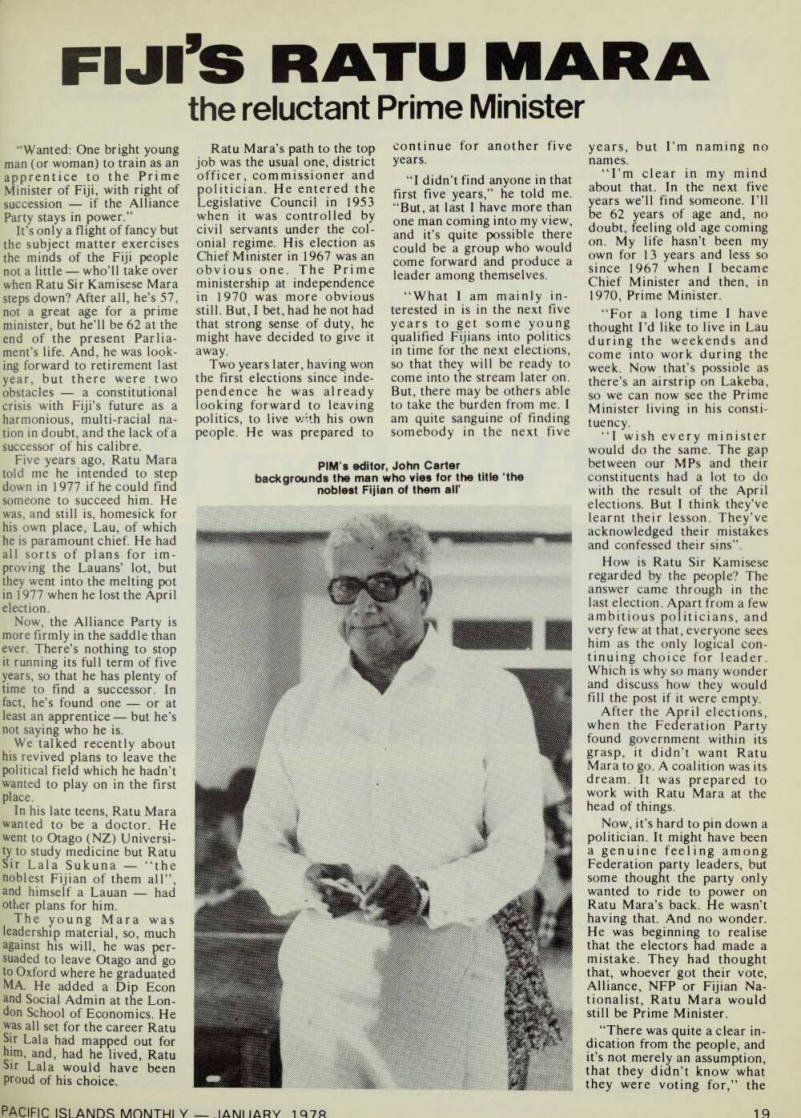
PIM’s editor, John Carter backgrounds the man who vies for the title ‘the noblest Fijian of them all’