Will Lord Indra Help
pp. 17-18 · Read in the full issue

The Burning North-West
Farmers and villagers in the “burning north-west” of Viti Levu, Fiji’s main island, faced disaster in November from the worst drought in 10 years. The sugar cane crop is threatened. Valuable stands of pine have gone up in smoke. The people pray for rain. Below, Sarita Singh tells the storv.
It is eight o’clock in the night. The tiny village is deathly quiet. Despite a full moon and a sky free of clouds and full of stars, there’s an eerie atmosphere all around.
A row of young pine, the border of a patch of land near a river bank, stand stiffly immobile like victims of a firing squad. No leaf quivers for there is no wind.
Near the river bank stand a group of mostly middle-aged Hindu women forming a protective arch to discourage any night prowlers or peeping toms while three of their colleagues prepare for the ritual in which two women assume the role of bullocks and another of a farmer and plough a piece of land to woo the Hindu raingod Lord Indra.
No men, not even little boys, are allowed to see the ritual. Photographs are
strictly forbidden.
Two huge women strip themselves naked. A rope cord is tied around each waist and harnessed to a steel plough normally pulled by a pair of bullocks. The third woman, fully clad, holds a whip. While they get ready the
group of women look down and pray, Suddenly, the “farmer” cracks her whip, and the sound is unusually harsh in the stillness of the night.
Somewhat startled, the women look up but quickly cast down their eyes meekly, The oldest among them ex claims that Lord Indra would be pleased while the rest pray with a new fervour, Meanwhile, urged on by the farmer and her whip the pair, slightly bent, sweat streaming down their faces, their large loose breasts hanging out, heave with all their might and manage to get going. They plough a 100 m row.
Hindu women are demurely clad by tradition. In spite of the humidity, they wear ankle length garb and consider ex posure of one’s body indecent, But Fiji’s rural Hindu women, fed up with the prolonged dry weather and its burdens, are putting aside shackles of tra dition to implore the Almigh ty for help, The drought, the worst in a decade, began nearly six months ago and has reached crisis point, seriously under mining the country’s main
sources of water. It has dried up wells, creeks and rivers.
Root catchment tanks have been unreplenished and re servoirs are hard put to supply people with enough water.
At Nadi, about 11.25 km from Fiji’s International Air port, the Vatutu intake has become dry because of the shrinking river level, and an emergency pumping station has been installed. The town’s other main source at Votualevu is operating nor mally but officials warn that similar steps would have to be taken there if the drought con tinues.
The worst hit areas are Fiji’s agricultural Western Division on the main island of Viti Levu and outer islands where water is the lifeblood.
Government has already spent $6O 000 in supplying water to drought-stricken families in the West.
Fiji’s Commissioner Western, Mr Narsi Raniga, told me they were spending $1 000 daily supplying emergency water to over 2 500 families. Twenty-five trucks, and several tugs and barges are being used for this.
Mr Raniga said they were
giving preferential treatment to schools, nursing stations and health centres while families pay 5c for 200 L of water.
Severe emergency water re strictions have been imposed in all urban centres in the West and other urban centres in Fiji where residents caught washing cars or watering gar dens can land themselves in court. But no one has so far been prosecuted.
Mr Raniga said that because of low water levels in reservoirs supply to high areas and outlying areas were auto matically curtailed. And to stop residents from hoarding
water unnecessarily inspec
tions are made at random and water pressures are reduced.
Housewives who, as part of conservation recycle water, complain that because they are not forewarned they are often left with no water or get caught unawares in the shower.
Rainfall during the past six months has been 40% less than normal. Average rain for the August-September-Oc tober period was an insignifi cant 11 5 mm.
The dry spell has left
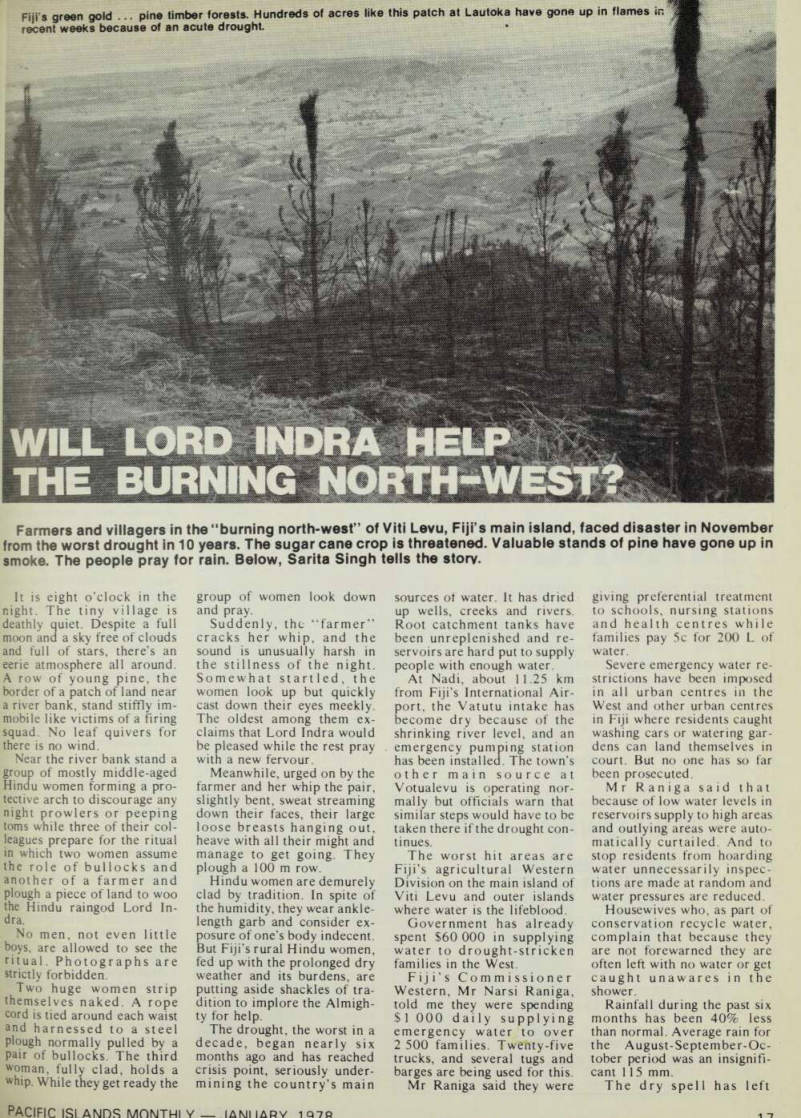
Fiji's green gold ... pine timber forests. Hundreds of acres like this patch at Lautoka have gone up in flames in recent weeks because of an acute drought
vegetable and flower gardens and nurseries dying. One Lautoka woman who has a passion for growing orchids showed me her garden which she tried to save by using water left from dishwashing.
For a while they struggled de sperately but died eventually carrying with them the work of many years.
The drought means a widespread crop reduction.
Vegetables are scarce in the markets and their quality is poor, but prices have shot up.
It will also hurt Fiji’s econ omy. According to Mr Raniga if the country does not have heavy rain soon, the canecrop for next season will be adver sely affected . Already hundreds of acres of cane which were planted early this year lie shrivelled and ruined.
Fiji does not have an irriga tion system or dams.
Dry weather conditions have led to an increasing number of fires which so far have destroyed several thou sand acres of mature cane.
The Fiji Sugar Corporation, concerned at the harmful effects of burnt cane on sugar
processing, has appealed to
farmers to increase their sup ply of high-quality green cane.
Fiji’s “green gold” the pine industry which the government hopes will even tually become one of the chief sources of revenue has been another target of fires. Alrea dy over 280 ha of the trees, which take years to mature, have been destroyed. The Pine Commission believes that these fires were the result of acts of arson and is keeping guards on constant duty to prevent further damage.
Major victims of the drought have been cattle which have to feed on poor grazing lands which stand de solate with grass that has dried up. Weak with under nourishment and lack of ade quate drinking water, many cattle are unable to withstand the heat and die.
Development projects and the building industry are also suffering from lack of water.
Town councils early this year had to abandon several civic projects because of insuffi cient water. Work on build ings under construction or near completion has had to halt until the present situation eases. Factories have had to reduce production but other wise have been unaffected.
Unconfirmed reports say that ships calling at the Lautoka wharf have had to replenish
their water tanks from elsewhere.
In the outer islands families at times have to make do with a pail of water for a week and resort to using coconut milk.
Yaqona parties, one of the most popular forms of enter tainment in the islands which do not have many recreational facilities, have had to stop, following bans by village heads. “Grog” preparation re quires a lot of water.
But there have been no
epidemics despite unhygienic
practices in the rural areas.
People often use the river for their drinking and cooking water, bathing, as a drinking base for their cattle, horses and goats, for washing clothes and bathing, as a toilet and for garbage disposal. The drought has left water in many rivers stagnant but many people fail to listen to officials who have been urging people to boil water before drinking it.
Simple folk in the villages explain that the drought is a punishment for the mounting sin of man. But Fiji’s meteorological department has a more realistic ex planation. It attributes this to dry anti-cyclonic weather conditions. There have been suggestions that the depart ment use chemicals to make rain. But the weathermen say that Fiji’s atmospheric condi tions are unsuitable for this.
However, recently, dark clouds have been looming over the West’s Evans Range.
Perhaps Lord Indra is about to answer the prayers of those Hindu women. More likely they are an indication that the present weather pat tern is about to be broken.
A downpour would literall> be Godsent from the heavens But Fiji’s farmers are rathei unhappy. Several told me that if they could somehow be sure that it would rain for a while and then stop they would no< worry. , . M The rainy season, whicn normally begins in November! is well known for the floodl caused in the rural areas washing away crops, roads and bridges, causing drainage and soil erosion problems am threatening cattle and home: in low-lying areas.
Superstitious farmers spemi sleepless nights in anticipation of a major flood. With theii simple logic they argue tha because of the drought thr country would have more die aster through a large flood.
Rain, or dry, they say the: will be the losers.