Ussr, The Pacific
pp. 15-16 · Read in the full issue
by Alexander Malyashkin
The USSR has two-thirds of its national territory in Asia and an outlet to the Pacific through its Far East region, which is equal in area and about equal in population to Australia. Here is a terminal of what is practically the only year-round Soviet sea route passing through the Indian Ocean to European Russia.
The Far East and Eastern Siberia are the sites of a large scale construction effort to tap more of the local natural resources, expand timber fell ing, woodworking, fishing and other industries, build new ports, modernise old ones, and so on. This is what creates, in our view, an objec tive premise for the Soviet Union’s broader involvement in the international division of labour in the Pacific area.
We know of quite a few in stances of an advanced nation using its advantages to further its own self-seeking ambitions
in disregard of other people’s interests. The Soviet Union is averse to this kind of relation ship.
It is not out of any time serving considerations that the USSR follows the princi ple of equal terms in its rela tions with other nations, big and small. This is our stra tegic policy reflecting the very essence of Soviet society. This principle rests, besides, on the assumption that the objectives pursued by Soviet foreign policy meet the interests of other nations as well as those of the USSR. These objectives are peace and greater interna tional security and co-op eration.
To bear me out, here is a case in point related to the region where this journal’s readers live. Following the proclamation of indepen dence of Papua New Guinea the Soviet Union recognised
the new state and established diplomatic relations with it.
Here is what the head of the Soviet government, Alexei Kosygin wrote on the occasion to Prime Minister Michael Somare: “Unswervingly committed to the policy of equal relations and friendship among all states regardless of their social systems, and guided by the principles of national self-determination, the Soviet Government proclaims its recognition of Papua New Guinea as a sovereign independent state and willingness to establish diplomatic relations with it.”
The USSR proves by deeds rather than words its earnest desire to have good relations with the countries of the region.
The name of my fellowcountryman Miklukho- Maklai has not been forgotten, I hope, although he lived a long time ago. It was way back in the last century that he, citing the case of the peopie of Oceania, proved the theory about the “superior” and “inferior” races to be utterly baseless. He was the first European to declare that the local natives were capable of setting up a state of their own.
This eminent Russian scientist acted on behalf of the rights of
the colonial peoples. But little could have been done for them at a time when men like Maklai were few and far be tween in face of the colonialist policies of entire states.
The USSR is developing its relations with Fiji, Tonga, Papua New Guinea and Western Samoa. The Soviet Union is keeping up the policy which has helped these states to obtain their independence.
This policy manifested itself in the promotion of political, economic and cultural con tacts on terms of bilateral co operation with due regard for the national interests of the countries of Oceania. The Soviet Union has no other ob jectives to pursue beyond those of maintaining normal relations with the newly inde pendent states. Nor does it look for any one-sided advan tages, for concessions, politi cal submission, or military bases.
In the field of trade with these countries, the Soviet Union confines itself to minor one-time deliveries of con sumer goods, There are some other com monly accepted contacts. The Soviet research vessel, the Dmitry Mendeleyev, recently made a 105-day cruise around the islands of Oceania. The
botanists of Papua New Guinea gave the Soviet scien tists much help in their excur sions into the jungles to study local vegetation. In their turn, Soviet botanists presented their foreign colleagues with Soviet floral collections.
Yet in spite of these com monly known facts, some peo ple in the West are circulating fabricated stories about a Soviet desire to draw the newly independent states of Oceania into “the Soviet sphere of influence”.
Western powers delib erately misrepresent the ob jectives of Soviet policy to obstruct the establishment and promotion of good rela tions between the USSR and the countries of Oceania and to maintain their own ex clusive influence in that region. But, according to the United Nations Charter, every independent state can develop its relations with other states as it sees fit. If the Western powers want to prevent the emergent states from indepen dently carrying out their own foreign policies, let them stop covering this up with fabrica tions distorting Soviet policy.
These fabrications about Soviet policy are, just as they have been on many occasions in the past, something which some people need in order to divert attention from their own deplorable acts and de signs.
The lot of Micronesia is a case in point. Under a com mitment undertaken before the UN, the United States, which has that territory under its trusteeship, should have laid the groundwork for the granting of independence to these Pacific Islands. What it is actually doing, as the facts indicate, is to prepare for an annexation of Micronesia to meet the Pentagon’s plans for using it as a bridgehead. In creased military construction on Tinian island has been re ported to be designed for the installation of American nuclear weapons on Tinian.
The US has likewise been re ported to be considering set ting up a base for its latest missile-carrying Trident sub marines in the vicinity of the Palau islands.
It is, however, up to the Micronesians themselves, not anybody else, to decide their homeland’s future. And this has to be decided in strict com Pi iance with the UN Charter and with the consent of the Security Council, and not at the discretion of the ad
ministering power.
The Soviet Union is con vinced of the need for the peo ple of Micronesia to exercise their inalienable right to self determination and indepen dence at the earliest oppor tunity, retaining Micronesia’s. territorial integrity, and it is. willing to contribute towards; such a settlement to the best oT its ability.
Military preparations will,, of course, continue to do tre mendous damage to mankind! unless the arms race is* brought to a halt. There are; many ways of doing so, andi one of them is by setting up( “peace zones”.
A number of Asian andl African nations have takeni the initiative in calling for the; Indian Ocean to be turnedf into such a zone. The Soviet) Union has all along beenr favourable to such an idea.
The way to solve pressing international problems, as the Soviet Union sees it, is not) through confrontation andt military preparations but) through a renunciation of the use of force, through respect for sovereignty and in violability of frontiers, non interference in internal affairs and through the development of economic, scientific and cultural co-operation on the basis of full equality and mutual advantage.
States with differing social systems can effectively co-op< erate, for instance, in the fielo of trade. In 1976 the volume of Soviet-Australian track reached its highest-ever poim of about $490 million ir value. There has likewise beer a notable increase in trade be; tween the USSR and Nev Zealand. This has been na only a quantitative im provement. Soviet product) are technologically not im ferior to Western, and cos less, as a rule, which is a cin cumstance of no mean imr portance for the troublec capitalist economies. It is es sential to form a proper judge ment of the prospects for thr economic development of ouj countries and their role in thr international division o: labour not only today bm tomorrow as well.
The USSR has, on balano good relations with AustraK and New Zealand in this are Contacts are developing alou other lines as well.
But they could be still td tter if they were not handicas ped by certain campaigns an
certain pronouncements '
some officials.
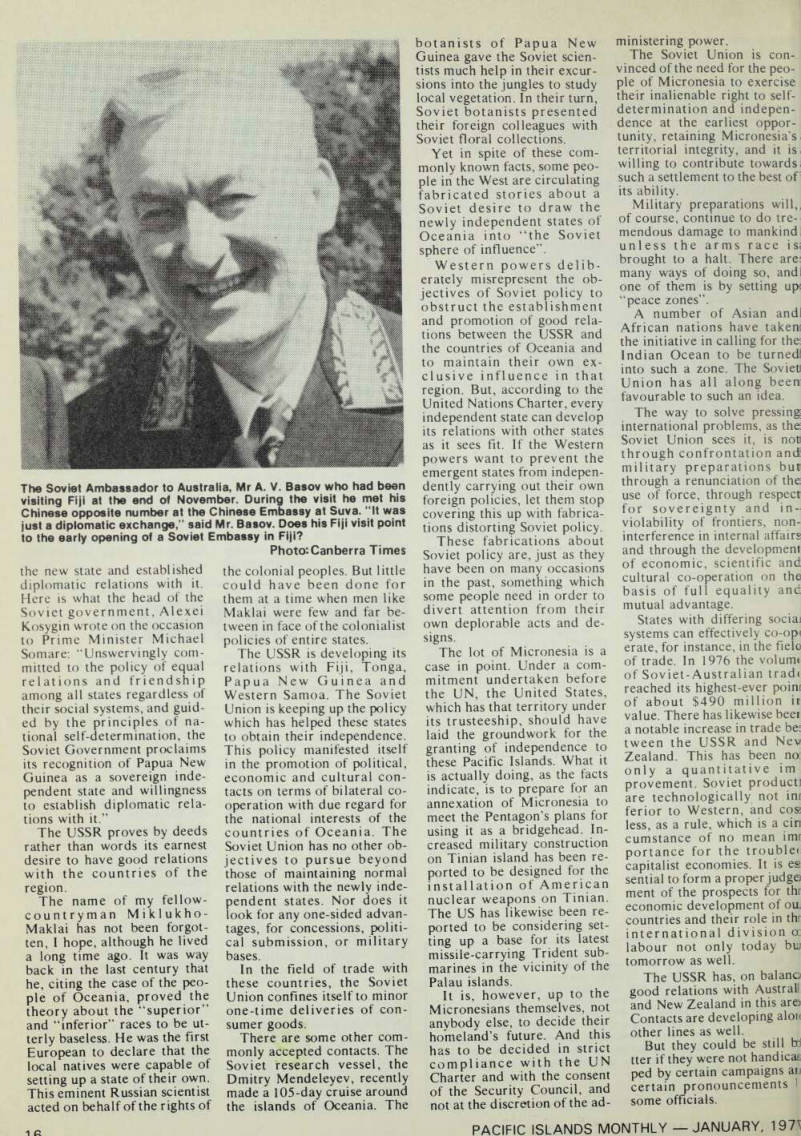
The Soviet Ambassador to Australia, Mr A. V. Basov who had been visiting Fiji at the end of November. During the visit he met his Chinese opposite number at the Chinese Embassy at Suva. ‘‘lt was just a diplomatic exchange,” said Mr. Basov. Does his Fiji visit point to the early opening of a Soviet Embassy in Fiji?
Photo:Canberra Times