Australia, The Pacific
pp. 14-15 · Read in the full issue
by Senator John W Knight
The South Pacific has emerged, relatively suddenly, as an important factor in Australian foreign policy.
In 1972, a Liberal foreign minister made a major foreign policy statement which emphasised the South Pacific region as one in which Australia was “developing special initiatives”. In the same year, the Leader of the Labor Opposition referred to Australia as “the natural leader of the South Pacific”, though this statement was re sented by many in the South Pacific as suggesting many of the least-acceptable of tradi tional Australian attitudes about the region. However, it was significant that the South Pacific was rated important enough to be dealt with in an election policy speech. Thus, by 1972, the process of change was evident and it has accele rated since.
By the 19605, Australia’s relationship with the Islands of the South Pacific was fre quently expressed in terms of outmoded perceptions or cliches.
The Evatt initiatives of the 1940 s most notably the Canberra (ANZAC) Agree ment of 1944 and the estab lishment of the South Pacific Commission in 1947 had provided a basis for con tinuing development. But this was quickly dissipated in post war policies which limited the effectiveness of the South Pacific Commission, except for some aspects of its social and economic role.
This is, no doubt, partly ex plained by the fact that even by 1970 only two of the Island territories of the South Pacific had become independent.
These were Western Samoa in 1962 (formerly a New Zea land territory) and Nauru in 1 968 (previously admin istered by Australia).
When considering why the South Pacific matters to Australia and in recent years it has come to matter much more than previously the end of colonialism and the independence of the nations of the region is undoubtedly one of the major factors. In re cent years, Australia has had
to deal, not with just a few col onial metropolitan powers, but with a large number of new and assertive nations.
Despite the problems about Mr/Whitlam’s statement in 1972, it was remarkable that the South Pacific should have been mentioned with such emphasis in an election policy speech by an Australian political leader. To that ex tent the statement also mark ed the process of change by then under way.
Since that time there has been an enormous increase in Australia’s aid to the South Pacific to an extent that is sometimes resented, or at least questioned, in Asia.
Diplomatic relations have ex panded in Fiji, Papua New Guinea, the Solomon Islands, Nauru and Western Samoa, so that Australia now has an ex tensive official, trade and in formation network in the region. Ministerial visits to the region have increased and there has been an Australian parliamentary delegation to the region this year.
The Australian Senate’s Foreign Affairs and Defence Committee is now completing an inquiry and will soon re port to the Australian Parlia ment on Australia’s role in the South Pacific.
Just as the end of the col onial era is one obvious and
traditionally accepted
reason for Australia’s growing awareness of the region, there are other similar traditional and accepted reasons. Nor should it be overlooked that the move to independence in the region had particular relevance for Australia because of its own direct in volvement with Nauru and Papua New Guinea.
The other significant fac tors include Australia’s subs tantial commercial and finan cial interests in the region which some prefer to classify as instances of Australia’s neo-colonial attitude. There is the strategic relevance of the region of which Australia was made particularly aware dur ing World War 11. Elements of this concept tend to remain, but changes in strategic con cepts and weapons have made
it somewhat less relevant in this respect.
Recently, some of these fac tors have merged with the ex pansion of Japanese trading and financial activities and the display of increasing in terest by China and the Soviet Union in the South Pacific, in commercial, economic and
diplomatic terms.
All these developments help explain why the South Pacific is perceived to be of significance to Australia. All are valid reasons in ex plaining increasing Australian involvement in the region.
They are the most obvious factors, but there are others which are generally overlook ed and which are often of more fundamental sig nificance.
Perhaps one of the most sig nificant is the changing per ceptions of the ANZUS alliance, so long considered to be the “cornerstone” of Australian security. ANZUS resulted from the settlement with Japan after World War 11. It was, for example, not an “anti-communist” alliance such as SEATO or CENTO, though it is a general mutual defence pact.
Given the changed relation ships between the United States and Japan and China there are real questions about its relevance. In any case it is only one element in the ex tensive relationship between the three allies.
It is of particular sig nificance that at the most re
cent ANZUS Council meet ing, in New Zealand, there seemed to be more emphasis on economic issues and their importance to regional stability, than on defence co operation.
For example, the com munique after the meeting on July 28 said; “The Ministers recognised that the health of the economies of the three partners is of concern to each, for it affects their capacity to play the responsive and re sponsible role that world andl regional circumstances de mand of them and which is their common desire. They, therefore agreed that they< would consider their econ omic relationships and mutual problems within this larger framework.”
The ANZUS Council alsc welcomed the achievements of the southeast Asian coun tries of ASEAN in promoting economic and social develop ' ment in their region. T acknowledged that the three ANZUS allies share ”a special interest in the Asia/Pacifit region”. They went on to welcome continuing growth oc regional institutions in th< South Pacific and their com tribution to the welfare oc countries in the area.
The ANZUS Council wem so far as to comment thatr “South Pacific countries could expect continued sup: port from the ANZU partners on a bilateral an«i regional basis. Ministers look! ed forward to co-operatio(
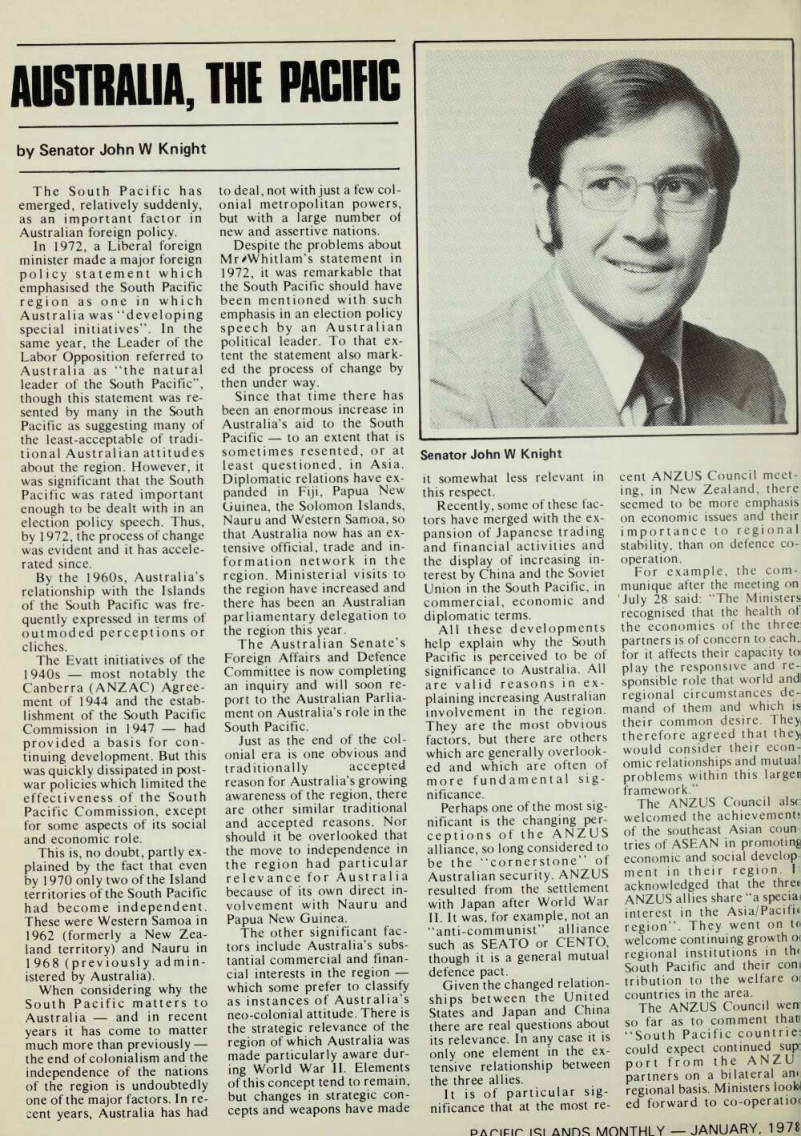
Senator John W Knight
with South Pacific nations in new areas such as the man agement and development of marine resources.”
It seems clear from such statements that the ANZUS partners are now looking to ANZUS as a more important regional instrument to be as sociated especially with econ omic initiatives and the wider regional role of the members of the pact.
The ANZUS communique has added significance in that the South Pacific Forum had on its agenda for its August meeting in Port Moresby the question of possible co-op eration between ASEAN and the Forum. The Forum com munique said the members had “agreed that informal contact on matters of common interest between the Forum and ASEAN should be initi ated." However, at the Forum some caution was evident about the possible future role of the United States in the area. Action to establish a regional fisheries agency and 200-mile sea resource zones resulted in a formulation that
effectively excluded
American Samoa and the United States. It seems sig nificant that no special effort seems to have been made to overcome this anomaly.
In an address to the Forum the Australian Prime Minister urged that Forum members extend their contacts with other international organ isations. It is of interest that Mr Fraser expressed caution about the prospect of any ma jor power dominating the region or competition be tween powers for influence in the area.
Any period of fundamental change carries with it uncer tainties. This applies to the role of the United States in the South Pacific and of the sig nificance of the ANZUS alliance and its potential role in the region.
On the question of its defence significance it is in teresting that the Australian Defence Minister has recently commented on the uncertainty
of reliance on alliances or more powerful friends.
What is obvious is that at titudes to ANZUS are chang ing. This is undoubtedly fun damental to Australia’s in creasing concern with the future of the South Pacific region and Australia’s role in it.
The second major factor, which is often overlooked, is the concept of a “new interna tional economic order”. In the so-called “north-south dialogue” context Australia (and New Zealand) are as sociated with the “north”, while the South Pacific coun tries are linked with the “south”.
The components of propos ed international economic change are, however, of mutual interest and concern; for example, the transfer of resources and technology, the operations of transnational corporations and interna tional development assistance programs.
It is also worth recalling that the ANZUS communique in July indicated that the three allies reviewed develop ments, including “considera tion of the global economic situation” and agreed that “international access to markets and resources was a factor of continuing im portance to global and regional stability”.
In future negotiations on in ternational economic issues Australia’s relations with its South Pacific neighbours could be of increasing sig nificance to Australia. We may be on different sides of many such discussions. A close understanding will be essential if Australia’s rela tions with its neighbours are not to be at times jeopardised in such circumstances.
Friendly and co-operative links with South Pacific coun tries might also help smooth Australia’s difficult path through these negotiations with more distant and, perhaps, less sympathetic na tions.
Thus, along with the tradi-
Australian is taking a whole new look at its relations with the South Pacific. John W, Knight, former member of the Australian office in Fiji and, as a senator, a member of the Australian Senate Standing Committee on Foreign Affairs and Defence, backgrounds the developing new approach. The Soviet Union is also taking a closer look at the Islands and 1978 should see a link developing between the USSR and some Island nations. Soviet journalist Alexander Malyashkin of the Novesti Press Agency presents the Soviet viewpoint exclusively for PIM.
tional factors which have given rise to growing Australian interest in its South Pacific neighbourhood, there are fundamental new ele ments.
These relate to the changing nature of the ANZUS alliance, and to changing rela tionships with Japan, China and the Soviet Union. The concept of a “new interna tional economic order’’, is relevant to Australia’s com mercial, financial and tourist interests in the South Pacific area.
While there have been tra ditional developments as sociated with Australia’s in creasing interest and concern diplomatic, political, sup port for the South Pacific Forum and changes in the South Pacific Commission, aid there have also been significant new manifesta tions. These have been sug gested in the recent ANZUS communique, the South Pacific Forum’s interest in ASEAN and a clear intent by Australian governments to take the South Pacific seriously.
No doubt all of these have been given added impetus by the increasing assertiveness of
the South Pacific countries themselves. In recent years they have expanded their diplomatic ties and not al ways in the same directions as in the case of China. Their trading horizons have widen ed and they have shown their determination to control their own destinies as in the re cent Fiji dock strike.
All of these have helped ac celerate changed attitudes in Australia. These changes are part of Australia’s adjustment to complex new developments in the international situation.
They affect issues as funda mental to Australia’s tradi tional outlook as ANZUS and as vexed as the concept of a future world economic system.
Australia’s new approach to its relations with the South Pacific is part of its changing attitudes and assumptions about its own foreign policy and the international situ ation.
The South Pacific is more important to Australia in that context and may be a “weather vane’’ for the future development of Australia’s in ternational policies on some of the most essential issues facing the Asian and Pacific region.