Preview:
pp. 10-13 · Read in the full issue
What 1978 Holds
For The Islands
At the start of another year, 1978, PIM studies the prospects, good or ill, for the Islands of the South Pacific. Oui correspondents on the ground read the signs and came up with forecasts which, in the main, point to a busy year for some countries, financial improvements for the odd one and, most important happening of all for three territories independence. At the end of 1978, only the French territories, the Condominium of the New Hebrides Tokelau and American Samoa with little Pitcairn away on her own and the United States Trust Territories or the other side of the Equator will be awaiting independence or self-government. As each country becomes master in its own house and free to look outside the area for new friends, the big powers will seek to develop their interests and friendships in the Islands. Australia and the Soviet Union, in two exclusive articles, spell oui their hopes and plans for the Islands.
Solomons,
Gilberts And
Tovaio
For the Solomon Islands, the Gilberts and Tuvalu, 1978 is the Year of Decision. All three will, with the blessings of Britain and some monetary gifts, declare their indepen dence the Gilberts in June, the Solomons on July 7 and Tuvalu on October 1.
The year is expected to con tain some anxious moments for the Gilbertese who have yet to clarify their relations with the Banabans and the future of Banaba, more widely known as Ocean Island.
What must be regarded as a breakthrough, more for the Banabans than for the Gilber tese the latter having for a long time set their faces against the Banabans’ claim for an independent Ocean Is land was achieved in November.
The two parties got together on Tarawa and, eventually, reached agreement on a referendum to decide Ocean Island’s future.
The referendum, with Bri tain expected to foot the bill, will be taken around the mid dle of 1978. Both the Gilber tese and the Banabans will be asked to decide what, in effect, is history “Do you feel that Ocean Island was part of the Gilberts Colony?”
To the outsider, it would seem to be a foregone conclu sion because there are more Gilbertese than Banabans.
Accordint to Banaban Mr Thomas Teai, “Their verdict will determine whether the is land remains with the Gilberts, or becomes sepa rated so that the Banabans can
negotiate a constitutional as sociation with Fiji.”
At the same time, Britain will be asked in the event of a “Yes” vote to increase Banaban phosphate revenue from Ocean Island to 75% of the phosphate royalties. At present, the Banabans’ share is 15% from most mining leases and 50% from mining on re
cently-negotiated leases.
Which must mean a loss of revenue for the Gilberts.
The Gilbertese would be allowed to fish in an indepen dent Ocean Island’s economic zone and Gilbertese labour would continue to be used on the island.
If the Banabans lose the vote, they will retain land ownership rights on the is land, have dual citizenship with a representative in the Gilberts’ House of Assembly and the British Phosphate Commissioners’ reserve fund will be split between the Gilberts Government and the Council of Leaders on Rabi Island in Fiji, which is now the Banabans’ home.
Also the Gilberts will retain its present share of the phosphate royalties until min ing finishes in the next couple of years.
Apart from all this, Britain, Australia and New Zealand, partners in the BPC will be asked to provide money for the restoration of the worked out land on Ocean Island.
All this will cast a shadow over the Gilbertese celebra tions of independence.
There seems to be little else to give the Gilbertese cause to rejoice in 1978. They will still be saddened over the tragedy of the cholera outbreak which took the lives of 18 people.
One thing is clear. Much of the year will be taken up with work to clean up areas of pollution, on beaches, in
lagoons, in villages, to ensure there is no return of cholera.
Shipping will continue to be a problem, as it is in many parts of the South Pacific where rising freight rates, caused mainly by waterfront workers’ strikes and wage rise demands in exporting coun tries, force up living costs in places like Tarawa which has become so dependent on im
ported goods.
Much of what the Gilberts can expect for 1978 seems to be in the pipeline for Tuvalu, until two years ago the Ellice Islands section of the Gilbert and Ellice Islands Colony.
The Tuvaluans, all 7 000 odd of them, will let their hair down on October 1, Indepen dence Day, known at present as Tuvalu Day because on that day in 1975 they were sepa rated from the Gilberts.
On October 1 they will become an independent na tion within the Com monwealth.
One of their first important dates in 1978 will be a date in February when their leaders hope to go to London to dis cuss terms for independence.
When the Tuvaluans asked Britain for severance from the Gilberts, they were warned that they would get little of anything that was going, that it wouldn’t be a case of dividing up the joint assets. As a matter of fact, all Tuvalu got out of the Gilberts was one small ship.
She’ll hope for more from Britain with the settlement terms, but, as Chief Minister Toalipi Lauti pointed out re cently, Tuvalu is starting out “with not a single cent in the bank”. It should be a year of
promise, however, especially
if the South Pacific Fisheries Agency really gets going.
With a 200-mile economic zone around her perimeter,
Tuvalu should be able to reap a harvest from the seas, not in fish but in the money she could get to permit the distanii fishing nations to operate in Tuvaluan waters.
Australia is also footing a bill to the tune of $1.36 million for a new wharf a Funafuti, the capital. The size of a couple of football fields; the main islet of the atolll Fongafale, is becoming buill up, with a new Governmem House, government offices, i bulk store for the co-op and * new church building, not to mention a saloon liquor bar.
So, there’s cause for optimi ism in 1978 with few dull moi ments.
And, how about the thin and biggest of the tri< celebrating independence ii 1978, the Solomons? July will be a real day of rejoicing now that the future is clear s<; far as London is concerned.
All obstacles to an agree ment with Britain have bee: cleared with the Septembe conference in London whic: resulted in a generous gran from Britain which, alonr with the grants alreadl scheduled, will bring the toU handout from Britain over thi next four years to $44. million and none of it hs to be repaid.
There are those in Honiaij who believe that Britain!
generosity was dependent o
the Solomons giving way o the business of citizenship ft non-Solomon Islanders aft 1
independence.
The position of the larg Gilbertese and Chinese com munity in the Solomons is as sured along with that of tl!
Europeans. They will all V
guaranteed citizenshij
They’re in no danger of losii their vote and will not requii
work permits.
Land occupied by Gilber tese has also been an obstacle to agreement, but that too has been removed with the Gilbertese, who have title to land, being able to hold on to it indefinitely. This conces sion does not apply to land ac quired in the future. Other non-Solomon Islanders with land have to change their titles to a fixed term of 75 years, which will be the maxi mum period for leaseholds.
Politically, the government doesn’t seem to have many in ternal problems ahead. Trade union pressure has weakened in that field and Chief Minister Peter Kenilorea has grown in stature. He seems to be firmly in the saddle and is handling the job well.
After independence, there may be some embarrassing overtures from their relations in the North Solomons. Some of the Bougainvilleans are thinking in terms of a closer relationship with the Solomons even secession from Papua New Guinea and union with the Solomons. The Shortland people would welcome it, no doubt, but the Solomon leaders are not likely to respond, not even if federalism was proposed.
On the commercial front, the Solomons should have cause for satisfaction. It’s highly likely they’ll have a favourable balance of trade with growing fish and timber exports and, the newcomer, palm oil which, although in its infancy, has already grossed more than a million dollars in exports.
Western
Samoa
Economically speaking,
Felise Va’a writes, 1975 was one of Western Samoa’s worst years with shrinking exports and an almost-unbearable cost-of-living rise. By 1977, a major recovery was on the way, thanks largely to giant leaps in cocoa and copra prices. Prognostications for 1978 are even better, the 1978 Budget reveals. It contains all the seeds of optimism, with exports, foreign reserves and money supply looking very much brighter.
Estimated revenue for 1978 totals $22.2 million which represents an 18.4% increase over the $18.75 million esti mated for 1977. Of the esti
mated revenue, $10.92 million or 49.2% will be from Customs and $3.25 million or 14.6% from Inland Revenue.
Import duties will yield about $8.35 million while sales of li quor will gross about $2.15 million.
Ordinary current ex penditure is estimated at $17.7 million and statutory expenditure at $1.6 million.
This will leave an operating surplus of $2.9 million.
In addition to this surplus, government expects non-re current revenue and foreign cash grants of $2BO 000 and National Development Loans of $2.8 million. Development expenditure of $5.9 million will be financed from these leaving an estimated cash surplus for 1978 of $36 000.
But other development finance is also available from other sources; $8.6 million from Foreign Capital Project Assistance, and $6.1 million from soft term loans raised through international lending institutions and bilaterally.
Thus, total estimated development project ex penditure in 1978 is $20.6 million, an increase of over $5 million or 33% over the $15.5 million development ex penditure estimated for 1977.
Vaovasamanaia Filipo, Minister of Finance, says the 1 978 development ex penditure represents a 50-fold increase over the last 10-year period. For example, for the entire First Five Year Development Plan 1966-1970, development ex penditure over five years was WS$2 million or $4OO 000 a year.
The minister’s optimistic forecasts also embrace export earnings (more than $1 1 million in 1977), an increase in foreign reserves, develop ment investment in the public sector and cocoa and copra production.
Aid coming from Australia, New Zealand, the Com monwealth and the EEC is also expected to boost the economy and will be worth around $8.6 million, at least, in 1978, not to mention the $6.1 million soft term loans to be raised through interna tional lending institutions and bilaterally.
All in all, Western Samoa can look with confidence to 197 8. Prime Minister Tupuola Efi and his ministers will be pulling all stops out to make it a good year. After all, they’ll be facing the electors again in 1979.
ing sugar production was beginning to pay off and sugar output is expected to hit 330 000 tons, the highest since the late 19605, and should go higher in 1978 as a massive $2O million expansion of cane-growing areas and a $lO million sugar mill modernisa tion programme advances.
Worries about how far the government should go in financially propping up a fail ing gold mine on which more than 7 000 people are depen dent, and the poor return being received by thousands of copra producers, who are also partly dependent on direct government aid, will be among the big questions of 1978.
So will an alarming increase in Fiji’s trade deficit, as the cost of imports soars at an inf lated rate high above the na tion’s capacity to increase its export earnings.
Tourism, whose growth sank to zero in 1976 after hea dy 20% to 30% growth rates in the 1960 s and early 19705, began a slow recovery in 1977 that is expected to continue at a 3-4% rate in 1978.
But many hotels are in financial trouble due to low occupancy rates and no one is willing to think about build ing new ones until trade picks up to what it once was.
Foreign investors, those already in Fiji and those thinking of starting up there, heaved a sign of relief when the Alliance Party got back to power convincingly last Sep tember having lost control of parliament to the Opposition National Federation Party in April.
The political uncertainty that reigned for most of 1977 caused the cancellation or postponement of many plans for expanding existing indus-
Fiji
What’s in store for Fiji this year now that the dominion is settling down after the politi cal upsurge of 1977 with its two general elections?
Robert Keith-Reid looked in his crystal ball in Suva.
This is what he saw; It will be at least another 12 months before the country’s ability to earn a living shows any sign of a matching per formance, according to gloomy remarks in the Fiji Government’s Economic Planning Office.
The planners are warning that like 1977, 1978 will be a time when Fiji’s economy will continue to wallow listlessly in the wake of the great world recession that began afflicting it in 1975/76.
While the world at large seems to be recovering from bad times the Fiji planners say, it takes 12 to 18 months before the return of prosperity for big countries begins to fill the sails of small third-world countries like Fiji.
Last year was a year when the number of Fiji people in regular paid jobs fell by several thousands as employers cut their work forces by numbers corres ponding with the fall in the amount of business around.
Practically no new major in vestment of note came from private enterprise, and Fiji’s second, third and fourth most important industries, tourism, gold and copra continued to languish or decline.
The only significant re storation of fortunes occurred in the first industry, sugar, where by the end of the year it was evident that a big govern ment investment in revitalis
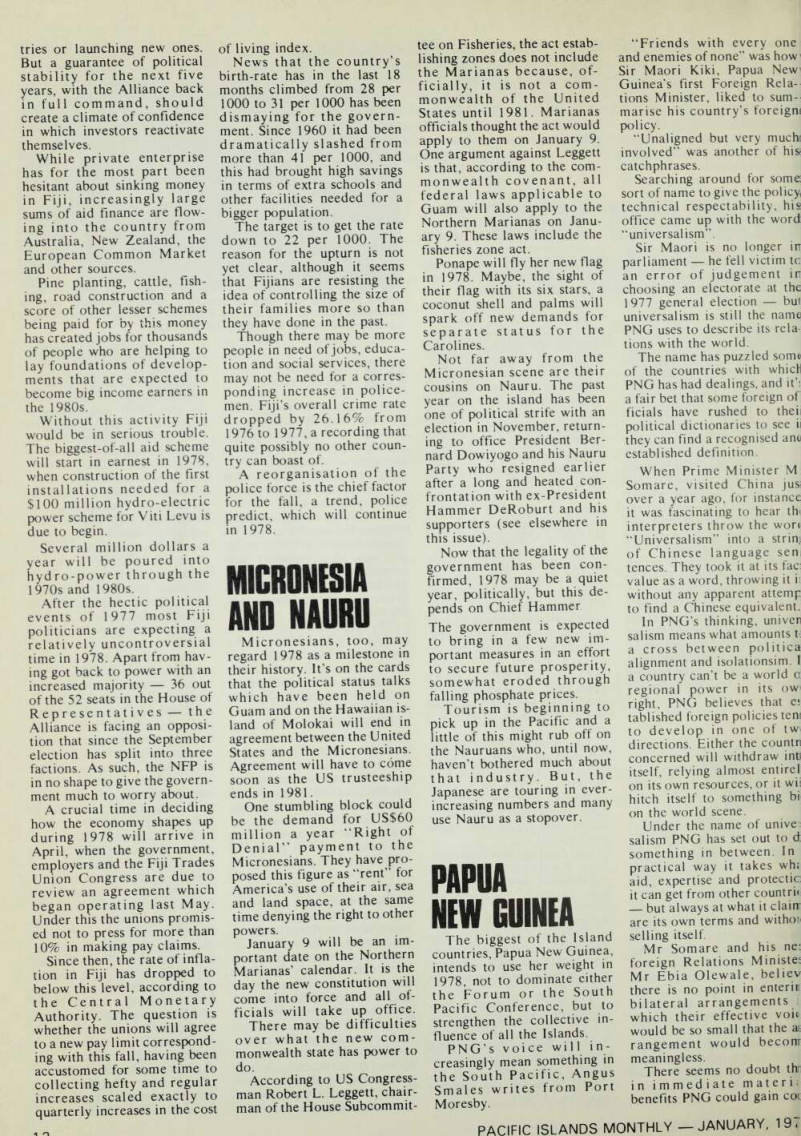
These buildings will help to ensure a healthy economy for the Solomons in 1978. They are the Solomon Taiyo fishing company’s cannery and freezer at Tulagi, the old capital.
tries or launching new ones.
But a guarantee of political stability for the next five years, with the Alliance back in full command, should create a climate of confidence in which investors reactivate themselves.
While private enterprise has for the most part been hesitant about sinking money in Fiji, increasingly large sums of aid finance are flow ing into the country from Australia, New Zealand, the European Common Market and other sources.
Pine planting, cattle, fish ing, road construction and a score of other lesser schemes being paid for by this money has created jobs for thousands of people who are helping to lay foundations of develop ments that are expected to become big income earners in the 1980s.
Without this activity Fiji would be in serious trouble.
The biggest-of-all aid scheme will start in earnest in 1978, when construction of the first installations needed for a $100 million hydro-electric power scheme for Viti Levu is due to begin.
Several million dollars a year will be poured into hydro-power through the 1970s and 1980s.
After the hectic political events of 1977 most Fiji
politicians are expecting a
relatively uncontroversial time in 1978. Apart from hav ing got back to power with an increased majority — 36 out of the 52 seats in the House of Representatives — the Alliance is facing an opposi tion that since the September election has split into three factions. As such, the NFP is in no shape to give the govern ment much to worry about.
A crucial time in deciding how the economy shapes up during 1978 will arrive in April, when the government, employers and the Fiji Trades Union Congress are due to review an agreement which began operating last May.
Under this the unions promis ed not to press for more than 10% in making pay claims.
Since then, the rate of infla tion in Fiji has dropped to below this level, according to the Central Monetary Authority. The question is whether the unions will agree to a new pay limit correspond ing with this fall, having been accustomed for some time to collecting hefty and regular increases scaled exactly to quarterly increases in the cost
of living index.
News that the country’s birth-rate has in the last 18 months climbed from 28 per 1000 to 31 per 1000 has been dismaying for the govern ment. Since 1960 it had been dramatically slashed from more than 41 per 1000, and this had brought high savings in terms of extra schools and other facilities needed for a bigger population.
The target is to get the rate down to 22 per 1000. The reason for the upturn is not yet clear, although it seems that Fijians are resisting the idea of controlling the size of their families more so than they have done in the past.
Though there may be more people in need of jobs, educa tion and social services, there may not be need for a corres ponding increase in police men. Fiji’s overall crime rate dropped by 26.16% from 1976 to 1977, a recording that quite possibly no other coun try can boast of.
A reorganisation of the police force is the chief factor for the fall, a trend, police predict, which will continue in 1978.
Micronesia
And Nauru
Micronesians, too, may regard 1978 as a milestone in their history. It’s on the cards that the political status talks which have been held on Guam and on the Hawaiian is land of Molokai will end in agreement between the United States and the Micronesians.
Agreement will have to come soon as the US trusteeship ends in 1981.
One stumbling block could be the demand for US$6O million a year “Right of Denial’’ payment to the Micronesians. They have pro posed this figure as “rent” for America’s use of their air, sea and land space, at the same time denying the right to other powers.
January 9 will be an im portant date on the Northern Marianas’ calendar. It is the day the new constitution will come into force and all of ficials will take up office.
There may be difficulties over what the new com monwealth state has power to do.
According to US Congress man Robert L. Leggett, chair man of the House Subcommit
tee on Fisheries, the act estab lishing zones does not include the Marianas because, of ficially, it is not a com monwealth of the United States until 1981. Marianas officials thought the act would apply to them on January 9.
One argument against Leggett is that, according to the com monwealth covenant, all federal laws applicable to Guam will also apply to the Northern Marianas on Janu ary 9. These laws include the fisheries zone act.
Ponape will fly her new flag in 1978. Maybe, the sight of their flag with its six stars, a coconut shell and palms will spark off new demands for separate status for the Carolines.
Not far away from the Micronesian scene are their cousins on Nauru. The past year on the island has been one of political strife with an election in November, return ing to office President Ber nard Dowiyogo and his Nauru Party who resigned earlier after a long and heated con frontation with ex-President Hammer Deßoburt and his supporters (see elsewhere in this issue).
Now that the legality of the government has been con firmed, 1978 may be a quiet year, politically, but this de pends on Chief Hammer The government is expected to bring in a few new im portant measures in an effort to secure future prosperity, somewhat eroded through falling phosphate prices.
Tourism is beginning to pick up in the Pacific and a little of this might rub off on the Nauruans who, until now, haven’t bothered much about that industry. But, the Japanese are touring in ever increasing numbers and many use Nauru as a stopover.
Papua
New Guinea
The biggest of the Island countries, Papua New Guinea, intends to use her weight in 1978, not to dominate either the Forum or the South Pacific Conference, but to strengthen the collective in fluence of all the Islands.
PNG’s voice will in creasingly mean something in the South Pacific, Angus Smales writes from Port Moresby.
“Friends with every one and enemies of none” was how' Sir Maori Kiki, Papua Guinea's first Foreign Rela tions Minister, liked to sum marise his country’s foreign! policy.
“Unaligned but very muchr involved” was another of his catchphrases.
Searching around for some: sort of name to give the policy technical respectability, his office came up with the word “universalism”.
Sir Maori is no longer irr parliament he fell victim tc an error of judgement in choosing an electorate at the 1977 general election but universalism is still the name PNG uses to describe its rela tions with the world.
The name has puzzled some of the countries with whicH PNG has had dealings, and if i a fair bet that some foreign of ficials have rushed to theii political dictionaries to see ii they can find a recognised ano established definition.
When Prime Minister M Somare, visited China jus< over a year ago, for instance it was fascinating to hear thi interpreters throw the wore “Universalism” into a string of Chinese language sem tences. They took it at its fac: value as a word, throwing it in without any apparent attemp to find a Chinese equivalent.
In PNG’s thinking, univen salism means what amounts t: a cross between politics alignment and isolationsim. 1 a country can’t be a world a regional power in its ow\ right, PNG believes that e« tablished foreign policies tern to develop in one of tw\ directions. Either the countn concerned will withdraw inti itself, relying almost entirel on its own resources, or it wii hitch itself to something bi< on the world scene.
Under the name of unive : salism PNG has set out to d something in between. In practical way it takes whr aid, expertise and protectio it can get from other countrir but always at what it claim are its own terms and withoi* selling itself.
Mr Somare and his ne; foreign Relations Minister Mr Ebia Olewale, believ there is no point in enterir bilateral arrangements i which their effective voh would be so small that the as rangement would becorrr meaningless.
There seems no doubt thi in immediate materi: benefits PNG could gain coc
siderably by entering into some alignments or by allow ing itself to be internationally wooed, but in a deliberate way the country is steering away from such involvements. It could be argued from all this that PNG has shown more ethics, more realism and more plain commonsense than any other small country trying to take its place in the world.
True enough, PNG can't be knocked for the manner in which it has entered into its international relations and obligations. But at the same time it would be naive to believe that PNG has hit on a new and more honest formula than anyone else, because of certain important qualifica tions.
For the truth is that PNG is far more aligned than many of its leaders might like to think, although the alignment may not be written in so many words.
Circumstances alone have played a big part in this pro cess. Only a few weeks ago Mr Somare was asked at a press conference in Port Moresby if he would like to see Japan give his country direct material aid without any strings— the sort of aid which Australia extends and which fills a big part of the PNG budget.
Mr Somare dismissed the question as academic. On the one hand, he said, Australia and PNG had “ a special sort of relationship". On the other, countries with their own poli cies and prioritiy com mitments couldn’t be ex pected to hand out aid with out some sort of attachments, even if the net result were to the benefit of PNG and at PNG’s terms.
The situation described by Mr Somare highlights one of the hidden alignments under which PNG operates. They are not recognised as align ments simply because they grew naturally and because they contain no threat to PNG's national freedoms and autonomy. This is not a whitewash of Australian col onial involvement in PNG for the greater part of the century, but it is a matter of fact de scription of the current situ ation.
The circumstances of PNG's background, its geographical location, its natural food resources, the systems which it inherited, the systems which it developed, and the political climate of its independence all helped to es
tablish fertile ground for what PNG now calls universalism.
How universalist can you be if you have outside countries squabbling over you? Or if you are so poor that you have to sell yourself for food and other essentials?
Universalism has grown fairly naturally from a more significant aspect of PNG policies the belief that stability is essential through a formalised type of govern ment and administration, the safeguards against power hungry leaders and the re cognition of civil rule by the people as a whole.
This outlook, coupled with the earlier background, cre ated universalism. If any real problem faces PNG in 1978, and this could affect its inter national relations eventually as well as its home affairs, then the problem lies in effi ciencies and abilities rather than in attitudes and methods.
The present government re cognises the need for proper administration based on what the people want, and so do most of the factions that could conceivably have anything to do with government now or in the immediate future.
There is no cult of the per son in leadership ranks, the economy is structured re sponsibly, agreements and ar rangements are honoured at home and overseas, and power is distributed with workable checks and balances.
These attitudes and methods are firmly estab lished, many of them enshrin ed in the constitution. The possible weakness is the extent to which the young country can effectively administer and maintain the machine which it agrees is necessary and cor rect. The approach to national management is impeccable the ability to carry it out has sometimes faltered.
In general, PNG’s prospects for 1978 of remaining stable at home and reliable in inter national affairs are far greater than many critics believed possibly a few years ago, and there are indications that de spite universalism PNG’s voice will increasingly mean something in the South Pacific.
Much is made of the sugges tion that PNG is an outpost of south-east Asia, but PNG it self does not accept this although its only land border is with Indonesia.
PNG sees itself as essen tially a South Pacific country.
with links in south-east Asia and with the Asian Pacific seaboard as a whole.
Mr Somare describes his country as “a bridge between Asia and the Pacific”. In this respect he has frequently spoken of the useful role which he believes PNG can play by acting as a bridging nation in ideas and exchanges, particularly between the South Pacific Forum and the association of south-east Asian nations.
But he sees the Pacific end of the link as his country’s sphere or real influence and the Pacific Islanders as his na tional brothers.
The Asian end is an area for co-operation and friendship the practical test of univer salism.
New Hebrides
Nineteen seventy-seven be queathed to the New Hebrides a lameduck Representative
Assembly produced by the
non-elections of November 29, and a new political forma tion calling itself the People’s Provisional Government, ex isting alongside the already
labyrinthine governmental
structure of the Anglo-French condominium.
The new “government” was declared by the Vanuaaku Party, which, despite its ma jority support in the 1975 election, decided to boycott the November 29 poll. The party claims that no British or French government officers, no expatriate and no one who works for private business firms can enter its territorial zones without a permit from the “government’s” headquar ters.
Thus, all ingredients are there for continued tension in 1978.
It will require all the wisdom and restraint of the administering powers, and of the local political parties, to avoid violent confrontations in the coming year.
Tonga
One would have to be a seer to forecast what will be in store for Tonga this year. But one thing is certain. The kingdom will know in 1978 whether it takes its place among the oil-rich nations, or continues to paddle its own canoe with a little outside help.
Oil rigs were on their way to
Tonga in December, a $1 '/* million survey by an American firm having indi cated the possibility of an oil strike on three sites on the main island of Tongatapu. An earlier survey by a consortium drew a blank but, according to some experts, drilling was not deep enough.
The experts working on Tongatapu in the latest survey think there may be results by the end of January.
King Taufa’ahau Tupou IV is looking further ahead, however, to the day when Tonga will obtain much of its power from another of nature’s gifts Geothermal energy.
During his tour of Micronesia, the King heard of a plan to explore the possibili ty of generating power from a volcano on the island of Pagan in the Marianas.
“We’ve got a better volcano, Tofua,” the King told his people, and added that the money expected from the oil wells could be used to finance a geothermal project!
In common with the rest of the Islands, Tonga expects a slight improvement in the tourist industry but will be able to do little to halt infla tion.
New Caledonia
F. Polynesia
New Caledonia and French Polynesia will spend the year adjusting to the new “statutes” decided for them by the French Government in 1977.
Although their new status is still very far short of indepen dence, the pressures in this direction no doubt continue.
This was clearly foreshadow ed in the 1977 election in New Caledonia, where for the first time independence was the major issue, with one-third of the elected representatives favouring it in various ways.
While many people in the course of 1977 anticipated that the March 1978 legisla tive elections in France would lead to radical changes in French policy towards the Pacific territories following a victory of a Socialist-Com munist coalition in that coun try, developments towards the end of 1977, with a growing rift between the two left wing parties, made that prospect less likely.