Shoestring
p. 51 · Read in the full issue
Books
The CofE’s Operation Shoestring in Papua New Guinea
Operation Shoestring would be an appropriate title for a book about the first 50 years of Anglicanism in Papua New Guinea. As late as the 19505, the annual stipend for English and Australian married missionaries was a paltry $5O, and the indigenous priests, teachers and helpers received even less. As only a handful of the white clergy had pri vate means, the frayed, greyish white cassock was de rigueur. It is very likely that no other theocracy has ever been so poor.
And as theocracy there certainly was along the 400 km of coast and hinterland of north-eastern Papua.
Right from its beginnings in 1891, the Anglican mission was High Church, structured and ruled hierarchically and, in the absence of more than desultory law-and-order government, the word of the bishop at Dogura was secular as well as holy writ during the period dealt with in David Wetherell’s Reluctant Mission: The Anglican Church in Papua New Guinea 1891-1942.
Led by men who came from or aspired to the English Estab lishment, the Anglican Mission sought “to develop the Papuans’ art istic talents without descending to the grubby financial exchanges of the counter”. Whilst Methodists and the London Missionary Society taught the Protestant ethic, the Anglicans showed the dignity of labour by personal example, en couraged traditional peasantry and the preservation of communal values and structure. They opposed the capitalism introduced by other whites. Even so, the Mission did not come to grips with cargo cultism and, notwithstanding the ordination of Papuan priests from as early as 1917 (there were 22 by 1940), it was a paternalist par excellence and thus took away much of the islanders’ in itiative and independence.
The educational and theological standard of the indigenous clergy was appallingly low, quite inade quate to use their leadership to help the people cope with the alien world
that inexorably pressed in upon them. As the late Father John Livingstone Yariri put it to me at Nindewari in 1952: “We Papuan priests do not have the schooling to understand the young people who have been outside our district.”
While the author does not gloss over the human and institutional
shortcomings and failures of the Anglican Mission, he rightly re cords the sincerity and self-sacrifice of white and brown clergy and lay men and women, some of whom were as close to saintliness as mere mortals are likely to get. With almost no support from their co religionists in Australia, many of whom, being Low Church (Evangelicals), wanted no truck with an organisation headed by bishops like Montague Stone-Wigg and Henry Newton, the going was even harder than the Mission’s poli cy of self-denial would, in any case, have made it.
There have been major changes in the Anglican Church of Papua New Guinea since 1942, and this excel lent book makes one look with eagerness to the author’s next one which, no doubt, will, among other things, deal with the preparations for and attainment of independent church status. Will there be an in digenous archbishop by the time that book comes out? I hope so.
Harry Jackman
(Reluctant Mission: The Anglican Church In
PAPUA NEW GUINEA 1891-1942 David Wetherell.
Published by University of Queensland Press Brisbane. $14.95.)
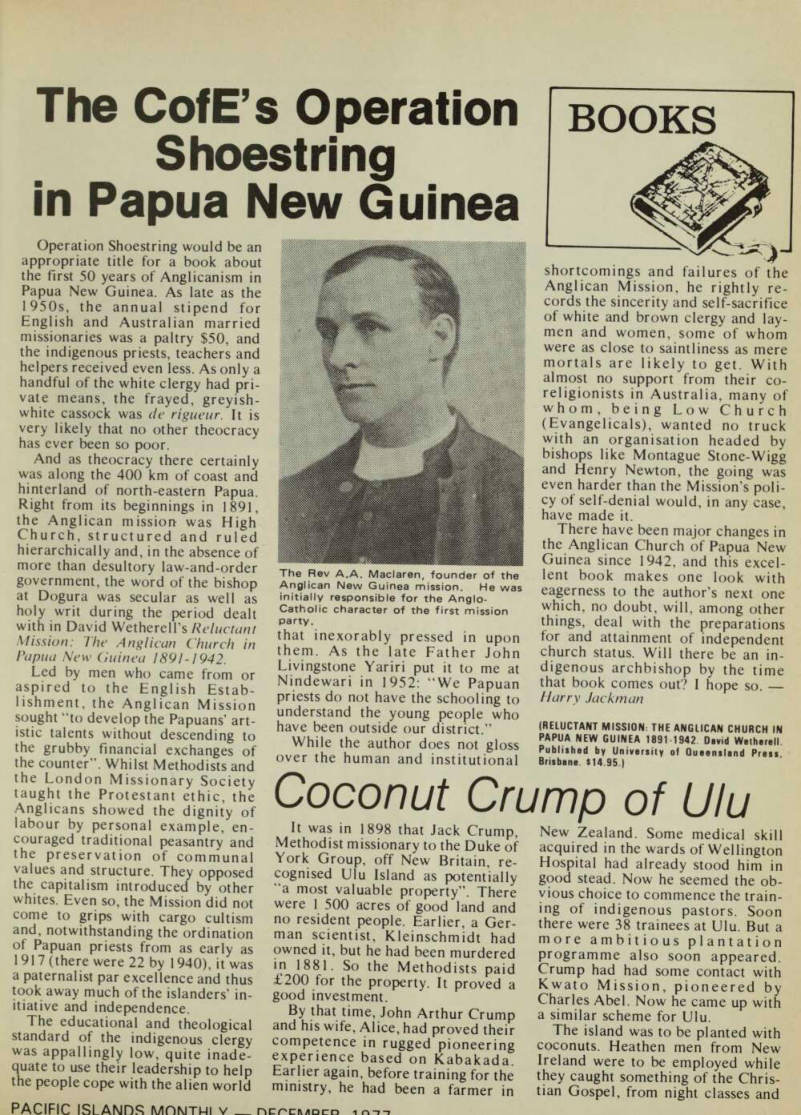
The Rev A.A. Maclaren, founder of the Anglican New Guinea mission. He was initially responsible for the Anglo- Catholic character of the first mission party.