Coconut Crump of Ulu
pp. 51-53 · Read in the full issue

It was in 1898 that Jack Crump, Methodist missionary to the Duke of York Group, off New Britain, re cognised Ulu Island as potentially “a most valuable property”. There were I 500 acres of good land and no resident people. Earlier, a Ger man scientist, Kleinschmidt had owned it, but he had been murdered in 1881. So the Methodists paid £2OO for the property. It proved a good investment.
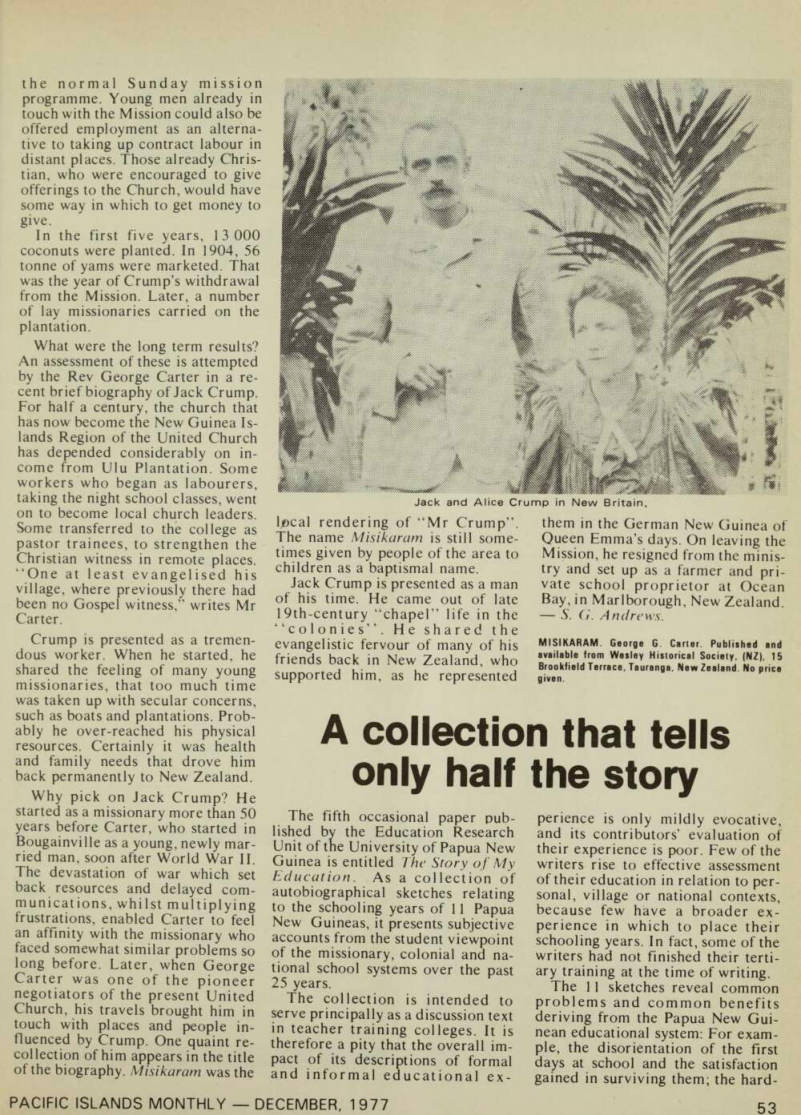
By that time, John Arthur Crump and his wife, Alice, had proved their competence in rugged pioneering experience based on Kabakada.
Earlier again, before training for the ministry, he had been a farmer in
New Zealand. Some medical skill acquired in the wards of Wellington Hospital had already stood him in good stead. Now he seemed the ob vious choice to commence the train ing of indigenous pastors. Soon there were 38 trainees at Ulu. But a more ambitious plantation programme also soon appeared.
Crump had had some contact with Kwato Mission, pioneered by Charles Abel. Now he came up with a similar scheme for Ulu.
The island was to be planted with coconuts. Heathen men from New Ireland were to be employed while they caught something of the Chris tian Gospel, from night classes and
the normal Sunday mission programme. Young men already in touch with the Mission could also be offered employment as an alterna tive to taking up contract labour in distant places. Those already Chris tian, who were encouraged to give offerings to the Church, would have some way in which to get money to give.
In the first five years, 13 000 coconuts were planted. In 1904, 56 tonne of yams were marketed. That was the year of Crump’s withdrawal from the Mission. Later, a number of lay missionaries carried on the plantation.
What were the long term results?
An assessment of these is attempted by the Rev George Carter in a re cent brief biography of Jack Crump.
For half a century, the church that has now become the New Guinea Is lands Region of the United Church has depended considerably on in come from Ulu Plantation. Some workers who began as labourers, taking the night school classes, went on to become local church leaders.
Some transferred to the college as pastor trainees, to strengthen the Christian witness in remote places.
“One at least evangelised his village, where previously there had been no Gospel witness,” writes Mr Carter.
Crump is presented as a tremen dous worker. When he started, he shared the feeling of many young missionaries, that too much time was taken up with secular concerns, such as boats and plantations. Prob ably he over-reached his physical resources. Certainly it was health and family needs that drove him back permanently to New Zealand.
Why pick on Jack Crump? He started as a missionary more than 50 years before Carter, who started in Bougainville as a young, newly mar ried man, soon after World War 11.
The devastation of war which set back resources and delayed com munications, whilst multiplying frustrations, enabled Carter to feel an affinity with the missionary who faced somewhat similar problems so long before. Later, when George Carter was one of the pioneer negotiators of the present United Church, his travels brought him in touch with places and people in fluenced by Crump. One quaint re collection of him appears in the title of the biography. Misikaram was the
Ipcal rendering of “Mr Crump”.
The name Misikaram is still sometimes given by people of the area to children as a baptismal name.
Jack Crump is presented as a man of his time. He came out of late 19th-century “chapel” life in the “colonies”. He shared the evangelistic fervour of many of his friends back in New Zealand, who , . . . ’ , supported him, as he represented
them in the German New Guinea of Queen Emma’s days. On leaving the Mission, he resigned from the minis try and set up as a farmer and pri vate school proprietor at Ocean Bay, in Marlborough, New Zealand.
S. G. Andrews.
MISIKARAM George G Certer. Published end S , oc '*'» ' N2 '- . 15 Brookfield Terrece, Tauranga, New Zeeland No once given
Jack and Alice Crump in New Britain.