bronze misquotation
pp. 49-84 · Read in the full issue


That extra 'the', on RLS bronze misquotation
By MIKE FIELD in Apia
Most people would be hard-press ed to find a less-controversial word than “the”, but here in Western Samoa files are full of letters on that very word.
And it is probably the fault of one engraver, long dead, who did not know anything about poetry.
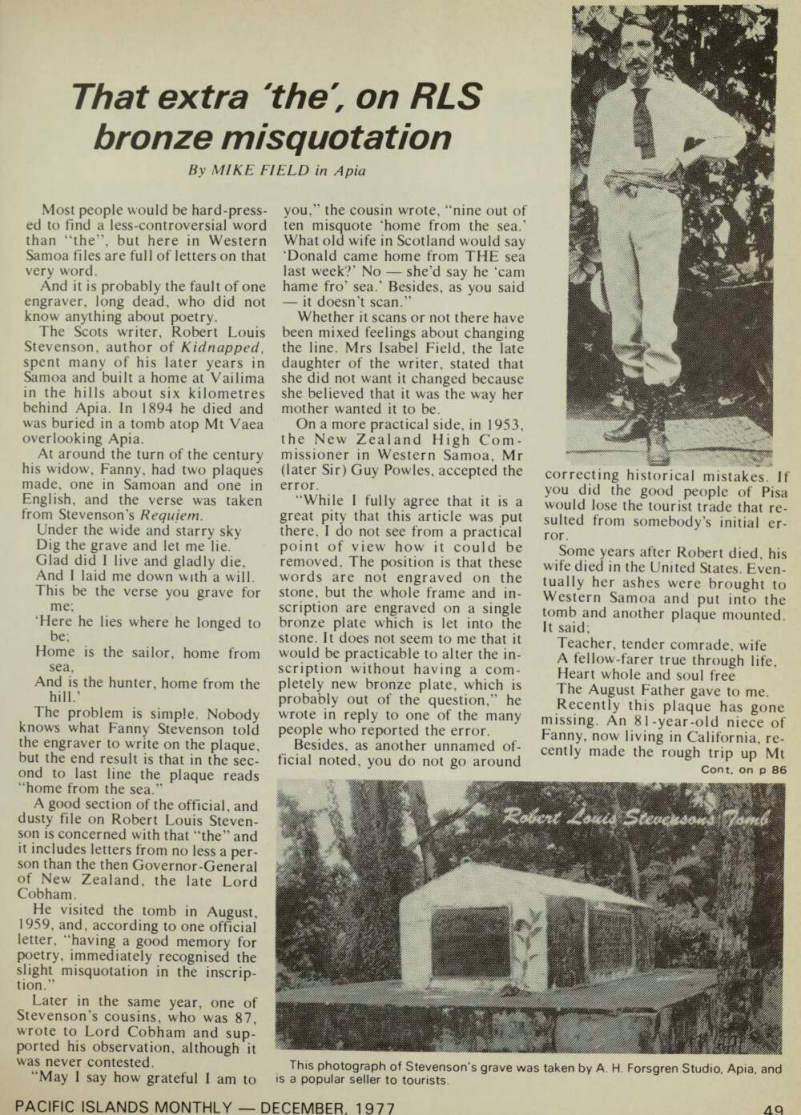
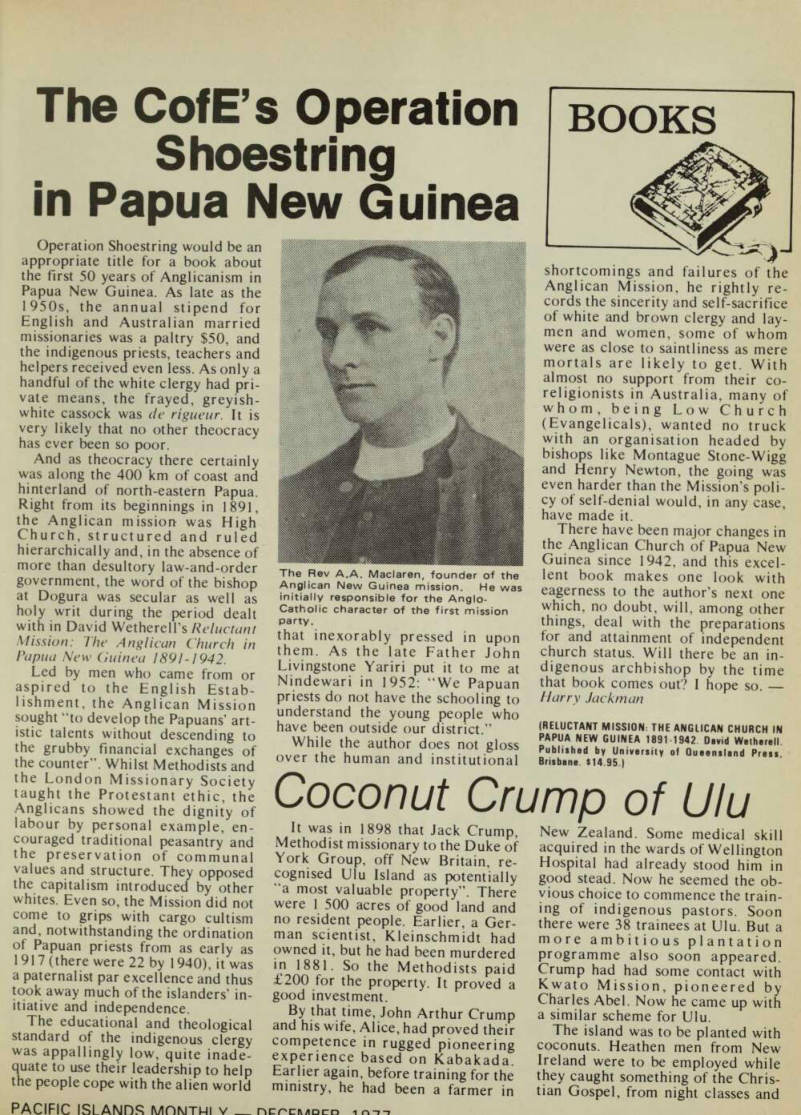
The Scots writer, Robert Louis Stevenson, author of Kidnapped, spent many of his later years in Samoa and built a home at Vailima in the hills about six kilometres behind Apia. In 1894 he died and was buried in a tomb atop Mt Vaea overlooking Apia.
At around the turn of the century his widow, Fanny, had two plaques made, one in Samoan and one in English, and the verse was taken from Stevenson’s Requiem.
Under the wide and starry sky Dig the grave and let me lie.
Glad did I live and gladly die, And I laid me down with a will.
This be the verse you grave for me; ‘Here he lies where he longed to be; Home is the sailor, home from sea, And is the hunter, home from the hill.’
The problem is simple. Nobody knows what Fanny Stevenson told the engraver to write on the plaque, but the end result is that in the sec ond to last line the plaque reads “home from the sea.”
A good section of the official, and dusty file on Robert Louis Steven son is concerned with that “the” and it includes letters from no less a per son than the then Governor-General of New Zealand, the late Lord Cobham.
He visited the tomb in August, 1959, and, according to one official letter, “having a good memory for poetry, immediately recognised the slight misquotation in the inscrip tion.”
Later in the same year, one of Stevenson’s cousins, who was 87, wrote to Lord Cobham and sup ported his observation, although it was never contested.
“May I say how grateful I am to
you,” the cousin wrote, “nine out of ten misquote ‘home from the sea.’
What old wife in Scotland would say ‘Donald came home from THE sea last week?’ No she’d say he ‘cam hame fro’ sea.’ Besides, as you said it doesn’t scan.”
Whether it scans or not there have been mixed feelings about changing the line. Mrs Isabel Field, the late daughter of the writer, stated that she did not want it changed because she believed that it was the way her mother wanted it to be.
On a more practical side, in 1953, the New Zealand High Com missioner in Western Samoa, Mr (later Sir) Guy Powles, accepted the error.
“While I fully agree that it is a great pity that this article was put there, I do not see from a practical point of view how it could be removed. The position is that these words are not engraved on the stone, but the whole frame and in scription are engraved on a single bronze plate which is let into the stone. It does not seem to me that it would be practicable to alter the in scription without having a com pletely new bronze plate, which is probably out of the question,” he wrote in reply to one of the many people who reported the error.
Besides, as another unnamed of ficial noted, you do not go around
correcting historical mistakes. If you did the good people of Pisa would lose the tourist trade that re sulted from somebody’s initial er ror.
Some years after Robert died, his wife died in the United States. Even tually her ashes were brought to Western Samoa and put into the tomb and another plaque mounted.
It said; Teacher, tender comrade, wife A fellow-farer true through life, Heart whole and soul free The August Father gave to me.
Recently this plaque has gone missing. An 81-year-old niece of Fanny, now living in California, re cently made the rough trip up Mt
Cont. on p 86
This photograph of Stevenson's grave was taken by A. H Forsgren Studio, Apia, and is a popular seller to tourists.
Cont. from p 49
Vaea and seeing the loss, offered to replace the plaque.
This is not the first plaque to go missing. Another plaque, put on a seat near the tomb in the 1930’s by the Robert Loius of Scotland, went missing during World War Two. It turned up again, in 1963 on the island Guadalcanal in the Solomons.
And through all this letter writing and discussion the tomb site remains as one of the most beautiful spots in the Pacific.
The rugged climb from Vailima, now the official residence of the Head of State, His Highness Malietoa Tanumafili 11, is well worth it. Along a mountain stream, up through native bush and onto the flat top where, under a “wide and starry sky”, one can see most of the eastern side of Upolu with the mountains on one side and the wide blue Pacific on the other; the hills and sea, or is it the sea?