Magazine
pp. 42-47 · Read in the full issue

Frangipani flowers cannot float on concrete
By George Lynch
Twen ty-fi ve years ago, when Air New Zealand was known as TEAL, flying boats took off from Laucala Bay, Suva, as pioneers of a new chapter in aviation history, the opening of the Coral Route from Fiji to Tahiti.
Eight years later, the flying boat flew its last flight on the Coral Route, giving way to land-based air c r aft.
For me the past is yesterday, but flying home from Europe in a full Jumbo, with a late and irascible start and then a diversion to Jakarta, summons memories of better days in air travel.
They belonged, for me, to what must be recorded in aviation history as man’s most romantic air trek the Coral Route from Fiji to Tahiti, created for the flying-boat and in operation. 1952-60. Not long ago, really, yet that route was the preserve of few travellers by Jumbo standards: the era of the packaged hordes was then only an idea.
The Coral Route, created by TEAL (now Air New Zealand), was a crooked line running for 2 282 nautical miles. The flying-boat, at home among the flying fish and cruising yachts, would hop in daylight from lagoon to lagoon, tak ing two days usually to reach Tahiti.
The start was at Laucala Bay, Suva, before the day became clammy and the passenger cabin an oven. The passengers, only 46 at the most, would be in Aggie Grey’s hotel at Apia, Western Samoa, before sunset, 1 130 km from Fiji.
The next morning, it was early off the water to Akaiami, a tiny gem in the Cook Group, 1 432 km from Apia. Just a refuelling stop: usually.
It took a while to refuel from drums on a raft, but if everything worked, the flying-boat would be nodding in the gentle water off Papeete, 1 110 km to the East, again before sunset.
The Coral Route was formed because of New Zealand s re sponsibilities to the Cook Islands and Western Samoa, and Tahiti was tacked on in the hope that the ser vice would make money. New Zealand, like so many other countries then, was hot after the US dollar and the route certainly collected those, because Tahiti was
given its first international air service.
Mainland Americans, of dollar substance, flew at least 8 370 piston engined km from California to catch the flying-boat at Fiji.
I was on the first passenger flight, my first excursion into Polynesia.
The aircraft, a Short Solent, cruised at 290 km/h and rarely higher than 2 440 m. The cabin, un-pressurised, became as cool as an autumn morn ing. the seats would have been acceptable in the best of clubs: the early glass of French wine seemed to be outstanding to one living in post war, spartan New Zealand.
The first extraordinary event oc curred not far out from Suva. Cap tain Ross McHardy, a dapper skip per with a good flying-boat record in World War 11, told us he was going off-course to deliver an urgent bottle of medicine to a copra planter. Eventually the aircraft swept down towards the sea in war time-style, and someone in the crew dropped a cannister on to an island covered with orderly coconut trees, and ringed by a reef that frothed and spouted gallons of the Pacific.
About three hours later, we were over the rainy mountains of Western Samoa, over Mount Vaea with the tomb of Robert Louis Stevenson, lying, I remembered, where he long ed for it to be. The plane was soon
snipping open the lagoon at Satapuala, along a laneway flanked by coral heads, the most menacing of all sights on that journey.
The coming of the four-engined Solent was big news in Apia, for the people had been accustomed only to DC-3’s dropping in on a dusty air port, a blessing left behind by the American Forces. The reception was lavish, but the place did not ap peal to me. There was too much of a missionary influnce for my liking: the main island, Upolo, alone, had more than 100 churches. It was on another trip, on a documentary film assignment, that I found Samoa.
The magic then began after Samoa. Even the sea seemed to be bluer, I think now that, perhaps for us, a kind of point of no return had been passed.
We were cruising along, and I think some were sleeping Samoa off, when McHardy came down the aisle and suggested we take a look at “the most beautiful atoll” along the route, Palmerston Island. He said he’d gone a bit off-course so we could get a good view and there it was below, a sight this time beyond
imagination.
It was donut-shaped, more or less: outside the circle of pink and white, the calm blue sea, and inside the reef what looked like a sheet of glass which had been used, on the under side, for a colour experiment in vivid greens. There were huts, peo ple running about, a boat on its side in the sand, the skeleton of another half buried, and well-spaced palm trees.
Even the Solent was too fast then: a helicopter would have been better.
We had Robbie aboard R. W.
Robson, founder of the Pacific Is lands Monthly (PIM), and the Year Book: himself a walking en cyclopedia of the islands: a remarkable man now retired in
N.S.W.
He told me that Palmerston was 1 740 km south of the Equator and very, very lonely.
The popping of ears much later took some of the drowsiness out of us as the plane descended; but it was the sight of the lagoon at Aitutaki that popped the eyes not a green lagoon, but an extraordinary patch of translucent turquoise. I have seen nothing like it elsewhere.
We went ashore at Akaiami, a strip of land across from Aitutaki, No one lived there, and rarely up to that time had anyone put a foot there, except for the occasional fisherman who emerged from his hollowed log to rest in Akaiami’s silence and drain a coconut.
The Resident Agent and others puttered across from Aitutaki to say hello, sign papers, pick up mail and the Auckland newspapers,and fill up the fuel tanks. The Solent’s ar rival was a big event for them, too, and we were far from the capital of the Cooks, Avarua, and any officialdom.
But the figure that one remembers best on the dazzling sand at Akaiami is Robbie, in pith helmet, white shirt, baggy trousers, and a black umbrella. It was not just a black umbrella; it was one of those ter ribly sturdy, black umbrellas, with enough fabric, it seems now, to have clothed one of Zorba’s crones.
Anyway, we spent the night there in native-style shelters that TEAL had built for emergencies, and the two stewards and one hostess pro duced a superb meal. There was nothing wrong with the plane; this was the inaugural and to hell with commercial schedules.
The next day, all the talk was of Akaiami as the plane ticked off the nautical miles to Papeete, and there was nothing to disturb our dreams of beach-combing forever because the ocean was empty after the Solent had cast its shadow over an island
called Tubuai Manu, noted for suc culent crabs.
I think it was about four o’clock when Moorea struck up from the sea, the most majestic sight in the South Pacific after New Zealand’s Alps. Here was something we had not seen along the way volcanic land with gothic spires broken up by rambling cloud and mists, and fall ing away into deep valleys, where a profusion of Nature hid the villages, a scene more of Hokusai than of Gaughin. And it occurred to me that the old navigators, staggered by Moorea, had surveyed it at best from masthead.
The plane swheeled by the peaks and there was Tahiti, 19.3 km off, it self mountainous, without the majes ty, but luxuriant. As the Solent levelled close to water, we could see that the waterfront was thronged and there was an outrigger welcome also bedecked yachts, flowers, music, immutable gendarmes. One
girl even managed to be sinuous standing in a canoe; quite miraculous given the bow wave of the Solent.
I shall not attempt to describe the ensuing days, except that then and in following years one came to unders tand that there was an area, Polynesia, and a place called French Polynesia. One can turn around Maugham's advice to scribblers and aim it at readers: “There is no need for the writer to eat a whole sheep to be able to tell you what mutton tastes like".
Over eight years, the route col lected a few big names: Gary Cooper; Cole, of Cole of California (whatever happened to that outfit?); Reynolds of tobacco fame; Brando and Trevor Howard. There were others to cause comment, such as the officials from Metropolitan France going out to straighten out some thing or other, only to leave
bemused.
Cont. on p 47
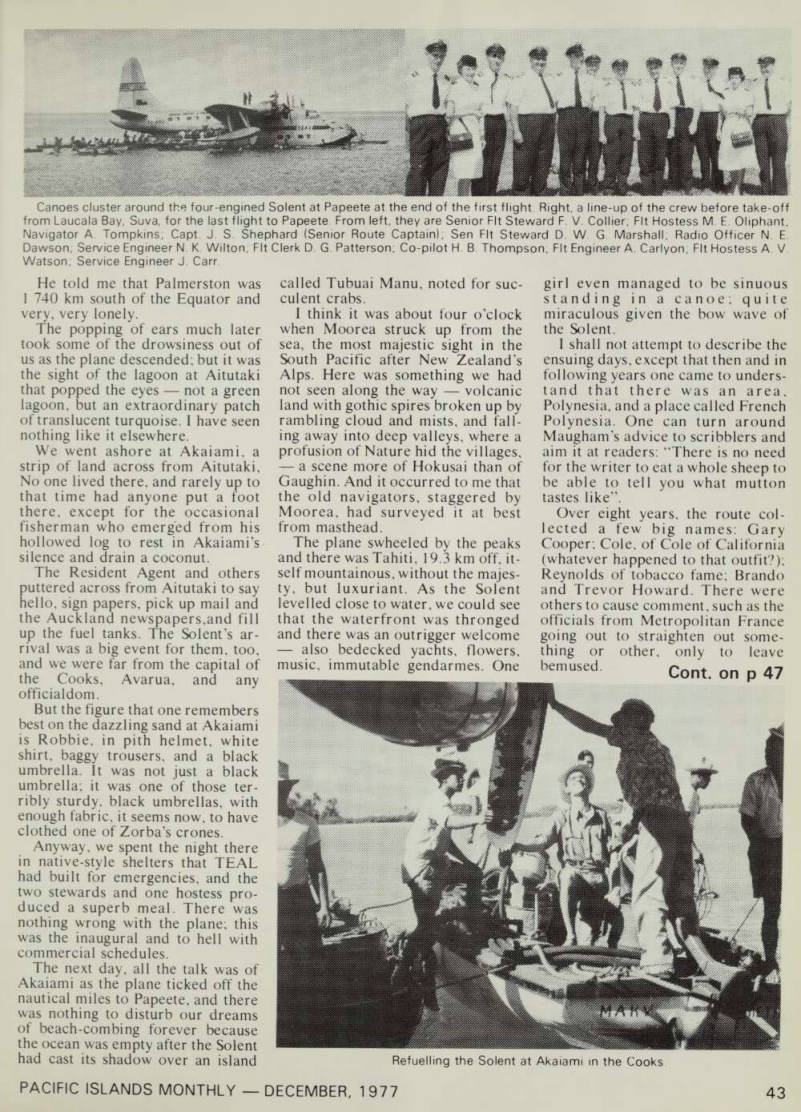
Canoes cluster around the four-engined Solent at Papeete at the end of the first flight Right, a line-up of the crew before take-off from Laucala Bay, Suva, for the last flight to Papeete From left, they are Senior Fit Steward F V. Collier; Fit Hostess M. E. Oliphant, Navigator A. Tompkins; Capt. J. S. Shephard (Senior Route Captain), Sen Fit Steward D. W. G. Marshall; Radio Officer N. E.
Dawson; Service Engineer N. K. Wilton; Fit Clerk D. G. Patterson; Co-pilot H. B. Thompson; Fit Engineer A. Carlyon, Fit Hostess A. V.
Watson; Service Engineer J. Carr.
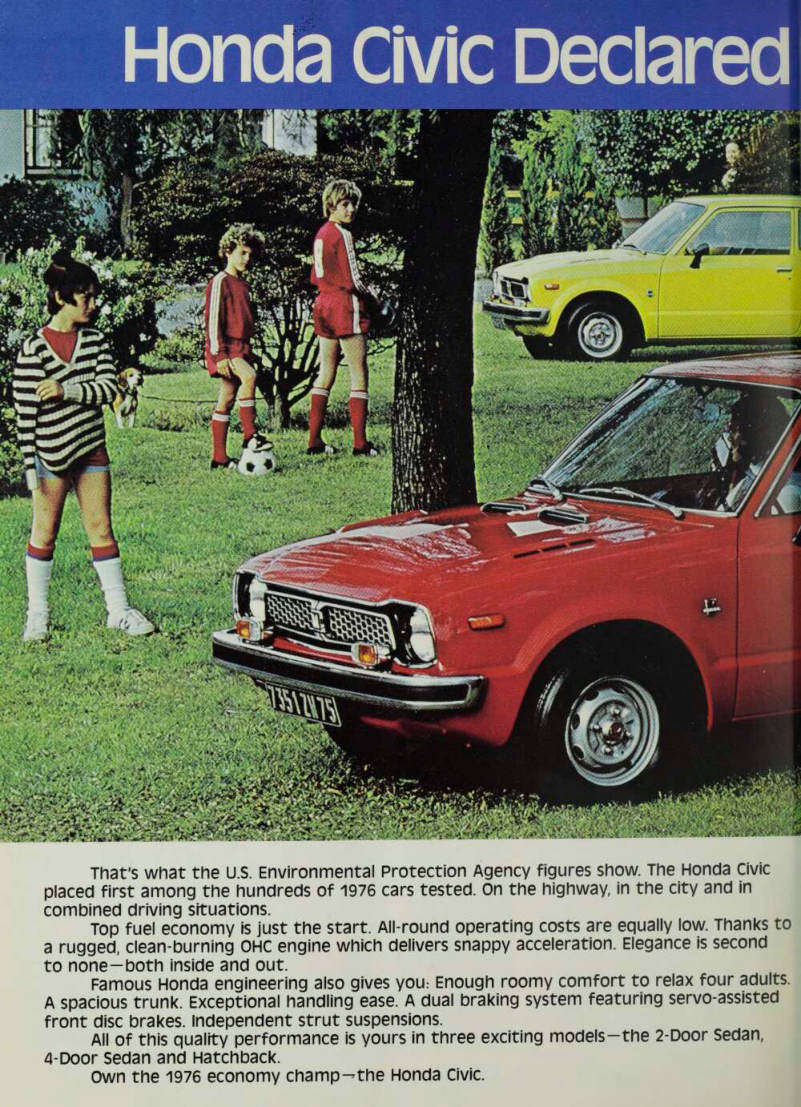
Refuelling the Solent at Akaiami in the Cooks.
Cont. from p 43
Over the years, the route bred a certain dottiness; in Auckland, any way, where a kind of club was form ed, meeting, according to whim, in a bar in Vulcan Lane or another, seedier, in Custom Street.
Dottiness. One traveller, a mate, turned up for work after Tahiti with a string of seashells around his neck, straw hat, floral shirt the whole imagined beach-comber bit. It was an admirable but silly thing to do in New Zealand in 1952; even in the reporters’ room of an afternoon newspaper.
He disappeared, but in time the word was passed around that he had become more than a bit religious.
And then he brought some journal from obscurity into passing pro minence by writing that the domestic DC-3’s, flying low at night, should carry fluorescent crosses under their wings, and we. looking up, would be reminded of God. We, his mates, were aghast; it was enough for an extraordinary meeting of the club.
He called on me in Sydney some years later, on his way to London.
He was okay.
The end began when the French Airline, TAI, flew a landplane into Bora Bora, another island with a left-over airfield, and with Alain Gerbault, the lonely and disillusion ed sailor, lying where it had once been peaceful to be. The landplane passengers took a 75-minute trip from there to Papeete in a local and less distinguished flying-boat.
Then South Pacific Air Lines, a Californian company, started a Super Constellation service direct from Honolulu to Bora Bora. A SPAL advertisement about that time in Travel News, the magazine of the Pacific Area Travel Assiciation, shouted: “Slash 2 650 miles and hundreds of dollars from the United States-Tahiti air route ... fly be tween Honolulu and Papeete over night.” What it meant to us was: “Slash off 2 650 miles of Paradise . bypass Samoa, Palmerston and Akaiami ... fly overnight and see nothing”.
So really, the end came before the jets. The landplane with piston engines, long-range and cruising from 5 180 m up, was enough to change the pattern of air travel over the South Seas. And in SPAL’s case, flying in from another direction, it
was perhaps as well to have scheduled the flight for night, because there is no string of Palmerstons or Akaiamis on that route; and if there was, no one 5 180 m up could get very excited about them.
The jets, bigger, faster and flying from 9 144 m up, eventually started to swoop into Tahiti from Los Angeles and from Auckland, and from elsewhere. After years of rumours and delays, the French had got on with the construction of a concrete airport where there was once a lagoon. We were told by friends down from Tahiti that it had started off as a half-hearted job. No wonder.
The later nuclear tests and the in cursions of the French military make another story.
I have just turned from the typewriter to gaze upon a wild and sinuous garden, and am reminded of the romantic, farewell touch of those other days, When one boarded the launch at Papeete to go out to the Solent, there was a hei (same as lei), placed around one’s neck. He was en couraged to throw a flower or two, or the lot, on to the lagoon, and if they floated back to land it meant that one would return to Tahiti, The frangipani, however, cannot float on concrete.