When cholera, the wasting death,
pp. 22-25 · Read in the full issue


stalked the Gilbert Islands
By the beginning of October, 18 people had died in the Gilbert Islands, victims of cholera which, until it struck in a small village on the Tarawa atoll at the end of August, had never before been recorded in the South Pacific Islands. At one time it was feared that it would spread like wildfire throughout the whole of the South Pacific.
More than 500 cases entered the Tungaru Central Hospital and Betio Hospital on Tarawa, the fight to beat the epidemic and confine it to the four affected islands brought medical experts from Fiji, Australia and New Zealand.
How the fight was waged and won, is told below.
By John Carter
It looked like just another case of dengue fever or plain diarrhoea which struck a woman in Teaorareka village on Tarawa at the end of August. When the first sym ptoms appeared, they were mild and it was only after a few days of suffer ing that her condition appeared serious enough to merit her admis sion to the Central Hospital. By that time she was very dehydrated, like a lost wanderer dying of thirst in the desert.
This was the first attack of cholera, but unlike the many thou sands of cases which have occcurred over the years in crowded India and Asia, it was an insidious attack.
There were none of the recognised symptoms of cholera. That was the great danger which threatened the South Pacific, Dr Tin Maung Maung told me in Suva in October.
Dr Tin, the epidemiologist with the World Health Organisation (WHO) at the Suva office, led the fight against the epidemic when it was finally confirmed that cholera had struck in the islands. The sick woman was admitted to the Central Hospital on August 30 but it took nine days to confirm the presence of the disease. That, said Dr Tin, was what made the disease so deadly.
There are, he explained, two types of cholera — Classical Cholera, a more common type which strikes very quickly with symptoms easily and quickly recognisable. There is severe diarrhoea and vomiting and very quick dehydration caused by the loss of body fluid through the diarrhoea and vomiting. The victim can lose three or four pints of fluid in an hour.
The only cure is to replace the fluid by the patient drinking copious amounts of diluted salt water or a saline drip into a vein.
The second type, and the one which struck in the Gilberts, is
of a little stomach-ache and slight diarrhoea and people affected will naturally move around and spread the disease without anyone being aware of it. That is why, any case of diarrhoea, however slight, with vomiting or even diarrhoea without vomiting, should be reported and dealt with immediately. Sometimes, people carry the disease without suffering from it but they spread the germs through their waste matter for many months.
Dr Tin paid tribute to the physi cian specialist, Dr Adrian Roberts, of the Central Hospital.
Dr Tin said the credit had to go to Dr Roberts for being the first to re cognise the presence of the disease.
There was no suspicion at all for several days after the first patient was admitted and, in fact, the hospital conducted its “public open day” on September 3 even though there were five patients in the hospital suffering from cholera. By September 5, there were suspicions that some kind of epidemic was oc curring because the number of pa tients admitted had risen to seven.
The medical authorities thought
known as Cholera El Tor almost a romantic name so called because it was first recognised at El Tor in Egypt in 1906. When it strikes it doesn’t reveal its deadli ness for several days and can be mistaken, as was the case at Tarawa, for a fever or diarrhoea. Therein, Dr Tin pointed out, lay the danger.
El Tor is not readily recognisable in the early stages. There may be no symptoms at all with the exception
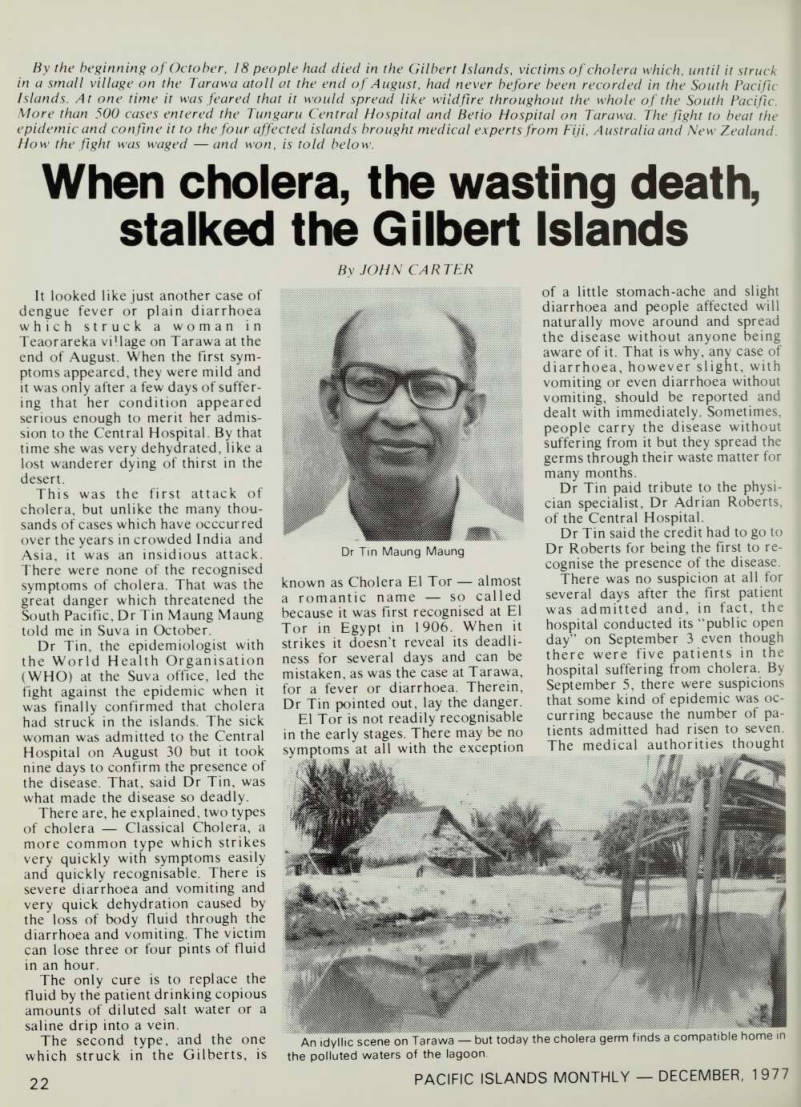
An idyllic scene on Tarawa - but today the cholera germ finds a compatible home in the polluted waters of the lagoon.
Dr Tin Maung Maung
that it might be food or fish poison ing. Then came news from Betio, which at present has no causeway and can only be reached by boat, that there were three patients in its small hospital and the first death had occurred.
The following day Dr Roberts began to suspect that it was El Tor.
Laboratory tests were made but because the laboratory lacked the necessary anti-cholera sera there were no definite results until Sep tember 8 when the analysis showed a strong indication of cholera.
The Gilbert Islands Government moved quickly and declared the group a cholera-infected area. The South Pacific Commission and WHO were told immediately.
South Tarawa, where the epidemic was first discovered among the population of 20 000, was immediately isolated from the rest of the group. There was a ban on travel to the other 15 island groups, but by this time cases had also occurred at Abemama and Abaiang, two small islands near South Tarawa.
Dr Tin, who was then in Saipan, in the Marianas, preparing to go to Nauru, heard the news and made his way to Tarawa, arriving on Septem ber 12. By that time the five British doctors had begun the fight. WHO threw in all its resources from its centre in Fiji and in three days the whole population of South Tarawa had been vaccinated by eight teams travelling throughout the islets and working around the clock.
New Zealand’s military forces sent a medical and nursing team in a Hercules aircraft under the com mand of Colonel Brian Linehan. Mr Ken Butler, a water engineer, who had been in the Gilberts shortly before helping to plan an improved water supply, was also flown over from Australia. The Peacesat satellite was also brought into op eration to enable Dr Tin to keep in continuous touch with his Suva
headquarters.
The locals also rallied round, tak ing food and mats to the two hospitals at Betio and Bikenibeu.
If treatment is given in the early stages recovery is swift, and by Sep tember 10 some of the people had
been discharged from hospital.
More were arriving, however, and on September 14, 50 new cases were at the hospital, including nine from North Tarawa, an indication that
the epidemic was spreading.
Although the death toll reached 18 and these were mainly people who had not sought treatment the experts had the outbreak under con trol.
As the days passed, the stream of patients to the hospital became a trickle and by mid-October there were only a few new cases.
Dr Tin said that, although the epidemic had been beaten, sporadic outbreaks might occur but they would be dealt with very easily now that El Tor had been recognised for what it was.
Probably the biggest job facing the health authorities was that of im proving sanitatiom which throughout the group is very poor. It was no coincidence that South Tarawa was so badly hit. Betio, in particular, is notoriously over crowded. It was also no coincidence that one small village, Tangintebu, which has a good living standard with good sanitation and a private water supply, had no cases of cholera.
The water supply was one problem which needed attention.
The only fresh water sources in the Gilberts are rain water which is col lected from roof gutters, well water from shallow wells, which are al ways in danger of pollution from human dwellings nearby, and supply mains which run from east to west in South Tarawa from 10 collection depots. This mains water is stored in a 500 000-gallon reservoir, is chlorinated and then fed into the Betio mains. But Mr Butler found that the amount of free chlorine in the water when it reached the taps was nil. Tarawa lagoon is greatly polluted by rubbish and sewage and when the microbiologists tested it they found that the cholera germ was present, especially close to the latrines.
Fly breeding is also uncontrolled and there was a high density of flies during the epidemic period. It’s also the season for the ripening of breadfruit and the pandanus fruit and this is a time of increased diar rhoea caused through eating over ripe fruit.
It was obvious that something had to be done to clean up the Gilberts and within a few days plans were completed to combat the fly menace, to attempt to immunise the people from cholera, to improve sanitation and disinfect all latrines.
A campaign is also in train to educate the people in hygienic methods of preparation of food and drink.
With regard to El Tor it again emerges as the more dangerous of the two types. According to Dr Tin, vaccination prevents Classical Cholera for as long as six months but with El Tor the immunisation period is halved to three months.
Although every precaution was taken to isolate the Gilberts, travel could not be prevented through the group, especially by the airlines. Air Pacific and Air Nauru both co-op erated to the limit.
In the case of Air Pacific, drink ing water was carried in sealed plastic containers from Nausori, Suva’s airport, so that there was no need to take on such water in Tarawa and there were no ice or food pick-ups from Tarawa or Funafuti, capital of Tuvalu.
All catering on the flights was strictly supervised and catering staff handling cooked food had to disin fect their hands and also use dis posable sterilised gloves.
All toilet water replenished at Tarawa was chlorinated and passengers were warned not to drink the tap water in the toilets. Air crews stopping overnight in Tarawa were only allowed to eat and drink provisions brought from Nausori and throughout their stay at the Otintai Hotel were not allowed to walk outside.
Aii . C
All cutlery after the return from Tarawa was sterilised under the ™ eth . ods Nauson Health Department s super vls'?n' ... , , , xt T " e a > r jine went further than this.
Night soil staff, who cleaned the aircraft af * er lts return from eacb protective clothing and sterilised raincoats and gumboots, gloves and masks, Alter completing the job they had to shower at the airport using medi cated soap and then change into f J es u h dothmg. Their discarded clothes were put in plastic bags for disinfecting before being sent to the
laundry.
Although the South Pacific’s cholera epidemic appears to have beenl beaten > a ? Dr Tin said unless sani tation and water supplies are * m P r o v ed, there could be more out breaks. However, he discounted the headlines in some newspapers which P r °phesised the spread of cholera
.f 2? the Islands
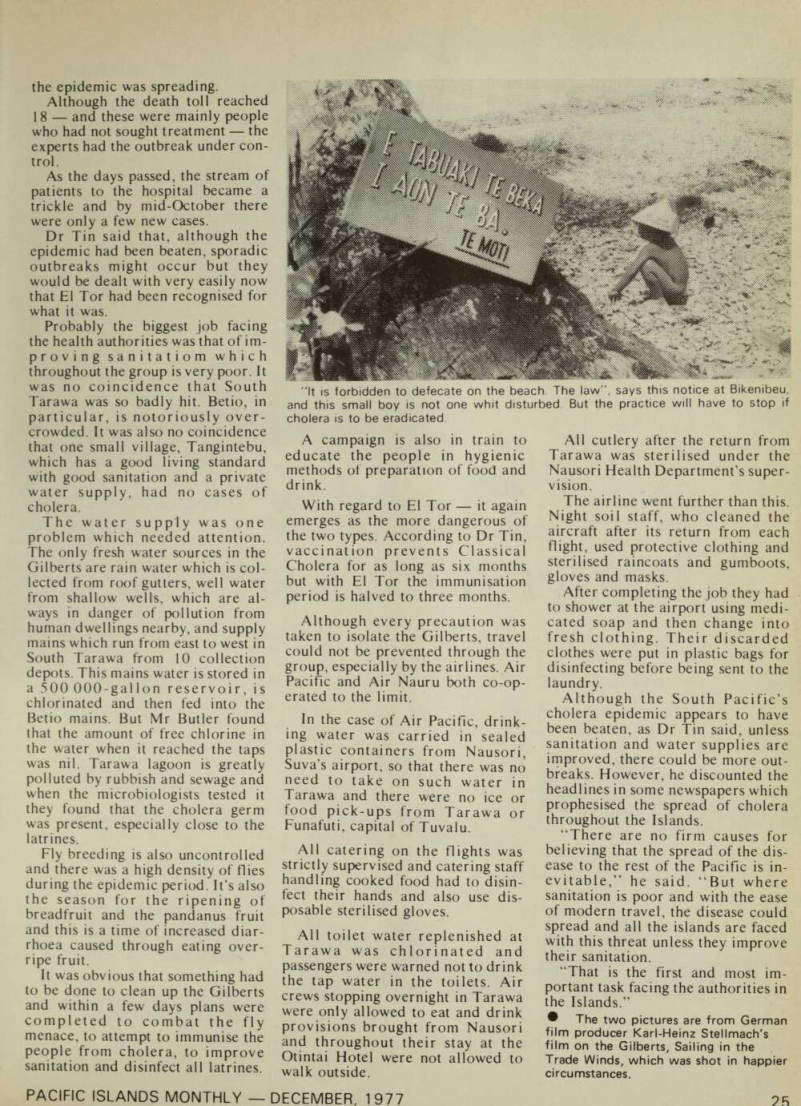
‘ fhere are no firm causes for believing that the spread of the dis ease to the rest of the Pacific is in evitable,” he said. ”But where sanitation is poor and with the ease of modern travel, the disease could s P and all the islands are faced ' mpr ° Ve " That “*!“>« and most im " * T . . . , Z The two pictures are from German S m prod uc e r Kad-Hemz Stellmach's film on the Gilberts, Sailing in the Trade Winds, which was shot in happier circumstances.
"It is forbidden to defecate on the beach The law”, says this notice at Bikenibeu, and this small boy is not one whit disturbed But the practice will have to stop if cholera is to be eradicated