Tropicalities
pp. 27-32 · Read in the full issue


All he wants
for Xmas ...
A set of false teeth believed to be those of a Japanese soldier killed in the Pacific War have been found in North Solomons Province, Papua New Guinea.
The old man who found the teeth asked a technician at the dental clinic at Arawa general hospital to fit them into his toothless upper jaw.
His request was refused. The teeth are being kept at Arawa Hospital for further investigation. The old man remains toothless.
Pago's proud yachts
were dwarfed
Even the biggest and most splen did of the yachts moored in Pago Pago Bay were dwarfed with the ar rival of three US naval destroyers in October. The USS Benjamin Stud dert, the USS Richard E. Edwards and the USS Sommers glided into American Samoa for a brief visit and to refuel before returning to their home port of Pearl Harbour, Hawaii.
The fleet was concluding an eight month tour that took them to Korea, Japan, Hong Kong, New Zealand and Australia, in order to “show the American flag” to the people of the Western Pacific.
Six months gaol
for Kobale Kale
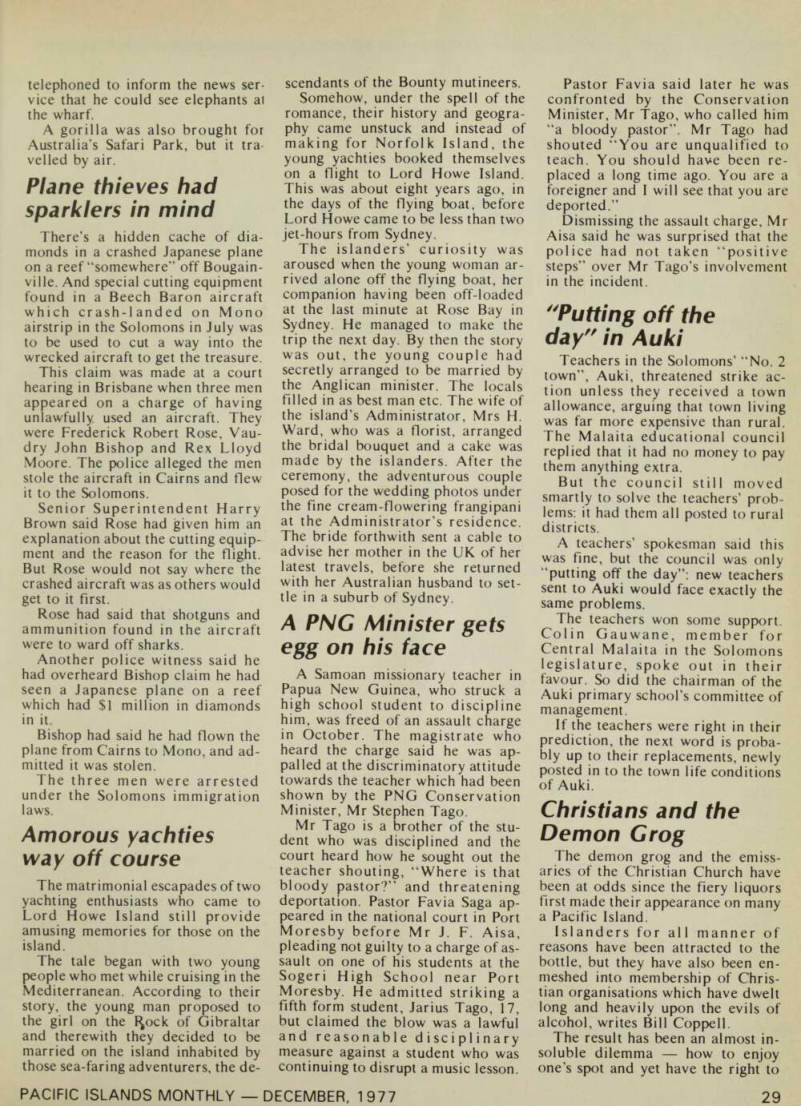
The former Education Minister in Papua New Guinea, Kobale Kale, was jailed for six months in October on a charge of dangerous driving causing death. He had pleaded not guilty to the charge which was heard in the national court at Kundiawa in the PNG Highlands.
The deputy chief justice, Sir William Prentice, said he was aware of the contribution which Kale had made to nationhood in PNG. He was aware, too, how the accident had cost Kale his status as a leader and had contributed to the loss of Kale’s
seat in parliament at the last elec tions. But Sir William said he believed he would be failing in his duty if he did not impose a custodial sentence.
Kale was the driver of a truck which ran off the road on the PNG Highlands Highway on the eve of the last elections, killing a five-year old girl passenger (PIM, Aug, p 9).
The accident flared into inter-tribal violence in which four men were killed, scores of houses were burnt and large areas of crops were torn out of the ground. Kale himself had to seek refuge at one stage, and one of his close relatives was among the men killed. The unrest interfered with the schedule for polling in the elections, and peace was not fully restored for several weeks.
Tonga, Taiwan in
"two-out" tango
While the rest of the world refuses to recognise Taiwan, or the Re public of China, only Tonga, along with one or two others, gets closer and closer to Taiwan.
King Taufa’ahau Tupou IV and Queen Mata’aho not long ago returned from a successful state visit to the ROC. Immediately on his return, the king publicly announced
the desirability of his country estab lishing closer ties with the ROC.
Tonga, he explained, could benefit greatly from such a relationship and the ROC is more than willing to as sist Tonga in any way it can.
Tonga’s recognition of the ROC in the face of opposition from other countries is a good example of the kingdom’s independent political stance. While the rest of the world closes its doors to the ROC as a re sult of pressure from other nations, Tonga welcomes her and in so doing reaffirms not only her well-known stance of being friendly with all na tions but also her political indepen dence.
Elephants pull in
Apia crowds
Many residents of Apia went to the wharf to see four African elephants on board the cargo vessel Auckland Star, when it called at Western Samoa in October. The elephants were in the course of a 20 000 km journey from England to Australia, where they were taken to Safari Park at Dubbo, about 320 km from Sydney. A zoo-keeper who was accompanying the elephants on the trip said the cost of the four of them was $25 000, and they were brought from Lord Bath’s private zoo in England.
Unfortunately, the Auckland Star arrived at Apia on a Sunday, when most people spend the day with their families and attend church services, so not as many people were availa ble to see the elephants as there would have been on a weekday. The zoo-keeper said that had there been more time, he would have asked each visitor to bring a banana plant to feed the elephants, He added that one taxi driver, of whom he did make the request, turned up with 14 plants.
Word of the elephants’ arrival had spread through town by Mon day, and many people went on board to see the animals, before the vessel sailed in the afternoon. The local radio station was alerted when an officer of the fire brigade
Mr Kobale Kale
telephoned to inform the news ser vice that he could see elephants al the wharf.
A gorilla was also brought for Australia’s Safari Park, but it tra velled by air.
Plane thieves had
sparklers in mind
There’s a hidden cache of dia monds in a crashed Japanese plane on a reef “somewhere” off Bougain ville. And special cutting equipment found in a Beech Baron aircraft which crash-landed on Mono airstrip in the Solomons in July was to be used to cut a way into the wrecked aircraft to get the treasure.
This claim was made at a court hearing in Brisbane when three men appeared on a charge of having unlawfully used an aircraft. They were Frederick Robert Rose, Vau dry John Bishop and Rex Lloyd Moore. The police alleged the men stole the aircraft in Cairns and flew it to the Solomons.
Senior Superintendent Harry Brown said Rose had given him an explanation about the cutting equip ment and the reason for the flight.
But Rose would not say where the crashed aircraft was as others would get to it first.
Rose had said that shotguns and ammunition found in the aircraft were to ward off sharks.
Another police witness said he had overheard Bishop claim he had seen a Japanese plane on a reef which had $1 million in diamonds in it.
Bishop had said he had flown the plane from Cairns to Mono, and ad mitted it was stolen.
The three men were arrested under the Solomons immigration laws.
Amorous yachties
way off course
The matrimonial escapades of two yachting enthusiasts who came to Lord Howe Island still provide amusing memories for those on the island.
The tale began with two young people who met while cruising in the Mediterranean. According to their story, the young man proposed to the girl on the of Gibraltar and therewith they decided to be married on the island inhabited by those sea-faring adventurers, the de
scendants of the Bounty mutineers.
Somehow, under the spell of the romance, their history and geogra phy came unstuck and instead of making for Norfolk Island, the young yachties booked themselves on a flight to Lord Howe Island.
This was about eight years ago, in the days of the flying boat, before Lord Howe came to be less than two jet-hours from Sydney.
The islanders’ curiosity was aroused when the young woman ar rived alone off the flying boat, her companion having been off-loaded at the last minute at Rose Bay in Sydney. He managed to make the trip the next day. By then the story was out, the young couple had secretly arranged to be married by the Anglican minister. The locals filled in as best man etc. The wife of the island’s Administrator, Mrs H.
Ward, who was a florist, arranged the bridal bouquet and a cake was made by the islanders. After the ceremony, the adventurous couple posed for the wedding photos under the fine cream-flowering frangipani at the Administrator’s residence.
The bride forthwith sent a cable to advise her mother in the UK of her latest travels, before she returned with her Australian husband to set tle in a suburb of Sydney.
A PNG Minister gets
egg on his face
A Samoan missionary teacher in Papua New Guinea, who struck a high school student to discipline him, was freed of an assault charge in October. The magistrate who heard the charge said he was ap palled at the discriminatory attitude towards the teacher which had been shown by the PNG Conservation Minister, Mr Stephen Tago.
Mr Tago is a brother of the stu dent who was disciplined and the court heard how he sought out the teacher shouting, “Where is that bloody pastor?’’ and threatening deportation. Pastor Favia Saga ap peared in the national court in Port Moresby before Mr J. F. Aisa, pleading not guilty to a charge of as sault on one of his students at the Sogeri High School near Port Moresby. He admitted striking a fifth form student, Jarius Tago, 17, but claimed the blow was a lawful and reasonable disciplinary measure against a student who was continuing to disrupt a music lesson.
Pastor Favia said later he was confronted by the Conservation Minister, Mr Tago, who called him “a bloody pastor”. Mr Tago had shouted “You are unqualified to teach. You should have been re placed a long time ago. You are a foreigner and I will see that you are deported.”
Dismissing the assault charge, Mr Aisa said he was surprised that the police had not taken “positive steps” over Mr Tago’s involvement in the incident.
"Putting off the
day"in Auki
Teachers in the Solomons’ “No. 2 town”, Auki, threatened strike ac tion unless they received a town allowance, arguing that town living was far more expensive than rural.
The Malaita educational council replied that it had no money to pay them anything extra.
But the council still moved smartly to solve the teachers’ prob lems: it had them all posted to rural districts.
A teachers’ spokesman said this was fine, but the council was only “putting off the day”: new teachers sent to Auki would face exactly the same problems.
The teachers won some support.
Colin Gauwane, member for Central Malaita in the Solomons legislature, spoke out in their favour. So did the chairman of the Auki primary school’s committee of management.
If the teachers were right in their prediction, the next word is proba bly up to their replacements, newly posted in to the town life conditions of Auki.
Christians and the
Demon Grog
The demon grog and the emiss aries of the Christian Church have been at odds since the fiery liquors first made their appearance on many a Pacific Island.
Islanders for all manner of reasons have been attracted to the bottle, but they have also been en meshed into membership of Chris tian organisations which have dwelt long and heavily upon the evils of alcohol, writes Bill Coppell.
The result has been an almost in soluble dilemma how to enjoy one’s spot and yet have the right to
stand in front of the congregation as a deacon of the church and pon tificate at length about the degreda tion that follows upon indulgence in drink.
W. E. Gudgeon, the Resident Commissioner in the Cook Islands, in 1904 tried to resolve this dichotomy when he reported to the Minister in New Zealand, “Previous to the arrival of the first British Re sident the will of the resident mis sionary had practically been the law of the island, and prohibition was supposed to be the rule. But it ex isted in name only, for the people, with one or two exceptions, were op posed to it, and assisted European traders to break the law whenever it suited them to do so. The Maoris do not desire prohibition. At any general meeting held on this subject every man will, for the sake of ap pearances and the safety of his church-membership, speak against the sale of liquor, but privately they, as a rule, favour it, and cannot see why a Maori should be treated dif ferently from a European.
“Whatever there may have been of drunkenness during the last five years has been due to bush beer, which is almost invariably drunk on Sundays with the full knowledge of the chiefs of the tapere, police, and church-members, but the offenders are never brought before the Court, unless they have been so foolish as to exhibit their drunkenness on the public road where they may be seen before Europeans. Police sympathy is with the beer-drinkers”.
It might be added as a postscript that today the police sympathy in many cases is with Europeans, especially the tourists, who exhibit their drunkenness in the sight of the local people in the Pacific Islands.
Sails trimmed
in Pago Pago
POWER, The Political Organ isation of Women for Equal Rights, met with American Samoa’s guber natorial candidates, in a public rally to question them regarding their views on price control, economic development and the equal rights amendment. Wisely, each of the candidates spoke in favour of the ERA and stated that women would play vital roles in their admin istration if elected. The day before the rally, Arieta Mulitauaopele became the first woman to enter the
race, as a candidate for Lieutenantu em ? r n u Hopefully, the new Governor and Lieutenant-Governor will fulfill their campaign promises by appointing qualified women and men equally within their administration, allowing American Samoa to enter mto self-government with the aid of the whole population, rather than JU T h a p S H p m f nt ' . .
The elections were to be held on November 8. • n j c 'J*U menus meet
in distant Athens
Australia’s genial ambassador in Greece, Les Johnson and his wife Dulcie, played host in mid-October to an old family friend.
Their house guest who arrived quietly in Athens with no formality he’d even left his wife at home was Michael Somare, Prime Minister of Papua New Guinea. “A holiday with an old friend to get away from journalists and people like that, was how Somare described the visit which was a fortnight’s stay on his way home from the United Nations.
Les Johnson, one-time high school teacher in Western Australia, became the technician who phased
PNG into self-government, and has remained a close friend of Somare.
He went to PNG 1 5 years ago from a headquarters job with the Western Australian education department to become director of education in
Png.
Within a few years he was As sistant Administrator for Australia in PNG, and eventually became the last man to hold the post of Admin istrator.
It was Les Johnson who signed the papers handing over his authority as Administrator when Somare became Chief Minister of PNG just before the achievement of full indepen dence.
Before his present ambassadorial post, Johnson ran the Australian Development Assistance Agency looking after PNG’s requirements from within Australia.
TV " concealment "
charge on Truk
Did the Trust Territory admin istration try to conceal the “real story” of Micronesia from a major American television team preparing a one-hour documentary about the islands? Jack Archer, of Truk, legal adviser to the Congress of Micronesia, claims it did, and add
ed that the administration would, no doubt, be pleased with a trivial tra velogue, which concealed the real story of Micronesia.
The television team went to Truk with Mr Samuel McPhetres, a TT official and a political education ad visor in the TT Public Affairs Department. Mr Archer claimed that Mr McPhetres tried to prevent any interview which might cover serious political , social and econ omic issues on Micronesia.
Mr Archer said the producer seemed to be interested in Micronesia as a subject of travel. He suggested there should be a protest
against such a superficial approach.
The administration said it had no say in the documentary. The televi sion company was free to film any thing and interview anybody it wished.
Smoking no wealth
hazard in Tonga
Rothmans cigarette company of Australia is wooing Tongan smokers by running a weekly raffle to assist sports in Tonga.
For five empty packets of one of the company’s brands and 10c, one
buys a ticket for the weekly draw which carries prizes totalling $5O.
At the end of the 10 weeks all tickets included in the weekly draws are re raffled for the Jackpot prize of $1 000.
The local agent for the brand esti mates that by the tenth week of the raffle, its share of the market could soar to 30% or 40%. The brand has the added attraction of a lower price than other cigarettes sold in the kingdom.
Death jump
from hunger?
A prisoner who jumped from a police “paddy wagon” in Papua New Guinea may have wanted to escape, but he may also have been so hungry that he wanted to search for food. His reason will never be known for he died after landing heavily.
The prisoner, Pora Win, was one of seven who jumped out. Sixteen prisoners were being driven from the Minj lockup to the nearest place for a square meal. The door was secured with nothing more than a piece of wire, and it was not long before prisoners were jumping to freedom.
At an inquest at Mt Hagen cor oner’s court a constable from Minj said the prisoners in Minj lockup had not been fed for three days. A sub-inspector said he did not have authority to buy rations on the spot.
This prompted the coroner, Mr Stoddart to remark that supply ar rangements seemed sadly inade quate. The police should have greater flexibility with their supply arrangements. (And so say all of u 5...).
Murderous
cricket
A cricket match in Western Samoa ended with a fight in which two players were killed.
The game was organised by a church fund-raising committee but led to a row in which two players were stabbed in their backs, necks and arms.
Both died before they reached hospital.
The row started after a player was bowled out and angrily hit the wicket with his bat.
Six other players were detained by police investigating the incident.