Pacifique Sud
p. 20 · Read in the full issue
With Helen Rousseau
As Christmas approaches, the Caledonians have a choice of two activities; to devote their fervour to the grand role Paris has mapped out for them in the Pacific, or to turn for pleasure to their own island beer with the “Number One” label, which has recently been awarded the sec ond prize in a Luxembourg beer contest.
The question of France’s role in the Pacific has again been raised in Paris following upon the August political assassination and other ex plosive events in Tahiti (PIM, Nov, p 16).
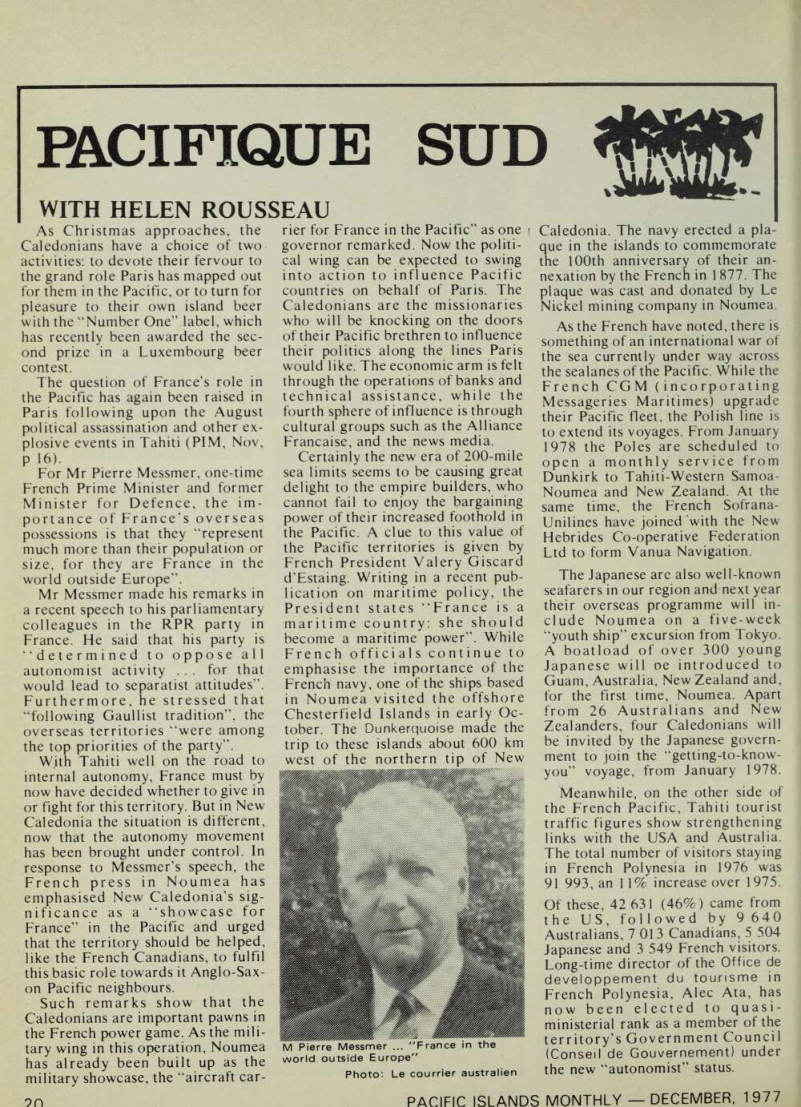
For Mr Pierre Messmer, one-time French Prime Minister and former Minister for Defence, the im portance of France’s overseas possessions is that they “represent much more than their population or size, for they are France in the world outside Europe”.
Mr Messmer made his remarks in a recent speech to his parliamentary colleagues in the RPR party in France. He said that his party is “determined to oppose all autonomist activity . . . for that would lead to separatist attitudes”.
Furthermore, he stressed that “following Gaullist tradition”, the overseas territories “were among the top priorities of the party”.
With Tahiti well on the road to internal autonomy, France must by now have decided whether to give in or fight for this territory. But in New Caledonia the situation is different, now that the autonomy movement has been brought under control. In response to Messmer’s speech, the French press in Noumea has emphasised New Caledonia’s sig nificance as a “showcase for France” in the Pacific and urged that the territory should be helped, like the French Canadians, to fulfil this basic role towards it Anglo-Sax on Pacific neighbours.
Such remarks show that the Caledonians are important pawns in the French power game. As the mili tary wing in this operation, Noumea has already been built up as the military showcase, the “aircraft car
rier for France in the Pacific” as one i governor remarked. Now the politi cal wing can be expected to swing into action to influence Pacific countries on behalf of Paris. The Caledonians are the missionaries who will be knocking on the doors of their Pacific brethren to influence their politics along the lines Paris would like. The economic arm is felt through the operations of banks and technical assistance, while the fourth sphere of influence is through cultural groups such as the Alliance Francaise, and the news media.
Certainly the new era of 200-mile sea limits seems to be causing great delight to the empire builders, who cannot fail to enjoy the bargaining power of their increased foothold in the Pacific. A clue to this value of the Pacific territories is given by French President Valery Giscard d'Estaing. Writing in a recent pub lication on maritime policy, the President states ‘‘France is a maritime country; she should become a maritime power”. While French officials continue to emphasise the importance of the French navy, one of the ships based in Noumea visited the offshore Chesterfield Islands in early Oc tober. The Dunkerquoise made the trip to these islands about 600 km west of the northern tip of New
Caledonia. The navy erected a pla que in the islands to commemorate the 100th anniversary of their an nexation by the French in 1877. The plaque was cast and donated by Le Nickel mining company in Noumea.
As the French have noted, there is something of an international war of the sea currently under way across the sealanes of the Pacific. While the French CGM (incorporating Messageries Maritimes) upgrade their Pacific fleet, the Polish line is to extend its voyages. From January 1978 the Poles are scheduled to open a monthly service from Dunkirk to Tahiti-Western Samoa- Noumea and New Zealand. At the same time, the French Sofrana- Unilines have joined with the New Hebrides Co-operative Federation Ltd to form Vanua Navigation.
The Japanese are also well-known seafarers in our region and next year their overseas programme will in clude Noumea on a five-week “youth ship” excursion from Tokyo.
A boatload of over 300 young Japanese will oe introduced to Guam, Australia, New Zealand and, for the first time, Noumea. Apart from 26 Australians and New Zealanders, four Caledonians will be invited by the Japanese govern ment to join the “getting-to-know you” voyage, from January 1978.
Meanwhile, on the other side of the French Pacific, Tahiti tourist traffic figures show strengthening links with the USA and Australia.
The total number of visitors staying in French Polynesia in 1976 was 91 993, an 11% increase over 1975.
Of these, 42 631 (46%) came from the US, followed by 9 640 Australians, 7 013 Canadians, 5 504 Japanese and 3 549 French visitors.
Long-time director of the Office de developpement du tourisme in French Polynesia, Alec Ata, has now been elected to quasi ministerial rank as a member of the territory’s Government Council (Conseil de Gouvernement) under the new “autonomist” status.
M Pierre Messmer ... "France in the world outside Europe"
Photo: Le courrier australien