at daggers drawn
p. 71 · Read in the full issue
Pacific Transport
Air New Zealand, Air Pacific, at daggers drawn
Fiji and New Zealand are at log gerheads over air landing rights. Fiji has told New Zealand it will give notice of intention to scrap the air service rights between the two coun tries. This followed the collapse, in Wellington, of negotiations for changes in an existing agreement.
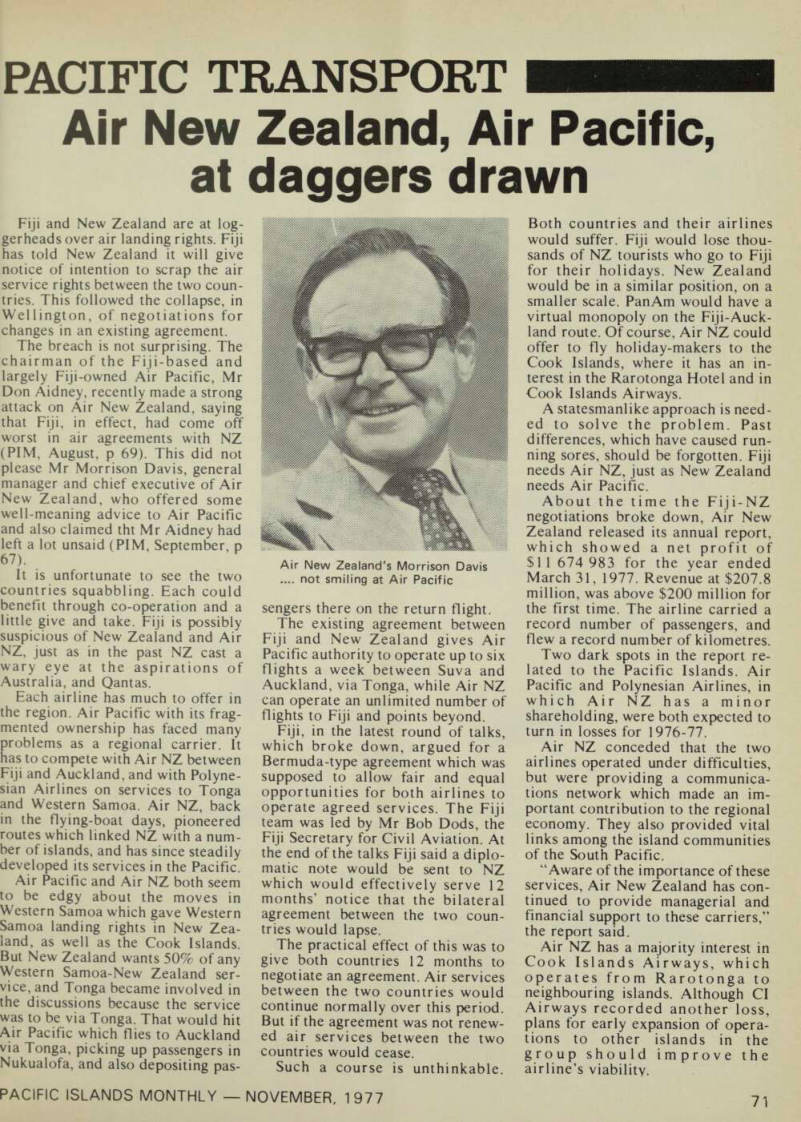
The breach is not surprising. The chairman of the Fiji-based and largely Fiji-owned Air Pacific, Mr Don Aidney, recently made a strong attack on Air New Zealand, saying that Fiji, in effect, had come off worst in air agreements with NZ (PIM, August, p 69). This did not please Mr Morrison Davis, general manager and chief executive of Air New Zealand, who offered some well-meaning advice to Air Pacific and also claimed tht Mr Aidney had left a lot unsaid (PIM, September, p 67).
It is unfortunate to see the two countries squabbling. Each could benefit through co-operation and a little give and take. Fiji is possibly suspicious of New Zealand and Air NZ, just as in the past NZ cast a wary eye at the aspirations of Australia, and Qantas.
Each airline has much to offer in the region. Air Pacific with its frag mented ownership has faced many problems as a regional carrier. It has to compete with Air NZ between Fiji and Auckland, and with Polyne sian Airlines on services to Tonga and Western Samoa. Air NZ, back in the flying-boat days, pioneered routes which linked NZ with a num ber of islands, and has since steadily developed its services in the Pacific.
Air Pacific and Air NZ both seem to be edgy about the moves in Western Samoa which gave Western Samoa landing rights in New Zea land, as well as the Cook Islands.
But New Zealand wants 50% of any Western Samoa-New Zealand ser vice, and Tonga became involved in the discussions because the service was to be via Tonga. That would hit Air Pacific which flies to Auckland via Tonga, picking up passengers in Nukualofa, and also depositing pas-
sengers there on the return flight.
The existing agreement between Fiji and New Zealand gives Air Pacific authority to operate up to six flights a week between Suva and Auckland, via Tonga, while Air NZ can operate an unlimited number of flights to Fiji and points beyond.
Fiji, in the latest round of talks, which broke down, argued for a Bermuda-type agreement which was supposed to allow fair and equal opportunities for both airlines to operate agreed services. The Fiji team was led by Mr Bob Dods, the Fiji Secretary for Civil Aviation. At the end of the talks Fiji said a diplo matic note would be sent to NZ which would effectively serve 12 months’ notice that the bilateral agreement between the two coun tries would lapse.
The practical effect of this was to give both countries 12 months to negotiate an agreement. Air services between the two countries would continue normally over this period.
But if the agreement was not renew ed air services between the two countries would cease.
Such a course is unthinkable.
Both countries and their airlines would suffer. Fiji would lose thou sands of NZ tourists who go to Fiji for their holidays. New Zealand would be in a similar position, on a smaller scale. PanAm would have a virtual monopoly on the Fiji-Auck land route. Of course, Air NZ could offer to fly holiday-makers to the Cook Islands, where it has an in terest in the Rarotonga Hotel and in Cook Islands Airways.
A statesmanlike approach is need ed to solve the problem. Past differences, which have caused run ning sores, should be forgotten. Fiji needs Air NZ, just as New Zealand needs Air Pacific.
About the time the Fiji-NZ negotiations broke down, Air New Zealand released its annual report, which showed a net profit of $ll 674 983 for the year ended March 31, 1977. Revenue at $207.8 million, was above $2OO million for the first time. The airline carried a record number of passengers, and flew a record number of kilometres.
Two dark spots in the report re lated to the Pacific Islands. Air Pacific and Polynesian Airlines, in which Air NZ has a minor shareholding, were both expected to turn in losses for 1976-77.
Air NZ conceded that the two airlines operated under difficulties, but were providing a communica tions network which made an im portant contribution to the regional economy. They also provided vital links among the island communities of the South Pacific.
“Aware of the importance of these services, Air New Zealand has con tinued to provide managerial and financial support to these carriers,” the report said.
Air NZ has a majority interest in Cook Islands Airways, which operates from Rarotonga to neighbouring islands. Although Cl Airways recorded another loss, plans for early expansion of opera tions to other islands in the group should improve the airline’s viability.
Air New Zealand's Morrison Davis ... not smiling at Air Pacific