high
p. 69 · Read in the full issue
Japanese auto industry still riding high
Japanese car manufacturers main tained a brisk level of exports throughout 1976, and prospects were good for a continued demand throughout 1977. In the Pacific Is lands in 1976 Japan sold 7 148 cars, 9 970 trucks and 396 buses. She sold 1 922 motor-bikes to Papua New Guinea and 3 247 to other Pacific Islands.
The breakdown of vehicle sales was; Cars Fiji, 1 117; Guam, 2 140; Papua New Guinea, 1 902; other, 1 989. Trucks Fiji, 1 055; Guam 1 483; Papua New Guinea, 5 326; other, 2 106. Buses Fiji, 38; Guam, 9; Papua New Guinea, 256; other, 93.
In the last 15 years Japanese car manufacturers have captured a big slice of the market from the pre viously traditional suppliers. Small to medium-sized Japanese cars seem to be eminently suited to the Pacific Islands. Although light they stand up well to the rugged roads in many parts of the Pacific. Fuel economy is a big factor, with the price having
broken through the $1 a gallon bar rier (4.5 litres) in most areas.
Japan’s auto emission standard, announced in 1976 and fixed for 1978, has been described as the most severe in the world. The stan dard called for the content of nitrogen oxide (NOx) in auto ex haust gas to be held down to an average of 0.25 grams a kilometre run for new model cars on and after April 1, 1978. It also calls for limit ing emission of carbon monoxide (CO) and hydrocarbons (HC) to less than 2.1 grams and 0.25 grams a kilometre run respectively.
• The golf boom which swept Japan in recent years is showing signs of easing. But it is still not un common to see office workers using their umbrellas to practise their golf swings during the coffee break, or on the railway platform. Golf still dominates late evening and weekend sports broadcasting. About 400 golf courses which opened after the oil crisis felt a pinch in 1976 as the number of players levelled off for the first time. Of a total of 1 100 links in operation, 44 went out of business in 1976. To tighten the screws still further, local adminis trations raised the amusement tax on golf by 20% in June.
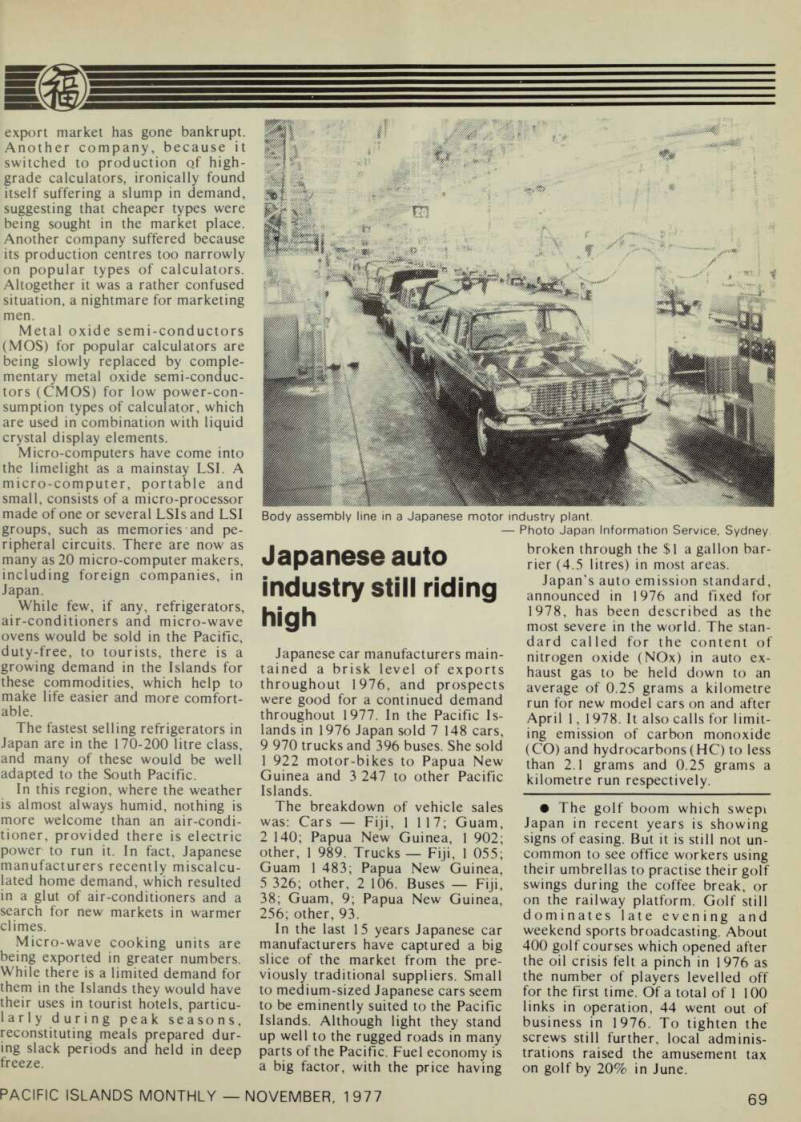
Body assembly line in a Japanese motor industry plant Photo Japan Information Service, Sydney