“Electronic?” “It’s probably
pp. 67-69 · Read in the full issue
made in Japan ...”
Much of the prosperity of South Pacific countries which have embraced tourism depends on the electronics industry of Japan. Items such as colour TV sets, stereos and CB transceivers are some of the “baits” used in Pacific duty-free shops to attract tourists.
The Japanese economy, which has been going through a recession, de pends on sales of these items throughout the world. The Pacific is a small, but important, part of the market. These “luxury” items, as they are unofficially known in the tourist trade, accounted for about two-thirds of the total 1976 output of Japan’s household electrical ap pliance industry. Exports expanded faster than manufacturers expected, particularly in the case of colour TV sets.
The increased exports of these sets however, created problems, particularly in competing countries like the US. To overcome frictions, Japanese manufacturers have step ped up building production facili ties abroad. Sanyo Electric Co took over Warwick Electronics through Sears, Roebuck and Co in 1976, with US-based production schedul ed to start in 1977 under new man agement. Toshiba and Hitachi indi cated that they too would go abroad to manufacture.
This willingness to take produc tion overseas should open up oppor tunities for enterprising busi nessmen in the South Pacific. It may be some years before there are enough trained people available to make complicated electronic ap pliances, but such enterprise could pay off. After all, American Samoa has a thriving watch industry which needs trained technicians.
Tape recorders, mostly cassette recorders, followed colour TV in terms of production value. About 90 per cent of the total output is ex ported, mostly to the US, but a fair share goes to the South Pacific.
Stereo production continued to increase in 1976, although there Were some signs of a decline in the
market. Pioneer Electronic Corp, which enjoyed huge sales in the US, now plans to start production in that country. Pioneer is the biggest manufacturer, but its position is being challenged by Matsushita Electric Industrial. Pioneer, however, with its US production, should maintain its lead over its nearest rival.
CB transceiver sales suffered a reverse in the US, the biggest market, in the second half of 1976, when there was a revision of stan dards, with the US Federal Com munications Commission increasing the number of channels. This caused a chaotic situation for the manufac turers and was followed by a sharp drop in demand. The industry ex pected some recovery in the second half of 1977, but was not over-op timistic.
Manufacturers of electronic parts, such as resistors, condensers and semi-conductors enjoyed their best year ever in 1976. Production could not keep pace with demand because of the rise in exports of the finished products using these electronic components.
Output of such single-unit semi
conductors as transistors and diodes rose by about 60% in 1976, and of integrated circuits (ICs) by 70%.
Semi-conductor makers, producing single-unit semi-conductors and ICs, boosted production capacity by 50% in the financial year ended March 31, 1977, through aggressive plant and equipment investment based on expectations of long-term growth.
These manufacturers included Toshiba, Nippon Electric, Hitachi, Mitsubishi and Sharp. With so many manufacturers, there is keen com petition with prices at economic levels for buyers, even though pro duction cannot yet match demand.
Large-scale integrations (LSIs), the most sophisticated IC incor porating one silicon chip and more than 1 000 transistors and diodes, have become widely used in calcula tors and computer memories in the last six or seven years. Production has been rising sharply, reflecting the booming demand for pocket type calculators which characteris ed this period.
But there has recently been a slump in demand, and one top manufacturer of calculators for the
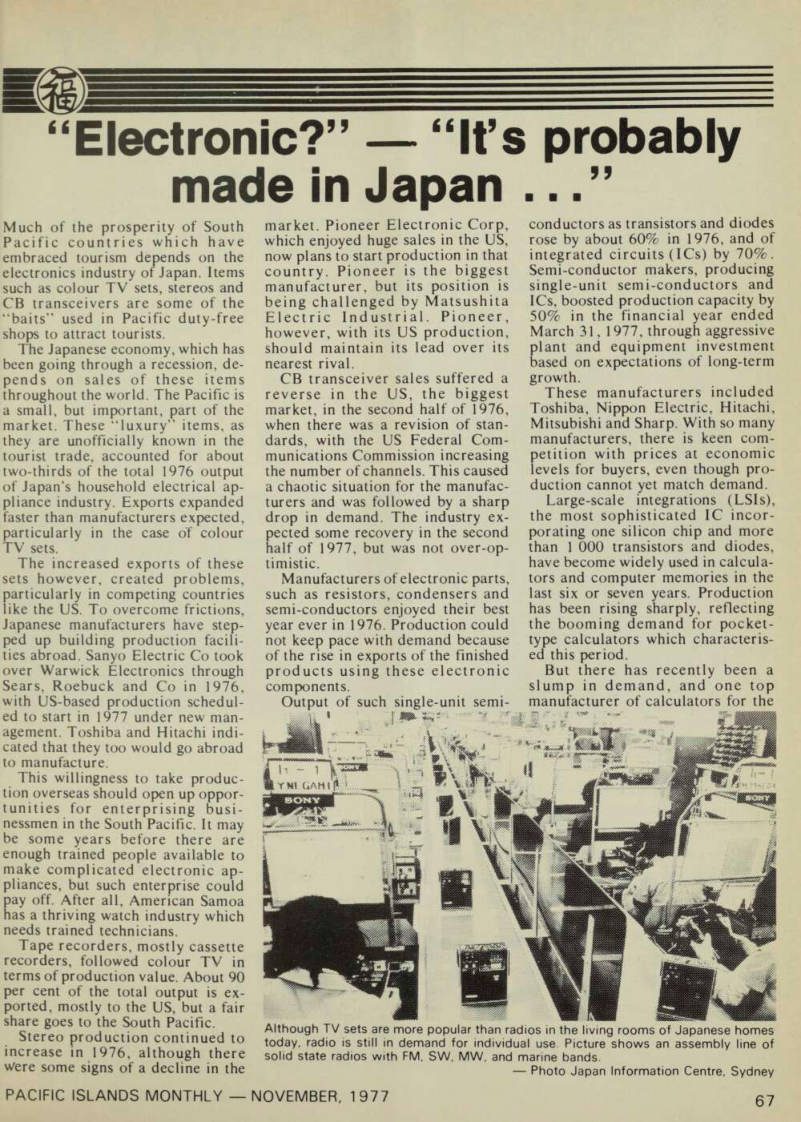
Although TV sets are more popular than radios in the living rooms of Japanese homes today, radio is still in demand for individual use. Picture shows an assembly line of solid state radios with FM, SW, MW, and marine bands.
Photo Japan Information Centre, Sydney
export market has gone bankrupt.
Another company, because it switched to production of high grade calculators, ironically found itself suffering a slump in demand, suggesting that cheaper types were being sought in the market place.
Another company suffered because its production centres too narrowly on popular types of calculators.
Altogether it was a rather confused situation, a nightmare for marketing men.
Metal oxide semi-conductors (MOS) for popular calculators are being slowly replaced by comple mentary metal oxide semi-conduc tors (CMOS) for low power-con sumption types of calculator, which are used in combination with liquid crystal display elements.
Micro-computers have come into the limelight as a mainstay LSI. A micro-computer, portable and small, consists of a micro-processor made of one or several LSIs and LSI groups, such as memories and pe ripheral circuits. There are now as many as 20 micro-computer makers, including foreign companies, in Japan.
While few, if any, refrigerators, air-conditioners and micro-wave ovens would be sold in the Pacific, duty-free, to tourists, there is a growing demand in the Islands for these commodities, which help to make life easier and more comfort able.
The fastest selling refrigerators in Japan are in the 170-200 litre class, and many of these would be well adapted to the South Pacific.
In this region, where the weather is almost always humid, nothing is more welcome than an air-condi tioner, provided there is electric power to run it. In fact, Japanese manufacturers recently miscalcu lated home demand, which resulted in a glut of air-conditioners and a search for new markets in warmer climes.
Micro-wave cooking units are being exported in greater numbers.
While there is a limited demand for them in the Islands they would have their uses in tourist hotels, particu larly during peak seasons, reconstituting meals prepared dur ing slack periods and held in deep freeze.