The talking’s over Japan is
pp. 65-66 · Read in the full issue
on the move in Fiji
From ROBERT KEITH-REID in Suva
Japanese investment corporations will be occupying a significant place in the Fiji economy by the end of the 19705.
After a long period of talk, but lit tle positive action, Japanese compa nies have in the last 18 months made moves in the fields of land, fishing and manufacturing that will un doubtedly result in the inflow of large sums of capital.
The advent of the Taisei construc tion group at Pacific Harbour, a resort development 55 km from Suva, is expected to prompt a gra dual snowballing of other Japanese involvement there, primarily in the business of catering for leisure.
At the old Fiji capital of Levuka a big fish cannery is already in pro duction as a joint venture between the Fiji Government and Japanese interests.
It will soon be supplemented by a factory which will make cans for the cannery.
On Mana Island a resort hotel is 80% owned by Todeco (Fiji) Ltd, a private company formed by more than 30 large Japanese corporations as a vehicle for investment in a wide range of fields in Fiji and possibly other areas of the South Pacific.
Through the 1950 s and 1960 s Japan derived considerable business from Fiji but gave little back.
The two exceptions were failures.
The Banno Mining Corporation, a subsidiary of the Nassan Corpora tion of Osaka, opened a copper mine which ran for only a few months before it closed permanently when it became clear that mineral deposits were far smaller than calculated.
And three other companies lost several million dollars in attempt ing to exploit deposits of lowgrade bauxite.
The Pacific Fishing Company, formed by C. Itoh and Co Ltd of Osaka and Nichiryo Ltd of Tokyo, opened a freezing factory at Levuka 13 years ago to handle tuna landed by Japanese, Korean and Taiwanese vessels.
Three years ago they and the Fiji Government signed an agreement under which the freezing facilities were expanded to can fish.
The government acquired a 25% holding in Pacific Fishing, with C.
Itoh retaining 60% of the shares and Nichiryo’s holding dropping to 10%. Another 5% is owned by about 20 local shareholders.
More than SI million was in vested in building the cannery, which started production late last year.
By 1979 the cannery is due to be processing 12 000 tonnes of fish a year and employing 400 local peo ple. It should be contributing from $lO million to $l5 million annually towards export earnings, and at the same time reducing local depen dence on imported tinned fish.
The cannery has led to a further agreement under which the govern ment has taken a 20% share in the Fiji Can Company Ltd, formed with Toyo Seikan Kaisha Ltd. A factory
being built next to the existing cann ery will start production this year making 470 000 cans a year, to reach an annual output of a million by 1980.
TSK, a well-known Japanese packaging company, is supplying equipment, technicians and raw materials as well as capital.
Between the 10th and 15th year of its agreement with the government it will offer 10% of the can company’s shares to local investors.
More than 60 000 ha of pines is being planted by the Fiji Govern ment with an eye to supplying the Japanese market.
At the end of 1975 Southern Pacific Properties of Hong Kong, in which the British P&O shipping group is a large shareholder, an nounced the formation of SPP- Taisei Ltd.
Taisei, one of Japan’s biggest con struction groups, has a half share in SSP-Taisei, which paid out $5 million for 2 400 ha of the 2 800 ha of land owned at Pacific Harbour by Southern Pacific Properties.
SSP completed the 445 ha first stage of the Pacific Harbour scheme, in which Taisei has bought land on its own account with a view to hotel and condominium-style projects.
Taisei is taking the bulk of responsibility of planning and ex ecution of the development of the 2 400 ha acquired by SPP-Taise.
Detailed plans have not yet been published but Taisei has indicated that it envisages small village-type complexes along the same lines as the first stage.
In buying into Fiji Taisei execu tives said they saw the country as a prime destination for Japanese tourists in the 1980 s a develop ment which will be encouraged by the planned initiation of flights to Fiji before 1980 by Japan Air Lines.
In July 1974 a Fiji public compa ny, Fiji Property Centre Ltd, an nounced that it had signed a Joint venture agreement with the Asahi Urban Development Corporation
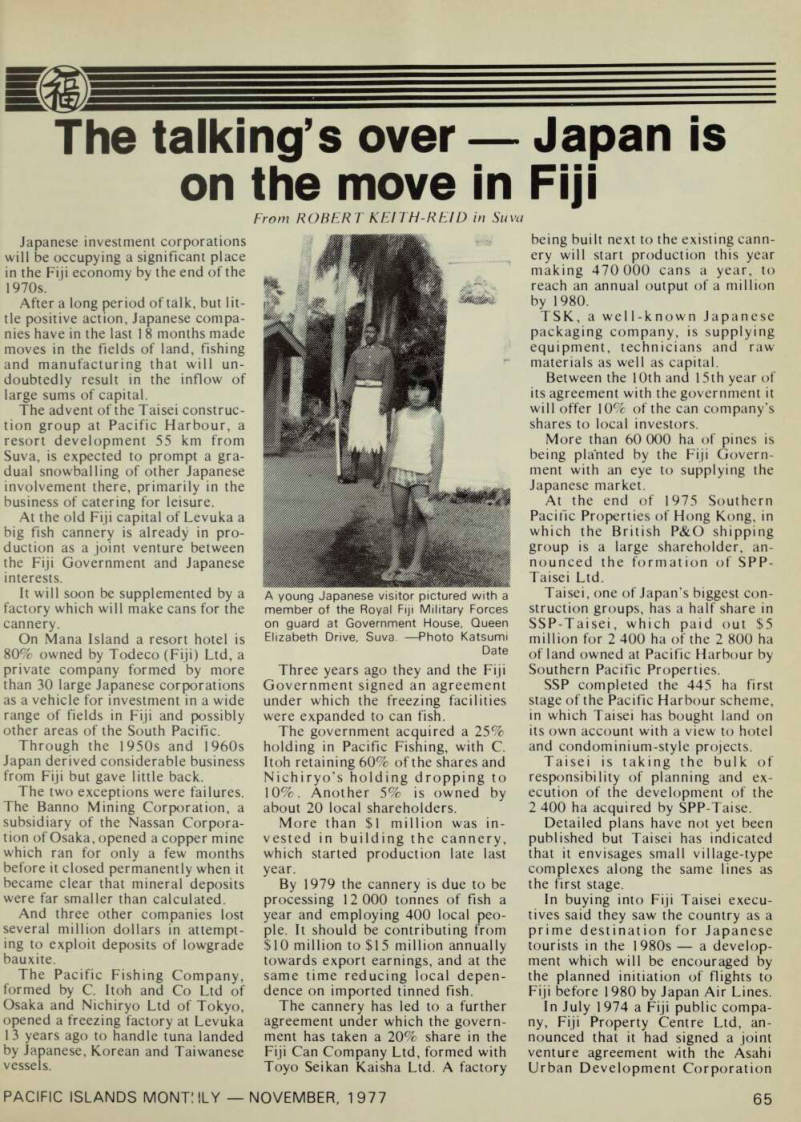
A young Japanese visitor pictured with a member of the Royal Fiji Military Forces on guard at Government House, Queen Elizabeth Drive, Suva. —Photo Katsumi Date
Ltd for construction of a 100-room hotel.
Asahi’s interest in the deal amounted to 80% of the stock, but the hotel has not yet materialised, apparently due to the Japanese com pany’s reluctance to embark on it in prevailing tight economic condi tions.
Latest Japanese arrival in Fiji is the Yashino Kogyosho Co which has formed Cope Allman-Yashino Ltd for the production of plastic bottles and other containers.
Cope Allman, a large British company established in Fiji for more than 10 years, is active in copra milling, biscuit making, and in the manufacture of soap, plastics and various other items.
Full details of its venture with Yashino Kogyosho have not yet been disclosed.
Japan Briefs
• Japanese interests are seeking rights to search for oil in Tongan waters, and explore for minerals throughout the country. A recent visitor to Tonga was Mr M. Okada, president of Empire Boeki KK, of Tokyo. He met King Taufa’ahau Tupou and discussed with him the possibility of securing rights for oil exploration in the Niuas and general mineral exploration.
The king said later that Mr Okada was also interested in leasing land for a fishing base, and possibly building hotels. Tonga has sanction ed the exploration proposals, but the other suggestions will have to wait till Mr Okada is established in Tonga.
Initially, Mr Okada could invest as much as T 3 million in Tonga, but first must get a clearance from the Federal Reserve Bank of Japan to shift the money to Tonga. • Japan’s gross national product in 1976 registered a 6.3% growth in real terms, showing a much larger economic growth than in 1975, the first year of recovery from the 1974 recession. According to preliminary figures published by the Economic Planning Agency, the GNP reached SUS 346 000 million after adjust ment for prices in the last calendar year. Japan’s per capita GNP in 1976 reached SUS 4 930, an increase from the SUS 4 390 of 1975.