trading companies
p. 64 · Read in the full issue
Meet Japan’s remarkable trading companies
Japanese trading companies play an unusually important role in facilitating Japan’s export and import trade. In recent years they have come to play an increasingly significant role in trade among countries other than Japan.
Almost 6 000 corporations in Japan are classified as trading companics, engaged primarily in exporting, importing or a combination of these activities. The largest 10 of those companies are called general trading companies or sogo shosha and have a minimum annual turnover of SUS 6 billion.
The origins of trading companies date back to the 1870 s when Japan resumed international trade after more than 200 years of self-imposed isolation. Major business interests of the time set up specialised divisions or separate companies to provide needed expertise related to seeking new export opportunities, finding sources of raw materials and other imported products, and assisting in the transmission of technology to promote industrial development.
The most basic role played by trading companies even today is that of providing trade intermediary ser-
vices. Because of the volume of the business transactions handled by them, the top 10 trading companies particularly are in a position to realise economies of scale in transport, warehousing and other areas related to physical distribu tion and the marketing of imports and exports.
But in addition to simply acting as intermediaries, trading companies, both large and small, have been ac tive in developing new trade flows, Their role is not simply that of inter mediaries, but also creators of trade. This activity has been one of the most important sources of their growth and development, The task of creating trade flows has included development of new sources of supply, as in the case of iron ore mines in Australia, and in development of new industries to use raw materials and intermediate products, as in the case of the textile industry in South-east Asia, To this task of trade development, trading companies bring a unique combination of; • Expertise and information on market opportunities around the world;
• An ability to provide finance through trade credits, investments, direct loans and loan guarantees; • The ability to absorb some of the risks inherent in trade because of the wide range of products they handle and their ability to hedge foreign exchange risks.
The potential role which trading companies can play in assisting in the growth of developing nations ap pears to be a large one. Trading companies, for example, have the ability to assist in economic development through plant and technology exports, can assist in the financing of these industrial developments and in marketing their finished products in Japan and other international markets.
In the 1974 financial year trading companies handled 67% of Japan’s exports and 70% of imports. The 10 largest companies handled 57% of the export business and 58% of im ports.
For the 12 months to March 31, 1976, the 10 leading trading compa nies, by sales, were; Mitsubishi, Mit sui, Marubeni, C. Itoh, Sumitomo, Nissho-Iwai, Tomen, Kanematsu- Gosho, Ataka and Nichimen.
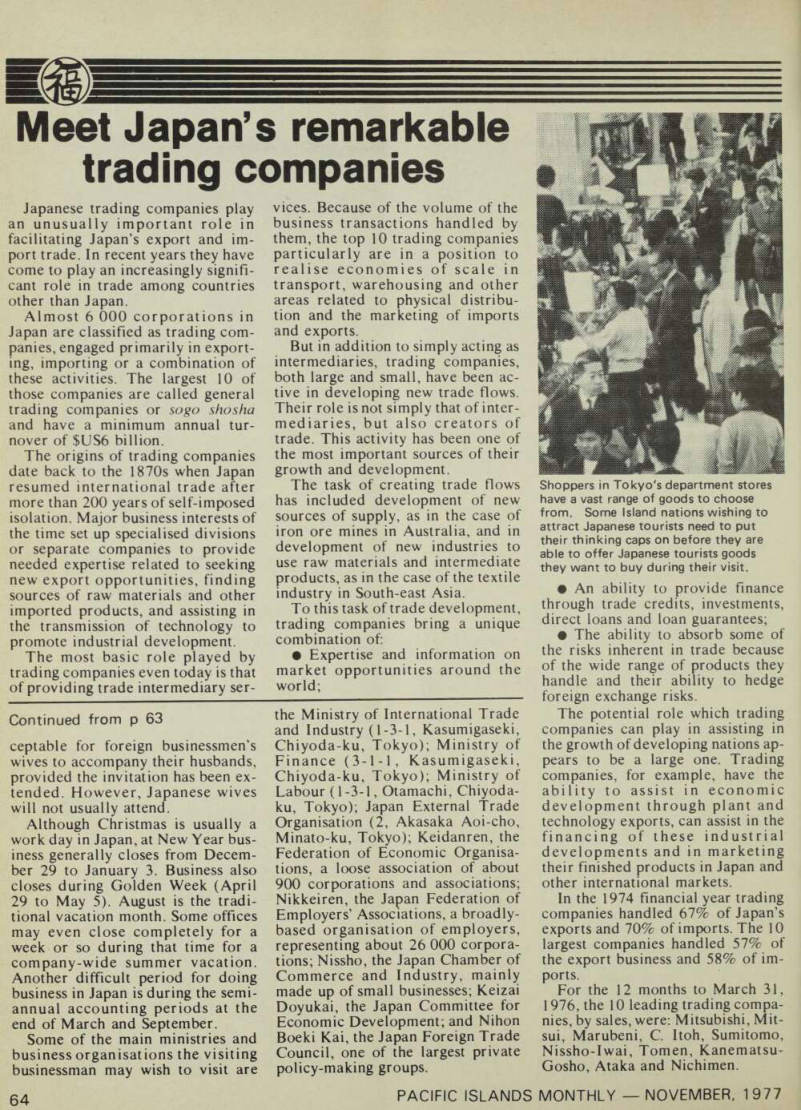
Shoppers in Tokyo's department stores have a vast range of goods to choose from. Some Island nations wishing to attract Japanese tourists need to put their thinking caps on before they are able to offer Japanese tourists goods they want to buy during their visit.