US, Australian
pp. 73-75 · Read in the full issue
airlines in new Pacific war
Continental Airlines will fly the US-South Pacific route in 1978 in the face of opposition by Pan Ameri can World Airways, supported by Qantas and the Australian Govern ment. Qantas has filed an appeal with the US Civil Aeronautics Board in support of an earlier ap peal presented by Pan Am against award of the route to Continental.
The Australian Transport Minis ter, Mr Peter Nixon, would stop the Continental service if he could, but under the terms of the US-Australia air agreement there is nothing he can do to veto a decision made by President Carter. But he may be able to make things a little awkward for Continental as Australia has a say in the frequency of the service and the type of aircraft used.
The final decision in the award of air routes always rests with the US President, no matter what the CAB recommends. Both PAA and Conti nental, who fought each other hard for the Saipan-Japan route, know this only too well.
PAA, during drawn-out pro cedures before the matter finally went to President Carter, threatened to cut back flights to the South Pacific if a second US carrier was allowed on the route. It has now shifted ground because of the suc cess of its SP long-range jumbo jet on non-stop flights across the Pacific.
But at the time it made its threat to cut back, the CAB noted that it would withdraw two Boeing 727 services. That would be almost offset by four DCIO services plann
ed by Continental, which would represent a net gain of 10% in US carrier capacity on the Pacific route, with two PAA services out.
PAA forecast that with an in crease in capacity with Continental in the market and no cutback in PAA services, Australia would de mand capacity ceilings on US ser vices.
This could well be where Mr Nix on comes in. He is afraid there could be a repeat of the unsatisfac tory situation which developed when American Airlines came into the service. While Continental might generate some new traffic, he was far from satisfied it would be enough to use the capacity which would become available with Conti nental on the route.
Mr Nixon said one of his prin cipal concerns was the loss of oppor tunity for reduction of passenger fares and freight rates if the airlines flew an increasing number of empty seats across the Pacific. As fossil fuels became more expensive, there would be an increased need to en sure capacity was fully maintained.
He regards those matters as serious, which may well have to be taken up with “American friends”.
With US politics being what they are it is hard to see President Carter reversing his decision. After all, President Johnson back in the 1960 s gave tentative approval for Conti nental to fly the route as the second US carrier. President Nixon on coming into office in 1969 overturn ed President Johnson’s decision, and awarded the route to American Airlines, with disastrous financial results. If President Carter stands firm, and remains in office for the two terms he is allowed under the US constitution, then Continental is safe till 1985 at least.
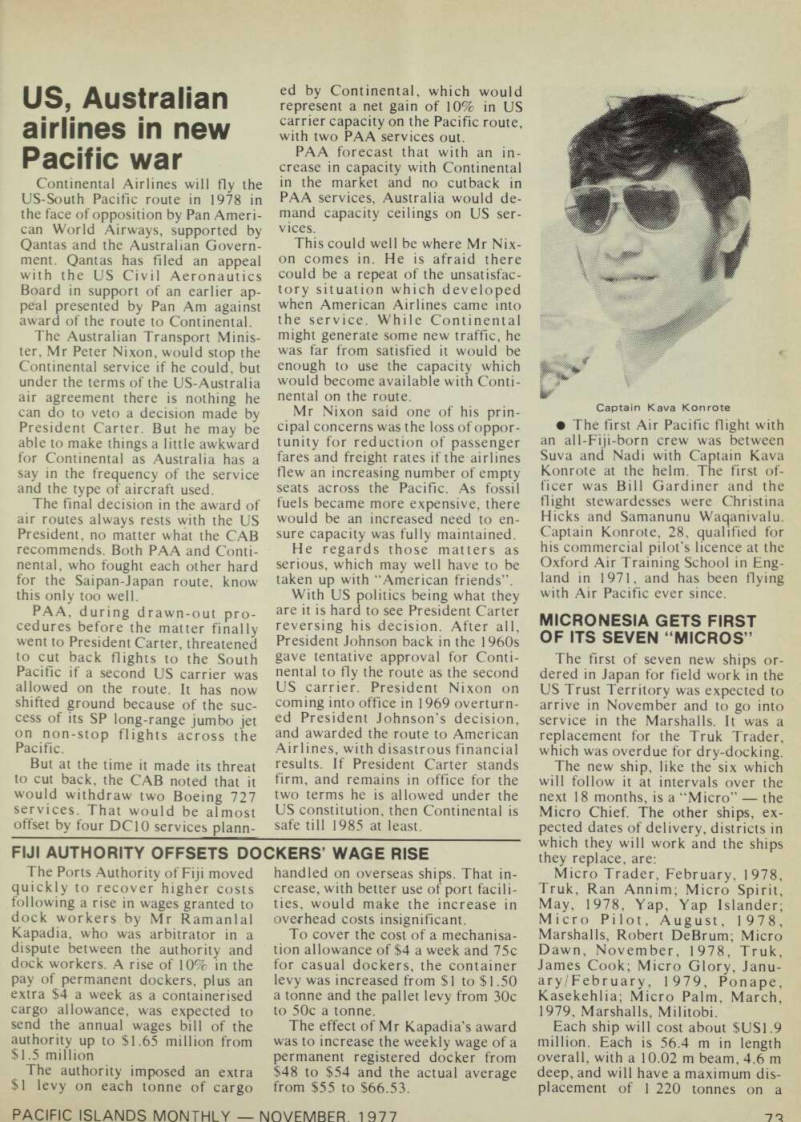
• The first Air Pacific flight with an all-Fiji-born crew was between Suva and Nadi with Captain Kava Konrote at the helm. The first of ficer was Bill Gardiner and the flight stewardesses were Christina Hicks and Samanunu Waqanivalu.
Captain Konrote, 28, qualified for his commercial pilot’s licence at the Oxford Air Training School in Eng land in 1971, and has been flying with Air Pacific ever since.
Micronesia Gets First
Of Its Seven “Micros”
The first of seven new ships or dered in Japan for field work in the US Trust Territory was expected to arrive in November and to go into service in the Marshalls. It was a replacement for the Truk Trader, which was overdue for dry-docking.
The new ship, like the six which will follow it at intervals over the next 18 months, is a “Micro” the Micro Chief. The other ships, ex pected dates of delivery, districts in which they will work and the ships they replace, are; Micro Trader, February, 1978, Truk, Ran Annim; Micro Spirit, May, 1978, Yap, Yap Islander; Micro Pilot, August, 1978, Marshalls, Robert Deßrum; Micro Dawn, November, 1978, Truk, James Cook; Micro Glory, Janu ary/February, 1979, Ponape, Kasekehlia; Micro Palm, March, 1979, Marshalls, Militobi.
Each ship will cost about SUSI. 9 million. Each is 56.4 m in length overall, with a 10.02 m beam, 4.6 m deep, and will have a maximum dis placement of 1 220 tonnes on a
Captain Kava Konrote
draught of 3.35 m. They are powered by Twin GM diesels of 455 hp and are capable of 11 knots.
There is berthing accommodation for 12 passengers and 100 deck pas sengers will be allowed. Each ship will carry a crew of 12.
The ships were designed by Mor ris Guralnick Associates, naval architects, of San Francisco. The builder is the Namura Shipbuilding Co Ltd, Osaka.
Expanded Air Terminal
For Pago Pago
The United States has made a grant of about SUSI.B million to American Samoa to build an addi tion to the terminal at Pago Pago in ternational airport. American Samoa is not required to match the grant in any way. Work on the pro ject, which will take two years, was expected to start in November.
The addition will do much to eliminate overcrowding at the ter minal. It will include a sterile hold, duty-free shop, arrival and depar ture facilities and parking lot im provements. At present the simultaneous arrival of two aircraft places an almost intolerable strain on airport facilities.
Airstrip For Cooks’
Mauke Island
Mauke Island in the southern Cooks now has an airstrip. It was of ficially opened by the Premier, Sir Albert Henry, amid three days of celebration and feasting. Mauke is the second of the southern Cooks to have an airstrip. The first strip was laid on Atiu. The next island on the list is Mitiaro. Sites have been sur veyed on Mangaia, but so far no definite plans have been announced about when that strip will be laid.
The Mauke strip is a little more than 1 000 metres long. The terminal building is of local materials and pandanus.
Victory (And Jets)
For Air Niugini
A tug of war between the Papua New Guinea Government and its national airline, Air Niugini, ended in victory for the airline in Septem ber.
The Prime Minister, Mr Somare, announced that the airline would be permitted to go ahead with its ar rangements to buy two Fokker Fellowship jets in a deal worth $7.5 million.
The two Fokkers were acquired from Air Nauru, which was re equipping for expanded require ments, and they were to operate under a lease-purchase arrangement from November 1.
The deal, which was master minded by the aircraft manufac turers Fokker-VFW, was regarded in aviation circles as extremely good.
Mr Somare also announced im mediate and pending expenditure of
$500,000 to upgrade some airport facilities for the new aircraft.
The Fokkers are to be used for domestic services out of Port Moresby, Wewak, Bougainville Is land, Madang, New Ireland and Manus Island. They will also be phased into short-haul international services to Northern Queensland, Irian Jaya and the Solomon Islands.
Air Niugini already operated 11 F 27 Fokker Friendship turboprops on domestic routes, and a Boeing 707 on international routes.
Fiji’S $250 000
Sinking
A Fiji Government landing craft, the Tabilai, 200 tonnes, sank off Vanua Balavu in Lau and with it went cargo worth $250 000. The master, Akeai Taka, 15 crew and five passengers were rescued and taken to Cikobia Island, but one man was feared to have drowned.
It was a troublesome voyage, which followed a troublesome prelude. She broke her ramp while a bulldozer was being loaded, and that delayed her departure from Suva for three days. Then she ran on to a sandbank in Vanua Balavu lagoon. Next she developed a leak in rough seas, with strong winds blowing.
Then the bulldozer slipped from its hold and with its weight toppled the Tabilai over. Another bulldozer, 100 184-litre drums of fuel, a work hut, a vehicle and other cargo for development projects in the outer islands went down as well.
Attempts may be made to salvage the vessel.
Name Of Swire
Is Riding Higher
The name of Swire is riding high among Fiji importers. Swire Ship ping Agencies, agents for New Zea land Express Unit, absorbed extra shipping costs, caused by the recent dock strikes. Swire made no claim against Fiji importers in the case of two trans-shipments. The Fiji Ship pers’ Council, after officially prais ing Swire Shipping Agencies, cri ticised other companies which charged extra for returning cargo not discharged in Fiji during the strike. Both Swire Shipping Agen cies and NZ Express Unit are part of the giant Swire group.
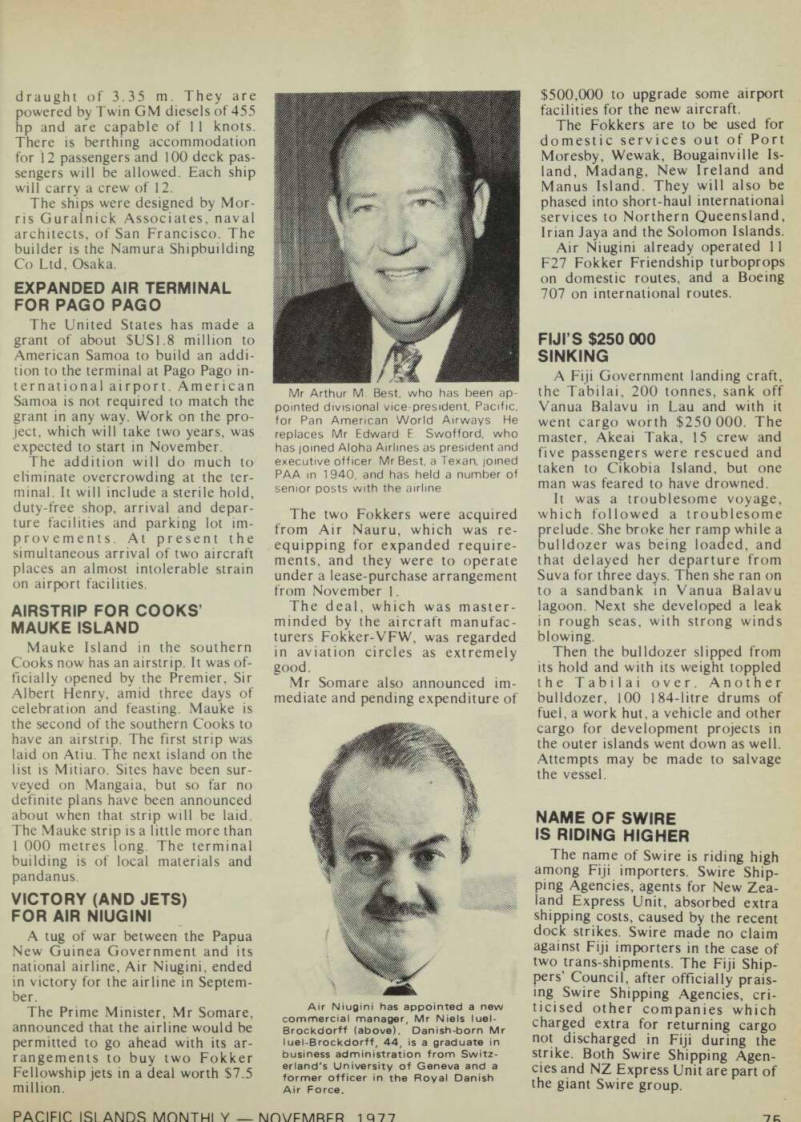
Mr Arthur M Best, who has been ap pointed divisional vice-president. Pacific, for Pan American World Airways He replaces Mr Edward E Swofford, who has joined Aloha Airlines as president and executive officer Mr Best, a Texan, joined PAA in 1940, and has held a number of senior posts with the airline
Air Niugini has appointed a new commercial manager, Mr Niels luel- Brockdorff (above). Danish-born Mr luel-Brockdorff, 44, is a graduate in business administration from Switz erland's University of Geneva and a former officer in the Royal Danish Air Force.