at Fiji’s striking dockers
pp. 65-66 · Read in the full issue
Pacific Transport
Wuam! Angry women’s blow at Fiji’s striking dockers
From ROBERT KEITH-RE/D in Suva
A dock strike that choked the Fiji economy in the first weeks of July ended as an affair that clouded Fiji- New Zealand relations.
And the sequel could be a row at the South Pacific Forum meeting in Port Moresby, where the strike is almost certain to be raised as the re sult of Fiji’s appeal to other small Is land states for support in resisting “sinister” foreign involvement in its affairs.
The strike had origins in a deci sion by the Fiji Waterside Workers’ and Seamen’s Union to hit the Ports Authority of Fiji (PAF) with a 30% pay rise claim in negotiations, to re place an expiring agreement.
The claim ran counter to an agreement in May by the govern ment, Fiji Trades Union Congress, and Fiji Employers’ Consultative Association, which said that to help the recovery of a flagging economy, all three sides will hold pay in creases to a maximum of 10% for 12 months. It also allowed for special procedures to avoid strikes through mediation by a tripartite committee headed by Prime Minister Ratu Sir Kamisese Mara.
The dockers just thumbed their noses at the agreement, only too well aware of the power of their hold on the ports through which almost all Fiji’s imports and exports must move.
On the same day that the tripartite pay limit deal was formalised, the dockers served 28 days’ notice of their intention to strike, as required by Essential Service Industry laws.
They did this after walking out of talks at which the PAF had unwisely quibbled about the status of 39year-old Taniela Veitata, the union’s paid industrial adviser.
Veitata, who completely dominates the dockers, was secretary of their unions until he was legally barred from holding elective office for five years because of a conviction for theft from Suva wharf.
The PAF’s quibble about his bona fides gave the union an excuse for a strike which it seems to have been bent on anyhow.
A confrontation between the dockers and the government became inevitable from the moment the Prime Minister, commenting on the strike notice, recalled hardships caused by a six-week-long dock strike in 1971 and promised that this time the Government would not let the ports be closed.
Veitata’s prompt warning was that New Zealand and Australian water side workers’ unions would blacklist all Fiji cargo in ships loaded or dis charged in Fiji by non-union labour.
Over the weeks leading up to the strike the government and PAF tried to avoid it. The PAF insisted that it was bound by the 10% limit guideline, and offered to pay 10% more, which would give a docker $1.32 an hour. Since the dockers are guaranteed pay for at least 40 hours a week, although they work only an average of 20, the offer would have kept them in their place as Fiji’s highest-paid labourers. On top of it, the PAF said it would establish a $2OO 000 trust fund from which the dockers could draw sickness pay, housing loans and various other benefits.
The union was not interested. It wanted 30 cents an hour extra or nothing, it said an increase of 25%, against its original 30% claim.
Weeks of sporadic haggling ended with an irate Veitata reporting to the local press that although the PAF was sticking to its 10% offer, it had suggested giving another 15c to be disguised as a special fringe benefit that would not technically transgress the 10% guideline.
What was annoying, Veitata said, was that the PAF had withdrawn this idea under pressure from the employers’ association.
The mood of the dockers was not improved when their offices were raided by police who seized files and said they were investigating alleged misuse of union funds.
On July 5 union officials met the government-employer-trade union tripartite committee in what turned out to be the last effort to avoid the strike.
After the talks, Veitata declared: “All talks have collapsed and are dead. It’s 30 cents or nothing.”
When the strike started next morn ing the government responded quickly.
It declared the strike illegal under the Trade Disputes Act, or dered compulsory arbitration, and began recruiting from a plentiful supply of eager voluntary labour.
Veitata defied the government to do its worst. “They can lock me up and throw away the key,” he said.
The government’s claim to be keeping ports open soon proved rather hollow. Shipping companies, knowing their ships would hit big trouble in Australia and New Zea land if touched by non-union labour in Fiji, instructed captains to have nothing to do with it.
The strike bit quickly into the economy. Sugar shipments worth $l6 million were endangered, thou sands of acres of growing sugar cane
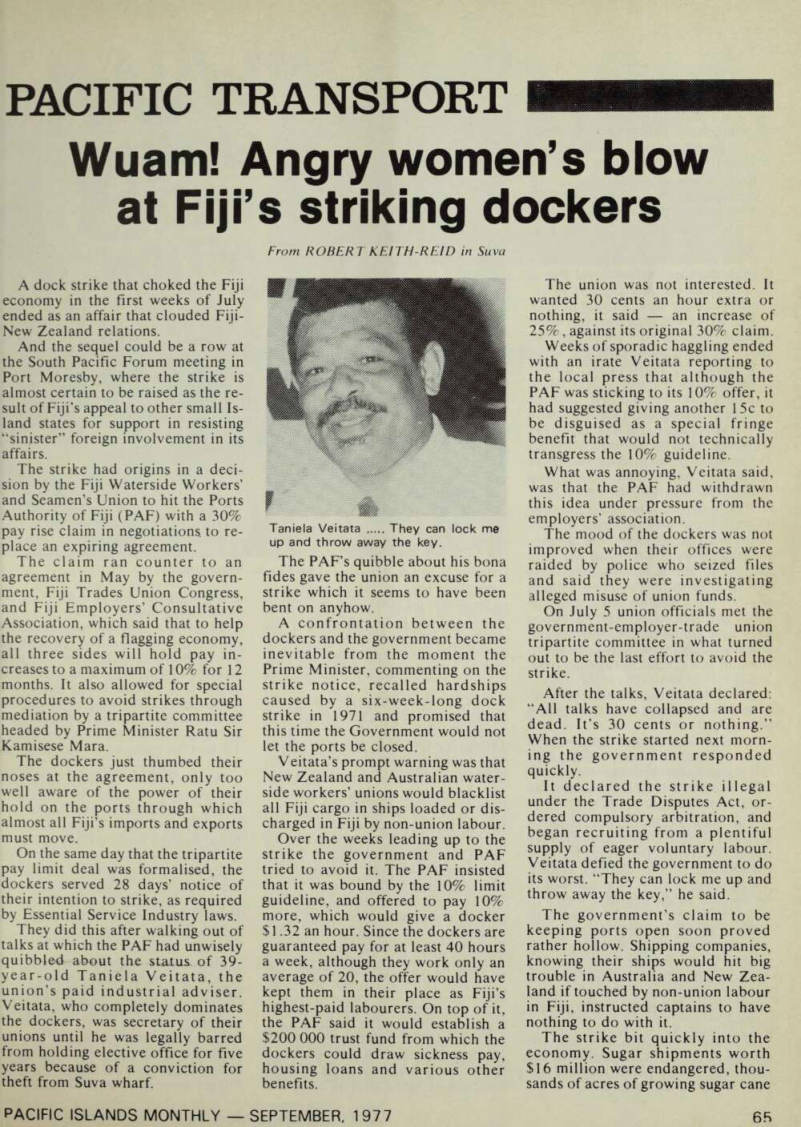
Taniela Veitata ... They can lock me up and throw away the key.
were imperilled by non-delivery of fertilisers, and industries, including the Vatukoula gold mine and a big plywood firm, prepared to lay men off or go on short time for lack of chemicals and spare parts.
Ratu Mara sent protests to the Australian and New Zealand prime ministers about the support their unions were giving to the Fiji dockers. He also wrote to the leaders of Nauru, Tonga, Western Samoa, the Cook Islands and Papua New Guinea seeking support in re sisting pressure from outside unions.
The strike was nine days old when Veitata announced “we’ll end the strike at 8 am tomorrow and settle our dispute by arbitration”. But 45 minutes later he said; “The strike will continue.” He and PAF officials had been fixing arrangements with the arbitrator, Mr Ramanlal Kapadia, when he got news of events at the sugar port of Lautoka, where the 6 000 tonne Union Steam Ship vessel Ngahere was tied up.
Her militant New Zealand and English crew were on strike in sym pathy with the dockers. On govern ment orders the PAF told her cap tain to shift Ngahere to make way for another ship. The crew refused to obey the captain’s order and had to be quelled with tear gas when they took up hammers, shovels and fire hoses against Fiji police sent to the ship as a precaution against trou ble.
Seventeen of the seamen were ar rested and charged with obstructing police.
Veitata viewed the arrests as a “new development” and after telephone talks with the New Zea land Seamen’s Unions, ordered the dockers to stay on strike.
The New Zealand Federation of Labour (NZFOL) immediately began exerting pressure for the withdrawal of the charges against the Ngahere men. A total ban would be applied to all dealings with Fiji unless they were released, it warned.
Ratu Mara was infuriated. “We are not going to be dictated to by people from outside,” he said. “I would rather that we starve, have less money through the actions of these people overseas, but maintain our law.”
His government’s line was at tacked by some local opponents, but there was a significant surge of ap proval from other quarters.
The Fiji Trades Union Congress, backed by about three-quarters of the country’s unions, slammed the NZFOL and other foreign unions for “unethical” interference that put Fiji in a position “similar to being invaded”.
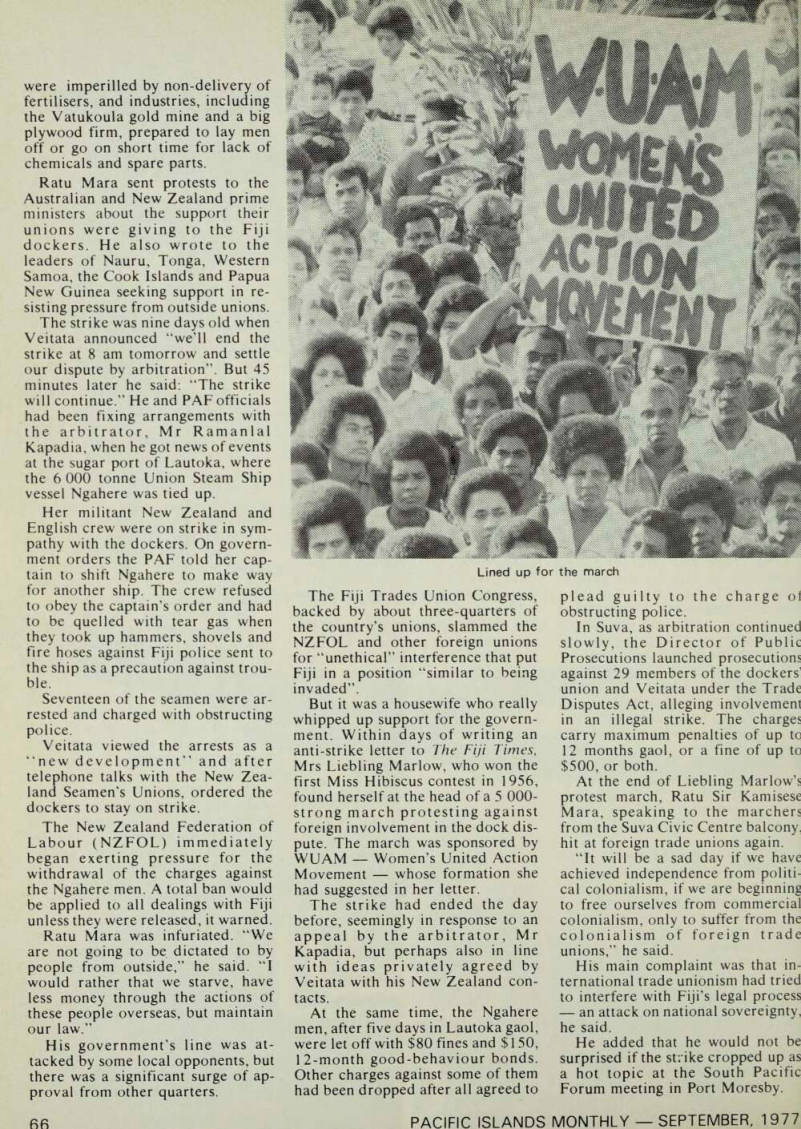
But it was a housewife who really whipped up support for the govern ment. Within days of writing an anti-strike letter to The Fiji Times, Mrs Liebling Marlow, who won the first Miss Hibiscus contest in 1956, found herself at the head of a 5 000strong march protesting against foreign involvement in the dock dis pute. The march was sponsored by WUAM Women’s United Action Movement whose formation she had suggested in her letter.
The strike had ended the day before, seemingly in response to an appeal by the arbitrator, Mr Kapadia, but perhaps also in line with ideas privately agreed by Veitata with his New Zealand con tacts.
At the same time, the Ngahere men, after five days in Lautoka gaol, were let off with $BO fines and $ 150, 12-month good-behaviour bonds.
Other charges against some of them had been dropped after all agreed to
plead guilty to the charge of obstructing police.
In Suva, as arbitration continued slowly, the Director of Public Prosecutions launched prosecutions against 29 members of the dockers’ union and Veitata under the Trade Disputes Act, alleging involvement in an illegal strike. The charges carry maximum penalties of up to 12 months gaol, or a fine of up to $5OO, or both.
At the end of Liebling Marlow’s protest march, Ratu Sir Kamisese Mara, speaking to the marchers from the Suva Civic Centre balcony, hit at foreign trade unions again.
“It will be a sad day if we have achieved independence from politi cal colonialism, if we are beginning to free ourselves from commercial colonialism, only to suffer from the colonialism of foreign trade unions,” he said.
His main complaint was that in ternational trade unionism had tried to interfere with Fiji’s legal process an attack on national sovereignty, he said.
He added that he would not be surprised if the strike cropped up as a hot topic at the South Pacific Forum meeting in Port Moresby.
Lined up for the march