capital
p. 63 · Read in the full issue
Png Timber Industry In 'Dire
Straits’ Says An Expert
PNG, ‘crocodile
capital
of the world’
Papua New Guinea has been de scribed as “the crocodile capital of the world” by the newly-appointed representative of the UN Food and Agriculture Organisation in PNG, Mr John Lever.
Speaking after a six-weeks tour in which he visited reptile skin tann eries in the United States, France, Italy and India, Mr Lever said that PNG crocodile skins are considered to be the best in the world. Every tannery he visited wanted to corner supplies of PNG croc skins for itself, he said.
Mr Lever went on; “What is perhaps more important, the coun try has formulated and put into effect a realistic plan for the indus try which blends in with the people’s cultural and economic re quirements.
“The PNG situation is unique in that the people who own the re source are doing something con structive to retain the high popula tion rate of crocodiles in natural swamps and river systems.
“All that the industry needs is stronger organisation to emphasise crocodile farming in rural areas, direct marketing of skins, and a system that will return payment to suppliers in the quickest and most efficient way.
“If these things are done, within about five years PNG could be the only country in the world con sidered as a reliable supplier of top quality crocodile skins to the inter national market.”
Mr Lever said that in some coun tries he had seen crocodile skin handbags priced at K800, wallets at about K65-80, and belts at about K65. Articles made from PNG skins were always among the most highly priced.
Once present problems are solv ed, the industry would certainly bring in large sums of money to peo ple in rural areas, especially the Sepik, Madang, Western and Gulf areas.
At present, PNG has 300 cro codile farms in operation with a capacity of 3 000 crocodiles a year per farm. There are also six village business groups active,
That timber industry advisers to the PNG Government have been kidding themselves and the government about the quality of PNG timber is the opinion of Mr J.
L. Chipper of Rabaul, a businessman, timber logger, miller, and investor, who has had more than 40 years experience in PNG.
“Papua New Guinea timbers just don t compare with those of the Philippines, Malaya, Borneo and Indonesia, and the market place is proving it, Mr Chipper says.
In an analytical newspaper article published in the Papua New Guinea Post-Courier, Mr Chipper is critical of the infrastructure costs the government is forcing on the timber industry because of advice which he believes is wrong.
He sees the PNG timber industry in dire straits, and believes the writing is on the wall for a number of major companies in the next 12 months. He is also highly critical of the standard of labour and training available, touching on a sensitive issue in PNG industrial developmen L Referring to labour and training, he says, “It’s no good our advisers to our leaders prattling about training programmes in a country where people don’t have to work to eat, there can be no discipline and hence no training.”
He claims that trained and halftrained men are sitting around their villages while their women work the land to produce food.
Some are loafing around the towns, sponging off their friends, he says.
Mr Chipper quotes from govern ment incentives provided in some south-east Asian areas for timber development, comparing the in centives with what he sees as crip pling handicaps forced on the PNG timber industry, The problem is then made worse, he says, by the inflated opinion which some government advisers have about the value of the product.
T« I UVaIU PayS a
trG6 ChOPDiIICI bill
3 The Tuvalu Government has paid out SA73 850 as compensation for trees and plants on land acquired for housing for civil servants. The money was paid to landowners whose land was taken over on Oc tober 3, 1975. The compensation re quired for all trees and plants was SAB6 000, which exceeded the total grant of SA74 058 from the British Government.
The compensation was assessed only on coconut trees, breadfruit trees and banana plants so that pay ment could be kept within the ap proved grant. There was no com pensation for pandanus trees, papaw, te puka, felo, tamuu’, sweet potatoes and kanava. The govern ment is expected to ask Britain for more money to allow it to pay for those trees and plants.
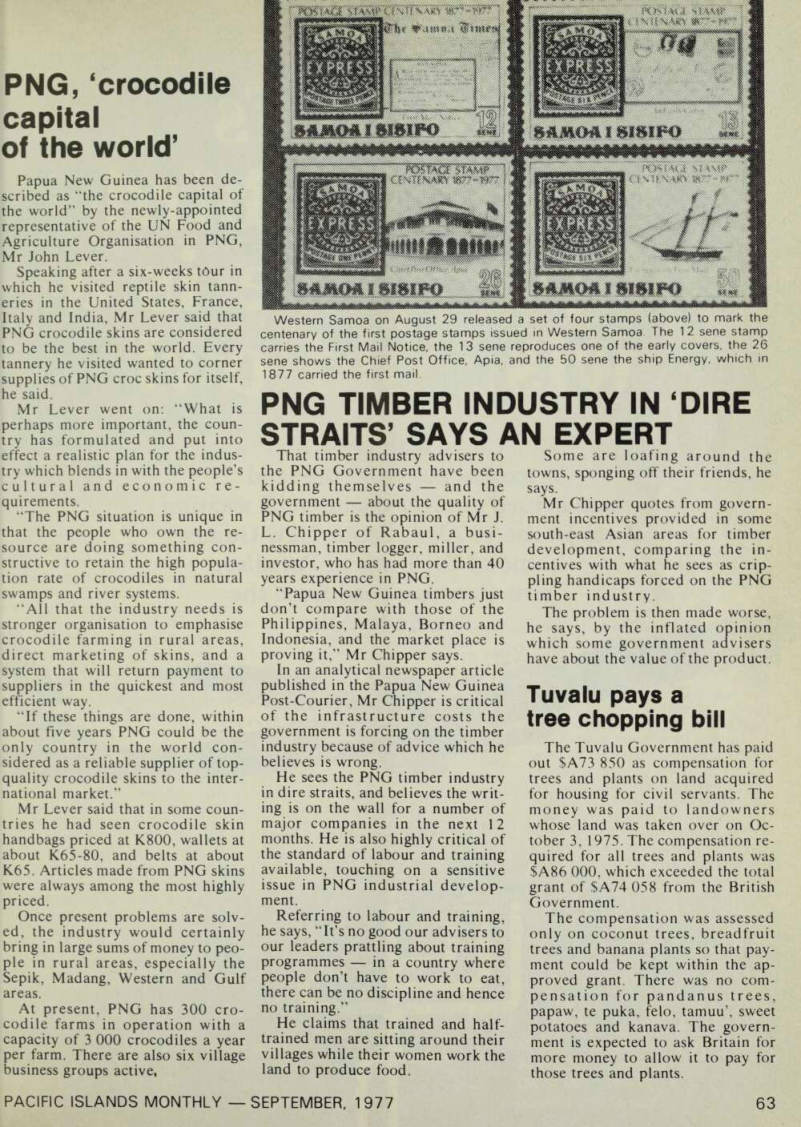
Western Samoa on August 29 released a set of four stamps (above) to mark the centenary of the first postage stamps issued in Western Samoa. The 12 sene stamp carries the First Mail Notice, the 13 sene reproduces one of the early covers, the 26 sene shows the Chief Post Office, Apia, and the 50 sene the ship Energy, which in 1877 carried the first mail.