Puts The Record Straight
pp. 67-68 · Read in the full issue
Air Nz’S Chief
Daiwa Builds Up
Its Pacific Service
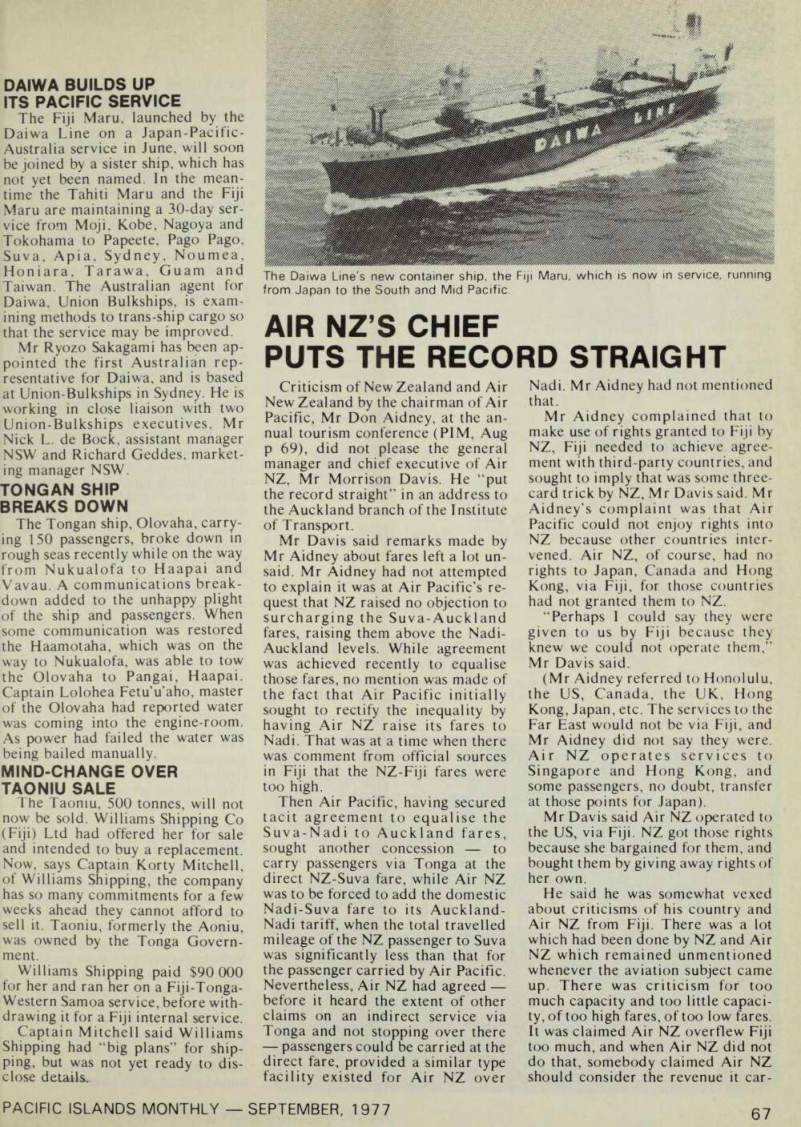
The Fiji Maru, launched by the Daiwa Line on a Japan-Pacific- Australia service in June, will soon be joined by a sister ship, which has not yet been named. In the mean time the Tahiti Maru and the Fiji Maru are maintaining a 30-day ser vice from Moji, Kobe, Nagoya and Tokohama to Papeete, Pago Pago, Suva, Apia, Sydney, Noumea, Honiara, Tarawa, Guam and Taiwan. The Australian agent for Daiwa, Union Bulkships, is exam ining methods to trans-ship cargo so that the service may be improved.
Mr Ryozo Sakagami has been ap pointed the first Australian rep resentative for Daiwa, and is based at Union-Bulkships in Sydney. He is working in close liaison with two Union-Bulkships executives. Mr Nick L. de Bock, assistant manager NSW and Richard Geddes, market ing manager NSW.
Tongan Ship
Breaks Down
The Tongan ship, Olovaha, carry ing 150 passengers, broke down in rough seas recently while on the way from Nukualofa to Haapai and Vavau. A communications break down added to the unhappy plight of the ship and passengers. When some communication was restored the Haamotaha, which was on the way to Nukualofa, was able to tow the Olovaha to Pangai, Haapai.
Captain Lolohea Fetu’u’aho, master of the Olovaha had reported water was coming into the engine-room.
As power had failed the water was being bailed manually.
Mind-Change Over
Taoniu Sale
The Taomu, 500 tonnes, will not now be sold. Williams Shipping Co (Fiji) Ltd had offered her for sale and intended to buy a replacement.
Now, says Captain Korty Mitchell, of Williams Shipping, the company has so many commitments for a few weeks ahead they cannot afford to sell it. Taoniu, formerly the Aoniu, was owned by the Tonga Govern ment.
Williams Shipping paid $9O 000 for her and ran her on a Fiji-Tonga- Western Samoa service, before with drawing it for a Fiji internal service.
Captain Mitchell said Williams Shipping had “big plans” for ship ping, but was not yet ready to dis close details.
Criticism of New Zealand and Air New Zealand by the chairman of Air Pacific, Mr Don Aidney, at the an nual tourism conference (PIM, Aug p 69), did not please the general manager and chief executive of Air NZ, Mr Morrison Davis. He “put the record straight” in an address to the Auckland branch of the Institute of Transport.
Mr Davis said remarks made by Mr Aidney about fares left a lot un said. Mr Aidney had not attempted to explain it was at Air Pacific’s re quest that NZ raised no objection to surcharging the Suva-Auckland fares, raising them above the Nadi- Auckland levels. While agreement was achieved recently to equalise those fares, no mention was made of the fact that Air Pacific initially sought to rectify the inequality by having Air NZ raise its fares to Nadi. That was at a time when there was comment from official sources in Fiji that the NZ-Fiji fares were too high.
Then Air Pacific, having secured tacit agreement to equalise the Suva-Nadi to Auckland fares, sought another concession to carry passengers via Tonga at the direct NZ-Suva fare, while Air NZ was to be forced to add the domestic Nadi-Suva fare to its Auckland- Nadi tariff, when the total travelled mileage of the NZ passenger to Suva was significantly less than that for the passenger carried by Air Pacific.
Nevertheless, Air NZ had agreed before it heard the extent of other claims on an indirect service via Tonga and not stopping over there passengers could be carried at the direct fare, provided a similar type facility existed for Air NZ over
Nadi. Mr Aidney had not mentioned that.
Mr Aidney complained that to make use of rights granted to Fiji by NZ, Fiji needed to achieve agree ment with third-party countries, and sought to imply that was some three card trick by NZ, Mr Davis said. Mr Aidney’s complaint was that Air Pacific could not enjoy rights into NZ because other countries inter vened. Air NZ, of course, had no rights to Japan, Canada and Hong Kong, via Fiji, for those countries had not granted them to NZ.
“Perhaps I could say they were given to us by Fiji because they knew we could not operate them,"
Mr Davis said. (Mr Aidney referred to Honolulu, the US, Canada, the UK, Hong Kong, Japan, etc. The services to the Far East would not be via Fiji, and Mr Aidney did not say they were.
Air NZ operates services to Singapore and Hong Kong, and some passengers, no doubt, transfer at those points for Japan).
Mr Davis said Air NZ operated to the US, via Fiji. NZ got those rights because she bargained for them, and bought them by giving away rights of her own.
He said he was somewhat vexed about criticisms of his country and Air NZ from Fiji. There was a lot which had been done by NZ and Air NZ which remained unmentioned whenever the aviation subject came up. There was criticism for too much capacity and too little capaci ty, of too high fares, of too low fares.
It was claimed Air NZ overflew Fiji too much, and when Air NZ did not do that, somebody claimed Air NZ should consider the revenue it car
The Daiwa Line's new container ship, the Fiji Maru, which is now in service, running from Japan to the South and Mid Pacific.
ried on those sectors and apply it to the balance of the bilateral.
“We are asked to pass revenue op portunities to the Fiji airline, thus reducing the need for our own capacity and are then criticised when the landing fee income at Nadi diminishes “ Mr Davis said. “So landing fees go up to compensate and fuel taxes go on and we find ourselves in the present position losing $1 million a year on the route.”
Mr Davis said there was much in Mr Aidney’s general comments with which he had sympathy, and it was a pity from his (Mr Davis’s) point of view that Mr Aidney made the one
sided comments about NZ that he did. He did not expect Air NZ and Air Pacific views to agree at all times. Nor did he believe Air NZ or NZ were beyond criticism in avia tion matters associated with Fiji.
Nz Government Backs
Service To Islands
The New Zealand will continue its charter of the cargo ship, Luhe sand, till the end of 1977 so that the service to and from NZ to Tahiti, Samoa and Tonga will not be dis rupted. The NZ Deputy Prime Minister, Mr Talboys, said that although the new charter was only
for a limited period, his government was examining proposals for im provement of the services to the three groups following withdrawal of the Luhesand.
The Shipping Corporation of NZ would recommend replacement ton nage for the route. With the amalgamation of the Cook Islands/ Niue service and the advent of the Pacific Forum Line, an improved network of regional shipping should result.
It Wasn’T A Good
Year For Pago’S Port
Port operations in American Samoa in 1976 were affected by a financial crisis, which was reflected in a drop in the number of ships en tering and leaving. Many staff changes also affected the efficient working of the port.
A new revenue source was in troduced half-way through the year.
This provided for storage charges on containers which were previously stored on port property at no cost to shipping companies. Now there is a storage fee of $1 a day for con tainers less than 6.1 m long, and $2 a day for containers 6.1 mto 12.2 m long.
The wharf suffered some damage through cargo operations by Toko Shimasaki and Knewbuhl Maritime Services and the Public Works Department when unloading army generators. The cruise liner Arcadia also damaged the wharf.
In 1976, 640 vessels entered the port, compared with 754 in 1975.
The number of departures was 645.
The entries were 19 cruise ships, 10 government vessels, 110 freighters (including LASH ships), 12 tankers, 196 fishing vessels, 192 local vessels, 85 yachts and 16 others.
Kyowa’S New
Service To Pacific
The Kyowa Shipping Co Ltd, of Tokyo, has launched a new service from Japan to the South Pacific with a newly built container/break bulk cargo ship, the Asian Rose. The ship will sail from Kobe, Nagoya and Yokohama every 45 days for Guam, Suva, Lautoka and Noumea.
The Asian Rose, apart from carrying containers and break bulk cargo, is also designed to carry motor cars. Her capacity is 280 cars, 48 containers and 5 508 tonnes of break bulk cargo. She has an esti mated speed of 13 knots.