Editor’S Mailbag
pp. 28-30 · Read in the full issue
Reindeer Country!
Greetings from the Arctic Circle!
Well, let’s be honest about it, we’re 30 kilometres south of it give or take a hundred reindeer heartbeats more or less: N.66°22’30”, E.25°20’40” would find you either in the Kemi river outside our win dow or in Muurela village (yes, there are two ‘u’s in it).
A New Zealand friend of mine, knowing my determination to get to the Tonga Islands and stay if they will have me, and how starved I was of information, very kindly sent me your December number. It arrived in due course and has been read from cover to cover. It has taken a while to get round to a way of send ing you $l4 Aust. and I hope the enclosed cheque does the trick.
From Finnish Lapland, PIM looks like the ideal way of keeping in touch with the Pacific Islands, and it looks as if a lot of people in your own latitudes agree with me!
Well, the summer has at last ar rived, the potatoes are coming up, the curlews are calling, and the bus driver pointed out three elks nosing about at the edge of the marshland west of the Rovaniemi-Muurola road the other day. We were head ing south along a narrow causeway no wider than the road at the time and I’m happy to report that having drawn our attention to them he re sumed his interest in the way ahead.
So, all the best from us up here, and looking forward to receiving the first of the first dozen.
Ros Wayland
Muurola, Finland.
Oceanic Research
Dr Coppell’s letter in the July issue (p 29) about the Oceanic Re search Foundation, which is ap proaching final incorporation, is both thoughtful and very fair. He correctly points to the salient ques tion is there a useful role for a small-scale, flexible organisation to help safeguard our threatened marine environment and adapt and
develop non-destructive low-cost technologies? Experience of large academic and governmental institu tions suggests that there are, indeed, many gaps that the small man can play a part in filling.
When planning even so modest an enterprise as ours the prelimin aries have taken all of four years one is forced to list all possible de sirable activities, well knowing that only a proportion will prove prac ticable. Thus one’s listed objectives must needs appear overambitious.
We have no wish to over-reach; rather we aim to begin small scale practical activities and feel our way forward.
A chartered vessel, like our 62ft steel ketch, is by no means essential to all our activities. For instance, it will play no part at all in some pro posed studies of traditional maritime technology. For work in Antarctica, however, and on the Australian Barrier Reef, a sturdy craft capable of accomodating 10-14 crew and scientists and
transporting equipment and instru
ments is an absolute essential. The cost in these instances will be only a tiny fraction of more conventional forms of expedition transport.
Since this letter has anticipated forthcoming press releases, may I jump the gun and ask any of your readers who would like information about the foundation, or have sug gestions or criticisms, to contact me at the address or phone number below.
David Lewis
Dangar Island, Tel Sydney
455 1275 Nsw, 2253.
The July, 1977, PIM is the best ever, not only because of the con tinuing emphasis on Pacific-wide events but also because it carries on the ‘behind-the-scenes’ reportage, something rarely available from Australian, New Zealand or other countries’ newspapers.
I do hope that all Australian universities and many of the col leges of advanced education are on your list of subscribers as almost everyone of them has some course
concerned with Pacific affairs, in one way or another.
Congratulations,
Harry Jackman
Bathust, NSW
Slugged Yachtie
On behalf of most of the yachts men we have met I would like to apologise to Mr Kenilorea and the population of the Solomon Islands for the letter under Slugged Yachtie written by Klaus Schaffer (PIM, June p 22). The man is one who most of us wish would forsake the oceans and go back home wherever that may be.
His very use of words and phrases such as “Whitie” and “Black is beautiful baby” show him up as ex actly what he is, an ignorant bigot and a racist of the worst kind. It is people like him who create the racial problems which exist in the world today.
By inference from the contents of his letter he has trouble with the authorities wherever he goes and, with the attitudes which he ex presses, I can fully understand it.
On the subject of the SIOO light dues, like all of us, I didn’t like hav ing to pay it. I believe it is too high and I hope that some day it will be reduced to a more reasonable amount for small privately-owned pleasure craft.
On the other hand we do respect the laws of those countries we visit and have therefore paid it without question on both occasions when we entered the Solomons.
I must also add that on all occa sions we have been treated with the utmost courtesy and respect by the officials and people of the Islands.
One very positive aspect of the
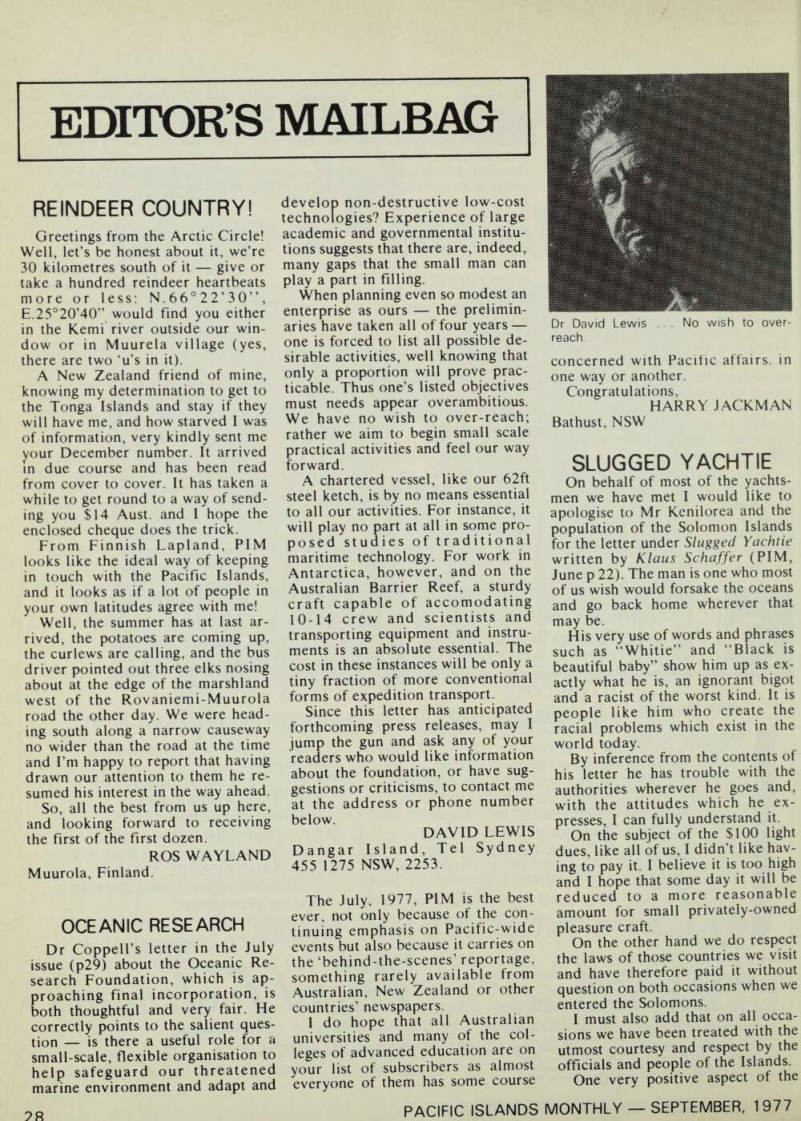
Dr David Lewis ... No wish to over reach
imposition of the light dues is that it may serve to keep people like Schaffer and his yacht Hilda away from the Solomons. I’m sure no one would regret that.
In conclusion, I would like to say, to the Klaus Schaffers of the world, go home, keep your mouth shut.
To the people of the Solomon Is lands our sincere thanks for your hospitality and friendship and good luck as you work your way to na tionhood through independence.
Bob And Lenore Tardif
Yacht Margaret Rintoul, Gizo
Preserving
Architecture
I read, with interest and great sympathy, the editorial in the May PIM and hasten to commend you for your concern. [The publisher’s regular column Up Front in that issue drew attention to the need for the Pacific Islands to preserve their architecture, particularly timber buildings of the colonial period.) We, in the Development Authori ty of the Pacific Area Travel As sociation, are pushing very hard for just this type of preservation and are presently exploring the means and methods of organising (for want of a better term) what we call The Pacific Society. This is modelled somewhat after the organisation called Europa Nostra which is a consortium of historical conserva tion societies throughout Europe.
The Pacific area needs a great deal of help in its preservation efforts as most of the architecture has not been constructed with very permanent materials. Even well intentioned maintenance sometimes obscures the architectural grace of the original structure.
A great number of the old wooden buildings throughout the Central Pacific area were built originally by ships’ carpenters and have a sophistication of detail which has not since been equalled.
Personally, I would be most pleased to work with anyone in terested in preservation or re storation in the Pacific area, since our practice of designing resort ac commodation gets us through the Central Pacific quite regularly.
George J. Wimberly, Faia
Wimberly. Whisenand, Allison, Tong & Goo, Architects Ltd. Honolulu.
Nature's Grand
Maya B. Kra’huemanu’s letter (PIM, May, p. 31) carried a laud able sentiment: “Fight bureaucracy and new laws, unless they are made to protect nature.” He said much about the need for countries to co operate with one another in order to achieve the best protection of the environment, then added “Na tionalism seems to me outdated”.
It is sad that nationalism is depre cated by one who is otherwise sensi tive and thoughtful. In a de-per sonalised world, where rules are being dictated by the larger powers with little thought for the rights of the communities affected, surely it must become evident that national ism may be our only hope to save threatened cultures yes, protect nature?
Nationalism, ironically enough, has become associated in people’s minds with national imperialism, super-patriotism and isolationist motivations, all of which are anti thetical to responsible nationalism, which is basically the right of a peo ple to have the principal voice in de ciding their own affairs, protecting their environment and developing advantageous alliances.
A world in which a benevolent nationalist ideology was upheld would be a world in which proud, self-sufficient groups would be truly free to co-operate with one another.
If the super-powers were neutralised through the cultural development of their minorities (making these into
national entities) we would surely no longer have to worry about the massive exploitation of the world's resources, the suppression of cultural traditions, the imposition of arbitrary regulations or the sub version or corruption of our leaders.
We might each find a community which would have just the amount of laws with which we felt comfortable (I’m in agreement with MBK in wishing to have as few as possible) and a social climate which would tolerate our inevitable (and valua ble) differences.
The Pacific area is one in which the forces of nationalism are becom ing more evident, and I rejoice in it.
It is unfortunate that the inheritance of national imperialism has caused difficulties which will take serious thought to overcome. A responsible nationalism can overcome even the bitterness evident in the expression ‘Fiji for the Fijians’ (for instance) and realise each group’s desire to achieve political responsibility and a role in determining its own future.
Nationalism is not racialism. If the whites and blacks in South Africa think about their aspirations, they must learn that they share some noble motivations. And if the Scots and the Irish gave up their racial and religious bigotry and became truly appreciative of nationalism their problems would vanish tomor row (I have a bit of both in me, so can say that). Integration and cultural inter-relationships must be respected as a right of individuals (I
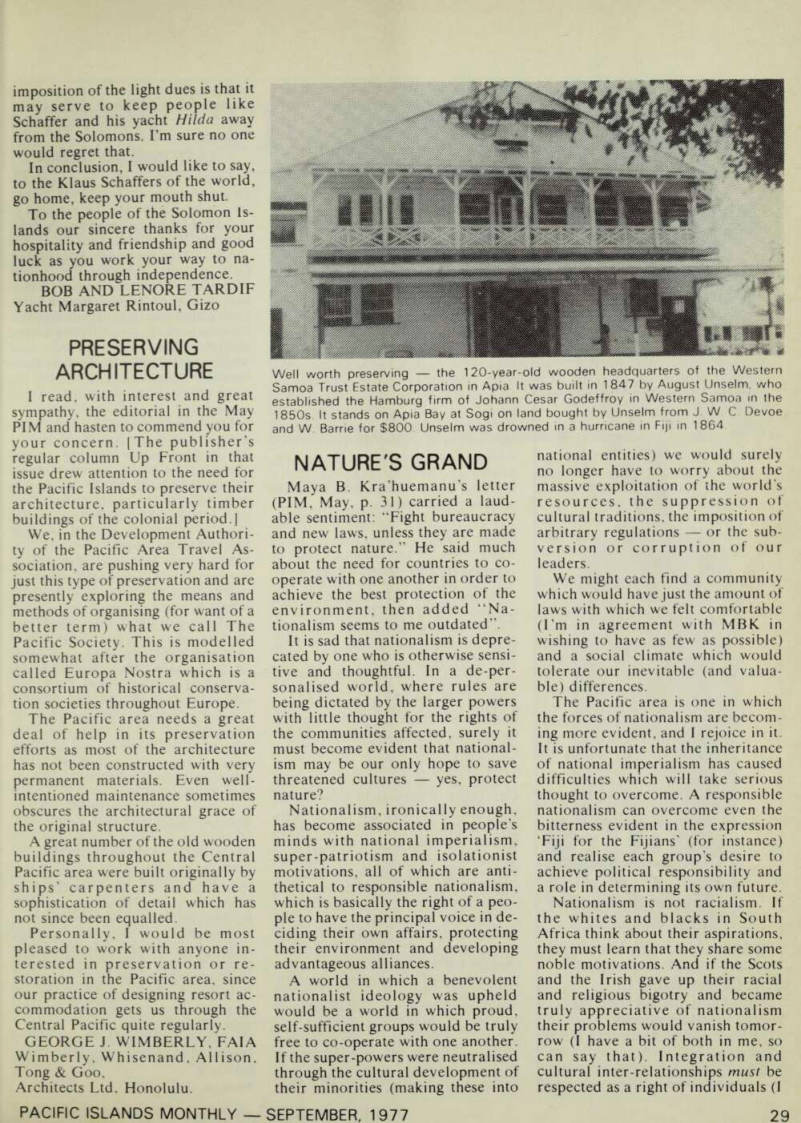
Well worth preserving - the 120-year-old wooden headquarters of the Western Samoa Trust Estate Corporation in Apia It was built in 1847 by August Unselm. who established the Hamburg firm of Johann Cesar Godeffroy in Western Samoa in the 1850s. It stands on Apia Bay at Sogi on land bought by Unselm from J. W. C. Devoe and W. Barrie for $800. Unselm was drowned in a hurricane in Fiji in 1864.
was a happy participant/beneficiary of an Inter-racial marriage for 12 years) but history has shown that en forcement of integration policies is taken as a threat to existing cultures, and I believe this fear should be re spected.
The larger problem lies in na tional and cultural jealousies these lead to group hostilities which serve only the culture-levelling super-powers.
Let us begin to see national aspirations as part of the quality of life. If we do not, we condemn the Pacific to a future in which an island must become a Waikiki Beach or a desert. The Pacific communities can best serve nature (as MBK enjoins) and themselves by taking re sponsibility for the direction of their own lives, and by examining their bureaucratic inheritance to see if they might abandon the restrictions which alien traditions have im planted. thereby making their freedom and political independence an example to others.
Gordon Mcshean
Scotts Valley, California, USA
Brych's 'Calvary'
Having read the account of the calvary of Mr Milan Brych by W. H.
Percival and Malcolm Salmon (PIM, June, p 23) I wish to record my reaction.
It seems to me that any person who has chosen the medical pro fession, even if only to make money, and who disagrees with Brych’s theory concerning cancer, as outlin ed in the PIM article, can only .be motivated by bad faith.
Ever since work done at the University of Jerusalem some seven or eight years ago on the foetus ejection process in pregnant women, it has seemed to me that it has become accepted medical knowledge that cancer is due, as stated by Brych, to an impairment of the body’s self-immunising capacity.
That the cancerous cells, being abnormal entities, should be treated by the body’s still normal cells as in truders has always seemed to me to be the base of all and any research into cancer.
I hope that Mr Brych will be able to withstand the onslaught of the mixture of jealousy and ignorance which has often, from the times of Galileo Galilei until our own, characterised official human
behaviour when confronted with the discoveries of a clear, uncluttered
mind.
Henri Lombard
Papeete, Tahiti
Wrong Picture
I am writing to take issue with Mr Bruce Adams in July PIM (p3l), where he states that the remains of Admiral Isoroku Yamamoto’s Betty bomber lied disintegrating in the jungle 27 miles from Kahili Air field in Buin, Bougainville. Kangu Mountain, where the bomber lies is not more than 7 miles from Kihili, (not Kahili) airfield. I left this sta tion which I had cleared and planted from 1936 onwards, and which the Japanese made their main base on Bougainville, in 1958, but have revisited the place three times since then.
I, too, had noted that the previous picture was incorrect, for there are no coconut palms growing around Yamamoto’s plane on the side of Kangu mountain, but I was unable to say where the picture was taken, and I had not visited Finschhafen since I was there aboard the S.S.
Marsina In 1926.
But I have had more than a pass ing interest in Admiral Yamamoto, and indeed in a memorial built at Kihili in 1958 to commemorate all servicemen and civilians and also war prisoners who lost their lives in that area. Special mention was made of Yamamoto. The memorial was dedicated on Anzac Day, 1958, in a ceremony carried out by the District Commissioner resident then at Kangu, and since that time the memorial has been visited by num bers of Japanese groups. It is the only private war memorial in Papua New Guinea.
A. H. Voyce (Rev)
Milford, Auckland. NZ
No. 1 Hatch?
When Mrs Maui Maui gave birth to her son on the No. 1 hatch of the MV Manuvai (PIM, July, p. 34), neither the crew of the vessel nor the members of the Women’s Institute were practical in their choice of names for the child (“the Manuvai crew naturally preferred the name ‘Manuvai’, while the Women’s In stitute deemed ‘Women’s Institute’ appropriate’’).
The obvious choice was “No. 1 Hatch’’, especially if the babv was
her first!
Neutral Bay, NSW.