Tropicalities
pp. 31-33 · Read in the full issue
Spooks in the
powerhouse
Suva’s city fathers have taken part in an unusual exercise, which pro duced the desired result with rather temperamental new power genera tors. The generators, which cost about $2 million, developed a num ber of faults, which led to frequent black-outs and complaints from irate power users.
Someone considered that angry spirits in the Kinoya area, near Suva, the location of one of the powerhouses, were throwing a span ner in the works. A delegation led by the Mayor, Cr Joape Rokosoi. with two other councillors and senior staff, supported by powerhouse workers, performed the traditional Fijian bulubulu before Sunia Malewa, chief of the tribe in the area. The bulubulu ceremony is normally performed by wrongdoers to people who suffer for their ir responsible actions. The victims may have suffered emotional dis tress or physical damage.
In the powerhouse case, Sunia ex plained, two spirits, Daunisai and his sister. Rokowati, who held do main over the area, had been of fended, for what reason no one really knew.
After the ceremony the generators started to hum normally. Sunia said he and members of his tribe had high hopes that the ceremony had patched up any possible actions by the council which had offended the two kindred spirits. He felt certain the future of the powerhouse was bright.
Cr Rokosoi said the approach had been made to Kinoya village elders, “hopefully to prevent any future faulty development in the genera tors”. The council’s action might seem ridiculous to some people, but it was worthwhile.
The council showed its ap preciation of the tribe’s action by presenting the traditional tabua (whale’s tooth), yaqona and cigarettes.
An old school
in the Cooks
In November, 1894, Frederick J.
Moss, the British Resident in the Cook Islands wrote to the Governor in New Zealand, “At the end of Oc tober the Roman Catholic Mission was opened in Rarotonga by two French priests from Tahiti, who in form me that a school for teaching the natives in English will be shortly opened, under the control of two English or Irish sisters appointed for the purpose. The school built at Nikao by the London Missionary Society will also be opened during the present month.”
Since that time, the Catholic Church has made a significant and continuing contribution to educa tion throughout the Cook Islands. St Joseph’s Primary School, under the direction of the Sisters of St Joseph of Cluny has provided for the educational needs of many of the children on Rarotonga and in the outer islands for a number of years French and Dutch priests of the Order of the Picpus Fathers combin ed their pastoral duties with those of being school masters.
In the last few years the Catholic Church has become concerned about the provision of secondary education for its children and the establishment of Nukutere College adjacent to St Joseph’s Primary School has met that need.
The Hocken Library, at the University of Otago, holds a small
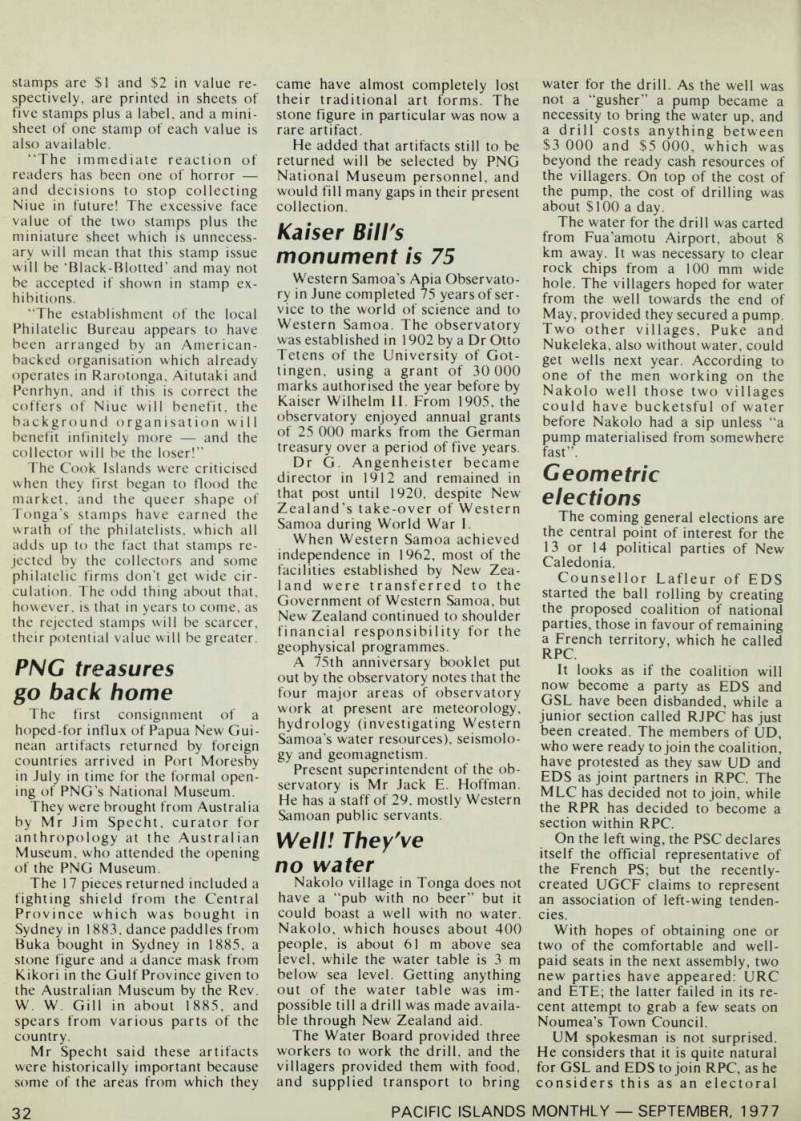
collection of the photographic plates developed on Rarotonga by George Crummer, early in this cen tury. Among these photographs are two which show the boys and girls attending St Joseph’s and these must be among the oldest pictorial re cords of school classes on Rarotonga that are still to be found.
The fashions worn by the children are of interest and it is clear that there were very few European children attending the school, this being a reflection of the small num bers of the European population on Rarotonga at that time. • The picture shows a girls’ class at St Joseph’s about 70 years ago with, seemingly, some rather old girls!
Stamping on
little Niue
A comment in the Mail Coach, the magazine of the Postal History Society of New Zealand (Inc), bodes no good for the success in the philatelic field of little Niue’s stamps commemorating the Queen’s silver jubilee, or, possibly, all future issues.
Says the Mail Coach: “Leaflets have now been received in New Zealand from the Niue Post Office Philatelic Bureau, posted 1 June, 1977, announcing the issue on 7 June of two postage stamps to com memorate the Silver Jubilee of Her Majesty, Queen Elizabeth. The
stamps are $1 and $2 in value re spectively, are printed in sheets of five stamps plus a label, and a mini sheet of one stamp of each value is also available.
“The immediate reaction of readers has been one of horror and decisions to stop collecting Niue in future! The excessive face value of the two stamps plus the miniature sheet which is unnecess ary will mean that this stamp issue will be ‘Black-Blotted’ and may not be accepted if shown in stamp ex hibitions.
“The establishment of the local Philatelic Bureau appears to have been arranged by an American backed organisation which already operates in Rarotonga, Aitutaki and Penrhyn, and if this is correct the coffers of Niue will benefit, the background organisation will benefit infinitely more and the collector will be the loser!”
The Cook Islands were criticised when they first began to flood the market, and the queer shape of Tonga’s stamps have earned the wrath of the philatelists, which all adds up to the fact that stamps re jected by the collectors and some philatelic firms don't get wide cir culation. The odd thing about that, however, is that in years to come, as the rejected stamps will be scarcer, their potential value will be greater.
PNG treasures
go back home
The first consignment of a hoped-for influx of Papua New Gui nean artifacts returned by foreign countries arrived in Port Moresby in July in time for the formal open ing of PNG's National Museum.
They were brought from Australia by Mr Jim Specht, curator for anthropology at the Australian Museum, who attended the opening of the PNG Museum.
The 17 pieces returned included a fighting shield from the Central Province which was bought in Sydney in 1883, dance paddles from Buka bought in Sydney in 1885, a stone figure and a dance mask from Kikori in the Gulf Province given to the Australian Museum by the Rev.
W. W. Gill in about 1885, and spears from various parts of the country.
Mr Specht said these artifacts were historically important because some of the areas from which they
came have almost completely lost their traditional art forms. The stone figure in particular was now a rare artifact.
He added that artifacts still to be returned will be selected by PNG National Museum personnel, and would fill many gaps in their present collection.
Kaiser Bill's
monument is 75
Western Samoa’s Apia Observato ry in June completed 75 years of ser vice to the world of science and to Western Samoa. The observatory was established in 1902 by a Dr Otto Tetens of the University of Got tingen, using a grant of 30 000 marks authorised the year before by Kaiser Wilhelm 11. From 1905, the observatory enjoyed annual grants of 25 000 marks from the German treasury over a period of five years.
Dr G. Angenheister became director in 1912 and remained in that post until 1920, despite New Zealand’s take-over of Western Samoa during World War I.
When Western Samoa achieved independence in 1962, most of the facilities established by New Zea land were transferred to the Government of Western Samoa, but New Zealand continued to shoulder financial responsibility for the
geophysical programmes.
A 75th anniversary booklet put out by the observatory notes that the four major areas of observatory work at present are meteorology, hydrology (investigating Western Samoa’s water resources), seismolo gy and geomagnetism.
Present superintendent of the ob servatory is Mr Jack E. Hoffman.
He has a staff of 29, mostly Western Samoan public servants.
Well! They've
no water
Nakolo village in Tonga does not have a “pub with no beer” but it could boast a well with no water.
Nakolo, which houses about 400 people, is about 61 m above sea level, while the water table is 3 m below sea level. Getting anything out of the water table was im possible till a drill was made availa ble through New Zealand aid.
The Water Board provided three workers to work the drill, and the villagers provided them with food, and supplied transport to bring
water for the drill. As the well was not a “gusher” a pump became a necessity to bring the water up, and a drill costs anything between $3 000 and $5 000, which was beyond the ready cash resources of the villagers. On top of the cost of the pump, the cost of drilling was about $lOO a day.
The water for the drill was carted from Fua’amotu Airport, about 8 km away. It was necessary to clear rock chips from a 100 mm wide hole. The villagers hoped for water from the well towards the end of May, provided they secured a pump.
Two other villages, Puke and Nukeleka, also without water, could get wells next year. According to one of the men working on the Nakolo well those two villages could have bucketsful of water before Nakolo had a sip unless “a pump materialised from somewhere fast”.
Geometric
elections
The coming general elections are the central point of interest for the 13 or 14 political parties of New Caledonia.
Counsellor Lafleur of EDS started the ball rolling by creating the proposed coalition of national parties, those in favour of remaining a French territory, which he called
Rpc.
It looks as if the coalition will now become a party as EDS and GSL have been disbanded, while a junior section called RJPC has just been created. The members of UD, who were ready to join the coalition, have protested as they saw UD and EDS as joint partners in RPC. The MLC has decided not to join, while the RPR has decided to become a section within RPC.
On the left wing, the PSC declares itself the official representative of the French PS; but the recently created UGCF claims to represent an association of left-wing tenden cies.
With hopes of obtaining one or two of the comfortable and well paid seats in the next assembly, two new parties have appeared: URC and ETE; the latter failed in its re cent attempt to grab a few seats on Noumea’s Town Council.
UM spokesman is not surprised.
He considers that it is quite natural for GSL and EDS to join RPC, as he considers this as an electoral
manoeuvre. Maybe the UD mem bers do not agree with this point of view.
UC is a very sad party. Once the biggest formation, over recent years it has seen members break away to form new groups such as MLC, UM and UMP. Recently three more members walked out; one of whom joined URC. Luckily, and to avoid more confusion the UPM remains the UPM, although the name of the party has changed.
If the right-wing electors remem ber that to maintain the present statute they must vote UD or MLC or PSC or URC or ETE with an ulti mate option RPC, everything will be OK. Of course, you must remember that RPC = RPR + EDS + GSL.
Luckily the young voters have been prepared by mathematics
Qed.
Statistics
from the past
A census taken on Niue in 1900 showed that the population of the is land numbered 4,676 and of these 561 were absent from the island, either as sailors or as labourers on other Pacific Islands.
In 1901, S. Percy Smith, the New Zealand Government Resident Agent reported that he had “found in existence here 23 native magistrates or judges and 124 police, who paid themselves by the fines inflicted”. This meant that there was one policeman for every 33 persons then living on the island.
The Native Magistrates and Police Act of 1901 began the process of reducing the numbers of law enfor cement officers by reducing the number of magistrates to five.
In 1900, the total population of Rarotonga aged 16 years or more was 1418, with 769 men and 649 women. In those days the sale of li quor to the Maori population was severely restricted.
The figures for the sale of liquor from the government bond on Rarotonga, for the year ending December 31, 1900, make interest ing reading gin 759 bottles; whis ky 1,330; rum 1,668; cognac 258; beer 2,345; wine 4,214. It would be interesting to compare the tastes for varieties of alcohol and the levels of consumption with these of today on Rarotonga, where no restrictions on the sale of liquor to Cook Islanders are now enforced.
Perhaps in 1900, the apparent shortage of females may have con tributed to the need to seek the pleasures of the bottle.
I say you cha ,
look there!
Two Papua New Guineans, John Laki and Nema Joarafa, produced more than one crinkle in the stiff British upper lip when they arrived in London on a pre-publicity cam paign for their country’s largest overseas exhibition at the Com monwealth Institue.
Heavily disguised under the tra ditional mask and croton leaf cos tume of the Asaro people of Eastern Highlands Province, the first “ghostly mudmen" ever to visit Bn tish shores invaded the newspaper precincts of Fleet Street, danced their ghostly dance steps along its pavements; caused an elderly passer-by to pause, gape and mutter to his companion “Gawd, now I’ve seen everything!" and got involved in a mild brush with the law when two London bobbies obliged them to move on after the crowd they had gathered “caused an obstruction".