When Some Fools Stepped In-
pp. 23-27 · Read in the full issue


Or A Wokabout Niuailan
By John Glynn
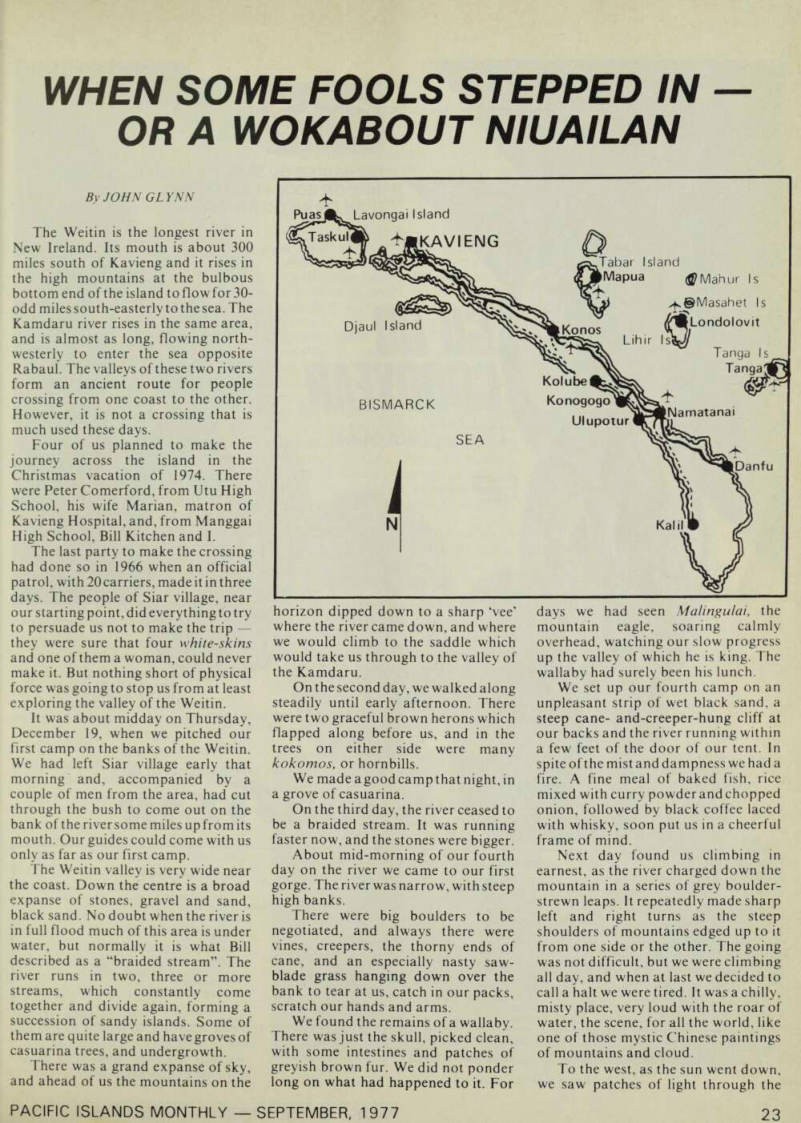
The Weitin is the longest river in New Ireland. Its mouth is about 300 miles south of Kavieng and it rises in the high mountains at the bulbous bottom end of the island to flowfor 30odd miles south-easterly to the sea. The Kamdaru river rises in the same area, and is almost as long, flowing north westerly to enter the sea opposite Rabaul. The valleys of these two rivers form an ancient route for people crossing from one coast to the other.
However, it is not a crossing that is much used these days.
Four of us planned to make the journey across the island in the Christmas vacation of 1974. There were Peter Comerford, from Utu High School, his wife Marian, matron of Kavieng Hospital, and, from Manggai High School, Bill Kitchen and I.
The last party to make the crossing had done so in 1966 when an official patrol, with 20 carriers, made it in three days. The people of Siar village, near our starting point, did everything to try to persuade us not to make the trip they were sure that four white-skins and one of them a woman, could never make it. But nothing short of physical force was going to stop us from at least exploring the valley of the Weitin.
It was about midday on Thursday, December 19, when we pitched our first camp on the banks of the Weitin.
We had left Siar village early that morning and, accompanied by a couple of men from the area, had cut through the bush to come out on the bank of the river some miles up from its mouth. Our guides could come with us only as far as our first camp.
The Weitin valley is very wide near the coast. Down the centre is a broad expanse of stones, gravel and sand, black sand. No doubt when the river is in full flood much of this area is under water, but normally it is what Bill described as a “braided stream”. The river runs in two, three or more streams, which constantly come together and divide again, forming a succession of sandy islands. Some of them are quite large and have groves of casuarina trees, and undergrowth.
There was a grand expanse of sky, and ahead of us the mountains on the
horizon dipped down to a sharp ‘vee’ where the river came down, and where we would climb to the saddle which would take us through to the valley of the Kamdaru.
On the second day, we walked along steadily until early afternoon. There were two graceful brown herons which flapped along before us, and in the trees on either side were many kokomos, or hornbills.
We madeagoodcampthatnight,in
a grove of casuarina.
On the third day, the river ceased to be a braided stream. It was running faster now, and the stones were bigger.
About mid-morning of our fourth day on the river we came to our first gorge. The river was narrow, with steep high banks.
There were big boulders to be negotiated, and always there were vines, creepers, the thorny ends of cane, and an especially nasty saw blade grass hanging down over the bank to tear at us, catch in our packs, scratch our hands and arms.
We found the remains of a wallaby.
There was just the skull, picked clean, with some intestines and patches of greyish brown fur. We did not ponder long on what had happened to it. For
days we had seen Malingu/ai. the mountain eagle, soaring calmly overhead, watching our slow progress up the valley of which he is king. The wallaby had surely been his lunch.
We set up our fourth camp on an unpleasant strip of wet black sand, a steep cane- and-creeper-hung cliff at our backs and the river running within a few feet of the door of our tent. In spite of the mist and dampness we had a fire. A fine meal of baked fish, rice mixed with curry powder and chopped onion, followed by black coffee laced with whisky, soon put us in a cheerful frame of mind.
Next day found us climbing in earnest, as the river charged down the mountain in a series of grey boulder strewn leaps. It repeatedly made sharp left and right turns as the steep shoulders of mountains edged up to it from one side or the other. The going was not difficult, but we were climbing all day, and when at last we decided to call a halt we were tired. It was a chilly, misty place, very loud with the roar of water, the scene, for all the world, like one of those mystic Chinese paintings of mountains and cloud.
To the west, as the sun went down, we saw patches of light through the
John Glynn, the author, who taught at Sursurunga Primary, Kavieng Primary, Mongop Catholic Mission High and Manggai United Church High schools, all on New Ireland Is now studying for the RC priesthood at Kensington, NSW. trees. After much discussion and examination of maps, Bill, our navigator, decreed that we had reached the saddle of the mountains, and that no more than three miles of bush lay between us and the upper reaches of the Kamdaru river.
Over our evening meal we assessed our situation. We were all fit and in good spirits. We had food enough for several days, provided there were more fish to be caught, or pigeons to be shot.
Clearly, we should press on, we decided. But if we had known what lay ahead we would have been preparing to turn back.
Until around midday the next day we found the going very tough. As we had only one bushknife between us, our procedure was to send one of the men ahead, compass in one hand, knife in the other, hacking his way through the dense growth, lining steep-sided ravines, scrambling across overgrown rotting tree trunks, following along creek bottoms choked with dangling creepers and vines and fallen trees.
Every 20 minutes we men changed places and carried on hacking a track through that terrible country.
We were searching for a stream flowing north, or west, or anywhere in between, but so far every little trickle had quite obviously been flowing back to join the Weitin river behind us. Now we rested. Marian sat with the packs.
Peter and Bill went exploring the hillsides in search of a stream which might be feeding the Kamdaru. I took the shotgun and went for a prowl around the top of the hill where I was
lucky enough to shoot a fine, fat
pigeon.
When we all came together again.
Bill and Peter reported that they had found a tiny stream which appeared to be running in the right direction and we decided to follow it. We well knew that water will always find the easiest, and hence most precipitous, way downhill, but we were determined to camp on the banks of the Kamdaru that night and so were unanimous in agreeing to follow the stream. We were soon negotiating a steep-sided rocky ravine.
It became a series of 10 to 2-foot waterfalls down which we slid and crawled. We were several hours creeping down that mountainside. At one stage I suggested that we stop, hack out a camp for ourselves and wait on the mountain till morning. The others, bless them, wouldn’t hear of it, and we scrambled on. At last, there were cries ofjoy from Billleadingthe way,and we stumbled out on to a wide pebble beach Irontmg a broad brown river bustling off north-westerly through the jungle.
It was Christmas Eve, 1974, and we had reached the Kamdaru on the sixth day of our hike.
For me, at any rate, the next two days were the most enjoyable of our hike. The scenery was beautiful. The sun shone and the river was fast and boisterous. The foliage was lush and the butterflies gorgeous. The fishing was magnificient. Those were the last, safe, enjoyable days.
On our third day on the Kamdaru, we set off in the morning at a good pace. The river had divided and formed an island, down which we made our way. When we reached the bottom of the island, we decided to cross to the
south bank, where the going looked easier than on the other bank. The stream we had to cross was about 20 feet wide, about waist-deep and very fast.
A smooth and slippery tree trunk extended most of the way across the stream. Bill and I managed thecrossing all right, and then I got back into the water and clung to the tree to aid Peter and Marian, who were crossing together. We got Marian past me and to the end of the tree. Peter came along the trunk, twocameracasesslungfrom the framework of his rucksack, filled with water. He was gradually pulled down, suddenly dragged from the tree, and went flying downstream.
Marian immediately let go of the
Marian Comerford ... she was washed away and then washed ashore
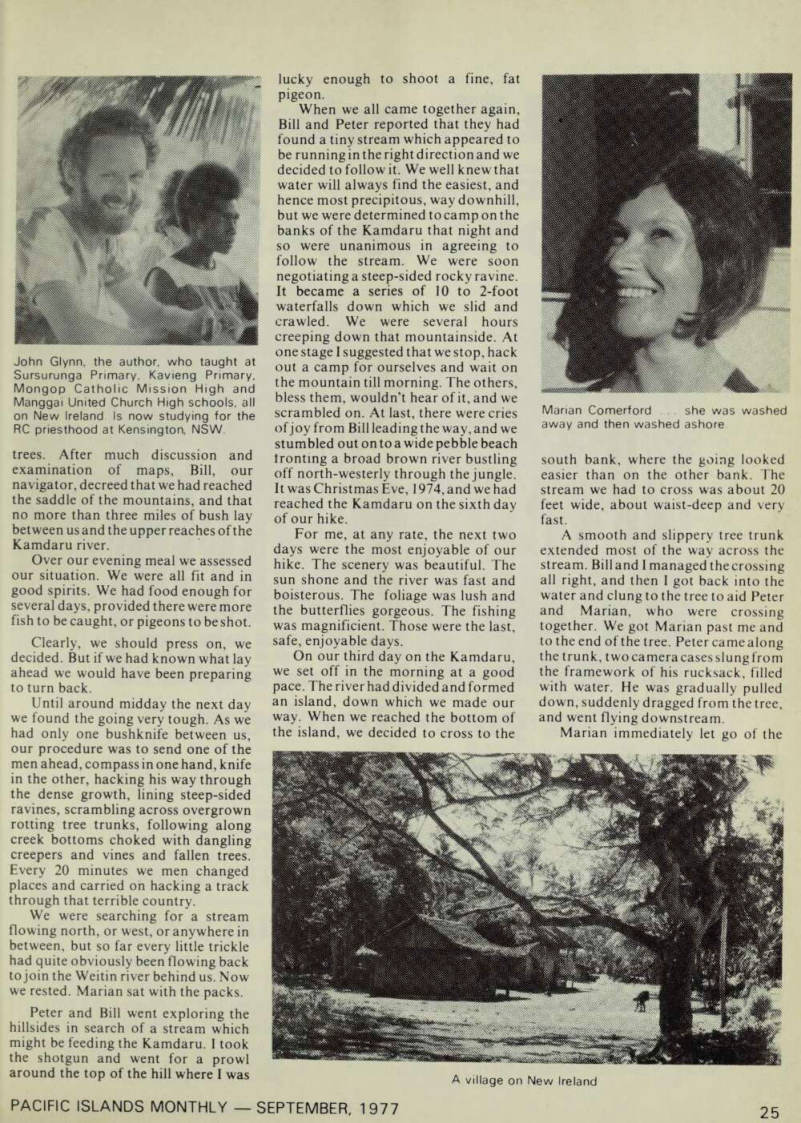
A village on New Ireland
tree and was washed away after him.
Peter was taken almost to the point of the island, where he grabbed hold of the exposed roots of a tree and hauled himself partly out ofthe water. Marian caught hold of another tree trunk extending from the south bank, but at once began to slide down its greasy length, out into the stream. * 1, fool that I was, yelled to Peter to look out for Marian. She was all right.
An eddy took heraroundtheend ofthe tree and washed her ashore, but Peter, hearing my yell, let go his hold and was at once taken by the current out into the middle of the mam river and quickly disappeared from our view, tossing and turning in the turbulent water. He was rolled over and over by the stream. His waterporrf rucksack tended to ride up and force his head under water and Peter struggled desperately to get it off while he was repeatedly tumbled and battered against the rocks.
We found him a couple of hundred yards downstream sheltering behind a large boulder in the middle ofthe river.
He had finally got rid of his rucksack, and it had gone on out of sight down the river. He had no broken bones but was badly bruised and quite ex-
hausted. The rucksack turned up a mile further on.
We camped on a broad stone and pebble beach, and took stock of our
position. Clearly, we could no longer
pretend to know how far we were from the coast. Unless we stopped for a day or two to do some hunting, we were not going to get any more food, but we didn’t want to stop. We determined to press on as hard as we could from dawn next day. We were quite shocked by all our experiences and were in a very
introspective mood.
In his accident, Peter had lost his still and movie cameras and lenses. All his exposed film had been in the camera cases and was gone also, and the diary he had been keeping, which contained all his notes on local snake lore, was reduced to unreadable pulp.
The following two days seemed unreal. Mother nature was still wearing her most beautiful face. The sun shone and the river sang, but a new element had now entered into things.
We had become very aware of how implacable mother nature is, and how dangerous our situation was, and had been from the very start of our expedition. But we had to overcome our fears and plod on regardless.
Around midday on the 11th day of
our crossing, we suddenly began to find the prints of men and dogs together. Clearly there was a hunting party m the area. Then, all at once we were standing in wheel tracks. The tracks led us to a logging road through the jungle. We had reached Kamdaru, on the west coast ol New Ireland.
Another five davs were to oass . Another live days were to pass before we could get a speedboat to take as U P * be coast to where the . road b . e B an - s P ent those days enjoying the hos P lt ahty (and eating out of house and bo ™ e) 0 " e of the fm . est Scottl sh ** lgb * and gent [emen everTo grace the u . th , Seas ’. Mr Alex MacCrae of Mala P lantatlon - The general opinion of our friends, when they heard of our adventure, was that we had been very foolish, that what we had done was extremely dangerous. That is all quite correct, What we did was dangerous, and our ignorance made it foolish. Yet none of us regrets having made the trip and I, for one, will do it again if the opportunity ever offers. I wouldn’t mind, for instance, hiking up the Kamdaru into the mountains, camp ing for a week or two to explore, photograph, shoot and fish, returning to the coast by raft. Care to come?