What makes fish poisonous?
p. 45 · Read in the full issue
Scientists expose a villain
If Dr Takeshi Yasumoto had his way, he would post “Do not disturb ” signs on coral reefs all over the Pacific, Australia, the Caribbean and even the Indian Ocean around Sri Lanka.
Dr Yasumoto is a Japanese chemist who, in 1975, was assigned by the World Health Organisation as consultant on the phenomenon of fish-poisoning which, according to the South Pacific Commission, claims about 1,500 victims a year around the Pacific. The WHO as signment was made at the request of the Government of French
Polynesia.
On two visits to the South Pacific to study ciguatera a Caribbean word used for the illness due to fish poisoning Dr Yasumoto worked with Dr J. Laigret of the South Pacific Commission, Drs R. Bagnis and H. Kaeuffer of the Institut de Recherches Medicales of French Polynesia, and Dr Y. Hokoma of the University of Hawaii.
Their labours have paid off with the first positive identification of the primary source of poison found in edible fish caught in coral reefs around islands in the south and west Pacific region.
The scientists’ accusing finger is pointed at a microscopic olant or ganism known as a dinoflagellate.
The dinoflagellates, which attach to algae, are round, flat like a plate, forming two hemispheres with slender, whiplike appendages (the flagellae).
Small fish feed on the algae which carry the dinoflagellates. These small fish are in turn eaten by bigger ones. Thus the toxin is transferred and concentrated as it moves further along the fish-food chain. The big ger the fish, the more potentially toxic it is. The poison penetrates the flesh of the fish and cannot be removed by washing or cooking.
Humans are extremely vulnerable to the poison. Dr Yasumoto esti mates that as little as .75 of a milligramme of it would be suffi cient to cause death of a person weighing 100 kilogrammes.
Dr Yasumoto’s concern with the preservation of coral reefs in their natural state arises from his research finding that: “The dinoflagellates
are present in coral reefs, but they seem to be provoked to multiply when their environment is disturb ed.
“The precise cause of this multiplication is not certain, but man himself may be causing it, as when reefs are blasted off or cut to pieces in building runways, wharves or piers.
“There are several known exam ples where human aggression against coral reefs seems to have triggered explosive outbreaks of ciguatera.”
He adds that natural causes, such as exceptionally heavy rain, may also cause a heavy growth of the dinoflagellates.
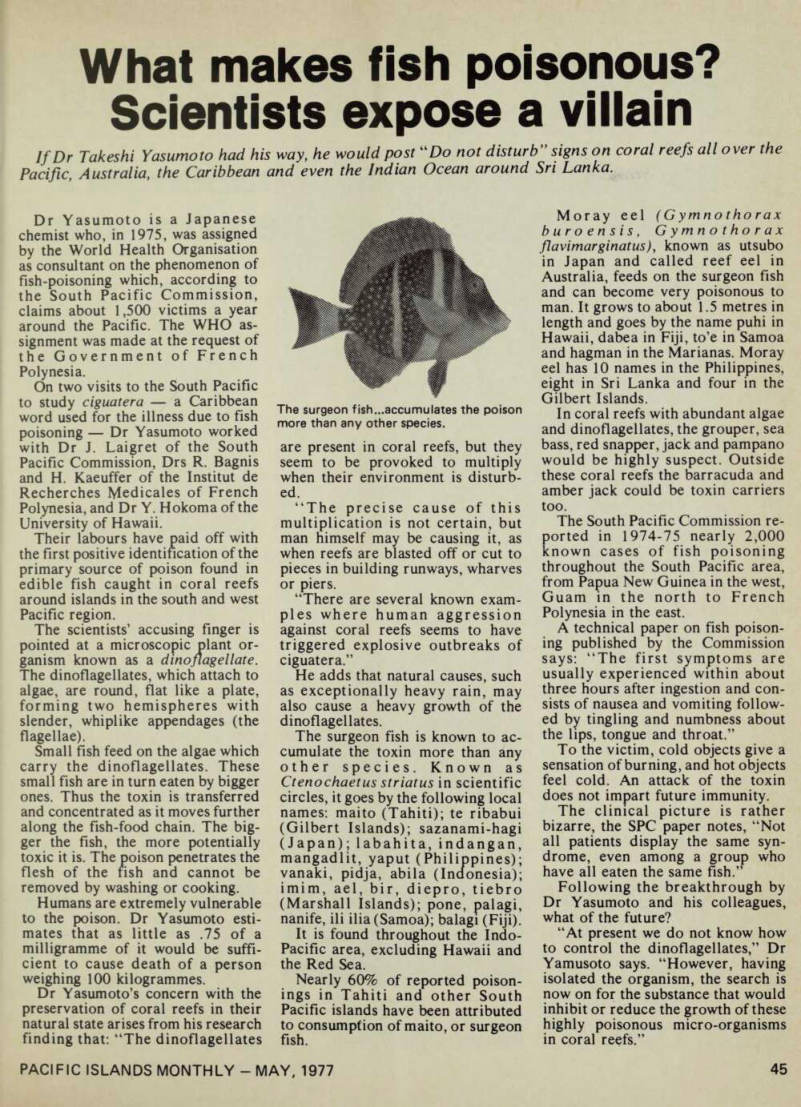
The surgeon fish is known to ac cumulate the toxin more than any other species. Known as Ctenochaetus striatus in scientific circles, it goes by the following local names: maito (Tahiti); te ribabui (Gilbert Islands); sazanami-hagi (Japan); labahita, indangan, mangadlit, yaput (Philippines); vanaki, pidja, abila (Indonesia); imim, ael, bir, diepro, tiebro (Marshall Islands); pone, palagi, nanife, ili ilia (Samoa); balagi (Fiji).
It is found throughout the Indo- Pacific area, excluding Hawaii and the Red Sea.
Nearly 60% of reported poison ings in Tahiti and other South Pacific islands have been attributed to consumption of maito, or surgeon fish.
Moray eel (Gymnothorax buroensis, Gymnothorax flavimarginatus ), known as utsubo in Japan and called reef eel in Australia, feeds on the surgeon fish and can become very poisonous to man. It grows to about 1.5 metres in length and goes by the name puhi in Hawaii, dabea in Fiji, to’e in Samoa and hagman in the Marianas. Moray eel has 10 names in the Philippines, eight in Sri Lanka and four in the Gilbert Islands.
In coral reefs with abundant algae and dinoflagellates, the grouper, sea bass, red snapper, jack and pampano would be highly suspect. Outside these coral reefs the barracuda and amber jack could be toxin carriers too.
The South Pacific Commission re ported in 1974-75 nearly 2,000 known cases of fish poisoning throughout the South Pacific area, from Papua New Guinea in the west, Guam in the north to French Polynesia in the east.
A technical paper on fish poison ing published by the Commission says: “The first symptoms are usually experienced within about three hours after ingestion and con sists of nausea and vomiting follow ed by tingling and numbness about the lips, tongue and throat.”
To the victim, cold objects give a sensation of burning, and hot objects feel cold. An attack of the toxin does not impart future immunity.
The clinical picture is rather bizarre, the SPC paper notes, “Not all patients display the same syn drome, even among a group who have all eaten the same fish.”
Following the breakthrough by Dr Yasumoto and his colleagues, what of the future?
“At present we do not know how to control the dinoflagellates,” Dr Yamusoto says. “However, having isolated the organism, the search is now on for the substance that would inhibit or reduce the growth of these highly poisonous micro-organisms in coral reefs.”
The surgeon fish...accumulates the poison more than any other species.