Magazine
pp. 46-48 · Read in the full issue
The cruises of two Challengers and the antics of some crewmen
By W. G. Coppell
The name Challenger is revered in the Royal Navy as, for a con siderable period, it was associated with survey vessels, which carried out extensive oceanographic and general exploration tasks.
The greatest share of fame in the Challenger line was a three-master, square-rigged steam corvette, which displaced 2,300 tons. Although she had an engine that had an indicated horsepower of 1,200 she was, in most respects, a sailing vessel, as she could not carry enough coal to make the passage from one coaling station to another, without relying heavily on her sails.
A group of scientists at Edinburgh University under the leadership of Charles Wyville Thomson, the Pro fessor of Natural History, persuaded the British Government to lend them and provision a vessel, which would undertake one of the most ex tended of exploration voyages.
Thus, it was that on December 7, 1872, HMS Challenger set out on a journey, which saw her eventually return to Spithead on May 24, 1876, after traversing a distance of 68,890 miles.
One of the principal preoccupa tions of the scientists in the ex pedition was to explore the ocean depths, to chart currents and tem peratures and to find and identify flora and fauna from the submarine levels. Although the vessel visited all manner of exotic ports, islands and out-of-the-way places, the re petitive work of dredging and taking soundings was both physically de manding and mentally frustrating for the sailors.
For the first half of the voyage the ship was under the command of Captain George Nares, who was himself of scientific bent, and who was later to command exploratory expeditions into the Arctic.
The scientists, who were known to the ship’s officers as the “Philosophers”, were led by Wyville Thomson and numbered among them were John Murray, who was to rise to considerable heights in the scientific world and H. N. Moseley, who is described by Eric Linklater as being the “most indefatigable of scientists”, and having “an eye that missed nothing”.
The ship’s complement numbered about 240 men and, as the accom modation aboard had been altered to meet the special needs of the ex pedition, conditions were cramped and added to the discomfort arising from the constant round of trawling, dredging and sounding the ocean depths.
The voyage first took the ship down the Atlantic via Portugal, Tenerife, the Danish West Indies,
Bermuda, Nova Scotia, the Azores, the Cape Verde Islands, Bahia.
Then the ship made her way into the chilly stretches of sub-Antarctic and Antarctic waters, undertaking pioneer exploration tasks at Tristan Da Cunha, Marion, Edward, the Crozets, Kerguelen and Heard is lands.
Some time was spent in the southern icefields and the vessel had fortune on her side when she suffered only slight damage after colliding with an iceberg.
After calling at Melbourne and Sydney the Challenger began her work among the Pacific Islands. A call was made at Wellington before Tonga was visited, where, in ad dition to their scientific knowledge, the ship’s company were taken with the Tongan women, whom Moseley described as being “the most ac complished coquettes”.
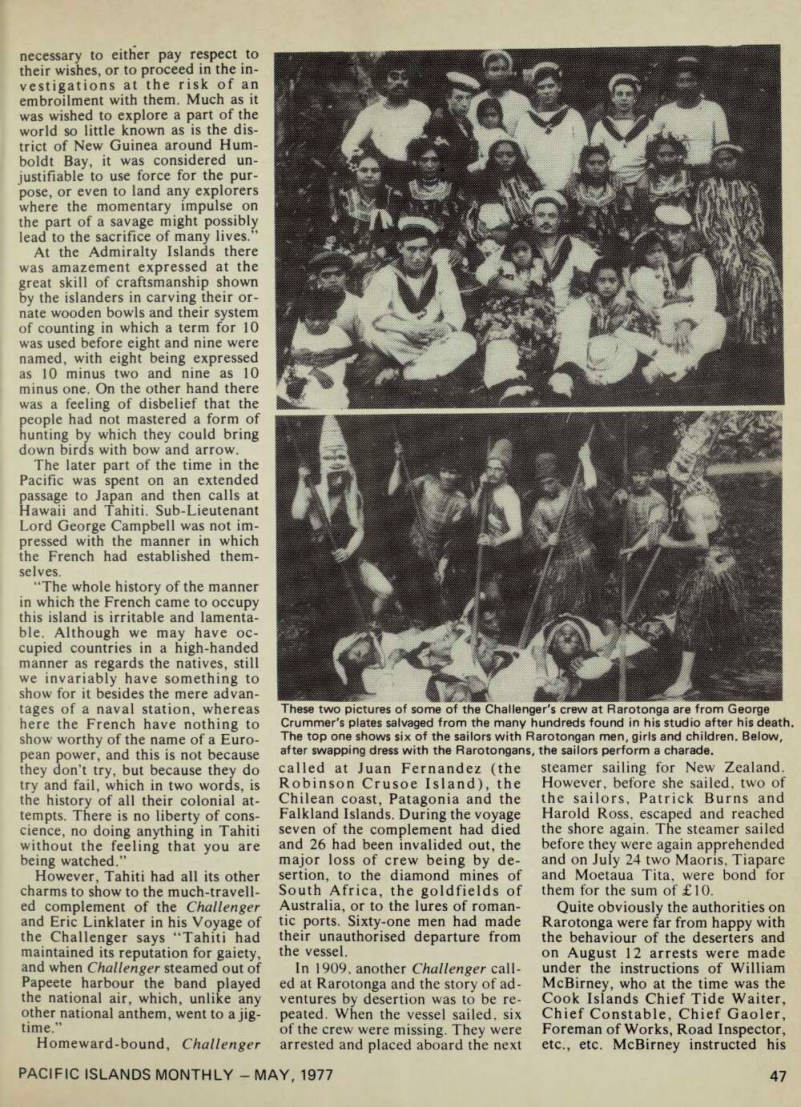
In Fiji waters, the ship called at Matuku, Ovalau and Kadavu. On Ovalau, Moseley saw many Fijians “dressed in their best, with bright new girdles of yellow and scarlet dyed pandanus leaves, bodies and hair freshly oiled, ornaments dis played and faces painted black or red or a mixture of both”.
Challenger next made her way to Cape York, then through the Torres Strait into Papuan waters, where the birds of paradise were a principal item of interest. After passing on to the Philippines and Hong Kong, she made her way into the New Guinea coastal area, making Humboldt Bay her first port-of-call, where much trading was done with the local peo ple, hoop-iron being a principal item of barter.
The report of the expedition ex plains the outcome of this visit “Unwillingness on the part of the natives to allow the parties to land and explore the country rendered it
This etching of a Fijian "in his best" was made around the time HMS Challenger called at Fiji. He was Nabukataratara Mataitonga of the Sabeto people.
necessary to either pay respect to their wishes, or to proceed in the in vestigations at the risk of an embroilment with them. Much as it was wished to explore a part of the world so little known as is the dis trict of New Guinea around Hum boldt Bay, it was considered un justifiable to use force for the pur pose, or even to land any explorers where the momentary impulse on the part of a savage might possibly lead to the sacrifice of many lives.”
At the Admiralty Islands there was amazement expressed at the great skill of craftsmanship shown by the islanders in carving their or nate wooden bowls and their system of counting in which a term for 10 was used before eight and nine were named, with eight being expressed as 10 minus two and nine as 10 minus one. On the other hand there was a feeling of disbelief that the people had not mastered a form of hunting by which they could bring down birds with bow and arrow.
The later part of the time in the Pacific was spent on an extended passage to Japan and then calls at Hawaii and Tahiti. Sub-Lieutenant Lord George Campbell was not im pressed with the manner in which the French had established them selves.
“The whole history of the manner in which the French came to occupy this island is irritable and lamenta ble. Although we may have oc cupied countries in a high-handed manner as regards the natives, still we invariably have something to show for it besides the mere advan tages of a naval station, whereas here the French have nothing to show worthy of the name of a Euro pean power, and this is not because they don’t try, but because they do try and fail, which in two words, is the history of all their colonial at tempts. There is no liberty of cons cience, no doing anything in Tahiti without the feeling that you are being watched.”
However, Tahiti had all its other charms to show to the much-travell ed complement of the Challenger and Eric Linklater in his Voyage of the Challenger says “Tahiti had maintained its reputation for gaiety, and when Challenger steamed out of Papeete harbour the band played the national air, which, unlike any other national anthem, went to a jig time.”
Homeward-bound, Challenger
called at Juan Fernandez (the Robinson Crusoe Island), the Chilean coast, Patagonia and the Falkland Islands. During the voyage seven of the complement had died and 26 had been invalided out, the major loss of crew being by de sertion, to the diamond mines of South Africa, the goldfields of Australia, or to the lures of roman tic ports. Sixty-one men had made their unauthorised departure from the vessel.
In 1909, another Challenger call ed at Rarotonga and the story of ad ventures by desertion was to be re peated. When the vessel sailed, six of the crew were missing. They were arrested and placed aboard the next
steamer sailing for New Zealand.
However, before she sailed, two of the sailors, Patrick Burns and Harold Ross, escaped and reached the shore again. The steamer sailed before they were again apprehended and on July 24 two Maoris, Tiapare and Moetaua Tita, were bond for them for the sum of £lO.
Quite obviously the authorities on Rarotonga were far from happy with the behaviour of the deserters and on August 12 arrests were made under the instructions of William Mcßirney, who at the time was the Cook Islands Chief Tide Waiter, Chief Constable, Chief Gaoler, Foreman of Works, Road Inspector, etc., etc. Mcßirney instructed his
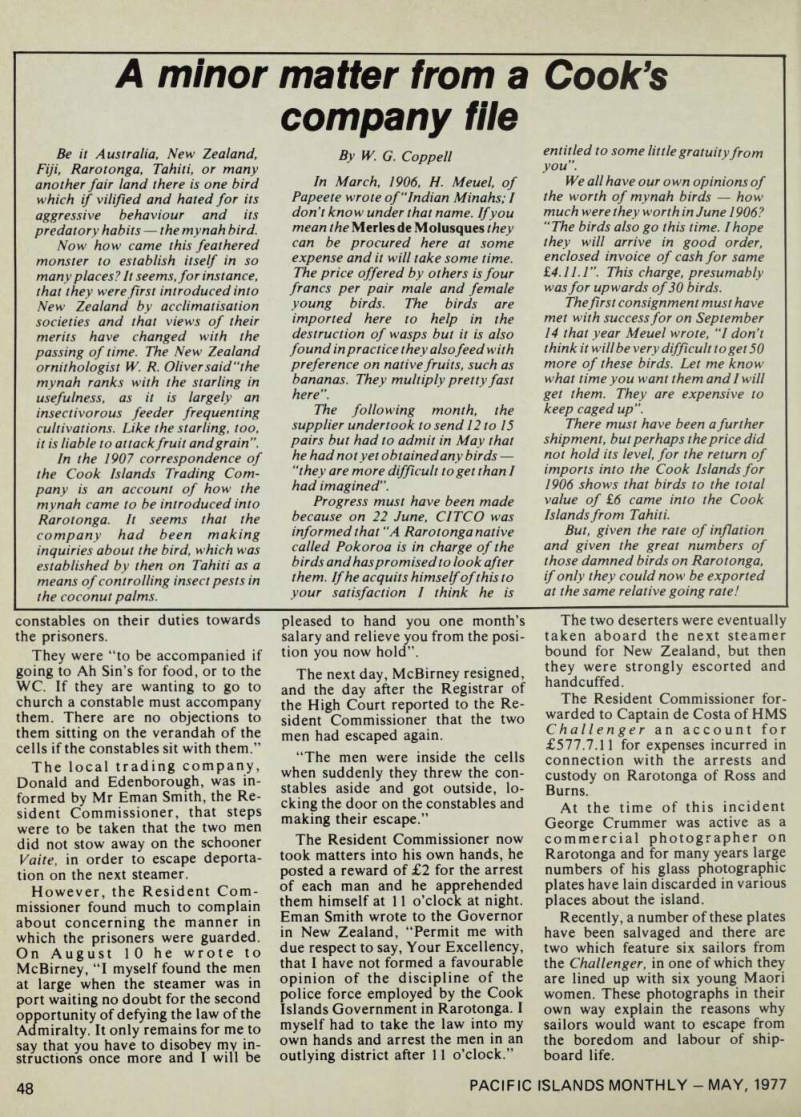
These two pictures of some of the Challenger's crew at Rarotonga are from George Crummer's plates salvaged from the many hundreds found in his studio after his death.
The top one shows six of the sailors with Rarotongan men, girls and children. Below, after swapping dress with the Rarotongans, the sailors perform a charade.
constables on their duties towards
the prisoners.
They were “to be accompanied if going to Ah Sin’s for food, or to the WC. If they are wanting to go to church a constable must accompany them. There are no objections to them sitting on the verandah of the cells if the constables sit with them.’’
TL P trarlino mmnanv sMent* Commi^one S r th’at h steps were to be taken that the two men did not stow away on the schooner Vaite in order to escape deportation on the next steamer However, the Resident Commissioner found much to complain about concerning the manner in which the prisoners were guarded.
On August 10 he wrote to Mcßirney “I myself found the men at large when the steamer was in port waiting no doubt for the second opportunity of defying the law of the Admiralty. It only remains for me to say that you have to disobey my instructioris once more and I will be
pleased to hand you one month’s salary and relieve you from the posi tion Y ou now hold”.
The next day, Mcßirney resigned, an d t h e day after the Registrar of t h e High Court reported to the Re sident Commissioner that the two men had escaped again " P g . . . . n Toe men were 10Slde the cells eking the door on the constables and makmg their escape The Resident Commissioner now took matters into his own hands, he posted a reward of £2 for the arrest each man and he apprehended ' hem himself at 11 o clock at night, Eman Simth wrote to the Governor > n New Zealand, Permit me with due respect to say, Your Excellency, that 1 have not formed a favourable opinion of the discipline of the P ohce force employed by the Cook Islands Government in Rarotonga. I myself had to take the law into my own hands and arrest the men in an outlying district after 11 o clock.
The two deserters were eventually taken aboard the next steamer bound for New Zealand, but then they were strongly escorted and handcuffed.
The Resident Commissioner for warded to Captain de Costa of HMS Challenger an account for £577.7.11 for expenses incurred in connection with the arrests and custody on Rarotonga of Ross and Burns.
At the time of this incident George Crummer was active as a commercial photographer on Rarotonga and for many years large numbers of his glass photographic plates have lain discarded in various places about the island.
Recently, a number of these plates have been salvaged and there are two which feature six sailors from the Challenger, in one of which they are lined up with six young Maori women. These photographs in their own way explain the reasons why sailors would want to escape from the boredom and labour of ship board life.