Pacific Islands Monthly
Pim
*Muini/ Iochiml/O Iviu
F
85c Aust $1.25 US
Cfp 130
, *thc •fcLfIJT
Ffbmdijc?
Registered for posting as j Categtfcpft
Our Cover
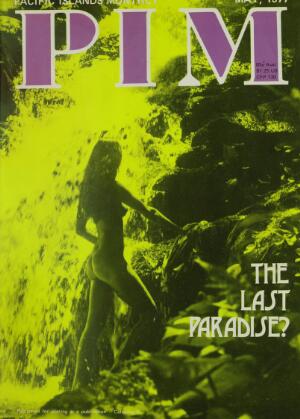
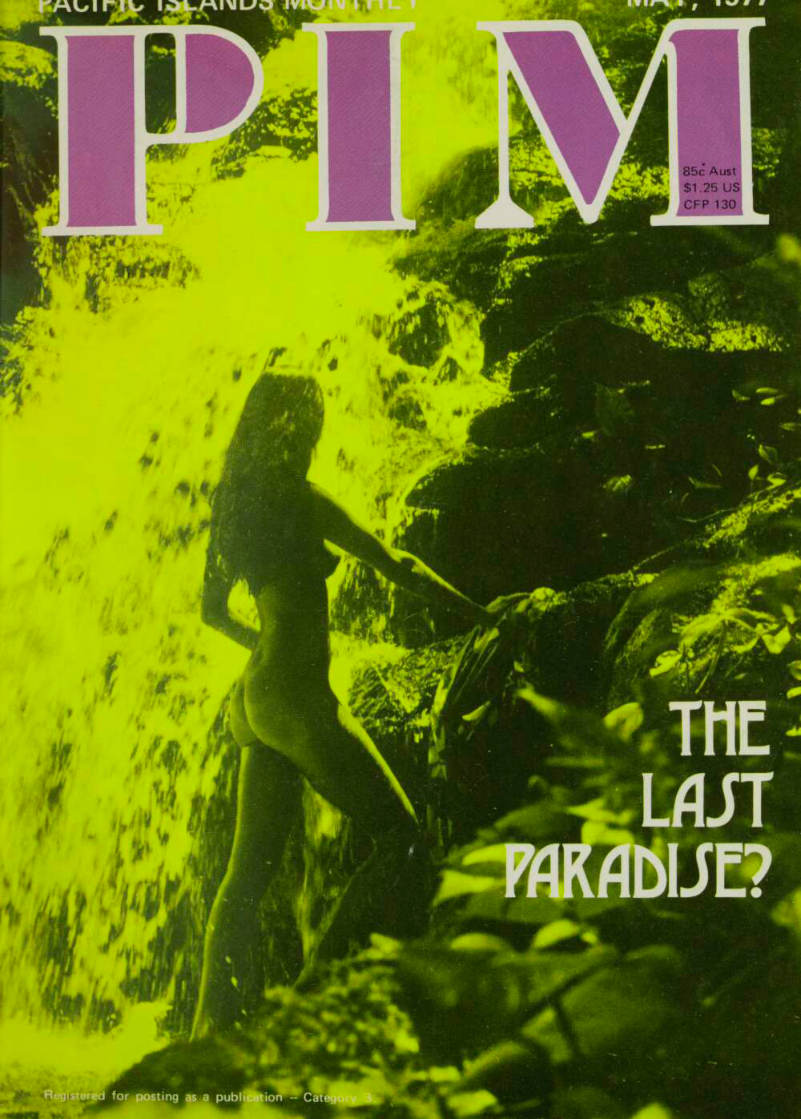
This attractive study from the camera of Ned A vary of a Rarotongan beauty at Papua Falls on Rarotonga is linked with inside pages in this special issue which features New Zealand’s trading links with the Islands and the open ing of the new Rarotonga Hotel and underlines the im portance of New Zealand’s influential connections with the Islands.
Advertisements & other items, pp. 2-4 (1 item)
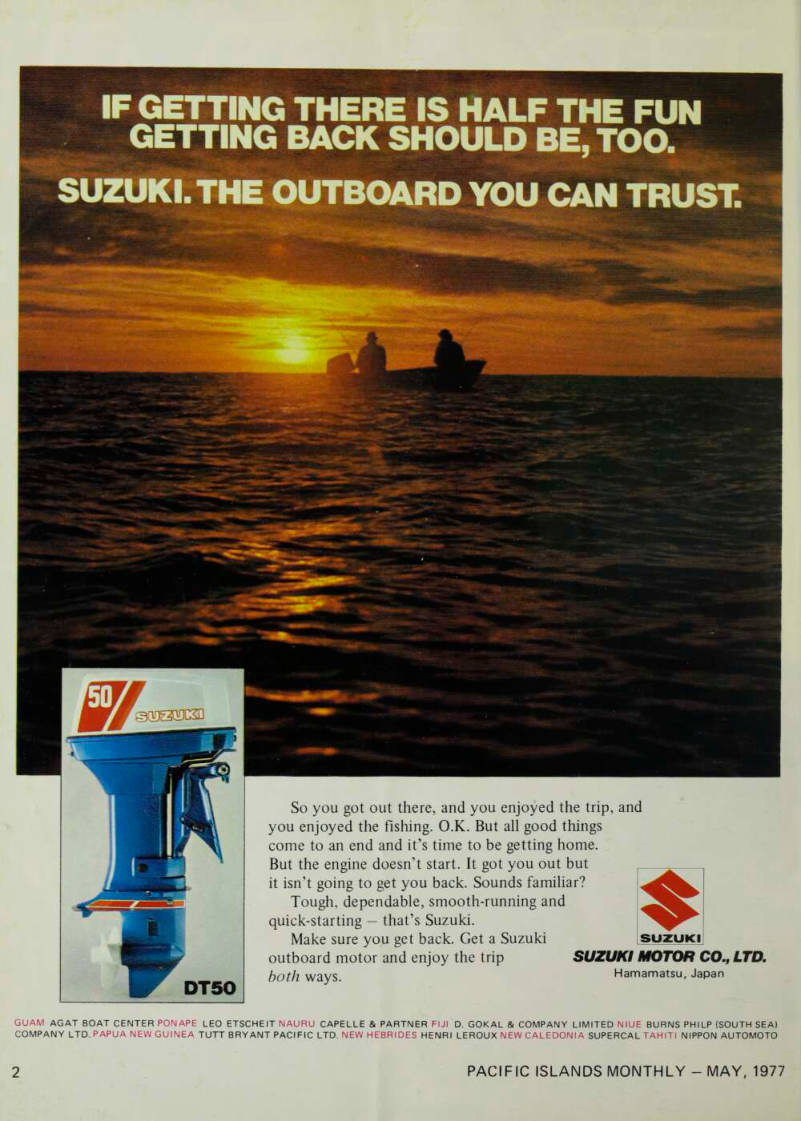
Getting Back Should Be, Too.
IF GETTING THERE IS HALF THE FUN
SUZUKI. THE OUTBOARD YOU CAN TRUST.
m
UJK4I
CO
DTSO
So you got out there, and you enjoyed the trip, and you enjoyed the fishing. O.K. But all good things come to an end and it’s time to be getting home.
But the engine doesn’t start. It got you out but , it isn’t going to get you back. Sounds familiar?
Tough, dependable, smooth-running and quick-starting that’s Suzuki.
Make sure you get back. Get a Suzuki I Suzuki I outboard motor and enjoy the trip SUZUKI MOTOR CO., LTD. both ways. Hamamatsu, Japan GUAM AGAT BOAT CENTER PONAPE LEO ETSCHEIT NAURU CAPELLE & PARTNER FIJI D. GOKAL & COMPANY LIMITED NIUE BURNS PHILP (SOUTH SEA) COMPANY LTD. PAPUA NEW GUINEA TUTT BRYANT PACIFIC LTD. NEW HEBRIDES HENRI LEROUX NEW CALEDONIA SUPERCAL TAHITI NIPPON AUTOMOTO
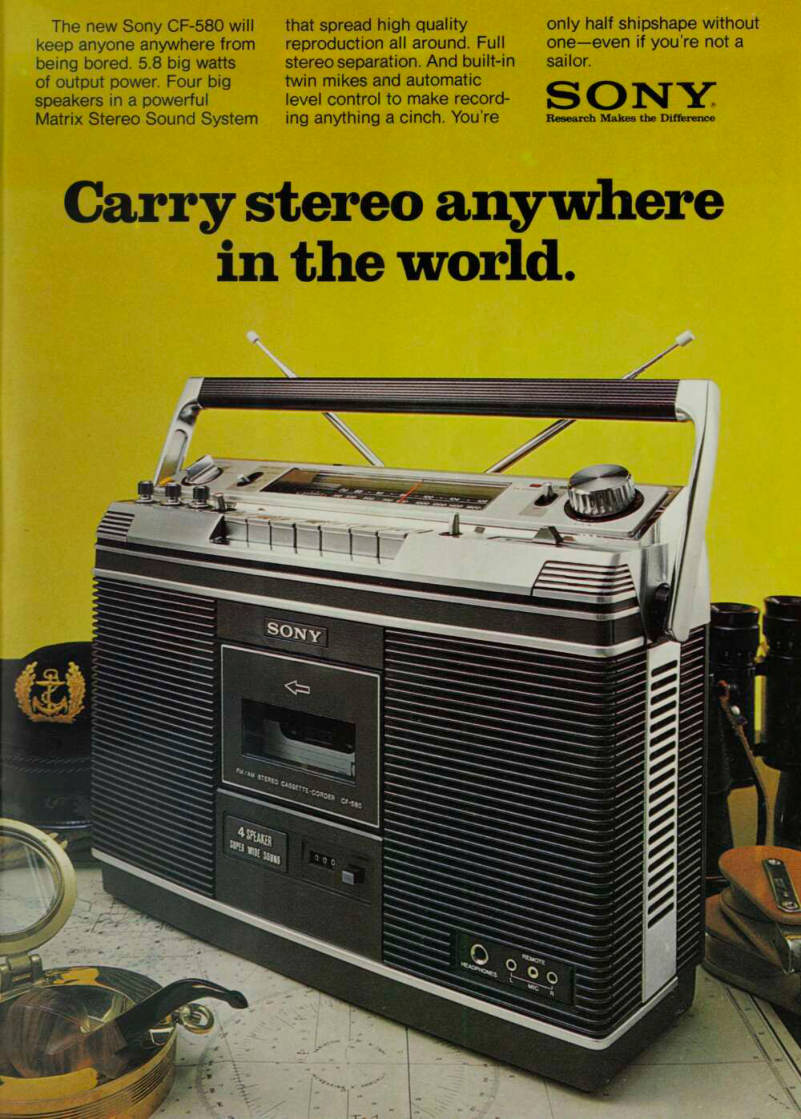
The new Sony CF-580 will keep anyone anywhere from being bored. 5.8 big watts of output power. Four big speakers in a powerful Matrix Stereo Sound System that spread high quality reproduction all around. Full stereo separation. And built-in twin mikes and automatic level control to make recording anything a cinch. You’re only half shipshape without one—even if you’re not a sailor.
SONY
Research Makes the Difference
Carry stereo anywhere
in the world.
“T® •* w
1 fJSi
Ms / I -i : m ■
Pocket a Me gold.
m r m VjfiS' Benson <u Hedges 20 Benson and Hedges Special Filter. When only the best will do. L585-1/77
Pacific Slands
Monthly
Subscription Rates
"Pacific Islands Monthly” is airfreighted to the majority of subscribers and agents in the Pacific Islands and the
Usa.
Australia (including Norfolk Island) $lO 50 Aust, New Zealand, Papua New Guinea, Fiji, New Hebrides, Tonga, Cook Islands, Western Samoa, Gilbert Islands, Tuvalu, Niue, Nauru and Solomon Islands $lO 50 Aust.
American Samoa, Northern Marianas, Micronesia, Guam and Hawaii $l5 00 US or $l2 00 Aust. US Mainland and Canada $17.00 US or $l4 00 Aust. New Caledonia and French Polynesia 1,600 CFP or $l3 50 Aust United Kingdom £9 50 or $l2 50 Aust. Japan 4,500 Yen or $l2 50 Aust. Elsewhere $l4 00 Aust.
Representatives
Fiji: D istribution and subscriptions Desai Bookshops, P.O. Box 160, Suva, Fiji Telephone: Suva 23036 Advertising, Fiji Times & Herald Ltd , 20 Gordon Street, Suva Telephone: 312 111. Telex: FJ2124.
Papua New Guinea: Advertising and Distribution PNG Post-Courier, P.O. Box 85, Port Moresby Inquiries: Post Newsagency, Telephone 24 2148 French Polynesia: Distribution Hachette Pacifique, 10 Ave Bruat, Papeete New Caledonia: Distribution Depot Centre de Presse Michel PENTECOST, 8.P.C2 NOUMEA United Kingdom: The Herald and Weekly Times Limited, 8-10 Clifford’s Inn, Fetter Lane, London EC4A IBU. Telephone: 01 831 6041 Telex: London 21989 Japan: Advertising Universal Media Corporation, C.P.O Box 46, Tokyo Telephone: 666 3036 New Zealand: Pacific Publications, C.P.O. Box 2229, Auckland Advertising enquiries: International Media Representatives Ltd, P.O. Box 3880 Auckland. Tel 73 880 Telex: NZ21157 (Auck 40) Hawaii and U.S. Mainland only: PIM, Hawaii. 2812, Kahawai St., Honolulu, Hawaii, 96822 Second class postage paid at Honolulu, Hawaii Victoria: Advertising Pacific Publications (Aust.) Pty Ltd., Herald and Weekly Times Building, 2nd Floor, 61 Flinders Lane, Melbourne, 3000. Telephone: 652 1565 Brisbane: D Wood, Anday Agency, Box 1918 G.P.0., Brisbane 4001 Telephone: 44 3485; 44 1546 Printed in Australia
Copyright ©, 1977,
Pacific Publications (Aust.) Pty. Ltd.
Printed by Paramac, Mitchell Rd,
Alexandria.
PIM is distributed in Australia and New Zealand by Gordon & Gotch. Australian cover price is recommended retail only.
Registered at the G.P.O. Sydney for transmission by post as a publication category B.
Vol. 48 No. 5 May, 1977
Up Front
with the Publisher
Sydney, oldest British settlement in the South Seas (it was founded in 1788) naturally has a number of buildings that are both beautiful and historic, and one of the most pleasing bits of architecture is a row of terraced shops which recently appeared at Circular Quay, where the big cruise ships come in, I say ‘appeared’, although the terrace no doubt dates from last century. But nobody noticed those shops until somebody with a good eye for line and colour had them painted so as to bring out their most attractive features, and hung out new shingles in the style of the period.
This sort of thing is being done everywhere these days. I saw some beautiful examples in the city area of Auckland recently, and in much maligned Chicago I’ve seen some large areas of restoration done in great good taste. But I know of no similar activity going on in the Islands.
I was reminded of this the other week when I, and wife Jo, spent a pleasant fortnight in old Levuka.
Levuka was the capital of Fiji until the seat of government was moved to Suva in 1882, but it retains an old world charm that continues to attract all manner of visitors.
The buildings ramble along the beach road and up into the sharply rising hills, so reminiscent of Tahiti, where the paths are so steep they give way to stone steps.
The views out across the Koro Sea, of course, are nothing short of wondrous.
But the charm is in the town itself. There’s the quaint Ovalau Club, and next to it the town hall, and within a stone’s throw the equally historic Royal Hotel (rebuilt in the 1880 ? s, but little changed in outward appearance since). These are some of my favourite buildings, but as a single architectural vista there’s nothing to
surpass the whole line of the Beach Road stores.
Beginning with Burns Philp, there they sit, with their verandah posts and awnings, their fretwork scrolls, facing out to sea like a setting of Somerset Maugham’s.
Until April 1, Morris Hedstrom’s store was among them, but it’s closed now after almost 100 years, and the land will be used by the government for a different purpose.
And that’s the point. There’s history in Levuka, but it’s architectural history as much as the history of old wars, blackbirders and cession.
It shouldn’t be allowed to disappear, little by little, for the lack of a coat of paint, or some repairs, or because renovations are done from time to time for reasons of commercial expediency, but with no appreciation of a heritage.
I might be wrong but I doubt if the heritage can be safeguarded, let alone enhanced, by individual owners unless they are offered both professional and financial help.
Beach Road can be made even more pleasing than those terraced shops at Circular Quay if the Levuka council organises a planned restoration programme. This might require little more than paint in the first instance - but it has to be an integrated plan.
Levuka begs for this attention, and the town is in so confined a space that the results would be seen immediately. But there are other parts of Fiji, and the South Pacific, where the architecture needs safeguarding. The most obvious is historic Apia, but there are buildings of charm that I know of in Nukualofa, Papeete, Pago and Rabaul, among other places.
If anybody wants to come up with his own list of priorities, or suggestions, in this appeal, I’ll be glad to publish it.
Stuart Inder
Advertisements & other items, pp. 5-6 (2 items)
Pacific Islands Monthly May, 1977
5
FOUNDED BY R. W. ROBSON IN 1930
PUBLISHED MONTHLY BY
PACIFIC PUBLICATIONS (AUST.) PTY. LTD.,
76 CLARENCE STREET. SYDNEY 2000
Post Address; G.P.O. BOX 3408, SYDNEY,
N S W 2001
Telegraphic Address: PACPUB, Sydney Telex: 21242
TELEPHONE: 29 6693
Publisher: Stuart Inder Manager: John Berry Advertising Manager: Alan Batt EDITOR: John Carter
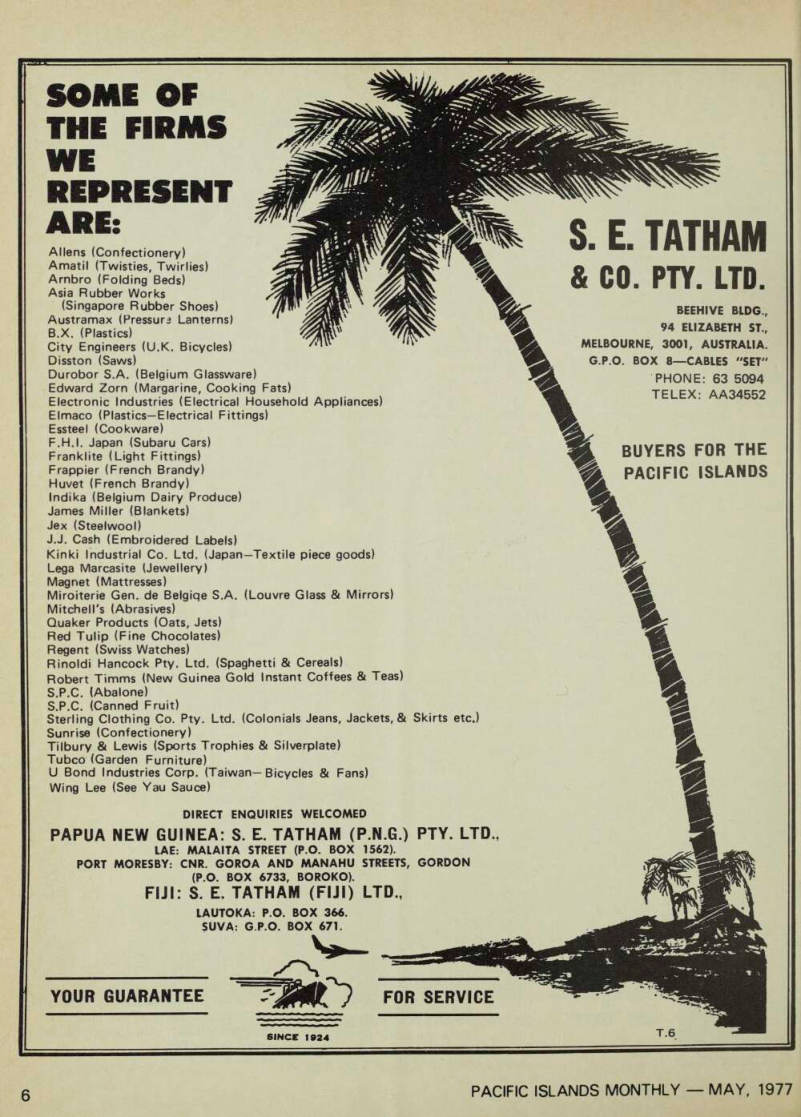
S. E. Tatham
SOME OF
REPRESENT
ARE:
Vi A Allens (Confectionery) Amatil (Twisties, Twirlies) Arnbro (Folding Beds) Asia Rubber Works (Singapore Rubber Shoes) Austramax (Pressuri Lanterns) B.X. (Plastics) City Engineers (U.K. Bicycles) Disston (Saws) Durobor S.A. (Belgium Glassware) Edward Zorn (Margarine, Cooking Fats) Electronic Industries (Electrical Household Appliances) Elmaco (Plastics—Electrical Fittings) Essteel (Cookware) F.H.I. Japan (Subaru Cars) Franklite (Light Fittings) Frappier (French Brandy) Huvet (French Brandy) Indika (Belgium Dairy Produce) James Miller (Blankets) Jex (Steelwool) J.J. Cash (Embroidered Labels) Kinki Industrial Co. Ltd. (Japan—Textile piece goods) Lega Marcasite (Jewellery) Magnet (Mattresses) Miroiterie Gen. de Belgiqe S.A. (Louvre Glass & Mirrors) Mitchell's (Abrasives) Quaker Products (Oats, Jets) Red Tulip (Fine Chocolates) Regent (Swiss Watches) Rinoldi Hancock Pty. Ltd. (Spaghetti & Cereals) Robert Timms (New Guinea Gold Instant Coffees & Teas) S.P.C. (Abalone) S.P.C. (Canned Fruit) Sterling Clothing Co. Pty. Ltd. (Colonials Jeans, Jackets, & Skirts etc.) Sunrise (Confectionery) Tilbury & Lewis (Sports Trophies & Silverplate) Tubco (Garden Furniture) U Bond Industries Corp. (Taiwan—Bicycles & Fans) Wing Lee (See Yau Sauce)
DIRECT ENQUIRIES WELCOMED
PAPUA NEW GUINEA: S. E. TATHAM (P.N.G.) PTY. LTD.,
LAE: MALAITA STREET (P.O. BOX 1562).
PORT MORESBY: CNR. GOROA AND MANAHU STREETS, GORDON
(P.O. BOX 6733, BOROKO).
FIJI: S. E. TATHAM (FIJI) LTD.,
LAUTOKA: P.O. BOX 366.
SUVA: G.P.O. BOX 671.
S. E. TATHAM
& CO. PTY. LTD.
BEEHIVE BLDG.,
94 ELIZABETH ST.,
MELBOURNE, 3001, AUSTRALIA.
G.P.O. BOX B—CABLES "SET"
PHONE: 63 5094
TELEX: AA34552
BUYERS FOR THE
PACIFIC ISLANDS
YOUR GUARANTEE
SINCE 1024
1
FOR SERVICE
T. 6
In this issue
General
Hokule'a lesson 37 First mail by canoe 39 Poison in fish 45 NZ trade feature 55 NZ's interests in Islands 59 What makes New Zealanders tick. ... 69 Australian aid for Forum Line 81
Cook Islands
Kia Orana painting 11 Census figures 21 Anthropologist's visit 21 Armour-plated hats in fashion 27 Cut-price haircuts 29 Bali Ha'i or Rarotonga 43 How the Mynah bird came 48 Rarotonga Hotel opens 73 Tourist industry benefits NZ 75 Atiu airstrip opened 83
Fiji
Election turmoil 8,9, 10 Mr Stinson sues for libel 21 Emperor Mines losses 72 Burns Philp's profits 77 Sugar agreement 78 Heavy chemical factory planned 79 Better days for Air Pacific 81 Australia helps Forum Line 81 Roll on/roll off ships coming 87
French Polynesia
Unavoidable path to independence ... 17
Gilbert Islands
Fiji sugar agreement 78
Nauru
Nauru House opened (pic) 21 A name for Nauru House 27 Air and shipping lines in Suva 83
New Caledonia
The municipal merry-go-round 15 The economic switchback 15 Soccer field fight 23 Aquarium's new director 29 Navy's part in yacht race 89
New Hebrides
The political storm 11
Niue
NZ aid for fisheries scheme 57
Norfolk Island
Knockback from the UN 18
Papua New Guinea
Queen's visit 12 Political parties on trial 19 Chinese gifts to parties 19 Vatican relations 21 Women join Police Force 21 Wages rise 21 Regiment's birthday 27 Sir John Yocklunn's job 31 Torres Strait argument 35 History of gold-mining 63 Purari River electricity 71 Copper prices 71 Buffalo farming plan 79
Pitcairn Island
A nation of motorcyclists 29
Solomon Islands
Independence problems 13 Tin gods 13 Fred Maedola, the troubadour 14 First trade mission to NZ 77
Tonga
Seaman reported drowned in China. . . 21 Queen's award to Tongan 25 Burns Philp's profits 77 Boat with a date 83 Hopes for oil strike 91
Tuvalu
Fiji sugar agreement 78
Us Trust Territory
The return to Enewetak 16 Peter Coleman resigns 25 Bugging a new approach 33 Party politics 33
Wallis & Futuna
St Peter Chanel's relics 23
Western Samoa
Burns Philp's profits 77 Fiji sugar agreement 78
DEPARTMENTS: Up Front with the Publisher, 5; News in a Nutshell, 21; People, 25; Tropicalities, 27, Editor's Mailbag, 31, Magazine Section, 46, Islands Press, 49; Business & Development, 55; Books, 63; Transport, 81; Cruising Yachts, 89; Deaths of Islands People, 93; Shipping Information, 96, Produce Prices, 101
‘Fiji for
Fijians’ brings these islands to the brink
From ROBERT KEITH-REID in Suva
Complacent supporters of Fiji’s ruling Alliance Party who thought the country’s complex voting system gave a virtual guarantee of perpetual power for the Alliance, were shocked numb in March/April after the first general elections for the House of Representatives since 1972. Fiji’s 278,000 voters (out of a population of half a million) handed out a result which sent the nation into constitutional crisis.
The general election was the second since independence from Britain in 1970. But, compared with the election of 1972, it was a far, far more complex process due to the emergence of a third significant political force, the Fijian Nationalist Party, and factional pressures inside both the Alliance and the NFP.
In 1972 it was a straight fight, the Alliance versus the NFP.
Race is a fact of life, as Fiji politicans comment frequently in discussing the communal problems confronting a country in which 51 % of the population is Indian and the balance mainly Fijian, with a smattering of Europeans, Chinese, other Islanders and mixed-race peoples.
In 1972, it was a forgone conclusion that, as the Fiji Constitution guaranteed non-Indians control of 30 of the 52 seats in parliament, and as the Alliance had the total support of this group, plus the support of about 25% of Indian electors, it would win.
So it did, 33 seats to 19 over the NFP. But, a lot of things have happened since then.
First, one of the Alliance’s Fijian MPs, Mr Sakiasi Butadroka, turned out to be too anti-Indian for a party basing its policies on the preservation of communal harmony.
He left it three years ago, although not resigning his Fijian communal seat, and formed the Fijian Nationalist Party with the motto “Fiji for the Fijians”.
Since then, there has been waver-
ing in the Alliance in other directions, although the disunity there has certainly been nothing compared to the troubles in the National Federation Party.
The results of the elections were known by early April.
While the NFP won 26 seats, the Alliance got 24, eight less than its previous 32.
The Fijian Nationalist Party which, as far as the Alliance was concerned, was the cause of the whole upset, won one seat and independent candidate Ratu Osea Gavidi took one of the Alliance’s 12 Fijian communal seats.
The result left the NFP with a majority that did not give it the control G f parliament it had to have if it was to ge t any legislation passed. The NFP sat down to hours of discussing a way out of the impasse while stunnec i Alliance cabinet ministers, after nearly 11 years of unchallenged power, packed their bags and left t h e ir ministerial offices.
Prime Minister Ratu Sir Kamisese Mara handed in his resignation on April 5, coldly refused offers of a coalition deal received from the NFP and challenged it to try to form a government.
The Alliance expectation was that t h e NFP would be forced to do so but WO uld soon topple not only because of its nil majority but because of intense leadership rivalries within its ranks.
But then Ratu Osea Gavidi, who had campaigned with the promise to remain an independent, threatened
to upset the applecart by announcing that he would back the NFP and give it a working majority to be able to form a government in the national in terest.
Next day, he said he had changed his mind, apparently after persuasion by the Alliance, The NFP was back to the prospect ofrule without power again, and after much haggling amongst members of its parliamentary group, agreed logo for a deal with the Alliance. While some local observers had predicted that the Alliance might get its majori ty cut by an alarming amount, no one, least of all the NFP had expected it would lose the election, “A very pleasant surprise,” was how the NFP’s boss, Siddiq Koya, put it after keeping his Lautoka Indian seat in a tough battle against a former NFP man, Raojibhai Patel.
So why the Alliance loss?
There were several factors, but the main one was undoubtedly the deci sion of about 20,000 Fijians to vote for the two-year-old Fijian Na tionalist Party and its unpleasant “anti-Indian and Fiji for the Fijian” creed instead of for the Alliance as before.
The Alliance, which had com pletely underestimated the draw of the Fijian Nationalists, predicted that all its 17 candidates would lose their deposits, had a horrible surprise, True, only one Nationalist did get to parliament and this was the party’s leader, former Alliance assistant minister Sakeasi Butadroka, who kept his Fijian communal seat by
soundly beating his Alliance oppo nent. But many other FNP candidates got up to 4,000 votes each, so splitting the Fijian vote in many of the 25 “na tional” seats, of which the Alliance had held the majority and, hence, the overall parliamentary majority.
This lack of support meant that the NFP picked up seats it would never have otherwise obtained.
Alliance losses included three cabinet ministers, Ratu Josua Toganivalu (Agriculture) and Mr Sakiasi Waqanivavalagi (Lands and Mines) while Education Minister, Peniame Naqasima was beaten unex pectedly for his Fijian Sigatoka seat by Ratu Gavidi, a popular young chief of the area.
A jubilant Sakeasi Butadroka, who said he was praying for an NFP victo ry to prove his claims to Fijians tuat Fiji was really controlled by the In dians, was able to cry; “My prayers have been answered,” which he did.
Ratu Mara took the defeat a little
cynically, saying, “It is quite obvious
that the Fijians blame us for being pro-Indian, particularly the Na tionalists and the Indians have blam ed us for being pro-Fijian.”
Fijians would have to “blame themselves” for any mess they found the country in as a result of deserting the Alliance, he warned, and added that he still thought the Fiji Constitu tion was the best one the country could have.
At this point, events began to move quickly.
Fiji’s burly, belligerent Opposi tion leader, Siddiq Koya, 53, drove up to Government House in Suva four days after the end of the elec tion, supremely confident that he was about to become Fiji’s first In dian Prime Minister.
Half an hour after his departure from the Opposition office in the Government Building he returned a downcast, and furious man.
He’d been told by the Governor- General, Ratu Sir George Cakobau, Fiji’s paramount chief and a former
Alliance Minister, that Ratu Sir Kamisese Mara had been reap pointed to the post.
A Government House statement broadcast to a stunned nation a few minutes later explained why.
The Governor-General, it said, having considered all relevant cir cumstances, had come to the conclu sion that despite the NFP’s 26 seats in parliament, it was Ratu Mara who commanded the support of the ma jority of the 52 parliamentarians, and who therefore, under the terms laid down by the Constitution, was the man who should be made Prime Minister.
Ratu Mara was back in his hastily vacated Prime Minister’s office and had appointed a new cabinet just over an hour after Koya had been dismaved by the Governor-General.
“It’s amazing,” confessed Ratu Mara, describing how he felt about the sudden reversal of his fortunes.
“The summons to Government House this afternoon came out of the blue. I did not expect it at all.”
The NFP quickly put out a state ment complaining that the Gover nor-General acted without con sultation with Koya or any other party source.
"We have a written Constitution and it is a pity that the constitutional processes were not allowed to take their course” it said.
As Ratu Mara went to mass at the
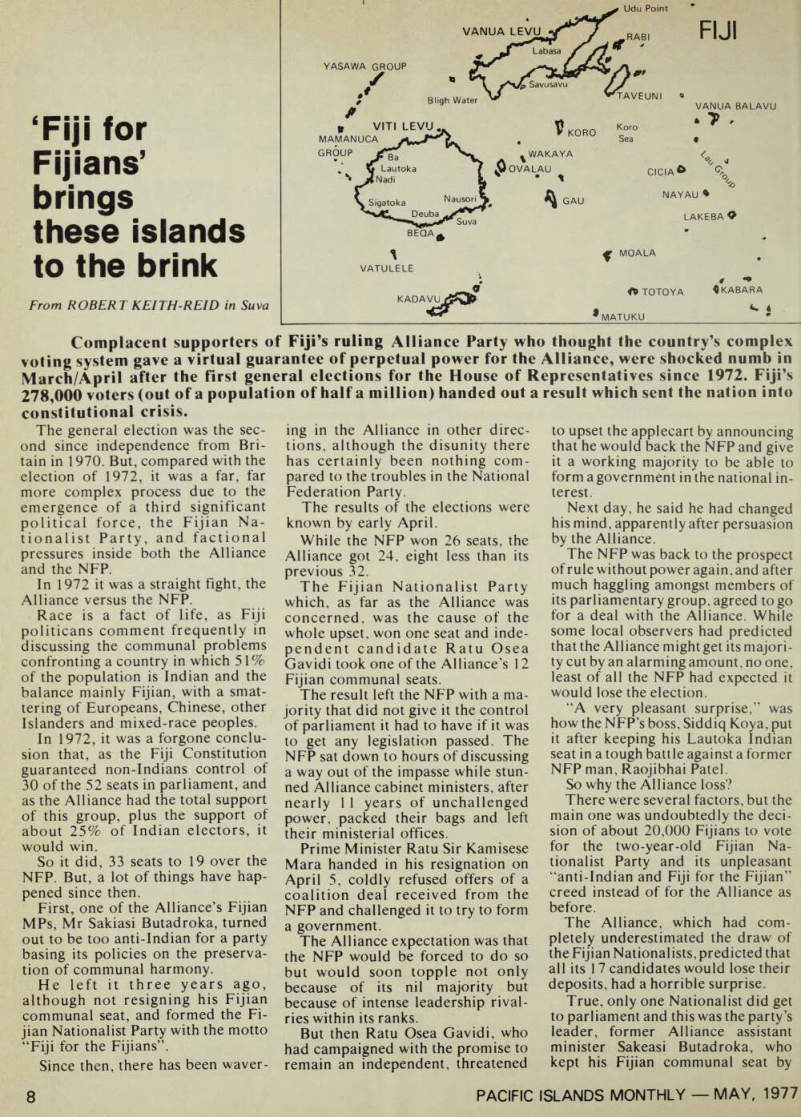
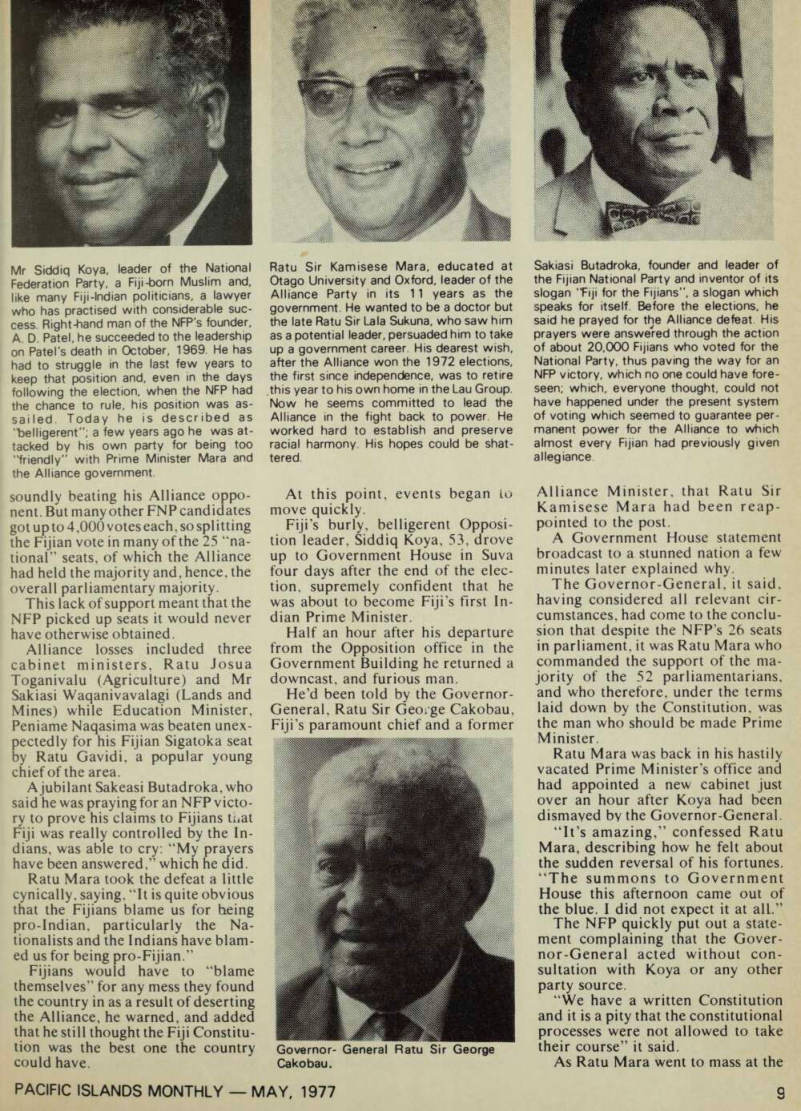
Mr Siddiq Koya, leader of the National Federation Party, a Fiji-born Muslim and, like many Fiji-Indian politicians, a lawyer who has practised with considerable suc cess. Right-hand man of the NFP's founder, A. D. Patel, he succeeded to the leadership on Patel's death in October, 1969. He has had to struggle in the last few years to keep that position and, even in the days following the election, when the NFP had the chance to rule, his position was as sailed. Today he is described as "belligerent"; a few years ago he was at tacked by his own party for being too "friendly” with Prime Minister Mara and the Alliance government.
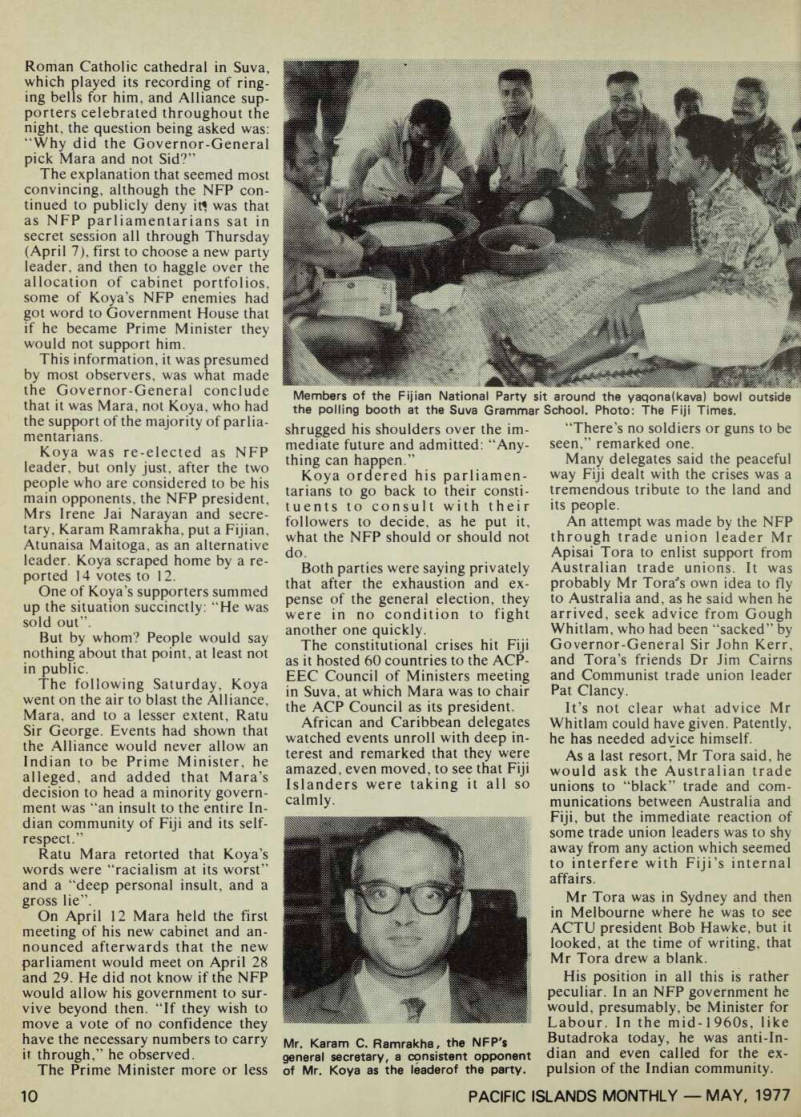
Ratu Sir Kamisese Mara, educated at Otago University and Oxford, leader of the Alliance Party in its 11 years as the government. He wanted to be a doctor but the late Ratu Sir Lala Sukuna, who saw him as a potential leader, persuaded him to take up a government career. His dearest wish, after the Alliance won the 1972 elections, the first since independence, was to retire this year to his own home in the Lau Group.
Now he seems committed to lead the Alliance in the fight back to power. He worked hard to establish and preserve racial harmony. His hopes could be shat tered.
Governor- General Ratu Sir George Cakobau.
Sakiasi Butadroka, founder and leader of the Fijian National Party and inventor of its slogan "Fiji for the Fijians”, a slogan which speaks for itself. Before the elections, he said he prayed for the Alliance defeat His prayers were answered through the action of about 20,000 Fijians who voted for the National Party, thus paving the way for an NFP victory, which no one could have fore seen; which, everyone thought, could not have happened under the present system of voting which seemed to guarantee per manent power for the Alliance to which almost every Fijian had previously given allegiance.
Roman Catholic cathedral in Suva, which played its recording of ring ing bells for him, and Alliance sup porters celebrated throughout the night, the question being asked was: “Why did the Governor-General pick Mara and not Sid?”
The explanation that seemed most convincing, although the NFP con tinued to publicly deny it* was that as NFP parliamentarians sat in secret session all through Thursday (April 7), first to choose a new party leader, and then to haggle over the allocation of cabinet portfolios, some of Koya’s NFP enemies had got word to Government House that if he became Prime Minister they would not support him.
This information, it was presumed by most observers, was what made the Governor-General conclude that it was Mara, not Koya, who had the support of the majority of parlia mentarians.
Koya was re-elected as NFP leader, but only just, after the two people who are considered to be his main opponents, the NFP president, Mrs Irene Jai Narayan and secre tary, Karam Ramrakha, put a Fijian, Atunaisa Maitoga, as an alternative leader. Koya scraped home by a re ported 14 votes to 12.
One of Koya’s supporters summed up the situation succinctly: “He was sold out”.
But by whom? People would say nothing about that point, at least not in public.
The following Saturday, Koya went on the air to blast the Alliance, Mara, and to a lesser extent, Ratu Sir George. Events had shown that the Alliance would never allow an Indian to be Prime Minister, he alleged, and added that Mara’s decision to head a minority govern ment was “an insult to the entire In dian community of Fiji and its self respect.”
Ratu Mara retorted that Koya’s words were “racialism at its worst” and a “deep personal insult, and a gross lie”.
On April 12 Mara held the first meeting of his new cabinet and an nounced afterwards that the new parliament would meet on April 28 and 29. He did not know if the NFP would allow his government to sur vive beyond then. “If they wish to move a vote of no confidence they have the necessary numbers to carry it through,” he observed.
The Prime Minister more or less
shrugged his shoulders over the im mediate future and admitted; “Any thing can happen.”
Koya ordered his parliamen tarians to go back to their consti tuents to consult with their followers to decide, as he put it, what the NFP should or should not do.
Both parties were saying privately that after the exhaustion and ex pense of the general election, they were in no condition to fight another one quickly.
The constitutional crises hit Fiji as it hosted 60 countries to the AGP EEC Council of Ministers meeting in Suva, at which Mara was to chair the ACP Council as its president.
African and Caribbean delegates watched events unroll with deep in terest and remarked that they were amazed, even moved, to see that Fiji Islanders were taking it all so calmly.
“There’s no soldiers or guns to be seen,” remarked one.
Many delegates said the peaceful way Fiji dealt with the crises was a tremendous tribute to the land and its people.
An attempt was made by the NFP through trade union leader Mr Apisai Tora to enlist support from Australian trade unions. It was probably Mr Tora J s own idea to fly to Australia and, as he said when he arrived, seek advice from Gough Whitlam, who had been “sacked” by Governor-General Sir John Kerr, and Tora’s friends Dr Jim Cairns and Communist trade union leader Pat Clancy.
It’s not clear what advice Mr Whitlam could have given. Patently, he has needed advice himself.
As a last resort, Mr Tora said, he would ask the Australian trade unions to “black” trade and com munications between Australia and Fiji, but the immediate reaction of some trade union leaders was to shy away from any action which seemed to interfere with Fiji’s internal affairs.
Mr Tora was in Sydney and then in Melbourne where he was to see ACTU president Bob Hawke, but it looked, at the time of writing, that Mr Tora drew a blank.
His position in all this is rather peculiar. In an NFP government he would, presumably, be Minister for Labour. In the mid-19605, like Butadroka today, he was anti-In dian and even called for the ex pulsion of the Indian community.
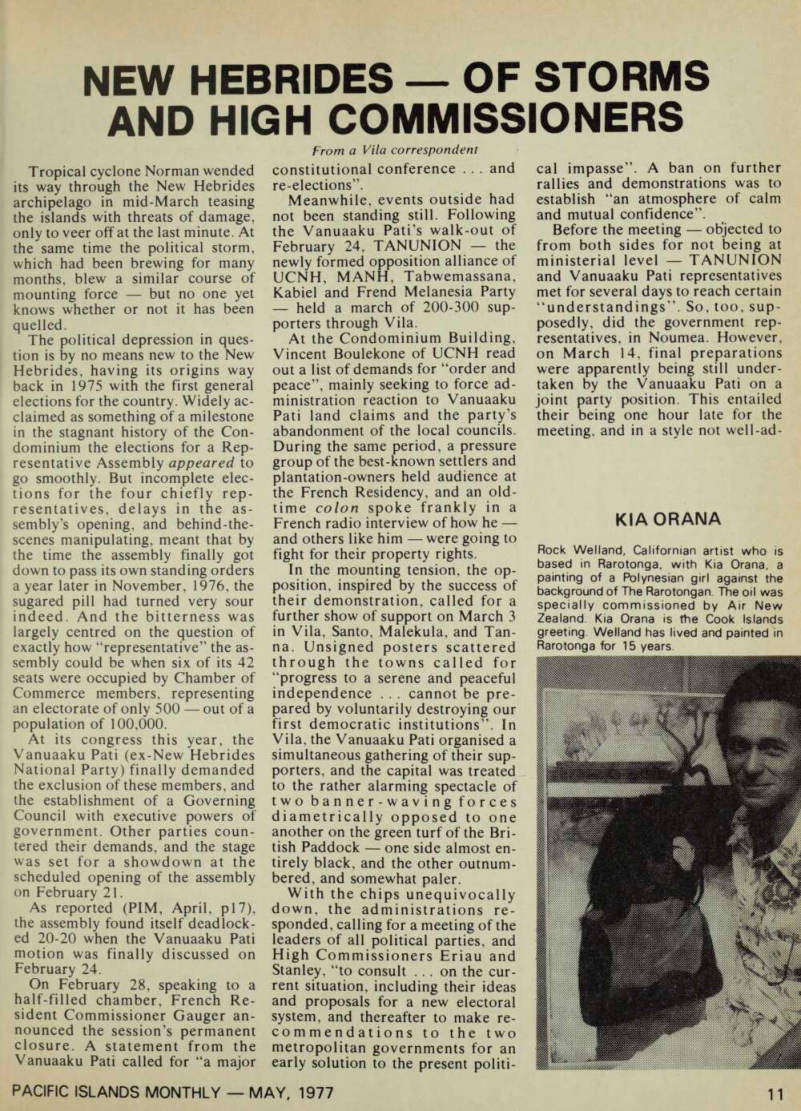
Members of the Fijian National Party sit around the yaqona(kava) bowl outside the polling booth at the Suva Grammar School. Photo: The Fiji Times.
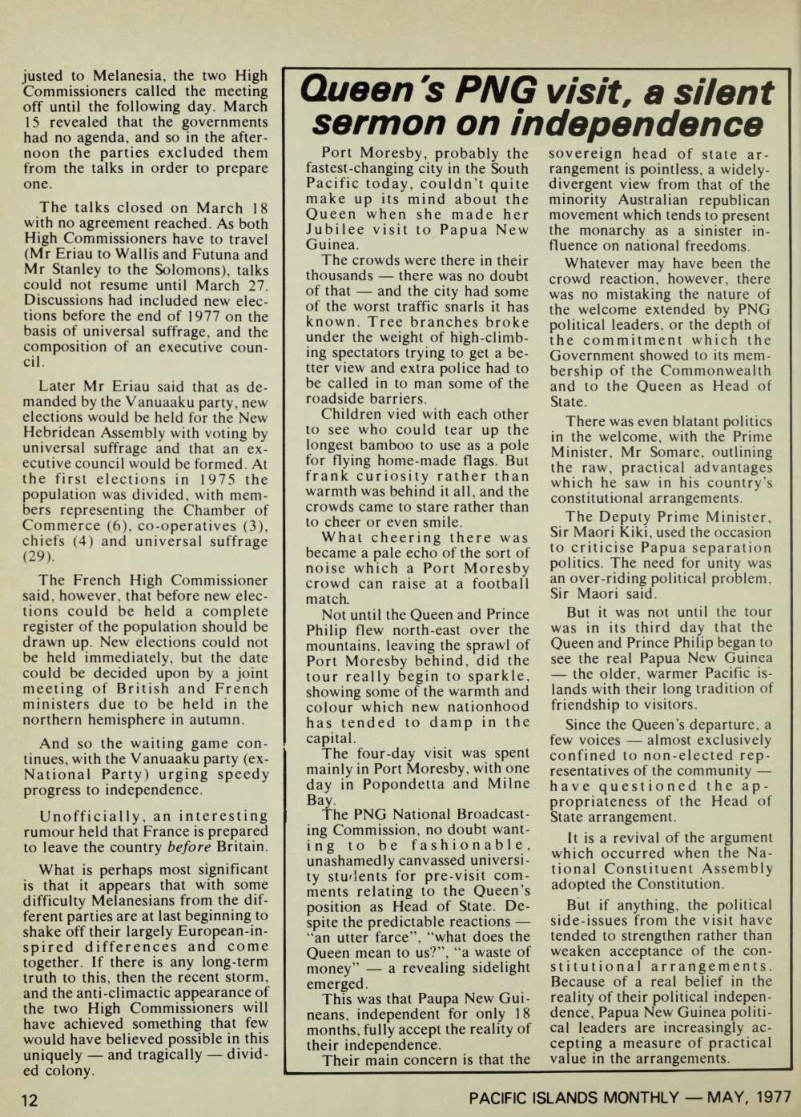
Mr. Karam C.Ramrakha, the NFP's general secretary, a consistent opponent of Mr. Koya as the leaderof the party.
New Hebrides - Of Storms
And High Commissioners
From a Vila correspondent
Tropical cyclone Norman wended its way through the New Hebrides archipelago in mid-March teasing the islands with threats of damage, only to veer off at the last minute. At the same time the political storm, which had been brewing for many months, blew a similar course of mounting force but no one yet knows whether or not it has been
quelled.
The political depression in ques tion is by no means new to the New Hebrides, having its origins way back in 1975 with the first general elections for the country. Widely ac claimed as something of a milestone in the stagnant history of the Con dominium the elections for a Rep resentative Assembly appeared to go smoothly. But incomplete elec tions for the four chiefly rep resentatives, delays in the as sembly’s opening, and behind-the scenes manipulating, meant that by the time the assembly finally got down to pass its own standing orders a year later in November, 1976, the sugared pill had turned very sour indeed. And the bitterness was largely centred on the question of exactly how “representative” the as sembly could be when six of its 42 seats were occupied by Chamber of Commerce members, representing an electorate of only 500 out of a population of 100,000.
At its congress this year, the Vanuaaku Pati (ex-New Hebrides National Party) finally demanded the exclusion of these members, and the establishment of a Governing Council with executive powers of government. Other parties coun tered their demands, and the stage was set for a showdown at the scheduled opening of the assembly on February 21.
As reported (PIM, April, pi 7), the assembly found itself deadlock ed 20-20 when the Vanuaaku Pati motion was finally discussed on
February 24.
On February 28, speaking to a half-filled chamber, French Re sident Commissioner Gauger an nounced the session’s permanent closure. A statement from the Vanuaaku Pati called for “a major
constitutional conference . . . and re-elections”.
Meanwhile, events outside had not been standing still. Following the Vanuaaku Pati’s walk-out of February 24, TANUNION the newly formed opposition alliance of UCNH, MANH, Tabwemassana, Kabiel and Frend Melanesia Party held a march of 200-300 sup porters through Vila.
At the Condominium Building, Vincent Boulekone of UCNH read out a list of demands for “order and peace”, mainly seeking to force ad ministration reaction to Vanuaaku Pati land claims and the party’s abandonment of the local councils.
During the same period, a pressure group of the best-known settlers and plantation-owners held audience at the French Residency, and an old time colon spoke frankly in a French radio interview of how he and others like him —were going to fight for their property rights.
In the mounting tension, the op position, inspired by the success of their demonstration, called for a further show of support on March 3 in Vila, Santo, Malekula, and Tan na. Unsigned posters scattered through the towns called for “progress to a serene and peaceful independence . . . cannot be pre pared by voluntarily destroying our first democratic institutions”. In Vila, the Vanuaaku Pati organised a simultaneous gathering of their sup porters, and the capital was treated to the rather alarming spectacle of two banner-waving forces diametrically opposed to one another on the green turf of the Bri tish Paddock one side almost en tirely black, and the other outnum bered, and somewhat paler.
With the chips unequivocally down, the administrations re sponded, calling for a meeting of the leaders of all political parties, and High Commissioners Eriau and Stanley, “to consult ... on the cur rent situation, including their ideas and proposals for a new electoral system, and thereafter to make re commendations to the two metropolitan governments for an early solution to the present politi
cal impasse”. A ban on further rallies and demonstrations was to establish “an atmosphere of calm and mutual confidence”.
Before the meeting objected to from both sides for not being at ministerial level TANUNION and Vanuaaku Pati representatives met for several days to reach certain “understandings”. So, too, sup posedly, did the government rep resentatives, in Noumea. However, on March 14, final preparations were apparently being still under taken by the Vanuaaku Pati on a joint party position. This entailed their being one hour late for the meeting, and in a style not well-ad-
Kia Orana
Rock Welland, Californian artist who is based in Rarotonga, with Kia Orana, a painting of a Polynesian girl against the background of The Rarotongan. The oil was specially commissioned by Air New Zealand Kia Orana is the Cook Islands greeting Welland has lived and painted in Rarotonga for 15 years.
justed to Melanesia, the two High Commissioners called the meeting off until the following day. March 15 revealed that the governments had no agenda, and so in the after noon the parties excluded them from the talks in order to prepare one.
The talks closed on March 18 with no agreement reached. As both High Commissioners have to travel (Mr Eriau to Wallis and Futuna and Mr Stanley to the Solomons), talks could not resume until March 27.
Discussions had included new elec tions before the end of 1977 on the basis of universal suffrage, and the composition of an executive coun cil.
Later Mr Eriau said that as de manded by the Vanuaaku party, new elections would be held for the New Hebridean Assembly with voting by universal suffrage and that an ex ecutive council would be formed. At the first elections in 1975 the population was divided, with mem bers representing the Chamber of Commerce (6), co-operatives (3), chiefs (4) and universal suffrage (29).
The French High Commissioner said, however, that before new elec tions could be held a complete register of the population should be drawn up. New elections could not be held immediately, but the date could be decided upon by a joint meeting of British and French ministers due to be held in the northern hemisphere in autumn.
And so the waiting game con tinues, with the Vanuaaku party (ex- National Party) urging speedy progress to independence.
Unofficially, an interesting rumour held that France is prepared to leave the country before Britain.
What is perhaps most significant is that it appears that with some difficulty Melanesians from the dif ferent parties are at last beginning to shake off their largely European-in spired differences and come together. If there is any long-term truth to this, then the recent storm, and the anti-climactic appearance of the two High Commissioners will have achieved something that few would have believed possible in this uniquely and tragically divid ed colony.
Queen's PNG visit, a silent
sermon on independence
Port Moresby, probably the fastest-changing city in the South Pacific today, couldn’t quite make up its mind about the Queen when she made her Jubilee visit to Papua New Guinea.
The crowds were there in their thousands there was no doubt of that and the city had some of the worst traffic snarls it has known. Tree branches broke under the weight of high-climb ing spectators trying to get a be tter view and extra police had to be called in to man some of the roadside barriers.
Children vied with each other to see who could tear up the longest bamboo to use as a pole for flying home-made flags. But frank curiosity rather than warmth was behind it all, and the crowds came to stare rather than to cheer or even smile.
What cheering there was became a pale echo of the sort of noise which a Port Moresby crowd can raise at a football match.
Not until the Queen and Prince Philip flew north-east over the mountains, leaving the sprawl of Port Moresby behind, did the tour really begin to sparkle, showing some of the warmth and colour which new nationhood has tended to damp in the capital.
The four-day visit was spent mainly in Port Moresby, with one day in Popondetta and Milne Bay.
The PNG National Broadcast ing Commission, no doubt want ing to be fashionable, unashamedly canvassed universi ty students for pre-visit com ments relating to the Queen’s position as Head of State. De spite the predictable reactions “an utter farce”, “what does the Queen mean to us?”, “a waste of money” a revealing sidelight emerged.
This was that Paupa New Gui neans, independent for only 18 months, fully accept the reality of their independence.
Their main concern is that the
sovereign head of state ar rangement is pointless, a widely divergent view from that of the minority Australian republican movement which tends to present the monarchy as a sinister in fluence on national freedoms.
Whatever may have been the crowd reaction, however, there was no mistaking the nature of the welcome extended by PNG political leaders, or the depth of the commitment which the Government showed to its mem bership of the Commonwealth and to the Queen as Head of State.
There was even blatant politics in the welcome, with the Prime Minister, Mr Somare, outlining the raw, practical advantages which he saw in his country’s constitutional arrangements.
The Deputy Prime Minister, Sir Maori Kiki, used the occasion to criticise Papua separation politics. The need for unity was an over-riding political problem.
Sir Maori said.
But it was not until the tour was in its third day that the Queen and Prince Philip began to see the real Papua New Guinea the older, warmer Pacific is lands with their long tradition of friendship to visitors.
Since the Queen’s departure, a few voices almost exclusively confined to non-elected rep resentatives of the community have questioned the ap propriateness of the Head of State arrangement.
It is a revival of the argument which occurred when the Na tional Constituent Assembly adopted the Constitution.
But if anything, the political side-issues from the visit have tended to strengthen rather than weaken acceptance of the con stitutional arrangements.
Because of a real belief in the reality of their political indepen dence, Papua New Guinea politi cal leaders are increasingly ac cepting a measure of practical value in the arrangements.
Solomons independence problems
of “when?”, “how?”, “who?”
By ALAN GILL who was in Honiara
Members of the Solomon Islands Legislative Assembly will travel to London soon to thrash out with the British Government questions affecting the “when?” and “how?” of Solomons’ independence.
As this issue of PIM went to press, it was not yet decided who, or in deed, how many members of the as sembly, would take part in the ac tual negotiations.
A suggestion raised a few weeks ago, that all 38 members of the as sembly make the trip to London leaving the Governor, Mr Colin Allan, to mind the fort is likely to cause raised eyebrows in Whitehall.
And Her Majesty’s Government’s collective eyebrows are likely to rise even higher at the formula for inde pendence proposed by the assembly on March 3.
This calls for, initially, a monarchy with the Queen as Head of State, to be followed, a year later, by the automatic creation of a re public unless the move should be blocked, in the interim period, by a two-thirds vote in the assembly, in which case a constitutional monarchy would be retained.
Not that Britain is opposed to in dependence for the Solomon Is lands. Indeed, HMG (to use the jargon of expatriate public servants) has shown a willingness, bordering on relief, which some residents find unflattering.
However, diplomatic sources in Honiara believe that Britain will re ject the proposed independence for mula on the grounds that it is too complicated a not-very-practical compromise aimed primarily at placating the various shades of opi nion within the assembly itself.
Britain is expected to make a counter-offer of immediate inde pendence as a constitutional monarchy or immediate indepen dence as a republic ... without ‘ifs’ and ‘buts’ or half-measures. In either event, full independence could be achieved before the end of 1977.
The proposed independence con stitution was drawn up with the help of a globe-trotting Kenyan Indian lawyer, Professor Yash Ghai, 38,
who specialises in constitutional matters. Professor Ghai, who was warmly thanked by MPs of all view points and political persuasions, is professor of law at Uppsala Univer sity in Sweden.
The Solomons has had internal self-government since January, 1976, with the idea, at that time, that full independence should follow 12 months later or as soon after as practicable. The original in dependence scheme, drawn up by a constitutional committee, was refer red back to the assembly, last Sep tember for further consideration, in the belief that the general public had not been given sufficient chance to air their views. To remedy this, the assembly arranged for consulta tions with eight local councils and seven special interest groups.
The original report called for the creation of a constitutional monarchy within the British Com monwealth. Differences were pri marily over the extent of power that should be held locally and how the decision should be made to appoint someone to represent the Queen in the Solomons.
Curiously, the Australian press and television, while making much of Mr Whitlam’s “Queen of Sheba”
remark in his address to Queen Elizabeth during the recent Silver Jubilee royal tour, hardly mention ed the issue independence for the Solomons which had inspired the Australian Federal Opposition Leader’s jest. (The incident took place during the Queen’s official welcome in King’s Hall, Parliament House, Canberra. After an address by the Prime Minister, Mr Malcolm Fraser, it was Gough Whitlam’s turn to speak. It was a lighthearted con vivial welcome until Whitlam paus ed to note that the people of the Solomon Islands had asked Elizabeth to be their Queen. “What next?” cracked Whitlam. “The Queen of Sheba?”) The Queen of the Solomons- Queen of Sheba just might have been relegated to a lower place in Mr Whitlam’s repertoire of gags had he been present at the debate, a few days earlier, in the Honiara As sembly building.
Events of November, 1975 (when the Governor-General of Australia, Sir John Kerr, sacked Whitlam from office) were much in the assembly’s mind.
It was decided that on indepen dence the Queen’s representative would be a Governor-General who must be a Solomon Islands citizen.
A year after independence, the Governor-General would auto matically become the first President of the Republic of Solomons. (The words ‘British’ and ‘Protectorate’ were dropped from the former title, British Solomon Islands Protec torate, upon the granting of internal self-government, in 1976. The change caused confusion to librarians and archivists in consular offices, who now have to file material about the region under a different letter of the alphabet.) The proposals infer that the head of state will not be what is termed an “executive President” as in the United States. He must act on the advice of his Prime Minister who will be elected by the House.
The exact powers of the President are open to doubt. A chart in the of ficial newspaper, the Solomons
News Drum, published by the Solomon Islands Information Ser vice, describes the President’s sole as “ceremonial”. Elsewhere, the paper states that the President can dismiss the Prime Minister if parlia ment passes a motion of no-con fidence in him by an absolute ma jority.
Inevitably, there is speculation as to who will be the first Governor- General (and a year later the first President) of the new nation, and who will be its first Prime Minister.
A government messenger who taught himself to read in his spare time ... rising to become Speaker of the Legislative Assembly and. in January, the first Solomon Islander to receive a knighthood. That is the success story of Frederick Aubarua Osifelo, who is odds-on favourite for the Governor-Generalship (and Presidency).
Sir Frederick, who received the knighthood in the Queen’s New Year honours, still recalls clearly
how he started his working life 31 years ago as a government orderly in the leaf-roofed secretariat build ing, now demolished, Sir Frederick, who is aged 48 and comes from North-east Malaita, was transferred to Auki a year later.
Each morning, instead of burning the waste paper he emptied from the rubbish bins, he would take them to the makeshift “office” he had con structed under the old District Of fice in Auki and try to puzzle out what they meant. Gradually, with the help of clerks and superiors, he learned to read. (Textbooks were unobtainable at that time.) By 1949, he could read well enough to work as a clerk in the Auki post office and, at the same time, write out the reports for local policemen who did not know how to write.
The present Chief Minister, Mr Peter Kenilorea, will barring un foreseen events became the new nation’s first Prime Minister.
He is a cautious, highly cultured man, who weighs decisions
carefully, and exercises a moderat ing and sobering influence on Solomon Island politics. Some pro minent Solomon Islanders consider that he lacks the “firebrand” quali ties to govern a newly-independent nation. Time alone will tell.
Peter Kenilorea is only the second Chief Minister of the Solomons. His predecessor, Mr Solomon Mamaloni, resigned from parlia ment, unexpectedly, in January, without giving a reason.
Despite his resignation a friend described him as the “resigning type” he is likely to bounce back into high office possibly, if this turns out to be a position of power rather than a “show” job, into the Governor-Generalship and Presidency, or as Prime Minister.
Mr Mamaloni’s resignation came a few days after the death, in December, 1976, of Mr Francis Aqorau (also known as Francis Talasasa), who was also considered a candidate for high office.
Continued on p. 91
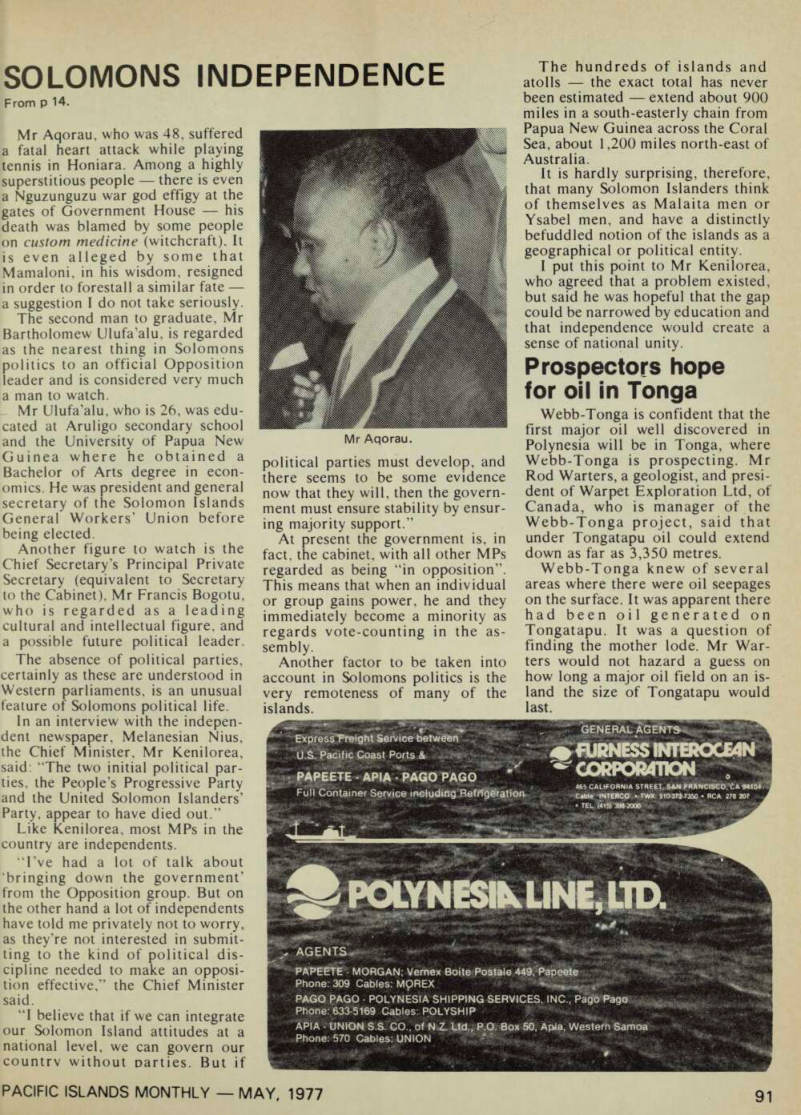
Mr Aqorau, who was 48, suffered a fatal heart attack while playing tennis in Honiara. Among a highly superstitious people there is even a Nguzunguzu war god effigy at the gates of Government House his death was blamed by some people on custom medicine (witchcraft). It is even alleged by some that Mamaloni, in his wisdom, resigned in order to forestall a similar fate a suggestion I do not take seriously.
The second man to graduate, Mr Bartholomew Ulufa’alu, is regarded as the nearest thing in Solomons politics to an official Opposition leader and is considered very much a man to watch.
Mr Ulufa’alu, who is 26, was edu cated at Aruligo secondary school and the University of Papua New Guinea where he obtained a Bachelor of Arts degree in econ omics. He was president and general secretary of the Solomon Islands General Workers’ Union before being elected.
Another figure to watch is the Chief Secretary’s Principal Private Secretary (equivalent to Secretary to the Cabinet), Mr Francis Bogotu, who is regarded as a leading cultural and intellectual figure, and a possible future political leader.
The absence of political parties, certainly as these are understood in Western parliaments, is an unusual feature of Solomons political life.
In an interview with the indepen dent newspaper, Melanesian Nius, the Chief Minister, Mr Kenilorea, said: “The two initial political par ties, the People’s Progressive Party and the United Solomon Islanders’
Party, appear to have died out.”
Like Kenilorea, most MPs in the country are independents.
“I’ve had a lot of talk about ‘bringing down the government’ from the Opposition group. But on the other hand a lot of independents have told me privately not to worry, as they’re not interested in submit ting to the kind of political dis cipline needed to make an opposi tion effective,” the Chief Minister said.
“I believe that if we can integrate our Solomon Island attitudes at a national level, we can govern our countrv without oarties. But if
political parties must develop, and there seems to be some evidence now that they will, then the govern ment must ensure stability by ensur ing majority support.”
At present the government is, in fact, the cabinet, with all other MPs regarded as being ‘‘in opposition”.
This means that when an individual or group gains power, he and they immediately become a minority as regards vote-counting in the as sembly.
Another factor to be taken into account in Solomons politics is the very remoteness of many of the islands.
The hundreds of islands and atolls the exact total has never been estimated extend about 900 miles in a south-easterly chain from Papua New Guinea across the Coral Sea, about 1,200 miles north-east of Australia.
It is hardly surprising, therefore, that many Solomon Islanders think of themselves as Malaita men or Ysabel men, and have a distinctly befuddled notion of the islands as a geographical or political entity.
I put this point to Mr Kenilorea, who agreed that a problem existed, but said he was hopeful that the gap could be narrowed by education and that independence would create a sense of national unity.
Prospectors hope
for oil in Tonga
Webb-Tonga is confident that the first major oil well discovered in Polynesia will be in Tonga, where Webb-Tonga is prospecting. Mr Rod Warters, a geologist, and presi dent of Warpet Exploration Ltd, of Canada, who is manager of the Webb-Tonga project, said that under Tongatapu oil could extend down as far as 3,350 metres.
Webb-Tonga knew of several areas where there were oil seepages on the surface. It was apparent there had been oil generated on Tongatapu. It was a question of finding the mother lode. Mr War ters would not hazard a guess on how long a major oil field on an is land the size of Tongatapu would last.
Mr Aqorau.
Tin Gods??
A suggestion that members of the Legislative Assembly in the Solomons be put in a privileged position if they committed crime did not get very far when the as sembly was considering pro posals for a new constitution. Mr Faneta Sira (East Malaita) said there should be a separate court for politicians. It would be a shame for honourable members to appear before public courts.
Mr Daniel Ho'ota, Minister for Health and Welfare, put in a nutshell the view of many other members when he said Mr Sira’s proposal would puzzle people in the villages. They would ques tion whether members were mak ing the right decision if they adopted the proposal.
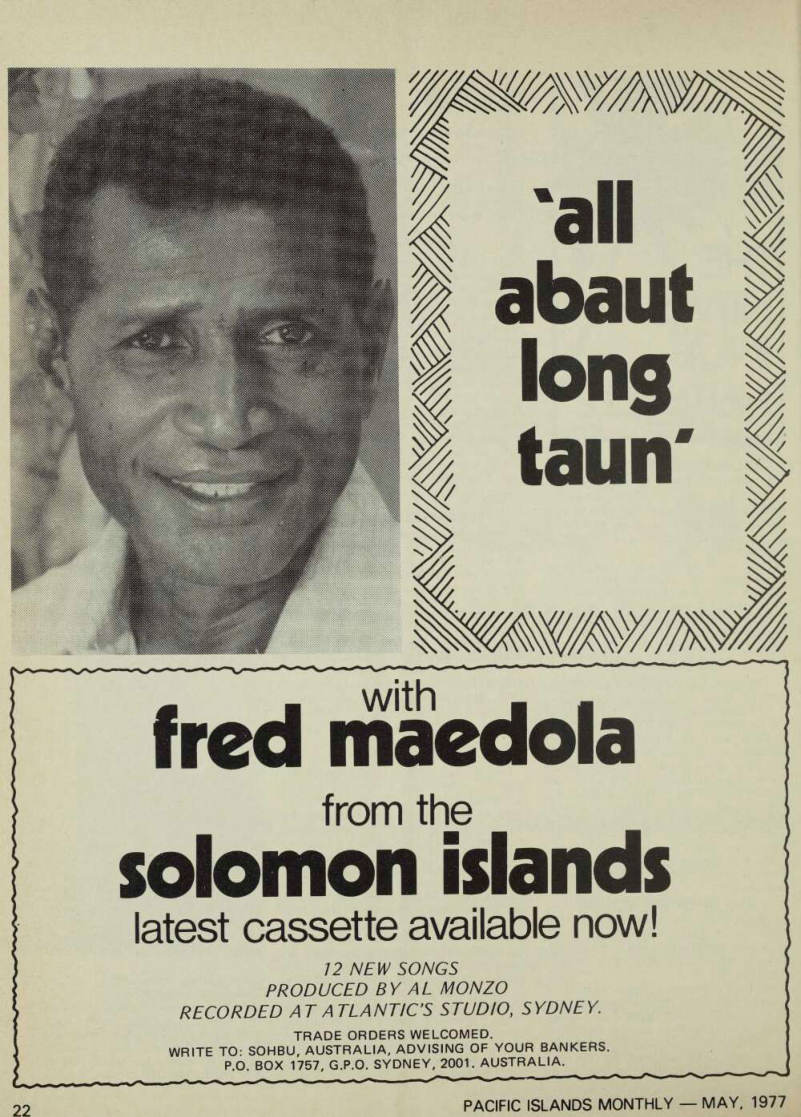
Fred Maedola, The Solomons
Troubadour Extraordinary
By staffman MALCOLM SALMON
"Send a telegram or a letter ad dressed 'Fred Maedola, Solomon Islands', and it'll get to him all right," Mr Fraser Hickox told PIM in March.
Mr Hickox, a representative of Sohbu (Australia), was in Sydney with a particular job on his hands helping to see that everything went smoothly with the making of a cassette recording of 12 songs written and sung by Fred Maedola, troubadour-extraordinary of the Solomon Islands.
He wanted to make the point that Mr Maedola's fame in his own country spreads far beyond Fote Village on Malaita, where he was born 37 years ago. Indeed, it is rapidly growing in other Island countries Papua New Guinea, the New Hebrides, and as far afield as Nauru.
The cassette recording project (under the Singsing label) is jointly sponsored by Sohbu, a Japanese based firm active in forestry, fish
ing and the making of video-cass ettes in Papua New Guinea, and Living Sound, a subsidiary of Chan nel 9 of Sydney.
Taking time off from his re cording work, Fred Maedola talked to PIM about how it all started.
He said; "When i was a boy at district school, I was already in terested in music. I particularly lik ed the records of Slim Dusty. I suppose I wanted from the start to do something like them about the daily lives of my own people."
So, Australia's renewed ex ponent of the country-western style of music really started some thing.
Fred has already written about 30 songs in Pidgin, many of which have been recorded.
PIM asked him to outline some of the themes of his songs. His answers gave more than one clue to his success, especially among town-dwelling Melanesian com munities.
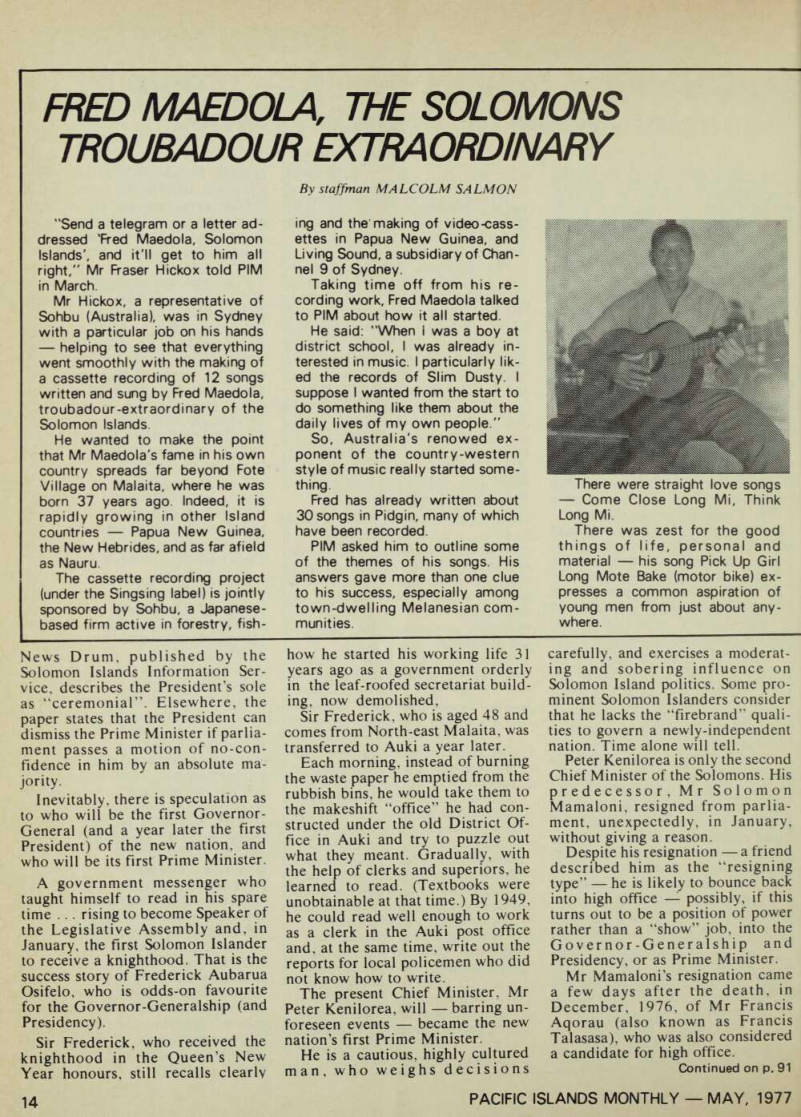
There were straight love songs -Come Close Long Mi, Think Long Mi.
There was zest for the good things of life, personal and material his song Pick Up Girl Long Mote Bake (motor bike) ex presses a common aspiration of young men from just about any where.
There was pathos Come Home Boy tells of a father writing to his absent son, informing him his mother has just died and that now he must return home.
There was acid social comment Lucky Girls tells of the envy of married folk for the "freedom” of women who are divorced; Oh Dar ling Me Losim You Now is the la ment of an absent boyfriend who has heard that his loved one is playing fast and loose with other fellows while he is away.
There was humour Time Mi Sick Long Number Nine recalls a spell Fred had in hospital ("Number Nine” was a World War II US ser vicemen's term for hospital) and tells how pleased some people were to believe that Fred was "finis”, and the nasty shock they got when they eventually learned he was out of hospital and still alive and kicking.
There was straight descriptive material, laced with humour Waitim Fish Long Market Place de scribes the crowds waiting for the
fishermen to come in with their catch at Honiara, the smelling of the fish by prospective buyers to make sure they were fresh and the haggling over prices.
Fred drew on his nine years' ex perience as a policeman to write another song. Mi Sit Down Inside Jail, which tells of the brooding of a prisoner on his fate.
Fred Maedola, tall, good-look ing, with a relaxed manner and an easy smile, is a "natural” for popu lar appeal.
His first recording, an LP, was made 10 years ago in collabora tion with a New Zealand group called Viking. It is still selling in the Islands (The estimated selling life of pop records in Australia is 27 weeks!) Mr Hickox said the Fred Maedola cassette project was in line with the principle often expressed by Sohbu's managing director, Mr Karl Matsuura, that it was im portant not only to develop the natural resources of the Islands, but the human resources as well.
"This is the first time we have brought anybody out of the Islands for a fully professional production, but in view of the enormous re servoir of talent that exists in these countries. I'd be very surprised if it's the last,” Mr Hickox said.
Caledonians municipal
merry-go-round
From a Noumea correspondent
Almost every New Caledonian had a friend or a cousin among the 2,413 candidates hopping on the merry-go-round of the municipal elections on March 13 and 20.
As in metropolitan France, the municipal elections are a piece of French political folklore a grassroots operation for letting off steam throughout the country. They precede the elections for the Legislative Assembly and for the presidency and are thus regarded as a testing of the political climate.
Another distinctive feature of “les municipales” is that these elections don’t really matter, except as a safety valve. The isolated New Caledonian mayor, for example, may receive generous trips to Paris, he may wear a colourful red, white and blue sash as he stands in an impressive
town hall to officiate at local wed ding ceremonies; but he has no sig nificant power. Under the French system his action is supervised and controlled by a public servant chef de subdivision, or district of fleer who is responsible to the governor.
Outside the capital, for just 451 seats, the 31 municipalities re corded 2,238 candidates forming 119 party or group lists, In Noumea, as expected, outgoing Mayor Roger Laroque led a team of prominent businessmen back to the impressive new “ mairie ” building, with socialists in second place. In land, however, saw a greater in fluence of Melanesian voters, in eluding autonomists and indepen dence-seekers, especially on the east coast and the Loyalty Islands.
Caledonians’
economic switch-back
For those who share Paris’ keen interest in plotting out the New Caledonian economy, Noumea’s hard working computer operators turned out a mass of figures in February detailing the state of the territory.
Most important are the nickel production figures. These showed that in 1976 nickel ore output was 5.9 million tonnes, a drop of 12 percent on the 6.7 million tonnes extracted in 1975. Similarly the production of smelted nickel at the SLN furnaces dropped 13 per cent to 61,911 tonnes.
On the export side, nickel ore ship ments to Japan rose nine per cent to 2693 million tonnes. However, there was a significant drop in shipment of metal, which totalled 51,489 tonnes, a cut of 17 per cent in volume and six per cent in value. Metal exports were worth 18,330 million CFP (about SAIB3 million) in 1976. Together with ore exports, this carped nearly SA2O million for the territorial budget by way of export tax. In addition, chrome exports totalled 9,105 tonnes.
Another movement out of the territory last year concerned persons, and resulted in a population loss of over 2,000, including 1,670 Europeans.
This was out of a total island population of 133,000. This reflected the drop in employment opportunities, with about 4,000 persons counted as unemployed, although such figures are hard to assess due to the numbers of Melanesians reabsorbed into tribal
living. The active working population
was estimated at 46,700 last year.
The territory’s trade balance, however, showed up a surplus of 1,952 million CFP (almost SA2O million).
This was due to the higher value of mining products and a 10.6 per cent drop in the value of imports. Payments for the latter amounted to about $ A 242 million, with major cuts in textiles, heavy equipment and transport items.
France supplied 39 per cent of goods, with Australia and New Zealand lifting their shares to 13 and 3.5 per cent respectively. France was similarly the top buyer of Caledonian nickel, taking 51 per cent of total exports, the territory’s full exports for the year being valued at 26,131 million
CFP (about SA26I million).
Two other indices of economic interest reflect the level of car sales and home building. New vehicle registra tions for 1976 totalled 3,877 compared with 5,332 in 1974. In addition 493 motorcycles were registered. On the building front, only 724 new dwelling units were completed in 1976, compared with 1,858 in 1975.
Above this sombre situation hang the 1977 territorial budget figures which continued to be strongly contested in February. While Paris firmly refused any postponing in repayment of the public debt amounting to about SAI2 million for 1977, both sides of the Territorial Assembly bitterly, but belatedly, blamed Paris for encouraging this build-up of the island’s debt.
At the same time, local protest continued over how Paris would take over payment of salaries in mission schools, amid a struggle in which Catholic Archbishop Klein strongly defended the rights of the Melanesians to a retention of their own culture.
lining has a grey cloud
Return to Enewetak: every silver lining has a grey cloud
By Jim Hall of Micronesian News Service
A participant in the March return of the Enewetak people to their an cestral home expressed one re servation along with his feeling of elation. He was Representative Ata ji Balos, 38, of the Congress of Micronesia, who represents not only the people of Enewetak but those of Bikini, Kwajalein, Rongelap and Utirik.
Balos, speaking to the press after the luau in honour of the returnees, said that he hoped that the United States would have a programme of periodic medical examinations for the Enewetak people.
He said that the US "had gained much scientific knowledge because of the testing and so it should bear the responsibility if someone becomes ill as a result of living on these islands”.
Balos noted that because of fallout from the Bikini tests, the people of Rongelap and Utirik were still affected after 20 years. He said: "I am not a scientist, but who knows what will happen in the future?”
Balos also expressed some disap pointment with the conditions at Japtan Island. He said that although Japtan has much better soil than Ujelang and there are more fish in the lagoons, there was not sufficient water for the Enewetak people when they arrived. He said that their main staples were breadfruit and pan danus, and yet there were only coconut trees on Japtan. “I wish there has been more preparations for the return,” he said.
Representative Balos had played a significant part in effecting the return of the Enewetak people to their home.
In 1968, after Balos graduated from the University of Guam, he worked for the Trust Territory Government as an assistant district affairs officer. His duties consisted of travelling to the various outlying islands by field trip vessel and meet
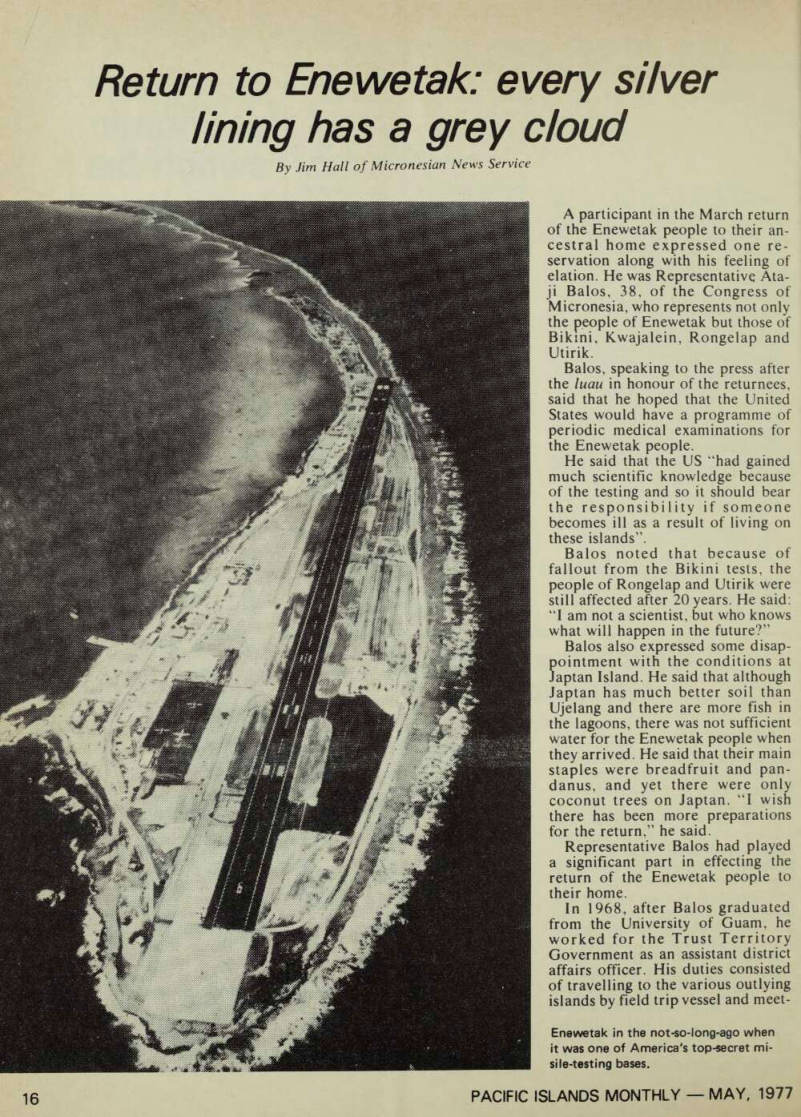
Enewetak in the not-so-long-ago when it was one of America's top-secret mi sile-testing bases.
ing with the island leaders to learn of their problems.
Early one morning in October of 1968, his ship docked off Ujelang and he went ashore to meet with the magistrate and members of the municipal council. He was unaware of the fact that the people of Ujelang had decided to abandon the island and so while the council was con ducting the meeting, all the rest of the islanders, over 300 of them, went aboard the field trip vessel, crowding it with men, women and children from bow to stern.
Finally, the council told Balos of the plan to go to Majuro and aban don Ujelang. They told him that “nobody really cares about us”.
They said they were virtually starv ing and did not even have copra to trade.
Balos told me: “I totally agree with you. Give me a chance to see what I can do.” He noted that the ship was severely overloaded and he feared that many people would die should the ship leave and encounter a storm.
Balos pleaded with them to come off, but they refused. “The women were particularly adamant,” Balos said. The magistrate. John Abraham, brother of the chief, said, “Give him a chance.” But many per sons refused to leave the ship. The negotiations continued for four hours.
Finally, an agreement was reach ed in which the ship was to put ashore whatever flour and rice was available. In addition, Balos agreed to remain behind until the situation on Ujelang was alleviated.
Balos said that the people wanted a field trip vessel to return in two weeks with supplies or they would “feed him to the sharks”. Word was sent by the ship’s captain to the-then district administrator Dwight Heine, concerning the situation on the island and exactly two weeks later the field ship returned. Balos said that the people were very happy and killed chickens and pigs for a big party.
“They trusted me from then on,”
Balos said.
Afterwards Balos quit his govern ment job because it was too re strictive. “I decided to run for the Congress of Micronesia,” Balos said, “so I could do what I could to help the people.”
His first task was to ensure that the people received the interest
from SUSI. 4 million trust fund.
Then he requested that a group be allowed to return to Enewetak and for the first time, Balos said, they were aware that a missile-testing programme was still going on.
Balos then went to Micronesian Legal Services for help. The ML,S filed a law suit in federal district court in Honolulu for a restraining order to stop the testing.
Finally, the Department of Defence agreed in 1972 to bring the Ujelang council members to meet in Enewetak. Balos said. “They took us to see the craters on the northern side and it was the first time we learned that two islands were gone.
The landowners were really sad their islands had disappeared.”
Balos said that he felt at that time the United States had finally begun to feel concerned. Soon they were giving the problem their full at tention. Subsequently, Balos said, he began to focus his attention on the other problems of his district.
Balos concluded by saying that
the move to Japtan was not an altogether happy occasion. In ad dition to the lack of preparation, he said it was “very difficult for the people because they had to leave their friends and relatives”. He said the Enewetak people are a very close-knit group and “they like to go together all the time”. The real hap py day, he said, will be when “they are all here together and self-suffi cient at last”.
A later report says that the 56 people young children, infants, young adults and a few who remem bered the departure so many years ago who returned on the Militobi seemed genuinely pleased with what they saw as they went ashore.
The children quickly ran to the sandy beach and through the village area where, unlike Ujelang, there were a few rocky areas. The older folk sat under nearby palm trees to enjoy a little rest. Others strolled through the converted Butler build ing which were to be their tempor ary homes until new ones are built.
path independence
F. Polynesia's unavoidable path independence
From a Tahiti correspondent
When French Polynesia’s deputy to the French National Assembly, Francis Sanford, closed the door to further talks with France in February and called for Polynesian independence, there was a rapid flurry of messages from Paris and a suecession of Tahitian leaders took the plane to Paris to discuss the new political statutes.
Sanford’s refusal to talk any further was contained in a letter in early February to Tahiti’s Governor Schmitt. Sanford told the governor that French government policy seemed to have just one objective in overseas territories to keep their peoples under Paris custody. And so he saw only one way of escape independence. He called for a referendum on independence to be held throughout French Polynesia with voting restricted to locallyborn persons, those who could eventually obtain Polynesian nationality.
In view of local disappointment over the new statutes proposed by Paris last year, Sanford said he saw no further point in talking.
The Polynesian autonomists have
been insisting on reformed statutes as proposed by the late Senator Pouvanaa a Oopa, with the public service responsible to a fully elected local executive, instead of having a public servant appointed by Paris as governor and top execu live.
Sanford’s ultimatum brought ins tant assurances from Paris that sig nificant changes would be made to the proposed statues, and to talk on this basis two leaders flew off to Paris on behalf of the United Front for Autonomy Franz Vanizette and the new senator, Daniel Millaud.
In repudiating the Paris statute they claimed it tended to deprive Polynesia of its natural riches to the benefit of outside interests approved by the Paris government and that the text included special measures in tended to neutralise all local politi
cal opposition.
In Paris on March 1, Millaud and Vanizette, accompanied by fellow autonomist Henri Bouvier, were re ceived by Mr Michel Poniatowski, Minister for the Interior, and Mr
Olivier Stirn, his junior Minister for Overseas Territories. Statute amendments from the Autonomy Front were discussed in subsequent working sessions and the minister agreed that new elections for the Territorial Assembly should be held to give the Polynesians a new chance to approve the changes.
Then speedily, by March 10, Francis Sanford was on his way to Paris to add the final commas to the amended text. By his earlier “bang ing on the table” and refusing dialogue, Sanford was credited with having provoked the prompt change of heart in Paris.
Sanford took the plane on the un derstanding that the spirit of Pouvanaa’s proposals had been ac cepted. He pointed out that on his election as Polynesian deputy in 1967 he sought a referendum on autonomy and then last year re signed his seat to be overwhelmingly re-elected on the autonomist plat form, He said he was prepared to ac cept autonomy now, but he insisted that the unavoidable path of French Polynesia led to independence.
News from Paris in late March in dicated that the French government was about to dissolve the Polynesian Territorial Assembly, which the autonomists claimed no longer rep resented their full strength. Elec tions would then be held six weeks after this dissolution and the new as sembly would be asked to approve the new statutes as amended be tween the Autonomist Front and French cabinet ministers. The Tahi tians have thus fought for and gain ed greater concessions from Paris than the Caledonians.
Norfolk's knockback
The United Nations Committee on Decolonisation, the so-called Committee of 24, has advised the Norfolk Island Council that it is unable to take up the council’s case against possible incorporation into the Commonwealth of Australia.
The committee’s cable said that such a step would require a decision of the UN General Assembly, from which the committee derives its mandate.
One idea which was floated on the island following receipt of the UN knockback was that Australia itself, being a member of the Committee, could raise the matter.
Advertisements & other items, p. 18 (1 item)
in the Building Industry.
Two Great Names
Cook Islands
Trading Company Ltd.
and
Henderson & Pollard
Industries Ltd.
Take our Coreboard. A laminated solid core of kiln dried Radiata faced with selected wood veneers of Rimu. Its natural attractive colour and grain make Coreboard ideal for interior fitted furniture and panelling.
Or our Plywood Doors. A whole range of hollow core interior doors available in a beautiful variety of finishes and timbers. Light, strong and good-looking.
And our Construction Plywood that combines strength with economy and is also treated with an insecticide to prevent insect attack.
You can’t miss the quality in either of these versatile Henderson & Pollard products.
And you’ll find them at Cook Islands Trading Company Ltd.
Henderson & Pollard Industries Ltd Enfield St; Mt. Eden, Auckland, New Zealand P.O. Box 8551, Symonds St, Auckland, New Zealand Telephone: 689-929.
Cook Islands Trading Co.
Pngs First General Election
The Party System On Trial In
From GUS SMALES in Port Moresby
“Party Politics” amounted to little more than a couple of dirty words in the Papua New Guinea of not so many years ago.
Australia didn’t like the idea of politics in PNG, and the few Papua New Guinean voices of the time pleaded “keep us clean”. Even politics as an art or a trade was considered vaguely suspect, but as for parties they were far beyond the pale.
Much of this was a symptom of pure ignorance, and is typified in the extraordinary lengths to which some of the pioneer politicians went to
explain their position.
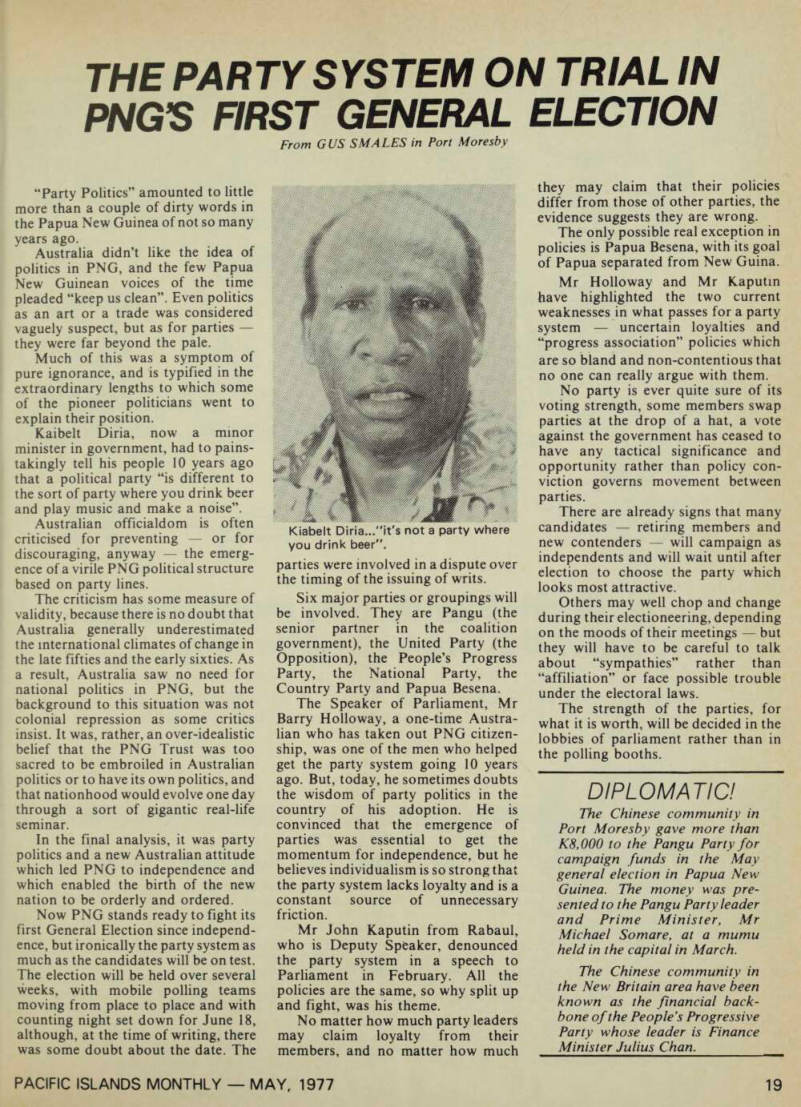
Kaibelt Diria, now a minor minister in government, had to pains takingly tell his people 10 years ago that a political party “is different to the sort of party where you drink beer and play music and make a noise”.
Australian officialdom is often criticised for preventing or for discouraging, anyway the emerg ence of a virile PNG political structure based on party lines.
The criticism has some measure of validity, because there is no doubt that Australia generally underestimated the international climates of change in the late fifties and the early sixties. As a result, Australia saw no need for national politics in PNG, but the background to this situation was not colonial repression as some critics insist. It was, rather, an over-idealistic belief that the PNG Trust was too sacred to be embroiled in Australian politics or to have its own politics, and that nationhood would evolve one day through a sort of gigantic real-life seminar.
In the final analysis, it was party politics and a new Australian attitude which led PNG to independence and which enabled the birth of the new nation to be orderly and ordered.
Now PNG stands ready to fight its first General Election since independ ence, but ironically the party system as much as the candidates will be on test.
The election will be held over several weeks, with mobile polling teams moving from place to place and with counting night set down for June 18, although, at the time of writing, there was some doubt about the date. The
parties were involved in a dispute over the timing of the issuing of writs.
Six major parties or groupings will be involved. They are Pangu (the senior partner in the coalition government), the United Party (the Opposition), the People’s Progress Party, the National Party, the Country Party and Papua Besena.
The Speaker of Parliament, Mr Barry Holloway, a one-time Austra lian who has taken out PNG citizen ship, was one of the men who helped get the party system going 10 years ago. But, today, he sometimes doubts the wisdom of party politics in the country of his adoption. He is convinced that the emergence of parties was essential to get the momentum for independence, but he believes individualism is so strong that the party system lacks loyalty and is a constant source of unnecessary friction.
Mr John Kaputin from Rabaul, who is Deputy Speaker, denounced the party system in a speech to Parliament in February. All the policies are the same, so why split up and fight, was his theme.
No matter how much party leaders may claim loyalty from their members, and no matter how much
they may claim that their policies differ from those of other parties, the evidence suggests they are wrong.
The only possible real exception in policies is Papua Besena, with its goal of Papua separated from New Guina.
Mr Holloway and Mr Kaputm have highlighted the two current weaknesses in what passes for a party system uncertain loyalties and “progress association” policies which are so bland and non-contentious that no one can really argue with them.
No party is ever quite sure of its voting strength, some members swap parties at the drop of a hat, a vote against the government has ceased to have any tactical significance and opportunity rather than policy con viction governs movement between
parties.
There are already signs that many candidates retiring members and new contenders will campaign as independents and will wait until after election to choose the party which looks most attractive.
Others may well chop and change
during their electioneering, depending
on the moods of their meetings but they will have to be careful to talk about “sympathies” rather than “affiliation” or face possible trouble under the electoral laws.
The strength of the parties, for what it is worth, will be decided in the lobbies of parliament rather than in the polling booths.
Kiabelt Diria..."it's not a party where you drink beer".
Diplomatic!
The Chinese community in Port Moresby gave more than KB.OOO to the Pangu Party for campaign funds in the May general election in Papua New Guinea. The money was pre sented to the Pangu Party leader and Prime Minister. Mr Michael Somare, at a mumu held in the capital in March.
The Chinese community in the New Britain area have been known as the financial back bone of the People’s Progressive Party whose leader is Finance Minister Julius Chan.
Advertisements & other items, p. 20 (1 item)
Mono [Pildffioip:
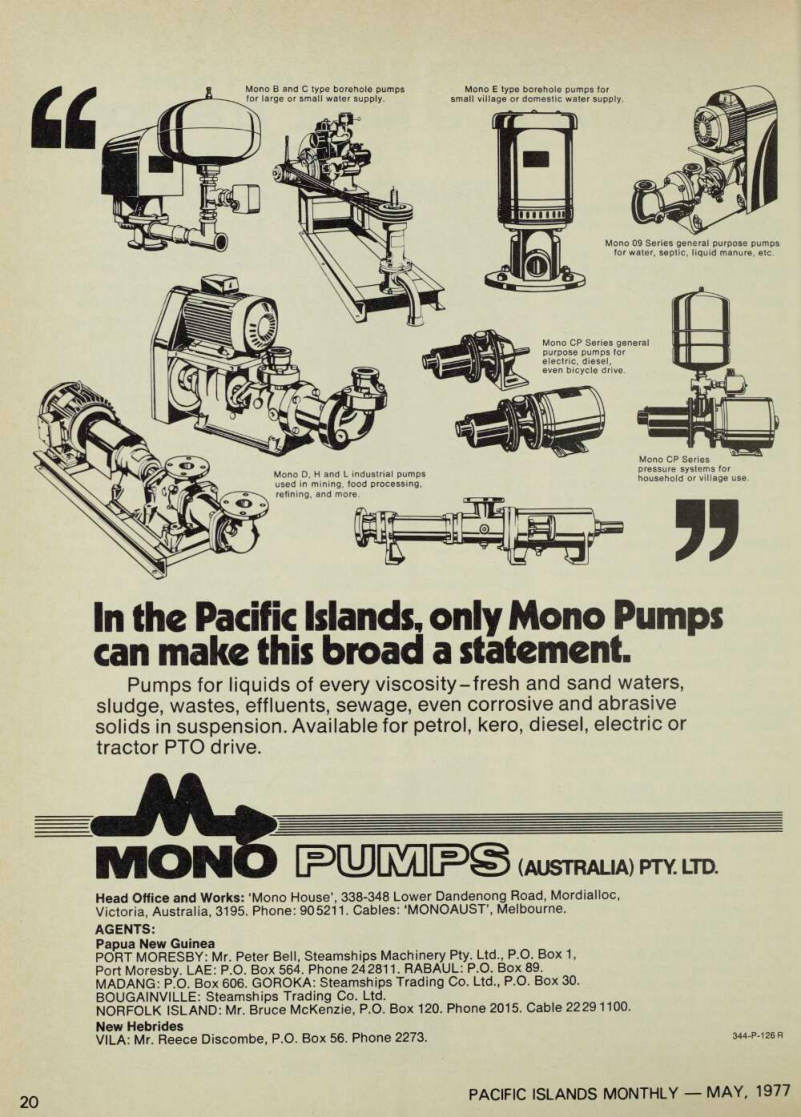
Mono B and C type borehole pumps for large or small water supply.
Mono E type borehole pumps for small village or domestic water supply. 11l Mono 09 Series general purpose pumps for water, septic, liquid manure, etc.
Mono CP Series general purpose pumps for electric, diesel, even bicycle drive. «E> Mono D, H and L industrial pumps used in mining, food processing, refining, and more.
Mono CP Series pressure systems for household or village use. ©_ w In the Pacific Islands, only Mono Pumps
can make this broad a statement.
Pumps for liquids of every viscosity-fresh and sand waters, sludge, wastes, effluents, sewage, even corrosive and abrasive solids in suspension. Available for petrol, kero, diesel, electric or
tractor PTO drive.
MONO [PILDffiOIP:
(AUSTRALIA) PTY LTD.
Head Office and Works: ‘Mono House’, 338-348 Lower Dandenong Road, Mordialloc, Victoria, Australia, 3195. Phone; 905211. Cables: ‘MONOAUST’, Melbourne.
AGENTS:
Papua New Guinea PORT MORESBY: Mr. Peter Bell, Steamships Machinery Pty. Ltd., P.O. Box 1, Port Moresby. LAE: P.O. Box 564. Phone 242811. RABAUL: P.O. Box 89.
MADANG: P.O. Box 606. GOROKA: Steamships Trading Co. Ltd., P.O. Box 30.
BOUGAINVILLE: Steamships Trading Co. Ltd.
NORFOLK ISLAND: Mr. Bruce McKenzie, P.O. Box 120. Phone 2015. Cable 2229 1100.
New Hebrides VILA: Mr. Reece Discombe, P.O. Box 56. Phone 2273.
News
The
In A
Nutshell
Anthropologist In Cooks
Mr Christian Clerk, an anthropologist from University College, London, arrived at Rarotonga in late March after spending the previous nine months in Mangaia Island studying a branch of
anthropology.
He investigated the Mangaians’
knowledge and classification of the island’s birds, animals and fish, and how they collect, cook and eat them. Mr Clerk left for New Zealand and the United Kingdom a few days after his arrival in Rarotonga.
Too Many Men?
The Cook Islands had a population of 18,112, made up of 9,287 males and 8,825 females at the time of the census on December 1, 1976. The 1971 census gave a population of 21,323, mainly because of activities generated by con struction of the airport. The 1966 census gave a population of 19,247. The population of the various islands was; Rarotonga, 9,812; Aitutaki, 2,414.
Mangaia. 1,530. Atiu, 1,312; Mauke, 710; Mitiaro. 305; Palmerston, 53; Pukapuka, 786; Nassau, 113; Manihiki, 263; Rakahanga, 283; Penrhyn, 531.
Didn’t anyone count Tom Neale on Suwarrow?
Png Envoy For Vatican
Papua New Guinea’s Minister for Foreign Affairs, Sir Maori Kiki, announced in March that his country has entered formal diplomatic relations with the Holy See.
A joint communique released
simultaneously in the Vatican City and Port Moresby said. “Papua New Guinea and the Holy See, in the desire to promote and develop mutual friendly relations, have decided by common consent to establish diplomatic relations
between them, at the level of embassy on the part of Papua New Guinea and Apostolic Nunciature on the part of the
Holy See.”
Sir Maori described the move as a significant step towards recognition of what the Roman Catholic Church and Christian denominations had contributed towards development, particularly in the educational and social fields, in Papua New Guinea.
Libel Alleged
Mr Charles Stinson, the Fiji Finance Minister, has filed a writ in the New Zea land Supreme Court seeking $1 million damages for alleged libel. Named as de fendants are the Listener, a weekly magazine, the NZ Broadcasting Cor poration, which owns the Listener, Wilson and Horton Ltd, the printers, and Vernon Wright, journalist, writer of the article in which Mr Stinson claimed he was libelled.
Mr Stinson alleges, in a statement issued in Suva, that the Listener, in an article on March 5, under a heading, “Fiji for sale”, made several incorrect and damaging assertions concerning his (Mr Stinson’s) involvement in Fiji’s
tourist development.
Tongan Seaman Lost
Semisi Paeahelotu Latu, 23, Tongan member of the crew of the Tauloto, was reported to have drowned at Whampoa Port, China, in March. At the time he was acting as second mate. The Tauloto, on charter of a shipping line in China, has been there since September, 1976.
Semisi became a cadet officer with Pacific Navigation Co Ltd in March, 1973, and first served in the Hifofua. He joined the Tauloto in September, 1973, and became third mate in November, 1974. He was one of nine children of Tevita and ’Ana Latu, of Mataika, Vavau.
Exile S Wish
Canon Charles Fox, at the age of 98, wants to become a citizen of the Solomon Islands, not without good reason. He spent 70 years in the Solomons as an Anglican missionary, and retired to New Zealand four years ago. He wrote from hospital in NZ to ask to become a Solomon Islander. “I want to be what I was for over 70 years because that is home to me, and the peo ple there are my people which is not true of any other place or people.” Rather sadly he wrote, that on medical advice he might not be allowed to make the “journey home to the Solomons”. His chances of having his wish granted must be rated highly for the Chief Minister, Mr Kenilorea, commented on the matter in the Legislative Assembly, “Would any of us refuse such a wish?” Dr Fox, a well known author and linguist, wrote four books and compiled dictionaries of three
local languages.
Girls In Blue!
Papua New Guinea will start training its first policewomen this year. Twelve trainees in the first intake will undergo the same training as policemen. There have been pressures in PNG for some time for the establishment of a small corps of policewomen, but some men in the force have not favoured the idea. “If any men don’t like it, then their only op tion is to leave the force” the Com missioner, Mr Pious Kerepia, said in Port Moresby. The training course for women will begin in June. Uniforms are still being designed.
Png Wages Rise
Minimum wages for rural primary industry workers and urban workers in Papua New Guinea rose by 3.31% from March 1. Workers getting the urban minimum wage of K. 27.18 or higher in specified centres received another 90t a week, while rural primary industry workers received another 471. The minimum wage for other rural workers was unchanged at K 11.38. It was reported in February that PNG in 1976 had one of the lowest inflation rates in the world only 4.95% .
Nauru House, the republic's "colony" in Melbourne, was dedicated by Presi dent Bernard Dowiyogo on April 15. It will have a population bigger than Nauru's; it has the fastest lifts in Austra lia 20 of them which can reach the top (51st) level in less than a minute and weighs 100,000 tonnes.
Relics For Futuna
The relics of St Peter Chanel, the first canonised Roman Catholic martyr of the Pacific, left Paris on March 22 to be ex posed in various Pacific countries before reaching their final resting place in Wallis and Futuna, where this Marist missionary was slain on April 28, 1841.
The saint’s relics were returned from France at the request of the Bishop of Wallis and Futuna, Bishop Fuahea. Ex tensive ceremonies were planned in the territory, with a shrine to be built on Futuna for the saint who went to the is lands in 1836. The casket of relics was flown first to Sydney by UTA airlines to be exposed at the St Peter Chanel Church, Futuna Street. Woolwich, near the Marist Mission Centre for the Pacific. The relics were then to go to Wallis via stopovers in Auckland, Suva.
Vila and Noumea.
River Runs Wild
A river running wild in March brought down a hydro-electric tower, forcing Madang one of Papua New Guinea’s major towns on to emergency power.
The river Naru changed course by more than 100 metres to bring down the tower and damage three others from the Ramu hydro-electric scheme, one of PNG’s biggest and newest.
The Ramu scheme’s transmission line of 340 steel towers crosses what geologists describe as some of the youngest and most unstable terrain in the world.
There were indications that the unexpected diversion of the river will have a widespread effect on all engineering design work in the area, including work on roads and bridges.
Ship Explosion Inquiry
The master of a PNG government ship, Rouna Falls, which exploded with the loss of four lives was criminally culpable, a coroner found at an inquiry in late March. The finding also said that a government maritime official was
"partially culpable” and a gas supply
company “partially responsible”.
The ship was carrying a girls’ netball team and supporters on an excursion last September when an explosion occurred
north of Madang. killing four people.
The coroner, Mr Alan McLay, found that a low-pressure gas cylinder in the ship’s hold had leaked and that the ship’s mam engine had ignited the escaped gas in the engineroom and hold. He said the cylinder had been stored in the hold
contrary to regulations governing
dangerous cargo, there was evidence it had not been secured and there had been no protective guard around the valve and outlet.
He said the ship’s master. Captain Sebby Nebo. was responsible for the storage and was therefore criminally
culpable. The controller of marine services for the region. Captain Norman Brown, was partially culpable because of his overall control and his shipping survey responsibilities. The company which supplied the gas, Guinea Gas, should not supply cylinders without protective guards, the coroner said, and was therefore partially responsible for
what happened.
Sock And Roc Soccer
Soccer players from New Caledonia did not endear themselves to opposing players, the referee and spectators when they met New Zealand in an interna tional match. Trouble had simmered almost from the start of the game, and erupted when the referee sent a New Caledonian, Pierre Wacopo, from the field for kicking one of the home play ers.
Wacopo went a few metres, then stop ped. The referee waved him to leave the field. Some of Wacopo’s team mates ask ed the referee to reconsider his decision, but the referee ordered resumption of
play. New Caledonian players jostled
him, one pushed him and another tried to grab him around the neck.
The referee then signalled the end of the game, and left the field with a police man as an escort. But that was not enough for the New Caledonians. One of them threatened a photographer with a chair, while others gesticulated angrily.
About the same time, in Fiji, a Taiwan soccer team, in a warm-up game against Fiji before tackling Australia in a World Cup elimination series, nearly caused an international incident. The players went on to the field wearing shirts bearing the initials ROC (Republic of China). The Secretary for Foreign Affairs, Mr Jioji Kotobalavu, warned Taiwan they were breaking an agreement under which they were admitted to Fiji.
The team’s action could harm Fiji’s friendly relations with the People’s Re public of China, which did not recognise the Taiwan Government. Taiwan im mediately agreed not to wear the ROC shirts when they met Australia.
Png's Test'' Victory
Papua New Guinea was far too strong for Fiji when the two countries met for the first time in a cricket “test” at Port
Moresby in March, winning by eight
wickets. The visitors were as good as the home side in bowling, superior in field ing, but their batting let them down.
Apart from a sound first innings by opener, Cecil Browne, the Fiji batting was very erratic.
Veteran Inoke Tabualevu, also a Rug by international, smote the ball hard in the second innings, while another veteran. Curly Valentine, the captain, bowled steadily. Both Tabualevu and Valentine played for Fiji as long ago as 1960, when they were in the team which toured the New South Wales country dis tricts.
Peni Dakai bowled well for Fiji, and had good support from Valentine and Suka.
Papua New Guinea gave Fiji an object lesson in disciplined batting. Opener Don Fox. and Ilinome Tarua both top ped the half-century. They waited for the right ball to hit, and hit it hard. But their best player, who was later named “man of the match” was swing bowler Vavine Pala. who took 4/36 in the first innings and 1/8 in the second.
Fiji batted first. They made 138 in the first innings and 163 in the second.
Papua New Guinea, after making 253 in the first innings, had no trouble in hit ting off the 49 runs required for a win.
Four Lost In Canoe
A search for two women and two children, missing off the south coast of New Britain in March was called off after five days when the seas became too rough and dangerous. With two men, they were travelling from Gasmata, West New Britain, to Penlolo village, in a canoe which broke up on a reef. The two men, William Namilo, 15, and Jack Nalu, 30, managed to get ashore after spending five hours in the water. They were injured in crossing the reef and were treated for cuts.
“The ladies on the door” at a March social evening in Brisbane in honour of the touring Fiji cricket team. The team was en route to Port Moresby, the Solomon Islands and the New Hebrides for representative matches. The ex-Fiji residents of Brisbane had an opportunity to meet the players at the evening. In the picture from left: Bua Rayner, her mother Fane, Manu Bola and Louisa Tuicolo.
Advertisements & other items, pp. 22-24 (1 item)
long
F
all abaut long taun'
fred maedola
from the
solomon islands
latest cassette available now!
12 NEW SONGS
PRODUCED BY AL MONZO
RECORDED AT ATLANTIC'S STUDIO , SYDNEY.
TRADE ORDERS WELCOMED.
WRITE TO: SOHBU, AUSTRALIA, ADVISING OF YOUR BANKERS.
P.O. BOX 1757, G.P.O. SYDNEY, 2001. AUSTRALIA.
Muller K-line
cooling systems
k J
K-Line Water Cooling Tower
The K-line cooling tower is another quality Muller product which has been thoroughly laboratory tested and is fully guaranteed for high performance ratings. Features include - • 15 - 1300gpm per cell nominal • High velocity discharge - avoids recirculation • Quiet running centrifugal fans • Induced draught design eliminates leakage • Five nozzle sizes to give optimum pump selection and tower water distribution • Single and double flow versions • Simple installation and minimal support requirements. • High corrosion resistant solid construction.
K-Line Evaporative Condenser
The K-line evaporative condenser is of induced draught counterflow design. The unit is quiet in operation and moving parts are designed to ensure long life. The fans are available in stainless steel, or marine grade aluminium. The bearings are fitted outside the casing and the tubular shaft is specially treated to resist corrosion.
Fully guaranteed for high performance. For further particulars and specifications contact the New Zealand distributors. mm
COMMERCIAL
DIVISION
Bonaire Industries Ltd. Phone 760-025, Box 4011, Auckland Phone 36-088, Box 976, Dunedin
People
Two policemen with records of long service in different parts of the Pacific have retired. They are Senior- Sergeant George Wichman, who was in the Cook Islands Police Force for 46 years, and Deputy Superintendent Nemani Raikuna, 42 years with the Fiji Police. Senior-Sergeant Wichman was 18 when he joined the force. He was personally involved in the in vestigation of three murder cases, and four cases which resulted in charges of manslaughter. He helped to solve a number of complicated crimes. DSP Raikuna, who became a constable in November, 1935, rose steadily through the ranks. He served in most police stations in Fiji and at the time of his retirement was in command of the Namaka (Nadi) police district. In 1972, he was awarded the Fiji Police Long Service and Good Conduct Medal, and in the 1975 New Year Honours List was awarded the Queen’s Police Medal for meritorious service.
The City and County Department of Parks and Recreation in Honolulu has created a mini-park near the Kapalama entrance to the Bernice P.
Bishop Museum as a memorial to the late Sir Peter Buck. It was dedicated last July when it was named Peter Buck Park, in honour of the museum’s third director.
Peter Buck, who was also known as Te Rangi Hiroa, was born in 1880 of New Zealand Maori and Irish parents and graduated MD from the Univer sity of New Zealand in 1910. He later became a noted ethnologist and joined the Bernice P. Bishop Museum in 1927, becoming director in 1948. He was named as a Knight of the Order of St. Michael and St. George in 1946 and died in 1951.
Mr Peter T. Coleman, acting High Commissioner of the US Trust Territory of the Pacific Islands, and an ex-Governor of American Samoa, where he was born, has announced his impending resignation. His reason the appointment was political, under the Republican regime, and he’s got in first on the off-chance that Democrat
President Carter might replace him with a Democrat nominee. But Mr Coleman isn’t clear about his future.
There are indications that he might compete for the governorship of American Samoa, which is now a locally-elected post. Then again, he might seek a political career in Hawaii.
He has been 16 years in Micronesia, four years as a district administrator in the Marshalls, four in the same job in the Marianas and eight years as Deputy High Commissioner. The first local Samoan to be Governor of American Samoa, he held the position for five years. He was a US Army captain in World War 11.
Commander of the Papua New Guinea Defence Force, Brigadier- General Ted Diro, first Papua New Guinean to hold the highest military post in the country, has been re appointed for another three years.
Cabinet extended his term and announced its decision while he was on a 10-day visit to New Zealand where he toured military establish ments and had discussions with New Zealand defence officials. Born at Boku on the slopes of the Owen Stanleys, Ted Diro arrived in Port Moresby at the age of 12, fought hard to get an education, lived “on the run” buying food with money earned by caddying at the Port Moresby Golf Club, won a place at Slade School, Warwick in Queensland and then took his first step along the road to a military career by earning a place at Portsea Officer Cadet School. His father must have been proud when his son chose a military career. He, himself, fought with the Papuan Infantry Battalion on the Kokoda Trail.
Tongan-born Molimea Tlolahia was awarded the Royal Victoria Medal by the Queen during her March visit to New Zealand. Mr Tlolahia 69, a butler, was awarded the medal for his services to members of the British royal family during their stays at Government House in Auckland and Wellington.
Mr John Beusmans, general man ager of Vila’s Le Lagon Hotel, made a promotion swing in March through eastern Australian States and New Zealand. A warm welcome was extended to him, and to his wife, Marina who made the ex acting trip despite the fact that she was seven months pregnant with their first child in travel industry circles wherever they went.
Advertisements & other items, pp. 25-26 (1 item)
Trade Mark
CAUTIONARY NOTICE.
Dynamit Nobel Aktiengeseiischaft of Postbox 1209, 521 Troisdorf, West Germany wish it to be known that they are the owners of the trade mark ROTTWEIL (as shown) and that the ROTTWEIL mark is used by Dynamit Nobel Aktiengeselischaft on or in connection with ammunition and projectiles, explosive substances, fireworks, firearms for hunting and sporting purposes.
Proceedings will be taken against any third party found to be using the ROTTWEIL mark or any closely similar mark on or in connection with ammunition and projectiles, explosive substances, fireworks, firearms for hunting and sporting purposes.
that makes your home
a healthier place
How effectively you protect your family from the dangers of disease carrying insects, may well depend on the insect spray you choose.
Powerful Insect Killing Ingredients.
Concentrated Pea Beu is one of the most powerful household insect sprays in the world. Its principal insect killing ingredients have been selected to ensure rapid knock down and kill of all common disease
carrying insects.
Rigid Testing. Through every stage of manufacture. Pea Beu is rigidly tested.
There ore ingredient tests, spray droplet tests, pack tests, many forms of tests, some carried out three times over.
When you spray this remarkable aerosol insecticide, you can be sure that its ingredients have met with the most exacting standards enabling you to spray it safely with confidence in your home. 9 Family Health and Well Being. The common housefly carries up to half a billion germs and, when you realise that disease carrying insects enter even the best regulated households, you can understand why you can't be too careful about the effectiveness of your insect spray. Remember, even the tiniest droplet z / / 4 m X of concentrated Pea Beu kills flies, mos guiloes, all common disease carrying Concentrated Pea Beu. Even the tiniest droplet
kills flies, mosquitoes, gij common
disease carrying insects fast.
insects fast, so it is indeed a worthy guardian of your family's health and being Such is tlie effectiveness of Pea Ben's insect killing mgred ient, that no common disease carrying insect can survive it. nor develop an immunity to it. When you spray Concert (rated Pea Beu. it's nice to know that no common disease carrying insect can survive.
Pea Beu - The strong one, makes your home a healthier place.
Tropicalities
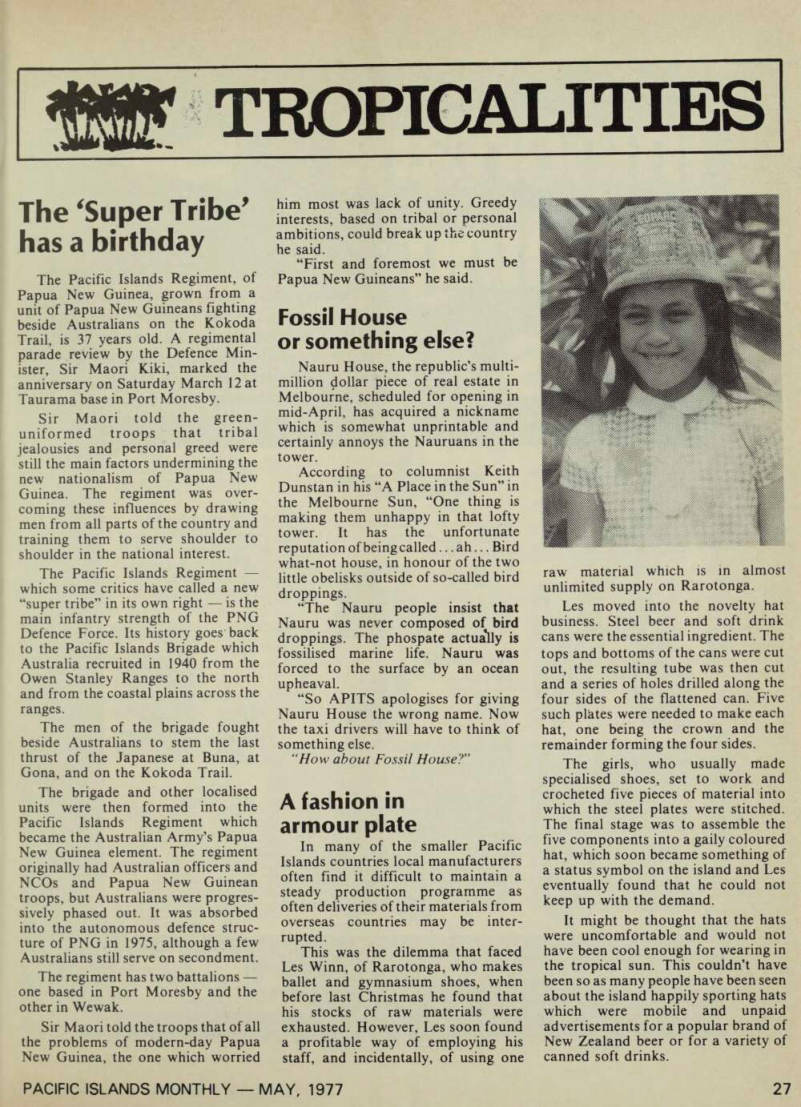

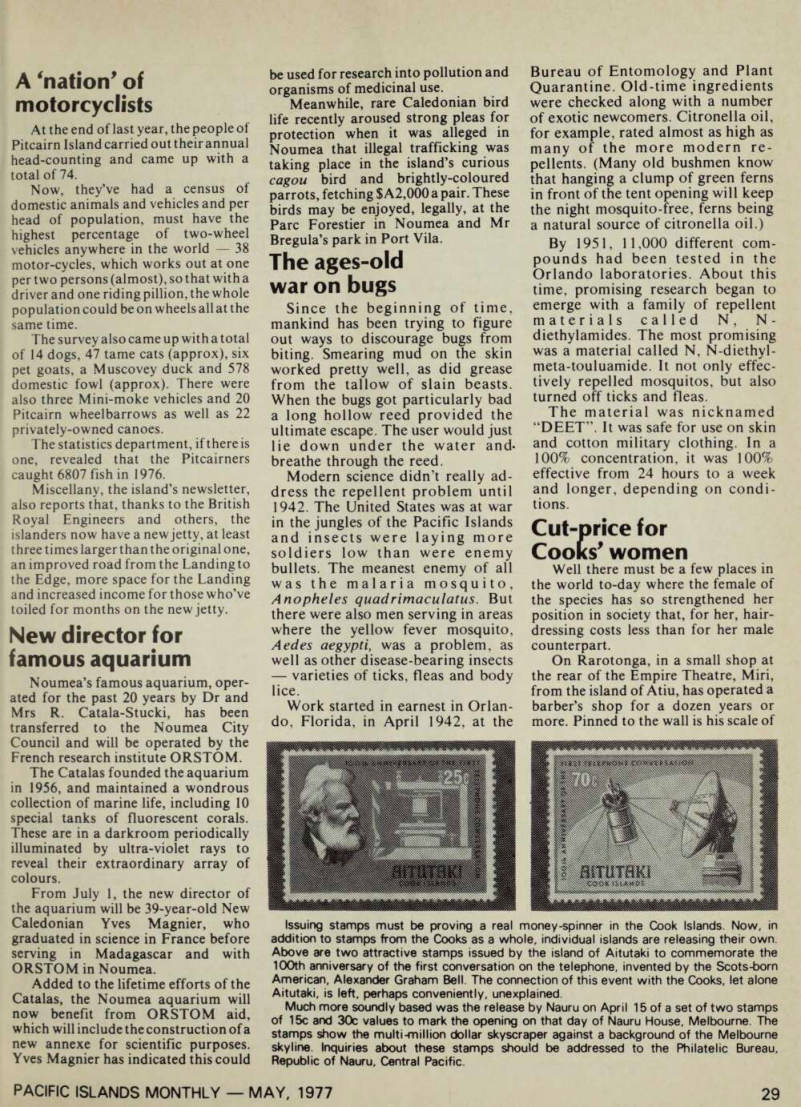
The ‘Super Tribe ,
has a birthday
The Pacific Islands Regiment, of Papua New Guinea, grown from a unit of Papua New Guineans fighting beside Australians on the Kokoda Trail, is 37 years old. A regimental parade review by the Defence Min ister, Sir Maori Kiki, marked the anniversary on Saturday March 12 at Taurama base in Port Moresby.
Sir Maori told the green uniformed troops that tribal jealousies and personal greed were still the main factors undermining the new nationalism of Papua New Guinea. The regiment was over coming these influences by drawing men from all parts of the country and training them to serve shoulder to shoulder in the national interest.
The Pacific Islands Regiment which some critics have called a new “super tribe” in its own right is the main infantry strength of the PNG Defence Force. Its history goes back to the Pacific Islands Brigade which Australia recruited in 1940 from the Owen Stanley Ranges to the north and from the coastal plains across the ranges.
The men of the brigade fought beside Australians to stem the last thrust of the Japanese at Buna, at Gona, and on the Kokoda Trail.
The brigade and other localised units were then formed into the Pacific Islands Regiment which became the Australian Army’s Papua New Guinea element. The regiment originally had Australian officers and NCOs and Papua New Guinean troops, but Australians were progres sively phased out. It was absorbed into the autonomous defence struc ture of PNG in 1975, although a few Australians still serve on secondment.
The regiment has two battalions one based in Port Moresby and the other in Wewak.
Sir Maori told the troops that of all the problems of modern-day Papua New Guinea, the one which worried
him most was lack of unity. Greedy interests, based on tribal or personal ambitions, could break up the country he said.
“First and foremost we must be Papua New Guineans” he said.
Fossil House
or something else?
Nauru House, the republic’s multi million dollar piece of real estate in Melbourne, scheduled for opening in mid-April, has acquired a nickname which is somewhat unprintable and certainly annoys the Nauruans in the tower.
According to columnist Keith Dunstan in his “A Place in the Sun” in the Melbourne Sun, “One thing is making them unhappy in that lofty tower. It has the unfortunate reputation of being called... ah... Bird what-not house, in honour of the two little obelisks outside of so-called bird droppings.
“The Nauru people insist that Nauru was never composed of bird droppings. The phospate actually is fossilised marine life. Nauru was forced to the surface by an ocean upheaval.
“So APITS apologises for giving Nauru House the wrong name. Now the taxi drivers will have to think of something else.
“How about Fossil House?”
A fashion in
armour plate
In many of the smaller Pacific Islands countries local manufacturers often find it difficult to maintain a steady production programme as often deliveries of their materials from overseas countries may be inter rupted.
This was the dilemma that faced Les Winn, of Rarotonga, who makes ballet and gymnasium shoes, when before last Christmas he found that his stocks of raw materials were exhausted. However, Les soon found a profitable way of employing his staff, and incidentally, of using one
raw material which is in almost unlimited supply on Rarotonga.
Les moved into the novelty hat business. Steel beer and soft drink cans were the essential ingredient. The tops and bottoms of the cans were cut out, the resulting tube was then cut and a series of holes drilled along the four sides of the flattened can. Five such plates were needed to make each hat, one being the crown and the remainder forming the four sides.
The girls, who usually made specialised shoes, set to work and crocheted five pieces of material into which the steel plates were stitched.
The final stage was to assemble the five components into a gaily coloured hat, which soon became something of a status symbol on the island and Les eventually found that he could not keep up with the demand.
It might be thought that the hats were uncomfortable and would not have been cool enough for wearing in the tropical sun. This couldn’t have been so as many people have been seen about the island happily sporting hats which were mobile and unpaid advertisements for a popular brand of New Zealand beer or for a variety of canned soft drinks.
A ‘nation’ of
motorcyclists
At the end of last year, the people of Pitcairn Island carried out their annual head-counting and came up with a total of 74.
Now, they’ve had a census of domestic animals and vehicles and per head of population, must have the highest percentage of two-wheel vehicles anywhere in the world 38 motor-cycles, which works out at one per two persons (almost), so that with a driver and one riding pillion, the whole population could be on wheels all at the same time.
The survey also came up with a total of 14 dogs, 47 tame cats (approx), six pet goats, a Muscovey duck and 578 domestic fowl (approx). There were also three Mini-moke vehicles and 20 Pitcairn wheelbarrows as well as 22 privately-owned canoes.
The statistics department, if there is one, revealed that the Pitcairners caught 6807 fish in 1976.
Miscellany, the island’s newsletter, also reports that, thanks to the British Royal Engineers and others, the islanders now have a new jetty, at least three times larger than the original one, an improved road from the Landing to the Edge, more space for the Landing and increased income for those who’ve toiled for months on the new jetty.
New director for
famous aquarium
Noumea’s famous aquarium, oper ated for the past 20 years by Dr and Mrs R. Catala-Stucki, has been transferred to the Noumea City Council and will be operated by the French research institute ORSTOM.
The Catalas founded the aquarium in 1956, and maintained a wondrous collection of marine life, including 10 special tanks of fluorescent corals.
These are in a darkroom periodically illuminated by ultra-violet rays to reveal their extraordinary array of colours.
From July 1, the new director of the aquarium will be 39-year-old New Caledonian Yves Magnier, who graduated in science in France before serving in Madagascar and with ORSTOM in Noumea.
Added to the lifetime efforts of the Catalas, the Noumea aquarium will now benefit from ORSTOM aid, which will include the construction of a new annexe for scientific purposes.
Yves Magnier has indicated this could
be used for research into pollution and organisms of medicinal use.
Meanwhile, rare Caledonian bird life recently aroused strong pleas for protection when it was alleged in Noumea that illegal trafficking was taking place in the island’s curious cagou bird and brightly-coloured parrots, fetching $ A 2,000 a pair. These birds may be enjoyed, legally, at the Parc Forestier in Noumea and Mr Bregula’s park in Port Vila.
The ages-old
war on bugs Since the beginning of time, mankind has been trying to figure out ways to discourage bugs from biting. Smearing mud on the skin worked pretty well, as did grease from the tallow of slain beasts.
When the bugs got particularly bad a long hollow reed provided the ultimate escape. The user would just lie down under the water and* breathe through the reed.
Modern science didn’t really ad dress the repellent problem until 1942. The United States was at war in the jungles of the Pacific Islands and insects were laying more soldiers low than were enemy bullets. The meanest enemy of all was the malaria mosquito, Anopheles quadrimaculatus. But there were also men serving in areas where the yellow fever mosquito, Aedes aegypti, was a problem, as well as other disease-bearing insects varieties of ticks, fleas and body lice.
Work started in earnest in Orlan do, Florida, in April 1942, at the
Bureau of Entomology and Plant Quarantine. Old-time ingredients were checked along with a number of exotic newcomers. Citronella oil, for example, rated almost as high as many of the more modern re pellents. (Many old bushmen know that hanging a clump of green ferns in front of the tent opening will keep the night mosquito-free, ferns being a natural source of citronella oil.) By 1951, 11,000 different com pounds had been tested in the Orlando laboratories. About this time, promising research began to emerge with a family of repellent materials called N, N
diethylamides. The most promising
was a material called N, N-diethyl meta-touluamide. It not only effec
tively repelled mosquitos, but also
turned off ticks and fleas.
The material was nicknamed “DEET”. It was safe for use on skin and cotton military clothing. In a 100% concentration, it was 100% effective from 24 hours to a week and longer, depending on condi tions.
Cut-price for
Cooks' women
Well there must be a few places in the world to-day where the female of the species has so strengthened her position in society that, for her, hair dressing costs less than for her male counterpart.
On Rarotonga, in a small shop at the rear of the Empire Theatre, Miri, from the island of Atiu, has operated a barber’s shop for a dozen years or more. Pinned to the wall is his scale of
Issuing stamps must be proving a real money-spinner in the Cook Islands. Now, in addition to stamps from the Cooks as a whole, individual islands are releasing their own.
Above are two attractive stamps issued by the island of Aitutaki to commemorate the 100th anniversary of the first conversation on the telephone, invented by the Scots-born American, Alexander Graham Bell. The connection of this event with the Cooks, let alone Aitutaki, is left, perhaps conveniently, unexplained.
Much more soundly based was the release by Nauru on April 15 of a set of two stamps of 15c and 30c values to mark the opening on that day of Nauru House, Melbourne. The stamps show the multi-million dollar skyscraper against a background of the Melbourne skyline. Inquiries about these stamps should be addressed to the Philatelic Bureau, Republic of Nauru, Central Pacific.
charges! Men’s haircuts 60c; women’s haircuts 40c; children’s haircuts 20c.
The follows the cryptic message
Kare Te Kaiou No Credit.
A bookish
sort of knight
Sir John Yocklunn, one of the PNG Government’s “backroom boys” who, along with the Foreign Minister Sir Maori Kiki, was knighted by the Queen in 1975 “for services to politics and the government”, has been confirmed in the job in which he has been “acting” for some time that of National Librarian.
Regarded by many as the possessor of one of the best brains in the country, Sir John is finding his days are crowded. He is National Treasurer for the Pangu Party, a hecticjob at present with the general elections imminent, and his programme for the National Library is gathering impetus as the K 2 million library HQ, Australia’s independence gift, takes shape.
In Sydney recently, he was making contacts which, he hopes, will benefit the National Library.
It is destined to play a big part in PNG’s development, co-ordinating most existing library services, pro viding services to the various provincial governments and all services which need to be on a national scale.
He’d like to see a library service working in every town and village throughout the country, many of them being operated by travelling libraries, but one big obstacle to that is the lack of roads.
Sir John, who was born in Canton, China, grew up in Western Australia where his parents had a property.
A graduate of the University of Western Australia, he had two BA degrees one for languages, the other for political science when he went to England in 1973 and completed an MA course in librarianship at the University of Sheffield.
His PNG career began in 1968 when he left Canberra where he was with the National library, joined the Pangu Party, was vice-president of the party within a year, became principal private secretary to Mr Somare and accompanied him on his visits to China and the Philippines.
PlM’s sure Sir John would be delighted if anyone, wishing to help such a worthy cause as a library service, sent their surplus volumes to Papua New Guinea.
Advertisements & other items, pp. 28-30 (1 item)
welding
important
news.
m
W.I.A. Welding products have a
renowned reputation for advanced
technical design, quality of
manufacture and field performance.
A full internationally approved
range is available to suit all
purposes and industries.
WELDMATIC G.M.A. SEMI
AUTOMATIC EQUIPMENT
One of the most comprehensive ranges available Australian designed and manufactured Backed by efficient technical expertise ensuring up to date designs equal to anywhere in the welding world Range includes semi-automatic packaged units with capacities from 150 amps up to 600 amps (all 100% duty cycle) Plus full automatic welding head/power source combinations up to 1200 amps output, for use on either gas shielded, open arc or submerged arc welding
WELDMATIC
250 A high production semi-automatic G M A welding package, ideal for aulomative production and manufacture of domestic/industrlal appliances, heating/air conditioning equipment, metal cabinets and similar products Rated 250 amps 100% duty cycle, max current 300 amps 60%.
AUTOMATIC
SUBMERGED ARC
FLUXES & WIRES
Austmatic OP series includes highest quality, general purpose production fluxes, hardfacing and special application highly basic fluxes Packing 30 kg pails and 250 kg drums Low carbon and low alloy steel wires available
HEAVY DUTY 400 AMP
DIESEL ENGINE DRIVEN
SITE WELDER
I Maximum weldability with minimum fuel costs > Reduced risk of fire and fuel theft.
I Auxiliary power > Long life service I Positive all weather starting characteristics
AUSTMIG C 026
Gas Shielded Welding Wire Copper coaled mild steel solid wire for all general purpose semi-automatic welding, using CO? or argon based mixture shielding gases 0.8. 0.9.1 2 and 1.6 mm sizes m 15 kg spools and 30 kg coils.
ELECTRODES
Austarc internationally approved mild steel IS electrodes including 11 cellulose, general purpose, low hydrogen, iron powder and Austalloy range offer superior welding characteristics in all types and gauges W.I.A. also offer a range of special purpose electrodes for hardfacing, bronze, stainless steel and cast iron applications.
Illustrated below are examples
from the extensive range
available.
WELDARC A.C. ARC WELDERS
Comprehensive range of seven models, designed for dependability, ease of use. long efficient life. Fully guaranteed.
Models illustrated are 1 ) The Miniarc mC66. a popular small A.C. welder, rated up to 140 amps and handles 3.25.2.5 and 2.0 mm designed for extra heavy duty production welding with large size electrodes in locations such as shipyards, building construction sites, etc Max. current output 500 amps at 100% duty cycle.
Optional extra is unique remote current control device, works wherever the operator is. any distance from the power source without special cabling
MINIARC mC66
A revolutionary 140 amp welding all-rounder representing a major breakthrough in welding technology.
Everything you ever wanted in a 240 volt arc Jr
CONSTRUCTOR
500
minlarc]L
Gas Shielded Welding Wire Solid drawn Seamless Tubular Steel Flux Cored Welding Wire ensures increased productivity higher deposition rates, deeper penetration and over 80% metal recovery Fluxofil 11 Ni Smooth running rutile type high production electrode for general purpose fillet and butt welding applications.
Fluxofil 31 Highly basic slag produces toughest Completely moisture proof, weld metal offering high low hydrogen quality Exclusive copper coating gives high efficiency feeding, better electrical production techniques to high integrity welding applications.
Fluxofil 41 and 42 —First contact, longer tip life. Sizes choice for welding low alloy manufactured in Australia notch tough, high strength
For full details & information contact
WELDING INDUSTRIES OF AUSTRALIA PTY. LTD.
INTERNATIONAL DIVISION
Austarc Avenue, Thomastown. Vic. Australia.
Telex: 32493, Cables; “Austarc" Melbourne.
AUSTRALIA'S OWN WELDING ORGANIZATION
The man from Australia
can come up with the goods
He’s the Australian Government Trade Commissioner. He has the knowledge and experience to advise you on buying from Australia.
And buying from Australia can be a very profitable business. The big range of world class Australian products will surprise you. Machinery, electrical
goods, chemicals, sporting goods, scientific
equipment, automotive and materials handling equipment—whatever products you want Australia will most likely be able to supply. Australian products are selling well in international markets, they can sell well in yours.
Ask the man who knows Australia
The Australian Trade Commissioner will be pleased to give you details of suppliers. You can contact him at: FIJI. 7th Floor, Dominion House, Thomson Street, Suva, (Post Office Box 1252). Telephone: 312844, P.N.G. Post Office Box 9129, Hohola, Port Moresby, Telephone: 25 9333. m C '. ■ ■
Ask the Australian Itede Commissioner
Editor’S Mailbag
Notonesia
No one is fully satisfied with the name Papua New Guinea as a good title for that country. It could even produce trouble in days to come. It is not satisfactory politically, geographically or linguistically. I wish to propose a name that could well meet all requirements.
In the Pacific region we already have Melanesia, meaning Black Isles, Indonesia, meaning Indian Isles, Micronesia, meaning Small Isles, and Polynesia, meaning Many Isles. These names have no political overtones whatsoever, derive from ancient Greek, are fully acceptable and likely to remain so. Therefore in place of Papua New Guinea I sug gest the name Notonesia, which sim ply means Southern Isles.
George A. F. Knight
Auckland, NZ.
Nature's Grand
As an artist I have travelled all the oceans in search of a part of the world which is still beautiful to live in. I have found the South Pacific Is lands to be still the healthiest part of the world.
When King Taufa’ahau Tupou IV of Tonga said (PIM, March pi 9); “In the event of a world war, there will be no safe place in the world to live. It is better to maintain peaceful relations with other countries”, I am sure no one could disagree with him.
I say that no human being can sur vive without nature. In my opinion, bureaucracy is an enemy of nature. I am sure that the law-makers will agree with me that the only laws that are good laws are those designed to protect nature.
Concerning the “Slugged Yachtie” (PIM, Editor’s Mailbag, February, March), I find it ridiculous that yachties of all people should be hit with a discriminatory tax in the Solomon Islands. Most yachties live in harmony with the environment, consuming only the barest minimum. It seems to me that airport taxes probably started the same way.
Nationalism seems to me out dated. Each country is responsible
for every other country. All rivers run into the ocean.
Fight bureaucracy and new laws, unless they are made to protect nature.
Nature has been raped for too long.
Maya B. Kra'heumanu
C/o PO, Neiafu, Tonga.
Bishop Epalle
I would likp to refer you to an er ror made in the article “Sin!
What’s Sin? Ask Solomons Catholics” (PIM, Jan, p. 51) written by Harry Jackman.
The error is in the reference made that Bishop Epalle of the Roman Catholic Church was axed down at San Cristobal.
Being a man born and brought up on the island mentioned, and having known my history well, I believe that Bishop Epalle was axed down on Santa Ysabel and not San Cristobal.
I demand that this error should be corrected in your PIM.
Amos Waiaru (Rev)
Aoba, New Hebrides.
An item in PIM (January) headed “Sin? What’s sin?” contains some false information.
Bishop Epalle was killed on Santa Ysabel. an all-Anglican island, ex cept for a few Seventh-day Adven tists, and not on San Christobal as the authors wrote. The Catholic Church in the Solomons is only the second largest of the churches active there.
Harry Mehare
P.O. Box 19, Honiara.
• Correspondents are asked to leave sufficient space between the lines in their letters for the sake of clarity and to enable easy insertion of corrections or alterations. A signed letter has a better chance of publica tion although a nom-de-pluine may be used if publication of the name would be embarrassing. A signature must ac company a letter, though not neces sarily for publication.
Advertisements & other items, p. 32 (1 item)
anytime
Give me Sunbeam
flat
Sunbeam Whistling Kettle.
A 2.3 litre Stainless Steel kettle that boils the water while you get the cups, then whistles for you when ifs ready. Safety cut-out turns the kettle off automatically if the water boils dry. Available in Sunset Red, Harvest Gold or polished finishes.
Sunbeam Beatermix Mixer with Burst of Power*.
The little mixer with lots of muscle.
Three mixing speeds plus an extra power burst at the touch of a button, on all speeds, for heavy mixing jobs. Buy it as a hand mixer, or with stand and two bowls.
Sunbeam Toasta Magic* Toaster.
The automatic toaster that gives Sunbeam quality at a price anyone can afford. Colour co-ordinated in Sunset Red, Harvest Gold and Chrome. Also the Sunbeam 4-Slice Toaster for big families and the breakfast rusn...4 slices of toast, cooked Just the way you like at one time. Automatically. In Harvest Gold, Sunset Red and Chrome.
Sunbeam Spray/Shot-of-Steam iron.
Ifs a spray iron, it's a shot-ofsteam iron, ifs a steam iron, ifs a dry iron, and it has the Sunbeam self-cleaning action as well. 55 steam holes, see-through waterlevel guage. Sunbeam safety heel rest, cool white handle.
Quality and service you’ve learnt to trust ‘Registered trademark of Sunbeam Corporation Ltd.
L 85.8761
approach to Micronesians
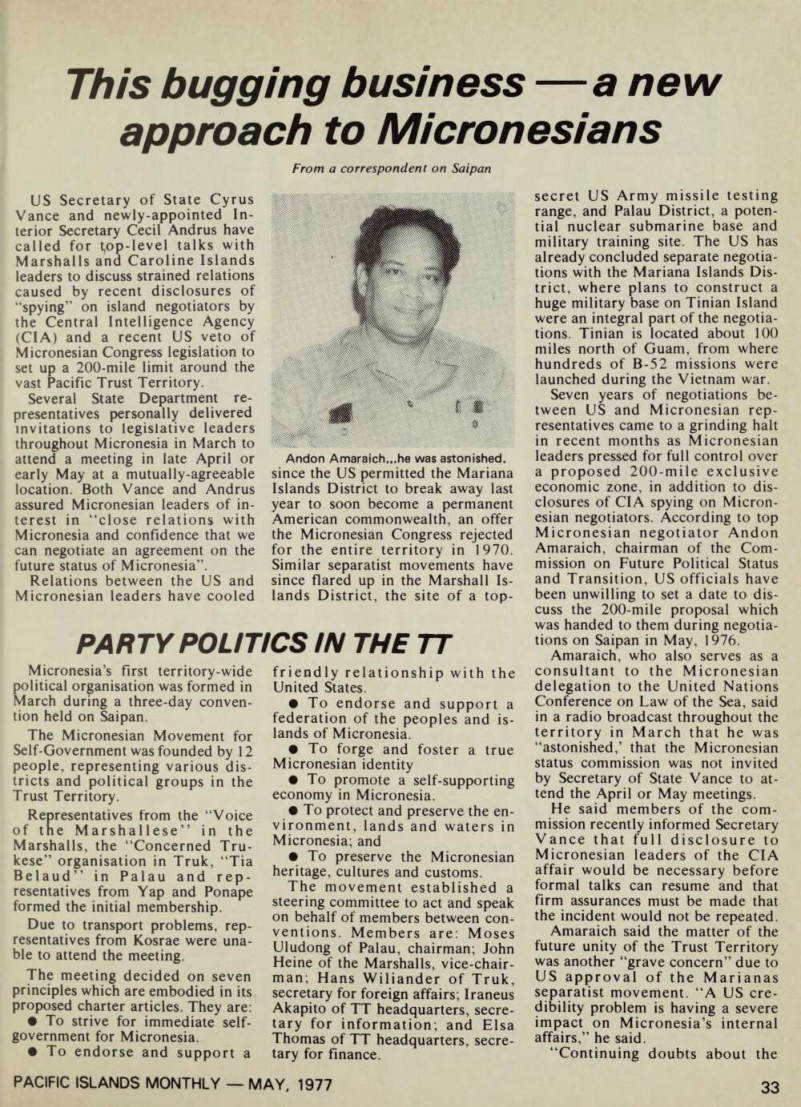
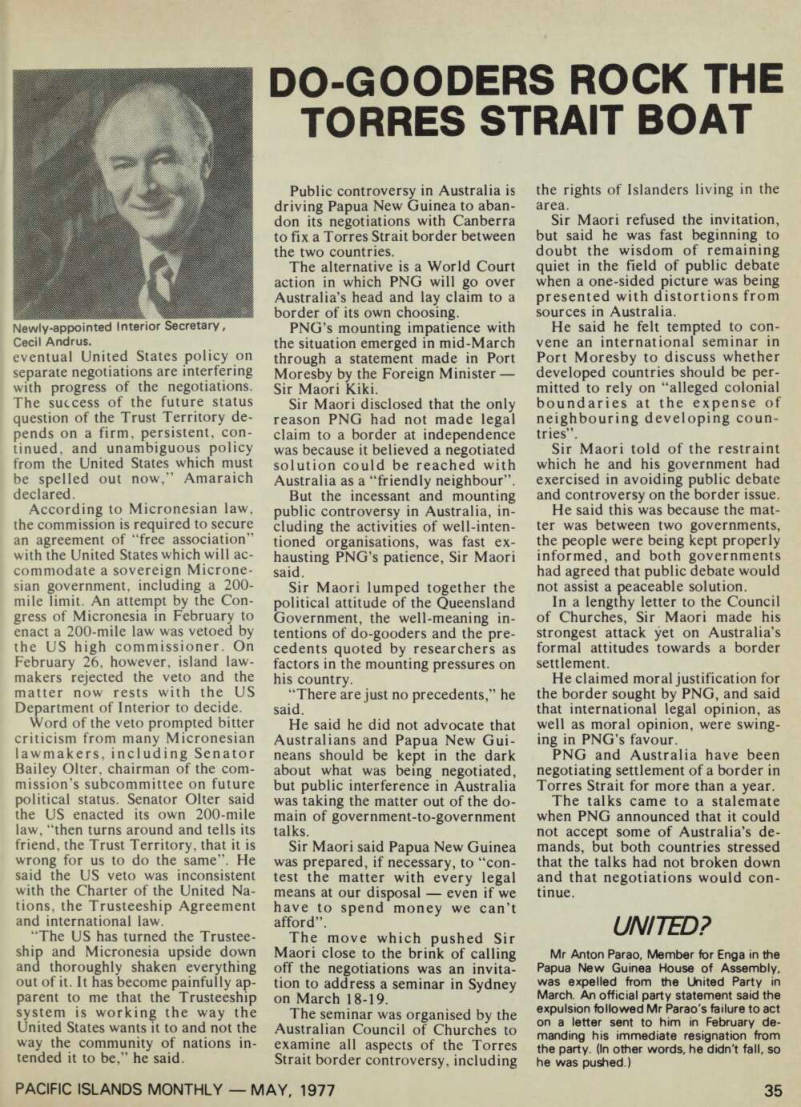
This bugging business —a new approach to Micronesians
From a correspondent on Saipan
US Secretary of State Cyrus Vance and newly-appointed In terior Secretary Cecil Andrus have called for t,op-level talks with Marshalls and Caroline Islands leaders to discuss strained relations caused by recent disclosures of “spying” on island negotiators by the Central Intelligence Agency (CIA) and a recent US veto of Micronesian Congress legislation to set up a 200-mile limit around the vast Pacific Trust Territory.
Several State Department re presentatives personally delivered invitations to legislative leaders throughout Micronesia in March to attend a meeting in late April or early May at a mutually-agreeable location. Both Vance and Andrus assured Micronesian leaders of in terest in “close relations with Micronesia and confidence that we can negotiate an agreement on the future status of Micronesia”.
Relations between the US and Micronesian leaders have cooled
Andon Amaraich...he was astonished, since the US permitted the Mariana Islands District to break away last year to soon become a permanent American commonwealth, an offer the Micronesian Congress rejected for the entire territory in 1970.
Similar separatist movements have since flared up in the Marshall Is lands District, the site of a top
secret US Army missile testing range, and Palau District, a poten tial nuclear submarine base and military training site. The US has already concluded separate negotia tions with the Mariana Islands Dis trict, where plans to construct a huge military base on Tinian Island were an integral part of the negotia tions. Tinian is located about 100 miles north of Guam, from where hundreds of B-52 missions were launched during the Vietnam war.
Seven years of negotiations be tween US and Micronesian rep resentatives came to a grinding halt in recent months as Micronesian leaders pressed for full control over a proposed 200-mile exclusive economic zone, in addition to dis closures of CIA spying on Micron esian negotiators. According to top Micronesian negotiator Andon Amaraich, chairman of the Com mission on Future Political Status and Transition, US officials have been unwilling to set a date to dis cuss the 200-mile proposal which was handed to them during negotia tions on Saipan in May, 1976.
Amaraich, who also serves as a consultant to the Micronesian delegation to the United Nations Conference on Law of the Sea, said in a radio broadcast throughout the territory in March that he was “astonished,’ that the Micronesian status commission was not invited by Secretary of State Vance to at tend the April or May meetings.
He said members of the com mission recently informed Secretary Vance that full disclosure to Micronesian leaders of the CIA affair would be necessary before formal talks can resume and that firm assurances must be made that the incident would not be repeated.
Amaraich said the matter of the future unity of the Trust Territory was another “grave concern” due to US approval of the Marianas separatist movement. “A US cre dibility problem is having a severe impact on Micronesia’s internal affairs,” he said.
“Continuing doubts about the
eventual United States policy on separate negotiations are interfering with progress of the negotiations.
The success of the future status question of the Trust Territory de pends on a firm, persistent, con tinued, and unambiguous policy from the United States which must be spelled out now,” Amaraich declared.
According to Micronesian law, the commission is required to secure an agreement of “free association” with the United States which will ac commodate a sovereign Microne sian government, including a 200mile limit. An attempt by the Con gress of Micronesia in February to enact a 200-mile law was vetoed by the US high commissioner. On February 26, however, island law makers rejected the veto and the matter now rests with the US Department of Interior to decide.
Word of the veto prompted bitter criticism from many Micronesian lawmakers, including Senator Bailey Olter, chairman of the com mission’s subcommittee on future political status. Senator Olter said the US enacted its own 200-mile law, “then turns around and tells its friend, the Trust Territory, that it is wrong for us to do the same”. He said the US veto was inconsistent with the Charter of the United Na tions, the Trusteeship Agreement and international law.
“The US has turned the Trustee ship and Micronesia upside down and thoroughly shaken everything out of it. It has become painfully ap parent to me that the Trusteeship system is working the way the United States wants it to and not the way the community of nations in tended it to be,” he said.
Newly-appointed Interior Secretary, Cecil Andrus.
Party Politics In The Tt
Micronesia’s first territory-wide political organisation was formed in March during a three-day conven tion held on Saipan.
The Micronesian Movement for Self-Government was founded by 12 people, representing various dis tricts and political groups in the Trust Territory.
Representatives from the “Voice of the Marshallese” in the Marshalls, the “Concerned Tru kese” organisation in Truk, “Tia Belaud” in Palau and rep resentatives from Yap and Ponape formed the initial membership.
Due to transport problems, rep resentatives from Kosrae were una ble to attend the meeting.
The meeting decided on seven principles which are embodied in its proposed charter articles. They are: • To strive for immediate self government for Micronesia. • To endorse and support a
friendly relationship with the United States. • To endorse and support a federation of the peoples and is lands of Micronesia. • To forge and foster a true Micronesian identity • To promote a self-supporting economy in Micronesia. • To protect and preserve the en vironment, lands and waters in Micronesia; and • To preserve the Micronesian heritage, cultures and customs.
The movement established a steering committee to act and speak on behalf of members between con ventions. Members are: Moses Uludong of Palau, chairman; John Heine of the Marshalls, vice-chair man; Hans Wiliander of Truk, secretary for foreign affairs; Iraneus Akapito of TT headquarters, secre tary for information; and Elsa Thomas of TT headquarters, secre tary for finance.
Advertisements & other items, p. 34 (1 item)
Goodyear
mi K I K 1 1 » Up St / .?'■ N *
gyagji^
The world over, more vehicles of all kinds roll on Goodyear tyres ... more planes land on Goodyear tyres ... more synthetic rubber is produced by Goodyear... and more different kinds of hose, transmission belts, conveyor belts and other industrial rubber goods bear the Goodyear trademark.
For leadership in rubber technology, look to Goodyear. The world’s largest rubber company.
GOODYEAR
We solve industrial problems.
Richard Pieris & Co., Lt( Colombo, SRI LANKA Nepal Motor Company ( Biratnagar. NEPAL Navana Ltd.
Dacca. BANGLADESH
Diethelm & Co., Ltd, Bangkok, THAILAND Landis Brothers & Co. L
HONG KONG
Guam Tire & Supply Co Agana. GUAM GOODYEAR DISTRIBUTORS IN S.E. ASIA AND PACIFIC BASIN.
Susupe Enterprises Saipan MARIANA IS Ltd. Nicrol Corporation Saipan. MARIANA IS.
Truk Trading Co.
Truk E. CAROLINE IS,
P.A.M.I.
Kolonia, PONAPE Island Transport Service Co.
Majuro MARSHALL ,IS Yap Cooperative Ass
Yap, W. CAROLINE IS
Cook Islands Motor Centre Rarotonga. COOK IS.
Ngiratkel Etpizon Co. Ltd.
Koror. PALAU Boroko Motors Ltd Port Moresby. PAPUA NEW GUINEA Solomon Motors Ltd.
Honiara. 8.5.1. P.
Santo Engineers
Santo, NEW HEBRIDES
Pacific Motors
Vila. NEW HEBRIDES
S.G.A.
Noumea.-NEW CALEDONIA
Duncombe Bay Garage
NORFOLK IS
Coral Island Motors Suva. FIJI Morris Hedstrom Ltd.
Nukualofa, TONGA Morris Hedstrom Ltd.
Apia, WESTERN SAMOA
W.S.T.C.S.
Apia. WESTERN SAMOA
Samoa Motors Inc
Pago Pago AMERICAN SAMOA
Service Mobil Papeete. TAHITI 171-0140
Do-Gooders Rock The
Torres Strait Boat
Public controversy in Australia is driving Papua New Guinea to aban don its negotiations with Canberra to fix a Torres Strait border between the two countries.
The alternative is a World Court action in which PNG will go over Australia’s head and lay claim to a border of its own choosing.
PNG’s mounting impatience with the situation emerged in mid-March through a statement made in Port Moresby by the Foreign Minister Sir Maori Kiki.
Sir Maori disclosed that the only reason PNG had not made legal claim to a border at independence was because it believed a negotiated solution could be reached with Australia as a “friendly neighbour”.
But the incessant and mounting public controversy in Australia, in cluding the activities of well-inten tioned organisations, was fast ex hausting PNG’s patience, Sir Maori said.
Sir Maori lumped together the political attitude of the Queensland Government, the well-meaning in tentions of do-gooders and the pre cedents quoted by researchers as factors in the mounting pressures on his country.
“There are just no precedents,” he said.
He said he did not advocate that Australians and Papua New Gui neans should be kept in the dark about what was being negotiated, but public interference in Australia was taking the matter out of the do main of government-to-government talks.
Sir Maori said Papua New Guinea was prepared, if necessary, to “con test the matter with every legal means at our disposal even if we have to spend money we can’t afford”.
The move which pushed Sir Maori close to the brink of calling off the negotiations was an invita tion to address a seminar in Sydney on March 18-19.
The seminar was organised by the Australian Council of Churches to examine all aspects of the Torres Strait border controversy, including
the rights of Islanders living in the area.
Sir Maori refused the invitation, but said he was fast beginning to doubt the wisdom of remaining quiet in the field of public debate when a one-sided picture was being presented with distortions from sources in Australia.
He said he felt tempted to con vene an international seminar in Port Moresby to discuss whether developed countries should be per mitted to rely on “alleged colonial boundaries at the expense of neighbouring developing coun tries”.
Sir Maori told of the restraint which he and his government had exercised in avoiding public debate and controversy on the border issue.
He said this was because the mat ter was between two governments, the people were being kept properly informed, and both governments had agreed that public debate would not assist a peaceable solution.
In a lengthy letter to the Council of Churches, Sir Maori made his strongest attack yet on Australia’s formal attitudes towards a border settlement.
He claimed moral justification for the border sought by PNG, and said that international legal opinion, as well as moral opinion, were swing ing in PNG’s favour.
PNG and Australia have been negotiating settlement of a border in Torres Strait for more than a year.
The talks came to a stalemate when PNG announced that it could not accept some of Australia’s de mands, but both countries stressed that the talks had not broken down and that negotiations would con tinue.
United?
Mr Anton Parao, Member for Enga in the Papua New Guinea House of Assembly, was expelled from the United Party in March. An official party statement said the expulsion followed Mr Parao's failure to act on a letter sent to him in February de manding his immediate resignation from the party. (In other words, he didn't fall, so he was pushed.)
Advertisements & other items, p. 36 (1 item)
Windmills
SHIPBUILDERS TO THE PACIFIC.
h a LANDING BARGE under construction at
CARPENTERS INDUSTRIAL SHIPYARD, Walu Bay, Suva
Fiji Islands, for Mr. Anton Lee of Port Moresby, Papua New Guinea.
CARGO CAPACITY: 14,000 aft LENGTH: 114ft.0.A.
Powered by twin GARDNER diesel engines each 230 bp.
[CARPENTERS INDUSTRIAL RO. BOX 296
I SUVA, FIJI. PHONE 312-133.
I Please send me information on Shipbuilding in the I South Pacific I Name Company I Address * r r»
Enr
SOUTHERN CROSS
GALVANISED STEEL
PRE-FABRICATED
WATER STORAGE
TANKS
> Capacities from 2,000 to 300,000 gal.
VERY STRONGLY MADE ! ! !
16 gauge sheets heavily galvanised,with angle steel attens inside and out side wide over, lapping joints.
Inside ladder included with every tank.
SOUTHERN CROSS
kn
WINDMILLS
STILL THE CHEAPEST
WAY TO' PUMP WATER
NO POWER COSTS///
• Heavily Galvanised • Automatic Governing • Self Oiling
SOUTHERN
SIZES:
6 ft. to 14 ft. Double Geared 17 ft. to 25 ft. Direct Acting Towers from 20 ft. to 60 ft.
Full details and prices available from:
SOUTHERN CROSS MACHINERY PTY LTD
39 GRANVILLE AVE., GRANVILLE, 2142, AUSTRALIA.
Telex: AA22663. Telegrams: 'SOCRQSS'.
Hokule'a, the canoe, taught
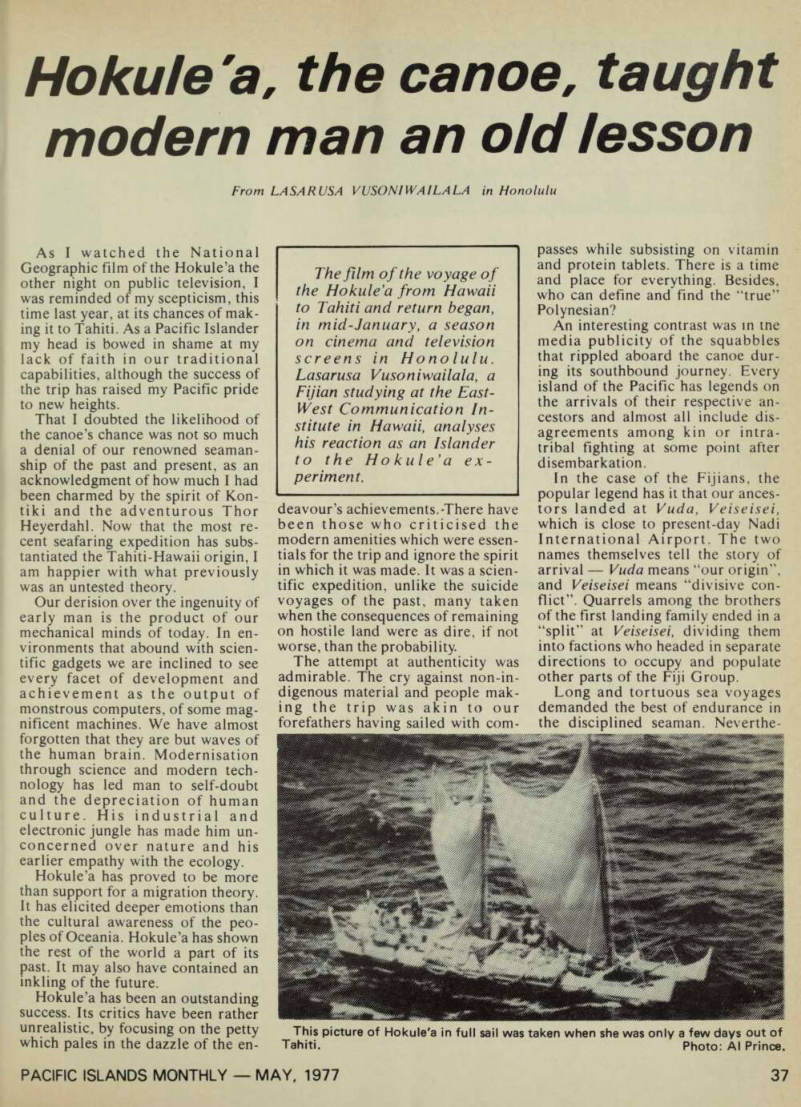
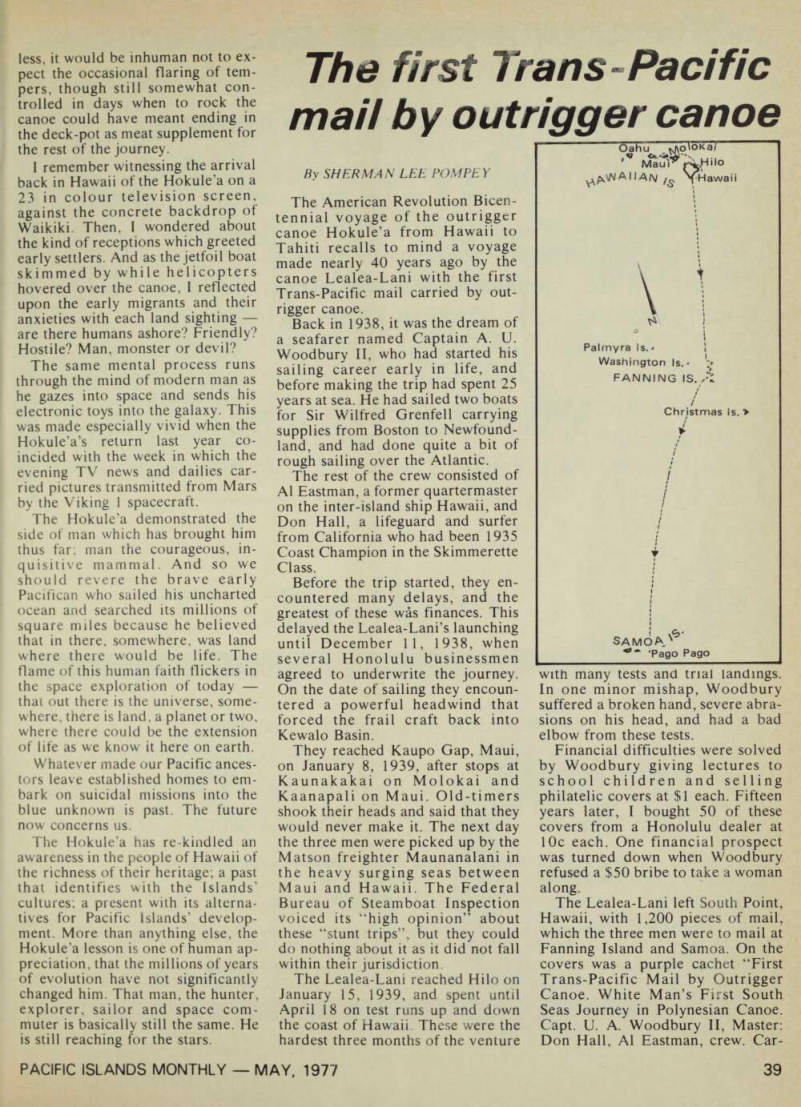
modern man an old lesson
From LASARUSA VUSONIWAILALA in Honolulu
As I watched the National Geographic film of the Hokule’a the other night on public television, I was reminded of my scepticism, this time last year, at its chances of mak ing it to Tahiti. As a Pacific Islander my head is bowed in shame at my lack of faith in our traditional capabilities, although the success of the trip has raised my Pacific pride to new heights.
That I doubted the likelihood of the canoe’s chance was not so much a denial of our renowned seaman ship of the past and present, as an acknowledgment of how much I had been charmed by the spirit of Kon tiki and the adventurous Thor Heyerdahl. Now that the most re cent seafaring expedition has subs tantiated the Tahiti-Hawaii origin, I am happier with what previously was an untested theory.
Our derision over the ingenuity of early man is the product of our mechanical minds of today. In en vironments that abound with scien tific gadgets we are inclined to see every facet of development and achievement as the output of monstrous computers, of some mag nificent machines. We have almost forgotten that they are but waves of the human brain. Modernisation through science and modern tech nology has led man to self-doubt and the depreciation of human culture. His industrial and electronic jungle has made him un concerned over nature and his earlier empathy with the ecology.
Hokule’a has proved to be more than support for a migration theory.
It has elicited deeper emotions than the cultural awareness of the peo ples of Oceania. Hokule’a has shown the rest of the world a part of its past. It may also have contained an inkling of the future.
Hokule’a has been an outstanding success. Its critics have been rather unrealistic, by focusing on the petty which pales in the dazzle of the en-
The film of the voyage of the Hokule’a from Hawaii to Tahiti and return began, in mid-January, a season on cinema and television screens in Honolulu.
Lasarusa Vusoniwailala, a Fijian studying at the East- West Communication In stitute in Hawaii, analyses his reaction as an Islander to the Hokule’a ex periment.
deavour’s achievements.-There have been those who criticised the modern amenities which were essentials for the trip and ignore the spirit in which it was made. It was a scientific expedition, unlike the suicide voyages of the past, many taken when the consequences of remaining on hostile land were as dire, if not worse, than the probability.
The attempt at authenticity was admirable. The cry against non-indigenous material and people making the trip was akin to our forefathers having sailed with com-
passes while subsisting on vitamin and protein tablets. There is a time and place for everything. Besides, who can define and find the “true”
Polynesian?
An interesting contrast was in me media publicity of the squabbles that rippled aboard the canoe dur ing its southbound journey. Every island of the Pacific has legends on the arrivals of their respective an cestors and almost all include dis agreements among kin or intra tribal fighting at some point after disembarkation.
In the case of the Fijians, the popular legend has it that our ances tors landed at Vuda, Veiseisei, which is close to present-day Nadi International Airport. The two names themselves tell the story of arrival Vuda means “our origin”, and Veiseisei means “divisive con flict”. Quarrels among the brothers of the first landing family ended in a “split” at Veiseisei, dividing them into factions who headed in separate directions to occupy and populate other parts of the Fiji Group.
Long and tortuous sea voyages demanded the best of endurance in the disciplined seaman. Neverthe-
This picture of Hokule'a in full sail was taken when she was only a few days out of Tahiti. Photo: Al Prince.
less, it would be inhuman not to ex pect the occasional flaring of tem pers, though still somewhat con trolled in days when to rock the canoe could have meant ending in the deck-pot as meat supplement for the rest of the journey.
I remember witnessing the arrival back in Hawaii of the Hokule’a on a 23 in colour television screen, against the concrete backdrop of Waikiki. Then, I wondered about the kind of receptions which greeted early settlers. And as the jetfoil boat skimmed by while helicopters hovered over the canoe, I reflected upon the early migrants and their anxieties with each land sighting are there humans ashore? Friendly?
Hostile? Man, monster or devil?
The same mental process runs through the mind of modern man as he gazes into space and sends his electronic toys into the galaxy. This was made especially vivid when the Hokule’a’s return last year co incided with the week in which the evening TV news and dailies car ried pictures transmitted from Mars by the Viking 1 spacecraft.
The Hokule’a demonstrated the side of man which has brought him thus far; man the courageous, in quisitive mammal. And so we should revere the brave early Pacifican who sailed his uncharted ocean and searched its millions of square miles because he believed that in there, somewhere, was land where there would be life. The flame of this human faith flickers in the space exploration of today thai out there is the universe, some where, there is land, a planet or two, where there could be the extension of life as we know it here on earth.
Whatever made our Pacific ances tors leave established homes to em bark on suicidal missions into the blue unknown is past. The future now concerns us.
The Hokule’a has re-kindled an awareness in the people of Hawaii of the richness of their heritage; a past that identifies with the Islands’ cultures; a present with its alterna tives for Pacific Islands’ develop ment. More than anything else, the Hokule’a lesson is one of human ap preciation, that the millions of years of evolution have not significantly changed him. That man, the hunter, explorer, sailor and space com muter is basically still the same. He is still reaching for the stars.
Advertisements & other items, p. 38 (1 item)
Zy R Compagnie Generale Maritime
Save hundreds of dollars
on Australia’s most efficient
WALK IN, ALUMINIUM
COOLROOMS AND
FREEZE ROOMS
Hundreds already installed! The most economical supplementary coolrooms for bottles and food, providing the largest storage capacity of any comparable coolrooms of the same exterior dimensions. Five sizes—from 90-360 cu. ft. capacity; 16 models offering normal temp., two temp., deep freeze, or for pastry and ice storage applications White vinyl interior, embossed rustproof aluminium exterior. * SUPPLIED IN EASY-TO-ERECT, DO-IT-YOURSELF KIT FORM.
Available front: AUSTRALIAN NEW CALEDONIA EXPORTS (SILVER & BARDA), 363 George St,, Sydney, 2000 and Branches.
BRECKWOLDT & CO , 276 Pitt St., Sydney, 2000 and Branches.
PETER FISHER TRADING PTY. LTD., 321 Pitt St., Sydney, 2000.
HAGEMEYER (A'SIA), 59 Anzac Pde., Kensington, 2033 and Branches.
GEOFFREY HUGHES & CO., 167 Macquarie St., Sydney, 2000.
Manufactured by:
T 1 S NELSON & ROBERTSON PTY. LTD., 197 Clarence St., Sydney, 2000.
RABAUL TRADING CO PTY. LTD., P.O. Box 219, Rabaul and Branches.
E. RABOT (EXPORTS) PTY. LTD., 67 Castlereagh St., Sydney, 2000.
H. Y. KWAN (AUST.) PTY. LTD., Box 2713 G.P.O. Sydney, 2001.
C. SULLIVAN (EXPORT) PTY. LTD., 60 Margaret St., Sydney, 2000 and Branches.
W. S. TAIT & CO., PTY. LTD., 31 Macquarie Place, Sydney, 2000 and Branches.
FRIGID CABINETS PTY. LTD.,
14A Duffy Ave., Thornleigh, N.S.W. 2120 Aust. Ph. 848 8292.
Zy r COMPAGNiE GENERALE MARITIME
[Messageries Maritimes]
AUSTRALIA - EUROPE SERVICE.
Fully containerised (Member of AECS) Agents: SEABRIDGE, 60 Pitt Street, SYDNEY.
Phone: 20518.
PO Box R 206.
PACIFIC ISLANDS - EUROPE SERVICE.
Roßo and Multipurpose Service Twice monthly to/from Papeete Noumea New Hebrides. - Multipurpose Service Monthly to/from Papua/New Guinea.
SOUTH PACIFIC UNITED LINES
AUSTRALIA - PACIFIC ISLANDS - U.S. WEST COAST.
Monthly fully containerised Service.
Agents: OMNITRADERS & BROKERS,
261 George Street, Phone: 241 2872.
GPO Box 3896. ★ * ** ★
mail by outrigger canoe
The first Trans-Pacific mail by outrigger canoe
By Sherman Lee Pompey
The American Revolution Bicen tennial voyage of the outrigger canoe Hokule’a from Hawaii to Tahiti recalls to mind a voyage made nearly 40 years ago by the canoe Lealea-Lani with the first Trans-Pacific mail carried by out rigger canoe.
Back in 1938, it was the dream of a seafarer named Captain A. U.
Woodbury 11, who had started his sailing career early in life, and before making the trip had spent 25 years at sea. He had sailed two boats for Sir Wilfred Grenfell carrying supplies from Boston to Newfound land, and had done quite a bit of rough sailing over the Atlantic.
The rest of the crew consisted of A 1 Eastman, a former quartermaster on the inter-island ship Hawaii, and Don Hall, a lifeguard and surfer from California who had been 1935 Coast Champion in the Skimmerette Class.
Before the trip started, they en countered many delays, and the greatest of these was finances. This delayed the Lealea-Lani’s launching until December 1 1, 1938, when several Honolulu businessmen agreed to underwrite the journey.
On the date of sailing they encoun tered a powerful headwind that forced the frail craft back into Kewalo Basin.
They reached Kaupo Gap, Maui, on January 8, 1939, after stops at Kaunakakai on Molokai and Kaanapali on Maui. Old-timers shook their heads and said that they would never make it. The next day the three men were picked up by the Matson freighter Maunanalani in the heavy surging seas between Maui and Hawaii. The Federal Bureau of Steamboat Inspection voiced its “high opinion” about these “stunt trips”, but they could do nothing about it as it did not fall within their jurisdiction.
The Lealea-Lani reached Hilo on January 15, 1939, and spent until April 18 on test runs up and down the coast of Hawaii. These were the hardest three months of the venture
with many tests and trial landings.
In one minor mishap, Woodbury suffered a broken hand, severe abra sions on his head, and had a bad elbow from these tests.
Financial difficulties were solved by Woodbury giving lectures to school children and selling philatelic covers at $1 each. Fifteen years later, I bought 50 of these covers from a Honolulu dealer at 10c each. One financial prospect was turned down when Woodbury refused a $5O bribe to take a woman along.
The Lealea-Lani left South Point, Hawaii, with 1,200 pieces of mail, which the three men were to mail at Fanning Island and Samoa. On the covers was a purple cachet “First Trans-Pacific Mail by Outrigger Canoe. White Man’s First South Seas Journey in Polynesian Canoe.
Capt. U. A. Woodbury 11, Master: Don Hall, A 1 Eastman, crew. Car
ried by Canoe Lealea-Lani Hawaiian Islands To Pago Pago.”
These covers were all postmarked at Honolulu on December 31, 1938 at midnight. They were sealed in one and five gallon cans for the voyage. The stamps were generally the 2c United States of the Army- Navy series, the 2c 1938 Presiden tial series and the 3c Hawaii issue.
The Lealea-Lani got off to a secret start in the early morning hours and was later spotted by an Army pilot who was flying south from Hawaii in the afternoon. Don Hall said they had expected to reach Fanning in the 10 days, but about the time they were to have reached Fanning overcast skies prevented a sight for position, a condition that remained for four days. Meanwhile the chronometer stopped. They searched for Fanning for five days until food and water were ex hausted, and then decided to head for Samoa. Samoa was ap proximately another 20 days away.
After five days they caught 10 gallons of water in the sails and on the seventh day they caught a 21b barracuda. The 10th day they caught a bonita. They tried to spear sharks to eat, but these were too large for their spears.
Thirty-four days out they spotted land dead ahead. It was an uninhabited cove in Samoan waters, where they found some coconuts.
Everyone was exhausted. The next day, Don Hall walked to a village, Aoloau, about two miles away, and the natives came and towed the canoe to the village. They arrived in the village the next day, and the third day reached Pago Pago by na tive rowboat and trail. In Pago Pago they were acclaimed by High Chief Fuimanono as “Greatest skipper to day of sailing craft”. This was a title given only by Samoans when well deserved in consideration of actual accomplishment.
The philatelic covers were a mess.
Many of them had rust spots on them, and Woodbury had to glue the stamps back on many of them, being careful that the stamps coincided with the postmarks.
“A thankless job,” he said, “but I feel that the people who gave me the dollar are entitled to it.” These covers were postmarked Pago Pago, Samoa 29 May, 1939, and back stamped upon arrival in Honolulu.
Advertisements & other items, pp. 40-41 (1 item)
nedlloyd
Builders' hardware, French corned beef, dry batteries, bi sc ill ts * hhiid s pi w i? t* ii e r ropes ne
stores, eriamelwai^ sweets’ f&Ature.
battery-plates, refrigerated display counters; brake flui decorative JlpGGfflfls made sanitary ware, sar' */ S paper, canned soft d ( knapsack sprayers. SWe'cMft RardboPxi, kerosene stove; Danish canned meats, slippers, kitchen lightbulbs, Ger bamboowai atteries, lamin Jmercia! trucks, to del foam, sheets, carpwines, puncJ: lawnmowers. automotive spare parts, pressure stoves, tractors, carpe
nedlloyd
REGULAR SAILINGS BY FAST, MODERN CARGO VESSELS from EUROPE via PANAMA to:
PAPEETE, NOUMEA,
APIA, SUVA, LAUTOKA,
NEW ZEALAND.
from NEW ZEALAND via PANAMA to:
EUROPE
(MEDITERRANEAN Cr NORTH CONTINENT)
and from AUSTRALIA to:
CENTRAL AMERICA & CARIBBEAN
heavy-lift facilities—refrigerated space—cargo deeptanks For further particulars apply to Agents: / / Ets. Donald Tahiti Agance Maritime Aerienne Caledonienne O. F. Nelson & Co. Ltd. Carpenters Shipping Papeete. S.A. A.M.A.C., Noumea. Apia. Suva, Lautoka.
Interocean Australia Services Pty. Ltd. Joint Shipping Management Ltd.
Sydney. P.O. Bex 890, Wellington, N.Z.
Advertisemeiv
Restore a satiny
smoothness to
your complexion
The scientific development of a trop-
ically moist oil blend that helps protect the skin against premature signs of age has made complexion loveliness a reality for women in many parts of the world. £&#***> AS YOU grow older and pass the late twenties the natural fluids in the skin which keep it soft and smooth begin to diminish in supply, a loss further exaggerated by their evaporation from the surface of your complexion through harsh climatic conditions.
Supplement
natural skin fluids
and bring beauty
to your skin
Regular supplementing
of these vital softening fluids with a tropically moist oil blend, smoothed over the complexion each day, simulates their action on the skin surface and brings to the complexion benefits similar to those supplied by nature herself. The complexion is brought to a state of balance, and thus can reward you with a softer, smoother, more supple skin which can be the basis of a superlatively beautiful complexion for many years to come.
Re-discover
fresh, natural
loveliness As you smooth on this tropically moist Oil of Ulan you will notice that it penetrates quickly and leaves no greasy feeling. Stroke Oil of Ulan on to the face and neck into any dryness and tiny lines
. . . even tired looking
skin, prone to wrinkle dryness, takes on a fresher, softer more
youthful appearance
that you may have believed could never be
achieved again.
Special care
each day can influence skin
beauty
Oil of Ulan softens and improves the appearance of your skin because it creates a moist environment for the tiny cells of the stratum corneum or, outer layer of the skin, which are daily finding their way to the surface. Every day presents itself therefore with an opportunity to recreate the vital balance of oil and moisture in which these new cells need to exist.
Once Oil of Ulan moist oil blend achieves this balanced condition your skin can resume a suppleness and pliant softness, characterised in the soft, dewy bloom of a youthful looking complexion. m \
Bali Ha 'i they call you ...or
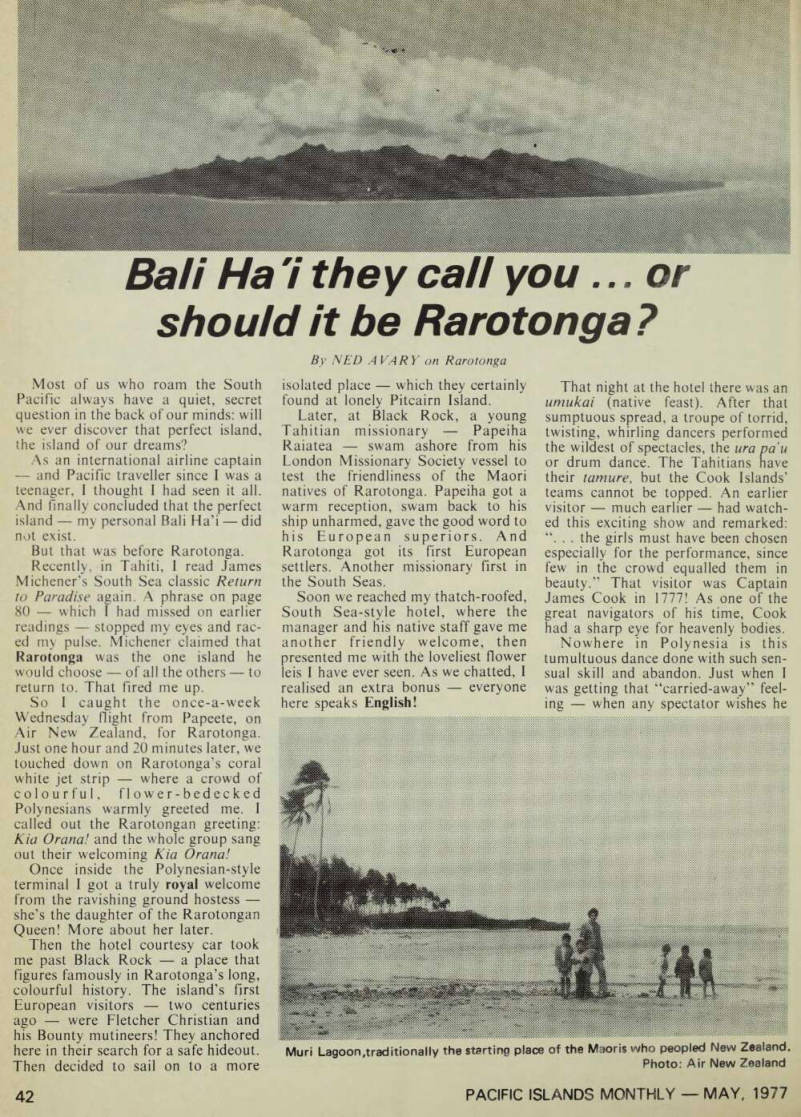
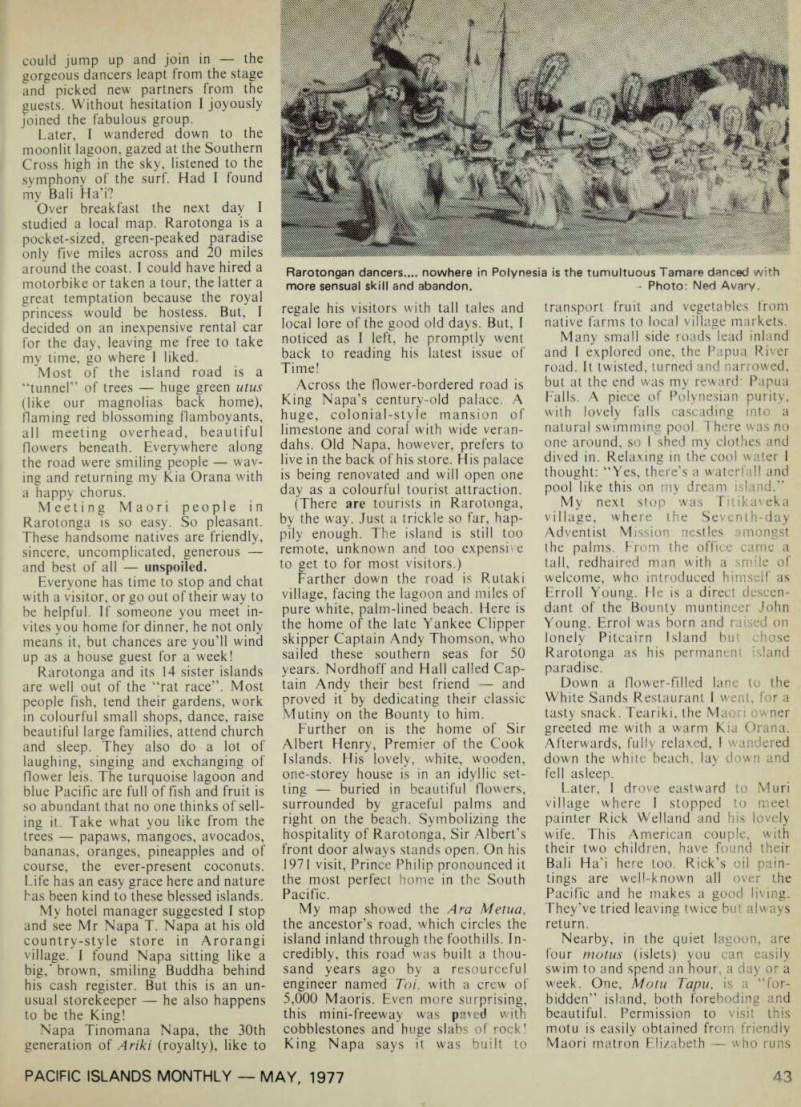
should it be Rarotonga ?
By NED A VARY on Rarotonga
Most of us who roam the South Pacific always have a quiet, secret question in the back of our minds: will we ever discover that perfect island, the island of our dreams?
As an international airline captain and Pacific traveller since I was a teenager, I thought I had seen it all.
And finally concluded that the perfect island my personal Bali Ha’i did not exist.
But that was before Rarotonga.
Recently, in Tahiti, I read James Michener's South Sea classic Return to Paradise again. A phrase on page 80 which I had missed on earlier readings stopped my eyes and rac ed my pulse. Michener claimed that Rarotonga was the one island he would choose of all the others to return to. That fired me up.
So 1 caught the once-a-week Wednesday flight from Papeete, on Air New Zealand, for Rarotonga.
Just one hour and 20 minutes later, we touched down on Rarotonga’s coral white jet strip where a crowd of colourful, flower-bedecked Polynesians warmly greeted me. I called out the Rarotongan greeting: Kia Orana! and the whole group sang out their welcoming Kia Orana!
Once inside the Polynesian-style terminal I got a truly royal welcome from the ravishing ground hostess she’s the daughter of the Rarotongan Queen! More about her later.
Then the hotel courtesy car took me past Black Rock a place that figures famously in Rarotonga’s long, colourful history. The island’s first European visitors two centuries ago were Fletcher Christian and his Bounty mutineers! They anchored here in their search for a safe hideout.
Then decided to sail on to a more
isolated place which they certainly found at lonely Pitcairn Island.
Later, at Black Rock, a young Tahitian missionary Papeiha Raiatea swam ashore from his London Missionary Society vessel to test the friendliness of the Maori natives of Rarotonga. Papeiha got a warm reception, swam back to his ship unharmed, gave the good word to his European superiors. And Rarotonga got its first European settlers. Another missionary first in the South Seas.
Soon we reached my thatch-roofed, South Sea-style hotel, where the manager and his native staff gave me another friendly welcome, then presented me with the loveliest flower leis I have ever seen. As we chatted, I realised an extra bonus everyone here speaks English!
That night at the hotel there was an umukai (native feast). After that sumptuous spread, a troupe of torrid, twisting, whirling dancers performed the wildest of spectacles, the ura pa’u or drum dance. The Tahitians have their tamure, but the Cook Islands’ teams cannot be topped. An earlier visitor much earlier had watch ed this exciting show and remarked: “... the girls must have been chosen especially for the performance, since few in the crowd equalled them in beauty.” That visitor was Captain James Cook in 1777! As one of the great navigators of his time, Cook had a sharp eye for heavenly bodies, Nowhere in Polynesia is this tumultuous dance done with such sen sual skill and abandon. Just when I was getting that “carried-away” feel ing when any spectator wishes he
Muri Lagoon,traditionally the starting place of the Maoris who peopled New Zealand.
Photo: Air New Zealand
could jump up and join in the gorgeous dancers leapt from the stage and picked new partners from the guests. Without hesitation I joyously joined the fabulous group.
Later, I wandered down to the moonlit lagoon, gazed at the Southern Cross high in the sky, listened to the symphony of the surf. Had I found my Bali Ha’i?
Over breakfast the next day I studied a local map. Rarotonga is a pocket-sized, green-peaked paradise only five miles across and 20 miles around the coast. I could have hired a motorbike or taken a tour, the latter a great temptation because the royal princess would be hostess. But, I decided on an inexpensive rental car for the day, leaving me free to take my time, go where I liked.
Most of the island road is a “tunnel” of trees huge green utus (like our magnolias back home), flaming red blossoming flamboyants, all meeting overhead, beautiful flowers beneath. Everywhere along the road were smiling people wav ing and returning my Kia Orana with a happy chorus.
Meeting Maori people in Rarotonga is so easy. So pleasant.
These handsome natives are friendly, sincere, uncomplicated, generous and best of all unspoiled.
Everyone has time to stop and chat with a visitor, or go out of their way to be helpful. If someone you meet in vites you home for dinner, he not only means it, but chances are you’ll wind up as a house guest for a week!
Rarotonga and its 14 sister islands are well out of the “rat race”. Most people fish, tend their gardens, work in colourful small shops, dance, raise beautiful large families, attend church and sleep. They also do a lot of laughing, singing and exchanging of flower leis. The turquoise lagoon and blue Pacific are full of fish and fruit is so abundant that no one thinks of sell ing it. Take what you like from the trees papaws, mangoes, avocados, bananas, oranges, pineapples and of course, the ever-present coconuts.
Life has an easy grace here and nature has been kind to these blessed islands.
My hotel manager suggested I stop and see Mr Napa T. Napa at his old country-style store in Arorangi village. I found Napa sitting like a big,'brown, smiling Buddha behind his cash register. But this is an un usual storekeeper he also happens to be the King!
Napa Tinomana Napa, the 30th generation of Ariki (royalty), like to
regale his visitors with tall tales and local lore of the good old days. But, I noticed as I left, he promptly went back to reading his latest issue of Time!
Across the flower-bordered road is King Napa’s century-old palace. A huge, colonial-style mansion of limestone and coral with wide veran dahs. Old Napa, however, prefers to live in the back of his store. His palace is being renovated and will open one day as a colourful tourist attraction. (There are tourists in Rarotonga, by the way. Just a trickle so far, hap pily enough. The island is still too remote, unknown and too expensive to get to for most visitors.) Farther down the road is Rutaki village, facing the lagoon and miles of pure white, palm-lined beach. Here is the home of the late Yankee Clipper skipper Captain Andy Thomson, who sailed these southern seas for 50 years. Nordhoff and Hall called Cap tain Andy their best friend and proved it by dedicating their classic Mutiny on the Bounty to him.
Further on is the home of Sir Albert Henry, Premier of the Cook Islands. His lovely, white, wooden, one-storey house is in an idyllic set ting buried in beautiful flowers, surrounded by graceful palms and right on the beach. Symbolizing the hospitality of Rarotonga, Sir Albert’s front door always stands open. On his 1971 visit, Prince Philip pronounced it the most perfect home in the South Pacific.
My map showed the Ara Metua, the ancestor’s road, which circles the island inland through the foothills. In credibly, this road was built a thou sand years ago by a resourceful engineer named Toi, with a crew of 5,000 Maoris. Even more surprising, this mini-freeway was paved with cobblestones and huge slabs of rock!
King Napa says it was built to
transport fruit and vegetables from native farms to local village markets.
Many small side roads lead inland and I explored one, the Papua River road. It twisted, turned and narrowed, but at the end was my reward; Papua Falls. A piece of Polynesian purity, with lovely falls cascading into a natural swimming pool. There was no one around, so I shed my clothes and dived in. Relaxing in the cool water I thought: “Yes, there’s a waterfall and pool like this on my dream island.”
My next stop was Titikaveka village, where the Seventh-day Adventist Mission nestles amongst the palms. From the office came a tall, redhaired man with a smile of welcome, who introduced himself as Erroll Young. He is a direct descen dant of the Bounty muntineer John Young. Errol was born and raised on lonely Pitcairn Island but chose Rarotonga as his permanent island paradise.
Down a flower-filled lane to the White Sands Restaurant I went, for a tasty snack. Teariki, the Maori owner greeted me with a warm Kia Orana.
Afterwards, fully relaxed, I wandered down the white beach, lay down and fell asleep.
Later, 1 drove eastward to Muri village where I stopped to meet painter Rick Welland and his lovely wife. This American couple, with their two children, have found their Bali Ha’i here too. Rick’s oil pain tings are well-known all over the Pacific and he makes a good living.
They’ve tried leaving twice but always return.
Nearby, in the quiet lagoon, are four motus (islets) you can easily swim to and spend an hour, a day or a week. One, Motu Tapu, is a “for bidden” island, both foreboding and beautiful. Permission to visit this motu is easily obtained from friendly Maori matron Elizabeth who runs
Rarotongan dancers... nowhere in Polynesia is the tumultuous Tamare danced with more sensual skill and abandon. - Photo: Ned Avary.
a tiny hillside shop just opposite Motu Tapu. She will also tell you about the legendary monster lurking in a lagoon cavern. Elizabeth says Buzz Sawyer an American yachtsman visiting Rarotonga in 1958 left hurriedly after an underwater battle with something he encountered in that un derwater cave. Who knows?
On the reef, just opposite the main village, Avarua, rests the remains of the world-famous brigantine Yankee.
She was visiting Rarotonga in 1964 when a storm blew up and her anchors dragged. Engines failed to start and she was thrown onto the reefs foam ing jaws. Yachtsmen around the world wept real salt tears when they heard of her tragic fate.
No Rarotonga tour is complete without getting to know Bill Marsters. To meet him, all you do is visit the beautiful Cook Islands Chris tian Church in Avarua. Bill, a round, robust, Maori, has 12 children of his own, but is also spiritual father of thousands of his church members in the Cook Islands. He was going to visit his sister, Tere, and invited me to join him. Later, Tere and Bill told me one of the Pacific’s most romantic and improbable stories.
Their grandfather, William
Marsters, was a Scottish adventurer who made his fortune in the Califor nia Gold Rush. “Will Bill” then sailed for the South Pacific, where he selected and collected three beautiful wives from Tongareva in the northern Cooks. He promptly settled on remote Palmerston Atoll and with the kind co-operation of his three brides, he produced the Pacific’s best known “Marster” race. There are now over six thousand Marsters descendants!
At the end of the tour, I was enchanted with this incredibly beautiful, friendly and peaceful island. I know now why James Michener chose Rarotonga as the one island he longed to return to and stay.
Rarotonga is not crowded, com mercialised or expensive. Beauti fully furnished, lagoon-side bungalows rent for $l5 a week, choice filet mignon is $1 a pound, fruit and fish are free and Avarua has the best duty-free bargains in the whole Pacific. Medical and dental care? Excellent and free! This is not a tourist place yet. So I didn’t feel like a tourist. I honestly felt that these people really liked me as they do most papa as (foreigners). I had looked at all this sympathetically and
now I listened. The loudest noise was the surf pounding the reef, with a quiet lagoon undisturbed by outboard motors. Natives still paddle their graceful outrigger canoes as they have for centuries.
Finally, someone may ask what about the legendary charm and fabled beauty of the South Sea Island girls? I will only say that I’ve found it all to be true.
How many places are there left like this in the world, 1 wondered? I was soon to find out what this pocket paradise has done for me.
My last day passed too quickly.
The plane was leaving very early, so 1 retired right after dinner. Half awake, my mind kept asking: “Is this Polyne sian paradise really your Bali Ha’i?”
Finally I slept. 1 awakened to a light tapping on my bungalow door. Moana, the lovely Maori maid, whispered: “Captain Ned, it’s nearly time for your flight.”
Without hesitation I replied: “Moana, please cancel my booking, I'm staying longer.”
“Oh! That is good!” Moana warm ly responded. “How much longer?”
“Forever,” I sang out. And meant it. I’d found my Bali Ha’i at last.
Advertisements & other items, p. 44 (1 item)
Established In 1895 (Citc)
We are the largest organisation in the Cook Islands with branches in the main islands.
American Exprees & Diners Club Cards
“WELCOME!!!."
4
DUTY FREE!!!
SANYO
SONY
KENWOOD
HITACHI
BULOVA
CITIZEN
SHEAFFER
LANVIN
MA TCH-BOX
PHILIP VENET
PERSIAN RUGS
CHRISTIAN DIOR
What makes fish poisonous?
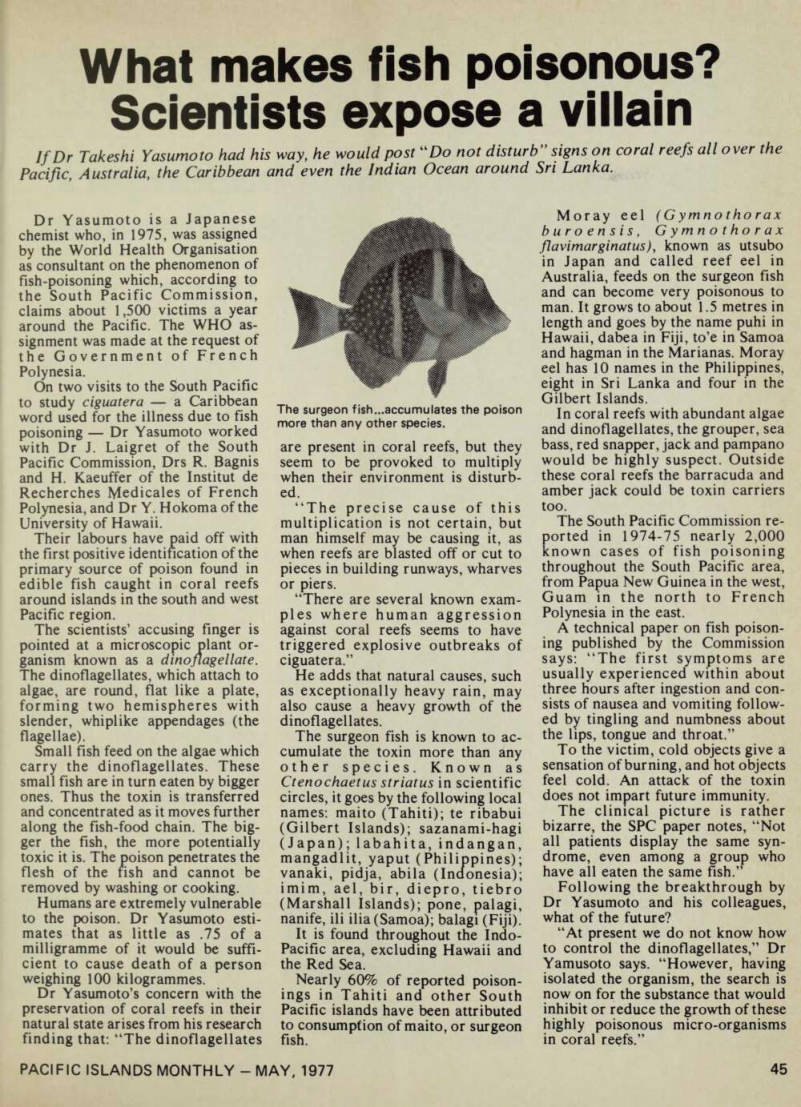
Scientists expose a villain
If Dr Takeshi Yasumoto had his way, he would post “Do not disturb ” signs on coral reefs all over the Pacific, Australia, the Caribbean and even the Indian Ocean around Sri Lanka.
Dr Yasumoto is a Japanese chemist who, in 1975, was assigned by the World Health Organisation as consultant on the phenomenon of fish-poisoning which, according to the South Pacific Commission, claims about 1,500 victims a year around the Pacific. The WHO as signment was made at the request of the Government of French
Polynesia.
On two visits to the South Pacific to study ciguatera a Caribbean word used for the illness due to fish poisoning Dr Yasumoto worked with Dr J. Laigret of the South Pacific Commission, Drs R. Bagnis and H. Kaeuffer of the Institut de Recherches Medicales of French Polynesia, and Dr Y. Hokoma of the University of Hawaii.
Their labours have paid off with the first positive identification of the primary source of poison found in edible fish caught in coral reefs around islands in the south and west Pacific region.
The scientists’ accusing finger is pointed at a microscopic olant or ganism known as a dinoflagellate.
The dinoflagellates, which attach to algae, are round, flat like a plate, forming two hemispheres with slender, whiplike appendages (the flagellae).
Small fish feed on the algae which carry the dinoflagellates. These small fish are in turn eaten by bigger ones. Thus the toxin is transferred and concentrated as it moves further along the fish-food chain. The big ger the fish, the more potentially toxic it is. The poison penetrates the flesh of the fish and cannot be removed by washing or cooking.
Humans are extremely vulnerable to the poison. Dr Yasumoto esti mates that as little as .75 of a milligramme of it would be suffi cient to cause death of a person weighing 100 kilogrammes.
Dr Yasumoto’s concern with the preservation of coral reefs in their natural state arises from his research finding that: “The dinoflagellates
are present in coral reefs, but they seem to be provoked to multiply when their environment is disturb ed.
“The precise cause of this multiplication is not certain, but man himself may be causing it, as when reefs are blasted off or cut to pieces in building runways, wharves or piers.
“There are several known exam ples where human aggression against coral reefs seems to have triggered explosive outbreaks of ciguatera.”
He adds that natural causes, such as exceptionally heavy rain, may also cause a heavy growth of the dinoflagellates.
The surgeon fish is known to ac cumulate the toxin more than any other species. Known as Ctenochaetus striatus in scientific circles, it goes by the following local names: maito (Tahiti); te ribabui (Gilbert Islands); sazanami-hagi (Japan); labahita, indangan, mangadlit, yaput (Philippines); vanaki, pidja, abila (Indonesia); imim, ael, bir, diepro, tiebro (Marshall Islands); pone, palagi, nanife, ili ilia (Samoa); balagi (Fiji).
It is found throughout the Indo- Pacific area, excluding Hawaii and the Red Sea.
Nearly 60% of reported poison ings in Tahiti and other South Pacific islands have been attributed to consumption of maito, or surgeon fish.
Moray eel (Gymnothorax buroensis, Gymnothorax flavimarginatus ), known as utsubo in Japan and called reef eel in Australia, feeds on the surgeon fish and can become very poisonous to man. It grows to about 1.5 metres in length and goes by the name puhi in Hawaii, dabea in Fiji, to’e in Samoa and hagman in the Marianas. Moray eel has 10 names in the Philippines, eight in Sri Lanka and four in the Gilbert Islands.
In coral reefs with abundant algae and dinoflagellates, the grouper, sea bass, red snapper, jack and pampano would be highly suspect. Outside these coral reefs the barracuda and amber jack could be toxin carriers too.
The South Pacific Commission re ported in 1974-75 nearly 2,000 known cases of fish poisoning throughout the South Pacific area, from Papua New Guinea in the west, Guam in the north to French Polynesia in the east.
A technical paper on fish poison ing published by the Commission says: “The first symptoms are usually experienced within about three hours after ingestion and con sists of nausea and vomiting follow ed by tingling and numbness about the lips, tongue and throat.”
To the victim, cold objects give a sensation of burning, and hot objects feel cold. An attack of the toxin does not impart future immunity.
The clinical picture is rather bizarre, the SPC paper notes, “Not all patients display the same syn drome, even among a group who have all eaten the same fish.”
Following the breakthrough by Dr Yasumoto and his colleagues, what of the future?
“At present we do not know how to control the dinoflagellates,” Dr Yamusoto says. “However, having isolated the organism, the search is now on for the substance that would inhibit or reduce the growth of these highly poisonous micro-organisms in coral reefs.”
The surgeon fish...accumulates the poison more than any other species.
Magazine
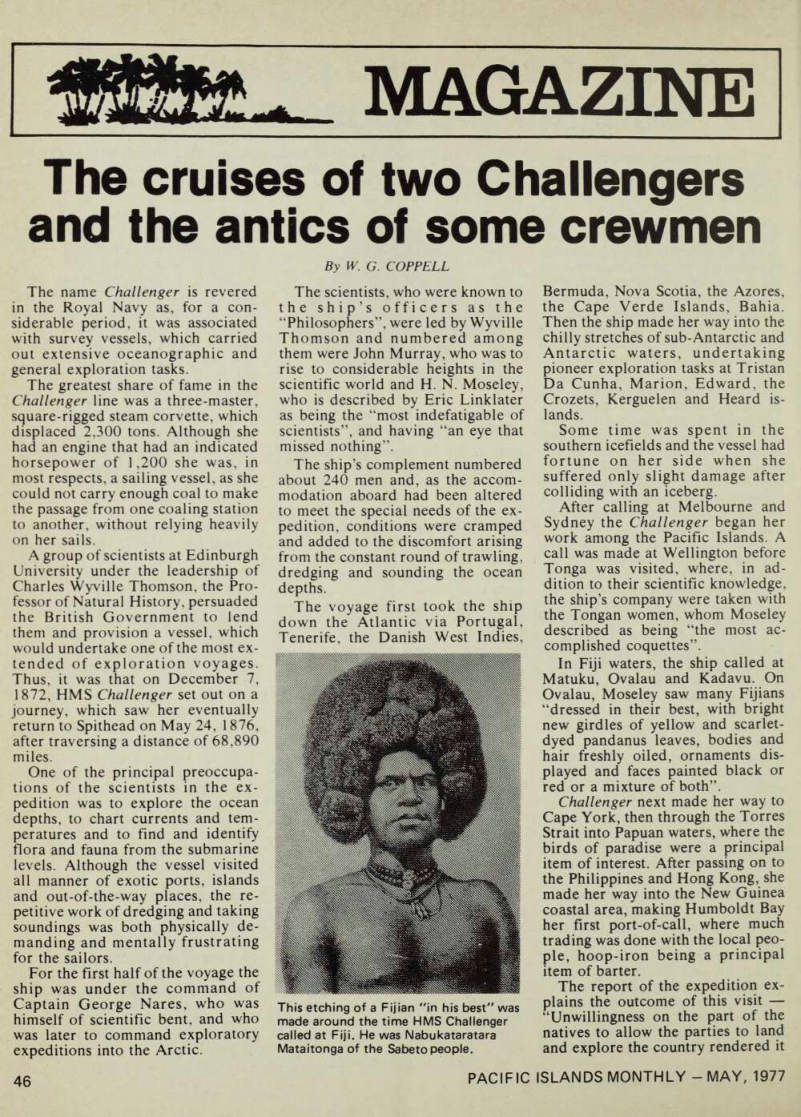
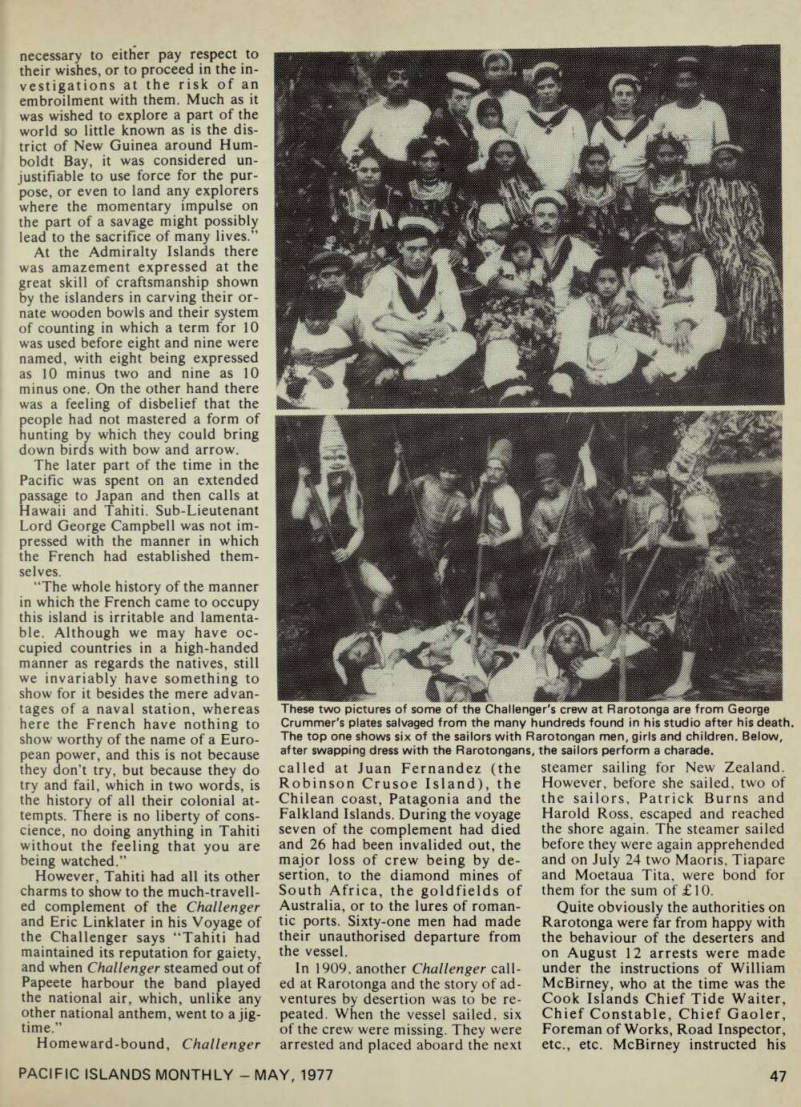
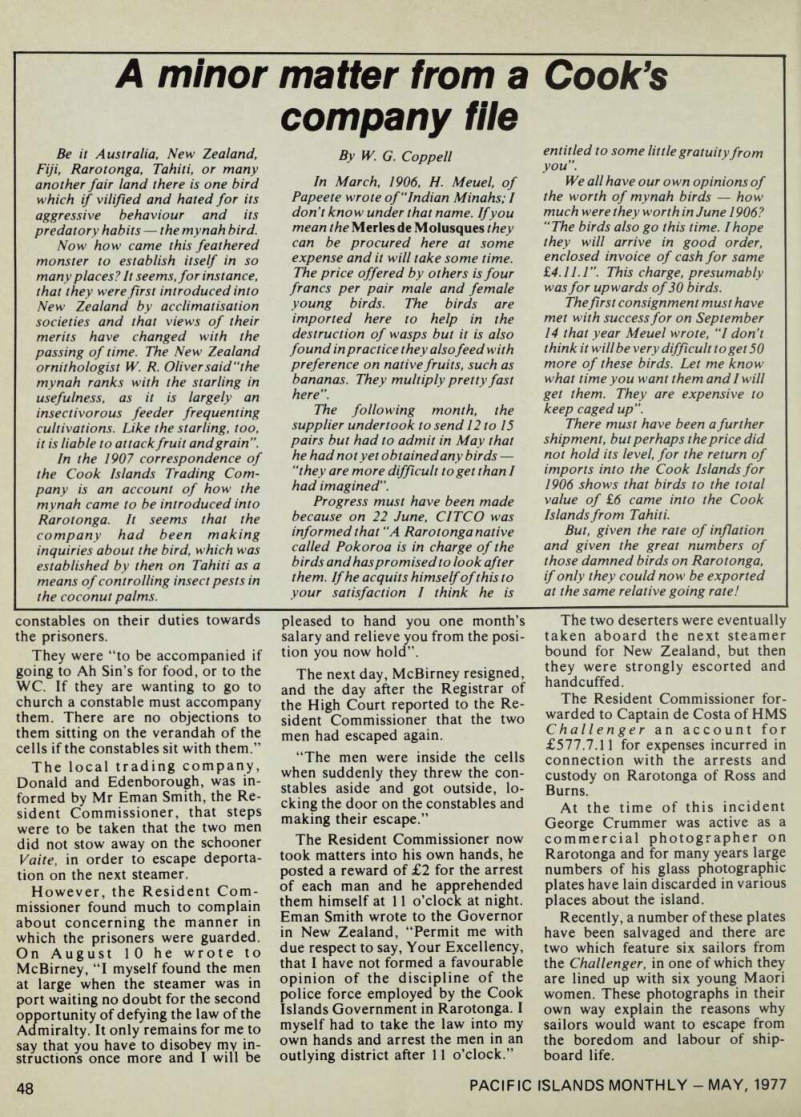
The cruises of two Challengers and the antics of some crewmen
By W. G. Coppell
The name Challenger is revered in the Royal Navy as, for a con siderable period, it was associated with survey vessels, which carried out extensive oceanographic and general exploration tasks.
The greatest share of fame in the Challenger line was a three-master, square-rigged steam corvette, which displaced 2,300 tons. Although she had an engine that had an indicated horsepower of 1,200 she was, in most respects, a sailing vessel, as she could not carry enough coal to make the passage from one coaling station to another, without relying heavily on her sails.
A group of scientists at Edinburgh University under the leadership of Charles Wyville Thomson, the Pro fessor of Natural History, persuaded the British Government to lend them and provision a vessel, which would undertake one of the most ex tended of exploration voyages.
Thus, it was that on December 7, 1872, HMS Challenger set out on a journey, which saw her eventually return to Spithead on May 24, 1876, after traversing a distance of 68,890 miles.
One of the principal preoccupa tions of the scientists in the ex pedition was to explore the ocean depths, to chart currents and tem peratures and to find and identify flora and fauna from the submarine levels. Although the vessel visited all manner of exotic ports, islands and out-of-the-way places, the re petitive work of dredging and taking soundings was both physically de manding and mentally frustrating for the sailors.
For the first half of the voyage the ship was under the command of Captain George Nares, who was himself of scientific bent, and who was later to command exploratory expeditions into the Arctic.
The scientists, who were known to the ship’s officers as the “Philosophers”, were led by Wyville Thomson and numbered among them were John Murray, who was to rise to considerable heights in the scientific world and H. N. Moseley, who is described by Eric Linklater as being the “most indefatigable of scientists”, and having “an eye that missed nothing”.
The ship’s complement numbered about 240 men and, as the accom modation aboard had been altered to meet the special needs of the ex pedition, conditions were cramped and added to the discomfort arising from the constant round of trawling, dredging and sounding the ocean depths.
The voyage first took the ship down the Atlantic via Portugal, Tenerife, the Danish West Indies,
Bermuda, Nova Scotia, the Azores, the Cape Verde Islands, Bahia.
Then the ship made her way into the chilly stretches of sub-Antarctic and Antarctic waters, undertaking pioneer exploration tasks at Tristan Da Cunha, Marion, Edward, the Crozets, Kerguelen and Heard is lands.
Some time was spent in the southern icefields and the vessel had fortune on her side when she suffered only slight damage after colliding with an iceberg.
After calling at Melbourne and Sydney the Challenger began her work among the Pacific Islands. A call was made at Wellington before Tonga was visited, where, in ad dition to their scientific knowledge, the ship’s company were taken with the Tongan women, whom Moseley described as being “the most ac complished coquettes”.
In Fiji waters, the ship called at Matuku, Ovalau and Kadavu. On Ovalau, Moseley saw many Fijians “dressed in their best, with bright new girdles of yellow and scarlet dyed pandanus leaves, bodies and hair freshly oiled, ornaments dis played and faces painted black or red or a mixture of both”.
Challenger next made her way to Cape York, then through the Torres Strait into Papuan waters, where the birds of paradise were a principal item of interest. After passing on to the Philippines and Hong Kong, she made her way into the New Guinea coastal area, making Humboldt Bay her first port-of-call, where much trading was done with the local peo ple, hoop-iron being a principal item of barter.
The report of the expedition ex plains the outcome of this visit “Unwillingness on the part of the natives to allow the parties to land and explore the country rendered it
This etching of a Fijian "in his best" was made around the time HMS Challenger called at Fiji. He was Nabukataratara Mataitonga of the Sabeto people.
necessary to either pay respect to their wishes, or to proceed in the in vestigations at the risk of an embroilment with them. Much as it was wished to explore a part of the world so little known as is the dis trict of New Guinea around Hum boldt Bay, it was considered un justifiable to use force for the pur pose, or even to land any explorers where the momentary impulse on the part of a savage might possibly lead to the sacrifice of many lives.”
At the Admiralty Islands there was amazement expressed at the great skill of craftsmanship shown by the islanders in carving their or nate wooden bowls and their system of counting in which a term for 10 was used before eight and nine were named, with eight being expressed as 10 minus two and nine as 10 minus one. On the other hand there was a feeling of disbelief that the people had not mastered a form of hunting by which they could bring down birds with bow and arrow.
The later part of the time in the Pacific was spent on an extended passage to Japan and then calls at Hawaii and Tahiti. Sub-Lieutenant Lord George Campbell was not im pressed with the manner in which the French had established them selves.
“The whole history of the manner in which the French came to occupy this island is irritable and lamenta ble. Although we may have oc cupied countries in a high-handed manner as regards the natives, still we invariably have something to show for it besides the mere advan tages of a naval station, whereas here the French have nothing to show worthy of the name of a Euro pean power, and this is not because they don’t try, but because they do try and fail, which in two words, is the history of all their colonial at tempts. There is no liberty of cons cience, no doing anything in Tahiti without the feeling that you are being watched.”
However, Tahiti had all its other charms to show to the much-travell ed complement of the Challenger and Eric Linklater in his Voyage of the Challenger says “Tahiti had maintained its reputation for gaiety, and when Challenger steamed out of Papeete harbour the band played the national air, which, unlike any other national anthem, went to a jig time.”
Homeward-bound, Challenger
called at Juan Fernandez (the Robinson Crusoe Island), the Chilean coast, Patagonia and the Falkland Islands. During the voyage seven of the complement had died and 26 had been invalided out, the major loss of crew being by de sertion, to the diamond mines of South Africa, the goldfields of Australia, or to the lures of roman tic ports. Sixty-one men had made their unauthorised departure from the vessel.
In 1909, another Challenger call ed at Rarotonga and the story of ad ventures by desertion was to be re peated. When the vessel sailed, six of the crew were missing. They were arrested and placed aboard the next
steamer sailing for New Zealand.
However, before she sailed, two of the sailors, Patrick Burns and Harold Ross, escaped and reached the shore again. The steamer sailed before they were again apprehended and on July 24 two Maoris, Tiapare and Moetaua Tita, were bond for them for the sum of £lO.
Quite obviously the authorities on Rarotonga were far from happy with the behaviour of the deserters and on August 12 arrests were made under the instructions of William Mcßirney, who at the time was the Cook Islands Chief Tide Waiter, Chief Constable, Chief Gaoler, Foreman of Works, Road Inspector, etc., etc. Mcßirney instructed his
These two pictures of some of the Challenger's crew at Rarotonga are from George Crummer's plates salvaged from the many hundreds found in his studio after his death.
The top one shows six of the sailors with Rarotongan men, girls and children. Below, after swapping dress with the Rarotongans, the sailors perform a charade.
constables on their duties towards
the prisoners.
They were “to be accompanied if going to Ah Sin’s for food, or to the WC. If they are wanting to go to church a constable must accompany them. There are no objections to them sitting on the verandah of the cells if the constables sit with them.’’
TL P trarlino mmnanv sMent* Commi^one S r th’at h steps were to be taken that the two men did not stow away on the schooner Vaite in order to escape deportation on the next steamer However, the Resident Commissioner found much to complain about concerning the manner in which the prisoners were guarded.
On August 10 he wrote to Mcßirney “I myself found the men at large when the steamer was in port waiting no doubt for the second opportunity of defying the law of the Admiralty. It only remains for me to say that you have to disobey my instructioris once more and I will be
pleased to hand you one month’s salary and relieve you from the posi tion Y ou now hold”.
The next day, Mcßirney resigned, an d t h e day after the Registrar of t h e High Court reported to the Re sident Commissioner that the two men had escaped again " P g . . . . n Toe men were 10Slde the cells eking the door on the constables and makmg their escape The Resident Commissioner now took matters into his own hands, he posted a reward of £2 for the arrest each man and he apprehended ' hem himself at 11 o clock at night, Eman Simth wrote to the Governor > n New Zealand, Permit me with due respect to say, Your Excellency, that 1 have not formed a favourable opinion of the discipline of the P ohce force employed by the Cook Islands Government in Rarotonga. I myself had to take the law into my own hands and arrest the men in an outlying district after 11 o clock.
The two deserters were eventually taken aboard the next steamer bound for New Zealand, but then they were strongly escorted and handcuffed.
The Resident Commissioner for warded to Captain de Costa of HMS Challenger an account for £577.7.11 for expenses incurred in connection with the arrests and custody on Rarotonga of Ross and Burns.
At the time of this incident George Crummer was active as a commercial photographer on Rarotonga and for many years large numbers of his glass photographic plates have lain discarded in various places about the island.
Recently, a number of these plates have been salvaged and there are two which feature six sailors from the Challenger, in one of which they are lined up with six young Maori women. These photographs in their own way explain the reasons why sailors would want to escape from the boredom and labour of ship board life.
A minor matter from a Cook’s
company file
By W. G. Coppell
Be it Australia, New Zealand, Fiji, Rarotonga, Tahiti, or many another fair land there is one bird which if vilified and hated for its aggressive behaviour and its predatory habits the mynah bird.
Now how came this feathered monster to establish itself in so many places? It seems, for instance, that they were first introduced into New Zealand by acclimatisation societies and that views of their merits have changed with the passing of time. The New Zealand ornithologist W. R. Oliver said “the mynah ranks with the starling in usefulness, as it is largely an insectivorous feeder frequenting cultivations. Like the starling, too. it is liable to attack fruit and grain".
In the 1907 correspondence of the Cook Islands Trading Com pany is an account of how the mynah came to be introduced into Rarotonga. It seems that the company had been making inquiries about the bird, which was established by then on Tahiti as a means of controlling insect pests in the coconut palms.
In March, 1906. H. Meuel, of Papeete wrote of” Indian Minahs: I don’t know under that name. If you mean the Merles de Molusques they can be procured here at some expense and it will take some time.
The price offered by others is four francs per pair male and female young birds. The birds are imported here to help in the destruction of wasps but it is also found in practice they also feed with preference on native fruits, such as bananas. They multiply pretty fast here”.
The following month, the supplier undertook to send 12 to 15 pairs but had to admit in May that he had not yet obtained any birds— ”they are more difficult to get than I had imagined .
Progress must have been made because on 22 June, CITCO was informed that “A Rarotonga native called Pokoroa is in charge of the birds and has promised to look after them • V he acquits himself of this to y° ur satisfaction I think he is
entitled to some little gratuity from you”.
We all have our own opinions of the worth of mynah birds how muchwere they worthin June 1906?
“ The birds also go this time. I hope they will arrive in good order, enclosed invoice of cash for same £4.11.1”. This charge, presumably was for upwards of 30 birds.
The first consignment must have met with success for on September 14 that year Meuel wrote. ”1 don’t think it will be very difficult to get 50 more of these birds. Let me know what time you want them and I will get them. They are expensive to keep caged up .
There must have been a further shipment, but perhaps the price did not hold its level, for the return of imports into the Cook Islands for 1906 shows that birds to the total value of £6 came into the Cook Islands from Tahiti, But. given the rate of infation and given the great numbers of those damned birds on Rarotonga, if only they could now be exported at the same relative going rate!
Islands
From The
Press
From the Papua New Guinea Post-Courier: Development groups and not political parties should organise Papua New Guinea’s Government, the Deputy Speaker of Parliament, Mr John Kaputin, said yesterday. These groups should include Mungkas in the North Solomons, Kabisawali in the Trobriands, Milalot in Madang and the Mataungan in the Gazelle Peninsula, Besena (Central) and Moaripi (Gulf), he said.
“Because of their background, representatives from these groups will have a greater common denominator to protect”, Mr Kaputin said. “They will be armed with practical experience instead ot a set ol policies as members ot political parties” . . .
From The Fiji Times: The Fiji Taxi Union will continue its fight for the reintroduction of control over the number of taxis in the country. The general secretary of the union, Mr Mahendra Praiap, said in Suva that the Government had made “many promises” in relation to the limitation of taxis ... Mr Pratap said there were now 1,200 taxis in Fiji and more licences were being issued. In Suva alone there were 450 taxis and those in the business found it hard to make a living.
From the Tuvalu News Sheet, quoting a member of the constitutional committee on tour in the outer islands: “We really had a very enjoyable tour; we were fed and entertained like big shots” ... He went on to say that the only drawback on their part was that not all of them were good in dancing only the Chief Minister and perhaps one or two others.
From the Norfolk Island’s Council’s submissions to the United Nations as reported in the Norfolk Islander: . . . The major group on the island is made up of those who were born here, and almost all of these are people of Pitcairn descent.
Those of the Pitcairn race make up about 40% of the resident population. With their spouses they make up over half the population and their families own the greatest part of the land privately owned or leased from the Crown. Not only because they are by far the largest group, but also because their roots are in the land, they give the island its special character and its remarkably distinct culture . . .
From the New Hebrides News: The people of Mele, Efate, have given three months notice to the Catholic Mission and the managers of Tara and S.I.P. plantations to move out of land they occupy at Mele. The villagers marched peacefully to these places to present letters last Saturday. They demanded that the land be returned to the people of Mele. Mr George Kalkoa, speaking on behalf of the chiefs and people of Mele said they knew how the S.I.P. land was bought; with an axe . . .
From The Fiji Times: Lami was officially declared a town yesterday afternoon.
A few yards from the venue of the declaration Lami’s new and only cinema advertised a 5.30 pm feature film entitled “A Town Called Bastard”.
From “The Long View” by Francis Hezel SJ, in the Micronesian Independent: Not too long ago a gentleman visited these islands offering a new eight million dollar college as a gift to the Micronesian people from the US Congress ... I was dismayed by the uncritical enthusiasm that greeted the visitor’s offer, well-intentioned though it was. Don’t people here know, 1 asked myself, that the new college will cost almost two million dollars a year to operate.
A tidy sum considering that the total amount of revenues generated in the TT is only seven million dollars at present.
Isn’t this gesture 1 thought, a bit like making a gift to a poor friend of a good-sized German Shepherd to guard his house, letting him know as you walk out the door that the animal eats five pounds of meat a day?
From a report in the Solomons News Drum of an interview with the Archbishop of Canterbury (Dr Donald Coggan) at Honiara in which he was asked his views on the Solomons’ “own kind of
Christianity”:
“• • • I rejoice to hear your drums, your local singing and local kind of worship. Keep this. It’s the right way. It’s the way you worship God. These are externals, the non-essentials. But, doctrinally, we inherit the same kind of faith and this is what never changes ...”
“Aropa Airport a national disgrace” headlines
the Arawa Bulletin: . The refreshment room is rarely open, and when it is, the entire stock seems to consist of lolly-water, cigarettes and dry biscuits. The less said about the toilets and washrooms the better. . There is no control tower and the nearest flight service facility is at Rabaul 250 miles away .
A comment on Niue’s bread shortage as reported in the Tohi Tala Niue: It is very hard for people overseas to imagine what a shortage is like. Somebody told the story the other day that their mother in-law wrote saying that she had read the story of the bread shortage in the papers. Her advice was that, as a short teVm measure maybe they could buy bread mix from one of the local stores and bake their own.
From the Micronesian Independent: Jaluit: A fiesty food program here for elementary students and regular children has got to be kidding. Breakfast: Two pieces of bread! Lunch; Two pieces of bread and cookie for dessert. NO MILK. NO JUICE. NO WA 1 LR. You say you don’t believe it? Talk to parents of children on Jaluit. Anyway, the U.S. is falling far short of what it should be doing with this giveaway program. Why isn’t there any beer or cigarettes included in the food program?
From The Fiji Times: Hundreds of people who bought rings to enter a “magic mood ring” contest carrying prizes which included a brand new Mazda car and a holiday trip to Australia for two may be waiting in vain for the results . . . the man behind it, one Mr Mark Fraser, is understood to have left the country early in January for an unknown overseas destination after selling rings worth more than $20,000.
A “kindly warning” from Sir Albert Henry, Cook Islands Premier, at the Legislative Assembly meeting as reported in the Cook Islands News: He said that members, when rising to speak, must remember to switch their mircophonc on and, more important, they must remember to switch it off alter their speech is delivered, otherwise every urutoe (backbiting) uttered would automatically be recorded. “I have proof that you are urutoeing me behind mv back” . ,
Advertisements & other items, pp. 50-54 (1 item)
L Quartz. All Seiko. Allaccurat
THE INNOVATIVE LOOK OF
MULTI-MODE LC DIGITALS.
THE TRADITIONAL
FACE OF ANALOGS.
9 u r: . wm
L QUARTZ. ALL SEIKO. ALLACCURAT
The first quartz watch ever sold was a Seiko. Today; Seiko offers a wide selection of quality quartz watches.
In the Seiko Quartz Analog Collection, hands pin-point time with unerring quartz accuracy. Choose from a wide array of models: boldly colorful dials are tri-lingual day/date settings, ultra-thin watches and exquisitely miniature Lady Seiko Quartz models. Featured in the Multi-Mode LC Digital Quartz Collection are watches with various functions including LC chronograph with day/date calendar that instantly converts into a stopwatch.
All are the result of almost a century of involvement and innovation in the watch industry.
All are made with Seiko's traditionally matchless beauty and precision.
Seiko Quartz. sa
SEIKO
Someday all watches will be made this way.
When you've been in the business as long as we have, you know how to create a turntable that sets the standard for rotational accuracy without setting a record for exorbitant price. In our new PL-550 direct-drive turntable, we used the most precise speed control system there is. With Pioneer’s Quartz PLL (phase-locked loop) method, the output waveform of a generator on the rotor of the motor is compared with the waveform of the Quartz element reference oscillator. A solidstate phase comparator insures that the precision of rotation is perfectly identical to the precision of the Quartz oscillator.
In addition, advanced fabrication techniques have resulted in reducing the wow & flutter to no more than 0.025% (WRMS)and increasing the S/N ratio to more than 70dB (DIN B).
After that, the high-torque motor resists even the most minute amounts of friction from stylus pressure for outstanding rotational precision.
The visual manifestation of this incredible accuracy is displayed on the built-in strobe. In comparison to conventional types, the PL-550’s strobe utilizes only one row of markings. In addition, a conventional light source powered by line voltage is subject to fluctuation of up to 0.1%. In the PL-550, strobe lighting is Quartz reference pulsive lighting unaffected by changes in power supply frequency.
Tonal quality is further enhanced by the high-trackability of the S-shaped tone arm. High precision angular contact bearings prevent deterioration in the mid and high frequency range and a thick aluminum mounting base assures integrityin the bass range. An anti-skating device eliminates harmful inward forces and a cueing device protects records and stylus against accidental damage.
And for protection from outside influences, the monocoque design cabinet combines the ideal weight/ mass ratio with large solid insulators.
Pioneer s PL-550 Quartz PLL directdrive turntable. When it came to building in high performance accuracy, we held nothing back.
When it came to keeping the price down, we made everything count.
OiDpioneer
Pioneer Electronic Corporation 4-1, Meguro 1-chomo, Meguro-ku, Tokyo 153, Japan Australia Pioneer Electronics Australia Pty.
Ltd., 178-184 Boundary Road, Braeside, Victoria 3195, Tel; 90-9011, Sydney 93-0246, Brisbane 59-7457, Adelaide 433379, Perth 24-9899 Fiji Islands Brijlal & Company, G.P.O, Box No 362. Suva, Fiji Islands Tel 22258 New Zealand Fountain Marketing Ltd., Maidstone Street, Auckland, New Zealand Tel: 763-064 Norfolk Island Burns Philp (Norfolk Island) Ltd., Norfolk Island, South Pacific New Hebrides Burns Philp (New Hebrides) Ltd., Vila, New Hebrides Nauru Island Jacob Enterprises, P.O. Box No. 4 Republic of Nauru Tahiti Est. PERFECT, B.P. 594, Papeete, Tahiti Tel: 20 407 New Caledonia Menard Freres, B.P 123, Noumea, New Caledonia Tel: 27.52.22 American Samoa Traspac Corporation, P.O. Box 1477, Pago Pago, American Samoa 96799 Tel: 633-5224 Rarotonga South Seas International Ltd., P.O. Box 49, Rarotonga Cook Islands Tel; 2327
* t* * * BlStf
r. jf
mSf *
MUI
i **
SPN
The Toyota truck range.
Built to be unbeatable.
Bad weather conditions, no problem.
Bad roads and driving surfaces, eaten up.
Difficult loads, no contest.
Built tough. Built to take it.
There's a Toyota truck built for you.
For unbeatable after service: TOYOTA Land Cruiser Pickup
TOYOTA Hi-Ace
TOYOTA Stout
TOYOTA Hi-Lux
TOYOTA Dyna
TOYOTA Toyo-Ace I*l TOYOTA Truck
TOYOTA
PAPUA, NEW GUINEA: ELA MOTORS LIMITED, Scratchley Rd., Badili,P.O. Box 75, Port Moresby. U.S. TRUST TERRITORY: MICROL CORPORATION, P.O. Box 267, Saipan. FIJI ISLANDS: AUTOMOTIVE SUPPLIES CO., LTD., G.P.O. Box 355, Suva. AMERICAN SAMOA: BURNS PHILP (SOUTH SEA) CO., LTD., P.D. 1057, Pago Pago. WESTERN SAMOA: BURNS PHILP (SOUTH SEA) LTD., P.O. Box 188, Apia. GUAM: ATKINS, KROLL (GUAM) LTD., P.O. Box 6428, Tamunmg. NEW HEBRIDES: NEW HEBRIDES MOTORS LTD., P.O. Box 18, Vila. SOLOMON ISLANDS: MENDANA ENTERPRISES (5.1.), LTD., P.O. Box 174, Honiara. TAHITI: NIPPON AUTOMOTO, B.P. 342, Papeete, COOK ISLANDS: COOK ISLANDS TRADING CORPORATION LTD., P.O. Box 92, Rarotonga. NAURU ISLAND: NAURU COOPERATIVE SOCIETY. GILBERT & ELLICE ISLANDS COLONY: TARAWA MOTORS, Box 36, Bairiki Tarawa. NORFOLK ISLAND: MARIE'S NORFOLK TOURS, LTD,, P.O. Box 276. TIMOR: SANG TAI HOO, Sang Tai Building, Dili. NEW CALEDONIA: SOCIETE IMPORTATION AUTOMOBILE DU PACIFIQUE, Rond-Point du Pacific (Station Total) B.P. 438, Noumea.
Another major Hotel in
the Pacific Region protected
with Dunlop Membrane
Some Major Jobs Undertaken in Pacific Area Are; Regent Hotel, FIJI Pacific Fishing Co., Levuka, FIJI Le Lagan Hotel, PORT VILA R.C. Seminary, Suva, FIJI Parliament Building, NEW ZEALAND $ Sole distributors
SHELTER
ENGINEERING
LIMITED
(A Dunlop Company)
DUNLOP INDUSTRIAL PRODUCT
GENERAL PRODUCT DIVISION
Dunlop New Zealand Limited Branches throughout New Zealand
FEATURES OF BUTYNOL, SHELTERLINE AND
DUNLINE [keeping water out] Impervious to Water and Gases Impermeable Resists Weather £t Sunlight Resists Abrasives Flame Resistant Lightweight [freedom of design] Resists Flex Cracking Resists Tearing Strong Versatile No Maintenance Long Life [guaranteed up to 20 years workmanship guarantee underwritten]
USES IN THE BUILDING INDUSTRY
Foundations, Tanking Flat, Contoured, Pitched & Paraboloid Roofs Guttering Bridge Decking.
OTHER USES [keeping water in] Tanks, Dams, Canals Reservoirs, Pools Irrigation Ditches Covers & Tarpaulins.
Pits & Ponds Tunnels, Lay flat tube for Irrigation Catchment Areas Butynol, Shelterline, and Dunline are proven materials readily adapted for roofing, tanking and other construction uses.
RAROTONGA HOTEL - RAROTONGA
Under cedar strakes protected by Butynol with grey asbestos backed Shelterline membrane, for exposed flat areas.
First steps in NZ’s big move to take industry

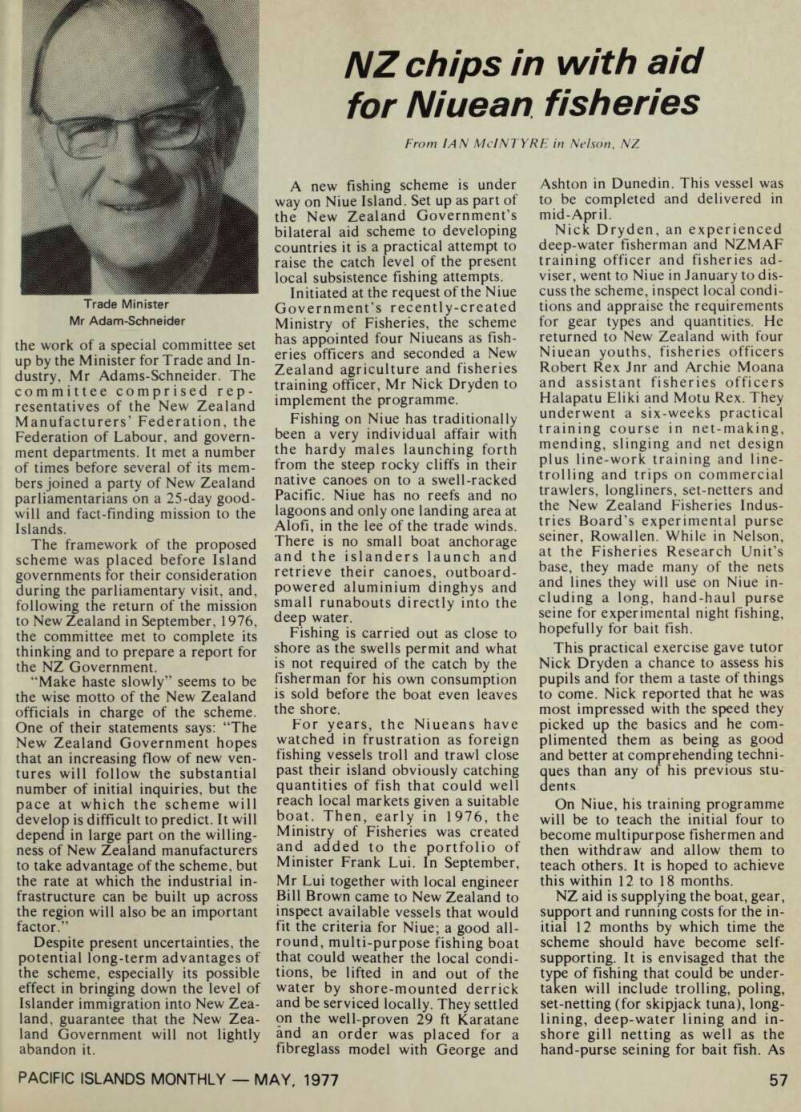
take industry to the Islands
The New Zealand Government’s Pacific Islands Industrial Develop ment Scheme is gingerly taking its first steps, with three or four ven tures tentatively expected to be es tablished in its first year.
The scheme, announced by the government in November, 1976. aims at encouraging New Zealand based companies to set up approved manufacturing operations in Fiji, Tonga, Western Samoa, the Cook Islands and Niue. It offers com panies a range of financial induce ments, including interest-free loans (which convert to grants if the ven tures are still operating five years after they are set up), assistance with up to 50% of the cost of labour training programmes, feasibility stu dies, and the transfer of key per sonnel and equipment from New Zealand.
If the venture ceases operating, or moves from the Island nation in which it was established within five years of the assistance being pro vided. or fails to meet other condi tions set at the time the loan was ap proved. the loan will become re payable and will bear interest from the time of closure or movement un til repayment.
Applications for assistance under the scheme are assessed in accor dance with a number of criteria, in cluding the following: • The value of the venture to the Island economy, taking into account the use of local resources, employ ment creation, the value of the labour skills acquired, the extent of local equity and management par ticipation. and other factors. • The extent to which the ven ture needs assistance and incentives to be provided by New Zealand.
The amount of incentive to be pro vided will depend on the extent to which the venture is disadvantaged by features of the commercial en vironment. such as infrastructural shortcomings. • The desirability of attracting a venture to a particular Island location it may be necessary to provide greater incentives to attract ventures to some Islands than to others.
• The need to maintain rational industrial development within the Islands. • The provision of special access to the New Zealand market will be regarded as a form of assistance, and the provision of incentives may be adjusted accordingly.
• The need to prevent undue dis ruption to production and employ ment in New Zealand. • The extent to which en vironmental aspects of ventures are satisfactory.
The Pacific Islands Industrial Development Scheme stems from
the work of a special committee set up by the Minister for Trade and In dustry, Mr Adams-Schneider. The committee comprised rep resentatives of the New Zealand Manufacturers’ Federation, the Federation of Labour, and govern ment departments. It met a number of times before several of its mem bers joined a party of New Zealand parliamentarians on a 25-day good will and fact-finding mission to the Islands.
The framework of the proposed scheme was placed before Island governments for their consideration during the parliamentary visit, and, following the return of the mission to New Zealand in September, 1976, the committee met to complete its thinking and to prepare a report for the NZ Government.
“Make haste slowly” seems to be the wise motto of the New Zealand officials in charge of the scheme.
One of their statements says; “The New Zealand Government hopes that an increasing flow of new ven tures will follow the substantial number of initial inquiries, but the pace at which the scheme will develop is difficult to predict. It will depend in large part on the willing ness of New Zealand manufacturers to take advantage of the scheme, but the rate at which the industrial in frastructure can be built up across the region will also be an important factor.”
Despite present uncertainties, the potential long-term advantages of the scheme, especially its possible effect in bringing down the level of Islander immigration into New Zea land, guarantee that the New Zea land Government will not lightly abandon it.
Trade Minister Mr Adam-Schneider
NZ's Island trade makes
a big jump in 13 years
In the 13 years from 1963 to 1976, the value of New Zealand’s exports to the Pacific Islands in creased more than fivefold from SNZIS million to SNZ76 million.
These figures put the Elands among New Zealand’s top iO ex port markets.
Imports from the Islands have also risen sharply in recent years: from SNZ2O million in the year ended June, 1973. to nearly SNZ42 million in the year ended June, 1976.
The principal buyer of New Zealand exports is Fiji, which, with purchases worth 5NZ26.7 million in die year ended June, 1976, took almost a third of total NZ exports to the region. The major commodities bought by Fiji are meat, fruit and vegeta bles, dairy products, pulp and paper, non-metallic manufac tures and machinery.
Food, building materials and manufactures also constitute NZ export items to the other Pacific Islands. The pattern of NZ ex ports to these countries has been largely foodstuffs, but with a wide range of raw materials and manufactured goods making up an increasing percentage.
Imports from the area are pat terned on one main product per country. Imports from Fiji are principally sugar, from Nauru, the (Albert Islands and Tuvalu mainly phosphate, from Western Samoa and Niue largely copra, from Papua New Guinea coffee and from the Solomon Islands hard woods.
However, in the case of the Cook Islands, imports have largely been of canned fruit and fruit Juice, bananas and, to a lesser extent, clothing (men’s shorts and shirts).
NZ has made a considerable effort to assist stablisation of the banana export industry of the Cook Islands, Western Samoa and Tonga.
A recent statement by the New Zealand Department of Trade and Industry makes the follow ing comment on the background to the growth in Islands trade: "Although New Zealand's ex ports and imports from the indi vidual Pacific Islands are not large in terms of New Zealand's total trade, the Islands are col lectively of significant and grow ing importance.
"For many years potential New Zealand exporters to the region were deterred by the small size of the scattered Island markets, the low incomes and the relatively unsophisticated re quirements of the people, the lack of harbour and airport facilities, and perhaps by their own diffidence in seeking other than traditional markets for their goods.
"However, likely British entry to the European Eco nom ic Community, together with the devaluation of the New Zealand dollar in 1967, stimulated the search for new markets and led to a rapid growth in exports to non-traditional markets, in cluding the Pacific Islands".
Advertisements & other items, p. 56 (1 item)
International Beer
ft ■ ■ m 1 ■ 1 "■ Hi! i m I mm m m & B m 7 1 MB f
The
From New Zealand
The Export Division of New Zealand Breweries Limited P.O. Box 23 Auckland, New Zealand.
Cables Breweries" Auckland. Telex NZ2980 Telephone 78-840
NZ chips in with aid
for Niuean fisheries
From lAN McINTYRF in Nelson, NZ.
A new fishing scheme is under way on Niue Island. Set up as part of the New Zealand Government’s bilateral aid scheme to developing countries it is a practical attempt to raise the catch level of the present local subsistence fishing attempts.
Initiated at the request of the Niue Government’s recently-created Ministry of Fisheries, the scheme has appointed four Niueans as fish eries officers and seconded a New Zealand agriculture and fisheries training officer, Mr Nick Dryden to implement the programme.
Fishing on Niue has traditionally been a very individual affair with the hardy males launching forth from the steep rocky cliffs in their native canoes on to a swell-racked Pacific. Niue has no reefs and no lagoons and only one landing area at Alofi, in the lee of the trade winds.
There is no small boat anchorage and the islanders launch and retrieve their canoes, outboard powered aluminium dinghys and small runabouts directly into the deep water.
Fishing is carried out as close to shore as the swells permit and what is not required of the catch by the fisherman for his own consumption is sold before the boat even leaves the shore.
For years, the Niueans have watched in frustration as foreign fishing vessels troll and trawl close past their island obviously catching quantities of fish that could well reach local markets given a suitable boat. Then, early in 1976, the Ministry of Fisheries was created and added to the portfolio of Minister Frank Lui. In September, Mr Lui together with local engineer Bill Brown came to New Zealand to inspect available vessels that would fit the criteria for Niue; a good all round, multi-purpose fishing boat that could weather the local condi tions, be lifted in and out of the water by shore-mounted derrick and be serviced locally. They settled pn the well-proven 29 ft Karatane and an order was placed for a fibreglass model with George and
Ashton in Dunedin. This vessel was to be completed and delivered in mid-April.
Nick Dryden, an experienced deep-water fisherman and NZMAF training officer and fisheries ad viser, went to Niue in January to dis cuss the scheme, inspect local condi tions and appraise the requirements for gear types and quantities. He returned to New Zealand with four Niuean youths, fisheries officers Robert Rex Jnr and Archie Moana and assistant fisheries officers Halapatu Eliki and Motu Rex. They underwent a six-weeks practical training course in net-making, mending, slinging and net design plus line-work training and line trolling and trips on commercial trawlers, longliners, set-netters and the New Zealand Fisheries Indus tries Board’s experimental purse seiner, Rowallen. While in Nelson, at the Fisheries Research Unit’s base, they made many of the nets and lines they will use on Niue in cluding a long, hand-haul purse seine for experimental night fishing, hopefully for bait fish.
This practical exercise gave tutor Nick Dryden a chance to assess his pupils and for them a taste of things to come. Nick reported that he was most impressed with the speed they picked up the basics and he com plimented them as being as good and better at comprehending techni ques than any of his previous stu dents On Niue, his training programme will be to teach the initial four to become multipurpose fishermen and then withdraw and allow them to teach others. It is hoped to achieve this within 12 to 18 months.
NZ aid is supplying the boat, gear, support and running costs for the in itial 12 months by which time the scheme should have become self supporting. It is envisaged that the type of fishing that could be under taken will include trolling, poling, set-netting (for skipjack tuna), long lining, deep-water lining and in shore gill netting as well as the hand-purse seining for bait fish. As
this is the first organised attempt at catching quantities of fish off Niue, Nick is also taking over a variety of nets and gear to test under local conditions. The emphasis will be on pelagic fishing but all types of fish will be taken including shark. It is hoped to develop a protein sup plement scheme whereby sharks and any waste fish will be prepared for pig food, and experiments will be carried out to find an acceptable method of presentation.
With the new Karatane, a variety of nets and lines made and slung by themselves and under the guidance of an enthusiastic professional the new Niuean fisheries team should produce some interesting and worthwhile additions to their island’s economy and diet.
And Nick Dryden, his wife and weeks-old baby daughter are look ing forward to a seiner pace of liv ing for a couple of years.
Advertisements & other items, p. 58 (1 item)
Nfullswing
m m % m mm * m m
OUR FACTORY
New Zealand is blessed with bountiful natural resources ideal for the production of quality livestock. Our temperate climate and year-round grazing have built for us an unmatched reputation in practically every country of the world.
We at Hellaby's are proud of our hundred year history as exporters of prime New Zealand beef, lamb and processed meats.
Proud to be meeting the needs of our most exacting customer.
Hellaby's look forward to the continuation of what has become an important New Zealand tradition. With a factory floor of sixty six million acres we have plenty of room to grow.
R. & W. Hellaby Limited P.O. Box 2193 Auckland New Zealand
HELLABY
n
New Zealand looks to booming

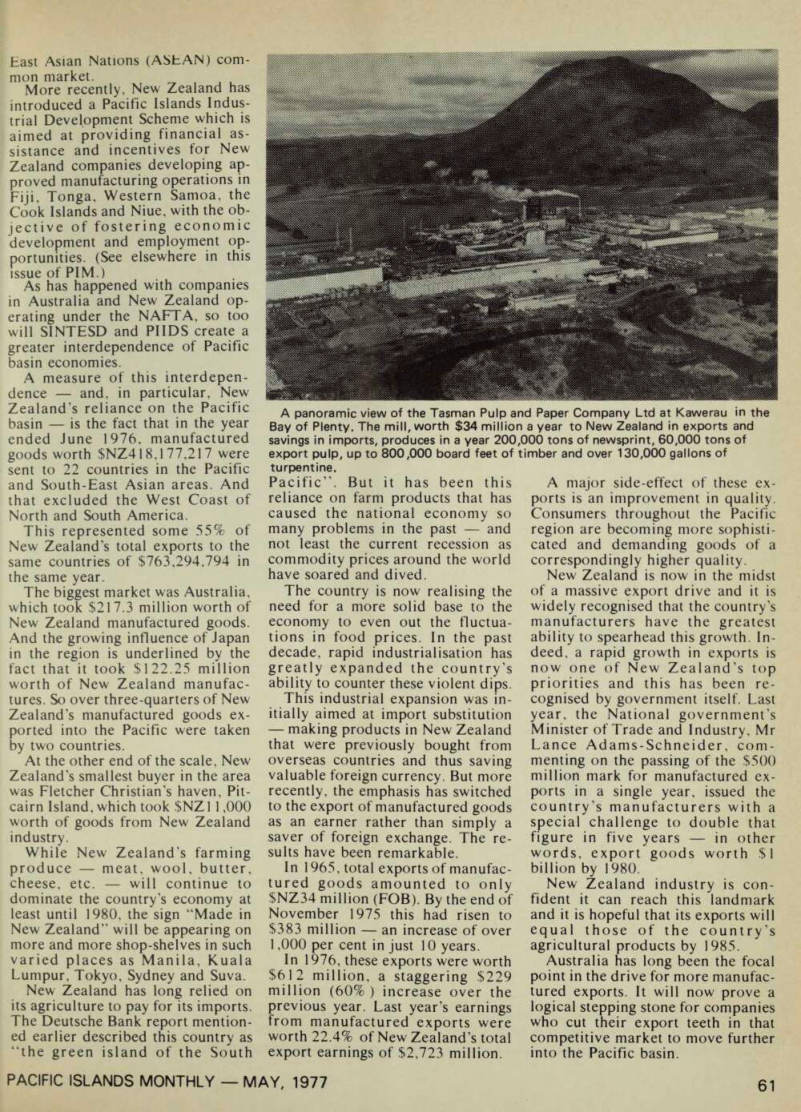
future in Pacific trade
By Allan Parker,
Public Relations and Economic Services Division, New Zealand Manufacturers’ Federation
Economic and social trends indicate that within the next 20 years before the close of this century the Pacific basin will have become the world’s largest trading region. Its potential importance was underlined recently by the release of a detailed report by one of Europe’s most influential banks. West Germany’s Deutsche Bank.
The bank considered the Pacific basin as the region with the greatest growth potential and pointed out that: • already, half the world’s na tional product is created in Pacific basin countries, • these same countries order one third of all world imports; • nearly 40% of the world’s population lives in this region.
The Deutsche Bank report also noted that in the past the countries with the strongest economies (Japan and the United States primarily) had benefited the most. But it expected that all countries in the region could expect to benefit to a much greater degree in the future, particularly
with an increasingly sophisticated
transport system for shipment of foods across the vast Pacific ocean distances involved.
New Zealand, one of the smaller
countries on the rim of the basin, can expect to be included among these as trading has always been the life-blood of the nation.
New Zealand on a per capita basis is in the top league of international traders.
The following comparison on a per capita basis illustrates this; New Zealand SUS2,OOO, Japan
$U51,046, Usa Susi,Ooo, Uk
$U51,750.
New Zealand’s prominence in the region has grown rapidly, spurred by rapid industrial development and a dramatic surge in manufac tured exports to complement its tra ditional agricultural exports.
Over the past decade there has been a significant redirection of NZ’s international trade.
In 1965 58% of all our trade was with Europe this had dropped to 32% by 1975.
In 1965 34% of all trade was with Pacific basin countries this rose to 51% by 1975 with expectation that this rise will continue.
So there has been a virtually com plete switch in markets in the last *lO years.
The importance of New Zealand in the Pacific basin is highlighted by the fact that the Pacific Basin Econ omic Council meeting will be held in Christchurch in May. The theme, appropriately enough, will be in vestment in the Pacific, with emphasis on energy and food.
New Zealand’s interest in the area can be gauged, too, by the number of new trade agreements coming into force between New Zealand and other countries in the Pacific.
There is, of course, the 10-year old New Zealand-Australia Free Trade Agreement (NAFTA) be tween these two Pacific neighbours.
But more recently there have been two new arrangements made with Pacific countries.
The first is SINTESD the
Agreement for Industrial, Tech nological and Scientific Co-op eration which aims to promote co-operation between businessmen in New Zealand and Singapore in making the best and most efficient use of the technological and other resources each possesses.
The agreement has three main provisions: • a framework for the estab lishment in Singapore and New Zea land of joint commercial ventures based on the resources and tech nological expertise of the two coun tries; • a formal basis for joint com mercial enterprises and develop ment projects in third countries of the South-East Asian region; • a formal basis for scientific co operation, confirming and building on the relationship which already exists between New Zealand’s Department of Scientific and Indus trial Research (DSIR) and the Singapore Institute of Standards and Industrial Research (SISIR).
A comparison of two-way trade between the two countries shows the growing importance of the two countries to each other’s economies.
Last year, two-way trade reached SNZI3O million, a 400% growth in just five years. But New Zealand still accounts for only 1% of Singapore’s total trade and Singapore only 1.5% of New Zea land’s trade.
The advantages of agreements such as SINTESD between countries in the region can best be illustrated by pointing out that Singapore is anxious to build up its industrial base and can, in return, offer New Zealand a new market-place and a geographical stepping stone to other markets.
In addition, closer ties between the two countries will be of benefit to New Zealand as the former joins the proposed Association of South-
East Asian Nations (ASEAN) com mon market.
More recently, New Zealand has introduced a Pacific Islands Indus trial Development Scheme which is aimed at providing financial as sistance and incentives for New
Zealand companies developing ap
proved manufacturing operations in
Fiji, Tonga, Western Samoa, the Cook Islands and Niue, with the ob jective of fostering economic development and employment op portunities. (See elsewhere in this issue of PIM.) As has happened with companies in Australia and New Zealand op erating under the NAFTA, so too will SINTESD and PUDS create a greater interdependence of Pacific basin economies.
A measure of this interdepen dence and, in particular. New Zealand’s reliance on the Pacific basin is the fact that in the year ended June 1976, manufactured goods worth $NZ418,177,217 were sent to 22 countries in the Pacific and South-East Asian areas. And that excluded the West Coast of North and South America.
This represented some 55% of New Zealand’s total exports to the same countries of $763,294,794 in the same year.
The biggest market was Australia, which took $217.3 million worth of New Zealand manufactured goods.
And the growing influence of Japan in the region is underlined by the fact that it took $122.25 million worth of New Zealand manufac tures. So over three-quarters of New Zealand’s manufactured goods ex ported into the Pacific were taken by two countries.
At the other end of the scale. New Zealand’s smallest buyer in the area was Fletcher Christian’s haven, Pit cairn Island, which took SNZII,OOO worth of goods from New Zealand
industry.
While New Zealand’s farming produce meat, wool, butter, cheese, etc. will continue to dominate the country’s economy at least until 1980, the sign “Made in New Zealand” will be appearing on more and more shop-shelves in such varied places as Manila, Kuala Lumpur, Tokyo, Sydney and Suva.
New Zealand has long relied on its agriculture to pay for its imports.
The Deutsche Bank report mention ed earlier described this country as “the green island of the South
Pacific”. But it has been this reliance on farm products that has caused the national economy so many problems in the past and not least the current recession as commodity prices around the world have soared and dived.
The country is now realising the need for a more solid base to the economy to even out the fluctua tions in food prices. In the past decade, rapid industrialisation has greatly expanded the country’s ability to counter these violent dips.
This industrial expansion was in itially aimed at import substitution making products in New Zealand that were previously bought from overseas countries and thus saving valuable foreign currency. But more recently, the emphasis has switched to the export of manufactured goods as an earner rather than simply a saver of foreign exchange. The re sults have been remarkable.
In 1965, total exports of manufac tured goods amounted to only SNZ34 million (FOB). By the end of November 1975 this had risen to $383 million an increase of over 1,000 per cent in just 10 years.
In 1976, these exports were worth $612 million, a staggering $229 million (60%) increase over the previous year. Last year’s earnings from manufactured exports were worth 22.4% of New Zealand’s total export earnings of $2,723 million.
A major side-effect of these ex ports is an improvement in quality.
Consumers throughout the Pacific region are becoming more sophisti cated and demanding goods of a correspondingly higher quality.
New Zealand is now in the midst of a massive export drive and it is widely recognised that the country’s manufacturers have the greatest ability to spearhead this growth. In deed, a rapid growth in exports is now one of New Zealand’s top priorities and this has been re cognised by government itself. Last year, the National government’s Minister of Trade and Industry, Mr Lance Adams-Schneider, com menting on the passing of the $5OO million mark for manufactured ex ports in a single year, issued the country’s manufacturers with a special challenge to double that figure in five years in other words, export goods worth $1 billion by 1980.
New Zealand industry is con fident it can reach this landmark and it is hopeful that its exports will equal those of the country’s agricultural products by 1985.
Australia has long been the focal point in the drive for more manufac tured exports. It will now prove a logical stepping stone for companies who cut their export teeth in that competitive market to move further into the Pacific basin.
A panoramic view of the Tasman Pulp and Paper Company Ltd at Kawerau in the Bay of Plenty. The mill, worth $34 million a year to New Zealand in exports and savings in imports, produces in a year 200,000 tons of newsprint, 60,000 tons of export pulp, up to 800,000 board feet of timber and over 130,000 gallons of turpentine.
Advertisements & other items, pp. 59-62 (2 items)
59
PACIFIC ISLANDS MONTHLY MAY, 1977
NIUEAN FISHERIES
from p. 57
Better baking, all
sbels
ML I Abets__
I Sj
SaoWfelP, Abels ! mr Spunof^^ Abels 'eif Abe |s ,
Abejs
. <s> I 7 i?, j Abel Abate ' .'N- *-, -r/ , ■ -■*''• : * ■>: -
Better baking, all
through the Pacific
begins in this test bakery.
This is Abels Test Bakery in Auckland. Everything we make and export is tested here.
We maintain a comprehensive testing programme throughout the year to ensure that our products give optimum performance under tropical conditions.
That’s why you can use these Abels products with total confidence:
IN MARGARINE
MORAH for cakes and pastry
IN SHORTENINGS
OLEO for general purposes CHEFADE for frying HI-MIX for High-ratio SNOWWHIP for creaming WE MAKE BETTER PRODUCTS SO YOU MAKE BETTER PROFITS Don’t hesitate to get in touch if Abels can help in any way. Write with any enquiries to: Abels Limited, P.O. Box 9573, Auckland, New Zealand.
bels
THE PROFIT IMPROVERS
Rylock
JOINERY AT ITS BEST
Windows
Sliding windows
Awning windows Doors Style slider exterior doors Interior sliding doors Exterior hinged doors Style awning Wardrobe doors sliding Insect screens Hinged window screens Sliding window screens Hinged door screens Sliding door screens Shower doors Hinged side panel doors Folding doors Panel slider doors
Aluminium
Windows &
Doors
PACIFIC MANUFACTURERS Tonga, E. M. Jones Limited; Norfolk Island, John More Limited; Noumea, S.E.T.A.C.; Rarotonga, J. Short Const. Ltd.; Western Samoa, Motor Distributors (Samoa) Ltd.; Tahiti, Ets J. J. Wong; Fiji, AHI Stinson feuam *4 S CD tJ CP ' •• Marshalls Carolines •• Nauru Guinea Ocean Is. "%‘r Gilbert Is.
Solomon Is. EMic# To4e4eu Isi * r ' o Marquees* New Hebrides vj» Wallis v west S 4 AmirkM Sweaa ’* K v New Caledonia • Niue Tonga Norfolk la.
PWcairn Lord Howe Is. vr For information on Dealerships available, write Rylock Co., P.O. Box 11-008, Ellerslie, Auckland, New Zealand.
for old-time gold-seekers
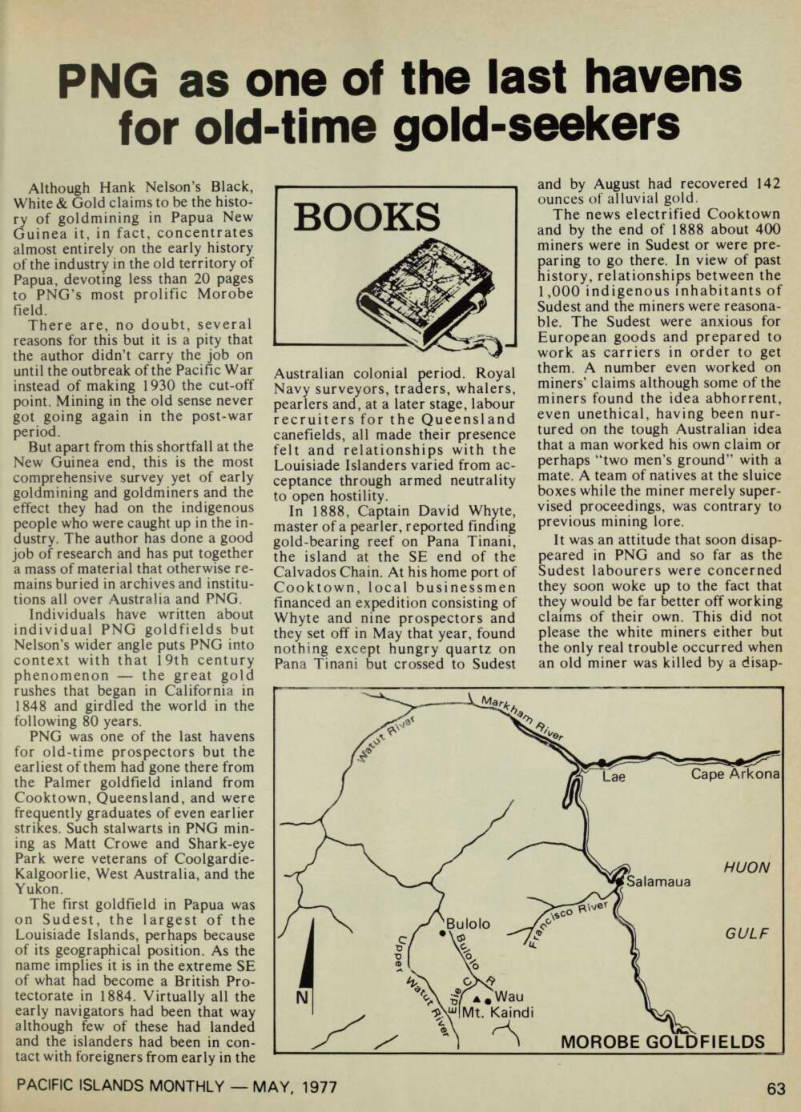

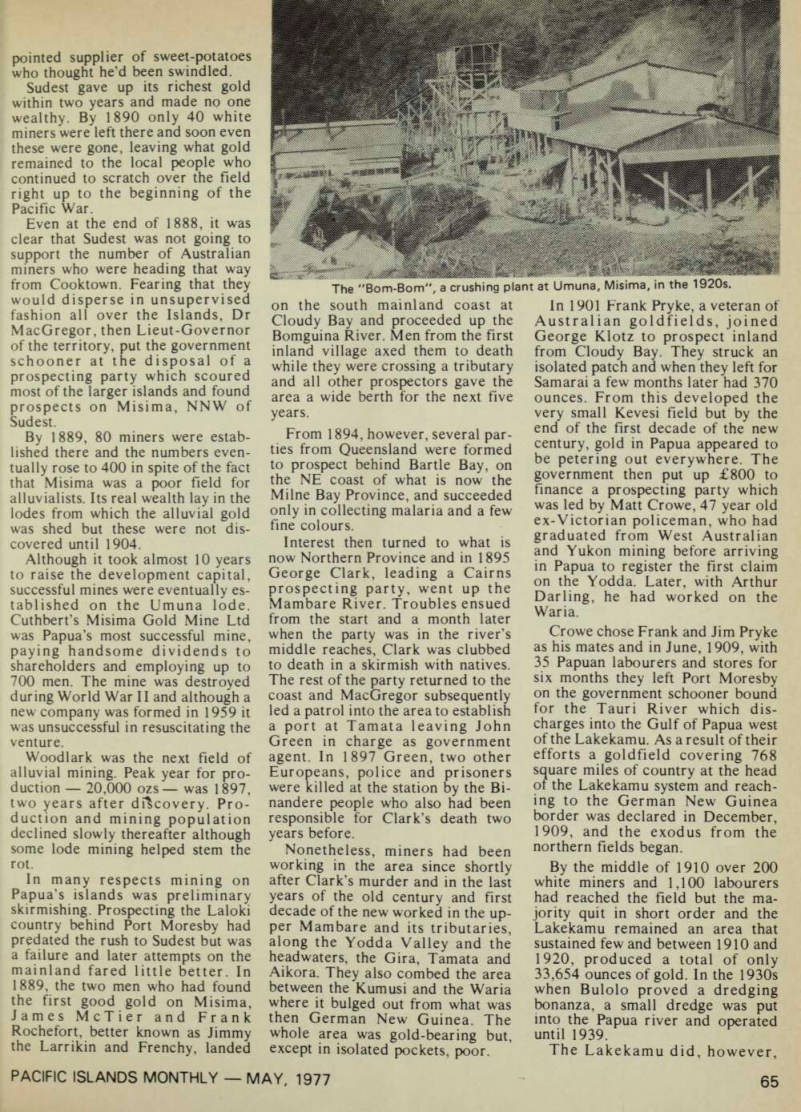
PNG as one of the last havens for old-time gold-seekers
Books
Although Hank Nelson’s Black, White & Gold claims to be the histo ry of goldmining in Papua New Guinea it, in fact, concentrates almost entirely on the early history of the industry in the old territory of Papua, devoting less than 20 pages to PNG’s most prolific Morobe field.
There are, no doubt, several reasons for this but it is a pity that the author didn’t carry the job on until the outbreak of the Pacific War instead of making 1930 the cut-off point. Mining in the old sense never got going again in the post-war
period.
But apart from this shortfall at the New Guinea end, this is the most comprehensive survey yet of early goldmining and goldminers and the effect they had on the indigenous people who were caught up in the in dustry. The author has done a good job of research and has put together a mass of material that otherwise re mains buried in archives and institu tions all over Australia and PNG.
Individuals have written about individual PNG goldfields but Nelson’s wider angle puts PNG into context with that 19th century phenomenon the great gold rushes that began in California in 1848 and girdled the world in the following 80 years.
PNG was one of the last havens for old-time prospectors but the earliest of them had gone there from the Palmer goldfield inland from Cooktown, Queensland, and were frequently graduates of even earlier strikes. Such stalwarts in PNG min ing as Matt Crowe and Shark-eye Park were veterans of Coolgardie- Kalgoorlie, West Australia, and the Yukon.
The first goldfield in Papua was on Sudest, the largest of the Louisiade Islands, perhaps because of its geographical position. As the name implies it is in the extreme SE of what had become a British Pro tectorate in 1884. Virtually all the early navigators had been that way although few of these had landed and the islanders had been in con tact with foreigners from early in the
Australian colonial period. Royal Navy surveyors, traders, whalers, pearlers and, at a later stage, labour recruiters for the Queensland canefields, all made their presence felt and relationships with the Louisiade Islanders varied from ac ceptance through armed neutrality to open hostility.
In 1888, Captain David Whyte, master of a pearler, reported finding gold-bearing reef on Pana Tinani, the island at the SE end of the Calvados Chain. At his home port of Cooktown, local businessmen financed an expedition consisting of Whyte and nine prospectors and they set off in May that year, found nothing except hungry quartz on Pana Tinani but crossed to Sudest
and by August had recovered 142 ounces of alluvial gold.
The news electrified Cooktown and by the end of 1888 about 400 miners were in Sudest or were pre paring to go there. In view of past
history, relationships between the
1,000 indigenous inhabitants of Sudest and the miners were reasona ble. The Sudest were anxious for European goods and prepared to work as carriers in order to get them. A number even worked on miners’ claims although some of the miners found the idea abhorrent, even unethical, having been nur tured on the tough Australian idea that a man worked his own claim or perhaps “two men’s ground’’ with a mate. A team of natives at the sluice boxes while the miner merely super vised proceedings, was contrary to previous mining lore.
It was an attitude that soon disap peared in PNG and so far as the Sudest labourers were concerned they soon woke up to the fact that they would be far better off working claims of their own. This did not please the white miners either but the only real trouble occurred when an old miner was killed by a disap-
pointed supplier of sweet-potatoes who thought he’d been swindled.
Sudest gave up its richest gold within two years and made no one wealthy. By 1890 only 40 white miners were left there and soon even these were gone, leaving what gold remained to the local people who continued to scratch over the field right up to the beginning of the Pacific War.
Even at the end of 1888, it was clear that Sudest was not going to support the number of Australian miners who were heading that way from Cooktown. Fearing that they would disperse in unsupervised fashion all over the Islands, Dr MacGregor, then Lieut-Governor of the territory, put the government schooner at the disposal of a prospecting party which scoured most of the larger islands and found prospects on Misima, NNW of Sudest.
By 1889, 80 miners were estab lished there and the numbers even tually rose to 400 in spite of the fact that Misima was a poor field for alluvialists. Its real wealth lay in the lodes from which the alluvial gold was shed but these were not dis covered until 1904.
Although it took almost 10 years to raise the development capital, successful mines were eventually es tablished on the Umuna lode.
Cuthbert’s Misima Gold Mine Ltd was Papua’s most successful mine, paying handsome dividends to shareholders and employing up to 700 men. The mine was destroyed during World War II and although a new company was formed in 1959 it was unsuccessful in resuscitating the venture.
Woodlark was the next field of alluvial mining. Peak year for pro duction 20,000 ozs— was 1897, two years after discovery. Pro duction and mining population declined slowly thereafter although some lode mining helped stem the rot.
In many respects mining on Papua’s islands was preliminary skirmishing. Prospecting the Laloki country behind Port Moresby had predated the rush to Sudest but was a failure and later attempts on the mainland fared little better. In 1889, the two men who had found the first good gold on Misima, James McTier and Frank Rochefort, better known as Jimmy the Larrikin and Frenchy, landed
on the south mainland coast at Cloudy Bay and proceeded up the Bomguina River. Men from the first inland village axed them to death while they were crossing a tributary and all other prospectors gave the area a wide berth for the next five years.
From 1894, however, several par ties from Queensland were formed to prospect behind Bartle Bay, on the NE coast of what is now the Milne Bay Province, and succeeded only in collecting malaria and a few fine colours.
Interest then turned to what is now Northern Province and in 1895 George Clark, leading a Cairns prospecting party, went up the Mambare River. Troubles ensued from the start and a month later when the party was in the river’s middle reaches, Clark was clubbed to death in a skirmish with natives.
The rest of the party returned to the coast and MacGregor subsequently led a patrol into the area to establish a port at Tamata leaving John Green in charge as government agent. In 1897 Green, two other Europeans, police and prisoners were killed at the station by the Bi nandere people who also had been responsible for Clark’s death two years before.
Nonetheless, miners had been working in the area since shortly after Clark’s murder and in the last years of the old century and first decade of the new worked in the up per Mambare and its tributaries, along the Yodda Valley and the headwaters, the Gira, Tamata and Aikora. They also combed the area between the Kumusi and the Waria where it bulged out from what was then German New Guinea. The whole area was gold-bearing but, except in isolated pockets, poor.
In 1901 Frank Pryke, a veteran of Australian goldfields, joined George Klotz to prospect inland from Cloudy Bay. They struck an isolated patch and when they left for Samarai a few months later had 370 ounces. From this developed the very small Kevesi field but by the end of the first decade of the new century, gold in Papua appeared to be petering out everywhere. The government then put up £BOO to finance a prospecting party which was led by Matt Crowe, 47 year old ex-Victorian policeman, who had graduated from West Australian and Yukon mining before arriving in Papua to register the first claim on the Yodda. Later, with Arthur Darling, he had worked on the Waria.
Crowe chose Frank and Jim Pryke as his mates and in June, 1909, with 35 Papuan labourers and stores for six months they left Port Moresby on the government schooner bound for the Tauri River which dis charges into the Gulf of Papua west of the Lakekamu. As a result of their efforts a goldfield covering 768 square miles of country at the head of the Lakekamu system and reach ing to the German New Guinea border was declared in December, 1909, and the exodus from the northern fields began.
By the middle of 1910 over 200 white miners and 1,100 labourers had reached the field but the ma jority quit in short order and the Lakekamu remained an area that sustained few and between 1910 and 1920, produced a total of only 33,654 ounces of gold. In the 1930 s when Bulolo proved a dredging bonanza, a small dredge was put into the Papua river and operated until 1939.
The Lakekamu did, however,
The "Bom-Bom", a crushing plant at Umuna, Misima, in the 1920s.
maintain the men who were to even tually open up the rich Morobe field on the other side of the mountains and which had tantalised ex perienced miners from the time they first entered Yodda, Gira and Lakekamu fields. They were pre vented from putting their idea to the test, firstly, by the impossibility of maintaining supply lines in country virtually untouched by Europeans and peopled by hostile natives and, secondly, by tne fact that the Ger man administration was determined to keep mineral rights out of foreign hands although right up to the end of their period in NG they had done little in the way of gold search and nothing in the way of exploitation.
According to Nelson, Frank Pryke, at one time, considered becoming a naturalised German in order to explore the Watut- Markham country but, generally, a state of stalemate prevailed while men washed a bare living from the creeks and rivers that fed the Lakekamu.
Among those who did more than theorise about the gold beyond the German border was Arthur Darling who, in late 1909, prospected the Markham and Watut until forced to retreat through lack of food, malaria and a spear wound. He died as a result of these experiences in 1911.
In 1912 a party consisting of Matt Crowe, William (Shark-eye) Park, James Preston and Edward Auer bach prospected the Markham but their only discovery was to confirm the fierceness of the local natives.
There have been suggestions that Preston returned to the area in 1914 and that Darling or Preston actually washed good gold at what was later Koranga Creek but this had never been confirmed.
Although an Australian ex peditionary force took over German New Guinea in 1914, a Mandate from the League of Nations did not come into force until 1921 and two more years went by before a mining ordinance came into effect and Australian diggers could legally op erate.
It was found that two men had jumped the gun and had been wash ing gold at Koranga Creek which ran into the Upper Bulolo before it plunges into a gorge. They were Shark-eye Park, who had got his first sniff of the country 10 years before and John Nettleton, an ex-
member of the expeditionary force who had returned to set up a trade store on the Huon Gulf. He left the store in someone else’s care and joined Park in 1922. In 1923, they emerged to register their claims and bring out the gold they had accumu lated from a year’s work. It was more than could have been expected from several lifetimes on Yodda or Lakekamu.
In spite of this, no rush developed, partly because the ranks of Papua’s prospectors had been thinned in the war years, partly because of the remoteness and difficulty of the country at the head of the Bulolo.
Some old stalwarts of the Papuan fields who had been battling from one miserable creek to another for 20 years, including Frank Pryke, Les Joubert, Joe Sloane and George Arnold, were fairly early arrivals at the new find but even at the end of 1925 the number of men working above Bulolo Gorge could be counted on two hands. It was not un til the discovery of even better gold in the upper reaches of Edie Creek, which joined the Bulolo below the Koranga, that the situation changed.
A rush of sorts began although in comparison with the rushes of California, Australia and the Klon dike, each of which involved scores of thousands of individuals, what occurred in Morobe in the 1920 s was a dawdle not a rush.
At the end of 1926 there were 200-odd miners on the field and in 1932, after air transport had super seded the six days’ agony of the Salamaua-Edie track, and the first dredges were working, miners still numbered less than 500.
Morobe gold was of poor quality and on average brought less than £3 per ounce in the early years but a team could wash out up to 80 ounces a day on Koranga and a claim on the Edie could produce as much in a day as the best Lakekamu claims could in a year.
By the outbreak of World War 11, gold from Morobe was worth over £3 million a year big money in those days. It helped to keep the Territory financially afloat and at no cost to the Australian taxpayer.
It is interesting to speculate on what the old Territory of New Guinea would have been like if the Morobe deposits had not been dis covered until after World War II in stead of after World War I; or what would have happened if the Ger mans, who had been in their Ter ritory since 1 883, has produced prospectors and miners on the same scale as Australia instead of concen trating almost entirely on planters and traders.
In comparison with the detail in which he describes the history of the several Papua fields, Nelson’s chapter on Morobe is brief and fairly superficial, possibly because the big developments in air transportation and large-scale dredging after 1927 are fairly well documented and are, in any event, in a different dimension.
Black, White & Gold is, nonethe less, an excellent account of a phase of PNG history that covered half a century and is never likely to be re peated. The fact that the author has put equal emphasis on the reactions of the indigenous people who were touched by this alien industry pro vides perspective that most other PNG mining accounts lack.
The book is illustrated with some old photographs and line drawings.
There are production and other ta bles and 15 maps which are simple and are adequate for those blessed with good sight. All those who are not are recommended to equip themselves with a good magnifying glass to ease the reading of some of
the place names.
Judy Tudor
(BLACK, WHITE & GOLD. By H. N. Nelson.
Published by Australian National University Press, PO Box 4, Canberra, ACT $8.95 (paper), $16.95 (cloth).)
The last three permanent residents at Edie Creek, from left, George (Scotty Suther land) and Stella and Ned Partridge, pictured in the 1960s. -Photo: M. R. Hayes
Advertisements & other items, pp. 64-68 (1 item)
Mealing
The
Classic
Grape
of the
Rhine
is the supreme exam
Mealing
y waiter
VINTAGE
ESTATE BOTTLED
sRv. m AS* vm
yluanprlßifslin?
The Sylvaner Riesling Kample of the viticulture of tne Rhine, the vines of which made possible this truly magnificent grape.
Corbans Sylvaner Riesling has the characteristic delicacy of the Rhineland grape, a round, fruity flavour, yet infinitely fine and full of subtlety.
CORBANS
Vignerons Cellarers and Shippers of fine wines for over 70 years
COOKERS
IBBj
Topline‘D’ Autoline ‘D’
Valiant Timeline Benchline
LAUNDRY
□ a \ Washing Machine Drier
Champion
Appliances
A completely new range of cookers and laundry equipment with unique features designed for easier and better cooking and cleaning.
TRADE ENQUIRIES WELCOME.
I am interested in your Champion appliances Please direct me to your nearest stockist.
NAME
ADDRESS
Export Division Radiation N.Z. Ltd Jutland ST Dunedin New Zealand. Telex N.Z. 5289.
ACE
AUTOMOTIVE PRODUCTS
NEW ZEALAND’S leading range of car care products and exhaust systems.
ACE} CAR CARE PRODUCTS
lACE} \
, 4 glmrcrywAX, ACE Glitter Wax, Liquid and Cream Car Polish. Based on a proven European formula using micro-waxes containing two silicones to give your car a longer lasting, longer working polish.
ALUMINIZED SILENCERS
• Manufactured from the finest Aluminized steel. • Designed to the World’s Best Specifications • Triple flow reduces back pressure • Quieter performance • Lightweight - less strain on the support brackets. • Exclusive ACE double-ended construction prevents pipe breakaway.
ENQUIRIES TO: EXPORT DEPT. E. W. PIDGEON & CO. LTD.
HEAD OFFICE. BOX 8837
SYMONDS STREET, AUCKLAND, NEW ZEALAND.
CAXTON PRINTING WORKS
LIMITED
MANUFACTURERS AND SUPPLIERSOF
• TOILETAND FACIALTISSUE* PAPER TOWELS
• PAPER BAGS • SERVIETTES
• BABYCARE PRODUCTS • BUSINESS MACHINE ROLLS
• TELEX ROLLS
• OTHER DISPOSABLE PAPER PRODUCTS
EXPORT SALES DIVISION
P.O. BOX 3844 AUCKLAND NEW ZEALAND
PHONEAUCKLAND3I 579
TELEX NZ2422 CABLE CAXSALES AUCKLAND.
New Zealand tick?
Who cares what makes New Zealand tick?
Anyone with any doubts about the national characteristics of the New Zealanders can now read about them in The Passionless People. In it the author, Gordon McLauchlan, a fourth generation Kiwi himself, operating from some olympian height, sets about the psyche of his countrymen with a metaphorical machete and leaves it without a shred of virtue.
As such, what he says has certain elements of inverted superiority complex. Who are these monumen tal dullards that they warrant a 200odd page book about them? Who outside New Zealand cares what makes 3 1 / 2 million New Zealanders tick?
According to McLauchlan they aren’t, as they think, contented peo ple living in a green and sunlit land but a mob of “smiling Zombies”; unhappy, unsure of themselves culturally constipated, as it were, because migration has come entirely from the British Isles instead of (like Australia) from middle and southern Europe, Middle East and even Latin America. Furthermore, there were too many canny Scots amongst the early settlers and their horrible influence is still being felt, five generations on.
We are told that NZ society is materialistic and bemused by statistics. People are carried away by the thought that the New Zealander is, per capita, the world’s biggest meat eater, butter eater, sugar comsumer, milk drinker, beer drinker, etc. Their conception of God is said to be a “South Canter bury sheep farmer with a diploma of farm machinery from Lincoln Col lege, who plays senior in the Rugby scrum and gets pissed with the boys but never with strangers”.
A lot of Kiwis suffer, McLauchlan thinks, from sexual hangups (could it be because of a dearth of those Latin Americans and Southern Europeans?) but “ ... the divorce rate is still relatively low. It is believed that the New Zealand wife lasts such a long time as a sex partner because she has so few mov ing parts ...”
Other New Zealander faults in clude the facts that they drink too much, take too many pills, make good soldiers but are moral cowards, are ultra-conservative and probably racist. When in doubt about anything they set up a com mittee or call a general meeting; and they prostrate themselves in admira tion of the medical profession which sits firmly at the top of the social totem-pole.
“In New Zealand,” the author says, “the scapel is mightier than the pen, sword, orb and sceptre too ...
Here he is the subject of fawning social adulation. I think the most likely reason is that in NZ the doc tor is the perfect shining example of the things New Zealanders most ad mire superficial cleverness, con formity and money.”
The list of Kiwi shortcomings is endless; quotes from psychiatrists, social workers, poets, politicians, novelists, professors of this and that, even doctors, are given at length to reinforce the proposition that they are a despicable and hopeless lot.
Virtues, if any, are not mentioned.
The Passionless People may enrage a few Kiwis but nationally it is hardly likely to bring about a metamorphosis in the New Zealand way of life. Foreigners, if they aren’t
bored by it, will probably reflect that there also could go a Brit, a Pom, a Yank or an Aussie.
Uniquely for anyone living on the eastern side of the Tasman Sea, the author seems to see virtue in the way Australians do things. In this, by in ference, he even goes to the length of thinking that a new and virile culture is developing a fact denied by his Australian opposite numbers who exhort Aussies to forgot their beach-bumming, beer swilling, horse-racing preoccupa tions and get off their collective backsides, or else.
Gordon Maclauchlan has been a journalist for 25 years during which time he has had a multiplicity of jobs, including, at one time, being editor of the New Zealand Journal of Agriculture which can hardly be said to be anything but attached to the Establishment. Perhaps that’s what soured him.
He is best known now for his humorous column in the New Zea land Herald’s Saturday edition and no doubt he has sufficient fans to take the book in the spirit in which it maybe, was meant; Not too seriously. Judy Tudor.
(The Passionless People By Gordon
McLauchlan. Published by Cassell, New Zea land. 1NZ6.95.)
Advertisements & other items, pp. 69-70 (1 item)
The Modulock System.
A unique building method.
SB Modulock is a high quality, low maintenance building system. It allows an infinite variety of designs ideal for homes, offices, schools indeed all low rise buildings.
Modulock is quick to deliver and assemble, low on labour, compact, easy to ship and particularly suited to conditions in the Pacific: For further information contact
MODULOCK
Modulock (N.Z.) Limited, P.O. Box 51-099, Pakuranga, Auckland, New Zealand.
Telephone 47-069 Papatoetoe, Telex N.Z. 2290-
mltchett
LIFEJACKETS
BUOYANCY VEST, WATER
SKI JACKETS ETC.
SOLE NEW ZEALAND
MANUFACTURER
AND DISTRIBUTING
AGENT
m.ibmmt mm
CAMPING, STOVES
LIGHTS, HANDYMANS
KITS IN BUTANE AND PROPANE
ALLAN G. MITCHELL NZ LTD.
DRIUJH
PRIVATE BAG
AUCKLAND Ni.
f )
HAKG
TEN
FISHING
RODS, REELS
& MONOFILAMENT
FISHING LINE
EXPORTERS TO THE PACIFIC!
ENQUIRIES WELCOMED
SURF, BEACH,
SPORTWEAR AND
LEISUREWEAR
Glassmakers
to the
Pacific
Bottles by the million - wine, beer, soft drink. Glass containers in hundreds of shapes and sizes. New Zealand Glass Manufacturers can do it!
We offer glass container design and technical design facilities, mould manufacturing, custom packaging and end use cartons. New Zealand Glass Manufacturers, glassmakers to the Pacific.
For further information contact. r/mn New Zealand Glass Manufacturers Company Private Bag, Auckland.
NEW ZEALAND.
XGMB
Purari River power
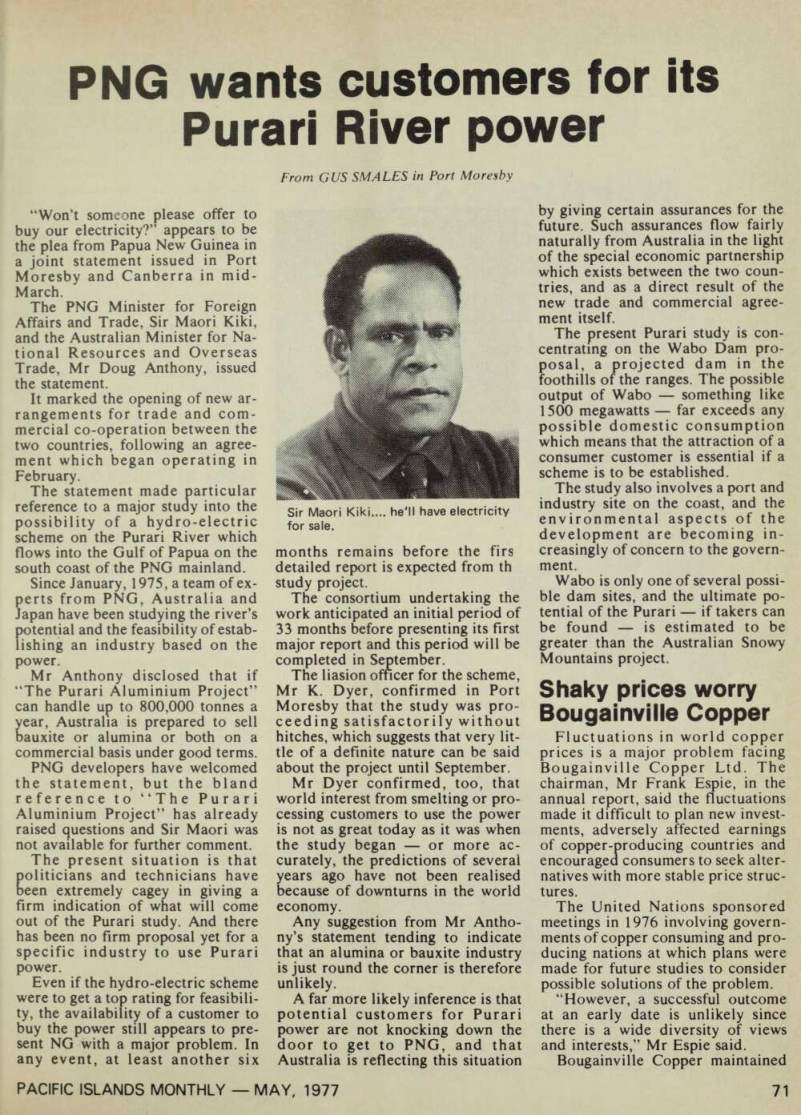

PNG wants customers for its Purari River power
From GUS SMALES in Port Moresby
“Won’t someone please offer to buy our electricity?” appears to be the plea from Papua New Guinea in a joint statement issued in Port Moresby and Canberra in mid- March.
The PNG Minister for Foreign Affairs and Trade, Sir Maori Kiki, and the Australian Minister for Na tional Resources and Overseas Trade, Mr Doug Anthony, issued the statement.
It marked the opening of new ar rangements for trade and com mercial co-operation between the two countries, following an agree ment which began operating in February.
The statement made particular reference to a major study into the possibility of a hydro-electric scheme on the Purari River which flows into the Gulf of Papua on the south coast of the PNG mainland.
Since January, 1975, a team of ex perts from PNG, Australia and Japan have been studying the river’s potential and the feasibility of estab lishing an industry based on the power.
Mr Anthony disclosed that if “The Purari Aluminium Project” can handle up to 800,000 tonnes a year, Australia is prepared to sell bauxite or alumina or both on a commercial basis under good terms.
PNG developers have welcomed the statement, but the bland reference to “The Purari Aluminium Project” has already raised questions and Sir Maori was not available for further comment.
The present situation is that Politicians and technicians have een extremely cagey in giving a firm indication of what will come out of the Purari study. And there has been no firm proposal yet for a specific industry to use Purari power.
Even if the hydro-electric scheme were to get a top rating for feasibili ty, the availability of a customer to buy the power still appears to pre sent NG with a major problem. In any event, at least another six
months remains before the firs detailed report is expected from th study project.
The consortium undertaking the work anticipated an initial period of 33 months before presenting its first major report and this period will be completed in September.
The liasion officer for the scheme, Mr K. Dyer, confirmed in Port Moresby that the study was pro ceeding satisfactorily without hitches, which suggests that very lit tle of a definite nature can be said about the project until September.
Mr Dyer confirmed, too, that world interest from smelting or pro cessing customers to use the power is not as great today as it was when the study began or more ac curately, the predictions of several years ago have not been realised because of downturns in the world economy.
Any suggestion from Mr Antho ny’s statement tending to indicate that an alumina or bauxite industry is just round the corner is therefore unlikely.
A far more likely inference is that potential customers for Purari power are not knocking down the door to get to PNG, and that Australia is reflecting this situation
by giving certain assurances for the future. Such assurances flow fairly naturally from Australia in the light of the special economic partnership which exists between the two coun tries, and as a direct result of the new trade and commercial agree ment itself.
The present Purari study is con centrating on the Wabo Dam pro posal, a projected dam in the foothills of the ranges. The possible output of Wabo something like 1500 megawatts far exceeds any possible domestic consumption which means that the attraction of a consumer customer is essential if a scheme is to be established.
The study also involves a port and industry site on the coast, and the environmental aspects of the development are becoming in creasingly of concern to the govern ment.
Wabo is only one of several possi ble dam sites, and the ultimate po tential of the Purari if takers can be found is estimated to be greater than the Australian Snowy Mountains project.
Shaky prices worry
Bougainville Copper
Fluctuations in world copper prices is a major problem facing Bougainville Copper Ltd. The chairman, Mr Frank Espie, in the annual report, said the fluctuations made it difficult to plan new invest ments, adversely affected earnings of copper-producing countries and encouraged consumers to seek alter natives with more stable price struc tures.
The United Nations sponsored meetings in 1976 involving govern ments of copper consuming and pro ducing nations at which plans were made for future studies to consider possible solutions of the problem.
“However, a successful outcome at an early date is unlikely since there is a wide diversity of views and interests,” Mr Espie said.
Bougainville Copper maintained
Sir Maori Kiki... he'll have electricity for sale.
a watching brief on those develop ments, and had exchanged views with the PNG Government. The effect of the fluctuations on the government was reduced by setting up a mineral resources stabilisation fund, which acted as a buffer be tween the variable revenues re ceived by the government from Bougainville Copper. The fund helped to ensure a regular transfer of funds to finance a steady programme of government spend ing.
Mr Espie said the net effect on the company’s overall position follow ing currency changes between the kina and the Australian dollar was favourable.
The managing director, Mr D. C.
Vernon, said that at the end of 1976 reserves of ore were just over 800 million tonnes averaging 0.45% copper and 0.51 gm gold a tonne.
All is not
gold at Vatukoula
Emperor Mines Ltd reported a loss of $486,000 in the six months to December 31, 1976, compared with a profit of $270,000 in the previous corresponding half-year, although in 1975-76 there was an overall loss of $381,857.
In February and March the com pany was plagued with a strike at Vatukoula and this could cause a further loss in the current half-year, even though there had been a steady rise in the price of gold in recent weeks. The directors in a brief com ment on the latest half-year said fac tors which affected earnings were general strikes, resulting in the loss of production, and the substantial drop in the price of gold.
The company carried out a threat to close the mine in February and only re-opened after the Fiji Government guaranteed to provide up to $2 million to offset losses in the next 28 months. During the closure a number of skilled employees found jobs elsewhere and do not want to go back to Vatukoula.
The Emperor chairman, Mr J.
Reid, said if the company could not get sufficient skilled labour it would have to train the workers it already had in the required skills. Emperor has an extensive training program me, covering many tradesmen such as mechanics, electricians and plumbers.
Advertisements & other items, p. 72 (1 item)
And Rolltrays
BAKING TRAYS
AND MUFFIN TINS
AND PIE PLATES
AND CAKE TINS
AND LOAF TINS
AND PATTY TRAYS
AND ROLLTRAYS
AND BAKING DISHES..
And that’s just the beginning of our vast range of fine bakeware and decorated ware, in just about every size and shape you can imagine.
To meet all domestic and commercial requirements.
Durable, attractive. With superior heat conductivity that ensures excellent baking results. Everytime.
We make everything that goes in your oven so that what you make bakes better.
If it’s quality bakeware you want, look for our name.
MSB
W H. Bond & Company A Division of AH I Operations Ltd.
Exporters of fine bakeware throughout the Pacific Islands.
Rarotonga
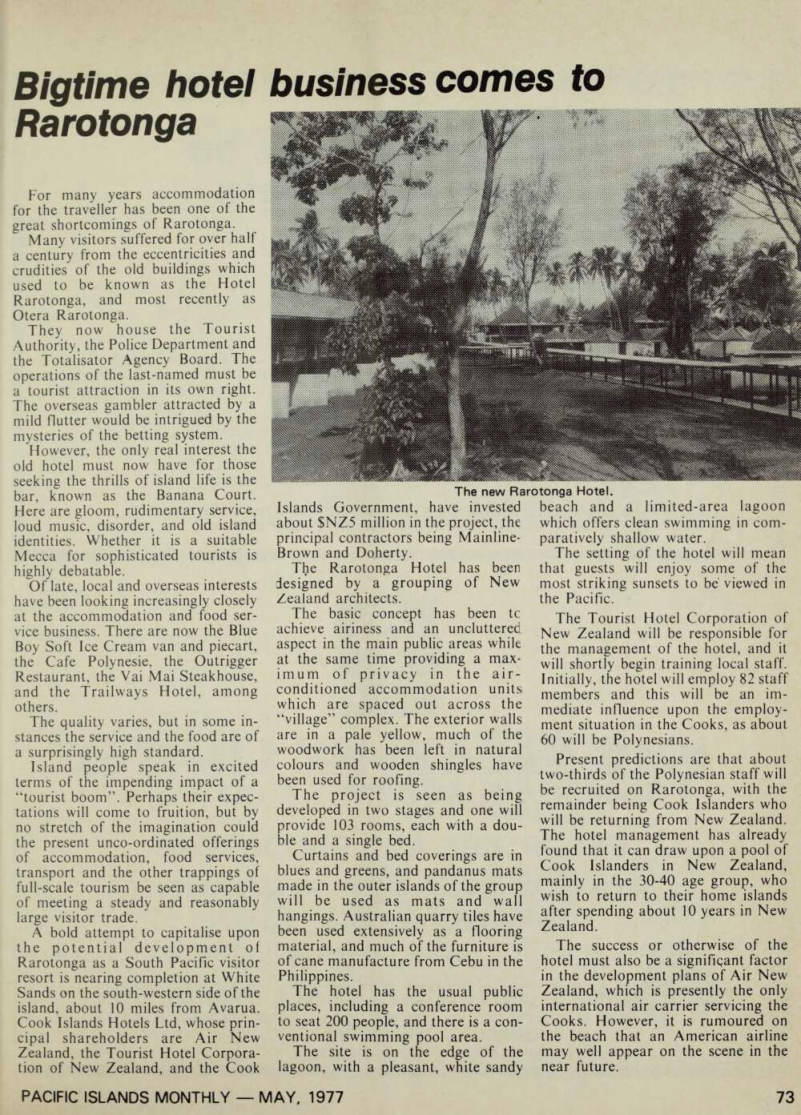
Bigtime hotel business comes to
For many years accommodation for the traveller has been one of the great shortcomings of Rarotonga.
Many visitors suffered for over half a century from the eccentricities and crudities of the old buildings which used to be known as the Hotel Rarotonga, and most recently as Otera Rarotonga.
They now house the Tourist Authority, the Police Department and the Totalisator Agency Board. The operations of the last-named must be a tourist attraction in its own right.
The overseas gambler attracted by a mild flutter would be intrigued by the mysteries of the betting system.
However, the only real interest the old hotel must now have for those seeking the thrills of island life is the bar, known as the Banana Court.
Here are gloom, rudimentary service, loud music, disorder, and old island identities. Whether it is a suitable Mecca for sophisticated tourists is highly debatable.
Of late, local and overseas interests have been looking increasingly closely at the accommodation and food ser vice business. There are now the Blue Boy Soft Ice Cream van and piecart, the Cafe Polynesie, the Outrigger Restaurant, the Vai Mai Steakhouse, and the Trailways Hotel, among others.
The quality varies, but in some in stances the service and the food are of a surprisingly high standard.
Island people speak in excited terms of the impending impact of a “tourist boom”. Perhaps their expec tations will come to fruition, but by no stretch of the imagination could the present unco-ordinated offerings of accommodation, food services, transport and the other trappings of full-scale tourism be seen as capable of meeting a steady and reasonably large visitor trade.
A bold attempt to capitalise upon the potential development of Rarotonga as a South Pacific visitor resort is nearing completion at White Sands on the south-western side of the island, about 10 miles from Avarua.
Cook Islands Hotels Ltd, whose prin cipal shareholders are Air New Zealand, the Tourist Hotel Corpora tion of New Zealand, and the Cook
Islands Government, have invested about SNZS million in the project, the principal contractors being Mainline- Brown and Doherty.
The Rarotonga Hotel has been designed by a grouping of New Zealand architects.
The basic concept has been tc achieve airiness and an uncluttered aspect in the main public areas while at the same time providing a max imum of privacy in the air conditioned accommodation units which are spaced out across the “village” complex. The exterior walls are in a pale yellow, much of the woodwork has been left in natural colours and wooden shingles have been used for roofing.
The project is seen as being developed in two stages and one will provide 103 rooms, each with a dou ble and a single bed.
Curtains and bed coverings are in blues and greens, and pandanus mats made in the outer islands of the group will be used as mats and wall hangings. Australian quarry tiles have been used extensively as a flooring material, and much of the furniture is of cane manufacture from Cebu in the Philippines.
The hotel has the usual public places, including a conference room to seat 200 people, and there is a con ventional swimming pool area.
The site is on the edge of the lagoon, with a pleasant, white sandy
beach and a limited-area lagoon which offers clean swimming in com paratively shallow water.
The setting of the hotel will mean that guests will enjoy some of the most striking sunsets to be' viewed in the Pacific.
The Tourist Hotel Corporation of New Zealand will be responsible for the management of the hotel, and it will shortly begin training local staff.
Initially, the hotel will employ 82 staff members and this will be an im mediate influence upon the employ ment situation in the Cooks, as about 60 will be Polynesians.
Present predictions are that about two-thirds of the Polynesian staff will be recruited on Rarotonga, with the remainder being Cook Islanders who will be returning from New Zealand.
The hotel management has already found that it can draw upon a pool of Cook Islanders in New Zealand, mainly in the 30-40 age group, who wish to return to their home islands after spending about 10 years in New Zealand.
The success or otherwise of the hotel must also be a significant factor in the development plans of Air New Zealand, which is presently the only international air carrier servicing the Cooks. However, it is rumoured on the beach that an American airline may well appear on the scene in the near future.
The new Rarotonga Hotel.
Advertisements & other items, p. 74 (1 item)
Fmc (Meat) Nz Limited
AHI have put the lid
on canning costs
(the collapsed can story)
Collapsed cans are shipped in compacted form before using, the bodies are reformed and flanged, and one end seamed on. The can is now ready for filling.
Advantages of this method of transportation ★ Saves 75% on freight costs ★ Ease of handling ★ Saves storage space ★ Cannery uses its own labour to reform cans. AHI metal containers - open top division offer a full technical advisory service and provides reforming equipment that can be rented for approximately $5OO/$7OO per year. /MW
METAL CONTAINERS (AUCKLAND)
OPEN TOP DIVISION.
ALEX HARVEY METAL CONTAINERS - OPEN TOP DIVISION P O BOX 14-443, PANMURE, AUCKLAND, NEW ZEALAND
o
PMC
FMC (MEAT) NZ LIMITED
FORMERLY E. M. DENNY & CO (NZ) LTD
EXPORTERS AND PRODUCERS
LAMB MUTTON BEEF FANCY MEATS
CARCASS PRIMAL CUTS
Portion packs for retail hotel or institution trades
PROMPT SERVICE FOR ENQUIRIES
ADDRESS: 3 WOLFE ST PHONE 75-739 ANSWER BACK ENZFMC AUCKLAND 1 P.O. BOX 3681 CABLES FATSTOCK
NEW ZEALAND TELEX NZ2310
When you cast your bread on
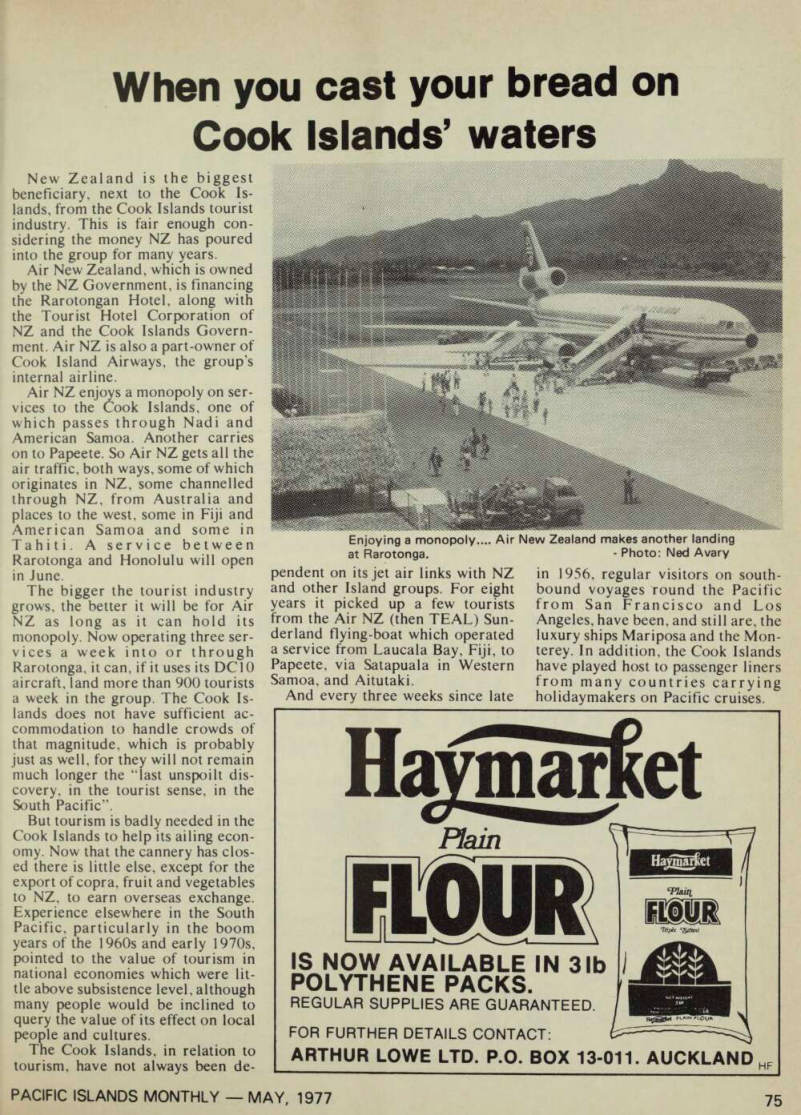
Cook Islands’ waters
New Zealand is the biggest beneficiary, next to the Cook Is lands, from the Cook Islands tourist industry. This is fair enough con sidering the money NZ has poured into the group for many years.
Air New Zealand, which is owned by the NZ Government, is financing the Rarotongan Hotel, along with the Tourist Hotel Corporation of NZ and the Cook Islands Govern ment. Air NZ is also a part-owner of Cook Island Airways, the group’s internal airline.
Air NZ enjoys a monopoly on ser vices to the Cook Islands, one of which passes through Nadi and American Samoa. Another carries on to Papeete. So Air NZ gets all the air traffic, both ways, some of which originates in NZ, some channelled through NZ, from Australia and places to the west, some in Fiji and American Samoa and some in Tahiti. A service between Rarotonga and Honolulu will open in June.
The bigger the tourist industry grows, the better it will be for Air NZ as long as it can hold its monopoly. Now operating three ser vices a week into or through Rarotonga, it can, if it uses its DCIO aircraft, land more than 900 tourists a week in the group. The Cook Is lands does not have sufficient ac commodation to handle crowds of that magnitude, which is probably just as well, for they will not remain much longer the “last unspoilt dis covery, in the tourist sense, in the South Pacific”.
But tourism is badly needed in the Cook Islands to help its ailing econ omy. Now that the cannery has clos ed there is little else, except for the export of copra, fruit and vegetables to NZ, to earn overseas exchange.
Experience elsewhere in the South Pacific, particularly in the boom years of the 1960 s and early 19705, pointed to the value of tourism in national economies which were lit tle above subsistence level, although many people would be inclined to query the value of its effect on local people and cultures.
The Cook Islands, in relation to tourism, have not always been de-
pendent on its jet air links with NZ and other Island groups. For eight years it picked up a few tourists from the Air NZ (then TEAL) Sunderland flying-boat which operated a service from Laucala Bay, Fiji, to Papeete, via Satapuala in Western Samoa, and Aitutaki.
And every three weeks since late
in 1956, regular visitors on southl bound voyages round the Pacific from San Francisco and Los Angeles, have been, and still are, the luxury ships Mariposa and the Mon terey. In addition, the Cook Islands have played host to passenger liners from many countries carrying holidaymakers on Pacific cruises.
Enjoying a monopoly... Air New Zealand makes another landing at Rarotonga. - Photo: Ned Avary
Advertisements & other items, pp. 75-76 (1 item)
Haymarfiet
Plain c Plahi £ n
IS NOW AVAILABLE IN 31b
POLYTHENE PACKS.
REGULAR SUPPLIES ARE GUARANTEED.
FOR FURTHER DETAILS CONTACT:
ARTHUR LOWE LTD. P.O. BOX 13-011. AUCKLAND HF
* m
THE PACIFIC’S
SPECIALISTS IN
FLEXIBLE CONTAINERS
BIG BAGSTo carry tons of Salt, Sugar, Rice, Flour, Minerals, Stockfeed, Fishmeal, Fertilizer, Coal, Copra or any powdered or granular product by road railors^a.
BRITISH HOVERCRAFT CORPORATION.
Fortransport or storage of pumpable liquids in quantities of 1000 litresto 18,000 litres suitable for coconut oils, vegetable oils, liquid latex, water, etc.
If you have an application for any of these units contact our Flexible Container Division now. mm
AH I Agencies
66 Portage Road, Otahuhu, N.Z.
P.O. Box 22-296, Otahuhu. Tel. OH 62-119 Telex NZ21621 Cables Alexind’
ssss
IF YOU EXPORT OR IMPORT
ANYWHERE IN THE PACIFIC ISLANDS
YOU NEED N.Z. EXPRESS
TRANSPORT TO KEEP YOUR PROFITS
MOVING.
When you move goods, you move money. If your distribution system is antiquated, your capital moves like a snail. And you can’t make a fast profit with a slow dollar.
With the modern N.Z. Express Transport method of transportation you speed up your shipments. Our specialised services-air freighting, export shipping, consolidation, door-to-door container service, to and from the Pacific Islands helps you to a big slice of the profit cake in this ever expanding market.
Let N.Z. Express Transport take care of your goods and there’ll be no more costly breakages, deterioration, pillaging, We have the manpower, facilities, equipment to do the job quickly and efficiently.
In Fiji, our affiliate company is Grace Express International, a business association that extends throughout the Pacific Islands and Australasia.
Contact N.Z. Express Transport for advice, quotes and information on the fastest, most economical methods of transporting to and from the Pacific Islands. You will also discover how totally immersed we are in the transport business.
N.Z. EXPRESS TRANSPORT
LTD.
Head Office Beach Road, Auckland 1. New Zealand.
C.P.O. 15, Ph: 360-040
Telex; 2361
M & C EXPRESS TRANSPORT
LTD.
Wellington, New Zealand.
BRIGHTLINGS EXPRESS
TRANSPORT LTD.
Christchurch, New Zealand.
GRACE EXPRESS
INTERNATIONAL (FIJI) LTD.
Head Office P.O. Box 200 Suva, Fiji.
Ph: 24624. Telex: FJ 2160 Branch Office, Nadi Airport.
Solomons’
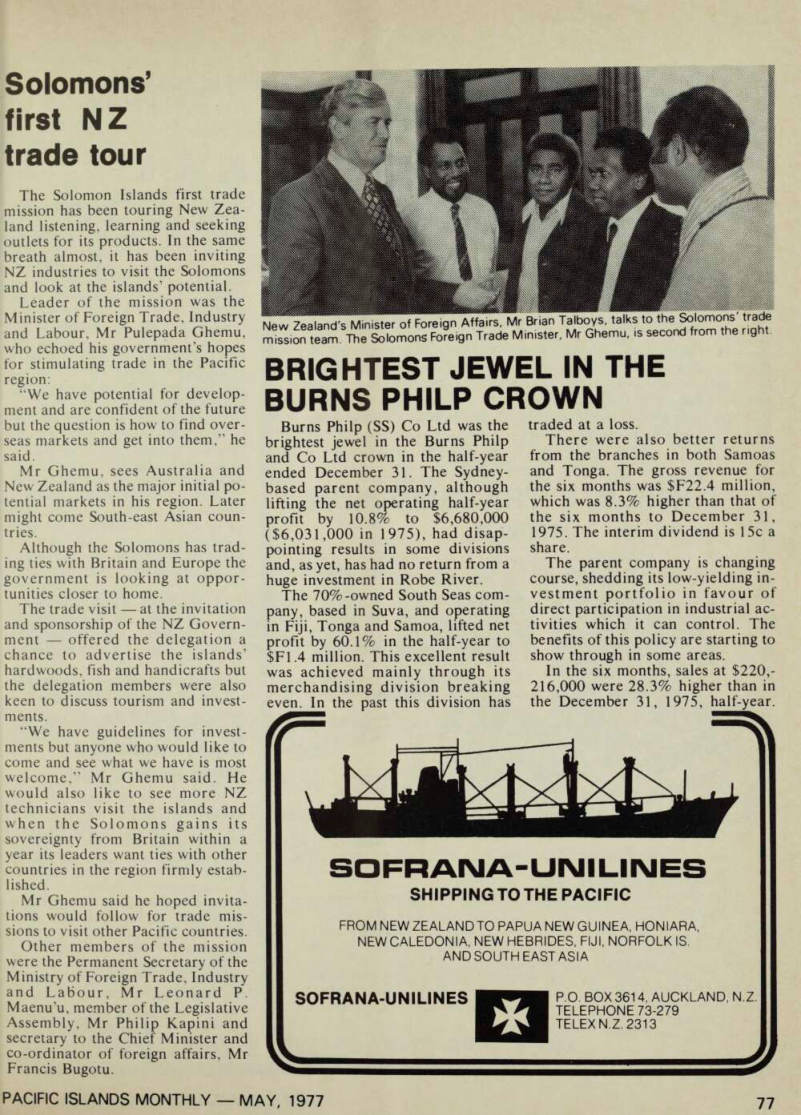
first NZ trade tour
The Solomon Islands first trade mission has been touring New Zea land listening, learning and seeking outlets for its products. In the same breath almost, it has been inviting NZ industries to visit the Solomons and look at the islands’ potential.
Leader of the mission was the Minister of Foreign Trade, Industry and Labour, Mr Pulepada Ghemu, who echoed his government’s hopes for stimulating trade in the Pacific region; “We have potential for develop ment and are confident of the future but the question is how to find over seas markets and get into them,” he said.
Mr Ghemu, sees Australia and New Zealand as the major initial po tential markets in his region. Later might come South-east Asian coun tries.
Although the Solomons has trad ing ties with Britain and Europe the government is looking at oppor tunities closer to home.
The trade visit at the invitation and sponsorship of the NZ Govern ment offered the delegation a chance to advertise the islands’ hardwoods, fish and handicrafts but the delegation members were also keen to discuss tourism and invest ments.
“We have guidelines for invest ments but anyone who would like to come and see what we have is most welcome,” Mr Ghemu said. He would also like to see more NZ technicians visit the islands and when the Solomons gains its sovereignty from Britain within a year its leaders want ties with other countries in the region firmly estab lished.
Mr Ghemu said he hoped invita tions would follow for trade mis sions to visit other Pacific countries.
Other members of the mission were the Permanent Secretary of the Ministry of Foreign Trade, Industry and Labour, Mr Leonard P.
Maenu’u, member of the Legislative Assembly, Mr Philip Kapini and secretary to the Chief Minister and co-ordinator of foreign affairs, Mr Francis Bugotu.
Brightest Jewel In The

Burns Philp Crown
Burns Philp (SS) Co Ltd was the brightest jewel in the Burns Philp and Co Ltd crown in the half-year ended December 31. The Sydneybased parent company, although lifting the net operating half-year profit by 10.8% to $6,680,000 ($6,031,000 in 1 975), had disappointing results in some divisions and, as yet, has had no return from a huge investment in Robe River.
The 70%-owned South Seas company, based in Suva, and operating in Fiji, Tonga and Samoa, lifted net profit by 60.1% in the half-year to SFI.4 million. This excellent result was achieved mainly through its merchandising division breaking even. In the past this division has
traded at a loss, There were also better returns from the branches in both Samoas and Tonga. The gross revenue for the six months was $F22.4 million, which was 8.3% higher than that of the six months to December 31, 1975. The interim dividend is 15c a share.
The parent company is changing course, shedding its low-yielding in vestment portfolio in favour of direct participation in industrial ac tivities which it can control. The benefits of this policy are starting to show through in some areas, In the six months, sales at $220,- 216,000 were 28.3% higher than in the December 31, 1975, half-year.
New Zealand's Minister of Foreign Affairs, Mr Brian Talboys, talks to the Solomons' trade mission team. The Solomons Foreign Trade Minister, Mr Ghemu, is second from the right.
50th birthday
for Breckwoldt
March, 1977, marked the 50th anniversay of the founding of the Hamburg-based Breckwoldt organ isation, well-known on the Pacific Islands trading scene.
The company’s Australian sub sidiary, Breckwoldt Australia, is almost solely engaged in the export of a wide range of Australian goods, mainly foodstuffs, to the Islands, where there are 10 Breckwoldt of fices, seven of them in Papua New Guinea.
Another Breckwoldt organ isation, Projects Procurements Pty Ltd, specialises in the supply of foodstuffs required by mining and construction camps in Australia and overseas.
The founder of the firm, Mr Wilhelm Breckwoldt, started an ex port-import company under his own name in Hamburg 50 years ago. and following intensive overseas sales tours by him and later also by his top executives, branches were open ed in Rabaul (1934), Suva (1934), Papeete (1936) and Apia (1937).
Branches were later opened in Venezuela and Nigeria.
Among joint development pro jects in which Breckwoldt has taken part are a now-completed soap fac tory in Lae. Papua New Guinea, and the brewery project now under way in Apia, Western Samoa.
Companies represented by Breck woldt in a number of countries in clude Daimler-Benz. Volkswagen.
Bosch, Hoechst and Agfa-Gaevert.
Eight countries
meet over sugar
The price at which Fiji will supply sugar to a number of neighbouring islands was fixed at a recent regional meeting in Suva, which dis cussed a long-term sugar agreement.
Represented at the meeting, at the headquarters of the South Pacific Bureau of Economic Co-operation, were the Gilbert Islands, Niue, Nauru, Tonga, Tuvalu, the Solomons, Western Samoa and Fiji.
The meeting also agreed on quota allocations. The coming year will be the second in which the agreement was operated. SPEC headquarters issued a statement saying that the price and quotas had been fixed, but for some reason or other did not state the price or the quota
Advertisements & other items, pp. 77-78 (1 item)
So Fr Aim A-Uimi Li Im Es
SHIPPING TO THE PACIFIC
FROM NEW ZEALAND TO PAPUA NEW GUINEA, HONIARA.
NEW CALEDONIA, NEW HEBRIDES. FIJI, NORFOLK IS.
AND SOUTH EAST ASIA
SOFRANA-UNILINES
P.O. BOX 3614, AUCKLAND, N.Z.
TELEPHONE 73-279
TELEX N.Z. 2313
ANDREWS &
BEAVER LTD
INDUSTRIAL TRANSMISSION
suppliers to the Pacific Basin !
For many years, Andrews & Beaven have been supplying the power transmission needs of New Zealand industry. Today they are geared to meet the demands of industrial development throughout the Pacific Basin.
From Gear boxes to Flexible couplings, Andrews & Beaven manufacture a wide range of power transmission components. Their modern, sophisticated plant ensures consistent accuracy of all components and complete dependability.
COMPLETE TRANSMISSION
RANGE
• Transmission Gearboxes • Conveyor Equipment • Transmission Bearings • Flexible Couplings .
A' For further information and full product list MAIL THIS COUPON Andrews & Beaven Ltd. Transmission Division Private Bag Andrews & Beaven Ltd Christchurch, N.Z.
Please mail by return post details and full product list of Power Transmission Equipment.
Name Company . .
Full Address
Buffalo Farming
Png To Boost Water
Water buffaloes are to be bred in Papua New Guinea on a large scale for the first time.
The all-purpose Asian beast has been promoted in several parts of the country to improve villagers’ self-reliance in food-growing and cash-cropping.
Buffaloes like cattle, they are not indigenous to PNG are slowly gaining acceptance as work animals and as sources of meat as a side benefit.
Now, in a plan backed by the Asian Development Bank, relatively huge numbers are ex pected to take over the grasslands of the East Sepik, one of the country’s poorest ana least-developed areas.
Potentially very productive, the rather soggy grasslands proved to be only marginally worthwhile for cat tle raising, although the foothills ris ing from the plains were a suitable home for beef herds.
But buffaloes, over the past 10 or 12 years of experiments, have shown themselves clearly superior to the
cattle in adapting to the grasslands.
They have had a higher calving rate, faster growth and have reached maturity earlier.
The ADB has now lent SUS 1.645 million to set up 88 small-holder village buffalo farms over the next six years.
A nucleus farm will begin the pro ject, using 5,500 hectares of govern ment land adjacent to the Sepik Plains Livestock Station at Urimo.
The present experimental herd of 600 buffaloes will be increased by 2,000 imported breeders.
During the first six years, the turn-off will be maximised so that about 3,500 will be distributed to small-holders.
Each small-holder farm will be supplied with 41 head. These will be 20 breeders, 20 steers and a bull.
The steers are for use after the first three years so they can be sold to give an income.
Credit for each small-holder farm will be about K. 3,500.
A buffalo population of 150,-
000-200,000 could be supported on the East Sepik grasslands, the bank and the government believe, de pending on the amount of pasture management and improvement.
Heavy chemical
factory for Fiji
A Fiji company plans to build a huge heavy chemical industry com plex at Lautoka. Mr Prabhulal Raniga, 42, a Nadi pharmacist, managing director of the promoting company, said about 150 people would be employed, and the country would save about $1 million each year in foreign exchange.
The first stage of the project, cost ing about S 3 million, on the Hous ing Authority’s Tavakubu subdivi sion, will involve the production of superphosphate, alum sulphuric and oleum. In the second stage alum and sulphuric acid will be used to develop a pulp and paper industry.
Mr Raniga said two chemical engineers and a general admin istrator would go to Fiji from India for the project. The remainder of the staff would be local and trained on the job. When the company was properly established he wanted to get the Fijian people involved in it.
Advertisements & other items, pp. 79-80 (1 item)
Now Ii The Islands
The personal insect repellent
guaranteed'to work!
Muskol positively keeps off all biting
insects including mosquitoes, sandflies
fleas and midges and discourages flies!
And it usually lasts up to 24 hours. * $ W % 100% Active Ingredients! Muskol is 90% Deet, the insect repellent ingredient that stopped the mosquitoes in the Panama Canal Zone, and 10% other powerful repellents. It will keep off all biting insects, but is harmless to normal skin, has no strong unpleasant smell, and needs only a few drops rubbed over the exposed skin. ‘Remcon Industries have the proof of exhaustive tests under heavy insect infestation conditions, that Muskol will positively repel all biting insects. Ask for Muskol from your local retailer now.
MUSKOL
CONCENTRATED INSECT REPELLENT
Wholesale Stockists; Moresby Wholesale Drug Supply Pty. Ltd.
Also leading Island Agents throughout the South Pacific, including Burns Philp & Company Ltd., and Sullivans.
If unavailable in your area write to: Remcon Industries Pty. Ltd., P.O. Box 54, Surry Hills, N.S.W. 2010, Australia.
RM1157 .
• ■ Every Tuesday our big jet birds of paradise wing their way from Port Moresby to Hong Kong departing at 1730 and arriving in Hong Kong at 2150. The return flight to Port Moresby will depart same day at 2300.
From Hong Kong we can connect on to anywhere in the world.
Adventures in paradise
Papua New Guinea offers the tourist one of the last truly unspoiled paradise destinations.
The country provides an amazing variety of character, from idyllic tropical island locations to the cool upland valleys of the highlands, to the great sprawling tropical rivers like the Sepik.
The people are proud and handsome, and just as varied in appearance, customs and culture as their exciting land.
BRRBANE/SYDNEY - PORT MORESBY
Each week there are four jet services from Australia.
Thursday and Sunday we fly Sydney to Port Moresby direct, Monday we fly via Brisbane, Saturdays from Brisbane, connecting with all domestic flights.
SYDNEY - BRISBANE - PORT MORESBY - Mondays at 0730 an all-daylight flight leaves Sydney, stopping at Brisbane and Port Moresby before flying on to Manila, arriving at 1655 and departing Manila for Port Moresby at 1800. (Pre daylight saving times.)
SYDNEY - PORT MORESBY - KAGOSHIMA
Thursdays at 0630 we have an all-daylight service from Sydney to Port Moresby, and on to Kagoshima arriving at 1630 From Kagoshima we provide immediate connections on to anywhere in Japan.
Paradise stopovers
It’s an idea for the jaded businessman who thinks he’s seen it all. En route to anywhere in Europe or Asia, give him a short stopover in paradise. We’ll float him down the Sepik in an air-conditioned houseboat. Fly him into our highlands. Deposit him on a tropical island, or just let him get amongst the best reef and big game fishing in the world.
GKeusacall
We’d love to provide any information you need call us at any one of our Adventures in Paradise Shops. In Sydney we’re on the Concourse Level of King George Tower.
Phone 232 8900.
In Brisbane we’re at 127 Creek Street. Phone 2295854.
And in Cairns we’re at the corner of Shields and Lake Streets. Phone 512255.
Or contact any travel agent.
mmuemfe
THE INTERNATIONALAIRUNEOF PAPUA NEW GUINEA y
Pacific Transport
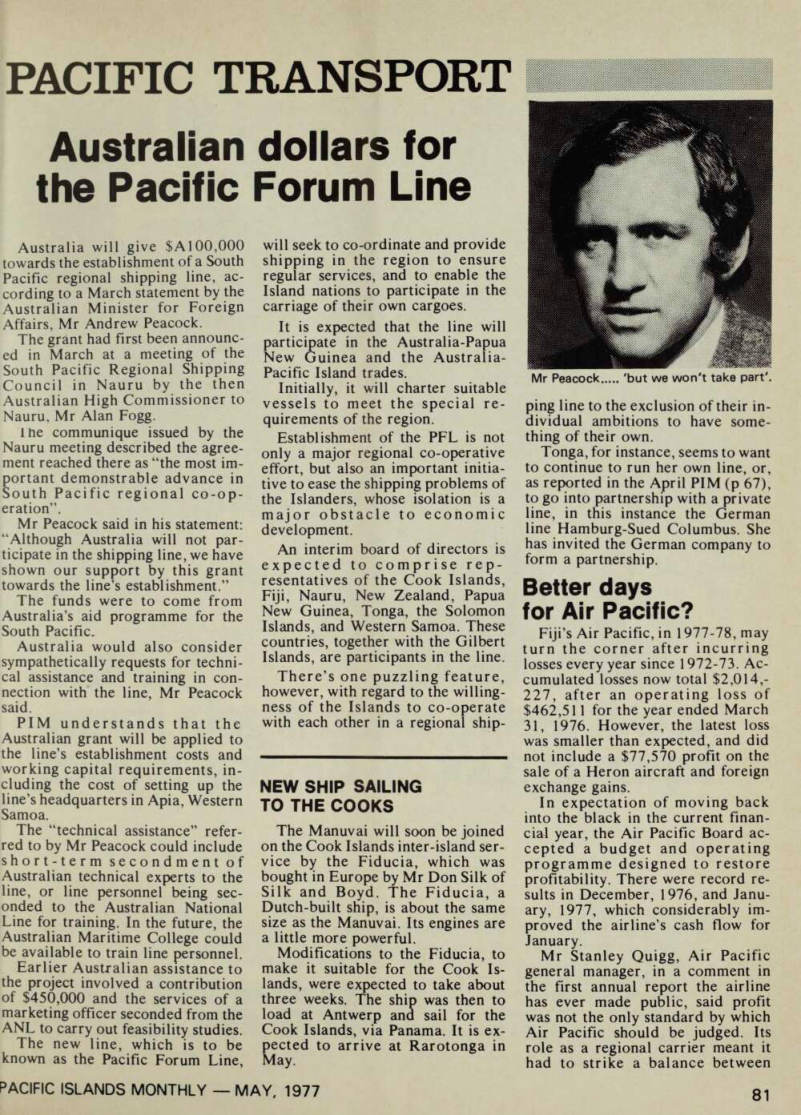
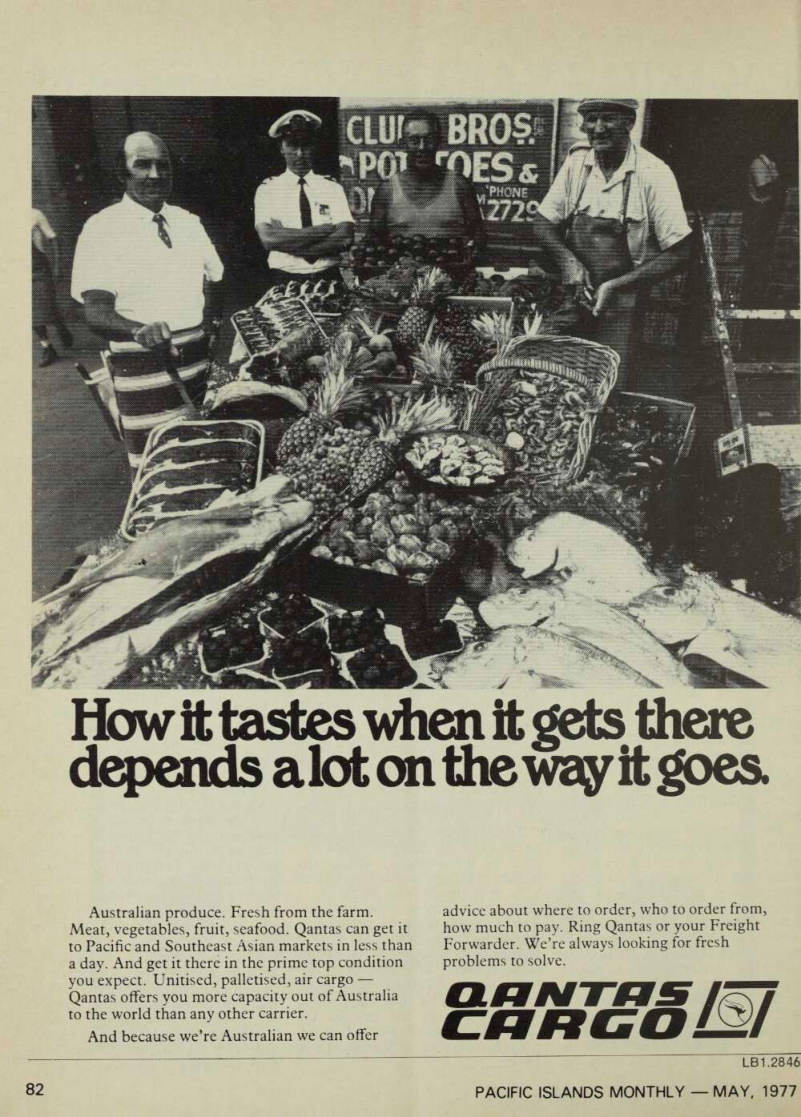
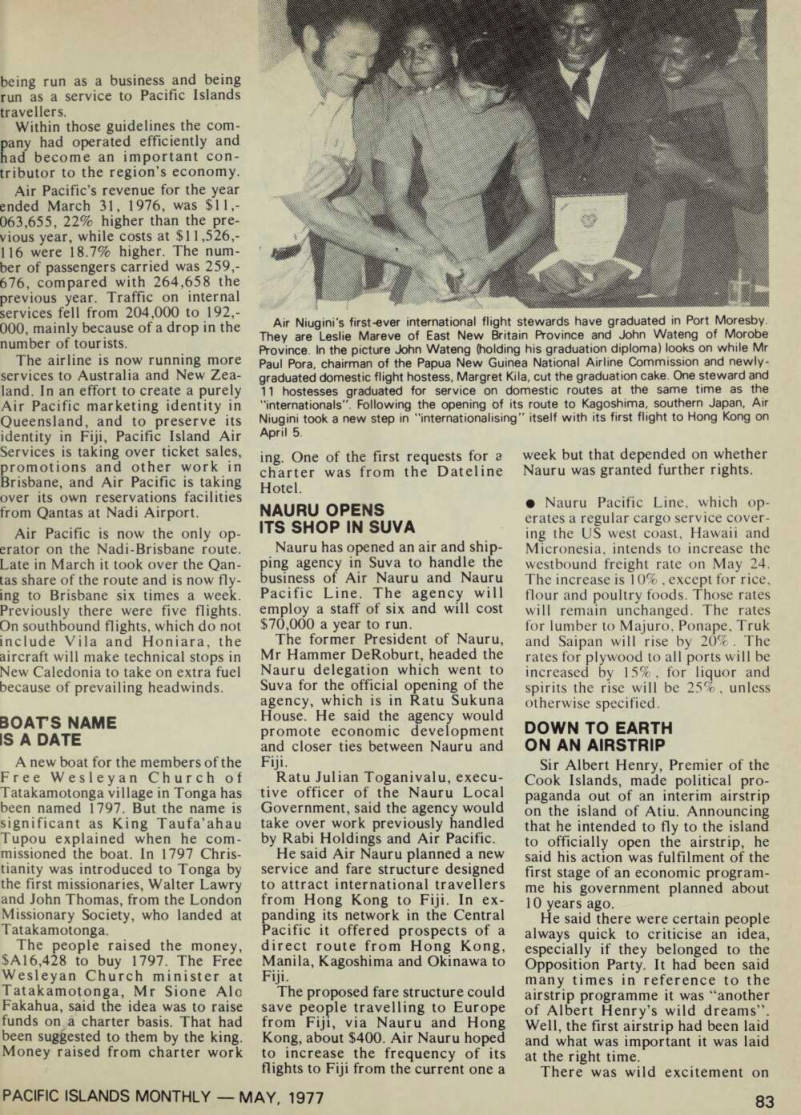
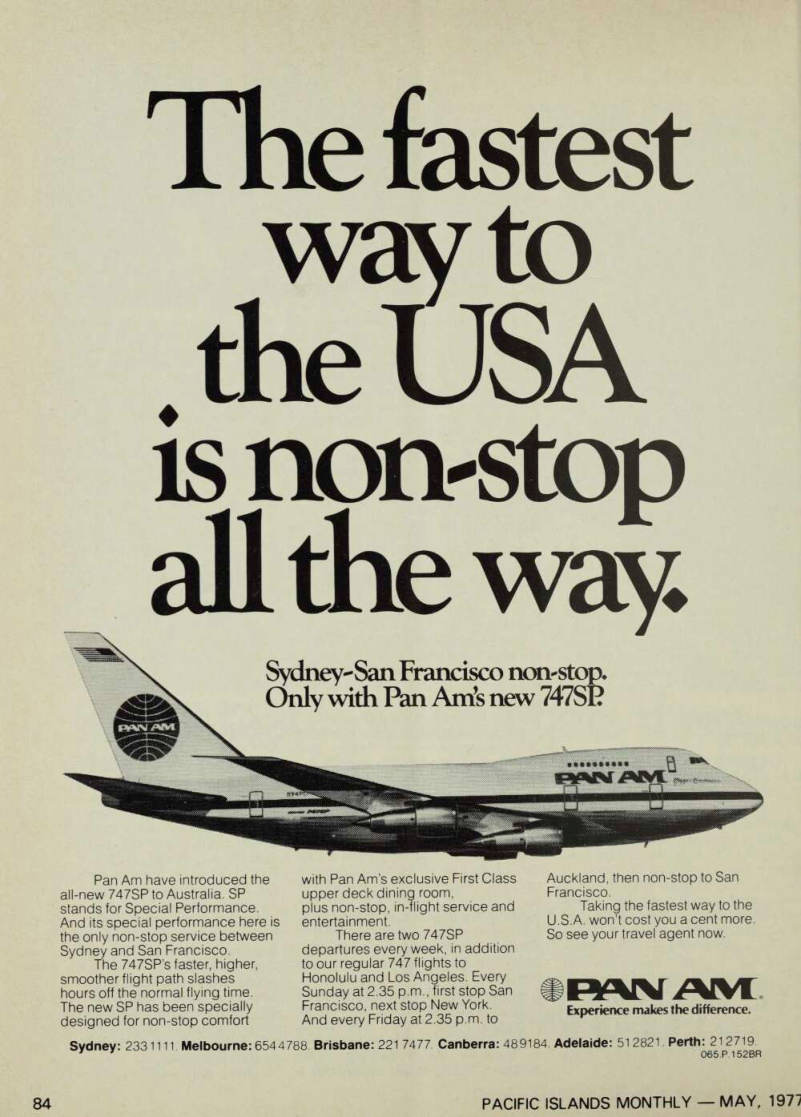
Australian dollars for the Pacific Forum Line
Australia will give SAIOO,OOO towards the establishment of a South Pacific regional shipping line, ac cording to a March statement by the Australian Minister for Foreign Affairs, Mr Andrew Peacock.
The grant had first been announc ed in March at a meeting of the South Pacific Regional Shipping Council in Nauru by the then Australian High Commissioner to Nauru, Mr Alan Fogg. me communique issued by the Nauru meeting described the agree ment reached there as “the most im portant demonstrable advance in South Pacific regional co-op eration”.
Mr Peacock said in his statement: “Although Australia will not par ticipate in the shipping line, we have shown our support by this grant towards the line’s establishment.”
The funds were to come from Australia’s aid programme for the South Pacific, Australia would also consider sympathetically requests for techni cal assistance and training in con nection with the line, Mr Peacock said.
PIM understands that the Australian grant will be applied to the line’s establishment costs and working capital requirements, in cluding the cost of setting up the line’s headquarters in Apia, Western Samoa.
The “technical assistance” refer red to by Mr Peacock could include short-term secondment of Australian technical experts to the line, or line personnel being sec onded to the Australian National Line for training. In the future, the Australian Maritime College could be available to train line personnel.
Earlier Australian assistance to the project involved a contribution of $450,000 and the services of a marketing officer seconded from the ANL to carry out feasibility studies.
The new line, which is to be known as the Pacific Forum Line,
will seek to co-ordinate and provide shipping in the region to ensure regular services, and to enable the Island nations to participate in the carriage of their own cargoes.
It is expected that the line will participate in the Australia-Papua New Guinea and the Australia- Pacific Island trades.
Initially, it will charter suitable vessels to meet the special re quirements of the region.
Establishment of the PFL is not only a major regional co-operative effort, but also an important initia tive to ease the shipping problems of the Islanders, whose isolation is a major obstacle to economic development.
An interim board of directors is expected to comprise rep resentatives of the Cook Islands, Fiji, Nauru, New Zealand, Papua New Guinea, Tonga, the Solomon Islands, and Western Samoa. These countries, together with the Gilbert Islands, are participants in the line.
There’s one puzzling feature, however, with regard to the willing ness of the Islands to co-operate with each other in a regional ship-
New Ship Sailing
To The Cooks
The Manuvai will soon be joined on the Cook Islands inter-island ser vice by the Fiducia, which was bought in Europe by Mr Don Silk of Silk and Boyd. The Fiducia, a Dutch-built ship, is about the same size as the Manuvai. Its engines are a little more powerful.
Modifications to the Fiducia, to make it suitable for the Cook Is lands, were expected to take about three weeks. The ship was then to load at Antwerp and sail for the Cook Islands, via Panama. It is ex pected to arrive at Rarotonga in May.
ping line to the exclusion of their in dividual ambitions to have some thing of their own.
Tonga, for instance, seems to want to continue to run her own line, or, as reported in the April PIM (p 67), to go into partnership with a private line, in this instance the German line Hamburg-Sued Columbus. She has invited the German company to form a partnership.
Better days
for Air Pacific?
Fiji’s Air Pacific, in 1977-78, may turn the corner after incurring losses every year since 1972-73. Ac cumulated losses now total $2,014,- 227, after an operating loss of $462,511 for the year ended March 31, 1976. However, the latest loss was smaller than expected, and did not include a $77,570 profit on the sale of a Heron aircraft and foreign exchange gains.
In expectation of moving back into the black in the current finan cial year, the Air Pacific Board ac cepted a budget and operating programme designed to restore profitability. There were record re sults in December, 1976, and Janu ary, 1977, which considerably im proved the airline’s cash flow for January.
Mr Stanley Quigg, Air Pacific general manager, in a comment in the first annual report the airline has ever made public, said profit was not the only standard by which Air Pacific should be judged. Its role as a regional carrier meant it had to strike a balance between
Mr Peacock 'but we won't take part'.
being run as a business and being run as a service to Pacific Islands travellers.
Within those guidelines the com pany had operated efficiently and had become an important con tributor to the region’s economy.
Air Pacific’s revenue for the year ended March 31, 1976, was $ll,- 063,655, 22% higher than the pre vious year, while costs at $11,526,- 116 were 18.7% higher. The num ber of passengers carried was 259,- 676, compared with 264,658 the previous year. Traffic on internal services fell from 204,000 to 192,- 000, mainly because of a drop in the number of tourists.
The airline is now running more services to Australia and New Zea land. In an effort to create a purely Air Pacific marketing identity in Queensland, and to preserve its identity in Fiji, Pacific Island Air Services is taking over ticket sales, promotions and other work in Brisbane, and Air Pacific is taking over its own reservations facilities from Qantas at Nadi Airport.
Air Pacific is now the only op erator on the Nadi-Brisbane route.
Late in March it took over the Qan tas share of the route and is now fly ing to Brisbane six times a week.
Previously there were five flights.
On southbound flights, which do not include Vila and Honiara, the aircraft will make technical stops in New Caledonia to take on extra fuel because of prevailing headwinds.
Boats Name
Is A Date
A new boat for the members of the Free Wesleyan Church of Tatakamotonga village in Tonga has been named 1797. But the name is significant as King Taufa’ahau Tupou explained when he com missioned the boat. In 1797 Chris tianity was introduced to Tonga by the first missionaries, Walter Lawry and John Thomas, from the London Missionary Society, who landed at Tatakamotonga.
The people raised the money, $A16,428 to buy 1797. The Free Wesleyan Church minister at Tatakamotonga, Mr Sione Alo Fakahua, said the idea was to raise funds on a charter basis. That had been suggested to them by the king.
Money raised from charter work
ing. One of the first requests for a charter was from the Dateline Hotel.
Nauru Opens
Its Shop In Suva
Nauru has opened an air and ship ping agency in Suva to handle the business of Air Nauru and Nauru Pacific Line. The agency will employ a staff of six and will cost $70,000 a year to run.
The former President of Nauru, Mr Hammer Deßoburt, headed the Nauru delegation which went to Suva for the official opening of the agency, which is in Ratu Sukuna House. He said the agency would promote economic development and closer ties between Nauru and Fiji.
Ratu Julian Toganivalu, execu tive officer of the Nauru Local Government, said the agency would take over work previously handled by Rabi Holdings and Air Pacific.
He said Air Nauru planned a new service and fare structure designed to attract international travellers from Hong Kong to Fiji. In ex panding its network in the Central Pacific it offered prospects of a direct route from Hong Kong, Manila, Kagoshima and Okinawa to Fiji.
The proposed fare structure could save people travelling to Europe from Fiji, via Nauru and Hong Kong, about $4OO. Air Nauru hoped to increase the frequency of its flights to Fiji from the current one a
week but that depended on whether Nauru was granted further rights. • Nauru Pacific Line, which op erates a regular cargo service cover ing the US west coast, Hawaii and Micronesia, intends to increase the westbound freight rate on May 24.
The increase is 10% , except for rice, flour and poultry foods. Those rates will remain unchanged. The rates for lumber to Majuro. Ponape, Truk and Saipan will rise by 20% . The rates for plywood to all ports will be increased by 15%, for liquor and spirits the rise will be 25%, unless otherwise specified.
Down To Earth
On An Airstrip
Sir Albert Henry, Premier of the Cook Islands, made political pro paganda out of an interim airstrip on the island of Atiu. Announcing that he intended to fly to the island to officially open the airstrip, he said his action was fulfilment of the first stage of an economic program me his government planned about 10 years ago.
He said there were certain people always quick to criticise an idea, especially if they belonged to the Opposition Party. It had been said many times in reference to the airstrip programme it was “another of Albert Henry’s wild dreams”.
Well, the first airstrip had been laid and what was important it was laid at the right time.
There was wild excitement on
Air Niugini's first-ever international flight stewards have graduated in Port Moresby.
They are Leslie Mareve of East New Britain Province and John Wateng of Morobe Province. In the picture John Wateng (holding his graduation diploma) looks on while Mr Paul Pora, chairman of the Papua New Guinea National Airline Commission and newly graduated domestic flight hostess, Margret Kila, cut the graduation cake. One steward and 11 hostesses graduated for service on domestic routes at the same time as the "internationals”. Following the opening of its route to Kagoshima, southern Japan, Air Niugini took a new step in "internationalising” itself with its first flight to Hong Kong on April 5.
Atiu for the occasion, and Sir Albert declared a public holiday for all government workers and schools.
There will be Rarotonga-Atiu return services on Tuesdays and Fridays.
To show it meant business, the Cl Government sent a development and planning committee to Mauke and Mitiaro soon after the opening of Atiu to survey airstrip sites, assess construction costs and complete for malities for taking over the required land.
Sir Albert expected to become directly involved in the next stage of the programme by heading a development and planning team in vestigating the possibility of laying an airstrip on Mangaia.
Daiwa Ro-Ro
Ship For Fiji
The South Pacific will get another container service in June when the Daiwa Line, of Japan, sends a new roll on/roll off (ro-ro) ship, the Fiji Maru, 15,240 tonnes, to Suva on its maiden voyage. The Fiji Maru is a multi-purpose carrier, designed and built to carry motor vehicles, con tainers, general cargo, heavy cargo and bulk cargo.
She has two side ramps for the ve hicles to be driven to the car decks.
A pair of 51 tonne and 41 tonne electrohydraulic twin deck cranes are on the upper deck to handle con tainers and heavy cargo. There is other sophisticated equipment to help speed up handling of cargo.
The Fiji Maru will have a maxi mum speed of 18.7 knots, and a cruising range of about 22,000 kilometres. She will run a monthly service from Japan to Papeete, Pago Pago, Apia, Fiji, Noumea, Sydney and Honiara.
Daiwa Line operates a similar ship, the Ponape Maru, from Japan to Guam and Taiwan.
Ustt Cold Shoulder
For Freezer Shippers
Bureaucracy in the US Trust Ter ritory has foiled a plan by Refrige rated Express Lines to open a ship ping service from Australia to TT ports with the Lae Express. As a re sult, about 1,500 tonnes of cargo is waiting in Australia for 50 to 60 days till it can be shipped by a Daiwa Line service.
REL several weeks ago applied to the TT Director of Transportation
for a regular or continuing entry permit. After much prodding from REL, the director finally replied, refusing the permit.
“We were told we would not re ceive an entry permit and that we should look elsewhere for an area other than Micronesia,” Mr S. Mc- Callum, managing director of REL, said to PIM.
REL then asked for a single entry permit because of pressure from shippers to get cargo away. On March 31, the shipping line re ceived a telex message from the Director of Transportation refusing such a permit.
The TT decision will have a serious affect on Australia’s export trade with Micronesia. Australia was starting to regain, through the 1976 devaluation, trade it had been losing steadily to other countries • The British Government has given $114,000 in aid to the Solomons to construct airfields on Lord Howe (Ontong Java), Lol Lorn in the Reef Islands and Santa Anna, off San Cristoval. The Legislative Council, in January, 1976, gave ap proval to lay the airfields. • Mr C. B. Grey, general manager of Air Niugini, has been appointed a member of the National Airline Commission, along with Mr A. J.
Yates. They replace Mr R. J. Yates, Qantas, and Mr R. E. Bailey,TAA. Mr J. W. Reillyisalternatememberfor Mr Grey and Mr F. Pascoe is alternate for Mr Yates.
Us Navy To Build
Wharf On Yap
The United States Navy plans to build a new wharf, with associated installations on the north side of Colonia Peninsula, near the District Legislature building on Yap Island.
It will replace the existing port area on the south side of the peninsula, close to the centre of the town. This port is in disrepair and is now inade quate Plans for the new dock include possible future expansion of port facilities. First of all, an area of about 18,500 square metres will be reclaimed from the edge of the pre sent short-line out to the edge of the existing deep channel to the north of the peninsula. Coral, coral heads and coral sand dredged from nearby shoal areas will be used to fill this area.
The dock will include a single 137 metre berth with an open storage area for containers and bulk cargo, buildings and utilities. Build ings will include a transit shed/warehouse, offices, a small gatehouse and a transformer station.
But before the project gets under way, the US Army Corps of Engineers will make a study aimed a protecting the public interest in navigable waters, and other matters of public concern, including the en vironment, and social and economic impact. This study will be con sidered by the authorities before ap proval, or otherwise, is given for the project to go ahead.
Advertisements & other items, pp. 81-86 (2 items)
81
ACIFIC ISLANDS MONTHLY MAY, 1977
depends alot on the way it goes.
* 1 ' x> #5 A - How it tastes when it gets there depends alot on the way it goes.
Australian produce. Fresh from the farm.
Meat, vegetables, fruit, seafood. Qantas can get it to Pacific and Southeast Asian markets in less than a day. And get it there in the prime top condition you expect. Unitised, palletised, air cargo Qantas offers you more capacity out of Australia to the world than any other carrier.
And because we’re Australian we can offer advice about where to order, who to order from, how much to pay. Ring Qantas or your Freight Forwarder. We’re always looking for fresh problems to solve.
txaNTas /S 7
can col—/
L 81.2846
The fastest
way to
.the USA
is non-stop
all the way.
San Francisco non-
Only with Pan Am’s new
Sydney
stop
7475 P «»••***«*» Pan Am have introduced the all-new 7475 P to Australia. SP stands for Special Performance.
And its special performance here is the only non-stop service between Sydney and San Francisco.
The 747SP’s faster, higher, smoother flight path slashes hours off the normal flying time.
The new SP has been specially designed for non-stop comfort with Pan Am’s exclusive First Class upper deck dining room, plus non-stop, in-flight service and entertainment.
There are two 7475 P departures every week, in addition to our regular 747 flights to Honolulu and Los Angeles. Every Sunday at 2.35 p.m., first stop San Francisco, next stop New York.
And every Friday at 2.35 p.m. to Auckland, then non-stop to San Francisco.
Taking the fastest way to the U.S.A. won’t cost you a cent more.
So see your travel agent now.
Experience makes the difference.
Sydney: 2331111 Melbourne: 6544788 Brisbane: 221 7477 Canberra: 489184 Adelaide: 51 2821 Perth: 212719
Diesel Power! Displacement Hull!
The KINGSTON ANGLER'
is good news
for fishermen
and island
traders.
• The 19’ displacement hull gives you smoother cruising than a planing hull (it’s the same hull as the Kingston 580) •The diesel engine (up to 33 h.p. and 15 knots) is safe, reliable and cheaper to run. •Full length, self-draining floor. •The fibreglass construction throughout makes it easier nta mai
lfl«vojf#o«v
CRUISER SALES PTY. LTD.
179 South Creek Road, Dee Why, N.S.W. 2099. Australia.
Telephone: 981 3508
If you can’t come to the Pacific’s best range
of boating gear—send us SA4.
And we’ll bring the range to you!
T&" i - • < ww *
fsaf
■ k bv f* :c k ti
ROBt"
«*1
JOUY
m m 4- & MT -«r*& - T *i .-J ’tft In Sydney is where Jolly Roger has collected what is boldly called the best range of boating gear in the Pacific. Assembled from all corners of the world are some of the best examples of nautical craftsmanship.
From the U.S.A, England, the Continent, Australia and elsewhere come winches, portlights, hatches, fittings, lights, cleats, anchors, electronic aids, navigation equipment, fishing gear and so much more it fills 230 pages of the current Jolly Roger Catalogue. If you’re not going to Sydney in the near future, fill in the coupon, enclose a cheque for SA4 and post it to Jolly Roger. By return post you will receive the graphically illustrated catalogue and price list. 230 pages of picture and information-packed boating goodies, all for sale to any boating enthusiast who wants them.
JOLLY ROGER MARINE PTY. LTD.
boating and marine products you never thought you would see in the Pacific Jolly Roger Marine Pty. Ltd. 16 Chard Road, Brookvale, N.S.W. 2100 Australia Telephone: 9383211 Telex; AA27443
HURRY! MAILTO-DAY. CATALOGUE STOCKS LIMITED
r ti
■ Jolly Roger Marine Pty. Ltd. 16 Chard Road, Brookvale, N.S.W. 2100 Australia I Please rush your 230 page illustrated catalogue of the best I I range of marine products in the Pacific. I enclose SA4 to I cover packing and despatch by return mail.
NAME
j ADDRESS
I COUNTRY j
JR77.FP.
Transport Briefs
• A new airport will be laid for Rabaul, possibly at Kokopo. The Papua New Guinea Transport and Works Minister, Mr Jephcott, said the airport would enable Air Niugini to meet future operational re quirements. The airport at present in use was not suitable for night lan dings, nor for larger aircraft, which Air Niugini would soon be using. • A new landing barge, The Yaubula, built at the government shipyard in Suva, has been launched and is now in operation. The New Zealand Government paid for the barge and its equipment under its aid scheme for the Pacific. It was the first vessel built under the scheme outside NZ. The Yaubula, 43 metres long and nine metres wide, will cary cargo to and from the outer islands. • The Trust Territory Govern ment is having six field trip vessels built in Japan to replace older ships, which will be sold for scrap or used in smaller operations. Government of ficials recently visited Japan to in spect shipyards which had submitted bids to build the vessels. The shipyard selected will construct six identical vessels. • Lan-Chile airline, from April I, added a second weekly flight to its route Papeete Easter Island Santiago. This second stopover, by Boeing 707, is in view of expected extra traffic on the route following the withdrawal since February of Air France from the Tokyo Papeete Lima run. The Lan-Chile Thursday and Sunday calls at Easter Island permit a minimum stopover of three days, with the flight from Tahiti taking about six hours. • The Papua New Guinea Na tional Shipping Corporation, which is owned by the government, will operate on a strictly commercial basis. The government has approved the purchase of 12 ships for tne cor poration. They will operate on ma jor routes servicing PNG. Some of the ships will be built at Madang, but will not be available for some time. In the meantime, the cor poration has placed an order with J.
L. Primrose, of New Zealand, to build six vessels to meet urgent re quirements.
Cruising
Yachts
• KAWAMEE, 60 ft steel-hulled ketch, arrived at Rarotonga from Penrhyn on March 25 with Rocknee Johnson (captain) and nine crew, seven Americans and two Canadians. The cruise started from Honolulu and an emergency call was made at Penrhyn to repair the starter motor for the diesel engine after it had been damaged by salt water. Plans were to call at Bora Bora, Raiatea, Papeete and the Marquesas before returning to Honolulu. • CYN SAN, 40 ft Canadian ketch-rigged trimaran, arrived at Rarotonga from Bora Bora and Tahiti in late March with owner Bob Hamilton, Don Carr, Stephen Blum, John Atherton and Rene Kunzler They will sail to Tonga, Samoa, Fiji and Hawaii, then home to Canada. • DEYDREAM 11, 32 ft Canadian sloop registered in Vancouver, arrived at Rarotonga on February 28 with Budd Dey, his son, Calvin, and daughter Kelli. Their cruise started from Vancouver Island and took them to the Hawaiian Islands, the Marquesas and Tuamotus, most of which they called at. Last ports of call were Papeete and Bora Bora and they were bound for Tonga and Fiji. • RAINBIRD, 45 ft sloop registered in Auckland, arrived at Rarotonga on March 1 from Papeete with Captain Martin Farrand, his wife, Christine, and Allan and Irene Coubray —all New Zealanders. The yacht is on a delivery voyage from Miami to her owners in New Zealand and plans were to sail direct from Rarotonga to Auckland. • ESCAPADE with her five French crew returned to Noumea in mid-February after two months cruising in the Solomon Is lands. At Vanikoro in the Solomons, the men went diving around the area where La Perouse’s frigates Astrolabe and Boussole sunk in 1788, but said they saw only two anchors.
Png's First Open
Ocean Race
An ocean-going race, to be held in May by the Papua Yacht Club in Port Moresby, will be Papua New Guinea’s first interna tional ocean race. It will be sailed over about 1,303 nautical miles from Noumea to Port Moresby.
The race will begin on May 28, soon after the finish of this year's annual Sydney-Noumea yacht race.
The Sydney-Noumea race, which is con ducted by the Cruising Yacht Club of Australia, is being held this year for the fourth time. Between 30 and 40 yachts are expected to make up the race fleet which will sail from Sydney Harbour on May 7 Papua Yacht Club officials believe that probably half the fleet will be interested in following on by entering in the new Noumea to Port Moresby race. And, if the new event is a success, it could eventually lead to an annual triangular series of races Sydney to Noumea, Noumea to Port Moresby and Port Moresby to an Australian port.
The Papua Yacht Club is planning the event in conjunction with the Cercle Nauti que of New Caledonia. It will be sailed in two divisions one under the interna tional offshore rule with mark three rating handicaps, and the other as a cruising yacht event. The cruising division will be han dicapped by what the organisers described as "subjective assessment”. It will take into account the performance recorded in relation to the type of craft, seamanship
and navigation.
The event is being heavily sponsored by Air Niugini, PNG's national airline, which also helped sponsor the country's first in ternational air race 18 months ago. • MARINER, 34 ft yawl, where are you? asks Bruce B. McCloskey and wife, of 1113 Tangelo Isle, Fort Lauderdale, Florida 33315, in a letter to PIM. They built Mariner in California about 35 years ago.
"We last heard of our Mariner as being in New Caledonia a few years ago, and once noted an item concerning a 34 ft yawl named Te Mariner in New Caledonia,”
Bruce writes. "We are most anxious for news concerning the little vessel that we once knew so well. We have been avid readers and subscribers of PIM for many years.”
Sydney-Noumea Yacht Race
The French and Australian navies are providing escort vessels to accompany the Sydney-Noumea yacht race craft leaving Sydney on May 7. La Dunkerquoise and HMAS Duchess are covering the course, just over 1,000 nautical miles, expected to take at least nine days. Organised by race director Peter Rysdyk and the Cruising Yacht Club of Australia, this year's race is enthusiastically supported by the French authorities and sponsored by UTA French Airlines.
By mid-March, 18 Australian yachts and several from Noumea were entered in the race, including stars of the Sydney-Hobart event and French yachtsman Alain Colas all competing for the "Cock of the Pacific".
In Noumea, the Cercle Natique Yacht Club on the Baie des Pecheurs has numerous official receptions organised for the visitors, some of whom are taking eight weeks for the event, including further cruising in the offshore Loyalty Islands to the Isle of Pines and the New Hebrides,
Advertisements & other items, pp. 88-90 (2 items)
Kellercraft
Workboat Fishing boat Pleasure boat
This is an international double-ended lifeboat with a 40-person-plus-provisions capacity. The boat is built to Harbours and Marine standards (under supervision if necessary).
SPECIFICATIONS
Centreline length 7.3 m (24 ft) Beam 2.4 m (8 ft) Draught 0.48 m (1 ft 7 in.) It has been officially swamp-tested by the Harbours and Marine in work boat form. It can be made self-draining with full foam floatation. Designed for diesel power (8-10 hp gives 8-9 knots); high work load capacity; can be trailered.
It is now in use by the government ambulance in Torres Strait waters.
One is also in use at St. Helena Island, Moreton Bay, as a service boat licensed to carry 20 persons.
E q “ KELLERCRAFT p
Enterprise Street,
Molendinar,
Southport, Qld. 4215.
Phone: Gold Coast (075) 32 3066.
ExpressTreight Service between U.S. Pacific Coast Ports & *
PAPEETE - APIA - PAGO PAGO
Full Container Service including Refrigeration
GENERAL AGENTS-
fURNESS INTEROCE4N
465 CALIFORNIA STREET. SAN FRANCISCO X A 94104 .
C*We INTERCO' • TWA; 910-37 J 7350 • RCA 273 207
• TEL. (415 i:
> AGENTS.
PAPEETE - MORGAN; Vernex Boite Postale 449, Papeete Phone: 309 Cables; MOREX , PAGO PAGO - POLYNESIA SHIPPING SERVICES, INC., Pago Pago Phone; 633-5169 Cables; POLYSHIP APIA • UNION S.S. CO., of N.Z. Ltd., P.O. Box 50, Apia, Western Samoa Phone; 570 Cables: UNION ? ■ 0
We’re working the Pacific
with a Cat Marine Diesel.
m* i. <• la'..
"Loloho” - General purpose Harbour tug boat. Operated by Bougainville Copper Limited at Bougainville. Overall length 50 ft. (15.24 m). Powered by a Caterpillar D 343 Marine Engine.
"M.V. Kaunitoni” - An Inter-Island freighter. Operated by the Fiji Government. Overall length 134.3 ft. Displacement 628 tons. Speed 10 knots. Powered by a Caterpillar D 379.
Hastings Deering (Pacific) Ltd.and Carpenters Tractors cover the Pacificlslands waterfront with Cat. Marine Service and Parts.
Hastings Deering (Pacific) at Lae, Port Moresby and Bougainville and Carpenters Tractors at Suva are staffed by Caterpillar-trained technicians.
Working the Pacific waterfront day after day, year after year, you depend on reliable horsepower and first class dealer-support. You get it with a Cat Marine Diesel, Hastings Deering (Pacific) and Carpenters Tractors.
While there’s a Cat Marine Diesel in your craft you're backed up with Cat Plus, the total support programme offered only by your Caterpillar dealer.
Your local Hastings Deering (Pacific) or Carpenters Tractors dealer backs your Cat Marine Diesel engine with parts and service programmes designed to prevent, as well as shorten profitrobbing downtime.
Caterpillar Dealers in South-West Pacific.
Lae; Milford Haven Road, 154 Queens Road, Suva.
Ph; 42 2355 Ph: 24 051-4, Port Moresby: Champion Cables: Carptrac Suva.
Parade, Konedobu Ph: 24 3138 Telex: Carptrac FJ2191 Suva, or 24 2098.
Bougainville: Itakara.
Industrial Park, Arawa, Ph: 95 9077 Caterpillar. Cat and □ are trademark* oi Caterpillar Tractor Co.
HASTINGS DEERING
HD6I4
CARPENTERS
TRACTOR e EQUIPMENT
Solomons Independence
91
PACIFIC ISLANDS MONTHLY MAY, 1977
From p 14.
Deaths
of Islands People
Mr Rarua Tau Mr Rarua Tau, a leading villager of Hanuabada in Papua New Guinea, has died. He was 70. Mr Tau became a deacon in the London Missionary Society in 1945 and when the Papuans first formed their own church society, called Papua Ekalesia, he became secretary. He was made a life deacon of the Poreporena United Church for his work for the church. Early in his career he worked in the PNG postal service and then became a mission school teacher. One of his sons, Mr Mahuru Rarua Rarua is Lord Mayor of Port Moresby.
Mr T. Fuka Mr Taniela Fuka, a prominent member of the Free Wesleyan Church in Tonga and Town Officer of Kolomotua for 38 years, has died, aged 85. He was educated at Tupou College and was one of the founders of the Old Students’ Association of the college. Queen Mata’aho, mem bers of the nobility and church dig nitaries attended his funeral. Mr Fuka is survived by four sons and three daughters.
Mr S.A. Shah Mr Saiyad Anwar Shah, a promi nent figure in the Fiji passenger transport industry for many years, has died. He was 59. Mr Shah was a director of Amalgamated Transport Co till a few months ago. He owned Gordon Properties Ltd and was a director of the Fiji Property Centre.
Mr Shah was a member of the Fiji Public Service Commission for six years, and was active in Fiji Muslim League affairs. He leaves seven daughters and two sons.
Ratu Senator A. Nanovo Ratu Senator Apakuki Nanovo, a prominent Fijian administrator and a Great Council of Chiefs rep resentative in the Fiji Senate since 1970, has died aged 73. Coming from the island of Kadavu, where he was Fijian administrator for many years, he was appointed a member of
the Great Council of Chiefs in 1938, and was still a member of that body when he died.
During World War II he served in the Solomons and Bougainville campaigns with the Fiji Docks Com pany. He retired from the Fijian ad ministration in 1960, but joined again five years later for another three years. In 1973 he was awarded the OBE. He is survived by his wife, four sons and a daughter.
Mr A. E. Cridland Mr Albert Ernest Cridland died at Wanigela in Papua New Guinea’s Northern Province in March. He was 84. An Australian, Mr Cridland
first went to PNG in 1913 for ser vice with the then Papua Public Ser vice. Wounded at Gallipoli his service with the AIF, he return ed to PNG at the end of World War I and served for many years as a re sident magistrate. He was in private business following his retirement in 1940.
Mr A. Houng Lee Mr Arlie Houng Lee, a well known Fiji Chinese, who emigrated to the United States in 1965, died in Seattle, aged 60. He was a son of the late Mr George Houng Lee, a famous shark catcher. Like his father, he was a keen fisherman.
Advertisements & other items, pp. 91-92 (1 item)
Breckwoldt & Co
EXPORTERS TO THE PACIFIC ISLANDS
P ij Ltd
IM47TT
T 7 276 Pitt Street, Box 5027, G.P.O. Sydney 2001
CABLE ADDRESS: BREWO SYDNEY
TELEPHONES: 61-7110 26-6893
TELEX AA22890.
Pacific Island Branches:
BRECKWOLDT & CO (PNG) PTY LTD
PO BOX 1549, BOROKO, PORT MORESBY
PO BOX 222, RABAUL
PO BOX 72, KIETA
PO BOX 178, WEWAK
PO BOX 185, MADANG
PO BOX 237, MT HAGAN
PO BOX 1188, LAE
BRECKWOLDT & CO., PO BOX 47, APIA BRECKWOLDT & CO. (SI) LTD. PO BOX 140, HONIARA
BRECKWOLDT SARL BP 2369, NOUMEA
Offices in : Hamburg, London, Milan and West Africa as well as Singapore, Kuala Lumpur, Bangkok and Hong Kong.
Enquiries from Australian
Manufacturers invited.
The space man’s aircraft
20 cu.ft. of cargo space.,
and if that’s not enough,
the seats are easily
removable.
Sole distributors for Australia • Papua New Guinea • New Zealand • Pacific Islands • FM773
FOR RESTAIR
A DIVISION OF H. C. SLEIGH LIMITED Bulla Road, Essendon Airport Victoria, Australia 3041 Cables & Telegrams: Forrestair Melbourne Telex AA33015 Telephone (03)3798929.
After hours (03) 7254430 Space. Payload Space.
Six comfortable seats and a cavernous 400 lb cargo compartment, accessible in flight.
You load your cargo through a 7 sq.ft, door: and if you want to fly more packing cases than passengers, the seats are designed to come out, quickly and easily.
You’ll carry a big payload, a long way between petrol pumps: and if you have to use an outback strip, the twin Lycomings are mounted on high wings for clearance.
If space man, then this is your aircraft.
Ask for the full dimensions and the operating costs.. they both measure up.
Stern Words
Papua New Guinea’s Minister for Provincial Affairs, Mr Oscar Tam mur, had some stern words for prov incial government leaders at a March seminar in Rabaul which dis cussed the problems of the new provincial government system in
Png.
He said: “If you are a leader of your people you must do something about finding finance to help fund your provincial government.
“If you can’t, give the job to some one else. It’s your responsibility. It’s your country.
“While I am minister, I don’t want to see slack leaders.’’
Mr Tammur said many govern ment departments seemed to think the old Australian way was the only way and “the road to heaven”.
He told the provincial leaders to stop citing the Bougainville case as an example of what should flow to other provinces.
“Bougainville was a special case and I nearly lost my life fighting to keep PNG united there,” he said.
“You can’t copy that special case.”
Advertisements & other items, pp. 93-94 (2 items)
95
ACIFIC ISLANDS MONTHLY MAY, 1977
Caledonia's problems continued from p. 15.
Lash
i «
REFRIGERATED
& GENERAL
CARGO IN
BARGES. BULK
LIQUIDS IN
VESSEL DEEP
TANKS.
LASH
IFROM UNITED STATES WEST COAST & CANADA TO PAPEETE,
IPAGO PAGO, AUCKLAND, LAE & RABAUL.
1 PAPUA NEW GUINEA TO VANCOUVER 8.C., TACOMA, PORT-
II_AND, SAN FRANCISCO, LOS ANGELES.
■ SYDNEY, MELBOURNE, BURNIE, HOBART, BRISBANE TO LAE
& RABAUL.
MANAGING AGENTS: Wilh. Wilhelmsen Agency P/L., 13-15 Bridge Street, Sydney 2000—Phone 20517—60 Market Street, Melbourne, 3000—Phone 613031—344 Queen Street. Brisbane, 4000-Phone 2213316. MANAGING AGENTS N.Z.; Dalgety N.Z.
Ltd. , 119 Featherston Street, Weiington—Phone 738347 41/45 Albert Street, Auckland—Phone 71859. ISLAND AGENTS: Robert Laurie (NG) P/L, P.O. Box 1032, Lae, PNG - Phone 423811. Burns Philp (NG) Ltd., P.O. Box 87, Rabaul, PNG. - Phone 922666.
KYOWA LINE
YOUR TRADING PARTNER
Monthly Services
Hong Kong, Taiwan, S. Korea, Japan
To: Guam, Saipan, British Solomon, New Caledonia, Fiji, W. Samoa, A. Samoa. Tahiti, Cook Is., Tonga, New Ftebndes.
Taiwan,Hong Kong,Singapore,Jakarta
To: Australia, Papua New Guinea, Sabah & Sarawak.
South Korea, Japan
To: Guam, Saipan, Papua New Guinea, Other Pacific Islands.
Taiwan: Royal Steamship Corp., Ltd., Taipei S. Korea: Dong Sue Shipping Co., Ltd., Seoul Hong Kong; Dahzun Enterprises Ltd Singapore: Ocean Shipping & Enterprises Pte , Ltd Mariana Is.: Island Navigation Co., Ltd.. Guam 8.5.1. P.: Solomon Taiyo Ltd.. Honiara Tahiti: J.A. Cowan & Fils, Papeete Cooks: Union Citco Travel Ltd., Rarotonga Tonga: E M. Jones Ltd., Nukualofa New Hebrides: Agence Maritime Raymond Velicite, Port Vila A.Samoa: Island Pacific Agencies Inc., Pago Pago W. Samoa: Morris Hedstrom Ltd., Apia Fiji: Ca rpenter Shipping, Suva & Lautoka PNG: Carpenter Shipping Agencies, Port Moresby, Rabaul New Caledonia; Agence Maritime Du Rond Point Du Pacific, Indonesia: P.T. Porodisa Raya Shipping Lines, Jakarta Sabah: KOH Han Ming Shipping & Forwarding Agent, Kotakmabalu Sarawak: Pan Sarawak Agencies Sdn. Bhd .Sibu & Kuching Australia; Hethermgton Kingsbury Pty. Ltd , Sydney, N.S.W.
KYOWA SHIPPING CO., LTD.
Ojima Bldg., 22-8, 6-chome, Shinbashi, Frontier Bldg., 3-13 Hirano-cho,
AGENTS
Noumea
HEAD OFFICE
OSAKA OFFICE
Minato-ku, Tokyo, Japan Phone; 03(437)2885 (Rep.) Cables: “MARIQUEEN” Tokyo Telex; 242-4651 Kyowa J.
Higashi-ku, Osaka, Japan.
Phone: 06(227)0422 (Rep.) Cables: “MARIQUEEN” Osaka.
Telex: 522-3896 Kyowa 0.
Shipping
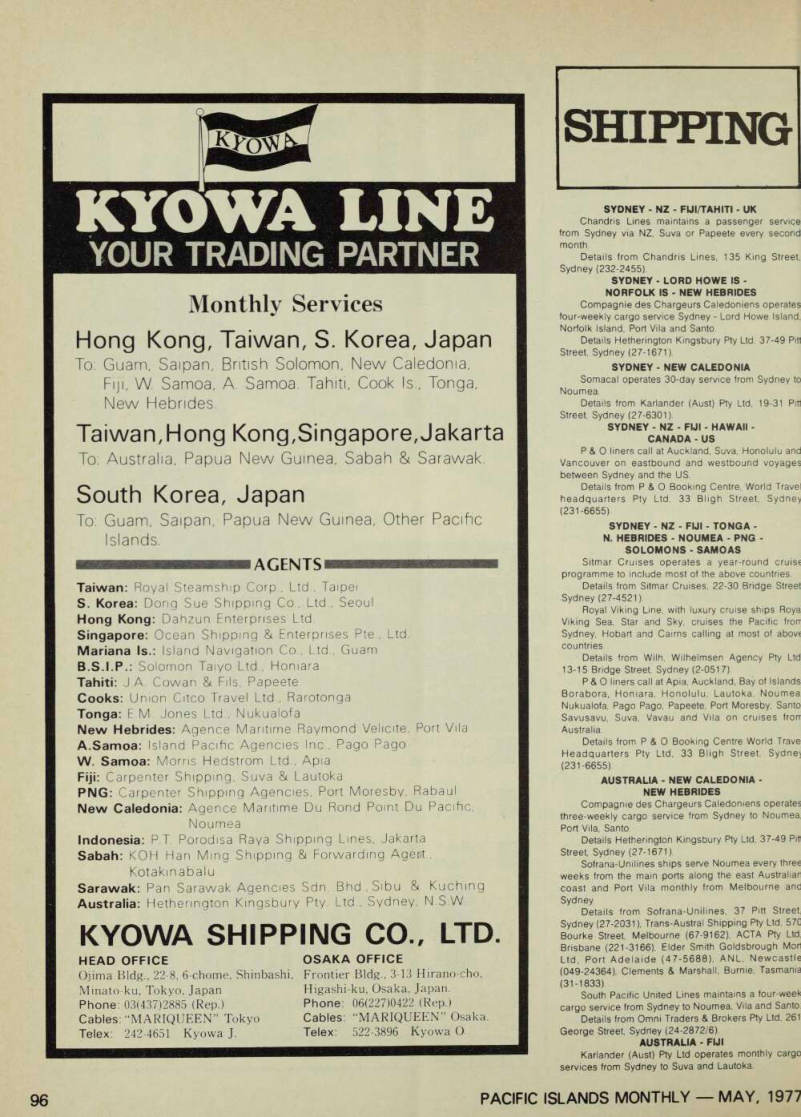
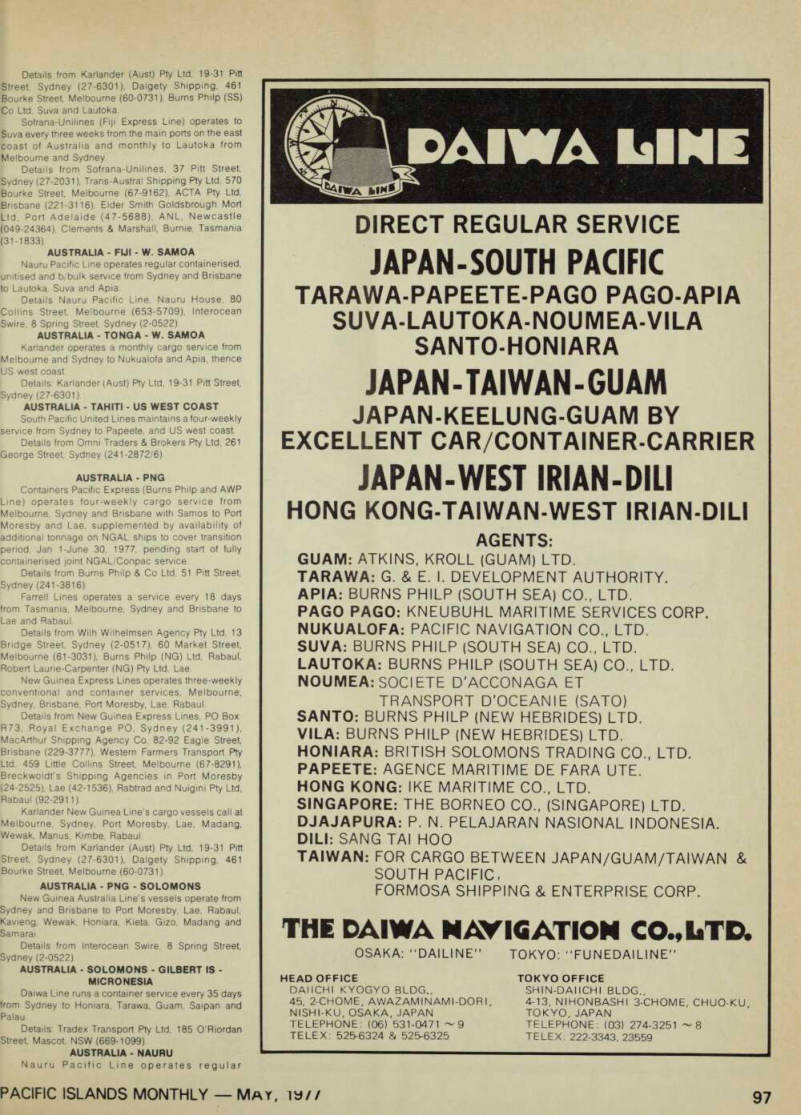
SYDNEY - NZ - FUI/TAHITI - UK Chandris Lines maintains a passenger service from Sydney via NZ, Suva or Papeete every second month.
Details from Chandris Lines, 135 King Street, Sydney (232-2455).
Sydney - Lord Howe Is -
Norfolk Is - New Hebrides
Compagnie des Chargeurs Caledoniens operates four-weekly cargo service Sydney - Lord Howe Island, Norfolk Island, Port Vila and Santo.
Details Hetherington Kingsbury Pty Ltd, 37-49 Pitt Street, Sydney (27-1671).
Sydney - New Caledonia
Somacal operates 30-day service from Sydney to Noumea.
Details from Karlander (Aust) Pty Ltd, 19-31 Pitl Street, Sydney (27-6301).
SYDNEY - NZ - FUI - HAWAII -
Canada - Us
P & 0 liners call at Auckland, Suva, Honolulu and Vancouver on eastbound and westbound voyages between Sydney and the US.
Details from P & O Booking Centre, World Travel headquarters Pty Ltd, 33 Bligh Street, Sydney (231-6655).
SYDNEY - NZ - FIJI - TONGA - N. HEBRIDES - NOUMEA - PNG -
Solomons -Samoas
Sitmar Cruises operates a year-round cruise programme to include most of the above countries.
Details from Sitmar Cruises, 22-30 Bridge Street Sydney (27-4521).
Royal Viking Line, with luxury cruise ships Roya Viking Sea, Star and Sky, cruises the Pacific fronr Sydney, Hobart and Cairns calling at most of above countries.
Details from Wilh, Wilhelmsen Agency Pty Ltd 13-15 Bridge Street, Sydney (2-0517).
P & 0 liners call at Apia, Auckland, Bay of Islands Borabora, Honiara, Honolulu, Lautoka, Noumea Nukualofa, Pago Pago, Papeete, Port Moresby, Santo Savusavu, Suva, Vavau and Vila on cruises fronr Australia.
Details from P & O Booking Centre World Trave Headquarters Pty Ltd, 33 Bligh Street. Sydney (231-6655)
Australia - New Caledonia -
New Hebrides
Compagnie des Chargeurs Caledoniens operates three-weekly cargo service from Sydney to Noumea Port Vila, Santo.
Details Hetherington Kingsbury Pty Ltd, 37-49 Pit Street, Sydney (27-1671).
Sofrana-Unilines ships serve Noumea every three weeks from the main ports along the east Australian coast and Port Vila monthly from Melbourne anc Sydney.
Details from Sofrana-Unilines, 37 Pitt Street, Sydney (27-2031), Trans-Austral Shipping Pty Ltd, 57C Bourke Street, Melbourne (67-9162), ACTA Pty Ltd Brisbane (221-3166), Elder Smith Goldsbrough Mon Ltd, Port Adelaide (47-5688), ANL, Newcastle (049-24364), Clements & Marshall, Burnie. Tasmania (31-1833).
South Pacific United Lines maintains a four-week cargo service from Sydney to Noumea, Vila and Santo.
Details from Omni Traders & Brokers Pty Ltd, 261 George Street, Sydney (24-2872/6).
Australia - Fiji
Karlander (Aust) Pty Ltd operates monthly cargo services from Sydney to Suva and Lautoka.
Details from Karlander (Aust) Pty Ltd, 19-31 Pitt Street, Sydney (27-6301), Dalgety Shipping, 461 Bourke Street, Melbourne (60-0731), Burns Philp (SS) Co Ltd, Suva and Lautoka Sofrana-Unilines (Fiji Express Line) operates to Suva every three weeks from the main ports on the east coast of Australia and monthly to Lautoka from Melbourne and Sydney.
Details from Sofrana-Unilines, 37 Pitt Street, Sydney (27-2031), Trans-Austral Shipping Pty Ltd, 570 Bourke Street, Melbourne (67-9162), ACTA Pty Ltd, Brisbane (221-3116), Elder Smith Goldsbrough Mort Ltd, Port Adelaide (47-5688), ANL, Newcastle (049-24364), Clements & Marshall, Burnie, Tasmania (31-1833)
Australia - Fiji - W. Samoa
Nauru Pacific Line operates regular containerised, unitised and b/bulk service from Sydney and Brisbane to Lautoka. Suva and Apia.
Details Nauru Pacific Line, Nauru House, 80 Collins Street. Melbourne (653-5709), Interocean Swire, 8 Spring Street, Sydney (2-0522)
Australia - Tonga - W. Samoa
Karlander operates a monthly cargo service from Melbourne and Sydney to Nukualofa and Apia, thence US west coast Details: Karlander (Aust) Pty Ltd, 19-31 Pitt Street, Sydney (27-6301).
AUSTRALIA - TAHITI - US WEST COAST South Pacific United Lines maintains a four-weekly service from Sydney to Papeete, and US west coast.
Details from Omni Traders & Brokers Pty Ltd, 261 George Street, Sydney (241-2872/6).
Australia - Png
Containers Pacific Express (Burns Philp and AWP Line) operates four-weekly cargo service from Melbourne, Sydney and Brisbane with Samos to Port Moresby and Lae, supplemented by availability of additional tonnage on NGAL ships to cover transition period, Jan 1-June 30, 1977, pending start of fully containerised joint NGAL/Conpac service.
Details from Burns Philp & Co Ltd, 51 Pitt Street, Sydney (241-3816).
Farrell Lines operates a service every 18 days from Tasmania, Melbourne, Sydney and Brisbane to Lae and Rabaul.
Details from Wilh Wilhelmsen Agency Pty Ltd, 13 Bridge Street, Sydney (2-0517), 60 Market Street, Melbourne (61-3031), Burns Philp (NG) Ltd, Rabaul.
Robert Laurie-Carpenter (NG) Pty Ltd, Lae New Guinea Express Lines operates three-weekly conventional and container services, Melbourne, Sydney, Brisbane, Port Moresby, Lae, Rabaul.
Details from New Guinea Express Lines, PO Box R 73, Royal Exchange PO, Sydney (241-3991), MacArthur Shipping Agency Co, 82-92 Eagle Street, Brisbane (229-3777), Western Farmers Transport Pty Ltd, 459 Little Collins Street, Melbourne (67-8291), Breckwoldt's Shipping Agencies in Port Moresby (24-2525), Lae (42-1536), Rabtrad and Nuigini Pty Ltd, Rabaul (92-2911).
Karlander New Guinea Line's cargo vessels call at Melbourne, Sydney, Port Moresby. Lae, Madang, Wewak, Manus, Kimbe, Rabaul.
Details from Karlander (Aust) Pty Ltd, 19-31 Pitt Street, Sydney (27-6301), Dalgety Shipping, 461 Bourke Street, Melbourne (60-0731).
Australia - Png - Solomons
New Guinea Australia Line’s vessels operate from Sydney and Brisbane to Port Moresby, Lae, Rabaul, Kavieng, Wewak, Honiara, Kieta, Gizo, Madang and Samarai Details from Interocean Swire, 8 Spring Street, Sydney (2-0522).
AUSTRALIA - SOLOMONS - GILBERT IS -
Micronesia
Daiwa Line runs a container service every 35 days from Sydney to Honiara, Tarawa, Guam, Saipan and Palau Details: Tradex Transport Pty Ltd, 185 O’Riordan Street, Mascot, NSW (669-1099).
Australia - Nauru
Nauru Pacific Line operates regular
cargo/passenger service from Melbourne to Nauru.
Details Nauru Pacific Line, Nauru House, 80 Collins Street, Melbourne (653-5709), Interocean Swire, 8 Spring Street, Sydney (2-0522)
Us - Png
Farrell Lines operates regular services from all US west coast ports to Lae and Rabaul.
Details from With, Wilhelmsen Agency Pty Ltd, 13 Bridge Street, Sydney (2-0517), Farrell Lines, 1 Market Plaza, San Francisco, LA. (9-4105), Burns Philp (IslG) Ltd, Rabaul and Kieta, Robert Laurie-Carpenter (PNG) Pty Ltd, Lae.
Png - Us - Canada
Farrell Lines operates regular services from Lae and Rabaul to US west coast ports and Vancouver.
Details from Burns Philp (NG) Pty Ltd, Rabaul, Robert Laurie-Carpenter (PNG) Pty Ltd, Lae, Farrell Lines, 1 Market Plaza, San Francisco, LA. (9-4105), Wilh, Wilhelmsen Agency Pty Ltd, 13 Bridge Street, Sydney (2-0517).
FAR EAST - FIJI - NEW ZEALAND New Zealand Unit Express (CNC, MNOL RIL) operates a three-weekly cargo service from Hong Kong to Lautoka, Suva, NZ ports, Manila, Kaoshiung, Keelung, Hong Kong.
Details from Interocean Swire, 8 Spring Street, Sydney (2-0522).
Royal Interocean Lines operates monthly cargo service with three ships from Surabaya, Jakarta, Bangkok, Port Kelang and Singapore to Suva and NZ ports Details from Interocean Aust. Services Pty Ltd, 8 Spring Street, Sydney (27-3801), Burns Philp (SS) Co Ltd, Suva and Lautoka.
Ben Shipping Co (Pte) Ltd, sailing monthly from Singapore, Hong Kong, Keelung, Kaoshiung, Suva and main NZ ports.
Details from Seatrans (Fiji) Ltd, GPO Box 152, Suva, Fiji.
Japan - Nz - Png
China Navigation Co, with three ships operates £ monthly cargo service from Japan to New Zealanc calling at Lae on return journey.
Details Interocean Swire, 8 Spring Street, Sydney (2-0522).
Far East - Mid-S. Pacific
China Navigation Co’s vessels operate a regulai cargo service from Hong Kong, Taiwan and Singapore to Rabaul, Wewak, Madang, Lae, Port Moresby Honiara, New Hebrides, Noumea, Papeete anc Samoa.
Details from Interocean Swire, 8 Spring Street Sydney (2-0522).
Kyowa Shipping Co Ltd operates monthly services from Hong Kong, Taiwan, S. Korea and Japan, tc Guam, Saipan, Solomons, New Caledonia, Fiji Western and American Samoa, Tahiti, Cook Is., Tong£ and New Hebrides.
Details: Hetherington Kingsbury Pty Ltd, 37-49 Pit Street, Sydney (27-1671).
North Europe - New Caledonia
Hamburg-Sued operates monthly cargo services from Dunkirk and Le Havre to Noumea, via Panama Details from Columbus Overseas Services Pty Ltd 333 George Street, Sydney (290-2966)
North Europe - Tahiti -
N. Caledonia - Png
Compagnie Generale Maritime operates three multi-purpose and three ro/ro cargo services a montl from North European and Mediterranean ports t< Papeete and Noumea. Three multi-purpose ships cal monthly in Papua New Guinea.
Details from Compagnie General Maritime, 4-f Bligh Street, Sydney (221-2522).
JAPAN - GUAM - FUI - SAMOA -
N. Caledonia - N. Hebrides
Daiwa Lines runs a monthly cargo service frorr Japan via Guam to Suva, Lautoka, Pago Pago, Apia Vila, Santo and Noumea.
Details from Burns Philp (SS) Co Ltd, Suva.
NZ - FUI - TONGA - SAMOAS -
Tahiti
Union Steam Ship Co of NZ operates a full}
containerised service Auckland-Suva-Pago Pago- Apia-Nukualofa every 14-16 days.
A 28-day service by conventional ship is operated from Auckland to Papeete, Apia and Nukualofa.
Details from Union Steam Ship Co of NZ Ltd, PO Box 12, Auckland, or from branch offices/agents in Fiji, Tonga, Samoa and Tahiti NZ - N. CALEDONIA - N. HEBRIDES -
Png - Si
Sofrana-Unilines with two ships operates to Vila and Santo, to Honiara and Papua New Guinea, and to Noumea.
Details from Sofrana-Unilines, 42 Customs Street, Auckland (7-3279), PO Box 3614, Telex: NZ2313.
Nz - Png
Farrell Lines operates regular service every 18 days from Auckland to Lae and Rabaul.
Details from Dalgety NZ Ltd, 41-45 Albert Street, Auckland (7-1859), Burns Philp (NG) Ltd, Rabaul, Robert Laurie-Carpenter (PNG) Pty Ltd, Lae NZ - FUI - NORTH AMERICA (WC) Crusader cargo ships call at Suva, Levuka and Honolulu on NZ-US west coast trips and at Suva and/or .autoka on US-NZ return trips.
Details from Blueport ACT (NZ) Ltd, PO Box 192, Wellington (739-029), Burns Philp (SS) Co Ltd, Suva.
Nz - Fiji
Reef operates a regular 18-day service from Auckland to Suva and Lautoka Details from Reef Shipping Agencies Ltd, PO Box J 382, Auckland, NZ (7-1221-3).
Pacific Line with one ship operates monthly cargo service New Zealand, Lautoka, Suva.
Details: Sof-'ana-Unilines, 42 Customs Street, Auckland (7-3279) PO Box 3614, Telex: NZ2313.
Warner Pacific Line operates monthly freezer :argo service, Timaru-Suva.
Details from Air Marine Services (NZ) Ltd, PO Box >505, Auckland (362-730).
Nz- Tonga
Warner Pacific Line services Onehunga - Nukualofa - Vavau - Haapai fortnightly, and Timaru - Nukualofa - Vavau monthly Details from Air Marine Service (NZ) Ltd, PO Box >505, Auckland (362-730)
Nz - W. Samoa
Warner Pacific Line services Onehunga - Apia ;very 21 days carrying general and freezer cargoes Details from Air Marine Services (NZ) Ltd, PO Box >505, Auckland (362-730)
Nz - W. Samoa • Tonga
McKay Shipping Ltd operates a four-weekly cargo service, Auckland - Nukualofa - Vavau - Apia - Nukualofa - Auckland.
Details from McKay Shipping Ltd, Downtown House, Queen Street, Auckland (33-656)
Nz - Cook Is - Niue
The Shipping Corporation of NZ Ltd with Toa doana and Lorena, operates cargo services from Auckland to Rarotonga and Aitutaki (fortnightly) and Hiue (monthly) Details from the Shipping Corp of NZ Ltd, PO Box )420, Auckland (379-430); Waterfront Commission, PO Box 61, Rarotonga, Lighterage and Stevedoring Co, Aitutaki, Niue Govt Offices, Niue Island NZ - FAR EAST - PACIFIC ISLANDS Sofrana Fareast Lines operates a five-weekly service from Auckland to Far East, PNG, New Daledonia and Fiji Details from Sofrana Unilines, 42 Customs Street, Auckland (73-279).
UK - PANAMA • SAMOA - FUI The Fiji Direct Service, cargo only, is maintained jy Conference vessels, sailing at regular monthly ntervals out of Avonmouth, via Panama, for Apia, Suva smd Lautoka Details from Burns Philp (SS) Co Ltd, Suva.
UK - TAHITI - N. CALEDONIA - N. HEBRIDES - PNG - SOLOMONS -
Gilbert Is
Bank Line operates a monthly direct cargo service from Europe, via the Panama Canal to Papeete, Noumea, Vila, major PNG ports and Honiara, accasionally to Tarawa, Santo, Kieta, Jayapura and
Yandina and return.
Details from Bank Line (A’asia) Pty Ltd, 1 York Street, Sydney (27-2041); Burns Philp (SS) Co Ltd, Suva.
EUROPE - TAHITI - W. SAMOA - FUI -
N. Caledonia
Nedlloyd offers regular cargo services from Northern Europe and UK to Papeete, Apia, Fiji and Ne\k Caledonia.
Details Interocean Aust Services Pty Ltd, 8 Spring Street, Sydney (27-3801).
San Francisco - Honolulu -
Micronesia
Nauru Pacific Line operates regular conventional/container service from San Francisco and Honolulu to Majuro, Nauru, Ponape, Truk and Saipan.
Details from Nauru Pacific Line, Nauru House, 80 Collins Street, Melbourne (653-5709), North American Maritime Agencies, 100 California Street, San Francisco, California 9411 (981-0343).
US - FIJI - TAHITI - AUSTRALIA Bank Line Ltd operates regular cargo services from US Gulf ports to Australia and NZ. Calls at Suva, Lautoka and Papeete on demand.
Details from Bank Line (A/asia) Pty Ltd. 1 York Street, Sydney (27-2011).
Pacific Far East Line cruise ships operate from San Francisco, Los Angeles, Honolulu, Moorea, Papeete, Rarotonga, Auckland, Opua (Bay of Islands), Sydney and return via Suva, Niuafoou, Pago Pago and Honolulu to San Francisco.
Freight is carried on these passenger liners.
Passenger details from World Travel Headquarters Pty Ltd, 33 Bligh Street, Sydney (231-6655); freight details from Beaufort Shipping Agency Co, 2 Castlereagh Street, Sydney (221-2388).
US - A. SAMOA - NZ - AUST - PNG Farrell Lines LASH ships operate regularly fronr US to Australia, via Pago Pago and Auckland, returning via PNG ports.
Details from Wilh, Wilhelmsen Agency Pty Ltd, 12 Bridge Street, Sydney (2-0517), 60 Market Street Melbourne (61-0301); Farrell Lines, 1 Market Plaza San Francisco, LA. (415-777-3300); Dalgety NZ Ltd Auckland (7-1859); Kneubuhl Maritime Services, Page Pago (633-5121)
Us - Tahiti - Samoa
Pacific Islands Transport operates a five/six weekly cargo service from North American west coas ports to Papeete, Pago Pago, Apia.
Details from Trans-Austral Shipping Pty Ltd, 19 Pit Street, Sydney (27-2441).
Polynesia Line operates container and genera cargerservice from US west coast ports to Papeete anc Pago Pago.
Details from Polynesia Shipping Services Inc, PC Box 1478, Pago Pago (9-6799)
Solomons’ Hopes
For Forum Line
The Solomon Islands expects
another 18 more commercia
voyages a year if the government de
cides to join the South Pacific
Forum’s regional shipping line. The
services would be from Australia
and New Zealand. At present there
are 14 voyages a year from Australh
and nine from NZ.
While not expecting a cut ir
freight rates, the group sees an econ omic advantage in a speed-up in the
flow of goods, particularly exports
and a cut-back in periodical shor
tages of commodities.
Advertisements & other items, pp. 95-98 (2 items)
Daiwa Line
bfei
DIRECT REGULAR SERVICE
JAPAN-SOUTH PACIFIC
TARAWA-PAPEETE-PAGO PAGO-APIA
SUVA-LAUTOKA-NOUMEA-VILA
SANTO-HONIARA
JAPAN - TAIWAN - GUAM
JAPAN-KEELUIMG-GUAM BY
EXCELLENT CAR/CONTAINER-CARRIER
JAPAN-WEST IRIAN-DILI
HONG KONG-TAIWAN-WEST IRIAN-DILI
AGENTS:
GUAM; ATKINS, KROLL (GUAM) LTD.
TARAWA: G. & E. I. DEVELOPMENT AUTHORITY.
APIA: BURNS PHILP (SOUTH SEA) CO., LTD.
PAGO PAGO: KNEUBUHL MARITIME SERVICES CORP.
NUKUALOFA: PACIFIC NAVIGATION CO., LTD.
SUVA: BURNS PHILP (SOUTH SEA) CO., LTD.
LAUTOKA: BURNS PHILP (SOUTH SEA) CO., LTD.
NOUMEA: SOCIETE D'ACCONAGA ET
TRANSPORT D'OCEANIE (SATO)
SANTO: BURNS PHILP (NEW HEBRIDES) LTD,
VILA: BURNS PHILP (NEW HEBRIDES) LTD.
HONIARA: BRITISH SOLOMONS TRADING CO., LTD.
PAPEETE: AGENCE MARITIME DE FARA UTE.
HONG KONG: IKE MARITIME CO., LTD.
SINGAPORE: THE BORNEO CO., (SINGAPORE) LTD.
DJAJAPURA: P. N. PELAJARAN NASIONAL INDONESIA.
DILI: SANG TAI HOO
TAIWAN; FOR CARGO BETWEEN JAPAN/GUAM/TAIWAN &
SOUTH PACIFIC.
FORMOSA SHIPPING & ENTERPRISE CORP.
THE DAIWA NAVIGATION CO.* LTD.
OSAKA: “DAILINE” TOKYO; “FUNEDAILINE”
HEAD OFFICE
DAIICHI KYOGYO BLDG.,
45, 2-CHOME, AWAZAMINAMI-DOR I,
NISHI-KU, OSAKA, JAPAN
TELEPHONE: (06) 531-0471 ~9
TELEX: 525-6324 & 525-6325
TOKYO OFFICE
SHIN-DAIICHI BLDG.,
4-13, NIHONBASHI 3-CHOME, CHUO-KU
TOKYO, JAPAN
TELEPHONE: (03) 274-3251 ~8
TELEX: 222-3343, 23559
THE
GLOBAL SERVICE FOR SHIPPERS
V $3
MONTHLY SERVICES
United Kingdom and Continent to: Papeete, Noumea, New Hebrides, Papua New Guinea and Solomon Islands.
Papua New Guinea to: North America, United Kingdom and Continent.
Solomons, Fiji, Tonga, Samoa and Tarawa to: United Kingdom and Continent.
For particulars apply:
THE BANK LINE (AUSTRALASIA) PTY.
LTD.,
18TH FLOOR, 1 YORK STREET,
SYDNEY, N.S.W.
HENRY CUMINES PTY. LTD.
EXPORTERS • GENERAL MERCHANTS
428 GEORGE ST., SYDNEY
CABLES: HENCO SYDNEY. G.P.O. Box 3949. PHONE: 25-3383.
For specialised and personalised buying service throughout the Pacific Islands and the East.
LOCAL AGENTS AND REPRESENTATION:
PAPUA NEW GUINEA.
PORT MORESBY: Mr. Tan,
P.O. Box 5445, Boroko.
Telephone 25 2542.
RABAUL: M. & C. Seeto, P.O. Box 131, Rabaul.
Telephone 92 2902.
MADANG: W, Double, P.O. Box 22, Madang.
Telephone 82 2696.
FIJI.
K. Witherington Ltd., P.O. Box 293, Suva.
Telephone 22 356.
NEW HEBRIDES.
John Lum & Associates, P.O. Box 65, Santo.
Telephone 329.
SOLOMON ISLANDS.
Lo See War Ltd., P.O. Box 327, Honiara.
Telephone 399.
Resident Agents in other Pacific Territories.
Q E
offers expert insurance service
throughout the Islands
QBE INSURANCE
LIMITED
(FORMERLY—QUEENSLAND INSURANCE COMPANY)
Central Office: 82 Pitt Street, Sydney FlJl—Branch Office, Suva, Manager for Fiji: L.G.Liddell A A I I.
LAUTOKA—Sub-Branch Office: Bums Philp Bldg.
HONIARA (8.5.1. P.) —Breckwoldt & Company (5.1.) Pty. Limited.
NEW CALEDONIA—T. A. Hagen, Stc. W. A. Johnston, SA.R.L. —Noumea.
NEW HEBRIDES— District Manager: G. F. Donnelly, Vila; Santo: Burns Philp (New Hebrides) Ltd.
TAHlTl—Arthur Chung: Immeuble 8.1., Front dc Mer, Papeete.
NIUE, NORFOLK ISLAND, SAMOA, TONGA and other South Sea Islands—Bums Philp (South Sea) Company Ltd.
QUEENSLAND INSURANCE (P.N.G.) LTD
PAPUA NEW GUINEA-Head Office, PORT MORESBY.
General Manager: J.M.Dawe. Assistant Manager: R.Jackson,A.A.l.l.
District Managers at: ARAWA: J.Longbut LAE: W.J.Leonard MADANG: I.R.Martin
MOUNT HAGEN: D.F.CarroU RABAUL: A.M.Tanner
DATELINE HOTEL
TONGA
'Friendly Hotel” of the "Friendly Islands Situated along the Nukualofa waterfront. Only five minutes walk from town. Single, double, family suites, airconditioning, and hot and cold water showers. Pool, bar, restaurant, duty-free shop, tour desk and boutique.
Book through your travel agent or write to International Dateline Hotel, P.O. Box 62, Nukualofa Tonga.
Cable Address; ''DATELINE".
Represented Overseas by: Charles J. Henry and Associates Pty. Ltd.
Sydney and Melbourne. 29 76
THE PAPUA HOTEL
PORT MORESBY
• Right in the business centre • A tradition for comfort and fine food • All rooms air conditioned • Restaurant • Bars • Banquet Hall Telephone 24 2121 Cables PAPTEL
A. C. NEUMANN
Manager
Regular Pacific Services
"Union South Pacific”, cellular container vessel. Reefer and general cargo from Auckland at approximately fortnightly intervals. Calls at Suva, Pago Pago, Apia and Nukualofa before returning to Auckland.
"Luhesand”, conventional reefer and general cargo. Monthly sailings from Auckland, calls at Suva, Apia, Papeete and Nukualofa.
jmimwuon
Jm/mcompanij
Branches at all main Australian, New Zealand and Pacific Island ports.
PACIFIC ISLANDS TRANSPORT LINE
Owners: Thor Dahls Hvoljangerseiskap A/S — Sandefjord, Norway.
MS CAMELLIA VENTURE
Express Freight Service between Pacific Coast Ports of
U.S.A.
and
TAHITI and SAMOA
Full container service including reefers.
GENERAL STEAMSHIP CORPORATION LTD.
General Agents 400 California Street, San Francisco, California, U.S.A.
APlA—Burns Philp (South Sea) Company, Ltd. . .
PAPEETE—Afenco Maritime Internationale Tahiti. •AGO PAGO—Polynesia Shipping Services Inc.
NOUMEA—Etablissements Ballande.
SYDNEY—Trans-Aostral Shipping Pty. Ltd.
SUVA —Bums Philp (South Sea) Company, Ltd.
LAE/RABAUL—Burns Philp (Now Guinea) Ltd.
PORT VlLA—Comptoirs Francais de Neuvelles Hebrides.
99
’ACIFIC ISLANDS MONTHLY MAY, 1977
Produce
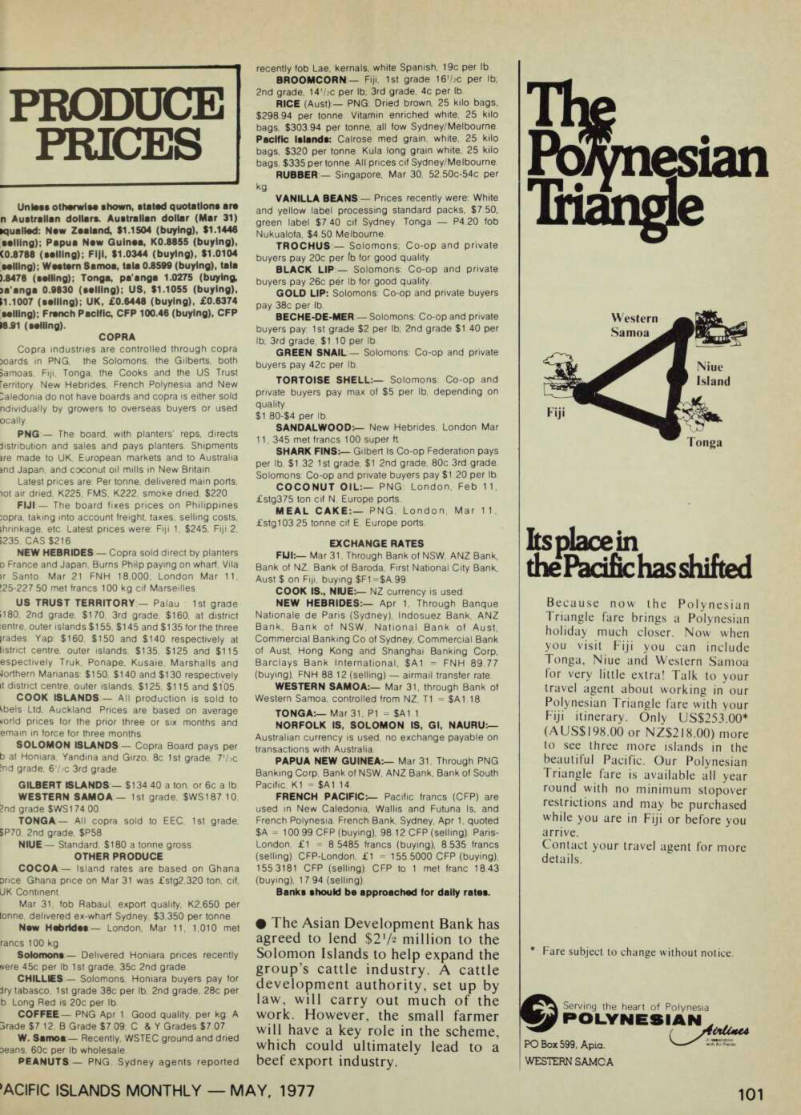
Prices
Unlass otherwise shown, statod quotations are n Australian dollars. Australian dollar (Mar 31) iqualled: Naw Zealand, $1.1504 (buying), $1.1446 selling); Papua New Guinea, K 0.8855 (buying), (0.8788 (selling); Fiji, $1.0344 (buying), $1.0104 selling); Western Samoa, tala 0.8599 (buying), tala I. (selling); Tonga, pa'anga 1.0275 (buying, la'anga 0.9830 (selling); US, $1.1055 (buying), 11. (selling); UK, £0.8448 (buying), £0.6374 selling); French Pacific, CFP 100.46 (buying), CFP 18SI (selling).
Copra
Copra industries are controlled through copra joards in PNG, the Solomons, the Gilberts, both Jamoas, Fiji, Tonga, the Cooks and the US Trust territory New Hebrides, French Polynesia and New Caledonia do not have boards and copra is either sold ndividually by growers to overseas buyers or used ocally PNG The board, with planters' reps, directs distribution and sales and pays planters. Shipments are made to UK, European markets and to Australia md Japan, and coconut oil mills in New Britain Latest prices are: Per tonne, delivered main ports, lot air dried, K 225, FMS, K 222, smoke dried, $220 FIJI The board fixes prices on Philippines :opra, taking into account freight, taxes, selling costs, shrinkage, etc. Latest prices were: Fiji 1, $245, Fiji 2,
>235, Cas $216
NEW HEBRIDES Copra sold direct by planters o France and Japan, Burns PhHp paying on wharf, Vila ir Santo Mar 21 FNH 18,000: London Mar 11, !25-227 50 met francs 100 kg cif Marseilles US TRUST TERRITORY Palau Ist grade 1180, 2nd grade, $l7O, 3rd grade, $l6O, at district ;entre, outer islands $155, $145 and $135 for the three irades Yap: $l6O, $l5O and $l4O respectively at listrict centre, outer islands. $135, $125 and $ll5 espectively Truk, Ponape, Kusaie, Marshalls and Jorthern Marianas: $l5O, $l4O and $l3O respectively it district centre, outer islands. $125, $ll5 and $lO5 COOK ISLANDS All production is sold to kbels Ltd. Auckland Prices are based on average i/orld prices for the prior three or six months and emain in force for three months SOLOMON ISLANDS Copra Board pays per b at Honiara, Yandina and Girzo, 8c Ist grade, 7'/?c !nd grade, 6’/ >c 3rd grade GILBERT ISLANDS $134 40 a ton, or 6c a lb
Western Samoa Ist Grade, Swsib7 10.
2nd grade SWSI74 00 TONGA— All copra sold to EEC, Ist grade, 5P70, 2nd grade. SPSB NIUE Standard. $lBO a tonne gross
Other Produce
COCOA Island rates are based on Ghana price Ghana price on Mar 31 was £stg2,32o ton, cif.
UK Continent Mar 31, fob Rabaul, export quality, K 2.650 per tonne, delivered ex-wharf Sydney, $3,350 per tonne.
New Hebrides— London, Mar 11, 1,010 met rancs 100 kg Solomon* — Delivered Honiara prices recently vere 45c per lb Ist grade, 35c 2nd grade CHILLIES Solomons, Honiara buyers pay for jry tabasco, Ist grade 38c per lb, 2nd grade, 28c per b Long Red is 20c per lb COFFEE— PNG Apr 1 Good quality, per kg: A Srade $7 12, B Grade $7 09: C & Y Grades $7 07 W. Samoa Recently. WSTEC ground and dried Deans, 60c per lb wholesale PEANUTS — PNG. Sydney agents reported
recently fob Lae, kernals, white Spanish, 19c per lb BROOMCORN Fiji, Ist grade 16V?c per lb; 2nd grade. 14'/?c per lb; 3rd grade, 4c per lb RICE (Aust): — PNG: Dried brown, 25 kilo bags, $298 94 per tonne Vitamin enriched white, 25 kilo bags, $303 94 per tonne, all tow Sydney/Melbourne Pacific Islands: Calrose med grain, white, 25 kilo bags, $320 per tonne. Kula long grain white, 25 kilo bags, $335 per tonne All prices cif Sydney/Melbourne.
RUBBER Singapore, Mar 30, 52 50c-54c per kg VANILLA BEANS Prices recently were: White and yellow label processing standard packs, $7 50, green label $7 40 cif Sydney Tonga P 4.20 fob Nukualofa, $4 50 Melbourne.
TROCHUS — Solomons: Co-op and private buyers pay 20c per lb for good quality BLACK LIP — Solomons; Co-op and private buyers pay 26c per lb for good quality.
GOLD LIP: Solomons: Co-op and private buyers pay 38c per lb BECHE-DE-MER Solomons: Co-op and private buyers pay: Ist grade $2 per lb: 2nd grade $1 40 per lb: 3rd grade, $llO per lb GREEN SNAIL Solomons: Co-op and private buyers pay 42c per lb.
TORTOISE SHELL:— Solomons: Co-op and private buyers pay max of $5 per lb, depending on quality $1 80-$4 per lb.
SANDALWOOD: — New Hebrides, London Mar 11, 345 met francs 100 super ft SHARK FINS: — Gilbert Is Co-op Federation pays per lb, $1 32 Ist grade, $1 2nd grade, 80c 3rd grade.
Solomons: Co-op and private buyers pay $1.20 per lb COCONUT OIL; PNG: London, Feb 11, £stg37s ton cif N. Europe ports.
MEAL CAKE;— PNG, London, Mar 11, £stglo3 25 tonne cif E. Europe ports.
Exchange Rates
FUI;— Mar 31, Through Bank of NSW, ANZ Bank, Bank of NZ, Bank of Baroda, First National City Bank, Aust $ on Fiji, buying SFI =$A.99 COOK IS., NIUE: — NZ currency is used NEW HEBRIDES: — Apr 1, Through Banque Nationale de Paris (Sydney), Indosuez Bank, ANZ Bank, Bank of NSW, National Bank of Aust, Commercial Banking Co of Sydney, Commercial Bank of Aust, Hong Kong and Shanghai Banking Corp, Barclays Bank International, SAI = FNH 89.77 (buying), FNH 88 12 (selling) airmail transfer rate WESTERN SAMOA: — Mar 31, through Bank of Western Samoa, controlled from NZ, T 1 = SAI 18 TONGA;— Mar 31, PI = SAI 1
Norfolk Is, Solomon Is, Gl, Nauru:—
Australian currency is used, no exchange payable on transactions with Australia.
PAPUA NEW GUINEA;— Mar 31, Through PNG Banking Corp, Bank of NSW, ANZ Bank, Bank of South Pacific, K 1 = SAI 14 FRENCH PACIFIC: — Pacific francs (CFP) are used in New Caledonia, Wallis and Futuna Is, and French Polynesia French Bank, Sydney, Apr 1, quoted $A = 100 99 CFP (buying), 98.12 CFP (selling). Paris- London, £1 = 8 5485 francs (buying), 8.535 francs (selling) CFP-London. £1 = 155 5000 CFP (buying), 155 3181 CFP (selling). CFP to 1 met franc 18.43 (buying), 17 94 (selling).
Banks should be approached for daily rates.
• The Asian Development Bank has
agreed to lend s2'/ 2 million to the
Solomon Islands to help expand the
group’s cattle industry. A cattle
development authority, set up by
law, will carry out much of the
work. However, the small farmer
will have a key role in the scheme,
which could ultimately lead to a
beef export industry.
Advertisements & other items, pp. 99-104 (3 items)
101
‘ACIFIC ISLANDS MONTHLY MAY, 1977
mangle
Hie
Po/ynesian
Western Samoa Niue Island Fiji Ponga
Its place in
the Pacific has shifted
Because now the Polynesian
Triangle fare brings a Polynesian
holiday much closer. Now when you visit Fiji you can include Tonga, Niue and Western Samoa for very little extra! Talk to your travel agent about working in our Polynesian Triangle fare with your
Fiji itinerary. Only U55253.00*
(AUSSI9B.OO or NZ$2lB.OO) more to see three more islands in the beautiful Pacific. Our Polynesian Triangle fare is available all year round with no minimum stopover restrictions and may be purchased while you are in Fiji or before you arrive.
Contact your travel agent for more details. * Fare subject to change without notice.
Serving the heart of Polynesia
POLYNESIAN
PO Box 599, Apia.
WESTERN SAMOA
CLASSIFIED ADVERTISEMENTS
Per Line $3.00 Aust Minimum 4 lines.
w
Stay at
Aggie Grey's the
South Pacific's legendary hotel Situated right in the heart of Western Samoa. Enjoy Polynesian-style friendliness and service, in cool surroundings, superb entertainment and food. Magnificent white sand beaches only a short drive away.
Airconditioned rooms, swimming pool and full bar facilities.
Bookings through Union Steamship Company of NZ, Pan Am, Air New Zealand or direct to Aggie Grey's. Apia, Western Samoa. Cables: AGGIES, APIA.
FOR SALE
Coastal Vessels Built 1960. B.V. Class. Survey due 6/77. 43.9 m x 7.9 m x 2.83 m. Gross 351.9. Nett 172.8. M/E S/S Brons 2SA. 330 BHP. I hold, 2 hatches. Offers.
Built 1969 PNG survey. 21,5 m x 6.4 m x 2.13 m. 62 DWT. S/S Caterpillar D 333.
K 75,000 ONO.
Built 1965 PNG survey. 24.41 m x 5.9 m x 2.28 m. 100 DWT. I hold, I hatch.
S/S SMS Yanmar diesel. 150 BHP.
KBO,OOO ONO.
Barges Built 1969. PNG survey. 23.37 m x 6.09 n 60 DWT. 2x4 cyl. Caterpillar D33OC.
K 75,000 ONO.
Rebuilt 1976. 10.1 m x 4.8 m. 20 DWT.
Capacity T/S Ferdson diesel each 56
BHP. K 25,000.
Built 1969. 27.4 m x 7.9 m x 2.13 m. 127 DWT. 280 sq ft deck space. 4 Perkins diesels. K 175,000.
Built 1970. Abs. S/S 76. 38.4 m x 9.3 m x 2.13 m. DWT 250. M/E 3x6 cyl.
Caterpillar D 333. K 275,000.
Many other vessels also available on request. For further details apply:
NEW GUINEA MARINE SURVEYS &
SERVICES, BOX 783, LAE, PAPUA
NEW GUINEA.
TELEX: MARINESERV NE42515.
FOR SALE
Pacific Island Business for sale.
Established electronics firm providing good income with small investment.
Write PIM, GPO Box 3408, Sydney, for details.
TAG SHELLS
Australian specimen shells for the serious collector. Send your "WANT" list now. Prompt and personal replies.
To: C. Samson - PO Box 13, Hampton, Vic, 3188. Aust.
FLEETS 30ft. fibreglass cutter bit. 1976, 25 hp mar. diesel, alum, mast & boom, sails, s.s.stays, self-steering, 4 berths, toilet, gas stove, sounder, $32,000.00. FLEETS 221 Esplanade, Wynnum Central, Brisbane. Cable
FLEETS BRISBANE.
TRADE MARK CAUTIONARY NOTICE:
Wiggins Teape Limited of Gateway House, Basing View, Basingstoke, Hampshire RG2J 2EE, England wish it to be known that they are the owners of the trade mark IDEM and that the IDEM mark is used by Wiggins Teape Limited on or in connection with paper.
Proceedings will be taken against any third party found to be using the IDEM mark or any closely similar mark on or in connection with paper.
IS
VU.H. GROVE 0 SONS
LTD
THE ACTIVE EXPORTERS
SHIPPERS OF FRESH, FROZEN
AND PROCESSED
NEW ZEALAND PRODUCTS
SINCE 1896
ENQUIRIES WELCOME
AIR FREIGHTS A SPECIALTY
W. H. GROVE ft SONS LTD
16-18 FANSHAWE ST AUCKLAND NZ
P.O. BOX 3718 AUCKLAND TELEPHONE 74-2*5
TELEX AUCKCOM NZ 2326 CABLES GROVE AUCKLAND
MODERN TEACHING AIDS PTY. LTD.
has progressively introduced sound educational materials into the classroom and homes that guide children's natural interest to their learning needs. Foremost among these are the very successful Tutor Books, M. T.A.
Reading Laboratories, and now the recently published Open House Math Laboratory.
Continuing with this policy of meeting the educational needs in Papua New Guinea, and the Pacific. MT.A. have appointed Mr T. Unwin to service this region.
For your educational needs, please contact Isopang School & Library Supplies P. 0., Box 9123 Hohola. P.N.G.
Telephone: 25-3817
TOWAGE
Contract towage Australia and Pacific Islands. International survey - F.G. Crews. Interocean Marine, 106 Anderson St, Ballina, NSW. Cable
INTERSALVAGE.
THE
W th ’ re,l able. di,r^,- s
men
mh the accents’ quality. Trucks £act n % inee ring'
TRUCksi
ssiS^tt
9 re teUeJsu^i e truck - Powerful SUZU d 'ese/ PoweTs^yortab/e,
gearbox. Dua°br*l! :Synchro
Suner b r klng
ov erslunq ,7
system 9 S^ p f ns -on springs UDf ® s ' ,,enf teaf
j ffi'*
I absorbers.
I —wfoers. Foo,, „ ac °es sibiiify Syen 9' n e Jj 1 7 , >~ ; n if
ISUZU TXD ISUZU TLD 238 BUS
A big, powerful truck designed to A great way to carry up to 15 tackle the toughest jobs with ease! passengers reliably and comfortably.
Western Samoa O.F. Nelson & Co. Ltd. < Fiji Burns Philp (South Sea) Co. Ltd.
Papua New Guinea Dawapia Motors, Rabaul Wamp Nga Motors, Mt. Hagen Solomon Islands Solomon Islands Service Station New Caledonia
SAIP
SMI General Motors. Serving you in the South Pacific.
m v ti /
Beautiful Sunset,
Astounding Soundset!
The component hunt ends with Akai’s ultra-compact stereo System-A Series. Perfectly matched audio engineering between turntable and Receiver/Cassette Deck, and your choice of speakers, lets you construct the system most in harmony with your taste. Akai’s vertical display rack completes System-A’s easy operation and good looks. System-A is the professional-quality component system that recreates music both naturally bright and beautiful.
Vi ■
ifc
if v m I * Australia; Akai Australia Pty. Ltd., 17/18 Hordern Place Denison St. Camperdown, Sydney, N S W. 2050 Tel: 516-3366/P.N.G.: S O. Svensson (N.G.) Ltd., P 0. Box 705, Port Moresby Tel; 2275/Fiji Islands; Motibhai & Company Ltd , P 0 Box 9175 Nadi International Airport Tel; 72-165/New Zealand; Pye Ltd, Consumer Product Division, 110 Mt. Eden Rd., Mt. Eden, Auckland Tel: 686-437/ New Caledonia: Menard Freres, B P, H 2, Noumea Tel; 275222/Tahiti. Etablissements Comimpex, P.O. Box 200. Papeete Tel: 20477/New Hebrides Island: Burns Philip (New Hebrides) Co., Ltd., Port Vita, New Hebrides Island /Norfolk Island: Burns Philip (Norfolk Island) Co., Ltd , P.O, Box 21, Norfolk Island/ Samoan Islands: Burns Philip (South Sea) Co., Ltd., P 0. Box 129, Pago Pago, American Samoa, Apia, Western Samoa /Mariana Islands: J C. Tenorio Enterprises, P.O. Box 137, Saipan Tel: 6444/8/British Solomon: Security Electrical Co., Ltd., P.O. Box 174, Honiara Tel; 881 /Cook Islands: JPS Enterprises Ltd..
P.O. Box 15, Rarotonga Tel: 2150, 2176
SYSTEIfIiV
Audio & Video
IAKAII
AKAI ELECTRIC CO., LTD.
Tokyo, Japan
Honda is a true life drama, performed on the world’s stage. By average folks, teenagers, men, and women everywhere. Your neighbors, maybe even you are playing a part. If so, you know Honda is more than great machines.
It’s people concerned with taking people where they want to go in life.
On two wheels, we’re the best selling motorcycle. The easy to operate hard workers who don’t demand much. Honda is always ready and gets you there safely. We move on four wheels. The precedent setting Honda Civic continues to receive international economy and performance awards. It’s the elegant compact car.
Sometimes, we have no wheels. Honda portable power operates machinery, generates electricity, pumps water and tills the soil.
Little wonder good things happen on Honda —we work harder to assure they do. r
HONDA MOTOR CO., LTD. TOKYO, JAPAN
PapeeWFMl' ISLANDS: Suwu'S°TRUST TERRITORY 'ij It"*!! de ‘ Produi, ‘ H »" da B P 1665-
4-Wheel Drive
Built By the People Who’ve Made Datsun World Famous.
The Nissan Patrol, Datsun cars and trucks all share the same tradition of quality engineering.
The 4-wheel drive Nissan Patrol is specially designedf^o''handle a wide-range of work assignments both on and dff the road.
It’s tough and dependable.
The Nissan Patrol —built to do the job betl □J V s Nissan PATROL Pickup Nissan PATROL Hardtop'
DATSUN
Product of NISSA^
105
:iFIC ISLANDS MONTHLY - MAY, 1977