Juimc, 157/I

Advertisements & other items, pp. 2-4 (1 item)
we promise you much more than
When you buy a Toyota
one of the world’s finest cars.
We'll be the first to admit that at Toyota we make some of the world's finest cars.
You only have to look at them to see that.
And driving them just goes to confirm your first opinions.
But there's more to buying a car than buying a good one. You also have to be sure you can keep it that way.
Which is why Toyota have always insisted that their after-sales service be as good as the cars themselves.
In the Pacific Islands area alone we have over fifty designated outlets to provide everything you might need, from a simple service to a major overhaul. So get yourself a Toyota and get a lot more than a car.
And that's a promise.
TOYOTA
SERVICE
TOYOTA
The Toyota range includes; Toyota 1000, Toyota Corolla, Toyota Celica, Toyota Corona, Toyota Corona Mark 11, Toyota Crown PAPUA NEW GUINEA- ELA MOTORS LIMITED, Scra.chley Rd„ 8ad,1,, P.O. Box 75, Port Moresby. U.S. TRUST TERRITORY MICROL ru P TOMOTIvE G S U Up N pL,ES CO., LTD..G.P.O. Box 355, Suva. AMERICAN SAMOA: BURNS PHILP «A, <» P.O. Box 188, Apia. GUAM: ATKINS. KROLL (GUAM) LTD., P.O. Box rnnic iqi AMDS- TOOK ISLANDS TRADING CORPORATION LTD., P.O. Box 92. Rarotonga.
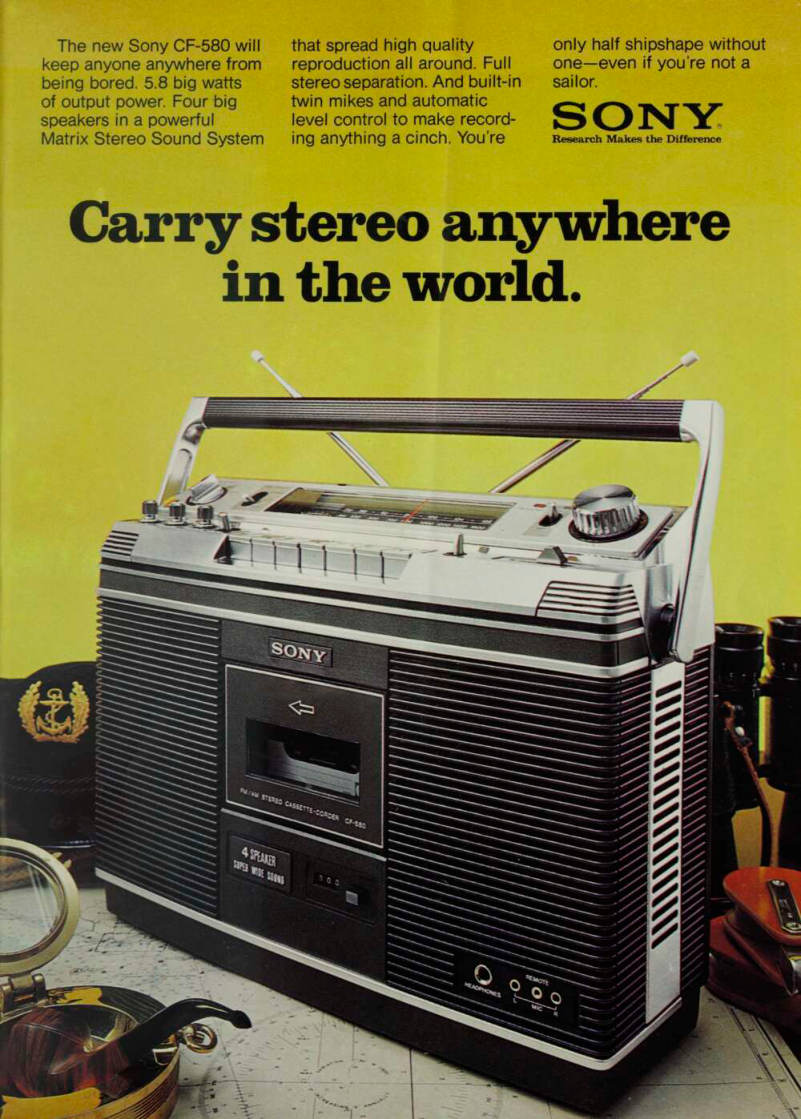
The new Sony CF-580 will keep anyone anywhere from being bored. 5.8 big watts of output power. Four big speakers in a powerful Matrix Stereo Sound System that spread high quality reproduction all around. Full stereo separation. And built-in twin mikes and automatic level control to make recording anything a cinch. You’re only half shipshape without one—even if you’re not a sailor.
SONY
Research Makes the Difference
Carry stereo anywhere
in the world.
i*4 : P ft B m m mm m
wSk
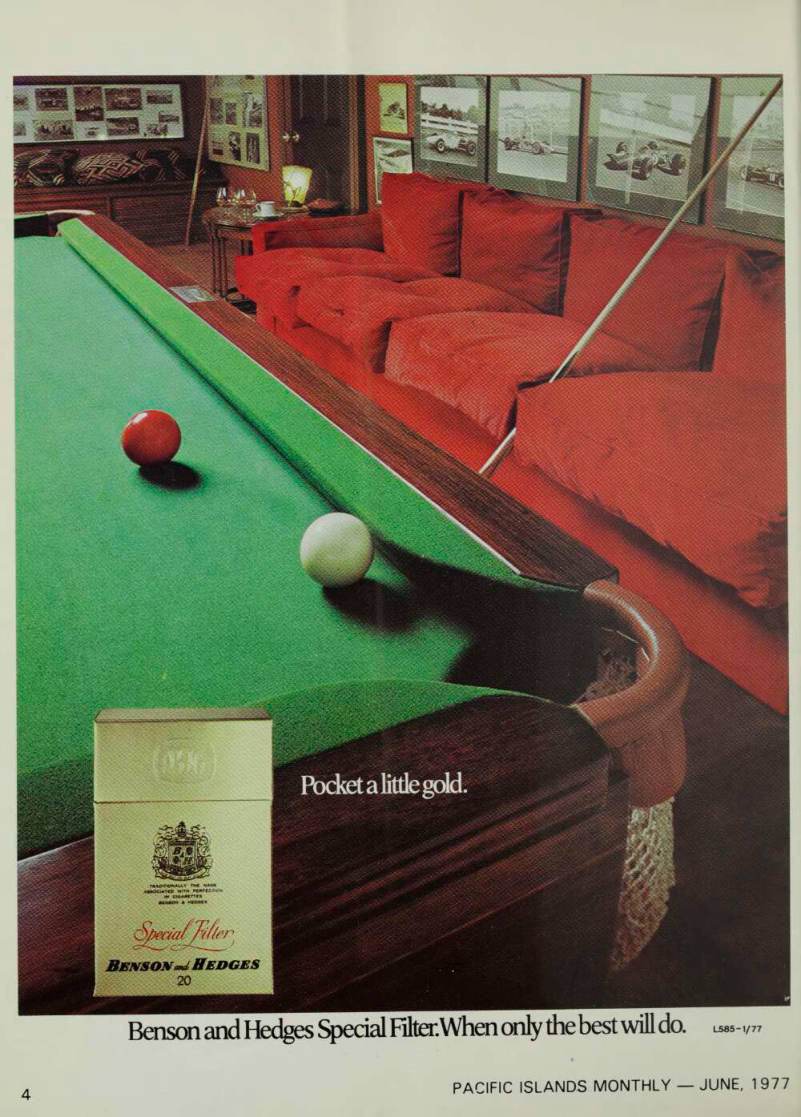
■ Benson w Hedges 20 Benson and Hedges Special Filter. When only the best will do.
L585-1/77
Monthly
Pacific Islands
FOUNDED BY R W. ROBSON IN 1930
Published Monthly By
Pacific Publications (Aust.) Pty. Ltd.,
76 Clarence Street, Sydney 2000
Post Address: G.P.O. BOX 3408, SYDNEY,
N.S.W. 2001
Telegraphic Address: PACPUB, Sydney Telex: 21242
Telephone: 29 6693
Publisher; Stuart Inder Manager: John Berry Advertising Manager: Alan Batt EDITOR: John Carter
Subscription Rates
‘‘Pacific Islands Monthly” is airfreighted to the majority of subscribers and agents in the Pacific Islands and the
Usa.
Australia (including Norfolk Island) $10.50 Aust, New Zealand, Papua New Guinea, Fiji, New Hebrides, Tonga, Cook Islands, Western Samoa, Gilbert Islands, Tuvalu, Niue, Nauru and Solomon Islands $10.50 Aust.
American Samoa, Northern Marianas, Micronesia, Guam and Hawaii $l5 00 US or $l2 00 Aust. US Mainland and Canada $l7 00 US or $14.00 Aust New Caledonia and French Polynesia 1,600 CFP or $l3 50 Aust United Kingdom £9 50 or $l2 50 Aust Japan 4,500 Yen or $12.50 Aust. Elsewhere $14.00 Aust.
Representatives
Fiji: Di stribution and subscriptions Desai Bookshops, P.O. Box 160, Suva, Fiji. Telephone: Suva 23036. Advertising, Fiji Times & Herald Ltd , 20 Gordon Street, Suva. Telephone: 312 111 Telex: FJ2124 Papua New Guinea: Advertising and Distribution PNG Post-Courier, P.O. Box 85, Port Moresby Inquiries: Post Newsagency, Telephone 24 2148 French Polynesia: Distribution Hachette Pacifique, 10 Ave Bruat, Papeete New Caledonia: Distribution Depot Centre de Presse Michel PENTECOST, 8.P.C2 NOUMEA United Kingdom; The Herald and Weekly Times Limited, 8-10 Clifford's Inn, Fetter Lane, London EC4A IBU. Telephone: 01 831 6041 Telex: London 21989 Japan: Advertising Universal Media Corporation, C P.O. Box 46, Tokyo Telephone: 666 3036 New Zealand: Pacific Publications, C.P O Box 2229, Auckland Advertising enquiries: International Media Representatives Ltd, P.O, Box 3880 Auckland Tel 73 880 Telex: NZ21157 (Auck 40) Hawaii and U.S. Mainland only; PIM, Hawaii, 2812 Kahawai St , Honolulu, Hawaii, 96822 Second class postage paid at Honolulu, Hawaii Victoria: Advertising Pacific Publications (Aust.) Pty Ltd , Herald and Weekly Times Building, 2nd Floor, 61 Flinders Lane, Melbourne, 3000 Telephone 652 1565 Brisbane: D Wood, Anday Agency, Box 1918 G.P.O, Brisbane 4001 Telephone: 44 3485; 44 1546 Printed in Australia
Copyright ©, 1977,
Pacific Publications (Aust.) Pty. Ltd.
Printed by Paramac, Mitchell Rd,
Alexandria.
PIM is distributed in Australia and New Zealand by Gordon & Gotch Australian cover price is recommended retail only Registered at the G.P.O. Sydney for transmission by post as a publication category B
Vol. 48 N 0.6
June, 1977
Up Front
with the Publisher
Not everyone has the chance of getting a few telling points across to a captive audience of VlP's, but Nauru’s recently elected President Bernard Dowiyogo made good use of the opportunity pre sented him in April at the official open ing of Melbourne’s tallest building, the 52-level, 598 ft Nauru House. Nauru built it as an investment, at a cost of $45 million.
Australian Prime Minister Malcolm Fraser unveiled a plaque in front of a black-tie array of Pacific leaders, diplomats, politicians and captains of in dustry, who were guests of the republic.
Mr Fraser said all the right things.
President Dowiyogo in reply equally
stressed the long and close association between Australia and his small republic of only 4,000 Nauruans, but he underlin ed some salient facts en route.
He reminded his audience that for more than two generations Nauru’s phosphate rock has “helped to nourish the pastoral and agricultural lands of Australia”, and he added that “no one, I venture to think, would question that it has had a not-insignificant effect on the health and economy of every Australian State”.
The President said he didn’t wish to pretend that “all has been light and joy” in the long association of the two coun tries. "By the standards of today,” he said, “much that was done in the ex ploitation of Nauru’s only natural re source cannot be commended, and the political advancement of my people dur ing the years of trusteeship was slower than it should have been. There are. no doubt, other unpleasant things which may sometimes enter uninvited a Nauruan’s memory, but as one of Eng land’s poets wrote, 'We cannot revive old factions. We cannot restore old poli cies, or follow an antique dream . . . ’ and we Nauruans, do not wish to do so.
Although we believe there may be some adjustments of the past which the admin
istering powers of pre-independence
days should wish to make, we also believe in facing realities and oppor tunities of the future.”
We were left to wonder what the “ad justments of the past” might be.
But the passage of his speech that I lik ed best and which I hope hit hardest, was Bernard Dowiyogo’s defence of Nauru’s
“rich” image.
“It has been common,” he said, “to comment that on a per capita basis 1 of
annual gross national product, the Nauruan is one of the richest persons in the world. Unfortunately, what is lost in this comment is that soon our phosphate reserves will be exhausted. There is no more. With this wasting asset, it is im perative that we make maximum use of our returns. This we owe to our children.
The other matter also lost is that goods and services are bought with absolute funds and not per capita funds. The truth of the matter, therefore, is that phosphate rock is Nauruan capital, and that the only income that is available to Nauru is that which is derived from the capital as phosphate is sold.
"The situation is naturally dramatised by the fact that capital is being spent by Nauru as though it were income, giving an appearance of super-abundant wealth, a label which is as dramatic as it is dramatically untrue.”
As he says, Nauruan capital is being spent as if it were income and there is no future in that. Nauru needs more in vestments that will give it an income that will make it truly wealthy. Because of the poor state of the property market in Melbourne, any return from leasings in Nauru House will give no immediate relief. Long term, the imposing oc tagonal building, which is full of light and commanding superb views, should prove a prime, swank business address.
Nauru's new President was impressive in his most important international engagement since taking office. The official opening, thanks to good organ isation by Finance Minister Kinza Clodumar on Nauru and Counsul- General T, W Star in Melbourne, was a warm success, not least because of the spectacular food and wines served at the banquet tables and which rated columns of space in the Melbourne newspapers.
And not least because the biggest pro portion of the invited guests who were there to enjoy it were Nauruans or dinary Nauruans. The occasions must be rare when ordinary citizens are so in vited to enjoy what their money has
bought!
There was one important Nauruan guest missing; Head Chief and former President Hammer Deßoburt, the man who planned Nauru House. For reasons of his own, he decided not to come, and
he was sincerely missed, especially by
Nauruans in government and out.
Stuart Inder.
Advertisements & other items, p. 6 (1 item)
S. E. Tat Ham & Co. Pty. Ltd
m a S. E. TAT HAM & CO. PTY. LTD
BEEHIVE BLDG., 94 ELIZABETH STREET
G.P.O. BOX 8 CABLES "SET"
MELBOURNE, 3001, AUSTRALIA
TELEX: AA34552. TELEPHONE: 63 5094.
Buyers for the Pacific Islands
AND IN
Popup New Guinea:
S. E. TATHAM (P.N.G.) PTY. LTD.
LAE: MALAITA ST. (P.O. BOX 1562)
PORT MORESBY: Cnr. GOROA & MANAHU Sts., GORDON
(P.O. BOX 6733, B0R0K0).
Fiji: S. E. TATHAM (FIJI) LTD.,
LAUTOKA P.O. BOX 366,
SUVA G.P.O. BOX 671,
TELEGRAMS: ALL OFFICES “SET
YOUR GUARANTEE
SINCE 1924
is 1 1 1 1
FOR SERVICE
T4/R
In this issue
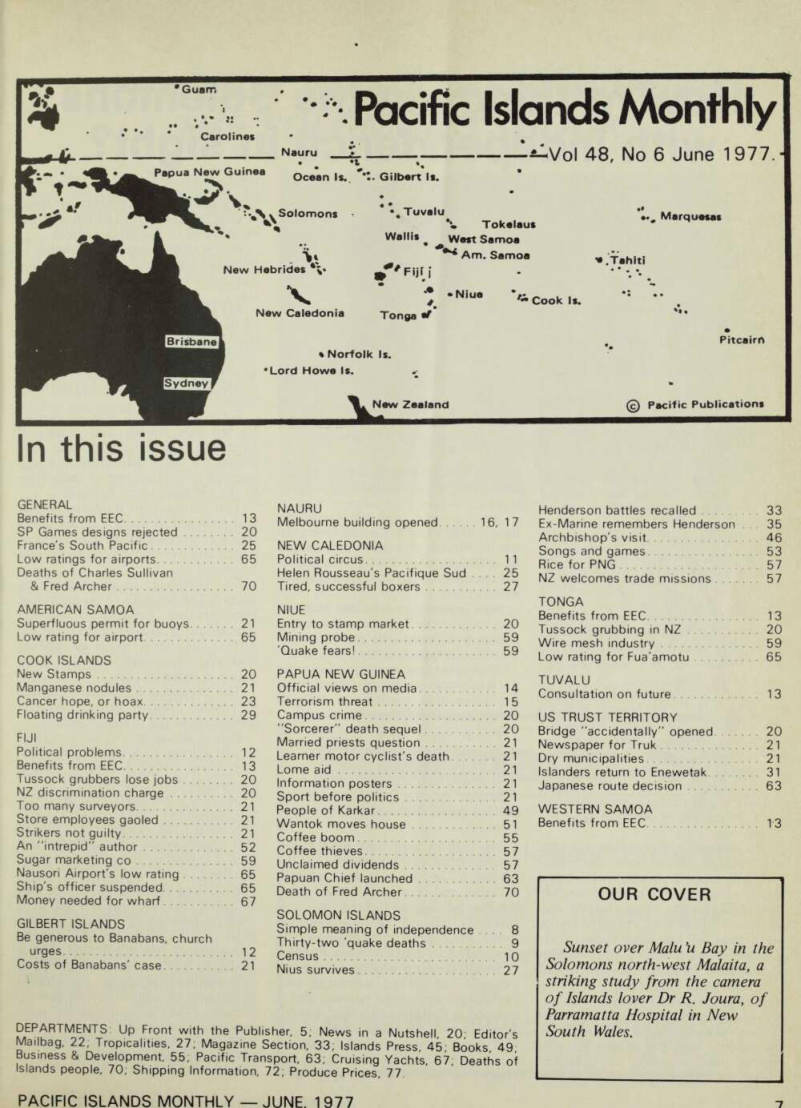
General
Benefits from EEC 13 SP Games designs rejected 20 France's South Pacific 25 Low ratings for airports 65 Deaths of Charles Sullivan & Fred Archer 70
American Samoa
Superfluous permit for buoys 21 Low rating for airport 65
Cook Islands
New Stamps 20 Manganese nodules 21 Cancer hope, or hoax 23 Floating drinking party 29
Fiji
Political problems 12 Benefits from EEC 13 Tussock grubbers lose jobs 20 NZ discrimination charge 20 Too many surveyors 21 Store employees gaoled 21 Strikers not guilty 21 An "intrepid" author 52 Sugar marketing co 59 Nausori Airport's low rating 65 Ship's officer suspended 65 Money needed for wharf 67
Gilbert Islands
Be generous to Banabans, church urges 12 Costs of Banabans'case 21
Nauru
Melbourne building opened 16, 17
New Caledonia
Political circus 11 Helen Rousseau's Pacifique Sud . . . . 25 Tired, successful boxers 27
Niue
Entry to stamp market 20 Mining probe 59 'Quake fears! 59
Papua New Guinea
Official views on media 14 Terrorism threat 15 Campus crime 20 "Sorcerer" death sequel 20 Married priests question 21 Learner motor cyclist's death 21 Lome aid 21 Information posters 21 Sport before politics 21 People of Karkar 49 Wantok moves house 51 Coffee boom 55 Coffee thieves 57 Unclaimed dividends 57 Papuan Chief launched 63 Death of Fred Archer 70
Solomon Islands
Simple meaning of independence 8 Thirty-two 'quake deaths 9 Census 10 Nius survives 27
Henderson battles recalled 33 Ex-Marine remembers Henderson 35 Archbishop's visit 46 Songs and games 53 Rice for PNG 57 NZ welcomes trade missions 57
Tonga
Benefits from EEC 13 Tussock grubbing in NZ 20 Wire mesh industry 59 Low rating for Fua'amotu 65
Tuvalu
Consultation on future 13
Us Trust Territory
Bridge ''accidentally” opened 20 Newspaper for Truk 21 Dry municipalities 21 Islanders return to Enewetak 31 Japanese route decision 63
Western Samoa
Benefits from EEC 13
DEPARTMENTS Up Front with the Publisher, 5; News in a Nutshell, 20; Editor's Mailbag, 22; Tropicalities, 27; Magazine Section, 33; Islands Press, 45; Books, 49, Business & Development, 55; Pacific Transport, 63; Cruising Yachts, 67 Deaths of Islands people, 70; Shipping Information, 72; Produce Prices, 77
with independence in sight?
How’re things in the Solomons with independence in sight?
Independence simply meant
transferring power and re sponsibility from the British Government to Solomon Islanders it did not mean that individuals would immediately get personal benefits.
This was the message taken to Santa Ysabel by the Chief Minister of the Solomon Islands, Mr Peter Kenilorea, during a nine-day “meet the people” tour of the island in
April.
Mr Kenilorea outlined the main points in the proposed Solomons constitution, and pledged that the government would press ahead with decentralisation.
At Kilokaka, the people made no secret of their feeling that they had been neglected by the central government.
Mr Kenilorea was met by a man fishing, and a woman and child sit ting by a fire near the entrance to the village. They pretended to know nothing about his visit.
But Mr Kenilorea later learned that this had been done deliberately to signify that the people felt the government had not taken enough interest in them.
A sign at the entrance to the village read “Welcome CM to Kilokaka". But many villagers crowded around a placard saying “What is the purpose of your coming to our neglected village?”
Mr Kenilorea told the villagers that their grievances were similar to those of people in other parts of the Solomons.
He said the big problem was that the central government and local councils faced a shortage of money.
Also on the move in April was Mr Colin Gauwane, Legislative As sembly member for Central Malaita.
In a tour of his constituency, Mr Gauwane heard fears expressed that a Solomon Islands republic would fall under one-man rule.
The Legislative Assembly has ap proved a constitutional plan for the Solomons to retain its links with the monarchy, with the Queen remain ing as head of state, on indepen dence, but switching automatically
to republican status a year later, unless there are substantial objec tions.
Some people told Mr Gauwane they thought the period of one year was too short, and that there should be a longer period of education of the people as to how a republic would work.
Mr Gauwane assured his electors that even if the Solomons became a republic it could still establish and maintain relations with Britain.
A conference on independence for the Solomons was foreshadowed for later this year by a British delegate to the United Nations.
The delegate, Mr R. J. Dalton , in April told the UN sub-committee on small territories that a preliminary step would probably be a visit by a Solomon Islands delegate to Lon don to pave the way for the con ference.
Mr Dalton said that inadequate communications were generally agreed to be the principal admin istrative-and economic weakness of the Pacific region, and that this was certainly true of the Solomon Is lands, the biggest territory now ad ministered by Britain in the Pacific.
Small trading and government vessels travelled between the various groups of the islands, and a limited scheduled internal water borne service was also operated.
A programme of road construc tion was proceeding in some of the bigger islands, and efforts were
being made to concentrate produce at selected areas from which it could be shipped to the main centres.
Air communications, though ex pensive, continued to play an im portant role in opening up the coun try.
Mr Dalton said that the economy of the Solomons had been based for many years on a single export, copra. Today, after strenuous efforts to diversify the economy, copra ac counted for only 20% of exports by value.
Sixty-six per cent was accounted for by fish, timber and palm oil.
Beef, cattle and rice at present pro duced for local consumption could become important export industries in the medium term, he said.
The production patterns which had emerged in the Solomons show ed “a remarkable diversification of which any developing country could be proud”.
For instance, in the last three years 5,328 hectares of oil palm had been planted. Production and ex port would gradually build up as the entire planted area of palms matured. Progress had also been made in fisheries.
The prospects for bauxite mining were the “major hope” for the Solomons in the minerals sector.
British development aid for 1977 would amount to SA7 million, while aid from other sources would amount to $A3.2 million.
Mr Dalton said the British Government “particularly ap preciated” the considerable finan cial contribution of Australia and New Zealand to the progress of the territory.
Recalling that the Solomons had attained full internal self-govern ment on January 2, 1976, Mr Dalton said; “Now that the Solomons Government has confirmed that it wishes to stay on the present road of constitutional progress, the United Kingdom, as administering power, remains ready to convene an inde pendence conference.”
He said that full independence would probably be attained early in 1978.
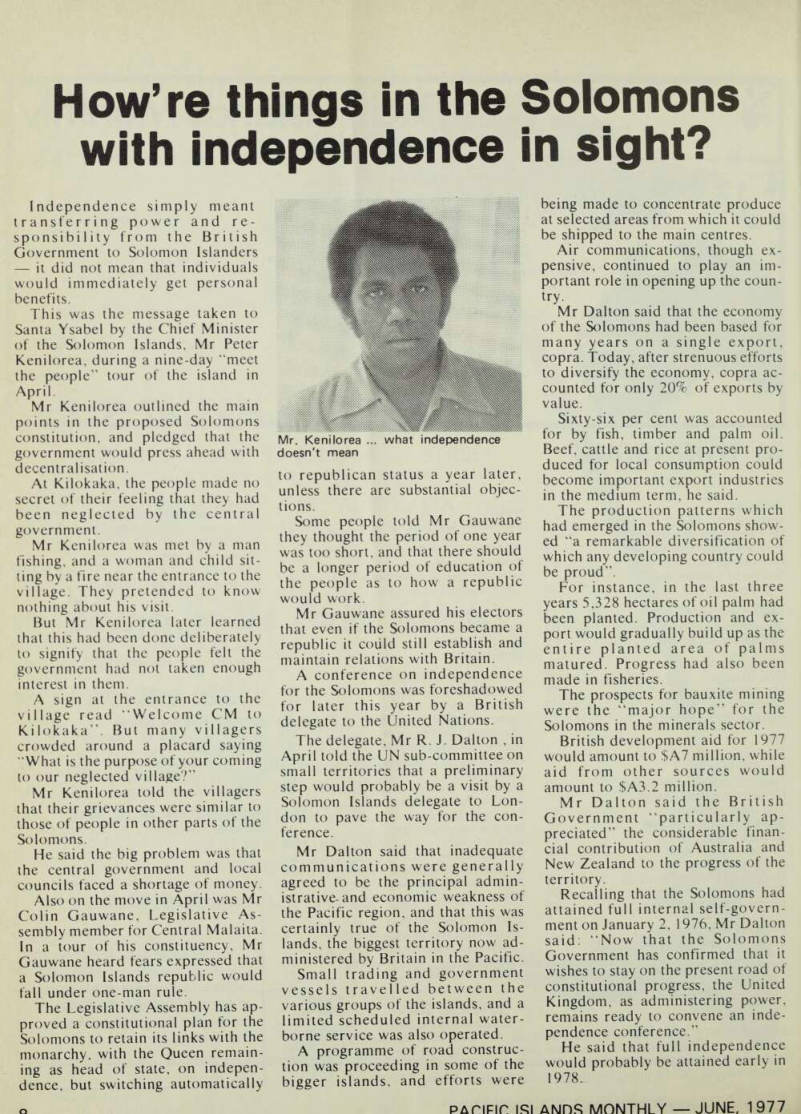
Mr. Kenilorea... what independence doesn't mean
Advertisements & other items, p. 8 (1 item)
8
PAPiFir ici AND. 9 MONTHLY —JUNE, 1977
The Solomons Shook
Tragedy And Comedy When
At least 32 people were either killed or reported missing in the April 21 earthquake in the Solomon Islands, according to local authori ties.
PIM correspondent Jim Boutilier writes from Honiara: At 10.43 in the morning the town was rocked by a short, sharp ’quake which measured 7.25 on the Richter scale.
There had been two minor tremors earlier in the morning, which many people had failed even to notice.
But the major shock sent them flee ing in panic from their offices, homes and shops.
Stephen Yee was outside the Customs Department when he saw “a great wave running across the bitumen road”. It seemed about a foot high. Skyline Ridge, overlook ing the Matanikau River, “moved like the mast of a ship”, said one woman secretary, who was amazed that she felt seasick from the mo tion.
Typesetters and apprentices bolted from their machines in the Melanesian Mission’s Provincial Press, the staff of the Tourist Authority raced from their desks on the second floor of the Hong Kong and Shanghai Bank building as fil ing cabinets began to rock back and forth crazily, and Stephen Loloito from Ulawa was flung from his car penter's perch, into the basement of the building he was working on.
Damage was relatively minor, but two buildings were particularly hard hit. The five-storey Hong Kong and Shanghai office was badly damaged. “It was all trembling, shaking, and the third time we ran out,” one teller said. Three of the six heavy plate glass windows at the front of the bank were shattered, large pieces of concrete flaked away from the facade, and a great jagged fissure appeared in the load-bearing wall of the external stairwell. The strongroom and rear entrance of the bank were heavily damaged a*nd tiles were torn from the stairs as the building was contorted by the earth’s movements.
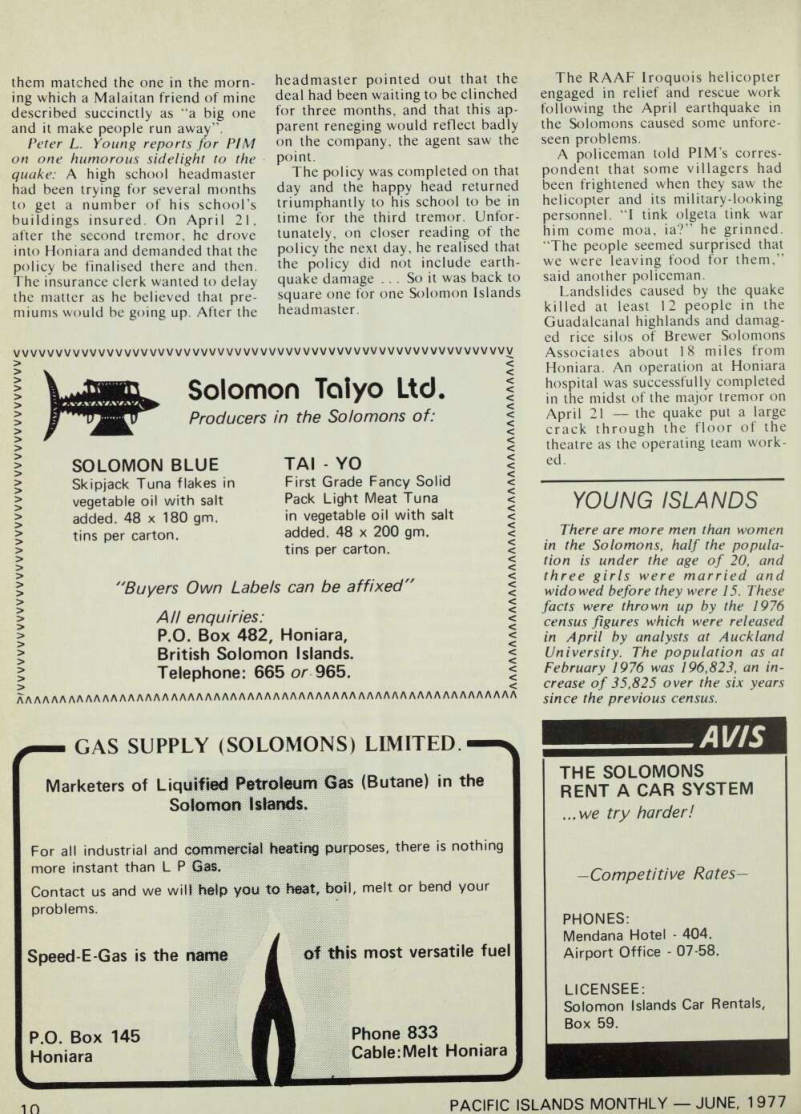
The concrete block warehouse of the M. P. Kwan Trading Company in Chinatown collapsed in a jumble
of wreckage as if smashed by a mighty hand. Over $A60,000 worth of supplies, in the form of boxes of corned beef, instant coffee, steel wool pads and soap lay scattered or crushed under the crumpled corru gated iron roof.
An hour or so later almost every thing was back to normal. People were still congregated in front of the bank building, which was guarded by two constables, while Public
Works Department personnel sur veyed the damage. But the rest of Honiara had resumed its normal routine. Mothers were waiting in their Mini-mokes outside Woodford School for their children, regulars were gathered at the Mendana Hotel for lunch, and knots of people were sitting in the shade by the market place.
There were several more tremors during the afternoon. But none of
"...as if smashed by a mighty hand" —J.P. Kwan Trading Company's warehouse.
Photo: Jim Boutilier.
them matched the one in the morn ing which a Malaitan friend of mine described succinctly as “a big one and it make people run away”.
Peter L. Young reports for PIM on one humorous sidelight to the quake: A high school headmaster had been trying for several months to get a number of his school’s buildings insured. On April 21, after the second tremor, he drove into Honiara and demanded that the policy be finalised there and then.
The insurance clerk wanted to delay the matter as he believed that pre miums would be going up. After the
headmaster pointed out that the deal had been waiting to be clinched for three months, and that this ap parent reneging would reflect badly on the company, the agent saw the point.
The policy was completed on that day and the happy head returned triumphantly to his school to be in time for the third tremor. Unfor lunately, on closer reading of the policy the next day, he realised that the policy did not include earth quake damage ... So it was back to square one for one Solomon Islands headmaster.
The RAAF Iroquois helicopter engaged in relief and rescue work following the April earthquake in the Solomons caused some unfore seen problems.
A policeman told PI M’s corres pondent that some villagers had been frightened when they saw the helicopter and its military-looking personnel. T tink olgeta tink war him come moa, ia?” he grinned. ‘The people seemed surprised that we were leaving food for them,” said another policeman.
Landslides caused by the quake killed at least 12 people in the Guadalcanal highlands and damag ed rice silos of Brewer Solomons Associates about 18 miles from Honiara. An operation at Honiara hospital was successfully completed in the midst of the major tremor on April 21 the quake put a large crack through the floor of the theatre as the operating team work ed.
Advertisements & other items, pp. 9-10 (1 item)
Bowmans S.I.
(Member Lend Lease Group) P.O, Box 514 Honiara Phone 901 Building Materials Timber Steel— — Paints
WE HELP TO BUILD THE SOLOMONS
Solomon Tolyo Ltd.
Producers in the Solomons of: "Buyers Own Labels can be affixed"
AH enquiries: P.O. Box 482, Honiara, British Solomon Islands.
Telephone: 665 or 965.
SOLOMON BLUE
Skipjack Tuna flakes in vegetable oil with salt added. 48 x 180 gm. tins per carton.
TAI - YO
First Grade Fancy Solid Pack Light Meat Tuna in vegetable oil with salt added. 48 x 200 gm. tins per carton.
GAS SUPPLY (SOLOMONS) LIMITED.
Marketers of Liquified Petroleum Gas (Butane) in the Solomon Islands.
For all industrial and commercial heating purposes, there is nothing more instant than L P Gas.
Contact us and we wilt help you to heat, boil, melt or bend your problems.
Speed-E-Gas is the name P.O. Box 145 Honiara v__ of this most versatile fuel Phone 833 Cable:Melt Honiara
Young Islands
There are more men than women in the Solomons, half the popula tion is under the age of 20, and three girls were married and widowed before they were 15. These facts were thrown up by the 1976 census figures which were released in April by analysts at Auckland University. The population as at February 1976 was 196,823, an in crease of 35,825 over the six years since the previous census.
Advertisements & other items, p. 10 (1 item)
Avis
THE SOLOMONS
RENT A CAR SYSTEM
...we try harder!
—Competitive Rates—
PHONES:
Mendana Hotel - 404.
Airport Office - 07-58.
LICENSEE:
Solomon Islands Car Rentals, Box 59.
Caledonians’ political circus
From PAUL STERLING in Noumea
Six thousand five hundred people gathered on a Sunday in April under an enormous circus tent at the Bru nelet football stadium to listen to Mr Jacques Lafleur and his friends.
Once again, a new political party was born, the Assembly for New Caledonia.
Like France, New Caledonia has many political parties, all using the term Union or Assembly or United in their name. Like all the others, Mr Lafleur’s new party appeals to a united multi-racial gathering of all those “sincerely interested” in the future of the territory.
Yet the new movement has two unusual features. Its creation coin cides with a period of severe econ omic and psychological depression and, for the first time, a European leading a right-wing group is admit ting the necessity for greater local legislative powers. Its major object is to break down the numerous divi sions that split the population into small political groups before the next legislative elections. To achieve this, the right-wing parties are deliberately breaking away from the usual alliances with national parties in France.
A barricade was raised on the east coast at Poindimie to stop rural sup porters from joining in the de monstrations, but this was quietly dismantled by a platoon of gen darmes flown in by helicopter.
Of the various speakers of all races, including the Senator Lionel Cherrier, Mr Lafleur attracted most attention.
Jacques Lafleur openly admitted that the territory was in the throes of the greatest economic and political crisis in its history. But he pointed out that the natural resources (nickel, chrome, beef production and tourism) made the people of New Caledonia one of the wealthiest communities in the world.
Perhaps he could have added that this natural wealth was unevenly distributed, but such words could have been ill-chosen when uttered by the owner of the island’s largest cattle property, and at the same time one of the major exporters of nickel ore.
Mr Lafleur bravely pointed out
two of the most delicate problems of the territory: the unsuitability of the present colonial regime, and the necessity for a complete break from traditional Melanesian customs. He was a firm advocate of maintaining French possession of the territory, but stipulated that the relationships should be modified. New Caledonia should no longer be the daughter, but the sister of the homeland, he said.
His opponents lost no time in cri ticising the movement. Lafleur’s in itiative was qualified as a “personal success, bringing no new solutions, lacking in originality, the result of a guilty conscience”. The criticism is probably justified. But the novelty of seeing a right-wing European leader question the present political and economic situation could itself renew the confidence of a high pro portion of the population.
Advertisements & other items, p. 11 (1 item)
Central co-operative
G TSG TSG TSG TSG TSG TSG TSG TSG TSG TSG TSG TSG TSG TSG TSG TS
Guadalcanal Travel Service
The first in the Solomons specialising in tours of interest throughout the Solomons.
Contact: P.O. Box 114, Honiara,
SOLOMON ISLANDS.
Cable: Trade Honiara.
Telephone: 589 or 587.
GTSGTSGTSGTSGTSGTSGTSGTSGTSGTSGTSGTSGTSGTSGTSGTS
Central co-operative
Association Ltd.
IMPORTERS OF:
Children's and Infant's wear Batteries, Torches, Radios i Outerwear, Underwear J Wine, Spirits M Foodstuffs Stationary Plasticware Footwear aU Hardware
EXPORTERS OF
Beche-de-Mer Marine Shells Chillies P.O. Box 151, Honiara, Solomon Islands. Cable: Cenco
in Fiji’s political basket
Unscrambling the broken eggs in Fiji’s political basket
From ROBERT KEITH-REID in Suva
Fiji’s government and opposition parties are keeping an unofficial, uneasy truce while they wait to see how the wind is blowing.
The minority Alliance government, which in an April general election had its parliamentary strength lopped from 33 of the 52 seats to 24 is wondering why the opposition National Federation Party, mustering 26 seats, has failed to toppie n with a vote of no-confidence.
Mainly Fijian-supported, the Alliance planned to force the issue by asking for a vote of confidence when the House resumed its meeting on Mav 24 Meanwhile, the predominantly Indian-backed NFP is wondering when, if ever, its perpetually-squabbling leaders will set about convincing the country that they are capable of governing.
One thing is increasingly clear to an increasingly-irritated electorate; it is that Fiji is in the doldrums, drifting without a government strong enough to steer a meaningful course.
The question being asked is; How long can Fiji afford to suffer such a state of affairs?
The Alliance was beaten due to a surprise swing by about 25% of Fi-
jian voters to the anti-Indian cause of the Fijian Nationalist Party, Left, theoretically, in a position to form a government, a surprised NFP dallied fatally for four days after the election, trying to decide whether it dare do so. indecision was abruptly ended when (he Governor-General, Ratu sjr George Cakobau, announced that he was rea ppointing the Al a nce leader, Ratu Sir Kamisese Mara as Prime Minjster n t _. „ . ... . , . R “‘" Sl , r ° eorg^ . a PPf r «J‘ ly d|dn t l „ hlnk h; ‘ Opposition leader S.dd.q Koya had enou 8 h support from in side his own Party to do the job. . His decision ripped open a freshly-knitted NFO leadership split wound.
Supporters of Mr Koya screamed that a faction led by the party’s president, Mrs Irene Jai Narayan, and secretary, Mr Karam Ramrakha, had stabbed the leader from behind.
Someone, they alleged, had tip ped off the Governor-General that not all opposition MPs would have Mr Koya as Prime Minister, Mrs Narayan and Mr Ramrakha are known to want the NFP leader ship changed, but they vehemently
denied having tried to do so in this way.
Yet accusations continued so thick and fast that Ratu Sir George, in an unusual step for a vice-regal personage, issued a statement to say he had not got any secret tip from the NFP or other party, before de ciding to dash My Koya’s hopes.
While the NFP wilted, the Alliance showed definite signs of reviving.
Ratu Sir Kamisese assured an emergency election post-mortem session of the Fijian Association, the Alliance’s strongest arm, that his government and not the NFP would push the button for another election “when the time has come”.
He left the meeting heartened by Fijian promises of $F30,000 for his party’s empty election fighting fund by the end of May.
By the end of April, much of the Alliance election machine was turn ing again to discover what went wrong for the party at the polls.
The first objective was to per suade thousands of Fijians, who had voted for the Fijian Nationalists, to return to the Alliance fold.
Another post-election sensation was the arrest of Fijian Nationalist leader Sakiasi Butadroka on Public Order Act charges.
He denied accusations that he had held an illegal public meeting, had attended an unlawful assembly, and had incited racial hatred.
Butadroka was remanded in custody for trial in May.
Three applications for bail so that he could attend the opening sessions of parliament on April 27 and 28 were refused.
His arrest posed two questions for the Alliance. Would his removal from the scene, at least temporarily, make it easier to win back Fijian support? Or would Butadroka attain martyr status that would make counter-action against the Na tionalists difficult?
The two-day inaugural session of the House of Representatives passed without a move by the NFP to topple the Alliance. Parliament adjourned
to May 24 with the Alliance reaffirming its intention to seek a vote of confidence.
Observers noted that the Alliance could win such a vote easily if the NFP simply abstained, and the ex pectation was that the opposition would abstain.
From Mr Koya’s side there were hints that he thought it was “futile” to kick the Alliance out right away.
The explanation, it emerged, was that several of his supporters won their seats by narrow margins.
As the situation is now, they don’t think they would keep them if another election was fought soon.
Their ousting would shift majority support in the NFP caucus to his rivals, who would have enough power to remove him as leader.
This, the theory goes, is why Mr Koya is unwilling to face another election, at least just now.
Alliance organisers are en visaging a fresh election in August or September.
Most observers agree that if the NFP fails to sort out its difficulties, and if the influence of the Fijian Na tionalists falters, as well it might, the Alliance should slide back to power comfortably enough, with about 30 of the 52 seats to be con tested again.
But until this happens, Fiji’s government will be largely an in effective one.
Be Generous To Banabans'
Urge The British Churches
The British Council of Churches has urged the British Government to draw up ”a generous financial plan to help the Banaban community to secure their future after phosphate mining ends .
It said the government should ‘Teach an early agreement with the Australian and New Zealand governments” to this end.
The Council, by unanimous decision of the board of its international affairs division, also urged the convening of a series of meetings on the constitutional future of Ocean Island in which the Banaban people, the Gilbert Islands Government, the Fiji Government and the British Government would take part. Aim of the meetings would be to arrive at an agreed constitutional position for Ocean Island prior to the granting of independence to the Gilbert Islands.
It adds' ”As the geographical, economic and political situation is unique, we anticipate that an unusual constitutional compromise will be required The hoard said it reached these decisions, “recognising that British colonialism in the Central Pacific Islands has included a mixture of paternalism, good intentions, social progress and outright commercial exploitation”.
On Tuvalu’S Future
A republic or a monarchic system? A president or a governor general?
Tuvalu, formerly Ellice Island, which is headed for independence before the end of 1978, has just been thrashing out these questions.
The eight elected members of the Tuvaluan House of Assembly made a tour of all nine islands and, theoretically at least, heard the views of every man, woman and child in the country.
Themselves split four-four on the questions, at the end of the tour they believed they had the answers; the country as a whole, especially some vocal members of the civil service and church, favours retaining the Queen as Head of State, with a Tuvaluan citizen representing her inside the country as governor-general.
Acting as a committee, the eight members have recommended accordingly. They also recommended that there shall be 12 members of parliament who would elect the Prime Minister, and that islands with a population of more than 1000 should have two MPs, and the remainder one. Four ministers in addition to the Prime Minister are recommended. These are to be appointed by the Governor-General on the advice of the Prime Minister.
The present position of an official Attorney-General having a seat both in the Cabinet and Parliament would continue.
The committee recommended that Tuvalu should make application to join the Commonwealth as an independent member.
Elections for the new government are expected in August.
‘ACP-EEC’spells'good
news’ for Fiji,Tonga, Samoa
Three Pacific Island nations that with 49 developing African and Caribbean nations, are associate members of the European Economic Community, are getting significan benefits from the relationship.
This was clear at the April con ference in Suva at which Suva hosted a joint meeting of the ACP EEC (African, Caribbean. Pacific- European Economic Community) Council of Ministers, It was the first such meeting held outside Europe.
It began with disillusioned moans from the ACP group, but ended on a note of accord that delegates from a ll the 61 countries in attendance said they were delighted with.
The purpose of the meeting was to discuss amendments and mter pretations concerning the 1976 Lome Convention, which binds the ACP states and the nine EEC na tions together in various trade and a id deals.
A significant agreement for Western Samoa and Tonga was that if their banana sales to New Zealand drop below an average value, the
EEC will pay them compensation.
The EEC agreed to the expansion of the Stabex Scheme to permit this.
The scheme props up the prices of certain commodities from ACP countries by requiring the EEC to pay compensation when prices slump.
Expansion of the scheme does not affect Fiji, whose banana trade is now extinct.
But in the case of copra, for in stance, Fiji received $F613,000 last year to offset the copra price slump, and this year it will get $F 1,400,000.
Tonga and Western Samoa will get smaller copra compensation amounts.
Discussing other EEC aid for the South Pacific, its commissioner, Mr Claude Cheysson, said Fiji, Samoa and Tonga would get SFIO million for regional projects over four years from this year.
Most of the money would go to a telecommunications scheme de signed to hook the three countries into a space-satellite com munications system.
Other money would go to the University of the South Pacific, and for fisheries, agricultural and biolo gy research.
Mr Cheysson said the three coun tries would also get separate grants over the same period.
Fiji would get SFIO million of which $F6,400,000 would be used for building roads, airstrips and jet ties, and $F1,500,000 would be spent on major port works.
Western Samoa would get $F6,500,000 of which SF3 million would be spent on hydro-electric schemes.
Tonga would spend its $3,500,- 000 on fishing projects, jetties, and in buying public works equipment.
The Suva meeting approved Papua New Guinea’s application to accede to the Lome Convention.
Mr Cheysson said other British and French territories would be en titled to join the group as they at
tained independence.
All United States territories, however, were excluded.
Advertisements & other items, p. 13 (1 item)
13
PAPIPIP IQI AMHQ MOMTUI V II IMP 1Q77
How the news media can keep
their noses clean in PNG
Papua New Guinea’s Minister for Finance, Mr Julius Chan, provided a number of insights into his govern ment’s thinking on problems of the news media when he spoke at the re cent ceremony to inaugurate the new Port Moresby headquarters of the weekly Wantok (see PIM, Books section).
Mr Chan’s remarks included the following; On television: All we propose is a study into the question. I will only say that if a worthwhile service, even of a limited kind, could be pro vided at the right price it would seem to be a very useful addition to the range of educational instruments that already exists ... I am also aware that there could be difficul ties in obtaining suitable and rele vant programme material. That is why we are only proposing a study.
To do less would be too cautious, to offer more would be irresponsible.
One thing I can assure you is that we will not be involved in the introduc tion of a service consisting of in ferior or inappropriate foreign programmes. We are well aware that oad television is far worse than no television . . .
On radio advertising: The ex periment is now under way, with the approval of a majority in parlia ment. We have our doubts about it, mainly because we are afraid that the main effect will be to whip up appetites for consumer goods,
especially those of a luxury type, some of which may be actually harmful, and most of which will either be imported or manufactured in this country by subsidiaries of foreign firms . . .
On government com munications with the public: In principle there is no special problem here, because the task of government information services is straightforward enough: it is to in form the public about the govern ment’s aims, activities and policies.
In practice, of course, there can be difficulties, because effective com
munication is a special technique re quiring skilled staff with the right attitudes as well as the right educa tion and training ...
On the role of information media not under government con trol: These information media, whether they like it or not, have public responsibilities. This applies whether they are owned publicly, like the National Broadcasting Commission, or privately,. In some highly-affluent countries with a wide variety of information media it may be possible for some of them to behave in an irresponsible manner, by which I mean printing or broad casting just what they like with a view to nothing more than their own circulation or profit, although even in those countries I doubt whether it is ever desirable that many im portant media of news and infor mation should be conducted without regard to the public interest. But in a developing country like Papua New Guinea it seems to me that ir responsible media in this sense are a luxury we can’t afford ...
The duty of behaving responsibly ... is not one that derives from the law. Legally speaking the media are free to behave how they like, within limits set by such things as the law on libel and obscenity.
Rather, the media have the obligation to behave responsibly because of the nature of the society and their role within it .. . For ex ample, a newspaper which kept its readers fully informed about Elizabeth Taylor’s love life but never mentioned anything to do with rural development would hardly be living up to its obligations as a national institution . . .
Another aspect of responsible behaviour is that in making critic isms the media must be careful. As I have said, everyone has the right to criticise the government. But in a country where the sense of nation hood is still rather young, criticism or comment which is designed to stir up violent feelings, or which is not based on an accurate and balanced presentation of the facts, can inflict severe damage on the fabric of national life ...
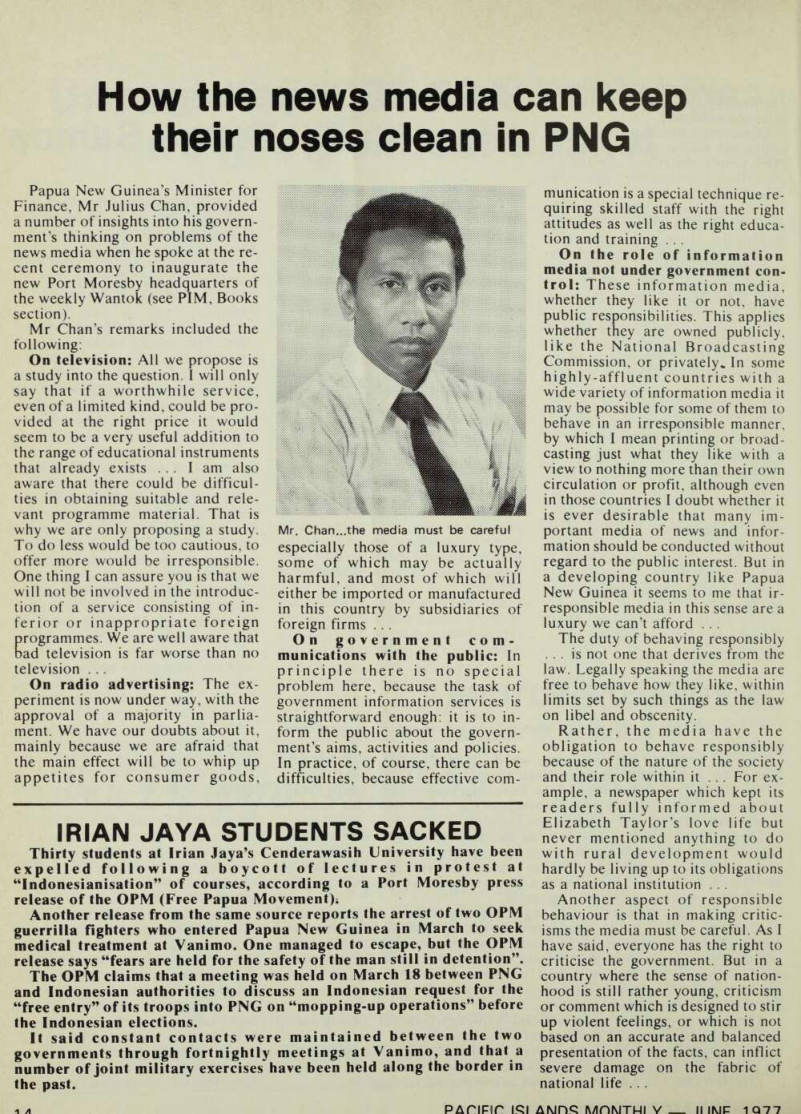
Mr. Chan...the media must be careful
Irian Java Students Sacked
Thirty students at Irian Jaya’s Cenderawasih University have been expelled following a boycott of lectures in protest at “Indonesianisation” of courses, according to a Port Moresby press release of the OPM (Free Papua Movement); Another release from the same source reports the arrest of two OPM guerrilla fighters who entered Papua New Guinea in March to seek medical treatment at Vanimo. One managed to escape, but the OPM release says “fears are held for the safety of the man still in detention”.
The OPM claims that a meeting was held on March 18 between PNG and Indonesian authorities to discuss an Indonesian request for the “free entry” of its troops into PNG on “mopping-up operations” before the Indonesian elections.
It said constant contacts were maintained between the two governments through fortnightly meetings at Vanimo, and that a number of joint military exercises have been held along the border in the past.
Advertisements & other items, p. 14 (1 item)
14
PAriPjr iqi AMnc: montmi v n imp 1077
Fighters’ threat

Papuan Freedom Fighters’ threat of terrorism
Irianese nationalists who oppose the Indonesian administration in Irian Jaya are threatening “Arab style terrorism” in the Pacific to gain recognition for their cause.
The threat is contained in a letter released in Port Moresby in April by Irianese exiles living there.
Written by Mr Nicholas Jouwe, who styles himself Premier of the Provincial Revolutionary Govern ment of West Papua, the letter says the campaign will be directed against those countries which sup port the Indonesian presence in Irian Jaya. These include the US, Australia, New Zealand, and other nations of the South Pacific.
An Irianese source in Port Mores by said that under no circumstances would the terrorism be directed against Papua New Guineans, “our Melanesian brothers”. But he went on to name Mr Tom Critchley, Australian High Commissioner in PNG, as a possible target for ter rorist action.
The new direction in Irianese rebel policy follows the ousting last year of the rebel president General Seth Rumkorem. It is seen as a vic tory for young radical elements in the movement.
It also follows flat rejection by the US State Department of rebel pro posals that the US should apply military and economic sanctions against Indonesia as a measure of support for their cause.
An influential section of the Irianese community in Port Mores by in early May announced its op position to threats to use terrorist methods.
Eleven men, including some who were once prominent in Irianese na tionalist politics, dissociated them selves from the threats.
They pledged their support to the Papua New Guinea Government and other Pacific countries in op posing what they called “unfound ed, impractical, irresponsible and potentially hazardous proposals of terrorism”. • Mr Jouwe was quoted in press reports early in May as denying that
Continued on page 76
Continued from page 15 his letter called for terrorist acts. He was quoted as saying from his home in Holland: “1 never mentioned adopting Palestinian tactics in my letter, or any other acts of terrorism.
We have to use diplomacy and all the legal means available to us”. But reporters for the Sydney Morning Herald and the Papua New Guinea Post-Courier, who have seen the let ter, defended their earlier reports that it did call for terrorist actions.
Irianese sources in Port Moresby have suggested that Mr Jouwe’s denial had been made in a bid to “remove some heat” from Irianese refugees in Papua New Guinea, some of whom are now PNG citizens.
Advertisements & other items, p. 15 (2 items)
15
PACIFIC ISI AMDS MONTHI Y .11 INF 1 977
complexion resist
How to help your
the premature signs
of growing older
With the scientific development of a tropically moist oil blend the accentuation of tiny lines and wrinkle dryness, which so often makes a complexion
look prematurely older,
can be softened to look
attractively younger.
MANY WOMEN approaching their thirties discover, with some consternation that their complexions show, for the first time traces of tiny surface lines and coarser, drier skin . . . they are beginning to lose their youthful looks! Probably they have never cared for their skin at any time in their lives, apart from normal cleansing.
This is the time to begin caring for it with a
scientifically developed
tropically moist oil blend that helps restore and maintain the vital balance of oil and moisture in your skin because, at this age, your own skin’s natural prom tective and beautifying oils and moisture are
usually starting to dim-
inish in supply and with-
out supplementation
from the tropically moist Oil of Ulan, can be a prime cause of your skin beginning to look prematurely older.
More radiant
skin beauty
Smoothed on each morning and at night over the entire complexion, this tropically moist Oil of Ulan acts like the skin’s own natural fluids, providing essential elements to condition the important stratum corneum, or outer layer of your skin. Oil of Ulan helps achieve a softness, smoothness and suppleness similar in quality to what would have been created by a full and plentiful supply of natural fluids. Thousands of women, in many parts of the world, living in many different climates now enjoy a complexion loveliness far beyond what the natural course of events would have provided, their skin’s taking on a new suppleness and beauty.
Nauru In Melbourne (For Keeps!)
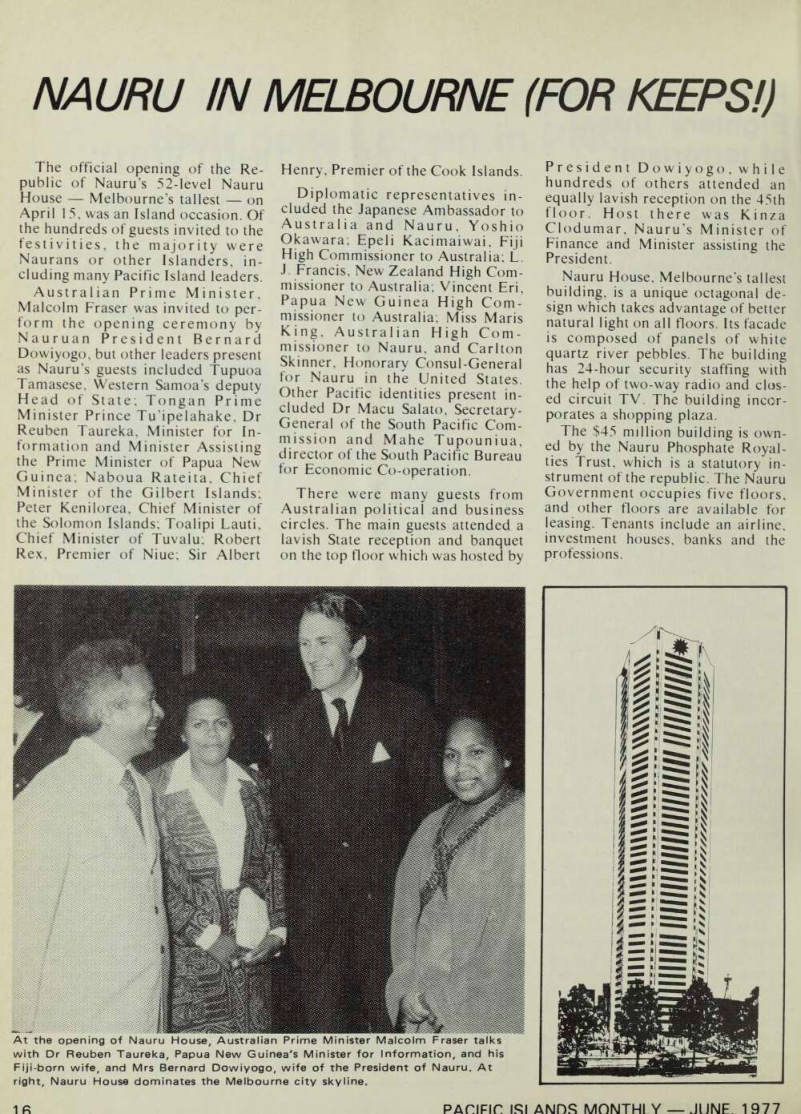
The official opening of the Republic of Nauru’s 52-level Nauru House Melbourne’s tallest on April 15, was an Island occasion. Of the hundreds of guests invited to the festivities, the majority were Naurans or other Islanders, ineluding many Pacific Island leaders Australian Prime Minister, Malcolm Fraser was invited to perform the opening ceremony by Nauruan President Bernard Dowiyogo, but other leaders present as Nauru's guests included Tupuoa Tamasese, Western Samoa’s deputy Head of State; Tongan Prime Minister Prince Tu ipelahake, Dr Reuben Taureka. Minister for Information and Minister Assisting the Prime Minister of Papua New Guinea; Naboua Rateita. Chief Minister of the Gilbert Islands; Peter Kenilorea, Chief Minister of the Solomon Islands; Toalipi Lauti, Chief Minister of Tuvalu; Robert Rex. Premier of Niue; Sir Albert
Henry. Premier of the Cook Islands.
Diplomatic representatives in cluded the Japanese Ambassador to Australia and Nauru, Yoshio Okawara; Epeli Kacimaiwai, Fiji High Commissioner to Australia; L J. Francis. New Zealand High Com missioner to Australia; Vincent Eri, Papua New Guinea High Com missioner to Australia; Miss Maris King. Australian High Com missioner to Nauru, and Carlton Skinner, Honorary Consul-General for Nauru in the United States.
Other Pacific identities present in cluded Dr Macu Salato, Secretary- General of the South Pacific Com mission and Mahe Tupouniua, director of the South Pacific Bureau for Economic Co-operation.
There were many guests from Australian political and business circles. The main guests attended a lavish State reception and banquet on the top floor which was hosted by
President Dowiyogo, while hundreds of others attended an equally lavish reception on the 45th floor. Host there was Kinza Clodumar, Nauru’s Minister of Finance and Minister assisting the President.
Nauru House, Melbourne’s tallest building, is a unique octagonal de sign which takes advantage of better natural light on all floors. Its facade is composed of panels of white quartz river pebbles. The building has 24-hour security staffing with the help of two-way radio and clos ed circuit TV. The building incor porates a shopping plaza.
The $45 million building is own ed by the Nauru Phosphate Royal ties Trust, which is a statutory in strument of the republic. The Nauru Government occupies five floors, and other floors are available for leasing. Tenants include an airline, investment houses, banks and the professions.
At the opening of Nauru House, Australian Prime Minister Malcolm Fraser talks with Dr Reuben Taureka, Papua New Guinea's Minister for Information, and his Fiji-born wife, and Mrs Bernard Dowiyogo, wife of the President of Nauru. At right, Nauru House dominates the Melbourne city skyline.
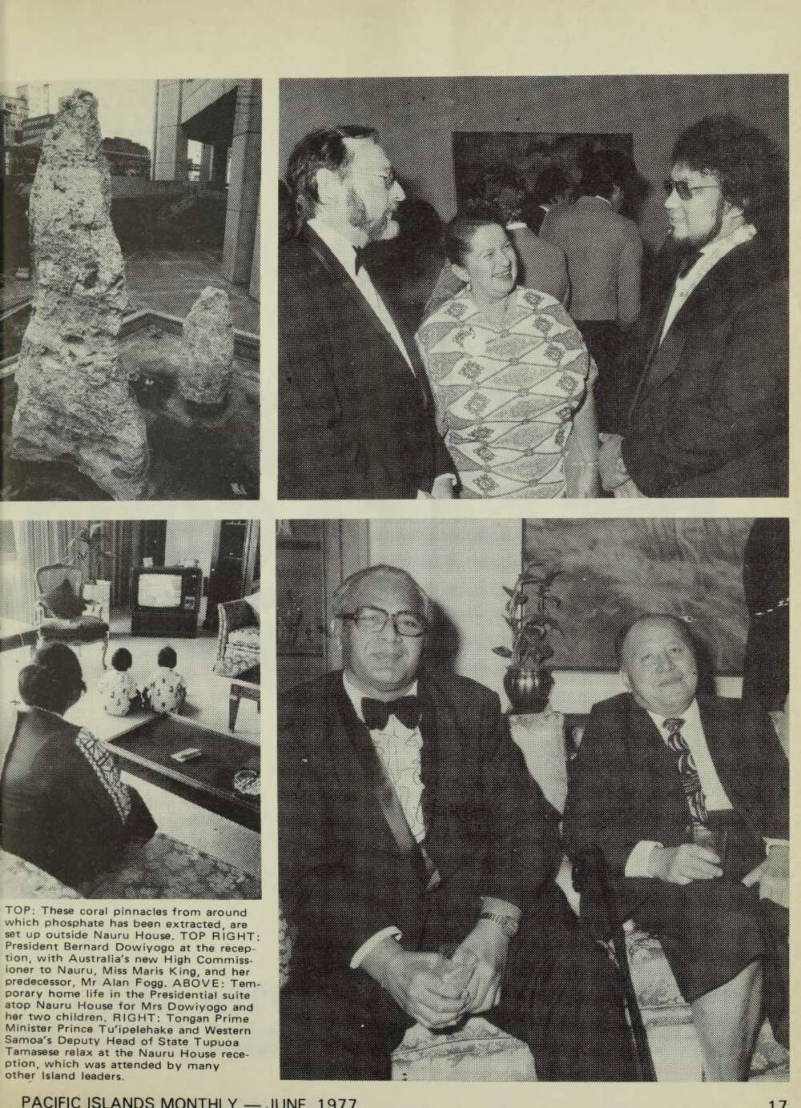
TOP: These coral pinnacles from around which phosphate has been extracted, are set up outside Nauru House. TOP RIGHT: President Bernard Dowiyogo at the recep tion, with Australia's new High Commiss ioner to Nauru, Miss Maris King, and her predecessor, Mr Alan Fogg. ABOVE: Tem porary home life in the Presidential suite atop Nauru House for Mrs Dowiyogo and her two children. RIGHT: Tongan Prime Minister Prince Tu'ipelehake and Western Samoa's Deputy Head of State Tupuoa Tamasese relax at the Nauru House rece ption, which was attended by many other Island leaders.
Advertisements & other items, pp. 16-19 (5 items)
16
PACIFIC ISI ANDS MONTHLY JUNE. 1 977
17
PACIFIC ISLANDS MONTHI Y II INF 1 Q 77
18
PAriFir IQI ANDS MONTHLY JUNE. 1977
Solid Ring To It.
A.R.CRINGLCK
IT'S GOT A GOOD
ARC.
A NEW ADDITION TO THE A.RX.
iW FAMILY OF FENCES. AJICRINGIOCK.
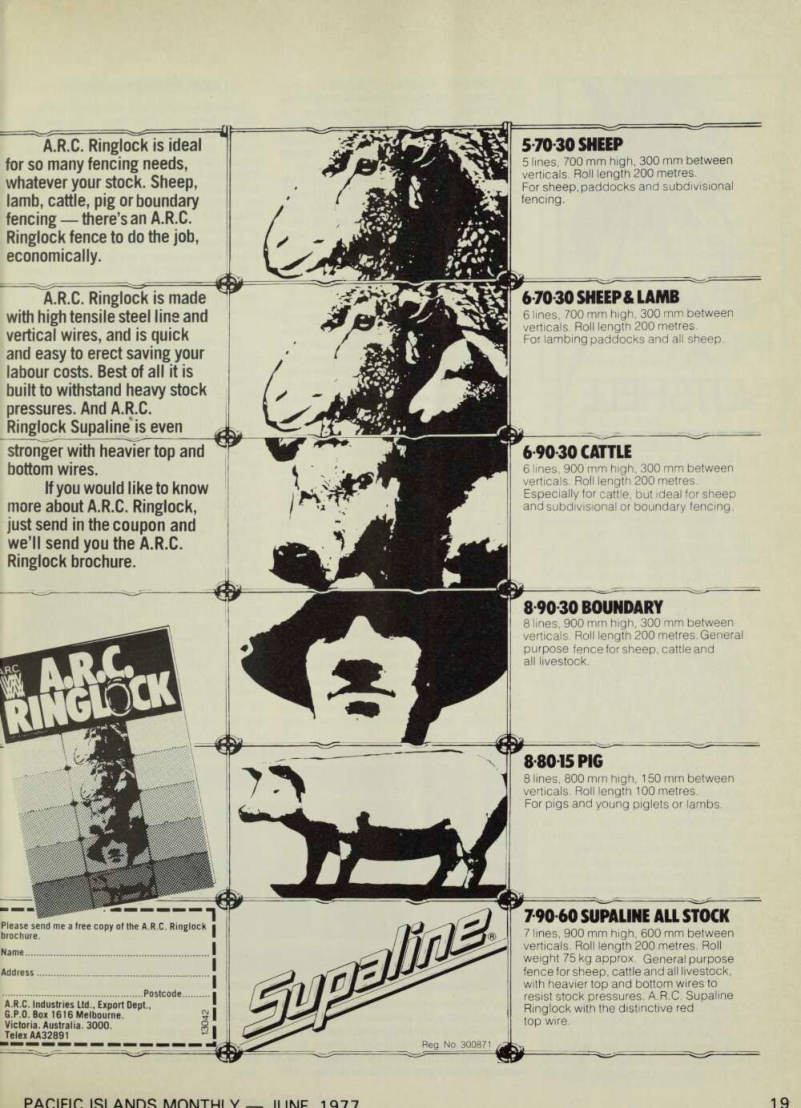
A.R.C. Ringlock is ideal for so many fencing needs, whatever your stock. Sheep,
lamb, cattle, pig or boundary
fencing there’s an A.R.C.
Ringlock fence to do the job,
economically.
A.R.C. Ringlock is made with high tensile steel line and vertical wires, and is quick and easy to erect saving your labour costs. Best of all it is built to withstand heavy stock pressures. And A.R.C.
Ringlock Supaline is even
stronger with heavier top and bottom wires.
If you would like to know more about A.R.C. Ringlock, just send in the coupon and we’ll send you the A.R.C.
Ringlock brochure.
* Please send me a free copy of the A.R.C. Ringlock brochure.
Address Postcode A.R.C. Industries Ltd., Export Dept., G.P.O. Box 1616 Melbourne. $ Victoria. Australia. 3000. S Telex AA32891 M w= O r
5 70 30 SHEEP
5 lines, 700 mm high, 300 mm between verticals. Roll length 200 metres.
For sheep, paddocks and subdivisional fencing.
670*30 SHEEP & LAMB
6 lines, 700 mm high, 300 mm between verticals. Roll length 200 metres.
For lambing paddocks and all sheep.
6 90 30 CATTLE
6 lines, 900 mm high, 300 mm between verticals. Roll length 200 metres.
Especially for cattle, but ideal for sheep and subdivisional or boundary fencing.
8 90 30 BOUNDARY
8 lines, 900 mm high, 300 mm between verticals. Roll length 200 metres. General purpose fence for sheep, cattle and all livestock.
8 8015 PIG
8 lines, 800 mm high, 150 mm between verticals. Roll length 100 metres.
For pigs and young piglets or lambs.
790 60 SUPALINE ALL STOCK
7 lines, 900 mm high, 600 mm between verticals. Roll length 200 metres. Roll weight 75 kg approx. General purpose fence for sheep, cattle and all livestock, with heavier top and bottom wires to resist stock pressures. A.R.C. Supaline Ringlock with the distinctive red top wire.
Patifir. Isi And£ Momtmi V Ii Imp 1Q77
Nutshell
The
News
In A
Nutshell
They Killed A "Sorcerer"
Seven men have been gaoled for periods of up to three years and nine months by the National Court at Goroka in PNG for murdering a man whose identity is still unknown. Mr Justice Raine was told the men murdered the stranger because they believed he was a sorcerer who had come to their village of Yanuta. One of the men told the court the man had “poisoned our people” and that 20 villagers had lost their lives.
Fijians Lose Jobs
Nasella tussock is the curse of much good sheep-farming country in the north Canterbury area of New Zealand, and there is no way of getting rid of it, except by rooting it out. Since 1968, the North Canterbury Nasella Tussock Board has been recruiting Fijians to dig out the tussock. Now, because of recent adverse publicity involving the behaviour of Fi jians worse for liquor, in several small towns in the area, the board has turned to Tongans, and recruited 38.
They will receive $2.12 an hour, or about $B5 a week. The board pays their air fares, and then deducts it from their wages over 20 weeks. They get free ac
commodation, including cooking and
washing facilities, but are required to provide their own food. They will live in camps at Cheviot and Waiau, north of Christchurch.
And Not Only Fijians!
A New Zealand publican is un dismayed about a charge under that country’s Race Relations Act that he refused lo sell spirits to Fijians. The pub lican, Mr Arthur Jones, of the town of Cheviot, in the South Island, went on na tional television to explain his view. He claimed there was “nothing remotely racist” in his action. After saying that he
was married to a Maori, he said the men concerned were tussock cutters who had returned to Fiji. Townspeople of Cheviot, while expressing respect for the Fijians, agreed with Mr Jones, who said he would not serve spirits to Fijians because they “just go mad”.
Some Fiji publicans disagreed with Mr
Jones, although one said that most Fijians drank beer, not spirits. They also considered that in any racial group there were people who could not hold their
liquor.
Accidentally Opened
The new 722-metre, single-span bridge linking the islands of Koro and Babelthuap in the Carolines was dedicated and “accidentally” opened towards the end of April. Palauan chief Ebedul Gibbon and Guam’s Governor Ricardo J. Bordallo were supposed to head a 20-car procession over the bridge in the opening ceremony. Nobody told them and the two started to cross on foot. More than 2,000 spectators followed. Before the bridge was built, the only link between the two islands was a ferry which could only accommodate 14 cars at one crossing and took 15 minutes to do it. The bridge, financed by the United States, was completed three months ahead of schedule.
What! All 225!
* ' Fiji judges of a competition for an emblem for the Sixth South Pacific Games scheduled for Fiji in 1979 rejected all 225 entries and asked for more. Most of the designs, which came from 12 Island countries New Caledonia sent 78 —were good but rejected either because they would need much modification or because they forgot to include the date and venue or, maybe, because they were just plain
l°usy.
Stamp Market Newcomer
Niue is getting ready to claim a larger s^'ce °/ income from the postage stamp industry. The government has de cided to establish its own philatelic department instead of allowing the New Zealand Post Office to handle stamp sales and has appointed Mr Finbar Ken ny, of New York, as the department’s ad v,ser - Mr Kenny already handles stamp production and sales for the Cook Is lands and Tonga. Stamp revenue from Niue stamps has averaged more than $45,000 a year over the last 10 years even though Niue has never attempted to n ° od the market PAM one pdime Ud UhlMt The April row over alleged rape and general lawlessness on the campus of the
University of Papua New brought strong
official reactions. The PNG Prime Minister, Mr Michael Somare, per sonally ordered the UPNG Vice-Chan cellor. Dr Gabriel Gris, to ensure that criminal behaviour on the campus “ceases immediately”. Dr Gris re sponded by banning alcohol on campus (except for staff residential areas and of ficial functions), closing the University Club until revision of the Discipline Statute was completed, and vesting new disciplinary powers in himself, the Deputy Vice-Chancellor and the University Secretary. At the same time he moved to increase lighting and physi cal security measures, especially at the Luavi women’s residential hostel, from which all visitors were banned. Police officers cannot enter the campus unless invited. On this the Police Com missioner, Mr Pious Kerepia, declared “I don’t see why the police should not patrol the campus. Universities in Papua New Guinea should not copy traditions of overseas universities. Male students are taking advantage of the existing ban on police entry to the UPNG campus.”
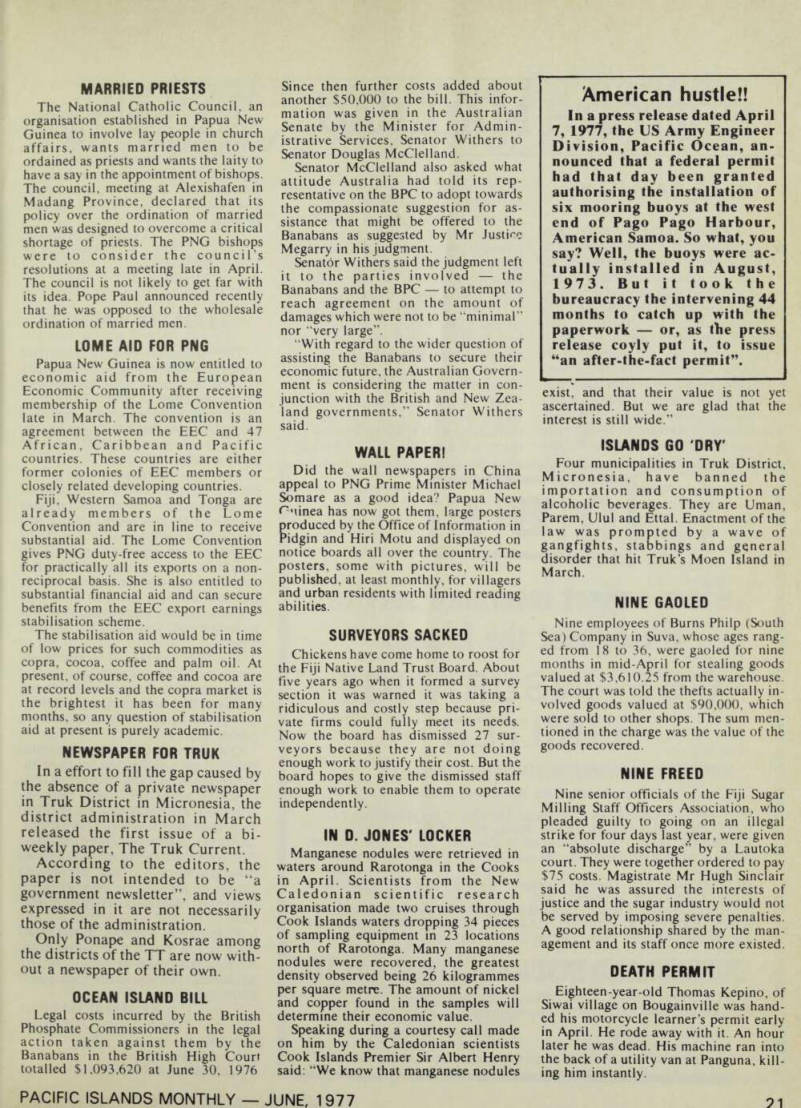
Easter 1977 and the 400th anniversary of the painter Peter Paul Rubens (1577-1640) are simultaneously commemorated in this new series of three stamps from the Cook Islands. The stamp designs reproduce in five-colour photogravure Rubens' the Cruci fixion, Christ Between Two Thieves, and The descent form the Cross. A decorative corner label with profile of Queen Elizabeth is included in each sheet.
Demoninations are 7c, 15c, and 35c.
Married Priests
The National Catholic Council, an organisation established in Papua New Guinea to involve lay people in church affairs, wants married men to be ordained as priests and wants the laity to have a say in the appointment of bishops.
The council, meeting at Alexishafen in Madang Province, declared that its policy over the ordination of married men was designed to overcome a critical shortage of priests. The PNG bishops were to consider the council’s resolutions at a meeting late in April.
The council is not likely to get far with its idea. Pope Paul announced recently that he was opposed to the wholesale ordination of married men.
Lome Aid For Png
Papua New Guinea is now entitled to economic aid from the European
Economic Community after receiving
membership of the Lome Convention late in March. The convention is an agreement between the EEC and 47 African, Caribbean and Pacific countries. These countries are either former colonies of EEC members or
closely related developing countries.
Fiji, Western Samoa and Tonga are already members of the Lome Convention and are in line to receive substantial aid. The Lome Convention gives PNG duty-free access to the EEC for practically all its exports on a non reciprocal basis. She is also entitled to substantial financial aid and can secure benefits from the EEC export earnings stabilisation scheme.
The stabilisation aid would be in time of low prices for such commodities as copra, cocoa, coffee and palm oil. At present, of course, coffee and cocoa are at record levels and the copra market is the brightest it has been for many months, so any question of stabilisation aid at present is purely academic.
Newspaper For Truk
In a effort to fill the gap caused by the absence of a private newspaper in Truk District in Micronesia, the district administration in March released the first issue of a bi weekly paper, The Truk Current.
According to the editors, the paper is not intended to be “a government newsletter”, and views expressed in it are not necessarily those of the administration.
Only Ponape and Kosrae among the districts of the TT are now with out a newspaper of their own.
Ocean Island Bill
Legal costs incurred by the British Phosphate Commissioners in the legal action taken against them by the Banabans in the British High Court totalled $1,093,620 at June 30, 1976
Since then further costs added about another $50,000 to the bill. This infor mation was given in the Australian Senate by the Minister for Admin istrative Services, Senator Withers to Senator Douglas McClelland.
Senator McClelland also asked what attitude Australia had told its rep resentative on the BPC to adopt towards the compassionate suggestion for as sistance that might be offered to the Banabans as suggested by Mr Justice
Megarry in his judgment.
Senator Withers said the judgment left it to the parties involved the Banabans and the BPC to attempt to reach agreement on the amount of damages which were not to be “minimal” nor “very large”.
“With regard to the wider question of assisting the Banabans to secure their economic future, the Australian Govern ment is considering the matter in con junction with the British and New Zea land governments,” Senator Withers said.
Wall Paper!
Did the wall newspapers in China appeal to PNG Prime Minister Michael Somare as a good idea? Papua New Guinea has now got them, large posters produced by the Office of Information in Pidgin and Hiri Motu and displayed on notice boards all over the country. The posters, some with pictures, will be
published, at least monthly, for villagers
and urban residents with limited reading abilities.
Surveyors Sacked
Chickens have come home to roost for the Fiji Native Land Trust Board. About five years ago when it formed a survey section it was warned it was taking a ridiculous and costly step because pri vate firms could fully meet its needs.
Now the board has dismissed 27 sur veyors because they are not doing enough work to justify their cost. But the board hopes to give the dismissed staff enough work to enable them to operate
independently.
In D. Jones' Locker
Manganese nodules were retrieved in waters around Rarotonga in the Cooks in April. Scientists from the New Caledonian scientific research organisation made two cruises through Cook Islands waters dropping 34 pieces of sampling equipment in 23 locations north of Rarotonga. Many manganese nodules were recovered, the greatest
density observed being 26 kilogrammes
per square metre. The amount of nickel and copper found in the samples will determine their economic value.
Speaking during a courtesy call made on him by the Caledonian scientists Cook Islands Premier Sir Albert Henry said: “We know that manganese nodules
exist, and that their value is not yet ascertained. But we are glad that the interest is still wide.”
Islands Go Dry'
Four municipalities in Truk District, Micronesia, have banned the
importation and consumption of
alcoholic beverages. They are Uman, Parem, Ulul and Ettal. Enactment of the law was prompted by a wave of
gangfights, stabbings and general
disorder that hit Truk’s Moen Island in March.
Nine Gaoled
Nine employees of Burns Philp (South Sea) Company in Suva, whose ages rang ed from 18 to 36, were gaoled for nine
months in mid-April for stealing goods
valued at $3,610.25 from the warehouse.
The court was told the thefts actually in volved goods valued at $90,000, which were sold to other shops. The sum men tioned in the charge was the value of the
goods recovered.
Nine Freed
Nine senior officials of the Fiji Sugar Milling Staff Officers Association, who pleaded guilty to going on an illegal strike for four days last year, were given an “absolute discharge” by a Lautoka court. They were together ordered to pay $75 costs. Magistrate Mr Hugh Sinclair said he was assured the interests of justice and the sugar industry would not
be served by imposing severe penalties.
A good relationship shared by the man agement and its staff once more existed.
Death Permit
Eighteen-year-old Thomas Kepino, of
Siwai village on Bougainville was hand
ed his motorcycle learner’s permit early
in April. He rode away with it. An hour later he was dead. His machine ran into the back of a utility van at Panguna, kill
ing him instantly.
Advertisements & other items, pp. 20-21 (2 items)
20
PACIFIC LSI AMDS MONTHLY JUNE. 1977
American hustle!!
In a press release dated April 7, 1977, the US Army Engineer Division, Pacific Ocean, announced that a federal permit had that day been granted authorising the installation of six mooring buoys at the west end of Pago Pago Harbour, American Samoa. So what, you say? Well, the buoys were actually installed in August, 1973. But it took the bureaucracy the intervening 44 months to catch up with the paperwork or, as the press release coyly put it, to issue “an after-the-fact permit”.
Editor’S Mailbag
Uncle Sam Says
It is encouraging to note that prospects for the formation of a regional maritime organisation in the Pacific Islands are improving, and it is hoped that similar develop ments in the airline field will occur.
These prospects could be im proved considerably if these regional entities were planned as complete vertically-integrated en terprises, with ownership and op erational control of all facilities and equipment, shore-based and mobile, domestic and foreign, in which title is presently held by all of the Pacific
Island states which would become participants in the endeavour.
Each Island member would ex change their equity in current transportation assets, whether air port, aircraft, dock/piers, ship and support gear, for a like value of stock shares in the enterprise.
It could be organised as a public corporation, which, in effect, would be a multi-national company. These companies have been outperforming other types of organisations in modern times.
All employees should be paid wages prevailing in Pacific Rim countries, with the expectation that their productivity and efficiency
would be commensurate with the Pay- Island disputes over landing rights and reciprocal shipping agreements would be greatly miti gated by such an arrangement. Ex pensive duplication in capital ex penditures could be avoided.
Utilisation factors could be im proved.
Yours for progress,
A. Hansvold,
Uncle Sam Agency, Seattle, Washington.
Slugged Yachtie
The American yachtie Raymond Quint was way wrong when he made out the Solomons light fee was put up by the English (PIM, Feb, p 25).
He hasn’t sailed around out here enough to see what’s really going on.
Kenilorea’s answer (PIM, March, p2l) set him right.
The light fee is only part of the Solomons anti-yacht programme.
No doubt when they go independent there will be lots more. Like PNG, they’ll make you not only bond your boat but bond yourself as well. Then they’ll “search” your boat for a day or two, turning everything inside out, and acting vicious as hell.
Quint doesn’t want to admit it, but it is not just anti-yachtie, its anti whitie.
The light fee rip-off is just thinly disguised racism. Bougainville, theoretically belonged to PNG but really filled with Solomon Islan ders, is full of black-white problems.
Quint’s “very friendly and helpful people” are just waiting for their in dependence to show the world that black is beautiful, baby, and the Solomons are black and are going to stay that way. Whitie, look out, Kenilorea is probably reading up on Idi Amin’s tourist policies even now. Yachties are just the easiest group of whities to attack under their still-cautious black panther ism.
To prove it, just look at the small inter-island boats that come from Bourgainville (PNG) to the Solomons. Do you think they pay a $lOO light fee?
Klaus Schaffer
Yacht Hilda Hong Kong. • (Copy to Mr Peter Kenilorea.)
Advertisements & other items, p. 22 (1 item)
Qbe Insurance
Q E
offers expert insurance service
throughout the Islands
QBE INSURANCE
LIMITED
(FORMERLY —QUEENSLAND INSURANCE COMPANY)
Central Office: 82 Pitt Street, Sydney FlJl—Branch Office, Suva, Manager for Fiji: L.G.Liddell A.A.1.1.
LAUTOKA—Sub-Branch Office: Bums Philp Bldg.
HONIARA (8.5.1. P. & Company (5.1.) Pty. Limited.
NEW CALEDONIA—T. A. Hagen, Stc. W. A. Johnston, S.A.R.L. —Noumea.
NEW HEBRlDES—District Manager; G. F. Donnelly, Vila; Santo; Burns Philp (New Hebrides) Ltd.
TAHlTl—Arthur Chung; Immeuble 8.1., Front dc Mer, Papeete.
NIUE, NORFOLK ISLAND, SAMOA, TONGA and other South Sea Islands—Bums Philp (South Sea) Company Ltd.
QUEENSLAND INSURANCE (P.N.G.) LTD
PAPUA NEW GUINEA-Head Office, PORT MORESBY.
General Manager: J.M.Dawe. Assistant Manager; R.Jackson^.A.l.l.
District Managers at: ARAWA: J.Longbut LAE: W.J.Leonard MADANG: I.R.Martin MOUNT HAGEN: D.F.Carroll RABAUL: A.M.Tanner
The Cooks, last hope for cancer
victims, or a haven for a hoaxer?
By W. H. PERCIVAL in Rarotonga and MALCOLM SALMON in Sydney
Take Prague (Czechoslovakia), Auckland (New Zealand), and Rarotonga (Cook Islands) three places as remote from each other in distance as they are in the customs and lifestyles of their people. Add the worldwide human scourge and fear of cancer. Then throw in a pinch of traditional Polynesian medicine.
Now you have the main ingre dients of the extraordinary story of 40- year -old Czechoslovak.
Vladimil Milan Brych.
The story began in August, 1968, as Soviet tanks rolled across the borders of Czechoslovakia to snuff out the brave and brief attempt by that country’s communist leaders to liberalise their country’s political system, to give socialism “a human face” as they said.
With thousands of others. Brych fled his homeland.
Later that year he arrived in New Zealand. He applied for admission to the medical profession, claiming to have been a doctor in Czechoslovakia but having no papers on his person to prove it.
He was given work in the patholo gy department of Auckland Hospital, and was later granted probationary registration as a medi cal practitioner. Main aspect of his work was the treatment of cancer by immunological methods. He won full registration on August 11,1972.
His first brush with the world of official medicine, represented by the New Zealand Medical Council, came very soon after his registra tion. In late 1972, some of his cancer patients went on television and claimed that he had saved their lives where other doctors offered them no hope.
The council deregistered him for this, seeing it as a clear breach of the ethics of the profession. But Brych's appeal to the Supreme Court was. successful, and he was back on the rolls 24 hours later.
In 1974, he was charged by the council with making false rep
resentations when he applied for registration. Brych had claimed that he held medical degrees in Czechoslovakia, but council inqu iries in Prague had been answered with claims by Czechoslovak authorities that at the time Brych said he was studying medicine at Masaryk University in the city of Brno he was actually serving seven years in gaol for robbery with as sault. Later, it was said, he worked in a biochemical laboratory, but had been sacked from this job.
The council claimed that no one of Brych’s name held a Czechoslovak medical degree.
Brych’s name was struck off the NZ medical register for a second time on November 8, 1974.
Brych appealed again, and was granted an interim stay of the coun cil’s action. The New Zealand Herald of April 6, reporting Supreme Court proceedings of the previous day, said. “In July 1975, Mr Justice Roper granted permis sion to the council for a commission to take evidence in Czechoslovakia.
Mr Brych appealed against that un successfully in the Court of Appeal, and following a petition to the Privy Council was denied the right to any further appeal . . . The basis of Mr Brych’s opposition was that he had been advised that, as a political
refugee, he could not expect to be treated properly in Czechoslovakia.”
The result of the Supreme Court hearing was that Brych was removed from the medical register once again, with $15,000 costs awarded against him.
But the bird had flown. Brych was already in Rarotonga capital of the Cook Islands, busily setting up a cancer clinic there.
His case had been followed with interest by the Cook Islands Health Minister. Dr Joe Williams, and by the Premier, Sir Albert Henry.
Following initial contacts in New Zealand, and an exploratory visit to the Cooks by Brych, a deal was struck; Brych could practise his cancer therapy in Rarotonga, if at the same time he worked as head of an Institute of Island Medicine, set up to study traditional Polynesian medicine.
As Sir Albert Henry said, in a speech of welcome to Brych in April: “We want to know all about our traditional medicine before the people who know how to identify, grow and preserve the medicinal plants are all gone.”
Earlier, Sir Albert had told a New Zealand television interviewer, Gordon Drydon, that Brych was ac ceptable to him because he was out side the “ring” that the medical pro fession had formed around them selves in their attitudes to tradi tional Polynesian medicine, and their refusal to make a serious study of it.
The deal with Brych did not go through without a flaming row in the Cook Islands House of Assembly over the amendment to the Medical and Dental Council Act which was necessary to allow Brych to practise.
Dr Tom Davis, Leader of the Op position, said in debate: “The man has no qualifications that he can produce, and he has never produced any qualifications.”
But for a number of people in New Zealand, Brych has the greatest
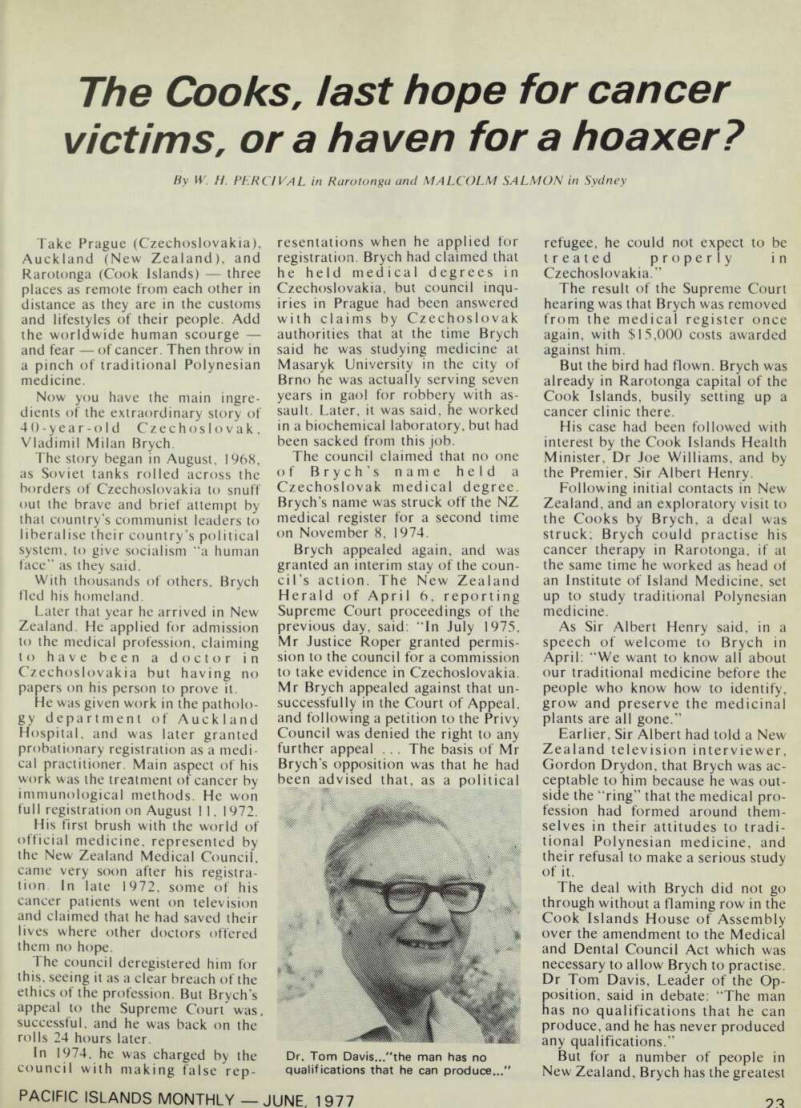
Dr. Tom Davis..."the man has no qualifications that he can produce..."
qualification of all they see him as having saved their lives, after they had been diagnosed by other doctors as having terminal cancer.
Melbourne Truth in April ran a series of articles called The Brych Report drawn up after months of in vestigation by a number of its senior journalists. The articles contained details of such cases.
One of Brych’s patients, 52-year old Auckland engineer Mr Maurice Cunningham, described his cure at Brych’s hands as “mircaulous”.
Brych himself pooh-poohs such statements. He told Truth: “This isn’t magic, and despite what well meaning emotional patients say there is really nothing miraculous about it.”
Brych calls his treatment chemo immunotherapy. It involves stimulating the body’s immune system to fight the cancer. hive or six treatments are given over a period of six months.
Brych says he has isolated the an tigens of particular tumours. He in jects a serum containing the antigen into the patient. This stimulates the body’s immune system to the point where anti-bodies attack and de stroy the malignancy.
He says the 20% of patients he has failed to save were people with melanomas he has not yet developed an antigen for melano mas and, principally, people whose immunological systems have been rendered ineffective by major surgery or extensive radio-therapy or chemotherapy treatment Keystone of his theory is the con viction that cancer is to be at tributed to a breakdown of the body’s immunological defences.
True or false? Is Brych a charlatan or a saviour? Was the New Zealand Medical Council lied to by the authorities in Prague? Or did the council fall victim to professional jealousy at the successes recorded by Brych? Or are both these pro positions true?
Questions crowd in on the ex traordinary story of Vladimil Milan Brych.
The answers are not yet known.
But what is known is that cancer sufferers from both New Zealand and Australia are already beating a path to his door in far-off Rarotonga.
Advertisements & other items, p. 24 (2 items)
24
PACIFIC ISI AMDS MONTHLY JUNE. 1 977
Itavdodge offers
" you a whole
sight more in
Australia and
the South Pacific
i I m. *=< *f * to r 9 Right around the South Pacific you’ll find international standard Travelodge where the sights are ...where the action is.
And that’s where you’ll want to stay-to see the things, do the things you wish without moving too far from your room.
Friendly Travelodge offers the best in accommodation, service, food and value for money.
So book Travelodge. You’ll get a whole sight more. • Australia • New Zealand
• Fiji
• Tahiti • New Caledonia Papua New Guinea • Indonesia
’RAVE/ODCE CARE
RESERVATIONS: for any one of over 70 Travelodges in Australia. Fiji, New Zealand, Papua Guinea Tahiti Japan & Indonesia:- .Australia: Sydney (02) 31.0601: Adelaide (08) 223.6194: Melbourne (M) (092) 25 3811- Brisbane (072) 21.8586: Hobart (002) 34.2911; Canberra (062) 49.1424: Darwin 81.5388. U.K. (London). us Houses Forte (01) 567.3444. Japan (Tokyo): Travelodge Branch Office (03) 214.0961. Rji: Travelodge .wis 2.4600. Hong Kong: Travelodge Reservations 522.2251. U.S.A. (Toll Free): Travelodge International Inc. (800) 255.3050 N.Z. (Auckland): Travelodge Reservations 374.108.
OR YOUR TRAVEL AGENT TR99/75
Pacifique Sud
With Helen Rousseau
If the French can be said to have a national sport, one in which all can participate, it must surely be “Systeme D” the skilful art of wangling one’s way around the law, or gaining a per sonal advantage. The New Caledonians now have new scope for indulging in this sport, since new regulations were made covering the island’s uni que “barking” bird the cagou.
While the French authorities in Noumea meticulously keep count of every tonne of nickel produced, every request for a permit to have a gun, and the delicate tally of jobs divided be tween Caledonians and “metros” from France, the com puter operators now have a new task counting cagou birds.
By April, 45 birds had been counted in a cagou census. All birds in captivity are to be tagg ed, and if one dies its remains are to be handed over to the authorities. The owner will not have the right to acquire a new bird. Obvious scope for Systeme D.
No doubt this accounting for cagous will become an important job for the French public service, watching production targets under the current seventh Five year Plan. Another important part of that plan for distant New Caledonia concerns the media and communications. Since the installation of satellite-transmis sion facilities in Noumea last year, the Caledonians are now treated to certain direct TV broad casts from Paris, intended to help the islanders feel closer to the mother country. The Caledonians have already been entertained by 10 years of television and have now been promised the luxury of
colour TV in 12 months time.
The Tahitians have plenty of enthusiasm for other things too, and invited numerous overseas groups to join in their dance festival in late April. Among those to fly to Papeete for the event were dancers from the Philip pines and Japan besides Pacific Islanders and Australian Aborigines.
An unusual beauty contest held some time beforehand was neither the traditional Miss Vahine or Monsieur Tane but Miss Tane-Vahine, which reveal ed some very well-endowed men to add to the novelty of Tahiti night-life. In more serious vein, Paris has promised that French President Valery Giscard d'Estaing will visit Tahiti before the end of this year.
Meanwhile, back in Noumea, just in case the Caledonians should get the bold idea that Australia might help them in ob taining greater self-government from France, the local press keeps photographing smiling Australian naval commanders exchanging hearty handshakes with French officials, with the caption that Franco-Australian relations are “fine’’.
Actually, it has recently been announced in Noumea that a South Pacific section is to be formed in the Franco-British As sociation. This has led to ex pressions of surprise that such a friendly association has not ex isted before. Indeed it is surpris ing, especially as over the past 10 years the French have man aged to drive out one Australian consul and a resident correspon dent for Radio Australia, who was only allowed back in Noumea on
the understanding that there was no more writing about local affairs.
But the French are great believers in change variety is the spice of life. So the welcome mat is out for Anglo-Saxons now.
As a sign of the new trend, for the first time this year the ANZAC Day celebrations in Sydney on April 25 were joined by a 21-man delegation of Caledonian war veterans.
So in New Caledonia it’s open arms for visitors. And now they see not only the capital, Noumea: a new Federation of Inland Hoteliers is encouraging tourists to venture to new resorts up country, to Hienghene and Poin dimie, Bourail and Sarramea, along the east and west coasts.
The bush hoteliers are in direct telex contact with the new French Caledonia Travel Service in Sydney, set up by Alex Redler of Theodore Travel, to help foreign visitors explore off the beaten track.
After his success with the gamblers’ $2,000 special excur sion to Noumea’s Casino Royal, Alex Redler has now discovered the offshore island of Ouvea, with its bungalows to take 60 persons.
Resort managers. Azem and Pauline Youssef, flew to Sydney in April to tell a gathering of 300 travel agents just what a relaxing welcome they can expect on this atoll in the Loyalty Group.
Yes, they have great fish, shells and lobsters three feet across or was it five? Any photo genic gendarmes on Ouvea yes, two, to maintain the French connection. So New Caledonia can really claim to be the Pacific Island territory with a difference “la presence francaise’’.
Advertisements & other items, p. 26 (1 item)
Toturn Grass Into Lawn
COUNT ON VICTA
VICTA
UTILITY 160
MOWER
A Tough, rugged, lightweight and low priced, a mower without grass-catcher designed to handle the full range of grass cutting jobs from heavily weeded and long grass areas to fine lawns. Cuts close to trees and fences and new side chute sends the cut grass safely to the side. Powered by 160 cc Mark 4 2-stroke Victa engine with the easy pull-Zip Starter, multiposition height adjuster, fold-down handles and many more exclusive Victa features make the Utility'a popular lightweight mower f
VICTA
SUPER 24
MOWER
The big mower for big grass with a giant 61 cm (24") cut. It’s the mower for the big grass cutting jobs and municipal parks and gardens, sports grounds, roadside growth control as well as property owners with large areas of land. Solid construction, easy manoeuvrability and giant rear wheels handle rough ground effortlessly. Two free-swinging blades on the cutting disc absorb shock when hard objects are encountered, protecting the engine from damage.
Powered by a special power-boosted Victa 160 cc 2-stroke engine with the exclusive easy pull Zip Starter and many more features to make the big mowing jobs easier.
When you want tough reliable grass cutting, Victa has the mower for any job. And every Victa mower is backed by the widest service and spare parts network in the business.
L 83.8646
Victa
TURNS GRASS INTO LAWN
Tropicalities
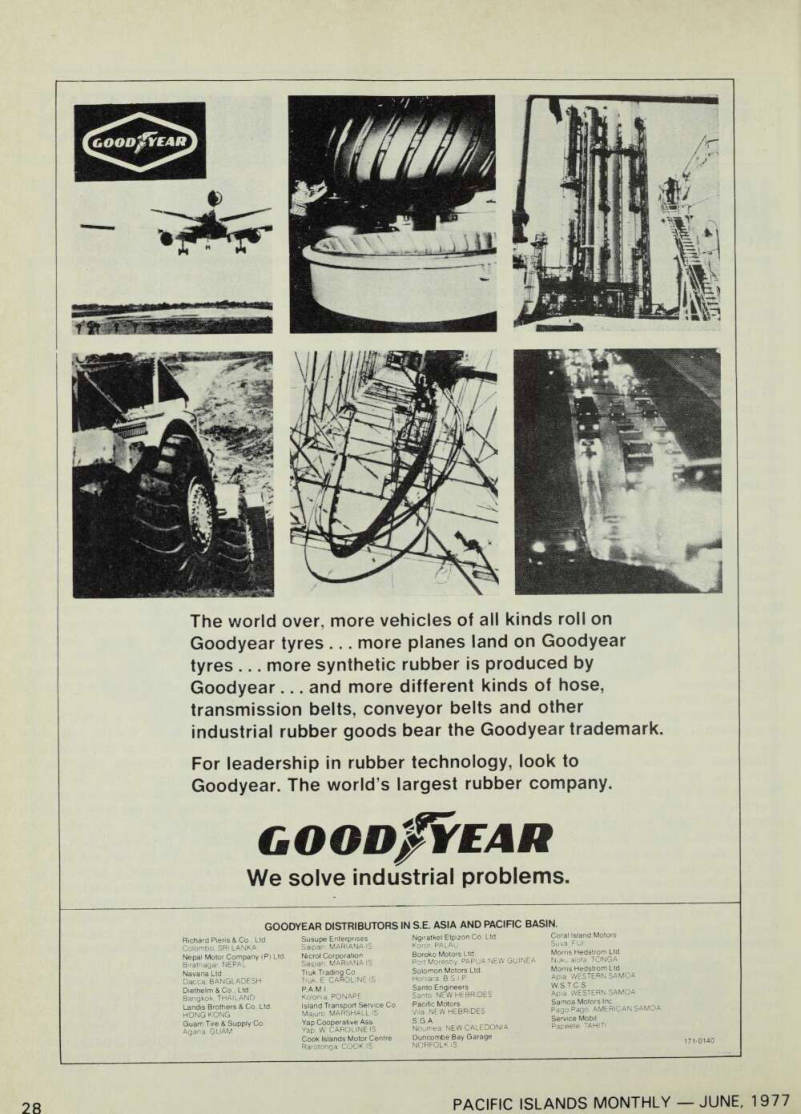
New Nius in
the Solomons
It seemed as if the Solomons was losing its only independent newspaper when the short-lived Melanesian Nius announced that it was suspending its publication for lack of funds. The Nius was the only competitor to the officially pro duced Solomon Islands News Drum.
The Nius had had an erratic career, obviously being produced on a ‘shoe-string’ budget. This meant that at times its articles were unclear and its facts often astray.
Nevertheless, it was popular because it was irreverent, especially where the government was concern ed.
The Nius was sensationalist and people were curious over what it would say next. It was said that the “leading light’’ behind the Nius was former Chief Minister Solomon Mamaloni, although he has kept very much out of the Nius and the news.
Even the Nius reported that it didn’t know why he had resigned
from parliament.
No doubt there were some sighs of relief in some government depart ments when it seemed that the Nius was no more.
However, the Nius has been re surrected as the Kiokio Nius.
Perhaps the change of title reflected a criticism that “Melanesian” smacked of racial exclusiveness the Solomons contains Melanesians, Micronesians, Polynesians, Chinese and Europeans, as well as various intermixtures thereof.
To the beginning of April the Kiokio Nius has produced two issues. These have been generally more constructive than its pre decessor, but the criticisms of the government and particularly the police, and the ‘pretty-girl-of-the week’ are still there. So far however, the bare-breasted ‘custom-dress queens’ have not reappeared in the pretty girl section.
In its letters to the editor, it has
allowed racial disharmonies to sur face. There have been two rather nasty letters saying that the Gilber tese settlers, brought in by the Bri tish, should be repatriated.
This has been an issue brought up in recent debates in the Legislative Assembly: what is the Gilbertese settlers’ citizenship to be when the
Solomons becomes independent 9
Racial disharmony also appeared recently in expressions of criticism of a half-hour weekly Cantonese broadcast over the Solomon Islands
Broadcasting Corporation.
So, for the time being it seems that the Nius is here to stay. Its latest claim to its readers is that it will be publishing the true story of the reasons for former Chief Minister Solomon Mamaloni’s withdrawal from politics last year.
Although Solomon Mamaloni was connected with the Melanesian Nius, the new Kiokio Nius is a one man effort from George Atkin, a local who trained in New Zealand and has experience with the Solomon Islands Broadcasting Commission.
Good news is
no politics
In the last elections held in Australia, Liberal Party leader, Malcolm Fraser, promised to take politics “off the front page’’ if he were elected. Mr Fraser was refer ring to the then-Labor government’s tendency towards scandal and con troversy.
PNG Prime Minister Michael Somare has been taking a leaf from Mr Fraser’s book, and doing a better job of it!
First, there was the extensive radio coverage of the PNG v Fiji cricket match. The coverage in length and detail would have done an Australia-England test match proud. It certainly kept politics off the front page. But it appears that Mr Somare wanted more. Accord ing to ‘informed cricketers’, when the PNG’s National Broadcasting Commission broke off from the cricket for the news, it received a
curt call from the Prime Minister to get on with the cricket com mentary’.
Then there was the Queen’s visit.
That kept politics off the front pages in PNG for some time.
Added to this, Michael Somare has been asking Solomons country singer Fred Maedola to tour PNG.
With the PNG election coming up, however, politics must begin to hit the front page with considerable
regularity soon.
A welcome for
two champions
Half-past five on a Saturday morning in April could hardly be described as the ideal time to ar range a popular celebration. Yet at New Caledonia’s Tontouta aero drome, a crowd was already waiting the regular UTA flight from Paris.
There were the usual sleepy-eyed relatives or friends of people return ing from a holiday in Europe. But there was also an enthusiastic and chattering crowd of very alert peo ple who had left their homes at 4.30 that morning to offer a particularly warm welcome to two very discreet heroes.
Vincent Kafoa is a powerful but timid man from Wallis. His com panion, a little more self-confident, is Raymond Nebayes, employed in the nickel mines at Thio, on the east coast. But, as the two men stepped into the terminal, the crowd cheered and banners were waved. New Caledonians expressed their joy to see two local boys who are now, re
spectively, amateur heavyweight
and middleweight champions of
France. The territory had sent three
competitors to the championships,
and two had brought back national titles.
The reception at the Chateau Royal was certainly a tiring event for the two boxers, after nearly 30 hours in a DCIO. Fatigue, and above all, natural shyness, pre vented both of them from appearing on the special TV programme that evening.
Making a plane
fit for a queen
How much did it cost to refitan Air Niugini Fokker Friendship aircraft for the Queen’s Silver Jubilee visit to Papua New Guinea in March?
K 26,000 said an unnamed spokes man for the airline who was quoted in the Papua New Guinea Post-Courier on March 17.
Not so, said the airline’s general manager, Mr Brian Grey, in the Post- Courier next day. Only K 6,000 was spent on the actual refitting, while another K 18,000 was for scheduled upholstery maintenance.
He said the airline’s nine other F 27 aircraft were also scheduled for maintenance which would cost a total of K 162,000.
The VIP aircraft, which was assigned a back-up role for the royal visit, had been rearranged with 22 seats six seats at the back of the aircraft for VIPs and 16 at the front.
The six VIP seats cost about K 1,000 each. The VIP area, which is adorned with the PNG crest and the royal coat of arms, has two dropleaf tables, each worth about K 1,000.
Mr Grey said the VIP plane filled a long-felt need for a luxury aircraft in Papua New Guinea for visiting dignitaries. He said the aircraft would be chartered to businessmen in future at a cost of KlOO a flying hour.
Tourism’s magnet
for honeymooners
Japanese couples may soon be marrying in a church built to fulfil a vow by the people of Noumea that they would put up a church if they were spared a Japanese invasion in World War 11.
The church, iEglise du Voeu, or Church of the Vo\£, is on Noumea’s Anse Vata beach. The idea of staging Japanese weddings in it is being con sidered as part of a major promotion of tourism now under way in New Caledonia. It is an idea which is already working well in Guam and Singapore. Young couples arrive from Tokyo in full wedding dress, looking forward to their overseas nup tials if for no other reason than that of avoiding the high cost of a big wed ding back home.
Figures released by the Office of Tourism in New Caledonia show that the territory received 34,983 visitors in 1976, an 11% increase over 1975.
These figures do not include
passengers on cruise ships. The in creasing tourist traffic through Noumea is attributed particularly to Australians, whose numbers increased by 19% to 18,639 in 1976. Visitors from New Zealand dropped 18% on the year, down to 4,379. Traffic from Japan more than doubled, to total 3,- 467 visitors. However, many of these were promotional teams from the Japanese media, so that filling the weekly UTA airlines flight between Tokyo and Noumea continues to be a problem.
Much of the success in the Australian market can be credited to the efforts of Traveland and their Noumea subsidiary Island Holidays.
One of their latest initiatives has been the promotion of drive-yourself through the Caledonian inland, with accommodation vouchers for use at the growing number of small hotels along the island’s east and west coasts.
Povai, a
new voice
PIM has frequently brought to the notice of its readers the appearance of new newspapers and magazines published to cater for the tastes and needs of the various groups that comprise the Pacific Islands reading audience.
In recent years, attention has been given to several newspapers which have been produced as a counter voice to the established private en terprise newspapers or the various government-controlled pub lications. There have been few if any newspapers which could be classified as being the platform of political activists, but 1976 saw the emergence of Povai, which is pub lished in Suva and which describes itself as “the paper of the Pacific Peoples’ Action Front”, aiming to provide information and views on the various struggles of people in the Pacific to determine their own lives.
“Povai contains material not usually found in the regular news media. We are a non-profit making organisation and encourage con tributions from people who think it is important to provide this type of service.” It is published six times a year and in its last issue carried eight pages.
The area of interest of this newspaper makes intriguing read ing, as its proprietors quite ob viously have an all-embracing view of the Pacific.
A Cook’s ship
in Bogart’s wake
How many of us remember the scene from the film, The African Queen when Humphrey Bogart and Kathryn Hepburn were floating down the river and she decided that his cargo of gin had to be jettisoned?
There was that marvellous vista of the long stretches of the river with the emptied gin bottles bobbing in the wake of the steam launch. There was something of a repetition on one occasion when that great old schooner the Tiare Taporo called at Manihiki in the northern Cook Islands and picked up four Europeans, who had been waiting on the island for some weeks for a vessel to take them on to Rakahanga, Penrhyn and other outer island ports.
The skipper, Archie Pickering, was a mutual friend of long-standing, and so it wasn’t long after the vessel had moved away from the landing at Tauhunu, that all five sat down to have a can or two of beer and to yarn away the hours before the sun set.
The old ship, at full speed ahead, could not have been making more than three or four knots. There were three cartons of good Australian beer suitably chilled on the bench in the pantry and everything was right for an
animated and engrossing chin-wag.
The cans were to be opened as required by Ben, the Maori steward, using the now out-dated opener that pierced the top of the can with a smart hiss. Ben was intrigued with the way in which the cans responded to his opener. The quintet of old mates went on with their gossiping, and Ben went on with his opening, without let or hindrance.
When eventually it dawned upon the drinkers that Ben had kept on with his task with the greatest of enthusiasm, something like 60 cans of beer stood in neat rows, all opened. But this did not entirely stump these hardy Cook Islands’ imbibers. For some hours they set their minds to the serious task of making sure that as little of the beer as possible went to waste. It wasn’t too much of a throw to pitch an empty can, up the companionway, across the poop and into the sea. What with the slow pace of the Tiare Taporo and the effects of a following wind the cans took many minutes to pass out of sight and, like the African Queen, the schooner left behind her a long line of tributes to the demon grog.
Advertisements & other items, pp. 28-30 (1 item)
Goodyear
The world over, more vehicles of all kinds roll on Goodyear tyres ... more planes land on Goodyear tyres ... more synthetic rubber is produced by Goodyear... and more different kinds of hose,
transmission belts, conveyor belts and other
industrial rubber goods bear the Goodyear trademark.
For leadership in rubber technology, look to
Goodyear. The world’s largest rubber company.
GOODYEAR
We solve industrial problems.
GOODYEAR DISTRIBUTORS IN S.E. ASIA AND PACIFIC BASIN.
Richard Pieris& Co., Ltd.
Colombo, SRI LANKA Nepal Motor Company (P) Ltd.
Biratnagar, NEPAL Navana Ltd.
Dacca, BANGLADESH
Dlelhelm & Co., Ltd.
Bangkok, THAILAND Landis Brothers & Co. Ltd.
HONG KONG
Guam Tire & Supply Co Agana. GUAM Susupe Enterprises Saipan MARIANA IS Nicrol Corporation Saipan, MARIANA IS.
Truk Trading Co.
Truk. E CAROLINE IS
PA M I
Kolonia. PONAPE Island Transport Service Co.
Majuro. MARSHALL IS.
Yap Cooperative Ass
Yap. W CAROLINE IS.
Cook Islands Motor Centre Rarotonga. COOK IS Ngiratkel Etpizon Co, Ltd Koror. PALAU Boroko Motors Ltd Port Moresby. PAPUA NEW GUINEA Solomon Motors Ltd.
Honiara. 8.5.1 P Santo Engineers
Santo NEW HEBRIDES
Pacific Motors
Vila. NEW HEBRIDES
S.G A
Noumea. NEW CALEDONIA
Duncombe Bay Garage
NORFOLK IS
Coral Island Motors Suva. FIJI Morris Hedstrom Ltd Nukualofa. TONGA Morris Hedstrom Ltd.
Apia. WESTERN SAMOA
W.S.T.C.S.
Apia, WESTERN SAMOA
Samoa Motors Inc.
Pago Pago AMERICAN SAMOA
Service Mobil Papeete. TAHITI , 171-0140
KAI
KAI
the
BUAI
with
Larry Danielson
latest cassette available now!
PRODUCED BY AL MONZO
RECORDED AT A TLA NT ICS STUDIO , SYDNEY .
TRADE ORDERS WELCOMED.
WRITE TO: SOHBU, AUSTRALIA, ADVISING OF YOUR BANKERS.
P.O. BOX 1757, G.P.O. SYDNEY, 2001. AUSTRALIA.
century ghost town
Islanders return to a 21st century ghost town
By Jim Hall of Micronesian Hews Service
When the MS Militobi arrived at Japtan Island on the morning of March 15, 1977, with 56 Marshallese from Ujelang Atoll, it marked the beginning of the end of the American era on Enewetak Atoll.
Enewetak, known to most Americans as a symbol of the hot war in the Pacific in the 40s, and the cold war and atomic testing of the 50s, is being turned back to the peo ple who left here on December 20, 1947, in a naval LST (Landing Ship Troops) for Ujelang Atoll, 124 miles to the southwest.
On December 2, 1947, the US Government had notified the Security Council of the United Na tions that Enewetak Atoll was to be closed to the world for security reasons in order that “necessary ex periments relating to nuclear fis sion” could be conducted at the 30-
square-mile atoll.
The people of Enewetak moved to Ujelang on the basis of an agreement which was to give them full land rights to the uninhabited atoll. But the 136 Enewetakese became 450 by 1976, and Ujelang was no longer adequate. The US had ended its atomic testing programme in 1958, and its other scientific and technical programmes were slowly being phased out. There was a growing sentiment among the Enewetak peo ple to return to their ancestral home.
On September 16, 1976, the Ac ting High Commissioner of the Trust Territory, Mr Peter T. Cole man, signed a series of agreements which would begin the return pro cess and allow for a SUS2O million clean-up programme to get under way.
What will the Enewetak people find upon their return 9 The main is land of Enewetak is dominated by a mighty 8100-foot concrete runway built for use by bombers in World War 11. The other half of the island is crowded with anodised aluminium Butler buildings of every shape and size warehouses, living quarters, mess halls and clubs. Fuel tanks, water towers, a huge hangar, salt
water conversion units and concrete bunkers also dot the two-and-a-half mile strip which lies between the deep blue Pacific and the aqua-blue lagoon.
The island of Japtan, where the first returnees will live, has numerous Butler buildings, bunkers, communications sites, animal pens and other reminders of the nuclear testing programme. It underwent an intensive clean-up and rehabilitation for the first ar rivals. A Hawaiian luau was held for the arrival of the Militobi.
Those returning for the first time probably felt like space voyagers who had passed through a time warp. Their old world seemed to have aged several hundred years during their 29-year absence.
They were well aware of some other changes. Traditionally, the northern islands of the atoll were occupied by the Enjebi people, and the southern islands by the En ewetak people. Only the southern is lands are now considered habitable.
Two northern islands were vapourised during the tests, one during the explosion of the world’s first hydrogen bomb in 1952 and the second six years later. Enjebi, the main northern island, was inun dated by a 100-foot wall of water generated by the hydrogen bomb blast, and is not considered habita ble for another 30 years. The island of Runit, near the line dividing the north and south, is contaminated by radio-active plutonium and is off limits for the indefinite future.
This poses a serious political
question. Despite frequent inter
marriages, will the Enjebi people wish to live on the islands which tra ditionally belong to the Enewetak people, or will they choose to re main on Ujelang 9 Another question: what will become of the massive scientific and technological complex on Enewetak Island, which once housed over 5000 technicians, but is now a 21st century ghost town situated amidst a timeless environment where lazy trade winds swirl coral dust around the coconut palms 9
Advertisements & other items, pp. 31-32 (1 item)
Triangle
Polynesian
Western Samoa Niue Island Fiji Ponga
Its place in
the Pacific has shifted
Because now the Polynesian Triangle fare brings a Polynesian holiday much closer. Now when you visit Fiji you can include Tonga, Niue and Western Samoa for very little extra! Talk to your travel agent about working in our Polynesian Triangle fare with your
Fiji itinerary. Only U55253.00*
(A US$l9B.OO or NZ$2lB.OO) more to see three more islands in the beautiful Pacific. Our Polynesian Triangle fare is available all year round with no minimum stopover restrictions and may be purchased while you are in Fiji or before you arrive.
Contact your travel agent for more details.
Fare subject to change without notice.
Serving the heart of Polynesia
POLYNESIAN, ,
/ NWN
PO Box 599, Apia.
WESTERN SAMOA
A NEW CARD
ENTERS THE
SOUTH PACIFI
RICE MARKET
The Rice Growers of the Solomon Islands,
“BREWER SOLOMONS ASSOCIATES"
We invite enquiries from:
Fiji... New Hebrides... Trust Territories... Gilberts.
,9io
As SOn9*S
9 ui m f nt r 'e s er n ati 0 n 9l ar/, e tin b I re CfQ
TIMBER FOR THE SOUTH PACIFIC BUILDING INDUSTRY &
• MAHEE BA
|CAIRNS
iNMSfAIL .
SIANGAN
lOWNSVILLE
IHUI.HENOFN
BRISBANE
Major Exporters
Manufacturers and/or
Suppliers of —
ROTARY VENEER-SLICED VENEER-
S' INTERIOR—EXTERIOR—MARINE PLYWOOD-
I oxwood
SAWN TIMBER—BOTH DRESSED & ROUGH
MOULDINGS OF ALL DESCRIPTIONS
Direct Pacific Islands enquiries to Direct Australian aitouiriaa to—
THE MANAGER FOXWOOO. CAIRNS. NTH OLD
FOXWOOD INTERNATIONAL P.O. BOX ito2. CAIRNS
GPO BOX 8 HONIARA, SOLOMON IS PHONE: 53-3401.
PHONE: 0720 BUILD BETTER WITH
Son Hi Pacific Builders fir Handymen
TRADE WITH FOXWOOD FOR
VALUE IN TIMBER
f bxwood
Magazine
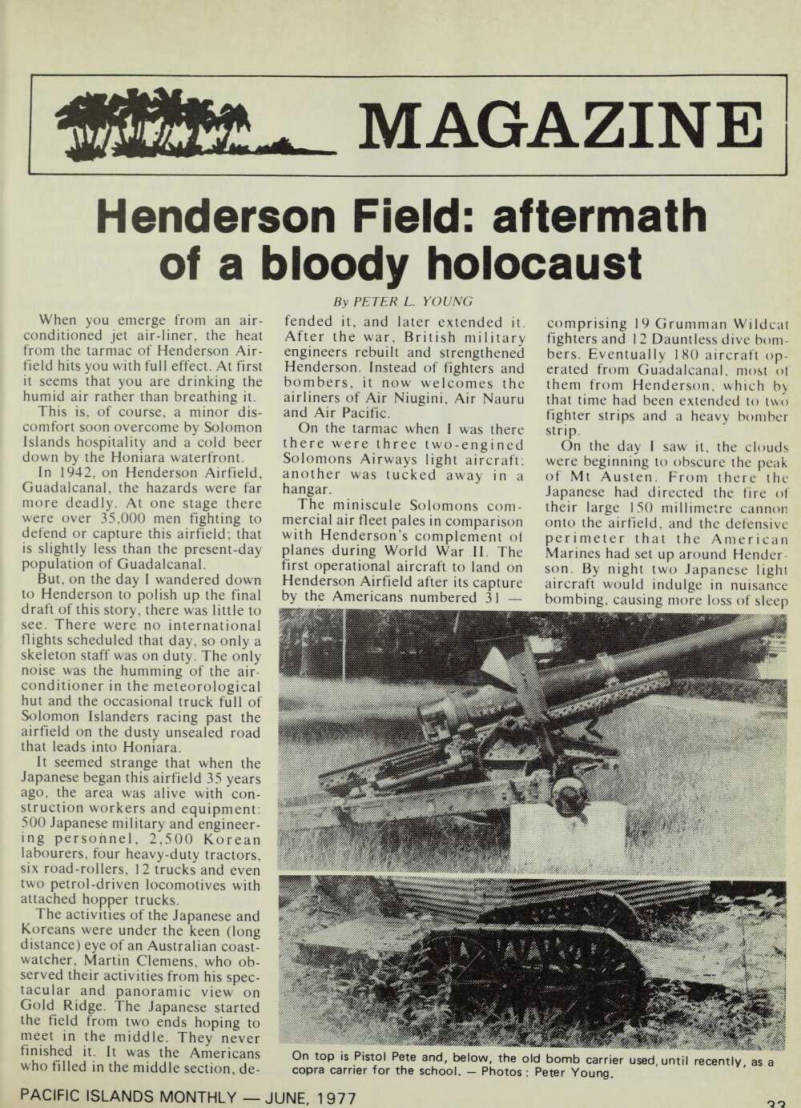
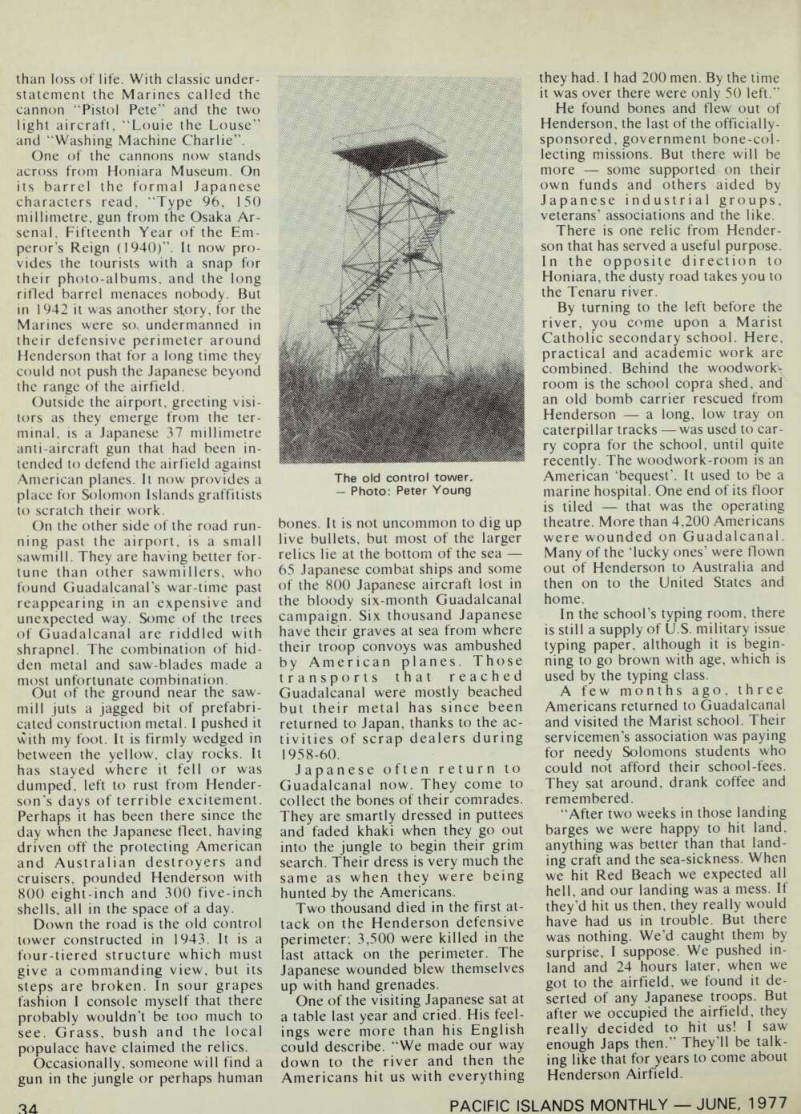
Henderson Field: aftermath of a bloody holocaust
By Peter L. Young
When you emerge from an air conditioned jet air-liner, the heat from the tarmac of Henderson Air field hits you with full effect. At first it seems that you are drinking the humid air rather than breathing it.
This is, of course, a minor dis comfort soon overcome by Solomon Islands hospitality and a cold beer down by the Honiara waterfront.
In 1942, on Henderson Airfield, Guadalcanal, the hazards were far more deadly. At one stage there were over 35,000 men fighting to defend or capture this airfield; that is slightly less than the present-day population of Guadalcanal.
But, on the day I wandered down to Henderson to polish up the final draft of this story, there was little to see. There were no international flights scheduled that day, so only a skeleton staff was on duty. The only noise was the humming of the air conditioner in the meteorological hut and the occasional truck full of Solomon Islanders racing past the airfield on the dusty unsealed road that leads into Honiara.
It seemed strange that when the Japanese began this airfield 35 years ago, the area was alive with con struction workers and equipment: 500 Japanese military and engineer ing personnel, 2,500 Korean labourers, four heavy-duty tractors, six road-rollers, 12 trucks and even two petrol-driven locomotives with attached hopper trucks.
The activities of the Japanese and Koreans were under the keen (long distance) eye of an Australian coast watcher, Martin Clemens, who ob served their activities from his spec tacular and panoramic view on Gold Ridge. The Japanese started the field from two ends hoping to meet in the middle. They never finished it. It was the Americans who filled in the middle section, de
fended it, and later extended it.
After the war, British military engineers rebuilt and strengthened Henderson. Instead of fighters and bombers, it now welcomes the airliners of Air Niugini, Air Nauru and Air Pacific.
On the tarmac when I was there there were three two-engined Solomons Airways light aircraft; another was tucked away in a hangar.
The miniscule Solomons com mercial air fleet pales in comparison with Henderson’s complement ot planes during World War 11. The first operational aircraft to land on Henderson Airfield after its capture by the Americans numbered 31
comprising 19 Grumman Wildcat fighters and 1 2 Dauntless dive bom bers. Eventually 180 aircraft op erated from Guadalcanal, most of them from Henderson, which by that time had been extended to two fighter strips and a heavy bomber strip.
On the day I saw it, the clouds were beginning to obscure the peak of Mt Austen. From there the Japanese had directed the fire of their large 150 millimetre cannon onto the airfield, and the defensive perimeter that the American Marines had set up around Hender son. By night two Japanese light aircraft would indulge in nuisance bombing, causing more loss of sleep
On top is Pistol Pete and, below, the old bomb carrier used, until recently, as a copra carrier for the school. Photos: Peter Young.
than loss of life. With classic under statement the Marines called the cannon “Pistol Pete’’ and the two light aircraft, “Louie the Louse” and “Washing Machine Charlie”.
One of the cannons now stands across from Honiara Museum. On its barrel the formal Japanese characters read, “Type 96, 150 millimetre, gun from the Osaka Ar senal, Fifteenth Year of the Em peror’s Reign (1940)”. It now pro vides the tourists with a snap for their photo-albums, and the long rifled barrel menaces nobody. But in 1942 it was another sfory, for the Marines were so, undermanned in their defensive perimeter around Henderson that for a long time they could not push the Japanese beyond the range of the airfield.
Outside the airport, greeting visi tors as they emerge from the ter minal, is a Japanese 37 millimetre anti-aircraft gun that had been in tended to defend the airfield against American planes. It now provides a place for Solomon Islands graffitists to scratch their work.
On the other side of the road run ning past the airport, is a small sawmill. They are having better for tune than other sawmillers, who found Guadalcanal’s war-time past reappearing in an expensive and unexpected way. Some of the trees of Guadalcanal are riddled with shrapnel. The combination of hid den metal and saw-blades made a most unfortunate combination.
Out of the ground near the saw mill juts a jagged bit of prefabri cated construction metal. I pushed it with my foot. It is firmly wedged in between the yellow, clay rocks. It has stayed where it fell or was dumped, left to rust from Hender son’s days of terrible excitement.
Perhaps it has been there since the day when the Japanese fleet, having driven off the protecting American and Australian destroyers and cruisers, pounded Henderson with 800 eight-inch and 300 five-inch shells, all in the space of a day.
Down the road is the old control tower constructed in 1943. It is a four-tiered structure which must give a commanding view, but its steps are broken. In sour grapes fashion I console myself that there probably wouldn’t be too much to see. Grass, bush and the local populace have claimed the relics.
Occasionally, someone will find a gun in the jungle or perhaps human
bones. It is not uncommon to dig up live bullets, but most of the larger relics lie at the bottom of the sea 65 Japanese combat ships and some of the 800 Japanese aircraft lost in the bloody six-month Guadalcanal campaign. Six thousand Japanese have their graves at sea from where their troop convoys was ambushed by American planes. Those transports that reached Guadalcanal were mostly beached but their metal has since been returned to Japan, thanks to the ac tivities of scrap dealers during 1958-60.
Japanese often return to Guadalcanal now. They come to collect the bones of their comrades.
They are smartly dressed in puttees and faded khaki when they go out into the jungle to begin their grim search. Their dress is very much the same as when they were being hunted by the Americans.
Two thousand died in the first at tack on the Henderson defensive perimeter; 3,500 were killed in the last attack on the perimeter. The Japanese wounded blew themselves up with hand grenades.
One of the visiting Japanese sat at a table last year and cried. His feel ings were more than his English could describe. “We made our way down to the river and then the Americans hit us with everything
they had. I had 200 men. By the time it was over there were only 50 left. 1 ' He found bones and flew out of Henderson, the last of the officially sponsored, government bone-col lecting missions. But there will be more some supported on their own funds and others aided by Japanese industrial groups, veterans’ associations and the like.
There is one relic from Hender son that has served a useful purpose.
In the opposite direction to Honiara, the dusty road takes you to the Tenaru river.
By turning to the left before the river, you come upon a Marist Catholic secondary school. Here, practical and academic work are combined. Behind the woodwork room is the school copra shed, and an old bomb carrier rescued from Henderson a long, low tray on caterpillar tracks was used to car ry copra for the school, until quite recently. The woodwork-room is an American ‘bequest’. It used to be a marine hospital. One end of its floor is tiled that was the operating theatre. More than 4,200 Americans were wounded on Guadalcanal.
Many of the ‘lucky ones’ were flown out of Henderson to Australia and then on to the United States and home.
In the school’s typing room, there is still a supply of U.S. military issue typing paper, although it is begin ning to go brown with age, which is used by the typing class.
A few months ago, three Americans returned to Guadalcanal and visited the Marist school. Their servicemen’s association was paying for needy Solomons students who could not afford their school-fees.
They sat around, drank coffee and remembered.
“After two weeks in those landing barges we were happy to hit land, anything was better than that land ing craft and the sea-sickness. When we hit Red Beach we expected all hell, and our landing was a mess. If they’d hit us then, they really would have had us in trouble. But there was nothing. We’d caught them by surprise, I suppose. We pushed in land and 24 hours later, when we got to the airfield, we found it de serted of any Japanese troops. But after we occupied the airfield, they really decided to hit us! I saw enough Japs then.’’ They’ll be talk ing like that for years to come about Henderson Airfield.
The old control tower.
Photo: Peter Young
Henderson Field Commander
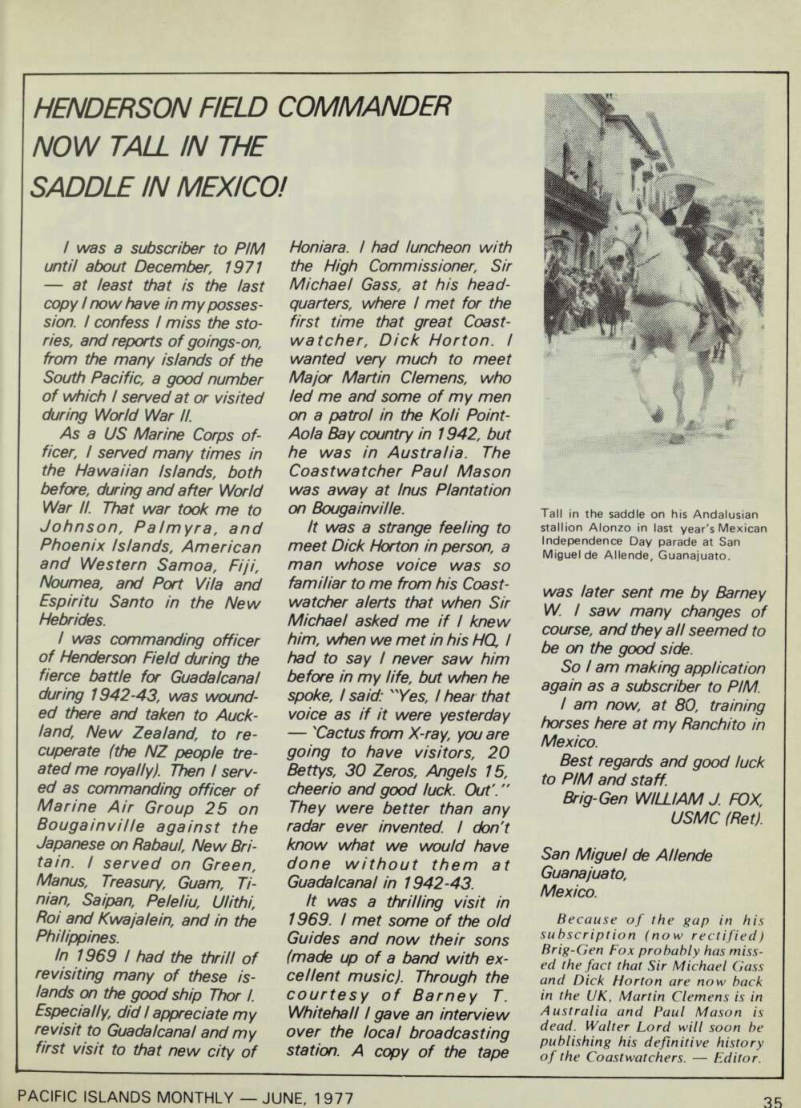
Now Tall In The
Saddle In Mexico!
/ was a subscriber to PIM until about December, 1971 at least that is the last copy / now have in my posses sion. / confess / miss the sto ries, and reports of goings-on, from the many islands of the South Pacific, a good number of which / served at or visited during World War 11.
As a US Marine Corps of ficer, / served many times in the Hawaiian Islands, both before, during and after World War //. That war took me to Johnson, Palmyra, and Phoenix Islands, American and Western Samoa, Fiji, Noumea, and Port Vila and Fspiritu Santo in the New Hebrides. / was commanding officer of Henderson Field during the fierce battle for Guadalcanal during 1942-43, was wound ed there and taken to Auck land, New Zealand, to re cuperate (the NZ people tre ated me royally). Then / serv ed as commanding officer of Marine Air Group 25 on Bougainville against the Japanese on Rabauj New Bri tain. / served on Green, Manus, Treasury, Guam, Ti nian, Saipan, Pe/e/iu, UHthi, Roi and Kwaja/ein, and in the Philippines.
In 1969 / had the thrill of revisiting many of these is lands on the good ship Thor /.
Especially, did / appreciate my revisit to Guadalcanal and my first visit to that new city of
Floniara. / had luncheon with the High Commissioner, Sir Michael Gass, at his head quarters, where / met for the first time that great Coast watcher, Dick Horton. / wanted very much to meet Major Martin Clemens, who led me and some of my men on a patrol in the Koli Point- Ao/a Bay country in 1942, but he was in Australia. The Coastwatcher Paul Mason was away at Inus Plantation on Bougainville.
It was a strange feeling to meet Dick Horton in person, a man whose voice was so familiar to me from his Coast watcher alerts that when Sir Michael asked me if / knew him, when we met in his HQ, / had to say / never saw him before in my life, but when he spoke, / said: 'Yes, / hear that voice as if it were yesterday 'Cactus from X-ray, you are going to have visitors, 20 Be ttys, 30 Zeros, Angels 15, cheerio and good luck. Out'."
They were better than any radar ever invented. / don't know what we would have done without them at Guadalcanal in 1942-43.
It was a thrilling visit in 1969. / met some of the old Guides and now their sons (made up of a band with ex cellent music). Through the courtesy of Barney T.
Whitehall / gave an interview over the local broadcasting station. A copy of the tape
was later sent me by Barney W. I saw many changes of course, and they all seemed to be on the good side.
So / am making application again as a subscriber to RIM. / am now, at 80, training horses here at my Ranchi to in Mexico.
Best regards and good luck to RIM and staff.
Brig-Gen William J. Fox,
Usmc (Ret).
San Miguel de Allende
Guanajuato,
Mexico.
Because of the gap in his subscription (now rectified) Brig-Gen Fox probably has miss ed the fact that Sir Michael Gass and Dick Horton are now hack in the UK, Martin Clemens is in Australia and Paul Mason is dead. Walter Lord will soon be publishing his definitive history of the Coastwatchers. Editor.
Tall in the saddle on his Andalusian stallion Alonzo in last year's Mexican Independence Day parade at San Miguel de Allende, Guanajuato.
Advertisements & other items, pp. 36-44 (1 item)
suit a thousand island^.
From Australia, mesh to
P J r . * Li ri 5®
LADY VI
- From Australia, mesh to suit a thousand islands, and a thousand uses.
A.R.C. Weldmesh andA.R.C. Chainmesh are the ideal materials for all kinds of industrial, rural and domestic applications.
Security fencing, internal partitioning, reinforcing fabric and steel bars for all concrete construction work, and fencing for around the home or farm.
There’s an A.R.C. Weldmesh or Chainmesh product to suit your needs.
Contact the Export Division, A.R.C. Industries Limited, G.P.O. Box 1616 M, Melbourne, Vic. 3000 Australia Telex AA 32891.
Stocks also available from A.R.C. Engineering Pty. Ltd. Papua New Guinea Lae: P.O. Box 1026. A.R.C.
Phone; 42 1555.
Port Moresby: P. 0. Box 6852 Boroko. Telephone: 26 0422. 02383
Total service 0n ...
plumbing supplies Fast
WATSON & CRANE
are organised to fulfil your needs
wherever you are in the South Pacific tl You can get all you need from one supply source: water taps, valves, copper tube, tools and a host of other fittings and related plumbing equipment for domestic, industrial and multistorey buildings.
Watson & Crane Pty Ltd have over 20,000 plumbing items in stock at their central warehouse located at Waterloo, NSW, Australia.
Years of experience in handling and shipping right throughout the South Pacific add up to another big reason for you to deal with Watson & Crane Pty Ltd.
Representatives call regularly at New Guinea, Papua, the Solomons, New Hebrides and Frji Islands to personally discuss your requirements and appropriate credit arrangements.
Write, cable or telephone today for complete plumbers' supplies service.
Watson & Crane Pty. Ltd, 1037 Bourke Street, Waterloo,
NSW 2017.
Phone: Sydney 699-1333.
Telex: AA 25548.
Cables: "Watcrane" Sydney.
Pacific Island distributors of Crane Enfield copper tube for water, sanitation, engineering, refrigeration and air conditioning.
9 9
UUUUUU fi
SB m Mr mm i n u
WMMAmA
o m m h! fi m m m *% V 4f +4*
l F £l*A
ujjjfrMMr* • r .. «; ♦ * t -a- * • f • 8 #4 9 - *# <N sssssis «;• * """ * t. 1 I i- #’
SANSUI ELECTRIC CO., LTD. 1 4-1 izumi 2-chome, Suginami-ku, Tokyo 168, Japar Australia Rank Industries Australia Pty. Ltd Head Office: 12 Barcoo Street, East Roseville, N.S.W. 2069 Phone: 406 5666 Melbourne; 6£ Queensbridge Street, South Melbourne, Vic. 3205 Phone; 62 0031 Adelaide; Phone: 212 2555/ Brisbane: Phone; 52 7333 Canberra: Phone: 95 2144 Perth: Phone: 28 393 c
Performers by Sansui!
Sansui! Who else could present such an exciting array of spectacular stereo?
Sansui! Who else but the hi-fi specialist could assure you of outstanding and reliable performance for every model on this page!
Sansui means sound that’s clean and powerful. It means stereo that touches your soul. And it means even the subtle nuances of music sources are crisp.
Here is proof that Sansui is dedicated to excellent sound quality for everyone.
If you put sound quality first, it’s Sansui all the way! v# ; mim • € € t 1 I tf % i' * % at
S(uvsui
Only hi-fi, everything hi-fi.
; iji Prabhu Brothers Ltd. P.O. Box 183, Nadi Phone: 70183/4 Papua New Guinea Oceania Indent Agency (P.N.Q.) Pty. Ltd. Box 5518, 3oroko. Port Moresby Phone: PM 256406 New Zealand David J. Reid (N.Z.) Ltd. C.P.0.80x 2630, Auckland, 1 Phone:492-189 New Caledonia Ets Michel MERCIER B.P. 1123, Noumea Phone: 27. 59. 11 South Pacific Miltons Department Stores Limited P.O. Box 146, Norfolk Island -899 Central Pacific Nauru Co-operative Society Republic of Nauru Western Samoa H.J. Keil and Company Ltd. P.O. Box 7. Apia Phone: 198 New Hebrides The Sound Centre P.O. Box 434, Port Vila Cook Islands United Island Traders Ltd. P.O. Box 1 & 2. Rarotonga
» t & m m - PI ■ m *.m
pm iipm
. ;6 v. •• f - A ■• *j' /*' : -* C' ./'a ■ •• v ’,- ■-’ > j?fer ;
BliiSiWiMl*
That's what the u.S. Environmental Protection Agency figures show. The Honda Civic placed first among the hundreds of 1976 cars tested. On the highway, in the city and in combined driving situations.
Top fuel economy is just the start. All-round operating costs are equally low. Thanks tc a rugged, clean-burning OHC engine which delivers snappy acceleration. Elegance is second to none-both inside and out.
Famous Honda engineering also gives you: Enough roomy comfort to relax four adults A spacious trunk. Exceptional handling ease. A dual braking system featuring servo-assisted front disc brakes, independent strut suspensions.
All of this quality performance is yours in three exciting models-the 2-Door Sedan, 4-Door Sedan and Hatchback.
Own the 1976 economy champ-the Honda Civic.
HONDA
HONDA MOTOR CO.. LTD. TOKYO, JAPAN
PAPUA NEW GUINEA: Steamships-Machinery P.O. Box 1, Port Moresby/TAHITI: Societe Tahitienne d’lmportation des Produits Honda B.P. 1665-Papeete/FIJI ISLANDS; Coral Island Motors P.O. Box 48, Suva/U.S. TRUST TERRITORY: United Micronesia Development Assn. P.O. Box 238, Saipan, Mariana Islands 96950/COOK ISLANDS: Cook Islands Motor Center Ltd. P.O. Box 74, Rarotonga/AMERICAN SAMOA: Samoan Holiday and Travel Center P.O. Box 968, Pago Pago/AMERICAN SAMOA: Haieck's Service Center P.O. Box 1138. Pago Pago/GUAM: Mark’s Motor Co., Inc. P.O. Box DV. Agana/WESTERN SAMOA; Motor Distributors (Samoa) Ltd. P.O. Box 576, Apia/SOLOMON ISLANDS: British Solomons Trading Co.. Ltd. P.O. Box 114, Honiara/NEW CALEDONIA: Establissements Ballande Boite Postale No. C 4 Noumea Cedex/TONGA: E.M. Jones Limited P.O. Box 34, Nuku’alofa/TARAWA: Gilbert & Ellice Islands Development Authority P.O. Box 488, Beito/NIUE ISLAND: S. Jessop & Sons Ltd. P.O. Box 71.
Alofi South/NAURU: Nauru Cooperative Society, Republic of Nauru, Nauru Island Central Pacific/NEW HEBRIDES: Tropex International Ltd., P.O. Box 139, Port Vila.
Quick, quiet, comfortable.
You'll start your flights on time, more times, aboard a reliable McDonnell Douglas DC-9 twinjet. That's because it's built for quick turnarounds.
The DC-9 carries its own passenger stair and power unit so you don't wait while equipment is rolled up to service the aircraft.
In the air, you'll find the 9's interior noticeably quiet.
A thicker aluminium skin and double insulation around the cabin isolate you from outside noise. And the engines are placed on the rear fuselage where they leave their sound behind.
Five abreast coach seating lets you unwind in wide-seat comfort.
Make you next flight quick, quiet and comfortable.
Book yourself aboard a DC-9.
TheDC-9
JMTOOOJVMEI.I. 001/O LAk
/ mm m
Beautiful Sunset,
Astounding Soundset!
HUM,MV .rV
The component hunt ends with Akai’s ultra-compact stereo System-A Series. Perfectly matched audio engineering between turntable and Receiver/Cassette Deck, and your choice of speakers, lets you construct the system most in harmony with your taste. Akai’s vertical display rack completes System-A’s easy operation and good looks. System-A is the professional-quality component system that recreates music both naturally bright and beautiful. - • is i-*
i (film
A V Australia: Akai Australia Pty. Ltd., 17/18 Hordern Place Denison St. Camperdown. Sydney. N S W. 2050 Tel; 516-3366/P.N.G.: S O. Svensson (N.G.) Ltd., P 0. Box 705, Port Moresby Tel: 2275/Fiji Islands: Motibhai & Company Ltd., P 0. Box 9175 Nadi International Airport Tel: 72-165/New Zealand; Pye Ltd, Consumer Product Division, 110 Mt. Eden Rd„ Mt. Eden, Auckland Tel: 686-437/ New Caledonia: Menard Freres, B.P. H 2, Noumea Tel: 275222/Tahiti: Etablissements Comimpex, P.O. Box 200, Papeete Tel: 20477/New Hebrides Island: Burns Philip (New Hebrides) Co , Ltd , Port Vila, New Hebrides Island/Norfolk Island: Burns Philip (Norfolk Island) Co., Ltd., P.O. Box 21, Norfolk Island/ Samoan Islands: Burns Philip (South Sea) Co., Ltd , P.O. Box 129, Pago Pago, American Samoa, Apia, Western Samoa /Mariana Islands; J.C. Tenorio Enterprises. P.O. Box 137, Saipan Tel: 6444/8/British Solomon: Security Electrical Co.. Ltd., P.O. Box 174, Honiara Tel: 881 /Cook Islands: JPS Enterprises Ltd., P.O Box 15, Rarotonga Tel; 2150, 2176
Audio & Video
I AKAI I
AKAI ELECTRIC CO., LTD.
Tokyo, japan
Decisions. Decisions.
SP Draught Lager, SP Greenies, SP Brownies, and Anchor in cans and bottles.
They all taste so good it’s difficult to decide which one to try first. - 1?“ M SE
AGO
mm. mm i &K IK a y Available in Solomon Islands through Guadalcanal Import-Export, P.O. Box 550, Honiara.
Islands
From The
Press
From the Papua New Guinea Post-Courier: University of Papua New Guinea women students say they are like prisoners. They are frightened day and night of rape, violence, theft and drunken louts. At night they will not move around the campus without escorts. They have called for police patrols and stronger campus security . . . The women said security guards had turned up to work drunk, sometimes did not turn up at all, slept on the job and ran off when they could not handle trouble.
From The Fiji Times: A man who came to court wearing a pair,of trousers he was charged with stealing was fined $2O by Sigatoka Court ...
Sergeant Ram said Chand had come to court wearing the stolen trousers because the police did not have another to
give him ...
From The Tohi Tala Niue: For a long time now the Niue Government has been concerned at the fall in local productivity from the land and the decline in passionfruit pulp exports, and for a long time also that matter of a shorter working week for all Government employees has been haggled over. It now seems that a trial compromise has been agreed upon. This week employees of the Government began work at 7 am with a half-hour break at 10.45 am to 11.15 am with work finishing at 2.30 pm. The change in working hours now gives the people more time in the afternoon to devote to pollination of their passionfruit areas, lime orchards, bush gardens and
fishing .. .
A down-to-earth exercise at St Patricks
Agricultural Training School, Mabiri, North
Solomons as revealed at graduation day by Premier Dr Sarei and reported in the Arawa
Bulletin:
The Premier remarked that he was delighted to see girls training in pig farming this year. Each girl received two sows and one boar to rear and take home to start their farms. By graduation, the sows were pregnant, so that a ‘lady farmer’ may find herself the proud owner of up to 20 pigs, only two months after graduation a fine start!
From the Uni Tavur, journalism students’ newspaper at the University of Papua New Guinea: A second year law student at the UPNG said this week that the student body should not fight blindly at issues that were of no immediate significance to the people both at the local and regional level. Mr Malipu Bonsai Balakau was speaking on the controversial issue of the Queen being the Head of State. Mr Balakau said students should not make themselves unpopular as highly educated intellectuals of this country by continuing to concern themselves with rather minor items.
From a letter by Martin Kepa (a servant) in
the Papua New Guinea Post-Courier:
. . . The monarchy is a tradition quite diverse to that of our Melanesian chieftainship ... This I think is a foreign system that our forefathers knew nothing of, so why don’t we have the Head of State in a more Melanesian way without any foreign person being involved. That will show that the Government doesn’t ignore the home-made tradition. If this can’t be done now history will prove it later ...
From the Nauru Bulletin: Police have been receiving reports of children going around using slings, better known as sweet sixteen, damaging properties like electric bulbs, louvres and windows of
buildings. Street lights are the prime target ... A final warning anyone caught in possession of slings will be liable for prosecution.
From a speech by the Queen’s Commissioner, Mr Tom Layng, when opening Tokotu, a public bar on Funafuti, as reported in the Tuvalu News Sheet: ... I hope you will run the bar as well as you have built it.
May your bouncer be strong and fearless. You are fortunate in having a deep and muddy swamp on three sides of the building. If those who misbehave themselves are cast head first into this never to be seen or heard of again any trouble should be of short duration ...
From the Solomons News Drum: Small change is disappearing from circulation in Honiara.
Banks and shops have reported a shortage of one cent and two cent bronze coins the brown money. A spokesman of the Australian and New Zealand Bank said the bank imports about $5O worth of coins from Australia every month but “these disappeared in a week ” .. . Staff of the Guadalcanal Bus Company have also run into difficulty finding small change and are reluctant to accept paper money. This could cause price rises. There would be a tendency for shopkeepers to “round up” prices of goods because they could not obtain
enough change . ..
From the Tohi Tala Niue: The shooting season for a period of about three months is now closed, and according to the Police Department anyone caught during the close of the shooting will be prosecuted.
The ban on shooting of birds was lifted last December by the Assembly resolution and since then the war on birds was fought with sharpshooters boasting on how many they bagged . How many birds killed during the season is anyone’s guess. Niue with a population of 3,900 owns close to 800
shotguns of various sizes . ..
From The Fiji Times:
Traditional Pacific Island customs play no part in modern society apart from that of entertainment, according to visiting Australian academic Dr Max Hartwell . . . Considering that the Pacific Islands had been settled for more than 1,000 years, it seemed significant that as yet they had not produced any great cultural tradition, he said . . . The Pacific Way itself was a non-concept and failed to show what was the most important idea of the Pacific, that of pluralism, Dr Hartwell claimed. He said it would be ridiculous to assume that a Pacific Way could be used to describe the varied indigenous cultures of the people, he said. The characteristic feature of the Pacific was certainly not unity, but on the contrary, diversitv.
Canterbury
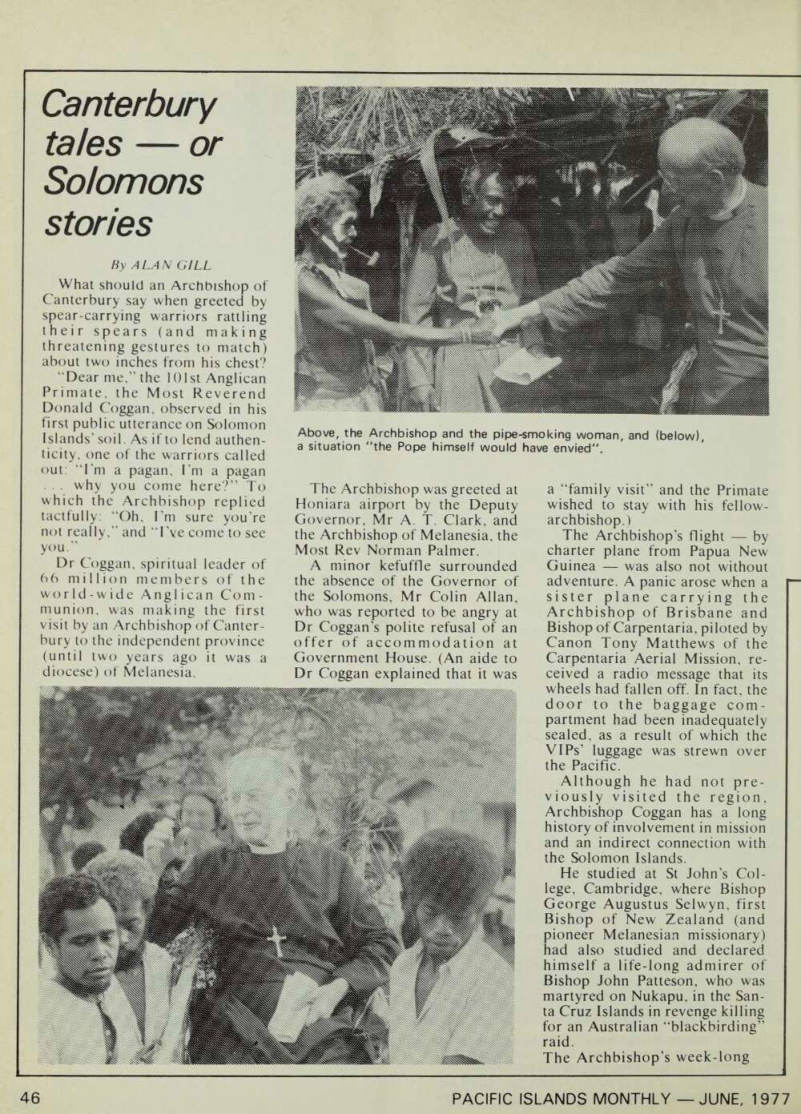
tales- or Solomons stories
By Alan Gill
What should an Archbishop of Canterbury say when greeted by spear-carrying warriors rattling their spears (and making threatening gestures to match) about two inches from his chest?
“Dear me,” the 101st Anglican Primate, the Most Reverend Donald Coggan. observed in his first public utterance on Solomon Islands’ soil. As if to lend authen ticity. one of the warriors called out: “I’m a pagan. I'm a pagan . . . why you come here?” To which the Archbishop replied tactfully; “Oh. I’m sure you’re not really,” and ‘Tve come to see you.”
Dr Coggan. spiritual leader of 66 million members of the world-wide Anglican Com munion, was making the first visit by an Archbishop of Canter bury to the independent province (until two years ago it was a diocese) of Melanesia.
The Archbishop was greeted at Honiara airport by the Deputy Governor, Mr A. T. Clark, and the Archbishop of Melanesia, the Most Rev Norman Palmer.
A minor kefuffle surrounded the absence of the Governor of the Solomons, Mr Colin Allan, who was reported to be angry at Dr Coggan’s polite refusal of an offer of accommodation at Government House. (An aide to Dr Coggan explained that it was
a “family visit” and the Primate wished to stay with his fellow archbishop.) The Archbishop’s flight by charter plane from Papua New Guinea was also not without adventure. A panic arose when a sister plane carrying the Archbishop of Brisbane and Bishop of Carpentaria, piloted by Canon Tony Matthews of the Carpentaria Aerial Mission, re ceived a radio message that its wheels had fallen off. In fact, the door to the baggage com partment had been inadequately sealed, as a result of which the VlPs’ luggage was strewn over the Pacific.
Although he had not pre viously visited the region.
Archbishop Coggan has a long history of involvement in mission and an indirect connection with the Solomon Islands.
He studied at St John’s Col lege, Cambridge, where Bishop George Augustus Selwyn, first Bishop of New Zealand (and pioneer Melanesian missionary) had also studied and declared himself a life-long admirer of Bishop John Patteson, who was martyred on Nukapu, in the San ta Cruz Islands in revenge killing for an Australian “blackbirding” raid.
The Archbishop’s week-long
Above, the Archbishop and the pipe-smoking woman, and (below), a situation "the Pope himself would have envied".
tour included visits to the Bishop Patteson Theological Centre, Selwyn College, and the head quarters of the Melansian Brotherhood. all on Guadalcanal; also visits by air and on the Melanesian mission vessel, Southern Cross to the islands of Malaita and Santa Ysabel.
By the time he had been in the Islands a few days he was able to greet with aplomb bare-breasted maidens (some of whom, hands held in strategic positions to guard their modesty, were reluc tant to drop their guard for the brief seconds necessary for a handshake), not to mention the Malaita “mud men” and “wild men” of Ysabel.
Three years ago the Malaita “mud men” had arrived stark naked to greet the Queen. This was considered just a trifle too realistic and the men wore loinclothes (suitably caked with mud) for their performance before the Archbishop.
By the time he reached Ysabel, Dr Coggan was sufficiently ac customed to the novel greetings
to join in. Entering into the spirit of the occasion, he warded off the spears of the “wild men” by raising his pectoral cross in the manner of a full-blooded virgin warding off Dracula and received spontaneous applause.
He jested about another spearcarrying warrior; “Don’t worry about him. He’s a churchwarden.”
Asked why he had come to the island, he replied, brandishing his Bible, “To bring you the Good News.”
Television viewers, recalling the flow, mane and sage-like appearance of his predecessor, someti complain that Dr Coggan looks “ordinary” more like a local rector than Archbishop of Canterbury.
Dr Coggan would regard such a criticism as a compliment. Repeatedly, during his Melanesian tour, he told island congregations; “Christ came as a servant, and I am the servant of the servant.”
The Archbishop was greeted at Auki by the Bishop of Malaita, Bishop Leonard Alafurai, whose
grandfather was a kanaka in Queensland, and at Santa Ysabel by the Bishop of Ysabel, the Rt Rev Dudley Tuti, who is also Paramount Chief of Ysabel.
Probably the most eventful ar rival was at Ysabel, where the Southern Cross was escorted to its mooring by a flotilla of war canoes which took the Archbishop through a triumphal arch of reeds to the shore, On arrival, we were greeted by singers and drummers, pounding out a moving song relating the exploits of Bishop" Patteson and the Archbishop was carried aloft on a sedia gestatoria (portable throne) which the Pope himself would have envied, At all stages of his tour the Archbishop mingled with village people. He posed for pictures with a bare-breasted woman who puffed at a pipe while de monstrating her garden produce and was treated to a starkly realistic island baby-rearing custom from a woman who stuff ed a cushion up her skirt to portray the condition of pregnan cy.
Advertisements & other items, pp. 47-48 (1 item)
P) Hotel
if\\ 1 THE HOTEL OF THE SOLOMON'S
MENDANA
Box 384, Mendana Avenue, HONIARA' Cable: MENDANA SOLOMON ISLANDS
SITUATED ON THE BEACHFRONT-
IN THE HEART OF TOWN
ALL ROOMS WITH: Private facilities Airconditioning Telephone
TARIFF ON APPLICATION
CHLORIDE
BATTERIES FOR ALL APPLICATIONS
A generous statement? Maybe, but then Chloride is equipped and qualified as such . . always ready to offer advice, guidance and service on your battery requirements.
As it goes way beyond automotive batteries. No matter what the problem . . if it's a question of power . . battery power . . it's one for Chloride. It could be as small as a battery for a hearing aid the size of a coat button, or a power station battery weighing 40 tonnes.
Again, it could be a no break D.C. power system for a computer or emergency lighting for a hospital.
No matter what the application . .
Transport, Industrial, Communication, Defence, Mining, Marine, Recreation . . .
Make Chloride power work for you. m La T elecommunications Chloride Batteries Australia Limited P.O. Box 141, Bankstown. N.S.W. 2200 Australia. Telex: 21262
CHLORIDE THE WORLD'S MOST EXPERIENCED BATTERYMAKER
r
LiJm
Emergency Lighting Electric Vehicles £ 1 1 V I ff X Engine Starting Automotive £ I Sill m
A ‘sympathetic’
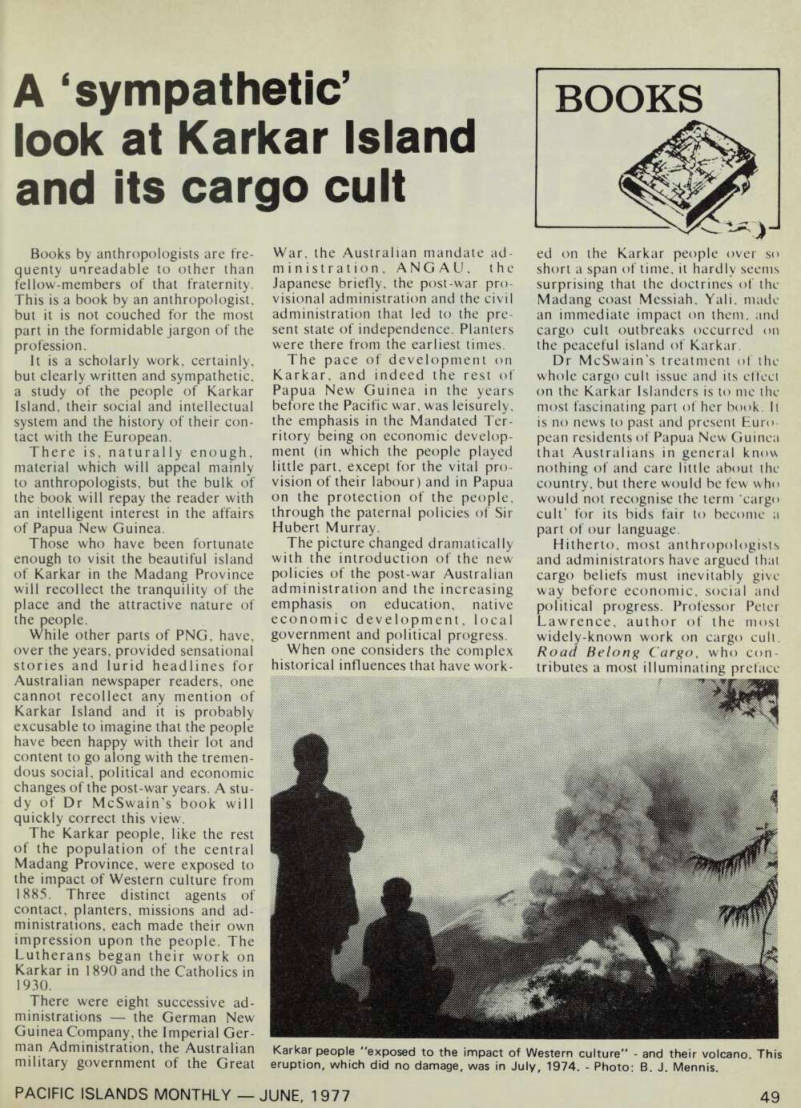
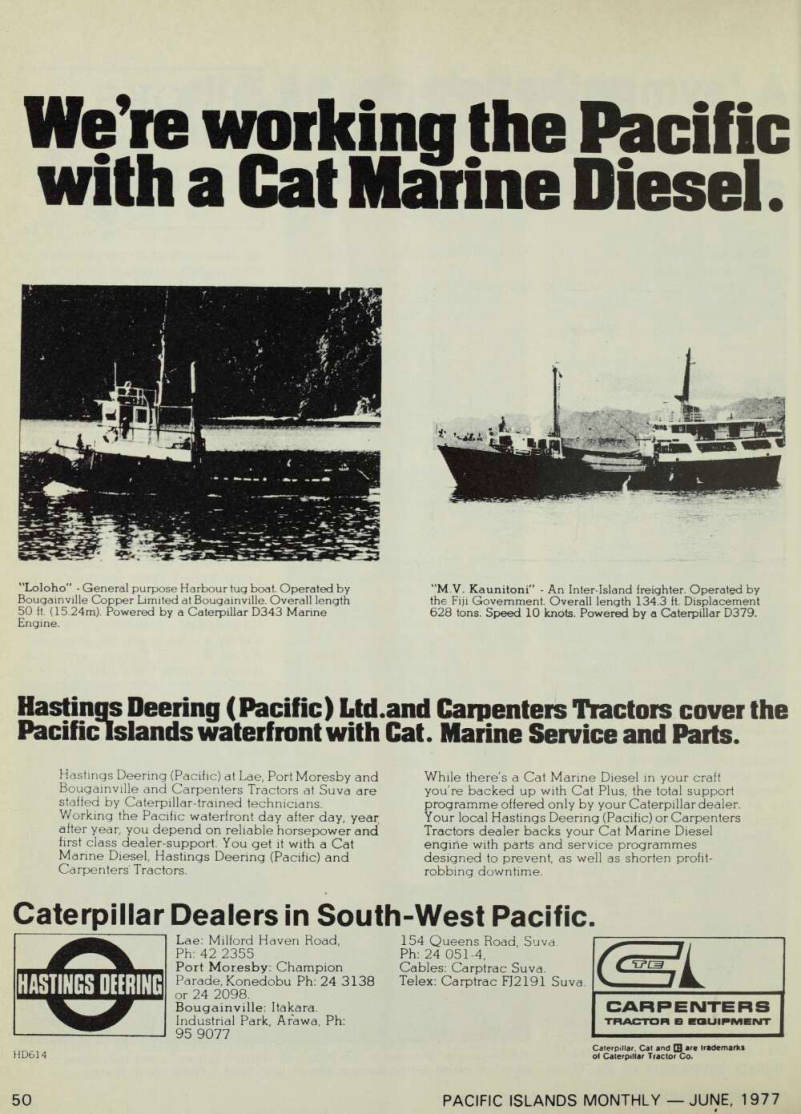
look at Karkar Island and its cargo cult
Books by anthropologists are fre quenty unreadable to other than fellow-members of that fraternity.
This is a book by an anthropologist, but it is not couched for the most part in the formidable jargon of the profession.
It is a scholarly work, certainly, but clearly written and sympathetic, a study of the people of Karkar Island, their social and intellectual system and the history of their con tact with the European.
There is, naturally enough, material which will appeal mainly to anthropologists, but the bulk of the book will repay the reader with an intelligent interest in the affairs of Papua New Guinea.
Those who have been fortunate enough to visit the beautiful island of Karkar in the Madang Province will recollect the tranquility of the place and the attractive nature of the people.
While other parts of PNG, have, over the years, provided sensational stories and lurid headlines for Australian newspaper readers, one cannot recollect any mention of Karkar Island and it is probably excusable to imagine that the people have been happy with their lot and content to go along with the tremen dous social, political and economic changes of the post-war years. A stu dy of Dr McSwain’s book will quickly correct this view.
The Karkar people, like the rest of the population of the central Madang Province, were exposed to the impact of Western culture from 1885. Three distinct agents of contact, planters, missions and ad ministrations, each made their own impression upon the people. The Lutherans began their work on Karkar in 1890 and the Catholics in 1930.
There were eight successive ad ministrations the German New Guinea Company, the Imperial Ger man Administration, the Australian military government of the Great
War, the Australian mandate administration, ANGAU, the Japanese briefly, the post-war provisional administration and the civil administration that led to the present state of independence. Planters were there from the earliest times.
The pace of development on Karkar, and indeed the rest of Papua New Guinea in the years before the Pacific war, was leisurely. the emphasis in the Mandated Territory being on economic development (in which the people played little part, except for the vital provision of their labour) and in Papua on the protection of the people, through the paternal policies of Sir Hubert Murray.
The picture changed dramatically with the introduction of the new policies of the post-war Australian administration and the increasing emphasis on education, native economic development, local government and political progress.
When one considers the complex historical influences that have work-
Books
ed on the Karkar people over so short a span of time, it hardly seems surprising that the doctrines of the Madang coast Messiah, Yali. made an immediate impact on them, and cargo cult outbreaks occurred on the peaceful island of Karkar.
Dr McSwain’s treatment of the whole cargo cult issue and its effect on the Karkar Islanders is to me the most fascinating part of her book It is no news to past and present Euro pean residents of Papua New Guinea that Australians in general know nothing of and care little about the country, but there would be few who would not recognise the term cargo cult’ for its bids fair to become a part of our language.
Hitherto, most anthropologists and administrators have argued that cargo beliefs must inevitably give way before economic, social and political progress. Professor Peter Lawrence, author of the most widely-known work on cargo cull.
Road Belong Cargo, who con tributes a most illuminating preface
Karkar people "exposed to the impact of Western culture"-and their volcano. This eruption, which did no damage, was in July, 1974. Photo: B. J. Mennis.
to the present book and Professor Peter Worsley, author of the equally authoritative The Trumpets Shall Sound, are of this belief.
But in Karkar, as Lawrence states, Dr McSwain has ‘shown convinc ingly that the cargo belief can coex ist with a fair measure of economic and sociopolitical development: tra ditional and modern institutions op erate side-by-side, sometimes in harmony, sometimes in conflict’.
Her work, Lawrence believes, has made a signal contribution to the study of the cargo cult phenomenon.
It certainly makes convincing read ing.
I was interested to note that Dr McSwain departed from orthodox anthropological practice by employ ing that once-despised lingua fran ca, Pidgin English, to gather her in formation in the field instead of learning the local language. How times change. The official language of parliament in Papua New Guinea is English, but in reality it is Pidgin and Police Motu which allows the commerce of daily life to proceed.
Pidgin is becoming positively re spectable.
A book, then, that is warmly re commended The orice is high but it
is well produced with the normal features of a significant study notes, bibliography, index, maps, tables, figures but. unfortunately, no
maps. James Sinclair
(THE PAST AND FUTURE PEOPLE: Tradition and changa on a Now Guinea island. By Romola McSwain. Puklishad by Oxford University Prats.
Ac I
Advertisements & other items, pp. 50-51 (1 item)
We're working the Pacific
with a Cat Marine Diesel.
-is . k Vi*.
"Loloho" - General purpose Harbour tug boat. Operated by Bougainville Copper Limited at Bougainville. Overall length 50 ft. (15.24 m). Powered by a Caterpillar D 343 Marine Engine.
"M.V. Kaunitoni” - An Inter-Island freighter. Operated by the Fiji Government. Overall length 134.3 ft. Displacement 628 tons. Speed 10 knots. Powered by a Caterpillar D 379.
Hastings Deering (Pacific) Ltd.and Carpenters Tractors cover the Pacificlslands waterfront with Cat. Marine Service and Parts.
Hastings Deering (Pacific) at Lae, Port Moresby and Bougainville and Carpenters Tractors at Suva are staffed by Caterpillar-trained technicians.
Working the Pacific waterfront day after day, year after year, you depend on reliable horsepower and first class dealer-support. You get it with a Cat Marine Diesel, Hastings Deering (Pacific) and Carpenters' Tractors.
While there’s a Cat Marine Diesel in your craft you’re backed up with Cat Plus, the total support programme offered only by your Caterpillar dealer.
Your local Hastings Deering (Pacific) or Carpenters Tractors dealer backs your Cat Marine Diesel engine with parts and service programmes designed to prevent, as well as shorten profitrobbing downtime.
Caterpillar Dealers in South-West Pacific.
Lae; Milford Haven Road, 154 Queens Road, Suva.
Ph: 42 2355 Ph; 24 051-4, Port Moresby: Champion Cables: Carptrac Suva.
Parade, Konedobu Ph; 24 3138 Telex: Carptrac FJ2191 Suva, or 24 2098.
Bougainville: Itakara.
Industrial Park, Arawa, Ph: 95 9077 Caterpillar. Cat and Q] are trademarks ol Caterpillar Tractor Co.
CARPENTERS
TRACTOR B EQUIPMENT
HASTINGS DEERING
HD6I4
O
wantok
Niuspepa bilong ol Papua Niugini stret Papua New Guinea’s thriving weekly Wantok f“ Friend”, 'Relation”), which is printed in Melanesian Pidgin and has a circulation of 12,000 copies, has moved from its old editorial home in Wewak to a brand new headquarters in Port Moresby.
Wantok was born seven years ago, set up by the Roman Catholic Church in Papua New Guinea and edited by its present editor, Fr Frank Mihalic. Fr Mihalic is the author of the standard Pidgin dictionary, and a world authority on the language.
In 1976 the church invited the Lutheran, Anglican and United Churches to join with it in running the paper. All now have places on the Wantok board.
Wantok will celebrate its move into the capital by appearing with a new masthead and logo (a man reading a paper a literacy symbol), and a new typeface, thanks to a new, computerised type-setting machine.
Wantok has an Islands edition, based in Rabaul, an edition in the Enga language, and aims shortly to have a Madang edition.
The PNG Minister for Finance, Mr Julius Chan, spoke at the opening of the new headquarters on March 29. He expressed the gratitutde of his government for Wantok’s attention to questions of development, especially rural development.
SOUTHERN CROSS
GALVANISED STEEL
PRE-FABRICATED
WATER STORAGE
TANKS
Capacities from 2,000 to 300,000 gal.
VERY STRONGLY MADE ! ! !
16 gauge sheets heavily galvanised,with angle steel fattens inside and out iside wideoverlapping joints.
Inside ladder included with every tank. - s
SOUTHERN CROSS
WINDMILLS
STILL THE CHEAPEST
WAY TO PUMP WATER
NO POWER COSTS///
• Heavily Galvanised • Automatic Governing • Self Oiling
SOUTHERN
CROSS
SIZES:
6 ft, to 14 ft. Double Geared 17 ft. to 25 ft. Direct Acting Towers from 20 ft. to 60 ft.
Full details and prices available from:
SOUTHERN CROSS MACHINERY PTV LTD
39 GRANVILLE AVE., GRANVILLE, 2142, AUSTRALIA.
Telex; AA22663. Telegrams: 'SOCROSS'.
Intrepid was the word for ‘Eka’
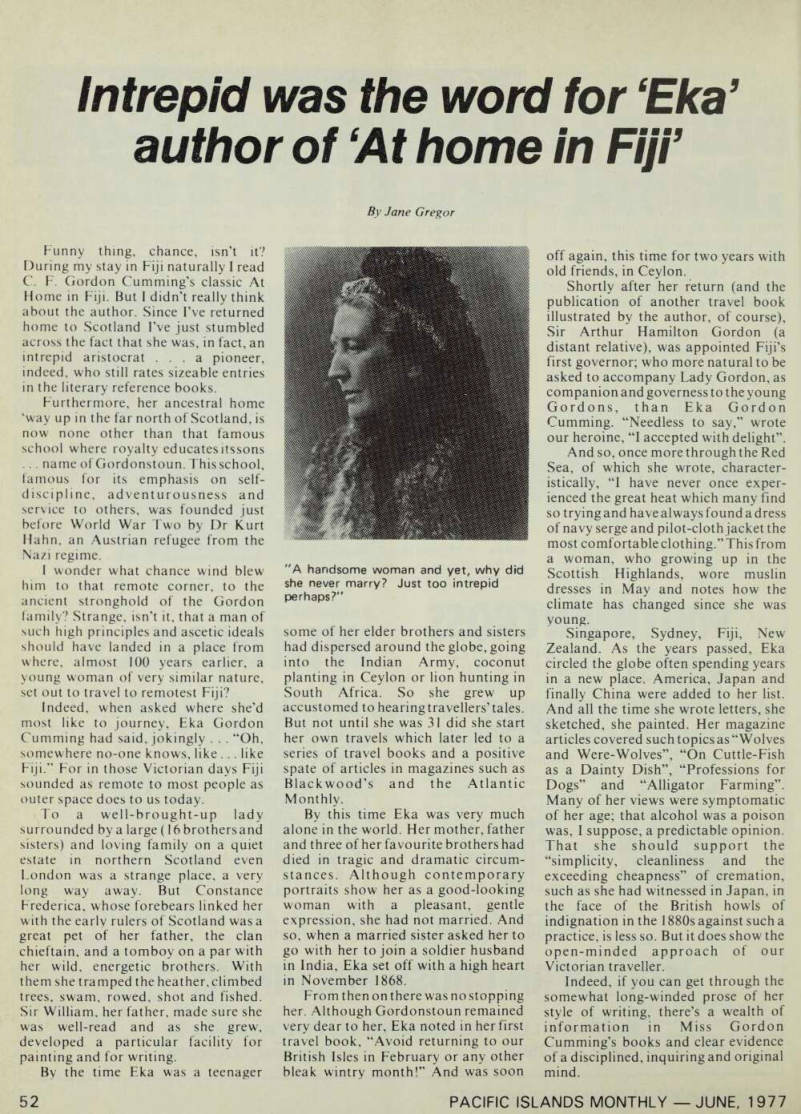
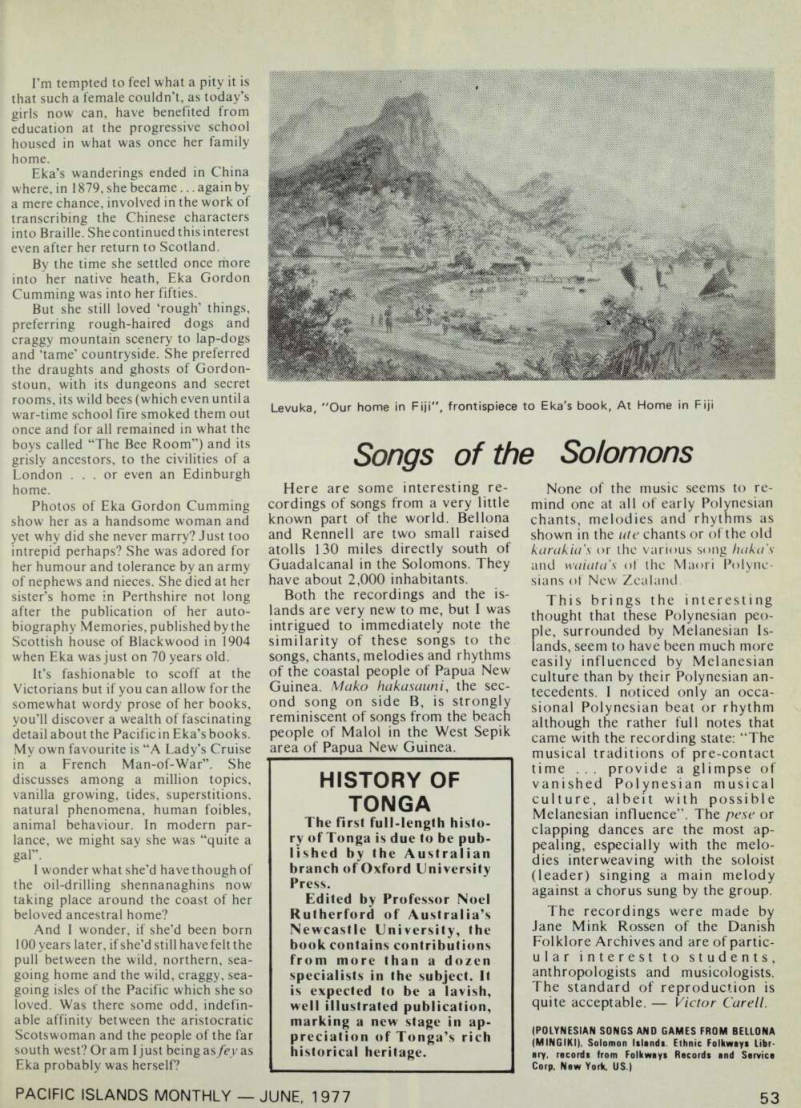
author of ‘At home in Fiji’
By Jane Gregor
Funny thing, chance, isn’t it?
During my stay in Fiji naturally I read C. F. Gordon Cumming’s classic At Home in Fiji. But I didn’t really think about the author. Since I’ve returned home to Scotland I’ve just stumbled across the fact that she was, in fact, an intrepid aristocrat ... a pioneer, indeed, who still rates sizeable entries in the literary reference books.
Furthermore, her ancestral home ‘way up in the far north of Scotland, is now none other than that famous school where royalty educatesitssons . . . name of Gordonstoun. This school, famous for its emphasis on self discipline, adventurousness and service to others, was founded just before World War Two by Dr Kurt Hahn, an Austrian refugee from the Nazi regime.
I wonder what chance wind blew him to that remote corner, to the ancient stronghold of the Gordon family? Strange, isn’t it, that a man of such high principles and ascetic ideals should have landed in a place from where, almost 100 years earlier, a young woman of very similar nature, set out to travel to remotest Fiji?
Indeed, when asked where she’d most like to journey, Eka Gordon Gumming had said, jokingly . . . “Oh, somewhere no-one knows, like ... like Fiji.” For in those Victorian days Fiji sounded as remote to most people as outer space does to us today.
To a well-brought-up lady surrounded by a large (16 brothersand sisters) and loving family on a quiet estate in northern Scotland even London was a strange place, a very long way away. But Constance Frederica, whose forebears linked her with the early rulers of Scotland was a great pet of her father, the clan chieftain, and a tomboy on a par with her wild, energetic brothers. With them she tramped the heather, climbed trees, swam, rowed, shot and fished.
Sir William, her father, made sure she was well-read and as she grew, developed a particular facility for painting and for writing.
By the time Eka was a teenager
some of her elder brothers and sisters had dispersed around the globe, going into the Indian Army, coconut planting in Ceylon or lion hunting in South Africa. So she grew up accustomed to hearing travellers’tales.
But not until she was 31 did she start her own travels which later led to a series of travel books and a positive spate of articles in magazines such as Blackwood’s and the Atlantic Monthly.
By this time Eka was very much alone in the world. Her mother, father and three of her favourite brothers had died in tragic and dramatic circum stances. Although contemporary portraits show her as a good-looking woman with a pleasant, gentle expression, she had not married. And so, when a married sister asked her to go with her to join a soldier husband in India, Eka set off with a high heart in November 1868.
From then on there was no stopping her. Although Gordonstoun remained very dear to her, Eka noted in her first travel book, “Avoid returning to our British Isles in February or any other bleak wintry month!” And was soon
off again, this time for two years with old friends, in Ceylon.
Shortly after her return (and the publication of another travel book illustrated by the author, of course).
Sir Arthur Hamilton Gordon (a distant relative), was appointed Fiji’s first governor; who more natural to be asked to accompany Lady Gordon, as companion and governess to the young Gordons, than Eka Gordon Gumming. “Needless to say,” wrote our heroine, “I accepted with delight”.
And so, once more through the Red Sea, of which she wrote, character istically, “I have never once exper ienced the great heat which many find so trying and have always found a dress of navy serge and pilot-cloth jacket the most comfortable clothing.” This from a woman, who growing up in the Scottish Highlands, wore muslin dresses in May and notes how the climate has changed since she was young.
Singapore, Sydney, Fiji, New Zealand. As the years passed, Eka circled the globe often spending years in a new place. America, Japan and finally China were added to her list.
And all the time she wrote letters, she sketched, she painted. Her magazine articles covered such topics as “Wolves and Were-Wolves”, “On Cuttle-Fish as a Dainty Dish”, “Professions for Dogs” and “Alligator Farming”.
Many of her views were symptomatic of her age; that alcohol was a poison was, I suppose, a predictable opinion.
That she should support the “simplicity, cleanliness and the exceeding cheapness” of cremation, such as she had witnessed in Japan, in the face of the British howls of indignation in the 1880 s against such a practice, is less so. But it does show the
open-minded approach of our
Victorian traveller.
Indeed, if you can get through the somewhat long-winded prose of her style of writing, there’s a wealth of information in Miss Gordon Cumming’s books and clear evidence of a disciplined, inquiring and original mind.
"A handsome woman and yet, why did she never marry? Just too intrepid perhaps?"
I’m tempted to feel what a pity it is that such a female couldn’t, as today’s girls now can, have benefited from education at the progressive school housed in what was once her family home.
Eka’s wanderings ended in China where, in 1879, she became ... again by a mere chance, involved in the work of transcribing the Chinese characters into Braille. Shecontinued this interest even after her return to Scotland.
By the time she settled once more into her native heath, Eka Gordon Cumming was into her fifties.
But she still loved ‘rough’ things,
preferring rough-haired dogs and
craggy mountain scenery to lap-dogs and ‘tame’ countryside. She preferred the draughts and ghosts of Gordon stoun, with its dungeons and secret rooms, its wild bees (which even until a war-time school fire smoked them out once and for all remained in what the boys called “The Bee Room”) and its grisly ancestors, to the civilities of a London ... or even an Edinburgh home.
Photos of Eka Gordon Cumming show her as a handsome woman and yet why did she never marry? Just too intrepid perhaps? She was adored for her humour and tolerance by an army of nephews and nieces. She died at her sister’s home in Perthshire not long after the publication of her auto biography Memories, published by the Scottish house of Blackwood in 1904 when Eka was just on 70 years old.
It’s fashionable to scoff at the Victorians but if you can allow for the somewhat wordy prose of her books, you’ll discover a wealth of fascinating detail about the Pacific in Eka’s books.
My own favourite is “A Lady’s Cruise in a French Man-of-War”. She discusses among a million topics, vanilla growing, tides, superstitions, natural phenomena, human foibles, animal behaviour. In modern par lance, we might say she was “quite a gal”.
I wonder what she’d have though of the oil-drilling shennanaghins now taking place around the coast of her beloved ancestral home?
And I wonder, if she’d been born 100 years later, if she’d still have felt the pull between the wild, northern, sea going home and the wild, craggy, sea going isles of the Pacific which she so loved. Was there some odd, indefin able affinity between the aristocratic Scotswoman and the people of the far south west? Oram I just being as fey as Eka probably was herself?
Songs of the Solomons
Here are some interesting re cordings of songs from a very little known part of the world. Bellona and Rennell are two small raised atolls 130 miles directly south of Guadalcanal in the Solomons. They have about 2,000 inhabitants.
Both the recordings and the is lands are very new to me, but I was intrigued to immediately note the similarity of these songs to the songs, chants, melodies and rhythms of the coastal people of Papua New Guinea. Mako hakasauni, the sec ond song on side B, is strongly reminiscent of songs from the beach people of Malol in the West Sepik area of Papua New Guinea.
None of the music seems to re mind one at all of early Polynesian chants, melodies and rhythms as shown in the ute chants or of the old kcirakia’s or the various song haka's and waiata's of the Maori Polyne sians of New Zealand.
This brings the interesting thought that these Polynesian peo ple, surrounded by Melanesian Is lands, seem to have been much more easily influenced by Melanesian culture than by their Polynesian an tecedents. I noticed only an occa sional Polynesian beat or rhythm although the rather full notes that came with the recording state; “The musical traditions of pre-contact time . . . provide a glimpse of vanished Polynesian musical culture, albeit with possible Melanesian influence”. The pese or clapping dances are the most ap pealing, especially with the melo dies interweaving with the soloist (leader) singing a main melody against a chorus sung by the group.
The recordings were made by Jane Mink Rossen of the Danish Folklore Archives and are of partic ular interest to students, anthropologists and musicologists.
The standard of reproduction is quite acceptable. Victor Carell.
(Polynesian Songs And Games From Bellona
(MINGIKI), Solomon Islands. Ethnic Folkways Libr ary, records from Folkways Records and Service Corp, New York, US.)
Levuka, "Our home in Fiji", frontispiece to Eka's book, At Home in Fiji
Advertisements & other items, pp. 53-54 (1 item)
History Of
TONGA
The first full-length history of Tonga is due to be published by the Australian branch of Oxford University Press.
Edited by Professor Noel Rutherford of Australia’s Newcastle University, the book contains contributions from more than a dozen specialists in the subject. It is expected to be a lavish, well illustrated publication, marking a new stage in appreciation of Tonga’s rich historical heritage.
Air
Niugini’s
beautiful bird
of paradise is a
It flies with grace and
experience from the land
that helped pioneer commercial aviation
back in the 1920 s Papua New Guinea -
home of the Birds of Paradise;
now the cross-road from the
Pacific to Asia
Jayapura I Moresby Pori 242101 755023 5804711 5037804 807131 Port Moresby: Brisbane: Sydney: Cairns: Hong Kong: Kagoshima: Tokyo: Manila: Cairns 2295844 2328900 514950
PNG and some problems...
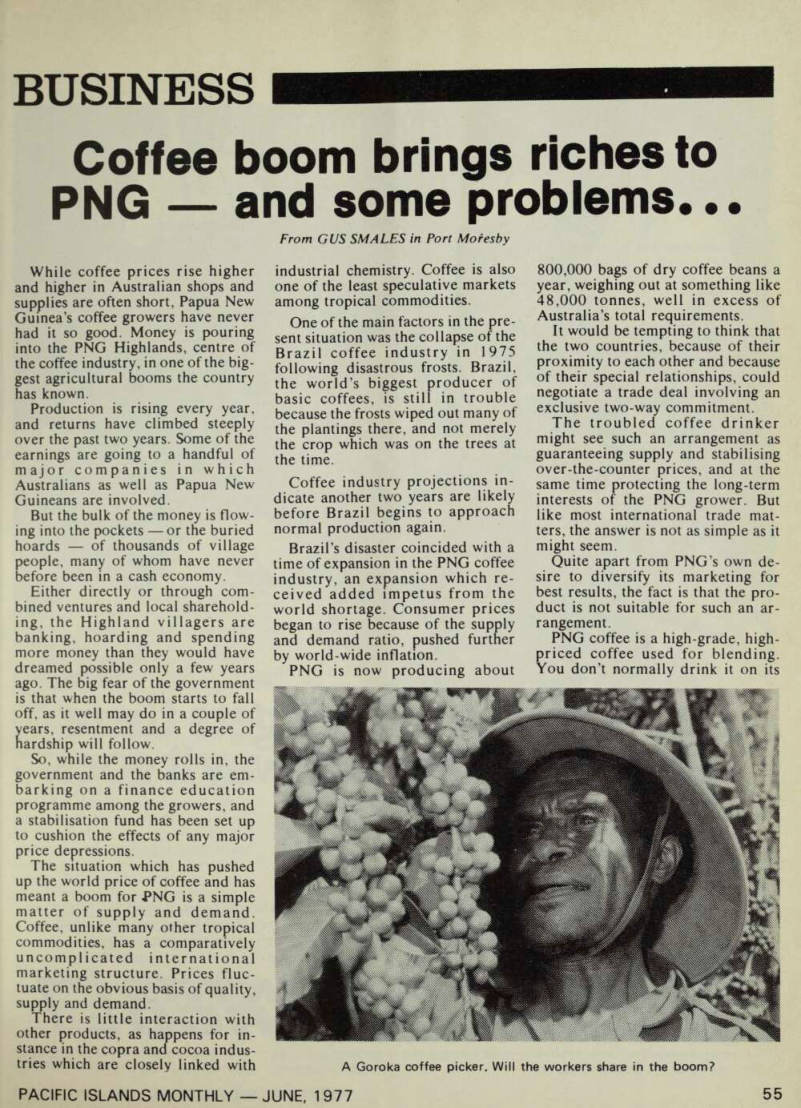
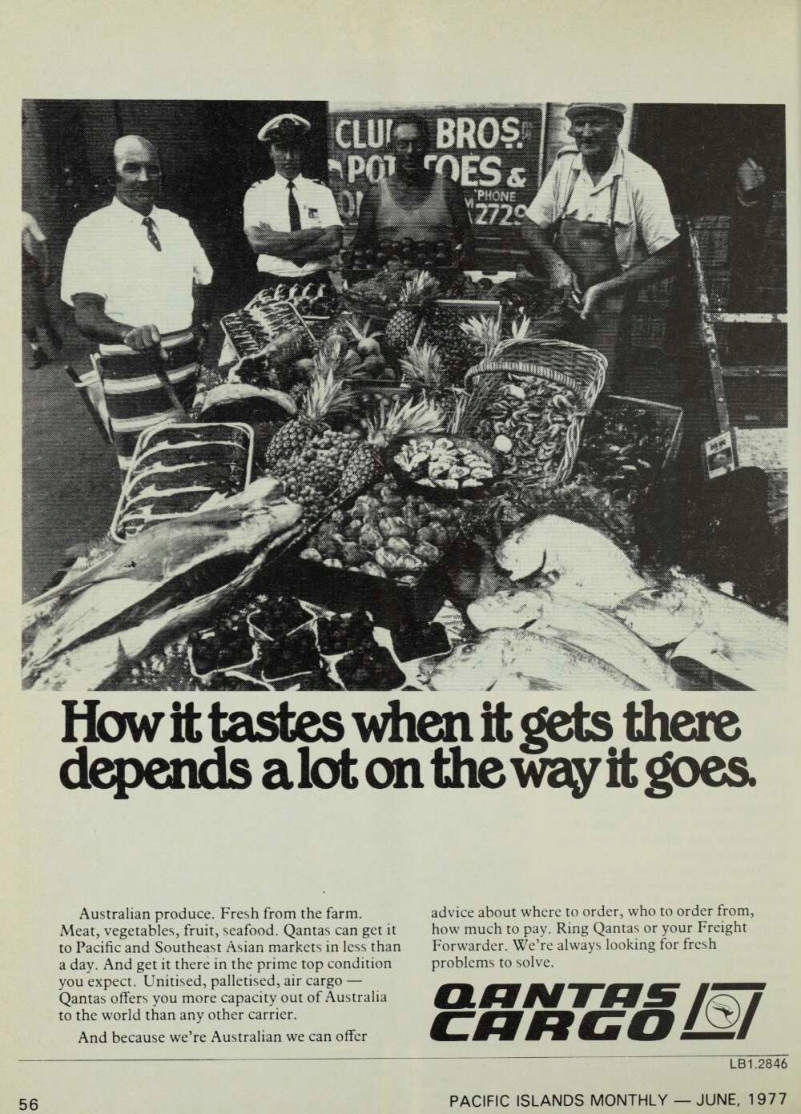
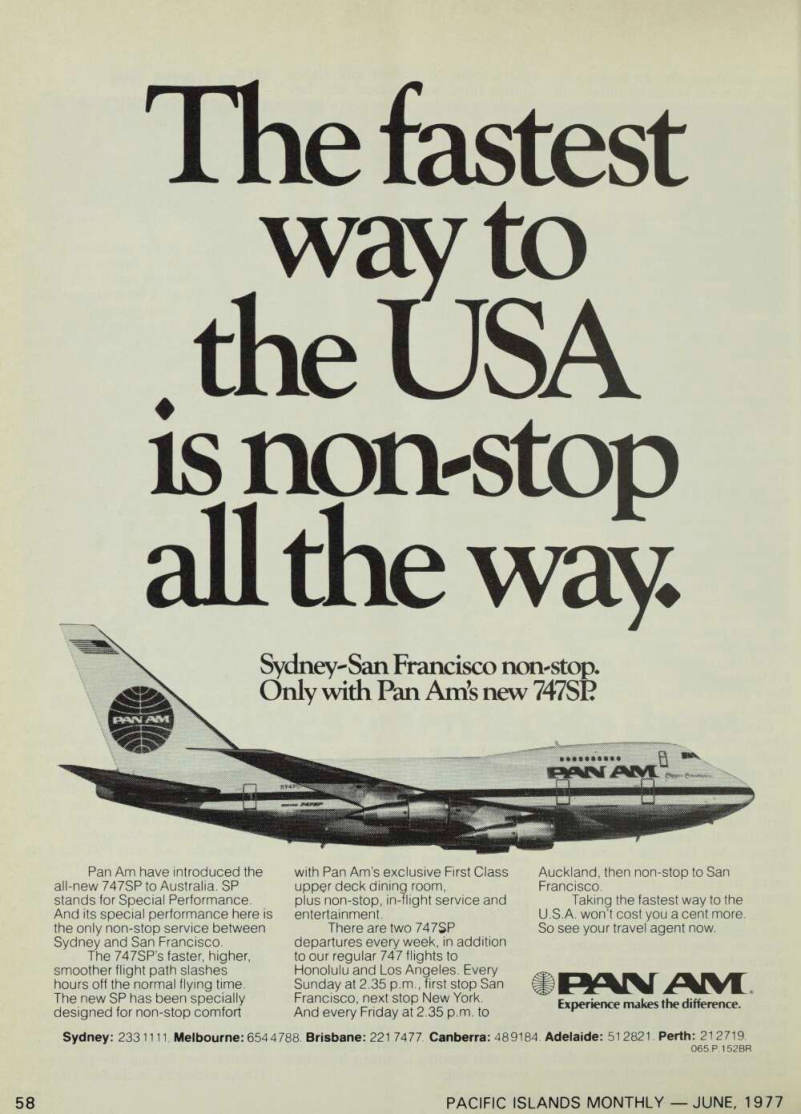
Business
Coffee boom brings riches to PNG and some problems...
From GUS SMALES in Port Moresby
While coffee prices rise higher and higher in Australian shops and supplies are often short, Papua New Guinea’s coffee growers have never had it so good. Money is pouring into the PNG Highlands, centre of the coffee industry, in one of the big gest agricultural booms the country has known.
Production is rising every year, and returns have climbed steeply over the past two years. Some of the earnings are going to a handful of major companies in which Australians as well as Papua New Guineans are involved.
But the bulk of the money is flow ing into the pockets or the buried hoards of thousands of village people, many of whom have never before been in a cash economy.
Either directly or through com bined ventures and local sharehold ing, the Highland villagers are banking, hoarding and spending more money than they would have dreamed possible only a few years ago. The big fear of the government is that when the boom starts to fall off, as it well may do in a couple of years, resentment and a degree of hardship will follow.
So, while the money rolls in, the government and the banks are em barking on a finance education programme among the growers, and a stabilisation fund has been set up to cushion the effects of any major
price depressions.
The situation which has pushed up the world price of coffee and has meant a boom for PNG is a simple matter of supply and demand.
Coffee, unlike many other tropical commodities, has a comparatively uncomplicated international marketing structure. Prices fluc tuate on the obvious basis of quality, supply and demand.
There is little interaction with other products, as happens for in stance in the copra and cocoa indus tries which are closely linked with
industrial chemistry. Coffee is also one of the least speculative markets among tropical commodities.
One of the main factors in the present situation was the collapse the Brazil coffee industry in 1975 following disastrous frosts. Brazil, the world’s biggest producer of basic coffees, is still in trouble because the frosts wiped out many of the plantings there, and not merely the crop which was on the trees at the time Coffee industry projections indicate another two years are likely before Brazil begins to approach normal production again.
Brazil’s disaster coincided with a time of expansion in the PNG coffee industry, an expansion which received added impetus from the world shortage. Consumer prices began to rise because of the supply and demand ratio, pushed further by world-wide inflation.
PNG is now producing about
800,000 bags of dry coffee beans a year, weighing out at something like 48,000 tonnes, well in excess of Australia’s total requirements, of , '< would be tempting to think that the two countries, because of their proximity to each other and because of their special relationships, could negotiate a trade deal involving an exclusive two-way commitment troubled coffee drinker m, B ht see . such an arrangement as guaranteeing supply and stabilising over-the-counter prices, and at the same time protecting the long-term interests of the PNG grower. But like most international trade mat ters, the answer is not as simple as it might seem, Quite apart from PNG’s own de sire to diversify its marketing for best results, the fact is that the pro duct is not suitable for such an ar rangement.
PNG coffee is a high-grade, high priced coffee used for blending.
You don’t normally drink it on its
A Goroka coffee picker. Will the workers share in the boom?
... And A Harvest For Thieves
With prices booming, coffee steal ing is fast becoming a major problem in the Highlands.
Armed with spears, axes and clubs, and usually with a truck wait ing just round the corner, the new generation of coffee thieves is mak ing night raids on coffee estates and village plantations.
The raiders know that for every kilogramme of coffee they can take, there will be an easy sale bringing in about $l.
Until stealing reached its present proportions, the boldest of the raiders were selling coffee back to the estates they had stolen it from.
“Give the police guns and let them get tough” was a recent com ment from the Eastern Highlands Provincial Premier, Mr James Yanepa. And the bigger centralised coffee estates disclosed they were using dogs and armed security guards to keep out coffee thieves.
The growing and marketing struc ture existing in PNG has left the way open for illegal selling, made at tractive by booming prices. Much of PNG’s coffee comes from small time growers who sell their produce to large estates or processing centres which have been registered as buyers.
Thousands of villagers and their families cultivate small communal
plantations or individual “back yard” holdings which can contain only a handful of trees. The small holders sell unprocessed or semi processed beans to licensed buyers at the roadside or at central points.
If coffee beans can be stolen from the big estates or the communal plantations, it’s a simple matter to slip the stolen beans into the money market. No one can prove that the poker-faced villager who flags down a dealer’s truck at the roadside didn’t grow the beans in his own backyard.
Small lots of loose beans —worth a mere six cents a kilogramme three years ago now bring close to a dollar, making stealing worth while.
The general manager of Asaro coffee estates, Mr Paddy Leahy, said he believed thousands of dollars worth of stolen coffee beans were changing hands every week. Asaro estate which has 3000 PNG shareholders stood to lose heavily from the stealing, and is now offering a KlOO reward for infor mation leading to the conviction of coffee thieves.
But many villagers who have a fair idea of the identity of some of the thieves are reluctant to turn in former. They fear reprisals, or are bound by tribal loyalties despite the fact that stealing is cutting into their own earnings.
Who owns the
unclaimed coppers?
Hundreds of unclaimed shareholders’ dividends, some of them equivalent to only about $1.35 have been advertised in Papua New Guinea by Bougainville Copper.
The total amount held in unclaimed dividends is equal to more than $9,000.
The bulk of the unclaimed divi dends belongs to Papua New Gui neans who bought small sharehold ings which had to be made available under the company’s formation obligations. The shareholders can no longer be traced and the money has gone into an unclaimed moneys register.
But many western-type names which were last known at PNG ad dresses are also included. The com pany took 18 pages of advertising in the PNG Post-Courier in an attempt to trace the owners of the unclaimed money.
A spokesman for Bougainville Copper said that keeping track of the large number of small investors represented a big operation within the company. This was one of the reasons why the company recently announced a scheme which will en courage people either to sell small holdings of shares, or to build up their present small holdings to marketable parcel size.
Solomons rice for
Papua New Guinea
The Solomon Islands has opened up an export rice trade with Papua New Guinea. The first shipment, of more than 50 tonnes, shipped to Kieta, Bougainville, followed negotiations between the PNG Government and the growers, Brewer Solomon Associates.
It was the first time PNG had im ported rice from a country other than Australia, The next shipment, of more than 100 tonnes, was for Lae. The plan is for the Solomons to send regular shipments of rice to
Png.
NZ’s open arms for
Solomons’ mission
The first Solomon Islands trade mission to New Zealand came home in April with $30,000-worth of firm orders for Solomons products.
Items ordered included timber,
rice, carvings, chillis and tuna.
Leader of the mission was the Solomons Minister for Foreign Trade, Industry and Labour, Mr Ghemu. He said the mission’s re ception in New Zealand had been warmer than expected. “The New Zealand Government opened its arms wide,” he said. “It’s now up to the people of the Solomons to re
spond.”
Will Niue be
another Nauru?
A special committee set up by the Niue Government to investigate a Mining Act which would give the green light to the Avian Mining Company of Sydney to begin ex ploratory test bores on the isla id, was expected to report back to the Cabinet in May.
Several months ago Premier Robert Rex announced that Avian might have found a large deposit of uranium known locally as maka uho (precious rock) and that if the find was confirmed Niue could become another Nauru.
The Mining Act, 1977, consists of 44 clauses and, if adopted, would give the Cabinet power to declare land open for mining without the owner’s consent.
The act also provides for a levy of up to 5% of the market value of any minerals taken from the island and outlines procedure for mine admin istration, licensing, compensation claims and mining regulations.
All income obtained by levies on minerals would go into the Niue General Revenue Account.
The Commission of Inquiry was set up to investigate; • Acquisition of Niuean land for mining purposes, • The granting of access licences over land for mining and com pensation for land taken for mining.
Copies of the act were given to each family on the island and the commission held five sittings in the villages and was available for public submissions on two days.
Members of the commission, which also sought the views of Niueans living in New Zealand, were: Director of Works, Mr B Robinson, retired civil servants S.
Heka, L. R. Rex, police officer H.
Jackson, Pastor Tukutama of Ekalesia Niue and the secretary, Mrs C. Togatule, wife of the legal officer who assisted with the draft ing of thp act.
Tonga to have
a new industry Mr Tutomu Nakao, of Nukualofa, is becoming quite a tycoon by Tongan standards. Apart from run ning construction and soft drink companies, he recently became the major shareholder in a wire mesh fencing venture. This venture, known as Tonga Wire Co Ltd, will be capable of meeting all Tonga’s wire mesh netting needs.
Mr Nakao estimates that his com pany, in which two Auckland men are partners, will substantially cut the wholesale price. Apart from meeting the local demands he hopes to open export markets
Another CSR
link with Fiji goes
The Australian-based CSR Ltd, which dominated the economy of Fiji for many years through its con trol of the sugar industry has few, if any, remaining links with that coun try. One of the last cut was when Fiji Sugar Marketing Co took over re sponsibility from CSR Ltd for sell ing Fiji’s sugar production.
The Fiji Sugar Marketing Co worked closely with CSR Ltd for about a year, learning the intricacies of sugar marketing. CSR Ltd was paid a commission of .66% of the sales price of sugar it sold. Fiji Sugar Marketing Co’s first sale of sugar was a shipment to New Zea land, where it is refined by the NZ Sugar Co, a CSR Ltd subsidiary.
Advertisements & other items, pp. 56-60 (1 item)
depends a lot cm the way it goes.
T 5? & A ■r How it tastes when it gets there depends a lot cm the way it goes.
Australian produce. Fresh from the farm.
Meat, vegetables, fruit, seafood. Qantas can get it to Pacific and Southeast Asian markets in less than a day. And get it there in the prime top condition you expect. Unitised, palletised, air cargo Qantas offers you more capacity out of Australia to the world than any other carrier.
And because we’re Australian we can offer advice about where to order, who to order from, how much to pay. Ring Qantas or your Freight Forwarder. We’re always looking for fresh problems to solve.
aanrras m 7
can coL-l
L 81.2846
The fastest
way to
.the USA
is non-stop
all the way
Sydney--San Francisco non-stop.
Only with Pan Am’s new 7475 P Pan Am have introduced the all-new 7475 P to Australia. SP stands for Special Performance.
And its special performance here is the only non-stop service between Sydney and San Francisco.
The 747SP’s faster, higher, smoother flight path slashes hours off the normal flying time.
The new SP has been specially designed for non-stop comfort with Pan Am’s exclusive First Class upper deck dining room, plus non-stop, in-flight service and entertainment.
There are two 7475 P departures every week, in addition to our regular 747 flights to Honolulu and Los Angeles. Every Sunday at 2.35 p.m., first stop San Francisco, next stop New York.
And every Friday at 2.35 p.m. to Auckland, then non-stop to San Francisco.
Taking the fastest way to the U.S.A. won’t cost you a cent more.
So see your travel agent now.
Experience makes the difference.
Sydney: 2331111. Melbourne: 6544788 Brisbane: 221 7477 Canberra: 489184 Adelaide: 512821 Perth: 212719 065.P.1528R
PROPHETIC
SHAKE?
April I had ominous overtones for the people of Hakupu village on Niue and the Commission of Inquiry into the Niue Mining Act. At 8.15 pm, just after the people of Hakupu had made final submissions to the commission an earthquake believed centred about 80 kilometres north of the island struck with considerable force.
The shake was felt in Tonga and the Samoas.
It set many people on Niue thinking what would happen if Niue (69,000 acres) was honeycombed with mine shafts ... “perhaps the island would topple and sink”, said one
pessimistic islander.
Round gourmet
“Skillet”
r
THE HANDIEST NEW APPLIANCE
SINCE FRYPANS
Bacon and eggs for two? Simple for the Sunbeam "Skillet", Yet "Skillet" is big enough to roast a size 8 chicken to perfection. And to wash simply remove the control and dunk the pan in the sink.
Another first and it comes only from Sunbeam.
8 Speed
Power
Blender
THE APPLIANCE YOU CAN USE
EVERY MEAL
With powerful. Solid-state motor. Which means the exact blending action you need to— Whip, grate, mix, chop or liquefy. Stainless steel cutters give fast food preparation while switching from speed to speed without turning off . . .
It was not designed for
the conditions you fly in ..
WMM
Sole distributors for Australia • Papua New Guinea • New Zealand < Pacific Islands •
FORRESTAIR
but you’d think it had been !
High wing.
The gravel strips of Australia’s outback or the coral strips of the Pacific Islands will make you glad it is high wing; as will the excellent visibility.
This light 6-seater challenges the handling ease you’ve associated with singles .. but it outperforms many of the twins that you’ve admired.
You’ll buy it for less than any comparable twin; operate it for around the same as a big single; and have the added safety of those reliable twin Lycomings.
A DIVISION OF H. C. SLEIGH LIMITED Bulla Road, Essendon Airport Victoria, Australia 3041 Cables & Telegrams: Forrestair Melbourne Telex AA33015 Telephone (03)3798929.
FM772 After hours (03) 7254430 Ask for the reprints of flight test reports by independent experts.
COMPAGNIE GENERALE MARITIME
AUSTRALIA - EUROPE SERVICE.
Fully containerised (Member of AECS) Agents: SEABRIDGE, 60 Pitt Street, SYDNEY.
PACIFIC ISLANDS - EUROPE SERVICE.
Roßo and Multipurpose Service Twice monthly to/from Papeete Noumea New Hebrides.
Multipurpose Service Monthly to/from Papua/New Guinea.
SOUTH PACIFIC UNITED LINES
AUSTRALIA - PACIFIC ISLANDS - U.S. WEST COAST.
Monthly fully containerised Service.
Agents: OMNITRADERS & BROKERS,
[Messageries Maritimes]
Phone: 20518.
PO Box R 206. 261 George Street, Phone: 241 2872.
GPO Box 3896.
Micronesia, a ‘pawn’ in air
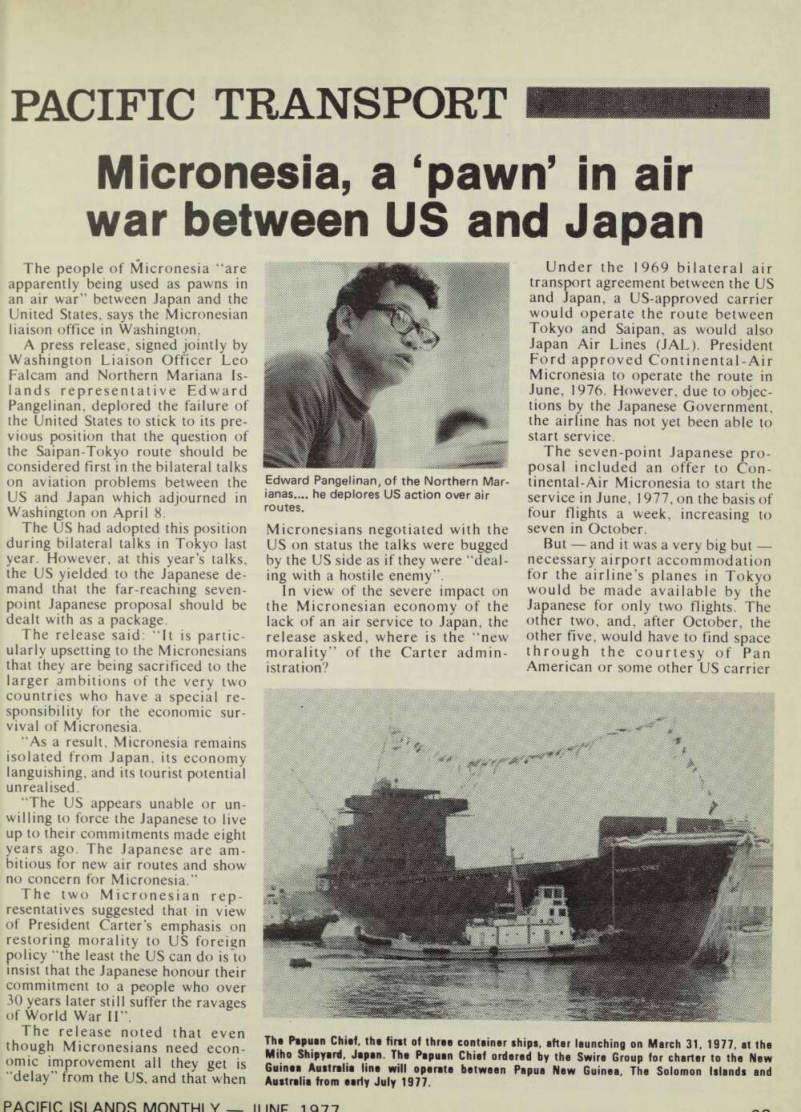

Pacific Transport
Micronesia, a ‘pawn’ in air war between US and Japan
The people of Micronesia “are apparently being used as pawns in an air war” between Japan and the United States, says the Micronesian liaison office in Washington.
A press release, signed jointly by Washington Liaison Officer Leo Falcam and Northern Mariana Is lands representative Edward Pangelinan, deplored the failure of the United States to stick to its pre vious position that the question of the Saipan-Tokyo route should be considered first in the bilateral talks on aviation problems between the US and Japan which adjourned in Washington on April 8.
The US had adopted this position during bilateral talks in Tokyo last year. However, at this year’s talks, the US yielded to the Japanese de mand that the far-reaching seven point Japanese proposal should be dealt with as a package.
The release said; “It is partic ularly upsetting to the Micronesians that they are being sacrificed to the larger ambitions of the very two countries who have a special re sponsibility for the economic sur vival of Micronesia.
“As a result, Micronesia remains isolated from Japan, its economy languishing, and its tourist potential unrealised.
“The US appears unable or un willing to force the Japanese to live up to their commitments made eight years ago. The Japanese are am bitious for new air routes and show no concern for Micronesia.”
The two Micronesian rep resentatives suggested that in view of President Carter’s emphasis on restoring morality to US foreign policy “the least the US can do is'to insist that the Japanese honour their commitment to a people who over 30 years later still suffer the ravages of World War II”.
The release noted that even though Micronesians need econ omic improvement all they get is “delay” from the US, and that when
Micronesians negotiated with the US on status the talks were bugged by the US side as if they were “deal ing with a hostile enemy”.
In view of the severe impact on the Micronesian economy of the lack of an air service to Japan, the release asked, where is the “new morality” of the Carter admin istration?
Under the 1969 bilateral air transport agreement between the US and Japan, a US-approved carrier would operate the route between Tokyo and Saipan, as would also Japan Air Lines (JAL). President Ford approved Continental-Air Micronesia to operate the route in June, 1976. However, due to objec tions by the Japanese Government, the airline has not yet been able to start service.
The seven-point Japanese pro posal included an offer to Con tinental-Air Micronesia to start the service in June, 1977, on the basis of four flights a week, increasing to seven in October.
But and it was a very big but necessary airport accommodation for the airline’s planes in Tokyo would be made available by the Japanese for only two flights. The other two, and, after October, the other five, would have to find space through the courtesy of Pan American or some other US carrier
The Papuan Chief, the first of three container ships, after launching on March 31, 1977, at the Miho Shipyard, Japan. The Papuan Chief ordered by the Swire Group for charter to the New Guinea Australia line will operate between Papua New Guinea, The Solomon Islands and Australia from early July 1977.
Edward Pangelinan, of the Northern Mar ianas..., he deplores US action over air routes.
currently using the overcrowded Tokyo airport.
Other points made by the Japanese included a freeze on the number of US take-offs and landings at Tokyo at the level of 332 weekly, including the four offered from June to Continental-Air Micronesia.
Vice-president and general man ager of Continental-Air Micronesia, Mr Gene Massing, said the Japanese offer was in effect for two flights a week and was not a viable economic proposition for his airline. Nor did it satisfy the airline’s commitment that when it starts service it would provide flights to all the districts of Micronesia and the Northern Marianas.
“It seems the Japanese govern ment is trying to close the door to us,” said Mr Massing.
Mr Tom Roesch, of the US State Department’s Aviation Division, in a comment reported by Gannett News Service, said that considering Continental-Air Micronesia plann ed to use Boeing 727 jets, with a seating capacity of only 98 passengers, it seemed that the Japanese were pushing the overall issue a bit too hard.
“Not that much capacity is being offered to make the Japanese ner vous,” Roesch said.
Fiji Marine Court
Suspends Chief Officer
A Fiji marine court of inquiry has suspended the certificate of the chief officer of the Taoniu, Thomas Roudon, for 12 months. Roudon was on watch when the Taoniu hit a reef off Wakaya Island in February.
The court found him incompetent.
The court also found that the master, Captain Simon Osborne, was careless because he did not en sure, as master, that he had in his ship up-to-date navigational equip ment before leaving on the voyage.
He had a very old chart which did not show the existence of Makogai lighthouse.
Had Captain Osborne checked the chief officer’s belief of the posi tion of the Taoniu as he recorded on the chart, he would have discovered the error as the position entered by the chief officer was wrongly plot ted. Captain Osborne was rep rimanded. The court took into ac count his long years of service and unblemished record.
Advertisements & other items, pp. 61-62 (3 items)
63
PACIFIC ISI AMDS MDNTHI Y ll imp iq-7"7
DAr'icif' ici amhq momthi Y .11 INF 1 977
64
Refrigerators
El
UPRIGHT DISPLAY
FWGfD COLO DRINKS
LOW COST
LARGE CAPACITY
BOTTLE & FOOD DISPLAY
2 & 3 DOOR MODELS AVAILABLE
• Large capacity - small floor space Maximum visual display • Gleaming white, vinyl coated aluminium interior for better reflection of light within cabinet • Fluorescent lighting 2" Frigidfoam insulation (equivalent to 4" Polystyrene or 6" cork!) Powered by heavy-duty Kelvinator sealed unit warranteed for 5 years
AVAILABLE FROM:
AUSTRALIAN NEW CALEDONIA EXPORTS. 363 George St, Sydney, 2000.
BRECKWOLDT & CO., 276 Pitt St,, Sydney, 2000.
HAGEMEYER <A’SIA), 59 Anzac Pde, J 203 GEOFFREY HUGHES & CO, 167 Macquarie St, Sydney 2000.
NELSON & ROBERTSON PTY. LTD, 197 Clarence St, Sydney, 2000.
PETER FISHER TRADING PTY.LTD, 321 Pitt St, Sydney 200 CL E RABOT (EXPORTS) PTY. LTD, 67 Castlereagh St, Sydney. 2000.
RABTRAD NIUGINI PTY. LTD., PO Box 1406, Lae.
A RIETTE (PACIFIC) PTY. LTD., 300 George St., Sydney, 2000.
H' Y KWAN (AUST) PTY. LTD. Box 2713, GPO , Sydney, 2001.
C, SULLIVAN (EXPORT) PTY. LTD., GPO Box 3373, Sydney, 2001.
W.S. TAIT & CO, PTY. LTD, 31 Macquarie Place, Sydney, 2000. 1 Attractive timber grain Marviplate exterior > Automatic frost-free, fan-assisted cooling gives even and faster cooling of stored products • 4 rows adjustable plastic-coated, hygenic, white shelves and floor tray LOW MAINTENANCE, the only maintenance required being periodic cleaning of condenser Illuminated sign in top panel optional extra.
Manufactured by: T 1
FRIGID CABINETS PTY. LTD.,
Duffy Ave., Thornleigh, N.S.W. 2120 Aust. Ph. 848 8292. 14A FC2.
To Future Generations,
Security
m m ni ,1 t fvj pit r Tranquil Splendor.
Borobudur Temple in Indonesia built over 11 centuries ago.
Social welfare is a subject of serious consideration in most modern societies. Man in the twentieth century accepts his responsibility to bequeath to the next generation a society better than his own. Daiwa Bank is not unique in accepting this responsibility, but Daiwa is unique in making acceptance of this role in society an integral part of their banking service.
Daiwa is the only Japanese city bank to combine banking and trust business. Daiwa is thus a fully integrated banking institution, comprising banking, international financing, trust, pension trust, and real estate business. This integration is part of our effort to fulfil our social responsibility consistent with society's needs in a contemporary environment. a fully integrated banking service
DAIWA BANK
Head Office: Osaka, Japan Branches and Agencies: London, New York, Los Angeles, Frankfurt Representative Offices: Singapore, Sydney, Sao Paulo, Hong Kong Subsidiary: Daiwa Bank Trust Company, New York Joint Venture Banks: P.T. Bank Perdania, Jakarta, International Credit Alliance, Ltd., Hong Kong
for Fiji’s Nausori airport
A black star (for danger) for Fiji’s Nausori airport
Nausori airport in Fiji, along with two other South Pacific airports re ceived a “black star” rating in a re port issued by the International Airline Pilots’ Association. A black star designates an airfield as “cri tically deficient”. It is the worst of three ratings orange, red and black.
The other South Pacific airports which qualify for the dubious black star rating are Fua’amotu, near Nukualofa, and Tafuna in American Samoa. Tafuna is an international airport. Nausori and Fua’amotu, although handling international flights, mainly BACI 1 Is between Fiji and Auckland, via Tonga, are classed as regional airports.
Twenty-six airports throughout the world received the black star rating in the January report. Black star listings often convince govern ments of the need to upgrade airport facilities.
This is what the pilots said about Nausori; “Navigation aids are unservicea ble and unreliable. The runway is narrow and not strong enough for modern aircraft. There are pools of water on the runway after heavy rain, frequent reports of livestock wandering in the airport area and lighting and navigation aids are in adequate.”
The report was also critical of the fire-fighting facilities, saying they were inadequate. All airports near the sea should have amphibious craft, but Nausori did not have one.
The pilots’ criticism about wan dering livestock is no longer valid as a stockproof fence has been con structed round the airfield (thanks to the recent royal tour). Navigation aids have also been improved, and the runway is being upgraded. Pilots and civil aviation authorities in Fiji hope that Nausori’s black star rating will be removed by the middle of 1977.
It is doubtful, however, if any body will ever be able to do any thing about flooding at Nausori air port, unless at great cost. The actual site of the airport is known as Luvuluvu. It is beside the tidal lower reaches of the Rewa River, and during flooding is invariably
under water. Luvuluvu is a Fijian word related to flooding. As the Fi jians have been there for hundreds of years it is fair to presume they did not give it such a tag without good reason.
The main rqnway at Nausori is 100 ft (30.5 metres) wide, and does not reach International Civil Avia tion Organisations standards. The runway, which is 6000 ft (1828 metres) long, should be 150 ft (45.7 metres) wide, and should have shoulders of 25 ft (7.6 metres). The shoulders are 20 ft (6J metres).
Captain John Childs, president of the Fiji Airline Pilots’ Association, agrees that the runway is narrow, but says it is not an uncommon fault.
It was possibly dangerous at Nausori only when combined with other fac tors. If an aircraft ran off the runway it could get stuck in swamp and mud, which would prevent crash ve hicles, such as fire engines, reaching it.
Mr M. Varley, the Fiji Director of Civil Aviation, says there are plans to improve the drainage, but it is not worth investing a large sum of money to mhke it a 100% jet air field, although it had to be ungraded to ensure adequate levels of safety were maintained.
Nausori should be looked on as a feeder airport for the excellent air port at Nadi, Mr Varley said. Later, it might be better to build an airport nearer Suva.
Proposals for an airport closer to Suva have been aired many times in the past. One suggestion was for a runway running alongside Suva Point with aircraft taking off and landing over the sea, rather than in land. Today’s cost and the state of the Fiji economy would make such a
project impossible.
Captain Childs said members of his association were concerned about Fua’amotu, which was eight miles (12.9 km) from Nukualofa.
Weather forecasting was inaccurate and had put pilots in “com promising situations”. The trouble was that the forecaster compiled his information in Nukualofa, and it was not necessarily the same weather as at the airport.
Advertisements & other items, pp. 63-64 (2 items)
65
PACIFIC ISLANDS MOMTHI V II IMP 1Q77
Otis
To stand tall
in 118 countries
you need to
keep on your toes
Staying on top in the business world means backing a programme of continuing innovation with a sound service programme.
So Otis employs some 50,000 specialists in 118 countries researching, making, installing and servicing Otis elevators, escalators and allied transportation systems.
Otis keeps moving people and things. While looking for better ways of doing it.
Otis
Otis Elevator Company Ltd., Nukuwatu Street, Lami, Suva, FIJI.
Telephone 361-248 Suva. 36372 A
Cruising
Money will talk loudly over Suva wharf project
Yachts
If Fiji wants a container-age wharf at Suva she will have to be prepared to spend a lot of money.
That message rings through loud and clear in a report prepared by a United Nations expert, Mr Jack N.
Bathurst, about the impact of con tainerisation on the development of port facilities in Suva. Mr Bathurst is international regional adviser in shipping and ports to the United Na tions Conference on Trade and Development (UNCTAD).
His services were requested by the director-general of the Ports Authority of Fiji, Mr Loh Heng Kee, soon after a Suva Harbour Development Committee was set up.
Should the Fiji Government de cide to act on Mr Bathurst’s report, these are some of the factors involv ed: • Maximum additional back-up would extend along Rodwell Road, but would exclude Suva market.
This would make it necessary to de molish a number of buildings and several streets would have to be closed. This would be a major headache for traffic planners as all roads in the area are fully used; • Coastal traffic which uses Princes Wharf would have to move to another site, north of the existing port area; • The oil and petroleum dis charge facility would also have to go to another site, mainly on the grounds of non-compatibility and extreme hazard it presents in a general cargo port; • Even though the market would remain in its present site, it could become the foundation of a high rise building, with the first floor used as a passenger-terminal facili ty. Government departments dis placed from Rodwell Road could be housed on the higher floors; • Berthing arrangements for deeper draught cruise liners would have to be changed, so that only the after part was alongside and the fore end was secured to suitable
dolphins.
The customs building would re main at the north end of the existing Kings Wharf. Traffic would enter at the Princess Street end, and leave near the May Street/Edinburgh Drive end.
If Princes Wharf was dredged to its maximum depth it could provide berthing for smaller cruise ships and general cargo ships.
Mr Loh sought the report because of changing trends in shipping ser vices and increasing use of unitised cargo ships in the South Pacific.
Mr Bathurst reported that such changes, along with the proposal to set up a regional shipping line, might also provide an opportunity for Fiji to attract more traffic by developing its potential as a focal point and trans-shipment port for the region.
Because two major influencing factors were unresolved when Mr Bathurst made his investigation, it was not possible to make, in ab solute terms, anything approaching a detailed and accurate forecast of ship types and cargo volumes likely to use Suva in the next few years.
Those factors were the outcome of the port labour situation and the final scope and orientation of the Spec regional shipping line the Pacific Forum Line and other na tional lines operating in the region.
However, it was possible to give some indication how changing tech nology could affect the services and facilities the port was likely to be called on to provide.
But to do that it would be necess ary to have fairly wide-ranging con tact and discussions with the ship ping lines and certain external or ganisations whose future intentions and activities were likely to have a major impact on shipping serving the region.
Overall, a lot of people will be in volved the government, city council, shipping companies, com merce, tourist industry, and trade unions, to name the major interests.
With so many voices it will be no surprise to see Mr Bathurst’s report emasculated beyond recognition.
• ASTERIAS, 44 ft Polish ketch registered in Szczecin, arrived at Rarotonga in late March from Tahiti and Moorea with five Polish students, A.
Lipinski (captain), A. Gasiorek, J. Sitnik, A. Kurzeja and W. Baranowski. After a week's stay they left on April 4 for Brisbane, Port Moresby, Mauritius, Capetown, the Canary Islands and home to Poland, expecting to arrive there in October or November after completing
their circumnavigation.
• COR CAROLI, 9 1 metre sloop, sailed by Bulgarian professional yachtsman George Georgiev, was a recent arrival in Suva. It was George's halfway point in a solo attempt to sail round the world. He took part in the transatlantic race last year, finishing 37th overall and 25th in the group for his class of yacht, then continued on through the Caribbean to Balboa, the Mar quesas, Tonga and Fiji. After Fiji he planned to sail to Darwin and then to Capetown before sailing on to England, where he started his voyage. • LA DESIRADE arrived unexpectedly at Pitcairn Island on February 28 from Florida, carrying Carl Lipscombe and a companion. • SHEARWATER 11, 10 3 metre dou ble-ended gaff ketch, was a recent visitor to Pitcairn Island, carrying New Zealander Derry Symons and sons Tony and John.
After two weeks at Rapa they spent a week at Pitcairn and then sailed for the Marquesas, en route to Tahiti. Derry plann ed to fly home from Tahiti and leave his sons to take the ketch back to Opua in the NZ Bay of Islands. Derry's original intention was to make the shores of South America, but changed his mind when in French Polynesian waters. • SWEET THING, 16.5 metre Morgan yacht, was at Pitcairn Island late in Febru ary and early in March on the way to Florida from Whangarei, NZ. She left Whangarei on November 16, 1976, and sailed to New Caledonia where the owner, Jim Wilson, left to fly home to Tennessee, US. On board, when the Sweet Thing ar rived at Pitcairn after a few days in Tahiti, were two Americans, Herb Stonebrook, skipper, from Memphis, Tennessee, and Jim Slesar (Wisconsin) and three New Zealanders, Carlton Clark (Whangarei), Mark Allpress (Auckland) and Stuart Lee (Auckland). From Pitcairn they planned to sail to Easter Island and the Galapagos.
Target date for arrival in Florida is June. • BABALATCHI, 45 ft ferro-cement ketch from Vancouver, arrived in Tahiti on January 3 for their second visit, enroute home to Vancouver after a sail that began in 1974 and took the Braith
waite family of Frank, wife Pat, 13-yr-old JoAnne and 11-yr-old Patrick to New Zealand where the children went to school for a year, Babalatchi sailed from Huahine on February 28, bound for Hawaii, but immediately ran into a squall that broke her bowsprit. So she returned to port for repairs and they left again the following day. Sailing with the Braith waites was Lindsay Trott of Australia. • BERENICE, 40 ft ferro-cement ketch from Trenton, Missouri, left Tahiti on April 23 for the Tuamotus, Marquesas and Hawaii. Owned by Boyd and Neva Mineer and her brother Joe Davidson, Berenice left Florida in November, 1975 for the Bahamas, Haiti, Panama, Galapagos, Marquesas, Tuamotus and Tahiti, arriving in Papette last September.
She spent the hurricane season cruising the Societies. On board for the trip to Hawaii were Boyd, Brian Gronnebeck of California and Jean-Loup Gladieux of France. Boyd hopes to sell Berenice in Honolulu or Marina Del Rey. Joe flew back to the States in September and Neva remained in Tahiti, looking for a boat going west. • CONSTELLATION, famous racing 95 ft Alden staysail schooner from San Diego, sailed into Tahiti in February after a 19-day passage from Santa Barbara to Nukuhiva in the Marquesas. Built in 1932 in East Boothbay, Maine, Constellation twice won the Transpac-Hawaii race, in 1957 and 1959. She was bought IV2 years ago by her present owner and cap tain, Roberta Erb. Sailing with Roberta are: Gregg Lott, skipper and navigator from New York; Roberta's 16-year-old son Dexter and his friend Duncan Ross; Scott Lapperque of California and Tom Britt of Connecticut. Roberta said she is making a circumnavigation at a leisurely pace and will be visiting the Cooks, Fiji, Tonga, New Zealand and Tasmania on her way to Australia and the Suez. • DA BOAT, 31 ft Islander sloop from Los Angeles, returned to Tahiti on April 23 on her way home from a visit to the Cooks and American Samoa. She originally sailed from Los Angeles in December, 1974, and called at Mexico, Central America, Cocos Islands, the Mar quesas and Tuamotus and arrived in Tahiti on December 1, 1975. She remain ed in the Societies until September, 1976, when she left for Samoa. They left Samoa in February, heading for the Cooks, but a tropical depression blew them off course and they ended up in Raiatea in the Societies. Co-owners Mike Lascurain, Scott Borek and Dick Wagner own a tropical fish business in Los Angeles and one runs the business while the other two sail and follow the surf. On board in Tahiti with Mike and Scott were Scott's wife Denise and Dugga Warren of Australia. They planned to remain in French Polynesia until June, then sail to Ha « /O DESPERADO, 41 ft Morgan Out- Island yacht from Anchorage, Alaska, left home July, 1 976 and sailed down the in side passage to Canada, then down the
California coast and left in November for the Marquesas, Tuamotus and Tahiti, ar riving in Papeete on February 19. The Monroe family of Thomas and Jan and daughters Dawn, 16 and Lynne 14, may go back to Alaska from Tahiti or sail on to New Zealand. Thomas flew home on business and the rest of the family stayed aboard in Papeete, awaiting the decision as to their future direction. Desperado sailed across the Pacific with RODONIS, another yacht from Anchorage. • DRAGON, 41 ft Morgan sloop from St Thomas, VI, sailed into Tahiti on April 4, carrying owners Louis and Claude Czukelter and their dachsund, Zipper.
They left Florida in August, 1976 for the Bahamas and San Bias Islands, where they encountered a 36-hr. gale with seas 20 ft-25ft. Dragon was then hit by lightning, which caused $2,000 damage, including melting the rigging off the top of the mast and cracking all the fittings and riggings. Their cockpit was engulfed in blue flames and Louis even had his finger split by the lightning. After re pairing the damage, they sailed to Panama and the Galapagos, Marquesas and Tuamotus before arriving in Papeete.
Their plans were to stay a couple of months, then head west to Fiji and New Zealand. Louis is an electrician and refrigeration-diesel mechanic and they are both professional charter people. • DRUMMER, 33 ft modified Islander sloop from Los Angeles, left San Pedro, Calif in September, ran into a hurricane off the coast of Mexico and returned to San Pedro for repairs. She started again in November and had a very bad trip to the Marquesas, with storms around all the time. They missed the Tuamotus because of the storms and arrived in Tahiti on March 10, after spending several months in the Marquesas, which they all loved. The Lemmons family makes up Drummer's crew, consisting of former auto racing champion "PAPPY"
Lemmons, wife Helen, three daughters Jean, 17, Ann, 1 2 and Mary 11. Also on board is their dear chihuahua, Chiquita Banana, who is also 11 years old. Pappy, who is also a cartoonist and writer for automotive magazines, said that all the boaties voted he should receive a medal for crossing the ocean with five females.
Their plans include sailing in a few months to the Cooks, Samoa and to the Solomons, where he has two ships sit ting on the bottom there at Guadalcanal. • GETEL, 32 ft ferro-cement double ender cutter from Los Angeles, built and owned by Bill Kohut, left California in January, 1976 and sailed to the Mar quesas and Tahiti, arriving on July 1 Bill and his wife, Anny, their daughters Mar tine, 15, and Pascale, 13, along with their nephew Eric Rigney, 17, have been cruis ing the Societies since that time. They went to Uturoa in Raiatea for one day and ended up staying five months. The kids were entered in school there to learn French. They planned to leave May 3 for the Tuamotus, Marquesas and on to Hawaii and California.
Advertisements & other items, pp. 65-67 (4 items)
PACIFIC ISI iwiomtui v ii imc IQ-7-7
67
ici amhq MnMTWI V II INF 1977
68
anywhere,
any time,
any gas.
For further information & addresses of your local distributor contact:
THE COMMONWEALTH
INDUSTRIAL GASES LIMITED
Gases Export Department, 138 Bourke Road, Alexandria, N.S.W.
Australia 2015.
Cables ‘CIGAS’-Telex AA25475 SYDNEY CG 96/76
Diesel Power! Displacement Hull!
The KINGSTON ANGLER'
is good news
for fishermen
and island
traders.
• The 19’ displacement hull gives you smoother cruising than a olaning hull (it’s the same hull as the Kingston 580) •The diesel engine (up to 33 h.p. and 15 knots) is safe, reliable and cheaper to run. •Full length, self-draining floor. •The fibreglass construction throughout makes it easier nta ma
J fffloKlOff
no O r* l. n i n
CRUISER SALES PTY. LTD.
179 South Creek Road, Dee Why, N.S.W. 2099. Australia.
Telephone: 981 3508
THE PAPUA HOTEL
PORT MORESBY
• Right in the business centre • A tradition for comfort and fine food • All rooms air conditioned • Restaurant • Bars • Banquet Hall Telephone 24 2121 Cables PAPTEL
A. C. NEUMANN
Manager
J
INTERNATIONAL *
DATELINE HOTEL™ 11
TONGA
"Friendly Hotel" of the "Friendly Islands"
Situated along the Nukualofa waterfront. Only five minutes walk from town. Single, double, family suites, airconditioning, and hot and cold water showers. Pool, bar, restaurant, duty-free shop, tour desk and boutique.
Book through your travel agent or write to International Dateline Hotel, P.O. Box 62, Nukualofa Tonga.
Cable Address: "DATELINE".
Represented Overseas by: Charles J. Henry and Associates Pty. Ltd.
Sydney and Melbourne. 76
NOTICE
TRADE MARK
Notice is hereby given that Aiwa Co., Ltd., a corporation duly organised and existing under the laws of Japan of 2- 3, 5-chome, Sotokanda, Chiyoda-ku, Tokyo, Japan, is the sole proprietor in Papua New Guinea and Nauru and elsewhere oj the following Trade Mark:
AIWA
Used in respect of the following: Radio and television equipments; sound amplifying apparatus and instruments and parts thereof; microphones, loud-speakers, tuners, record players, turntables, pickups, tape recorders, video recorders, phonograph records, tapes and other sound and/or image recording and/or reproducing apparatus, articles and implements: cassette tape recorders, combined radio receivers and cassette tape recorders, phonomotors; parts and accessories of foregoing goods.
The Proprietor claims all rights In respect of the above Trade Mark and will take all necessary legal steps against any person or company infringing those rights.
F. B. RICE
& CO.
Patent Attorneys Sydney, Australia
FRANCIS TRADING COMPANY
IMPORT & EXPORT MERCHANTS,
SUITE 204, 11 SPRING ST., CHATSWOOD, NSW. 2067.
We offer personal service on all commercial and other requirements.
Our manager, A.N. (“Andy") Losurdo, formerly of Ma dang and Rabaul, is now available to offer the best in export service and advise on prospects in Australia for all types of your exports.
PHONE: 412 4960.
P.O. BOX 186, CHATSWOOD 2067.
P.N.G. Representatives: Woo Enterprises Pty. Ltd., Chinsurah St., Taurama.
P.O. Bdx 5576, Boroko.
PAriPir IQI A MnC IVV/ II iikir- trm
Deaths
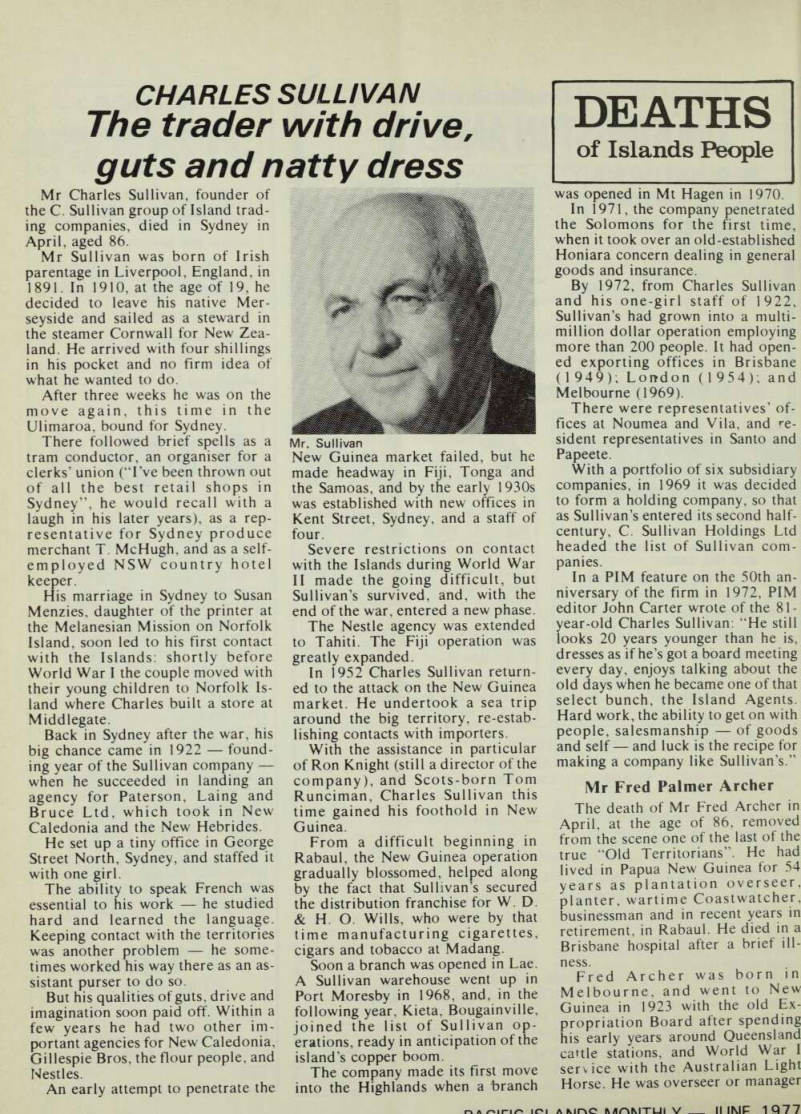
Charles Sullivan
The trader with drive, guts and natty dress
Mr Charles Sullivan, founder of the C. Sullivan group of Island trad ing companies, died in Sydney in April, aged 86.
Mr Sullivan was born of Irish parentage in Liverpool. England, in 1891. In 1910, at the age of 19, he decided to leave his native Mer seyside and sailed as a steward in the steamer Cornwall for New Zea land. He arrived with four shillings in his pocket and no firm idea of what he wanted to do.
After three weeks he was on the move again, this time in the Ulimaroa, bound for Sydney.
There followed brief spells as a tram conductor, an organiser for a clerks’ union (“I’ve been thrown out of all the best retail shops in Sydney”, he would recall with a laugh in his later years), as a rep resentative for Sydney produce merchant T. McHugh, and as a self employed NSW country hotel keeper.
His marriage in Sydney to Susan Menzies, daughter of the printer at the Melanesian Mission on Norfolk Island, soon led to his first contact with the Islands; shortly before World War I the couple moved with their young children to Norfolk Is land where Charles built a store at Middlegate.
Back in Sydney after the war, his big chance came in 1922 —found ing year of the Sullivan company when he succeeded in landing an agency for Paterson, Laing and Bruce Ltd, which took in New Caledonia and the New Hebrides.
He set up a tiny office in George Street North, Sydney, and staffed it with one girl.
The ability to speak French was essential to his work he studied hard and learned the language.
Keeping contact with the territories was another problem he some times worked his way there as an as sistant purser to do so.
But his qualities of guts, drive and imagination soon paid off. Within a few years he had two other im portant agencies for New Caledonia, Gillespie Bros, the flour people, and Nestles.
An early attempt to penetrate the
New Guinea market failed, but he made headway in Fiji. Tonga and the Samoas, and by the early 1930 s was established with new offices in Kent Street, Sydney, and a staff of four.
Severe restrictions on contact with the Islands during World War II made the going difficult, but Sullivan’s survived, and, with the end of the war, entered a new phase.
The Nestle agency was extended to Tahiti. The Fiji operation was greatly expanded.
In 1952 Charles Sullivan return ed to the attack on the New Guinea market. He undertook a sea trip around the big territory, re-estab lishing contacts with importers.
With the assistance in particular of Ron Knight (still a director of the company), and Scots-born Tom Runciman, Charles Sullivan this time gained his foothold in New Guinea.
From a difficult beginning in Rabaul, the New Guinea operation gradually blossomed, helped along by the fact that Sullivan’s secured the distribution franchise for W. D. & H. O. Wills, who were by that time manufacturing cigarettes, cigars and tobacco at Madang.
Soon a branch was opened in Lae.
A Sullivan warehouse went up in Port Moresby in 1968, and, in the following year, Kieta, Bougainville, joined the list of Sullivan op erations, ready in anticipation of the island’s copper boom.
The company made its first move into the Highlands when a branch
Deaths
of Islands People
was opened in Mt Hagen in 1970.
In 1971, the company penetrated the Solomons for the first time, when it took over an old-established Honiara concern dealing in general goods and insurance.
By 1972, from Charles Sullivan and his one-girl staff of 1922, Sullivan’s had grown into a multi million dollar operation employing more than 200 people. It had open ed exporting offices in Brisbane (1949); London (1954); and Melbourne (1969).
There were representatives’ of fices at Noumea and Vila, and re sident representatives in Santo and Papeete.
With a portfolio of six subsidiary companies, in 1969 it was decided to form a holding company, so that as Sullivan’s entered its second half century, C. Sullivan Holdings Ltd headed the list of Sullivan com
panies.
In a PIM feature on the 50th an niversary of the firm in 1972, PIM editor John Carter wrote of the 81year-old Charles Sullivan; “He still looks 20 years younger than he is, dresses as if he’s got a board meeting every day, enjoys talking about the old days when he became one of that select bunch, the Island Agents.
Hard work, the ability to get on with people, salesmanship of goods and self and luck is the recipe for making a company like Sullivan’s.”
Mr Fred Palmer Archer The death of Mr Fred Archer in April, at the age of 86, removed from the scene one of the last of the true “Old Territorians”. He had lived in Papua New Guinea for 54 years as plantation overseer, planter, wartime Coastwatcher, businessman and in recent years in retirement, in Rabaul. He died in a Brisbane hospital after a brief ill ness.
Fred Archer was born in Melbourne, and went to New Guinea in 1923 with the old Ex
propriation Board after spending
his early years around Queensland cattle stations, and World War I service with the Australian Light Horse. He was overseer or manager
Mr. Sullivan
of a number of board plantations in the old Territory of New Guinea, his favourite being Matty Island, now known as Wuvulu, between the Sepik coast and the Manus group, where he made associations with the native people which were to last all his life. In recent years, from retire menl, he had campaigned vigorously and successfully for re cognition of Wuvulu’s native land owners as opposed to the interests of a development company there.
Fred Archer himself became an independent planter when he purchased Jame Plantation, near Buka Passage, Bougainville, from the Expro Board in 1927 and he personally ran it until he sold it some years after World War 11. He was actively involved in many Bougainville interests. He had been made a civilian Coastwatcher in 1939 and was involved with Jack Read in these activities for a short time on Bougainville during the war.
Up to the time of his death Fred Archer had remained alert and ac tive, with his usual fund of stories of Island events and personalities. He was an interesting writer, many of his contributions appearing in PIM over the years. He never married, but he “adopted” several genera tions of an Island family and was generous and very proud to be able to assist with their welfare and education. Spartan in his own needs, during his lifetime he established the F. P. Archer Charitable Fund, which has quietly provided for and will continue to regularly and generously endow a great number of recognised charities. His staff were shareholders in his family company.
Continued on page 76
Mr. Archer
Auckland (7-1859): Kneubuhl Maritime Services Pago Pago (633-5121)
Us - Tahiti - Samoa
Pacific Islands Transport operates a five/six weekly cargo service from North American west coast ports to Papeete, Pago Pago, Apia Details from Trans-Austral Shipping Pty Ltd, 19 Pitt Street, Sydney (27-2441).
Polynesia Line operates container and general cargo service from US west coast ports to Papeete and Pago Pago.
Details from Polynesia Shipping Services Inc, PO Box 1478, Pago Pago (9-6799) Continued from page 71 His old friend and business as sociate for 65 years, Mr Eric Storm, plans to return Fred Archer’s ashes to Wuvulu.
Mr. E. V. Crisp The death occurred in Sydney in May of Mr Eric Vivian Crisp, chairman and managing director of
Steamships Trading Company. Port
Moresby, from 1946 until his retirement in 1961. He was aged 82.
“Viv” Crisp had gone to Papua from Australia in 1924 after serving with the AIF on Gallipoli in World War He joined Steamships in 1926 as manager at Samarai, and became the company’s general manager in 1939.
It was his direction that enabled the company to greatly expand after the war. * He is survived by his wife. Ruby.
Father J. Zerger Father Jean Zerger, 54, a Roman Catholic priest, died at Noumea in March after a long illness. He went to the New Hebrides from France in 1953, and served in a number of areas in the condominium.
Advertisements & other items, pp. 68-70 (2 items)
nA/Mno ioi a mi-\o (v/inMxui v II IMP 1Q 7 7
Baiwa Line
Hrw^ fclHl
DIRECT REGULAR SERVICE
JAPAN-SOUTH PACIFIC
TARAWA-PAPEETE-PAGO PAGO-APIA
SUVA-LAUTOKA-NOUMEA-VILA
SANTO-HONIARA
JAPAN - TAIWAN - GUAM
JAPAN-KEELUIMG-GUAM BY
EXCELLENT CAR/CONTAINER-CARRIER
JAPAN-WEST IRIAN-DILI
HONG KONG-TAIWAN-WEST IRIAN-DILI
AGENTS:
GUAM: ATKINS, KROLL (GUAM) LTD.
TARAWA: G. & E. I. DEVELOPMENT AUTHORITY.
APIA: BURNS PHILP (SOUTH SEA) CO.. LTD.
PAGO PAGO: KNEUBUHL MARITIME SERVICES CORP.
NUKUALOFA: PACIFIC NAVIGATION CO., LTD.
SUVA: BURNS PHILP (SOUTH SEA) CO., LTD.
LAUTOKA: BURNS PHILP (SOUTH SEA) CO., LTD.
NOUMEA: SOCIETE D'ACCONAGA ET
TRANSPORT D'OCEANIE (SATO)
SANTO: BURNS PHILP (NEW HEBRIDES) LTD.
VILA: BURNS PHILP (NEW HEBRIDES) LTD.
HONIARA: BRITISH SOLOMONS TRADING CO., LTD.
PAPEETE: AGENCE MARITIME DE FARA UTE.
HONG KONG: IKE MARITIME CO., LTD.
SINGAPORE: THE BORNEO CO., (SINGAPORE) LTD.
DJAJAPURA: P. N. PELAJARAN NASIONAL INDONESIA.
DILI: SANG TAI HOO
TAIWAN: FOR CARGO BETWEEN JAPAN/GUAM/TAIWAN &
SOUTH PACIFIC,
FORMOSA SHIPPING & ENTERPRISE CORP.
THE DAIWA NAVIGATION CO.,LTD.
OSAKA: “DAILINE” TOKYO: “FUNEDAILINE”
HEAD OFFICE
DAIICHI KYOGYO BLDG.,
45, 2-CHOME, AWAZAMINAMI-DORI,
NISHI-KU, OSAKA, JAPAN
TELEPHONE: (06) 531-0471 ~9
TELEX: 525-6324 & 525-6325
TOKYO OFFICE
SHIN-DAIICHI BLDG.,
4-13, NIHONBASHI 3-CHOME, CHUO-KU,
TOKYO, JAPAN
TELEPHONE: (03) 274-3251 ~8
TELEX: 222-3343, 23559
THE
GLOBAL SERVICE FOR SHIPPERS
LINE
MONTHLY SERVICES
United Kingdom and Continent to: Papeete, Noumea, New Hebrides, Papua New Guinea and Solomon Islands. * Papua New Guinea to: North America, United Kingdom and Continent. * Solomons, Fiji, Tonga, Samoa and Tarawa to: United Kingdom and Continent.
For particulars apply:
THE BANK LINE (AUSTRALASIA) PTY.
LTD.,
18TH FLOOR, 1 YORK STREET,
SYDNEY, N.S.W.
Shipping
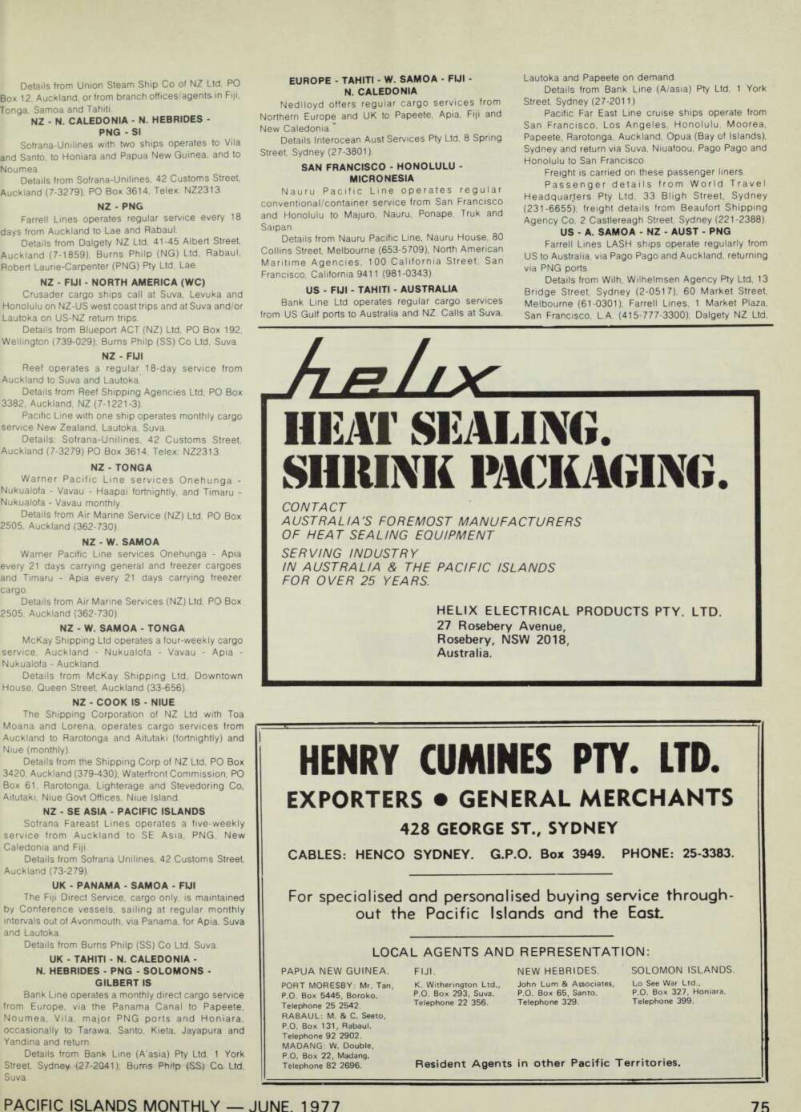
SYDNEY - NZ - FIJI/TAHITI - UK Chandris Lines maintains a passenger service from Sydney via NZ, Suva or Papeete every second month.
Details from Chandris Lines, 135 King Street, Sydney (232-2455).
Sydney - Lord Howe Is -
Norfolk Is • New Hebrides
Compagnie des Chargeurs Caledoniens operates four-weekly cargo service Sydney - Lord Howe Island, Norfolk Island, Port Vila and Santo.
Details Hetherington Kingsbury Pty Ltd, 37-49 Pitt Street, Sydney (27-1671).
SYDNEY - NZ - FIJI - HAWAII -
Canada - Us
P & 0 liners call at Auckland, Suva, Honolulu and Vancouver on eastbound and westbound voyages between Sydney and the US.
Details from P & 0 Booking Centre, World Travel headquarters Pty Ltd, 33 Bligh Street, Sydney (231-6655).
SYDNEY - NZ - FIJI - TONGA - N. HEBRIDES - NOUMEA - PNG -
Solomons -Samoas
Sitmar Cruises operates a year-round cruise programme to include most of the above countries.
Details from Sitmar Cruises, 22-30 Bridge Street, Sydney (27-4521).
Royal Viking Line, with luxury cruis6 ships Royal Viking Sea, Star and Sky, cruises the Pacific from Sydney, Hobart and Cairns calling at most of above countries.
Details from Wilh, Wilhelmsen Agency Pty Ltd, 13-15 Bridge Street, Sydney (2-0517).
P & 0 liners call at Apia, Auckland, Bay of Islands, Borabora, Honiara, Honolulu, Lautoka, Noumea, Nukualofa, Pago Pago, Papeete, Port Moresby, Santo, Savusavu, Suva, Vavau and Vila on cruises from Australia.
Details from P & 0 Booking Centre World Travel Headquarters Pty Ltd, 33 Bligh Street, Sydney (231-6655).
Australia - New Caledonia
Somacal operates 30-day service from Sydney to Noumea.
Details from Karlander (Aust) Pty Ltd, 19-31 Pitt Street, Sydney (27-6301).
Sofrana-Unilines ships serve Noumea every three weeks from the main ports along the east Australian coast.
Details from Sofrana-Unilines, 37 Pitt Street, Sydney (27-2031), Trans-Austral Shipping Pty Ltd, 570 Bourke Street, Melbourne (67-9162), ACTA Pty Ltd, Brisbane (221-3166), Elder Smith Goldsbrough Mort Ltd, Port Adelaide (47-5688), ANL, Newcastle (049-24364), Clements & Marshall, Burnie, Tasmania (3.1-1833).
Compagnie des Chargeurs Caledoniens operates three-weekly cargo service from Sydney to Noumea.
Details Hetherington Kingsbury Pty Ltd, 37-49 Pitt Street, Sydney (27-1671).
Australia - New Caledonia -
New Hebrides
South Pacific United Lines maintains a four-week cargo service from Sydney to Noumea, Vila and Santo.
Details from Omni Traders & Brokers Pty Ltd, 261 George Street, Sydney (24-2872/6)
Australia - Fiji
Karlander (Aust) Pty Ltd operates monthly cargo services from Sydney to Suva and Lautoka.
Details from Karlander (Aust) Pty Ltd, 19-31 Pitt Street, Sydney (27-6301), Dalgety Shipping, 461 Bourke Street, Melbourne (60-0731), Burns Philp (SS)
Co Ltd, Suva and Lautoka.
Sofrana-Unilines (Fiji Express Line) operates to Suva every three weeks from the main ports on the east coast of Australia and monthly to Lautoka from Melbourne and Sydney.
Details from Sofrana-Unilines, 37 Pitt Street, Sydney (27-2031), Trans-Austral Shipping Pty Ltd, 570 Bourke Street, Melbourne (67-9162), ACTA Pty Ltd, Brisbane (221-3116), Elder Smith Goldsbrough Mort Ltd, Port Adelaide (47-5688), ANL, Newcastle (049-24364), Clements & Marshall, Burnie, Tasmania (31-1833)
Australia - Fiji - W. Samoa
Nauru Pacific Line operates regular containerised, unitised and b/bulk service from Sydney and Brisbane to Lautoka, Suva and Apia.
Details Nauru Pacific Line, Nauru House, 80 Collins Street, Melbourne (653-5709), Interocean Swire, 8 Spring Street, Sydney (2-0522).
Australia - Tonga - W. Samoa
Karlander operates a monthly cargo service from Melbourne and Sydney to Nukualofa and Apia, thence US west coast Details: Karlander (Aust) Pty Ltd, 19-31 Pitt Street, Sydney (27-6301).
AUSTRALIA - TAHITI - US WEST COAST South Pacific United Lines maintains a four-weekly service from Sydney to Papeete, and US west coast.
Details from Omni Traders & Brokers Pty Ltd, 261 George Street, Sydney (241-2872/6).
Australia - Png
Containers Pacific Express (Burns Philp and AWP Line) operates four-weekly cargo service from Melbourne, Sydney and Brisbane with Samos to Port Moresby and Lae, supplemented by availability of additional tonnage on NGAL ships to cover transition period, Jan 1-June 30, 1977, pending start of fully containerised joint NGAL/Conpac service.
Details from Burns Philp & Co Ltd, 51 Pitt Street, Sydney (241-3816).
Farrell Lines operates a service every 18 days from Tasmania, Melbourne, Sydney and Brisbane to Lae and Rabaul.
Details from Wilh Wilhelmsen Agency Pty Ltd, 13 Bridge Street, Sydney (2-0517), 60 Market Street, Melbourne (61-3031), Burns Philp (NG) Ltd, Rabaul, Robert Laurie-Carpenter (NG) Pty Ltd, Lae New Guinea Express Lines operates three-weekly conventional and container services, Melbourne, Sydney, Brisbane, Port Moresby, Lae, Rabaul.
Details from New Guinea Express Lines, PO Box R 73, Royal Exchange PO, Sydney (241-3991), MacArthur Shipping Agency Co, 82-92 Eagle Street, Brisbane (229-3777), Western Farmers Transport Pty Ltd, 459 Little Collins Street, Melbourne (67-8291), Dreckwoldt's Shipping Agencies in Port Moresby (24-2525), Lae (42-1536), Rabtrad and Nuigini Pty Ltd, Rabaul (92-2911).
Karlander New Guinea Line’s cargo vessels call at Melbourne, Sydney, Port Moresby, Lae, Madang, Wewak, Manus, Kimbe, Rabaul.
Details from Karlander (Aust) Pty Ltd, 19-31 Pitt Street, Sydney (27-6301), Dalgety Shipping, 461 Bourke Street, Melbourne (60-0731).
Australia - Png - Solomons
New Guinea Australia Line’s vessels operate from Sydney and Brisbane to Port Moresby, Lae, Rabaul, Kavieng, Wewak, Honiara, Kieta, Gizo, Madang and Samarai.
Details from Interocean Swire, 8 Spring Street, Sydney (2-0522).
AUSTRALIA - SOLOMONS - GILBERT IS -
Micronesia
Daiwa Line runs a container service every 35 days from Sydney to Honiara, Tarawa, Guam, Saipan and Palau.
Details: Tradex Transport Pty Ltd, 185 O’Riordan Street, Mascot, NSW (669-1099)
Australia - Nauru - Majuro
Nauru Pacific Line operates regular cargo/passenger service from Melbourne to Nauru and Majuro.
Details Nauru Pacific Line, Nauru House, 80 Collins Street. Melbourne (653-5709), Interocean
Swire, 8 Spring Street, Sydney (2-0522).
Us - Png
Farrell Lines operates regular services from all US west coast ports to Lae and Rabaul Details from Wilh, Wilhelmsen Agency Pty Ltd, 13 Bridge Street, Sydney (2-0517), Farrell Lines. 1 Market Plaza, San Francisco, L A. (9-4105), Burns Philp (NG) Ltd, Rabaul and Kieta, Robert Laurie-Carpenter (PNG) Pty Ltd, Lae
Png - Us - Canada
Farrell Lines operates regular services from Lae and Rabaul to US west coast ports and Vancouver Details from Burns Philp (NG) Pty Ltd, Rabaul, Robert Laurie-Carpenter (PNG) Pty Ltd. Lae, Farrell Lines, 1 Market Plaza, San Francisco, LA. (9-4105), Wilh, Wilhelmsen Agency Pty Ltd, 13 Bridge Street, Sydney (2-0517).
FAR EAST - FIJI - NEW ZEALAND New Zealand Unit Express (CNC. MNOL, RIL) operates a three-weekly cargo service from Hong Kong to Lautoka, Suva, NZ ports. Manila, Kaoshiung, Keelung, Hong Kong.
Details from Interocean Swire, 8 Spring Street, Sydney (2-0522).
Royal Interocean Lines operates monthly cargo service with three ships from Surabaya, Jakarta, Bangkok, Port Kelang and Singapore to Suva and NZ ports.
Details from Interocean Aust. Services Pty Ltd, 8 Spring Street, Sydney (27-3801), Burns Philp (SS) Co Ltd, Suva and Lautoka Ben Shipping Co (Pte) Ltd, sailing monthly from Singapore, Hong Kong, Keelung, Kaoshiung, Suva and main NZ ports Details from Seatrans (Fiji) Ltd, GPO Box 152, Suva, Fiji.
Japan - Nz - Png
China Navigation Co, with three ships operates a monthly cargo service from Japan to New Zealand calling at Lae on return journey Details Interocean Swire, 8 Spring Street, Sydney (2-0522).
Far East - Mid-S. Pacific
China Navigation Co’s vessels operate a regular cargo service from Hong Kong, Taiwan and Singapore to Rabaul, Wewak, Madang, Lae, Port Moresby, Honiara, New Hebrides, Noumea, Papeete and Samoa.
Details from Interocean Swire, 8 Spring Street, Sydney (2-0522).
Kyowa Shipping Co Ltd operates monthly services from Hong Kong, Taiwan, S. Korea and Japan, to Guam, Saipan, Solomons, New Caledonia, Fiji, Western and American Samoa, Tahiti, Cook Is., Tonga and New Hebrides.
Details; Hetherington Kingsbury Pty Ltd, 37-49 Pitt Street, Sydney (27-1671).
North Europe - New Caledonia
Hamburg-Sued operates monthly cargo services from Dunkirk and Le Havre to Noumea, via Panama.
Details from Columbus Overseas Services Pty Ltd, 333 George Street, Sydney (290-2966).
North Europe - Tahiti -
N. Caledonia - Png
Compagnie Generate Maritime operates three multi-purpose and three ro/ro cargo services a month from North European and Mediterranean ports to Papeete and Noumea. Three multi-purpose ships call monthly in Papua New Guinea.
Details from Compagnie General Maritime, 4-6 Bligh Street, Sydney (221-2522).
JAPAN - GUAM - FIJI - SAMOA -
N. Caledonia - N. Hebrides
Daiwa Lines runs a monthly cargo service from Japan via Guam to Suva, Lautoka. Pago Pago, Apia, Vila, Santo and Noumea.
Details from Burns Philp (SS) Co Ltd, Suva.
NZ - FIJI - TONGA - SAMOAS -
Tahiti
Union Steam Ship Co of NZ operates a fully containerised service Auckland-Suva-Pago Pago- Apia-Nukualofa every 14-16 days.
A 28-day service by conventional ship is operated from Auckland to Papeete, Apia and Nukualofa.
Details from Union Steam Ship Co of NZ Ltd, PO Box 12. Auckland, or from branch offices/agents in Fiji, Tonga, Samoa and Tahiti.
NZ - N. CALEDONIA - N. HEBRIDES -
Png - Si
Sofrana-Unilines with two ships operates to Vila and Santo, to Honiara and Papua New Guinea, and to Noumea.
Details from Sofrana-Unilines, 42 Customs Street, Auckland (7-3279), PO Box 3614. Telex: NZ2313.
Nz - Png
Farrell Lines operates regular service every 18 days from Auckland to Lae and Rabaul Details from Dalgety NZ Ltd, 41-45 Albert Street, Auckland (7-1859), Burns Philp (NG) Ltd, Rabaul, Robert Laurie-Carpenter (PNG) Pty Ltd, Lae.
NZ - FIJI - NORTH AMERICA (WC) Crusader cargo ships call at Suva, Levuka and Honolulu on NZ-US west coast trips and at Suva and/or Lautoka on US-NZ return trips.
Details from Blueport ACT (NZ) Ltd, PO Box 192, Wellington (739-029); Burns Philp (SS) Co Ltd, Suva.
Nz - Fiji
Reef operates a regular 18-day service from Auckland to Suva and Lautoka.
Details from Reef Shipping Agencies Ltd, PO Box 3382, Auckland, NZ (7-1221-3).
Pacific Line with one ship operates monthly cargo service New Zealand, Lautoka, Suva.
Details: Sofrana-Unilines, 42 Customs Street, Auckland (7-3279) PO Box 3614, Telex: NZ2313.
Nz- Tonga
Warner Pacific Line services Onehunga - Nukualofa - Vavau - Haapai fortnightly, and Timaru - Nukualofa - Vavau monthly.
Details from Air Marine Service (NZ) Ltd, PO Box 2505, Auckland (362-730).
Nz - W. Samoa
Warner Pacific Line services Onehunga - Apia every 21 days carrying general and freezer cargoes and Timaru - Apia every 21 days carrying freezer cargo.
Details from Air Marine Services (NZ) Ltd, PO Box 2505, Auckland (362-730).
Nz - W. Samoa - Tonga
McKay Shipping Ltd operates a four-weekly cargo service, Auckland - Nukualofa - Vavau - Apia - Nukualofa - Auckland.
Details from McKay Shipping Ltd, Downtown House, Queen Street, Auckland (33-656).
Nz - Cook Is - Niue
The Shipping Corporation of NZ Ltd with Toa Moana and Lorena, operates cargo services from Auckland to Rarotonga and Aitutaki (fortnightly) and Niue (monthly).
Details from the Shipping Corp of NZ Ltd, PO Box 3420, Auckland (379-430); Waterfront Commission, PO Box 61, Rarotonga, Lighterage and Stevedoring Co, Aitutaki, Niue Govt Offices, Niue Island.
NZ - SE ASIA - PACIFIC ISLANDS Sofrana Fareast Lines operates a five-weekly service from Auckland to SE Asia, PNG, New Caledonia and Fiji.
Details from Sofrana Unilines, 42 Customs Street, Auckland (73-279).
UK - PANAMA - SAMOA - FIJI The Fiji Direct Service, cargo only, is maintained by Conference vessels, sailing at regular monthly intervals out of Avonmouth, via Panama, for Apia, Suva and Lautoka.
Details from Burns Philp (SS) Co Ltd, Suva.
UK - TAHITI - N. CALEDONIA - N. HEBRIDES - PNG - SOLOMONS -
Gilbert Is
Bank Line operates a monthly direct cargo service from Europe, via the Panama Canal to Papeete, Noumea, Vila, major PNG ports and Honiara, occasionally to Tarawa, Santo, Kieta, Jayapura and Yandina and return.
Details from Bank Line (A’asia) Pty Ltd, 1 York Street, Sydney <27-2041); Bums Phifp (SS) Co. Ltd, Suva.
EUROPE - TAHITI - W. SAMOA - FIJI -
N. Caledonia
Nedlloyd offers regular cargo services from Northern Europe and UK to Papeete, Apia, Fiji and New Caledonia.”
Details Interocean Aust Services Pty Ltd, 8 Spring Street, Sydney (27-3801).
San Francisco - Honolulu -
Micronesia
Nauru Pacific Line operates regular conventional/container service from San Francisco and Honolulu to Majuro, Nauru, Ponape. Truk and Saipan.
Details from Nauru Pacific Line, Nauru House. 80 Collins Street, Melbourne (653-5709), North American Maritime Agencies, 100 California Street, San Francisco, California 9411 (981-0343).
US - FIJI - TAHITI - AUSTRALIA Bank Line Ltd operates regular cargo services from US Gulf ports to Australia and NZ. Calls at Suva,
Lautoka and Papeete on demand.
Details from Bank Line (A/asia) Ply Ltd, 1 York Street, Sydney (27-2011).
Pacific Far East Line cruise ships operate from San Francisco, Los Angeles, Honolulu, Moorea, Papeete, Rarotonga. Auckland, Opua (Bay of Islands), Sydney and return via Suva, Niuafoou, Pago Pago and Honolulu to San Francisco.
Freight is carried on these passenger liners Passenger details from World Travel Headquarters Pty Ltd, 33 Bligh Street, Sydney (231-6655), freight details from Beaufort Shipping Agency Co, 2 Castlereagh Street, Sydney (221-2388) US - A. SAMOA - NZ - AUST - PNG Farrell Lines LASH ships operate regularly from US to Australia, via Pago Pago and Auckland, returning via PNG ports Details from Wilh, Wilhelmsen Agency Pty Ltd, 13 Bridge Street, Sydney (2-0517), 60 Market Street, Melbourne (61-0301); Farrell Lines, 1 Market Plaza, San Francisco. LA. (415-777-3300); Dalgety NZ Ltd,
Advertisements & other items, pp. 71-74 (1 item)
Lash
K I i ft
REFRIGERATED
& GENERAL
CARGO IN
BARGES. BULK
LIQUIDS IN
VESSEL DEEP
TANKS.
«s
LASH
IFROM UNITED STATES WEST COAST & CANADA TO PAPEETE,
IPAGO PAGO, AUCKLAND, LAE & RABAUL.
I PAPUA NEW GUINEA TO VANCOUVER 8.C., TACOMA, PORT-
ILAND, SAN FRANCISCO, LOS ANGELES.
■ SYDNEY, MELBOURNE, BURNIE, HOBART, BRISBANE TO LAE
& RABAUL.
MANAGING AGENTS: Wilh. Wilhelmsen Agency P/L., 13-15 Bridge Street, Sydney 2000-Phone 20517-60 Market Street, Melbourne, 3000-Phone 613031-344 Queen Street, Brisbane, 4000-Phone 2213316. MANAGING AGENTS N.Z.: Dalgety N.Z.
Ltd. , 119 Featherston Street, Welington—Phone 738347 41/45 Albert Street, Auckland—Phone 71859. ISLAND AGENTS: Robert Laurie (NG) P/L, P.O. Box 1032, Lae, PNG - Phone 423811. Burns Philp (NG) Ltd., P.O. Box 87, Rabaul, PNG. - Phone 922666.
KYOWA LINE
YOUR TRADING PARTNER
Monthly Services
Hong Kong, Taiwan, S. Korea, Japan
To: Guam, Saipan, British Solomon, New Caledonia, Fiji, W. Samoa, A. Samoa. Tahiti, Cook Is., Tonga, New Hebrides.
Taiwan,Hong Kong,Singapore,Jakarta
To: Australia, Papua New Guinea, Sabah & Sarawak.
South Korea, Japan
To; Guam, Saipan, Papua New Guinea, Other Pacific Islands.
Taiwan: Royal Steamship Corp., Ltd., Taipei S. Korea: Dong Sue Shipping Co., Ltd., Seoul Hong Kong: Dahzun Enterprises Ltd Singapore: Ocean Shipping & Enterprises Pte., Ltd Mariana Is.: Island Navigation Co, Ltd., Guam 8.5.1. P.: Solomon Taiyo Ltd., Honiara Tahiti: J.A. Cowan & Fils, Papeete Cooks: Union Citco Travel Ltd., Rarotonga Tonga: E.M Jones Ltd., Nukualofa New Hebrides: Agence Maritime Raymond Velicite, Port Vila A.Samoa: Island Pacific Agencies Inc., Pago Pago W. Samoa: Morris Hedstrom Ltd., Apia Fiji: Carpenter Shipping, Suva & Lautoka PNG: Carpenter Shipping Agencies, Port Moresby, Rabaul New Caledonia: Agence Maritime Du Rond Point Du Pacific.
Indonesia: P.T. Porodisa Raya Shipping Lines, Jakarta Sabah: KOH Han Ming Shipping & Forwarding Agent, Kotakmabalu Sarawak: Pan Sarawak Agencies Sdn. Bhd ,Sibu & Kuching Australia: Hetherington Kingsbury Pty. Ltd., Sydney, N.S.W.
KYOWA SHIPPING CO., LTD.
Ojima Bldg., 22-8 6-chome, Shinbashi, Frontier Bldg., 3-13 Hirano-cho,
AGENTS
Noumea
HEAD OFFICE
OSAKA OFFICE
Minato-ku, Tokyo, Japan Phone: 03(437)2885 (Rep.) Cables: “MARIQUEEN” Tokyo Telex: 242-4651 Kyowa J.
Higashi-ku, Osaka, Japan.
Phone: 06(227)0422 (Rep.) Cables: “MARIQUEEN” Osaka.
Telex: 522-3896 Kyowa O.
/l /=>//*'
HEAT SCALING.
SHRINK PACKAGING.
CONTACT
AUSTRALIA'S FOREMOST MANUFACTURERS
OF HEAT SEALING EQUIPMENT
SERVING INDUSTRY
IN AUSTRALIA & THE PACIFIC ISLANDS
FOR OVER 25 YEARS.
HELIX ELECTRICAL PRODUCTS PTY. LTD.
27 Rosebery Avenue, Rosebery, NSW 2018, Australia.
HENRY CUMiNES PTY. LTD.
EXPORTERS • GENERAL MERCHANTS
428 GEORGE ST., SYDNEY
CABLES: HENCO SYDNEY. G.P.O. Box 3949. PHONE: 25-3383.
For specialised and personalised buying service throughout the Pacific Islands and the East
LOCAL AGENTS AND REPRESENTATION:
PAPUA NEW GUINEA.
PORT MORESBY: Mr. Tan,
P.O. Box 5445, Boroko.
Telephone 25 2542.
RABAUL: M. & C. Seeto, P.O. Box 131, Rabaul.
Telephone 92 2902.
MADANG: W. Double, P.O. Box 22, Madang.
Telephone 82 2696.
FIJI.
K. Witherington Ltd., P.O. Box 293, Suva.
Telephone 22 356.
NEW HEBRIDES.
John Lum & Associates, P.O. Box 65, Santo.
Telephone 329.
SOLOMON ISLANDS.
Lo See War Ltd., P.O. Box 327, Honiara.
Telephone 399.
Resident Agents in other Pacific Territories.
AITCHISON YACHT MASTS OF
NEW ZEALAND
CONSTRUCT AND SUPPLY FOR YACHTS:
MASTS & SPARS, ALL SPAR FITTINGS, LIGHTING,
ROPES, RIGGING, WINCHES, STAINLESS STEEL
BOAT FITTINGS, COMPLETE RIGGING SYSTEMS.
Yachties for quick experienced service contact the specialist firm with the world wide reputation now!!!
We air freight and ship all over the Islands.
Flagpoles also made and supplied.
AITCHISON YACHT MASTS,
71 ROWANDALE AVE., MANUREWA
(PO Box 274, MANUREWA), AUCKLAND, N.Z.
Phone: 63 500.
Regular Pacific Services
"Union South' Pacific”, cellular container vessel. Reefer and general cargo from Auckland at approximately fortnightly intervals. Calls at Suva, Pago Pago, Apia and Nukualofa before returning to Auckland.
"Luhesand”, conventional reefer and general cargo. Monthly sailings from Auckland, calls at Suva, Apia, Papeete and Nukualofa.
jmimmuon .
JM/mcompanij
Branches at all main Australian, New Zealand and Pacific Island ports.
PACIFIC ISLANDS TRANSPORT LINE
Owners: Thor Dahls Hvaljangerseiskap A/S — Sandefjord, Norway.
MS CAMELLIA VENTURE
Express Freight Service between Pacific Coast Ports of
U.S.A.
and
TAHITI and SAMOA
Full container service including reefers.
GENERAL STEAMSHIP CORPORATION LTD.
General Agents 400 California Street, San Francisco, California, U.S.A.
APlA—Burn* Phiip (South Sea) Company, SYDNEY—Trans-Austral Shipping Pty. Ltd.
Ltd. SUVA —Bum* Phiip (South Sea) Company, PAPEETE—Agence Maritime Internationale Ltd.
Tahiti. LAE/RABAUL—Burns Phiip (New Guinea) Ltd.
PACO PAGO-Rolynesia Shipping Service* Inc. PORT VlLA—Comptoir* Francais de Nouvelle* NOUMEA—Etablitsements Ballande. Hebrides.
Produce
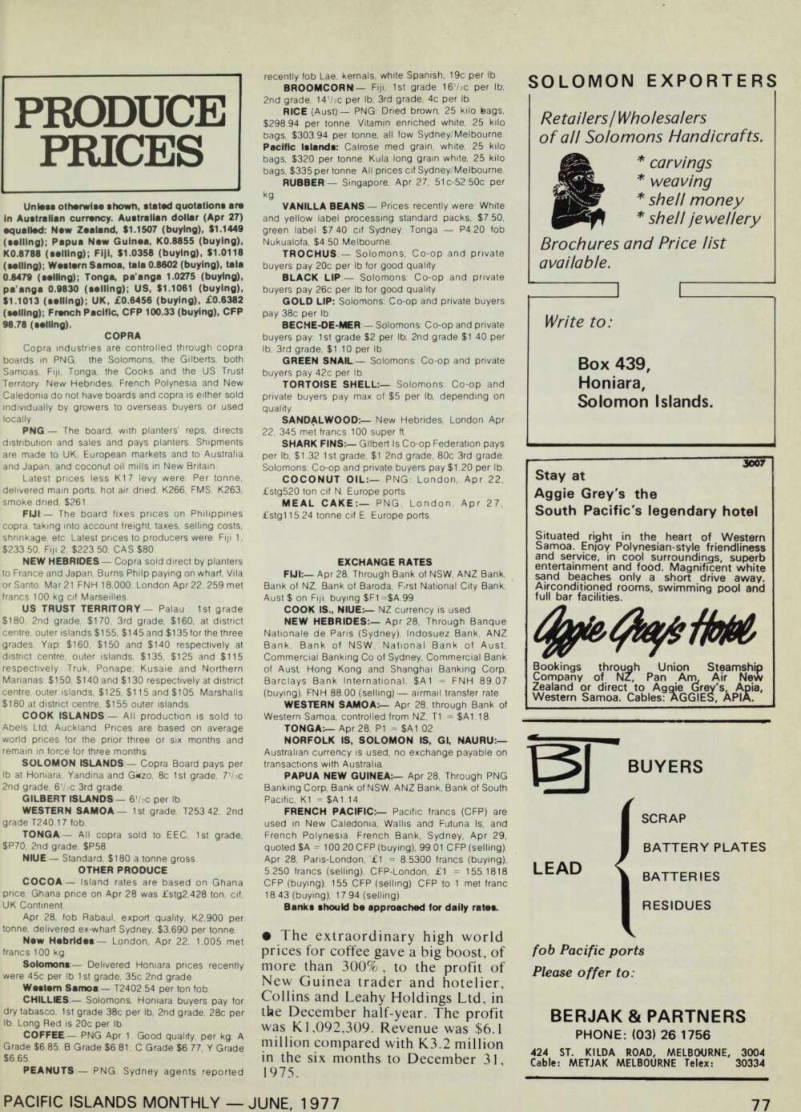
Prices
Unless otherwise shown, stated quotations are In Australian currency. Australian dollar (Apr 27) equalled; New Zealand, $1.1507 (buying), $1.1449 (selling); Papua New Guinea, K 0.8855 (buying), K 0.8788 (selling); Fiji, $1.0358 (buying), $l.OllB (selling); Western Samoa, tala 0.8602 (buying), tala 0.8479 (selling); Tonga, pa anga 1.0275 (buying), pa anga 0.9830 (selling); US, $1.1061 (buying), $1.1013 (selling); UK, £0.6456 (buying), £0.6382 (selling); French Pacific, CFP 100.33 (buying), CFP 98.78 (selling).
Copra
Copra industries are controlled through copra boards in PNG. the Solomons, the Gilberts, both Samoas, Fiji, Tonga, the Cooks and the US Trust Territory New Hebrides, French Polynesia and New Caledonia do not have boards and copra is either sold individually by growers to overseas buyers or used locally PNG The board, with planters’ reps, directs distribution and sales and pays planters. Shipments are made to UK, European markets and to Australia and Japan, and coconut oil mills in New Britain.
Latest prices less Kl 7 levy were: Per tonne, delivered mam ports, hot air dried, K 266, FMS, K 263, smoke dried. $261 FIJI — The board fixes prices on Philippines copra, taking into account freight, taxes, selling costs, shrinkage, etc Latest prices to producers were: Fiji 1, $233 50, Fiji 2, $223 50, CAS $BO NEW HEBRIDES Copra sold direct by planters to France and Japan, Burns Philp paying on wharf, Vila or Santo Mar 21 FNH 18,000; London Apr 22, 259 met francs 100 kg cif Marseilles US TRUST TERRITORY Palau Ist grade $lBO, 2nd grade, $l7O, 3rd grade. $l6O, at district centre, outer islands $155. $145 and $135 for the three grades Yap: $l6O, $l5O and $l4O respectively at district centre, outer islands, $135, $125 and $ll5 respectively Truk, Ponape, Kusaie and Northern Marianas: $l5O, $l4O and $l3O respectively at district centre, outer islands, $125, $ll5 and $lO5 Marshalls $lBO at district centre, $155 outer islands.
COOK ISLANDS All production is sold to Abels Ltd, Auckland. Prices are based on average world prices for the prior three or six months and remain in force for three months.
SOLOMON ISLANDS — Copra Board pays per lb at Honiara, Yandina and G«zo, 8c Ist grade. 7V?c 2nd grade, 6V?c 3rd grade
Gilbert Islands 6V?C Per Lb
WESTERN SAMOA- Ist grade, T 253 42, 2nd grade T 240 17 fob TONGA— All copra sold to EEC. Ist grade.
SP7O, 2nd grade, SPSB NIUE Standard, $lBO a tonne gross
Other Produce
COCOA — Island rates are based on Ghana price Ghana price on Apr 28 was £stg2,42B ton, cif, UK Continent Apr 28, fob Rabaul, export quality, K 2.900 per tonne, delivered ex-wharf Sydney, $3,690 per tonne New Hebrides — London, Apr 22, 1,005 met francs 100 kg Solomons— Delivered Honiara prices recently were 45c per lb Ist grade, 35c 2nd grade Western Samoa T 2402 54 per ton fob CHILLIES — Solomons, Honiara buyers pay for dry tabasco, Ist grade 38c per lb, 2nd grade, 28c per lb Long Red is 20c per lb COFFEE — PNG Apr 1 Good quality, per kg: A Grade $6 85. B Grade $6 81; C Grade $6 77 Y Grade $665 PEANUTS PNG Sydney agents reported
recently fob Lae, kernals, white Spanish, 19c per lb BROOMCORht — Fiji, Ist grade I6V2C per lb; 2nd grade, 14'/?c per lb; 3rd grade, 4c per lb RICE (Aust):— PNG: Dried brown, 25 kilo bags, $298 94 per tonne Vitamin enriched white, 25 kilo bags, $303 94 per tonne, all fow Sydney/Melbourne Pacific Islands: Calrose med grain, white, 25 kilo bags, $320 per tonne Kula long grain white, 25 kilo bags, $335 per tonne All prices cif Sydney/Melbourne RUBBER Singapore, Apr 27, 51c-52 50c per kg VANILLA BEANS Prices recently were: White and yellow label processing standard packs, $7 50, green label $7 40 cif Sydney Tonga P 4 20 fob Nukualofa, $4 50 Melbourne.
TROCHUS: — Solomons; Co-op and private buyers pay 20c per lb for good quality BLACK LIP — Solomons: Co-op and private buyers pay 26c per lb for good quality GOLD LIP: Solomons: Co-op and private buyers pay 38c per lb BECHE-OE-MER Solomons: Co-op and private buyers pay: Ist grade $2 per lb; 2nd grade $1 40 per lb; 3rd grade, $llO per lb GREEN SNAIL Solomons: Co-op and private buyers pay 42c per lb.
TORTOISE SHELL:— Solomons: Co-op and private buyers pay max of $5 per lb, depending on quality SANDALWOOD:— New Hebrides, London Apr 22, 345 met francs 100 super ft SHARK FINS;— Gilbert Is Co-op Federation pays per lb, $1 32 Ist grade, $1 2nd grade, 80c 3rd grade Solomons: Co-op and private buyers pay $1 20 per lb COCONUT OIL: PNG: London, Apr 22, £stgs2o ton cif N. Europe ports.
MEAL CAKE:— PNG, London, Apr 27. £5tg115.24 tonne cif E. Europe ports
Exchange Rates
FIJI; — Apr 28, Through Bank of NSW, ANZ Bank, Bank of NZ, Bank of Baroda, First National City Bank, Aust $ on Fiji, buying SFI =$A 99 COOK IS., NIUE: — NZ currency is used NEW HEBRIDES;— Apr 28, Through Banque Nationale de Paris (Sydney), Indosuez Bank, ANZ Bank, Bank of NSW, National Bank of Aust, Commercial Banking Co of Sydney, Commercial Bank of Aust Hong Kong and Shanghai Banking Corp, Barclays Bank International, SAI = FNH 89 07 (buying), FNH 88 00 (selling) airmail transfer rate WESTERN SAMOA* — Apr 28, through Bank of Western Samoa, controlled from NZ, T 1 = SAI 18 TONGA: — Apr 28, PI = SAI 02
Norfolk Is, Solomon Is, Gl, Nauru:—
Australian currency is used, no exchange payable on transactions with Australia PAPUA NEW GUINEA:— Apr 28, Through PNG Banking Corp, Bank of NSW, ANZ Bank, Bank of South Pacific, K 1 = SAI 14 FRENCH PACIFIC:— Pacific francs (CFP) are used in New Caledonia, Wallis and Futuna Is, and French Polynesia French Bank, Sydney, Apr 29, quoted $A = 100 20 CFP (buying), 99 01 CFP (selling).
Apr 28, Paris-London, £1 = 8 5300 francs (buying), 5 250 francs (selling) CFP-London, £1 = 155 1818 CFP (buying), 155 CFP (selling). CFP to 1 met franc 18 43 (buying). 17 94 (selling) Banks should be approached for daily rates.
• The extraordinary high world
prices for coffee gave a big boost, of more than 300% , to the profit of
New Guinea trader and hotelier,
Collins and Leahy Holdings Ltd, in
the December half-year. The profit
was K 1,092,309. Revenue was $6.1
million compared with K 3.2 million
in the six months to December 31, 1975.
Advertisements & other items, pp. 75-76 (1 item)
{Scrap
SOLOMON EXPORTERS
Retailers/Wholesalers
of all Solomons Handicrafts. * carvings * weaving * shell money * shell jewellery Brochures and Price list available.
Write to: Box 439, Honiara, Solomon Islands.
3007
Stay at
Aggie Grey's the
South Pacific's legendary hotel Situated right in the heart of Western Samoa. Enjoy Polynesian-style friendliness and service, in cool surroundings, superb entertainment and food. Magnificent white sand beaches only a short drive away.
Airconditioned rooms, swimming pool and full bar facilities.
Bookings through Union Steamship Company of NZ, Pan Arm Air New Zealand or direct to Aggie Grey's, Apia, Western Samoa. Cables: AGGIES, APIA.
BUYERS
LEAD
{SCRAP
BATTERY PLATES
BATTERIES
RESIDUES
fob Pacific ports Please offer to:
BERJAK & PARTNERS
PHONE: (03) 26 1756
424 ST. KILDA ROAD, MELBOURNE, 3004
Cable: METJAK MELBOURNE Telex: 30334
CLASSIFIED ADVERTISEMENTS
Per Line $3.00 Aust . Minimum 4 hntt.
TAG SHELLS
Australian specimen shells for the serious collector. Send your "WANT" list now. Prompt and personal replies.
To: C. Samson - PO Box 13, Hampton, Vic, 3188. Aust.
FLEETS have Tourist Boats from 34ft.
FOR SALE:
FREEHOLD PROPERTY
AT DEUBA, FIJI.
Three bedroom cottage, furnished or unfurnished, with all conveniences, character and charm, set amongst over two acres of lawns, tropical fruit and exotic trees, flowering shrubs and orchids. Own lighting plant, underground water tanks, garage and workshop. Bounded on one side by tranquil river, opposite beach and adjacent to multi million dollar Pacific Harbour development. Ideal for peaceful, private living yet able to enjoy nearby Pacific Harbour amenities including golf, tennis and boating, or as business project potential. Private sale.
No reasonable offer refused.
Enquiries in writing to:
Mr. R.L. MILLER,
10 Eric Street, Cottesloe, 6011.
Western Australia, or
Mr. R.P. MILLER,
G.P.O. Box 216, Suva, Fiji.
CONCRETE BLOCK MAKER Makes blocks, flags edgings screen-blocks. garden stools —up to 8 at once and 96 an hour $215 00 ci f mam ports Send (or leaflets Forest Farm Research, Londonderry NSW, 2753 Australia.
at $26,500.00 through all sizes to 100 ft. Also workboats, trawlers, tugs, cargo ships, barges etc. FLEETS 221 Esplanade, Wynnum Central, Brisbane.
Cable FLEETS BRISBANE.
LAND FOR SALE:
Springwood, beautiful Blue Mountains, N. Ideal investment, future retirement. 2 blocks (1 sewered), $19,000.
O. NANNELU,
18 Linksview Rd., Springwood, N.S.W. 2777.
FOR INVESTMENTS
IN THE SOLOMON ISLANDS
please contact:
R.C. SYMES PTY. LTD.,
P.O. Box 88, Honiara, Solomon Islands.
HIBISCUS HOTEL
HONIARA,
SOLOMON ISLANDS
* In Centre of Town. * Quiet Location. * Air Conditioning. * Restaurant open till 11 p.m. * All Private Facilities. * Most Economical Rates.
PHONE: 205.
CABLES: HIBISCUS,
Box 268, Honiara.
People
King Taufa’ahau Tupou IV and Queen Halaevalu Mata’aho, of Tonga, are grandparents. Their only daughter, Princess Pilolevu, gave birth to a daughter (weight 3.6 kg) in an Oxford (UK) hospital on April 16. The princess is in Oxford with her husband, Captain Ma’ulupekotofa Tuita, who is on a 10-month foreign service course at the university. Their marriage in Nukualofa last July was the social event of the year in the Islands. The child has been named Lupepau’u.
Trust Territory High Court As sociate Justice Donald C. Williams, ex-Attorney-General of American Samoa, has resigned and will return to private practice, probably on Guam. Judge Williams took up the job two years ago. His resignation, according to Chief Justice Harold W. Burnett, “will leave an enor mous gap in our justice system” until Washington appoints a new judge.
Advertisements & other items, pp. 76-80 (1 item)
Notice
KiKKOMAN
TRADE MARKS
Notice is hereby given that Kikkoman Shoyu Co. Ltd., a corporation duly organised and existing under the laws of Japan, of 339, Noda, Noda City, Chiba, Japan, is the sole proprietor in Papua New Guinea and Nauru and elsewhere of the following Trade Marks:
1. KIKKOMAN
2 Used in respect of the following: Coffee, tea, cocoa, sugar, rice, tapioca, sago, coffee substitutes: flour, and preparations made from cereals: bread, biscuits, cakes, pastry and confectionery, ices; honey, treacle; yeast, bakingpowder; salt, mustard; pepper, vinegar, sauces, spices; ice The Proprietor claims all rights in respect of the above Trade Marks and will take all necessary legal steps against any person or company infringing those rights.
F. B. RICE
& CO.
Patent Attorneys Sydney, Australia
-r/4 1. • '1 " mem m r * * i i ! *MH M» V s*> N * 1977 Toyo Kogyo Co.. Ltd This page tells a lot about Mazda technology.
Just a few of the searching tests a Mazda has to pass before it ever goes into production. Many more follow, both during manufacture and after. The result. Superior, high-quality products. Cars like the newly released Mazda 323. A car everyone’s talking about because of its versatile, economical performance and stylish good looks. And like all Mazdas, a car that you can own and drive with confidence. Because Mazdas are made right.
Right from the beginning.
The Climatic Testing Laboratories Here a range of driving conditions can be simulated,-from stop-start city driving to sustained high-speed highway running. The tests are conducted in a wide range of temperatures and under different atmospheric conditions. So you can be sure your Mazda will be expertly tuned to run smoothly in the country where you live. \ Body Testing Laboratories This is one of the facilities that crash tests our car bodies. Impact and torsional effects can be accurately measured by computers simulating collisions at 30-60 m.p.h. Dummies electronically wired tell us what happens to passengers —and as a result —provide our design engineers with valuable information about the safest interiors and bodies.
Tests such as these helped us to design the light, crash resistant, semimonocoque body found on all Mazda passenger cars.
Sound Testing Laboratories Nobody likes noise. Least of all Mazda.
That’s why we are working hard to make our cars quieter —from the outside and the inside. The car below is in our anechoic test chamber. Here the whole car is subjected to vibration through a machine that creates a variety of different shakes and thumps.
Ultra-sensitive microphones pick up every sound made, then amplifies it for thorough analysis. This way we can get rid of excessive noise and vibration before they annoy you and your passengers.
IB r
Eli
rJ
mazoa
Quality through superior technology FIJI ISLANC Nlranjans Autoport Ltd. G.P.O. Box 450, Suva TEL: 22691 NEW CALEDON A Socl6ld Riviere et Bernanos 27, Rue de Sebastopol. Noumea P.N.G. Associated Industries Ltd. P.O. Box 1394. Boroko TEL: 255788 V ZEALA Mazda Motors of New Zealand Ltd. Otahuhu, Auckland, P.O. Box 22-472 TEL: 69-099 NORF: Buncombe Bay Garage P.O. Box 220. Norfolk Island TEL: 2097 Solomon Motors Ltd. P.O. Box 20, Honiara TEL: 313 Complolr Polynesian B P 628, Papeete The trademark MAZDA in this advertisement stands for AUTOMOBILES MAZDA as far as France and her territories are concerned.
The only thing medium
about this amplifier is the dent
it makes in your wallet.
* * t m
SI-MI
Pioneer does it again. More "top of the line" features from the middle of our line. The new SA-950011 integrated stereo amplifier brings high fidelity out of the range of high finance. Features and performance that were previously available only on the high-priced, "high-end” models are now easily within reach of the demanding music listener whose budget has other demands on it.
Power is a respectable 80 watts per channel, minimum RMS at 8 ohms from 20 to 20,000 Hz with no more than 0.1% total harmonic distortion.
The 2-stage differential amplifier, using a current mirror circuit with a parallel push-pull pure complementary OCL circuit is powered from a plus/minus split power supply to ensure large power reserve and to suppress distortion of all types.
If power is measured from the Power Amp-in Terminals, the same power output can be obtained with no more than 0.05% THD. This means that the low distortion rating is maintained accurately over the entire range of one to nearly eighty watts.
Other features include phono equalization as low as ±0.2d8 RIAA, a 32-step attenuator type volume control and variable load capacitance/ resistance selectors to match the impedance characteristics of high performance cartridges.
And while some other amplifiers may offer two tone controls or possibly three, only Pioneer gives you four. The BASS and TREBLE sections each have two parts —MAIN and SUB. Thus Pioneer’s Twin Tone Control system places total sound management right at your fingertips.
Pioneer’s new SA-9500 II stereo amplifier. One of its greatest features is the money it leaves behind for the other good things in life.
CiD PIONEER
Pioneer Electronic Corporation 4-1. Meguro 1-chom®. Moguro-ku, Tokyo 153. Japan Australia Pioneer Electronics Australia Pty.
Ltd., 178-184 Boundary Road.
Braeslde, Victoria 3195. Tel: 90-9011, Sydney 93-0246. Brisbane 59-7457.
Adelaide 433379, Perth 24-9899 Fiji Islands Brijlal & Company, G P.O Box No 362. Suva. Fiji Islands Tel: 22258 New Zealand Fountain Marketing Ltd., Maidstone Street, Auckland, New Zealand Tel: 763-064 Norfolk Island Burns Philp (Norfolk Island) Ltd., Norfolk Island, South Pacific New Hebrides Burns Philp (New Hebrides) Ltd., Vila. New Hebrides Nauru Island Jacob Enterprises, P.O. Box No 4 Republic of Nauru Tahiti Est. PERFECT, B P 594. Papeete Tahiti Tel: 20 407 New Caledonia Menard Freres Ville, B P. H2Cedex. Noumea, New Caledonia Tel: 27.52.22 American Samoa Traspac Corporation, P.O. Box 1477, Pago Pago, American Samoa 96799 Tel: 633-5224 Rarotonga South Seas International Ltd., P.O Box 49. Rarotonga Cook Islands Tel 2327
ONE-
TONNE
TOUGH!
• The length, breadth, strength and suspension to deal with big 1-tonne loads! • Economical, powerful 4-cylinder SOHC oversquare engine. 68.9 kW (92.5 bhp)! •12 months or 20,000 kilometre warranty! • Expert service and reliable spares supply right through the Pacific! • Great cabin comfort bench seat, flow-through ventilation. •i' 4 rr~ New w. y Oceon It. Gilbert It. * \ v Sokxnom ' ’•.Ellice Papua New Guinea Tutt Bryant Pacific Ltd., Port Moresby Wamp Nga Motors, Mt. Hagen Dawapia Motors, Rabaul Solomon Islands Solomon Islands Service Station General Motors Serving you in the South Pacific.
Republic of Nauru Nauru Co-Operative .Society Western Samoa O. F. Nelson and Co. Ltd.
Fiji Burns Philp (South Sea) Co. Ltd.
New Caledonia
SAIP
n GM
ISUZU
4-Wheel Drive
i Built By the People Who’ve Made Datsun World Famous.
The Nissan Patrol, Datsun cars and trucks all share the sameTsadition of quality engineering.
The 4-wheel drive Nissan Patrol is specially designed to handle a wide-range of work assignments both on and off the road. tough and dependable.
The Nissan Patrol built to do the job better. □
Lffl
a A Nissan PATROL Pickup ptvot:i Product of NISSAN