JULY iy//
Pacific Islands Monthly
Pim
85c Aust $1.25 US
Cfp 130
ReaisterpH for nnetinn ac o .I~ l:
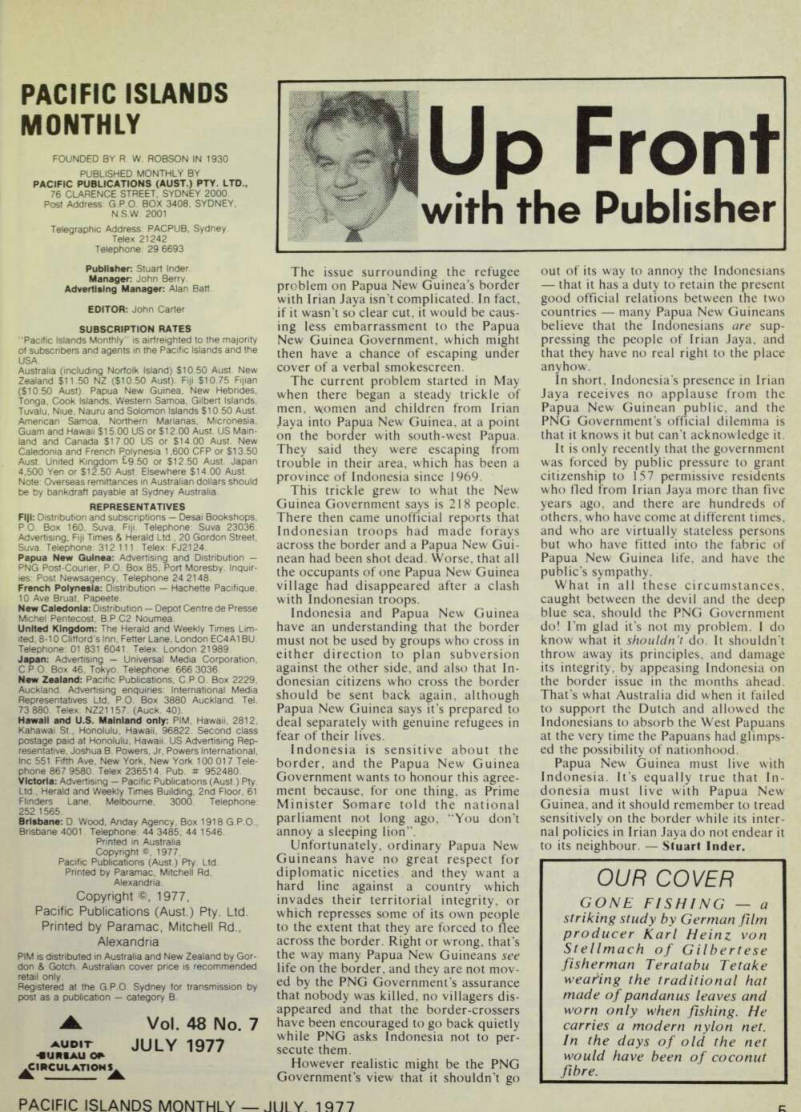
Our Cover
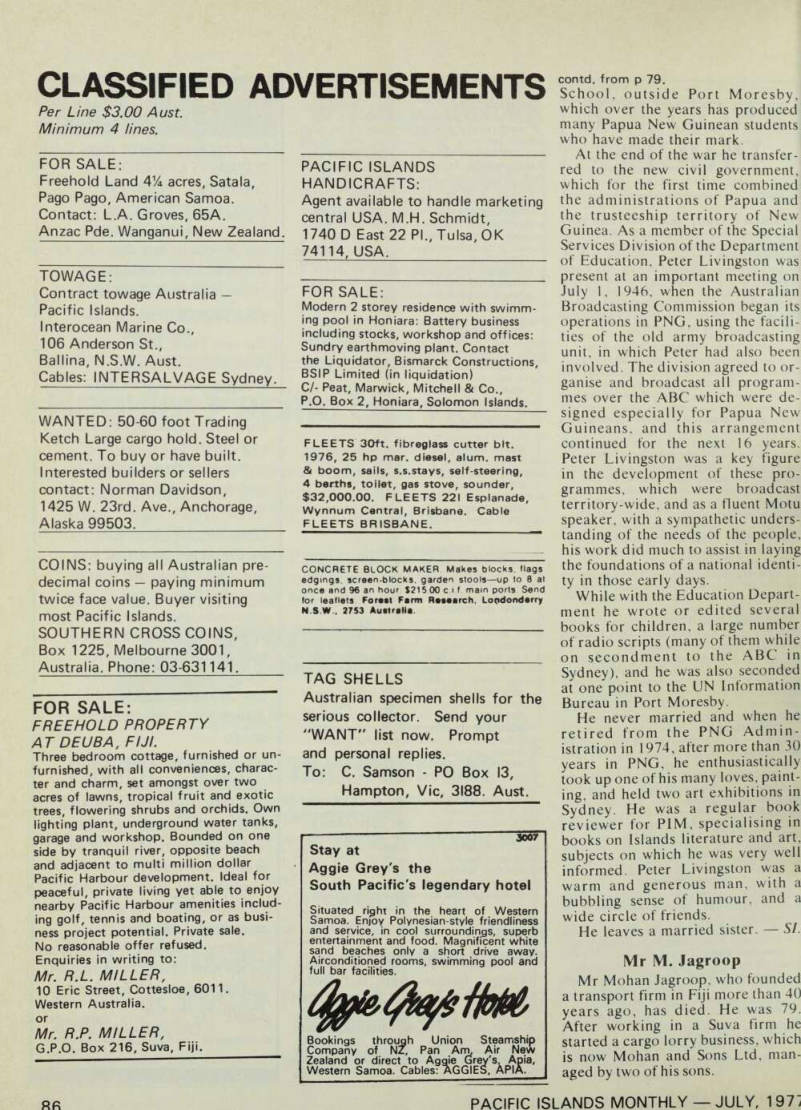
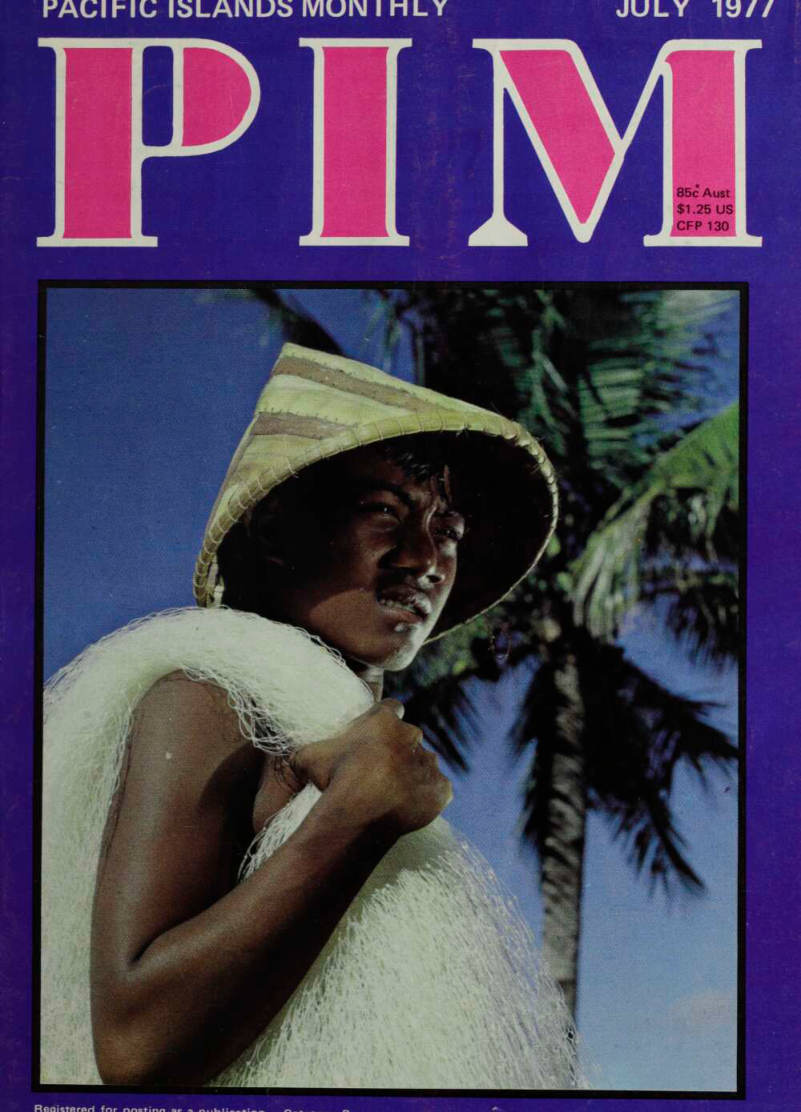
Gone Fishing A
striking study by German film producer Karl Heinz von Stellmach of Gilbertese fisherman Teratabu Tetake wearing the traditional hat made of pandanus leaves and worn only when fishing. He carries a modern nylon net.
In the days of old the net would have been of coconut fibre.
Advertisements & other items, pp. 2-4 (1 item)
I Akai I
h ■ ■;• ; ■ MM
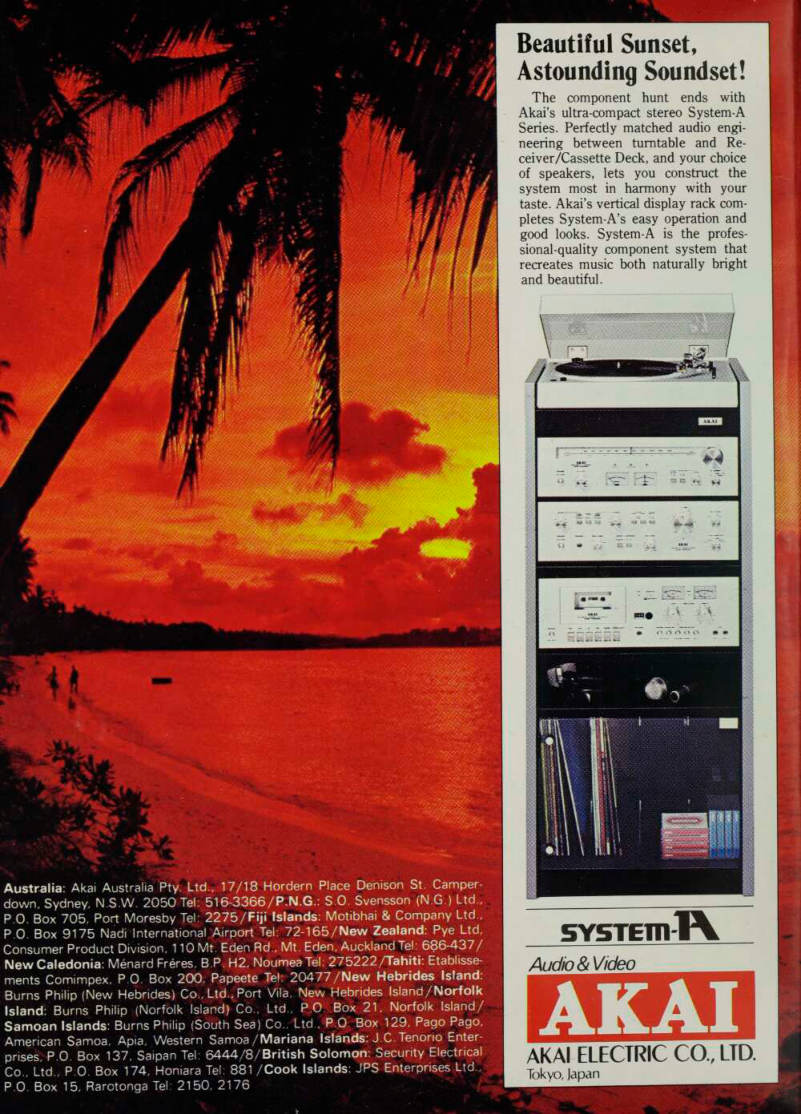
Beautiful Sunset,
Astounding Soundset!
The component hunt ends with Akai’s ultra-compact stereo System-A Series. Perfectly matched audio engineering between turntable and Receiver/Cassette Deck, and your choice of speakers, lets you construct the system most in harmony with your taste. Akai’s vertical display rack completes System-A’s easy operation and good looks. System-A is the professional-quality component system that recreates music both naturally bright and beautiful. / m i /
MViVi
M i ; II i m> m m n mr Australia: Akai Australia Pty. Ltd., 17/18 Hordern Place Denison St. Camperdown, Sydney, N.S.W. 2050 Tel: 516-3366/P.N.G.: S O. Svensson (N.G.) Ltd., p.O. Box 705, Port Moresby Tel: 2275/Fiji Islands: Motibhai & Company Ltd., P.O. Box 9175 Nadi International Airport Tel: 72-165/New Zealand: Pye Ltd, Consumer Product Division, 1 IOMt. Eden Rd„ Mt. Eden, Auckland Tel: 686-437/ New Caledonia: Menard Freres, B.P. H 2, Noumea Tel: 275222/Tahiti; Etablissements Comimpex, P.O. Box 200, Papeete Tel: 20477/New Hebrides Island; Burns Philip (New Hebrides) Co., Ltd., Port Vila. New Hebrides Island/Norfolk Island: Burns Philip (Norfolk Island) Co., Ltd,, P.O, Box 21, Norfolk Island/ Samoan Islands; Burns Philip (South Sea) Co., Ltd,, P.O. Box 129, Pago Pago, American Samoa, Apia, Western Samoa /Mariana Islands: J.C. Tenorio Enterprises, P.O. Box 137, Saipan Tel: 6444/8/British Solomon: Security Electrical Co„ Ltd,, P.O. Box 174, Honiara Tel: 881 /Cook Islands: JPS Enterprises Ltd,, P.O. Box 15, Rarotonga Tel: 2150, 2176
SYSTEHI-I\
Audio & Video
I AKAI I
AKAI ELECTRIC CO., LTD.
Tokyo, Japan
•* •• ■ ■£ \
Pbcketautdegold
€i A f ■« f ■■
S^iafjmer
Bbmsommad Hedges 20 Benson and Hedges Special Filter. When only the best will do. L585 - V77
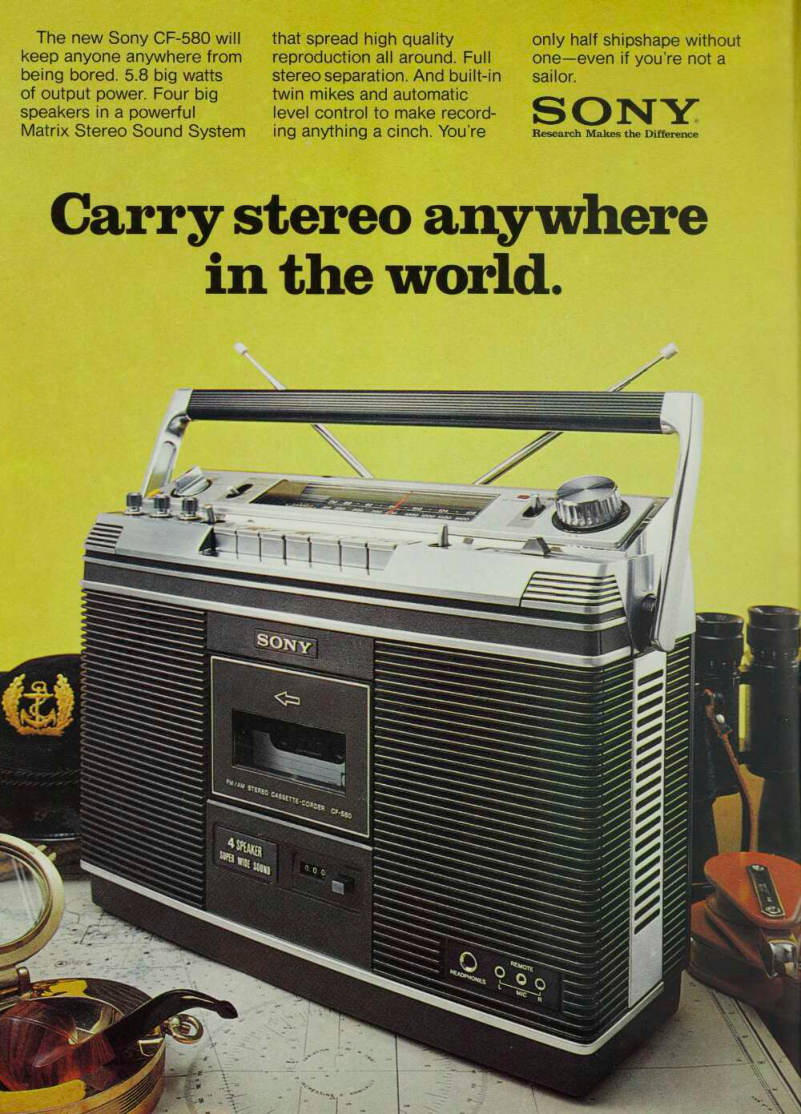
The new Sony CF-580 will keep anyone anywhere from being bored. 5.8 big watts of output power. Four big speakers in a powerful Matrix Stereo Sound System that spread high quality reproduction all around. Full stereo separation. And built-in twin mikes and automatic level control to make recording anything a cinch. You’re only half shipshape without one—even if you’re not a sailor.
SONY
Research Makes the Difference
Carry stereo anywhere
in the world.
£ Z Z Z Z y r
Monthly
Pacific Islands
Subscription Rates
“Pacific Islands Monthly” is airfreighted to the majority of subscribers and agents in the Pacific Islands and the
Usa
Australia (including Norfolk Island) $10.50 Aust New Zealand $11.50 NZ ($10.50 Aust). Fiji $10.75 Fijian ($10.50 Aust). Papua New Guinea, New Hebrides, Tonga, Cook Islands, Western Samoa, Gilbert Islands, Tuvalu, Niue, Nauru and Solomon Islands $10.50 Aust.
American Samoa, Northern Marianas, Micronesia, Guam and Hawaii $15.00 US or $12.00 Aust. US Main land and Canada $17.00 US or $14.00 Aust. New Caledonia and French Polynesia 1,600 CFP or $13.50 Aust. United Kingdom £9.50 or $12.50 Aust. Japan 4,500 Yen or $12,50 Aust. Elsewhere $l4 00 Aust.
Note Overseas remittances in Australian dollars should be by bankdraft payable at Sydney Australia.
Representatives
FIJI: Distribution and subscriptions Desai Bookshops, P.O Box 160, Suva, Fiji. Telephone: Suva 23036.
Advertising. Fiji Times & Herald Ltd., 20 Gordon Street, Suva. Telephone: 312 111. Telex: FJ2124.
Papua New Guinea: Advertising and Distribution PNG Post-Courier, P.O. Box 85, Port Moresby. Inquir ies: Post Newsagency, Telephone 24 2148 French Polynesia: Distribution Hachette Pacifique, 10 Ave Bruat, Papeete New Caledonia: Distribution Depot Centre de Presse Michel Pentecost, 8.P.C2 Noumea.
United Kingdom: The Herald and Weekly Times Lim ited, 8-10 Clifford's Inn, Fetter Lane, London EC4AIBU.
Telephone: 01 831 6041 Telex; London 21989.
Japan: Advertising Universal Media Corporation, C.P.O. Box 46, Tokyo. Telephone: 666 3036.
New Zealand: Pacific Publications, C.P.O. Box 2229, Auckland. Advertising enquiries: International Media Representatives Ltd, P.O. Box 3880 Auckland. Tel. 73 880. Telex: NZ21157. (Auck. 40).
Hawaii and U.S. Mainland only: PIM, Hawaii, 2812, Kahawai St., Honolulu, Hawaii, 96822. Second class postage paid at Honolulu, Hawaii US Advertising Rep resentative, Joshua B. Powers, Jr, Powers International, Inc 551 Fifth Ave, New York, New York 100 017 Tele phone 867 9580 Telex 236514 Pub. 952480 Victoria: Advertising Pacific Publications (Aust.) Pty.
Ltd . Herald and Weekly Times Building, 2nd Floor, 61 Flinders Lane, Melbourne, 3000. Telephone: 252 1565 Brisbane; D Wood, Anday Agency, Box 1918 G.P.0., Brisbane 4001. Telephone 44 3485; 44 1546 Printed in Australia Copyright ©, 1977, Pacific Publications (Aust.) Pty. Ltd.
Printed by Paramac, Mitchell Rd, Alexandria.
Copyright ©, 1977,
Pacific Publications (Aust.) Pty. Ltd.
Printed by Paramac, Mitchell Rd.,
Alexandria PIM is distributed in Australia and New Zealand by Gor don & Gotch. Australian cover price is recommended retail only.
Registered at the G.P.O. Sydney for transmission by post as a publication category B
Vol. 48 No. 7
July 1977
Up Front
with the Publisher
The issue surrounding the refugee problem on Papua New Guinea’s border with Irian Jaya isn’t complicated. In fact, if it wasn’t so clear cut, it would be caus ing less embarrassment to the Papua New Guinea Government, which might then have a chance of escaping under cover of a verbal smokescreen.
The current problem started in May when there began a steady trickle of men. women and children from Irian Jaya into Papua New Guinea, at a point on the border with south-west Papua.
They said they were escaping from
trouble in their area, which has been a province of Indonesia since 1969.
This trickle grew to what the New Guinea Government says is 218 people.
There then came unofficial reports that Indonesian troops had made forays across the border and a Papua New Gui nean had been shot dead. Worse, that all the occupants of one Papua New Guinea village had disappeared after a clash with Indonesian troops.
Indonesia and Papua New Guinea have an understanding that the border must not be used by groups who cross in either direction to plan subversion against the other side, and also that In donesian citizens who cross the border should be sent back again, although Papua New Guinea says it’s prepared to deal separately with genuine refugees in fear of their lives.
Indonesia is sensitive about the border, and the Papua New Guinea Government wants to honour this agree ment because, for one thing, as Prime Minister Somare told the national parliament not long ago, “You don’t annoy a sleeping lion ".
Unfortunately, ordinary Papua New
Guineans have no great respect for diplomatic niceties and they want a hard line against a country which invades their territorial integrity, or which represses some of its own people to the extent that they are forced to flee across the border. Right or wrong, that’s the way many Papua New Guineans see life on the border, and they are not mov ed by the PNG Government’s assurance that nobody was killed, no villagers dis appeared and that the border-crossers have been encouraged to go back quietly while PNG asks Indonesia not to per secute them.
However realistic might be the PNG Government’s view that it shouldn’t go
out of its way to annoy the Indonesians that it has a duty to retain the present good official relations between the two countries many Papua New Guineans believe that the Indonesians are sup pressing the people of Irian Jaya, and that they have no real right to the place
anyhow.
In short, Indonesia’s presence in Irian Jaya receives no applause from the Papua New Guinean public, and the PNG Government’s official dilemma is that it knows it but can’t acknowledge it.
It is only recently that the government was forced by public pressure to grant citizenship to 157 permissive residents who fled from Irian Jaya more than five years ago, and there are hundreds of others, who have come at different times, and who are virtually stateless persons but who have fitted into the fabric of Papua New Guinea life, and have the
public’s sympathy.
What in all these circumstances, caught between the devil and the deep blue sea, should the PNG Government do! I’m glad it’s not my problem. Ido know what it shouldn’t do. It shouldn’t throw away its principles, and damage its integrity, by appeasing Indonesia on the border issue in the months ahead.
That’s what Australia did when it failed to support the Dutch and allowed the Indonesians to absorb the West Papuans at the very time the Papuans had glimps ed the possibility of nationhood.
Papua New Guinea must live with Indonesia. It’s equally true that In donesia must live with Papua New Guinea, and it should remember to tread sensitively on the border while its inter nal policies in Irian Jaya do not endear it
to its neighbour.
Stuart Inder.
Advertisements & other items, pp. 5-6 (3 items)
Pacific Islands Monthly Jljl Y 1977
5
FOUNDED BY R W. ROBSON IN 1930
PUBLISHED MONTHLY BY
PACIFIC PUBLICATIONS (AUST.) PTY. LTD.,
76 CLARENCE STREET, SYDNEY 2000
Post Address G P.O. BOX 3408, SYDNEY,
NSW 2001
Telegraphic Address: PACPUB, Sydney Telex 21242 Telephone: 29 6693 Publisher: Stuart Inder Manager: John Berry Advertising Manager: Alan Batt.
EDITOR: John Carter
6
r-. a AMno in a mho rv/irkMTUi V II II V 1977
S. E. Tatham
SOME OF
THE FIRMS
REPRESENT
M Allens (Confectionery) Amatil (Twisties, Twirlies) Arnbro (Folding Beds) Asia Rubber Works (Singapore Rubber Shoes) Austramax (Pressure Lanterns) B.X. (Plastics) City Engineers (U.K. Bicycles) Disston (Saws) Durobor S.A, (Belgium Glassware) Edward Zorn (Margarine, Cooking Fats) Electronic Industries (Electrical Household Appliances) Elmaco (Plastics—Electrical Fittings) Essteel (Cookware) F.H.I. Japan (Subaru Cars) Franklite (Light Fittings) Frappier (French Brandy) Huvet (French Brandy) Indika (Belgium Dairy Produce) James Miller (Blankets) Jex (Steelwool) JJ. Cash (Embroidered Labels) Kinki Industrial Co. Ltd. (Japan—Textile piece goods) Lega Marcasite (Jewellery) Magnet (Mattresses) Miroiterie Gen. de Belgiqe S.A. (Louvre Glass & Mirrors) Mitchell's (Abrasives) Quaker Products (Oats, Jets) Red Tulip (Fine Chocolates) Regent (Swiss Watches) Rinoldi Hancock Pty. Ltd. (Spaghetti & Cereals) Robert Timms (New Guinea Gold Instant Coffees & Teas) S.P.C. (Abalone) S.P.C. (Canned Fruit) Sterling Clothing Co. Pty. Ltd. (Colonials Jeans, Jackets, & Skirts etc.) Sunrise (Confectionery) Tilbury & Lewis (Sports Trophies & Silverplate) Tubco (Garden Furniture) U Bond Industries Corp. (Taiwan—Bicycles & Fans) Wing Lee (See Yau Sauce)
DIRECT ENQUIRIES WELCOMED
PAPUA NEW GUINEA: S. E. TATHAM (P.N.G.) PTY. LTD.,
LAE: MALAITA STREET (P.O. BOX 1562).
PORT MORESBY: CNR. GOROA AND MANAHU STREETS, GORDON
(P.O. BOX 6733, BOROKO).
FIJI: S. E. TATHAM (FIJI) LTD.,
LAUTOKA: P.O. BOX 366.
SUVA: G P.O. BOX 671.
S. E. TATHAM
& CO. PTY. LTD.
BEEHIVE BLDG.,
94 ELIZABETH ST.,
MELBOURNE, 3001, AUSTRALIA.
G.P.O. BOX B—CABLES "SET"
PHONE: 63 5094
TELEX: AA34552
BUYERS FOR THE
PACIFIC ISLANDS
% « V « %
YOUR GUARANTEE
1 1 H
FOR SERVICE
SINCE 1024
In this issue
General
Australia's aid to Islands 8,9, 10 Business potential of PNG 18 Down-to-earth Islanders 23 Wishful thinking blasted 25 Stamp issues 27 Pacifique Sud with Helen Rousseau 28 Deputy Director of Spec 33 Australia's trade 53 Climate for investment 59 Good trading opportunities 61 C. Sullivan's "new look” 61 Challenger for air routes 65 Tonga's new shipping line 73 Questions about Forum Line 75 Pat Raddock & Peter Livingston die 79
Cook Islands
Query about Brych 20 Tupui Henry out 20
Ufos 23
Benefits of Atiu airstrip 25 Tom Neale ill 32 Valuable glass plates 40
Fiji
Political suspense 11 $lO million offer to Banabans 13 Police gang rape 20 Census 21 Senator in trouble 21 Rugby win in Hong Kong 21 Rakiraki shops destroyed 21 Down to earth Islanders 23 Barmaid is tops 23 Defaulting ratepayers 27
Trade balance 54 Advantages of EEC 55 Marine court critical 67 Waterfront row 71 Pat Raddock dies 79
French Polynesia
Archaeological discovery 20 Pacifique Sud with Helen Rousseau 28
Gilbert Islands
$lO million offer to Banabans 13 Murder charge in New Hebrides 20 Betio-Bairiki causeway 57 Loan sought for shipping 71
Guam
No casino gambling 12
Nauru
Special beer can 20
New Caledonia
Pacifique Sud with Helen Rousseau 28 Beef problems 58
New Hebrides
Gilbertese on murder charge 20 Athletes do well in NZ 20 Pacifique Sud with Helen Rousseau 28 Fisherman goes home 33 Victim of lightning 33 Jack Judge back in Pacific 33 Club Mediteranee planned 55
Niue
Census 21 Ancient "blue” laws 27
Norfolk Island
MP's plea 10
Papua New Guinea
Election Stakes 14 Irian refugees 16 Business potential 18 Embassy in US 21 Drive against vagrants 21 Two ballots for premier 21 Murderer gaoled 21 Pay-day swill 21 Election drain 21 Myth of doctors' handwriting 25 John Parker in Sydney 33 Bougainville copper earnings 59 Tariff protection planned 63 Pilots'dispute 67 Container service 68 Peter Livingston dies 79
Tonga
Boating tragedy 20 Honour for Dr Tapa 32 New shipping line 73
Solomon Islands
Britain's $4O million gift 13 SI man is tourism boss 32 The Breathless Army 36
Us Trust Territory
Carmen Bigler's "firsts” 33 Peter Coleman's new job 33
Western Samoa
Forum Line delay slated 75
DEPARTMENTS: Up Front with the Publisher, 5; News in a Nutshell, 20; Tropicalities, 23; Editor's Mailbag, 29; People, 32; Islands Press, 34; Magazine Section, 36; Books, 49; Business & Development, 53; Pacific Transport, 65; Cruising Yachts, 77; Deaths of Islands People, 79; Shipping Information, 80; Produce Prices, 85
Advertisements & other items, p. 7 (1 item)
7
DAOiriP IPI A mrvO K/I/Mlixiii \/ ii r i v z a ft-i-i
The ABC of Australia’s $60
million aid to the Islands
By John Carter And Malcolm Salmon
Finally committed to the belief that her future is irrevocably bound up with the Island countries of South Pacific, Australia plans over the next three years to spend at least $6O million on an expanded and modified programme of bilateral aid to the Islands.
Nine countries will benefit the Cook Islands, Fiji, the Gilberts.
New Hebrides. Niue, the Solomon Islands. Tonga. Tuvalu and Western Samoa. Already, teams have toured some of the countries to discover local priorities and plan program mes which will improve the econ omies and raise living standards throughout the Islands.
It's not many years ago that some of the Islanders, particularly in countries like Fiji where there is considerable private business in volvement. complained that Australia regarded the Islands as a milch cow to be milked of profits. If it was true then and it was an over-simplification anyway it isn't true today. Australia con tributes the most of all the developed countries to the South Pacific Commission. But she has said that isn't enough, and she plans to increase her aid and to be more closely involved in the South Pacific than ever before.
Now. she's putting her money where her mouth is to the tune of. at least. $6O million. And. in case the cynic says that it wouldn't have happened if the Russians and the Chinese hadn't come knocking on Island doors, the aid plan and the money were already in the pipeline when the communist countries made their overtures.
Papua New Guinea isn't included in the programme. The great aid PNG gets and will get is part of a different set-up.
There's a comparatively new and large department in Canberra, the Australian Development Assistance Bureau (ADAB) which handles all the aid Australia gives to India.
South-east Asia, the South Pacific Islands and others.
Agriculturists, economists,
engineers and other specialists work from ADAB to a programme com piled by Australian officials and of-
Australia is revamping its policy towards the South Pacific. In the years ahead the Island countries of the region will be given higher priority by Canberra in terms of political and diplomatic attitudes, and in terms of economic aid, than has been the case in the re cent past.
PIM, in this issue, takes a close look at the new Australian policy at the point of development it has reached to date, and at its likely directions for the future.
ficials of the country being helped.
Fiji, as the largest country in the South Pacific programme, will get about $21.5 million of the $6O million. The other allocations (all approximate) are; Cooks $700,000; Gilberts $4 million; New Hebrides $5.3 million; Niue $150,000; Solomons 16.55 million. Tonga $7 million; Tuvalu $600,000; Western Samoa $lO.B million. Regional pro jects, which will include support for the University of the South Pacific, will take $3.4 million.
But it’s a rolling programme and $6O million is not the final figure. It may be larger, but not smaller, and there are imponderables in the programme. Some think ADAB is under-staffed and may not be able to handle all the work once the wheels are really turning. Much will de pend on Island officials and experts, of whom there aren’t many around, and individual projects may get bog ged down.
This year, if this doesn't happen. $l3 million will be spent, with $2O million earmarked for 1977/78 and $27 million in 1978/79.
What's more important than the
amount of aid are the new forms of aid in the programme. There’ll be no monuments to Australian generosity, huge schemes the upkeep of which will bleed an Island coun try white, but projects which, in the words of Dr John Baker, head of the Pacific. Asia and Africa Programme Branch of ADAB. “will be more re sponsive to the needs of the South Pacific Islands."
Cash grants will be made to na tional development banks to in crease their equity and lending and there will be projects of technical and educational assistance and food aid.
When the Western world entered the Islands, the people, in many in stances. adopted Western ways with canned meats, one-minute meals and bottled this and that. Surround ed by millions of square miles ot water teeming with fish, the Islan ders still import most of their fish.
Australian aid will aim at creating self-sufficiency which means that, it she never did it before. Australia (and New Zealand, too) will be knocking much of the bottom out ot her Island markets. But not altogether. With a higher living standard. the Islanders will want more of the good things of life which may have to come from overseas.
Added to that. Australia has at tached one string to her aid and she can’t guarantee that the Islanders will pull the string that goods bought outside the Pacific Islands should be bought, mainly, from Australia.
Some grants will be used to enable the “locals" or governments to buy shares in Australian firms operating in the Islands. Papua New Guineans know how well that sort ot aid is working.
There will be increased invest ment. a transfer of technology, more
employment opportunities,
manufacturing and processing in
dustries, tourist development and better transport and com munications.
Much of past aid from developed countries to the Islands has been swallowed up in experts’ salaries and the local costs of projects, as the aided country had to foot the bill for all these. That’s all changed. In this new programme up to 100% of such bills will be met by Australia.
How many times has come the complaint from the aided country, “You gave us so much, but most of it has gone in paying the salaries and expenses of the people sent to launch the projects”.
Not so long ago, Australia met a bill for $300,000 as an accountable grant to the Gilberts to pay for two airfields being built in the outer is lands.
There have been much smaller payments $16,000 for houses for agricultural extension officers in some Western Samoa villages, and $12,000 for a courthouse at Mua village in Tonga.
When decisions are to be made on which projects are to be funded in a particular country, the programme branch sends a team, usually headed by the branch head. Dr Baker, to that country. The office has a collec tion of development plans from various countries. These are studied so that the team has a good idea, before setting out. what it will look for.
"Our basic guideline,” Dr Baker told us.” is to follow the priorities established by the recipient country.
We are really interested to see that the project proposed for assistance is included in that country’s
development plan.
“We examine the whole thing to see if it is going to increase employ ment. raise living standards, reduce the country’s dependence on outside support and assistance, increase ex ports and. by the same token, avoid encouraging that kind of develop ment which is going to increase the country’s dependence on outside aid.
“‘The main aim of the whole aid programme is to help to strengthen the countries of the region, both economically and socially.
“ Another aim is to avoid sup porting projects which are going to contribute to an excessive increase in government expenditure.
“The projects should be designed, as far as possible, to encourage self-
sufficiency and avoid developing an attitude of dependence. The main means of achieving this are by pro viding support for grass-roots development and assistance to non government organisations.
“ Projects should not contribute to the development of either the social or economic infrastructure whose upkeep a country paddling its own canoe can’t afford.
“The basic thing is that we are try ing to follow their'priorities and re cent missions have, with very few exceptions, completely identified the programme of assistance with the proposals put to the missions by the governments concerned.
“Problems can arise where a re quest would result in our aid being spent on one very large project to
the exclusion of almost all other projects in that particular country. ‘Frequently, these very large pro jects are more suitable for funding by one of the international agencies such as the World Bank or the Asian Development Bank.”
The ADAB, Dr Baker pointed out. had its favourites among pro jects. agriculture and rural develop ment for example.
“However, the problem there.”
Dr Baker said, “is that, whereas it is fairly easy for a country to identify major infrastructure projects such as roads, airports or telecommunica tion facilities, it is very much harder for us to develop similar scale agricultural and rural projects because of the tremendous social and cultural ramifications of such projects.”
The programming missions have almost a fixed method of approach to the aid countries. An average mission spends four to five working days in each country, following a fairly standard approach. The first day is spent in introducing the team and holding working discussions with the government’s planning office to review projects inviting Australian support.
The following two or three days are filled with detailed investigation and documentation of individual projects, with the various experts in the team working in their respective fields of specialisation.
There is a “wrap-up” session on the final day with the planning office and other senior officials when the future shape and composition of the programme is reviewed and tenta tive agreement to the list of requests is given by both sides.
Then the team goes home and out from Australia goes a feasibility team. Specialist advisers are engag ed and approvals are sought before the plant and equipment is obtained for the particular project in view.
And that is when, sometimes, there is a hitch. A date for the start of the work is agreed on. Something happens somewhere a strike, maybe, a hurricane, or some equip ment is out of stock and the tools for the job don’t arrive.
The project is held up, the money earmarked for it doesn’t get spent, and the Australian politicians start asking questions because aid to the Islands has become a political foot ball.
It’s likely that the $l3 million
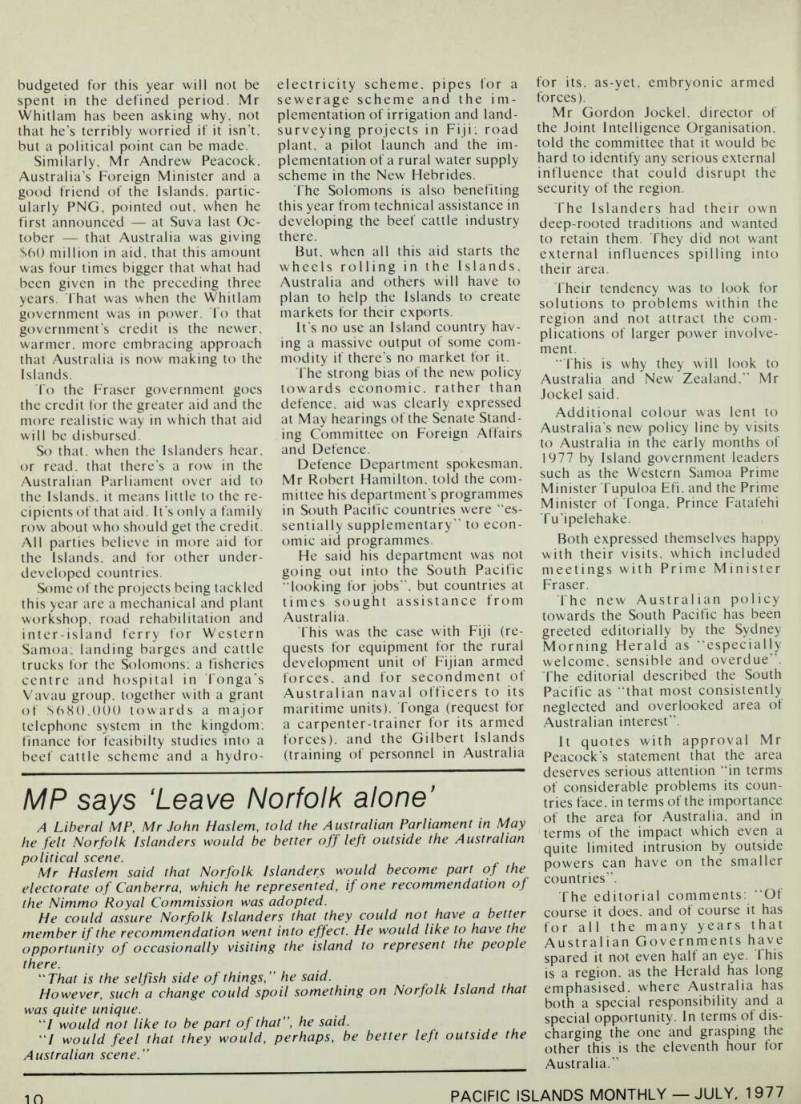
Dr John Baker
budgeted for this year will not be spent in the defined period. Mr Whitlam has been asking why, not that he’s terribly worried if it isn’t, but a political point can be made.
Similarly. Mr Andrew Peacock.
Australia’s Foreign Minister and a good friend of the Islands, partic ularly PNG, pointed out, when he first announced at Suva last Oc tober that Australia was giving $6O million in aid. that this amount was four times bigger that what had been given in the preceding three years. That was when the Whitlam government was in power. To that government’s credit is the newer, warmer, more embracing approach that Australia is now making to the Islands.
To the Fraser government goes the credit for the greater aid and the more realistic way in which that aid will be disbursed.
So that, when the Islanders hear, or read, that there’s a row in the Australian Parliament over aid to the Islands, it means little to the re cipients of that aid. It’s only a family row about who should get the credit.
All parties believe in more aid for the Islands, and for other under
developed countries.
Some of the projects being tackled this year are a mechanical and plant workshop, road rehabilitation and inter-island ferry for Western Samoa, landing barges and cattle trucks for the Solomons: a fisheries centre and hospital in Tonga’s Vavau group, together with a grant of $680.000 towards a major telephone system in the kingdom: finance for feasibilty studies into a beef cattle scheme and a hydro
electricity scheme, pipes for a sewerage scheme and the im plementation of irrigation and land surveying projects in Fiji: road plant, a pilot launch and the im plementation of a rural water supply scheme in the New Hebrides.
The Solomons is also benefiting this year from technical assistance in developing the beef cattle industry there.
But. when all this aid starts the wheels rolling in the Islands.
Australia and others will have to plan to help the Islands to create markets for their exports.
It’s no use an Island country hav ing a massive output of some com modity if there’s no market for it.
The strong bias of the new policy towards economic, rather than defence, aid was clearly expressed at May hearings of the Senate Stand ing Committee on Foreign Affairs and Defence.
Defence Department spokesman.
Mr Robert Hamilton, told the com mittee his department’s programmes in South Pacific countries were “es sentially supplementary” to econ omic aid programmes.
He said his department was not going out into the South Pacific "looking for jobs”, but countries at times sought assistance from Australia.
This was the case with Fiji (re quests for equipment for the rural development unit of Fijian armed forces, and for secondment of Australian naval officers to its maritime units). Tonga (request for a carpenter-trainer for its armed forces), and the Gilbert Islands (training of personnel in Australia
for its. as-yet, embryonic armed forces).
Mr Gordon Jockel. director of the Joint Intelligence Organisation, told the committee that it would be hard to identify any serious external influence that could disrupt the security of the region.
The Islanders had their own deep-rooted traditions and wanted to retain them. They did not want external influences spilling into their area.
Their tendency was to look for solutions to problems within the region and not attract the com plications of larger power involve ment.
" This is why they will look to Australia and New Zealand." Mr Jockel said.
Additional colour was lent to Australia’s new policy line by visits to Australia in the early months of 1977 by Island government leaders such as the Western Samoa Prime Minister Tupuloa Efi. and the Prime Minister of Tonga. Prince Fatafehi
Tu’ipelehake.
Both expressed themselves happy with their visits, which included meetings with Prime Minister Fraser.
The new Australian policy towards the South Pacific has been greeted editorially by the Sydney Morning Herald as "especially welcome, sensible and overdue".
The editorial described the South Pacific as "that most consistently neglected and overlooked area ot Australian interest”.
It quotes with approval Mr Peacock’s statement that the area deserves serious attention "in terms of considerable problems its coun tries face, in terms of the importance of the area for Australia, and in terms of the impact which even a quite limited intrusion by outside powers can have on the smaller countries”.
The editorial comments: “Of course it does, and of course it has for all the many years that Australian Governments have spared it not even half an eye. This is a region, as the Herald has long emphasised, where Australia has both a special responsibility and a special opportunity. In terms of dis charging the one and grasping the other this is the eleventh hour for Australia.”
“Etonnant!"
“More than five million Australian dollars (477 million New Hebrides francs) in three years . . . Australian aid to the New Hebrides in the coming period will amount to that rather astonishing figure,” says the French/ Bi si ama Vila fortnightly, Nabanga, in a May commentary.
Reporting a visit to the condominium by a team from the Australian Development Assistance Bureau (ADAB) in April, the commentary noted that Australia was not putting forward ready-made programmes, but was “con tenting itself with financing programmes that are pre sented to it”.
Advertisements & other items, p. 9 (1 item)
9
D A f'lCI/’' IO 1 A l 11/Ml-ri •• > /
MP says ‘Leave Norfolk alone’
A Liberal MP, Mr John Haslem, told the Australian Parliament in May he felt Norfolk Islanders would be better off left outside the Australian political scene.
Mr Haslem said that Norfolk Islanders would become part of the electorate of Canberra, which he represented, if one recommendation of the Nimmo Royal Commission was adopted.
He could assure Norfolk Islanders that they could not have a better member if the recommendation went into effect. He would like to have the opportunity of occasionally visiting the island to represent the people there.
“That is the selfish side of things,” he said.
However, such a change could spoil something on Norfolk Island that was quite unique.
“/ would not like to be part of that”, he said.
“/ would feel that they would, perhaps, be better left outside the Australian scene.”
Fiji's Cuff-Hanger Continues
With An Election In The Offing
From ROBERT KEITH-REID in Suva
Fiji still lingers in a state of politi cal suspense four months after a general election that stripped the ruling Alliance Party of its parlia mentary majority, and, hence, power.
Events that have followed in the election’s wake climaxed at the beginning of June with the Governor-General, Ratu Sir George Cakobau, dissolving parliament after the NFP had steam rollered a motion through the House which, in effect, defeated a government-tabled motion of confidence.
Moving the motion Ratu Sir Kamisese said the NFP’s indecision after the election had left the coun try rudderless while the Alliance had been besieged with “unbelieva ble” Opposition offers of a coali tion, interim and caretaker-type governments.
The NFP countered with a curious amendment to the govern ment motion.
This said, in effect, that if, and the “if” was what the Alliance pounced on as evidence of the NFP’s wish to avoid becoming the government if the Governor-General should get the Alliance’s advice to dissolve parliament so that another election could be held, he should ignore it and appoint Mr Koya as Prime Minister instead.
The Alliance, after taking legal advice on this idea, blasted it as
“constitutionally impossible”.
House Leader, Mr Jonati Mavoa said the passing of the amendment would be to ask the Governor- General to do something that he had no legal right to do.
For this reason the Alliance would ignore the advice and carry on as a minority government until a time for a dissolution most favoura ble for it cropped up, he said.
It would resign on the spot only if its own motion for a vote of corl fidence in itself was defeated
directly.
The Fijian Nationalist leader, Mr Butadroka, voted with the NFP.
After the vote, the House continued with its normal business.
As the Alliance had warned, the motion was not accepted as a vote of no-confidence.
Ratu Sir Kamisese said his government would carry on as best it could.
He had told the press beforehand that, as far as he was concerned, a fresh election could be deferred un til February or March next year if the Electoral Commission felt it needed this time in which to sort out some of the administrative foul-ups that had occurred in organising the previous one.
But it would be nice to get the election over and done with before the budget session started in November, he added.
The Alliance is already busy cam paigning for the next round of poll ing, chiefly against the Fijian Na tionalist Party, the cause of its ruin.
It hopes to win back a substantial portion of lost Fijian loyalties, which it must do if it is to regain any kind of majority.
Admirers of the Alliance believe this will restore the mainly Fijian and European-backed party “to its former glory” as one of them over optimistically enthused.
More impartial observers, however, suspect that the Alliance will be lucky to collect anything more than a slender working ma jority of one or two.
Some Alliance men had privately hoped that the arrest of the Fijian Nationalist leader Sakiasi Butadroka in April might nip the nationalist cause in the bud, making it much easier to recover defecting Fijian voters.
Butadroka and two of his followers face charges under the tough Public Order Act, basically of holding illegal meetings and, in Butadroka’s case, of inciting race hatred.
But Butadroka’s remand in custo dy has made him something of a heroic martyr in many Fijian eyes.
Although he was released in late May to await a Supreme Court trial due to start in September, his un doubted magnetism and his “kick the Indians out, Fiji for the Fijians” philosophies have made him a major force in Fiji politics that cannot be eliminated in just a few months.
Indeed, while Ratu Sir Kamisese has publicly stated that he thinks the influence of the Nationalists has waned since the April election, many others believed that it con tinues to gain strength rapidly.
Because of this it is quite possible that the NFP, despite its lost cre dibility, might do just as well, at the Alliance’s expense, at the next elec tion as it did at the last one.
It’s a possibility which is causing foreign investors to cancel or shelve schemes they had in mind for Fiji at a time when the stagnant Fijian economy, struggling to recover from the effect of a world-wide recession is desperately in need of such con crete signs of confidence in it.
And it’s quite on the cards that the result could turn out exactly the same.
The ingredients that have pro duced the current goulash situation are unlikely to have altered much by the time polling stations are opened again.
The April election spelt disaster for the Alliance, slashing its strength in the 52-seat House of Rep resentatives from 33 to 24, and giv ing the mainly Indian backed Na
Sakiasi Butadroka... something of a heroic martyr.
tional Federation Party 36 seats.
The cause was the influence of the anti-Indian Fijian Nationalist Party.
Besieged by troubles that in cluded a murderous internal strug gle for its leadership, and knowing that, with only half of the House of Representative’s seats, it would be unable to control parliament with any effect, the NFP hesitated in try ing to form a government.
The Governor-General. Ratu Sir George Cakobau, made up the NFP’s mind for it four days after the election when he reappointed Ratu Sir Kamisese Mara, the Alliance’s leader, as Prime Minister.
The reason he gave was that the NFP’s leader, lawyer Siddiq Koya, did not command the support of the majority of the House the qualification which the Fiji Con stitution requires of the man who is the country’s PM.
Mr Koya put on an angry show about being deprived of what he said was his party’s just due the right to govern. The NFP, he blustered, could kick the Alliance out of power any time it wanted.
Mr Koya and other NFP big-wigs were also angrily denying reports that their party was crippled by a chasm of distrust and intrigue caus ed by the efforts of anti-Koya fac tions to dislodge him as party boss.
But the round of protestations, ac cusations and confrontations ut tered or promised by the NFP in dealing with the Alliance met with mounting disbelief in all quarters of Fiji as daily reports of what was going on in NFP circles were re counted by the local press.
First of all. the NFP failed to move an immediate vote of no con fidence in the new minority govern ment when the new House of Rep resentatives met for the first time three weeks after the election.
And then its president, Mrs Irene Jai Narayan, and secretary, Mr Karam Ramrakha, openly con tinued their efforts to bring Mr Koya down.
Mr Koya quietly retaliated in his own astute way and, despite all the public uproar against him, staged a recovery that, by the time Parlia ment came to meet again in late May, showed that he was still the single most powerful force in the NFP that the Alliance or his own personal foes had to contend with.
Advertisements & other items, p. 11 (1 item)
11
PACIFIC ISLANDS MONTHI Y II II V 1 Q 77
Guam's Casino Game
Bishop Held The Ace In
From TOM BRISLIN on Guam
Voters in the United States Ter ritory of Guam soundly defeated a proposal to legalise casino-type gambling. The question was put to a popular vote in a special election held in April during which delegates to the island’s coming con stitutional convention, and mem bers of a new Board of Education were also elected.
The legalised gambling issue has arisen several times in the past on Guam. The Guam Legislature pass ed a bill last year that would allow a government-controlled casino. But that bill was vetoed by the island’s Governor, Ricardo J Bordallo, an outspoken opponent of gambling.
The legislature also passed a bill that would allow slot machines in a specially-controlled area of the transit lounge at the Guam interna tional air terminal. But that bill also saw a veto.
The latest referendum posed three options to the voters: • Unlimited legalised casinos: • One government-operated casino; and • Legalised slot machines.
Each option was defeated by a greater than three-to-one margin with approxomately 53% of Guam’s registered voters turning out to cast their ballots.
Guam currently enjoys several forms of legal wagering including bingo, raffles, cockfighting and pari-mutuel betting at a greyhound dog racing track which offers three nights of racing a week.
Legislation also exists to permit a government lottery and pari-mutuel wagering on the game Jai Alai, but neither of these has been im
plemented.
The gambling referendum took on all the aspects of a major political campaign, eventually dwarfing the individual races for constitutional delegates and school board mem berships.
A pro-gambling faction of Guam businessmen organised a group call ed Ayuda Guam (which in the local Chamorro language means Help or
Helper to the Island) which spent about US$lOO,OOO to persuade the Guam voters to opt for a govern ment-operated casino.
The group hired a mainland US consultant who specialises in voter campaigns and was credited with the passage of the pro-gambling issue in Atlantic City. New Jersey. It also employed a direct-mail campaign, television and radio advertisements, and numerous full-page newspaper spreads to promote their cause.
They faced considerable opposi tion. however, from the Roman Catholic Church and the Bishop of Guam, Felixberto C. Flores, who waged a personal campaign against gambling. Since Guam is over whelmingly Catholic, the bishop is a formidable force in the swaying of public opinion.
The bishop’s group also embarked on a media campaign which though not as sophisticated as the pro-gambling group was as effec tive.
Governor Bordallo had earlier pledged a strong personal opposi tion campaign to the gambling issue, but as the time drew near for the referndum, he maintained a rather low profile. During the week before the vote he left the island for Washington (DC) and did not return until after the election.
Bishop Flores was elated the day following the returns and proclaim ed it a “great moral victory” for Guam. Spokesmen for the pro-gam bling faction admitted that it was a bitter defeat, and doubled that the issue would be put to a public test again in the near future.
In the accompanying election contests delegates were elected by their villages to represent them at the Guam Constitutional Conven tion which will start this summer.
The convention is charged with the drafting of a Guam constitution as the supreme governing document for the island, to replace the US Congress’ Organic Act which gave self-government to the territory in 1950.
Advertisements & other items, p. 12 (1 item)
12
PAPiFir IQI ANDS MONTHLY JULY, 1 977
Britain’s $10 million handout-
Britain’s $10 million handoutbut no smiles from Banabans
The British Foreign Secretary, Dr David Owen, announced in May that the partner governments on the board of the British Phosphate Commissioners Britain, Australia and New Zealand —would make an ex gratia payment of SAIO million to the Banabans.
The money would come from the funds currently held by the BPC funds which, he revealed in replying to a question in the House following his statement, amount at present to about SA23 million.
The payment would be made “without admitting any liability”, and “on condition that, in the outs tanding legal actions, no appeal would be made in the case against the Crown and the early resolution of the cases would be sought, and that no further claims would be made arising out of past events”.
Dr Owen made it clear that the payment was quite separate from, and therefore additional to, the damages to be paid to the Banabans by the Phosphate Commissioners themselves. In the course of his five and-a-half-day judgment handed down in December in the Banabans’ marathon High Court case against the British Government, the Vice- Chancellor, Sir Robert Megarry, said that the damages to be paid by the commissioners, should be “neither merely nominal nor very large”.
Also additional would be the SAIO million the Banabans are
likely to receive by way of phosphate revenue from July 1, 1976 until the end of mining (ex pected in 1979-80).
Dr Owen said that it was esti mated that the sum of SAIO million, invested now, would accumulate to SAI2 million by the end of 1979.
This sum would give the benefits of unearned income of about SA3SO per head per year to the 2,500 Banabans now living on Rabi Is land, in Fiji.
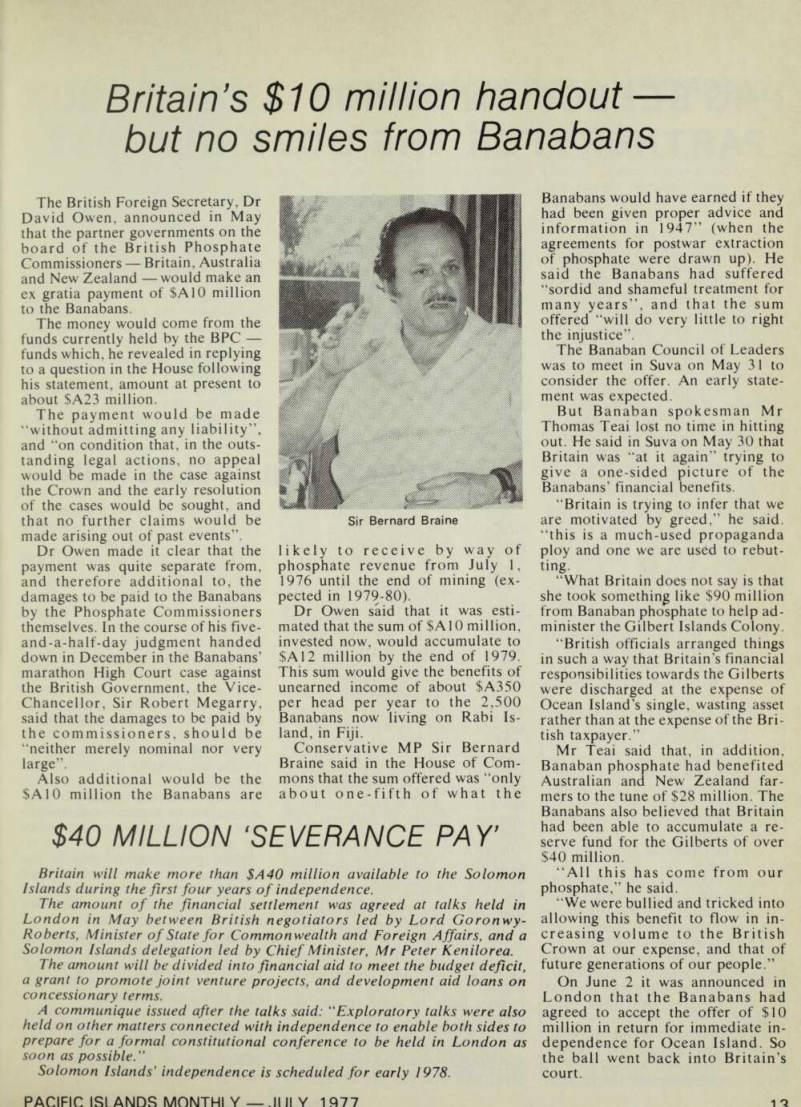
Conservative MP Sir Bernard Braine said in the House of Com mons that the sum offered was “only about one-fifth of what the
Banabans would have earned if they had been given proper advice and information in 1947” (when the agreements for postwar extraction of phosphate were drawn up). He said the Banabans had suffered “sordid and shameful treatment for many years”, and that the sum offered “will do very little to right the injustice”.
The Banaban Council of Leaders was to meet in Suva on May 31 to consider the offer. An early state ment was expected.
But Banaban spokesman Mr Thomas Teai lost no time in hitting out. He said in Suva on May 30 that Britain was “at it again” trying to give a one-sided picture of the Banabans’ financial benefits.
“Britain is trying to infer that we are motivated by greed,” he said, “this is a much-used propaganda ploy and one we are used to rebut ting.
“What Britain does not say is that she took something like $9O million from Banaban phosphate to help ad minister the Gilbert Islands Colony.
“British officials arranged things in such a way that Britain’s financial responsibilities towards the Gilberts were discharged at the expense of Ocean Island’s single, wasting asset rather than at the expense of the Bri tish taxpayer.”
Mr Teai said that, in addition, Banaban phosphate had benefited Australian and New Zealand far mers to the tune of $2B million. The Banabans also believed that Britain had been able to accumulate a re serve fund for the Gilberts of over $4O million.
“All this has come from our phosphate,” he said.
“We were bullied and tricked into allowing this benefit to flow in in creasing volume to the British Crown at our expense, and that of future generations of our people.”
On June 2 it was announced in London that the Banabans had agreed to accept the offer of $lO million in return for immediate in dependence for Ocean Island. So the ball went back into Britain’s court.
Sir Bernard Braine
$40 Million ‘Severance Pay’
Britain will make more than SA4O million available to the Solomon Islands during the first four years of independence.
The amount of the financial settlement was agreed at talks held in London in May between British negotiators led by Lord Goronwy- Roberts, Minister of State for Commonwealth and Foreign Affairs, and a Solomon Islands delegation led by Chief Minister, Mr Peter Kenilorea.
The amount will be divided into financial aid to meet the budget deficit, a grant to promote joint venture projects, and development aid loans on concessionary terms.
A communique issued after the talks said: “Exploratory talks were also held on other matters connected with independence to enable both sides to prepare for a formal constitutional conference to be held in London as soon as possible.”
Solomon Islands' independence is scheduled for early 1978.
Advertisements & other items, p. 13 (1 item)
13
PACIFIC ISLANDS MONTHI Y .1111 Y 1 377
Png’S Election Dance - Take Your
Partners For The Government?
From LUKE SELA, in Port Moresby
Mr Michael Somare will again, 1 believe, become Papua New Guinea’s Prime Minister following the general elections of June-July.
But there will, I predict, be con siderably reduced numbers in the national coalition composed of the Pangu Pati and the People’s Progress Party.
I’m aware that these are bold statements if one considers that the elections will still be continuing as this report appears, but I believe that Mr Somare will retain the coun try’s leadership because he has learned to master the art of com promise.
It is this most important quality which has kept Papua New Guinea from breaking into tiny, separate “kingdoms” since independence in 1975, and which has gained Mr Somare so much respect as Prime Minister. He has the ability to con vince, and especially to convince traditional leaders. People have confidence in him when he says in effect, “Well, we cannot give you this now, but I will give it to you next year ...”
None of this is meant to indicate that the election results will be clear cut. They will not be clear cut. I can see sleepless nights ahead before the new parliament sits in July nights similar to those in 1972 when the Pangu-PPP coalition was being hammered out so that a government could be formed.
Only this time it will be even more difficult.
On the one hand there will be the United Party, which currently is, in terms of numbers, the biggest single party in Papua New Guinea, and which I believe will continue to be.
Should it receive support from the Papua Besena and the Country Par ty, Mr Somare would not be the next Prime Minister of Papua New Guinea.
But to be able to do this the com bined United, Besena and Country parties must muster at least 60% of their candidates and likely sup
porters in the 109-man national parliament (there were 100 members in the old parliament), and I don’t think they can do it.
What about the present coalition?
I think Pangu will lose some of its seats, but the PPP will gain some, Mr Julius Chan, PPP leader and current Minister for Finance in the national coalition, says he will be happy if he gains another five or six seats.
I think he is being modest, but
whatever the PPP result, pressures inside the party will not be strong enough to influence Mr Chan into accepting the Prime Minister’s post for himself. Mr Chan respects Mr Somare, as Mr Somare respects him, and they would both want to retain their present positions in the new government.
Deputy leadership would no doubt be offered to a Papuan, to keep regional pressures at bay. That would be a post for the former
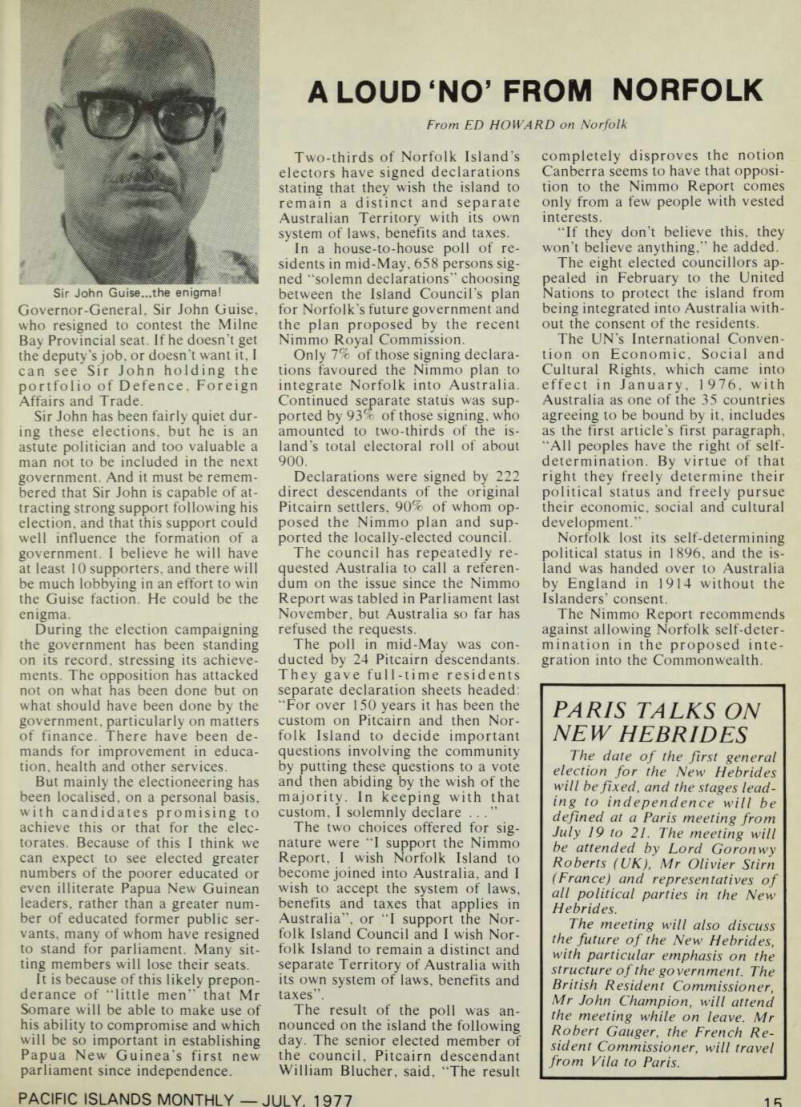
Governor-General, Sir John Guise, who resigned to contest the Milne Bay Provincial seat. If he doesn’t get the deputy’s job, or doesn’t want it, I can see Sir John holding the portfolio of Defence, Foreign Affairs and Trade.
Sir John has been fairly quiet dur ing these elections, but he is an astute politician and too valuable a man not to be included in the next government. And it must be remem bered that Sir John is capable of at tracting strong support following his election, and that this support could well influence the formation of a government. I believe he will have at least 10 supporters, and there will be much lobbying in an effort to win the Guise faction. He could be the enigma.
During the election campaigning the government has been standing on its record, stressing its achieve ments. The opposition has attacked not on what has been done but on what should have been done by the government, particularly on matters of finance. There have been de mands for improvement in educa tion, health and other services.
But mainly the electioneering has been localised, on a personal basis, with candidates promising to achieve this or that for the elec torates. Because of this I think we can expect to see elected greater numbers of the poorer educated or even illiterate Papua New Guinean leaders, rather than a greater num ber of educated former public ser vants, many of whom have resigned to stand for parliament. Many sit ting members will lose their seats.
It is because of this likely prepon derance of “little men’’ that Mr Somare will be able to make use of his ability to compromise and which will be so important in establishing Papua New Guinea’s first new parliament since independence.
Sir John Guise...the enigma!
‘Citizens Only’ Election
Voting, in Papua New Guinea’s first general elections since inde pendence, was scheduled to begin on June 18 and continue for three weeks.
Conspicuous absentees from the polling this time are the country’s 40,000 whites who find themselves disfranchised by the government ruling that in these elections citizen ship, and not merely residence, is the qualification for voting.
The only whites entitled to vote are the relatively few who have become citizens by naturalisation.
More than 700 candidates had nominated for the 109 seats in the National Parliament when nomina tions closed on May 9, but this num ber was expected to grow because of communication problems with remote areas.
Some seats attracted more than 15 candidates. Because of problems with printing and paper, these seats are excluded from the general rule that ballot papers carry photographs of the candidates for the benefit of voters who can’t read.
Electoral officials sworn to secre cy and accuracy have the job of fill ing out ballot papers for people who request help. In some remote and primitive areas, most votes are being recorded in this way.
Every elector in PNG votes for two candidates one for his prov ince, and one for his immediate
area, known as an open electorate.
There are 20 provincial electorates and 89 open electorates.
The sealed ballot boxes are not to be opened until the night of July 9, when counting is to begin.
Results of the elections are ex pected to be declared much more rapidly than at previous elections because preferential voting has been dropped in favour of first-past-the post.
Although an active party system has developed in PNG, and election campaigning is in party style, party considerations are not expected to weigh very heavily in the elections themselves.
Many candidates did not commit themselves to parties, preferring to leave their options open until after the counting.
This is expected to lead to the same situation as that which applied after the last general election, when the poll itself failed to establish the strength of the parties.
Party strengths and the emergence of a coalition government were es tablished during a lobbying period after the elections and before the first sitting of parliament.
PNG political leaders see a simi lar lobbying period towards the end of July as rivalling the elections in importance in the creation of the new government.
Advertisements & other items, p. 14 (1 item)
14
n a A'lriP 101 AMRC ft/inMTUI V II II V 1Q 7 7
A Loud ‘No’ From Norfolk
From ED HOWARD on Norfolk
Two-thirds of Norfolk Island’s electors have signed declarations stating that they wish the island to remain a distinct and separate Australian Territory with its own system of laws, benefits and taxes.
In a house-to-house poll of re sidents in mid-May, 658 persons sig ned “solemn declarations” choosing between the Island Council's plan for Norfolk’s future government and the plan proposed by the recent Nimmo Royal Commission.
Only 7% of those signing declara tions favoured the Nimmo plan to integrate Norfolk into Australia.
Continued separate status was sup ported by 93% of those signing, who amounted to two-thirds of the is land’s total electoral roll of about 900.
Declarations were signed by 222 direct descendants of the original Pitcairn settlers, 90% of whom op posed the Nimmo plan and sup ported the locally-elected council.
The council has repeatedly re quested Australia to call a referen dum on the issue since the Nimmo Report was tabled in Parliament last November, but Australia so far has refused the requests.
The poll in mid-May was con ducted by 24 Pitcairn descendants.
They gave full-time residents separate declaration sheets headed: “For over 150 years it has been the custom on Pitcairn and then Nor folk Island to decide important questions involving the community by putting these questions to a vote and then abiding by the wish of the majority. In keeping with that custom, I solemnly declare ...”
The two choices offered for sig nature were “I support the Nimmo Report, I wish Norfolk Island to become joined into Australia, and I wish to accept the system of laws, benefits and taxes that applies in Australia”, or “I support the Nor folk Island Council and I wish Nor folk Island to remain a distinct and separate Territory of Australia with its own system of laws, benefits and taxes”.
The result of the poll was an nounced on the island the following day. The senior elected member of the council, Pitcairn descendant William Blucher, said, "The result
completely disproves the notion Canberra seems to have that opposi tion to the Nimmo Report comes only from a few people with vested interests.
"If they don’t believe this, they won’t believe anything,” he added.
The eight elected councillors ap pealed in February to the United Nations to protect the island from being integrated into Australia with out the consent of the residents.
The UN's International Conven tion on Economic, Social and Cultural Rights, which came into effect in January, 1976, with Australia as one of the 35 countries agreeing to be bound by it, includes as the first article’s first paragraph, “All peoples have the right of self determination. By virtue of that right they freely determine their political status and freely pursue their economic, social and cultural development.”
Norfolk lost its self-determining political status in 1896, and the is land was handed over to Australia by England in 1914 without the Islanders’ consent.
The Nimmo Report recommends against allowing Norfolk self-deter mination in the proposed inte gration into the Commonwealth.
New Hebrides
Paris Talks On
The date of the first general election for the New Hebrides will be fixed, and the stages lead ing to independence will be defined at a Paris meeting from July 19 to 21. The meeting will be attended by Lord Goronwy Roberts (UK), Mr Olivier Stirn (France) and representatives of all political parties in the New Hebrides.
The meeting will also discuss the future of the New Hebrides, with particular emphasis on the structure of the government. The British Resident Commissioner, Mr John Champion, will attend the meeting while on leave. Mr Robert Gauger, the French Re sident Commissioner, will travel from Vila to Paris.
Irian Refugees—Png Squirms On
Its Very Own Hot Seat
From GUS SMALES in Port Morseby
In the timbered grasslands of south-west Papua New Guinea, where anthills stand like sentinels, the sudden appearance of a large number of Irianese from across the border couldn’t have come at a worse time for the PNG Govern ment.
Men, women and children, some of them carrying cooking utensils, knives and axes, trickled in over a period of several weeks in May, tell ing PNG officials of trouble in their adjoining homeland which In donesia controls.
The PNG Prime Minister, Mr Somare, was fresh back from a state visit to Indonesia where he had as sured President Suharto that PNG would not allow itself to become a base for anti-Indonesian border crossing dissidents. President Suharto had given reciprocal as surances to Mr Somare.
But President Suharto’s side of the bargain was little more than an academic exercise to make Mr Somare’s assurance appear more re spectable, because no one in a fit has suggested that Papua New Guineans want to flee across the border into West Irian.
Mindful of Indonesia’s extreme sensitivity regarding the border, and West Irianese rebels in general, Mr Somare later gave the impression that he was keeping his fingers crossed in the hope that the border would remain quiet and the problem would go away.
But it wasn’t to be. And of all times, the newest mass crossing oc curred as the PNG Government was girding up for its national elections and political sensitivities at home were highest and the government executive machine was at its lowest.
In theory there should be no problem. If PNG is friendly with In donesia, and if PNG recognises sovereignty in West Irian and both conditions apply then why not simply pack the border-crossefs home again with arrangements to sort it out with their own authori ties?
And even if they have tales of
hardship which entitle them to refugee status, PNG should be able to quietly process their applications under international protocol, and without any fuss.
But Indonesia’s prickly attitude to the border in general, and PNG’s acceptance of Indonesia’s strength and proximity, together with Mr Somare’s recent Jakarta talks, impeded any easy diplomatic solution.
But on the other hand and quite apart from any moral issues there are two things at home which prevent the PNG government from simply getting tough with the border-crossers.
One of these is that the Papua New Guineans and the West Irianese are ethnic Melanesian brothers (or are certainly so in the border regions), and direct family relationships exist across the border.
The other is that political and community opinion in PNG sympathises with the border-crossers and rides roughshod over any diplomatic niceties. Any PNG government which openly tried to send the West Irianese packing in the interests of smooth diplomatic relations with a big friendly neighbour could find itself in hot water at home.
Against this conflicting back ground it was not surprising that the PNG government appeared con fused and undecided, While it desperately scrabbled for more and more information from its field officers and intelligence op erators, and no doubt prayed that the border-crossers would go home, the government staved off making a ny statement of policy or attitude, and largely closed off access to day by-day information, Then new incidents began to be reporte d from the other end of the border, in the north. Indonesian troops had made forays across the border said some of the reports. A p apua New Guinean had been shot dead near Imondo during one clash, anot her .. ’ , Finally, on June 1, the PNG Prime Minister, Mr Somare, called a . nev ys conference on the border situation.
He announced that the govern ment was returning to their homes all the 218 Irianese who had crossed the border. He said that original of ficial estimates of nearly 500 border-crossers had been based on early information and had been found to be incorrect. The actual
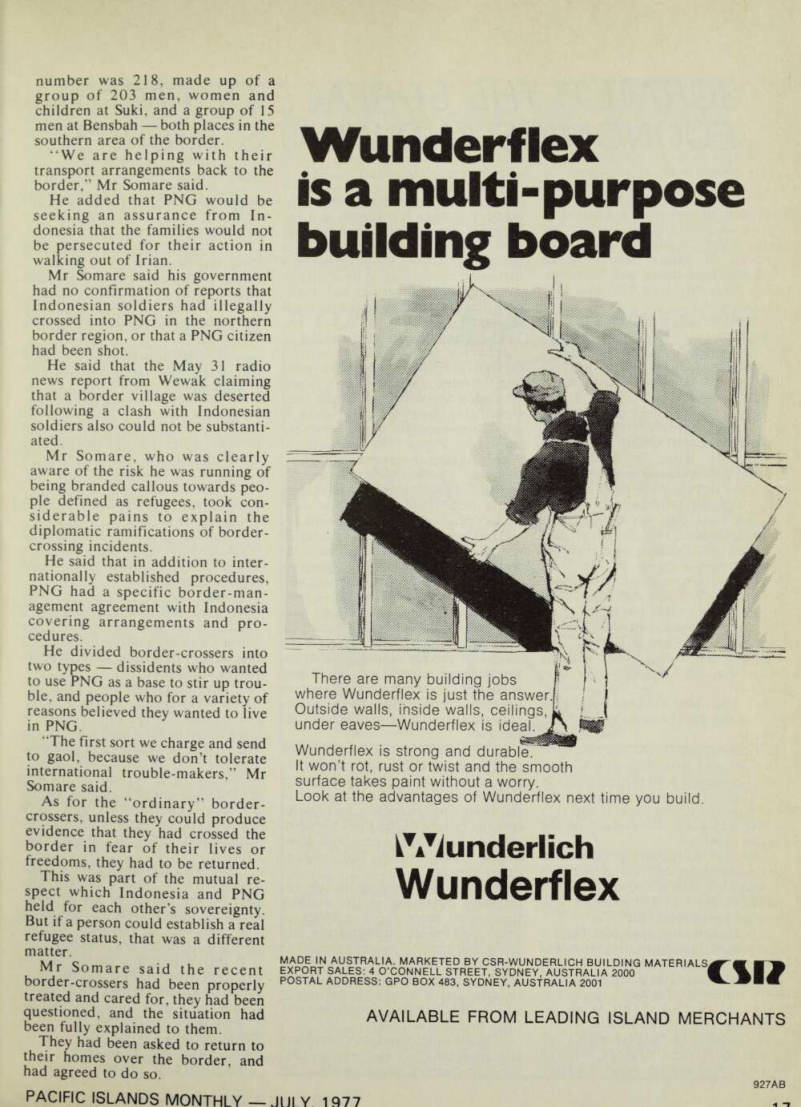
The border - a continuing headache for PNG's Foreign Minister Sir Maori Kiki (right) and his Indonesian counterpart Adam Malik.
number was 218, made up of a group of 203 men, women and children at Suki, and a group of 15 men at Bensbah both places in the southern area of the border.
“We are helping with their transport arrangements back to the border,” Mr Somare said.
He added that PNG would be seeking an assurance from In donesia that the families would not be persecuted for their action in walking out of Irian.
Mr Somare said his government had no confirmation of reports that Indonesian soldiers had illegally crossed into PNG in the northern border region, or that a PNG citizen had been shot.
He said that the May 31 radio news report from Wewak claiming that a border village was deserted following a clash with Indonesian soldiers also could not be substanti ated.
Mr Somare, who was clearly aware of the risk he was running of being branded callous towards peo ple defined as refugees, took con siderable pains to explain the diplomatic ramifications of border crossing incidents.
He said that in addition to inter nationally established procedures, PNG had a specific border-man agement agreement with Indonesia covering arrangements and pro cedures.
He divided border-crossers into two types dissidents who wanted to use PNG as a base to stir up trou ble, and people who for a variety of reasons believed they wanted to live in PNG.
“The first sort we charge and send to gaol, because we don’t tolerate international trouble-makers,” Mr Somare said.
As for the “ordinary” border crossers, unless they could produce evidence that they had crossed the border in fear of their lives or freedoms, they had to be returned.
This was part of the mutual re spect which Indonesia and PNG held for each other’s sovereignty.
But if a person could establish a real refugee status, that was a different matter.
Mr Somare said the recent border-crossers had been properly treated and cared for, they had been questioned, and the situation had been fully explained to them.
They had been asked to return to their homes over the border, and had agreed to do so.
Advertisements & other items, p. 17 (1 item)
building board
Wunderflex
is a multi-purpose
a There are many building jobs -tiivsiw f iui luumuA lO JUOI UIU Ul IOVVCI Outside walls, inside walls, ceilings, under eaves—Wunderflex is ideal.
Wunderflex is strong and durable.
It won’t rot, rust or twist and the smooth surface takes paint without a worry.
Look at the advantages of Wunderflex next time you build.
IViunderlich
Wunderflex
MADE IN AUSTRALIA. MARKETED BY CSR-WUNDERLICH BUILDING MATERIALS EXPORT SALES: 4 O’CONNELL STREET, SYDNEY, AUSTRALIA 2000 POSTAL ADDRESS: GPO BOX 483, SYDNEY, AUSTRALIA 2001 an
AVAILABLE FROM LEADING ISLAND MERCHANTS
927A8
Scratch The Surface Of Png's
Economics And What’S There?
Most Australian businessmen are ignorant of business potential in Asian and Pacific countries, Mr Tom Allen, a former executive director of Papua New Guinea’s National Investment and Develop ment Authority, told PIM in a May interview.
Mr Allen was speaking in Sydney following two one-day workshops on the subject of Operations in Papua New Guinea and the Im plications of the Forthcoming Elec tions.
The workshops were organised by
the Sydney-based Implementation
and Management Group Pty Ltd, of which Mr Allen is a director.
Twenty-two businessmen, mostly at director level, had paid an un disclosed sum to attend.
Each workshop was divided into four sessions: The Political En vironment. Present and Future, which heard a paper by Mr Tony Voutas. a former principal adviser to the PNG Prime Minister: The Economic and Financial En vironment. which was addressed by economist Dr Vernon Harvey. The Investment Climate, dealt with by Mr Allen: and a panel-type dis cussion.
Mr Allen told PIM he thought the workshops had been a considerable success.
"It’s simply a fact of life that most Australian businesses don't know how to grapple with the problems of working in the region.” he said. "We feel that the workshops, at the very least, scratched the surface of the issues involved.”
He said the papers presented at the workshops, and the subsequent discussions, had in the main taken a positive view of the prospects of foreign investment in PNG There had. for example, been a close examination of the so-called Third Investment Priorities Schedule published by the PNG Government in January.
Mr Allen said: “This is an in teresting document because it not only reflects the government's na tional investment strategy, with its strong emphasis on rural develop
ment. but also a much greater accep tance of foreign investment as a ve hicle for development than was the case two or three years ago. This stems largely from the government’s increased confidence in its ability to control foreign investors and to en sure that they operate in the national interest.”
The schedule extended the list of “priority activities” in which foreign investors could take part, and introduced a new category call ed "open activities” in which they would also be welcome. However, it still contained a list of industries re served for Papua New Guineans, in which foreign investment is forbid den. and another of "restricted ac tivities”. in which foreign investors could only take part in joint ven tures with Papua New Guineans.
The "priority activities” included specific mineral and petroleum re sources, integrated timber projects in a number of locations, fishing and
fish processing, agricultural pro
ducts such as tea. grain crops, oil palm and sugar, and manufacturing industries which further process the output of the agricultural, fisheries, forestry and mineral sectors. “Open activities” covered a wide range of investment opportunities in prim ary. manufacturing and service in dustries.
Mr Allen said that reservations on investing in PNG still lingered in the minds of many companies because of the 1974 negotiation of the Bougainville copper agreement, and the failure of the PNG Govern ment to reach agreement with Ken necott over the Ok Tedi copper development.
He went on: “Existing foreign en terprises operating in the country have been there for a number of years, and before independence and self-government they were subject to very few controls over their op erations. They thus found it difficult to cope with a new government which did introduce controls over their investment plans.
“On the other hand, new investors still look on PNG as a newly-inde pendent country which needs to be
approached with caution like all other newly-independent or developing countries.
“The country has to produce a track record.
“It is well on the way to doing this and it seems likely that an upsurge in investment in PNG could be forthcoming during the next couple of years.
"There are still many problems in setting up there, but these problems are not insurmountable.”
Discussion on the political en vironment and the prospects of the 1977 parliamentary elections had proved quite an eye-opener for many participants. Mr Allen said.
The general consensus was that, whatever the outcome of the elec tions. present government policies are likely to persist.
Mr Allen said: “At the national level, there is very little difference between the platforms of the three
major parties.
“Pangu and the People's Progress Party are not campaigning on a united front, and PPP leader Mr Julius Chan has indirectly indicated that he may be willing to form alter native alliances.
“What is happening at the na tional level is that the third party, the United Party, which was the main force in the Opposition in the old House, is attacking both Pangu and the PPP for their lack of per formance in government, for the elitist behaviour of ministers, for the political appointments they have made to the public service, and. by implication, for their alleged cor ruption.
“But. with the major policy issue which divided these parties in the past the timing of self-govern ment and independence now well and truly out of the way, serious policy differences are minimal.”
If any difference does exist it would be that the PPP and the con servative faction of the United Party favour individual enterprise among Papua New Guineans, whereas Pangu would favour more com munal business development.
Mr Allen said: “In any discussion
of PNG’s political structure it must be recognised that modern political debates on national issues are wit nessed and understood by only a privileged 10% of the community who are within the modern media network. For the bulk of the popula tion. politics is about local issues.”
Mr Allen summed up: “The elec tion results are likely to be in conclusive. with no party having a clear majority. This means that the real contest for power is not in the election struggle, but in the subse quent wheeling and dealing to build a coalition government.
“An element of stability is imbed ded into the political system by the lack of differentiation between par ties and the focus on local rather than national issues, by the bulk of the population.”
On trade union activity in PNG, a subject of keen interest to workshop participants. Mr Allen said the in terpretation was offered that organ ised labour in PNG has become “a kind of aristocracy”.
He said; “The unions were the first PNG group to become organ ised and make concerted demands on the government. Through their organisational strength and infor mal links with the government they have elevated urban labour to a pri vileged position. Their members do better than the rest of the com munity.
“Their organisational attitudes are being modified by their growing involvement as unions in the run ning of private enterprises.
"While there is the prospect of labour/government confrontations Port Moresby unions have several of their proteges training in the Soviet Union the long-term trend should be one of comparative industrial peace.”
The public service was presented as “the weakest resource” in PNG’s political-administrative structure, suffering, especially in rural areas, from frequent transfers, poor com munications and a lack of co-or dination.
On Papua New Guinea’s financial situation, the workshop was told that the government’s “hard cur rency strategy” had certainly work ed to date.
Mr Allen said: “There have been successive revaluations of the kina relative to the Australian dollar, the balance of payments situation has been healthy, there is a commitment
of aid over a long period from Australia, important trade and com mercial relations agreements have been reached with Australia and the European Economic Community (Lome Convention), and a credit worthiness rating has been given to PNG by the World Bank. There is little likelihood, therefore, of the present approach in financial policy being changed by any new govern ment coming into power.”
Conditions could change in the
future which would require a new set of policies. For example, if aid from Australia were cut off, no ma jor new venture (such as the Ok Tedi or Freida River copper projects) could be undertaken, or if prices of all exports went down considerably, then PNG could be placed in a difficult situation.
However, the likelihood of all these things occurring simultaneously appeared to be minimal.
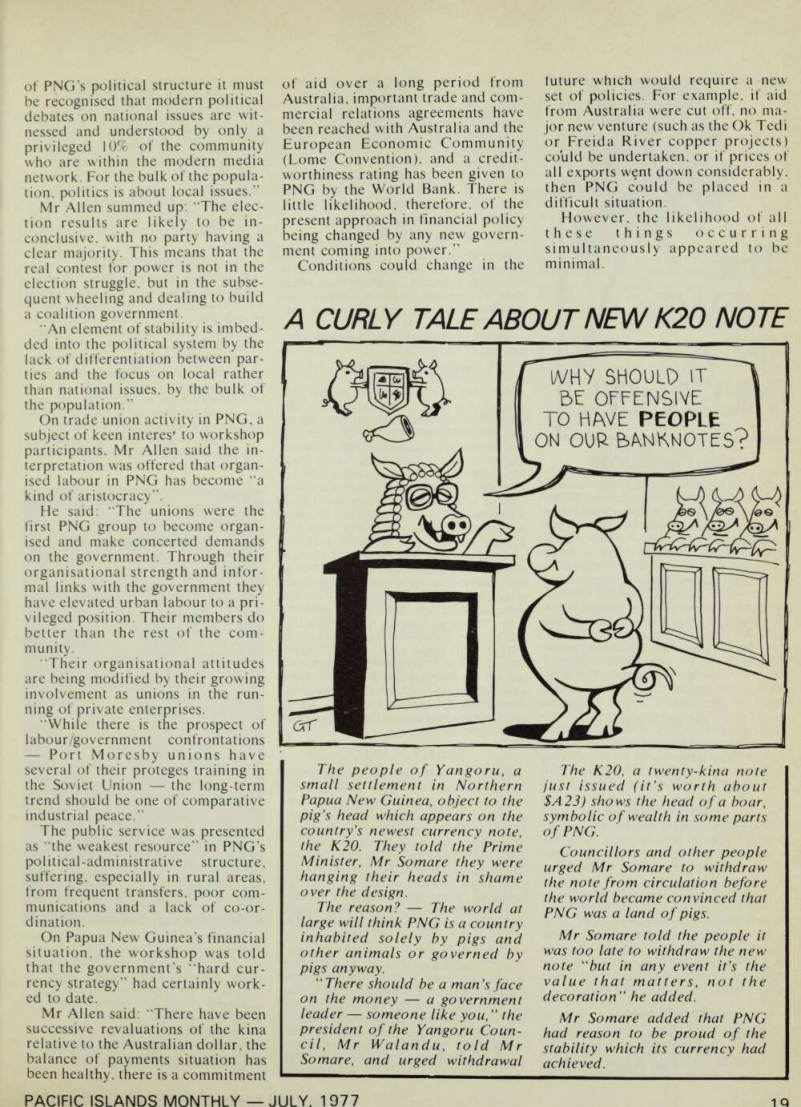
A Curly Tale About New K20 Note
The people of Yangoru, a small settlement in Northern Papua New Guinea, object to the pig’s head which appears on the country’s newest currency note, the K2O. They told the Prime Minister, Mr Somare they were hanging their heads in shame over the design.
The reason? The world at large will think PNG is a country inhabited solely by pigs and other animals or governed by pigs anyway.
“There should be a man’s face on the money a government leader someone like you,” the president of the Yangoru Coun cil, Mr Walandu, told Mr Somare, and urged withdrawal
The K2O, a twenty-kina note just issued (it’s worth about SA23) shows the head of a boar, symbolic of wealth in some parts of PNG.
Councillors and other people urged Mr So mare to withdraw the note from circulation before the world became convinced that PNG was a land of pigs.
Mr Somare told the people it was too late to withdraw the new note “but in any event it’s the value that matters, not the decoration” he added.
Mr Somare added that PNG had reason to be proud of the stability which its currency had achieved.
Nutshell
The
News
In A
Nutshell
Clumsy Fabrication'
Professor Otto Ulc, a former Czech district court judge who is now professor of political science at New York State University, has described the alleged crime record of Vladimil Milan Brych prepared by Czechoslovak authorities as “a clumsy fabrication”. Brych is the con troversial cancer therapist deregistered by the New Zealand Medical Council and now practising in Rarotonga, Cook Islands (PIM, June p 23). Professor Ulc said in a long affidavit sent to Brych's Auckland lawyers that the crime record document was of such a poor standard that it was “probably forged by Czech es pionage or security authorities rather than the state itself, which prepared
usually flawless forgeries”. Czech
authorities claim Brych never qualified as a doctor and had an extensive crime record. Their claims, and the supporting documents, were key elements in the NZMC decision to deregister him.
Murder Charge
A Gilbert Islander, Maeke Taumatoe, was charged in Vila in May with the murder of Willy Ben, an employee of the French administration in the New Hebrides. It is alleged that Taumatoe pushed Ben overboard from the inter island vessel Biliki during a crossing from Vila to Epi in the night of May 9-10. Taumatoe is said to have been drunk at the time, and to have attacked Ben when he asked him. and two fellow drinkers, to quieten down. An extensive search failed to recover Ben’s body.
Tahiti Find
French archeological researchers working in Tahiti’s Papenoo Valley have discovered 12 large marae stone structures which were sacred centres of
communication with the gods or with an cestors for the original Polynesian in habitants in just three months of work. They also found more than 400 stone objects, mainly adzes, which have been deposited in the Tahiti Museum.
The Papenoo Valley project is giving a number of young Tahitians their first ex perience of archeological work and their first opportunity to study the an cient culture of their people.
Athletics In Vila
New Hebridean athletes acquitted themselves well at a May contest in Vila with a New Zealand athletic team. The New Zealanders, from the Auckland Athletics Club, won 15 events and the New Hebrideans 11.
About 3,000 people watched the contest.
Police Gang Rape
Five Fiji policemen were gaoled for
gang rape at Suva in May. Magistrate Mr Colin Perrier found them guilty of being concerned in the rape of a 20-year-old girl at Laucala Beach estate, Suva. Those gaoled were Corporal Jone Numa (35), 5V2 years in prison; Constables Anasa Ranasau (32) and Mata Biunacagilaba (25), 4V2 years each; Constable Wame Vosakotoira (21), VU years and Consta ble Sefanaia Basiyalo (27), 2V2 years. Mr Perrier said he gave Basiyalo a lesser sentence because he had refused to rape the girl but had made no attempt to stop his companions from committing rape.
Also, he was sure Vosakotoira, the youngest, had been led into the offence.
In Western Samoa. Chief Justice Nicholson sentenced Panaua Faavesi (31) to four years prison for a “brutal case of rape”, saying that the court would not tolerate the increasing rape cases which involved mainly young girls.
In the short time he had been Chief Justice there had been a high rate of rape and other sex offences.
Double Penalty
Tupui Ariki Henry automatically for feited his seat in the Cook Islands Legislative Assembly when he was con victed of common assault in the High Court at Rarotonga. He is the Minister of Internal Affairs and son of the Pre mier, Sir Albert Henry. A solicitor, Mr laveta,Short, accused Tupui Henry of as sault in an incident during a Christmas break-up party in the offices of the Department of Justice and Survey last December 23. One charge was dismiss ed.
The Chief Justice, Mr Justice Donne, fined Tupui Henry $lO. He said the fine would have been greater, but the defen dant had incurred heavy costs by hiring an Auckland solicitor, Mr Graham No ble, to appear for him because no local solicitors were available to take his case.
With his automatic disqualification from the Legislative Assembly his seat for his Mauke Island constituency
became vacant. Whether he will be able to offer himself for re-election is not yet known, nor is it yet known whether he will be able to continue as a cabinet minister. There are several precedents for people to hold cabinet rank without being members of legislative bodies.
Mr Henry is the second South Pacific parliamentarian to lose his seat because of a conviction for assault in the last few months. Mr Rennie Harris lost his seat in the Nauru Parliament for a similar offence.
Boating Tragedy
A search in Tonga for two men and a young girl, missing at sea after a huge wave swamped their 6.1 metre wooden pleasure boat, was abandoned about 10 days later. They were officially presum ed dead, Elisepa Mafi, 23, a nurse, was drowned in the same accident while try ing to swim ashore. Those missing were Bob Springett, 47, a NZ farmer adviser at Tupou College, his daughter, Anna, 5, and Frank Herbert, 60, a British adviser in the Co-operative Department.
With five others they had spent the day picknicking on Malonia Island, and were returing to Nukualofa when the wave hit.
This beer can, in four colours, was pro duced by Courage Brewery in Melbourne to mark the opening of Melbourne's tallest building Nauru House, which is owned by the Republic of Nauru. A first shipment of 10,000 dozen cans com plete with contents, is already in Nauru.
More will follow Courage Brewery al ways supplies Nauru with a special can, the previous design showing a fishing scene.
Fiji Head Count
The population of Fiji grew by 1 1 .341 between the 1966 and 1976 censuses.
While the Indians are still the dominant race, with a fraction less than half the population, the gap between the two races is narrowing. The 1976 census showed there were 292.896 Indians and 259.932 Fijians, a difference of 32.964. while in 1966 there were 288,408 In dians and 250,833 Fijians, a difference of 37.575.
The population of other groups in the country, with the 1966 census figures in brackets, was: Pan-Europeans, or Euronesians. 10.276 (9.697); other Pacific Islanders. 7.291 (6,095); Rotu mans. 6,822 (5.797); Europeans. 4.929 (6.590); Chinese. 4.652 (5.149); others. 1.270 (273).
In every racial breakdown there were more males than females 296.950 males and 291.1 18 females.
The populations of the two cities (Suva and Lautoka). and of towns with boundaries, were: Suva, 63.622; Lautoka. 22.672; Nadi. 6.938; Ba. 5.917; Nausori. 5.262; Labasa. 4.328; Sigatoka. 1.816; Savusavu. 1.754; Levuka, 1.397.
Diplomatic Move
The Papua New Guinea Embassy in the United Slates is being transferred from Washington to New York. The Am bassador. Mr Paulias Matane, is also PNG Ambassador to the United Nations, which has its headquarters in New York.
The PNG Government decided on the move so that there could be "more active and meaningful participation" in the work of UN and its agencies. There was a need for PNG to be seen as one of the third world counterparts. The move will enable Mr Matane to keep in close touch with his counterparts from other third world countries. PNG's Washington office will be headed by a charge d'affaires.
Anti-Vagrancy Drive
Rabaul in Papua New Guinea is
rapidly losing its appeal for vagrants.
Ninety of them were arrested in a police raid on the 2/22nd streets area early on a
Sunday in May and charged with
vagrancy. Many were women. Eleven of them were gaoled for a month and eight were given six months. The provincial
police commander. Superintendent Reo
Paluka. said the arrests were part of a
"clean-up" campaign.
Two Ballots For Premier
Following criticism from the Mataungan Association that it was not fairly represented in the new Provincial Government of East New Britain, the names of those elected went back into the drum. The new ballot, which came after hours of peace talks between the various factions, resulted in the election of Mr Koniel Alar. Mataungan Association leader, as Premier. Another
Mataungan. Mr Hosea Biu. will be Deputy-Speaker. Elected Premier in the first ballot. Mr Ereman Toßaining agreed to resign and take part in another ballot. Mr Alar beat him 1 1 -6. After the first election. Mataungan Association members staged a protest match and disrupted a swearing-in ceremony held by the Governor-General. Sir Tore Lo x koloko.
Senator In Trouble
Fijian senator, Inoke Tabua, is likely to behave himself when he goes to the cinema in future. The senator, who is a nominee of the Great Council of Chiefs in the Senate, and a member of the Ports Authority of Fiji, was at a film at Raiwaqa. Suva, when the screening abruptly came to a halt through some technical fault. Understandably an noyed. he got to his feel and gave vent to his feelings. That may have been all right, except that he uttered some inde cent words.
The duly bouncer, who was also a special constable, warned Senator Tabua to keep quiet. There was then an argu ment which led to the bouncer, and another policeman arresting him and
charging him with disturbing the public
peace. The magistrate. Mr Victor Vi vian. answering a plea by Senator Tabua’s lawyer. Mr Am in fa si Katonivualiku. that his client was a pro minent citizen in a senior position, said that being a prominent citizen he should not have behaved in that manner. He bound Senator Tabua over for 12 months.
Fiji's Rugby Win
Fiji Rugby almost scaled the heights
when Fiji beat Marlborough (NZ) 28-18 in the final of a 12-nation seven-a-side
tournament in Hong Kong in May.
Earlier. Fiji beat another fancied team.
Australia, 15-4 in a semi-final. But before Fiji fans go into raptures at Fiji's performance, it should be remembered that Marlborough is a minor union and by no stretch of the imagination any where near the best in NZ Rugby.
Gaoled For Murder
Eric Gordon Berry. 34, formerly of Gaythorn, Queensland, was sentenced to
12 years’ imprisonment in Port Moresby
in May for the December, 1976. murder of Peter John Power, formerly of Colac.
Victoria. Power and Berry, once friends, worked together on the staff of the Papua New Guinea Administrative College in Port Moresby. But Berry lost his job there, and evidence at his trial showed he blamed Power for what had happen ed.
Evidence showed that Berry had brooded over the killing of Power for 1 I months. He had considered the use of paralysing sprays, disguises, guns ob tained from an indigenous prostitute, and the emulation of methods used by a fictional hero named Willy the Actor, In
the event, he had shot Power dead under circumstances his defence claimed amounted almost to an impulse.
Pay-Day Swill
A move to prevent excessive pay-day drinking in the Papua New Guinea city of Lae has rebounded. Despite new ly-re stricted bar hours on Thursdays the generally adopted pay-day in PNG liquor traders have reported a 35 f r in crease in Thursday turnovers. They said that big queues were lining up for the 6.30 pm Thursday opening lime which has replaced the usual 4 pm opening.
Once the doors opened, the drinkers ap peared determined to make up for the time they had lost. Police also reported that the Thursday night clean up of 'drunks and larrikins” now lasted until I I pm instead of the more usual 8.30 pm. Liquor traders plan an approach to the Licensing Commission for a return to the old hours. Port Moresby has been on restricted Thursday trading hours for more than a year, and the arrangement has generally been conceded as suc cessful 1.
Niue Shrinking!
Niue, when the census was taken last September, had a population of 3.843 1,927 males and 1.916 females about half the number of Niueans now living in New Zealand, and 23T less than in 1971, There was a big decline in village population and of 1.045 living quarters on the island 324 were empty.
Sp Forum Meets
The Papua New Guinea Government will be host to the Island leaders in August at a meeting of the South Pacific Forum to be held in Port Moresby from August 29 to 31. A meeting of the South Pacific Bureau for Economic Co-op eration (SPEC) will precede the Forum
meeting.
Fiji Shops Fire
Fire swept through the Rakiraki shop ping centre of Vaileka in Fiji early in
May. destroying eight shops in three
buildings. Damage was estimated at $200,000. Brigades from Ba (66 km away) and Lautoka (102 km away) arriv ed at 3 am, several hours after the fire was first reported. By then the shops were almost completely destroyed.
Vaileka itself has no fire engine.
Election Drain
Three top men from the discipline ser vices in Papua New Guinea have re signed to seek a political career. They are Colonel Ken Noga, who was Deputy Commander of the PNG Defence Forces, Mr Michael Samo, Assistant Police Commissioner (operations), and Mr Noel Levi, Secretary for Defence.
Several other top public servants have resigned to contest seats at the June elec tions. This is causing the government some concern for it can ill-afford to lose such skilled local men.
Advertisements & other items, pp. 20-22 (2 items)
20
PACIFIC ISI AMDS MONTHLY JULY, 1977
Green
INTRODUCING
VALLEY
rr > FOP QUALITY PRODUCT - VERY COMPETITIVELY PRICED c or enquiries contact:
R. J. GILBERTSON PTY. LTD.,
HEAD OFFICE: KYLE FID., ALTONA NORTH, VICTORIA, AUSTRALIA, 3025.
CABLES; "GILBERTSONCO" MELBOURNE.
FELEPHONE: 391 2311.
FELEX’ AA30522
POSTAL ADDRESS; BOX 21, ALTONA NORTH. VICTORIA, AUSTRALIA. 3025.
Tropicalities
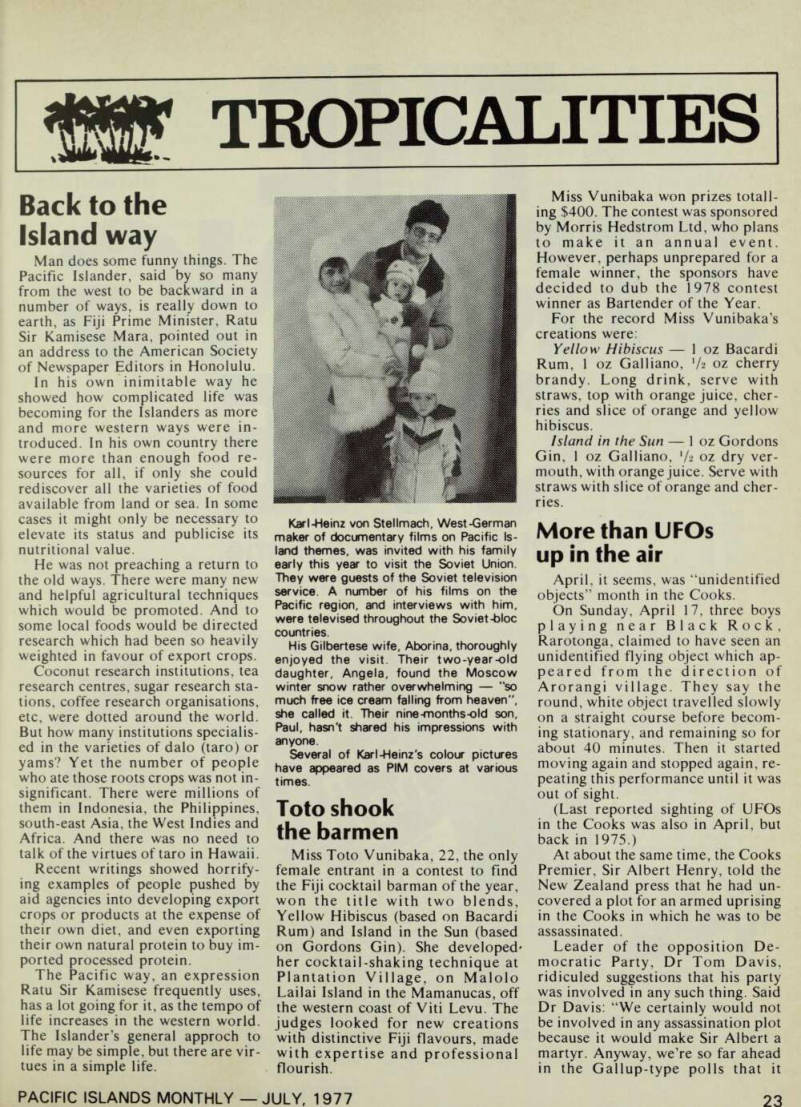


Back to the
Island way
Man does some funny things. The Pacific Islander, said by so many from the west to be backward in a number of ways, is really down to earth, as Fiji Prime Minister, Ratu Sir Kamisese Mara, pointed out in an address to the American Society of Newspaper Editors in Honolulu.
In his own inimitable way he showed how complicated life was becoming for the Islanders as more and more western ways were in troduced. In his own country there were more than enough food re sources for all, if only she could rediscover all the varieties of food available from land or sea. In some cases it might only be necessary to elevate its status and publicise its nutritional value.
He was not preaching a return to the old ways. There were many new and helpful agricultural techniques which would be promoted. And to some local foods would be directed research which had been so heavily weighted in favour of export crops.
Coconut research institutions, tea research centres, sugar research sta tions, coffee research organisations, etc, were dotted around the world.
But how many institutions specialis ed in the varieties of dalo (taro) or yams? Yet the number of people who ate those roots crops was not in significant. There were millions of them in Indonesia, the Philippines, south-east Asia, the West Indies and Africa. And there was no need to talk of the virtues of taro in Hawaii.
Recent writings showed horrify ing examples of people pushed by aid agencies into developing export crops or products at the expense of their own diet, and even exporting their own natural protein to buy im ported processed protein.
The Pacific way, an expression Ratu Sir Kamisese frequently uses, has a lot going for it, as the tempo of life increases in the western world.
The Islander’s general approch to life may be simple, but there are vir tues in a simple life.
Toto shook
the barmen
Miss Toto Vunibaka, 22, the only female entrant in a contest to find the Fiji cocktail barman of the year, won the title with two blends, Yellow Hibiscus (based on Bacardi Rum) and Island in the Sun (based on Gordons Gin). She developed' her cocktail-shaking technique at Plantation Village, on Malolo Lailai Island in the Mamanucas, off the western coast of Viti Levu. The judges looked for new creations with distinctive Fiji flavours, made with expertise and professional flourish.
Miss Vunibaka won prizes totall ing $4OO. The contest was sponsored by Morris Hedstrom Ltd, who plans to make it an annual event.
However, perhaps unprepared for a female winner, the sponsors have decided to dub the 1978 contest winner as Bartender of the Year.
For the record Miss Vunibaka’s creations were: Yellow Hibiscus 1 oz Bacardi Rum, 1 oz Galliano, l h oz cherry brandy. Long drink, serve with straws, top with orange juice, cher ries and slice of orange and yellow hibiscus.
Island in the Sun 1 oz Gordons Gin, 1 oz Galliano, V 2 oz dry ver mouth, with orange juice. Serve with straws with slice of orange and cher ries.
More than UFOs
up in the air
April, it seems, was “unidentified objects” month in the Cooks.
On Sunday, April 17, three boys playing near Black Rock, Rarotonga, claimed to have seen an unidentified flying object which ap peared from the direction of Arorangi village. They say the round, white object travelled slowly on a straight course before becom ing stationary, and remaining so for about 40 minutes. Then it started moving again and stopped again, re peating this performance until it was out of sight. (Last reported sighting of UFOs in the Cooks was also in April, but back in 1975.) At about the same time, the Cooks Premier, Sir Albert Henry, told the New Zealand press that he had un covered a plot for an armed uprising in the Cooks in which he was to be assassinated.
Leader of the opposition De mocratic Party, Dr Tom Davis, ridiculed suggestions that his party was involved in any such thing. Said Dr Davis: “We certainly would not be involved in any assassination plot because it would make Sir Albert a martyr. Anyway, we’re so far ahead in the Gallup-type polls that it
Karl-Heinz von Stellmach, West-German maker of documentary films on Pacific Is land themes, was invited with his family early this year to visit the Soviet Union.
They were guests of the Soviet television service. A number of his films on the Pacific region, and interviews with him, were televised throughout the Soviet-bloc countries.
His Gilbertese wife, Aborina, thoroughly enjoyed the visit. Their two-year-old daughter, Angela, found the Moscow winter snow rather overwhelming - "so much free ice cream falling from heaven”, she called it. Their nine-months-old son, Paul, hasn't shared his impressions with anyone.
Several of Karl-Heinz's colour pictures have appeared as PIM covers at various times.
would be stupid of us to get involv ed in such a hairy scheme.”
Like whatever it was the three boys saw, the object of the alleged “coup” exercise remains uniden tified.
Deflation hits
a Pacific book
The posthumous reputation of Sir Arthur Grimble, former British Re sident Commissioner on Ocean Is land, took a caning at the British High Court hearing last December into the claim by the Banabans for compensation for the ravages caus ed by phosphate mining on the is land.
The presiding judge. Sir Robert Megarry, said a statement addressed by Sir Arthur to the Banabans in 1928 “could not be read without a sense of outrage”.
Insult is added to injury by a cir cular sent not long ago to various schools throughout the Pacific by a British book distributor. The cir cular said of Grimble’s book, A Pat tern of Islands, which was once one of the most popular English language works on the Pacific: “I have just been advised by the pub lishers of this book a copy of which I enclose that they have a massive overstock of it and are will ing to supply any bulk order at a price of 10 UK New Pence, plus freight.”
Wishful thinking
in the Islands
If Pacific Islanders want to live in Western style they need to make a few changes in their attitude to life.
That message comes through in an article former PIM editor, Judy Tudor, wrote in People, the London journal, on world population and family planning trends. She wrote that most of them now had aspira tions based on wishful thinking, rather than hard economic facts.
“Since the Second World War, Western-style education has become a fetish and once a youth has become ‘educated’ he usually scorns all manual work and sets his sights on a white collar job, in the security of government service if possible”, she wrote. “An oversupply of would-be clerks and other seekers of the good life therefore drifts into towns and larger centres to become disillusioned, unemployed, to swell
squatter settlements and to exert pressure on the authorities for social services once taken care of by the extended family unit back in the village.
“For one reason or another small land area, rapidly-growing populations, increased expectations, industrial inroads into subsistence farming no Pacific Island, even the well-endowed, is without people
problems”.
Adding that the resources of most islands was limited, she wrote: “Yet most Islanders have learned to live in a way unknown to the subsistence farmers who were their ancestors and now have aspirations based on wishful thinking rather than on hard economic facts”.
Biting the hand
that reeds it
The School of Education at the University of the South Pacific has recently established a “Continuing role for the School of Education in Regional Curriculum Develop ment”. It has been seeking the sup port of other tertiary institutions within the Pacific and on the periph ery of the region which are concern ed with curriculum development.
The information supplied by the School of Education says that estab lished within the school are, firstly, a curriculum resources workshop, and, secondly, a curriculum re sources agency. The workshop is seen as having the functions of a clearing house for regional cur riculum information; a working area and repository for a collection of curriculum materials, and a base for research.
The aim of the Curriculum Re sources Agency is to “provide with in the resources of, but using the facilities of the School of Education and the university, curriculum materials for the regional coun tries”. It will be interesting to ob serve the extent to which this development is accepted by the various commercial interests which have been seeking to establish a market for curriculum materials produced to meet the needs of Pacific Islands countries.
It is said of the proposed Cur riculum Resources Agency that “the agency will use the university print ing unit on a commercial basis.
This will provide services “at ap proximately two-thirds of com
mercial business rates”. This would seem to be a radical departure from generally-accepted university stan dards that the facilities of the universities should not be used in direct competition with private en terprise, when production of the same product is the object of the game.
Shake the bottle
and the doctor
A doctor in Papua New Guinea wants to kill the old myth that bad handwriting indicates a good doc tor.
In a note in the latest issue of the PNG Medical Journal the editor. Dr D. Amato, appeals to his fellow doc tors to clean up their handwriting.
He describes sloppy writing from doctors as ”a remnant of the days when an authoritarian arrogance on the part of medical practitioners was accepted by patients”.
He believes that, more often than not, doctors had used bad writing as a mask for their own ignorance, “but these days happily are on their way out, and with them should go the il legible scrawl”.
Dr Amato says in the Medical Journal that he finds it heartening to see many medical students and younger doctors adopting neater writing, and “older doctors would do well to follow their example”.
He calls bad writing “in considerate, presumptuous and an insult”.
Dr Amato also appeals to doctors to print their names as well as to sign them on prescriptions and charts which he describes as poten tially-legal documents.
It’s been 58
years a’coming
There is news of the opening of an airstrip on Atiu Island in the books, which will add a further dimension to the operations of Cook Islands Airways. It will also very markedly influence the way of life of Atiuans, as they will now be able to reach Rarotonga in less than an hour and without all the discomfort which has been part and parcel of travel on small inter-island vessels.
But this recent move into aviation isn’t the first that has been mooted for Atiu. Over the years all manner of suggestions for landing places in the Cook Islands have been put for
ward, but Johnstone Dyer, the Re sident Agent on Atiu in 1919 must have had a pioneer view of the future role of the aircraft.
On January 13, 1919, Dyer wrote to the Resident Commissioner on Rarotonga “I should like to make a little suggestion. If the Minister of Defence is looking for a mid-ocean aerodrome, Atiu offers the best situ ation, being about 400 feet above sea-level, with a gentle slope to the sea and devoid of trees on the hilltop. There are patches on the top of the hill about over 100 acres in extent, without trees or any other obstruction”.
Fiji’s defaulting
ratepayers
Fiji ratepayers must be among the most dilatory when it comes to meeting their just dues. An unofficial survey in May showed they owed more than $1 million, nearly $2 a head for every person in the country. In many cases people have not paid their rates since 1972.
At the top of the list was Suva, which showed arrears of $639,962, enough to meet the cost of several council services for a year. Others with debts of more than six figures were Nadi ($166,000) and Lautoka ($100,000). Councils are beginning to realise that unpaid rates have cumulative problems, not only for them, but also for the slow ratepayers. Accumulated rates run into solid lump sums, which many ratepayers find they just cannot meet.
The councils get further behind in providing services and development programmes, and find the govern ment does not exactly rush into ap proving and then guaranteeing loans while so much is owed to them. The councils have the remedy in their own hands the time-consuming process of prosecuting defaulting ratepayers. Unfortunately, some councillors, with their eyes on the ballot boxes, often put up a fight for defaulters, which does not make any easier the task of council officers who collect the money.
About 15 years ago a PIM writer, who had attended a Suva City Coun cil meeting which voted to, delay launching prosecutions, checked the list of defaulters and found the names of at least two councillors who were in favour had not paid their rates.
Making a ‘blue’
on old Niue
Many writers who specialise in topics concerned with the Pacific Is lands countries tend to wax with considerable strength about the blue laws imposed upon many islands by the missionaries.
On the island of Niue the chiefs and rulers passed a set of laws at their Fono held at Alofi on Decem ber 1, 1875.
It seems that many of the laws agreed to then could not have been too unacceptable to the New Zea land Government, as on June 5, 1900 the laws, with modifications and additions, were confirmed by the Fono. These laws were pub lished in the 1901 New Zealand Parliamentary Papers.
Working on the roads, or making lime-ovens seems to have been an obsessive form of punishment on Niue at the time, as it appears as a form of retribution imposed upon a wide spectrum of offenders.
“Whosoever shall be convicted of fornication, for the first offence, shall be liable to one week’s labour
in making lime-oven or work on the roads; for a second offence, an oven of lime involving two weeks work.”
And let’s ponder about sexual discrimination in this modern world ...
“A woman convicted of fornica tion, for the first offence, shall be liable to work on the roads for a term of one week, for second offence, two weeks work on the roads.” Making a lime-oven must, in some way, have got the male of fender nearer to hell. If only such penalties applied today in Australia or New Zealand all the road con struction problems would be solved.
What about solving the unemployment problems which now bedevil the developed world? In the Niue laws the following appeared “Disobedient sons who wander to other lands, and when at home are lazy and dissolute, not helping at all in the work of the plantations, but appropriating the father’s coconuts and living upon the fruits of his in dustry: Upon the father making known his case to the judges, such sons shall be dealt with by the law of the land.”
Conservation of native fauna is the theme of a June issue of Papua New Guinea stamps featuring five beautiful species of pigeon to be found in the country. Pictured, they are the white-bibbed ground-dove, the Victoria goura pigeon, the Magnificent Pheasant pigeon, the orange-fronted fruit dove and the black-belted fruit pigeon.
Niue is the latest Commonwealth country to join in postal commemoration of the silver jubilee of the reign of Queen Elizabeth with a special issue of two stamps which were placed on sale in Niue's post office on June 7.
Other recent philatelic developments in Island countries include Tonga's issue of a series of three commemorative stamps to mark the 10th anniversary of the coronation of King Taufa'ahau Tupou IV (July 4, 1967), the release by Western Samoa of a series of four stamps to mark the 50th anniversary of Lindbergh's trans-Atlantic flight (20 May, 1927), and the use by the Pitcairn Island postal administration of a rubber stamped "Hands Across the Sea” pictorial cachet on all mail lodged between May 7 to July 7, 1977, to mark 50 years of association with the New Zealand post office.
Advertisements & other items, pp. 24-26 (1 item)
a healthier place
that makes your home
How effectively you protect your family from the dangers of disease carrying insects, may well depend on the insect spray you choose.
Powerful Insect Killing Ingredients.
Concentrated Pea Beu is one of the most powerful household insect sprays in the world. Its principal insect killing ingredients have been selected to ensure rapid knock down and kill of all common disease carrying insects.
Rigid Testing. Through every stage of manufacture. Pea Beu is rigidly tested.
There are ingredient tests, spray droplet tests, pack tests, many forms of tests, some carried out three times over.
When you spray this remarkable aerosol insecticide, you can be sure that its ingredients have met with the most exacting standards enabling you to spray it safely with confidence in your home. 9 Family Health and Well Being. The common housefly carries up to half a billion germs and, when you realize that disease carrying insects enter even the best regulated households, you can understand why you can't be too careful about the effectiveness of your insect spray. Remember, even the tiniest droplet I 5 / t * m of concentrated Pea Beu kills flies, mos quiloes, all common disease carrying insects fast, so it is indeed a worthy guardian of your family's health and well
being
Concentrated Pea Beu. Even the tiniest droplet
kills flies, mosquitoes, gH common
disease carrying insects fast
Such is the effectiveness of Pea Ben's insect killing ingred ient, that no common disease carrying insect can survive it nor develop an immunity to it. When you spray Concentrated Pea Beu, it's nice to know that no common disease carrying insect can survive.
Pea Beu - The strong one. makes your home a healthier place.
Give me Sunbeam
anytime
(X / / I —* m I Sunbeam Whistling Kettle.
A 2.3 litre Stainless Steel kettle that boils the water while you get the cups, then whistles tor you when ifs ready. Safety cut-out turns the kettle off automatically if the water boils dry. Available in Sunset Red, Harvest Gold or polished finishes.
Sunbeam Beatermix Mixer with Burst of Power*.
The little mixer with lots of muscle.
Three mixing speeds plus an extra power burst at the touch of a button, on all speeds, for heavy mixing jobs. Buy it as a hand mixer, or with stand and two bowls.
Toaster for big families and the breakfast rusn...4 slices of toast, cooked just the way you like at one time. Automatically. In Harvest Gold, Sunset Red and Chrome.
Sunbeam Toasta Magic* Toaster.
The automatic toaster that gives Sunbeam quality at a price anyone can afford. Colour co-ordinated in Sunset Red, Harvest Gold and Chrome. Also the Sunbeam 4-Slice Sunbeam Spray/Shot-of-Steam Iron.
Ifs a spray iron, ifs a shot-ofsteam iron, ifs a steam iron, ifs a dry iron, and it has the Sunbeam self-cleaning action as well. 55 steam holes, see-through waterlevel guage. Sunbeam safety heel rest, cool white handle.
Quality and service you’ve leamtto trust
'Registered trademark of Sunbeam Corporation Ltd.
L 85.8761
Pacifique Sud
With Helen Rousseau
There was plenty of sporting activity around the French territo ries in recent weeks from the stream of Paris government of ficials testing the temperature in Pacific waters, and the armada of Australian yachtsmen invading Noumea, to unscheduled games reported from the Casino Royal and a young French legionnaire testing his legs on a sprint around Tahiti.
The legionnaire, Jean Hartel broke the record set by a military man last year when he made a complete circle of Tahiti on foot, covering the distance in 12 hours 14 minutes.
No doubt “sport maketh the man” in this leisure age.
Certainly, that seems the way or ganisers of the Club Mediter ranee resorts think of people on holidays. At the Club Med village on the island of Moorea, off Tahiti, young Americans, French and Australians are attracted by the casual mood teamed with coaching In scuba diving, water skiing, tennis and yoga. The sporting organisers of the day help present cabaret shows at night, not forgetting what has been cynically described as the “sexual smorgasbord’’.
Club Med founder-chairman Gilbert Trigano visited French Polynesia from Paris in April ac companied by other top com pany executives. The group also visited New Caledonia, New Hebrides, Fiji and Tonga to choose a site for the next club village. Though no final choice was announced, leaders of the main political parties in the New Hebrides, who are scheduled to attend talks with British and French government officials July 19-21 In Paris, have been Invited to visit Senegal. There they can see what the Club Med has built in a newly-lndependent African nation.
Meanwhile, at the Paris talks, decisions are expected on the date for new elections In the New Hebrides and on some indica tions of. a .timetable towards achieving Independenee.
However. Mr J-G Eriau, French High Conhmlssioner In the Pacific, speaking late April at the opening of the newly tar-sealed airfield at Pekoa, Santo, told the Hebrideans that France would not abandon the islands if the future government wished to re ceive her financial and technical aid. Further offers of French tech nical aid were made to other Pacific Islands when officials from Paris. Noumea, and Papeete met in Noumea in May before a scheduled visit to Papua New Guinea, Fiji. Western Samoa and Tonga. The mission was led by Mr C. Le Breton from the Paris Ministry of Foreign Affairs. The mission Indicated growing French initiative to introduce their scientific and technological know-how around the Islands.
Further moves to extend French Interests in the region, partic ularly in uranium and defence, were underlined by the Australian Prime Minister Malcolm Fraser’s invitation to visit France. June 18-20, for talks with French Prime Minister Ray mond Barre.
At the same time, the French have been offering a warm welcome to overseas tourism promoters. Recent visitors from Sydney included Mr Clarrle Davis, South Pacific director of Thai Airways, and Mr Len Man nel, regional director of sales and marketing for American Ex press. Both were visiting new representative offices In Noumea.
The other ambassadors of overseas tourism recently in Noumea were crews aboard the .33 yachts completing the Sydney
to Noumea race in May, won by Mark Twain with French yacht Escapade second. The Caledo nians celebrated the event with plenty of things Australian, from cricket to Australian foodstuffs in the Prisunic supermarket. With typical French flavour, a Noumea cartoonist depicted the Australian products as ranging from “to be AFt NOTTS to be’’, mint cheese, ginger cheese sugar butter, cheese powder with beetroot sugar, etc. Such sweet ness is of course, In considera ble contrast to French cheeses which carry such savoury labels as “delight of the gods’’ and “droppings of the devil’’.
The Australian mood around town also prompted a friendly match of le cricket between Melanesian women and an Australian team led by Mrs Bill Fisher, wife of the Australian con sul. Wearing kangaroo teashirts, the Australians were defeated by the Melanesians In their brightly coloured Mother Flubbards. This dress, Introduced by prudent English missionaries, was ap parently so-named because un derneath used to be “bare’’.
Rather unsportingly, a scandal has been reported from Noumea’s Casino Royal. The company stated that In June last year the chief cashier was charg ed with having “milked’’ the poker machines through the re serve key. This “indelicate employee ’’ was given a sus pended prison sentence by the Noumea court and after restoring his avowed illegal gains of $A 1.600 was promptly de spatched back to France. The company has since strengthened security in Its gaming rooms. The casino is, nonetheless, a good money-spinner and this year pro posed a 1 for 10 bonus issue to shareholders, after allowing for $A350,000 in local taxes.
Editor’S Mailbag
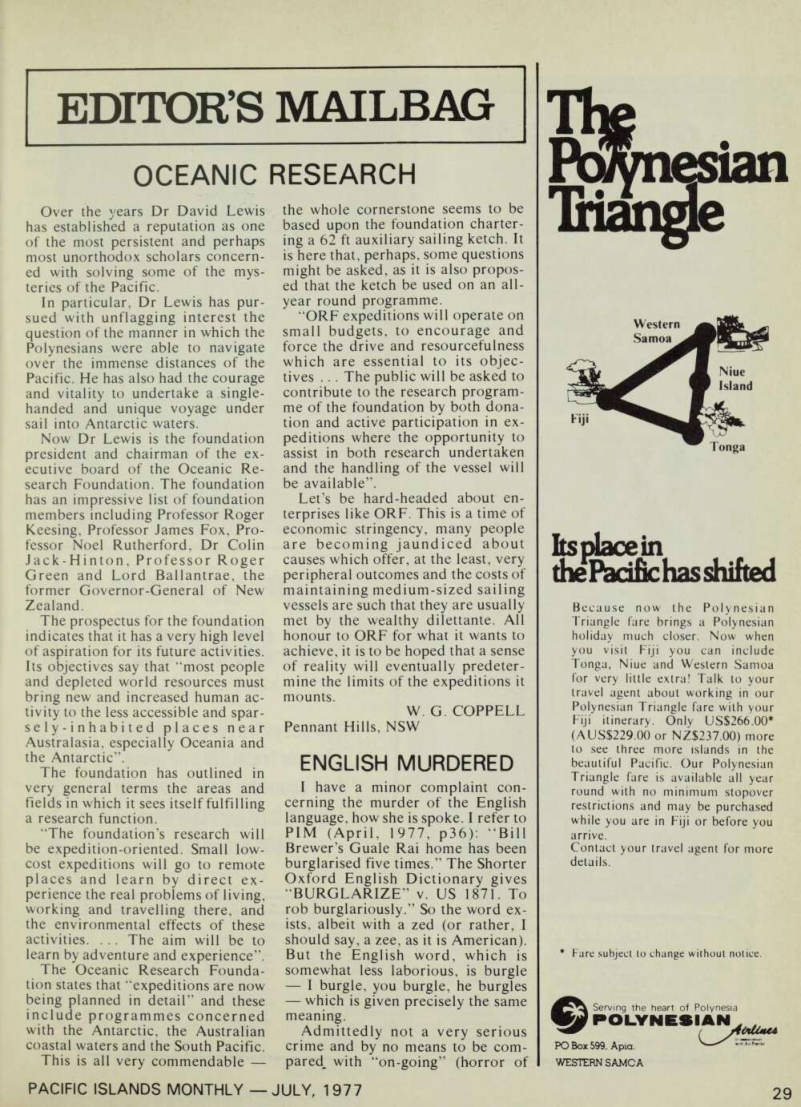

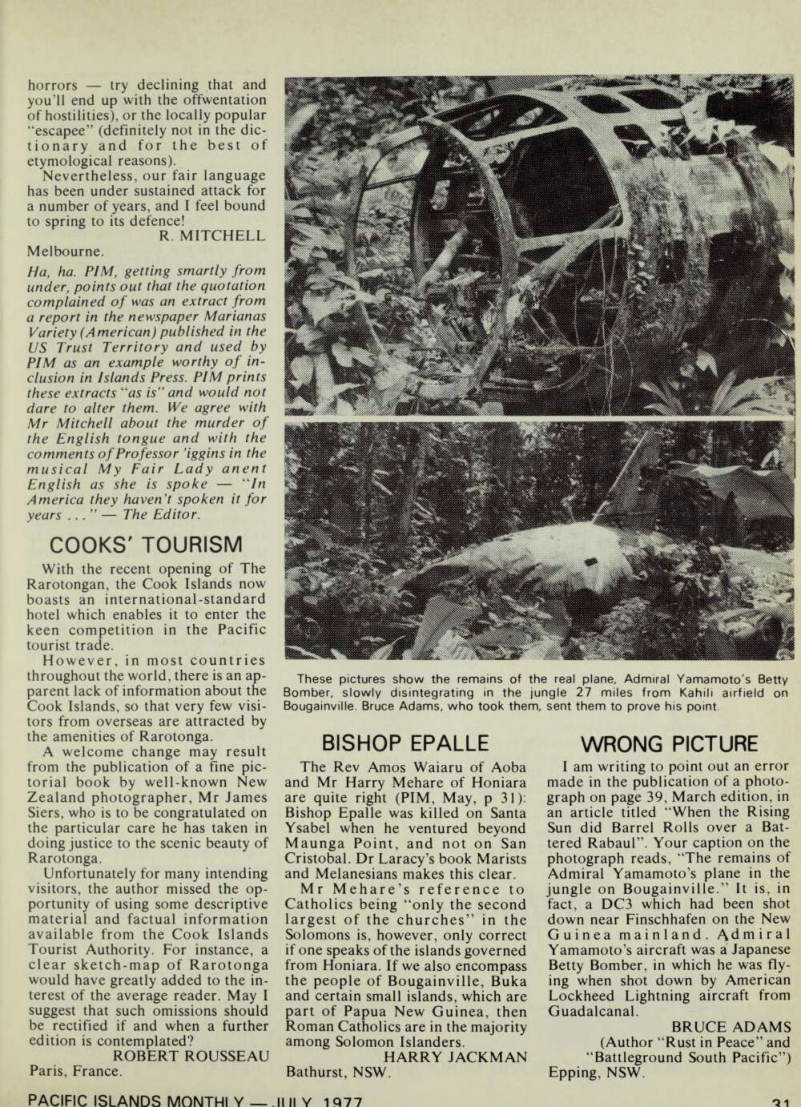
Oceanic Research
Over the years Dr David Lewis has established a reputation as one of the most persistent and perhaps most unorthodox scholars concern ed with solving some of the mys teries of the Pacific.
In particular. Dr Lewis has pur sued with unflagging interest the question of the manner in which the Polynesians were able to navigate over the immense distances of the Pacific. He has also had the courage and vitality to undertake a single handed and unique voyage under sail into Antarctic waters.
Now Dr Lewis is the foundation president and chairman of the ex ecutive board of the Oceanic Re search Foundation. The foundation has an impressive list of foundation members including Professor Roger Keesing, Professor James Fox, Pro fessor Noel Rutherford, Dr Colin Jack-Hinton, Professor Roger Green and Lord Ballantrae, the former Governor-General of New Zealand.
The prospectus for the foundation indicates that it has a very high level of aspiration for its future activities.
Its objectives say that “most people and depleted world resources must bring new and increased human ac tivity to the less accessible and spar se 1 y-inhabited places near Australasia, especially Oceania and the Antarctic”.
The foundation has outlined in very general terms the areas and fields in which it sees itself fulfilling a research function.
“The foundation’s research will be expedition-oriented. Small low cost expeditions will go to remote places and learn by direct ex perience the real problems of living, working and travelling there, and the environmental effects of these activities. ... The aim will be to learn by adventure and experience”.
The Oceanic Research Founda tion states that “expeditions are now being planned in detail” and these include programmes concerned with the Antarctic, the Australian coastal waters and the South Pacific.
This is all very commendable
the whole cornerstone seems to be based upon the foundation charter ing a 62 ft auxiliary sailing ketch. It is here that, perhaps, some questions might be asked, as it is also propos ed that the ketch be used on an all year round programme.
“ORE expeditions will operate on small budgets, to encourage and force the drive and resourcefulness which are essential to its objec tives ... The public will be asked to contribute to the research program me of the foundation by both dona tion and active participation in ex peditions where the opportunity to assist in both research undertaken and the handling of the vessel will be available”.
Let’s be hard-headed about en terprises like ORE. This is a time of economic stringency, many people are becoming jaundiced about causes which offer, at the least, very peripheral outcomes and the costs of maintaining medium-sized sailing vessels are such that they are usually met by the wealthy dilettante. All honour to ORE for what it wants to achieve, it is to be hoped that a sense of reality will eventually predeter mine the limits of the expeditions it mounts.
W. G. Coppell
Pennant Hills, NSW
English Murdered
I have a minor complaint con cerning the murder of the English language, how she is spoke. I refer to PIM (April, 1977, p 36): “Bill Brewer’s Guale Rai home has been burglarised five times.” The Shorter Oxford English Dictionary gives
“Burglarize” V. Us 1871. To
rob burglariously.” So the word ex ists, albeit with a zed (or rather, I should say, a zee, as it is American).
But the English word, which is somewhat less laborious, is burgle I burgle, you burgle, he burgles which is given precisely the same meaning.
Admittedly not a very serious crime and by no means to be comwith “on-going” (horror of
horrors try declining that and you’ll end up with the offwentation of hostilities), or the locally popular “escapee” (definitely not in the dic tionary and for the best of etymological reasons).
Nevertheless, our fair language has been under sustained attack for a number of years, and I feel bound to spring to its defence!
R. Mitchell
Melbourne.
Ha, ha. PIM, getting smartly from under, points out that the quotation complained of was an extract from a report in the newspaper Marianas Variety (American) published in the US Trust Territory and used by PIM as an example worthy of in clusion in Islands Press. PIM prints these extracts “as is” and would not dare to alter them. We agree with Mr Mitchell about the murder of the English tongue and with the comments of Professor ’iggins in the musical My Fair Lady anent English as she is spoke l ln America they haven’t spoken it for years ...” The Editor.
Cooks' Tourism
With the recent opening of The Rarotongan, the Cook Islands now boasts an international-standard hotel which enables it to enter the keen competition in the Pacific tourist trade.
However, in most countries throughout the world, there is an ap parent lack of information about the Cook Islands, so that very few visi tors from overseas are attracted by the amenities of Rarotonga.
A welcome change may result from the publication of a fine pic torial book by well-known New Zealand photographer, Mr James Siers, who is to be congratulated on the particular care he has taken in doing justice to the scenic beauty of
Rarotonga.
Unfortunately for many intending visitors, the author missed the op portunity of using some descriptive material and factual information available from the Cook Islands Tourist Authority. For instance, a clear sketch-map of Rarotonga would have greatly added to the in terest of the average reader. May I suggest that such omissions should be rectified if and when a further edition is contemplated?
Robert Rousseau
Paris, France.
Bishop Epalle
The Rev Amos Waiaru of Aoba and Mr Harry Mehare of Honiara are quite right (PIM, May, p 31): Bishop Epalle was killed on Santa Ysabel when he ventured beyond Maunga Point, and not on San Cristobal. Dr Laracy’s book Marists and Melanesians makes this clear.
Mr Mehare’s reference to Catholics being “only the second largest of the churches” in the Solomons is, however, only correct if one speaks of the islands governed from Honiara. If we also encompass the people of Bougainville, Buka and certain small islands, which are part of Papua New Guinea, then Roman Catholics are in the majority among Solomon Islanders.
Harry Jackman
Bathurst, NSW.
Wrong Picture
I am writing to point out an error made in the publication of a photo graph on page 39, March edition, in an article titled “When the Rising Sun did Barrel Rolls over a Bat tered Rabaul”. Your caption on the photograph reads, “The remains of Admiral Yamamoto’s plane in the jungle on Bougainville.” It is, in fact, a DC3 which had been shot down near Finschhafen on the New Guinea mainland. Admiral Yamamoto’s aircraft was a Japanese Betty Bomber, in which he was fly ing when shot down by American Lockheed Lightning aircraft from Guadalcanal.
Bruce Adams
(Author “Rust in Peace” and “Battleground South Pacific”) Epping, NSW.
These pictures show the remains of the real plane. Admiral Yamamoto's Betty Bomber, slowly disintegrating in the jungle 27 miles from Kahili airfield on Bougainville. Bruce Adams, who took them, sent them to prove his point.
Advertisements & other items, pp. 29-32 (2 items)
PcSynesian
The
Triangle
Western Samoa Niue Island riji Tonga
Its place in
the Pacific has shifted
Because now the Polynesian
Triangle fare brings a Polynesian
holiday much closer. Now when you visit Fiji you can include Tonga, Niue and Western Samoa for very little extra! Talk to your travel agent about working in our Polynesian Triangle fare with your
Fiji itinerary. Only U55266.00*
(AU55229.00 or NZ5237.00) more to see three more islands in the beautiful Pacific. Our Polynesian Triangle fare is available all year round with no minimum stopover restrictions and may be purchased while you are in Fiji or before you arrive.
Contact your travel agent for more details.
Fare subject to change without notice.
Serving the heart of Polynesia
POLYNESIAN . „
/ ytinUM*
PO Box 599, Apia.
WESTERN SAMOA
GOODYEAR
G 8
CROSS PLY TYRE
G 8 offers you improved wet-
skid protection smoother
handling and quieter softer
ride. Three choices:
G 8 Custom G 8
Super Cushion G 8
■m. *** W
GOODfYEAR
GBOO
RADIAL PLY TYRE
You get extra tyre toughness,
longer tread life and more
fuel economy from Goodyear
GBOO, Custom GBOO Rib or
GBOO Grand Prix.
GOODYEAR DISTRIBUTORS IN S.E. ASIA AND PACIFIC BASIN.
Richard Piens & Co . Ltd Colombo. SRI LANKA Nepal Motor Company (P) I Biratnagar. NEPAL Navana Ltd.
Dacca, BANGLADESH
Dielhelm & Co , Ltd.
Bangkok, THAILAND Landis Brothers & Co Ltd.
HONG KONG
Guam Tire & Supply Co.
Agana. GUAM Susupe Enterprises Saipan MARIANA IS Nicrol Corporation Saipan, MARIANA IS Truk Trading Co.
Truk. E CAROLINE IS.
PAM.I.
Koloma, PONAPE Island Transport Service Co.
Majuro, MARSHALL IS Yap Cooperative Ass
Yap. W CAROLINE IS
Cook Islands Motor Centre Rarotonga, COOK IS Ngiralkel Etpizon Co Ltd Koror. PALAU Boroko Motors Ltd.
Port Moresby. PAPUA NEW GUINEA Solomon Motors Ltd.
Honiara, 8.5. l P Santo Engineers
Santo NEW HEBRIDES
Pacific Motors
Vila. NEW HEBRIDES
S.GA.
Noumea. NEW CALEDONIA
Duncombe Bay Garage
NORFOLK IS
Coral Island Motors Suva. FIJI Morris Hedstrom Ltd Nukualofa, TONGA Morris Hedstrom Ltd
Apia. WESTERN SAMOA
W.S.TC.S
Apia. WESTERN SAMOA
Samoa Motors Inc
Pago Pago. AMERICAN SAMOA
Service Mobil Papeete. TAHITI 171-0141 A
Design and lay
your own floor
It’s easy to have your own individual floor design with CSR Vinylflex floor tiles. Many different patterns in lots of lovely decorator colours.
There are two types of CSR Vinylflex tiles — regular Vinylflex and the easy-to-lay Peel and Stick range. With Peel and Stick the adhesive is already on the back. You just peel off the protective paper and lay the tiles direct onto any clean, dry, smooth floor.
csr Vinylflex
FLOORTILES
MADE IN AUSTRALIA. MARKETED BY CSR-WUNDERLICH BUILDING MATERIALS EXPORT SALES: 4 O'CONNELL STREET, SYDNEY, AUSTRALIA 2000 POSTAL ADDRESS: GPO BOX 483, SYDNEY, AUSTRALIA 2001 cm AVAILABLE FROM LEADING ISLAND MERCHANTS 92? ad
31
PACIFIC ISLANDS MONTH! Y .1111 Y 1 P 77
People
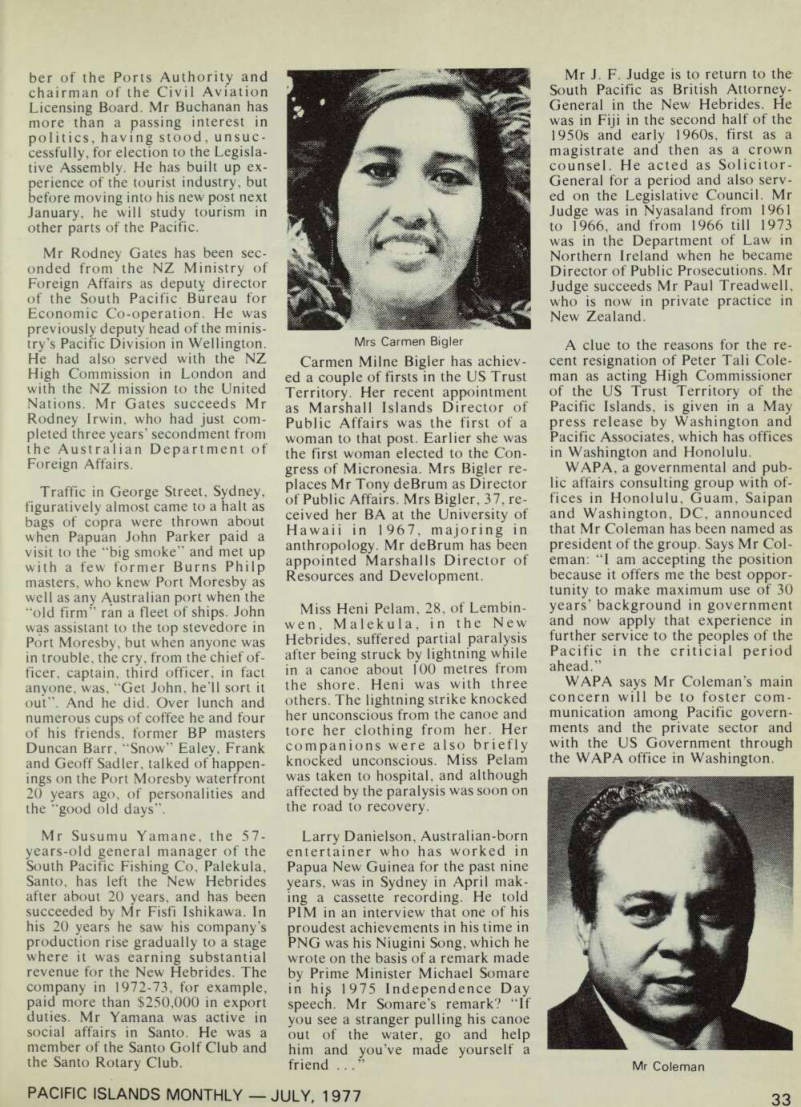
Dr Sione Tapa, Minister of Health in Tonga, was elected presi dent of the 30th World Health As sembly at the May three-week ses sion in Geneva. Dr Tapa was born at Nukualofa in 1923, and is a gra duate of the Fiji School of Medicine, Otago University (NZ) and the Royal Institute of Public Health and Hygiene (London). Tonga joined the World Health Organisation in 1975, but has taken part in WHO activities since 1956. Since then Tonga has undertaken a number of WHO projects, several of them sponsored by Dr Tapa.
Tom Neale, 75, the Hermit of Suwarrow atoll in the Cook Islands was taken to Rarotonga in May for treatment in hospital. A cruise yacht which called at Suwarrow found him ill and radioed for assistance.
The Manuvai called at the island to pick him up. Mr Neale was suffering from a bowel complaint. Whether he will return to the island is doubtful.
Acting High Commissioner of the US Pacific Trust Territory, Mr J.
Boyd MacKenzie, spoke with more authority than most when he opened the seventh annual Pacific Basin Regional Airport Conference on Saipan.
Tn the early days of the Trustee ship,” MacKenzie recalled, ”a trip around the districts by air was a true adventure.” He should know. In the early days he survived two crashes one off Guam, and the other near Palau District.
Mr Bartholomew (Bara) Buchanan, 42, is the first Solomon Islander appointed to manage the SI Tourist Authority. Mr Buchanan, before going into the commercial field a few years ago, spent about 20 years in the civil service, working in the Public Works Department, dis trict administration and as Deputy Registrar of Land and Titles. He was chairman of two advisory boards on wages, a member of the Copra and Industrial and Agricultural Loans Boards and Electricity Authority. He is a mem
ber of the Ports Authority and chairman of the Civil Aviation Licensing Board. Mr Buchanan has more than a passing interest in politics, having stood, unsuc cessfully, for election to the Legisla tive Assembly. He has built up ex perience of the tourist industry, but before moving into his new post next January, he will study tourism in other parts of the Pacific.
Mr Rodney Gates has been sec onded from the NZ Ministry of Foreign Affairs as deputy director of the South Pacific Bureau for Economic Co-operation. He was previously deputy head of the minis try’s Pacific Division in Wellington.
He had also served with the NZ High Commission in London and with the NZ mission to the United Nations. Mr Gates succeeds Mr Rodney Irwin, who had just com pleted three years’ secondment from the Australian Department of Foreign Affairs.
Traffic in George Street, Sydney, figuratively almost came to a halt as bags of copra were thrown about when Papuan John Parker paid a visit to the “big smoke” and met up with a few former Burns Philp masters, who knew Port Moresby as well as any Australian port when the “old firm” ran a fleet of ships. John was assistant to the top stevedore in Port Moresby, but when anyone was in trouble, the cry, from the chief of ficer, captain, third officer, in fact anyone, was, “Get John, he’ll sort it out”. And he did. Over lunch and numerous cups of coffee he and four of his friends, former BP masters Duncan Barr, “Snow” Ealey, Frank and Geoff Sadler, talked of happen ings on the Port Moresby waterfront 20 years ago, of personalities and the “good old days”.
Mr Susumu Yamane, the 57years-old general manager of the South Pacific Fishing Co, Palekula, Santo, has left the New Hebrides after about 20 years, and has been succeeded by Mr Fisfi Ishikawa. In his 20 years he saw his company’s production rise gradually to a stage where it was earning substantial revenue for the New Hebrides. The company in 1972-73, for example, paid more than $250,000 in export duties. Mr Yamana was active in social affairs in Santo. He was a member of the Santo Golf Club and the Santo Rotary Club.
Carmen Milne Bigler has achiev ed a couple of firsts in the US Trust Territory. Her recent appointment as Marshall Islands Director of Public Affairs was the first of a woman to that post. Earlier she was the first woman elected to the Con gress of Micronesia. Mrs Bigler re places Mr Tony deßrum as Director of Public Affairs. Mrs Bigler, 37, re ceived her BA at the University of Hawaii in 1967, majoring in anthropology. Mr deßrum has been appointed Marshalls Director of Resources and Development.
Miss Heni Pelam, 28, of Lembin wen, Malekula, in the New
Hebrides, suffered partial paralysis
after being struck by lightning while in a canoe about 100 metres from the shore. Heni was with three others. The lightning strike knocked her unconscious from the canoe and tore her clothing from her. Her companions were also briefly knocked unconscious. Miss Pelam was taken to hospital, and although affected by the paralysis was soon on the road to recovery.
Larry Danielson, Australian-born entertainer who has worked in Papua New Guinea for the past nine years, was in Sydney in April mak ing a cassette recording. He told PIM in an interview that one of his proudest achievements in his time in PNG was his Niugini Song, which he wrote on the basis of a remark made by Prime Minister Michael Somare in 1975 Independence Day speech. Mr Somare’s remark? “If you see a stranger pulling his canoe out of the water, go and help him and you’ve made yourself a friend ...”
Mr J. F. Judge is to return to the South Pacific as British Attorney- General in the New Hebrides. He was in Fiji in the second half of the 1950 s and early 19605, first as a magistrate and then as a crown counsel. He acted as Solicitor- General for a period and also serv ed on the Legislative Council. Mr Judge was in Nyasaland from 1961 to 1966, and from 1966 till 1973 was in the Department of Law in Northern Ireland when he became Director of Public Prosecutions. Mr Judge succeeds Mr Paul Treadwell, who is now in private practice in New Zealand.
A clue to the reasons for the re cent resignation of Peter Tali Cole man as acting High Commissioner of the US Trust Territory of the Pacific Islands, is given in a May press release by Washington and Pacific Associates, which has offices in Washington and Honolulu.
WAPA, a governmental and pub lic affairs consulting group with of fices in Honolulu. Guam, Saipan and Washington, DC, announced that Mr Coleman has been named as president of the group. Says Mr Col eman: “I am accepting the position because it offers me the best oppor tunity to make maximum use of 30 years’ background in government and now apply that experience in further service to the peoples of the Pacific in the criticial period ahead.”
WAPA says Mr Coleman’s main concern will be to foster com munication among Pacific govern ments and the private sector and with the US Government through the WAPA office in Washington.
Mrs Carmen Bigler
Mr Coleman
Islands
From The
Press
From a letter by William Long Wah, bus company manager, in the New Hebrides News: . . . . We have advised school headmasters to instruct children on how to behave themselves while travelling by bus, and not to put their heads, arms or bodies outside the windows and doors. It would be a great help if all parents would do the same. One of our drivers last year did actually reprimand a child for misbehaving in the bus and spanked the child. The outcome of this was that our driver got bashed up by the parents and friends of the child ...
From an editorial in the Papua New Guinea
Post-Courier:
The protracted strike by Australian air traffic controllers certainly underlined PNG’s strong dependence on Australia. It also drew attention to some weaknesses which we, as an independent nation, could find it hard to live with in the future.
The existing airline policy is a particular case in point. The question must now be asked. Is it in the best interests of PNG to remain so closely tied to our southern neighbour? If the strike in Australia had continued for a few more weeks it would have virtually paralysed PNG. The cost would have been catastrophic.
It would have severely affected the nation’s economy ... Our traditional links with Australia are of prime importance but we must also look to the future.
From the women’s page in The Fiji Times: “Breast fed is best fed” is the slogan of a group calling itself the Nursing Mothers of Fiji. The group’s leader is Margaret Taylor who trained with Nursing Mothers of Australia as a group leader “. . . we were appalled at the blatant advertising artificial feeding formulas were getting in Fiji”, Mrs Taylor said. Some products bore the claim that they were a “complete alternative to breast milk”, which simply was not true. Mrs Taylor said there was no way that artificial formulas could be made completely to match breast milk and added: “Cows’ milk is for cows and that’s what most formulas are made from.”
From the Cook Island News: An unusual event occurred last Sunday evening aboard MV Manuvai while enroute Atiu. At about 10 pm Mrs Maui Maui, a member of the Women’s Institute, gave birth to a baby boy atop No 1. hatch ... Controversyimmediatelyaroseoverthenamingof the new arrival. The Manuvai crew naturally preferred the name “Manuvai” while the Women’s Institute deemed “Women’s Institute” appropriate. Mrs Maui and her son navigating under their own steam, caught the first barge ashore the following morning at Atiu, leaving the matter of the naming unresolved.
A poser in the Solomons News Drum: Can fish tell when an earthquake is coming? That is the question puzzling Solomon Taiyo catcher boat crews who have reported a falling off in the catch following the earthquake. Nine boats fishing in the area bounded by the Russels, Ysabel and Malaita have found that the skipjack catch has dropped by about 30 per cent. And the odd thing is that the fish seemed to vanish about 24 hours before the earthquakes on April 21.
From an article by Joe Murphy writing on “Religious Activity in the Marshalls” in the
Micronesian Independent:
You must have heard somewhere along the line about the difficulties missionaries run into spreading the word well none of what you heard is true about the Marshall Islands where not only is it not difficult to get a religion established here, it’s almost impossible to avoid success ... Now there is an amazing proliferation of competitive missionary activity that boggles the imagination and makes one wonder if all this talking and persuading isn’t more an indication that the Marshall Islands is a nice soft place to gospelize than a sorry statement implying that the people here are so sinful and woebegone that all this missionary activity is thought necessary ...
From the Samoa Times: Young church officials who will be ordained as pastors in the Congregational Christian Church tomorrow at Malua have been instructed by their elders to have haircuts. Similar instructions were given to some tutors at Malua Theological College and that some of the tutors’ wives should not wear certain dresses and hairstyles “because these do not suit them as pastors’ wives. Most of the young pastors who are playing rugby in their village teams have also been told not to “because pastors do not play rugby”.
From Ruby Matthews’ (nee Yager) reminiscences
about Kingston in the k Old Days’, in the Norfolk Island News: “What did we do for fun? There were balls, any excuse for one too.
They were held in old Rawson Hall near Branka House. It was a stone building, convict built. We had a fine orchestra and for these occasions Hugo Quintal, George Nobbs and Bert Starr played violins and Swain Quintal at the piano. We didn’t pair off.
Everyone danced with everyone else. We danced the Lancers, the Chatish, square dances and the old-time waltz and others. If we got thirsty we had a drink of water under the tap.
From a letter by Beachy in the Cook Islands
News:
It is with growing concern that one views the number of barbed-wire fences being erected around the island. In particular the fencing off of beach sections seems to be the 'in’ thing and one wonders what the situation will be like in a few years if all owners of beach sections follow suit. After all they do not own the beach and lagoon. Surely steps must be taken now to protect all Cook Islanders’ right of access to the lagoon not just the lucky few who are owners of beach sections.
The drinking pattern in Tonga as recorded in the Tonga Chronicle by Minister of Police ‘Akau’ola: ... Given the opportunity, the drinking session startsquietly and builds up to a very fast pace (usually dictated by the fastest drinker). It is therefore not uncommon, under such circumstances, to find that three participants have consumed two cartons of beer, or a bottle of whisky and one carton of beer in two hours. These drinking sessions seldom take place at the parents’ home for the family generally objects. A secluded spot is selected, for uninvited “friends” are not looked on with favour, unless they also contribute.
From a speech by Papuan secessionist leader Josephine Abaijah reported in the Papua New
Guinea Post-Courier:
Sex prostitution was a lesser evil than political prostitution, the Member for the National Capital District, Miss J. M. Abaijah said yesterday. Sex was not the only morality... For example, there are plenty of political prostitutes who are willingtoselltheir political support for personal gain irrespective of what the people want.”
Advertisements & other items, p. 35 (1 item)
Bond S T-Shirts.
Available at all BURNS PHILP STEAMSHIPS TRADING.
MORRIS HEDSTROMS. and other leading suppliers in the Islands.
Magazine
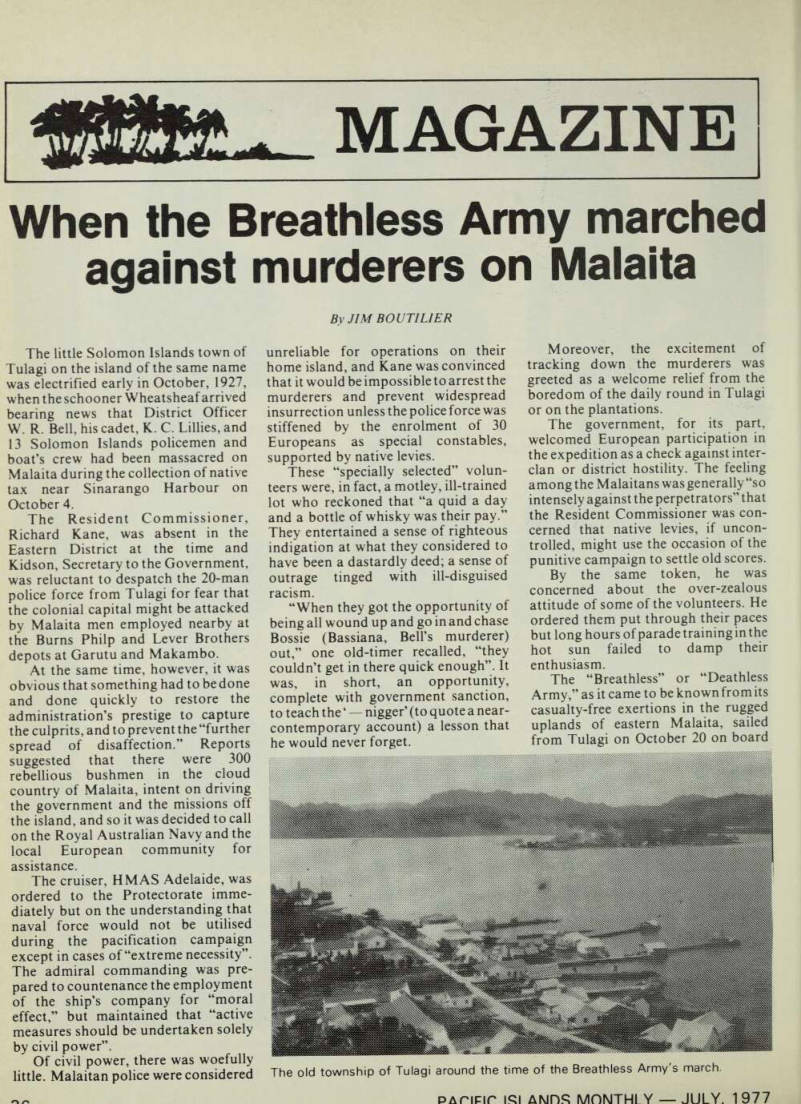
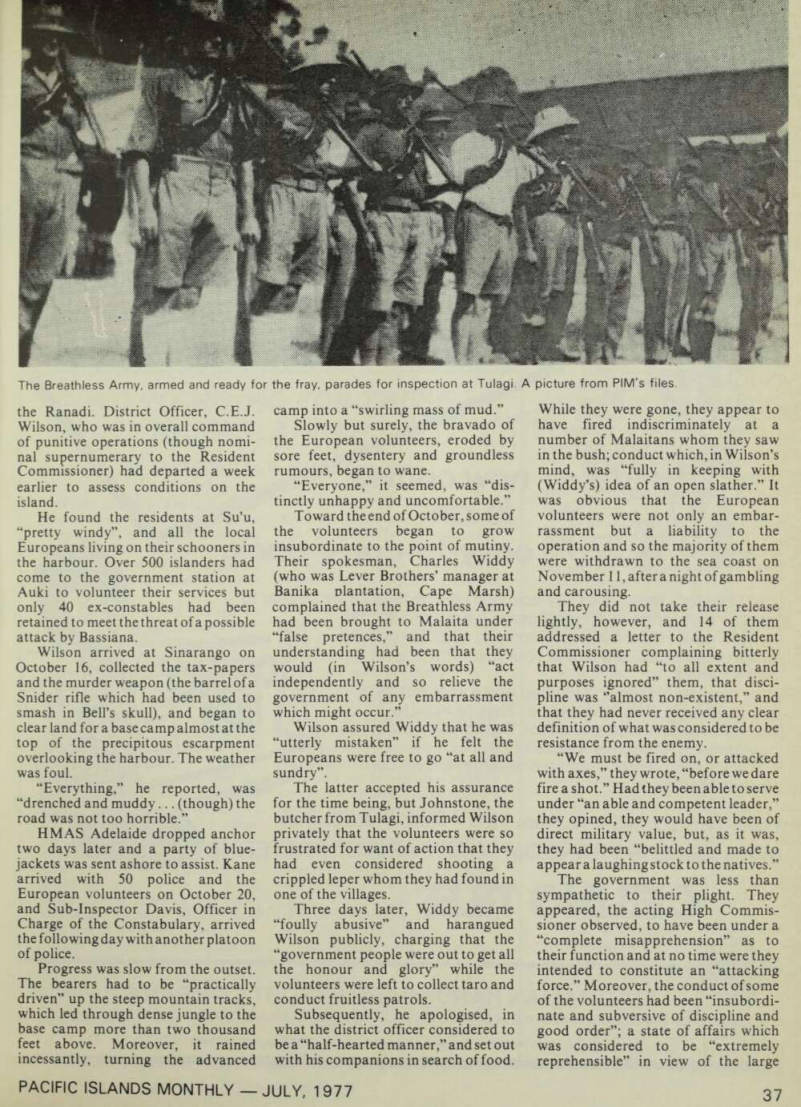

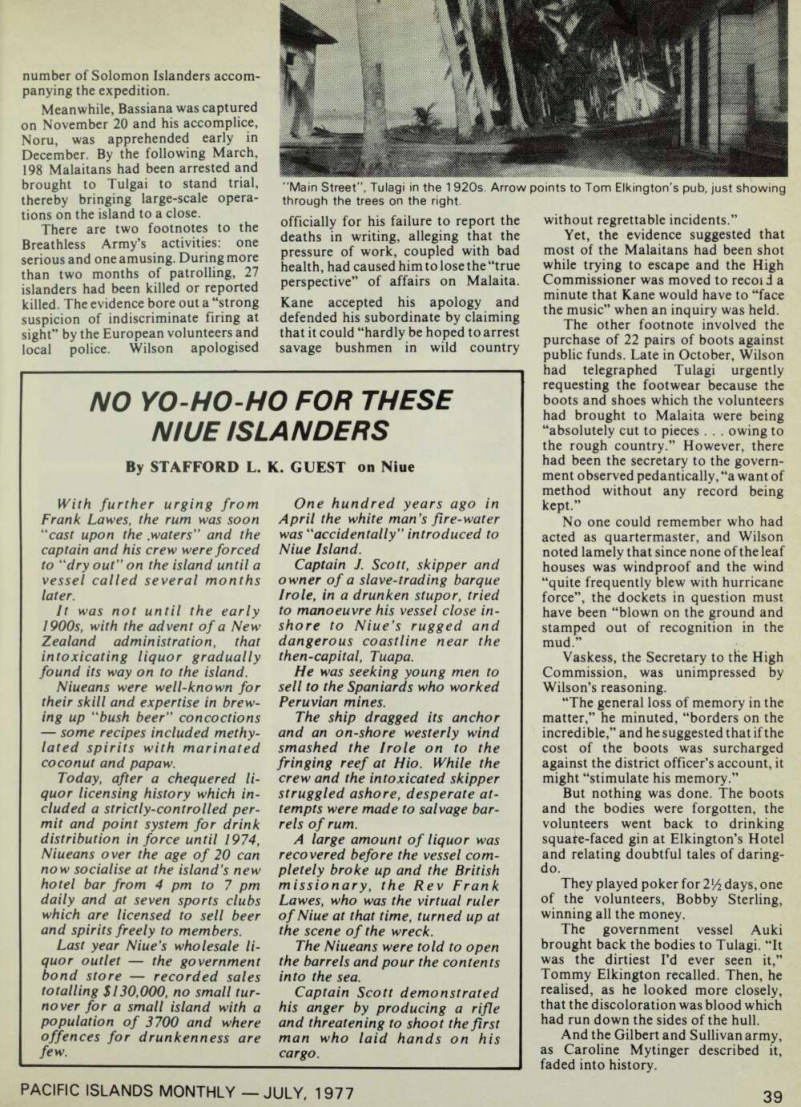
When the Breathless Army marched against murderers on Malaita
By Jim Boutilier
The little Solomon Islands town of Tulagi on the island of the same name was electrified early in October, 1927, when the schooner Wheatsheaf arrived bearing news that District Officer W. R. Bell, his cadet, K. C. Lillies, and 13 Solomon Islands policemen and boat’s crew had been massacred on Malaita during the collection of native tax near Sinarango Harbour on October 4.
The Resident Commissioner, Richard Kane, was absent in the Eastern District at the time and Kidson, Secretary to the Government, was reluctant to despatch the 20-man police force from Tulagi for fear that the colonial capital might be attacked by Malaita men employed nearby at the Burns Philp and Lever Brothers depots at Garutu and Makambo.
At the same time, however, it was obvious that something had to be done and done quickly to restore the administration’s prestige to capture the culprits, and to prevent the “further spread of disaffection.” Reports suggested that there were 300 rebellious bushmen in the cloud country of Malaita, intent on driving the government and the missions off the island, and so it was decided to call on the Royal Australian Navy and the local European community for assistance.
The cruiser, HMAS Adelaide, was ordered to the Protectorate imme diately but on the understanding that naval force would not be utilised during the pacification campaign except in cases of “extreme necessity”.
The admiral commanding was pre pared to countenance the employment of the ship’s company for “moral effect,” but maintained that “active measures should be undertaken solely by civil power”.
Of civil power, there was woefully little. Malaitan police were considered
unreliable for operations on their home island, and Kane was convinced that it would be impossible to arrest the murderers and prevent widespread insurrection unless the police force was stiffened by the enrolment of 30 Europeans as special constables, supported by native levies.
These “specially selected” volunteers were, in fact, a motley, ill-trained lot who reckoned that “a quid a day and a bottle of whisky was their pay.”
They entertained a sense of righteous indigation at what they considered to have been a dastardly deed; a sense of outrage tinged with ill-disguised rac i sm .
“When they got the opportunity of being all wound up and go in and chase Bossie (Bassiana, Bell’s murderer) out,” one old-timer recalled, “they couldn’t get in there quick enough”. It was, in short, an opportunity, complete with government sanction, to teach the ‘ nigger’(to quote a nearcontemporary account) a lesson that he would never forget.
Moreover, the excitement of tracking down the murderers was greeted as a welcome relief from the boredom of the daily round in Tulagi or on the plantations, The government, for its part, welcomed European participation in the expedition as a check against inter clan or district hostility. The feeling among the Malaitans was generally “so intensely against the perpetrators” that the Resident Commissioner was con cerned that native levies, if uncon trolled, might use the occasion of the punitive campaign to settle old scores, By the same token, he was concerned about the over-zealous attitude of some of the volunteers. He ordered them put through their paces but long hours of parade training in the hot sun failed to damp their enthusiasm.
The “Breathless” or “Deathless Army,” as it came to be known from its casualty-free exertions in the rugged uplands of eastern Malaita, sailed from Tulagi on October 20 on board
The old township of Tulagi around the time of the Breathless Army's march.
the Ranadi. District Officer, C.E.J.
Wilson, who was in overall command of punitive operations (though nominal supernumerary to the Resident Commissioner) had departed a week earlier to assess conditions on the island.
He found the residents at Su’u, “pretty windy”, and all the local Europeans living on their schooners in the harbour. Over 500 islanders had come to the government station at Auki to volunteer their services but only 40 ex-constables had been retained to meet the threat of a possible attack by Bassiana.
Wilson arrived at Sinarango on October 16, collected the tax-papers and the murder weapon (the barrel of a Snider rifle which had been used to smash in Bell’s skull), and began to clear land for a base camp almost at the top of the precipitous escarpment overlooking the harbour. The weather was foul, “Everything,” he reported, was “drenched and muddy... (though) the road was not too horrible.”
HMAS Adelaide dropped anchor two days later and a party of bluejackets was sent ashore to assist. Kane arrived with 50 police and the European volunteers on October 20, and Sub-Inspector Davis, Officer in Charge of the Constabulary, arrived the following day with another platoon
of police.
Progress was slow from the outset, The bearers had to be “practically driven” up the steep mountain tracks, which led through dense jungle to the base camp more than two thousand feet above. Moreover, it rained
incessantly, turning the advanced
camp into a “swirling mass of mud.”
Slowly but surely, the bravado of the European volunteers, eroded by sore feet, dysentery and groundless rumours, began to wane.
“Everyone,” it seemed, was “distinctly unhappy and uncomfortable.”
Toward the end of October, some of the volunteers began to grow insubordinate to the point of mutiny.
Their spokesman, Charles Widdy (who was Lever Brothers’manager at Banika plantation, Cape Marsh) complained that the Breathless Army had been brought to Malaita under “false pretences,” and that their understanding had been that they would (in Wilson’s words) “act independently and so relieve the government of any embarrassment which might occur.”
Wilson assured Widdy that he was “utterly mistaken” if he felt the Europeans were free to go “at all and sundry”.
The latter accepted his assurance for the time being, but Johnstone, the butcher from Tulagi, informed Wilson privately that the volunteers were so frustrated for want of action that they had even considered shooting a crippled leper whom they had found in one of the villages.
Three days later, Widdy became “foully abusive” and harangued Wilson publicly, charging that the “government people were out to get all the honour and glory” while the volunteers were left to collect taro and conduct fruitless patrols.
Subsequently, he apologised, in what the district officer considered to be a “half-hearted manner,” and set out with his companions in search of food.
While they were gone, they appear to have fired indiscriminately at a number of Malaitans whom they saw in the bush; conduct which, in Wilson’s mind, was “fully in keeping with (Widdy’s) idea of an open slather.” It was obvious that the European volunteers were not only an embar rassment but a liability to the operation and so the majority of them were withdrawn to the sea coast on November 11, after a night of gambling and carousing.
They did not take their release lightly, however, and 14 of them addressed a letter to the Resident Commissioner complaining bitterly that Wilson had “to all extent and purposes ignored” them, that disci pline was ‘’almost non-existent,” and that they had never received any clear definition of what was considered to be resistance from the enemy, “We must be fired on, or attacked with axes,” they wrote, “before we dare fire a shot.” Had they been able to serve under “an able and competent leader,” they opined, they would have been of direct military value, but, as it was, they had been “belittled and made to appear a laughing stock to the natives.”
The government was less than sympathetic to their plight. They appeared, the acting High Commis sioner observed, to have been under a “complete misapprehension” as to their function and at no time were they intended to constitute an “attacking force,” Moreover, the conduct of some of the volunteers had been “insubordi nate and subversive of discipline and good order”; a state of affairs which was considered to be “extremely reprehensible” in view of the large
The Breathless Army, armed and ready for the fray, parades for inspection at Tulagi. A picture from PIM’s files.
number of Solomon Islanders accom panying the expedition.
Meanwhile, Bassiana was captured on November 20 and his accomplice, Noru, was apprehended early in December. By the following March, 198 Malaitans had been arrested and brought to Tulgai to stand trial, thereby bringing large-scale opera tions on the island to a close.
There are two footnotes to the Breathless Army’s activities: one serious and one amusing. During more than two months of patrolling, 27 islanders had been killed or reported killed. The evidence bore out a “strong suspicion of indiscriminate firing at sight” by the European volunteers and local police. Wilson apologised
officially for his failure to report the deaths in writing, alleging that the pressure of work, coupled with bad health, had caused him to lose the “true perspective” of affairs on Malaita.
Kane accepted his apology and defended his subordinate by claiming that it could “hardly be hoped to arrest savage bushmen in wild country
without regrettable incidents.”
Yet, the evidence suggested that most of the Malaitans had been shot while trying to escape and the High Commissioner was moved to recoid a minute that Kane would have to ‘‘face the music” when an inquiry was held.
The other footnote involved the purchase of 22 pairs of boots against public funds. Late in October, Wilson had telegraphed Tulagi urgently requesting the footwear because the boots and shoes which the volunteers had brought to Malaita were being “absolutely cut to pieces . . . owing to the rough country.” However, there had been the secretary to the govern ment observed pedantically, “a want of method without any record being kept.”
No one could remember who had acted as quartermaster, and Wilson noted lamely that since none of the leaf houses was windproof and the wind “quite frequently blew with hurricane force”, the dockets in question must have been “blown on the ground and stamped out of recognition in the mud.”
Vaskess, the Secretary to the High Commission, was unimpressed by Wilson’s reasoning.
“The general loss of memory in the matter,” he minuted, “borders on the incredible,” and he suggested that if the cost of the boots was surcharged against the district officer’s account, it might “stimulate his memory.”
But nothing was done. The boots and the bodies were forgotten, the volunteers went back to drinking squate-faced gin at Elkington’s Hotel and relating doubtful tales of daring do.
They played poker for V/i days, one of the volunteers, Bobby Sterling, winning all the money.
The government vessel Auki brought back the bodies to Tulagi. “It was the dirtiest I’d ever seen it,”
Tommy Elkington recalled. Then, he realised, as he looked more closely, that the discoloration was blood which had run down the sides of the hull.
And the Gilbert and Sullivan army, as Caroline Mytinger described it, faded into history.
"Main Street", Tulagi in the 1920s. Arrow points to Tom Elkington's pub, just showing through the trees on the right.
Advertisements & other items, pp. 36-38 (2 items)
36
PAriPir IQI ANn.9 MONTHLY JULY. 1 977
do-it-yourself with
lUNG TILES
TILE PATTERN:
“PARIAN”
T^i •PS*comes now A an in V_
pack
to easy
carry
Lots of people hesitate to buy acoustic tiles because they appear to come in one-tonne lots. Hardboards have fixed all that.
As from now, HAL ceiling tiles come in neat, take-away packs of 20. Look for them at your favourite handyman store.
They’re great for helping to keep noise in or out, or simply as a good looking ceiling. They re easy to fix, and they enhance any decor. Best of all, now they come in handyman packs of 20.
P.S. If you actually do need a one-tonne lot, we can arrange that too.
Tile size 610 x 305 x 12.7 mm T&G - Matt White Finish
AVAILABLE IN “RANDOM” OR “PARIAN” PATTERNS
CEILING TILES
m < m The handy tile that insulates Available from DdsD
AUSTRALIAN HARDBOARD EXPORT COMPANY
A DIVISION OF HARDBOARDS AUSTRALIA LIMITED.POST OFFICE BOX 161 MILSONS POINT, N S W 2061, AUSTRALIA TELEX: 24332 PHONE: (SYDNEY) 9294244 CABLES: AUSTBOARDS SYDNEY
No Yo-Ho-Ho For These
Niue Islanders
By STAFFORD L. K. GUEST on Niue
With further urging from Frank Lawes, the rum was soon “cast upon the .waters” and the captain and his crew were forced to “dry out” on the island until a vessel called several months later.
It was not until the early 19005, with the advent of a New Zealand administration, that intoxicating liquor gradually found its way on to the island.
Niueans were well-known for their skill and expertise in brewing up “bush beer” concoctions some recipes included methylated spirits with marinated coconut and papaw.
Today, after a chequered liquor licensing history which included a strictly-controlled permit and point system for drink distribution in force until 1974, Niueans over the age of 20 can now socialise at the island’s new hotel bar from 4 pm to 7 pm daily and at seven sports clubs which are licensed to sell beer and spirits freely to members.
Last year Niue’s wholesale liquor outlet the government bond store recorded sales totalling $130,000, no small turnover for a small island with a population of 3700 and where offences for drunkenness are few.
One hundred years ago in April the white man’s fire-water was “ accidentally” introduced to Niue Island.
Captain J. Scott, skipper and owner of a slave-trading barque I role, in a drunken stupor, tried to manoeuvre his vessel close in shore to Niue’s rugged and dangerous coastline near the then-capital, Tuapa.
He was seeking young men to sell to the Spaniards who worked Peruvian mines.
The ship dragged its anchor and an on-shore westerly wind smashed the Irole on to the fringing reef at Hio. While the crew and the intoxicated skipper struggled ashore, desperate at tempts were made to salvage bar rels of rum.
A large amount of liquor was recovered before the vessel com pletely broke up and the British missionary, the Rev Frank Lawes, who was the virtual ruler of Niue at that time, turned up at the scene of the wreck.
The Niueans were told to open the barrels and pour the contents into the sea.
Captain Scott demonstrated his anger by producing a rifle and threatening to shoot the first man who laid hands on his cargo.
Glass-Plated Island History
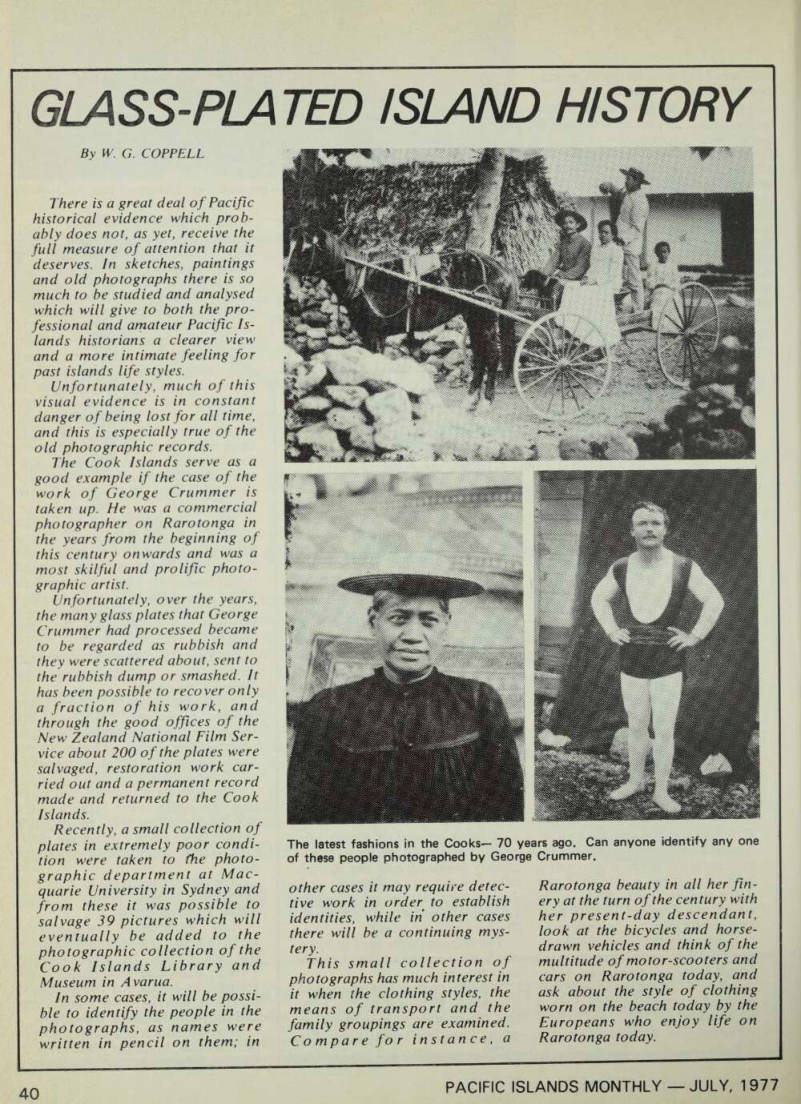
By W. G. Coppell
There is a great deal of Pacific historical evidence which prob ably does not, as yet, receive the full measure of attention that it deserves. In sketches, paintings and old photographs there is so much to be studied and analysed which will give to both the pro fessional and amateur Pacific Is lands historians a clearer view and a more intimate feeling for past islands life styles.
Unfortunately, much of this visual evidence is in constant danger of being lost for all time, and this is especially true of the old photographic records.
The Cook Islands serve as a good example if the case of the work of George Crummer is taken up. He was a commercial photographer on Rarotonga in the years from the beginning of this century onwards and was a most skilful and prolific photo graphic artist.
Unfortunately, over the years, the many glass plates that George Crummer had processed became to be regarded as rubbish and they were scattered about, sent to the rubbish dump or smashed. It has been possible to recover only a fraction of his work, and through the good offices of the New Zealand National Film Ser vice about 200 of the plates were salvaged, restoration work car ried out and a permanent record made and returned to the Cook Islands.
Recently, a small collection of plates in extremely poor condi tion were taken to fhe photo graphic department at Mac quarie University in Sydney and from these it was possible to salvage 39 pictures which will eventually be added to the photographic collection of the Cook Islands Library and Museum in Avarua.
In some cases, it will be possi ble to identify the people in the photographs, as names were written in pencil on them; in
other cases it may require detective work in order to establish identities, while in other cases there will be a continuing mystery.
This small collection of photographs has much interest in it when the clothing styles, the means of transport and the family groupings are examined.
Compare for instance, a
Rarotonga beauty in all her fin ery at the turn of the century with her present-day descendant, look at the bicycles and horse drawn vehicles and think of the multitude of motor-scooters and cars on Rarotonga today, and ask about the style of clothing worn on the beach today by the Europeans who enjoy life on Rarotonga today.
The latest fashions in the Cooks— 70 years ago. Can anyone identify any one of these people photographed by George Crummer.
Advertisements & other items, pp. 41-48 (1 item)
Invest in precious metals.
Of the eight precious metals, it takes four to make a Parker 75 pen. The silver, gold, platinum and ruthenium aren't there just for show. They make it work better. And they make it a gift to treasure. What you could call a lifetime investment.
Sterling silver gives the case heft and balance.
We use our own special alloy of 14ct gold for the nib, because few other metals resist ink corrosion as well, and still provide such responsiveness as you write.
For the tip that touches the paper, we developed an alloy of platinum and ruthenium that resists wear so well, we don't know how long a tip will last.
It’s even more exceptional.
The nib can turn 360° to write at the angle most natural to you.
Quite an investment, the sterling silver Parker 75.
There’s a nylon nib version and matching ball pen or pencil.
Also rolled gold or Vermeil, which is 14ct gold on silver.
The distinctive arrow clip identifies every Parker model.
■t PARKER
World's most wanted pens
9 *
mssm
n ■obb w&mijwm fj HI O » m B * * * 5 *. ' 4%- 44 4-44 ■v; IE ♦» 1# fi
V\V\\\V-
W\ 4 r 1 W -4 SANSUI ELECTRIC CO., LTD. 14-1 Izumi 2-chome, Suginami-ku, Tokyo 168, Japan Australia Rank Industries Australia Pty. Ltd.
Head Office: 12 Barcoo Street, East Roseville, N.S.W. 2069 Phone: 406 5666 Melbourne: 68 Queensbridge Street, South Melbourne, Vic. 3205 Phone; 62 0031 Adelaide; Phone: 212 2555/ Brisbane; Phone: 52 7333 Canberra; Phone: 95 2144 Perth; Phone: 28 3933
Performers by Sansui!
Sansui! Who else could present such an exciting array of spectacular stereo?
Sansui! Who else but the hi-fi specialist could assure you of outstanding and reliable performance for every model on this page!
Sansui means sound that’s clean and powerful. It means stereo that touches your soul. And it means even the subtle nuances of music sources are crisp.
Here is proof that Sansui is dedicated to excellent sound quality for everyone.
If you put sound quality first, it’s Sansui all the way! * » i. 9 9 9 f r r S 3 a t J r ••• tf a Si f- / Stut v ui
Only hi-fi, everything hi-fi.
Fiji Prabhu Brothers Ltd. P.O. Box 183, Nadi Phone: 70183/4 Papua New Guinea Oceania Indent Agency (P.N.G.) Pty. Ltd. Box 5518, Boroko, Port Moresby Phone: PM 256406 New Zealand David J. Reid (N.Z.) Ltd. C.P.0.80x 2630, Auckland, 1 Phone:492-189 New Caledonia Ets Michel MERCIER B.P. 1123, Noumea Phone: 27. 59. 1 1 South Pacific Miltons Department Stores Limited P.O. Box 146, Norfolk Island 2899 Central Pacific Nauru Co-operative Society Republic of Nauru Western Samoa H.J. Keil and Company Ltd. P.O. Box 7, Apia Phone; 198 New Hebrides The Sound Centre P.O. Box 434, Port Vila Cook Islands United Island Traders Ltd. P.O. Box 1 & 2, Rarotonga
- ■* PR % w **■ § ft * . iwi K ' r » . ■i j J % V m i*'
The Toyota truck range.
Built to be unbeatable.
Bad weather conditions, no problem.
Bad roads and driving surfaces, eaten up.
Difficult loads, no contest.
Built tough. Built to take it.
There's a Toyota truck built for you.
TOYOTA Land Cruiser Pickup
TOYOTA Hi-Ace
TOYOTA Stout
TOYOTA Hi-Lux
A &
TOYOTA Dyna
“fSC
TOYOTA Toyo-Ace nm HI TOYOTA Truck
TOYOTA
For unbeatable after service: GUINEA: ELA MOTORS LIMITED, Scratchley Rd., Badill, P.O, Box 75, Port Moresby. U.S. TRUST TERRITORY- MICROL CORPORATION CO ■ LTD P O PFUI P SLA^ T «L O c M . OT^ VE SUPPUES C °- LTD - GP °- B °* 355 - Suva - AMER^aJI po' rI mor t° ' 390 S uctn SAMOA: BURNS PHILP (SOUTH SEA) LTD., P.O. Box 188, Apia. GUAM: ATKINS KROLL (GUAM) LTD (S l’) B LTD 6 p B n T R mUn i7a h E E xrmxP :^o^ HEBRIDES MOTORS LTD - PO - B °* 18 - Vila. SOLOMON ISLANDS: MENDANA ENTERPRISES LTD ' f k AUTOMOTO - bp - 342, Papeete COOK ISLANDS: COOK ISLANDS TRADING CORPORATION r TD rr P ‘d' t 2 ' Rarot ° n Jl- NAURU ISLAND: NAURU COOPERATIVE SOCIETY. GILBERT & ELLICE ISLANDS COLONY: TARAWA MOTORS CALEDONIASOcTtEImportATin^AurnMni 8 S C NORF ° LK TOURS - LTD - p °- Box 276 TIMOR: SANG TAI HOO, Sang Tai Building, Dili. NEW CALEDONIA. SOCIETE IMPORTATION AUTOMOBILE DU PACIFIQUE, Rond-Pomt du Pacific (Station Total) B.P. 438 Noumea
ALL QUARTZ. ALL SEIKO.
ALL SUPERBLYACCURATE.
a *••• ■ *
SEIKO *r«T
?J*Z *** m. UMf rr 1
&LiARTZS,C
't \ first qua a Seiko. Today Seiko of quality quartz In the Seiko Quartz Analog Collection, hands pin-point time with unerring quartz accuracy. Choose from a wide array of models: boldly colorful dials and trilingual day/date settings, ultra-thin watches and exquisitely miniature Lady Seiko Quartz models. Featured in the Multi-Mode LC various functions including uc cnronograph with day/date calendar that instantly converts into a stopwatch.
All are the result of almost a century of involvement and innovation in the watch industry.
All are made with Seiko's traditionally matchless beauty and precision.
Seiko Quartz. sa
SEIKO
Someday all watches will be made this way.
The only thing medium
about this amplifier is the dent
it makes in your wallet.
ril*
rC 0 % % r™i 0 Ml EJ7 Pioneer does it again. More “top of the line” features from the middle of our line. The new SA-950011 integrated stereo amplifier brings high fidelity out of the range of high finance. Features and performance that were previously available only on the high-priced,“high-end” models are now easily within reach of the demanding music listener whose budget has other demands on it.
Power is a respectable 80 watts per channel, minimum RMS at 8 ohms from 20 to 20,000 Hz with no more than 0.1% total harmonic distortion.
The 2-stage differential amplifier, using a current mirror circuit with a parallel push-pull pure complementary OCL circuit is powered from a plus/minus split power supply to ensure large power reserve and to suppress distortion of all types.
If power is measured from the Power Amp-in Terminals, the same power output can be obtained with no more than 0.05% THD. This means that the low distortion rating is maintained accurately over the entire range of one to nearly eighty watts.
Other features include phono equalization as low as ±0.2d8 RIAA, a 32-step attenuator type volume control and variable load capacitance/ resistance selectors to match the impedance characteristics of high
performance cartridges.
And while some other amplifiers may offer two tone controls or possibly three, only Pioneer gives you four. The BASS and TREBLE sections each have two parts —MAIN and SUB. Thus Pioneer’s Twin Tone Control system places total sound management right at your fingertips.
Pioneer’s new SA-9500 II stereo amplifier. One of its greatest features is the money it leaves behind for the other good things in life.
ADpioneer
Pioneer Electronic Corporation
4-1, Meguro 1-chome, Meguro-ku, Tokyo 153, Japan Australia Pioneer Electronics Australia Pty.
Ltd., 178-184 Boundary Road, Braeside, Victoria 3195. Tel: 90-9011 Sydney 93-0246, Brisbane 59-7457, Adelaide 433379, Perth 24-9899 Fiji Islands Brijlal & Company, G P.O. Box No 362. Suva. Fiji Islands Tel 22258 New Zealand Fountain Marketing Ltd., Maidstone Street, Auckland, New Zealand Tel; 763-064 Norfolk Island Burns Philp (Norfolk Island) Ltd., Norfolk Island, South Pacific New Hebrides Burns Philp (New Hebrides) Ltd., Vila New Hphririoc Nauru Island Jacob Enterprises, P.O. Box No. 4 Republic of Nauru Tahiti Est. PERFECT, B.P. 594, Papeete Tahiti Tel: 20 407 New Caledonia Menard Freres Ville, B P. H2Cedex, Noumea, Mau/ T~l. 0-7 c o oo American Samoa Traspac Corporation. P.O. Box 1477, Pago Pago, American Samoa 96799 Tel: 633-5224 Rarotonga South Seas International Ltd., P.O. Box 49. Rarotonga Cook
Fast efficient reliable
SPEED-E-GAS
_A_
SPEED-E-GAS
9 * » • * SPEED-E-GAS is known in Papua New Guinea as GUINEA GAS, in Tonga as TONGA SPEED-E-GAS and in Fiji as FIJI-GAS Boral Gas Limited, a member of the major Australian Boral Group of Companies is associated with a network of bulk storage terminals distributing SPEED-E-GAS throughout the Pacific region.
Terminals at Port Moresby, Lae, Rabaul, Kieta, Wewak, Honiara, Port Vila, Santo, Suva, Lautoka, Nukualofa and Rarotonga now supply fast, efficient SPEED-E-GAS for industrial, commercial and domestic requirements in these areas.
SPEED-E-GAS is completely dependable and highly efficient fuel, so vital to the development of modern living.
BORAL
Boral Gas Limited Head Office, 221 Miller Street North Sydney 2060 Phone 92-0951
Out of the rural frypan
Books
Out of the rural frypan and into the city fire
Rural poverty causes rapid city growth, and in poor countries the ci ties are doubling in population ev ery 17 years. They will continue to grow, although the cities of the more developed countries show a tenden cy to level off. The newer genera tions of rural people are escaping to the cities from the poverty of the villages.
This is one of the points made in Population Change in the Pacific Region, edited by Yunshik Chang and Peter J. Donaldson (SC4). This is a selection of some of the papers presented in the Symposia on Pacific Populations at the 13th Pacific Science Congress at the University of British Columbia, Vancouver, and published by the Congress and the Pacific Science Association of Vancouver.
This growth in urban areas is rele vant to what is happening in many of the nations of the Pacific Islands, although this volume deals for the most part with the countries on the Pacific rim, and only three papers examine specific South Pacific problems.
One of these, by Jean Pages of French Polynesia’s ORSTOM Centre, deals with migration and ur banisation in French Polynesia. It points out that French Polynesia is now one of the most urbanised of the South Pacific territories. This ur banisation has occurred exclusively on Tahiti, focusing on Papeete. At the 1971 census, Papeete’s urban population of 65,000 included 82 per cent of the population of Tahiti and 55 per cent of the population of French Polynesia.
The growth has been rapid, and has resulted from changes in the economic and social structure brought about by major investments in the jet airport and tourist facili ties, as well as the development of the nuclear testing programme. The author says that before the estab lishment of the Pacific Ex perimental Centre, internal migra tion within Polynesia was “cir cular”, the migrants going back to their own islands after a stay in the city. But they are now staying in Papeete and this has had a detrimen
tal effect on the traditional agricultural activities, he says.
Migration has caused a modifica tion of the ethnic composition of the population. In 1962, six per cent of the population was European, but the figure is now 15 per cent. There have been many inter-ethnic mar riages and cross-breeding has in creased.
The author is unhappy about the future. He says that “future possibilities are disquieting; no one knows how to establish a state of equilibrium between the city and the archipelagoes and slow down the exodus from the rural areas.”
The other two papers on South Pacific themes in this book deal with Social Boundaries and Migration in New Zealand (David Pitt) and The Impact of Cultural Exchange on the Health of Tokelau Island Migrants (Judith Huntsman).
A separate volume. Mankind’s Future in the Pacific , edited by R. F.
Scagel, is a selection of the plenary and special lectures at the same Science Congress and is published by the University of British Colum bia Press at Vancouver, although our copy comes from the Australia & New Zealand Book Co Pty Ltd,
Sydney (5A10.50).
Mankind’s Future in the Pacific
contains 13 papers dealing with a wide variety of matters, including environment, science policy, biolo gy. primitive navigation (by Thor Heyerdahl) and agricultural re sources.
The proceedings of a seminar sponsored by the Institute of Ap plied Social and Economic Re search in Papua New Guinea in 1976 titled Research Needs and Priorities in Papua New Guinea have now been published as the in stitute’s Monograph Number 1, and edited by R. J. May. The seminar, and these papers, consisted of a series of submissions by various government departments and other organisations such as the PNG Housing Commission, the Law Reform Commission and the University of Papua New Guinea, on what direction they thought the in stitute should take in its research programme. It’s an interesting monograph because of the insight it gives into what organisations in Papua New Guinea see as the problems ahead of this developing
country
E.W.
Two for students and
a "better read”
Among the more technical books about the Pacific which are coming from various publishers, and which are useful and yet unlikely to quicken the heart of the general reader looking for a good read, are two from the University Press of Hawaii.
Culture-bound Syndromes, Ethnopsychiatry, and Alternate Therapies is the long title of Volume IV of a series put out on mental health research by the Program for Culture and Mental Health in Asia and the Pacific, which was established in 1966 at the University of Hawaii under the
sponsorship of the National Institute of Mental Health, the East-West Center and the Social Science Re search Institute of the university, Price is SUSI 6.
This volume, edited by William P. Lebra, comprises the principal offerings of the fourth and final con ference of the programme, which was in 1972, and the studies have special interest for students of trans cultural psychiatry, cross-cultural psychology, and psychological anthropology, as well as for those directing international training programmes in mental health fields.
The papers represented include
Spirit Possession in a Japanese Healing Cult; Healing in a West Polynesian Village; and Native Healers in Malaysia.
Professor Lebra is Professor of Anthropology and director of the Culture and Mental Health Program in the Social Sciences and Linguistics Institute of the Universi ty of Hawaii.
Transactions in Kinship: Adop tion and Fosterage in Oceania, from the same press, is Number 4 of the monograph series of the Association for Social Anthropology in Oceania.
The editor of this volume is Ivan Brady, and the book deals with adoption and land tenure, alliance and social mobility in specified areas of Micronesia. Polynesia and Melanesia. The book is also SUSI 6.
Something of more general in terest from the University Press of Hawaii, and a far better “read”, is For Whom Are the Stars? by Alber tine Loomis (5U59.95). She gives the first complete account of the three-year period in Hawaii’s histo ry from 1893 when Queen Lili’uokalani surrendered the crown, through the first months of the Republic of Hawaii, and the final desperate attempt by the queen’s loyal supporters to restore the monarchy. The events following the monarchy’s fall are recounted in detail for the first time, including the trial of the conspirators and their eventual fate. The author was helped by recently-discovered papers of Nathaniel B. Emerson, which incorporated many first-hand statements from participants in the
armed uprising of 1895.
E. W.
Advertisements & other items, p. 50 (1 item)
Where every flight
Pan Ana’s Pacific*
is a 747
ill Now that’s a comforting thought. First Class passengers now have a Big spacious 747 s on every Pacific flight, choice from four superb main courses.
That makes choosing an airline a lot In Economy it’s three, easier. Especially when you consider the Pan Am is not only the all-747 airline other advantages we offer. but also the first 7475 P airline. With the Flights to the USA every day of the first ever non-stop services from Sydney week from Sydney, except Wednesdays, to San Francisco and from Auckland to From Melbourne, it’s 5 times a week. San Francisco. These flights connect in Plus our First Class Upper Deck San Francisco with Pan Am’s non-stop Dining Room. From Australia, it’s the only flight to London.
First Class dining room in the skies.
And talking of wining and dining, all Experience makes the difference.
SYDNEY- 2331111 MELBOURNE: 6544788, CANBERRA: 48 9184, BRISBANE: 221 7477, AUCKLAND: 364232, NADI: 72100, NOUMEA: 275757, PAGO PAGO: 32364, PAPEETE: 29640, PORT MORESBY: 2131, SUVA: 22641.
YEARS EXPERIENCE
and chauvinism,
Patriotism and chauvinism, of Jo Guilett
Born into an upper class family, educated at Geelong Grammar, Australia’s most exclusive school, Oxford and the Sorbonne, Jo Gullett was a journalist when World War II broke out.
He enlisted as a private in the 2/6 Infantry Battalion and served with it in the Middle East and New Guinea, ending up as major, with a Military Cross.
After the war he became a member of the Australian parliament and chief whip in the Menzies administration.
But he left politics after a few years.
Not As A Duty Only is about Gullett’s war as an infantryman. He was a brave and resourceful soldier, a staunch patriot who hated Australia’s enemies and revelled in killing them.
Uncritical patriotism does, however, often lead to racist chauvinism, and it has certainly done so in Gullett’s case.
Prejudice against “wogs”, allies and enemies among the peoples of the Middle East alike, and “niggers”, the Pacific Islanders who fought and worked with Allied units and without whose help the war in the Pacific may have gone the other way, mars this book.
The inspiring accounts of hardship and courage in the Battle of Wau and on the Mubo trail, for instance, are almost diminished to nothingness by Gullett’s failure to see the deeds of the 2/6 Inf. Bn in the wider context of the actions of other units and of the New Guinean carriers. And it is perturbing to read, “If an Italian or German were running away one might let him go, but never a Japanese. You would kill them as you would a snake . . .
That is how we thought of them as animals. I am bound to say that when I see a group of them even today that is how they appear to me”.
Fortunately, as I know from personal contact with many unit associations, made up of Australians who fought in Papua New Guinea, there are very few ex-Diggers who still harbour ill-feeling towards the Japanese, and there is not one who remembers the “fuzzy-wuzzies” with anything but gratitude and affection.
Harry Jackman
(NOT AS A DUTY ONLY, By Henry (Jo) Qullett.
Published by Melbourne University Press. $12.00.)
Advertisements & other items, pp. 51-52 (1 item)
to buy:
WANTED
m
OBJECTS of ART
from the
SOUTH PACIFIC
ISLANDS
* Old woodcarvings * Idols * Persona! ornaments and all items used by the people of
MELANESIA ,
POL YNESIA
and other islands.
Particulars should be addressed to:
IPU ART GALLERY,
P.O. Box 230,
PORT VILA,
NEW HEBRIDES,
SOUTH PACIFIC.
Cables: IPU ART.
The man from Australia
can come up with the goods
He’s the Australian Government Trade Commissioner. He has the knowledge and experience to advise you on buying from Australia.
And buying from Australia can be a very profitable business. The big range of world class Australian products will surprise you. Machinery, electrical goods, chemicals, sporting goods, scientific equipment, automotive and materials handling equipment—whatever products you want Australia will most likely be able to supply. Australian products are selling well in international markets, they can sell well in yours.
Ask the man who knows Australia The Australian Trade Commissioner will be pleased to give you details of suppliers. You can contact him at: FIJI. 7th Floor, Dominion House, Thomson Street. Suva, (Post Office Box 1252). Telephone: 312844, P.N.G. Post Office Box 9129, Hohola, Port Moresby, Telephone: 259333. ■ . . i - ' . ' . i < • y ’. ■.. ,> ‘..Ji 1. ■ ' '
Ask the Australian Trade Commissioner
Business
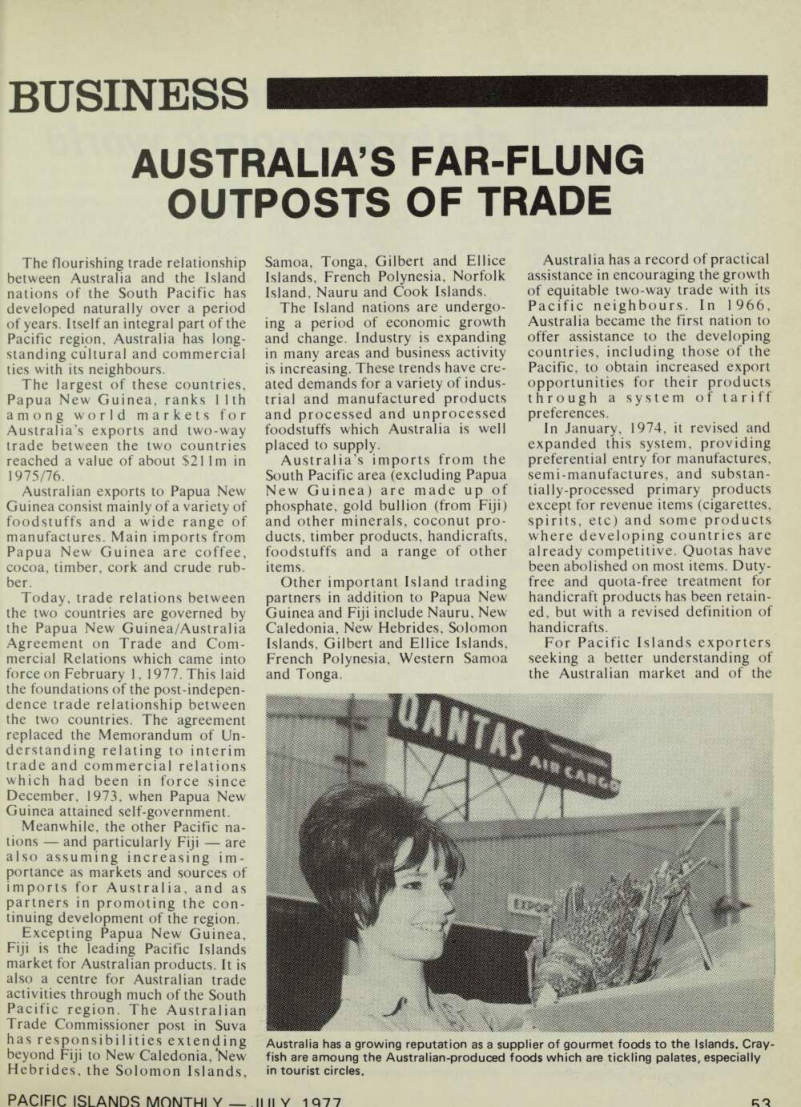
Australia’S Far-Flung
Outposts Of Trade
The flourishing trade relationship between Australia and the Island nations of the South Pacific has developed naturally over a period of years. Itself an integral part of the Pacific region, Australia has long standing cultural and commercial ties with its neighbours.
The largest of these countries, Papua New Guinea, ranks 11th among world markets for Australia’s exports and two-way trade between the two countries reached a value of about s2llm in 1975/76.
Australian exports to Papua New Guinea consist mainly of a variety of foodstuffs and a wide range of manufactures. Main imports from Papua New Guinea are coffee, cocoa, timber, cork and crude rub ber.
Today, trade relations between the two countries are governed by the Papua New Guinea/Australia Agreement on Trade and Com mercial Relations which came into force on February 1, 1977. This laid the foundations of the post-indepen dence trade relationship between the two countries. The agreement replaced the Memorandum of Un derstanding relating to interim trade and commercial relations which had been in force since December, 1973, when Papua New Guinea attained self-government.
Meanwhile, the other Pacific na tions and particularly Fiji are also assuming increasing im portance as markets and sources of imports for Australia, and as partners in promoting the con tinuing development of the region.
Excepting Papua New Guinea, Fiji is the leading Pacific Islands market for Australian products. It is also a centre for Australian trade activities through much of the South Pacific region. The Australian Trade Commissioner post in Suva has responsibilities extending beyond Fiji to New Caledonia, ‘New Hebrides, the Solomon Islands,
Samoa, Tonga, Gilbert and Ellice Islands, French Polynesia, Norfolk Island, Nauru and Cook Islands.
The Island nations are undergoing a period of economic growth and change. Industry is expanding in many areas and business activity is increasing. These trends have ereated demands for a variety of industrial and manufactured products and processed and unprocessed foodstuffs which Australia is well placed to supply.
Australia’s imports from the South Pacific area (excluding Papua New Guinea) are made up of phosphate, gold bullion (from Fiji) and other minerals, coconut products, timber products, handicrafts, foodstuffs and a range of other items.
Other important Island trading partners in addition to Papua New Guineaand Fiji include Nauru, New Caledonia, New Hebrides, Solomon Islands, Gilbert and Ellice Islands, French Polynesia, Western Samoa and Tonga.
Australia has a record of practical assistance in encouraging the growth of equitable two-way trade with its Pacific neighbours. In 1966, Australia became the first nation to offer assistance to the developing countries, including those of the Pacific, to obtain increased export opportunities for their products through a system of tariff preferences.
In January, 1974, it revised and expanded this system, providing preferential entry for manufactures. semi-manufactures, and substan tially-processed primary products except for revenue items (cigarettes, spirits, etc) and some products where developing countries are already competitive. Quotas have been abolished on most items. Duty free and quota-free treatment for handicraft products has been retain ed, but with a revised definition of handicrafts.
For Pacific Islands exporters seeking a better understanding of the Australian market and of the
Australia has a growing reputation as a supplier of gourmet foods to the Islands. Cray fish are amoung the Australian-produced foods which are tickling palates, especially in tourist circles.
selling and other techniques as sociated with it, assistance and ad vice is available from the Australian Trade Commissioner in Suva and from Australia’s Department of Overseas Trade through its Market Advisory Section in Canberra.
The work of the section covers two main areas. The first is product and market analysis. This involves the incorporation of a data base of information on the Australian market, and investigation of ways in which developing countries can take best advantage of the Tariff Preference System.
The second area of the section’s work is market development, which includes practical help by advising developing countries on the market ing and promotion of their products in Australia.
The section undertakes research and prepares studies, in response to specific requests, on products of likely interest to developing country exporters, the marketing oppor tunities in Australia for products from developing countries; and features peculiar to Australian trade with developing countries.
Australia takes an active part in the work of the South Pacific Forum and the South Pacific Bureau of Economic Co-operation, partic ularly in efforts to advance the economic development of Pacific Island countries. Australia con tributes further to regional develop ment through such agencies as the South Pacific Commission, the Asian Development Bank, the United Nations Development Programme, World Food Program me, the Australian South Pacific Technical Assistance Programme and the Commonwealth Co-op eration in Education Scheme.
As trading partners, Australia and most South Pacific countries share a number of advantages, including geographic proximity, regular ship ping and air links and com paratively short delivery times.
These factors, together with long standing cultural and commercial ties, should provide a background for continued economic co-op eration. • Coffee prices on the London ter minal market fell by almost $3OO a tonne early in May. The downturn generally was attributed to buyer re sistance, a suggestion that coffee might be close to pricing itself off the market.
Advertisements & other items, p. 53 (1 item)
53
PACIFIC ISLANDS MONTHI Y 1111 Y 1 Q 77
shaky economic world
Fiji holds her own in a shaky economic world
In 1975, a year described as characterised by uncertainties on the international trade scene in the wake of world-wide recession, Fiji scored a plus. She held imports at close to a “no increase” level, while exports, including re-exports, rose by 15% compared with 1974.
However, Fiji still had a substantial adverse trade balance.
Total imports in 1975 were valued at $220,967,000, 0.7% high er than 1974, while exports and re exports were valued at $142,293,- 000. The adverse trade balance of $78,674,000, was $16,907,000 lower than that of 1974. Thus, there was a substantial increase in foreign reserves and an improvement in the overall balance of payments account with the rest of the world.
The major sources of imports re mained with the traditional sup pliers Australia, the UK and New Zealand. But Australia’s share of the trade dropped from 30.3% in 1974 to 28.9%. The UK gained a bigger slice of the market 13.4% against 9.9% in 1974, while NZ also improved from 11.2% in 1974 to 12.1%. Goods of Japanese origin fell from 17.9% of the total in 1974 to 15.7% in 1975, reflecting a general decrease of the import of duty-free goods which act as a tourist magnet.
The bulk of export earnings were from a narrow range of primary commodities, most of which are sold under special negotiated prices. In 1975, sugar was sold to the UK/EEC under a special arrangement and brought record receipts.
In 1975, sugar exports earned an all-time high of $94,718,000, at an average value of $383.85 a ton, compared with 254,000 tons in 1974 at an average of $263.46 a ton.
Mainly because of new links with the EEC, under which most sugar went to Europe, there was no sugar left for the US, which was a useful market for about 15 years. Under the Lome Convention, the UK paid Fiji $75,631,000 for 170,814 tons of Fiji raw sugar, which was 69.5% of total exports.
Receipts for coconut oil dropped.
Exports of 15,800 tons were worth $5,064,000, at an average of $320.45 a ton. In 1974, 14,000 tons realised $761,93 a ton.
Gold exports were relatively static 68,756 fine ounces worth $8,584,000 in 1975 and 68,890 fine ounces worth $8,621,000 in 1974.
Fiji enjoys a favourable overall trade balance in her export trade with other groups in the Pacific. In 1975, exports to other groups were valued at $12,745,832 ($13,729,572 in 1974) while imports were worth $483,279 ($904,085 in 1974).
The figures for the trade with the various groups were, 1974 figures in brackets: Exports American Samoa, $786,549 ($1,423,103); Solomon Is lands, $53,638 ($129,961); Cook Is lands, $695,069 ($987,854); French Polynesia, $229,437 ($116,538); Gilbert and Elice Islands, $1,181,- 613 ($1,106,247); Line Islands $99,221 ($126,063); New Caledonia, $207,764 ($281,544); Papua New Guinea, $92,700 ($24,- 192); New Hebrides, $1,031,177 ($1 ,240,072); Niue, $704,426 ($361,990); Tonga, $3,066,901 ($3,620,421); Western Samoa, $4,- 059,586 ($3,728,917); Wallis & Futuna, $237,601 ($368,035); Other, $300,150 ($214,605).
Imports American Samoa, $19,249 ($6,551); Solomon Islands, $5,482 ($2,849); Cook Islands, $5Bl ($7,221); French Polynesia, $275 (—); Gilbert & Ellice Islands, $3,816 ($2,110); Line Islands, ($1,035); New Caledonia, $3,142 ($2,932); Papua New Guinea, $156,1 14 ($46 1 ,422); New Hebrides, $8,785 ($4,577); Niue, $2,479 ($328); Tonga, $200,088 ($322,82 1); Western Samoa, $83,109 ($66,21 1); Wallis & Futuna, $159 ( —); others, $26,- 028).
Fiji has a small trade in manufac tured products with neighbouring Pacific Islands. Exports of manufac tures to those groups in 1975, while down generally on 1974, still had a useful role in the economy of a developing country like Fiji. These exports in 1975, with the 1974
figures in brackets, were: Biscuits, $473,000 ($622,000); cigarettes, $19,000 ($49,000); cement, $588,- 000 ($504,000); paints, $190,000 ($239,000); clothing, $58,000 ($76,000); corrugated sheets, $38,000 ($264,000).
There were a number of changes in the composition of imports. Food and manufactured goods decreased significantly, while the value of petroleum products, machinery, transport equipment, and chemicals, mainly fertilisers, rose.
There was a marked decline in the import of goods classed as “tourist goods”. These were worth $17,779,- 000 on 1975, compared with $23,- 829.000 in 1974. It has been esti mated that, on an average, about 90% of tourist goods are sold across the country to visitors to Fiji. The added mark-up constitutes Fiji’s in visible exports, and is the major component offsetting the visible trade deficit.
Along with the drop in value of “tourist goods” there was also a marked downturn in the number of visitors. However, there was an esti mated increase of 16% in total tourist earnings, attributed almost wholly to inflation.
A fairly significant proportion of imports, consisting of capital goods and raw materials, was allowed in at a rate lower than the prevailing rate of duty in line with the government’s policy of encouraging growth in ex isting industries and attracting fur ther investment. The value of those imports in 1975 was $29,359,000, or 13.2% of total imports.
Two or three years ago it was con fidently predicted that fish exports would be second to sugar in value.
The value of fish and fish prepara tions was $213,501. The value of re exports of fish in 1975 was $1,466,- 288. As the cannery at Levuka did not start operating till 1976, fish ex ports are not likely to show substan tial increase till trade figures for 1977 are available. • Being an associate member of the European Economic Com munity has its advantages for Fiji. In a recent coconut oil price com pensation payout, she received $l,- 514.000 instead of the $1.4 million originally approved by the EEC.
The money, paid under what is known as the Stabex scheme, is to cover the fall in receipts Fiji re ceived from coconut oil sales.
The secret of
a Hebridean resort
Mr Gilbert Trigano, “Monsieur Club Mediterranee”, and a major figure in the French tourist industry, was in the New Hebrides in April spying out the land for the estab lishment of a Club Mediterranee village in the condominium.
Mr Trigano saw a number of sites he liked particularly, but he wasn’t saying which. He told the Vila fortnightly Nabanga: “You know, if I said now, ‘lt’s going to be at that
place,’ the landowner is going to double or treble the price. This rule applies, not only in the New Hebrides, but the whole world over.”
Asked when a village would be set up, Mr Trigano turned the question back on the interviewer: “You tell me when the situation in the New Hebrides will be finally cleared up.”
In the meantime New Hebridean political leaders who are to visit Paris in July will be invited by Mr Trigano to visit any Club Mediter ranee village of their choice to see how it works.
Advertisements & other items, pp. 55-56 (1 item)
Breckwoldt & Co
EXPORTERS TO THE PACIFIC ISLANDS
P ij Ltd
4
UliVI'T
T 7 276 Pitt Street, Box 5017, G.P.O. Sydney 2001
CABLE ADDRESS: BREWO SYDNEY
TELEPHONES; 61-7110 26-6893
TELEX AA22890.
Pacific Island ;
BRECKWOLDT & CO (PNG) PTY LTD
PO BOX 1549, BOROKO, PORT MORESBY
PO BOX 222, RABAUL
PO BOX 72, KIETA
PO BOX 178, WEWAK
PO BOX 185, MADANG
PO BOX 237, MT HAGAN
PO BOX 1188, LAE
BRECKWOLDT & CO., PO BOX 47, APIA BRECKWOLDT & CO. (SI) LTD. PO BOX 140, HONIARA
BRECKWOLDT SARL BP 2369, NOUMEA
Offices in : Hamburg, London, Milan and West Africa as well as Singapore, Kuala Lumpur, Bangkok and Hong Kong.
Enquiries from Australian
Manufacturers invited.
lb Future Generations,
Security
Tranquil Splendor.
Borobudur Temple in Indonesia built over 11 centuries ago.
Social welfare is a subject of serious consideration in most modern societies. Man in the twentieth century accepts his responsibility to bequeath to the next generation a society better than his own. Daiwa Bank is not unique in accepting this responsibility, but Daiwa is unique in making acceptance of this role in society an integral part of their banking service.
Daiwa is the only Japanese city bank to combine banking and trust business. Daiwa is thus a fully integrated banking institution, comprising banking, international financing, trust, pension trust, and real estate business. This integration is part of our effort to fulfil our social responsibility consistent with society's needs in a contemporary environment. a fully integrated banking service
DAIWA BANK
Head Office: Osaka, Japan Branches and Agencies; London, New York, Los Angeles, Frankfurt Representative Offices: Singapore, Sydrfey, Sao Paulo, Hong Kong Subsidiary: Daiwa Bank Trust Company, New York Joint Venture Banks; P.T. Bank Perdania, Jakarta, International Credit Alliance, Ltd., Hong Kong
NOW II THE ISLANDS
The personal insect repellent
guaranteedto work!
Muskol positively keeps off all biting
insects including mosquitoes, sandfjies,
fleas and midges and discourages flies!
And it usually lasts up to 24 hours. i I W 4 100% Active Ingredients! Muskol is 90% Deet, the insect repellent ingredient that stopped the mosquitoes in the Panama Canal Zone, and 10% other powerful repellents. It will keep off all biting insects, but is harmless to normal skin, has no strong unpleasant smell, and needs only a few drops rubbed over the exposed skin. ‘Rerncon Industries have the proof of exhaustive tests under heavy insect infestation conditions, that Muskol will positively repel all biting insects. Ask for Muskol from your local retailer now.
MUSKOL
CONCENTRATED INSECT REPELLENT
Wholesale Stockists: Moresby Wholesale Drug Supply Pty. Ltd.
Also leading Island Agents throughout the South Pacific, including Burns Philp & Company Ltd., and Sullivans.
If unavailable in your area write to; Remcon Industries Pty. Ltd., P.O. Box 54, Surry Hills, N.S.W. 2010, Australia.
“Dramatic Piece Of Coastal
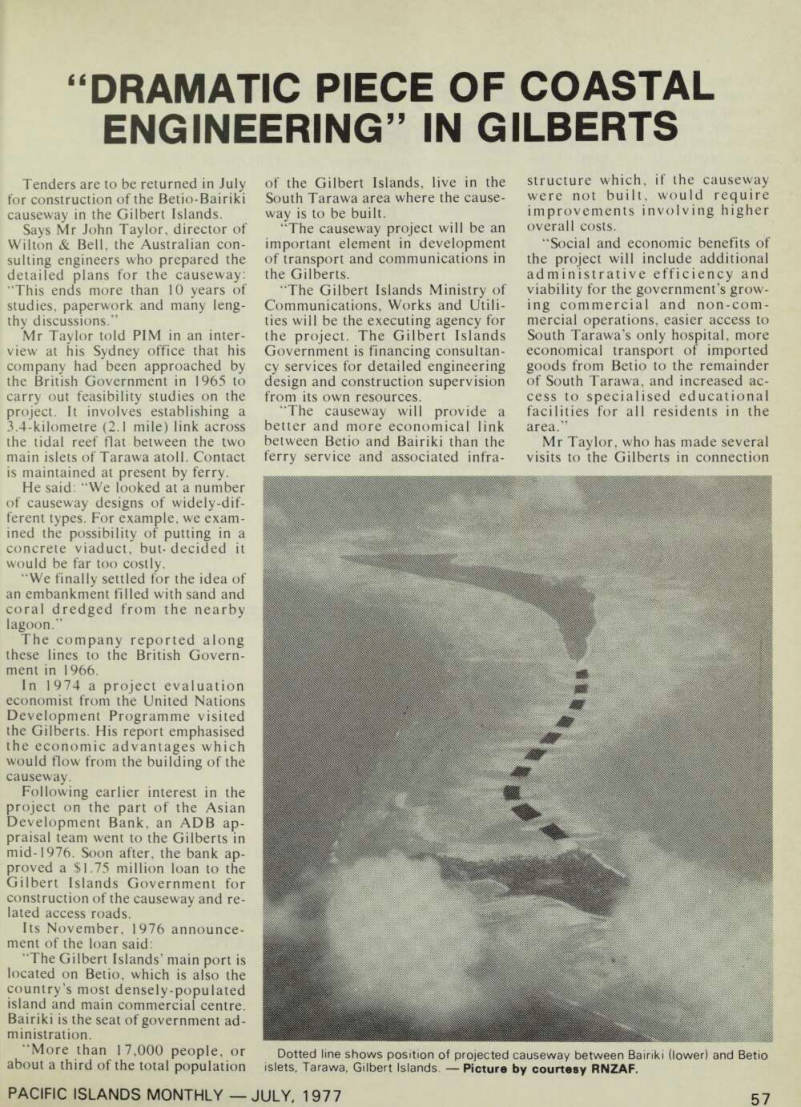
Engineering" In Gilberts
Tenders are to be returned in July for construction of the Betio-Bairiki causeway in the Gilbert Islands.
Says Mr John Taylor, director of Wilton & Bell, the Australian con sulting engineers who prepared the detailed plans for the causeway: “This ends more than 10 years of studies, paperwork and many leng thy discussions.”
Mr Taylor told PIM in an inter view at his Sydney office that his company had been approached by the British Government in 1965 to carry out feasibility studies on the project. It involves establishing a 3.4-kilometre (2.1 mile) link across the tidal reef flat between the two main islets of Tarawa atoll. Contact is maintained at present by ferry.
He said: “We looked at a number of causeway designs of widely-dif ferent types. For example, we exam ined the possibility of putting in a concrete viaduct, but* decided it would be far too costly.
“We finally settled for the idea of an embankment filled with sand and coral dredged from the nearby lagoon.”
The company reported along these lines to the British Govern ment in 1966.
In 1974 a project evaluation economist from the United Nations Development Programme visited the Gilberts. His report emphasised the economic advantages which would flow from the building of the causeway.
Following earlier interest in the project on the part of the Asian Development Bank, an ADB ap praisal team went to the Gilberts in mid-1976. Soon after, the bank ap proved a $1.75 million loan to the Gilbert Islands Government for construction of the causeway and re lated access roads.
Its November, 1976 announce ment of the loan said: “The Gilbert Islands’ main port is located on Betio, which is also the country’s most densely-populated island and main commercial centre.
Bairiki is the seat of government ad ministration.
“More than 17,000 people, or about a third of the total population
of the Gilbert Islands, live in the South Tarawa area where the cause way is to be built.
“The causeway project will be an important element in development of transport and communications in the Gilberts.
“The Gilbert Islands Ministry of Communications, Works and Utili ties will be the executing agency for the project. The Gilbert Islands Government is financing consultan cy services for detailed engineering design and construction supervision from its own resources.
“The causeway will provide a better and more economical link between Betio and Bairiki than the ferry service and associated infra
structure which, if the causeway were not built, would require improvements involving higher overall costs.
“Social and economic benefits of the project will include additional administrative efficiency and viability for the government’s grow ing commercial and non-com mercial operations, easier access to South Tarawa’s only hospital, more economical transport of imported goods from Betio to the remainder of South Tarawa, and increased ac cess to specialised educational facilities for all residents in the area.”
Mr Taylor, who has made several visits to the Gilberts in connection
Dotted line shows position of projected causeway between Bairiki (lower) and Betio islets, Tarawa, Gilbert Islands. - Picture by courtesy RNZAF.
with the causeway project, de scribed it as “a dramatic piece of coastal engineering”. He said his company knew of only one other similar type of coastal construction in the world. It is a sand-filled breakwater in South Africa, near
Capetown.
Wilton & Bell receive regular re ports from the Gilberts on the height and direction of waves and on wind characteristics in the causeway area to help in their continuing design work.
Thirty-five dredging companies, including some of the world’s big gest, had replied to the original ad vertisements concerning the cause way. Eighteen of them had subse quently “pre-qualified” for tender ing.
When completed, the embank ment, topped by a two-lane highway which is to be built by local labour employed by the Gilbert Islands Government, will be about 160 metres (1 75 yards) wide at the base, about 25 metres (27 yards) wide on top, and standing about 4 metres (13 feet) above reef level.
Target date for completion is June 30, 1979.
Beefy problem for Noumea’s Meat Board
Noumea’s Meat Board
From PAUL STERLING in Noumea
Noumea’s butchers have been muttering angrily for the last few weeks. To obtain the Cryovac-pack ed Scotch fillet imported from Australia or New Zealand, OCEF has been forcing them to take a high er proportion of local carcasses.
Meanwhile, the consumers, and in particular hotels and restaurants, are refusing to buy local production.
The tender, aged cuts from Australia and New Zealand are par ticularly popular with the barbecue fans.
Yet OCEF, Noumea’s Meat Board, is only applying the accepted policy of protecting local pro duction. While local supplies were insufficient, frozen carcasses were imported, but the latter were gra dually replaced by the refrigerated, matured meat as New Caledonia’s breeders stepped up production.
After a long and difficult meeting between cattlemen, butchers and
OCEF, a certain number of measures have been accepted. While imports of lamb and pork will re main at the same level, butchers will be forced to buy local carcasses of beef. Imports of Scotch fillet, a “Caledonian” dish if ever there was such a thing, will be reduced by 75% . Each butcher will receive one carton a week, while imports will drop from 25 to six tonnes a month.
But this is only a temporary measure. Local production is so high that an abattoir, abandoned when the OUACO canning plant closed down nearly 20 years ago, will be re-opened to slaughter cattle in the north and stock frozen beef.
OCEF will begin an advertising campaign to encourage the con sumption of stews and roasts instead of “steak and chips”.
The price of local beef is too high to permit exports to other Pacific Is lands, and the breeders in the New
Hebrides, particularly those on San to, will have a battle on their hands if they wish to continue exporting to New Caledonia.
There remains the possibility of canning meat and prohibiting im ports of canned and jellied beef, another measure which could have serious effects on the New Hebrides economy.
The OUACO canning plant, whose production was unanimously preferred to all imported preserves, closed down 20 years ago when local production became insuffi cient, and the danger is that, if and when the territory has its next nickel boom, present producers will drop
the stock-whip and rush back to the caterpillars the eternal cycle of an unstable economy.
Meanwhile, the people of New Caledonia have learnt with pleasure that an agreement had been reached between the French Government and INCO to prospect certain laterite deposits at Goro, on the southern tip of the mainland. The area granted to INCO is near the deposits earlier granted to two French companies, Societe Le Nickel and Aquitaine.
This will be the second program me of exploration carried out by INCO in New Caledonia. The first, undertaken eight years ago, had cost the company SAS million.
Advertisements & other items, p. 58 (1 item)
Fire Fighting Enterprises Caustj Ltd.
LIFE, SAFETY AND TOTAL ASSET PROTECTION.
Our group companies have been formed to provide protection equipment for all types of hazards likely to affect your assets. These include fire, theft and vandalism.
OUR PRODUCTS INCLUDE:
* Quell Portable and Mobile Fire Extinguishers. * Automatic Fire Fighting Sprinkler Installations. * May Oatway Fire Alarms & Gas Detection Systems. * Electronic Security Systems. * Special Flazard Protection Systems. . * A wide range of Electronic Equipment, providing Integrated Communication Systems. * Sound Systems and Asset Utilisation. * Computer Control Systems.
Some Local Agencies and Distributorships are available.
OFIRE FIGHTING ENTERPRISES (AUST.) LTD.,
50 Waratah Street, Ermington, N.S.W. 2155. Australia.
Telephone: 858 2400 (Sydney).
Cables & Telegrams: Quellfire, Sydney.
Telex: Quell AA22327.
Copper’s glitter was
dulled last year
From GUS SMALES in Port Moresby
The 1976 net earnings of Bougainville Copper dropped by $A5.4 million because of low metal prices, increased raw material costs and high wage levels.
The company chairman, Mr F. F.
Espie, reported this in April at Bougainville Copper’s annual meet ing held at Panguna, the town ad joining the mine in the centre of Bougainville Island.
Net earnings for the year were 5A46.8 million. Dividends declared for the year amounted to 10 toea a little under 11c Australian. They will absorb $A32.2 million.
Mr Espie referred to the political problems which earlier had become expressed in a move for Bougain ville to secede from Papua New Guinea.
Mr Espie said that the company had been careful not to become in volved in the political events on the island, but the period had neverthe less been a difficult one for the com pany and its employees.
He said that from the company’s viewpoint he was pleased to record that the PNG Government and the Bougainville power base had been able to reach an amicable agreement on the distribution of powers.
Mr Espie announced a capital project costing about SAI2 million to drive a huge tunnel into the side of the Crown Prince Range on Bougainville to drain its open pit mine.
The tunnel project, which will eliminate drainage pumping, is part of an overall efficiency programme being undertaken by the company in its engineering, operational and workforce divisions.
When the mine began operating just over four years ago, the bed of the pit was higher than the adjacent river system, making drainage
engineering relatively simple.
But, Mr Espie reported, the base of the pit was now lower than the river system. This meant that pump ing was essential for drainage a system which would become in creasingly complex and expensive as the pit deepened.
The new tunnel would run for several kilometres under the sur face, emerging at a point where gra vity would allow the water to drain into the river systems.
Mr Espie also announced new shareholding arrangements under which “little” shareholders in Australia will be given the oppor tunity to grow bigger or to bow out gracefully.
Holders of fewer than 100 share generally too small a holding to have marketable value will be given the chance to dispose of their holdings or build them up to 100.
The scheme will, in essence, amount to a reshuffle of holdings among small shareholders, con solidating the amount among fewer
people.
The Island

climate for investment
Australian companies have built up extensive business operations in rural commercial manufacturing fields in Papua New Guinea, taking full advantage of Australia’s past trusteeship and the long association of Australian-based island trading companies with the area.
The Australian Department of Overseas Trade, after a recent survey, reported that 10 of 20 multi national companies with headquar ters in Australia operated in PNG.
Their activities cover plantations, packaging, metal fabrication, glass manufacture, shipping, retail and wholesale distribution, new car sales, civil engineering, ready-mix ed concrete, etc.
By far the largest investment is in the primary sector copra, coffee, tea and cocoa plantations but there is a growing equity in manufacturing and it offers great potential. As long as the political climate remains stable, these sec ondary ventures are likely to attract Australian capital, even though there is a strongly nationalistic feel ing.
Large parcels of undeveloped plantation lands have been handed to local people. Several joint ven tures are performing satisfactorily.
A number of Australian companies give high priority to technical train ing for indigenous people, both in PNG and Australia. Foremost among these were W. R. Carpenter and Burns Philp, which have traded in PNG for many years, and which launched training schemes for local people before independence.
Rising wages in PNG should have a beneficial effect, at least in the short term, on consumer spending and Australian subsidiaries with in vestments in wholesale and retail trading, new car dealerships, packaging, engineering services, soft drink bottling and basic building materials are in a good position to take the best advantage of that situ ation.
The PNG economy will largely depend on satisfactory world com modity prices being received for copra, cocoa, coffee and copper, and much of the future development depends on a world economic re
covery, which will increase demand for those products. Duty-free access to the European Economic Com munity, through PNG joining the Lome Convention recently, will be a stabilising factor.
In other Pacific Islands, Australian companies, for many years, have held a strong position in a wide range of business activities.
Investments range from shipping to plantations and include nearly every aspect of trading and commerce.
Where products and services re quire manufacturing facilities, these have always been provided. Six of 20 multi-national companies have operations in the Pacific Islands.
Although the Pacific Islands cover thousands of square kilometres, trading is mostly centred around Fiji, from whence cargoes are trans-shipped to a num ber of other Island groups. Thus, business conditions in Fiji are im portant to the profitability of Island trading generally.
Economic aspects have been of concern to investors, because of price controls, coupled with union pressure on wages, increasing over head costs, fixed quotas on the im port of motor vehicles, stringent re strictions on lending to overseas controlled corporations, and lower prices for commodities, although the copra market is improving.
Advertisements & other items, p. 60 (1 item)
Shipbuilders To The Pacific.
kil
A I r A LANDING BARGE under construction at
CARPENTERS INDUSTRIAL SHIPYARD, Walu Bay, Suva
Fiji Islands, for Mr. Anton Lee of Port Moresby, Papua New Guinea.
CARGO CAPACITY: 14,000 aft LENGTH: 114ft.0.A.
Powered by twin GARDNER diesel engines each 230 hp.
["CARPENTERS INDUSTrTaL R07b0X296~ ”
I SUVA,FIJI. PHONE 312-133.
I Please send me information on Shipbuilding in the I South Pacific I Name
j Company
I Address-
1m
ram
ULqUd
UPRIGHT DISPLAY
REFRIGERATORS
* LOW COST
FRIGID COLO DRINKS , LA RQE CAPACITY
* BOTTLE & FOOD DISPLAY
* 2& 3 DOOR MODELS AVAILABLE
Large capacity small floor space Maximum visual display Gleaming white, vinyl coated aluminium interior for better reflection of light within cabinet Fluorescent lighting 2" Frigidfoam insulation (equivalent to 4" Polystyrene or 6" cork!) Powered by heavy-duty Kelvinator sealed unit warranteed for 5 years
AVAILABLE FROM:
AUSTRALIAN NEW CALEDONIA EXPORTS. 363 George St, Sydney, 2000.
BREGKWOLDT & CO., 276 Pitt St., Sydney, 2000.
HAGEMEYER (A'SIA), 59 Anzac Pde, Kensington, 2033 GEOFFREY HUGHES & CO, 167 Macquarie St, Sydney, 2000.
NELSON & ROBERTSON PTY. LTD, 197 Clarence St, Sydney, 2000.
PETER FISHER TRADING PTY.LTD, 321 Pitt St, Sydney 2000 E. RABOT (EXPORTS) PTY. LTD, 67 Castlereagh St, Sydney. 2000.
RABTRAD NIUGINI PTY. LTD., PO Box 1406, Lae.
A. RIETTE (PACIFIC) PTY. LTD., 300 George St„ Sydney, 2000.
H. Y. KWAN (AUST) PTY. LTD. Box 2713, GPO , Sydney, 2001.
C. SULLIVAN (EXPORT) PTY. LTD., GPO Box 3373, Sydney, 2001.
W.S. TAIT & CO, PTY. LTD, 31 Macquarie Place, Sydney, 2000. ) Attractive timber grain Marviplate exterior > Automatic frost-free, fan-assisted cooling gives even and faster cooling of stored products • 4 rows adjustable plastic-coated, hygenic, white shelves and floor tray LOW MAINTENANCE, the only maintenance required being periodic cleaning of condenser Illuminated sign in top panel optional extra.
Manufactured by: T 1 0 0
LTD.
FRIGID CABINETS PTY.
14A Puffy Ave., Thornleigh, N.S.W. 2120 Aust. Ph. 848 8292.
FC2.
worth cultivating
Islands are worth cultivating
The Pacific Islands, with a population of more than six million, offers many oppor tunites for Australian exporters.
The annual import bill for most of the groups, excluding Hawaii and periphery territories such as Irian Jaya and the Philippines, runs to more than $l,OOO million a year, while Islands’ ex ports earn more than $750 million a year.
As the Island groups develop a western style off living, which may or may not be good for them and their cultures, they demand more and more western goods, food, machinery, commodities, and so on. Naturally, the bigger groups such as Papua New Guinea and Fiji, buy and sell the most.
PNG, in 1975, exported goods, mostly primary products, worth K 427,470,000, while im ports were valued at K393,997,- 000. Fiji’s import bill in 1975 was $220,967,000 and her ex ports, including re-exports, totalled $142,293,000.
Guam and the Trust Territory are a couple of good markets, in which there is keen competition for Australia from the US.
Australia’s devaluation of late 1976 helped her to recover some of her competitive edge, and some of the markets lost to the US.
Closer to home, in Fiji, Tonga, Western Samoa and the Solomons, Australia faces strong competition from New Zealand over a wide field of food, and manufactured goods. On a cur rency exchange basis, NZ has a slight advantage.
hustle and bustle

At Sullivan’s—air of hustle and bustle
By PIM staffman MALCOLM SALMON
There is a fine air of hustle and bustle about the George Street, Sydney, headquarters of the Pacific Islands trading firm, C. Sullivan Holdings Ltd, these days. And not all the voices taking part in the hours-long executive discussions going on there have Australian ac cents.
When I called at the office in April, the process of practical im plementation of the February take over of the company by the big French firm, Scoa, was well under way.
PIM first caught up with Sullivan director and Papua New Guinea veteran Mr Ron Knight. “Fish,” he proclaimed, waving at his paper strewn desk. “We’ve been talking about a fish deal all day. I can prac tically smell ’em.”
Then PIM met Swiss-born Mr Carlo Kraushaar, a youthful-look ing Scoa executive who explained that he was the one and only Scoa man from Europe who would be taking up permanent residence in Australia as a result of the change in control of Sullivan’s.
“Why should we bring people out here? It costs a lot of money and, besides, the Sullivan people know Sullivan business best,” he said.
There would be no change in the company’s name and only the barest minimum of change in management personnel.
PIM next moved from Mr Knight’s office to meet the man who is perhaps the most important single aspect of this “barest minimum”; Mr Jacques Leprince, the new chairman of directors of C. Sullivan Holdings Ltd. With him was Mr Alan Miflin, Sullivan director and financial man ager.
Mr Leprince will spend part of each year in Australia, but will con tinue to operate from his customary base in Paris.
Again there was talk of continuity in the Sullivan operation.
But, PIM ventured, along with continuity there must be change.
Scoa had not bought Sullivan’s to leave everything exactly as it was.
What would be the main directions of change?
Mr Leprince began to reply, but hesitated for a moment to search for a word. PIM suggested it under stood French rather well, if that would be more convenient. “I speak English,” was the polite but firm re sponse.
The first task, said Mr Leprince, was to co-ordinate Sullivan and Scoa activities. “For example,” he said, “Sullivan imports many goods from the Far East. In future, these goods can come from Scoa offices in that region.”
Mr Miflin said: “Even though it’s still very early days, co-ordination is already becoming a fact. The Scoa group though its Australian subsidi ary recently sold 7500 tons of Australian powdered milk to an African customer. It was a deal that could never have been hoped for without Scoa’s African connections.
There’s also been an inquiry from New Zealand about tropical timbers from Cameroon, where Scoa is well established.”
“Then,” Mr Leprince went on, “people must get to know each
other. It’s not just a question of learning the names of people in Africa and France to whom one sends a telex. It’s a question of knowing the people behind the names. So, Mr Knight will go to Europe and Africa later this year.
Mr Miflin will go to Europe in
August-September.”
Of Scoa’s economic strategy in the new venture, Mr Leprince said: “As a company exporting goods from Europe, we would hope to find markets in Australia chiefly for European industrial goods.
“But, if we want to be welcome here as an importer, we think we should help Australia and New Zea land to expand their exports.
“There could also be oppor tunities for Australian mineral ex porters through our Moscow office, which is already selling copper and other ores to the Russians.
From what PIM could see on its visit, the new scale of the operation was throwing strain on the present Sullivan office accommodation.
So, it was no surprise to learn a few weeks later that from the begin ning of July the company will move into 830 square metres (9000 square feet) of brand new office space in Sydney’s King George Tower, on the corner of George and King Streets.
Advertisements & other items, p. 62 (1 item)
Plm’S Product Bulletin
Products or services advertised in PlM’s Product Bulletin are not necessarily available in all Pacific Islands. If you have difficulty in obtaining these products, please contact the manufacturer direct.
Where AGENTS WANTED ’ is indicated, the manufacturer is interested in appointing agents or distributors.
STEAM BOILERS
OIL OR WASTE FUEL FIRED
PACKAGED UNITS
AVAILABLE
TOMLINSON Watertube or Firetube automatic steam and firetube hot water boilers operate on light or heavy fuels and are available in a range of 150 kW to 8000 kW (metric 0.24 tons to 12.5 tons output). The boilers are assembled as complete packaged units ready for immediate service. The Company also manufactures a range of waste fuel firetube boilers suitable for use in sugarcane, beet and palm oil factories, plywood and timber mills. These boilers burn most types of waste and residual fuels and are available for 1500 kW to 6000 kW (metric 2.3 tons to 9.4 tons).
Many years of export experience ensures efficient handling of export documentation and dispatch.
Enquiries;
TOMLINSON STEEL LIMITED, G.P.O.
Box P 1223, Perth, Western Australia, 6001. Telex: AA92230. Telephone: (092) 61 2055. Sydney: P.O. Box 74, Marrickville, 2204. Telex: AA21131.
Telephone: (02) 57 2791. Cables; "TOMSTEL”, Branch offices & dealers in all Australian States. ul
SIMPLE TOURNIQUET
BOON TO FIRST AID
A simple, inexpensive and almost indestructible tourniquet is made by C.
E, Mayo Pty. Ltd., a manufacturer
and exporter of medical supplies.
It is used in Britain, Belgium, Holland, Austria and New Zealand.
The tourniquet allows pressure to be varied at will. This is vital, for while too little pressure will not arrest the flow of blood in a limb, too much can cause tissue damage.
Variation in pressure is through a control on the buckle which enables the webbing to move freely in either direction without sticking or gripping However, once the control is released the webbing is held firmly in position and there is no possibility of slip.
The black rubber-based elastic webbing has a buckle of almost indestructible light plastic.
Enquiries: C.E. Mayo Pty. Ltd., 6 Grafton St., Chippendale, NSW 2008, Australia.
YOUR MESSAGE IN THE
PACIFIC ISLANDS
YEAR BOOK?
The 9th edition of the Papua New Guinea Handbook and Travel Guide is now being compiled, and work has also begun on the 13th edition of the Pacific Islands Year Book. Both these reference books, from the publishers of PIM, contain authoritative facts and figures and are invaluable to governments, libraries, businessmen, schools and tourists. The Pacific Islands Year Book contains more than 430 pages of information and maps on all the South Pacific Islands.
Advertisers who want to include their message in either of these two widely circulated reference books should contact the Advertising Manager, Pacific Publications (Aust) Pty Ltd, GPO Box 3408, Sydney, or ask for Jack Fagen at the same address, phone 29 6693.
STOP THIEF!
WITH AUTOMARK
WINDOW ETCHING
TRANSFERS
Every day goods are stolen. Automark protects by etching letters and figures onto any glass. Each kit contains 18 letters & 18 figures (ie. 6 sets of each). $4.75 including postage.
Enquiries to:
AUTOMARK,
1/32 MARALL CRESCENT,
MISSION BAY, AUCKLAND,
NEW ZEALAND.
*’ * ' ' ' ' ' ' * ' I . ' < V ' ♦ ''t .v,;*;; .v :' J
SK&L' \
HAL T&G RANDOM
PATTERN CEILING TILES
Tongue and grooved random pattern Cane-ite wood fibre ceiling tile.
The basic material used in the manufacture of Cane-ite wood fibre tiles is a lightly compressed medium density softboard, composed of radiata pine fibres, waterproofing agents and binders.
The tiles are designed for direct mechanical fixing or adhesive bonding, and are pre-painted with washable off white PVA emulsion paint.
In addition to being a finished ceiling, Cane-ite tiles have builtin sound absorption qualities for unwanted sound within a room, as well as providing thermal insulation at no extra cost.
Enquiries:
HARDBOARDS
AUSTRALIA LIMITED,
118 Alfred Street, Milsons Point, NSW 2061.
The Profile Of Scoa
Scoa, the French company which in February acquired control of the 55year-oid Sydney-based Islands trading company, C. Sullivan Holdings Ltd, was born in 1907 as the Societe Commerciale de VQuest Africain.
The venture of two young Swiss, Wilhelm Roth and Hans Ryff, it opened its first store on Sherbro Island in Sierra Leone.
From that small beginning, the company has grown until today- it employs 32,000 people in 44 countries in Europe, Africa and North America. Its annual turnover is more than SAIOOO million.
The company has long ceased to be merely a trading enterprise. Its Industries Department employs 16,000 people, half its total personnel.
Scoa industries, largely concerned with processing local raw materials in a number of African countries, include Said, a pineapple processing subsidiary on the Ivory Coast, which is one of the world's largest producers of pineapple-derived products.
Scoa is also active in the distribution of machinery, automobiles and the operation of large stores, particularly in Africa and France.
In 1969, Scoa, anxious to complete its expansion programme and to ensure its future success, entered into agreements with the Compagnie Financiere de Paris et du Pays-bas, one of the Big Two private financial institutions in France, which is now the company’s biggest single shareholder.
In 1973 Scoa shareholders voted to discard the company’s old name in favour of the simple title, Scoa. The new name drops all reference to West Africa and to trade, catching up with the fact that the group’s activities now extend far beyond that region and include manufacturing and distribution, as well as trade.
How it happened
In 1971, at the age of 81, the founder of Sullivan’s, Mr Charles Sullivan, retired and handed over as chairman of directors to his son Denis. But Denis Sullivan died within a few months of taking office.
This meant that no member of the Sullivan family was left on the board and the family expressed a wish to relinquish its shares in the holding company. At the same time, the team which had taken over the management of Sullivan’s was feel ing the need to be associated with a larger group.
Closely in touch with these developments was Mr W. J. Cram sie, the Sydney representative of Compagnie Olivier, a French-based trading firm which had been ac quired by Scoa a year before. This acquisition had given Scoa a much improved position in the Far East, Olivier’s traditional area of op eration.
Mr Cramsie was instrumental in establishing contacts between Scoa and Sullivan executives and dis cussions between the two sides were begun in May, 1976.
Scoa was reported in February to have paid SA2.B million for the en tire issued capital of the company.
Tariff protection
planned for PNG home industries
Tougher restrictions on imported goods will be a policy of the Somare Government if it is returned to of fice in the Papua New Guinea elec tions.
The policies, foreshadowed by Mr Somare in a speech in Port Moresby in late April, suggest that Australia would be one of the most strongly affected of PNG’s supplier coun tries.
Mr Somare’s proposal will mean a ban or a very high import duty on bringing in any product which is already produced in PNG. The re strictions will extend to products for which PNG can provide a reasona ble alternative.
They will also be extended where necessary to promote the internal production of any product.
Mr Somare said the proposals were designed to develop self reliance by eliminating goods which competed with internal production or potential.
He said that at the same time the government would take measures to ensure that internal prices did not rise as a result of the import re strictions.
Mr Somare listed coffee, tea and some foodstuffs and fruit in cluding tropical fruit as examples of imports competing with local production.
Although Mr Somare made no reference to any particular country, Australian goods would appear to be a big part of the competitive im ports.
The re-import of processed goods which originated in PNG as raw materials could also be affected by the proposals, Mr Somare said.
This could mean, for instance, that PNG would begin processing its own coffee instead of exporting coffee beans to Australia and im porting the finished product.
He said the government had reason to believe that PNG had been used to dump some products from overseas markets, and this situation would be closely watched under the new proposals.
Advertisements & other items, p. 64 (1 item)
Hong Kong
The bird of paradise
connection
A/f?
Every Tuesday our big jet birds of paradise wing their way from Port Moresby to Hong Kong departing at 1730 and arriving in Hong Kong at 2150. The return flight to Port Moresby will depart same day at 2300.
From Hong Kong we can connect on to anywhere in the world.
Adventures in paradise
Papua New Guinea offers the tourist one of the last truly unspoiled paradise destinations.
The country provides an amazing variety of character, from idyllic tropical island locations to the cool upland valleys of the highlands, to the great sprawling tropical rivers like the Sepik.
The people are proud and handsome, and just as varied in appearance, customs and culture as their exciting land.
BRISBANE/SYDNEY - PORT MORESBY
Each week there are four jet services from Australia.
Thursday and Sunday we fly Sydney to Port Moresby direct, Monday we fly via Brisbane, Saturdays from Brisbane, connecting with all domestic flights.
SYDNEY - BRISBANE - PORT MORESBY -
MANILA
Mondays at 0730 an all-daylight flight leaves Sydney, stopping at Brisbane and Port Moresby before flying on to Manila, arriving at 1655 and departing Manila for Port Moresby at 1800. (Pre daylight saving times.) & A
SYDNEY - PORT MORESBY - KAGOSHIMA.
Thursdays at 0630 we have an all-daylight service from Sydney to Port Moresby, and on to Kagoshima arriving at 1630 From Kagoshima we provide immediate connections on to anywhere in Japan.
Paradise stopovers
It’s an idea for the jaded businessman who thinks he’s seen it all. En route to anywhere in Europe or Asia, give him a short stopover in paradise. We’ll float him down the Sepik in an air-conditioned houseboat. Fly him into our highlands. Deposit him on a tropical island, or just let him get amongst the best reef and big game fishing in the world.
Give us a call
We’d love to provide any information you need - call us at any one of our Adventures in Paradise Shops. In Sydney we’re on the Concourse Level of King George Tower.
Phone 232 8900.
In Brisbane we’re at 127 Creek Street. Phone 2295854.
And in Cairns we’re at the corner of Shields and Lake Streets. Phone 512255.
Or contact any travel agent.
AIR HUMS Hi
THE INTERNATIONAL AIRLINE OF PAPUA NEW GUINEA
challenges the Pacific fortress
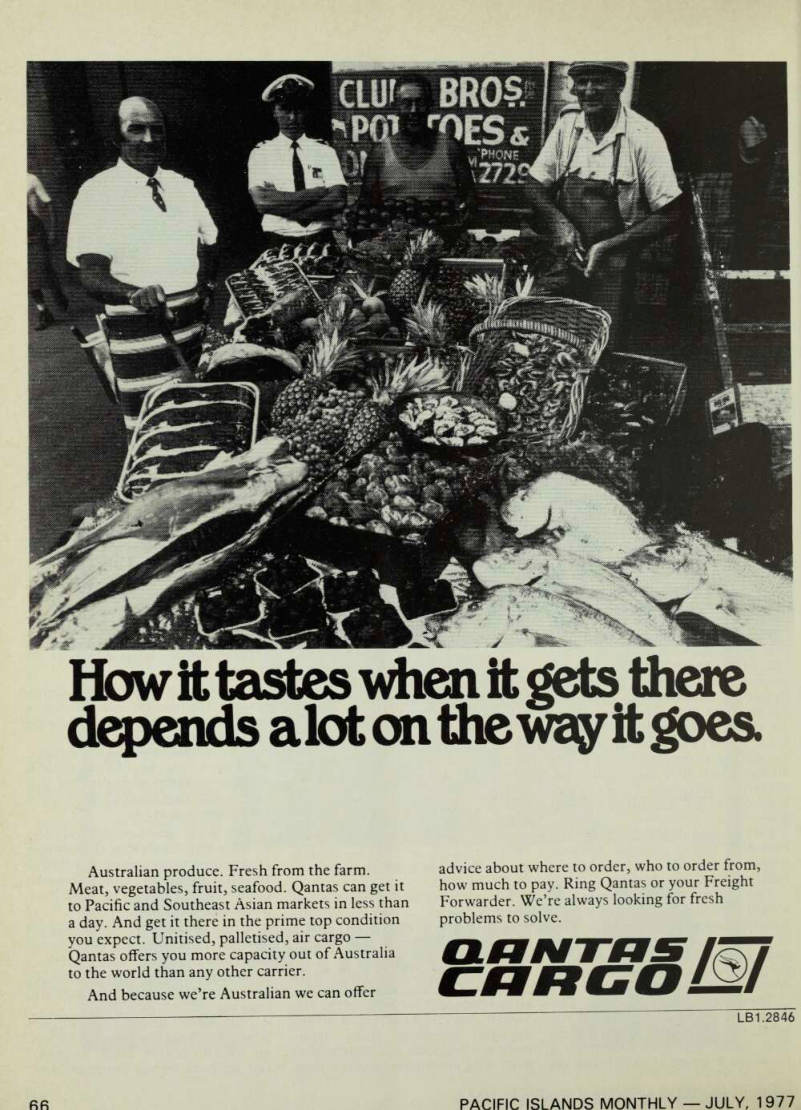
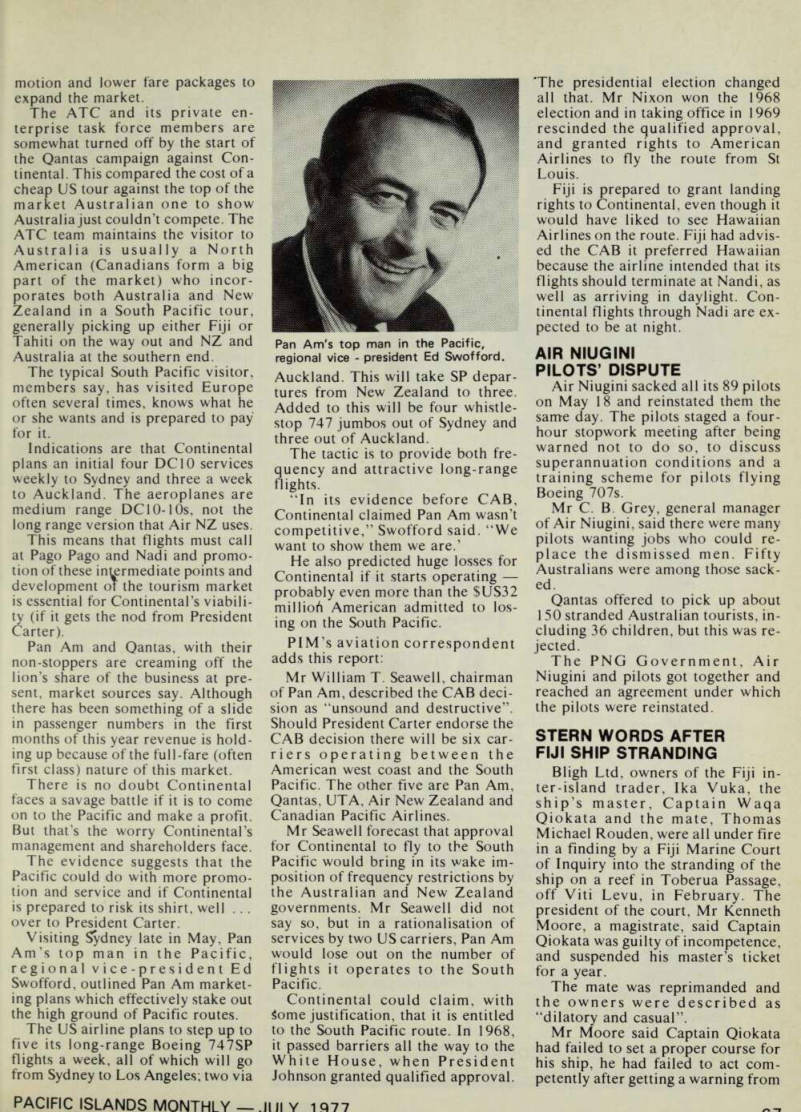

Pacific Transport
Once again Continental Airlines challenges the Pacific fortress
By John Stackhouse
Once more Qantas, Pan American and Air New Zealand are manning the barricades in the South Pacific.
Once more there is a challenger to the hold that the three airlines main tain on what must by now be one of the world’s truly-profitable air routes.
And once more for the third time the would-be challenger is Continental Airlines, the US domestic carrier that has estab lished a foothold in Micronesia and still harbours strong Pacific ambi tions.
If you feel you’ve heard all this before, you’re dead right. In fact, it began back in 1965 when the US Civil Aeronautics Bureau con ducted the Trans-Pacific case. The CAB fell there was inadequate market development in the Pacific and inadequate US flag carrier com petition.
The CAB obviously agreed with this because it nominated Con tinental. then a brash Texas oriented carrier, to run the service.
President Johnson (the President has the right of approval or veto of air rights assignments) confirmed Continental, which wasn’t altogether surprising because the airline which Bob Six ran had as sociations with the Texas estab lishment which was LBJ's original power base.
LBJ stepped down, however, and President Nixon reversed his pre decessor's decision and awarded the route to American Airlines.
The theory was that American would develop the midwest and eastern markets to the Pacific, but, in the event, it turned out that the giant carrier had little expertise in foreign, long-haul multi-stage op erations and lost a packet.
There is a footnote here. The Pacific route was only one of the areas that American stumbled in.
The airline was also shaken by a kick-back scandal involving its
house publications and indicted for making illegal campaign con tributions —to President Nixon’s funds. Some of the money turned up in the Watergate mess and all in all American can hardly be blamed for wanting to get shot of the Pacific.
It agreed to swap the routes for some that Pan Am held in the Carib bean (one of American’s stranger actions was to manage Caribbean and Pacific services in the same division). The US authorities agreed to the exchange but only on the condition that a new hearing was held.
This is where we came in.
In the hearings earlier this year.
Continental emphasised the problems that lack of competition had caused. The airline’s able Washington lawyers made three points: • Pan Am is doing a “wholly in adequate job” of developing the tourist potential of American Samoa. • With the withdrawal of Ameri cal Airlines and British Airways from the Pacific, competition had declined, leading to a situation where “fares are among the highest in the world” and “market promo tion tends to be focused on the gate way cities”. • Pan Am is seriously out scheduled and out-carried. US flag share has dropped from 49.3% in 1971 to 33.3% in 1974 slightly above Pan Am’s all-time low of 31.2% in 1965.
The inference of this is that a sec ond US carrier and specifically Continental —will do more to boost Islands' tourism and step up the US market share.
The positive side of Continental’s case was that it serves cities that already account for 80% of the US- South Pacific traffic: it plans daylight schedules using wide bodies: it proposes a comprehensive marketing programme and it is com
mined to assist in the development of hotels and tourist facilities.
Qantas and Pan Am (taking an Australian view of the challenge) oppose the application on the classic capacity argument. They say the market cannot support more capaci ty and if a new airline comes on. everybody will lose.
Air New Zealand is presumably saying the same thing in NZ.
The upshot is that Australian Transport Minister Peter Nixon and according to some well-sourced reports even Prime Minister Malcolm Fraser will lobby against Continental in the White House with President Carter.
The new president still has to ap prove the CAB recommendation.
It would be a pity, however, to see unthinking protectionism carry the day, with no questions being asked as to whether the interests of Australia necessarily are those of Qantas.
The Australian Tourism Com mission, for instance, has just sent a “task force” to the States, following up a similar one last year.
US visitors, the ATC reports, were up 17.5% to 75,688 in 1976 and the market forecasters are tip ping a rise to a total of more than 100,000 this year.
The ATC tends to support the Continental marketing submission.
It says promotion can be targeted to specific audiences, either those in higher income groups or those with particular interests.
A case in point, the ATC team re ported. is a growing interest in Australia by a firm which markets homosexual tours. Apparently gay groups are a big market already and
growing.
The ATC’s general manager.
Kevin McDonald, won’t be drawn on specific airline cases, however.
But he does favour increased pro
motion and lower fare packages to expand the market.
The ATC and its private en terprise task force members are somewhat turned off by the start of the Qantas campaign against Con tinental. This compared the cost of a cheap US tour against the top of the market Australian one to show Australia just couldn’t compete. The ATC team maintains the visitor to Australia is usually a North American (Canadians form a big part of the market) who incor porates both Australia and New Zealand in a South Pacific tour, generally picking up either Fiji or Tahiti on the way out and NZ and Australia at the southern end.
The typical South Pacific visitor, members say, has visited Europe often several times, knows what he or she wants and is prepared to pay for it.
Indications are that Continental plans an initial four DC 10 services weekly to Sydney and three a week to Auckland. The aeroplanes are medium range DC 10-10 s, not the long range version that Air NZ uses.
This means that flights must call at Pago Pago and Nadi and promo tion of these intermediate points and development of the tourism market is essential for Continental’s viabili ty (if it gets the nod from President Carter).
Pan Am and Qantas, with their non-stoppers are creaming off the lion’s share of the business at pre sent, market sources say. Although there has been something of a slide in passenger numbers in the first months of this year revenue is hold ing up because of the full-fare (often first class) nature of this market.
There is no doubt Continental faces a savage battle if it is to come on to the Pacific and make a profit.
But that’s the worry Continental’s management and shareholders face.
The evidence suggests that the Pacific could do with more promo tion and service and if Continental is prepared to risk its shirt, well ... over to President Carter.
Visiting Sydney late in May, Pan Am’s top man in the Pacific, regional vice-president Ed Swofford, outlined Pan Am market ing plans which effectively stake out the high ground of Pacific routes.
The US airline plans to step up to five its long-range Boeing 7475 P flights a week, all of which will go from Sydney to Los Angeles; two via
Auckland. This will take SP depar tures from New Zealand to three.
Added to this will be four whistle stop 747 jumbos out of Sydney and three out of Auckland.
The tactic is to provide both fre quency and attractive long-range
flights.
“In its evidence before CAB.
Continental claimed Pan Am wasn’t competitive,” Swofford said. “We want to show them we are.’
He also predicted huge losses for Continental if it starts operating probably even more than the SUS 32 millioh American admitted to los ing on the South Pacific.
PlM’s aviation correspondent adds this report: Mr William T. Seawell, chairman of Pan Am, described the CAB deci sion as “unsound and destructive”.
Should President Carter endorse the CAB decision there will be six car riers operating between the American west coast and the South Pacific. The other five are Pan Am, Qantas, UTA, Air New Zealand and Canadian Pacific Airlines.
Mr Seawell forecast that approval for Continental to fly to the South Pacific would bring in its wake im position of frequency restrictions by the Australian and New Zealand governments. Mr Seawell did not say so, but in a rationalisation of services by two US carriers, Pan Am would lose out on the number of flights it operates to the South Pacific.
Continental could claim, with Some justification, that it is entitled to the South Pacific route. In 1968, it passed barriers all the way to the White House, when President Johnson granted qualified approval.
'The presidential election changed all that. Mr Nixon won the 1968 election and in taking office in 1969 rescinded the qualified approval, and granted rights to American Airlines to fly the route from St Louis.
Fiji is prepared to grant landing rights to Continental, even though it would have liked to see Hawaiian Airlines on the route. Fiji had advis ed the CAB it preferred Hawaiian because the airline intended that its flights should terminate at Nandi, as well as arriving in daylight. Con tinental flights through Nadi are ex pected to be at night.
Air Niugini
Pilots’ Dispute
Air Niugini sacked all its 89 pilots on May 18 and reinstated them the same day. The pilots staged a four hour stopwork meeting after being warned not to do so, to discuss superannuation conditions and a training scheme for pilots flying Boeing 7075.
Mr C. B. Grey, general manager of Air Niugini, said there were many pilots wanting jobs who could re place the dismissed men. Fifty Australians were among those sack ed.
Qantas offered to pick up about 150 stranded Australian tourists, in cluding 36 children, but this was re jected.
The PNG Government, Air Niugini and pilots got together and reached an agreement under which the pilots were reinstated.
Stern Words After
Fiji Ship Stranding
Bligh Ltd, owners of the Fiji in ter-island trader. Ika Vuka, the ship’s master, Captain Waqa Qiokata and the mate, Thomas Michael Rouden, were all under fire in a finding by a Fiji Marine Court of Inquiry into the stranding of the ship on a reef in Toberua Passage, off Viti Levu, in February. The president of the court, Mr Kenneth Moore, a magistrate, said Captain Qiokata was guilty of incompetence, and suspended his master’s ticket for a year.
The mate was reprimanded and the owners were described as “dilatory and casual”.
Mr Moore said Captain Qiokata had failed to set a proper course for his ship, he had failed to act com petently after getting a warning from
Pan Am's top man in the Pacific, regional vice - president Ed Swofford.
the mate just before the grounding, and failed to see that navigational equipment normally carried by the ship was on board.
The captain and the mate had been appointed to the Ika Vuka at short notice for one voyage. Captain Qiokata’s taking charge had been most causal; there was no proper handing over. There were no log en tries.
He had left Suva with nothing but a compass, a list of lighthouses, and 13 years’ experience. He had been “lethargic and dilatory” after he was told at 4 am that the ship was off course and that an expected light had not been sighted. He had not taken the action that would have been expected.
Mr Rouden had been concerned about the ship’s safety and had felt that the course had been “erroneous and dangerous”. After a check he had twice altered course, but had failed to advise the captain.
While it might be difficult for a mate to tell a captain he was wrong, he had a duty to ensure the safety of passengers and crew, Mr Moore said. The mate deserved a rep rimand for failing to make a more forceful impression on the captain that a dangerous course was being followed.
The Ika Vuka, a motor-sailer, op erated between Suva and Savusavu.
She was holed after she hit the reef and later sank. However, a salvage team refloated her and she was tow ed to Suva for repairs.
Png Organises
Container Service
A new stevedoring consortium has been formed in Papua New Guinea to handle .the three con tainer ships which will be phased into the Australia-PNG service, starting in July.
The consortium will operate in Port Moresby, Lae, Rabaul and Madang, handling cargo for the in tegrated service to be operated by the New Guinea Australia Line,
PNG Shipping Corporation and
Conpac (Australia West Pacific Line). It will be responsible for both the ship container exchange, and terminal freight station operations.
Steamships Trading Co Ltd will manage the stevedoring in Port Moresby and Madang, and Burns Philp at Lae and Rabaul.
Advertisements & other items, pp. 66-68 (2 items)
How it tastes when it gets there
My i 8 J r How it tastes when it gets there depends a lot on the way it goes.
Australian produce. Fresh from the farm.
Meat, vegetables, fruit, seafood. Qantas can get it to Pacific and Southeast Asian markets in less than a day. And get it there in the prime top condition you expect. Unitised, palletised, air cargo Qantas offers you more capacity out of Australia to the world than any other carrier.
And because we’re Australian we can offer advice about where to order, who to order from, how much to pay. Ring Qantas or your Freight Forwarder. We’re always looking for fresh problems to solve.
txrtNTas /~~7
tin neat—l
L81.2846
6
Welders from
the range
ELECTRIC
for FABRICATING, CONSTRUCTION
MAINTENANCE AND REPAIR
*■ Lincoln Tractapac tractor driven welder/ generator; welding range 40-225 amp DC; auxiliary power 3 kVA 50 Hz 240 V continuous duty, for pumps, motors, power tools, lighting.
Available also as stationary unit for engine drive or for mounting on 4 x 4 for go-anywhere use.
Lincoln Jetwelder 130, portable transformer welder; welding range 45 to 130 amps AC. Operates from 240 volts AC mains supply.
Handles electrodes from 2mm (WbA") to 3.15 mm (Vs").
Diesel Weldanpower 225 DC—economical reliable Diesel driven welder/generator. Transportable for on-site welding, 40 to 225 amp DC handling electrodes 2-5 mm (%4"- 3 /i6"). Auxiliary power, 3 kVA 240 V 50 Hz cont. duty—Other models, Lincwelder 225 petrol engine, details as above; Weldanpower 225 AC petrol engine 40-225 amp AC welding, auxiliary power 5 kVA 240 V or 115 V 60 Hz. Weldanpower 130 petrol engine 60-130 amp AC, auxiliary power 2.5 kVA 240 V 50 Hz.
LINCOLN
link up with ■naawn
FOR THE RIGHT WELDER
FOR YOUR NEEDS
PLUS
LINCOLN HEAVY-DUTY
DIESEL WELDERS
Models 400 AS, 40-400 amp; 500 AS, 60-600 amp handling electrodes from 2.5 to 10 mm (%»" to %") offering options of DC and AC auxiliary power, details on > Lincwelder 225 DC Weldanpower 130 Representatives for PNG
TUTT BRYANT
PACIFIC LIMITED
Other Dealers Throughout Pacific Islands THE LINCOLN ELECTRIC COMPANY (AUST.) PTY. LTD.
Pacific Area Office, 240 Evans Road, Salisbury North 4107, Q’ld, Australia
68
PAPIFIP l.qi ANDS MONTHLY JULY. 1 977
Fiji waterside workers at odds
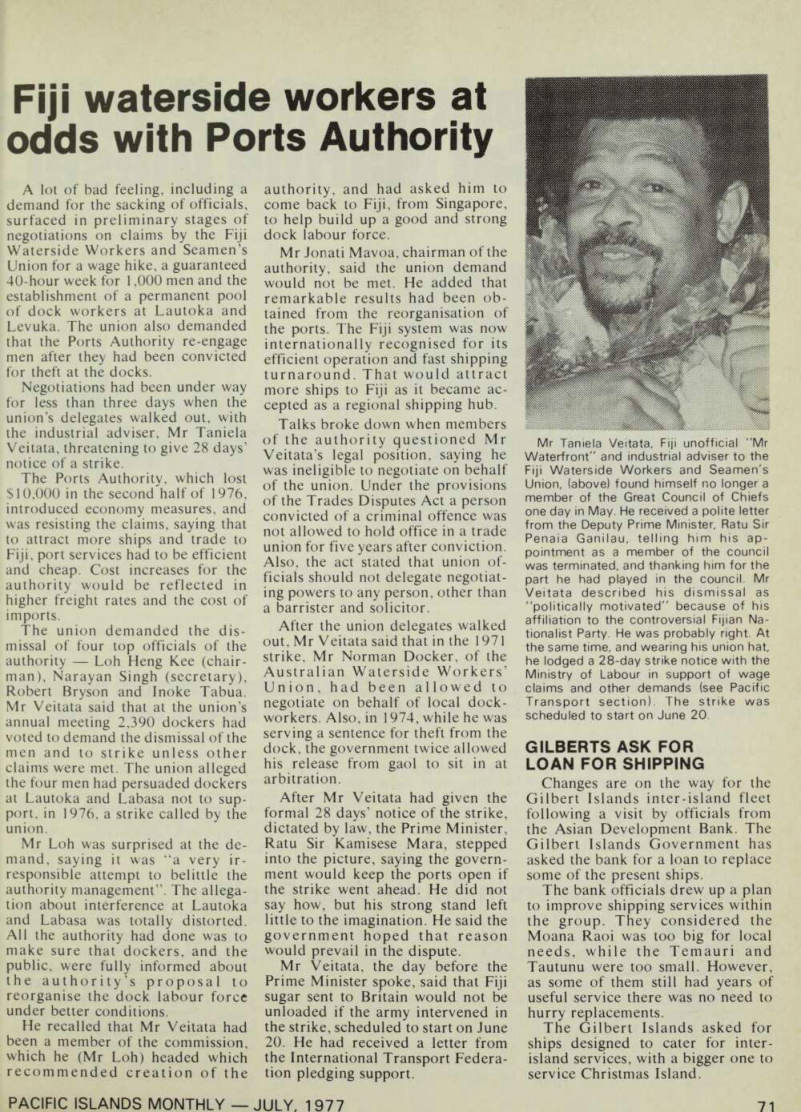
odds with Ports Authority
A lot of bad feeling, including a demand for the sacking of officials, surfaced in preliminary stages of negotiations on claims by the Fiji Waterside Workers and Seamen’s Union for a wage hike, a guaranteed 40-hour week for 1,000 men and the establishment of a permanent pool of dock workers at Lautoka and Levuka. The union also demanded that the Ports Authority re-engage men after they had been convicted for theft at the docks.
Negotiations had been under way for less than three days when the union’s delegates walked out, with the industrial adviser, Mr Taniela Veitata, threatening to give 28 days’ notice of a strike.
The Ports Authority, which lost $lO,OOO in the second half of 1976, introduced economy measures, and was resisting the claims, saying that to attract more ships and trade to Fiji, port services had to be efficient and cheap. Cost increases for the authority would be reflected in higher freight rates and the cost of imports.
The union demanded the dis missal of four top officials of the authority Loh Heng Kee (chair man), Narayan Singh (secretary), Robert Bryson and Inoke Tabua.
Mr Veitata said that at the union’s annual meeting 2,390 dockers had voted to demand the dismissal of the men and to strike unless other claims were met. The union alleged the four men had persuaded dockers at Lautoka and Labasa not to sup port. in 1976, a strike called by the union.
Mr Loh was surprised at the de mand, saying it was “a very ir responsible attempt to belittle the authority management”. The allega tion about interference at Lautoka and Labasa was totally distorted.
All the authority had done was to make sure that dockers, and the public, were fully informed about the authority’s proposal to reorganise the dock labour force under better conditions.
He recalled that Mr Veitata had been a member of the commission, which he (Mr Loh) headed which recommended creation of the
authority, and had asked him to come back to Fiji, from Singapore, to help build up a good and strong dock labour force.
Mr Jonati Mavoa, chairman of the authority, said the union demand would not be met. He added that remarkable results had been ob tained from the reorganisation of the ports. The Fiji system was now internationally recognised for its efficient operation and fast shipping turnaround. That would attract more ships to Fiji as it became ac cepted as a regional shipping hub.
Talks broke down when members of the authority questioned Mr Veitata’s legal position, saying he was ineligible to negotiate on behalf of the union. Under the provisions of the Trades Disputes Act a person convicted of a criminal offence was not allowed to hold office in a trade union for five years after conviction.
Also, the act stated that union of ficials should not delegate negotiat ing powers to any person, other than a barrister and solicitor.
After the union delegates walked out, Mr Veitata said that in the 1971 strike, Mr Norman Docker, of the Australian Waterside Workers’
Union, had been allowed to negotiate on behalf of local dock workers. Also, in 1974, while he was serving a sentence for theft from the dock, the government twice allowed his release from gaol to sit in at arbitration.
After Mr Veitata had given the formal 28 days’ notice of the strike, dictated by law, the Prime Minister, Ratu Sir Kamisese Mara, stepped into the picture, saying the govern ment would keep the ports open if the strike went ahead. He did not say how, but his strong stand left little to the imagination. He said the government hoped that reason would prevail in the dispute.
Mr Veitata, the day before the Prime Minister spoke, said that Fiji sugar sent to Britain would not be unloaded if the army intervened in the strike, scheduled to start on June 20. He had received a letter from the International Transport Federa tion pledging support.
Gilberts Ask For
Loan For Shipping
Changes are on the way for the Gilbert Islands inter-island fleet following a visit by officials from the Asian Development Bank. The Gilbert Islands Government has asked the bank for a loan to replace some of the present ships.
The bank officials drew up a plan to improve shipping services within the group. They considered the Moana Raoi was too big for local needs, while the Temauri and Tautunu were too small. However, as some of them still had years of useful service there was no need to hurry replacements.
The Gilbert Islands asked for ships designed to cater for inter island services, with a bigger one to service Christmas Island.
Mr Taniela Veitata, Fiji unofficial "Mr Waterfront" and industrial adviser to the Fiji Waterside Workers and Seamen's Union, (above) found himself no longer a member of the Great Council of Chiefs one day in May. He received a polite letter from the Deputy Prime Minister, Ratu Sir Penaia Ganilau, telling him his ap pointment as a member of the council was terminated, and thanking him for the part he had played in the council. Mr Veitata described his dismissal as "politically motivated" because of his affiliation to the controversial Fijian Na tionalist Party. He was probably right. At the same time, and wearing his union hat, he lodged a 28-day strike notice with the Ministry of Labour in support of wage claims and other demands (see Pacific Transport section). The strike was scheduled to start on June 20.
Advertisements & other items, p. 70 (1 item)
We're working the Pacific
with a Cat Marine Diesel.
-^3 ■O' L.
"Loloho" - General purpose Harbour tug boat. Operated by Bougainville Copper Limited at Bougainville. Overall length 50 ft. (15.24 m). Powered by a Caterpillar D 343 Marine Engine.
"MV. Kaunitoni" - An Inter-Island freighter. Operated by the Fiji Government. Overall length 134.3 ft. Displacement 628 tons. Speed 10 knots. Powered by a Caterpillar D 379.
Hastings Peering (Pacific) Ltd.and Carpenters Tractors cover the Pacificlslands waterfront with Cat. Marine Service and Parts.
Hastings Deering (Pacific) at Lae, Port Moresby and Bougainville and Carpenters Tractors at Suva are staffed by Caterpillar-trained technicians.
Working the Pacific waterfront day after day, year after year, you depend on reliable horsepower and first class dealer-support. You get it with a Cat Marine Diesel, Hastings Deering (Pacific) and Carpenters' Tractors.
While there's a Cat Marine Diesel in your craft you're backed up with Cat Plus, the total support programme offered only by your Caterpillar dealer.
Your local Hastings Deering (Pacific) or Carpenters Tractors dealer backs your Cat Marine Diesel engine with parts and service programmes designed to prevent, as well as shorten profitrobbing downtime.
Caterpillar Dealers in South-West Pacific.
HASTINGS DEERING
Lae; Milford Haven Road, Ph; 42 2355 Port Moresby: Champion Parade, Konedobu Ph; 24 3138 or 24 2098.
Bougainville: Itakara.
Industrial Park, Arawa, Ph: 95 9077
HD6I4
154 Queens Road, Suva.
Ph; 24 051-4, Cables; Carptrac Suva.
Telex: Carptrac FJ2191 Suva. a
CARPENTERS
TRACTOR B EQUIPMENT
Caterpillar. Cat and QJ are trademarks ot Caterpillar Tractor Co.
Tonga shipping line
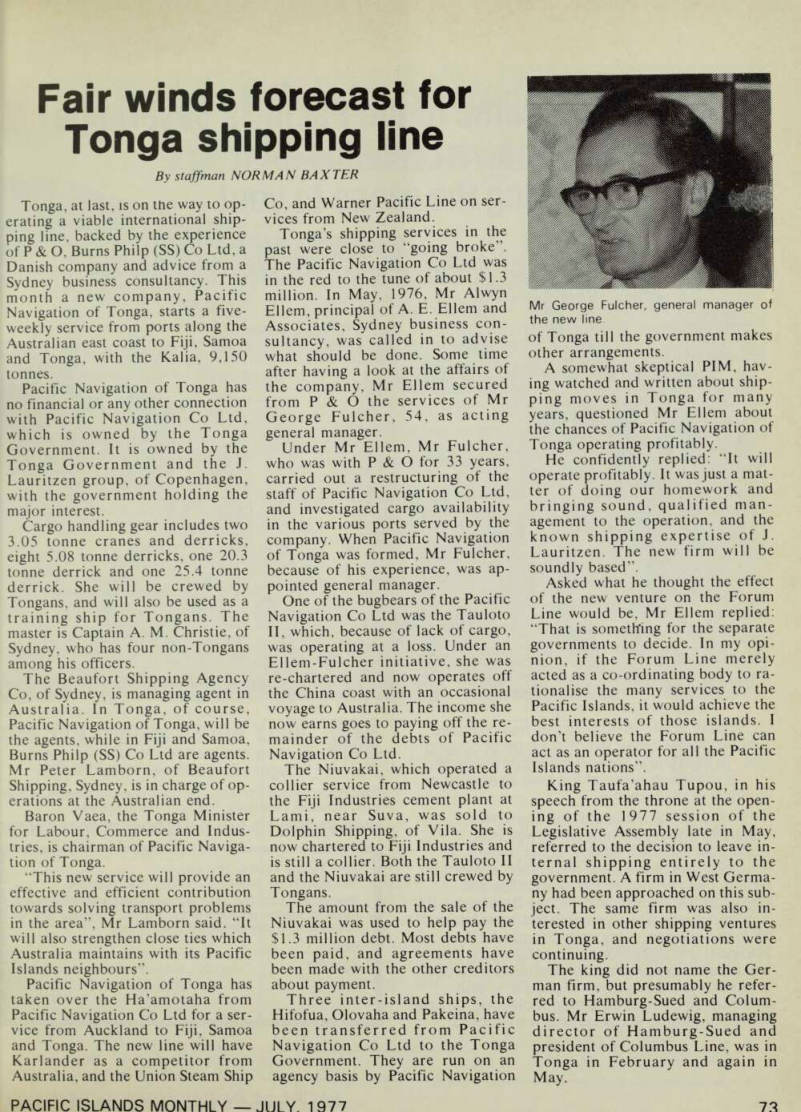
Fair winds forecast for Tonga shipping line
By staffman NORMAN BAXTER
Tonga, at last, is on the way to op erating a viable international ship ping line, backed by the experience of P & O, Burns Philp (SS) Co Ltd, a Danish company and advice from a Sydney business consultancy. This month a new company, Pacific Navigation of Tonga, starts a five weekly service from ports along the Australian east coast to Fiji, Samoa and Tonga, with the Kalia, 9,150 tonnes.
Pacific Navigation of Tonga has no financial or any other connection with Pacific Navigation Co Ltd, which is owned by the Tonga Government. It is owned by the Tonga Government and the J.
Lauritzen group, of Copenhagen, with the government holding the major interest.
Cargo handling gear includes two 3.05 tonne cranes and derricks, eight 5.08 tonne derricks, one 20.3 tonne derrick and one 25.4 tonne derrick. She will be crewed by Tongans, and will also be used as a training ship for Tongans. The master is Captain A. M. Christie, of Sydney, who has four non-Tongans among his officers.
The Beaufort Shipping Agency Co, of Sydney, is managing agent in Australia. In Tonga, of course, Pacific Navigation of Tonga, will be the agents, while in Fiji and Samoa, Burns Philp (SS) Co Ltd are agents.
Mr Peter Lamborn, of Beaufort Shipping, Sydney, is in charge of op erations at the Australian end.
Baron Vaea, the Tonga Minister for Labour, Commerce and Indus tries, is chairman of Pacific Naviga tion of Tonga.
“This new service will provide an effective and efficient contribution towards solving transport problems in the area”, Mr Lamborn said. “It will also strengthen close ties which Australia maintains with its Pacific Islands neighbours”.
Pacific Navigation of Tonga has taken over the Ha’amotaha from Pacific Navigation Co Ltd for a ser vice from Auckland to Fiji, Samoa and Tonga. The new line will have Karlander as a competitor from Australia, and the Union Steam Ship
Co, and Warner Pacific Line on ser vices from New Zealand.
Tonga’s shipping services in the past were close to “going broke”.
The Pacific Navigation Co Ltd was in the red to the tune of about $1.3 million. In May, 1976, Mr Alwyn Ellem, principal of A. E. Ellem and Associates, Sydney business con sultancy, was called in to advise what should be done. Some time after having a look at the affairs of the company, Mr Ellem secured from P & O the services of Mr George Fulcher, 54, as acting general manager.
Under Mr Ellem, Mr Fulcher, who was with P & O for 33 years, carried out a restructuring of the staff of Pacific Navigation Co Ltd, and investigated cargo availability in the various ports served by the company. When Pacific Navigation of Tonga was formed, Mr Fulcher, because of his experience, was ap pointed general manager.
One of the bugbears of the Pacific Navigation Co Ltd was the Tauloto 11, which, because of lack of cargo, was operating at a loss. Under an Ellem-Fulcher initiative, she was re-chartered and now operates off the China coast with an occasional voyage to Australia. The income she now earns goes to paying off the re mainder of the debts of Pacific Navigation Co Ltd.
The Niuvakai, which operated a collier service from Newcastle to the Fiji Industries cement plant at Lami, near Suva, was sold to Dolphin Shipping, of Vila. She is now chartered to Fiji Industries and is still a collier. Both the Tauloto II and the Niuvakai are still crewed by Tongans.
The amount from the sale of the Niuvakai was used to help pay the $1.3 million debt. Most debts have been paid, and agreements have been made with the other creditors about payment.
Three inter-island ships, the Hifofua, Olovaha and Pakeina, have been transferred from Pacific Navigation Co Ltd to the Tonga Government. They are run on an agency basis by Pacific Navigation
of Tonga till the government makes other arrangements.
A somewhat skeptical PIM, hav ing watched and written about ship ping moves in Tonga for many years, questioned Mr Ellem about the chances of Pacific Navigation of Tonga operating profitably.
He confidently replied: “It will operate profitably. It was just a mat ter of doing our homework and bringing sound, qualified man agement to the operation, and the known shipping expertise of J.
Lauritzen. The new firm will be soundly based”.
Asked what he thought the effect of the new venture on the Forum Line would be, Mr Ellem replied: “That is something for the separate governments to decide. In my opi nion, if the Forum Line merely acted as a co-ordinating body to ra tionalise the many services to the Pacific Islands, it would achieve the best interests of those islands. I don’t believe the Forum Line can act as an operator for all the Pacific Islands nations”.
King Taufa’ahau Tupou, in his speech from the throne at the open ing of the 1977 session of the Legislative Assembly late in May, referred to the decision to leave in ternal shipping entirely to the government. A firm in West Germa ny had been approached on this sub ject. The same firm was also in terested in other shipping ventures in Tonga, and negotiations were continuing.
The king did not name the Ger man firm, but presumably he refer red to Hamburg-Sued and Colum bus. Mr Erwin Ludewig, managing director of Hamburg-Sued and president of Columbus Line, was in Tonga in February and again in May.
Mr George Fulcher, general manager of the new line.
Advertisements & other items, p. 72 (1 item)
of boating gear—send us SA4.
If you can’t come to the Pacific’s best range
And we’ll bring the range to you! mm -wwl.
T W \ W~ m
ROGER
SI - i
JOIIY
v• 4 I i <• ' <« it < 'S In Sydney is where Jolly Aoger has collected what is boldly called the best range of boating gear in the Pacific. Assembled from all corners of the world are some of the best examples of nautical craftsmanship.
From the U.S.A, England, the Continent, Australia and elsewhere come winches, portlights, hatches, fittings, lights, cleats, anchors, electronic aids, navigation equipment, fishing gear and so much more it fills 230 pages of the current Jolly Roger Catalogue. If you’re not going to Sydney in the near future, fill in the coupon, enclose a cheque for SA4 and post it to Jolly Roger. By return post you will receive the graphically illustrated catalogue and price list. 230 pages of picture and information-packed boating goodies, all for sale to any boating enthusiast who wants them.
JOLLY ROGER MARINE PTY. LTD
boating and marine products you never thought you would see in the Pacific Jolly Roger Marine Pty. Ltd. 16 Chard Road, Brookvale, N.S.W 2100 Australia Telephone: 9383211 Telex: AA27443
HURRY! MAIL TO-DAY. CATALOGUE STOCKS LIMITEi
Jolly Roger Marine Pty. Ltd. 16 Chard Road, Brookvale, N.S.W. 2100 Australia Please rush your 230 page illustrated catalogue of the best range of marine products in the Pacific. I enclose SA4 to cover packing and despatch by return mail.
NAME
ADDRESS
.COUNTRY
JR77.FP.
‘Glib political rhetoric’ won’t
run the Forum Line
The proposed South Pacific Forum Line appears headed for the rocks, just as it is seeking a general manager and other expert staff and after the interim board has ap proved the company’s memorandum and articles of association. The line is to be registered as a company in Western Samoa with head office in Apia. Countries wishing to join the line were to be asked to sign docu ments at a meeting in the Cook Is lands in June.
The ink on a press release cover ing the latest formal developments was still wet when the Western Samoa Minister of Economic Affairs, Communications and Transport, Mr Asi Eikeni, called for some soul-searching by Forum members and the New Zealand Government to help end a “six-year farce”.
Only a week earlier it was learned in Apia that the roll-on roll-off (ro ros) which the line proposed to use, would not be allowed into NZ ports.
It was not clear whether that was the official view of the NZ Government, or the attitude of the maritime unions. It was more likely the latter, for the NZ Government had com mitments in relation to establishing the line, while the intransigence of some NZ maritime unions is well known in the South Pacific.
Mr Eikeni stressed the dependen cy of the South Pacific people on agricultural and industrial develop ment and added that shipping and air links were essential to national development. Seven years ago the Western Samoa Government took the initiative about a regional line, and in 1976, it seemed that prospects were good.
Since then, two countries which were closely associated with the venture, Papua New Guinea and Tonga, had taken another, or ad ditional course. PNG proposed to launch a line which would take over the most lucrative route of the pro posed regional line, while Tonga had indicated it would join Colum bus and other lines in a shipping venture which would take over even
more routes of the proposed Forum Line.
Mr Eikeni said there seemed to be no end to formulae and feasibility reports about the Forum Line. He wanted to know it it was feasible without NZ support. If that support was not forthcoming, false hopes were being raised. Part of the problem was that Pacific govern ment leaders had allowed them selves, either consciously or sub consciously, to gloss over basic issues with glib political rhetoric.
If ro-ros could not operate on a direct route, it would have to be a circular route, which meant cross trading. Would NZ maritime unions allow a cross-trading ship in the Pacific to enter a NZ port?
A ro-ro, used to its full potential, would “pick the eyes” out of the Union Steam Ship Co trade. Was the NZ Government prepared to allow that?
Clearly, the co-operation and goodwill of the NZ wharf and maritime unions were essential to a viable Pacific Forum Line. The main reason for the existence of unions was to promote group action to protect the interests of the little man. The Pacific Islands people were very much in the “little man”
category in the shipping exercise.
Mr Eikeni, however, said his government was prepared to make a last effort to save the project. His government was prepared to acquire a ro-ro, to sub-charter to the Forum Line. He invited the NZ Govern ment to match his government’s in itiative in a positive attempt to end a six-year farce.
“On the other hand, if the NZ Government will not respond positively then I call on the NZ Government and all the other coun tries, who have so far been involved in the establishment of a Pacific Forum Line, to do the decent thing by our people and call it a day,” Mr Eikeni said.
The NZ Minister of Overseas Trade, Mr Talboys, was surprised that Western Samoa should have any doubt about the strength of NZ’s commitment to the Forum line. NZ had made it clear, many times, that she would contribute a suitable ship.
The commitment was reaffirmed as recently as early May to the in augural meeting of the interim board in Apia. On top of that, in ad dition to her shareholding, NZ had undertaken to provide a guarantee for a substantial proportion of the line’s initial working capital.
Advertisements & other items, pp. 73-74 (1 item)
> Interport,
Freight Forwarders -Air& Sea.
The Interport Group of Companies who have offices in Sydney, Melbourne, Brisbane and Singapore and who specialise in Customs Clearances, Transport, Sea and Air Freight Forwarding and Warehousing is looking for Agents to represent it in Australasia and Oceania on an exclusive and reciprocal basis.
If you are interested in entering into negotiations with us please forward details of your organization together with any other salient details to:
> INTERPORT,
G.P.O. BOX 5326,
SYDNEY, 2001,
N.S.W., AUSTRALIA.
nedlloyd
REGULAR SAILINGS BY FAST, MODERN CARGO VESSELS from EUROPE yio PANAMA to: from NEW ZEALAND™ PANAMA to:
PAPEETE, NOUMEA, (MEDITERRANEAN & NORTH CONTINENT)
APIA, SUVA, LAUTOKA, and from AUSTRALIA to:
NEW ZEALAND. CENTRAL AMERICA & CARIBBEAN
heavy-lift facilities —refrigerated space—cargo deeptanks
For further particulars apply to Agents: Ets. Donald Tahiti Papeete. / > Agence Maritime Aerienne Caledonienne S.A. A.M.A.C., Noumea.
O. F. Nelson & Co* Ltd.
Apia.
Carpenters Shipping Suva, Lautoha.
Interocean Australia Services Pty. Ltd.
Sydney.
Joint Shipping Management Ltd.
P.O. Box 890, Wellington, N.Z.
COMPAGNIE GENERALE MARITIME
[Messageries Maritimes]
AUSTRALIA - EUROPE SERVICE.
Fully containerised mmkirv/ (Member of AECS) Agents; SEABRIDGE, 60 Pitt Street, SYDNEY.
Phone: 20518.
PO Box R 206.
PACIFIC ISLANDS - EUROPE SERVICE.
- Roßo and Multipurpose Service ... .
Twice monthly to/from Papeete - Noumea - New Hebrides.
Multipurpose Service Monthly to/from Papua/New Guinea.
SOUTH PACIFIC UNITED LINES
AUSTRALIA - PACIFIC ISLANDS - U.S. WEST COAST.
Monthly fully containerised Service.
Agents: OMNITRADERS & BROKERS,
261 George Street, Phone: 241 2872.
GPO Box 3896. *★* ★
Cruising
Yachts
• PRECIOSA, 54 ft aluminium ketch from Oslo, Norway, arrived in Tahiti on February 12, carrying owners and builders Dag Juell Pettersen, Per Omdal, Kjell Myrann and Ola Heining, all of Nor way. They left Oslo on June 2, 1975, and have since visited many countries in Europe, sailed to the Canaries and West Indies, to Barbados and Rio de Janeiro, the Falkland Islands and around Cape Horn to Chile. They drank champagne 100 metres off the coast of Cape Horn.
After spending eight months in Chile they set off again for Robinson Crusoe Island, Easter Island, then on to Nukuhiva in the Marquesas, the Tuamotus and Tahiti. The four young men, who range in age from 22-24 yrs took four to build Pre ciosa, which is named for an old boat which in 1847 sailed the same route they are following. Future plans include sailing west and arriving back in Norway by May, 1978, but they are not sure of the arrival date.
Preciosa was on another leg of her journey in May, arriving on May 11 at Rarotonga. • RODONIS, 47 ft Skookum sloop from Anchorage, Alaska, carrying the Somers family of Dale and Randi, 16-yr old son Dan and 15-yr-old daughter Chris, left Alaska last July for Seattle, where they joined yacht DESPERADO for the sail to Tahiti, where they anchored on February 22. Enroute they enjoyed play ing tennis in the Marquesas and pool in the Tuamotus. They planned to remain in Tahiti for a short while, then sail to Samoa, Fiji and New Zealand. • SHEARWATER, 40 ft trimaran ketch from Venice, Fla left home in June, 1975, for the Bahamas, South America and San Bias islands. Owner-captain Bill Baker, his wife Janet Duke Baker and her brother Steve Duke spent four months in the San Bias islands then sailed to Panama where Bill's son Bill Jr joined them for their sail to the Marquesas and Tahiti, which they reached on April 22.
Bill Jr planned to fly back to Colorado to return to work, while the others intended visiting French Polynesia for some months and then heading to New Zea land, Australia and around the world. Just before reaching Tahiti they encountered 35 knot winds from Cyclone Robert. • SILENT ECHO, 44 ft Garden design ketch from Vancouver, left Huahine in French Polynesia on Feb 28, bound for Hawaii. Owner and builder of the wooden boat. Bill Penny, was making a return visit to the island he has come to love so much since he crashed on the reef in
1961 in a copra boat. He lived in Huahine for six months a year and the other six months were spent in the Arctic, then he moved to Australia and eventually to Vancouver where he married his wife Jill and built Silent Echo. They left on their voyage in 1974 and visited Mexico, Central America, the Caribbean and South America, passed through the Panama Canal and sailed to the Galapagos in September, 1976, visited the Marquesas and arrived in Tahiti in November. On board, as they sailed for Hawaii, was David Craig of Australia. • STUFF, a 46 ft fibreglass ketch, Cal-46, arrived at Tubuai in the Australs from New Zealand in February on a delivery voyage with professional crew to San Diego for the owners, Ron Hungerford
and Art Frank of All Seas Yacht Transport, a partnership in Za Mesa, California They were accompanied by Ron's wife, Harryette, and son Phil, and New Zealander Malcolm Wilson of Napier They stayed one day to take on fuel and then left for Tahiti, Marquesas and direct to San Diego • JOLLY TAR, a 32 ft fibreglass cutter Kendall-32, arrived at Tubuai from Tahiti on February 28 with Lon and Susie Woodrum and their young son Casey after 18 months' cruising from Redonda Beach, California, to Hawaii and Tahiti (Lon had cruised to Tahiti in 1956 as a
teenager.)
• KAHIKIMOE, a Cal-30 sloop with singlehander Eric Metcalb arrived on April 2 at Tubuai from Tahiti, after cruising
from Hawaii Eric left on April 20 in com pany with Jolly Tar for Raivavae and Tahiti Both yachts narrowly missed hur ricane Robert • BENEDIC, an Ocean-71 fibreglass ketch "the most luxurious yacht I’ve ever visited”, writes Don Travers from Tubuai sailed from New Zealand to Raivavae in 21 days, and arrived at Tubuai on April 22 after 75,000 miles cruising. Built in England, she has circled the Pacific, including the Bering Sea, Panama Canal (twice), and the Suez Canal. She completed circumnavigation in Australia Benedic has centre and aft cockpits, a main saloon with hydraulic operated table for raising and lowering, electric-powered adjustable lounge chairs, three stainless steel-lined shower head compartments, 115 hp auxiliary engine, 7.5 KW generator, intercom be tween all cabins, radar, bathometer, marine telephone, Omega navigation, satellite navigation, sight reduction com puter, a radio gadget that prints out the latest satellite weather map, interior car peted and lined with padded leather and cork a truly "gold-plated” yacht! She left on April 25 for Rurutu and Tahiti with captain owner Gerardus Dusseldorp (Dutch), girlfriend Atea (Tahitian), engineer Bob Chapman (Australian), cook Amanda Faruharsson (Australian), sea man Tony May (English), and Colin Hunter (Canadian). • EDYTHE, 28 ft ketch registered in Auckland, arrived at Rarotonga on April 17 from Bora Bora with New Zealanders John Atkinson and Peter Brown. They left NZ in May, 1976, on a Pacific cruise that took them from Auckland to Fiji, the Lau Group, Tonga, American and Western Samoa, Christmas Island, Hawaii, the Marquesas, Tuamotus and Tahiti. From Rarotonga they were homeward bound for Auckland. • TIR TAIRNGIRE, 32 ft cutter-riggec Tahiti ketch, registered at Seattle, arrived at Rarotonga on April 11 from Papeete with Michael Moriaity and his wife, Karen.
They built the yacht in Santa Barbara, ther sailed her to the Marquesas, Tuamotus anc Tahiti. On entering Avatiu Harbour, Rarotonga, a high wind blew a line over side. The line fouled the propeller anc damaged the engine and, as Mr Moriaity could not do repairs at Rarotonga, he piano ed to sail to Tonga and then NZ where he would get the engine repaired. From there, future ports of call were to be in Fiji anc Brisbane. • FROJ, 32 ft Danish ketch, arrived al Rarotonga on May 11 from the Society Islands with Jan Bertlsen, Lisbeth Johan nsen, Nina Flagstad, all Danes, and American Timothy Haber. The voyage started from Denmark 2'/ 2 years ago and plans were to visit Fiji. • MANTA, 38 ft ketch-rigged American trimaran, arrived at Rarotonga on May 8 from Bora Bora with owner captain Edward Sullivan and Japanese crewman Norio Ota. They left for Vavau, Tonga, on May 14
Advertisements & other items, pp. 75-76 (3 items)
77
PACIFIC ISI AMDS MOMTHI V ll ll V i Q 77
The Kingston Angler'
FRANCIS TRADING COMPANY
IMPORT & EXPORT MERCHANTS,
SUITE 204, 11 SPRING ST., CHATSWOOD, NSW. 2067.
We offer personal service on all commercial and other requirements.
Our manager, A.N. (“Andy”) Losurdo, formerly of Madang and Rabaul, is now available to offer the best in export service and advise on prospects in Australia for all types of your exports.
PHONE: 412 4960.
P.O. BOX 186, CHATSWOOD 2067.
P.N.G. Representatives: Woo Enterprises Pty. Ltd., Chinsurah St., Taurama.
P.O. Bdx 5676, Boroko.
Diesel Power! Displacement Hull!
The KINGSTON ANGLER'
is good news
for fishermen
and island
traders.
»The 19’ displacement hull gives you smoother cruising than a planing hull (it’s the same hull as the Kingston 580) 'The diesel engine (up to 33 h.p. and 15 knots) is safe, reliable and cheaper to run.
'Full length, self-draining floor.
'The fibreglass construction throughout makes it easier to maintain.
For brochure and name of your nearest dealer phone or write ■%
Ifrtf ojfloif
CRUISER SALES PTY. LTD.
179 South Creek Road, Dee Why, N.S.W. 2099. Australia.
Telephone: 981 3508 y
THE
LINE
& 'M.
MONTHLY SERVICES
United Kingdom and Continent to: Papeete, Noumea, New Hebrides, Papua New Guinea and Solomon Islands.
Papua New Guinea to: North America, United Kingdom and Continent.
Solomons, Fiji, Tonga, Samoa and Tarawa to: United Kingdom and Continent.
For particulars apply:
THE BANK LINE (AUSTRALASIA) PTY.
LTD.,
18TH FLOOR, 1 YORK STREET,
SYDNEY, N.S.W.
78
DAncir IQI AMPiQ MOMTHI Y II II Y 1 Q 77
Deaths
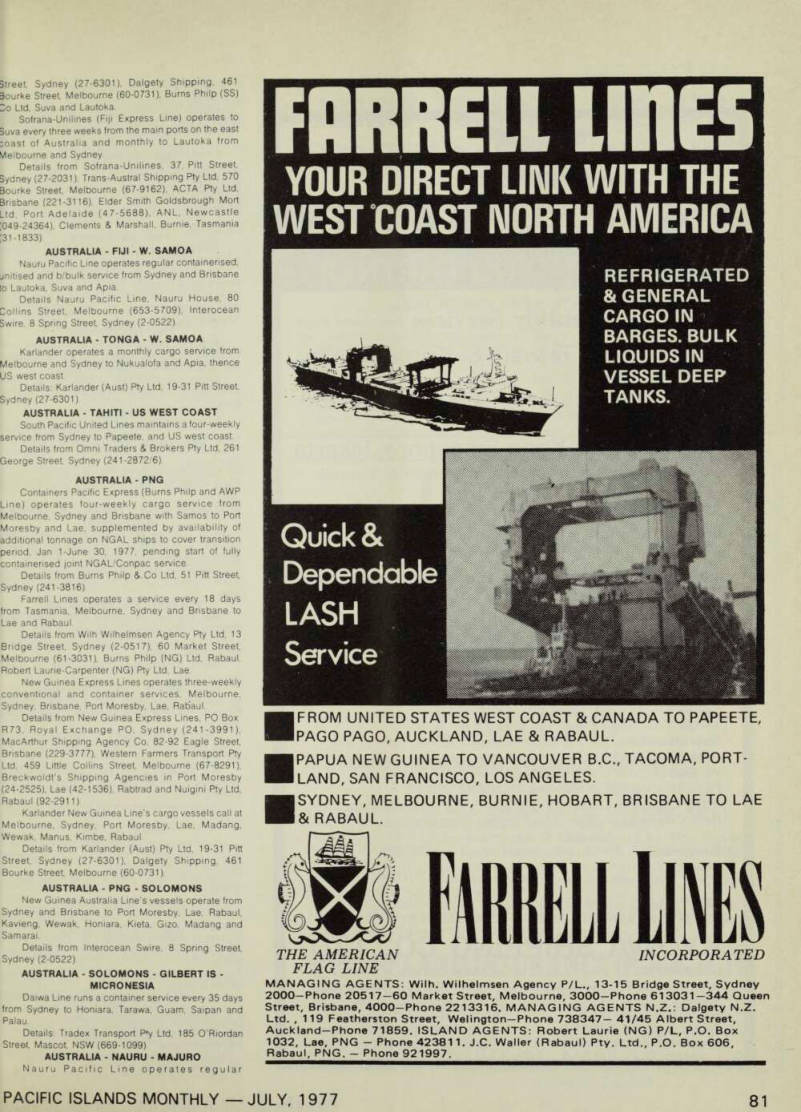
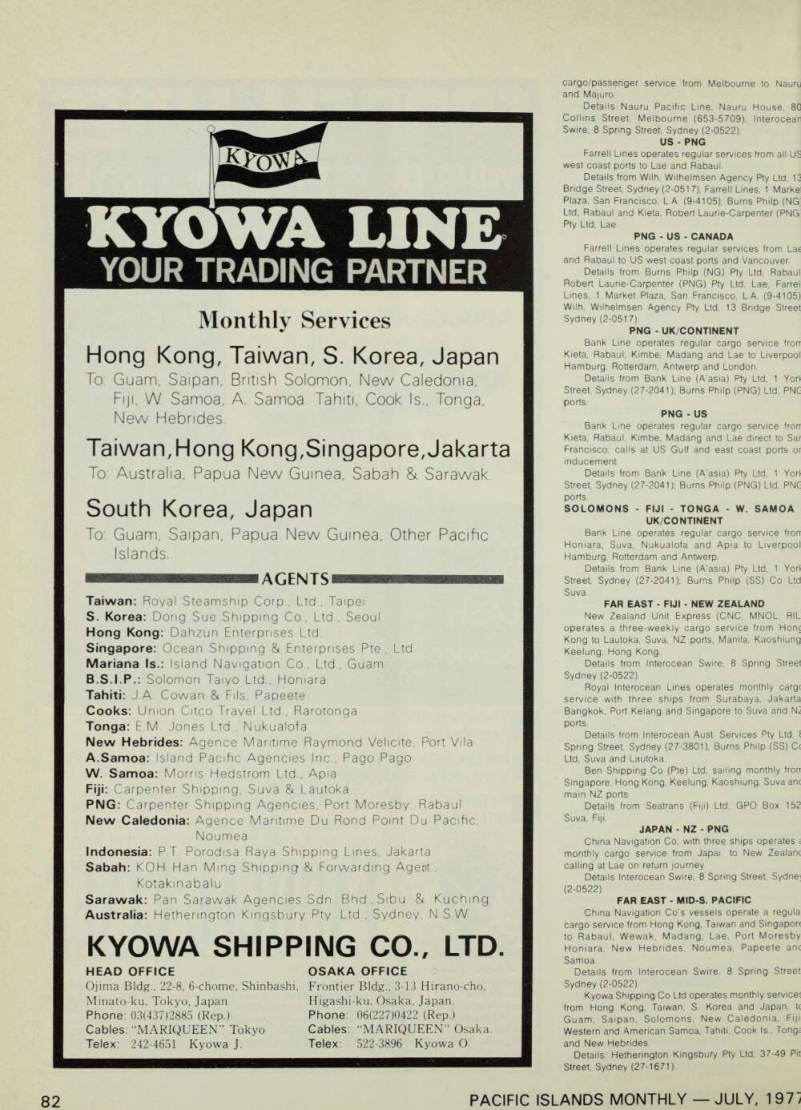
of Islands People
Mr. P. T. Raddock Mr Patrick Tasman Raddock Pat), one of Fiji’s most prominent portsmen, died on May 22, after >ecoming ill the previous day. He vas 56. For many years he was truly Fiji’s “Mr Rugby”, as a player, as an idministrator, coach, referee, and elector. He was honoured with life nembership of the Fiji Rugby Union or his services.
Three times he was assistant man iger and coach of Fiji touring rugby earns to New Zealand (1951), Australia (1952) and Wales (1964).
Significantly, they were some of the nost successful teams Fiji has sent m tour.
He was also a cricketer of more han ordinary ability. He toured 4ew Zealand twice with Fiji teams in 1948 and in 1954, when he was :aptain. One of the members of the 1954 team was a close friend, Ratu C. K. T. Mara, who is now Ratu Sir Camisese Mara, Prime Minister of -iji. The pair were the “long and the ihort” Ratu Sir Kamisese a owering 6 ft 6 in, Pat Raddock a iiminutive 5 ft 4V-2 in (he always in listed on that half-inch).
Mr Raddock was also a good lockey player in his younger days, md later helped as an admin strator. In fact, he would have spent i large part of his life at Albert
3 ark, Suva, Fiji headquarters for
ugby, cricket and soccer.
He worked for the Labour Department for many years, and lad acted as Commissioner of Labour. On his retirement from the :ivil service he joined the staff of Lope Allman, soap and biscuit nanufacturers as staff officer.
He leaves a widow, Sophia, and a daughter.
Mr James Roy Vicary
Roy Vicary, an Australian who worked in the New Guinea goldmin ing industry in the 30s and was a Royal Australian Air Force in dulgence officer in Dutch New Guinea during World War II has died in Melbourne, aged 73.
In January, 1942, Roy Vicary and bis yawl Gitana helped to evacuate
civilian residents of New Guinea fleeing the Japanese invasion.
Following his RAAF service, he joined the allied translator and in terpreter section before being at tached to the Ist US Army Corps, the only Australian with this group of Americans, and served with them in the invasion of the Philippines.
Following service with the oc cupation forces in Japan, he return ed to New Guinea as senior agricultural officer at Madang, where he spent 17 years before retir ing to Melbourne in 1965.
Mr Peter Livingston The death occurred in Sydney in May of Mr Peter Livingston, for many years a member of the Papua New Guinea Administration, and a pioneer in broadcasting in Papua New Guinea. He was 62.
Peter Livingston went to Port Moresby early in World War II with the Australian Army and was a member of the Papuan Admin istrative Unit. One of his more im portant postings at that time was to the teaching staff of the Sogeri High
contd. on p 86.
contd. from p 79.
School, outside Port Moresby, which over the years has produced many Papua New Guinean students who have made their mark.
At the end of the war he transfer red to the new civil government, which for the first time combined the administrations of Papua and the trusteeship territory of New Guinea. As a member of the Special Services Division of the Department of Education, Peter Livingston was present at an important meeting on July 1, 1946, when the Australian Broadcasting Commission began its operations in PNG, using the facili ties of the old army broadcasting unit, in which Peter had also been involved. The division agreed to or ganise and broadcast all program mes over the ABC which were de signed especially for Papua New Guineans, and this arrangement continued for the next 16 years.
Peter Livingston was a key figure in the development of these pro grammes, which were broadcast territory-wide, and as a fluent Motu speaker, with a sympathetic unders tanding of the needs of the people, his work did much to assist in laying the foundations of a national identi ty in those early days.
While with the Education Depart ment he wrote or edited several books for children, a large number of radio scripts (many of them while on secondment to the ABC in Sydney), and he was also seconded at one point to the UN Information Bureau in Port Moresby.
He never married and when he retired from the PNG Admin istration in 1974, after more than 30 years in PNG, he enthusiastically took up one of his many loves, paint ing, and held two art exhibitions in Sydney. He was a regular book reviewer for PIM, specialising in books on Islands literature and art, subjects on which he was very well informed. Peter Livingston was a warm and generous man, with a bubbling sense of humour, and a wide circle of friends.
He leaves a married sister. SI.
Mr M. Jagroop Mr Mohan Jagroop, who founded a transport firm in Fiji more than 40 years ago, has died. He was 79.
After working in a Suva firm he started a cargo lorry business, which is now Mohan and Sons Ltd, man aged by two of his sons.
Advertisements & other items, pp. 77-78 (1 item)
Bacchanal”
STOP THIEF! qta4i?
W |TH g
Automark
WINDOW ETCHING
TRANSFERS
Every day goods are stolen, Automark protects by etching letters and figures onto any glass.
Each kit contains 18 letters & 18 figures $4.75 including postage, (ie. 6 sets of each).
SO SIMPLE TO APPLY NAME
Moisten the chemically impregnated self-etching transfer, to the glass ADDRESS and leave for three minutes. Remove transfer and clean.
Glass is PERMANENTLY ENGRAVED.
SEND TO: Letters & figures required;
AUTOMARK
1/32 MARALL CRESCENT,
MISSION BAY,
AUCKLAND, NEW ZEALAND.
FOR
SALE:
BACCHANAL”
One of the very few truly long range ocean cruising vessels in Australia. 68 ft. x 18'6" x 8' steel motor-sailer. Powered by twin Rolls Royce diesels.
Extras include deep freezerefrigeration, air-conditioning, radar, auto pilot, echo sounders, 3 radios, Walkers log and speedo hull fitted: others too numerous to list.
Professionally maintained excellent condition.
PHONE: SYDNEY 98 6651
A.H. 90 2449.
\DAIWA LINE
DIRECT REGULAR SERVICE
JAPAN-SOUTH PACIFIC
TARAWA-PAPEETE-PAGO PAGO-APIA
SUVA-LAUTOKA-NOUMEA-VILA
SANTO-HONIARA
JAPAN-TAIWAN-GUAM
JAPAN-KEELUNG-GUAM BY
EXCELLENT CAR/CONTAINER-CARRIER
JAPAN-WEST IRIAN-DILI
HONG KONG-TAI WAN-WEST IRIAN-DILI
AGENTS:
GUAM: ATKINS, KROLL (GUAM) LTD.
TARAWA: G. & E. I. DEVELOPMENT AUTHORITY.
APIA: BURNS PHILP (SOUTH SEA) CO., LTD.
PAGO PAGO: KNEUBUHL MARITIME SERVICES CORP.
NUKUALOFA: PACIFIC NAVIGATION CO., LTD.
SUVA: BURNS PHILP (SOUTH SEA) CO., LTD.
LAUTOKA: BURNS PHILP (SOUTH SEA) CO., LTD.
NOUMEA: SOCIETE D'ACCONAGA ET
TRANSPORT D'OCEANIE (SATO)
SANTO: BURNS PHILP (NEW HEBRIDES) LTD.
VILA: BURNS PHILP (NEW HEBRIDES) LTD.
HONIARA: BRITISH SOLOMONS TRADING CO., LTD.
PAPEETE: AGENCE MARITIME DE FARA UTE.
HONG KONG: IKE MARITIME CO., LTD.
SINGAPORE: THE BORNEO CO., (SINGAPORE) LTD.
DJAJAPURA: P. N. PELAJARAN NASIONAL INDONESIA.
DILI: SANG TAI HOO
TAIWAN: FOR CARGO BETWEEN JAPAN/GUAM/TAIWAN &
SOUTH PACIFIC,
FORMOSA SHIPPING & ENTERPRISE CORP.
THE DAIWA NAVIGATION CO.LTD*
OSAKA: "DAILINE" TOKYO: “FUNEDAILINE’'
HEAD OFFICE
DAI ICHI KYOGYO BLDG.,
45, 2-CHOME, AWAZAMINAMI-DORI,
NISHI-KU, OSAKA, JAPAN
TELEPHONE: (06) 531-0471 ~9
TELEX: 525-6324 & 525-6325
TOKYO OFFICE
SHIN-DAIICHI BLDG.,
4-13, NIHONBASHI 3-CHOME, CHUO-KU,
TOKYO, JAPAN
TELEPHONE: (03) 274-3251 ~8
TELEX: 222-3343. 23559
Shipping
SYDNEY - NZ - FIJI/TAHITI - UK Chandris Lines maintains a passenger service from Sydney via NZ, Suva or Papeete every second month.
Details from Chandris Lines. 135 King Street, Sydney (232-2455).
Sydney - Lord Howe Is -
Norfolk Is - New Hebrides
Compagnie des Chargeurs Caledoniens operates four-weekly cargo service Sydney - Lord Howe Island, Norfolk Island, Port Vila and Santo Details Hetherington Kingsbury Pty Ltd, 37-49 Pitt Street, Sydney (27-1671).
SYDNEY - NZ - FIJI - HAWAII -
Canada - Us
P & O liners call at Auckland, Suva, Honolulu and Vancouver on eastbound and westbound voyages between Sydney and the US.
Details from P & O Booking Centre, World Travel headquarters Pty Ltd, 33 Bligh Street, Sydney (231-6655).
AUSTRALIA - NZ - FIJI - TONGA - N. HEBRIDES - NOUMEA - PNG -
Solomons -Samoas
Sitmar Cruises operates a year-round cruise programme to include most of the above countries.
Details from Sitmar Cruises, 22-30 Bridge Street, Sydney (27-4521).
Royal Viking Line, with luxury cruise ships Royal Viking Sea, Star and Sky, cruises the Pacific from Sydney, Hobart and Cairns calling at most of above countries.
Details from Wilh, Wilhelmsen Agency Pty Ltd, 13-15 Bridge Street, Sydney (2-0517) P & 0 liners call at Apia, Auckland, Bay of Islands, Borabora, Honiara, Honolulu, Lautoka, Noumea, Nukualofa, Pago Pago, Papeete, Port Moresby, Santo, Savusavu, Suva, Vavau and Vila on cruises from Australia.
Details from P & O Booking Centre World Travel Headquarters Pty Ltd, 33 Bligh Street, Sydney (231-6655) Pacific Navigation of Tonga operates a five-weekly general cargo/container service from Port Kembla, Sydney and Newcastle (inducement), to Suva, Lautoka (inducement), Apia, Pago Pago and Nukualofa.
Details from Beaufort Shipping Agency Co, 2 Castlereagh Street, Sydney (221-2388)
Australia - New Caledonia
Somacal operates a monthly service from Sydney to Noumea.
Details from Karlander (Aust) Pty Ltd, 19-31 Pitt Street, Sydney (27-6301).
Sofrana-Unilines ships serve Noumea every three weeks from the main ports along the east Australian coast.
Details from Sofrana-Unilines, 37 Pitt Street, Sydney (27-2031), Trans-Austral Shipping Pty Ltd, 570 Bourke Street, Melbourne (67-9162), ACTA Pty Ltd, Brisbane (221-3166), Elder Smith Goldsbrough Mort Ltd, Port Adelaide (47-5688), ANL, Newcastle (049-24364), Clements & Marshall, Burnie, Tasmania (31-1833).
Compagnie des Chargeurs Caledoniens operates three-weekly cargo service from Sydney to Noumea Details Hetherington Kingsbury Pty Ltd, 37-49 Pitt Street, Sydney (27-1671).
Australia - New Caledonia -
New Hebrides
South Pacific United Lines maintains a four-week cargo service from Sydney to Noumea, Vila and Santo.
Details from Omni Traders & Brokers Pty Ltd, 261 George Street, Sydney (241-2872/6).
Australia - Fiji
Karlander (Aust) Pty Ltd operates monthly cargo services from Sydney to Suva and Lautoka.
Details from Karlander (Aust) Pty Ltd, 19-31 Pitt
Street, Sydney (27-6301), Dalgety Shipping, 461 3ourke Street, Melbourne (60-0731), Burns Philp (SS) So Ltd. Suva and Lautoka Sofrana-Unilines (Fiji Express Line) operates to Suva every three weeks from the main ports on the east :oast of Australia and monthly to Lautoka from Melbourne and Sydney.
Details from Sofrana-Unilines, 37. Pitt Street, Sydney (27-2031), Trans-Austral Shipping Pty Ltd, 570 Bourke Street, Melbourne (67-9162), ACTA Pty Ltd, Brisbane (221-3116), Elder Smith Goldsbrough Mort Ltd, Port Adelaide (47-5688), ANL, Newcastle [049-24364), Clements & Marshall, Burnie, Tasmania [3l-1833).
Australia - Fiji - W. Samoa
Nauru Pacific Line operates regular containerised, unitised and b/bulk service from Sydney and Brisbane to Lautoka, Suva and Apia Details Nauru Pacific Line, Nauru House, 80 Collins Street, Melbourne (653-5709), Interocean Swire, 8 Spring Street, Sydney (2-0522).
Australia - Tonga - W. Samoa
Karlander operates a monthly cargo service from Melbourne and Sydney to Nukualofa and Apia, thence US west coast Details: Karlander (Aust) Pty Ltd, 19-31 Pitt Street, Sydney (27-6301).
AUSTRALIA - TAHITI - US WEST COAST South Pacific United Lines maintains a four-weekly service from Sydney to Papeete, and US west coast.
Details from Omni Traders & Brokers Pty Ltd, 261 George Street, Sydney (241-2872/6).
Australia - Png
Containers Pacific Express (Burns Philp and AWP Line) operates four-weekly cargo service from Melbourne, Sydney and Brisbane with Samos to Port Moresby and Lae, supplemented by availability of additional tonnage on NGAL ships to cover transition period, Jan 1-June 30, 1977, pending start of fully containerised joint NGAL/Conpac service.
Details from Burns Philp S. Co Ltd, 51 Pitt Street, Sydney (241-3816) Farrell Lines operates a service every 18 days from Tasmania, Melbourne, Sydney and Brisbane to Lae and Rabaul Details from Wilh Wilhelmsen Agency Pty Ltd, 13 Bridge Street, Sydney (2-0517), 60 Market Street, Melbourne (61-3031), Burns Philp (NG) Ltd, Rabaul, Robert Laurie-Carpenter (NG) Pty Ltd, Lae.
New Guinea Express Lines operates three-weekly conventional and container services, Melbourne, Sydney, Brisbane, Port Moresby, Lae, Rabaul.
Details from New Guinea Express Lines, PO Box R 73, Royal Exchange PO, Sydney (241-3991), MacArthur Shipping Agency Co, 82-92 Eagle Street, Brisbane (229-3777), Western Farmers Transport Pty Ltd. 459 Little Collins Street, Melbourne (67-8291), Breckwoldt's Shipping Agencies in Port Moresby (24-2525), Lae (42-1536), Rabtrad and Nuigini Pty Ltd, Rabaul (92-2911) Karlander New Guinea Line’s cargo vessels call at Melbourne, Sydney, Port Moresby, Lae, Madang, Wewak, Manus, Kimbe, Rabaul.
Details from Karlander (Aust) Pty Ltd, 19-31 Pitt Street, Sydney (27-6301), Dalgety Shipping, 461 Bourke Street, Melbourne (60-0731).
Australia - Png - Solomons
New Guinea Australia Line’s vessels operate from Sydney and Brisbane to Port Moresby, Lae. Rabaul, Kavieng, Wewak, Honiara, Kieta, Gizo, Madang and Samarai.
Details from Interocean Swire, 8 Spring Street, Sydney (2-0522) AUSTRALIA - SOLOMONS - GILBERT IS -
Micronesia
Daiwa Line runs a container service every 35 days from Sydney to Honiara, Tarawa, Guam, Saipan and Palau.
Details: Tradex Transport Pty Ltd, 185 O’Riordan Street, Mascot, NSW (669-1099)
Australia - Nauru - Majuro
Nauru Pacific Line operates regular
cargo/passenger service from Melbourne to Nauru and Majuro.
Details Nauru Pacific Line, Nauru House, 80 Collins Street, Melbourne (653-5709), Interocean Swire, 8 Spring Street, Sydney (2-0522).
Us - Png
Farrell Lines operates regular services from all US west coast ports to Lae and Rabaul.
Details from Wilh, Wilhelmsen Agency Pty Ltd, 13 Bridge Street, Sydney (2-0517), Farrell Lines, 1 Markei Plaza, San Francisco, LA, (9-4105), Burns Philp (NG!
Ltd, Rabaul and Kieta, Robert Laurie-Carpenter (PNG; Pty Ltd, Lae.
Png - Us - Canada
Farrell Lines operates regular services from Lae and Rabaul to US west coast ports and Vancouver.
Details from Burns Philp (NG) Pty Ltd, Rabaul Robert Laurie-Carpenter (PNG) Pty Ltd, Lae, Farrel Lines, 1 Market Plaza, San Francisco, LA. (9-4105) Wilh, Wilhelmsen Agency Pty Ltd, 13 Bridge Street Sydney (2-0517).
Png - Uk/Continent
Bank Line operates regular cargo service front Kieta, Rabaul, Kimbe, Madang and Lae to Liverpool Hamburg, Rotterdam, Antwerp and London.
Details from Bank Line (A’asia) Pty Ltd, 1 Yorf Street, Sydney (27-2041); Burns Philp (PNG) Ltd, PNG ports.
Png - Us
Bank Line operates regular cargo service from Kieta, Rabaul, Kimbe, Madang and Lae direct to Sar Francisco; calls at US Gulf and east coast ports or inducement.
Details from Bank Line (A’asia) Pty Ltd, 1 Yorf Street, Sydney (27-2041); Burns Philp (PNG) Ltd, PNG ports.
SOLOMONS - FIJI - TONGA - W. SAMOA
Uk/Continent
Bank Line operates regular cargo service fron Honiara, Suva, Nukualofa and Apia to Liverpool Hamburg, Rotterdam and Antwerp.
Details from Bank Line (A'asia) Pty Ltd, 1 Yorf Street Sydney (27-2041); Burns Philp (SS) Co Ltd Suva.
FAR EAST - FIJI - NEW ZEALAND New Zealand Unit Express (CNC, MNOL RIL operates a three-weekly cargo service from Hone Kong to Lautoka, Suva, NZ ports. Manila, Kaoshiung Keelung, Hong Kong.
Details from Interocean Swire, 8 Spring Street Sydney (2-0522).
Royal Interocean Lines operates monthly cargt service with three ships from Surabaya, Jakarta Bangkok, Port Kelang and Singapore to Suva and N 2 ports.
Details from Interocean Aust. Services Pty Ltd, ( Spring Street, Sydney (27-3801), Burns Philp (SS) Cc Ltd, Suva and Lautoka.
Ben Shipping Co (Pte) Ltd, sailing monthly from Singapore, Hong Kong, Keelung, Kaoshiung, Suvaanc main NZ ports.
Details from Seatrans (Fiji) Ltd, GPO Box 152 Suva, Fiji.
Japan - Nz - Png
China Navigation Co, with three ships operates ; monthly cargo service from Japai to New Zealanc calling at Lae on return journey.
Details Interocean Swire, 8 Spring Street, Sydne; (2-0522).
Far East - Mid-S. Pacific
China Navigation Co’s vessels operate a regula cargo service from Hong Kong, Taiwan and Singapore to Rabaul. Wewak, Madang, Lae, Port Moresby Honiara, New Hebrides, Noumea, Papeete anc Samoa.
Details from Interocean Swire, 8 Spring Street Sydney (2-0522).
Kyowa Shipping Co Ltd operates monthly service; from Hong Kong, Taiwan, S. Korea and Japan, tc Guam, Saipan, Solomons, New Caledonia, Fiji Western and American Samoa, Tahiti, Cook Is., Tong; and New Hebrides.
Details: Hetherington Kingsbury Pty Ltd, 37-49 Pit Street, Sydney (27-1671).
North Europe - New Caledonia
Hamburg-Sued operates monthly cargo services from Dunkirk and Le Havre to Noumea, via Panama.
Details from Columbus Overseas Services Pty Ltd, 333 George Street, Sydney (290-2966).
North Europe - Tahiti -
N. Caledonia - Png
Compagnie Generale Maritime operates three multi-purpose and three ro/ro cargo services a month from North European and Mediterranean ports to Papeete and Noumea. Three multi-purpose ships call monthly in Papua New Guinea.
Details from Compagnie General Maritime. 4-6 Bligh Street, Sydney (221-2522).
JAPAN - GUAM - FIJI - SAMOA -
N. Caledonia • N. Hebrides
Daiwa Lines runs a monthly cargo service from Japan via Guam to Suva, Lautoka, Pago Pago, Apia, Vila, Santo and Noumea.
Details from Burns Philp (SS) Co Ltd, Suva.
NZ - FIJI - TONGA - SAMOAS -
Tahiti
Union Steam Ship Co of NZ operates a fully containerised service Auckland-Suva-Pago Pago- Apia-Nukualofa every 14-16 days.
A 28-day service by conventional ship is operated from Auckland to Papeete, Apia and Nukualofa.
Details from Union Steam Ship Co of NZ Ltd, PO Box 12, Auckland, or from branch offices/agents in Fiji, Tonga. Samoa and Tahiti.
NZ - N. CALEDONIA - N. HEBRIDES -
Png - Si
Sofrana-Unilines with two ships operates to Vila and Santo, to Honiara and Papua New Guinea, and to Noumea.
Details from Sofrana-Unilines, 42 Customs Street, Auckland (7-3279), PO Box 3614, Telex. NZ2313.
Nz - Png
Farrell Lines operates regular service every 18 days from Auckland to Lae and Rabaul Details from Dalgety NZ Ltd, 41-45 Albert Street, Auckland (7-1859), Burns Philp (NG) Ltd, Rabaul, Robert Laurie-Carpenter (PNG) Pty Ltd, Lae.
NZ - FIJI - NORTH AMERICA (WC) Crusader cargo ships call at Suva, Levuka and Honolulu on NZ-US west coast trips and at Suva and/or Lautoka on US-NZ return trips.
Details from Blueport ACT (NZ) Ltd, PO Box 192, Wellington (739-029); Burns Philp (SS) Co Ltd, Suva.
Nz - Fiji
Reef operates a regular 18-day service from Auckland to Suva and Lautoka.
Details from Reef Shipping Agencies Ltd, PO Box 3382, Auckland, NZ (7-1221-3).
Pacific Line with one ship operates monthly cargo service New Zealand, Lautoka, Suva.
Details: Sofrana-Unilines, 42 Customs Street, Auckland (7-3279) PO Box 3614, Telex: NZ2313
Nz- Tonga
Warner Pacific Line services Onehunga - Nukualofa - Vavau - Haapai fortnightly, and Timaru - Nukualofa - Vavau monthly.
Details from Air Marine Service (NZ) Ltd, PO Box 2505, Auckland (362-730).
Nz - W. Samoa
Warner Pacific Line services Onehunga - Apia every 21 days carrying general and freezer cargoes and Timaru - Apia every 21 days carrying freezer cargo Details from Air Marine Services (NZ) Ltd, PO Box 2505, Auckland (362-730).
Nz - W. Samoa - Tonga
Pacific Navigation of Tonga operates a four-weekly cargo service, Auckland - Nukualofa - Vavau - Apia - Nukualofa - Auckland.
Details from McKay Shipping Ltd, Downtown House, Queen Street, Auckland (33-656).
Nz - Cook Is - Niue
The Shipping Corporation of NZ Ltd with Toa Moana and Lorena, operates cargo services from Auckland to Rarotonga and Aitutaki (fortnightly) and Niue (monthly).
Details from the Shipping Corp of NZ Ltd, PO Box 3420, Auckland (379-430); Waterfront Commission, PO
Box 61. Rarotonga, Lighterage and Stevedoring Co, Aitutaki, Niue Govt Offices, Niue Island.
NZ - SE ASIA - PACIFIC ISLANDS Sofrana Fareast Lines operates a five-weekly service from Auckland to SE Asia, PNG, New Caledonia and Fiji.
Details from Sofrana Unilines, 42 Customs Street, Auckland (73-279).
UK - PANAMA - SAMOA - FIJI The Fiji Direct Service, cargo only, is maintained by Conference vessels, sailing at regular monthly intervals out of Avonmouth, via Panama, for Apia, Suva and Lautoka.
Details from Burns Philp (SS) Co Ltd, Suva.
UK/N. CONTINENT - TAHITI - N. CALEDONIA - N,
Hebrides
Bank Line operates regular cargo service from Hull, Hamburg, Bremen. Antwerp and Rotterdam tc Papeete, Noumea and Vila.
Details from Bank Line (A’asia) Pty Ltd, 1 York Street, Sydney (27-2041), Ets AMAV, Papeete; Ets Ballande, Noumea, Burns Philp (NH) Ltd, Vila.
Uk/N. Continent - Png - Solomons
Bank Line operates regular cargo service from Hull, Hamburg, Bremen, Antwerp and Rotterdam tc Port Moresby, Lae, Madang, Kimbe. Rabaul, Kieta anc Honiara and, on inducement to Yandina, Tarawa anc Nauru.
Details from Bank Line (A’asia) Pty Ltd, 1 York Street, Sydney (27-2041); Burns Philp (PNG) Ltd. PNG ports.
EUROPE - TAHITI - W. SAMOA - FIJI -
N. Caledonia
Nedlloyd offers regular cargo services from Northern Europe and UK to Papeete, Apia, Fiji anc New Caledonia.
Details Interocean Aust Services Pty Ltd, 8 Sprinc Street, Sydney (27-3801).
San Francisco - Honolulu - Micronesia
Nauru Pacific Line operates regulai conventional/container service from San Franciscc and Honolulu to Majuro, Nauru, Ponape, Truk anc Saipan.
Details from Nauru Pacific Line, Nauru House, 8( Collins Street, Melbourne (653-5709), North Americar Maritime Agencies, 100 California Street, Sar Francisco, California 9411 (981-0343).
US - FIJI - TAHITI - NZ - AUSTRALIA Bank Line Ltd operates regular cargo service; from US Gulf ports to Australia and NZ. Calls at Suva Lautoka and Papeete on demand Details from Bank Line (A/asia) Pty Ltd, 1 Yorl Street, Sydney (27-2011).
Pacific Far East Line cruise ships operate fron San Francisco, Los Angeles, Honolulu. Moorea Papeete, Rarotonga, Auckland, Opua (Bay of Islands) Sydney and return via Suva, Niuafoou, Pago Pago anc Honolulu to San Francisco.
Freight is carried on these passenger liners.
Passenger details from World Trave Headquarters Pty Ltd, 33 Bligh Street, Sydney (231-6655); freight details from Beaufort Shippinc Agency Co, 2 Castlereagh Street, Sydney (221-2388) US - A. SAMOA - NZ - AUST - PNG Farrell Lines LASH ships operate regularly fron US to Australia, via Pago Pago and Auckland, returning via PNG ports.
Details from Wilh, Wilhelmsen Agency Pty Ltd, 11 Bridge Street, Sydney (2-0517), 60 Market Streel Melbourne (61-0301); Farrell Lines, 1 Market Plaza San Francisco, LA. (415-777-3300); Dalgety NZ Ltd Auckland (7-1859); Kneubuhl Maritime Services, Pag< Pago (633-5121).
Us - Tahiti - Samoa
Pacific Islands Transport operates a five/si) weekly cargo service from North American west coas ports to Papeete, Pago Pago, Apia.
Details from Trans-Austral Shipping Pty Ltd, 19 Pil Street, Sydney (27-2441).
Polynesia Line operates container and genera cargo service from US west coast ports to Papeete anc Pago Pago.
Details from Polynesia Shipping Services Inc, PC Box 1478, Pago Pago (9-6799).
Advertisements & other items, pp. 78-82 (4 items)
80
PAriFir ISI ANDS MONTHLY JULY, 1 97/
Farrell Lires
YOUR DIRECT LINK WITH THE
WEST COAST NORTH AMERICA
Quick &
Dependable
LASH
Service
REFRIGERATED
& GENERAL
CARGO IN
BARGES. BULK
LIQUIDS IN
VESSEL DEEP
TANKS.
FROM UNITED STATES WEST COAST & CANADA TO PAPEETE,
IPAGO PAGO, AUCKLAND, LAE & RABAUL.
■ PAPUA NEW GUINEA TO VANCOUVER 8.C., TACOMA, PORT-
LAND, SAN FRANCISCO, LOS ANGELES.
■ SYDNEY, MELBOURNE, BURNIE, HOBART, BRISBANE TO LAE
& RABAUL.
THE AMERICAN
FLAG LINE
INCORPORATED
MANAGING AGENTS: Wilh. Wilhelmsen Agency P/L., 13-15 Bridge Street, Sydney 2000—Phone 20517—60 Market Street, Melbourne, 3000—Phone 613031 —344 Queen Street, Brisbane, 4000-Phone 2213316. MANAGING AGENTS N.Z.: Dalgety N.Z.
Ltd. , 119 Featherston Street, Welington—Phone 738347 41/45 Albert Street, Auckland—Phone 71859. ISLAND AGENTS: Robert Laurie (NG) P/L, P.O. Box 1032, Lae, PNG - Phone 423811. J.C. Waller (Rabaul) Pty. Ltd., P.O. Box 606, Rabaul, PNG. - Phone 921997.
KYOWA LINE
YOUR TRADING PARTNER
Monthly Services
Hong Kong, Taiwan, S. Korea, Japan
To: Guam, Saipan, British Solomon, New Caledonia, Fiji, W. Samoa, A. Samoa. Tahiti, Cook Is., Tonga, New Hebrides.
Taiwan,Hong Kong,Singapore,Jakarta
To; Australia, Papua New Guinea, Sabah & Sarawak.
South Korea, Japan
To: Guam, Saipan, Papua New Guinea, Other Pacific Islands.
Taiwan: Royal Steamship Corp. Ltd., Taipei S. Korea; Dong Sue Shipping Co., Ltd., Seoul Hong Kong: Dahzun Enterprises Ltd Singapore: Ocean Shipping & Enterprises Pte., Ltd Mariana Is.: Island Navigation Co , Ltd , Guam 8.5.1. P.: Solomon Taiyo Ltd . Honiara Tahiti: J.A. Cowan & Fils, Papeete Cooks: Union Citco Travel Ltd., Rarotonga Tonga: E M Jones Ltd , Nukualofa New Hebrides: Agence Maritime Raymond Velicite, Port Vila A.Samoa: Island Pacific Agencies Inc., Pago Pago W. Samoa; Morris Hedstrom Ltd., Apia Fiji: Ca rpenter Shipping, Suva & Lautoka PNG: Carpenter Shipping Agencies, Port Moresby, Rabaul New Caledonia: Agence Maritime Du Rond Point Du Pacific, Indonesia: P.T. Porodisa Raya Shipping Lines, Jakarta Sabah: KOH Han Ming Shipping & Forwarding Agent, Kotakmabalu Sarawak; Pan Sarawak Agencies Sdn. Bhd .Sibu & Kuching Australia: Hethenngton Kingsbury Pty Ltd . Sydney, NSW
KYOWA SHIPPING CO., LTD.
Ojima Bldg., 22-8, 6-chome, Shinbashi, Frontier Bldg., 3-13 Hirano-cho,
AGENTS
Noumea
HEAD OFFICE
OSAKA OFFICE
Minato-ku, Tokyo, Japan Phone: 03(437)2885 (Rep.) Cables: “MARIQUEEN” Tokyo Telex: 242-4651 Kyowa J.
Higashi-ku, Osaka, Japan.
Phone. 06(227)0422 (Rep.) Cables: “MARIQUEEN” Osaka.
Telex: 522-3896 Kyowa O-
HENRY CUMINES PTY. LTD.
EXPORTERS • GENERAL MERCHANTS
428 GEORGE ST., SYDNEY
CABLES: HENCO SYDNEY. G.P.O. Box 3949. PHONE: 25-3383.
For specialised and personalised buying service throughout the Pacific Islands and the East
LOCAL AGENTS AND REPRESENTATION:
PAPUA NEW GUINEA.
PORT MORESBY: Mr. Tan,
P.O. Box 5445, Boroko.
Telephone 25 2542.
RABAUL: M. & C. Seeto, P.O. Box 131, Rabaul.
Telephone 92 2902.
MADANG: W. Double, P.O. Box 22, Madang.
Telephone 82 2696.
FIJI.
K. Witherington Ltd., P.O. Box 293, Suva.
Telephone 22 356.
NEW HEBRIDES.
John Lum & Associates, P.O. Box 65, Santo.
Telephone 329.
SOLOMON ISLANDS.
Lo See War Ltd., P.O. Box 327, Honiara.
Telephone 399.
Resident Agents in other Pacific Territories.
Q E
offers expert insurance service
throughout the Islands
QBE INSURANCE
LIMITED
(FORMERLY—QUEENSLAND INSURANCE COMPANY)
Central Office: 82 Pitt Street, Sydney FlJl—Branch Office, Suva, Manager for Fiji: L.GXiddell A.A.1.1 LAUTOKA—Sub-Branch Office: Bums Philp Bldg.
HONIARA (8.5.1. P.) —Breckwoldt & Company (5.1.) Pty. Limited.
NEW CALEDONIA—T. A. Hagen, Stc. W. A. Johnston, S.A.R.L. —Noumea.
NEW HEBRlDES—District Manager; G. F. Donnelly, Vila; Santo; Burns Philp (New Hebrides) Ltd.
TAHlTl—Arthur Chung; Immeuble 8.1., Front dc Mer, Papeete.
NIUE, NORFOLK ISLAND, SAMOA, TONGA and other South Sea Islands—Bums Philp (South Sea) Company Ltd.
Q
n a a
'ISLAND INSURANCE (P.N.G.) LTD
PAPUA NEW GUINEA-Head Office, PORT MORESBY.
General Manager: J.M.Dawe. Assistant Manager: R.Jackson,A.A.l.l.
District Managers at: ARAWA: J.Longbut LAE: W.J.Leonard MADANG: I.R.Martin
MOUNT HAGEN: D.F.CarroU RABAUL: A.M.Tanner
DATELINE HOTEL
TONGA
' Friendly Hotel" of the "Friendly Islands"
Situated along the Nuku'alofa waterfront. Only five minutes walk from town. Single, double, family suites, airconditioning, and hot and cold water showers. Pool, bar, restaurant, duty-free shop, tour desk and boutique.
Book through your travel agent or write to International Dateline Hotel, P.O. Box 62, Nuku'alofa Tonga.
Cable Address: "DATELINE".
Represented Overseas by: Charles J. Henry and Associates Pty. Ltd.
Sydney and Melbourne. 7(
THE PAPUA HOTEL
PORT MORESBY
• Right in the business centre • A tradition for comfort and fine food • All rooms air conditioned • Restaurant • Bars • Banquet Hall Telephone 24 2121 Cables PAPTEL
A. C. NEUMANN
Manager
Regular Pacific Services
"Union South Pacific", cellular container vessel. Reefer and general cargo from Auckland at approximately fortnightly intervals. Calls at Suva, Pago Pago, Apia and Nukualofa before returning to Auckland.
"Luhesand", conventional reefer and general cargo. Monthly sailings from Auckland, calls at Suva, Apia, Papeete and Nukualofa.
jmimumon
Jm/Mcompanij
Branches at all main Australian, New Zealand and Pacific Island ports.
PACIFIC ISLANDS TRANSPORT LINE
Owners: Thor Dahls Hvaijangerseiskap A/S — Sandefjord, Norway.
MS CAMELLIA VENTURE
Express Freight Service between Pacific Coast Ports of
U.S.A.
and
TAHITI and SAMOA
Full container service including reefers.
GENERAL STEAMSHIP CORPORATION LTD.
General Agents 400 California Street, San Francisco, California, U.S.A.
APlA—Burns Philp (South Sea) Company, SYDNEY—Trans-Austral Shipping Pty. Ltd.
Ltd. SUVA —Bums Philp (South Sea) Company, PAPEETE—Age nee Maritime Internationale Ltd.
Tahiti. LAE/RABAUL—Burns Philp (New Guinea) Ltd.
PAGO PAGO-Pelynesia Shipping Services Inc. PORT VlLA—Comptoirs Francais de Nouvelles NOUMEA—Etablissements Ballande. Hebrides.
83
PACIFIC ISLANDS MONTHI Y .1111 V 1 977
84
DAmcir ICI AMHQ yriMTMI V II II Y 1 97’
Produce
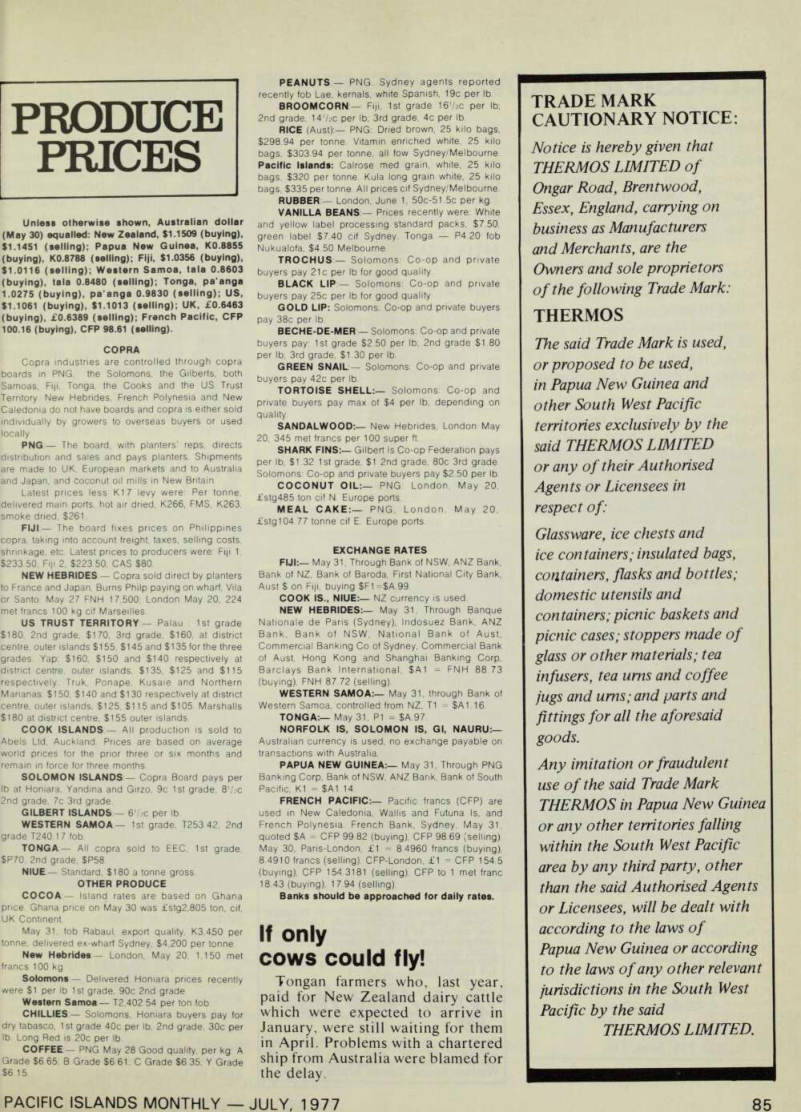
Prices
Unless otherwise shown, Australian dollar (May 30) equalled; New Zealand, $1.1509 (buying), $1.1451 (selling); Papua New Guinea, K 0.8855 (buying), K 0.8788 (selling); Fiji, $1.0356 (buying), $1.0116 (selling); Western Samoa, tala 0.8603 (buying), tala 0.8480 (selling); Tonga, pa’anga 1.0275 (buying), pa'anga 0.9830 (selling); US, $1.1061 (buying), $1.1013 (selling); UK, £0.6463 (buying), £0.6389 (selling); French Pacific, CFP 100.16 (buying), CFP 98.61 (selling).
Copra
Copra industries are controlled through copra boards in PNG, the Solomons, the Gilberts, both Samoas, Fiji, Tonga, the Cooks and the US Trust Territory New Hebrides, French Polynesia and New Caledonia do not have boards and copra is either sold individually by growers to overseas buyers or used locally.
PNG The board, with planters' reps, directs distribution and sales and pays planters. Shipments are made to UK, European markets and to Australia and Japan, and coconut oil mills in New Britain.
Latest prices less Kl 7 levy were: Per tonne, delivered main ports, hot air dried. K 266, FMS, K 263, smoke dried, $261.
FIJI: — The board fixes prices on Philippines copra, taking into account freight, taxes, selling costs, shrinkage, etc. Latest prices to producers were: Fiji 1. $233.50, Fiji 2. $223 50, CAS $BO NEW HEBRIDES Copra sold direct by planters to France and Japan, Burns Philp paying on wharf, Vila or Santo May 27 FNH 17,500; London May 20, 224 met francs 100 kg cif Marseilles.
US TRUST TERRITORY— Palau : Ist grade $lBO, 2nd grade, $l7O, 3rd grade, $l6O, at district centre, outer islands $155, $145 and $135 for the three grades. Yap: $l6O, $l5O and $l4O respectively at district centre, outer islands, $135, $125 and $ll5 respectively. Truk, Ponape, Kusaie and Northern Marianas: $l5O, $l4O and $l3O respectively at district centre, outer islands, $125, $ll5 and $lO5. Marshalls $lBO at district centre, $155 outer islands.
COOK ISLANDS All production is sold to Abels Ltd, Auckland. Prices are based on average world prices for the prior three or six months and remain in force for three months.
SOLOMON ISLANDS Copra Board pays per lb at Honiara, Vandina and Girzo, 9c Ist grade, BV2C 2nd grade, 7c 3rd grade.
Gilbert Islands 6V?C Per Lb
WESTERN SAMOA Ist grade, T 253.42, 2nd grade T 240 17 fob.
TONGA— All copra sold to EEC, Ist grade, SP7O, 2nd grade, SPSB NIUE Standard, $lBO a tonne gross.
Other Produce
COCOA — Island rates are based on Ghana price Ghana price on May 30 was £stg2,Bos ton, cif.
UK Continent May 31, fob Rabaul, export quality. K 3.450 per tonne, delivered ex-wharf Sydney, $4,200 per tonne.
New Hebrides— London, May 20, 1,150 met francs 100 kg Solomons Delivered Honiara prices recently were $1 per lb Ist grade, 90c 2nd grade Western Samoa T 2.402,54 per ton fob CHILLIES — Solomons, Honiara buyers pay for dry tabasco, 1 st grade 40c per lb, 2nd grade. 30c per lb. Long Red is 20c per lb.
COFFEE PNG May 28 Good quality, per kg: A Grade $6 65; B Grade $6 61; C Grade $6 35, Y Grade $6 15.
PEANUTS PNG. Sydney agents reported recently fob Lae, kernals, white Spanish, 19c per lb BROOMCORN Fiji, Ist grade 16V?c per lb; 2nd grade, 14'/2C per lb; 3rd grade, 4c per lb.
RICE (Aust):— PNG: Dried brown, 25 kilo bags, $298.94 per tonne. Vitamin enriched white, 25 kilo bags, $303.94 per tonne, all fow Sydney/Melbourne.
Pacific Islands; Calrose med grain, white. 25 kilo bags, $320 per tonne. Kula long grain white, 25 kilo bags, $335 per tonne. All prices cif Sydney/Melbourne.
RUBBER London, June 1, 50c-51.5c per kg.
VANILLA BEANS Prices recently were: White and yellow label processing standard packs, $7.50, green label $7 40 cif Sydney. Tonga P 4.20 fob Nukualofa, $4.50 Melbourne.
TROCHUS Solomons: Co-op and private buyers pay 21c per lb for good quality BLACK LIP — Solomons: Co-op and private buyers pay 25c per lb for good quality GOLD LIP: Solomons: Co-op and private buyers pay 38c per lb.
BECHE-DE-MER Solomons: Co-op and private buyers pay: Ist grade $2.50 per lb; 2nd grade $1 80 per lb; 3rd grade, $1.30 per lb.
GREEN SNAIL Solomons: Co-op and private buyers pay 42c per lb.
TORTOISE SHELL:— Solomons: Co-op and private buyers pay max of $4 per lb, depending on quality.
SANDALWOOD: — New Hebrides, London May 20, 345 met francs per 100 super ft.
SHARK FINS: — Gilbert Is Co-op Federation pays per lb, $1.32 Ist grade, $1 2nd grade, 80c 3rd grade Solomons: Co-op and private buyers pay $2.50 per lb.
COCONUT OIL: PNG: London, May 20, £stg4Bs ton cif N. Europe ports.
MEAL CAKE:— PNG, London, May 20, £5tg104.77 tonne cif E. Europe ports.
Exchange Rates
FIJI:— May 31, Through Bank of NSW, ANZ Bank, Bank of NZ, Bank of Baroda, First National City Bank, Aust $ on Fiji, buying $Fl=$A99 COOK IS., NIUE: — NZ currency is used NEW HEBRIDES:— May 31, Through Banque Nationale de Paris (Sydney). Indosuez Bank, ANZ Bank, Bank of NSW, National Bank of Aust, Commercial Banking Co of Sydney, Commercial Bank of Aust Hong Kong and Shanghai Banking Corp, Barclays Bank International, SAI = FNH 88.73 (buying), FNH 87.72 (selling).
WESTERN SAMOA:— May 31, through Bank of Western Samoa, controlled from NZ, T 1 = $A1.16.
TONGA;— May 31, PI = $A 97
Norfolk Is, Solomon Is, Gl, Nauru:—
Australian currency is used, no exchange payable on transactions with Australia.
PAPUA NEW GUINEA:— May 31, Through PNG Banking Corp, Bank of NSW, ANZ Bank, Bank of South Pacific, K 1 = SAI 14 FRENCH PACIFIC:— Pacific francs (CFP) are used in New Caledonia, Wallis and Futuna Is, and French Polynesia. French Bank, Sydney, May 31, quoted $A = CFP 99.82 (buying), CFP 98.69 (selling).
May 30, Paris-London, £1 = 8 4960 francs (buying), 8 4910 francs (selling). CFP-London, £1 = CFP 154.5 (buying), CFP 154.3181 (selling). CFP to 1 met franc 18 43 (buying), 17.94 (selling).
Banks should be approached for daily rates.
If only
cows could fly!
Tongan farmers who, last year,
paid for New Zealand dairy cattle
which were expected to arrive in
January, were still waiting for them
in April. Problems with a chartered
ship from Australia were blamed for
the delay.
Advertisements & other items, pp. 83-88 (2 items)
Trade Mark
CAUTIONARY NOTICE:
Notice is hereby given that
THERMOS LIMITED of
Ongar Road, Brentwood, Essex, England, carrying on business as Manufacturers and Merchants, are the Owners and sole proprietors of the following Trade Mark:
THERMOS
The said Trade Mark is used, or proposed to be used, in Papua New Guinea and other South West Pacific territories exclusively by the
said THERMOS LIMITED
or any of their Authorised Agents or Licensees in respect of: Glassware, ice chests and ice containers; insulated bags, containers, flasks and bottles; domestic utensils and containers; picnic baskets and picnic cases; stoppers made of glass or other materials; tea infusers, tea urns and coffee jugs and ums; and parts and fittings for all the aforesaid goods.
Any imitation or fraudulent use of the said Trade Mark THERMOS in Papua New Guinea or any other territories falling within the South West Pacific area by any third party, other than the said Authorised Agents or Licensees, will be dealt with according to the laws of Papua New Guinea or according to the laws of any other relevant jurisdictions in the South West Pacific by the said
THERMOS LIMITED.
CLASSIFIED ADVERTISEMENTS
Per Line $3.00 Aust.
Minimum 4 lines.
FOR SALE:
Freehold Land 4% acres, Satala, Pago Pago, American Samoa.
Contact: L.A. Groves, 65A.
Anzac Pde. Wanganui, New Zealand.
TOWAGE:
Contract towage Australia Pacific Islands.
Interocean Marine Co., 106 Anderson St., Ballina, N.S.W. Aust.
Cables: INTERSALVAGE Sydney.
WANTED: 50-60 foot Trading Ketch Large cargo hold. Steel or cement. To buy or have built.
Interested builders or sellers contact: Norman Davidson, 1425 W. 23rd. Ave., Anchorage, Alaska 99503.
COINS: buying all Australian predecimal coins paying minimum twice face value. Buyer visiting most Pacific Islands.
SOUTHERN CROSS COINS,
Box 1225, Melbourne 3001, Australia. Phone: 03-631141.
FOR SALE:
FREEHOLD PROPERTY
AT DEUBA , FIJI.
Three bedroom cottage, furnished or unfurnished, with all conveniences, character and charm, set amongst over two acres of lawns, tropical fruit and exotic trees, flowering shrubs and orchids. Own lighting plant, underground water tanks, garage and workshop. Bounded on one side by tranquil river, opposite beach and adjacent to multi million dollar Pacific Harbour development. Ideal for peaceful, private living yet able to enjoy nearby Pacific Harbour amenities including golf, tennis and boating, or as business project potential. Private sale.
No reasonable offer refused.
Enquiries in writing to;
Mr. R.L. MILLER,
10 Eric Street, Cottesloe, 6011.
Western Australia, or
Mr. R.P. MILLER ,
G.P.O. Box 216, Suva, Fiji.
PACIFIC ISLANDS
HANDICRAFTS:
Agent available to handle marketing central USA. M.H. Schmidt, 1740 D East 22 PL, Tulsa, OK
74114, USA.
FOR SALE:
Modern 2 storey residence with swimming pool in Honiara: Battery business including stocks, workshop and offices: Sundry earthmoving plant. Contact the Liquidator, Bismarck Constructions, BSIP Limited (in liquidation) C/- Peat, Marwick, Mitchell & Co., P.O. Box 2, Honiara, Solomon Islands.
FLEETS 30ft. fibreglass cutter bit. 1976, 25 hp mar. diesel, alum, mast 8i boom, sails, s.s.stays, self-steering, 4 berths, toilet, gas stove, sounder, $32,000.00. FLEETS 221 Esplanade, Wynnum Central, Brisbane. Cable
FLEETS BRISBANE.
CONCRETE BLOCK MAKER Makes blocks, flags edgings screen-blocks, garden stools—op to 8 at once and 96 an hour $215 00 c i f main ports Send (or leaflets Forest Farm Research. Londonderry NSW. 2753 Australia.
TAG SHELLS
Australian specimen shells for the serious collector. Send your "WANT" list now. Prompt and personal replies.
To: C. Samson - PO Box 13, Hampton, Vic, 3188. Aust.
■ 300?
Stay at
Aggie Grey's the
South Pacific's legendary hotel Situated right in the heart of Western Samoa. Enjoy Polynesian-style friendliness and service, in cool surroundings, superb entertainment and food. Magnificent white sand beaches only a short drive away.
Airconditioned rooms, swimming pool and full bar facilities.
Bookings through Union Steamship Company of NZ, Pan Arm Air New Zealand or direct to Aggie Grey's, Apia, Western Samoa. Cables: AGGIES, APIA.
ONE-
TONNE
TOUGH!
• The length, breadth, strength and suspension to deal with big 1-tonne loads! • Economical, powerful 4-cylinder SOHC oversquare engine. 68.9 kW (92.5 bhp)! •12 months or 20,000 kilometre warranty! • Expert service and reliable spares supply right through the Pacific! • Great cabin comfort bench seat, flow-through ventilation.
K ■m General Motors Serving you in the South Pacific.
Republic of Nauru Nauru Co-Operative,Society Western Samoa O. F. Nelson and Co. Ltd.
Fiji Burns Philp (South Sea) Co. Ltd.
New Caledonia
SAIP
Arnott’s!
The taste of Australia
Milk A rrowroot A wholesome biscuit enjoyed by all the family. Milk Coffee. A « ■ - ■ plain crisp biscuit to enjoy with coffee or tea.
Amott’s plain sweet biscuits are not too sweet, not too fancy. They’re just right for those times when you really want a biscuit to go with a cup of tea or coffee, or a glass of icy cold milk.
Discover the taste of Arnott’s for
yourself.
with fine sugar.
Nice. A sweet
biscuit sprinkled
'9 "1* 1
RISCIHTS
milkjjoffee ;
Shredded Wheatmeal.
Crunchy, with the nutty flavour of baked wheatmeal.
BISCUITS
- » * It „ fim.
Ornovts jr y biscuits 2269^ ■ ■ ■.••• .
Ornotts
nice
BISCUITS
Qrnott's/« mous Biscuits
There is no Substitute for Quality
Honda is a true life drama, performed on the world’s stage. By average folks, teenagers, men, and women everywhere. Your neighbors, maybe even you are playing a part. If so, you know Honda is more than great machines.
It’s people concerned with taking people where they want to go in life.
On two wheels, we’re the best selling motorcycle. The easy to operate hard workers who don’t demand much. Honda is always ready and gets you there safely. We move on four wheels. The precedent setting Honda Civic continues to receive international economy and performance awards. It’s the elegant compact car.
Sometimes, we have no wheels. Honda portable power operates machinery, generates electricity, pumps water and tills the soil.
Little wonder good things hr oen on Honda we work harder to assure they do.
V L ’T
HONDA MOTOR CO.. LTD. TOKYO, JAPAN
PAPUA NEW GUINEA: Steamships-Machinery P.O. Box 1. Port Moresby/TAHITI: Societe Tahitienne d’lmportation des Produits Honda B P 1665- Papeete FIJI ISLANDS: Coral Island Motors P.O. Box 48, Suva/U.S. TRUST TERRITORY: United Micronesia Development Assn. P.O. Box 238 Saipan Mariana Islands 96950 COOK ISLANDS: Cook Islands Motor Center Ltd. P.O. Box 74, Rarotonga, AMERICAN SAMOA: Samoan Holiday and Travel Center P.a Box 968 Pago Pago/AMERiCAN SAMOA: Haleck's Service Center P.O. Box 1138, Pago Pago/GUAM: Mark’s Motor Co., Inc. P.0.80x DV. Agana WESTERN SAMOA: Motor Distributors (Samoa) Ltd. P.O. Box 576, Apia SOLOMON ISLANDS; British Solomons Trading Co., Ltd. P O Box ,u EW CALEDONIA: Establissements Ballande Boite Postale No. C 4 Noumea Cedex/TONGA: E.M. Jones Limited P.O. Box 34, Nukualofa/ I AKAWA: Gilbert & Ellice Islands Development Authority P.O. Box 488, Beito/NIUE ISLAND: S. Jessop & Sons Ltd. P.O. Box 71, Alofi South/NAURU- Nauru Cooperative Society, Republic of Nauru, Nauru Island Central Pacific/NEW HEBRIDES: Tropex International Ltd., P O Box 139 Port Vila
My Datsun-
a car fit for a queen
a beauty queen, that is.
f' n
'll f
I . m S Student, beauty queen and TV personality Eunice Duran, photographed in Santo Domingo, Dominican Republic.
As a student, I lead quite an interesting life. Four years ago I won the Dominican Republic's national beauty contest, and sincethen I've travelled a fair amount in Latin America as a kind goodwill ambassador.
Like many students, I hWo to pay my way through univf sity. And I enjoy doing it.
I work for a TV station as M.C. I also do sradio and appear in '''commercials. Sowou can see I'm * 5 J JMy a a big help to me because I'm>always rushing "afopnd thejaty. It doesn't use much fuel, and it’s small and easy to park. Yet inside it has a lot of room. I get exactly what I want out of it.
In another year I'll graduate and start work as a civil engineer.
It'll be a far cry from the work I've done so far, but I'm sure I'll enjoy it just as much.
Datsun Distributors: Boroko Motors Ltd P.O. Box 1259, Boroko, Port Moresby, P.N.G. Suva Motors Ltd. G.P.O. Box 34 Suva Fiji Morris Hedstrom Ltd. P.O. Box 189, Apia, Western Samoa/United Enterprises Ltd. P.O. Box 262, Honiara, British Solomon Island Sirius Motors P.O. Box 34, Norfolk Island, South Pacific Jacob Enterprises P.O. Box 4, Republic of Nauru/ Cook Islands Motor Center Ltd. P.0.80x 74, Rarotonga, Cook Islands, South Pacific /Pentecost Pacific S.A. P.0.80x 119,Port Vila, New Hebrides Agence Alma S.A B.P. A 3, Noumea Cedex, New Caledonia TAHITIBULL S.AR.L. B.P. 359, Papeete, Tahiti/ Gilbert Islands Development Authority (Supply Division) P.O. Box 488, Betio Tarawa, Gilbert Islands
DATSUN
Product of NISSAN
87
‘ACIFIC ISLANDS MONTHLY JULY, 1 977