Advertisements & other items, pp. 1-7 (3 items)
sfsdfdf
PLM
wlvj lummwm
85c Aust $1.25 US
CFP 130
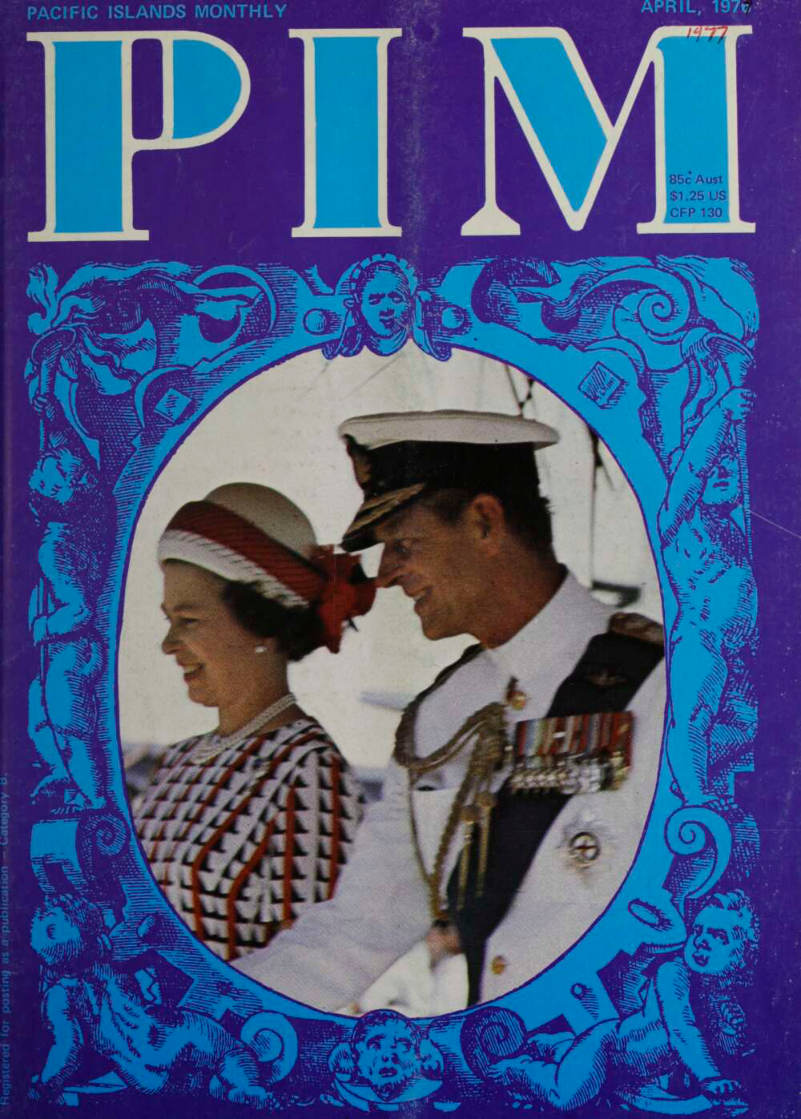
OUR COVER
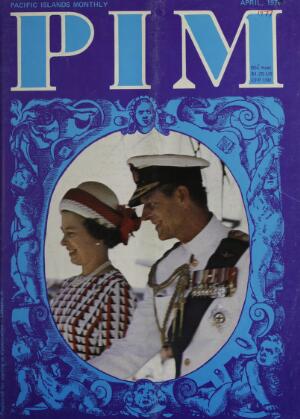
The Queen and Prince Philip just had to be on PI M's front cover which will make a fitting souvenir of her Silver Jubilee tour of the Islands. The picture and those on page 44 were taken by Ann Livingston, of Suva.
one of the world’s finest cars.
When you buy a Toyota
we promise you much more than
sL We'll be the first to admit that at Toyota we make some of the world's finest cars.
You only have to look at them to see that.
And driving them just goes to. confirm your first opinions.
But there's more to buying a car than buying a good one. You also have to be sure you can keep it that way.
Which is why Toyota have always insisted that their after-sales service be as good as the cars themselves.
In the Pacific. Islands area alone we have over fifty designated outlets to provide everything you might need, from a simple service to a major overhaul. So get yourself a Toyota and get a lot more than a car.
And that's a promise.
TOYOTA
SERVICE
TOYOTA
The Toyota range includes: Toyota 1000, Toyota Corolla, Toyota Celica, Toyota Corona, Toyota Corona Mark 11, Toyota Crown PAPUA, NEW GUINEA: ELA MOTORS LIMITED, Scratchley Rd., Badili, P.O. Box 75, Port Moresby. U.S. TRUST TERRITORY: MICROL CORPORATION, P.O. Box 267, Saipan. FIJI ISLANDS: AUTOMOTIVE SUPPLIES CO., LTD., G.P.O. Box 355, Suva. AMERICAN SAMOA: BURNS PHILP (SOUTH SEA) CO., LTD., P.O. 1057, Pago Pago. WESTERN SAMOA: BURNS PHILP (SOUTH SEA) LTD., P.O, Box 188, Apia. GUAM: ATKINS, KROLL (GUAM) LTD., P.O. Box 6428, Tamuning. NEW HEBRIDES: NEW HEBRIDES MOTORS LTD., P.O. Box 18, Vila. SOLOMON ISLANDS; MENDANA ENTERPRISES (5.1.), LTD., P.O. Box 174, Honiara. TAHITI: NIPPON AUTOMOTO, B.P. 342, Papeete, COOK ISLANDS: COOK ISLANDS TRADING CORPORATION LTD., P.O. Box 92, Rarotonga.
NAURU ISLAND: NAURU COOPERATIVE SOCIETY. GILBERT & ELLICE ISLANDS COLONY: TARAWA MOTORS, Box 36, Bairiki Tarawa. NORFOLK ISLAND: MARIE'S NORFOLK TOURS, LTD:, PO Box 276 TIMOR- SANG TAI HOO Sang Tai Building, Dili. NEW CALEDONIA; SOCIETE IMPORTATION AUTOMOBILE DU PACIFIQUE, Rond-Point du Pacific (Station Total) B.P. 438, Noumea.
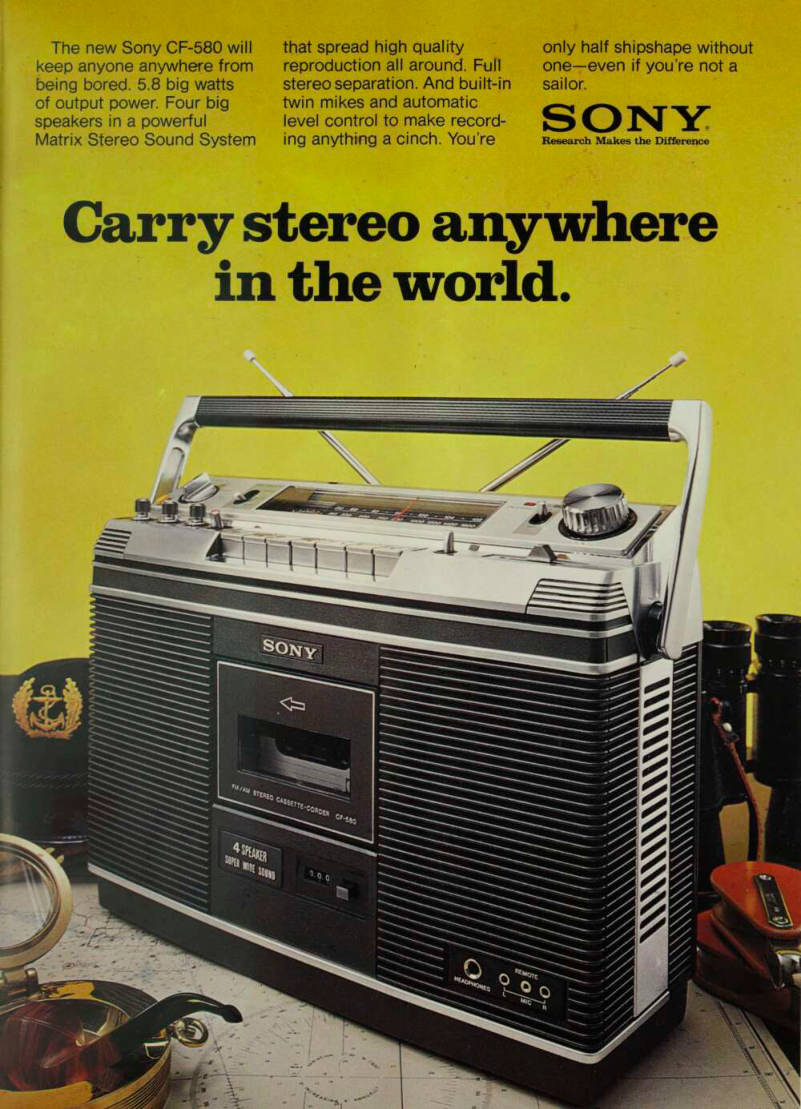
Carry stereo anywhere
The new Sony CF-580 will keep anyone anywhere from being bored. 5.8 big watts of output power. Four big speakers in a powerful Matrix Stereo Sound System that spread high quality reproduction all around. Full stereo separation. And built-in twin mikes and automatic level control to make recording anything a cinch. You’re only half shipshape without one—even if you’re not a sailor.
SONY
Research Makes the Difference
Carry stereo anywhere
in the world.
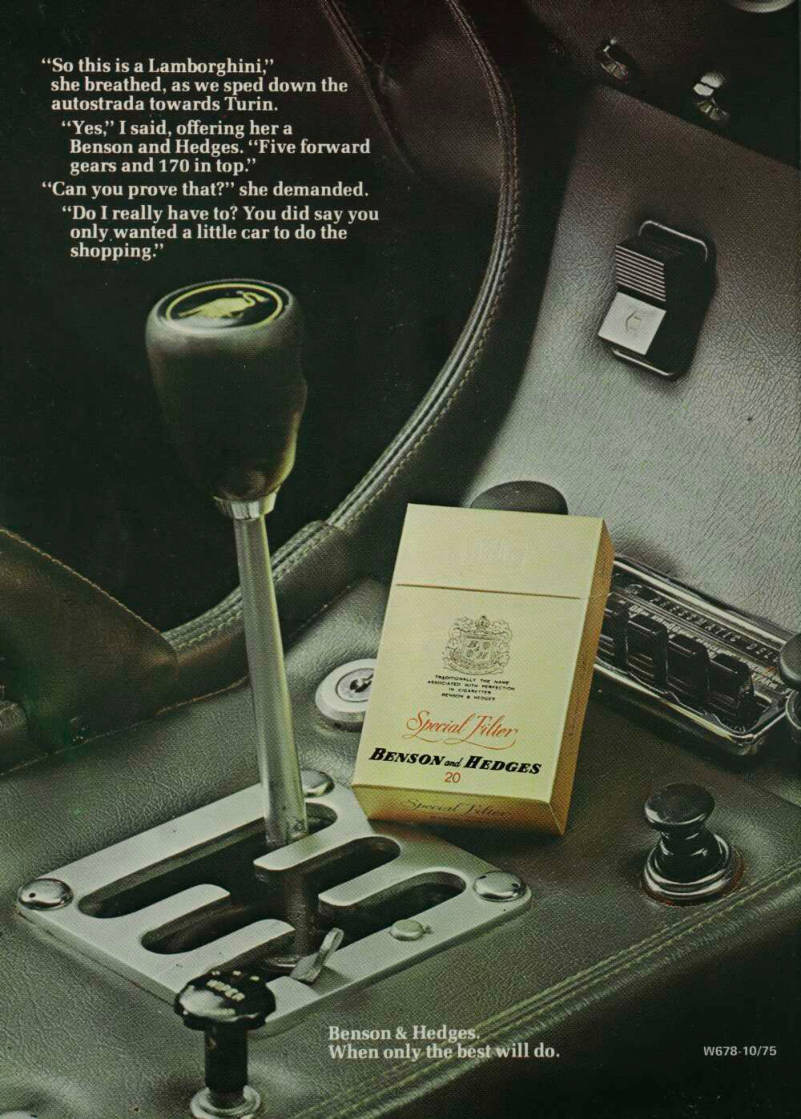
“So this is a Lamborghini,’’ she breathed, as we sped down the autostrada towards Turin.
“Yes,” I said, offering her a Benson and Hedges. “Five forward gears and 170 in top.”
“Can you prove that?” she demanded.
“Do I really have to? You did say you only wanted a little car to do the shopping.” « r / X I S 20 jL 3 \ rx:.r
smmw
Benson & Hedges.
When only die best will do. * I W678-10/75
Pacific Islands
Monthly
Subscription Rates:
"Pacific Islands Monthly" is airfreighted to the ma jority of subscribers and agents in the Pacific Islands and the U S A Australia (including Lord Howe and Thursday Islands), New Zealand, Papua New Guinea, Fiji, New Hebrides, Tonga. Cook Islands. Western Samoa. Gilberts and Tuvalu. Norfolk Island. Niue and Nauru $9 00 (local currency): Solomon Islands $10 00 Aust , American Samoa, Micronesia and Guam $12 00 US: Hawaii and U S Mainland $15 00 U S , New Caledonia and French Polynesia 1.500 C.F.P.; United Kingdom £6 50 Japan 4000 Yen: Elsewhere $1 1 50 Aust
Representatives
Fiji: Distribution and subscriptions — Desai Bookshops, P.O. Box 160, Suva, Fiji. Telephone: Suva 23036. Advertising, Fiji Times & Herald Ltd., 20 Gordon Street, Suva. Telephone: 312 111. Telex: FJ 2124.
Papua New Guinea: Advertising and Distribution — PNG Post-Courier. P.O. Box 85, Port Moresby Inquiries: Post Newsagency, Telephone 24-2148 French Polynesia: Distribution — Hachette Pacifique, 10 Ave Bruat. Papeete New Caledonia: Distribution — Depot Centre de Presse Michel PENTECOST, B P.C2 NOUMEA Now Zealand: Pacific Publications, CPO Box 2229. Auckland United Kingdom: The Herald and Weekly Times Limited, 8-10 Clifford's Inn, Fetter Lane. London EC4A 1BU. Telephone: 01-831 6041 Telex Lon don 21989 Japan: Advertising — Universal Media Corpora tion, C P O. Box 46. Tokyo Telephone: 666-3036 Victoria: Advertising — Pacific Publications (Aust.) Pty Ltd , Herald and Weekly Times Building. 2nd Floor, 61 Flinders Lane, Melbourne. 3000 Telephone 652 1565 Brisbane: D Wood. Anday Agency. Box 1918 G.P.O.. Brisbane 4001 Telephone: 44 3485: 44 1546 Hawaii and U.S. Mainland only; PIM. Hawaii. 2812. Kahawai St, Honolulu, Hawaii. 96822 Second class postage paid at Honolulu, Hawaii.
Printed in Australia
Copyright c 1977
Pacific Publications (Aust.) Pty. Ltd.
Printed by Paramac. Mitchell Road, Alexandria.
Registered at the G P.(/. Sydney for transmission by post as a newspaper — category B Recommended retail price only
V 01.48 No. 4 April, 1977
Up Front
with the Publisher
“Here’s a how-de-do!” somebody sings in Gilbert and Sullivan. But on Norfolk Island lately there’s been a how-de-do going on that’s more serious than comic opera (although Sir William Gilbert’s librettos often were a knife-thrust commentary on social and political matters of his day).
Norfolk is the Australian territory off the east coast of Australia, home of the descendants of the mutineers of the Bounty, who were moved there from Pitcairn in 1856. As PIM readers will know from recent stories, Sir John Nimmo'tabled an exhaustive report on the constitutional background and likely future of the island.
Sir John recommended that Australian quickly make up its mind whether to abandon Norfolk Island completely, or to continue to accept responsibility for it. If it should decide to accept responsibility, he said, then Australia should move the island closer to the Australian governmental and political system. It should have its own Territory Assembly, but residents should be included in the Federal electorate of Canberra and have the privilege of paying taxes like other Australians.
Sir John does not specifically say that Norfolk cannot eventually have an independent future by passing through the usual stages of political development, but some Norfolk Islanders are clearly in no doubt that if Sir John’s recommendations are accepted then for all time Norfolk will be completely absorbed and integrated into the Commonwealth.
They’re probably right, because those sort of eggs would be the dickens to unscramble.
Ed Howard, American-born Australian citizen, who is a resident of Norfolk and editor of one of the island’s two newspapers, has just produced an 8,000-word argument in a supplement to his paper, the Norfolk Island News, which is a spirited defence of the “historic rights” of the Pitcairn settlers to Norfolk Island.
The core of his case is that a real contract has existed between the Pit cairn settlers and the British Government since the day in May,
1856, when the Pitcairners boarded the vessel sent by the British Government to carry them to Nor folk Island for resettlement there.
Conceding that there is no written document embodying the Pitcair ners’ rights, Mr Howard argues that a contract nevertheless existed, say ing; “In law, enforceable rights flow from contracts. If a contract is a written one, the rights of the parties involved are defined by the wording of the contract document.
“But from time immemorial, most contracts have not been written ones. An unwritten contract, known in law as a ‘parol’ contract, can be every bit as real and enforceable as a written contract.”
He says: “The Pitcairners believ ed that they were accepting an offer of Norfolk Island, an offer virtually without qualifications. There was a qualification that Norfolk could not be ‘ceded’ to them. There was prob ably a qualification that some of Norfolk would be reserved by the Crown, but how much they were not yet certain.
“Through the 120 years since 1856, the descendants of the Pit cairn settlers have learned, one generation passing its knowledge on to the following generation, that the rights were real, and that they have been unjustly abused and taken away .. .
In his editorial in the issue carry ing the supplement he says: “The theory in the accompanying paper can be partly disproved if verifiable evidence can be presented that shows it was not the intention of the British Government to allow the Pitcairners to continue gover ning themselves as they had on Pitcairn ...
Ed Howard’s own document is a pretty powerful addition to Norfolk’s documentary history, especially as he raises a legal argument that appears to have been overlooked by jurist Sir John. It needs a reply, and perhaps the Australian Attorney-General might like to supply one. Or perhaps Sir John.
Stuart Inder
Advertisements & other items, pp. 5-6 (3 items)
Pacific Islands Monthly April, 1977
5
FOUNDED BY R W. ROBSON IN 1930
PUBLISHED MONTHLY BY
PACIFIC PUBLICATIONS (AUST.) PTY. LTD.,
76 CLARENCE STREET, SYDNEY 2000
Post Address T5.P.0. BOX 3408. SYDNEY,
N S W 2001
Telegraphic Address PACPUB. Sydney Telex: 21242
TELEPHONE 29 6693
Publisher: Stuart Inder Manager: John Berry
PACIFIC ISLANDS MONTHLY
Editor: John Carter Advertising Manager: Alan Batt
6
PAPiFir ISI ANDS MONTHLY APRIL. 1977
S. E. Tat Ham & Co. Pty. Ltd.
52 S. E. TAT HAM & CO. PTY. LTD.
BEEHIVE BLDG., 94 ELIZABETH STREET
G.P.O. BOX 8 CABLES "SET"
MELBOURNE, 3001, AUSTRALIA
TELEX: AA34552. TELEPHONE: 63 5094.
Buyers hr the Pacific Islands
AND IN
Popup New Guinea:
S. E. TATHAM (P.N.G.) PTY. LTD.
LAE: MALAITA ST. (P.O. BOX 1562)
PORT MORESBY: Cnr. GOROA & MANAHU Sts., GORDON
(P.O. BOX 6733, BOROKO).
Fiji: S. E. TATHAM (FIJI) LTD.
LAUTOKA P.O. BOX 366,
SUVA G.P.O. BOX 671,
TELEGRAMS: ALL OFFICES “SET
YOUR GUARANTEE
SINCE 1924
% 1 % 1
FOR SERVICE
T4/R
In this issue
General
The Banaban story 30 German cruiser at Fanning Is 34 Royal tour 44, 45
Cook Islands
Red visitors to Suwarrow 20 Minister charged 21 Road-marking exercise 27 Sir Albert's 'Yed" threat 29 Cannery closure 53 Airstrips for southern islands 68 Upgrading shipping 69
Fiji
Election a power struggle 17 Bus accident deaths 21 Workers for Niue 21 Silver teaset for royal visit 29 Royal tour colour pictures 44 Royal tour 45 More fish for export 53 "Fiji" on Aust gold coast 55 Tourist firm’s profit 57 Emperor mine troubles 59 Nadi airport finances 69
French Polynesia
Admiral's Pacific role 16 Tahitians taken for a ride 16 Tourist traffic 59
Gilbert Is
Banabans criticise UK 33
Guam
Organised gambling 8 Lei day 9 Gun runners 20
Nauru
President's warning on economy 20 Claim against NZ unions 21
New Caledonia
Noumea traffic plan 15 Meat marketing 55
New Hebrides
French role in education 16 Assembly boycott 17 Abattoirs closed 57 New Zealand's gift 68 Fire destroys ferry boat 69
Niue Island
Relic demolished 20 Workers from Fiji 21 Passionfruit industry in doldrums 60
Norfolk Island
East-West's air service 65
Papua New Guinea
Spate of murders 12 Junk as national heritage 12 Sir John Guise discusses politics 13 Sixth knight 13 Softball is popular 14 Jim Taylor honoured 20 Big award for pay-back death 20 Value of tribal customs 20 Non-citizen job policy 21 Rape danger in Lae 21 Beer sales boom 29 Butterfly farm 57 New ship hits reef 68 Container shipping services 70
Pitcairn Is
Census 29
Tonga
Census 21 Royal tour 45 New holiday resort 57 Invitation to shipping line 67
Tuvalu
Disposing of minefields 20
Us Trust Territory
Senator's views on Micronesia 10 US-Micronesia relations strained 10 Economic zone row looms 11 Tax scheme debated 11 Liaison office in Washington 11 War compensation hearings 20 Northern Marianas constitution 20 "Friendly" strike wins conditions 21 Yap programme for aged 29 Stand against superport 59 Amphibious air service 67
Western Samoa
Royal tour 45 Luncheon with the Queen 45
DEPARTMENTS; Up front with the Publisher, 5; People, 18; News in a Nutshell, 20; Editor's Mailbag, 23; Topicalities, 27; Magazine section, 34; Islands Press, 36; Books, 47; Business and Development, 53; Pacific Transport, 65; Ouising Yachts, 71; Shipping Information, 72; Produce Prices, 77; Deaths of Islands People, 78.
Guam’S Gamblers Will Go To The
Dogs But Not To Casinos
From TOM BRISLIN in Guam
The US Pacific Territory of Guam will move this year in the further sanc tioning of several types of organised gambling for the island.
A greyhound racing track is scheduled to open in the earlier part of the year, and another to begin con struction. Both will engage in pari mutuel wagering, approved and con trolled by the island government.
Both racing tracks are primarily supported by Asian-based investors who hope to capitalise on Guam’s fledgling tourist industry which, to date, has offered first-class beachfront hotels and duty-free shopping, but lit tle in the way of organised recreational activities.
The institution of pari-mutuel bet ting was approved last year by the island government in a move to in crease local revenues. Measures call ing for the legalisation of complete casino-type gambling, however, fell far short of government and com munity acceptance.
Several highly-spirited public debates both for and against casino gambling marked the year on Guam.
Most hotel interests attempted to gather support for the legalisation of casino gambling as the catalyst to bring Guam out of its economic slump.
A small but significant core of island legislators at first expressed support of the idea, but most recanted when community support proved adverse and they became afraid that their position would seriously hamper their re-election chances late last year.
The Governor of Guam, Ricardo J.
Bordallo, has been outspoken in his opposition to casino-type gambling on the grounds that it would likely in troduce elements of organised crime to the island and destroy the traditional life-styles.
Extremely significant in the fight against allowing casino gambling was the Bishop of Guam, the Most Reverend Felixberto C. Flores, the first Guamanian Bishop to oversee the Diocese of Agana, which includes Guam and the Northern Marianas. A very large majority of Guamanians are Roman Catholic; the Bishop’s in fluence over the people is often as
great, if not greater, than the govern ment itself.
Bishop Flores preached against gambling from his pulpit, and promis ed to wage a personal campaign against any island politician who voted in support of a casino gambling measure. The Bishop told me, in a televised interview, that he planned to organise the “Mothers of Guam” into a miles-long protest march, complete with placards, against the island legislature if they persisted in their pro-gambling efforts.
A well-organised rally and special
mass to protest against gambling was attended by the Governor as well as the Bishop. The latter came under some criticism and charges of hypocrisy by the pro-gambling fac tions as the Catholic Church on Guam conducts regular bingo sessions in the parish social halls throughout the island.
Bingo (or housey) is a quasi gambling game with returns in the form of “prizes” rather than money.
It has official government sanction on Guam, although there are several states in the US where it is considered illegal.
Another form of gambling with full government approval is lottery-type raffles where the purchase of a ticket, usually for 50c or a dollar, makes the purchaser eligible for a slate of prizes such as television sets, bicycles, small appliances, and sometimes live animals such as pigs, chickens, and cows.
These raffles are conducted con stantly throughout the island, usually as fund-raising efforts by schools, churches or community organisations.
The longest-sanctioned wagering system on Guam has been cockfighting. In Guam’s organised cockfighting pit, the “Sport-O- Dome,” tens of thousands of dollars are often wagered on a single match between two feisty fighting cocks.
Cockfighting has been labelled a “death” or “blood sport” as the los ing bird literally loses everything. In smaller, village-level cockfights, the birds fight continuously until one drops dead from exhaustion.
In the larger fights where much money is bet, each bird is outfitted with a small razor-sharp spur at tached to the leg. The cocks attempt to slice each other’s throat with these knives.
This type of fighting is very fast and furious, lasting little more than a few minutes. The result is predictable very very messy. If the victorious bird escaped unscathed by the other’s knife, he will fight again in a later match. If he suffered a wound, he will grace the table of his owner at the next family dinner.
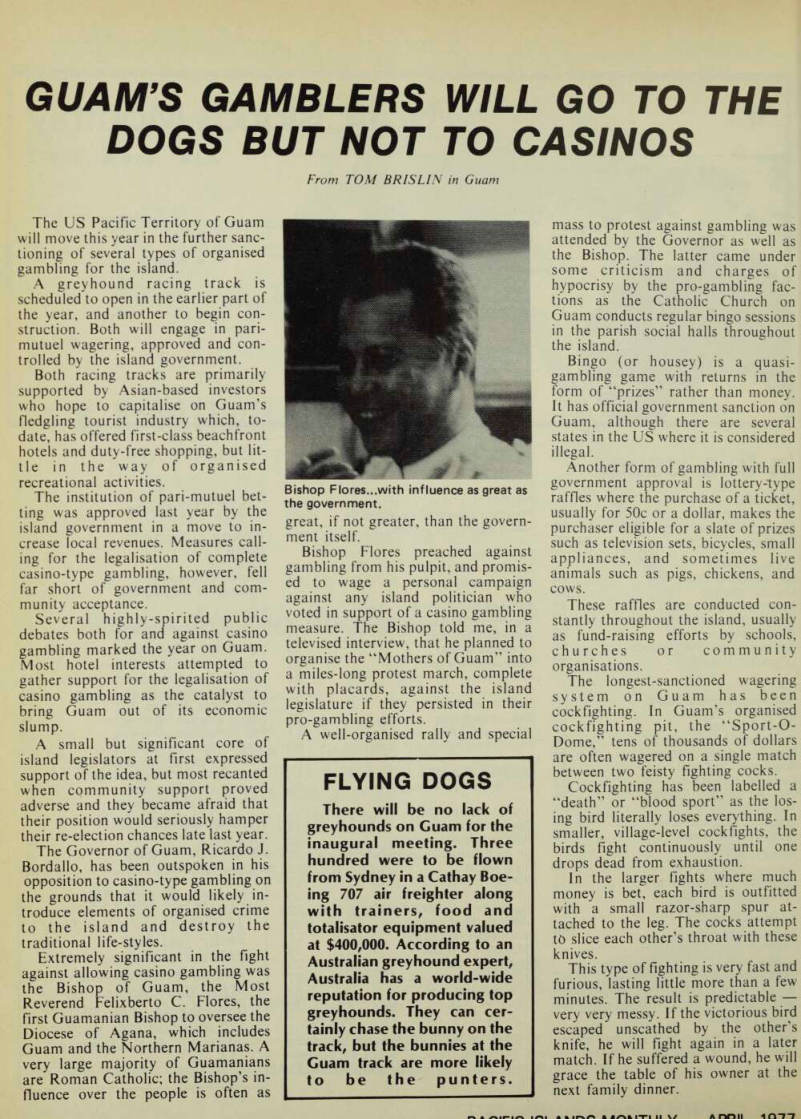
Bishop Flores...with influence as great as the government.
Cockfighting is a traditional sport on Guam, a remnant of the Spanish culture, and no attempt has been made by the government to outlaw it.
Only the wagering is controlled and duly recorded for tax purposes.
There is a tremendous amount of il legal gambling that occurs on Guam, mostly games of card and dice. Police raids on gambling “dens” often gather some quite prominent local citizens into the net.
The game of poker is perhaps the most favoured form of illegal gambl ing. This can be seen at any of the Guamanian funeral wakes, where for three days before the funeral prayers are said for the deceased.
In older times, the trek from one village to another took a complete day, so attendants at a wake always stayed in and around the home of the host, and were treated to daily feasts.
This tradition still holds and Guama nian wakes are also times of fiesta style eating and drinking as well as praying.
Since the men are expected to per form an all-night vigil during the three days, they pass their time by playing cards and wagering.
At christening fiestas for newborn babes one is also likely to see the men retreat to a room in the house for some serious card playing and wager ing. Often a portion of the winnings is donated to the newborn.
There was a brief period several years ago when Guam taverns and bistros contained electronic slot machines that were played with regularity. The machines did not pay off in cash, but rather in tallied “points” that could be translated into further free replays of the machine.
When the player tallied enough points, he would simply inform the proprietor that the machine had malfunctioned, and could he please have a cash rebate for his ac cumulated points.
It was a silly ritual, but practised with straight faces by everyone to avoid charges of direct gambling.
The future outlook for gambling on Guam is dim to dark. With such strong opposition to organised casino gambling from both government and church sources, it is doubtful that the issue will re-emerge soon.
Saipan has outlawed gambling, and it is doubtful that they will re-enter the field, even though they are hoping to build a tourist-based economy.
In the meantime, there are still plenty of ways Guamanians can wager part of their pocket money.
Flying Dogs
There will be no lack of greyhounds on Guam for the inaugural meeting. Three hundred were to be flown from Sydney in a Cathay Boe ing 707 air freighter along with trainers, food and totalisator equipment valued at $400,000. According to an Australian greyhound expert, Australia has a world-wide reputation for producing top greyhounds. They can cer tainly chase the bunny on the track, but the bunnies at the Guam track are more likely to be the punters.
Advertisements & other items, p. 8 (1 item)
n a lOl a k ir\o i irvi ITI II \/ AHD II 1 HTI
When It’S Lei Day On Guam
Perhaps it’s because it is the last working day of the week, a causefor joy in itself, or perhaps because spirits need a lift after the bulk of the working week. Whatever the reason, the island of Guam recognises each Friday as “Island Day” when it is practically mandatory that the populace bedeck themselves in colourful attire in a celebration of sunshine and tropical Pacific pride.
Guam has long experienced a paradox in the relationship between clothing and the tempo of life. As the island was administered by the military for the first 52 years of its American history, civilian government and private sector workers adopted their own “uniform” of sorts a daily regimen of short-sleeve white shirts worn with dark ties.
This standard attire continued through the early 70s. The pace of life was slow then, even though the daily dress was rather “stiff. ”
During Guam’s economic “boom” of the early 70s the pace of life took several quantum leaps.
The sure sign of the American way of business life began to appear the ulcer.
Perhaps as a counter to that pace, to afford at least a little internal relaxation, the style of dress changed to a more casual fashion, imitating in many respects the relaxed informality of Hawaii.
As the tourist fow from Japan increased, it was felt that it hardly
befitted the image of a tropical island if the same drab clothing were worn on Guam that the tourists could see daily in Tokyo.
“Island Day" was instituted as an official break from the confines of the starched shirt, and floral printed shirts in loud and welcoming colours flourished.
Tom Brislin, in Guam, reports that while there may be some criticism for Guam adopting the Hawaii fashions rather than utilising its own native costumes, it should be remembered that the indigenous Chamorro attire was simplicity in itself total stark nudity!
He says that perhaps it was this memory that circumvented the establishment of another “new” tradition. One local proposed a resolution in the Guam legislature calling for the renaming of “Island Day” to “Lei Day”, when everyone would add garlands of flowers to their colourful attire.
The double-entendre caused so many snickers, however, that the project was dropped.
“Island Day” is slowly becoming every day on Guam lately. The Governor, Ricardo J. Bordallo, who has just completed two years of his four-year term, has been somewhat of a trendsetter for island styles. Governor Bordallo has spurned the white-shirt-and-tie approach to official attire and appears daily in bright, splashy shirts.
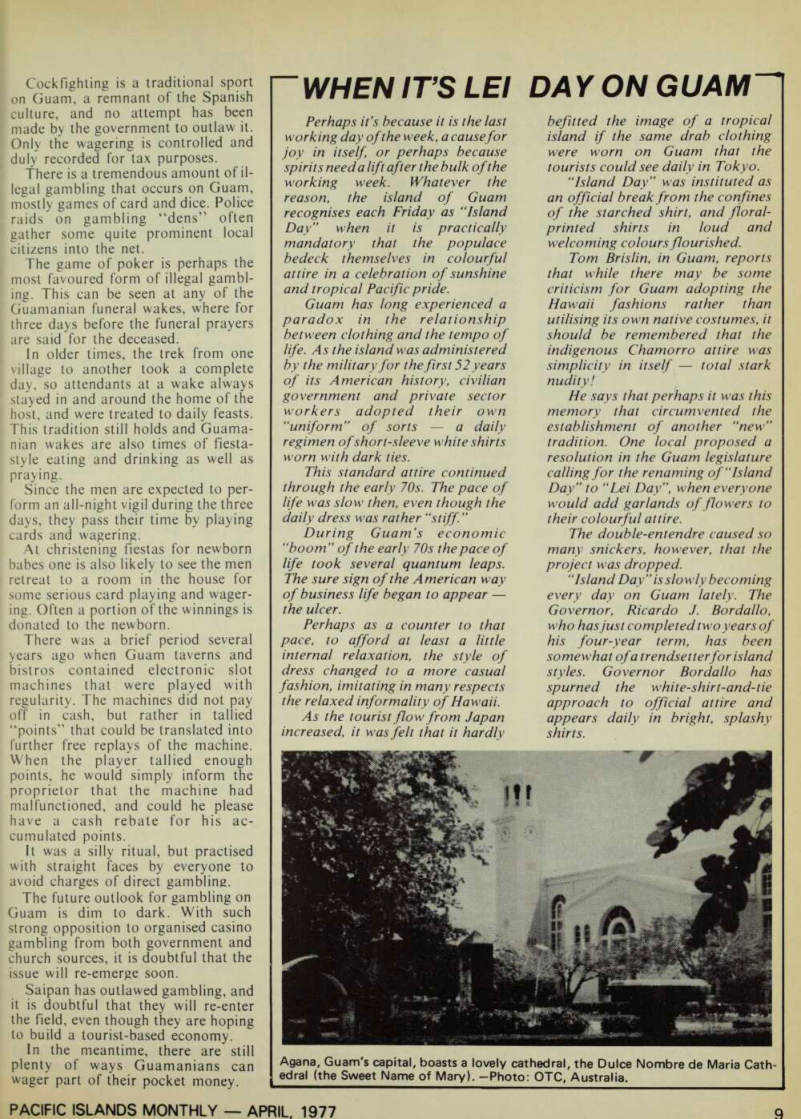
Agana, Guam's capital, boasts a lovely cathedral, the Dulce Nombre de Maria Cath edral (the Sweet Name of Mary). —Photo: OTC, Australia.
Micronesia - Mangefel
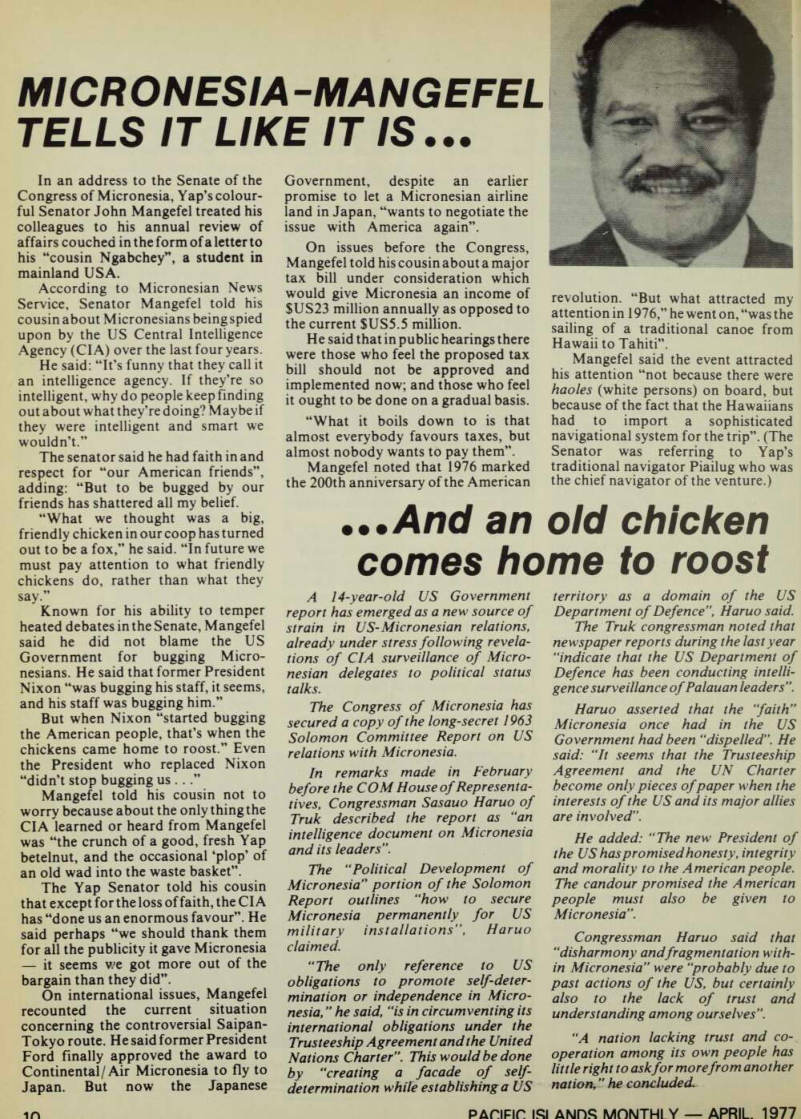
Tells It Like It Is.,.
...And an old chicken comes home to roost
In an address to the Senate of the Congress of Micronesia, Yap’s colour ful Senator John Mangefel treated his colleagues to his annual review of affairs couched in the form of a letter to his “cousin Ngabchey”, a student in mainland USA.
According to Micronesian News Service, Senator Mangefel told his cousin about Micronesians being spied upon by the US Central Intelligence Agency (CIA) over the last four years.
He said: “It’s funny that they call it an intelligence agency. If they’re so intelligent, why do people keep finding out about what they’re doing? Maybe if they were intelligent and smart we wouldn’t.”
The senator said he had faith in and respect for “our American friends”, adding: “But to be bugged by our friends has shattered all my belief.
“What we thought was a big, friendly chicken in our coop has turned out to be a fox,” he said. “In future we must pay attention to what friendly chickens do, rather than what they say.”
Known for his ability to temper heated debates in the Senate, Mangefel said he did not blame the US Government for bugging Micro nesians. He said that former President Nixon “was bugging his staff, it seems, and his staff was bugging him.”
But when Nixon “started bugging the American people, that’s when the chickens came home to roost.” Even the President who replaced Nixon “didn’t stop bugging us ..
Mangefel told his cousin not to worry because about the only thing the CIA learned or heard from Mangefel was “the crunch of a good, fresh Yap betelnut, and the occasional ‘plop’ of an old wad into the waste basket”.
The Yap Senator told his cousin that except for the loss of faith, the CIA has “done us an enormous favour”. He said perhaps “we should thank them for all the publicity it gave Micronesia it seems we got more out of the bargain than they did”.
On international issues, Mangefel recounted the current situation concerning the controversial Saipan- Tokyo route. He said former President Ford finally approved the award to Continental/Air Micronesia to fly to Japan. But now the Japanese
Government, despite an earlier promise to let a Micronesian airline land in Japan, “wants to negotiate the issue with America again”.
On issues before the Congress, Mangefel told his cousin about a major tax bill under consideration which would give Micronesia an income of SUS 23 million annually as opposed to the current SUSS.S million.
He said that in public hearings there were those who feel the proposed tax bill should not be approved and implemented now; and those who feel it ought to be done on a gradual basis.
“What it boils down to is that almost everybody favours taxes, but almost nobody wants to pay them”.
Mangefel noted that 1976 marked the 200th anniversary of the American
A 14-year-old US Government report has emerged as a new source of strain in US-Micronesian relations, already under stress following revela tions of CIA surveillance of Micro nesian delegates to political status talks.
The Congress of Micronesia has secured a copy of the long-secret 1963 Solomon Committee Report on US relations with Micronesia.
In remarks made in February before the COM House of Representa tives, Congressman Sasauo Haruo of Truk described the report as “an intelligence document on Micronesia and its leaders”.
The “Political Development of Micronesia” portion of the Solomon Report outlines “how to secure Micronesia permanently for US military installations”, Haruo claimed.
“The only reference to US obligations to promote self-deter mination or independence in Micro nesia, ” he said, “is in circumventing its international obligations under the Trusteeship Agreement and the United Nations Charter”. This would be done by “creating a facade of self determination while establishing a US
revolution. “But what attracted my attention in 1976,” he went on, “was the sailing of a traditional canoe from Hawaii to Tahiti”.
Mangefel said the event attracted his attention “not because there were haoles (white persons) on board, but because of the fact that the Hawaiians had to import a sophisticated navigational system for the trip”. (The Senator was referring to Yap’s traditional navigator Piailug who was the chief navigator of the venture.)
territory as a domain of the US Department of Defence”, Haruo said.
The Truk congressman noted that newspaper reports during the last year “indicate that the US Department of Defence has been conducting intelli gence surveillance of Palauan leaders”.
Haruo asserted that the “faith”
Micronesia once had in the US Government had been “dispelled”. He said: “It seems that the Trusteeship Agreement and the UN Charter become only pieces of paper when the interests of the US and its major allies are involved”.
He added: “The new President of the US has promised honesty, integrity and morality to the American people.
The candour promised the American people must also be given to Micronesia”.
Congressman Haruo said that “disharmony andfragmentation with in Micronesia” were “probably due to past actions of the US, but certainly also to the lack of trust and understanding among ourselves”.
“A nation lacking trust and co operation among its own people has little right to askfor more from another nation, ” he concluded.
Advertisements & other items, p. 10 (1 item)
10
PACIFIC ISI ANDR MONTHLY APRIL. 1977
Breakers
Ahead In
Tt Waters
A major confrontation is looming between the US administration of the Trust Territory of the Pacific and the Congress of Micronesia over the latter’s decision to enact a 200-mile economic zone for Micronesian waters.
When the Congress adopted the measure in February, it was at once vetoed by the new acting High Com missioner, Mr J. B. Mackenzie, and it was then adopted again, in a show of defiance, by the Congress.
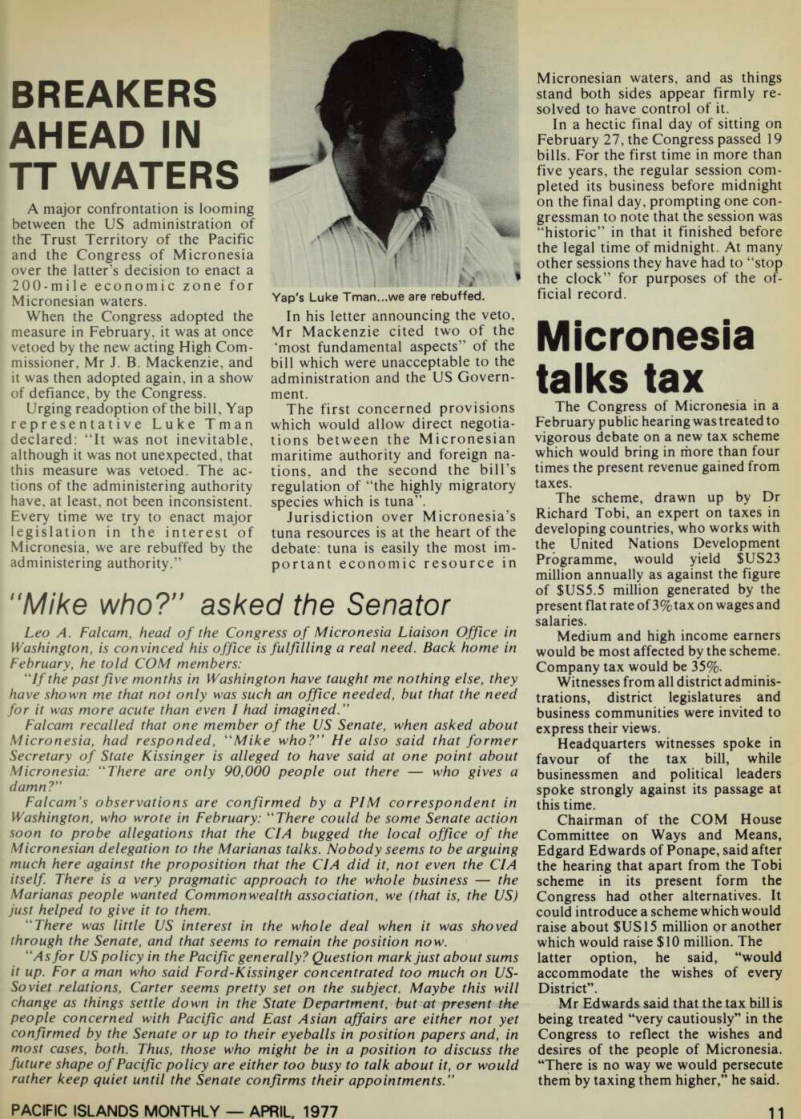
Urging readoption of the bill, Yap representative Luke Tman declared; “It was not inevitable, although it was not unexpected, that this measure was vetoed. The ac tions of the administering authority have, at least, not been inconsistent.
Every time we try to enact major legislation in the interest of Micronesia, we are rebuffed by the
administering authority.”
In his letter announcing the veto, Mr Mackenzie cited two of the ‘most fundamental aspects” of the bill which were unacceptable to the administration and the US Govern ment.
The first concerned provisions which would allow direct negotia tions between the Micronesian maritime authority and foreign na tions, and the second the bill’s regulation of “the highly migratory species which is tuna”.
Jurisdiction over Micronesia’s tuna resources is at the heart of the debate; tuna is easily the most im portant economic resource in
Micronesian waters, and as things stand both sides appear firmly re solved to have control of it.
In a hectic final day of sitting on February 27, the Congress passed 19 bills. For the first time in more than five years, the regular session com pleted its business before midnight on the final day, prompting one con gressman to note that the session was “historic” in that it finished before the legal time of midnight. At many other sessions they have had to “stop the clock” for purposes of the of ficial record.
Yap's Luke Tman...we are rebuffed.
“Mike who?” asked the Senator
Leo A. Falcam, head of the Congress of Micronesia Liaison Office in Washington, is convinced his office is fulfilling a real need. Back home in February, he told COM members: “If the past five months in Washington have taught me nothing else, they have shown me that not only was such an office needed, but that the need for it was more acute than even I had imagined.”
Falcam recalled that one member of the US Senate, when asked about Micronesia, had responded, “Mike who?” He also said that former Secretary of State Kissinger is alleged to have said at one point about Micronesia: “There are only 90,000 people out there who gives a damn?”
Falcam’s observations are confirmed by a PIM correspondent in Washington, who wrote in February: “There could be some Senate action soon to probe allegations that the CIA bugged the local office of the Micronesian delegation to the Marianas talks. Nobody seems to be arguing much here against the proposition that the CIA did it, not even the CIA itself. There is a very pragmatic approach to the whole business the Marianas people wanted Commonwealth association, we (that is, the US) just helped to give it to them.
“There was little US interest in the whole deal when it was shoved through the Senate, and that seems to remain the position now.
“As for US policy in the Pacific generally? Question mark just about sums it up. For a man who said Ford-Kissinger concentrated too much on US- Soviet relations, Carter seems pretty set on the subject. Maybe this will change as things settle down in the State Department, but at present the people concerned with Pacific and East Asian affairs are either not yet confirmed by the Senate or up to their eyeballs in position papers and, in most cases, both. Thus, those who might be in a position to discuss the future shape of Pacific policy are either too busy to talk about it, or would rather keep quiet until the Senate confirms their appointments.”
Micronesia
talks tax
The Congress of Micronesia in a February public hearing was treated to vigorous debate on a new tax scheme which would bring in more than four times the present revenue gained from taxes.
The scheme, drawn up by Dr Richard Tobi, an expert on taxes in developing countries, who works with the United Nations Development Programme, would yield SUS 23 million annually as against the figure of SUSS.S million generated by the present flat rate of 3%tax on wages and salaries.
Medium and high income earners would be most affected by the scheme.
Company tax would be 35%.
Witnesses from all district adminis trations, district legislatures and business communities were invited to express their views.
Headquarters witnesses spoke in favour of the tax bill, while businessmen and political leaders spoke strongly against its passage at this time.
Chairman of the COM House Committee on Ways and Means, Edgard Edwards of Ponape, said after the hearing that apart from the Tobi scheme in its present form the Congress had other alternatives. It could introduce a scheme which would raise about SUSIS million or another which would raise $lO million. The latter option, he said, “would accommodate the wishes of every District”.
Mr Edwards said that the tax bill is being treated “very cautiously” in the Congress to reflect the wishes and desires of the people of Micronesia.
“There is no way we would persecute them by taxing them higher,” he said.
PNG headaches: feuding truckies
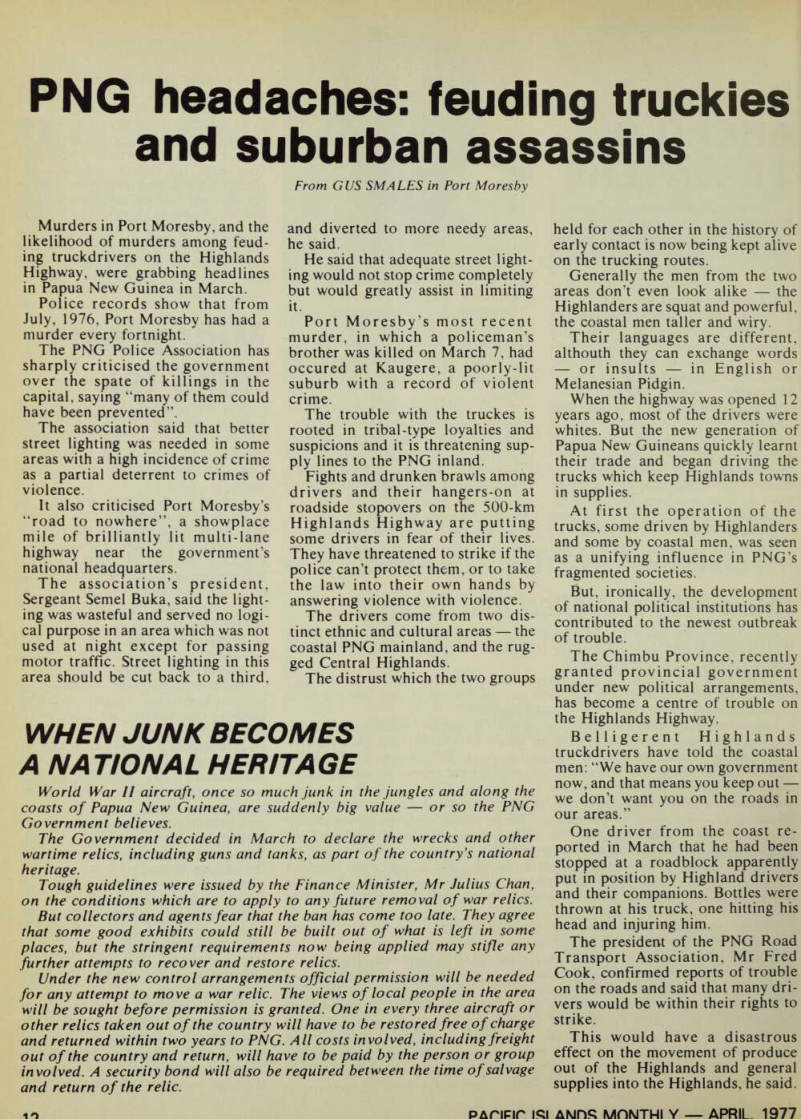
and suburban assassins
From GUS SMALES in Port Moresby
Murders in Port Moresby, and the likelihood of murders among feud ing truckdrivers on the Highlands Highway, were grabbing headlines in Papua New Guinea in March.
Police records show that from July, 1976, Port Moresby has had a murder every fortnight.
The PNG Police Association has sharply criticised the government over the spate of killings in the capital, saying “many of them could have been prevented”.
The association said that better street lighting was needed in some areas with a high incidence of crime as a partial deterrent to crimes of violence.
It also criticised Port Moresby’s “road to nowhere”, a showplace mile of brilliantly lit multi-lane highway near the government’s national headquarters.
The association’s president, Sergeant Semel Buka, said the light ing was wasteful and served no logi cal purpose in an area which was not used at night except for passing motor traffic. Street lighting in this area should be cut back to a third,
and diverted to more needy areas, he said.
He said that adequate street light ing would not stop crime completely but would greatly assist in limiting it.
Port Moresby’s most recent murder, in which a policeman’s brother was killed on March 7, had occured at Kaugere, a poorly-lit suburb with a record of violent crime.
The trouble with the truckes is rooted in tribal-type loyalties and suspicions and it is threatening sup ply lines to the PNG inland.
Fights and drunken brawls among drivers and their hangers-on at roadside stopovers on the 500-km Highlands Highway are putting some drivers in fear of their lives.
They have threatened to strike if the police can’t protect them, or to take the law into their own hands by answering violence with violence.
The drivers come from two dis tinct ethnic and cultural areas the coastal PNG mainland, and the rug ged Central Highlands.
The distrust which the two groups
held for each other in the history of early contact is now being kept alive on the trucking routes.
Generally the men from the two areas don’t even look alike the Highlanders are squat and powerful, the coastal men taller and wiry.
Their languages are different, althouth they can exchange words or insults in English or Melanesian Pidgin.
When the highway was opened 12 years ago, most of the drivers were whites. But the new generation of Papua New Guineans quickly learnt their trade and began driving the trucks which keep Highlands towns
in supplies.
At first the operation of the trucks, some driven by Highlanders and some by coastal men, was seen as a unifying influence in PNG’s fragmented societies.
But, ironically, the development of national political institutions has contributed to the newest outbreak of trouble.
The Chimbu Province, recently granted provincial government under new political arrangements, has become a centre of trouble on the Highlands Highway.
Belligerent Highlands truckdrivers have told the coastal men: “We have our own government now, and that means you keep out we don’t want you on the roads in our areas.”
One driver from the coast re ported in March that he had been stopped at a roadblock apparently put in position by Highland drivers and their companions. Bottles were thrown at his truck, one hitting his head and injuring him.
The president of the PNG Road Transport Association, Mr Fred Cook, confirmed reports of trouble on the roads and said that many dri vers would be within their rights to strike.
This would have a disastrous effect on the movement of produce out of the Highlands and general supplies into the Highlands, he said.
When Junk Becomes
A National Heritage
World War II aircraft, once so much junk in the jungles and along the coasts of Papua New Guinea, are suddenly big value or so the PNG Government believes.
The Government decided in March to declare the wrecks and other wartime relics, including guns and tanks, as part of the country’s national heritage.
Tough guidelines were issued by the Finance Minister, Mr Julius Chan, on the conditions which are to apply to any future removal of war relics.
But collectors and agents fear that the ban has come too late. They agree that some good exhibits could still be built out of what is left in some places, but the stringent requirements now being applied may stifle any further attempts to recover and restore relics.
Under the new control arrangements official permission will be needed for any attempt to move a war relic. The views of local people in the area will be sought before permission is granted. One in every three aircraft or other relics taken out of the country will have to be restored free of charge and returned within two years to PNG. All costs involved, including freight out of the country and return, will have to be paid by the person or group involved. A security bond will also be required between the time of salvage and return of the relic.
Advertisements & other items, p. 12 (1 item)
12
PAPIFir ISI AMDS MONTHI Y APRIL. 1977
System’
Change
Says
Sir John
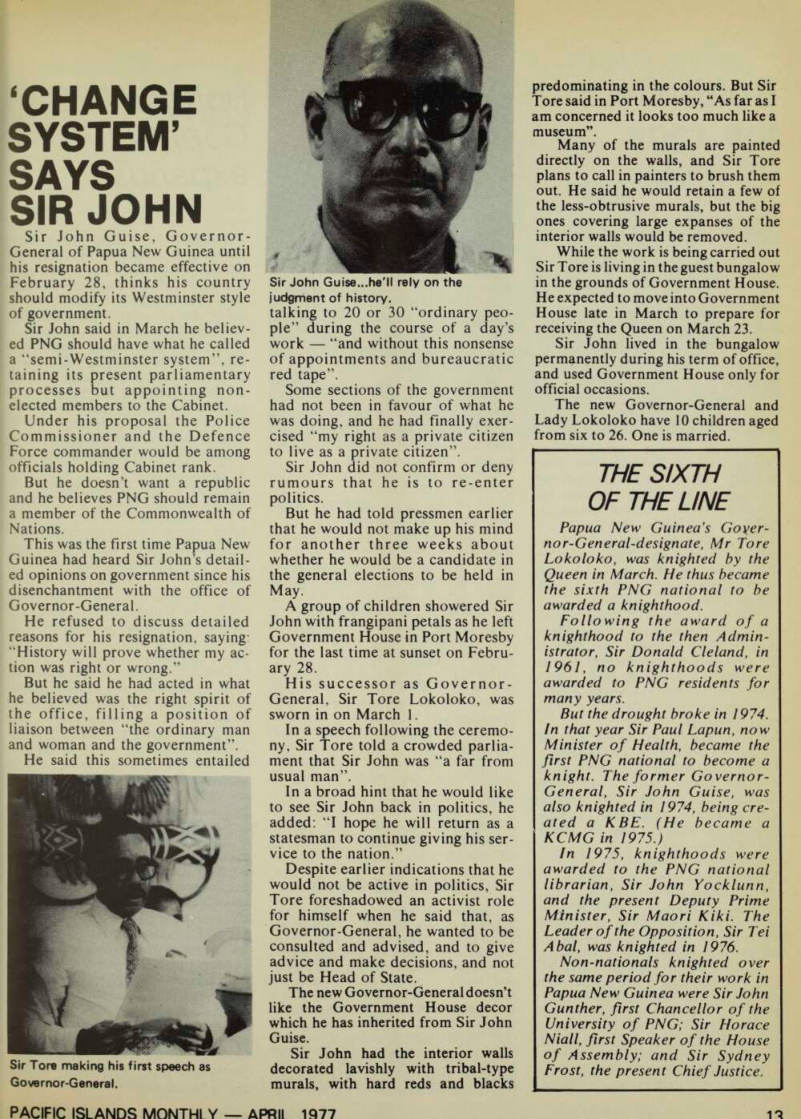
Sir John Guise, Governor- General of Papua New Guinea until his resignation became effective on February 28, thinks his country should modify its Westminster style of government.
Sir John said in March he believ ed PNG should have what he called a “semi-Westminster system”, re taining its present parliamentary processes but appointing non elected members to the Cabinet.
Under his proposal the Police Commissioner and the Defence Force commander would be among officials holding Cabinet rank.
But he doesn’t want a republic and he believes PNG should remain a member of the Commonwealth of Nations.
This was the first time Papua New Guinea had heard Sir John’s detail ed opinions on government since his disenchantment with the office of Governor-General.
He refused to discuss detailed reasons for his resignation, saying “History will prove whether my ac tion was right or wrong.”
But he said he had acted in what he believed was the right spirit of the office, filling a position of liaison between “the ordinary man and woman and the government”.
He said this sometimes entailed
talking to 20 or 30 “ordinary peo ple” during the course of a day’s work “and without this nonsense of appointments and bureaucratic
red tape”.
Some sections of the government had not been in favour of what he was doing, and he had finally exer cised “my right as a private citizen to live as a private citizen”.
Sir John did not confirm or deny rumours that he is to re-enter politics.
But he had told pressmen earlier that he would not make up his mind for another three weeks about whether he would be a candidate in the general elections to be held in
May.
A group of children showered Sir John with frangipani petals as he left Government House in Port Moresby for the last time at sunset on Febru ary 28.
His successor as Governor- General, Sir Tore Lokoloko, was sworn in on March 1.
In a speech following the ceremo ny, Sir Tore told a crowded parlia ment that Sir John was “a far from usual man”.
In a broad hint that he would like to see Sir John back in politics, he added: “I hope he will return as a statesman to continue giving his ser vice to the nation.”
Despite earlier indications that he would not be active in politics, Sir Tore foreshadowed an activist role for himself when he said that, as Governor-General, he wanted to be consulted and advised, and to give advice and make decisions, and not just be Head of State.
The new Governor-General doesn’t like the Government House decor which he has inherited from Sir John Guise.
Sir John had the interior walls decorated lavishly with tribal-type murals, with hard reds and blacks
predominating in the colours. But Sir Tore said in Port Moresby, “As far as I am concerned it looks too much like a museum”.
Many of the murals are painted directly on the walls, and Sir Tore plans to call in painters to brush them out. He said he would retain a few of the less-obtrusive murals, but the big ones covering large expanses of the interior walls would be removed.
While the work is being carried out Sir Tore is living in the guest bungalow in the grounds of Government House.
He expected to move into Government House late in March to prepare for receiving the Queen on March 23.
Sir John lived in the bungalow permanently during his term of office, and used Government House only for official occasions.
The new Governor-General and Lady Lokoloko have 10 children aged from six to 26. One is married.
Sir Tore making his first speech as Governor-General.
Sir John Guise...he'll rely on the judgment of history.
The Sixth
Of The Line
Papua New Guinea’s Goyer nor-General-designate, Mr Tore Lokoloko, was knighted by the Queen in March. He thus became the sixth PNG national to be awarded a knighthood.
Following the award of a knighthood to the then Admin istrator, Sir Donald Cleland, in 1961, no knighthoods were awarded to PNG residents for many years.
But the drought broke in 1974.
In that year Sir Paul Lapun, now Minister of Health, became the first PNG national to become a knight. The former Governor- General, Sir John Guise, was also knighted in 1974, being cre ated a KBE. (He became a KCMG in 1975.) In 1975, knighthoods were awarded to the PNG national librarian, Sir John Yocklunn, and the present Deputy Prime Minister, Sir Maori Kiki. The Leader of the Opposition, Sir Tei Abal, was knighted in 1976.
Non-nationals knighted over the same period for their work in Papua New Guinea were Sir John Gunther, first Chancellor of the University of PNG; Sir Horace Niall, first Speaker of the House of Assembly; and Sir Sydney Frost, the present Chief Justice.
the rage
Softball’s the rage in PNG
From RICHARD JONES in Papua New Guinea Men and women softballers in multi-coloured uniforms playing competition matches are a common sight in all Papua New Guinea towns on Saturday and Sunday afternoons.
Softball is the young nation’s fastest-growing sport. It really blossomed after the PNG women’s softball side at the Guam South Pacific Games in 1975 defeated the home team 8-7 in the final to take out the gold medal.
There are now 26 women’s teams playing every Saturday in Port Moresby alone. They are grouped into four grades, including a students’ division for high school, university and teachers’ college players.
The capital also boasts 24 men’s teams in three grades. More teams are being formed all the time, clamouring for admission to the official competitions.
There’s quite an international flavour to the softball competition in Port Moresby. Japanese residents in the city have formed a team named, without any great originality, Fuji. A number of Filipino residents play with another side called Wantoks (“one talks”, friends).
There are eight men’s softball teams in Lae, and six in Madang.
On New Ireland no fewer than 26 women’s teams battle it out every weekend. There are also regular women’s competitions in Lae, Rabaul, Goroka, Wewak, Mt Hagen and Madang.
The former secretary of the Port Moresby Men’s Softball Association, Mr Lapaseng Meli, who has taken a position with the New Ireland provincial government secretariat hopes soon to start up a men’s competition in his home province.
At the Guam Games, the PNG men’s team came third of the three teams entered. The players couldn’t cope with the ultra-fast pitching and big hitting of the Guam and Micronesian teams, who played off for the gold medal.
If softball is included as one of the sports for the 1979 Games scheduled
for Suva, Fiji, organisers are hopeful that the PNG men will offer Guam and Micronesia much stiffer competition.
President of the PNG Softball Federation, Mr Peter Barlow, says: “Our biggest headache at present, because of the rapid spread of the game, is providing competent officials to umpire at all matches.
“We’ve been affiliated with the international softball body since 1974, so we’re able to run umpiring clinics and theory examinations.
“We may have to revise our methods of setting the examinations so that greater emphasis can be placed on the verbal rather than the written aspect, to suit local conditions.’’
He added: “We don’t want teams dropping out because of a feeling that umpiring standards haven’t kept pace with the growth of the game.”
There is no doubt that the game will spread from the towns to the villages.
When urban-based public servants or employees of private businesses take their leave and return to their villages throughout the country, the chances are that they go home armed with a softball and bat ready for scratch games with relatives and friends.
In any case, bats and balls can fairly easily be improvised. Proper equipment is fairly expensive, but not
prohibitively so.
Cups Of Gold
Exports of cocoa and coffee are expected to earn about $l5O million for Papua New Guinea in 1977. Both commodities have been in short supply on world markets for more than a year, and rarely a month passes without a further rise in prices. The export policy for these commodities will now be largely in the hands of the PNG Investment Corporation, which has taken over all the foreign shareholdings in the country’s biggest coffee and cocoa exporter, Angco Pty Ltd. The takeover cost the corooration about K 4.3 million.
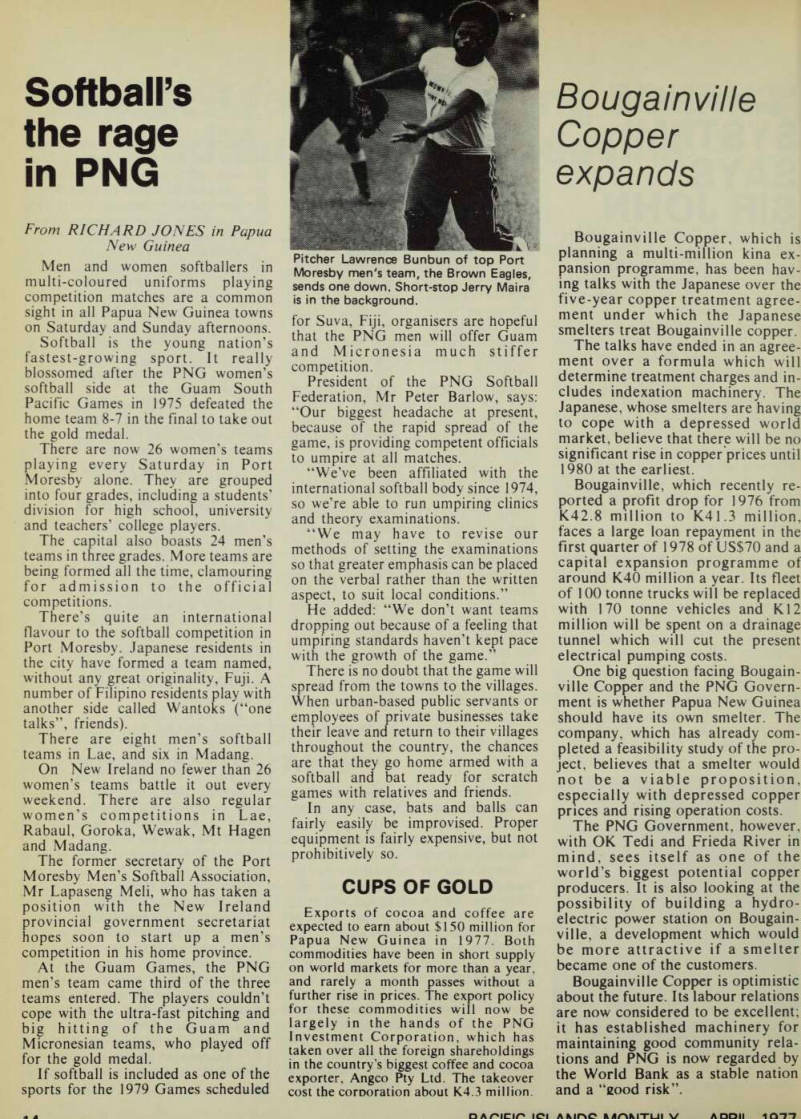
Pitcher Lawrence Bunbun of top Port Moresby men's team, the Brown Eagles, sends one down, Short-stop Jerry Maira is in the background.
Copper
Bougainville Copper expands
Bougainville Copper, which is planning a multi-million kina ex pansion programme, has been hav ing talks with the Japanese over the five-year copper treatment agree ment under which the Japanese smelters treat Bougainville copper.
The talks have ended in an agree ment over a formula which will determine treatment charges and in cludes indexation machinery. The Japanese, whose smelters are having to cope with a depressed world market, believe that there will be no significant rise in copper prices until 1980 at the earliest.
Bougainville, which recently re ported a profit drop for 1976 from K 42.8 million to K 41.3 million, faces a large loan repayment in the first quarter of 1978 of US$7O and a capital expansion programme of around K4O million a year. Its fleet of 100 tonne trucks will be replaced with 170 tonne vehicles and Kl 2 million will be spent on a drainage tunnel which will cut the present electrical pumping costs.
One big question facing Bougain ville Copper and the PNG Govern ment is whether Papua New Guinea should have its own smelter. The company, which has already com pleted a feasibility study of the pro ject, believes that a smelter would not be a viable proposition, especially with depressed copper prices and rising operation costs.
The PNG Government, however, with OK Tedi and Frieda River in mind, sees itself as one of the world’s biggest potential copper producers. It is also looking at the possibility of building a hydro electric power station on Bougain ville, a development which would be more attractive if a smelter became one of the customers.
Bougainville Copper is optimistic about the future. Its labour relations are now considered to be excellent; it has established machinery for maintaining good community rela tions and PNG is now regarded by the World Bank as a stable nation and a “good risk”.
Advertisements & other items, p. 14 (1 item)
14
DAr>icir> ioi AMnr uaiutui \y adoii iott
Putting The People Of Noumea On
Their Feet
From PA UL STERLING in Noumea Visitors to Noumea doubtlessly remember the traffic with amuse ment, annoyance or nostalgia.
Tourists who ventured to hire cars were either very brave, or extremely imprudent. Pedestrians had the choice of being hunted down mercilessly on pedestrian crossings or scrambling their way through cars parked on footpaths, on crossroads, across driveways or in the middle of the street.
Accustomed to a system where practically all the rules of the road were gaily ignored, the people of Noumea admired the courteous and law-abiding attitude of their Anglo- Saxon neighbours, admitting that in their own town four wheels and an in ternal combustion engine were the arms of selfish and bloodthirsty in dividualism.
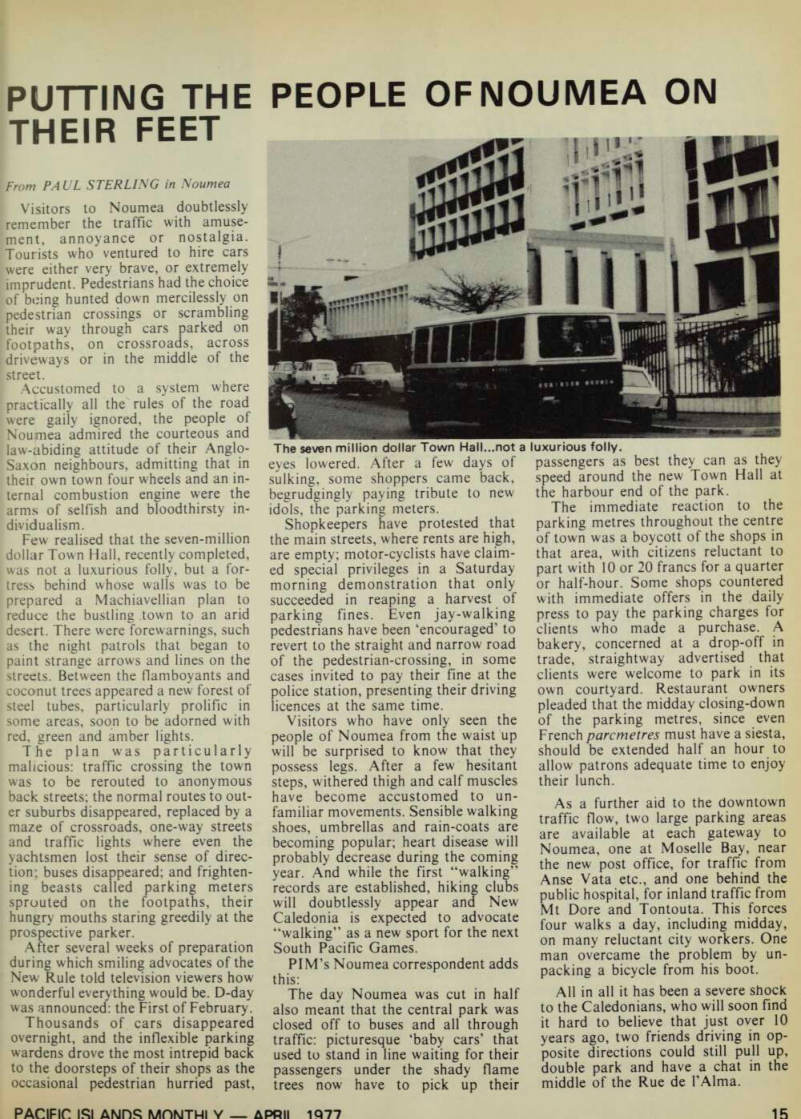
Few realised that the seven-million dollar Town Hall, recently completed, was not a luxurious folly, but a for tress behind whose walls was to be prepared a Machiavellian plan to reduce the bustling town to an arid desert. There were forewarnings, such as the night patrols that began to paint strange arrows and lines on the streets. Between the flamboyants and coconut trees appeared a new forest of steel tubes, particularly prolific in some areas, soon to be adorned with red, green and amber lights.
The plan was particularly malicious: traffic crossing the town was to be rerouted to anonymous back streets; the normal routes to out er suburbs disappeared, replaced by a maze of crossroads, one-way streets and traffic lights where even the yachtsmen lost their sense of direc tion; buses disappeared; and frighten ing beasts called parking meters sprouted on the footpaths, their hungry mouths staring greedily at the prospective parker.
After several weeks of preparation during which smiling advocates of the New Rule told television viewers how wonderful everything would be. D-day was announced: the First of February.
Thousands of cars disappeared overnight, and the inflexible parking wardens drove the most intrepid back to the doorsteps of their shops as the occasional pedestrian hurried past,
eyes lowered. After a few days of sulking, some shoppers came back, begrudgingly paying tribute to new idols, the parking meters.
Shopkeepers have protested that the main streets, where rents are high, are empty; motor-cyclists have claimed special privileges in a Saturday morning demonstration that only succeeded in reaping a harvest of parking fines. Even jay-walking pedestrians have been ‘encouraged’ to revert to the straight and narrow road of the pedestrian-crossing, in some cases invited to pay their fine at the police station, presenting their driving licences at the same time.
Visitors who have only seen the people of Noumea from the waist up will be surprised to know that they possess legs. After a few hesitant steps, withered thigh and calf muscles have become accustomed to unfamiliar movements. Sensible walking shoes, umbrellas and ram-coats are becoming popular; heart disease will probably decrease during the coming year. And while he first walking records are established, hiking clubs will doubtlessly appear and New Caledonia is expected to advocate wa king as a new sport for the next So D “ , h . c ! tk Games. this M * N ° Umea corres P ondent adds The day Noumea was cut in half also meant that the central park was closed off to buses and all through traffic: picturesque ‘baby cars’ that used to stand in line waiting for their passengers under the shady flame trees now have to pick up their
passengers as best they can as they speed around the new Town Hall at the harbour end of the park.
The immediate reaction to the parking metres throughout the centre of town was a boycott of the shops in that area, with citizens reluctant to part with 10 or 20 francs for a quarter or half-hour. Some shops countered with immediate offers in the daily press to pay the parking charges for clients who made a purchase. A bakery, concerned at a drop-off in trade, straightway advertised that clients were welcome to park in its own courtyard. Restaurant owners pleaded that the midday closing-down of the parking metres, since even French parcmetres must have a siesta, should be extended half an hour to allow patrons adequate time to enjoy their lunch.
As a further aid to the downtown traffic flow, two large parking areas are available at each gateway to Noumea, one at Moselle Bay, near the new post office, for traffic from Anse Vata etc., and one behind the public hospital, for inland traffic from Mt Dore and Tontouta. This forces four walks a day, including midday, on many reluctant city workers. One man overcame the problem by un packing a bicycle from his boot.
All in all it has been a severe shock to the Caledonians, who will soon find it hard to believe that just over 10 years ago, two friends driving in op posite directions could still pull up, double park and have a chat in the middle of the Rue de I’Alma.
The seven million dollar Town Hall...not a luxurious folly.
Advertisements & other items, p. 15 (1 item)
15
PACIFIC ISI AMDS MONTMI Y APRII 1Q77
French admiral talks
about his Pacific role
The growing significance of French military activity in the Pacific was underlined by remarks made in Tahiti by Rear-Admiral Gerard de Castel bajac, Commander in Chief of French Armed Forces in the Pacific and Commander of the CEP nuclear test centre.
The admiral spoke to the Tahiti press in late January on the eve of a visit to Noumea and Wellington, one of numerous visits planned as part of France’s drive to sell arms and defence technology in the Pacific.
The January trip coincided with news from Canberra that the Australian Government plans to buy a SASO million navy supply ship from France.
In his Tahiti conference, Admiral de Castelbajac spoke not only of France’s nuclear test centre but of the planned local build-up of a maritime force to police the extended territorial waters to 200 miles. This is a problem likely to be shared by all Island countries in the Pacific area and already at its strategically placed islands in the region France is pre paring to display useful boats for this maritime surveillance task.
Admiral de Castelbajac took up his Tahiti post at the beginning of 1976, after previous service which included Indo-China and training as an air pilot in the USA. Speaking of the nuclear test centre in French Polynesia, the admiral said that after several years of troop reductions around this base, the numbers employed were now likely to stabilise at present levels. This had meant a shifting away from concentra tion in Tahiti and the island of Hao to Mururoa which now had acommunity of 3,000 military and civilians living in single quarters. Personnel on Hao dropped from 2,000 to a few hundred persons and the island’s airfield has been open to commercial traffic since the beginning of this year.
But there has been a new develop ment for the French Navy, the introduction, from January this year of a maritime gendarmerie brigade.
Composed initially of only six gendarmes, this brigade is expected to expand with the growing responsibil ity of surveillance over territorial waters which are scheduled to be
extended to 200 miles about the middle of this year.
Such an extension would bring French Polynesia’s territorial waters up to about five million square kilometres.
The admiral said it was hoped the navy would soon be given sufficient naval and air equipment to carry out this surveillance work. He said it was difficult to fully assess such needs, but the exploitation of the ocean’s resources is opening up a new era in the
economic history of humanity.
Admiral de Castelbajac also spoke of his third role, that of French admiral in the Pacific. This included maintain ing good relations with the naval forces of various countries in the area. The admiral pointed out that in 1976 he had visited the US naval authorities in Hawaii, besides the Australian naval authorities in Sydney and Canberra.
He had also recently received a visit from Vice-Admiral Samuel L.
Gravely, Commander of the US 3rd Fleet, based at Pearl Harbour. This year, the French admiral said, he plans to visit other naval officials in Pacific countries.
The admiral wound up with, “France has been in the South Pacific for a long time. She expects to remain here and make her contributions to the maintenance of peace in this part of the world . . . The increasingly important role played by the sea in national economies, the probable creation of economic sea limits of 200 miles, can only encourage us to play an active and constructive role in this sphere.”
Tahitians
'taken for a ride'
From a Tahiti correspondent A call for independence was the Tahitians’ first reaction to the new political statutes proposed by the Paris Government in late January.
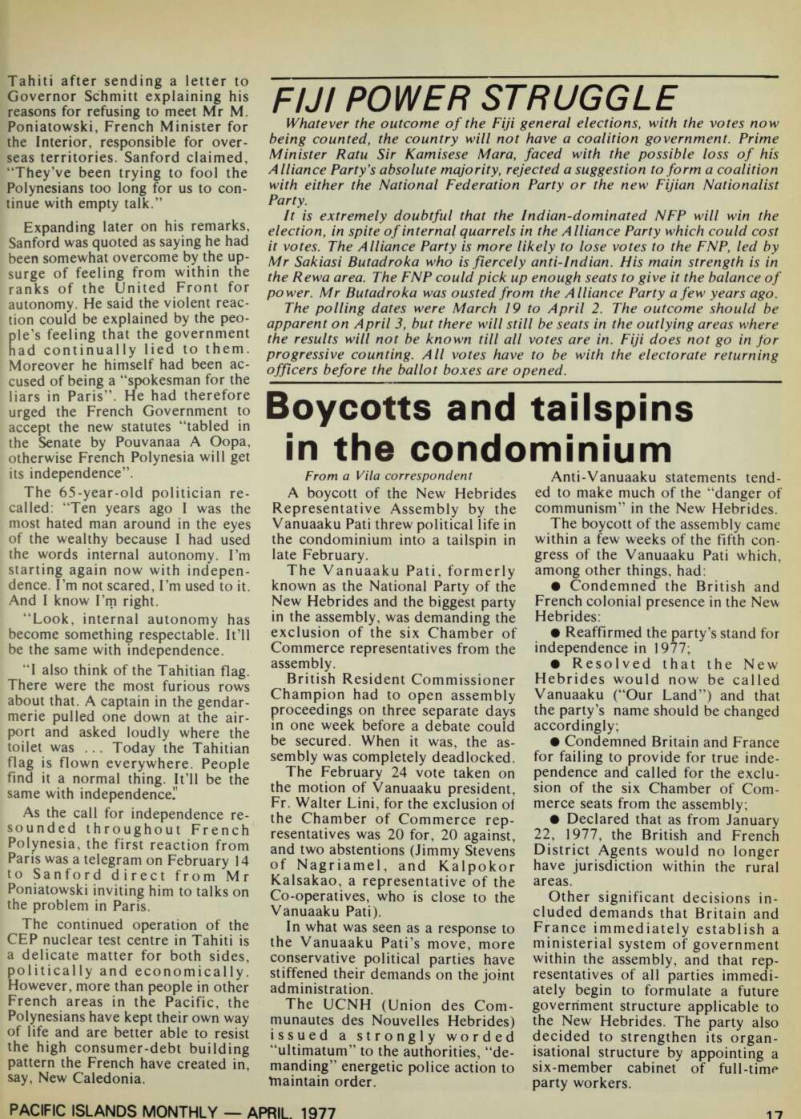
“From General de Gaulle to Giscard, we’ve been taken for a ride. We’ve had enough of talking. I only want to talk about one thing independence.” This was the reac tion of Francis Sanford, French Polynesia’s deputy to the French
National Assembly.
Main substance of the new statutes is an upgrading of the “Council of Government”, with each counsellor being given the right to supervise a “sector” of the territorial administration. Provision would also be made for an elected vice-president of the Council, and the Governor, while retaining the presidency, would lose his right to vote in the Council. The new statutes have been rejected by both conservatives and autonomists in
French Polynesia.
Mr Sanford made his statement in
Sanford...enough of talking.
Tahiti after sending a letter to Governor Schmitt explaining his reasons for refusing to meet Mr M.
Poniatowski, French Minister for the Interior, responsible for over seas territories. Sanford claimed, “They’ve been trying to fool the Polynesians too long for us to con tinue with empty talk.”
Expanding later on his remarks, Sanford was quoted as saying he had been somewhat overcome by the up surge of feeling from within the ranks of the United Front for autonomy. He said the violent reac tion could be explained by the peo ple’s feeling that the government had continually lied to them.
Moreover he himself had been ac cused of being a “spokesman for the liars in Paris”. He had therefore urged the French Government to accept the new statutes “tabled in the Senate by Pouvanaa A Oopa, otherwise French Polynesia will get its independence”.
The 65-year-old politician re called: “Ten years ago I was the most hated man around in the eyes of the wealthy because I had used the words internal autonomy. I’m starting again now with indepen dence. I’m not scared, I’m used to it.
And I know I’m right.
“Look, internal autonomy has become something respectable. It’ll be the same with independence.
“I also think of the Tahitian flag.
There were the most furious rows about that. A captain in the gendar merie pulled one down at the air port and asked loudly where the toilet was ... Today the Tahitian flag is flown everywhere. People find it a normal thing. It’ll be the same with independence!’
As the call for independence re sounded throughout French Polynesia, the first reaction from Paris was a telegram on February 14 to Sanford direct from Mr Poniatowski inviting him to talks on the problem in Paris.
The continued operation of the CEP nuclear test centre in Tahiti is a delicate matter for both sides, politically and economically.
However, more than people in other French areas in the Pacific, the Polynesians have kept their own way of life and are better able to resist the high consumer-debt building pattern the French have created in, say, New Caledonia.
Education’s ‘balance of power’
The “balance of power” as between English and French education systems in the New Hebrides has changed in recent years.
A report to the French National Assembly in Paris by a mission of the Assembles Legal Committee which visited the islands in 1976 has revealed that, whereas in 1971, 85 French schools had 7,000 pupils and 218 English schools and 11,000, in 1975 there were 10,171 pupils attending French schools. (It had already been reported that the French in 1975 had spent the equivalent of SAS million on their New Hebridean schools system.) Reporting to the assembly on behalf of the mission, Mr Jean Gerbet declared: “It is actually the existence of two types of education, and thus two languages, which has contributed to the creation of an extremely serious con flict situation in this distant archipelago.”
The* mission’s recipe for resolving this “conflict situation”? “France could . . . establish an equilibrium between the communities by pursuing her effort in the field of education.
Fiji Power Struggle
Whatever the outcome of the Fiji general elections, with the votes now being counted, the country will not have a coalition government. Prime Minister Ratu Sir Kamisese Mara, faced with the possible loss of his Alliance Party’s absolute majority, rejected a suggestion to form a coalition with either the National Federation Party or the new Fijian Nationalist Party.
It is extremely doubtful that the Indian-dominated NFP will win the election, in spite of internal quarrels in the Alliance Party which could cost it votes. The Alliance Party is more likely to lose votes to the FNP, led by Mr Sakiasi Butadroka who is fiercely anti-Indian. His main strength is in the Rewa area. The FNP could pick up enough seats to give it the balance of power. Mr Butadroka was ousted from the Alliance Party a few years ago.
The polling dates were March 19 to April 2. The outcome should be apparent on April 3, but there will still be seats in the outlying areas where the results will not be known till all votes are in. Fiji does not go in for progressive counting. All votes have to be with the electorate returning officers before the ballot boxes are opened.
Boycotts and tailspins
in the condominium
From a Vila correspondent A boycott of the New Hebrides Representative Assembly by the Vanuaaku Pati threw political life in the condominium into a tailspin in late February.
The Vanuaaku Pati, formerly known as the National Party of the New Hebrides and the biggest party in the assembly, was demanding the exclusion of the six Chamber of Commerce representatives from the assembly.
British Resident Commissioner Champion had to open assembly proceedings on three separate days in one week before a debate could be secured. When it was, the as sembly was completely deadlocked.
The February 24 vote taken on the motion of Vanuaaku president, Fr. Walter Lini, for the exclusion of the Chamber of Commerce rep resentatives was 20 for, 20 against, and two abstentions (Jimmy Stevens of Nagriamel, and Kalpokor Kalsakao, a representative of the Co-operatives, who is close to the Vanuaaku Pati).
In what was seen as a response to the Vanuaaku Pali’s move, more conservative political parties have stiffened their demands on the joint administration.
The UCNH (Union des Com munautes des Nouvelles Hebrides) issued a strongly worded “ultimatum” to the authorities, “de manding” energetic police action to ttiaintain order.
Anti-Vanuaaku statements tend ed to make much of the “danger of communism” in the New Hebrides.
The boycott of the assembly came within a few weeks of the fifth con gress of the Vanuaaku Pati which, among other things, had; • Condemned the British and French colonial presence in the New Hebrides: • Reaffirmed the party’s stand for independence in 1977; • Resolved that the New Hebrides would now be called Vanuaaku (“Our Land”) and that the party’s name should be changed accordingly; • Condemned Britain and France for failing to provide for true inde pendence and called for the exclu sion of the six Chamber of Com merce seats from the assembly; • Declared that as from January 22, 1977, the British and French District Agents would no longer have jurisdiction within the rural areas.
Other significant decisions in cluded demands that Britain and France immediately establish a ministerial system of government within the assembly, and that rep resentatives of all parties immedi ately begin to formulate a future government structure applicable to the New Hebrides. The party also decided to strengthen its organ isational structure by appointing a six-member cabinet of full-time party workers.
People
A trip to England by Fiji dress designer Mrs Gaetane Duncan to show her children where their father once lived and worked ended with her picking up a plum export order from the London top-quality store, Harrods. Mrs Duncan’s husband, Dr Brian Duncan, a well-known Suva practitioner, died in Suva in January last year.
Her first interview with a shrewd Harrods buyer ended with his request for information on Fiji customs tariffs. When she checked at the Fiji High Commission in London she found that Fiji-made clothing was allowed into the United Kingdom at an extremely low rate as part of an aid scheme.
At her next interview she was given an order for 320 items, including 50 sulus and two styles of dress which she calls Limbo and Pareu. The clothing has to carry a special “Made in Fiji” label.
On the way back to Fiji, Mrs Dun can stopped in Singapore. Inspired by the Harrods order, she shopped around for some business and soon had an order from a specialist swim suit shop to send a trial shipment of 30 outfits.
Naturally, Mrs Duncan is hoping that these initial orders may be the small acorn from which the mighty oak tree grows.
Dr Ganga Ram, a graduate of the Fiji School of Medicine, has retired from the Fiji Civil Service after 34 years as a health officer. He served in various centres and rural hospitals throughout Fiji. He was in the Western Division for 16 years.
Dr Ram was one of the first doctors from Fiji to undertake post-gra duate study in public health at Otago Medical Scnool in New Zea land. He does not plan to rusticate in retirement. After leave he will join the staff of the Suva City Coun cil as the council’s first full-time medical officer.
Sir Albert Henry, Premier of the Cook Islands, now carries the title Tu-Mata-Ara Mataiopo, which means a guardian warrior standing with his eyes open. As the title was handed to him at a ceremony at
Aitutaki by his family he made the necessary declaration accepting it under the House of Ariki Act. He became the first Mataiopo to be ac cepted into the Koutu-Nui, accept ing the title Mataiopo-Tutara under Vaeruarangi Ariki. This title was previously held by his mother, the late Metua Grace Henry and before that by his grandfather, Ru.
The Rev Father Francis Lambert is the new Roman Catholic Bishop of the Diocese of Port Vila. He worked for many years at Kamap, Melsisi and Vila. He was in Fiji when his appointment was announc ed.
Sister Juliana Mataiti is the first Cook Islander to celebrate a silver jubilee in the Order of St Joseph de Cluny. This entitled her to wear a gold ring, along with a silver ring which marked her first six years in the order. In joining the order she dedicated herself to the order for the rest of her life.
Papua New Guinea’s Prime Minister, Mr Michael Somare, in terrupted a pleasant Sunday after noon’s fishing in Port Moresby har bour in February to rescue a seven-
year-old English boy who had got into difficulties while swimming off Gemo Island. The boy and a com panion were taken aboard the launch being used by Mr Somare and taken back to shore where he returned them to their parents.
Major Apisai Lelenoa Masi, MC has retired from the Royal Fiji Military Forces after 27 years’ un interrupted service. Major Masi, known to one and all as Bill, was a popular officer with an almost perma nent smile on his face. He was com missioned soon after joining the Fiji
Military Forces in 1950. He served in Malaya from 1952 to 1956, winning the Military Cross for distinguished service. He was promoted to the rank of major in 1969. During his service he commanded three guards of honour for the Queen. Major Masi, at his retirement, was General Staff Of ficer II of the RFMF.
Mr Clifford Simon has been ap pointed Nauruan consul in Japan.
He replaces Mr Theodore Moses, who has resigned his post and is now on special leave of absence on Nauru.
Miss M. E. King has been appointed Australian High Commissioner to Nauru in succession to Mr A. L.
Fogg, who is to take up another ap pointment. Miss King joined the Department of Foreign Affairs in 1942 and has since served in Chung king, Shanghai, Tokyo, Hong Kong and Suva.
Mr G.L. Morris, a New Zealander, has been appointed manager and chief executive of the Bank of Tonga, succeeding Mr C. Flint, who was manager at the bank’s inception in 1974. Mr Flint was seconded from the Bank of NSW to set up the Bank of Tonga.
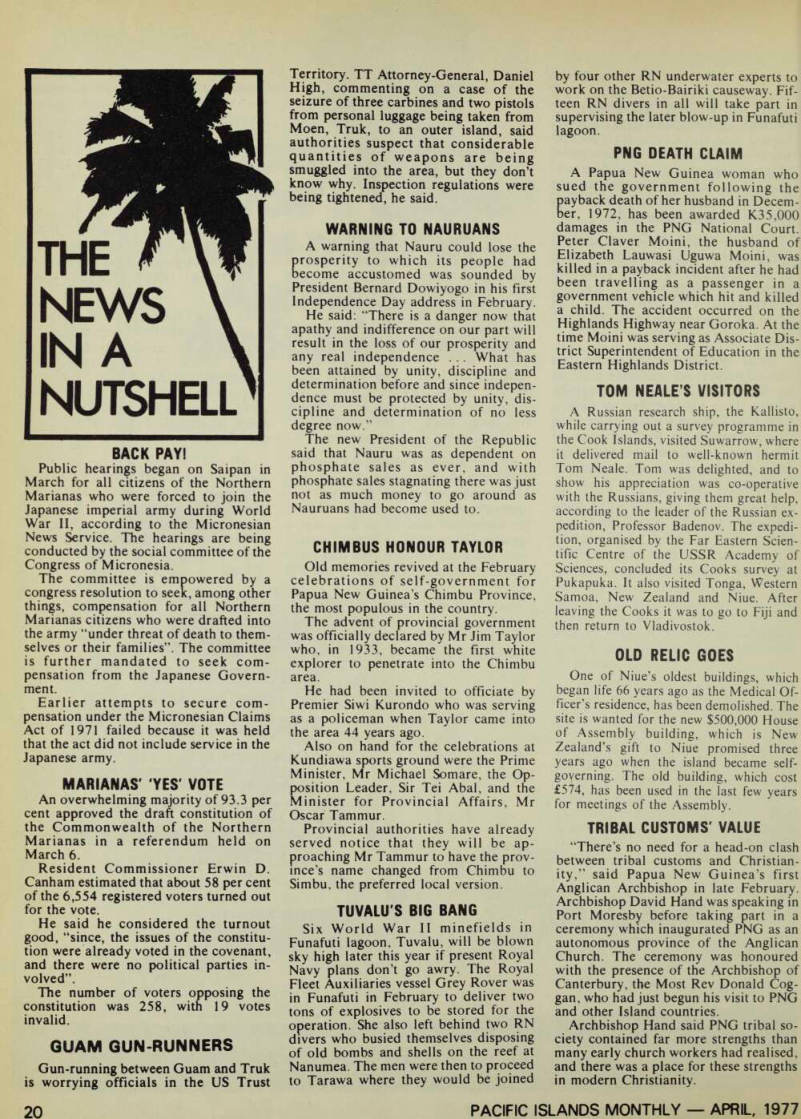
Lt-Col Karry Frank, MBE, took over in February as the commanding officer of the Papua New Guinea Defence Force patrol boat base at Lombrum, Manus. He became the first national commander at the base when he succeeded an Australian officer, Commander Ted Wilkinson
Advertisements & other items, pp. 18-19 (2 items)
'Rave/Odce Care
Itavdodoc offers
you a whole
sight more in
Australia and
the South Pacific
i i i % 1 19 A F Right around the South Pacific you’ll find international standard Travelodge where the sights are ...where the action is.
And that’s where you’ll want to stay-to see the things, do the things you wish without moving too far from your room.
Friendly Travelodge offers the best in accommodation, service, food and value for money.
So book Travelodge. You’ll get a whole sight more. • Australia • New Zealand • Fiji • Tahiti • New Caledonia Papua New Guinea • Indonesia
'RAVE/ODCE CARE
RESERVATIONS: for any one of over 70 Travelodges in Australia, Fiji, New Zealand, Papua New Guinea. Tahiti, Japan & Indonesia:- .Australia: Sydney (02) 31.0601: Adelaide (08) 223.6194: Melbourne (03) 387.1233; Perth (092) 25.3811: Brisbane (072) 21.8586: Hobart (002) 34.2911: Canberra (062) 49.1424: Darwin 81.5388. U.K. (London): Trust Houses Forte (01) 567.3444. Japan (Tokyo): Travelodge Branch Office (03) 214.0961. Fiji: Travelodge Reservations, Suva 2.4600. Hong Kong: Travelodge Reservations 522.2251. U.S.A. (Toll Free): Travelodge International Inc. (800) 255.3050.
N.Z. (Auckland): Travelodge Reservations 374.108.
OR YOUR TRAVEL AGENT
TR99/75
& bciLL
mJLKH
• 0 • t f i • « 9K2i
SMALL SHIP AND YACHT BROKERS
FOR SALE Ex “CORVETTE”
Has been converted for use as a pilot vessel, with comfortable single cabin accommodation. Well maintained and immediately available at a realistic price.
Further details available from
BYRNE & BULL
9 Clarke Street, South Melbourne.
Victoria 3205. Australia Telephone (03) 6993744 Telex AA32154 Also available-a comprehensive range of Motor Cruisers, Fishing Boats and Yachts. • •
News
The
In A
Nutshell
Back Pay!
Public hearings began on Saipan in
March for all citizens of the Northern Marianas who were forced to join the
Japanese imperial army during World
War 11, according to the Micronesian News Service. The hearings are being conducted by the social committee of the Congress of Micronesia.
The committee is empowered by a congress resolution to seek, among other things, compensation for all Northern Marianas citizens who were drafted into the army “under threat of death to them selves or their families”. The committee is further mandated to seek com pensation from the Japanese Govern ment.
Earlier attempts to secure com pensation under the Micronesian Claims Act of 1971 failed because it was held that the act did not include service in the
Japanese army.
Marianas' Yes' Vote
An overwhelming majority of 93.3 per cent approved the draft constitution of the Commonwealth of the Northern Marianas in a referendum held on March 6.
Resident Commissioner Erwin D.
Canham estimated that about 58 per cent of the 6,554 registered voters turned out for the vote.
He said he considered the turnout good, “since, the issues of the constitu tion were already voted in the covenant, and there were no political parties in volved”.
The number of voters opposing the constitution was 258, with 19 votes invalid.
Guam Gun-Runners
Gun-running between Guam and Truk is worrying officials in the US Trust
Territory, TT Attorney-General, Daniel
High, commenting on a case of the seizure of three carbines and two pistols from personal luggage being taken from Moen, Truk, to an outer island, said authorities suspect that considerable quantities of weapons are being smuggled into the area, but they don’t know why. Inspection regulations were
being tightened, he said.
Warning To Nauruans
A warning that Nauru could lose the prosperity to which its people had become accustomed was sounded by President Bernard Dowiyogo in his first
Independence Day address in February.
He said: “There is a danger now that apathy and indifference on our part will result in the loss of our prosperity and any real independence . . . What has
been attained by unity, discipline and
determination before and since indepen dence must be protected by unity, dis cipline and determination of no less
degree now.”
The new President of the Republic said that Nauru was as dependent on phosphate sales as ever, and with
phosphate sales stagnating there was just
not as much money to go around as Nauruans had become used to.
Chimbus Honour Taylor
Old memories revived at the February celebrations of self-government for Papua New Guinea’s Chimbu Province, the most populous in the country.
The advent of provincial government was officially declared by Mr Jim Taylor who, in 1933, became the first white explorer to penetrate into the Chimbu area.
He had been invited to officiate by Premier Siwi Kurondo who was serving as a policeman when Taylor came into the area 44 years ago.
Also on hand for the celebrations at Kundiawa sports ground were the Prime Minister, Mr Michael Somare, the Op position Leader. Sir Tei Abal, and the Minister for Provincial Affairs, Mr Oscar Tammur.
Provincial authorities have already served notice that they will be ap proaching Mr Tammur to have the prov ince’s name changed from Chimbu to Simbu, the preferred local version.
Tuvalu's Big Bang
Six World War II minefields in Funafuti lagoon, Tuvalu, will be blown sky high later this year if present Royal Navy plans don’t go awry. The Royal Fleet Auxiliaries vessel Grey Rover was in Funafuti in February to deliver two tons of explosives to be stored for the operation. She also left behind two RN divers who busied themselves disposing of old bombs and shells on the reef at Nanumea. The men were then to proceed to Tarawa where they would be joined
by four other RN underwater experts to work on the Betio-Bairiki causeway. Fif teen RN divers in all will take part in supervising the later blow-up in Funafuti
lagoon.
Png Death Claim
A Papua New Guinea woman who sued the government following the payback death of her husband in Decem ber, 1972, has been awarded K 35,000 damages in the PNG National Court.
Peter Claver Moini, the husband of Elizabeth Lauwasi Uguwa Moini, was killed in a payback incident after he had been travelling as a passenger in a government vehicle which hit and killed a child. The accident occurred on the Highlands Highway near Goroka. At the time Moini was serving as Associate Dis trict Superintendent of Education in the Eastern Highlands District.
Tom Neale S Visitors
A Russian research ship, the Kallisto, while carrying out a survey programme in the Cook Islands, visited Suwarrow, where it delivered mail to well-known hermit Tom Neale. Tom was delighted, and to show his appreciation was co-operative with the Russians, giving them great help, according to the leader of the Russian ex pedition, Professor Badenov. The expedi tion, organised by the Far Eastern Scien tific Centre of the USSR Academy of Sciences, concluded its Cooks survey at Pukapuka. It also visited Tonga, Western Samoa, New Zealand and Niue. After leaving the Cooks it was to go to Fiji and then return to Vladivostok.
Old Relic Goes
One of Niue’s oldest buildings, which began life 66 years ago as the Medical Of ficer’s residence, has been demolished. The site is wanted for the new $500,000 House of Assembly building, which is New Zealand’s gift to Niue promised three years ago when the island became self governing. The old building, which cost £574, has been used in the last few years for meetings of the Assembly.
Tribal Customs' Value
“There’s no need for a head-on clash between tribal customs and Christian ity,” said Papua New Guinea’s first
Anglican Archbishop in late February.
Archbishop David Hand was speaking in Port Moresby before taking part in a ceremony which inaugurated PNG as an autonomous province of the Anglican Church. The ceremony was honoured with the presence of the Archbishop of Canterbury, the Most Rev Donald Cog gan, who had just begun his visit to PNG and other Island countries.
Archbishop Hand said PNG tribal so ciety contained far more strengths than many early church workers had realised, and there was a place for these strengths in modern Christianity.
Fiji Children Killed
Three children died and about 50 were injured when a school bus left the road on the copra island of Taveuni in Fiji and crashed on to a beach 4Vi to 6 metres below. The bus was on a narrow winding road, typical of Taveuni, at Nanuku, about seven miles from Waiyevo, which is about the centre of the island on the north western side. There were about 80 children on the bus.
The Fiji Cabinet discussed the accident, after which the Minister for Com munications, Mr Jonati Mavoa, issued a circular letter to bus drivers, appealing to them to see that bus transport rules were observed. Fie said his ministry believed that many of the problems being ex perienced were because many drivers were ignorant of their responsibilities as bus drivers. A few weeks earlier a school child was killed near Suva when he put his head out of a window as it passed close to a power pole. His head struck the pole.
90,000 Tongans
Tonga had a population of 90,128
according to the census taken in December, 1976. The figure was 16.4% higher than that of the 1966 census. Males outnumbered females by 46,029 to 44,099. Tongatapu had a population of 54,437, Vavau 15,065,
Haapai 10,812, Eua 4,486 and the
Niuas 2,328. The population of Nukualofa at 18,396 was 17.2% higher than that of the 1966 census.
People
Minister Charged
An interesting court case seems to be on the way in the Cook Islands. The Premier, Sir Albert Henry, was given leave to appear for his son, Mr Tupui Ariki Henry, Minister of Justice, Lands and Internal Affairs, who was charged in the High Court with having assaulted laveta Short, a Rarotonga barrister and solicitor. Sir Albert asked Chief Justice Gavin Donne to adjourn the case because his son needed time to seek legal action, and because the complainant, and prosecution, appeared to have subpoenaed all available barristers and solicitors to either act on his behalf or as witnesses for the prosecution. Thus his son would have to get legal assistance from either New Zealand or Australia. The matter was adjourned to May 9.
Nauru's Claim
New Zealand union lawyers have demanded that the Nauru Government be less confused in its statement of claim for $NZ432,241 damages against three New Zealand unions. The claim, which is being heard in the Supreme Court, Wellington, arises from an industrial dispute which caused the Nauruan ship, Enna G, to make a prolonged stay in
Wellington in 1973. The plaintiffs counsel agreed in February to amend the statement and the case was temporarily
adjourned.
,«w
Png Job Policy
PNG’s Minister for Foreign Affairs and Trade, Sir Maori Kiki and Minister for Labour, Commerce and Industry Mr Gavera Rea, have agreed on a joint policy whereby non-citizens may change employment while in Papua New Guinia, without returning to their country of origin. The change of employment will only be approved if the employee has completed at least a year s term of employment with the employer who brought the immigrant into Papua New Guinea. The Chief Migration Officer and the Department of Labor, Commerce and Industry must be advised in writing by the intending employer that change of employment is sought and the passports surrendered to the Chief Migration Officer for re-endorsement. The Department of Labour will then advise the employer and the Department of Foreign Affairs whether or not the change of employment is approved.
Fijians For Niue
Niue Island’s Minister of Agriculture and Economic Development, Mr Young Vivian, would rather have Fijian experts working on his country’s projects than New Zealanders. “The Fijian would be more in tune with the way things are done in the Islands,” he says.
New Zealand experts in Niue tended to go about their jobs as if they were still working in New Zealand. Some did not
always appreciate that they were
working in an entirely different country, with a different social structure, soils and climate.
His statement brought a declaration of
“strong support” from New Zealand Foreign Affairs Minister, Mr Talboys.
“It would give people from one Pacific nation the chance to impart their knowledge of regional conditions to their less developed neighbours,” said he.
Friendly Stoppage
A , „ .
About employees of the Jft"" ‘ ndus . t . I f lal Corporat.on < .!*/"*"?, J„ y .„ wo rk ' pr< PP ss g ing on K( P ror jn ° Febr ° a P ™ The worker p s sem a , ist of .. requ ests” to company officials for consideration, They were for a num ber of improvements in conditions, and for a 35 c wa g e rise. Police said there was no violence involved. Employees of the
nearby Van Camp Seafood Company
gave fish to the idle MIC workers,
Following talks with MIC president Guy
Luttrel, who paid a special visit to Koror to discuss the “requests”, all were granted except the 35c pay rise. ia//\dwiwp in u/nMcw
Wmifphwu Iu Vvumtn
Lae women who wear very brief costumes or shorts are inviting assault from “certain individuals”, according to Superintendent lan McPherson, of Lae Provincial Police Headquarters. He said that in a recent P enod of ei B ht weeks ’ reports of assaults on females, un successful rape attempts and one rape case were received. These attacks occurred mainly at night, in houses and in the streets. In nearly every case the person at tacked had, without thinking, presented the opportunity to the offender. It was un advisable for women to display themselves dressed in very brief costumes or shorts or to sunbathe in swimming costumes in the backyards of their homes, as that tended to arouse certain individuals, he said.
Chris Elliott, aged 30 (second from left), put on traditional Manus ceremonial costume for his marriage at St Joseph's RC Church at Boroko, Port Moresby, in December to Angela Morove, of Marshall Lagoon, 1 50 km along the coast from Port Moresby. Angela wore the traditional costume from her own area. Chris, from Mackay, Queensland, is a naturalised Papua New Guinea citizen. He has lived nine years in PNG and was adopted by a Manus Island family, in PNG's far north, while he was teaching there.
Advertisements & other items, p. 22 (1 item)
by Goodyear.
Some doMlivto-earth
reasons for using
Unisteel radial ply tires
by Goodyear.
Unisteel—the earthmover tire with radial steel body plies plus steei belts— carries heavier loads at faster speeds than conventional tires. Radial ply construction—with belts of steel cord under the tread plus a super-strong ply of steel cord in the body—dissipates heat quickly for cooler running, resists punctures by deflecting most debris and rocks, and provides excellent traction with a long lasting tread. Large vehicle or small, Goodyear earthmover tires will perform better, longer, and more economically than conventional tires.
GOODfYEAR
/ GOODYEAR DISTRIBUTORS IN S.E. ASIA AND PACIFIC BASIN.
Richard Pieris & Co., Ltd.
Colombo, SRI LANKA Nepal Motor Company (P) Ltd.
Biratnagar. NEPAL Navana Ltd.
Dacca. BANGLADESH
Diethelm & Co., Ltd.
Bangkok. THAILAND Landis Brothers & Co. Ltd.
HONG KONG
Guam Tire & Supply Co.
Agana, GUAM Susupe Enterprises Saipan, MARIANA IS.
Nicrol Corporation Saipan, MARIANA IS Truk Trading Co.
Truk, E. CAROLINE IS.
P.A.M.I.
Kolonia, PONAPE Island Transport Service Co.
Majuro, MARSHALL IS.
Yap Cooperative Ass
Yap. W. CAROLINE IS.
Cook Islands Motor Centre Rarotonga, COOK IS.
Ngiratkel Etpizon Co. Ltd.
Koror, PALAU Boroko Motors Ltd.
Port Moresby, PAPUA NEW GUINEA Solomon Motors Ltd.
Honiara, B S I P Santo Engineers
Santo, NEW HEBRIDES
Pacific Motors
Vila, NEW HEBRIDES
S.G.A.
Noumea, NEW CALEDONIA
Duncombe Bay Garage
NORFOLK IS
Coral Island Motors Suva, FIJI Morris Hedstrom Ltd.
Nuku'alofa, TONGA Morris Hedstrom Ltd.
Apia, WESTERN SAMOA
WSTC S
Apia, WESTERN SAMOA
Samoa Motors Inc.
Pago Pago. AMERICAN SAMOA
Service Mobil Papeete. TAHITI 171-0138
Editor’S Mailbag


Relatives Wanted
I have been trying to locate my relatives in Lifu, Samoa, New Caledonia and Niue.
My father’s father was William Wakado. He came from Lifu Island.
He had a younger brother named Kalimo, who returned to Lifu at their father’s bidding. Wakado stayed on Darnley Island in the Torres Strait, where he married my grandmother, Mourah. Her father was from Niue and was known as Harry Niue.
On my mother’s side, her father was part-Samoan, part-Scottish. His name was Christopher Scanlan, and came from Apia, Western Samoa. He had a son by his first wife, a Samoan, but she died. When the father and son came to Torres Strait, he married my mother’s mother Tina. They had two children, Michael and my mother Caroline.
The son by his first wife was named Morris. After mum’s father died, Morris had to go back to Samoa, Since then I think he has probably died. He was brokenhearted at having to Jeave his stepmother and his sister and brother.
If there are any relatives of Scanlan in Samoa, would they please get in touch with me. Any of my father’s relations in Lifu, New Caledonia, Niue or Samoa could make me very happy if they would kindly contact me.
(Miss) Katherine L.
Wacando
10 Maryvale St, West End, 4810, Townsville, Qld, Australia.
Over-Stayers
Having followed with much in terest, generated through personal involvement, the problem of New Zealand’s “over-stayers”, I have yet to see any discussion either in PIM or the national dailies on what I see as a “bedfellow” of the major vexed question.
That is that there appears to be no provision made to advise or compel holders of a legal work-permit to remit a portion of money received to their immediate families at home.
I would be glad to think that the spirit of the arrangement is to ena
ble those permit-holders to augment or provide the whole family income.
Yet from experience I have found that very little of the money earned finishes where it is most needed, in the family purse.
Perhaps the fault lies with an all too-ready change from a struggle to “affluence”. Or is it that the lucky few adopt a policy of “out of sight out of mind”, or “blow you, Jack”?
Or perhaps it is simply that family ties are weakening among the Pacific Islanders concerned.
James F. Willson
214 High St, Belmont, Vic.
PIM believes that Mr Willson is burdening all Islanders with the guilt earned by a few. Our ex perience is that the majority of Islanders working in NZ discharge their responsibilities to their depen dants back home admirably.
Statistics published in the past by various Island governments have shown that Islanders working in NZ have sent large sums of money to their dependants and, in some cases, to the churches to which they belong. Editor.
Justice And Mercy
PIM has received the following copy of a letter sent to the Prime Minister of Australia, Mr Malcolm Fraser: While Australia may have a problem with illegal immigrants, the laws and regulations governing this problem should be administered with justice and mercy. It would appear that the magistrate who sat on the re cent case of two young Fijian women accused of being illegal immigrants has forgotten both justice and mercy.
These two fine young women, who have been helping our country’s aged, have been treated in a shocking manner. You should know that Australian firms such as Carpenters, Burns Philp, CSR, Steamships, Morris Hedstrom’s, etc, have been “ripping off’ the economies of coun tries in the South Pacific, including Fiji, for generations. All the Islands and Island people have got in return is racist and harsh interpretation of
Australia’s immigration laws, already particularly biased.
Belatedly, Australia is now giving some aid to the area but a kinder in terpretation of the immigration laws towards Pacific Island peoples would do a great deal to improve Australia’s tarnished image in the area.
While my letter probably arrives too late to have any effect, I have to tell you, Sir, I hope to interest my local church group and others in this and similar matters. May I ask you, Sir, • How long were these young Fi jian nurses working in homes and hospitals for the aged in Sydney? • How long were they im prisoned? • Were they deported?
B.H. Turner
Winnellie, NT, Australia.
The Australian Minister for Im migration, Mr MacKellar, on February 21, signed orders for the deportation of the two girls, Akanasi (Aggie) Ratu, and Matu Apa Doko, both 24. They were released on February 16, after eight days in custody. They had been working at the Sacred Heart Hospice for the Dy ing, at Darlinghurst, Sydney.
Editor.
Another Hokule'a
I read with interest the magazine article on the Hokule’a by Keith Haugen in PIM of December, 1976.
In October, 1975, I was sailing in the Marquesas Islands, and met Dr Bob Griffith and his wife, Nancy.
They were at Tiaohae, Nukuhiva.
Nancy was skipper of their famous ferro-cement yacht Awanhee 11, and Bob at the helm of the 70ft proa, The Spirit of Nukuhiva.
Excluding the nationalism involv ed in Hokule’a’s voyage, Griffith’s proa was a credit to the skills and ingenuity for the peoples of the Pacific. She was constructed of wood, both hulls carved from tree trunks and, where other woods join ed, sewn together and then caulked with pitch.
The cross-planking lash and much of the railing were of bamboo. The small “cabin” was nothing more than a tiny thatched hut.
The trip from San Francisco to Nukuhiva was successful, but in December 1975, on the leg to Hawaii, almost midway, the hulls came apart and she became a derelict.
The crew were rescued by the Awanhee. The trip was conceived and made in the mould of the an cients. Truly a feat.
Ted Burgon
Redding, Cal.,
Usa, 96001.
The Deluge!
On page 57 of your February, 1977, issue you credit Papua New Guinea around Nadzab airport with 1,188 in ches of annual rainfall, and Nadzab with 350. Apologies to India. The highest recorded rainfall in the world is at Cherrapunji, a long way from Morobe. And it is only 536 inches a year. A closer look shows you have your conversion from the metric system wrong. At 25.4 mm to the inch Nadzab gets only 59.1 inches of rain and the surrounding mountains 187.1.
That’s only a little over a third as much as as in Assam.
John Pasagogo
Box 4779 University PO, PNG
More letters over page
Jonas Coe's Children
I am writing in reference to the photograph belonging to Mrs M. G.
Rosser of Newport Beach, which was in your January issue of PI M (p 25).
In the picture caption Mrs Rosser describes the children of Jonas Coe with his Tongan wife Litia. The second child Nellie Lydia is said to have died in 1960. I have been in Samoa about a year now and I believe that Nellie Lydia is still alive, but living in New Zealand. Her name is Nellie Davidson, however, and as I recall she visited Samoa last year, and there was a small news item over the radio about her. If perhaps she could be located in New Zealand she may be able to identify the people in the photo, if they are members of her
famil y- Apia ’ W - Samoa
Judie Teall
|M Poor Tartp?
lIN rUUh 1 Ab 1 t f 1 take shar P exception to your cover on the February 1977 PIM. I have travelled extensively throughout the Pacific, including the Kapinga village on Ponape.
Bare-breasted women were nowhere in sight in fact, they are rare throughout most parts of the Pacific nowadays, especially when foreig ners are about.
John H. Harding’s photograph is in poor taste not because of the bare bosoms, but because these peo pie are very obviously ill-at-ease.
Their bra lines are quite apparent. I doubt very much that this is an
“everyday” scene, or that Mr Hard mg“sfughT ? C l C lovelies - He probably had to both coerce and pay them -
June S. Lewis
Pepeekeo, Hawaii, 96783.
With Regrets
I regret that I will not be renewing further subscriptions to PIM as age has beaten me. But I would only like to add that over the years I have read this magazine, it has been al ways a pleasure and source of enter tainment and news, and something to look forward to each month.
My thanks and appreciation.
Arthur H. Mills
Cairn®, Qld.
Advertisements & other items, pp. 23-26 (1 item)
Triangle
The
Polynesian
Western Samoa !\iue island Km Ponga
Its place in
the Pacific has shifted
Because now the Polynesian Triangle fare brings a Polynesian holiday much closer. Now when you visit Fiji you can include Tonga, Niue and Western Samoa for very little extra! Talk to your travel agent about working in our Polynesian Triangle fare with your
Fiji itinerary. Only U55253.00*
(AUSSI9B.OO or NZ$2lB.OO) more to see three more islands in the beautiful Pacific. Our Polynesian Triangle fare is available all year round with no minimum stopover restrictions and may be purchased while you are in Fiji or before you arrive.
Contact your travel agent for more details.
Fare subject to change without notice.
Serving the heart of Polynesia
POLYNESIAN, ,
wu^Au'pocibc PO Box 599, Apia.
WESTERN SAMOA
/ The Model ‘9oo’. Operates off single phase electricity. Compact. Easy to use. Fully automatic. Two models available: the standard and the SD 900 with ‘side saddle’ soap saver.
The Clayton ‘Clayjet’. eso litres per hour with a temperature of 95 degrees C. 40 foot hose so you can move the cleaning power to where the dirt is. And, of course, it operates anywhere with single phase electricity.
The Clayton ‘7so’. With an output of 720 litres per hour and a maximum temperature of 71 degrees C. This is real cleaning power. And, like all Clayton systems, operates off single phase electricity.
The only thing better than any Clayton high pressure, hot water cleaner is
the new C£cuftok.
high pressure, hot water cleaner.
For further information
contact;—
Clyde-Westeels Ltd.,
1 Factory Street,
Granville, N.S.W. 2142,
Australia.
Phone 682-2111.
A member of the Clyde Industries Group.
The new Clay-jet Compact. 600 psi pressure. Operates anywhere with single phase electricity and 40 ft. of pressure hose effectively.
Easy on fuel. Easy to operate. Hot water, or cold high pressure cleaning is our business. This unit can make it yours. 1552
WMMi
Sole distributors for Australia • Papua New Guinea • New Zealand • Pacific Islands
When you need hard facts
to back your judgment..
use these:
FM77I
FOR RESTAIR
A DIVISION OF H. C. SLEIGH LIMITED Bulla Road, Essendon Airport Victoria, Australia 3041 Cables & Telegrams: Forrestair Melbourne Telex AA33015 Telephone (03)3798929.
After hours (03) 7254430 You’ll get the range you may want, at a speed you could need, in the comfort you’d expect.
You’ll get the safety of twin Lycoming engines, at a lower price than any comparable twin.
You’ll operate it for around the same cost as most of the worthwhile singles.
You’ll get an airborne conference room, with its six executive chairs.
You’ll get a 7 sq. ft. cargo loading door, and 20 cu. ft. of cargo space, accessible in flight, and if your business takes you to the outback, you’ll land on gravel strips with the peace of mind you’ll only get from high wings.
Get the operating costs for your accountant.
Get the specifications for yourself.
You could win one of these magnificent prizes for only $2.00
1 st Prize. Mazda 121
Automatic Sedan. Value $8368.70 ft r
Book
Tickets $2.00 Buy a
5 Chances for $lO
2nd Prize. Leyland Moke
Value $3026.20
3rd Prize. P&O Cruise
12 nights for 2 on the Arcadia. Value $1434.00
4th Prize. Sanyo Colour TV
22" UHF/VHF. Value $829,00
sth Prize. Sanyo Stereo
5-piece, 4 channel console. Value $599.00 Authorised under the provisions of the Lotteries and Art Union Act 1901, as amended by subsequent acts.
This offer not valid in States where it would contravene State Laws. Permit No. AU4957, Drawn at 36 Flood Street, Bondi at 12 noon on Wednesday 27th July 1977.
Total Value off Prizes $14,256.90
In aid of SYDNEY
TALMUDICAL COLLEGE
RAINBOW
for the education of children. ART UNION N 92 If you or your friends would like tickets in this Art Union, rush this coupon back while tickets last ■ to Hon. Promoter, Box 18, Bondi, NSW 2026.
Please send me Name tickets @ $2.00 each.
Address Postcode I enclose $ Would you like tickets in the next
Rainbow Art Union? I 1 |^J
Tropicalities
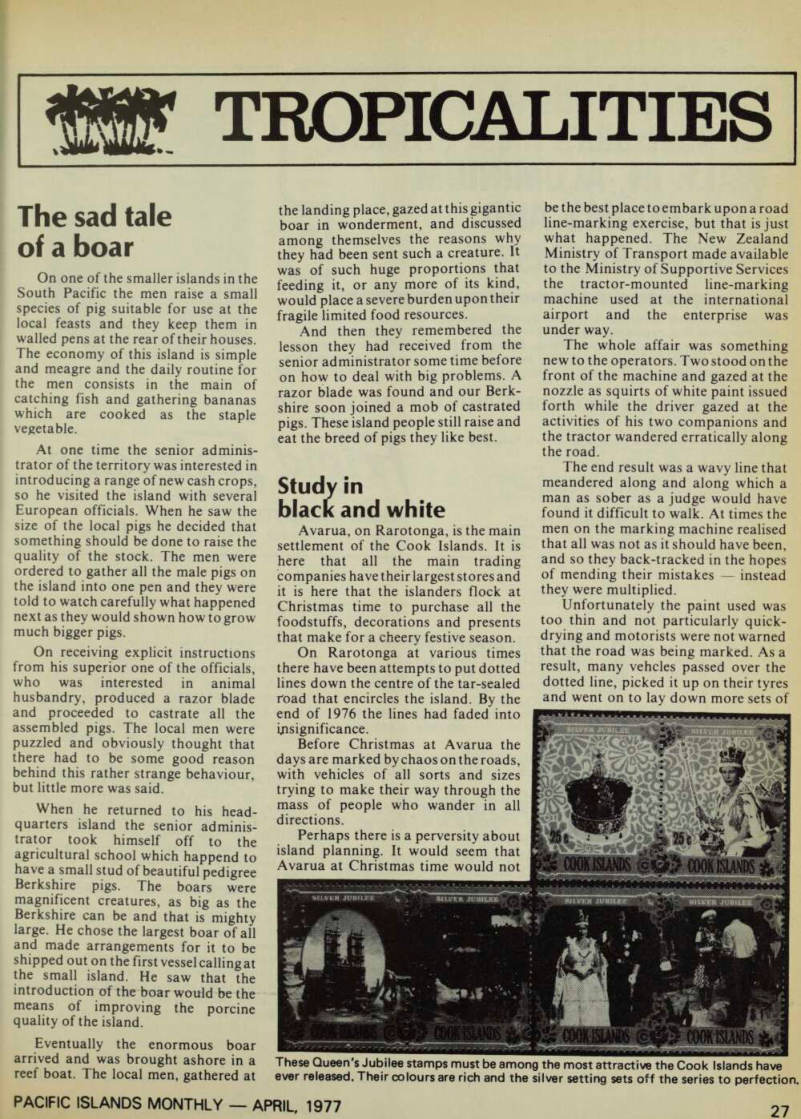

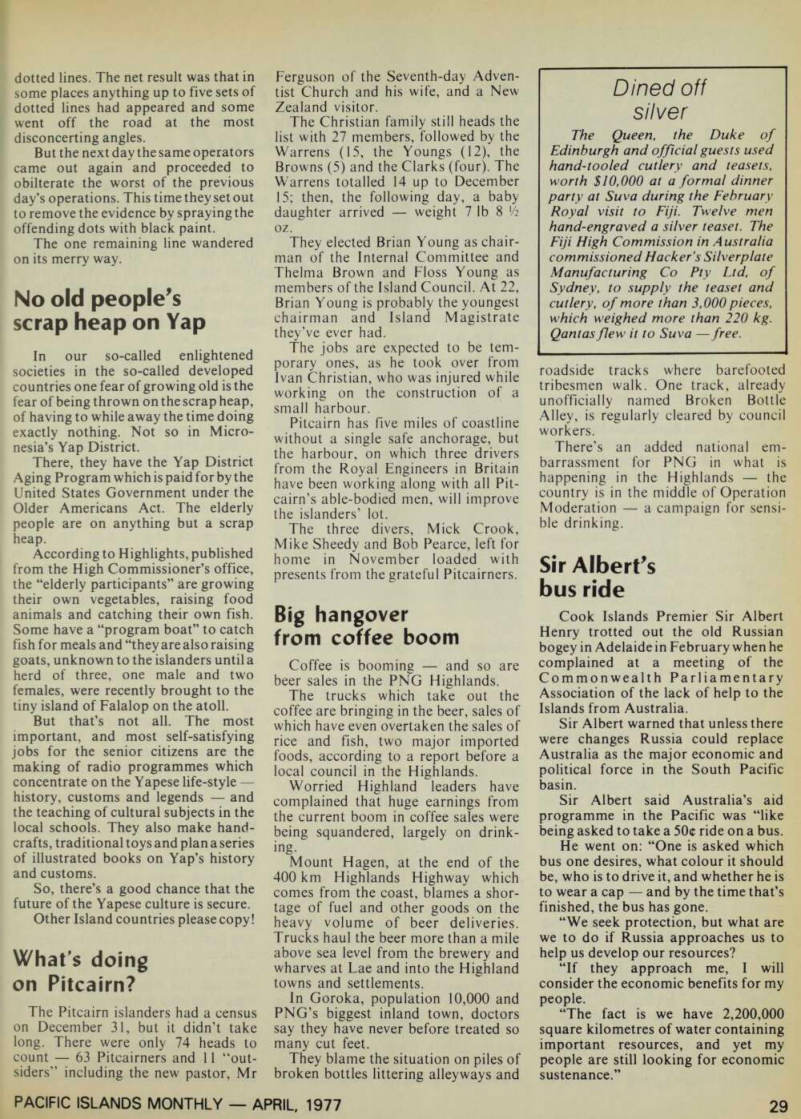
The sad tale
of a boar
On one of the smaller islands in the South Pacific the men raise a small species of pig suitable for use at the local feasts and they keep them in walled pens at the rear of their houses.
The economy of this island is simple and meagre and the daily routine for the men consists in the main of catching fish and gathering bananas which are cooked as the staple vegetable.
At one time the senior adminis trator of the territory was interested in introducing a range of new cash crops, so he visited the island with several European officials. When he saw the size of the local pigs he decided that something should be done to raise the quality of the stock. The men were ordered to gather all the male pigs on the island into one pen and they were told to watch carefully what happened next as they would shown how to grow
much bigger pigs.
On receiving explicit instructions
from his superior one of the officials, who was interested in animal husbandry, produced a razor blade and proceeded to castrate all the assembled pigs. The local men were puzzled and obviously thought that there had to be some good reason behind this rather strange behaviour, but little more was said.
When he returned to his head quarters island the senior adminis trator took himself off to the agricultural school which happend to have a small stud of beautiful pedigree Berkshire pigs. The boars were magnificent creatures, as big as the Berkshire can be and that is mighty large. He chose the largest boar of all and made arrangements for it to be shipped out on the first vessel calling at the small island. He saw that the introduction of the boar would be the means of improving the porcine quality of the island.
Eventually the enormous boar arrived and was brought ashore in a reef boat. The local men, gathered at
the landing place, gazed at this gigantic boar in wonderment, and discussed among themselves the reasons why they had been sent such a creature. It was of such huge proportions that feeding it, or any more of its kind, would place a severe burden upon their fragile limited food resources.
And then they remembered the lesson they had received from the senior administrator some time before on how to deal with big problems. A razor blade was found and our Berk shire soon joined a mob of castrated pigs. These island people still raise and eat the breed of pigs they like best.
Study in
black and white
Avarua, on Rarotonga, is the main settlement of the Cook Islands. It is here that all the main trading companies have their largest stores and it is here that the islanders flock at Christmas time to purchase all the foodstuffs, decorations and presents that make for a cheery festive season.
On Rarotonga at various times there have been attempts to put dotted lines down the centre of the tar-sealed road that encircles the island. By the end of 1976 the lines had faded into
insignificance.
Before Christmas at Avarua the days are marked by chaos on the roads, with vehicles of all sorts and sizes trying to make their way through the mass of people who wander in all directions.
Perhaps there is a perversity about island planning. It would seem that Avarua at Christmas time would not
be the best place to embark upon a road line-marking exercise, but that is just what happened. The New Zealand Ministry of Transport made available to the Ministry of Supportive Services the tractor-mounted line-marking machine used at the international airport and the enterprise was under way.
The whole affair was something new to the operators. Two stood on the front of the machine and gazed at the nozzle as squirts of white paint issued forth while the driver gazed at the activities of his two companions and the tractor wandered erratically along the road.
The end result was a wavy line that meandered along and along which a man as sober as a judge would have found it difficult to walk. At times the men on the marking machine realised that all was not as it should have been, and so they back-tracked in the hopes of mending their mistakes instead they were multiplied.
Unfortunately the paint used was too thin and not particularly quick drying and motorists were not warned that the road was being marked. As a result, many vehcles passed over the dotted line, picked it up on their tyres and went on to lay down more sets of
These Queen's Jubilee stamps must be among the most attractive the Cook Islands have ever released. Their colours are rich and the silver setting sets off the series to perfection.
dotted lines. The net result was that in some places anything up to five sets of dotted lines had appeared and some went off the road at the most disconcerting angles.
But the next day the same operators came out again and proceeded to obilterate the worst of the previous day’s operations. This time they set out to remove the evidence by spraying the offending dots with black paint.
The one remaining line wandered on its merry way.
No old people’s
scrap heap on Yap
In our so-called enlightened societies in the so-called developed countries one fear of growing old is the fear of being thrown on the scrap heap, of having to while away the time doing exactly nothing. Not so in Micro nesia’s Yap District.
There, they have the Yap District Aging Program which is paid for by the United States Government under the Older Americans Act. The elderly people are on anything but a scrap heap.
According to Highlights, published from the High Commissioner’s office, the “elderly participants” are growing their own vegetables, raising food animals and catching their own fish.
Some have a “program boat” to catch fish for meals and “they are also raising goats, unknown to the islanders until a herd of three, one male and two females, were recently brought to the tiny island of Falalop on the atoll.
But that’s not all. The most important, and most self-satisfying jobs for the senior citizens are the making of radio programmes which concentrate on the Yapese life-style history, customs and legends and the teaching of cultural subjects in the local schools. They also make hand crafts, traditional toys and plan a series of illustrated books on Yap’s history and customs.
So, there’s a good chance that the future of the Yapese culture is secure.
Other Island countries please copy!
What’s doing
on Pitcairn?
The Pitcairn islanders had a census on December 31, but it didn’t take long. There were only 74 heads to count —63 Pitcairners and 11 “out siders” including the new pastor, Mr
Ferguson of the Seventh-day Adven tist Church and his wife, and a New Zealand visitor.
The Christian family still heads the list with 27 members, followed by the Warrens (15, the Youngs (12), the Browns (5) and the Clarks (four). The Warrens totalled 14 up to December 15; then, the following day, a baby daughter arrived weight 7 lb 8 Vi oz.
They elected Brian Young as chair man of the Internal Committee and Thelma Brown and Floss Young as members of the Island Council. At 22, Brian Young is probably the youngest chairman and Island Magistrate they’ve ever had.
The jobs are expected to be tem porary ones, as he took over from Ivan Christian, who was injured while working on the construction of a small harbour.
Pitcairn has five miles of coastline without a single safe anchorage, but the harbour, on which three drivers from the Royal Engineers in Britain have been working along with all Pit cairn’s able-bodied men, will improve the islanders’ lot.
The three divers, Mick Crook, Mike Sheedy and Bob Pearce, left for home in November loaded with presents from the grateful Pitcairners.
Big hangover
from coffee boom
Coffee is booming and so are beer sales in the PNG Highlands.
The trucks which take out the coffee are bringing in the beer, sales of which have even overtaken the sales of rice and fish, two major imported foods, according to a report before a local council in the Highlands.
Worried Highland leaders have complained that huge earnings from the current boom in coffee sales were being squandered, largely on drink ing.
Mount Hagen, at the end of the 400 km Highlands Highway which comes from the coast, blames a shor tage of fuel and other goods on the heavy volume of beer deliveries.
Trucks haul the beer more than a mile above sea level from the brewery and wharves at Lae and into the Highland towns and settlements.
In Goroka, population 10,000 and PNG’s biggest inland town, doctors say they have never before treated so many cut feet.
They blame the situation on piles of broken bottles littering alleyways and
roadside tracks where barefooted tribesmen walk. One track, already unofficially named Broken Bottle Alley, is regularly cleared by council workers.
There’s an added national em barrassment for PNG in what is happening in the Highlands the country is in the middle of Operation Moderation a campaign for sensi ble drinking.
Sir Albert’s
bus ride
Cook Islands Premier Sir Albert Henry trotted out the old Russian bogey in Adelaide in February when he complained at a meeting of the Commonwealth Parliamentary Association of the lack of help to the Islands from Australia.
Sir Albert warned that unless there were changes Russia could replace Australia as the major economic and political force in the South Pacific basin.
Sir Albert said Australia’s aid programme in the Pacific was “like being asked to take a 50c ride on a bus.
He went on: “One is asked which bus one desires, what colour it should be, who is to drive it, and whether he is to wear a cap and by the time that’s finished, the bus has gone.
“We seek protection, but what are we to do if Russia approaches us to help us develop our resources?
“If they approach me, I will consider the economic benefits for my people.
“The fact is we have 2,200,000 square kilometres of water containing important resources, and yet my people are still looking for economic sustenance.”
Advertisements & other items, p. 28 (1 item)
Walk In, Aluminium
Save hundreds of dollars
on Australia's most efficient
COOLROOMS AND
FREEZE ROOMS!!
Hundreds already installed! The most economical supplementary coolrooms for bottles and food, providing the larg r st storage capacity of any comparable coolrooms of the same exterior dimensions. Five sizes—from 90-360 cu. ft. capacity; 16 models offering normal temp., two temp., deep freeze, or for pastry and ice storage applications. White vinyl interior, embossed rustproof aluminium exterior
Q SUPPLIED IN EASY-TO-ERECT, DO-IT-
AVAILABLE FROM:
AUSTRALIAN NEW CALEDONIA EXPORTS. 363 George St, Sydney, 2000.
BRECKWOLDT & CO., 276 Pitt St., Sydney, 2000.
HAGEMEYER (A'SIA), 59 Anzac Pde, Kensington, 2033.
GEOFFREY HUGHES & CO, 167 Macquarie St, Sydney, 2000.
NELSON & ROBERTSON PTY. LTD, 197 Clarence St, Sydney, 2000.
PETER FISHER TRADING PTY.LTD, 321 Pitt St, Sydney 2000.
E. RABOT (EXPORTS) PTY. LTD, 67 Castlereagh St, Sydney. 2000.
RABTRAD NIUGINI PTY. LTD., PO Box 1406, Lae.
A. RIETTE (PACIFIC) PTY. LTD., 300 George St., Sydney, 2000.
H. Y. KWAN (AUST) PTY. LTD. Box 2713, GPO , Sydney, 2001.
C. SULLIVAN (EXPORT) PTY. LTD., GPO Box 3373, Sydney, 2001.
W.S. TAIT & CO, PTY. LTD, 31 Macquarie Place, Sydney, 2000.
YOURSELF KIT FORM.
Manufactured by:
T 1
FRIGID CABINETS PTY. LTD.,
14A Duffy Ave., Thornleigh, N.S.W. 2120 Aust. Ph. 848 8292.
FCI
NORTH SHORE MARINE
& INDUSTRIAL LTD.
32 CLARENCE STREET, (Box 3091)
DEVONPORT, AUCKLAND 9,
NEW ZEALAND.
Phone Auckland: Business 450 370.
Aft. Hrs. - 452 392.
MARINE, INDUSTRIAL AND TRUCK
DIESELS - NEW & RECONDITIONED.
DETROIT G.M.— 271, 371, 471,8V71,
12V71, 353,453, 12V149, 16V149
from 55 1000 h.p. with Allison or Twin Disc gearbox.
GARDNER- 3LW, 4LW, SLW, 6LW,
4L3, 5L3, 6L3, BL3, 6LX, 6LXB, BLXB with Twin Disc gearboxes.
LEY LAND- 400 Power Plus, 680 Power Plus, 690, 760.
FORD DIESELS— Full range including 75 h.p., 115 h 0., 180 h.p.
GENERATOR SETS.
From 3KVA - 1000 KVA. All sizes new or used. Also large range of Bedford and Perkins diesels.
BOATS FOR SALE.
Two 72' x 16'6" x s'B" 14-16 knot passenger and cargo vessels, Gardner or GM diesels, in survey, fitted with Radio, Echo Sounder, Radar, 48-60 miles. Bargain Price $75,000. Will trade. 86' x 26' x 9'6" 450 h.p. diesel 11 knots. 100 ton Freezer or cargo hold. Radar 60 miles. Good accommodation. Radio, Sounder, 240 volt electrics. Powerful winch and tow post, in survey. $195,000. 40' x 12*6" x 3'B". 5 years old. New engine, 126 h.p, diesel. Bargain $19,700. 58' x 16' x 6' fishing boat or cargo. Radar 48 miles, Sounder, Freezer 5 ton.
Excellent accommodation.. Shower. 240 volt electrics, in survey. $70,000. 28' x 9'6" x 3'. 5 years old, diesel motor, as new. Radio sounder etc. 11 knots. $15,800. 109' x 22' x 7'6" wooden vessel Gardner diesel, big freezer and cargo capacity, wooden vessel in survey. $120,000.
Many other vessels for sale both high speed and work boats or we will build you a new steel vessel to your plans. Ask us for a quote. All types of gearboxes available.
Dined off
silver
The Queen, the Duke of Edinburgh and official guests used hand-tooled cutlery and teasels, worth $lO,OOO at a formal dinner party at Suva during the February Royal visit to Fiji. Twelve men hand-engraved a silver teasel. The Fiji High Commission in Australia commissioned Hacker’s Silverplate Manufacturing Co Pty Ltd, of Sydney, to supply the teasel and cutlery, of more than 3,000 pieces, which weighed more than 220 kg.
Qantas flew it to Suva free.
The Banabans' Story-
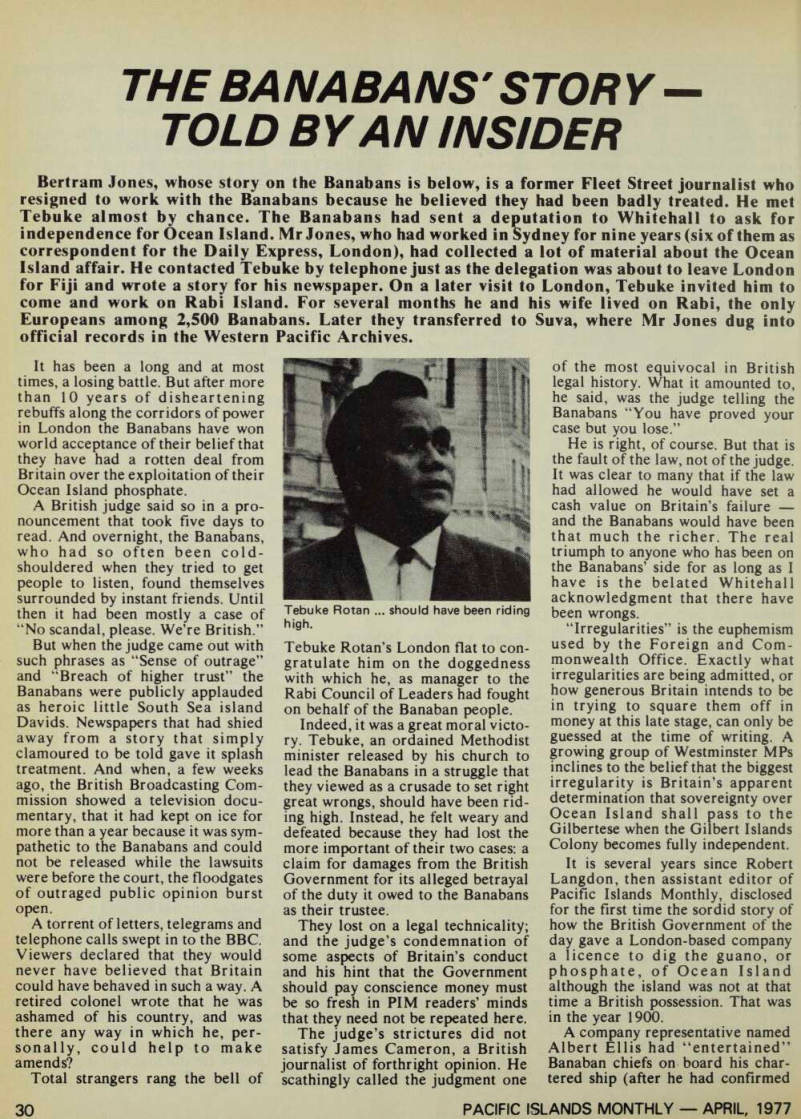
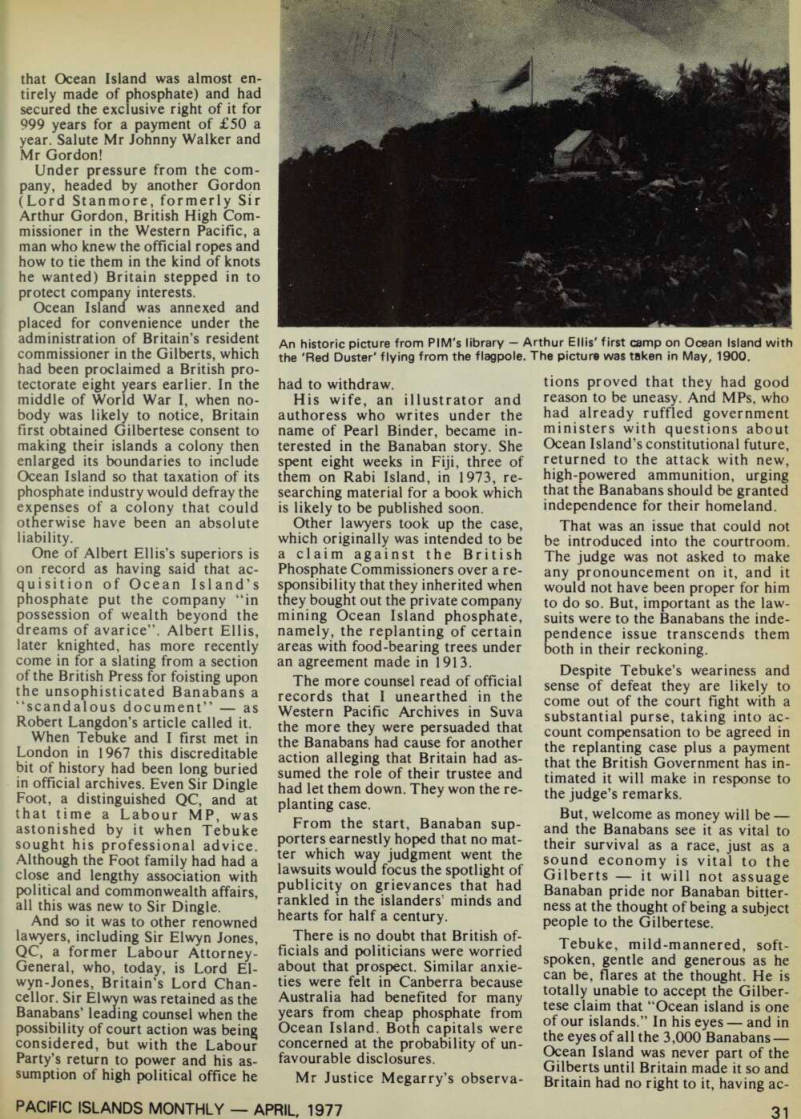
Told By An Insider
Bertram Jones, whose story on the Banabans is below, is a former Fleet Street journalist who resigned to work with the Banabans because he believed they had been badly treated. He met Tebuke almost by chance. The Banabans had sent a deputation to Whitehall to ask for independence for Ocean Island. Mr Jones, who had worked in Sydney for nine years (six of them as correspondent for the Daily Express, London), had collected a lot of material about the Ocean Island affair. He contacted Tebuke by telephone just as the delegation was about to leave London for Fiji and wrote a story for his newspaper. On a later visit to London, Tebuke invited him to come and work on Rabi Island. For several months he and his wife lived on Rabi, the only Europeans among 2,500 Banabans. Later they transferred to Suva, where Mr Jones dug into official records in the Western Pacific Archives.
It has been a long and at most times, a losing battle. But after more than 10 years of disheartening rebuffs along the corridors of power in London the Banabans have won world acceptance of their belief that they have had a rotten deal from Britain over the exploitation of their Ocean Island phosphate.
A British judge said so in a pro nouncement that took five days to read. And overnight, the Banabans, who had so often been cold shouldered when they tried to get people to listen, found themselves surrounded by instant friends. Until then it had been mostly a case of “No scandal, please. We’re British.”
But when the judge came out with such phrases as “Sense of outrage” and “Breach of higher trust” the Banabans were publicly applauded as heroic little South Sea island Davids. Newspapers that had shied away from a story that simply clamoured to be told gave it splash treatment. And when, a few weeks ago, the British Broadcasting Com mission showed a television docu mentary, that it had kept on ice for more than a year because it was sym pathetic to the Banabans and could not be released while the lawsuits were before the court, the floodgates of outraged public opinion burst open.
A torrent of letters, telegrams and telephone calls swept in to the BBC.
Viewers declared that they would never have believed that Britain could have behaved in such a way. A retired colonel wrote that he was ashamed of his country, and was there any way in which he, per sonally, could help to make amends?
Total strangers rang the bell of
Tebuke Rotan’s London flat to con gratulate him on the doggedness with which he, as manager to the Rabi Council of Leaders had fought on behalf of the Banaban people.
Indeed, it was a great moral victo ry. Tebuke, an ordained Methodist minister released by his church to lead the Banabans in a struggle that they viewed as a crusade to set right great wrongs, should have been rid ing high. Instead, he felt weary and defeated because they had lost the more important of their two cases: a claim for damages from the British Government for its alleged betrayal of the duty it owed to the Banabans as their trustee.
They lost on a legal technicality; and the judge’s condemnation of some aspects of Britain’s conduct and his hint that the Government should pay conscience money must be so fresh in PIM readers’ minds that they need not be repeated here.
The judge’s strictures did not satisfy James Cameron, a British journalist of forthright opinion. He scathingly called the judgment one
of the most equivocal in British legal history. What it amounted to, he said, was the judge telling the Banabans “You have proved your case but you lose.’’
He is right, of course. But that is the fault of the law, not of the judge.
It was clear to many that if the law had allowed he would have set a cash value on Britain’s failure and the Banabans would have been that much the richer. The real triumph to anyone who has been on the Banabans’ side for as long as I have is the belated Whitehall acknowledgment that there have been wrongs.
“Irregularities’’ is the euphemism used by the Foreign and Com monwealth Office. Exactly what irregularities are being admitted, or how generous Britain intends to be in trying to square them off in money at this late stage, can only be guessed at the time of writing. A growing group of Westminster MPs inclines to the belief that the biggest irregularity is Britain’s apparent determination that sovereignty over Ocean Island shall pass to the Gilbertese when the Gilbert Islands Colony becomes fully independent.
It is several years since Robert Langdon, then assistant editor of Pacific Islands Monthly, disclosed for the first time the sordid story of how the British Government of the day gave a London-based company a licence to dig the guano, or phosphate, of Ocean Island although the island was not at that time a British possession. That was in the year 1900.
A company representative named Albert Ellis had “entertained”
Banaban chiefs on board his char tered ship (after he had confirmed
Tebuke Rotan ... should have been riding high.
that Ocean Island was almost en tirely made of phosphate) and had secured the exclusive right of it for 999 years for a payment of £5O a year. Salute Mr Johnny Walker and Mr Gordon!
Under pressure from the com pany, headed by another Gordon (Lord Stanmore, formerly Sir Arthur Gordon, British High Com missioner in the Western Pacific, a man who knew the official ropes and how to tie them in the kind of knots he wanted) Britain stepped in to protect company interests.
Ocean Island was annexed and placed for convenience under the administration of Britain’s resident commissioner in the Gilberts, which had been proclaimed a British pro tectorate eight years earlier. In the middle of World War I, when no body was likely to notice, Britain first obtained Gilbertese consent to making their islands a colony then enlarged its boundaries to include Ocean Island so that taxation of its phosphate industry would defray the expenses of a colony that could otherwise have been an absolute liability.
One of Albert Ellis’s superiors is on record as having said that ac quisition of Ocean Island’s phosphate put the company “in possession of wealth beyond the dreams of avarice’’. Albert Ellis, later knighted, has more recently come in for a slating from a section of the British Press for foisting upon the unsophisticated Banabans a “scandalous document’’ as Robert Langdon’s article called it.
When Tebuke and I first met in London in 1967 this discreditable bit of history had been long buried in official archives. Even Sir Dingle Foot, a distinguished QC, and at that time a Labour MP, was astonished by it when Tebuke sought his professional advice.
Although the Foot family had had a close and lengthy association with political and commonwealth affairs, all this was new to Sir Dingle.
And so it was to other renowned lawyers, including Sir Elwyn Jones, QC, a former Labour Attorney- General, who, today, is Lord El wyn-Jones, Britain’s Lord Chan cellor. Sir Elwyn was retained as the Banabans’ leading counsel when the possibility of court action was being considered, but with the Labour Party’s return to power and his as sumption of high political office he
had to withdraw.
His wife, an illustrator and authoress who writes under the name of Pearl Binder, became in terested in the Banaban story. She spent eight weeks in Fiji, three of them on Rabi Island, in 1973, re searching material for a book which is likely to be published soon.
Other lawyers took up the case, which originally was intended to be a claim against the British Phosphate Commissioners over a re sponsibility that they inherited when they bought out the private company mining Ocean Island phosphate, namely, the replanting of certain areas with food-bearing trees under an agreement made in 1913.
The more counsel read of official records that I unearthed in the Western Pacific Archives in Suva the more they were persuaded that the Banabans had cause for another action alleging that Britain had as sumed the role of their trustee and had let them down. They won the re planting case.
From the start, Banaban sup porters earnestly hoped that no mat ter which way judgment went the lawsuits would focus the spotlight of publicity on grievances that had rankled in the islanders’ minds and hearts for half a century.
There is no doubt that British of ficials and politicians were worried about that prospect. Similar anxie ties were felt in Canberra because Australia had benefited for many years from cheap phosphate from Ocean Island. Both capitals were concerned at the probability of un favourable disclosures.
Mr Justice Megarry’s observa
tions proved that they had good reason to be uneasy. And MPs, who had already ruffled government ministers with questions about Ocean Island’s constitutional future, returned to the attack with new, high-powered ammunition, urging that the Banabans should be granted independence for their homeland.
That was an issue that could not be introduced into the courtroom.
The judge was not asked to make any pronouncement on it, and it would not have been proper for him to do so. But, important as the law suits were to the Banabans the inde pendence issue transcends them both in their reckoning.
Despite Tebuke’s weariness and sense of defeat they are likely to come out of the court fight with a substantial purse, taking into ac count compensation to be agreed in the replanting case plus a payment that the British Government has in timated it will make in response to the judge’s remarks.
But, welcome as money will be and the Banabans see it as vital to their survival as a race, just as a sound economy is vital to the Gilberts it will not assuage Banaban pride nor Banaban bitter ness at the thought of being a subject people to the Gilbertese.
Tebuke, mild-mannered, soft spoken, gentle and generous as he can be, flares at the thought. He is totally unable to accept the Gilber tese claim that “Ocean island is one of our islands.’’ In his eyes and in the eyes of all the 3,000 Banabans Ocean Island was never part of the Gilberts until Britain made it so and Britain had no right to it, having ac
An historic picture from PIM's library Arthur Ellis' first camp on Ocean Island with the 'Red Duster' flying from the flagpole. The picture was taken in May, 1900.
quired it by Force Majeure from the Banabans.
Any Pacific Islander ought to see that, he argues; and for the Gilberts’
Chief Minister, Mr Naboua Ratieta, to pretend otherwise shows how far he has strayed from true island tra dition and custom under the in fluence of alien advisers.
Nothing will ever persuade Tebuke that the Gilberts are other than receivers of stolen property whose claim to rightful sovereignty is an expedient sham. It seems to many that history is on his side.
The mammoth lawsuits the longest and most expensive in Bri tish legal history could cost nearly a million pounds, according to London estimates. Just what costs will be awarded to or against the Banabans still has to be decided in court.
But ever since the Rabi Council first decided on court action, in the early 19705, they have regularly set aside part of their phosphate income to meet legal fees on a pay-as-you go basis.
Advertisements & other items, p. 32 (1 item)
Chloride The Most Complete
SOURCE OF PACKAGED POWER IN
THE SOUTHERN HEMISPHERE.
A generous statement? Maybe, but then Chloride is equipped and qualified as such . . always ready to offer advice, guidance and service on your battery requirements.
And it goes way beyond automotive batteries. No matter what the problem . . if it's a question of power . . battery power. . it's one for Chloride. It could be as small as a battery for a hearing aid the size of a coat button, or a power station battery weighing 40 tonnes.
Again, it could be a no break D.C. power system for a computer or emergency lighting for a hospital.
Nearly 50% of all batteries sold in Australia are made by Chloride.
No matter what the application . .
Transport, Industrial, Communication, Defence, Mining, Marine, Recreation . . .
Make Chloride power work for you.
Telecommunications Chloride Batteries Australia Limited 55 Bryant Street, Padstow, N.S.W. 2211, Australia 9 ■. e Emergency Lighting Electric vehicles f a Engine Starting Automotive rzzi ini I 8 ill K :=== =^4|i Telephone; 77 0177,
A Note From Rabi
The Rabi Island Council of Leaders has expressed its dis pleasure at the fact-finding visit to Ocean Island by Mr Richard Posnett, a British Government rep resentative. After the recent court case the UK Government decided to send Mr Posnett to Ocean Island to look at the damage caused by phosphate mining and estimate com pensation. He was also to examine the request for independence for Ocean Island.
The council asked what facts Mr Posnett could gather which had not already been placed on record. The facts were known to the world, and added up to a record of “ex ploitation, broken promises and evasion of responsibility that is without precedent in the history of colonialism”.
The statement added: “Mr Posnett is a former colonial gover nor. He had been, and still is, a ser vant of the British Government.
How can he be expected to look with an impartial, unbiased eye at the issues involved? If Britain wanted to give a semblance of legit imacy to this latest manoeuvre, it should have entrusted the ‘fact-find ing’ to the United Nations so that, at least, the precepts of impartiality could have prevailed.
Advertisements & other items, p. 33 (1 item)
through the passing years
(Advt.) Soft, smooth, supple skin is achieved by ensuring continued supplementation of the dwindling supplies of naturally produced skin fluids. m
Your complexion can
stay more beautiful
through the passing years
Women in their more mature years find that they can protect their complexions from the signs of a prematurely older look by being attentive to the needs of the skin by daily smoothing on a scientifically developed tropically moist oil blend.
NO MATTER whe-
ther your skin be dry or delicate, the daily smoothing on of a tropically moist oil blend,
scientifically developed
to help sustain the vital balance of oil and moisture in your skin, can exert an influence on the supplies of natural fluids flowing by way of tiny ducts to the stratum corneum to create a moist environment that conditions the skin to softness and beauty.
This influence is necessary because for many women the natural supplies of oil and moisture become diminished with the passing years. The action of supplementa-
tion by tropically moist
Oil of Ulan provides similar benefits to those created by the natural fluids and, by simply smoothing a feather light film over the face and neck with the
fingertips each day, a
fresher, more natural look of beauty can be realised by many women.
The tropically moist Oil of Ulan penetrates rapidly for it has an affinity with the natural oils and moisture and merges with them in the stratum corneum so that wrinkle dryness and tiny facial lines accentuated by dryness can be quickly made softer, re-
ducing the tell-tale signs
of a prematurely aged look.
Beauty for
dry skin
If your skin is especially dry, smooth on your Oil of Ulan moist oil blend each morning so that your skin’s fluid reserves are always balanced before venturing outdoors in
drying conditions.
V
Magazine
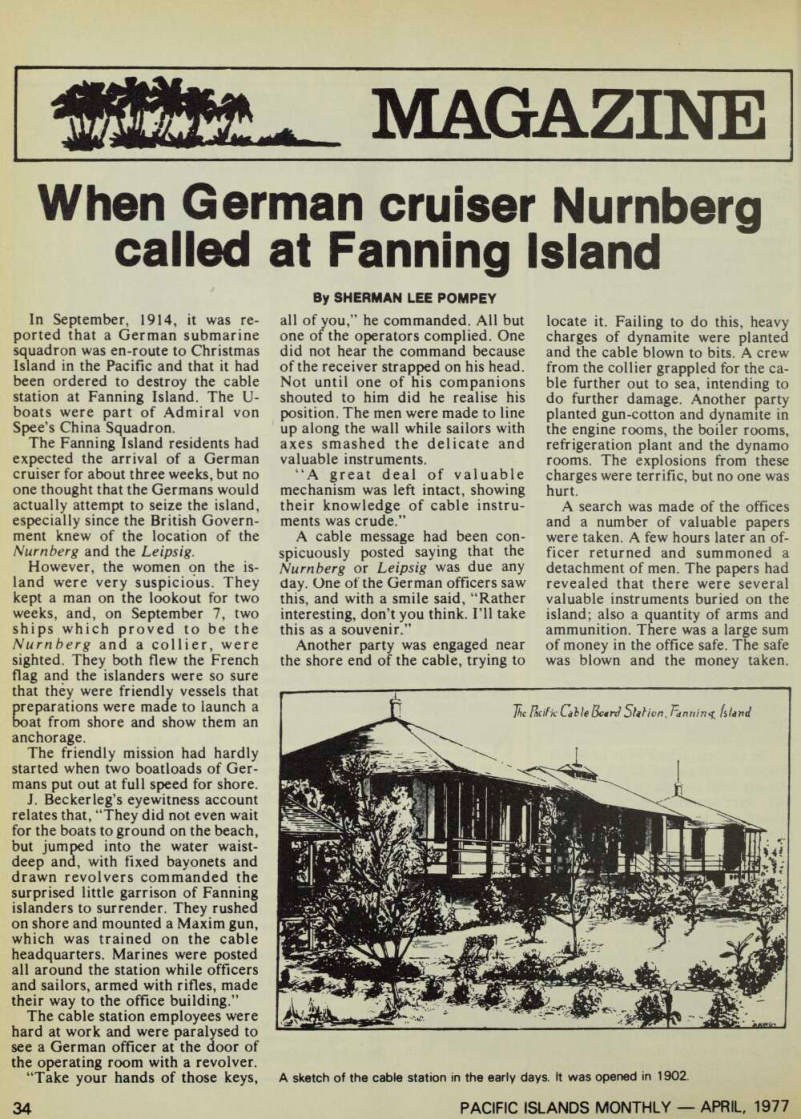
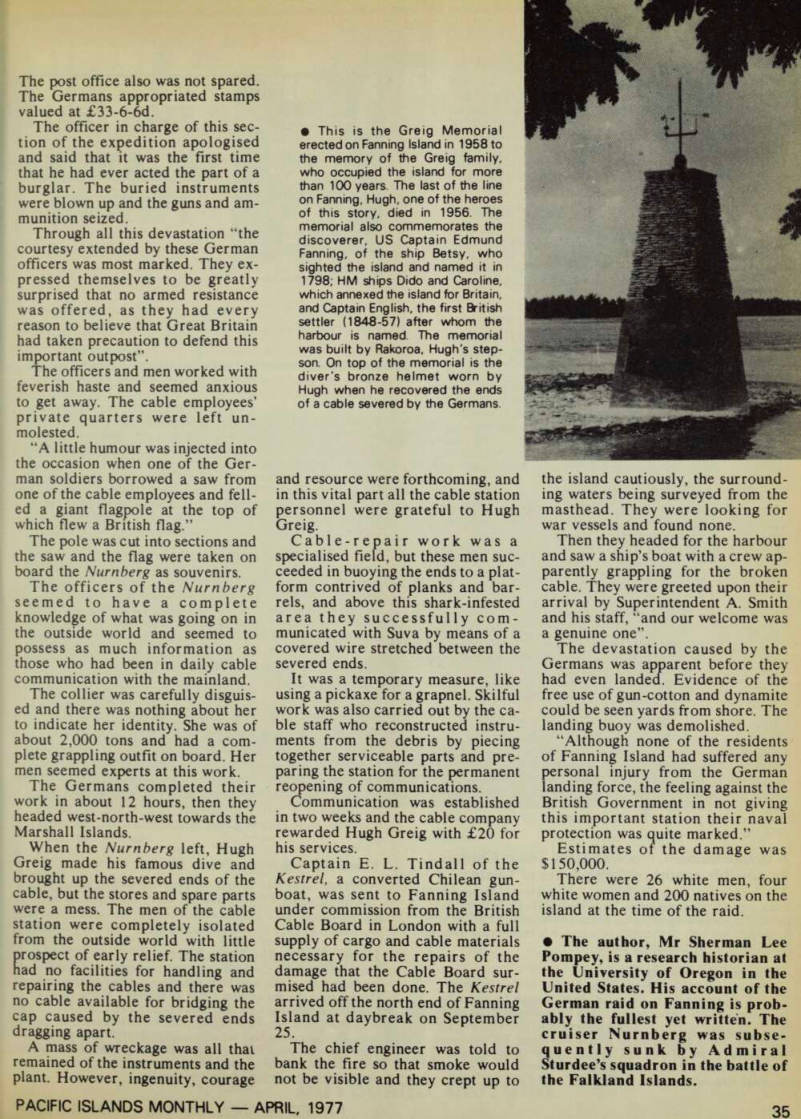
When German cruiser Nurnberg called at Fanning Island
By Sherman Lee Pompey
In September, 1914, it was re ported that a German submarine squadron was en-route to Christmas Island in the Pacific and that it had been ordered to destroy the cable station at Fanning Island. The Ü boats were part of Admiral von Spec’s China Squadron.
The Fanning Island residents had expected the arrival of a German cruiser for about three weeks, but no one thought that the Germans would actually attempt to seize the island, especially since the British Govern ment knew of the location of the Numberg and the Leipsig.
However, the women on the is land were very suspicious. They kept a man on the lookout for two weeks, and, on September 7, two ships which proved to be the Nurnberg and a collier, were sighted. They both flew the French flag and the islanders were so sure that they were friendly vessels that preparations were made to launch a boat from shore and show them an anchorage.
The friendly mission had hardly started when two boatloads of Ger mans put out at full speed for shore.
J. Beckerleg’s eyewitness account relates that, “They did not even wait for the boats to ground on the beach, but jumped into the water waist deep and, with fixed bayonets and drawn revolvers commanded the surprised little garrison of Fanning islanders to surrender. They rushed on shore and mounted a Maxim gun, which was trained on the cable headquarters. Marines were posted all around the station while officers and sailors, armed with rifles, made their way to the office building.”
The cable station employees were hard at work and were paralysed to see a German officer at the door of the operating room with a revolver.
“Take your hands of those keys,
all of you,” he commanded. All but one of the operators complied. One did not hear the command because of the receiver strapped on his head, Not until one of his companions shouted to him did he realise his position. The men were made to line up along the wall while sailors with axes smashed the delicate and valuable instruments.
“A great deal of valuable mechanism was left intact, showing their knowledge of cable instruments was crude.”
A cable message had been conspicuously posted saying that the Nurnberg or Leipsig was due any day. One of the German officers saw this, and with a smile said, “Rather interesting, don’t you think. I’ll take this as a souvenir.”
Another party was engaged near the shore end of the cable, trying to
locate it. Failing to do this, heavy charges of dynamite were planted and the cable blown to bits. A crew from the collier grappled for the ca ble further out to sea, intending to do further damage. Another party planted gun-cotton and dynamite in the engine rooms, the boiler rooms, refrigeration plant and the dynamo rooms. The explosions from these charges were terrific, but no one was hurt.
A search was made of the offices and a number of valuable papers were taken. A few hours later an of ficer returned and summoned a detachment of men. The papers had revealed that there were several valuable instruments buried on the island; also a quantity of arms and ammunition. There was a large sum of money in the office safe. The safe was blown and the money taken.
A sketch of the cable station in the early days. It was opened in 1902.
The post office also was not spared.
The Germans appropriated stamps valued at £33-6-6d.
The officer in charge of this sec tion of the expedition apologised and said that it was the first time that he had ever acted the part of a burglar. The buried instruments were blown up and the guns and am munition seized.
Through all this devastation “the courtesy extended by these German officers was most marked. They ex pressed themselves to be greatly surprised that no armed resistance was offered, as they had every reason to believe that Great Britain had taken precaution to defend this important outpost”.
The officers and men worked with feverish haste and seemed anxious to get away. The cable employees’ private quarters were left un molested.
“A little humour was injected into the occasion when one of the Ger man soldiers borrowed a saw from one of the cable employees and fell ed a giant flagpole at the top of which flew a British flag.”
The pole was cut into sections and the saw and the flag were taken on board the Nurnberg as souvenirs.
The officers of the Nurnberg seemed to have a complete knowledge of what was going on in the outside world and seemed to possess as much information as those who had been in daily cable communication with the mainland.
The collier was carefully disguis ed and there was nothing about her to indicate her identity. She was of about 2,000 tons and had a com plete grappling outfit on board. Her men seemed experts at this work.
The Germans completed their work in about 12 hours, then they headed west-north-west towards the Marshall Islands.
When the Nurnberg left, Hugh Greig made his famous dive and brought up the severed ends of the cable, but the stores and spare parts were a mess. The men of the cable station were completely isolated from the outside world with little prospect of early relief. The station had no facilities for handling and repairing the cables and there was no cable available for bridging the cap caused by the severed ends
dragging apart.
A mass of wreckage was all that remained of the instruments and the plant. However, ingenuity, courage
and resource were forthcoming, and in this vital part all the cable station personnel were grateful to Hugh Greig.
Cable-repair work was a specialised field, but these men suc ceeded in buoying the ends to a plat form contrived of planks and bar rels, and above this shark-infested area they successfully com municated with Suva by means of a covered wire stretched between the severed ends.
It was a temporary measure, like using a pickaxe for a grapnel. Skilful work was also carried out by the ca ble staff who reconstructed instru ments from the debris by piecing together serviceable parts and pre paring the station for the permanent reopening of communications.
Communication was established in two weeks and the cable company rewarded Hugh Greig with £2O for his services.
Captain E. L. Tindall of the Kestrel, a converted Chilean gun boat, was sent to Fanning Island under commission from the British Cable Board in London with a full supply of cargo and cable materials necessary for the repairs of the damage that the Cable Board sur mised had been done. The Kestrel arrived off the north end of Fanning Island at daybreak on September 25.
The chief engineer was told to bank the fire so that smoke would not be visible and they crept up to
the island cautiously, the surround ing waters being surveyed from the masthead. They were looking for war vessels and found none.
Then they headed for the harbour and saw a ship’s boat with a crew ap parently grappling for the broken cable. They were greeted upon their arrival by Superintendent A. Smith and his staff, “and our welcome was a genuine one”.
The devastation caused by the Germans was apparent before they had even landed. Evidence of the free use of gun-cotton and dynamite could be seen yards from shore. The landing buoy was demolished.
“Although none of the residents of Fanning Island had suffered any personal injury from the German landing force, the feeling against the British Government in not giving this important station their naval protection was quite marked.”
Estimates of the damage was $150,000.
There were 26 white men, four white women and 200 natives on the island at the time of the raid. • The author, Mr Sherman Lee Pompey, is a research historian at the University of Oregon in the United States. His account of the German raid on Fanning is prob ably the fullest yet written. The cruiser Nurnberg was subse quently sunk by Admiral Sturdee’s squadron in the battle of the Falkland Islands.
• This is the Greig Memorial erected on Fanning Island in 1958 to the memory of the Greig family, who occupied the island for more than 100 years. The last of the line on Fanning, Hugh, one of the heroes of this story, died in 1956. The memorial also commemorates the discoverer, US Captain Edmund Fanning, of the ship Betsy, who sighted the island and named it in 1798, HM ships Dido and Caroline, which annexed the island for Britain, and Captain English, the first British settler (1848-57) after whom the harbour is named. The memorial was built by Rakoroa, Hugh's step son. On top of the memorial is the diver's bronze helmet worn by Hugh when he recovered the ends of a cable severed by the Germans.
Press
From The
Islands
From the Cook Islands News: The Hair Cutting Ceremony of Master Poaru Poaru, son of Mr and Mrs Poaru took place at Panama at the home of his grandparents Mr and Mrs Moko Irangi. Over two hundred invited guests attended the ceremony. The four-year-old Poaru Poaru dressed in his best was seated on his beautifully decorated chair with his thirty-six plaits tied with white ribbons. After the cutting ceremony all sat down to a very delicious spread prepared by the families.
From the Papua New Guinea Post-Courier:
A man is in hospital with severe burns after a fire at Epo Plantation in the Gulf Province. Building damage is estimated at about K 15,000. Kerema police said the fire started when a plantation employee’s oil lamp ignited petrol he had rubbed on his arm and legs to keep warm. The workshop which he entered was also burned.
From an interview with departing Gunter Buczynski, former manager of the Melanesian Hotel at Lae, and his wife as reported by the
Lae Nius:
. . . They said one time they will remember easily is shortly after arriving in PNG. Only three weeks after taking over, Gunter went down to start the day only to find the place deserted.
Shortly afterwards he found his staff. They were marching up the street demonstrating in a strike for higher wages. Never having been approached by a representative of the staff with claims prior to the strike, Gunter was more than a little bewildered.
From the Arawa Bulletin: At a recent meeting of the Ba-na Community Government, members claimed that in the past there was not so much rain as there is now with the presence of Bougainville Copper. They believe the type of chemicals used by BCL for processing copper gets washed into the sea and evaporates with the water to form nimbus cloud which later gets blown back inland to bring heavy rains in the area.
From the Tohi Tala Niue: The Minister of Finance, the Hon. Robert R. Rex late last week announced that there would be an increase in the wholesale and retail price of petroleum. This was due, he said, to the increase in the bulk price of imported fuel and the devaluation of the New Zealand dollar in November, 1976. Petrol will now retail at $1.40 per gallon and diesel at $1.07 per gallon.
From The Fiji Times: The Minister for Labour, Ratu David Toganivalu, has undertaken to consider an increase in the government grant for indentured labourers and their sons and daughters who want to go back to India. Opposition member Mr Chandra Pillay complained to the House of Representatives that the $270 grant had not been increased since 1939 when it had been the cost of a one-way sea passage. The Nadi-Bombay air fare was now $768, he said.
A royal comment, reported in the Tonga Chronicle, on possible export of flying foxes to Guam: . . . His Majesty King Taufa’ahau Tupou IV said flying foxes fetch a good price in Guam. They cost US$l5 per flying fox there. The exporting of flying foxes to Guam will benefit the kingdom, not only in overseas earnings, but in reducing damage to fruit crops by the flying foxes.
From the Marianas Variety: Bill Brewer loved the islands when he was in Saipan as a Peace Corps volunteer. He loved them enough to return to Saipan to work under contract to the Environmental Protection Board at Trust Territory headquarters. But since his return in February, 1975, Bill Brewer’s Guale Rai home has been burglarised five times. He has lost nearly everything of value ...
Now he is bitter. “I still love the island”, he said .. . “But a small criminal element is spoiling life here.”
A comment by the Ysabel Council on government elections as reported in the Solomons News Drum: The members of the council disagreed with having photographs of candidates on ballot boxes because this would encourage voters to vote for candidates who were good looking and “sometimes not the best” . . .
From the Micronesian Independent: A bill that would penalise members of the Congress of Micronesia for unexcused absences was introduced in the Senate. The bill, authored by Sen John Mangefel of Yap, would amend certain sections of the TT Code relating to salaries of congress members. The amendment provides that a penalty fee of $5O a day will be assessed and deducted from the salary of any member of the Congress whose absence from any day of a regular of special session is unexcused.
From The Fiji Times: Several Suva city councillors yesterday walked out at royal visit rehearsals at Albert Park after they were seated in an uncovered pavilion. The councillors, who were non-Fijians, walked out because they felt that white cards they had been issued with entitled them to sit in the covered pavilion, where dignitaries would sit.
From “The Commonsense Corner” of New Caledonia’s France Australe: “The courts have been presented with a certain segment of society which is particularly disadvantaged: the drunkard) ' who stabbed his brother-in-law with a steel rod lived in a slum and simply sought escape in drink. In the case of infanticide in Noumea’s Latin Quarter, a young woman, poorly endowed mentally, had to face successive pregnancies and blows from her husband and make her budget meet with SAIOO per month! (sentenced to 5 years imprisonment) . . . When we speak of recession, there are many poor people who know the acuteness of it.”
From the Solomons News Drum: A strange turtle was caught off the reefs at Sikaiana recently.
The turtle, about 4 ft long and 3 ft wide, had Japanese writings on its yellow back. The fishermen caught the turtle while they were fishing. They took it home and ate it with other villagers.
From the Tuvalu News Sheet: His Excellency the Commissioner and his party had a rough time on their tour of the Southern islands . . . Most of them were thrown into the sea several times as Nivaga’s heavy two-ton workboats capsized time and time again in confused seas., . He (Commissioner Mr Tom Layng) said he only wished he could have been accompanied on this tour by representatives of the New Zealand, Australian and British aid agencies so that they could see at first hand what everyday conditions, even in fine weather, can be like in the outer islands . . .
Advertisements & other items, pp. 37-44 (2 items)
—BiMi(,i! [mail
THE NEW POWER IN THE PACIFIC
The Yamaha 40A-a compact 2-stroke, water-cooled outboard motor which Yamaha technology has moulded into the most powerful engine for its size anywhere. Conceived by professionals for professionals, its design concentrates on efficiency, economy, safety and durability. In it, tried and tested features are combined with improved and completely new ones. Larger propeller, one-piece crankshaft and heavy duty bearings, for instance. Big on power, the 40A is light on fuel consumption because its Schnurle scavenging system, new V-type reed valve intake, improved combustion chamber and new dual exhaust system add up to an engine that burns fuel more completely and cuts costs dramatically. This, plus the motor's drainless recycle system reduces exhaust pollutants to the minimum providing economy at no cost to the environment The New 40A-Very Powerful! Very YAMAHA!
YAMAHA
mwfrm
:T I I - * -- See your YAMAHA dealer for details.
Papua New Guinea Ela Motors Ltd. P. O. Box 75 Port Moresby P. N. G.
Fiji Automotive supplies Co., Ltd.
G. P. O. Box 355 Suva, Fiji Tahiti Tahiti Automoto B. P. Box 439 Papeete, Tahiti Philippines G. A Yupangco & Co., Inc P. O. Box 2020 MCC Makati Rizal Solomon Jetsa Shipping Agents Co P. O. Box 376 Honiara, Solomon Islands Norfolk Is.
Southern Cross Motors Ltd.
P. O. Box 218 Norfolk Islands South Pacific 2899 New Hebrides New Hebrides Motors Ltd.
Box 18 Vila, New Hebrides New Caledonia Roayl Motors B. P. 2548 Noumea, New Caledonia Tonga E. M. Jones Ltd. P. O. Box 34 Nuku' alofa, Tonga Island Truk Susumu's Store P. O. Box 25 Moen, Truk District Eastern Caroline Islands 96942
YAMAHA
OUTBOARD MOTORS
Central Pacific Jacob Enterprises P. O. Box 4 Republic of Nauru Central Pacific Gilbert Is.
The Teikaraoi Fishing Co., Ltd. P. O. Box 450 Betio, Tarawa Gilbert Islands Ponape Ponape Island Transportation Inc. P. O. Box 750 Kolonia, Ponape East Caroline Islands 96941
—BiMi(,i! [mail
SR-929 n. i SP-75( 1..—... : ■
' wMi
%*r * ss 101 V r I I • » ■ m m w m m t $44 9090D8
SC-30C
The prestige and pleasure of the very best The pleasures of music are too important to settle for second-best. That’s why Sansui, the hi-fi leader, now presents a complete stereo system of the highest order. Each unit is a technological masterpiece in itself. Each incorporates the most advanced technology and this is reflected in the distinguished design that confers true prestige on its owner. When you and your guests listen to the miraculous realism of this Sansui
San^uh
system, you will never be satisfied with anything less
Sansui’s superb system includes the 9090D8
FM/AM receiver—enormous power with unbeliev-
ably low distortion. Also: SR-929 quartz-servo
direct drive turntable with beautiful piano lacquered base; SC-3000 cassette deck with Dolby"; giant 5-speaker system with 16" woofer and exquisite
cypress grille.
For those who demand the very best. -TM of Dolby Lab . Inc.
Only hi-fi, everything hi-fi.
SANSUI ELECTRIC CO., LTD. 14-1 Izumi 2-chome, Suginami-ku, Tokyo, 168 Japan Australia Rank Industries Australia Pty. Ltd.
Head Office; 12 Barcoo Street. East Roseville, N.S.W. 2069 Phone; 406 5666 Melbourne: 68 Queensbridge Street. South Melbourne, Vic. 3205 Phone; 62 0031 Adelaide; Phone: 212 2555 Brisbane; Phone: 52 7333 Canberra: Phone: 95 2144 Perth; Phone; 28 3933 Papua New Guinea Oceania Indent Agency (P.N.G.) Pty. Ltd.
Box 5518, Boroko, Port Moresby Phone: PM 256406 Fiji Prabhu Brothers Ltd.
P.O. Box 183, Nadi Phone; 70183/4 New Caledonia Ets Michel MERCIER B. 1123, Noumea Phone: 27. 59. 11 New Zealand David J. Reid (N.Z.) Ltd.
C. Box 2630, Auckland. 1 Phone: 492-189 Western Samoa H.J. Keil and Company Lt P.O. Box 7. Apia Phone: 198 New Hebrides The Sound Centre P.O. Box 434, Port Vila South Pacific Miltons Department Stores Limited P.O. Box 146, Norfolk Island 2899 Central Pacific Nauru Co-operative Society Republic of Nauru Cook Islands United Island Traders Ltd P.O. Box 1 & 2. Rarotonga
Just a few of the searching tests a Mazda has to pass before it ever goes into production. Many more follow, both during manufacture and after. The result. Superior, high-quality products. Cars like the Mazda 808.
A car that you can own and drive with confidence. Because Mazdas are made right. Right from the beginning.
The Climatic Testing Laboratories Here a range of driving conditions can be simulated, from stop-start city driving to sustained high-speed highway running. The tests are conducted in a wide range of temperatures and under different atmospheric conditions. So you can be sure your Mazda will be expertly tuned to run smoothly in the country where you live.
Body Testing Laboratories This is one of the facilities that crash tests our car bodies. Impact and torsional effects can be accurately measured by computers simulating collisions at 30-60 m.p.h. Dummies electronically wired tell us what happens to passengers—and as a result—provide our design engineers with valuable information about the safest interiors and bodies.
Tests such as these helped us to design the light, crash resistant, semimonocoque body found on all Mazda passenger cars.
Sound Testing Laboratories Nobody likes noise. Least of all Mazda.
That’s why we are working hard to make our cars quieter —from the outside and the inside. The car below is in our anechoic test chamber. Here the whole car is subjected to vibration through a machine that creates a variety of different shakes and thumps.
Ultra-sensitive microphones pick up every sound made, then amplifies it for thorough analysis. This way we can get rid of excessive noise and vibration before they annoy you and your passengers.
V Quality through superior technology FIJI ISLANDS Nlranjans Autoport Ltd. G.P.O. Box 450, Suva TEL: 22691 NEW CALEDONIA Soci6t£ Riviere el Bernanos 27, Rue de Sebastopol. Noumea PAPUA NEW GUINE P.N.G. Associated Industries Ltd. P.O. Box 1394, Boroko TEL: 255788 NEW ZEALAND Mazda Motors ol New Zealand Ltd. Otahuhu, Auckland. P.O. Box 22-472 TEL: 69-099 NORFOLK Duncombe Bay Garage P.O. Box 220, Norfolk Island TEL: 2097 8.5.1 f Solomon Motors Ltd. P.O. Box 20, Honiara TEL: 313 TAHIT Comptolr Polynesian B P 628, Papeete The trademark MAZDA in this advertisement stands for AUTOMOBILES MAZDA as far as France and her territories are concerned.
I m
NAS
. .- - ' to i a
i ii
m »w iU ■, w tmm
i zmm
m. m 5% /.. Bfl That's what the u.S. Environmental Protection Agency figures show. The Honda Civic placed first among the hundreds of 1976 cars tested. On the highway, in the city and in combined driving situations.
Top fuel economy is just the start. All-round operating costs are equally low. Thanks t( a rugged, clean-burning OHC engine which delivers snappy acceleration. Elegance is second to none—both inside and out.
Famous Honda engineering also gives you: Enough roomy comfort to relax four adults A spacious trunk. Exceptional handling ease. A dual braking system featuring servo-assisted front disc brakes, independent strut suspensions.
All of this quality performance is yours in three exciting models-the 2-Door Sedan, 4-Door Sedan and Hatchback.
Own the 1976 economy champ-the Honda Civic.
HONDA
HONDA MOTOR CO.. LTD. TOKYO, JAPAN
PAPUA NEW GUINEA: Steamships-Machinery P.O. Box 1, Port Moresby/TAHITI: Societe Tahitienne d’lmportation des Produits Honda B.P. 1665-Papeete/FIJI ISLANDS: Coral Island Motors P.O. Box 48, Suva/U.S. TRUST TERRITORY: United Micronesia Development Assn. P.O. Box 238, Saipan, Mariana Islands 96950/COOK ISLANDS: Cook Islands Motor Center Ltd. P.O. Box 74, Rarotonga/ AMERICAN SAMOA: Samoan Holiday and Travel Center P.O. Box 968. Pago Pago/AMERICAN SAMOA: Haleck’s Service Center P.O. Box 1138, Pago Pago/GUAM: Mark’s Motor Co., Inc. P.O. Box DV. Agana / WESTERN SAMOA: Motor Distributors (Samoa) Ltd. P.O. Box 576, Apia/SOLOMON ISLANDS: British Solomons Trading Co.. Ltd. P.O. Box 114, Honiara/NEW CALEDONIA: Establissements Ballande Boite Postale No. C 4 Noumea Cedex/TONGA: E.M. Jones Limited P.O. Box 34, Nuku'alofa/TARAWA: Gilbert & Ellice Islands Development Authority P.O. Box 488, Beito/NIUE ISLAND: S. Jessop & Sons Ltd. P.O. Box 71.
Alofi South/NAURU: Nauru Cooperative Society, Republic of Nauru, Nauru Island Central Pacific/NEW HEBRIDES: Tropex International Ltd., P.O. Box 139, Port Vila.
Seiko
Another Achievement of Seiko Quartz Technology.
The Ultra-Thin Seiko Quartz.
It Combines Slim Elegance with the Accuracy Only Quartz Can Offer, / Ml / \ *
SEIKO
s w § / s. iv 0 1 Seiko was first to reduce the quartz principle to true wrist size and to market a quartz watch. That's why Seiko can create a quartz this thin and elegant. Seiko's expertise in every phase of watchmaking means Seiko can make any part of any watch, for impeccable quality control.
Seiko makes quartz watches with traditional analog faces and with the LC digital readout. No matter which Seiko Quartz you select, you get the watch that's changing the world's standard of accuracy. Seiko Quartz.
SEIKO
Someday all watches will be made this way.
any gas, anywhere, any time.
<r l % V .' • i m % * - § * »** ,r j s* !
CIG
THE COMMONWEALTH INDUSTRIAL GASES LIMITED,
GASES EXPORT DEPARTMENT, 138 BOURKE ROAD, ALEXANDRIA, N.S.W.,
AUSTRALIA 2015. CABLES “CIGAS”—TELEX AA25475 SYDNEY.
■C/G NEW GUINEA PTV.LIMITED. Lae; Mangola Street, LAE (P.O. Box 93). Phone 2641 Port Moresby. Racecourse Road, Hohola (P.O. Box 1636 Boroko) Phone 53870.
■ THAI INDUSTRIAL GASES LIMITED, Bangkok:
22/26 Poochaosmingprai Road, Prapradaeng, Smutprakarn.
Phone 940708. Telex AMCO TH 2541. ■ C/G FIJI LIMITED, Suva; Vetaia Street, Lami (P.O. Box 687).
Phone 361011. Lautoka: Vitogo Parade (P.O. Box 601). Phone 61105.
♦ASSOCIATED COMPANIES
■ P.T. INDUSTRIAL GASES, INDONESIA, DJAKARTA:
P.O. Box 124/JNG, Pulo Gadung. ■ HONG KONG OXYGEN AND ACETYLENE CO. LTD.
Hong Kong: 41 G Ma Tau Wei Road, Kowloon. ■ SOXAL P.O. Box 241, Singapore, Telex 21150.
■ NEW ZEALAND INDUSTRIAL GASES LIMITED,
Wellington: P.O. Box 30337, Lower Hutt, Wellington, N.Z.
■ MALAYAN OXYGEN SDN BERHAD,
Box 633 P.O. Kuala Lumpur. Malaysia.
•**#o -V- -\A Mi 55 %m ft 4 > L W i* w V . I i r * % 4; • f r / J 1 :F i ...
Gold and purple patches in
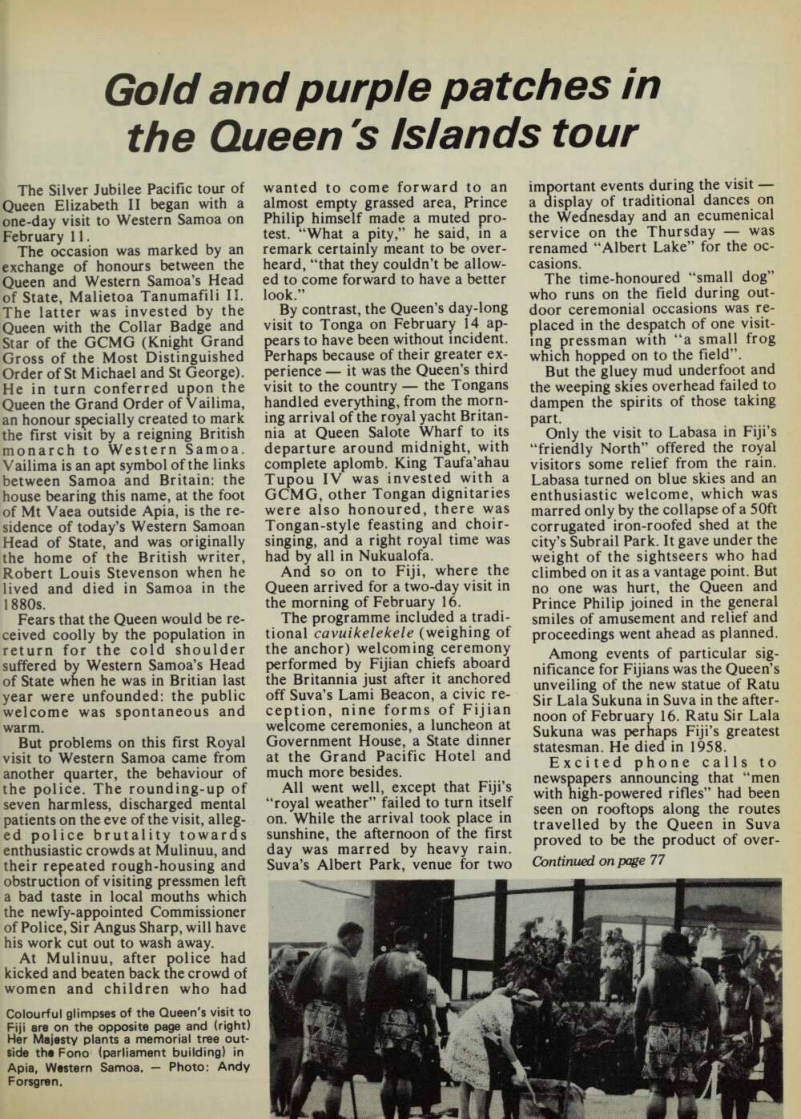
the Queen's Islands tour
The Silver Jubilee Pacific tour of Queen Elizabeth II began with a one-day visit to Western Samoa on February 11.
The occasion was marked by an exchange of honours between the Queen and Western Samoa’s Head of State, Malietoa Tanumafili 11.
The latter was invested by the Queen with the Collar Badge and Star of the GCMG (Knight Grand Gross of the Most Distinguished Order of St Michael and St George).
He in turn conferred upon the Queen the Grand Order of Vailima, an honour specially created to mark the first visit by a reigning British monarch to Western Samoa.
Vailima is an apt symbol of the links between Samoa and Britain: the house bearing this name, at the foot of Mt Vaea outside Apia, is the re sidence of today’s Western Samoan Head of State, and was originally the home of the British writer, Robert Louis Stevenson when he lived and died in Samoa in the 1880 s.
Fears that the Queen would be re ceived coolly by the population in return for the cold shoulder suffered by Western Samoa’s Head of State when he was in Britian last year were unfounded: the public welcome was spontaneous and warm.
But problems on this first Royal visit to Western Samoa came from another quarter, the behaviour of the police. The rounding-up of seven harmless, discharged mental patients on the eve of the visit, alleg ed police brutality towards enthusiastic crowds at Mulinuu, and their repeated rough-housing and obstruction of visiting pressmen left a bad taste in local mouths which the newfy-appointed Commissioner of Police, Sir Angus Sharp, will have his work cut out to wash away.
At Mulinuu, after police had kicked and beaten back the crowd of women and children who had Colourful glimpses of the Queen's visit to Fiji are on the opposite page and (right) Her Majesty plants a memorial tree out side the Fono (parliament building) in Apia, Western Samoa. Photo: Andy Forsgren.
wanted to come forward to an almost empty grassed area, Prince Philip himself made a muted pro test. “What a pity,” he said, in a remark certainly meant to be over heard, “that they couldn’t be allow ed to come forward to have a better look.”
By contrast, the Queen’s day-long visit to Tonga on February 14 ap pears to have been without incident.
Perhaps because of their greater ex perience it was the Queen’s third visit to the country the Tongans handled everything, from the morn ing arrival of the royal yacht Britan nia at Queen Salote Wharf to its departure around midnight, with complete aplomb. King Taufa’ahau Tupou IV was invested with a GCMG, other Tongan dignitaries were also honoured, there was Tongan-style feasting and choir singing, and a right royal time was had by all in Nukualofa.
And so on to Fiji, where the Queen arrived for a two-day visit in the morning of February 16.
The programme included a tradi tional cavuikelekele (weighing of the anchor) welcoming ceremony performed by Fijian chiefs aboard the Britannia just after it anchored off Suva’s Lami Beacon, a civic re ception, nine forms of Fijian welcome ceremonies, a luncheon at Government House, a State dinner at the Grand Pacific Hotel and much more besides.
All went well, except that Fiji’s “royal weather” failed to turn itself on. While the arrival took place in sunshine, the afternoon of the first day was marred by heavy rain.
Suva’s Albert Park, venue for two
important events during the visit a display of traditional dances on the Wednesday and an ecumenical service on the Thursday was renamed “Albert Lake” for the oc casions.
The time-honoured “small dog” who runs on the field during out door ceremonial occasions was re placed in the despatch of one visit ing pressman with “a small frog which hopped on to the field”.
But the gluey mud underfoot and the weeping skies overhead failed to dampen the spirits of those taking part.
Only the visit to Labasa in Fiji’s “friendly North” offered the royal visitors some relief from the rain.
Labasa turned on blue skies and an enthusiastic welcome, which was marred only by the collapse of a 50ft corrugated iron-roofed shed at the city’s Subrail Park. It gave under the weight of the sightseers who had climbed on it as a vantage point. But no one was hurt, the Queen and Prince Philip joined in the general smiles of amusement and relief and proceedings went ahead as planned.
Among events of particular sig nificance for Fijians was the Queen’s unveiling of the new statue of Ratu Sir Lala Sukuna in Suva in the after noon of February 16. Ratu Sir Lala Sukuna was perhaps Fiji’s greatest statesman. He died in 1958.
Excited phone calls to newspapers announcing that “men with high-powered rifles” had been seen on rooftops along the routes travelled by the Queen in Suva proved to be the product of over-
Continued on page 77
The Day That Lunched
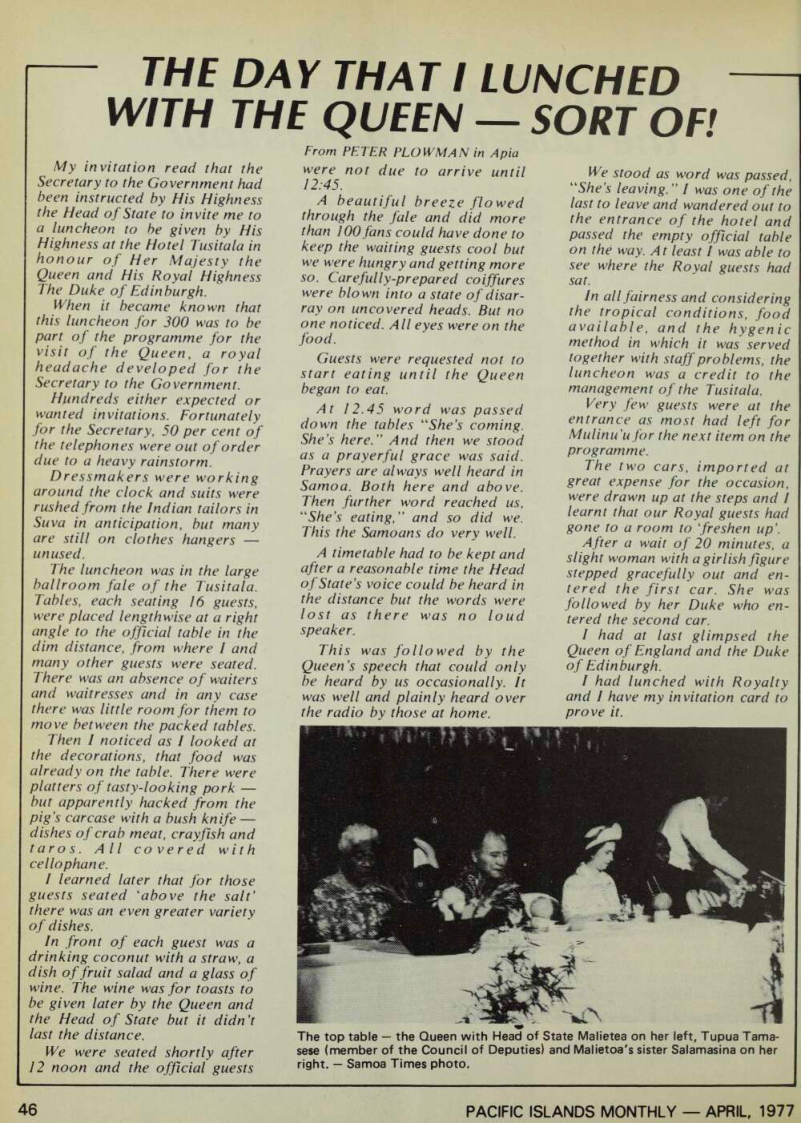
With The Queen Sort Of!
From PETER PLOWMAN in Apia
My invitation read that the Secretary to the Government had been instructed by His Highness the Head of State to invite me to a luncheon to be given by His Highness at the Hotel Tusitala in honour of Her Majesty the Queen and His Royal Highness The Duke of Edinburgh.
When it became known that this luncheon for 300 was to be part of the programme for the visit of the Queen, a royal headache developed for the Secretary to the Government.
Hundreds either expected or wanted invitations. Fortunately for the Secretary, 50 per cent of the telephones were out of order due to a heavy rainstorm.
Dressmakers were working around the clock and suits were rushed from the Indian tailors in Suva in anticipation, but many are still on clothes hangers unused.
The luncheon was in the large ballroom fale of the Tusitala.
Tables, each seating 16 guests, were placed lengthwise at a right angle to the official table in the dim distance, from where I and many other guests were seated.
There was an absence of waiters and waitresses and in any case there was little room for them to move between the packed tables.
Then I noticed as I looked at the decorations, that food was already on the table. There were platters of tasty-looking pork but apparently hacked from the pig's carcase with a bush knife dishes of crab meat, crayfish and taros. All covered with cellophane.
I learned later that for those guests seated ‘above the salt' there was an even greater variety of dishes.
In front of each guest was a drinking coconut with a straw, a dish of fruit salad and a glass of wine. The wine was for toasts to be given later by the Queen and the Head of State but it didn’t last the distance.
We were seated shortly after 12 noon and the official guests
were not due to arrive until 12:45.
A beautiful breeze flowed through the fale and did more than 100 fans could have done to keep the waiting guests cool but we were hungry and getting more so. Carefully-prepared coiffures were blown into a state of disarray on uncovered heads. But no one noticed. All eyes were on the f°°d- Guests were requested not to start eating until the Queen began to eat.
At 12.45 word was passed down the tables “She’s coming.
She’s here.’’ And then we stood as a prayerful grace was said.
Prayers are always well heard in Samoa. Both here and above.
Then further word reached us, “ She’s eating,’’ and so did we.
This the Samoans do very well. . . ... . , , .
A timetable had to be kept and a f<i r a reaso fable time the Head oj States voice could be heard in the distance but the words were lost as there was no loud speaker.
This was followed by the Queen’s speech that could only be heard by us occasionally. It was well and plainly heard over the radio by those at home.
We stood as word was passed, “ She’s leaving. ” I was one of the last to leave and wandered out to the entrance of the hotel and passed the empty official table on the way. At least I was able to see where the Royal guests had sat.
In all fairness and considering the tropical conditions, food available, and the hygenic method in which it was served together with staff problems, the luncheon was a credit to the management of the Tusitala.
Very ? ew quests were at the e J] tr ,? nc , e ? s ™ ost dad left for Muhnu u for the next item on the programme. ™ e two cars, imported at great expense for the occasion, were drawn up at the steps and I learnt that our Royal guests had gone to a room to freshen up .
After a wait of 20 minutes, a slight woman with a girlish figure stepped gracefully out and en tered the first car. She was followed by her Duke who en tered the second car. / ad at i ast gH m p Sec ( the Queen of England and the Duke of Edinburgh, I had lunched with Royalty and I have my invitation card to prove it.
The top table the Queen with Head of State Malietea on her left, Tupua Tama sese (member of the Council of Deputies) and Malietoa's sister Salamasina on her right. Samoa Times photo.
history, by those
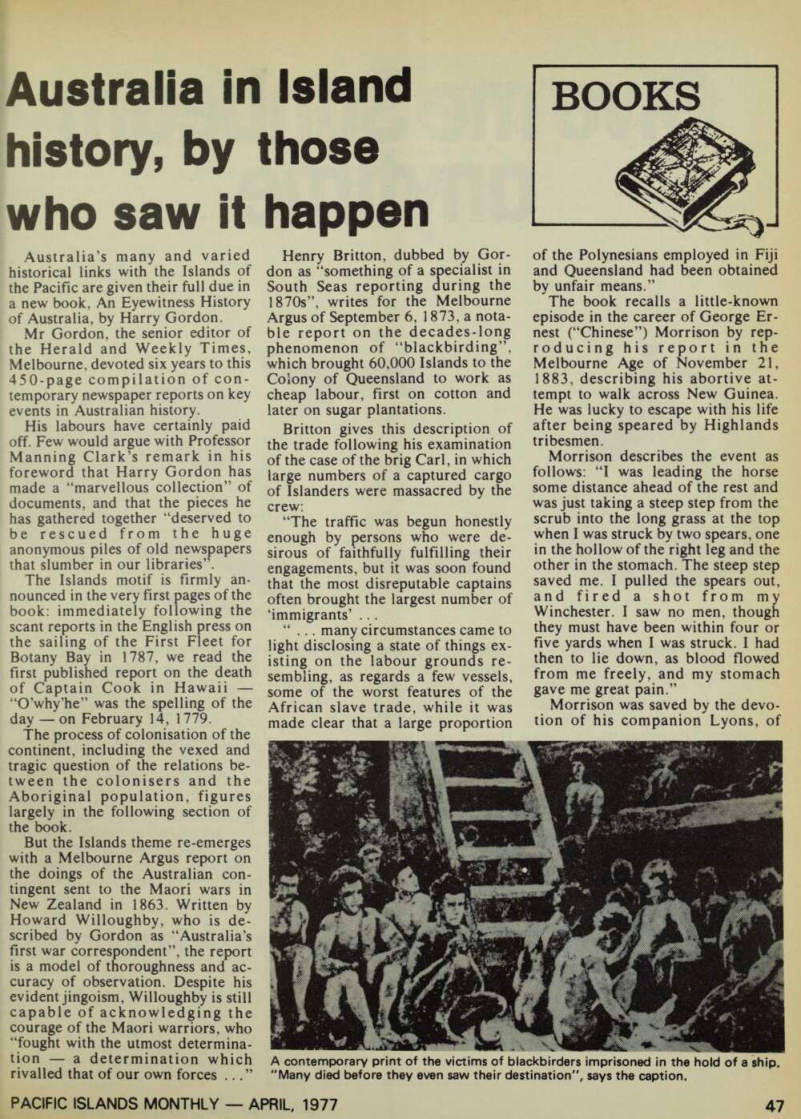

Books
Australia in Island history, by those who saw it happen
Australia’s many and varied historical links with the Islands of the Pacific are given their full due in a new book, An Eyewitness History of Australia, by Harry Gordon.
Mr Gordon, the senior editor of the Herald and Weekly Times, Melbourne, devoted six years to this 450-page compilation of con temporary newspaper reports on key events in Australian history.
His labours have certainly paid off. Few would argue with Professor Manning Clark’s remark in his foreword that Harry Gordon has made a “marvellous collection” of documents, and that the pieces he has gathered together “deserved to be rescued from the huge anonymous piles of old newspapers that slumber in our libraries”.
The Islands motif is firmly an nounced in the very first pages of the book: immediately following the scant reports in the English press on the sailing of the First Fleet for Botany Bay in 1787, we read the first published report on the death of Captain Cook in Hawaii “O’why’he” was the spelling of the day —on February 14, 1779.
The process of colonisation of the continent, including the vexed and tragic question of the relations be tween the colonisers and the Aboriginal population, figures largely in the following section of the book.
But the Islands theme re-emerges with a Melbourne Argus report on the doings of the Australian con tingent sent to the Maori wars in New Zealand in 1863. Written by Howard Willoughby, who is de scribed by Gordon as “Australia’s first war correspondent”, the report is a model of thoroughness and ac curacy of observation. Despite his evident jingoism, Willoughby is still capable of acknowledging the courage of the Maori warriors, who “fought with the utmost determina tion a determination which rivalled that of our own forces ..
Henry Britton, dubbed by Gordon as “something of a specialist in South Seas reporting during the 1870 s”, writes for the Melbourne Argus of September 6, 1873, a notable report on the decades-long phenomenon of “blackbirding”. which brought 60,000 Islands to the Colony of Queensland to work as cheap labour, first on cotton and later on sugar plantations.
Britton gives this description of the trade following his examination of the case of the brig Carl, in which large numbers of a captured cargo of Islanders were massacred by the crew “The traffic was begun honestly enough by persons who were desirous of faithfully fulfilling their engagements, but it was soon found that the most disreputable captains often brought the largest number of ‘immigrants’ ...
“ ... many circumstances came to light disclosing a state of things existing on the labour grounds resembling, as regards a few vessels, some of the worst features of the African slave trade, while it was made clear that a large proportion
of the Polynesians employed in Fiji and Queensland had been obtained by unfair means.”
The book recalls a little-known episode in the career of George Er nest (“Chinese”) Morrison by rep reducing his report in the Melbourne Age of November 21, 1883, describing his abortive at tempt to walk across New Guinea, He was lucky to escape with his life after being speared by Highlands tribesmen.
Morrison describes the event as follows: “I was leading the horse some distance ahead of the rest and was just taking a steep step from the scrub into the long grass at the top when I was struck by two spears, one in the hollow of the right leg and the other in the stomach. The steep step saved me. I pulled the spears out, an d fired a shot from my Winchester. I saw no men, though they must have been within four or five yards when I was struck. I had then to lie down, as blood flowed from me freely, and my stomach B av e me great pain.”
Morrison was saved by the devo tion of his companion Lyons, of
A contemporary print of the victims of blackbirders imprisoned in the hold of a ship.
"Many died before they even saw their destination", says the caption.
whom he says: “But for his mar vellous stamina I should now be rot ting in the New Guinea bush.” And, it should be added, the world would never have heard of “Chinese” Mor rison, since he would never have got to China as the London Times cor respondent in Peking.
Sydney Morning Herald corres pondent, Fritz Burnell provides a first-hand account of the capture of Rabaul, the “new capital” of Ger man New Guinea, with his report printed on October 8, 1914.
The first flight across the Pacific Ocean by Charles Kingsford Smith and three companions in the Southern Cross is recalled with a splendid report of Smithy’s welcome at Brisbane’s Eagle Farm airport written by journalist Clem Lack (Courier-Mail, June 11, 1928).
The names of the journalists who figure in Gordon’s book as reporters of the fighting in New Guinea dur ing the Second World War read rather like an honour roll of Australian journalism in the 19405.
George Johnston reports vividly for the Melbourne Argus on Port Moresby in 1942, as the city waited for the invasion that never came.
Osmar White describes in the Melbourne Sun News-Pictorial (April 7, 1942) the heroism of five RAAF Wirraway pilots in Rabaul who put up what they knew to be a virtually suicidal resistance to the invading Japanese air force.
Geoffrey Hutton analyses in the Melbourne Argus (21 August, 1942) the special features of the fighting in New Guinea it was not only Australia versus Japanese, he pointed out, it was also man against nature. Allan Dawes (Melbourne Herald, September 7 and 29) de scribes with characteristic wit and flair the landing of the Ninth Divi sion, AIF, at Lae in that month the first opposed landing from the sea by an Australian force since the Anzacs disembarked at Gallipoli 28 years before.
Of course there is much more to Gordon’s book than all this. It sets out to be the story of Australia and the Australian people recorded as it happened by people who saw it hap pen. For Australians it has a special appeal. For non-Australians it is loaded with new insights into events that shaped the country into what it is today. Malcolm Salmon. (AN EYEWITNESS HISTORY OF AUSTRALIA. By Harry Garfaa. Pablithad by Rifby Ltd. 30 North Tarraca, Kaat Town. SA. *13.95.)
Advertisements & other items, p. 48 (1 item)
anytime
Give me Sunbeam
i I Sunbeam Whistling Kettle.
A 2.3 litre Stainless Steel kettle that boils the water while you get the cups, then whistles for you when it's ready. Safety cut-out turns the kettle off automatically if the water boils dry. Available in Sunset Red, Harvest Gold or polished finishes.
Sunbeam Beatermix Mixer with Burst of Power*.
The little mixer with lots of muscle.
Three mixing speeds plus an extra power burst at the touch of a button, on all speeds, for heavy mixing jobs. Buy it as a hand mixer, or with stand and two bowls.
Sunbeam Toasta Magic* Toaster.
The automatic toaster that gives Sunbeam quality at a price anyone can afford. Colour co-ordinated in Sunset Red, Harvest Gold and Chrome. Also the Sunbeam 4-Slice Toaster for big families and the breakfast rush., .4 slices of toast, cooked Just the way you like atone time. Automatically. In Harvest Gold, Sunset Red and Chrome.
Sunbeam Spray/Shot-of-Steam Iron.
Ifs a spray iron, it's a shot-ofsteam iron, ifs a steam iron, ifs a dry iron, and it has the Sunbeam self-cleaning action as well. 55 steam holes, see-through waterlevel guage. Sunbeam safety heel rest, cool white handle.
Quality and service youVe learnt to trust "Registered trademark of Sunbeam Corporation Ltd.
L 85.8761
is a little out of step
The ' Dance in the Pacific' is a little out of step
There is a dearth of books on the arts of the Pacific, particularly the art of dance, therefore, every book on this subject is looked to with eagerness, Unfortunately, The Dance in the Pacific by W.A. Poort adds very little to the information about the subject, Its statements are in many cases oversimplifications and too general, while it gives a strong impression of limited first-hand knowledge of the subject of dance That The Dance in the Pacific valiantly tries to trace the origins of Pacific dance to the Indonesian Islands is in itself praiseworthy since a number of scientists among others, archaeologists, through such finds as Lapita potter and other artifacts, and linguists, through Austronesian language studies now suggest that the nest of origin and travels of the three racial groups, Polynesian, Melanesian, Micronesian, are very possibly from and through South- East Asia.
That this book suffers from too great a number of generalisations is seen, for example, in the use of the word ‘Polynesian’. It appears, from Mr Poort’s arguments, that what he seems to mean by that word is the culture developed in the French Society Islands and in particular in ancient times, since many of the circular pattern dances he shows in diagrams
and in discussions along the way have long since disappeared from Tahiti.
Broad statements such as, “Dances in a single circle are performed all over Polynesia” (p 29) are misleading because in today’s expression of dance in, say, the Manihiki, Atiu, Mangaia, Rarotonga islands of the Cook group, or Niue, or Tonga, or New Zealand, circle dances are so rare as to seem to be almost non-existent.
In reading The Dance in the Pacific one wonders at the lack of life, at the absence of human contact situations.
The book gives the impressions of a work prepared second-hand and at a great distance from Pacific sources.
There are also too many editorial and grammatical errors and it is dismay ing to find spelling mistakes cropping up all through the book.
One must question many points made in the book. On page 29, the following quote is quite untenable: “Dances in various frontal lines behind each other are widespread as well in Polynesia as in Micronesia, but are lacking in Rarotonga, the Tuamotus, the Tubuai Archipelago, the I les Gambler and New Zealand. ” (The italics are mine.) Both in Rarotonga and New Zealand dancers do stand in lines one behind the other in action songs, in Rarotonga for drum dances, and in New Zealand for both poi dances and haka war dances and on page 52, “Stamping dances are scarce in Polynesia”. Niue, Tonga, Samoa and New Zealand all have dances in which stamping is included. One could use numerous other such examples from this book.
Mr Poort’s effort points to a direc tion where much work remains to be done. It has a value from that point of view for the knowledgeable dance oriented ethnologist but not for lay beginners. Unfortunately, he has not achieved the very worthwhile aim he set for himself nor has he added anything significant to the quote he uses in the preface, from Helen H.
Roberts.
Referring to dance she says, “I can merely indicate that there lies an almost untouched field for in vestigation”. Fifty years later that statement remains just as true as it was in 1926. Victor Carell. (THE DANCE IN THE PACIFIC. By W.A. Poor!. Publish ed by Van Der Lee Press, Katwijk, Netherlands, No price indicated.)
Advertisements & other items, pp. 49-50 (2 items)
New Pacific Islands
YEAR BOOK
The 12th edition of the Pacific Islands Year Book the first since 1972 is now available.
It has been completely rewritten and reset, with new maps including a large, up-to-theminute coloured fold-out map of the islands of the Pacific.
The Pacific Islands Year Book is to be produced annually in future.
Readers can order the 12th edition by filling in the mail order coupon bound into this issue, or by writing direct to the publishers. Pacific Publications (Aust) Pty. Ltd., Box 3408 GPO, Sydney. The 430 page Year Book is SAIB posted.
We're working the Pacific
with a Cat Marine Diesel.
sa ss.
"Loloho” - General purpose Harbour tug boat. Operated by Bougainville Copper Limited at Bougainville. Overall length 50 ft. (15.24 m). Powered by a Caterpillar D 343 Marine Engine.
"MV. Kaunitoni” - An Inter-Island freighter. Operated by the Fiji Government. Overall length 134.3 ft. Displacement 628 tons. Speed 10 knots. Powered by a Caterpillar D 379.
Hastings Oeerlng (Pacific) Ltd.and Carpenters Tractors cover the Pacific Islands waterfront with Cat. Marine Service and Parts.
Hastings Deering (Pacific) at Lae, Port Moresby and Bougainville and Carpenters Tractors at Suva are staffed by Caterpillar-trained technicians.
Working the Pacific waterfront day after day, year, after year, you depend on reliable horsepower and first class dealer-support. You get it with a Cat Marine Diesel, Hastings Deering (Pacific) and Carpenters Tractors.
While there's a Cat Marine Diesel in your craft you're backed up with Cat Plus, the total support programme offered only by your Caterpillar dealer.
Your local Hastings Deering (Pacific) or Carpenters Tractors dealer backs your Cat Marine Diesel engine with parts and service programmes designed to prevent, as well as shorten profitrobbing downtime.
Caterpillar Dealers in South-West Pacific.
Lae; Milford Haven Road, 154 Queens Road, Suva.
Ph: 42 2355 Ph: 24 051-4, Port Moresby; Champion Cables: Carptrac Suva.
Parade, Konedobu Ph: 24 3138 Telex: Carptrac FJ2191 Suva, or 24 2098.
Bougainville: Itakara.
Industrial Park, Arawa, Ph: 95 9077 Caterpillar. Cat and CB are trademarks ol Caterpillar Tractor Co.
HASTINGS DEERING
HD6I4
McAuley, poet of the Pacific
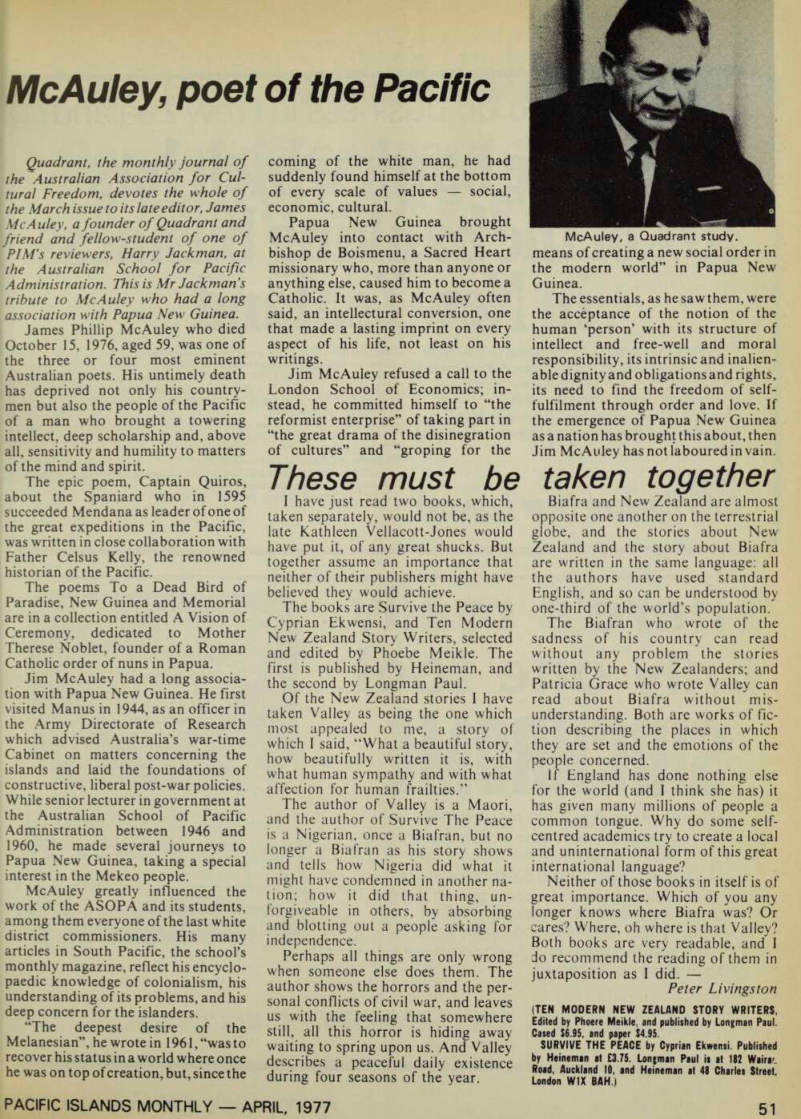
Quadrant, the monthly journal of the Australian Association for Cul tural Freedom, devotes the whole of the March issue to its late editor, James McAuley, a founder of Quadrant and friend and fellow-student of one of PlM’s reviewers, Harry Jackman, at the Australian School for Pacific Administration. This is Mr Jackman’s tribute to McAuley who had a long association with Papua New Guinea.
James Phillip McAuley who died October 15, 1976, aged 59, was one of the three or four most eminent Australian poets. His untimely death has deprived not only his country men but also the people of the Pacific of a man who brought a towering intellect, deep scholarship and, above all, sensitivity and humility to matters of the mind and spirit.
The epic poem, Captain Quiros, about the Spaniard who in 1595 succeeded Mendana as leader of one of the great expeditions in the Pacific, was written in close collaboration with Father Celsus Kelly, the renowned historian of the Pacific.
The poems To a Dead Bird of Paradise, New Guinea and Memorial are in a collection entitled A Vision of Ceremony, dedicated to Mother Therese Noblet, founder of a Roman Catholic order of nuns in Papua.
Jim McAuley had a long associa tion with Papua New Guinea. He first visited Manus in 1944, as an officer in the Army Directorate of Research which advised Australia’s war-time Cabinet on matters concerning the islands and laid the foundations of constructive, liberal post-war policies.
While senior lecturer in government at the Australian School of Pacific Administration between 1946 and 1960, he made several journeys to Papua New Guinea, taking a special interest in the Mekeo people.
McAuley greatly influenced the work of the ASOPA and its students, among them everyone of the last white district commissioners. His many articles in South Pacific, the school’s monthly magazine, reflect his encyclo paedic knowledge of colonialism, his understanding of its problems, and his deep concern for the islanders.
“The deepest desire of the Melanesian”, he wrote in 1961, “was to recover his status in a world where once he was on top of creation, but, since the
coming of the white man, he had suddenly found himself at the bottom of every scale of values social, economic, cultural.
Papua New Guinea brought McAuley into contact with Arch bishop de Boismenu, a Sacred Heart missionary who, more than anyone or anything else, caused him to become a Catholic. It was, as McAuley often said, an intellectural conversion, one that made a lasting imprint on every aspect of his life, not least on his writings.
Jim McAuley refused a call to the London School of Economics; in stead, he committed himself to “the reformist enterprise” of taking part in “the great drama of the disinegration of cultures” and “groping for the
means of creating a new social order in the modern world” in Papua New Guinea.
The essentials, as he saw them, were the acceptance of the notion of the human ‘person’ with its structure of intellect and free-well and moral responsibility, its intrinsic and inalien able dignity and obligationsand rights, its need to find the freedom of self fulfilment through order and love. If the emergence of Papua New Guinea as a nation has brought this about, then Jim McAuley has not laboured in vain.
McAuley, a Quadrant study.
These must be taken together
I have just read two books, which, taken separately, would not be, as the late Kathleen Vellacott-Jones would have put it, of any great shucks. But together assume an importance that neither of their publishers might have believed they would achieve.
The books are Survive the Peace by Cyprian Ekwensi, and Ten Modern New Zealand Story Writers, selected and edited by Phoebe Meikle. The first is published by Heineman, and the second by Longman Paul.
Of the New Zealand stories I have taken Valley as being the one which most appealed to me, a story of which I said, “What a beautiful story, how beautifully written it is, with what human sympathy and with what affection for human frailties.’’
The author of Valley is a Maori, and the author of Survive The Peace is a Nigerian, once a Biafran, but no longer a Biafran as his story shows and tells how Nigeria did what it might have condemned in another na tion; how it did that thing, un forgiveable in others, by absorbing and blotting out a people asking for independence.
Perhaps all things are only wrong when someone else does them. The author shows the horrors and the per sonal conflicts of civil war, and leaves us with the feeling that somewhere still, all this horror is hiding away waiting to spring upon us. And Valley describes a peaceful daily existence during four seasons of the year.
Biafra and New Zealand are almost opposite one another on the terrestrial globe, and the stories about New Zealand and the story about Biafra are written in the same language: all the authors have used standard English, and so can be understood by one-third of the world’s population.
The Biafran who wrote of the sadness of his country can read without any problem the stories written by the New Zealanders; and Patricia Grace who wrote Valley can read about Biafra without mis understanding. Both are works of fic tion describing the places in which they are set and the emotions of the people concerned.
If England has done nothing else for the world (and I think she has) it has given many millions of people a common tongue. Why do some self centred academics try to create a local and uninternational form of this great international language?
Neither of those books in itself is of great importance. Which of you any longer knows where Biafra was? Or cares? Where, oh where is that Valley?
Both books are very readable, and I do recommend the reading of them in juxtaposition as I did.
Peter Livingston
(Ten Modern New Zealand Story Writers,
Edited by Phoere Meikle, and published by Longman Paul.
Cased $6.95, and paper $4.95.
SURVIVE THE PEACE by Cyprian Ekwensi. Published by Heineman at £3.75. Longman Paul is at 182 Walras Road, Auckland 10, and Heineman at 48 Charles Street, London WIX BAH.)
Advertisements & other items, p. 52 (1 item)
Sidchrome
Do you want to do business in New Zealand?
Ask the bank which has
40% of the banking business
in New Zealand
The BNZ can give you full information on buying or selling in New Zealand and overseas. Fui information on investment movement of money, transfers of dividends etc., is also readily available There are offices everywhere, more tfian 400 in fact Whatever your financial or trade needs, the BNZ can help you.
Bank of New Zealand
Wellington-Head Office, International Dmswo, Box 2392.
Sydney-GPO Box 507, Sydney, NSW. 2001.
Melboume-GPO Box 528 E, Melbourne, Vic, 3001.
Tokyo-Mr E. L. Banks, Bank of New Zealand Representative Office, Japan. Surte 240,!ShiniTokyo Bldg, 3-1,3-Chrome, Marunouchi, Chiyoda-kuJTokyo 100.
Singapore-Mr R. F. Warren, Bank of New Zealand Representative Office, South East Asia. Suite 230,23 rd Floor, Ocean Bldg, Colyer Quay, Singapore 1.
London-P0 Box AOZ LondooEC4P.4 H E.
Fiji, Suva-25 Victors Parade Aiso at Labasa, Lautoka, NadiJSigatoka, Ba.
Associated Banks nthe South Pacific.
Bank of Western Samoa. Bank of Tonga.
There’s really
only one tool
SIDCHROME
There’s a saying in the tool business.
If you’re going to throw a spanner in the works, make sure it’s a Sidchrome spanner.
And that goes for all Sidchrome tools.
Sidchrome tools are made from the highest quality alloy steel. Finished in a tough, everlasting nickel chrome, and made to last.
That’s why Sidchrome hand tools are un-
conditionally guaranteed.
I*:. > i mmmm P.N.G. AGENT:- R. & J. Henderson, P.O. Box 353, Lae.
Rarotonga cannery closure is
Business
Rarotonga cannery closure is a blow to Cooks’ economy
From W. G. Coppeli
Island Foods Ltd, the Rarotonga based fruit processing firm, which has played a major role in the Cook Islands’ economy for the last 16 years will close in August.
The cannery has been losing money and has blamed it on the “unpredictable and disappointing” production of citrus fruits.
The fruit-processing plant pro duced large quantities of a variety of tropical fruit products orange juice, tomato juice, fruit salad, pineapple juice, pineapple chunks and orange concentrate.
Indeed, Raro orange came to fill the major share of the fruit juice market in New Zealand. The plant was designed to handle up to a million cases of citrus a year, and since the mid-sixties it has process ed almost all the pineapples pro duced by the newly-established plantations on the outer islands of Mangaia and Atiu.
In days gone by, the Cook Islands were very much involved in the sup plying of fresh oranges and bananas to the New Zealand market but this trade has declined and the fact that the plant on Rarotonga took all fruit and not only the export grades en couraged the citrus growers to aban don the fresh fruit trade.
During the 19505, a vigorous citrus replanting scheme was under taken in the Cook Islands but unfor tunately some varieties, for instance mandarins, were planted, which were unpopular in New Zealand and were not suitable for use in the can nery.
Several years ago the planters were warned that the time had come to rejuvenate the orange trees by top pruning them but generally this was not done and now production is declining markedly from the ageing trees. The greatest quantity of oranges ever delivered into the can nery in one year was 200,000 cases and present production is well below that level.
The high rate of migration to New
Zealand has also made it difficult for the plant to operate efficiently.
It is possible to obtain sufficient unskilled labour for the seasonal de mands of the plant, but it has been very difficult to obtain the skilled and semi-skilled labour needed for maintenance and other essential tasks. At the moment several Fijians are employed on the engineering functions.
Compounding the problems of the cannery is the shift in the agricultural activities of planters on Rarotonga. Many of them are at tracted to the high prices that are being obtained in New Zealand for cash crops, such as cucumbers, papaws, egg plant, beans and tomatoes and they are not showing any marked interest in investing time and money in crops which will take several years for a worthwhile return. Moreover, some of these planters are looking forward eagerly to the opening of the Rarotongan Hotel, as they see that here will be another market for quick-growing cash crops.
More Fiji
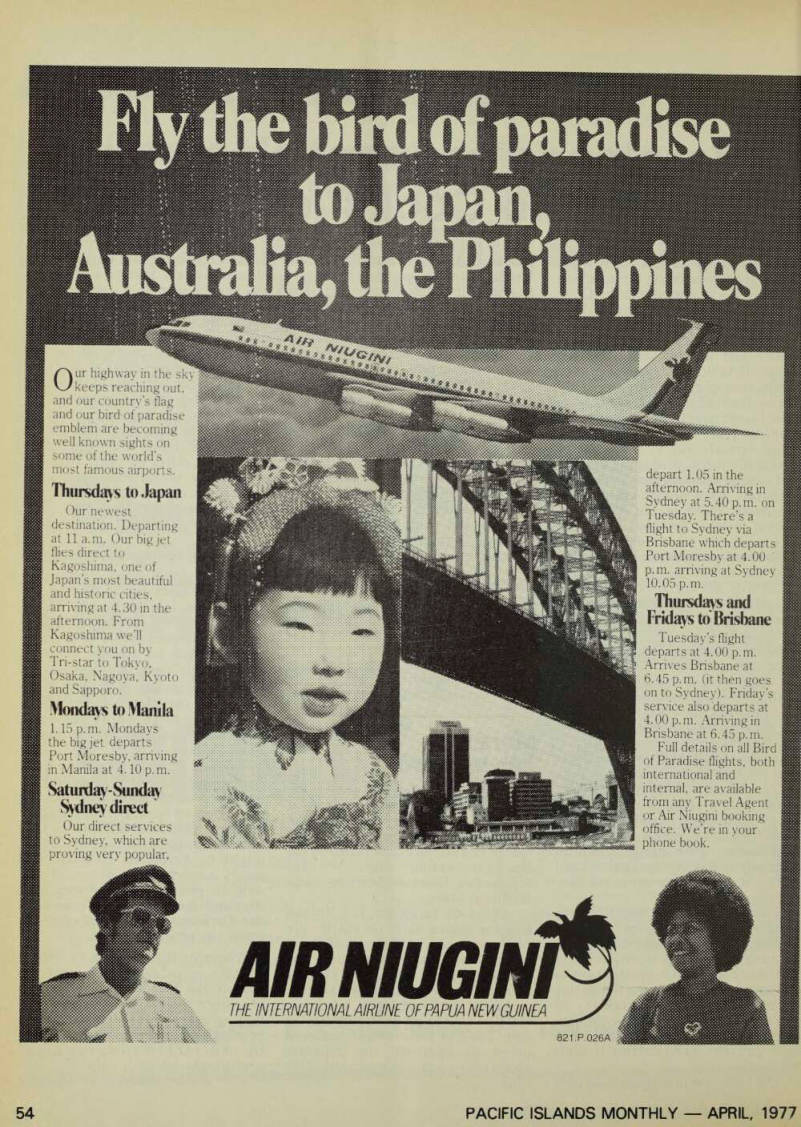
fish for export
The Pacific Fishing Co, of Levuka, Fiji, expects to export about 99.5% of its total production in 1977. The company is hoping to process 2,300 tons of raw skipjack tuna netted by the
Ika Corporation ships Tui
Niwasaliwa, Hatsutori Maru No 5 and Hatsutori Maru.
About 40 Taiwanese and Korean
longline fishing ships on charter are
expected to add 7,000 tons of albacore and yellow fin tuna to the catch. The company opened a $500,000 cannery at Levuka last August. It is looking for an export market in Japan, but Japan will first have to lift its import duty on fish. The Fiji Government has been asked to approach the Japanese Government and seek a removal of the duty.
The development of the pineapple plantations on Mangaia and Atiu was earlier seen as a supply source which would sustain the operations of Island Foods Ltd, but again, because of a number of factors the quantity of fruit predicted has not been matched by actual production.
And given the best will in the world by the outer islands’ planters, the pineapple trade is very much at the mercy of the seas that separate the plantations from the cannery by about 150 miles of open sea. The availability of suitable vessels for the trade is one of the Cook Islands principal causes for concern.
A word of warning was given in March last year when the local director Mr George Keenan, said in the Cook Islands News, “After pro mising increases during the first few years after Island Foods’ estab lishment in 1961, citrus production has been unpredictable and disap pointing, with an adverse effect on the company’s profitability.”
Mr Keenan also highlighted the decline in the earlier frequency of outer islands shipping services, “with adverse effects on fruit quality and receipts”.
Various alternatives have been put forward on Rarotonga. Perhaps the government could take over the processing of fruit; perhaps another company could be induced to take over the operations; perhaps it might be better to establish two small canneries on Mangaia and Atiu to process the pineapples on site, and then to use the vessels on the Auckland-Cook Islands route to uplift the processed fruit.
Whatever the outcome, the plight of the processing plant on Rarotonga has very serious im plications for the Cook Islands. To how great an extent should the emphasis on agricultural production be redirected towards high profit/high-risk cash crops?
The whole position of shipping
services in the Cook Islands is in a most precarious state. What will be the effect upon the Cook Islands as a whole if a large part of the present trade is to be curtailed?
Towards the end of February, the Premier, Sir Albert Henry, who was on a visit to New Zealand, said in Auckland, with respect to the com pany’s threat to quit, that the Cook Islands Government would prob ably buy out the company. Three Australian and NZ companies were ready to take over the industry and once the Cooks became a full mem ber of the Asian Development Bank in May a loan of around $2 million would be available.
He added that he believed the processing operation had helped the company and New Zealand more than it had the Cook Islands. The price paid to the growers had re mained about 3c for 454 gm of oranges for nearly two decades while the price of orange juice for the consumer had soared.
Sir Albert also pointed out that there was a lack of diversity of the citrus plant. It extracted the citrus juice while neglecting other fruits such as papaw, mangoes, guava and tomato.
Advertisements & other items, p. 54 (1 item)
Airniugini
iTmfCIT
se ui
Ti T
Our highway in the skTIISi keeps reaching out, and our country’s flag and our bird of paradise emblem are becoming well known sights on some of the world’s most famous airports.
Thursdays to Japan
Our newest destination. Departing at 11 a.m. Our big jet flies direct to Kagoshima, one of Japan’s most beautiful and historic cities, arriving at 4.30 in the afternoon. From Kagoshima we’ll connect you on by Tri-star to Tokyo, Osaka, Nagoya, Kyoto and Sapporo.
Mondays to Manila
1.15 p.m. Mondays the big jet departs Port Moresby, arriving in Manila at 4.10 p.m.
Saturday-Sunday
Sydney direct
Our direct services to Sydney, which are proving very popular, #•: , Mi depart 1.05 in the afternoon. Arriving in Sydney at 5.40 p.m. on Tuesday. There’s a flight to Sydney via Brisbane which departs Port Moresby at 4.00 p.m. arriving at Sydney 10.05 p.m.
Thursdays and
Fridays to Brisbane
Tuesday’s flight departs at 4.00 p.m.
Arrives Brisbane at 6.45 p.m. (it then goes on to Sydney). Friday’s service also departs at 4.00 p.m. Arriving in Brisbane at 6.45 p.m.
Full details on all Bird of Paradise flights, both international and internal, are available from any Travel Agent or Air Niugini booking office. We’re in your phone book.
AIRNIUGINI
THE INTERNATIONAL AIRLINE OF PAPUA NEW GUINEA 821.P.026A
The Islands
on the Gold Coast
Over the last nine years or so, Fiji born Tina Cook, wife of Bruce Cook, a Gold Coast (Queensland) business man, has probably felt homesick for her native Levuka. Now, she’s sure she’ll cure that, not by returning home, but by bringing a bit of Fiji to the Gold Coast. Tina (nee Virtue) married her hsuband nine years ago.
Mr Cook and two business associates, one married to a girl from New Britain, are in the throes of building a Polynesian village as a culture centre and tourist attraction on South Stradbroke Island off the Gold Coast. They plan to open this coming Easter but continue to enlarge it with sections representing all the Island territories of the South Pacific.
The village itself will cover two acres in the centre of a large area of bushland. Mr Cook is busy recruiting Islanders to people the village and has openings for Maoris, Tongans, Fijians, Cook Islanders, Tahitians and Samoans.
Island dances will be a feature of the display.
Noumea’S ‘Steak And

Chips’ Board
From PAUL STERLING in Noumea
Originally created to provide ter ritorial cold storage facilities, the Office de Commercialisation des Entrepots Frigorifiques (OCEF) was later granted the monopoly of meat marketing in Noumea. The role of the organisation is to protect local production, at the same time importing the necessary com plement to meet consumer demand.
The year 1972 was the year of a scandal which resulted in the depar ture of the previous director and the appointment of Mr Jean-Louis Mir.
The ex-manager was a public ser vant, the new manager a person whose past experience was strictly commercial.
Mr Mir took over an organisation with a $300,000 overdraft, on the verge of bankruptcy. Breeders were incapable of forecasting production, butchers were eager to see the or ganisation close down to recover their previous rights to import, while the Territorial Assembly began asking embarrassing ques tions about relationships with certain “privileged” exporters.
The new manager introduced a system of overseas purchases calling for tenders from approved export abattoirs in Australia and New Zea land. Undesired intermediaries and agents were asked to abstain from submitting. Local suppliers were ad vised the OCEF would introduce a calendar of slaughtering and that three months’ notice would be re quired of those wishing to sell meat to the organisation. Butchers con tinued to fight the monopoly, but opposition dwindled as they began to appreciate the vigour and deter mination of the new management.
In 1974, OCEF’s monopoly was extended to cover pork, as well as beef and veal. But attempts to take over the marketing of poultry were abandoned because of the resistance of indignant importers. The price of beef purchased from the local breeders was raised, butchers’ profit margins lowered, and the marketing organisation introduced a new scale of prices which would allow OCEF to make a profit, hopefully ab sorbing the overdraft. The butchers staged a protest strike and the High
Commissioner immediately an nounced that OCEF would sell directly to the consumer as long as the movement lasted.
Australian and New Zealand authorities co-operated fully with OCEF and Mir’s regular visits to both meat boards created an at mosphere of renewed confidence.
But the sudden drop in world beef prices, disastrous to many Australian breeders, was to be the most important factor in getting OCEF back on its feet. During 1974, OCEF was purchasing “extra” quality beef from the local breeder at 130 francs per kilo, and selling to the butcher at 165 francs. The same beef was being imported from Australia for around 80 francs per kilo. That year, OCEF marketed 1500 tonnes of local beef and im ported 1300 tonnes.
New Hebrides breeders were en couraged to step-up beef production to export to New Caledonia, The French administration’s aim was to reduce expenditure in foreign cur rency, and improve the economy of the condominium. The Santo breeders are not satisfied with re sults, exports being hampered by the problem of transport.
The success of the new system of operation lead the government to invite the Territorial Assembly to grant OCEF the monopoly of potato marketing. The project was finally accepted last September, despite re sistance from the private importers.
The results have been dramatic.
With, for the first time, a guarantee that produce will be bought at har vest at a pre-determined price, far mers have placed orders for seed that will double local production and make the territory self-suffi cient for the first time in its history.
But OCEF has been obliged to dis courage enthusiasms as consump tion has dropped from 4000 tonnes in 1975 to 3000 tonnes in 1976 and is expected to decrease further in 1977.
In a territory devoted to private enterprise and quick profit, OCEF has demonstrated that an organised public service can encourage local production. New Caledonia’s trade
is traditionally turned towards im ports, to the detriment of any at tempts to produce locally. But OCEF has not overcome the major problem of New Caledonia’s econ omy, the cost. This year, potato pro ducers will be claiming 30 francs per kilo, three times as much as their Australian and New Zealand coun terparts. Local beef is the most ex pensive in the world.
Meanwhile, a definite policy is becoming apparent. New Caledonia is organising its agricultural pro duction, despite the disadvan tageous prices. Imports can decrease and primary industry become a new source of employ ment, despite the resulting cost to the consumer.
With a price index automatically applied to monthly salaries, this can generate an acceleration in infla tion, and will doubtlessly prohibit exports. Incapable of developing any exports except for nickel, the trade balance can only be improved by reducing imports. OCEF has set the example: will private initiatives follow?
PNG has a
butterfly farm
Papua New Guinea has estab lished its first commercial butterfly farm. The government-sponsored project at Bainyik, west of Wewak, will breed butterflies for sale to overseas collectors.
It will also work in conjunction with PNG butterfly breeders who are being established in the area.
Beetles and other insects are also being included in the project which will involve about 150 “insect far mers’’ and associated workers.
PNG has some of the most colour ful and largest butterflies in the world, and their export is now closely controlled. Heavy penalties have been incurred in court hear ings over the past 12 months for the unauthorised export of butterflies.
The main markets for the new project will be Australia, United Kingdom, Sweden, Japan, Hong Kong, United States and Taiwan.
A government rural development officer has been appointed to the scheme full time and overall super vision is being provided by the Bainyik agricultural extension station.
Advertisements & other items, p. 56 (1 item)
profit-maker’s
——- profit-maker’s aircraft
“This is the only aircraft we can make a buck with . . and we
searched for eighteen months!”
Terry Cahill & Dick Scott, directors, Tropicair Services Pty. Ltd., Carnarvon, W.A.
J'JaMTWWJ'aVA wma
Sole distributors for Australia • Papua New Guinea • New Zealand • Pacific Islands •
FORRESTAIR
A DIVISION OF H. C. SLEIGH LIMITED Bulla Road, Essendon Airport Victoria, Australia 3041 Cables & Telegrams: Forrestair Melbourne Telex AA33015 Telephone (03)3798929.
FM774 After hours (03) 7254430 Hard-headed commercial operators demand aircraft performance that shows a profit. With Partenavia they get it.
Payload. Range. Speed. Six comfortable seats. A 7 sq.ft, cargo loading door, and a 400 lb, 20 cu.ft. cargo space, accessible in flight. Uncomplicated systems that mean low operating costs.
And it handles the outback as though bred to it.
You may never need everything that Tropicair demands . . but you’ll get it anyway: and for less money th**'i for any comparable twin.
Why would you settle for less?
Ask for the brochure, specifications, and flight reports.
Back to Middle Ages for Vila’s meat production
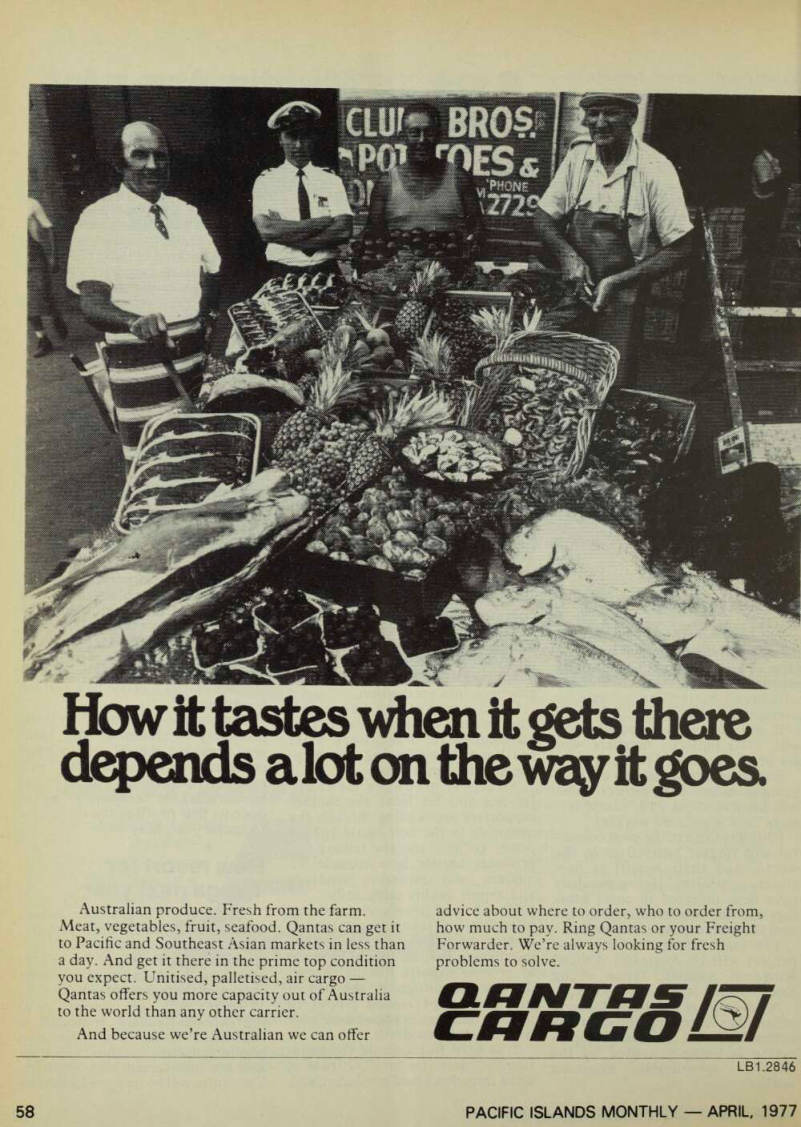
Vila’s meat production
From a Vila correspondent
The New Hebrides Abattoir, in Vila, has closed down. It went under after just seven weeks of a three-month trial period under the supervision of a French-oriented pastoral producers’ co-operative.
In the earlier stages of its two year history, the abattoir, developed and managed by Australian interests and with many local shareholders, had built up an excellent reputation for supplying quality-cut meat to retailers. It had also carried out suc cessful experiments with the pro duction of smoked and corned pro ducts.
It now remains to be seen whether the old management, despite the loss of experienced staff, can pick up the pieces and recapture the abattoir’s former reputation for hygiene and efficiency.
It is not so long ago that visitors to Vila, touring shopping areas, were greeted with the ghastly medieval sight of locals hacking into bloody carcasses in open, fly-encrusted doorways. Following the collapse of the abattoir, one American resident has already reported the return of this type of spectacle. He has elected to stay vegetarian until the abattoir gets back into production.
In the meantime the con dominium’s three-cultured bureaucratic machinery still vacillates in reviewing urgently needed clean meat laws.
Abattoir manager Graham Daniels and his local shareholder supporters are wading through the quagmire in the new battle against power politics and the lethargy of producer cartels in a crusade for modern meat inspection standards and export quality safeguards.
Local beef producers, asking unrealistic prices for cattle, are making the audacious claim that the middleman abattoir should be made to process exports free of charge, disregarding altogether the cost ol plant and experienced labour to process the meat in accordance with world export standards.
It is hard to reconcile the isola tionist, “blow-you-Jack” attitude of some influential beef producers with
the fact that the New Hebrides is witnessing a winding-down of Bri tish-French government and that the new condominium budget needs the financial backing of local resources.
Neighbouring countries are beg ging for meat imports. The abattoir has capabilities yet untried in the food market.
It is a shame that shareholders with faith must first labour to remove needless overburden.
The situation is perhaps best sum med up in the fact that a proposed contract for $A200,000 worth of meat for Martinique, to be carried in French Pacific shipping returning to France from the New Hebrides, is still bogged down in condominium paperwork.
Fiji tourist firm
makes a profit
The Tourist Corporation of Fiji Ltd moved into the black in the first six months of the current financial year to November 30, 1976.
Revenue in the half-year was up by 32.26% to $1.5 million. The higher revenue, allied with tight control on overheads, was a major factor in the good result.
The company continued to trade profitably in December and Janu ary. Provided the fall-off in hotel occupancy in the traditional “off’ months, February to April, is not too serious, the company will pro duce its first profit at the end of the financial year, May 31.
New resort for
Tonga next year
Tongatapu, Tonga’s main island, will have a new hotel resort next year.
The complex, to cost $1,200,000, is to be built by Pacific Inns of Tonga Ltd, at Fahina Beach on the island’s west coast near the famous blowholes.
There will be, initially, 60 international-standard bedrooms, a restaurant, coffee-shop, swimming pool, entertainments centre, bars and a health centre spread over 2Vi acres.
The centre will be on lease to Beverly
Evans, a well-known Sydney beauty consultant.
Building is expected to start towards the end of May with completion 12 months later.
Local resident directors are the Tongan noble Hahano Vaha’i and Mr Peter Warner.
PNG wants loan
for Highlands road
The Asian Development Bank, which has already put nearly SA3S million into Papua New Guinea development loans, may increase this amount. Representatives of the bank and the PNG Government were to hold talks in Port Moresby.
PNG is interested in obtaining further loan money to improve the Highlands Highway, more than 400 kilometres of unsealed road, which crosses two major mountain ranges to link the port of Lae with Mount Hagen.
More Tourists
in French Polynesia
Tourist traffic to French Polynesia grew to 91,993 visitors in 1976, compared with 82,822 in 1975. This 11 per cent increase was due to more tourists coming from Australia and South America, as well as from the USA, Germany, Mexico and Japan.
Traffic dropped from Canada, Italy and England with slightly fewer French as well.
While this year’s tourist statistics can be expected to show the effect of Qantas cutting out its Sydney-Papeete service and Air France abandoning the Tokyo-Papeete-Lima route, extra traffic is arriving from the cold-smitten
Usa.
‘No’ to Palau
superport
The Tia Beluad movement of Palau has taken a strong stand against the proposed superport for Palau District.
After two years’ study of the project, the movement its name means “This is our nation” says: “The short-term monetary benefits that the superport will bring are not worth the price that the people of Palau will have to pay in terms of the loss of culture and the destruction of land and sea.”
The movement announced its stand following its first national convention in Ngerkebesang, Koror District, in January.
Advertisements & other items, p. 58 (1 item)
depends alot on the way it goes.
How it tastes when it gets there depends alot on the way it goes.
Australian produce. Fresh from the farm.
Meat, vegetables, fruit, seafood. Qantas can get it to Pacific and Southeast Asian markets in less than a day. And get it there in the prime top condition you expect. Unitised, palletised, air cargo Qantas offers you more capacity out of Australia to the world than any other carrier.
And because we’re Australian we can offer advice about where to order, who to order from, how much to pay. Ring Qantas or your Freight Forwarder. We’re always looking for fresh problems to solve.
OIHNTHS /“7
cancoLL/
L 81.2846
Another Chance For
The Emperor Mine
The Emperor gold mine at Vatukoula, Fiji, reopened in the first week in March, about two weeks after the board of Emperor Mines Ltd decided to close it. The board closed the mine rather than bow to union pressure for a wage rise from 98c to $1.50 an hour, and further fringe benefits in addition to the many mine workers and their families already enjoy.
The Fiji Government, which has given the mine a lot of assistance in recent years, including direct subsi dies and tax concessions, was con cerned that about 8,000 people, in cluding the miners, would be adver sely affected by the closure.
A special committee appointed by the government negotiated with the Emperor board. The talks resulted in the government agreeing to make “certain moneys” available to Em peror Gold Mining Co Ltd, the Em peror Mines operating subsidiary at Vatukoula, to offset losses for the next 28 months. The amount will not exceed $2 million.
Under the agreement, mine workers already paid off were to be re-employed.
The closure was barely a month after the board decided to keep the mine going for the time being as a “calculated risk”. The mine has been in difficulties several times in the last 20 years and has received
assistance from the government.
The latest government aid included an interest-free loan, waiving of un paid income tax and the remaining balance of a government loan made under a 1971 agreement (PIM, March, p 49).
Soon after the board made this decision the union made its demand.
The company had given away to union demands, which were of a “stand and deliver” nature, several times in recent years. It lost money through the strikes.
The latest demand was made in spite of an agreement to waive claims till the mine was again on a solid footing.
About 1,300 miners, from the in terior of Viti Levu, and outer is lands of Rotuma, Lomaiviti, Lau and the Yasawas and their families were affected. They were enjoying many fringe benefits such as cheap housing and electricity, free water, garbage collection, subsidised medi cal services, education and am bulance services.
There were entertainment halls, a library and cinema, sports grounds and a new grandstand and help for the churches. There were credit facilities at supermarkets, clubs and co-ops and long service leave and travel allowances after 10 years’ ser vice, repeated after every five years of additional service.
Advertisements & other items, p. 59 (1 item)
JlsJ-UC.
HEAT SEALING.
SHRINK PACKAGING.
CONTACT
AUSTRALIA'S FOREMOST MANUFACTURERS
OF HEAT SEALING EQUIPMENT
SERVING INDUSTRY
IN AUSTRALIA & THE PACIFIC ISLANDS
FOR OVER 25 YEARS.
HELIX ELECTRICAL PRODUCTS PTY. LTD.
27 Rosebery Avenue, Rosebery, NSW 2018, Australia.
Passionfruit Industry
There’S A Blight On Niue’S
From STAFFORD L. K. GUEST on Niue
Niuean passionfruit growers seem to have “the pip” over calls for an all-out effort to boost production this season to meet ever-increasing demands for their produce on the New Zealand market.
According to the Niue Development Board food factory manager, Dave Pooch, production figures have been on the decline for the past three years and he’s predicted that this season will see an all-time low in pulp and juice output.
Niue, which supplies about onethird of the New Zealand market, relies on passionfruit pulp and juice to boost its flagging economy. Pooch says that only 70 tonnes is expected
this season from growers which will bring in about $lOO,OOO in overseas funds. He was expecting about 125 tonnes to meet orders, “Niue has the potential to in crease by three-fold its pulp ex ports,” says Mr Pooch, “but the re sponse we have had from the growers has been very poor.”
Growers are now getting 22c a kilo for fruit which is marketed in New Zealand at $1.45 a kilo. Niue has so far managed to fight off increasing competition from Fiji growers who are also anxious to capture the increasing demand for pulp and juice by overseas buyers, “1 really think the novelty of
growing has worn off passionfruit growing is a tedious and time-con suming job,” says Mr Pooch.
The vines have to be hand-polli nated and until a mechanical aid is invented to take the tedium out of the job or a self-pollinating plant is found Mr Pooch holds out little hope for the industry which was started about six years ago.
Most Niuean families have a 1,000 sq metre plot of vines near their homes and the cost of erecting poles and wires on which the vines grow is met by the Development Board. The grower repays the in stallation cost over several seasons.
Women and children hand pollinate the large yellow flowers and weed the rows.
But over the past year many women have been working on the $700,000 round-the-island electric Cower reticulation scheme and this as been one cause of the drop in production, according to Niue’s Minister of Economic Development and chairman of the board, Young Vivian.
Dry weather and the fact that many Niueans have spent a lot of time entertaining relatives and friends from New Zealand during the holiday period have all been fac tors in the decline, he said.
Agriculture Director Morris Tafatu supports the minister’s reasons for the decline and con siders it is too early in the season to predict another poor crop.
The Niue Development Board is making an all-out effort to meet the demands of the market by introduc ing trial eight-hectare passionfruit orchards and will seek financial aid from New Zealand to establish them as a commercial venture.
Several families are managing two-hectare blocks successfully and at the peak of the season produce about 150 kilos of fruit a week.
Cheaper For Chinese
A team of three Singapore doctors began giving acupuncture treatment to residents of the Solomon Islands capital, Honiara, in February. The team, which is on a Pacific-wide tour, treated Chinese free of charge, but charged everyone else $5 a session.
Advertisements & other items, pp. 60-62 (2 items)
Qbe Insurance
Q E
offers expert insurance service
throughout the Islands
QBE INSURANCE
LIMITED
(FORMERLY—QUEENSLAND INSURANCE COMPANY)
Central Office: 82 Pitt Street, Sydney FlJl—Branch Office, Suva, Manager for Fiji: L.G.Liddell A.A.1.1.
LAUTOKA—Sub-Branch Office: Bums Philp Bldg.
HONIARA (8.5.1. P.) —Breckwoldt & Company (5.1.) Pty. Limited.
NEW CALEDONIA—T. A. Hagen, Ste. W. A. Johnston, SA.R.L. —Noumea.
NEW HEBRlDES—District Manager; G. F. Donnelly, Vila; Santo: Burns Philp (New Hebrides) Ltd.
TAHlTl—Arthur Chung: Immeuble B.L, Front dc Mer, Papeete.
NIUE, NORFOLK ISLAND, SAMOA, TONGA and other South Sea Islands—Bums Philp (South Sea) Company Ltd.
QUEENSLAND INSCIRANCE(P.N.G.)LTD
PAPUA NEW GUINEA-Head Office, PORT MORESBY.
General Manager: J.M.Dawe. Assistant Manager: R.Jackson,A.A.l.l.
District Managers at: ARAWA: J.Longbut LAE: W.J.Leonard MADANG: I.R.Martin MOUNT HAGEN: D.F.Carroll RABAUL: A.M.Tanner
Total service 0n ...
plumbing supplies Fast
WATSON & CRANE
are organised to fulfil your needs
wherever you are in the South Pacific You can get all you need from one supply source: water taps, valves, copper tube, tools and a host of other fittings and related plumbing equipment for domestic, industrial and multistorey buildings.
Watson & Crane Pty Ltd have over 20,000 plumbing items in stock at their central warehouse located at Waterloo, NSW, Australia.
Years of experience in handling and shipping right throughout the South Pacific add up to another big reason for you to deal with Watson & Crane Pty Ltd.
Representatives call regularly at New Guinea, Papua, the Solomons, New Hebrides and Fiji IsLands to personally discuss your requirements and appropriate credit arrangements.
Write, cable or telephone today for complete plumbers' supplies service.
Watson & Crane Pty. Ltd. 1037 Bourke Street, Waterloo,
NSW 2017.
Phone: Sydney 699-1333.
Telex: AA 25548.
Cables: "Watcrane" Sydney.
Pacific Island distributors of Crane Enfield copper tube for water, sanitation, engineering, refrigeration and air conditioning.
Money-saver
The McDonnell Douglas DC-9 has the best on-time performance record, the highest utilization rate, and the lowest maintenance cost of any twinjet transport.
The DC-9 Series 50, with a range of 1200 nautical miles, can carry uj 139 passengers in comfortable seating. And because of its raph the Series 50 thrives on the tough of intermediate and short-range rou It's the most economical twinjet flyii 11 ist , . ms u ■ / .
64
PAPIPI r iqi amh<; montmi Y APRIL 1977
New sights, new sounds
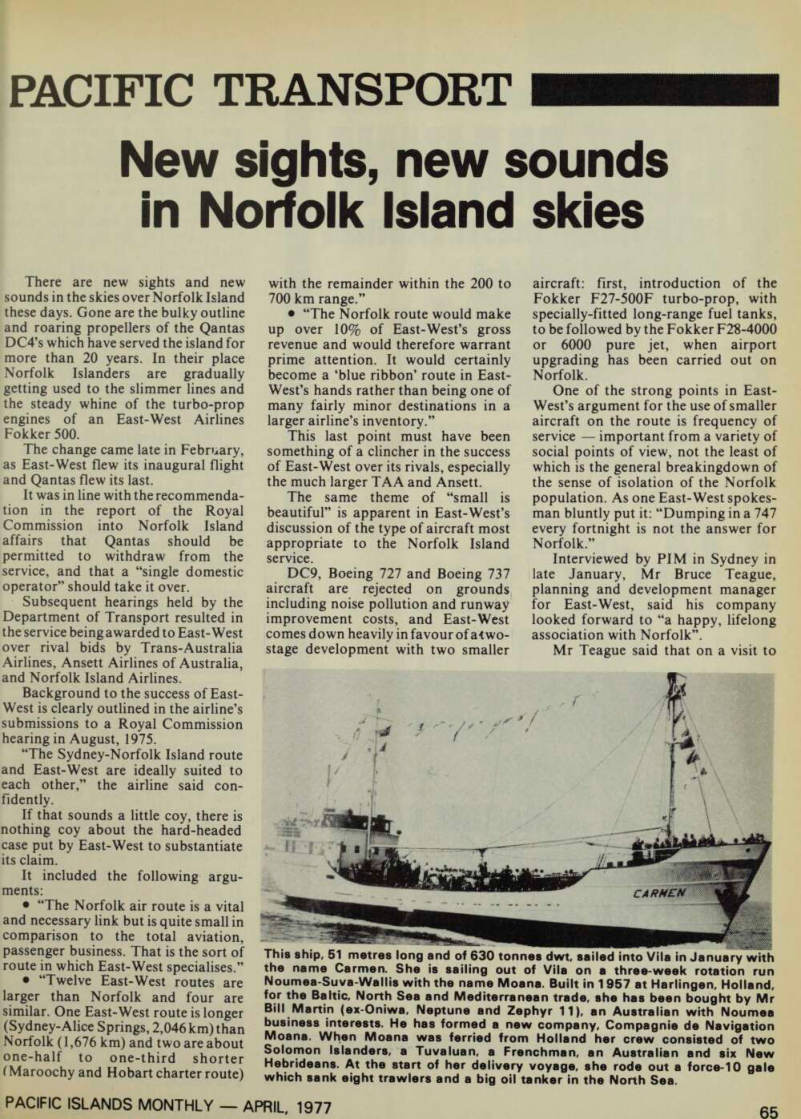
Pacific Transport
New sights, new sounds in Norfolk Island skies
There are new sights and new sounds in the skies over Norfolk Island these days. Gone are the bulky outline and roaring propellers of the Qantas DC4’s which have served the island for more than 20 years. In their place Norfolk Islanders are gradually getting used to the slimmer lines and the steady whine of the turbo-prop engines of an East-West Airlines Fokker 500.
The change came late in February, as East-West flew its inaugural flight and Qantas flew its last.
It was in line with the recommenda tion in the report of the Royal Commission into Norfolk Island affairs that Qantas should be permitted to withdraw from the service, and that a “single domestic operator” should take it over.
Subsequent hearings held by the Department of Transport resulted in the service being awarded to East-West over rival bids by Trans-Australia Airlines, Ansett Airlines of Australia, and Norfolk Island Airlines.
Background to the success of East- West is clearly outlined in the airline’s submissions to a Royal Commission hearing in August, 1975.
“The Sydney-Norfolk Island route and East-West are ideally suited to each other,” the airline said con fidently.
If that sounds a little coy, there is nothing coy about the hard-headed case put by East-West to substantiate its claim.
It included the following argu ments: • “The Norfolk air route is a vital and necessary link but is quite small in comparison to the total aviation, passenger business. That is the sort of route in which East-West specialises.” • “Twelve East-West routes are larger than Norfolk and four are similar. One East-West route is longer (Sydney-Alice Springs, 2,046 km) than Norfolk (1,676 km) and two are about one-half to one-third shorter (Maroochy and Hobart charter route)
with the remainder within the 200 to 700 km range.” • “The Norfolk route would make up over 10% of East-West’s gross revenue and would therefore warrant prime attention. It would certainly become a ‘blue ribbon’ route in East- West’s hands rather than being one of many fairly minor destinations in a larger airline’s inventory.”
This last point must have been something of a clincher in the success of East-West over its rivals, especially the much larger TAA and Ansett.
The same theme of “small is beautiful” is apparent in East-West’s discussion of the type of aircraft most appropriate to the Norfolk Island service.
DC9, Boeing 727 and Boeing 737 aircraft are rejected on grounds including noise pollution and runway improvement costs, and East-West comes down heavily in favour of atwostage development with two smaller
aircraft: first, introduction of the Fokker F27-500F turbo-prop, with specially-fitted long-range fuel tanks, to be followed by the Fokker F 23-4000 or 6000 pure jet, when airport upgrading has been carried out on Norfolk.
One of the strong points in East- West’s argument for the use of smaller aircraft on the route is frequency of service important from a variety of social points of view, not the least of which is the general breakingdown of the sense of isolation of the Norfolk population. As one East-West spokes man bluntly put it: “Dumping in a 747 every fortnight is not the answer for Norfolk.”
Interviewed by PIM in Sydney in late January, Mr Bruce Teague, planning and development manager for East-West, said his company looked forward to “a happy, lifelong association with Norfolk”, Mr Teague said that on a visit to
This ship, 51 metres long and of 630 tonnes dwt, sailed into Vila in January with the name Carmen. She is sailing out of Vila on a three-week rotation run Noumea-Suva-Wallis with the name Moana. Built in 1957 at Harlingen, Holland, for the Baltic, North Sea and Mediterranean trade, she has been bought by Mr Bill Martin (ex-Oniwa, Neptune and Zephyr 11), an Australian with Noumea business interests. He has formed a new company, Compagnie de Navigation Moana. When Moana was ferried from Holland her crew consisted of two Solomon Islanders, a Tuvaluan, a Frenchman, an Australian and six New Hebrideans. At the start of her delivery voyage, she rode out a force-10 gale which sank eight trawlers and a big oil tanker in the North Sea.
Norfolk late in December East-Wesl executives had received “a favourable reaction” from the administration, tourist board and everybody they’d come in contact with.
He said: “Our basic problem now is to learn to operate the route and get tc know the people who use it.”
In the longer term, East-Wesl would be working hard to encourage more people to use the route in off peak periods.
“There is a very bad ‘peaking’ situation now, particularly at school holiday times,” said Mr Teague. “In fact, the peaks and troughs are more acute on the Norfolk Island route than on any other in Australia that we know of. We’re sure this was one of the factors in the losses suffered by Qantas they worked very hard at school holiday times, but had very little to dc during winter.
“We’ve asked the tourist board tc co-operate in anything that might b< done in an effort to even-out th( situation.”
He said the long-term future of the service would not be definitely settlec until the two conditions laid down bj Australian Transport Minister Nixor had been met.
The first concerned the eventua performance characteristics of the so called de Havilland Dash 7, a new four engined propeller aircraft which hac been considered for the route and i: still undergoing development by it: American manufacturers.
The second relates to the Australia: Government’s own decision on the waj to meet the Royal Commission’: recommendation that the Norfoll Island airport should be upgraded tc accommodate jet aircraft.
For the time being, said Mr Teague East-West will proceed with its two stage plan: first using the F27-500F and then, when airport conditions an right, moving over to the F2£ (Fellowship) pure jet.
Mr Teague described the F27-500F as the “super-dooper” version of the Friendship series.
“It has improved engines, naviga tional gear, additional air-condi tioning, inflight music, new sea design, and so on..
“East-West is the only airline in Australasia with F 27-500 Fs fitted with the extra fuel tanks required for the Norfolk Island service.”
The airline had recently brought two of the aircraft at a cost of about SAS million.
Advertisements & other items, p. 64 (1 item)
Cue Marine
PETROL and DIESEL ENGINES
wsLS Petrol and diesel engines to 350 h.p. Wide range of optional and accessory equipment, choice of transmissions - Paragon, Twin-Disc or Borg Warner in all popular ratios. a * I V >»
MARINE GEARS
Hydraulic-operated, self-contained oil pump, 220 h.p. maximum. Suits all popular engines. For work or pleasure.
CLAE ENGINE Sales and Service
31 Hoskins Ave, Bankstown.
NSW 2200. Phone 709 4777 Distributed by Stones Auto Diesel Service
P.O. Box 151, Kieta, BOUGAINVILLE.
CLAl5.2O.lOcm
A sailor flies a 'goose'
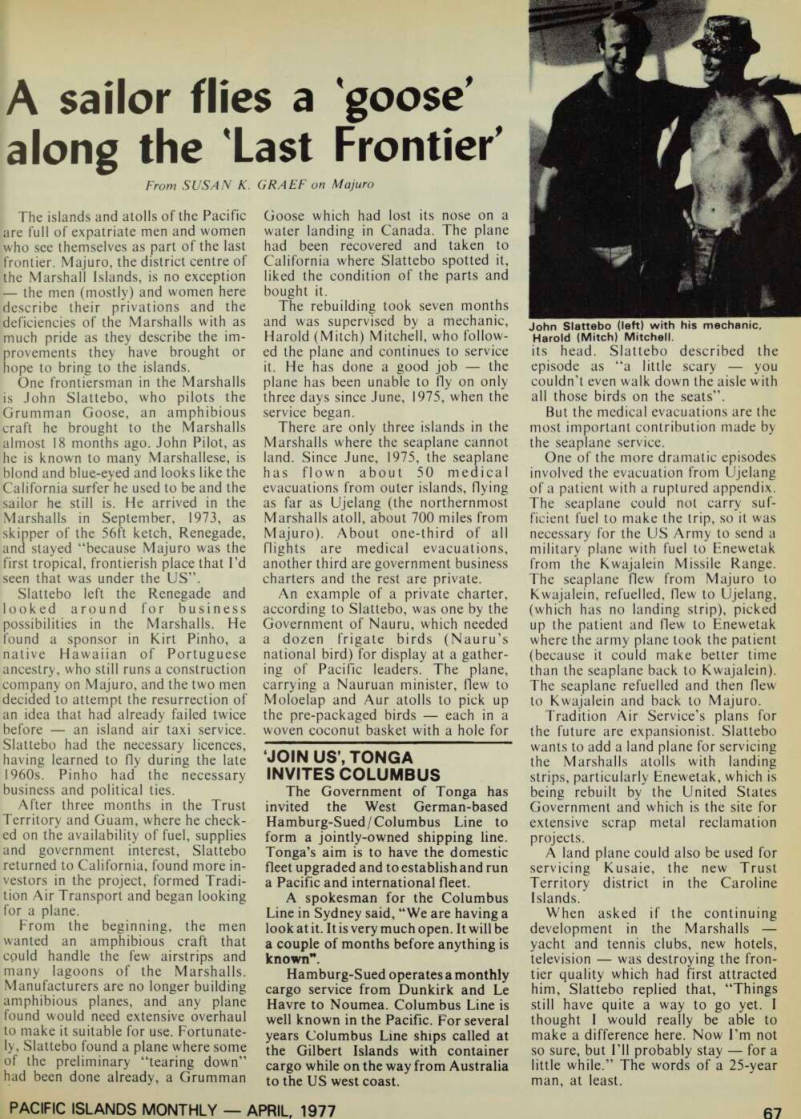
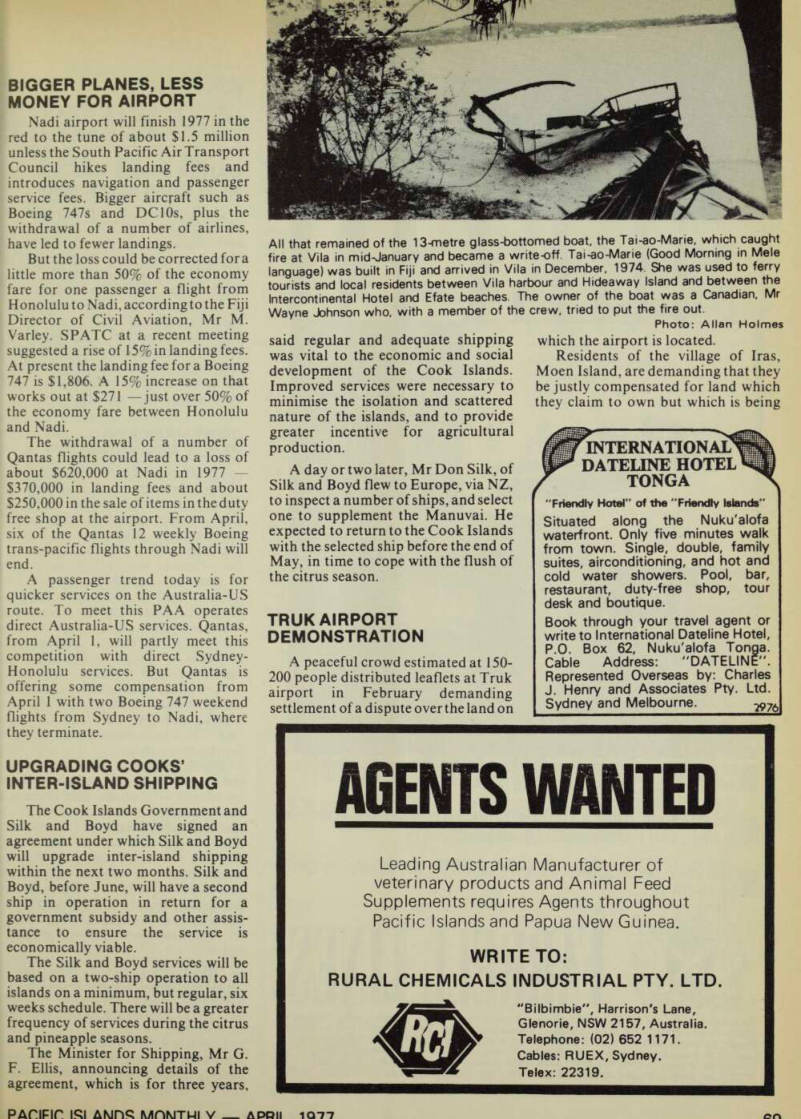
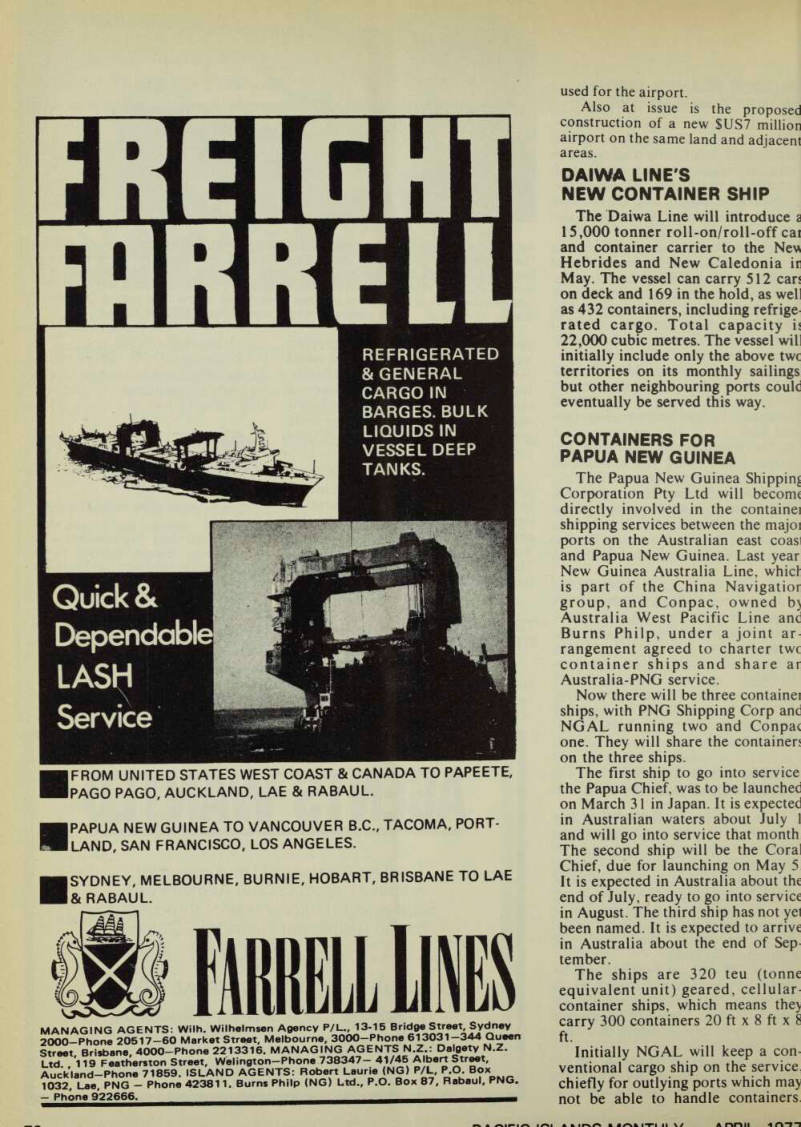
along the 'Last Frontier’
From SUSAN K. GRAEF on Majuro
The islands and atolls of the Pacific are full of expatriate men and women who see themselves as part of the last frontier. Majuro, the district centre of the Marshall Islands, is no exception the men (mostly) and women here describe their privations and the deficiencies of the Marshalls with as much pride as they describe the im provements they have brought or hope to bring to the islands.
One frontiersman in the Marshalls is John Slattebo, who pilots the Grumman Goose, an amphibious craft he brought to the Marshalls almost 18 months ago. John Pilot, as he is known to many Marshallese, is blond and blue-eyed and looks like the California surfer he used to be and the sailor he still is. He arrived in the Marshalls in September, 1973, as skipper of the 56ft ketch, Renegade, and stayed ‘‘because Majuro was the first tropical, frontierish place that I’d seen that was under the US”.
Slattebo left the Renegade and looked around for business possibilities in the Marshalls. He found a sponsor in Kirt Pinho, a native Hawaiian of Portuguese ancestry, who still runs a construction company on Majuro, and the two men decided to attempt the resurrection of an idea that had already failed twice before an island air taxi service.
Slattebo had the necessary licences, having learned to fly during the late 19605. Pinho had the necessary business and political ties.
After three months in the Trust Territory and Guam, where he check ed on the availability of fuel, supplies and government interest, Slattebo returned to California, found more in vestors in the project, formed Tradi tion Air Transport and began looking for a plane.
From the beginning, the men wanted an amphibious craft that could handle the few airstrips and many lagoons of the Marshalls.
Manufacturers are no longer building amphibious planes, and any plane found would need extensive overhaul to make it suitable for use. Fortunate ly, Slattebo found a plane where some of the preliminary “tearing down” had been done already, a Grumman
Goose which had lost its nose on a water landing in Canada. The plane had been recovered and taken to California where Slattebo spotted it, liked the condition of the parts and bought it.
The rebuilding took seven months and was supervised by a mechanic, Harold (Mitch) Mitchell, who follow ed the plane and continues to service it. He has done a good job the plane has been unable to fly on only three days since June, 1975, when the service began.
There are only three islands in the Marshalls where the seaplane cannot land. Since June, 1975, the seaplane has flown about 50 medical evacuations from outer islands, flying as far as Ujelang (the northernmost Marshalls atoll, about 700 miles from Majuro). About one-third of all flights are medical evacuations, another third are government business charters and the rest are private.
An example of a private charter, according to Slattebo, was one by the Government of Nauru, which needed a dozen frigate birds (Nauru’s national bird) for display at a gather ing of Pacific leaders. The plane, carrying a Nauruan minister, flew to Moloelap and Aur atolls to pick up the pre-packaged birds each in a woven coconut basket with a hole for
its head. Slattebo described the episode as “a little scary you couldn’t even walk down the aisle with all those birds on the seats”.
But the medical evacuations are the most important contribution made by the seaplane service.
One of the more dramatic episodes involved the evacuation from Ujelang of a patient with a ruptured appendix.
The seaplane could not carry suf ficient fuel to make the trip, so it was necessary for the US Army to send a military plane with fuel to Enewetak from the Kwajalein Missile Range.
The seaplane flew from Majuro to Kwajalein, refuelled, flew to Ujelang, (which has no landing strip), picked up the patient and flew to Enewetak where the army plane took the patient (because it could make better time than the seaplane back to Kwajalein).
The seaplane refuelled and then flew to Kwajalein and back to Majuro.
Tradition Air Service’s plans for the future are expansionist. Slattebo wants to add a land plane for servicing the Marshalls atolls with landing strips, particularly Enewetak, which is being rebuilt by the United States Government and which is the site for extensive scrap metal reclamation projects.
A land plane could also be used for servicing Kusaie, the new Trust Territory district in the Caroline Islands.
When asked if the continuing development in the Marshalls yacht and tennis clubs, new hotels, television was destroying the fron tier quality which had first attracted him, Slattebo replied that, ‘‘Things still have quite a way to go yet. I thought 1 would really be able to make a difference here. Now I’m not so sure, but I’ll probably stay for a little while.” The words of a 25-year man, at least.
John Slattebo (left) with his mechanic, Harold (Mitch) Mitchell.
Airstrips For
Southern Cooks
The Cook Islands Government is ready to begin construction of airstrips on the southern islands of Atiu, Mauke and Mitiaro and in that order. Atiu will be first because much of the heavy equipment for the job is already on the island.
Plans for the construction of airstrips on the southern Cooks have been in the pipeline for many years and it was decided to start work on them as soon as practicable after the opening of Rarotonga’s Interna tional Airport in December, 1973.
Mangaia, the southernmost of the islands, is also keen to have an airstrip and seven possible sites have been surveyed. However, Mangaia is not included in the cur rent programme because further discussions are still to be held be tween the islanders and the Govern ment.
Cook Islands Airways owns one aircraft, a nine-seater Britten Nor man Islander, Rarotonga-based and capable of operating from short strips. The three airstrips are ex pected to be completed by July.
New Ship
Hits Png Reef
The Niugini Trader, the 373tonnes cargo vessel, delivered a short time ago from the Fiji makers, Carpenters Industrial, to owner Anton Lee of Port Moresby, escaped disaster by a hair’s breadth in mid- February.
She struck a reef near Samarai but the only damage was a jammed rudder.
She was pulled off the reef and taken in tow by PNG coastal vessel Ame Rupa, and berthed safely at Port Moresby.
Nz Gift For
New Hebrides
A 23-metre steel beach landing craft, the Roena, is now the property of the New Hebrides Government.
The Roena is a gift under the NZ Government aid programme for the Pacific Islands, and was built in Auckland. She can carry more than 85 tonnes of cargo, but as she dis places a little more than half a metre of water at the bow can land in shallow water.
The Roena has accommodation for a crew of four and has four dou ble-berth cabins for passengers; is powered by two 110 hp diesel engines and has twin rudders.
Bigger Planes, Less
Money For Airport
Nadi airport will finish 1977 in the red to the tune of about $1.5 million unless the South Pacific Air Transport Council hikes landing fees and introduces navigation and passenger service fees. Bigger aircraft such as Boeing 747 s and DC 10s, plus the withdrawal of a number of airlines, have led to fewer landings.
But the loss could be corrected fora little more than 50% of the economy fare for one passenger a flight from Honolulu to Nadi, according to the Fiji Director of Civil Aviation, Mr M.
Varley. SPATC at a recent meeting suggested a rise of 15% in landing fees.
At present the landing fee for a Boeing 747 is $1,806. A 15% increase on that works out at $271 —just over 50% of the economy fare between Honolulu and Nadi.
The withdrawal of a number of Qantas flights could lead to a loss of about $620,000 at Nadi in 1977 $370,000 in landing fees and about $250,000 in the sale of items in the duty free shop at the airport. From April, six of the Qantas 12 weekly Boeing trans-pacific flights through Nadi will end.
A passenger trend today is for quicker services on the Australia-US route. To meet this PAA operates direct Australia-US services. Qantas, from April 1, will partly meet this competition with direct Sydney- Honolulu services. But Qantas is offering some compensation from April 1 with two Boeing 747 weekend flights from Sydney to Nadi, where they terminate.
Upgrading Cooks’
Inter-Island Shipping
The Cook Islands Government and Silk and Boyd have signed an agreement under which Silk and Boyd will upgrade inter-island shipping within the next two months. Silk and Boyd, before June, will have a second ship in operation in return for a government subsidy and other assis tance to ensure the service is economically viable.
The Silk and Boyd services will be based on a two-ship operation to all islands on a minimum, but regular, six weeks schedule. There will be a greater frequency of services during the citrus and pineapple seasons.
The Minister for Shipping, Mr G.
F. Ellis, announcing details of the agreement, which is for three years.
said regular and adequate shipping was vital to the economic and social development of the Cook Islands.
Improved services were necessary to minimise the isolation and scattered nature of the islands, and to provide greater incentive for agricultural production.
A day or two later, Mr Don Silk, of Silk and Boyd flew to Europe, via NZ, to inspect a number of ships, and select one to supplement the Manuvai. He expected to return to the Cook Islands with the selected ship before the end of May, in time to cope with the flush of the citrus season.
Truk Airport
Demonstration
A peaceful crowd estimated at 150- 200 people distributed leaflets at Truk airport in February demanding settlement of a dispute over the land on
which the airport is located.
Residents of the village of Iras, Moen Island, are demanding that they be justly compensated for land which they claim to own but which is being
All that remained of the 13-metre glass-bottomed boat, the Tai-ao-Marie, which caught fire at Vila in mid-anuary and became a write-off. Tai-ao-Marie (Good Morning in Mele language) was built in Fiji and arrived in Vila in December, 1974. She was used to ferry tourists and local residents between Vila harbour and Hideaway Island and between the Intercontinental Hotel and Efate beaches. The owner of the boat was a Canadian, Mr Wayne Johnson who, with a member of the crew, tried to put the fire out.
Photo: Allan Holmes
used for the airport.
Also at issue is the proposed construction of a new $US7 million airport on the same land and adjacent areas.
Daiwa Line's
New Container Ship
The Daiwa Line will introduce a 15.000 tonner roll-on/roll-off cat and container carrier to the New Hebrides and New Caledonia in May. The vessel can carry 512 cars on deck and 169 in the hold, as well as 432 containers, including refrige rated cargo. Total capacity is 22.000 cubic metres. The vessel will initially include only the above twc territories on its monthly sailings but other neighbouring ports could eventually be served this way.
Containers For
Papua New Guinea
The Papua New Guinea Shipping Corporation Pty Ltd will become directly involved in the containei shipping services between the majoi ports on the Australian east coast and Papua New Guinea. Last year New Guinea Australia Line, which is part of the China Navigation group, and Conpac, owned b> Australia West Pacific Line and Burns Philp, under a joint ar rangement agreed to charter twc container ships and share an Australia-PNG service.
Now there will be three containei ships, with PNG Shipping Corp and NGAL running two and Conpac one. They will share the containers on the three ships.
The first ship to go into service the Papua Chief, was to be launched on March 31 in Japan. It is expected in Australian waters about July 1 and will go into service that month The second ship will be the Coral Chief, due for launching on May 5, It is expected in Australia about the end of July, ready to go into service in August. The third ship has not yet been named. It is expected to arrive in Australia about the end of Sep tember.
The ships are 320 teu (tonne equivalent unit) geared, cellular container ships, which means they carry 300 containers 20 ft x 8 ft x 8 ft.
Initially NGAL will keep a con ventional cargo ship on the service, chiefly for outlying ports which may not be able to handle containers.
Join Us’, Tonga
Invites Columbus
The Government of Tonga has invited the West German-based Hamburg-Sued/Columbus Line to form a jointly-owned shipping line.
Tonga’s aim is to have the domestic fleet upgraded and to establish and run a Pacific and international fleet.
A spokesman for the Columbus Line in Sydney said, “We are having a look at it. It is very much open. It will be a couple of months before anything is known**.
Hamburg-Sued operates a monthly
cargo service from Dunkirk and Le Havre to Noumea. Columbus Line is well known in the Pacific. For several years Columbus Line ships called at the Gilbert Islands with container cargo while on the way from Australia to the US west coast.
Advertisements & other items, pp. 66-68 (3 items)
Kyowa Line
YOUR TRADING PARTNER
Monthly Services
Hong Kong, Taiwan, S. Korea, Japan
To: Guam, Saipan, British Solomon, New Caledonia, Fiji, W. Samoa, A. Samoa. Tahiti, Cook Is., Tonga, New Hebrides.
Taiwan,Hong Kong,Singapore,Jakarta
To: Australia, Papua New Guinea, Sabah & Sarawak.
South Korea, Japan
To: Guam, Saipan, Papua New Guinea, Other Pacific Islands.
Taiwan: Royal Steamship Corp., Ltd., Taipei S. Korea: Dong Sue Shipping Co., Ltd., Seoul Hong Kong: Dahzun Enterprises Ltd Singapore: Ocean Shipping & Enterprises Pte., Ltd Mariana Is.: Island Navigation Co., Ltd., Guam 8.5.1. P.: Solomon Taiyo Ltd.. Honiara Tahiti: J.A. Cowan & Fils, Papeete Cooks; Union Citco Travel Ltd , Rarotonga Tonga: E M. Jones Ltd . Nukualofa New Hebrides: Agence Maritime Raymond Velicite, Port Vila A.Samoa: Island Pacific Agencies Inc., Pago Pago W. Samoa: Morris Hedstrom Ltd., Apia Fiji: Carpenter Shipping. Suva & Lautoka PNG: C arpenter Shipping Agencies, Port Moresby, Rabaul New Caledonia; Agence Maritime Du Rond Point Du Pacific, Indonesia: P.T. Porodisa Raya Shipping Lines, Jakarta Sabah: KOH Han Ming Shipping & Forwarding Agent, Kotakmabalu Sarawak: Pan Sarawak Agencies Sdn. Bhd .Sibu & Kuching Australia; Hethermgton Kingsbury Pty. Ltd., Sydney. N.S.W.
KYOWA SHIPPING CO., LTD.
Ojima Bldg., 22-8, 6-chome, Shinbashi, Frontier Bldg., 3-13 Hirano-cho,
AGENTS*n
Noumea
HEAD OFFICE
OSAKA OFFICE
Minato-ku, Tokyo, Japan Phone: 03(437)2885 (Rep.) Cables: “MARIQUEEN” Tokyo Telex: 242-4651 Kyowa J.
Higashi-ku, Osaka, Japan.
Phone: 06(227)0422 (Rep.) Cables: “MARIQUEEN” Osaka.
Telex. 522-3896 Kyowa O
DATELINE HOTEL
TONGA
"Friendly Hotel" of the "Friendly Islands"
Situated along the Nuku'alofa waterfront. Only five minutes walk from town. Single, double, family suites, airconditioning, and hot and cold water showers. Pool, bar, restaurant, duty-free shop, tour desk and boutique.
Book through your travel agent or write to International Dateline Hotel, P.O. Box 62, Nuku'alofa Tonga.
Cable Address; ''DATELINE”.
Represented Overseas by: Charles J. Henry and Associates Pty. Ltd.
Sydney and Melbourne. 29 76
AGENTS WANTED
Leading Australian Manufacturer of veterinary products and Animal Feed Supplements requires Agents throughout Pacific Islands and Papua New Guinea.
WRITE TO:
RURAL CHEMICALS INDUSTRIAL PTY. LTD.
"Bilbimbie", Harrison's Lane, Glenorie, NSW 2157, Australia.
Telephone: (02) 652 1171.
Cables: RUEX, Sydney.
Telex: 22319.
B B B
REFRIGERATED
& GENERAL
CARGO IN
BARGES. BULK
LIQUIDS IN
VESSEL DEEP
TANKS.
Quick &
Dependable
LASIH
Service
IFROM UNITED STATES WEST COAST & CANADA TO PAPEETE,
IpAGO PAGO, AUCKLAND, LAE & RABAUL.
PAPUA NEW GUINEA TO VANCOUVER 8.C., TACOMA, PORT-
LAND, SAN FRANCISCO, LOS ANGELES.
|SYDNEY, MELBOURNE, BURNIE, HOBART, BRISBANE TO LAE
I&RABAUL.
ANAGING AGENTS: Wilh. Wilhelmsen Agency P/L., 13-15 Bridge Street, Sydney X)o—Phone 20517-60 Market Street, Melbourne, 3000-Phone 613031-344 Queen treet Brisbane, 4000-Phone 2213316. MANAGING AGENTS N.Z.: Dalgety N.Z. td 119 Featherston Street, Wialington—Phone 738347—41/45 Albert Street, uckland—Phone 71859. ISLAND AGENTS: Robert Laurie (NG) P/L, P.O. Box 332 Lae PNG Phone 423811. Burns Philp (NG) Ltd., P.O. Box 87, Rabaul, PNG.
Phone 922666. -
69
pacific isi amds momtui v apom 107-7
n a a/M A l a lAk ITT I II V/ AHR II i OTH
Cruising
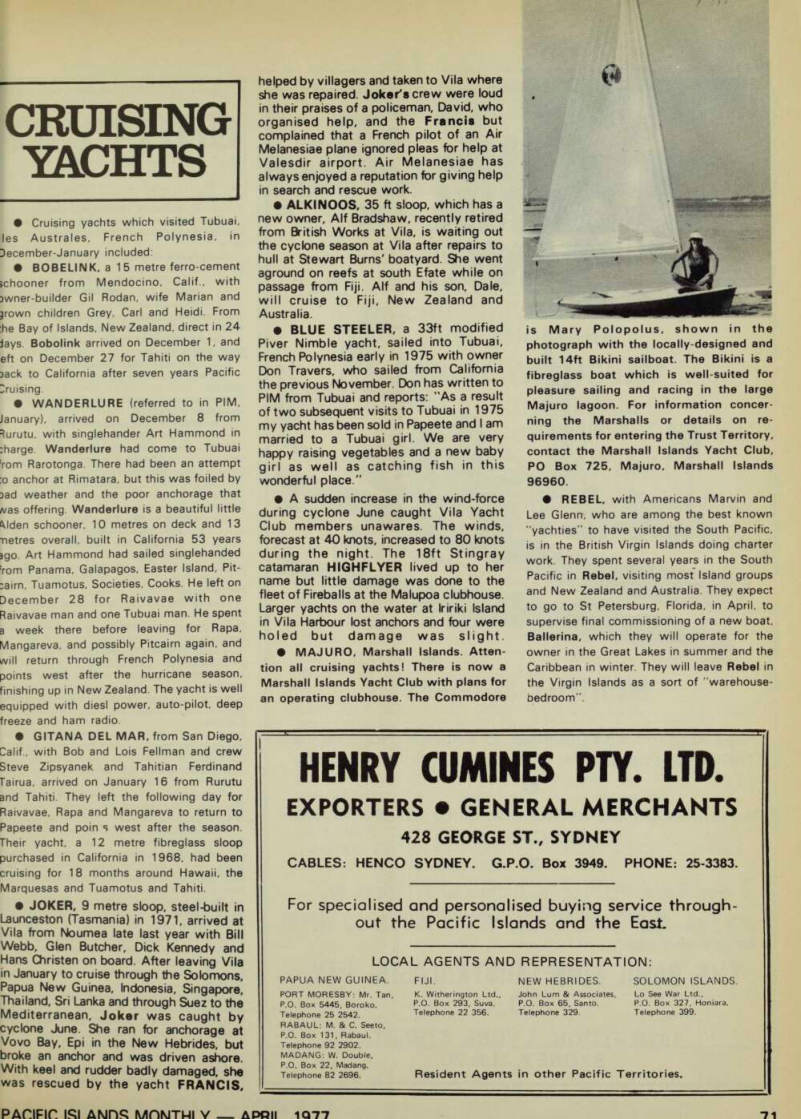
Yachts
• Cruising yachts which visited Tubuai, les Australes, French Polynesia, in December-January included: • BOBELINK, a 15 metre ferro-cement schooner from Mendocino, Calif., with jwner-builder Gil Rodan, wife Marian and jrown children Grey, Carl and Heidi. From :he Bay of Islands, New Zealand, direct in 24 jays. Bobolink arrived on December 1, and eft on December 27 for Tahiti on the way jack to California after seven years Pacific bruising. • WANDERLURE (referred to in PIM, January), arrived on December 8 from Rurutu, with singlehander Art Hammond in :harge. Wanderlure had come to Tubuai rom Rarotonga. There had been an attempt :o anchor at Rimatara, but this was foiled by sad weather and the poor anchorage that was offering. Wanderlure is a beautiful little Mden schooner, 10 metres on deck and 13 netres overall, built in California 53 years jgo. Art Hammond had sailed singlehanded 'rom Panama, Galapagos, Easter Island, Pit cairn, Tuamotus, Societies, Cooks. He left on December 28 for Raivavae with one Raivavae man and one Tubuai man. He spent a week there before leaving for Rapa, Mangareva, and possibly Pitcairn again, and will return through French Polynesia and points west after the hurricane season, finishing up in New Zealand. The yacht is well equipped with diesl power, auto-pilot, deep freeze and ham radio. • GITANA DEL MAR. from San Diego, Calif., with Bob and Lois Fellman and crew Steve Zipsyanek and Tahitian Ferdinand Tairua, arrived on January 16 from Rurutu and Tahiti. They left the following day for Raivavae, Rapa and Mangareva to return to Papeete and poin s west after the season.
Their yacht, a 12 metre fibreglass sloop purchased in California in 1968, had been cruising for 18 months around Hawaii, the Marquesas and Tuamotus and Tahiti. • JOKER, 9 metre sloop, steel-built in Launceston (Tasmania) in 1971, arrived at Vila from Noumea late last year with Bill Webb, Glen Butcher, Dick Kennedy and Hans Christen on board. After leaving Vila in January to cruise through the Solomons, Papua New Guinea, Indonesia, Singapore, Thailand, Sri Lanka and through Suez to the Mediterranean, Joker was caught by cyclone June. She ran for anchorage at Vovo Bay, Epi in the New Hebrides, but broke an anchor and was driven ashore.
With keel and rudder badly damaged, she was rescued by the yacht FRANCIS,
helped by villagers and taken to Vila where she was repaired. Joker's crew were loud in their praises of a policeman, David, who organised help, and the Francis but complained that a French pilot of an Air Melanesiae plane ignored pleas for help at Valesdir airport. Air Melanesiae has always enjoyed a reputation for giving help in search and rescue work. • ALKINOOS, 35 ft sloop, which has a new owner, Alf Bradshaw, recently retired from British Works at Vila, is waiting out the cyclone season at Vila after repairs to hull at Stewart Burns' boatyard. She went aground on reefs at south Efate while on passage from Fiji. Alf and his son, Dale, will cruise to Fiji, New Zealand and Australia. • BLUE STEELER, a 33ft modified River Nimble yacht, sailed into Tubuai, French Polynesia early in 1975 with owner Don Travers, who sailed from California the previous November. Don has written to PIM from Tubuai and reports: "As a result of two subsequent visits to Tubuai in 1975 my yacht has been sold in Papeete and I am married to a Tubuai girl. We are very happy raising vegetables and a new baby girl as well as catching fish in this
wonderful place."
• A sudden increase in the wind-force during cyclone June caught Vila Yacht Club members unawares. The winds, forecast at 40 knots, increased to 80 knots during the night. The 18ft Stingray catamaran HIGHFLYER lived up to her name but little damage was done to the fleet of Fireballs at the Malupoa clubhouse.
Larger yachts on the water at Iririki Island in Vila Harbour lost anchors and four were holed but damage was slight. • MAJURO, Marshall Islands. Atten tion all cruising yachts! There is now a Marshall Islands Yacht Club with plans for an operating clubhouse. The Commodore
is Mary Polopolus, shown in the photograph with the locally-designed and built 14ft Bikini sailboat. The Bikini is a fibreglass boat which is well-suited for pleasure sailing and racing in the large Majuro lagoon. For information concer ning the Marshalls or details on re quirements for entering the Trust Territory, contact the Marshall Islands Yacht Club, PO Box 725, Majuro, Marshall Islands 96960. • REBEL, with Americans Marvin and Lee Glenn, who are among the best known "yachties" to have visited the South Pacific, is in the British Virgin Islands doing charter work. They spent several years in the South Pacific in Rebel, visiting most Island groups and New Zealand and Australia. They expect to go to St Petersburg, Florida, in April, to supervise final commissioning of a new boat.
Ballerina, which they will operate for the owner in the Great Lakes in summer and the Caribbean in winter. They will leave Rebel in the Virgin Islands as a sort of "warehouse bedroom”.
Advertisements & other items, pp. 69-70 (2 items)
71
PAriFir isi mhmtmi v apqm iq-?-?
Henry Cumines Pty. Ltd.
EXPORTERS • GENERAL MERCHANTS
428 GEORGE ST., SYDNEY
CABLES: HENCO SYDNEY. G.P.O. Box 3949. PHONE: 25-3383.
For specialised and personalised buying service throughout the Pacific Islands and the East.
LOCAL AGENTS AND REPRESENTATION:
PAPUA NEW GUINEA.
PORT MORESBY; Mr. Tan,
P.O. Box 5445, Boroko.
Telephone 25 2542.
RABAUL: M. & C. Seeto, P.O. Box 131, Rabaul.
Telephone 92 2902.
MADANG: W. Double, P.O. Box 22, Madang.
Telephone 82 2696.
FIJI.
K. Witherington Ltd., P.O. Box 293, Suva.
Telephone 22 356.
NEW HEBRIDES.
John Lum & Associates, P.O. Box 65, Santo.
Telephone 329.
SOLOMON ISLANDS.
Lo See War Ltd., P.O. Box 327, Honiara.
Telephone 399.
Resident Agents in other Pacific Territories.
THE
LINE
MONTHLY SERVICES
United Kingdom and Continent to: Papeete, Noumea, New Hebrides, Papua New Guinea and Solomon Islands. ♦ Papua New Guinea to: North America, United Kingdom and Continent. * Solomons, Fiji, Tonga, Samoa and Tarawa to: United Kingdom and Continent.
For particulars apply:
THE BANK LINE (AUSTRALASIA) PTY.
LTD.,
18TH FLOOR, 1 YORK STREET,
SYDNEY, N.S.W.
Shipping
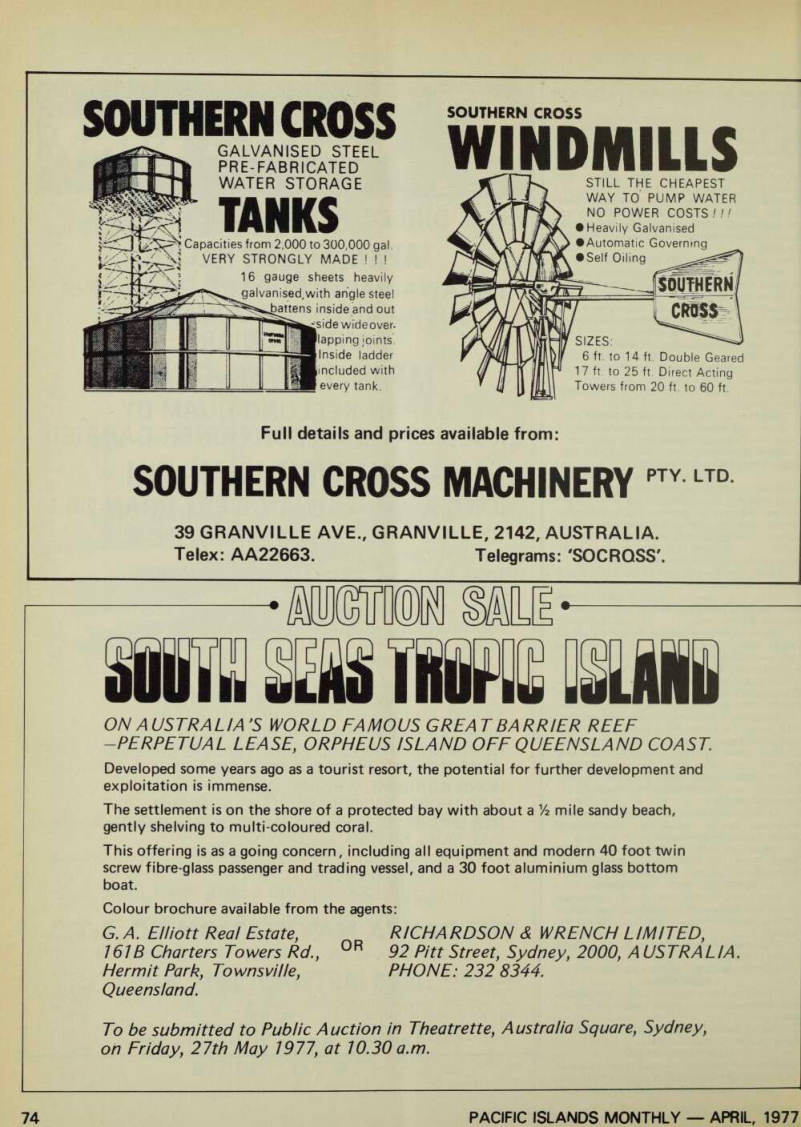
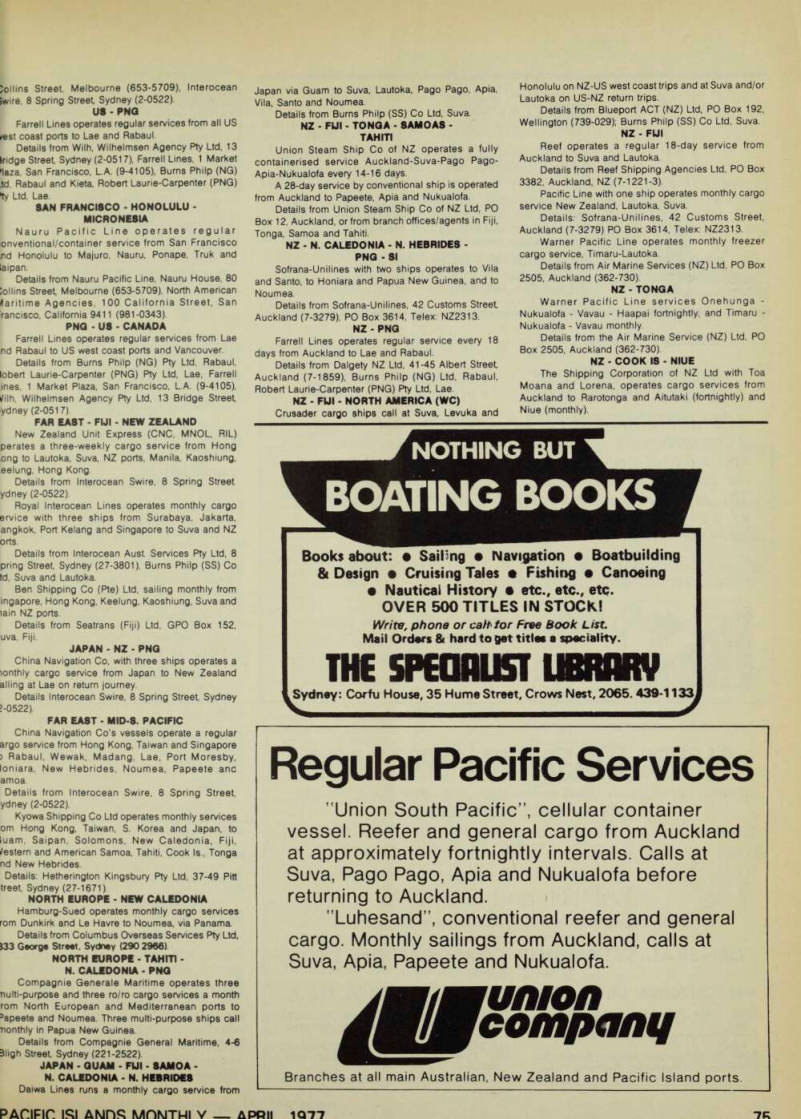
SYDNEY - NZ - FUI/TAHITI - UK Chandris Lines maintains a passenger service from Sydney via NZ, Suva or Papeete every second month.
Details from Chandris Lines, 135 King Street, Sydney (232-2455).
Sydney - Lord Howe Is -
Norfolk Is • New Hebrides
Compagnie des Chargeurs Caledonians operates four-weekly cargo service Sydney - Lord Howe Island, Norfolk Island, Port Vila and Santo.
Details Hetherington Kingsbury Pty Ltd, 37-49 Pitt Street, Sydney (27-1671).
Sydney • New Caledonia
Somacal operates 30-day service from Sydney to Noumea.
Details from Karlander (Aust) Pty Ltd, 19-31 Pitt Street, Sydney (27-6301).
SYDNEY - NZ - FIJI - HAWAII -
Canada - Us
P & 0 liners call at Auckland, Suva, Honolulu and Vancouver on eastbound and westbound voyages between Sydney and the US.
Details from P & 0 Booking Centre, World Travel headquarters Pty Ltd, 33 Bligh Street, Sydney (231-6655).
SYDNEY - NZ - FIJI - TONGA - N. HEBRIDES - NOUMEA - PNG -
Solomons -Bamoab
Sitmar Cruises operates a year-round cruise programme to include most of the above countries.
Details from Sitmar Cruises, 22-30 Bridge Street Sydney (27-4521).
Royal Viking Line, with luxury cruise ships Royal Viking Sea, Star and Sky, cruises the Pacific from Sydney, Hobart and Cairns calling at most of above countries.
Details from Wilh, Wilhelmsen Agency Pty Ltd, 13-15 Bridge Street Sydney (2-0517).
P & 0 liners call at Apia, Auckland, Bay of Islands, Borabora, Honiara, Honolulu, Lautoka, Noumea, Nukualofa, Pago Pago, Papeete, Port Moresby, Santo, Savusavu, Suva, Vavau and Vila on cruises from Australia.
Details from P & 0 Booking Centre World Travel Headquarters Pty Ltd, 33 Bligh Street, Sydney (231-6655).
Australia • New Caledonia •
New Hebrides
Compagnie des Chargeurs Caledoniens operates three-weekly cargo service from Sydney to Noumea, Port Vila, Santo.
Details Hetherington Kingsbury Pty Ltd, 37-49 Pitt Street, Sydney (27-1671).
Sofrana-Unilines ships serve Noumea every three weeks from the main ports along the east Australian coast and Port Vila monthly from Melbourne and Sydney.
Details from Sofrana-Unilines, 37 Pitt Street, Sydney (27-2031), Trans-Austral Shipping Pty Ltd, 570 Bourke Street, Melbourne (67-9162), ACTA Pty Ltd, Brisbane (221-3166), Elder Smith Goldsbrough Mort Ltd, Port Adelaide (47-5688), Mcllwraith McEacharn Ltd, Newcastle (2-4781), H Jones and Co Pty Ltd, Burnie, Tasmania (31-1833), ACTA Pty Ltd, Fremantle (35-4866) South Pacific United Lines maintains a four-week cargo service from Sydney to Noumea, Vila and Santo.
Details from Omni Traders & Brokers Pty Ltd, 261 George Street, Sydney (24-2872/6).
Australia - Fui
Karlander (Aust) Pty Ltd operates monthly cargo services from Sydney to Suva and Lautoka.
Details from Karlander (Aust) Pty Ltd, 19-31 Pitt
Street, Sydney (27-6301), Dalgety Shipping, 461 Bourke Street Melbourne (60-0731), Burns Philp (SS) Co Ltd, Suva and Lautoka.
Sofrana-Unilines (Fiji Express Line) operates to Suva every three weeks from the main ports on the east coast of Australia and monthly to Lautoka from Melbourne and Sydney.
Details from Sofrana-Unilines, 37 Pitt Street, Sydney (27-2031), Trans-Austral Shipping Pty Ltd, 570 Bourke Street, Melbourne (67-9162), ACTA Pty Ltd, Brisbane (221-3116), Elder Smith Goldsbrough Mort Ltd, Port Adelaide (47-5688), Mcllwraith McEacharn Ltd, Newcastle (2-4781), H Jones and Co Pty Ltd.
Burnie, Tasmania (31-1833), ACTA Pty Ltd, Fremantle (35-4866)
Australia • Fui - W. Samoa
Nauru Pacific Line operates regular containerised, unitised and b/bulk service from Sydney and Brisbane to Lautoka, Suva and Apia.
Details Nauru Pacific Line, Nauru House, 80 Collins Street, Melbourne (653-5709), Interocean Swire, 8 Spring Street Sydney (2-0522).
Australia - Tonga - W. Samoa
Karlander operates a monthly cargo service from Melbourne and Sydney to Nukualofa and Apia, thence US west coast.
Details: Karlander (Aust) Pty Ltd, 19-31 Pitt Street Sydney (27-6301).
AUSTRALIA • TAHITI - US WEST COAST South Pacific United Lines maintains a four-weekly service from Sydney to Papeete, and US west coast Details from Omni Traders & Brokers Pty Ltd, 261 Seorge Street, Sydney (241-2872/6).
Australia - Png
Containers Pacific Express (Burns Philp and AWP Line) operates four-weekly cargo service from Melbourne, Sydney and Brisbane with Samos to Port Moresby and Lae. supplemented by availability of additional tonnage on NGAL ships to cover transition period, Jan 1-June 30, 1977, pending start of fully containerised joint NGAL/Conpac service.
Details from Burns Philp & Co Ltd, 51 Pitt Street Sydney (241-3816).
Farrell Lines operates a service every 18 days from Tasmania, Melbourne, Sydney and Brisbane to Lae and Rabaul.
Details from Wilh Wilhelmsen Agency Pty Ltd, 13 Bridge Street, Sydney (2-0517), 60 Market Street, Melbourne (61-3031), Burns Philp (NG) Ltd, Rabaul.
Robert Laurie-Carpenter (NG) Pty Ltd, Lae.
New Guinea Express Lines with two ships operates three-weekly Melbourne, Sydney, Brisbane, Port Moresby, Lae, Rabaul.
Details from New Guinea Express Lines, PO Box R 73, Royal Exchange PO, Sydney (241-3991), MacArthur Shipping Agency Co, 82-92 Eagle Street Brisbane (229-3777), Western Farmers Transport Pty Ltd, 459 Little Collins Street Melbourne (67-8291), Breckwoldt’s Shipping Agencies in Port Moresby (24-2525), Lae (42-1536), Rabtrad and Nuigini Pty Ltd, Rabaul (92-2911).
Karlander New Guinea Line's cargo vessels call at Melbourne, Sydney, Port Moresby, Lae, Madang, Wewak, Manus, Kimbe. Rabaul.
Details from Karlander (Aust) Pty Ltd, 19-31 Pitt Street Sydney (27-6301), Dalgety Shipping, 461 Bourke Street Melbourne (60-0731).
Australia - Png • Solomons
New Guinea Australia Line's vessels operate from Sydney and Brisbane to Port Moresby, Lae, Rabaul, Kavieng, Wewak, Honiara, Kieta, Gizo, Madang and Samarai.
Details from Interocean Swire, 8 Spring Street Sydney (2-0522).
AUSTRALIA - SOLOMONS • GILBERT IS •
Micronesia
Daiwa Line runs a container service every 35 days from Sydney to Honiara, Tarawa, Guam, Saipan and Palau.
Details: Tradex Transport Pty Ltd. 185 O'Riordan Street Mascot NSW (669-1099).
Australia - Nauru
Nauru Pacific Line operates regular cargo/passenger service from Melbourne to Nauru.
Details Nauru Pacific Line. Nauru House. 80
Jollins Street, Melbourne (653-5709), Interocean iwire, 8 Spring Street Sydney (2-0522).
U 8 • Png
Farrell Lines operates regular services from all US rest coast ports to Lae and Rabaul.
Details from Wilh, Wilhelmsen Agency Pty Ltd, 13 Iridge Street Sydney (2-0517), Farrell Lines, 1 Market •laza, San Francisco, LA. (9-4105), Burns Philp (NG) .td, Rabaul and Kieta, Robert Laurie-Carpenter (PNG) 1y Ltd, Lae.
San Francisco - Honolulu -
Micronesia
Nauru Pacific Line operates regular onventional/container service from San Francisco nd Honolulu to Majuro, Nauru, Ponape, Truk and iaipan.
Details from Nauru Pacific Line, Nauru House, 80 Jollins Street Melbourne (653-5709), North American Maritime Agencies, 100 California Street, San rancisco, California 9411 (981-0343),
Png • U 8 - Canada
Farrell Lines operates regular services from Lae nd Rabaul to US west coast ports and Vancouver.
Details from Burns Philp (NG) Pty Ltd, Rabaul, lobert Laurie-Carpenter (PNG) Pty Ltd, Lae, Farrell ines, 1 Market Plaza, San Francisco, LA. (9-4105), Kilh, Wilhelmsen Agency Pty Ltd, 13 Bridge Street ydney (2-0517).
FAR EAST • FUI - NEW ZEALAND New Zealand Unit Express (CNC, MNOL, RIL) perates a three-weekly cargo service from Hong ong to Lautoka, Suva, NZ ports, Manila, Kaoshiung, eelung, Hong Kong.
Details from Interocean Swire, 8 Spring Street ydney (2-0522).
Royal Interocean Lines operates monthly cargo ervice with three ships from Surabaya, Jakarta, angkok, Port Kelang and Singapore to Suva and NZ orts Details from Interocean Aust Services Pty Ltd, 8 pring Street, Sydney (27-3801), Burns Philp (SS) Co td, Suva and Lautoka.
Ben Shipping Co (Re) Ltd, sailing monthly from ingapore, Hong Kong, Keelung, Kaoshiung, Suva and lain NZ ports.
Details from Seatrans (Fiji) Ltd, GPO Box 152, uva, Fiji.
Japan - Nz - Png
China Navigation Co, with three ships operates a lonthly cargo service from Japan to New Zealand ailing at Lae on return journey.
Details Interocean Swire, 8 Spring Street Sydney >-0522),
Far East • Mid-8. Pacific
China Navigation Co's vessels operate a regular argo service from Hong Kong, Taiwan and Singapore ) Rabaul, Wewak, Madang, Lae, Port Moresby, loniara, New Hebrides, Noumea, Papeete and amoa.
Details from Interocean Swire, 8 Spring Street, ydney (2-0522).
Kyowa Shipping Co Ltd operates monthly services om Hong Kong, Taiwan, S. Korea and Japan, to iuam, Saipan, Solomons, New Caledonia, Fiji, /estern and American Samoa. Tahiti, Cook Is., Tonga nd New Hebrides.
Details: Hetherington Kingsbury Pty Ltd, 37-49 Pitt treet, Sydney (27-1671).
North Europe - New Caledonia
Hamburg-Sued operates monthly cargo services rom Dunkirk and Le Havre to Noumea, via Panama.
Details from Columbus Overseas Services Pty Ltd, *33 George Street, Sydney (290 2966)
North Europe - Tahiti -
N. Caledonia • Png
Compagnie Generale Maritime operates three nulti-purpose and three ro/ro cargo services a month rom North European and Mediterranean ports to s apeete and Noumea Three multi-purpose ships call nonthly in Papua New Guinea.
Details from Compagnie General Maritime, 4-6 3ligh Street Sydney (221-2522).
JAPAN - GUAM • FUI - SAMOA -
N. Caledonia - N. Hebrides
Daiwa Lines runs a monthly cargo service from
Japan via Guam to Suva, Lautoka, Pago Pago, Apia, Vila, Santo and Noumea.
Details from Burns Philp (SS) Co Ltd, Suva.
NZ - FUI - TONGA - BAMOAB -
Tahiti
Union Steam Ship Co of NZ operates a fully containerised service Auckland-Suva-Pago Pago- Apia-Nukualofa every 14-16 days.
A 28-day service by conventional ship is operated from Auckland to Papeete, Apia and Nukualofa.
Details from Union Steam Ship Co of NZ Ltd, PO Box 12, Auckland, or from branch offices/agents in Fiji, Tonga, Samoa and Tahiti.
NZ - N. CALEDONIA • N. HEBRIDES -
Png - 81
Sofrana-Unilines with two ships operates to Vila and Santo, to Honiara and Papua New Guinea, and to Noumea.
Details from Sofrana-Unilines, 42 Customs Street Auckland (7-3279), PO Box 3614, Telex: NZ2313.
Nz - Png
Farrell Lines operates regular service every 18 days from Auckland to Lae and Rabaul.
Details from Dalgety NZ Ltd, 41-45 Albert Street Auckland (7-1859), Burns Philp (NG) Ltd, Rabaul, Robert Laurie-Carpenter (PNG) Pty Ltd, Lae.
NZ - FUI • NORTH AMERICA (WC) Crusader cargo ships call at Suva, Levuka and
Honolulu on NZ-US west coast trips and at Suva and/or Lautoka on US-NZ return trips.
Details from Blueport ACT (NZ) Ltd, PO Box 192, Wellington (739-029); Burns Philp (SS) Co Ltd, Suva.
Nz - Fui
Reef operates a regular 18-day service from Auckland to Suva and Lautoka.
Details from Reef Shipping Agencies Ltd, PO Box 3382, Auckland, NZ (7-1221-3).
Pacific Line with one ship operates monthly cargo service New Zealand, Lautoka, Suva.
Details: Sofrana-Unilines, 42 Customs Street, Auckland (7-3279) PO Box 3614, Telex: NZ2313.
Warner Pacific Line operates monthly freezer cargo service, Timaru-Lautoka.
Details from Air Marine Services (NZ) Ltd, PO Box 2505, Auckland (362-730).
Nz- Tonga
Warner Pacific Line services Onehunga - Nukualofa - Vavau - Haapai fortnightly, and Timaru - Nukualofa - Vavau monthly.
Details from the Air Marine Service (NZ) Ltd, PO Box 2505, Auckland (362-730).
Nz - Cook Is - Niue
The Shipping Corporation of NZ Ltd with Toa Moana and Lorena, operates cargo services from Auckland to Rarotonga and Aitutaki (fortnightly) and Niue (monthly).
Details from the Shipping Corp of NZ Ltd, PO Bo) 3420, Auckland (379-430); Waterfront Commission, PC Box 61, Rarotonga, Lighterage and Stevedoring Co Aitutaki, Niue Govt Offices, Niue Island.
NZ - FAR EAST - PACIFIC ISLANDS Sofrana Fareast Lines operates a five-weekh service from Auckland to Far East, PNG, Nev Caledonia and Fiji.
Details from Sofrana Unilines, 42 Customs Street Auckland (73-279).
UK • PANAMA - SAMOA - FUI The Fiji Direct Service, cargo only, is maintainec by Conference vessels, sailing at regular monthl] intervals out of Avonmouth, via Panama, for Apia, Suvs and Lautoka.
Details from Burns Philp (SS) Co Ltd. Suva.
UK - TAHITI - N. CALEDONIA • N. HEBRIDES - PNG • SOLOMONS -
Gilbert Is
Bank Line operates a monthly direct cargo servlet from Europe, via the Panama Canal to Papeete Noumea, Vila, major PNG ports and Honiara occasionally to Tarawa, Santo, Kieta, Jayapura anc Yandina and return.
Details from Bank Line (A'asia) Pty Ltd, 1 Yorl Street, Sydney (27-2041); Burns Philp (SS) Co Ltd Suva.
EUROPE - TAHITI - W. SAMOA - FUI -
N. Caledonia
Nedlloyd offers regular cargo services from Northern Europe and UK to Papeete, Apia, Fiji anc New Caledonia.
Details Interocean Aust Services Pty Ltd, 8 Spring Street, Sydney (27-3801).
US - FUI - TAHITI ■ AUSTRALIA Bank Line Ltd operates regular cargo services from US Gulf ports to Australia and NZ. Calls at Suva Lautoka and Papeete on demand.
Details from Bank Line (A/asia) Pty Ltd, 1 York Street Sydney (27-2011).
Pacific Far East Line cruise ships operate from San Francisco, Los Angeles, Honolulu, Moorea, Papeete, Rarotonga, Auckland, Opua (Bay of Islands), Sydney and return via Suva, Niuafoou, Pago Pago and Honolulu to San Francisco.
Freight is carried on these passenger liners.
Passenger details from World Travel Headquarters Pty Ltd, 33 Bligh Street, Sydney (231-6655); freight details from P & O Aust. Ltd, 2 Castlereagh Street, Sydney (230-0177).
US - A. SAMOA • NZ - AUST - PNG Farrell Lines LASH ships operate regularly from US to Australia, via Pago Pago and Auckland, returning via PNG ports.
Details from Wilh, Wilhelmsen Agency Pty Ltd, 13 Bridge Street, Sydney (2-0517), 60 Market Street, Melbourne (61-0301); Farrell Lines, 1 Market Plaza, San Francisco, LA. (415-777-3300); Dalgety NZ Ltd, Auckland (7-1859): Kneubuhl Maritime Services, Pago Pago (633-5121).
Us • Tahiti - Samoa
Pacific Islands Transport operates a five/six weekly cargo service from North American west coast ports to Papeete, Pago Pago, Apia.
Details from Trans-Austral Shipping Pty Ltd, 19 Pitt Street, Sydney (27-2441).
Polynesia Line operates container and general cargo service from US west coast ports to Papeete and Pago Pago.
Details from Polynesia Shipping Services Inc, PO Box 1478, Pago Pago (9-6799). • The French airline, UTA, in
June, will open a Tokyo-Papeete
service, via Noumea, Nadi and Pago
Pago and return. The service will give Nadi and Pago Pago their first regular air links with Japan. The service will be run once a week with a DCS aircraft
with capacity for 178 passengers. The
new service is expected to boost the Fiji
tourist industry.
Advertisements & other items, pp. 71-74 (2 items)
Daiwa Line
fc.H*
DIRECT REGULAR SERVICE
JAPAN-SOUTH PACIFIC
TARAWA-PAPEETE-PAGO PAGO-APIA
SUVA-LAUTOKA-NOUMEA-VILA
SANTO-HONIARA
JAPAN - TAIWAN - GUAM
JAPAN-KEELUNG-GUAM BY
EXCELLENT CAR/CONTAINER-CARRIER
JAPAN-WEST IRIAN-DILI
HONG KONG-TAIWAN-WEST IRIAN-DILI
AGENTS:
GUAM: ATKINS, KROLL (GUAM) LTD.
TARAWA: G. & E. I. DEVELOPMENT AUTHORITY.
APIA: BURNS PHILP (SOUTH SEA) CO., LTD.
PAGO PAGO: KNEUBUHL MARITIME SERVICES CORP.
NUKUALOFA: PACIFIC NAVIGATION CO., LTD.
SUVA: BURNS PHILP (SOUTH SEA) CO., LTD.
LAUTOKA: BURNS PHILP (SOUTH SEA) CO., LTD.
NOUMEA: SOCIETE D'ACCONAGA ET
TRANSPORT D'OCEANIE (SATO)
SANTO: BURNS PHILP (NEW HEBRIDES) LTD.
VILA: BURNS PHILP (NEW HEBRIDES) LTD.
HONIARA; BRITISH SOLOMONS TRADING CO., LTD.
PAPEETE: AGENCE MARITIME DE FARA UTE.
HONG KONG: IKE MARITIME CO., LTD.
SINGAPORE: THE BORNEO CO., (SINGAPORE) LTD.
DJAJAPURA: P. N. PELAJARAN NASIONAL INDONESIA.
DILI: SANG TAI HOO
TAIWAN: FOR CARGO BETWEEN JAPAN/GUAM/TAIWAN &
SOUTH PACIFIC,
FORMOSA SHIPPING & ENTERPRISE CORP.
THE DAIWA MITIGATION CO.,LTD.
OSAKA: “DAILINE" TOKYO; "FUNEDAILINE”
HEAD OFFICE
DAIICHI KYOGYO BLDG.,
45, 2-CHOME, AWAZAMINAMI-DORI,
NISHI-KU, OSAKA, JAPAN
TELEPHONE; (06) 531-0471 ~9
TELEX; 525-6324 & 525-6325
TOKYO OFFICE
SHIN-DAIICHI BLDG.,
4-13, NIHONBASHI 3-CHOME, CHUO-KU,
TOKYO, JAPAN
TELEPHONE; (03) 274-3251 ~8
TELEX; 222-3343, 23559
SOUTHERN CROSS
SOUTHERN CROSS
GALVANISED STEEL
PRE-FABRICATED
WATER STORAGE
TANKS
Capacities from 2,000 to 300,000 gal
VERY STRONGLY MADE ! ! !
r 16 gauge sheets heavily galvanised,with angle steel fattens inside and out side wideover. lapping joints'.
Inside ladder ncluded with every tank.
WINDMILLS
STILL THE CHEAPEST
WAY TO' PUMP WATER
NO POWER COSTS///
• Heavily Galvanised • Automatic Governing • Self Oiling
SOUTHERN
CROSS
SIZES:
6 ft. to 14 ft. Double Geared 17 ft. to 25 ft. Direct Acting Towers from 20 ft. to 60 ft.
Full details and prices available from:
SOUTHERN CROSS MACHINERY PTY LTD
39 GRANVILLE AVE., GRANVILLE, 2142, AUSTRALIA.
Telex: AA22663. Telegrams; 'SOCRQSS'.
nn
t «o r m
ON AUSTRALIA’S WORLD FAMOUS GREAT BARRIER REEF -PERPETUAL LEASE, ORPHEUS ISLAND OFF QUEENSLAND COAST.
Developed some years ago as a tourist resort, the potential for further development and exploitation is immense.
The settlement is on the shore of a protected bay with about a V 2 mile sandy beach, gently shelving to multi-coloured coral.
This offering is as a going concern, including all equipment and modern 40 foot twin screw fibre-glass passenger and trading vessel, and a 30 foot aluminium glass bottom boat.
Colour brochure available from the agents: G. A. Elliott Rea! Estate, RICHARDSON & WRENCH LIMITED, 16!B Charters Towers Rd., 0R 92 Pitt Street, Sydney, 2000, AUSTRALIA.
Hermit Park, Townsville, PHONE: 232 8344.
Queensland.
To be submitted to Public Auction in Theatrette, Australia Square, Sydney, on Friday, 27th May 1977, at 10.30 a.m.
I Books about: • Sailing • Navigation • Boatbuilding & Design • Cruising Tales • Fishing • Canoeing • Nautical History • etc., etc., etc.
OVER 500 TITLES IN STOCKI
Write, phone or cantor Free Book List Mail Orders & hard to get titles a speciality.
THE SPGOnUST ÜBRfIRV
NOTHING BUT
BOATING BOOKS
Regular Pacific Services
"Union South Pacific", cellular container vessel. Reefer and general cargo from Auckland at approximately fortnightly intervals. Calls at Suva, Pago Pago, Apia and Nukualofa before returning to Auckland.
"Luhesand", conventional reefer and general cargo. Monthly sailings from Auckland, calls at Suva, Apia, Papeete and Nukualofa.
jmimumon
gm/Mcompanu
Branches at all main Australian, New Zealand and Pacific Island ports.
AITCHISON YACHT MASTS OF
NEW ZEALAND
CONSTRUCT AND SUPPLY FOR YACHTS:
MASTS & SPARS, ALL SPAR FITTINGS, LIGHTING,
ROPES, RIGGING, WINCHES, STAINLESS STEEL
BOAT FITTINGS, COMPLETE RIGGING SYSTEMS.
Vachties for quick experienced service contact the specialist firm with the world wide reputation now!!!
We air freight and ship all over the Islands.
Flagpoles also made and supplied,
AITCHISON YACHT MASTS,
71 ROWANDALE AVE., MANUREWA
(PO Box 274, MANUREWA), AUCKLAND, N.Z.
Phone: 63 500,
PAPUA NEW GUINEA
* INVESTMENT PROSPECTS * ECONOMIC PROSPECTS
* TRADING OPPORTUNITIES * POLITICAL STABILITY
ECONOMIC RESEARCH UNIT have available for sale a comprehensive report which outlines the economic and political structure of PAPUA NEW GUINEA and the opportunities offered to foreign investors and traders.
This report has proved a valuable guide to organisations with an existing or potential interest in this newly emerging nation.
Cost of this 200 page report is SA6O and payment should accompany orders sent to: Economic Research Unit, 18 Armstrong Street, Middle Park, Victoria, 3206, Australia.
PACIFIC ISLANDS TRANSPORT LINE
Owners: Thor Dahls Hvaljangerseiskap A/S — Sandefjord, Norway.
MS CAMELLIA VENTURE
Express Freight Service between Pacific Coast Ports of
U.S.A.
and
TAHITI and SAMOA
Full container service including reefers.
GENERAL STEAMSHIP CORPORATION LTD.
General Agents 400 California Street, San Francisco, California, U.S.A.
APlA—Bunts Philp (South Sea) Company, SYDNEY—Trans-Austral Shipping Pty, Ltd.
Ltd. SUVA —Bums Philp (South Sea) Company, PAPEETE—Agence Maritime Internationale ltd.
Tahiti. LAE/RABAUL—Burns Philp (New Guinea) Ltd.
PACO PAGO-Polynesia Shipping Services Inc. PORT VlLA—Comptoirs Francais de Nouvelles NOUMEA—Etablissements Balland e. Hebrides.
75
PACIFIC. ISI AND£ MOMTHI V APPM 1Q77
heated imaginations Police calmly
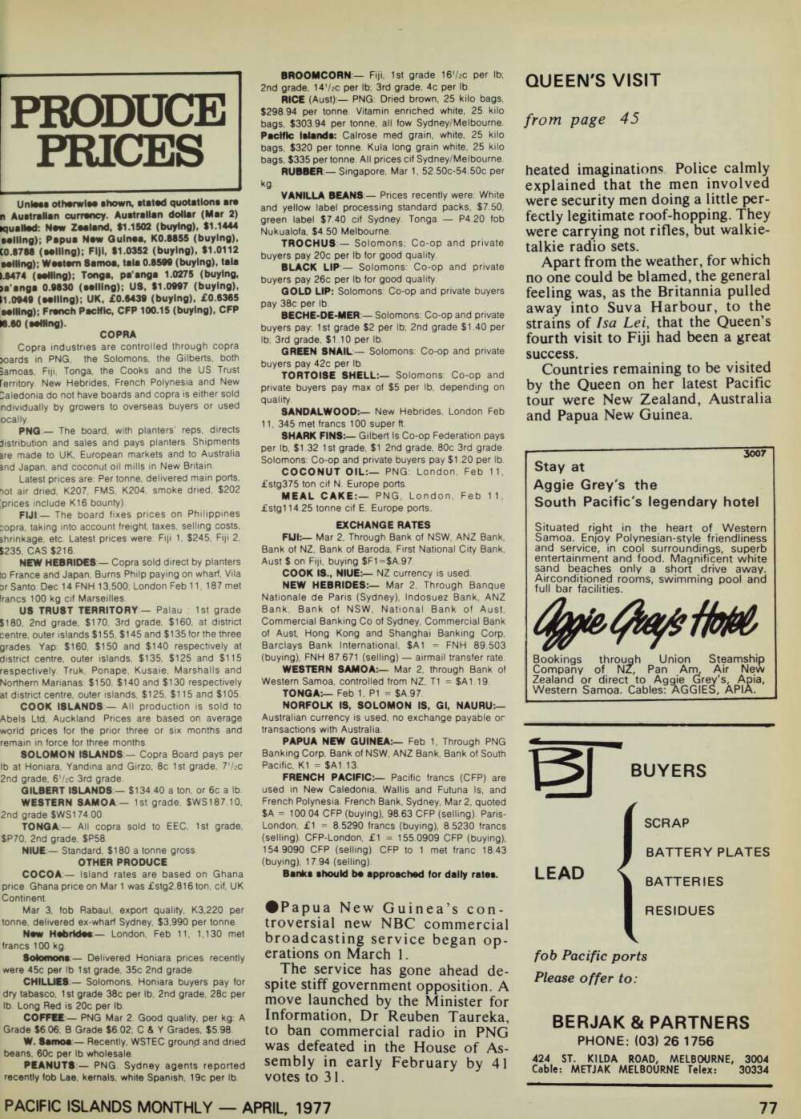
explained that the men involved were security men doing a little per fectly legitimate roof-hopping. They were carrying not rifles, but walkie talkie radio sets.
Apart from the weather, for which no one could be blamed, the general feeling was, as the Britannia pulled away into Suva Harbour, to the strains of Isa Lei, that the Queen’s fourth visit to Fiji had been a great success.
Countries remaining to be visited by the Queen on her latest Pacific tour were New Zealand, Australia and Papua New Guinea.
Produce
Prices
Unlass otharwlsa shown, stslad quotations ara n Australian currancy. Australian dollar (Mar 2) iquaHad: Naw Zaaland, $1.1502 (buying), $1.1444 sailing); Papua Naw Qulnaa, K 0.8855 (buying), (0.8788 (sailing); Fiji, $1.0352 (buying), $1.0112 sailing); Wastam Samoa, tala 0.8599 (buying), tala I. (aalllng); Tonga, pa anga 1.0275 (buying. >a’anga 0.9830 (sailing); US, $1.0997 (buying), 11. (sailing); UK, £0.8439 (buying), £0.8385 sailing); Franch Pacific, CFP 100.15 (buying), CFP 18.80 (sailing).
Copra
Copra industries are controlled through copra joards in PNG, the Solomons, the Gilberts, both samoas, Fiji, Tonga, the Cooks and the US Trust territory New Hebrides, French Polynesia and New Caledonia do not have boards and copra is either sold ndividually by growers to overseas buyers or used ocally PNG — The board, with planters’ reps, directs Jistribution and sales and pays planters. Shipments ire made to UK, European markets and to Australia md Japan, and coconut oil mills in New Britain Latest prices are: Per tonne, delivered main ports, lot air dried, K 207, FMS, K 204, smoke dried, $202 [prices include Kl 6 bounty).
FIJI: — The board fixes prices on Philippines copra, taking into account freight, taxes, selling costs, shrinkage, etc Latest prices were: Fiji 1, $245, Fiji 2,
(235, Cas $216
NEW HEBRIDES Copra sold direct by planters lo France and Japan, Burns Philp paying on wharf, Vila cr Santo Dec 14 FNH 13,500; London Feb 11, 187 met irancs 100 kg cif Marseilles.
US TRUST TERRITORY Palau Ist grade $lBO, 2nd grade, $l7O, 3rd grade, $l6O, at district centre, outer islands $155, $145 and $135 for the three grades Yap: $l6O, $l5O and $l4O respectively at district centre, outer islands, $135, $125 and $ll5 respectively Truk, Ponape, Kusaie, Marshalls and Northern Marianas: $l5O, $l4O and $l3O respectively at district centre, outer islands, $125, $ll5 and $lO5.
COOK ISLANDS All production is sold to Abels Ltd, Auckland Prices are based on average world prices for the prior three or six months and remain in force for three months SOLOMON ISLANDS Copra Board pays per lb at Honiara, Yandina and Girzo, 8c Ist grade, T'/zc 2nd grade, S'hc 3rd grade GILBERT ISLANDS $134 40 a ton, or 6c a lb
Western Samoa— Ist Grade, Swsib7.Io,
2nd grade $W5174.00.
TONGA— All copra sold to EEC, Ist grade, SP7O, 2nd grade, SPSB NIUE Standard, $lBO a tonne gross
Other Produce
COCOA — Island rates are based on Ghana price Ghana price on Mar 1 was £stg2,Bl6 ton, cif, UK Continent.
Mar 3, fob Rabaul, export quality, K 3.220 per tonne, delivered ex-wharf Sydney, $3,990 per tonne.
Naw Hebrides London, Feb 11, 1,130 met francs 100 kg Sotomona Delivered Honiara prices recently were 45c per lb Ist grade, 35c 2nd grade CHILLIES Solomons, Honiara buyers pay for dry tabasco, 1 st grade 38c per lb. 2nd grade, 28c per lb Long Red is 20c per lb COFFEE PNG Mar 2 Good quality, per kg: A Grade $6 06; B Grade $6 02; C & Y Grades, $5 98 W. Samoa Recently, WSTEC ground and dried beans. 60c per lb wholesale PEANUTS PNG. Sydney agents reported recently fob Lae, kernals, white Spanish, 19c per lb
BROOMCORN Fiji, Ist grade I6V2C per lb; 2nd grade, 14'/2C per lb; 3rd grade, 4c per lb.
RICE (Aust):— PNG: Dried brown, 25 kilo bags, $298 94 per tonne. Vitamin enriched white, 25 kilo bags, $303.94 per tonne, all fow Sydney/Melbourne.
Pacific lalanda: Calrose med grain, white, 25 kilo bags, $320 per tonne. Kula long grain white, 25 kilo bags, $335 per tonne. All prices cif Sydney/Melbourne.
RUBBER: — Singapore, Mar 1, 52 50c-54.50c per kg VANILLA BEANS Prices recently were: White and yellow label processing standard packs, $7.50, green label $7.40 cif Sydney. Tonga P 4.20 fob Nukualofa, $4 50 Melbourne.
TROCHUB Solomons; Co-op and private buyers pay 20c per lb for good quality BLACK LIP — Solomons: Co-op and private buyers pay 26c per lb for good quality GOLD LIP: Solomons: Co-op and private buyers pay 38c per lb.
BECHE-DE-MER Solomons: Co-op and private buyers pay: Ist grade $2 per lb; 2nd grade $1 40 per lb; 3rd grade, $1 10 per lb.
GREEN SNAIL — Solomons: Co-op and private buyers pay 42c per lb.
TORTOISE SHELL:— Solomons: Co-op and private buyers pay max of $5 per lb, depending on quality SANDALWOOD: — New Hebrides, London Feb 11, 345 met francs 100 super ft SHARK FINS- Gilbert Is Co-op Federation pays per lb, $1 32 Ist grade, $1 2nd grade. 80c 3rd grade Solomons: Co-op and private buyers pay $1.20 per lb.
COCONUT OIL: PNG: London, Feb 11, £stg37s ton cif N. Europe ports MEAL CAKE:— PNG, London, Feb 11, £stgll4 25 tonne cif E. Europe ports.
Exchange Rates
FUI- Mar 2, Through Bank of NSW, ANZ Bank, Bank of NZ, Bank of Baroda, First National City Bank, Aust $ on Fiji, buying $Fl=$A.97 COOK IS., NIUE:— NZ currency is used.
NEW HEBRIDES:— Mar 2, Through Banque Nationale de Paris (Sydney), Indosuez Bank, ANZ Bank, Bank of NSW, National Bank of Aust, Commercial Banking Co of Sydney, Commercial Bank of Aust Hong Kong and Shanghai Banking Corp, Barclays Bank International, SAI = FNH 89.503 (buying), FNH 87.671 (selling) airmail transfer rate.
WESTERN SAMOA;— Mar 2, through Bank of Western Samoa, controlled from NZ, T 1 = $A1.19.
TONGA: — Feb 1, PI = $A,97.
Norfolk Is, Solomon Is, Gl, Nauru:—
Australian currency is used, no exchange payable or transactions with Australia.
PAPUA NEW GUINEA:— Feb 1, Through PNG Banking Corp, Bank of NSW, ANZ Bank, Bank of South Pacific, K 1 = $A1.13 FRENCH PACIFIC:— Pacific francs (CFP) are used in New Caledonia, Wallis and Futuna Is, and French Polynesia. French Bank, Sydney, Mar 2, quoted $A = 100 04 CFP (buying), 98.63 CFP (selling). Paris- London, £1 = 8.5290 francs (buying), 8.5230 francs (selling). CFP-London, £1 = 155 0909 CFP (buying), 154 9090 CFP (selling). CFP to 1 met franc 18.43 (buying), 17.94 (selling).
Banks should b« approached for daily rates.
#Papua New Guinea’s con
troversial new NBC commercial
broadcasting service began op
erations on March 1.
The service has gone ahead de
spite stiff government opposition. A
move launched by the Minister for
Information, Dr Reuben Taureka,
to ban commercial radio in PNG
was defeated in the House of As
sembly in early February by 41
votes to 31.
Advertisements & other items, p. 75 (2 items)
77
QUEEN'S VISIT
from page 45
PACIFIC ISLANDS MONTHLY APRIL, 1977
(Scrap
3007
Stay at
Aggie Grey's the
South Pacific's legendary hotel Situated right in the heart of Western Samoa. Enjoy Polynesian-style friendliness and service, in cool surroundings, superb entertainment and food. Magnificent white sand beaches only a short drive away.
Airconditioned rooms, swimming pool and full bar facilities.
Bookings through Union Steamship
Company of NZ, Pan Am, Air New Zealand or direct to Aggie Grey's, Apia, Western Samoa. Cables: AGGIES, APIA.
BUYERS
LEAD
(SCRAP
BATTERY PLATES
BATTERIES
RESIDUES
fob Pacific ports Please offer to:
BERJAK & PARTNERS
PHONE; (03) 26 1756
424 ST. KILDA ROAD, MELBOURNE, 3004
Cable: METJAK MELBOURNE Telex: 30334
Deaths
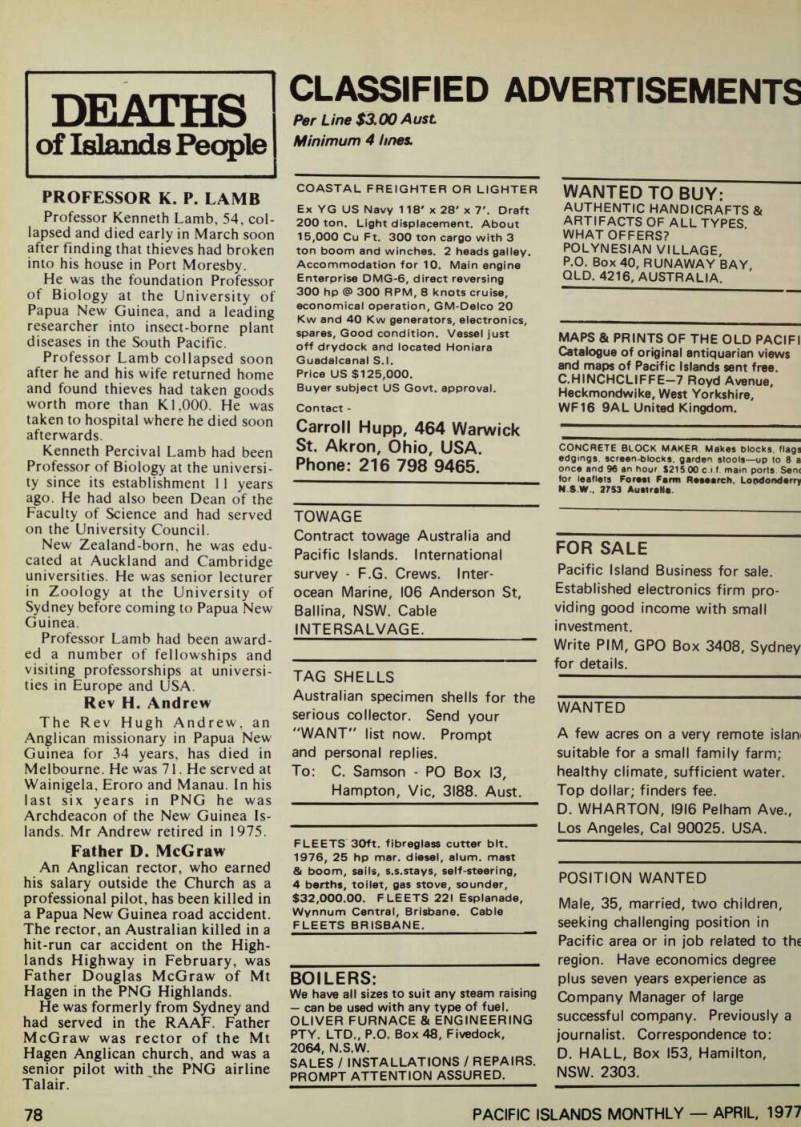
of Islands People
Professor K. P. Lamb
Professor Kenneth Lamb, 54, col lapsed and died early in March soon after finding that thieves had broken into his house in Port Moresby.
He was the foundation Professor of Biology at the University of Papua New Guinea, and a leading researcher into insect-borne plant diseases in the South Pacific.
Professor Lamb collapsed soon after he and his wife returned home and found thieves had taken goods worth more than K 1,000. He was taken to hospital where he died soon afterwards.
Kenneth Percival Lamb had been Professor of Biology at the universi ty since its establishment 11 years ago. He had also been Dean of the Faculty of Science and had served on the University Council.
New Zealand-born, he was edu cated at Auckland and Cambridge universities. He was senior lecturer in Zoology at the University of Sydney before coming to Papua New Guinea.
Professor Lamb had been award ed a number of fellowships and visiting professorships at universi ties in Europe and USA.
Rev H. Andrew The Rev Hugh Andrew, an Anglican missionary in Papua New Guinea for 34 years, has died in Melbourne. He was 71. He served at Wainigela, Eroro and Manau. In his last six years in PNG he was Archdeacon of the New Guinea Is lands. Mr Andrew retired in 1975.
Father D. McGraw An Anglican rector, who earned his salary outside the Church as a professional pilot, has been killed in a Papua New Guinea road accident.
The rector, an Australian killed in a hit-run car accident on the High lands Highway in February, was Father Douglas McGraw of Mt Hagen in the PNG Highlands.
He was formerly from Sydney and had served in the RAAF. Father McGraw was rector of the Mt Hagen Anglican church, and was a senior pilot with the PNG airline Talair.
Advertisements & other items, pp. 76-80 (2 items)
Classified Advertisements
Per Line $3.00 Aust Minimum 4 lines.
COASTAL FREIGHTER OR LIGHTER
Ex YG US Navy 118' x 28' x 7'. Draft 200 ton. Light displacement. About 15,000 Cu Ft. 300 ton cargo with 3 ton boom and winches. 2 heads galley.
Accommodation for 10. Main engine Enterprise DMG-6, direct reversing 300 hp @ 300 RPM, 8 knots cruise, economical operation, GM-Delco 20 Kw and 40 Kw generators, electronics, spares, Good condition. Vessel just off drydock and located Honiara Guadalcanal S.l.
Price US $125,000.
Buyer subject US Govt, approval.
Contact -
Carroll Hupp, 464 Warwick
St. Akron, Ohio, USA.
Phone: 216 798 9465.
TOWAGE
Contract towage Australia and Pacific Islands. International survey - F.G. Crews. Interocean Marine, 106 Anderson St, Ballina, NSW. Cable
INTERSALVAGE.
TAG SHELLS
Australian specimen shells for the serious collector. Send your "WANT" list now. Prompt
and personal replies.
To: C. Samson - PO Box 13,
Hampton, Vic, 3188. Aust.
FLEETS 30ft. fibreglass cutter bit. 1976, 25 hp mar. diesel, alum, mast & boom, sails, s.s.stays, self-steering, 4 berths, toilet, gas stove, sounder, $32,000.00. FLEETS 221 Esplanade, Wynnum Central, Brisbane. Cable
FLEETS BRISBANE.
BOILERS:
We have all sizes to suit any steam raising can be used with any type of fuel.
OLIVER FURNACE & ENGINEERING
PTY. LTD., P.O. Box 48, Fivedock,
2064, N.S.W,
SALES / INSTALLATIONS / REPAIRS.
PROMPT ATTENTION ASSURED.
WANTED TO BUY:
AUTHENTIC HANDICRAFTS &
ARTIFACTS OF ALL TYPES
WHAT OFFERS?
POLYNESIAN VILLAGE,
P.O. Box 40, RUNAWAY BAY
OLD. 4216, AUSTRALIA.
MAPS & PRINTS OF THE OLD PACIFI Catalogue of original antiquarian views and maps of Pacific Islands sent free.
C.HINCHCLIFFE—7 Royd Avenue, Heckmondwike, West Yorkshire, WFI6 9AL United Kingdom.
CONCRETE BLOCK MAKER Mdkes blocks, flags edgings, screen-blocks, garden stools—up to 8 a once and 96 an hour $215 00 c.i.f. main ports Sen< tor leaflets Forest Farm Research, Londonderry NSW.. 2753 Australia.
FOR SALE
Pacific Island Business for sale.
Established electronics firm providing good income with small investment.
Write PIM, GPO Box 3408, Sydney for details.
WANTED
A few acres on a very remote isiarr suitable for a small family farm; healthy climate, sufficient water.
Top dollar; finders fee.
D. WHARTON, 1916 Pelham Ave., Los Angeles, Cal 90025. USA.
POSITION WANTED
Male, 35, married, two children, seeking challenging position in Pacific area or in job related to the region. Have economics degree plus seven years experience as Company Manager of large successful company. Previously a journalist. Correspondence to: D. HALL, Box 153, Hamilton,
NSW. 2303.
Beautiful Sunset,
Astounding Soundset!
t •H <• n ✓ *1 u Australia: Akai Australia Pty. Ltd., 17/18 Hordern Place Denison St. Camperdown, Sydney, N S W. 2050 Tel: 516-3366/P.N.G.: S O. Svensson (N.G.) Ltd., P 0. Box 705, Port Moresby Tel: 2275/Fiji islands: Motibhai & Company Ltd,, P 0 Box 9175 Njdi International Airport Tel: 72-165/New Zealand; Pye Ltd, Consumer Product Division, 110 Mt. Eden Rd„ Mt. Eden, Auckland Tel: 686-437/ New Caledonia: Menard Freres, B.P. H 2, Noumea Tel: 275222/Tahiti: Etablissements Comimpex, P.O. Box 200, Papeete Tel: 20477/New Hebrides Island; Burns Philip (New Hebrides) Co., Ltd , Port Vila. New Hebrides Island /Norfolk Island; Burns Philip (Norfolk Island) Co., Ltd., P.O. Box 21, Norfolk Island/ Samoan Islands: Burns Philip (South Sea) Co.. Ltd., P.O. Box 129, Pago Pago, American Samoa. Apia. Western Samoa /Mariana Islands: J.C. Tenorio Enterprises, P.O. Box 137, Saipan Tel: 6444/8/British Solomon: Security Electrical Co., Ltd., P 0. Box 174, Honiara Tel: 881 /Cook Islands: JPS Enterprises Ltd., P.O. Box 15, Rarotonga Tel: 2150, 2176
SYSTETTII\
Audio & Video
I AKAI I
AKAI ELECTRIC CO., LTD.
Tokyo, Japan
THE SMALL CAR
FUUOF
IGI
I fe v. mam isuzu d-. .
' uiW
ISUZU GEMINI
The rugged little Isuzu Gemini! All the style, features and comfort you expect from the Japanese plus General Motors parts, service and unbeatable 12 months or 20,000 km warranty.
Its got the looks, the style, the performance and handling ... the reliability to set it way ahead of its competitors. Check out Gemini now!
O Four-on-the-floor O 1600 cc engine O Flow-through ventilation O Power assisted disc brakes O Hazard warning light O Radio O Bucket seats
O 2-speed wipers
O Electric clock O Headlight flasher O Anti-theft steering lock O Cigar lighter O Optional air conditioning available W. % A m Papua New Guinea Wamp Nga Motors, Mt. Hagen Dawapia Motors, Rabaul
Fiji
Burns Philp (South Sea) Co. Ltd.
Western Samoa O. F. Nelson and Co. Ltd.
General Motors Serving you in the South Pacific n G 149
* ■*> tQ J When you’ve been in the business as long as we have, you know how to create a turntable that sets the standard for rotational accuracy without setting a record for exorbitant price. In our new PL-550 direct-drive turntable, we used the most precise speed control system there is. With Pioneer’s Quartz PLL (phase-locked loop) method, the output waveform of a generator on the rotor of the motor is compared with the waveform of the Quartz element reference oscillator. A solidstate phase comparator insures that the precision of rotation is perfectly identical to the precision of the Quartz oscillator.
In addition, advanced fabrication techniques have resulted in reducing the wow & flutter to no more than 0.025% (WRMS)and increasing the S/N ratio to more than 70dB (DIN B).
After that, the high-torque motor resists even the most minute amounts of friction from stylus pressure for outstanding rotational precision.
The visual manifestation of this incredible accuracy is displayed on the built-in strobe. In comparison to conventional types, the PL-550’s strobe utilizes only one row of markings. In addition, a conventional light source powered by line voltage is subject to fluctuation of up to 0.1%. In the PL-550, strobe lighting is Quartz reference pulsive lighting unaffected by changes in power
supply frequency.
Tonal quality is further enhanced • by the high-trackability of the S-shaped tone arm. High precision angular contact bearings prevent deterioration in the mid and high frequency range and a thick aluminum mounting base assures integrity in the bass range. An anti-skating device eliminates harmful inward forces and a cueing device protects records and stylus against accidental damage.
And for protection from outside influences, the monocoque design cabinet combines the ideal weight/ mass ratio with large solid insulators.
Pioneer’s PL-550 Quartz PLL directdrive turntable. When it came to building in high performance accuracy, we held nothing back.
When it came to keeping the price down, we made everything count.
Mpiomeer
Pioneer Electronic Corporation 4-1, Meguro 1-chome, Meguro-ku, Tokyo 153, Japan Australia Pioneer Electronics Australia Pty.
Ltd., 178-184 Boundary Road, Braeside, Victoria 3195, Tel: 90-9011, Sydney 93-0246, Brisbane 59-7457, Adelaide 433379, Perth 24-9899 Fiji Islands Brijlal & Company, G.P.O. Box No. 362, Suva, Fiji Islands Tel: 22258 New Zealand Fountain Marketing Ltd., Maidstone Street, Auckland, New Zealand Tel: 763-064 Norfolk Island Burns Philp (Norfolk Island) Ltd., Norfolk Island, South Pacific New Hebrides Burns Philp (New Hebrides) Ltd., Vila, New Hebrides Nauru Island Jacob Enterprises, P.O. Box No. 4 Republic of Nauru Tahiti Est. PERFECT, B.P, 594, Papeete, Tahiti Tel: 20 407 New Caledonia Menard Freres, B.P. 123, Noumea, New Caledonia Tel: 27.52.22 American Samoa Traspac Corporation, P.O Box 1477, Pago Pago, American Samoa 96799 Tel: 633-5224 Rarotonga South Seas International Ltd., P.O. Box 49, Rarotonga Cook Islands Tel: 2327
4-Wheel Drive
rn i i Built By the People WhoVe Made Datsun World Famous.
The Nissan Patrol, Datsun cars and trucks all share the same tradition of quality engineering.
The 4-wheel drive Nissan Patrol is specially designed to handle a wide-range of work assignments both on and off the road.
It's tough and dependable.
The Nissan Patrol —built to do the job better. fi( 20 APR 77 □ Nissan PATROL Pickup Nissan PATROL Hardtop
DATSUN
esei Product of NISSAN
80
PACIFIC ISLANDS MONTH LY-APRI L, 1977