Pacific Islands Monthly

Pim
March, 1977
Registered for posting as a publication Category B.
85C Aust
$1.25 US
Cfp 130
Our Cover
We don’t know how long it took to make up this boy from the PNG Southern Highlands but he’s a walk ing, dancing work of art.
The boy, who was made up for an important sing-sing, was featured in the PNG film "... and then came dawn”, which won for its producer K arl-H einz Stellmach and his film com pany the first prize at an Italian film festival and an award from the Human Rights Association.
Advertisements & other items, pp. 2-4 (1 item)
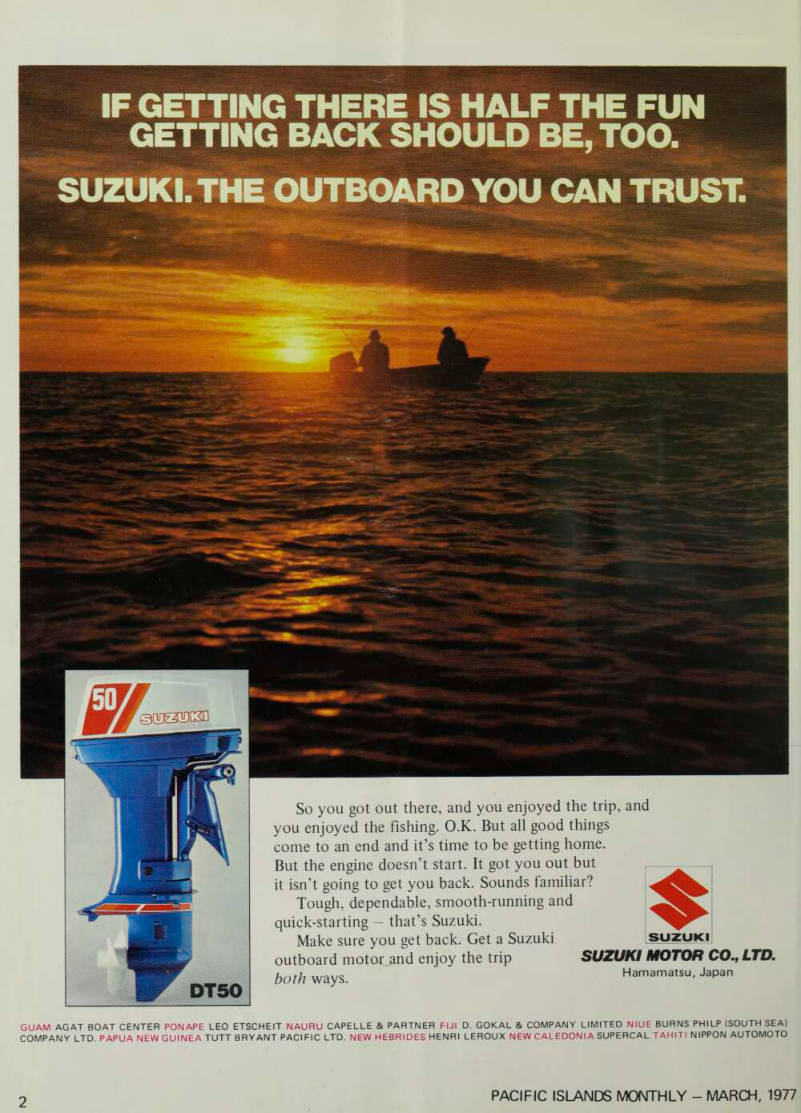
If Getting There Is Half The Fun
GETTING BACK SHOULD BE, TOO.
SUZUKI. THE OUTBOARD YOU CAN TRUST.
50 CO
DTSO
So you got out there, and you enjoyed the trip, and you enjoyed the fishing. O.K. But all good things come to an end and it’s time to be getting home.
But the engine doesn’t start. It got you out but , A —, it isn’t going to get you back. Sounds familiar?
Tough, dependable, smooth-running and quick-starting that’s Suzuki.
Make sure you get back. Get a Suzuki Suzuki outboard motor and enjoy the trip SUZUKI MOTOR CO., LTD. both ways. Hamamatsu, Japan Hamamatsu, Japan GUAM AGAT BOAT CENTER PONAPE LEO ETSCHEIT NAURU CAPELLE & PARTNER FIJI D. GOKAL & COMPANY LIMITED NIUE BURNS PHILP (SOUTH SEA) COMPANY LTD. PAPUA NEW GUINEA TUTT BRYANT PACIFIC LTD. NEW HEBRIDES HENRI LEROUX NEW CALEDONIA SUPERCAL TAHITI NIPPON AUTOMOTO
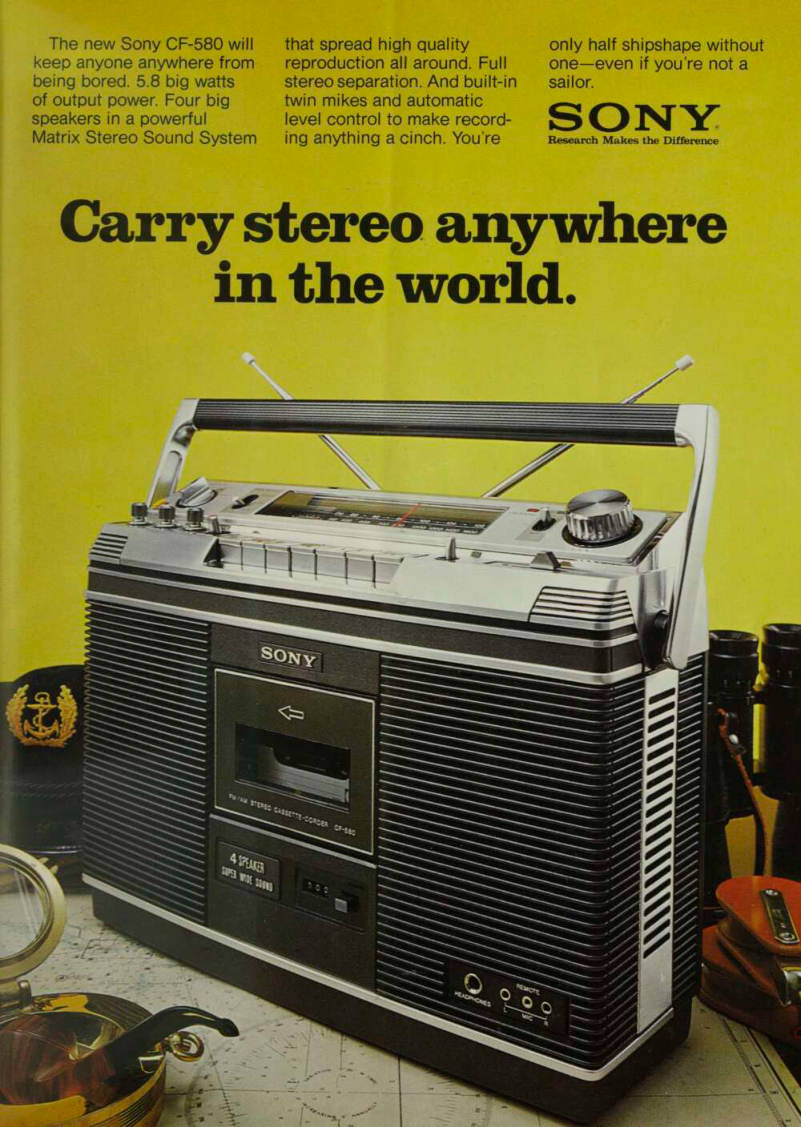
The new Sony CF-580 will keep anyone anywhere from being bored. 5.8 big watts of output power. Four big speakers in a powerful Matrix Stereo Sound System that spread high quality reproduction all around. Full stereo separation. And built-in twin mikes and automatic level control to make recording anything a cinch. You’re only half shipshape without one—even if you’re not a sailor.
SONY
Research Makes the Difference
Carry stereo anywhere
in the world.
W 4 1 % y - & &>•■ - * '
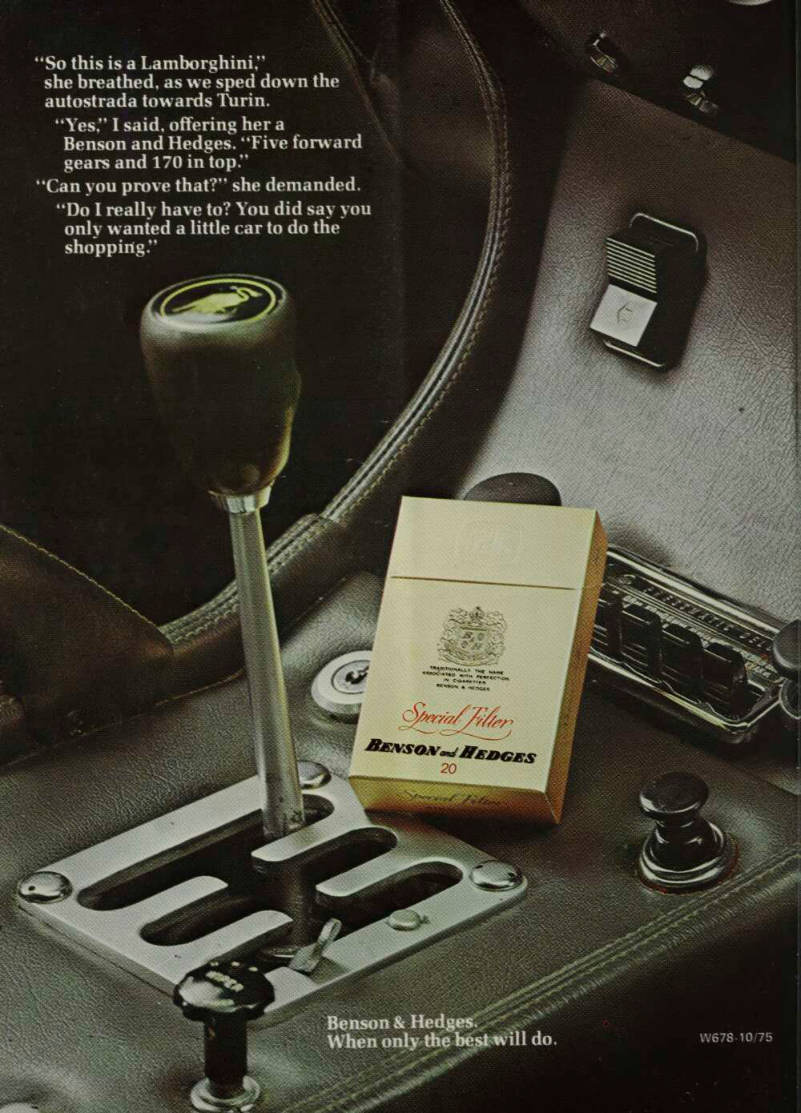
“So this is a Lamborghini ” she breathed, as we sped down the autostrada towards Turin.
“Yes,” I said, offering her a Benson and Hedges. “Five forward gears and 170 in top.”
“Can you prove that?” she demanded.
“Do I really have to? You did say you only wanted a little car to do the shopping” \ % m 5) « m 7 am mm * K TS v % isg m m ■ - y.i r ibbs ■v v When only the best #lll do.
W678-10/75
Pacific Islands
Monthly
Subscription Rates:
"Pacific Islands Monthly” is airfreighted to the ma jority of subscribers and agents in the Pacific Islands and the U S A, Australia (including Lord Howe and Thursday Islands), New Zealand, Papua New Guinea, Fiji.
'Jew Hebrides, Tonga, Cook Islands, Western Samoa, Gilberts and Tuvalu, Norfolk Island, Niue jnd Nauru $9 00 (local currency): Solomon slands $10 00 Aust. American Samoa, Micronesia and Guam $12 00 U S Hawaii and J S Mainland $15.00 U S ; New Caledonia and c rench Polynesia 1,500 C.F.P.; United Kingdom "6 50, Japan 4000 Yen: Elsewhere $11 50 Aust
Representatives
: iji: Advertising and Distribution — Fiji Times & ferald Ltd , 20 Gordon Street, Suva, elephone 312-1 1 1. Telex FJ 2124 *apua New Guinea; Advertising and Distribution - PNG Post-Courier, P 0 Box 85, Port Moresby inquiries Post Newsagency, Telephone 24-2148 : rench Polynesia: Distribution — Hachette 'acifique. 10 Ave Bruat, Papeete lew Caledonia; Distribution — Depot Centre de resse Michel PENTECOST, 8 P C2 NOUMEA lew Zealand; Pacific Publications. CPO Box 229, Auckland nited Kingdom: The Herald and Weekly Times imited, 8-10 Clifford's Inn, Fetter Lane, London C4A 1BU Telephone 01-831 6041 Telex Lon an 21989 apan. Advertising — Universal Media Corpora an, CPO Box 46. Tokyo Telephone: 666-3036
ictoria: Advertising — Pacific Publications (Aust)
ty Ltd., Herald and Weekly Times Building. 2nd oor, 61 Flinders Lane. Melbourne 3000 Jlephone 652 1565 risbane: D Wood, Anday Agency, Box 1918 PO, Brisbane 4001 Telephone 44 3485 *1546 awaii and U S Mainland only: PIM, Hawaii, 312. Kahawai St, Honolulu, Hawaii. 96822 econd class postage paid at Honolulu. Hawaii Printed in Australia
Copyright c 1977
3 acific Publications (Aust.) Pty. Ltd.
Printed by Paramac. Mitchell Road, Alexandria. gistered at the G.P.i/. Sydney for transmission by st as a newspaper — category B Recommended retail price only
Vol. 48 No. 3 March., 1977.
Up Front
with the Publisher
Some colour has gone from Papua New Guinea‘s Government House with the resignation In February of the Governor-General, Sir John Guise. Sir John wants to contest the general elections in May. One might wonder what could be so attractive about the political hustings that a man would voluntarily relinquish the privileges and honour of the highest post in the land, that of the Queen’s representative, to com pete in them. But Sir John Guise has never been a man for doing the obvious, and politics are in his blood. In view of his latest de cision it might be more accurate to say that politics are his lifeblood.
I have cause to remember one of the last occasions I met Sir John, It was during the Papua New Guinea independence celebrations of 1975.
It was the big day itself. Only that morning Sir John had become the new nation’s first Governor-General, and he was now seated on a dais below Independence Hill surrounded on all sides by seated Pacific leaders and heads of state, ambassadors and dignitaries of all kinds from many lands. All were patiently awaiting the arrival of the last guest, Prince Charles, heir to the British Throne, who was only a few minutes away in a cavalcade of cars, police and security men.
You would not have believed the number of security men who were present at that spot on that day.
Imelda Marcos, First Lady of the Philippines, had brought a whole planeload of them for herself, and there was not one leader in the vast assortment who was not being watched over from behind dark glasses by men who had, as the thriller stories have it, tell-tale bulges beneath their coats.
You can imagine, then, my mounting horror when I detected Sir John apparently beckoning to me from across the no man’s land that separated that great tier of VIPs from the roped-in press enclosure, where literally hundreds of us appeared to be under armed
guard. I hoped it wasn’t happening, and I looked behind me to see whether it was really some security man that the Governor-General was attempting to attract.
But it was me he seemed to want.
Bravely I stepped into no man’s land and marched purposefully and smartly across the open ground between us expecting any moment to hear a shot ring out, or to have a security man take a flying tackle.
I climbed the steps of the dais, and in full view of the waiting throng walked up to the seated Governor-General and went down on one knee.
“Stuart”, said the Governor- General. “Would you be free for lunch tomorrow?”
“Yes sir”, I said, a little shaken, probably at my narrow escape from assassination.
“I am having all the departmental heads into lunch and it might be useful for you to come along too”.
“Thank you, sir”, I said. And there was a great fanfare as Prince Charles’s entourage rolled into view!
Well, it was a very good lunch at Government House, In other ways it was like no other function that I ever attended at Government House.
The new Governor-General didn’t stand on his dignity. We all wore open-necked shirts. He got the beers himself and handed them out.
And when it came time to go into lunch there was no formal arrange ment at the vast table.
“Find yourselves a seat”, said the Governor-General.
When we did there was, luckily, one seat left, at no particular part of the table, and Sir John sat in that - the last of us to sit down.
That lunch was the most relaxed lunch I’ve had in any Government House anywhere, or in most other houses for that matter.
Sir John that day set a Vice-regal style which he carried on through his entire period as Governor- General. As I said, some colour has now gone from Government House!
Fortunately, the personality behind it is not lost to Papua New Guinea.
Advertisements & other items, pp. 5-6 (2 items)
’Acific Islands Monthly - March, 1977
5
FOUNDED BY R W. ROBSON IN 1930
PUBLISHED MONTHLY BY
PACIFIC PUBLICATIONS (AUST.) PTY. LTD ,
76 CLARENCE STREET, SYDNEY 2000
Post Address G PO BOX 3408. SYDNEY,
N S W 2001
Telegraphic Address PACPUB, Sydney Telex 21242
TELEPHONE 29 6693
Publisher: Stuart Inder Manager: John Berry
PACIFIC ISLANDS MONTHLY
Editor; John Carter Advertising Manager: Alan Batt
S. E. Tatham
SOME OF
THE FIRMS
REPRESENT
ARI^H
S 3 A 2 !• Allens (Confectionery) Amatil (Twisties, Twirlies) Arnbro (Folding Beds) Asia Rubber Works (Singapore Rubber Shoes) Austramax (Pressuri Lanterns) B.X. (Plastics) City Engineers (U.K. Bicycles) Disston (Saws) Durobor S.A. (Belgium Glassware) Edward Zorn (Margarine, Cooking Fats) Electronic Industries (Electrical Household Appliances) Elmaco (Plastics—Electrical Fittings) Essteel (Cookware) F.H.I. Japan (Subaru Cars) Franklite (Light Fittings) Frappier (French Brandy) Huvet (French Brandy) Indika (Belgium Dairy Produce) James Miller (Blankets) Jex (Steelwool) JJ, Cash (Embroidered Labels) Kinki Industrial Co. Ltd. (Japan—Textile piece goods) Lega Marcasite (Jewellery) Magnet (Mattresses) Miroiterie Gen. de Belgiqe S.A. (Louvre Glass & Mirrors) Mitchell's (Abrasives) Quaker Products (Oats, Jets) Red Tulip (Fine Chocolates) Regent (Swiss Watches) Rinoldi Hancock Pty. Ltd. (Spaghetti & Cereals) Robert Timms (New Guinea Gold Instant Coffees & Teas) S.P.C. (Abalone) S.P.C. (Canned Fruit) Sterling Clothing Co. Pty. Ltd. (Colonials Jeans, Jackets, & Skirts etc.) Sunrise (Confectionery) Tilbury & Lewis (Sports Trophies & Silverplate) Tubco (Garden Furniture) U Bond Industries Corp. (Taiwan—Bicycles & Fans) Wing Lee (See Vau Sauce)
DIRECT ENQUIRIES WELCOMED
PAPUA NEW GUINEA: S. E. TATHAM (P.N.G.) PTY. LTD.,
LAE: MALAITA STREET (P.O. BOX 1562).
PORT MORESBY: CNR. GOROA AND MANAHU STREETS, GORDON
(P.O. BOX 6733, BOROKO).
FIJI: S. E. TATHAM (FIJI) LTD.,
LAUTOKA: P.O. BOX 366.
SUVA: G.P.O. BOX 671.
S. E. TATHAM
& CO. PTY. LTD.
BEEHIVE BLDG.,
94 ELIZABETH ST.,
MELBOURNE, 3001, AUSTRALIA.
G.P.O. BOX B—CABLES "SET"
PHONE: 63 5094
TELEX: AA34552
BUYERS FOR THE
PACIFIC ISLANDS
7k 5* \ l 1
YOUR GUARANTEE
SINCE 1924
1 1 1
FOR SERVICE
T. 6
In this issue
General
French takeover of Sullivans 19 Melanesian cultural body 23
American Samoa
Air service to Tonga 59
Cook Islands
Versatile fire engine 23 Migrant flow reversed 25 Wage rise 33 Transport troubles 57
Fiji
Anti-corruption laws .12 General elections 13 Help for Emperor Mines 49 Co-op cocoa growing 50
French Polynesia
Imports problem 53 Death of Pouvanaa a Oopa 68 Death of Archbishop Maze 68
Gilbert Islands
Chief Minister interviewed 8
New Caledonia
Road toll 31 Tourist industry 51
New Hebrides
National Party name change .17 British High Commissioner 29 Sharks take Children 31
Niue Island
Bureaucracy praised 25 Choosing a bride 25 Uranium discovery 53
Papua New Guinea
Somare in Indonesia 14 Torres talks breakdown 15 Red embassies rejected 15 Bird over Sydney garage 23 Public prosecutor named 29 Experience needed in diplomacy 31 Advice to Tolais 21 Japanese bombing of Rabaul 38 Oil quest .49 Stock exchange in sight 51 Lutherans sell up 53 New foreign ventures 53 Equity in Seacom 54 Vanimo forest problems 55
Pitcairn Island
Census 23
Solomon Islands
Mamaloni resigns 19 History uncovered 25 Shortland riot 31
Tonga
King's tour 19 Good year for tourism 54 Air services 59
Tuvalu
The date for independence 10
Us Trust Territory
Kusaie celebrates new status 13 CIA bugs talks .17 Bid to save turtle 25
Western Samoa
Sackings follow inquiry 11
DEPARTMENTS: Up front with the Publisher, 5; Editor's Mailbag, 21; Tropicalities 23; People, 29; News in a Nutshell, 31; Islands Press, 36; Magazine Section, 38; Book's 45; Business and Development, 49; Pacific Transport, 57; Cruising Yachts, 66; Deaths' of Islands People, 68; Shipping Information, 72; Produce Prices, 77.
signposts on the way ahead
The Independent Gilberts
Chief Minister looks at the signposts on the way ahead
The Gilbert islanders expect to declare their independence from Britain in June, 1978. How do they view their chances of success as a free and independent state? What about the Banabans’ demand for transfer of sovereignty of their former home, Ocean Island, fromthe Gilberts toFiji?How do the Gilberteseseetheir future relationship with the Ellice islanders, former partners in the Crown Colony, who also hope for independence in 1978? Speaking for his people in an interview on January 6 with Barrie MacDonald, Lecturer in Pacific History at Massey University (NZ), Mr Naboua Ratieta, Chief Minister of the Gilberts, gives answers to these questions, and many others, in the report below. The Chief Minister agreed to the interview provided it appeared in PIM.
Barrie MacDonald is in the Gilberts helping with a Workshop on a history of the Gilbertese people.
MACDONALD: Chief Minister, shortly after your return from the constitutional talks in London, you announced that self-government would be introduced on November 1, 1976; the British Government then put the date back to January 1,1977. Why?
RATIETA: I think it was because the British Government acted for political expediency; I think they would like to please other people, other than the Gilberts and they would like to show that they are giving all the chances to try to make peace with everybody concerned like us, the Rabi Islanders and the Fijians (because the Ocean Islanders are citizens of Fiji now). Also, because they said they believed that the decision of the court could have a bearing on the implementation of self government if we were given it on November 1 before the court decision came out, so they asked us to defer the thing until January 1.
MACDONALD: In the House of Assembly’s recent meeting you introduced a motion which criticised the intervention of third parties in your relationship with the British Govern ment. You did not name names at that time but the motion was apparently directed at Fiji. Was this the case, and how has this incident affected your relationship with Fiji and other Pacific countries?
RATIETA: Well, in the interests of regionalism I thought that Fiji should not have intervened in these cases without consulting us because, after all, we are moving towards a fuller consultation between sovereign nations in the Pacific and if one leader of one nation goes behind the others’
backs and does his thing with the British Government then I think it is not in the interests of co-operation as
friendly neighbours.
MACDONALD: Do you intend to raise this issue at the next meeting of the South Pacific Forum?
RATIETA: I don’t know. I think things have cooled off and people, despite their first angry reaction to this intervention, seem to be able to understand Fiji’s position now as acting on behalf of its citizens, the Banabans, and not, as before, of trying to become an impartial mediator.
MACDONALD: What was your reaction to the court decisions on the Banaban case?
RATIETA: I think we are very happy that there is nothing in the judgments in these cases that affects us or our independence, or ourinternal self-government, or our share of the
royalties.
MACDONALD: Do you expect further talks on independence?
RATIETA: I made it clear to the
minister in London responsible tor us, Lord Goronwy-Roberts, that there is no point in us meeting with the Banabans or anybody else if the Banabans insist on not considering anything but independence.
MACDONALD: Would you con tinue to oppose independence for Ocean Island after the exhaustion of phosphates in 1978?
RATIETA: Yes, we oppose independence not because of phos phate but as a matter of principle. It is one of our islands and it is not going to be taken by another country.
MACDONALD: Would you en visage Ocean Island being inhabited or used in any way after the exhaustion of phosphates?
RATIETA: Well, we thought it was going to be a very expensive exercise to live on Ocean Island after the exhaustion of phosphates but if some Ocean Islanders insist on living there then I think we should give them some kind of services.
MACDONALD: Phosphate is expected to finish in the second half of 1978, a few months after Gilbert Islands independence. What are the chances of the independent Gilberts being able to meet recurrent costs of
government?
RATIETA: As far as using our reserves is concerned, we have about $35 million in our reserves which is being kept by our brokers in London (James Capel). If we have to use those to balance our budget, provided we do not exceed our recurrent expenditure as at present, it will take about seven years to finish our royalties but we are planning to cut down unnecessary expenditure and also to find other means of supplementing our income,
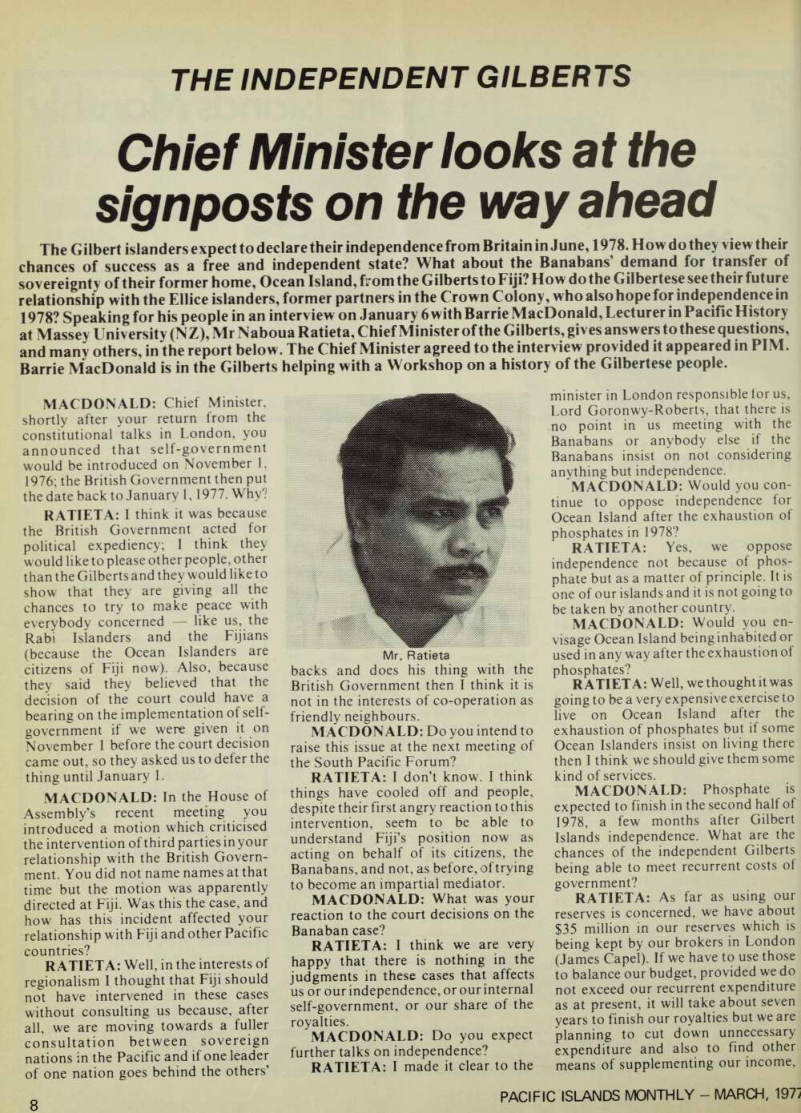
Mr. Ratieta
for example by fisheries. As you know, we have been negotiating with the Japanese to establish a fisheries industry here. They came here in December and had an on-shore-based survey. On the results of this survey they are going to send another survey which is going to bring a ship. But thing that the Japanese have been emphasising to us is that their hands are tied because we are not yet independent and, maybe when we are independent, they can give us more money; as you know they will not then be restricted by their regulations governing their aid to other countries.
MACDONALD: You said the reserves might last seven years; do you expect to use the capital of the reserve fund as well as the interest from it?
RATIETA: We don’t want to but if we have to use the capital and interest it will take only seven years to finish the reserves but we hope by that time we will have discovered other income. We are hoping that the brine shrimp industry at Christmas Island will come into production very shortly.
MACDONALD: As far as the development budget is concerned, your major source of aid is still the United Kingdom with, for 1977, about $2,7 million, about $1 million from Australia and about $.2 million from New Zealand. Do you expect this pattern of aid to continue and do you expect, or hope for, any change with self-government or independence?
RATIETA: As I said, the Japanese said they will be able to give us more money after independence and we are hoping that, because we are nearer to the Australians and the New Zealanders, and because they think they would like to increase their aid to the Pacific countries, we might get more from them as time goes on. We are determined that in our indep endence talks we should be able to get something from the British Govern ment like the Seychelles are getting.
They have managed to get a deal that the British Government will balance their recurrent budget for the next five years after independence.
MACDONALD: So you will be looking for specific guarantees for development capital and perhaps, even, for recurrent expenditure?
Ratieta: Yes.
MACDONALD: The local con tribution to development expenditure for 1977 is about $1.5 million. One of the major budgeted areas for this expenditure is the purchase of Fanning and Washington islands; what is the
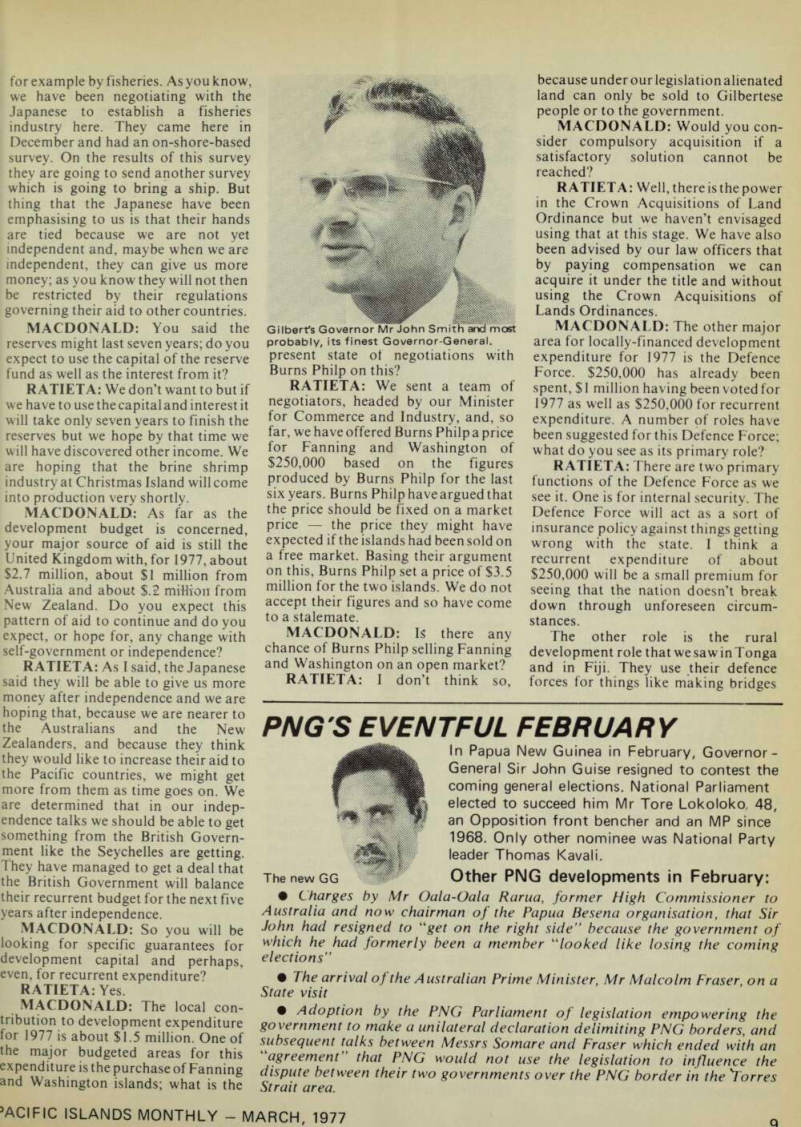
Gilbert's Governor Mr John Smith and most probably, its finest Governor-General. present state of negotiations with Burns Philp on this?
RATIETA: We sent a team of negotiators, headed by our Minister for Commerce and Industry, and, so far, we have offered Burns Philp a price for Fanning and Washington of $250,000 based on the figures produced by Burns Philp for the last six years. Burns Philp have argued that the price should be fixed on a market
price the price they might have
expected if the islands had been sold on a free market. Basing their argument on this. Burns Philp set a price of $3.5 million for the two islands. We do not accept their figures and so have come to a stalemate.
MACDONALD: Is there any
chance of Burns Philp selling Fanning
and Washington on an open market?
RATIETA: I don’t think so,
because under our legislation alienated land can only be sold to Gilbertese people or to the government.
MACDONALD: Would you con sider compulsory acquisition if a satisfactory solution cannot be reached?
RATIETA: Well, there is the power in the Crown Acquisitions of Land Ordinance but we haven’t envisaged using that at this stage. We have also been advised by our law officers that by paying compensation we can acquire it under the title and without using the Crown Acquisitions of Lands Ordinances.
MACDONALD: The other major area for locally-financed development expenditure for 1977 is the Defence Force. $250,000 has already been spent, $ 1 million having been voted for 1977 as well as $250,000 for recurrent expenditure. A number of roles have been suggested for this Defence Force; what do you see as its primary role?
RATIETA: There are two primary functions of the Defence Force as we see it. One is for internal security. The Defence Force will act as a sort of insurance policy against things getting wrong with the state. I think a recurrent expenditure of about $250,000 will be a small premium for seeing that the nation doesn’t break down through unforeseen circum stances.
The other role is the rural development role that wesawinTonga and in Fiji. They use their defence forces for things like making bridges
and causeways and we are also envisaging that we will do the same thing here with our Defence Force helping the councils.
Another thing is that the Defence Force will also perform some of the ceremonial duties that the police are doing now.
MACDONALD: Is this Defence Force seen as a strike-breaking unit?
RATIETA: Strikes lawful under our legislation but if the strikers do break laws like starting to burn the place down or looting shops or any of these things, then we would need a force trained to contain them.
MACDONALD: In a strike, would the force be used to run essential services?
RATIETA: It could be.
MACDONALD: If the primary function is internal security, why could this not be achieved by extending the present police force?
RATIETA: We are advised that the police as a law enforcement agency would not be able to do things that a well-trained and mobile security force could do. And we are cutting down on the police force where the Defence Force is taking over things previously done by them MACDONALD: 1976 also saw the final separation of the Ellice from the Gilberts with the Ellice becoming a separate dependancy under the name Tuvalu. What have been the main implications of this partition for the Gilbert Islands?
RATIETA: It seems that the Gilbertese have more jobs available to them. We’ve suffered in certain areas but we’ve managed so far, in others, say in the field of doctors, to continue employing Tuvaluan doctors here.
MACDONALD: How would you describe the present relationship between Tuvalu and the Gilbert Islands?
RATIETA: As amicable as ever.
MACDONALD: Has there been any noticeable effect from the loss of Ellice civil servants a loss of efficiency or a drop in standards?
RATIETA: We have not felt that very much because, in cases where Gilbertese cannot cope, we have employed expatriates.
MACDONALD: How many ex patriates have you employed as a direct result of separation?
RATIETA: I think we have increased by perhaps half-a-dozen.
MACDONALD: How many ex patriates are in the civil service and the Development Autority?
RATIETA: About 160.
MACDONALD: Are there time tables for the localisation of these positions or timetables for local isation you want to meet before
independence?
RATIETA: We have a Select Committee to go into this problem and its report is being considered by government at the moment. We have extended the terms of reference; before, committees have usually done this exercise for the Civil Service only.
But this last Select Committee has considered the Development Autority employees as well. I don’t think the Gilberts will ever get rid of all its expatriates but we will try to make them as few as possible.
MACDONALD: Are you satisfied with the present rate of localisation?
RATIETA: Yes, in a sense, because the driving force behind localisation before when we had a colonial type of government was that we would like to get Gilbertese to be policy makers and now, with a ministerial system, Gilbertese people are policy makers so it doesn’t really matter now who does what. Butsolongasweknow that the Gilbertese people are the bosses around the place the main thing now is to get jobs for the Gilbertese
people.
MACDONALD: The ministerial system has now been in operation for about three years and you have been Chief Minister for that time. What have been the major developments and changes in your role in that time?
RATIETA: When we had the membership system, just before the ministerial system, we did not know what do do and it was a rather frustrating experienc for us. But as the Governor at that time pointed out, it was a time for learning, and we were certainly learning. With the advent of the ministerial system we changed from being inactive to being active in the field of policy-making and that has made, I think, most of our ministers feel more self-confident.
MACDONALD: What have been the major difficulties or frustrations?
RATIETA: I think the major frustration is that we can’t do as much as we would like to because of the constraints of finance and the time taken on preparing a project here and
getting it approved by the Foreign
Commonwealth Office, which is not easy.
Continued on p. 76
MACDONALD: Are aid donors prepared to accept your priorities in terms of development expenditure or do you find that sometimes they attempt to impose priorities upon you?
RATIETA: Sometimes they at tempt to impose priorities, I think, largely, because the money is theirs and they’ve got this paternalistic attitude of using their money in the way they think will benefit us most, but not necessarily the way we think.
MACDONALD: The past three years have seen the emergence of a
‘government’ and an ‘opposition’.
What is it in terms of political philosophy that gives each of these groups its coherence and distinguishes between them?
RATIETA: I think that we haven’t got parties started off at the grass roots; parties here are more politicians’ clubs than anything else. What gets the people to converge in these so-called parties are the personalities concerned.
MACDONALD: Do you see party politics as being important at the next general election? Would you try to
establish a grass-roots organisation foi your National Progressive Party 01 would you be happier with you: members campaigning on a persona basis?
RATIETA: I think we will try i both ways because, even thougl parties have not been very successfu
here, parties are the coming thing
They are coming very slowly but the; are surely coming. In the case of th trade union movement, the union i becoming more and more political an< maybe will have a party based on th
labour philosophy.
MACDONALD: What sort c philosophy would you see your part being based on?
RATIETA: I think all parties in thi small place, where there aren’t any ric people, should have a tendency t become socialistic and we can’t sa that, because those people are goin labour, we are going conservative there aren’t any true blue-blood torie here.
MACDONALD: Looking at th composition of your present cabine seven of the eight members are froi the six northern islands and only or from the 10 southernmost islands c the group. Of the eight ministers fi\ are, or have been, associated with th Catholic Church. Do you see religio as a possible basis for party politics i the Gilbers?
RATIETA: I hope that the tim will never come. The decision t appoint ministers on my part is nc based on religion, or on geography, appoint the people that I think can d the job from among the people in th House within that limitation an people who I think can co-operal because the major advantage of havir parties here is that they get legislatio that government wants passed throug the House with a minimum of fuss an without any further need for lobbyinj MACDONALD: After a delay c two months, the Gilbert Islands is sell governing. What future steps do yo see on the path to independence?
RATIETA: We are setting ou target for independence for June, 197£ and this is known also to the Britis Government because we said thi during our meeting in London fo internal self-government. But befor we do that we would like to have th fullest consultation with the people o the constitution they would like V have. We are going to have Continued on p. 78
constitutional convention in May this year and after that we will know what kind of constitution should be drafted by the legal experts.
MACDONALD: The Gilbert Islands is due foranelection by March, 1978; do you see that election as confirming a constitution for in dependence?
RATIETA: Yes. The British Government insists on an election to show the other side of the coin whether there are people who do not like the constitution and, if so, they can vote for people who will oppose it.
MACDONALD: What sort of constitution would you prefer?
RATIETA: My personal opinion is to try to keep our constitution as simple and as inexpensive as possible so I would prefer to see a constitution like our neighbours in Nauru have.
MACDONALD: Looking for ward to independence, what sort of international relationships do you envisage for the Gilberts? Would they, for example, extend to the United Nations?
RATIETA: We are hoping after independence to beome members of the British Commonwealth of Nations and also to play our part in the Pacific amongst the Pacific sovereign states.
We would like to participate fully in the South Pacific Forum and the SPCand any other regional organisation in the Pacific.
We would like to be members of the specialised UN agencies like the World Health Organisation and the UNDP because we can benefit from them. But having a representative at the UN or a post in Washington or New York would be foolish. We have discussed this with other leaders in the Pacific and since some in the Pacific like Papua New Guina and Fiji, and Australia and New Zealand are members of the UN we can discuss our views and stand up together and they can take it to the United Nations for us.
Vanuaaku Pati
A resolution of the sth Con gress of the New Hebrides Na tional Party held in Tautu village, Malekula, decided that the party will henceforth be known as the Vanuaaku Pati. The resolution re jected the name “New Hebrides” as “a colonial relic” and declared that the country should hen ceforth be known as Vanuaaku, “Our Land”. The party’s name was changed as a consequence of this decision.
Png's Eventful February
In Papua New Guinea in February, Governor- General Sir John Guise resigned to contest the coming general elections. National Parliament elected to succeed him Mr Tore Lokoloko, 48, an Opposition front bencher and an MP since 1968. Only other nominee was National Party leader Thomas Kavali.
Other PNG developments in February:
• Charges by Mr Oala-Oala Rarua, former High Commissioner to Australia and now chairman of the Papua Besena organisation, that Sir John had resigned to “get on the right side” because the government of which he had formerly been a member “looked like losing the coming elections” • The arrival of the Australian Prime Minister, Mr Malcolm Fraser, on a State visit • Adoption by the PNG Parliament of legislation empowering the government to make a unilateral declaration delimiting PNG borders, and subsequent talks between Messrs Somare and Fraser which ended with an agreement that PNG would not use the legislation to influence the dispute between their two governments over the PNG border in the 'Torres Strait area.
The new GG
Advertisements & other items, p. 9 (1 item)
9
’ACIFIC ISLANDS MONTHLY - MARCH 1977
Tuvalu Sets
The Date For
Independence
The most significant even during Tuvalu’s December budget meeting in the House of Assembly was the un animous passing of a motion in troduced by Chief Minister Toalipi Lauti, calling for the setting up of a constitutional committee and infor ming the United Kingdom that Tubalu wishes to go independent in 1978.
All members spoke enthusiastically in support of the motion, though one or two expressed doubts about the country’s economy. Mr Isa Paeniu said that those who did not want to live without their colonial masters could always emigrate to French Polynesia or New Caledonia!
Members of the constitutional committee was limited to the elected members of the House under the Chief Minister’s chairmanship.
Strenuous touring programme is being carried out with two days of meetings on each island. The Attorney-General, Mr J.A.B. Disney, is accompanying the committee as ad viser and Mr lonatana lonatana (ex- Chief of Police, but now an ad ministrative officer) is secretary. The committee expects to report to the next assembly meeting in April.
At the committee’s first meeting, a timetable leading to independence on October I, 1978, was agreed. October I is Tuvalu Day, and was the date in 1975 when legal separation from the Gilberts was achieved. It is likely that a constitutional conference in London in March, 1978, will be proposed.
In November, Professor David Murray of the University of the South Pacific paid a 10-day visit to the colony, at the invitation of Com missioner Tom Layng, and held a series of seminars with politicans, civil servants, church leaders and members of the public.
He also visited two of the outer islands and was able to explain some of the constitutional possibilities open to an independent Tuvalu.
His meetings provoked much lively discussion, and ome quite original ideas were put forward.
Under the present constitution, the life of the current House of Assembly expires on October 1. It is understood that there are plans for a General Election (probably on August 29).
The heads of tall poppies
roll in Western Samoa...
From FELISE VA’A in Apia
These days, if you are a head of a government department in Western Samoa, you are living in fear a deadly weapon has been unleashed on public servants; the commission of inquiry. The aim of these commissions is to combat bribery and corruption and improve efficiency in government operations. Whether they are suc ceeding in their tasks remains to be seen but almost invariably the top men have lost their jobs.
Already, three commissions of inquiry have been held. In the first, Saena Hunter, Director of Lands, was fired. In the second, Willie Meredith, Director of Agriculture, did not lose his job but his minister, Muagututia Pinati, was pressured to resign. Other inquiries by the auditor and Public Accounts Committee resulted in the sacking of Vince Brebner, Controller of Customs, along with his top assistant, as well as the dismissal of Tuataga Te’o, secretary for Health and the accountant, Lamusitele Sio currently chairman of the Public Accounts Committee. Now in the latest commission of inquiry held late 1976, Lavea Lio, Commissioner of Police, and Pa’u Young, Superinten dent of Police, have both been sacked, effectively from January this year.
The Commission of Inquiry into the Department of Police and Prisons found much corruption, a high level of inefficiency, a drastic drop in morale, an extreme lack of training and motivation and the existence of brutality, and inhumane treatment of suspects and prisoners. In its report, the commission said: “It remains to be considered upon whom the respon sibility for this alarming state of affairs must rest. We have no hesitation in placing full responsibility for this state of affairs on the two top commissioned officers, namely the Commissioner and the Superintendent.”
In the commissioner’s case, one of the most serious findings against him was that, though he was aware of some allegations of bribery, he did not take any action. In the last analysis, the level of efficiency in the running of the department is reflected by the quality
of leadership.
The level of efficiency was so low and, therefore, the quality of the top leadership must be low. Therefore, the commissioner and the superintendent must be replaced, the commission reasoned.
There is general agreement here that the members of the commission were highly qualified for the task. The chairman was G. J. Donne, former Chief Justice of Western Samoa; Sir Angus Sharp, a former Commissioner of Police in New Zealand; H. H.
Bisset, another expert on police matters and Tamaseu Papa, a Samoan matai, who replaced Herbert Clarke, a local barrister and solicitor, who died in a motor vehicle accident last year.
The commission found there was widespread bribery in the force, particularly among traffic personnel.
This has arisen through payments of money to policemen by traffic violators who hoped, thereby, to escape prosecution. Bribes were also paid to obtain a warrant of fitness fora defective motor vehicle. In some instances, certain police officers had obtained loans they never intended to repay except that the lender would receive favourable consideration in police matters.
There was also evidence that the police had failed to pursue complaints and press charges in criminal matters, suggesting ulterior motives. Perhaps there had been family pressure.
Whatever the reason, the commission
found that bribery was facilitated because of inadequate remuneration for members of the police force as well as inept control on the part of superior officers.
“We have received much evidence of brutal and cruel action by members of the police in relation to alleged offenders,” the commission said. It then went on to give the details of some cases of brutality. In one case, for instance, “certain defenders who prior to their appearance in court had been in police custody, appeared in court with obvious injuries including puffed eyes; one had a swollen jaw, another a back blackened by bruises and all had blood on their clothes.”
“In another case,” the commission said, “persons arriving at the Police Headquarters to complain against assaults on them by policemen the previous day in their homes, were kept waiting from 9 am to 3.30 pm. They were then charged with obstructing the police the previous day and placed in custody.”
A further caseconcerned a motorist who double-parked his motor vehicle near the Apia Post Office for which offence he was wrongfully arrested by a policeman and ordered to drive to the Police Station. On arriving at the Police Station he was severely beaten by the policemen and placed in custody.”
The commission expressed sur prise that though the Police Regula tions provided for complaints by the police, there was no procedure laid down to deal with complaints against the police. There was much evidence that complaints against the police had been treated with complete indiffer ence by senior police administrators, and because of their example, by subordinate officers also.
The commission condemned the standard of the strict security block at the main prison at Tafaigata. It said, “We find it inconceivable that this block has been tolerated and condoned for so long. There is no feature in it which we commend. To incarcerate human beings in it is undoubtedly subjecting them if not to inhuman then
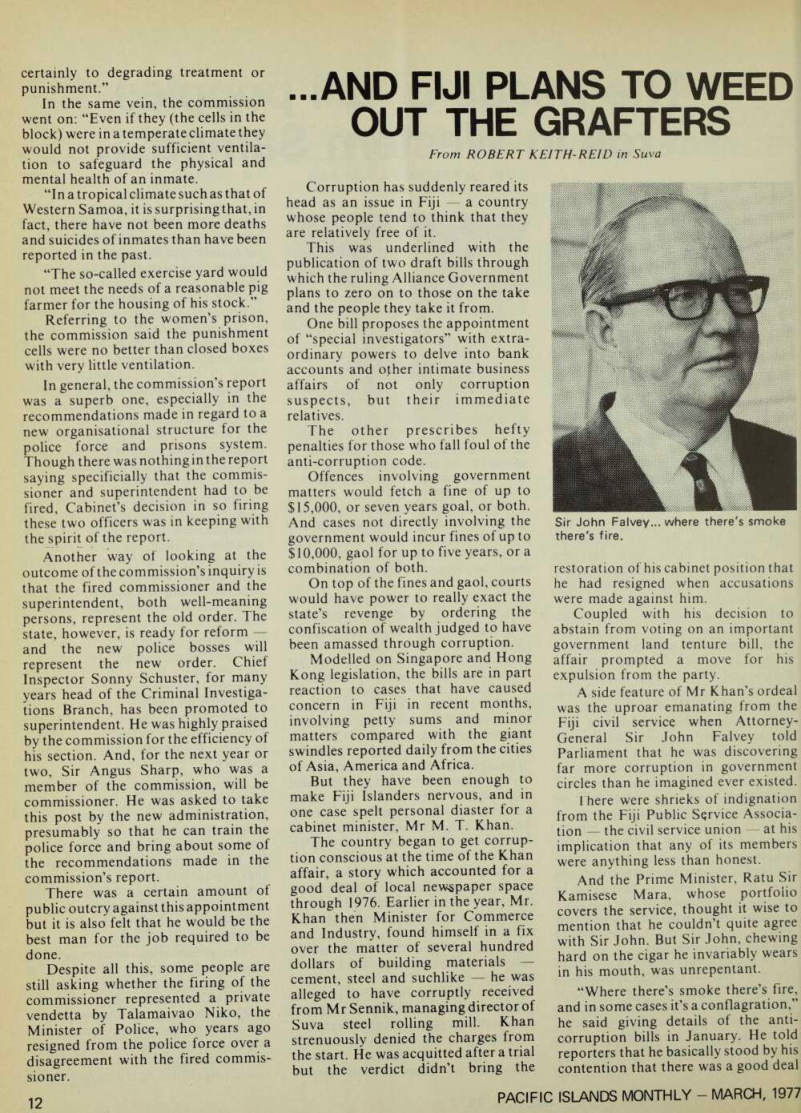
Samoan Prime Minister Tupuola Efi who has inherited some knotty problems in government departments.
certainly to degrading treatment or
punishment.”
In the same vein, the commission went on: “Even if they (the cells in the block) were inatemperateclimatethey would not provide sufficient ventila tion to safeguard the physical and mental health of an inmate.
“In a tropical climate such as that of Western Samoa, it is surprisingthat, in fact, there have not been more deaths and suicides of inmates than have been reported in the past.
“The so-called exercise yard would not meet the needs of a reasonable pig farmer for the housing of his stock.”
Referring to the women’s prison, the commission said the punishment cells were no better than closed boxes with very little ventilation.
In general, the commission’s report was a superb one, especially in the recommendations made in regard to a new organisational structure for the police force and prisons system.
Though there was nothing in the report saying specificially that the commis sioner and superintendent had to be fired, Cabinet’s decision in so firing these two officers was in keeping with the spirit of the report.
Another way of looking at the outcome of the commission’s inquiry is that the fired commissioner and the superintendent, both well-meaning persons, represent the old order. The state, however, is ready for reform and the new police bosses will represent the new order. Chief Inspector Sonny Schuster, for many years head of the Criminal Investiga tions Branch, has been promoted to superintendent. He was highly praised by the commission for the efficiency of his section. And, for the next year or two, Sir Angus Sharp, who was a member of the commission, will be commissioner. He was asked to take this post by the new administration, presumably so that he can train the police force and bring about some of the recommendations made in the commission’s report.
There was a certain amount of
public outcry against this appointment
but it is also felt that he would be the best man for the job required to be done.
Despite all this, some people are still asking whether the firing of the
commissioner represented a private
vendetta by Talamaivao Niko, the Minister of Police, who years ago resigned from the police force over a disagreement with the fired commis sioner.
Out The Grafters
...And Fiji Plans To Weed
From ROBERT KEITH-REID in Suva
Corruption has suddenly reared its head as an issue in Fiji a country whose people tend to think that they are relatively free of it.
This was underlined with the publication of two draft bills through which the ruling Alliance Government plans to zero on to those on the take and the people they take it from.
One bill proposes the appointment of “special investigators” with extra ordinary powers to delve into bank accounts and o(her intimate business affairs of not only corruption suspects, but their immediate relatives.
The other prescribes hefty
penalties for those who fall foul of the anti-corruption code.
Offences involving government matters would fetch a fine of up to $15,000, or seven years goal, or both.
And cases not directly involving the government would incur fines of up to $lO,OOO, gaol for up to five years, or a combination of both.
On top of the fines and gaol, courts would have power to really exact the state’s revenge by ordering the confiscation of wealth judged to have been amassed through corruption.
Modelled on Singapore and Hong Kong legislation, the bills are in part reaction to cases that have caused concern in Fiji in recent months, involving petty sums and minor matters compared with the giant swindles reported daily from the cities of Asia, America and Africa.
But they have been enough to make Fiji Islanders nervous, and in one case spelt personal diaster for a cabinet minister, Mr M. T. Khan.
The country began to get corrup tion conscious at the time of the Khan affair, a story which accounted for a good deal of local newspaper space through 1976. Earlier in the year, Mr.
Khan then Minister for Commerce and Industry, found himself in a fix over the matter of several hundred dollars of building materials cement, steel and suchlike he was alleged to have corruptly received from Mr Sennik, managing director of Suva steel rolling mill. Khan strenuously denied the charges from the start. He was acquitted after a trial but the verdict didn’t bring the
restoration of his cabinet position that he had resigned when accusations were made against him.
Coupled with his decision to abstain from voting on an important government land tenture bill, the affair prompted a move for his expulsion from the party.
A side feature of Mr Khan’s ordeal was the uproar emanating from the Fiji civil service when Attorney- General Sir John Falvey told Parliament that he was discovering far more corruption in government circles than he imagined ever existed.
There were shrieks of indignation from the Fiji Public Service Associa tion the civil service union at his implication that any of its members were anything less than honest.
And the Prime Minister, Ratu Sir Kamisese Mara, whose portfolio covers the service, thought it wise to mention that he couldn’t quite agree with Sir John. But Sir John, chewing hard on the cigar he invariably wears in his mouth, was unrepentant.
“Where there’s smoke there’s fire, and in some cases it’s a conflagration,” he said giving details of the anti corruption bills in January. He told reporters that he basically stood by his contention that there was a good deal
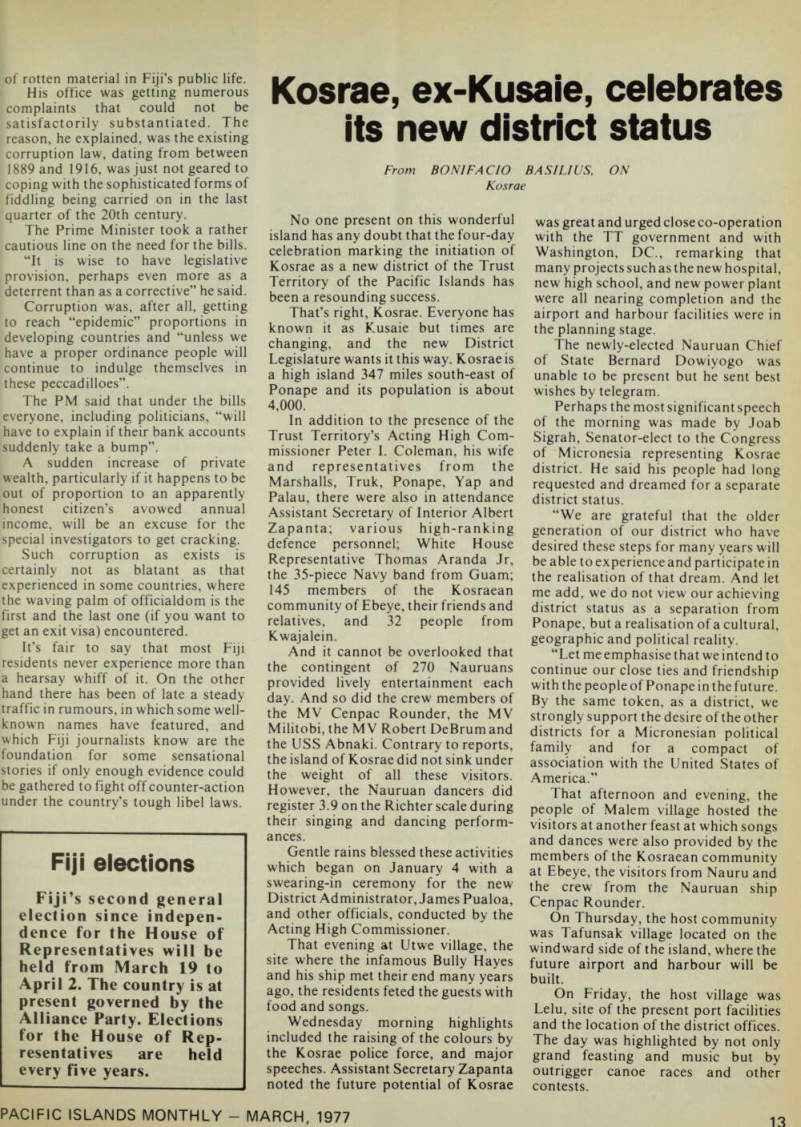
Sir John Falvey... where there's smoke there's fire.
of rotten material in Fiji’s public life.
His office was getting numerous complaints that could not be satisfactorily substantiated. The reason, he explained, was the existing corruption law, dating from between 1889 and 1916, was just not geared to coping with the sophisticated forms of fiddling being carried on in the last quarter of the 20th century.
The Prime Minister took a rather cautious line on the need for the bills.
“It is wise to have legislative provision, perhaps even more as a deterrent than as a corrective” he said.
Corruption was, after all, getting to reach “epidemic” proportions in developing countries and “unless we have a proper ordinance people will continue to indulge themselves in these peccadilloes”.
The PM said that under the bills everyone, including politicians, “will have to explain if their bank accounts suddenly take a bump”.
A sudden increase of private wealth, particularly if it happens to be out of proportion to an apparently honest citizen’s avowed annual income, will be an excuse for the special investigators to get cracking.
Such corruption as exists is certainly not as blatant as that experienced in some countries, where the waving palm of officialdom is the first and the last one (if you want to get an exit visa) encountered.
It’s fair to say that most Fiji residents never experience more than a hearsay whiff of it. On the other hand there has been of late a steady traffic in rumours, in which some well known names have featured, and which Fiji journalists know are the foundation for some sensational stories if only enough evidence could be gathered to fight off counter-action under the country’s tough libel laws.
Fiji elections
Fiji’s second general election since indepen dence for the House of Representatives will be held from March 19 to April 2. The country is at present governed by the Alliance Party. Elections for the House of Rep resentatives are held every five years.
Kosrae, ex-Kusaie, celebrates
its new district status
From BONIFACIO BA SI LI US. ON Kosrae
No one present on this wonderful island has any doubt that the four-day celebration marking the initiation of Kosrae as a new district of the Trust Territory of the Pacific Islands has been a resounding success.
That’s right, Kosrae. Everyone has known it as Kusaie but times are changing, and the new District Legislature wants it this way. Kosrae is a high island 347 miles south-east of Ponape and its population is about 4,000.
In addition to the presence of the Trust Territory’s Acting High Com missioner Peter I. Coleman, his wife and representatives from the Marshalls, Truk, Ponape, Yap and Palau, there were also in attendance Assistant Secretary of Interior Albert Zapanta; various high-ranking defence personnel; White House Representative Thomas Aranda Jr, the 35-piece Navy band from Guam; 145 members of the Kosraean community of Ebeye, their friends and relatives, and 32 people from Kwajalein.
And it cannot be overlooked that the contingent of 270 Nauruans provided lively entertainment each day. And so did the crew members of the MV Cenpac Rounder, the MV Militobi, the MV Robert Deßrum and the USS Abnaki. Contrary to reports, the island of Kosrae did not sink under the weight of all these visitors.
However, the Nauruan dancers did register 3.9 on the Richter scale during their singing and dancing perform ances.
Gentle rains blessed these activities which began on January 4 with a swearing-in ceremony for the new District Administrator, James Pualoa, and other officials, conducted by the
Acting High Commissioner.
That evening at Utwe village, the site where the infamous Bully Hayes and his ship met their end many years ago, the residents feted the guests with food and songs.
Wednesday morning highlights
included the raising of the colours by the Kosrae police force, and major speeches. Assistant Secretary Zapanta noted the future potential of Kosrae
was great and urged close co-operation with the TT government and with Washington, DC., remarking that many projects such as the new hospital, new high school, and new power plant were all nearing completion and the airport and harbour facilities were in the planning stage.
The newly-elected Nauruan Chief of State Bernard Dowiyogo was unable to be present but he sent best wishes by telegram.
Perhaps the most significant speech of the morning was made by Joab Sigrah, Senator-elect to the Congress of Micronesia representing Kosrae district. He said his people had long requested and dreamed for a separate district status.
“We are grateful that the older generation of our district who have desired these steps for many years will be able to experience and participate in the realisation of that dream. And let me add, we do not view our achieving district status as a separation from Ponape, but a realisation of a cultural,
geographic and political reality.
“Let me emphasise that we intend to continue our close ties and friendship with the people of Ponape in the future.
By the same token, as a district, we strongly support the desire of the other districts for a Micronesian political family and for a compact of association with the United States of America.”
That afternoon and evening, the people of Malem village hosted the visitors at another feast at which songs and dances were also provided by the members of the Kosraean community at Ebeye, the visitors from Nauru and the crew from the Nauruan ship Cenpac Rounder.
On Thursday, the host community was Tafunsak village located on the windward side of the island, where the future airport and harbour will be built.
On Friday, the host village was Lelu, site of the present port facilities and the location of the district offices.
The day was highlighted by not only grand feasting and music but by outrigger canoe races and other contests.
Somare In Indonesia -
Two Worlds Meet
From GUS SMALES in Port Moresby
Indonesia, adjoining Papua New Guinea and outnumbering it in population by 40 to one, has long projected a bogey image to most Papua New Guineans.
The situation goes back to the
early 1960 s when Indonesia launch
ed a mini-war (one paratrooper per half mile dropped in darkness) against the Dutch, who then con trolled the western half of the New Guinea land mass.
The intervention by the United Nations, the international disavowal of any Dutch rights and Indonesia’s subsequent take-over of what is now Irian Jaya became a highly emotive chapter in Asian and Pacific history.
“Liberation” the Indonesians called it, but many Papua New Gui neans who recognise an ethnic brotherhood on the western side of their land mass, have never been quite convinced.
For the first time they saw the hardships and inconveniences which a strictly-controlled border can bring to border-dwelling families, and in the years which followed the take-over there have been frequent allegations from border-crossing refugees of Indonesian repression.
In recent years a more sophisti cated and doctrinaire attitude has entered the criticism.
So-called Black Power supporters in Papua New Guinea have branded Indonesia as a neo-colonialist na tion intruding on Melanesia, and in one incident which strained the offi cial friendship between the two countries, university students in Port Moresby trampled an Indone sian flag.
Politicians, too, have not been slow to sense the feeling of the elec torate and in a milder way have ad ded to the erosion of the Indonesian popularity poll.
The practically-minded Papua New Guinea Government has found itself in an invidious position, balancing on one hand the obvious need for a peaceful co-existence and on the other the more emotional issues at home.
Where Papua New Guinea has been satisfied that border crossers
have a legitimate or humane right under international protocol to re main in Papua New Guinea, refuge has been granted.
Recently 157 permissive residents who came across the border more than five years ago were granted citizenship, a move which irritated Indonesia and added to undercur rents of friction.
Officially the two countries are friendly neighbours; each has an embassy in the other’s capital, and of all the borders which Papua New Guinea shares with its neighbours the Indonesian one is the only one properly defined and established by mutual treaty.
Officially, too, the Papua New Guinea Prime Minister, Mr Somare, has always preached friendship, co operation and close ties with In donesia, although his comments have often suggested an element of no option in the arrangement.
“You don’t annoy a sleeping lion,” he told his parliament not long ago, with an eye to the disparity in size, population and strength be tween the two countries.
This was the background against which Mr Somare recently accepted an invitation from President Suhar to of Indonesia and spent a one week state visit there, leaving behind the political sniping of some of his countrymen who accused him of playing to the Indonesian camp.
The first point which was brought home very quickly to members ot Mr Somare’s party was that there is little deep-seated similarity between the Indonesian brand of national security and nationhood and the Papua New Guinean brand.
This has nothing to do with the acceptability of co-existence and co operation, but it strengthened Mr Somare’s belief which he ex pressed strongly at the end of the tour that Indonesia is an integral part of South-east Asia and Papua New Guinea is an integral part of the Pacific.
If PNG can be a bridge between two regions it will gladly accept the responsibility, Mr Somare said, but any connection with ASEAN will be
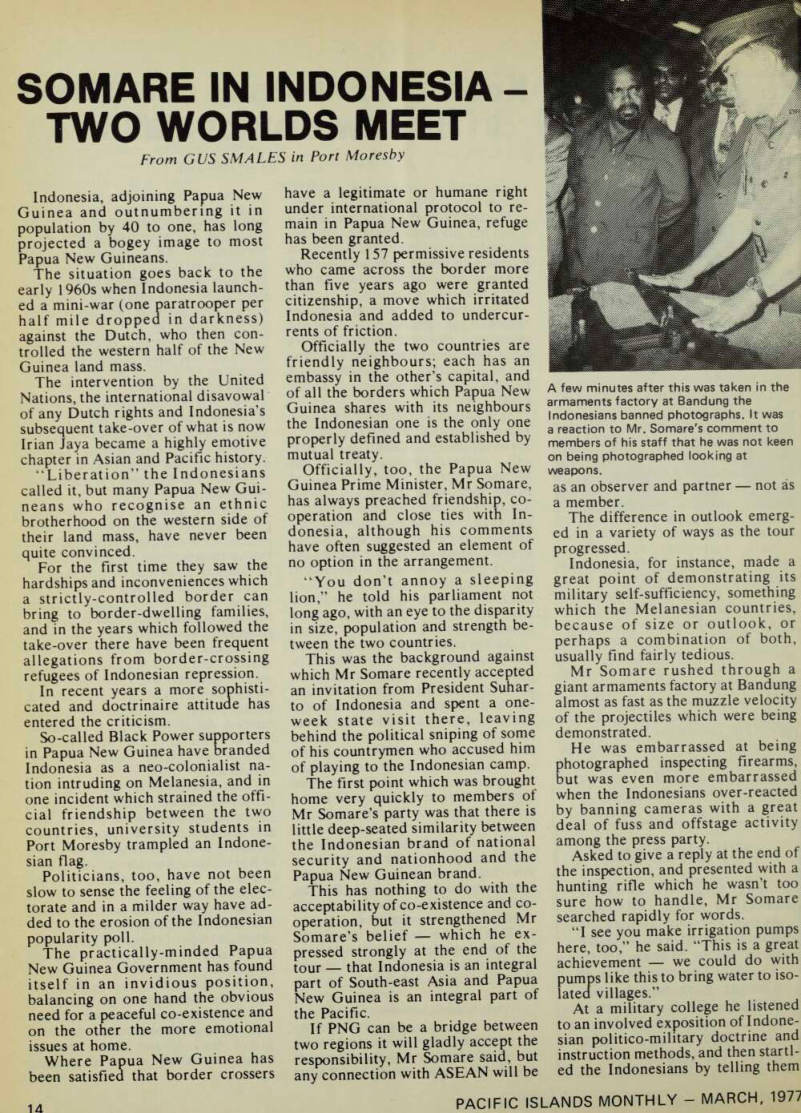
A few minutes after this was taken in the armaments factory at Bandung the Indonesians banned photographs. It was a reaction to Mr. Somare's comment to members of his staff that he was not keen on being photographed looking at weapons. as an observer and partner not as a member.
The difference in outlook emerg ed in a variety of ways as the tour
progressed.
Indonesia, for instance, made a great point of demonstrating its military self-sufficiency, something which the Melanesian countries, because of size or outlook, or perhaps a combination of both, usually find fairly tedious.
Mr Somare rushed through a giant armaments factory at Bandung almost as fast as the muzzle velocity of the projectiles which were being demonstrated.
He was embarrassed at being photographed inspecting firearms, but was even more embarrassed when the Indonesians over-reacted by banning cameras with a great deal of fuss and offstage activity among the press party.
Asked to give a reply at the end of the inspection, and presented with a hunting rifle which he wasn’t too sure how to handle, Mr Somare searched rapidly for words.
“I see you make irrigation pumps here, too,” he said. “This is a great achievement we could do with pumps like this to bring water to iso lated villages.”
At a military college he listened to an involved exposition of Indone sian politico-military doctrine and instruction methods, and then startl ed the Indonesians by telling them
he was not aware of the details of the curriculum at his own Joint Services Training College in Lae.
Immersed in dedication to their own structure, the Indonesians seemed unsure whether Mr Somare was pulling their leg or playing a very deep game.
The large-scale use of military personnel for civilian and security type duties was another activity which Mr Somare found at odds with his own type of society.
From a political and diplomatic point of view the focal point of the tour and the point which prob ably least is known about was the two-hour private talk held in Jakar ta between Mr Somare and Presi dent Suharto.
The bones of it emerged in the of ficial and fairly generalised com munique which the two leaders released, but the details have yet to be written.
One thing was obvious, however, and that was that Mr Somare came away from the talks much more at ease over his country’s relationship with Indonesia.
He is believed to be satisfied that much of the friction over border crossers arises from military fac tions directly associated with border affairs, and that the Indonesian leadership puts the border situation into a far more rational perspective.
In the official communique the two leaders agreed that “measures had to be taken’’ to prevent the border being used by groups who crossed in either direction to plan subversion against the other side.
The two leaders also agreed in the communique that the affairs of East Timor, where Indonesia took over last year, were internal matters for Indonesia.
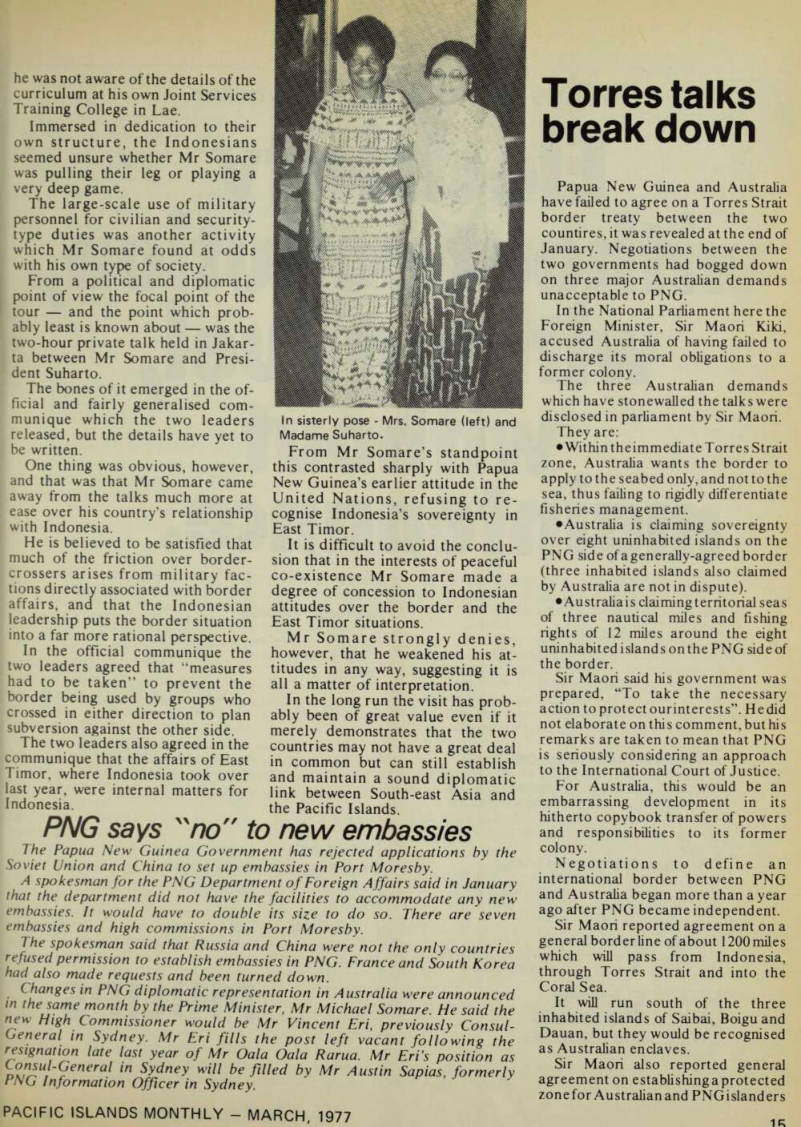
In sisterly pose - Mrs. Somare (left) and Madame Suharto.
From Mr Somare’s standpoint this contrasted sharply with Papua New Guinea’s earlier attitude in the United Nations, refusing to re cognise Indonesia’s sovereignty in East Timor.
It is difficult to avoid the conclu sion that in the interests of peaceful co-existence Mr Somare made a degree of concession to Indonesian attitudes over the border and the East Timor situations.
Mr Somare strongly denies, however, that he weakened his at titudes in any way, suggesting it is all a matter of interpretation.
In the long run the visit has prob ably been of great value even if it merely demonstrates that the two countries may not have a great deal in common but can still establish and maintain a sound diplomatic link between South-east Asia and the Pacific Islands.
PNG says " no" to new embassies
The Papua New Guinea Government has rejected applications by the Soviet Union and China to set up embassies in Port Moresby.
A spokesman for the PNG Department of Foreign Affairs said in January that the department did not have the facilities to accommodate any new embassies. It would have to double its size to do so. There are seven embassies and high commissions in Port Moresby.
The spokesman said that Russia and China were not the only countries refused permission to establish embassies in PNG. France and South Korea had also made requests and been turned down.
Changes in PNG diplomatic representation in Australia were announced m the same month by the Prime Minister, Mr Michael Somare. He said the new High Commissioner would be Mr Vincent Eri, previously Consul- General in Sydney. Mr Eri fills the post left vacant following the resignation late last year of Mr Gala Oala Rarua. Mr Eri’s position as DK^.9 eneral in S y dne y will be filled by Mr Austin Sapias, formerly PNG Information Officer in Sydney.
Torres talks

break down
Papua New Guinea and Australia have failed to agree on a Torres Strait border treaty between the two countires, it was revealed at the end of January. Negotiations between the two governments had bogged down on three major Australian demands unacceptable to PNG.
In the National Parliament here the Foreign Minister, Sir Maori Kiki, accused Australia of having failed to discharge its moral obligations to a former colony.
The three Australian demands which have stonewalled the talks were disclosed in parliament by Sir Maori.
They are: • Within theimmediate Torres Strait zone, Australia wants the border to apply to the seabed only, and not to the sea, thus failing to rigidly differentiate fisheries management. • Australia is claiming sovereignty over eight uninhabited islands on the PNG side of a generally-agreed border (three inhabited islands also claimed by Australia are not in dispute). • Australiais claiming territorial seas of three nautical miles and fishing rights of 12 miles around the eight uninhabited islands on the PNG side of the border.
Sir Maori said his government was prepared, “To take the necessary action to protect ourinterests”. Hedid not elaborate on this comment, but his remarks are taken to mean that PNG is seriously considering an approach to the International Court of Justice.
For Australia, this would be an
embarrassing development in its
hitherto copybook transfer of powers and responsibilities to its former
colony.
Negotiations to define an international border between PNG and Australia began more than a year ago after PNG became independent.
Sir Maori reported agreement on a general borderline of about 1200 miles which will pass from Indonesia, through Torres Strait and into the Coral Sea.
It will run south of the three inhabited islands of Saibai, Boigu and Dauan, but they would be recognised as Australian enclaves.
Sir Maori also reported general agreement on establishing a protected zone for Australian and PNGislanders
in the region, and for safeguarding their rights. He said the border woulcf be an agreed sea borderfor most of its length, but Australia wanted only a seabed boundary in the immediate Torres Strait zone.
PNG could not accept this demand on the grounds that it would store up trouble for thefuture, and there was an immediate need for a clear definition regarding the waters.
The PNG Government was prepared to accept interim Australian sovereignty over the eight uninhabited islands, but would not accept Australia’s claim to all-time sovereignty. Australia’s concept of wanting a 12-mile fishing zone round the islands within PNG’s border was completely unacceptable.
“This is simply perpetuating the state of affairs that came about as a result of colonising action many years ago. Papua New Guinea cannot be expected to accept the situation where Australia has seajurisdiction on the basis of a few uninhabited islands a few miles off our coast”, he said.
Later, PNG’s Foreign Minister criticised the Queensland Premier, Mr Bjelke-Petersen for “continued and unwarranted interference" over the border controversy.
He said the border was entirely a matter for negotiation between the PNG Government and the Australian Government as representatives of their sovereign nations. The negotiations did not concern Mr Bjelke-Petersen, who had no standing in the matter.
Sir Maori added that one of the greatest errors being perpetuated by the Queensland Premier was that a border already existed and that it might be “shifted”. That was not true.
In international law, no border existed and the purpose of the negotiations with Australia was to define a border.
Advertisements & other items, p. 16 (1 item)
If? Electricity
Philips Silicon Solar Cells offer
without pollution,
without fuel,
.without
maintenance.
The search for alternative sources of energy has, not surprisingly, focused the world's attention on the inexhaustible supply from the sun.
By means of silicon solar cells, solar energy becomes an ideal source of power for such applications as remote navigation beacons, mountain top repeaters for fire, forestry or police networks as well as gas pipeline monitors.
Already solar cells are powering microwave communication links spanning the world’s deserts.
How does the Silicon Solar Cell Work?
Quite simply it converts solar energy to electric current. A diffused silicon disc has one side exposed to the sun. It converts the photons of solar energy into electrical energy. Cells can be connected in series and parallel to give the power output required.
Clean, Safe, Inexhaustible Energy.
Solar cells are independent of fuel supplies and rising costs. They need no maintenance. And they are best suited to countries with high annual solar radiation.
How big is the installation?
It depends on the climate, the latitude and the application. These are reasonable guides:
Electronic
Components
and Materials
PHILIPS
2 square metres - run a radio base station. 5 square metres - a radio beacon for navigation Now readily available.
Philips Solar Cell units are designed to withstand extremes of weather and will provide power almost indefinitely with a minimum of attention. n For full information on Philips Solar Cells and on supporting Application Engineering Service send in this coupon. r philips Electronic Components & Materials, I P.O. Box 50, Lane Cove. N.S.W. 2066 Australia. I am interested in the possibilities of Silicon
Solar Cells I
Type of Industry : : ■ I Application lam interested immediately □ longer term □ Please have your representative contact me □ .
I Name : I Organisation business letterhead for rapid response j
PHILIPS
153.
Austin Bernicke Dead
Austin Bernicke, a former leading Nauruan Cabinet Minister, died un expectedly in Nauru on January 13.
He had a little earlier been taken to hospital ill. He was 68.
Austin Bernicke was a Nauruan leader who was an original member of the first Legislative Assembly before independence, and held an original Cabinet post from in dependence in 1968 right up until the change of government last December. He was Minister for Health & Education in that time.
Listening In! Cia Buggers
At Work On Micronesians
From TOM BRISLIN on Guam
In the strangest development to date in the oft-criticised relationship between the United States and its “strategic trust’’ islands in Micronesia, the US Central Intelligence Agency (CIA) has ad mitted that it has been conducting wiretap surveillance on members of the Congress of Micronesia involved in negotiating a new status with America.
Reported Bob Woodward of the Washington Post revealed the CIA “bugging” early in December.
Woodward was the reporter who un earthed the original stories on the “Watergate” bugging scandal.
Because of this coincidence, the affair has been dubbed locally the “Microgate” scandal.
Early reports did not make it clear whether the Micronesians had their phones tapped while in Washington (DC) or in their home islands or both.
The US Senate plans an investiga tion into the affair during the early part of this year.
The Congress of Micronesia has also asked for an investigation by the United Nations Trusteeship Council, with a possible recommendation of censure for the US.
According to early reports, a CIA spokesman said the wiretapping was done in attempts to learn the negotiating positions and strategies the Micronesians would employ in their status talks with the US State Department.
State Department officials, however, have denied requesting, or using, such surreptitiously gained in formation.
The Attorney-General at the time of the wiretappings, Edward Levi, stated on a nationally-broadcast inter view programme (NBC’s Meet The Press) that his office never authorised any electronic surveillance of the Micronesians.
Recent US laws have dictated that all wiretaps by federal law enforce ment agencies must have the approval of the Attorney-General.
At question, and a key in the up coming US Senate investigation, is whether the CIA could lawfully con duct such wiretaps.
The CIA cannot, by law, “spy” on US citizens. The CIA spokesman quoted by Woodward gave the opi
nion that Micronesians are not US citizens, evidenced by the fact that they are negotiating with the US State Department, who deal only with “foreign” governments and people.
However, provisions of the US Constitution have been extended to Micronesia, including freedoms of ex pression and rights to privacy.
Micronesians are technically “wards” of the US Government, as all the multiple chains of islands were placed “in trust” to the United States by the United Nations following World War 11.
The Trusteeship agreement, however, called for the US to foster political autonomy and self determination for the islands.
The islands are administered by the US Department of the Interior, as are Guam, the Virgin Islands and American Samoa.
The future political status negotiations are being conducted by the State Department as in dependence is one of the statuses un der consideration, as well as a “Free Associated State,” which would call for common defence by the US and constitutional protection, but general immunity from US laws and ad ministration.
The resolution passed by the Congress of Micronesia requesting a United Nations investigation was strongly critical of the US.
In a letter to the Trusteeship Coun cil, Congress of Micronesia Senate President Tosiwo Nakayama and House Speaker Bethwel Henry wrote that while the US “enjoys certain rights pertaining to the maintenance of international peace and security” under the Trusteeship Agreement, the Congress of Micronesia “firmly believes that these rights cannot be ex ercised at the expense of the ad ministering authority’s (US) obliga tion to promote the political advance ment of the people of Micronesia as spelled out in Article Six of the agreement.”
The two Micronesian leaders also pointed out that Article Seven of the UN Charter directs the US to “guarantee to the inhabitants of the Trust Territory freedom of con science, and, subject only to the re quirements of public order and securi
ty, freedom of speech, of the press and of assembly; freedom of worship and ( of religious teaching; and freedom of migration and movement.”
Nakayama and Henry stated that ; Article Seven does not “allow (the I US) to conduct covert (or any other) surveillance against Micronesian citizens to determine the Micronesian negotiating position or to foster dis ; unity in Micronesia.”
CIA involvement in Micronesia is apparently not a new development. It is generally rumoured that the CIA [ established a special “training camp” in Saipan in the Mariana Islands for Nationalist Chinese from Taiwan to mount an invasion of the Communist mainland.
Supposedly, the camp was disband ed following adverse public reaction to the unsuccessful CIA-backed inva sion of the Bay of Pigs in Cuba in ear ly 1960.
Reaction on Guam to the “Microgate” affair was critical of the US by the press and electronic media, but did not raise many eyebrows in the local government.
Guam also plans to enter new [status talks with the US, but their negotiations will be with the US Interior Department which has no of ficial relationship with the CIA. Since Guamanians are American citizens, local government and status commis sion leaders expressed doubt that there has been any intelligence-gather surveillance of them.
Since the wiretapping was so well publicised, and since the United Nations will undoubtedly become in volved and issue their own report of findings, the “Microgate” affair may prove embarrassing to the United States in negotiations with “real” foreign powers, as charges of alleged “bugging” could stalemate other talks.
Advertisements & other items, p. 18 (1 item)
Goodfyeah
Iw h * r ® . 4 e«y
TRACTION HI-MILER HI-MILER G 8
TRACTION 100
For rugged 'stop-go' de-
livery work. Gives long-
er mileage and easier-
steering.
Round shoulder tire With 3-T cord,
for highway trucks, stronger than steel.
Assures extra trac- developed for bus tion on all surfaces, and highway trucks, wet and dry.
SUPER ROAD LUG
Abrasion resistant extra-thick tread and
deep-grooved, sharp an-
gle lugs assure positive
traction on all types of
road surfaces.
ALL SERVICE
A non-directional mud and snow tire.
Reduces skidding
and weaving.
I 955 61 m as**
THE RIGHT TIRE FOR EVERY JOB
HIGHWAY - ON/OFF THE ROAD - CROSS COUNTRY GOODYEAR DISTRIBUTORS IN S.E. ASIA AND PACIFIC BASES.
Richard Piens & Co., Ltd.
Colombo. SRI LANKA Nepal Motor Company (P) Ltd Biratnagar. NEPAL Navana Ltd.
Dacca BANGLADESH
Diethelm & Co.. Ltd Bangkok, THAILAND Landis Brothers & Co Ltd.
HONG KONG
Guam Tire & Supply Co.
Agana, GUAM Susupe Enterprises Saipan, MARIANA IS Nicrol Corporation Saipan, MARIANA IS Truk Trading Co.
Truk. E CAROLINE IS
PAM I
Kolonia. PONAPE Island Transport Service Co.
Majuro MARSHALL IS Yap Cooperative Ass
Yap, W CAROLINE IS
Cook Islands Motor Centre Rarotonga. COOK IS Ngiratkel Etpizon Co. Ltd.
Koror PALAU Boroko Motors Ltd, Port Moresby. PAPUA NEW GUINEA Solomon Motors Ltd Honiara. B S I P Pacific Motors
Vila. NEW HEBRIDES
S.G A.
Noumea. NEW CALEDONIA
Duncombe Bay Garage
NORFOLK IS
Coral Island Motors Suva. FIJI Morris Hedstrom Ltd Nukualofa TONGA Morris Hedstrom Ltd.
Apia. WESTERN SAMOA
W.S.T.C.S.
Apia, WESTERN SAMOA
Samoa Motors Inc
Pago Pago. AMERICAN SAMOA
Service Mobil Papeete. TAHITI
French Sullivan
The well-known Australian based Islands trading firm, C.
Sullivan (Holdings) Ltd, has been taken over by the French com pany, Societe Commerciale de I’Ouest Afrique (SCOA), which is headquartered in Paris. Purchase price was $1.75 a share for 1.6 million shares. The new owners are retaining the company name and the present management. An injection of new capital, coupled with the Sullivan knowhow in Is lands trading, will make the firm a formidable proposition.
the Solomons'
What made the Solomons' 'Solo' Go?
From a Honiara correspondent
A kingsize question mark hangs over the resignation from the Solomon Islands Legislative As sembly on December 31, of Mr Solomon Mamaloni, the first Chief Minister of the Solomons and one of the country’s most experienced politicians.
Neither Mr Mamaloni nor Government House, which an nounced the resignation, has given the slightest hint as to the reason for it.
His resignation from his West Makira seat, and the death of Mr Francis Aqorau, member for Vona Vona, Rendova and Tetpari, gave rise to two by-elections which were due to be held on February 18.
Given the present climate of Solomon Islands politics, they were expected to be keenly contested.
Mr Mamaloni was appointed the country’s first Chief Minister in late 1974 when the Governing Council became the Legislative Assembly with an unchanged membership, and a ministerial system each govern ment ministry having a Cabinet Minister at its head was introduc ed.
His period in office was marked by extensive planning for the econ omic, political and social develop ment of the Solomons based on what Mr Mamaloni called “the three Ds” equal distribution of the coun try’s wealth, decentralisation and decolonisation.
Perhaps his major achievement was the introduction of self-govern ment in January 1976, in the face of union opposition. He also handled negotiations with the British Government on outline steps to in
dependence.
He began to put the Solomons on the international map with an over seas tour which took in Papua New Guinea, Japan and New Zealand.
In November, 1975, he resigned as Chief Minister following the Letcher Mint Affair of which he said in a nation-wide broadcast; “Today I resigned from my post because I have caused much embar rassment to my Ministers and the
people of the Solomons as a whole by not informing my Ministers of the minting of coins by the Letcher Mint of California to commemorate in ternal self-government,”
But a month later he bounced back, his colleagues electing him as Chief Minister once again.
He remained in office until the general election in June 1976. In a post-election ballot for the Chief Minister’s job he lost to Mr Peter Kenilorea.
In the weeks preceding Mr Mamaloni’s resignation as Chief Minister rumours were rife in Honiara about an alleged “Mafia” operating in the Solomons which was out to “get” a number of leading politicians, including Mr Mamaloni. One rumour even sug gested an attempt to murder him by poisoning his food.
But well-informed Honiara sources tend to discount such sto ries. A police spokesman is reported by the official newspaper, Solomon Islands News Drum, as saying that the stories were “without support”, and pointed out: “No official com plaint has been made to police, nor have any politicians asked for police protection.”
Tonga's King awed
by Guam weaponry
King Taufa’ahau Tupou IV of Tonga returned from a January visit to Micronesia awed by the vast amount and varieties of weaponry he observed at the US military base on Guam.
Said the king: “In the event of a world war, there will be no safe place in the world to live. It is better to maintain peaceful relations with other countries.”
While in Micronesia the king flo ated a suggestion that Tonga might play host to the controversial “superport” which is under dis cussion for Palau in the Caroline Is lands. But he said his government would need to be satisfied that ade quate safeguards were provided against oil pollution.
The king also visited Western Samoa and Nauru.
The King and Queen Halaevalu Mata’aho are to visit Western Samoa again in July for the 15th an niversary celebrations of that coun try’s independence, and in Septem ber they will pay a state visit to the Republic of China (Taiwan).
Advertisements & other items, p. 20 (1 item)
Canada^
AT
YOUR SERVICE
Canada has had an active interest in the South Pacific since Canada’s first Trade Commission was established in the area in 1894.
Today, quality, design and reliability make Canada a favoured supplier to the South Pacific of a wide variety of goods and services, from canned salmon to sophisticated higher technology products and consulting services.
Do you need to know where to buy in Canada? How to contact Canadian suppliers? Ask your Canadian Trade Commissioners in Wellington or Sydney.
They are anxious to help you and are well versed in all aspects of Canadian industry, trade and commerce. They can provide complete information to help you get 'in touch with the right Canadian supplier for the right product or service, at the right time and at the best competitive price.
The next time you require fast, reliable and confidential sourcing or trade information, contact one of these Canadian trade offices:
WELLINGTON, NEW ZEALAND.
Covering the territory of Fiji, Western Samoa, American Samoa, Tonga, Tahiti, Cook Islands, New Caledonia, New Hebrides, Gilbert Islands and Tuvalu.
ADDRESS ENQUIRIES TO:
Commercial Section, Canadian High Commission, P.O. Box 12 - 049, Wellington North, 1.C.1. Building, 3rd Floor, Molesworth Street,
WELLINGTON, NEW ZEALAND.
SYDNEY, AUSTRALIA.
Covering Papua New Guinea, Solomon Islands, Nauru, Norfolk Island and Lord Howe Island.
Commercial Section, Canadian Consulate General, A.M.P. Centre, Bth Floor, 50 Bridge Street,
SYDNEY, N.S.W. 2000.
AUSTRALIA.
Industry, Trade & Commerce, Ministere de I'lndustrie et du Commerce,
OTTAWA, CANADA.
Editor’S Mailbag
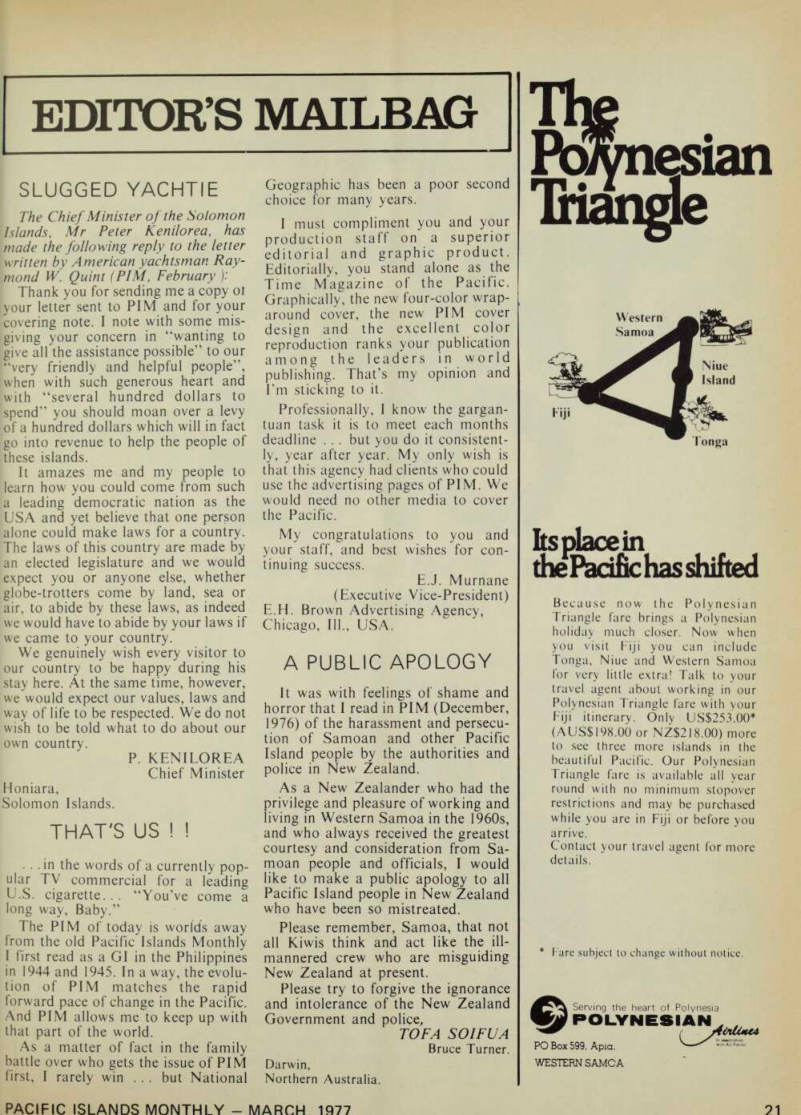
Slugged Yachtie
The Chief Minister of the Solomon Islands, Mr Peter Kenilorea, has made the following reply to the letter written by American yachtsman Ray mond W. Quint (PIM, February ): Thank you for sending me a copy ot your letter sent to PIM and for your covering note. I note with some mis giving your concern in “wanting to give all the assistance possible” to our “very friendly and helpful people”, when with such generous heart and with “several hundred dollars to spend” you should moan over a levy of a hundred dollars which will in fact go into revenue to help the people of these islands.
It amazes me and my people to learn how you could come from such a leading democratic nation as the USA and yet believe that one person alone could make laws for a country.
The laws of this country are made by an elected legislature and we would expect you or anyone else, whether globe-trotters come by land, sea or air, to abide by these laws, as indeed we would have to abide by your laws if we came to your country.
We genuinely wish every visitor to our country to be happy during his stay here. At the same time, however, we would expect our values, laws and way of life to be respected. We do not wish to be told what to do about our own country.
P. Kenilorea
Chief Minister
Honiara, Solomon Islands.
That's Us ! !
. . .in the words of a currently pop ular TV commercial for a leading U.S. cigarette... “You’ve come a long way, Baby.”
The PIM of today is worlds away from the old Pacific Islands Monthly I first read as a GI in the Philippines in 1944 and 1945. In a way, the evolu tion of PIM matches the rapid forward pace of change in the Pacific.
And PIM allows me to keep up with that part of the world.
As a matter of fact in the family battle over who gets the issue of PIM first, I rarely win . . . but National
Geographic has been a poor second choice for many years.
I must compliment you and your production staff on a superior editorial and graphic product.
Editorially, you stand alone as the Time Magazine of the Pacific.
Graphically, the new four-color wrap around cover, the new PIM cover design and the excellent color reproduction ranks your publication among the leaders in world publishing. That’s my opinion and I’m sticking to it.
Professionally, I know the gargan tuan task it is to meet each months deadline . . . but you do it consistent ly, year after year. My only wish is that this agency had clients who could use the advertising pages of PIM. We would need no other media to cover the Pacific.
My congratulations to you and your staff, and best wishes for con tinuing success.
E.J. Murnane
(Executive Vice-President) E.H. Brown Advertising Agency, Chicago, 111., USA.
A Public Apology
It was with feelings of shame and horror that I read in PIM (December, 1976) of the harassment and persecu tion of Samoan and other Pacific Island people by the authorities and police in New Zealand.
As a New Zealander who had the privilege and pleasure of working and living in Western Samoa in the 1960s, and who always received the greatest courtesy and consideration from Sa moan people and officials, I would like to make a public apology to all Pacific Island people in New Zealand who have been so mistreated.
Please remember, Samoa, that not all Kiwis think and act like the ill mannered crew who are misguiding New Zealand at present.
Please try to forgive the ignorance and intolerance of the New Zealand Government and police.
Tofa Soifua
Bruce Turner.
Darwin, Northern Australia.
Advertisements & other items, pp. 21-22 (2 items)
THaiigle
The
Polynesian
Western Samoa Niue Island r Ijl I onga
Its place in
the Pacific has shifted
Because now the Polynesian Triangle fare brings a Polynesian holiday much closer. Now when you visit Fiji you can include Tonga, Niue and Western Samoa for very little extra! Talk to your travel agent about working in our Polynesian Triangle fare with your Fiji itinerary. Only U55253.00* (AUSSI9B.OO or NZ$2lB.OO) more to see three more islands in the beautiful Pacific. Our Polynesian Triangle fare is available all year round with no minimum stopover restrictions and may be purchased while you are in Fiji or before you arrive.
Contact your travel agent for more details. * Fare subject to change without notice.
Serving the heart of Polynesia
POLYNESIAN , ,
with Air Pacific PO Box 599, Apia.
WESTERN SAMOA
that makes your home
a healthier place
How effectively you protect your family from the dangers of disease carrying insects, may well depend on the insect spray you choose.
Powerful Insect Killing Ingredients.
Concentrated Pea Beu is one of the most powerful household insect sprays in the world. Its principal insect killing ingredients have been selected to ensure rapid knock down and kill of all common disease carrying insects.
Rigid Testing. Through every stage of manufacture. Pea Beu is rigidly tested.
There nre ingredient tests, spray droplet tests, pack tests, many forms of tests, some carried out three times over.
When you spray this remarkable aerosol insecticide, you can be sure that its ingredients have met with the most exacting standards enabling you to spray it safely with confidence in your home. a 9 Family Health and Well Being. The common housefly carries up to half a billion germs and, when you realize that disease carrying insects enter even the best regulated households, you can understand why you can't be too careful about the effectiveness of your insect spray. Remember, even the tiniest droplet X I I / / 4 I'L m of conceitlfciled Pc;;i Hc*u kills flies, mos quiloos, .ill common disease carrying Concentrated Pea Beu. Even the tiniest droplet
kills flies, mosquitoes, gM common
disease carrying insects fast.
insects fast, so it is indeed a worthy guardian of your family's health and well being Such is the effectiveness rtf Pea Ben’s insect killing inqred ient, that no common disease carrying insect can survive it not develop an immunity to it. When you spray Concentrated Pea Beu, it's nice to know that no common disease carrying insect can survive.
Pea Beu - The strong one, makes your home a healthier place.
DA/~icir id AMns MOMTHI Y MARCH 1977
Tropicalities
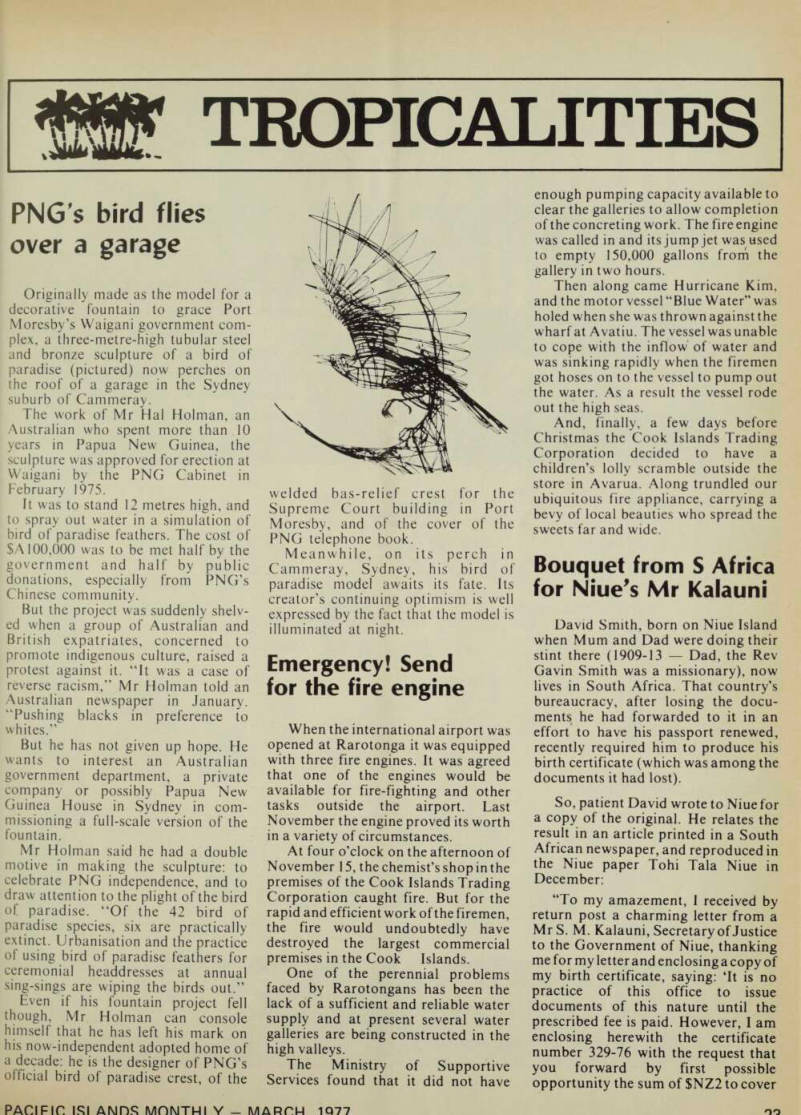

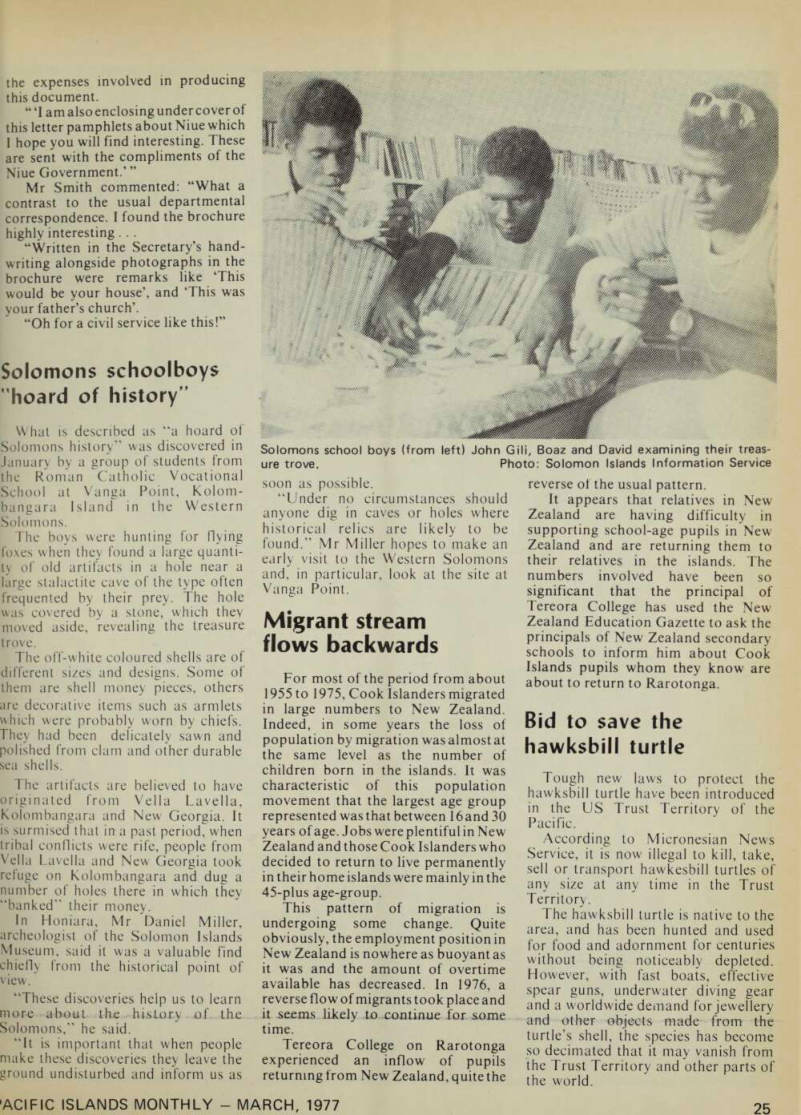
PNG’s bird flies
over a garage
Originally made as the model for a decorative fountain to grace Port Moresby’s Waigani government com plex, a three-metre-high tubular steel and bronze sculpture of a bird of paradise (pictured) now perches on the roof of a garage in the Sydney suburb of Cammeray.
The work of Mr Hal Holman, an Australian who spent more than 10 years in Papua New Guinea, the sculpture was approved for erection at Waigani by the PNG Cabinet in February 1975.
It was to stand 12 metres high, and to spray out water in a simulation of bird of paradise feathers. The cost of $A 100,000 was to be met half by the government and half by public donations, especially from PNG’s Chinese community.
But the project was suddenly shelv ed when a group of Australian and British expatriates, concerned to promote indigenous culture, raised a protest against it. “It was a case of reverse racism,” Mr Holman told an Australian newspaper in January.
“Pushing blacks in preference to whites.”
But he has not given up hope. He wants to interest an Australian government department, a private company or possibly Papua New Guinea House in Sydney in com missioning a full-scale version of the fountain.
Mr Holman said he had a double motive in making the sculpture: to celebrate PNG independence, and to draw attention to the plight of the bird of paradise. “Of the 42 bird of paradise species, six are practically extinct. Urbanisation and the practice of using bird of paradise feathers for ceremonial headdresses at annual sing-sings are wiping the birds out.”
Even if his fountain project fell though, Mr Holman can console himself that he has left his mark on his now-independent adopted home of a decade: he is the designer of PNG’s official bird of paradise crest, of the
welded bas-relief crest for the Supreme Court building in Port Moresby, and of the cover of the PNG telephone book.
Meanwhile, on its perch in Cammeray, Sydney, his bird of paradise model awaits its fate. Its creator’s continuing optimism is well expressed by the fact that the model is illuminated at night.
Emergency! Send
for the fire engine
When the international airport was opened at Rarotonga it was equipped with three fire engines. It was agreed that one of the engines would be available for fire-fighting and other tasks outside the airport. Last November the engine proved its worth in a variety of circumstances.
At four o’clock on the afternoon of November 15, the chemist’s shop in the premises of the Cook Islands Trading Corporation caught fire. But for the rapid and efficient work of the firemen, the fire would undoubtedly have destroyed the largest commercial premises in the Cook Islands.
One of the perennial problems faced by Rarotongans has been the lack of a sufficient and reliable water supply and at present several water galleries are being constructed in the high valleys.
The Ministry of Supportive Services found that it did not have
enough pumping capacity available to clear the galleries to allow completion of the concreting work. The fire engine was called in and its jump jet was used to empty 150,000 gallons from the gallery in two hours.
Then along came Hurricane Kim, and the motor vessel “Blue Water” was holed when she was thrown against the wharf at Avatiu. The vessel was unable to cope with the inflow of water and was sinking rapidly when the firemen got hoses on to the vessel to pump out the water. As a result the vessel rode out the high seas.
And, finally, a few days before Christmas the Cook Islands Trading Corporation decided to have a children’s lolly scramble outside the store in Avarua. Along trundled our ubiquitous fire appliance, carrying a bevy of local beauties who spread the sweets far and wide.
Bouquet from S Africa
for Niue’s Mr Kalauni
David Smith, born on Niue Island when Mum and Dad were doing their stint there (1909-13 — Dad, the Rev Gavin Smith was a missionary), now lives in South Africa. That country’s bureaucracy, after losing the docu ments he had forwarded to it in an effort to have his passport renewed, recently required him to produce his birth certificate (which was among the documents it had lost).
So, patient David wrote to Niue for a copy of the original. He relates the result in an article printed in a South African newspaper, and reproduced in the Niue paper Tohi Tala Niue in December; “To my amazement, 1 received by return post a charming letter from a Mr S. M. Kalauni, Secretary of Justice to the Government of Niue, thanking me for my letter and enclosing a copy of my birth certificate, saying: ‘It is no practice of this office to issue documents of this nature until the prescribed fee is paid. However, I am enclosing herewith the certificate number 329-76 with the request that you forward by first possible opportunity the sum of $NZ2 to cover
the expenses involved in producing this document.
“‘I am also enclosing undercover of this letter pamphlets about Niue which I hope you will find interesting. These are sent with the compliments of the Niue Government.’ ”
Mr Smith commented: “What a contrast to the usual departmental correspondence. I found the brochure highly interesting . . .
“Written in the Secretary’s hand writing alongside photographs in the brochure were remarks like ‘This would be your house’, and This was your father’s church’.
“Oh for a civil service like this!”
Solomons schoolboys
"hoard of history”
What is described as “a hoard of Solomons history” was discovered in January by a group of students from the Roman Catholic Vocational School at Vanga Point, Kolom bangara Island in the Western Solomons.
The boys were hunting for flying foxes when they found a large quanti ty of old artifacts in a hole near a large stalactite cave of the type often frequented by their prey. The hole was covered by a stone, which thev moved aside, revealing the treasure trove.
The off-white coloured shells are of different sizes and designs. Some of them are shell money pieces, others are decorative items such as armlets which were probably worn by chiefs.
They had been delicately sawn and polished from clam and other durable sea shells.
The artifacts are believed to have originated from Vella Lavella, Kolombangara and New Georgia. It is surmised that in a past period, when tribal conflicts were rife, people from Vella Lavella and New Georgia took refuge on Kolombangara and dug a number of holes there in which they “banked” their money.
In Honiara, Mr Daniel Miller, archeologist of the Solomon Islands Museum, said it was a valuable find chiefly from the historical point of view.
“These discoveries help us to learn more about the history of the Solomons,” he said.
“It is important that when people make these discoveries they leave the ground undisturbed and inform us as
soon as possible.
“Under no circumstances should anyone dig in caves or holes where historical relics are likely to be found.” Mr Miller hopes to make an early visit to the Western Solomons and, in particular, look at the site at Vanga Point.
Migrant stream
flows backwards
For most of the period from about 1955 to 1975, Cook Islanders migrated in large numbers to New Zealand.
Indeed, in some years the loss of population by migration was almost at the same level as the number of children born in the islands. It was characteristic of this population movement that the largest age group represented was that between 16 and 30 years of age. Jobs were plentiful in New Zealand and those Cook Islanders who decided to return to live permanently in their home islands were mainly in the 45-plus age-group.
This pattern of migration is undergoing some change. Quite obviously, the employment position in New Zealand is nowhere as buoyant as it was and the amount of overtime available has decreased. In 1976, a reverse flow of migrants took place and it seems likely to continue fox some time.
Tereora College on Rarotonga experienced an inflow of pupils returning from New Zealand, quite the
reverse of the usual pattern.
It appears that relatives in New Zealand are having difficulty in supporting school-age pupils in New Zealand and are returning them to their relatives in the islands. The numbers involved have been so significant that the principal of Tereora College has used the New Zealand Education Gazette to ask the principals of New Zealand secondary schools to inform him about Cook Islands pupils whom they know are about to return to Rarotonga.
Bid to save the
hawksbill turtle
Tough new laws to protect the hawksbill turtle have been introduced in the US Trust Territory of the Pacific.
According to Micronesian News Service, it is now illegal to kill, take, sell or transport hawkesbill turtles of any size at any time in the Trust Territory.
The hawksbill turtle is native to the area, and has been hunted and used for food and adornment for centuries
without being noticeably depleted.
However, with fast boats, effective spear guns, underwater diving gear and a worldwide demand for jewellery and other objects made from the turtle’s shell, the species has become so decimated that it may vanish from the Trust Territory and other parts of the world.
Solomons school boys (from left) John Gili, Boaz and David examining their treas ure trove.
Photo: Solomon Islands Information Service
Advertisements & other items, pp. 23-29 (4 items)
23
PACIFIC LSI AMDS MONTH I Y - MARCH 1Q77
Rapirip Ici Amne Momtui V _ Marpi-I 1Q77
RAPiriP iCI AMne MOMTUI V MARPI-I 1Q77
welding
important
news.
m
W.I.A. Welding products have a
renowned reputation for advanced
technical design, quality of
manufacture and field performance.
A full internationally approved
range is available to suit all
purposes and industries.
WELDMATIC G.M.A. SEMI
AUTOMATIC EQUIPMENT
One of the most comprehensive ranges available Australian designed and manufactured. Backed by efficient technical expertise ensuring up to date designs equal to anywhere in the welding world Range includes semi-automatic packaged units with capacities from 150 amps up to 600 amps (all 100% duty cycle! Plus full automatic welding head/power source combinations up to 1200 amps output, for use on either gas shielded, open arc or submerged arc welding rd * s'\ |f
IMrl
WELDMATIC
250 A high production semi-automatic G.M A. welding package, ideal for aulomalive production and manufacture of domestic/mdustnal appliances, heatmg/air conditioning equipment, metal cabinets and similar products. Rated 250 amps 100% duty cycle, max. current 300 amps 60%.
AUTOMATIC
SUBMERGED ARC
FLUXES & WIRES
Austmatic OP series includes highest quality, general purpose production fluxes, hardfacmg and special application highly basic fluxes Packing 30 kg pails and 250 kg drums Low carbon and low alloy steel wires available
HEAVY DUTY 400 AMP
DIESEL ENGINE DRIVEN
SITE WELDER
) Maximum weldability with minimum fuel costs. > Reduced risk of fire and fuel theft. ) Auxiliary power ► Long life service. ) Positive all weather starting characteristics.
AUSTMIG C 026
Gas Shielded Welding Wire Copper coated mild steel solid wire for all general purpose semi-automatic welding, using CO2 or argon based mixture shielding gases. 0 8. 0.9,1.2 and 16 mm sizes in 15 kg spools and 30 kg coils
ELECTRODES
Austarc internationally approved mild steel T electrodes including I cellulose, general purpose, low hydrogen, iron powder and Austalloy range offer superior welding characteristics in all types and gauges.
W.I.A. also offer a range of special purpose electrodes for hardfacmg, bronze, stainless steel and cast iron applications.
lAf
For full details & information contact
WELDING INDUSTRIES OF AUSTRALIA PTY. LTD.
INTERNATIONAL DIVISION
Austarc Avenue, Thomastown. Vic. Australia.
Telex: 32493, Cables: “Austarc” Melbourne.
I
Illustrated below are examples
from the extensive range
available.
WELDARC A.C. ARC WELDERS
Comprehensive range of seven models, designed for dependability, ease of use, long efficient life Fully guaranteed.
Models illustrated are 1) The Miniarc fTIC66, a popular small A.C. welder, rated up io 140 amps and handles 3.25,2.5 and 2.0 mm electrodes Ideal for handyman, garage and light factory maintenance welding and 2) top of the range Constructor 500. designed for extra heavy duty production welding with large size electrodes in locations such as shipyards, building construction sites, etc. Max. current output 500 amps at 100% duty cycle.
Optional extra is unique remote current control device, works wherever the operator is. any distance from the power source without special cabling.
MINIARC mC66 CONSTRUCTOR
representing a major breakthrough in welding technology Everything you ever wanted in a 240 volt arc
miniarc
FLUXOFIL
Gas Shielded Welding Wire Solid drawn Seamless Tubular Steel Flux Cored Welding Wire ensures increased productivity higher deposition rates, deeper penetration and over 80% metal recovery.
Fluxofll 11 Ni Smooth running rutile type high production electrode for general purpose fillet and butt welding applications.
Fluxofll 31 Highly basic slag produces toughest Completely moisture proof, weld metal offering high low hydrogen quality.
Exclusive copper coating gives high efficiency feeding, better electrical contact, longer lip life. Size available 1.6,2.0 and 2.4 mm. Wires available production techniques to high integrity welding applications.
Fluxofll 41 and 42 —First choice for welding low alloy high tensile steels, particularly those of the manufactured in Australia notch tough, high strength \wm
AUSTRALIA'S OWN WELDING ORGANIZATION
i w W
»>■»♦♦ WWW
Hi 6i
JUBILEE YEAR IN THE SOUTH PACIFIC
These stamps are but a few of the many flooding into the world's stamp markets from commonwealth countries to mark the silver jubilee of Queen Elizabeth. As with their other issues over the years, the Sauth Pacific Islands, which are also welcoming the Queen in person as she and Prince Philip, the Prince Consort, tour the islands, have all produced attractive series. Many have used as subject matter, photographs taken on previous royal visits and also pictures of her coronation in 1952. 1
Turn moments
into memories..
m*. % m idg^ cap t ! kts/ 20^ m
COLOP
110
FOP
?0
take your pictures
on Kodak film*
See your photo dealer now.
K6l-5076
New range of
Epiglass antif oulings
give up to 12 months
growth-free performance
Consolidated Chemicals Ltd have launched new range of antifoulings now being marketed under the name of Epiglass E-type. Superior, in terms of performance, to any antifouling currently on the market, they are the result of years of research and development work in the company’s laboratories followed by extensive testing.
PRODUCT PERFORMANCE PROVED
Tests have been carried out under widely varying conditions throughout the Pacific area which have conclusively proved the effectiveness of E-type antifouling on both Commercial and Pleasure craft.
12 MONTHS GROWTH-FREE PERFORMANCE
Epiglass E-type antifouling is formulated to guard your boat against the expensive damage that can be done by algae, barnacles, slime weed and general fouling. The formulation includes a very high percentage of special toxins which are “release controlled’’ This positive control release of toxins means that if applied as directed you can expect up to 12 months growth-free performance.
Whatever size your boat, whether it is power or sail, protect below the water line with new Epiglass E-type antifouling.
[epiglass]
Consolidated Chemicals Ltd.
P.O. Box 15-104, New Lynn, Auckland.
Please send me a free copy of your Epiglass Boat Owners Manual plus facts on new E-type antifouling.
Mr Address
(Block letters please)
I J
from 7ft to73ft [
EJ power or sail
PACIFIC AREA
DISTRIBUTORS
COOK ISLANDS
Cook Is. Trading Corp. Ltd
FIJI
Burns Philp (SS) Co. Ltd
NEW GUINEA
Bougainville Marine Pty Ltd, Kieta Burns Philp (NG) Ltd, Madang Elvee Trading Pty Ltd, Rabaul Faulkner & Tait (NG) Pty Ltd, Lae S. A. Heath & Co. Pty Ltd, Port Moresby
NEW HEBRIDES
Burns Philp (NH) Ltd
NOUMEA
Guy Limousin Pacific Yachting
NORFOLK ISLAND
Irvine Bid. Supply Centre
PAGO PAGO
Max Haleck Inc.
TAHITI
Marine Corail Tahiti Sport Tahiti Voile
TONGA
Riechelmann Bros.
WESTERN SAMOA
Burns Philp (SS) Co. Ltd E. A. Coxon Ltd Gold Star Transport Co. Ltd Morris Hedstrom Ltd
SOLOMON ISLANDS
George Yee Fai Ltd s*
25
'ACIFIC ISLANDS MONTHLY - MARCH, 1977
People
Mr H.S.H. Stanley, 56, is the new British High Commissioner for the New Hebrides. He is also Assistant Under-Secretary for the Dependent Territories Division of the Foreign and Commonwealth Office and the Ministry of Overseas Development.
He succeeds Mr E.N. Larmour, who is retiring from the diplomatic service.
As was the case with Mr Larmour, Mr Stanley will be based in London.
Mr Larmour was given a knight hood by the Queen in the New Year’s Honours list.
Mr Kaveinga Havea has been ap pointed Director of the Institute of Social and Administrative Studies at the University of the South Pacific, Suva. A Tongan, Mr Havea replaces Dr D.J. Murray, who has acted as in terim director since the Institute was founded last year. Mr Havea was originally trained as a teacher in New Zealand. He was the first Tongan principal of Tonga College before becoming deputy director of educa tion in Tonga. His first degree was from Willamette University, USA, and he has a master’s degree from Saskatchewan University, Canada.
Captain Hugh Birch, formerly Qantas regional director for the South Pacific, can’t get the Pacific out of his blood. He is now the regional manager, Australia, for the Tonga Visitors Bureau, and regional sales manager, Australia, for South Pacific Island Airways, of Pago Pago. Cap tain Birch’s career of more than 30 years in civil aviation, as a pilot and administrator, took him to many of the Islands. He is based in Sydney, at 31 Cross Street, Double Bay, 2028 (telephone 32-0291).
Mr Kevin Barry Egan, 29, has been appointed Papua New Guinea’s Public Prosecutor. Announcing the appointment late last year, PNG’s Minister for Justice, Mr Ebia Olewale, said that a position of Associate Public Prosecutor would be created to enable a young national lawyer to work closely with Mr Egan, who has undertaken to train a national lawyer to eventually take over his position. Mr Egan’s appoint ment is for three years.
M Jean Massias, Head of the French Information Service in the New Hebrides and director of the newspaper Nabanga, has been made a Chevalier of the Order of Merit.
Captain Fetu’utolu Tupou, at the end of January, became the first Tongan to command the Tonga Defence Services. He was promoted to the rank of major, succeeding New Zealander Major Hornbrook. New Zealand, for many years, has provid ed the commander of the TDS.
Mr Sam Piniau, chairman of the Papua New Guinea National Broad casting Commission, has been reap pointed for a second three-year term by the PNG National Executive Council. Mr Piniau’s first term ex pired on December 1, 1976.
The Papua New Guinea Defence Minister, Sir Maori Kiki, has an nounced the promotion of three national Defence Force officers to the rank of Lieutenant-Colonel. They are Major John Lytus, from Kaulas village, North Solomons Province; Paul Soma, from Wuvulu, East Sepik Province; and Jack Maniama, from Kwato, Milne Bay Province.
Major Garry Elias has become the first national officer to take command of Papua New Guinea’s Landing Craft Squadron. He took over the command from Lieutenant- Commander D.J. Angus of the Royal Australian Navy.
Well-known Suva publican, Mr Vince Costello, 7/, retired in January after 43 years in the hotel trade in the Fiji capital. Mr Costello had been associated with two Suva hotels, the Pier (later renamed the Garrick), and the Suva. He took over the licence of the latter hotel in 1970, in partnership with Mr Norm Macdonald. Mr Costello is well-known as a sportsman. He is a keen racing fan and was a member of Fiji’s bowls team at the 1962 Commonwealth Games in Perth and again at the Commonwealth Games in Edinburgh, Scotland, in 1970.
Mr John Malcolm has been ap pointed group corporate planner of Burns, Philp & Co Ltd. The position is a newly created head-office ap pointment in the group. Mr Malcolm will report direct to the general manager, planning and development.
Mina
Advertisements & other items, p. 30 (1 item)
Oiirect
20 cu.ft. of cargo space.,
and if that’s not enough,
the seats are easily
removable.
Space. Payload Space.
Six comfortable seats and a cavernous /innih rarnn rnmnartment accessible in
sr/j
Sole distributors for Australia • Papua New Guinea • New Zealand • Pacific Islands •
FORRESTAIR
A DIVISION OF H. C SLEIGH LIMITED flight.
You load your cargo through a 7 sq.ft, door: and if you want to fly mors packing cases than passengers, the seats are designed to come out, quickly and easily.
You’ll carry a big payload, a long way between petrol pumps: and if you have to use an outback strip, the twin Lycomings are mounted on high wings for clearance.
If you’res space man, then this is your aircraft.
Bulla Road, Essendon Airport Victoria, Australia 3041 Cables & Telegrams: Forrestair Melbourne Telex AA33015 Telephone (03)3798929.
FM773 After hours (03) 7254430 Ask for the full dimensions and the operating costs.. they both measure up.
0j EALING with
(AUSTRALIA) means
0 I EALING with Manufacturers
OIIRECT
We represent the greatest variety of merchandise in the entire P.O. BOX 340, MASCOT (SYDNEY) 2020 NSW, Telex: 21416. Telephone: 669 5344.
DO APPROACH US BY LETTER, CABLE OR TELEX FOR
QUOTATIONS
News
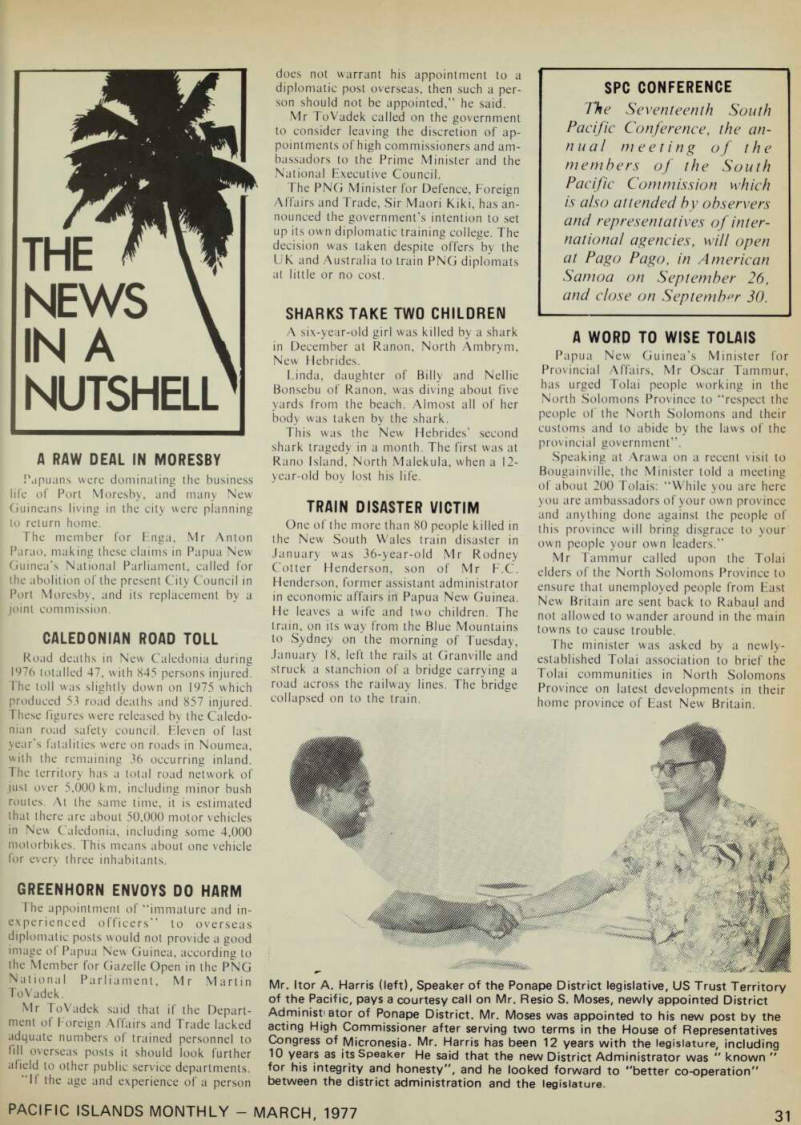
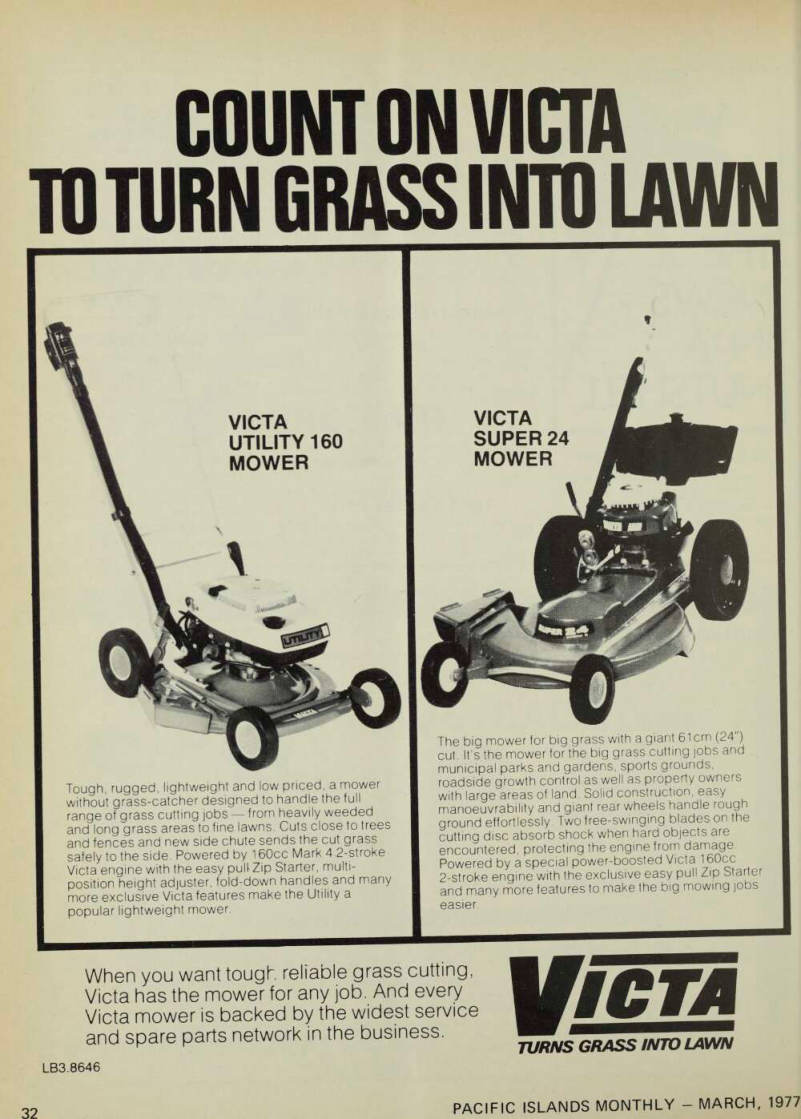
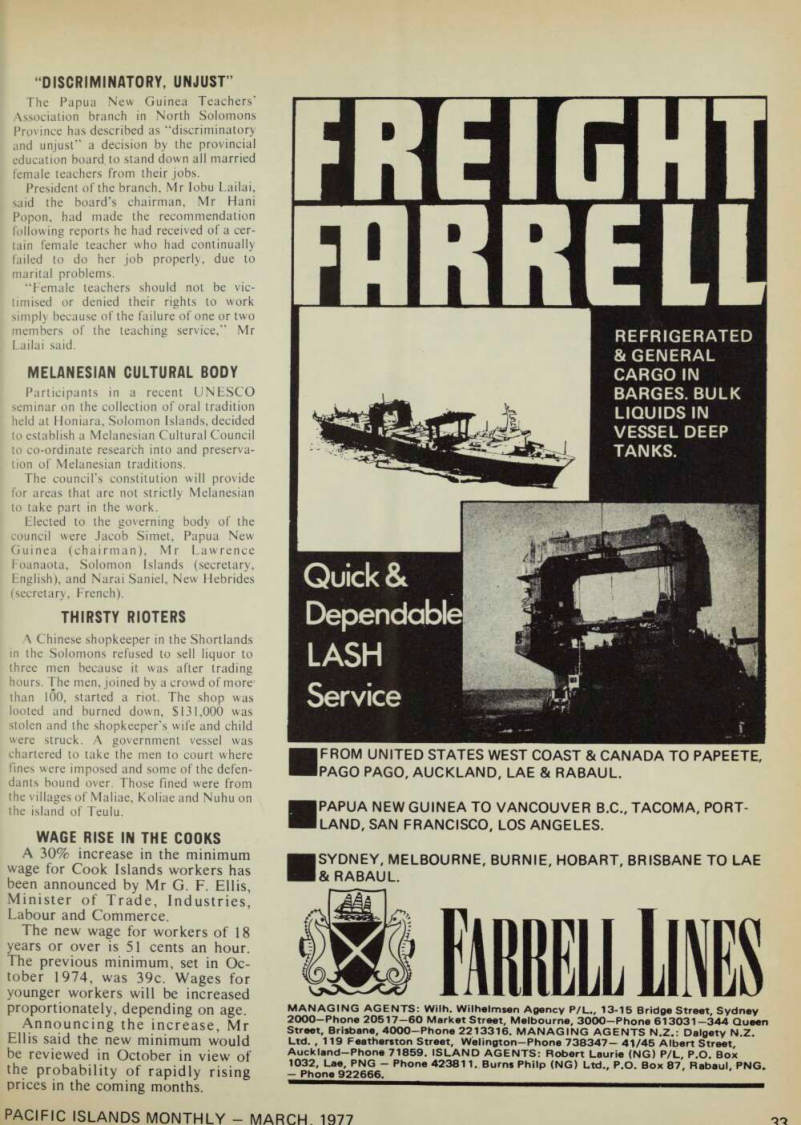
The
In A
Nutshell
A Raw Deal In Moresby
Papuans were dominating the business life of Port Moresby, and many New Guineans living in the city were planning to return home.
The member for Enga, Mr Anton Parao, making these claims in Papua New Guinea’s National Parliament, called for the abolition of the present City Council in Port Moresby, and its replacement by a joint commission.
Caledonian Road Toll
Road deaths in New Caledonia during 1976 totalled 47, with 845 persons injured.
The toll was slightly down on 1975 which produced 53 road deaths and 857 injured.
These figures were released by the Caledo nian road safety council. Eleven of last year’s fatalities were on roads in Noumea, with the remaining 36 occurring inland.
The territory has a total road network of just over 5,000 km, including minor bush routes. At the same time, it is estimated that there are about 50,000 motor vehicles in New Caledonia, including some 4,000 motorbikes. This means about one vehicle for every three inhabitants.
Greenhorn Envoys Do Harm
The appointment of “immature and in experienced officers” to overseas diplomatic posts would not provide a good image of Papua New Guinea, according to the Member for Gazelle Open in the PNG National Parliament, Mr Martin ToVadek.
Mr ToVadek said that if the Depart ment of Foreign Affairs and Trade lacked adquate numbers of trained personnel to fill overseas posts it should look further afield to other public service departments.
“If the age and experience of a person
does not warrant his appointment to a diplomatic post overseas, then such a per son should not be appointed,” he said.
Mr ToVadek called on the government to consider leaving the discretion of ap pointments of high commissioners and am bassadors to the Prime Minister and the National Executive Council.
The PNG Minister for Defence, Foreign Affairs and Trade, Sir Maori Kiki, has an nounced the government’s intention to set up its own diplomatic training college. The decision was taken despite offers by the UK and Australia to train PNG diplomats at little or no cost.
Sharks Take Two Children
A six-year-old girl was killed by a shark in December at Ranon, North Ambrym, New Hebrides.
Linda, daughter of Billy and Nellie Bonsebu of Ranon, was diving about five yards from the beach. Almost all of her body was taken by the shark.
This was the New Hebrides’ second shark tragedy in a month. The first was at Rano Island, North Malekula, when a 12year-old boy lost his life.
Train Disaster Victim
One of the more than 80 people killed in the New South Wales train disaster in January was 36-year-old Mr Rodney Cotter Henderson, son of Mr F.C.
Henderson, former assistant administrator in economic affairs in Papua New Guinea.
He leaves a wife and two children. The train, on its way from the Blue Mountains to Sydney on the morning of Tuesday, January 18, left the rails at Granville and struck a stanchion of a bridge carrying a road across the railway lines. The bridge collapsed on to the train.
A Word To Wise Tolais
Papua New Guinea’s Minister for Provincial Affairs, Mr Oscar Tammur, has urged Tolai people working in the North Solomons Province to “respect the people of the North Solomons and their customs and to abide by the laws of the provincial government’’.
Speaking at Arawa on a recent visit to Bougainville, the Minister told a meeting of about 200 Tolais; “While you are here you are ambassadors of your own province and anything done against the people of this province will bring disgrace to your own people your own leaders.”
Mr Tammur called upon the Tolai elders of the North Solomons Province to ensure that unemployed people from East New Britain are sent back to Rabaul and not allowed to wander around in the main towns to cause trouble.
The minister was asked by a newly established Tolai association to brief the Tolai communities in North Solomons Province on latest developments in their home province of East New Britain.
Mr. Itor A. Harris (left), Speaker of the Ponape District legislative, US Trust Territory of the Pacific, pays a courtesy call on Mr. Resio S. Moses, newly appointed District Administrator of Ponape District. Mr. Moses was appointed to his new post by the acting High Commissioner after serving two terms in the House of Representatives Congress of Micronesia- Mr. Harris has been 12 years with the legislature, including 10 years as its Speaker He said that the new District Administrator was " known " for his integrity and honesty”, and he looked forward to "better co-operation" between the district administration and the legislature.
“Discriminatory, Unjust”
The Papua New Guinea Teachers’
Association branch in North Solomons Province has described as “discriminatory and unjust” a decision by the provincial education board, to stand down all married female teachers from their jobs.
President of the branch, Mr lobu Lailai, said the board’s chairman, Mr Hani Popon, had made the recommendation following reports he had received of a cer tain female teacher who had continually failed to do her job properly, due to marital problems.
“Female teachers should not be vic timised or denied their rights to work simply because of the failure of one or two members of the teaching service,” Mr Lailai said.
Melanesian Cultural Body
Participants in a recent UNESCO seminar on the collection of oral tradition held at Honiara, Solomon Islands, decided to establish a Melanesian Cultural Council to co-ordinate research into and preserva tion of Melanesian traditions.
The council’s constitution will provide for areas that are not strictly Melanesian to take part in the work.
Elected to the governing body of the council were Jacob Simet, Papua New Guinea (chairman), Mr Lawrence Foanaota, Solomon Islands (secretary, English), and Narai Saniel, New Hebrides (secretary, French).
Thirsty Rioters
A Chinese shopkeeper in the Shortlands in the Solomons refused to sell liquor to three men because it was after trading hours. The men, joined by a crowd of more than 100, started a riot. The shop was looted and burned down, $131,000 was stolen and the shopkeeper’s wife and child were struck. A government vessel was chartered to take the men to court where fines were imposed and some of the defen dants bound over. Those fined were from the villages of Maliae, Koliae and Nuhu on the island of Teulu.
Wage Rise In The Cooks
A 30% increase in the minimum wage for Cook Islands workers has been announced by Mr G. F. Ellis,
Minister of Trade, Industries,
Labour and Commerce.
The new wage for workers of 18 years or over is 51 cents an hour.
The previous minimum, set in Oc tober 1974, was 39c. Wages for younger workers will be increased
proportionately, depending on age.
Announcing the increase, Mr
Ellis said the new minimum would be reviewed in October in view of
the probability of rapidly rising
prices in the coming months.
Spc Conference
The Seventeenth South Pacific Conference, the an nual meeting of the members of the South Pacific Commission which is also attended by observers and representatives of inter national agencies, will open at Pago Pago, in American Samoa on September 26, and close on September 30.
Advertisements & other items, pp. 32-34 (2 items)
Count On Victa
TO TURN GRASS I NTO LAWN
VICTA
UTILITY 160
MOWER
Tough, rugged, lightweight and low priced, a mower without grass-catcher designed to handle the full range of grass cutting jobs from heavily weeded and long grass areas to fine lawns. Cuts close to trees and fences and new side chute sends the cut grass safely to the side. Powered by 160 cc Mark 4 2-stroke Victa engine with the easy pull- Zip Starter, multiposition height adjuster, fold-down handles and many more exclusive Victa features make the Utility a popular lightweight mower.
VICTA
SUPER 24
MOWER
4* The big mower for big grass with a giant 61 cm (24") cut. It’s the mower for the big grass cutting jobs and municipal parks and gardens, sports grounds, roadside growth control as well as property owners with large areas of land. Solid construction, easy manoeuvrability and giant rear wheels handle rough ground effortlessly. Two free-swinging blades on the cutting disc absorb shock when hard objects are encountered, protecting the engine from damage.
Powered by a special power-boosted Victa 160 cc 2-stroke engine with the exclusive easy pull Zip Starter and many more features to make the big mowing jobs easier.
When you want tough reliable grass cutting, Victa has the mower for any job. And every Victa mower is backed by the widest service and spare parts network in the business.
TURNS GRASS INTO LAWN
L 83.8646
B I B *
REFRIGERATED
& GENERAL
CARGO IN
BARGES. BULK
LIQUIDS IN
VESSEL DEEP
TANKS.
c
LASH
IFROM UNITED STATES WEST COAST & CANADA TO PAPEETE,
IPAGO PAGO, AUCKLAND, LAE & RABAUL.
I PAPUA NEW GUINEA TO VANCOUVER 8.C., TACOMA, PORT-
LAND, SAN FRANCISCO, LOS ANGELES.
I SYDNEY, MELBOURNE, BURNIE, HOBART, BRISBANE TO LAE
l& RABAUL.
MANAGING AGENTS: Wilh. Wilhelmsen Agency P/L., 13-15 Bridge Street, Sydney 2000-Phone 20517-60 Market Street, Melbourne, 3000—Phone 613031—344 Queen Street, Brisbane, 4000-Phone 2213316. MANAGING AGENTS N.Z.: Dalgety N. 2.
Ltd. , 119 Featherston Street, Welington-Phone 738347- 41/45 Albert Street, Auckland—Phone 71859. ISLAND AGENTS: Robert Laurie (NG) P/L, P.O. Box 1032, Lae, PNG - Phone 423811. Burns Philp (NG) Ltd., P.O. Box 87, Rabaul, PNG. - Phone 922666.
The man from Australia
can come up with the goods
He’s the Australian Government Trade Commissioner. He has the knowledge and experience to advise you on buying from Australia.
And buying from Australia can be a very profitable business. The big range of world class Australian products will surprise you. Machinery, electrical goods, chemicals, sporting goods, scientific equipment, automotive and materials handling equipment—whatever products you want Australia will most likely be able to supply. Australian products are selling well in international markets, they can sell well in yours.
Ask the man who knows Australia The Australian Trade Commissioner will be pleased to give you details of suppliers. You can contact him at; FIJI. 7th Floor, Dominion House, Thomson Street. Suva, (Post Office Box 1252). Telephone: 312844, P.N.G. Post Office Box 9129, Hohola, Port Moresby, Telephone: 259333. *
Ask the Australian trade Commissioner
Dancir Iqi Amos Monthly - March, 1977
It's Not The Suitor Who Goes
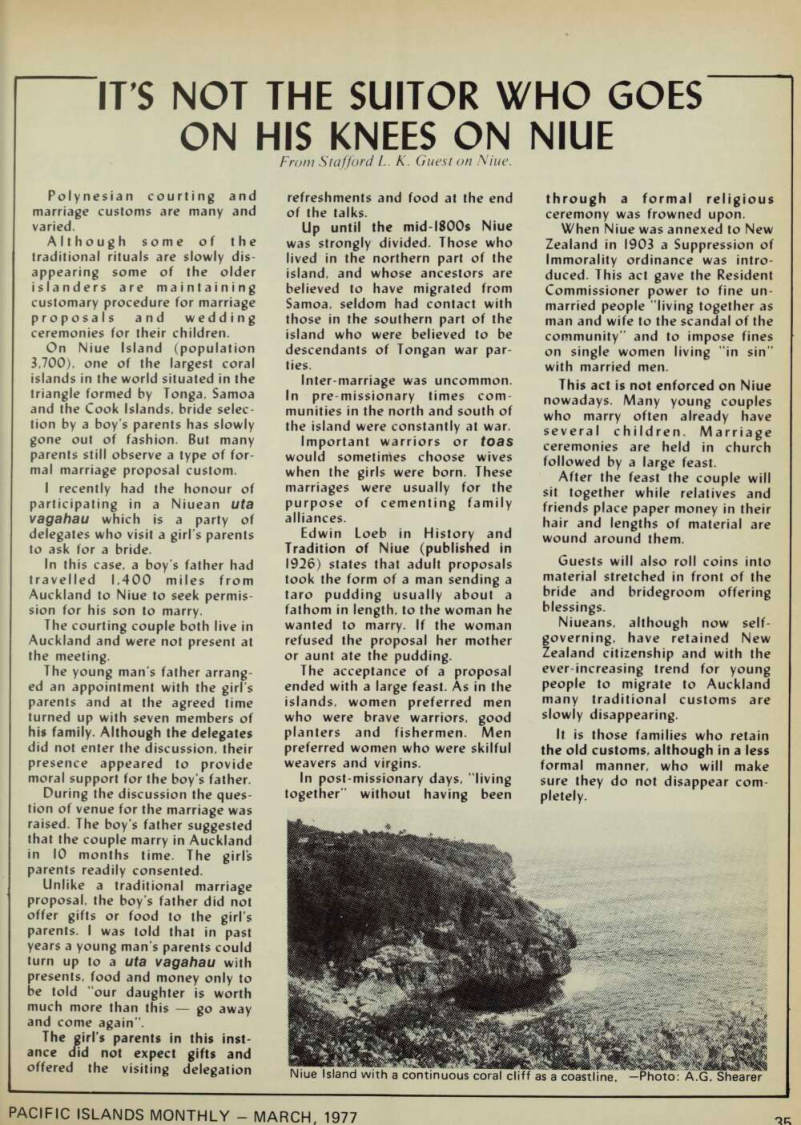
On His Knees On Niue
From Stafford L. K. Guest on Niue.
Polynesian courting and marriage customs are many and varied.
Although some of the traditional rituals are slowly dis appearing some of the older islanders are maintaining customary procedure for marriage proposals and wedding ceremonies for their children.
On Niue Island (population 3,700), one of the largest coral islands in the world situated in the triangle formed by Tonga, Samoa and the Cook Islands, bride selec tion by a boy’s parents has slowly gone out of fashion. But many parents still observe a type of for mal marriage proposal custom.
I recently had the honour of participating in a Niuean uta vagahau which is a party of delegates who visit a girl’s parents to ask for a bride.
In this case, a boy’s father had travelled 1,400 miles from Auckland to Niue to seek permis sion for his son to marry.
The courting couple both live in Auckland and were not present at the meeting.
The young man’s father arrang ed an appointment with the girl’s parents and at the agreed time turned up with seven members of his family. Although the delegates did not enter the discussion, their presence appeared to provide moral support for the boy’s father.
During the discussion the ques tion of venue for the marriage was raised. The boy’s father suggested that the couple marry in Auckland in 10 months time. The girl’s parents readily consented.
Unlike a traditional marriage proposal, the boy’s father did not offer gifts or food to the girl’s parents. I was told that in past years a young man’s parents could turn up to a uta vagahau with presents, food and money only to be told ”our daughter is worth much more than this go away and come again”.
The girl’s parents in this inst ance did not expect gifts and offered the visiting delegation
refreshments and food at the end of the talks.
Up until the mid-ISOOs Niue was strongly divided. Those who lived in the northern part of the island, and whose ancestors are believed to have migrated from Samoa, seldom had contact with those in the southern part of the island who were believed to be descendants of Tongan war par ties.
Inter marriage was uncommon.
In pre-missionary times com munities in the north and south of the island were constantly at war.
Important warriors or toas would sometimes choose wives when the girls were born. These marriages were usually for the purpose of cementing family alliances.
Edwin Loeb in History and Tradition of Niue (published in 1926) states that adult proposals took the form of a man sending a taro pudding usually about a fathom in length, to the woman he wanted to marry. If the woman refused the proposal her mother or aunt ate the pudding.
The acceptance of a proposal ended with a large feast. As in the islands, women preferred men who were brave warriors, good planters and fishermen. Men preferred women who were skilful weavers and virgins.
In post-missionary days, ’ living
together” without having been
through a formal religious
ceremony was frowned upon.
When Niue was annexed to New Zealand in 1903 a Suppression of Immorality ordinance was intro duced. This act gave the Resident Commissioner power to fine un
married people ’’living together as
man and wife to the scandal of the community” and to impose fines on single women living 'in sin” with married men.
This act is not enforced on Niue
nowadays. Many young couples
who marry often already have several children. Marriage ceremonies are held in church followed by a large feast.
After the feast the couple will sit together while relatives and friends place paper money in their hair and lengths of material are wound around them.
Guests will also roll coins into material stretched in front of the
bride and bridegroom offering
blessings.
Niueans, although now self governing, have retained New Zealand citizenship and with the ever-increasing trend for young people to migrate to Auckland many traditional customs are
slowly disappearing.
It is those families who retain the old customs, although in a less formal manner, who will make sure they do not disappear com pletely.
Niue Island with a continuous coral cliff as a coastline. —Photo: A.G. Shearer
Islands
Prom The
Press
From the Norfolk Islander: ... It is also hoped (a comment after a report of a spate of shopbreaking and shoplifting) that those persons who have been making a habit of’phoning people at late hours, getting them up out of bed to answer quite senseless questions, will give a little thought at this time of the year to the message of Christmas Peace and Goodwill. It was unfortunate that Mrs Agnes Jensen, in an endeavour to get help while her home was burning around her a couple of weeks ago, was unsuccessful in raising four neighbours who, because of those frequent disturbances over the ’phone at late hours, no longer answer any ringing after they have retired.
From the Tohi Tala Niue: One of my better experiences since working as a reporter for Tohi Tala Niue, is being invited to lunch at Niue Hotel by the 17 students of form 2H of Niue High School ... the majority of the students had never seen such things as running water in a house or even the existence of a bath. It was also the first time some had seen themselves in a full-length mirror and such things as carpets and electric stoves do exist.
From a speech by the British Resident Commissioner, Mr John Champion, in the New Hebrides, as reported by the New Hebrides News: The role of the BNS (British National Service) is, in partnership and in step with the French, to work towards self determination a timely but orderly withdrawal in favour of a single New Hebridean administration which would fairly represent and protect the interests of all the people living in these islands . . .
From the Solomon Islands News Drum: One of the most successful business enterprises in the Solomons is the sale of stamps. The Legislative Assembly was told recently the spending of another $15,000 on printing new stamps would yield at least 14 times that amount in stamp sales . . . Stamp sales at home and overseas had already brought in $300,000 by last August. Of this sum, more than $200,000 was sold in London by the Crown Agent who collected 15 per cent commission .. .
From the Gilbert Islands Atoll Pioneer: A workshop consisting of 25 people from different denominations are at present engaged and well on the road to presenting this country with a history. This history, to be called The History of the Gilbert Islands, will be different in that, as far as it is known, it will be the first time in the Pacific that a people compile their own history. As one of the workshop members said, they will analyse, even criticise, what has already been written by people like Maude, Grimble and such like.
From the Cook Islands' News: A lot of people complain about the Cook Islands’ News being full of reports only from the Minister of Justice, Lands, Survey, Internal Affairs and Conservation, Hon Tupui Ariki Henry.
Well as far as the CIBNC is concerned the Minister and his Ministry are the only ones who can be relied on to give us news daily.
From the Solomon Islands News Drum: People in rural areas should be allowed to pay their council rates in commodities or garden produce if they cannot find the cash, Bartholomew Ulufa’alu, the member for East Honiara, suggested in the Legislative Assembly last week. Speaking in the adjournment debate, he said the idea of paying basic rates originated under “colonial rules”.
From the Papua New Guinea Post-Courier: The Information and Broadcasting Minister, Dr Reuben Taureka is opposed to proposals by the NBC to go commercial . . , He said he opposed the move because he saw commercial radio as one of the low priorities in a developing country. “I would much rather see the NBC spend more time on creating good and entertaining developmental programmes". Dr Taureka said. “The benefit of commercial broadcasting is not all that great. This was evident from what 1 saw and examined in Fiji" ... He said many Fijians now regretted their earlier deci sion to allow commercial broadcasting . . . They feel that their commission has lost some of its credibility because of the move to go commercial.
From a leading article in the Fiji Times: The state of undress in which many overseas visitors to Fiji go about the country is an open invitation to the latent rapist or a sex maniac.
From the New Year message of Western Samoa Prime Minister Tupuola Efi in the Samoa Times: ... It is easy to set Protestants against Catholics, half-castes against full-blooded Samoans, farmers against businessmen, Upolu against Savaii, Apia against the rest of Samoa. But, suppose you do succeed in getting the reaction you want, what have you achieved?
From a leading article in the Papua New Guinea
Post-Courier:
Shame! The Port Moresby City Council is going to crack down on the itinerant street seller . . . Does this mean that police will have to waste their time rounding up those gentle women who walk the streets offering bead necklaces, shell bangles and pots to all and sundry?
From The Fiji Times: With 19 previous convictions behind him, 25-year-old Asivorosi Titoko of Suva was trying to go straight. So, when asked to take part in a smash and grab raid on a Suva jewellery shop, he refused. But he himself was later arrested and he landed in Suva Court yesterday for failing to tell police about the proposed raid.
He admitted that on February 10 last year, he failed to use reasonable means to prevent the commission of a felony. The senior magistrate, Mr David Moore granted him a conditional discharge. He said Titoko appeared to be doing his best to keep out of crime and had tried to mend his ways.
From the Lae Nius: Our traffic laws have been declared “bad" by the acting Chief PNG Magistrate, Mr John Pritchard, and in need of change . .
He also said the system of traffic fines had broken down because of general neglect by police in not serving summonses . . . “It is obvious that most police regard the serving of documents as boring and a nuisance" . ..
Advertisements & other items, p. 37 (1 item)
Tough!
ONE-
TONNE
• The length, breadth, strength and suspension to deal with big 1-tonne loads! • Economical, powerful 4-cylinder SOHC oversquare
engine. 68.9kW(92.5bhp)!
•12 months or 20,000
kilometre warranty!
• Expert service and reliable
spares supply right through
the Pacific! • Great cabin comfort bench seat, flow-through ventilation.
Y k N i: i m 0 Oceon Is.'" Gilbert It. \\vSolomons Ellice l» „ . .
Wollis. WestSolrSo ■HofcndeX », Am Samoo M~’ V - * -Ni “* '• Coe Coledonio Torao* Papua New Guinea Tutt Bryant Pacific Ltd., Port Moresby Wamp Nga Motors, Mt. Hagen Dawapia Motors, Rabaul Solomon Islands Solomon Islands Service Station General Motors Serving you in the South Pacific.
Republic of Nauru Nauru Co-Operative,Society Western Samoa O. F. Nelson and Co. Ltd.
Fiji Burns Philp (South Sea) Co. Ltd.
New Caledonia
SAIP
Tropicalities
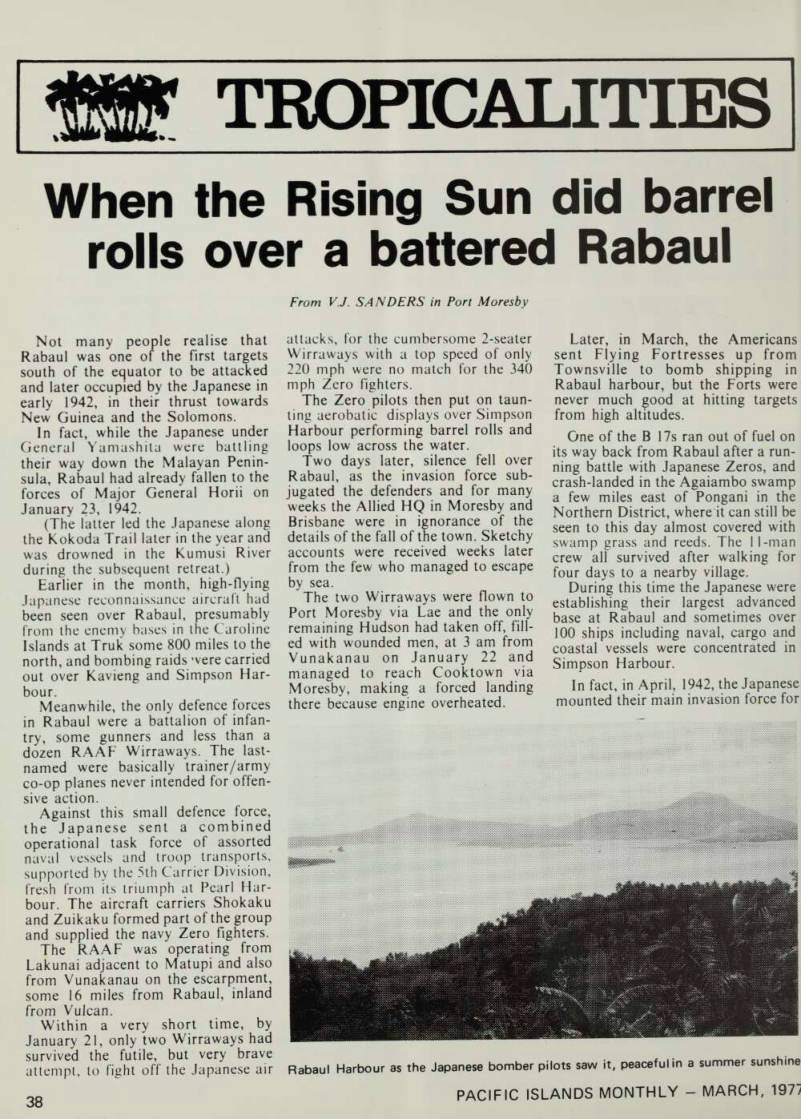
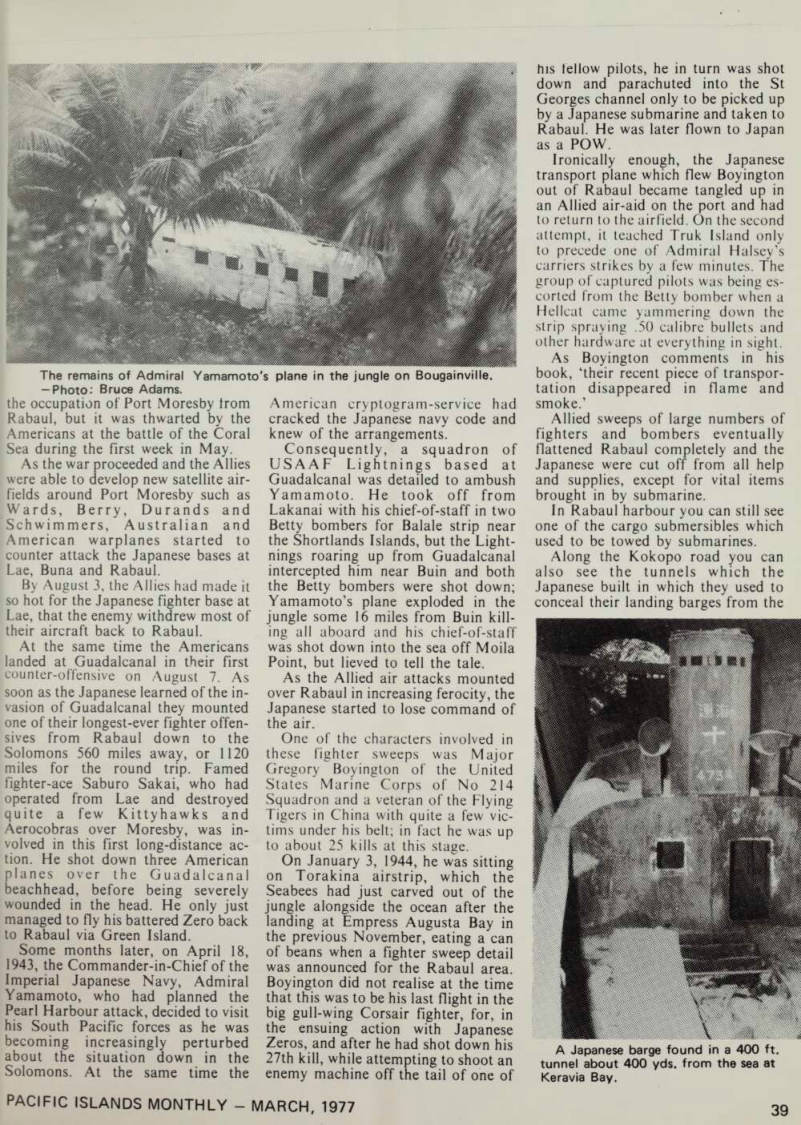

When the Rising Sun did barrel rolls over a battered Rabaul
From V.J. SANDERS in Port Moresby
Not many people realise that Rabaul was one of the first targets south of the equator to be attacked and later occupied by the Japanese in early 1942, in their thrust towards New Guinea and the Solomons.
In fact, while the Japanese under General Yamashita were battling their way down the Malayan Penin sula, Rabaul had already fallen to the forces of Major General Horii on January 23, 1942. (The latter led the Japanese along the Kokoda Trail later in the year and was drowned in the Kumusi River during the subsequent retreat.) Earlier in the month, high-flying Japanese reconnaissance aircraft had been seen over Rabaul, presumably from the enemy bases in the Caroline Islands at Truk some 800 miles to the north, and bombing raids were carried out over Kavieng and Simpson Har bour.
Meanwhile, the only defence forces in Rabaul were a battalion of infan try, some gunners and less than a dozen RAAF Wirraways. The last named were basically trainer/army co-op planes never intended for offen sive action.
Against this small defence force, the Japanese sent a combined operational task force of assorted naval vessels and troop transports, supported by the slh Carrier Division, fresh from its triumph at Pearl Har bour. The aircraft carriers Shokaku and Zuikaku formed part of the group and supplied the navy Zero fighters.
The RAAF was operating from Lakunai adjacent to Matupi and also from Vunakanau on the escarpment, some 16 miles from Rabaul, inland from Vulcan.
Within a very short time, by January 21, only two Wirraways had survived the futile, but very brave attempt, to fight off the Japanese air
attacks, for the cumbersome 2-seater Wirraways with a top speed of only 220 mph were no match for the 340 mph Zero fighters.
The Zero pilots then put on taun ting aerobatic displays over Simpson Harbour performing barrel rolls and loops low across the water.
Two days later, silence fell over Rabaul, as the invasion force sub jugated the defenders and for many weeks the Allied HQ in Moresby and Brisbane were in ignorance of the details of the fall of the town. Sketchy accounts were received weeks later from the few who managed to escape by sea.
The two Wirraways were flown to Port Moresby via Lae and the only remaining Hudson had taken off, fill ed with wounded men, at 3 am from Vunakanau on January 22 and managed to reach Cooktown via Moresby, making a forced landing there because engine overheated.
Later, in March, the Americans sent Flying Fortresses up from Townsville to bomb shipping in Rabaul harbour, but the Forts were never much good at hitting targets from high altitudes.
One of the B 17s ran out of fuel on its way back from Rabaul after a run ning battle with Japanese Zeros, and crash-landed in the Agaiambo swamp a few miles east of Pongani in the Northern District, where it can still be seen to this day almost covered with swamp grass and reeds. The 11-man crew all survived after walking for four days to a nearby village.
During this time the Japanese were establishing their largest advanced base at Rabaul and sometimes over 100 ships including naval, cargo and coastal vessels were concentrated in Simpson Harbour.
In fact, in April, 1942, the Japanese mounted their main invasion force for
Rabaul Harbour as the Japanese bomber pilots saw it, peaceful in a summer sunshine
the occupation of Port Moresby from Rabaul, but it was thwarted by the Americans at the battle of the Coral Sea during the first week in May.
As the war proceeded and the Allies were able to develop new satellite airfields around Port Moresby such as Wards, Berry, Durands and Schwimmers, Australian and American warplanes started to counter attack the Japanese bases at Lae, Buna and Rabaul.
By August 3, the Allies had made it so hot for the Japanese fighter base at Lae, that the enemy withdrew most of their aircraft back to Rabaul.
At the same time the Americans landed at Guadalcanal in their first counter-offensive on August 7. As soon as the Japanese learned of the invasion of Guadalcanal they mounted one of their longest-ever fighter offensives from Rabaul down to the Solomons 560 miles away, or 1120 miles for the round trip. Famed fighter-ace Saburo Sakai, who had operated from Lae and destroyed quite a few Kittyhawks and Aerocobras over Moresby, was involved in this first long-distance action. He shot down three American planes over the Guadalcanal beachhead, before being severely wounded in the head. He only just managed to fly his battered Zero back to Rabaul via Green Island.
Some months later, on April 18, 1943, the Commander-in-Chief of the Imperial Japanese Navy, Admiral Yamamoto, who had planned the Pearl Harbour attack, decided to visit his South Pacific forces as he was becoming increasingly perturbed about the situation down in the Solomons. At the same time the
American cryptogram-service had cracked the Japanese navy code and knew of the arrangements.
Consequently, a squadron of USAAF Lightnings based at Guadalcanal was detailed to ambush Yamamoto. He took off from Lakanai with his chief-of-staff in two Betty bombers for Balale strip near the Shortlands Islands, but the Light nings roaring up from Guadalcanal intercepted him near Buin and both the Betty bombers were shot down; Yamamoto’s plane exploded in the jungle some 16 miles from Buin kill ing all aboard and his chief-of-staff was shot down into the sea off Moila Point, but lieved to tell the tale.
As the Allied air attacks mounted over Rabaul in increasing ferocity, the Japanese started to lose command of the air.
One of the characters involved in these fighter sweeps was Major Gregory Boyington of the United States Marine Corps of No 214 Squadron and a veteran of the Flying Tigers in China with quite a few vic tims under his belt; in fact he was up to about 25 kills at this stage.
On January 3, 1944, he was sitting on Torakina airstrip, which the Seabees had just carved out of the jungle alongside the ocean after the landing at Empress Augusta Bay in the previous November, eating a can of beans when a fighter sweep detail was announced for the Rabaul area.
Boyington did not realise at the time that this was to be his last flight in the big gull-wing Corsair fighter, for, in the ensuing action with Japanese Zeros, and after he had shot down his 27th kill, while attempting to shoot an enemy machine off the tail of one of
his fellow pilots, he in turn was shot down and parachuted into the St Georges channel only to be picked up by a Japanese submarine and taken to Rabaul. He was later flown to Japan as a ROW.
Ironically enough, the Japanese transport plane which flew Boyington out of Rabaul became tangled up in an Allied air-aid on the port and had to return to the airfield. On the second attempt, it teached Truk Island only to precede one of Admiral Halsey’s carriers strikes by a few minutes. The group of captured pilots was being es corted from the Betty bomber when a Helical came yammering down the strip spraying .50 calibre bullets and other hardware at everything in sight.
As Boyington comments in his book, ‘their recent piece of transpor tation disappeared in flame and smoke.’
Allied sweeps of large numbers of fighters and bombers eventually flattened Rabaul completely and the Japanese were cut off from all help and supplies, except for vital items brought in by submarine.
In Rabaul harbour you can still see one of the cargo submersibles which used to be towed by submarines.
Along the Kokopo road you can also see the tunnels which the Japanese built in which they used to conceal their landing barges from the
The remains of Admiral Yamamoto's plane in the jungle on Bougainville. -Photo: Bruce Adams.
A Japanese barge found in a 400 ft. tunnel about 400 yds. from the sea at Keravia Bay.
ferocity of the Allied air attacks, Some of the landing barges are still there to this day.
In the New Guinea Club, there are some excellent photographs pf the Allied air attacks on Rabaul with the shipping under actual bombardment and huge fires burning among the shore installations. Just nearby is the admiral’s bunker where the Japanese had their Navy HQ and signals section, one of the very few buildings to survive the bombings.
All these spots of interest are well worth a visit and when you have done so, take a trip up to Namunula Hill where the old German governors had their residences. The view across the harbour is magnificent, set among the lush, green foliage with the tropical background of palms reaching skywards.
It is difficult to imagine that only 35 years ago, Mitchell and Boston bombers, intermingled with Beauforts and various Allied fighters including Corsairs and Lightnings, were roaring back and forth across the harbour blasting shipping and warehouses with high explosives and raking the Japanese ack-ack gun positions with machine gun and cannon fire to such an extent that Rabaul ceased to exist
as a township and port.
When the Japanese signed their surrender in Rabaul on September 6, 1945 General Sturdee, the Australian commander, was amazed to learn that nearly 100,000 of the enemy had been cut off in East New Britain and were now his prisoners.
The port and airfield were in ruins and there were over 31 ships sunk in the harbour.
The Japanese had' honeycombed the hills around Rabaul with miles and miles of tunnels in which they kept stores, vehicles and workshops.
And what happened to the ravages of war? Ironically enough, most of the war-time wrecks were raised and cut up and shipped back to the Land of the Rising Sun by Japanese salvage teams which spent many months working in Rabaul harbour in the early 19605.
Only very few wartime wrecks now remain; out along the Kokopo road a partly-submerged pontoon crane may be seen near the water edge opposite the Japanese-built tunnels. Other vessels lie in deeper water near Rabaul and in the St Georges channel, victims of Allied bomber and torpedoes.
Meanwhile, over the post-war
years, Kabaul has been rebuilt and once again today it is one of the pret tiest spots in Papua New Guinea and with what a background of history!
In less than 100 years from the time when the first missionaries landed in the Duke of York islands, followed by the early German traders (not forget ting Queen Emma of Ralum fame) then the annexation of New Guinea by Imperial Germany, only to be lost to the Allies as a result of World War One, albeit under mandate to the old League of Nations, Rabaul had seen many changes, Then in 1937, the eruptions at Matupi and Vulcan caused great damage to the township, Five years later, invaders from a country thousands’ of miles to the north occupied Rabaul and the whole 0 f New Guinea, until their defeat in 1945, when Australia again resumed the mandate but this time under the auspices of the United Nations and now in 1977, Rabaul forms part of a successful transition from mandated territory to self-government, to in dependence.
Good old Rabaul for the beau ty of your harbour and the friendliness of your people, happy memories will always remain.
Advertisements & other items, pp. 40-44 (1 item)
Toyota
n -k V, ■ : / F. * I % P r •i '
" * . - ** w&*
The Toyota truck range.
Built to be unbeatable.
Bad weather conditions, no problem.
Bad roads and driving surfaces,
eaten up.
Difficult loads, no contest.
Built tough. Built to take it.
There's a Toyota truck built for you.
TOYOTA Land Cruiser Pickup
TOYOTA Hi-Ace
TOYOTA Stout
TOYOTA Hi-Lux
TOYOTA Dyna
rt 1 r" ■; TOYOTA Toyo-Ace TOYOTA Truck For unbeatable after service:
TOYOTA
D^ Pl i A ' ELA MOTORS LIMITED, Scratchley Rd., Badili, P.O. Box 75, Port Moresby. U.S. TRUST TERRITORY: MICROL CORPORATION rn' ?T’k 26 D 7^ Sa 1 l d FIJI ISLANDS: AUTOMOTIVE SUPPLIES CO,, LTD., G.P.O. Box 355, Suva. AMERICAN SAMOA: BURNS PHILP (SOUTH SEA)’
TD -' P ;°- 1057'I 057 ' Pa 9° Pa 9°- WESTERN SAMOA: BURNS PHILP (SOUTH SEA) LTD,, P.O. Box 188, Apia. GUAM: ATKINS KROLL (GUAM) LTD :c°- 1 BO " 642 V amUn,n9 ' NEW HEBRIDES: NEW HEBRIDES MOTORS LTD,, P.O, Box 18, Vila. SOLOMON ISLANDS: MENDANA ENTERPRISES to oTP °o 1?4, Honiara - TAHITI: NIPPON AUTOMOTO, B.P. 342, Papeete, COOK ISLANDS: COOK ISLANDS TRADING CORPORATION o o* o • P ' Raro,on 9 a - NAURU ISLAND: NAURU COOPERATIVE SOCIETY. GILBERT & ELLICE ISLANDS COLONY: TARAWA MOTORS PA X uPonPf at'.o^aPto^o' 6 ’ 5 NORFOLK TOURS - LTD., P.O. Box 276. TIMOR: SANG TAI HOO, Sang Tai Building, Dili. NEW CALEDONIA. SOCIETE IMPORTATION AUTOMOBILE DU PACIFIQUE, Rond-Point du Pacific (Station Total) B.P. 438, Noumea.
www:
> 4 4* SC-300( 090 DB
ie prestige
The pleasures of music are too important to ittie for second-best. That’s why Sansui, the hi-fi ader, now presents a complete stereo system of ie highest order. Each unit is a technological lasterpiece in itself. Each incorporates the most dvanced technology and this is reflected in the istinguished design that confers true prestige on s owner. When you and your guests listen ) the miraculous realism of this Sansui
Sansui.
system, you will never be satisfied with anything less
Sansui’s superb system includes the 9090D8
FM/AM receiver—enormous power with unbeliev-
ably low distortion. Also; SR-929 quartz-servo
direct drive turntable with beautiful piano lacquered base; SC-3000 cassette deck with Dolby 5 "; giant 5-speaker system with 16" woofer and exquisite
cypress grille.
For those who demand the very best. *TM of Dolby Lab., Inc.
Only hi-fi, everything hi-fi.
NSUI ELECTRIC CO., LTD. 14-1 Izumi 2-chome, Suginami-ku, Tokyo, 168 Japan New Zealand jtralia ik Industries Australia Pty. Ltd. id Office: 12 Barcoo Street. East Roseville, ,W. 2069 Phone: 406 5666 bourne: 68 Queensbridge Street, South bourne, Vic. 3205 Phone; 62 0031 >laide: Phone; 212 2555/Brisbane: Phone: 52 7333 iberra; Phone: 95 2144 Perth: Phone: 28 3933 Fij Prabhu Brothers Ltd.
P.O. Box 183, Nadi Phone: 70183/4 New Zealand David J. Reid (N.Z.) Ltd.
C.P.O. Box 2630, Auckland, 1 Phone: 492-189 New Hebrides The Sound Centre P.O. Box 434, Port Vila South Pacific Miltons Department Stores Limited P.O. Box 146, Norfolk Island 2899 Central Pacific Nauru Co-operative Society Republic of Nauru Cook Islands United Island Traders Ltd.
P.O. Box 1 & 2, Rarotonga >ua New Guinea »ania Indent Agency (P.N.G.) Pty. Ltd.
New Caledonia Ft<s Michel MERCIER Western Samoa m .i Ken and Comoanv Ltd.
Tahiti Societe JAUNEZ & Cie B.P. 322, Papeete Phone: 2.04.
There’s really
only one tool
SIDCHROME
There’s a saying in the tool business.
If you’re going to throw a spanner in the works, make sure it’s a Sidchrome spanner.
And that goes for all Sidchrome tools.
Sidchrome tools are made from the highest quality alloy steel. Finished in a tough, everlasting nickel chrome, and made to last.
That’s why Sidchrome hand tools are unconditionally guaranteed. *w ?
P.N.G. AGENT:- R. & J. Henderson, P.O. Box 353, Lae.
I I I I I I
) YAMAHA
COMING SOON! THE NEW 40A FROM YAMAHA-
A LOT BIGGER FOR COMMERCIAL WATERMEN.
YAMAHA
* n \ a system 1 The forthcoming new model will come with many gems of Yamaha's technical refinements: Built exactly for transportations: Built completely for easier fishing: Built newly for all types of marine works.
It's coming with an exact power, extra durability, ease of service plus economy of fuel consumption. Built for professional watermen who want an exact power.
You'll see it soon.
POWERFUL • Single-carb/reed-valve intake system • Schnurle scavenging • Bigger propeller DURABLE • Integrated crankshaft with solid bearings • Larger capacity water pump • Anti-corrosion throughout ECONOMICAL • Minimum fuel consumption • Minimum maintenance costs ALMIGHTY • High-quality performance • Easy-to-service • New Yamaha's mighty innovation Papua New Guinea Ela Motors Ltd. P. O. Box 75 Port Moresby P. N. G.
Fiji Automotive supplies Co., Ltd.
G. P. O. Box 355 Suva, Fiji Tahiti Tahiti Automoto B. P. Box 439 Papeete, Tahiti Philippines G. A Yupangco & Co., Inc P O. Box 2020 MCC Makati Rizal Solomon Jetsa Shipping Agents Co.
P. O. Box 376 Honiara, Solomon Islands New Hebrides New Hebrides Motors Ltd.
Box 18 Vila, New Hebrides New Caledonia Roayl Motors B. P. 2548 Noumea, New Caledonia Norfolk Is. Central Pacific Southern Cross Motors Ltd. Jacob Enterprises P. O. Box 4 P. O. Box 218 Norfolk Islands Republic of Nauru Central South Pacific 2899 Tonga Pacific Gilbert Is.
The Teikaraoi Fishing Co.
E. M. Jones Ltd. P. O. Box 34 Ltd p Q Box 450 Betio, Nuku' alofa, Tonga Island Truk Susumu's Store P. O. Box 25 Moen, Truk District Eastern Caroline Islands 96942 Tarawa Gilbert Islands Ponape Ponape Island Transportation Inc. P. O. Box 750 Kolonia, Ponape East Caroline Islands 96941
YAMAHA-f-
OUTBOARD MOTORS fr
such a rich
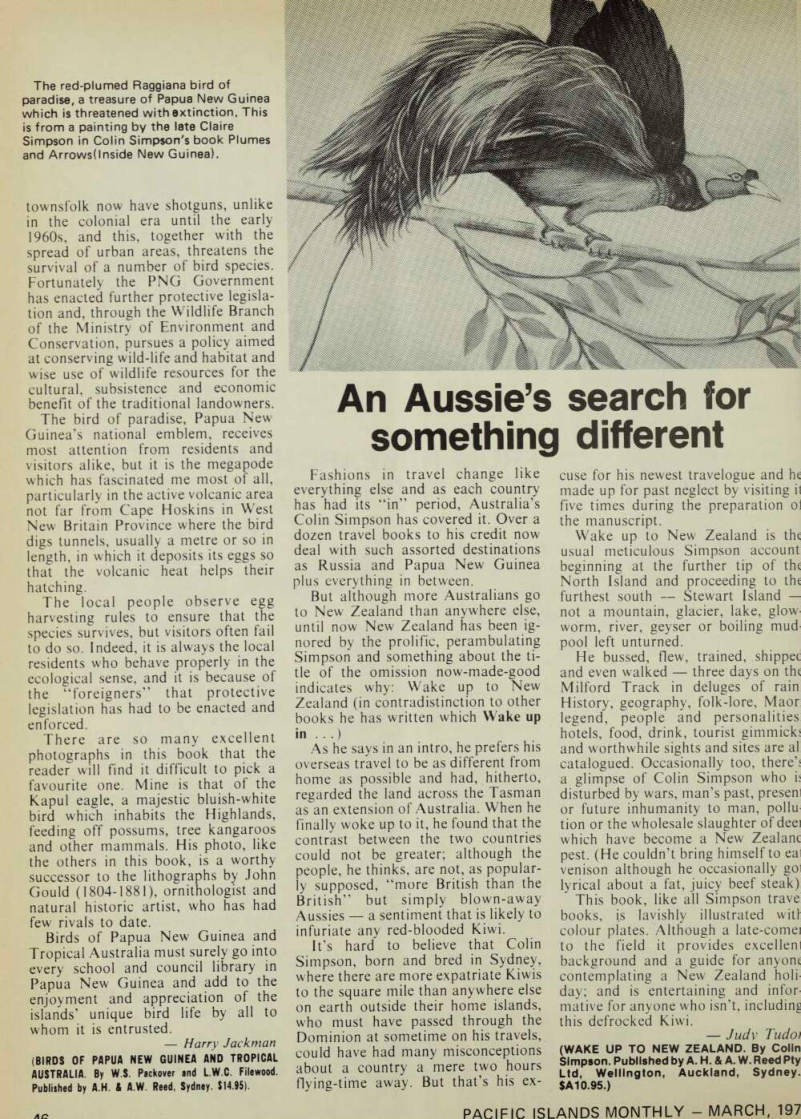
Islands’ bird life: such a rich heritage under threat
Books
Papua New Guinea and the Solomons have a rich and varied bird fauna. Everyone has heard about the birds of paradise, not found elsewhere except for two species in the West In dies, but there are also the magnificently crested goura, largest pigeon in the world, exquisitely plumaged kingfishers, beautiful parrots such as the kalanga, flower peckers, bower birds, hornbills, 'cassowaries, and a host of other species.
The co-authors of Birds of New Guinea and Tropical Australia list 852 local and visiting birds for Papua New Guinea, Irian Jaya and the Solomons. It is no wonder that 41 pages in E.T. Gilliard’s Birds of Paradise and Bower Birds (1969) are taken up by details of visits and ex peditions by ornithologists between 1818 and 1956, and that there have been just about as many publications on the birds as there are species.
Even so, much work remains to be done to fully uncover this great heritage of the Islands. In this superb book, Peckover and Filewood con tinue the work begun by Salvadori, Gould and Sharpe in the 19th century and continued by Mayr, Iredale, Rand and Gilliard, Schodde and Hitchcock, and others in recent times.
Advances in ornithology and photography have enabled the co authors to give us brilliant pictures of many of the birds in their natural habitat, and to provide a text, supplemented by maps of distribu tion, that helps the layman to a better appreciation of the unique place which the feathered inhabitants hold in the Islands. This is most important because it is the people at large, villagers and townsfolk no less than politicians, to whom this wonderful heritage is entrusted. It is they, just as much as the ornithologists, who need to have a proper understanding of the bird world around them if an ecological disaster is to be prevented.
The Australian Administration was too slow to act. It was not until 1968 that the Fauna Protection Ordinance
came into operation, protecting all birds of paradise, goura pigeons, Salvador's teal, osprey, New Guinea eagle, and certain egrets. By that time many species had already become scarce in some localities. No longer could one see large trees made fiery red by dozens of displaying Raggiana birds of paradise not far from what is now Kwikila sub-provincial headquarters, as I was fortunate to see them in 1948. No longer was the
goura pigeon a common bird along the banks of the Keram River as it had been in the 19505, and the Kokomo, the huge hornbill, who makes an amusing pet (mine flew around the Lawes Road area of Port Moresby until the police “arrested” it because of complaints from neighbours and it had to be sent to the sanctuary at Nondugl) had become scarce along the lower Vailala River, Very many villagers and some
townsfolk now have shotguns, unlike in the colonial era until the early 19605, and this, together with the spread of urban areas, threatens the survival of a number of bird species.
Fortunately the PNG Government has enacted further protective legisla tion and, through the Wildlife Branch of the Ministry of Environment and Conservation, pursues a policy aimed at conserving wild-life and habitat and wise use of wildlife resources for the cultural, subsistence and economic benefit of the traditional landowners.
The bird of paradise, Papua New Guinea’s national emblem, receives most attention from residents and visitors alike, but it is the megapode which has fascinated me most of all, particularly in the active volcanic area not far from Cape Hoskins in West New Britain Province where the bird digs tunnels, usually a metre or so in length, in which it deposits its eggs so that the volcanic heat helps their hatching.
The local people observe egg harvesting rules to ensure that the species survives, but visitors often fail to do so. Indeed, it is always the local residents who behave properly in the ecological sense, and it is because of the “foreigners” that protective legislation has had to be enacted and enforced.
There are so many excellent photographs in this book that the reader will find it difficult to pick a favourite one. Mine is that of the Kapul eagle, a majestic bluish-white bird which inhabits the Highlands, feeding off possums, tree kangaroos and other mammals. His photo, like the others in this book, is a worthy successor to the lithographs by John Gould (1804-1881), ornithologist and natural historic artist, who has had few rivals to date.
Birds of Papua New Guinea and Tropical Australia must surely go into every school and council library in Papua New Guinea and add to the enjoyment and appreciation of the islands’ unique bird life by all to whom it is entrusted.
Harry Jackman
(BIROS OF PAPUA NEW GUINEA AND TROPICAL AUSTRALIA. By W.S. Packover and LW.C. Filewood.
Published by A.H. & A.W. Reed, Sydney. $14.95).
Advertisements & other items, p. 45 (1 item)
ScalTrv^
FROM RESEARCH UNIT
TO A PNG INSTITUTE
In the October issue of PIM (p. 63) I reviewed Marion Ward’s Road and Development in Southwest Bougainville, in the Monograph series of the Research Unit of the Australian Na tiona Univ-ersity, and I made the point that it was one in an admirable series of publications. I now have to sav that this was one of the last publications ofthe Research Unit, for Uniy . ty had agreed the unit’s assets will pass to an Institute of Applied Social and Economic Research, the establishment of which was approved by the Papua New Guinea House of Assembly in August, 1975. Until their contracts expire, the unit’s staff will remain with the institute which began ks new work on January 1, 1976.
Henry Toßobert, the Governor of the Bank of Papua New Guinea, is chairman of the institute’s council, which includes representatives from parliament, the public service, the community, the universities and the institute’s staff.
The institute will continue the unit’s publishing role by producing its own monographs and the periodical Luksave The first monograph of the Institute Research, Needs and n eW p G . Ui^ a ’ e K Ued the Director Dr RJ May has now appeared. It IS a significant document
both for the wide range of issues it dis cusses and for the depth of experts, in digenous and expatriate, who put forward fundamental areas for ex amination. j Tu who ana| com .
D J . .. m niun.cat.on problems P Japhlom wh ° directs attention tO housing Problems and R.W Fergie. who
ScalTrv^
'Jo authors contributing to the overall s a eme ‘ , 18 he hoped that the institute Wld continue to pursue the down-to earth approach expressed by Henry Toßobert in his concluding remarks ia me monograph, “I have no illusion . a * ad the various proposals par ticipants in this seminar have been suggesting are achievable, at least in the short run, because I do not think the institute is in a position to undertake all or even a great number them. But I want to repeat what I have expressed earlier that I do hope that the discussions that have taken place will help us in defining needs and priorities for research and in cidentally to result in a much greater degree of co-ordination than has ex
isted in the past.”
W. G. Coppell.
(RESEARCH NEEDS AND PRIORITIES IN PAPUA NEW GUINEA. R. J. May. Papua New Guinea Institute of Applied Social and Economic Research. Monograph No 1.)
something different
An Aussie’s search for something different
Fashions in travel change like everything else and as each country has had its “in” period, Australia’s Colin Simpson has covered it. Over a dozen travel books to his credit now deal with such assorted destinations as Russia and Papua New Guinea plus everything in between.
But although more Australians go to New Zealand than anywhere else, until now New Zealand has been ig nored by the prolific, perambulating Simpson and something about the ti tle of the omission now-made-good indicates why: Wake up to New Zealand (in contradistinction to other books he has written which Wake up in .. .) As he says in an intro, he prefers his overseas travel to be as different from home as possible and had, hitherto, regarded the land across the Tasman as an extension of Australia. When he finally woke up to it, he found that the contrast between the two countries could not be greater; although the people, he thinks, are not, as popular ly supposed, “more British than the British” but simply blown-away Aussies a sentiment that is likely to infuriate any red-blooded Kiwi.
It’s hard to believe that Colin Simpson, born and bred in Sydney, where there are more expatriate Kiwis to the square mile than anywhere else on earth outside their home islands, who must have passed through the Dominion at sometime on his travels, could have had many misconceptions about a country a mere two hours flying-time away. But that’s his ex
cuse for his newest travelogue and he made up for past neglect by visiting it five times during the preparation ol the manuscript.
Wake up to New Zealand is the usual meticulous Simpson account beginning at the further tip of the North Island and proceeding to the furthest south Stewart Island not a mountain, glacier, lake, glow worm, river, geyser or boiling mud pool left unturned.
He bussed, flew, trained, shippec and even walked three days on the Milford Track in deluges of rain History, geography, folk-lore, Maor legend, people and personalities hotels, food, drink, tourist gimmicks and worthwhile sights and sites are al catalogued. Occasionally too, there’s a glimpse of Colin Simpson who is disturbed by wars, man’s past, preseni or future inhumanity to man, pollu tion or the wholesale slaughter of deei which have become a New Zealanc pest. (He couldn’t bring himself to eai venison although he occasionally goi lyrical about a fat, juicy beef steak) This book, like all Simpson trave books, is lavishly illustrated wit! colour plates. Although a late-comei to the field it provides excellent background and a guide for anyone contemplating a New Zealand holi day; and is entertaining and infor mative for anyone who isn’t, including this defrocked Kiwi.
Judy Tudor
(WAKE UP TO NEW ZEALAND. By Colin Simpson. Published by A. H. & A. W. Reed Pty Ltd, Wellington, Auckland, Sydney. 5A10.95.)
The red-plumed Raggiana bird of paradise, a treasure of Papua New Guinea which is threatened with extinction. This is from a painting by the late Claire Simpson in Colin Simpson's book Plumes and Arrows(inside New Guinea).
This Professor Leans
On Too Weak A Reed
The Philippines, Puerto Rico, the Trust Territory of the Pacific Islands (TTPI), Guam, the Cook Islands, Papua New Guinea (PNG), and the West Indies all have at least one feature in common, all being island countries.
Arnold Leibowitz, Professor of Public Administration at Harvard University and a former adviser to Puerto Rico, Guam, the Virgin Islands and Jamaica, suggests they share a further characteristic which makes the treatment of such disparate entities in a single work intellectually profitable. The common factor, ac cording to Leibowitz, is the mutual experience of what he calls “com monwealth” or “associated state” status.
This political standing might best be described as semi-independence internal self-government to some degree for the dependency, with metropolitan dominance in such areas as defence and foreign relations.
The idea is a rather intriguing one for two reasons. Firstly, there is relatively little literature on this topic, be it comparative or case study, and, secondly, Leibowitz seeks to compare polities for which this status is a final political solution with others for which it was/is a transitional stage to full independence.
However, as Leibowitz himself ad mits, there is little beyond their in sularity and their shared experience as “commonwealths” to unite the sub jects of his study, and so the coherence of the entire book depends on a very slender and suspect reed.
Unhappily, this reed proves too
fragile.
In the event the significance of Leibowitz’ book derives not so much from his examination of the associated state relationships as from the compilation of information on the countries of his study.
Key issues in the negotiation of the commonwealth status are examined from the perspective of each of the seven island groups’ experience in what amounts to a series of mini-case studies. The issues raised in each chapter range from the obvious defence, foreign affairs, immigration, tariffs and trade to the less obvious taxation, applicability of
metropolitan law, and termination of the associated state agreement.
With the lawyer’s practised eye for detail, Leibowitz clearly and concisely examines the impact such issues have had on the development of each coun try’s negotiations towards associated state status.
In the case of the Philippines, Puer to Rico, the Cooks and the West In dies these topics tend to be treated more as settled historical events which serve as precedents against which to measure the on-going negotiations in Guam, PNG (the book was written before September, 1975), and the
Ttpi.
In all these countries but the Philip pines, however, the continuing legal relationship between the territory and the metropole has necessitated cons tant redefinition of rights and respon sibilities of each participant in the face of changing international cir cumstances. Thus some consideration is given to the implications of on going dependency regardless of how circumscribed this dependence might be.
Leibowitz presents his material in a somewhat flat and legalistic tone.
This can be irksome on occasion.
Lor example, Leibowitz points to the rigidity of the American attitude which allows almost no scope for the termination of some form of dependency relationship for the US territories, and contrasts this with the flexibility of the British experience (including the two Australasian governments) without committing himself to a judgment on this vital issue.
Given the emotive connotations of the phrase “colonial emancipation’’ which appears in the title the reader is justified in finding such hesitancies (and there are others) disappointing.
At best his stylistic technique conveys the impression of over-caution through the rather thin guise of main taining scholarly objectivity. Certain ly, it does not offer any guidance for either the political or moral resolution of the problems involved in a halfway house solution to the ending of im perialism.
This brings the reader back to his initial disquiet regarding the coherence of the study. The detailed
legal and political data which Leibowitz has compiled are indeed useful and will warrant the interest in this work of students in a variety of disciplines. Even the layman with some background in the South Pacific or the Caribbean will find the book worth reading.
Nevertheless, Leibowitz has missed a valuable opportunity in his book. By devoting less than a page to his con clusions, he has failed to justify the common thread to his study. His view of the associated state arrangement as a realistic and viable political option for very small states is offset by his piecemeal approach to the subject.
Neither the Philippines nor PNG contributes to this thesis, while the dismemberment of the TTPI, the militarisation of Guam and the overlooking of American Samoa’s situation suggest little support from the experience of the American territories.
Thus, as the topic stands now, it would seem there is much ground for further debate on the value of semi independence as a model for the few remaining micro-colonies of the world. Leibowitz has opened the debate but he has not taken out the mortgage on it.
Richard A. Herr
(Colonial Emancipation In The Pacific And
The Caribbean; A Legal And Political
ANALYSIS, by Arnold H. Leibowitz. Praeger Publishers, New York, J 18.50.)
New Pacific Islands
Year Book out soon!
The 12th edition of the Pacific Islands Year Book is now being printed.
It will be a publishing landmark because for the first time since the 1st edition of 1932 the Year Book has been completely rewritten and reset. Its material is now all on computer setting, which means it is now economic to update it annually. A new edition will be published every year in future.
In the past it has been published about every three years.
The 12th edition contains details of all Island nations and territories, including history, population, trade figures etc. Its many maps have all been revised and redrawn.
The Pacific Islands Year Book is published by Pacific Publications, publishers of PIM.
Advertisements & other items, p. 48 (2 items)
dapicip iq i am nQ MONTH I Y MARCH, 197
Shipbuilders To The Pacific.
* AG ■JI at. r A LANDING BARGE under construction at
CARPENTERS INDUSTRIAL SHIPYARD, Walu Bay, Suva
Fiji Islands, for Mr. Anton Lee of Port Moresby, Papua New Guinea.
CARGO CAPACITY; 14,000 c.ft. LENGTH; 114ft.0.A.
Powered by twin GARDNER diesel engines each 230 hp.
[CARPENTERS INDUSTRIAL RO. 80X296
l SUVA,FIJI. PHONE 312-133.
I Please send me information on Shipbuilding in the I South Pacific I Name
j Company
I Address-
•iff]
TfVMi
Save hundreds of dollars
on Australia’s most efficient
WALK IN, ALUMINIUM '
COOLROOMS AND
FREEZE ROOMS
Hundreds already installed! The most economical supplementary coolrooms for bottles and food, providing the largest storage capacity of any comparable coolrooms of the same exterior dimensions. Five sizes—from 90-360 cu. ft. capacity; 16 models offering normal temp., two temp., deep freeze, or for pastry and ice storage applications. White vinyl interior, embossed rustproof aluminium exterior. • SUPPLIED IN EASY-TO-ERECT, DO-IT-YOURSELF KIT FORM.
Available from: AUSTRALIAN NEW CALEDONIA EXPORTS (SILVER & BARDA), 363 George St., Sydney, 2000 and Branches.
BRECKWOLDT & CO., 276 Pitt St., Sydney, 2000 and Branches.
PETER FISHER TRADING PTY. LTD., 321 Pitt St., Sydney, 2000.
HAGEMEYER (A'SIA), 59 Anzac Pde., Kensington, 2033 and Branches.
GEOFFREY HUGHES & CO., 167 Macquarie St., Sydney, 2000.
Manufactured by:
rtt
NELSON & ROBERTSON PTY. LTD., 197 Clarence St., Sydney, 2000.
RABAUL TRADING CO. PTY. LTD., P.O. Box 219, Rabaul and Branches.
E RABOT (EXPORTS) PTY. LTD., 67 Castlereagh St., Sydney, 2000.
H. Y. KWAN (AUST.) PTY. LTD., Box 2713 G.P.O. Sydney, 2001.
C. SULLIVAN (EXPORT) PTY. LTD., 60 Margaret St., Sydney, 2000 and Branches. „ , W. S. TAIT & CO., PTY. LTD., 31 Macquarie Place, Sydney, 2000 and Branches.
FRIGID CABINETS PTY. LTD.,
HA Puffy Ave., Thornleigh, N.S.W. 2120 Aust. Ph. 848 8292.
of the ailing Emperor goldmine
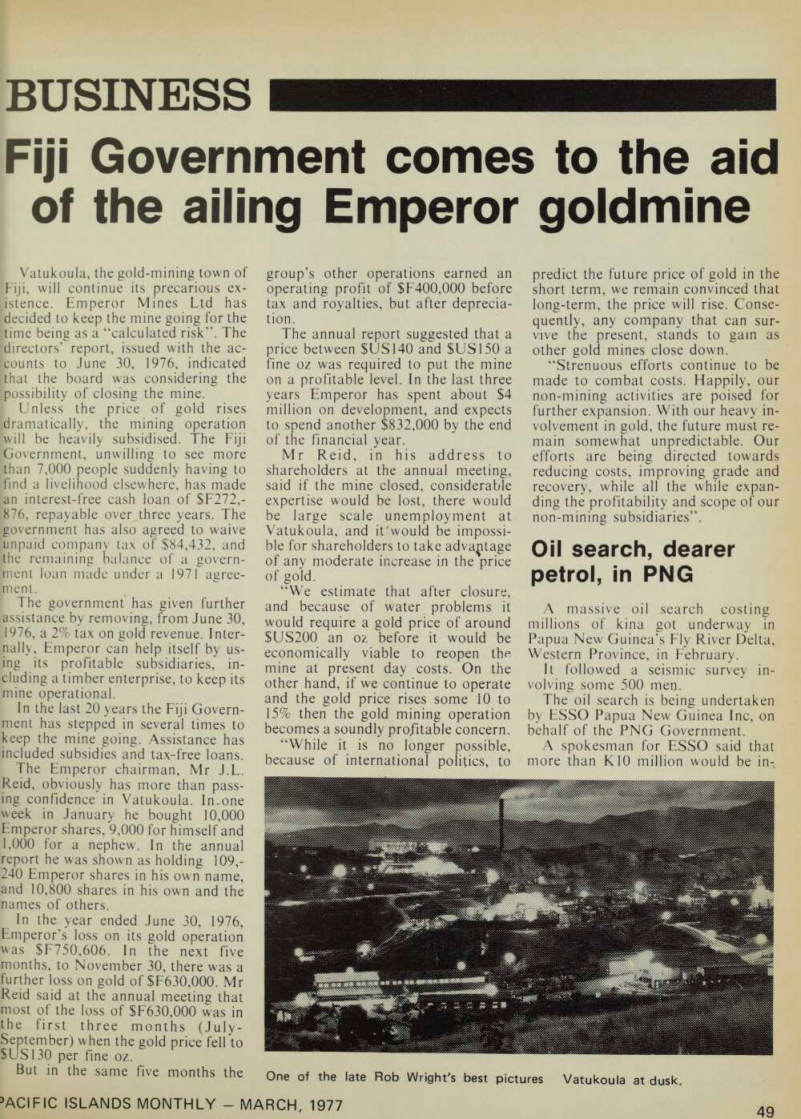
Business
Fiji Government comes to the aid of the ailing Emperor goldmine
Vatukoula, the gold-mining town of Fiji, will continue its precarious ex istence. Emperor Mines Ltd has decided to keep the mine going for the ■time being as a “calculated risk”. The [directors’ report, issued with the ac counts to June 30, 1976, indicated [that the board was considering the [possibility of closing the mine.
Unless the price of gold rises dramatically, the mining operation will be heavily subsidised. The Fiji Government, unwilling to see more than 7,000 people suddenly having to find a livelihood elsewhere, has made an interest-free cash loan of $F272,- 876, repayable over three years. The government has also agreed to waive unpaid company tax of $84,432, and the remaining balance of a govern ment loan made under a 1971 agree
ment.
The government has given further assistance by removing, from June 30, 1976, a 2% tax on gold revenue. Inter nally, Emperor can help itself by us ing its profitable subsidiaries, in cluding a timber enterprise, to keep its mine operational.
In the last 20 years the Fiji Govern ment has stepped in several times to keep the mine going. Assistance has included subsidies and tax-free loans.
The Emperor chairman, Mr J.L.
Reid, obviously has more than pass ing confidence in Vatukoula. Imone week in January he bought 10,000 Emperor shares, 9,000 for himself and 1,000 for a nephew. In the annual report he was shown as holding 109,- 240 Emperor shares in his own name, and 10,800 shares in his own and the names of others.
In the year ended June 30, 1976, Emperor’s loss on its gold operation was $F750,606. In the next five months, to November 30, there was a further loss on gold of $F630,000. Mr Reid said at the annual meeting that most of the loss of $F630,000 was in the first three months (July- September) when the gold price fell to SUSI3O per fine oz.
But in the same five months the
group’s other operations earned an operating profit of $F400,000 before tax and royalties, but after deprecia tion.
The annual report suggested that a price between SUSI4O and SUSISO a fine oz was required to put the mine on a profitable level. In the last three years Emperor has spent about $4 million on development, and expects to spend another $832,000 by the end of the financial year.
Mr Reid, in his address to shareholders at the annual meeting, said if the mine closed, considerable expertise would be lost, there would be large scale unemployment at Vatukoula, and it'would be impossi ble for shareholders to take advantage of any moderate increase in the price of gold.
“We estimate that after closure, and because of water problems it would require a gold price of around SUS2OO an oz before it would be economically viable to reopen the mine at present day costs. On the other hand, if we continue to operate and the gold price rises some 10 to 15% then the gold mining operation becomes a soundly pro/itable concern.
“While it is no longer possible, because of international politics, to
predict the future price of gold in the short term, we remain convinced that long-term, the price will rise. Conse quently, any company that can sur vive the present, stands to gain as other gold mines close down.
“Strenuous efforts continue to be made to combat costs. Happily, our non-mining activities are poised for further expansion. With our heavy in volvement in gold, the future must re main somewhat unpredictable. Our efforts are being directed towards reducing costs, improving grade and recovery, while all the while expan ding the profitability and scope of our non-mining subsidiaries”.
Oil search, dearer
petrol, in PNG
A massive oil search costing millions of kina got underway in Papua New Guinea’s Fly River Delta, Western Province, in February.
It followed a seismic survey in volving some 500 men.
The oil search is being undertaken by ESSO Papua New Guinea Inc, on behalf of the PNG Government.
A spokesman for ESSO said that more than KlO million would be in-
One of the late Rob Wright's best pictures Vatukoula at dusk.
vested in the project. The search would later be extended to Gulf Province where test wells would also be drilled offshore.
Oil exploration has been going on for several years covering 80 areas of PNG and involving 15 companies.
But so far neither gas nor oil has been found in economic quantities.
The ESSO spokesman said that about Kl5O million had already been spent on the oil search in PNG.
High prices of oil on the world market are forcing the government to undertake a full survey of the country in a bid to make the nation self sufficient. At present most oil con sumed in PNG is imported from South-east Asia. • PNG motorists were told in January that petrol prices would rise by 4.9 toea per gallon to 91.4 toea.
The rise was announced by the Oil In dustry Prices Committee. Service stations in all major centres would also charge 68 toea for a gallon of kerosine, a rise of 0.3 toea; and 69 toea for a gallon of distillate, a rise of 3.8 toea. Committee secretary, Mr I.
Freer, said the Price Controller had approved the increases after a detailed study report had been submitted by management consultants, W.D.
Scott, for the oil industry. Mr Freer said the increases had been recommended by the oil industry but had been deferred since June, 1976.
Co-operative cocoa
growing in Fiji
A promising co-operative effort ir cocoa production is under way in Fi ji’s Bau district.
Seventeen farmers joined togethei in June, 1976, to form the Bau Tikim Cocoa Growers’ Association.
From Mondays to Thursdays al members work on one member's farm, and on Fridays and Saturdays they are left to work on their own mainly preparing cash crops for the markets.
The association’s president, Mi Lenaitasi Ranuku, 67, said: “Thu system has worked successfully Everyone abides by the rules and w( have obviously achieved more than w( did by working individually. I am sun the end result will be very rewarding i; this trend continues.’’
He said a $F 1,500 cocoa fermen tary built under New Zealand govern ment grant was nearing completior and would enable the association tc dry members’ own beans. The curreni price of SF74O per ton of dried beans would be an added incentive tc members.
Advertisements & other items, p. 50 (1 item)
E. G. Barker & Co.
THE PAPUA HOTEL
PORT MORESBY
• Right In the business centre • A tradition for comfort and fine food • All rooms air conditioned • Restaurant • Bars • Banquet Hall Telephone 24 2121
Cables PAPTEL
A. C. NEUMANN
Manager
INTERNATION
DATELINE HO r
TONGA
"Friendly Hotel" of the "Friendly Islands"
Situated along the Nukualofa waterfront. Only five minutes walk from town. Single, double, family suites, airconditioning, and hot and cold water showers. Pool, bar, restaurant, duty-free shop, tour desk and boutique.
Book through your travel agent or write to International Dateline Hotel, P.O. Box 62, Nukualofa Tonga.
Cable Address: "DATELINE".
Represented Overseas by; Charles J. Henry and Associates Pty. Ltd.
Sydney and Melbourne. 1976
E. G. BARKER & CO.
PTY. LTD.
Established 1825 150 Years of Service
AUSTRALIA'S OLDEST EXPORT HOUSE
GENERAL EXPORT MERCHANTS
Specialising in world-wide distribution of General Merchandise, Provisions and Produce
Buying Agents for:
THE CO-OPERATIVE WHOLESALE SOCIETY LTD.
Lae and all branches throughout PNG
Representatives
PORT MORESBY
RAYMOND WONG
P.O. Box 5020
BOROKO
Phone 25 5546
RABAUI
NEW GUINEA ISLANDS
PRODUCE CO. LTD.
P.O. Box 387
RABAUL
Phone: 92 1982
FIJI
PARAMOUNT AGENCIES
GvP.O. Box 459
SUVA
Phone 2 3127
34 HUNTER STREET, SYDNEY 2000
Cable Address: KERBAR SYDNEY Phone: 231 6200. Telex: 22221 Melbourne Office: 530 Little Collins Street.
Phone: 61 2877. Tele* 31732
‘Cheep, cheep’ sings the Noumea
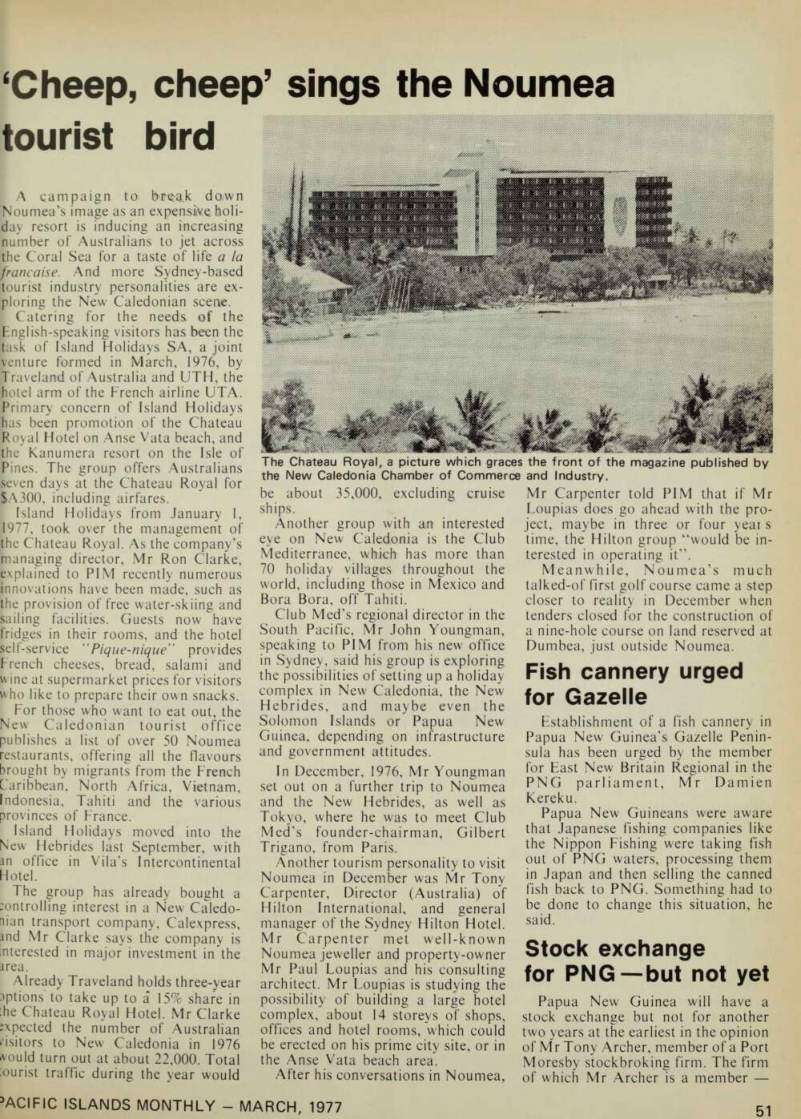
tourist bird
A campaign to frp-sa.k down Noumea's image as an expensive holi day resort is inducing an increasing number of Australians to jet across the Coral Sea for a taste of life a la francaise. And more Sydney-based tourist industry personalities are ex ploring the New Caledonian scene.
Catering for the needs of the English-speaking visitors has been the task of Island Holidays SA, a joint venture formed in March, 1976, by Traveland of Australia and UTH, the hotel arm of the French airline UTA.
Primary concern of Island Holidays has been promotion of the Chateau Royal Hotel on Anse Vata beach, and the Kanumera resort on the Isle of Pines. The group offers Australians seven days at the Chateau Royal for SA3OO, including airfares.
Island Holidays from January 1, 1977, took over the management of the Chateau Royal. As the company’s managing director, Mr Ron Clarke, explained to PIM recently numerous innovations have been made, such as the provision of free water-skiing and sailing facilities. Guests now have fridges in their rooms, and the hotel self-service “ Pique-nique” provides French cheeses, bread, salami and wine at supermarket prices for visitors who like to prepare their own snacks.
For those who want to eat out, the New Caledonian tourist office publishes a list of over 50 Noumea restaurants, offering all the flavours brought by migrants from the French Caribbean, North Africa, Vietnam, Indonesia, Tahiti and the various provinces of France.
Island Holidays moved into the New Hebrides last September, with an office in Vila’s Intercontinental Hotel.
The group has already bought a :ontrolling interest in a New Caledo
nian transport company, Calexpress,
and Mr Clarke says the company is interested in major investment in the area.
Already Traveland holds three-year aptions to take up to a 15% share in :he Chateau Royal Hotel. Mr Clarke ;xpected the number of Australian visitors to New Caledonia in 1976 would turn out at about 22,000. Total tourist traffic during the year would
be about 35,000, excluding cruise ships.
Another group with an interested eye on New Caledonia is the Club Mediterranee, which has more than 70 holiday villages throughout the world, including those in Mexico and Bora Bora, off Tahiti.
Club Med’s regional director in the South Pacific, Mr John Youngman, speaking to PIM from his new office in Sydney, said his group is exploring the possibilities of setting up a holiday complex in New Caledonia, the New Hebrides, and maybe even the Solomon Islands or Papua New Guinea, depending on infrastructure and government attitudes.
In December, 1976, Mr Youngman set out on a further trip to Noumea and the New Hebrides, as well as Tokyo, where he was to meet Club Med’s founder-chairman, Gilbert Trigano, from Paris.
Another tourism personality to visit Noumea in December was Mr Tony Carpenter, Director (Australia) of Hilton International, and general manager of the Sydney Hilton Hotel.
Mr Carpenter met well-known Noumea jeweller and property-owner Mr Paul Loupias and his consulting architect. Mr Loupias is studying the possibility of building a large hotel complex, about 14 storeys of shops, offices and hotel rooms, which could be erected on his prime city site, or in the Anse Vata beach area.
After his conversations in Noumea,
Mr Carpenter told PIM that if Mr Loupias does go ahead with the pro ject, maybe in three or four year s time, the Hilton group “would be in terested in operating it”.
Meanwhile, Noumea’s much talked-of first golf course came a step closer to reality in December when tenders closed for the construction of a nine-hole course on land reserved at Dumbea, just outside Noumea.
Fish cannery urged
for Gazelle
Establishment of a fish cannery in Papua New Guinea’s Gazelle Penin sula has been urged by the member for East New Britain Regional in the PNG parliament, Mr Damien Kereku.
Papua New Guineans were aware that Japanese fishing companies like the Nippon Fishing were taking fish out of PNG waters, processing them in Japan and then selling the canned fish back to PNG. Something had to be done to change this situation, he said.
Stock exchange
for PNG —but not yet
Papua New Guinea will have a stock exchange but not for another two years at the earliest in the opinion of Mr Tony Archer, member of a Port Moresby stockbroking firm. The firm of which Mr Archer is a member
The Chateau Royal, a picture which graces the front of the magazine published by the New Caledonia Chamber of Commerce and Industry.
Reynolds, Sweeney, Platt-Hepburn, Archer, Jones and Co started over the-counter trading in stock and I shares in mid-January.
They are catering for the invest ment needs of permanent residents who, under exchange control regulations, are allowed to invest only K 10,000 annually in foreign portfolio investments. The firm will also trade in Australian-listed companies with loca registers.
The firm has about 700 active in vestors on its books. About 100 are PNG nationals. The service caters ; primarily for permanent expatriate residents as PNG citizens already have the facilities of the PNG Invest ment Corporation available to them. 1 Citizens are able to buy shares in the [corporation which, in turn, holds local and foreign investments.
The over-the-counter market trades in kina for locally-registered com panies and in the case of Australian listed locally registered companies prices are to be close to those on Australian exchanges, allowing for exchange rate differentials, Mr Archer said.
The major stocks available to in vestors include New Guinea Finance Co Ltd, Bougainville Copper Ltd, South Pacific Brewery Ltd and Steamships Trading Co Ltd.
Lutherans to
sell up in PNG
The Lutheran Church in Papua New Guinea is to dispose of its com mercial enterprises because they are interfering with the church’s essential evangelical work.
The enterprises, estimated to be worth some K 2 million, include Lutheran Shipping, Luta Air (with a fleet of four light aircraft), Lutheran Technical Services, nine plantations, Graged Steelworks and a number of garage workshops.
The decision follows recommen dations made by a task force of five prominent Lutherans who visited PNG in early 1976 to study the opea tion of the enterprises. They recommended that they should be dis posed of within five years.
Sent specially by the church to supervise the liquidation is Mr Leroy Dockter, who arrived in Lae last December from Wisconsin, USA.
Mr Dockter said.the.intention is to turn most of the church’s businesses into “passive” investments, which will ;arn interest and provide funds for special projects, instead of largely supporting the church.
Advertisements & other items, pp. 51-52 (2 items)
51
’ACIFIC ISLANDS MONTHLY - MARCH, 1977
nedlloyd
To Future Generations,
Security
a Tranquil Splendor.
Borobudur Temple in Indonesia built over 11 centuries ago.
Social welfare is a subject of serious consideration in most modern societies.
Man in the twentieth century accepts his responsibility to bequeath to the next generation a society better than his own.
Daiwa Bank is not unique in accepting this responsibility, but Daiwa is unique in making acceptance of this role in society an integral part of their banking service.
Daiwa is the only Japanese city bank to combine banking and trust business. Daiwa is thus a fully integrated banking institution, comprising banking, international financing, trust, pension trust, and real estate business.
This integration is part of our effort to fulfil our social responsibility consistent with society's needs in a contemporary environment. a fully integrated banking service
DAIWA BANK
Head Office: Osaka, Japan London and Frankfurt Branches New York and Los Angeles Agencies Singapore, Sydney, Sao Paulo and Hong Kong Representative Offices Joint Venture Banks: P.T. Bank Perdania, Jakarta, International Credit Alliance, Ltd., Hong Kong
nedlloyd
REGULAR SAILINGS BY FAST, MODERN CARGO VESSELS from EUROPE yio PANAMA to: from NEW ZEALAND via PANAMA to:
EUROPE
PAPEETE, NOUMEA, (MEDITERRANEAN fr NORTH CONTINENT)
APIA, SUVA, LAUTOKA, and from AUSTRALIA to:
NEW ZEALAND. CENTRAL AMERICA & CARIBBEAN
heavy-lift facilities —refrigerated space—cargo deeptonks For further particulars apply to Agents: Ets. Donald Tahiti Agonce Maritime Aerienne Caledonienne Papeete. S.A. A.M.A.C., Noumea.
Interocean Australia Services Pty. Ltd.
Sydney.
O. F. Nelson & Co. Ltd. Carpenters Shipping Apia. Suva, Lautoka.
Joint Shipping Management Ltd.
P.O. Box 890, Wellington, N.Z.
Imports are a problem

for French Polynesia
A recent report on French Polynesia compiled by a French parliamentary mission emphasises the territory’s excessive dependence on expenditure by Paris, to the detriment of local agriculture and industry. The role of the CEP nuclear test centre, which has been reducing its activities in recent times, has been particularly noted for drawing islanders away from traditional employment.
The Paris report shows that French Polynesia’s population of over 140,- 000, almost 100,000 of them in Tahiti, is growing at a rate of about 30%.
This is faster than the rate of develop ment of the territory’s resources and thus creates a serious economic problem. There is an excessive dependence on imports which are 10 times greater than the value of local exports. It is calculated that agriculture and industry provide only 20 per cent of the gross national product, while services, including tourism, make up 50 per cent. The remaining 30 per cent comes from the administration.
The islands’ chief agricultural production, copra, increased 76 per cent in 1975, to reach a 10-year record of 22,348 tonnes, no doubt prompted by the economic recession on Tahiti and reduced expenditure by the CEP.
This prompted workers to return to their plantations in outer islands.
Despite the drop in price of copra on world markets, under a local stabilisation plan Polynesian producers were guaranteed a favourable price by the Huilerie de Tahiti oil factory. This in turn cost the local authorities 495.2 million CFP in subsidies (about $A5 million).
In other areas of agriculture, vanilla and coffee production con tinued to be negligible. About 3,600 tonnes of local fruit was marketed, with less than 250 tonnes exported while about 1,800 tonnes, mostly citrus, was imported.
In the livestock market, local pork production exceeded imports. But for beef, imports were 10 times greater than local production. Milk produc tion is about equal to local demand.
The tourist industry attracted just under 83,000 visitors in 1975, com pared with the record 84,600 in 1974.
The tourist situation has since suf
fered further by the withdrawal, in late 1976, of the Qantas service between Sydney and Papeete and the discontinuation in February, 1977, of the Air France link Tokyo-Papeete- Lima. However, greater efforts are being made to make the lovely outer islands of the group more accessible to tourists. These include the Club Mediterranee on Moorea Island and the Kia Ora hotel chain with its Kia Ora Village on Rangiroa, the new Kia Ora Village on Moorea and plans for further bungalows on Bora Bora.
With North America providing about 50% of tourists through Tahiti, UTH, the hotel arm of UTA French Airlines has now been reconstituted in the USA as Firts French Hotels.
French Polynesia had over 1,900 hotel rooms in service at the begin ning of 1976, including 1,186 on Tahiti and 497 on Moorea.
Uranium found
on Niue Island
Are Niue Islanders going to grow rich on uranium?
Sixteen bores will be drilled on the island to determine the quantity and grade of uranium, the presence of which was discovered recently. The first test bore will be drilled in March.
The tests will be financed by the Niue Government and Avian Mining Company, of Australia.
Avian Mining, which holds the prospecting rights on Niue, has spent about $250,000 in the last five years looking for economic bauxite deposits.
75 new foreign
ventures in PNG
Papua New Guinea’s Minister for Labour, Commerce and Industry, Mr Gavera Rea, has reported that in the 12 months up to October 30, 1976, 75 foreign-owned companies had opened up new business operations in PNG.
Fifteen of the new businesses were in rural areas, with the rest in major centres. The 75 projects involved a total new investment of K9 million.
The figures excluded the Biala oil palm project, now discontinued by the government. But they covered the Jant project at Madang, the Gollin
Kyokuyo fishing venture at Kavieng, a number of companies specially es tablished in North Solomons province to service the copper mine, and takeovers and expansions of existing businesses which were not included in the 1975-76 figures.
Good year for
Tonga tourism
The tourist industry in Tonga en joyed a good year in 1976 and expects to do even better in 1977. There was a record number of arrivals by air with 9,323, offset to some extent by a slight fall in the number of cruise ship visitors at 35,000, chiefly because of the withdrawal of Shaw Savill ships.
New services into the kingdom by Air Nauru and South Pacific Island Airways are expected to boost the number of air visitors this year. More tourist accommodation is expected to be available later in 1977. This will in clude a 60-room hotel at Fahine and another new hotel at Vaiko Latai, about a mile from Fua’amotu airport.
PNG buys equity
in Seacom system
The PNG National Parliament has authorised the purchase of a 5% equi ty in the South-east Asia Com monwealth Telephone Cable System.
PNG thus becomes the seventh na tion to have equity in the Seacom Cable system. The others are the United Kingdom, Australia, Canada, Malaysia, Singapore and New Zealand.
Presenting the treaty document to parliament, the Minister for Foreign Affairs and Trade, Sir Maori Kiki, said the Seacom Cable provides 166 telephone circuits from Cairns in Northern Australia via Madang in PNG to Guam. Eighty-two telephone circuits are provided from Guam via Hong Kong to Kota Kinablu in Singapore.
Sir Maori said that as a result of the purchase, PNG would become responsible for operating and main taining the cable station near Yabob village in Madang province. The sta tion was previously operated by Overseas Telecommunications of Australia.
The Minister said the assets which PNG would acquire in Madang would comprise buildings, houses and land associated with the cable station, and joint ownership with the six other Seacom partners of land cable, transmission, power and ancillary equipment in the Madang cable sta tion.
Advertisements & other items, pp. 53-54 (3 items)
S Acific Islands Monthi V _ Madpu M-;-;
S ACIFIC ISLANDS MONTHI V madpu m-;-;
dapicip iqi amhq MONTHLY MARCH. 197>
CLAE ENGINE Sales and Service
Ann CVTG diesel or
IVCllloftMl 1 ft# GAS TURBINE
I -3 R Full range from 2kVA up to 3 MW in single units. Self contained with control gear and instrumentation . .
Choice of voltages.
CLAE ENGINE Sales and Service
31 Hoskins Ave, Bankstown.
NSW 2200. Phone 709 4777 Distributed by CLAl6.B.lOcm Stones Auto Diesel Service
P.O. Box 151, Kieta, BOUGAINVILLE.
THE DENOISED DIESEL
Air cooled 1.5 to 80 h.p. at 3000 rpm.
Rugged, lightweight construction; the diesel specified by the majority of European equipment builders.
CLAE ENGINE Sales and Service
31 Hoskins Ave, Bankstown.
NSW 2200. Phone 709 4777 Distributed by Stones Auto Diesel Service
P.O. Box 151, Kieta, BOUGAINVILLE.
CLAI 7.8.1 Ocm
Vanimo forest project faces problems
Because of the poor response from potential developers, the Papua New Guinea Government extended from November 30, to December 31, 1976, the deadline for applications to es tablish an integrated forestry pro t ject at Vanimo in the country’s north-western region.
Revealing this late last year, a i senior PNG forestry official denied press speculation that the government had already settled on a SA42O million programme for Vanimo in I conjunction with three foreign firms, two U.S. and one Korean.
He said that a short list of in terested companies would be drawn [up in January 1977. The companies involved would then be invited to carry out feasibility studies and sub mit their proposals for evaluation by : the government.
In assessing the various plans, the [government would seek the advice of experts from the United Nations Development Programme and the Food and Agriculture Organisation.
Nearly 85% of the country’s land surface is covered with tropical forest, but PNG has very little wood-based industry. Forestry operations began 30 years ago, but the country still has fewer than 100 sawmills, most of which are small-scale. Exports of un processed logs bring in something un
der Kl 5 million annually.
The development of a forestry in dustry has been hampered by such factors as difficult terrain, lack of roads and ports and a land tenure system which vests ownership of forests in traditional village leaders.
To have the right to exploit timber resources, the government must pay a fee to the owners of the land who merely give permission to take out timber for a defined period.
At loma in Northern Province, one of the eight areas identified by the government as capable of supporting large-scale timber industries, opposi tion from traditional owners forced the shelving of development plans.
At Vanimo, on the other hand, the owners are keen to see development go ahead.
Of the more than 285,000 hectares of forest in the Vanimo area, about 200,000 hectares are available for in dustrial purposes. The timber stands, estimated at 31 million cubic metres, are considered sufficient to support saw milling and veneer operations for
25 years, and a pulp mill for 15 to 20 years.
UNDP-FAO consultants have ad vised the government to set up train ing programmes to create the cadre of forestry workers required for such projects as Vanimo.
PNG already has a sub professional college at Bulolo in Morobe Province, while the Universi ty of Technology in Lae has launched a degree course in forestry.
Another forestry industries educa
tion centre is being established in Lae with assistance from the New Zealand Government.
The PNG Government has already set up an Office of Environment and Conservation to study and advise upon the environmental impact of forest industries development. • Papua New Guinea’s Minister for Primary Industry, Mr Boyamo Sali, late last year presented higher certificates and diplomas in forestry to 29 graduates of the Bulolo Forestry College.
Advertisements & other items, pp. 55-56 (2 items)
55
3 ACIFIC ISLANDS MONTHLY - MARCH 1977
fiSH
PETER FISHER TRADING Pty. Ltd.
321 Pin STREET, SYDNEY, 2000, AUSTRALIA
T.Uphon. 26-1109 CABLES; "FISHERION", SYDNEY
EXPORTERS TO THE PACIFIC ISLANDS
fiSH
offers expert insurance service
throughout the Islands
QBE INSURANCE
LIMITED
(FORMERLY— QUEENSLAND INSURANCE COMPANY)
Central Office: 82 Pitt Street, Sydney fAirrOKA^Q o ?^ Su^ a ’M. anager for Fiji: L.G.Liddell A A I I urwvrTAD^~7i? : 4, b Branch Office: Bums Philp Bldg.
NEW I CAL,F ( noNTA )^- B T k u° ldt * Com P an y (5.1.) Pty. Limited.
A T ‘ A ’ Hagen ’ Stc - W - A - Johnston, S.A.R.L.
S ° ' v «« >—* Sea Islands—Bums Philp (South Sea) Company Ltd.
QUEENSLAND INSURANCE (P.N.G.) LTD
PAPUA NEW GUINEA-Head Office, PORT MORESBY.
General Manager: J.M.Dawe. Assistant Manager: R.Jackson,A.A.l.l. p 4?' C w l '? a i nagerS J a ' : ARAWA; J.Longbut LAE: W.J.Leonard MADANH- I r Martin
MOUNT HAGEN: D.F.CarroU RABAUL: A.M.Tanner
x M B ■ m «
rash
gravel
No i * ■
It was not designed for
the conditions you fly in
/Yi MfWWJAVAt WMA
Sole distributors for Australia • Papua New Guinea • New Zealand • Pacific Islands • but you’d think it had been !
High wing.
The gravel strips of Australia’s outback or the coral strips of the Pacific Islands will make you glad it is high wing; as will the excellent visibility.
This light 6-seater challenges the handling ease you’ve associated with singles .. but it outperforms many of the twins that you’ve admired.
You’ll buy it for less than any comparable twin; operate it for around the same as a big single; and have the added safety of those reliable twin Lycomings.
FM772
FORRESTAIR
A DIVISION OF H. C. SLEIGH LIMITED Bulla Road, Essendon Airport Victoria, Australia 3041 Cables & Telegrams: Forrestair Melbourne Telex AA33015 Telephone (03)3798929.
After hours (03) 7254430 Ask for the reprints of flight test reports by independent experts.
Sea tragedy underlines the
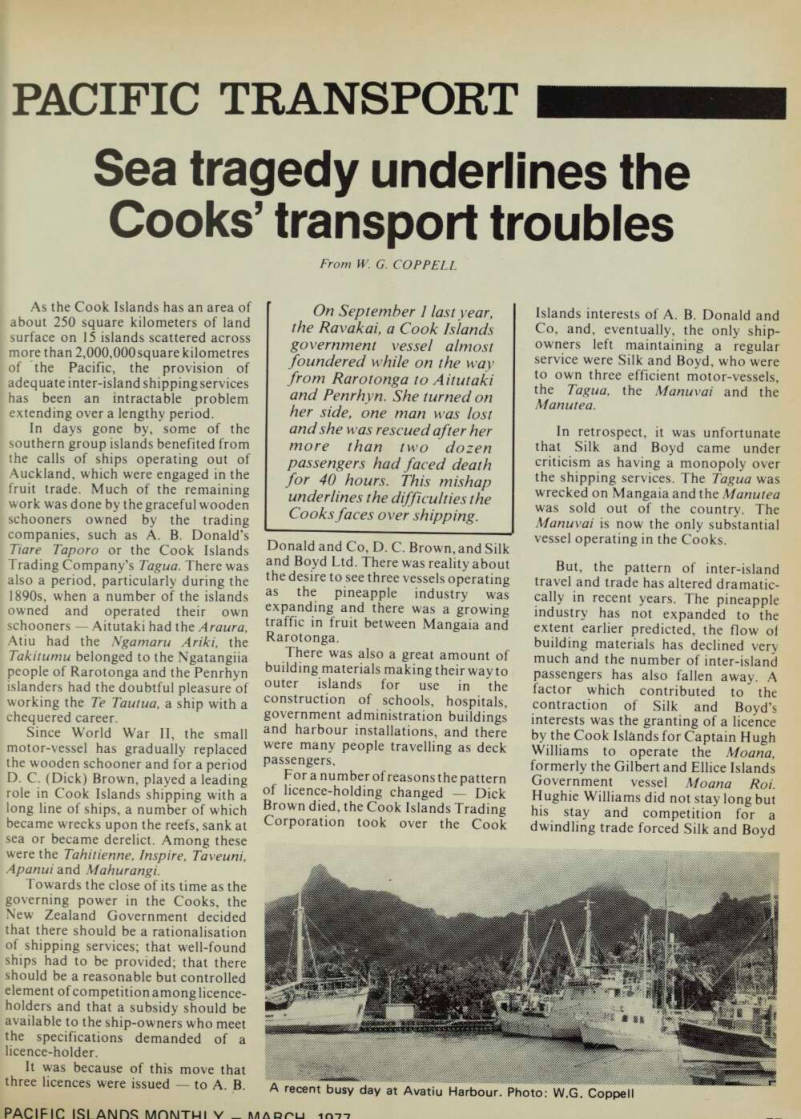

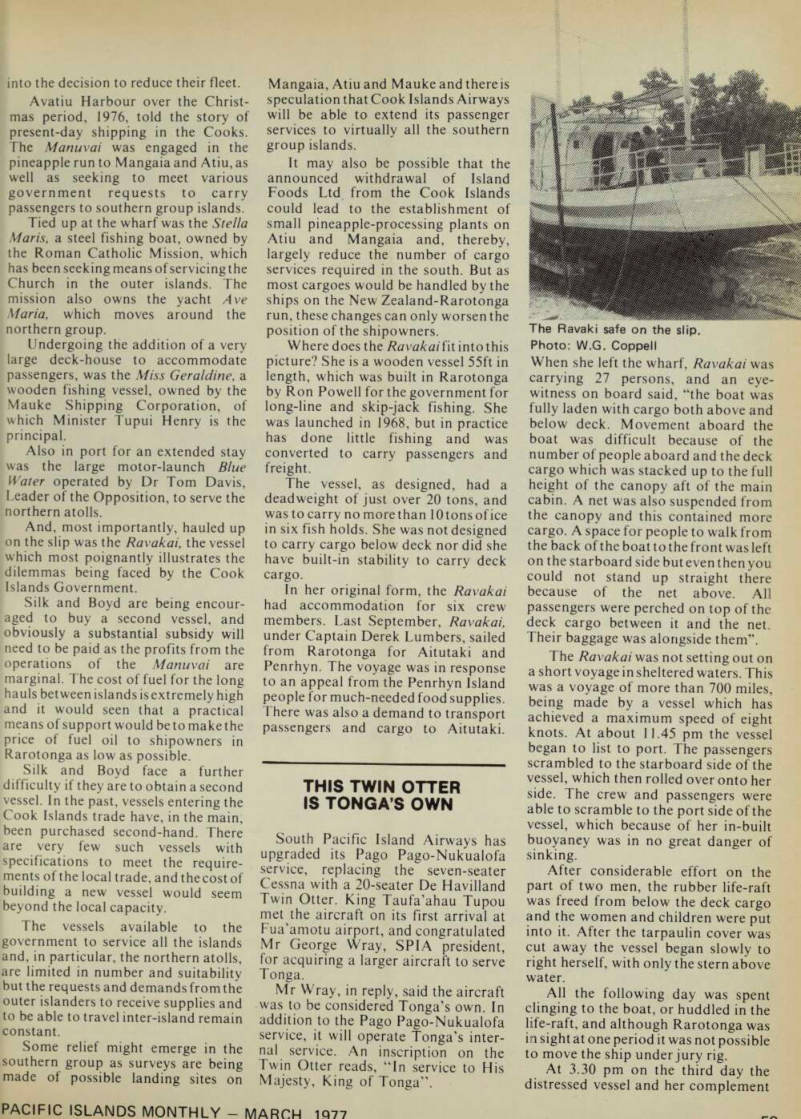
Pacific Transport
Sea tragedy underlines the Cooks’ transport troubles
From W. G. Coppell
As the Cook Islands has an area of about 250 square kilometers of land surface on 15 islands scattered across more than 2,000,000 square kilometres of the Pacific, the provision of adequate inter-island shipping services has been an intractable problem extending over a lengthy period.
In days gone by, some of the southern group islands benefited from the calls of ships operating out of Auckland, which were engaged in the fruit trade. Much of the remaining work was done by the graceful wooden schooners owned by the trading companies, such as A. B. Donald’s Tiare Taporo or the Cook Islands Trading Company’s Tagua. There was also a period, particularly during the 1890 s, when a number of the islands owned and operated their own schooners Aitutaki had the Araura, Atiu had the Ngamaru Ariki, the Takitumu belonged to the Ngatangiia people of Rarotonga and the Penrhyn islanders had the doubtful pleasure of working the Te Tautua, a ship with a chequered career.
Since World War 11, the small motor-vessel has gradually replaced the wooden schooner and for a period D. C. (Dick) Brown, played a leading role in Cook Islands shipping with a long line of ships, a number of which became wrecks upon the reefs, sank at sea or became derelict. Among these were the Tahitienne, Inspire, Taveuni, Apanui and Mahurangi.
Towards the close of its time as the governing power in the Cooks, the New Zealand Government decided that there should be a rationalisation of shipping services; that well-found ships had to be provided; that there should be a reasonable but controlled element of competition among licence holders and that a subsidy should be available to the ship-owners who meet the specifications demanded of a licence-holder.
It was because of this move that three licences were issued to A. B.
On September 1 last year, the Ravakai, a Cook Islands government vessel almost foundered while on the way from Rarotonga to Aitutaki and Penrhyn. She turned on her side, one man was lost and she was rescued after her more than two dozen passengers had faced death for 40 hours . This mishap underlines the difficulties the Cooks faces over shipping.
Donald and Co, D. C. Brown, and Silk and Boyd Ltd. There was reality about the desire to see three vessels operating as the pineapple industry was expanding and there was a growing traffic in fruit between Mangaia and Rarotonga.
There was also a great amount of building materials making their way to outer islands for use in the construction of schools, hospitals, government administration buildings and harbour installations, and there were many people travelling as deck passengers, For a number ofreasonsthe pattern of licence-holding changed Dick Brown died, the Cook Islands Trading Corporation took over the Cook
Islands interests of A. B. Donald and Co, and, eventually, the only ship owners left maintaining a regular service were Silk and Boyd, who were to own three efficient motor-vessels, the Tagua, the Manuvai and the Manutea.
In retrospect, it was unfortunate that Silk and Boyd came under criticism as having a monopoly over the shipping services. The Tagua was wrecked on Mangaia and the Manutea was sold out of the country. The Manuvai is now the only substantial vessel operating in the Cooks.
But, the pattern of inter-island travel and trade has altered dramatic cally in recent years. The pineapple industry has not expanded to the extent earlier predicted, the flow ol building materials has declined very much and the number of inter-island passengers has also fallen away. A factor which contributed to the contraction of Silk and Boyd’s interests was the granting of a licence by the Cook Islands for Captain Hugh Williams to operate the Moana, formerly the Gilbert and Ellice Islands Government vessel Moana Roi.
Hughie Williams did not stay long but his stay and competition for a dwindling trade forced Silk and Boyd
A recent busy day at Avatiu Harbour. Photo; W.G. Coppell
into the decision to reduce their fleet.
Avatiu Harbour over the Christ mas period, 1976, told the story of present-day shipping in the Cooks.
The Manuvai was engaged in the pineapple run to Mangaia and Atiu, as well as seeking to meet various government requests to carry passengers to southern group islands.
Tied up at the wharf was the Stella Maris, a steel fishing boat, owned by the Roman Catholic Mission, which has been seeking means of servicing the Church in the outer islands. The mission also owns the yacht Ave Maria, which moves around the northern group.
Undergoing the addition of a very large deck-house to accommodate passengers, was the Miss Geraldine, a wooden fishing vessel, owned by the
Mauke Shipping Corporation, of
which Minister Tupui Henry is the
principal.
Also in port for an extended stay was the large motor-launch Blue Water operated by Dr Tom Davis, Leader of the Opposition, to serve the northern atolls.
And, most importantly, hauled up on the slip was the Ravakai, the vessel which most poignantly illustrates the dilemmas being faced by the Cook Islands Government.
Silk and Boyd are being encour aged to buy a second vessel, and obviously a substantial subsidy will need to be paid as the profits from the operations of the Manuvai are marginal. The cost of fuel for the long hauls between islands is extremely high and it would seen that a practical means of support would betomakethe price of fuel oil to shipowners in Rarotonga as low as possible.
Silk and Boyd face a further difficulty if they are to obtain a second vessel. In the past, vessels entering the Cook Islands trade have, in the main, been purchased second-hand. There are very few such vessels with specifications to meet the require ments of the local trade, and the cost of building a new vessel would seem beyond the local capacity.
The vessels available to the government to service all the islands and, in particular, the northern atolls, are limited in number and suitability but the requests and demands from the outer islanders to receive supplies and to be able to travel inter-island remain constant.
Some relief might emerge in the southern group as surveys are being made of possible landing sites on
Mangaia, Atiuand Mauke and there is speculation that Cook Islands Airways will be able to extend its passenger services to virtually all the southern group islands.
It may also be possible that the announced withdrawal of Island Foods Ltd from the Cook Islands could lead to the establishment of small pineapple-processing plants on Atiu and Mangaia and, thereby, largely reduce the number of cargo services required in the south. But as most cargoes would be handled by the ships on the New Zealand-Rarotonga run, these changes can only worsen the position of the shipowners.
Where does the Ravakai fit into this picture? She is a wooden vessel 55ft in length, which was built in Rarotonga by Ron Powell for the government for
long-line and skip-jack fishing. She
was launched in 1968, but in practice has done little fishing and was converted to carry passengers and
freight.
The vessel, as designed, had a deadweight of just over 20 tons, and was to carry no more than lOtonsofice in six fish holds. She was not designed to carry cargo below deck nor did she have built-in stability to carry deck cargo.
In her original form, the Ravakai had accommodation for six crew members. Last September, Ravakai, under Captain Derek Lumbers, sailed from Rarotonga for Aitutaki and Penrhyn. The voyage was in response to an appeal from the Penrhyn Island people for much-needed food supplies.
There was also a demand to transport passengers and cargo to Aitutaki.
Advertisements & other items, pp. 57-58 (3 items)
Pacific Islands Month I V _ Madpu M-7-7
PACIFIC ISLANDS MONTH I V madpu m-7-7
„ « ,r- ■ in a m r\f-' MAMTUI \/ MADPU IQT
depends alot on the way it goes.
* % ' : * Jm f. £ ■ How it taslra when it gets there depends alot on the way it goes.
Australian produce. Fresh from the farm.
Meat, vegetables, fruit, seafood. Qantas can get it to Pacific and Southeast Asian markets in less than a day. And get it there in the prime top condition you expect. Unitised, palletised, air cargo Qantas offers you more capacity out of Australia to the world than any other carrier.
And because we’re Australian we can offer advice about where to order, who to order from, how much to pay. Ring Qantas or your Freight Forwarder. We’re always looking for fresh problems to solve.
O.HNTFIS /—J
can ca I—l
L 81.2846
This Twin Otter
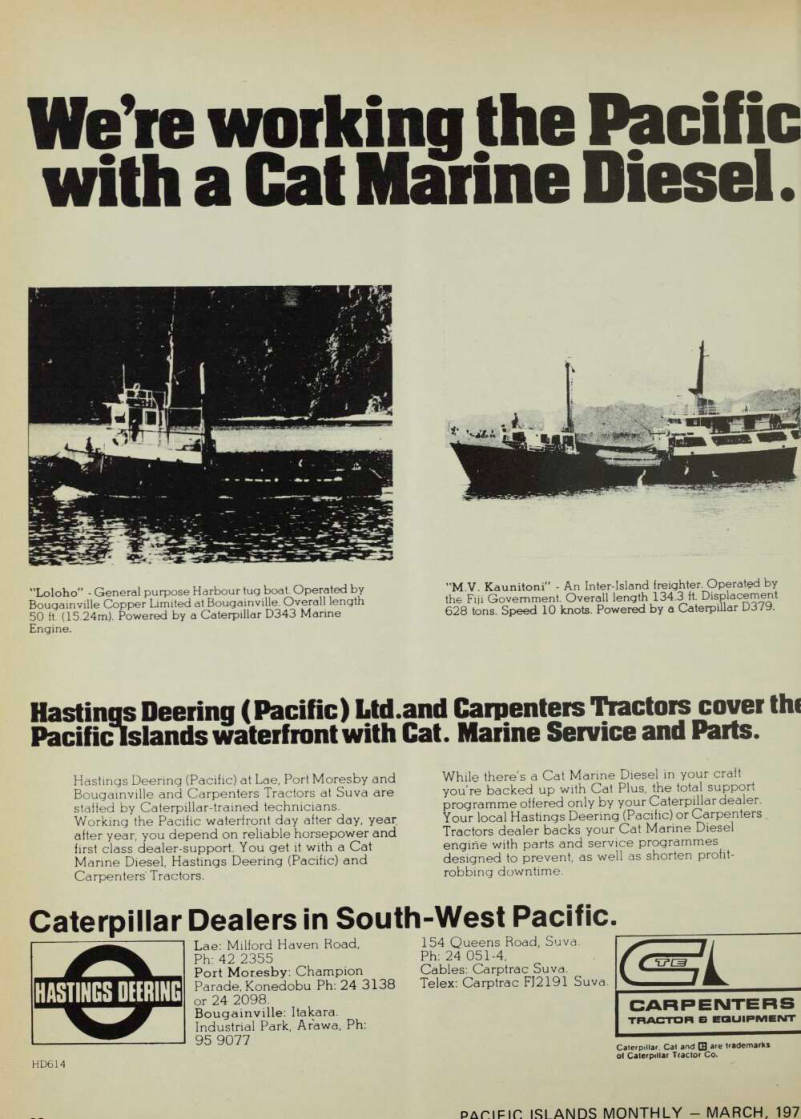
Is Tonga’S Own
South Pacific Island Airways has upgraded its Pago Pago-Nukualofa service, replacing the seven-seater Cessna with a 20-seater De Havilland Twin Otter. King Taufa’ahau Tupou met the aircraft on its first arrival at Fua’amotu airport, and congratulated Mr George Wray, SPIA president, for acquiring a larger aircraft to serve Tonga.
Mr Wray, in reply, said the aircraft was to be considered Tonga’s own. In addition to the Pago Pago-Nukualofa service, it will operate Tonga’s inter nal service. An inscription on the Twin Otter reads, “In service to His Majesty, King of Tonga”.
When she left the wharf, Ravakai was carrying 27 persons, and an eye witness on board said, “the boat was fully laden with cargo both above and below deck. Movement aboard the boat was difficult because of the number of people aboard and the deck cargo which was stacked up to the full height of the canopy aft of the main cabin. A net was also suspended from the canopy and this contained more cargo. A space for people to walk from the back of the boat to the front was left on the starboard side buteventhenyou could not stand up straight there because of the net above. All passengers were perched on top of the deck cargo between it and the net.
Their baggage was alongside them”.
The Ravakai was not setting out on a short voyage in sheltered waters. This was a voyage of more than 700 miles, being made by a vessel which has achieved a maximum speed of eight knots. At about 11.45 pm the vessel began to list to port. The passengers scrambled to the starboard side of the vessel, which then rolled over onto her side. The crew and passengers were able to scramble to the port side of the vessel, which because of her in-built buoyancy was in no great danger of
sinking.
After considerable effort on the part of two men, the rubber life-raft was freed from below the deck cargo and the women and children were put into it. After the tarpaulin cover was cut away the vessel began slowly to right herself, with only the stern above water.
All the following day was spent clinging to the boat, or huddled in the life-raft, and although Rarotonga was in sight at one period it was not possible to move the ship under jury rig.
At 3.30 pm on the third day the distressed vessel and her complement
The Ravaki safe on the slip.
Photo: W.G. Coppell
were sighted by the Islander aircraft of Cook Islands Airways.
Flares, torches and a large rubber raft were dropped o the survivors and at 9 pm the Stella Maris was able to complete the rescue mission. One of the passengers, loane Dean, was lost in the mishap. It was most fortunate that the death-toll was not larger.
The Ravakai was towed back to Rarotonga and the government reimbursed the passengers for the losses they suffered in the disaster.
However, several questions must be raised. While it must be conceded that the government seems to be in a well nigh impossible position with regard to the provision of shipping to the more isolated islands, it must also be argued that the government itself must be the most vigilant of all those concerned with shipping, to ensure that the regulations and ordinances in force in the Cook Islands primarily concerned with the minimum standards of safety on local shipping are strictly enforced.
All vessels wishing to carry cargo and/or passengers within the Cook Islands arc required to be licensed, but the government, apparently, is exempt from these requirements.
The Premier of the Cook Islands, Sir Albert Henry, was obviously most distressed at the mishap and September 6 he said, “I wish to assure the public that a formal independent public enquiry will be held into this matter at which time all persons, who feel they have a contribution to make towards the ascertainment of all the relevant facts, will have an opportunity to provide their evidence. For government’s part the Ravakai casualty has worsened an already most difficult problem that of internal shipping. Let me assure the outer islands that I will be taking immediate steps today to get something done about their needs”.
On Rarotonga, the Ravakai incident remains a matter for much discussion and it seems unfortunate that, as late as the end of the year, the findings of the enquiry had not been made public, nor does it seem that there has been an inquest into the loss of loane Dean’s life.
The pressures upon the Cook Islands as a result of its difficulties about inter-island shipping are familiar ones in the Pacific countries, and it is to this area that the developed countries could well direct their attention when they are offering assistance to Island countries.
Air Niugini has
a drink problem
Air Niugini, PNG’s national airline, may stop serving alcohol to passengers on domestic flights.
There have been too many complaints from passengers about drunks causing trouble on flights, a management spokesman said in February.
The airline’s cabin crews had been instructed to refuse to serve passengers who appeared to have drunk too much, but the refusal itself often precipitated problems. On several occasions aircraft captains had intervened to stop trouble developing among passengers.
As a result, the airline was seriously considering a ban on alcoholic drinks.
The bar service on international flights would not be affected.
Air Niugini’s new Boeing 707 air craft flew its inaugural service from Port Moresby to Kagoshima, Japan, in January.
The aircraft, bought from Qantas for about K 5 million, seats up to 148 passengers in first and economy classes.
There were 55 VIP passengers from Papua New Guinea on the in augural flight. They included the Deputy Prime Minister and Minister for Defence, Foreign Affairs and Trade, Sir Maori Kiki, and Lady Kiki; the Minister for Transport, Works and Supply, Mr Bruce Jephcott; Leader of the Opposition, Sir Tei Abal; Chairman of the Public Services Commission, Mr Rabbie Namaliu; and three MPs, Messrs Harry Humphreys (Talasea), Suinavi Otio (Lufa), and Kui Baiyand (Mid dle Ramu).
The plane stayed overnight at Kagoshima and returned to Port Moresby the next day.
Nauru’S Conditions
For Forum Line
The Nauru Government will guarantee 20% of losses the South Pacific Forum shipping line expects to incur in its first year of operations.
Nauru will also provide two ships.
The Western Samoa Minister of Economic Affairs and acting Minister of Communications and Transport, Mr Asi Eikeni, made those statements after a recent visit to Nauru.
Mr Eikeni and the acting Attorney- General, Mr Neroni Slade, went to Nauru to discuss the shipping line
with the new Nauru Government. Mr Eikeni said the government had agreed to honour an agreement the previous government made to guarantee the line’s establishment costs and the provision of ships.
But Nauru would not sign the draft constitution for the shipping line, even with provision for a review in 12 months, unless there was agreement to amendments it proposed. Nauru wants all member countries of the forum to be shareholders in the ship ping line. It has proposed a share of $lO,OOO each.
Originally the plan was that all members of the Forum would give 510,000 to set up the line. Members providing ships would share profits and pay any costs, while the other members would be assured of better and more regular services.
Mr Eikeni said the Nauruan proposal did not present any problems for the Western Samoa Government.
It could very well turn out the best plan for the line. The only fear was that prolonged discussion of the Nauruan proposal would delay setting up the line within the next few weeks.
He said plans were unchanged for the United States to provide a ship for Samoa. New Zealand has also pledg ;d to supply a ship.
Over-Flying Planes
Are Worrying Fiji
With Qantas and Pan American World Airways over-flying Nadi Air sort on several of their flights between Australia and the US, the Fiji Sovernment is becoming worried.
Fewer landings mean heavy financial oss.
The Fiji Minister for Com nunications, Works and Tourism, Vlr Jonati Mavoa, expressed his fears )f losses at a recent meeting of the South Pacific Air Transport Council n Suva. Delegations from Britain, \ustralia, New Zealand and Fiji attended.
Mr Mavoa said over-flights would se a serious blow to airport revenues, md increasing landing charges was lot a solution as it would increase the lumber of over-flights. Alternative methods were needed to raise an atherwise constantly decreasing ■evenue. One method would be charge airlines, which did not actually land, 'ees for use of Nadi weather informa ;ion.
The question of airlines over-flying Nadi has been raised often in the past.
Now, with fewer airlines using Nadi and bigger aircraft making fewer
calls, Mr Mavoa’s warning is timely.
Mr Mavoa said the South Pacific region depended on Nadi airport as an important centre of international transport.
Six New Ships For
Micronesian Fleet
The US Trust Territory plans to add six new ships to its fleet. It recent ly sent a “letter of intent” to the Namura Shipbuilding Co Ltd, Osaka, Japan, for the construction of six new field trip vessels.
Mr William P. Flanagan, director of Transportation and Communica tion, and officials of his department, inspected the capabilities of five shipyards in Japan before deciding that Namura was the most suitable to build the ships.
The ships will be 56.38 metres long, with a beam of 10.05 metres. Each will carry 12 cabin passengers and up to 100 deck passengers. Mr Flanagan expects the new ships to be operating by the end of 1978.
French Shipping
Lines Merge
Two of the top French government owned shipping lines were to merge on March 1. The two lines, Com pagnie Generale Maritime (CGM).
Compagnie des Messageries Maritimes, now become the Com pagnie Generale Maritime (CGM).
With a fleet of 102 vessels, the CGM is the biggest French shipping line.
Previously, the two partners operated across the Atlantic and through Far East and Pacific ports. Together, they now operate throughout the world.
Emblem of the new CGM is a ship’s bow breaking through the waves, in red, white and blue. Among the com pany’s new vessels in Pacific ports are the Rostand and Rousseau.
Fiji Dockers
In The Money
The Fiji Waterside Workers and Seamen’s Union seems to be on the way to becoming a wealthy “capitalist” organisation. About two years ago it took up 26% interest in the newly-formed shipping company, Pacific Line Ltd, with Carpenters, also 26% and Sofrana 48%.
After initial early losses the line went into the black, and in the latest financial term has decided to pay a $30,000 interim dividend to the three shareholders. The dividend is at the rate of $ 1.50 for every dollar invested.
Mr Taniela Veitata, unofficial king of the Fiji waterfront and industrial adviser to the union, commented: “We are proud of what the company has achieved and look forward to be ing able to make further contributions to its trading results”.
Pacific Line runs a chartered ship, the Tui Cakau, 2,460 tonnes, on a cargo service between New Zealand and Fiji. It dropped a call at Apia some months ago.
Mr Harry Kiss, of Carpenters, who is managing director of Pacific Line, said the line was looking at major new cargo sources, including the shipment of sugar to New Zealand and other markets. Since its beginning, the line had brought about $550,000 in foreign earnings into Fiji, and had paid about $228,000 in local wages and taxes.
After Snags, Png
Gets New Trawlers
Papua New Guinea’s four new government-owned trawlers were due to go into operation in December after a four-month delay because of construction faults.
The 20-metre vessels cost the government K 186,000 each.
A spokesman for the Department of Transport, Mr John Reily, said the faults had been rectified at the ex pense of the manufacturers, Pan-Asia Shipbuilders of Singapore, after long negotiations.
Air Niugini stewardesses in Kagoshima after the inaugural flight to Japan. Note the new-style uniforms. Top to bottom the stewardesses are: P. Papilla, W. Teilflo, L. Caparas, H. Mesulam, W. Gutierrey.
Photo; Veronica Williams.
Advertisements & other items, pp. 60-63 (3 items)
Pacific: Islands Monthly - March, 197
60
We're working the Pacific
with a Cat Marine Diesel.
"Loloho" - General purpose Harbour tug boat. Operated by Bougainville Copper Limited at Bougainville. Overall length 50 ft. (15.24 m). Powered by a Caterpillar D 343 Marine Engine. ”M.V. Kaunitoni” - An Inter-Island freighter. Operated by the Fiji Government. Overall length 134.3 ft. Displacement 628 tons. Speed 10 knots. Powered by a Caterpillar D 379.
Hastings Deerlng (Pacific) Ltd.and Carpenters Tractors cover th( Pacific islands waterfront with Cat. Marine Service and Parts.
Hastings Deering (Pacific) at Lae, Port Moresby and Bougainville and Carpenters Tractors at Suva are staffed by Caterpillar-trained technicians.
Working the Pacific waterfront day after day, year, after year, you depend on reliable horsepower and first class dealer-support. You get it with a Cat Marine Diesel, Hastings Deering (Pacific) and Carpenters Tractors.
While there's a Cat Marine Diesel in your craft you're backed up with Cat Plus, the total support programme offered only by your Caterpillar dealer.
Your local Hastings Deering (Pacific) or Carpenters Tractors dealer backs your Cat Marine Diesel engine with parts and service programmes designed to prevent, as well as shorten profitrobbing downtime.
Caterpillar Dealers in South-West Pacific
Lae- Milford Haven Road, 154 Queens Road, Suva.
Ph: 42 2355 Ph: 24 051-4, Port Moresby: Champion Cables; Carptrac Suva.
Parade, Konedobu Ph; 24 3138 Telex: Carptrac FJ2191 Suva, or 24 2098.
Bougainville: Itakara.
Industrial Park, Arawa, Ph: 95 9077
HASTINGS DEERING
HD6I4
(SL
CARPENTERS
TRACTOR S EQUIPMENT
Caterpillar. Cal and Q 3 are trademarks ol Caterpillar Tractor Co.
Round gourmet
“Skillet”
r
THE HANDIEST NEW APPLIANCE
SINCE FRYPANS
Bacon and eggs for two? Simple for the Sunbeam "Skillet". Yet "Skillet" is big enough to roast a size 8 chicken to perfection. And to wash simply remove the control and dunk the pan in the sink.
Another first and it comes only from Sunbeam.
8 Speed
Power
Blender
THE APPLIANCE YOU CAN USE
EVERY MEAL
With powerful. Solid-state motor. Which means the exact blending action you need to— Whip, grate, mix, chop or liquefy. Stainless steel cutters give fast food preparation while switching from speed to speed without turning off . . .
Money-saver
The McDonnell Douglas DC-9 has the best on-time performance record, the highest utilization rate, and the lowest maintenance cost of any twinjet transport.
The DC-9 Series 50, with a range of 1200 nautical miles, can carry up to 139 passengers in comfortable five-abreast seating. And because of its rapid tumaroum the Series 50 thrives on the tough of intermediate and short-range roi It's the most economical twinjet flying
65
’ACIFIC ISLANDS MONTHLY - MARCH, 1977
Cruising
Yachts
• FEISTY LADY, 27 ft sloop from Los Angeles, arrived at Rarotonga from Bora Bora on December 10 with Conrad and San dra Ramalho. They were still in Rarotonga in late January and are bound for Tonga, • TEQUILA I, 40 ft Auckland sloop, arrived at Rarotonga on January 16 from Papeete and Bora Bora with D’arcy George Whiting, his wife, Mollie, daughter Debra
aged 1 6, and Ann Clucas. They are bound for Auckland. • BOLD SPIRIT, 43 ft Canadian trimaran, arrived at Rarotonga from Papeete on January 18. On board were Keith and Jeanne Sandilands and their children, Kathryn 16, Gwen 14, and Eric 12. They planned to visit Aitutaki, Niue, Tonga and New Zealand. • MIGRANT, 42 ft steel schooner, arrived at Majuro on New Year's Eve with owner-skipper Dick Johnson, his wife, Anita, children Kari (18) and Rick (19), and young friend Luis Mateos aboard. The Migrant was designed and built by Thomas Colvin in Virginia and was launched in 1970. She is junk-rigged, with bright red sails, a white deck and a dark-blue hull and is registered in the US Virgin Islands. The Johnsons are on a
one-year cruise, which started in Seattle, Washington in August. They are on their way to Japan through the island chains of the Trust Territory of the Pacific Islands. • VAIMALUA, Rabaul-registered 39 fi ferro-cement cutter of 13 tons, arrived ai Majuro just before Christmas with owners Dave and Dianne Brown. They will return tc Rabaul after visiting other Marshalls atolls Kosrae (Kusaie) and Ponape. The Browns are Australians but have lived in Papua Nev\ Guinea so long, they consider it a seconc home. Vanalua was built over a 15-montf period in Rabaul and launched in February 1973. The name was given by the loca workers in Rabaul and means "the first one' or "to go ahead", an appropriate descriptor as she was the first ferro-cement boat built ir Papua New Guinea • KETCHUP, a Northstar 80/20 39 ft 1 ins ketch from Toronto, arrived in Tahiti or Christmas Day from the British Virgin Island: where she was purchased in October by Ror Tillotson, 43. Ron and his son Ken, 18, anc Veronica Horner, 24, sailed from the Carib bean through the Panama Canal to the Mar quesas, before sailing into Papeete. His plan: were to leave his boat in Tahiti while he flies home for a few months, then return to con tinue his sail to Samoa and New Zealand. • MISTY, 65 ft ferro-cement ketch own ed by Bob Wieand, 40, of New Jersey, arriv ed in Tahiti on November 18, fron Rarotonga, carrying Bob and crew Izurr Itagaki of Tokyo, Bob built Misty nine year ago in Yokohama and has since sailed t( many islands from Japan to the Philippines Indonesia, South-east Asia, the Americai Trust territories to New Guinea, thi Solomons, New Hebrides, Fiji, Tonga and thi Cooks. In February, 1975 Bob and a charts group were capsized twice during a typhooi between Japan and the Bonin Islands, Then were no injuries suffered even though Mist made 360 degree rolls twice. His plans in elude sailing to Yugoslavia and then returnin' to the Orient. • SAMANTHA ANN, 34 ft Chinoo design sloop from Hawaii is spending th hurricane season in Tahiti. Owner-skippe William Niles, 28, along with Irene Pottin c Canada and Albert Ferguson of Californic sailed from Maui in July to the Tuamotus an Tahiti, arriving in Papeete in October, Bill' plans were to return to Hawaii by way of th Tuamotus and Hawaii. • TYREE, 37 ft trimaran from Honolul arrived in Tahiti on December 24, for her se cond visit. Owner-skipper Charles Burnett c Hawaii and John Fraser of California lei Hawaii three years ago and sailed to th Galapagos and South America, then visitei the Marquesas, Tahiti, Samoa, Guam, Hon< Kong to the China Sea. They also visitei Malaysia and Thailand, Indonesia, Bornec the Philippines and Marshall Islands. The
plans were to remain in Tahiti two months, then return to Hawaii through the Mar quesas. • CASTAWAYS, 70ft 2-masted square-rigged schooner from Los Angeles arrived in Tahiti on December 12, after spen ding five months in the Marquesas. Built and owned by Gene and Kathy Taatjes, CASTAWAYS was launched in 1974 and began her voyage from Los Angeles in January, 1975 Sailing with Gene and Kathy is Gene's nephew, Jeff Taatjes. Gene, an electronics engineer, plans to sail downwind after the season is open. • DECISION, CAL 48ft sloop from Marblehead, Massachusetts, sailed into Tahiti in November for a long visit before continuing her voyage around the world through New Zealand and Australia. Owner skipper Robert Oldham bought his boat in February, 1975 and began his journey from Massachusetts down the east coast of the US through the inland waterway to North Carolina, then by sea to the Virgin Islands and all the Caribbean, on through the Panama Canal to the Marquesas and Tahiti.
Sailing with Robert are Carolyn Osburn, their son Jason (4), her brother Rodger Osburn and Donald Mears, all of California • DEYDREAM 11, Spencer 32 ft sloop from Vancouver, left home August 23 and sailed to the Hawaiian islands, then to the Marquesas and Tahiti, finally arriving in
Papeete on December 23. On board were the Dey family of Bud, Irene, daughter Kelli, 18 and son Calvin, 24, Their plans include sailing to the Cooks, Samoa, Tonga, Fiji and Marshalls, before going home • CITANA DEL MAR, 40 ft William Garden design sloop from San Diego is in Tahiti with owners Bob and Lois Fellman and crew Danny Cunningham. Their cruise began in 1975 from San Diego and has since
carried them to Hawaii, the Marquesas and Tuamotus. On the first leg of their voyage to Hawaii they broke the spreader arm in a storm and jury-rigged the last 800 miles, still making Hawaii in 19 days. While they are waiting for the hurricane season to finish, Bob and Lois are cruising the rarely-visited islands of Rapa and Mangareva. Later they will sail to the Cooks, Fiji, Tonga and American Samoa • MARTINETTE, 15 metre ferro-cement ketch, which left Vilaon October 19 (RIM, Jan, p 67) with Tony Hodges, wife Joan and daughter Gabriel, crew Kevin Dodds, John Doby and John’s fiancee, to return to England, stranded on the reef at Sue island in the Torres Strait. They had stopped for a swim. At the time of writing, Martinette was still on the reef but the Hodges and crew had managed to salvage their belongings. • KATHENA FAA, 33 ft fibreglass sloop, registered in Germany, arrived at Majuro from Tarawa on December 7, with owners Wilfried and Astrid Erdmann and their four year old son, Kym, aboard. The Kathena Faa was built in England in 1972 and acquired by the Erdmanns in New Zealand. The family is seven months into a cruise planned to last three years. After leaving Majuro,they will sail toother Marshalls atolls, including Bikiniand Likiep. Before sailing south to the Solomons, the Erdmanns will make at least one more stop in Micronesia, at Ponape. When not cruising, the Erdmannsdocharterwork inthe South of France and Wilfried composes articles and books on their travels, the most notable one being an illustrated chronicle of their round-the-world cruisefrom 1969-1972.
Advertisements & other items, p. 64 (1 item)
Pty Ltd
EXPORTERS TO THE PACIFIC ISLANDS
Breekwoldt & Co
4
UHVi'T
276 Pitt Street, Box 5027, G.P.O. Sydney 2001
CABLE ADDRESS: BREWO SYDNEY
TELEPHONES: 61-7110 26-6893
TELEX AA22890.
Pacific Island Branches:
BRECKWOLDT & CO (PNG) PTV LTD
PO BOX 1549, BOROKO, PORT MORESBY
PO BOX 222, RABAUL
PO BOX 72, KIETA
PO BOX 178, WEWAK
PO BOX 185, MADANG
PO BOX 237, MT HAGAN
PO BOX 1188, LAE
BRECKWOLDT & CO., PO BOX 47, APIA BRECKWOLDT & CO. (SI) LTD. PO BOX 140, HONIARA
BRECKWOLDT SARL BP 2369, NOUMEA
Offices in : Hamburg, London, Milan and West Africa as well as Singapore, Kuala Lumpur, Bangkok and Hong Kong.
Enquiries from Australian
Manufacturers invited.
Two Races To Fiji
There will be a lot of sail in the ocean between Auckland and Fiji in April, 1977, with upwards of 100 yachts taking part in two races one from Auckland to Suva and the other from Auckland to Lautoka.
The Auckland-Lautoka race has been in troduced to relieve pressure on the Royal Suva Yacht Club. The Lautoka Yacht Club, the Northern Club (Lautoka) and the Nadi Boat Club will host the Auckland-Lautoka race, which will include divisions for mini raters and lOR yachts. About 50 entries are expected for the new race. The Auckland-Suva race is for IOR-rated yachts. Although entries for this race do not close till January 31, 1977, more than 140 applications are already in for the 60 positions.
Advertisements & other items, p. 65 (1 item)
Compagnie Generale Maritime
AUSTRALIA - EUROPE SERVICE.
Fully containerised (Member of AECS) Agents: SEABRIDGE, 60 Pitt Street, SYDNEY.
PACIFIC ISLANDS - EUROPE SERVICE.
Roßo and Multipurpose Service Twice monthly to/from Papeete Noumea New Hebrides.
Multipurpose Service Monthly to/from Papua/New Guinea.
SOUTH PACIFIC UNITED LINES
AUSTRALIA - PACIFIC ISLANDS - U.S. WEST COAST.
Monthly fully containerised Service.
Agents: OMNITRADERS & BROKERS,
[Messageries Maritimes] Phone: 20518.
PO Box R 206. 261 George Street, Phone: 241 2872.
GPO Box 3896.
Colourful Veterans
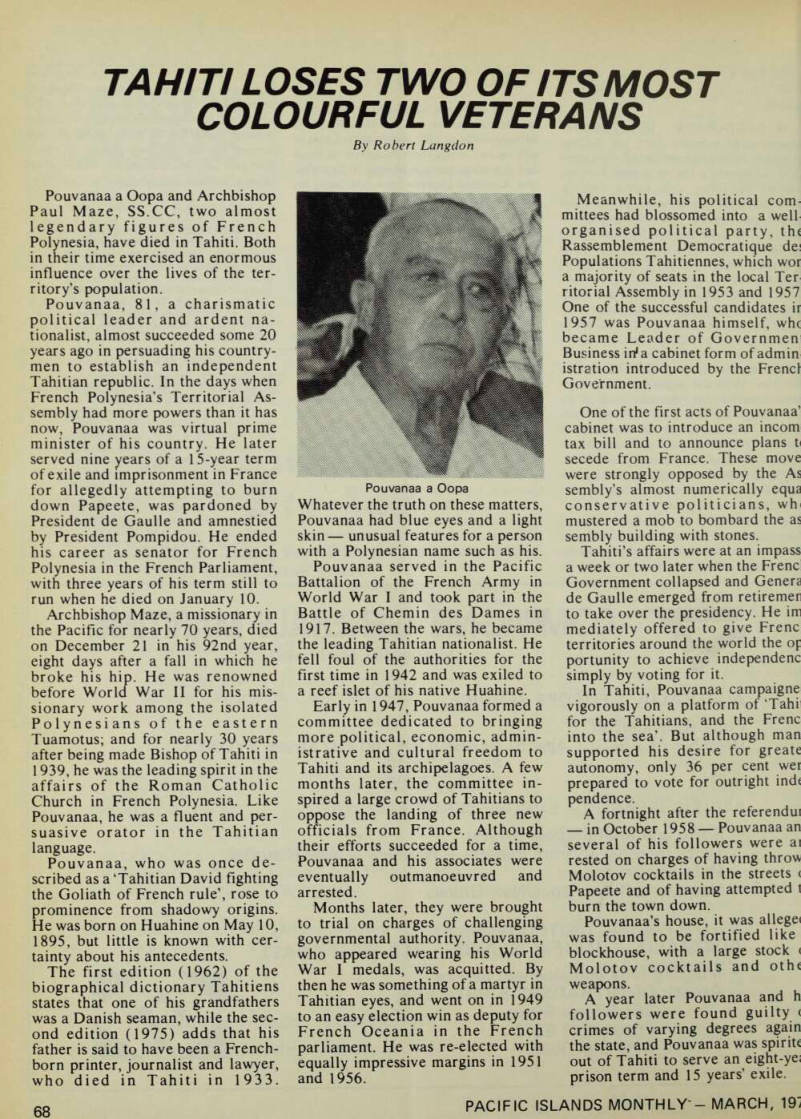
Tahiti Loses Two Of Its Most
By Robert Langdon
Pouvanaa a Oopa and Archbishop Paul Maze, SS.CC, two almost legendary figures of French Polynesia, have died in Tahiti. Both in their time exercised an enormous influence over the lives of the ter ritory’s population.
Pouvanaa, 81, a charismatic political leader and ardent na tionalist, almost succeeded some 20 years ago in persuading his country men to establish an independent Tahitian republic. In the days when French Polynesia’s Territorial As sembly had more powers than it has now, Pouvanaa was virtual prime minister of his country. He later served nine years of a 15-year term of exile and imprisonment in France for allegedly attempting to burn down Papeete, was pardoned by President de Gaulle and amnestied by President Pompidou. He ended his career as senator for French Polynesia in the French Parliament, with three years of his term still to run when he died on January 10.
Archbishop Maze, a missionary in the Pacific for nearly 70 years, died on December 21 in his 92nd year, eight days after a fall in which he broke his hip. He was renowned before World War II for his mis sionary work among the isolated Polynesians of the eastern Tuamotus; and for nearly 30 years after being made Bishop of Tahiti in 1939, he was the leading spirit in the affairs of the Roman Catholic Church in French Polynesia. Like Pouvanaa, he was a fluent and per suasive orator in the Tahitian language.
Pouvanaa, who was once de scribed as a ‘Tahitian David fighting the Goliath of French rule’, rose to prominence from shadowy origins.
He was born on Huahine on May 10, 1895, but little is known with cer tainty about his antecedents.
The first edition (1962) of the biographical dictionary Tahitiens states that one of his grandfathers was a Danish seaman, while the sec ond edition (1975) adds that his father is said to have been a French born printer, journalist and lawyer, who died in Tahiti in 1 933.
Whatever the truth on these matters, Pouvanaa had blue eyes and a light skin— unusual features for a person with a Polynesian name such as his.
Pouvanaa served in the Pacific Battalion of the French Army in World War I and took part in the Battle of Chemin des Dames in 1917. Between the wars, he became the leading Tahitian nationalist. He fell foul of the authorities for the first time in 1942 and was exiled to a reef islet of his native Huahine.
Early in 1947, Pouvanaa formed a committee dedicated to bringing more political, economic, admin istrative and cultural freedom to Tahiti and its archipelagoes. A few months later, the committee in spired a large crowd of Tahitians to oppose the landing of three new officials from France. Although their efforts succeeded for a time, Pouvanaa and his associates were eventually outmanoeuvred and arrested.
Months later, they were brought to trial on charges of challenging governmental authority. Pouvanaa, who appeared wearing his World War I medals, was acquitted. By then he was something of a martyr in Tahitian eyes, and went on in 1949 to an easy election win as deputy for French Oceania in the French parliament. He was re-elected with equally impressive margins in 1951 and 1956.
Meanwhile, his political com mittees had blossomed into a well organised political party, the Rassemblement Democratique de; Populations Tahitiennes, which wor a majority of seats in the local Ter ritorial Assembly in 1953 and 1957 One of the successful candidates ir 1957 was Pouvanaa himself, whe became Leader of Governmen Business in'a cabinet form of admin istration introduced by the Trend Government.
One of the first acts of Pouvanaa’ cabinet was to introduce an incom tax bill and to announce plans t< secede from France. These move were strongly opposed by the As sembly’s almost numerically equa conservative politicians, whi mustered a mob to bombard the as sembly building with stones.
Tahiti’s affairs were at an impass a week or two later when the Frenc Government collapsed and Genera de Gaulle emerged from retiremen to take over the presidency. He im mediately offered to give Frenc territories around the world the op portunity to achieve independenc simply by voting for it.
In Tahiti, Pouvanaa campaigne vigorously on a platform of ‘Tahf for the Tahitians, and the Frenc into the sea’. But although man supported his desire for greate autonomy, only 36 per cent wer prepared to vote for outright ind< pendence.
A fortnight after the referendui in October 1958 Pouvanaa an several of his followers were ai rested on charges of having throw Molotov cocktails in the streets ( Papeete and of having attempted t burn the town down.
Pouvanaa’s house, it was allege* was found to be fortified like blockhouse, with a large stock < Molotov cocktails and othc weapons.
A year later Pouvanaa and h followers were found guilty ( crimes of varying degrees again the state, and Pouvanaa was spirite out of Tahiti to serve an eight-yei prison term and 15 years’ exile.
Pouvanaa a Oopa
Deaths
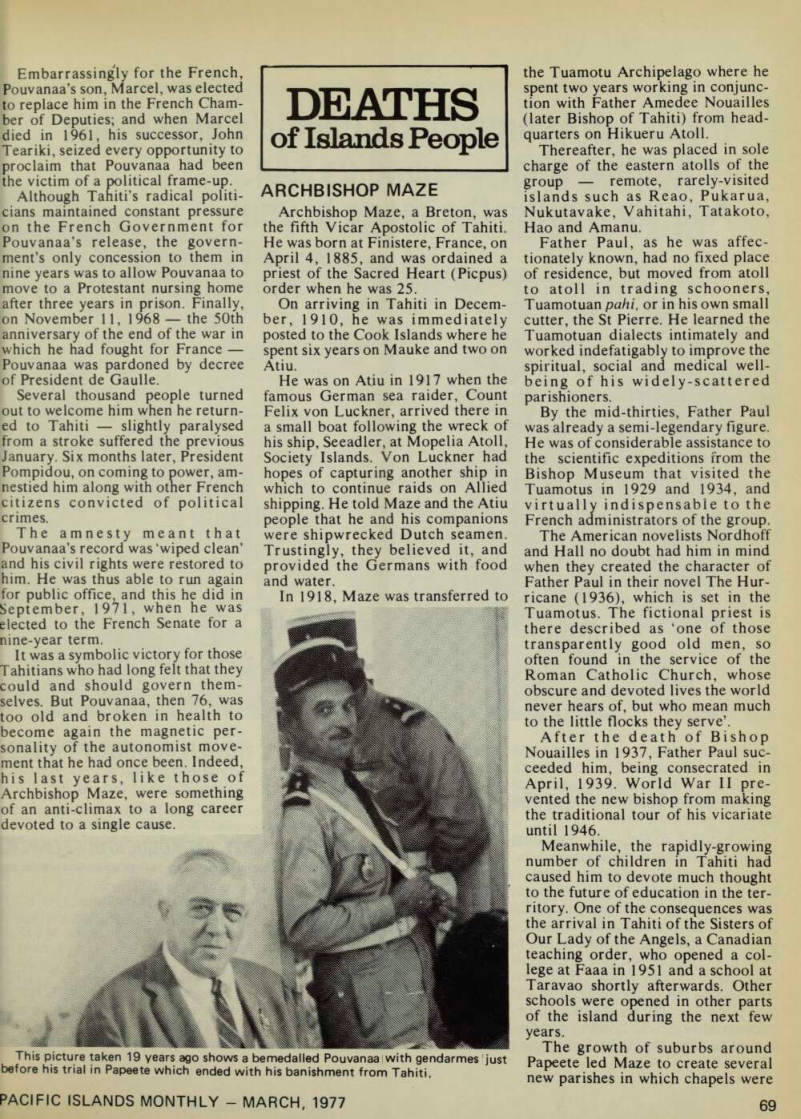
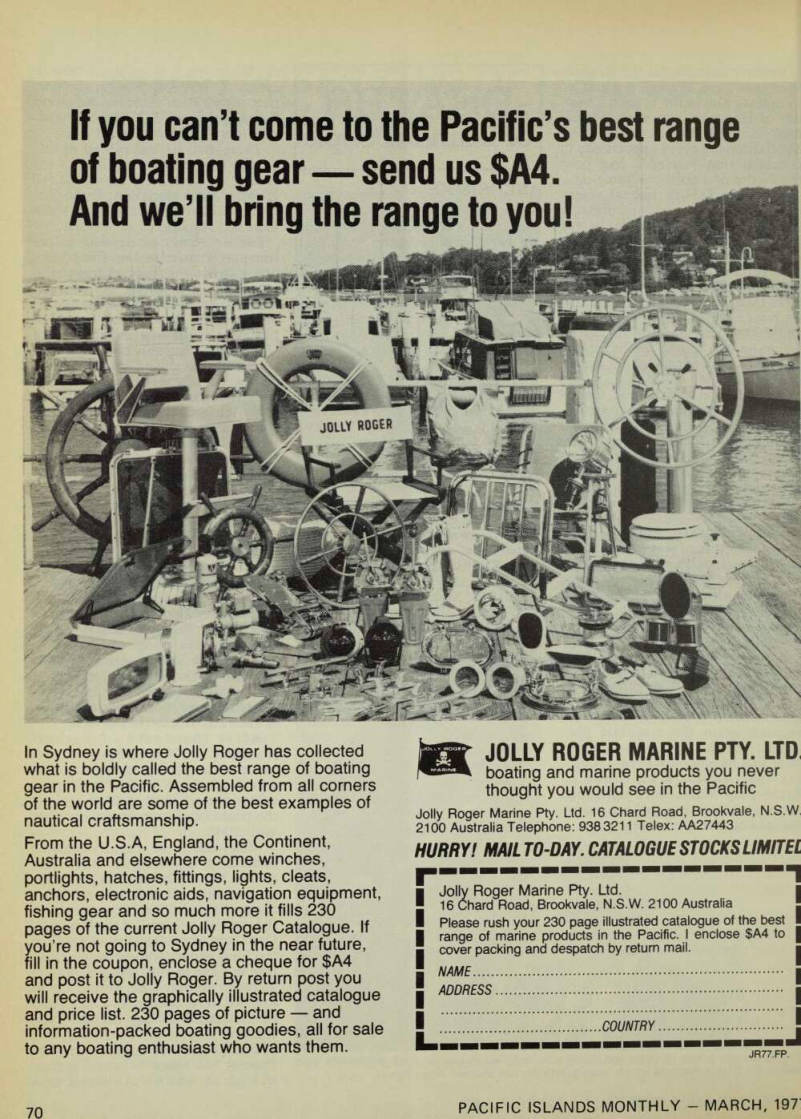

of Islands People
Embarrassingly for the French, Pouvanaa’s son, Marcel, was elected to replace him in the French Cham ber of Deputies; and when Marcel died in 1961, his successor, John Teariki, seized every opportunity to proclaim that Pouvanaa had been the victim of a political frame-up.
Although Tahiti’s radical politi cians maintained constant pressure on the French Government for Pouvanaa’s release, the govern ment’s only concession to them in nine years was to allow Pouvanaa to move to a Protestant nursing home after three years in prison. Finally, on November 11, 1968 the 50th anniversary of the end of the war in which he had fought for France Pouvanaa was pardoned by decree of President de Gaulle.
Several thousand people turned out to welcome him when he return ed to Tahiti slightly paralysed from a stroke suffered the previous January. Six months later, President Pompidou, on coming to power, am nestied him along with other French citizens convicted of political crimes.
The amnesty meant that Pouvanaa’s record was ‘wiped clean’ and his civil rights were restored to him. He was thus able to run again for public office, and this he did in September, 1971, when he was elected to the French Senate for a nine-year term.
It was a symbolic victory for those Tahitians who had long felt that they could and should govern them selves. But Pouvanaa, then 76, was too old and broken in health to become again the magnetic per sonality of the autonomist move ment that he had once been. Indeed, his last years, like those of Archbishop Maze, were something of an anti-climax to a long career devoted to a single cause.
Archbishop Maze
Archbishop Maze, a Breton, was the fifth Vicar Apostolic of Tahiti.
He was born at Finistere, France, on April 4, 1885, and was ordained a priest of the Sacred Heart (Picpus) order when he was 25.
On arriving in Tahiti in Decem ber, 1910, he was immediately posted to the Cook Islands where he spent six years on Mauke and two on Atiu.
He was on Atiu in 1917 when the famous German sea raider, Count Felix von Luckner, arrived there in a small boat following the wreck of his ship, Seeadler, at Mopelia Atoll, Society Islands. Von Luckner had hopes of capturing another ship in which to continue raids on Allied shipping. He told Maze and the Atiu people that he and his companions were shipwrecked Dutch seamen.
Trustingly, they believed it, and provided the Germans with food and water.
In 1918, Maze was transferred to
the Tuamotu Archipelago where he spent two years working in conjunc tion with Father Amedee Nouailles (later Bishop of Tahiti) from head quarters on Hikueru Atoll.
Thereafter, he was placed in sole charge of the eastern atolls of the group remote, rarely-visited islands such as Reao, Pukarua, Nukutavake, Vahitahi, Tatakoto, Hao and Amanu.
Father Paul, as he was affec tionately known, had no fixed place of residence, but moved from atoll to atoll in trading schooners, Tuamotuan pahi, or in his own small cutter, the St Pierre. He learned the Tuamotuan dialects intimately and worked indefatigably to improve the spiritual, social and medical well being of his widely-scattered parishioners.
By the mid-thirties, Father Paul was already a semi-legendary figure.
He was of considerable assistance to the scientific expeditions from the Bishop Museum that visited the Tuamotus in 1929 and 1934, and virtually indispensable to the French administrators of the group.
The American novelists Nordhoff and Hall no doubt had him in mind when they created the character of Father Paul in their novel The Hur ricane (1936), which is set in the Tuamotus. The fictional priest is there described as ‘one of those transparently good old men, so often found in the service of the Roman Catholic Church, whose obscure and devoted lives the world never hears of, but who mean much to the little flocks they serve’.
After the death of Bishop Nouailles in 1937, Father Paul suc ceeded him, being consecrated in April, 1939. World War II pre vented the new bishop from making the traditional tour of his vicariate until 1946.
Meanwhile, the rapidly-growing number of children in Tahiti had caused him to devote much thought to the future of education in the ter ritory. One of the consequences was the arrival in Tahiti of the Sisters of Our Lady of the Angels, a Canadian teaching order, who opened a col lege at Faaa in 1951 and a school at Taravao shortly afterwards. Other schools were opened in other parts of the island during the next few years.
The growth of suburbs around Papeete led Maze to create several new parishes in which chapels were
This picture taken 19 years ago shows a bemedalled Pouvanaa with gendarmes just before his trial in Papeete which ended with his banishment from Tahiti.
built and Catholicism has since prospered. But increasing urbanisa tion also created a serious child delinquency problem. So Maze brought in the Sisters of the Good Shepherd of Angers to grapple with it.
Bishop Maze was elevated to archbishop in 1966 when Pope Paul VI established a regular hierarchy of the Catholic Church in the Pacific and upgraded the status of Maze’s vicariate. However, two years later, at the age of 83, Maze handed over most of his duties to Michel Cop penrath, the first Islands-born priest to become a bishop. Maze resigned as archbishop in 1973.
Maze was a man of great charity, energy, endurance and apostolic zeal; a diplomat; and a firm believer in ecumenism. In 1970, in conjunc tion with Hubert Coppenrath, he published the fifth (extensively revised) edition of the Grammaire et Dictionnaire de le Langue Tahi tienne, originally prepared by Bishop Tepano Jaussen, the first Vicar Apostolic of Tahiti, more than a century earlier.
During his retirement, Archbishop Maze lived at Taravao where he worked on his memoirs despite increasing blindness caused by cataracts.
Father D. Moore The Rev Father Denis Moore, OBE, a former missionary in the Solomon Islands, died recently in New Zealand. He went to the group in 1931 and worked at Visale on Guadalcanal.
Father Moore returned to NZ at the start of World War 11. He was reposted to the Solomons in 1947. Heservedina number of areas, and was awarded the OBE for his outstanding work for education.
Chief Selwyn Taga Batagorovanua Chief Selwyn Taga Batagorovanua, one of the highest ranking custom chiefs on North Pentecost, New Hebrides, died in December, aged 85.
Mr Buzz Miller Mr Buzz Miller, American jour nalist and publisher who had lived in Tahiti since 1963, died of a brain haemorrhage while out fishing with a friend in January. In 1964 Mr Miller launched the magazine O’TAHITI, the first English language magazine to appear in Tahiti. In 1976 he extended op erations to the Cook Islands with the first edition of his Rarotonga Magazine.
Advertisements & other items, pp. 68-70 (2 items)
of boating gear—send us SA4.
If you can’t come to the Pacific’s best range
And we’ll bring the range to you! «jsl , kl " .< I' « * kli Si*9 ■ MkJr >
ROGER
JOlli V m m i* * H & 4 It.' t - LdW
Mm JOLLY ROGER MARINE PTY. LTD
boating and marine products you never thought you would see in the Pacific Jolly Roger Marine Pty. Ltd. 16 Chard Road, Brookvale, N.S.W. 2100 Australia Telephone: 9383211 Telex: AA27443
HURRY! MAIL TO-DAY. CATA
I Jolly Roger Marine Pty. Ltd. 16 Chard Road, Brookvale, N.S.W. 2100 Australia I Please rush your 230 page illustrated catalogue of the best I I range of marine products in the Pacific. I enclose SA4 to ■ cover packing and despatch by return mail.
NAME I
ADDRESS I
COUNTRY
In Sydney is where Jolly Roger has collected what is boldly called the best range of boating gear in the Pacific. Assembled from all corners of the world are some of the best examples of nautical craftsmanship.
From the U.S.A, England, the Continent, Australia and elsewhere come winches, portlights, hatches, fittings, lights, cleats, anchors, electronic aids, navigation equipment, fishing gear and so much more it fills 230 pages of the current Jolly Roger Catalogue. If you’re not going to Sydney in the near future, fill in the coupon, enclose a cheque for SA4 and post it to Jolly Roger. By return post you will receive the graphically illustrated catalogue and price list. 230 pages of picture and information-packed boating goodies, all for sale to any boating enthusiast who wants them.
How to help
create a softer beauty
for your complexion
The early signs of age in your complexion can be softened and smoothed to a more
youthful look by giving
your skin a few moments pampering each
day with a unique
tropically moist oil blend.
One of the secrets of
soft, smooth, supple
skin lies in the potential of the skin’s failing oil and moisture to be
supplemented by the
daily smoothing on of
a remarkable beautify-
ing fluid.
m AS A WOMAN passes her thirties, it is normal for her complexion beauty to start fading and for her skin to adopt the signs of a prematurely older look. This is due to the tiring of the beautifying reservoirs which nestle in the mitotically active area of your skin and which supply the outer skin layer with its softening fluids.
Fortunately, these signs can be softened and the resulting rough skin and accentuated surface lines assuaged in order to help keep the complexion looking younger as the years pass by.
Pamper Your Skin to Softness
A few moments each day pampering the complexion with a light film of a
scientifically developed tropically
moist oil blend can help restore and maintain the vital balance of oil and moisture in your skin — the remarkable fluid simulating the action of the skin’s natural fluids to bring benefits similar to those provided by its own oils and moisture.
The tropically moist Oil of Ulan, through its affinity with the natural fluids, penetrates rapidly into the stratum corneum or outer layer of your skin to help condition the keratinous area so that a softer, smoother, more supple and radiantly lovely complexion can result.
Smoothed over the entire face and neck before you venture outdoors and again at night before you retire, the Oil of Ulan leaves a fresh, natural, non-greasy feeling and such is its efficacy that Oil of Ulan moist oil blend has become for women in many parts of the world, a priceless element in preserving softer, smoother and more
supple complexion beauty.
DIRECT REGULAR SERVICE
JAPAN-SOUTH PACIFIC
TARAWA-PAPEETE-PAGO PAGO-APIA
SUVA-LAUTOKA-NOUMEA-VILA
SANTO-HONIARA
JAPAN-TAIWAN-GUAM
JAPAN-KEELUNG-GUAM BY
EXCELLENT CAR/CONTAINER-CARRIER
JAPAN-WEST IRIAN-DILI
HONG KONG-TAIWAN-WEST IRIAN-DILI
GUAM: ATKINS, KROLL (GUAM) LTD.
TARAWA: G. & E. I. DEVELOPMENT AUTHORITY.
APIA: BURNS PHILP (SOUTH SEA) CO., LTD.
PAGO PAGO: KNEUBUHL MARITIME SERVICES CORP.
NUKUALOFA: PACIFIC NAVIGATION CO., LTD.
SUVA: BURNS PHILP (SOUTH SEA) CO., LTD.
LAUTOKA: BURNS PHILP (SOUTH SEA) CO., LTD.
NOUMEA: SOCIETE D'ACCONAGA ET
TRANSPORT D'OCEANIE (SATO)
SANTO: BURNS PHILP (NEW HEBRIDES) LTD.
VILA: BURNS PHILP (NEW HEBRIDES) LTD.
HONIARA: BRITISH SOLOMONS TRADING CO., LTD.
PAPEETE: AGENCE MARITIME DE FARA UTE.
HONG KONG: IKE MARITIME CO., LTD.
SINGAPORE: THE BORNEO CO., (SINGAPORE) LTD.
DJAJAPURA: P. N. PELAJARAN NASIONAL INDONESIA.
DILI: SANG TAI HOO
TAIWAN: FOR CARGO BETWEEN JAPAN/GUAM/TAIWAN
FORMOSA SHIPPING & ENTERPRISE CORP.
TAIWAN: FOR CARGO BETWEEN JAPAN/SOUTH PACIFIC/
WEST IRIAN/DILI
MARITIME TRANSPORTATION AGENCIES, LTD.
THE DAIWA MAX IG AXIOM CO., LTD.
AGENTS
OSAKA: “DAILINE”
TOKYO: “FUNEDAILINE”
HEAD OFFICE
DAIICHI KYOGYO BLDG.,
45, 2-CHOME, AWAZAMINAMI-DORI,
NISHI-KU, OSAKA, JAPAN
TELEPHONE: (06) 531-0471 ~9
TELEX: 525-6324 & 525-6325
TOKYO OFFICE
SHIN-DAIICHI BLDG.,
4-13, NIHONBASHI 3-CHOME, CHUO-KU,
TOKYO, JAPAN
TELEPHONE: (03) 274-3251 ~8
TELEX; 222-3343, 23559
71
>ACIFIC ISLANDS MONTHLY - MARCH, 1977
Shipping
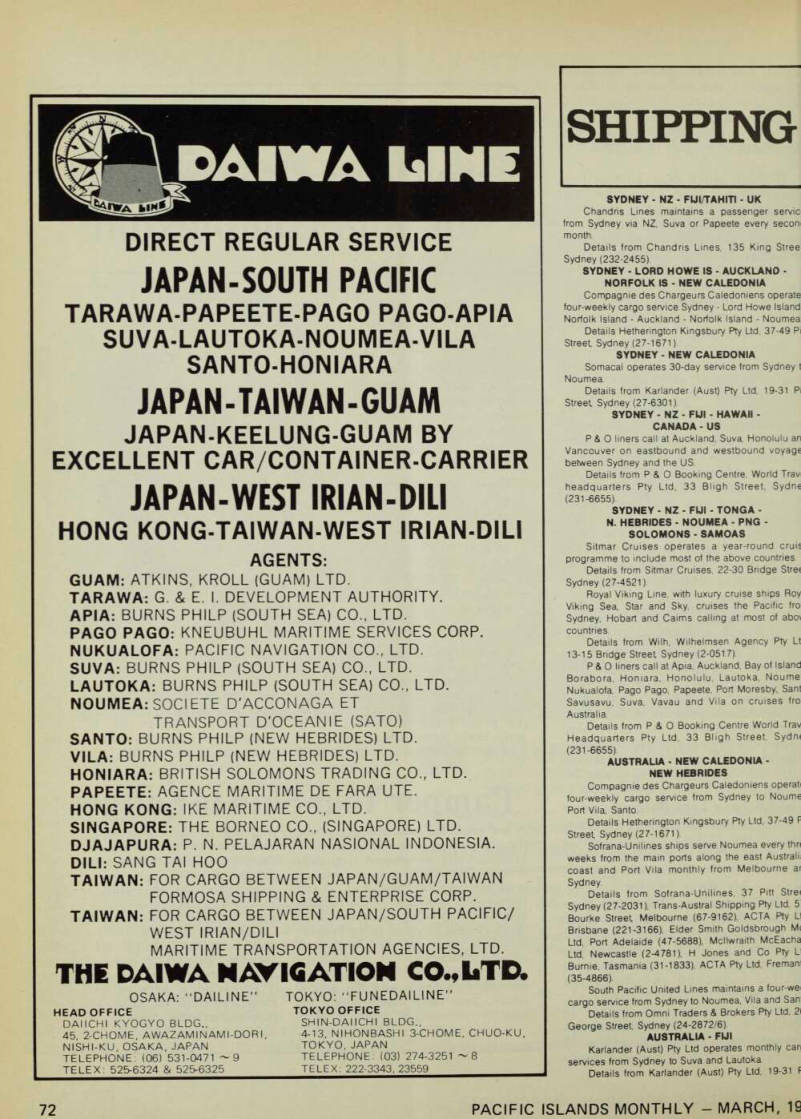
SYDNEY - NZ - FUI/TAHITI - UK Chandris Lines maintains a passenger servio from Sydney via NZ, Suva or Papeete every seconi month.
Details from Chandris Lines, 135 King Stree Sydney (232-2455).
SYDNEY - LORD HOWE IS • AUCKLAND -
Norfolk Is - New Caledonia
Compagnie des Chargeurs Caledoniens operate four-weekly cargo service Sydney - Lord Howe Island Norfolk Island - Auckland - Norfolk Island - Noumea Details Hetherington Kingsbury Pty Ltd, 37-49 Pi Street Sydney (27-1671).
Sydney - New Caledonia
Somacal operates 30-day service from Sydney t Noumea.
Details from Karlander (Aust) Pty Ltd, 19-31 Pi Street Sydney (27-6301).
SYDNEY - NZ - FUI - HAWAII -
Canada - Us
P & 0 liners call at Auckland, Suva, Honolulu an Vancouver on eastbound and westbound voyage between Sydney and the US.
Details from P & 0 Booking Centre, World Travi headquarters Pty Ltd, 33 Bhgh Street, Sydne (231-6655) SYDNEY - NZ - FIJI - TONGA- N. HEBRIDES - NOUMEA - PNG -
Solomons -Samoas
Sitmar Cruises operates a year-round cruis programme to include most of the above countries.
Details from Sitmar Cruises, 22-30 Bridge Stree Sydney (27-4521).
Royal Viking Line, with luxury cruise ships Roy Viking Sea, Star and Sky, cruises the Pacific fro Sydney, Hobart and Cairns calling at most of abo\ countries.
Details from Wilh, Wilhelmsen Agency Pty Lt 13-15 Bridge Street Sydney (2-0517).
P & 0 liners call at Apia, Auckland, Bay of Island Borabora, Honiara, Honolulu, Lautoka, Noume Nukualofa, Pago Pago, Papeete, Port Moresby. Sant Savusavu, Suva, Vavau and Vila on cruises fro Australia.
Details from P & 0 Booking Centre World Trav Headquarters Pty Ltd, 33 Bligh Street, Sydnr (231-6655)
Australia - New Caledonia -
New Hebrides
Compagnie des Chargeurs Caledoniens operati four-weekly cargo service from Sydney to Noume Port Vila, Santo Details Hetherington Kingsbury Pty Ltd, 37-49 F Street Sydney (27-1671).
Sofrana-Unilines ships serve Noumea every thn weeks from the main ports along the east Australi. coast and Port Vila monthly from Melbourne ar Sydney.
Details from Sofrana-Unilines, 37 Pitt Stre< Sydney (27-2031), Trans-Austral Shipping Pty Ltd, 5 Bourke Street Melbourne (67-9162), ACTA Pty LI Brisbane (221-3166). Elder Smith Goldsbrough M( Ltd, Port Adelaide (47-5688), Mcllwraith McEacha Ltd, Newcastle (2-4781), H Jones and Co Pty Li Burnie, Tasmania (31-1833), ACTA Pty Ltd, Fremanl (35-4866) South Pacific United Lines maintains a four-wei cargo service from Sydney to Noumea, Vila and San 1 Details from Omni Traders & Brokers Pty Ltd, 21 George Street Sydney (24-2872/6).
Australia - Fui
Karlander (Aust) Pty Ltd operates monthly can services from Sydney to Suva and Lautoka.
Details from Karlander (Aust) Pty Ltd, 19-31 F
Street, Sydney (27-6301), Dalgety Shipping, 461 Bourke Street Melbourne (60-0731), Burns Philp (SS) po Ltd, Suva and Lautoka.
Sofrana-Unilines (Fiji Express Line) operates to Suva every three weeks from the main ports on the east coast of Australia and monthly to Lautoka from Melbourne and Sydney.
Details from Sofrana-Unilines, 37 Pitt Street Sydney (27-2031), Trans-Austral Shipping Pty Ltd. 570 Bourke Street Melbourne (67-9162), ACTA Pty Ltd, Brisbane (221-3116), Elder Smith Goldsbrough Mort Ltd, Port Adelaide (47-5688), Mcllwraith McEacharn Ltd, Newcastle (2-4781), H Jones and Co Pty Ltd, Burnie, Tasmania (31-1833), ACTA Pty Ltd, Fremantle ;35-4866)
Australia - Fuji - W. Samoa
i Nauru Pacific Line operates regular containerised, unitised and b/bulk service from Sydney and Brisbane |c Lautoka, Suva and Apia i Details Nauru Pacific Line, Nauru House, 80 fcollins Street, Melbourne (653-5709), Interocean Swire, 8 Spring Street, Sydney (2-0522).
Australia - Tonga - W. Samoa
Karlander operates a monthly cargo service from Melbourne and Sydney to Nukualofa and Apia, thence US west coast. f Details: Karlander (Aust) Pty Ltd, 19-31 Pitt Street,
Sydney (27-6301).
AUSTRALIA - TAHITI - US WEST COAST I South Pacific United Lines maintains a four-weekly Bervice from Sydney to Papeete, and US west coast.
Details from Omni Traders & Brokers Pty Ltd, 261 Seorge Street Sydney (241-2872/6).
Australia - Png
Containers Pacific Express (Burns Philp and AWP Line) operates four-weekly cargo service from Melbourne, Sydney and Brisbane with Samos to Port Moresby and Lae, supplemented by availability of Additional tonnage on NGAL ships to cover transition Benod, Jan 1-June 30, 1977, pending start of fully ;ontainerised joint NGAL/Conpac service.
Details from Burns Philp & Co Ltd, 51 Pitt Street Sydney (241-3816).
Farrell Lines operates a service every 18 days rom Tasmania, Melbourne, Sydney and Brisbane to .ae and Rabaul.
Details from Wilh Wilhelmsen Agency Pty Ltd, 13 Bridge Street, Sydney (2-0517), 60 Market Street Melbourne (61-3031), Burns Philp (NG) Ltd, Rabaul, Bobert Laurie-Carpenter (NG) Pty Ltd, Lae.
New Guinea Express Lines with two ships jperates three-weekly Melbourne, Sydney, Brisbane, *ort Moresby, Lae, Rabaul.
Details from New Guinea Express Lines, PO Box 873, Royal Exchange PO, Sydney (241-3991), MacArthur Shipping Agency Co, 82-92 Eagle Street Brisbane (229-3777), Western Farmers Transport Pty -td, 459 Little Collins Street, Melbourne (67-8291), Breckwoldt’s Shipping Agencies in Port Moresby 24-2525), Lae (42-1536), Rabtrad and Nuigini Pty Ltd, Babaul (92-2911).
Karlander New Guinea Line's cargo vessels call at Melbourne, Sydney, Port Moresby, Lae, Madang, Vewak, Manus, Kimbe, Rabaul Details from Karlander (Aust) Pty Ltd, 19-31 Pitt Street, Sydney (27-6301), Dalgety Shipping, 461 Bourke Street Melbourne (60-0731).
Australia - Png - Solomons
New Guinea Australia Line’s vessels operate from Sydney and Brisbane to Port Moresby, Lae, Rabaul, (avieng, Wewak, Honiara Kieta Gizo, Madang and lamarai.
Details from Interocean Swire, 8 Spring Street Sydney (2-0522).
AUSTRALIA - SOLOMONS - GILBERT IS -
Micronesia
Daiwa Line runs a container service every 35 days ’om Sydney to Honiara, Tarawa Guam, Saipan and ’alau.
Details: Tradex Transport Pty Ltd, 185 O'Riordan Street Mascot NSW (669-1099).
Australia - Nauru
Nauru Pacific Line operates regular argo/passenger service from Melbourne to Nauru Details Nauru Pacific Line, Nauru House, 80
Collins Street, Melbourne (653-5709), Interocear Swire, 8 Spring Street Sydney (2-0522).
Us - Png
Farrell Lines operates regular services from all US west coast ports to Lae and Rabaul.
Details from Wilh, Wilhelmsen Agency Pty Ltd. IS Bridge Street Sydney (2-0517), Farrell Lines, 1 Marke Plaza San Francisco, LA. (9-4105), Burns Philp (NG Ltd, Rabaul and Kieta, Robert Laurie-Carpenter (PNG Pty Ltd, Lae.
San Francisco - Honolulu -
Micronesia
Nauru Pacific Line operates regula conventional/container service from San Francisci and Honolulu to Majuro, Nauru, Ponape, Truk am Saipan.
Details from Nauru Pacific Line, Nauru House, 8( Collins Street Melbourne (653-5709), North Americai Maritime Agencies, 100 California Street, Sa Francisco, California 9411 (981-0343).
Png - Us • Canada
Farrell Lines operates regular services from Lai and Rabaul to US west coast ports and Vancouver.
Details from Burns Philp (NG) Pty Ltd, Rabau Robert Laurie-Carpenter (PNG) Pty Ltd, Lae, Farre Lines, 1 Market Plaza, San Francisco, LA. (9-4105 Wilh, Wilhelmsen Agency Pty Ltd, 13 Bridge Stree Sydney (2-0517).
FAR EAST - FUI - NEW ZEALAND New Zealand Unit Express (CNC, MNOL, RIL operates a three-weekly cargo service from Horn Kong to Lautoka Suva, NZ ports, Manila Kaoshiunj Keelung, Hong Kong.
Details from Interocean Swire, 8 Spring Stree Sydney (2-0522).
Royal Interocean Lines operates monthly carg< service with three ships from Surabaya, Jakarta Bangkok, Port Kelang and Singapore to Suva and Ni ports.
Details from Interocean Aust Services Pty Ltd, Spring Street, Sydney (27-3801), Burns Philp (SS) C Ltd, Suva and Lautoka.
Ben Shipping Co (Pte) Ltd, sailing monthly fror Singapore, Hong Kong, Keelung, Kaoshiung, Suva an main NZ ports.
Details from Seatrans (Fiji) Ltd, GPO Box 152 Suva, Fiji.
Japan ■ Nz - Png
China Navigation Co, with three ships operates monthly cargo service from Japan to New Zealao calling at Lae on return journey.
Details Interocean Swire, 8 Spring Street Sydne (2-0522).
Far East - Mid-S. Pacific
China Navigation Co’s vessels operate a regula cargo service from Hong Kong, Taiwan and Singapor to Rabaul, Wewak, Madang. Lae, Port Moresby Honiara, New Hebrides, Noumea, Papeete an Samoa.
Details from Interocean Swire, 8 Spring Stree Sydney (2-0522).
Kyowa Shipping Co Ltd operates monthly service from Hong Kong, Taiwan, S. Korea, Japan, Singapor and Jakarta to Guam, Saipan, Solomons, Ne' Caledonia, Fiji, Western and American Samoa, Tahil Cook Is., Tonga, New Hebrides and PNG.
Details; Hetherington Kingsbury Pty Ltd, 37-49 Pi Street Sydney (27-1671).
North Europe - New Caledonia
Hamburg-Sued operates monthly cargo service from Dunkirk and Le Havre to Noumea via Panama Details from Columbus Overseas Services Pty Lt 33 George Street Sydney (290-2966)
North Europe - Tahiti -
N. Caledonia - Png
Compagnie Generale Maritime operates thre conventional and three ro/ro cargo services a monl from North European and Mediterranean ports 1 Papeete and Noumea Three conventional ships ca monthly in Papua New Guinea.
Details from Compagnie General Maritime, 4- Bligh Street Sydney (221-2522).
JAPAN - GUAM - FUI - SAMOA -
N. Caledonia - N. Hebrides
Daiwa Lines runs a monthly cargo service fror
Japan via Guam to Suva, Lautoka, Pago Pago, Apia, Vila Santo and Noumea.
Details from Bums Philp (SS) Co Ltd, Suva.
NZ - FUI - TONGA - SAMOAS -
Tahiti
I Union Steam Ship Co of NZ operates a fully pontainerised service Auckland-Suva-Pago Pago (kpia-Nukualofa every 14-16 days A 28-day service by conventional ship is operated Irom Auckland to Papeete, Apia and Nukualofa.
Details from Union Steam Ship Co of NZ Ltd, PO Box 12, Auckland, or from branch offices/agents in Fiji, fonga, Samoa and Tahiti.
Nz • Norfolk Is
I Compagnie des Chargeurs Caledoniens operate bur-weekly cargo service from Auckland to Norfolk
bland.
I Details from Maritime Services Ltd, 14-18 customs Street, E. Auckland (7-5509).
NZ - N. CALEDONIA - N. HEBRIDES -
Png - Si
I Sofrana-Unilines with two ships operates to Vila ind Santo, to Honiara and Papua New Guinea, and to loumea. [ Details from Sofrana-Unilines, 42 Customs Street luckland (7-3279), PO Box 3614, Telex. NZ2313.
Nz - N. Caledonia
I Compagnie des Chargeurs Caledoniens operates bur-weekly cargo service from Auckland to Noumea.
Details from Maritime Services Ltd, 14-18 Customs Street E. Auckland (7-5509).
Nz- Png
[ Farrell Lines operates regular service every 18 lays from Auckland to Lae and-Rabaul.
Details from Dalgety NZ Ltd, 41-45 Albert Street Auckland (7-1859), Burns Philp (NG) Ltd, Rabaul, Robert Laurie-Carpenter (PNG) Pty Ltd, Lae.
NZ - FUI - NORTH AMERICA (WC) I Crusader cargo ships call at Suva, Levuka and (lonolulu on NZ-US west coast trips and at Suva and/or (.autoka on US-NZ return trips Details from Blueport ACT (NZ) Ltd, PO Box 192, Wellington (739-029); Burns Philp (SS) Co Ltd, Suva.
Nz - Fiji
Reef operates a regular 18-day service from Auckland to Suva and Lautoka.
Details from Reef Shipping Agencies Ltd, PO Box 1382, Auckland, NZ (7-1221-3).
Pacific Line with one ship operates monthly cargo lervice New Zealand, Lautoka, Suva.
Details: Sofrana-Unilines, 42 Customs Street, Auckland (7-3279) PO Box 3614, Telex; NZ2313.
Warner Pacific Line operates monthly freezer :argo service, Timaru-Lautoka.
Details from Air Marine Services (NZ) Ltd, PO Box 1505, Auckland (362-730).
Nz-Tonga
Warner Pacific Line services Onehunga - Nukualofa - Vavau - Haapai fortnightly, and Timaru - Nukualofa - Vavau monthly.
Details from the Air Marine Service (NZ) Ltd, PO Jox 2505, Auckland (362-730).
Nz - Cook Is - Niue
The Shipping Corporation of NZ Ltd with Toa 4oana and Lorena, operates cargo services from Auckland to Rarotonga and Aitutaki (fortnightly) and Jiue (monthly).
Details from the Shipping Corp of NZ Ltd, PO Box 1420, Auckland (379-430); Waterfront Commission, PO Jox 61, Rarotonga, Lighterage and Stevedoring Co, kitutaki, Niue Govt Offices, Niue Island.
NZ - FAR EAST - PACIFIC ISLANDS Sofrana Fareast Lines operates a five-weekly iervice from Auckland to Far East, PNG, New Caledonia and Fiji.
Details from Sofrana Unilines, 42 Customs Street Auckland (73-279).
US • FUI - TAHITI - AUSTRALIA Bank Line Ltd operates regular cargo services rom US Gulf ports to Australia and NZ. Calls at Suva .autoka and Papeete on demand.
Details from Bank Line (A/asia) Pty Ltd, 1 York street Sydney (27-2011).
Pacific Far East Line cruise ships operate from san Francisco, Los Angeles, Honolulu, Moorea,
Papeete, Rarotonga Auckland, Opua (Bay of Islands), Sydney and return via Suva, Niuafoou, Pago Pago and Honolulu to San Francisco.
Freight is carried on these passenger liners.
Passenger details from World Travel Headquarters Pty Ltd, 33 Bligh Street, Sydney (231-6655), freight details from P & O Aust Ltd, 2 Castlereagh Street, Sydney (230-0177).
Us - Tahiti - Samoa
Pacific Islands Transport operates a five/six weekly cargo service from North American west coast ports to Papeete, Pago Pago, Apia.
Details from Trans-Austral Shipping Pty Ltd, 19 Pitt Street Sydney (27-2441).
Polynesia Line operates container and general cargo service from US west coast ports to Papeete and Pago Pago Details from Polynesia Shipping Services Inc, PO Box 1478, Pago Pago (9-6799).
EUROPE - TAHITI - W. SAMOA - FUI -
N. Caledonia
Nedlloyd offers regular cargo services from Northern Europe and UK to Papeete, Apia, Fiji and New Caledonia.
Details Interocean Aust Services Pty Ltd, 8 Spring Street Sydney (27-3801).
UK - TAHITI - N. CALEDONIA • N. HEBRIDES • PNQ - SOLOMONS -
Gilbert Is
Bank Line operates a monthly direct cargo service from Europe, via the Panama Canal to Papeete, Noumea, Vila, major PNG ports and Honiara, occasionally to Tarawa, Santo, Kieta, Jayapura and Yandina and return.
Details from Bank Line (A’asia) Pty Ltd, 1 York Street Sydney (27-2041); Burns Philp (SS) Co Ltd, Suva.
US - A. SAMOA - NZ - AUBT • PNQ Farrell Lines LASH ships operate regularly from US to Australia, via Pago Pago and Auckland, returning via PNG ports Details from Wilh, Wilhelmsen Agency Pty Ltd, 13 Bridge Street, Sydney (2-0517), 60 Market Street Melbourne (61-0301); Farrell Lines, 1 Market Plaza San Francisco, L A. (415-777-3300), Dalgety NZ Ltd, Auckland (7-1859); Kneubuhl Maritime Services, Pago Pago (633-5121) UK - PANAMA - SAMOA • FIJI The Fiji Direct Service, cargo only, is maintained by Conference vessels, sailing at regular monthly intervals out of Avonmouth, via Panama, for Apia, Suva and Lautoka.
Details from Burns Philp (SS) Co Ltd, Suva
Advertisements & other items, pp. 71-74 (3 items)
73
’ACIFIC ISLANDS MONTHLY - MARCH, 1977
Monthly Services
THE
United Kingdom and Continent to: Papeete, Noumea, New Hebrides, Papua New Guinea and Solomon Islands.
Papua New Guinea to: North America, United Kingdom and Continent.
Solomons, Fiji, Tonga, Samoa and Tarawa to; United Kingdom and Continent.
For particulars apply:
THE BANK LINE (AUSTRALASIA) PTY.
LTD.,
18TH FLOOR, 1 YORK STREET,
SYDNEY, N.S.W.
KYOWA LINE
YOUR TRADING PARTNER
Monthly Services
Hong Kong, Taiwan, S. Korea, Japan
To: Guam, Saipan, British Solomon, New Caledonia, Fiji, W. Samoa, A. Samoa. Tahiti, Cook Is., Tonga, New Hebrides.
Taiwan,Hong Kong,Singapore,Jakarta
To: Australia, Papua New Guinea, Sabah & Sarawak.
South Korea, Japan
To: Guam, Saipan, Papua New Guinea, Other Pacific Islands.
Taiwan: Royal Steamship Corp , Ltd., Taipei S. Korea: Dong Sue Shipping Co., Ltd , Seoul Hong Kong: Dahzun Enterprises Ltd Singapore: Ocean Shipping & Enterprises Pte , Ltd Mariana Is.; Island Navigation Co, Ltd., Guam 8.5.1. P.: Solomon Taiyo Ltd., Honiara Tahiti: J.A. Cowan & Fils. Papeete Cooks: Union Citco Travel Ltd , Rarotonga Tonga: EM. Jones Ltd , Nukualofa New Hebrides: Agence Maritime Raymond Velicite, Port Vila A.Samoa: Island Pacific Agencies Inc., Pago Pago W. Samoa; Morris Hedstrom Ltd., Apia Fiji: Carpenter Shipping, Suva & Lautoka PNG: Carpenter Shipping Agencies, Port Moresby, Rabaul New Caledonia; Agence Maritime Du Rond Point Du Pacific.
Indonesia: P.T. Porodisa Raya Shipping Lines, Jakarta Sabah: KOH Han Ming Shipping & Forwarding Agent , Kotakinabalu Sarawak: Pan Sarawak Agencies Sdn. Bhd ,Sibu & Kuching Australia: Hethermgton Kingsbury Pty. Ltd., Sydney, N S W.
KYOWA SHIPPING CO., LTD.
Ojima Bldg., 22-8, 6-chome, Shinbashi, Frontier Bldg., 3-13 Hirano-cho,
AGENTS
Noumea
HEAD OFFICE
OSAKA OFFICE
Minato-ku, Tokyo, Japan Phone: 03(437)2885 (Rep.) Cables: “MARIQUEEN” Tokyo Telex: 242-4651 Kyowa J.
Higashi-ku, Osaka, Japan. ' Phone: 06(227)0422 (Rep.) Cables: “MARIQUEEN” Osaka.
Telex: 522-3896 Kyowa O
Hr NOTHING BUT
BOATING BOOKS
\ i Books about: • Sailing • Navigation • Boatbuilding & Design • Cruising Tales • Fishing • Canoeing • Nautical History • etc., etc., etc.
OVER 500 TITLES IN STOCK!
Write, phone or caff tor Free Book List Mail Orders & hard to get titles a speciality.
THE SPEORUST ÜBRfIRV
Sydney: Corfu House, 35 Hume Street, Crows Nest, 2065. 439-1133; y
Regular Pacific Services
"Union South Pacific", cellular container vessel. Reefer and general cargo from Auckland at approximately fortnightly intervals. Calls at Suva, Pago Pago, Apia and Nukualofa before returning to Auckland.
"Luhesand", conventional reefer and general cargo. Monthly sailings from Auckland, calls at Suva, Apia, Papeete and Nukualofa.
jmimumon
gm/mcompanu
Branches at all main Australian, New Zealand and Pacific Island ports
ExpressTreight Service between . U.S. Pacific Coast Ports &
PAPEETE ■ APIA • PAGO PAGO
Full Container Service including Refrtgeration
GENERAL AGENTS-.
fURNESS INTEROCE4N
465 CALIFORNIA STREET. SAN FRANCISCO.'6 A 94104 .
Cable: INTERCO- • TWX: 910-3717350 • RCA: 278 207
• TEL <415):
AGENTS-
PAPEETE ■ MORGAN; Vernex Boite Postale 449, Papeete Phone: 309 Cables: MOREX PAGO PAGO - POLYNESIA SHIPPING SERVICES, INC., Pago Pago Phone:633-5169 Cables: POLYSHIP APIA - UNION S.S. CO., of N.Z. Ltd., P.O. Box 50, Apia, Western Samoa Phone; 570 Cables: UNION
PACIFIC ISLANDS TRANSPORT LINE
Owners: Thor Dahls Hvaijangerseiskap A/S — Sandefjord, Norway.
MS CAMELLIA VENTURE
Express Freight Service between Pacific Coast Ports of
U.S.A.
and
TAHITI and SAMOA
Full container service including reefers.
GENERAL STEAMSHIP CORPORATION LTD.
General Agents 400 California Street, San Francisco, California, U.S.A.
APIA —Burns Philp (South Sea) Company, SYDNEY—Trans-Austral Shipping Pty. Ltd.
SUVA —Bums Philp (South Sea) Company, PAPEETE—Agonco Maritime Internationale ltd. . . ...
Tahiti LAE/RABAUL —Borns Philp (New Guinea) Ltd.
PAGO PAGO-Polynesia Shipping Services Inc. PORT VlLA—Comptoirs Francais de Nouvelles NOUMEA —Etablissements Ballande. Hebrides.
75
‘ACIFIC ISLANDS MONTHLY - MARCH, 1977
Produce
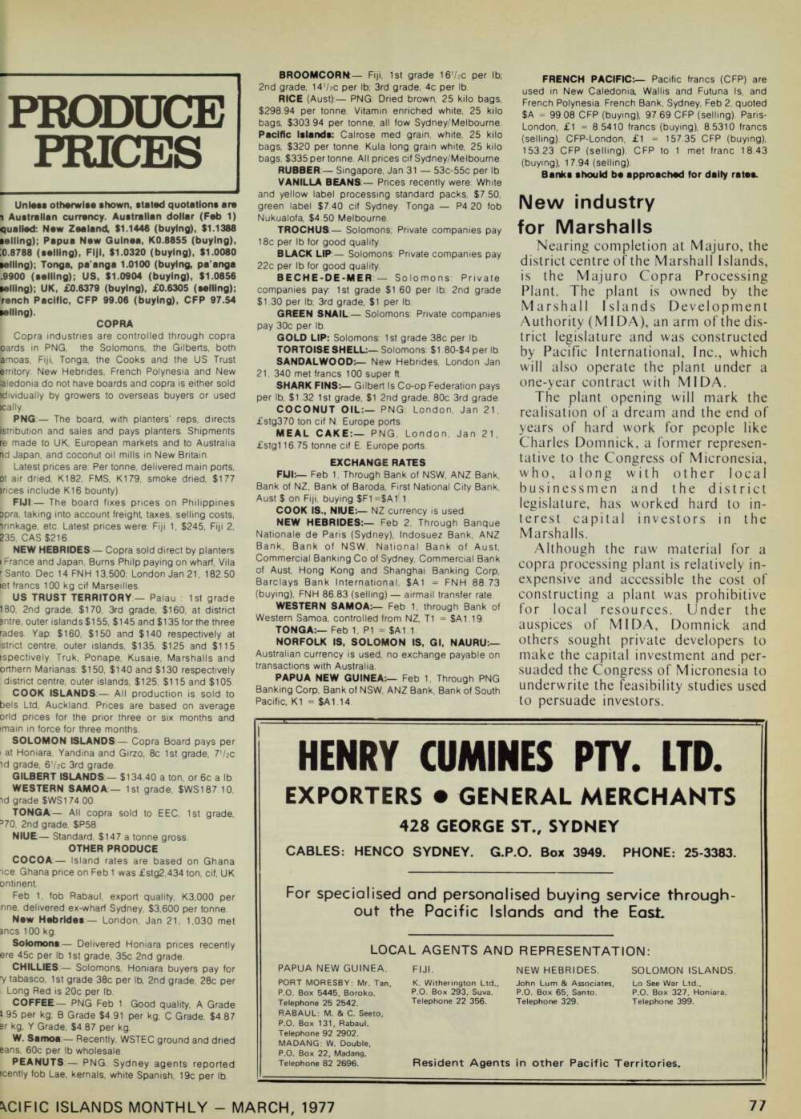
Prices
Unless otherwise shown, stated quotations are n Australian currency. Australian dollar (Feb 1) quailed: New Zealand, $1.1446 (buying), $1.1388 selling); Papua New Guinea, K 0.8855 (buying), [0.8788 (selling), Fiji, $1.0320 (buying), $l.OOBO selling); Tonga, pa'anga 1.0100 (buying, pa'anga .9900 (selling); US, $1.0904 (buying), $1.0856 selling); UK, £0.6379 (buying), £0.6305 (selling); ranch Pacific, CFP 99.06 (buying), CFP 97.54 selling).
Copra
I Copra industries are controlled through copra bards in PNG, the Solomons, the Gilberts, both emoas, Fiji, Tonga the Cooks and the US Trust brritory. New Hebrides, French Polynesia and New Bledonia do not have boards and copra is either sold Idividually by growers to overseas buyers or used jcally.
PNG— The board, with planters' reps, directs retribution and sales and pays planters. Shipments re made to UK, European markets and to Australia fid Japan, and coconut oil mills in New Britain, i Latest prices are: Per tonne, delivered main ports, pt air dried, KlB2, FMS, K 179, smoke dried, $177 Irices include Kl 6 bounty).
FIJI: — The board fixes prices on Philippines upra, taking into account freight taxes, selling costs, firinkage, etc. Latest prices were: Fiji 1, $245, Fiji 2,
235, Cas $216
NEW HEBRIDES Copra sold direct by planters [France and Japan, Burns Philp paying on wharf, Vila f Santo. Dec 14 FNH 13,500; London Jan 21, 182 50 let francs 100 kg cif Marseilles.
US TRUST TERRITORY Palau Ist grade 180, 2nd grade, $l7O, 3rd grade, $l6O, at district Bntre, outer islands $155, $145 and $135 for the three rades. Yap: $l6O, $l5O and $l4O respectively at (strict centre, outer islands, $135, $125 and $ll5 sspectively. Truk, Ponape, Kusaie, Marshalls and orthern Marianas: $l5O, $l4O and $l3O respectively district centre, outer islands, $125, $ll5 and $lO5.
COOK ISLANDS All production is sold to bels Ltd, Auckland. Prices are based on average orld prices for the prior three or six months and imain in force for three months.
SOLOMON ISLANDS — Copra Board pays per i at Honiara, Yandina and Girzo, 8c Ist grade, 7'he id grade, 6'hc 3rd grade.
GILBERT ISLANDS —5134.40 a ton, or 6c a lb
Western Samoa Ist Grade, Swsib7 10,
id grade SWSI74 00.
TONGA— All copra sold to EEC, Ist grade, s 7O, 2nd grade, SPSB NIUE — Standard, $147 a tonne gross.
Other Produce
COCOA: — Island rates are based on Ghana •ice. Ghana price on Feb 1 was £5tg2,434 ton, cif, UK ontinent Feb 1, fob Rabaul, export quality, K 3.000 per nne, delivered ex-wharf Sydney, $3,600 per tonne.
New Hebrides London, Jan 21, 1,030 met incs 100 kg Solomon* — Delivered Honiara prices recently ere 45c per lb Ist grade, 35c 2nd grade.
CHILLIES: — Solomons, Honiara buyers pay for 7 tabasco, Ist grade 38c per lb, 2nd grade, 28c per . Long Red is 20c per lb COFFEE — PNG Feb 1. Good quality, A Grade 195 per kg; B Grade $4 91 per kg; C Grade, $4 87 sr kg, Y Grade, $4 87 per kg W. Samoa Recently, WSTEC ground and dried Bans, 60c per lb wholesale PEANUTS: — PNG. Sydney agents reported tcently fob Lae, kernals, white Spanish, 19c per lb.
BROOMCORf*— Fiji, Ist grade 16Vzc per lb; 2nd grade, per lb; 3rd grade, 4c per lb.
RICE (Aust): — PNG: Dried brown, 25 kilo bags, $298 94 per tonne. Vitamin enriched white, 25 kilo bags, $303 94 per tonne, all fow Sydney/Melbourne.
Pacific Islands: Calrose med grain, white. 25 kilo bags, $320 per tonne. Kula long grain white, 25 kilo bags, $335 per tonne. All prices cif Sydney/Melbourne.
RUBBER Singapore, Jan 31 53c-55c per lb VANILLA BEANS — Prices recently were: White and yellow label processing standard packs, $7 50, green label $7 40 cif Sydney Tonga P 4 20 fob Nukualofa $4 50 Melbourne.
TROCHUS — Solomons; Private companies pay 18c per lb for good quality.
BLACK LIP — Solomons: Private companies pay 22c per lb for good quality.
BECHE-DE-MER Solomons: Private companies pay Ist grade $1 60 per lb; 2nd grade $1.30 per lb; 3rd grade, $1 per lb.
GREEN SNAIL — Solomons: Private companies pay 30c per lb.
GOLD LIP: Solomons: Ist grade 38c per lb.
TORTOISE SHELL— Solomons: $1 80-$4 per lb.
SANDALWOOD: — New Hebrides, London Jan 21, 340 met francs 100 super ft.
SHARK FINS: — Gilbert Is Co-op Federation pays per lb, $1 32 Ist grade, $1 2nd grade, 80c 3rd grade COCONUT OIL: PNG: London, Jan 21, £stg37o ton cif N. Europe ports.
MEAL CAKE:— PNG, London, Jan 21, £5tg116.75 tonne cif E, Europe ports.
Exchange Rates
FIJI: — Feb 1, Through Bank of NSW, ANZ Bank, Bank of NZ, Bank of Baroda First National City Bank, Aust $ on Fiji, buying SFI =$Al 1 COOK IS., NIUE: — NZ currency is used NEW HEBRIDES: — Feb 2, Through Banque Nationale de Paris (Sydney), Indosuez Bank, ANZ Bank, Bank of NSW, National Bank of Aust, Commercial Banking Co of Sydney, Commercial Bank of Aust, Hong Kong and Shanghai Banking Corp, Barclays Bank International, SAI = FNH 88.73 (buying), FNH 86 83 (selling) airmail transfer rate.
WESTERN SAMOA: — Feb 1, through Bank of Western Samoa, controlled from NZ, T 1 = $A 119 TONGA:— Feb 1, PI = $A 1 1
Norfolk Is, Solomon Is, Gl, Nauru;—
Australian currency is used, no exchange payable on transactions with Australia.
PAPUA NEW GUINEA*. — Feb 1, Through PNG Banking Corp, Bank of NSW, ANZ Bank, Bank of South Pacific, K 1 = $A1.14.
FRENCH PACIFIC: — Pacific francs (CFP) are used in New Caledonia, Wallis and Futuna Is, and French Polynesia French Bank, Sydney, Feb 2, quoted $A = 99 08 CFP (buying), 97 69 CFP (selling). Paris- London, £1 = 8 5410 francs (buying), 8 5310 francs (selling). CFP-London, £1 = 157.35 CFP (buying), 153.23 CFP (selling). CFP to 1 met franc 18.43 (buying), 17.94 (selling).
Bank* should b* approached for daily rata*.
New industry
for Marshalls
Nearing completion at Majuro, the district centre of the Marshall Islands, is the Majuro Copra Processing Plant. The plant is owned by the Marshall Islands Development Authority (MI DA), an arm of the dis trict legislature and was constructed by Pacific International, Inc., which will also operate the plant under a one-year contract with MI DA.
The plant opening will mark the realisation of a dream and the end of years of hard work for people like Charles Domnick, a former represen tative to the Congress of Micronesia, who, along with other local businessmen and the district legislature, has worked hard to in terest capital investors in the Marshalls.
Although the raw material for a copra processing plant is relatively in expensive and accessible the cost of constructing a plant was prohibitive for local resources. Under the auspices of MI DA, Domnick and others sought private developers to make the capital investment and per suaded the Congress of Micronesia to underwrite the feasibility studies used to persuade investors.
Advertisements & other items, pp. 75-80 (3 items)
77
\CIFIC ISLANDS MONTHLY - MARCH, 1977
Henry Cumines Pty. Ltd.
EXPORTERS • GENERAL MERCHANTS
428 GEORGE ST., SYDNEY
CABLES: HENCO SYDNEY. G.P.O. Box 3949. PHONE: 25-3383.
For specialised and personalised buying service throughout the Pacific Islands and the East.
LOCAL AGENTS AND REPRESENTATION;
PAPUA NEW GUINEA.
PORT MORESBY: Mr. Tan,
P.O. Box 5445, Boroko.
Telephone 25 2542.
RABAUL: M. & C. Seeto, P.O. Box 131, Rabaul.
Telephone 92 2902.
MADANG: W. Double, P.O. Box 22, Madang.
Telephone 82 2696.
FIJI.
K. Witherington Ltd., P.O. Box 293, Suva.
Telephone 22 356.
NEW HEBRIDES.
John Lum & Associates, P.O. Box 65, Santo.
Telephone 329.
SOLOMON ISLANDS.
Lo See War Ltd., P.O. Box 327, Honiara.
Telephone 399.
Resident Agents in other Pacific Territories.
CLASSIFIED ADVERTISEMENTS
Per L ine $3.00 Aus t Minimum 4 lines.
FOR SALE
Cruising Sloop double-ender 32ft. x lift. 3 ins. x 6ft. 3 ins. Launched 1966. Immaculate cond. Full particulars Box 197 PO Roseville NSW 2069. Principals only.
FLEETS have Tourist Boats from 34ft. at $26,500.00 through all sizes to 100 ft. Also workboats, trawlers, tugs, cargo ships, barges etc. FLEETS 221 Esplanade, Wynnum Central, Brisbane.
Cable FLEETS BRISBANE.
COASTAL FREIGHTER OR LIGHTER
Ex YG US Navy 118' x 28' x 7'. Draft 200 ton. Light displacement. About 15,000 Cu Ft, 300 ton cargo with 3 ton boom and winches. 2 heads galley.
Accommodation for 10. Main engine Enterprise DMG-6, direct reversing 300 hp @ 300 RPM, 8 knots cruise, economical operation, GM-Delco 20 Kw and 40 Kw generators, electronics, spares, Good condition. Vessel just off drydock and located Honiara Guadalcanal S.l.
Price US $125,000.
Buyer subject US Govt, approval.
Contact -
Carroll Hupp, 464 Warwick
St. Akron, Ohio, USA.
Phone: 216 798 9465.
Position Wanted:
Young Australian experienced in all aspects of beef farming, would like to obtain any position out there. Bruce Emerson "Alvadale" Pte Bag No. 1 Heywood Victoria Australia, 3304 MAPS & PRINTS OF THE OLD PACIF Catalogue of original antiquarian views and maps of Pacific Islands sent free.
C.HINCHCLIFFE—7 Royd Avenue, Heckmondwike, West Yorkshire, WFI6 9AL United Kingdom.
COINS
WANTED...
Paying twice face value for all pre-decimal Australian coins.
GOLD SOVEREIGNS
BUY—$27
SELL-$3O
Prices subject to fluctuation.
SOUTHERN CROSS COINS
2/131 Exhibition St.,,
MELBOURNE 3000,
AUSTRALIA.
Phone: 63 1141.
STERN
DRIVES
PETROL & DIESEL
MARINE ENGINES
X Manufactured by
SEA TIGER
MARINE
Pty. Ltd.
P.O. Box 157, Mordialloc Victoria, Australia 3195
CONCRETE BLOCK MAKER Makes blocks flags edgings screen-blocks, garden stools —up to 8 at once and 96 an hour $215 00 C i f mam ports Send for leaflets Forest Farm Research, Londonderry NSW. 2753 Australia.
— 3007
Stay at
Aggie Grey's the
South Pacific's legendary hotel Situated right in the heart of Western Samoa. Enjoy Polynesian-style friendliness and service, in cool surroundings, superb entertainment and food. Magnificent white sand beaches only a short drive away.
Airconditioned rooms, swimming pool and full bar facilities.
Bookings through Union Steamship
Company of Nz, Pan Arm Air New Zealand or direct to Aggie Grey's, Apia, Western Samoa. Cables: AGGIES, APIA.
AKAI
* A A y C€M* c .
D.
What You Hear Isa Mind'Blowing
Visual Experience.
There seems to be no end to the superlatives used to describe stereo sound quality. It’s usually
natural, crystal clear, rich or
vibrant with plenty in reserve.
The list of words is longer than the tape on a 7-inch reel. But these tired, old adjectives can’t convey the full impact of Akai sound. Perhaps there just aren’t any words equal to the task.
Australia Akai Australia Pty. Ltd. 17/18 Hordern Place Denison St.
Camperdown, Sydney, N.S.W. 2050 Tel: 516-3366
P.N.G.
S.O. Svensson (N.G.) Ltd.
P.O. Box 705, Port Moresby Tel; 2275 Fiji Islands Motibhai & Company Ltd.
P.O. Box 9175 Nadi International Airport Tel: 72-165 New Zealand Pye Ltd, Consumer Product Division 110 Mt. Eden Rd., Mt. Eden, Auckland Tel: 686-437 It’s a visual experience that begins the moment you close your eyes and are swept into the imaginative world of your mind.
Akai provides you a wide selection of fine stereo components
tape decks, turntables, amps,
tuners, receivers and speaker systems—to assure you will enjoy
every trip.
New Caledonia Menard Freres B.P. H 2, Noumea Tel; 275222 Tahiti Etablissements Comimpex P.O. Box 200, Papeete Tel: 20477 New Hebrides Island Burns Philip (New Hebrides) Co., Ltd.
Port Vila, New Hebrides Island Norfolk Island Burns Philip (Norfolk Island) Co., Ltd.
P.O. Box 21, Norfolk Island See the difference when you move up to Akai sound.
Audio & Video
AKAI
AKAI ELECTRIC CO., LTD.
Tokyo, Japan
Samoan Islands Burns Philip (South Sea) Co., Ltd.
P.O. Box 129, Pago Pago, American Samoa, Apia, Western Samoa Mariana Islands J.C. Tenorio Enterprises P.O. Box 137, Saipan Tel: 6444/8 British Solomon Security Electrical Co., Ltd.
P.O. Box 174, Honiara Tel: 881 Cook Islands JPS Enterprises Ltd.
P.O. Box 15, Rarotonga Tel: 2150, 2176
m J*~i/ ms j/ * * * * ;
Musical survival pack.
You want good high fidelity sound reproduction. But, you don’t want to expend all your time and energy (not to mention your bankroll) on mixing and matching individual audio components. Well, Pioneer has done it again.
For those who want great stereo listening without getting lost in an electronic jungle, we are pleased to introduce our MS-6500 stereo system.
Everything you need to play anything you want. All in one beautifully designed package.
At the heart of the MS-6500 is an outstanding AM/FM stereo receiver.
In the amplifier, continuous power output is 18 watts per channel (RMS).
More than enough to fill your listening room with great sound. In the tuner, FM sensitivity is a powerful I.9mV and the S/N ratio is a hushed 73d8 (mono). Stable reception is virtually guaranteed by the presence of advanced PLL circuitry.
Playing your records is easy. The full size turntable features a sensitive tone arm with cartridge plus the added convenience of auto-cut and return.
Multi-source enjoyment is always available with the built-in cassette deck. All controls are user-oriented and the auto-stop mechanism offers protection for both tape and deck.
To make things complete, the MS-6500 includes a pair of balance* three-way, three-speaker systems.
Full rich bass from the big 20cm (8 inch) woofers is enhanced by the solid bass-reflex cabinets.
Pioneer’s new MS-6500 stereo system. Just plug it in, turn it on an< save your time for enjoying truly great sound.
CiDpioneef
Pioneer Electronic Corporate
4-1, Meguro 1-chome, Meguro-ku, Tokyo 153, Jap Australia Pioneer Electronics Australia Pty.
Ltd., 178-184 Boundary Road, Braeside, Victoria 3195, Tel: 90-9011, Sydney 93-0246, Brisbane 52-8231, Adelaide 433379, Perth 76-7776 Fiji Islands Brijlal & Company, G.P.O. Box No 362, Suva, Fiji Islands Tel: 22258 New Zealand Fountain Marketing Ltd., Maidstone Street, Auckland, New Zealand Tel: 763-064 Norfolk Island Burns Philp (Norfolk Island) Ltd., Norfolk Island, South Pacific New Hebrides Burns Philp (New Hebrides) Ltd., Vila, New Hebrides Nauru Island Jacob Enterprises, P.O. Box No. 4 Republic of Nauru Tahiti Est. PERFECT, B.P. 594, Papeete, Tahiti Tel: 20 407 New Caledonia Menard Freres, B.P. 123, Noumea, New Caledonia Tel: 27.52.22 American Samoa Traspac Corporation, P.O. Box 1477 Pago Pago, American San 96799 Tel: 633-5224 Rarotonga South Seas International Ltd..
P.O. Box 49, Rarotonga Cook Islands Tel: 2327
m' ipmwi kwh wmmfm
Performance
You Emeu Living With.
Honda is a true life drama, performed on the world’s stage. By average folks, teenagers, men, and women everywhere. Your neighbors, maybe even you are playing a part. If so, you know Honda is more than great machines.
It’s people concerned with taking people where they want to go in life.
On two wheels, we’re the best selling motorcycle. The easy to operate hard workers who don’t demand much. Honda is always ready and gets you there safely. We move on four wheels. The precedent setting Honda Civic continues to receive international economy and performance awards. It’s the elegant compact car.
Sometimes, we have no wheels. Honda portable power operates machinery, generates electricity, pumps water and tills the soil.
Little wonder good things happen on Honda we work harder to assure they do. tomm r ::
HONDA MOTOR CO., LTD. TOKYO, JAPAN
PAPUA NEW GUINEA; Steamships-Machinery P.O. Box 1, Port Moresby/TAHITI: Societe Tahitienne d'lmportation des Produits Honda B.P. 1665- Papeete/FIJI ISLANDS: Coral Island Motors P.O. Box 48, Suva/U.S. TRUST TERRITORY: United Micronesia Development Assn. P.O. Box 238, Saipan, Mariana Islands 96950/COOK ISLANDS: Cook Islands Motor Center Ltd. P.O. Box 74, Rarotonga/AMERICAN SAMOA: Samoan Holiday and Travel Center P.O. Box 968, Pago Pago/AMERICAN SAMOA: Haleck’s Service Center P.O. Box 1138, Pago Pago/GUAM; Mark's Motor Co., Inc. P.O. Box DV. Agana/WESTERN SAMOA; Motor Distributors (Samoa) Ltd. P.O. Box 576, Apia/SOLOMON ISLANDS; British Solomons Trading Co., Ltd. P.O. Box 114, Honiara/ NEW CALEDONIA: Establissements Ballande Boite Postale No. C 4 Noumea Cedex/TONGA: E.M. Jones Limited P.O. Box 34, Nukualofa/ TARAWA: Gilbert & Ellice Islands Development Authority P.O. Box 488, Beito/NIUE ISLAND: S. Jessop & Sons Ltd. P.O. Box 71, Alofi South/NAURU: Nauru Cooperative Society, Republic of Nauru, Nauru Island Central Pacific/NEW HEBRIDES: Tropex International Ltd., P.O. Box 139, Port Vila.
MyDatsun-
ifs a taxi driver’s dream
TAXI
w Sam Tasip with his money-making Datsun, near Port Moresby, Papua New Guinea I’ve been driving for 19 years.
Here in Port Moresby I've been driving a taxi for the last three years. That's when I put my money in a co-operative, Pagini Taxis.
But things weren’t going so well. Maintenance and fuel costs were getting me down. I had less time to spend with my family.
Then the co-op. looked into the different models available and decided on Datsun for its economy and durability.
Once I started driving my Datsun diesel taxi, things began looking up right away.
Now I have more time for my children and in my garden, because I'm never busy with maintenance. My Datsun is getting 36-40 MPG on Diesel Datsun Distributors; A. SAMOA: BJF. Kneubuhl, Inc. P.O. Box 39, Pago Pago/AUSTRALIA: Nissan Motor Co., (Australia) Pty. Ltd. 210-218 Victoria St. Carlton Melbourne, Victoria 3053/COOK IS: Cook Is. Motor Centre P.O.
Box 74, Rarotonga/FIJI: Suva Motors Ltd. P.O. Box 34, Suva/GILBERT IS: Gilbert & Ellice Islands Development Authority P.O. Box 71, Bairiki, Tarawa/GUAM: Datsun Motor Sales P.O. Box 726, Agana/NAURU: Jacob Enterprises Ltd. P.O. Box 4, Nauru/NEW CALEDONIA: Agence Alma S.A. B.P. A 3, Noumea fuel, and that's over the hilly countryside and unpaved roads around here.
I find my Datsun easy to drive and with lots of comfort for my passengers. Actually, there's nothing I don't like aboi my Datsun. It is my first one, but it won’t be my last. I'm gta I bought Datsun, because now I make plenty of money.
DATSUN
Product of NISSAI
79
ACIFIC ISLANDS MONTHLY - MARCH, 1977