Pacific Islands Monthly

Rim
February, 1977
85C Aust
$1.25 US
Cfp 130
Registered for posting ars a publication Category B.
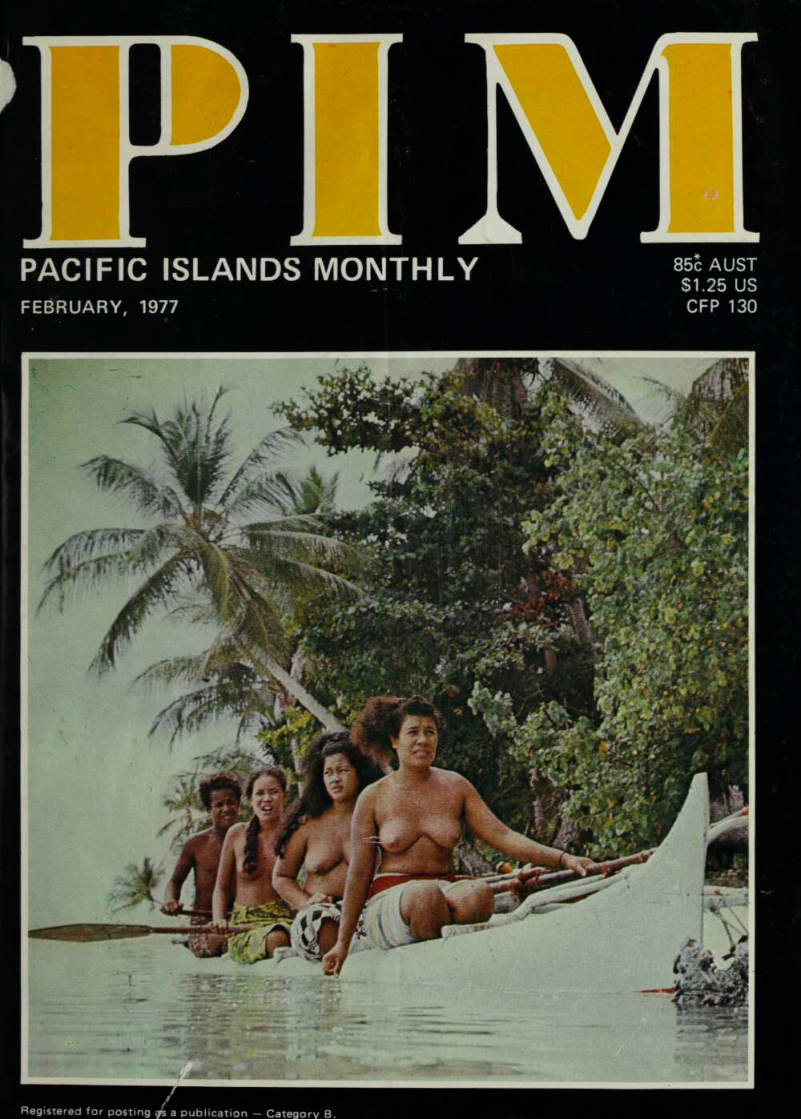
Our Cover
A canoe-full of lovelies, an every day scene in the lagoon at Kapingamarangi Atoll in the Caroline Islands. Australian phot ographer John H. Harding caught them with the camera as they paddled a handmade canoe around the former site of a Japanese seaplane base.
Advertisements & other items, pp. 2-4 (2 items)
2
PACIFIC ISLANDS MON i'HLY—FEBRUARY, 1977
one of the world’s finest cars.
When you buy a Toyota
we promise you much more than
We'll be the first to admit that at Toyota we make some of the world's finest cars.
You only have to look at them to see that.
And driving them just goes to confirm your first opinions.
But there's more to buying a car than buying a good one. You also have to be sure you can keep it that way.
Which is why Toyota have always insisted that their after-sales service be as good as the cars themselves.
In the Pacific Islands area alone we have over fifty designated outlets to provide everything you might need, from a simple service to a major overhaul. So get yourself a Toyota and get a lot more than a car.
And that's a promise. f
TOYOTA
SERVICE
Z/
TOYOTA
The Toyota range includes: Toyota 1000, Toyota Corolla, Toyota Celica, Toyota Corona, Toyota Corona Mark 11, Toyota Crown PAPUA, NEW GUINEA: ELA MOTORS LIMITED, Scratchley Rd., Badili, P.O. Box 75, Port Moresby. U.S. TRUST TERRITORY: MICROL CORPORATION I P.O Box 267, Saipan. FIJI ISLANDS: AUTOMOTIVE SUPPLIES CO.. LTD..G.P.O. Box 355, Suva. AMERICAN SAMOA: BURNS PHILP (SOUTH SEA) CO., LTD., P.O. 1057, Pago Pago. WESTERN SAMOA: BURNSPHILP (SOUTH SEA) LTD P.O. Box 188, Apia. GUAM: ATKINS, KROLL (GUAM) LTD., P.O. Box 6428, Tamuning. NEW HEBRIDES: NEW HEBRIDES MOTORS LTD., P.O. Box I ®-^'' a - ENTERPRISES (5.1.), LTD,, P.O. Box 174, Honiara. TAHITI: NIPPON AUTOMOTO, B.P. 342, Papeete. COOK ISLANDS: COOK (SLANDS TRADING ?n.?R^°rnv NAURU ISLAND: NAURU COOPERATIVE SOCIETY. GILBERT & ELLICE ISLANDS COLONY: TARAWA MOTORS, Box 36,Bainki Tarawa. NORFOLK ISLAND: MARIE S NORFOLK TOURS, LTD., PO Box 276 TIMOR- SANG TAI HOO Sang Tai Building, Dili. NEW CALEDONIA: SOCIETE IMPORTATION AUTOMOBILE DU PACIFIQUE, Rond-Pointdu Pacific (Stat.on Total) B.P. 438. Noumea.
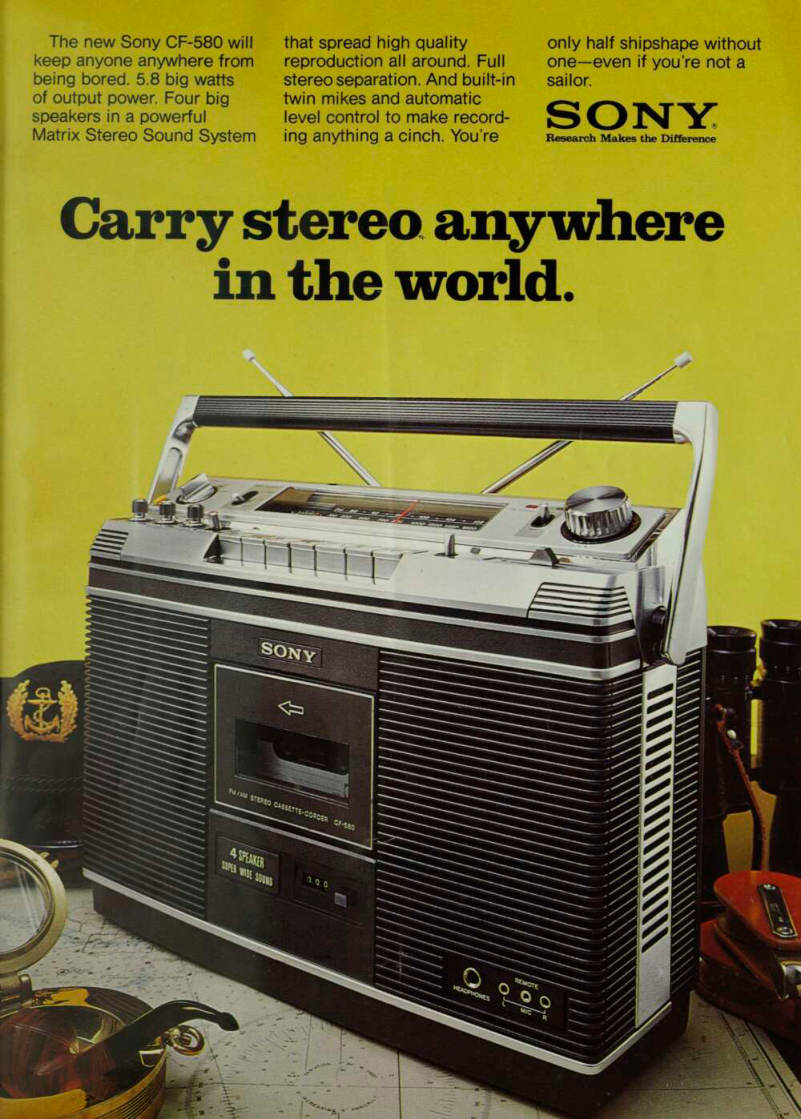
The new Sony CF-580 will keep anyone anywhere from being bored. 5.8 big watts of output power. Four big speakers in a powerful Matrix Stereo Sound System that spread high quality reproduction all around. Full stereo separation. And built-in twin mikes and automatic level control to make recording anything a cinch. You’re only half shipshape without one—even if you’re not a sailor.
SONY
Research Makes the Difference
Carry stereo anywhere
in the world.
Top performance takes the guesswork
out of going hi-fi.
No imitations here. Every one of the RONDO 2000 Stereo Sound Mates was component created and Pioneer blended into a total system stereo package. And at a price much lower than you think.
First, an advanced design AM/FM stereo receiver produces a powerful 13 watts per channel virtually distortion-free.
Accurate tonal management is achieved with separate bass and treble controls and AM/FM reception is clean and clear.
On the input side of the RONDO 2000 is a professional type manual turntable.
The super-smooth belt-drive mechanism provides loving care for your records.
Auto-cut at the touch of a button plus the convenience of auto-return.
On the output side, beautifully balanced two-way, two-speaker systems. Every earthy note from the big 20cm. woofers is enriched by the solid bass-reflex design cabinets.
And for your private listening pleasure, RONDO 2000 Sound-Mates include lightweight high-polymer headphones.
RONDO 2000 Stereo Sound Mates.
From stylus to speaker...the direct approach to top performance.
PIONEEIT
Pioneer Electronic Corporation
4-1. Meguro 1-chome, Moguro-ku, Tokyo 153, Japan Australia Pioneer Electronics Australia Pty. Ltd., 178-184 Boundary Road, Braeside, Victoria 3195, Phone: 90-9011, Sydney 93-0246, Brisbane 52-8231, Adelaide 433379, Perth 76-7776 Fiji Islands Brijlal & Company, G.P.O. Box No. 362, Suva, Fiji Islands Tel; 22258 New Zealand Fountain Marketing Ltd., Maidstone Street, Auckland, New Zealand Tel: 763-064 Norfolk Island Burns Philp (Norfolk Island) Ltd., Norfolk Island, South Pacific New Hebrides Burns Philp (New Hebrides) Ltd., Vila, New Hebrides Nauru Island Jacob Enterprises, P.O. Box No. 4 Republic of Nauru Tahiti
Est, PERFECT, B.P. 594,
Papeete, Tahiti Tel: 20 407 New Caledonia Menard Freres, B P. 123, Noumea, New Caledonia Tel: 27.52.22 American Samoa Traspac Corporation, P.O. Box 1477, Pago Pago, American Samoa 96799 Tel: 633-5224 Rarotonga South Seas International Ltd., P.O. Box 49, Rarotonga Cook Islands Tel; 2327
Pacific Islands
Monthly
Subscription Rates
Pacific Islands Monthly" is airfreighted to the ma jority of subscribers and agents in the Pacific Islands and the U S A Australia (including Lord Howe and Thursday Islands). New Zealand. Papua New Guinea. Fiji, New Hebrides, Tonga. Cook Islands, Western Samoa. Gilberts and Tuvalu, Norfolk Island, Niue and Nauru $9 00 (local currency). Solomon Islands $10 00 Aust , American Samoa, Micronesia and Guam $12 00 US: Hawaii and US Mainland $15 00 US, New Caledonia and French Polynesia 1,500 CFP United Kingdom C6 50, Japan 4000 Yen: Elsewhere $11 50 Aust
Representatives
Fiji: Advertising and Distribution — Fiji Times & Herald Ltd , 20 Gordon Street. Suva.
Telephone 312-111 Telex FJ2124 Papua New Guinea: Advertising and Distribution — PNG Post-Courier, P 0 Box 85, Port Moresby Inquiries Post Newsagency, Telephone 24-2148 French Polynesia: Distribution — Hachette Pacifique, 10 Ave Bruat. Papeete New Caledonia: Distribution — Depot Centre de Presse Michel PENTECOST, B.P.C2 NOUMEA New Zealand: Pacific Publications, CPO Box 2229, Auckland United Kingdom. The Herald and Weekly Times Limited. 8-10 Clifford's Inn. Fetter Lane, London EC4A 1BU Telephone 01-831 6041 Telex Lon don 21989 Japan: Advertising — Universal Media Corpora tion, CPO Box 46. Tokyo Telephone 666-3036 Victoria: Advertising — Pacific Publications (Aust) PtV Ltd • Herald and Weekly Times Building. 2nd Floor, 61 Flinders Lane, Melbourne, 3000 Telephone 652 1565 Brisbane: D Wood, Anday Agency, Box 1918 GPO. Brisbane 4001 Teluphone 44 3485 44 1546 Hawaii and US Mainland only: PIM, Hawaii, 2812. Kahawai St, Honolulu, Hawaii, 96822 Second class postage paid at Honolulu. Hawaii Printed in Australia Copyright c 1 976
Pacific Publications (Aust.) Pty. Ltd.
Printed by Paramac, Mitchell Road, Alexandria Registered at the GPO Sydney for transmission by post as a newspaper — category B Recommended retail price only
Vol. 48 No. 2 Feb., 1977
Up Front
with the Publisher
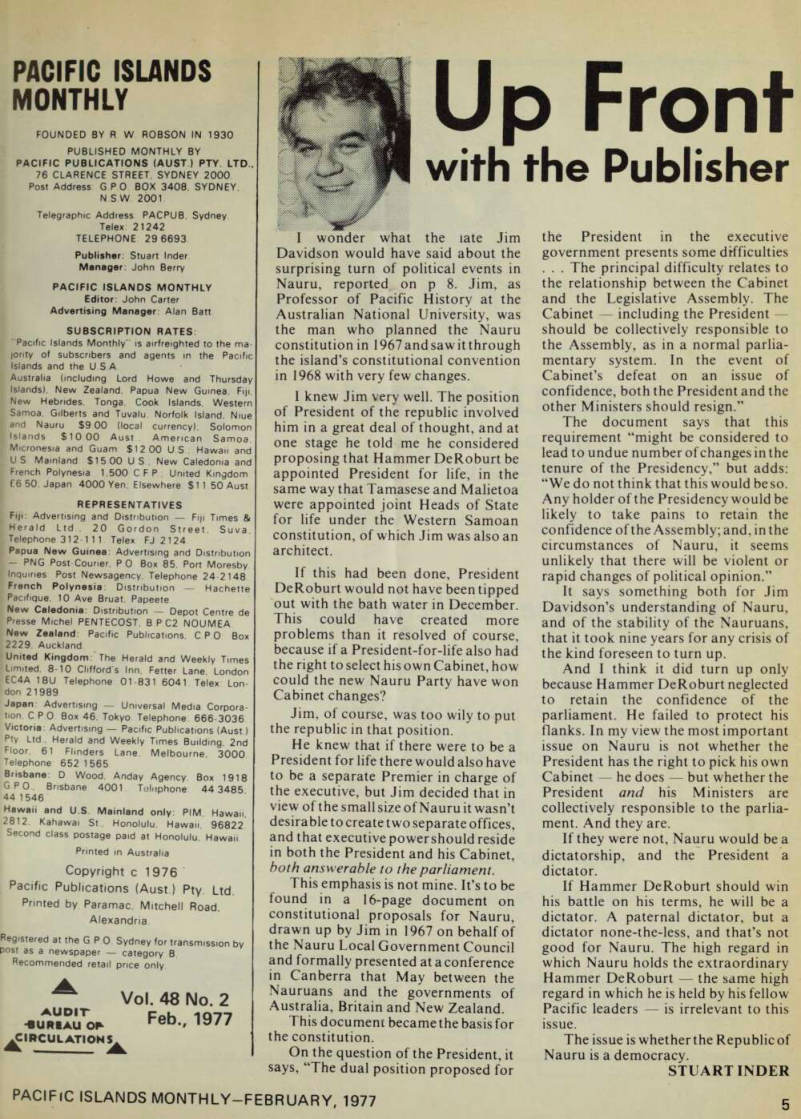
I wonder what the late Jim Davidson would have said about the surprising turn of political events in Nauru, reported on p 8. Jim, as Professor of Pacific History at the Australian National University, was the man who planned the Nauru constitution in 1967 and saw it through the island’s constitutional convention in 1968 with very few changes.
I knew Jim very well. The position of President of the republic involved him in a great deal of thought, and at one stage he told me he considered proposing that Hammer Deßoburt be appointed President for life, in the same way that Tamasese and Malietoa were appointed joint Heads of State for life under the Western Samoan constitution, of which Jim was also an architect.
If this had been done, President Deßoburt would not have been tipped out with the bath water in December.
This could have created more problems than it resolved of course, because if a President-for-life also had the right to select his own Cabinet, how could the new Nauru Party have won Cabinet changes?
Jim, of course, was too wily to put the republic in that position.
He knew that if there were to be a President for life there would also have to be a separate Premier in charge of the executive, but Jim decided that in view of the small size of Nauru it wasn’t desirable to create two separate offices, and that executive powershould reside in both the President and his Cabinet, both answerable to the parliament.
This emphasis is not mine. It’s to be found in a 16-page document on constitutional proposals for Nauru, drawn up by Jim in 1967 on behalf of the Nauru Local Government Council and formally presented at aconference in Canberra that May between the Nauruans and the governments of Australia, Britain and New Zealand.
This document becamethebasisfor the constitution.
On the question of the President, it says, “The dual position proposed for
the President in the executive government presents some difficulties . . . The principal difficulty relates to the relationship between the Cabinet and the Legislative Assembly. The Cabinet including the President should be collectively responsible to the Assembly, as in a normal parlia mentary system. In the event of Cabinet’s defeat on an issue of confidence, both the President and the other Ministers should resign.”
The document says that this requirement “might be considered to lead to undue number of changes in the tenure of the Presidency,” but adds: “We do not think that this would beso.
Any holder of the Presidency would be likely to take pains to retain the confidence of the Assembly; and, in the circumstances of Nauru, it seems unlikely that there will be violent or
rapid changes of political opinion.”
It says something both for Jim Davidson’s understanding of Nauru, and of the stability of the Nauruans, that it took nine years for any crisis of the kind foreseen to turn up.
And I think it did turn up only because Hammer Deßoburt neglected to retain the confidence of the parliament. He failed to protect his flanks. In my view the most important issue on Nauru is not whether the President has the right to pick his own Cabinet he does but whether the President and his Ministers are collectively responsible to the parlia ment. And they are.
If they were not, Nauru would be a dictatorship, and the President a dictator.
If Hammer Deßoburt should win his battle on his terms, he will be a dictator. A paternal dictator, but a dictator none-the-less, and that’s not good for Nauru. The high regard in which Nauru holds the extraordinary Hammer Deßoburt the same high regard in which he is held by his fellow Pacific leaders is irrelevant to this issue.
The issue is whether the Republic of Nauru is a democracy.
Stuartinder
Advertisements & other items, pp. 5-6 (2 items)
Pacific Islands Monthly-Februar Y, 1977
5
FOUNDED BY R W ROBSON IN 1930
PUBLISHED MONTHLY BY
PACIFIC PUBLICATIONS (AUST ) PTY. LTD.,
76 CLARENCE STREET, SYDNEY 2000
Post Address G PO BOX 3408, SYDNEY,
N S W 2001
Telegraphic Address PACPUB, Sydney Telex 21242
TELEPHONE 29 6693
Publisher: Stuart Inder Manager: John Berry
PACIFIC ISLANDS MONTHLY
Editor: John Carter Advertising Manager: Alan Batt
S. E. Tatham & Co. Pty. Ltd
m S. E. TATHAM & CO. PTY. LTD
BEEHIVE BLDG., 94 ELIZABETH STREET
G.P.O. BOX 8 CABLES "SET"
MELBOURNE, 3001, AUSTRALIA
TELEX; AA34552. TELEPHONE: 63 5094.
Buyers for the Pacific Islands
AND IN
Popup New Guinea:
S. E. TATHAM (P.N.G.) PTY. LTD.
LAE: MALAITA ST. (P.O. BOX 1562)
PORT MORESBY: Cnr. GOROA & MANAHU Sts., GORDON
(P.O. BOX 6733, B0R0K0).
Fiji: S. E. TATHAM (FIJI) LTD.,
LAUTOKA P.O. BOX 366,
SUVA G.P.O. BOX 671,
TELEGRAMS: ALL OFFICES “SET
YOUR GUARANTEE
SINCE t 924
IS % 1 1 1 1
FOR SERVICE
T4/R
Pacific Islands Monthly
General
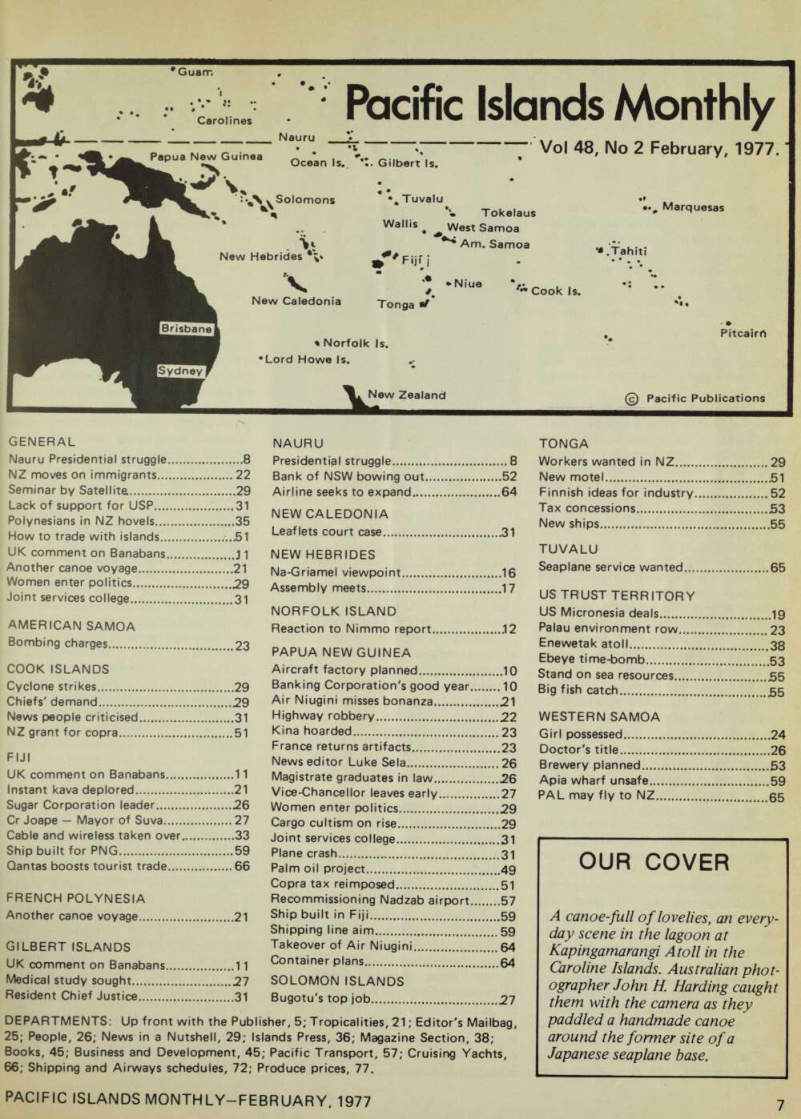
Nauru Presidential struggle 8 NZ moves on immigrants 22 Seminar by Satellite 29 Lack of support for USP 31 Polynesians in NZ hovels 35 How to trade with islands ...51 UK comment on Banabans 11 Another canoe voyage 21 Women enter politics 29 Joint services college 31
American Samoa
Bombing charges 23
Cook Islands
Cyclone strikes 29 Chiefs' demand 29 News people criticised 31 NZ grant for copra 51
Fiji
UK comment on Banabans 11 Instant kava deplored 21 Sugar Corporation leader 26 Cr Joape Mayor of Suva 27 Cable and wireless taken over 33 Ship built for PNG 59 Qantas boosts tourist trade 66
French Polynesia
Another canoe voyage 21
Gilbert Islands
UK comment on Banabans 11 Medical study sought 27 Resident Chief Justice 31
Nauru
Presidential struggle 8 Bank of NSW bowing out 52 Airline seeks to expand 64
New Caledonia
Leaflets court case 31
New Hebrides
Na-Griamel viewpoint 16 Assembly meets 17
Norfolk Island
Reaction to Nimmo report .12
Papua New Guinea
Aircraft factory planned 10 Banking Corporation's good year 10 Air Niugini misses bonanza 21 Highway robbery 22 Kina hoarded 23 France returns artifacts 23 News editor Luke Sela 26 Magistrate graduates in law 26 Vice-Chancellor leaves early 27 Women enter politics 29 Cargo cultism on rise 29 Joint services college 31 Plane crash 31 Palm oil project 49 Copra tax reimposed 51 Recommissioning Nadzab airport 57 Ship built in Fiji 59 Shipping line aim 59 Takeover of Air Niugini 64 Container plans 64
Solomon Islands
Bugotu's top job 27
Tonga
Workers wanted in NZ 29 New motel 51 Finnish ideas for industry 52 Tax concessions 53 New ships 55
Tuvalu
Seaplane service wanted 65
Us Trust Territory
US Micronesia deals 19 Palau environment row 23 Enewetak atoll 39 Ebeye time-bomb 53 Stand on sea resources 55 Big fish catch 55
Western Samoa
Girl possessed 24 Doctor's title 26 Brewery planned 53 Apia wharf unsafe 59 PAL may fly to NZ 65
DEPARTMENTS: Up front with the Publisher, 5; Tropicalities, 21; Editor's Mailbag, 25; People, 26; News in a Nutshell, 29; Islands Press, 36; Magazine Section, 38; Books, 45; Business and Development, 45; Pacific Transport, 57; Cruising Yachts, 66; Shipping and Airways schedules, 72; Produce prices, 77.
No Fun And Games When Party
Politics Creep Up On Nauru
The news that President Hammer Deßoburt had lost his job as President of the Republic of Nauru was one of the
most surprising political develop
ments to have taken place in the South Pacific in years.
Certainly the political understate ment of 1976 was the official announcement made in Nauru on December 22 that “the unexpected election of a new President has aroused keen interest among Nauruans.”
The election of 30-year-old Bernard Dowiyogo as Nauru’s second Presi dent had in fact stunned Nauru.
Nauruans were unable to talk of anything else over the Christmas and New Year holidays. Interest intensified when within a few days, it became obvious that Nauru was undergoing not merely a change of President but a constitutional crisis.
President Deßoburt is the man who achieved Nauru’s independence on January 31,1968, after successfully leading a long and stubborn fight for control of the island’s phosphate resources. Now aged 54, everybody expected him to retain the Presidency for as long as he wanted it.
The fall of the President occurred following the Nauruan general elec tions of December 18. The republic holds elections for the 18-member Parliament of Nauru every three years, and at the first meeting of the new parliament members elect a Speaker and a President. The President then selects his own cabinet of four.
Nauruan population is about 3,950, of a total of 7,100 people on the island.
Only Nauruans can vote, on acommon role.
A total of 1,348 votes was cast at the general elections for 41 candidates standing in seven constituencies. In one other constituency there was no election because the two members were
unopposed.
All but three sitting members were returned, and the only surprise among these was the defeat of Lagumot Harris in the Übenide constituency. Harris is Nauru’s Director of Civil Aviation.
The Übenide constituency elects four members, all the other con-
stituencies electing two each. Übenide is the electorate of President Dowiyogo, who polled second highest number of votes, after Buraro Detudamo, Minister for Works and Community Services.
Not at any time was President Deßoburt or any of his Cabinet Ministers in danger at the polls.
Voting in Nauru is along local, almost personal lines, with no great issues. Electioneering is low key, as all candidates and their policies are well known to the small community. The position of President Deßoburt was never an election issue, although there was criticism by some of the younger sitting members about the lack of performance of some of the President’s ministers, and about some of the country’s economic policies.
This young group had formed themselves loosely into the Nauru Party Nauru’s first political party, although one without formal structure or any great pretensions of having a firm platform. It was a group of like minded people, both inside and out of
parliament. Inside parliament its
members include, Bernard Dowiyogo, Kinza Clodumar, Laurence Stephen, Ruben Kun, Obeira Menke, Roy Degoregore and Leo Keke.
Kinza Clodumar, projects officer for Air Nauru, will be 32 in February, and has a degree in politics and economics from the Australian National University, Canberra. He is
one of the group’s leaders. Bernard Dowiyogo was also a student, in law, in ANU, after being at Ballarat College, Victoria. He will be 31 in February.
Leo Keke is a barrister.
This young, better-educated group took the view that the republic needed to manage its financial affairs in a more systematic way to get better use of the phosphate revenues available to it.
There has been a levelling out in phosphate returns in the last year or two as a result of the world recession.
They were also critical of “closed government” and felt too many decisions were being made in Cabinet without proper discussion that the Ministers were rubber-stamping decisions of the President, and that people weren’t being told what was going on.
This criticism of the Cabinet was an old complaint. Nauru has had thesame cabinet since independence in 1968, and for several years President Deßoburt has been put under pressures to make changes, without result. He failed to make changes after the previous general election. There has been criticism of the conservative attitude of Austin Bernicke, Minister for Health and Education, and of James Bop, Minister for Finance.
Criticism of President Deßoburt’s economic policies had last come to a head in July, when parliament refused to pass financial bills and forced the President to resign. When, an hour or two later, the Speaker called for nominations for election of a new President there was only one nomination that of Deßoburt.
The young members of parliament who were responsible for forcing his resignation meant this as a warning to President Deßoburt not as a warning that his leadership was in jeopardy, but as a reminder that
parliament also had adutyandthatthe
republic was not to be managed as a one-man band, even by a man as highly-respected as President Deßoburt.
It is likely that President Deßoburt saw the action differently. That he saw it as an irresponsible action that failed because there was nobody strong
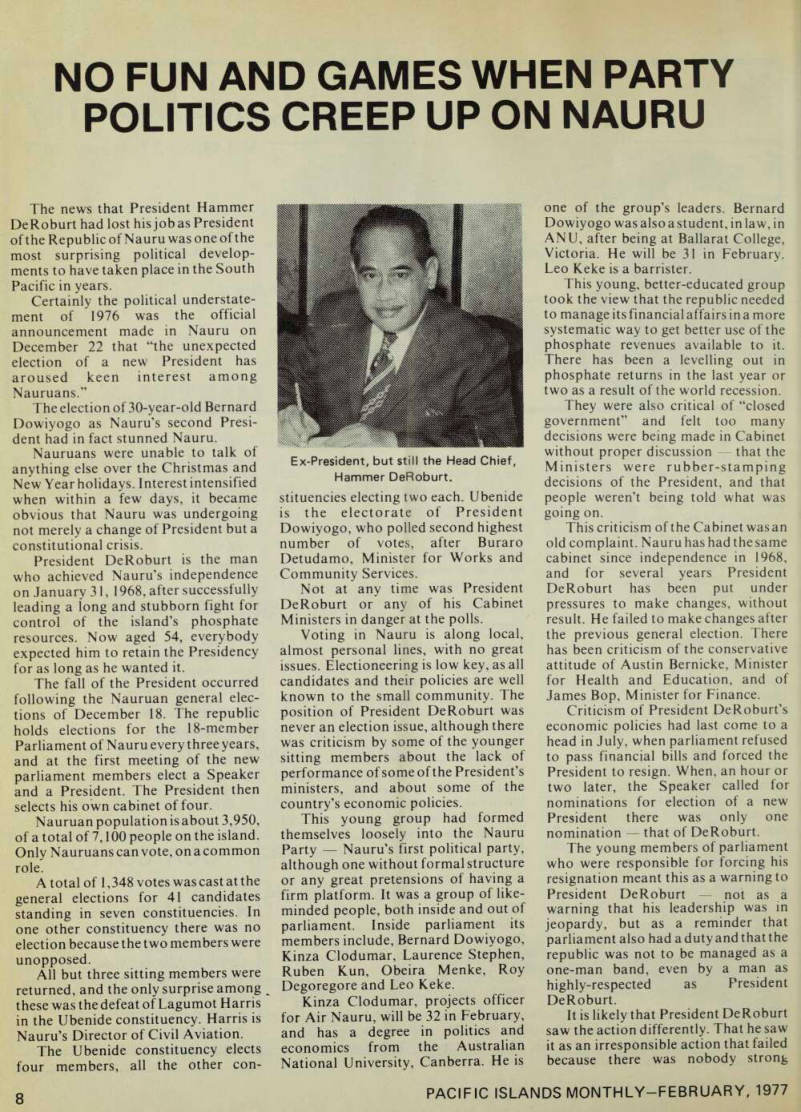
Ex-President, but still the Head Chief, Hammer Deroburt.
enough to effectively oppose his leadership even when the opportunity presented itself.
In any case, hedidn’theedthestorm warnings on December 21 when the new parliament met to elect a Speaker and a President of the small republic Before the actual sitting began, the new parliament met behind closed doors for a general unofficial discussion on attitudes and procedures. At this meeting the “ginger group” made it clear that this time they definitely wanted some Cabinet changes, and they sought to get an undertaking from Deßoburt.
Although the election for President was still to be held, there was no question in anybody’s mind that Deßoburt would not be re-elected.
President Deßoburt was unexpec tedly unco-operative. He stressed that it was the President’s prerogative to select his own Cabinet and he would give no undertakings beforehand. He was further pressed, but remained adamant that the principle was not to be interfered with.
He indicated at the last moment that if his opponents disagreed, the remedy was in their own hands they would oppose his leadership. This is something the young group did not want to do, but after being challenged they were left with no choice.
Even then, when election timecame they nominated in turn various members of the former Cabinet for the position of Speaker, knowing that if anyone of them accepted nomination it would indicate they knew their Cabinet post was insecure. Each man declined nomination.
The former Speaker, Kenas Aroi, was re-elected.
For the post of President, there were two nominations those of Hammer Deßoburt and Bernard
Dowiyogo. Kenas Aroi chose not to vote and one of the four members for Übenide, Victor Eoaeo, was missing from the chamber at the crucial time.
The ballot was 9 to 7 for Dowiyogo.
The young members had expected
to count on eight votes, and this result was unexpected and stunning. The baby had been thrown out with the bathwater.
Immediately after the ballot, the Speaker adjourned the House for several hours during which time behind scenes, the Nauru Part} assured Deßoburt that the new President would resign and make way for Deßoburt’s re-election, if he now recognised the strength of their feelings and agreed to cabinet changes.
Hammer Deßoburt is a stubborn, resolute man, a strong believer in principle. He made it clear that the principle as he saw it was that the President chose his own Cabinet. No amount of pressure could get him to change his mind, even after he held a long private meeting with members of his former Cabinet Austin Bernicke, Buraro Detudamo, James Bop and Joseph Detismea.
The Nauru Party was left with no alternative but to get on with the business of governing.
President Dowiyogo chose as his Minister for Finance and Minister Assisting the President, Kinza Clodumar.
Kenas Aroi accepted the portfolio of Minister for Islands Development and Industry, and Minister respons ible for Civil Aviation and thus became an important asset. Aroi, an older man, is highly regarded as a sound and responsible man. He shares with Hammer Deßoburt the constituency of Boe. (In accepting this ministerial post Aroi resigned the Speakership, and Samuel Tsitsi was elected.) Appointed Minister for Works and Community Services was Rubin Kun.
The President retained for himself the portfolios of Minister for External Affairs, Justice and the Public Service.
A fourth member of Cabinet was not
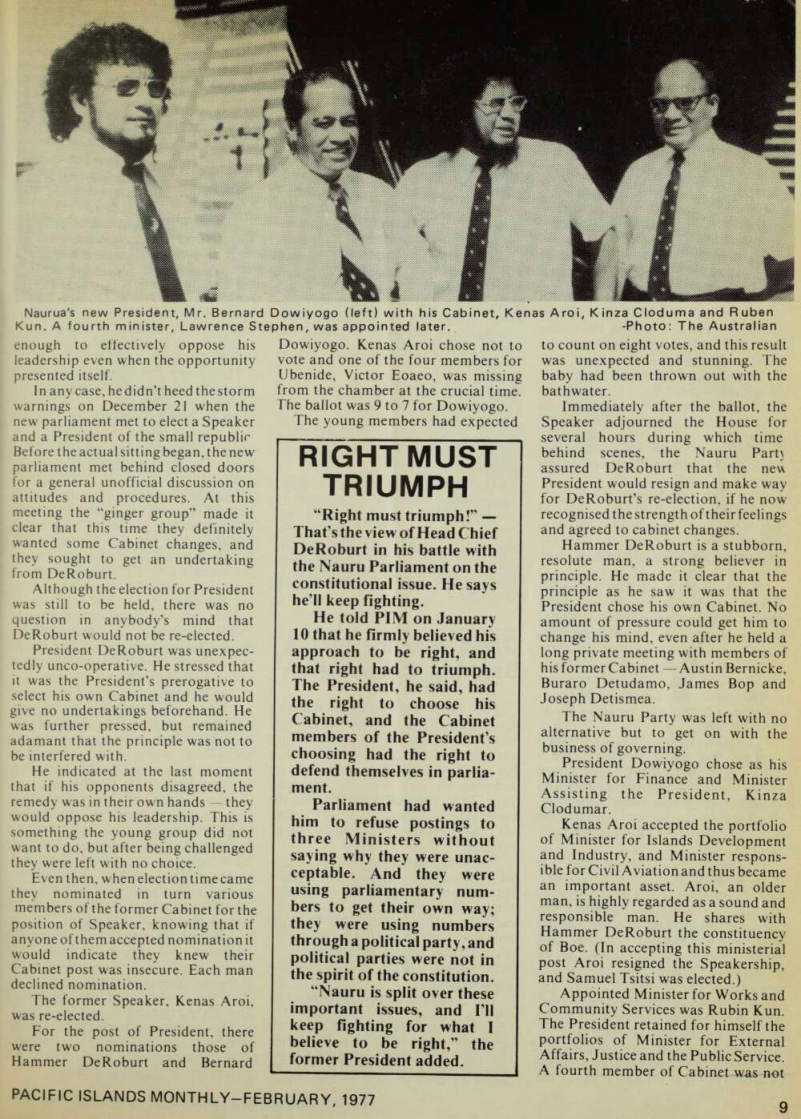
Naurua's new President. Mr Bernard Dowiyogo (left) with his Cabinet. Kenas Aroi. Kinza Cloduma and Ruben Kun. a fourth minister, lawrence Stephen, was appointed later.
selected tor a few days Lawrence Stephen, who took over the portfolio of Health and Education. He has been Nauru’s Assistant Director of Educa tion.
The new President issued a statement paying great tribute to former President Deßoburt, stating that his name “will take an imperishable place in Nauru’s history as the founding father of independ ence.”
He said he was confident that as Head Chief of the island (a post which Deßoburt holds separately under the powerful Nauru Local Government Council) his “contribution to the prosperity of the island in the future will be more than comparable to his great achievements as President.”
Head Chief Deßoburt moved immediately from State House on the hill to his own home which he has always retained neartheciviccentreon the waterfront.
For the next week, the new Cabinet met into the night, takingoverthereins of government.
By Christmas eve, Deßoburt fought back by calling a special meeting of parliament for that day, which can be done under the constitution if any six members want it.
He proposed in a motion that the House should agreeMhat the recent changes were outside the constitution, because they involved party politics, and there was no provision for party politics in the constitution. Nor was party politics in the spirit of the views expressed at the constitutional con vention which had agreed to the constitution.
The debate was not concluded because the new Speaker, Edwin Tsitsi, who is Nauru’s Government Printer, was unable to keep order and resigned, not merely from the Speaker ship but from parliament, thus forcing a by-election (to be held on February 5.) Not until the following week was a new Speaker, David Gadaraoa, appointed, with Derog Gioura elected Deputy Speaker, but despite pro longed debate the motion was still not resolved, although it certainly gave every opportunity for views to be ventilated. The public gallery was crowded.
Meantime, President Dowiyogo’s new government found itself under great social pressure on Nauru.
Head Chief Deßoburt argued that for the sake of the republic they should resign. The new leaders replied that
they had worked within the democratic framework and that Head Chief Deßoburt should accept the will of parliament or else be labelled a dictator. It was also argued during parliamentary debate that the crisis might be resolved by those former ministers to whom the new govern ment objected declaring that they would not be available for Cabinet reappointment, thus clearing the way for Deßoburt’s re-election.
The crisis soon became as much a test of the Nauruans. If they wanted Deßoburt returned, whose principles should be sacrificed? It was a demo cratci coup, and should democratic principles be sacrificed to please the former President? And it soon became obvious that after the first shock of finding itself in office, the new government began to settle into the role that it had unexpectedly won for itself. Minister in charge of Civil Aviation Kenas Aroi represented Nauru at an inaugural flight of the government-owned Air Nauru to Tonga, and was well received by King Taufa’ahau, who said he planned to call briefly at Nauru on January 15 en route to Guam. The Cabinet also started to examine in detail some of the decisions of the former President and evaluate their effect on the Nauruan economy.
Good year for PNG’s
Banking Corporation
The Papua New Guinea Banking Corporation overcame depressed economic activity and periods of un certainty about liquidity to turn in a net profit of K 760,000 for 1975-76, an increase of 24% over the previous year. The improved result allowed the corporation to double, to K 100,000, its contribution to consolidated revenue.
The corporation, in 1975-76, open ed four new sub-branches, to bring the total number to 13. Its total represen tation throughout the country by banking outlets is now 223. The cor poration, in intensified education programmes, made extensive use of audio-visual aids to spread banking knowledge.
The corporation approved new
loans of almost K 1 million, which suggested a depth of demand for credit for worthwhile purposes, which had yet to be fully satisfied by the country’s banking institutions.
Aircraft factory
planned for PNG
Douglas Airways Pty Ltd, a PNG company, is to assemble Australian Nomad aircraft at a plant in Port Moresby.
The deal between Douglas Airways and the Australian government air craft factory in Melbourne was an nounced late in December by the managing director of Douglas Airways, Mr Denis Douglas, as a “partial assembly” operation and in itially it will amount to the installa tion of internal equipment and finishing work.
However, the content of local assembly is expected to increase as the operation develops.
About $55,000 is being spent on the Port Moresby assembly plant, and a technical team from Australia was to arrive in January to advise on the project.
Initially the assembly scheme will be used to provide Nomads sold in PNG, including a fleet which is being established by Douglas Airways itself.
Later, however, if the operation proves economically sound, Douglas Airways could make export sales un der licence.
There are two Nomads operating in PNG at present one with a small charter operator on the north coast of mainland PNG, and the other with Douglas Airways.
Mr Douglas said he had embarked on the assembly deal for two reasons.
One was that he believed the Nomad with its basic engineering and short-field performance appeared to be one of the most suitable aircraft in the world today for PNG operations.
The other reason was that politically-independent PNG had already proved itself economically stable, providing a sound launching base for an aircraft assembly project.
The PNG-assembled Nomads will have a higher seating density than the Australian units, giving them capacity for 15 passengers instead of 12.
Meanwhile, the PNG Transport Minister, Mr Bruce Jephcott, has given tentative details of a ship building project to be established at Madang on the central north coast of the PNG mainland.
Mr Jephcott did not reveal the in vestment interests involved, but said the government had given an assurance of initial contracts.
Triumph
Right Must
“Right must triumph!”
That’s the view of Head Chief Deßoburt in his battle with the Nauru Parliament on the constitutional issue. He says he’ll keep fighting.
He told PIM on January 10 that he firmly believed his approach to be right, and that right had to triumph.
The President, he said, had the right to choose his Cabinet, and the Cabinet members of the President’s choosing had the right to defend themselves in parlia ment.
Parliament had wanted him to refuse postings to three Ministers without saying why they were unac ceptable. And they were using parliamentary num bers to get their own way; they were using numbers through a political party, and political parties were not in the spirit of the constitution.
“Nauru is split over these important issues, and I’ll keep fighting for what 1 believe to be right,” the former President added.
UK says: Let’s not indulge
The Banabans
UK says: Let’s not indulge in recriminations
In a statement commenting on the result of the Banabans’ legal action in the British High Court, the British Government says it “does not wish to indulge in recrimination about the past’’, but will “look to the future’’.
The Government says it will “naturally give consideration to what the judge has said’’, but defends Britain’s part in the Ocean Island question. Here in full is the government’s official comment, released in London in late December.
The judgments in two actions in the High Court brought by the Banabans against the Crown in both, and the British Phosphate Commissioners in only one, were concluded by Vice- Chancellor, Sir Robert Megarry, on December 3. The judge dismissed all claims against the crown in both actions.
The judge said that the claims relating to “Crown Royalties” (which contended that, under proper con struction of certain ordinances, payments made to the Gilbert and Ellice Islands Colony Government by way of taxation should have been paid to the Banabans as royalties) were so unmeritorious that they should not have been brought at all.
As regards to royalties paid to the Banabans, he ruled that the various arrangements (principally in 1930, 1931, 1947) did not constitute a series of true trusts and that the Crown’s obligations were government in nature and not fuduciary obligations justici able in the courts.
In dismissing these claims he did however, draw attention to what he regarded as certain “grave breaches” of governmental obligations.
“The worst” was the process by which the level of phosphate royalties was fixed in 1931, including the fact that it was fixed by the same Resident Commissioner (Mr Arthur Grimble) who had written “an outrageous” letter IVi years earlier. The other breach, which Sir Robert Megarry described as the gravest in its consequences for the Banabans, was thefailuretoensure that they had proper advice when they embarked on the 1947 negotiations.
The claim that the Crown was liable in that it failed to prescribe the trees to be replanted was dismissed. The British Phosphate Commissioners were found liable on their obligations to replant in respect of some, but not all of the lands which were subject of the claim, but the judge
defined “replanting” in a very narrow sense that excluded any obligation to rehabilitate fully, bring in soil or build access roads (which was anyway not
feasible).
He made no order for specific performance (ie, that the replanting should be done) and considered damages an adequate remedy. He has not ruled on the amount of damages, on which he wishes to hear further argument if it cannot be settled out of court.
The High Court has confirmed that the British Government was not in breach of any fiduciary duty, either in allowing the Gilbert Islands to levy taxation on the Ocean Island phosphate operation or in prescribing or allowing the British Phosphate* Commissioners to negotiate with the
Banabans the level of royalties fixed in 1931 and 1947.
Her Majesty’s Government will naturally give consideration to what the judge has said. However, his reference to governmental failures related essentially to the processes by which the level of royalties was fixed in 1931 and 1947. He did not rule that these were too low. Since 1947 the Banabans, who number about 2,500, have received about A$ 12 million, and at present phosphate prices stand to receive as much again before mining ends.
The judge also paid tribute to the Colonial Office and the Resident Commissioner’s continuing concern for the protection of the Banabans. He commented that the King’s Regula tions which were applied to the Banabans on Ocean Island were “plainly designed to protect the native inhabitants against exploitation” and he emphasised that the Banaban decision to make Rabitheirpermanent headquarters and home had been entirely voluntary, after lengthy discussion and a secret ballot.
The judge referred critically to a letter sent in August 1928 by Mr Arthur Grimble, the Resident Com missioner on Ocean Island, to a group of Banaban villagers which threatened compulsory acquisition of their land and indiscriminate mining unless they accepted a proposed agreement.
The judge explained the difficult position and circumstances in which Grimble was operating at that time, including his state of health, and said the letter was wholly out of character for a man who was a dedicated colonial servant with a deep affection for the Banabans. However, even bearing all this in mind, it was impossible to read the letter without a sense of outrage.
Her Majesty’s Government con siders the judge’s comment to be
Continued on p. 71
balanced and fair. As he himself pointed out however, the letter seems wholly out of characer and there is no reason to suppose that any improper considerations influenced MrGrimble when he prescribed the royalty in 1931, and evidence was produced to the court that this was a fair one in the circumstances of the time.
The existence of the letter was unknown to any other officer of the local or UK Governments at the time and did not come to light until it was produced by the Banabans in the court action.
The judge referred a number of times to the Banabans’ tendency to resort to untrue or misleading statements, for example a statement they had madetothe United Nations of which hesaidthatnoonewhoknewthe facts could escape the conclusion that a forceful presentation of their griev ances had been marred by significant omissions of what was true and intemperate assertions of what was false.
He cited the Banabans’ allegation that they were coerced to living on Rabi, without any mention of the secret ballot or of the large majority obtained for staying on Rabi.
The statement also alleged that the British Phosphate Commissioners had desecrated a Banaban cemetery, shipping “the remains of our forefathers” to “fertilise the farms in Australia and New Zealand.” The
judge said that the damage to this cemetery was in fact caused by Japanese earth works and fortifica tions there during the war and he dismissed this allegation as “stupidly and offensively false.”
“The Japanese transferred most of the Banabans to other islands and when in 1945 Ocean Island was recovered from the Japanese it had been devastated and was unin habitable. Though the Banabans’right to return to Ocean Island has been carefully preserved, it was plainly impossible for them to go back immediately after the war.”
He also said that from any practical point of view there has long been no question of the Banaban community as a whole returning to live on Ocean Island.
The legal actions were not concerned with the constitutional future of the Banabans and Ocean Island. Her Majesty’s Government hopes that it may now be possible to pursue efforts to find an agreed solution to this wider problem.
Her Majesty’s government does not wish to indulge in recrimination about the past.
We must look to the future, recognising that for the bulk of the Banaban people this must lie on Rabi.
We must not allow the constitutional issue to obscure what matters most: the welfare of the communities concerned, Banaban and Gilbertese.
Phosphate End
By Maunaa Itala
The Sun sends extra heat.
On the heating sand my pig Is black and skinny and sick.
Her bones are clear to see.
On weak breasts her small ones feed, while on old dry fish bones she gnaws Because all else is gone.
Two fat healthy pigs: White is the one. black is the other, The last milk is gone.
Thinner and thinner her frame grows, They suck even her blood.
Her skeleton shakes.
On blazing sand falls fat, Deep the last breath she takes.
White is the one, black is the other.
Fatter, stronger, more healthier they grow, Happily, strong they go away.
My mother, my mother but a skeleton!
My brothers, my sisters tiny dry bones! • The poem depicts the forthcoming end of the phosphate on Ocean Island, the claims by the Banabans and the Gilbertese — and the British.
“Because we’re different why
Norfolk Island Reply
“Because we’re different why should we be punished?”
The Nimmo Report on the future constitutional position of Norfolk Island has caused the greatest controversy on the island since it was first occupied in 1856 by the descendants of the mutineers of the "Bounty”, who moved to Norfolk because Pitcairn was overcrowded. If adopted, the Nimmo report will mean great changes to their island lifestyle. William Blucher, president-of-committees of the elected Norfolk Island Council, at a special council meeting, has defended this life-style in an impassioned appeal to the Australian Government not to act hastily over the report. He asks for a referendum of islanders and says that if, in the meantime, any of Sir John Nimmo's recommendations are put into effect it should be regarded as "an indefensible intrusion against human rights". In this and the following pages, PIM publishes the main points of this Norfolk Islander's defence of Norfolk Island.
The Norfolk Island Council, who are the only elected representatives of the people of Norfolk Island, have been asked to comment on a very complicated set of proposals that would radically change the way of life on the Island.
This set of proposals is made in the Report of the Royal Commission into Matters Relating to Norfolk Island.
The Royal Commission was ap pointed because the Australian Government of the day believed that Norfolk Island’s present form of ad ministration had become outmoded and inappropriate.
In urging the council to state its views quickly, the Administrator has several times said, “The place to begin is at the beginning.”
I agree that we should begin at the beginning, but with respect I do not accept the idea that the Royal Com mission Report is the beginning. The true beginning is the Norfolk Island way of life.
Since 1856, when our ancestors the Pitcairn families were re-settled on Norfolk and the Island was set apart for them, a most unusual and distinc tive way of life has grown here and taken shape.
The Norfolk Island way of life is the result of many forces.
It is based partly on the fact that we are an island, three miles by five miles in size, a thousand miles out in the Pacific Ocean from Sydney, with a population now of about 1600 people.
Our way of life is partly based on the fact that this is a very beautiful island, with a semi-tropical climate and good soil.
It is also an important part of our
way of life that since 1856 we have been a territory under the protection and guidance of, first, England, and since 1913, of Australia.
We have for generations been an almost fully self-supporting territory. 1 say “almost” because the island needs help and guidance mostly guidance from people who have ex perience that we lack.
It would be wasteful for us to make and support our own currency, for ex ample, and it is a help to us to be able to use Australian currency. It would be foolish for us to try to have our own foreign affairs representation in other countries, and Australia provides that for us. It is reassuring to us to have the protection of a large country with defence forces, because we could not defend ourselves.
We need good educational curricula, and we need teachers who have been well trained. We need good health regulations to follow. We need guidance in the form of laws that have been written and used elsewhere, which we can examine and learn from in working out laws that are suitable to Norfolk Island.
We need an international standard of air and shipping safety regulations.
We need higher courts where decisions made in the Norfolk Island Court can be appealed to.
We need many such kinds of guidance Australia kindly provides them, although Norfolk Island pays most of the actual costs involved.
We pay for our own school for ex ample, and for our own hospital.
But some services are provided free, and we hope these would continue to be provided free: as an example,
foreign affairs representation. We are glad to have Australia represent us in many countries of the world without asking us to pay, just as England represented Australia in many coun tries of the world without asking Australia to pay.
It has been charged that Norfolk Island is a serious economic burden to Australia.
This charge is made by Sir John Nimmo, the Royal Commissioner, who stales that there were $2,500,000 of annual outgoings from Australia to Norfolk Island in the last financial year. This sum was worked out by the Department of the Capital Territory in a submission made to the Royal Commission.
The calculation is false. It was refuted at the lime by the Norfolk Island Council, and I will be glad to refute it again for anyone who is in terested. In these remarks I will men tion only three examples of the falseness of the calculation. 1. The Norfolk Island Meteorological Station is included as a $67,000 annual outgoing from Australia to Norfolk Island. This sta tion makes no forecasts for Norfolk.
It exists purely as a reporting station required by the Australian meteorological system. It is not a cost of Norfolk Island, but of Australia. 2. Losses of $750,000 a year by Qantas on the Sydney-to-Norfolk route are included as an annual outgo ing from Australia to Norfolk Island.
This sum was the result of an Australian policy that Qantas should operate the route. East-West Airlines has just been appointed to take over the route, and it expects to earn
money on the run. It will need no Australian subsidy. There is no $750,- 000 annual outgoing from Australia to Norfolk Island. 3. The cost of services provided to Norfolk Island by the Australian Department of Labour and Immigra tion, and the Australian Department of Education, is included as being $435,700. These two departments submitted no cost estimates whatsoever, and they provided no significant services whatsoever. The figure of $435,700 is sheer fantasy. It was invented because a grand total of $2,500,000 sounded like a nice, round number. $435,700 more was needed to reach that number, and those two departments were the only ones not heard from.
In all, there are 28 items of sup posed “annual outgoings from Australia to Norfolk Island” in the calculation presented by the Depart ment of the Capital Territory. At least 21 of these items, in the opinion of the Norfolk Island Council, are either seriously overstated or are totally inapplicable to the true costs of the island.
I have mentioned only three of those items. Those three total $1,252,- 700, which is more than half of the imagined total of $2Vi million a year.
Any calculation that includes a few false items, amounting to over half the total, is a false calculation that should not be relied on until it has been completely re-examined and corrected.
Sir John Nimmo accepted that false calculation without examining it closely for accuracy. He then used it as a foundation on which to build his entire report and his recommen dations for the island.
After spending a year on his en quiry, Sir John concluded that the most important and vital decision, from which all other decisions must flow, is whether Australia should abandon Norfolk Island or continue to accept responsibility for main taining it.
In weighing that all-important deci sion, he says: “If the Government chooses to stay in the island, it should set out clearly the conditions and policies under which it will continue to treat the island as part of Australia. As the net overall financial burden is clearly be ing borne by mainland Australia and no one else, it is proper that the Com monwealth Government should have this choice.
“If Norfolk Island residents were
meeting this cost then they would have a case for exercising the choice themselves via a referendum. It would be nonsensical for a minuscule group of 1600 people, who have never con tributed anything to Australia by way of taxes and from whom Australia can be expected to receive minimal or no economic benefit, to claim the right to demand that Australia con tinue to support them on their own terms.
“It is Australia’s choice, not theirs, and it is for Australia to set down the terms under which it may be willing to continue to pay for the sustenance of Norfolk Island.”
Sir John Nimmo has accepted a false calculation, and his major con clusion is false as a result.
The net overall financial burden of Norfolk Island is not being borne by mainland Australia, but by the people and the economy of Norfolk Island itself.
The people of Norfolk Island are not, as Sir John assumes, claiming any right to demand that Australia continue to support them.
Australia is not paying for the sustenance of Norfolk Island. The island very largely pays for its own sustenance, and the people of Norfolk Island should, as a matter of fairness, have a voice in shaping the future of the island.
Many nations have many territories that must be heavily subsidised. The Royal Commission figures give a false and, 1 feel, degrading impres sion that Norfolk Island is such a territory. It is not.
Norfolk Island virtually supports itself. It has done so for 120 years. It has no public debt, but actually has a small surplus in reserve. 1 would think Australia would find this a source of pleasure and satisfac tion, rather than trying to pretend that we are a serious burden.
The good way of life on Norfolk Island comes from the earth, the sun,
the rain, the sea, the hard work and co-operation of the people who live here, and from the beauty and peacefulness of the island, which at tract a growing number of tourists here. It does not come from Canberra or from the Australian budget.
Sir John Nimmo says that perhaps Australia should abandon Norfolk Island, on the grounds that it is a great expense. I hope this notion will be recognised as being exactly what it is preposterous! But if it should for some strange reason be taken serious ly, and Australia should abandon us, we could certainly want to find another large power that would be ac commodating enough to provide the kind of support we do need, at very little cost to itself . . .
If you ask people on Norfolk Island whether they like the Norfolk Island way of life, the answer is an overwhelming “yes”. People here prefer it to the way of life they may have known anywhere else in the world.
But now a Royal Commission report has recommended that our way of life be almost completely changed.
I will speak about twelve of these recommended changes. Many others are recommended as well. 1. Self reliance. Norfolk Island is largely self-supporting. People who live here know that we have to get along pretty well on our own. We do not look to the outside world for hand-outs.
The Nimmo Report recommends that we be meshed into the Australian Government financial system, and that we be encouraged to rely on economic support from Canberra. 2. Our laws. Norfolk Island has its own set of fairly simple and clear laws, most of them made to suit the needs of the island. In general, it is possible for an ordinary citizen to get a copy of the law on some subject, read it, understand it, and know what he can do. In the past several years the
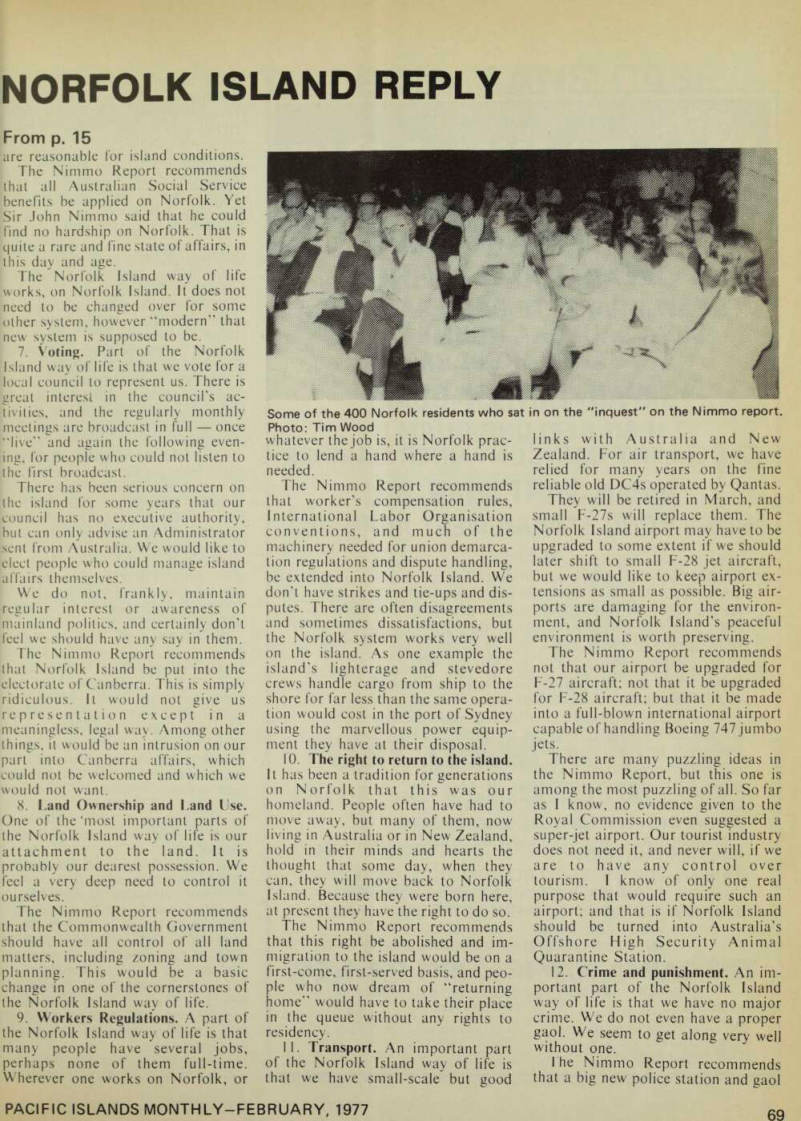
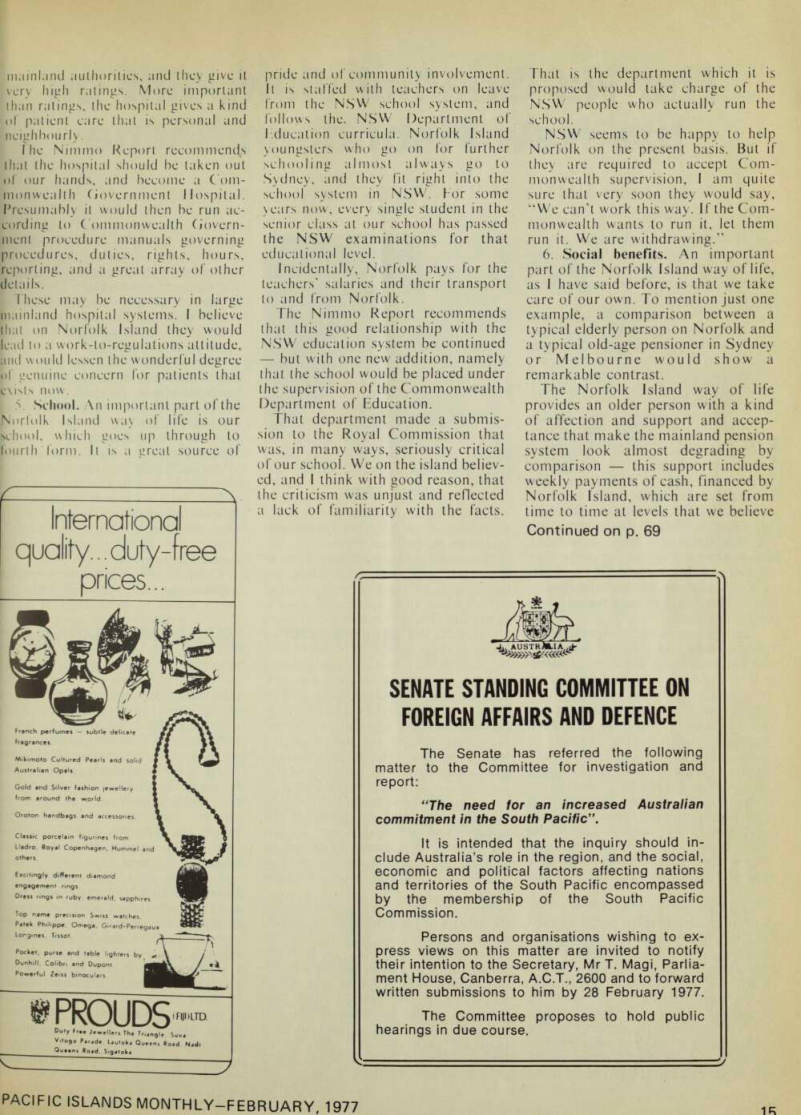
About 400 Norfolk Island residents attended this meeting in the Rawson Hall to discuss the Nimmo report, which got a mixed reception.
Photo: Tim Wood
council has been increasingly concern ed about the number of new laws that have been imposed on the island from Canberra, not because they were needed or wanted here, but because Australia wanted them.
The Nimmo Report recommends that our own set of laws should have superimposed on it the entire tangled range of Australian laws. 3. Taxation. It has been thought by some that Norfolk Island is tax-free.
This is not so. There is a considerable Norfolk Island tax system but it is a Norfolk Island kind of system.
We pay customs duties on all goods that are shipped into the island, and that is a great deal, because we produce no manufactured goods ourselves. We pay extremely heavy freight charges to bring these goods in, and this is a form of tax that affects every one of us in a real way.
We pay an annual works call levy.
Some years ago the works call system was more typical of Norfolk Island than it is now; each man was expected to work a certain number of days per year on the roads, or on other com munity jobs. He could pay money in stead of working, if he preferred. That system was abolished by Australia because it felt it was a violation of some United Nations agreement against “forced labour”. I thought the change was a shame. Now everyone just pays the money.
We pay a kind of tax through a local Norfolk Island Administration monopoly on the sale of beer, wines and spirits. These are sold at prices far below mainland prices, but there is still a very large margin of profit that helps pay local government expenses.
We pay a wide range of small fees for registration of cars, dogs, guns and other such matters.
We pay a Norfolk Island form of tax for transport that is, do it yourself! There is no government transport of any kind on the island, and every individual expects to pay for and maintain his own transport.
The same thing applies to water and sewerage. There is none provided by government. Every home must catch, or dig for, its own water supply, and provide its own sewerage, which must meet proper health re quirements.
City people may think that water is free if you catch it from the rain, but catching it, storing it and pumping it are very expensive and uncertain operations, which government does on the mainland, but which Norfolk Islanders do for themselves.
We on Norfolk Island pay another kind of tax every day, although we scarcely think of it that way. On Nor folk Island we care for our own.
When someone is ill, or in need, or requires a hand, family and friends and neighbours make the effort to help. We do not pay taxes to a govern ment and say, “here you look after these hardship cases for us”. We do it ourselves.
Norfolk Island is not tax free. We pay substantial taxes, in a Norfolk Island manner.
The Nimmo Report recommends that the full range of Australian taxes should be added on top of the Norfolk Island taxes that seem to be adequate for our needs.
I would not question the need for heavy income taxes in Australia.
There are many mainland jobs that have to be done by the Com monwealth Government.
It must finance vast Government offices and wages and expenses; a defence force; tremendous transport
systems; a postal system; universities; research; foreign affairs representa tion overseas; agricultural services; it must provide heavy support for the States; it must pay heavy interest on the national debt; and it must pay for very extensive social welfare benefits; it must pay its share of developing countries to develop themselves. But these have very little to do with Nor folk Island.
Taking a general economic view, there is no question that the addition of heavy new Australian taxes would considerably increase the costs, and therefore the prices, of our tourist in dustry. The tourist industry is our only significant way of bringing new, outside income into Norfolk Island.
We are keenly aware of the need to keep the growth of tourism under con trol, so that it does not spoil the island, but the entire island needs the income that the industry yields. I do not think there is any question but that heavy added taxes would make Norfolk Island much less competitive in the tourist industry.
It might hurl the island only moderately; it might hurt it very greatly; but I do not believe Norfolk can risk a gamble with its only real in dustry.
It is in competition with New Caledonia, Singapore, Fiji, Flonolulu, and Australian and New Zealand resorts and the competition is very close indeed. Our tourist industry should be nurtured and encouraged. It must not be made less competitive. 4. Hospital. Part of the Norfolk Island way of life is that we have our own 17-bed hospital, with a full-time doctor, a part-time doctor, and various consulting doctors that call in to the island from time to time. The hospital is regularly inspected by
The peace of Norfolk Island in contrast to the turmoil created by the Nimmo Report. Left, Bloody Bridge; centra rear view of St. Barnabas Church and, right, Kingston.
Photo: Qantas
mainland authorities, and they give it very high ratings. More important than ratings, the hospital gives a kind [of patient care that is personal and neighbourly.
The Nimmo Report recommends that the hospital should be taken out of our hands, and become a Com monwealth Government Hospital.
Presumably it would then be run ac cording to Commonwealth Govern ment procedure manuals governing procedures, duties, rights, hours, reporting, and a great array of other details.
These may be necessary in large jnainland hospital systems. I believe that on Norfolk Island they would lead to a work-10-regulations attitude, and would lessen the wonderful degree of genuine concern for patients that exists now. \ School. An important part oflhe Norfolk Island way of life is our school, which goes up through to fourth' form. It is a great source of
pride and of community involvement.
It is staffed with teachers on leave from the NSW school system, and follows the. NSW Department of Education curricula. Norfolk Island youngsters who go on for further schooling almost always go to Sydney, and they fit right into the school system in NSW. For some years now, every single student in the senior class at our school has passed the NSW examinations for that educational level.
Incidentally, Norfolk pays for the teachers' salaries and their transport to and from Norfolk.
The Nimmo Report recommends that this good relationship with the NSW education system be continued but with one new addition, namely that the school would be placed under the supervision of the Commonwealth Department of Education.
That department made a submis sion to the Royal Commission that was, in many ways, seriously critical of our school. We on the island believ ed, and I think with good reason, that the criticism was unjust and reflected a lack of familiarity with the facts.
Thai is the department which it is proposed would take charge of the NSW people who actually run the school.
NSW seems to be happy to help Norfolk on the present basis. But if they are required to accept Com monwealth supervision, I am quite sure that very soon they would say, “We can't work this way. If the Com monwealth wants to run it, let them run it. We are withdrawing.” 6. Social benefits. An important part of the Norfolk Island way of life, as I have said before, is that we take care of our own. To mention just one example, a comparison between a typical elderly person on Norfolk and a typical old-age pensioner in Sydney or Melbourne would show a remarkable contrast.
The Norfolk Island way of life provides an older person with a kind of affection and support and accep tance that make the mainland pension system look almost degrading by comparison this support includes weekly payments of cash, financed by Norfolk Island, which are set from time to time at levels that we believe
Continued on p. 69
are reasonable for island conditions.
The Nimmo Report recommends that all Australian Social Service benefits be applied on Norfolk. Yet Sir John Nimmo said that he could find no hardship on Norfolk. That is quite a rare and fine state of affairs, in this day and age.
The Norfolk Island way of life works, on Norfolk Island. It does not need to be changed over for some other system, however “modern” that new system is supposed to be. 7. Voting. Part of the Norfolk Island way of life is that we vote for a local council to represent us. There is great interest in the council’s ac tivities, and the regularly monthly meetings are broadcast in full once “live” and again the following even ing, for people who could not listen to the first broadcast.
There has been serious concern on the island for some years that our council has no executive authority, but can only advise an Administrator sent from Australia. We would like to elect people who could manage island affairs themselves.
We do not, frankly, maintain regular interest or awareness of mainland politics, and certainly don’t feel we should have any say in them.
The Nimmo Report recommends that Norfolk Island be put into the electorate of Canberra. This is simply ridiculous. It would not give us representation except in a meaningless, legal way. Among other things, it would be an intrusion on our part into Canberra affairs, which could not be welcomed and which we would not want. 8. Land Ownership and Land Use.
One of the 'most important parts of the Norfolk Island way of life is our attachment to the land. It is probably our dearest possession. We feel a very deep need to control it ourselves.
The Nimmo Report recommends that the Commonwealth Government should have all control of all land matters, including zoning and town planning. This would be a basic change in one of the cornerstones of the Norfolk Island way of life. 9. Workers Regulations. A part of the Norfolk Island way of life is that many people have several jobs, perhaps none of them full-time.
Wherever one works on Norfolk, or
whatever the job is, it is Norfolk prac tice to lend a hand where a hand is needed.
The Nimmo Report recommends that worker’s compensation rules, International Labor Organisation conventions, and much of the machinery needed for union demarca tion regulations and dispute handling, be extended into Norfolk Island. We don’t have strikes and tie-ups and dis putes. There are often disagreements and sometimes dissatisfactions, but the Norfolk system works very well on the island. As one example the island’s lighterage and stevedore crews handle cargo from ship to the shore for far less than the same opera tion would cost in the port of Sydney using the marvellous power equip ment they have at their disposal. 10. The right to return to the island.
It has been a tradition for generations on Norfolk that this was our homeland. People often have had to move away, but many of them, now living in Australia or in New Zealand, hold in their minds and hearts the thought that some day, when they can, they will move back to Norfolk Island. Because they were born here, at present they have the right to do so.
The Nimmo Report recommends that this right be abolished and im migration to the island would be on a first-come, first-served basis, and peo ple who now dream of “returning home” would have to take their place in the queue without any rights to residency. 11. Transport. An important part of the Norfolk Island way of life is that we have small-scale but good
links with Australia and New Zealand. For air transport, we have relied for many years on the fine reliable old DC4s operated by Qantas.
They will be retired in March, and small F-27s will replace them. The Norfolk Island airport may have to be upgraded to some extent if we should later shift to small F-28 jet aircraft, but we would like to keep airport ex tensions as small as possible. Big air ports are damaging for the environ ment, and Norfolk Island’s peaceful environment is worth preserving.
The Nimmo Report recommends not that our airport be upgraded for F-27 aircraft; not that it be upgraded for F-28 aircraft; but that it be made into a full-blown international airport capable of handling Boeing 747 jumbo jets.
There are many puzzling ideas in the Nimmo Report, but this one is among the most puzzling of all. So far as I know, no evidence given to the Royal Commission even suggested a super-jet airport. Our tourist industry does not need it, and never will, if we are to have any control over tourism. I know of only one real purpose that would require such an airport; and that is if Norfolk Island should be turned into Australia’s Offshore High Security Animal Quarantine Station. 12. Crime and punishment. An im portant part of the Norfolk Island way of life is that we have no major crime. We do not even have a proper gaol. We seem to get along very well without one.
I he Nimmo Report recommends that a big new police station and gaol
Some of the 400 Norfolk residents who sat in on the "inquest” on the Nimmo report.
Photo: Tim Wood
should be built, and that perhaps a correctional institution for young criminals should be built. Sir John Nimmo says that our attitudes toward crime and punishment are not as sophisticated as on the mainland, and he apparently wants us to get in step with these mainland ideas.
Now, those are not all the recommendations of the Nimmo Report, but those twelve represent massive changes in a way of life we have treasured for generations.
We do not want our way of life replaced by another way of life.
By all that is fair and decent in modern civilisation, I believe Norfolk Island is entitled to retain and preserve its way of life unless one of three causes can be shown.
First Australia might have the right to change our way of life if it could be shown that, by being different, we are causing harm to others particularly Australia.
For a numoer of years, Australia might have argued that this was in deed the case. During those years, outsiders discovered that Norfolk Island’s relatively simple laws could be used to their advantage. The island became a tax haven that apparently cost the Australia n Government many millions of dollars in taxes that otherwise may have been payable.
But the tax haven is over dead and gone.
Sir John Nimmo is, among other things, a tax expert, and the longest section of the Royal Commission Report is the one discussing Norfolk’s history as a tax haven. Having in vestigated in very, very great detail, Sir John concluded as follows and I quote from the report: “In so far as income tax avoidance is concerned the overwhelming body of abuses has now been stopped. Taxation Office in vestigators will be able ... to take any necessary steps to curb or eliminate whatever tax avoidance activities remain’’.
In the summary of recommen dations in the report, there are 74 recommendations for Norfolk Island.
Under the heading of Guideline (g), “The extent to which Norfolk Island has been and is being used to provide a base for activities (e.g. income tax, gift duty and death duty avoidance or evasion) which are harmful to the in terests of Australia or of other coun tries,’’ Sir John Nimmo did not feel it was necessary to make one single recommendation.
Second, Australia might have the right to change our way of life if we
vere harming ourselves, and should )e stopped from doing so.
Sir John Nimmo searched and bund no way in which this is so he bund no activity which could be said .o be harmful to ourselves.
Third, Australia might have the right to change our way of life if we nad in some way offended against the world, or Australia, and were behav ing in some way that called for punishment.
Sir John Nimmo in various parts of lis report expresses a personal dis able for people on Norfolk Island, ml I think we are simply different fom some others. I do not really iclieve he would say that it is for Australia to punish us.
If we are not harming others, if we ire not harming ourselves, and if we ire not deserving of punishment, I iclieve it is morally wrong for Australia to destroy a way of life that las been followed for generations on Norfolk Island and is treasured by all he people.
There is one other possible ground >n which great changes might be im )osed on our way of life. That would >c if Australia believed the changes would actually improve our way of ifc, and that we ought to be forced to ry them for a few years and see whether we liked them, with the un- Jerslanding that if the changes proved o be harmful, they would be undone.
That is not what the Nimmo Report proposes.
If Australia reduced our need to support ourselves; if Australia Abolishes our simple laws and imposes implicated new ones; if Australia in :reases our costs by requiring us to ■>ay full Australian taxes as well as our own indirect taxes and levies perhaps wrecking our tourist in iuslry in the process; it Australia akes our hospital out of our hands; if
Australia disrupts our good
"dationship with the NSW Depart ment of Education; if Australia gets js accustomed to receiving benefit cheques; if Australia forces us to vote in Canberra; if Australia takes over oil powers over our land; if Australia allows and introduces mainlandstyle strife in our work force; if Australia removes the right of our people to come home; if Australia builds a Boe ing 747 airport in the middle of the island, and gives us a big concrete gaol and police station Australia will have permanently ruined our pre sent way of life.
It could not conceivably be an ex periment that could be undone.
Advertisements & other items, p. 15 (1 item)
quality... duty-free
c
International
French perfumes subtle delicate fragrances.
Mikimoto Cultured Pearls and solid Australian Opals.
Gold and Silver fashion (ewellery from around the world.
Oroton handbags and accessories.
Clastic porcelain figurines from Lladro. Royal Copenhagen, Hummel , others.
Excitingly different diamond engagement rings Dress rings in ruby, emerald, sapphir Top name precision Swiss watches.
Patek Philippe, Omega. G.rard-Perre Lengines, Tissot.
quality... duty-free
prices...
Pocket, purse end teble lighters by Dunhilt, Colibri end Dupont Powerful Zeiss binoculers
®PROUDS
Duty Free Jewellers The Trungle !
(Fl|l) LTD.
SENATE STANDING COMMITTEE ON
FOREIGN AFFAIRS AND DEFENCE
The Senate has referred the following matter to the Committee for investigation and report: “The need for an increased Australian commitment in the South Pacific”.
It is intended that the inquiry should include Australia’s role in the region, and the social, economic and political factors affecting nations and territories of the South Pacific encompassed by the membership of the South Pacific Commission.
Persons and organisations wishing to express views on this matter are invited to notify their intention to the Secretary, MrT. Magi, Parliament House, Canberra, A.C.T., 2600 and to forward written submissions to him by 28 February 1977.
The Committee proposes to hold public hearings in due course.
The Na-Griamel viewpoint on
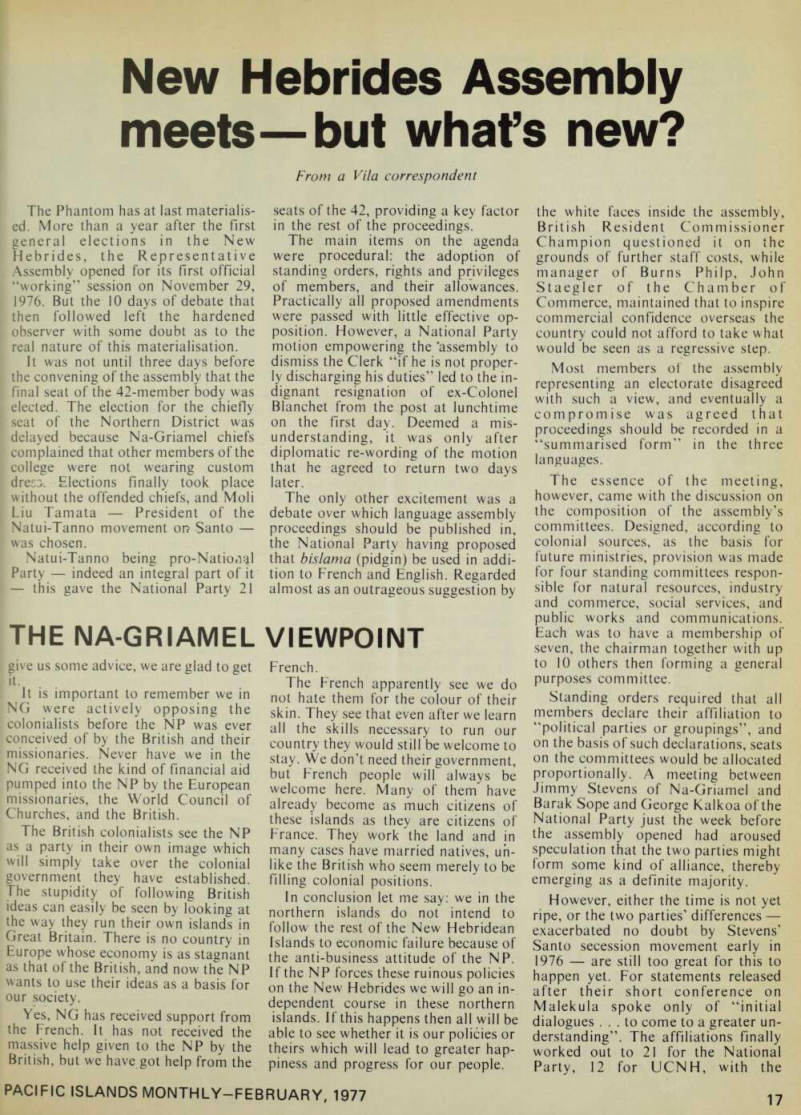
the New Hebridean scene
From JIMMY MOLI STEVENS in Santo, New Hebrides.
For some time now people in the Pacific have been given a false impres sion of what is happening in the New Hebrides Islands, and in the northern islands in particular.
This false impression has been created by the National Party (NP) of the New Hebrides because they have found it in their interests to have peo-. pie believe they represent both the will and the best interests of the New Hebridean people.
It is true the NP does have a great deal of strength, especially in the southern islands of the New Hebrides, but in the northern islands, and on Santo, the biggest of all the New Hebridean islands, the NP is only one of several political-cultural influences.
In a recent election it was clear that the Na-Griamel (NG) movement, which has been active for more than 10 years in the struggle for the rights of the native people, had emerged as one of the two dominant forces in the northern islands.
The NG is based on respect for tribal custom and personal freedoms, and the belief that freedom of enter prise is the best method of developing the country. Because we have little wealth and few natural resources we feel it will be necessary to attract in vestment to our islands in order to create new jobs for our people and progress for our children. As long as the land rights of the native people are acknowledged we need have no fear, nor jealousy, toward those who would come here to do business. The debate over economic development and respect for tribal customs is the main area of conflict between the NG and the NP.
Some people in the NP seem to think they can threaten property con fiscation, heavy taxes and nationalisa tion, yet still attract people to the New Hebrides to invest. Some people in the NP openly reject investment, saying jobs created by it would be degrading. They call them “slave jobs”. With this attitude there will be no new jobs at all, and what kind of dignity is there in that? No new wealth will be invested in the islands if those
who are expected to invest have a fear that what they bring to the islands might be taken from them.
We in NG realise we may have to work at jobs like deckhands, or bartenders, or truck drivers, so that our children may some day have a better life. There is nothing degrading about this. We feel that by offering leases to those who wish to invest here we can attract wealth, guarantee a certain amount of income for our schools and other functions, as well as create jobs for our people.
Businessmen can make all the money they want during the period of the leases, and after the time period of the lease is up there will be more wealth for all. To threaten confiscation or heavy taxation will mean there will be no new jobs and no progress for anyone, just political power for the NP because it is basing its power on making those who have less jealous and hateful towards those who have more.
How can the NP expect to develop the islands if investment is frightened away? Maybe they plan to beg the super powers for aid. Is it more dignified for people to beg for a hand out than it is to work at jobs which will develop the country and give progress to the children? What will happen if the West refuses to give such aid? Will the NP then go to China or Russia for help? What would such countries demand in return for
that kind of help? The NG symbol of native plants is a far cry from the NP symbol, which so closely resembles the hammer and sickle.
One of the other areas of disagree ment between the two parties is respect for the culture and the tribal customs of the people.
The NP pays only lip service to these customs, while the NG has made the respect for them a basic part of its party’s philosophy. The reason for this conflict between the parties is that the NP is dominated by, and is indeed a creation of, European mis sionaries. These missionaries hope to use the NP as a tool in building these islands into a kind of theocracy, or religious dictatorship. It is feared that this theocracy would have little respect for the tribal customs of the native peoples.
Those of us in the Pacjfic know the missionaries have been both a blessing and a plague to our islands. It is true they have done good things like offer ing us some schools and medical ad vice, and, yes, giving us the chance to hear about Jesus Christ. But they have at times been very arrogant in relation to the customs of the people whose islands they visit. Many of our people in NG are Christian, and we only demand that the customs of the native people be respected as well.
Some of the missionaries have gone so far as to tell people they would go to hell if they so much as spoke to anyone from any political party beside the NP. We in NG feel that God is too important to be taken down to this level.
It seems that for centuries the Europeans lime and again have done this thing of saying God is for me, and then using it to justify doing what they want to do. Now the NP is doing the same.
One of the NP attacks on the NG has been to claim we are “controlled” by some Americans and the French. It is true we have accepted help from some Americans. We are happy for their advice, but let me stress we make up our own minds. If, knowing that we have the final decision, they still
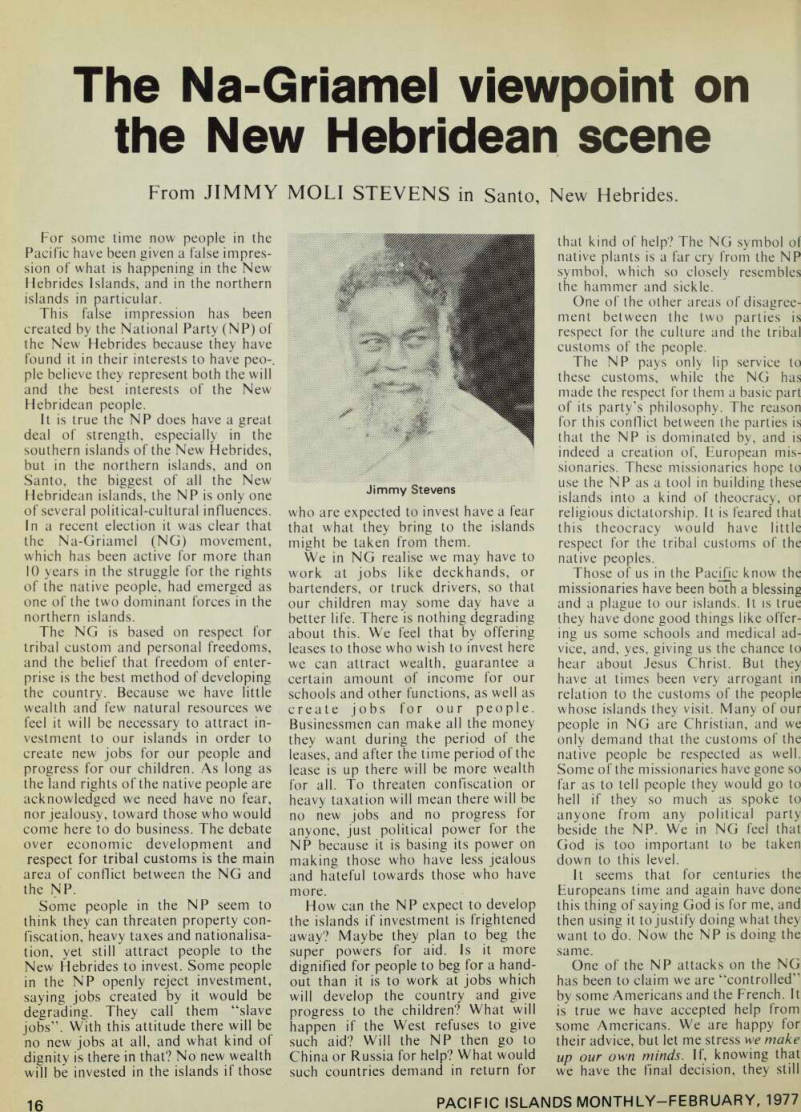
Jimmy Stevens
give us some advice, we are glad to get it.
It is important to remember we in NG were actively opposing the colonialists before the NP was ever conceived of by the British and their missionaries. Never have we in the NG received the kind of financial aid pumped into the NP by the European missionaries, the World Council of Churches, and the British.
The British colonialists see the NP as a party in their own image which will simply take over the colonial government they have established.
The stupidity of following British ideas can easily be seen by looking at the way they run their own islands in Great Britain. There is no country in Europe whose economy is as stagnant as that of the British, and now the NP wants to use their ideas as a basis for our society.
Yes, NG has received support from the French. It has not received the massive help given to the NP by the British, but we have got help from the
French.
The French apparently see we do not hate them for the colour of their skin. They see that even after we learn all the skills necessary to run our country they would still be welcome to stay. We don’t need their government, but French people will always be welcome here. Many of them have already become as much citizens of these islands as they are citizens of France. They work the land and in many cases have married natives, un like the British who seem merely to be filling colonial positions.
In conclusion let me say: we in the northern islands do not intend to follow the rest of the New Hebridean Islands to economic failure because of the anti-business attitude of the NP.
If the NP forces these ruinous policies on the New Hebrides we will go an in dependent course in these northern islands. If this happens then all will be able to see whether it is our policies or theirs which will lead to greater hap piness and progress for our people.
New Hebrides Assembly
meets —but what's new?
From a Vila correspondent
The Phantom has at last materialis ed. More than a year after the first general elections in the New Hebrides, the Representative Assembly opened for its first official “working” session on November 29, 1976. But the 10 days of debate that then followed left the hardened observer with some doubt as to the real nature of this materialisation.
It was not until three days before the convening of the assembly that the final seat of the 42-member body was elected. The election for the chiefly seat of the Northern District was delayed because Na-Griamel chiefs complained that other members of the college were not wearing custom dres:>. Elections finally took place without the offended chiefs, and Moli Liu Tamata President of the Natui-Tanno movement or Santo was chosen.
Natui-Tanno being pro-National Party indeed an integral part of it this gave the National Party 21
seats of the 42, providing a key factor in the rest of the proceedings.
The main items on the agenda were procedural: the adoption of standing orders, rights and privileges of members, and their allowances.
Practically all proposed amendments were passed with little effective op position. However, a National Party motion empowering the 'assembly to dismiss the Clerk “if he is not proper ly discharging his duties” led to the in dignant resignation of ex-Colonel Blanchet from the post at lunchtime on the first day. Deemed a mis understanding, it was only after diplomatic re-wording of the motion that he agreed to return two days later.
The only other excitement was a debate over which language assembly proceedings should be published in, the National Party having proposed that bislama (pidgin) be used in addi tion to French and English. Regarded almost as an outrageous suggestion by
the white faces inside the assembly, British Resident Commissioner Champion questioned it on the grounds of further staff costs, while manager of Burns Philp, John Staegler of the Chamber of Commerce, maintained that to inspire commercial confidence overseas the country could not afford to take what would be seen as a regressive step.
Most members of the assembly representing an electorate disagreed with such a view, and eventually a compromise was agreed that proceedings should be recorded in a “summarised form" in the three languages.
The essence of the meeting, however, came with the discussion on the composition of the assembly’s committees. Designed, according to colonial sources, as the basis for future ministries, provision was made for four standing committees respon sible for natural resources, industry and commerce, social services, and public works and communications.
Each was to have a membership of seven, the chairman together with up to 10 others then forming a general purposes committee.
Standing orders required that all members declare their affiliation to “political parties or groupings’’, and on the basis of such declarations, seats on the committees would be allocated proportionally. A meeting between Jimmy Stevens of Na-Griamel and Barak Sope and George Kalkoa of the National Party just the week before the assembly opened had aroused speculation that the two parties might form some kind of alliance, thereby emerging as a definite majority.
However, either the time is not yet ripe, or the two parties’ differences exacerbated no doubt by Stevens’
Santo secession movement early in 1976 are still too great for this to happen yet. For statements released after their short conference on Malekula spoke only of “initial dialogues ... to come to a greater un derstanding’’. The affiliations finally worked out to 21 for the National Party, 12 for UCNH, with the
remaining nine including the three MANH/Na-Griamel members —, declaring themselves “independents”.
For the National Party, the com position of the committees was a question of principle. As George Kalkoa pointed out, elections for the assembly had included seats for special interest groups of chiefs and economic interests.
The two administrations were now forcing these representatives to align themselves politically . . . “We wish to record our strongest dissatisfaction with the governments of France and Fngland for their construction of a system of elections and a system of political representation with the assembly, both of which are blatantly undemocratic and are further attempts by the colonial powers to destroy the strength of New Hebri dean representation in the assembly.”
A motion calling for revision of the electoral regulations ensuring that all seals at the next elections would be chosen by universal suffrage was later passed unanimously.
The reason for the National Party's anger was plain; having won almost 60% of the universal suffrage vote, and being represented in three of the four chiefly seals and two of the three co-operative seals, they were to be allowed only 50% representation on the committees. And 50% of seven on each committee produces three and a half people . . . Arguing that in terms of representation of the electorate, they were entitled to a majority on each committee of four members, the National Party tried all ways to argue their case, but to no avail. The Resi dent Commissioners’ offer of a National Parly majority on just two committees was finally accepted, the party choosing Natural Resources and Commerce and Industry as their strongholds.
Debate on the regulations es tablishing the chiefly council then fairly painlessly decided that con sultation with the chiefs would be compulsory on all matters relating to land, custom, hunting and fishing, and judicial and legislative matters relating to New Hebrideans. The council of 20 chiefs would relate directly to the assembly through the four chiefly representatives to the assembly who would also sit on the counci, effectively, therefore, making it a council of 24.
While on the subject of 24, the United Nations General Assembly had the previous month adopted a
Committee of 24 resolution calling on the British and French governments “to expedite the process of decolonisation in the New Hebrides” and to “consider permitting access by a UN-visiting mission”. The vote on a National Party motion condemning the “unworkable system of government” and moving that the assembly request such a mission was perhaps the most interesting of all. It was carried by 21 votes to 21 absten tions: a clear indication of how firmly the assembly is split down party lines (despite “economic interests” and all that), and perhaps revealing the extent to which the UN is regarded as National Party territory, in spite of the two visits there of Na-Griamel and the one of UCNH this year.
Two other motions passed almost unanimously reflected the across-the board discontent with the absurd ob solescence of the condominium. One called for a single legal system for all races in the islands, and the other for the creation of a new administration.
Change in both areas is much over due, there being three adminstrations and more than three legal systems in the country facts which to out siders may be a joke, but which cause untold strain on psychological, as well as financial, resources.
It was at this point that the assembly somewhat mysteriously end ed with the National Party withdraw ing two motions, one calling for the creation of a commission to recom mend a single, unified land-tenure system, and the other demanding “a
programme for the independence on the New Hebrides”. Neither issue could be more controversial, nor nearer to the heart of the nationalists.
But no reasons were given, and so with some relief, and more than a lit tle puzzlement, the two Resident Commissioners jointly closed up shop until February when the Budget is due *to be debated and a single New Hebri dean President of the assembly elected.
Sorting through the mass of ver biage to come to some sort of overall conclusions on the session, one thing alone is clear. That is that, despite colonial attempts to create the con trary impression in the consciousness of the nation, little in reality has changed. Words have been spoken, and the ritual played out. And motions have been passed which mostly give just an official stamp to processes of gradual change which were under way in any case after the usual snail’s-pace fashion of the Joint Administration.
But the power structure of deadlock remains firmly intact, the only difference being that it is now in stitutionalised in the form of the Representative Assembly, which provides its new focus. Initiatives for radical change from the National Par ty can now be counted upon to be squashed by “the Opposition”, thus very conveniently letting the British and French off the hook.
How long the National Party will stand for this version of democracy is anyone’s guess . . .
The "thumbs up" victory sign from the National Party leaders, from the left. Father Walter Lini, the president, Barak Sope, the general-secretary, and George Kalkoa.
U.S.-Micronesia Wheeler Deals
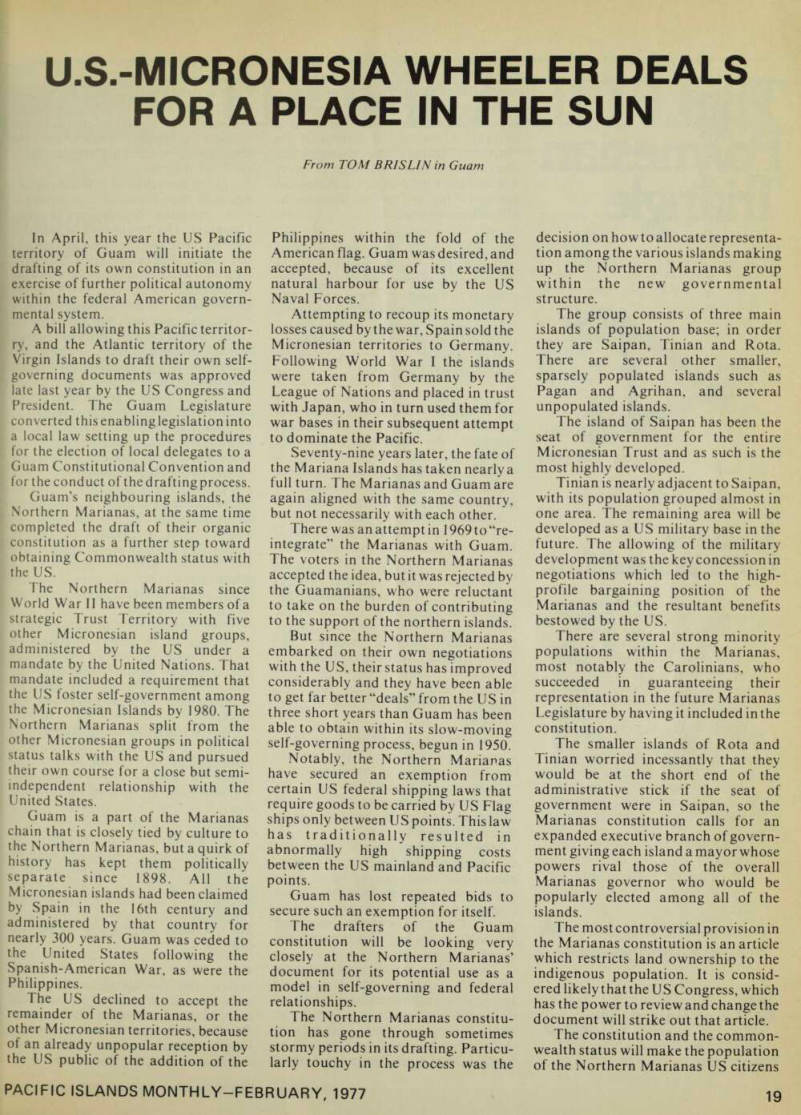
For A Place In The Sun
From TOM BRISLIN in Guam
In April, this year the US Pacific territory of Guam will initiate the drafting of its own constitution in an exercise of further political autonomy within the federal American govern mental system.
A bill allowing this Pacific territor ry, and the Atlantic territory of the Virgin Islands to draft their own self governing documents was approved late last year by the US Congress and President. The Guam Legislature converted this enabling legislation into a local law setting up the procedures for the election of local delegates to a Guam Constitutional Convention and for the conduct of the drafting process.
Guam’s neighbouring islands, the Northern Marianas, at the same time completed the draft of their organic constitution as a further step toward obtaining Commonwealth status with the US.
The Northern Marianas since World War II have been members of a strategic Trust Territory with five other Micronesian island groups, administered by the US under a mandate by the United Nations. That mandate included a requirement that the US foster self-government among the Micronesian Islands by 1980. The Northern Marianas split from the other Micronesian groups in political status talks with the US and pursued their own course for a close but semi
independent relationship with the
United States.
Guam is a part of the Marianas chain that is closely tied by culture to the Northern Marianas, but a quirk of history has kept them politically separate since 1898. All the Micronesian islands had been claimed by Spain in the 16th century and administered by that country for nearly 300 years. Guam was ceded to the United States following the Spanish-American War, as were the
Philippines.
The US declined to accept the remainder of the Marianas, or the other Micronesian territories, because of an already unpopular reception by the US public of the addition of the
Philippines within the fold of the American flag. Guam was desired, and accepted, because of its excellent natural harbour for use by the US Naval Forces.
Attempting to recoup its monetary losses caused by the war, Spain sold the Micronesian territories to Germany.
Following World War I the islands were taken from Germany by the League of Nations and placed in trust with Japan, who in turn used them for war bases in their subsequent attempt to dominate the Pacific.
Seventy-nine years later, the fate of the Mariana Islands has taken nearly a full turn. The Marianas and Guam are again aligned with the same country, but not necessarily with each other.
There was an attempt in 1969 to “re integrate” the Marianas with Guam.
The voters in the Northern Marianas accepted the idea, but it was rejected by the Guamanians, who were reluctant to take on the burden of contributing to the support of the northern islands.
But since the Northern Marianas embarked on their own negotiations with the US, their status has improved considerably and they have been able to get far better “deals” from the US in three short years than Guam has been able to obtain within its slow-moving self-governing process, begun in 1950.
Notably, the Northern Marianas have secured an exemption from certain US federal shipping laws that require goods to be carried by US Flag ships only between US points. This law has traditionally resulted in
abnormally high shipping costs
between the US mainland and Pacific points.
Guam has lost repeated bids to secure such an exemption for itself.
The drafters of the Guam constitution will be looking very closely at the Northern Marianas’ document for its potential use as a model in self-governing and federal
relationships.
The Northern Marianas constitu tion has gone through sometimes stormy periods in its drafting. Particu larly touchy in the process was the
decision on how to allocate representa tion among the various islands making up the Northern Marianas group within the new governmental structure.
The group consists of three main islands of population base; in order they are Saipan, Tinian and Rota.
There are several other smaller, sparsely populated islands such as Pagan and Agrihan, and several unpopulated islands.
The island of Saipan has been the seat of government for the entire Micronesian Trust and as such is the most highly developed.
Tinian is nearly adjacent to Saipan, with its population grouped almost in one area. The remaining area will be developed as a US military base in the future. The allowing of the military development was the key concession in negotiations which led to the high profile bargaining position of the Marianas and the resultant benefits bestowed by the US.
There are several strong minority populations within the Marianas, most notably the Carolinians, who succeeded in guaranteeing their representation in the future Marianas Legislature by having it included in the constitution.
The smaller islands of Rota and Tinian worried incessantly that they would be at the short end of the administrative stick if the seat of government were in Saipan, so the Marianas constitution calls for an expanded executive branch of govern ment giving each island a mayor whose powers rival those of the overall Marianas governor who would be popularly elected among all of the islands.
The most controversial provision in the Marianas constitution is an article which restricts land ownership to the indigenous population. It is consid ered likely that the US Congress, which has the power to review and change the document will strike out that article.
The constitution and the common wealth status will make the population of the Northern Marianas US citizens
(they are presently more or less “wards” of the US government and treated as aliens for immigration purposes). The US Constitution calls for “equal protection” of all US citizens. Allowing US citizens of the Northern Marianas one privilege while denying that same privilege to other US citizens runs counter to American law and is highly frowned upon by the US judicial system.
The US Congress, and the President, will also have review authority over the drafted version of the Guam document, and both will be allowed to change it at will, subject to each other’s review. It will be a lengthy federal review process for the Guam constitution before it is returned to the Guam people for a final public referendum for approval.
The federal enabling legislation for the drafting of the document carried certain directives that, in effect, provided the framework for the constitution. Among other things, it required that the document provide for three and only three branches of government, and directed that the constitution contain a “Bill of Rights” that is “at least as broad” as the Bill of Rights contained in the US consti tution.
Several Guam political leaders bridled at the directives, stating that they demonstrated a limited confi dence by the American Government for Guam’s political maturity and ability to do its own work. Despite the objections, the directives were accepted and include in the local legislation setting up the drafting process.
Each of Guam’s 19 villages will be allowed one delegate to the conven tion, with additional delegates from each based on population. Using the latest census figures, the total delegates will number 48 for the job of writing up the constitution.
The document, once scrutinised and approved by the federal govern ment and then approved by a Guam popular vote, will replace the “Guam Organic Act” which was approved by the US Congress in 1950 to establish the self-governing structure of the island government.
The act has been amended several times by Congress, the last major amendment in 1969 which allowed for the popular election of a governor the following year, with subsequent elections each four years.
Since that time Guam has elected
two governors, each from opposing parties.
It is predicted that the drafting of the Guam constitution will be replete with political machinations as it will become campaign fodder for the hotly-contested Guam Delegate seat in the US Congress.
The incumbent Washington delegate manoeuvered the constitu tion enabling legislation through Congress. His opposition within his own party sits as the vice-chairman of the Guam Political Status Commis sion who will attempt to closely link the constitution with Guam-US status negotiations. The opposing party challenger presides over a committee within the Guam legislature on federal territorial matters, and may attempt to intervene at all levels of the status constitution issue.
There remains a group who would wish to see an eventual re-integration of Guam and the Northern Marianas to pursue the possibilities of a stronger and more powerful commonwealth status, or eventual statehood.
While Guam and the Northern Marianas can continue improvement of-status talks with the US for many years, it is generally considered impossible that either could achieve the ultimate status statehood without the other, or for that matter, without an entirely coalasced Guam- Micronesia unit.
The remainder of Micronesia continues to be generally stalled in status considerations as the various island groups consider following the course of the Northern Marianas and entering into separate talks with the US.
As the Northern Marianasdropped out of the Micronesia federation, a replacement district joined in. The island of Kusaie felt it no longer wanted association with the Ponape district, so it hasjust split off to become a district unto itself.
Such internal independence among the Micronesian groups casts a shadow of doubt over the possibilities of a unified stand in head-to-head negotiations with the US, much less a rapprochment with Guam, tradition ally the showcase of American Pacific
politics.
• A Trust Territory coast guard cutter, the Basswood, broke down while on patrol and had to be towed
from Majuro to Kwajalein for repairs.
The Caroline Islands, which was on a regular run to the outer islands, was diverted to tow the Basswood.
Advertisements & other items, p. 20 (1 item)
Polynesian
Thg
Triangle
Western Samoa IN me Island Fiji Tonga
Its place in
the Pacific has shifted
Because now the Polynesian Triangle fare brings a Polynesian holiday much closer. Now when you visit Fiji you can include Tonga, Niue and Western Samoa for very little extra! Talk to your travel agent about working in our Polynesian Triangle fare with your Fiji itinerary. Only U55253.00* (AUSSI9B.OO or NZ$2lB.OO) more to see three more islands in the beautiful Pacific. Our Polynesian Triangle fare is available all year round with no minimum stopover restrictions and may be purchased while you are in Fiji or before you arrive.
Contact your travel agent for more details. * Fare subject to change without notice. ©Serving the heart of Polynesia
POLYNESIAN
PO Box 599, Apia. ' S * , “
WESTERN SAMOA
Tropicalites
Another
canoe voyage
Fourteen Polynesian descendants of royal lineage from around Tahiti are preparing to set sail in July in an outrigger canoe, following ancient custom in an effort to simulate early Polynesian migrations across the Pacific, including Japan.
The outrigger will sail from Tahiti to Hawaii and on to Japan and the Marianas, then via the New Hebrides and New Caledonia to New Zealand.
The voyage by 11 men and three women is expected to take eight months. Preparations were under way by December when timber for the pirogue was being shipped from the New Hebrides to Papeete.
Huge trees of at least five metres in diameter are required to reproduce the dimensions of the original royal Polynesian vessels. The plans for the pirogue were made after consultation with British Admiralty documents relating to observations of the craft made by Captain Cook. Traditional Polynesian carpenters have been recruited for the task.
One of the leaders of the operation is Teriiteanuanua (Charles) Manu- Tahi, an associate of the Punaruu Museum. He supervised the cutting and choice of timber from the island of Efate in the New Hebrides, and ex plained that the whole project is being organised by men of royal Polynesian descent from Tahiti, Raiatea and Bora Bora.
By including Japan on their circuit, the navigators aim to emphasise that the early Polynesians did in fact sail as far as Nippon. They state that in one particular district the Japanese know about the traditional Polynesian oven and use the same name for fish and fruits as in Tahiti.
The 20th century Polynesian sailors plan to use only ancient traditional means of boat construction, navigational aids and foodstuffs on board. This will include sails of pan danus fibre sewn together by woven
coconut fibre. Bamboo segments will contain the traditional forms of medicinal plants, while fish hooks will be mother of pearl attached to vegetable thread. Fish will be the main diet on this voyage for which special preparation will be required of the 14 members aboard.
Navigation aids will similarly be restricted to ancient materials such as a compass made of a coconut pierced in precise spots so that the sound blowing through will indicate any movement off course. Similarly, the weathercock will include red feathers, and as a sextant there will be a piece of bamboo, pierced in appropriate spots in relation to the stars.
Fund-raising to finance the sailing venture will include Polynesian folkloric displays scheduled for Noumea in March.
Rsad this and
bs warnsd . . .
At one time there was a European trader living on an island in the Cooks many miles from the administrative centre of the island territory that had become his home.
As the years passed, he became in creasingly given to fits of frustration and to the feeling that those in authority were in some kind of unholy league against him.
For many years he wrote letters of increasing ire to the hierarchy of in fluence. His epistles went to resident agents, the resident commissioner, to the Secretary of the Department con trolling the territory, and, if the mood moved him, to the Minister himself. It is even said of our friend that he had received acknowledgments from a certain personage in Buckingham Palace itself.
Well, as might have been expected, no ordinary typewriter was capable of withstanding this onslaught upon its keyboard. Eventually the “e” fell from the machine never to be replac ed. But this did not daunt our man.
For some time letters arrived at the administrative headquarters which bore the inscription “In this letter
read e for s except where s is applicable”. Words like “sex” became “ssx” well, that was not too difficult to cope with. But it was when this correspondent launched into diatribes about the ‘‘obssssions of ssvsral ssrvants of ths sovsrsign to sssk succour in csrtain ssxual and drunksn sscapadss” that the long suffering clerks and public servants decided that the time had come for all incoming mail from this source to be placed in a “pending” file.
'lnstant' kava
upsets senator
Fiji’s Ratu Senator Livai Volavola, in a recent plea for a revival of Fijian culture, said people who did not help to preserve it, should leave the coun try. Senator Volavola, who is Vice- President of the Senate, attacked a decision by a local company to sell pre-packed “instant” yaqona (kava).
He said such sales were against Fijian tradition and culture.
He was also critical of film showings on Sundays, saying they were turning the Fijian people away from church. When he was a Suva city councillor some years ago (in fact he acted as mayor for three months, the first Fijian to be Mayor of Suva), he had raised the question of films being screened on Sundays. He was told then they were Indian films and were shown on Sundays so that people from rural areas, unable to get to the city on any other day of the week, could see them. But now the theatre owners were showing English films, and Fijians were going to them in stead of to church.
Air Niugini misses
conversion bonanza
Air Niugini could have saved itself more than $A500,000 if it had waited two extra days before paying Australia for a Boeing 707 jet.
The airline paid 5A4.2 million to Qantas on Friday, November 26,
1976. But currency revaluations in both countries over the ensuing weekend raised the value of the Papua New Guinea kina by 12.5% against the Australian dollar.
The airline’s manager, Mr Bryan Grey, said: “It made no difference to Qantas one way or the other they still received the agreed price in Australian dollars.
“And in terms of our own money, we still paid exactly what we had agreed to pay, but we would have had a conversion windfall if we had been a few days later.”
Mr Grey said that in any event, November 26 was the day on which payment had become due under the
agreement of sale, and Air Niugini had met its commitment.
NZ moves on
offending immigrants
The New Zealand Government moved in December to implement its election promise to deport offending immigrants.
The Minister of Immigration, Mr Gill, introduced into Parliament an Immigration Amendment Bill which provides that: • An immigrant will be deported if he commits an offence within two years of his arrival
• No deportation order can be made more than six months after the offender has been released from detention, or if the sentence imposed for an offence did not involve deten tion • It will not be a defence to a charge if the defendant proves that he did not know that his temporary per mit had expired • If the holder of a temporary per mit leaves New Zealand at any time during its currency, the permit expires on his departure.
The Labour Opposition spokesman on immigration, MrColman, strongly attacked the measure. He said: “At a time when we were seeing some compassion as regards overstayers, we see this repressive measure being introduced.”
A person who had committed an offence carrying a prison term of as little as one day or one week could face deportation under the bill, he said.
Mr M. Rata (Labour, Northern Maori) said the bill represented a further attack on the Island com munity.
An Opposition move to have the bill referred to a select committee for study during the parliamentary recess was defeated 25-41.
Highland highway
robbery in PNG
Highway robbery was one of the themes touched on by Papua New Guinea’s Police Commissioner, Pious Kerepia, at a press conference late last year.
Just back from a highland tour, Mr Kerepia admitted that the increasing incidence of thefts from the backs of trucks using PNG mountain highways was worrying police.
He told the press: “I deliberately chose to travel from Mt Hagen to Kundiawa in the evening rather than in daylight. We left Mt Hagen for Kundiawa at 6.30 pm. On the way I noticed up to half a dozen loaded trucks parked unattended at the side of the highway. This must be one of the factors negligence by the drivers themselves.
“Another factor is the winding of the highway. There are too many sharp bends, and when the driver slows down to get around them, it’s easy for people to jump aboard and steal what they like.
“It’s the same thing with the hills and slopes. Either going up or down
them, drivers have to reduce speed, again making it easy for thieves to jump aboard.
“I also noticed that the highway was sometimes blocked by big stones lying in the middle. I don’t know whether this is deliberate or not, but I was told that some drivers, when they pull up to have a rest or chat to their mates, place stones behind the wheels of their trucks. When they take off again, they forget about the stones, and the next truck that comes along has to stop and the driver has to get out to move them. Another oppor tunity for the thieves.
“Between Kundiawa and Chuave the government is straightening part of the Highlands Highway so that instead of winding here and there we cut right across those bends and meet up with other sections of straight road. The straighter the road, the more consistent the speed, and the smaller the chance thieves will have of clambering aboard passing trucks
Palau: ’7os’ hottest
environmental issue”
Palau, a magnificent coral reef paradise in the Trust Territory of Micronesia, could become a junk fouled port for the world’s largest super-tankers bringing black crude to Japan, a conservation group was told late last year.
Micronesian News Service, quoting United Press International, said the warning came from Dr Sylvia A.
Earle in remarks prepared for the Fourth International Congress of the World Wildlife Fund. The Congress was attended by delegates from 35 nations.
“Imagine the world’s largest super port, five times larger than the largest now known,” said Dr Earle.
“Imagine 14,000 native Palauans, with a lifestyle, economy and cultural history tied to the land and surroun ding sea. Imagine billions of dollars of oil money and a consortium of in dustrial interests from the US, Japan and Iran. Imagine one of the world’s most magnificent and fragile coral reef formations.
“Put them all together and you have one of the hottest environmental issues of the decade. Call it Port Pacific.”
Palau as a superport is “a throwaway container, a package for oil, a temporary place where ships as large as the Empire State Building can come and go,” she said. “When
they finally go forever, the dead husk that was once Palau will remain.”
Japan wants a place such as Palau to build a superport because of pressure from Japanese fishermen against the present use of Japan’s har bours and storage facilities, said Dr Earle, leader of the first team of women aquanauts in the world, a research botanist at the California Academy of Sciences and a faculty member of the University of Califor nia, Berkeley.
“Port Pacific will enable Japan to export pollution not wanted at home.
Yet Palau is one of the most beautiful places in the world,” she said.
PNG’s kina is
going underground
Papua New Guinea is concerned that a “significant” proportion of its currency is being hoarded or used in closed-currency situations.
Money hoarding has long been popular in the PNG Highlands where villagers bury it in holes in the ground instead of putting it into the banking systems.
The practice is part of an attitude which places status value rather than practical value on the possession of coins. Much of the money circulates only in closed family groups as part of tribal ceremonies.
Meanwhile, the second major con signment of coins since PNG in troduced its own currency 19 months ago has been received in Port Moresby from the Royal Mint in Bri tain.
A new denomination of note, K2O, will also be introduced early in 1977. It will be PNG’s highest denomination note.
France returns
PNG artifacts
In a move unpublicised at the time, France last November handed back more than 70 tribal carvings and weapons which had been smuggled out of Papua New Guinea. Many of the pieces are classified as national cultural property.
Secrecy surrounds the full story of how the French authorities traced the artifacts and seized them. The PNG National Museum and Art Gallery merely confirmed in December that the French naval escort ship Com mandant Riviere had delivered the ar tifacts during a courtesy call to Port Moresby the previous month.
There had been no announcement at the time ‘Tor diplomatic reasons”.
Earlier in the year a company direc tor from New Caledonia, John Gueroull, and a Frenchwoman, Jocelyn Knezevic, formerly of Paris, had eluded a harbour watch in Port Moresby and taken their yacht Thetis to sea. They had been awaiting trial on charges of conspiracy involving the purchase of tribal artifacts from village communities in the Gulf of Papua.
An earlier search of their yacht and other searches failed to locate ar tifacts which were known to be miss ing from villages.
The Thetis later berthed in Darwin from where the couple attempted to obtain new passports to replace those they had left behind in Port Moresby.
Despite a warrant for their arrest the couple were not extradited to PNG, and they later sailed from Darwin, still without passports.
PNG authorities said at the time their main concern was to get back “valuable cultural property which is missing from our villages”.
Govt men charged
on Pago Pago bombing
Two employees of the Government of American Samoa face charges arising out of the bombing of a motor car belonging to the publisher of Pago Pago’s major newspaper, Samoa News.
The men are To’a Etimani Fonoti, Assistant Tax Manager, and Wally Utu, assistant clerk of the American Samoa House of Representatives.
The publisher, Jake King, who is described by a colleague as “possibly the most vitriolic a-nd colourful publisher in the business”, stood unsuccessfully for the Fono in the last election. Utu was also an unsuccessful candidate in the election.
Count 8 of the 10-count government charge against Utu says that he “did . . . wilfully and unlawfully threaten and intimidate . . .
King in the free exercise or enjoyment of his rights and privileges secured to him by both the constitutions of the US and American Samoa, to wit, his right of free association with guests at his home, and his right to seek political office . . .”
The car exploded while parked outside King’s home in the Pago Pago suburb of Auasi on May 6, 1976, but the two officials were not charged until late November.
It looks like being a long-winded
affair all round: a PIM correspondent in Pago Pago writes that “the trial has been delayed now to a time uncertain, due to the absence of the principals . .
Western Samoans’
double trouble
Troubles have not come singly for a Western Samoan brother and sister in Auckland on visitor’s permits.
The girl, Aloiafi Satiu, 16, had not long been in New Zealand when, ac cording to relatives, she became possessed by evil spirits. As the spirits had possessed her in that country, they believe, they can only be exor cised there. Aloiafi has been successfully treated on about 10 oc casions by a Western Samoan “witch doctor”, but relief is only temporary and the coma-like attacks keep recurring.
As well as the spirits, Aloiafi has to reckon with the NZ immigration authorities who in September gave her till the end of the month to leave the country. Her family believes that if she has to leave NZ and miss the cures effected by the witch doctor she could die.
Aloiafi’s six-year-old brother, Misilagi, has rheumatic fever, which has affected his heart. As Western Samoa has no reciprocal social welfare agreement with NZ, his parents, who are now back home, face bills totalling $NZ4,280 for the treat ment received by the boy in the Princess Mary Ward of Auckland Hospital, and some dental care. Like his sister’s, Misilagi’s visitor’s permit has also expired.
Two new plays on PNG.
past and present
Two significant plays by Papua New Guinean authors were presented in Port Moresby late last year by PNG’s National Dance and Drama Company.
They were “Oli-Kam Na Paulim Yumi”, by John Bili Tokome, and “Which Way Big Man”, by Nora Vagi Brash.
The plays dealt with aspects of past and present realities of PNG society.
The first reflected the confusion of Papua New Guineans at their first contact with Europeans. The teaching methods of various Christian denominations, and the instrusion on traditional societies and cultures, were clearly illustrated in the play.
The second play dealt with symp toms of conflict between educated and uneducated in contemporary PNG society.
Advertisements & other items, pp. 22-24 (1 item)
JMuftson & Co.
SELLING RELIABLE EXPORT SERVICE
TO THE PACIFIC ISLANDS
No. 37, Wyndham Street, Ist. & 3rd. Floor, Hong Kong.
Cable: YOUNGIP HONG KONG.
Telex: HX86210 TINKU HONG KONG.
For all import enquiries from Hong Kong and Taiwan please contact us.
We have a special section dealing in semi-precious jewellery and all kinds of watches.
MODERN TEACHING AIDS PTY. LTD.
has progressively introduced sound educational materials into the classroom and homes that guide children's natural interest to their learning needs. Foremost among these are the very successful Tutor Books, M.T.A.
Reading Laboratories, and now the recently published Open House Math Laboratory.
Continuing with this policy of meeting the educational needs in Papua New Guinea, and the Pacific. M.T.A. have appointed Mr T. Unwin to service this region.
For your educational needs, please contact Isopang School & Library Supplies P. 0., Box 9123 Hohola. P.N.G.
Telephone; 25-3817
How to help
create a softer beauty
for your complexion
The early signs of age in your complexion can be softened and smoothed to a more
youthful look by giving
your skin a few moments pampering each
day with a unique
tropically moist oil blend.
One of the secrets of soft, smooth, supple skin lies in the potential of the skin’s failing oil and moisture to be
supplemented by the
daily smoothing on of
a remarkable beautify-
ing fluid.
AS A WOMAN passes her thirties, it is normal for her complexion beauty to start fading and for her skin to adopt the signs of a prematurely older look. This is due to the tiring of the beautifying reservoirs which nestle in the mitotically active area of your skin and which supply the outer skin layer with its softening fluids.
Fortunately, these signs can be softened and the resulting rough skin and accentuated surface lines assuaged in order to help keep the complexion looking younger as the years pass by.
Pamper Your Skin to Softness
A few moments each day pampering the complexion with a light film of a
scientifically developed tropically
moist oil blend can help restore and maintain the vital balance of oil and moisture in your skin the remarkable fluid simulating the action of the skin’s natural fluids to bring benefits similar to those provided by its own oils and moisture.
The tropically moist Oil of Ulan, through its affinity with the natural fluids, penetrates rapidly into the stratum corneum or outer layer of your skin to help condition the keratinous area so that a softer, smoother, more supple and radiantly lovely complexion can result.
Smoothed over the entire face and neck before you venture outdoors and again at night before you retire, the Oil of Ulan leaves a fresh, natural, non-greasy feeling and such is its efficacy that Oil of Ulan moist oil blend has become for women in many parts of the world, a priceless element in preserving softer, smoother and more
supple complexion beauty.
Editor’S Mailbag
Slugged Yachtie
I would like to add to Tom Hepworth’s letter (PIM, September) regarding the light fee imposed on yachts by the Solomon Islands Government.
I would also like to advise all yachtsmen to give the Solomons a wide berth until the fee is rescinded, unless they want to pay the fee of
Saioo.
I had heard that the light fee was being imposed, but had heard similar stories about other countries in the past and had always found them to be groundless.
I decided to go to Papua New Guinea, via the Solomons, to revisit places I had been to in 1944, and to see, incidentally, if the Solomons was imposing a fee. It is.
As far as I’ve been able to piece the story together it seems that the law states that vessels shall pay a light fee, which was set at a few cents per ton.
About May 1976, someone, I think it was the Comptroller of Customs and Excise, Mr J. W. Green, requested an opinion from the legal department to determine if yachts could be classified as vessels.
The reply, which I was able to see, said yes, yachts fall under the classification of vessels, but that if they paid the light fee at the current rate they would not pay very much and that a fee of SAIOO seemed reasonable.
Therefore the rate was changed, I believe at the suggestion of Mr Green, to SAIOO minimum, and 5c per ton to a maximum of SA3OO.
Thereafter, Mr Green issued an instruction to all Customs people to charge all yachts the light fee starting on June 1, 1976.
I have been in the Solomons about five weeks and I have seen only two other yachts, both in Honiara. Most places I have anchored I have been told that I was the only yacht calling there since the light fee had been imposed. This is a great pity, as most yachts spend several hundred dollars each while in the Solomons, and this money benefits the people, especially in the outer islands.
I mentioned this to Mr Green, but I got the impression he was more interested in keeping yachts out of the Solomons than encouraging them to come here.
When I have discussed the light fee with people around here, I have often been told that Mr Green “hates yachts”, and that one way he felt he could harass them was to apply the light fee to them.
At Graciosa Bay, I heard the legislature was considering changing the law to exempt yachts from the fee.
I certainly hope this is true.
This may seem a small matter to some of your readers, but I have cruised through 13 or 14 countries in the past three years and have not had to pay any fee of this nature anywhere else but here.
This is the first time I have ever had to tell people to keep away from any area. It is a pity, because the Solomons are nice cruising grounds and the people are very friendly.
Hopefully the law will be changed, or clarified, soon so that cruising yachts can return to the Solomons.
R. W. Quint
US Yacht Moana.
Andy Thomson
I need information, stories, and personal impressions of the late Cap tain Andy Thomson, an American skipper who was well-known throughout the Pacific. His obituary appeared in PIM in January 1976. I could use several good photos, and a picture of the ship Tiare Taporo. I am writing an article as a tribute to this fascinating man.
Thank you for printing my letter about Fanning Island (PIM, September). The results were marvellous. As a result I have three times as much information for my book as I had when I wrote to you asking for help. I really appreciate it.
Sherman Lee Pompey
PO Box 145, Springfield, Oregon, 97477, USA.
Advertisements & other items, pp. 25-26 (1 item)
anywhere,
any time,
any gas.
For further information & addresses of your local distributor contact:
THE COMMONWEALTH
INDUSTRIAL GASES LIMITED
Gases Export Department, 138 Bourke Road, Alexandria, N.S.W.
Australia 2015.
Cables ‘CIGAS’-Telex AA25475 SYDNEY CG 98/76
Ihavdodge offers
you a whole
sight more in
Australia and
the South Padfk
j. i 3 Right around the South Pacific you’ll find international standard Travelodge where the sights are ...where the action is.
And that’s where you’ll want to stay-to see the things, do the things you wish without moving too far from your room.
Friendly Travelodge offers the best in accommodation, service, food and value for money.
So book Travelodge. You’ll get a whole sight more. • Australia • New Zealand
• Fiji
• Tahiti • New Caledonia Papua New Guinea • Indonesia
'RAVE/ODCE CARE
RESERVATIONS: for any one of over 70 Travelodges in Australia. Fiji. New Zealand, Papua New' Guinea Tahiti.
Japan & Indonesia:- .Australia: Sydney (02) 31.0601: Adelaide (08) 223.6194: Melbourne (03) 387.1233: Perth (M 2 25.3811: Brisbane (072) 21.8586; Hobart (002) 34.2911: Canberra (062) 49.1424: Darwin 81.5388. U.K. (London). Trust Houses Forte (01) 567.3444. Japan (Tokyo): Travelodge Branch Office (03) 214.0961. Fiji: Travelodge Reservation Suva 2.4600. Hong Kong: Travelodge Reservations 522.2251. U.S.A. (Toll Free): Travelodge International Inc. (800) 255.3050.
N.Z. (Auckland): Travelodge Reservations 374.108.
OR YOUR TRAVEL AGENT
TR99/75
People
Mr George Moody-Stuart, 45, has been appointed chief executive of the government-owned Fiji Sugar Corporation. A graduate of Cambridge University, he is on a three-year contract. After graduation Mr Moody-Stuart worked in the sugar industry in St Kitts and Antigua and then became general manager and resident director for the Booker McConnell group of sugar estates in Kenya. He has worked on sugar feasibility studies in Indonesia, Africa, South America and the Caribbean. He will take over from Mr Gwynfor Bowen-Jones on March 1.
Dr Semisi Sofe Maiai, a resident physician in Auckland, recently had the title of Le Papaliitele conferred on him by the Western Samoa Head of State, Malietoa Tanumafili 11. The ceremony was performed at Poutoa, Sapapalii, Savaii. Dr Maiai maintains two clinics in Auckland. Most of his patients are Polynesians, with many Samoans among them.
Mr Luke Sela has forsaken the comparative calm of the Papua New Guinea Office of Information, where he has been assistant director, for the hurly-burly of daily journalism. He recently became chief-of-staff of the PNG Post-Courier. He has been in journalism for about 10 years, the last five with the PNG public service. He was the first Papua New Guinean to become news editor of a major media organisation when he was appointed news editor of the Government Broadcasting Service in 1973. He was the first press officer in the PNG Consulate in Sydney, when it opened in 1974.
Mr Hose Mina, 35, is the first Papua New Guinean serving as a magistrate to graduate in law. In 1975, he took seven months leave to finish the course, which he started in 1973, but was recalled to the bench at Goroka. While serving there he was able to continue his studies by correspondence. In 1976 he was able to study full-time at university, complete the course, and pass in the 10 subjects he took. He is now senior district court magistrate in Port Moresby Court. He
has been appointed magistrate, grade four, which is equivalent to a stipendiary magistrate.
Cr Joape Rokosoi, 35, has been elected Mayor of Suva, beating the in cumbent, Cr Len Usher, 69, in an election in which there were traces of bitterness. Cr Rokosoi polled seven votes to Cr Usher’s four. Seven National Federation Party coun cillors abstained in the vote. Crs Rokosoi and Usher are both Alliance Party councillors. The Alliance Party had earlier decided that Cr Rokosoi should be the mayor in accordance with a gentleman’s agreement of 1972 that the mayoralty should rotate an nually on a racial basis. Cr Usher did not go along with this idea and offered to serve another year. He had previously been mayor for three years in the late 19605. He worked hard throughout 1976 to put the council on a better financial and administrative footing.
Mr Francis Bugotu, 39, has been appointed to one of the top bureaucratic jobs in the Solomon Islands as Secretary to the Chief Minister and the Council of Ministers. He succeeded Mr G. Wyn Jones who has retired, and has since been appointed Governor of Montserrat in the West Indies. Mr Bugotu has wide experience in the public service. Before taking up his present position he was Permanent Secretary for Education. After educa tion at Pawa Primary School, and then in New Zealand, he was a teacher for a number of years, and then an inspector of schools for the Church of Melanesia. He was a nominated member of the first Legislative Council, and the first Solomon Islander to take one of the diplomatic training courses arranged by the Australian Government.
Dr John Sandover, vice-chancellor of the Papua New Guinea University of Technology at Lae, left PNG in early December, two months before he was due to go.
Dr Sandover, an Australian, denied that he had been sacked from his position. He said he was leaving because the university council had asked him if he would vacate his post earlier than he intended in the interests of localisation.
He said that the incoming acting vice-chancellor, Mr Matthias Tigilai, a Papua New Guinean, would make a
“magnificient” head of the institution, who would be able to ‘’wield more influence than I could”.
Kautu Tenaua, a Gilbertese, went to England in November, 1972, with Mr Brian Savage, who was retur ning home after service as mathematics master at the King George V School, Bikenibeu. He studied at Westwood High School, Staffordshire, at Mr Savage’s ex pense, where his mentor was also a teacher. Kautu returned home recent ly with three A level passes in chemistry, physics and biology, and now hopes to study medicine at the Fiji School of Medicine on a govern ment scholarship. He said on his return that he would have liked to stay with Mr Savage and his wife, but he was also “very Gilbertese” and wanted to work for his country.
Mr D. G. Harper, 46, will succeed Mr Paul Cotton as New Zealand High Commissioner in Western Samoa in February. Mr Harper has served in a number of overseas posts and is at present in the Ministry of Foreign Affairs. Mr Cotton, when hereturnsto New Zealand will rejoin the staff of the Ministry of Foreign Affairs.
Mr James Vaukei, 34, a Solomon Islander, has become acting general manager of his country’s Ports Authority, which he joined as a trainee clerk in 1959. He is experienc ed in all aspects of the authority’s work, and also has overseas ex perience. He was with the Port of Fremantle Authority on operational attachment, during which he became warehouse superintendent. In 1975, he spent a month in Singapore at tached to the Port Authority there, and nine months at the University of Wales Institute of Science and Technology, where he was awarded a Diploma in Port and Shipping Ad ministration. He also attended a six week seminar on senior management at the University of the South Pacific.
Mr Vaukei became deputy manager of the Solomons Ports Authority in 1973.
A new arrival at Tarawa recently was a sea captain from England who has been lent for about four months to the marine division at Betio. His name Captain Kidd. A departure from Tarawa some time ago was ex patriate civil servant Dick Turpin. So far, Robin Hood hasn’t turned up.
Advertisements & other items, pp. 27-28 (1 item)
“Skillet”
Round gourmet
r
THE HANDIEST NEW APPLIANCE
SINCE FRYPANS
Bacon and eggs for two? Simple for the Sunbeam "Skillet". Yet "Skillet" is big enough to roast a size 8 chicken to perfection. And to wash simply remove the control and dunk the pan in the sink.
Another first and it comes only from Sunbeam.
8 Speed
Power
Blender
THE APPLIANCE YOU CAN USE
EVERY MEAL
With powerful. Solid-state motor. Which means the exact blending action you need to — Whip, grate, mix, chop or liquefy. Stainless steel cutters give fast food preparation while switching from speed to speed without turning off .
CHLORIDE THE MOST COMPLETE
SOURCE OF PACKAGED POWER IN
THE SOUTHERN HEMISPHERE.
A generous statement? Maybe, but then Chloride is equipped and qualified as such . . always ready to offer advice, guidance and service on your battery requirements.
And it goes way beyond automotive batteries. No matter what the problem . . if it's a question of power. . battery power. . it's one for Chloride. It could be as small as a battery for a hearing aid the size of a coat button, or a power station battery weighing 40 tonnes.
Again, it could be a no break D.C. power system for a computer or emergency lighting for a hospital.
Nearly 50% of all batteries sold in Australia are made by Chloride.
No matter what the application . .
Transport, Industrial, Communication, Defence, Mining, Marine, Recreation . . .
Make Chloride power work for you.
W 9 w *> Electric vehicles Emergency Lighting » sf Engine Starting Automotive m Telecommunications Chloride Batteries Australia Limited 55 Bryant Street, Padstow, N S W. 2211, Australia Telephone; 77 0177. spu 8111 « 8 HI
Nutshell
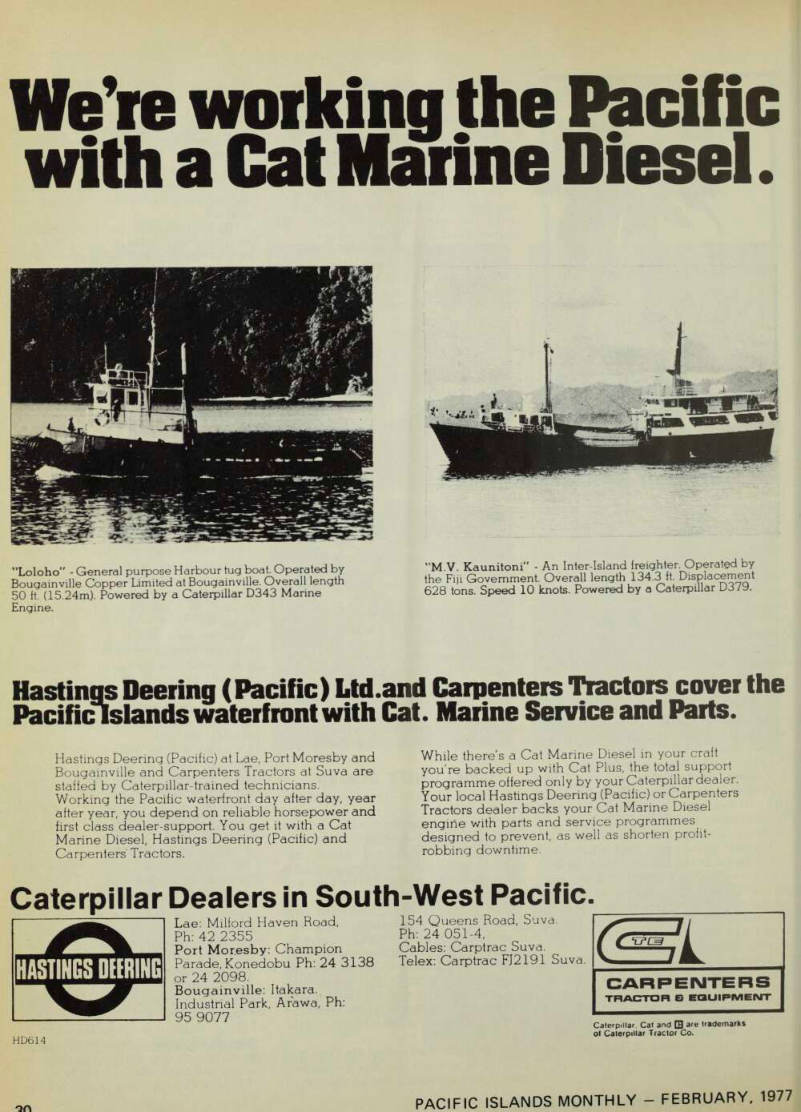
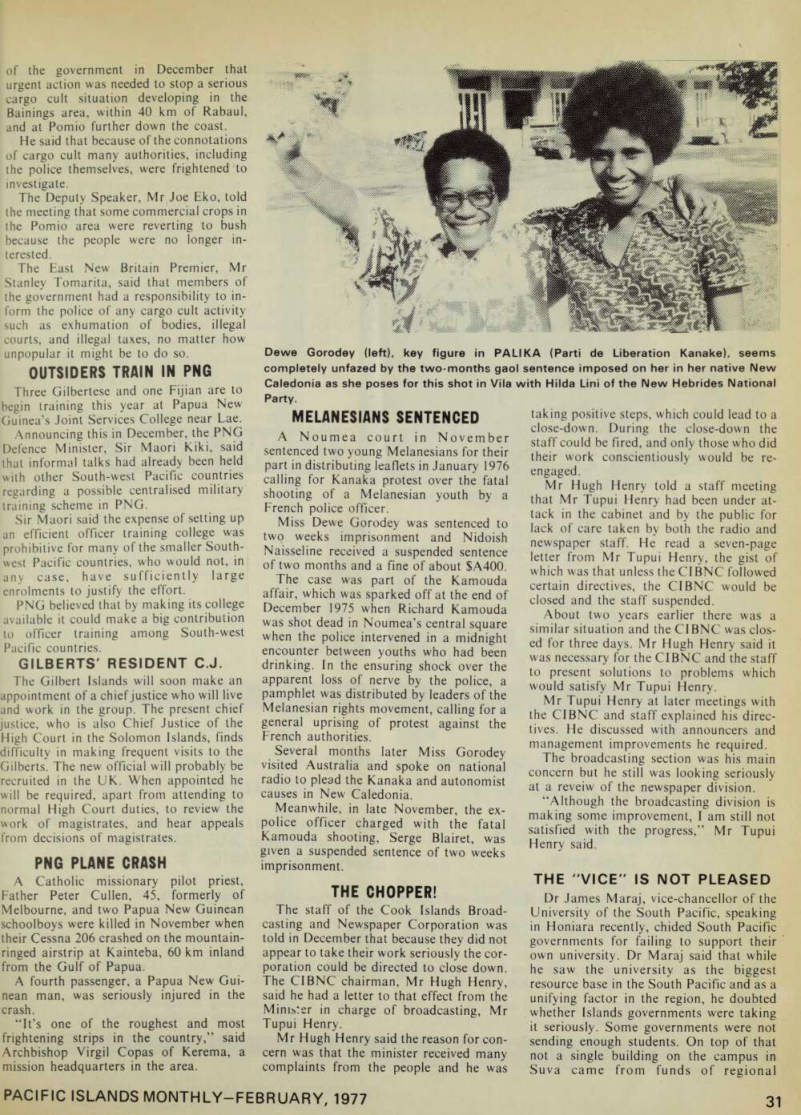
The
News
In A
Nutshell
North. Solomons Holiday
September I has been fixed as an annual public holiday for the North Solomons Province. The Premier of the North Solomons Provincial .Government, Dr Alexis Sarei, said celebrations on September I, 1976, marked the adoption of the new name from Bougainville to North Solomons Province, flying of the new flag alongside the Papua New Guinea national flag, and agreements reached between the leaders of the North Solomons and the PNG government. Dr Sarei said that the Prime Minister, Mr Michael Somare, had approved the celebrations.
Crane’S Yeoman Service
A heavyweight mobile crane did yeoman service last December lifting vessels to safely when tropical cyclone Kim hit Avarua and Avatiu harbours on Rarotonga, Cook Islands.
Among craft saved were launches and lighters belonging to the government Waterfront Commission, and an American cruising yacht, Fiesty Lady.
The inter-island vessel, Blue Water, was not so lucky. In the course of the blow she struck the wharf at Avatiu, was holed, and was only saved from sinking by prompt attention from the New Zealand Ministry ol Transport's fire engine whose pumps coped with the inflow of water until the weather improved.
Another craft to suffer was the fishing vessel Morning Star, owned by the well known island identity, Tekake Williams.
Morning Star's cabin was smashed by the Hying roof of the old headquarters building of A. B. Donald & Co. at Avatiu, which was one of a number of buildings on Rarotonga which emerged from the strom open to the heavens.
Talking Shop By Satellite
Directors of education from a number of island nation or territory members of the South Pacific Commission held a two-hour seminar in December with one exception they didn’t have to move more than a few hundred yards from their offices to do it.
The exception, Albert Sanagustin, Director of Education for Guam, had to make the short air trip to Saipan, the nearest Peacesat terminal location.
The satellite-borne discussion also in volved terminals in Papua New Guinea, Cook Islands, Niue, Western Samoa and New Caledonia. Education authorities in Honolulu and Wellington took part as observers.
Agenda items for the seminar included teacher education and teacher exchange, general curriculum development, and the possibility of creating a South Pacific Commission board for education co operation.
Tongan Workers Wanted
New Zealand’s Tongan Work Permit Committee chairman Mr Clive Edwards went to Tonga in December with a list of 15 companies wanting Tongan workers un der the new 1 1-month work permit scheme.
One of the businessmen involved, Mr Peter Norfolk, operations manager of Jaybel Nichimo, said shortage of workers wasn’t the reason for employing Tongans.
It’s because of the difficulty in finding keen and willing workers.
Another businessman, Mr Bill Witstyn, personnel manager for Ceramco’s heavy clay division, once had about 60 Tongan workers, but is down to 27 of whom about 20 are registered over-stayers. Some are key workers he can't afford to lose.
Staff particularly young people come and go “like wildfire,” he says, ad ding: “Tongans have the incentive to work - and their money helps the Island economy.”
Cooks Chiefs’ Demand
Some arikis (chiefs) in the Cook Islands are threatening legal action against the Premier, Sir Albert Henry, unless he con venes a meeting of the House of Ariki by the end of February. Sir Albert, un worried, questioned whether those arikis were qualified as members of the House of Ariki under the House of Ariki Act. (The House of Ariki, under the con stitution, is a consultative body, particular ly on land and native customs.) The Ui Arikis of Rarotonga recently considered legislation passed by the Legislative Assembly, particularly the Leases Restrictions Act. Mr laveta Short, a barrister and solicitor, at the invitation of the Ui Arikis, explained the effect of the act.
At the end of the meeting Mr Short was directed to write to Sir Albert recording the Ui Arikis' concern that no meeting of
the House of Ariki had been convened since 1974. (A meeting of the House of Ariki may be convened by the High Com missioner at the recommendation of the Premier.) Mr Short was directed to advise Sir Albert that he should call a meeting of the House of Ariki before the end of February, otherwise legal action might be taken to ensure compliance with the con stitution.
The Ui Arikis also recorded their disap pointment and concern that the Leases Restrictions Act was not referred to the House of Ariki before its passage through the Legislative Assembly.
The government in the past had said that all legislation relating to land custom and the general welfare of the people would be referred to the House of Ariki for con sideration before it was finally dealt with by the Legislative Assembly. The Ui Ariki fell that if the government wished to cultivate a harmonious relationship it had to give due recognition and respect to the House of Ariki, and not ignore it as it had with the Leases Restrictions Act and other legislation.
Sir Albert, in addition to doubting the qualifications of the Ui Arikis, also doubled whether Mr Short had given a true interpretation of the act.
Distaff Side Push In Png
For the first time in Papua New Guinea politics an organised attempt is to be made to get a group of women into Parliament.
Nilai Ra Warden “The Voice of Women” in the Rabaul area is making the move.
The president of Nilai Ra Warden, Mrs Demaris Tonga, announcing the cam paign, said that one of the biggest criticisms expressed by women about the present political scene was that most men refused to involve women. “We are just forgotten when men start dealing in politics”, she said.
Nilai Ra Warden plans to nominate one woman candidate for each of the four elec torates in the Rabaul area. But the group’s involvement could extend if sufficient sup port is received.
There is only one woman, Miss Josephine Abaijah, at present in PNG’s 100-seat National Parliament. Only three women, one of them an Australian, have ever stood for parliament in PNG.
Cargo Cultism On Rise
A swing to cargo cultism in rural villages is worrying the newlyformed East New Britain provincial government in Papua New Guinea.
The government has been told that some villagers are turning their backs on agriculture and are seeking prosperity through potential cargo cults. This includ ed the operation of secret societies and the exhuming of bodies. The latter practice is seen as part of a process of absorbing the wisdom and knowledge of ancestors.
Mr John Golpak told a special meeting
of the government in December that urgent action was needed to stop a serious cargo cult situation developing in the Bainings area, within 40 km of Rabaul, and at Pomio further down the coast.
He said that because of the connotations of cargo cult many authorities, including the police themselves, were frightened to investigate.
The Deputy Speaker, Mr Joe Eko, told the meeting that some commercial crops in the Pomio area were reverting to bush because the people were no longer in terested.
The East New Britain Premier, Mr Stanley Tomarita, said that members of the government had a responsibility to in form the police of any cargo cult activity such as exhumation of bodies, illegal courts, and illegal taxes, no matter how unpopular it might be to do so.
Outsiders Train In Png
Three Gilbertese and one Fijian are to begin training this year at Papua New Guinea’s Joint Services College near Lae.
Announcing this in December, the PNG Defence Minister, Sir Maori Kiki, said that informal talks had already been held with other South-west Pacific countries regarding a possible centralised military training scheme in PNG.
Sir Maori said the expense of setting up an efficient officer training college was prohibitive for many of the smaller South west Pacific countries, who would not, in any case, have sufficiently large enrolments to justify the effort.
PNG believed that by making its college available it could make a big contribution to officer training among South-west Pacific countries.
Gilberts' Resident C.J.
The Gilbert Islands will soon make an appointment of a chief justice who will live and work in the group. The present chief justice, who is also Chief Justice of the High Court in the Solomon Islands, finds difficulty in making frequent visits to the Gilberts. The new official will probably be recruited in the UK. When appointed he will be required, apart from attending to normal High Court duties, to review the work of magistrates, and hear appeals from decisions of magistrates.
Png Plane Crash
A Catholic missionary pilot priest.
Father Peter Cullen, 45, formerly of Melbourne, and two Papua New Guinean schoolboys were killed in November when their Cessna 206 crashed on the mountain ringed airstrip at Kainteba, 60 km inland from the Gulf of Papua.
A fourth passenger, a Papua New Gui nean man, was seriously injured in the crash.
“It’s one of the roughest and most frightening strips in the country,” said Archbishop Virgil Copas of Kerema, a mission headquarters in the area.
Party.
Melanesians Sentenced
A Noumea court in November sentenced two young Melanesians for their part in distributing leaflets in January 1976 calling for Kanaka protest over the fatal shooting of a Melanesian youth by a French police officer.
Miss Dewe Gorodey was sentenced to two weeks imprisonment and Nidoish Naisseline received a suspended sentence of two months and a fine of about SA4OO.
The case was part of the Kamouda affair, which was sparked off at the end of December 1975 when Richard Kamouda was shot dead in Noumea’s central square when the police intervened in a midnight encounter between youths who had been drinking. In the ensuring shock over the apparent loss of nerve by the police, a pamphlet was distributed by leaders of the Melanesian rights movement, calling for a general uprising of protest against the French authorities.
Several months later Miss Gorodey visited Australia and spoke on national radio to plead the Kanaka and autonomist causes in New Caledonia.
Meanwhile, in late November, the ex police officer charged with the fatal Kamouda shooting, Serge Blairet, was given a suspended sentence of two weeks
imprisonment.
The Chopper!
The staff of the Cook Islands Broad casting and Newspaper Corporation was told in December that because they did not appear to take their work seriously the cor poration could be directed to close down.
The CIBNC chairman, Mr Hugh Henry, said he had a letter to that effect from the Minister in charge of broadcasting, Mr Tupui Henry.
Mr Hugh Henry said the reason for con cern was that the minister received many complaints from the people and he was
taking positive steps, which could lead to a close-down. During the close-down the staff could be fired, and only those who did their work conscientiously would be re
engaged.
Mr Hugh Henry told a staff meeting that Mr Tupui Henry had been under at tack in the cabinet and by the public for lack of care taken by both the radio and newspaper staff. He read a seven-page letter from Mr Tupui Henry, the gist of which was that unless the Cl BMC followed certain directives, the CIBNC would be closed and the staff suspended.
About two years earlier there was a similar situation and the CIBNC was clos ed for three days. Mr Hugh Henry said it was necessary for the CIBNC and the staff to present solutions to problems which would satisfy Mr Tupui Henry.
Mr Tupui Henry at later meetings with the CIBNC and staff explained his direc tives. He discussed with announcers and management improvements he required.
The broadcasting section was his main concern but he still was looking seriously at a reveiw of the newspaper division.
“Although the broadcasting division is making some improvement, I am still not satisfied with the progress,” Mr Tupui Henry said.
The "Vice” Is Not Pleased
Dr James Maraj, vice-chancellor of the University of the South Pacific, speaking in Honiara recently, chided South Pacific governments for failing to support their own university. Dr Maraj said that while he saw the university as the biggest resource base in the South Pacific and as a unifying factor in the region, he doubted whether Islands governments were taking it seriously. Some governments were not sending enough students. On top of that not a single building on the campus in Suva came from funds of regional
Dewe Gorodey (left), key figure in PALIKA (Parti de Liberation Kanake), seems completely unfazed by the two-months gaol sentence imposed on her in her native New Caledonia as she poses for this shot in Vila with Hilda Uni of the New Hebrides National
governments Britain, Australia, New Zealand and Canada had paid for the lot.
The University suffered because of the habit among Pacific politicians of allowing a dispute over one subject to cloud their thinking over another unrelated matters.
Illegal Migrants Rapped
People trying to evade Australia’s im migration laws were at best unfair, at worst dishonest, the Australian Minister for Immigration, Mr MacKellar, said recently.
Mr MacKellar added: “1 have asked the department as far as possible to tighten controls on people entering the country.
Offices overseas will be asked to look more closely at the bona fides of people applying for visitor visas.
“This will apply particularly to people of nationalities which have shown up in our records as being among those most con sistently flouting entry requirements,” he said.
Fiji To Take Over C&W
Cable and Wireless, which has been part of the Fiji scene for many years, will soon be no more. Independent Fiji naturally wanting to do its own thing, is set to acquire a 51% interest in the British Government-owned Cable and Wireless through a new company, Fiji International Telecommunications Ltd (Fintel).
Cable & Wireless will become Fintel, which will operate out of that handsome building in Victoria Parade, Suva, which has been the C&W headquarters for many years.
The shareholding will cost Fiji about 5F3.5 million, about $1 million less than originally estimated. Fiji will take up an initial 10% very soon, and is required to take up the balance of equity to give it its 51% shareholding by 1982. Fintel will retain the C&W staff and management. But C&W retains ownership of its repair ships and ship-servicing station at Walu Bay.
The Fiji Minister for Communications, Mr Jonati Mavoa, said Fintel would be a commercial operation. Returns would be used to finance development projects. The government had already negotiated a 25% increase in international telecommunications rates, which came into effect in August, 1976.
There could be another increase this year. C&W had not increased its rates for 15 years.
Mr Mavoa said the government bought into C&W because it regarded it as a vital means of communication with other countries. On a purely commercial basis the government saw it as a good investment.
Advertisements & other items, pp. 30-34 (1 item)
We're working the Pacific
with a Cat Marine Diesel.
■ai -X* "Loloho" - General purpose Harbour tug boat. Operated by Bougainville Copper Limited at Bougainville. Overall length 50 ft. (15.24 m). Powered by a Caterpillar D 343 Marine Engine. ■M, "M.V. Kaunitoni” - An Inter-Island freighter. Operated by the Fiji Government. Overall length 134.3 ft. Displacement 628 tons. Speed 10 knots. Powered by a Caterpillar D 379.
Hastings Deering (Pacific) Ltd.and Carpenters Tractors cover the Pacific islands waterfront with Cat. Marine Service and Parts.
Hastings Deering (Pacific) at Lae, Port Moresby and Bougainville and Carpenters Tractors at Suva are staffed by Caterpillar-trained technicians.
Working the Pacific waterfront day after day, year after year, you depend on reliable horsepower and first class dealer-support. You get it with a Cat Marine Diesel, Hastings Deering (Pacific) and Carpenters' Tractors.
While there's a Cat Marine Diesel in your craft you're backed up with Cat Plus, the total support programme offered only by your Caterpillar dealer.
Your local Hastings Deering (Pacific) or Carpenters Tractors dealer backs your Cat Marine Diesel engine with parts and service programmes designed to prevent, as well as shorten profitrobbing downtime.
Caterpillar Dealers in South-West Pacific
Lae: Milford Haven Road, 154 Queens Road, Suva.
Ph: 42 2355 Ph: 24 051-4, Port Moresby: Champion Cables: Carptrac Suva.
Parade, Konedobu Ph: 24 3138 Telex: Carptrac FJ2191 Suva, or 24 2098.
Bougainville: Itakara.
Industrial Park, Arawa, Ph: 95 9077
HD6I4
HASTINGS DEERING
CARPENTERS
TRACTOR B EQUIPMENT
Caterpillar. Cat and [H are trademarks of Caterpillar Tractor Co.
To Future Generations,
Security
T m 'TI Tranquil Splendor.
Borobudur Temple in Indonesia built over 11 centuries ago.
Social welfare is a subject of serious consideration in most modern societies.
Man in the twentieth century accepts his responsibility to bequeath to the next generation a society better than his own.
Daiwa Bank is not unique in accepting this responsibility, but Daiwa is unique in making acceptance of this role in society an integral part of their banking service.
Daiwa is the only Japanese city bank to combine banking and trust business. Daiwa is thus a fully integrated banking institution, comprising banking, international financing, trust, pension trust, and real estate business.
This integration is part of our effort to fulfil our social responsibility consistent with society's needs in a contemporary environment. a fully Integrated banking service
DAIWA BANK
Head Office: Osaka, Japan London and Frankfurt Branches New York and Los Angeles Agencies Singapore, Sydney, Sao Paulo and Hong Kong Representative Offices Joint Venture Banks: P.T, Bank Perdania, Jakarta, International Credit Alliance, Ltd., Hong Kong
o
nedlloyd
REGULAR SAILINGS BY FAST, MODERN CARGO VESSELS from EUROPE via PANAMA fo; from NEW ZEALAND via PANAMA to:
EUROPE
PAPEETE, NOUMEA, (MEDITERRANEAN Or NORTH CONTINENT)
APIA, SUVA, LAUTOKA, „nd from AUSTRALIA to:
NEW ZEALAND. CENTRAL AMERICA & CARIBBEAN
heavy-lift facilities—refrigerated space—cargo deeptanks
For further particulars apply to Agents: its. Donald Tahiti Agence Maritime Aerienne Caledonienne Papeete. S.A. A.M.A.C., Noumea.
Interocean Australia Services Pty. ltd.
Sydney.
O. F. Nelson & Co. Ltd.
Apia.
Carpenters Shipping Suva, Lautoka.
Joint Shipping Management ltd.
P.O. Box 890, Wellington, N.Z.
CUE MARINE
PETROL and DIESEL ENGINES
Petrol and diesel engines to 350 h.p. Wide range of optional and accessory equipment, choice of transmissions Paragon, Twin-Disc or Borg Warner in all popular ratios. a • * o Vt. * v. 1 u v»
MARINE GEARS
Hydraulic-operated, self-contained oil pump, 220 h.p. maximum. Suits all popular engines. For work or pleasure.
CLAE ENGINE Sales and Service
31 Hoskins Ave, Bankstown.
NSW 2200. Phone 709 4777 Distributed by Stones Auto Diesel Service
P.0.80x 151, Kieta, BOUGAINVILLE.
CLAl5.2O.lOcm
Total service 0n ...
plumbing supplies Fast
WATSON & CRANE
are organised to fulfil your needs
wherever you are in the South Pacific * « ‘3r You can get all you need from one supply source; water taps, valves, copper tube, tools and a host of other fittings and related plumbing equipment for domestic, industrial and multistorey buildings.
Watson & Crane Pty Ltd have over 20,000 plumbing items in stock at their central warehouse located at Waterloo, NSW, Australia.
Years of experience in handling and shipping right throughout the South Pacific add up to another big reason for you to deal with Watson & Crane Pty Ltd.
Representatives call regularly at New Guinea, Papua, the Solomons, New Hebrides and Fiji Islands to personally discuss your requirements and appropriate credit arrangements.
Write, cable or telephone today for complete plumbers' supplies service.
Watson & Crane Pty. ltd. 1037 Bourke Street, Waterloo,
NSW 2017.
Phone: Sydney 699-1333.
Telex: AA 25548.
Cables; "Watcrane" Sydney.
P.cHic Island distributors of Crane Enfield copper tube for water, sanitation, endearing, refrigeration and air cotvdfHootfrg.
The gaping
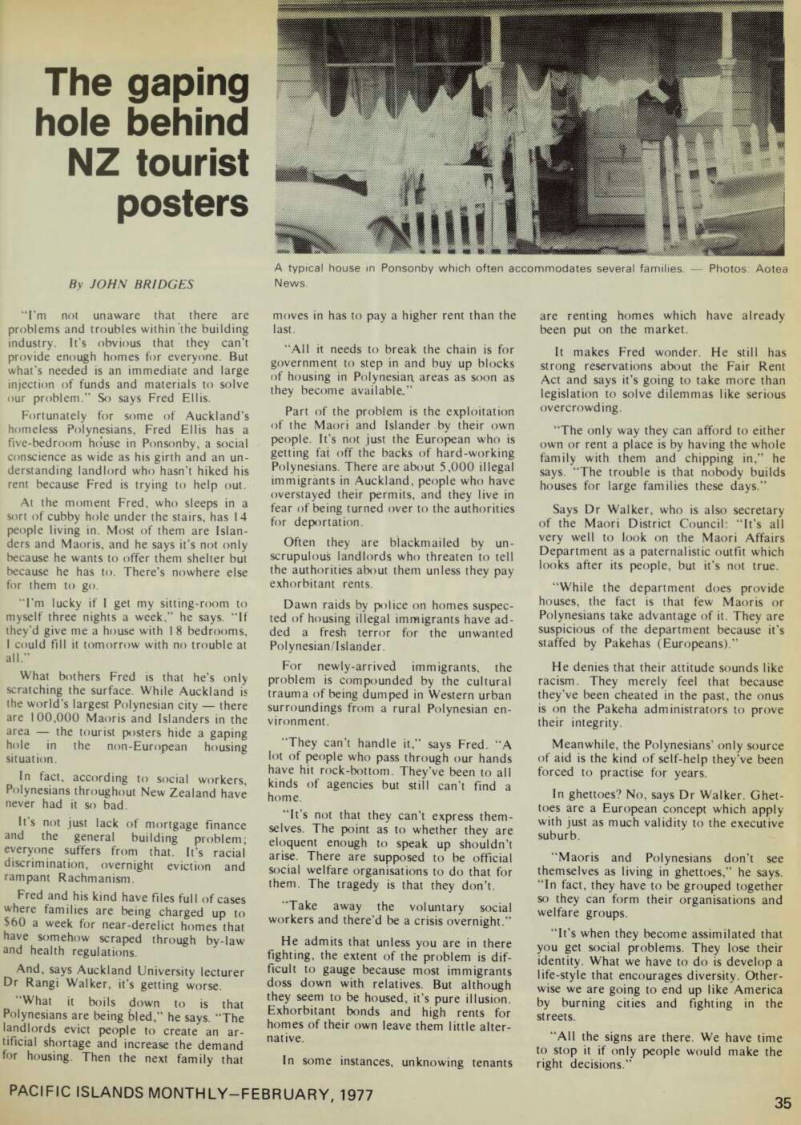
hole behind NZ tourist posters
By John Bridges
“I’m not unaware that there are problems and troubles within the building industry. It’s obvious that they can’t provide enough homes for everyone. But what’s needed is an immediate and large injection of funds and materials to solve our problem.” So says Fred Ellis.
Fortunately for some of Auckland’s homeless Polynesians, Fred Ellis has a five-bedroom house in Ponsonby, a social conscience as wide as his girth and an un derstanding landlord who hasn’t hiked his rent because Fred is trying to help out.
At the moment Fred, who sleeps in a sort of cubby hole under the stairs, has 14 people living in. Most of them are Islan ders and Maoris, and he says it’s not only because he wants to offer them shelter but because he has to. There’s nowhere else for them to go.
“I’m lucky if I get my sitting-room to myself three nights a week,” he says. “If they’d give me a house with 1 8 bedrooms, I could fill it tomorrow with no trouble at all.”
What bothers Fred is that he’s only scratching the surface. While Auckland is the world’s largest Polynesian city there are 100,000 Maoris and Islanders in the area the tourist posters hide a gaping hole in the non-European housing situation.
In fact, according to social workers, Polynesians throughout New Zealand have never had it so bad.
It’s not just lack of mortgage finance and the general building problem; everyone suffers from that. It’s racial discrimination, overnight eviction and rampant Rachmanism.
Fred and his kind have files full of cases where families are being charged up to $6O a week for near-derelict homes that have somehow scraped through by-law and health regulations.
And, says Auckland University lecturer Dr Rangi Walker, it’s getting worse.
“What it boils down to is that Polynesians are being bled,” he says. “The landlords evict people to create an ar tificial shortage and increase the demand for housing. Then the next family that
moves in has to pay a higher rent than the last.
“All it needs to break the chain is for government to step in and buy up blocks of housing in Polynesian areas as soon as they become available,”
Part of the problem is the exploitation of the Maori and Islander by their own people. It’s not just the European who is getting fat off the backs of hard-working Polynesians. There are about 5,000 illegal immigrants in Auckland, people who have overstayed their permits, and they live in fear of being turned over to the authorities for deportation.
Often they are blackmailed by un scrupulous landlords who threaten to tell the authorities about them unless they pay exhorbitant rents.
Dawn raids by police on homes suspec ted of housing illegal immigrants have ad ded a fresh terror for the unwanted Polynesian/Islander.
For newly-arrived immigrants, the problem is compounded by the cultural trauma of being dumped in Western urban surroundings from a rural Polynesian en vironment.
“They can’t handle it,” says Fred. “A lot of people who pass through our hands have hit rock-bottom. They’ve been to all kinds of agencies but still can’t find a home.
“It’s not that they can’t express them selves. The point as to whether they are eloquent enough to speak up shouldn’t arise. There are supposed to be official social welfare organisations to do that for them. The tragedy is that they don’t.
“Take away the voluntary social workers and there’d be a crisis overnight.”
He admits that unless you are in there fighting, the extent of the problem is dif ficult to gauge because most immigrants doss down with relatives. But although they seem to be housed, it’s pure illusion.
Exhorbitant bonds and high rents for homes of their own leave them little alter native.
In some instances, unknowing tenants
are renting homes which have already been put on the market.
It makes Fred wonder. He still has strong reservations about the Fair Rent Act and says it’s going to take more than legislation to solve dilemmas like serious overcrowding.
“The only way they can afford to either own or rent a place is by having the whole family with them and chipping in,” he says. “The trouble is that nobody builds houses for large families these days.”
Says Dr Walker, who is also secretary of the Maori District Council: “It’s all very well to look on the Maori Affairs Department as a paternalistic outfit which looks after its people, but it’s not true.
“While the department does provide houses, the fact is that few Maoris or Polynesians take advantage of it. They are suspicious of the department because it’s
staffed by Pakehas (Europeans).”
He denies that their attitude sounds like racism. They merely feel that because they’ve been cheated in the past, the onus is on the Pakeha administrators to prove
their integrity.
Meanwhile, the Polynesians’ only source of aid is the kind of self-help they’ve been forced to practise for years.
In ghettoes? No, says Dr Walker. Ghet toes are a European concept which apply with just as much validity to the executive suburb.
“Maoris and Polynesians don’t see themselves as living in ghettoes,” he says.
“In fact, they have to be grouped together so they can form their organisations and welfare groups.
“It’s when they become assimilated that you get social problems. They lose their identity. What we have to do is develop a life-style that encourages diversity. Other wise we are going to end up like America by burning cities and fighting in the streets.
“All the signs are there. We have time to stop it if only people would make the right decisions.”
A typical house in Ponsonby which often accommodates several families. - Photos: Aotea News.
Islands
From The
Press
From the Samoa Times, Apia: Solosolo men cut off the water pipes supplying the adjacent villages of Eva, Fusi and Saluafata to give their village more water . . . The Minister of Works, Letiu Tamatoa . . . said the village action was quite illegal and the alleged involvement of Members of Parliament in ordering it made it quite deplorable.
From an editorial in the Fiji Times, Suva: Why is Suva Chamber of Commerce objecting to the Consumer Council obtaining powers to hold inquiries and call people to give information? The suggestion that it is because consumer councils in overseas countries do not have the powers of a statutory body fails to hold water . . . Here our consumers are basically unsophisticated shoppers who know little, if anything, about their rights or about the Consumer Council . . .
Businessmen who provide a genuine service to the consumer have nothing to fear from a properly functioning consumer council, however powerful it is . . .
From Samoa News, Pago Pago:
The Governor of American Samoa will soon be taking his showers in water heated to a comfortable temperature by the sun’s rays ... The pilot project with solar energy is part of a world-wide effort to save on consumption of oil and gas.
From an editorial in the Papua New Guinea Post-
Courier, Port Moresby:
So the louts have won. Kila Kila High School has been closed indefinitely. What a disgusting state of affairs. There have been 19 break-ins at the school this year and thousands of kina worth of damage caused. In June the students were fingerprinted. For a while the vandalism stopped. Now it has broken out again. The police must winkle out these louts and lock them up. Why should hundreds of children suffer because of a few?
From the Solomons News Drum, Honiara: Squatters are becoming a big problem on Guadalcanal, the Minister of Natural Resources, Paul Tovua, told the people of Mataniko village at a meeting. Mr Tovua said pigs and crops had been stolen and women threatened in their gardens. He said that squatters are illegally settling on land and action must be taken to stop such people.
From Lae Nius, Papua New Guinea: The secretary of the Morobe Traditional Dancing Society, Mr Werner Knoll, claimed that not enough time was given to traditional dancing at the Morobe Show. He said: “Giving the show ring to the dancers for only a couple of hours, while the rest of the day is taken up with horse events of limited interest, means the dancers cannot display themselves properly. Most groups can put on plays and elaborate dances, involving building various structures. For example, there is an 80-foot tower needed for one fertility dance . . .”
From the Cook Islands News: Well the Tourist Authority is going to be an Authority at last.
The trouble is that it might be too late. Already outsiders have moved in and Cook Islanders moved out so where do we go from here? We have heard the same old story from the Authority that it is their intention to restrict outsiders in the tourist industry, but up till now all they have done is restrict Cook Islanders.
From the Norfolk Islander: The Nimmo report arrived this week. Its effect has been elec trifying. The judge talks of the divisiveness of the people of N or folk Island. We feel that the report will aggravate and further this divisiveness.
From the Cook Islands News, on a critical report of
the Cl Broadcasting and Newspaper Corporation:
On the radio side, the equipment is so bad that the announcers bring their own records and cassettes. They also supply their own cassette players because the wonderful studio does not own one. The tape recorders are so old that you never know if the programme is being recorded properly or not.
From The Atoll Pioneer, Tarawa, Gilbert Islands: Radio Tarawa is able to resume transmissions on a temporary basis with the assistance of the Ministry of Communications Works and Utilities who kindly offered the use of one of their short wave transmitters. This is a commercial transmitter and cannot produce good quality music. Our sincere apologies to our music fans but we hope they will understand, and that our own transmitter will soon be repaired.
Mr Barry Holloway, Speaker of the PNG Parliament, in the PNG Post-Courier: “The planning of the Papua New Guinea economy is upside down. We are going full speed astern in the false security of a currently favourable and misdirected cash economy. The amount of money going out of Papua New Guinea on luxury and replaceable food items is reaching a peak far more beyond the point of necessity than ever before. This money alone would replace the fiscal benefits of a new copper mine, or nearly hall the generous Australian grant.”
From an article on water pollution in the Tonga Chronicle: ... The water of the lagoon now carries more suspended sediment than previously, and this has killed some large coral heads near Mu’a ... The rate of change of the lagoon has increased with the population of Tonga and the amount of land under cultivation. At this rate the already shallow lagoons will turn into dry land causing the loss of an extremely important ecosystem many coral reef fish use the lagoon as a nursery area in which the young fish grow up . . .
A recipe for successful negotiating from PNG Prime Minister Michael Somare and reported in the Arawa Bulletin: ... In the past some people have tried to betray my government and have criticised me for taking my time in negotiating the Bougainville problem. But I have always told them that we Papua New Guineans have a unique way of coming to terms, by sitting down together, chewing betelnut and at the same time
talking about differences . . .
Advertisements & other items, p. 37 (1 item)
Different yes. Frivolous no
' & ■a i - J Mazda 929
You can see the 929 is different.
Beautiful, clean-flowing lines from nose to tail. Everything on the car, appointments and mechanics, is there for a good practical reason. Building frivolous cars is not for us.
Never has been and never will be.
We build in something everyone appreciates . . . Quality. You’ll know what we mean when you look over the 929. Examine its finish. Settle down at the wheel. And take it out for a spin. Different yes. Frivolous no.
A ■ - * A
1976 TOYO KOGYO CO., LTD.
da FIJI ISLANDS Niranjans Autoport Ltd. G.P.O. Box 450, Suva TEL: 22691 NEW CALEDON A Soci6te Riviere et Bernanos, 27, Rue de Sebastopol, Noumea JEA P.N.G. Associated Industries Ltd. P.O. Box 1394, BorokoTEL: 55788 lEW ZEALAND Mazda Motors of New Zealand Ltd. Olahuhu, Auckland, P.O. Box 22-472 TEL: 69-099 NOPh )LK Duncombe Bay Garage, P.O. Box 220, Norfolk Island TEL: 2097 8.5.1. P, Solomon Motors Ltd. P.O. Box 20. Honiara TEL: 313 TAHITI Comptoir Polynesian, B.P. 628, Papeete.
The trademark MAZDA in this advertisemet stands for AUTOMOBILES MAZDA as far as France and her territories are concerned.
Magazine
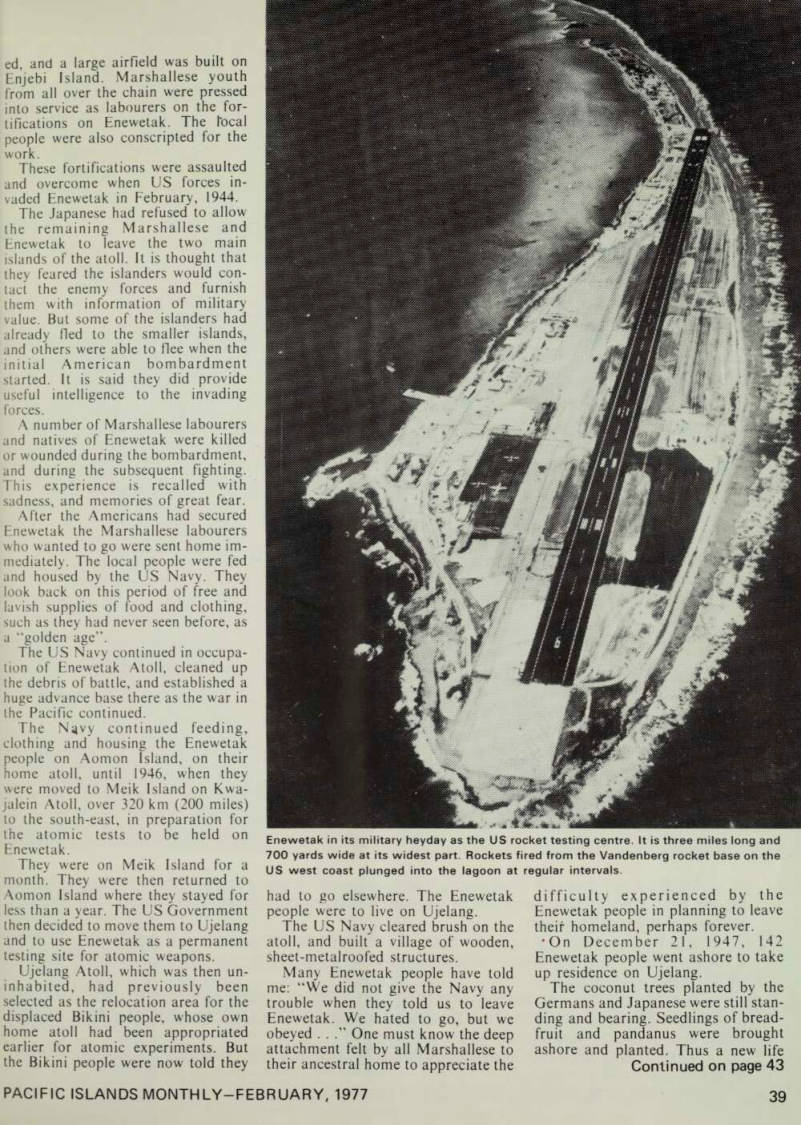
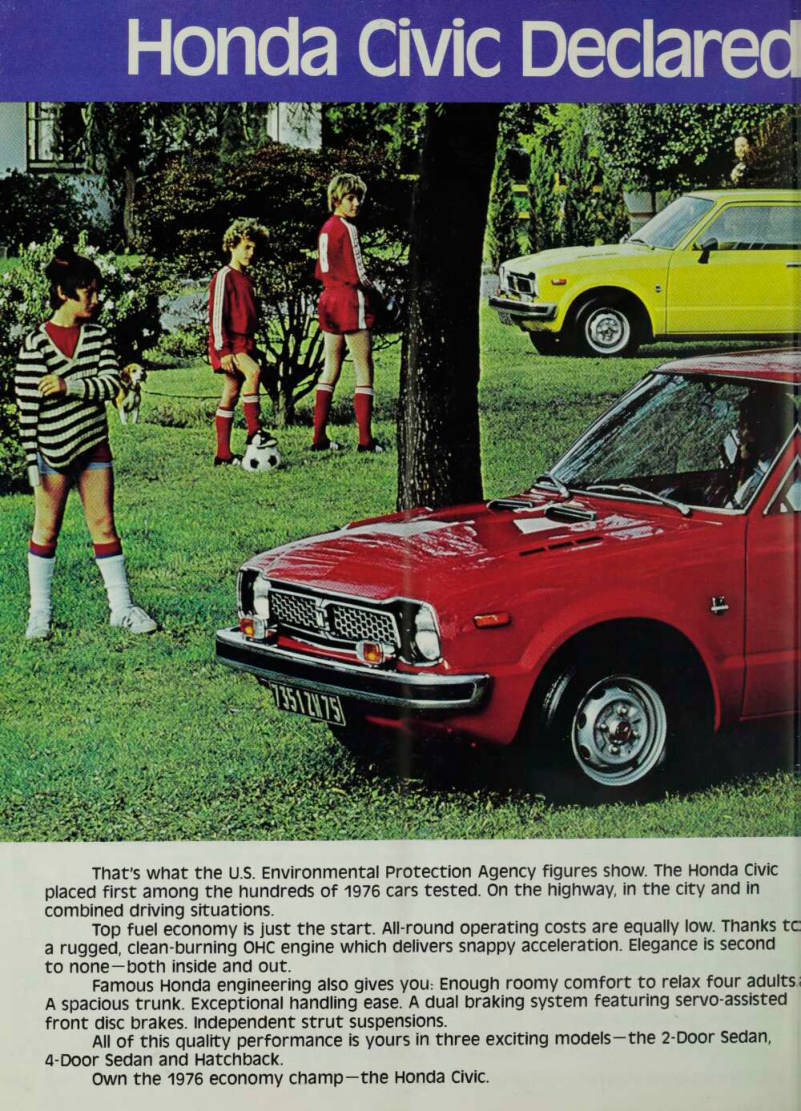

On Enewetak Atoll it’s “Paradise Regained”
The Enewetak people say that, as far as they know, they have always lived on Enewetak Atoll, and that “there have always been two big chiefs (‘iroij’) and two groups, because there were two big islands”.
They state that these were the people of Enjebi Island and the people of Enewetak Island, both of whom lived on the atoll of Enewetak. They claim that the two groups have never warred against each other, but have always co-operated very closely.
According to those who know the history of their people the chiefs, the wise old men and women, and those few of the younger people who have learned the ancient lore from their elders four separate groups of Marshallese arrived on Enewetak Atoll before the coming of the Europeans. These latter came from the atolls of Bikini, Ujae, Wotto, and other atolls many miles to the east of Enewetak. These invaders, apparently castaways, either fought the Enewetak people, or merely stayed a while before returning to their home atolls. Apparently none of them remained on Enewetak.
Enewetak was discovered quite by chance by European ships passing through the area on the way to the East. The German scholars Kramer and Nevermann say that “Alvaro de Saavedra found Enewetak on October 1, 1529”. There is no evidence or tradition of contact between the Spaniards and the Enewetak people’ either then or at any other time.
It seems unlikely that significant contacts with Europeans occurred before the 19th century.
The sighting of the isolated atoll was next reported in 1792 by Captain Bond in the English ship Royal Ad miral. Other sightings followed and were duly reported by English cap tains during the remainder of the cen tury.
These 18th century contacts are not a part of the oral tradition of the
For generations to come, the people of Enewetak Atoll, Marshall Islands, will mark September 16 as a holiday, a day of rejoicing.
For it was on that day in 1976 that the United States ended 32 years of use and occupancy of Enewetak, and formally handed back the atoll to its people.
As a bonus, they were also given nearby Ujelang Atoll, where they had been living in exile ever since, in 1947, they were removed from Enewetak to enable the US to use their home for nuclear testing. In all, 43 nuclear blasts, including the first hydrogen bomb explosion in 1952, were con ducted between their removal and 1958, when nuclear testing was ended in the Enewetak-Bikini area.
From Majuro, American scholar JACK ADAIR TOBIN, author of a doctoral dissertation on the Enewetak people which was presented at the University of California, Berkeley, fills in the background to their story.
Enewetak people, and as far as can be discerned, had very little, if any, effect on their culture.
More frequent and purposeful European visits began in the latter part of the 19th century, as the islands of the Pacific were opened up for trade and missionary activity.
The Germans formally established their administration over the Marshall Islands in 1886, but had been trading in the area for years before that.
Enewetak informants tell how a German warship put in to Enewetak Atoll shortly after the acquisition of the Marshalls, and confirmed the two chiefs in their authority, giving them medals of office. German traders followed, bringing in coconut seedlings and asking the chiefs to tend them and to sell the copra so produc
ed to them. Trade goods were ad vanced to the chiefs against the equivalent in future copra production.
The Enewetak people thus became involved in the economy of the outside world. They began moving from a subsistence economy to a mixed cash and subsistence economy. This brought changes in the patterns of work and consumption.
The Germans did not station any agent on Enewetak, nor were there any resident Europeans or other aliens. Foreign visitors were in frequent during the German period, and the inhabitants were left pretty much to themselves.
The Japanese seized Enewetak, along with the rest of the German possessions in Micronesia, in the autumn of 1914.
Enewetak (and Ujelang), unlike the rest of the Marshalls, were ad ministered from the Branch Bureau of the South Seas Administration (“Nanyo Cho”) on Ponape Island in the Eastern Carolines. Infrequent trips were made by Japanese officials to Enewetak for administrative and commercial purposes.
As had been the case with the Ger mans, contact with the Japanese was very slight. There were no Japanese officials of any kind on Enewetak.
Three Japanese, a trader and his two assistants, comprised the only presence of the administering nation on the atoll. No schools were es tablished, but several young people were sent to Ponape to attend govern ment and Protestant mission schools.
The pace changed dramatically in the late 19305. The Japanese Imperial High Command had decided to make Enewetak an important link in its strategic plans for the conquest of the Pacific area.
During 1939-41, thousands of ar my, navy, marine, and engineering personnel, and Korean and Okinawan labourers, poured into Enewetak.
Elaborate fortifications were install
ed, and a large airfield was built on Enjebi Island. Marshallese youth from all over the chain were pressed into service as labourers on the for tifications on Enewetak. The focal people were also conscripted for the work.
These fortifications were assaulted and overcome when US forces in vaded Enewetak in February, 1944.
The Japanese had refused to allow the remaining Marshallese and Enewetak to leave the two main islands of the atoll. It is thought that they feared the islanders would con tact the enemy forces and furnish them with information of military value. But some of the islanders had already fled to the smaller islands, and others were able to flee when the initial American bombardment started. It is said they did provide useful intelligence to the invading forces.
A number of Marshallese labourers and natives of Enewetak were killed or wounded during the bombardment, and during the subsequent fighting.
This experience is recalled with sadness, and memories of great fear.
After the Americans had secured Enewetak the Marshallese labourers who wanted to go were sent home im mediately. The local people were fed and housed by the US Navy. They look back on this period of free and lavish supplies of food and clothing, such as they had never seen before, as a “golden age”.
The US Navy continued in occupa tion of Enewetak Atoll, cleaned up the debris of battle, and established a huge advance base there as the war in the Pacific continued.
The Navy continued feeding, clothing and housing the Enewetak people on Aomon Island, on their home atoll, until 1946, when they were moved to Meik Island on Kwa jalein Atoll, over 320 km (200 miles) to the south-east, in preparation for the atomic tests to be held on Enewetak.
They were on Meik Island for a month. They were then returned to Aomon Island where they stayed for less than a year. The US Government then decided to move them to Ujelang and to use Enewetak as a permanent testing site for atomic weapons.
Ujelang Atoll, which was then un inhabited, had previously been selected as the relocation area for the displaced Bikini people, whose own home atoll had been appropriated earlier for atomic experiments. But the Bikini people were now told they
had to go elsewhere. The Enewetak people were to live on Ujelang.
The US Navy cleared brush on the atoll, and built a village of wooden, sheet-metalroofed structures.
Many Enewetak people have told me; “We did not give the Navy any trouble when they told us to leave Enewetak. We hated to go, but we obeyed . . .” One must know the deep attachment felt by all Marshallese to their ancestral home to appreciate the
difficulty experienced by the Enewetak people in planning to leave their homeland, perhaps forever. •On December 21, 1947, 142 Enewetak people went ashore to take up residence on Ujelang.
The coconut trees planted by the Germans and Japanese were still stan ding and bearing. Seedlings of bread fruit and pandanus were brought ashore and planted. Thus a new life
Continued on page 43
Enewetak in its military heyday as the US rocket testing centre. It is three miles long and 700 yards wide at its widest part. Rockets fired from the Vandenberg rocket base on the US west coast plunged into the lagoon at regular intervals.
began for the uprooted Enewetak peo ple. No American official remained on Ujelang, nor was there radio com munication with the outside world.
Long periods of complete isolation and privation ensued.
The Enewetak inhabitants, who were and are well organised, with good leadership, attempted to adjust to their new location. There were several formidable problems to cope with. The most obvious was the great disparity in size between Ujelang and Enewetak.
The total dry land area of Ujelang is only 1.08 sq. km (0.67 sq. m), and much of this is rocky and poor. The area of the lagoon is only 41 sq km (25 sq m). On the other hand, the total dry land area of Enewetak Atoll is 3.64 sq km (2.26 sq m), much of which is well suited for agricultural use. The total lagoon area is 624 sq km (388 sq m). These figures are reflected of course in the much less abundant production of food, and the drastical ly reduced food potential, especially from the reefs, lagoon and surroun ding sea on Ujelang.
Logistics was another major problem. The geographical location of Ujelang is much less favourable in relation to the sources of needed im ported foodstuffs and other com modities than is the case with Enewetak.
The tendency for the population to rise, and the consequent added pressure on scant natural resources, was another problem. (As of November, 1972 there were 340 peo ple living on Ujelang, with 71 Enewetak people living elsewhere.) The unfavourable economic situa tion and the persistent desire to return to Enewetak finally stimulated agressive action by the people. In 1967 they threatened to evacuate the atoll, and in 1968 the leaders petition ed the United Nations for assistance in returning to Enewetak.
Relief shipments of food were sent to the community. An ex gratia pay ment of $ 1,020,000 was made to them in 1969. This was placed in a trust fund, the interest from which was of assistance. Other funds were allocated for the construction of badly needed public facilities on the atoll. The Ujelang community assumed respon sibility for the labour involved.
The efforts to improve the situa tion, while welcome, did nothing to lessen the desire of the people to return to their ancestral home. They continued to want, indeed to yearn, to return to their “paradise lost . .
Advertisements & other items, pp. 40-44 (1 item)
Honda Civic Declare
et W % y> ■« mt *>* m m m ■ mm : * m :r i P»7 •:V' S& $ Kt Ufl #s m &f?r, ft# « That's what the U.S. Environmental Protection Agency figures show. The Honda Civic placed first among the hundreds of 1976 cars tested. On the highway, in the city and in combined driving situations.
Top fuel economy is just the start. All-round operating costs are equally low. Thanks tc a rugged, clean-burning OHC engine which delivers snappy acceleration. Elegance is second to none-both inside and out.
Famous Honda engineering also gives you: Enough roomy comfort to relax four adults; A spacious trunk. Exceptional handling ease. A dual braking system featuring servo-assisted front disc brakes, independent strut suspensions.
All of this quality performance is yours in three exciting models-the 2-Door Sedan, 4-Door Sedan and Hatchback.
Own the 1976 economy champ-the Honda Civic.
HONDA
HONDA MOTOR CO.. LTD. TOKYO, JAPAN
PAPUA NEW GUINEA: Steamships-Machinery P.O. Box 1. Port Moresby/TAHITI: Societe Tahitienne d’lmportation des Produits Honda B.P. 1665-Papeete/FIJI ISLANDS: Coral Island Motors P.O. Box 48.
Suva/U.S. TRUST TERRITORY: United Micronesia Development Assn. P.O. Box 238, Saipan. Mariana Islands 96950/COOK ISLANDS: Cook Islands Motor Center Ltd. P.O. Box 74, Rarotonga/AMERICAN SAMOA: Samoan Holiday and Travel Center P.O. Box 968, Pago Pago/AMERICAN SAMOA: Haleck’s Service Center P.O. Box 1138, Pago Pago/GUAM: Mark’s Motor Co., Inc. P.O. Box DV. Agana / WESTERN SAMOA: Motor Distributors (Samoa) Ltd. P.O. Box 576. Apia/SOLOMON ISLANDS: British Solomons Trading Co., Ltd. P.O. Box 114, Honiara/NEW CALEDONIA: Establissements Ballande Boite Postale No. C 4 Noumea Cedex/TONGA; E.M. Jones Limited P.O. Box 34, Nuku’alofa/TARAWA: Gilbert & Ellice Islands Development Authority P.O. Box 488, Beito/NIUE ISLAND: S. Jessop & Sons Ltd. P.O. Box 71. u^l'«. < L U i^ /NAURU: Nauru Cooperative Society, Republic of Nauru, Nauru Island Central Pacific/NEW HEBRIDES: Tropex International Ltd., P.O. Box 139, Port Vila.
that makes your home
a healthier place
How effectively you protect your family from the dangers of disease carrying insects, may well depend on the insect spray you choose.
Powerful Insect Killing Ingredients.
Concentrated Pea Beu is one of the most powerful household insect sprays in the world. Its principal insect killing ingredients have been selected to ensure rapid knock down and kill of all common disease carrying insects.
Rigid Testing. Through every stage of manufacture. Pea Beu is rigidly tested.
There ore ingredient tests, spray droplet tests, pack tests, many forms of tests, some carried out three times over.
When you spray this remarkable aerosol insecticide, you can be sure that its ingredients have met with the most exacting standards enabling you to spray it safely with confidence in your home. 9 Family Health and Well Being. The common housefly carries up to half a billion germs and, when you realize that disease carrying insects enter even the best regulated households, you can understand why you can't be too careful .about the effectiveness of your insect spray. Remember, even the tiniest droplet * 4 7 / / 4
wmm
m v Concentrated Pea Beu. Even the tiniest droplet
kills flies, mosquitoes, gi| common
disease carrying insects fast.
* insects fast, so it is indeed a worthy guardian of your family's health and well being.
Such is the effectiveness of Pea Ben's insect killing ingred ient. tliat no common disease carrying insect can survive it. not develop an immunity to it. When you spray Concentrated Pea Beu. it's nice to know I fiat no common disease carrying insect can survive.
Pea Beu The strong one, makes your home a healthier place.
Look to Wunderflex
for a practical approach
to good design
We all look for good design in a building.
If it’s practical and economical as well, you’re in front.
Wunderflex building board is the answer. It fits good design with ease. Practical because it’s easy to work; won’t rot, shrink or rust. Paint it if you wish — but there’s no need. Versatile, too, use Wunderflex inside or out.
Economy comes with initial purchase and the long lasting qualities of Wunderflex.
Yes, Wunderflex has a lot going for it.
Ask your builder.
kViunderlich
Wunderflex
Made in Australia and marketed by: CSR-Wunderlich Building Materials Export Sales: 4 O'Connell Street, Sydney 2000 Postal address; Box 483, G.P.0., Sydney, N S W. 2001
AVAILABLE THROUGH LEADING ISLAND MERCHANTS.
926A8
€ * —J‘ j
QQQC'C &MSLM
7 (4 it* t'*'" 1 ‘
S * -r: i There seems to be no end to the superlatives used to describe stereo sound quality. It’s usually natural, crystal clear, rich or vibrant with plenty in reserve.
The list of words is longer than the tape on a 7-inch reel. But these tired, old adjectives can’t convey the full impact of Akai sound. Perhaps there just aren’t any words equal to the task.
It’s a visual experience that begins the moment you close your eyes and are swept into the imaginative world of your mind.
Akai provides you a wide selection of fine stereo components—
tape decks, turntables, amps,
tuners, receivers and speaker systems—to assure you will enjoy
every trip.
See the difference when you move up to Akai sound.
Audio & Video
AKAI
AKAI ELECTRIC CO., LTD.
Tokyo, Japan
Australia Akai Australia Pty. Ltd. 17/18 Hordern Place Denison St.
Camperdown, Sydney, N.S.W. 2050 Tel: 516-3366
P.N.G.
S.O. Svensson (N.G.) Ltd.
P.O. Box 705, Port Moresby Tel: 2275 Fiji Islands Motibhai & Company Ltd.
P.O. Box 9175 Nadi International Airport Tel: 72-165 New Zealand Pye Ltd, Consumer Product Division 110 Mt. Eden Rd., Mt. Eden, Auckland Tel: 686-437 New Caledonia Menard Freres B.P. H 2, Noumea Tel: 275222 Tahiti Etablissements Comimpex P.O. Box 200, Papeete Tel: 20477 New Hebrides Island Burns Philip (New Hebrides) Co., Ltd.
Port Vila, New Hebrides Island Norfolk Island Burns Philip (Norfolk Island) Co., Ltd.
P.O. Box 21, Norfolk Island Samoan Islands Burns Philip (South Sea) Co., Ltd.
P.O. Box 129, Pago Pago, American Samoa, Apia, Western Samoa Mariana Islands J.C. Tenorio Enterprises P.O. Box 137, Saipan Tel: 6444/8 British Solomon Security Electrical Co., Ltd.
P.O. Box 174, Honiara Tel: 881 Cook islands JPS Enterprises Ltd.
P.O. Box 15, Rarotonga Tel: 2150, 2176
For George Farwell,
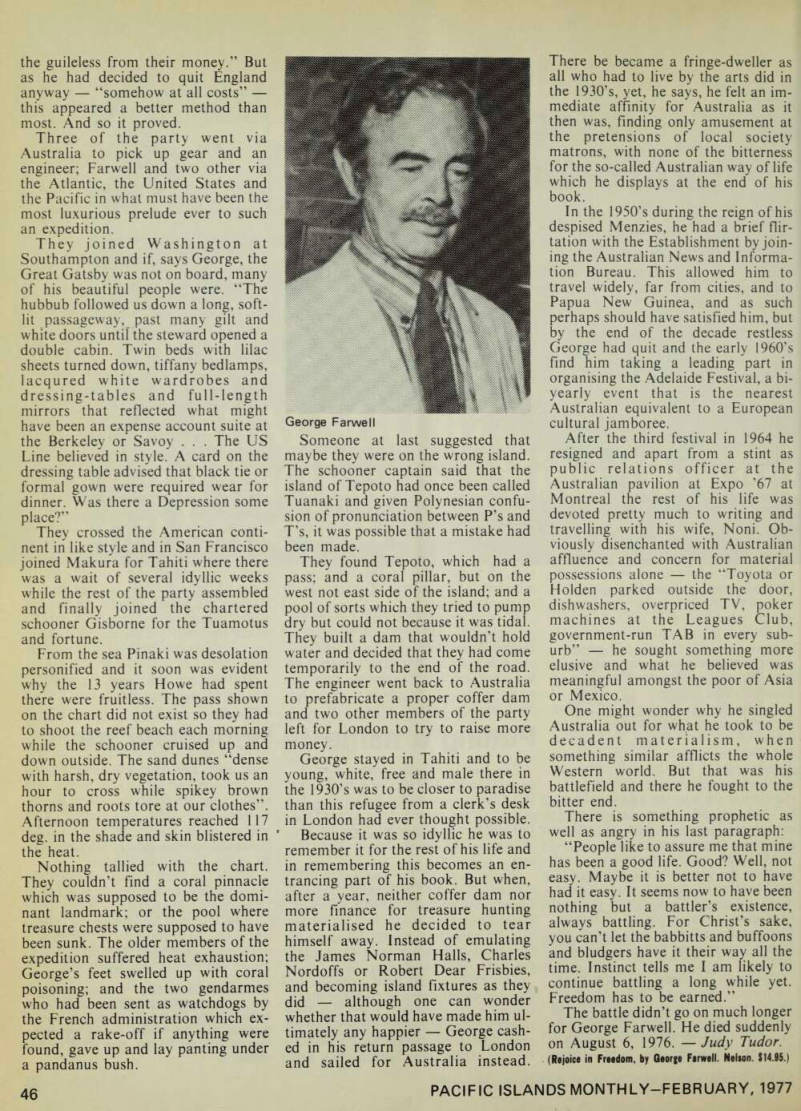
freedom had to be earned
Books
George Farwell spent the best part of his life in Australia working hard at what we Australians allegedly haven’t got culture and an appreciation of the arts. Just how hard is made abun dantly clear in his posthumously published autobiography, Rejoice in Freedom, in which George reveals himself as a many-sided fellow in deed, albeit lurking behind the facade of a mild-mannered, expatriate Englishman.
He was bdrn in the United Kingdom some time before World War I, of a family whose connections included a ne’er-de-well grandfather who had been at the Bendigo diggings, an English bishop, a lawyer who ad- L vised the British Cabinet, an uncle who wrote music and a great-great aunt who was lady-in-waiting to Queen Mary.
All good background for what he was to become in Australia radical, anti-establishment, bohemian, writer, wharf labourer, gold miner, actor, Australian Broadcasting Commission commentator/reader of poetry, seaman, public servant, outback traveller, magazine publisher and Pacific Island hopper.
Perennially, he was an advocate for the recognition of Australian artistic talent which, he believed, had to flee overseas or perish in the cultural desert created by the disinterest of successive conservative governments.
He did not see why the arts should not be subsidised, like farming or manufacturing a sort of artistic phosphate bounty, as it were.
Although many Australians look back on the era of Prime Minister R.
G. Menzies as some sort of Golden Age, to George Farwell and those of like mind it was a period of frustra tion, really relieved only when the Labor government came to power in 1972.
“It was a time of great ex citement,” he says, “new hopes, a belief that something could at last be made of this torpid, directionless country.” Prime Minister Whitlam certainly loosened the purse-strings
for the arts, as he loosened them for much else, and there was rejoicing amongst the cultural poor before his government was tossed out three years later.
Much of Rejoice in Freedom deals with Farwell’s struggle to survive by his writing and associated activities between the 1930’s and 1950’5, and to the analysis of life in those times from this viewpoint. As such it should have much appeal to those of like mind who tried to travel the same stony path.
Philistines will probably take greater pleasure in his excursions into the Australian outback and his other travels, most of which became sub jects for full-length books, his humorous asides and anecdotes; his continuing love affair with French Polynesia and his hilarious introduc tion to those isles of the blest as a member of a party of high class treasure seekers.
He was decanted straight from his minor public school into the Great Depression whereupon his lawyer un cle managed to find him a niche in Royal Dutch Shell with the ultimate prospect of transfer to the Netherlands Indies. When this idea
Putting a name to Hebridean trees
The New Hebrides, with a popula tion of under 100,000, has well over 100 distinct vernacular languages. To record all the vernacular names of the 150 different species of trees in the islands would clearly be an immense task.
While working for two years as a United Nations Volunteer in the islands, Miss Sheila Gowers has done ground-breaking work in this direc tion by collecting names from 35 of the most widely spoken languages covering 100 tree species.
The bulk of the book consists of detailed descriptions of 50 of the more common tree species. Each descrip tion includes notes on crown shape, bole, buttress, bark, slash, leaves, flowers, fruit, wood properties and
folded the same uncle whisked him to a clerk’s desk in the London Electric Supply Co, From an endless vista of life as a clerk in cold, wet London he finally decided to escape by cashing in his only inheritance and joining a syn dicate formed to search for treasure on the uninhabited atoll of Pinaki in the Tuamolu group of French Polynesia. The treasure, so the story went, had been looted from a church in Lima in 1859 and cached on lonely Pinaki until the fuss blew over. It was said to include 14 tons of gold ingots, gold, jewel-encrusted candlesticks and 38 diamond necklaces. The last per son to seek it was an Australian nam ed Howe who had got a chart and in formation from one of the original looters then on his death-bed. After he got himself to Pinaki in 1910 Howe lived there on fish and coconuts for 13 years while he frantically dug trenches all over the island. Finally the French authorities deported him to Australia where he spent the rest of his life try ing to raise the finance for another try.
“In bold outline,’’ says Farwell, “it was an improbable story. Boy’s Own Paper stuff. Or designed to separate
local uses. These are followed by a list of common and vernacular names and a full page illustration of the leaves, flowers and fruit. A further nine species are briefly described. All botanical terms used are fully describ ed in an illustrated glossary.
While the book’s primary intention is to reduce the confusion existing in the New Hebrides over the nomenclature of tree species, it should also be of interest to linguists, anthropologists and botanists work ing in the region and worldwide.
(SOME COMMON TREES OF THE NEW HEBRIDES AND THEIR VERNACULAR NAMES. By Sheila Gowers.
Published by the Forest Section of the Department of Agriculture, Vila, New Hebrides. Available from Maropa Bookshop. P.O. Box 210, Vila. Price 5A2.50, including postage.)
the guileless from their money.” But as he had decided to quit England anyway “somehow at all costs” this appeared a better method than most. And so it proved.
Three of the party went via Australia to pick up gear and an engineer; Farwell and two other via the Atlantic, the United States and the Pacific in what must have been the most luxurious prelude ever to such an expedition.
They joined Washington at Southampton and if, says George, the Great Gatsby was not on board, many of his beautiful people were. “The hubbub followed us down a long, soft lit passageway, past many gilt and white doors until the steward opened a double cabin. Twin beds with lilac sheets turned down, tiffany bedlamps, lacqured white wardrobes and dressing-tables and full-length mirrors that reflected what might have been an expense account suite at the Berkeley or Savoy . . . The US Line believed in style. A card on the dressing table advised that black tie or formal gown were required wear for dinner. Was there a Depression some place?”
They crossed the American conti nent in like style and in San Francisco joined Makura for Tahiti where there was a wait of several idyllic weeks while the rest of the party assembled and finally joined the chartered schooner Gisborne for the Tuamotus and fortune.
From the sea Pinaki was desolation personified and it soon was evident why the 13 years Howe had spent there were fruitless. The pass shown on the chart did not exist so they had to shoot the reef beach each morning while the schooner cruised up and down outside. The sand dunes “dense with harsh, dry vegetation, took us an hour to cross while spikey brown thorns and roots tore at our clothes”.
Afternoon temperatures reached 117 deg. in the shade and skin blistered in the heat.
Nothing tallied with the chart.
They couldn’t find a coral pinnacle which was supposed to be the domi nant landmark; or the pool where treasure chests were supposed to have been sunk. The older members of the expedition suffered heat exhaustion; George’s feet swelled up with coral poisoning; and the two gendarmes who had been sent as watchdogs by the French administration which ex pected a rake-off if anything were found, gave up and lay panting under a pandanus bush.
Someone at last suggested that maybe they were on the wrong island.
The schooner captain said that the island of Tepoto had once been called Tuanaki and given Polynesian confu sion of pronunciation between P’s and T’s, it was possible that a mistake had been made.
They found Tepoto, which had a pass; and a coral pillar, but on the west not east side of the island; and a pool of sorts which they tried to pump dry but could not because it was tidal.
They built a dam that wouldn’t hold water and decided that they had come temporarily to the end of the road.
The engineer went back to Australia to prefabricate a proper coffer dam and two other members of the party left for London to try to raise more money.
George stayed in Tahiti and to be young, white, free and male there in the 1930’s was to be closer to paradise than this refugee from a clerk’s desk in London had ever thought possible.
Because it was so idyllic he was to remember it for the rest of his life and in remembering this becomes an en trancing part of his book. But when, after a year, neither coffer dam nor more finance for treasure hunting materialised he decided to tear himself away. Instead of emulating the James Norman Halls, Charles Nordoffs or Robert Dear Frisbies, and becoming island fixtures as they did although one can wonder whether that would have made him ul timately any happier George cash ed in his return passage to London and sailed for Australia instead.
There be became a fringe-dweller as all who had to live by the arts did in the 1930’5, yet, he says, he felt an im mediate affinity for Australia as it then was, finding only amusement at the pretensions of local society matrons, with none of the bitterness for the so-called Australian way of life which he displays at the end of his book.
In the 1950’s during the reign of his despised Menzies, he had a brief flir tation with the Establishment by join ing the Australian News and Informa tion Bureau. This allowed him to travel widely, far from cities, and to Papua New Guinea, and as such perhaps should have satisfied him, but by the end of the decade restless George had quit and the early 1960’s find him taking a leading part in organising the Adelaide Festival, a bi yearly event that is the nearest Australian equivalent to a European cultural jamboree.
After the third festival in 1964 he resigned and apart from a stint as public relations officer at the Australian pavilion at Expo ’67 at Montreal the rest of his life was devoted pretty much to writing and travelling with his wife, Noni. Ob viously disenchanted with Australian affluence and concern for material possessions alone the “Toyota or Holden parked outside the door, dishwashers, overpriced TV, poker machines at the Leagues Club, government-run TAB in every sub urb” he sought something more elusive and what he believed was meaningful amongst the poor of Asia or Mexico.
One might wonder why he singled Australia out for what he took to be decadent materialism, when something similar afflicts the whole Western world. But that was his battlefield and there he fought to the bitter end.
There is something prophetic as well as angry in his last paragraph: “People like to assure me that mine has been a good life. Good? Well, not easy. Maybe it is better not to have had it easy. It seems now to have been nothing but a battler’s existence, always battling. For Christ’s sake, you can’t let the babbitts and buffoons and bludgers have it their way all the time. Instinct tells me I am likely to continue battling a long while yet.
Freedom has to be earned.”
The battle didn’t go on much longer for George Farwell. He died suddenly
on August 6, 1976.
Judy Tudor.
(Rejoice in Freedom, by Qeorje Ferwell. Nelion. $14.95.)
George Farwell
the publishing field
Church team enters the publishing field
The Lotu Pasifika Productions en try into a wider field of publication in the Pacific region is worthy of note.
Lotu Pasifika traces its origin to the first co-operative effort in the media area about 1963 with the development of the Pacific Islands Christian educa tion curriculum, which was the star ting point for the production of Chris tian publications on a regional basis.
A number of surveys conducted during the 1960 s and early 1970 s in dicated, moreover, that there was a need for a publishing house in the Pacific, with a broader base than purely religious publications, one that would be concerned with education on a wider plane than the emphasis upon Sunday School materials.
In 1976, Lotu Pasifika Productions is better known for its concern for the publication of materials with a wide and popular appeal. It is also noteworthy for its emphasis that there should be proper attention paid to manuscripts written in the vernacular as instanced by its Fijian language recipe book and its Tongan language monograph of the life of Sui La Polu.
One of the major concerns is to produce textual support by way of supplementary readers that will ex tend local curricula objectives and also provide printed works suitable for use on an inter-regional basis.
Although it has no official stan ding, other than its inter congregational organisational struc ture, Lotu Pasifika is seeking to work with the various education departments to produce texts which will have specific value within a syllabus. For Fiji, LPP is now produc ing a text on the life of Cargill, the missionary.
One of the more interesting projects which has been advanced by LPP is the publishing of a children’s magazine for use throughout the Pacific region.
The magazine, to be called Coconut, is designed for use by children in the top two years of the primary school and the first two years of the post-primary school. The staff of LPP have conducted a survey of the children’s response to the first trial issue of the magazine and the consen sus seems to be that a suitable level of language difficulty has been sur
mounted. It is a continuing aim of the publishers that they should seek the children’s response to the material presented and that the magazine should provide a back-up by way of supplementary material for course prescriptions being followed in schools.
One of the initial contributions, for instance, will be a cartoon series on the peoples of the Pacific, and on such topics as weather stations and the education of handicapped children.
The name of the magazine was chosen from entries received in a com petition, the winners being two boys from Tailevu in Fiji, who suggested
that the coconut has real significance in the Pacific as it is a fruit which floats everywhere and it is a plant of which every part can be used.
The manager of Lotu Pasifika Publications is Isake Raratabu of Fiji and the editor lova Geita of Papua New Guinea.
At present the Rev David Williams of the Church Missionary Society is acting as LPP's publishing trainer.
LPP is solely a publishing house and all work is sent out for printing.
At present LPP receives financial sup port from sponsoring organisations, but the long-term objective is economic viability.
O Tahiti expands horizons
On August !, 1964, E. “Buzz”
Miller founded Echoes of Polynesia, which enjoys the distinction of having been “French Polynesia’s first and only periodical in English”. The magazine, which was later re-named O Tahiti, has now been published con tinually as a quarterly for 10 years.
O Tahiti, which has its material carried in parallel English and French versions, covers general interest areas, as well as some items about current developments in French Polynesia.
The tourist trade is the main target for O Tahiti so its vision is limited by the constraints imposed by such a sec tor.
In the last issue for 1976, the magazine made an adjustment, which seems to be intended to capitalise upon the projected expansion of tourism in Rarotonga.
Miller has now published two periodicals O Tahiti and Rarotonga and Rarotonga. The first magazine carries the usual material of O Tahiti, with an additional 12-page “Rarotonga Section”.
The second magazine uses the same cover picture and uses the Rarotonga material from the omnibus section.
The larger version deserves critical examination. Ralph Varady has provided “Hokule’a expose migration proof or hoax?”, in which he raises in some depth and with con siderable vigour and critical com
merit, the doubts that must be felt in many minds about simulated or “duplicated'’ Polynesian canoe voyages. It is an article which should be read as a point of reference to the October, 1976, article in National Geographic, “Hokule'a follows the stars to Tahiti”, and PI M’s articles on the same subject.
O Tahiti and Rarotonga also in cludes George Logue's “The little grass shack,” which examines the transformation of the native-style ac commodation used by tourists in French Polynesia. There is a six-page photographic essay composed by Buzz Miller which must have been designed to titillate the fancies of tourists who have visions of unclad female Polynesian figures abounding on coral strands.
Rarotonga is also published in French and English versions and perhaps it will persuade some French tourists to use the Air New Zealand service from Papeete to Rarotonga and, thereby, visit a less-sophisticated Polynesian country.
This first edition of Rarotonga con tains mainly introductory and descriptive material and it is unfor tunate that several elementary errors have been made. However, Miller has admitted that he is aware of these failings and that future issues will be more severely edited.
w. G. Coppell.
Advertisements & other items, p. 48 (1 item)
Sidchrome
Save hundreds of dollars
on Australians most efficient
WALK IN, ALUMINIUM
COOLROOMS AND
FREEZE ROOMS
Hundreds already installed! The most economical supplementary coolrooms for bottles and food, providing the largest storage capacity of any comparable coolrooms of the same exterior dimensions. Five sizes—from 90-360 cu. ft. capacity; 16 models offering normal temp., two temp., deep freeze, or for pastry and ice storage applications. White vinyl interior, embossed rustproof aluminium exterior. • SUPPLIED IN EASY-TO-ERECT, DO-IT-YOURSELF KIT FORM.
Available from: AUSTRALIAN NEW CALEDONIA EXPORTS (SILVER & BARDA), 363 George St., Sydney, 2000 and Branches.
BRECKWOLDT & CO., 276 Pitt St., Sydney, 2000 and Branches.
PETER FISHER TRADING PTY. LTD., 321 Pitt St., Sydney, 2000.
HAGEMEYER (A'SIA), 59 Anzac Pde., Kensington, 2033 and Branches.
GEOFFREY HUGHES & CO., 167 Macquarie St., Sydney, 2000.
Manufactured by:
■ 77 NELSON & ROBERTSON PTY. LTD., 197 Clarence St., Sydney, 2000.
RABAUL TRADING CO. PTY. LTD., P.O. Box 219, Rabaul and Branches.
E. RABOT (EXPORTS) PTY. LTD., 67 Castlereagh St., Sydney, 2000.
H. Y. KWAN (AUST.) PTY. LTD., Box 2713 G.P.O. Sydney, 2001.
C. SULLIVAN (EXPORT) PTY. LTD., 60 Margaret St., Sydney, 2000 and Branches.
W. S. TAIT & CO., PTY. LTD., 31 Macquarie Place, Sydney, 2000 and Branches.
FRIGID CABINETS PTY. LTD.,
14A Duffy Ave., Thornleigh, N.S.W. 2120 Aust. Ph. 848 8292.
There’s really
only one tool
SIDCHROME
There’s a saying in the tool business.
If you’re going to throw a spanner in the works, make sure it’s a Sidchrome spanner.
And that goes for all Sidchrome tools.
Sidchrome tools are made from the highest quality alloy steel. Finished in a tough, everlasting nickel chrome, and made to last.
That’s why Sidchrome hand tools are unconditionally guaranteed. m m m * M P.N.G. AGENT:- R. & J. Henderson, P.O. Box 353, Lae,
Png’S Oil Palm Project-
Business
‘Biggest In The World!’
The world’s biggest oil palm project is to be established at Popondetta in Papua New Guinea’s Northern Province.
The agreement to develop the estate section of the K 35 million project was signed by the PNG Government and the Commonwealth Development Corporation in Port Moresby in Oc tober.
The CDC, a British statutory authority operating with funds drawn from the United Kingdom Treasury, is now involved in development pro jects in about 50 countries in the Pacific, Asia, Africa and the Carib bean.
The CDC will be corporate manager of the project.
The scheme involves the develop ment of a 4,000 ha nucleus estate by the CDC, and the settling of 1,400 smallholder families on 5,600 ha un der oil palm surrounding the estate.
The nucleus estate company will com mission a 60-tonne-per-hour factory to process the output of both its own estate and the smallholders.
The CDC investment is Kll million, while the smallholders’ pro ject is being financed by a K 9.1 million long-term, low-interest loan from the World Bank.
Each smallholder will be settled on a block allowing 4 ha to be planted to oil palm, and a further 2 ha for hous ing and gardening.
Estimated smallholder income a family is between K 1,200 and K 2,500 depending on world prices.
A company will be formed which will be responsible for the transport of smallholder fruit, selling in bulk to the factory and making payments to smallholders.
Selection of new settlers will be on a nation-wide basis, with preference given to applicants from the Northern Province.
Speaking at the October signing ceremony, PNG’s Minister for Primary Industry, Mr Boyamo Sali, denied that the launching of the new
oil palm project (to be known as the Higaturu project) had any connection with recent events at the Biala oil palm project in West New Britain Province, where the government has abrogated the agreement with Japanese companies and taken full control of the project.
He said he was confident that Biala would soon be operating again under new management.
Stressing the importance of in volving local people in the scheme, the Governor-General, Sir John Guise, said that first priority must be given to the Orokaiva people, who were the owners of the land set aside for the Higaturu project. He said there were two other language groups to be taken into account before the government could bring in families from other provinces to make up the balance.
The Prime Minister, Mr Michael Somare, said the new project was the
largest development scheme under taken in PNG since the Bougainville copper project.
About 11,000 people would be directly involved, while thousands more would benefit from its spin-off effects, bringing prosperity to Northern Province, whose economy had recently been depressed.
He said PNG expected to earn about KlO million annually in foreign exchange when the scheme is fully operative in about five years’ time.
The Minister for Finance, Mr Julius Chan, said the World Bank loan for the smallholder scheme was highly significant, because it was the first loan made by the Bank to PNG without an Australian Government guarantee.
He said the new loan set the seal on the bank’s favourable assessment of PNG’s creditworthiness.
Forward Thinking
Hanuatek, A Piece Of
By Anne Macgregor
A new concept in education after training is Hanuatek part and parcel of forward-thinking Badili Vocational School. Built on the foreshore of reclaimed land on Motu-Motu Bay the village will he a home for ex-students with a skill, but nowhere to go.
Badili Vocational School produces scores of students who have learned the fine arts of carpentry, plumbing, cane furniture making, picture framing and many other manual skills. Many graduate to the big, had world unable to find employment, and without capital to set themselves up.
That’s what Hanuatek's all about. Graduates will he encouraged to set themselves up individual workshops, which have been designed with accom modation overhead. Budding entrepreneurs may stay there for a year to get a business established, and raise further capital.
The architectural concept is an innovative one for Papua New Guinea.
Treated timber walls, and roofing tiles have rarely been used in housing in the country to-date, though these materials would obviate the imported, characterless roofing-iron and fibro-sheeting currently used.
Hopper windows and doors allow maximum lighting and air. The display house features three-level-living with an airy, open gallery.
English designer, Hugh Webster has designed an attractive, functional complex which will provide workshops for 30 craftsmen and women, a restaurant, and gallery. Visitors will be welcomed at Hanuatek and visits there will most likely be included on tour itineraries of the national capital.
Hanuatek was officially opened by Port Moresby’s Lord Mayor, Mr Mahuru Rarua Rarua, on September 16 Independence Day.
Shot in the arm
for Cooks’ copra
The Cook Islands’ copra industry got a shot in the arm in November when the New Zealand Government made a cash grant to it of $lOO,OOO.
The aid came under NZ’s bilateral aid programme and will be ad ministered by the Cooks Primary Produce Marketing Board under the Minister of Industries, Labour and Commerce, Mr George Ellis.
The aid will eliminate the long standing grievance of copra producers over delays in payment for their produce by Abels Ltd of Auckland. A revolving fund of $67,000 has been set aside from the new grant to permit payment as soon as the copra is reweighed and graded in Rarotonga.
Copra producers’ associations will use a further $20,000 to buy new production equipment, and $13,000 will be spent on gunny sacks and new scales for copra-weighing in Rarotonga.
Rising copra prices have en couraged producers, who have shipped 172 tonnes to New Zealand in recent months. Of the seven producer islands, Manihiki topped the list with 66 tonnes exported.
Dine by lantern light
at Good Samaritan
A new motel, the Good Samaritan Inn, opened recently at Kolovia Beach, about 12 miles west of the Tongan capital, Nukualofa. There is sleeping accommodation for 12 in five decorated Tongan-style “fales”. The dining room, sitting room and bar overlook the beach. Facilities include a small shop, shower and toilet, and barbecue areas. One drawback is that there is no electricity. Lighting is provided by lanterns. The owner is Mr William Huluholo Mo’ungaloa, of Kolovai.
PNG restores copra
export tax
Papua New Guinea’s export tax of 2Vi% on copra, suspended since April, 1975, because of poor prices, was reimposed on January 11. When the tax was lifted there was an understan ding between the Department of Finance, the Department of Primary Industry and the Copra Marketing Board, that it would be reimposed when the price recovered to above the “floor level”. Prices were now above the “floor”.
Advertisements & other items, p. 50 (1 item)
<\fr a. lia
Do you want to do business in New Zealand?
Ask the bank which has
40% of the banking business
in New Zealand
The BNZ can give you full information on buying or selling in New Zealand and overseas. Ful information on investment movement of money, transfers of dividends etc., is also readily available.
There are offices everywhere, more than 400 in fact Whatever your financial or trade needs, the BNZ can help you.
Bank of New Zealand
Wellington -Head Office, International Division, Box 2392.
Sydney-GRO Box 507, Sydney, NSW. 2001 Melboume-GPO Box 528 E, Melbourne, Vc. 3001.
Tokyo-MrE.L. Banks, Bank of New Zealand Representative Office, Japan. Sorte 240,lShin t Tokyo Bldg, 3-1,3-Chrome, Marunouchi, lOO.
Singapore - M r R. F. Warren, Bank of New Zealand Representative Office, South East Asia. Suite 230,23 rd Floor, Ocean Bldg, Cofyer Quay, Singapore 1.
London -P0 Box 402, LondonEC4P4.H.E.
Fiji, Suva-25 Victona Parade Also at Labasa, Lautoka, NadiJSigatoka, Ba.
Associated Banks inthe South Pacific.
Bank of Western Samoa. Bank of Tonga. 7.6
<\fr a. lia
rtrodt
Shipping • Forwarding • Air Freight • Container operators • Insurance Founded in 1887 at Hamburg (Head Office) to service your transport needs.
NOMINATE HARTRODT AS YOUR FREIGHT FORWARDER
Contact A. Hartrodt (Australia) Ply. Ltd. for information on services available and advantages. Our own offices in all main trade centres of HAMBURG • BREMEN • ROTTERDAM • GENOA
• LONDON • LIVERPOOL
7 COGGINS PLACE, MASCOT. N.S.W. 2020.
Postal Address: P.O. Box 349, Mascot, N.S.W. 2020.
Telephone: 669 6844. Telex: 21416. the world.
The Best Way To

Trade With Islands
Australian exporters to the Pacific Islands received some good advice from Mr Philip Best, group general manager of Burns Philp and Co Ltd at the Christmas luncheon of the Sydney Chamber of Commerce Export Development Group in December.
He was particularly qualified to advise exporters after about 25 years with Burns Philp (SS) Ltd, including five years as general manager, for he knows at first hand what is required in the Islands.
He said Australia enjoyed the major portion of exports to a number of countries in the Pacific, with NZ a close second.
The pricing structure of goods sold thus had a significant effect on internal costs and inflation. Australia enjoyed its position because it was close to the Islands, there were good shipping services, and there was a demand for Australian goods. He warned, however, that rising costs in Australia at all levels would eventu ally force Islands importers to look elsewhere. Even with the recent Australian devaluation of currency, retention of the Pacific Islands market would be increasingly difficult.
Mr Best said that as Pacific countries became independent they also became selective. There was a growing awareness of what was available in other countries.
Increasing pressure was therefore placed on Island merchants and importers to prove they were supplying Islands communities goods at the best possible price.
In the middle of 1976, PNG revalued the kina by 5%. After that merchants were asked to show how
the revaluation had helped to reduce the cost to the public of goods sold, and were asked to quote actual figures. Exporters who used the opportunity to increase their fob prices at the same time would be looked at more closely in the future. A similar policy followed in relation to reductions in duty to see that the exporter and local merchant, in collusion, did not take up the difference at the expense of the consumer.
Mr Best said the larger import houses in the Islands had been asked many times whether the merchandise they were carrying was, in fact, being bought from the cheapest source, rather than the traditional. If Australia was to retain the Pacific Islands market exporters would need
to continually appraise their price
structures.
Mr Best also asked exporters to give greater attention to the quality of packages, to help avoid damage and
pilfering.
He said the late receipt of invoices by the importer was an area which had caused concern for many years. With reasonably adequate airline schedules there was no real excuse for delays.
Unfortunately, co-ordination be tween warehouse despatch and ex porters’ customs agents was not always as close as it might be. But importers, to avoid high demurrage charges, needed to clear their goods
quickly.
There was also a need for exporters away from the main shipping port of Sydney to get their goods to the ship in time. Too often, once a ship was
The shape of things to come ... a model of Hanuatek (see p. 49) the technical village to be built on Motu-Motu Bay, PNG. Hanuatek, a Motu word for technical village, includes a restaurant, display gallery and workshops for 30 people.
missed, three to five weeks passed before another was available.
He suggested that exporters do as much as possible to promote container cargoes, from warehouse to warehouse. There were problems to be overcome, and he believed they could be if there was a concerted effort.
Mr Best emphasised that Islands governments were encouraging their nationals to go into commercial trade.
Many of those people were inexpe rienced and did not know all ramifications of international trade and pricing structures. It could be said they should not go into business unless they were fully equipped to do so. Untortunately, not many of them realised that, and exporters in Australia would be doing their country and those people a tremend ous service by watching and safe guarding against pitfalls.
“I make this special plea because of the very dominant role that Australian export does play in the South Pacific market place”, Mr Best said.
Bank of NSW
bows out on Nauru
The Bank of New South Wales will soon close its Nauru branch. This follows an undertaking it gave about nine years ago, when Nauru became independent, that when the govern ment set up its own bank it would pul out. It is now in the closing-dowr process.
The Bank of Nauru, which startec business on October 1, 1976, is full) owned by the Nauru Government and its obligations to depositors an guaranteed by the government. It is it the same premises as the Bank o NSW, which is providing the staff til the Bank of Nauru is able to recrui its own staff.
Finnish ideas for
Tonga’s industry
There are four major areas of in dustrial development which mak sense for Tonga, says a Finnish ex pert, Mr Pekka Mannio, who visitei the country recently as a represen tative of the Asian Development Banl to study industrial possibilities. Th areas referred to were: • Processing agricultura products; • Substituting imports with loca products; • Handicraft development, main ly for export; • Inducing foreign companies t set up subsidiaries in Tonga.
Mr Mannio noted that man
Tongans sought work in New Zealand, and that many NZ employers actively sought island employees. He expressed the view that it would be more humane, and more efficient, to take work to the people, rather than the people to work.
Therefore, New Zealand companies should set up subsidiaries in Tonga to provide work on the spot for Tongans.
W. Samoa to have
its own brew
The Western Samoa Government will hold a 51% interest in a brewery, at Apia, which it hopes will be profitable in two years. West German interests will have a 25.5% equity. The remaining shares will be offered to Nauru, Tonga, Niue and the Cook Islands.
The acting Attorney-General, Mr Neroni Slade, went to West Germany recently to complete details for the project. He said then he expected the brewery would be in operation in about 18 months (about mid-1978).
Initial capital will be T 1 million, but ultimately it will rise to T 3.5 million.
The Chamber of Commerce raised objections, saying the amount of water required would be more than 10 gallons for each gallon of beer brew ed. But the official view was that preliminary studies showed there was enough water available.
A brewery would practically eliminate the need to import beer.
US plans to defuse
Ebeye ‘time-bomb’
The Trust Territory Government has taken the first step to try to lift the standard of living on the tiny islet of Ebeye in the Marshall Islands. Ebeye is over-populated and congested.
About 700 Micronesians, who work on the Kwajalein missile range, and their families, numbering about 7,000, live on Ebeye which covers 76 acres.
A planning committee, a rather high-powered body, has been ap pointed consisting of representatives of all concerned interests, including the High Commissioner, Congress of Micronesia, Marshallese traditional leaders, the District Administrator, the District Legislature, the Defence Department, the Interior Depart ment, Redstone Arsenal, the US Commander-in-Chief, Pacific and Kwajalein missile range officials.
The acting High Commissioner, Mr Peter T. Coleman, recently wrote to the Director of Territorial Affairs, Mr Fred M. Zeder, saying Ebeye
needed upgrading of its “deteriorated public and private facilities to cope with its high population density”. The most “prominent” problems were on Ebeye because of international im plications.
They were problems caused by programmes conducted in the interest of the national security of the US and perhaps the free world. The nuclear tests on Enewetak and Bikini for which the people of Ujelang and Kili had to be moved, the fallout that affected the people of Rongelap and to some extent the people of Utirik, and the anti-missile tests on Kwa jalein Atoll affecting all the people on
that atoll, gave rise to the problems.
An article in PIM last June, which described Ebeye as a “ghetto-islet”, reported that the Congress of Micronesia had declared the islet to be a “disaster area ... a biological time-bomb which could go off at any moment”.
Solomons budget
shows dependence
Just how heavily the Solomons Government relies on overseas assistance to meet budgetary requirements was revealed by the Finance Minister, Mr Kinika, when he introduced the 1977 budget to the
Legislative Assembly. The government requires $21,920,440 to meet commitments $11,681,000 in the recurrent budget and $10,239,490 in the capital budget.
Mr Ki.nika said that to meet the recurrent budget the government expected to raise $9,668,000 locally, with the shortfall of about $2 million coming from a British grant-in-aid.
Mr Kinika expects the whole of the capital budget to be financed by grants or soft loans from overseas. He thought about two-thirds would come from British aid, about a quarter from the Australian aid programme, and the rest from a number of sources, including New Zealand and the United Nations Development Programme.
Mr Kinika said the budget was aimed at fostering economic growth.
The theme was to consolidate the public service and expand the private commercial sector. He wanted to achieve that through a grand partnership between overseas investors with know-how and Solomon Islanders.
Tax concessions would be offered to encourage more local industries, particularly those owned by Solomon Islanders.
Big fish catch
off Ponape
A Ponape-owned fishing ship, the Kacho, with a Ponape captain, fishing in Ponape waters, recently landed about 2Vi tonnes of yellowfin and skipjack tuna in two days. The Kacho is one of seven fibreglass reinforced plastic fishing vessels built in Japan under the US-Japan war claims agreement.
The Kacho will not compete with local fishermen who supply the Ponape markets. All tuna it catches will go to overseas markets, unless the local demand exceeds what local fishermen can supply.
The ship is owned by the Ponape District Administration, and Is operated under contract by the Ponape District Fishing Authority.
The policy in operating the Kacho is to see if a skipjack fishing boat can operate successfully in Ponape District, and to show the people and potential investors that a large joint fishing venture is possible. The Kacho is also being used to survey the availability of bait fish for commer cial use, to train Ponapean fishermen to operate and maintain such a ship, and in proper handling and processing techniques.
Advertisements & other items, pp. 52-54 (2 items)
Darimr Iqi Amds Mdnthlv-February. 197:
E. G. Barker & Co.
INTERNATIONA
DATELINE HOT
TONGA
"Friendly Hotel" of the "Friendly Islands"
Situated along the Nukualofa waterfront. Only five minutes walk from town. Single, double, family suites, airconditioning, and hot and cold water showers. Pool, bar, restaurant, duty-free shop, tour desk and boutique.
Book through your travel agent or write to International Dateline Hotel, P.O. Box 62, Nukualofa Tonga.
Cable Address; "DATELINE".
Represented Overseas by: Charles J. Henry and Associates Pty. Ltd.
Sydney and Melbourne. 7976
THE PAPUA HOTEL
PORT MORESBY
• Right in the business centre • A tradition for comfort and fine food • All rooms air conditioned • Restaurant • Bars • Banquet Hall Telephone 24 2121 Cables PAPTEL
A. C. NEUMANN
Manager
E. G. BARKER & CO.
PTY. LTD.
Established 1825 150 Years of Service
AUSTRALIA'S OLDEST EXPORT HOUSE
GENERAL EXPORT MERCHANTS
Specialising in world-wide distribution of General Merchandise, Provisions and Produce
Buying Agents for:
THE CO-OPERATIVE WHOLESALE SOCIETY LTD.
Lae and all branches throughout PNC
Representatives
PORT MORESBY
RAYMOND WONG
P.O. Box 5020
BOROKO
Phone 25 5546
RABAUL
NEW GUINEA ISLANDS
PRODUCE CO. LTD.
P.O. Box 387
RABAUL
Phone: 92 1982
FIJI
PARAMOUNT AGENCIES
G.P.O. Box 459
SUVA
Phone 2 3127
34 HUNTER STREET, SYDNEY 2000
Cable Address: KERBAR SYDNEY Phone: 231 6200. Telex: 22221 Melbourne Office: 530 Little Collins Street.
Phone: 61 2877. Telex 31732
PETER FISHER TRADING Pty. Lid.
321 Pin STREET, SYDNEY, 2000, AUSTRALIA
T«Uphon«: 26-1109 CABLES: "FISHERION", SYDNEY
EXPORTERS TO THE PACIFIC ISLANDS
Q E
offers expert insurance service
throughout the Islands
QBE INSURANCE
LIMITED
(FORMERLY—QUEENSLAND INSURANCE COMPANY)
Central Office: 82 Pitt Street, Sydney FlJl—Branch Office, Suva, Manager for Fiji: L.G.Liddell A AM.
LAUTOKA—Sub-Branch Office; Bums Philp Bldg.
HONIARA (8.5.1. P.) —Breckwoldt & Company (5.1.) Pty. Limited.
NEW CALEDONIA—T. A. Hagen, Stc. W. A. Johnston, S.A.R.L. —Noumea.
NEW HEBRlDES—District Manager; G. F. Donnelly, Vila; Santo; Burns Philp (New Hebrides) Ltd.
TAHlTl—Arthur Chung: Immeuble 8.1., Front de Mer, Papeete.
NIUE, NORFOLK ISLAND, SAMOA, TONGA and other South Sea Islands—Bums Philp (South Sea) Company Ltd.
NSLAND INSURANCE (P.N.G.) LTD
PAPUA NEW GUINEA-Head Office, PORT MORESBY.
General Manager: J.M.Dawe. Assistant Manager: R.Jackson,A.A.l.l.
District Managers at: LAE: W.J.Leonard
MOUNT HAGEN; D.F.CarroU
ARAWA: J.Longbut MADANG; I.R.Martin RABAUL; A.M.Tanner
Pump borcwater
from 600 feet down?
Mono can do it.
Mono borehole pumps operate against total heads of 15.2 m to 183 m (50 to 600 feet) in all deep-well bores and can be used for down the river bank installations.
Mono’s self-priming ability against high suction lifts up to 7.6 m (25 feet) is better than any other positive displacement pump. This is because Mono use their own design of rotor and resilient stator and this combination can pump almost anything.
Like any kind of underground water at 230 Iph to 109 000 Iph (50 gph to 24,000 gph), for year after year.
And Mono’s borehole drive heads handle drives from petrol or diesel engines, electric motors, or tractor PTO shafts.
Mono have over a dozen pumps in their borehole range, why not call for details?
Borehole Pumps, engine driven.
Your choice of diesel, petrol, kero or PTO. nil o ‘E’ type Borehole Pump. Closecoupled. 0.75 hp elec, motor. 410- 1,560 gph; depths to 150 ft.
Borehole Pumps. 50-24,000 gph. Allweather canopy is standard with electric drive.
MONO [FQ=DES][P© (AUSTRALIA) PTY LTD.
Head Office and Works: 'Mono House", 338-348 Lower DandenongL?^ Q 7E^ENSLA C ND lC Kedro s n Ph ° ne: 9 ° 52 ” interstate Offices- NEW SOUTH WALES: Kirrawee, telephone 521 5611. QUEENSLAND Kearo , lefeThoie 596466.^Townsville, telephone 71 5043. SOUTH AUSTRALIA: 43 9754. WESTERN AUSTRALIA: Belmont, telephone 655244. Carna^° n ’' TERRITORY TASMANIA: Moonah, telephone 280353. Devonport, tele PT° n , e A 2 TJapua New Winnellie, telephone 843099. Alice Springs, telephone 22913. AGENTS IN. P p 344. P-139 Guinea. Indonesia, Fiji, The Philippines
Micronesians take a stand
over sea resources
Meeting at Moen, Truk, the first Micronesian Law of the Sea Conven tion adopted a strong position on Micronesian rights over the islands’ surrounding waters.
The main document coming out of the convention the 1976 Microne sian Declaration on the Law of the Sea won unanimous endorsement from delegates of all five districts of Micronesia, including the future dis trict of Kusaie.
As reported by Micronesian News Service, the document said: “The con vention supports as an essential part of any future agreement or agreements of political association with the United States provisions that would ensure for the Micronesian people: “(1) Full authority over the living and non-living marine, seabed and subsoil resources in an exclusive economic zone in Micronesian waters of not less than 200 miles outward from appropriate base lines.
“(2) Power to enact laws, negotiate and sign treaties or other inter national agreements regarding such zone in its own name and right, and to the full extent that such zone and such authority is, may be, or may become, recognised under principles of inter national law or by international treaties or agreements; and to par ticipate as a full member in inter national conferences and organisations.
“(3) Full power to engage in dis pute settlement procedures with foreign nations regarding such zone, including access to statutes of the International Court of Justice.
“The convention will support the earliest practicable opening of negotiations with foreign fishing nations and fishermen who fish, or desire to fish, in Micronesian waters to a distance of 200 miles from shore.
“The convention declares that after passage of appropriate legislation or joint resolutions by the Congress of Micronesia, all further foreign fishing in Micronesia’s 200-mile exclusive fishing jurisdiction, without the con sent of the elected representatives of the Micronesian people will be regarded by the Micronesian people as illegal . . .
“The convention supports the earliest practicable legislation by the Congress of Micronesia to protect
and preserve all Micronesian sea resources, including tuna, in a manner not inconsistent with the UN Charter, the Trusteeship Agreement, and the current UN Draft Convention on the Law of the Sea.
“The convention supports the declaration of Suva of October 15, 1976, by the South Pacific Forum, and supports, to the maximum prac ticable extent, co-operation by the Micronesian people with neighbours and friends in Oceania in carrying out the above purposes, principles and ac tions.
“The Micronesian people must now take all necessary steps and act to protect and preserve their resources, by all available means, within the historic archipelago area of Micronesia, by means of the 200-mile exclusive economic zone jurisdiction, which is generally becoming recognis ed in international law.”
The rub is in the two words “including tuna”. The US position is to oppose the control of tuna fishing by any country. It wants tuna fishing to be regulated by international agree ment so that it, and other fishing nations like Japan, may continue to fish in the economic zones of other nations.
Tuna represents the only known sea resources of Micronesia.
The document says: “Absence of Micronesian control over tuna fishing in our waters would be a great loss to the developing island nation of the future Federated States of Micronesia.”
New ships for Tonga’s
fishing fleet
Tonga has added two more ships to its fishing fleet. They are the Tavake (formerly the Chishio Maru), from Japan, and the Cindy Joan, from Australia. Both are government gifts.
The Cindy Joan, 16 metres long, 5.5 metres wide and with a draft of 2 metres, is a specialised craft designed for catching skipjack tuna. It has special holding tanks for live bait.
The Tavake, 55 metres long, 6.5 metres wide and with a draft of 3.1 metres, was used to train students in Japan in fishery techniques. It is an oceanic longline fishing ship. The Tavake will operate from Nukualofa and the Cindy Joan from Vavau.
Advertisements & other items, p. 56 (1 item)
Your Island
IN THE SKY
For 25 years, we have been flying the blue Pacific skies. Today, to celebrate our anniversary, and to look ahead to the next 25 years, we have become a new airline. From today, we are your island in the sky. An island reflected in a new colour scheme.
Rolls-Royce engined jets in colours which are a combination of the Pacific people’s fun and freedom. Colours which are sunrises and sunsets.
Flowers. And the blue Pacific itself.
This is the new Air Pacific. . .your island in the sky.
A new airline which offers you the new kind of island happiness and hospitality. With all traditional courtesy and dignity.
If you’re flying the Pacific, welcome aboard.
We know the South Pacific its our home. ; i ■w!
M \j* I
ovcv
v. -• I
They’ll fly again from Nadzab,
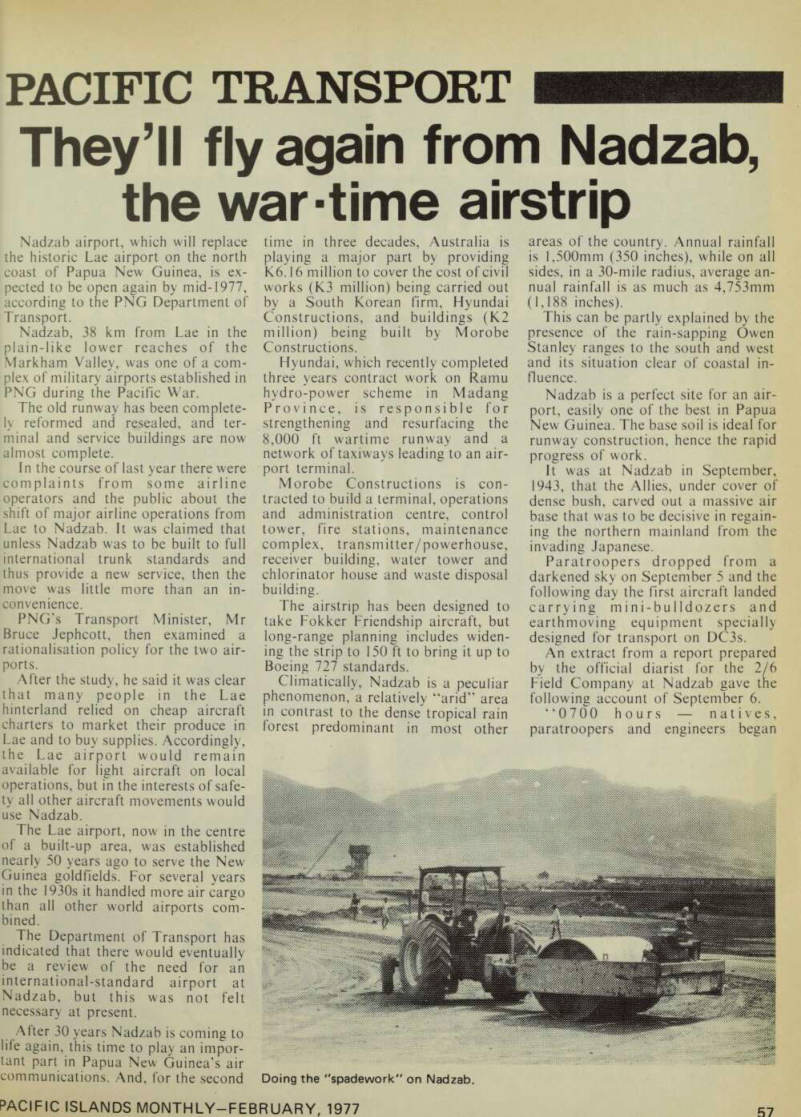
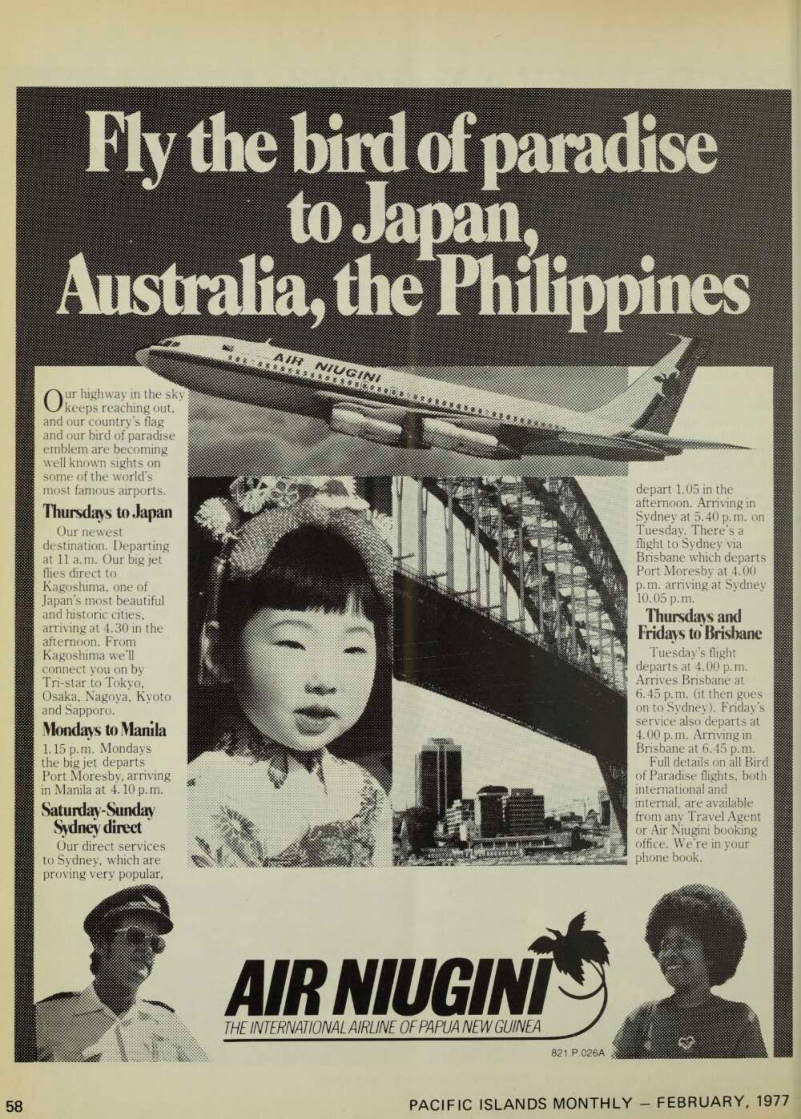
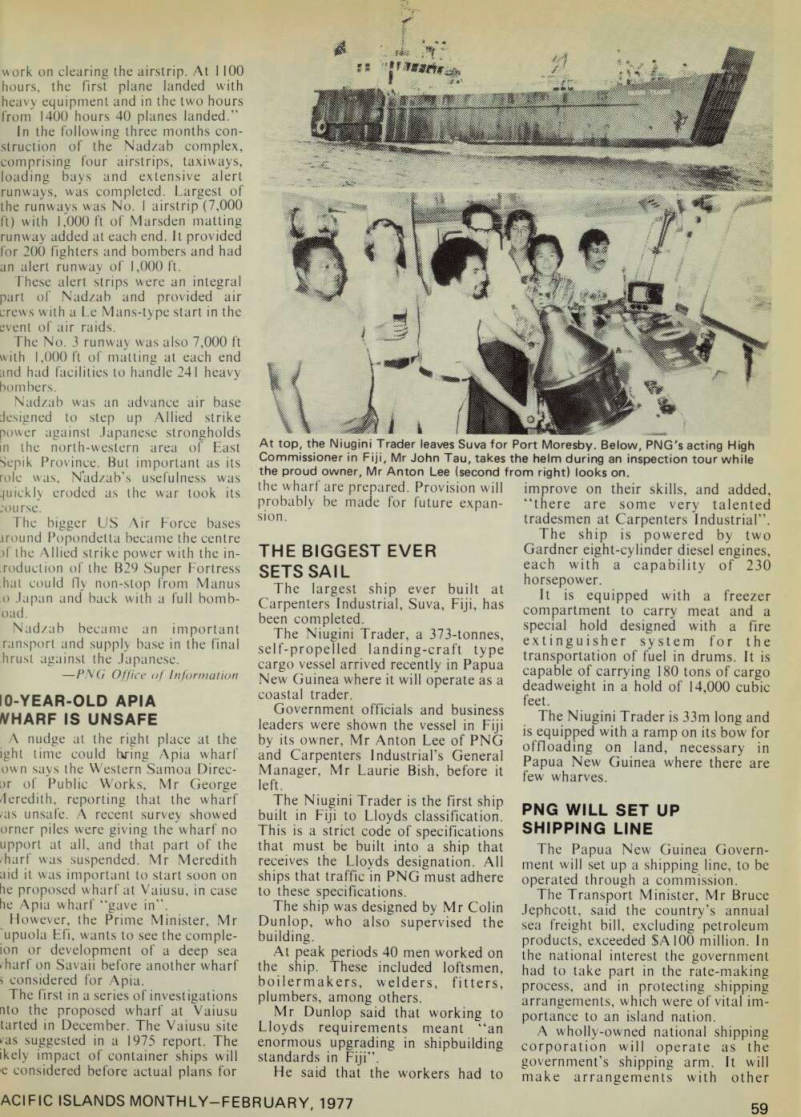
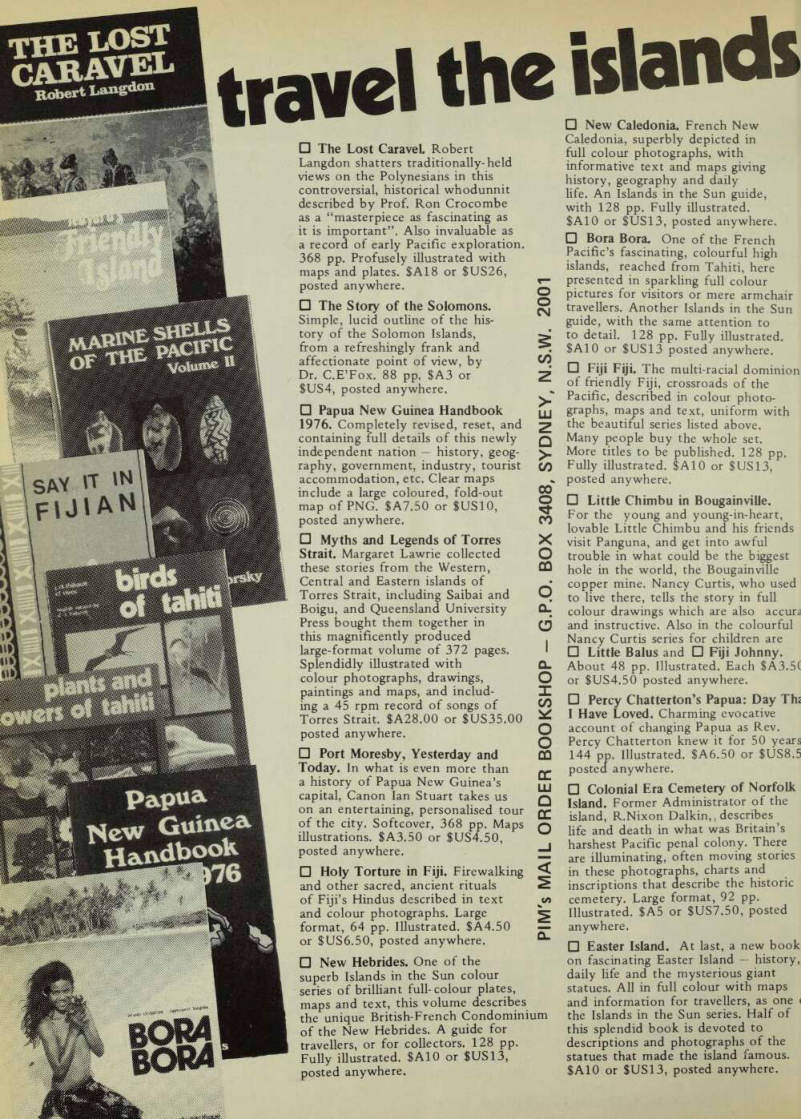
Pacific Transport
They’ll fly again from Nadzab, the war-time airstrip
Nadzab airport, which will replace the historic Lae airport on the north coast of Papua New Guinea, is ex pected to be open again by mid-1977, according to the PNG Department of Transport.
Nadzab, 38 km from Lae in the plain-like lower reaches of the Markham Valley, was one of a com plex of military airports established in PNG during the Pacific War.
The old runway has been complete ly reformed and resealed, and ter minal and service buildings are now almost complete.
In the course of last year there were complaints from some airline operators and the public about the shift of major airline operations from Lae to Nadzab. It was claimed that unless Nadzab was to be built to full international trunk standards and thus provide a new service, then the move was little more than an in convenience.
PNG’s Transport Minister, Mr Bruce Jephcott, then examined a rationalisation policy for the two air ports.
After the study, he said it was clear that many people in the Lae hinterland relied on cheap aircraft charters to market their produce in Lae and to buy supplies. Accordingly, the Lae airport would remain available for light aircraft on local operations, but in the interests of safe ty all other aircraft movements would use Nadzab.
The Lae airport, now in the centre of a built-up area, was established nearly 50 years ago to serve the New Guinea goldfields. For several years in the 1930 s it handled more air cargo than all other world airports com bined.
The Department of Transport has indicated that there would eventually be a review of the need for an international-standard airport at Nadzab, but this was not felt necessary at present.
After 30 years Nadzab is coming to life again, this time to play an impor tant part in Papua New Guinea’s air communications. And, for the second
time in three decades, Australia is playing a major part by providing K 6.16 million to cover the cost of civil works (K 3 million) being carried out by a South Korean firm, Hyundai Constructions, and buildings (K 2 million) being built by Morobe Constructions.
Hyundai, which recently completed three years contract work on Ramu hydro-power scheme in Madang Province, is responsible for strengthening and resurfacing the 8,000 ft wartime runway and a network of taxiways leading to an air port terminal.
Morobe Constructions is con tracted to build a terminal, operations and administration centre, control tower, fire stations, maintenance complex, transmitter/powerhouse, receiver building, water tower and chlorinator house and waste disposal building.
The airstrip has been designed to take Fokker Friendship aircraft, but long-range planning includes widen ing the strip to 150 ft to bring it up to Boeing 727 standards.
Climatically, Nadzab is a peculiar phenomenon, a relatively “arid" area in contrast to the dense tropical rain forest predominant in most other
areas of the country. Annual rainfall is 1,500 mm (350 inches), while on all sides, in a 30-mile radius, average an nual rainfall is as much as 4,753 mm (1,188 inches).
This can be partly explained by the presence of the rain-sapping Owen Stanley ranges to the south and west and its situation clear of coastal in fluence.
Nadzab is a perfect site for an air port, easily one of the best in Papua New Guinea. The base soil is ideal for runway construction, hence the rapid progress of work.
It was at Nadzab in September, 1943, that the Allies, under cover of dense bush, carved out a massive air base that was to be decisive in regain ing the northern mainland from the invading Japanese.
Paratroopers dropped from a darkened sky on September 5 and the following day the first aircraft landed carrying mini-bulldozers and earthmoving equipment specially designed for transport on DC3s.
An extract from a report prepared by the official diarist for the 2/6 Field Company at Nadzab gave the following account of September 6.
“0700 hours natives, paratroopers and engineers began
Doing the "spadework" on Nadzab.
work on clearing the airstrip. At 1100 hours, the first plane landed with heavy equipment and in the two hours from 1400 hours 40 planes landed.”
In the following three months con struction of the Nadzab complex, comprising four airstrips, laxiways, loading bays and extensive alert runways, was completed. Largest of the runways was No. I airstrip (7,000 ft) with 1,000 ft of Marsden matting runway added at each end. It provided for 200 fighters and bombers and had an alert runway of 1,000 ft.
These alert strips were an integral part of Nadzab and provided air i:rews with a Le Mans-type start in the event of air raids.
The No. 3 runway was also 7,000 ft with 1,000 ft of matting at each end und had facilities to handle 241 heavy bombers.
Nadzab was an advance air base designed to step up Allied strike power against Japanese strongholds in the north-western area of East Sepik Province. But important as its role was, Nadzab’s usefulness was quickly eroded as the war took its :ourse.
The bigger US Air Force bases iround Popondetta became the centre jf the Allied strike power with the in roduction of the 829 Super Fortress hat could fly non-slop from Manus o Japan and back with a full bomb oad.
Nadzab became an important ransport and supply base in the final hrusl against the Japanese. —PNG Office of Information
10-Year-Old Apia
Vharf Is Unsafe
A nudge at the right place at the ight time could bring Apia wharf own says the Western Samoa Direc- Dr of Public Works, Mr George Jeredith, reporting that the wharf /as unsafe. A recent survey showed orner piles were giving the wharf no upporl at all, and that part of the /harf was suspended. Mr Meredith aid it was important to start soon on he proposed wharf at Vaiusu, in case he Apia wharf “gave in”.
However, the Prime Minister, Mr 'upuola Efi, wants to see the comple ion or development of a deep sea /harf on Savaii before another wharf > considered for Apia.
The first in a series of investigations nto the proposed wharf at Vaiusu tarted in December. The Vaiusu site /as suggested in a 1975 report. The ikely impact of container ships will e considered before actual plans for
the wharf are prepared. Provision will probably be made for future expan sion.
The Biggest Ever
Sets Sail
The largest ship ever built at Carpenters Industrial, Suva, Fiji, has been completed.
The Niugini Trader, a 373-tonnes, self-propelled landing-craft type cargo vessel arrived recently in Papua New Guinea where it will operate as a coastal trader.
Government officials and business leaders were shown the vessel in Fiji by its owner, Mr Anton Lee of PNG and Carpenters Industrial’s General Manager, Mr Laurie Bish, before it left.
The Niugini Trader is the first ship built in Fiji to Lloyds classification.
This is a strict code of specifications that must be built into a ship that receives the Lloyds designation. All ships that traffic in PNG must adhere to these specifications.
The ship was designed by Mr Colin Dunlop, who also supervised the building.
At peak periods 40 men worked on the ship. These included loftsmen, boilermakers, welders, fitters, plumbers, among others.
Mr Dunlop said that working to Lloyds requirements meant “an enormous upgrading in shipbuilding standards in Fiji”.
He said that the workers had to
improve on their skills, and added, “there are some very talented tradesmen at Carpenters Industrial”.
The ship is powered by two Gardner eight-cylinder diesel engines, each with a capability of 230 horsepower.
It is equipped with a freezer compartment to carry meat and a special hold designed with a fire extinguisher system for the transportation of fuel in drums. It is capable of carrying 180 tons of cargo deadweight in a hold of 14,000 cubic feet.
The Niugini Trader is 33m long and is equipped with a ramp on its bow for offloading on land, necessary in Papua New Guinea where there are few wharves.
Png Will Set Up
Shipping Line
The Papua New Guinea Govern ment will set up a shipping line, to be operated through a commission.
The Transport Minister, Mr Bruce Jephcott, said the country’s annual sea freight bill, excluding petroleum products, exceeded SAIOO million. In the national interest the government had to take part in the rate-making process, and in protecting shipping arrangements, which were of vital im portance to an island nation.
A wholly-owned national shipping corporation will operate as the government’s shipping arm. It will make arrangements with other
At top, the Niugini Trader leaves Suva for Port Moresby. Below, PNG's acting High Commissioner in Fiji, Mr John Tau, takes the helm during an inspection tour while the proud owner, Mr Anton Lee (second from right) looks on.
operators which appear viable, and which would tend to stimulate the shipping industry as a whole.
Mr Jephcott said he was well aware of the number of unsuccessful attempts to set up shipping lines which had been set up by governments in other countries. But PNG was prepared to walk before it could run, and would initially operate in joint ventures with established operators.
Initially it will charter rather than buy a Heel.
The new line will progressively enter PNG’s major trade routes, in cluding those to Australia, New Zealand and Asia.
Mr Jephcott said the project had been evaluated by commercial con sultants and international agencies, including the Commonwealth Fund for Technical Co-operation, and the United Nations Committee on Trade and Development.
Forty-six shipping companies had been approached in tentative planning for the proposed joint ventures. Of that number, 37 showed interest or stated a wish to negotiate further.
More advanced discussions would start soon.
Port Moresby Plans
For Containers
Papua New Guinea will begin a major expansion of its waterfront facilities in Port Moresby, mainly for the large-scale introduction of con tainer shipping facilities. The project is being carried out by the PNG Har bours Board, with assistance from the World Bank.
A foreshore reclamation contact has already been let as the initial move in the expansion. As part of the project, stevedoring companies alone will spend more than SA6 million in container handling equipment. The Transport Minister, Mr Bruce Jephcott, believes that the entire trade between Australian ports and Port Moresby will be containerised within a few years. #The Markwarth Shipping Co in the Solomons recently took delivery of a new passenger/cargo ship, the Walter Funk, which will be renamed Elizabeth Anne. The new ship replaces another Elizabeth Anne which was wrecked off Point Cruz reef. The ship, built in Germany, is of steel, 36 metres long, and can carry 152 tonnes of general cargo. She is powered by a single engine and is capable of seven knots.
Advertisements & other items, pp. 58-61 (2 items)
Slli«ibpan,
Fly the bird of paradise
I II Hilii •
!»TTC
TIT
f/* Our highway in the skykeeps reaching out, and our country’s flag and our bird of paradise emblem are becoming well known sights on some of the world’s most famous airports.
Thursdays to Japan
Our newest
destination. Departing
at 11 a.m. Our big jet flies direct to Kagoshima, one of Japan’s most beautiful and historic cities, arriving at 4.30 in the afternoon. From Kagoshima we’ll connect you on by Tri-star to Tokyo, Osaka, Nagoya, Kyoto and Sapporo.
Mondays to Manila
1.15 p.m. Mondays the big jet departs Port Moresby, arriving in Manila at 4.10 p.m.
Saturday-Sunday
Sydney direct
Our direct services to Sydney, which are proving very popular, depart 1.05 in the afternoon. Arriving in Sydney at 5.40 p.m. on Tuesday. There’s a flight to Sydney via Brisbane which departs Port Moresby at 4.00 p. m. arriving at Sydney 10.05 p.m.
Thursdays and
Fridays to Brisbane
Tuesday’s flight
departs at 4.00 p.m.
Arrives Brisbane at 6.45 p.m. (it then goes on to Sydney). Friday’s service also departs at 4.00 p. m. Arriving in Brisbane at 6.45 p.m.
Full details on all Bird of Paradise flights, both international and internal, are available from any Travel Agent or Air Niugini booking office. We’re in your phone book.
AIRNIUGINi
THE INTERNATIONAL AIRLINE OF PAPUA NEW GUINEA 821 .PO26A if
travel the islands
□ New Caledonia. French New □ The Lost Caravel Robert
Langdon shatters traditionally-held
views on the Polynesians in this controversial, historical whodunnit described by Prof. Ron Crocombe as a “masterpiece as fascinating as it is important”. Also invaluable as a record of early Pacific exploration. 368 pp. Profusely illustrated with maps and plates. SAIB or SUS 26,
posted anywhere.
□ The Story of the Solomons.
Simple, lucid outline of the history of the Solomon Islands, from a refreshingly frank and affectionate point of view, by Dr. C.E’Fox. 88 pp. SA3 or
SUS 4, posted anywhere.
□ Papua New Guinea Handbook 1976. Completely revised, reset, and containing full details of this newly
independent nation history, geog-
raphy, government, industry, tourist
accommodation, etc. Clear maps include a large coloured, fold-out map of PNG. 5A7.50 or SUSIO,
posted anywhere.
□ Myths and Legends of Torres Strait. Margaret Lawrie collected these stories from the Western, Central and Eastern islands of Torres Strait, including Saibai and Boigu, and Queensland University Press bought them together in
this magnificently produced
large-format volume of 372 pages.
Splendidly illustrated with
colour photographs, drawings,
paintings and maps, and including a 45 rpm record of songs of Torres Strait. 5A28.00 or 5U535.00
posted anywhere.
□ Port Moresby, Yesterday and Today. In what is even more than a history of Papua New Guinea’s capital, Canon lan Stuart takes us on an entertaining, personalised tour of the city. Softcover, 368 pp. Maps illustrations. 5A3.50 or SUS4.SO,
posted anywhere.
□ Holy Torture in Fiji. Firewalking and other sacred, ancient rituals of Fiji’s Hindus described in text and colour photographs. Large format, 64 pp. Illustrated. 5A4.50
or SUS6.SO, posted anywhere.
O O CN £ CO Q > C/3 X o GO O CL d CL 0 1 C/5 X o o QQ D CC O □ New Hebrides. One of the superb Islands in the Sun colour series of brilliant full-colour plates, maps and text, this volume describes the unique British-French Condominium of the New Hebrides. A guide for travellers, or for collectors. 128 pp.
Fully illustrated. SAIO or SUSI 3,
posted anywhere.
Caledonia, superbly depicted in
full colour photographs, with informative text and maps giving
history, geography and daily
life. An Islands in the Sun guide, with 128 pp. Fully illustrated.
SAIO or SUSI 3, posted anywhere. □ Bora Bora. One of the French
Pacific’s fascinating, colourful high
islands, reached from Tahiti, here presented in sparkling full colour pictures for visitors or mere armchair travellers. Another Islands in the Sun guide, with the same attention to to detail. 128 pp. Fully illustrated.
SAIO or SUSI 3 posted anywhere.
□ Fiji Fiji, The multi-racial dominion of friendly Fiji, crossroads of the Pacific, described in colour photographs, maps and text, uniform with ifhl 00 o CO the beautiful series listed above.
Many people buy the whole set.
More titles to be published. 128 pp.
Fully illustrated. SAIO or SUSI 3,
posted anywhere.
□ Little Chimbu in Bougainville.
For the young and young-in-heart, lovable Little Chimbu and his friends visit Panguna, and get into awful trouble in what could be the biggest hole in the world, the Bougainville copper mine. Nancy Curtis, who used to live there, tells the story in full colour drawings which are also accura and instructive. Also in the colourful Nancy Curtis series for children are □ Little Balus and □ Fiji Johnny.
About 48 pp. Illustrated. Each SA3.SC
or SUS4.SO posted anywhere.
□ Percy Chatterton’s Papua: Day Thj I Have Loved. Charming evocative account of changing Papua as Rev.
Percy Chatterton knew it for 50 years 144 pp. Illustrated. 5A6.50 or SUSS.S id :
posted anywhere,
□ Colonial Era Cemetery of Norfolk Island. Former Administrator of the island, R.Nixon Dalkin,, describes life and death in what was Britain’s harshest Pacific penal colony. There are illuminating, often moving stories in these photographs, charts and inscriptions that describe the historic cemetery. Large format, 92 pp.
Illustrated. SAS or SUS7.SO, posted
anywhere,
□ Easter Island. At last, a new book on fascinating Easter Island history, daily life and the mysterious giant statues. All in full colour with maps and information for travellers, as one < the Islands in the Sun series. Half of this splendid book is devoted to descriptions and photographs of the statues that made the island famous.
SAIO or SUSI 3, posted anywhere.
without leaving home!
□ Marine Shells of the Pacific Volume 11. Walter Cernohprsky carries on where his first book left off, with a further 600 species fully described and illustrated: Some of the 68 full page plates are in colour. 412 pp.
Illustrated. SAI7 or SUS2S,
posted anywhere.
□ Friendly Island. Warm account of life in Tonga, sunlit South Pacific
island kingdom, by Patricia Ledyard,
who has lived in a Tongan harbourside village for more than 20 years.
Paperback, 215 pp. SA3 or SUS4.SO,
posted anywhere.
□ Plants and Flowers of Tahiti. Full colour photographs of the rich and beautiful Tahitian flora, classified by scientific names, and by French, English and Tahitian common names. 144 pp. Fully illustrated. SAS or
SUS 7, posted anywhere.
□ Birds of Tahiti. A companion volume to Plants and Flowers of Tahiti. Full colour photographs and descriptions, for collectors or amateur birdwatchers, visitors and students needing easy identification. 112 pp. Fully illustrated, SAS or SUS 7, posted anywhere. □ Tahiti: Island of Love. In this book the author of The Lost Caravel presents the vivid, colourful history of Tahiti
from its discovery by Europeans to
modern times. Eminently readable, now in its fourth edition. 284 pp. Illustrated. 5A4.50 or SUS6.OO, posted anywhere. □ Tahiti and its Islands. New revised editon, just released, of this popular title in the Islands in the Sun series.
Sparkling new colour plates, new information, new maps. Includes the Leeward Islands, the Tuamotus, the Gambiers, Marquesas the Australs.
Has hotel lists and places to see. 128 pp. Fully illustrated. SAIO or SUSI 3, posted anywhere. □ Log of the Mahina: A Tale of the South Pacific. Young American John Neal took his 27ft. yacht from Seattle on an 18 months cruise through Polynesia and then wrote about it. This delightfully refreshing book abounds with information on how to get there and what to do when you are there. John Neal learned it the hard way and shares his experiences with
enthusiasm. Required reading for
all yachties venturing into Polynesia’s dangers and pleasures, physical and romantic, 280 pp.
Illustrated, 5A6.00 or SUS7.SO,
posted anywhere.
□ Say it in Fijian. Dr.A.J.Schutz presents a pocket sized, entertaining guide to the Fijian language for those making their first contact with Fiji. 5A2.00 or SUS3.OO, posted anywhere □ Say it in Motu. In the same series, Dr. Percy Chatterton provides an instant introduction to one of the three official languages of Papua New Guinea; the common tongue of the streets and markets of Port Moresby. 5A2.00 or SUS3.OO,
posted anywhere.
□ Now in preparation in the same series are Say it in Fiji Hindi and Say it in Tahitian. Advance orders
accepted.
□ Available soon! Pacific Islands Year Book for 1977! Completely revised, reset in a new format.
Hundreds of pages of facts and maps on all the Pacific Islands. Advance orders taken for this invaluable reference book. SAIB or SUS 26,
posted anywhere.
O Fold-out maps of the Pacific! Large size, in colour. Norfolk Island, Lord Howe Island, the Tonga group. Others in preparation, including a general map of the Pacific Ocean.
SA2 or SUS 3, posted anywhere .v % .1 5?
MW Ot
v " eK '"Sr/v
xo^ G t
p © ile'T h*hc< 63
Oj, *OLK
¥o^,3^
59
ACIFIC ISLANDS MONTHLY-FEBRUARY, 1977
holdings in Air Niugini
PNG ousts ‘foreign’ holdings in Air Niugini
The PNG Government decided in December to buy out the Qantas and TAA interests in Air Niugini. At the same lime it announced that the Ansett Transport Industries holding in the PNG national airline would be reduced by 25%, with a further review of the Ansett holding at the end of 1977.
The PNG Transport Minister, Mr Bruce Jephcott, said the principal reason for the move, which had been under consideration for some months, was the entry of Air Niugini into the international field, which led to a con flict of interests as Air Niugini and Qantas were competitors. It was not appropriate that future Air Niugini marketing strategy should be disclos ed at commission (National Airline Commission) level to representatives of competing airlines.
The three Australian airlines had representatives on the National Airlines Commission, which controls Air Niugini. Also, the presence of Qantas as an important shareholder in Air Niugini tended to prejudice negotiations for air routes with other governments.
Qantas and TAA each held 12% of the shares in Air Niugini and Ansett held 16%. The decision to buy out TAA and Qantas and reduce the Ansett shareholding meant a cut in the 4-million share issue, which, in effect, leaves Ansett with a slightly bigger holding on a percentage basis.
The decision to retain part of the Ansett holding for the present was to ensure the continued availability of expertise at commission level.
The decision cost PNG about K 1.34 million, of which K 1.15 million went to Qantas and TAA and K190,- 000 to Ansett. Qantas and TAA lost their seats on the National Airline Commission, which controls Air Niugini.
Mr Jephcott paid a tribute to Qan tas and TAA for the contribution they had made to aviation in PNG.
The government’s decision was not greeted with joy in all political circles.
In fact, the Leader of the Opposition, Sir Tei Abal, called the dropping “shameful and shortsighted”. He said the deal was a smack in the face for the Australian Government, which
had done so much for the airline in dustry in PNG.
The decision was also shortsighted because it mean that PNG was dum ping two experienced airline partners while Air Niugini was still effectively establishing itself. The money re quired to buy back the capital could be ill-afforded at present.
It was reasonable to ask where the money was coming from. He did not believe it could be found from Air Niugini’s trading profits, particularly as more than $4 million had been spent in fleet re-equipment.
He continued that Air Niugini was about to enter a new route to Japan.
The expansion was commendable, but the route had not yet been proved viable. In the meantime it appeared most unwise to be spending money unnecessarily to buy back capital.
Philippine Air Lines had an nounced recently it intended to exer cise its option to operate in competi tion with Air Niugini between Port Moresby and Manila. That develop ment pointed to a lack of wisdom in making an expensive change to ownership structure of the airline.
Sir Tei estimated that in recent years the Australian Government had given civil aviation aid valued at more than $ll million to PNG. That was connected with the handover of assets when PNG became independent. To summarily sack the Australian Government shareholding (through Qantas and TAA) in Air Niugini which was only a minor shareholding in the first place was a shameful gesture.
Footnote: The Australian airlines concerned will earn a currency wind fall! because the capital in Air Niugini is in PNG kina. The Australian partners will gain close to another 15% on the deal.
Air Nauru Wants
More Air Space
Air Nauru was interested in open ing up a service to Noumea, Tonga, Niue and the Cook Islands, King Taufa’ahau Tupou of Tonga, said in December. Nauru was negotiating with France and New Zealand for lan ding rights at Noumea and Aitutaki.
The king said Air Nauru proposed to fly from Nauru and call at
Noumea, Tonga, Niue and Aitutaki.
An alternative route would be Nauru, Wallis Island, Tonga, Niue and Aitutaki. Return flights would be over the same route as the outward flight.
He also said that if negotiations were successful, Air Nauru would operate on a cheaper structure than Air Pacific. Of significance to Tonga, the service would give Tongan growers the opportunity to export vegetables to Nauru.
Pal May Fly
To New Zealand
Polynesian Airlines is looking at the possibility of direct flights to New Zealand following discussions on civil aviation matters in Wellington. It was reported from Apia recently that of ficials of the Western Samoa and NZ governments, after the talks, agreed to enter into a bilateral agreement for an exchange of routes for designated airlines.
Mr lulai Toma, Secretary to the Western Samoa Government and Aviation Administrator, who led the Western Samoa delegation, had emphasised early in the talks that the NZ airline could well remain content to service Western Samoa through Pago Pago, and thus had no real need for a bilateral agreement with Western Samoa.
But NZ recognised that Western Samoa had good reasons for wanting a direct service. A condition of NZ entering into agreement is the need to consult other governments affected by Western Samoa’s request.
The designated airlines (Polynesian and Air New Zealand), will now dis cuss how to service the routes suggested by the two governments.
Mr Ted Annandale, chairman of PAL, said it would be some time before PAL could make arrangements for direct flights to NZ.
There will have to be a study of the aircraft needed. The company would consider Boeing 7375, F2Bs, BACII Is and DC9s.
Tuvalu Seeks
A Seaplane Service
Provisional approval has been given for a year’s trial seaplane service operation within the eight islands of Tuvalu, and the government is trying to attract a private firm to come in and launch the service.
The plan is that essential infrastruc ture for the service hangar, slipway, mooring buoys, etc. would be provided under British or Australian development aid, while an
aviation firm would run the service under a revenue guarantee agreement.
Tuvalu’s Commissioner, Mr Tom Layng, first raised the idea of using floatplanes in Tuvalu in 1974. He had served as Chief Secretary in the Falkland Islands and had first hand experience of how two small single engined 5-seater Beavers had successfully solved the difficult com munications problems of a remote and scattered territory.
Britain’s Civil Aviation Authority then did a “desk study”, and conclud ed that seaplane operation in Tuvalu was feasible. This was followed by a United Nations Development Programme evaluation by economist
Walter Yep who said that floatplanes could be the answer to Tuvalu’s com munications difficulties and recommended that a year’s trial be conducted to explore the economic viability of a service.
Six of Tuvalu's islands have neat, sheltered, ready-made “seadromes” in their enclosed lagoons. The two other permanently inhabited islands Niutao and Nanumanga have tidal mangrove ponds which, if a ser vice is successful, might at a later date be cleared to provide landing facilities for a floatplane Cessna or Islander.
None of the islands can spare land for the construction of conventional land aerodromes. The whole country has
less than 10 square miles of terra firma!
At present Tuvalu is served by one old ship, the Nivanga, which has now reached the end of its economic life.
This year, for more than three months, the country had no internal communications of any kind when the Nivanga broke down and was under repair in Suva. With only rudimen tary medical facilities on outer islands, this meant that chances of help for any accident victim or even a simple sufferer from appendicitis were slim. Plans are afoot to replace the Nivanga with a new ship using sails as well as engines.
Quantas Boosts Fiji's
Tourist Trade
The Fiji tourist trade will get a big lift from the allocation of 78,000 seats for Fiji-bound passengers in Qantas aircraft this year. The airline’s capaci ty for Fiji in 1977 is 20% higher than 1976. It has allocated 63,000 seats ex clusively for people flying to Fiji, and another 15,000 seats in jet aircraft calling at Fiji on the way to the US.
Qantas aircraft will now arrive at and leave Nadi at more convenient times. To help fill the 78,000 seats Qantas is stepping up its advertising of Fiji’s virtues as a holiday resort. In addition to the regular services, Qan tas will operate 54 supplementary ser vices for holiday traffic at peak periods of May, August-September and December-January. Qantas studies show that 94% of all Australians carried to Fiji by Qantas had Fiji as their sole destination.
• The Cook Islands will have three air services a week from New Zealand after the Tourist Hotel Cor poration’s new hotel at Rarotonga is opened in April. Air NZ will call at Rarotonga on both outward and return flights on a new Auckland- Honolulu service. At present there are two services weekly between NZ and the Cooks. • Pacific Missionary Aviation, which is part of the Liebenzell Mis sion, has been given permission to operate an air transport network covering district centres and outer islands in Yap, Truk and Ponape in the US Trust Territory. Under an agreement with the TT Government, Pacific Missionary Aviation will provide medical evacuation of patients from the outer islands to dis trict centres.
Advertisements & other items, pp. 63-64 (1 item)
J-Lej-Lx.
urileoa bpcs.(ppi«teps) pty. United
P.O. Box 56, Chippendale, N.S.W. 2008 Australia Telegrams: "Wilbroprint" Sydney Currently supplying to the Pacific Islands: Computer Stationery Accounting Machine Forms for Sweda, NCR & Burroughs Punch Cards Burroughs Magnetic Stripe Ledger Cards Package stationery systems for Burroughs L Series Machines - Payroll - General Accounting Ledger Cards Security Document Printing - Airline Tickets - Accommodation & Travel Vouchers - Cheques Computer Data Storage -Magnetic Tape, Disk Pack, Punch Card, Visible Record, Revolving & Rotating Card Storage and Retrieval Systems.
Machine Accounting Trays & Indexes.
Computer Print-out Binders.
May we discuss your requirements with you on our next visit.
J-LeJ-LX.
HEAT SEALING.
SHRINK PACKAGING.
CONTACT
AUSTRALIA'S FOREMOST MANUFACTURERS
OF HEAT SEALING EQUIPMENT
SERVING INDUSTRY
IN AUSTRALIA & THE PACIFIC ISLANDS
FOR OVER 25 YEARS.
HELIX ELECTRICAL PRODUCTS PTY. LTD.
27 Rosebery Avenue, Rosebery, NSW 2018, Australia.
NOTICE-TRADE MARK.
Dynamit Nobel AktiengeseUschaft of P.O. Box 1209, 521, Troisdorf, West Germany wish it to be known that they are the owners of the Trade Mark: and that this Trade Mark is used by Dynamit Nobel Aktiengesellschaft on or in connection with ammunition and projectiles, explosive substances, fireworks, firearms for hunting and sporting purposes, optical apparatus and instruments.
Proceedings will be taken against any third party found to be using the above Trade Mark on or in connection with ammunition and projectiles, explosive substances, fireworks, firearms for hunting and sporting purposes, optical apparatus and instruments.
McCUBBERY TRAIN LOVE
& THOMAS,
Barristers and Solicitors, Port Moresby, agents for Davies and Collison, Trade Mark Agents for the proprietors.
Cruising
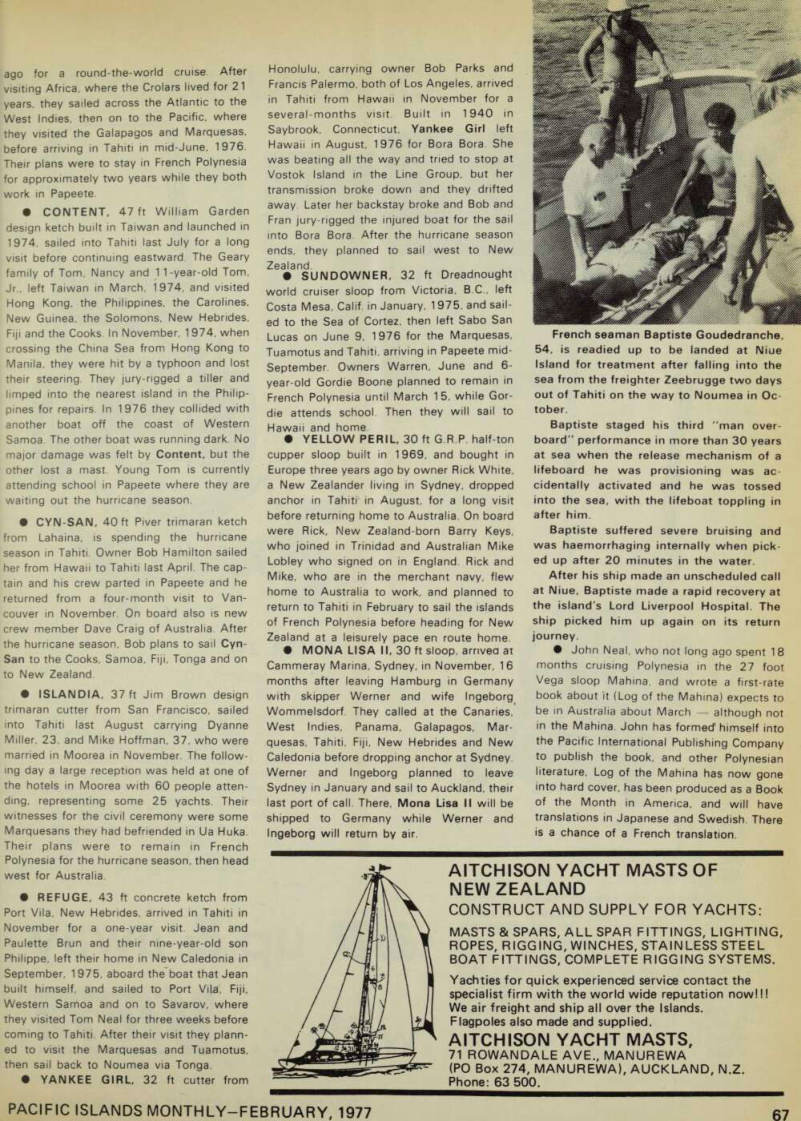
Yachts
• A number of overseas yachts, including some from Australia, visited Samarai in Papua New Guinea recently. They included: • MARYAMA, 32 ft Colin Archer designed yacht, which had cruised in PNG waters and was on the way back to Australia.
On board were Jim and Cathy Downie • HOHOQ, 10 metre cutter, built in Den mark in 1938, carrying Ted and Jane De Villa and Cathy Colgam. • CANESH, 29 ft 7 in modified Herkoshoff ketch, built in Whangarei, NZ, from Fiji, the New Hebrides, New Caledonia and Australia, carrying Reinhard Haiber and Arleen Hicks and Kiki the cat. • DREAMTIME, from Australia, carry ing Davy and Sue Jones. • CHRISTIAN ROSE, formerly a US buoy tender, carrying Rodney Drew and Shan Drew • ABRAXOS, 40 ft fibreglass ketch, carrying builder-owner-skipper Rod Lewis, his wife Carol and children Aaron and Mereid. • SUN DANCER, 45 ft Hartley design ferro cement yacht, from Sydney, carrying D Piper and N. Short. • ZUGVOGEL, 36 ft ferro cement yacht, home built in Toronto, Canada, carrying Rudolf Halbrichter and his wife. • SHI BUI, 44 ft sloop, carrying Mr and Mrs Cutlack and Gary Baldwin. • ROSALIESEL, from Brisbane, with Keith and Ann Davis. • RODIAM, 40 ft steel yacht, built by Halvorsen in Sydney, carrying Steven, Kim, Arron and Marise Kent. • John Mansell would like to hear from the owner of the mv Taxos. His address is PO Box 2, Samarai, Papua New Guinea • PELORUS JACK, 50 ft ketch registered in Montreal, arrived at Rarotonga on November 20 from Papeete, Raiatea and Bora Bora. On board were skipper Bernard Gunn and fami ly: Patricia the cook, and seamen Alistair Gunn, Derek I. Gunn and Derek D. Gunn all New Zealanders. They sailed for Niue and Auckland on November 26. • TYEE, 44 ft American ketch, arrived at Rarotonga on November 23 from Niue, bound for Bora Bora, with Captain William C.
Whipple, and Elizabeth and Lawrence Whip ple. They sailed from Rarotonga on November 29. • AN DEN SEOUL, 40 ft ketch built in Holland and owned by Bob and Jacqueline Crolar of France, left Amsterdam two years
ago for a round-the-world cruise. After visiting Africa, where the Crolars lived for 21 years, they sailed across the Atlantic to the West Indies, then on to the Pacific, where they visited the Galapagos and Marquesas, before arriving in Tahiti in mid-June, 1976.
Their plans were to stay in French Polynesia for approximately two years while they both work in Papeete. • CONTENT, 47 ft William Garden design ketch built in Taiwan and launched in 1974, sailed into Tahiti last July for a long visit before continuing eastward. The Geary family of Tom, Nancy and 11-year-old Tom, Jr, left Taiwan in March, 1974, and visited Hong Kong, the Philippines, the Carolines, New Guinea, the Solomons, New Hebrides, Fiji and the Cooks. In November, 1974, when crossing the China Sea from Hong Kong to Manila, they were hit by a typhoon and lost their steering. They jury-rigged a tiller and limped into the nearest island in the Philip pines for repairs. In 1976 they collided with another boat off the coast of Western Samoa, The other boat was running dark. No major damage was felt by Content, but the other lost a mast. Young Tom is currently attending school in Papeete where they are waiting out the hurricane season. • CYN-SAN, 40 ft Piver trimaran ketch from Lahaina, is spending the hurricane season in Tahiti. Owner Bob Hamilton sailed her from Hawaii to Tahiti last April. The cap tain and his crew parted in Papeete and he returned from a four-month visit to Van couver in November. On board also is new crew member Dave Craig of Australia. After the hurricane season, Bob plans to sail Cyn- San to the Cooks. Samoa, Fiji, Tonga and on to New Zealand. • ISLANDIA, 37ft Jim Brown design trimaran cutter from San Francisco, sailed into Tahiti last August carrying Dyanne Miller, 23, and Mike Hoffman, 37, who were married in Moorea in November. The follow ing day a large reception was held at one of the hotels in Moorea with 60 people atten ding, representing some 25 yachts. Their witnesses for the civil ceremony were some Marquesans they had befriended in Ua Huka.
Their plans were to remain in French Polynesia for the hurricane season, then head west for Australia. • REFUGE, 43 ft concrete ketch from Port Vila, New Hebrides, arrived in Tahiti in November for a one-year visit. Jean and Paulette Brun and their nine-year-old son Philippe, left their home in New Caledonia in September, 1975, aboard the boat that Jean built himself, and sailed to Port Vila, Fiji, Western Samoa and on to Savarov, where they visited Tom Neal for three weeks before coming to Tahiti. After their visit they plann ed to visit the Marquesas and Tuamotus, then sail back to Noumea via Tonga. • YANKEE GIRL. 32 ft cutter from
Honolulu, carrying owner Bob Parks and Francis Palermo, both of Los Angeles, arrived in Tahiti from Hawaii in November for a several-months visit Built in 1940 in Saybrook, Connecticut, Yankee Girl left Hawaii in August, 1976 for Bora Bora. She was beating all the way and tried to stop at Vostok Island in the Line Group, but her transmission broke down and they drifted away. Later her backstay broke and Bob and Fran jury-rigged the injured boat for the sail into Bora Bora. After the hurricane season ends, they planned to sail west to New Zealand. • SUNDOWNER. 32 ft Dreadnought world cruiser sloop from Victoria, 8.C., left Costa Mesa, Calif, in January, 1975, and sail ed to the Sea of Cortez, then left Sabo San Lucas on June 9, 1976 for the Marquesas, Tuamotus and Tahiti, arriving in Papeete mid- September. Owners Warren, June and 6year-old Gordie Boone planned to remain in French Polynesia until March 15, while Gor die attends school. Then they will sail to Hawaii and home. • YELLOW PERIL, 30 ft G.R.P. half-ton cupper sloop built in 1969, and bought in Europe three years ago by owner Rick White, a New Zealander living in Sydney, dropped anchor in Tahiti' in August, for a long visit before returning home to Australia. On board were Rick, New Zealand-born Barry Keys, who joined in Trinidad and Australian Mike Lobley who signed on in England. Rick and Mike, who are in the merchant navy, flew home to Australia to work, and planned to return to Tahiti in February to sail the islands of French Polynesia before heading for New Zealand at a leisurely pace en route home. • MON A LISA 11, 30 ft sloop, arnveo at Cammeray Marina, Sydney, in November, 16 months after leaving Hamburg in Germany with skipper Werner and wife Ingeborg Wommelsdorf. They called at the Canaries, West Indies, Panama, Galapagos, Mar quesas, Tahiti, Fiji, New Hebrides and New Caledonia before dropping anchor at Sydney.
Werner and Ingeborg planned to leave Sydney in January and sail to Auckland, their last port of call. There. Mona Lisa II will be shipped to Germany while Werner and Ingeborg will return by air.
• John Neal, who not long ago spent 18 months cruising Polynesia in the 27 foot Vega sloop Mahina, and wrote a first-rate book about it (Log of the Mahina) expects to be in Australia about March although not in the Mahina. John has formecf himself into the Pacific International Publishing Company to publish the book, and other Polynesian literature. Log of the Mahina has now gone into hard cover, has been produced as a Book of the Month in America, and will have translations in Japanese and Swedish. There is a chance of a French translation.
French seaman Baptiste Goudedranche 54, is readied up to be landed at Niue Island for treatment after falling into the sea from the freighter Zeebrugge two days out of Tahiti on the way to Noumea in Oc tober.
Baptiste staged his third "man over board" performance in more than 30 years at sea when the release mechanism of a lifeboard he was provisioning was ac cidentally activated and he was tossed into the sea, with the lifeboat toppling in after him.
Baptiste suffered severe bruising and was haemorrhaging internally when pick ed up after 20 minutes in the water.
After his ship made an unscheduled call at Niue, Baptiste made a rapid recovery at the island's Lord Liverpool Hospital. The ship picked him up again on its return journey.
Advertisements & other items, pp. 65-70 (3 items)
Aitchison Yacht Masts Of
NEW ZEALAND
CONSTRUCT AND SUPPLY FOR YACHTS:
MASTS & SPARS, ALL SPAR FITTINGS, LIGHTING,
ROPES, RIGGING, WINCHES, STAINLESS STEEL
BOAT FITTINGS, COMPLETE RIGGING SYSTEMS.
Yachties for quick experienced service contact the specialist firm with the world wide reputation now!!!
We air freight and ship all over the Islands.
Flagpoles also made and supplied.
AITCHISON YACHT MASTS,
71 ROWANDALE AVE., MANUREWA
(PO Box 274, MANUREWA), AUCKLAND, N.Z.
Phone: 63 500.
I IICTA
TURNS GRASS INTO LAWN
\ j
UTILITY 160
THE “WORK HORSE” OF THE
VICTA RANGE
SUPER 24
THE BIG MOWER FOR
BIG AREAS
The big mower from Victa. It takes a full 61 cm wide bite into and cuts a smooth swath over large expanses of grass. It is the mower for municipal parks and gardens, sports grounds, road-side growth control as well as home owners with large areas of land. The lightweight construction of the mower makes it easy to manoeuvre and the giant rear wheels ride rough ground effortlessly. Two freeswinging blades cn the cutting disc absorb shock when hard objects are encountered.
A tough but lightweight mower without grasscatcher, a model designed to do a superb grasscutting job—on meadows full of weeds or on a fine lawn. It cuts clos. up to trees and fences and is the lightest Victa mower of all to use. Available with either a 125 c.c. Victa 2-stroke engine or with the Victa 160 c.c. 2-stroke engine— Folding handle and single-lever simultaneous height adjustment are other features that make this lowest priced VICTA a popular mower.
lip up & away
with ...vas
if \eaiwa line
DIRECT REGULAR SERVICE
JAPAN-SOUTH PACIFIC
TARAWA-PAPEETE-PAGO PAGO-APIA
SUVA-LAUTOKA-NOUMEA-VILA
SANTO-HONIARA
JAPAN-TAIWAN-GUAM
JAPAN-KEELUIMG-GUAM BY
EXCELLENT CAR/CONTAINER-CARRIER
JAPAN-WEST IRIAN-DILI
HONG KONG-TAI WAN-WEST IRIAN-DILI
AGENTS:
GUAM: ATKINS, KROLL (GUAM) LTD.
TARAWA: G. & E. I. DEVELOPMENT AUTHORITY.
APIA: BURNS PHILP (SOUTH SEA) CO., LTD.
PAGO PAGO: KNEUBUHL MARITIME SERVICES CORP.
NUKUALOFA: PACIFIC NAVIGATION CO., LTD.
SUVA: BURNS PHILP (SOUTH SEA) CO., LTD.
LAUTOKA: BURNS PHILP (SOUTH SEA) CO., LTD.
NOUMEA: SOCIETE D'ACCONAGA ET
TRANSPORT D'OCEANIE (SATO)
SANTO: BURNS PHILP (NEW HEBRIDES) LTD.
VILA: BURNS PHILP (NEW HEBRIDES) LTD.
HONIARA: BRITISH SOLOMONS TRADING CO., LTD.
PAPEETE: AGENCE MARITIME DE FARA UTE.
HONG KONG: IKE MARITIME CO., LTD.
SINGAPORE: THE BORNEO CO., (SINGAPORE) LTD.
DJAJAPURA: P. N. PELAJARAN NASIONAL INDONESIA.
DILI: SANG TAI HOO
TAIWAN: FOR CARGO BETWEEN JAPAN/GUAM/TAIWAN
FORMOSA SHIPPING & ENTERPRISE CORP.
TAIWAN: FOR CARGO BETWEEN JAPAN/SOUTH PACIFIC/
WEST IRIAN/DILI
MARITIME TRANSPORTATION AGENCIES, LTD.
THE DAIWA NAVIGATION CO.,LTD.
OSAKA; “DAILINE”
HEAD OFFICE
DAIICHI KYOGYO BLDG.,
45, 2-CHOME, AWAZAMINAMI-DORI,
NISHI-KU, OSAKA, JAPAN
TELEPHONE: (06) 531-0471 ~9
TELEX; 525-6324 & 525-6325
TOKYO: “FUNEDAILINE”
TOKYO OFFICE
SHIN-DAI ICH I BLDG.,
4-13, NIHONBASHI 3-CHOME, CHUO-KU,
TOKYO, JAPAN
TELEPHONE: (03) 274-3251 ~8
TELEX: 222-3343. 23559
HENRY CUMINES PTY. LTD.
EXPORTERS • GENERAL MERCHANTS
428 GEORGE ST., SYDNEY
CABLES: HENCO SYDNEY. G.P.O. Box 3949. PHONE: 25-3383.
For specialised and personalised buying service throughout the Pacific Islands and the East.
LOCAL AGENTS AND REPRESENTATION:
PAPUA NEW GUINEA.
PORT MORESBY: Mr. Tan,
P.O. Box 5445, Boroko.
Telephone 25 2542.
RABAUL: M. & C. Seeto, P.O. Box 1 31, Rabaul.
Telephone 92 2902.
MADANG: W. Double, P.O. Box 22, Madang.
Telephone 82 2696.
FIJI.
K. Witherington Ltd., P.O. Box 293, Suva.
Telephone 22 356.
NEW HEBRIDES.
John Lum & Associates, P.O. Box 65, Santo.
Telephone 329.
SOLOMON ISLANDS.
Lo See War Ltd., P.O. Box 327, Honiara.
Telephone 399.
Resident Agents in other Pacific Territories.
FREIGHT
FHRRELL
REFRIGERATED
& GENERAL
CARGO IN
BARGES. BULK
LIQUIDS IN
VESSEL DEEP
TANKS.
Quick &
Dependabl
LASH
Service
FROM UNITED STATES WEST COAST & CANADA TO PAPEETE,
PAGO PAGO, AUCKLAND, LAE & RABAUL.
PAPUA NEW GUINEA TO VANCOUVER 8.C., TACOMA, PORT-
LAND, SAN FRANCISCO, LOS ANGELES.
SYDNEY, MELBOURNE, BURNIE, HOBART, BRISBANE TO LAE
& RABAUL.
MANAGING AGENTS: With. Wilhelmsen Agency P/L., 13-15 Bridge Street, Sydney 2000-Phone 20517-60 Market Street, Melbourne, 3000-Phone 613031-344 Queen Street, Brisbane, 4000-Phone 2213316. MANAGING AGENTS N.Z.: Dalgety N.Z.
Ltd. , 119 Featherston Street, Welington-Phone 738347- 41/45 Albert Street, Auckland—Phone 71859. ISLAND AGENTS: Robert Laurie (NG) P/L, P.O. Box 1032, Lae, PNG - Phone 423811. Burns Philp (NG) Ltd., P.O, Box 87, Rabaul, PNG. - Phone 922666.
Norfolk Island Reply
69
PACIFIC ISLANDS MONTHLY-FEBRUARY, 1977
From p. 15
NORFOLK ISLAND REPLY
The Banabans* Case
71
From p. 11
PACIFIC ISLANDS MONTHLY-FEBRUARY, 1977
Shipping,
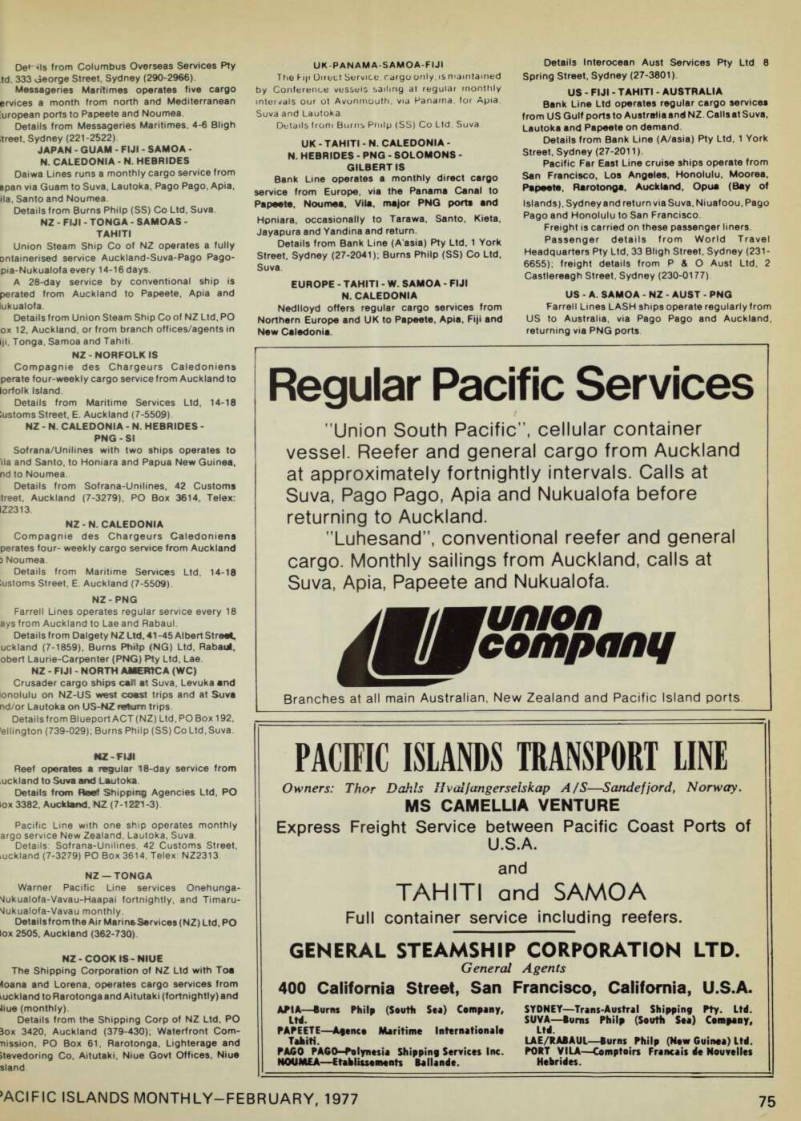
Airways
Shipping
SYDNEY - NZ - FIJI/TAHITI - UK Chandris Lines maintains a passenger service from Sydney via NZ, Suva or Papeete every second month.
Details from Chandris Lines. 135 King Street, Sydney (232-2455).
SYDNEY - LORD HOWE IS - AUCKLAND -
Norfolk Is - New Caledonia
Compagnie des Chargeurs Caledoniens operates four-weekly cargo service Sydney-Lord Howe Island-Noi folk Island-Auckland-Norfolk Island-Noumea.
Details Hetherington Kingsbury Pty Ltd, 37-49 Pitt Street, Sydney (27-1671)
Sydney - New Caledonia
Somacal operates 30-day service from Sydney to Noumea.
Details from Karlander (Aust) Pty Ltd, 19-31 Pitt Street, Sydney (27-6301).
SYDNEY - NZ - FIJI - HAWAII -
Canada-Us
P & O linerscall at Auckland, Suva, Honoluluand Vancouver on eastbound and westbound voyages between Sydney and the US.
Details from P & O Booking Centre, World Travel Headquarters Pty Ltd, 33 Bligh Street, Sydney (231-6655).
SYDNEY - NZ - FIJI - TONGA -
N. Hebrides - Noumea-Png -
Solomons-Samoas
Sitmar Cruises operates a year-round cruise programme to include most of the above countries.
Details from Sitmar Cruises, 22-30 Bridge Street, Sydney (27-4521) Royal Viking Line, with luxurycruiseshipsßoyal Viking Sea, Star and Sky, cruises the Pacific from Sydney, Hobart and Cairns calling at most of above countries.
Details from Wilh, Wilhelmsen Agency Pty Ltd, 13-15 Bridge Street, Sydney (2-0517).
P & O liners call at Apia, Auckland, Bay of Islands, Borabora, Honiara, Honolulu, Lautoka, Noumea, Nukualofa, Pago Pago, Papeete, Port Moresby, Santo, Savusavu, Suva, Vavau and Vila on cruises from Australia.
Details from P & O Booking Centre World Travel Headquarters Pty Ltd, 33 Bligh Street, Sydney (231-6655).
Australia - New Caledonia -
New Hebrides
Compagnie des Chargeurs Caledoniens operates four-weekly cargo service from Sydney to Noumea. Port Vila, Santo.
Details: Hetherington Kingsbury Pty Ltd, 37-49 Pitt Street, Sydney (27-1671).
Sofrana-Unilines ships serve Noumea every three weeks from the main ports along the east Australian coast and Port Vila monthly from Melbourne and Sydney Details from Sofrana-Unilines, 37 Pitt Street, Sydney ' 5 7-2031). Trans-Austral Shipping Pty Ltd, 570 Bourke Street, Melbourne (67-9162), ACTA Pty Ltd, Brisbane (221-3166). Elder Smith Goldsbrough Mort Ltd, Port Adelaide (47-5688), Mcllwraith McEacharn Ltd, Newcastle (2-4781), H Jonesand Co Pty Ltd. Burnie, Tasmania (31-1833), ACTA Pty Ltd, Fremantle (35-4866).
South Pacific United Lines maintains a four week cargo service from Sydney to Noumea. Vila and Santo
Details from Omni Traders & Brokers Pty Ltd, 261 George Street, Sydney (24-2872/6)
Australia-Fiji
Karlander (Aust) Pty Ltd operates monthly cargo services from Sydney to Suva and Lautoka Details from Karlander (Aust) Pty Ltd, 19-31 Pitt Street, Sydney (27-6301); Dalgety Shipping, 461 3ourke Street, Melbourne (60-0731); Burns Philp SS) Co Ltd, Suva and Lautoka Sofrana-Unilines (Fiji Express Line) operates to Suva every three weeks from the main ports on the sast coast of Australia and monthly to Lautoka from Melbourne and Sydhey Details from Sofrana-Unilines, 37 Pitt Street, Sydney (27-2031), Trans-Austral Shipping Pty Ltd, >7O Bourke Street, Melbourne (67-9162), ACTA Pty .fd, Brisbane (221-3116), Elder Smith Goldsbrough i/lort Ltd, Port Adelaide (47-5688), Mcllwraith WlcEacharn Ltd Newcastle (2-4781), H Jonesand Co s ty Ltd. Burnie, Tasmania (31-1833), ACTA Pty Ltd : remantle (35-4866)
Australia - Fiji - W.Samoa
Nauru Pacific Line operates regular contamer sed. unitised and b/bulk service from Sydney and Irisbane to Lautoka, Suva and Apia Details Nauru Pacific Line, Nauru House, 80 Jollins Street, Melbourne (653-5709), Interocean iwire. 8 Spring Street, Sydney (2-0522).
Australia - Tonga - W.Samoa
Karlander operates a monthly cargo service rom Melbourne and Sydney to Nukualofa and Apia, hence US west coast.
Details: Karlander (Aust) Pty Ltd, 19-31 Pitt Street, Sydney (27-6301).
AUSTRALIA - TAHITI - US WEST COAST South Pacific United Lines maintains a four veekly service from Sydney to Papeete, and US west :oast.
Details from Omni Traders & Brokers Pty Ltd, >6l George Street. Sydney (241-2872/6).
Australia-Png
Containers Pacific Express (Burns Philp and kWP Line) operates four-weekly cargo service from Melbourne, Sydney and Brisbane with Samos to >ort Moresby and Lae, supplemented by availability if additional tonnage on NGAL ships to cover ransition period, Jan 1-June 30, 1977, pending itart of fully containerised joint NGAL/Conpac iervice.
Details from Burns Philp & Co Ltd, 51 Pitt Street, iydney (241-3816).
Farrell Lines operates a service every 18 days rom Tasmania, Melbourne, Sydney and Brisbane to .ae and Rabaul.
Details from Wilh Wilhelmsen Agency Pty Ltd, 13 Iridge Street, Sydney (2-0517), 60 Market Street, Melbourne (61-3031), Burns Philp (NG) Ltd, Rabaul, lobert Laurie-Carpenter (NG) Pty Ltd, Lae New Guinea Express Lines with two ships iperates three-weekly Melbourne. Sydney, Irisbane, Port Moresby, Lae Rabaul.
Details from New Guinea Express Lines, PO Box 173, Royal Exchange PO, Sydney (241-3991) tacArthur Shipping Agency Co, 82-92 Eagle Street, Irisbane(229-3777), Western Farmers Transport Pty td. 459 Little Collins Street, Melbourne 57-8291), Breckwoldt’s Shipping Agencies in Port Moresby (24-2525), Lae (42-1536), Rabtrad Nuigini •ty Ltd. Rabaul (92-2911).
Karlander New Guinea Line’s Cargo vessels call it Melbourne, Sydney, Port Moresby, Lae, Madang, Wewak, Manus, Kimbe, Rabaul.
Details from Karlander (Aust) Pty Ltd, 19-31 Pitt Street, Sydney (27-6301); Dalgety Shipping, 461 Jourke Street, Melbourne (60-0731).
Australia - Png - Solomons
New Guinea Australia Line's vessels operate Irorn Sydney and Brisbane to Port Moresby, Lae Rabaul, Kavie-g Wewak, Honiara, Kieta, Gizo, Madang and Samara!.
Details from Interocean Swire, 8 Spring Street, Sydney (2-0522)
AUSTRALIA - SOLOMONS - GILBERT IS -
Micronesia
Daiwa Line runs a container service every 35 jays from Sydney to Honiara, Tarawa, Guam. Saipan and Palau.
Details: T radex T ransport Pty Ltd. 185 O’Riordan Street, Mascot, NSW (669-1099).
Australia-Nauru
Nauru Pacific Line operates regular cargo/ passenger service from Melbourne to Nauru.
Details Nauru Pacific Line, Nauru House, 80 Collins Street, Melbourne (653-5709), Interocean Swire, 8 Spring Street, Sydney (2-0522).
Us-Png
Farrell Lines operates regular services from all US west coast ports to Lae and Rabaul.
Details from Wilh, Wilhelmsen Agency Pty Ltd, 13 Bridge Street, Sydney (2-0517), Farrell Lines, 1 Market Plaza, San Francisco, L.A. (9-4105), Burns Philp (NG) Ltd, Rabaul and Kieta, Robert Laurie- Carpenter (PNG) Pty Ltd, Lae.
San Francisco - Honolulu -
Micronesia
Nauru Pacific Line operates regular conven tional/container service from San Francisco and Honolulu to Mjajuro, Nauru. Ponape, Truk and Saipan.
Details from Nauru Pacific Line, Nauru House, 80 Collins Street, Melbourne (653-5709), North American Maritime Agencies, 100 California Street, San Francisco, California 9411 (981-0343).
Png-Us-Canada
Farrell Lines operates regular services from Lae and Rabual to US west coast ports and Vancouver.
Details from Bums Philp (NG) Ltd, Rabaul, Robert Laurie-Carpenter (PNG) Pty Ltd. Lae. Farrell Lines, 1 Market Plazas Sarr Francisco, L.A. (9-4105), and Wilh. Wilhelmserr Agency Pty Ltd. 13 Bridge Street, Sydney (2-0517), FAR EAST - FIJI - MEW ZEALAND New Zealand Unit Express (CNC, MNOL, RIL) operates a three-weekly cargo service from Hong Kong to Lautoka, Suva, NZporte Manila, Kaoshiung, Keelung, Hong Kong.
Details from Interocean Swire, 8 Spring Street, Sydney (2-0522).
Royal Interocean Lines operates monthly cargo service with three ships from Surabaya, Jakarta.
Bangkok. Port Kelang and Singporeto Suva and N 2 ports.
Details from Interocean Aust. Services Pty Ltd, 8 Spring Street, Sydney, (27-3801), Bums Philp (SS) Co Ltd. Suva and Lautoka.
Ben Shipping Co (Re) Ltd, sailing monthly from Singapore, Hong Kong, Keelung, Kaoshiung, Suva and main NZ ports.
Details from Seatrans (Fiji) Ltd, GPO Box 152, Suva. Fiji.
Japan-Nz-Png
China Navigation Co, with three shipsoperatesa monthly cargo service from Japan to New Zealand calling at Lae on return journey.
Details from Interocean Swire, 8 Spring Street.
Sydney (2-0522).
FAR EAST - MID - S. PACIFIC China Navigation Co’s vessels operate a regular cargo service from Hong Kong, Taiwan and Singapore to Rabaul, Wewak, Madang, Lae, Port Moresby, Honiara. New Hebrides, Noumea, Papeete and Samoa.
Details from Interocean Swire, 8 Spring Street, Sydney (2-0522).
Kyowa Shipping Co Ltd operates monthly services from Hong Kong, Taiwan, S. Korea, Japan, Singapore and Jakarta to Guam, Saipan, Solomons, New Caledonia. Fiji. Western and American Samoa.
Tahiti, Cook Is., Tonga, New Hebrides and PNG.
Details: Hetherington Kingsbury Ry Ltd. 37-49 Pitt Street, Sydney (27-1671).
North Europe - New Caledonia
Hamburg-Sued operates monthly cargo services from Dunkirk and Le Havre to Noumea, via Panama
Details from Columbus Overseas Services Pty td, 333 George Street, Sydney (290-2966), Messageries Maritime* operates five cargo ervices a month from north and Mediterranean European ports to Papeete and Noumea.
Details from Messageries Maritimes, 4-6 Bligh itreet, Sydney (221-2522).
JAPAN - GUAM - FIJI - SAMOA -
N. Caledonia - N. Hebrides
Daiwa Lines runs a monthly cargo service from span via Guam to Suva. Lautoka, Pago Pago, Apia, ila, Santo and Noumea.
Details from Burns Philp (SS) Co Ltd, Suva.
NZ - FIJI - TONGA - SAMOAS -
Tahiti
Union Steam Ship Co of NZ operates a fully ontainerised service Auckland-Suva-Pago Pago pia-Nukualofa every 14-16 days.
A 28-day service by conventional ship is perated from Auckland to Papeete, Apia and lukualofa.
Details from Union Steam Ship Co of NZ Ltd. PO ox 12, Auckland, or from branch offices/agents in iji, Tonga, Samoa and Tahiti.
Nz - Norfolk Is
Compagnie des Chargeurs Caledonians perate four-weekly cargo service from Auckland to lorfolk Island.
Details from Maritime Services Ltd, 14-18 lustoms Street, E. Auckland (7-5509).
NZ - N. CALEDONIA - N. HEBRIDES -
Png-Si
Sofrana/Unilines with two ships operates to ila and Santo, to Honiara and Papua New Guinea, nd to Noumea.
Details from Sofrana-Unilines, 42 Customs treet, Auckland (7-3279), PO Box 3614, Telex: 1Z2313.
Nz-N. Caledonia
Compagnie des Chargeurs Caledoniens perates four- weekly cargo service from Auckland ) Noumea.
Details from Maritime Services Ltd, 14-18 lustoms Street, E. Auckland (7-5509).
Nz-Png
Farrell Lines operates regular service every 18 ays from Auckland to Lae and Rabaul.
Details from Dalgety NZ Ltd. 41-45 Albert Street, uckland (7-1859), Burns Philp (NG) Ltd, Rabaul. obert Laurie-Carpenter (PNG) Pty Ltd, Lae.
NZ - FIJI - NORTH AMERICA (WC) Crusader cargo ships call at Suva, Levuka and bnolulu on NZ-US west coast trips and at Suva nd/or Lautoka on US-NZ return trips.
Detailsfrom Blueport ACT (NZ) Ltd, PO Box 192, 'ellington (739-029); Burns Philp (SS) Co Ltd, Suva.
Hz-Fiji
Reef operates a regular 18-day service from uckland to Suva and Lautoka.
Details from Fteef Shipping Agencies Ltd, PO lox 3382, Auckland, NZ (7-12?1-3) Pacific Line with one ship operates monthly argo service New Zealand, Lautoka, Suva.
Details: Sofrana-Unilines, 42 Customs Street, ajckland (7-3279) PO Box 3614, Telex: NZ2313.
Nz —Tonga
Warner Pacific Line services Onehunga slukualofa-Vavau-Haapai fortnightly, and Timaru- Mukualofa-Vavau monthly.
Detailsfrom the Air Marine Services (NZ) Ltd, PO lox 2505, Auckland (362-730).
Nz-Cook Is-Niue
The Shipping Corporation of NZ Ltd with To* toana and Lorena, operates cargo services from Auckland to Rarotonga and Aitutaki (fortnightly) and Jiue (monthly).
Details from the Shipping Corp of NZ Ltd. PO 3ox 3420, Auckland (379-430); Waterfront Com nission, PO Box 61, Rarotonga, Lighterage and Stevedoring Co, Aitutaki, Niue Govt Offices. Niue sland.
Uk-Panam A-Samoa-Fiji
The Fiji Direct Service, cargo only, is maintained by Conference vessels sailing at regular monthly intervals our ot Avonmouth, via Panama, lor Apia.
Suva and Lautoka Details (rom Burns Pnilp (SS) Co Ltd. Suva UK - TAHITI - N. CALEDONIA - N. HEBRIDES - PNG - SOLOMONS -
Gilbert Is
Bank Line operates a monthly direct cargo service from Europe, via the Panama Canal to PajMete, Noumea, Vila, major PNG ports and Honiara, occasionally to Tarawa, Santo. Kieta, Jayapura and Yandina and return.
Details from Bank Line (A’asia) Pty Ltd, 1 York Street. Sydney (27-2041); Burns Philp (SS) Co Ltd.
Suva.
EUROPE - TAHITI - W. SAMOA - FIJI
N. Caledonia
Nedlloyd offers regular cargo services from Northern Europe and UK to Papeete, Apia, Fiji and New Caledonia.
Details Interocean Aust Services Pty Ltd 8 Spring Street, Sydney (27-3801).
US - FIJI - TAHITI - AUSTRALIA Bank Line Ltd operates regular cargo service* from US Gulf ports to Australia and NZ. Callsat Suva, Lautoka and Papeete on demand.
Details from Bank Line (A/asia) Pty Ltd, 1 York Street. Sydney (27-2011).
Pacific Far East Line cruise ships operate from San Francisco. Los Angeles. Honolulu. Moorea, Papeete. Rarotonga, Auckland. Opua (Bay of Islands). Sydney and return via Suva, Niuafoou, Pago Pago and Honolulu to San Francisco.
Freight is carried on these passenger liners.
Passenger details from World Travel Headquarters Pty Ltd, 33 Bligh Street, Sydney (231- 6655); freight details from P & O Aust Ltd, 2 Castlereagh Street, Sydney (230-0177).
US - A. SAMOA - NZ - AUST - PNG Farrell Lines LASH ships operate regularly from US to Australia, via Pago Pago and Auckland, returning via PNG ports
Details from With, Wilhelmsen Agency Pty Ltd, 13 Bridge Street, Sydney (2-0517); 60 Market Street, Melbourne (61-0301); Farrell Lines, 1 Market Plaza, San Francisco, L A (415-777-3300); Dalgety NZ Ltd, Auckland (7-1859); Kneubuhl Maritime Services, Pago Pago (633-5121).
Us-Tahiti-Samoa
Pacific Islands Transport operates a five/six weekly cargo service from North American west coast ports to Papeete, Pago Pago, Apia Details from Trans-Austral Shipping Pty Ltd, 19 Pitt Street. Sydney (27-2441).
Polynesia Line operates container and general cargo service from US west coast ports to Papeete and Pago Pago Details from Polynesia Shipping Services Inc, PO Box 1478, Pago Pago (9-6799)
Airlines
From Australia
Oantas (7075, 7475, DC4) PNG, Norfolk Is.
New Caledonia, Fiji, Hawaii. US. Canada PAA (7475) Fiji, American Samoa, Hawaii, US.
CP Air (DCB) Fiji, Hawaii, Canada.
UTA (DCBs and DClOs) New Caledonia, Fiji, New Zealand, Tahiti, US Air Nauru (F2B) New Caledonia, Nauru, Tarawa, Majuro.
Air Nuigini (7075, F 27) PNG.
Air Pacific (BAC111) Fiji, via New Hebrides or New Caledonia to Fiji.
Advance Aviation (from Sydney), North Coast Airlines (from Coffs Harbour) and Oxley Airlines (from Port Macquarie) Lord Howe Is
From New Zealand
Air-NZ (DCBs, DClOs, F 27) - Fiji, American Samoa, Cook Is, Tahiti, Hawaii, US, New Caledonia, Norfolk Is.
PAA (7475) American Samoa. Tahiti Hawaii US.
UTA (DCB) Tahiti
From Us
Oantas (707 s and 7475) Honolulu, Fiji.
Australia.
PAA (7475) Honolulu. Tahiti, A. Samoa, Fiji, NZ, Australia.
Air-NZ (DCBs and DCIOs) Honolulu, Fiji, Auckland.
PACIFIC - FAR EAST - S. AMERICA Air Nauru (F2B or 737) Nauru to Micronesia the Philippines, Okinawa, Japan, Taiwan, Mono Kong Air France (7075) Japan to Tahiti, Peru.
Air Niugini (7075) - to the Philippines, Japan.
Pacific Is - Aust
Oantas (7075) from Port Moresby to Sydney.
Air Pacific (BAC111) from Fiji, via New Hebrides or New Caledonia to Brisbane Air Nauru (F2B or 737) flies to Melbourne.
Air Nuigini (7075, F 27) to Cairns, Brisbane anc Sydney.
Norfolk Island Airlines (Beechcraft) to Brisbane
Pacific Is-Nz
Air Pacific (BAC111)-- Fiji-Tonga-NZ.
Inter-Territory
Lan-Chile (7075) Easter Is, Tahiti.
Air Pacific (BACIII and HS 7485) Fiji tc Gilbert Is, Tuvalu. Western Samoa. Tonga, New Hebrides, Solomon Islands, New Caledonia, PNG Fiji Air Services Wallis and Futuna (charter).
PAA (7075) Hawaii to Am Samoa and Tahiti US UTA (7075, Caravelles) from New Caledonia tc Fiji, New Hebrides, Wallis Is, Tahiti.
Continental-Air Micronesia (7275) from Hawai to Micronesia.
Air Nauru from Nauru to Tarawa, Marshall Is Wallis Is, Fiji W. Samoa, New Hebrides, New Caledonia. Solomons, Phillipines.
Polynesian Airlines from Apia to Tonga, Niue Is Fiji, Am. Samoa.
South Pacific Island Airway flies betweer America and Western Samoa and American Samos and Tonga.
Air Tahiti from Tahiti to Cook Is.
Air Niugini to Irian Jaya, Solomon Is Philippines.
Norfolk Island Airlines (Beechcraft) to Noumea
Internal
Fiji Air Pacific (HS74B and Trislanders), Fiji Aii Services (Beech Barons and Islanders) French Polynesia Air Polynesia (Fokkei Friendships), Air Tahiti.
US T rust Territory and Guam Continential-Air Micronesia (7275) and Air Pacific Internal Inc.
Gilbert Is Air Pacific.
PNG - Air Niugini, Douglas Airways, Panga Airways, Talair.
Bougainville Bougainville Air Services.
New Caledonia Air Caledonie (Twin Otters).
New Hebrides Air Melanesiae (Islanders).
Solomon Is Solair (Beech Barons and Islanders) Tonga Tonga Internal Air Service (Islander).
Norfolk Island Airlines (Beechcraft) Norfolk Is-Lord Howe Is.
Western Samoa Air Samoa Ltd. and Samoa Aviation Ltd.
Airlines supply full details. • Freight rates from Australia to the
Pacific Islands rose in December anc
January following the Australian
currency devaluation on Novembei
28. The new rates to Papua New
Guinea and the Solomons were 9.36%
higher, with the bunker surcharge un
changed at 4.72%. An increase of 8% for one trip from Australia to Fiji was
allowed early in December. Shipping
companies and shippers were ex
pected to agree early in January on a new rate for Australia to the New
Hebrides, New Caledonia, Fiji,
Western Samoa and Tonga.
Advertisements & other items, pp. 71-74 (3 items)
73
> ACIFIC ISLANDS MONTHLY-FEBRUARY, 1977
Kyowa Line
I
YOUR TRADING PARTNER
Monthly Services
Hong Kong, Taiwan, S. Korea, Japan
To: Guam, Saipan, British Solomon, New Caledonia, Fiji, W. Samoa, A. Samoa. Tahiti, Cook Is., Tonga, New Hebrides.
Taiwan,Hong Kong,Singapore,Jakarta
To: Australia, Papua New Guinea, Sabah & Sarawak.
South Korea, Japan
To: Guam, Saipan, Papua New Guinea, Other Pacific Islands.
Taiwan: Royal Steamship Corp , Ltd., Taipei S. Korea: Dong Sue Shipping Co , Ltd , Seoul Hong Kong: Dahzun Enterprises Ltd Singapore: Ocean Shipping St Enterprises Pte , Ltd Mariana Is.: Island Navigation Co , Ltd.. Guam 8.5.1. P.: Solomon Taiyo Ltd , Honiara Tahiti: J.A. Cowan & Fils, Papeete Cooks: Union Citco Travel Ltd., Rarotonga Tonga: E M. Jones Ltd., Nukualofa New Hebrides: Agence Maritime Raymond Velicite, Port Vila A.Samoa: Island Pacific Agencies Inc., Pago Pago W. Samoa: Morris Hedstrom Ltd., Apia Fiji: Carpenter Shipping, Suva & Lautoka PNG: Carpenter Shipping Agencies. Port Moresby, Rabaul New Caledonia: Agence Maritime Du Rond Point Du Pacific, Indonesia; P.T. Porodisa Raya Shipping Lines, Jakarta Sabah: KOH Han Ming Shipping St Forwarding Agent, Kotakmabalu Sarawak; Pan Sarawak Agencies Sdn. Bhd ,Sibu & Kuching Australia: Hethermgton Kingsbury Pty. Ltd., Sydney. N S W
KYOWA SHIPPING CO., LTD.
Ojima Bldg., 22-8, 6-chome, Shinbashi, Frontier Bldg., 3-13 Hirano-cho,
AGENTS
Noumea
HEAD OFFICE
OSAKA OFFICE
Minato-ku, Tokyo, Japan Phone: 03(437)2885 (Rep.) Cables: “MARIQUEEN” Tokyo Telex: 242-4651 Kyowa J.
Higashi-ku, Osaka, Japan.
Phone: 06(227)0422 (Rep.) Cables: “MARIQUEEN” Osaka.
Telex: 522-3896 Kyowa O
THE
LINE
MONTHLY SERVICES
United Kingdom and Continent to: Papeete, Noumea, New Hebrides, Papua New Guinea and Solomon Islands.
Papua New Guinea to: North America, United Kingdom and Continent.
Solomons, Fiji, Tonga, Samoa and Tarawa to: United Kingdom and Continent.
For particulars apply:
THE BANK LINE (AUSTRALASIA) PTY.
LTD.,
18TH FLOOR, 1 YORK STREET,
SYDNEY, N.S.W.
Regular Pacific Services
"Union South Pacific”, cellular container vessel. Reefer and general cargo from Auckland at approximately fortnightly intervals. Calls at Suva, Pago Pago, Apia and Nukualofa before returning to Auckland.
"Luhesand”, conventional reefer and general cargo. Monthly sailings from Auckland, calls at Suva, Apia, Papeete and Nukualofa.
jmimwuon
Jm/mcompanij
Branches at all main Australian, New Zealand and Pacific Island ports
PACIFIC ISLANDS TRANSPORT LINE
Owners: Thor Dahls Hvaijangerseiskap A/S — Sandefjord, Norway.
MS CAMELLIA VENTURE
Express Freight Service between Pacific Coast Ports of
U.S.A.
and
TAHITI and SAMOA
Full container service including reefers.
GENERAL STEAMSHIP CORPORATION LTD.
General Agents 400 California Street, San Francisco, California, U.S.A.
APlA—Burns Philp (South Sea) Company, SYDNEY—Trans-Austral Shipping Pty. Ltd.
Ltd. SUVA —Bums Philp (South Sea) Company, PAPEETE—Agonco Maritime Internationale Ltd.
Tahiti. LAE/RABAUL—Burns Philp (Now Guinea) Ltd.
PAGO PAGO-Polynesia Shipping Services Inc. PORT VlLA—Comptoirs Francais de Nouvelles NOUMEA—Etablissemonts Ballande. Hebrides.
1
NOTHING BUT
BOATING BOOKS
Books about: • Sailing • Navigation • Boatbuilding & Design • Cruising Tales • Fishing • Canoeing • Nautical History • etc., etc., etc.
OVER 500 TITLES IN STOCK!
Write, phone or cait tor Free Book List Mail Orders & hard to get titles a speciality.
THE SPEORUST ÜBRfIRV
jtapua new guinea
printing co. ply. ltd.
Serving the Country from Aitape to Alotau, Manus to Moresby Leaders in Commercial Offset and Letterpress Printing. • Stationery • Office Supplies • Office Equipment • Rubber Stamps • Self-Adhesive Labels • In Fact:— Everything For The Office.
P.O. Box 633, Port Moresby P.O. Box 759, Lae P.O. Box 1239, Rabaul
75
, 1977
FEBRUARY
’ACIFIC ISLANDS MONTHLY-
Produce
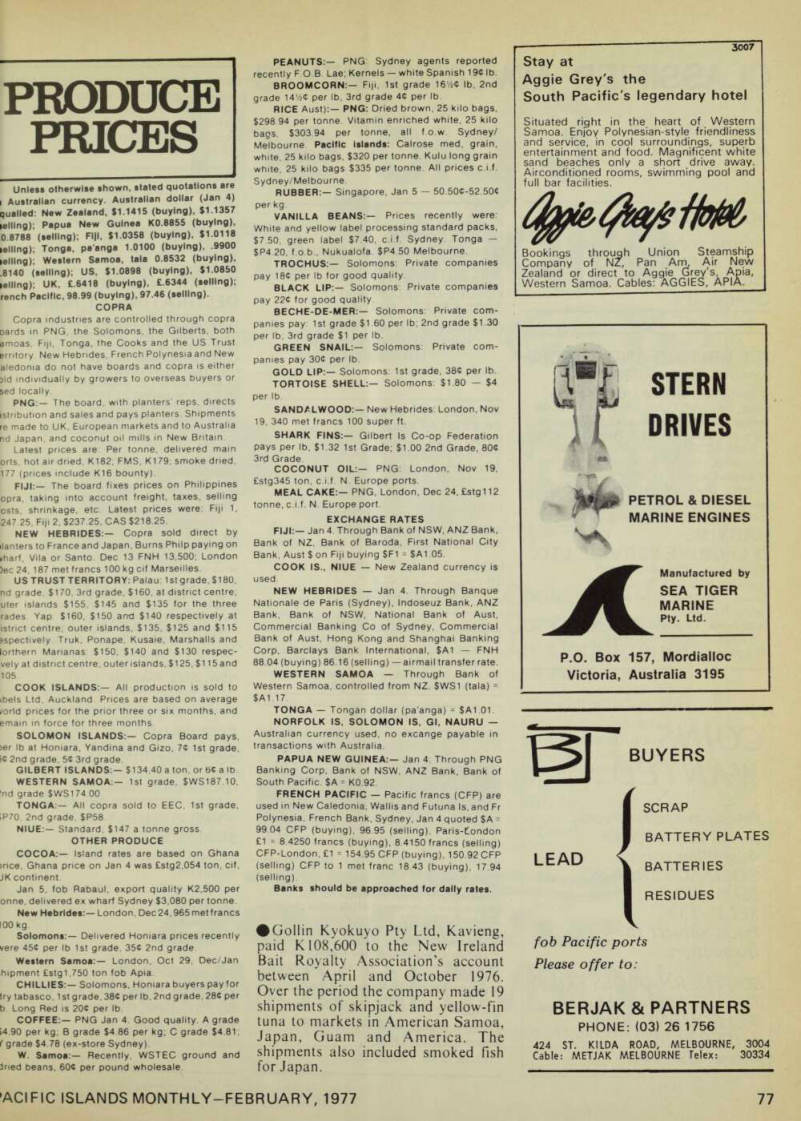
Prices
Unless otherwise shown, stated quotations are i Australian currency. Australian dollar (Jan 4) quailed: New Zealand, $1.1415 (buying), $1.1357 selling); Papua New Guinea K 0.8855 (buying), 0.8788 (telling): FIJI. $1.0358 (buying), $l.OllB telling); Tonga, paanga 1.0100 (buying), .9900 telling); Western Samoa, tala 0.8532 (buying), .8140 (telling): US. $1.0898 (buying), $1.0850 telling); UK, £.6418 (buying), £.6344 (telling); rench Pacific, 98.99 (buying), 97.46 (telling).
Copra
Copra industries are controlled through copra cards in PNG. the Solomons, the Gilberts, both amoas, Fiji. Tonga, the Cooks and the US Trust erntory New Hebrides, French Polynesia and New aledonia do not have boards and copra is either )ld individually by growers to overseas buyers or sed locally PNG:— The board, with planters' reps, directs istnbution and sales and pays planters Shipments re made to UK, European markets and to Australia nd Japan, and coconut oil mills in New Britain Latest prices are: Per tonne, delivered main orts, hot air dried, K 182; FMS, K 179; smoke dried, 177 (prices include Kl 6 bounty).
FIJI: — The board fixes prices on Philippines opra, taking into account freight, taxes, selling osts, shrinkage, etc Latest prices were; Fiji 1, 247.25, Fiji 2, $237.25, CAS $218.25.
NEW HEBRIDES:— Copra sold direct by ilanters to Franceand Japan, Burns Philp paying on Yharf, Vila or Santo. Dec 13 FNH 13,500; London )ec 24, 187 met francs 100 kg cif Marseilles US TRUST TERRITORY: Palau: Ist grade, $lBO, nd grade, $l7O, 3rd grade, $l6O, at district centre; uter islands $155. $145 and $135 for the three rades Yap $l6O, $l5O and $l4O respectively at istrict centre; outer islands, $135. $125 and $ll5 sspectively Truk, Ponape. Kusaie, Marshalls and lorthern Marianas $l5O, $l4O and $l3O respec vely at district centre, outer islands, $125, $ll5 and 105 COOK ISLANDS:— All production is sold to ibels Ltd, Auckland Prices are based on average rorld prices for the prior three or six months, and emain in force for three months SOLOMON ISLANDS:— Copra Board pays, >er lb at Honiara, Yandina and Gizo, 74 Ist grade, >4 2nd grade, 54 3rd grade.
GILBERT ISLANDS:- $134,40 a ton, or 64 a lb
Western Samoa:- Ist Grade, Swsib7.Io,
'nd grade SWSI74 00 TONGA:— All copra sold to EEC, Ist grade, IP7O, 2nd grade, SPSB NIUE:— Standard, $147 a tonne gross
Other Produce
COCOA:— Island rates are based on Ghana »rice, Ghana price on Jan 4 was £stg2,os4 ton, cif, JK continent.
Jan 5, fob Rabaul, export quality K 2.500 per onne, delivered ex wharf Sydney $3,080 per tonne.
New Hebrides:— London, Dec 24,965 metfrancs 100 kg Solomons;— Delivered Honiara prices recently vere 454 per lb Ist grade, 35C 2nd grade Western Samoa:— London, Oct 29. Dec/Jan hipment £stgl,7so ton fob Apia.
CHILLIES:— Solomons, Honiara buyers pay for Iry tabasco, Ist grade, 384 per lb, 2nd grade, 28C per b Long Red is 20C per lb COFFEE:— PNG Jan 4. Good quality. A grade 14 90 per kg; B grade $4 86 per kg; C grade $4.81; / grade $4.78 (ex-store Sydney).
W. Samoa;— Recently, WSTEC ground and tried beans. 604 per pound wholesale
PEANUTS:— PNG: Sydney agents reported recently F O B Lae; Kernels white Spanish 194 lb.
BROOMCORN;— Fiji, Ist grade IS'/jC lb, 2nd grade 14’/j4 per lb, 3rd grade 44 per lb.
RICE Aust):— PNG: Dried brown, 25 kilo bags, $298 94 per tonne Vitamin enriched white, 25 kilo bags, $303 94 per tonne, all f.o.w. Sydney/ Melbourne Pacific Islands: Calrose med, grain, white, 25 kilo bags, $320 per tonne. Kulu long grain white, 25 kilo bags $335 per tonne. All prices c.i.f.
Sydney/Melbourne.
RUBBER:— Singapore, Jan 5 50.50C-52.50C per kg VANILLA BEANS:— Prices recently were: White and yellow label processing standard packs, $7 50; green label $7.40, c.i.f. Sydney. Tonga $P4.20, f o b., Nukualofa. $P4.50 Melbourne.
TROCHUS:— Solomons: Private companies pay 18C per lb for good quality.
BLACK LIP:— Solomons: Private companies pay 22C for good quality.
BECHE-DE-MER:— Solomons: Private com panies pay: Ist grade $1 60 per lb; 2nd grade $1.30 per lb; 3rd grade $1 per lb.
GREEN SNAIL:— Solomons: Private com panies pay 30C per lb.
GOLD LIP;— Solomons: Ist grade. 38C per lb.
TORTOISE SHELL:— Solomons: $l.BO $4 per lb.
SANDALWOOD:— New Hebrides: London, Nov 19, 340 met francs 100 super ft.
SHARK FINS:— Gilbert Is Co-op Federation pays per lb, $1.32 Ist Grade; $l.OO 2nd Grade, 80C 3rd Grade.
COCONUT OIL: PNG; London. Nov 19, £stg34s ton. c.i.f N. Europe ports.
MEAL CAKE:— PNG, London, Dec 24, £stgll2 tonne, c.i.f. N. Europe port.
Exchange Rates
FIJI: — Jan 4. Through Bank of NSW, ANZ Bank, Bank of NZ, Bank of Baroda, First National City Bank, Aust $ on Fiji buying SFI = $A1.05.
COOK IS., NIUE New Zealand currency is used NEW HEBRIDES Jan 4 Through Banque Nationale de Paris (Sydney), Indoseuz Bank, ANZ Bank, Bank of NSW, National Bank of Aust.
Commercial Banking Co of Sydney, Commercial Bank of Aust, Hong Kong and Shanghai Banking Corp, Barclays Bank International, SAI FNH 88.04 (buying) 86.16 (selling) —airmail transferrate.
WESTERN SAMOA Through Bank of Western Samoa, controlled from NZ. SWSI (tala) = $A1.17.
TONGA Tongan dollar (pa anga) = SAI.OI
Norfolk Is, Solomon Is, Gl, Nauru
Australian currency used, no excange payable in transactions with Australia.
PAPUA NEW GUINEA:— Jan 4: Through PNG Banking Corp, Bank of NSW, ANZ Bank, Bank of South Pacific. $A = K 0.92.
FRENCH PACIFIC - Pacific francs (CFP) are used in New Caledonia, Wallis and Futuna Is, and Fr Polynesia, French Bank, Sydney, Jan 4 quoted $A = 99.04 CFP (buying), 96.95 (selling), Paris-tondon £1 = 8.4250 francs (buying), 8.4150 francs (selling) CFP-London, £1 = 154.95 CFP (buying), 150.92 CFP (selling) CFP to 1 met franc 18.43 (buying), 17.94 (selling).
Banks should be approached for daily rates.
• Gollin Kyokuyo Pty Ltd, Kavieng,
paid K 108,600 to the New Ireland
Bait Royalty Association’s account
between April and October 1976.
Over the period the company made 19
shipments of skipjack and yellow-fin
tuna to markets in American Samoa,
Japan, Guam and America. The
shipments also included smoked fish
for Japan.
Advertisements & other items, pp. 75-80 (3 items)
77
‘ACIFIC ISLANDS MONTHLY-FEBRUARY, 1977
(Scrap
3007
Stay at
Aggie Grey's the
South Pacific's legendary hotel Situated right in the heart of Western Samoa. Enjoy Polynesian-style friendliness and service, in cool surroundings, superb entertainment and food. Magnificent white sand beaches only a short drive away.
Airconditioned rooms, swimming pool and full bar facilities.
Bookings through Union Steamship
Company of Nz, Pan Arm Air New Zealand or direct to Aggie Grey's, Apia, Western Samoa. Cables: AGGIES, APIA.
STERN
DRIVES
PETROL & DIESEL
MARINE ENGINES
X Manufactured by
SEA TIGER
MARINE
Pty. Ltd.
P.O. Box 157, Mordialloc Victoria, Australia 3195
BUYERS
LEAD
(SCRAP
BATTERY PLATES
BATTERIES
RESIDUES
fob Pacific ports Please offer to:
BERJAK& PARTNERS
PHONE: (03) 26 1756
424 ST. KILDA ROAD, MELBOURNE, 3004
Cable; METJAK MELBOURNE Telex: 30334
CLASSIFIED ADVERTISEMENTS
Per Line $3.00 Aust Minimum 4 lines.
MAPS & PRINTS OF THE OLD PACIFIC
Catalogue of original antiquarian views
and maps of Pacific Islands sent free.
C.HINCHCLIFFE—7 Royd Avenue,
Heckmondwike, West Yorkshire,
WFI6 9AL United Kingdom.
CONCRETE BLOCK MAKER Makes blocks, flags edgings, screen-blocks. garden stools—up to Bat once and 96 an hour $215 00 c.i.f. main ports Send lor leaflets Forest Perm Research, Londonderry NSW, 2753 Austrelie.
LEARN INTERIOR
DECORATING AT HOME
It's easy and fun to decorate your home by yourself. Save money and time this easy "learn at home way".
Create a new vital interest in your life. Full notes covering all aspects of decorating - 21 pages alone of how to use colour in your home for your lifestyle plus our own colour wheel to make sure that you really understand colour and its use.
There is a cut-out furniture sheet to make it easy to rearrange your furniture no matter what the room.
Work on four fascinating rooms (all supplied) from modern to traditional to make the best use of your knowledge. You can use all this information to decorate your home or use this as a correspondence course and following instructions receive a certificate at satisfactory completion of the course. All this sent to you postpaid for $B5 Aust. Send your cheque/money order to: THE CARL
SCHWARZ SCHOOL OF INTERIOR
DESIGN AND DECORATION,
I Bellevue Park Road, Bellevue Hill, NSW. 2023. Australia.
BOATING BOOKS
Building, cruising, etc. State needs. JOHN ROBY, 3703NR Nassau, San Diego,
CA 92115, USA.
SEE BRITAIN AND EUROPE
BY CAR OR CAMPER.
A complete service from Martins.
Ford, Leyland, G.M., Chrysler. Over 40 model types sedans, station waggons, fully equipped campers. Realistic rentals from As2oo per/nonth include insurance, maintenance, unlimited free mileage. Delivery U.K. or Europe Airport, Docks, Hotel. For all details, quotations and brochures, rental, sales and guaranteed repurchase, Airmail:
MARTINS
SELFDRIVE SERVICE LTD.
School Lane, Chandlers Ford Eastleigh SOB 3YL ENGLAND.
Cables: Selfdrive Winchester.
Telex: 477366.
Telephone: Chandlers Ford 68386 5 lines. Clients from over 80 countries.
FOR SALE
HOTEL: 6 ROOMS
CONCRETE BLOCK CONSTRUCTION.
IDEAL FOR COUPLE TO MANAGE.
IDEALLY SITUATED.
FUTURE DEVELOPMENT,
GOOD STEADY TRADE.
CONTACT: B.J.S. AGENCIES,
BOX 39, HONIARA.
SOLOMON ISLANDS.
WE WISH TO BUY HANDICRAFTS
OF EVERY TYPE.
WHAT CAN YOU OFFER?
FREED Co. PO Box 394,
Albuquerque N.M. USA.
FOR SALE
Anderson Washer 12 wide Comeback.
Very good condition. 375 d.p.h. 750m1.
HORITZ FRUIT JUICES,
59 Cremorne Road,
KEDRON 4031.
FLEETS 45 ft. Hollow Heel Carvel launch, profess, bit 1974, solid floors on every timber, new 120 h.p.
Caterpillar, new Radar, Auto Pilot, $55,000.00 FLEETS 221 Esplanade, Wynnum Central, Brisbane Cable “FLEETS BRISBANE".
FOR SALE
s
COASTAL FREIGHTER OR LIGHTER
Ex YG US Navy 118' x 28' x7' Draft 200 ton.
Light displacement. About 15,000 Cu Ft. 300 ton cargo with 3 ton boom and winches. 2 heads galley. Accommodation for 10.
Main engine Enterprise DMG-6, direct reversing 300 hp @ 300 RPM, 8 knots cruise, economical operation, GM-Delco 20 kw and 40 kw generators, electronics, spares. Good condition.
Presently undergoing routine drydocking at Rabaul, PNG.
Price U 55125,000.
Buyer subject US Govt, approval.
Contact— Carroll Hupp, 464 Warwick St.,
Akron, Ohio, USA.
Phone: 216 798 9465.
FOR SALE
USED MACHINERY.
1 Pietro Berto Super Vienna & Crescent Moulder. 1 Mono Crescent Moulder. -1 Mono Gravity Feed Shop Bread Slicer. -1 Matchless 30-piece Bun-Divider- Rounder. -1 6-inch Mono Table Moulder.
INSPECTION INVITED.
For details, contact:
BUNGE (Aust.) Pty. Ltd.,
56 Pitt Street, Sydney, NSW.
Phone: 27 3543.
Telex: 28 20517.
COINS
WANTED...
Paying twice face value for all pre-decimal Australian coins.
GOLD SOVEREIGNS
BUY—$27
SELL-$3O
Prices subject to fluctuation.
SOUTHERN CROSS COINS
2/131 Exhibition St.,,
MELBOURNE 3000,
AUSTRALIA.
Phone: 63 1141.
The big 3
from Bonaire
x
sse
Refrigerating
Compressors
No novice, after more than three decades in the Compressor field, Bitzer can count more than 80 countries in their span of operations. Check the Bitzer pamphlet and select from a diverse and superb range of refrigerating compressors for the one exactly suitable for your requirements, using either refrigerants Rl2, 22, or 502.
Compressors &
Condensing
Units
Choose from a vast range (Vz - 5 H.P. of world renowned Tecumseh Compressor and Condensing units.
Remember the Tecumseh reputation has been built thru’ ease of servicing, reliability and the ability to carry on under adverse conditions all over the world.
Coolers,
Condensers &
Air Conditioners
Famous Muller/McQuay have a cooling unit capable of tackling your particular job.
Make your choice from the comprehensive categories of models of condensers and coolers available from Muller McQuay.
Contact Bonaire for the full story on how Muller McQuay can “Cool it” under any conditions.
COMMERCIAL DIVISION
Bonaire Industries Ltd, Phone 760-023, Box 4011, Auckland - Phone 36-088, Box 976, Dunedin.
/ J
Some occasions
call for the golden touc
(Y/ . a/b fcr 20 i fer> 4 i m **"*-s«Z: health hazabo
0 0 I There’
built tough reTJ f/ ands -
mh the accen f l6 -durable
ssgsSSr
P°wer. 5- S pel m ir ab,e ’ 9®arbox. Dual b r ~' system. Super r *e ln 9 oVe rslunq s ,, c /® Spor| s/v( system 9 ns '°n s Prtng s iin f? Slllen t leaf . «sS£««* I f Sorb ers S E acc essibinty y er >gine I r » SE »•*«»
My Datsun-
it’s a taxi driver’s dream.
TAXI
m $ Sam Tasip with his money-making Datsun, D/m4 PorMio \Tdia; llninOQ I've been driving for 19 years.
Here in Port Moresby I've been driving a taxi for the last three years. That's when I put my money in a co-operative, Pagini Taxis.
But things weren't going so well. Maintenance and fuel costs were getting me down. I had less time to spend with my family.
Then the co-op. looked into the different models available and decided on Datsun for its economy and durability.
Once I started driving my Datsun diesel taxi, things began looking up right away.
Now I have more time for my children and in my garden, because I'm never busy with maintenance. My Datsun is getting 36-40 MFG on Diesel fuel, and that's over the hilly countryside and unpaved roads around here.
I find my Datsun easy to drive and with lots of comfort for my passengers. Actually, there's nothing I don't like about my Datsun. It is my first one, but it won't be my last. I'm glad I bought Datsun, because now I make plenty of money.
Datsun Distributors: NEW HEBRIDES: Pentecost Pacific S.A. P.O. Box 119, Port Vila/NEW ZEALAND: Nissan Motor Distributors (N.Z.) 1975 Ltd. P.O. Box 61133, Otara, Auckland/NORFOLK I: Sirius Motors P.O. Box 34, Norfolk 1./ PAPUA NEW GUINEA: Boroko Motors Ltd. P.O. Box 1259, Boroko, Port Moresby/MARIAN AS: J.C. Tenorio Enterprises P.O. Box 137, Saipan /SOLOMON IS: United Enterprises Ltd. P.O. Box 262, Honiara/TAHITI: Michel Pentecost et Cie/ TAHTITBULL B.P. 1809, Papeete/TONGA: Riechelman Bros. Ltd. P.O. Box 18, Nukualofa/WESTERN SAMOA: Morris
DATSUN
Product of NISSAN Hedstrom Ltd. P.O. Box 189, Apia
79
3 ACIF 1C ISLANDS MONTHLY-FEBRUARY, 1977