Pim
Pacific Islawpif
January, 1977
Cfp 130 S
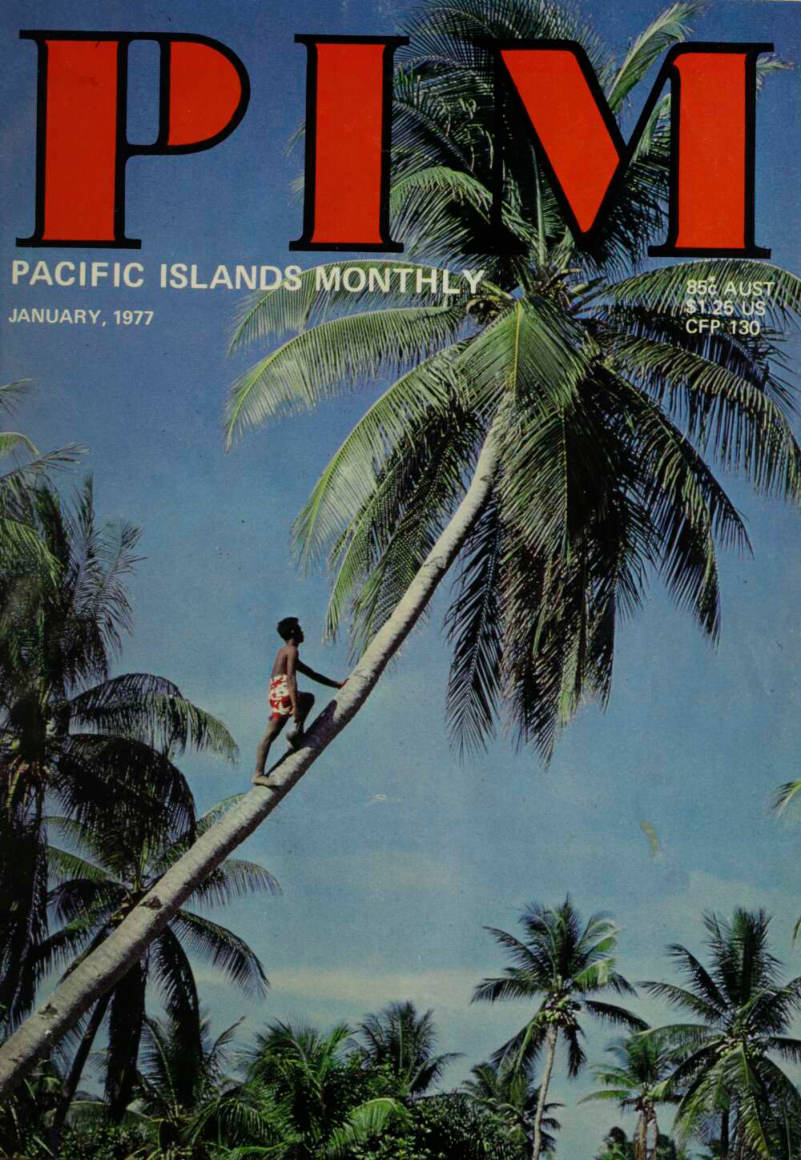
Our Cover
This G ilbertese youth “walking” up the coconut palm was “shot” by film director Karl-Heinz Stellmach for his film. Sailing in the Trade Winds, which was com missioned by the Catholic Church in the Gilberts. Mr Stellmach, who married his Gilbertese leading lady, Aborina Tenanorake, has also made other outstanding films of the Islands, The Long Way, featuring PNG’s Central District, .. . and then came Dawn, about the Eastern Highlands, and a film of West Australia’s far north, Tjakamarra, a boy between two worlds.
Advertisements & other items, pp. 2-4 (1 item)
Getting Back Should Be, Too.
IF GETTING THERE IS HALF THE FUN
SUZUKI. THE OUTBOARD YOU CAN TRUST.
50 Dll«l to OT 50 So you got out there, and you enjoyed the trip, and you enjoyed the fishing. O.K. But all good things come to an end and it’s time to be getting home.
But the engine doesn’t start. It got you out but , A — it isn’t going to get you back. Sounds familiar?
Tough, dependable, smooth-running and quick-starting that’s Suzuki.
Make sure you get back. Get a Suzuki Suzuki outboard motor and enjoy the trip SUZUKI MOTOR CO., LTD. , Hamamatsu, Japan both ways.
GUAM AGAT BOAT CENTER PONAPE LEO ETSCHEIT NAURU CAPELLE & PARTNER FIJI D. GOKAL & COMPANY LIMITED N'UE BURNS PHILPJ SOUTH SEA) COMPANY LTD. PAPUA NEW GUINEA TUTT BRYANT PACIFIC LTD. NEW HEBRIDES HENRI LEROUX NEW CALEDONIA SUPERCAL TAHITI NIPPON AUTOMOTO
STATESMAN
smoothest cigars on
e international scene
5 REft!)
O ONOfO
1801 If i ) 0 ns 0
STATESMAN
CORONA
5
Corona
X554-10/75
ONE-
TONNE
TOUGH!
The length, breadth, strength and suspension to deal with big 1-tonne loads! Economical, powerful 4-cylinder SOHC oversquare
engine. 68.9 kW (92.5 blip)!
12 months or 20,000
kilometre warranty!
Expert service and reliable
spares supply right through
the Pacific! Great cabin comfort bench seat, flow-through ventilation. ■I k Hi Ocean Is.Gilbe \\\Solomons ‘ \ Tokelaus Wollis. West Samoa Hebrides- New V Caledonic Papua New Guinea Tutt Bryant Pacific Ltd., Port Moresby Wamp Nga Motors, Mt. Hagen Dawapia Motors, Rabaul Solomon Islands Solomon Islands Service Station Republic of Nauru Nauru Co-Operative,Society Western Samoa 0. F. Nelson and Co. Ltd.
Fiji Burns Philp (South Sea) Co. Ltd.
New Caledonia
SAIP
General Motors Serving you in the South Pacific.
Pacific Islands
Monthly
FOUNDED BY R W ROBSON IN 1930
Published Monthly By
Pacific Publications (Aust.) Pty. Ltd.
76 Clarence Street. Sydney 2000
Post Address GP O BOX 3408, SYDNEY.
N S W 2001
Telegraphic Address PACPUB, Sydney Telex 21242
Telephone 29 6693
Publisher: Stuart Inder Manager: John Berry
Pacific Islands Monthly
Editor: John Carter Advertising Manager: Alan Batt
Subscription Rates
' Pacific Islands Monthly" is airfreighted to the ma jority of subscribers and agents in the Pacific Islands and the USA Australia (including Norfolk Island) $lO 50 Aust.
New Zealand, Papua New Guinea, Fiji, New Hebrides, Tonga, Cook Islands. Western Samoa, Gilbert Islands, Tuvalu, Niue. Nauru and Solomon Islands $10.50 Aust. American Samoa. Northern Marianas, Micronesia. Guam and Hawaii $15.00 US or $12.00 Aust. US mainland and Canada $17.00 US or $14.00 Aust. New Caledonia and French Polynesia 1,600 CFP or $13.50 Aust United Kingdom £9 50 or $12.50 Aust Japan 4,500 Yen or $12.50 Aust Elsewhere $14.00 Aust.
Representatives
Fiji: Advertising and Distribution Fiji Times & Herald Ltd . 20 Gordon Street, Suva Telephone 312-111 Telex FJ 2124 Papua New Guinea: Advertising and Distribution PNG Post-Courier, P 0 Box 85, Port Moresby Inquiries Post Newsagency, Telephone 24 2148 French Polynesia: Distribution Hachette Pacifique, 10 Ave Bruat. Papeete New Caledonia: Distribution Depot Centre de Presse Michel PENTECOST, B P C 2 NOUMEA United Kingdom: The Herald and Weekly Times Limited, 8 10 Clifford's Inn, Fetter Lane. London EC4A IBU Telephone 01-831 6041 Telex Lon don 21989 Japan: Advertising Universal Media Corpora tion, C P 0 Box 46, Tokyo Telephone 666-3036 Victoria: Advertising Pacific Publications (Aust) Pty Ltd . Herald and Weekly Times Building, 2nd Floor. 61 Flinders Lane, Melbourne, 3000 Telephone 652 1565 Brisbane: D Wood, Anday Agency, Box 1918 GPO. Brisbane 4001 Telephone 44 3485 441546 HJ®* Zealand: Pacific Publications, C.P.O. Box 2229, Auckland, Advertising enquiries: Internat ional Media Representatives Ltd. P.O. Box 3880 Auckl/d. Tel. 73 880. Telex: NZ21157. (Auck,4o) Hawaii and U.S. Mainland only: PIM, Hawaii. 2812, Kahawai St, Honolulu. Hawaii. 96822 Second class postage paid at Honolulu, Hawaii Printed in Australia
Copyright ©, 1977,
Pacific Publications (Aust.) Pty. Ltd.
Printed by Paramac, Mitchell Rd.
Alexandria.
PIM is distributed in Australia and New Zealand by Gordon & Gotch.
Registered at the GPO Sydney for transmission by post as a newspaper category B Recommended retail price only
V 01.48 No.l Jan.,1977.
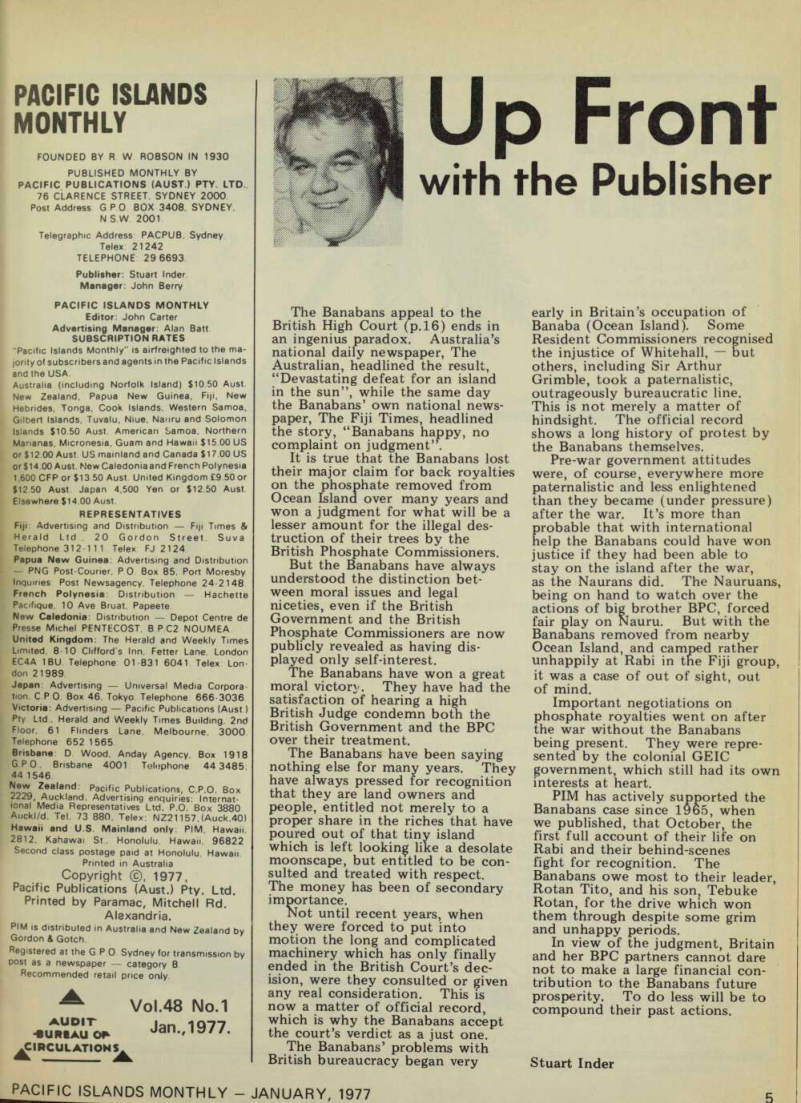
Up Front
with the Publisher
The Banabans appeal to the British High Court (p. 16) ends in an ingenius paradox. Australia’s national daily newspaper, The Australian, headlined the result, “Devastating defeat for an island in the sun”, while the same day the Banabans’ own national news paper, The Fiji Times, headlined the story, “Banabans happy, no complaint on judgment.
It is true that the Banabans lost their major claim for back royalties on the phosphate removed from Ocean Island over many years and won a judgment for what will be a lesser amount for the illegal des truction of their trees by the British Phosphate Commissioners.
But the Banabans have always understood the distinction bet ween moral issues and legal niceties, even if the British Government and the British Phosphate Commissioners are now publicly revealed as having dis played only self-interest.
The Banabans have won a great moral victory. They have had the satisfaction of hearing a high British Judge condemn both the British Government and the BPC over their treatment.
The Banabans have been saying nothing else for many years. They have always pressed for recognition that they are land owners and people, entitled not merely to a proper share in the riches that have poured out of that tiny island which is left looking like a desolate moonscape, but entitled to be con sulted and treated with respect.
The money has been of secondary importance.
Not until recent years, when they were forced to put into motion the long and complicated machinery which has only finally ended in the British Court’s dec ision, were they consulted or given any real consideration. This is now a matter of official record, which is why the Banabans accept the court’s verdict as a just one.
The Banabans’ problems with British bureaucracy began very
early in Britain’s occupation of Banaba (Ocean Island). Some Resident Commissioners recognised the injustice of Whitehall, but others, including Sir Arthur Grimble, took a paternalistic, outrageously bureaucratic line.
This is not merely a matter of hindsight. The official record shows a long history of protest by the Banabans themselves.
Pre-war government attitudes were, of course, everywhere more paternalistic and less enlightened than they became (under pressure) after the war. It’s more than probable that with international help the Banabans could have won justice if they had been able to stay on the island after the war, as the Naurans did. The Nauruans, being on hand to watch over the actions of big brother BPC, forced fair play on Nauru. But with the Banabans removed from nearby Ocean Island, and camped rather unhappily at Rabi in the Fiji group, it was a case of out of sight, out of mind.
Important negotiations on phosphate royalties went on after the war without the Banabans being present. They were repre sented by the colonial GEIC government, which still had its own interests at heart.
PIM has actively supported the Banabans case since 1965, when we published, that October, the first full account of their life on Rabi and their behind-scenes fight for recognition. The Banabans owe most to their leader, Rotan Tito, and his son ? Tebuke Rotan, for the drive which won them through despite some grim and unhappy periods.
In view of the judgment, Britain and her BPC partners cannot dare not to make a large financial con tribution to the Banabans future prosperity. To do less will be to compound their past actions.
Stuart Inder
Advertisements & other items, p. 6 (2 items)
DAPicir i q i AMnq monthly - JANUARY, 1977
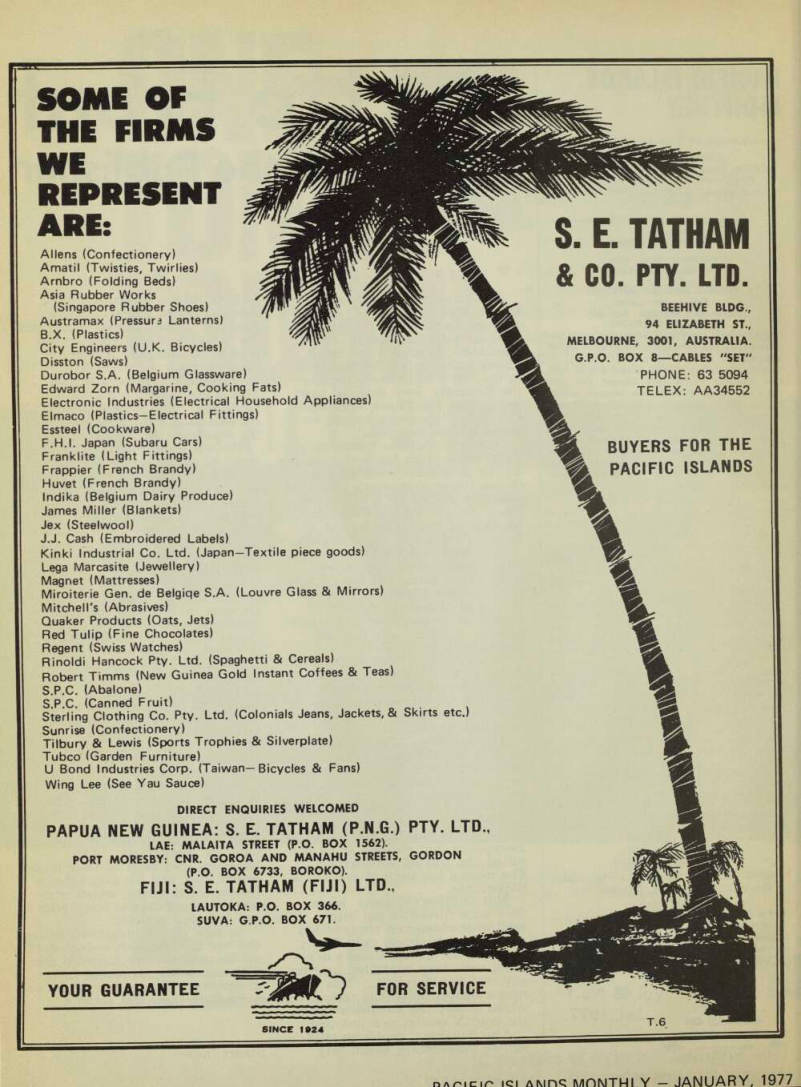
S. E. Tatham
SOME OF
THE FIRMS
REPRESENT
£3 m • Allens (Confectionery) Amatil (Twisties, Twirlies) Arnbro (Folding Beds) Asia Rubber Works (Singapore Rubber Shoes) Austramax (Pressure Lanterns) B.X. (Plastics) City Engineers (U.K. Bicycles) Disston (Saws) Durobor S.A. (Belgium Glassware) Edward Zorn (Margarine, Cooking Fats) Electronic Industries (Electrical Household Appliances) Elmaco (Plastics—Electrical Fittings) Essteel (Cookware) F.H.I. Japan (Subaru Cars) Franklite (Light Fittings) Frappier (French Brandy) Huvet (French Brandy) Indika (Belgium Dairy Produce) James Miller (Blankets) Jex (Steelwool) JJ. Cash (Embroidered Labels) Kinki Industrial Co. Ltd. (Japan-Textile piece goods) Lega Marcasite (Jewellery) Magnet (Mattresses) Miroiterie Gen. de Belgiqe S.A. (Louvre Glass & Mirrors) Mitchell's (Abrasives) Quaker Products (Oats, Jets) Red Tulip (Fine Chocolates) Regent (Swiss Watches) Rinoldi Hancock Pty. Ltd. (Spaghetti & Cereals) Robert Timms (New Guinea Gold Instant Coffees & Teas) S.P.C. (Abalone) S.P.C. (Canned Fruit) Sterling Clothing Co. Pty. Ltd. (Colonials Jeans, Jackets, & Skirts etc.) Sunrise (Confectionery) Tilbury & Lewis (Sports Trophies & Silverplate) Tubco (Garden Furniture) U Bond Industries Corp. (Taiwan—Bicycles & Fans) Wing Lee (See Yau Sauce)
DIRECT ENQUIRIES WELCOMED
PAPUA NEW GUINEA: S. E. TATHAM (P.N.G.) PTY. LTD.,
LAE: MALAITA STREET (P.O. BOX 1562).
PORT MORESBY: CNR. GOROA AND MANAHU STREETS, GORDON
(P.O. BOX 6733, BOROKO).
FIJI: S. E. TATHAM (FIJI) LTD.,
LAUTOKA: P.O. BOX 366.
SUVA: G.P.O. BOX 671.
S. E. TATHAM
& GO. PTY. LTD.
BEEHIVE BLDG.,
94 ELIZABETH ST.,
MELBOURNE, 3001, AUSTRALIA.
G.P.O. BOX B—CABLES "SET"
PHONE: 63 5094
TELEX: AA34552
BUYERS FOR THE
PACIFIC ISLANDS
5* \ 1 1
YOUR GUARANTEE
i i
FOR SERVICE
SINCE 1924
T. 6
Pacific Islands Monthly
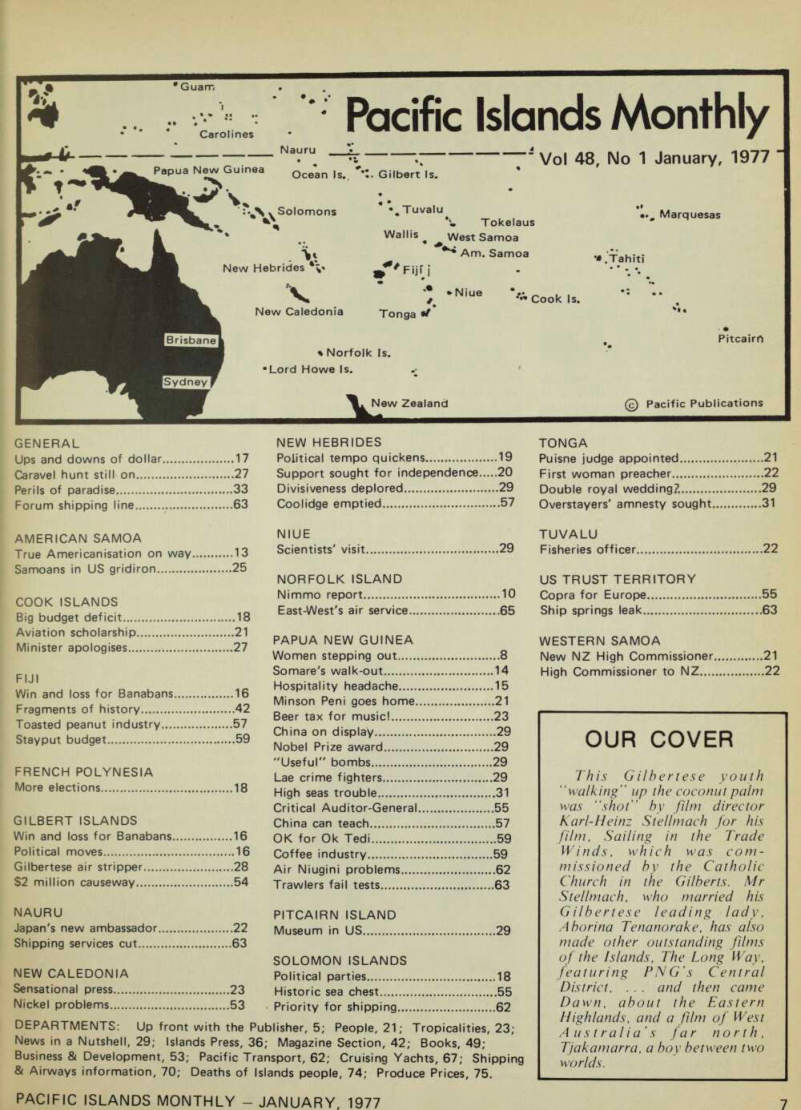
Vol 48, No 1 January, 1977
General
Ups and downs of dollar 17 Caravel hunt still on 27 Perils of paradise 33 Forum shipping line 63
American Samoa
True Americanisation on way 13 Samoans in US gridiron 25
Cook Islands
Big budget deficit 18 Aviation scholarship 21 Minister apologises 27
Fiji
Win and loss for Banabans 16 Fragments of history 42 Toasted peanut industry 57 Stayput budget 59
French Polynesia
More elections 18
Gilbert Islands
Win and loss for Banabans 16 Political moves 16 Gilbertese air stripper 28 $2 million causeway 54
Nauru
Japan's new ambassador 22 Shipping services cut 63
New Caledonia
Sensational press 23 Nickel problems 53
New Hebrides
Political tempo quickens 19 Support sought for independence 20 Divisiveness deplored 29 Coolidge emptied 57
Niue
Scientists' visit 29
Norfolk Island
Nimmo report 10 East-West's air service 65
Papua New Guinea
Women stepping out 8 Somare's walk-out 14 Hospitality headache 15 Minson Peni goes home 21 Beer tax for music! 23 China on display 29 Nobel Prize award 29 "Useful" bombs 29 Lae crime fighters 29 High seas trouble 31 Critical Auditor-General 55 China can teach 57 OK for Ok Tedi 59 Coffee industry 59 Air Niugini problems 62 Trawlers fail tests 63
Pitcairn Island
Museum in US 29
Solomon Islands
Political parties 18 Historic sea chest 55 Priority for shipping 62
Tonga
Puisne judge appointed 21 First woman preacher 22 Double royal wedding?. 29 Overstayers' amnesty sought 31
Tuvalu
Fisheries officer 22
Us Trust Territory
Copra for Europe 55 Ship springs leak 63
Western Samoa
New NZ High Commissioner 21 High Commissioner to NZ 22
DEPARTMENTS: Up front with the Publisher, 5; People, 21; Tropicalities, 23; News in a Nutshell, 29; Islands Press, 36; Magazine Section, 42; Books, 49; Business & Development, 53; Pacific Transport, 62; Cruising Yachts, 67; Shipping & Airways information, 70; Deaths of Islands people, 74; Produce Prices, 75.
in Papua New Guinea
The women are stepping out in Papua New Guinea
From MACLAREN HIARI in Port Moresby
Traditionally women in the South Pacific have played a subservient role to their men. But today in Papua New Guinea, the largest country in the region, women are coming out with the same vigour and panache as the new nation itself.
The traditional role of women in PNG varies from tribal group to tribal group, from area to area, and also over time. While they carry a major share of the economic burden, they also exert power and influence. It is difficult to make generalisations because of the need to assess the in terplay of customs and of social and economic forces.
But even where, to Western eyes, customs seem to be oppressive to women, there are often balancing fac tors which have given women either security or authority or both.
Although 90% of PNG women still lead a rural existence, they are gradually becoming aware of the new horizons which education, in all its various guises, is opening up.
From 1958 onwards concerted ef fort was made by the Australian ad ministration to step up the advance ment of women by expanding formal educational opportunities for girls, by introducing new forms of vocational training in nursing, teaching, secretarial duties; and so on, and by a new programme of informal educa tion for adult women.
Today, women are leaders in foster ing adult education both in the towns and in the villages, realising that this is a means of bringing both profit and pleasure to themselves and their families.
PNG community development of ficers are working throughout the country, fostering women’s groups, involving families in communal ac tivities and generally giving help, in particular lo women, whenever it is needed.
Today, there are more than 1,000 women’s clubs throughout the coun try, catering for up to 80,000 women.
In some areas, the clubs have joined together in provincial associations, to raise living standards through instruc tion in hygiene, nutrition, cookery, sewing, home nursing and childcare.
They also provide leisure-time ac
tivities, through new and old crafts, sports and social activities. They help women improve their way of life, and offer them a formal channel for ex pression of their opinions. Through these clubs, women now have a voice with which to influence the country’s development.
Several thousand selected women have been given leaders’ courses, and both churches and voluntary agencies such as the Young Women’s Christian Association, and the Girl Guides, have involved many thousands in a drive to bring women into the most favourable possible position.
Selected PNG women also attend the Community Education Centre at Suva in Fiji under the auspices of the South Pacific Commission, in con junction with the United Nations Food and Agriculture Organisation.
Training centres have been set up at many points throughout the country where courses of many kinds are given. Some are attended by married couples. Local government councils have been encouraged to employ social workers trained by the govern ment, and nearly 50 young women are currently so employed.
The first woman medical graduate took up her duties in 1966, and a growing percentage of girls and women is to be found in educational
inslilulions from pre-school lo univer sity level.
There is one woman in the national parliament, and several others in local government councils. Electoral reports indicate that women are acutely aware of the value of the vote, and register a high proportion of votes cast.
Women are taking part more ac tively in the cash sector of the economy and through new forms of economic endeavour such as small bakeries, craft shops, clothing workshops, cattle-farming and co operative cash cropping, are rapidly learning new roles.
If one views the time-scale in perspective, the women of Papua New Guinea have made tremendous gains in the postwar years.
There are still areas of marked con servatism and still problems to be overcome, such as the traditional ear ly marriage, which clashes sharply with the role of the emerging professional woman, or her counter part in business.
There is, for example, the question of “bride price”. Does this institution degrade the woman who appears to be the object of sale and purchase?
Where the practice itself has become merely a commercial transaction, this must be so. But, traditionally, bride price was only part of a series of marriage gifts between the relatives of bride and groom, which tended to give stability to the marriage.
Lacking the tissue of “status” con cepts which cloud social relationships in typical Western societies, the PNG woman in many respects enjoys a dignity of position which could well be envied by her sisters in more “ad vanced” societies.
Women have always played a full part in traditional Papua New Gui nean society, and they still do. Their role as the family workers has not changed. What has changed is the man’s traditional role as hunter, protector and weapon maker.
Now there is no more fighting, it may sometimes appear to the outsider that women have a harder life than men. Women carry burdens, make gardens, produce food, care for children. Men sit around talking,
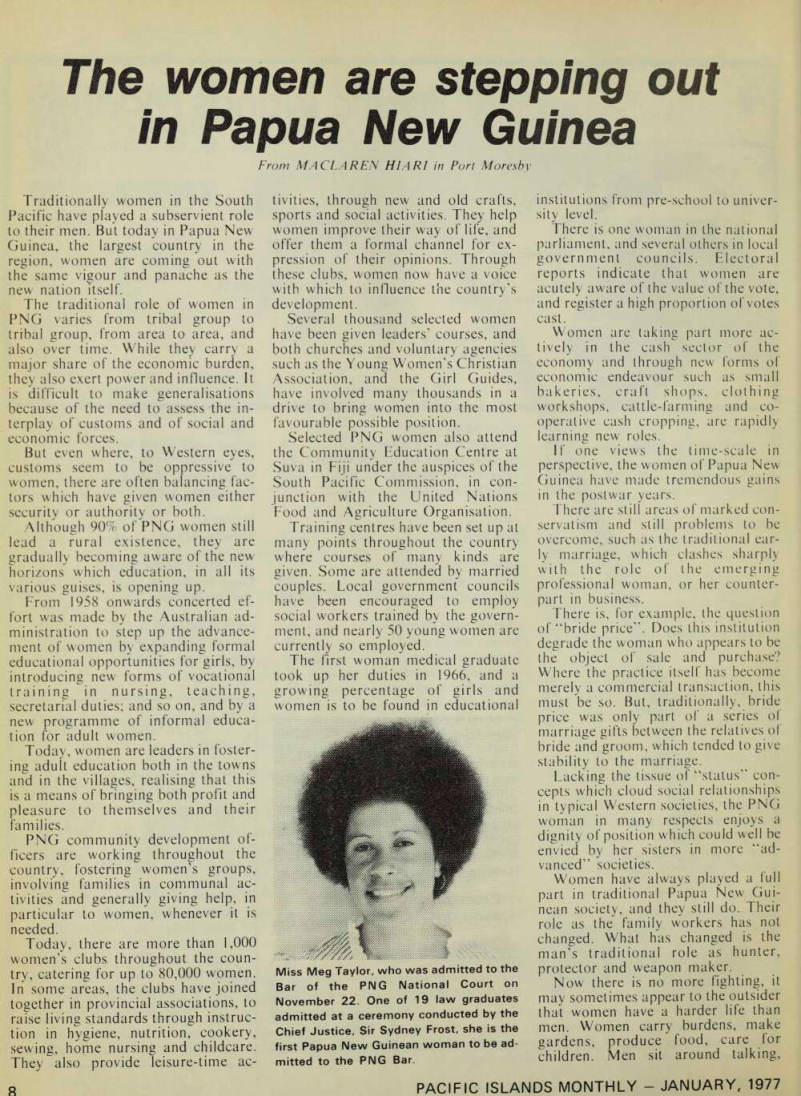
Miss Meg Taylor, who was admitted to the Bar of the PNG National Court on November 22. One of 19 law graduates admitted at a ceremony conducted by the Chief Justice, Sir Sydney Frost, she is the first Papua New Guinean woman to be ad mitted to the PNG Bar.
share in cash-cropping or leave the village to look for work.
It is an interim stage. Men’s “emancipation” into education and sophisticated skills goes fast women’s lags.
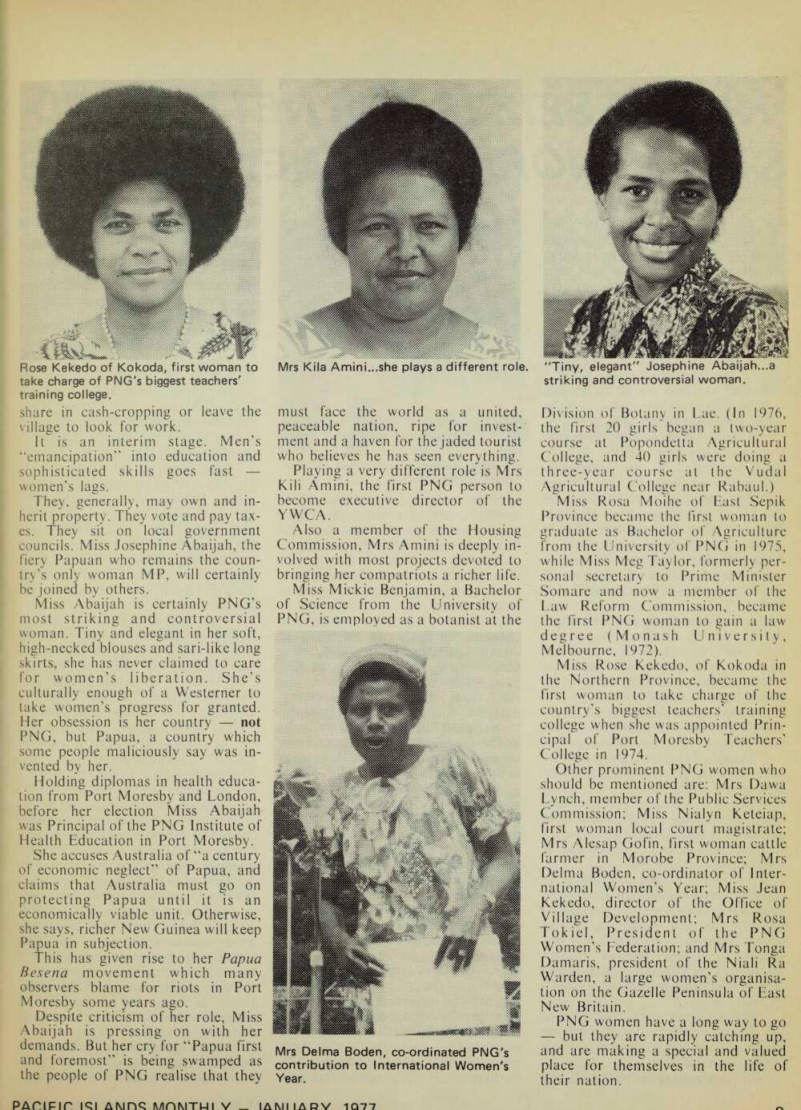
They, generally, may own and in herit property. They vote and pay tax es. They sit on local government councils. Miss Josephine Abaijah, the fiery Papuan who remains the coun try’s only woman MP, will certainly be joined by others.
Miss Abaijah is certainly PNG’s most striking and controversial woman. Tiny and elegant in her soft, high-necked blouses and sari-like long skirts, she has never claimed to care for women’s liberation. She’s culturally enough of a Westerner to take women’s progress for granted.
Her obsession is her country not PNG, but Papua, a country which some people maliciously say was in vented by her.
Holding diplomas in health educa tion from Port Moresby and London, before her election Miss Abaijah was Principal of the PNG Institute of Health Education in Port Moresby.
She accuses Australia of “a century of economic neglect” of Papua, and claims that Australia must go on protecting Papua until it is an economically viable unit. Otherwise, she says, richer New Guinea will keep Papua in subjection.
This has given rise to her Papua Besena movement which many observers blame for riots in Port Moresby some years ago.
Despite criticism of her role, Miss Abaijah is pressing on with her demands. But her cry for “Papua first and foremost” is being swamped as the people of PNG realise that they
must face the world as a united, peaceable nation, ripe for invest ment and a haven for the jaded tourist who believes he has seen everything.
Playing a very different role is Mrs Kili Amini, the first PNG person to become executive director of the
Ywca.
Also a member of the Housing Commission, Mrs Amini is deeply in volved with most projects devoted to bringing her compatriots a richer life.
Miss Mickie Benjamin, a Bachelor of Science from the University of PNG, is employed as a botanist at the
Division of Botany in Lae. (In 1976, the first 20 girls began a two-year course at Popondella Agricultural College, and 40 girls were doing a three-year course at the Vudal Agricultural College near Rabaul.) Miss Rosa Moihe of East Sepik Province became the first woman to graduate as Bachelor of Agriculture from the University of PNG in 1975, while Miss Meg Taylor, formerly per sonal secretary to Prime Minister Somare and now a member of the Law Reform Commission, became the first PNG woman to gain a law degree (Monash University, Melbourne, 1972).
Miss Rose Kekedo, of Kokoda in the Northern Province, became the first woman to lake charge of the country’s biggest teachers’ training college when she was appointed Prin cipal of Port Moresby Teachers’
College in 1974.
Other prominent PNG women who should be mentioned are; Mrs Dawa Lynch, member of the Public Services Commission; Miss Nialyn Keteiap, first woman local court magistrate; Mrs Alesap Gofin, first woman cattle farmer in Morobe Province; Mrs Delma Boden, co-ordinator of Inter national Women’s Year; Miss Jean Kekedo, director of the Office of Village Development; Mrs Rosa Tokiel, President of the PNG Women’s Federation; and Mrs Tonga Damaris, president of the Niali Ra Warden, a large women’s organisa tion on the Gazelle Peninsula of East New Britain.
PNG women have a long way to go but they are rapidly catching up, and are making a special and valued place for themselves in the life of their nation.
Rose Kekedo of Kokoda, first woman to take charge of PNG's biggest teachers' training college.
Mrs Kila Amini...she plays a different role.
Mrs Delma Boden, co-ordinated PNG's contribution to International Women's Year.
"Tiny, elegant" Josephine Abaijah...a striking and controversial woman.
Advertisements & other items, p. 9 (1 item)
9
PAriFIP 191 AMn9 MOMTUI V lAMMADV 1Q77
Nimmo Seizes The Nettle And
Stings Norfolk’S Newcomers
“It is hard to do justice to the spirit of order and decency that animates the whole community, whose number amounts to 170, strictly brought up in the Protestant faith according to the Established Church of England, by Mr Nobbs, their pastor and surgeon, who has, for 24 years, zealously and successfully, by precept and example, raised them to a state of the highest moral conduct and feeling ...” (Admiral Moresby on the Pitcairners in 1852, four years before their transfer to Norfolk Island.) “It really appears to me wonderful that a small community like this should have succeeded in so completely gulling the whole world into a belief that they are an isle of saints. I believe there is more immorality of all kinds here, according to population, than in any other civilised part of the world.. ” (Sydney magistrate Henry Wilkinson, reporting on Norfolk Island to Governor Loftus of New South Wales, 1885.) “A feature of this modern society is the number of factions which exist.
Pitcairn descendants, traders, operators of tax avoidance schemes, retired people and new farmers all constitute divergent groups. A superficial friendliness and con viviality masks a deal of resentment and dislike among some of the groups.
“Many Pitcairn descendants bitterly resent what they regard as the misuse of their Island by many newcomers whose predominant reason for being in the Island is to amass or retain wealth by avoiding revenue imposts and in some cases to help others to do likewise . . .
“It would be extremely difficult for this small faction-riddled and confined community to evolve for the Island policies that are likely to receive general acceptance in respect of major matters.” (Judge Nimmo in his “Report of the Royal Commission into Matters Relating to Norfolk Island”, 1976).
Such are three outsiders’ views of the same community at different points in its development over a century and a quarter.
The contrasting opinions of the
admiral and the magistrate reflect sharp changes in prevailing attitudes to the community of Pitcairners at different times in the 19th century.
But the opinion of the Nimmo Commission is topical in the extreme.
Its conclusion that, in present circumstances, it is impossible to obtain a genuine popular consensus on “Major matters” on Norfolk led directly to the main, and most controversial, point made in its 420page report which was tabled in the Australian Parliament in November; that the Australian Commonwealth itself should, “by a conscious and quite deliberate adoption of measures, bring the Island wholly within the Australian taxation system”.
In return, the commission says, all social security, pensions, medical, hospital and other health benefits dispensed by the Commonwealth Government would be extended to the residents of the Island. The burden of education would be taken over by the Commonwealth Government, which would be obliged to ensure that educational facilities were of the same standard as in the rest of the Australian territories.
As well as recommending the abolition of the present Norfolk Island Council and its replacement by a nine member, elected Norfolk Island Territory Assembly, the commission suggests that, in order to give them representation in the Commonwealth Parliament, Norfolk Island residents
should be included in the electorate of Canberra in the Australian Capital Territory.
This seizing of the Norfolk nettle by the commission has predictably brought protests from various circles on the Island, especially those most directly interested in preserving what remains of its tax-haven status.
A public meeting on the Island on November 23, which discussed the Nimmo report, heard various calls for “secession” from such circles. How ever, the meeting ended with a decision for one more try to persuade Canberra to let the Island carry on its old way.
But all signs are that this is just not on. Answering a question in Common wealth Parliament on November 17, the Australian Treasurer, Mr Lynch said that his government was “determined ... to make sure that neither Norfolk Island nor the other islands in its vicinity in that part of the Pacific Ocean can be used as tax avoidance havens”.
A substantial part of the Nimmo report is naturally devoted to the Island’s status as a tax haven, a status derived from the Acts Interpretation Act (1901-1973) which ruled that Norfolk Island is not part of “Australia” for taxation purposes.
The report records that in the 37 years from beginning of 1926, when the Island’s Companies Ordinance was first promulgated, to the end of 1962, seven companies were registered on the Island. By that time and not before Norfolk Island had developed what the report calls the “prerequisites of a tax haven”. These included, notably, efficient banking services, and satis factory communication facilities (transport, telephone, telex and mail).
In the next 10 years, to the end of 1972 no fewer than 1,920 companies were registered on the Island. (Put statistically, this means that from 1926 to 1962, a company was registered on Norfolk Island every 1,929.9 days.
From 1962 to 1972, the rate of registration was one every 1.9 days, a factor of increase in the rate of company registrations of 1,015.7!) The report says that, from information available to the Aust
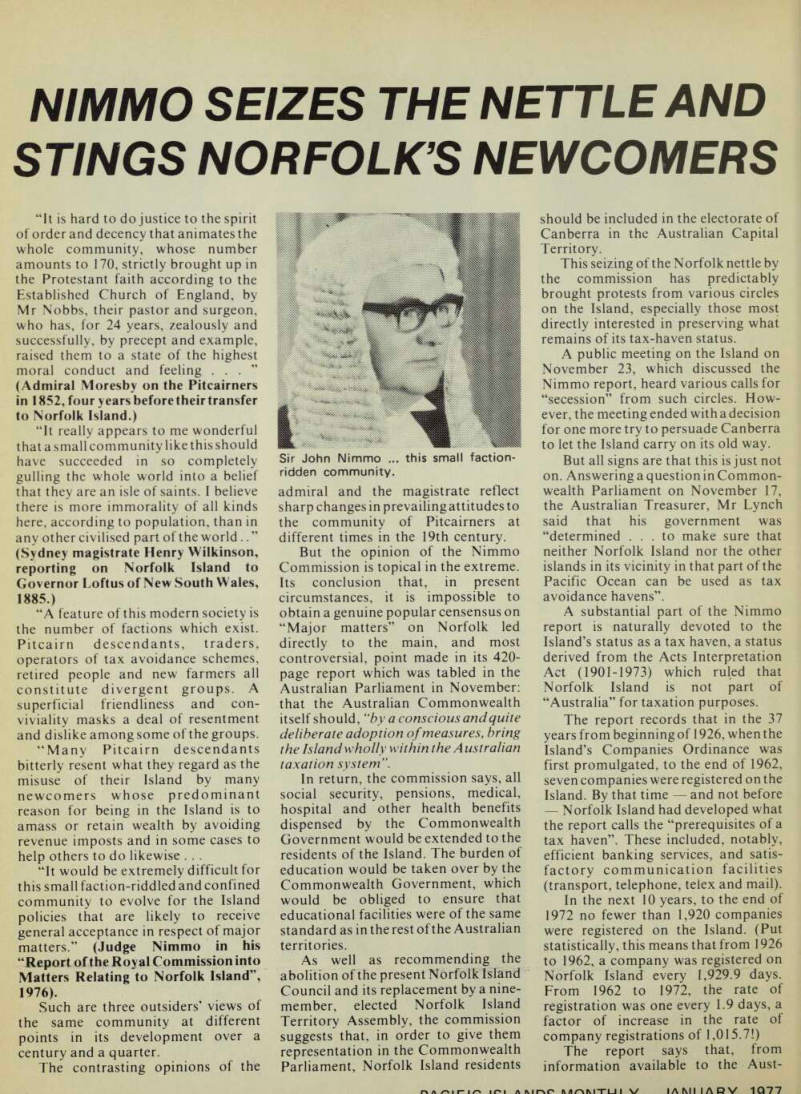
Sir John Nimmo ... this small faction ridden community.
ralian Taxation Office, the number of these companies engaged in “genuine business activity in the Island would not approach three figures”. It adds: “It is obvious that the overwhelming majority of the companies established on the Island since 1962 had tax avoidance or evasion as the sole or major reason for their existence. No other explanation was advanced for the existence of so many companies to serve a population of some 1,600
people.”
The report declines to offer an exact estimate of the tax lost to Australia during that period, offering only “a broad appreciation of the order of magnitude”. It says; “If for instance it is assumed that there were 900 tax avoidance schemes and that the average tax saving average $l,OOO per annum, the tax lost each year would be $900,000. If the tax saving averaged $lO,OOO, the tax lost would amount to s9m per annum. At an average of $50,000 avoided in each case, the total becomes s4sm . . . The tax avoided in some individual cases was in fact over $50,000.”
Assessing the position since the Income Tax Assessment Act (No 4) of 1973, the report says; “Insofar as income tax avoidance is concerned the overwhelming body of abuses has been stopped. Those that remain, namely abuses in the areas of Federal estate duty and State death and stamp duties, are on a relatively smaller scale, but, to an unascertainable extent, are detri mental to the Federal and State revenues concerned.
“It is significant that for the year ended June 30, 1975, over sls'/2m passed through the books of the Norfolk Island branch of the Commonwealth Trading Bank, and for the year ended September 30,1975, over s6s'/4m passed through the books of the Island’s branch of the Bank of New South Wales by way of ‘paper’ transactions.”
The report anticipates the objec tions now being raised to its findings when it says: “It was obvious that the groups, who were most critical of Australia’s government of the Island, and who were most clamorous in urging complete or near independence from Australia, were those who had moved to the Island in recent years predominantly to amass or retain wealth by avoiding revenue imposts, and by exploiting the Island’s commercial opportunities to the full.
They went to considerable lengths, including the use of small numbers of
Pitcairn descendants as willing
accomplices.
“One gathered from the evidence of some of the Pitcairn descendants that they had been moved to support these groups because of exploitation of their fear of what the Commonwealth Gpvernment might do in the spheres of taxation and land control if it continued to govern the Island. Their evidence followed a clearly identifiable pattern.”
In a caustic aside on recentlyarrived advocates on Norfolk separatism, the report adds: “One was not impressed by the repeated assertions of some of them that the predominant
reason t or their remaining in the Island was its natural charms.
In a general comment on the quality of witnesses, the report says: “In general the evidence given by the Pitcairn descendants was more acceptable than that of newcomers to the Island, part of whose evidence was so coloured that little reliance could be placed on it.”
So t he battle of Norfolk is joined, wh i le we have concentrated here on only j ts mo st contentious aspect, the report as a whole is an imposing storehouse of information on virtually every aspect of life on the Island. Its valued and significance will not be
quickly exhausted.
Advertisements & other items, p. 10 (1 item)
a /"> ir - i /~> ioi I V IA Ml IA R V 1Q77
The waiting is over but
indecision lingers on
From FRANCIS ROLLEY in Kingston
Norfolk Island enters the new year
with anticipation and apprehension
following the release of Sir John Nimmo’s Royal Commission report detailing a future constitutional, social, and economic blueprint for the community’s 1600 residents.
Everyone Pitcairn descendants who claim Norfolk as their homeland with valid moral, if no longer legal, justification; long-standing immigrants, many of them retired; more recent arrivals who have invested in local businesses and taken up residence; itinerant workers passing through; and even visiting tourists will be affected in some way if the Nimmo recommendations are adopted by the Australian Government.
Public meetings with attendances in the hundreds, informal discussions
among community leaders, private
conferences of wealthy big-business interests, and in-camera as well as open special and regular monthly sessions of the eight-member Norfolk Advisory Council which faces abolition under the Nimmo Plan have been held to consider the matter.
The various vested interests
provoked myriad opinion ranging
from favourable to foreboding which suggested Sir John Nimmo correctly read the climate when he referred to a community deeply divided by factions. His remarks spurred a flurry of comment in the Australian mainland media and a storm of indignant reaction on the island but in spite of
protestations many, although not all, residents with unwitting irony still disagree that they are deeply disagreed over the recommendations, The divisions, not surprisingly, fall broadly along economic lines and the contentious issue is taxation at Australian mainland rates. There are the low-wage workers who include the majority of Pitcairn descendant islanders along with a few long standing immigrant residents and many Australians, New Zealanders, and other nationals who, during shorter stays, engage in the mundane and menial occupations of the tourist support industries.
Because the average islander and itinerant earn less than the minimum taxable mainland wage it would seen they’ll be least scarred by the Nimmo Plan while sharing the economic and social welfare benefits from Canberra it proposes.
Islanders welcome any move to force very wealthy outsiders who they see as exploiting their homeland and erasing their heritage into paying a part of Norfolk’s present maintenance and future development costs in return for the privilege of residence.
But at the same time, some itinerants and islanders are chary of wage-price inflationary spirals which plague Australia. They fear their employers, if required to pay company tax, will increase retail prices, thus raising general living
costs, thereby necessitating staff pay increases which could elevate them to a tax-paying bracket and possibly mean their take-home pay would be even less than now.
Nevertheless, the majority of working people support the senti ments of Carol Adams favours taxation. Australian-born resident of Norfolk for eight years, part-time restaurant kitchen-hand. Young Residents’ Association member, housewife mother of two and whose husband, a Transport Department employee, is descended from a Bounty mutineer, she believes “the Nimmo Plan is the only answer for the benefit of all people on Norfolk.”
Popular rumour has it that she attended recent public hall meetings with a dozen or so duck eggs in a brown paper bag ‘just in case’ but all she admits to is a drake in her backyard. However, she says she would “take great delight in seeing egg on the face of the anonymous island councillor who spoke in the mainland press of burning the Australian flag and running up the Jolly Roger.”
The commercial-managerial sec tion of the Norfolk community includes numbers of immigrants who own tax-free and duty-free tourist stores, as well as trade and professional service businesses, and employ comparatively low-wage workers to operate them. In general, they oppose the Nimmo proposals chiefly because of the company tax provisions which, in the words of one, “could lead to a depressed society.”
Kevin Pereira, a director of a large tourist store, says, “commercial traders will have to absorb the increased overheads rather than increase prices on their merchandise because that would make them
uncompetitive and unattractive for visitors.”
He believes the net income of the commercial sector will be lower if the Nimmo Report is adopted.
Steve McMullen, manager of Norfolk’s largest tourist hotel The South Pacific is also against the Nimmo Plan. Expressing a personal opinion, not necessarily reflecting the company’s attitude, he says, “taxation will add in excess of $52,000 to annual liabilities and we’ll probably have to retrench staff and curtail some services although I’d hope not have to increase tariffs.”
However, John Anderson, owner of a tax-free electrical goods store, is a member of the commercial section who agrees in general with the report including the taxation proposals.
But as president of the Norfolk Island Conservation Society and a
private pilot he emphatically opposes
the Nimmo Plan to upgrade the island’s airport to take larger jet aircraft.
“Aircraft such as the newly developed propeller-driven De Havilland Dash-Seven could ade quately replace the obsolete Qantas DC-4s on the Australia Norfolk
run without requiring any airport
extensions or compromising existing
environmental values.”
The third board classification of sectional interests covers the retired gentry very wealthy business people, who have left large lifetime capital investments elsewhere and opted for the peace and seclusion of Norfolk to live on the interest.
By all accounts, many of them would pay sizable tax on their substantial interest incomes under the Nimmo Plan and with a means-test on aged pensions, most would be forced to dig into capital holdings for their bread and butter living.
Certainly, they have most to lose if the Nimmo Plan is adopted. Graham Hitchins, English immigrant, semi retired businessman, a director of Norfolk Island Airways, and a spokesman for the local Citizens’
Association endorses moves for a mainland consultant to investigate what will happen if income tax does come to the island.
“I don’t think people appreciate how that will increase prices at shops, apartments, and hotels causing our tourist trade to fail” he says.
But taxation entails financial benefits as well as burdens and by year’s end more and more Norfolk Island citizens were backing the belief that the Nimmo recommendations were worthy of the five-year trial suggested.
As New Zealand-born Merval Hoare, Norfolk’s only contemporary historian living on the Island, says, “By resolving once and for all the island’s constitutional status as a territory of Australia and by bringing it into tne mainland taxation system with benefits which will flow to so many people, the Nimmo Report will do much to end the unrest of recent times.”
Lisle Snell, Pitcairn descendant on his mother’s side, family man with three children, manager of the Qantas-Air New Zealand airline agency on the island, and, at 28, the youngest member of the Norfolk’s Advisory Council, agrees.
Speaking as a private citizen, he says “the road Norfolk has been following has been clouded with uncertainly and hesitancy far too long and, if nothing else, the Nimmo Report has told us where we stand and were we should go in future. This basis for future planning will in itself eradicate a lot of the divisiveness of which Sir John speaks.”
The Norfolk Island Council which might be abolished.-Photos: Tim Wood.
Carol Adams ... she favours taxation.
Advertisements & other items, pp. 11-12 (2 items)
11
PAriFir IQI MONTH I Y lAMIIARV 1Q77
12
nAPI r IP ici A Mr\ C H/lAMTUI \/ lAMIIADV 1077
American Samoans on the road
to true Americanisation
From FELISE VA A in Apia
Recent political developments in American Samoa definitely point to some drastic changes in the future which will have repercussions on the political geography of the South Pacific.
The most significant development was the territory’s fourth plebiscite on whether the people of American Samoa should elect their own gover nor and lieutenant-governor. Thrice before, over several years, the people have rejected the measure. But in the fourth plebiscite on August 31, 1976, the people voted overwhelmingly almost three to one in favour of the proposal.
The bureaucratic machineries in both Washington and American Samoa are now being geared to prepare the groundwork leading to the local election of a governor and lieutenant-governor by November, 1977, and even earlier, if possible.
There is no doubt now the Interior Department, which is reponsible for the administration of all US territories, will go along with the wishes of the Samoan people about electing their own top executives, and has formed an Elected Governor Commission to look into all the aspects involved.
On the commission are C. Brewster Chapman, associate solicitor for the Department of Interior, chairman; ac ting Governor Frank Barnett; former governor Earl Ruth; Representative Eaasuka Lutu; Senator Fofo Sunia; High Chief Leiato; Don Moysey, financial officer for Territorial Af fairs; Senate President Salanoa Aumoeualogo; House Speaker Te’o fuavai; Delegate-At-Large A.P.
Lutali; Attorney-General Lyle Rich mond and Paopaoailua Meko, assis tant director of Samoan Affairs.
Its functions have caused con troversy and brought strong criticism from Representative Joe luli, the in fluential chairman of American Samoa’s House Budget and Ap propriations Committee.
According to Pago reports, luli said that while in Washington on government business in September, the deputy director for Territorial Af
fairs, requested the formation by the local legislature of a “transition com mission”. However, when the bill for this purpose was finally introduced the commission was no longer a “transition” one, but an “elected governor” one. The alteration in the commission’s name is a controversial matter, maintains luli, and threatens to usurp the powers of the local legislature.
A bill now before the US Congress provides that the legislature “establish rules and procedures for the nomination, qualifications, term of office and removal of the gover nor,” luli says. It now seems that the new commission, in session since November, has taken over those func tions being earmarked for the local legislature, luli argues. He says he was removed from membership of the commission because of his critical views.
The elected governor will still come under the authority of the Interior Secretary, who will still be responsible to Congress for the administration of American Samoa.
It is uncertain whether the outcome of the August plebiscite played a role in the resignation in October of Governor Earl Ruth. The only thing publicly known was that the Interior Department has summoned Ruth to a top level desk job in the Office of Territorial Affairs. But just before Ruth left, there had been a big rift between him and the local legislature over much-needed funds which Ruth had withheld from the Fono. When he left early October, lieutenant-gover nor Frank Barnett became acting governor, a position he still holds.
On the surface, the decision by the American Samoans to have their own locally-elected governor looks to be one of those ordinary things. But it really is a foretaste of things to come.
An educated guess is that this is but a preliminary step to the passing of an Organic Act for American Samoa, which will officially make American Somoa United States territory with a constitution formally recognised by Congress rather than by the Interior Department as at present.
Under the act American Samoans will enjoy a much larger dose of local autonomy in governmental matters and such autonomy would enable the United States to avoid many of the more severe charges of imperialism.
Of course, the United States will still be “condemned” for holding on to American Samoa. But the Americans will probably reply “it is the Samoans’ wish”. And this is to a large extent true. By and large, American Samoans have cast their lot with the United States.
Seventy-odd years of American ad ministration have practically “brainwashed” the American Samoans into accepting everything American, and who can blame them?
They need the United States (now that Western Samoa is not interested) but the United States hardly needs them except for honour’s sake and for propaganda. And American Samoans realise that as long as they satisfy those curious American yearnings, they are on the safe side.
So for the future, American Samoans are destined for a honey moon with American interests. And this will have an important impact, not only on the political geography of the South Pacific, but also on its cultural environment.
Whether American Samoa’s choice to go with the Americans will have a good or bad effect is hard to say. But American Samoa will certainly be the odd man out among the independent nations of the South Pacific. So, there is room for friction.
Former Governor Earl Ruth.
Unique parliamentary motion?
Mr Somare does a walk-out
From A Port Moresby Correspondent
A walk-out from parliament by Prime Minister Michael Somare, an apology to him and to parliament staff by Speaker Barry Holloway, a motion to bring the 1977 Papua New Guinea elections forward by several months, and a government decision to withdraw a controversial Public Order Bill these were features of an
increasingly ragged parliamentary
scene in Port Moresby in late November-early December.
Mr Somare staged his angry walk out after Mr Holloway, criticised parliamentary staff following a pro cedural mix-up in which he himself had appeared to lose the thread of events.
Mr Holloway later apologised to Mr Somare and the staff, but by that time the Prime Minister had been out of the House for about 15 minutes.
Mr Somare was clearly the victim of frayed nerves following frustrations which had been distrupting the government’s control of the House.
Earlier in the same day he had twice attempted to suspend standing orders to move that next year’s general election be held earlier than planned. Parliament refused to allow
the suspension.
Mr Somare will now need 52 votes if parliament is to agree to his plan to hurry up the election date.
This is just over half the total number of votes in parliament, and is a good 10 votes more than the government can normally rely upon with confidence.
There thus seems little chance of success for Mr Somare’s sudden plan to call for elections in February instead of later in the year. The projected date at present is anywhere from April to June.
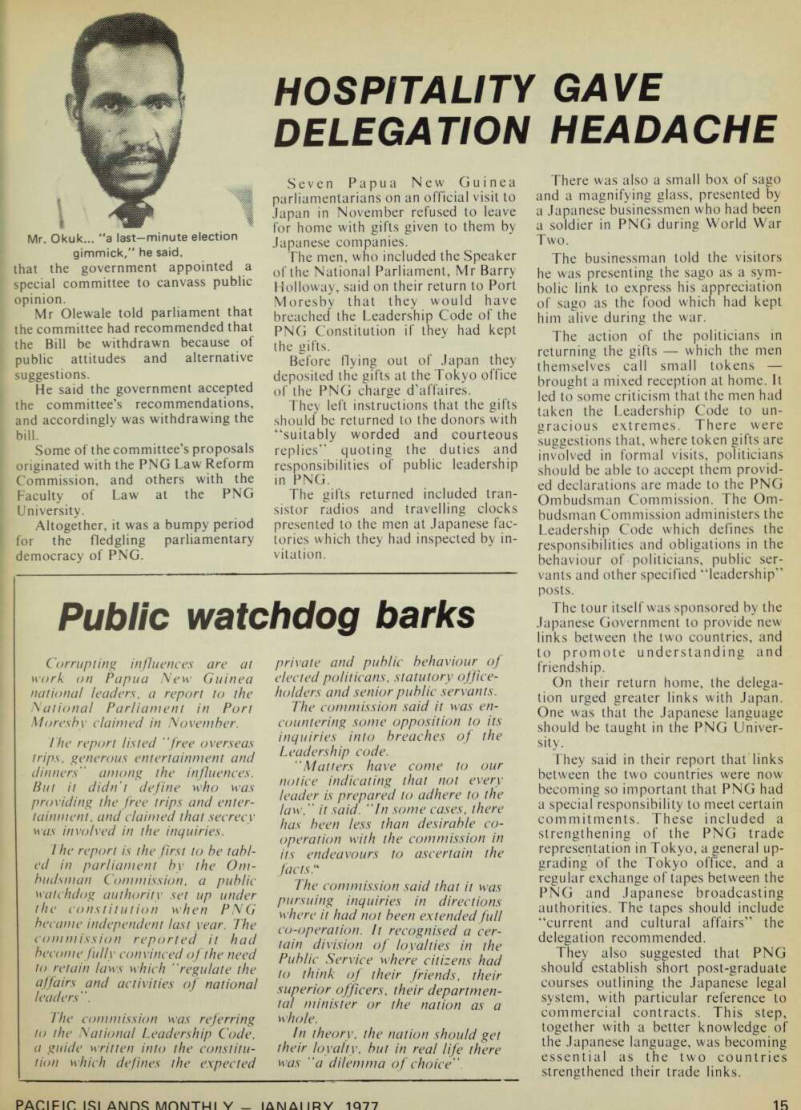
Mr Somare’s move was partly an act of bravado after being challenged in parliament by a former member of his ministry, Mr lambakey Okuk.
Mr Okuk challenged Mr Somare to call an early poll during a debate on Mr Okuk’s motion of no-confidence in the recent appointment of two ministers.
One of the ministers, Mr Waitea Magnolias, had been an Opposition front-bencher, but since crossing the floor to join the government has denied that he was ever a member of the Opposition party.
The other, Mr Moses Sasakila, lost his seat in Parliament earlier last year over a constitutional issue but was later reinstated following an appeal to the courts.
Mr Okuk accused the government of making the appointments as a last minute election gimmick, and called the two ministers “power-hungry”.
The Opposition Leader, Sir Tei Abal, criticised political horsetrading in Parliament. He also warned of the dangers if PNG allowed itself to develop in the direction of a one-party state.
Mr Somare was also no doubt influenced by an increasing feeling among all parties that an election is
long overdue, and that the more quickly it is approached the better.
But when it comes to the crunch, few members are likely to be prepared to do much about it.
The 52 votes required by Mr Somare represent what the House defines as an absolute majority more than half the total membership, and not simply a majority of those present.
The absolute majority is needed because Mr Somare’s motion involves rescinding an earlier decision.
Announcement of the withdrawal of the Public Order Bill was made to parliament by the Justice Minister, Mr Ebia Olewale. the Bill, which had aroused
unprecedented public opposition, was
designed to give special powers to police and other authorities in places and at times where a civil emergency
was proclaimed.
Under declared emergencies, police would have had power to restrict or prevent movement and association, to search without warrant, to control speech and publication and to make “holding type” arrests.
Despite a series of safeguards designed to prevent improper dec laration of a state of civil emergency, the Bill was widely criticised as repressive and as an interference with civil liberties.
Demonstrations and other forms of opposition reached such a point
Mr Somare ... he walked out.
Mr Magnolias who crossed the floor.
Speaker Holloway ... he apologised.
that the government appointed a special committee to canvass public opinion.
Mr Olewale told parliament that the committee had recommended that the Bill be withdrawn because of public attitudes and alternative suggestions.
He said the government accepted the committee’s recommendations, and accordingly was withdrawing the bill.
Some of the committee’s proposals originated with the PNG Law Reform Commission, and others with the Faculty of Law at the PNG University.
Altogether, it was a bumpy period for the fledgling parliamentary democracy of PNG.
Mr. Okuk... "a last-minute election gimmick," he said.
Hospitality Gave
Delegation Headache
Seven Papua New Guinea parliamentarians on an official visit to Japan in November refused to leave for home with gifts given to them by Japanese companies.
The men, who included the Speaker of the National Parliament, Mr Barry Holloway, said on their return to Port Moresby that they would have breached the Leadership Code of the PNG Constitution if they had kept the gifts.
Before flying out of Japan they deposited the gifts at the Tokyo office of the PNG charge d’affaires.
They left instructions that the gifts should be returned to the donors with “suitably worded and courteous replies” quoting the duties and responsibilities of public leadership in PNG.
The gifts returned included tran sistor radios and travelling clocks presented to the men at Japanese fac tories which they had inspected by in vitation.
There was also a small box of sago and a magnifying glass, presented by a Japanese businessmen who had been a soldier in PNG during World War Two.
The businessman told the visitors he was presenting the sago as a sym bolic link to express his appreciation of sago as the food which had kept him alive during the war.
The action of the politicians in returning the gifts which the men themselves call small tokens brought a mixed reception at home. It led to some criticism that the men had taken the Leadership Code to un gracious extremes. There were suggestions that, where token gifts are involved in formal visits, politicians should be able to accept them provid ed declarations are made to the PNG Ombudsman Commission. The Om budsman Commission administers the Leadership Code which defines the responsibilities and obligations in the behaviour of politicians, public ser vants and other specified “leadership” posts.
The tour itself was sponsored by the Japanese Government to provide new links between the two countries, and to promote understanding and friendship.
On their return home, the delega tion urged greater links with Japan.
One was that the Japanese language should be taught in the PNG Univer sity.
They said in their report that links between the two countries were now becoming so important that PNG had a special responsibility to meet certain commitments. These included a strengthening of the PNG trade representation in Tokyo, a general up grading of the Tokyo office, and a regular exchange of tapes between the PNG and Japanese broadcasting authorities. The tapes should include “current and cultural affairs” the delegation recommended.
They also suggested that PNG should establish short post-graduate courses outlining the Japanese legal system, with particular reference to commercial contracts. This step, together with a better knowledge of the Japanese language, was becoming essential as the two countries strengthened their trade links.
Public watchdog barks
Corrupting influences are at work on Papua New Guinea national leaders, a report to the National Parliament in Port Moresby claimed in November.
The report listed "free overseas trips, generous entertainment and dinners" among the infuences.
But it didn’t define who was providing the free trips and enter tainment. and claimed that secrecy was involved in the inquiries.
The report is the first to be tabl ed in parliament by the Om budsman Commission, a public watchdog authority set up under the constitution when PNG became independent last year. The commission reported it had become fully convinced of the need to retain laws which "regulate the affairs and activities of national leaders".
The commission was referring to the National Leadership Code, a guide written into the constitu tion which defines the expected
private and public behaviour of elected politicans, statutory office holders and senior public servants.
The commission said it was en countering some opposition to its inquiries into breaches of the Leadership code.
“Matters have come to our notice indicating that not every leader is prepared to adhere to the law." it said. "In some cases, there has been less than desirable co operation with the commission in its endeavours to ascertain the facts. 11 The commission said that it was pursuing inquiries in directions where it had not been extended full co-operation. It recognised a cer tain division of loyalties in the Public Service where citizens had to think of their friends, their superior officers, their departmen tal minister or the nation as a whole.
In theory, the nation should get their loyalty, hut in real life there was "a dilemma of choice"
Advertisements & other items, p. 15 (1 item)
15
PACIFIC: LSI AMDS MONTH I Y lANAIIRY 1Q77
For The Banabans
Something Each Way
The British High Court in December found against the Bana bans in their claims for £2l million sterling in back royalties for phos phate mined on their native Ocean Island, and for Britain to replant devastated mining areas with coconut palms and other crop-bearing trees.
The court said that although legally nothing could be done to force Britain to pay the royalties or rehabilitate the land, the Banabans were entitled to compensation for the damage to the land, and he ordered that the British Phosphate Commis sioners make payments that were “neither nominal nor very large”.
But if the major legal decision in the marathon, 221-day case went against them, the Banabans came out of it clear moral victors.
The presiding judge. Sir Robert Megarry, was sharply critical of past British treatment of the islanders, and broadly hinted that Britain should also make some financial recompense to the islanders for its treatment.
Sir Robert said he could not grant the £2l million claim because no “true trust” had been created with the Banabans in a legal sense. The Crown’s obligation was govern mental, and although there had been grave breaches,of that obligation, the court was powerless to do anything about it. Such obligations were not enforceable in the courts, he said.
But he added: “Justice is not confined to what is enforceable in the courts. I shall accordingly leave the Attorney General to make such communications to other persons concerned as he considers proper.”
A London report a few days after the court case said that SA2 million was a figure being suggested, but the true figure will be set in an out-of court settlement between the Bana bans and the BPC (which is a partnership of the British, Australian and New Zealand governments).
It’s most likely that the settlement will be financed from the money paid by the Nauruan Government to the BPC when it took over the BPC operations on Nauru.
In the course of his judgment, the longest in British legal history, Sir Robert said that a letter written to
Ocean Islanders by the island’s Resident Commissioner, Sir Arthur Grimble, in 1928 “could not be read without a sense of outrage”.
Sir Arthur had told the islanders in the letter that their refusal to accept an offer of 10.5 pence per ton of phosphate had “shamed the import ant chief’ (King George V). The letter than put to the islanders “points of life and death”.
Sir Arthur had said if they signed the agreement they would have life and their “shaming of the important chief will be forgiven and you will not
be punished.”
The “points of death” were that if they did not sign, the land would be compulsorily acquired, mining would be indiscriminate and their children and grandchildren would have “no land, no money”.
Sir Robert Megarry was also highly critical of British Government action in the negotiation of a major phosphate deal between the GEIC and the BPC in 1947. To negotiate on such a matter as the government had done, without giving the Banabans any guidance or advice, “could not possibly be called good government,” he said.
He said the British Phosphate Commissioners, who have had charge of mining operations on the island since 1920, could not take the benefit of the mining without taking the burden of their obligations.
In reaction to the judgment, Mr Thomas Teai, secretary to the Banabans’ Rabi Council of Leaders, said in Suva that his people had found great satisfaction in the judge’s denunciation of the British Govern ment.
The Banabans had felt that way for a great many years since they became
aware of the way things were manipulated to suit first the private exploiters of the phosphate deposits, then the administering power of the Gilbert and Ellice Islands Colony, and last but not least the BPC.
“The judge said that we did not have the protection we should have got,” he said.
“But, as he also said, his court was not a court of morals, and we lost our claim that legally the British Govern ment had been our trustee and had let us down.
“We have absolutely no complaint to make about the judgment.
“The judge gave the finding he did because there was no law under which he could do otherwise.”
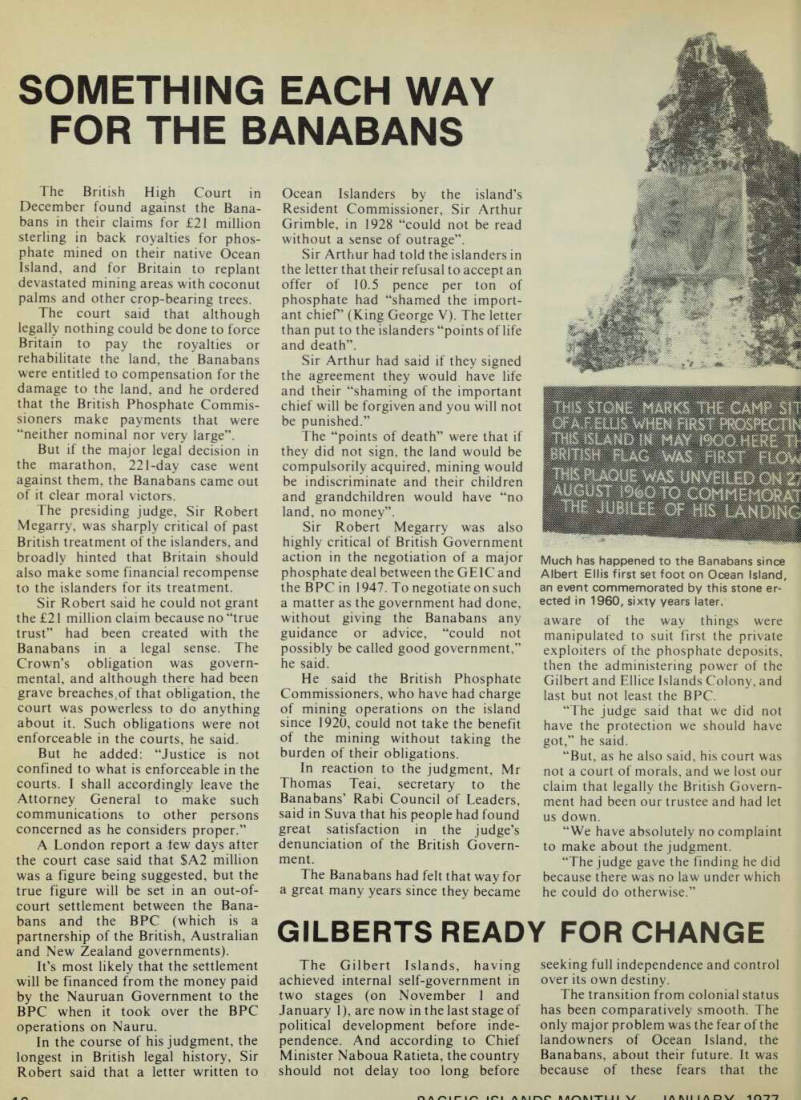
Much has happened to the Banabans since Albert Ellis first set foot on Ocean Island, an event commemorated by this stone er ected in 1960, sixty years later.
Gilberts Ready For Change
The Gilbert Islands, having achieved internal self-government in two stages (on November 1 and January 1), are now in the last stage of political development before inde pendence. And according to Chief Minister Naboua Ratieta, the country should not delay too long before
seeking full independence and control over its own destiny, The transition from colonial status has been comparatively smooth. The only major problem was the fear of the landowners of Ocean Island, the Banabans, about their future. It was because of these fears that the
appropriate Order-in-Council provided for internal self-government to come in in two stages.
The Banabans had persistently claimed that internal self-government would, in some way affect their position. That was not the case, but the British Government allowed the two months grace between November 1 and January Iso that the Ocean Island landowners could be convinced their fears were groundless. In any case the Order-m-Council safeguarded their position in accordance with an undertaking given by the old GEIC Government in 1947.
Under the first stage of internal selfgovernment a Minister of Finance replaced the expatriate Financial Secretary. That left the Attorney- General as the only expatriate in the Council of Ministers. Another provision is that the Governor, who presided over meetings of the Council of Ministers, no longer attends.
The Order-in-Council provided for an executive Public Service Commission to operate from January 1. The Governor is required to accept the recommendations of the Commission.
Mr Roniti Teiwaki, who was Minister for Education, Training and Culture, was appointed Minister of Finance and it fell to him in November to present the 1977 Budget to the House of Assembly. He was replaced in theeducation portfolio by Mr Ibeata
Tonganibeia.
Mr Ratieta strengthened the Council of Ministers by appointing Mr Teatao Tannaki as Minister of State in the Chief Minister’s office.
Advertisements & other items, p. 16 (1 item)
16
nAninn 101 a Mnr miamtui \/ I a M I I A nV/ mn
Join A Council See The World
Members of yet another statutory body in Papua New Guinea have decided to visit South-East Asia but they are on the defensive already.
“We are not looking at the bright lights of the cities. It’s strictly a study tour, members of the West New Britain Area Authority said at the end of November.
The Port Moresby City Council has already weathered a public storm over a study tour that councillors made to the Philippines. And members of the Gulf Area Authority were still overseas in late November after surviving a public demonstration which forcibly tried to stop them boarding their aircraft.
Critics claim that the tours are a waste of public funds to provide thinly dis guised holidays.
The West New Britain Area Authority an elected group midway between the national parliament and local councils has voted itself K 36,000 for the tour. Its members will visit the Philippines, Malaysia, Hong Kong and, possibly, Thailand.
They said half the money will come from government grants which are made without strings, and the remainder from the authority’s “own sources of revenue”.
“We won’t spend any time in Manila we go straight through and into the countryside to see rice, sugar, salt and fish production,” a spokesman for the authority said.
Sir Maori's
Diplomatic
Confession
The young nation of Papua New Guinea had made mistakes in its diplomatic service, Foreign Minister Sir Maori Kiki conceded in November.
Procedures, arrangements and the responsibilities of diplomats abroad would be examined and where necessary amended, Sir Maori said.
He said that some key postings Australia is one would have am bassadors or High Commissioners with wider responsibilities.
Sir Maori was commenting on criticism voiced earlier by Mr Oala Oala-Rarua who had just returned home after resigning as the PNG High Commissioner to Australia.
Mr Oala-Rarua claimed that there was no proper flow of information from PNG to its overseas offices. The result was that in an important posting such as Australia he had been unable to act properly, and often did not know what was going on between the two countries.
Sir Maori said he admired Mr Oala-Rarua and accepted his criticism, which would be fully ex amined.
It was probably not surprising that a new country had made mistakes, Sir Maori said, but the main thing now was “For all of us to get together in the good name of Papua New Guinea and amend the system”.
Ups and downs
downs of the dollar
Australia’s devaluation of her currency by \lVi% on November 30 set off a train events in Papua New Guinea, Fiji and New Zealand, aimed at maintaining something like a status quo. There were pluses and minuses all round. A big plus for the Islands was that much keener competition between Australia and New Zealand is likely with their currencies now much closer together. NZ had gained an edge earlier in 1976 through devalua tion.
NZ devalued by 7% against the US dollar and other major currencies, except Australia, which was an effective revaluation of 12.7% against the Australian dollar. Fiji devalued by 5.6% against all currencies, except the Australian dollar. Papua New Guinea, which revalued her currency by 5% against the Australian dollar earlier in 1976, made a further revaluation of 12.5% against the Australian dollar, but in relation to other countries she devalued by about 7.25%. All these chess-like moves and counter-moves made it more difficult for experts quickly to assess the likely results.
Australian goods will be cheaper in the Islands markets, but as Australian tourists will receive less in the Islands for their dollar, tourism could suffer.
That will be a blow in Fiji, where the industry is just starting to move out of the doldrums. Islands goods will be dearer in Australia, but Australia is not a big buyer of the Islands main exports primary produce so the effect is likely to be negligible on such commodities as sugar, tea, copra, coffee and cocoa.
The PNG Finance Minister, Mr Julius Chan, said if PNG followed the Australian dollar down by the full amount, there would have been an increase of well over 17.5% in the prices of goods from countries other than Australia. That would have been inflationary for PNG, and would have hit wage-earners heavily.
PNG’s main consideration was to protect the purchasing power of the kina. By following the Australian dollar only part of the way, higher prices for some imports would be
balanced by lower prices for others, depending on their origin.
Fiji and Papua New Guinea have increased their selling chances in areas other than Australia. Their currency moves also mean that imports, particularly food and capital goods in which they are most interested, will be dearer from the rest of the world, but cheaper from Australia.
However, their exports to Australia will be dearer. But one beneficial result to PNG will be in tea, although the price to Australia will rise. However, tea exporters to Australia in Sri Lanka, India and Indonesia will have to hike their prices to such an extent to maintain present incomes, that their teas will be proportionately dearer than PNG tea.
Australian aid to PNG and other Pacific Islands will be less, which is likely to cause finance ministers to have another look at their budgets for the coming year.
The Fiji Finance Minister, Mr Charles Stinson told the parliament
devaluation of the Australian dollar in Fiji terms was about 12%.
Mr Ronald Rowland, general manager of Burns Philp (SS) Ltd said consumers could expect a drop of 10% in the price of Australian goods on
supermarket shelves within a week.
FOOTNOTE: But some of the effects of the devaluation became even harder to judge within a fortnight of the Australian decision, when Australia announced revaluations of 2% on December 6 and 1% on December 13, meaning an overall devaluation of 14.6% on the pre- November 29 rate. Australia’s currency is now floating, which will affect the Island nations in different ways.
More elections in French Polynesia
The French Government has reportedly agreed to new elections for the Territorial Assembly in French Polynesia before the adoption of the Paris programme to develop new political statutes for the territory.
This was reported by the Tahitian United Front for Autonomy which issued a press communique in mid-November following Francis Sanford's visit to Paris. Sanford, Tahitian autonomist deputy, resigned his seat in June and was re-elected in September to demonstrate the autonomist strength to Paris.
The communique said that Mr Michel Poniatowski, Minister for the Interior, responsible for French Overseas Territories, had agreed in principle to discuss the new statutes with the United Front for Autonomy and to dissolve the Tahitian Assembly and call new elections.
Mr Sanford was quoted as stating the minister had undertaken to submit the new statutes for the opinion of a newly elected territorial assembly which would he truly representative of the Polynesian people.
The autonomists claim that the present assembly, with a majority of one not working for internal self-government, is no longer truly representative of the people.
Solomons political parties
“not off the ground”
"Politicalparties have not really got off the ground in the Solomons," the Islands' Chief Minister, Mr Peter Kenilorea. told Robert Keith-Reid in Suva.
Two parties which had been formed. the Peoples Progressive Party and the United Solomon Islanders' Party, appeared to he moribund, he said.
The Nationalists Parly, which had contested 35 seals in the elections and won six. wasn't a ... . r signtficon force.
Like Mr Kenilorea, most MPs in the Solomons are Independents.
The Chief Minister said: "I’ve heard a lot of talk about ‘bringing down the government' from the Opposition group. But on the other hand a lot of independents have privately told me not to worry, as they're not interested in submitting to the kind of political discipline needed to make an Opposition group effective".
He added: "I believe that if we can integrate our Solomon Islands attitudes at a national level, we can govern the country without parties.
"But if political parties must develop, and there seems to be
some evidence now that they will, then the Government must ensure stability by ensuring majority support for itself I suppose that might be seen as the creation of a party too.
M f said the altitude of the Council of Ministers was 'hat the Solomon Islands is ready Independence, that it has adequate local manpower to make work But still, he went on, more 90% of the population lead a relatively simple life in the rural areas and you can sa f e!y say that it’s only at the top that we are thinking about our relations with brother countries. Independence is certainly not a burning issue in the Solomons."
With the promise of a major bauxite mine, the foundations of a big oil palm industry being laid, and good prospects for timber and fishing, Mr Kenilorea said he feels his country has a good future economically, "We have all the resources, he said. "Our only real problem is lack of capital to utilise them properly."
Cooks budgets
for big deficit
The Cook Islands Finance Minister, Mr G. A. Henry, is budgeting for a whopping $3,586,735 deficit for the next financial year. The deficit will be offset to some extent by part of a surplus of $1,314,000, which accumulated in the 1975-76 financial year. This surplus followed an upswing in imports, which yielded high customs revenue, and from the income tax surcharge which applied for the last six months of 1975-76.
The appropriation is $7,393,755, which is down by about $4 million, compared with the previous term, which was for 15 months. Anticipated gross expenditure is put at $10,983,130.
Two major items of capital expenditure are $90,600 for govern ment housing and $90,900 to buy telephone and telecommunications equipment. Part of the $90,900 is the cost of the new PABX system at the new Rarotongan Hotel.
Advertisements & other items, p. 18 (1 item)
18
PAPiPir ISI ANDS MONTHLY - JANUARY, 1977
New Hebrideans clear the arena
arena for the next round
From a Vila correspondent
The political stalemate of the last 12 months in the New Hebrides, which has thrown a spanner into the works of the already chronically inef ficient machinery of the Joint British- French administration and slowed progress towards self-determination, may now be at an end. Re-elections in the northern island of Santo finally took place on October 25-28, enabling the possibility of the Representative Assembly at last officially getting down to business after a year’s delay.
The re-elections in Santo were for five seats invalidated by the Joint Anglo-French Court of Appeal after electoral challenges had been successful earlier in the year. The court annulled the election wins of Titus Path, Mary Gilu, Philibert de Montgremier and Thomas Reuben all of the New Hebrides National Par ty and of Michel Thevenin of the MANH party, in rulings which con demned the Joint Administration generally for their “incomplete and contradictory” electoral legislation, and specifically for illegally amending their own joint decisions during the election period.
The elections of November, 1975, gave the National Party a 17-12 ma jority of the “people’s represen tatives” seats. In view of the fact that some holders of “economic interests” seats were sympathetic to the National Party, as were two of the holders of the four “chiefly” seats provided for, the National Party had an overall majority in the 42-seat assembly.
Events following the original elec tions were seen by the National Party as manoeuvres by the French ad ministration to prevent progress towards the party’s declared aim of independence by 1977. The elections for the remaining two chiefly seats were blocked, and the assembly could therefore not convene. Meanwhile, Jimmy Stevens in close consulta tion with American land speculators and, it seems, the French administra tion in Vila and Paris declared the independence of the “Nagriamel Federation”, mainly comprising the island of Santo. As a separatist move this failed. But what it did achieve was to help divert attention sufficiently to
Santo “unrest” to mask the out rageousness of the election in validations and make re-elections appear almost justified, on the grounds that Nagriamel and pro- French factions should have greater representations in the Representative Assembly.
The Santo re-elections thus became a gladiators’ arena, the focus for the power struggle between the pro colonial and pro-independence cham pions. While the National Party field ed exactly the same candidates whose seats had been invalidated, the op position parties altered their strategy.
In the Santo Rural constituency Jimmy Stevens, self-styled chief of Nagriamel, who chose not to stand in 1975, was the major addition to the list of candidates. Predictably, he won, although the solid reaffirmation of the two National Party candidates must have damaged his pride more than a little. Voters elected Thomas Reuben (NHNP) with 1,126 votes, Jimmy Stevens (Nagriamel) with 977 votes, and Dr Titus Path (NHNP) with 887 votes. Unsuccessfully, in fourth place, came James Tangis Buluk, also of Nagriamel, with 869 votes.
In the Santo Urban constituency, the MANH party —seen basically as a French planters’ and businessman’s parly, but described by Jimmy Stevens as “pikinini blong Nagriamel” again combined with Nagriamel. George Cronsteadt of this alliance won the “French” seat from the National Party candidate, Philibert de Montgremier, with results of 770 to 706. However, Mary Gilu of the National Party regained her “British” seat with an increased majority over Charles Beetham (MANH/Nagriamel), 690 votes to 578 votes.
The elections were not without inci dent. In the week before polling day there were repeated threats and minor incidents against National Party residents of Santo town, and one ma jor fight resulting in the conviction of 13 Tabwemasana supporters. The two residencies were subsequently forced to increase security measures in Santo town, appeal on Radio Vila for peace
and calm, and investigate politically motivated dismissals of several workers. Later, results ol the rural elections were delayed for more than a week because, according to a com munique of the two Resident Com missioners, “a polling station at Tabwemol, in a remote part of the island, could not be opened, as all of the registered electors there refused to vole.”
After rejecting the possibility of polling officers returning there to make a second attempt to open the polling station, the communique con cluded ominously: “It will be for the competent authorities to decide, if the occasion arises, whether any irregularities have taken place.” The possibility of a repealed invalidation does not bear thinking about . . .
Despite the loss of de Montgremier, the results reaffirm the National Par ty’s solid base of support. And while the means by which the end-product was achieved are questionable to say the least, it is perhaps fitting in a democracy that the Nagriamel move ment should be represented by Stevens in the Assembly. Vet questions of democracy appear somewhat irrelevant in a country where an elected assembly is deemed “representative” when more than 20% of its membership is derived from “economic interests . . .”
What clearly emerges from the re election episode is that the opposition to the National Party is by no means united with or without the assistance of the French administra tion. The UCNH party seen very much as Vila-based and pro-French administration tried hard to form a united front alliance in Santo, but failed.
The interesting question now must be what degree of co-operation will there be between New Hebrideans in the Representative Assembly?
Crucial for the future of the New Hebrides will be whether New Hebrideans from the different parties can forget differences fostered by the false divisions between British and French, and work together in their own interests, sloughing off partisan foreign influence and vested interests.
For Independence
They Seek Support
Two young leaders of the New Hebridean National Party made a four-week tour of Australia and New Zealand in October, meeting union and church groups to seek support for the independence movement in the Anglo-French condominium.
Donald Kalpokas, aged 33, a National Parly executive, a member of the Representative Assembly, and graduate of the USP in Suva, was ac companied by Hilda Lini, aged 22, a sister of the Rev Walter Lini and editor of “New Hebridean View points”. Travelling through Brisbane, Armidale, Newcastle, Sydney, Canberra and Melbourne, before fly ing to Auckland and Wellington, the two Hebrideans were sponsored by several Australian organisations, in cluding the Presbyterian Board of Missions, the newly formed Trans- National Co-operative in Sydney, the Amalgamated Metal Workers’ Union and the NSW Teachers' Federation.
In Sydney, Mr Kalpokas and Miss Lini spoke over ABC national radio and met numerous local leaders in cluding NSW State Premier, Neville Wran, and members of the foreign af fairs committee of the State Australian Labor Party, besides representatives of six unions. In Canberra, the Hebridean leaders schedule included meetings with the Acting Minister for Foreign Affairs, ian Sinclair, besides Senator Sim, head of the parliamentary committee on defence and foreign affairs, and the Australian Assistance Development Agency. ..
One of the tour co-ordmators, Mr Ken McLeod, of the Trans-National
Co-operative in Sydney, said the two Hebrideans had received a “universal ly sympathetic hearing’’. Mr McLeod added that in Melbourne the Australian Council of Salaried and Professional Associations, an influen tial white-collar union of public ser vice and bank employees, had carried a strong resolution supporting in dependence in the New Hebrides.
Speaking on the ABC radio program “Frontier’’ on October 13, Donald Kalpokas explained the New Hebridean struggle for self government and independence by 1977. He said the fight was mainly against the French whom he accused of stacking the pro-French parties and pouring in a lot of money to support them during election campaigns. Ask ed what he wanted Australian unions to do, Kalpokas replied “to publicise our struggle and put pressure on the British Labour Government and similar (union) organisations in Bri tain and France.”
In another ABC interview a week later, Donald Kalpokas Hilda Lini told listeners to “Lateline” that if the UN did not respond to their appeal for a referendum in the New Hebrides to decide which administra tion British or French should leave and which should stay to prepare independence, then the National Party would itself hold a referendum at the end of 1976 to decide the issue. Questioned over possible violence in the islands, Kalpokas said they would try to pre vent violence, but if independence were refused by the end of 1977 “we would try ignoring their administra tion and set up our own government”.
Another concern of the National Party is the alleged French support of Jimmy Stevens and his separatist par ty Nagriamel. In this matter, Britain has already stated that she would not approve any move which would split the New Hebrides, granting one part independence and leaving Santo, for example, as French territory. This would be similar to the case of Mayotte in the African Comoro Islands. The UN General Assembly on October 21 voted a motion op posing the continued French presence in Mayotee, France having stayed on after a vote in Mayotte, while the rest
of the Comoro Islands gained in dependence. The UN motion on Mayotte was introduced by more than 20 African nations.
In an interview with PIM in Sydney, Mr Kalpokas and Miss Lini were asked was there any particular country to which they looked for ideas that might be helpful in building the future independent society of the New Hebrides. The answer was in stantaneous: Tanzania.
They said that at least five leading members of the National Party have paid study visits to Tanzania, in cluding President Father Walter Lini and Secretary-General Mr Barak Scope.
They had particularly examined the Tanzanian Ujamaa model villages, and believed they could learn much from them.
But there would be no attempt at carbon-copying the Tanzanian ex perience.
For example, they would not attempt to create new social struc tures in the villages as had been done in the Ujamaa villages. They would work through the existing structures of the New Hebridean villages, which seemed to them to be already ade quate for their purposes.
Nor would they have a single-party system such as exists in Tanzania, They believed a multi-party system was better suited to New Hebridear conditions. . But they greatly admired the 1 an zanian emphasis on the economic anc social structure of the country, anc the work being done there to increase people’s motivation to learn skills n order to help society as a whole.
They said: “We don’t want to trail elites who are mainly interested ii ‘getting on’ in an individual way. W( want people to know why they are be ing educated.’’
People
Mr G. Wyn Jones, 50, Secretary to the Chief Minister in the Solomon Islands, has been appointed Governor of Monserrat in the Carribbean. It had been announced earlier in Honiara that his post was to be localised and that he would leave the Solomons about the end of November. Mr Jones joined the civil service in the Solomons 15 years ago, after 11 years in the Gilbert and Ellice Islands Colony. He became secretary to the Chief Minister in 1974.
MrD. K. Hunn has been appointed New Zealand’s first resident High Commissioner to Tonga. Previously the NZ High Commissioner to Tonga was stationed in Apia, where he was also High Commissioner to Western Samoa. Mr Hunn is no stranger to the South Pacific. In 1970 he went to Suva as Deputy High Commissioner to Fiji, with the responsibility of setting up the NZ High Commission. New Zealand’s acting Minister of Foreign Affairs, Sir Keith Holyoake, said Tonga was a long-standing friend of New Zealand, and the habit of close consultation between the two countries on matters of mutual interest had developed. It was important that both countries have the means of getting in touch quickly and conveniently when the need arose.
Mr Syd Snowsill, a prominent figure in the Fiji sugar industry, and also active in several sporting spheres, will leave Fiji in January to settle in Australia. Mr Snowsill was the first project manager of the Seaqaqa sugar cane development scheme in Vanua Levu. Before that he held a number of senior positions with the CSR Co Ltd and later with the Fiji Sugar Corporation in several parts of the country. Mr Snowsill represented Fiji at cricket and bowls, and was a Fiji rugby selector for several years. He was vice-captain of the Fiji cricket team which toured NSW in 1961, and captain of the team which went to NZ in 1962. He was in the Fiji bowls team in several international tournaments.
Mr D. G. Harper, 46, will succeed Mr Paul Cotton as New Zealand High Commissioner in Western Samoa in February. Mr Harper has served in a number of overseas posts and is at
present in the Ministry of Foreign Affairs. Mr Cotton, when he returns to New Zealand will rejoin the staff of the Ministry of Foreign Affairs.
Air Niugini acquired a new pilot in December when Minson Peni return ed home from Australia to join his nation’s flag-carrier. Minson had spent about 15 months as a flying in structor with Nationwide Aviation Space Academy Pty Ltd, at Cessnock, New South Wales, teaching Australians to fly and bring ing a good number of them to the point of going .solo. His return brought to about a dozen the number of PNG nationals now serving as pilots with Air Niugini.
Paora Tiki, a young Cook Islands Boy Scout, may have a career in avia tion ahead of him. He recently won a two weeks’ flying scholarship at the Walsh Memorial Flying School, Matamata, in New Zealand. The scholarship, awarded under the allspices of the Cook Islands District Scout Association, was provided by Air New Zealand, Cook Islands Airways and Captain Ewen Smith.
The many entrants were narrowed down to a short list of seven. The seven were given a tour of the airport, and then a flight over Rarotonga, which was the first for many of them, and then they were interviewed by the selection committee.
Tonga and the New Hebrides got new judges in October and November.
Judge Henry Hubert Hill, MC, became the puisne judge in Tonga, after three years as Deputy Judge on the London western circuit and three years before that as an additional stipendiary magistrate. He was called to the bar in 1960 as a member of the Middle Temple.
Sir Louis Georges Souyave, a judge of the British High Court of the New Hebrides and co-president of the Con dominium Joint Court, was Chief Justice of the Seychelles, where he was born. He read for the bar at Gray’s Inn, London, and was called in 1949. He practised as a lawyer in the Seychelles till 1956, when he became Assistant Attorney-General. He was appointed a puisne judge of the Seychelles Supreme Court in 1964 and Chief Justice in 1970.
Papua New Guinea’s Minister for Primary Industry, Mr Boyamo Sali, visited the Philippines, the United Kingdom and Italy in November.
In the Philippines he looked at
fishing, forestry and agricultural es tablishments; in the UK he spoke with Commonwealth Development Cor poration officials, in particular attempting to persuade the CDC to set up an office in PNG instead of Fiji where it already has an office; and in Rome he attended the conference of the Food and Agriculture Organisa tion.
The Papua New Guinea Minister for Education, Mr Kobale Kale, headed a five-man delegation at the general conference of the United Nations Educational, Scientific and Cultural Organisation (UNESCO) in Nairobi, Kenya, in October- November. It was the first time PNG had attended a UNESCO conference as a full member. The PNG Govern ment signed the UNESCO Constitu tion on September 21, 1976.
Japan’s new Ambassador to Nauru, Mr Yoshio Okawara, presented his credentials to President Hammer Deßoburt, on October 22.
President Deßoburt hosted a State luncheon in honour of the ambassador, who later also hosted a reception. Both functions were at the Menen Hotel. Mr Okawara is also Japanese Ambassador to Australia.
Mrs ’Ungatea Fonua in October became the first woman in Tonga ever to preach a sermon at a Free Wesleyan Church service. Her ser mon, delivered in her home village of 'Utulau, followed a change in church policy made at its annual conference earlier in the year giving equal rights for women to preach at church ser vices. Mrs Fonua is the widow of a Wesleyan minister, the Rev Samiu Fonua.
Mr Gustav Frederick Dertag (Fred) Betham, 61, has been appointed Western Samoa’s first High Commis sioner to New Zealand. The man who made the appointment, Prime Minister Tupuola Efi, was quick to head off possible criticism, by saying that although Mr Betham was an uncle of his by his marriage, he was the man most qualified for the post, and no man could claim to be leader of a country if he was afraid to make decisions for fear of criticism. Mr Betham was Western Samoa’s Minister of Finance from 1961 to 1970, and from 1972t0 1976 he was Secretary-General of the South Pacific Commission.
Mr Elisala Pita, of Tuvalu, is now one of the most highly qualified fisheries officers in the Pacific. He recently attended a one-year post graduate diploma fisheries manage ment course at Grimsby College of Technology, UK Department of Maritime Studies and Fisheries. His study covered fish stock, fishing vessel design and power, fishing methods and gears, marine studies and legisla tion, fish processing technology and commercial and management prin ciples related to tropical and temperate areas. He was one of eight
A sideways glance from 20-year-old Angelyana Tukana, Air Niugini's Hostess of the Year, who was elected by her sister hostesses at the airline's annual ball in Port Moresby in November.
Photo: Veronica Williams.
Advertisements & other items, pp. 21-22 (2 items)
Keeps you informed
become a part
OF PlM's PACIFIC
AND SUBSCRIBE NOW
M Keeps you informed
FILL IN THE DETAILS
ON THE ATTACHED
ORDER FORMS
1
vi;i4vry
T 7“
EXPORTERS TO THE PACIFIC ISLANDS
Breckwoldt & Co Pty Ltd
276 Pitt Street, Box 5027, G.P.O. Sydney 2001
CABLE ADDRESS: BREWO SYDNEY
TELEPHONES: 61-7110 61-8674 26-6893
Pacific Island Branches:
TELEX AA22890.
P.O. BOX 1549, BOROKO, PORT MORESBY.
P.O. BOX 222, RABAUL PO - BOX 185 ’ MADANG - P.O. BOX 72, KIETA. P - BOX 237, MT> HAGEN P.O. BOX 178, WEWAK. P - BOX 1188 ’ LAE ‘ BRECKWOLDT & CO., P.O. BOX 47, APIA.
BRECKWOLDT & CO. (5.1.) LTD., P.O. BOX 140. HONIARA.
BRECKWOLDT S.A.R.L. B.P. 2369, NOUMEA.
Offices in Europe: Hamburg. London, Milan and West Africa as well as Singapore. Kuala Lumpur.
Bangkok and Hong Kong.
Enquiries from Australian Manufacturers invited.
22
DAr'iPir iqi AMDS MONTHLY - JANUARY, 1977
Tropicalities
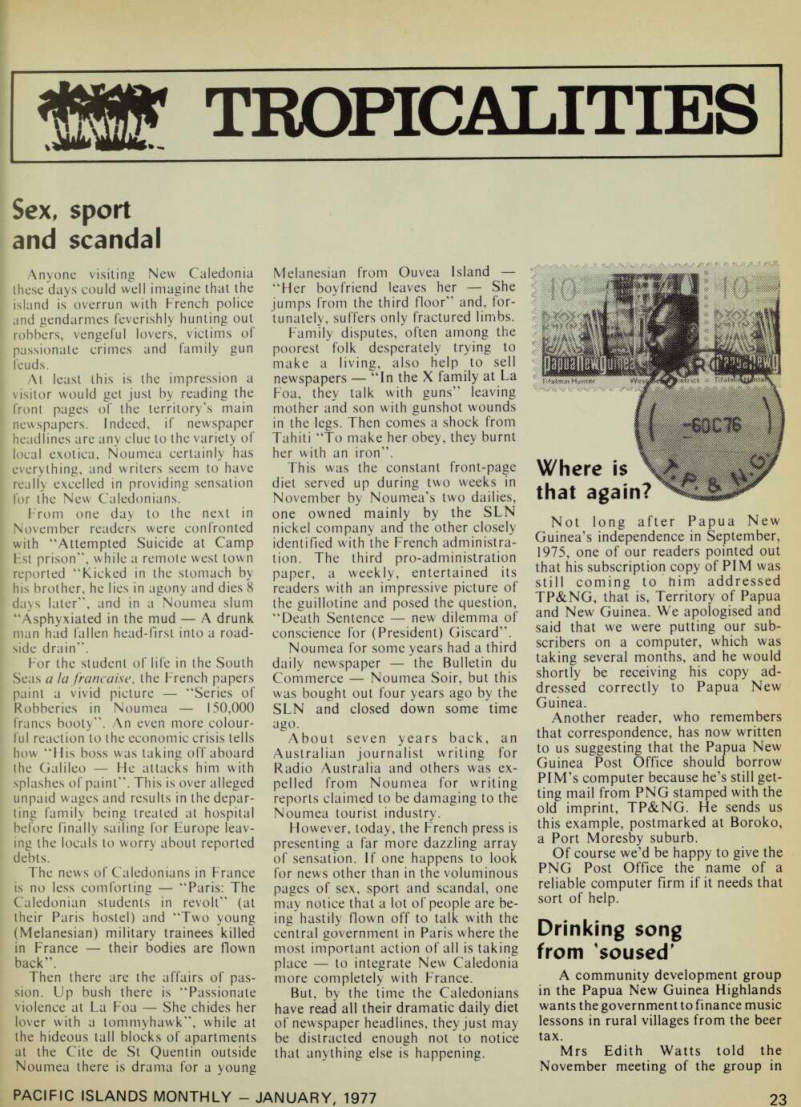

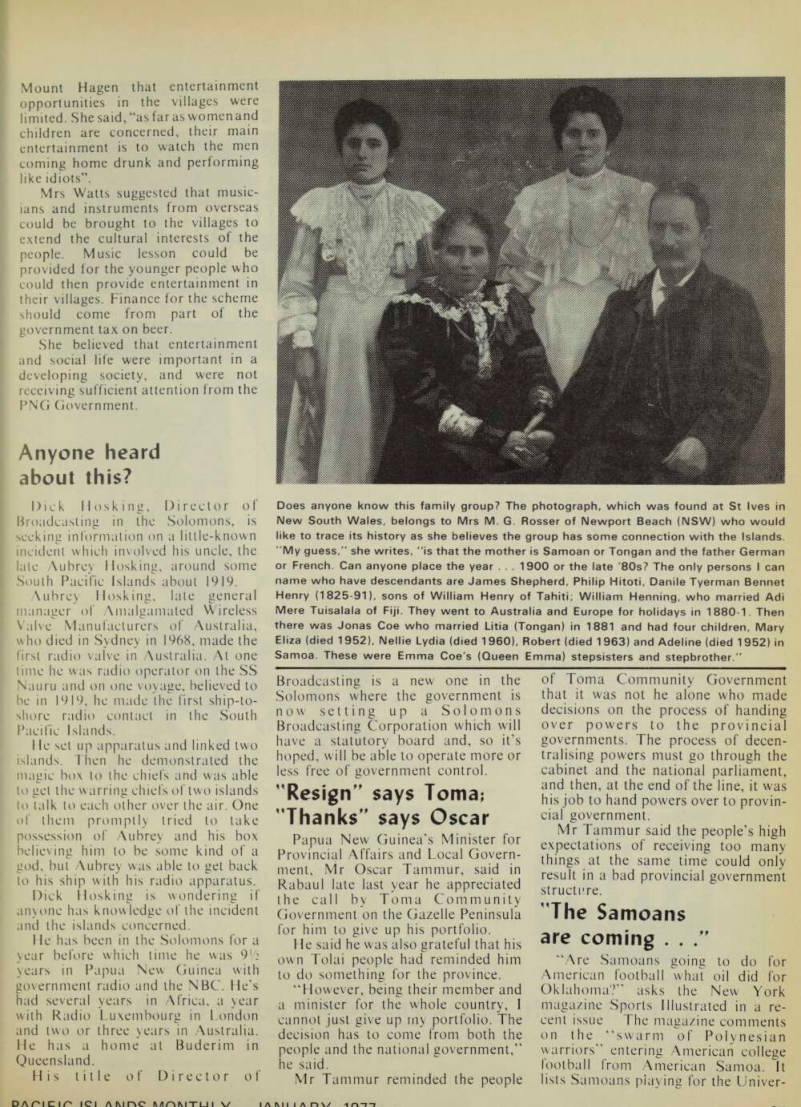

Sex, sport and scandal
Anyone visiting New Caledonia these days could well imagine that the island is overrun with French police and gendarmes feverishly hunting out robbers, vengeful lovers, victims of passionate crimes and family gun feuds.
At least this is the impression a visitor would gel just by reading the front pages of the territory’s main newspapers. Indeed, if newspaper headlines are any clue to the variety of local exotica, Noumea certainly has everything, and writers seem to have really excelled in providing sensation for the New Caledonians.
From one day to the next in November readers were confronted with “Attempted Suicide at Camp Fsl prison”, while a remote west town reported “Kicked in the stomach by his brother, he lies in agony and dies 8 days later”, and in a Noumea slum “Asphyxiated in the mud A drunk man had fallen head-first into a road side drain”.
For the student of life in the South Seas a la franca ise, the French papers paint a vivid picture “Series of Robberies in Noumea 150,000 francs booty”. An even more colour ful reaction to the economic crisis tells how “His boss was taking off aboard the Galileo He attacks him with splashes of paint”. This is over alleged unpaid wages and results m the depar ting family being treated at hospital before finally sailing for Europe leav ing the locals to worry about reported debts.
The news of Caledonians in France is no less comforting “Paris: The Caledonian students in revolt” (at their Paris hostel) and “Two young (Melanesian) military trainees killed in France their bodies are flown back”.
Then there are the affairs of pas sion. Up bush there is “Passionate violence at La Foa She chides her lover with a tommyhawk”, while at the hideous tall blocks of apartments at the Cite de St Quentin outside Noumea there is drama for a young
Melanesian from Ouvea Island “Her boyfriend leaves her She jumps from the third floor” and, for tunately, suffers only fractured limbs.
Family disputes, often among the poorest folk desperately trying to make a living, also help to sell newspapers “In the X family at La Foa, they talk with guns” leaving mother and son with gunshot wounds in the legs. Then comes a shock from Tahiti “To make her obey, they burnt her with an iron”.
This was the constant front-page diet served up during two weeks in November by Noumea’s two dailies, one owned mainly by the SLN nickel company and the other closely identified with the French administra tion. The third pro-administration paper, a weekly, entertained its readers with an impressive picture of the guillotine and posed the question, “Death Sentence new dilemma of conscience for (President) Giscard”.
Noumea for some years had a third daily newspaper the Bulletin du Commerce Noumea Soir, but this was bought out four years ago by the SLN and closed down some time ago.
About seven years back, an Australian journalist writing for Radio Australia and others was ex pelled from Noumea for writing reports claimed to be damaging to the Noumea tourist industry.
However, today, the French press is presenting a far more dazzling array of sensation. If one happens to look for news other than in the voluminous pages of sex, sport and scandal, one may notice that a lot of people are be ing hastily flown off to talk with the central government in Paris where the most important action of all is taking place to integrate New Caledonia more completely with France.
But, by the time the Caledonians have read all their dramatic daily diet of newspaper headlines, they just may be distracted enough not to notice that anything else is happening.
Mount Hagen that entertainment opportunities in the villages were limited. She said, “as far as women and children are concerned, their main entertainment is to watch the men coming home drunk and performing like idiots”.
Mrs Watts suggested that music ians and instruments from overseas could be brought to the villages to extend the cultural interests of the people. Music lesson could be provided for the younger people who could then provide entertainment in their villages. Finance for the scheme should come from part of the government tax on beer.
She believed that entertainment and social life were important in a developing society, and were not receiving sufficient attention from the PNG Government.
Anyone heard
about this?
Dick Hosking, Director of Broadcasting in the Solomons, is seeking information on a little-known incident which involved his uncle, the late Aubrey Hosking, around some South Pacific Islands about 1919.
Aubrey Hosking, late general
manager of Amalgamated Wireless Valve Manufacturers of Australia, who died in Sydney in 1968, made the first radio valve in Australia. At one lime he was radio operator on the SS Nauru and on one voyage, believed to be in 1919, he made the first ship-to shore radio contact in the South Pacific Islands.
He set up apparatus and linked two islands. Then he demonstrated the magic box to the chiefs and was able to gel the warring chiefs of two islands to talk to each other over the air. One of them promptly tried to take possession of Aubrey and his box believing him to be some kind of a god, but Aubrey was able to get back to his ship with his radio apparatus.
Dick Hosking is wondering if anyone has knowledge of the incident and the islands concerned.
He has been in the Solomons for a year before which lime he was 9Vi years in Papua New Guinea with government radio and the NBC. He's had several years in Africa, a year with Radio Luxembourg in London and two or three years in Australia.
He has a home at Buderim in Queensland.
His title of Director of
Broadcasting is a new one in the Solomons where the government is now' setting up a Solomons Broadcasting Corporation which will have a statutory board and, so it’s hoped, will be able to operate more or less free of government control. mo • Tnma.
IScblgn bdyS> lumd;
"Thanks" says Oscar
n f Papua New Guineas Minister for Provincigi Affairs and Local Governmem, Mr Oscar Tammur, said in Rabaul late last year he appreciated the call by Toma Community Government on the Gazelle Peninsula for him to give up his portfolio.
He said he was also grateful that his own Tolai people had reminded him to do something for the province.
“However, being their member and a minister for the whole country, I cannot just give up my portfolio. The decision has to come from both the people and the national government," he said.
Mr Tammur reminded the people
of Toma Community Government that it was not he alone who made decisions on the process of handing over powers to the provincial governments. The process of decen tralising powers must go through the cabinet and the national parliament, and then, at the end of the line, it was his job to hand powers over to provin dai government.
Mr Tammur said the people’s high eX p ec tations of receiving too many things at the same tim cou|d 0 „Z resu t in a bad provincia government structure mti c
I H 6 Samoans
• coming . ♦ .
“Are Samoans going to do for American football what oil did for Oklahoma?" asks the New York magazine Sports Illustrated in a re cent issue The magazine comments on the “swarm of Polynesian warriors" entering American college football from American Samoa. It lists Samoans playing for the Univer
Does anyone know this family group? The photograph, which was found at St Ives in New South Wales, belongs to Mrs M. G. Rosser of Newport Beach (NSW) who would like to trace its history as she believes the group has some connection with the Islands.
"My guess,” she writes, "is that the mother is Samoan or Tongan and the father German or French. Can anyone place the year...1900 or the late '80s? The only persons I can name who have descendants are James Shepherd, Philip Hitoti, Danile Tyerman Bennet Henry (1825-91), sons of William Henry of Tahiti; William Henning, who married Adi Mere Tuisalala of Fiji. They went to Australia and Europe for holidays in 1880-1. Then there was Jonas Coe who married Litia (Tongan) in 1881 and had four children, Mary Eliza (died 1952), Nellie Lydia (died 1960), Robert (died 1963) and Adeline (died 1952) in Samoa. These were Emma Coe's (Queen Emma) stepsisters and stepbrother."
sity of Southern California, Universi ty of California (Los Angeles), Brigham Young, San Jose State, San Diego Stale, Long Beach City College, and lots more.
It says that the new wave started after President Kennedy’s nominee, former Governor of American Samoa, Rex Lee, introduced educational TV to American Samoa in 1961 and screened football training films. From that time on, American football “looked like the rainbow’s end to many Samoan teenagers”, the magazine says.
The wave of northward migration shows no sign of tapering off. Sports Illustrated says the idea is gaining ground in American college football circles that “if the way to catch a thief is to be one, the way to stop a Samoan may be to put another Samoan, or better yet, two Samoans against him”.
Pumpkin leaves
or the cemetery!
Modern Papua New Guinea treats its troublemakers too kindly, the Prisons Minister, Mr Pita Lus, said towards November’s end.
“Under tribal law, troublemakers ended up in the cemetery now we just lock them up for a while,” Mr Lus said.
He was answering questions in the National Parliament about food given to prisoners.
Mr Ninkama Bomai (Gumine elec torate) had suggested the food was un suitable, and could have been a factor in the recent death of four prisoners.
Prisoners were fed Pumpkin leaves for breakfast, Mr Bomai alleged.
Mr Lus said, “Well what’s wrong with that? There’s plenty of protein in pumpkin leaves”.
He added that so far as he knew, prisoners were being properly fed three times a day, and many were growing fat and healthy on the diet they received.
He undertook to investigate Mr Bomai’s report that four prisoners had died.
'Sorry, sergeant’,
says the minister
A two-year-long Cook Islands legal drama ended in November in an em barrassing climb-down by Tupui Ariki Henry, Minister-in-Charge of the Broadcasting and Newspaper Corporation, and Mr M. Drollet, the Corporation’s manager.
Both men signed a public apology
to Sergeant Norman George, a Cook Islander who had previously been a policeman in the Cook Islands before joining the New Zealand force.
The drama centred on an article published under banner headlines in the Cook Islands News on November 22, 1974, which described Sergeant George and another man as “agitators” and “disturbing elements in a public place”.
The article was subsequently broad cast over Radio Cook Islands.
Sergeant George instituted civil proceedings against the Corporation, the responsible Minister and the Cor poration’s manager.
At a hearing of the Cook Islands High Court on November 29, 1976, it was ruled that a public apology was to be made to Sergeant George and that the question of damages and costs in his favour had been settled in private.
The apology said: “You were reported as an agitator and a distur bing element in a public place. It was inferred that you had created a distur bance in a public place, and that as a result of your behaviour the Chair man of the Island Council had to close the meeting (on the island of Aitu on November 21, 1974).
Although you participated in the meeting and asked repeated questions concerning the Audit Report which caused some concern to the guest speakers at the meeting, we have found that it was not correct that you were the cause of a disturbance and that the meeting had to be closed because of your behaviour. Accor dingly, each of us apologises and regrets any improper reflections on your personal reputation, or your reputation as a policeman.”
Still looking
for lost caravel
The Australian National Universi ty has awarded a two-year research fellowship to Robert Langdon, who was PI M’s assistant editor for several years in the 1960 s and is the author of two books published by Pacific Publications.
The fellowship is in the Department of Pacific and South-East History of the Research School of Pacific Studies and begins in February. It recognises the contribution Bob made to Pacific studies with his book The Lost Caravel, which concerns the in fluence in the Pacific Islands of 16th century Spanish castaways.
Bob proposes to devote the period of his fellowship to further in vestigations into the castaway ques
tion, as he believes the 368 pages of The Lost Caravel have only told about half the story.
He is especially interested in pur suing his theory that a goodly number of Spaniards from the caravel San Lesmes reached New Zealand from Raiatea, Society Islands, several years after their ship ran aground in the Tuamotu Archipelago about mid- July, 1526.
Bob believes the Spaniards sailed south-west with the idea of rounding the Cape of Good Hope and returning to Spain; that they were accompanied by Polynesian men, women and children; and that their vessel was the so-called Tainui “canoe” of Maori and Tuamotuan tradition.
Maori tradition says that the Tainui people settled at Kawhia Har bour on the west coast of New Zealand’s North Island. Many Maoris of today trace their descent from them. An announcement of the reasons for his fellowship has already created interest in New Zealand newspapers.
Bob is also interested in seeing what more he can find out about Spanish castaways in other parts of the Pacific, notably the Carolines and Solomons.
He has been delving into Pacific history since the early 19505. His first book, Tahiti: Island of Love, a pop ular history of Tahiti, was first published in 1959 and is now in its fourth edition the last two publish ed by Pacific Publications.
Bob was with Pacpub from 1962 to 1968 when he went to Canberra as ex ecutive officer of the Pacific Manuscripts Bureau at the Australian National University. He has leave of absence from the PMB for the dura tion of his fellowship.
Air strip
A man from the Gilbert Island caused a stir on a recent flight by jum bo jet from Frankfurt to London. Fin ding the cabin temperature a little bit too high, he divested himself of his clothing, and even when the pilot lowered the temperature he did not re dress. He just sat in his seat, in his birthday suit, all the way to London.
The pilot radioed London. The police met the aircraft and took the man,aged about 30, into their care, handcuffing him as a precaution. Said one passenger, “It was better than a movie”.
Advertisements & other items, pp. 23-28 (3 items)
that again?
Where is
Not long after Papua New Guinea’s independence in September, 1975, one of our readers pointed out that his subscription copy of PIM was still coming to him addressed TP&NG, that is, Territory of Papua and New Guinea. We apologised and said that we were putting our subscribers on a computer, which was taking several months, and he would shortly be receiving his copy addressed correctly to Papua New Guinea.
Another reader, who remembers that correspondence, has now written to us suggesting that the Papua New Guinea Post Office should borrow PI M’s computer because he’s still getting mail from PNG stamped with the old imprint, TP&NG. He sends us this example, postmarked at Boroko, a Port Moresby suburb.
Of course we’d be happy to give the PNG Post Office the name of a reliable computer firm if it needs that sort of help.
Drinking song
from 'soused’
A community development group in the Papua New Guinea Highlands wants thegovernmenttofinance music lessons in rural villages from the beer tax.
Mrs Edith Watts told the November meeting of the group in
Mixmaster Mixer
3 times better than any
other mixer. Designed especially for family food preparation. 12-speed mixfinder dial indicates the correct speed for each mixing action. Complete with 2 heat-resistant bowls and juice extractor. Sunbeam’s exclusive 3-way beating action extra large, contoured beaters, and automatic bowl movement — gives perfect aeration and more even mixing. It can handle everything from beating one egg to mixing a large fruit cake.
New range of
Epiglass antifoulings
give up to 12 months
growth-free performance.
Consolidated Chemicals Ltd have launched a new range of antifoulings now being marketed under the name of Epiglass E-type. Superior, in terms of performance, to any antifouling currently on the market, they are the result of years of research and development work in the company’s laboratories followed by extensive testing.
PRODUCT PERFORMANCE PROVED
Tests have been carried out under widely varying conditions throughout the Pacific area which have conclusively proved the effectiveness of E-type antifouling on both Commercial and Pleasure craft.
12 MONTHS GROWTH-FREE PERFORMANCE
Epiglass E-type antifouling is formulated to guard your boat against the expensive damage that can be done by algae, barnacles, slime weed and general fouling. The formulation includes a very high percentage of special toxins which are “release controlled’’ This positive control release of toxins means that if applied as directed you can expect up to 12 months growth-free performance.
Whatever size your boat, whether it is power or sail, protect below the water line with new Epiglass E-type antifouling. (
[EPIGLASS]
Vi * T
1: j- 1 1 Consolidated Chemicals Ltd. 1 P.O. Box 15-104, j New Lynn, Auckland. 1 Please send me a free copy of your Epiglass Boat Owners j Manual plus facts on new E-type antifouling.
I Mr 1
Address ]
I (Block letters please) 1 -I from 7ft to73ft I epiglass power or sail
PACIFIC AREA
DISTRIBUTORS
COOK ISLANDS
Cook Is. Trading Corp. Ltd
FIJI
Burns Philp (SS) Co. Ltd
NEW GUINEA
Bougainville Marine Pty Ltd, Kieta Burns Philp (NG) Ltd, Madang Elvee Trading Pty Ltd, Rabaul Faulkner & Tait (NG) Pty Ltd. l_ ae S. A. Heath & Co. Pty Ltd, Port Moresby
NEW HEBRIDES
Burns Philp (NH) Ltd
NOUMEA
Guy Limousin Pacific Yachting
NORFOLK ISLAND
Irvine Bid. Supply Centre
PAGO PAGO
Max Haleck Inc.
TAHITI
Marine Corail Tahiti Sport Tahiti Voile
TONGA
Riechelmann Bros.
WESTERN SAMOA
Burns Philp (SS) Co. Ltd E. A. Coxon Ltd Gold Star Transport Co. Ltd Morris Hedstrom Ltd
SOLOMON ISLANDS
George Yee Fai Ltd V
How to help your
complexion resist
the premature signs
of growing older
With the scientific development of a tropically moist oil blend the accentuation of tiny lines and wrinkle dryness, which so often makes a complexion
look prematurely older,
can be softened to look
attractively younger.
MANY WOMEN approaching their thirties discover, with some consternation that their complexions show, for the first time traces of tiny surface lines and coarser, drier skin . . . they are beginning to lose their youthful looks! Probably they have never cared for their skin at any time in their lives, apart from normal cleansing.
This is the time to begin caring for it with a scientifically developed tropically moist oil blend that helps restore and maintain the vital balance of oil and moisture in your skin because, at this age, your own skin’s natural pro- -jT m tective and beautifying oils and moisture are usually starting to diminish in supply and with-
out supplementation
from the tropically moist Oil of Ulan, can be a prime cause of your skin beginning to look prematurely older.
More radiant
skin beauty
Smoothed on each morning and at night over the entire complexion, this tropically moist Oil of Ulan acts like the skin’s own natural fluids, providing essential elements to condition the important stratum corneum, or outer layer of your skin. Oil of Ulan helps achieve a softness, smoothness and suppleness similar in quality to what would have been created by a full and plentiful supply of natural fluids. Thousands of women, in many parts of the world, living in many different climates now enjoy a complexion loveliness far beyond what the natural course of events would have provided, their skin’s taking on a new suppleness and beauty.
DAr*lCir* ICI A M r\C l\/irM\ITLJ I \/ iamiiahv irm
27
PACIFIC LSI AMDS MONTH I Y - JANUARY 1Q77
News

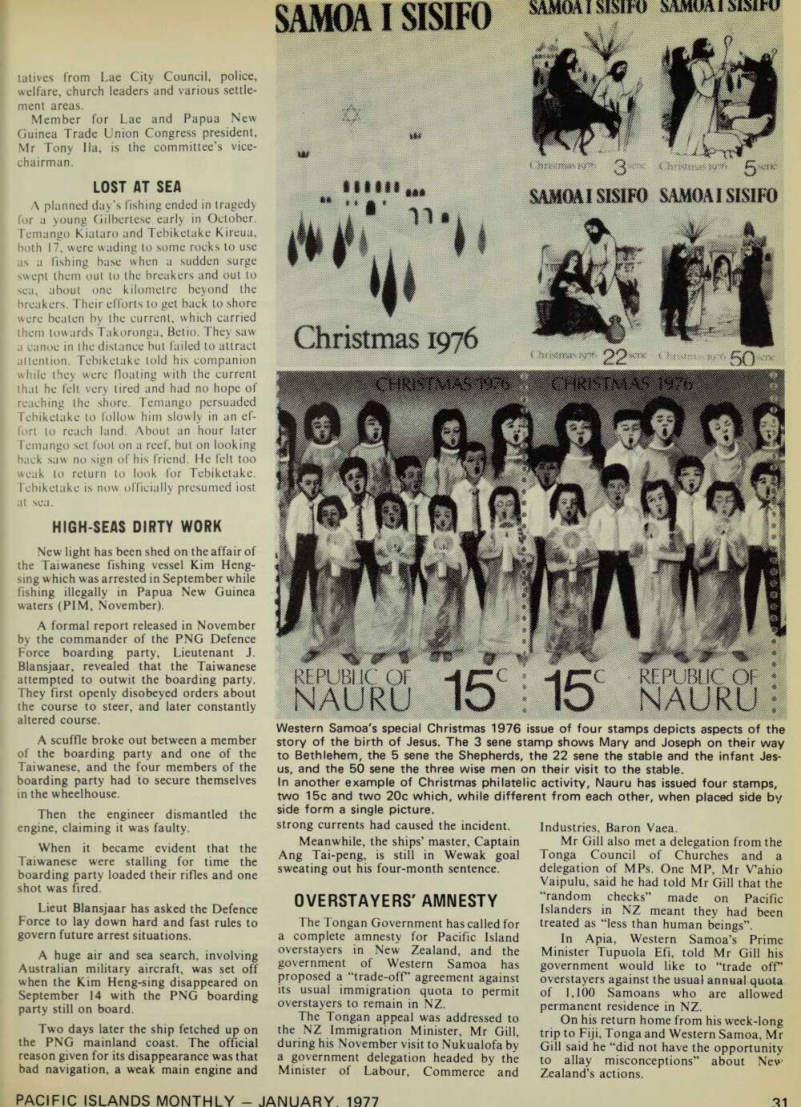
The
In A
Nutshell
The Gay Fifties!
The number of Fiji civil servants who retire before reaching the man datory retiring age of 60 is increasing.
In 1976, the government budgeted for about $1,380,000 to meet the cost of pensions and benefits, and then found towards the end of the year it had to fork out another $732,000 to meet the bill. The government now finds it practically impossible to forecast the number of retirements because of the trend to leave long before the retiring age.
China On Show
About 40,000 people visited the recent two-weeks-long economic and trade ex hibition of the People’s Republic of China in Port Moresby, according to exhibition spokesman Mr Chiao Mu-jung.
Mr Chiao said several Port Moresby business people had approached him about importing goods from China. Public in quiries had been particularly directed at Chinese farming machinery.
Mr Chiao particularly expressed ap preciation of the assistance of the PNG Government in mounting the exhibition.
Display exhibits made up of agricultural, light industrial and textile products, heavy machinery, foodstuffs, wines and spirits were shown at the exhibi tion.
Floating Scientists
A scientific team in a Russian research ship, the Kalliston, was scheduled to visit Niue Island early in January as part of an international geological study of the Pacific area. Russian, Australian and New Zealand scientists were on board.
Pitcairn 'Museum'
A Seventh-day Adventist college in California has become a major US research centre on the subject of Pitcairn Island following a gift of rare Pitcairn artefacts and books by an American author.
The gift was made to Pacific Union College by David Silverman, author of the 1967 study Pitcairn Island. It includes copies of the Civil Recorder of Pitcairn from 1792 to 1963, typescripts, photostats and pamphlets, and a facsimile reproduc tion of A Voyage to the South Seas, written in 1972 by Lieutenant William Bligh, commander of the HMS Bounty.
Pitcairn is today predominantly Seventh-day Adventist as a result of energetic evangelical efforts by American Adventists in the late 19th century.
Nobel Prize
An American researcher who discovered the cause of the disease kuru (“laughing death”) was awarded the 1976 Nobel Prize for medicine. Dr D. Carlton Gajdusek, a virologist, has been studying the disease for 19 years. Kuru, whose symptoms are uncontrollable facial and other movements resembling laughter, is found only in Papua New Guinea.
He began his research in the 1950 s in the Fore area of the Okapa sub-Province of the Eastern Highlands and his work.led to the identification of kuru. Through his research it became clear that kuru was similar to other diseases such as Parkin son’s Disease and other pre-senile dis orders.
His long-term research on kuru and disease-causing viroid particles was one of the major factors in the award of the Nobel Prize.
His study of kuru has aided medical researchers throughout the world in their study of similar diseases of the nervous system.
Kuru is now disappearing, and the assumption is that it will die out complete ly- Dr Gajdusek, who is employed by the National Institute of Infectious Diseases of the US Health Department, shared the prize with another America virologist, Dr Baruch Blumberg.
Old Bombs’ New Hole
The explosive power of two 200 lb US bombs from World War II was pressed into service late last year to deepen and widen a proposed wharf site on Watom Island, in PNG’s East New Britain Province. In charge of the blast were four members of the PNG Defence Force bomb disposal unit under Lieutenant lan Wegener.
While they were on the job, the men also detonated a 600 lb bomb in the Vunakanau area of the Gazelle Peninsula, and other bombs in Takua plantation in the Kokopo area.
Tower Of Babel
An appeal for an end to the divisive use of the English and French languages in the New Hebrides has been made by the bishop and priests of the Catholic Church in the Con dominium.
In a September, 1976, message to the people of the New Hebrides, they said; “It would be a genuine step towards maintaining peace if we ceas ed to present French and English as being opposed to each other, as if the two languages necessarily divided the people.
“If we accept and respect the fact of bilingualism we are recognising that the New Hebrides has a unique role to play in the future of the Pacific. At the same time we are allaying the fears of many Hebrideans, and mak ing a positive investment for the future development of this country.”
Lae Crime-Fighters
A law and order committee has been formed in Lae to try to solve the problem of crime in settlement areas. Committee chairman, Mr Nathaniel Rerem, who is also Provincial Local Government Officer, said four of the main problems were break ing and entering, urban drift, black marketing in liquor and vagrancy.
The committee consists of represen
tatives from Lae City Council, police, welfare, church leaders and various settle ment areas.
Member for Lae and Papua New Guinea Trade Union Congress president, Mr Tony I la, is the committee’s vice chairman.
Lost At Sea
A planned day’s fishing ended in tragedy for a young Gilbertese early in October.
Tcmango Kialaro and Tebiketake Kireua, both 17, were wading to some rocks to use as a fishing base when a sudden surge swept them out to the breakers and out to sea, about one kilometre beyond the breakers. Their efforts to gel back to shore were beaten by the current, which carried them towards Takoronga, Betio. They saw a canoe in the distance but failed to attract attention. Tebiketake told his companion while they were floating with the current that he fell very tired and had no hope of reaching the shore. Temango persuaded Tebiketake to follow him slowly in an ef fort to reach land. About an hour later Temango set fool on a reef, but on looking back saw no sign of his friend. He felt too weak to return to look for Tebiketake.
Tebiketake is now officially presumed iost at sea.
High-Seas Dirty Work
New light has been shed on the affair of the Taiwanese fishing vessel Kim Heng sing which was arrested in September while fishing illegally in Papua New Guinea waters (PIM, November).
A formal report released in November by the commander of the PNG Defence Force boarding party. Lieutenant J.
Blansjaar, revealed that the Taiwanese attempted to outwit the boarding party.
They first openly disobeyed orders about the course to steer, and later constantly altered course.
A scuffle broke out between a member of the boarding party and one of the Taiwanese, and the four members of the boarding party had to secure themselves in the wheelhouse.
Then the engineer dismantled the engine, claiming it was faulty.
When it became evident that the Taiwanese were stalling for time the boarding party loaded their rifles and one shot was fired.
Lieut Blansjaar has asked the Defence Force to lay down hard and fast rules to govern future arrest situations.
A huge air and sea search, involving Australian military aircraft, was set off when the Kim Heng-sing disappeared on September 14 with the PNG boarding party still on board.
Two days later the ship fetched up on the PNG mainland coast. The official reason given for its disappearance was that bad navigation, a weak main engine and
strong currents had caused the incident.
Meanwhile, the ships’ master, Captain Ang Tai-peng, is still in Wewak goal sweating out his four-month sentence.
Overstayers' Amnesty
The Tongan Government has called for a complete amnesty for Pacific Island overstayers in New Zealand, and the government of Western Samoa has proposed a “trade-off’ agreement against its usual immigration quota to permit overstayers to remain in NZ.
The Tongan appeal was addressed to the NZ Immigration Minister, Mr Gill, during his November visit to Nukualofa by a government delegation headed by the Minister of Labour, Commerce and
Industries, Baron Vaea.
Mr Gill also met a delegation from the Tonga Council of Churches and a delegation of MPs. One MP, Mr V’ahio Vaipulu, said he had told Mr Gill that the “random checks” made on Pacific Islanders in NZ meant they had been treated as “less than human beings”.
In Apia, Western Samoa’s Prime Minister Tupuola Efi, told Mr Gill his government would like to “trade off’ overstayers against the usual annual quota of 1,100 Samoans who are allowed permanent residence in NZ.
On his return home from his week-long trip to Fiji, Tonga and Western Samoa, Mr Gill said he “did not have the opportunity to allay misconceptions” about New Zealand’s actions.
Tongan Double
Royal Wedding?
There are rumours around the Islands of a double royal wed ding in Tonga in 1977 with Crown Prince Tupoutoa, the king’s eldest son, and Prince ‘Uluvalu, son of Prince Tu'ipelehake, the Prime Minister, as two of the leading figures. Rumour is sometimes a lying jade, and, if she is on this occasion PIM apologises in ad vance, but rumour has it that the Crown Prince's bride will be the daughter of Baron Vaea.
Prince ‘Cluvalu's choice of a partner hadn't leaked out at the time of writing.
Double royal weddings aren't rare in Tonga. King Taufa'ahau Tupou IV and his brother.
Prince Tu'ipelehake, had a dou ble wedding on June 10, 1947, the king, as Crown Prince Tungi, marrying Princess Halaevalu Mataaho, and Prince Tu'ipelehake taking Princess Melenaite Tupou-Moheofo as his bride.
Advertisements & other items, pp. 30-32 (3 items)
iv/irkMTUll V _ JANUARY. 1977
iv/irkMTUll V JANUARY. 1977
Goodpvcar
TRACTION HI-MILER HI MILERGB
For rugged 'stop-go' de-
livery work. Gives longer mileage and easier'
steering.
Round shoulder tire for highway trucks.
Assures extra traction on all surfaces, wet and dry.
TRACTION 100
With 3-T cord, stronger than steel, developed for bus and highway trucks.
SUPER ROAD LUG
Abrasion resistant extra-thick tread and
deep-grooved, sharp an-
gle lugs assure positive
traction on all types of road surfaces.
ALL SERVICE
A non-directional mud and snow tire.
Reduces skidding
and weaving.
% f t I 61 Si 9. m w A
THE RIGHT TIRE FOR EVERY JOB
HIGHWAY - ON/OFF THE ROAD - CROSS COUNTRY GOODYEAR DISTRIBUTORS IN S.E. ASIA AND PACIFIC BASIN Morris Hedstrom Boroko Motors Ltd.
Port Moresby, PNG.
Guam Tire & Supply Co.
Agana, Guam Coral Island Motors Suva, Fiji Landis Brothers & Co. Ltd.
Hong Kong Solomon Motors Ltd.
Honiara. 8.5.1. P.
Susupe Enterprises Saipan, Mariana Is.
Societe General Automobile Noumea, New Caledonia Service Mobil Papeete, Tahiti Santo Engineers Santo, New Hebrides Micro! Corporation Saipan, Mariana Is.
W.S.T.C.S.
Western Samoa Samoa Motors Inc.
American Samoa Pacific Motors Vila, New Hebrides Yap Cooperative Ass.
Yap, W. Caroline Is.
Morris Hedstrom Ltd.
Apia, Western Samoa Duncombe Bay Garage Norfolk Is.
Truk Trading Co.
Truk. E. Caroline Is.
P.A.M.I.
Kolonia, Ponape Tonga Cook Island Motors Cook Is.
Island Construction Co.
Majuro, Marshall Is.
Ngiratkel Elpison Co. Ltd.
Koror, Palau Yung Wei Tung Trading Co. Ltd.
Taipei, Taiwan A 558
iiiii* M* 3 - 5
SAMOA ISIS1F0 SAMOA 1SISIFO
•I
Christmas 1976
I (<<r*' v - iX ' < h•:>? -.•{>> -
REPUBtlC OF
NAURU
-i£T c • -4£TC REPUBLIC OF :
lb lb NAURU
Western Samoa's special Christmas 1976 issue of four stamps depicts aspects of the story of the birth of Jesus. The 3 sene stamp shows Mary and Joseph on their way to Bethlehem, the 5 sene the Shepherds, the 22 sene the stable and the infant Jesus, and the 50 sene the three wise men on their visit to the stable.
In another example of Christmas philatelic activity, Nauru has issued four stamps, two 15c and two 20c which, while different from each other, when placed side by side form a single picture.
important
welding
news.
WELDMATIC G.M.A. SEMI
AUTOMATIC EQUIPMENT
W.I.A. Welding products have a
renowned reputation for advanced
technical design, quality of
manufacture and field performance.
A full internationally approved
range is available to suit all
purposes and industries.
One of the most comprehensive ranges available Australian designed and manufactured. Backed by efficient technical expertise ensuring up to date designs equal to anywhere in the welding world Range includes semi-automatic packaged units with capacities from 150 amps up to 600 amps (all 100°o duty cycle) Plus full automatic welding head/power source combinations up to 1200 amps output, for use on either gas shielded, open arc or submerged arc welding
HEAVY DUTY 400 AMP
DIESEL ENGINE DRIVEN
SITE WELDER
V ?• H I «■ ■
WELDMATIC
A high production semi-automatic G M A welding package, ideal (or aulomative production and manufacture of domestic/lnduslrlal appliances, heatmg/air conditioning equipment, metal cabinets and similar products Rated 250 amps 100% duty cycle, max. current 300 amps 60%.
AUTOMATIC
SUBMERGED ARC
FLUXES & WIRES
Austmalic OP series includes highest quality, general purpose production fluxes, hardfacing and special application highly basic fluxes Packing 30 kg pails and 250 kg drums Low carbon and low alloy steel wires available costs.
I Reduced risk of fire and fuel theft. »Auxiliary power > Long life service. » Positive all weather starting characteristics
AUSTMIG C 026
Gas Shielded Welding Wire Copper coated semi-automatic welding, using COa or argon based mixture shielding gases 0 8. 0.9,1 2 and 16 mm sizes m 15 kg spools and 30 kg coils.
ELECTRODES
Austarc internationally approved mild steel H electrodes including cellulose, general purpose, low hydrogen, iron powder and Austalloy range offer superior welding characteristics in all types and gauges W.I.A. also offer a range of special purpese electrodes for hardfacing, bronze, stainless steel and cast iron applications.
Illustrated below are examples
from the extensive range
available.
WELDARC A.C. ARC WELDERS
Comprehensive range of seven models, designed for dependability, ease of use, long efficient life. Fully guaranteed Models illustrated are 1) The Miniarc mC66, a popular small A C welder, rated up to 140 amps and handles 3.25,2.5 and 2.0 mm electrodes. Ideal for handyman, garage and light factory maintenance welding and 2) top of the range Constructor 500, designed for extra heavy duty production welding with large size electrodes in locations such as shipyards, building construction sites, etc Max current output 500 amps at 100% duty cycle.
Optional extra is unique remote current control device, works wherever the operator is, any distance from the power source without special cabling.
MINIARC 1T1C66 CONSTRUCTOR
140 amp welding all-rounder representing a major breakthrough in welding technology Everything you ever wanted in a 240 volt arc
mtn^L.
FLUXOFIL
Gas Shielded Welding Wire Solid drawn Seamless FluxoflHl Tubular Steel Flux Cored running rut Welding Wire ensures production increased productivity general pui higher deposition rates. butt weldm deeper penetration and Fluxofil 31 over 80% metal recovery slag produt Fluxofil 11 Ni Smooth running rutile type high production electrode (or general purpose fillet and butt welding applications.
Fluxofil 31 Highly basic slag produces toughest Completely moisture proof, weld metal offering high low hydrogen quality.
Exclusive copper coating gives high efficiency feeding, better electrical contact, longer tip life. Size available 1.6,2.0 and 2.4 mm. Wires available production techniques to high integrity welding applications.
Fluxofil 41 amt 42 First choice for welding low alloy high tensile steels, particularly those of the manufactured in Australia notch tough, high strength
For full details & information contact
WELDING INDUSTRIES OF AUSTRALIA PTY. LTD.
INTERNATIONAL DIVISION
Austarc Avenue, Thomastown. Vic. Australia.
Telex: 32493, Cables: “Austarc” Melbourne.
AUSTRALIA'S OWN WELDING ORGANIZATION
32
PAriFir IS I AMDS MONTHLY - JANUARY, 1977
A Pacific Paradise
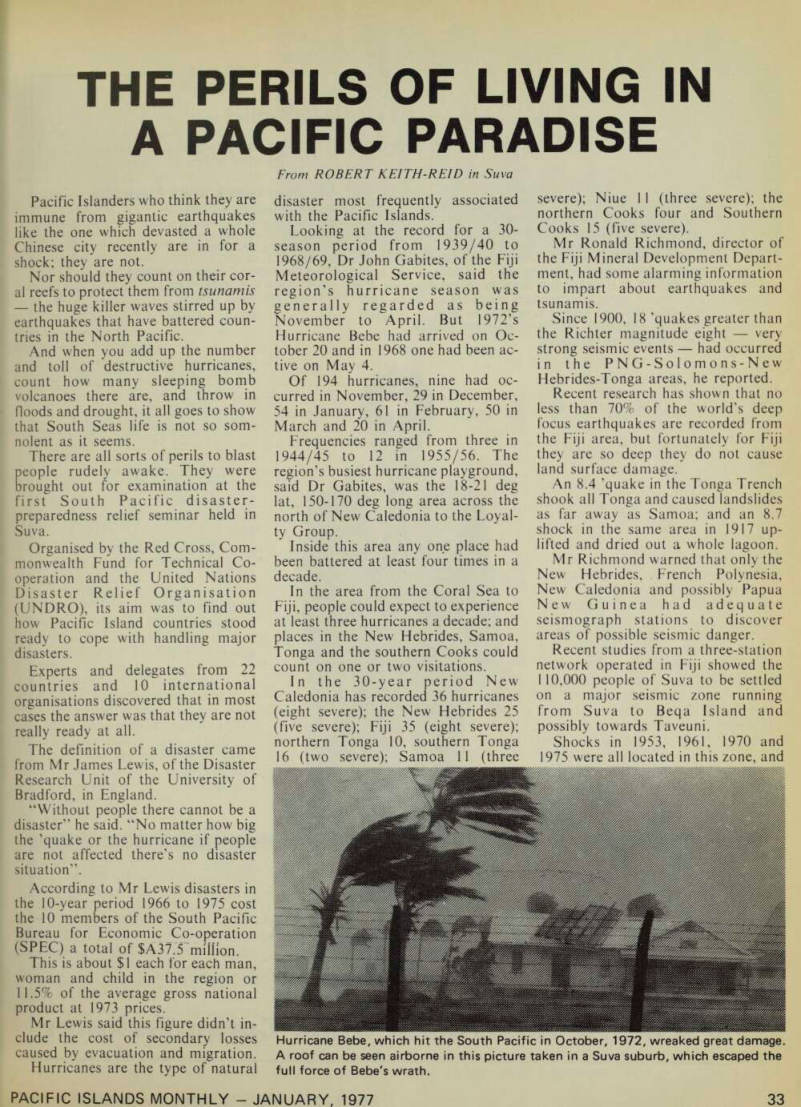

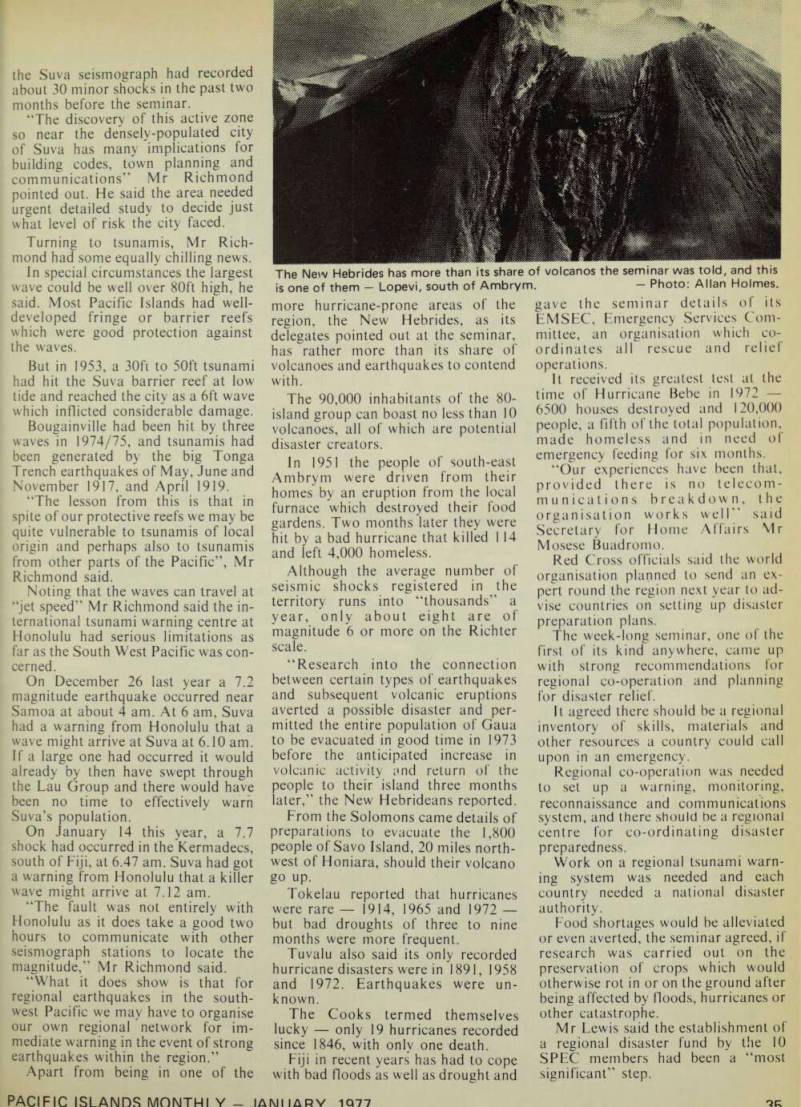
The Perils Of Living In
From ROBERT KEITH-REID in Suva
Pacific Islanders who think they are immune from gigantic earthquakes like the one which devasted a whole Chinese city recently are in for a shock; they are not.
Nor should they count on their cor al reefs to protect them from tsunamis the huge killer waves stirred up by earthquakes that have battered coun tries in the North Pacific.
And when you add up the number and toll of destructive hurricanes, count how many sleeping bomb volcanoes there are, and throw in floods and drought, it all goes to show that South Seas life is not so som nolent as it seems.
There are all sorts of perils to blast people rudely awake. They were brought out for examination at the first South Pacific disaster preparedness relief seminar held in Suva.
Organised by the Red Cross, Com monwealth Fund for Technical Co operation and the United Nations Disaster Relief Organisation (UNDRO), its aim was to find out how Pacific Island countries stood ready to cope with handling major disasters.
Experts and delegates from 22 countries and 10 international organisations discovered that in most cases the answer was that they are not really ready at all.
The definition of a disaster came from Mr James Lewis, of the Disaster Research Unit of the University of Bradford, in England.
“Without people there cannot be a disaster’’ he said. “No matter how big the ’quake or the hurricane if people are not affected there’s no disaster situation”.
According to Mr Lewis disasters in the 10-year period 1966 to 1975 cost the 10 members of the South Pacific Bureau for Economic Co-operation (SPEC) a total of sA37.s~miiHon.
This is about $1 each for each man, woman and child in the region or 11.5% of the average gross national product at 1973 prices.
Mr Lewis said this figure didn’t in clude the cost of secondary losses caused by evacuation and migration.
Hurricanes are the type of natural
disaster most frequently associated with the Pacific Islands.
Looking at the record for a 30season period from 1939/40 to 1968/69, Dr John Gabites, of the Fiji Meteorological Service, said the region’s hurricane season was generally regarded as being November to April. But 1972’s Hurricane Bebe had arrived on Oc tober 20 and in 1968 one had been ac tive on May 4.
Of 194 hurricanes, nine had oc curred in November, 29 in December, 54 in January, 61 in February, 50 in March and 20 in April.
Frequencies ranged from three in 1944/45 to 12 in 1955/56. The region’s busiest hurricane playground, said Dr Gabites, was the 18-21 deg lat, 150-170 deg long area across the north of New Caledonia to the Loyal ty Group.
Inside this area any one place had been battered at least four times in a decade.
In the area from the Coral Sea to Fiji, people could expect to experience at least three hurricanes a decade; and places in the New Hebrides, Samoa, Tonga and the southern Cooks could count on one or two visitations.
In the 30-year period New Caledonia has recorded 36 hurricanes (eight severe); the New Hebrides 25 (five severe); Fiji 35 (eight severe); northern Tonga 10, southern Tonga 16 (two severe); Samoa 11 (three
severe); Niue 11 (three severe); the northern Cooks four and Southern Cooks 15 (five severe).
Mr Ronald Richmond, director of the Fiji Mineral Development Depart ment, had some alarming information to impart about earthquakes and tsunamis.
Since 1900, 18’quakes greater than the Richter magnitude eight very strong seismic events had occurred in the PNG-Solomons-New Hebrides-Tonga areas, he reported.
Recent research has shown that no less than 70% of the world’s deep focus earthquakes are recorded from the Fiji area, but fortunately for Fiji they are so deep they do not cause land surface damage.
An 8.4 ’quake in the Tonga Trench shook all Tonga and caused landslides as far away as Samoa; and an 8,7 shock in the same area in 1917 up lifted and dried out a whole lagoon.
Mr Richmond warned that only the New Hebrides, French Polynesia, New Caledonia and possibly Papua New Guinea had adequate seismograph stations to discover areas of possible seismic danger.
Recent studies from a three-station network operated in Fiji showed the 110,000 people of Suva to be settled on a major seismic zone running from Suva to Beqa Island and possibly towards Taveuni.
Shocks in 1953, 1961, 1970 and 1975 were all located in this zone, and
Hurricane Bebe, which hit the South Pacific in October, 1972, wreaked great damage.
A roof can be seen airborne in this picture taken in a Suva suburb, which escaped the full force of Bebe's wrath.
the Suva seismograph had recorded about 30 minor shocks in the past two months before the seminar.
“The discovery of this active zone so near the densely-populated city of Suva has many implications for building codes, town planning and communications” Mr Richmond pointed out. He said the area needed urgent detailed study to decide just what level of risk the city faced.
Turning to tsunamis, Mr Rich mond had some equally chilling news.
In special circumstances the largest wave could be well over 80ft high, he said. Most Pacific Islands had well developed fringe or barrier reefs which were good protection against the waves.
But in 1953, a 30ft to 50ft tsunami had hit the Suva barrier reef at low tide and reached the city as a 6ft wave which inflicted considerable damage.
Bougainville had been hit by three waves in 1974/75, and tsunamis had been generated by the big Tonga Trench earthquakes of May, June and November 1917, and April 1919.
“The lesson from this is that in spite of our protective reefs we may be quite vulnerable to tsunamis of local origin and perhaps also to tsunamis from other parts of the Pacific”, Mr Richmond said.
Noting that the waves can travel at “jet speed” Mr Richmond said the in ternational tsunami warning centre at Honolulu had serious limitations as far as the South West Pacific was con cerned.
On December 26 last year a 7.2 magnitude earthquake occurred near Samoa at about 4 am. At 6 am, Suva had a warning from Honolulu that a wave might arrive at Suva at 6.10 am.
If a large one had occurred it would already by then have swept through the Lau Group and there would have been no time to effectively warn Suva’s population.
On January 14 this year, a 7.7 shock had occurred in the Kermadecs, south of Fiji, at 6.47 am. Suva had got a warning from Honolulu that a killer wave might arrive at 7.12 am.
“The fault was not entirely with Honolulu as it does take a good two hours to communicate with other seismograph stations to locate the magnitude,” Mr Richmond said.
“What it does show is that for regional earthquakes in the south west Pacific we may have to organise our own regional network for im mediate warning in the event of strong earthquakes within the region.”
Apart from being in one of the
more hurricane-prone areas of the region, the New Hebrides, as its delegates pointed out at the seminar, has rather more than its share of volcanoes and earthquakes to contend with.
The 90,000 inhabitants of the 80island group can boast no less than 10 volcanoes, all of which are potential disaster creators.
In 1951 the people of south-east Ambrym were driven from their homes by an eruption from the local furnace which destroyed their food gardens. Two months later they were hit by a bad hurricane that killed 114 and left 4,000 homeless.
Although the average number of seismic shocks registered in the territory runs into “thousands” a year, only about eight are of magnitude 6 or more on the Richter scale.
“Research into the connection between certain types of earthquakes and subsequent volcanic eruptions averted a possible disaster and per mitted the entire population of Gaua to be evacuated in good time in 1973 before the anticipated increase in volcanic activity and return of the people to their island three months later,” the New Hebrideans reported.
From the Solomons came details of preparations to evacuate the 1,800 people of Savo Island, 20 miles north west of Honiara, should their volcano go up.
Tokelau reported that hurricanes were rare 1914, 1965 and 1972 but bad droughts of three to nine months were more frequent.
Tuvalu also said its only recorded hurricane disasters were in 1891, 1958 and 1972. Earthquakes were un known.
The Cooks termed themselves lucky only 19 hurricanes recorded since 1846, with only one death.
Fiji in recent years has had to cope with bad floods as well as drought and
gave the seminar details of its EMSEC, Emergency Services Com mittee, an organisation which co ordinates all rescue and relief
operations.
It received its greatest lest at the time of Hurricane Bebe in 1972 6500 houses destroyed and 120,000 people, a fifth of the total population, made homeless and in need of emergency feeding for six months.
“Our experiences have been that, provided there is no telecom munications breakdown, the organisation works well” said Secretary for Home Affairs Mr Mosese Buadromo.
Red Cross officials said the world organisation planned to send an ex pert round the region next year to ad vise countries on setting up disaster preparation plans.
The week-long seminar, one of the first of its kind anywhere, came up with strong recommendations for regional co-operation and planning for disaster relief.
It agreed there should be a regional inventory of skills, materials and other resources a country could call upon in an emergency.
Regional co-operation was needed to set up a warning, monitoring, reconnaissance and communications system, and there should be a regional centre for co-ordinating disaster preparedness.
Work on a regional tsunami warn ing system was needed and each country needed a national disaster authority.
Food shortages would be alleviated or even averted, the seminar agreed, if research was carried out on the preservation of crops which would otherwise rot in or on the ground after being affected by floods, hurricanes or other catastrophe.
Mr Lewis said the establishment of a regional disaster fund by the 10 SPEC members had been a “most significant” step.
The New Hebrides has more than its share of volcanos the seminar was told, and this is one of them -Lopevi, south of Ambrym. -Photo: Allan Holmes.
Advertisements & other items, pp. 34-35 (2 items)
The man from Australia
can come up with the goods
He’s the Australian Government Trade Commissioner. He has the knowledge and experience to advise you on buying from Australia.
And buying from Australia can be a very profitable business. The big range of world class Australian
products will surprise you. Machinery, electrical
goods, chemicals, sporting goods, scientific equipment, automotive and materials handling equipment—whatever products you want Australia will most likely be able to supply. Australian products are selling well in international markets, they can sell well in yours.
Ask the man who knows Australia
The Australian Trade Commissioner will be pleased to give you details of suppliers. You can contact him at: FIJI. 7th Floor, Dominion House, Thomson Street, Suva, (Post Office Box 1252). Telephone: 312844, P.N.G. Post Office Box 9129, Hohola, Port Moresby, Telephone: 25 9333. ■ ' ■ : -:V ■ •'
4% Ask the Australian Trade Commissioner
35
PACIFIC ISLANDS MONTH I V - IAMMARY 1Q77
Islands
From The
Press
A comment in the New Hebrides News by Cecilia M. Ratard on New Hebridean marriage customs: What could be more cruel than selling one’s dearest teenage daughter to some unpleasant man simply because he has the right amount of pigs or money to buy her? Girls have souls and feelings, they are, after all, human beings and should be respected as such . . . The only way to speed up New Hebrides progress, in keeping with the 20th century world, is to educate all young girls as quickly as possible ... It is well to remember: “Educate a man you educate an individual; educate a woman you educate a nation”.
“Island food is all right but . . .” reports the Atoll Pioneer in an interview with two young Canadian visitors: Kelly and Ira spent two weeks on Butaritari (Gilberts) and described it as great. Their only problem was getting used to the food. Kelly told me that before coming out here he had made up his mind to taste every kind of food there was. “And now?” I asked. I miss fish and chips , he answered.
From the Cook Islands News: The Moana has left our shores but has returned once again proving that it is just right for the scrap yards, the only trouble is that Avatiu Harbour could be that scrap yard!
From Lae Nius, reporting a councillor’s
complaints:
Cr Roy Pogat has demanded that Lae City Councillors who went to Fiji to study the Fiji council 11 months ago supply a report on what they learned if anything from the trip. He said it cost more than K 6,000 for the six councillors to go, yet no report has been made to council by the mission leader, Cr John Rogers.
He told the last council meeting that the money appeared to have been wasted, and he called upon Cr Rogers to make a report to prove that the money would not have been better spent on services to rate payers.
Top of the Pops in the hymn department, a Seventh-day Adventist Church survey to find Norfolk Island’s favourite hymn as reported by the Norfolk Islander: it would seem that the vote was definitely for those hymns beloved by the old Norfolkers, for we find the voting thus: 1 Pitcairn Anthem; 2 The Old Rugged Cross; 3 Abide with me; 4 What a friend we have in Jesus; 5 Let the lower lights be burning; 6 The Lord’s my shepherd; 7 Rock of Ages; 8 Gethsemane; 9 Have Thine own way; 10 Amazing Grace.
From a letter by Peter Crowe in the New Hebrides News on ceremonial pig killing: The skull of the melanesian pig, sus papuensis, is quite thin and a wooden club is all that is The european breeds have skulls up to four times as thick (a lesson here?) and need the sharp edge of an axe.
From a commentary by Vili’ahio Vaipulu
(People’s Representative in the Tonga Legislative
Assembly) in the Tonga Chronicle: . . . It is not so much the decision of the New Zealand Government (concerning the expulsion of overstayers) that the island people are concerned about. New Zealand has the right to decide what course she is going to take on any issue. Rather it is the imperialistic, if not arrogant, attitude shown by New Zealand when what is needed is the genuine willingness on both sides to be “in the other person’s shoes” . . .
From the Papua New Guinea Post-Courier: Bishop David Hand yesterday warned of the danger of Papua New Guinea’s education system becoming simply technological, money-centred and materialist.
“I have heard that the time and effort spend on expressive arts here may be cut down by departmental order m favour of more mathematics and science, he said.
“This seems to me directly opposed to all that is being said in our country today about preserving our traditional Melanesian culture and its evolution through contact with other cultures.”
From Uni Tavur, the students’ newspaper at the University of Papua New Guinea: The National Union of Students will negotiate with the Government to send two students to China. The General Secretary of the National Union of Students, Mr Max Rai, said yesterday the executives want these two students to go to China to see why students m China do not oppose their government.
The Cook Islands News, reporting the return of the Deputy Premier from 22nd Commonwealth Parliamentary conference in Mauritius: Mr Short said that after witnessing how the other half of the world lives, especially in Mauritius, he was mighty glad it was the Cook Islands he was coming to.
From the Fiji Times: .
Fiii could be on the way out in top women s athletics it nothing is done to look for more women sprinters with the next South Pacific Games only years away Our women sprinters have dominated this field since Fiji hosted the first South Pacific Games 13 years ago.
In the past 13 years Fiji has never run out of women sprinters, who have won several gold medals. But a sign that the sprint events were getting away from our women sprinters was at Guam in 1975, when for the first time Fiji was runner-up in the 4 x 100 metres relay.
Advertisements & other items, pp. 36-41 (2 items)
oapicip iqi MONTHLY JANUARY, 1977
Carry stereo anywhere
The new Sony CF-580 will keep anyone anywhere from being bored. 5.8 big watts of output power. Four big speakers in a powerful Matrix Stereo Sound System that spread high quality reproduction all around. Full stereo separation. And built-in twin mikes and automatic level control to make recording anything a cinch. You’re only half shipshape without one—even if you’re not a sailor.
SONY
Research Makes the Difference
Carry stereo anywhere
in the world.
. ■ m ■m m ■ . m
New, For those who play it
cool and elegant
AVANTE 1 ...it means “advanced.” True component stereo
created and systematically blended by Pioneer.
Whatever your taste in fashion or music, the AVANTE 1 component stereo system suits your-life style beautifully.
Neatly arranged in a handsome rack, the AVANTE 1 integrated amplifier delivers continuous power output of 15 watts per channel, min. RMS at 8 ohms, from 20Hz to 20,000 Hz. This guaranteed power means you get true musical fidelity to create any mood you like.
Stable AM/FM reception is assured through sophisticated Pioneer circuitry in the tuner. Important for those in hard
to reach areas.
Belt-driven for quiet precision, the AVANTE 1 turntable offers the user involvement in the playing of his music plus the convenience of automatic return at the end of the
record and auto-cut during operation.
...for the
Australia Pioneer Electronics Australia Pty.
Ltd., 178-184 Boundary Road, Braeside, Victoria 3195, Tel: 90-9011, Sydney 93-0246. Brisbane 52-8231.
Adelaide 433379. Perth 76-7776 Fiji Islands Brijlal & Company, G P O. Box No 362. Suva Fiji Islands Tel: 22258 New Zealand Fountain Marketing Ltd., Maidstone Street. Auckland. New Zealand Tel: 763-064 Norfolk Island Burns Philp (Norfolk Island) U Norfolk Island, South Pacific ; New Hebrides Burns Philp (New Hebrides)!
Vila New Hebrides
m ■ mm/ ...
...or free a
sy. 1 1 i $sL *§ V T-F6060 cassette deck is optional.
And in the AVANTE 1 speaker system, theßfOcm (Sin.) woofer and 6.6 cm (234 in.) tweeter accepts Jignal inputs up to 30 watts and reproduces with no
significant loss of dynamics.
Of course, for those who wish to add the enjoyment of cassette versatility, a matching AVANTE 1 cassette deck is available. Dolby* and a long-life hard permalloy head
combine to provide virtually noise-free reproduction.
The new AVANTE 1 component stereo system from Pioneer. Performance plus flexibility. So you can play it any way you want. * Dolby is a trademark of Dolby Laboratories. Inc
you live.
Ci!) PIONEER
Pioneer Electronic Corporation
4-1, Meguro 1-chome, Meguro-ku, Tokyo 153, Japan ru Island )b Enterprises, P.O Box No 4 üblic of Nauru ti PERFECT. B P 594, Papeete (i Tel 20 407 New Caledonia Menard Freres. B.P 123, Noumea New Caledonia Tel: 27.52.22 American Samoa Traspac Corporation, P.O. Box 1477. Pago Pago, American Samoa 96799 Tel 633-5224 Rarotonga South Seas International Ltd., P.O. Box 49. Rarotonga Cook Islands Tel: 2327
VIOAQL
The Toyota truck range.
Built to be unbeatable.
Bad weather conditions, no problem.
Bad roads and driving surfaces,
eaten up.
Difficult loads, no contest.
Built tough. Built to take it.
There's a Toyota truck built for you. * TOYOTA Land Cruiser Pickup
TOYOTA Hi-Ace
TOYOTA Stout ,
TOYOTA Hi-Lux
m
TOYOTA Dyna
a: TOYOTA Toyo-Ace €1 TOYOTA Truck For unbeatable after service:
TOYOTA
PAPUA, NEW GUINEA: ELA MOTORS LIMITED, Scratchley Rd, Badili, P.O. Box 75, Port Moresby. U.S. TRUST TERRITORY: MICROL CORPORATION, P.O. Box 267, Saipan. FIJI ISLANDS: AUTOMOTIVE SUPPLIES CO., LTD., G.P.O. Box 355, Suva. AMERICAN SAMOA: BURNS PHILP (SOUTH SEA) CO., LTD., P.O. 1057, Pago Pago. WESTERN SAMOA: BURNS PHILP (SOUTH SEA) LTD., P.O. Box 188, Apia. GUAM: ATKINS, KROLL (GUAM) LTD., P.O. Box 6428, Tamuning. NEW HEBRIDES: NEW HEBRIDES MOTORS LTD., P.O. Box 18, Vila. SOLOMON ISLANDS: MENDANA ENTERPRISES (5.1.), LTD., P.O. Box 174, Honiara. TAHITI: NIPPON AUTOMOTO, B.P. 342, Papeete. COOK ISLANDS: COOK ISLANDS TRADING CORPORATION LTD., P.O. Box 92, Rarotonga. NAURU ISLAND: NAURU COOPERATIVE SOCIETY. GILBERT & ELLICE ISLANDS COLONY: TARAWA MOTORS, Box 36, Bairiki Tarawa. NORFOLK ISLAND: MARIE'S NORFOLK TOURS, LTD., P.O. Box 276. TIMOR: SANG TAI HOO, Sang Tai Building, Dili. NEW CALEDONIA: SOCIETE IMPORTATION AUTOMOBILE DU PACIFIQUE. Rond-Point du Pacific (Station Total) B.P. 438, Noumea.
Magazine
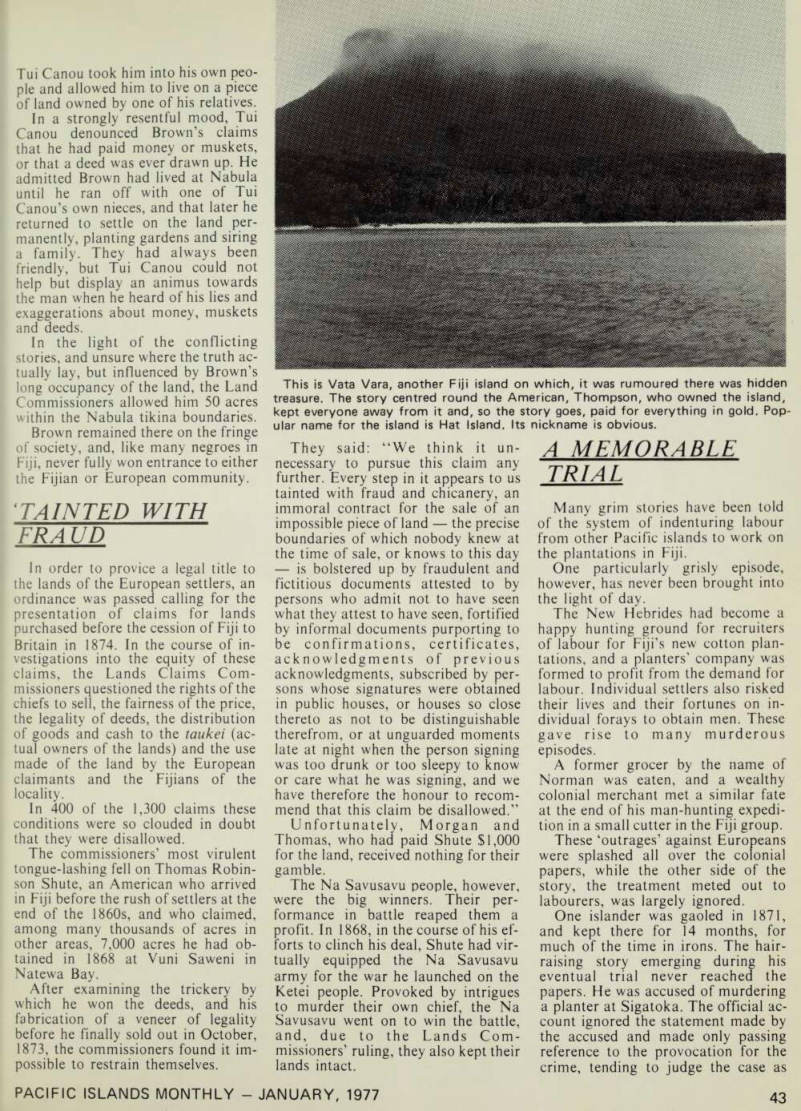

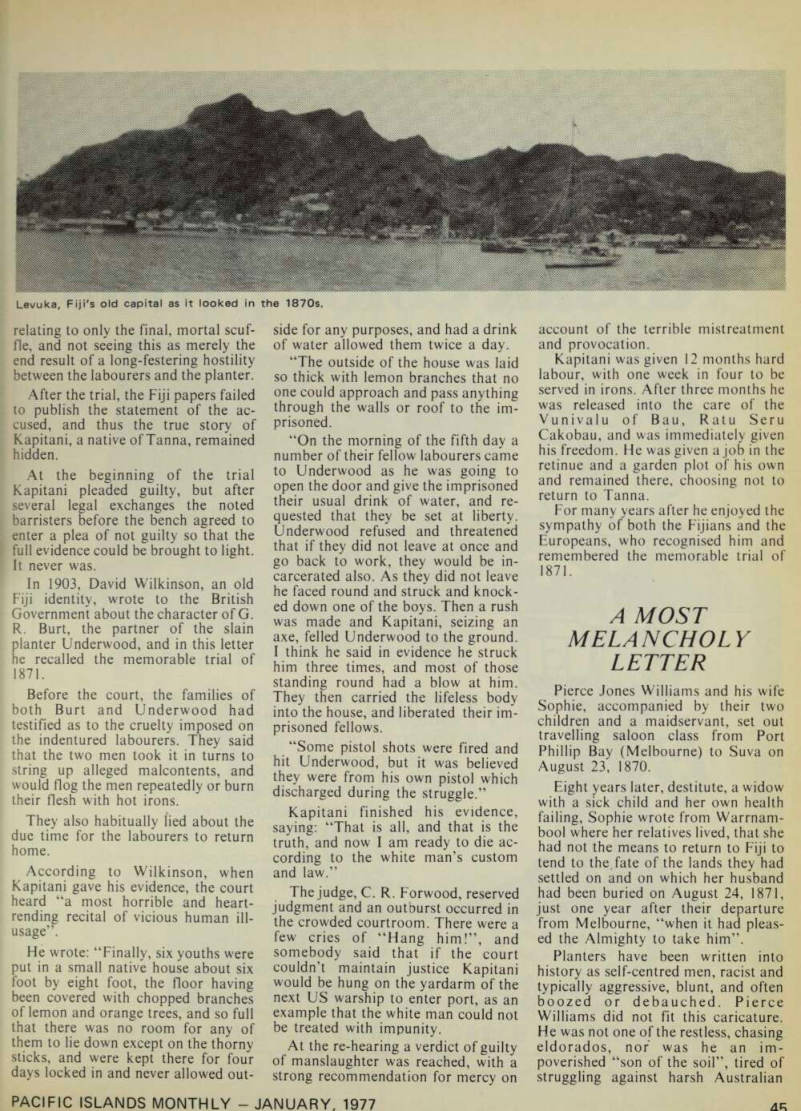
Drama In The Dusty Files:
Fragments Of Fiji History
The five stories below are based on research done by P/M contributor A. M. QUANCHI, of Melbourne's Monash University, into the records at the National Archives in Suva, Fiji.
They all belong to the period 1860-71, when Europeans in Fiji were few in number and had not yet learnt that the land was neither free, easy nor necessarily profitable. Their main theme is the ageless one that dreams of easy fortunes usually end up in despair and disillusion.
About 20 miles east of Rabi Island, in open water, lie the six Ringgold Islands. Today, ocean liners and con tainer vessels ply the main north-east passage and lights warn of these scattered reefs and islets.
In 1863 a small schooner headed for the Ringgold Islands with a strange purpose.
In that same year, in a deal sur rounded by mystery, ownership of the islands had passed into the hands of two new arrivals from Samoa, the Americans Gilliam and Thompson.
Discussion in the beach community around Levuka naturally turned to the newcomers, but before anybody could get a clear idea of what they were up to, they had slipped out and crossed to Vanua Levu to meet the powerful chief Tui Cakau.
The British Consul made what he called a “routine trip” to Vanua Levu and the word quickly came back buried treasure!
Soon after their arrival Gilliam and Thompson made inquiries with the American Consul, Dr Brower, who had directed them to Tui Cakau as the owner of the islands. Tui Cakau was aware of the Europeans’ desire to have access to parts of his domain, and its sparsely populated or un inhabited areas were of little conse quence to him. The promise of gold with which to purchase muskets for local warfare made him receptive to the offer by Gilliam and Thompson.
The bargain was completed for the then fabulous price of $250, paid in spectacular manner with 25 Chilean $lO gold coins.
They took possession, and for two
months carried out a fruitless excava tion, for, as with most buried treasure stories, there was none. (It is interesting to note how the talk of treasure on the Ringgolds has persisted over the years. As late as the 19505, Taveuni planters were still entertaining similar magical il lustions.) As it became obvious to the two searchers that the treasure was not to be found, they prepared to leave, hav ing suffered a double loss: Tui Cakau had also enticed away the two Sa moan girls they had brought with them.
They returned to Levuka and then disappeared, leaving the land deeds to be disposed of by Brower. The land changed hands twice before eventual purchase by Dr Brower himself.
He paid $l5O for a half share in the six little specks and finally in 1923 was rewarded with a nominal com pensation by a tribunal in London, since the islands had been reclaimed by their Fijian owners in the interven ing years. His “buried treasure” was the grand sum of one shilling.
The Coloured
The coloured man was John Brown, a Negro born in New Bedford in the United States. Both his parents were servants, and to escape a similar fate he ran away on one of the many whal ing vessels then based in the New England ports.
After serving as a boat steerer in the South Seas whaling grounds, he arrived in Fiji in the brig Phantom
and was paid off with $l2O in cash and $lOO in trade goods.
According to his own account, in 1865 he purchased the Nabula tikina block of land at Serua and lived there with his wife and family except for a period on a Suva plantation, and brief service as a sergeant in the militia at the time of the Kai Colo disturbances.
He said he gave the local chief, Tui Canou, $l,OOO for the land and later added an axe and 20 muskets.
He said that a fire had consumed his house and he lost his deeds, but he continued to live there, cultivating a small vegetable garden, at peace with the local people.
Brown’s account of his own life was not entirely clear as he spoke English poorly and his Fijian was limited. But at least on the face of it it seemed a case where lands had been alienated in a bonafide manner, rather than “on spec” by a land-jobber.
Later, when ownership of the lands was being disputed, a local chief Tui Canou spoke out and a tale unfolded quite at variance with the “coloured man’s” version.
Indeed, where had an illiterate Negro earned $l,OOO to pay for the land, let alone the axe and muskets in the two years between his arrival and the alleged purchase in 1862?
And wasn’t the price excessively high, considering that similar blocks were selling for $2O or $3O?
Tui Canou’s story was that the coloured man had arrived and had seduced a daughter of a neighbouring tribe, the Nui Davui Tukia. To save him from being clubbed to death as planned by the outraged tribesmen,
Tui Canou took him into his own peo ple and allowed him to live on a piece of land owned by one of his relatives.
In a strongly resentful mood, Tui Canou denounced Brown’s claims that he had paid money or muskets, or that a deed was ever drawn up. He admitted Brown had lived at Nabula until he ran off with one of Tui Canou’s own nieces, and that later he returned to settle on the land per manently, planting gardens and siring a family. They had always been friendly, but Tui Canou could not help but display an animus towards the man when he heard of his lies and exaggerations about money, muskets and deeds.
In the light of the conflicting stories, and unsure where the truth ac tually lay, but influenced by Brown’s long occupancy of the land, the Land Commissioners allowed him 50 acres within the Nabula tikina boundaries.
Brown remained there on the fringe of society, and, like many negroes in Fiji, never fully won entrance to either the Fijian or European community.
‘Tainted With
Fra Up
In order to provice a legal title to the lands of the European settlers, an ordinance was passed calling for the presentation of claims for lands purchased before the cession of Fiji to Britain in 1874. In the course of in vestigations into the equity of these claims, the Lands Claims Com missioners questioned the rights of the chiefs to sell, the fairness of the price, the legality of deeds, the distribution of goods and cash to the taukei (ac tual owners of the lands) and the use made of the land by the European claimants and the Fijians of the locality.
In 400 of the 1,300 claims these conditions were so clouded in doubt that they were disallowed.
The commissioners’ most virulent tongue-lashing fell on Thomas Robin son Shute, an American who arrived in Fiji before the rush of settlers at the end of the 1860 s, and who claimed, among many thousands of acres in other areas, 7,000 acres he had ob tained in 1868 at Vuni Saweni in Natewa Bay.
After examining the trickery by which he won the deeds, and his fabrication of a veneer of legality before he finally sold out in October, 1873, the commissioners found it im possible to restrain themselves.
They said: “We think it un necessary to pursue this claim any further. Every step in it appears to us tainted with fraud and chicanery, an immoral contract for the sale of an impossible piece of land the precise boundaries of which nobody knew at the time of sale, or knows to this day is bolstered up by fraudulent and fictitious documents attested to by persons who admit not to have seen what they attest to have seen, fortified by informal documents purporting to be confirmations, certificates, acknowledgments of previous acknowledgments, subscribed by per sons whose signatures were obtained in public houses, or houses so close thereto as not to be distinguishable therefrom, or at unguarded moments late at night when the person signing was too drunk or too sleepy to know or care what he was signing, and we have therefore the honour to recom mend that this claim be disallowed.”
Unfortunately, Morgan and Thomas, who had paid Shute $l,OOO for the land, received nothing for their gamble.
The Na Savusavu people, however, were the big winners. Their per formance in battle reaped them a profit. In 1868, in the course of his ef forts to clinch his deal, Shute had vir tually equipped the Na Savusavu army for the war he launched on the Ketei people. Provoked by intrigues to murder their own chief, the Na Savusavu went on to win the battle, and, due to the Lands Com missioners’ ruling, they also kept their lands intact.
A Memorable
trial
Many grim stories have been told of the system of indenturing labour from other Pacific islands to work on the plantations in Fiji.
One particularly grisly episode, however, has never been brought into the light of day.
The New Hebrides had become a happy hunting ground for recruiters of labour for Fiji’s new cotton plan tations, and a planters’ company was formed to profit from the demand for labour. Individual settlers also risked their lives and their fortunes on in dividual forays to obtain men. These gave rise to many murderous episodes.
A former grocer by the name of Norman was eaten, and a wealthy colonial merchant met a similar fate at the end of his man-hunting expedi tion in a small cutter in the Fiji group.
These ‘outrages’ against Europeans were splashed all over the colonial papers, while the other side of the story, the treatment meted out to labourers, was largely ignored.
One islander was gaoled in 1871, and kept there for 14 months, for much of the time in irons. The hair raising story emerging during his eventual trial never reached the papers. He was accused of murdering a planter at Sigatoka. The official ac count ignored the statement made by the accused and made only passing reference to the provocation for the crime, tending to judge the case as
This is Vata Vara, another Fiji island on which, it was rumoured there was hidden treasure. The story centred round the American, Thompson, who owned the island, kept everyone away from it and, so the story goes, paid for everything in gold. Pop ular name for the island is Hat Island, Its nickname is obvious.
relating to only the final, mortal scuf fle, and not seeing this as merely the end result of a long-festering hostility between the labourers and the planter.
After the trial, the Fiji papers failed to publish the statement of the ac cused, and thus the true story of Kapitani, a native of Tanna, remained hidden.
At the beginning of the trial Kapitani pleaded guilty, but after several legal exchanges the noted barristers before the bench agreed to enter a plea of not guilty so that the full evidence could be brought to light.
It never was.
In 1903, David Wilkinson, an old Fiji identity, wrote to the British Government about the character of G.
R. Burt, the partner of the slain planter Underwood, and in this letter he recalled the memorable trial of 1871.
Before the court, the families of both Burt and Underwood had testified as to the cruelty imposed on the indentured labourers. They said that the two men took it in turns to string up alleged malcontents, and would flog the men repeatedly or burn their flesh with hot irons.
They also habitually lied about the due time for the labourers to return home.
According to Wilkinson, when Kapitani gave his evidence, the court heard “a most horrible and heart rending recital of vicious human ill usage”.
He wrote: “Finally, six youths were put in a small native house about six foot by eight foot, the floor having been covered with chopped branches of lemon and orange trees, and so full that there was no room for any of them to lie down except on the thorny sticks, and were kept there for four days locked in and never allowed out
side for any purposes, and had a drink of water allowed them twice a day.
“The outside of the house was laid so thick with lemon branches that no one could approach and pass anything through the walls or roof to the im prisoned.
“On the morning of the fifth day a number of their fellow labourers came to Underwood as he was going to open the door and give the imprisoned their usual drink of water, and re quested that they be set at liberty.
Underwood refused and threatened that if they did not leave at once and go back to work, they would be in carcerated also. As they did not leave he faced round and struck and knock ed down one of the boys. Then a rush was made and Kapitani, seizing an axe, felled Underwood to the ground.
I think he said in evidence he struck him three times, and most of those standing round had a blow at him.
They then carried the lifeless body into the house, and liberated their im prisoned fellows.
“Some pistol shots were fired and hit Underwood, but it was believed they were from his own pistol which discharged during the struggle.”
Kapitani finished his evidence, saying: “That is all, and that is the truth, and now I am ready to die ac cording to the white man’s custom and law.”
The judge, C. R. Forwood, reserved judgment and an outburst occurred in the crowded courtroom. There were a few cries of “Hang him!”, and somebody said that if the court couldn’t maintain justice Kapitani would be hung on the yardarm of the next US warship to enter port, as an example that the white man could not be treated with impunity.
At the re-hearing a verdict of guilty of manslaughter was reached, with a strong recommendation for mercy on
account of the terrible mistreatment and provocation.
Kapitani was given 12 months hard labour, with one week in four to be served in irons. After three months he was released into the care of the Vunivalu of Bau, Ratu Seru Cakobau, and was immediately given his freedom. He was given a job in the retinue and a garden plot of his own and remained there, choosing not to return to Tanna.
For many years after he enjoyed the sympathy of both the Fijians and the Europeans, who recognised him and remembered the memorable trial of 1871.
A Mos
Melancholy
Letter
Pierce Jones Williams and his wife Sophie, accompanied by their two children and a maidservant, set out travelling saloon class from Port Phillip Bay (Melbourne) to Suva on August 23, 1870.
Eight years later, destitute, a widow with a sick child and her own health failing, Sophie wrote from Warrnam bool where her relatives lived, that she had not the means to return to Fiji to tend to the fate of the lands they had settled on and on which her husband had been buried on August 24, 1871, just one year after their departure from Melbourne, “when it had pleas ed the Almighty to take him”.
Planters have been written into history as self-centred men, racist and typically aggressive, blunt, and often boozed or debauched. Pierce Williams did not fit this caricature.
He was not one of the restless, chasing eldorados, nor was he an im poverished “son of the soil”, tired of struggling against harsh Australian
Levuka, Fiji's old capital as it looked in the 1870s.
conditions, these being contemporary stereotypes of the origins of the rush settlers.
He was a settled, married man, a clerk of reasonable means, and being a resolute man committed himself ful ly to becoming a successful planter.
' As soon as he and his family arriv ed at Suva promontory he selected 750 acres between the Vatuwaqa and Samabula rivers, overlooking Laucala Bay. At the end of that sad year, Sophie recalled “how bright and prosperous the plantation was looking” for' Pierce was one who “went in heavily for planting, as witness the rapidity with which he had such a large quantity of cotton planted”. He had 100 acres cleared, 80 under cotton, and employed 12 Tokelau men, eight local Fijians, and for brief periods had as many as 400 men working on clearing operations.
The cotton was “splendid”, but when Pierce passed away as the result of fever and the “strenuous labour in the tropical conditions”, wind blew the flowering cotton balls to the ground before Sophie could manage to collect more than a few pounds.
In that one year wells had been sunk, a fine native house with wooden floors and an iron roof erected, and Pierce had expended all the money
they had in hopes of reaping the returns promised by the high prices being fetched by Fiji cotton on the London market at the time.
On his death Sophie was left with nothing, as they had sold up all their possessions in Melbourne, intending to settle permanently in Fiji. The cost of establishing the plantation had been high, but Sophie knew little of these business matters, for “unfor tunately he did not communicate much of his affairs to me”. The land had cost £375 and Fred Armstrong and Henry Cuthbert, two of his neighbours, estimated that over £4OO had been spent on improvements and as much as £6OO on labour.
Sophie’s immediate reaction was to keep going, but “the men all ran away the night he died; if they had stayed, with Mr Surplice as manager, we could have managed”.
Pierce was placed in the soil he had claimed and toiled for.
To add to Sophie’s wretched situa tion, the day after her husband was buried she was confronted by several of the local Suva people who had on occasions worked on the plantation.
They demanded money for jobs they had done, and when Sophie refused they returned several times and in timidated the isolated woman,
threatening to kill her and burn her house down.
When new of this reached the white community centred around Nabukalou Creek on the other side of the promontory, a meeting was called and the family was evacuated by boat.
Later, the opportunism of the local people was rewarded by their arrest, and Sophie thankfully wrote how she had been saved “only by the kindness of Mathews, Ryan and others and a meeting of the Suva peo ple who fetched us away”.
Sophie stayed with a Suva family at Walu Bay and, three months later, after her brother had sent money for their passage, she and her two small girls, Annie and Eliza, returned to Victoria.
In 1878, when Henry Cuthbert was acting on her behalf to secure the legal titles to the land, Sophie wrote: “I feel an attraction to Suva. My husband is buried there and I was befriended when I was really in need. I am sure you will think this a most melancholy letter . . . believe me, I cannot endure the thought of losing that land.”
In 1881, Sophie received a Crown grant. She died in Richmond, Vic toria, in 1884.
Advertisements & other items, pp. 44-48 (2 items)
Akai
w
AKA!
ococcc
i c<<M
* <> t \-J- -# «n . »#• - '■. * « «> * There seems to be no end to the superlatives used to describe stereo sound quality. It’s usually natural, crystal clear, rich or vibrant with plenty in reserve.
The list of words is longer than the tape on a 7-inch reel. But these tired, old adjectives can’t convey the full impact of Akai sound. Perhaps there just aren’t any words equal to the task.
Australia Akai Australia Pty. Ltd. 17/18 Hordern Place Denison St.
Camperdown, Sydney, N.S.W. 2050 Tel: 516-3366
P.N.G.
S.O. Svensson (N.G.) Ltd.
P.O. Box 705, Port Moresby Tel: 2275 Fiji Islands Motibhai & Company Ltd.
P.O. Box 9175 Nadi International Airport Tel: 72-165 New Zealand Pye Ltd. Consumer Product Division 110 Mt. Eden Rd., Mt. Eden, Auckland Tel: 686-437 It’s a visual experience that begins the moment you close your eyes and are swept into the imaginative world of your mind.
Akai provides you a wide selection of fine stereo components
tape decks, turntables, amps,
tuners, receivers and speaker systems —to assure you will enjoy
every trip.
New Caledonia Menard Freres B.P. H 2, Noumea Tel: 275222 Tahiti Etablissements Comimpex P.O. Box 200, Papeete Tel: 20477 New Hebrides Island Burns Philip (New Hebrides) Co., Ltd.
Port Vila, New Hebrides Island Norfolk Island Burns Philip (Norfolk Island) Co., Ltd.
P.O. Box 21, Norfolk Island See the difference when you move up to Akai sound.
Audio & Video
AKAI
AKAI ELECTRIC CO., LTD.
Tokyo, Japan
Samoan Islands Burns Philip (South Sea) Co., Ltd.
P.O. Box 129, Pago Pago, American Samoa, Apia, Western Samoa Mariana Islands J.C. Tenorio Enterprises P.O. Box 137, Saipan Tel: 6444/8 British Solomon Security Electrical Co., Ltd.
P.O. Box 174, Honiara Tel; 881 Cook Islands JPS Enterprises Ltd.
P.O. Box 15, Rarotonga Tel: 2150, 2176
Remember the good times
with silk-finish
Kodak color prints
as ii 1 Borderless round-cornered pictures with a silk surface that actually hides fingerprints. Pass them around.
Show your friends.
You’ll forget. Pictures won’t.
Silk-finish Kodak color prints-from all sizes of Kodacolor film.
Silk-finish Kodak color prints are standard from all photo dealers where you see this sign.
KODAK (Australasia) PTY. LTD.
See your photo dealer now.
ASK FOR
COLOR
PROCESSING
bv Kodak
K6l/5074
Q| EALING
with
DIEMKA (AUSTRALIA) means
** w Pty. Ltd.
I EALING with Manufacturers
QIIRECT
We represent the greatest variety of merchandise in the entire P.O. BOX 340, MASCOT (SYDNEY) 2020 NSW.
Telex: 21416. Telephone: 669 5344.
DO APPROACH US BY LETTER, CABLE OR TELEX FOR
QUOTATIONS
SOUTH PACIFIC
a 5J
Save hundreds of dollars
on Australia’s most efficient
WALK IN, ALUMINIUM
COOLROOMS AND
FREEZE ROOMS
Hundreds already installed! The most economical supplementary coolrooms for bottles and food, providing the largest storage capacity of any comparable coolrooms of the same exterior dimensions. Five sizes—from 90-360 cu. ft. capacity; 16 models offering normal temp., two temp., deep freeze, or for pastry and ice storage applications. White vinyl interior, embossed rustproof aluminium exterior. • SUPPLIED IN EASY-TO-ERECT, DO-IT-YOURSELF KIT FORM.
Available from: AUSTRALIAN NEW CALEDONIA EXPORTS (SILVER & BARDA), 363 George St., Sydney, 2000 and Branches.
BRECKWOLDT & CO., 276 Pitt St., Sydney, 2000 and Branches.
PETER FISHER TRADING PTY. LTD., 321 Pitt St., Sydney, 2000.
HAGEMEYER (A'SIA), 59 Anzac Pde., Kensington, 2033 and Branches.
GEOFFREY HUGHES & CO., 167 Macquarie St., Sydney, 2000.
Manufactured by:
77 NELSON & ROBERTSON PTY. LTD., 197 Clarence St., Sydney, 2000.
RABAUL TRADING CO. PTY. LTD., P.O. Box 219, Rabaul and Branches.
E. RABOT (EXPORTS) PTY. LTD., 67 Castlereagh St., Sydney, 2000.
H. Y KWAN (AUST.) PTY. LTD., Box 2713 G.P.O. Sydney, 2001.
C. SULLIVAN (EXPORT) PTY. LTD., 60 Margaret St., Sydney, 2000 and Branches.
W. S. TAIT & CO., PTY. LTD., 31 Macquarie Place, Sydney, 2000 and Branches.
FRIGID CABINETS PTY. LTD.,
14A Duffy Ave., Thornleigh, N.S.W. 2120 Aust. Ph. 848 8292.
There’s really
only one tool
SIDCHROME
There’s a saying in the tool business.
If you’re going to throw a spanner in the works, make sure it’s a Sidchrome spanner.
And that goes for all Sidchrome tools.
Sidchrome tools are made from the highest quality alloy steel. Finished in a tough, everlasting nickel chrome, and made to last.
That’s why Sidchrome hand tools are un-
conditionally guaranteed.
an P.N.G. AGENT:- R. & J. Henderson, P.O. Box 353, Lae.
48
PAriFir isi AN ns MONTHLY - JANUARY, 1977
Early Days In Png Radio When
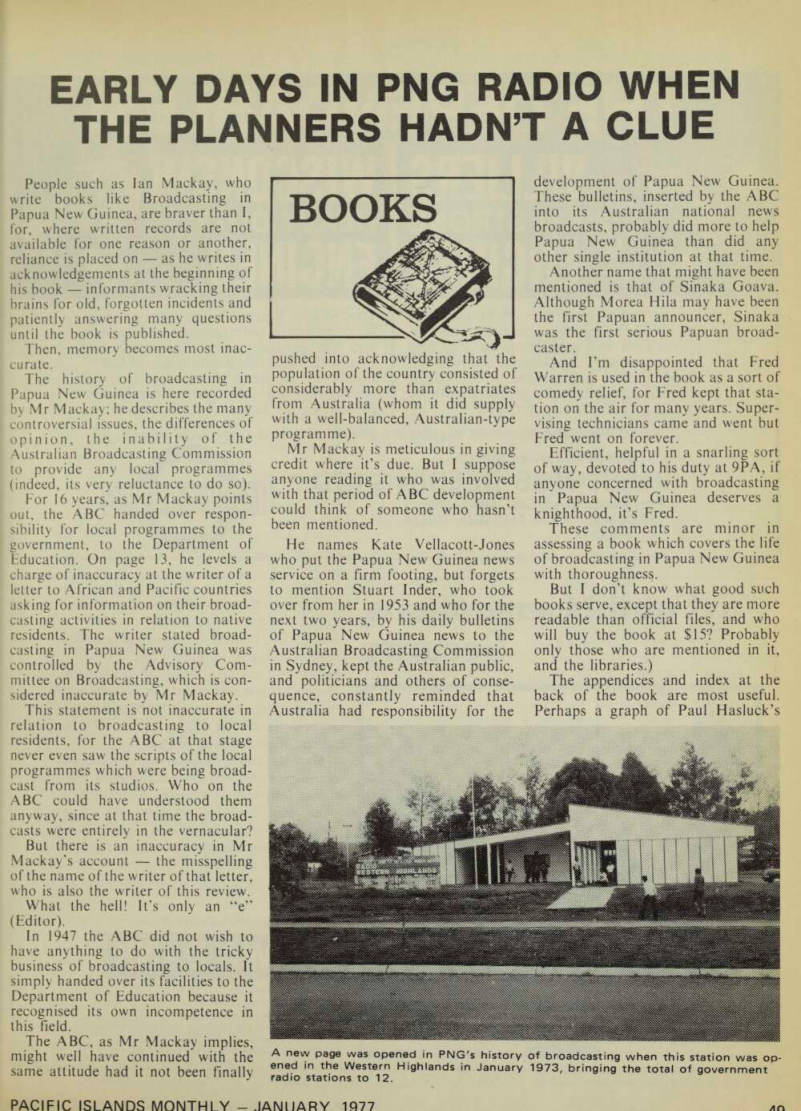
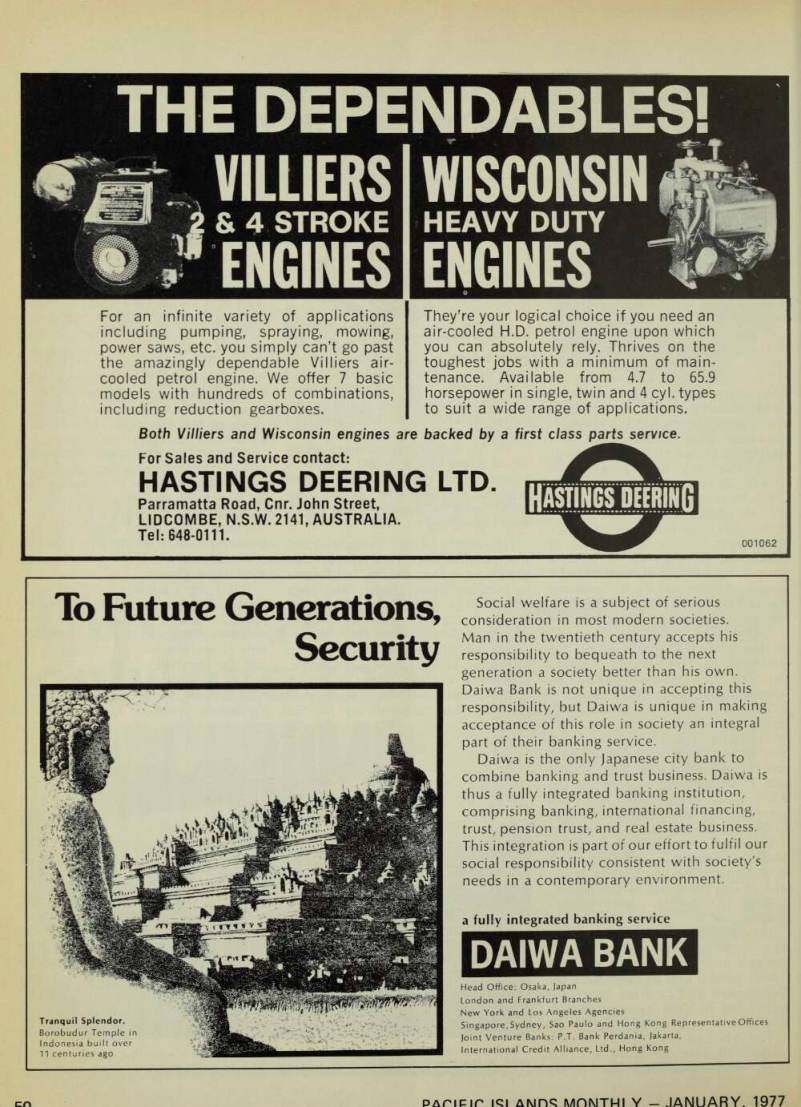
The Planners Hadn’T A Clue
People such as lan Mackay, who write books like Broadcasting in Papua New Guinea, are braver than I, for, where written records are not available for one reason or another, reliance is placed on as he writes in acknowledgements at the beginning of his book informants wracking their brains for old, forgotten incidents and patiently answering many questions until the book is published.
Then, memory becomes most inac curate.
The history of broadcasting in Papua New Guinea is here recorded by Mr Mackay; he describes the many controversial issues, the differences of opinion, the inability of the Australian Broadcasting Commission to provide any local programmes (indeed, its very reluctance to do so).
For 16 years, as Mr Mackay points out, the ABC handed over respon sibility for local programmes to the government, to the Department of Education. On page 13, he levels a charge of inaccuracy at the writer of a letter to African and Pacific countries asking for information on their broad casting activities in relation to native residents. The writer stated broad casting in Papua New Guinea was controlled by the Advisory Com mittee on Broadcasting, which is con sidered inaccurate by Mr Mackay.
This statement is not inaccurate in relation to broadcasting to local residents, for the ABC at that stage never even saw the scripts of the local programmes which were being broad cast from its studios. Who on the ABC could have understood them anyway, since at that time the broad casts were entirely in the vernacular?
But there is an inaccuracy in Mr Mackay’s account the misspelling of the name of the writer of that letter, who is also the writer of this review.
What the hell! It’s only an “e” (Editor).
In 1947 the ABC did not wish to have anything to do with the tricky business of broadcasting to locals. It simply handed over its facilities to the Department of Education because it recognised its own incompetence in this field.
The ABC, as Mr Mackay implies, might well have continued with the same attitude had it not been finally
Books
pushed into acknowledging that the population of the country consisted of considerably more than expatriates from Australia (whom it did supply with a well-balanced, Australian-type programme).
Mr Mackay is meticulous in giving credit where it’s due. But I suppose anyone reading it who was involved with that period of ABC development could think of someone who hasn’t been mentioned.
He names Kate Vellacott-Jones who put the Papua New Guinea news service on a firm footing, but forgets to mention Stuart Inder, who took over from her in 1953 and who for the next two years, by his daily bulletins of Papua New Guinea news to the Australian Broadcasting Commission in Sydney, kept the Australian public, and politicians and others of conse quence, constantly reminded that Australia had responsibility for the
development of Papua New Guinea.
These bulletins, inserted by the ABC into its Australian national news broadcasts, probably did more to help Papua New Guinea than did any other single institution at that time.
Another name that might have been mentioned is that of Sinaka Goava.
Although Morea Hila may have been the first Papuan announcer, Sinaka was the first serious Papuan broad caster.
And I’m disappointed that Fred Warren is used in the book as a sort of comedy relief, for Fred kept that sta tion on the air for many years. Super vising technicians came and went but Fred went on forever.
Efficient, helpful in a snarling sort of way, devoted to his duty at 9PA, if anyone concerned with broadcasting in Papua New Guinea deserves a knighthood, it’s Fred.
These comments are minor in assessing a book which covers the life of broadcasting in Papua New Guinea with thoroughness.
But I don’t know what good such books serve, except that they are more readable than official files, and who will buy the book at $l5? Probably only those who are mentioned in it, and the libraries.) The appendices and index at the back of the book are most useful.
Perhaps a graph of Paul Hasluck’s
A new page was opened in PNG's history of broadcasting when this station was op ened in the Western Highlands in January 1973, bringing the total of government radio stations to 12.
vacillations and changes of mind about the broadcasting situation might reveal one of the reasons why broadcast planning seemed so haphazard at that time.
It is strange reading about events in which one took part. They seem to assume an air of unreality. For in stance, the 1961 Broadcasting Com mittee described in the book sounds, when reading about it, as though it consisted of expert gentlemen, all of whom knew what they were about. In fact, none of us really had a clue.
Many years before this, when I had gone to London to talk with learned gentlemen who were concerned with the same problems of introducing broadcasting to developing countries notably Julian Huxley, who was concerned with broadcasting to West Africans I stated boldly that I had come to learn. Disappointment was expressed. Then one of the gentlemen exclaimed, “You won't get much from us! We hoped you could solve some of our problems!”
So it seems that, in those earlier days, all of us were uncertain how to proceed. It’s the history of uncertain ty that Mr Mackay records in Broad casting in Papua New Guinea
Peter Livingston.
BROADCASTING IN PAPUA NEW GUINEA. By lan K.
Mackay. Published by Melbourne University Press, PD Box 278, Carlton South, Victoria, Australia 3053. $l5)
A Fiji Operation
lova S. Geita, a young Papua New Gui nean, is in Suva for three years as editor of Lotu Pasifika Publications, which is own ed by the Pacific Conference of Churches.
Early in 1977 Lotu Pasifika Publications will launch The Pacific Islands Children’s Magazine on a regular basis. The pilot issue was reviewed in the October PIM.
Mr Geita says about 35,000 copies will be printed for distribution throughout the Pacific region.
Lotu Pasifika Publications has publish ed a number of journals and recipe books.
The journals deal mainly with social and economic matters, and include a “little politics”.
To come out soon is a Samoan recipe book, which follows a book on Fijian recipes. There will also be a book by Paul White about jungles in three languages PNG Pidgin, Fijian and Tongan. A survey is now under way in publishing French literature.
The publisher of Luto Pasifika Publications is a Fijian, Mr Aisake Raratabu, who recently returned to Fiji from the Oxford Polytechnic in the UK where he attended a short publishing course. The Rev David Williams is consul tant to the publisher.
Advertisements & other items, p. 50 (2 items)
50
PAriPir iqi Awnf; MONTHLY JANUARY. 1977
The Dependables!
1 P-
VILLIERS
2 & 4 STROKE
1 ENGINES
WISCONSIN
HEAVY DUTY
ENGINES
m § * For an infinite variety of applications including pumping, spraying, mowing, power saws, etc. you simply can’t go past the amazingly dependable Villiers aircooled petrol engine. We offer 7 basic models with hundreds of combinations, including reduction gearboxes.
They’re your logical choice if you need an air-cooled H.D. petrol engine upon which you can absolutely rely. Thrives on the toughest jobs with a minimum of maintenance. Available from 4.7 to 65.9 horsepower in single, twin and 4 cyl. types to suit a wide range of applications.
Both Villiers and Wisconsin engines are backed by a first class parts service.
For Sales and Service contact:
HASTINGS PEERING LTD.
Parramatta Road, Cnr. John Street,
LIDCOMBE, N.S.W. 2141, AUSTRALIA.
Tel: 648-0111. w 001062
To Future Generations,
Security
Tranquil Splendor.
Borobudur Temple in Indonesia built over 11 centuries ago.
Social welfare is a subject of serious consideration in most modern societies.
Man in the twentieth century accepts his responsibility to bequeath to the next generation a society better than his own.
Daiwa Bank is not unique in accepting this responsibility, but Daiwa is unique in making acceptance of this role in society an integral part of their banking service.
Daiwa is the only Japanese city bank to combine banking and trust business. Daiwa is thus a fully integrated banking institution, comprising banking, international financing, trust, pension trust, and real estate business.
This integration is part of our effort to fulfil our social responsibility consistent with society's needs in a contemporary environment. a fully integrated banking service
DAIWA BANK
Head Office: Osaka, Japan London and Frankfurt Branches New York and Los Angeles Agencies Singapore,Sydney, Sao Paulo and Hong Kong Representative Offices Joint Venture Banks: P.T. Bank Perdania, Jakarta, International Credit Alliance, Ltd., Hong Kong
Solomons Catholics
'Sin! What’S Sin?'Ask
The Solomon Islands Catholics lack a sense of sin they are not devout except when misfortune befalls them. At least, that’s how the white Marist missionaries see it. And Hugh Laracy, author of Marists and Melanesians, believes that the in stitutional Church is still alien: “the religious sanctions of the old social order have been broken down and Christian moral values have not com pensated for them’’.
He does, however, see no reason to assume that “the heirs of Melanesian animists are any less capable of professing Christianity than the descendants of Celtic or Teutonic polytheists”. The appointment of Gregory Sinkai as bishop leaves no doubt what the Vatican thinks.
The Marists first reached the Solomons in 1845. Within a fortnight Bishop Epalle was axed to death on San Cristobal, but the work was con tinued in spite of local hostility and an even greater foe, malaria. The first parties sent to what is now Papua New Guinea, to Murua Island in 1847 and Umboi Island a year later, were beaten by the same adversaries. It was not until the 1890 s that the Marists got a foothold in German New Guinea.
As the years went by, mission stations were established on several islands in the Solomons and on Bougainville and Buka. There was a lot of bickering among the Marists and one priest, Rinaldo Joseph Pavese, was recalled, by the Pope. (I have often wondered whether the eccentricity of Europeans in the tropics is in direct relationship to their proximity to the equator.) But most of the priests and the nuns associated with them toiled well and deserved and earned the respect and affection of the islanders.
There was bitter sectarian competi tion with Methodists, South Sea Evangelicals, Seventh-day Adventists and Anglicans. In 1929, for instance, Methodists and Catholics destroyed each other’s chapels at Osokoli and Huhuka; a judicial commission laid most of the blame on the Marists and placed restrictions on ‘foreign’
Melanesian and Polynesian mis sionaries. There was, however, one gain from the competition: the various missions stepped up their medical and educational work
because of the propaganda value at taching to it.
Thomas Wade, the Marists’ first English-speaking priest and later their first bishop, defused the situation, and the years since the Pacific War have seen growing ecumenism. By 1942, the Marists had 120 missionaries at 34 posts throughout the Solomons; over 30,000 islanders were baptised Catholics while about 50,000 adhered to one or other of the Protestant mis sions. The Catholics are now in the majority.
The Marists made few con tributions to the scientific knowledge of the Solomons but, on the credit side, they interfered less with the islanders’ tradition than did the Protestants.
The author rightly points out that what he perceives to be ideological ap titude for conversion has been ac tivated by social factors: the reduction of the islanders’ traditional control over the world through the introduc tion of new problems of disease, economic dependence and fear of European wrath.
The white man had shown himself to be allpowerful and with seemingly unlimited material wealth. If, as James McAuley has suggested, cargo cultism is mainly a technique to ac quire the white man’s power and wealth — and there have been many cults in the Solomons, from 1914, possibly even earlier, through the 1930s and in the postwar period — then the people’s readiness to become converts is easier to understand.
Like most of the Protestant mis sions, the Marists were too slow in in digenising their Church; only in recent years have they given due cognisance to the capacities and wishes of the local people.
After reading this straight-forward, honest and scholarly account of the endeavours of one particular ‘brand’ of European missionary, one can but hope that the new churches of the Pacific are not compounding the errors of the past, that they will put love and tolerance before dogma and pride.
Dr Laracy has looked at the Marists through European eyes. It remains for a Melanesian to look at
them.
Harry Jackman
(Marists And Melanesians. By Hugh Laracy.
Published by ANU Press, Canberra, ACT, Australia $12.95.)
Advertisements & other items, p. 51 (1 item)
51
PACIFIC ISLANDS MONTHI Y iammarv 1077
Easy Guide
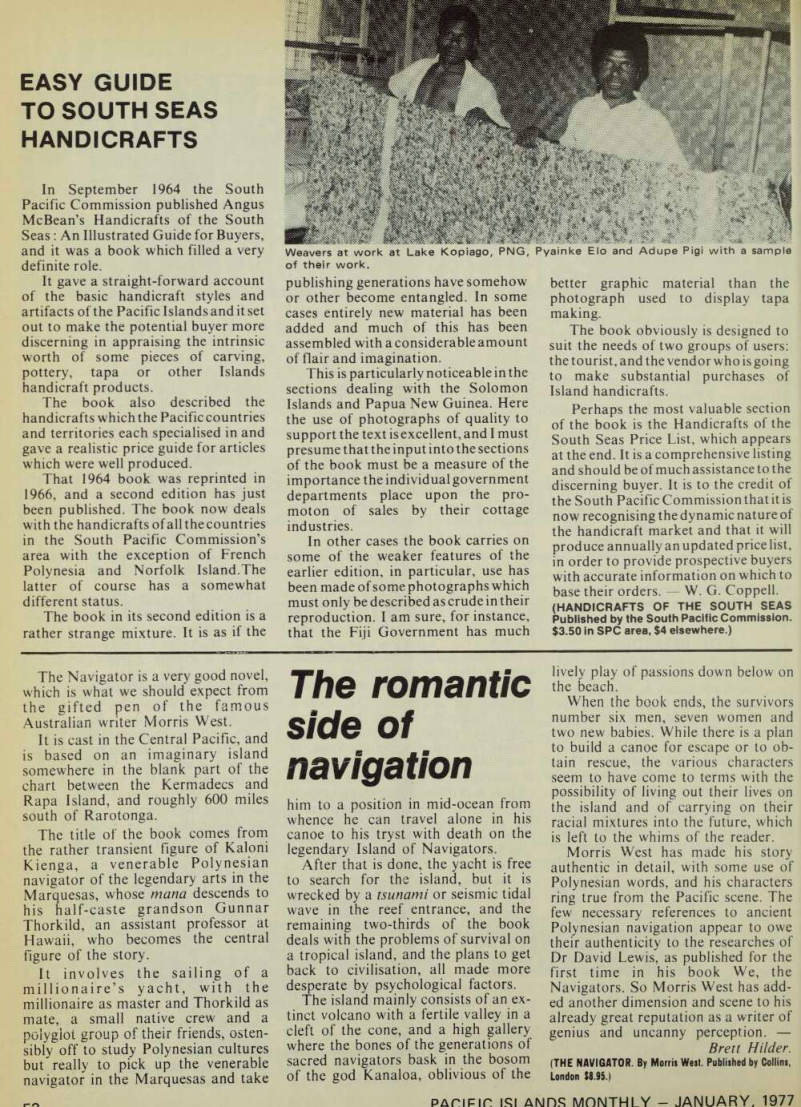
To South Seas
Handicrafts
In September 1964 the South Pacific Commission published Angus Mcßean’s Handicrafts of the South Seas : An Illustrated Guide for Buyers, and it was a book which filled a very definite role.
It gave a straight-forward account of the basic handicraft styles and artifacts of the Pacific Islands and it set out to make the potential buyer more discerning in appraising the intrinsic worth of some pieces of carving, pottery, tapa or other Islands
handicraft products.
The book also described the handicrafts which the Pacific countries and territories each specialised in and gave a realistic price guide for articles which were well produced.
That 1964 book was reprinted in 1966, and a second edition has just been published. The book now deals with the handicrafts of all the countries in the South Pacific Commission’s area with the exception of French Polynesia and Norfolk Island. The latter of course has a somewhat different status.
The book in its second edition is a rather strange mixture. It is as if the
publishing generations have somehow
or other become entangled. In some cases entirely new material has been added and much of this has been assembled with a considerable amount of flair and imagination.
This is particularly noticeable in the sections dealing with the Solomon Islands and Papua New Guinea. Here the use of photographs of quality to support the text is excellent, and I must presume that the input into the sections of the book must be a measure of the importance the individual government departments place upon the pro moton of sales by their cottage industries.
In other cases the book carries on some of the weaker features of the earlier edition, in particular, use has been made of some photographs which must only be described as crude in their reproduction. I am sure, for instance, that the Fiji Government has much
better graphic material than the photograph used to display tapa making.
The book obviously is designed to suit the needs of two groups of users: the tourist, and the vendor who is going to make substantial purchases of Island handicrafts.
Perhaps the most valuable section of the book is the Handicrafts of the South Seas Price List, which appears at the end. It is a comprehensive listing and should be of much assistance to the discerning buyer. It is to the credit of the South Pacific Commission that it is now recognising the dynamic nature of the handicraft market and that it will produce annually an updated price list, in order to provide prospective buyers with accurate information on which to
base their orders.
W. G. Coppell.
(Handicrafts Of The South Seas
Published by the South Pacific Commission. $3.50 in SPC area, $4 elsewhere.)
Weavers at work at Lake Kopiago, PNG, Pyainke Elo and Adupe Pigi with a sample of their work.
The romantic
side of navigation
The Navigator is a very good novel, which is what we should expect from the gifted pen of the famous Australian writer Morris West.
It is cast in the Central Pacific, and t „ iinri is based on a g y somewhere in the blank part of the chart between the Kermadecs and Rapa Island, and roughly 600 miles south or Rarotonga.
The title of the book comes from the rather transient figure of Kaloni Kienga, a venerable Polynesian navigator of the legendary arts in the Marquesas, whose mana descends to his half-caste grandson Gunnar Thorkild, an assistant professor at Hawaii, who becomes the central figure of the story.
It involves the sailing of a millionaire’s yacht, with the millionaire as master and Thorkild as mate, a small native crew and a nolygiot group of their friends, ostensibly off to study Polynesian cultures but really to pick up the venerable navigator in the Marquesas and take
him t 0 a pos i t i on in mid-ocean from whence he can travel alone in his canoe to his tryst with death on the legendary Island of Navigators.
After that is done, the yacht is free to search for the island, but it is wrecked by a tsunami or seismic tidal wave in the reef entrance, and the remaining two-thirds of the book deals with the problems of survival on a tropical island, and the plans to get back to civilisation, all made more desperate by psychological factors.
The island mainly consists of an ex tinct volcano with a fertile valley in a cleft of the cone, and a high gallery where the bones of the generations of sacred navigators bask in the bosom of the god Kanaloa, oblivious of the
lively play of passions down below on the beach.
When the book ends, the survivors number six men, seven women and two new babies. While there is a plan to build a canoe for escape or to ob tain rescue, the various characters seem to have come to terms with the possibility of living out their lives on the island and of carrying on their racial mixtures into the future, which is left to the whims of the reader.
Morris West has made his story authentic in detail, with some use of Polynesian words, and his characters ring true from the Pacific scene. The few necessary references to ancient Polynesian navigation appear to owe their authenticity to the researches of Dr David Lewis, as published for the first time in his book We, the Navigators. So Morris West has add ed another dimension and scene to his already great reputation as a writer of genius and uncanny perception.
Brett Milder.
(THE NAVIGATOR. By Morris West. Published by Collins, London $8.95.)
Advertisements & other items, p. 52 (1 item)
52
PACIFIC IS! ANDS MONTHLY - JANUARY. 1977
The Gilt Is Rubbing Off
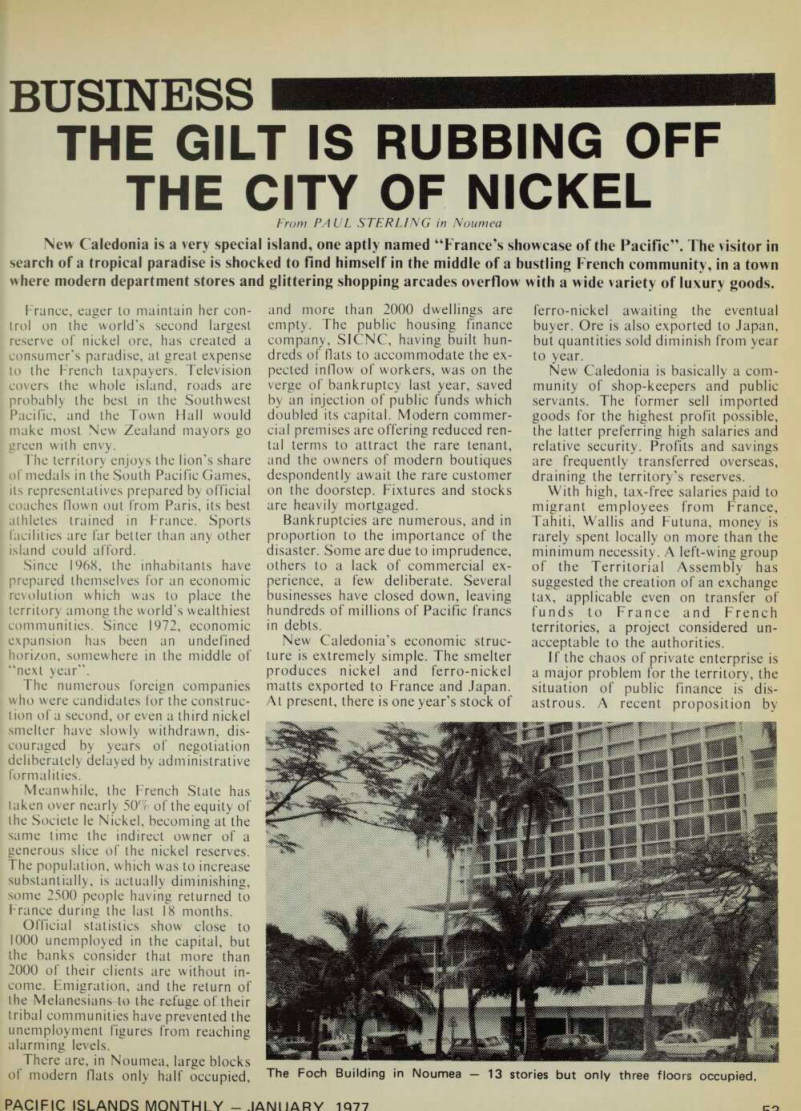
Business
The City Of Nickel
From PAUL STERLING in Noumea
New Caledonia is a very special island, one aptly named “France’s showcase of the Pacific”. The visitor in search of a tropical paradise is shocked to find himself in the middle of a hustling French community, in a town where modern department stores and glittering shopping arcades overflow with a wide variety of luxury goods.
France, eager to maintain her con trol on the world's second largest reserve of nickel ore, has created a consumer’s paradise, at great expense to the French taxpayers. Television covers the whole island, roads are probably the best in the Southwest Pacific, and the Town Hall would make most New Zealand mayors go green with envy.
The territory enjoys the lion’s share of medals in the South Pacific Games, its representatives prepared by official coaches flown out from Paris, its best athletes trained in France. Sports facilities are far better than any other island could afford.
Since 1968, the inhabitants have prepared themselves for an economic revolution which was to place the territory among the world’s wealthiest communities. Since 1972, economic expansion has been an undefined horizon, somewhere in the middle of “next year”.
The numerous foreign companies who were candidates for the construc tion of a second, or even a third nickel smeller have slowly withdrawn, dis couraged by years of negotiation deliberately delayed by administrative formalities.
Meanwhile, the French State has taken over nearly 50% of the equity of the Societe le Nickel, becoming at the same lime the indirect owner of a generous slice of the nickel reserves.
The population, which was to increase substantially, is actually diminishing, some 2500 people having returned to France during the last 18 months.
Official statistics show close to 1000 unemployed in the capital, but the banks consider that more than 2000 of their clients are without in come. Emigration, and the return of the Melanesians to the refuge of their tribal communities have prevented the unemployment figures from reaching alarming levels.
There are, in Noumea, large blocks of modern flats only half occupied,
and more than 2000 dwellings are empty. The public housing finance company, SICNC, having built hun dreds of flats to accommodate the ex pected inflow of workers, was on the verge of bankruptcy last year, saved by an injection of public funds which doubled its capital. Modern commer cial premises are offering reduced ren tal terms to attract the rare tenant, and the owners of modern boutiques despondently await the rare customer on the doorstep. Fixtures and stocks are heavily mortgaged.
Bankruptcies are numerous, and in proportion to the importance of the disaster. Some are due to imprudence, others to a lack of commercial ex perience, a few deliberate. Several businesses have closed down, leaving hundreds of millions of Pacific francs in debts.
New Caledonia’s economic struc ture is extremely simple. The smelter produces nickel and ferro-nickel matts exported to France and Japan.
At present, there is one year’s stock of
ferro-nickel awaiting the eventual buyer. Ore is also exported to Japan, but quantities sold diminish from year to year.
New Caledonia is basically a corn munity of shop-keepers and public servants. The former sell imported goods for the highest profit possible, the latter preferring high salaries and relative security. Profits and savings are frequently transferred overseas, draining the territory’s reserves, With high, tax-free salaries paid to migrant employees from France, Tahiti, Wallis and Futuna, money is rarely spent locally on more than the minimum necessity. A left-wing group of the Territorial Assembly has suggested the creation of an exchange tax, applicable even on transfer of funds to France and French territories, a project considered un acceptable to the authorities, If the chaos of private enterprise is a major problem for the territory, the situation of public finance is dis astrous. A recent proposition by
The Foch Building in Noumea-13 stories but only three floors occupied.
France to take over the cost of private education was accepted by a one-vote majority of the Assembly, those in favour being motivated by budgetary problems. A month later, a deficit of 1.5 billion francs had been acknowledged on the current budget, while a modest forecast of 800 million francs shortage has been announced for next year.
In November, the Assembly was to examine the 1977 Budget and in par ticular a project to introduce direct taxation. It seems likely that the ma jority will refuse to accept new taxes, leaving France the responsibility of the final decisions. Import tax has not provided the revenue expected, due to the substantial decrease in overseas trade.
France’s Prime Minister, Raymond Barre, while introducing measures to fight inflation and restrict public ex penditure, is hardly expected to provide further subsidies to the territory.
The old policy of signing the bill and asking France to write out the cheque is wearing thin. The owners of 40ft yachts, air-conditioned Mercedes and bank accounts in Geneva, Nice, Sydney and Honolulu can feel the menace of direct taxation putting an end to their financial paradise.
Yet the territory has resources that are deliberately ignored. Tourism is becoming a new source of revenue, the only activity that improves steadily through the present crisis. Virgin land awaits the plough, while fruit, vegetables and cereals are still im ported from Australia, New Zealand and the United States.
When mining, agriculture and tourism finally play the role of partners in the economic development of the territory, then, and only then will New Caledonia merit its claim to economic leadership in the South- West Pacific.
Two million dollar
causeway for Gilberts
After years of talking about it, the Gilbertese Government has finally decided to build a causeway between Betio and Bairiki, the two main islets on Tarawa Atoll.
The two-mile long, sealed causeway will cost at least $2 million.
A British engineering company has been called in to do design work and supervise the letting of a contract for the job. Work is expected to start late in 1977 and to take about 18 months.
Advertisements & other items, p. 54 (1 item)
Cue Marine
IPETROL and DIESEL ENGINES
Petrol and diesel engines to 350 h.p. Wide range of optional and accessory equipment, choice of transmissions Paragon, Twin-Disc or Borg Warner in all popular ratios. a o VI
MARINE GEARS
Hydraulic-operated, self-contained oil pump, 220 h.p. maximum. Suits all popular engines. For work or pleasure.
CLAE ENGINE Sales and Service
31 Hoskins Ave, Bankstown.
NSW 2200. Phone 709 4777 Distributed by Stones Auto Diesel Service
P.O. Box 151, Kieta, BOUGAINVILLE.
CLAl5.2O.lOcm
That’S The Way The
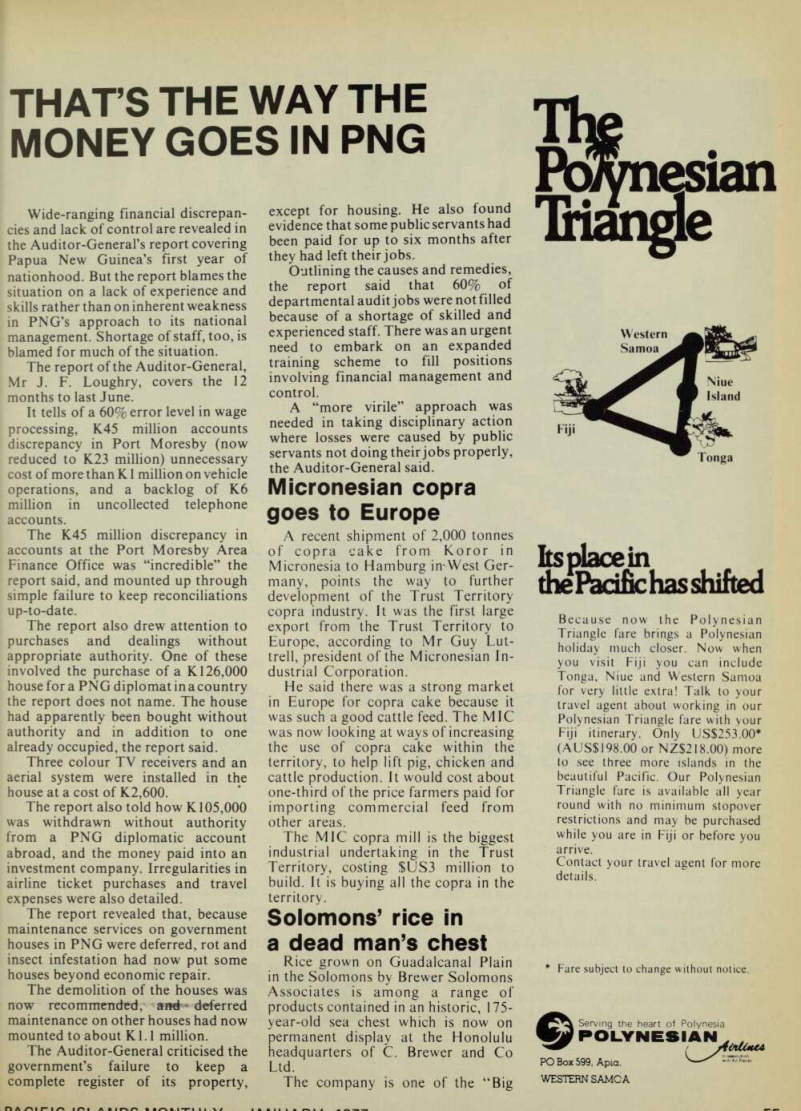
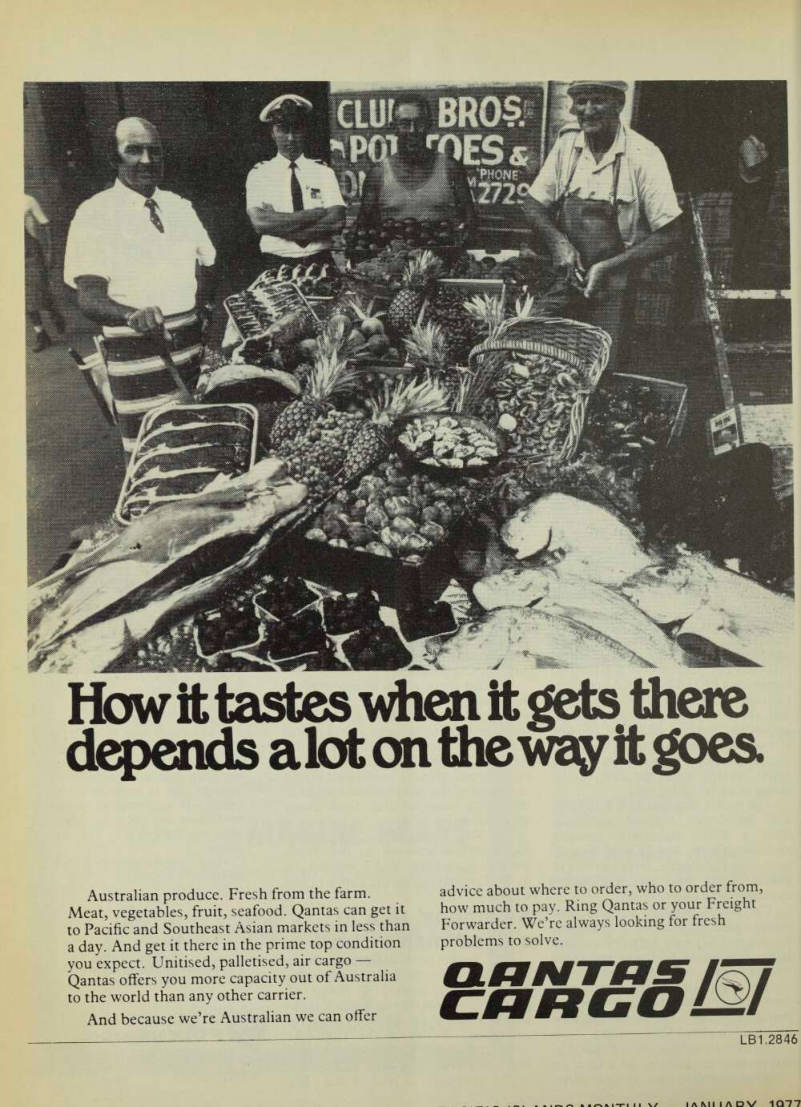
Money Goes In Png
Wide-ranging financial discrepan
cies and lack of control are revealed in the Auditor-General’s report covering Papua New Guinea’s first year of nationhood. But the report blames the situation on a lack of experience and skills rather than on inherent weakness in PNG’s approach to its national management. Shortage of staff, too, is blamed for much of the situation.
The report of the Auditor-General, Mr J. F. Loughry, covers the 12 months to last June.
It tells of a 60% error level in wage processing, K 45 million accounts discrepancy in Port Moresby (now reduced to K 23 million) unnecessary cost of more than K 1 million on vehicle operations, and a backlog of K 6 million in uncollected telephone accounts.
The K 45 million discrepancy in accounts at the Port Moresby Area Finance Office was “incredible” the report said, and mounted up through simple failure to keep reconciliations up-to-date.
The report also drew attention to purchases and dealings without appropriate authority. One of these involved the purchase of a K 126,000 house fora PNG diplomat in a country the report does not name. The house had apparently been bought without authority and in addition to one already occupied, the report said.
Three colour TV receivers and an aerial system were installed in the house at a cost of K 2,600.
The report also told how K 105,000 was withdrawn without authority from a PNG diplomatic account abroad, and the money paid into an investment company. Irregularities in airline ticket purchases and travel expenses were also detailed.
The report revealed that, because maintenance services on government houses in PNG were deferred, rot and insect infestation had now put some houses beyond economic repair.
The demolition of the houses was now recommended, and * deferred maintenance on other houses had now mounted to about Kl.l million.
The Auditor-General criticised the government’s failure to keep a complete register of its property,
except for housing. He also found evidence that some public servants had been paid for up to six months after they had left their jobs.
Outlining the causes and remedies, the report said that 60% of departmental audit jobs were not filled because of a shortage of skilled and experienced staff. There was an urgent need to embark on an expanded training scheme to fill positions involving financial management and control.
A “more virile” approach was needed in taking disciplinary action where losses were caused by public servants not doing their jobs properly, the Auditor-General said.
Micronesian copra
goes to Europe
A recent shipment of 2,000 tonnes of copra cake from Koror in Micronesia to Hamburg in-West Ger many, points the way to further development of the Trust Territory copra industry. It was the first large export from the Trust Territory to Europe, according to Mr Guy Lut trell, president of the Micronesian In dustrial Corporation.
He said there was a strong market in Europe for copra cake because it was such a good cattle feed. The MIC was now looking at ways of increasing the use of copra cake within the territory, to help lift pig, chicken and cattle production. It would cost about one-third of the price farmers paid for importing commercial feed from other areas.
The MIC copra mill is the biggest industrial undertaking in the Trust Territory, costing SUS 3 million to build. It is buying all the copra in the territory.
Solomons’ rice in
a dead man’s chest
Rice grown on Guadalcanal Plain in the Solomons by Brewer Solomons Associates is among a range of products contained in an historic, 175year-old sea chest which is now on permanent display at the Honolulu headquarters of C. Brewer and Co Ltd.
The company is one of the “Big
Five” businesses in Hawaii. Brewer Solomons Associates is one of its sub sidiaries.
The chest also contains many other items including sugar and macadamia nuts from Hawaii, spices and coffee from Central America and fresh and processed potatoes from Oregon all produced and marketed by C.
Brewer and subsidiaries around the world.
The chest, which originally belong ed to Captain James Hunnewell, who founded the Brewer company in Honolulu in 1826, was a 150th an niversary present to the company from Robert F. Caiman, executive vice-president of IU International Corp, of Philadelphia. IU holds 53% of the shares in Brewer & Co.
Caiman discovered the chest by ac cident in a Wolfeboro, New Hampshire, antique shop last summer. The link with Hunnewell was discovered from a scratched in scription inside.
A Brewer news release says the chest "is an excellent example of early American craftsmanship. Its hand cut, dovetail joints and handforged hinges are as strong today as when it was built in New England around 1800”.
The Coolidge
emptied at last
All the oil has been salvaged from the President Coolidge, the US troopship which sank in Segond Channel at Santo in the New Hebrides during World War II after hilling a US mine. The last 191 tons of oil pumped from the ship was transferred to the P&O liner, Ar cadia, when she called at Santo recently.
P&O bought all the oil. Salvage Pacific Ltd, of Suva, which had the contract to remove the oil, started work in July. Altogether, it recovered 550 tons of oil, which was 300 tons less than the quantity believed to be still in the wreck.
Divers are still working in the wreck, particularly in the engine rooms, trying to recover usable metal. • The Papua New Guinea Finance Minister, Mr Julius Chan, announced in November that the Asian Develop ment Bank had approved a loan of K 10.5 million to establish water supplies in a number of PNG towns.
The loan would cover construction of water supplies for Lae, Mount Hagen and Wewak, and the design of a scheme for Madang.
Advertisements & other items, pp. 55-56 (3 items)
55
n A I r I IO I A A I l"N r* It A KI T 111 V / I A fell I * v y
Triangle
esian
Western Samoa Niue Island Hji
Tonga
Its place in
the Pacific has shifted
Because now the Polynesian
Triangle fare brings a Polynesian
holiday much closer. Now when you visit Fiji you can include Tonga, Niue and Western Samoa for very little extra! Talk to your travel agent about working in our Polynesian Triangle fare with your
Fiji itinerary. Only U55253.00*
(AUSSI9B.OO or NZ$2lB.OO) more to see three more islands in the beautiful Pacific. Our Polynesian Triangle fare is available all year round with no minimum stopover restrictions and may be purchased while you are in Fiji or before you arrive.
Contact your travel agent for more details.
Fare subject to change without notice. ©Serving the heart of Polynesia
POLYNESIAN . ,
PO Box 599, Apia. '—^
WESTERN SAMOA
k mt A % How ft tastes when ft gets there depends alot on the way it goes.
Australian produce. Fresh from the farm.
Meat, vegetables, fruit, seafood. Qantas can get it to Pacific and Southeast Asian markets in less than a day. And get it there in the prime top condition you expect. Unitised, palletised, air cargo Qantas offers you more capacity out of Australia to the world than any other carrier.
And because we’re Australian we can offer advice about where to order, who to order from, how much to pay. Ring Qantas or your Freight Forwarder. We’re always looking for fresh problems to solve.
I®/ L 81.2846
ii ia Ml IA DV 1077
China’ Somare Says
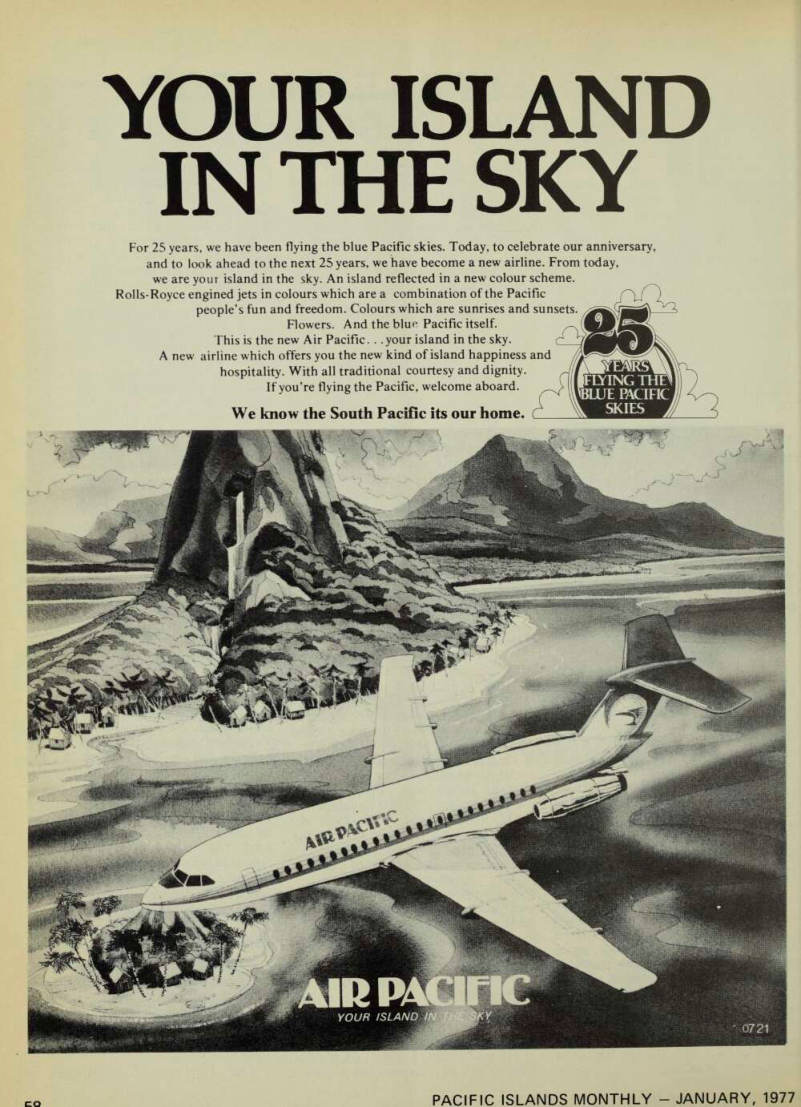
‘Let’S Learn From
The Papua New Guinea Prime Minister, Mr Michael Somare, has advocated Chinese-type communes and production brigades for PNG but not run by central authority.
He told a university audience in Port Moresby in November that village society itself would have to dic tate the social and political structure of any commune in a given area.
The government’s only role would be to provide the opportunities and the technical aid, not to lay down an obligatory blueprint or inflexible con cept.
Mr Somare was giving his first public assessment of what he learnt in China during his State visit in Oc tober. He spoke to a big crowd of un iversity students and the public at the University of PNG.
Mr Somare criticised PNG’s con tinued reliance on Australia for the supply of huge quantities of small im ports which he believed could be better made at home. He suggested that adoption of some Chinese-style attitudes to self-reliance would solve the problem.
Mr Somare also calimed that Australia was unable to provide ad vice and expertise in the village-level technology which PNG so badly need ed.
He believed China had the answers to this need, although the farm technology of the old China was probably more suited to PNG’s needs than the new intensive farming needed to feed China’s vast population.
Mr Somare gave impressive figures and descriptions of a commune which he had visted near Shanghai, and where more than 27,000 people lived.
He believed the fresh food re quirements and some of the smaller manufactured items needed by PNG’s main cities could come from a similar type of commune development.
But Mr Somare stressed that the motivation for the commune and the final shape taken by any commune should be dictated by the people living in it, not by central authority.
Mr Somare avoided reference to Chinese politics in his address, except to concede that there was a link between Chinese ideology and the type of development which he believed was applicable to PNG.
He said: “But I went to China to look at the way massive development
problems have been tackled, not to look at Chinese politics”.
Mr Somare quoted from the national constitutions of China and PNG to illustrate the wider freedoms which he believed were enjoyed by Papua New Guineas as citizens.
He said he was concerned only with adapting Chinese ideas in self-reliance which were applicable to PNG, and which he believed could go a long way towards decentralisation, develop ment and equitable distribution of recourses.
He believed a basic difference between the two countries at present was that China had learnt to tame its environment, and PNG had learnt to co-exist with its environment. This had made China more determined, and PNG more complacent.
Toasted peanuts,
a new Fiji export
A Taveuni, Fiji, company has developed a toasted peanut enterprise, which has established a market throughout Fiji and is now looking for export trade with New Zealand. The peanuts are produced on the Tarte copra estates, Waimaqere and Nalovo, in the southern part of the island.
Mr Daryl Tarte, Mr Brian Leonard, and four Tarte estate employees, Laisiasa Tuimota, Maika Vosata, Aporosa Waqa and Ilisoni Uganidavui, have formed a company, Taveuni Toasted Peanut Co Ltd, to operate the venture. Special cooking equipment has been installed for the roasting process.
Peanut processing is something new for Taveuni, which is noted more for its heavy rainfall, good quality copra, and the unique orchid, the tagimaucia, which grows only on the shores of a mountain lake above the small township of Somosomo.
Big new fisheries
college for PNG
Construction of Papua New Guinea’s first national fisheries college near Kavieng in the New Ireland province is already under way.
Its first intake of 100 students is ex pected to enrol at the beginning of 1978.
The Japanese Government is
providing K 1.65 million for construc tion of the college under arrangements concluded between the PNG and Japanese governments in I November, 1975.
The grant covers design and con struction of administration and classroom buildings, dormitories, a dining hall, workshop facilities and slipway, plant and a fisheries training vessel.
A contract worth K 700,000 has already been awarded to the Rabaul Building and Maintenance Co for the I construction of college buildings, and a K 400,000 contract has gone to Hor nibrooks Construction Pty Ltd for the i building of the slipway, wharf and
[ workshop.
College courses will be of three kinds: a three-year course for a Diploma in Tropical Fisheries, a one ‘ year course for a Grade-Two Cer tificate in Tropical Fisheries, and a six-month course for a Primary Cer tificate in Tropical Fisheries.
BHP’s O.K. for
Ok Tedi
The chairman of Broken Hill Proprietary Ltd advised Papua New Guinea Prime Minister, Mr Michael Somare, late last year that a consor tium agreement had been signed to carry out major feasibility studies of the Ok Tedi copper prospect in the Western Province of PNG.
The study will take Vh years to complete and will cost K 8.6 million.
Mr Somare said that the two groups who have joined with BHP’s mining subsidiary, DAMPCO, are Mount Fubilan Development Co of Amoco Minerals (a subsidiary of Standard Oil of Indiana), and a group of three West German metal process ing companies collectively known as Kupfer exploration Gesellschaft (these are Metallgesellschaft, Kabel und Metallwerke; Gutehoff nungshutte; and Siemens). Combined assets of the parent companies amount to more than KlO billion.
Fiji plans
a big loan
Fiji has a stay-put budget for 1977.
Rather than increase personal or company tax, the Finance Minister, Mr Charles Stinson, opted for a massive borrowing programme aimed at raising $7O million. With revenue estimated at $133 million, the total budget will be more than $203 million, the first time a Fiji budget has exceeded $2OO million. Even then, Mr
Stinson expects a deficit of about $l4 million.
Taxes have been increased on a number of items. Wine is up by about 10c a bottle, and whisky by about 28c a bottle. Mr Stinson says the rises are aimed at making people drink less.
There are higher import taxes on cosmetics, soaps, garments, shoes, table linen, handkerchiefs, ties and scarves. These are more in the nature of protective tariffs as they are design ed to encourage local industry.
Mr Stinson said the huge borrow ing programme would avert the highest taxes ever known in Fiji. The big borrowing and deficit plans were aimed at keeping as much money as possible in the hands of the people to boost spending on local goods and services, which would help business to recover from the slump which set in about two years ago, and create more work.
PNG coffee has
a copper tinge
Coffee is expected to move into number one place this year as Papua New Guinea’s export earner, ex ceeding even the earnings from the big Bougainville copper mine.
The Primary Industry Minister, Mr Boyamo Sali, reported this to the PNG National Parliament, saying that export earnings from coffee were expected to exceed KI 15 million in 1977. (The Bougainville copper mine would still be the biggest unit in the economy because of internal effects which it generates.) Mr Sali was introducing a Bill to consolidate existing laws on coffee marketing. The Bill will retain all the powers contained in existing legisla tion, but it will also establish a stabilisation fund to cushion the effect of depressed years.
Advertisements & other items, pp. 58-61 (2 items)
Your Island
IN THE SKY
For 25 years, we have been flying the blue Pacific skies. Today, to celebrate our anniversary, and to look ahead to the next 25 years, we have become a new airline. From today, we are your island in the sky. An island reflected in a new colour scheme.
Rolls-Royce engined jets in colours which are a combination of the Pacific people’s fun and freedom. Colours which are sunrises and sunsets.
Flowers. And the blue Pacific itself.
This is the new Air Pacific. . . your island in the sky.
A new airline which offers you the new kind of island happiness and hospitality. With all traditional courtesy and dignity.
If you’re flying the Pacific, welcome aboard.
We know the South Pacific its our home. .1 X mm % — 4Bk V» ■
Q E
offers expert insurance service
throughout the Islands
QBE INSURANCE
LIMITED
(FORMERLY—QUEENSLAND INSURANCE COMPANY)
Central Office: 82 Pitt Street, Sydney FlJl—Branch Office, Suva, Manager for Fiji; L.G.Liddell A.A.1.1.
LAUTOKA—Sub-Branch Office: Bums Philp Bldg.
HONIARA (8.5.1. P.) —Breckwoldt & Company (5.1.) Pty. Limited.
NEW CALEDONIA—T. A. Hagen, Ste. W. A. Johnston, S.A.R.L. —Noumea.
NEW HEBRIDES-—District Manager; G. F. Donnelly, Vila; Santo; Burns Philp (New Hebrides) Ltd.
TAHlTl—Arthur Chung: Immeuble B.L, Front de Mer, Papeete.
NIUE, NORFOLK ISLAND, SAMOA, TONGA and other South Sea Islands—Bums Philp (South Sea) Company Ltd.
Q
ii a a
SSLAND INSURANCE (P.N.G.) LTD
PAPUA NEW GUINEA-Head Office, PORT MORESBY.
General Manager: J.M.Dawe. Assistant Manager: R.Jackson^,.A.l.l.
District Managers at: ARAWA: J.Longbut LAE: W.J.Leonard MADANG: I.R.Martin
MOUNT HAGEN: D.F.CarroU RABAUL: A.M.Tanner
travel the islands
" □ New Caledonia. French New □ The Lost Caravel Robert
Langdon shatters traditionally-held
views on the Polynesians in this controversial, historical whodunnit described by Prof. Ron Crocombe as a “masterpiece as fascinating as it is important”. Also invaluable as a record of early Pacific exploration. 368 pp. Profusely illustrated with maps and plates. SAIB or SUS 26,
posted anywhere.
□ The Story of the Solomons.
Simple, lucid outline of the history of the Solomon Islands, from a refreshingly frank and affectionate point of view, by Dr. C.E’Fox. 88 pp. SA3 or
SUS 4, posted anywhere.
□ Papua New Guinea Handbook 1976. Completely revised, reset, and containing full details of this newly
independent nation history, geog-
raphy, government, industry, tourist
accommodation, etc. Clear maps include a large coloured, fold-out map of PNG. 5A7.50 or SUSIO,
posted anywhere.
□ Myths and Legends of Torres Strait. Margaret Lawrie collected these stories from the Western, Central and Eastern islands of Torres Strait, including Saibai and
Boigu, and Queensland University
Press bought them together in
this magnificently produced
large-format volume of 372 pages.
Splendidly illustrated with colour photographs, drawings, paintings and maps, and including a 45 rpm record of songs of Torres Strait. 5A28.00 or 5U535.00
posted anywhere.
□ Port Moresby, Yesterday and Today. In what is even more than a history of Papua New Guinea’s capital, Canon lan Stuart takes us on an entertaining, personalised tour of the city, Softcover, 368 pp. Maps p illustrations. 5A3.50 or SUS4.SO,
posted anywhere. “
□ Holy Torture in Fiji, Firewalking and other sacred, ancient rituals of Fiji’s Hindus described in text t y, and colour photographs. Large format, 64 pp. Illustrated. 5A4.50 —■
or SUS6.SO, posted anywhere.
□ New Hebrides. One of the superb Islands in the Sun colour series of brilliant full-colour plates, maps and text, this volume describes the unique British-French Condominium of the New Hebrides. A guide for travellers, or for collectors. 128 pp.
Fully illustrated. SAIO or SUSI 3,
posted anywhere.
Caledonia, superbly depicted in
full colour photographs, with informative text and maps giving
history, geography and daily
life. An Islands in the Sun guide, with 128 pp. Fully illustrated.
SAIO or SUSI 3, posted anywhere.
O Bora Bora. One of the French
Pacific’s fascinating, colourful high
islands, reached from Tahiti, here presented in sparkling full colour pictures for visitors or mere armchair travellers. Another Islands in the Sun guide, with the same attention to to detail. 128 pp. Fully illustrated.
SAIO or SUSI 3 posted anywhere.
□ Fiji Fiji, The multi-racial dominioi of friendly Fiji, crossroads of the Pacific, described in colour photographs, maps and text, uniform with the beautiful series listed above.
Many people buy the whole set.
More titles to be published. 128 pp.
Fully illustrated. SAIO or SUSI 3,
posted anywhere.
□ Little Chimbu in Bougainville.
For the young and young-in-heart, lovable Little Chimbu and his friends visit Panguna, and get into awful trouble in what could be the biggest hole in the world, the Bougainville copper mine. Nancy Curtis, who usee to live there, tells the story in full colour drawings which are also acciu and instructive. Also in the colourful Nancy Curtis series for children are □ Little Balus and □ Fiji Johnny.
About 48 pp. Illustrated. Each SA3.f
or SUS4.SO posted anywhere.
□ Percy Chatterton’s Papua: Day T 1 I Have Loved. Charming evocative account of changing Papua as Rev.
Percy Chatterton knew it for 50 yeai 144 pp. Illustrated. 5A6.50 or SUSS, ;d j
posted anywhere.
□ Colonial Era Cemetery of Norfoll Island. Former Administrator of the island, R.Nixon Dalkin,, describes life and death in what was Britain’s harshest Pacific penal colony. There are illuminating, often moving storie: in these photographs, charts and tions that de inscriptions that describe the historic cemetery. Large format, 92 pp.
Illustrated. SAS or SUS7.SO, posted
anywhere.
□ Easter Island. At last, a new boo on fascinating Easter Island history daily life and the mysterious giant statues. All in full colour with maps and information for travellers, as one the Islands in the Sun series. Half of this splendid book is devoted to descriptions and photographs of the statues that made the island famous.
SAIO or SUSI 3, posted anywhere. a /■* ir - i in AMr\c l\/ir*MTUI V lAMIIARV 1Q77
without leaving home I
□ Marine Shells of the Pacific Volume II. Walter Cernohorsky carries on where his first book left off, with a further 600 species fully described and illustrated: Some of the 68 full page plates are in colour. 412 pp.
Illustrated. SA17 or SUS25,
posted anywhere.
□ Friendly Island. Warm account of life in Tonga, sunlit South Pacific
island kingdom, by Patricia Ledyard,
who has lived in a Tongan harbourside village for more than 20 years.
Paperback, 215 pp. $A3 or SUS4.50,
posted anywhere,
□ Plants and Flowers of Tahiti. Full colour photographs of the rich and beautiful Tahitian flora, classified by scientific names, and by French, English and Tahitian common names. 144 pp. Fully illustrated. $A5 or
SUS7, posted anywhere.
□ Birds of Tahiti, A companion volume to Plants and Flowers of Tahiti. Full colour photographs and descriptions, for collectors or amateur birdwatchers, visitors and students needing easy identification. 112 pp. Fully illustrated. $A5 or $US7, posted anywhere. □ Tahiti: Island of Love. In this book the author of The Lost Caravel presents the vivid, colourful history of Tahiti
from its discovery by Europeans to
modern times. Eminently readable, now in its fourth edition. 284 pp. Illustrated.
SA4.50 or SUS6.00, posted anywhere.
D Tahiti and its Islands. New revised editon, just released, of this popular title in the Islands in the Sun series.
Sparkling new colour plates, new information, new maps. Includes the Leeward Islands, the Tuamotus, the Gamblers, Marquesas the Australs.
Has hotel lists and places to see. 128 pp. Fully illustrated. SA10 or SUS13, posted anywhere. □ Log of the Mahina: A Tale of the South Pacific. Young American John Neal took his 27ft. yacht from Seattle on an 18 months cruise through Polynesia and then wrote about it. This delightfully refreshing book abounds with information on how to get there and what to do when you are there. John Neal learned it the hard way and shares his experiences with
enthusiasm. Required reading for
all yachties venturing into Polynesia’s dangers and pleasures, physical and romantic, 280 pp.
Illustrated, SA6.00 or SUS7.50,
posted anywhere.
□ Say it in Fijian. Dr.A.J.Schutz presents a pocket sized, entertaining guide to the Fijian language for those making their first contact with Fiji. $A2.00 or SUS3.00, posted anywhere. □ Say it in Motu. In the same series, Dr, Percy Chatterton provides an instant introduction to one of the three official languages of Papua New Guinea; the common tongue of the streets and markets off Port Moresby. SA2.00 or $US3.00,
posted anywhere.
□ Now in preparation in the same series are Say it in Fiji Hindi and Say it in Tahitian. Advance orders
accepted.
□ Available soon! Pacific Islands Year Book for 1977! Completely revised, reset in a new format.
Hundreds of pages of facts and maps on all the Pacific Islands. Advance orders taken for this invaluable reference book. $A18 or SUS26,
posted anywhere.
□ Fold-out maps of the Pacific! Large size, in colour. Norfolk Island, Lord Howe Island, the Tonga group. Others in preparation, including a general map of the Pacific Ocean. $A2 or $US3, posted anywhere
nSE
wrA
oi
VheK'v^o
n »/-.in in aivi no i\/ir\MTUI V _ lAMIIARV 1Q77
n »/-.in in aivi no i\/ir\MTUI V lAMIIARV 1Q77
Pacific Transport
The Solomons Looks At Its
Transport Problems
Shipping is given priority over road and air transport in the Solomons, in a report made recently by a special committee after making a survey of national transport needs.
The committee, which was set up by the Minister of Works and Utilities, Mr Tepaika, recommended a 20-year programme to expand inter island shipping as a top priority.
A 20-year period was necessary because ports, airfields and roads were expensive to build, the report said. But they were long-lasting when built. It the economy was to grow a much improved transport system was essential, and should have a high priority in the allocation of national resources.
The committee said that, in most countries, road transport was the cheapest and most convenient way of moving freight. But that did not apply in the Solomons. Because the islands were scattered, sea transport was obviously of major importance.
Within individual islands, the long coastline, the difficult terrain for road building and the widely-scattered communities were factors in favour of sea transport against roads. The committee said that first there should be development of inter-island ports, then feeder services both by road and sea, then the development of Point Cruz as the country’s main inter national and trans-shipment port.
Each large island needed one or two really good ports to simplify trans-shipment of goods, to make passenger travel easier, and to help develop the economy of the island.
Ports should be sited not only where they were suitable for shipping, but to meet the needs of the people and the economy. Local ports would be part of the overall transport picture, linked to the outside world through an international port such as Point Cruz.
If the economy expanded at the rate of 4% a year over the next 20 years, the amount of imports handled at an international wharf would more than double from the 60,000 tonnes in 1975 to 130,000 tonnes. Point Cruz, if
properly developed could easily
handle all cargo forecast for the next 20 years. , .. , , Early consideration should be given to setting up a marine services authority to incorporate the functions of the Port Authority, Tulagi dockyard and the Marine Division s commercial shipping activities.
The committee came down against a national airline. The cost would be very high, maintenance problems severe and the service offered would be inadequate. The Solomons’ needs would best be met by encouraging all airlines in the Pacific to route their smaller aircraft through the country.
The committee was also against a
second international airport. Hen derson Field, near Honiara was not used enough, and could easily handle all international traffic. There was no ca jj f or bi g g er aircraft as mass tourist trave i the Solomons was unlikely to d eve i o p The country’s hotels and communicat i o ns were not geared to mass travel The service provided by Solair, the internal airline, was good, and financially self-supporting to a large degree.
The committee reported that the present airfield construction for Ontong Java, Reefs and Santa Ana was sound and when completed would provide a reasonably adequate network of internal airfields.
Bumpy Flight For Air Niugini
Air Niugini expects to have its own Boeing 707 flying its international routes in February, but so far the flight has not all been smooth. The PNG Transport Minister, Mr Bruce Jephcott, in Parliament recently had to defend the decision to buy the Boeing from Qantas for K 5 million. This was only a week or so after Air Niugini’s international operations were threatened by the collapse of the charter company which is providing the service.
The charter company is the UKbased Tempair, which is a subsidiary of Templewood Aviation International Ltd. Tempair, under the charter, provided a Boeing 707, crews, maintenance and operations as a package deal, which was due to expire in February.
With Tempair in difficulties another UK company, Stanhope Shipping, came to the rescue and after negotiations with PNG, Air Niugini services remained intact. However, PNG expected to pay higher operating costs under the new deal.
Mr Jephcott, defending the purchase of the Boeing from Qantas, said it had been an extremely good deal economically, and the training and technical arrangements which went with it were excellent. Mr
Jephcott was replying to questions from his predecessor in the Transport portfolio, Mr lambakey Okuk (now a back-bencher).
Mr Okuk inferred that Mr Jephcott was favouring Australia in deals in volving Air Niugini, and that the PNG airline industry was being forc ed into dependence on Australia. He asked Mr Jephcott if he could explain why the deal was not able to provide the full capabilities which Air Niugini might have expected, and when the PNG Government intended to buy out the 40% shareholding which Australian airlines hold in Air Niugini. (The PNG Government owns 60% of Air Niugini. Ansett holds 16% and Qantas and TAA 12% each.) Mr Jephcott said he had not the slightest intention of letting any foreign airline or foreign country dominate Air Niugini. He could not give a date for buying out the Australian holding in Air Niugini, and added, “But our aim is to own our own airline”.
The deal with Qantas includes crew training and conversion, a spare engine, special navigational equip ment, all life-saving gear, and the preparation of the aircraft for im mediate operation on delivery.
Advertisements & other items, p. 62 (1 item)
62
DAPiPir IQI AMDS MONTH I Y - JANUARY. 1977
Nauru Pacific
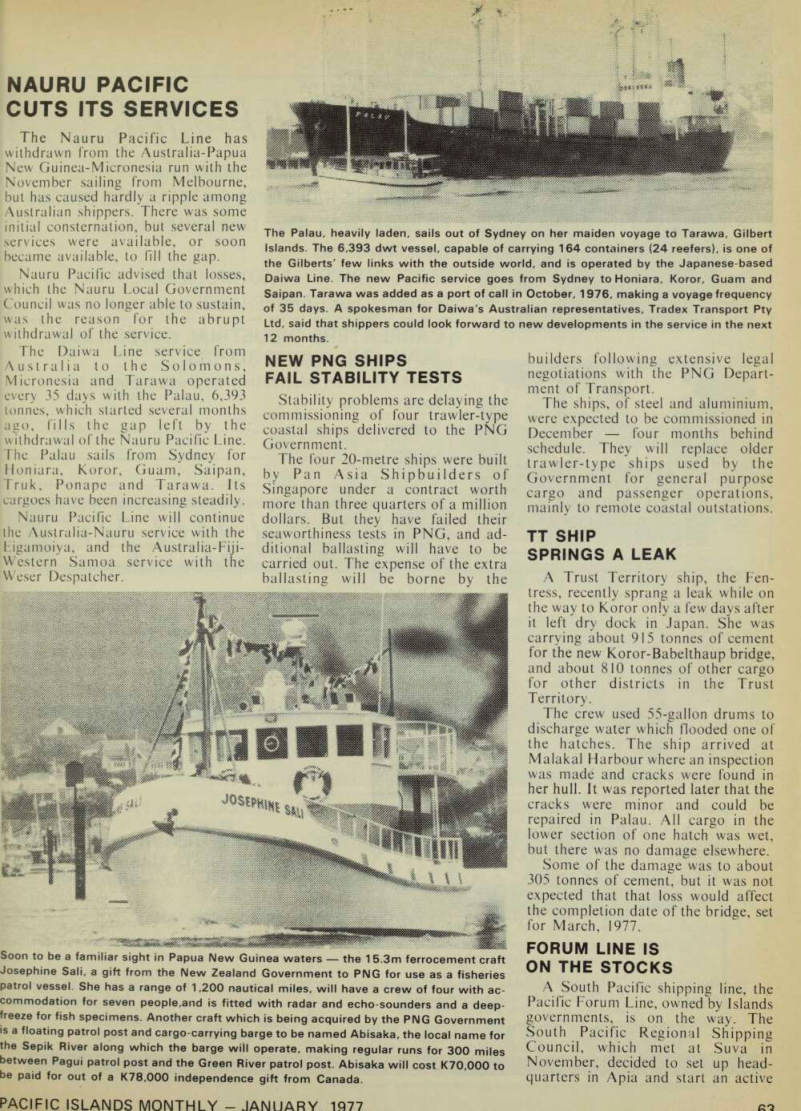
Cuts Its Services
The Nauru Pacific Line has withdrawn from the Australia-Papua New Guinea-Micronesia run with the November sailing from Melbourne, but has caused hardly a ripple among Australian shippers. There was some initial consternation, but several new services were available, or soon became available, to fill the gap.
Nauru Pacific advised that losses, which the Nauru Local Government Council was no longer able to sustain, was the reason for the abrupt withdrawal of the service.
The Daiwa Line service from Australia to the Solomons, Micronesia and Tarawa operated every 35 days with the Palau, 6,393 tonnes, which started several months ago, fills the gap left by the withdrawal of the Nauru Pacific Line.
The Palau sails from Sydney for Honiara, Koror, Guam, Saipan, Truk, Ponape and Tarawa. Its cargoes have been increasing steadily.
Nauru Pacific Line will continue the Australia-Nauru service with the Figamoiya, and the Australia-Fiji- Weslern Samoa service with the Weser Despatcher.
New Png Ships
Fail Stability Tests
Stability problems are delaying the commissioning of four trawler-type coastal ships delivered to the PNG Government.
The four 20-metre ships were built by Pan Asia Shipbuilders of Singapore under a contract worth more than three quarters of a million dollars. But they have failed their seaworthiness tests in PNG, and ad ditional ballasting will have to be carried out. The expense of the extra ballasting will be borne by the
builders following extensive legal negotiations with the PNG Depart ment of Transport.
The ships, of steel and aluminium, were expected to be commissioned in December four months behind schedule. They will replace older trawler-type ships used by the Government for general purpose cargo and passenger operations, mainly to remote coastal outstations.
Tt Ship
Springs A Leak
A Trust Territory ship, the Fen tress, recently sprang a leak while on the way to Koror only a few days after it left dry dock in Japan. She was carrying about 915 tonnes of cement for the new Koror-Babelthaup bridge, and about 810 tonnes of other cargo for other districts in the Trust Territory.
The crew used 55-gallon drums to discharge water which flooded one of the hatches. The ship arrived at Malakal Harbour where an inspection was made and cracks were found in her hull. It was reported later that the cracks were minor and could be repaired in Palau. All cargo in the lower section of one hatch was wet, but there was no damage elsewhere.
Some of the damage was to about 305 tonnes of cement, but it was not expected that that loss would affect the completion date of the bridge, set for March, 1977.
Forum Line Is
On The Stocks
A South Pacific shipping line, the Pacific Forum Line, owned by Islands governments, is on the way. The South Pacific Regional Shipping Council, which met at Suva in November, decided to set up head quarters in Apia and start an active
Soon to be a familiar sight in Papua New Guinea waters-the 15.3m ferrocement craft Josephine Sali, a gift from the New Zealand Government to PNG for use as a fisheries patrol vessel. She has a range of 1,200 nautical miles, will have a crew of four with ac commodation for seven people,and is fitted with radar and echo-sounders and a deep freeze for fish specimens. Another craft which is being acquired by the PNG Government is a floating patrol post and cargo-carrying barge to be named Abisaka, the local name for the Sepik River along which the barge will operate, making regular runs for 300 miles between Pagui patrol post and the Green River patrol post. Abisaka will cost K70,000 to be paid for out of a K78,000 independence gift from Canada.
The Palau, heavily laden, sails out of Sydney on her maiden voyage to Tarawa, Gilbert Islands. The 6,393 dwt vessel, capable of carrying 164 containers (24 reefers), is one of the Gilberts' few links with the outside world, and is operated by the Japanese-based Daiwa Line. The new Pacific service goes from Sydney to Honiara, Koror, Guam and Saipan. Tarawa was added as a port of call in October, 1976, making a voyage frequency of 35 days. A spokesman for Daiwa's Australian representatives, Tradex Transport Pty Ltd, said that shippers could look forward to new developments in the service in the next 12 months.
marketing policy to obtain cargo.
The council’s hope is that the ship ping line will be operating the main trunk routes covering Australia, New Zealand and the Islands by the second half of 1977. However, there are still many matters to be attended to before the first ship sails.
Where will the ships come from?
The council said that Nauru, New Zealand and Western Samoa had “in dicated an interest” in supplying ships. The council also reported that the Cook Islands, Fiji, Papua New Guinea and Tonga were willing to take part in the line, and the Gilbert Islands might come in.
A constitution still has to be agreed. There is agreement on a draft constitution, to be considered by the countries taking part, and ratified. An interim board of directors will be ap pointed to establish the line under the council’s guidance.
It was not stated what the eventual powers of the board would be, but if it is to be under the guidance of the council the line is doomed. No managing director or board will be able to operate efficiently when sub ject to the whim of individual governments. The line will only succeed if the board is given its brief and then left to carry it out without in leference.
East-West Gets
Norfolk Service
The Tamworth (NSW) based East- West Airlines has been granted a licence to operate the Sydney-Norfolk Island service, and expects to take over from Qantas on March 1. The Minister for Transport, Mr Nixon, announcing the grant of the licence, said it was in line with a recom mendation in the Nimmo report.
Sir John Nimmo recommended that Qantas be relieved of the responsibility of operating the service to the island, a recommendation which, no doubt, was received with a sigh of relief at Qantas. The ageing DC4s (Skymasters) with which Qantas operate the service, have been a losing proposition for years.
East-West Airlines recently took delivery of two F 27-5009 turbo-prop aircraft, the most modern turbo-prop aircraft in the world. They are fitted with special long-range tanks, and have all the necessary equipment to enable them to fly over water.
East-West expects to take part in phase-in phase-out operation with Qantas. Frequencies have yet to be worked out, but it is likdy East-West
services will fly more frequently as the seating capacity, because of the amount of fuel to be carried, will be 40, compared with up to 58 in the DC4s.
Transport Briefs
• Air Hibiscus may not get off the ground in its bid to operate cheap charter flights from Fiji, initially to the Bahamas and later to Europe. The Fiji Government granted the com pany a permit to operate in July. The first flight was scheduled for October 12, but did not eventuate. The com pany was then informed that unless it began flights by January 1, the licence would be withdrawn. • A new charter service for fishing and sailing enthusiasts visiting Wewak in Papua New Guinea’s East Sepik province has been announced by Mr John Barry of Barry Enter prises. His 26-ft trimaran, licensed to carry eight passengers, may be hired for an eight-hour day for K5O. Motor craft fans may hire his 24-ft cruiser, equipped with two 150-hp motors, for K 75 a day, plus cost of fuel. The cruiser’s flat-out speed is 50 mph. • Melanesian Tourist Services, nation-wide tour operator in Papua New Guinea, has taken over the Sepik River pleasure craft Sepik Explorer, and the Ambunti guesthouse. The move follows the temporary closure of Karawari Lodge in August. • The Micronesian Princess, a container/conventional cargo ship, is for sale at SUSI. 6 million. The ship was charted to the Palau Shipping Co by its owner, the Trust Territory Government. There were no initial bids, but one company submitted a proposal, which was under considera tion in November. The TT Govern ment bought the Micronesian Princess in 1974 from the Dae Sun shipbuilding and Engineering Co, South Korea. It is now offered for sale as it does not fit present operational procedures of the TT fleet. • Nauru Pacific Line is building a new ship in Japan. It will be known as Rosie D. Delivery date is expected to be sometime in July or August, 1977.
The Rosie D, which will be a little smaller than the Kolle D, will be a ser vice ship on trips to Nauru and will carry phosphate on outward trips. She is designed to carry a large quantity of bulk fuel, which will cancel the needs for tankers to call at Nauru. The Rosie D will be equipped to carry general cargo and containers.
Advertisements & other items, pp. 64-66 (4 items)
_ _ _ . . . . A . . . . A I nrkMTl I I V/ IA Ml lAD \/ 1 077
. . . . A . . . . A I nrkMTl I I V/ IA Ml lAD \/ 1 077
nedlloyd
SHIPBUILDERS TO THE PACIFIC.
m * M r A 5 mm LANDING BARGE under construction at
CARPENTERS INDUSTRIAL SHIPYARD, Walu Bay, Suva
Fiji Islands, for Mr. Anton Lee of Port Moresby, Papua New Guinea.
CARGO CAPACITY; 14,000 c.ft. LENGTH: 114ft.0.A.
Powered by twin GARDNER diesel engines each 230 hp.
[CARPENTERS INDUSTRIAL r6TbOX296 " i
I SUVA,FIJI. PHONE 312-133.
I Please send me information on Shipbuilding in the I South Pacific I Name I I I Address Company
nedlloyd
REGULAR SAILINGS BY FAST, MODERN CARGO VESSELS from EUROPE via PANAMA to:
PAPEETE, NOUMEA,
APIA, SUVA, LAUTOKA,
NEW ZEALAND.
from NEW ZEALAND via PANAMA to:
EUROPE
(MEDITERRANEAN Cr NORTH CONTINENT)
and from AUSTRALIA to:
CENTRAL AMERICA & CARIBBEAN
heavy-lift facilities—refrigerated space—cargo deeptanks For further particulars apply to Agents: Ets. Donald Tahiti Agence Maritime Aerienne Caledonienne O. F. Nelson & Co. Ltd. Carpenters Shipping Papeete. S.A. A.M.A.C., Noumea. Apia. Suva, Lautoka.
Interocean Australia Services Pty. Ltd. Joint Shipping Management Ltd.
Sydney. P.O. Box 890, Wellington, N.Z.
D pua new guim
printing co. ply. lid.
Serving the Country from Aitape to Alotau, Manus to Moresby Leaders in Commercial Offset and Letterpress Printing. • Stationery • Office Supplies • Office Equipment • Rubber Stamps • Self-Adhesive Labels • In Fact:— Everything For The Office.
P.O. Box 633, Port Moresby P.O. Box 759, Lae P.O. Box 1239, Rabaul
ExpressTreight Service between U.S. Pacific Coast Ports & o'
PAPEETE - APIA - PAGO PAGO
Full Container Service including Refrigeration
GENERAL AGENTS-. —i
fURNESS INTEROCE4N
CORPORATION
465 CALIFORNIA STREET, SAN FRANCISCO.tA 94104.
Cable INTERCO • TWX: 910-37* 7350 • RCA 276 207
• TEL <4151 396-2000
POLYNESIA LINE, LTD.
AGENTS. - - ,
PAPEETE - MORGAN; Vernex Boite Postale 449, Papeete Phone; 309 Cables: MpREX < "V.
PAGO PAGO • POLYNESIA SHIPPING SERVICES, INC., Pago Pago Phone: 633-5169 Cables; POLYSHIP APIA • UNION S.S. CO., of N.Z. Ltd., P.O. Box 50, Apia, Western Samoa Phone: 570 Cables; UNION
\ Books about: • Sailing • Navigation • Boatbuilding & Design • Cruising Tales • Fishing • Canoeing • Nautical History • etc., etc., etc.
OVER 500 TITLES IN STOCK!
Write, phone or cantor Free Book List Mail Orders & hard to get titles a speciality.
I* SKnniisf übrdrv
NOTHING BUT
BOATING BOOKS
blH*
DAIWA LINE
DIRECT REGULAR SERVICE
JAPAN-SOUTH PACIFIC
TARAWA-PAPEETE-PAGO PAGO-APSA
SUVA-LAUTOKA-NOUMEA-VILA
SANTO-HONIARA
JAPAN - TAIWAN - GUAM
JAPAN-KEELUNG-GUAM BY
EXCELLENT CAR/CONTAINER-CARRIER
JAPAN-WEST IRIAN-DILI
HONG KONG-TAIWAN-WEST IRIAN-DILI
AGENTS:
GUAM; ATKINS, KROLL (GUAM) LTD.
TARAWA: G. & E. I. DEVELOPMENT AUTHORITY.
APIA; BURNS PHILP (SOUTH SEA) CO., LTD.
PAGO PAGO; KNEUBUHL MARITIME SERVICES CORP.
NUKUALOFA: PACIFIC NAVIGATION CO., LTD.
SUVA; BURNS PHILP (SOUTH SEA) CO., LTD.
LAUTOKA: BURNS PHILP (SOUTH SEA) CO., LTD.
NOUMEA: SOCIETE D'ACCONAGA ET
TRANSPORT D'OCEANIE (SATO)
SANTO: BURNS PHILP (NEW HEBRIDES) LTD.
VILA: BURNS PHILP (NEW HEBRIDES) LTD.
HONIARA: BRITISH SOLOMONS TRADING CO., LTD.
PAPEETE: AGENCE MARITIME DE PARA UTE.
HONG KONG: IKE MARITIME CO., LTD.
SINGAPORE: THE BORNEO CO., (SINGAPORE) LTD.
DJAJAPURA: P. N. PELAJARAN NASIONAL INDONESIA.
DILI: SANG TAI HOO
TAIWAN: FOR CARGO BETWEEN JAPAN/GUAM/TAIWAN
FORMOSA SHIPPING & ENTERPRISE CORP.
TAIWAN; FOR CARGO BETWEEN JAPAN/SOUTH PACIFIC/
WEST IRIAN/DILI
MARITIME TRANSPORTATION AGENCIES, LTD.
THE DAIWA MAyiGATIOM CO., LTD.
OSAKA: “DAILINE”
HEAD OFFICE
DAIICHI KYOGYO BLDG.,
45, 2-CHOME, AWAZAMINAMI-DORI,
NISHI-KU, OSAKA, JAPAN
TELEPHONE: (06) 531-0471 ~9
TELEX: 525-6324 & 525-6325
TOKYO: “FUNEDAILINE”
TOKYO OFFICE
SHIN-DAIICHI BLDG.,
4-13, NIHONBASHI 3-CHOME, CHUO-KU,
TOKYO, JAPAN
TELEPHONE. (03) 274-3251 ~8
TELEX: 222-3343, 23559
Dapicip Ici Amrvc R/Inmtui V I A M I I A R-I W I -I -I
66
DAncip ici am nc i\/inMTi-ll Y JANUARY. 1977
Cruising
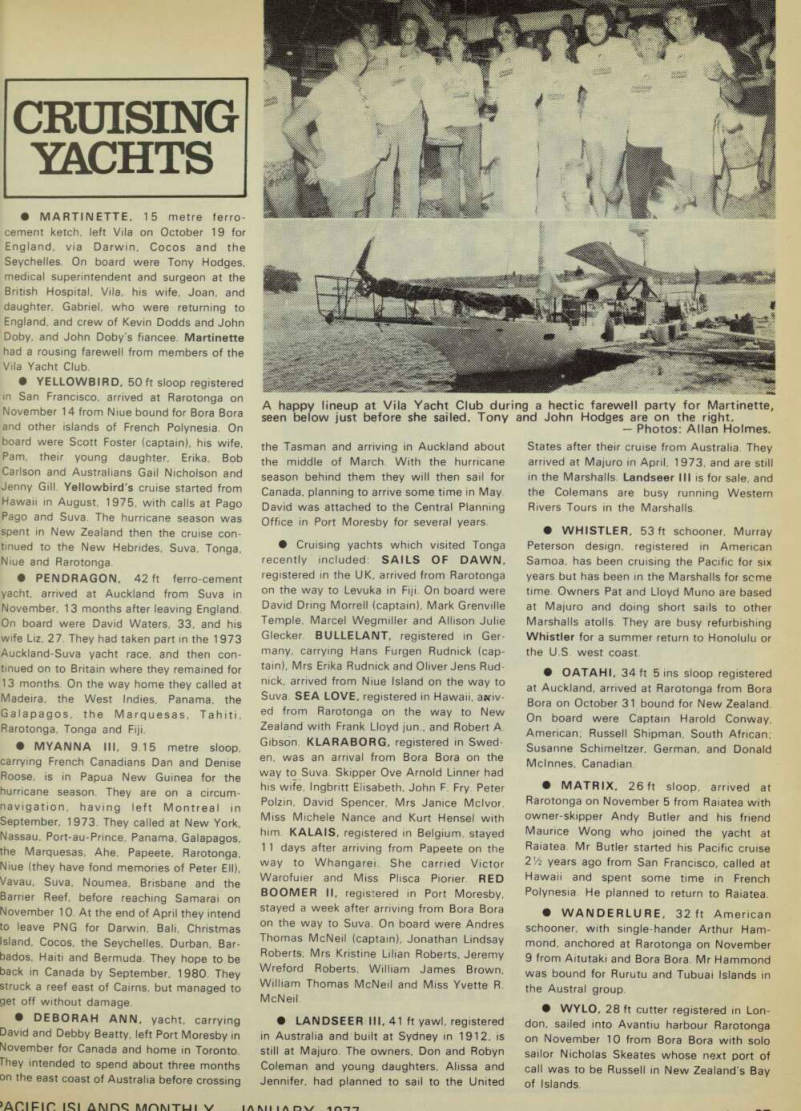
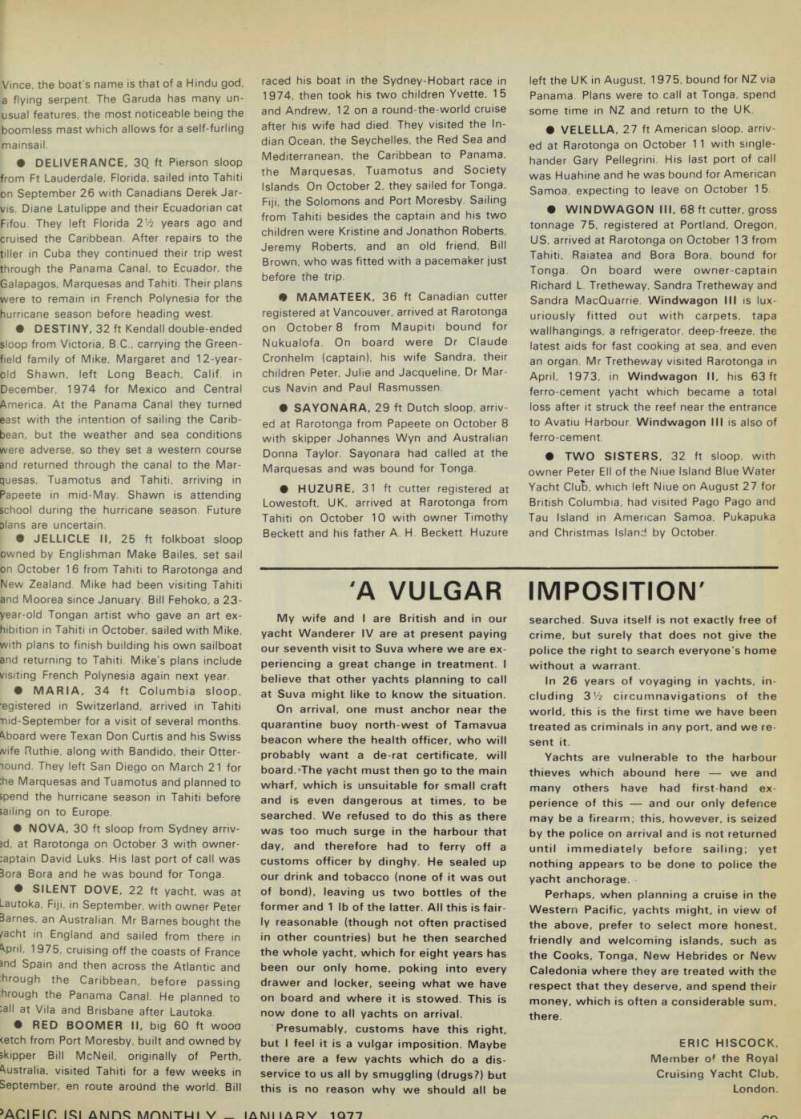
Yachts
• MARTINETTE, 15 metre ferro cement ketch, left Vila on October 19 for England, via Darwin, Cocos and the Seychelles. On board were Tony Hodges, medical superintendent and surgeon at the British Hospital, Vila, his wife, Joan, and daughter, Gabriel, who were returning to England, and crew of Kevin Dodds and John Doby, and John Doby's fiancee. Martinette had a rousing farewell from members of the Vila Yacht Club. • YELLOWBIRD, 50 ft sloop registered in San Francisco, arrived at Rarotonga on November 14 from Niue bound for Bora Bora and other islands of French Polynesia. On board were Scott Foster (captain), his wife, Pam, their young daughter, Erika, Bob Carlson and Australians Gail Nicholson and Jenny Gill. Yellowbird's cruise started from Hawaii in August, 1975, with calls at Pago Pago and Suva. The hurricane season was spent in New Zealand then the cruise con tinued to the New Hebrides, Suva, Tonga, Niue and Rarotonga. • PENDRAGON, 42 ft ferro-cement yacht, arrived at Auckland from Suva in November, 13 months after leaving England.
On board were David Waters, 33, and his wife Liz, 27, They had taken part in the 1973 Auckland-Suva yacht race, and then con tinued on to Britain where they remained for 13 months. On the way home they called at Madeira, the West Indies, Panama, the Galapagos, the Marquesas, Tahiti, Rarotonga, Tonga and Fiji. • MYANNA 111, 9.15 metre sloop, carrying French Canadians Dan and Denise Roose, is in Papua New Guinea for the hurricane season. They are on a circum navigation, having left Montreal in September, 1973. They called at New York, Nassau, Port-au-Prince, Panama, Galapagos, the Marquesas, Ahe, Papeete, Rarotonga, Niue (they have fond memories of Peter Ell), Vavau, Suva, Noumea, Brisbane and the Barrier Reef, before reaching Samarai on November 10. At the end of April they intend to leave PNG for Darwin, Bali, Christmas Island, Cocos, the Seychelles, Durban, Bar bados, Haiti and Bermuda. They hope to be back in Canada by September, 1980. They struck a reef east of Cairns, but managed to get off without damage. • DEBORAH ANN, yacht, carrying David and Debby Beatty, left Port Moresby in November for Canada and home in Toronto.
Fhey intended to spend about three months on the east coast of Australia before crossing
the Tasman and arriving in Auckland about the middle of March. With the hurricane season behind them they will then sail for Canada, planning to arrive some time in May.
David was attached to the Central Planning Office in Port Moresby for several years. • Cruising yachts which visited Tonga recently included: SAILS OF DAWN, registered in the UK, arrived from Rarotonga on the way to Levuka in Fiji. On board were David Dring Morrell (captain), Mark Grenville Temple, Marcel Wegmiller and Allison Julie Glecker. BULLELANT, registered in Ger many, carrying Hans Furgen Rudnick (cap tain), Mrs Erika Rudnick and Oliver Jens Rud nick, arrived from Niue Island on the way to Suva. SEA LOVE, registered in Hawaii, arriv ed from Rarotonga on the way to New Zealand with Frank Lloyd jun., and Robert A.
Gibson. KLARABORG, registered in Swed en, was an arrival from Bora Bora on the way to Suva. Skipper Ove Arnold Linner had his wife, Ingbritt Elisabeth, John F. Fry. Peter Polzin, David Spencer, Mrs Janice Mclvor, Miss Michele Nance and Kurt Hensel with him KALAIS, registered in Belgium, stayed 11 days after arriving from Papeete on the way to Whangarei. She carried Victor Warofuier and Miss Plisca Piorier. RED BOOMER 11, registered in Port Moresby, stayed a week after arriving from Bora Bora on the way to Suva. On board were Andres Thomas McNeil (captain), Jonathan Lindsay Roberts, Mrs Kristine Lilian Roberts, Jeremy Wreford Roberts, William James Brown, William Thomas McNeil and Miss Yvette R.
McNeil. • LANDSEER 111, 41 ft yawl, registered in Australia and built at Sydney in 1912, is still at Majuro. The owners, Don and Robyn Coleman and young daughters, Alissa and Jennifer, had planned to sail to the United
States after their cruise from Australia. They arrived at Majuro in April, 1973, and are still in the Marshalls. Landseer 111 is for sale, and the Colemans are busy running Western Rivers Tours in the Marshalls. • WHISTLER, 53ft schooner, Murray Peterson design, registered in American Samoa, has been cruising the Pacific for six years but has been in the Marshalls for seme time. Owners Pat and Lloyd Muno are based at Majuro and doing short sails to other Marshalls atolls. They are busy refurbishing Whistler for a summer return to Honolulu or the U S. west coast. • OATAHI, 34 ft 5 ins sloop registered at Auckland, arrived at Rarotonga from Bora Bora on October 31 bound for New Zealand.
On board were Captain Harold Conway, American; Russell Shipman, South African; Susanne Schimeltzer, German, and Donald Mclnnes, Canadian. • MATRIX, 26ft sloop, arrived at Rarotonga on November 5 from Raiatea with owner-skipper Andy Butler and his friend Maurice Wong who joined the yacht at Raiatea. Mr Butler started his Pacific cruise 2V4 years ago from San Francisco, called at Hawaii and spent some time in French Polynesia. He planned to return to Raiatea. • WANDERLURE, 32ft American schooner, with single-hander Arthur Ham mond, anchored at Rarotonga on November 9 from Aitutaki and Bora Bora. Mr Hammond was bound for Rurutu and Tubuai Islands in the Austral group. • WYLO, 28 ft cutter registered in Lon don, sailed into Avantiu harbour Rarotonga on November 10 from Bora Bora with solo sailor Nicholas Skeates whose next port of call was to be Russell in New Zealand's Bay of Islands.
A happy lineup at Vila Yacht Club during a hectic farewell party for Martinette, seen below just before she sailed. Tony and John Hodges are on the right. -Photos: Allan Holmes.
• NERISHMA, 39 ft sloop registered in Brisbane, called at Rarotonga on November 10 from Bora Bora bound for Auckland with David Beard (master), his wife, Jocelyn, and children Shane and Nerida Jane. • MANU OTE MTI, 47 ft ferro-cement cutter, registered at Vancouver, British Columbia, arrived at Majuro in the Marshalls on October 5, and left for Honolulu on November 10, On board were Heinz Cien ciala (who built the boat in two years) and his wife, Muriel. The Ciencialas have been cruis ing for four years, hitting virtually every major port in the Pacific circuit. After wintering in Hawaii they will return to Canada to live in the Gulf Islands. The Manu Ote Mti (Bird of the Sea) was designed by Stan Huntingford of Vancouver and is the third boat (first ferro cement boat) built by Cienciala. The cutter boasts a washing machine, freezer, two heads, radar and assorted other features to lessen the rigours of cruising life. • LE TAK NAL (Marshallese for Miss Sunrise), 32 ft Grand Banks diesel cruiser, built in Singapore in 1971 by American Marine, is in dry dock at Majuro for extensive work to convert it to a sport fishing boat for the developing tourist trade and the existing abundance of marlin in the Marshalls. The owner-skipper William A. Nagel, brought her to Majuro in 1972 after travelling through In donesia, New Guinea, and Australia, and employed her for 32,000 miles of deep-sea charter work throughout the Marshalls. Nagel also provided news of a well-known sailing vessel, the LITTLE BEAR, a 36ft carol ketch, designed by John Hanna, built by L.F and June Champion and launched in 1948 She sailed extensively in the Pacific and was described by Eric Hiscock in his book, 'Voyaging Under Sail', as one of the oustan ding sailing vessels in existence. She was acquired by Nagel in 1969 in Honolulu and was sailed as a charter vessel throughout the Marshall Islands from 1969-1975. During the typhoon season, in the autumn (northern) of 1975 Little Bear was blown ashore in a severe westerly and badly damaged. While still in dry dock she caught fire under mysterious circumstances and was totally destroyed. Sentimental sailors in the Marshalls have insisted that her keel remains on the beach as her permanent memorial. • GARUDA, 57 ft double-ended ferro cement cutter registered at Honolulu, Hawaii, arrived at Majuro on November 4. On board were retired US Air Force officer, James P.
Hagerstrom; wife, Lee, and four of their eight children, Anastasia, Eric, Mark and Vince.
The Garuda was designed and'built in four years by the owners with some help from their children and a lot of help from friends and was launched from San Diego in Oc tober, 1974. The Hagerstroms' travel plans are flexible. They hope to reach Singapore and maybe Darwin and Port Moresby but are not tied to a schedule. According to son.
Vince, the boat's name is that of a Hindu god, ;a flying serpent. The Garuda has many un usual features, the most noticeable being the boomless mast which allows for a self-furling mainsail. • DELIVERANCE, 3Q ft Pierson sloop from Ft Lauderdale, Florida, sailed into Tahiti on September 26 with Canadians Derek Jar vis, Diane Latulippe and their Ecuadorian cat Fifou. They left Florida 2'h. years ago and cruised the Caribbean. After repairs to the tiller in Cuba they continued their trip west through the Panama Canal, to Ecuador, the Galapagos, Marquesas and Tahiti. Their plans were to remain in French Polynesia for the hurricane season before heading west. • DESTINY, 32 ft Kendall double-ended sloop from Victoria, 8.C., carrying the Green field family of Mike, Margaret and 12-year old Shawn, left Long Beach, Calif, in December, 1974 for Mexico and Central America. At the Panama Canal they turned east with the intention of sailing the Carib bean, but the weather and sea conditions were adverse, so they set a western course and returned through the canal to the Mar quesas, Tuamotus and Tahiti, arriving in Papeete in mid-May. Shawn is attending school during the hurricane season. Future plans are uncertain. 9 JELLICLE 11, 25 ft folkboat sloop owned by Englishman Make Bailes, set sail on October 16 from Tahiti to Rarotonga and New Zealand. Mike had been visiting Tahiti and Moorea since January. Bill Fehoko, a 23year-old Tongan artist who gave an art ex hibition in Tahiti in October, sailed with Mike, with plans to finish building his own sailboat and returning to Tahiti. Mike's plans include visiting French Polynesia again next year. • MARIA, 34 ft Columbia sloop, ■egistered in Switzerland, arrived in Tahiti nid-September for a visit of several months.
Aboard were Texan Don Curtis and his Swiss wife Ruthie, along with Bandido, their Otter lound. They left San Diego on March 21 for :he Marquesas and Tuamotus and planned to spend the hurricane season in Tahiti before sailing on to Europe. • NOVA, 30 ft sloop from Sydney arriv -sd, at Rarotonga on October 3 with owner saptain David Luks. His last port of call was Bora Bora and he was bound for Tonga. • SILENT DOVE, 22 ft yacht, was at Lautoka, Fiji, in September, with owner Peter Barnes, an Australian. Mr Barnes bought the in England and sailed from there in 1975, cruising off the coasts of France snd Spain and then across the Atlantic and hrough the Caribbean, before passing hrough the Panama Canal. He planned to all at Vila and Brisbane after Lautoka. • RED BOOMER 11, big 60 ft wooo <etch from Port Moresby, built and owned by skipper Bill McNeil, originally of Perth, Australia, visited Tahiti for a few weeks in September, en route around the world. Bill
raced his boat in the Sydney-Hobart race in 1974, then took his two children Yvette, 15 and Andrew, 12 on a round-the-world cruise after his wife had died. They visited the In dian Ocean, the Seychelles, the Red Sea and Mediterranean, the Caribbean to Panama, the Marquesas, Tuamotus and Society Islands. On October 2, they sailed for Tonga, Fiji, the Solomons and Port Moresby. Sailing from Tahiti besides the captain and his two children were Kristine and Jonathon Roberts, Jeremy Roberts, and an old friend. Bill Brown, who was fitted with a pacemaker just before the trip. • MAMATEEK, 36 ft Canadian cutter registered at Vancouver, arrived at Rarotonga on Octobers from Maupiti bound for Nukualofa. On board were Dr Claude Cronhelm (captain), his wife Sandra, their children Peter, Julie and Jacqueline, Dr Mar cus Navin and Paul Rasmussen. • SAYONARA, 29 ft Dutch sloop, arriv ed at Rarotonga from Papeete on October 8 with skipper Johannes Wyn and Australian Donna Taylor, Sayonara had called at the Marquesas and was bound for Tonga. • HUZURE, 31 ft cutter registered at Lowestoft, UK, arrived at Rarotonga from Tahiti on October 10 with owner Timothy Beckett and his father A. H. Beckett. Huzure
left the UK in August, 1975, bound for NZ via Panama. Plans were to call at Tonga, spend some time in NZ and return to the UK. • VELELLA, 27 ft American sloop, arriv ed at Rarotonga on October 11 with single hander Gary Pellegrini. His last port of call was Huahine and he was bound for American Samoa, expecting to leave on October 1 5. • WINDWAGON 111, 68 ft cutter, gross tonnage 75, registered at Portland, Oregon, US, arrived at Rarotonga on October 1 3 from Tahiti, Raiatea and Bora Bora, bound for Tonga. On board were owner-captain Richard L Tretheway, Sandra Tretheway and Sandra MacQuarrie Windwagon 111 is lux uriously fitted out with carpets, tapa wallhangings, a refrigerator, deep-freeze, the latest aids for fast cooking at sea, and even an organ. Mr Tretheway visited Rarotonga in April, 1973, in Windwagon 11, his 63 ft ferro-cement yacht which became a total loss after it struck the reef near the entrance to Avatiu Harbour Windwagon 111 is also of ferro-cement. • TWO SISTERS, 32 ft sloop, with owner Peter Ell of the Niue Island Blue Water Yacht CluL, which left Niue on August 27 for British Columbia, had visited Pago Pago and Tau Island in American Samoa, Pukapuka and Christmas Island by October.
Advertisements & other items, pp. 67-68 (3 items)
67
’AHIFir. 1.91 AM HQ MHMTUI V iamiiadu inn
... . . . m/tkiTi II lAMIIADX/ 1077
Lash
REFRIGERATED
& GENERAL
CARGO IN
BARGES. BULK
LIQUIDS IN
VESSEL DEEP
TANKS.
LASH
IFROM UNITED STATES WEST COAST & CANADA TO PAPEETE,
IpAGO PAGO, AUCKLAND, LAE & RABAUL.
I PAPUA NEW GUINEA TO VANCOUVER 8.C., TACOMA, PORT-
LAND, SAN FRANCISCO, LOS ANGELES.
I SYDNEY, MELBOURNE, BURNIE, HOBART, BRISBANE TO LAE
l& RABAUL.
ANAGING AGENTS: Wilh. Wilhelmson Agency P/L., 13-15 Bridge Street, Sydney DOO— Phone 20517—60 Market Street, Melbourne, 3000—Phone 613031—344 Queen treet Brisbane, 4000-Phone 2213316. MANAGING AGENTS N.Z.: Dalgety N.Z. td 119 Featherston Street, Wialington—Phone 738347 41/45 Albert Street, uck land—Phone 71859. ISLAND AGENTS: Robert Laurie (NG) P/L, P.O. Box 332, Lae, PNG Phone 423811. Burns Philp (NG) Ltd., P.O. Box 87, Rabaul, PNG.
Phone 922666.
'A Vulgar Imposition'
My wife and I are British and in our yacht Wanderer IV are at present paying our seventh visit to Suva where we are ex periencing a great change in treatment. I believe that other yachts planning to call at Suva might like to know the situation.
On arrival, one must anchor near the quarantine buoy north-west of Tamavua beacon where the health officer, who will probably want a de-rat certificate, will board.>The yacht must then go to the main wharf, which is unsuitable for small craft and is even dangerous at times, to be searched. We refused to do this as there was too much surge in the harbour that day, and therefore had to ferry off a customs officer by dinghy. He sealed up our drink and tobacco (none of it was out of bond), leaving us two bottles of the former and 1 lb of the latter. All this is fair ly reasonable (though not often practised in other countries) but he then searched the whole yacht, which for eight years has been our only home, poking into every drawer and locker, seeing what we have on board and where it is stowed. This is now done to all yachts on arrival.
Presumably, customs have this right, but I feel it is a vulgar imposition. Maybe there are a few yachts which do a dis service to us all by smuggling (drugs?) but this is no reason why we should all be
searched. Suva itself is not exactly free of crime, but surely that does not give the police the right to search everyone's home without a warrant.
In 26 years of voyaging in yachts, in cluding 3Vz circumnavigations of the world, this is the first time we have been treated as criminals in any port, and we re sent it.
Yachts are vulnerable to the harbour thieves which abound here we and many others have had first-hand ex perience of this and our only defence may be a firearm; this, however, is seized by the police on arrival and is not returned until immediately before sailing; yet nothing appears to be done to police the
yacht anchorage.
Perhaps, when planning a cruise in the Western Pacific, yachts might, in view of the above, prefer to select more honest, friendly and welcoming islands, such as the Cooks, Tonga, New Hebrides or New Caledonia where they are treated with the respect that they deserve, and spend their money, which is often a considerable sum, there.
Eric Hiscock,
Member of the Royal Cruising Yacht Club, London.
Shipping,
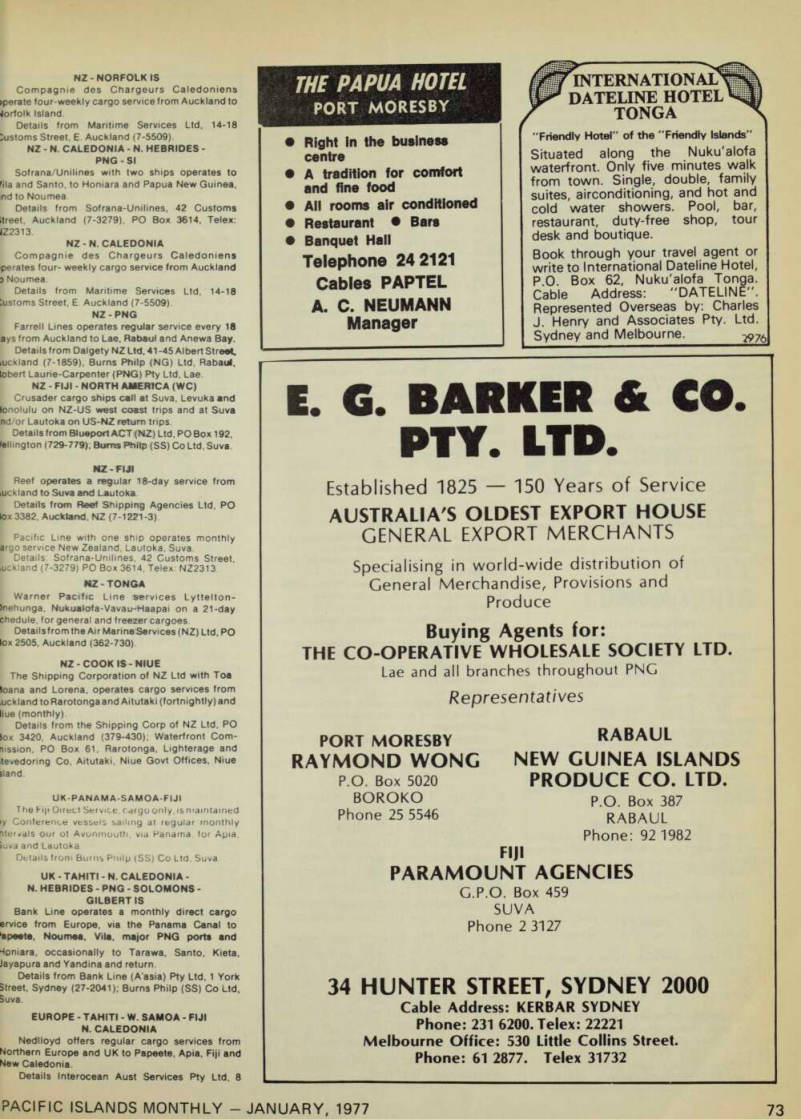
Airway's
Shipping
SYDNEY - NZ - FIJI/TAHITI - UK Chandris Lines maintains a passenger service from Sydney via NZ, Suva or Papeete every second month.
Details from Chandris Lines, 135 King Street, Sydney (232-2455).
SYDNEY - LORD HOWE IS - AUCKLAND -
Norfolk Is - New Caledonia
Compagnie des Chargeurs Caledoniens operates four-weekly cargo service Sydney-Lord Howe Island-Noi folk Island-Auckland-Norfolk Island-Noumea.
Details Hetherington Kingsbury Pty Ltd, 37-49 Pitt Street, Sydney (27-1671).
Sydney - New Caledonia
Somacal operates 30-day service from Sydney to Noumea.
Details from Karlander (Aust) Pty Ltd, 19-31 Pitt Street, Sydney (27-6301).
SYDNEY - NZ - FIJI - HAWAII -
Canada-Us
P & O liners call at Auckland, Suva, Honolulu and Vancouver on eastbound and westbound voyages between Sydney and the US.
Details from P & O Booking Centre, World Travel Headquarters Pty Ltd, 33 Bligh Street, Sydney (231-6655).
SYDNEY - NZ - FIJI - TONGA -
N. Hebrides-Noumea-Png -
Solomons-Samoas
Sitmar Cruises operates a year-round cruise programme to include most of the above countries.
Details from Sitmar Cruises, 22-30 Bridge Street, Sydney (27-4521).
Royal Viking Line, with luxury cruiseships Royal Viking Sea, Star and Sky, cruises the Pacific from Sydney, Hobart and Cairns calling at most of above countries.
Details from Wilh, Wilhelmsen Agency Pty Ltd, 13-15 Bridge Street. Sydney (2-0517).
P & O liners call at Apia, Auckland, Bay of Islands, Borabora, Honiara, Honolulu, Lautoka, Noumea, Nukualofa, Pago Pago, Papeete, Port Moresby, Santo, Savusavu, Suva, Vavau and Vila or cruises from Australia.
Details from P & O Booking Centre World Travel Headquarters Pty Ltd. 33 Bligh Street, Sydney (231-6655).
Australia - New Caledonia -
New Hebrides
Compagnie des Chargeurs Caledoniens operates three-weekly cargo service from Sydney to Noumea, Port Vila, Santo.
Details: Hetherington Kingsbury Pty Ltd, 37-49 Pitt Street, Sydney (27-1671).
Sofrana-Unilines ships serve Noumea every three weeks from the main ports along the easl Australian coast and Port Vila monthly frorr Melbourne and Sydney.
Details from Sofrana-Unilines, 37 Pitt Street, Sydney '97-2031). Trans-Austral Shipping Pty Ltd, 570 Bourke Street, Melbourne (67-9162), ACTA Pty Ltd, Brisbane (221-3166). Elder Smith Goldsbrough Mort Ltd, Port Adelaide (47-5688), Mcllwraith McEacharn Ltd, Newcastle (2-4781), HJonesandCo Pty Ltd, Burnie, Tasmania (31-1833), ACTA Pty Ltd, Fremantle (35-4866).
South Pacific United Lines maintains a four week cargo service from Sydney to Noumea, Vilaanc Santo.
Details from Omni Traders & Brokers Pty Ltd, 261 George Street, Sydney (24-2872/6).
Australia-Fiji
Karlander(Aust) Pty Ltd operates monthly cargo services from Sydney to Suva and Lautoka.
Details from Karlander (Aust) Pty Ltd, 19-31 Pitt Street, Sydney (27-6301): Dalgety Shipping, 461 Bourke Street, Melbourne (60-0731); Burns Philp (SS) Co Ltd, Suva and Lautoka Sofrana-Unilines (Fiji Express Line) operates to Suva every three weeks from the main ports on the east coast of Australia and monthly to Lautoka from Melbourne and Sydhey.
Details from Sofrana-Unilines. 37 Pitt Street, Sydney (27-2031), Trans-Austral Shipping Pty Ltd, 570 Bourke Street, Melbourne (67-9162), ACTA Pty Ltd, Brisbane (221-3116), Elder Smith Goldsbrough Mort Ltd, Port Adelaide (47-5688), Mcllwraith McEacharn Ltd Newcastle (2-4781), H Jonesand Co Pty Ltd, Burnie, Tasmania (31-1833), ACT A Pty Ltd 'Fremantle (35-4866)
Australia - Fiji - W.Samoa
Nauru Pacific Line operates regular container ised, unitised and b/bulk service from Sydney and Brisbane to Lautoka, Suva and Apia.
Details: Nauru Pacific Line, 227 Collins Street, Melbourne (654-4977), Interocean Swire, 8 Spring Street. Sydney (2-0522).
Australia - Tonga - W.Samoa
Karlander operates a monthly cargo service from Melbourne and Sydney to Nukualofa and Apia, thence US west coast.
Details: Karlander (Aust) Pty Ltd, 19-31 Pitt Street, Sydney (27-6301).
AUSTRALIA - TAHITI - US WEST COAST South Pacific United Lines maintains a four weekly service from Sydney to Papeete, and US west coast.
Details from Omni Traders & Brokers Pty Ltd, 261 George Street, Sydney (241-2872/6).
Australia-Png
Containers Pacific Express (Burns Philp and AWP Line) operates four-weekly cargo service from Melbourne and Brisbane with Samos to Port Moresby and Lae and three-weekly cargo service from Sydney (direct) to Lae and Port Moresby with Nimos.
Details from Burns Philp & Co Ltd, 51 Pitt Street.
Sydney (241-3816).
Farrell Lines operates a service every 18 days from Tasmania, Melbourne, Sydney and Brisbane to Lae, Rabaul and Anewa Bay Details from Wilh Wilhelmsen Agency Pty Ltd, 13 Bridge Street. Sydney (2-0517), 60 Market Street, Melbourne (61-3031), Burns Philp (NG) Ltd, Rabaul, Robert Laurie-Carpenter (NG) Pty Ltd, Lae New Guinea Express Lines with two ships operates three-weekly Melbourne, Sydney, Brisbane, Port Moresby, Lae Rabaul.
Details from New Guinea Express Lines, PO Box R 73, Royal Exchange PO, Sydney (241-3991) MacArthur Shipping Agency Co, 82-92 Eagle Street, Brisbane (229-3777), Western Farmers Transport Pty Ltd, 459 Little Collins Street, Melbourne [67-8291), Breckwoldt’s Shipping Agencies in Port Moresby (24-2525), Lae (42-1536), Rabtrad Nuigini Pty Ltd, Rabaul (92-2911).
Karlander New Guinea Line’s Cargo vessels call at Melbourne, Sydney, Port Moresby. Lae, Madang, Wewak, Manus, Kimbe, Rabaul.
Details from Karlander (Aust) Pty Ltd, 19-31 Pitt Street, Sydney (27-6301); Dalgety Shipping, 461 Bourke Street, Melbourne (60-0731).
Australia - Png - Solomons
New Guinea Australia Line's vessels operate from Sydney and Brisbane to Port Moresby, Lae Rabaul, Kavieng, Wewak, Honiara, Kieta, Gizo, Madang and Samarai.
Details from Interocean Swire, 8 Spring Street, Sydney (2-0522).
AUSTRALIA - SOLOMONS - GILBERT IS -
Micronesia
Daiwa Line runs a container service every 35 Jaysfrom Sydney to Honiara, Tarawa, Guam, Saipan md Palau.
Details: Tradex Transport Pty Ltd, 185 O'Riordan Street, Mascot, NSW (669-1099),
Australia-Nauru
Nauru Pacific Line operates regular cargo/ passenger service from Melbourne to Nauru.
Details. Nauru Pacific Line, 227 Collins Street, Melbourne (654-4977), Interocean Swire, 8 Spring Street, Sydney (2-0522).
Us-Png
Farrell Lines operates regular services from all
US west coast ports to Lae, Rabaul and Anewa Bay.
Details from Wilh, Wilhelmsen Agency Pty Ltd, 13 Bridge Street. Sydney (2-0517), Farrell Lines. 1 Market Plaza, San Francisco, L A. (9-4105), Burns Philp (NG) Ltd, Rabaul and Kieta, Robert Laurie- Carpenter (PNG) Ltd, Lae.
San Francisco - Honolulu -
Micronesia
Nauru Pacific Line operates regular conven tional/container service from San Francisco and
Honolulu to Majuro, Nauru, Ponape. Truk and Saipan.
Details from Nauru Pacific Line, 227 Collins Street, Melbourne (654-4977), North American!
Maritime Agencies, 100 California Street, San Francisco. California 9411 (981-0343).
Png-Us-Canada
Farrell Lines operates regular services from Lae and Rabual to US west coast ports and Vancouver.
Details from Bums Philp (NG) Ltd, Rabaul, Robert Laurie-Carpenter (PNG) Pty Ltd, Lae, Farrell Lines, 1 Market Plaza* Sarr Francisco. L A. (9-4105), and Wilh, Wilhelmsen Agency Fty Ltd, 13 Bridge Street, Sydney (2-0517).
FAR EAST - FIJI - MEW ZEALAND New Zealand Unit Express (CMC. MNOL, RIL) operates a three-weekly cargo service from Hong Kong to Lautoka, Suva, NZports, Manila, Kaoshiung, Keelung, Hong Kong.
Details from Interocean Swire, 8 Spring Street, Sydney (2-0522).
Royal Interocean Lines operates monthly cargo service with three ships from Surabaya. Jakarta, Bangkok,Port Kelang and SingporetoSuvaand N 2 ports.
Details from Interocean Aust. Services Pty Ltd, 8 Spring Street. Sydney, (27-3801), Bums Philp (SS) Co Ltd, Suva and Lautoka.
Ben Shipping Co (Pte) Ltd, sailing monthly frorr Singapore. Hong Kong, Keelung, Kaoshiung, Suva and main NZ ports.
Details from Seatrans (Fiji) Ltd. GPO Box 152, Suva, Fiji.
Japan-Nz-Png
China Navigation Co, withthreeshipsoperatesa monthly cargo service from Japan to New Zealand calling at Lae on return journey.
Details from Interocean Swire, 8 Spring Street, Sydney (2-0522).
FAR EAST - MID - S. PACIFIC China Navigation Co's vessels operate a regular cargo service from Hong Kong, Taiwan and Singapore to Rabaul, Wewak, Madang, Lae, Port Moresby, Honiara, New Hebrides. Noumea, Papeete and Samoa.
Details from Interocean Swire. 8 Spring Street, Sydney (2-0522).
Kyowa Shipping Co Ltd operates monthly services from Hong Kong. Taiwan. S. Korea, Japan, Singapore and Jakarta to Guam, Saipan, Solomons, New Caledonia, Fiji, Western and American Samoa, Tahiti. Cook Is., Tonga, New Hebrides and PNG.
Details: Hetherington Kingsbury Pty Ltd, 37-49 Pitt Street. Sydney (27-1671).
North Europe - New Caledonia
Hamburg-Sued operates monthly carg< services from Dunkirk and Le Havre to Noumea, vii Panama.
Det-ils from Columbus Overseas Services PL Ltd, 333 George Street, Sydney (290-2966).
Messageries Maritimes operates five cargi services a month from north and Mediterraneai European ports to Papeete and Noumea.
Details from Messageries Maritimes. 4-6 Bligl Street. Sydney (221-2522).
JAPAN - GUAM - FIJI - SAMOA -
N. Caledonia - N. Hebrides
Daiwa Lines runs a monthly cargo service fron Japan via Guam to Suva, Lautoka, Pago Pago, Apia Vila, Santo and Noumea.
Details from Burns Philp (SS) Co Ltd, Suva.
NZ - FIJI - TONGA - SAMOAS -
Tahiti
Union Steam Ship Co of NZ operates a full; containerised service Auckland-Suva-Pago Pago Apia-Nukualofa every 14-16 days.
A 28-day service by conventional ship ii operated from Auckland to Papeete, Apia an< Nukualofa.
Details from Union Steam Ship Co of NZ Ltd, PC Box 12. Auckland, or from branch offices/agents ii Fiji, Tonga, Samoa and Tahiti.
Nz -Norfolk Is
Compagnie des Chargeurs Caledonians tperate four-weekly cargo service from Auckland to Norfolk Island.
Details from Maritime Services Ltd, 14-18 Customs Street, E. Auckland (7-5509).
NZ - N. CALEDONIA - N. HEBRIDES -
Png - Si
Sofrana/Unilines with two ships operates to fila and Santo, to Honiara and Papua New Guinea, md to Noumea Details from Sofrana-Unilines, 42 Customs •treet, Auckland (7-3279), PO Box 3614, Telex; 1Z2313.
Nz - N. Caledonia
; Compagnie des Chargeurs Caledoniens pe rates four- weekly cargo service from Auckland j Noumea.
Details from Maritime Services Ltd. 14-18 Justoms Street, E. Auckland (7-5509).
Nz- Png
Farrell Lines operates regular service every 18 ays from Auckland to Lae, Rabaul and Anewa Bay.
Details from Dalgety NZ Ltd. 41-45 Albert Street, mckland (7-1859), Burns Philp (NG) Ltd, Rabaul, lobert Laurie-Carpenter (PNG) Pty Ltd, Lae.
NZ - FIJI - NORTH AMERICA (WC) Crusader cargo ships call at Suva, Levuka and lonolulu on NZ-US west coast trips and at Suva nd/or Lautoka on US-NZ return trips.
Details from Blueport ACT (NZ) Ltd, PO Box 192. lellington (729-779); Bums Philp (SS) Co Ltd, Suva.
Nz - Fiji
Reef operates a regular 18-day service from uckland to Suva and Lautoka.
Details from Reef Shipping Agencies Ltd, PO lox 3382, Auckland, NZ (7-1221-3).
I Pacific Line with one ship operates monthly argo service New Zealand, Lautoka, Suva.
Details: Sofrana-Unilines. 42 Customs Street, iuckland (7-3279) PO Box 3614, Telex: NZ2313
Nz-Tonga
Warner Pacific Line services Lyttelton- Inehunga, Nukualofa-Vavau-Naapai on a 21-day chedule, for general and freezer cargoes.
Detailsfrom the Air MarineServices(NZ) Ltd, PO lox 2505, Auckland (362-730).
Nz-Cook Is-Niue
The Shipping Corporation of NZ Ltd with Toa loana and Lorena, operates cargo services from uckland to Rarotonga and Aitutaki (fortnightly) and liue (monthly).
Details from the Shipping Corp of NZ Ltd, PO lox 3420, Auckland (379-430); Waterfront Com nission, PO Box 61. Rarotonga. Lighterage and levedoring Co, Aitutaki, Niue Govt Offices, Niue (land.
Uk-Panama-Samoa-Fiji
The Fiji Direct Service, cargo only, is maintained iy Conference vessels sailing at regular monthly our ot Avonmouth, via Panama, for Apia, !uva and Lautoka I Details from Burns Pnilp (SS) Co Ltd. Suva UK - TAHITI - N. CALEDONIA - N. HEBRIDES - PNG - SOLOMONS -
Gilbert Is
Bank Line operates a monthly direct cargo ervice from Europe, via the Panama Canal to 'apeete, Noumea, Vila, major PNG ports and Honiara, occasionally to Tarawa, Santo, Kieta, Jayapura and Yandina and return.
Details from Bank Line (A’asia) Pty Ltd, 1 York Street, Sydney (27-2041); Burns Philp (SS) Co Ltd.
Suva.
EUROPE - TAHITI - W. SAMOA - FIJI
N. Caledonia
Nedlloyd offers regular cargo services from Northern Europe and UK to Papeete, Apia. Fiji and New Caledonia.
Details Interocean Aust Services Pty Ltd, 8
Spring Street. Sydney (27-3801).
US - FIJI - TAHITI - AUSTRALIA Bank Line Ltd operates regular cargo services from US Gulf ports to Australia and NZ. Calls at Suva, Lautoka and Papeete on demand.
Details from Bank Line (A/asia) Pty Ltd. 1 York Street. Sydney (27-2011).
Pacific Far East Line cruise ships operate from San Francisco. Los Angeles, Honolulu, Moorea, Papeete. Rarotonga. Auckland, Opua (Bay of Islands), Sydney and return via Suva, Niuafoou, Pago Pago and Honolulu to San Francisco.
Freight is carried on these passenger liners.
Passenger details from World Travel Headquarters Pty Ltd, 33 Bligh Street, Sydney (231- 6655); freight details from P & O Aust Ltd, 2 Castlereagh Street, Sydney (230-0177).
US - A. SAMOA - NZ - AUST - PNG Farrell Lines LASH ships operate regularly from US to Australia, via Pago Pago and Auckland, returning via PNG ports.
Details from With, Wilhelmsen Agency Pty Ltd, 13 Bridge Street, Sydney (2-0517); 60 Market Street, Melbourne (61-0301); Farrell Lines. 1 Market Plaza, San Francisco. L A. (415-777-3300); Dalgety NZ Ltd, Auckland (7-1859); Kneubuhl Maritime Services, Pago Pago (633-5121).
Us-Tahiti-Samoa
Pacific Islands Transport operates a five/six weekly cargo service from North American west coast ports to Papeete, Pago Pago, Apia Details from Trans-Austral Shipping Pty Ltd, 19 Pitt Street, Sydney (27-2441).
Polynesia Line operates container and general cargo service from US west coast ports to Papeete and Pago Pago.
Details from Polynesia Shipping Services Inc, PO Box 1478, Pago Pago (9-6799),
Advertisements & other items, pp. 70-73 (5 items)
_ __ . a ■ ■ a ft i r«» it ii ft i “T - ill \ ✓ ia mi i a n\y in*7 *7
. a ■ ■ a ft i r«» it ii ft i “T - ill \ ✓ ia mi i a n\y in*7 *7
Kyowa Line
YOUR TRADING PARTNER
Monthly Services
Hong Kong, Taiwan, S. Korea, Japan
To; Guam, Saipan, British Solomon, New Caledonia, Fiji, W. Samoa, A. Samoa. Tahiti, Cook Is., Tonga, New Hebrides.
Taiwan,Hong Kong,Singapore,Jakarta
To: Australia, Papua New Guinea, Sabah & Sarawak.
South Korea, Japan
To; Guam, Saipan, Papua New Guinea, Other Pacific Islands.
Taiwan: Royal Steamship Corp., Ltd.. Taipei S. Korea: Dong Sue Shipping Co.. Ltd., Seoul Hong Kong; Dahzun Enterprises Ltd Singapore; Ocean Shipping & Enterprises Pte., Ltd Mariana Is.: Island Navigation Co , Ltd., Guam 8.5.1. P.: Solomon Taiyo Ltd., Honiara Tahiti: J.A. Cowan & Fils, Papeete Cooks: Union Citco Travel Ltd.. Rarotonga Tonga: E.M. Jones Ltd., Nukualofa New Hebrides: Agence Maritime Raymond Velicite, Port Vila A.Samoa: Island Pacific Agencies Inc., Pago Pago W. Samoa: Morris Hedstrom Ltd., Apia Fiji: Carpenter Shipping, Suva & Lautoka PNG; Carpenter Shipping Agencies, Port Moresby, Rabaul New Caledonia: Agence Maritime Du Rond Point Du Pacific, Indonesia: P.T. Porodisa Raya Shipping Lines, Jakarta Sabah: KOH Han Ming Shipping & Forwarding Agent, Kotakmabalu Sarawak; Pan Sarawak Agencies Sdn. Bhd .Sibu & Kuching Australia: Hethermgton Kingsbury Pty. Ltd., Sydney. N S W.
KYOWA SHIPPING CO., LTD.
Ojima Bldg., 22-8, 6-chome, Shinbashi, Frontier Bldg., 3-13 Hirano-cho,
AGENTS
Noumea
HEAD OFFICE
OSAKA OFFICE
Minato-ku, Tokyo, Japan Phone: 03(437)2885 (Rep.) Cables: “MARIQUEEN” Tokyo Telex: 242-4651 Kyowa J.
Higashi-ku, Osaka, Japan.
Phone: 06(227)0422 (Rep.) Cables: “MARIQUEEN” Osaka.
Telex: 522-3896 Kyowa 0.
71
JAPICIP ici a Mnc n/iriMTui \y iamiiadu 10-7-7
gm/mcompanu
PETER FISHER TRADING Pty. Ltd.
321 Pin STREET, SYDNEY, 2000, AUSTRALIA
UUphona: 26-1109 CABLES: "FISHERION", SYDNEY
EXPORTERS TO THE PACIFIC ISLANDS
Regular Pacific Services
"Union South Pacific”, cellular container vessel. Reefer and general cargo from Auckland at approximately fortnightly intervals. Calls at Suva, Pago Pago, Apia and Nukualofa before returning to Auckland.
"Luhesand”, conventional reefer and general cargo. Monthly sailings from Auckland, calls at Suva, Apia, Papeete and Nukualofa.
jmimumon
gm/mcompanu
Branches at all main Australian, New Zealand and Pacific Island ports.
PACIFIC ISLANDS TRANSPORT LINE
Owners: Thor Dahls Hvaijangerseiskap A/S — Sandefjord, Norway.
MS CAMELLIA VENTURE
Express Freight Service between Pacific Coast Ports of
U.S.A.
and
TAHITI and SAMOA
Full container service including reefers.
GENERAL STEAMSHIP CORPORATION LTD.
General Agents 400 California Street, San Francisco, California, U.S.A.
APIA-—Born* Philp (South Sea) Company, Ltd.
PAPEETE—Ape nee Maritime Internationale Tahiti.
PAGO PAGO-Polynesia Shipping Services Inc.
NOUMEA—Etahlissement* Ballande.
SYDNEY—Trans-Austral Shipping Pty, Ltd.
SUVA—Bum* Philp (South Sea) Company, LAE/RABAUL—Burns Philp (New Guinea) Ltd.
PORT VlLA—Comptoirs Francais de Nouvelles Hebrides.
THE
GLOBAL SERVICE FOR SHIPPERS
VA \rtAJ MO V u
MONTHLY SERVICES
United Kingdom and Continent to: Papeete, Noumea, New Hebrides, Papua New Guinea and Solomon Islands. * Papua New Guinea to: North America, United Kingdom and Continent. ★ Solomons, Fiji, Tonga, Samoa and Tarawa to: United Kingdom and Continent.
For particulars apply:
THE BANK LINE (AUSTRALASIA) PTY.
LTD.,
18TH FLOOR, 1 YORK STREET,
SYDNEY, N.S.W.
THE PAPUA HOTEL
PORT MORESBY
• Right in the business centre • A tradition for comfort and fine food • All rooms air conditioned • Restaurant • Bars • Banquet Hall Telephone 24 2121 Cables PAPTEL
A. C. NEUMANN
Manager
(rf
Hp* DATELINE HOTEL IHJ
r TONGA \
"Friendly Hotel" of the "Friendly Islands"
Situated along the Nukualofa waterfront. Only five minutes walk from town. Single, double, family suites, airconditioning, and hot and cold water showers. Pool, bar, restaurant, duty-free shop, tour desk and boutique.
Book through your travel agent or write to International Dateline Hotel, P.O. Box 62, Nukualofa Tonga.
Cable Address: ''DATELINE''.
Represented Overseas by: Charles J. Henry and Associates Pty. Ltd.
Sydney and Melbourne. 7
E. G. BARKER & CO.
PTY. LTD.
Established 1825 150 Years of Service
AUSTRALIA'S OLDEST EXPORT HOUSE
GENERAL EXPORT MERCHANTS
Specialising in world-wide distribution of General Merchandise, Provisions and Produce
Buying Agents for:
THE CO-OPERATIVE WHOLESALE SOCIETY LTD.
Lae and ail branches throughout PNG
Representatives
PORT MORESBY RABAUL
RAYMOND WONG NEW GUINEA ISLANDS
p o Box 5020 PRODUCE CO. LTD.
BOROKO p O. Box 387
Phone 25 5546 RABAUL Phone: 92 1982
FIJI
PARAMOUNT AGENCIES
G.P.O. Box 459
SUVA
Phone 2 3127
34 HUNTER STREET, SYDNEY 2000
Cable Address: KERBAR SYDNEY Phone: 231 6200. Telex: 22221 Melbourne Office: 530 Little Collins Street.
Phone: 61 2877. Telex 31732
~ . . imn mamti ii \/ IA Ml I ARV 1
. . imn mamti ii \/ IA Ml I ARV 1
granted landing rights in Tonga. He
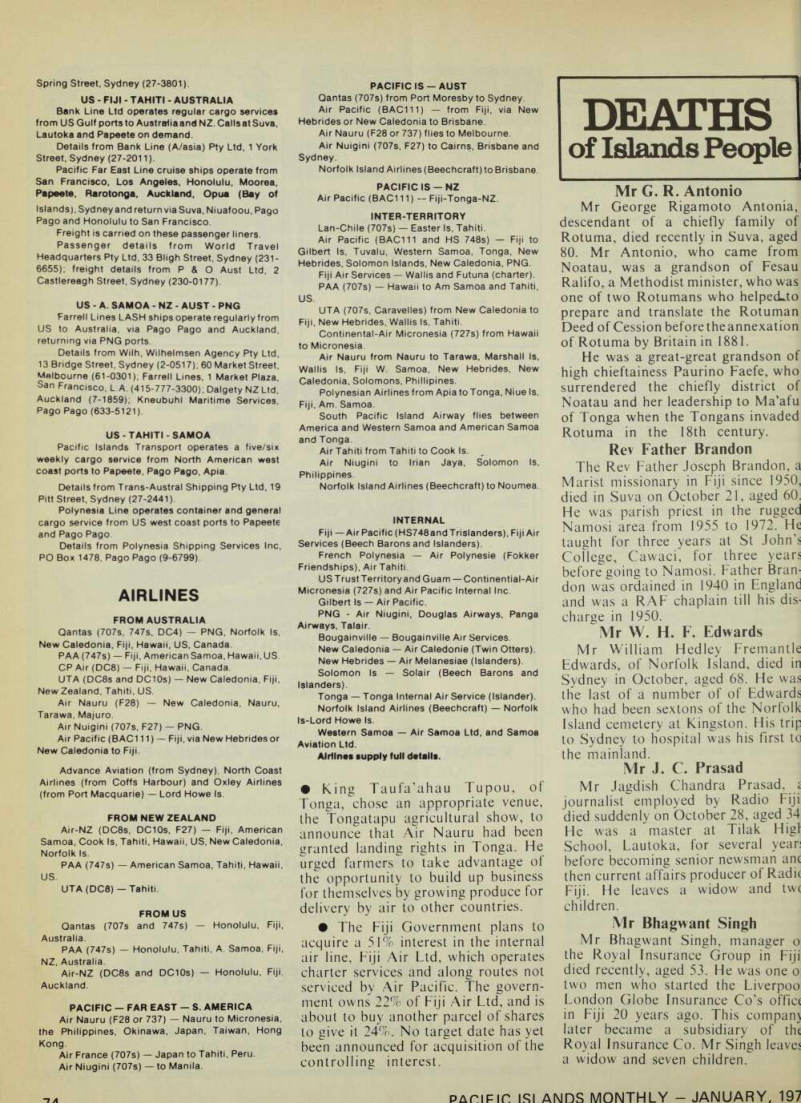
Airlines
From Australia
Qantas (7075. 7475, DC4) PNG, Norfolk Is, New Caledonia, Fiji, Hawaii. US, Canada.
PAA (7475) Fiji, American Samoa, Hawaii, US.
CP Air (DCS) Fiji, Hawaii, Canada.
UTA (DCBs and DCIOs) New Caledonia, Fiji, New Zealand. Tahiti. US.
Air Nauru (F2B) New Caledonia, Nauru, Tarawa, Majuro.
Air Nuigini (7075, F 27) PNG.
Air Pacific (BAC111) Fiji, via New Hebrides or New Caledonia to Fiji.
Advance Aviation (from Sydney), North Coast Airlines (from Coffs Harbour) and Oxley Airlines (from Port Macquarie) Lord Howe Is.
From New Zealand
Air-NZ (DCBs, DCIOs, F 27) Fiji, American Samoa, Cook Is, Tahiti, Hawaii, US, New Caledonia, Norfolk Is.
PAA (7475) American Samoa, Tahiti. Hawaii, US.
UTA (DCS) Tahiti.
From Us
Qantas (707 s and 7475) Honolulu, Fiji, Australia, PAA (7475) Honolulu, Tahiti, A. Samoa, Fiji, NZ, Australia.
Air-NZ (DCBs and DCIOs) Honolulu, Fiji, Auckland.
Pacific Far East S. America
Air Nauru (F2B or 737) Nauru to Micronesia, the Philippines, Okinawa, Japan, Taiwan, Hong Kong.
Air France (7075) Japan to Tahiti, Peru.
Air Niugini (7075) to Manila.
Pacific Is —Aust
Qantas (7075) from Port Moresby to Sydney.
Air Pacific (BAC111) from Fiji, via New Hebrides or New Caledonia to Brisbane.
Air Nauru (F2B or 737) flies to Melbourne.
Air Nuigini (7075, F 27) to Cairns, Brisbane and Sydney.
Norfolk Island Airlines (Beechcraft) to Brisbane.
Pacific Is —Nz
Air Pacific (BAC111) Fiji-Tonga-NZ.
Inter-Territory
Lan-Chile (7075) Easter Is, Tahiti.
Air Pacific (BACIII and HS 7485) Fiji to Gilbert Is, Tuvalu, Western Samoa. Tonga, New Hebrides, Solomon Islands, New Caledonia, PNG.
Fiji Air Services Wallis and Futuna (charter).
PAA (7075) Hawaii to Am Samoa and Tahiti, US.
UTA (7075, Caravelles) from New Caledonia to Fiji, New Hebrides, Wallis Is, Tahiti.
Continental-Air Micronesia (7275) from Hawaii to Micronesia.
Air Nauru from Nauru to Tarawa, Marshall Is, Wallis Is, Fiji W. Samoa, New Hebrides, New Caledonia, Solomons, Phillipines.
Polynesian Airlines from Apia to Tonga, Niue Is, Fiji, Am. Samoa.
South Pacific Island Airway flies between America and Western Samoa and American Samoa and Tonga.
Air Tahiti from Tahiti to Cook Is.
Air Niugini to Irian Jaya, Solomon Is, Philippines.
Norfolk Island Airlines (Beechcraft) to Noumea.
Internal
Fiji Air Pacific (HS74B and Trislanders), Fiji Air Services (Beech Barons and Islanders).
French Polynesia Air Polynesie (Fokker Friendships), Air Tahiti.
US T rust Territory and Guam Continential-Air Micronesia (7275) and Air Pacific Internal Inc.
Gilbert Is Air Pacific.
PNG - Air Niugini, Douglas Airways, Panga Airways, Talair.
Bougainville Bougainville Air Services.
New Caledonia Air Caledonie (Twin Otters).
New Hebrides Air Melanesiae (Islanders).
Solomon Is Solair (Beech Barons and Islanders).
Tonga Tonga Internal Air Service (Islander).
Norfolk Island Airlines (Beechcraft) Norfolk Is-Lord Howe Is.
Western Samoa Air Samoa Ltd, and Samoa Aviation Ltd.
Alrilnaa supply full details.
• King Taufa’ahau Tupou, of
Tonga, chose an appropriate venue,
the Tongatapu agricultural show, to
announce that Air Nauru had been
granted landing rights in Tonga. He
urged farmers to take advantage ol
the opportunity to build up business
for themselves by growing produce for
delivery by air to other countries.
• The Fiji Government plans to
acquire a 51% interest in the internal air line, Fiji Air Ltd, which operates
charter services and along routes not
serviced by Air Pacific. The govern
ment owns 22% of Fiji Air Ltd, and is about to buy another parcel of shares to give it 24%. No target date has yet
been announced for acquisition of the
controlling interest.
Deaths
of Islands People
Mr G. R. Antonio Mr George Rigamoto Antonia, descendant of a chiefly family of Rotuma, died recently in Suva, aged 80. Mr Antonio, who came from Noatau, was a grandson of Fesau Ralifo, a Methodist minister, who was one of two Rotumans who helpecLto prepare and translate the Rotuman Deed of Cession beforetheannexation of Rotuma by Britain in 1881.
He was a great-great grandson of high chieftainess Paurino Faefe, who surrendered the chiefly district of Noatau and her leadership to Ma’afu of Tonga when the Tongans invaded Rotuma in the 18th century.
Rev Father Brandon The Rev Father Joseph Brandon, a Marist missionary in Fiji since 1950, died in Suva on October 21, aged 60.
He was parish priest in the rugged Namosi area from 1955 to 1972. He taught for three years at St John’s College, Cawaci, for three years before going to Namosi. Father Bran don was ordained in 1940 in England and was a RAF chaplain till his dis charge in 1950.
Mr W. H. F. Edwards Mr William Hedley Fremantle Edwards, of Norfolk Island, died in Sydney in October, aged 68. He was the last of a number of of Edwards who had been sextons of the Norfolk Island cemetery at Kingston. His trip to Sydney to hospital was his first to the mainland.
Mr J. C. Prasad Mr Jagdish Chandra Prasad, £ journalist employed by Radio Fiji died suddenly on October 28, aged 34 He was a master at Tilak Higl School, Lautoka, for several year: before becoming senior newsman anc then current affairs producer of Radic Fiji. He leaves a widow and tw( children.
Mr Bhagwant Singh
Mr Bhagwant Singh, manager o the Royal Insurance Group in Fiji died recently, aged 53. He was one o two men who started the Liverpoo London Globe Insurance Co’s office in Fiji 20 years ago. This company later became a subsidiary of the Royal Insurance Co. Mr Singh leaves a widow and seven children.
Advertisements & other items, p. 74 (1 item)
74
PAPIFir ISI AMDS MONTHLY - JANUARY. 197
Produce
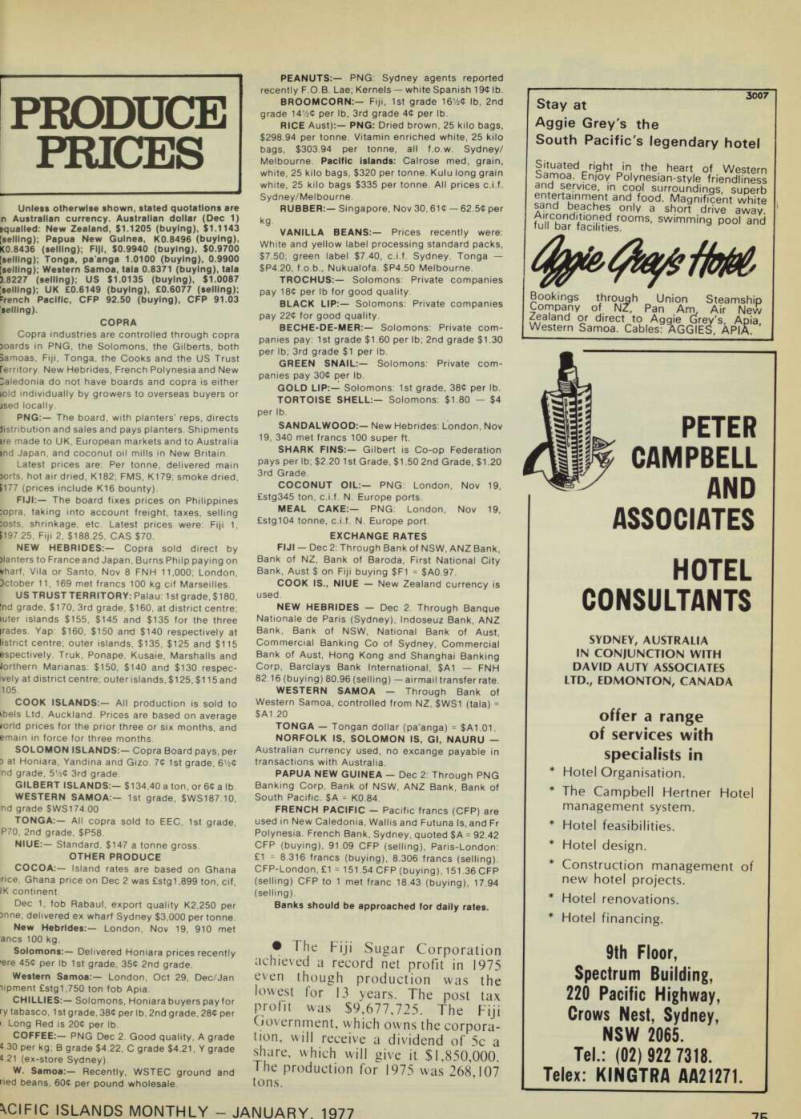
Prices
Unless otherwise shown, stated quotations are n Australian currency. Australian dollar (Dec 1) squalled: New Zealand, $1.1205 (buying), $1.1143 [selling); Papua New Guinea, K 0.8496 (buying), K 0.8436 (selling): FIJI, $0.9940 (buying), $0.9700 [selling); Tonga, pa'anga 1.0100 (buying), 0.9900 [selling); Western Samoa, tala 0.8371 (buying), tala 1.8227 (selling); US $1.0135 (buying), $1.0087 [selling); UK £0.6149 (buying), £0.6077 (selling); french Pacific, CFP 92.50 (buying), CFP 91.03 selling).
Copra
Copra industries are controlled through copra joards in PNG, the Solomons, the Gilberts, both Samoas, Fiji, Tonga, the Cooks and the US Trust territory. New Hebrides, French Polynesia and New Caledonia do not have boards and copra is either (Old individually by growers to overseas buyers or jsed locally.
PNG:— The board, with planters' reps, directs listribution and sales and pays planters. Shipments ire made to UK, European markets and to Australia ind Japan, and coconut oil mills in New Britain.
Latest prices are: Per tonne, delivered main )orts, hot air dried, K 182; FMS, K 179; smoke dried,
$177 (prices include Kl 6 bounty).
FIJI:— The board fixes prices on Philippines :opra, taking into account freight, taxes, selling :osts, shrinkage, etc. Latest prices were: Fiji 1, 697.25. Fiji 2, $188.25, CAS $7O.
NEW HEBRIDES:— Copra sold direct by )lanters to France and Japan. Burns Philp paying on Kharf, Vila or Santo, Nov 8 FNH 11,000; London, October 11, 169 met francs 100 kg cif Marseilles.
US TRUST TERRITORY: Palau: Ist grade, $lBO, Ind grade, $l7O, 3rd grade, $l6O, at district centre: »uter islands $155, $145 and $135 for the three irades. Yap $l6O, $l5O and $l4O respectively at Kstrict centre; outer islands, $135, $125 and $ll5 espectively. Truk, Ponape, Kusaie, Marshalls and Jorthern Marianas: $l5O, $l4O and $l3O respec ively at district centre; outer islands, $125, $ll5 and 105.
COOK ISLANDS:— All production is sold to (bels Ltd, Auckland. Prices are based on average rorld prices for the prior three or six months, and emain in force for three months.
SOLOMON ISLANDS: — Copra Board pays, per 3 at Honiara, Yandina and Gizo. 74 Ist grade, 6’/24 hd grade, s’/?4 3rd grade.
GILBERT ISLANDS:— $134,40 a ton, or 64 a lb.
Western Samoa:— Ist Grade, Swsib7.Io,
nd grade $W5174.00 TONGA:— All copra sold to EEC, Ist grade, P7O, 2nd grade, SPSB.
NIUE:— Standard, $147 a tonne gross.
Other Produce
COCOA:— Island rates are based on Ghana rice, Ghana price on Dec 2 was £stgl,B99 ton, cif, IK continent.
Dec 1, fob Rabaul, export quality K 2.250 per )nne; delivered ex wharf Sydney $3,000 per tonne.
New Hebrides:— London, Nov 19, 910 met ancs 100 kg.
Solomons: — Delivered Honiara prices recently 'ere 454 per lb Ist grade, 354 2nd grade.
Western Samoa:— London, Oct 29, Dec/Jan lipment £stgl.7so ton fob Apia.
CHILLIES:— Solomons, Honiara buyers payfor ry tabasco, Ist grade, 384 per lb, 2nd grade, 284 per i. Long Red is 204 per lb.
COFFEE:— PNG Dec 2. Good quality, A grade 1.30 per kg; B grade $4.22, C grade $4.21, Y grade 1.21 (ex-store Sydney).
W. Samoa:— Recently, WSTEC ground and ried beans, 604 per pound wholesale.
PEANUTS:— PNG: Sydney agents reported recently F. 0.8. Lae; Kernels white Spanish 194 lb.
BROOMCORN:— Fiji. Ist grade 16V44 lb, 2nd grade 14'/2<t per lb, 3rd grade 44 per lb.
RICE Aust):— PNG: Dried brown, 25 kilo bags, $298.94 per tonne. Vitamin enriched white, 25 kilo bags, $303.94 per tonne, all f.o.w. Sydney/ Melbourne. Pacific islands: Calrose med, grain, white, 25 kilo bags, $320 per tonne. Kulu long grain white, 25 kilo bags $335 per tonne. All prices c.i.f.
Sydney/Melbourne.
RUBBER:— Singapore, Nov 30,614 62.54 per kg VANILLA BEANS:— Prices recently were: White and yellow label processing standard packs, $7.50; green label $7.40, c.i.f. Sydney. Tonga $P4.20, f.0.b., Nukualofa. $P4.50 Melbourne.
TROCHUS:— Solomons: Private companies pay 184 per lb for good quality.
BLACK LIP:— Solomons: Private companies pay 224 for good quality.
BECHE-DE-MER:— Solomons: Private com panies pay: Ist grade $1.60 per lb; 2nd grade $1.30 per lb; 3rd grade $1 per lb.
GREEN SNAIL:— Solomons: Private com panies pay 30<t per lb.
GOLD LIP:— Solomons: Ist grade, 384 per lb.
TORTOISE SHELL:— Solomons: $l.BO $4 per lb.
SANDALWOOD:— New Hebrides: London, Nov 19, 340 met francs 100 super ft.
SHARK FINS:— Gilbert is Co-op Federation pays per lb; $2.20 Ist Grade, $1,50 2nd Grade, $1.20 3rd Grade.
COCONUT OIL: PNG: London. Nov 19. £stg34s ton, c.i.f. N. Europe ports.
MEAL CAKE:— PNG: London, Nov 19. £stglo4 tonne, c.i.f. N. Europe port.
Exchange Rates
FIJI Dec 2: Through Bank of NSW, ANZ Bank, Bank of NZ, Bank of Baroda, First National City Bank, Aust $ on Fiji buying SFI = $A0.97.
COOK IS., NIUE New Zealand currency is used.
NEW HEBRIDES Dec 2. Through Banque Nationale de Paris (Sydney), Indoseuz Bank, ANZ Bank. Bank of NSW, National Bank of Aust, Commercial Banking Co of Sydney, Commercial Bank of Aust, Hong Kong and Shanghai Banking Corp, Barclays Bank International, SAI FNH 82.16 (buying) 80.96 (selling) airmail transfer rate.
WESTERN SAMOA Through Bank of Western Samoa, controlled from NZ, SWSI (tala) = $A1.20 TONGA Tongan dollar (pa’anga) = SAI.OI.
Norfolk Is, Solomon Is, Gl, Nauru
Australian currency used, no excange payable in transactions with Australia.
PAPUA NEW GUINEA - Dec 2: Through PNG Banking Corp, Bank of NSW, ANZ Bank, Bank of South Pacific. $A = K 0.84.
FRENCH PACIFIC Pacific francs (CFP) are used in New Caledonia, Wallis and Futuna Is, and Fr Polynesia. French Bank, Sydney, quoted $A = 92.42 CFP (buying), 91.09 CFP (selling), Paris-London: £1 = 8.316 francs (buying), 8.306 francs (selling).
CFP-London, £1 = 151.54 CFP (buying), 151.36 CFP (selling) CFP to 1 met franc 18.43 (buying), 17.94 (selling).
Banks should be approached for daily rates.
• The Fiji Sugar Corporation
achieved a record net profit in 1975
even though production was the
lowest for 13 years. The post tax
profit was $9,677,725. The Fiji
Government, which owns the corpora
tion, will receive a dividend of 5c a
share, which will give it $1,850,000.
The production for 1975 was 268,107
tons.
Advertisements & other items, pp. 75-80 (5 items)
75
\CI FIC ISLANDS MONTHLY - JANUARY 1977
Associates
3007
Stay at
Aggie Grey's the
South Pacific's legendary hotel Situated ricjbt in the. heart of Western bamoa. Enjoy Polynesian-style friendliness and service, in cool surroundings, superb entertainment and food. Magnificent white sand beaches only a short drive away. p°°' Bookings through Union Steamship Company of NZ, Pan Am, Air New Zealand or direct to Aggie Grey's, Apia Western Samoa. Cables: AGGIES, APIA.
PETER
CAMPBELL
AND
ASSOCIATES
HOTEL
CONSULTANTS
SYDNEY, AUSTRALIA
IN CONJUNCTION WITH
DAVID AUTY ASSOCIATES
LTD., EDMONTON, CANADA
offer a range of services with specialists in * Hotel Organisation. * The Campbell Hertner Hotel management system. * Hotel feasibilities. * Hotel design. * Construction management of new hotel projects. * Hotel renovations. * Hotel financing.
9th Floor,
Spectrum Building,
220 Pacific Highway,
Crows Nest, Sydney,
NSW 2065.
Tel.: (02) 922 7318.
Telex: KINGTRA AA21271.
Minimum 4 lines. CLASSIFIED ADVERTISEMENTS
FOR SALE - COASTAL VESSEL.
Built 1969 Steel PNG Survey, bale 100 tons, DWT 70 tons, LOA 21.5 m, Beam 6.4 m.
Marine engine single screw Caterpillar diesel, new 1975. KBO,OOO 0.N.0.
New Guinea Marine Surveys & Services, PO BOX 783, LAE, Papua New Guinea.
Phone: 42 4305. Telex: NE 42515.
Cables: MARINESERV.
FOR SALE -
Steam Tug 'Tui Tawate". Built of steel in Aberdeen 1945, 115 ft. long, 27 ft. wide. Boilers and engines mechanically sound; the vessel travelled Suva-Santo under her own steam in July 1976, Capacity 250 tons.
Offers and enquiries (marked "Tui Tawate") to: The Assistant Secretary (Communications), British Residency,
VILA, NEW HEBRIDES.
PLUMBER & DRAINER, 34, Able.
Well organised tradesman, married, wants work in New Hebrides or Solomons. Prefer long-term position.
Will pay own fare.
Adolf Petek, P.O. Box 248, West End, Qld. 4101.
Australia.
WOULD YOU LIKE TO BE ABLE
TO WORK IN A TRAVEL AGENCY?
It is so hard to work in travel; when you go for the interview everybody wants somebody with experience.
How can you get experience without having worked in an Agency?
The Geneva International School of Travel has limited vacancies on a 3 month Correspondence Course which will help give you that experience.
It covers Domestic Travel through to Shipping and Tours plus International Travel and Ticketing and most importantly lATA fare construction.
The course is not expensive and a Diploma is given on completion of the course.
Further details on application.
GENEVA INTERNATIONAL
SCHOOL OF TRAVEL
71 Gurney Crescent, SEAFORTH NSW 2092.
All correspondence to PO Box 104
BALGOWLAH NSW 2093.
EXPERIENCED SWISS CHEF seeks
position as chef in top class resort hotel in Pacific area.
- MEISTER,
49 Liverpool St., Wanganui, New Zealand.
COINS
WANTED..
Paying twice face value for all pre-decimal Australian coins.
GOLD SOVEREIGNS
BUY—$27
SELL-$3O
Prices subject to fluctuation.
SOUTHERN CROSS COINS
2/131 Exhibition St.,
MELBOURNE 3000,
AUSTRALIA.
Phone: 63 1141.
MARINE ENGINEER urgently requires position on ship. Excellent references, experience on Bulk, General and Fridge ships. Will consider any Pacific Island or Australia.
Replies in writing to; PO Box 23-579, Papatoetoe East, Auckland, New Zealand.
FOR SALE
HOTEL: 6 ROOMS
CONCRETE BLOCK CONSTRUCTION.
IDEAL FOR COUPLE TO MANAGE.
IDEALLY SITUATED.
FUTURE DEVELOPMENT,
GOOD STEADY TRADE.
CONTACT: B.J.S. AGENCIES,
BOX 39, HONIARA.
SOLOMON ISLANDS.
CONCRETE BLOCK MAKER Makes blocks, flags edgings, screen-blocks, garden stools—up to Bat once and 96 an hour $215 00 c i f main ports Send tor leaflets Forest Farm Research, Londonderry NSW. 2753 Australia.
jppp
STERN
DRIVES
PETROL & DIESEL
MARINE ENGINES
X Manufactured by
SEA TIGER
MARINE
Pty. Ltd.
P.O. Box 157, Mordialloc Victoria, Australia 3195
HENRY CUMiNES PTY. LTD.
EXPORTERS • GENERAL MERCHANTS
428 GEORGE ST., SYDNEY
CABLES: HENCO SYDNEY. G.P.O. Box 3949. PHONE: 25-3383.
For specialised and personalised buying service throughout the Pacific Islands and the East
LOCAL AGENTS AND REPRESENTATION:
PAPUA NEW GUINEA.
PORT MORESBY: Mr. Tan,
P.O. Box 5445, Boroko.
Telephone 25 2542.
RABAUL: M. & C. Seeto, P.O. Box 131, Rabaul.
Telephone 92 2902.
MADANG: W. Double, P.O. Box 22, Madang.
Telephone 82 2696.
FIJI.
K. Witherington Ltd., P.O. Box 293, Suva.
Telephone 22 356.
NEW HEBRIDES.
John Lum & Associates, P.O. Box 65, Santo.
Telephone 329.
SOLOMON ISLANDS.
Lo See War Ltd., P.O. Box 327, Honiara.
Telephone 399.
Resident Agents in other Pacific Territories.
We're working the Pacific
with a Cat Marine Diesel.
"Loloho" - General purpose Harbour tug boat. Operated by Bougainville Copper Limited at Bougainville. Overall length 50 ft. (15.24 m). Powered by a Caterpillar D 343 Marine Engine. .i [ saa ; k mm iS. ± ''M.V. Kaunitoni” - An Inter-Island freighter. Operated by the Fiji Government. Overall length 134.3 ft. Displacement 628 tons. Speed 10 knots. Powered by a Caterpillar D 379.
Hastings Deering (Pacific) Ltd.and Carpenters Tractors cover the Pacificlslands waterfront with Cat. Marine Service and Parts.
Hastings Deering (Pacific) at Lae, Port Moresby and Bougainville and Carpenters Tractors at Suva are staffed by Caterpillar-trained technicians.
Working the Pacific waterfront day after day, year after year, you depend on reliable horsepower and first class dealer-support. You get it with a Cat Marine Diesel, Hastings Deering (Pacific) and Carpenters' Tractors.
While there's a Cat Marine Diesel in your craft you're backed up with Cat Plus, the total support programme offered only by your Caterpillar dealer.
Your local Hastings Deering (Pacific) or Carpenters Tractors dealer backs your Cat Marine Diesel engine with parts and service programmes designed to prevent, as well as shorten profitrobbing downtime.
Caterpillar Dealers in South-West Pacific.
HASTINGS DEERING
Lae: Milford Haven Road, Ph: 42 2355 Port Moresby: Champion Parade, Konedobu Ph: 24 3138 or 24 2098.
Bougainville; Itakara.
Industrial Park, Arawa, Ph: 95 9077 154 Queens Road, Suva.
Ph: 24 051-4, Cables: Carptrac Suva.
Telex: Carptrac FJ2191 Suva.
HD6I4
Caterpillar. Cat and E ate trademarks ol Caterpillar Tractor Co.
that makes your home
a healthier place
How effectively you protect your family from the dangers of disease carrying insects, may well depend on the insect spray you choose.
Powerful Insect Killing Ingredients.
Concentrated Pea Beu is one of the most powerful household insect sprays in the world Its principal insect killing ingredients have been selected to ensure rapid knock down and kill of all common disease carrying insects.
Rigid Testing. Through every stage of manufacture. Pea Beu is rigidly tested.
There ore ingredient tests, spray droplet tests, pack tests, many forms of tests, some carried out three times over.
When you spray this remarkable aerosol insecticide, you can be sure that its ingredients have met with the most exacting standards enabling you to spray it safely with confidence in your home. m 9 Family Health and Well Being. The common housefly carries up to half a billion germs and, when you realise that disease carrying insects enter even the best regulated households, you can understand why you can't be too careful about the effectiveness of your insect spray. Remember, even the tiniest drople / / / 4 m ol concentrated Pea Beu kills flies, f quiloos, all common disease carry in insects fast, so it is indeed a worthy guardian of your family’s health and well being.
Concentrated Pea Beu. Even the tiniest droplet
kills flies, mosquitoes, gU common
disease carrying insects fast.
Such is the effectiveness of Pea Ben’s insect killing ingredient. that no common disease carrying insect can survive it. not develop an immunity to it. When you spray Concentrated Pea Beu, it’s nice to know that no common disease carrying insect can survive.
Pea Beu - The strong one, makes your home a healthier place.
Honda is a true life drama, performed on the world’s stage. By average folks, teenagers, men, and women everywhere. Your neighbors, maybe even you are playing a part. If so, you know Honda is more than great machines.
It’s people concerned with taking people where they want to go in life.
On two wheels, we’re the best selling motorcycle. The easy to operate hard workers who don’t demand much. Honda is always ready and gets you there safely. We move on four wheels. The precedent setting Honda Civic continues to receive international economy and performance awards. It’s the elegant compact car.
Sometimes, we have no wheels. Honda portable power operates machinery, generates electricity, pumps water and tills the soil.
Little wonder good things happen on Honda —we work harder to assure they do.
HONDA MOTOR CO.. LTD. TOKYO, JAPAN
PAPUA NEW GUINEA: Steamships-Machinery P.O. Box 1, Port Moresby/TAHITI: Societe Tahitienne d lmportation des Produits Honda B P 1665- Papeete/FIJI ISLANDS: Coral Island Motors P.O. Box 48, Suva/U.S. TRUST TERRITORY: United Micronesia Development Assn. P.O. Box 238, Saipan Mariana Islands 96950/COOK ISLANDS: Cook Islands Motor Center Ltd. P.O. Box 74, Rarotonga/AMERICAN SAMOA: Samoan Holiday and Travel Center P.O. Box 968, Pago Pago/AMERICAN SAMOA: Haleck's Service Center P.O. Box 1138, Pago Pago/GUAM; Mark's Motor Co., Inc. PO Box !p V - "f ana/WESTERNSAMOA: Motor Distributors (Samoa) Ltd. P.O. Box 576, Apia/SOLOMON ISLANDS: British Solomons Trading Co. Ltd. P O Box tadA.°«« ara NEW CALEDONIA: Establissements Ballande Boite Postale No. C 4 Noumea Cedex/TONGA: E.M. Jones Limited P.O. Box 34 Nukualofa/ TARAWA: Gilbert & Ellice Islands Development Authority P.O. Box 488, Beito/NIUE ISLAND: S. Jessop & Sons Ltd. P.O. Box 71 Alofi South/NAURU- Nauru Cooperative Society, Republic of Nauru, Nauru Island Central Pacific/NEW HEBRIDES: Tropex International Ltd., P.O Box 139 Port Vila
My Datsun-
sometimes 1 think it’s too good to drive. m m T SSShStest Datsun, photographed near Port Moresby, rapua ,*» « Between my home life and running my truck/ taxi and forklift business, I don’t have much time left to myself. There are eleven children in the family.
The eldest is 26, the youngest four years old-and somewhere in between we even have twins.
When I do manage to get some spare time I like to go hunting and fishing. The Port Moresby area is ideal for the person who enjoys the peace and quiet of the outdoor life.
Though you need a tough car to get around because most of the roads are hilly and unpaved outside the city.
That’s why I drive a Datsun.
It’s my third Datsun, and lili the other two it’s a reliable Smart-looking, too. A lot ole friends agree with me. Half 1 them switched to Datsuns as they saw my latest one.
A car to be proud of, thr Datsun. In fact, sometimes I think it’s too good to drive! „ -Cl c A p n no Port Vila/NEW ZEALAND: Nissan Motor Datsun Distributors: NEW HEBRIDES: Pentecost Pacific S A. P.O. Box 119 ™^ a/ MohM p Q Box 34 , Norfolk 1./ Distributors (N.Z.) 1975 Ltd. P.O. Box 61133, uc k p Moresby MARIANAS: J.C. Tenorio Enterprises PAPUA NEW GUINEA: Boroko Motors Ltd. P.O. Box 1255'80r0k, o 262 H oniara/TAHITI: Michel Pentecost et Cie/ - KIIC P.O. Box 137, Saipan/SOLOMONK: United I Brof LldVo Box 18, Nukualofa WESTERN SAMOA: Morris qb RrodUCt ©f NIS < TAHITIBULL B.P. 1809, Papeete/TONGA; Riechelman Bros. Ltd. 1 .v. v Hedstrom Ltd. P.O. Box 189, Apia
DATSUI
a. ■ ■ m t m
76
DAricir iqi a MnQ MONTH I V JANUARY. 197'
77
’ACIFIC ISLANDS MONTHLY - JANUARY, 1977
79
\CIFIC ISLANDS MONTHLY - JANUARY, 1977