The Solomons!


Pim
Pacific Isiands Monthly
December, 1976
85C Aust
$1.25 US
Cfp 130
Rumblings In
The Solomons!
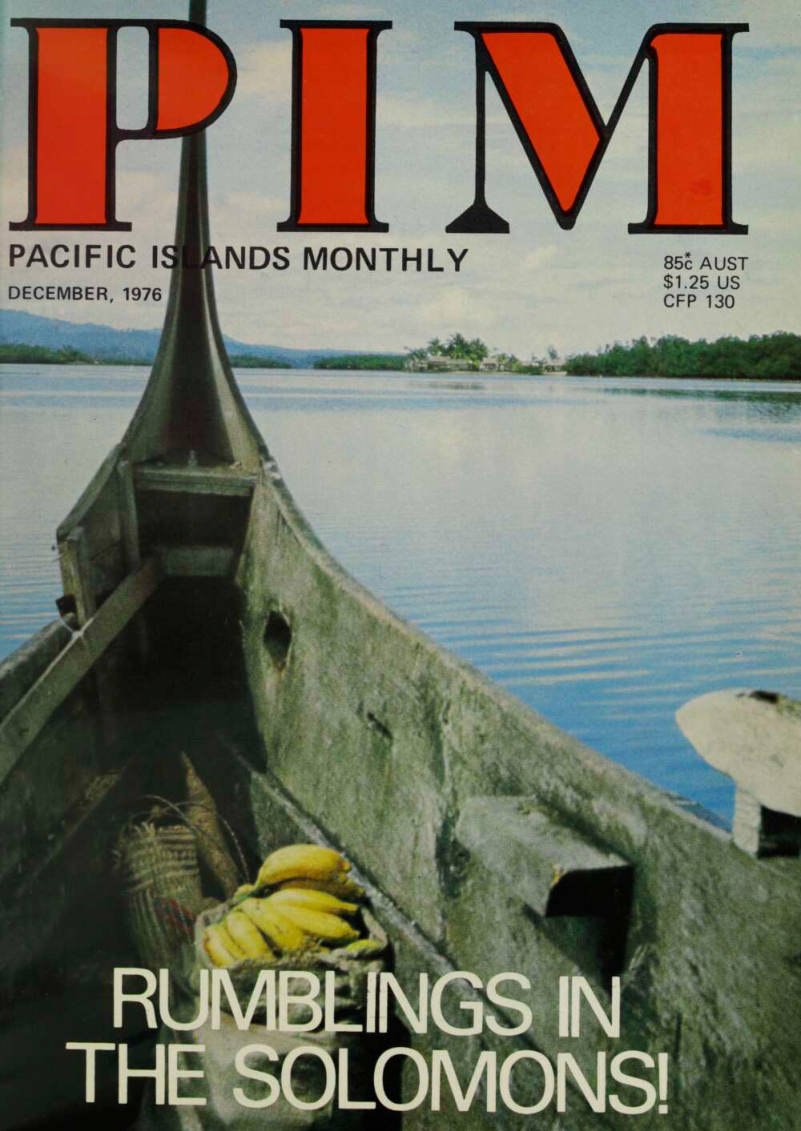
Our Cover
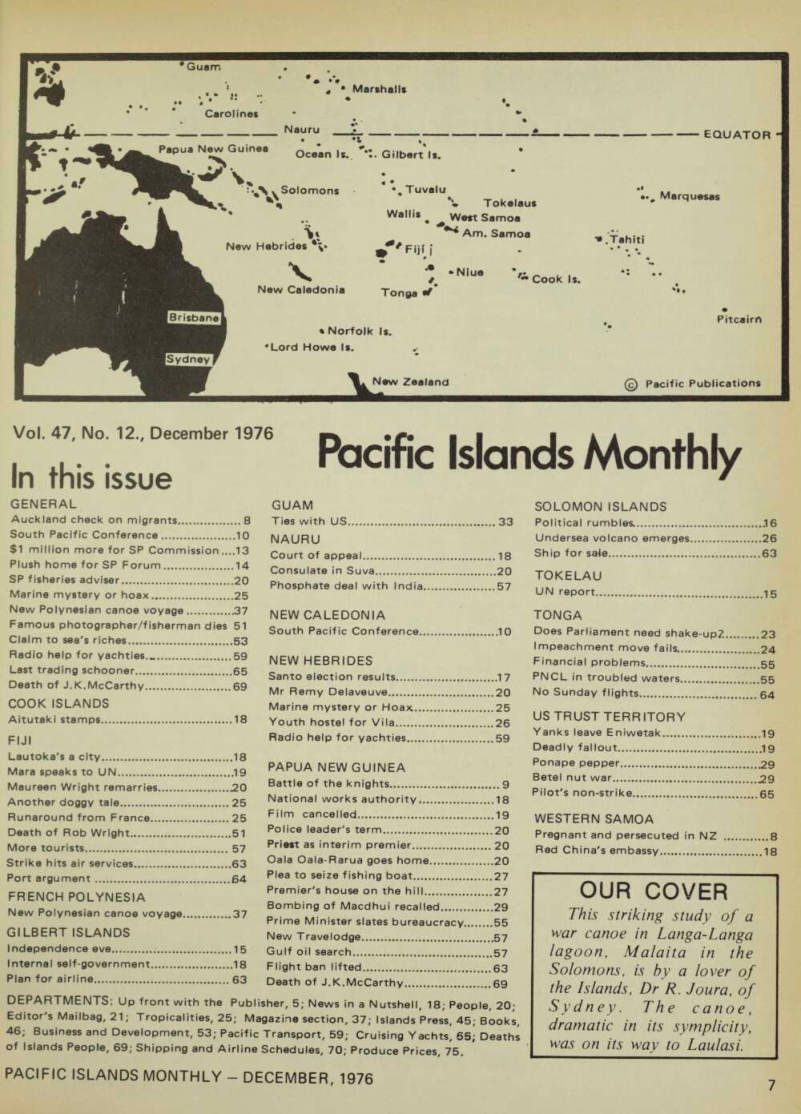
This striking study of a war canoe in Langa-Langa lagoon, Malaita in the Solomons, is by a lover of the Islands, Dr R. Joura, of Sydney. The canoe, dramatic in its symplicity, was on its way to Laulasi.
Advertisements & other items, pp. 2-4 (1 item)
one of the world’s finest cars.
When you buy a Toyota
we promise you much more than
m We'll be the first to admit that at Toyota we make some of the world's finest cars.
You only have to look at them to see that.
And driving them just goes to confirm your first opinions.
But there's more to buying a car than buying a good one. You also have to be sure you can keep it that way.
Which is why Toyota have always insisted that their after-sales service be as good as the cars themselves.
In the Pacific Islands area alone we have over fifty designated outlets to provide everything you might need, from a simple service to a major overhaul. So get yourself a Toyota and get a lot more than a car.
And that's a promise.
TOYOTA
SERVICE
TOYOTA
he Toyota range includes: Toyota 1000, Toyota Corolla, Toyota Celica, Toyota Corona, Toyota Corona Mark 11, Toyota Crown «*. NEW GUINEA: EEA MOTORS UMITEO.Rd- •^"SJSf’L^S'SSI JTOMOTIVE SUPPLIES CO., LTD., G.P.O. Box 355, Suva. AMERICAN SAMOA_BURNS PHI LP (SOUTHISEAHK) r • Mo^s [j D P 0 Box 18 Vila. SOLOMON ISLANDS: MENDANA 80. 188, Apia. GUAM: *«•«. kjWU. CORPORATION OTIVE SUPPLIES CO., L I U.,Li.r.u. Box ooo,auva. Hracniursn « t mm ucpmnFS- MFW HEBRIDES MOTORS LTD PO Box 18, Vila. SOLOMON ISLANDS; MtNUANA a 188, Apia. GUAM: ATKINS, KROLL (GUAMHLTD. P a 80, NEW LTD., P.O. Box 92, Rarotonga.
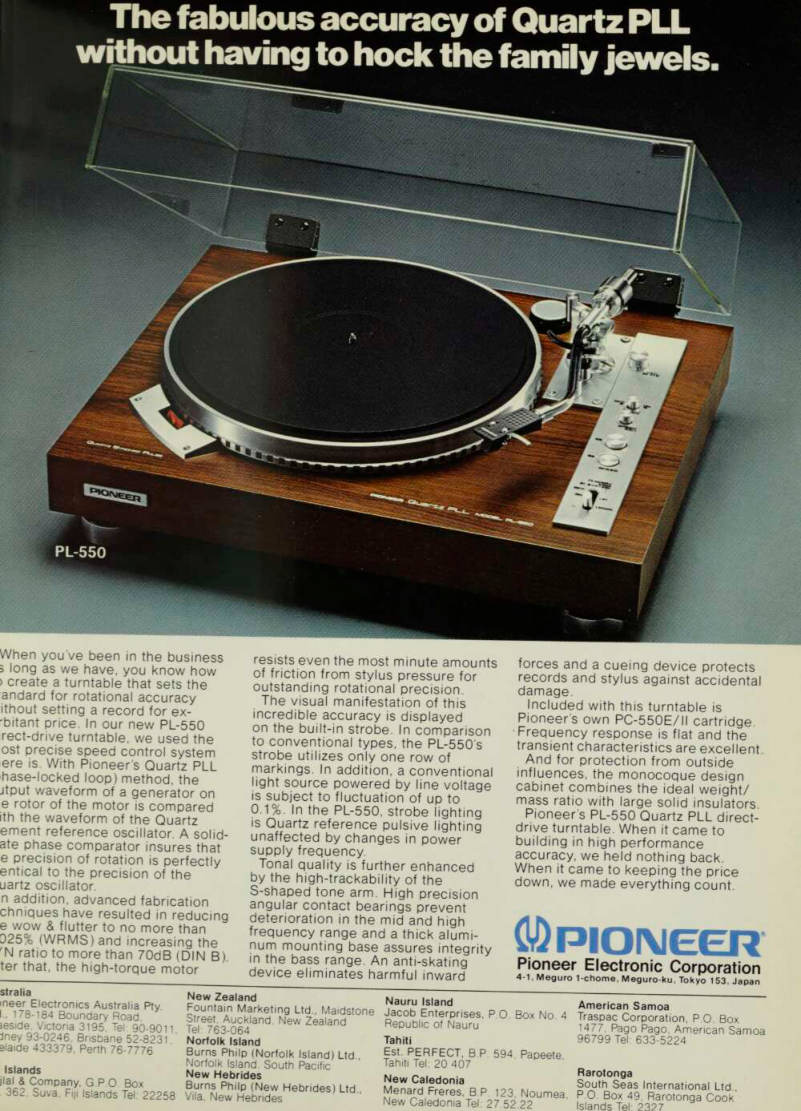
When you’ve been in the business 3 long as we have, you know how ) create a turntable that sets the andard for rotational accuracy ithout setting a record for ex- 'bitant price. In our new PL-550 rect-drive turntable, we used the ost precise speed control system ere is. With Pioneer’s Quartz PLL hase-locked loop) method, the jtput waveform of a generator on e rotor of the motor is compared ith the waveform of the Quartz ement reference oscillator. A solidate phase comparator insures that e precision of rotation is perfectly entical to the precision of the uartz oscillator. n addition, advanced fabrication chniques have resulted in reducing e wow & flutter to no more than 325% (WRMS) and increasing the 'N ratio to more than 70dB (DIN B). ter that, the high-torque motor resists even the most minute amounts of friction from stylus pressure for outstanding rotational precision.
The visual manifestation of this incredible accuracy is displayed on the built-in strobe. In comparison to conventional types, the PL-550’s strobe utilizes only one row of markings. In addition, a conventional light source powered by line voltage is subject to fluctuation of up to 0.1%. In the PL-550, strobe lighting is Quartz reference pulsive lighting unaffected by changes in power supply frequency.
Tonal quality is further enhanced by the high-trackability of the S-shaped tone arm. High precision angular contact bearings prevent deterioration in the mid and high frequency range and a thick aluminum mounting base assures integrity in the bass range. An anti-skating device eliminates harmful inward forces and a cueing device protects records and stylus against accidental damage.
Included with this turntable is Pioneer’s own PC-550E/II cartridge.
Frequency response is flat and the transient characteristics are excellent.
And for protection from outside influences, the monocoque design cabinet combines the ideal weight/ mass ratio with large solid insulators Pioneer s PL-550 Quartz PLL directdrive turntable. When it came to building in high performance accuracy, we held nothing back.
When it came to keeping the price down, we made everything count.
(^PIONEER
Pioneer Electronic Corporation
4-1, Meguro 1-chome, Meguro-ku, Tokyo 153, Japan stralia •neer Electronics Australia Pty. 1., 178-184 Boundary Road, leside, Victoria 3195, Tel 90-9011, tney 93-0246, Brisbane 52-8231 alaide 433379, Perth 76-7776 Islands ilal & Company. G.P.O Box 362, Suva, Fiji Islands Tel: 22258 New Zealand Fountain Marketing Ltd., Maidstone Street. Auckland. New Zealand Tel: 763-064 Norfolk Island Burns Philp (Norfolk Island) Ltd Norfolk Island, South Pacific New Hebrides Burns Philp (New Hebrides) Ltd.
Vila, New Hebrides Nauru Island Jacob Enterprises, P.O. Box No 4 Republic of Nauru Tahiti
Est. PERFECT, B P
Tahiti Tel: 20 407 594, Papeete, New Caledonia Menard Freres, B.P. 123, Noumea New Caledonia Tel: 27 52 22 American Samoa Traspac Corporation, P.O. Box 1477, Pago Pago, American Samoa 96799 Tel: 633-5224 Rarotonga South Seas International Ltd., P.O. Box 49, Rarotonga Cook Islands Tel- ?3?7
STATESMAN
smoothest cigars on
e international scene
,s re&u
\ .1 ’ ' T : -\' ,o^ ND^ 1801 US m mm m 88°
STATESMAN
CORONA
Corona
X554-10/75
Pacific Islands
Monthly
FOUNDED BY R W ROBSON IN 1930
Published Monthly By
Pacific Publications (Aust.) Pty. Ltd.,
76 Clarence Street, Sydney 2000
Post Address G P 0 BOX 3408. SYDNEY,
N S W 2001
Telegraphic Address PACPUB, Sydney Telex 21242
Telephone 29 6693
Publisher: Stuart Inder Manager: John Berry
Pacific Islands Monthly
Editor: John Carter Advertising Manager: Alan Batt
Subscription Rates
"Pacific Islands Monthly" is airfreighted to the ma jority of subscribers and agents in the Pacific Islands and the USA.
Australia (including Norfolk Island) $lO 50 Aust.
New Zealand, Papua New Guinea, Fiji, New Hebrides, Tonga, Cook Islands. Western Samoa, Gilbert Islands, Tuvalu, Niue. Nauru and Solomon Islands $10.50 Aust. American Samoa, Northern Marianas, Micronesia, Guam and Hawaii $15.00 US or $12.00 Aust. US mainland and Canada $17.00 US or $14.00 Aust. New Caledonia and French Polynesia 1,600 CFP or $l3 50 Aust. United Kingdom £9 50 or $12.50 Aust. Japan 4,500 Yen or $12.50 Aust.
Elsewhere $14.00 Aust.
Representatives
Fiji: Advertising and Distribution Fiji Times & Herald Ltd . 20 Gordon Street, Suva Telephone 312-1 11 Telex FJ2124 Papua New Guinea: Advertising and Distribution PNG Post-Courier, PO Box 85. Port Moresby Inquiries Post Newsagency, Telephone 24 2148 French Polynesia Distribution Hachette Pacifique, 10 Ave Bruat, Papeete New Caledonia: Distribution Depot Centre de Presse Michel PENTECOST, B P C 2 NOUMEA New Zealand: Pacific Publications, CP O Box 2229. Auckland United Kingdom. The Herald and Weekly Times Limited, 8-10 Clifford's Inn. Fetter Lane. London EC4A IBU Telephone 01-831 6041 Telex Lon don 21989 Japan: Advertising Universal Media Corpora tion, C P O Box 46. Tokyo Telephone 666-3036 Victoria: Advertising Pacific Publications (Aust) Pty Ltd , Herald and Weekly Times Building, 2nd Floor. 61 Flinders Lane, Melbourne 3000 Telephone 652 1565 Brisbane: D Wood, Anday Agency. Box 1918 GPO Brisbane 4001 Telephone 44 3485 44 1546 Hawaii and U S Mainland only: PIM, Hawaii, 2812, Kahawai St . Honolulu, Hawaii. 96822 Second class postage paid at Honolulu, Hawaii Printed in Australia
Copyright© 1976
Pacific Publications (Aust.) Pty. Ltd.
Printed by Paramac, Mitchell Road.
Alexandria PIM is distributed in Australia and New Zealand by Gordon & Gotch. 7 Registered at the GPO Sydney for transmission by lost as a newspaper category B Recommended retail price only
V 01.47 No. 12 Dec., 1976
Up Front
with the Publisher
Keith McCarthy, who died in Melbourne in late October after a long and colourful career in Papua New Guinea, was during the war described by a superior of his, the celebrated District Officer and Coast watcher Eric Feldt, as a “tall, red-headed man of Irish descent with the nature of a red headed man of Irish descent”.
Eric, who had great regard for McCarthy, which was warmly recip rocated, went on to say in The Coast Watchers, that McCarthy’s “was no cold calculating brain; his affections and emotions often governed him, but when his fine, free carelessness had landed him in trouble, he could extricate himself, cool logic guiding his Celtic fervour, until the danger was past. He had shown this capacity when ambushed in the heart of New Guinea by natives, coming safely out, though wounded bythreearrows,oneofwhich he described as having ruined the beautiful symmetry of his navel. For the rest, he had a boisterous sense of humour, a habit of appropriating other people’s matches, and a gift for caricature which he indulged at the expense of his friends.”
Keith mellowed, but his earthy humour and great enthusiasm for life remained untarnished. The other day I was leafing through my copy of the book he published in 1963, Patrol Into Yesterday, and found between its pages a note he had sent me in 1959 in reply to one I had written him, suggesting that he should write such a book and giving what I thought were a few pointers.
As it happened, Keith hadn’t needed any suggestion from me, as he had already written no less than 300,000 words on his own initiative, and the problem was not in the writing, but in the cutting! But in that note Keith wrote that he would like to “have a go” at publishing it, and added, “Your reference to sex in your note I
accept as a pretty compliment in view of my advancing years. We might even concentrate on sex and call the book, ‘Memory Close My Fly’, in a thick volume of early reminiscences.”
When Patrol Into Yesterday was published it had a dramatic title-page photograph of an older Keith McCarthy, with armed police and carriers, “on patrol” in New Guinea.
His pure delight at this picture had nothing to do with the “big man” image thus created, because Keith had no conceit. It was in the fact that the publishers had arranged to have the photograph taking in the handiest bit of rough New Guinea terrain the photographer could find, which happened to be in the grounds of Port Moresby’s Government House!
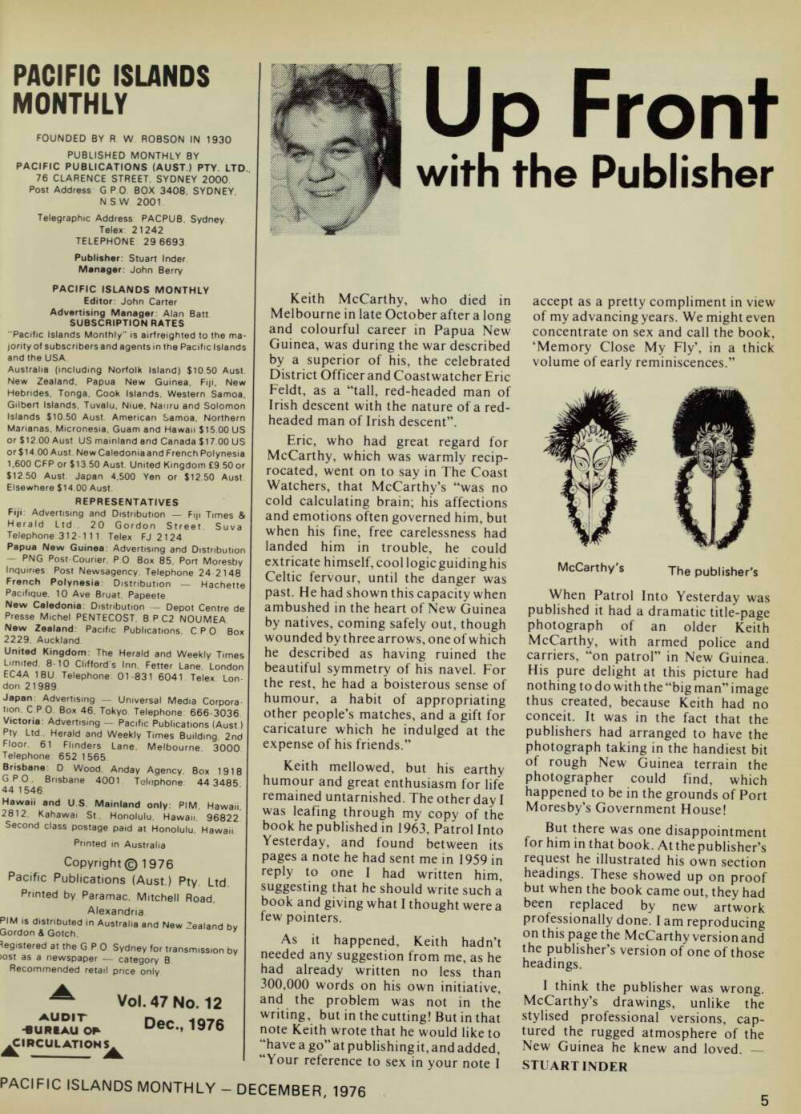
But there was one disappointment for him in that book. At the publisher’s request he illustrated his own section headings. These showed up on proof but when the book came out, they had been replaced by new artwork professionally done. I am reproducing on this page the McCarthy version and the publisher’s version of one of those headings.
I think the publisher was wrong.
McCarthy’s drawings, unlike the stylised professional versions, cap tured the rugged atmosphere of the New Guinea he knew and loved.
Stuart Inder
McCarthy's
The publisher's
Advertisements & other items, p. 6 (1 item)
S. E. Tatham & Co. Pty. Ltd
3 S. E. TATHAM & CO. PTY. LTD
BEEHIVE BLDG., 94 ELIZABETH STREET
G.P.O. BOX 8 CABLES "SET"
MELBOURNE, 3001, AUSTRALIA
TELEX: AA34552. TELEPHONE; 63 5094.
Buyers for the Pacific Islands
AND IN
Popup New Guinea:
S. E. TATHAM (P.N.G.) PTY. LTD.
LAE: MALAITA ST. (P.O. BOX 1562)
PORT MORESBY: Cnr. GOROA & MANAHU Sts., GORDON
(P.O. BOX 6733, BOROKO).
Fiji: S. E. TATHAM (FIJI) LTD.,
LAUTOKA P.O. BOX 366.
SUVA G.P.O. BOX 671,
TELEGRAMS: ALL OFFICES “SET”
YOUR GUARANTEE
\ 1 1 1 ✓ N
FOR SERVICE
T4/R
In this issue
General
Auckland check on migrants 8 South Pacific Conference 10 $1 million more for SP Commission ...13 Plush home for SP Forum 14 SP fisheries adviser 20 Marine mystery or hoax 25 Now Polynesian canoe voyage 37 Famous photographer/fisherman dies 51 Claim to sea's riches 53 Radio help for yachties. 59 Last trading schooner 65 Death of J.K.McCarthy 69
Cook Islands
Aitutaki stamps 18
Fiji
Lautoka's a city 18 Mara speaks to UN 19 Maureen Wright remarries .20 Another doggy tale 25 Runaround from France 25 Death of Rob Wright 51 More tourists 57 Strike hits air services 63 Port argument 64
French Polynesia
New Polynesian canoe voyage 37
Gilbert Islands
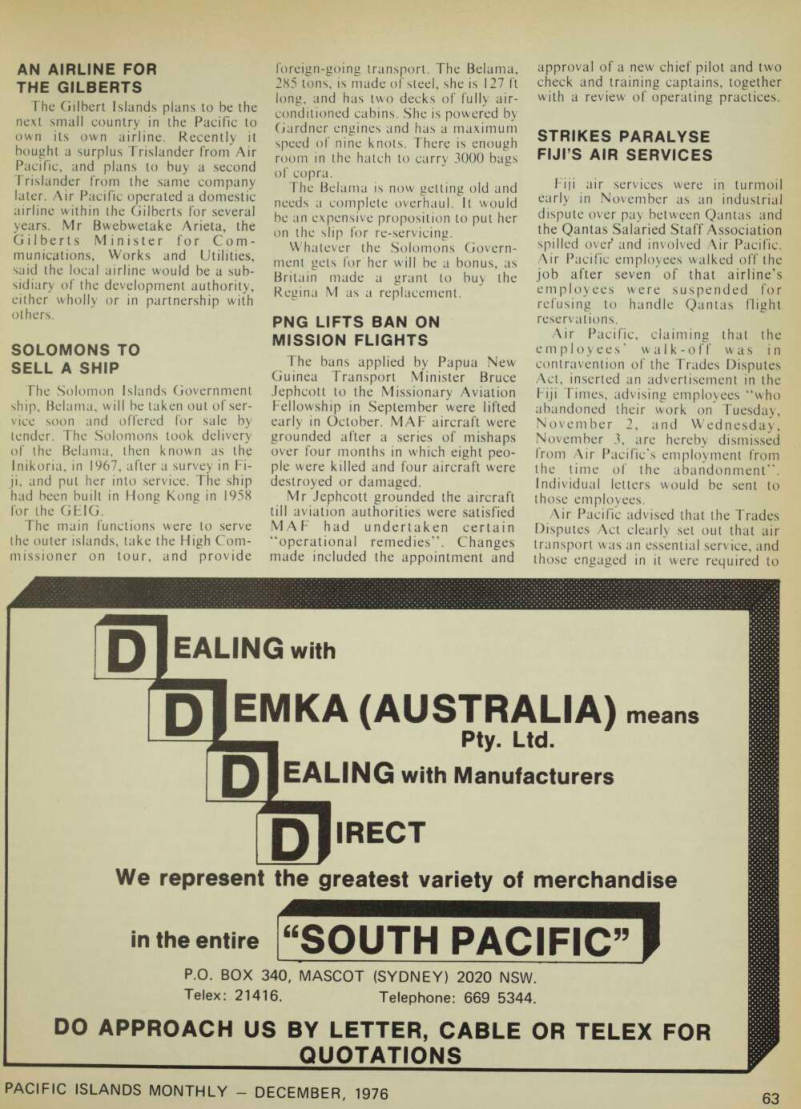
Independence eve 15 Internal self-government 18 Plan for airline 63
Guam
Ties with US 33
Nauru
Court of appeal 18 Consulate in Suva 20 Phosphate deal with India 57
New Caledonia
South Pacific Conference .10
New Hebrides
Santo election results 17 Mr Remy Delaveuve 20 Marine mystery or Hoax 25 Youth hostel for Vila 26 Radio help for yachties 59
Papua New Guinea
Battle of the knights 9 National works authority 18 Film cancelled 19 Police leader's term 20 Priest as interim premier 20 Oala Oala-Rarua goes home 20 Plea to seize fishing boat 27 Premier's house on the hill 27 Bombing of Macdhui recalled 29 Prime Minister slates bureaucracy 55 New Travelodge 57 Gulf oil search 57 Flight ban lifted 63 Death of J.K.McCarthy 69
Solomon Islands
Political rumbles. .16 Undersea volcano emerges 26 Ship for sale 63
Tokelau
UN report
Tonga
Does Parliament need shake-up?. 23 Impeachment move fails. 24 Financial problems 55 PNCL in troubled waters 55 No Sunday flights 64
Us Trust Terr Itory
Yanks leave Eniwetak 19 Deadly fallout 19 Ponape pepper 29 Betel nut war 29 Pilot's non-strike 65
Western Samoa
Pregnant and persecuted in NZ 8 Red China's embassy 18
DEPARTMENTS: Up front with the Publisher, 5; News in a Nutshell, 18; People, 20; Editor's Mailbag, 21; Tropicalities, 25; Magazine section, 37; Islands Press, 45; Books, 46, Business and Development, 53; Pacific Transport, 59; Cruising Yachts, 65; Deaths of Islands People, 69; Shipping and Airline Schedules, 70, Produce Prices, 75.
‘Gestapo in our streets’,
the Aucklanders cry
From MAURICE DICK in Auckland
It may be small consolation to those caught up in it, but New Zealand’s public opinion is heavily against the random checks and harassment of South Pacific Islanders as illegal immigrants.
In an unprecedented swoop, police teams sought out dark-skinned drinkers in pubs, passengers at taxi ranks, and pedestrians in Auckland’s streets, demanding evidence of their citizenship and right to be in New Zealand.
The three-day blitz raised an equal ly unprecedented groundswell of public outrage.
The Auckland Star called them “very bad days for long-time New Zealanders who care about their country and for Pacific Island overstayers”.
In a rare editorial comment, the sports paper 8 O’Clock said: “IT’S SICKENING. And frightening.
And It Must Stop!”.
Two things stuck in the throats of Kiwis of all races. One was the ran dom checks, which were compared with Gestapo methods. Auckland police chief Andy Berriman advised “anyone who speaks in a non-Kiwi ac cent or looks as though he was not born in this country . . .. should carry a passport”.
The second unpalatable fact was the insistence of politicians that ran dom checks had not been done.
Prime Minister Rob Muldoon twice denied it.
At the same time, Assistant Police Commissioner Bill Overton claimed some men “acted contrary to orders in questioning people in the street”.
Auckland Police Association chair man Peri Ngata quoted an official police instruction calling for “positive results” in the hunt for overstayers, in tactics which Mr Ngata himself a Maori found “quite abhorrent”.
The denials were insistent but futile. An Auckland journalist drink ing in a North Shore pub the night the blitz hit Auckland saw a police team move in on eight brown-skinned
drinkers, “invite” them outside to help with inquiries, and only six of them return.
The following morning, New Zealand-born Maori Mrs Hinerangi Burney, a member of the Tuhoe tribe, was stopped in broad daylight as she walked to work, and asked what island she came from.
Said Mrs Burney: “They didn’t ask me anything else”.
Yet in another of his dogmatic statements, Prime Minister Muldoon insisted three days later that “it would be contrary to government policy if anyone was accosted on the street because a policeman, on seeing the person, thought he might be an overstayer”.
While they watched it happening and seemed powerless to sway the politicians, New Zealanders’ faith in fair play was given a lift when no less a person than the Chief Ombudsman, Sir Guy Powles, stepped into the ring.
He called for a total amnesty and
blamed successive governments for “carelessly and probably negligently” allowing the situation to develop.
Said Sir Guy: “In the interests of ourselves and our grandchildren, we cannot allow this running sore to con tinue”.
It’s open knowledge that the Oc tober 21 blitz is the start of a three month campaign to gather in 4000 il legal immigrants in New Zealand.
All that might happen is that the random check technique will make “dawn raids” on Polynesians’ homes with police teams and trained dogs even as acceptable socially as a Sunday school picnic. By comparison, they may be seen as “normal police practice where there is reason to believe the law has been broken”.
But the tactics might also be more acceptable if those rounded up includ ed an equitable proportion of white skinned overstayers, from the British Isles, Canada, the United States and even Europe.
Pregnant And Persecuted
“For Fau Sale, a young Western Samoan woman halfway through her pregnancy, ‘justice’ meant that for two incredible months earlier this year she was pursued by the Police and the Immigration Departments”, writes New Zealand journalist Mike Field, telling one of the many grim stories thrown up by the current New Zealand government drive against “over-stayers”.
“The fear, terror and stress nearly caused her to miscarry”, Field writes.
Although she was married to a Western Samoan who has a permanent resident status, the Minister for Immigration, Mr Gill, decided the young woman had to leave New Zealand.
Straightening out the problem cost the young couple $4,000 in fares and expenses for their trip back to Apia where, the New Zealand Government insisted, they had to go to have Fau’s papers regularised.
The Sales are now back in New Zealand, and the proud parents of a baby girl.
But Fau’s position remains very much at the whim of the Immigration Department.
Fau’s husband, Tupui Sale, never tires of showing friends a photocopy of the ruling National Party’s 1975 manifesto in which the following passage is underlined: “The National Party will establish revised immigration criteria on the basis of humanitarian principles... Selection criteria will be based on family links with New Zealanders. Priority will be given to dependent relatives of New Zealand citizens and residents ...”
For his story, Field changed the names of the pair to avoid embarrassment o them and to the husband’s employers.
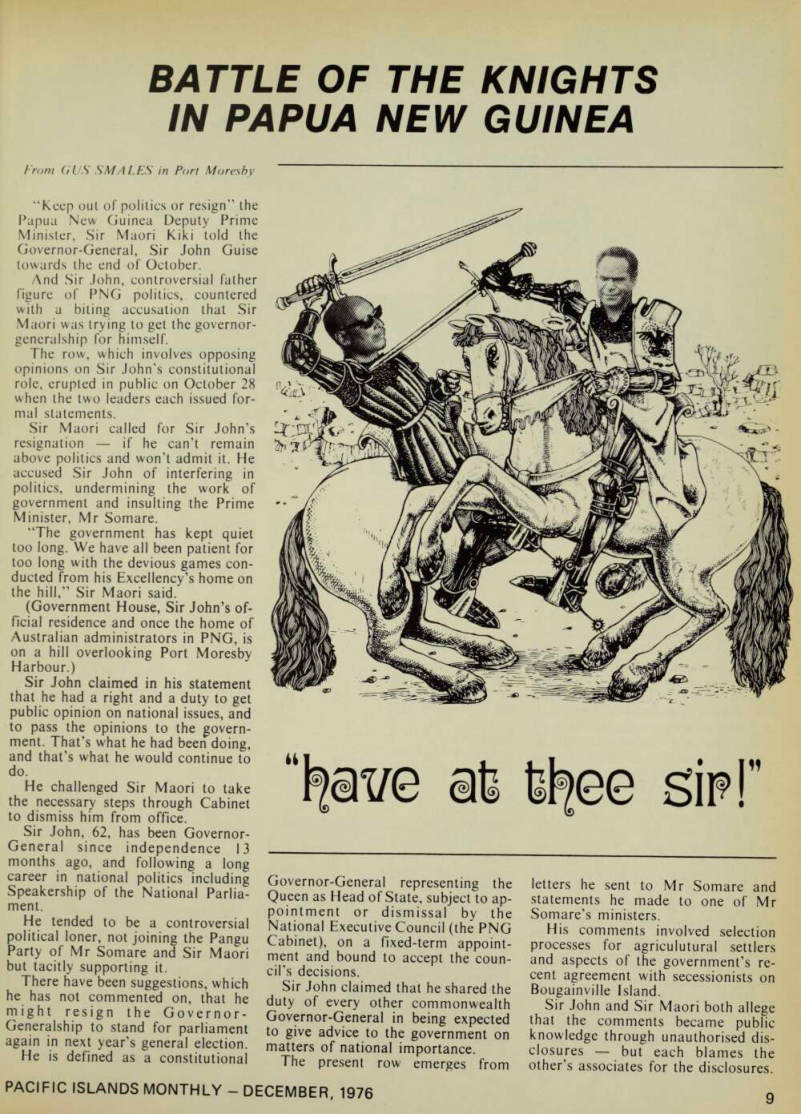
"have at thee sip!"
Battle Of The Knights
In Papua New Guinea
From (iUS SMALES in Port Moresby “Keep out of politics or resign” the Papua New Guinea Deputy Prime Minister, Sir Maori Kiki told the Governor-General, Sir John Guise towards the end of October.
And Sir John, controversial father figure of PNG politics, countered with a biting accusation that Sir Maori was trying to get the governor generalship for himself.
The row, which involves opposing opinions on Sir John’s constitutional role, erupted in public on October 28 when the two leaders each issued for mal statements.
Sir Maori called for Sir John’s resignation if he can’t remain above politics and won’t admit it. He accused Sir John of interfering in politics, undermining the work of government and insulting the Prime Minister, Mr Somare.
“The government has kept quiet too long. We have all been patient for too long with the devious games con ducted from his Excellency’s home on the hill,” Sir Maori said. (Government House, Sir John’s of ficial residence and once the home of Australian administrators in PNG, is on a hill overlooking Port Moresby Harbour.) Sir John claimed in his statement that he had a right and a duty to get public opinion on national issues, and to pass the opinions to the govern ment. That’s what he had been doing, and that’s what he would continue to do.
He challenged Sir Maori to take the necessary steps through Cabinet to dismiss him from office.
Sir John, 62, has been Governor- General since independence 13 months ago, and following a long career in national politics including Speakership of the National Parlia ment.
He tended to be a controversial political loner, not joining the Pangu Party of Mr Somare and Sir Maori but tacitly supporting it.
There have been suggestions, which he has not commented on, that he might resign the Governor- Generalship to stand for parliament again in next year’s general election.
He is defined as a constitutional
letters he sent to Mr Somare and statements he made to one of Mr Somare’s ministers.
His comments involved selection processes for agriculutural settlers and aspects of the government’s re cent agreement with secessionists on Bougainville Island.
Sir John and Sir Maori both allege that the comments became public knowledge through unauthorised dis closures but each blames the other’s associates for the disclosures.
Governor-General representing the Queen as Head of State, subject to ap pointment or dismissal by the National Executive Council (the PNG Cabinet), on a fixed-term appoint ment and bound to accept the coun cil’s decisions.
Sir John claimed that he shared the duty of every other commonwealth Governor-General in being expected to give advice to the government on matters of national importance.
The present row emerges from
"have at thee sip!"
The Last Convulsion?
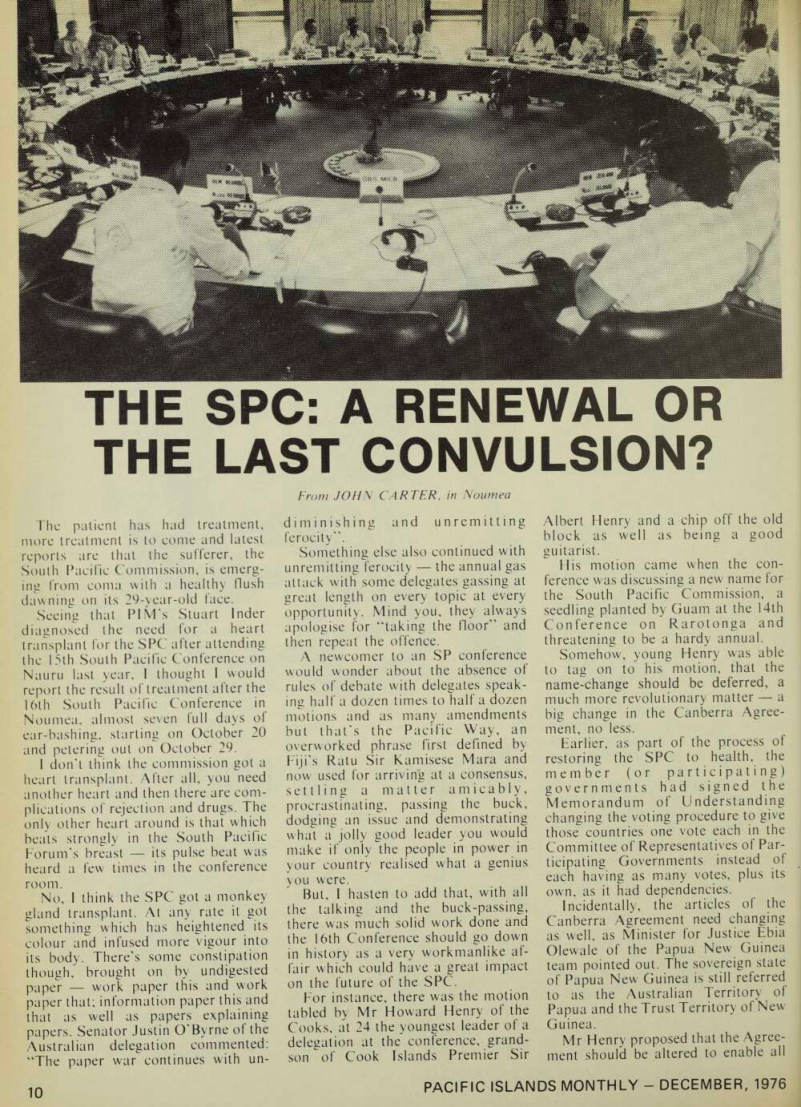
The Spc: A Renewal Or
From JOHN CARTER, in Noumea
The palicnl has had treatment, more treatment is to come and latest reports are that the sufferer, the South Pacific Commission, is emerging from coma with a healthy flush dawning on its 29-year-old face.
Seeing that PlM’s Stuart Inder diagnosed the need for a heart transplant for the SPC after attending the 15th South Pacific Conference on Nauru last year I thought 1 would report the result of treatment after the 16th South Pacific Conference in Noumea, almost seven full days of car-bashing, starting on October 20 and petering out October 29.
I don't think the commission got a heart transplant After all, you need another heart and then there are complications of rejection and drugs. The only other heart around is that which beats strongly in the South Pacific Forum's breast - its pulse beat was heard a few times in the conference No'. I think the SPC got a monkey uland transplant. At any rate it got something which has heightened its colour and infused more vigour into its bodv There's some constipation though brought on by undigested papef- work paper this andwork naner that* information paper this and Z t as wdl aT pape?s P papers. Senator Justin O'Byrne of the Australian delegation commented: "The paper war continues with un-
diminishing and unremitting ferocity Something else also continued with unremitting ferocity the annual gas attack with some delegates gassing at great length on every topic at every opportunity. Mind you, they always apologise for “taking the floor” and then repeat the offence.
A newcomer to an SP conference would wonder about the absence of rules of debate with delegates speaking half a dozen times to half a dozen motions and as many amendments but that s the Pacific Way, an overworked phrase first defined by Fiji's Ratu Sir Kamisese Mara and now used for arriving at a consensus, settling a matter amicably, procrastinating, passing the buck. dodging an issue and demonstrating what a jolly good leader you would make if only the people in power in your country realised what a genius you were.
' But, I hasten to add that, with all the talking and the buck-passing. there was much solid work done and the 16th Conference should go down in history as a very workmanlike affair which could have a great impact on the future of the SPC.
For instance, there was the motion tabled by Mr Howard Henry of the Cooks, at 24 the youngest leader of a delegation at the conference, grandson of Cook Islands Premier Sir
Albert Henry and a chip off the old block as well as being a good guitarist.
His motion came when the con ference was discussing a new name tor the South Pacific Commission a seedling planted by Guam at the 14lh Conference on Rarotonga and threatening to be a hardy annual Somehow, young Henry was able to tag on to his motion, that the name-change should be deferred, a much more revolutionary matter a big change in the Canberra Agree merit, no less.
Earlier, as PJ r^ of / he . P r^ ess t] ? f restoring the SPC to health the member (or part l c 1 pat l ng) governments had signedl the Memorandum of Und^. S r i a " d j i n J changing the voting procedure to give those countries one vote each in the Committee of Representatives of Par ticipatmg of each having as many votes, plus its own, as it had dependencies, Incidentally, the articles of the Canberra Agreement need changing as well, as M'" 18 ufnea Olewale of the Papua New Guinea team pointed out. The sovereign state of Papua New Guinea is still referred to as the Australian Territory of Papua and the Trust Terntory of New
Guinea^
Mr Henry proposed that the Agree ment should be altered to enable all
countries and territories of the Pacific to accede to it. He pointed out that only independent countries could accede to the agreement and he wanted equality.
That put the political cat among the pigeons. Politics are tabu in the SPC and this, complained some of the delegates from the French territories, was politics.
What Mr Henry wanted was for all the countries and territories to be on an equal footing with the nine Par ticipating Countries, who are the only signatories of the Agreement. He wanted the only qualification for full membership of the commission to be a geographical one, location in the South Pacific, and not political status.
But Mr Jacques Teheiura of French Polynesia took umbrage.
Mr Teheiura said he regarded the motion as political; that New Caledonia and French Polynesia were being forced to declare their political stand. It interfered with their internal affairs, but no one could force the non-independent territories to become independent if they didn’t want to be independent.
Then he got in a neat piece of political one-upmanship. Recently, he said, they had an election in French Polynesia and the candidate who wanted independence only got two per cent of the votes so that 98 per cent of the population who voted were against independence.
The storm passed, no one walked out and it was settled in the Pacific way.
Britain and New Zealand moved that the motion should be withdrawn although they were sympathetic towards the aspirations expressed in it, but Mr Henry refused to withdraw it.
However, he amended it and later, after some corridor diplomacy, he amended it again and it went through with almost everyone’s blessing. It directed the secretariat to study ways in which the legal implications in the Canberra Agreement could be sur mounted to permit all countries and territories, whatever their status, to become full members of the commis sion which, if it happens, could be the greatest change the SPC has un dergone.
As Australia’s Mr R. J. Percival said, it would mean that all the flags of all the countries would fly over Anse Vata beach. So, we’ll have Fiji’s, Tonga’s, Australia’s, New Zealand’s! three or four French Tricolors and a brace of Union flags, not to mention a
couple of Stars and Stripes and others.
That wasn’t the only discussion with a political tinge. There was an agenda item based on the theme of Regionalism; means to further con tacts between Island nations and territories. Wallis and Futuna had produced a paper which included complaints that there wasn’t enough regionalism; that their isolated islands weren’t considered by airline and shipping timetable compilers and that there wasn’t enough interchange of manpower and employment.
Somehow, a phrase “that local peo ple be more involved in policy-making in their own countries” got into the script. It came from Tuvalu’s Chief Minister Toalipe Lauti, who, like other representatives of newly independent countries or nearly so, was keen to push the barrow for the poor unfortunates still languishing un der the foreign yoke.
Once again, representatives of France’s overseas territories reacted “It’s politics, it’s interference in the internal affairs of other coun tries”. However, the leader of the French team, Mr Pierre Revol of the Department of External Affairs, successor at the SPC of Mr Henri Nettre, didn’t seem to see it that way.
The only word he objected to was “more”, arguing that people were in volved or they weren’t involved.
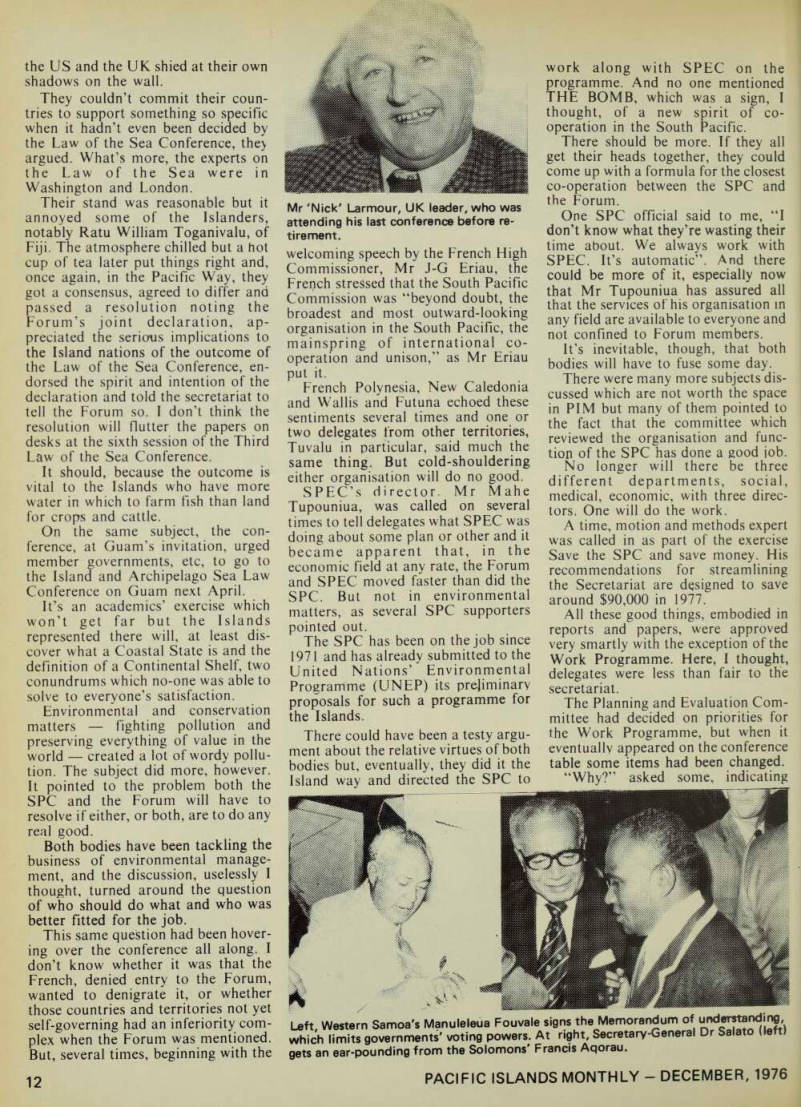
All through the conference Mr Revol sat like the Wise Old Owl, hearing a lot and saying little. There were one or two occasions the like of which had in the past prompted Mr Nettre to walk out.
Mr Revol doesn’t look like a walker but he’s a very experienced plenipotentiary minister and, no doubt, has usually got what he wanted without a fuss.
Back and forth went the arguments it wasn’t politics, it was to help Islanders to move more freely, or, from the other side, it was politics and interference, and the United States queried the SPC’s competence in that field.
What came out of it was, to me at any rate, evidence that monkey gland was doing its rejuvenating job. That’s if governments hearken to the con ference’s full endorsement of the “concept and spirit of regionalism” (with a capital R) and recommenda tion to all SPC countries that there should be in those countries “more flexibility in their immigration, health, communication and transport policies to enable more freedom of movement of people, goods and ideas within the region”.
Such a resolution could open many doors. It’s my belief most ad ministrations will cold-shoulder it, but the fact that the conference dealt with it instead of sweeping it under the carpet for 12 months is a sign that the SPC is responding to treatment.
In the same way, it got something positive out of two other items which threatened to blow a few fuses a resolution supporting the Forum’s Joint Declaration on Law of the Sea questions (reported elsewhere in this issue), and another directing that the SPC should work with the Forum’s Bureau for Economic Co-operation (SPEC) on a “comprehensive en vironmental management pro gramme”.
When the Law of the Sea business reared its head, both the United Kingdom, with the Icelandic cod war in mind no doubt, and the United States, which is trying to keep the lid on Micronesia’s aspirations in the same sphere, objected to giving all-out support to the Forum’s declaration.
As the Forum’s declaration called for “sovereign rights of coastal states over resources” in a 200-mile ex clusive economic zone and other matters pertaining to the rights of archipelagic and Island states, both
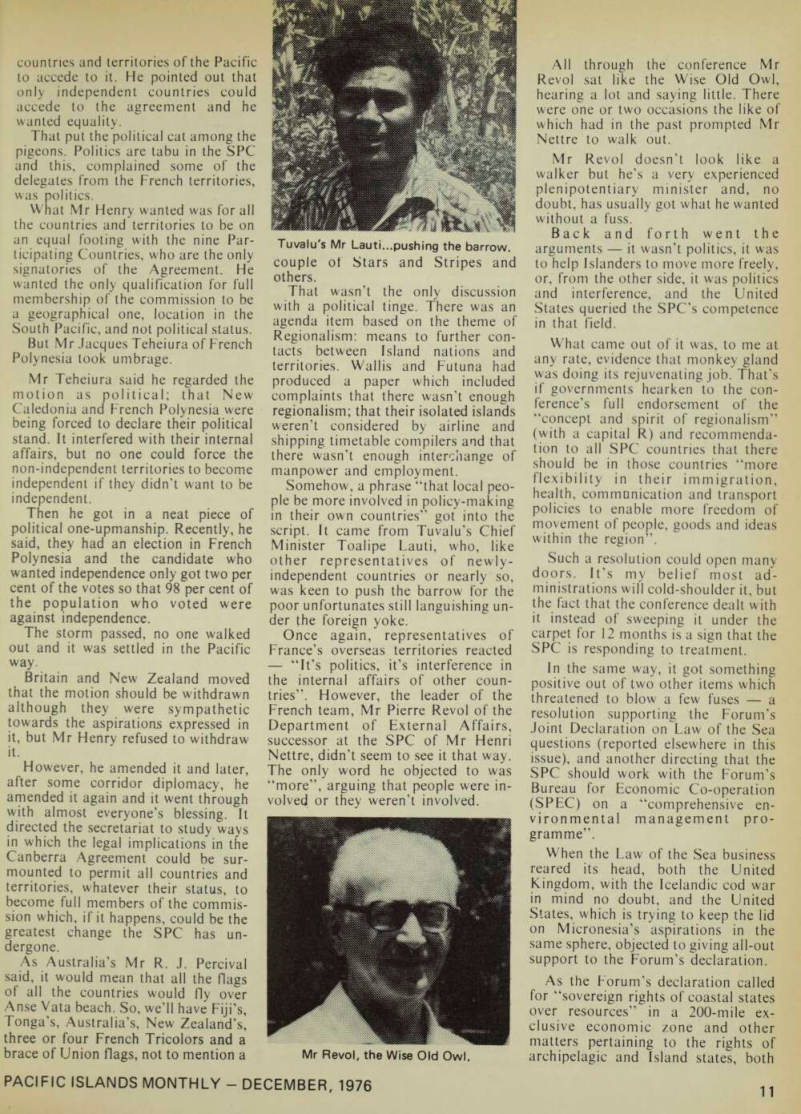
Tuvalu's Mr Lauti...pushing the barrow.
Mr Revol, the Wise Old Owl.
the US and the UK shied at their own shadows on the wall.
They couldn’t commit their coun tries to support something so specific when it hadn’t even been decided by the Law of the Sea Conference, the> argued. What’s more, the experts on the Law of the Sea were in Washington and London.
Their stand was reasonable but it annoyed some of the Islanders, notably Ratu William Toganivalu, of Fiji. The atmosphere chilled but a hot cup of tea later put things right and, once again, in the Pacific Way, they got a consensus, agreed to differ and passed a resolution noting the Forum’s joint declaration, ap preciated the serious implications to the Island nations of the outcome of the Law of the Sea Conference, en dorsed the spirit and intention of the declaration and told the secretariat to tell the Forum so. I don’t think the resolution will flutter the papers on desks at the sixth session of the Third Law of the Sea Conference.
It should, because the outcome is vital to the Islands who have more water in which to farm fish than land for crops and cattle.
On the same subject, the con ference, at Guam’s invitation, urged member governments, etc, to go to the Island and Archipelago Sea Law Conference on Guam next April.
It’s an academics’ exercise which won’t get far but the Islands represented there will, at least dis cover what a Coastal State is and the definition of a Continental Shelf, two conundrums which no-one was able to solve to everyone’s satisfaction.
Environmental and conservation matters fighting pollution and preserving everything of value in the world created a lot of wordy pollu tion. The subject did more, however.
It pointed to the problem both the SPC and the Forum will have to resolve if either, or both, are to do any real good.
Both bodies have been tackling the business of environmental manage ment, and the discussion, uselessly I thought, turned around the question of who should do what and who was better fitted for the job.
This same question had been hover ing over the conference all along. I don’t know whether it was that the French, denied entry to the Forum, wanted to denigrate it, or whether those countries and territories not yet self-governing had an inferiority com plex when the Forum was mentioned.
But, several times, beginning with the
welcoming speech by the French High Commissioner, Mr J-G Eriau, the French stressed that the South Pacific Commission was “beyond doubt, the broadest and most outward-looking organisation in the South Pacific, the mainspring of international co operation and unison,” as Mr Eriau put it.
French Polynesia, New Caledonia and Wallis and Futuna echoed these sentiments several times and one or two delegates from other territories, Tuvalu in particular, said much the same thing. But cold-shouldering either organisation will do no good.
SPEC’s director. Mr Mahe Tupouniua, was called on several times to tell delegates what SPEC was doing about some plan or other and it became apparent that, in the economic field at any rate, the Forum and SPEC moved faster than did the SPC. But not in environmental matters, as several SPC supporters
pointed out.
The SPC has been on the job since 1971 and has already submitted to the United Nations’ Environmental Programme (UNEP) its preliminary proposals for such a programme for the Islands.
There could have been a testy argu ment about the relative virtues of both bodies but, eventually, they did it the Island way and directed the SPC to
work along with SPEC on the programme. And no one mentioned THE BOMB, which was a sign, I thought, of a new spirit of co operation in the South Pacific.
There should be more. If they all get their heads together, they could come up with a formula for the closest co-operation between the SPC and the Forum.
One SPC official said to me, “I don’t know what they’re wasting their time about. We always work with SPEC. It’s automatic”. And there could be more of it, especially now that Mr Tupouniua has assured all that the services of his organisation in any field are available to everyone and not confined to Forum members.
It’s inevitable, though, that both bodies will have to fuse some day.
There were many more subjects dis cussed which are not worth the space in PIM but many of them pointed to the fact that the committee which reviewed the organisation and func tion of the SPC has done a good job.
No longer will there be three different departments, social, medical, economic, with three direc tors. One will do the work.
A time, motion and methods expert was called in as part of the exercise Save the SPC and save money. His recommendations for streamlining the Secretariat are designed to save around $90,000 in 1977.
All these good things, embodied in reports and papers, were approved very smartly with the exception of the Work Programme. Here, I thought, delegates were less than fair to the secretariat.
The Planning and Evaluation Com mittee had decided on priorities for the Work Programme, but when it eventually appeared on the conference table some items had been changed.
“Why?” asked some, indicating
Mr 'Nick' Larmour, UK leader, who was attending his last conference before re tirement.
Left, Western Samoa's Manuleleua Fouvale signs the Memorandum of undemanding, which limits governments' voting powers. At right, Secretary-General Dr Salato (left) gets an ear-pounding from the Solomons Francis Aqorau.
that the secretariat had no business changing the committee’s decisions.
The Secretariat explained.
For instance, top priority had been given to the appointment of an expert for a project and how much he’d be paid, but the job he was to do had been given a low priority, so they would have a highly-paid expert sit ting on his behind doing nothing.
Wisely, the secretariat changed the arrangement.
The upshot of it all was that the secretariat was “directed” not to “deviate” from the priorities laid down and to submit needed variations. That means more paper work.
And, here’s the place for a tribute to the Secretary-General and his secretariat. They’re all doing a good job with a smaller staff which, es pecially before and after the annual conference, works long hours. On the night before the conference closed they used up the midnight oil to produce next morning a 12-page report plus six annexes.
Translations and interpretations are also as near perfect as need be.
And here’s a bouquet for the delegates. Many of them waffled too much but they made decisions which indicate that the transplant is getting rid of the SPC’s palsy. In the past, rather than make a decision, delegates deferred things again and again. That could be all over.
The conference axed several things which threatened to pad out the agen da for years. In no time at all, they squashed the idea of a Pacific Law Centre a lack of interest and scrapped the proposal to change the commission’s name which Guam and the US Trust Territory had asked them to do more than two years ago, as it didn’t reflect their geographical position.
The argument used to squash it could have been given at the begin ning, thus sparing the efforts of those who, in the hope of winning a prize in the official contest, sent in 375 names.
The prize was $lOO which won’t be awarded now. Four names were pick ed for a short list so the fairest thing is to give the originators $25 each!
The proposed Regional Develop ment Bank will be on the agenda again next year but, probably, for the last time. The general feeling about it was that as it will only be required by the smallest of the territories who can’t get a small loan from existing in stitutions like the World Bank and the Asian Development Bank, a big bank
wouldn’t be viable. Apart from that, the Secretary-General has been all over the place looking for donors to finance the bank, but there were no takers.
Now he’s going to see if one of the big boys will set up an agency in the South Pacific to lend sums around $200,000 or $300,000. He’ll be lucky!
Unless he mentions R or C . . . .
Well, it was a good conference, one of the best and our French hosts, es pecially the French administration, did us proud a big official welcome
and red carpet, sundry cocktail par ties and trips around the island, through the nickel works and over to the Isle of Pines.
Next year, it’ll be American Samoa’s job to host the Seventeenth South Pacific Conference provisional ly dated for September, so it’s up to President Jimmy Carter and his crowd to give American Samoa all the help they can. It’s a small place; was nearly on the breadline a couple of years ago and it takes more than peanuts to do the job right.
Million dollar injection
The SPC has nearly a million dollars more to spend this coming year than for 1976, which was the best news to come out of the con ference.
The total income for its 1977 budget is A 52,871,022 and, as it can always, and usually does, spend up to the hilt, it will all be spent. In fact, if some unexpected windfalls come along, it has plans to spend another $1,116,120. Last year's total income was $2,000,578 All the nine participating governments increased their agreed percentage contributions by 20 per cent to a total of $2,210,340. Most of the other territories and countries also raised the ante and the par ticipating governments weighed in with another $541,935 in voluntary contributions the last time they are expected to do so, as Australia told the conference that the volun tary contributions system, which has only been going a few years, should be discontinued and the work programme paid for out of the con tributions to the regular budget.
The total income also included $41,786 which was available for revote, $12,000 from reserves, $9,000 from publications sales and $28,800 "other income”. There is a windfall coming, but not strictly to the SPC. Managing director Mr A.
Tasker, of the Commonwealth Fund for Technical Co-operation, an nounced that it would finance suitable projects in individual territories up to the tune of $lOO,OOO this coming year.
This is bow it's planned to spend the money in 1977: $183,220 on
executive management, $125,280 on food and materials, $276,488 on marine resources, $212,508 on rural management and technology, $302,897 on community services, $854,461 on information services and data analysis, $244,606 on awards and grants, $281,109 on property and office services, $130,- 738 on finance office, $167,215 on common services and $92,500 will go to the reserve fund.
And this is how the money came in for the budget; From the nine par ticipating governments on an agreed percentage basis: Australia (30% of the contributions) $663,103; Fiji (1%) $22,103; France (14%) $309,- 449; Nauru (1%) $22,103; New Zealand (16%) $353,654; Papua New Guinea (1%) $22,103; United Kingdom (16%) $353,654; United States (20%) $442,068; Western Samoa (1%) $22,103 Western Samoa's increased contribution (from $18,419 to $22,103) is con ditional on government agreement.
The territories and countries, not independent and, therefore, not par ticipating governments, contributed as follows: American Samoa $2,- 032; Cook Islands $3,450; French Polynesia $909; Gilbert Islands $2,- 068; Guam $6829: New Caledonia $1,818; New Hebrides $2,760; Niue $1,505; Solomon Islands $2,- 280; Tokelau $905; Tonga $950; Tuvalu $1,200; Wallis and Futuna $455.
In addition, Australia gave another $250,000 on a voluntary basis, France $50,000 and New Zealand $241,935.
A plush
home for the Forum
From a Suva correspondent The South Pacific Forum’s new, plush, one million dollar headquarters in Suva were opened in October by New Zealand Prime Minister Rob Muldoon, whose country footed the bill for the building. But Australia, who paid for the furnishings, upstaged everyone, her Foreign Minister An drew Peacock announcing that Australia would give the Islands $6O million between now and 1979.
His golden “declaration of intent” was made at a meeting of the Forum on the Law of the Sea conference, held as the “opener”.
New Zealand also made use of the meeting to privately calm Tongan and Samoan fears about its revamped im migration policies and make a declaration of its total involvement in the South Pacific.
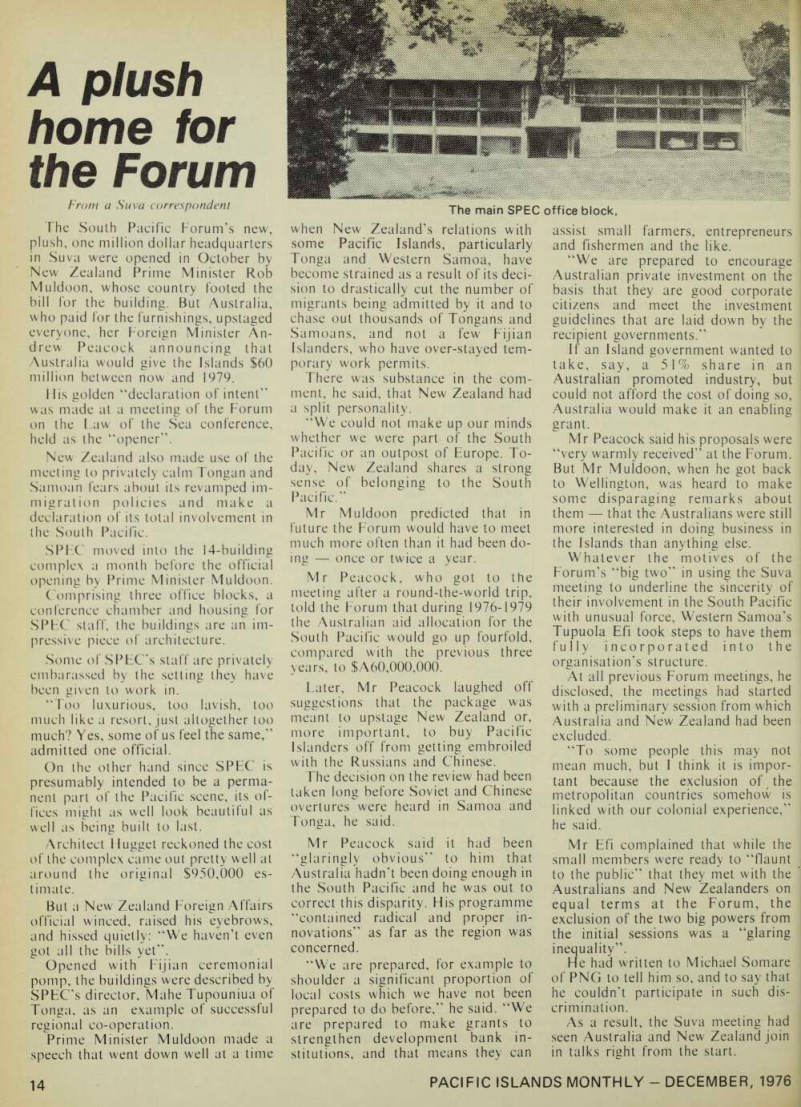
SPEC moved into the 14-building complex a month before the official opening by Prime Minister Muldoon.
Comprising three office blocks, a conference chamber and housing for SPEC staff, the buildings are an im pressive piece of architecture.
Some of SPEC's staff are privately embarassed by the setting they have been given to work in.
“Too luxurious, 100 lavish, too much like a resort, just altogether 100 much? Yes, some of us feel the same,” admitted one official.
On the other hand since SPEC is presumably intended to be a perma nent part of the Pacific scene, its of fices might as well look beautiful as well as being built to last.
Architect Hugget reckoned the cost of the complex came out pretty well at around the original $950,000 es timate.
But a New Zealand Foreign Affairs official winced, raised his eyebrows, and hissed quietly: “We haven’t even got all the bills yet”.
Opened with Fijian ceremonial pomp, the buildings were described by SPEC's director, Mahe Tupouniua of Tonga, as an example of successful regional co-operation.
Prime Minister Muldoon made a speech that went down well at a time
when New Zealand’s relations with some Pacific Islands, particularly Tonga and Western Samoa, have become strained as a result of its deci sion to drastically cut the number of migrants being admitted by it and to chase out thousands of Tongans and Samoans, and not a few Fijian Islanders, who have over-stayed tem porary work permits.
There was substance in the com ment, he said, that New Zealand had a split personality.
“We could not make up our minds whether we were part of the South Pacific or an outpost of Europe. To day, New Zealand shares a strong sense of belonging to the South Pacific.”
Mr Muldoon predicted that in future the Forum would have to meet much more often than it had been do ing once or twice a year.
Mr Peacock, who got to the meeting after a round-the-world trip, told the Forum that during 1976-1979 the Australian aid allocation for the South Pacific would go up fourfold, compared with the previous three years, to $A60,000,000.
Later, Mr Peacock laughed off suggestions that the package was meant to upstage New Zealand or, more important, to buy Pacific Islanders off from getting embroiled with the Russians and Chinese.
The decision on the review had been taken long before Soviet and Chinese overtures were heard in Samoa and Tonga, he said.
Mr Peacock said it had been “glaringly obvious” to him that Australia hadn't been doing enough in the South Pacific and he was out to correct this disparity. His programme “contained radical and proper in novations” as far as the region was concerned.
“We are prepared, for example to shoulder a significant proportion of local costs which we have not been prepared to do before,” he said. “We are prepared to make grants to strengthen development bank in stitutions, and that means they can
assist small farmers, entrepreneurs and fishermen and the like.
“We are prepared to encourage Australian private investment on the basis that they are good corporate citizens and meet the investment guidelines that are laid down by the recipient governments.”
If an Island government wanted to take, say, a 51% share in an Australian promoted industry, but could not afford the cost of doing so, Australia would make it an enabling grant.
Mr Peacock said his proposals were “very warmly received” at the Forum.
But Mr Muldoon, when he got back to Wellington, was heard to make some disparaging remarks about them that the Australians were still more interested in doing business in the Islands than anything else.
Whatever the motives of the Forum’s “big two” in using the Suva meeting to underline the sincerity of their involvement in the South Pacific with unusual force, Western Samoa’s Tupuola Efi took steps to have them fully incorporated into the organisation’s structure.
At all previous Forum meetings, he disclosed, the meetings had started with a preliminary session from which Australia and New Zealand had been excluded.
“To some people this may not mean much, but I think it is impor tant because the exclusion of the metropolitan countries somehow is linked with our colonial experience,” he said.
Mr Efi complained that while the small members were ready to “flaunt to the public” that they met with the Australians and New Zealanders on equal terms at the Forum, the exclusion of the two big powers from the initial sessions was a “glaring inequality”.
He had written to Michael Somare of PNG to tell him so, and to say that he couldn't participate in such dis crimination.
As a result, the Suva meeting had seen Australia and New Zealand join in talks right from the start.
The main SPEC office block.
On Independence Eve, What’S
Going On In The Gilberts?
By January, 1977, the Gilbert Islands will have moved from their present political status to that of in ternal self-government. But perhaps more important is the fact that, within 12 or 18 months after that, the Gilberts will achieve full in dependence.
In early July, our Chief Minister, Naboua Ratieta, with two of his ministers and two private members of our House of Assembly, together with the Governor, Mr John Smith, left Tarawa for a constitutional con ference in London on the subject of self-government for our country or so it was announced by our only newspaper, the Atoll Pioneer, which is owned by the government.
This announcement gave rise to some confusion in the minds of some people on the islands as to just what the real situation is. Self-government is already planned. There may even be a constitution already drafted for that eventuality. So what other issues are our leaders required to discuss further in relation to self-government?
It seems there must be some other very important issue at stake which has not been publicly aired. Perhaps it may come to the surface before too long.
Our government, since it was form ed under its new leader, has been very busy trying to solve a number of problems, some of which are left over from the past. These include: • The long-standing dispute between the Gilberts and Banaba (Ocean Island) concerning the de mand for separation of the Banabans Irom the Gilberts, and the annual division of funds between the Gilberts Government in export duties and the Banabans in royalties. • The separation of the Gilberts and Tuvalu (formerly Ellice Island). • The planned establishment of the new Gilbert Defence Force. • The perspectives of full in dependence for the Gilberts.
We can be proud that our govern ment has been thinking very hard about our future political advance.
But what about the other side of the question, the economic side? How does our government intend to pay for the political advances that are
From REUBEN K. UATIOA on Bairiki
planned?
At present our main sources of in come are phosphate, copra, various forms of duties, and aid from the United Kingdom, Australia and New Zealand and various international agencies such as the World Health Organisation, the United Nations Development Plan, and others.
Phosphate, it is well known, will not for long be a source of income, as it has been estimated that our supplies will be exhausted by 1978. If this happens, the present income of several millions of dollars a year received by the government will dwin dle to nothing. There is the further problem that with the closing down of the phosphate industry 200 or more Gilbertese will be thrown out of work.
Perhaps these people will readjust
easily to their traditional way of life where money was considered unim portant, and one lived happily on fish, babai, breadfruit and coconut. If this happens, there will be no problem, But I, for one, am doubtful.
It may also be of interest to know that in June this year a conference was held, the first of its kind in our capital, Bairiki, Tarawa, between the governments of the United Kingdom, Australia, New Zealand, members of the Rabi Council of Leaders with their economic adviser, and also the Gilberts Government.
The purpose of the conference, ac cording to our government press and radio, was to consider and agree on the future price of phosphate. As far as the official announcement went, the old policy of tying the price of Ocean Island phosphate to the current rate being received by the Republic of Nauru for its phosphate was reaf firmed, and that was all. The agree ment reached was to be known as the Tarawa Agreement.
I am fully convinced that there was much more to this conference than meets the eye, and I would, therefore, like to pose the following questions; • Has the world or even the public of the Gilbert Islands been formally informed of the changes of rate on the share of the phosphate earnings that the Gilberts Government and the Banabans are getting? • Are the Gilbertese aware that an agreement in respect of this very im portant question has been signed
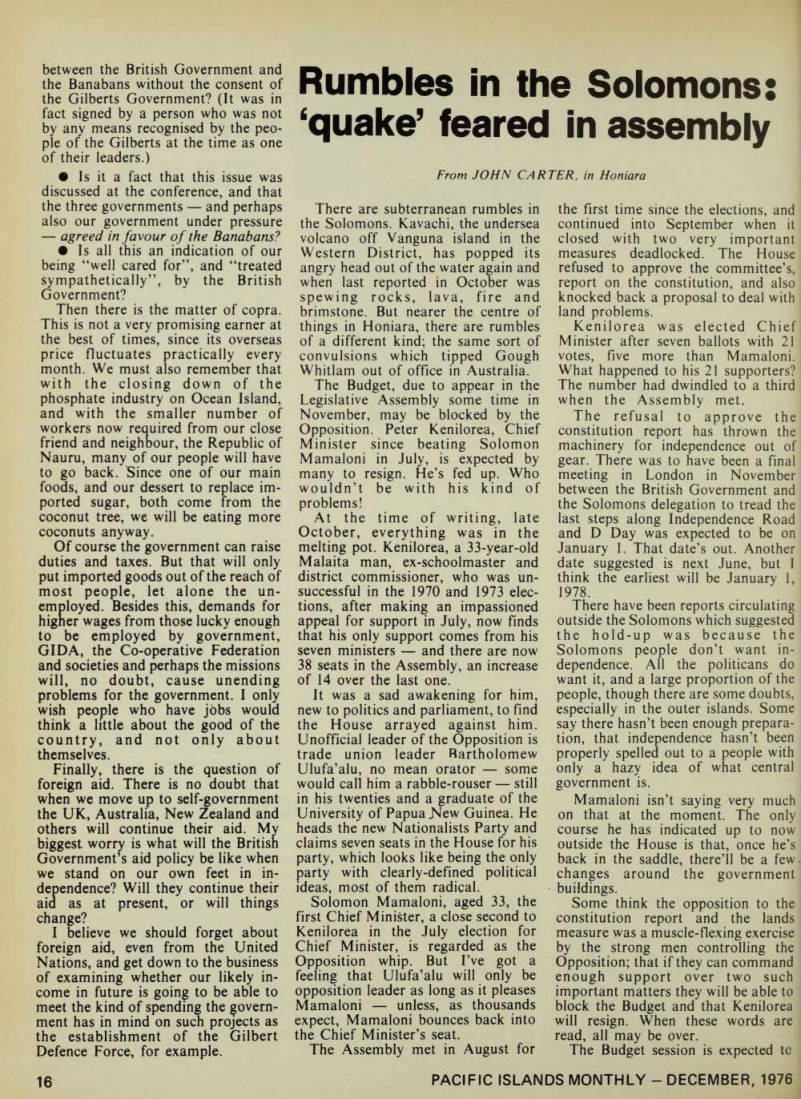
Mr Uatioa
between the British Government and the Banabans without the consent of the Gilberts Government? (It was in fact signed by a person who was not by any means recognised by the peo ple of the Gilberts at the time as one of their leaders.) • Is it a fact that this issue was discussed at the conference, and that the three governments and perhaps also our government under pressure agreed in favour of the Banabans? • Is all this an indication of our being “well cared for”, and “treated sympathetically”, by the British Government?
Then there is the matter of copra.
This is not a very promising earner at the best of times, since its overseas price fluctuates practically every month. We must also remember that with the closing down of the phosphate industry on Ocean Island, and with the smaller number of workers now required from our close friend and neighbour, the Republic of Nauru, many of our people will have to go back. Since one of our main foods, and our dessert to replace im ported sugar, both come from the coconut tree, we will be eating more coconuts anyway.
Of course the government can raise duties and taxes. But that will only put imported goods out of the reach of most people, let alone the un employed. Besides this, demands for higher wages from those lucky enough to be employed by government, GIDA, the Co-operative Federation and societies and perhaps the missions will, no doubt, cause unending problems for the government. I only wish people who have jobs would think a little about the good of the country, and not only about themselves.
Finally, there is the question of foreign aid. There is no doubt that when we move up to self-government the UK, Australia, New Zealand and others will continue their aid. My biggest worry is what will the British Government’s aid policy be like when we stand on our own feet in in dependence? Will they continue their aid as at present, or will things change?
I believe we should forget about foreign aid, even from the United Nations, and get down to the business of examining whether our likely in come in future is going to be able to meet the kind of spending the govern ment has in mind on such projects as the establishment of the Gilbert Defence Force, for example.
Un Report On Tokelau
The United Nations committee on decolonisation was told in October that the people of Tokelau wanted to retain their present relationship with New Zealand.
I report by a fact-finding mission from the committee which visited the islands earlier tins year said the Tokelauans were "apprehensive" of anv change which might alter the present relationship with New Zealand.
Tokelau is the last non-self-governing territory for which New Zealand has administrative responsibility. It has a population of about 1550. A further 2200 Tokelauans live in .Wtc Zealand.
The L \ mission s report said that the size of Tokelau, its tiny population, remote geographical situation and paucity of resources had combined to foster an extreme sense of solitude.
This has heightened the islanders' primary concern for their economy and their relationship with New Zealand.
‘quake’ feared in assembly
Rumbles in the Solomons: ‘quake’ feared in assembly
From JOHN CARTER, in Honiara
There are subterranean rumbles in the Solomons. Kavachi, the undersea volcano off Vanguna island in the Western District, has popped its angry head out of the water again and when last reported in October was spewing rocks, lava, fire and brimstone. But nearer the centre of things in Honiara, there are rumbles of a different kind; the same sort of convulsions which tipped Gough Whitlam out of office in Australia.
The Budget, due to appear in the Legislative Assembly some time in November, may be blocked by the Opposition. Peter Kenilorea, Chief Minister since beating Solomon Mamaloni in July, is expected by many to resign. He’s fed up. Who wouldn’t be with his kind of problems!
At the time of writing, late October, everything was in the melting pot. Kenilorea, a 33-year-old Malaita man, ex-schoolmaster and district commissioner, who was un successful in the 1970 and 1973 elec tions, after making an impassioned appeal for support in July, now finds that his only support comes from his seven ministers and there are now 38 seats in the Assembly, an increase of 14 over the last one.
It was a sad awakening for him, new to politics and parliament, to find the House arrayed against him.
Unofficial leader of the Opposition is trade union leader Bartholomew Ulufa’alu, no mean orator some would call him a rabble-rouser still in his twenties and a graduate of the University of Papua New Guinea. He heads the new Nationalists Party and claims seven seats in the House for his party, which looks like being the only party with clearly-defined political ideas, most of them radical.
Solomon Mamaloni, aged 33, the first Chief Minister, a close second to Kenilorea in the July election for Chief Minister, is regarded as the Opposition whip. But I’ve got a feeling that Ulufa’alu will only be opposition leader as long as it pleases Mamaloni unless, as thousands expect, Mamaloni bounces back into the Chief Minister’s seat.
The Assembly met in August for
the first time since the elections, and continued into September when it closed with two very important measures deadlocked. The House refused to approve the committee’s, report on the constitution, and also knocked back a proposal to deal with land problems.
Kenilorea was elected Chief Minister after seven ballots with 21 votes, five more than Mamaloni.
What happened to his 21 supporters?
The number had dwindled to a third when the Assembly met.
The refusal to approve the constitution report has thrown the machinery for independence out of gear. There was to have been a final meeting in London in November between the British Government and the Solomons delegation to tread the last steps along Independence Road and D Day was expected to be on January 1. That date’s out. Another date suggested is next June, but I think the earliest will be January 1, 1978.
There have been reports circulating outside the Solomons which suggested the hold-up was because the Solomons people don’t want in dependence. All the politicans do want it, and a large proportion of the people, though there are some doubts, especially in the outer islands. Some say there hasn’t been enough prepara tion, that independence hasn’t been properly spelled out to a people with only a hazy idea of what central government is.
Mamaloni isn’t saying very much on that at the moment. The only course he has indicated up to now outside the House is that, once he’s back in the saddle, there’ll be a few changes around the government buildings.
Some think the opposition to the constitution report and the lands measure was a muscle-flexing exercise by the strong men controlling the Opposition; that if they can command enough support over two such important matters they will be able to block the Budget and that Kenilorea will resign. When these words are read, all may be over.
The Budget session is expected to
be some time towards the end of November. The retiring Governor, Sir Donald Luddington, has left for home and his successor, Mr Colin Allan, ex-British Resident Commissioner in the New Hebrides and, more lately, ex-Governor of the Seychelles, will be installed at Government House before October’s end.
Kenilorea is regarded by all as a man of high principles with a wide, if at present theoretical, knowledge of Solomons administration on the higher levels. He’s not had the opportunity yet to show whether he is a fighter, but in some circles it is thought that, if he can be persuaded it is for the good of the Solomons that he should stay in the hot seat, he will fight.
Whatever happens, the birth of an independent Solomon Islands isn’t going to be an easy exercise in political obstetrics. But, there’ll be attempts behind the scenes to enlist more support for him among the back-benchers, and, if the Budget is blocked, the present constitution gives him breathing space. He can ask the House to allow him to draw finance from the coffers for four months. If this is refused, he can go to the country and ask for a vote of confidence through the ballot box. In the interim, the Consolidated Fund will take care of the bills.
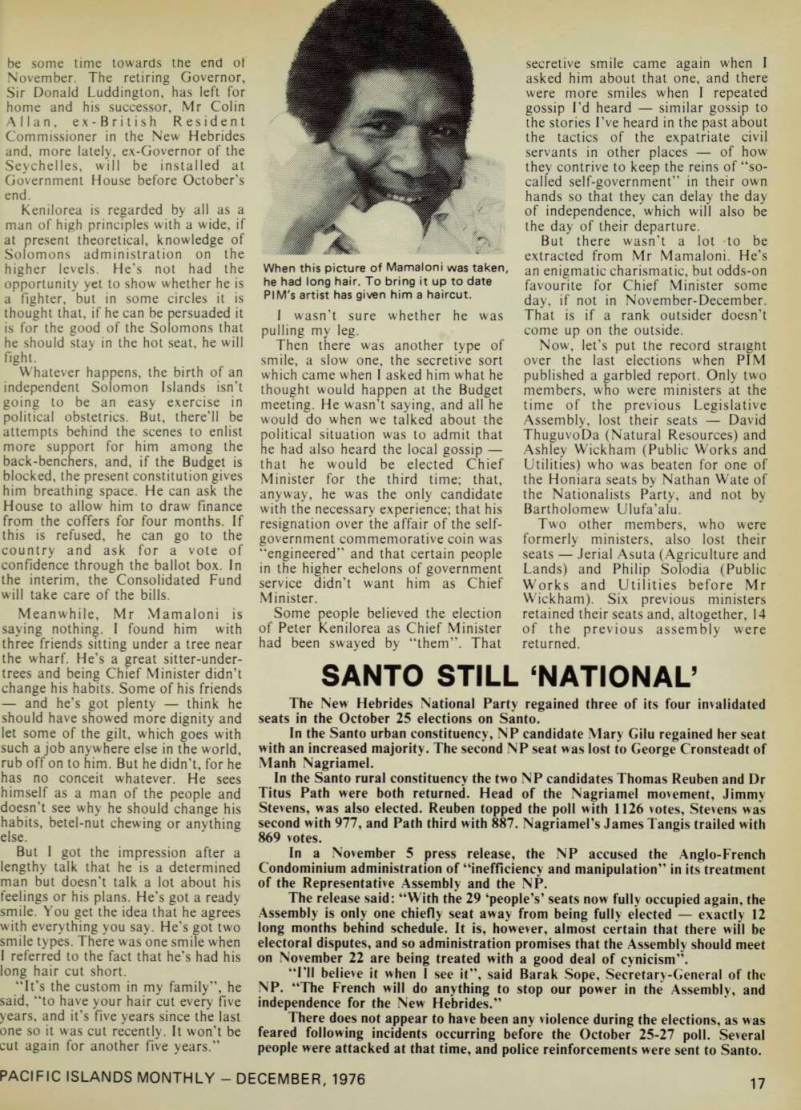
Meanwhile, Mr Mamaloni is saying nothing. I found him with three friends sitting under a tree near the wharf. He’s a great sitter-under trees and being Chief Minister didn’t change his habits. Some of his friends and he’s got plenty think he should have showed more dignity and let some of the gilt, which goes with such a job anywhere else in the world, rub off on to him. But he didn’t, for he has no conceit whatever. He sees himself as a man of the people and doesn’t see why he should change his habits, betel-nut chewing or anything else.
But I got the impression after a lengthy talk that he is a determined man but doesn’t talk a lot about his feelings or his plans. He’s got a ready smile. You get the idea that he agrees with everything you say. He’s got two smile types. There was one smile when I referred to the fact that he’s had his long hair cut short.
“It’s the custom in my family”, he said, “to have your hair cut every five years, and it’s five years since the last one so it was cut recently. It won’t be cut again for another five years.”
I wasn’t sure whether he was pulling my leg.
Then there was another type of smile, a slow one, the secretive sort which came when I asked him what he thought would happen at the Budget meeting. He wasn’t saying, and all he would do when we talked about the political situation was to admit that he had also heard the local gossip that he would be elected Chief Minister for the third time; that, anyway, he was the only candidate with the necessary experience; that his resignation over the affair of the self government commemorative coin was “engineered” and that certain people in the higher echelons of government service didn’t want him as Chief Minister.
Some people believed the election of Peter Kenilorea as Chief Minister had been swayed by “them”. That
secretive smile came again when I asked him about that one, and there were more smiles when I repeated gossip I'd heard similar gossip to the stories I’ve heard in the past about the tactics of the expatriate civil servants in other places of how they contrive to keep the reins of “so called self-government" in their own hands so that they can delay the day of independence, which will also be the day of their departure.
But there wasn’t a lot to be extracted from Mr Mamaloni. He’s an enigmatic charismatic, but odds-on favourite for Chief Minister some day, if not in November-December.
That is if a rank outsider doesn’t come up on the outside.
Now, let’s put the record straight over the last elections when PIM published a garbled report. Only two members, who were ministers at the time of the previous Legislative Assembly, lost their seats David ThuguvoDa (Natural Resources) and Ashley Wickham (Public Works and Utilities) who was beaten for one of the Honiara seats by Nathan Wate of the Nationalists Party, and not by Bartholomew Ulufa’alu.
Two other members, who were formerly ministers, also lost their seats Jerial Asuta (Agriculture and Lands) and Philip Solodia (Public Works and Utilities before Mr Wickham). Six previous ministers retained their seats and, altogether, 14 of the previous assembly were returned.
When this picture of Mamaloni was taken, he had long hair. To bring it up to date PIM's artist has given him a haircut.
Santo Still ‘National’
The New Hebrides National Party regained three of its four invalidated seats in the October 25 elections on Santo.
In the Santo urban constituency, NP candidate Mary Gilu regained her seat with an increased majority. The second NP seat was lost to George Cronsteadt of Manh Nagriamel.
In the Santo rural constituency the two NP candidates Thomas Reuben and Dr Titus Path were both returned. Head of the Nagriamel movement, Jimmy Stevens, was also elected. Reuben topped the poll with 1126 votes, Stevens was second with 977, and Path third with 887. Nagriamel’s James Tangis trailed with 869 votes.
In a November 5 press release, the NP accused the Anglo-French Condominium administration of “inefficiency and manipulation" in its treatment of the Representative Assembly and the NP.
The release said: “With the 29 ‘people’s’ seats now fully occupied again, the Assembly is only one chiefly seat away from being fully elected exactly 12 long months behind schedule. It is, however, almost certain that there will be electoral disputes, and so administration promises that the Assembly should meet on November 22 are being treated with a good deal of cynicism’’.
“I'll believe it when I see it", said Barak Sope, Secretary-General of the NP. “The French will do anything to stop our power in the Assembly, and independence for the New Hebrides.”
There does not appear to have been any violence during the elections, as was feared following incidents occurring before the October 25-27 poll. Several people were attacked at that time, and police reinforcements were sent to Santo.
News
The
In A
Nutshell
Red China In W. Samoa
Red China in October opened an embassy in Apia, operating temporarily from the Tusitula Hotel.
The embassy’s counsellor and charge d’affairs, Mr Wang Tao, was quick to denounce any attempt by Russia to interfere with the internal affairs of Western Samoa, saying China would fully support Western Samoa in resisting such moves.
Eight diplomats arrived in Apia on October 19 to help set up the embassy. Mr Wang said the ambassador had yet to be appointed.
The term of office of those who had arrived had not been fixed. It would depend on the “necessity of the work".
Mr Wang denied that setting up the embassy was a step towards spreading communism in Western Samoa.
There were different social systems, which were decided by the people of each nation. China considered setting up the embassy and diplomatic relations as being fully in line with the wishes of the peoples of each nation, based on the five principles of peaceful co-existence.
Among those principles was agreement that there should be no interference with the internal affairs of other nations. Those who thought China was trying to influence or spread communism in Western Samoa one way or another, did not understand China’s system very much.
“Revolution is never exported", he said. He added that the friendliness of
his country could be seen in the recent warm welcome to the Western Samoa head of state, Malietoa Tanumafili.
China was in Western Samoa to help and develop that friendship and understanding which, he believed, would increase day by day,
Nauru: A Courtly Deal
Legislation was before the Australian Parliament in October to allow appeals to the High Court against certain classes of decision by the Supreme Court of Nauru. The legislation is in line with a wish ex pressed by Nauruan leaders during negotiations which preceded in dependence for Nauru in 1968. The Australian Attorney-General, Mr Bob Ellicott, QC, said the Australian Government was happy to accede to the wish of the Nauruan leaders. He said the enabling bill represented a novel and significant step for it would be the first time the High Court of Australia became the final court of appeal for another independent sovereign country. The Australian Government saw the Nauru move as an expression of confidence in the capacity and impartiality of the High Court.
Status Change
Lautoka, Fiji’s “sugar" capital, is seeking city status. Town councillors reckon there are about 25,000 people living in the town. With census figure due soon, and expected to show more than 20,000, they felt that now was the time to seek government approval to have Lautoka declared a city. The Lautoka Town Council recently accepted a recommendation from the staff and general purposes committee to make the appropriate application for a change in status to the Minister for Local Government, Mr Mohammed Ramzan.
Self-Governing Gilberts
The Gilbert Islands will achieve full internal self-government on January 1, 1977, two months after the earlier target of November 1. Provision was made in the appropriate regulation for the appointment of an elected Minister of Finance from November 1, 1976. This was regarded as an im portant stage on the road to in dependence.
The regulation also contained provisions to safeguard the position of the Banabans. The UK Government agreed to defer full implementation of internal self-government for two months to enable the Banabans to be satisfied beyond any doubt that their interests were fully protected.
Fiji-Png Cricket Date
Sporting contests between Fiji and Papua New Guinea are few and far between. About the only time their sportsmen oppose each other is during the South Pacific Games. In February, 1977, the two countries will meet in a team sport for the first time for several years, when Fiji visits PNG to play a three-day cricket test and a one-day limited overs match.
The PNG visit will follow a four-week tour of New Zealand, by Fiji, in December. PNG might prefer to forget the last time PNG and Fiji met in a team sport. This was in 1969 dur ing the South Pacific Games when the Fiji rugby team twice trounced PNG, 79-0 and and 88-3. PNG, however, is mainly rugby league territory, and their men found the rugby union code a little difficult to follow.
Aitutaki’S Stamps
The Post Office of Aitutaki in the Cook Islands chose a series of sketches of biblical scenes connected with the birth of Christ for its regular issue of stamps for use on Christmas season mails. The artists prepared each design on a solid coloured background with Jhe design sketch in metallic gold to be a cheerful and at tractive representation of the Christ mas spirit, with each design covering two stamps in each denomination.
The denominations are 6c, showing the archangel Gabriel advising Mary she was to become the mother of Jesus; 7c, the angel telling the shepherds to follow the star to Bethlehem where Jesus was born; 15c, the infant Jesus in his cradle; and 20c, the three wise men on their way to Bethlehem to present frankincense and myrrh to the infant Jesus.
Streamlining Jobs
Papua New Guinea has set up a national works authority within the Department of Transport and Works to design, construct and maintain roads, bridges, aerodromes, water supply and sewerage and buildings.
Formation of the authority followed acceptance by the National Executive Council of recommendations made by Australia’s Snowy Mountains Engineering Corporation, which, in 1975, made an ex amination of PNG’s construction resources. The authority has taken over most of the responsibilities of the former Public Works Department and the Plant and Transport Authority. It will provide the government transport services previously provided by the Plant and Transport Authority. Mr Neil Collier, First Assistant Secretary of the Depart ment of Transport, Works and Supply, will act as director of the new organisation.
Eniwetak: Yanks Bow Out
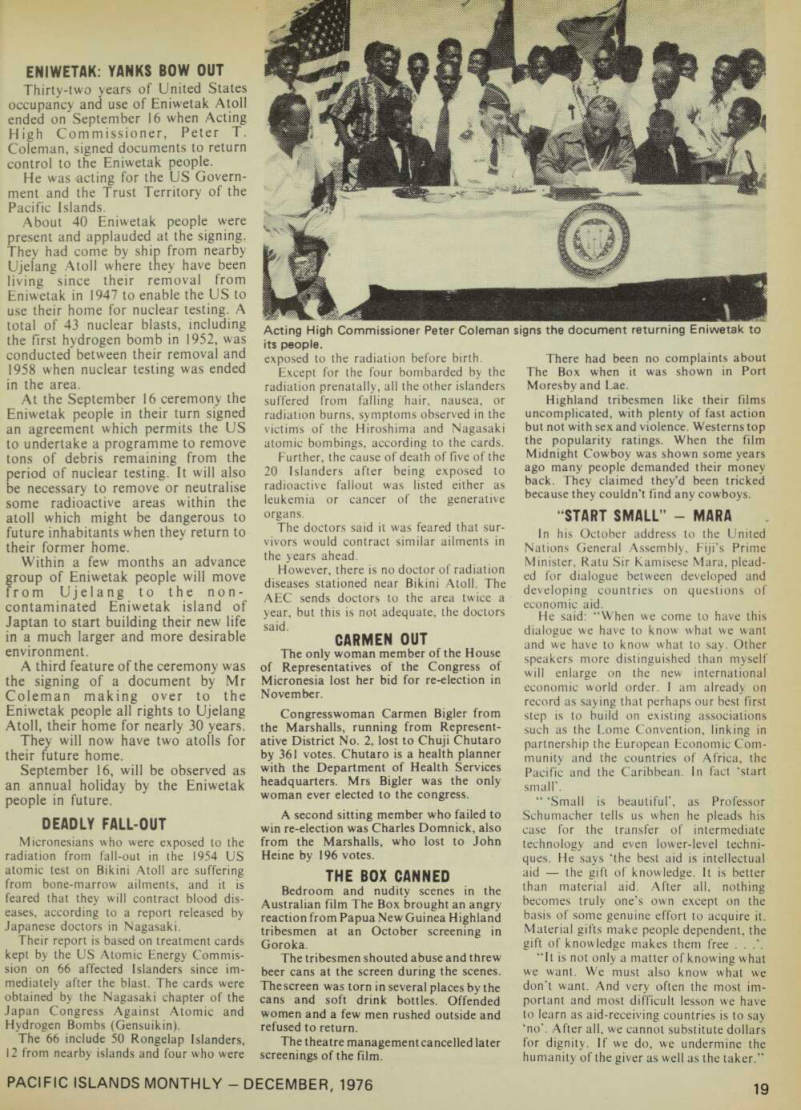
Thirty-two years of United States occupancy and use of Eniwetak Atoll ended on September 16 when Acting High Commissioner, Peter T.
Coleman, signed documents to return control to the Eniwetak people.
He was acting for the US Govern ment and the Trust Territory of the Pacific Islands.
About 40 Eniwetak people were present and applauded at the signing.
They had come by ship from nearby Ujelang Atoll where they have been living since their removal from Eniwetak in 1947 to enable the US to use their home for nuclear testing. A total of 43 nuclear blasts, including the first hydrogen bomb in 1952, was conducted between their removal and 1958 when nuclear testing was ended in the area.
At the September 16 ceremony the Eniwetak people in their turn signed an agreement which permits the US to undertake a programme to remove tons of debris remaining from the period of nuclear testing. It will also be necessary to remove or neutralise some radioactive areas within the atoll which might be dangerous to future inhabitants when they return to their former home.
Within a few months an advance group of Eniwetak people will move from Ujelang to the non contaminated Eniwetak island of Japtan to start building their new life in a much larger and more desirable environment.
A third feature of the ceremony was the signing of a document by Mr Coleman making over to the Eniwetak people all rights to Ujelang Atoll, their home for nearly 30 years.
They will now have two atolls for their future home.
September 16, will be observed as an annual holiday by the Eniwetak people in future.
Deadly Fall-Out
Micronesians who were exposed to the radiation from fall-out in the 1954 US atomic test on Bikini Atoll are suffering from bone-marrow ailments, and it is feared that they will contract blood dis eases, according to a report released by Japanese doctors in Nagasaki.
Their report is based on treatment cards kept by the US Atomic Energy Commis sion on 66 affected Islanders since im mediately after the blast. The cards were obtained by the Nagasaki chapter of the Japan Congress Against Atomic and Hydrogen Bombs (Gensuikin).
The 66 include 50 Rongelap Islanders, 12 from nearby islands and four who were
exposed to the radiation before birth.
Except for the four bombarded by the radiation prenatally, all the other islanders suffered from falling hair, nausea, or radiation burns, symptoms observed in the victims of the Hiroshima and Nagasaki atomic bombings, according to the cards.
Further, the cause of death of five of the 20 Islanders after being exposed to radioactive fallout was listed either as leukemia or cancer of the generative organs.
The doctors said it was feared that sur vivors would contract similar ailments in the years ahead.
However, there is no doctor of radiation diseases stationed near Bikini Atoll. The AEG sends doctors to the area twice a year, but this is not adequate, the doctors said.
Carmen Out
The only woman member of the House of Representatives of the Congress of Micronesia lost her bid for re-election in November.
Congresswoman Carmen Bigler from the Marshalls, running from Represent ative District No. 2, lost to Chuji Chutaro by 361 votes. Chutaro is a health planner with the Department of Health Services headquarters. Mrs Bigler was the only woman ever elected to the congress.
A second sitting member who failed to win re-election was Charles Domnick, also from the Marshalls, who lost to John Heine by 196 votes.
The Box Canned
Bedroom and nudity scenes in the Australian film The Box brought an angry reaction from Papua New Guinea Highland tribesmen at an October screening in Goroka.
The tribesmen shouted abuse and threw beer cans at the screen during the scenes.
The screen was torn in several places by the cans and soft drink bottles. Offended women and a few men rushed outside and refused to return.
The theatre management cancelled later screenings of the film.
There had been no complaints about The Box when it was shown in Port Moresby and Lae.
Highland tribesmen like their films uncomplicated, with plenty of fast action but not with sex and violence. Westerns top the popularity ratings. When the film Midnight Cowboy was shown some years ago many people demanded their money back. They claimed they’d been tricked because they couldn’t find any cowboys.
“Start Small’’ - Mara
In his October address to the United Nations General Assembly, Fiji’s Prime Minister, Ratu Sir Kamisese Mara, plead ed for dialogue between developed and developing countries on questions of economic aid.
He said: “When we come to have this dialogue we have to know what we want and we have to know what to say. Other speakers more distinguished than myself will enlarge on the new international economic world order. I am already on record as saying that perhaps our best first step is to build on existing associations such as the Lome Convention, linking in partnership the European Economic Com munity and the countries of Africa, the Pacific and the Caribbean. In fact ‘start small'.
“ ‘Small is beautiful', as Professor Schumacher tells us when he pleads his case for the transfer of intermediate technology and even lower-level techni ques. He says ‘the best aid is intellectual aid the gift of knowledge. It is better than material aid. After all, nothing becomes truly one’s own except on the basis of some genuine effort to acquire it.
Material gifts make people dependent, the gift of knowledge makes them free . . .’.
“It is not only a matter of knowing what we want. We must also know what we don't want. And very often the most im portant and most difficult lesson we have to learn as aid-receiving countries is to say ‘no’. After all, we cannot substitute dollars for dignity. If we do, we undermine the humanity of the giver as well as the taker.’’
Acting High Commissioner Peter Coleman signs the document returning Eniwetak to its people.
People
Mr Remy Delaveuve arrived in the New Hebrides many years ago from France to take up a temporary job for a year with the Joint Court. He’s still there. He’s now the first Mayor of the new municipality of Vila and holder of the MBE awarded to him in the last Queen’s Birthday Honours hand out, the first Frenchman in the South Pacific to get the honour. He was invested with the order in October by the British High Commissioner in the South Pacific, Mr Larmour, who stopped off in the condominium while on his way to the South Pacific Conference in Noumea. A member of the UCNH “but if you want to talk politics we move out of the town hall’’
Mr Delaveuve and his colleagues on the Vila Municipal Council have agreed to bar politics in the council.
And it looks as if it works well. Paved footpaths are appearing in the town, something the condominium administration never got round to in 70 years. He expects to hold the job for three years and “then I’m going fishing”. A keen angler, he caught the first marlin under IGFA standards in New Hebridean waters. And the prize? A year’s subscription to PIM.
Nauru’s President, Mr Hammer Deßoburt, hosted a reception at Suva's Grand Pacific Hotel on October 15, to mark the official opening of Nauru's new consulate in
Ratu Sukuna House, Suva. Nauru’s honorary consul in Fiji is Ratu Esira Rabuno, 36, who formerly was with the Fiji Civil Service.
Mrs Maureen Wright, the first woman mayor of a city or town in Fi ji, is now Mrs Ted Rouse. Mr Rouse is chief engineer of the Fiji Electricity Authority at Lautoka. Mrs Wright’s first husband, Edgar Wright, died some years ago while she was Mayor of Lautoka. He was a member of a well-known Fiji family, the son of the late Mr Matey Wright and a nephew of former Fiji government public relations photographer, the late Mr Rob Wright. Mrs Rouse is a daughter of the late Mr Dan Costello, who had business interests at Suva, Lautoka and Tavua, and who was one of five brothers from Maryborough, Queensland, who settled in Fiji. She has two brothers, Mr Dan Costello, a Lautoka businessman, who has in terests in the tourist industry, and the Rev Father Emmet Costello, SJ, of the Sydney parish of Lavender Bay.
Her mother lives in Sydney. One of her uncles, Mr Vince Costello, is a well-known Suva hotelier.
The Papua New Guinea Police Commissioner, Mr Pious Kerepia, whose term of appointment expired in October, has been reconfirmed by Cabinet for another 12-month term.
Mr Kerepia was the first Papua New Guinean to become Police Com missioner after the succession of Australians who held the post before PNG independence. But there have been tensions between Mr Kerepia
and two police ministers the pre sent Minister, Mr Poe, and the previous one, Mr Lus. Mr Poe set up a committee of public servants to in vestigate the commissioner’s leadership and personal qualities before taking any steps for his reap pointment.
Father Cherubim Dambui, 28, a Catholic priest, is the interim premier of East Sepik Interim Provincial Government, in Papua New Guinea, having been elected unopposed by other members of the government.
Father Dambui is from Timbuke village in the Angoram area. The deputy premier is Mr Lawrence Yakanduo, a local government coun cillor. Father Dambui’s election was criticised in some quarters by those who considered the functions of Church and State should be kept separate. But Mr Moses Murray, principal private secretary to the Minister for Education, said PNG had to do away with such a western concept.
Mr Gala Oala-Rarua, formerly a prominent Papua New Guinea politi cian, and first PNG High Com missioner to Australia, has resigned from the civil service. There was no early indication about his intentions, but there was a strong local tip that he planned to re-enter politics. With an election due in 1977, the tipsters could be close to the mark. Men of Mr Oala-Rarua’s calibre are needed in the PNG Parliament and in Cabinet.
Dr Rene Grandperrin has been ap pointed fisheries adviser to the South Pacific Commission, succeeding Mr R. H. Baird, who died earlier this year. Apart from wide experience in many phases of fisheries research, Dr Grandperrin also has the practical knowledge required for such work. He and Mr Baird, in 1973, set up an ex pert committee on tropical skipjack.
He has attended many international conferences on fisheries, and is the author and co-author of many publications covering fisheries.
Police Commissioner Kerepia.
Advertisements & other items, p. 20 (1 item)
-jlsJjjc
HEAT SEALING.
SHRINK PACKAGING.
CONTACT
AUSTRALIA'S FOREMOST MANUFACTURERS
OF HEAT SEALING EQUIPMENT
SERVING INDUSTRY
IN AUSTRALIA & THE PACIFIC ISLANDS
FOR OVER 25 YEARS.
HELIX ELECTRICAL PRODUCTS PTY. LTD.
27 Rosebery Avenue, Rosebery, NSW 2018, Australia.
Editor’S Mailbag
Angry Hebridean
I am responding to the two points made by “Expatriate (white)” (PIM, October, p. 23).
I. I remember the missionaries.
The first resident missionary on Aoba lies at Lolowai. My grandfather’s brother was responsible for his being there. My grandfather’s brother was a victim of the “expatriate” slave trade which took him to Queensland. My father became a clergyman. In his work he tried hard to preach and practise self-reliance. He died. I then grew up to be educated by mis sionaries. Later I worked with the very same missionaries, who taught me Christianity and democracy. I de mand that those Christian doctrines and democratic principles be applied, and their worth proven in the New Hebrides. 2. The Administration came to New Hebrides without an invitation.
The Administration ignores our ex istence and our rights on our native soil.
If taxpayers’ money is giving me a university education there should be much more taxpayers’ money to provide university education for every New Hebridean child. Providing only enough for a mere handful of New Hebrideans is too small a token to compensate for the injustices com mitted on us and our country.
I had read R. Cherry’s article (PIM, July) “Biting the feeding hand”. The food I am forced to eat sickens me. It is this very same relationship “expatriates” impose on us that we don’t want. Paternalism is the worst form of colonialism.
We are being denied the right to be “political”, let alone to “jet-set” as you claim. If you say that USP en courages white racism then explain to us New Hebrideans why we, our ancestors, our future generations, have been ignored in the writing of the New Hebrides Protocol; explain the stupidities in the Representative Assembly elections; explain the judgments passed in the current Rarua murder case; and a whole lot more within the New Hebrides political situation.
“Expatriate (white)”, I am New Hebridean black. I talk of my people and my country. Our experiences, our feelings, our thoughts, our hopes, you have never attempted to find out, much less understand.
True to form, you attack from un der cover, “Expatriate (white)”.
Grace Mera
University of the South Pacific, Suva, Fiji.
New Hebrides
I have read with keen interest this year all your articles and letters about the New Hebrides. I am particularly interested in the debate on ‘lndependence’, involving churchmen, laymen, Grace Mera, expatriates and others.
As I spent four years teaching in the New Hebrides (during which time I had a close working relationship with those parties in the present debate, including teaching at the same school as Grace for a year), and there developed a strong love for the native New Hebridean people, I have felt moved to join the debate.
Three cheers for Grace Mera and other Melanesian New Hebrideans who are now saying the things that have been kept padlocked in their minds by their European rulers from the lime the two races began to share the New Hebrides nearly one and one half centuries ago.
No cheers at all for the Ex-patriate (white), who, with shallow arguments and strong words (PI M, Oct.) implies that he would dearly love Grace and her fellow spokesman for the Melane sian New Hebridean community to close their eyes and hold their tongues: his kind reinforce and prolong the tragic enfeeblement of the Melanesian spirit that his predecessors have so cleverly master minded.
Most people, inside and outside the New Hebrides, will applaud the ef forts of the Melanesians who are now, for the first time in their history, put ting in print what they feel about themselves and other races of people; and what their countrymen like and dislike; and at last they are beginning
to figure prominently in debate about the future of their beautiful islands.
Let them say much to combat the arrogant and pernicious rubbish that is being prescribed in high places of the archipelago today; let their tongues expose those whose sole pur pose for being in the New Hebrides is, as Quiros unashamedly said 370 years ago, to “discover, pacify, and possess”.
R. G. Field
Warreena St, Walgett, NSW
A Call For Equity
Do the independent island states of the South Pacific need people to tell
them what to do? Your cor respondents who have been writing recently seem to think so.
None seems to want to leave the in dividual islander to follow his own in stincts, to build up what he wants to.
That is as often as not to leave his own island for a while, to work somewhere else where the pay is good enough to allow him to save up, to realise some of his dreams at home.
Many Polynesians can do this in New Zealand. For Melanesians life is more difficult. New Hebrideans can go pretty easily to New Caledonia, but very few Melanesians can ever realise the dream of working a short time in Australia. Either passports or
visas or both are difficult to get. So, for the last 70 years or so, you’ve pret ty well had to stow away or jump ship, if you’ve wanted to come to Australia to work from the New Hebrides or Solomon Islands, and from what is now Papua New Guinea, unless you’ve been on a government organised training course or something of the kind.
But you’ve seen Australians coming easily into your islands to make money for themselves.
Shouldn’t we all now, governments, individuals and journals like PIM, be pressing the Australian Government to allow at least as many Melanesians to get work permits as it has citizens working in their islands? They will be “unskilled” very often, but will learn many skills of use to them at home.
Then maybe we’ll see the islands transformed, like Turkey has been by those of its citizens who’ve worked in Germany in the last 15 or 20 years.
Now the Melanesian migrant worker usually ends up being deported, because the way he is forced to arrive is “illegal”. This upsets his employer, who has found him a good worker, and his older workmates, who fought in his islands to stop the Japanese controlling them, and who now find themselves ashamed of the mean treatment he gets from their own side.
John Allan,
Spring Hill, Qld.
Judges' Wigs
After Sir Alan Mann introduced wigs for judges of the Supreme Court of Papua New Guinea (PIM, Oct, p2O) one judge was a conspicuous dis senter.
The late Mr Justice Ollerenshaw, alone of the judges, did not wear a wig- „
Philip Davenport
Paddington, NSW
• Would Lonnie Shafer, of Woodworth, inquiring about her father’s grave on Hull Island in the Phoenix Group, please send her full address.
Reverse Traffic
Fourteen members of a church youth group in Auckland will go to the Island of ’Eua in Tonga in January to transform an old school building into a joinery factory.
The young people, with their parish priest, the Rev Father Paul Farmer, are from the Church of the Good Shepherd, Balmoral.
They will live and work with members of a local youth group.
Advertisements & other items, pp. 21-22 (1 item)
Become A Part
OF PIM's PACIFIC
AND SUBSCRIBE NOW
* E £ c I v> Q. 0) 0)
FILL IN THE DETAILS
ON THE ATTACHED
ORDER FORMS
AUSTRALIA
A RECYCLING COMPANY
12 SEVILLE STREET, VILLAWOOD, N.S.W. 2163
CABLES: WITWOOL TELEX: AA24541
TEL.: SYDNEY 72-0631
Bulk Suppliers to the Islunds of
• ZORBIES BRAND NON-WOVEN WIPERS
• KOALA BRAND CLEANING CLOTHS
• INDUSTRIAL WIPING RAGS
• INDUSTRIAL WADDING AND FLOCK
• COTTON WASTE STOCKINETTE
• GRADED SECOND HAND CLOTHING
OF ALL DESCRIPTIONS
WITTERS” —The most prominent name in rags
WRITE FOR PRICE LIST
KOALA BRAND CLOTHS
Does Tonga’S
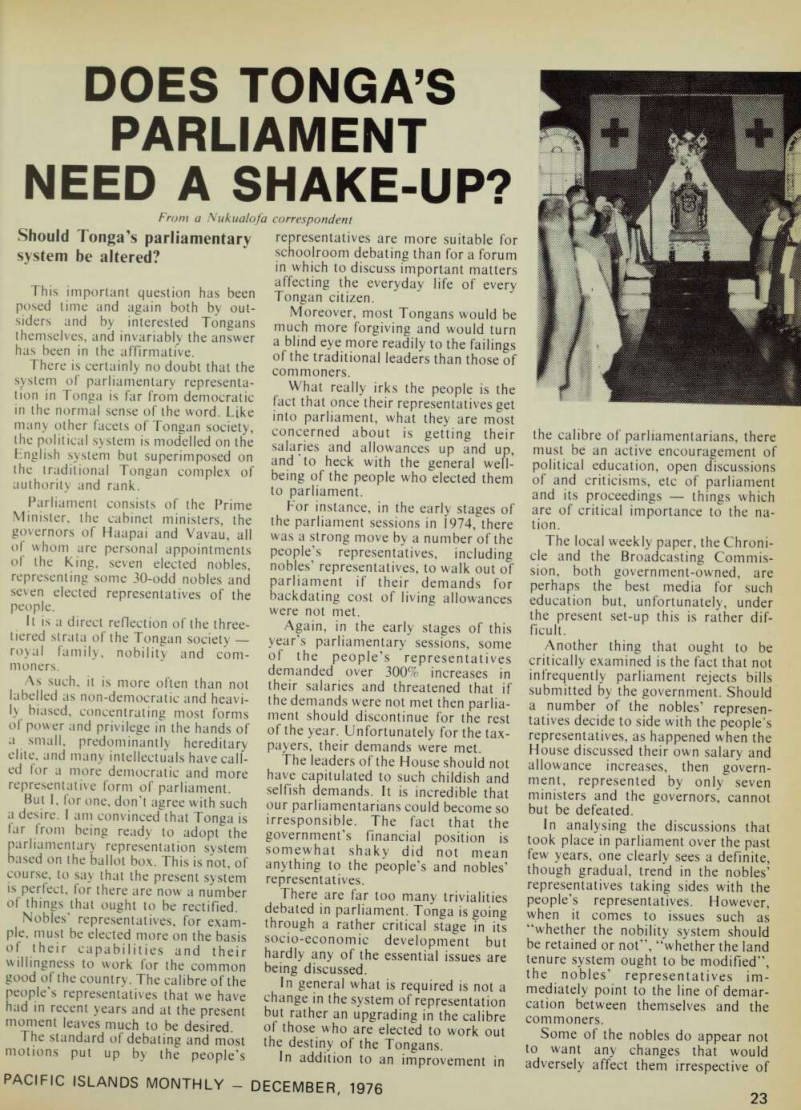
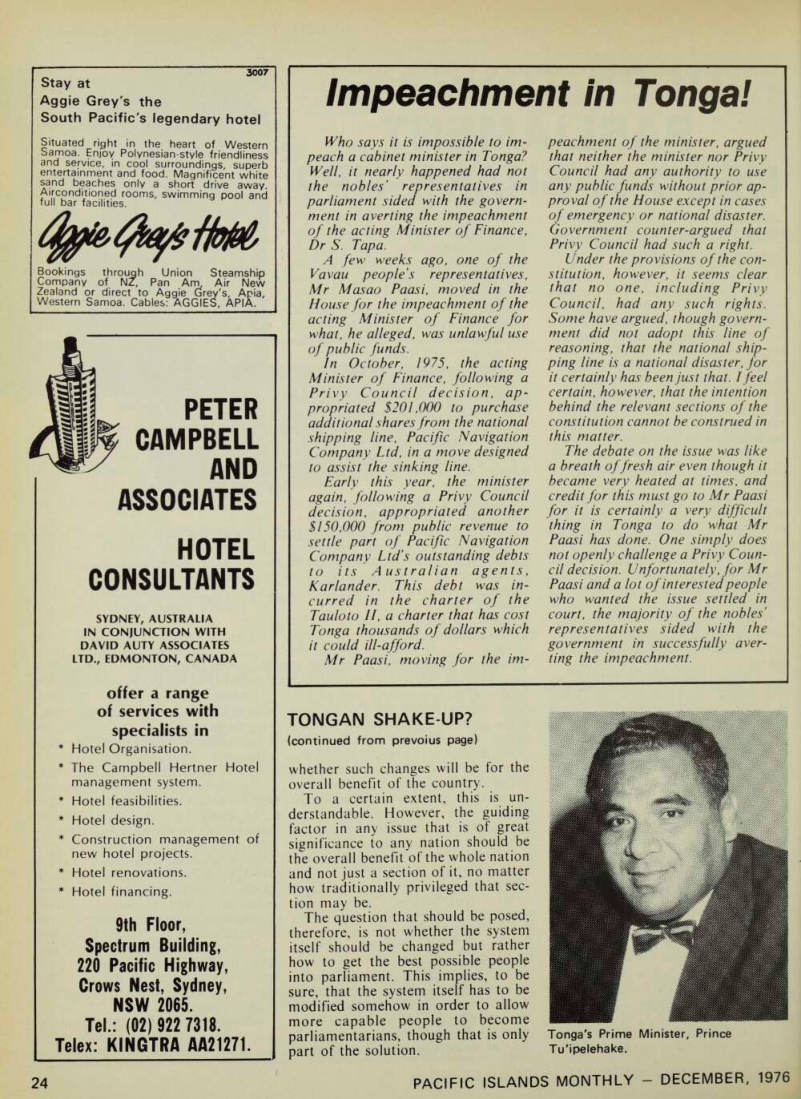
Parliament
Need A Shake-Up?
From a Nukualofa correspondent
Should Tonga’s parliamentary
system be altered? -T-i • . . , , This important question has been poseci time and again both by outsiders and by interested Tongans themselves, and invariably the answer has been in the affirmative There is certainly no doubt that the r f Par ! ia r n r‘ ary e P resenta lion ,n Tonga is far from democratic m the normal sense of the word. Like I°» ther fdC f tS ° f Ton^ 8 n n j oCiet u ’
Pn„l hlc ! y r, ' S modelied °" the H ™ but superimposed on ?u!hority , rd al ralk onBan complex of Parliament consists of the Prime Minister, the cabinet ministers, the governors of Haapai and Vavau, all ol whorn are personal appointments of the King, seven elected nobles, representing some 30-odd nobles and seven elected representatives of the P e ®P' e It is a direct reflection of the threeuered strata of the Tongan society royal family, nobility and commoners.
As such, it is more often than not abelled as non-democratic and heavily biased, concentrating most forms ol power and privilege in the hands of
a small, predominantly hereditary
elite and many intellectuals have callnior % democrat lc and more representative form of parliament. ut I, (or one, don t agree with such a desire. I am convinced that Tonga is far from being ready to adopt the parhamentary representation system rnnrl°? the b u° X ‘ Th ' S ,S not ’ ° f course, to say that the present system nf P >h r i„„ et ’.K or , ,her l are 1 0W a namber °f things that ought to be rectified.
Nobles representittives, for exampie must be elected more on the basis i lli?*" C .' pabl , V eS u and their willingness to work for the common good o| the country. The calibre of the hud P in r/-pni eSematlV a S tha i! We have had in recent years and at the present T^rs t land V e rd m f H h i| 0 f be des J red - I he standard of debating and most motions put up by the people's
representatives are more suitable for schoolroom debating than for a forum in which to discuss important matters affecting the everyday life of every Tongan citizen J Moreover, most Tongans would be much more forgiving a * d wou d turn a blind eye more readily to the failings of the traditional leaders than those of commoners What really irks the people is the fact that once their representatives get into parliament, wha? they are most concerned about is getting their salaries and allowance? up Ind up, and to heck with the p era| we ft who eleeted them For instance, in the early stages of the parliament sessions in 1974, there was a strong move by a number of the people’s representatives, including nobles’representatives, to walk out of parliament if their demands for backdating cost of living allowances were not met.
Again, in the early stages of this year’s parliamentary sessions, some of the people’s representatives demanded over 300% increases in their salaries and threatened that if the demands were not met then parlia ment should discontinue for the rest of the year. Unfortunately for the tax payers, their demands were met The leaders of the House should not have capitulated to such childish and selfish demands. It is incredible that our parliamentarians could become so irresponsible. The fact that the government’s financial position is somewhat shaky did not mean an y thm £ to the people’s and nobles’ representatives There are far 100 ma ny trivialities debated in parliament. Tonga is going through a rather critical stage in its socio-economic development but hard| y any of the essential issues are
being discussed.
In general what is required is not a chan ? e in the system of representation but rather an upgrading in the calibre °, f those who are elected to work out the destiny of the Tongans In addition to an improvement in
the calibre of parliamentarians, there must be an active encouragement of political education, open discussions of and criticisms, etc of parliament and its proceedings things which are of critical importance to the na tion.
The local weekly paper, the Chroni cle and the Broadcasting Commis sion, both government-owned, are perhaps the best media for such education but, unfortunately, under the present set-up this is rather dif ficult.
Another thing that ought to be critically examined is the fact that not infrequently parliament rejects bills submitted by the government. Should a number of the nobles’ represen tatives decide to side with the people’s representatives, as happened when the House discussed their own salary and allowance increases, then govern ment, represented by only seven ministers and the governors, cannot but be defeated.
In analysing the discussions that took place in parliament over the past few years, one clearly sees a definite, though gradual, trend in the nobles’ representatives taking sides with the people’s representatives. However, when it comes to issues such as “whether the nobility system should be retained or not’’, “whether the land tenure system ought to be modified’’, the nobles’ representatives im mediately point to the line of demar cation between themselves and the commoners.
Some of the nobles do appear not to want any changes that would adversely affect them irrespective of
whether such changes will be for the overall benefit of the country.
To a certain extent, this is un derstandable. However, the guiding factor in any issue that is of great significance to any nation should be the overall benefit of the whole nation and not just a section of it, no matter how traditionally privileged that sec tion may be.
The question that should be posed, therefore, is not whether the system itself should be changed but rather how to get the best possible people into parliament. This implies, to be sure, that the system itself has to be modified somehow in order to allow more capable people to become parliamentarians, though that is only part of the solution.
Tonga's Prime Minister, Prince Tu'ipelehake.
Impeachment in Tonga!
Who says it is impossible to impeach a cabinet minister in Tonga?
Well, it nearly happened had not the nobles’ representatives in parliament sided with the government in averting the impeachment of the acting Minister of Finance, Dr S. Tapa.
A few weeks ago, one of the Vavau people’s representatives, Mr Masao Paasi, moved in the House for the impeachment of the acting Minister of Finance for what, he alleged, was unlawful use of public funds.
In October, 1975, the acting Minister of Finance, following a Privy Council decision, appropriated $201,000 to purchase additional shares from the national shipping line, Pacific Navigation Company Ltd, in a move designed to assist the sinking line.
Early this year, the minister again, following a Privy Council decision, appropriated another $150,000 from public revenue to settle part of Pacific Navigation Company Ltd’s outstanding debts to its Australian agents, Karlander. This debt was incurred in the charter of the Tauloto 11, a charter that has cost Tonga thousands of dollars which it could ill-afford.
Mr Paasi, moving for the im-
peachment of the minister, argued that neither the minister nor Privy Council had any authority to use any public funds without prior ap proval of the House except in cases of emergency or national disaster, Government counter-argued that Privy Council had such a right.
Under the provisions of the con stitution, however, it seems clear that no one, including Privy Council, had any such rights, Some have argued, though govern ment did not adopt this line of reasoning, that the national ship ping line is a national disaster, for it certainly has been just that. I feel certain, however, that the intention behind the relevant sections of the constitution cannot be construed in this matter.
The debate on the issue was like a breath of fresh air even though it became very heated at times, and credit for this must go to Mr Paasi for it is certainly a very difficult thing in Tonga to do what Mr Paasi has done. One simply does not openly challenge a Privy Coun cil decision. Unfortunately, for Mr Paasi and a lot of interested people who wanted the issue settled in court, the majority of the nobles’ representatives sided with the government in successfully aver ting the impeachment.
Advertisements & other items, p. 24 (2 items)
24
PACIFIC ISLANDS MONTHLY - DECEMBER, 1976
TONGAN SHAKE-UP?
(continued from prevoius page)
Campbell
3007
Stay at
Aggie Grey's the
South Pacific's legendary hotel Situated right in the heart of Western Samoa. Enjoy Polynesian-style friendliness and service, in cool surroundings, superb entertainment and food. Magnificent white sand beaches only a short drive away.
Airconditioned rooms, swimming pool and full bar facilities.
Bookings through Union Steamship Company of NZ, Pan Arm Air New Zealand or direct to Aggie Grey's, Apia, Western Samoa. Cables: AGGIES, APIA.
PETER
CAMPBELL
AND
ASSOCIATES
HOTEL
CONSULTANTS
SYDNEY, AUSTRALIA
IN CONJUNCTION WITH
DAVID AUTY ASSOCIATES
LTD., EDMONTON, CANADA
offer a range of services with specialists in * Hotel Organisation. * The Campbell Hertner Hotel management system. * Hotel feasibilities. * Hotel design. * Construction management of new hotel projects. * Hotel renovations. * Hotel financing. 9th Floor,
Spectrum Building,
220 Pacific Highway, Crows Nest, Sydney,
NSW 2065.
Tel.: (02) 922 7318.
Telex: KINGTRA AA21271.
Tropicalities
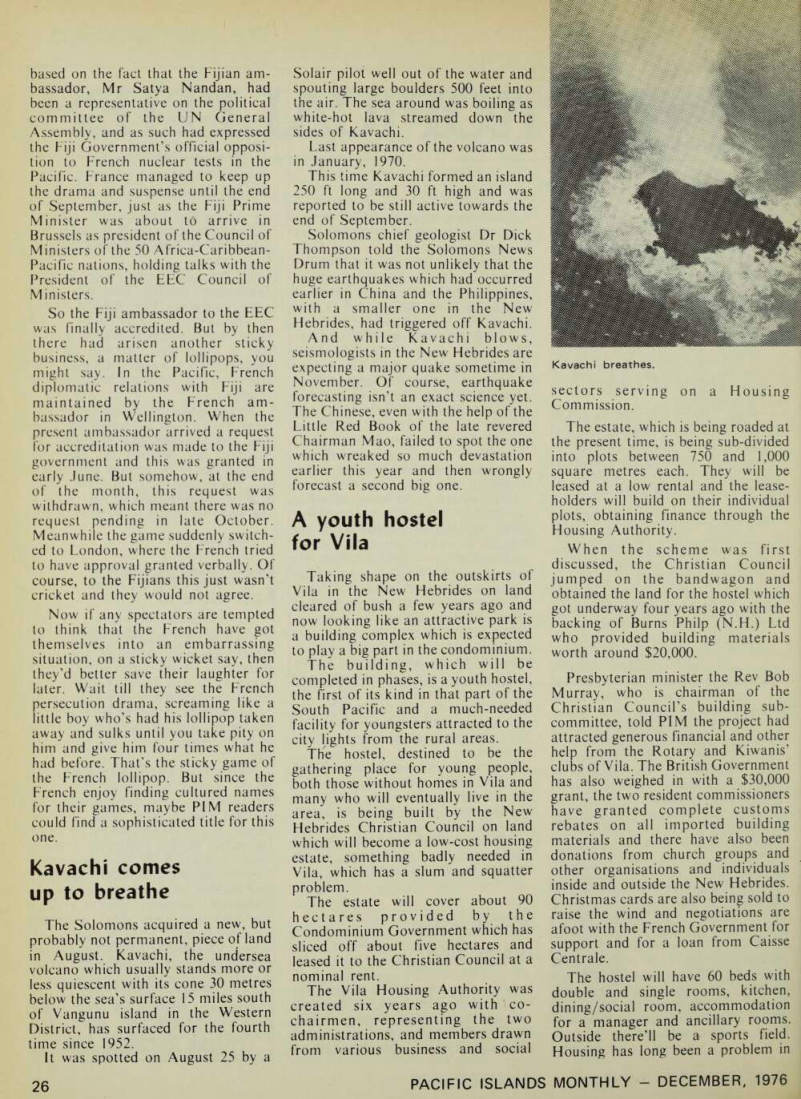
Pacific mystery,
or plain hoax?
Another Pacific maritime mystery . . . or a hoax?
Officials at Canberra’s Marine Operations Centre are asking themselves this question following the picking up in June in the Gulf of Bothnia, Finland of a bottle con taining a message.
It read: “Help. I am on an island with my children 167 degrees east and 13 degrees south. My boat sank near this island. I came here on 17 July, 1972. Please rescue us as soon as possible. Jill Woodall, Mary, Tom, Bill”.
Interpol, Canberra, and the Direc tor of Ports, Vila, New Hebrides, within whose geographic area the co ordinates lie, were soon involved.
Of particular interest to Canberra was the fact that seven people were known to have disappeared in a trimaran in the same general area in September 1968. Known names of the people on board were Bill and Mary Shute and their children Joanne, Rosalind and Richard. The names of other persons aboard were Sallie Scales, Valerie Kuirk and Diane McNeill. Mrs Mary Shute’s maiden name was Widall and she was also known to friends as Joy, Joan or Jill.
Canberra cabled Vila; “In view of similarity of maiden names Jill Widall to signature on letter in bottle Jill Woodall, her brother considers she and children and others survived and landed on island close to 13 degrees South 167 degrees East. Further, brother believes must be out-of-way, isolated or deserted island”.
British Marine Superintendent at Vila, Captain Robin Libby, said the islands near the position given were the Banks and Torres groups. These were mostly inhabited and all were regularly checked by both British and French marine operations supporting their respective district agents, as well as being visited by coastal traders and mission vessels at least once a month.
It was his opinion that it was not
possible for a bottle to drift from this part of the world to the Atlantic on known ocean currents.
Furthermore, the British Resident Commissioner’s cruising vessel, Euphrosyne II had recently visited all islands in the Banks and Torres groups with a geological survey team, and had observed nothing unusual.
The ship’s master, Captain Leith Nasak, said moreover that anyone throwing a bottle from any of these islands would be likely to see it drift west to southwest, as these islands are subject to the South Equatorial current. This ran quite the wrong way for a bottle to end up in Finland.
Another hypothesis that a ship taking in sea water as ballast in Pacific waters could have sucked in the bottle, carried it in its ballast tanks and then discharged it into the Atlantic was discounted as “highly improbable” by Captain Libby. He pointed out that most ships have filter screens across the intakes of their ballast systems to prevent the drawing up of just such objects.
The possibility of the message being a hoax has not been entirely ruled out.
Some odd body knowing the family and their pre-marital history could have written the message, getting the dates confused and misspelling the surname, and throwing it overboard from, say, a passenger liner in Atlan tic waters.
It is not known how long the bottle had been in the water, but it was held that its survival for even something less than four years would be highly unlikely.
But survive it did to commemorate what could be a plain hoax, or yet another Pacific Ocean mystery.
Another Fiji
doggy tale
Wild dogs are making life hell for the people and livestock of the small island of Moturiki, on Ovalau, in Fiji.
In one incident, a woman just escaped from a pack of wild dogs by climbing
up a tree. She had to stay there all night. Parents fear that the dogs will attack their children going to and from school.
A livestock death tally late in September showed that two large cows, nine goats, two pigs and dozens of chickens had fallen prey to the dogs. Men armed with knives failed to nail a single dog. On top of their depredations, the dogs, with their con stant howling, keep the people awake at night.
The dogs are descendants of village dogs which have gone into the bush and bred. Poison bait may end the menace, but perhaps the best ap proach would be engage dog killers like the school principal (PIM, Sept, p 25) or the priest (PIM, Aug, p 23) if the dogs are really to be eradicated.
Franco-Fijian
Fun-around
Fiji has been caught in the popular French game of screaming out like a little boy whose lollipop has been taken away, and he won’t stop yelling till you’ve given him four lollipops as compensation. It will be interesting to see what sort of a bargain these childish French tactics can win from Fiji.
Actually, what Anglo-Saxons might regard as petty, senseless behaviour, is in fact a carefully dis ciplined French sport. And, as in all games, it’s interesting to get to know the rules. In this particular Franco- Fijian contest, play went something like the following. Fiji nominated an ambassador to represent her at the European Common Market (EEC), and although eight EEC members were prepared to grant accreditation, France withheld her consent for seven months. Of course, France has made it clear she would like to be treated as leader in the EEC, acting as spokesman, negotiating, and being generally treated with importance.
The delaying tactics used to emphasise this point were said to be
based on the fact that the Fijian am bassador, Mr Satya Nandan, had been a representative on the political committee of the UN General Assembly, and as such had expressed the Fiji Government’s official opposi tion to French nuclear tests in the Pacific. France managed to keep up the drama and suspense until the end of September, just as the Fiji Prime Minister was about to arrive in Brussels as president of the Council of Ministers of the 50 Africa-Caribbean- Pacific nations, holding talks with the President of the EEC Council of Ministers.
So the Fiji ambassador to the EEC was finally accredited. But by then there had arisen another sticky business, a matter of lollipops, you might say. In the Pacific, French diplomatic relations with Fiji are maintained by the French am bassador in Wellington. When the present ambassador arrived a request for accreditation was made to the Fiji government and this was granted in early June. But somehow, at the end of the month, this request was withdrawn, which meant there was no request pending in late October.
Meanwhile the game suddenly switch ed to London, where the French tried to have approval granted verbally. Of course, to the Fijians this just wasn’t cricket and they would not agree.
Now if any spectators are tempted to think that the French have got themselves into an embarrassing situation, on a sticky wicket say, then they’d better save their laughter for later. Wait till they see the French persecution drama, screaming like a little boy who’s had his lollipop taken away and sulks until you take pity on him and give him four times what he had before. That's the sticky game of the French lollipop. But since the French enjoy finding cultured names for their games, maybe PIM readers could find a sophisticated title for this one.
Kavachi comes
up to breathe
The Solomons acquired a new, but probably not permanent, piece of land in August. Kavachi, the undersea volcano which usually stands more or less quiescent with its cone 30 metres below the sea’s surface 15 miles south of Vangunu island in the Western District, has surfaced for the fourth time since 1952.
It was spotted on August 25 by a
Solair pilot well out of the water and spouting large boulders 500 feet into the air. The sea around was boiling as white-hot lava streamed down the sides of Kavachi.
Last appearance of the volcano was in January, 1970.
This time Kavachi formed an island 250 ft long and 30 ft high and was reported to be still active towards the end of September.
Solomons chief geologist Dr Dick Thompson told the Solomons News Drum that it was not unlikely that the huge earthquakes which had occurred earlier in China and the Philippines, with a smaller one in the New Hebrides, had triggered off Kavachi.
And while Kavachi blows, seismologists in the New Hebrides are expecting a major quake sometime in November. Of course, earthquake forecasting isn’t an exact science yet.
The Chinese, even with the help of the Little Red Book of the late revered Chairman Mao, failed to spot the one which wreaked so much devastation earlier this year and then wrongly forecast a second big one.
A youth hostel
for Vila
Taking shape on the outskirts of Vila in the New Hebrides on land cleared of bush a few years ago and now looking like an attractive park is a building complex which is expected to play a big part in the condominium.
The building, which will be completed in phases, is a youth hostel, the first of its kind in that part of the South Pacific and a much-needed facility for youngsters attracted to the city lights from the rural areas.
The hostel, destined to be the gathering place for young people, both those without homes in Vila and many who will eventually live in the area, is being built by the New Hebrides Christian Council on land which will become a low-cost housing estate, something badly needed in Vila, which has a slum and squatter problem.
The estate will cover about 90 hectares provided by the Condominium Government which has sliced off about five hectares and leased it to the Christian Council at a nominal rent.
The Vila Housing Authority was created six years ago with co chairmen, representing the two administrations, and members drawn from various business and social
sectors serving on a Housing Commission.
The estate, which is being roaded at the present time, is being sub-divided into plots between 750 and 1,000 square metres each. They will be leased at a low rental and the lease holders will build on their individual plots, obtaining finance through the Housing Authority.
When the scheme was first discussed, the Christian Council jumped on the bandwagon and obtained the land for the hostel which got underway four years ago with the backing of Burns Philp (N.H.) Ltd who provided building materials worth around $20,000.
Presbyterian minister the Rev Bob Murray, who is chairman of the Christian Council’s building sub committee, told PIM the project had attracted generous financial and other help from the Rotary and Kiwanis’ clubs of Vila. The British Government has also weighed in with a $30,000 grant, the two resident commissioners have granted complete customs rebates on all imported building materials and there have also been donations from church groups and other organisations and individuals inside and outside the New Hebrides.
Christmas cards are also being sold to raise the wind and negotiations are afoot with the French Government for support and for a loan from Caisse Centrale.
The hostel will have 60 beds with double and single rooms, kitchen, dining/social room, accommodation for a manager and ancillary rooms.
Outside there’ll be a sports field.
Housing has long been a problem in
Kavachi breathes.
Vila. Ten years ago, the labour force was 1,700. Seven years later it had risen to 3,948. The high schools are now turning out large numbers of educated youngsters, the majority of whom stay put in Vila as white collar workers. Up to now, there has been little in the way of accommodation or entertainment for single people.
The bill for the hostel won’t be less than $160,000 so that the New Hebrides Christian Council will welcome support from outside.
"Seize us a
fishing boat, please"
The people of the Fead Islands in Papua New Guinea are after a fishing boat, preferably a Taiwanese fishing boat. They recently asked the Minister for Public Utilities, Mr Donatus Mola, to give them one, preferably the next one confiscated by the government for poaching, or one that has already been forfeited to the government.
They consider such a boat would suit their purposes for fishing and carrying their copra. Mr Mola, after a visit to the Feads, supported their request. As he is going to see what he can do about it, Taiwanese fishing ships, and other foreign fishing ships for that matter, would be well advised to keep clear of PNG waters.
Dr Sarei’s house
on the hill
The North Solomons Premier, Dr Sarei, has sent out the invitations all 200 of them. The Papua New Guinea Governor-General, Sir John Guise, will be guest of honour. There are politicians, business and civic leaders, leading churchmen and senior civil servants on the guest list.
Dr Sarei wants it to be a big occa sion his formal reception to mark the introduction of provincial govern ment to the North Solomons (previously Bougainville). The setting will be something out of the box, too the big house on the hill allocated to Dr Sarei, complete with everything, and once occupied by Australian dis trict commissioners based in Bougain ville.
But when Dr Sarei tried to move into the house and to prepare for the fast-approaching reception he found it was stripped of furniture, curtains, lampshades, the lot. And Bougain
ville’s no place to buy furniture and household fittings in a hurry.
Political and public service friction is building up over what has happen ed. Inquiries showed that the Provin cial Commissioner, Mr Benson Gegeyo the previous occupant took the furniture out when he left. As Provincial Commissioner Mr Gegeyo represents the Central Government of PNG and was the top “official” man in Bougainville until provincial government came along.
Now Dr Sarei as Premier gets the top billing and the top house but no one’s too sure about the furniture and fittings. Mr Gegeyo claimed the fur niture is a public service issue allocated to him for use in govern ment houses he occupied, and not specifically allocated to the house on the hill. Dr Sarei sent a plaintive report to the Central Government in Port Moresby and was counting the days to the planned reception while he waited for an answer.
Pick a peck of
Ponape pepper
Ponape, recently chosen as the future capital of Carolines, could have a profitable new export pepper.
In a letter to Knox McConnell, president of the Micronesia Develop ment Bank, Richard Brosnjak, presi dent of the American Culinary Federation, said in September: “In my professional opinion, Ponape pepper is truly a gourmet product and I can assure you of my utmost co operation in your endeavour to market it in the US”.
The American Culinary Federation is the national organisation of American chefs, and is a member body of the World Association of Cooks Societies.
McConnell said he had first sent the Ponape pepper for evaluation to his friend the restaurateur Federick R. Seity Jr. Seity, in turn, forwarded the pepper to Brosnjak. Both men are considered in county club circles to be leaders in their fields in the US.
Echo of bombing
of Macdhui
Harbour authorities have begun salvaging fuel oil from an Australian ship which was bombed and sunk in Port Moresby harbour more than 30 years ago. The fuel is being recovered from the partly-submerged and badly rusted hulk of the Burns Philp
passenger-cargo ship, Macdhui, destroyed by Japanese bombing on June 18, 1944. Ten of the ship’s crew of 77, and five officers and men of the 39th Battalion AIF, were killed dur ing the bombing.
The AIF men on board were help ing to handle urgently-needed cargo, including supplies for troops based in Port Moresby, when the raiding air craft came over the harbour.
Macdhui’s Master, Captain J.
Campbell, deliberately grounded the ship on a submerged mudbank to save it from sinking in deep water and in the hope that if could be salvaged. But further bombing destroyed the ship on the bank, and since then the partly submerged wreck has become a feature of the harbour.
The ship’s mast stands outside Port Moresby Yacht Club as a memorial to the men killed during the bombing.
Over the years the wreck has been the centre of a number of legal deals in volving salvage rights. Several years ago attempts were being made to locate a salvage operator who had allegedly allowed fuel oil to leak from the hull and cause harbour pollution.
Port Moresby officials said the fuel oil remaining in the ship's bunkers had been examined as a precaution against the possibility of pollution, but the quantity there had prompted further investigations and tests. It was now believed that about 12 tonnes of what is described as light marine diesel or industrial diesel fuel could be recovered from the wreck. The fuel will be offered for sale by public tender.
A culture clash
on betel nuts?
Micronesia's betel nut war with the Health, Education and Welfare Department in Washington hotted up again in October when two prominent Micronesians publicly voiced support lor Guam Congressman Antonio Won Pat in his fight with the depart ment on the issue.
It all began earlier in the year when
a spokesman for the US Food and Drug Administration announed a ban on interstate traffic of betel nuts in the US. He said that investigations had shown a link between prolonged betel nut chewing and oral and throat cancer.
Then HEW announced a ban on the importation of betel nut into the US mainland.
Betel nut enjoys a continuing and growing popularity in Micronesia.
Congressman Won Pat objected to the ban, citing the use of betel nut for centuries without any proven bad side-effects or consequences, and he has asked HEW secretary David Mathews to overturn the ban.
Now Palau District Administrator Thomas O. Remengesau has entered the lists, saying, according to a Micronesian News Service report: “I don't understand it. When the US Surgeon-General warned that ‘cigarette smoking is dangerous to your health’, HEW officials didn’t take notice of the warning, and the cigarette manufacturers continue to ship their deadly commodities over state lines and on to foreign coun tries”.
And Valentine Sengebau, assistant editor of the Micronesian Reporter, a betel nut chewer for 18 of his 36 years, backed up with this comment: “Betel nut chewing is much better than drinking hard liquor. About the only danger involved is that you might get your white shirt stained”.
But perhaps Congressman Won Pat came closest to putting the matter in a betel nutshell when he said earlier on in the fight: “A reasonable person could only conclude that the FDA has banned the betel nut because it is ‘strange’ or ‘different’.
“I guess that we must just face the fact that Western-style thinking finds the betel nut strange and therefore suspicious.”
The fight is far from over. And MNS recalls that an earlier similar FDA-HEW ban was overturned in 1973 when Congressman Won Pat took up the cudgels.
The old Macdhui pictured 10 years ago. There's not that much of her left now.
Advertisements & other items, pp. 27-30 (1 item)
Ikavdodge offers
you a whole
siohtmorein
Australia and
the South Pacific
a** I i m mk 19 * rc Right around the South Pacific you’ll find international standard Travelodge where the sights are ...where the action is.
And that’s where you’ll want to stay-to see the things, do the things you wish without moving too far from your room.
Friendly Travelodge offers the best in accommodation, service, food and value for money.
So book Travelodge. You’ll get a whole sight more. • Australia • New Zealand
• Fiji
• Tahiti • New Caledonia Papua New Guinea • Indonesia
'RMEIooge care
RESERVATIONS: for any one of over 70 Travelodges in Australia, Fiji, New Zealand, Papua New Guinea, Tahiti i J nd ? neS^7^*, ,: Sydney (02) 31 0601: Adelaide (08) 223.6194: Melbourne (03) 387.1233: Perth (092) 25.3811. Brisbane (072) 21.8586: Hobart (002) 34.2911: Canberra (062) 49.1424: Darwin 81.5388. U.K. (London)- Trust 2 4600 S Ho i Ol 567 344 - Ja P* n (Tokyo): Travelodge Branch Office (03) 214,0961. Fiji; Travelodge Reservations Suva Tr ® V ® lod9 ® Reservatrons 522.2251. U.S.A. (Toll Free): Travelodge International Inc. (800) 255.3050 N.Z. (Auckland): Travelodge Reservations 374.108.
OR YOUR TRAVEL AGENT
TR99/75
We're working the Pacific
with a Cat Marine Diesel.
% i "Loloho" - General purpose Harbour tug boat. Operated by Bougainville Copper Limited at Bougainville. Overall length 50 ft. (15.24 m). Powered by a Caterpillar D 343 Marine Engine.
"MV. Kaunitoni" - An Inter-Island freighter. Operated by the Fiji Government. Overall length 134.3 ft. Displacement 628 tons. Speed 10 knots. Powered by a Caterpillar D 379.
Hastings Deering (Pacific) Ltd.and Carpenters Tractors cover the Pacificlslands waterfront with Cat. Marine Service and Parts.
Hastings Deering (Pacific) at Lae, Port Moresby and Bougainville and Carpenters Tractors at Suva are staffed by Caterpillar-trained technicians.
Working the Pacific waterfront day after day, year after year, you depend on reliable horsepower and first class dealer-support. You get it with a Cat Marine Diesel, Hastings Deering (Pacific) and Carpenters' Tractors.
While there's a Cat Marine Diesel in your craft you're backed up with Cat Plus, the total support programme offered only by your Caterpillar dealer.
Your local Hastings Deering (Pacific) or Carpenters Tractors dealer backs your Cat Marine Diesel engine with parts and service programmes designed to prevent, as well as shorten profitrobbing downtime.
Caterpillar Dealers in South-West Pacific
Lae; Milford Haven Road, 154 Queens Road, Suva.
Ph: 42 2355 Ph; 24 051-4, Port Moresby; Champion Cables: Carptrac Suva.
Parade, Konedobu Ph: 24 3138 Telex: Carptrac FJ2191 Suva, or 24 2098.
Bougainville: Itakara.
Industrial Park, Arawa, Ph: 95 9077
HASTINGS DEERING
HD6I4
CARPENTERS
TRACTOR B EQUIPMENT
Caterpillar. Cat and D 3 are trademark* ol Caterpillar Tractor Co.
CHLORIDE THE MOST COMPLETE
SOURCE OF PACKAGED POWER 1
THE SOUTHERN HEMISPHERE
A generous statement? Maybe, but then Chloride is equipped and qualified as such . . always ready to offer advice, guidance and service on your battery requirements.
And it goes way beyond automotive batteries. No matter what the problem . . if it's a question of power . . battery power. . it's one for Chloride. It could be as small as a battery for a hearing aid the size of a coat button, or a power station battery weighing 40 tonnes.
Again, it could be a no break D.C. power system for a computer or emergency lighting for a hospital.
Nearly 50% of all batteries sold in Australia are made by Chloride.
No matter what the application . .
Transport, Industrial, Communication, Defence, Mining, Marine, Recreation . . .
Make Chloride power work for you.
Telecommunications Chloride Batteries Australia Limited 55 Bryant Street, Padstow, N S W. 2211, Australia,Telephone; 77 0177. * Pf Emergency Lighting Electric Vehicles s Engine Starting Automotive 11!! I y
Picking
Pacific tourists' pockets
From FRANCIS ROLLEY on Norfolk Island Norfolk Island’s identity crisis over whether or not it is part of Australia is posing problems for its local politicians. While awaiting the Royal Commission’s ruling on the island’s future status, the eight members of the Norfolk Administrative Council have found themselves playing politics with Big Brother counterparts in the Australian and New Zealand governments who, seemingly, pre judged the matter and decided policy affecting Norfolk on the basis of con tinued Australian authority.
The local politicians, however, have shown they can wheel and deal with the best of them by proposing conflic ting principles on parallel issues.
Vested Interest is the name of the game and when the latest NZ Budget threw a 10 per cent foreign travel tax on departing Kiwis, the council and the Norfolk Tourist Board, fearing a resulting decline in visitors, cried foul and alleged unsporting treatment.
In telegrams to the New Zealand Government and Prime Minister Rob Muldoon they pointed out that tourism is the island’s only major in dustry and urged exemption of the tax for Norfolk-bound New Zealanders like that provided for travellers to some other South Pacific islands.
In a 13-point rationale of their re quest, the board told Mr Muldoon that while Norfolk Island may legally be part of Australia at present, it is not so in reality. Thus, it should not be lumped with western-bound trans- Tasman travellers who have to pay the New Zealand tax.
However, the admission that Nor folk may be legally part of Australia tends to undermine the stand the Nor folk Island Council is taking on a tourist tax of its own.
Only three days after the NZ budget announcement a Council Visiting Fee Ordinance which picks $2 each from the pockets of people departing after a Norfolk holiday came into effect.
The Australian Senate Standing
Committee on Regulations and Or dinances promptly wrote the council saying the tax was objectionable because it appears to restrict the right of Australian citizens to visit part of the Commonwealth.
The committee asked that con sideration be given to raising the revenue in some other way.
After debating the matter at some length, the Norfolk politicians took the point that their tax does not only apply to Australians but also to tourists from other countries, in cluding New Zealand.
They decided to reply to the com mittee explaining that the ordinance was made only after due considera tion of the fact that alternative sources of revenue are already being utilised. But while they were manoeuvring the political ball back to the Australian Government’s court, the NZ Government on their other flank was confidently returning ser vice by undertaking only to keep Nor folk’s attitude in mind if and when any review of the list of exempted destinations is made.
For the moment, at least, Norfolk Island’s Council members are back to square one on the political playing board. The 40 per cent of Norfolk visitors who come from New Zealand continue to pay their government’s tax while the Norfolk Administration continues to have no qualms in taxing both them and the remaining 60 per cent of visitors from Australia for the privilege of coming and going.
The point, apparently, is not whether travellers should be taxed but rather who should reap-in the revenue raised. Match point, however, remains to be played and although the local Norfolk politicians are a little behind the eight-ball after the first round, the game might not yet be over.
Fiji's friendly
image vanishing
Whatever has happened to the Friendly Fiji which late Fiji Govern ment public relations officer, Jack Hackett, proclaimed to all and sun dry, at every opportunity, orally and in writing? The thought of Friendly Fiji immediately conjures up pictures of smiling Fijians, always happy to oblige.
But the smiles seem to have faded away, according to the Fiji Visitors Bureau. Board member Dick Warner remarked at a recent board meeting that five years ago Fiji was tops for friendly smiling service. Now all that had gone.
The board chairman, Mr Ken Oates, head of TraveLodge in Fiji, agreed that a smile from the average tourist industry employee was now not on. Mr Paddy Doyle, board manager and formerly actively engag ed in tourism as a hotel entrepreneur, said there were now complaints about service, starting with immigration and customs officials, to taxi drivers and hotel desk employees, who apparently couldn’t care less.
On top of all that, hotels had a hard job getting rid of an employee who “turned sour” after six months. First there had to be three letters of war ning and then a trade union investiga tion.
But there may be a resumption of smiles at the end of the tunnel. A hotel training school is just about to turn out its first graduates from a three year course, and after that kind of in doctrination the image of Friendly Fiji may return.
More Nz Aid For Islands
Despite an overall cut of 24 per cent in its Official Development Assistance budget, the New Zealand Government has increased its bilateral aid to South Pacific countries.
Aid to the region has gone up by $2.9 million compared with last financial year, and represents 55 per cent of total bilateral aid compared with 51 per cent last year. Aid to the South Pacific is now administered by the NZ Department of Foreign Affairs.
Other grants to the South Pacific which will be administered by other government departments includes $600,000 for regional civil aviation, $50,000 for industrial development assistance, and $300,000 for the provision of ship ping services.
There is also a special grant of $300,000 to Fiji in compensation for ear nings lost on sugar following devaluation.
Advertisements & other items, p. 32 (1 item)
Goodwyear
■v* : s L k
TRACTION HI-MILER HI-MILER G 8 TRACTION 100 SUPER ROAD LUG ALL SERVICE For rugged 'stop-go' de- Round shoulder tire With 3-T cord, Abrasion resistant ex- A non-directional livery work. Gives long- for highway trucks, stronger than steel, tra-thick tread and mud and snow tire, er mileage and easier' Assures extra trac- developed for bus deep-grooved, sharp an- Reduces skidding steering tion on all surfaces, and highway trucks, gle lugs assure positive and weaving. wet and dry. traction on all types of road surfaces. * *8 I Ui A 3 m w
THE RIGHT TIRE FOR EVERY JOB
HIGHWAY - ON/OFF THE ROAD - CROSS COUNTRY GOODYEAR DISTRIBUTORS IN S.E. ASIA AND PACIFIC BASIN Boroko Motors Ltd.
Port Moresby, PNG.
Guam Tire & Supply Co.
Agana, Guam Coral Island Motors Suva, Fiji Landis Brothers & Co. Ltd.
Hong Kong Solomon Motors Ltd.
Honiara, 8.5.1. P.
Susupe Enterprises Saipan, Mariana Is.
Societe General Automobile Noumea, New Caledonia Service Mobil Papeete, Tahiti Santo Engineers Santo, New Hebrides Micro! Corporation Saipan, Mariana Is.
W.S.T.C.S.
Western Samoa Samoa Motors Inc.
American Samoa Pacific Motors Vila, New Hebrides Yep Cooperative Ass.
Yap, W. Caroline Is.
Morris Hedstrom Ltd.
Apia, Western Samoa Buncombe Bay Garage Norfolk Is.
Truk Trading Co.
Truk, E. Caroline Is.
P.A.M.I.
Kolonia, Ponape Morris Hedstrom Tonga Cook Island Motors Cook Is.
Island Construction Co.
Majuro, Marshall Is.
Ngiratkel Etpison Co. Ltd.
Koror, Palau Yung Wei Tung Trading Co. Ltd.
Taipei, Taiwan A 558
g-assse
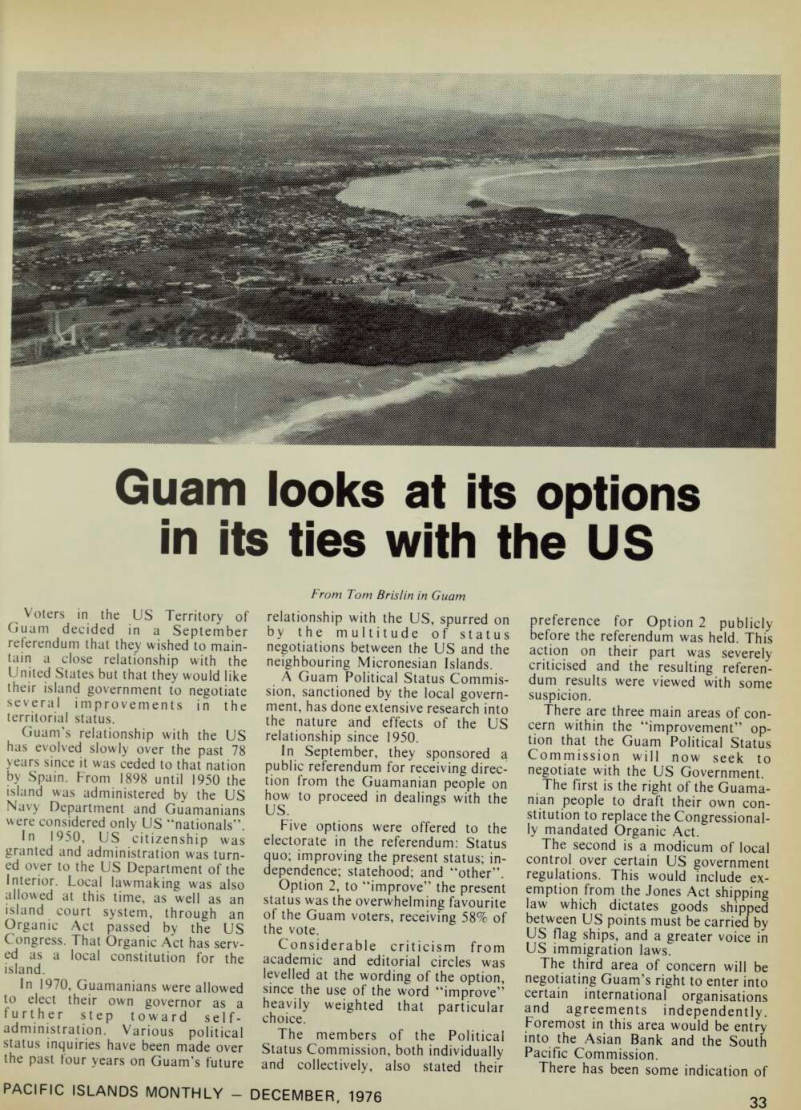
Guam looks at its options in its ties with the US
From Tom Brislin in Guam
A US T rntor y L of Ouam decided in a September referendum that they wished to mamnlvf hc£ °. SC rela [ ,ons h'P with the United States but that they would hke their island government to negotiate territorial [TlT*™™'* ,n the lerntonal status.
Guam s relationship with the US as evolved s l°wly over the past 78
by Spain^From 8 mfuntVl
Navy Dcp^rtmcm 8 were considered o n l y U s “ n aSs" S granted and admiis t r a 1 f| e r.n Sh,P , WaS Idoier to the ni nl ? , Interior l" 16 " ° f he
-a*' “ sw.t
C. “Z
rimini.tr.tion’ various political
the US Tf irieS haVe made over the past tour years on Guam’s future
relationship with the US, spurred on by the multitude of status negotiations between the US and the neighbouring Micronesian Islands.
A Guam Political Status Commission, sanctioned by the local govern- T*' haS done te f " sive research into the nature and effects of the US relationship since 1950.
In September, they sponsored a refer t ? ndam for receivin g <jirec-
u| "v*** the
Five options were offered to the electorate ln . the referendum: Status 3 UO; T proVlng th ,e present status; inde P endenc f statehood; and “other”.
Si'Tvs 2 t ,h .'.S n “
g-assse
‘The members of the Political Status Commission, both individually and collectively, also stated their
preference for Option 2 publicly before the referendum was held This action on their part was severely criticised and the resulting referen dum results were viewed with some suspicion There are three main areas of con cern within the “improvement” on tion that the Guam Political Status Commission will now seek to negotiate with the US Government.
drTft'teoSnT
8 ' 68510 " 3 '' The second is a modicum of local control over certain US government regulations. This would include ex
mss
Z’^SouS
Pacific Commission There some indication of
willingness on the part of the US Government to discuss status items with the Guam Government in a negotiations setting. No detailed agenda of acceptability has been dis cussed, however.
The US House of Representatives has already passed a measure allow ing the Territories of Guam and the Virgin Islands (in the Atlantic Ocean) to draft their own constitutions. It is expected that the measure will get full senate approval and be signed into law by the US President by the end of the year.
Guam’s representative to the US Congress, Antonio B. Won Pat, has cast some doubts over the probability of exemption from the Jones Act ship ping law because of the powerful lob bying efforts of US West Coast shippers and dockworkers.
The US State Department has traditionally cast a dim view over Guam entering any international agreements independently.
The course for negotiations, in short, will be difficult to steer by the Guam negotiators, Guam remains an important US military strategic base, and the US Government may wish to maintain a tight rein on its inter national relationships.
The next most popular option in the status referendum was statehood, in dicating that Guamanians are content to remain a part of the US flag. The option for independence received only a few votes.
The option in the referendum en titled “other” allowed the voters to write in a status preference not listed in the other options. There were several votes in this category to seek re-integration with the remainder of the Mariana Islands which were separated politically in 1898 when Guam went to the US and the Northern Marianas were sold to Ger many.
After World War I, the Marianas were awarded to Japan by the League of Nations. The US gained control of these islands as well as the rest of Micronesia as a Trust Territory following World War 11, Last year, the Northern Marianas split from Micronesia and are now in a transition process of becoming a Commonwealth of the United States, similar to Puerto Rico.
Guam’s status negotiations are slated to begin sometime after January, according to Frank Bias, a member of the Guam Legislature and chairman of the Guam Political Status Commission.
Advertisements & other items, pp. 34-36 (1 item)
Your Island
IN THE SKY
For 25 years, we have been flying the blue Pacific skies. Today, to celebrate our anniversary, and to look ahead to the next 25 years, we have become a new airline. From today, we are your island in the sky. An island reflected in a new colour scheme.
Rolls-Royce engined jets in colours which are a combination of the Pacific people’s fun and freedom. Colours which are sunrises and sunsets.
Flowers. And the blue Pacific itself.
This is the new Air Pacific. . .your island in the sky.
A new airline which offers you the new kind of island happiness and hospitality. With all traditional courtesy and dignity.
If you’re flying the Pacific, welcome aboard.
We know the South Pacific its our home. it '4 w* M u u 5 m Ua * -
The promise
of more radiant
skin beauty
m * You can help resist the signs of a prematurely aged look in your complexion by protecting it with a tropically moist oil blend.
THROUGH the development of a
unique tropically
moist oil blend, women of varying ages can be helped to achieve the complexion beauty they seek. Because of our harsh climatic conditions and the effects of the passing years most women are constantly faced with the problem of dry skin which, if not checked, can lead to the accentuation of tiny facial lines and wrinkle dryness. This is primarily caused over the years by the skin being
depleted of its precious
supply of oil and moisture but science helps
supplement these
natural fluids with a tropically moist oil blend to give your skin the assistance it needs to be at its radiant best.
A fresher,
more natural
softness
This remarkable beauty fluid helps to restore and maintain the vital balance of protective oils and moisture in your skin and provides it with a similar balance to that normally lavished on the soft, flawless complexion of the very young by Nature herself. Known in England as Oil of Ulay and in America as Oil of Olay this beautifying fluid is available from chemists and ☆ ☆ ☆ beauty counters in Australia as Oil of Ulan moist oil blend.
Smoothed conscientiusly into wrinkle prone areas such as around the eyes, mouth and neck your Oil of Ulan helps condition the keratinous skin cells which make up the stratum corneum, or outer region of your skin so that your complexion can take on a softer, smoother, more supple beautiful look.
By smoothing Oil of Ulan over your face and neck each morning an evening you will provide your skin with benefits similar to those of the skin’s own natural fluids, and in this way help keep your skin attractive and more
youthful looking.
a *** m
SSfij
Mixmaster Mixer
3 times better than any
Qf’h©!* mixer. Designed especially for family food preparation. 12-speed mixfinder dial indicates the correct speed for each mixing action. Complete with 2 heat-resistant bowls and juice extractor. Sunbeam’s exclusive 3-way beating action — extra large, contoured beaters, and automatic bowl movement — gives perfect aeration and more even mixing. It can handle everything from beating one egg to mixing a large fruit cake.
Magazine
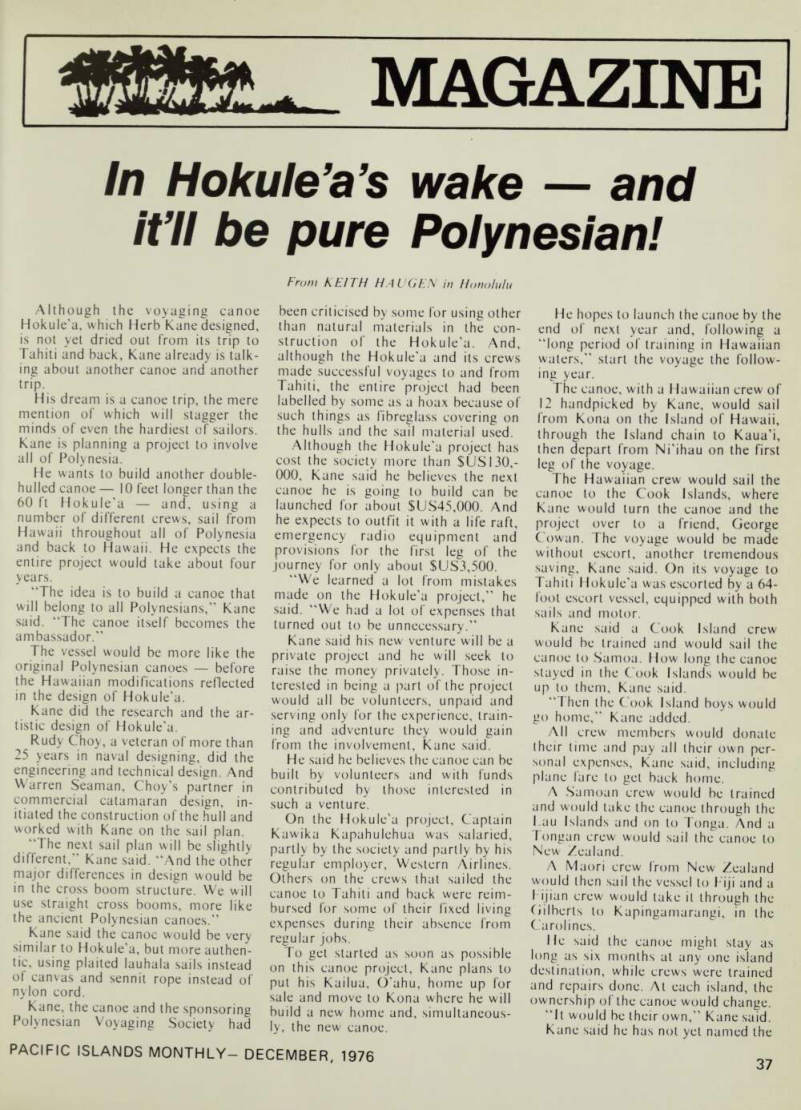
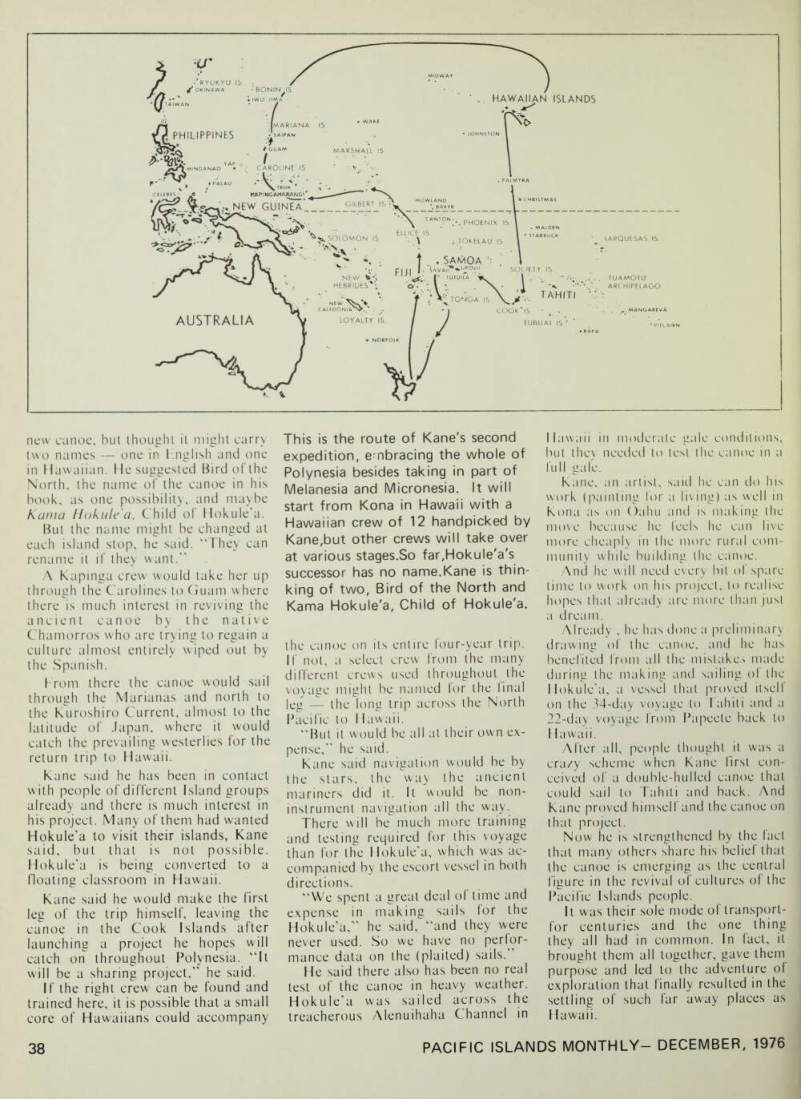
In Hokule’a’s wake - and it’ll be pure Polynesian!
From KEITH HAUGEN in Honolulu
Although the voyaging canoe Hokule'a, which Herb Kane designed, is not yet dried out from its trip to Tahiti and back, Kane already is talk ing about another canoe and another trip.
His dream is a canoe trip, the mere mention of which will stagger the minds of even the hardiest of sailors.
Kane is planning a project to involve all of Polynesia.
He wants to build another double hulled canoe 10 feet longer than the 60 ft Hokule’a and, using a number of different crews, sail from Hawaii throughout all of Polynesia and back to Hawaii. He expects the entire project would take about four years.
“The idea is to build a canoe that will belong to all Polynesians,” Kane said. “The canoe itself becomes the ambassador.”
The vessel would be more like the original Polynesian canoes before the Hawaiian modifications reflected in the design of Hokule’a.
Kane did the research and the ar tistic design of Hokule’a.
Rudy Choy, a veteran of more than 25 years in naval designing, did the engineering and technical design. And Warren Seaman, Choy’s partner in commercial catamaran design, in itiated the construction of the hull and worked with Kane on the sail plan.
“The next sail plan will be slightly different,” Kane said. “And the other major differences in design would be in the cross boom structure. We will use straight cross booms, more like the ancient Polynesian canoes.”
Kane said the canoe would be very similar to Hokule'a, but more authen tic, using plaited lauhala sails instead of canvas and sennit rope instead of nylon cord.
Kane, the canoe and the sponsoring Polynesian Voyaging Society had
been criticised by some for using other than natural materials in the construction of the Hokule’a. And, although the Hokule'a and its crews made successful voyages to and from Tahiti, the entire project had been labelled by some as a hoax because of such things as fibreglass covering on the hulls and the sail material used.
Although the Hokule a project has cost the society more than SUSI3O,- 000, Kane said he believes the next canoe he is going to build can be launched for about $U545,000. And he expects to outfit it with a life raft, emergency radio equipment and provisions for the first leg of the journey for only about $U53,500.
We learned a lot from mistakes made on the Hokule a project,” he said. We had a lot of expenses that turned out to be unnecessary.
Kane said his new venture will be a private project and he will seek to raise the money privately. Those inlerested in being a part of the project would all be volunteers, unpaid and serving only for the experience, training and adventure they would gain from the involvement, Kane said.
He said he believes the canoe can be built by volunteers and with funds contributed by those interested in such a venture.
On the Hokule’a project. Captain Kawika Kapahulehua was salaried, partly by the society and partly by his regular employer, Western Airlines.
Others on the crews that sailed the canoe to Tahiti and back were reimbursed for some of their fixed living expenses during their absence from regular jobs.
To get started as soon as possible on this canoe project, Kane plans to put his Kailua, O’ahu, home up for sale and move to Kona where he will build a new home and, simultaneously, the new canoe.
He hopes to launch the canoe by the end of next year and, following a “long period of training in Hawaiian waters,” start the voyage the follow ing year.
The canoe, with a Hawaiian crew of 12 handpicked by Kane, would sail from Kona on the Island of Hawaii, through the Island chain to Kaua’i, then depart from Ni’ihau on the first leg of the voyage.
The Hawaiian crew would sail the canoe to the Cook Islands, where Kane would turn the canoe and the project over to a friend, George Cowan. The voyage would be made without escort, another tremendous saving, Kane said. On its voyage to Tahiti Hokule'a was escorted by a 64loot escort vessel, equipped with both sails and motor, Kane said a Cook Island crew would be trained and would sail the canoe to Samoa. How long the canoe stayed in the Cook Islands would be up to them, Kane said, “Then the Cook Island boys would go home,” Kane added, All crew members would donate their lime and pay all their own per sonal expenses, Kane said, including plane fare to get back home, A Samoan crew would be trained and would lake the canoe through the Lau Islands and on to Tonga. And a Tongan crew would sail the canoe to New Zealand.
A Maori crew from New Zealand would then sail the vessel to Fiji and a Fijian crew would take it through the Gilberts to Kapingamarangi, in the Carolines.
He said the canoe might stay as long as six months at any one island destination, while crews were trained and repairs done. At each island, the ownership of the canoe would change “It would be their own,” Kane said, Kane said he has not yet named the
new canoe, but thought it might carry two names one in Tnglish and one in Hawaiian. He suggested Bird of the North, the name of the canoe in his book, as one possibility, and maybe Kama Hokule'a. Child of Hokule'a.
But the name might be changed at each island stop, he said. “They can rename it if they want.”
A Kapinga crew would take her up through the Carolines to Guam where there is much interest in reviving the ancient canoe by the native Chamorros who are trying to regain a culture almost entirely wiped out by the Spanish.
Prom there the canoe would sail through the Marianas and north to the Kuroshiro Current, almost to the latitude of Japan, where it would catch the prevailing westerlies for the return trip to Hawaii.
Kane said he has been in contact with people of different Island groups already and there is much interest in his project. Many of them had wanted Hokule’a to visit their islands, Kane said, but that is not possible.
Hokule'a is being converted to a floating classroom in Hawaii.
Kane said he would make the first leg of the trip himself, leaving the canoe in the Cook Islands after launching a project he hopes will catch on throughout Polynesia. “It will be a sharing project,” he said.
If the right crew can be found and trained here, it is possible that a small core of Hawaiians could accompany
the canoe on its entire lour-year trip.
If not, a select crew- from the many different crews used throughout the voyage might be named lor the linal leg the long trip across the North Pacific to Hawaii.
“But it would be all at their own ex pense," he said.
Kane said navigation would be by the stars, the way the ancient mariners did it. It would be non instrument navigation all the way.
There will be much more training and testing required for this voyage than for the Hokule'a, which was ac companied by the escort vessel in both directions.
“We spent a great deal of lime and expense in making sails for the Hokule’a,” he said, “and they were never used. So we have no perfor mance data on the (plaited) sails.”
He said there also has been no real test of the canoe in heavy weather.
Hokule'a was sailed across the treacherous Alenuihaha Channel in
Hawaii in moderate gale conditions, but they needed to lest the eanoe in a lull gale.
Kane, an artist, said he can do his work (painting for a living) as well in Kona as on Oahu and is making the move because he feels he can live more cheaply in the more rural com munity while building the eanoe.
And he will need every bit of spare time to work on his project, to realise hopes that already are more than just a dream.
Already , he has done a preliminary drawing of the eanoe, and he has benefited from all the mistakes made during the making and sailing ol the Hokule'a, a vessel that proved itself on the 34-day voyage to Tahiti and a 22-day voyage from Papeete baek to I lawaii.
After all, people thought it was a era/y scheme when Kane first con ceived of a double-hulled eanoe that could sail to Tahiti and baek. And Kane proved himself and the eanoe on that project.
Now he is strengthened by the fact that many others share his belief that the eanoe is emerging as the central figure in the revival of cultures of the Pacific Islands people.
It was their sole mode of transport er centuries and the one thing they all had in common. In fact, it brought them all together, gave them purpose and led to the adventure of exploration that finally resulted in the settling of such far away places as Hawaii.
This is the route of Kane's second expedition, embracing the whole of Polynesia besides taking in part of Melanesia and Micronesia. It will start from Kona in Hawaii with a Hawaiian crew of 12 handpicked by Kane,but other crews will take over at various stages.So far, Hokule'a's successor has no name. Kane is thin king of two, Bird of the North and Kama Hokule'a, Child of Hokule'a.
Advertisements & other items, pp. 39-42 (1 item)
Carry stereo anywhere
The new Sony CF-580 will keep anyone anywhere from being bored. 5.8 big watts of output power. Four big speakers in a powerful Matrix Stereo Sound System that spread high quality reproduction all around. Full stereo separation. And built-in twin mikes and automatic level control to make recording anything a cinch. You’re only half shipshape without one—even if you’re not a sailor.
SONY
Research Makes the Difference
Carry stereo anywhere
in the world.
Hr #* gcif' K ‘"’-
||j - "1 , v ' - : : ' . . ,_g- „ 3 /^*».v ' **•’*'' " 7 i i % //>.
J mj* -. itillii
Another Achievement of
Seiko Quartz Technology.
The LC Digital Quartz
Chronograph
It Tells the Time and Date and Turns into a Stopwatch at the Touch of a Button.
Seiko can do it because Seiko was first to market the quartz watch and today is the world leader in quartz. Seiko's expertise in every phase of watchmaking means Seiko can make any part of any Seiko watch, for impeccable quality control. Seiko makes quartz watches with traditional analog faces and with the LC digital readout. No matter which Seiko Quartz you select, you get the watch that's changing the world's standard of accuracy. Seiko Quartz,
SEIKO
Someday all watches will be made this way.
% m A ]• J « m**
i ciM*
rJ *• €
What You Hear Isa Mind-Blowing
Visual Experience.
There seems to be no end to the superlatives used to describe stereo sound quality. It’s usually natural, crystal clear, rich or vibrant with plenty in reserve.
The list of words is longer than the tape on a 7-inch reel. But these tired, old adjectives can’t convey the full impact of Akai sound. Perhaps there just aren’t any words equal to the task.
Australia Akai Australia Pty. Ltd. 17/18 Hordern Place Denison St.
Camperdown, Sydney, N.S.W. 2050 Tel: 516-3366
P.N.G.
S.O. Svensson (N.G.) Ltd.
P.O. Box 705, Port Moresby Tel: 2275 Fiji Islands Motibhai & Company Ltd.
P.O. Box 9175 Nadi International Airport Tel; 72-165 New Zealand Pye Ltd, Consumer Product Division 110 Mt. Eden Rd., Mt. Eden, Auckland Tel: 686-437 It’s a visual experience that begins the moment you close your eyes and are swept into the imaginative world of your mind.
Akai provides you a wide selection of fine stereo components
tape decks, turntables, amps,
tuners, receivers and speaker systems —to assure you will enjoy
every trip.
New Caledonia Menard Freres B.P. H 2, Noumea Tel: 275222 Tahiti Etablissements Comimpex P.O. Box 200, Papeete Tel; 20477 New Hebrides Island Burns Philip (New Hebrides) Co., Ltd.
Port Vila, New Hebrides Island Norfolk Island Burns Philip (Norfolk Island) Co., Ltd.
P.O. Box 21, Norfolk Island See the difference when you move up to Akai sound.
Audio & Video
AKAI
AKAI ELECTRIC CO., LTD.
Tokyo, Japan
Samoan Islands Burns Philip (South Sea) Co., Ltd.
P.O. Box 129, Pago Pago, American Samoa, Apia, Western Samoa Mariana Islands J.C. Tenorio Enterprises P.O. Box 137, Saipan Tel: 6444/8 British Solomon Security Electrical Co., Ltd.
P.O. Box 174, Honiara Tel; 881 Cook Islands JPS Enterprises Ltd.
P.O. Box 15, Rarotonga Tel: 2150, 2176
Christ is Melanesian
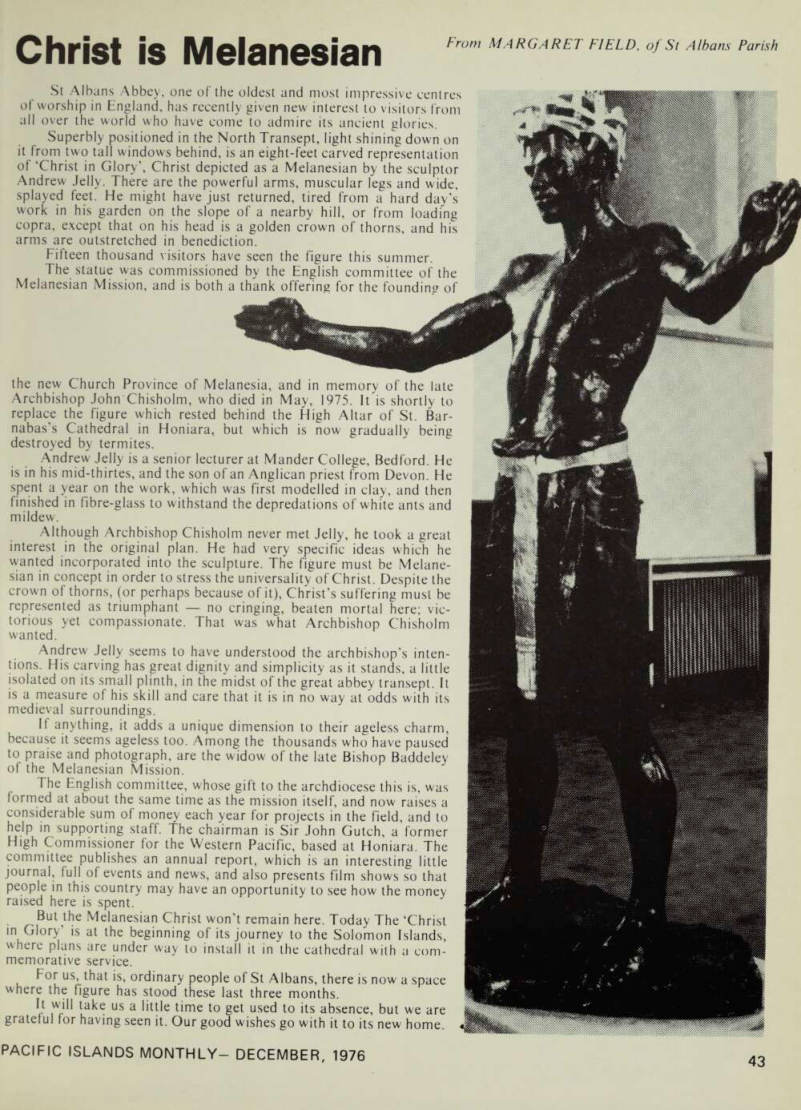
From MA RGA RET FIELD, of St Albans Parish
St Albans Abbey, one of the oldest and most impressive centres of worship in England, has recently given new interest to visitors from all over the world who have come to admire its ancient glories.
Superbly positioned in the North Transept, light shining down on it from two tall windows behind, is an eight-feet carved representation of ‘Christ in Glory’, Christ depicted as a Melanesian by the sculptor Andrew Jelly. There are the powerful arms, muscular legs and wide, splayed feet. He might have just returned, tired from a hard day's work in his garden on the slope of a nearby hill, or from loading copra, except that on his head is a golden crown of thorns, and his arms are outstretched in benediction.
Fifteen thousand visitors have seen the figure this summer.
The statue was commissioned by the English committee of the Melanesian Mission, and is both a thank offering for the founding of the new Church Province of Melanesia, and in memory of the late Archbishop John'Chisholm, who died in May, 1975. It is shortly to replace the figure which rested behind the High Altar of St. Bar nabas’s Cathedral in Honiara, but which is now gradually being destroyed by termites.
Andrew Jelly is a senior lecturer at Mander College, Bedford. He is in his mid-thirtes, and the son of an Anglican priest from Devon. He spent a year on the work, which was first modelled in clay, and then finished in fibre-glass to withstand the depredations of white ants and mildew.
Although Archbishop Chisholm never met Jelly, he took a great interest in the original plan. He had very specific ideas which he wanted incorporated into the sculpture. The figure must be Melane sian in concept in order to stress the universality of Christ. Despite the crown of thorns, (or perhaps because of it), Christ’s suffering must be represented as triumphant no cringing, beaten mortal here; vic torious yet compassionate. That was what Archbishop Chisholm wanted.
Andrew Jelly seems to have understood the archbishop’s inten tions. His carving has great dignity and simplicity as it stands, a little isolated on its small plinth, in the midst of the great abbey transept. It is a measure of his skill and care that it is in no way at odds with its medieval surroundings.
If anything, it adds a unique dimension to their ageless charm, because it seems ageless too. Among the thousands who have paused to praise and photograph, are the widow of the late Bishop Baddeley of the Melanesian Mission.
The English committee, whose gift to the archdiocese this is, was formed at about the same time as the mission itself, and now raises a considerable sum of money each year for projects in the field, and to help in supporting staff. The chairman is Sir John Gutch, a former High Commissioner for the Western Pacific, based at Honiara. The committee publishes an annual report, which is an interesting little journal, full of events and news, and also presents film shows so that people in this country may have an opportunity to see how the money raised here is spent.
But the Melanesian Christ won’t remain here. Today The ‘Christ in Glory’ is at the beginning of its journey to the Solomon Islands, where plans are under way to install it in the cathedral with a com memorative service.
For us, that is, ordinary people of St Albans, there is now a space where the figure has stood these last three months.
It will take us a little time to get used to its absence, but we are grateful for having seen it. Our good wishes go with it to its new home. <
Advertisements & other items, p. 44 (1 item)
any gas, anywhere, any time
H * i V \ ■ * » tl P • . % If % S . I I » ■« V, h
®l * i. 'r
THE COMMONWEALTH INDUSTRIAL GASES LIMITED,
GASES EXPORT DEPARTMENT, 138 BOURKE ROAD, ALEXANDRIA, N.S.W.,
AUSTRALIA 2015. CABLES “CIGAS”—TELEX AA25475 SYDNEY.
■ C/G NEW GUINEA PTY. LIMITED, Lae: Mangola Street, LAE (P.O. Box 93). Phone 2641 Port Moresby. Racecourse Road, Hohola (P.O. Box 1636 Boroko) Phone 53870.
■ THAI INDUSTRIAL GASES LIMITED, Bangkok:
22/26 Poochaosmingprai Road, Prapradaeng, Smutprakarn.
Phone 940708. Telex AMCO TH 2541. ■ C/G FIJI LIMITED, Suva: Vetaia Street, Lami (P.O. Box 687).
Phone 361011. Lautoka: Vitogo Parade (P.O. Box 601). Phone 61105.
*ASSOCIATED COMPANIES
• P.T. INDUSTRIAL GASES, INDONESIA, DJAKARTA:
P.O. Box 124/JNG, Pulo Gadung. * •HONG KONG OXYGEN AND ACETYLENE CO. LTD.
Hong Kong: 41 G Ma Tau Wei Road, Kowloon. * ■ SOXAL P.O. Box 241, Singapore, Telex 21150. * ■ NEW ZEALAND INDUSTRIAL GASES LIMITED, Wellington: P.O. Box 30337, Lower Hurt, Wellington, N.Z.
* ■ MALAYAN OXYGEN SDN BERHAD,
Box 633 P.O. Kuala Lumpur. Malaysia.
Islands
From The
Press
From a letter by P. Tura, in The Fiji Times, on the
need for rugby coaching:
With Nasoni Uluvula in their team, we expect them (Naitasiri) to play not like wild bulls just being shot, not like boxers with gloves, but more like men competing in a rugby field.
From the Cook Islands News: We have had experts from United Nations, experts from New Zealand and other countries, experts, experts, experts, reports, reports, reports, but what have we achieved? Even the Premier Hon. Sir Albert Henry, K.8.E., was reported to have said recently that 10 years ago, we had no experts and reports yet the work on all levels went ahead, be it Roads, Agriculture, Water Supply, Village Committee, etc., yet today we are surrounded with experts and reports and nothing else to show for it.
Mr Sam Salii, former Minister of Finance in Western Samoa, in the Samoa Times: Let me tell you, Mr Faalogo, that the authority of Parliament is next only to God’s.
Lone yachtsman, Phillip James, giving Rabaul
Provincial Court a reason for failure to leave the country when ordered, as reported in the PNG Post- Courier: When you are travelling alone in a seven-metre yacht you have to respect the weather.
Mr Pious Kerepia, Papua New Guinea Commissioner of Police, reported in the PNG Post- Courier.
“My plan is to stay in the police force for 20 years, either as Commissioner or anything else.”
From the Norfolk Islander, commenting on the
length of Advisory Council meetings:
Listening to the tape of the proceedings of the October meeting, it took 12 minutes to confirm the Minutes of the previous meeting and much of this time was spent searching the many pages looking for typographical and other minor errors.
A letter by Abhay Singh in The Fiji Times: I would like to complain about not getting stamps in the Samabula three miles area. Before, there was a shop next to the post box which had a licence to sell stamps. Now there is no shop selling stamps. It is no use having a post box if we do not get stamps.
From Island Trader, Papua New Guinea: The lives of underwater divers are in danger as the illegal practice of using dynamite to kill fish continues in waters around Rabaul.
From The Fiji Times, quoting an official of the Fiji Sugar Corporation on a decision by a number of staff to work on a public holiday: .. . people like chemists, maintenance men and accounts and office staff would be able to find work for themselves.
From the Samoa Times, Western Samoa, on the retirement of the Chief Justice, Mr Justice Scully: The law was a hard, demanding mistress, Mr Scully once said.
We are happy to report that Mr Scully was faithful to his mistress and an example to us all.
From the Cook Islands News, under the heading “The 53-Minute Game that No One Won”: It ended like no other game has ended in the history of Cook Islands first class rugby fixtures. Players in a melee of swinging fists, to the tune of Cassius Clay’s “I am the greatest”. Both the Wellington Maori side and the Rarotonga Country XV were utterly surprised when during one of the many skirmishes, the referee Mr Andrew Turua blew his whistle for “no side” (27 minutes before the official ending time).
From the Solomons News Drum: The problem of obtaining a screw was cited by Mr Johnson Kengalu (Malaita Outer Islands) as an example of “Colonial rules”. He said that if one of a crew of a government ship wanted a replacement screw from the Stores, he would have to go through nine separate administrative stages. “The Marine Department just cannot give him 20 cents to buy a screw,” said Mr Kengalu. “This is one of the Colonial rules we don’t like.”
From an editorial in the Tonga Chronicle: I ought to say of course that the New Zealanders are here after the Russians have gone. I’m not quite sure whether it is playing with words or a typical New Zealand subtle approach. I’m referring of course to the so-called aim of the NZ Parliamentary Delegation visit: “An information gathering and goodwill mission”. Don’t you get the impression that this is an approach typical of a country with no prior relationships at all with Tonga? . . . The delegation arrives in Tonga with the intention of encouraging industrial development in the Pacific while at the same time, the Immigration Department in New Zealand is carrying out a drastic axing programme with overstayers. It is a bit like giving out with the left hand while squeezing your neck with the other.
The Kiwanis Club in Vila rules the weather according to a report in the New Hebrides News; After long weeks of preparation by the Kiwanis Club and the agricultural officers, the CDI Agricultural show took place on Saturday, September 4. Thanks to their perfect planning, the day began with complete sunshine!
crossbows
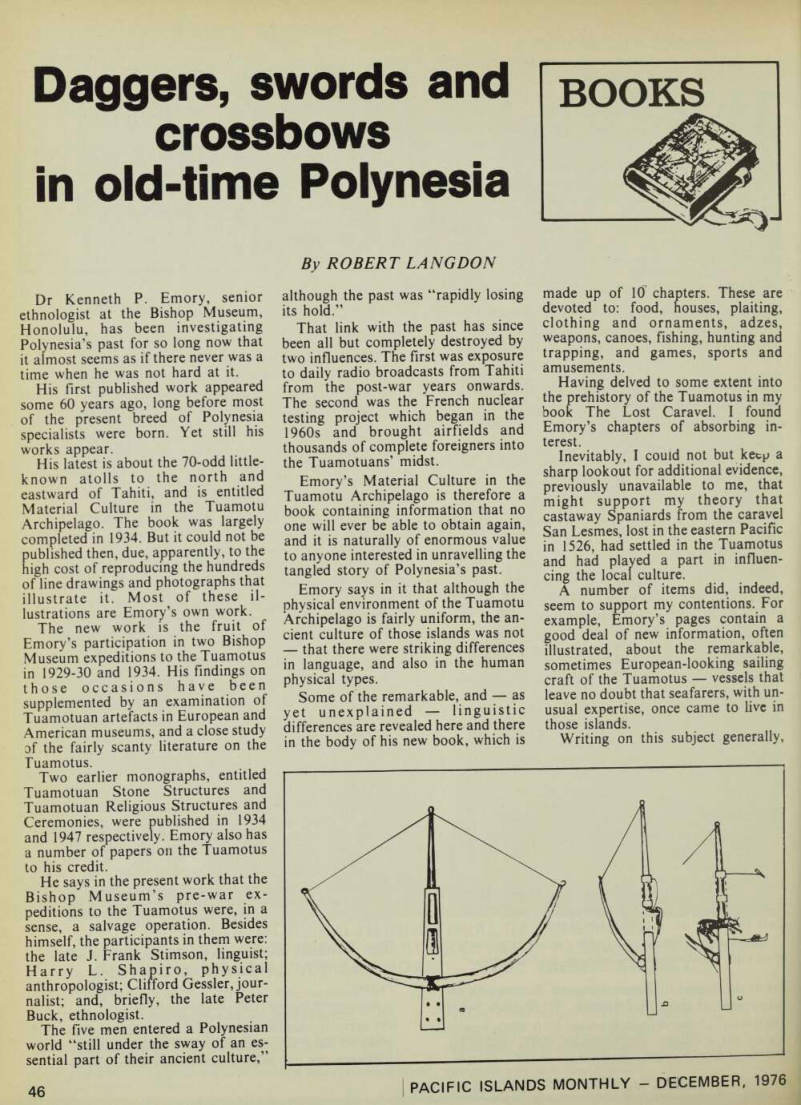
Daggers, swords and crossbows in old-time Polynesia
Books
By Robert Lang Don
Dr Kenneth P. Emory, senior ethnologist at the Bishop Museum, Honolulu, has been investigating Polynesia’s past for so long now that it almost seems as if there never was a time when he was not hard at it.
His first published work appeared some 60 years ago, long before most of the present breed of Polynesia specialists were born. Yet still his works appear.
His latest is about the 70-odd little known atolls to the north and eastward of Tahiti, and is entitled Material Culture in the Tuamotu Archipelago. The book was largely completed in 1934. But it could not be published then, due, apparently, to the high cost of reproducing the hundreds of line drawings and photographs that illustrate it. Most of these il lustrations are Emory’s own work.
The new work is the fruit of Emory’s participation in two Bishop Museum expeditions to the Tuamotus in 1929-30 and 1934. His findings on those occasions have been supplemented by an examination of Tuamotuan artefacts in European and American museums, and a close study of the fairly scanty literature on the Tuamotus.
Two earlier monographs, entitled Tuamotuan Stone Structures and Tuamotuan Religious Structures and Ceremonies, were published in 1934 and 1947 respectively. Emory also has a number of papers on the Tuamotus to his credit.
He says in the present work that the Bishop Museum’s pre-war ex peditions to the Tuamotus were, in a sense, a salvage operation. Besides himself, the participants in them were: the late J. Frank Stimson, linguist; Harry L. Shapiro, physical anthropologist; Clifford Gessler, jour nalist; and, briefly, the late Peter Buck, ethnologist.
The five men entered a Polynesian world “still under the sway of an es sential part of their ancient culture,”
although the past was “rapidly losing its hold.”
That link with the past has since been all but completely destroyed by two influences. The first was exposure to daily radio broadcasts from Tahiti from the post-war years onwards.
The second was the French nuclear testing project which began in the
1960 s and brought airfields and
thousands of complete foreigners into the Tuamotuans’ midst.
Emory’s Material Culture in the Tuamotu Archipelago is therefore a book containing information that no one will ever be able to obtain again, and it is naturally of enormous value to anyone interested in unravelling the tangled story of Polynesia’s past.
Emory says in it that although the physical environment of the Tuamotu Archipelago is fairly uniform, the an cient culture of those islands was not that there were striking differences in language, and also in the human physical types.
Some of the remarkable, and as yet unexplained linguistic differences are revealed here and there in the body of his new book, which is
made up of 10 chapters. These are devoted to: food, houses, plaiting, clothing and ornaments, adzes, weapons, canoes, fishing, hunting and trapping, and games, sports and amusements.
Having delved to some extent into the prehistory of the Tuamotus in my book The Lost Caravel. I found Emory’s chapters of absorbing in terest.
Inevitably, I could not but keep a sharp lookout for additional evidence, previously unavailable to me, that might support my theory that castaway Spaniards from the caravel San Lesmes, lost in the eastern Pacific in 1526, had settled in the Tuamotus and had played a part in influen cing the local culture.
A number of items did, indeed, seem to support my contentions. For example, Emory’s pages contain a good deal of new information, often illustrated, about the remarkable, sometimes European-looking sailing craft of the Tuamotus vessels that leave no doubt that seafarers, with un usual expertise, once came to live in those islands.
Writing on this subject generally,
Emory says: “While in all other material possessions the Tuamotuans were inferior to their high-island neighbours, they were superior in ocean-going sailing canoes in spite of poorer resources.” However, he makes no attempt to explain why this should have been so.
Other items in Emory’s compen dium that seemed to me to savour strongly of long-lost Spaniards were swords and daggers, of which he has some interesting sketches. In addi tion, his photographs of islanders “jousting” with wooden staves on Vahitahi Atoll conjured up more visions of doughty dons of long ago.
Of course, anyone can argue that the swords, daggers and staves could have been made by anyone that they are not so distinctive that they must have been derived from Spain.
However, when they are considered in conjunction with yet another Emory item, an expecially distinctive one, such an argument might not seem to have so much weight. This other item is what Emory calls a “crossbow type of trap” which the people of formerly used for catching rats.
Emory’s information on this sub ject was obtained from an Anaan man, Paea, who passed on many charts to Emory’s colleague Stimson about an ancient, esoteric, Biblical seeming god called Kiho.
Of the crossbow rat trap, Emory says, rather ambiguously, that it was “obviously patterned after the Euro pean crossbow and is not likely to have been in the Tuamotus before modern times.”
He illustrates his text with three drawings based on sketches by Paea himself.
I believe there are four good reasons why the crossbow rat trap could only have originated with castaways from the San Lesmes.
These are;- 1. In Spain and other European countries the. crossbow became ob solete for military purposes between the years 1570 and 1600, which was 300 years or so before Paea was born. 2. Quiros, the first recorded Euro pean to land in the Tuamotu Archipelago, did not reach those islands until 1606; and it is clear from an inventory of items carried in his flagship that the crossbow was not among them. On the other hand, the arquebus, which ousted the crossbow from military use, is mentioned in both the inventory and in various ac counts of Quiros’ voyage. 3. An inventory of the equipment
carried by the Magellan expedition, which crossed the Pacific in 1520-21, does include crossbows 60 of them but not the arquebus. 4. As the San Lesmes left Spain in 1525, three years after Magellan’s ship Victoria returned home, it may be assumed that vessel also carried crossbows, or, at the very least, men familiar with them.
Thus, by a simple process of elimination there can be no doubt, in my view, that the crossbow rat trap reached Anaa from 16th century Spain, and not from some vague European source in “modern times,” as Emory says.
My disagreement with Emory on this point, naturally, does not detract from the value of his monograph in my eyes. But I do regret that he has followed Sir Clements Markham in identifying the atoll that Quiros called La Conversion de San Pablo as Anaa.
All evidence including some that has come to light since Markham’s time some 50 years ago clearly in dicates that Hao was the atoll in ques tion, and all modern scholars who have studied the matter, including Andrew Sharp, H. E. Maude and Celsus Kelly, have been agreed on this.
Emory’s error on this matter has meant that he has wrongly attributed certain elements of ancient Tuamo tuan culture to Anaa when they right fully belong to Hao, some 400 km eastward.
It would be a great pity if Emory’s otherwise excellent work should be widely distributed without attention being drawn to the confusion over Anaa and Hao. An errata slip placed in all unsold copies would be a simple solution to the problem. (Material Culture in the Tuamotu Archipelago by Kenneth Emory. Bishop Museum Press, Honolulu. Price not available.)
Benjamin Umba
Remember the name: Benjamin Umba
For many years I have felt that publishers never at any time read the things they publish. This is obvious for a number of reasons, and in the case of Longman Pau’ Three Short Novels From Papua New Guinea by the authors Benjamin Umba, August Kituai and Jim Baital, the blurb on the back of the paperback confirms this, for it has nothing whatever to do with the contents of the book. Do publishers think readers cannot find out for themselves what a book is about? So, as Longman Paul may not have read the book they have just published in their Pacific Paperback series, and may know nothing of what it is about, let me tell them they have published a highly-worthwhile book, and one which, I sincerely hope, finds a large and understanding reading public.
The Editor of PIM tells me that I am becoming known for my condem natory reviews and that it is being said that I never say anything complimen tary about anyone’s writing, so, hav ing paid the publishers a compliment, I must revert to my true nature and start what some call carping. Why shouldn’t one carp anyway?
Dear authors three, try to think
that it is for your own good, and that because I take you to task this time you may not commit the same errors next time, remembering, as an author, that your reader is sacred. Always play fair with him, and he will give you fame and adulation, for it is he who makes the decisions.
I am starting at the back of the book, for the least masterly of the three novels is the last: they have been printed in order of virtue. Perhaps Mike Greicus, who has edited the collection, told the publishers this.
The blurb says that Tali, the third of the three novels is “about the effects of independence and offers a final comment on its costs”. Is it?
And does it? If it is and does, then the author has failed to impress me that that is what he is writing about. The story is a series of disjointed episodes in the life of Tali after he committed a sexual offence in the village and ran away to avoid the consequences. At least that is what the author tells us, but at no time in the whole story is the reader permitted to find out anything for himself or to come to any con clusions. Such is the essence of novel writing; take the reader into your con fidence and allow him to find out
things for himself.
We go through the somewhat bor ing routine of Tali until he joins the Army. His disintegration seems to be, not the result of independence, but the result of his own weakness. The author in this theme had the oppor tunity to do what the publisher’s blurb says he did. But I, who read the novel carefully, think that the author has failed in this task. I felt no sympathy for Tali at any time and the episodes in which he became involved had little measure of interest for the reader.
Given a little more attention to the theme and more attention to presen ting Tali as a being with thoughts and functions and features, and not as a colourless victim of circumstance, Tali might well turn into a compact Short Story, The middle story of the three, The Flight of Villager, afforded the author a wonderful opportunity too, and too, he failed to make full use of it. This story is set in that horrid, commercial, soulless town of Goroka, the centre of a large natural population paying visits to the town, and harbouring foreigners of all sorts black and white.
A wonderful choice for the setting of a novel, but not one of his characters emerges as a real being, and the en vironment, mental and physical, is given scant treatment by the author.
To have treated this evironment in depth would have meant that we would have been given a novel of great value. Again, it is the story of a youth who, committing a sexual offence, runs from his village and ends up in Goroka, eventually finding employ ment as a domestic. 1 read it, hoping for some descrip tion of the physical Goroka of the time, and found none. I read it, hop ing to be told something of the doings of that mixed population that in habited the place and learned nothing of it. 5 In that town emotion ran high,
foreign locals thinking they belonged,
foreigners from far parts such as
Kerema establishing minority groups,
foreigners of long-standing from New Britain considering themselves to be superior, and foreigners of different skin colour. All discriminating against one another. Do you see the setting, and the opportunity the author missed? All these things a writer must observe.
Yes, I know! They’re young!
They’re no more than students! It would be dishonest of me not to point
out what I think is the error of their ways. Writing isn’t easy! And don’t let’s make excuses, for if Benjamin Umba can do it, why didn’t they?
Remember the name, Benjamin Umba. You’re going to hear more of it. It is seldom that I have read with more delight any writing than I did that of The Fires of Dawn. This novel, the story of which I am not going to tell you, contains all that the others lack. I am not going to tell you the plot, which is perhaps, slight; nor am I going to tell you the theme which is tremendous, for I hope you will go out and buy the book and enjoy all three stories for they are all enjoyable, and see if what I say 4s not correct, par ticularly that Benjamin Umba can write.
In this story, not only did I feel sorry for the old man who is the cen tral character, but I felt keen ap prehension for him; sufficient suspense, not overdone, was written into the narrative by Benjamin Umba to make me turn the pages quickly hoping that the old man would escape the fate the author had prepared for him.
He was real and alive and feeling and the village in which he lived was real. I could see the houses and feel the rain, and the meeting in the men’s house was convincing and showed acute observation, at some time, on the author’s part.
The ending of the novel is superb.
The last paragraph is a gem. Long after the reader has come to the last word, his mind goes on contemplating the theme. This is real writing: no per sonal opinion expressed by the author,
the reader allowed to form his own judgments, and the sadness of the theme felt in the reader’s mind. With no judgment inflicted upon him by the writer, the reader sees much more clearly the sadness of the whole business. There was wrong on both sides, the reader feels, much horror was unnecessary, the fate of the villagers inevitable as the history of Papua New Guinea unfolded, but the reader is not hit on the head with these observations: he is led to make them for himself. This is writing.
I hope Benjamin Umba will re work The Fires of Dawn into a full length novel, not obliterating his gift of understatement, and not adding or detracting from his marvellous final paragraph. I should like to read in the novel somewhat more of Benjamin Umba’s description of the mission station and what Tanawa does there.
More detail in the description of the village without being wordy might be desirable, and greater detail in the description of the discussion in the men’s house.
These are things I wanted to know about as I read. I think the old man’s journey to the mission might do with a bit more description.
You seem, Benjamin Umba, to have got him through that long journey a little too suddenly, and perhaps a reader would like you to take a little more time in getting him back to the village. Was he not excited on the way back, that all was now well, and his son was coming back?
What did he think of the mission?
Nonetheless, the two great gifts are there: understatement and no un derestimation of the intelligence and sensitivity of the reader.
The publishers state that the writing of The Fires of Dawn “is only a step from the oral narratives that were previously used . . A flipping long step, if you ask me!
A final word of warning to all three of you. The colour of your skin will not get you by in the world of writing.
The reader, who makes the final deci sion, makes it upon what you write and generally knows little about pigmentation.
Congratulations to the three authors, congratulations to Mike Greicus for his part in it, and to Longman Paul who I hope will now read it for publishing it.
Peter Livingston
(Three Short Novels From Papua New
GUINEA, Edited by Mike Greicut, and published by Lonimm Paul, Hawthorn, Victoria, illustrated by Grava Aura, 140 pa{es, paperback at $2.95.)
Advertisements & other items, p. 48 (1 item)
The Dependables!
VILUERS
& 4 STROKE
ENGINES
WISCONSIN
HEAVY DUTY
ENGINES
For an infinite variety of applications including pumping, spraying, mowing, power saws, etc. you simply can’t go past the amazingly dependable Villiers aircooled petrol engine. We offer 7 basic models with hundreds of combinations, including reduction gearboxes.
They’re your logical choice if you need an air-cooled H.D. petrol engine upon which you can absolutely rely. Thrives on the toughest jobs with a minimum of maintenance. Available from 4.7 to 65.9 horsepower in single, twin and 4 cyl. types to suit a wide range of applications.
Both Villiers and Wisconsin engines are backed by For Sales and Service contact:
HASTINGS DEERING LTD.
Parramatta Road, Cnr. John Street,
LIDCOMBE, N.S.W. 2141, AUSTRALIA.
Tel: 648-0111. a first class parts service. 001062
To Future Generations,
Security
- « h
fflfe
<r> Tranquil Splendor.
Borobudur Temple in Indonesia built over 11 centuries ago.
Social welfare is a subject of serious consideration in most modern societies.
Man in the twentieth century accepts his responsibility to bequeath to the next generation a society better than his own.
Daiwa Bank is not unique in accepting this responsibility, but Daiwa is unique in making acceptance of this role in society an integral part of their banking service.
Daiwa is the only Japanese city bank to combine banking and trust business. Daiwa is thus a fully integrated banking institution, comprising banking, international financing, trust, pension trust, and real estate business.
This integration is part of our effort to fulfil our social responsibility consistent with society's needs in a contemporary environment. a fully integrated banking service
DAIWA BANK
Head Office: Osaka, Japan London and Frankfurt Branches New York and Los Angeles Agencies Singapore, Sydney, Sao Paulo and Hong Kong Representative Offices Joint Venture Banks; P.T. Bank Perdania, Jakarta, International Credit Alliance, Ltd., Hong Kong
Captain’S Thesis
Captain Brett Hilder, ex Burns Philp ships, recently completed his thesis on “The Voyage of Torres Along the Southern Coast of New Guinea in 1606” for the M.A. degree of Macquarie University, Sydney. This will be converted into a book to be published by the University of Queensland Press. In addition to writing, Captain Hilder spends an occasional month or two at sea as a relieving Master with the Dilmun Line, in their small tankers trading around the Pacific Islands. He and wife Jane now spend most of their time on the Queensland Gold Coast, where they have a house above Cumimbin.
Advertisements & other items, p. 50 (1 item)
rtrodt
Save hundreds of dollars
on Australians most efficient
WALK IN, ALUMINIUM
COOLROOMS AND
FREEZE ROOMS
Hundreds already installed! The most economical supplementary coolrooms for bottles and food, providing the largest storage capacity of any comparable coolrooms of the same exterior dimensions. Five sizes—from 90-360 cu. ft. capacity; 16 models offering normal temp., two temp., deep freeze, or for pastry and ice storage applications. White vinyl interior, embossed rustproof aluminium exterior. • SUPPLIED IN EASY-TO-ERECT, DO-IT-YOURSELF KIT FORM.
Available from: AUSTRALIAN NEW CALEDONIA EXPORTS (SILVER & BARDA), 363 George St., Sydney, 2000 and Branches.
BRECKWOLDT & CO., 276 Pitt St., Sydney, 2000 and Branches.
PETER FISHER TRADING PTY. LTD., 321 Pitt St., Sydney, 2000.
HAGEMEYER (A'SIA), 59 Anzac Pde., Kensington, 2033 and Branches.
GEOFFREY HUGHES & CO., 167 Macquarie St., Sydney, 2000.
Manufactured by:
%-i NELSON & ROBERTSON PTY. LTD., 197 Clarence St., Sydney, 2000.
RABAUL TRADING CO. PTY. LTD., P.O. Box 219, Rabaul and Branches.
E. RABOT (EXPORTS) PTY. LTD., 67 Castlereagh St., Sydney, 2000.
H. Y. KWAN (AUST.) PTY. LTD., Box 2713 G.P.O. Sydney, 2001.
C. SULLIVAN (EXPORT) PTY. LTD., 60 Margaret St., Sydney, 2000 and Branches.
W. S. TAIT & CO., PTY. LTD., 31 Macquarie Place, Sydney, 2000 and Branches. 77
FRIGID CABINETS PTY. LTD.,
14A Duffy Ave., Thornleigh, N.S.W. 2120 Aust. Ph. 848 8292.
a.La
rtrodt
I AT A
Shipping • Forwarding • Air Freight • Container operators • Insurance Founded in 1887 at Hamburg (Head Office) to service your transport needs.
NOMINATE HARTRODT AS YOUR FREIGHT FORWARDER
Contact A. Hartrodt (Australia) Pty. Ltd. for information on services available and advantages. Our own offices in all main trade centres of the world.
HAMBURG • BREMEN • ROTTERDAM • GENOA
• LONDON • LIVERPOOL
7 COGGINS PLACE, MASCOT. N.S.W. 2020.
Postal Address: P.O. Box 349, Mascot, N.S.W. 2020.
Telephone: 669 6844. Telex: 21416.
With ‘hook, line’ and
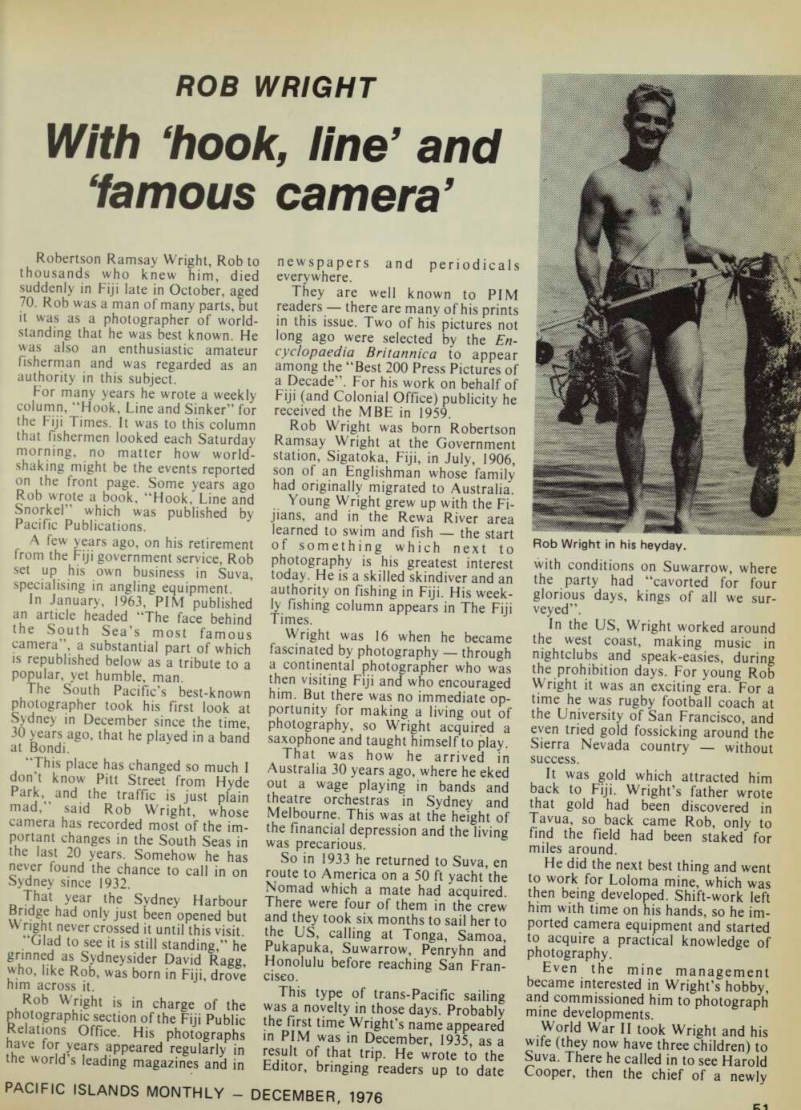
Rob Wright
With ‘hook, line’ and 'famous canera'
Robertson Ramsay Wright, Rob to thousands who knew him, died suddenly in Fiji late in October, aged 70. Rob was a man of many parts, but it was as a photographer of world standing that he was best known. He was also an enthusiastic amateur fisherman and was regarded as an authority in this subject.
For many years he wrote a weekly column, “Hook, Line and Sinker” for the Fiji Times. It was to this column that fishermen looked each Saturday morning, no matter how world shaking might be the events reported on the front page. Some years ago Rob wrote a book, “Hook, Line and Snorkel” which was published by Pacific Publications.
A few years ago, on his retirement from the Fiji government service, Rob set up his own business in Suva, specialising in angling equipment.
In January, 1963, PIM published an article headed “The face behind the South Sea’s most famous camera”, a substantial part of which is republished below as a tribute to a popular, yet humble, man.
The South Pacific’s best-known photographer took his first look at Sydney in December since the time, 30 years ago, that he played in a band at Bondi.
“This place has changed so much I don’t know Pitt Street from Hyde Parkland the traffic is just plain mad, said Rob Wright, whose camera has recorded most of the im portant changes in the South Seas in the last 20 years. Somehow he has never found the chance to call in on Sydney since 1932.
That year the Sydney Harbour Bndge had only just been opened but Wright never crossed it until this visit.
“Glad to see it is still standing,” he grinned as Sydneysider David Ragg, who, like Rob, was born in Fiji, drove him across it.
Rob Wright is in charge of the photographic section of the Fiji Public Relations Office. His photographs have for years appeared regularly in the world’s leading magazines and in
newspapers and periodicals everywhere.
They are well known to PIM readers there are many of his prints in this issue. Two of his pictures not long ago were selected by the En cyclopaedia Bntannica to appear among the “Best 200 Press Pictures of a Decade”. For his work on behalf of Fiji (and Colonial Office) publicity he received the MBE in 1959.
Rob Wright was born Robertson Ramsay Wright at the Government station, Sigatoka, Fiji, in July, 1906, son of an Englishman whose family had originally migrated to Australia.
Young Wright grew up with the Fi jians, and in the Rewa River area learned to swim and fish the start of something which next to photography is his greatest interest today. He is a skilled skindiver and an authority on fishing in Fiji. His week ly fishing column appears in The Fiji Times.
Wright was 16 when he became fascinated by photography through a continental photographer who was then visiting Fiji and who encouraged him. But there was no immediate op portunity for making a living out of photography, so Wright acquired a saxophone and taught himself to play.
That was how he arrived in Australia 30 years ago, where he eked out a wage playing in bands and theatre orchestras in Sydney and Melbourne. This was at the height of the financial depression and the living was precarious.
So in 1933 he returned to Suva, en route to America on a 50 ft yacht the Nomad which a mate had acquired.
There were four of them in the crew and they took six months to sail her to the US, calling at Tonga, Samoa, Pukapuka, Suwarrow, Penryhn and Honolulu before reaching San Fran cisco.
This type of trans-Pacific sailing was a novelty in those days. Probably the first time Wright’s name appeared in PIM was in December, 1935, as a result of that trip. He wrote to the Editor, bringing readers up to date
with conditions on Suwarrow, where the party had “cavorted for four glorious days, kings of all we sur veyed”.
In the US, Wright worked around the west coast, making music in nightclubs and speak-easies, during the prohibition days. For young Rob Wright it was an exciting era. For a time he was rugby football coach at the University of San Francisco, and even tried gold fossicking around the Sierra Nevada country without success.
It was gold which attracted him back to Fiji. Wright’s father wrote that gold had been discovered in Tavua, so back came Rob, only to find the field had been staked for miles around.
He did the next best thing and went to work for Loloma mine, which was then being developed. Shift-work left him with time on his hands, so he im ported camera equipment and started to acquire a practical knowledge of
photography.
Even the mine management became interested in Wright’s hobby, and commissioned him to photograph
mine developments.
World War II took Wright and his wife (they now have three children) to Suva. There he called in to see Harold Cooper, then the chief of a newly
Rob Wright in his heyday.
With Hook.Liime
And Famous
Camera
formed Government Information Of fice.
Wright was employed on trial to take photographs for the London War Ministry of the war effort in the Islands and soon he found himself with a fulltime appointment. He and Cooper, commissioned in the Fiji Military Forces, travelled widely through the Pacific.
When the war ended the Informa tion Office didn’t and Wright found himself doing a publicity job for Fiji, with plenty of side trips to other islands particularly to Tonga, where Queen Salote had known him and his camera since he was a young man.
Wright has photographed most of the important Tongan historical oc casions in recent years including Queen Elizabeth’s visit there in 1954.
In the first few years after the war Wright found himself up against new competition. His wartime work had been excellent, but it had found ready publication anyhow because of the in terest in the Pacific.
But soon he was faced with stiff competition for magazine and newspaper space against top world photographers with first-class equip ment and fully fitted darkrooms men who didn’t have to conquer the climatic conditions of the South Sea Islands.
He spent hours experimenting to beat the climate. He concocted for mulas of his own, which could work well but which were too messy and cumbersome for everyday practice.
Wright had to forget the textbooks which called for a 68 degree temperature as being the ultimate for good photographic work. At times he would open raw film just after it had arrived in Fiji and find it ruined by fungus.
But Wright won through, over coming these technical difficulties and many others peculiar to the Islands, such as the problems of staff training.
He has always scrutinised personally even the mechanical work turned out in the darkroom, striving hard to keep it up to the high standards he had set.
It has mean more time and energy, but it is worth it, when an overseas editor writes to say, “Thank you, Rob Wright, for some very nice quality prints”.
Advertisements & other items, p. 52 (1 item)
Clae Marine
PETROL and DIESEL ENGINES
m Petrol and diesel engines to 350 h.p. Wide range of optional and accessory equipment, choice of transmissions Paragon, Twin-Disc or Borg Warner - in all popular ratios. a * t I , V yJ >»
MARINE GEARS
Hydraulic-operated, self-contained oil pump, 220 h.p. maximum. Suits all popular engines. For work or pleasure.
CLAE ENGINE Sales and Service
31 Hoskins Ave, Bankstown.
NSW 2200. Phone 709 4777 Distributed by Stones Auto Diesel Service
P.O. Box 151, Kieta, BOUGAINVILLE.
CLAI 5.20.1 Ocm
Claim To The Sea’S Riches
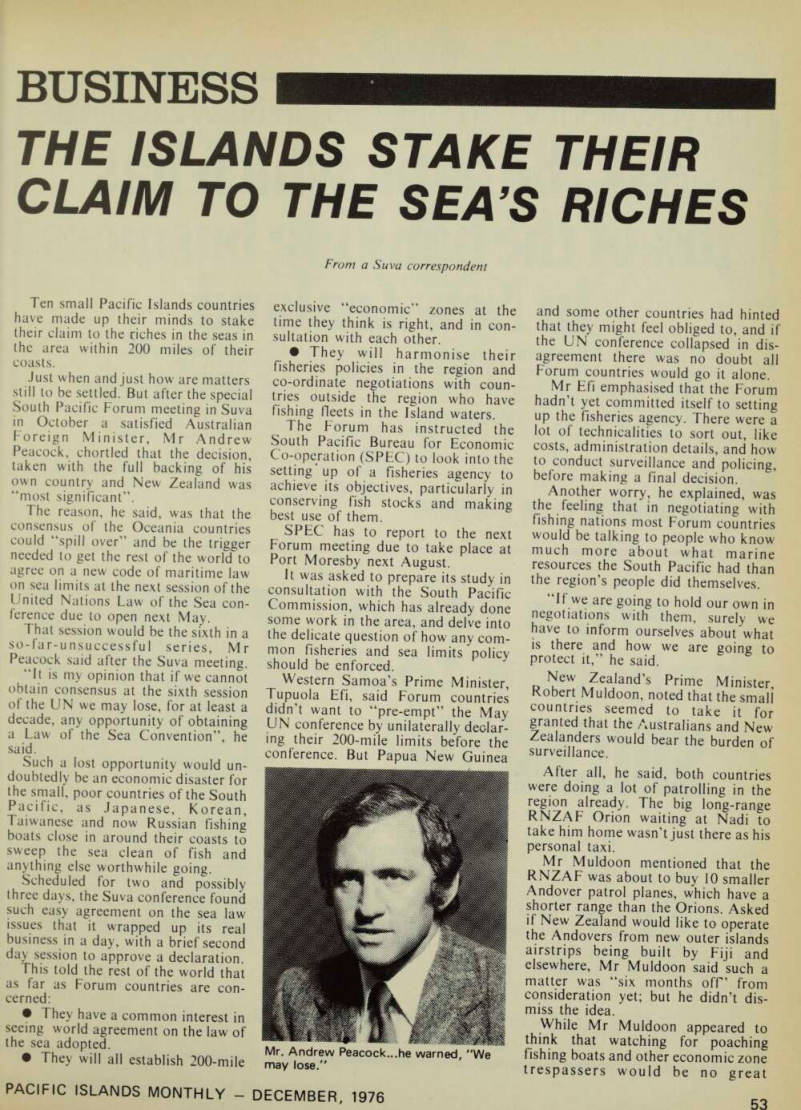

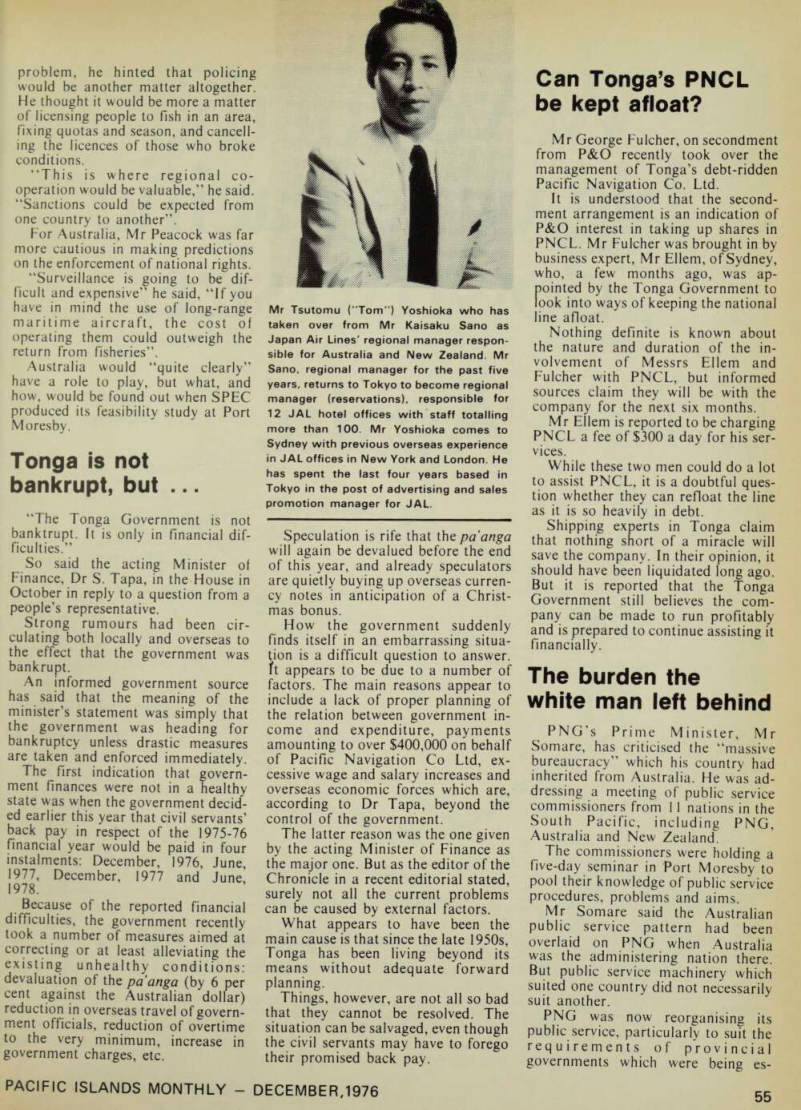
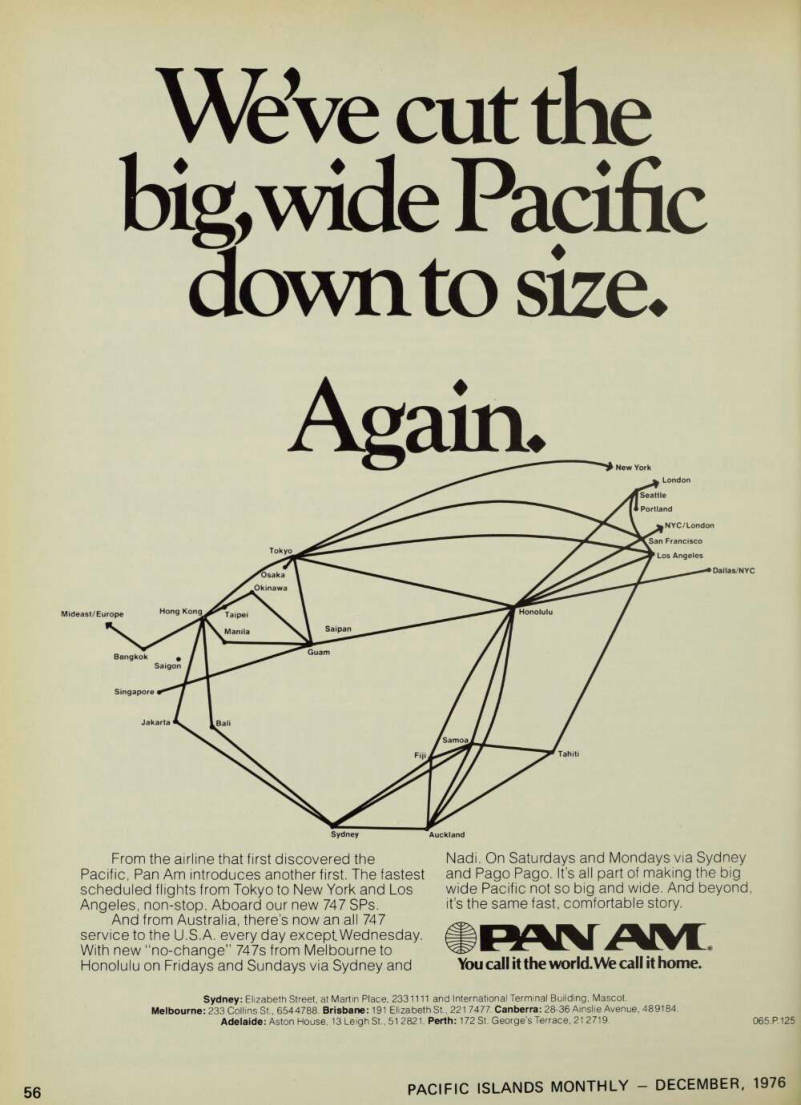
Business
The Islands Stake Their
From a Suva correspondent
Ten small Pacific Islands countries have made up their minds to stake their claim to the niches in the seas in the area within 200 miles of their coasts.
Just when and just how are matters still to be settled. But after the special South Pacific Forum meeting in Suva in October a satisfied Australian Foreign Minister, Mr Andrew Peacock, chortled that the decision, taken with the full backing of his own country and New Zealand was “most significant”.
The reason, he said, was that the consensus of the Oceania countries could “spill over” and be the trigger needed to get the rest of the world to agree on a new code of maritime law on sea limits at the next session of the United Nations Law of the Sea con ference due to open next May.
That session would be the sixth in a so-far-unsuccessful series, Mr Peacock said after the Suva meeting.
“It is my opinion that if we cannot obtain consensus at the sixth session of the UN we may lose, for at least a decade, any opportunity of obtaining a Law of the Sea Convention”, he said.
Such a lost opportunity would un doubtedly be an economic disaster for the small, poor countries of the South Pacific, as Japanese, Korean, Taiwanese and now Russian fishing boats close in around their coasts to sweep the sea clean of fish and anything else worthwhile going.
Scheduled for two and possibly three days, the Suva conference found such easy agreement on the sea law issues that it wrapped up its real business in a day, with a brief second day session to approve a declaration.
This told the rest of the world that as far as Forum countries are con cerned: • They have a common interest in seeing world agreement on the law of the sea adopted. • They will all establish 200-mile
exclusive “economic” zones at the time they think is right, and in con sultation with each other. • They will harmonise their fisheries policies in the region and co-ordinate negotiations with coun tries outside the region who have fishing fleets in the Island waters.
The Forum has instructed the South Pacific Bureau for Economic Co-operation (SPEC) to look into the setting up of a fisheries agency to achieve its objectives, particularly in conserving fish stocks and making best use of them.
SPEC has to report to the next Forum meeting due to take place at Port Moresby next August.
It was asked to prepare its study in consultation with the South Pacific Commission, which has already done some work in the area, and delve into the delicate question of how any com mon fisheries and sea limits policy should be enforced.
Western Samoa’s Prime Minister, Tupuola Efi, said Forum countries didn’t want to “pre-empt” the May UN conference by unilaterally declar ing their 200-mile limits before the conference. But Papua New Guinea
and some other countries had hinted that they might feel obliged to, and if the UN conference collapsed in dis agreement there was no doubt all Forum countries would go it alone.
Mr Efi emphasised that the Forum hadn’t yet committed itself to setting up the fisheries agency. There were a lot of technicalities to sort out, like costs, administration details, and how to conduct surveillance and policing, before making a final decision.
Another worry, he explained, was the feeling that in negotiating with fishing nations most Forum countries would be talking to people who know much more about what marine resources the South Pacific had than the region’s people did themselves.
“If we are going to hold our own in negotiations with them, surely we have to inform ourselves about what is there and how we are going to protect it,’’ he said.
New Zeners Prime Minister, Robert Muldoon, noted that the small countries seemed to take it for granted that the Australians and New Zealanders would bear the burden of surveillance.
After all, he said, both countries were doing a lot of patrolling in the region already. The big long-range RNZAF Orion waiting at Nadi to take him home wasn’t just there as his personal taxi.
Mr Muldoon mentioned that the RNZAF was about to buy 10 smaller Andover patrol planes, which have a shorter range than the Orions. Asked if New Zealand would like to operate the Andovers from new outer islands airstrips being built by Fiji and elsewhere, Mr Muldoon said such a matter was “six months off’ from consideration yet; but he didn’t dis miss the idea.
While Mr Muldoon appeared to think that watching for poaching fishing boats and other economic zone trespassers would be no great
Mr. Andrew Peacock...he warned, "We may lose."
problem, he hinted that policing would be another matter altogether.
He thought it would be more a matter of licensing people to fish in an area, fixing quotas and season, and cancell ing the licences of those who broke conditions.
“This is where regional co operation would be valuable,” he said.
“Sanctions could be expected from one country to another”.
For Australia, Mr Peacock was far more cautious in making predictions on the enforcement of national rights.
“Surveillance is going to be dif ficult and expensive” he said, “If you have in mind the use of long-range maritime aircraft, the cost of operating them could outweigh the return from fisheries”.
Australia would “quite clearly” have a role to play, but what, and how, would be found out when SPEC produced its feasibility study at Port Moresby.
Tonga is not
bankrupt, but ...
“The Tonga Government is not banktrupt. It is only in financial dif ficulties.”
So said the acting Minister of Finance, Dr S. Tapa, in the House in October in reply to a question from a people’s representative.
Strong rumours had been cir culating both locally and overseas to the effect that the government was
bankrupt.
An informed government source has said that the meaning of the minister’s statement was simply that the government was heading for bankruptcy unless drastic measures are taken and enforced immediately.
The first indication that govern ment finances were not in a healthy state was when the government decid ed earlier this year that civil servants’ back pay in respect of the 1975-76 financial year would be paid in four instalments: December, 1976, June, 1977, December, 1977 and June, 1978.
Because of the reported financial difficulties, the government recently took a number of measures aimed at correcting or at least alleviating the
existing unhealthy conditions:
devaluation of the pa’anga (by 6 per cent against the Australian dollar) reduction in overseas travel of govern ment officials, reduction of overtime to the very minimum, increase in government charges, etc.
Speculation is rife that the pa’anga will again be devalued before the end of this year, and already speculators are quietly buying up overseas curren cy notes in anticipation of a Christ mas bonus.
How the government suddenly finds itself in an embarrassing situa tion is a difficult question to answer, ft appears to be due to a number of factors. The main reasons appear to include a lack of proper planning of the relation between government in come and expenditure, payments amounting to over $400,000 on behalf of Pacific Navigation Co Ltd, ex cessive wage and salary increases and overseas economic forces which are, according to Dr Tapa, beyond the control of the government.
The latter reason was the one given by the acting Minister of Finance as the major one. But as the editor of the Chronicle in a recent editorial stated, surely not all the current problems can be caused by external factors.
What appears to have been the main cause is that since the late 19505, Tonga has been living beyond its means without adequate forward planning.
Things, however, are not all so bad that they cannot be resolved. The situation can be salvaged, even though the civil servants may have to forego their promised back pay.
Can Tonga’s PNCL
be kept afloat?
Mr George Fulcher, on secondment from P&O recently took over the management of Tonga’s debt-ridden Pacific Navigation Co. Ltd.
It is understood that the second ment arrangement is an indication of P&O interest in taking up shares in PNCL. Mr Fulcher was brought in by business expert, Mr Ellem, of Sydney, who, a few months ago, was ap pointed by the Tonga Government to look into ways of keeping the national line afloat.
Nothing definite is known about the nature and duration of the in volvement of Messrs Ellem and Fulcher with PNCL, but informed sources claim they will be with the company for the next six months.
Mr Ellem is reported to be charging PNCL a fee of $3OO a day for his ser vices.
While these two men could do a lot to assist PNCL, it is a doubtful ques tion whether they can refloat the line as it is so heavily in debt.
Shipping experts in Tonga claim that nothing snort of a miracle will save the company. In their opinion, it should have been liquidated long ago.
But it is reported that the Tonga Government still believes the com pany can be made to run profitably and is prepared to continue assisting it financially.
The burden the
white man left behind
PNG’s Prime Minister, Mr Somare, has criticised the “massive bureaucracy” which his country had inherited from Australia. He was ad dressing a meeting of public service commissioners from 11 nations in the South Pacific, including PNG, Australia and New Zealand.
The commissioners were holding a five-day seminar in Port Moresby to pool their knowledge of public service procedures, problems and aims.
Mr Somare said the Australian public service pattern had been overlaid on PNG when Australia was the administering nation there.
But public service machinery which suited one country did not necessarily suit another.
PNG was now reorganising its public service, particularly to suit the requirements of provincial governments which were being es
Mr Tsuttomu ("Tom”) Yoshioka who has taken over from Mr Kaisaku Sano as Japan Air Lines' regional manager respon sible for Australia and New Zealand. Mr Sano, regional manager for the past five years, returns to Tokyo to become regional manager (reservations), responsible for 12 JAL hotel offices with staff totalling more than 100. Mr Yoshioka comes to Sydney with previous overseas experience in JAL offices in New York and London. He has spent the last four years based in Tokyo in the post of advertising and sales promotion manager for JAL.
tablished. But this was proving a dif ficult task because of the massive bureaucracy which had grown up un der Australian influences.
Mr Somare said that as far as his country was concerned, the proposed provincial governments some of which are already established would be an important process of decentralisation in public service ac tivities. He believed this would be valuable because of the obvious need for a better government contact with people outside the main towns.
Mr Somare also warned about trends in which the public servant saw himself as the master rather than the servant. He said the affliction was also apparently affecting some politicians.
Nauru enters
Indian market
Nauru has another customer for rock phosphate. President Hammer deßoburt, of Nauru, recently negotiated a deal with the Indian Minister for Petroleum, Mr K. D.
Malviya, to produce phosphoric acid from rock phosphate in a joint ven ture. The annual requirement is ex pected to be about 300,000 tonnes.
Nauru is willing to supply up to one million tonnes a year if acceptable terms are negotiated.
The agreement provides for share capital of $374,882.84, with Nauru having a holding of up to 40%.
New Travelodge
is going up
Work has begun on the building of the new 186-room Travelodge hotel in Mary Street, Port Moresby. The hotel, due to be completed in mid -1978, will be a welcome supplement to the Papua New Guinean capital’s current stock of beds.
The 10-storey building has been planned in a tri-arc design. It will offer restaurants, coffee shop, special ty shops, mezzanine lobby, cocktail bar, public lounge bar and a function room which can be split into three separate areas.
All rooms will have sweeping views of the Coral Sea and Fairfax Har bour. There will be a number of special guest suites on the hotel’s top floor, and two underground parking levels.
Carpenter’s big
gains in Islands
The South Pacific companies in the W.R. Carpenter group, with headquarters in Suva, made a significant contribution to the overall profit in the latest financial year. The South Pacific companies returned a record net profit of $4,287,000. The net operating profit of the group, with headquarters in Sydney, was $9.1 million, compared with $B.l million in 1974-75. The parent company is paying a final dividend of 5.5 c a share, making a 10.5 c a share payout for the year.
The group’s trade revenue was $160.3 million, down by 1.3% compared with 1974-75. The directors expect a 10% increase in operating profit for the current financial year.
Has Fiji halted
its tourism slump?
Fiji’s tourist traffic was up 5.8 per cent in the first half of 1976 compared with the same period last year.
A total of 77,126 visitors came to the country, compared with 72,884 in January-June 1975, according to a September announcement by 'the Bureau of Statistics. The increase spelt a partial recovery from the bad
10.7 slump in Fiji’s tourist traffic last year.
But while visitor traffic has gone up, the amount of business being handled by Fiji hotels has decreased.
Because visitors are tendirfg to stay in the country for shorter periods, room occupancy rates were clown by three per cent as against last year from 49 per cent to 46 per cent.
Visitors in the first half of the year included 39.1 per cent Australians, J 8.9 per cent New Zealanders, 17.7 per cent Americans and 8.5 per cent Canadians.
Burns Philp
profit sags
Lower copra prices and a decline in the economy of the New Hebrides were two major factors in a lower profit for Burns Philp and Co Ltd in the year ended June 30. The net profit was $7.5 million, compared with $7.8 million in 1974-75.
Plantation earnings were down $1.2 million because of low copra prices.
The profits of the New Hebrides Company dropped by about $500,000.
Earnings of the Papua New Guinea company were also down by about $500,000 because of rising costs, lower margins and higher contributions for long service leave.
However, a number of the group’s Australian enterprises operated at profitable levels. The proportion of profits from Australian sources was about 61% compared with about 38% in 1974-75.
The group’s sales totalled $343 million, which was 16.8% higher than the previous year. The company expects better results in the current year from all Islands’ activities.
Burns Philp (SS) Ltd, which is based in Suva, although substantially owned by Burns Philp and Co Ltd, had a net operating profit of $1,335,000 in the latest financial year, compared with $1,112,000 in the previous financial year, although sales at $32,896,000 were below those of the previous term at $34,571,000. • New Guinea Islands Produce Co, of Rabaul, has been appointed the represen tative in the Gazelle Peninsula for the old established islands exporters, E.G. Barker and Co Pty Ltd, of Sydney and Melbourne. New Guinea Islands Produce Co, of which Mr Peni Pamm is trading manager, is a comparatively new com pany. It is the first nationally-owned com pany chosen to represent an Australian firm in PNG.
Advertisements & other items, pp. 54-56 (1 item)
Sidchrome
Do you want to do business in New Zealand?
Ask the bank which has
40% of the banking business
in New Zealand
The BNZ can give you full information on buying or selling in New Zealand and overseas Rjl information on investment movement of money, transfers of dividends etc., is also readily available.
There are offices everywhere, more than 400 in fact.
Whatever your financial or trade needs, the BNZ can help you.
Bank of New Zealand
Wellington -Head Office, International Division, Box 2392.
Sydney-GRO Box 507, Sydney, N.S.W. 2001.
Melboume-GPO Box 528 E, Melbourne, Vc. 3001.
Tokyo-MrE.L. Banks, Bank of New Zealand Representative Office, Japan. Suite 240,'ShiniTokyo Bldg, 3-1,3-Chrome, Marunouchi, Chiyoda-ku.VTokyo 100.
Singapore-Mr R. F. Warren, Bank of New Zealand Representative Office, South East Asia. Suite 230,23 rd Floor, Ocean Bldg, Cofyer Quay, Singapore 1.
London-PO Box 402, LondonEC4P.4.H.E.
Fiji, Suva-25 Victona Parade. Also at Labasa, Lautoka, NadiJSigatoka, Ba.
Associated Banks inthe South Pacific.
Bank of Western Samoa. Bank of Tonga. 7.6
There’s really
only one tool
SIDCHROME
There’s a saying in the tool business.
If you’re going to throw a spanner in the works, make sure it’s a Sidchrome spanner.
And that goes for all Sidchrome tools.
Sidchrome tools are made from the highest quality alloy steel. Finished in a tough, everlasting nickel chrome, and made to last.
That’s why Sidchrome hand tools are unconditionally guaranteed. - P.N.G. AGENT:- R. & J. Henderson, P.O. Box 353, Lae.
\VLve cut the
big, wide Pacific
down to size.
Again.
New York London Seattle Portland NYC/London San Francisco Los Angeles Mideasl/Europe Hong Konj^^Taipei Manila Tokyo Honolulu Saipan Guam Bangkok Saigon Singapore Bah Samoa From the airline that first discovered the Pacific, Pan Am introduces another first. The fastest scheduled flights from Tokyo to New York and Los Angeles, non-stop. Aboard our new 747 SPs.
And from Australia, there’s now an all 747 service to the U.S.A. every day except Wednesday.
With new “no-change” 747 s from Melbourne to Honolulu on Fridays and Sundays via Sydney and Nadi. On Saturdays and Mondays via Sydney and Pago Pago. It’s all part of making the big wide Pacific not so big and wide. And beyond,
it’s the same fast, comfortable story.
You call it the world. We call it home.
Sydney: Elizabeth Street, at Martin Place, 2331111 and International Terminal Building, Mascot.
Melbourne: 233 Collins St., 6544788. Brisbane: 191 Elizabeth St,, 221 7477 Canberra: 28-36 Ainslie Avenue, 489184.
Adelaide: Aston House, 13 Leigh St., 51 2821. Perth: 172 St. George’s Terrace, 212719. 065.P.125
Png Oil Quest
The Papua New Guinea Government has signed agreements with a consortium of seven companies to explore for petroleum in the Gulf Province.
The agreements are subject to ratification by parliament.
Initial expenditure will be more than KlO million. The operation will be in charge of Esso PNG Ltd, which is a subsidiary of Esso Aust Ltd which, in turn is a subsidiary of Exxon, the biggest oil company in the world. The government will take up a 25.5% interest in development, only after discovery of petroleum in commercial quantities. Two wells will be drilled in 1977, one offshore, 40 miles east of Daru, and the second at the mouth of the Fly River delta.
Advertisements & other items, p. 58 (1 item)
Kagoshima I Sydney
& * i it 1 s# 4 I
birds of paradise sighted in
Look out f orthe Bird of Paradise.
Air Niugini's Bird arrives in Sydney soon - later Kagoshima.
The Bird of Paradise is bringing you an exciting alternative route from Australia to Asia. Through Papua New Guinea. Contact your Travel Agent or Qantas. — 3,0,1
AIR NIUGINI
m 821.P.001 A
'Mickey Mouse calling'- and
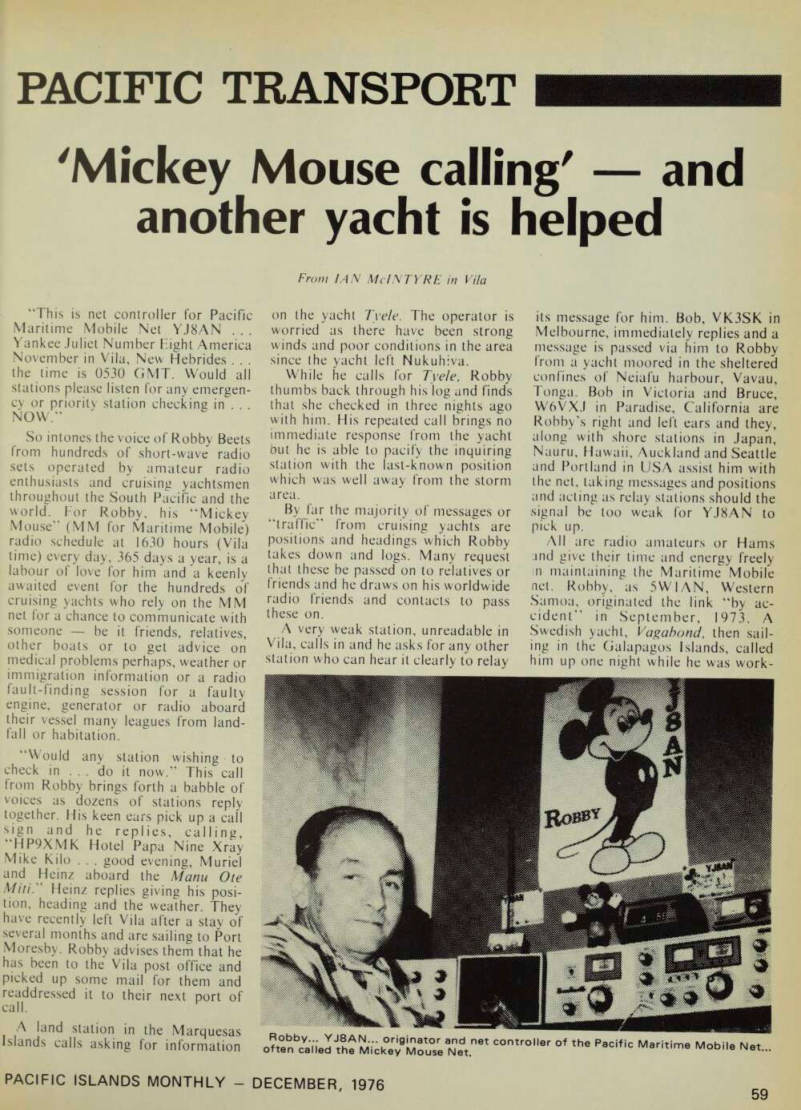
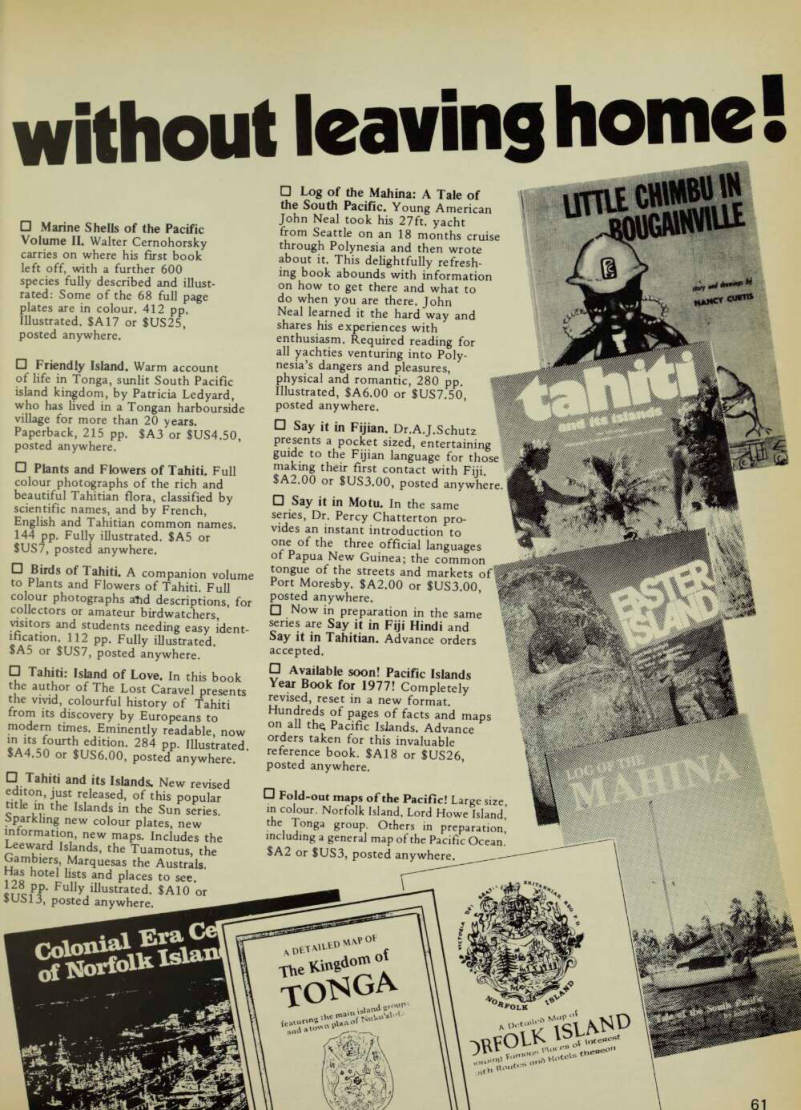
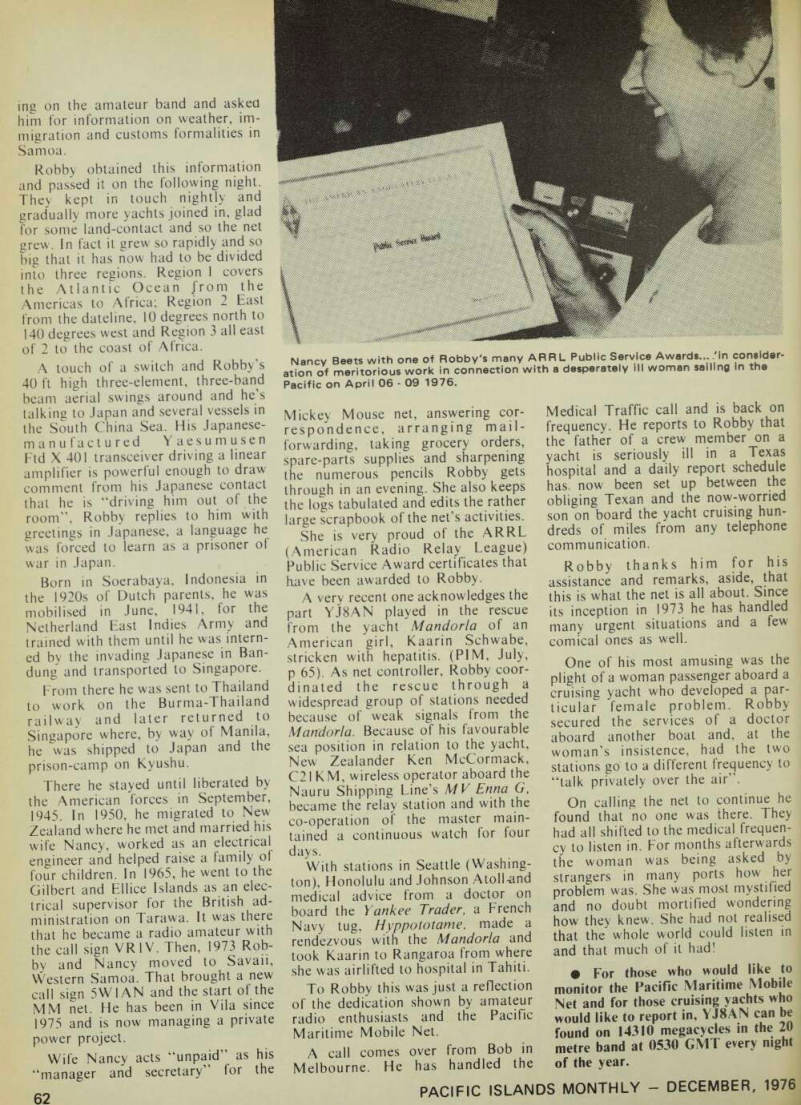
Pacific Transport
'Mickey Mouse calling'- and another yacht is helped
From lAN Me!NTYRE in Vila
“This is net controller for Pacific Maritime Mobile Net YJBAN . . .
Yankee Juliet Number Fight America November in Vila, New Hebrides . . . the time is 0530 GMT. Would all stations please listen for any emergen cy or priority station checking in . . .
Now.”
So intones the voice of Robby Beets from hundreds of short-wave radio sets operated by amateur radio enthusiasts and cruising yachtsmen throughout the South Pacific and the world. For Robby, his “Mickey Mouse" (MM for Maritime Mobile) radio schedule at 1630 hours (Vila time) every day, 365 days a year, is a labour of love for him and a keenly awaited event for the hundreds of cruising yachts who rely on the MM net for a chance to communicate with someone be it friends, relatives, other boats or to get advice on medical problems perhaps, weather or immigration information or a radio fault-finding session for a faulty engine, generator or radio aboard their vessel many leagues from land fall or habitation.
“Would any station wishing to check in ... do it now." This call from Robby brings forth a babble of voices as dozens of stations reply together. His keen ears pick up a call sign and he replies, calling, “HP9XMK Hotel Papa Nine Xray Mike Kilo . . . good evening, Muriel and Heinz aboard the Manu Ote Miti." Heinz replies giving his posi tion, heading and the weather. They have recently left Vila after a stay of several months and are sailing to Port Moresby. Robby advises them that he has been to the Vila post office and picked up some mail for them and readdressed it to their next port of call.
A land station in the Marquesas Islands calls asking for information
on the yacht Tyele. The operator is worried as there have been strong winds and poor conditions in the area since the yacht left Nukuhiva.
While he calls for Tyele, Robby thumbs back through his log and finds that she checked in three nights ago with him. His repeated call brings no immediate response from the yacht but he is able to pacify the inquiring station with the last-known position which was well away from the storm area.
By far the majority of messages or “traffic" from cruising yachts are positions and headings which Robby takes down and logs. Many request that these be passed on to relatives or friends and he draws on his worldwide radio friends and contacts to pass these on.
A very weak station, unreadable in Vila, calls in and he asks for any other station who can hear it clearly to relay
its message for him. Bob, VK3SK in Melbourne, immediately replies and a message is passed via him to Robby from a yacht moored in the sheltered confines of Neiafu harbour, Vavau, Tonga. Bob in Victoria and Bruce, W6VX.I in Paradise, California are Robby's right and left ears and they, along with shore stations in Japan, Nauru, Hawaii, Auckland and Seattle and Portland in USA assist him with the net, taking messages and positions and acting as relay stations should the signal be 100 weak for YJBAN to pick up.
All are radio amateurs or Hams md give their lime and energy freely n maintaining the Maritime Mobile net. Robby, as SWIAN, Western Samoa, originated the link “by ac cident" in September, 1973. A Swedish yacht, Vagabond, then sail ing in the Galapagos Islands, called him up one night while he was work-
Robby... YJ8AN...originator and net controller of the Pacific Maritime Mobile Net.. often called the Mickey Mouse Net
ing on the amateur band and asked him for information on weather, im migration and customs formalities in Samoa.
Robby obtained this information and passed it on the following night.
They kept in touch nightly and gradually more yachts joined in, glad for some land-contact and so the net grew. In fact it grew so rapidly and so big that it has now had to be divided into three regions. Region 1 covers the Atlantic Ocean from the Americas to Africa: Region 2 East from the dateline, 10 degrees north to 140 degrees west and Region 3 all east of 2 to the coast of Africa.
A touch of a switch and Robby’s 40 ft high three-element, three-band beam aerial swings around and he’s talking to Japan and several vessels in the South China Sea. His Japanese manufactured Vaesumusen Ftd X 401 transceiver driving a linear amplifier is powerful enough to draw comment from his Japanese contact that he is “driving him out of the room", Robby replies to him with greetings in Japanese, a language he was forced to learn as a prisoner of war in Japan.
Born in Soerabaya. Indonesia in the 1920 s of Dutch parents, he was mobilised in June, 1941, for the Netherland East Indies Army and trained with them until he was intern ed by the invading Japanese in Ban dung and transported to Singapore.
From there he was sent to Thailand to work on the Burma-Thailand railway and later returned to Singapore where, by way of Manila, he was shipped to Japan and the prison-camp on Kyushu.
There he stayed until liberated by the American forces in September, 1945. In 1950, he migrated to New' Zealand where he met and married his wife Nancy, worked as an electrical engineer and helped raise a family of four children. In 1965, he went to the Gilbert and Ellice Islands as an elec trical supervisor for the British ad ministration on Tarawa. It was there that he became a radio amateur with the call sign VRIV. Then, 1973 Rob by and Nancy moved to Savaii, Western Samoa. That brought a new call sign SWI AN and the start of the MM net. He has been in Vila since 1975 and is now managing a private
power project.
Wife Nancy acts “unpaid" as his “manager and secretary" for the
Mickey Mouse net, answering correspondence, arranging mailforwarding, taking grocery orders, spare-parts supplies and sharpening the numerous pencils Robby gets through in an evening. She also keeps the logs tabulated and edits the rather large scrapbook of the net’s activities.
She is very proud of the ARRL (American Radio Relay League) Public Service Award certificates that fiave been awarded to Robby.
A very recent one acknowledges the part YJBAN played in the rescue from the yacht Mandorla of an American girl, Kaarin Schwabe, stricken with hepatitis. (PIM, July p 65). As net controller, Robby coor dinated the rescue through a widespread group of stations needed because of weak signals from the Mandorla. Because of his favourable sea position in relation to the yacht, New Zealander Ken McCormack, C2l KM, wireless operator aboard the Nauru Shipping Lines MV Enna G, became the relay station and with the co-operation of the master maintained a continuous watch for four With stations in Seattle (Washington) Honolulu and Johnson Atoll-and medical advice from a doctor on board the Yankee Trader, a French Navy tug, Hyppototame, made a rendezvous with the and look Kaarin to Rangaroa from where she was airlifted to hospital in Tahiti.
To Robby this was just a reflection of the dedication shown by amateur radio enthusiasts and the Pacific Maritime Mobile Net.
A call comes over from Bob in Melbourne. He has handled the
Medical Traffic call and is back on frequency. He reports to Robby that the father of a crew member on a yacht is seriously ill in a Texas hospital and a daily report schedule has, now been set up between the obliging Texan and the now-worried son on board the yacht cruising hun dreds of miles from any telephone communication, Robby thanks him for his assistance and remarks, aside, that this is what the net is all about. Since its inception in 1973 he has handled many urgent situations and a few comical ones as well.
One of his most amusing was the plight of a woman passenger aboard a cruising yacht who developed a par ticular female problem. Robby secured the services of a doctor aboard another boat and, at the woman’s insistence, had the two stations go to a different frequency to “talk privately over the air”.
On calling the net to continue he found that no one was there. They had all shifted to the medical frequen cy to listen in. For months afterwards the woman was being asked by strangers in many ports how her problem was. She was most mystified and no doubt mortified wondering how they knew. She had not realised that the whole world could listen in and that much of it had! • For those who would like to monitor the Pacific Maritime Mobile Net and for those cruising yachts who would like to report in, YJ8AN can be found on 14310 megacycles in the 20 metre band at 0530 GMT every night of the year.
Nancy Beets with one of Robby's many ARRL Public Service Awards... .'in consider ation of meritorious work in connection with a desperately ill woman sailing in the Pacific on April 06 - 09 1976.
An Airline For
The Gilberts
The Gilbert Islands plans to be the next small country in the Pacific to own its own airline. Recently it bought a surplus Trislander from Air Pacific, and plans to buy a second Trislander from the same company later. Air Pacific operated a domestic airline within the Gilberts for several years. Mr Bwebwetake Arieta, the Gilberts Minister for Com munications, Works and Utilities, said the local airline would be a sub sidiary of the development authority, either wholly or in partnership with others.
Solomons To
Sell A Ship
The Solomon Islands Government ship, Belama, will be taken out of ser vice soon and offered for sale by tender. The Solomons took delivery of the Belama, then known as the Inikoria, in 1967, after a survey in Fi ji, and put her into service. The ship had been built in Hong Kong in 1958 for the GEIG.
The main functions were to serve the outer islands, take the High Com missioner on tour, and provide
foreign-going transport. The Belama, 285 tons, is made of steel, she is 127 ft long, and has two decks of fully air conditioned cabins. She is powered by Gardner engines and has a maximum speed of nine knots. There is enough room in the hatch to carry 3000 bags of copra.
The Belama is now getting old and needs a complete overhaul. It would be an expensive proposition to put her on the slip for re-servicing.
Whatever the Solomons Govern ment gels for her will be a bonus, as Britain made a grant to buy the Regina M as a replacement.
Png Lifts Ban On
Mission Flights
The bans applied by Papua New Guinea Transport Minister Bruce Jephcott to the Missionary Aviation Fellowship in September were lifted early in October. MAF aircraft were grounded after a series of mishaps over four months in which eight peo ple were killed and four aircraft were destroyed or damaged.
Mr Jephcott grounded the aircraft till aviation authorities were satisfied MAF had undertaken certain “operational remedies”. Changes made included the appointment and
approval of a new chief pilot and two check and training captains, together with a review of operating practices.
Strikes Paralyse
Fiji’S Air Services
Fiji air services were in turmoil early in November as an industrial dispute over pay between Qantas and the Qantas Salaried Staff Association spilled over and involved Air Pacific.
Air Pacific employees walked off the job after seven of that airline’s employees were suspended for refusing to handle Qantas flight reservations.
Air Pacific, claiming that the employees’ walk-off was in contravention of the Trades Disputes Act, inserted an advertisement in the Fiji Times, advising employees “who abandoned their work on Tuesday, November 2, and Wednesday, November 3, are hereby dismissed from Air Pacific’s employment from the lime of the abandonment’’.
Individual letters would be sent to those employees.
Air Pacific advised that the Trades Disputes Act clearly set out that air transport was an essential service, and those engaged in it were required to
give 28 days’ notice before going on strike. The advertisement appeared over the name of the Air Pacific general manager, Mr S. H. Quigg.
At the same time Air Pacific advised it had immediate vacancies in the engineering, commercial, finance and operations sections.
An immediate result of the strike was cancellation of all Air Pacific’s overseas services, and most internal services. Mails were disrupted. The only way for intending travellers to move in Viti Levu was by hire car or chartered aircraft (from Fiji Air) or by bus.
Who’Ll Do What
In Fiji’S Ports
Fiji could be in for one of those demarcation disputes which plague trade union activities in Australia.
The Fiji Waterside Workers and Seamen’s Union, through its vocal adviser, Mr Taniela Veitata, has told the Ports Authority that it will insist on unpacking and packing all cargo containers handled in Fiji ports. The practice is known in the industry as “unstuffing” and “stuffing”.
In Australia a few months ago a huge backlog of container cargo built up while a transport union and the wharfies bickered oyer whose members should handle it at par ticular points. Mr Veitata says his members have to handle all containers on the wharf to safeguard their work.
At present importers and exporters handle the unpacking and packing, although the waterside workers do handle some containers.
The union has also given the authority eight months notice of a de mand for an increase of 30% in the minimum pay rate of $1.20 an hour.
In Tonga It’S
Never On Sunday
Air Pacific has stepped up its Fiji- New Zealand flights to five a week with the introduction of a Sunday ser vice. The Sunday service will be the first non-stop Nausori-Auckland night. All other nights to and from Auckland are via Nukualofa. But Tonga’s strict observance of the Sun day laws preclude anything but emergency work on Sundays, which effectively rules out handling jet air craft on southbound nights. The air craft will leave Nausori at 4.45 pm on Sundays and arrive at Auckland at 7.45 pm. It will return to Nausori, via Nukualofa, on Mondays.
The Air Pilots’
Strike That Wasn’T
A strike by the Continental Airlines Pilots Association in October turned out to be a non-event in Micronesia after the association authorised pilots to continue to work in the Trust Territory on a voluntary basis. Earlier, the Trust Territory High Court, on the application of the Trust Territory Government, granted a temporary restraining order against the association from striking within Micronesia.
Mr Gary Thomas, chief union of ficial with Continental, said the pilots, intended to give their earnings from voluntary flights to charities within Micronesia, and hoped the airline's management would do the same with earnings from those flights.
More than 1000 Continental pilots operating in other areas went on strike for higher pay and shorter hours. Continental services between the US mainland and Hawaii were cancelled. Micronesia accounts for only a small part of Continental ser vices, but is heavily dependent on them.
Last Of The
Trading Schooners
The only registered trading schooner left in the South Pacific, the 96ft three-masted SOL, arrived at Rarotonga in October from Papeete with Captain de Graaf and 11 crew, all Australians except one Fijian and one Solomon Islander. The steel hulled, steel-decked schooner can carry 100 tons of dry cargo and 15 tons of freezer cargo and is registered in Sydney.
SOL left Papeete in company with MV Moana. Both vessels belong to Rowllem Pty Ltd and both called at Rarotonga to effect repairs to Moana s stern tube and starboard engine. Both ships expected to leave for Suva on October 18, then SOL was to return to Sydney and resume the Lord Howe run.
Moana operated in the Cook Islands in 1973 when owned by Cap tain Hugh Williams who later sold the vessel to an Australian company The new owners took the Moana in 1974 for survey in Tahiti and she stayed in Tahiti until the present voyage. • Groups of 15 travellers can get reductions of 25 per cent on their fares on Air Niugini’s internal services by flying during weekends including Mondays on long weekends.
Advertisements & other items, pp. 60-64 (1 item)
travel the islands
the lost
CARAVEL
Robert Langdon
01*1 \T
SAY
AN
FIJ
Ml Ml Ml bo®4
low
travel the islands
" □ New Caledonia. French New □ The Lost Caravel Robert
Langdon shatters traditionally-held
views on the Polynesians in this controversial, historical whodunnit described by Prof. Ron Crocombe as a “masterpiece as fascinating as it is important”. Also invaluable as a record of early Pacific exploration. 368 pp. Profusely illustrated with maps and plates. SAIB or SUS 26,
posted anywhere.
□ The Story of the Solomons.
Simple, lucid outline of the history of the Solomon Islands, from a refreshingly frank and affectionate point of view, by Dr. C.E’Fox. 88 pp. SA3 or SUS 4, posted anywhere. □ Papua New Guinea Handbook 1976. Completely revised, reset, and containing full details of this newly
independent nation history, geog-
raphy, government, industry, tourist
accommodation, etc. Clear maps include a large coloured, fold-out map of PNG. 5A7.50 or SUSIO,
posted anywhere.
□ Myths and Legends of Torres Strait. Margaret Lawrie collected these stories from the Western, Central and Eastern islands of Torres Strait, including Saibai and
Boigu, and Queensland University
Press bought them together in
this magnificently produced
large-format volume of 372 pages.
Splendidly illustrated with
colour photographs, drawings,
paintings and maps, and including a 45 rpm record of songs of Torres Strait. $A28.00 or 5U535.00
posted anywhere.
□ Port Moresby, Yesterday and Today. In what is even more than a history of Papua New Guinea’s capital, Canon lan Stuart takes us on an entertaining, personalised tour of the city. Softcover, 368 pp. Maps illustrations. $A3.50 or SUS4.SO,
posted anywhere.
□ Holy Torture in Fiji. Firewalking and other sacred, ancient rituals of Fiji’s Hindus described in text and colour photographs. Large format, 64 pp. Illustrated. 5A4.50
or SUS6.SO, posted anywhere.
O o CM CO >■
LLI
CL o X co X o o GO Q X O □ New Hebrides. One of the superb Islands in the Sun colour series of brilliant full-colour plates, maps and text, this volume describes the unique British-French Condominium of the New Hebrides. A guide for travellers, or for collectors. 128 pp.
Fully illustrated. SAIO or SUSI 3,
posted anywhere.
Caledonia, superbly depicted in
full colour photographs, with informative text and maps giving
history, geography and daily
life. An Islands in the Sun guide, with 128 pp. Fully illustrated.
SAIO or SUSI 3, posted anywhere. □ Bora Bora. One of the French Pacific’s fascinating, colourful high islands, reached from Tahiti, here presented in sparkling full colour pictures for visitors or mere armchair travellers. Another Islands in the Sun guide, with the same attention to to detail. 128 pp. Fully illustrated.
SAIO or SUSI 3 posted anywhere.
□ Fiji Fiji. The multi-racial dominion of friendly Fiji, crossroads of the Pacific, described in colour photographs, maps and text, uniform with ' ' iful Q > CO 00 o CO the beautiful series listed above.
Many people buy the whole set.
More titles to be published. 128 pp.
Fully illustrated. SAIO or SUSI 3,
posted anywhere.
X o CD o CL d □ Little Chimbu in Bougainville.
For the young and young-in-heart, lovable Little Chimbu and his friends visit Panguna, and get into awful trouble in what could be the biggest hole in the world, the Bougainville copper mine. Nancy Curtis, who used to live there, tells the story in full colour drawings which are also accurate and instructive. Also in the colourful Nancy Curtis series for children are □ Little Balus and □ Fiji Johnny.
About 48 pp. Illustrated. Each 5A3.50
or SUS4.SO posted anywhere.
□ Percy Chatterton’s Papua: Day That Lt I Have Loved. Charming evocative account of changing Papua as Rev.
Percy Chatterton knew it for 50 years 144 pp. Illustrated. 1A6.50 or SUSB.SO d ;
posted anywhere.
□ Colonial Era Cemetery of Norfolk Island. Former Administrator of the island, R.Nixon Dalkin,, describes life and death in what was Britain’s harshest Pacific penal colony. There are illuminating, often moving stories in these photographs, charts and inscriptions that describe the historic cemetery. Large format, 92 pp.
Illustrated. SAS or SUS7.SO, posted
anywhere.
□ Easter Island. At last, a new book on fascinating Easter Island history, daily life and the mysterious giant statues. All in full colour with maps and information for travellers, as one of the Islands in the Sun series. Half of this splendid book is devoted to descriptions and photographs of the statues that made the island famous.
SAIO or SUSI 3, posted anywhere.
PACIFIC ISLANDS MONTHLY - DECEMBER, 1976
without leaving home!
□ Marine Shells of the Pacific Volume 11. Walter Cernohorsky carries on where his first book left off, with a further 600 species fully described and illustrated: Some of the 68 full page plates are in colour. 412 pp.
Illustrated. SAI7 or SUS2S, posted anywhere. □ Friendly Island. Warm account of life in Tonga, sunlit South Pacific island kingdom, by Patricia Ledyard, who has lived in a Tongan harbourside village for more than 20 years.
Paperback, 215 pp. SA3 or SUS4.SO, posted anywhere. □ Plants and Flowers of Tahiti. Full colour photographs of the rich and beautiful Tahitian flora, classified by scientific names, and by French, English and Tahitian common names. 144 pp. Fully illustrated. SAS or SUS 7, posted anywhere. □ Birds of Tahiti. A companion volume to Plants and Flowers of Tahiti. Full colour photographs atid descriptions, for collectors or amateur birdwatchers, visitors and students needing easy identification. 112 pp. Fully illustrated.
SAS or SUS 7, posted anywhere. □ Tahiti: Island of Love. In this book the author of The Lost Caravel presents the vivid, colourful history of Tahiti from its discovery by Europeans to modern times. Eminently readable, now edition. 284 pp. Illustrated. 5A4.50 or SUS6.OO, posted anywhere. □ Tahiti and its Islands. New revised editon, just released, of this popular title m the Islands in the Sun series.
Sparkling new colour plates, new information, new maps. Includes the Leeward Islands, the Tuamotus, the Gamblers, Marquesas the Australs.
Has hotel lists and places to see. i T 2 T B PP* Full Y illustrated. SAIO or SUSX3, posted anywhere □ Log of the Mahina: A Tale of the South Pacific. Young American John Neal took his 27ft. yacht from Seattle on an 18 months cruise through Polynesia and then wrote about it. This delightfully refreshing book abounds with information on how to get there and what to do when you are there. John Neal learned it the hard way and shares his experiences with enthusiasm. Required reading for all yachties venturing into Polynesia’s dangers and pleasures, physical and romantic, 280 pp.
Illustrated, 5A6.00 or SUS7.SO, posted anywhere. □ Say it in Fijian. Dr.A.J.Schutz 1 presents a pocket sized, entertaining guide to the Fijian language for those makmg their first contact with Fiji. 5A2.00 or SUS3.OO, posted anywhere □ Say it in Motu. In the same senes, Dr. Percy Chatterton provides an instant introduction to one of the three official languages of Papua New Guinea; the common tongue of the streets and markets of Port Moresby. 5A2.00 or SUS3.OO, posted anywhere. □ Now in preparation in the same series are Say it in Fiji Hindi and Say it in Tahitian. Advance orders accepted. □ Available soon! Pacific Islands Year Book for 1977! Completely revised, reset in a new format.
Hundreds of pages of facts and maps on aU thq Pacific Islands. Advance orders taken for this invaluable reference book. SAIB or SUS 26, posted anywhere. □ Fold-out maps of the Pacific! Large size m colour. Norfolk Island. Lord Howe Island’ the Tonga group. Others in preparation including a general map of the Pacific Ocean SA2 or SUS 3, posted anywhere
Kingdom ot
XOISGA
provir t/ "
SUSP
61
}REOEK, u ,.c
J .X Hotels 1
EALING with
nIEMKA (AUSTRALIA) means
9 Ply. Ltd.
I EALING with Manufacturers
IRECT
We represent the greatest variety of merchandise in the entire
“SOUTH PACIFIC
P.O. BOX 340, MASCOT (SYDNEY) 2020 NSW.
Telex: 21416. Telephone: 669 5344.
DO APPROACH US BY LETTER, CABLE OR TELEX FOR
QUOTATIONS
INTERNATIONA
DATELINE HOT
TONGA
"Friendly Hotel" of the "Friendly Islands"
Situated along the Nukualofa waterfront. Only five minutes walk from town. Single, double, family suites, airconditioning, and hot and cold water showers. Pool, bar, restaurant, duty-free shop, tour desk and boutique.
Book through your travel agent or write to International Dateline Hotel, P.O. Box 62, Nukualofa Tonga.
Cable Address: "DATELINE".
Represented Overseas by; Charles J. Henry and Associates Pty. Ltd.
Sydney and Melbourne. 7976
THE PAPUA HOTEL
PORT MORESBY
• Right in the business centre • A tradition for comfort and fine food • All rooms air conditioned • Restaurant • Bars • Banquet Hall Telephone 24 2121 Cables PAPTEL
A. C. NEUMANN
Manager
E. G. BARKER & CO
PTY. LTD.
Established 1825 150 Years of Service
AUSTRALIA'S OLDEST EXPORT HOUSE
GENERAL EXPORT MERCHANTS
Specialising in world-wide distribution of General Merchandise, Provisions and Produce
Buying Agents for:
THE CO-OPERATIVE WHOLESALE SOCIETY LTD.
Lae and all branches throughout PNC
Representatives
PORT MORESBY
RAYMOND WONG
P.O. Box 5020
BOROKO
Phone 25 5546
RABAUL
NEW GUINEA ISLANDS
PRODUCE CO. LTD.
P.O. Box 387
RABAUL
Phone: 92 1982
FIJI
PARAMOUNT AGENCIES
G.P.O. Box 459
SUVA
Phone 2 3127
34 HUNTER STREET, SYDNEY 2000
Cable Address: KERBAR SYDNEY Phone: 231 6200. Telex: 22221 Melbourne Office: 530 Little Collins Street.
Phone: 61 2877. Telex 31732
Cruising
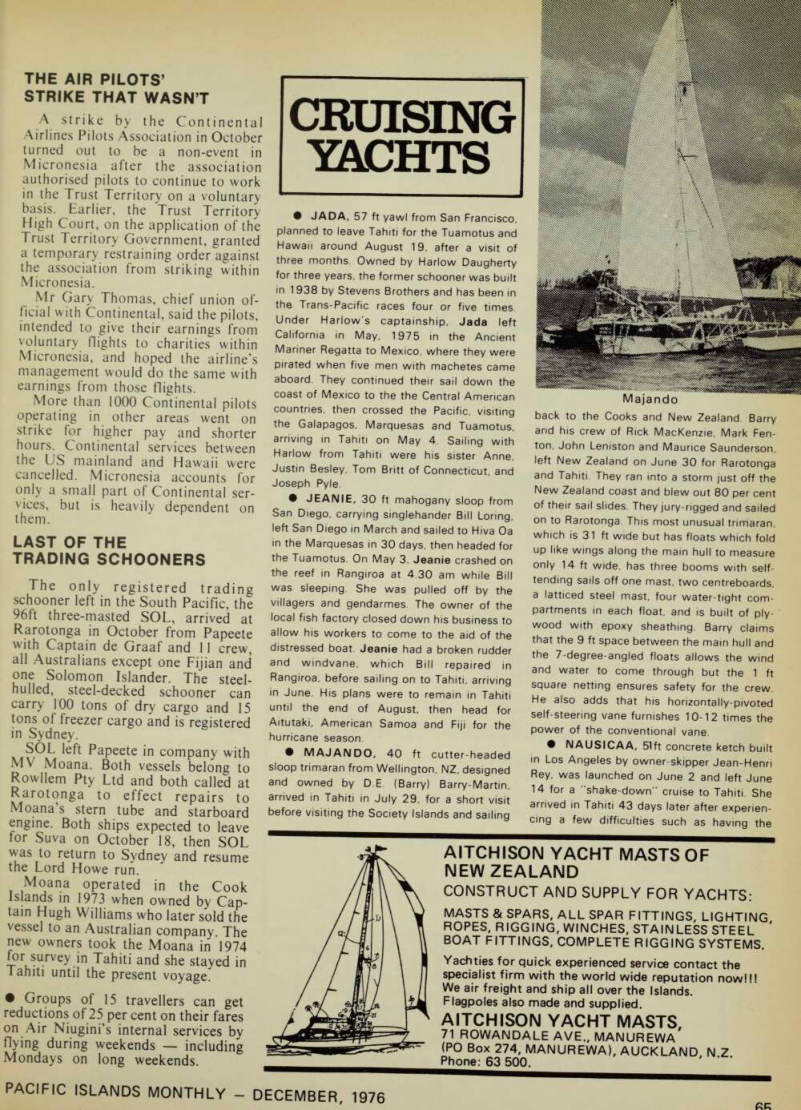
mans
• JADA, 57 ft yawl from San Francisco, planned to leave Tahiti for the Tuamotus and Hawaii around August 19. after a visit of three months. Owned by Harlow Daugherty for three years, the former schooner was built in 1938 by Stevens Brothers and has been in the Trans-Pacific races four or five times.
Under Harlow's captainship, Jada left California in May, 1975 in the Ancient Mariner Regatta to Mexico, where they were pirated when five men with machetes came aboard. They continued their sail down the coast of Mexico to the the Central American countries, then crossed the Pacific, visiting the Galapagos, Marquesas and Tuamotus, arriving in Tahiti on May 4. Sailing with Harlow from Tahiti were his sister Anne, Justin Besley, Tom Britt of Connecticut, and Joseph Pyle. • JEANIE, 30 ft mahogany sloop from San Diego, carrying singlehander Bill Loring, left San Diego in March and sailed to Hiva Oa in the Marquesas in 30 days, then headed for the Tuamotus. On May 3, Jeanie crashed on the reef in Rangiroa at 4.30 am while Bill was sleeping. She was pulled off by the villagers and gendarmes. The owner of the local fish factory closed down his business to allow his workers to come to the aid of the distressed boat. Jeanie had a broken rudder and windvane, which Bill repaired in Rangiroa, before sailing on to Tahiti, arriving in June, His plans were to remain in Tahiti until the end of August, then head for Aitutaki, American Samoa and Fiji for the hurricane season. • MAJAISIDO, 40 ft cutter-headed sloop trimaran from Wellington, NZ, designed and owned by D.E. (Barry) Barry-Martin, arrived in Tahiti in July 29, for a short visit before visiting the Society Islands and sailing
back to the Cooks and New Zealand Barry and his crew of Rick MacKenzie, Mark Fen ton, John Leniston and Maurice Saunderson, left New Zealand on June 30 for Rarotonga and Tahiti. They ran into a storm just off the New Zealand coast and blew out 80 per cent of their sail slides. They jury-rigged and sailed on to Rarotonga. This most unusual trimaran, which is 31 ft wide but has floats which fold up like wings along the main hull to measure only 14 ft wide, has three booms with self tending sails off one mast, two centreboards, a latticed steel mast, four water-tight com partments in each float, and is built of ply wood with epoxy sheathing. Barry claims that the 9 ft space between the main hull and the 7-degree-angled floats allows the wind and water to come through but the 1 ft square netting ensures safety for the crew.
He also adds that his horizontally-pivoted self-steering vane furnishes 10-12 times the power of the conventional vane. • NAUSICAA, 51ft concrete ketch built m Los Angeles by owner-skipper Jean-Henri Rey, was launched on June 2 and left June 14 for a "shake-down" cruise to Tahiti. She arrived in Tahiti 43 days later after experien cing a few difficulties such as having the
Majando
engine break down three days out of Los Angeles, the freezer breaking down, forcing them to dump 20 lb of meat and having all their sails torn out in strong winds. Jean- Henri. who was skipper of the famous yacht MAYLIS for three years, brought his wife Roxanne home to Tahiti, where they plan to live for a year before sailing Nausicaa to France. Sailing with them were Roxanne's brother Sean Tretheway, Doug Harland of Australia, Hunt Searls of California and their dog Jupiter • NAUSIKAA 111, 57 ft ferro cement and wood ketch from Vancouver, owned and built by Hajo Hadeler and wife Else, sailed into Tahiti on July 13 for a visit of several months • STICKY TOPS, 43 ft wooden ketch built in England in 1957, was bought two and a half years ago by owner George Layton
of San Francisco. George bought the boat in England and sailed her to the West Indies and Panama, then across the Pacific to the Marquesas and Tuamotus, then sailed on to Tahiti, where she arrived in late August for a six months' visit before continuing her trip to the Cooks, Tongas, Fijis, and on to Indonesia.
Sailing with George were Joel Hanson and Ellen Hall.
• Waterloo Of Galveston,
Erickson 30 ft fibreglass sloop owned by Dean and Beverly Chase, left Galveston, Tex as in January, 1971, for the Virgin Islands, where they lived for four years. In March, 1975, they cruised most of the Caribbean islands, then made their way over to the Panama Canal and sailed across to the Galapagos and Marquesas, where Beverly helped dress a bride who was marrying the son of the mayor of Fatu Hiva They arrived in
Tahiti July 5, where they plan to stay throughout the hurricane season before heading west, around the world. The boat mascot is Henry, a Yorkshire terrier who is all energy, hair and bark. • WAYWARD WIND, 45ft Angleman ocean racing yacht built in 1933 and the winner of six Atlantic races, visited Tahiti briefly in mid-September, carrying owner and solo sailor Anthony James (Tony) Blondell, a retired sergeant-major from the U S. Army.
Tony left Los Angeles July 1 5 and visited the Marquesas and Tuamotus, then sailed on to Tahiti The yacht, which has sailed once around the world already, was bought by Tony seven years ago. His plans will even tually carry him around the world by way of American Samoa, New Guinea, Borneo and Singapore. • Ten overseas yachts visited Tonga in September, most of them westbound, but a few were scheduled to sail onto Rarotonga.
The visitors were: • MISTY (Guam) carrying Robert Anthony Wieand (skipper), lan Maxwell Bar ton and Miss Junko Itagaki, arrived from Suva on the way to Rarotonga. • LEONA 111 (UK) arrived from Rarotonga and sailed for Suva. She was carrying George F Durant (captain), Hen drienna, J. Durant and Mrs Carol Ann Korsten. • DRAGON (St Thomas, U S), arrived from Pago Pago for an indefinite stay before sailing to Suva, carrying John Yuam Hwang. • HOLOKIKI (Virgin Is.), arrived from Apia on the way to Rarotonga, but James R Roy (skipper) intended to stay indefinitely in Tonga. • SOUTHBRIDGE (Australia), with Tony Pearse, who intended to stay indefinite ly, arrived from Niue Island on the way to Fiji.
• Fantasia (Us), With Eg.
Charlebois, arrived from Niue Island. The next port of call was indefinite. • SEATRAIN (US), with James Godber, arrived from Niue on the way to Fiji.
Godber did not know how long he would stay in Tonga. • FOAM (Australia), with Keith Newland and Susan T. Turnbull, arrived from Opua in New Zealand on the way to Suva. • DRUIANA (NZ) with Craig A. Fagan (captain) and Andrew Fagan, arrived from Rarotonga and sailed five days later for Fiji. • SPELLBOUND II (England), arrived from Rarotonga and sailed four days later for Lakeba in the Lau group of Fiji. On board were Geoffrey L Bumdy (captain), Janet Fiona C. Bumdy, V.C.R. Irwin. Carol A Irwin and Siteri Dinawai Cakaumitabua • ALISA, C.T. 41 ft cruising ketch from Honolulu visited French Polynesia for three
months between June and September, then sailed back to Hawaii Aboard as she left Papeete were owners Gordon and Marjorie Bower and crew Les Weaver • MISTY, 50 ft ketch registered in San Francisco, arrived at Rarotonga from Tonga on September 23 with owner-captain Bob Wieand and three Japanese crew They were bound for Tahiti and had called at Papua New Guinea. Solomon Islands, New Hebrides and Fiji. • FRANDA 11, 52 ft steel-hulled Dutch built ketch, carrying Doug and Barbara Hut ton. from the Bay of Islands, NZ. and their four children (aged 1 1 to 20) was a recent visitor to Suva After cruising through the Fiji group they planned to sail to Vila, Noumea, the Barrier Reef, Brisbane and Sydney before returning home • LA MIOCHE, 31 ft ketch from Balboa, Panama, arrived at Rarotonga on September 4 from Tahiti and Bora Bora with owners Bill and Karen Woods. They planned to sail to Pago Pago and will probably spend the hurricane season in New Zealand. The yacht s name is French for a female Parisian street urchin • DRUIANA, 30 ft sloop registered in Dartmouth. UK. arrived at Rarotonga in early September with New Zealand brothers Craig and Andrew Fagan Their Pacific cruise started from the Bay of Islands and took them to Rapa and the Society Islands They planned to visit Tonga and Fiji before retur ning home • KIRSTEN, 32Vi ft cutter, registered at San Francisco, arrived at Rarotonga on Oc tober 15 from the Tuamotus and bound for Niue or Tonga On board were Captain Stanley Pease and Joan and Karen Pease • ANACONDA 11, 76 ft ketch, registered at Adelaide arrived at Rarotonga on October 1 7 with Australian Captain Josko Grubic and a crew of three Australians, four Britishers, one American and one Canadian They were out of Papeete and left for Suva on October 19 • PARADER, 30 ft British sloop, arrived at Rarotonga on October 20 from Papeete with Anthony Pearce and Jennifer Guthrie They were bound for Auckland. • WIND SHADOW, 41 ft cutter, arriv ed at Rarotonga from Fanning Island on Oc tober 23. bound for Bora Bora, On board were Captain Ralph Jon Naranjo, his wife, Lenore. daughter Tara and son Eric. • REGENTAG, 50 ft ketch-rigged motor sailer, arrived at Rarotonga from Papeete on October 24 bound for Auckland On board were owner Freidensreich Hundertwasser, a famous Austrian artist, and Horst and Jacqueline Wachter, master and crew respectively. • JELLICLE 11, 25 ft sloop registered at
Newcastle, UK, arrived at Rarotonga on Oc tober 26 from Papeete with owner-captain Michael Bailes and Tongan crew member V F. Fehoko. Plans were to call at Aitutaki, then Auckland. • EROS, 51 ft trimaran from San Fran cisco, arrived at Rarotonga on October 22 from Maupiti with owner-captain Raymond Swartz, his wife, Kay, and young son Robert.
Mr Swartz, a science and maths teacher, designed and built the yacht himself and their
Pacific cruise took the family to the Mar quesas and French Polynesia. Plans were un certain, but it is probable that they would visit New Zealand. • KLARABORG, 116 ft sailing ship, built in Sweden, was a recent arrival in Suva.
Captain Uve Linner said he saw her lying un used as a cargo boat in a Swedish river in 1968. bought and refurbished her. He plan ned to stay in Suva for 10 days, seeking crew, before sailing on to New Zealand,
• FEISTY LADY, 27 ft Santana sloop from Redondo Beach, California, arrived in Tahiti late August carrying newlyweds Conrad and Sandy Ramalho, who planned to visit French Polynesia for six months before sailing west to the Cooks, Tonga, Fiji, New Zealand and Australia. • RED'S ROGUE, 40 tt Newporter ketch registered in Coos Bay, Oregon, left Washington state in May and sailed to San Diego, where she set out on June 25 for the Marquesas, Tuamotus and Society Islands, arriving in Tahiti Sept. The wood and fibreglass full-keel boat, owned and cap tained by O.C. (Red) Boyer, was built in 1957. On board in Tahiti were Red and crew members Roland Barker and Ralph Smith, all from Oregon Their plans were to carry them from Tahiti to Hawaii in three weeks' time. • NOVA, 30 ft sloop built by owner David Luks, 29, of Australia, visited Tahiti for a few weeks in September, before resuming her voyage home. David, along with Pauline Purcell and Mike Sanders, left Australia mid -1972 and cruised to New Zealand, Hawaii, the Aleutians, Canada and through the intra coastal canal of the United States to the Caribbean and the Virgin Islands. Heading back west, David sailed Nova single-handed to the San Bias Islands, the Marquesas and Tuamotus, before reaching Tahiti. Pauline flew to Tahiti to join David for the return trip to Australia. • SPRING FEVER, 48 ft Bermuda rigg ed sloop from Vancouver, sailed to Tahiti from Hawaii in 16’/2 days, tore out three sails and landed in Tahiti the end of May. Owner Frank Taylor, 70. and Englishman living 20 years in Canada, had the shell of his boat moulded and he and his son built the rest of it. His wife Joan, their son Pat and their crew of two made the voyage from Hawaii. His plans were to stay awhile in Tahiti and return to Hawaii and San Francisco. • L'EPERVIER, 37 ft ketch, carrying lone Swiss yachtsman Eric Steiner, arrived in Sydney on October 26 after drifting across the Pacific from the Marquesas. Storms crippled his craft and his auxiliary engine broke down three days out of the Marquesas.
When most of his provisions ran out Steiner lived on a small bag of flour, which lasted till he made his landfall off the Australian coast.
Late in 1972, he sailed his ketch down the Rhone, then cruised in the Mediterranean and across the Atlantic before entering the Pacific, via Panama, • CHEYENNE, 2-ton ocean racing sloop built in Auckland and registered in Honolulu, arrived at Rarotonga from Auckland on her maiden voyage on September 22. On board were owner D. Sheldon, his children Stephen and Donna. Chris White, and crewmen Bill Enwright, Sandy Walker and Tony Meyer, All three crew are Aucklanders. Cheyenne was bound for Tahiti and Honolulu.
Advertisements & other items, pp. 65-68 (2 items)
Aitchison Yacht Masts Of
NEW ZEALAND
CONSTRUCT AND SUPPLY FOR YACHTS:
MASTS & SPARS, ALL SPAR FITTINGS, LIGHTING
ROPES, RIGGING, WINCHES, STAINLESS STEEL '
BOAT FITTINGS, COMPLETE RIGGING SYSTEMS.
Yachties for quick experienced service contact the specialist firm with the world wide reputation now!!!
We air freight and ship all over the Islands.
Flagpoles also made and supplied.
AITCHISON YACHT MASTS,
71 ROWANDALE AVE., MANUREWA
(PO Box 274, MANUREWA), AUCKLAND NZ
Phone: 63 500.
m m
k ENQUIRIES TO
Western Fuel pump and Injector Services Pty. Ltd. - - 2116 NSW, Australia Telephone: 638 61 Of* 225-227 Victoria Road, Rydalmere,
unison bpcs.(ppinteps) ply.
P.O. Box 56, Chippendale.
N.S.W. 2008 Australia Telegrams: "Wilbroprint" Sydney Currently supplying to the Pacific Islands: Computer Stationery Accounting Machine Forms for Sweda. NCR & Burroughs Punch Cards Burroughs Magnetic Stripe Ledger Cards Package stationery systems for Burroughs L Series Machines - Payroll - General Accounting Ledger Cards Security Document Printing - Airline Tickets - Accommodation & Travel Vouchers - Cheques Computer Data Storage -Magnetic Tape, Disk Pack, Punch Card, Visible Record, Revolving & Rotating Card Storage and Retrieval Systems.
Machine Accounting Trays & Indexes.
Computer Print-out Binders.
May we discuss your requirements with you on our next visit.
Q E
offers expert insurance service
throughout the Islands
QBE INSURANCE
LIMITED
Central Office; 82 Pitt Street, Sydney “ Ch » Suva, Manager for Fiji: L.G.LiddeU A.A 11. uXxiTa D o b T ßranch ° fflce: Burns Philp Bldg.
NEW^ALEDONIa^ J-Breckwoldt & Company (5.1.) Pty. Limited. —Noumea EDONIA_T ’ A ‘ Hagen ’ Stc ’ W * A * J °hnston, S.A.R.L. e™ ?hIMNe% D ewigs) M L.d ger: ° R Donn '" y ’ VMa; Santo: T ? hung: Bmneuble 8.1., Front de Mer Papeete.
KK SftSsXghZSSftf
QUEENSLAND INSURANCE (P.N.G.) LTD
PAPUA NEW GUINEA-Head Office, PORT MORESBY.
General Manager: J.M.Dawe. Assistant Manager: R.Jackson,A.A.U.
ARAWA: J.Longbut LAE: W.J.Leonard MADANG- I R Martin
MOUNT HAGEN: D.F.CarroU RABAUL: A.M.Tanner
PETER FISHER TRADING Pry. Lid.
321 PITT STREET, SYDNEY, 2000, AUSTRALIA
Telephone: 26-1109 A B
CABLES; FISHERION", SYDNE
EXPORTERS TO THE PACIFIC ISLANDS
if \CAIWA LINE
DIRECT REGULAR SERVICE
JAPAN-SOUTH PACIFIC
TARAWA-PAPEETE-PAGO PAGO-APIA
SUVA-LAUTOKA-NOUMEA-VILA
SANTO-HONIARA
JAPAN-TAIWAN-GUAM
JAPAN-KEELUNG-GUAM BY
EXCELLENT CAR/CONTAINER-CARRIER
JAPAN-WEST IRIAN-DILI
HONG KONG-TAIWAN-WEST IRIAN-DILI
GUAM: ATKINS, KROLL (GUAM) LTD.
TARAWA: G. & E. I. DEVELOPMENT AUTHORITY.
APIA: BURNS PHILP (SOUTH SEA) CO., LTD.
PAGO PAGO: KNEUBUHL MARITIME SERVICES CORP.
NUKUALOFA: PACIFIC NAVIGATION CO., LTD.
SUVA: BURNS PHILP (SOUTH SEA) CO., LTD.
LAUTOKA: BURNS PHILP (SOUTH SEA) CO., LTD.
NOUMEA: SOCIETE D'ACCONAGA ET
TRANSPORT D'OCEANIE (SATO)
SANTO: BURNS PHILP (NEW HEBRIDES) LTD,
VILA; BURNS PHILP (NEW HEBRIDES) LTD.
HONIARA; BRITISH SOLOMONS TRADING CO., LTD.
PAPEETE: AGENCE MARITIME DE FARA UTE.
HONG KONG: IKE MARITIME CO., LTD.
SINGAPORE: THE BORNEO CO., (SINGAPORE) LTD.
DJAJAPURA: P, N. PELAJARAN NASIONAL INDONESIA.
DILI: SANG TAI HOO
TAIWAN: FOR CARGO BETWEEN JAPAN/GUAM/TAIWAN
FORMOSA SHIPPING & ENTERPRISE CORP.
TAIWAN: FOR CARGO BETWEEN JAPAN/SOUTH PACIFIC/
WEST IRIAN/DILI
MARITIME TRANSPORTATION AGENCIES, LTD.
THE DAIWA MAXIG ATION CO.* LTD*
acai/a. “r>a 11 imp l Tnu'vrv “Pi IN P D All INE”
AGENTS:
HEAD OFFICE
DAIICHI KYOGYO BLDG.,
45, 2-CHOME, AWAZAM IN AMI-DOR I,
NISHI-KU, OSAKA, JAPAN
TELEPHONE: (06) 531-0471 ~9
TELEX: 525-6324 & 525-6325
OSAKA: “DAILINE"
TOKYO; “FUNEDAILINE”
TOKYO OFFICE
SHIN-DAIICHI BLDG.,
4-13, NIHONBASHI 3-CHOME, CHUO-KU,
TOKYO, JAPAN
TELEPHONE; (03) 274-3251 ~8
TELEX: 222-3343, 23559
67
S ACIFIC ISLANDS MONTHLY - DECEMBER, 1976
Deaths
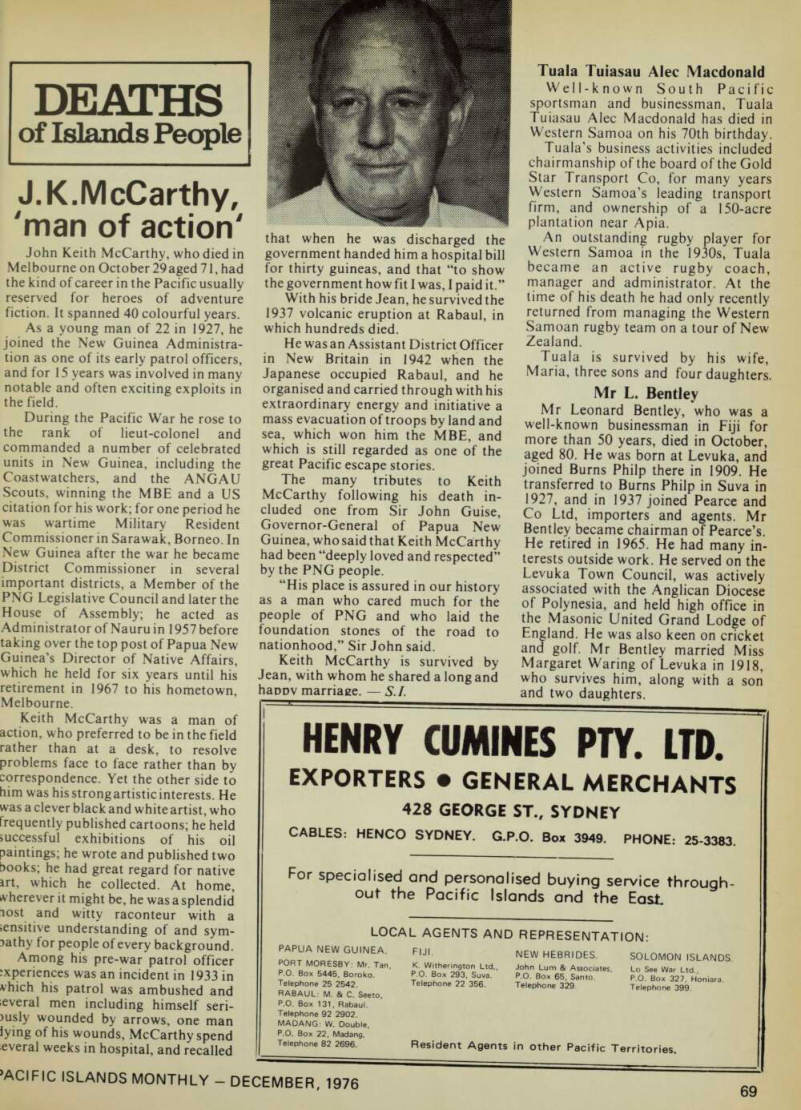
of Islands People
J.K.McCarthy,
'man of action'
John Keith McCarthy, who died in Melbourne on October 29aged 71, had the kind of career in the Pacific usually reserved for heroes of adventure fiction. It spanned 40 colourful years.
As a young man of 22 in 1927, he joined the New Guinea Administra tion as one of its early patrol officers, and for 15 years was involved in many notable and often exciting exploits in the field.
During the Pacific War he rose to the rank of lieut-colonel and commanded a number of celebrated units in New Guinea, including the Coastwatchers, and the ANGAU Scouts, winning the MBE and a US citation for his work; for one period he was wartime Military Resident Commissioner in Sarawak, Borneo. In New Guinea after the war he became District Commissioner in several important districts, a Member of the PNG Legislative Council and later the House of Assembly; he acted as Administrator of Nauru in 1957 before taking over the top post of Papua New Guinea’s Director of Native Affairs, which he held for six years until his retirement in 1967 to his hometown, Melbourne.
Keith McCarthy was a man of action, who preferred to be in the field rather than at a desk, to resolve problems face to face rather than by correspondence. Yet the other side to him was his strong artistic interests. He was a clever black and white artist, who frequently published cartoons; he held successful exhibitions of his oil paintings; he wrote and published two books; he had great regard for native m, which he collected. At home, wherever it might be, he was a splendid lost and witty raconteur with a sensitive understanding of and sym pathy for people of every background.
Among his pre-war patrol officer experiences was an incident in 1933 in which his patrol was ambushed and several men including himself seri >usly wounded by arrows, one man lying of his wounds, McCarthy spend everal weeks in hospital, and recalled
that when he was discharged the government handed him a hospital bill for thirty guineas, and that “to show the government how fit I was, I paid it.”
With his bride Jean, he survived the 1937 volcanic eruption at Rabaul, in which hundreds died.
He was an Assistant District Officer in New Britain in 1942 when the Japanese occupied Rabaul, and he organised and carried through with his extraordinary energy and initiative a mass evacuation of troops by land and sea, which won him the MBE, and which is still regarded as one of the great Pacific escape stories.
The many tributes to Keith McCarthy following his death in cluded one from Sir John Guise, Governor-General of Papua New Guinea, who said that Keith McCarthy had been “deeply loved and respected” by the PNG people.
“His place is assured in our history as a man who cared much for the people of PNG and who laid the foundation stones of the road to nationhood,” Sir John said.
Keith McCarthy is survived by Jean, with whom he shared a long and
haoDV marriage.
S.I.
Tuala Tuiasau Alec Macdonald Well-known South Pacific sportsman and businessman, Tuala Tuiasau Alec Macdonald has died in Western Samoa on his 70th birthday.
Tuala’s business activities included chairmanship of the board of the Gold Star Transport Co, for many years Western Samoa’s leading transport firm, and ownership of a 150-acre plantation near Apia.
An outstanding rugby player for Western Samoa in the 19305, Tuala became an active rugby coach, manager and administrator. At the time of his death he had only recently returned from managing the Western Samoan rugby team on a tour of New Zealand.
Tuala is survived by his wife, Maria, three sons and four daughters.
Mr L. Bentley Mr Leonard Bentley, who was a well-known businessman in Fiji for more than 50 years, died in October, aged 80. He was born at Levuka, and joined Burns Philp there in 1909. He transferred to Burns Philp in Suva in 1927, and in 1937 joined Pearce and Co Ltd, importers and agents. Mr Bentley became chairman of Pearce’s.
He retired in 1965. He had many in terests outside work. He served on the Levuka Town Council, was actively associated with the Anglican Diocese of Polynesia, and held high office in the Masonic United Grand Lodge of England. He was also keen on cricket and golf. Mr Bentley married Miss Margaret Waring of Levuka in 1918, who survives him, along with a son and two daughters.
Advertisements & other items, pp. 69-70 (2 items)
69
’ACIFIC ISLANDS MONTHLY - DECEMBER, 1976
Henry Cumines Pty. Ltd.
EXPORTERS • GENERAL MERCHANTS
428 GEORGE ST., SYDNEY
CABLES: HENCO SYDNEY. G.P.O. Box 3949. PHONE: 2S-3383.
For specialised and personalised buying service through out the Pacific Islands and the East
PAPUA NEW GUINEA. FIJI.
LOCAL AGENTS AND REPRESENTATION;
PORT MORESBY: Mr. Tan
P.O. Box 5445, Boroko.
Telephone 25 2542.
RABAUL: M. & C. Seeto, P.O. Box 131, Rabaul.
Telephone 92 2902.
MADANG: W. Double, P.O. Box 22, Madang.
Telephone 82 2696, K. Witherington Ltd.
P.O. Box 293, Suva.
Telephone 22 356.
NEW HEBRIDES.
John Lum & Associates P.O. Box 65, Santo.
Telephone 329.
SOLOMON ISLANDS.
Lo See War Ltd., P.O. Box 327, Honiara.
Telephone 399.
Resident Agents in other Pacific Territories.
THE
GLOBAL SERVICE FOR SHIPPERS
Vf*
UNE
MONTHLY SERVICES
United Kingdom and Continent to; Papeete, Noumea, New Hebrides, Papua New Guinea and Solomon Islands. * Papua New Guinea to: North America, United Kingdom and Continent. * Solomons, Fiji, Tonga, Samoa and Tarawa to: United Kingdom and Continent.
For particulars apply:
THE BANK LINE (AUSTRALASIA) PTY.
LTD.,
18TH FLOOR, 1 YORK STREET,
SYDNEY, N.S.W.
Shipping,
Airways
Shipping
SYDNEY - NZ - FIJI/TAHITI - UK Chandris Lines maintains a passenger service from Sydney via NZ, Suva or Papeete every second month.
Details from Chandris Lines, 135 King Street, Sydney (232-2455).
SYDNEY - LORD HOWE IS - AUCKLAND -
Norfolk Is - New Caledonia
Compagnie des Chargeurs Caledoniens operates four-weekly cargo service Sydney-Lord Howe Island-Norfolk Island-Auckland-Norfolk Island-Noumea.
Details Hetherington Kingsbury Pty Ltd, 37-49 Pitt Street, Sydney (27-1671).
Sydney - New Caledonia
Somacal operates 30-day service from Sydney to Noumea, Details from Karlander (Aust) Pty Ltd, 19-31 Pitt Street, Sydney (27-6301).
SYDNEY - NZ - FIJI - HAWAII -
Canada-Us
P & O liners call at Auckland, Suva, Honolulu and Vancouver on eastbound and westbound voyages between Sydney and the US.
Details from P & O Booking Centre, World Travel Headquarters Pty Ltd, 33 Bligh Street, Sydney (231-6655).
SYDNEY - NZ - FIJI - TONGA - N. HEBRIDES - NOUMEA - PNG - SOLOMONS - SAMOAS - TAHITI - HAWAII Sitmar Cruises operates a year-round cruise programme to include most of the above countries.
Details from Sitmar Cruises, 22-30 Bridge Street, Sydney (27-4521).
Royal Viking Line, with luxurycruiseships Royal Viking Sea, Star and Sky, cruises the Pacific from Sydney, Hobart and Cairns calling at most of above countries.
Details from Wilh, Wilhelmsen Agency Pty Ltd, 13-15 Bridge Street, Sydney (2-0517).
P & O liners call at Apia, Auckland. Bay of Islands, Borabora, Honiara, Honolulu, Lautoka, Noumea, Nukualofa, Pago Pago, Papeete, Port Moresby, Santo. Savusavu, Suva, Vavau and Vila on cruises from Australia.
Details from P & O Booking Centre World Travel Headquarters Pty Ltd, 33 Bligh Street, Sydney (231-6655).
Australia - New Caledonia -
New Hebrides
Compagnie des Chargeurs Caledoniens operates three-weekly cargo service from Sydney to Noumea, Port Vila, Santo.
Details: Hetherington Kingsbury Pty Ltd, 37-49 Pitt Street. Sydney (27-1671).
Sofrana-Unilines ships serve Noumea every three weeks from the main ports along the east Australian coast and Port Vila monthly from Melbourne and Sydney.
Details from Sofrana-Unilines, 37 Pitt Street, Sydney Trans-Austral Shipping Pty Ltd, 570 Bourke Street, Melbourne (67-9162), ACTA Pty Ltd, Brisbane (221-3166). Elder Smith Goldsbrough Mort Ltd, Port Adelaide (47-5688), Mcllwraith McEacharn Ltd, Newcastle (2-4781), H Jonesand Co Pty Ltd, Burnie, Tasmania (31-1833), ACTA Pty Ltd, Fremantle (35-4866).
South Pacific United Lines maintains a four week cargo service from Sydney to Noumea, Vila and Santo.
Details from Omni Traders & Brokers Pty Ltd, 261 George Street, Sydney (24-2872/6).
Australia-Fiji
Karlander(Aust) Pty Ltd operates monthly cargo services from Sydney to Suva and Lautoka.
Details from Karlander (Aust) Pty Ltd, 19-31 Pitt Street, Sydney (27-6301): Dalgety Shipping, 461 Bourke Street, Melbourne (60-0731); Burns Philp (SS) Co Ltd, Suva and Lautoka.
Sofrana-Unilines (Fiji Express Line) operates to Suva every three weeks from the main ports on the east coast of Australia and monthly to Lautoka from Melbourne and Sydhey Details from Sofrana-Unilines, 37 Pitt Street, Sydney (27-2031), Trans-Austral Shipping Pty Ltd, 570 Bourke Street, Melbourne (67-9162), ACTA Pty Ltd, Brisbane (221-3116), Elder Smith Goldsbrough Mort Ltd, Port Adelaide (47-5688), Mcllwraith McEacharn Ltd Newcastle (2-4781), H Jonesand Co Pty Ltd, Burnie, Tasmania (31-1833), ACTA Pty Ltd Fremantle (35-4866).
Australia - Fiji - W.Samoa
Nauru Pacific Line operates regular container sed, unitised and b/bulk service from Sydney to .autoka. Suva and Apia.
Details: Nauru Pacific Line, 227 Collins Street, Melbourne (654-4977), Interocean Swire, 8 Spring Street, Sydney (2-0522).
Australia - Tonga - W.Samoa
Karlander operates a monthly cargo service rom Melbourne and Sydney to Nukualofa and Apia, hence US west coast Details. Karlander (Aust) Pty Ltd, 19-31 Pitt Street, Sydney (27-6301).
AUSTRALIA - TAHITI - US WEST COAST South Pacific United Lines maintains a four weekly service from Sydney to Papeete, and US west oast.
Details from Omni Traders & Brokers Pty Ltd, 61 George Street, Sydney (241-2872/6).
Australia-Png
Containers Pacific Express (Burns Philp and ,WP Line) operates four-weekly cargo service from lelbourne and Brisbane with Samos to Port loresby and Lae and three-weekly cargo service om Sydney (direct) to Lae and Port Moresby with limos.
Details from Burns Philp & Co Ltd, 51 Pitt Street, ydney (241-3816) Farrell Lines operates a service every 18 days om Tasmania, Melbourne, Sydney and Brisbane to ae, Rabaul and Anewa Bay.
Details from WilhWilhelmsen Agency Pty Ltd, 13 ridge Street, Sydney (2-0517), 60 Market Street, lelbourne (61-3031), Burns Philp (NG) Ltd, Rabaul, obert Laurie-Carpenter (NG) Pty Ltd, Lae.
New Guinea Express Lines with two ships perates three-weekly Melbourne, Sydney, risbane, Port Moresby, Lae Rabaul Details from New Guinea Express Lines, PO Box 73, Royal Exchange PO, Sydney (241-3991) acArthur Shipping Agency Co. 82-92 Eagle Street, risbane (229-3777), Western Farmers Transport Pty td, 459 Little Collins Street, Melbourne 7-8291), Breckwoldt's Shipping Agencies in Port oresby (24-2525), Lae (42-1536), Rabtrad Nuigini :y Ltd, Rabaul (92-2911).
Karlander New Guinea Line's Cargo vessels call Melbourne, Sydney, Port Moresby, Lae, Madang, f ewak, Manus, Kimbe.
Details from Karlander (Aust) Pty Ltd, 19-31 Pitt treet. Sydney (27-6301); Dalgety Shipping, 461 ourke Street, Melbourne (60-0731).
Australia - Png - Solomons
New Guinea Australia Line’s vessels operate om Sydney and Brisbane to Port Moresby. Lae abaul, Kavieng, Wewak, Honiara, Kieta, Gizo, ladang and Samarai.
Details from Interocean Swire, 8 Spring Street, ydney (2-0522).
Australia - Png - Micronesia
Nauru Pacific Line operates regular container ed, unitised and b/bulk service from Sydney
(general cargo received in Melbourne for container movement to Sydney) to Lae, Rabaul, Koror, Guam, Saipan, Truk and Ponape.
Details: Nauru Pacific Line, 227 Collins Street, Melbourne (654-4977), Interocean Swire, 8 Spring Street, Sydney (2-0522).
AUSTRALIA - SOLOMONS - GILBERT IS -
Micronesia
Daiwa Line runs a container service every 35 days from Sydney to Honiara, Tarawa, Guam, Saipan and Palau.
Details: T radex T ransport Pty Ltd, 185 O’Riordan Street, Mascot, NSW (669-1099).
Australia - Nauru - Majuro -
Nauru-Australia
Nauru Pacific Line operates regular cargo/ passenger service from Sydney and Melbourne to Nauru, Majuro (Marshall Islands) Nauru. Sydney, Melbourne.
Details from Nauru Pacific Line, 227 Collins Street, Melbourne (654-4977), Interocean Swire, 8 Spring Street. Sydney (2-0522).
Us-Png
Farrell Lines operates regular services from all US west coast ports to Lae, Rabaul and Anewa Bay.
Details from Wilh, Wilhelmsen Agency Pty Ltd, 13 Bridge Street, Sydney (2-0517), Farrell Lines, 1 Market Plaza, San Francisco, L.A. (9-4105), Burns Philp (NG) Ltd, Rabaul and Kieta, Robert Laurie- Carpenter (PNG) Pty Ltd, Lae
San Francisco - Honolulu -
Micronesia
Nauru Pacific Line operates regular conven tional/container service from San Francisco and Honolulu to Majuro. Nauru, Ponape, Truk and Saipan.
Details from Nauru Pacific Line, 227 Collins Street, Melbourne (654-4977), North American Maritime Agencies, 100 California Street, San Francisco, California 9411 (981-0343).
Png-Us-Canada
Farrell Lines operates regular services from Lae and Rabual to US west coast ports and Vancouver.
Details from Burns Philp (NG) Ltd, Rabaul, Robert Laurie-Carpenter (PNG) Pty Ltd, Lae. Farrell Lines. 1 Market Plaza, San Francisco, L.A. (9-4105), and Wilh, Wilhelmsen Agency Pty Ltd, 13 Bridge Street, Sydney (2-0517).
FAR EAST - FIJI - NEW ZEALAND New Zealand Unit Express (CNC, MNOL, RIL) operates a three-weekly cargo service from Hong Kong to Lautoka, Suva. NZ ports, Manila, Kaoshiung, Keelung, Hong Kong.
Details from Interocean Swire, 8 Spring Street, Sydney (2-0522).
Royal Interocean Lines operates monthly cargo service with three ships from Surabaya, Jakarta, Bangkok,Port Kelang and Singpore to Suva and NZ ports.
Details from Interocean Aust. Services Pty Ltd, 8 Spring Street, Sydney, (27-3801), Burns Philp (SS) Co Ltd. Suva and Lautoka.
Ben Shipping Co (Pte) Ltd, sailing monthly from Singapore, Hong Kong, Keelung, Kaoshiung, Suva and main NZ ports.
Details from Seatrans (Fiji) Ltd, GPO Box 152, Suva, Fiji.
Japan-Nz-Png
China Navigation Co, with three shipsoperatesa monthly cargo service from Japan to New Zealand calling at Lae on return journey.
Details from Interocean Swire, 8 Spring Street, Sydney (2-0522).
FAR EAST - MID - S. PACIFIC China Navigation Co’s vessels operate a regular cargo service from Hong Kong, Taiwan and Singapore to Rabaul, Wewak, Madang, Lae, Port Moresby, Honiara, New Hebrides, Noumea, Papeete and Samoa.
Details from Interocean Swire, 8 Spring Street.
Sydney (2-0522).
Kyowa Shipping Co Ltd operates monthly services from Hong Kong, Taiwan, S. Korea. Japan,
Singapore and Jakarta to Guam, Saipan, Solomons.
New Caledonia, Fiji. Western and American Samoa, Tahiti, Cook Is.. Tonga, New Hebrides and PNG.
Details: Hetherington Kingsbury Pty Ltd, 37-49 Pitt Street, Sydney (27-1671).
North Europe - New Caledonia
Hamburg-Sued operates monthly cargo services from Dunkirk and Le Havre to Noumea, via Panama.
DeMls from Columbus Overseas Services Pty Ltd, 333 George Street. Sydney (290-2966), Messageries Maritimes operates five cargo services a month from north and Mediterranean European ports to Papeete and Noumea.
Details from Messageries Maritimes, 4-6 Bligh Street, Sydney (221-2522).
JAPAN - GUAM - FIJI - SAMOA -
N. Caledonia - N. Hebrides
Daiwa Lines runs a monthly cargo service from Japan via Guam to Suva. Lautoka, Pago Pago, Apia, Vila, Santo and Noumea Details from Burns Philp (SS) Co Ltd, Suva.
NZ - FIJI - TONGA - SAMOAS -
Tahiti
Union Steam Ship Co of NZ operates a fully :ontainerised service Auckland-Suva-Pago Pagoevery 14-16 days.
A 28-day service by conventional ship is sperated from Auckland to Papeete, Apia and Mukualofa.
Details from Union Steam Ship Co of NZ Ltd, PO Box 12. Auckland, or from branch offices/agents in : iji, Tonga, Samoa and Tahiti.
Nz-Norfolk Is
Compagnie des Chargeurs Caledoniens jperate four-weekly cargo service from Auckland to Norfolk Island.
Details from Maritime Services Ltd, 14-18 Customs Street, E. Auckland (7-5509).
NZ - N. CALEDONIA - N. HEBRIDES -
Png-Si
Sofrana/Unilines with two ships operates to r ila and Santo, to Honiara and Papua New Guinea, nd to Noumea.
Details from Sofrana-Unilines, 42 Customs treet, Auckland (7-3279), PO Box 3614 Telex 1Z2313.
Nz -N. Caledonia
Compagnie des Chargeurs Caledoniens perates four- weekly cargo service from Auckland ) Noumea.
Details from Maritime Services Ltd, 14-18 ustoms Street, E. Auckland (7-5509).
Nz-Png
Farrell Lines operates regular service every 18 ays from Auckland to Lae, Rabaul and Anewa Bay, Details from Dalgety NZ Ltd. 41 -45 Albert Street, uckland (7-1859), Burns Philp (NG) Ltd, Rabaul,' obert Laurie-Carpenter (PNG) Pty Ltd, Lae.
NZ - FIJI - NORTH AMERICA (WC) Crusader cargo ships call at Suva, Levuka and onolulu on NZ-US west coast trips and at Suva id/or Lautoka on US-NZ return trips.
Details from Blueport ACT (NZ) Ltd, PO Box 192, ellmgton (729-779); Burns Philp (SS) Co Ltd, Suva.
Nz - Fiji
Reef operates a regular 18-day service from uckland to Suva and Lautoka.
Details from Reef Shipping Agencies Ltd, PO ox 3382, Auckland, NZ (7-1221-3).
Nz-Tonga
Warner Pacific Line services Lyttelton nehunga, Nukualofa-Vavau-Haapai on a 21-day hedule, for general and freezer cargoes.
Detailsfromthe Air Marine Services (NZ) Ltd, PO ox 2505, Auckland (362-730).
Nz -Fiji-Samoa
Pacific Line with one ship operates monthly rg° service New Zealand, Lautoka, Suva, Apia.
Details: Sofrana-Unilines. 42 Customs Street, ickland (7-3279) PO Box 3614, Telex: NZ2313.
Nz-Cook Is-Niue
The Shipping Corporation of NZ Ltd with Toa
Moana and Lorena, operates cargo services from Auckland to Rarotongaand Aitutaki (fortnightly) and Niue (monthly).
Details from the Shipping Corp of NZ Ltd, PO Box 3420, Auckland (379-430); Waterfront Com mission, PO Box 61, Rarotonga, Lighterage and Stevedoring Co, Aitutaki, Niue Govt Offices, Niue Island.
Uk-Panama-Samoa-Fiji
The Fiji Direct Service, cargo only, is maintained by Conference vessels sailing at regular monthly intervals our ot Avonrnouth. via Panama, for Apia, Suva and Lautoka Details from Burns Philp (SS) Co Ltd. Suva
Uk -Tahiti-N. Caledonia -
N. HEBRIDES - PNG - SOLOMONS -
Gilbert Is
Bank Line operates a monthly direct cargo service from Europe, via the Panama Canal to Papeete, Noumea, Vila, major PNG ports and
Honiara, occasionally to Tarawa, Santo, Kieta, Jayapura and Yandina and return.
Details from Bank Line (A’asia) Pty Ltd, 1 York Street, Sydney (27-2041); Burns Philp (SS) Co Ltd.
Suva.
EUROPE - TAHITI - W. SAMOA - FIJI
N. Caledonia
Nedlloyd offers regular cargo services from Northern Europe and UK to Papeete, Apia, Fiji and New Caledonia.
Details Interocean Aust Services Pty Ltd, 8 Spring Street, Sydney (27-3801).
US - FIJI - TAHITI - AUSTRALIA Bank Line Ltd operates regular cargo services from US Gulf ports to Australia and NZ. Callsat Suva, Lautoka and Papeete on demand Details from Bank Line (A/asia) Pty Ltd 1 York Street, Sydney (27-2011).
Pacific Far East Line cruise ships operate from San Francisco, Los Angeles. Honolulu, Moorea, Papeete, Rarotonga. Auckland. Opua (Bay of
Islands), Sydney and return via Suva, Niuafoou, Pago Pago and Honolulu to San Francisco.
Freight is carried on these passenger liners.
Passenger details from World Travel Headquarters Pty Ltd, 33 Bligh Street, Sydney (231- 6655); freight details from P & O Aust Ltd, 2 Castlereagh Street, Sydney (230-0177).
US - A. SAMOA - NZ - AUST - PNG Farrell Lines LASH ships operate regularly from US to Australia, via Pago Pago and Auckland, returning via PNG ports.
Details from Wilh, Wilhelmsen Agency Pty Ltd, 13 Bridge Street, Sydney (2-0517); 60 Market Street, Melbourne (61-0301); Farrell Lines, 1 Market Plaza, San Francisco, L A. (415-777-3300); Dalgety NZ Ltd, Auckland (7-1859); Kneubuhl Maritime Services, Pago Pago (633-5121).
Us-Tahiti - Samoa
Pacific Islands Transport operates a five/six weekly cargo service from North American west coast ports to Papeete, Pago Pago, Apia.
Details from Trans-Austral Shipping Pty Ltd, 19 Pitt Street, Sydney (27-2441).
Polynesia Line operates container and general cargo service from US west coast ports to Papeete and Pago Pago.
Details from Polynesia Shipping Services Inc, PO Box 1478, Pago Pago (9-6799).
Advertisements & other items, pp. 71-73 (3 items)
71
ACIFIC ISLANDS MONTHLY - DECEMBER, 1976
Lash
i * »
REFRIGERATED
& GENERAL
CARGO IN
BARGES. BULK
LIQUIDS IN
VESSEL DEEP
TANKS.
wm.
LASH
IFROM UNITED STATES WEST COAST & CANADA TO PAPEETE,
IPAGO PAGO, AUCKLAND, LAE & RABAUL.
I PAPUA NEW GUINEA TO VANCOUVER 8.C., TACOMA, PORT-
LAND, SAN FRANCISCO, LOS ANGELES.
■ SYDNEY, MELBOURNE, BURNIE, HOBART, BRISBANE TO LAE
& RABAUL.
MANAGING AGENTS: Wilh. Wilhelmsen Agency P/L., 13-15 Bridge Street, Sydney 2000—Phone 20517—60 Market Street, Melbourne, 3000—Phone 613031—344 Queen Street, Brisbane, 4000-Phone 2213316. MANAGING AGENTS N. 2.: Dalgety N. 2.
Ltd. , 119 Featherston Street, Welington-Phone 738347- 41/45 Albert Street Auckland—Phone 71859. ISLAND AGENTS: Robert Laurie (NG) P/L, P.O. Box 1032, Lae, PNG - Phone 423811. Burns Philp (NG) Ltd., P.O. Box 87 , Rabaul PNG - Phone 922666.
KYOWA LINE
YOUR TRADING PARTNER
Monthly Services
Hong Kong, Taiwan, S. Korea, Japan
To: Guam, Saipan, British Solomon, New Caledonia, Fiji, W. Samoa, A. Samoa. Tahiti, Cook Is., Tonga, New Hebrides.
Taiwan,Hong Kong,Singapore,Jakarta
To: Australia, Papua New Guinea, Sabah & Sarawak.
South Korea, Japan
To: Guam, Saipan, Papua New Guinea, Other Pacific Islands.
Taiwan: Royal Steamship Corp , Ltd., Taipei S. Korea: Dong Sue Shipping Co.. Ltd., Seoul Hong Kong: Dahzun Enterprises Ltd Singapore; Ocean Shipping & Enterprises Pte , Ltd Mariana Is.: Island Navigation Co , Ltd., Guam 8.5.1. P.: Solomon Taiyo Ltd . Honiara Tahiti: J.A. Cowan & Fils, Papeete Cooks: Union Citco Travel Ltd.. Rarotonga Tonga: E.M. Jones Ltd., Nukualofa New Hebrides: Agence Maritime Raymond Velicite, Port Vila A.Samoa: Island Pacific Agencies Inc., Pago Pago W. Samoa: Morris Hedstrom Ltd., Apia Fiji: Carpenter Shipping, Suva & Lautoka PNG; Carpenter Shipping Agencies. Port Moresby. Rabaul New Caledonia: Agence Maritime Du Rond Point Du Pacific.
Indonesia: P.T. Porodisa Raya Shipping Lines, Jakarta Sabah: KOH Han Ming Shipping & Forwarding Agent, Kotakmabalu Sarawak: Pan Sarawak Agencies Sdn. Bhd .Sibu & Kuching Australia; Hethermgton Kingsbury Pty. Ltd., Sydney, N.S.W.
KYOWA SHIPPING CO., LTD.
Ojima Bldg., 22-8, 6-chome, Shinbashi, Frontier Bldg., 3-13 Hirano-cho,
AGENTS
Noumea
HEAD OFFICE
OSAKA OFFICE
Minato-ku, Tokyo, Japan Phone; 03(437)2885 (Rep.) Cables: “MARIQUEEN” Tokyo Telex: 242-4651 Kyowa J.
Higashi-ku, Osaka, Japan.
Phone: 06(227)0422 (Rep.) Cables: “MARIQUEEN” Osaka.
Telex: 522-3896 Kyowa 0.
Regular Pacific Services
Union South Pacific”, cellular container vessel. Reefer and general cargo from Auckland at approximately fortnightly intervals. Calls at Suva, Pago Pago, Apia and Nukualofa before returning to Auckland.
Luhesand , conventional reefer and general cargo. Monthly sailings from Auckland, calls at Suva, Apia, Papeete and Nukualofa.
jmimvmon
gmUcompanu
Branches at all main Australian. New Zealand and Pacific Island ports
PACIFIC ISLANDS TRANSPORT LINE
Owners: Thor Dahls Hvaijangerseiskap A/SSandefjord. Norway
MS CAMELLIA VENTURE
Express Freight Service between Pacific Coast Ports of
U.S.A.
and
TAHITI and SAMOA
Full container service including reefers.
GENERAL STEAMSHIP CORPORATION LTD.
General Agents 400 California Street, San Francisco, California, U.S.A.
Af’lA—Burns Philp (South Sea) Company, Lrv. — A ** nc# ***fitimo Internationale Shipping Services Inc.
NOUMEA—Etahlissoments Ballande. f^B^r' I '*"**^*** l Shipping Pty. Ltd SU Ltd~ ,UnU Phil * (South S «*> Com Hoy!
PORT*wjf*^!7* Ur, l , Phi i p (M#W Guinea) Ltd.
HebrTdw C ° mPtolr * Fr * ncail de Nouvdle*
73
ISLANDS MONTHLY - DECEMBER, 1976
Airlines
From Australia
Qantas (7075, 7475, DC4) PNG. Norfolk Is, New Caledonia, Fiji, Hawaii, US, Canada.
PAA (7475) Fiji, American Samoa, Hawaii, US.
CP Air (DCS) Fiji, Hawaii, Canada.
UTA (DCSs and DCIOs) New Caledonia, Fiji, New Zealand, Tahiti. US.
Air Nauru (F2B) New Caledonia, Nauru, Tarawa, Majuro.
Air Nuigini (7075, F 27) PNG.
Air Pacific (BAC111) Fiji, via New Hebrides or New Caledonia to Fiji.
Advance Aviation (from Sydney), North Coast Airlines (from Coffs Harbour) and Oxley Airlines (from Port Macquarie) Lord Howe Is.
From New Zealand
Air-NZ (DCBs, DCIOs, F 27) Fiji, American Samoa, Cook Is, Tahiti, Hawaii. US, New Caledonia, Norfolk Is.
PAA (7475) American Samoa, Tahiti, Hawaii, US.
UTA (DCS) Tahiti.
From Us
Qantas (707 s and 7475) Honolulu, Fiji, Australia.
PAA (7475) Honolulu, Tahiti, A. Samoa, Fiji, NZ, Australia.
Air-NZ (DCSs and DCIOs) Honolulu, Fiji, Auckland.
Pacific - Far East S. America
Air Nauru (F2B or 737) Nauru to Micronesia, the Philippines, Okinawa, Japan, Taiwan, Hong Kong.
Air France (7075) Japan to Tahiti, Peru.
Air Niugini (7075) to Manila.
Pacific Is-Aust
Qantas (7075) from Port Moresby to Sydney.
Air Pacific (BAC111) from Fiji, via New Hebrides or New Caledonia to Brisbane.
Air Nauru (F2B or 737) flies to Melbourne.
Air Nuigini (7075, F 27) to Cairns, Brisbane and Sydney.
Norfolk Island Airlines (Beechcraft) to Brisbane.
Pacific Is-Nz
Air Pacific (BAC111) Fiji-Tonga-NZ.
Inter-Territory
Lan-Chile (7075) Easter Is. Tahiti.
Air Pacific (BACIII and HS 7485) Fiji to Gilbert Is, Tuvalu, Western Samoa, Tonga, New Hebrides, Solomon Islands, New Caledonia, PNG.
Fiji Air Services Wallis and Futuna (charter).
PAA (7075) Hawaii to Am Samoa and Tahiti, US.
UTA (7075, Caravelles) from New Caledonia to Fiji, New Hebrides. Wallis Is, Tahiti.
Continental-Air Micronesia (7275) from Hawaii to Micronesia.
Air Nauru from Nauru to Tarawa, Marshall Is.
Wallis Is, Fiji W. Samoa, New Hebrides, New Caledonia, Solomons, Phillipines.
Polynesian Airlines from Apia to Tonga, Niue Is, Fiji, Am. Samoa.
South Pacific Island Airway flies between America and Western Samoa and American Samoa and Tonga.
Air Tahiti from Tahiti to Cook Is.
Air Niugini to Irian Jaya, Solomon Is, Philippines.
Norfolk Island Airlines (Beechcraft) to Noumea.
Internal
Fiji Air Pacific (HS74Band Trislanders), Fiji Air Services (Beech Barons and Islanders).
French Polynesia Air Polynesie (Fokker Friendships), Air Tahiti.
US Trust Territory and Guam Continential-Air Micronesia (7275) and Air Pacific Internal Inc.
Gilbert Is Air Pacific.
PNG - Air Niugini, Douglas Airways, Panga Airways, Talair.
Bougainville Bougainville Air Services.
New Caledonia Air Caledonie (Twin Otters).
New Hebrides Air Melanesiae (Islanders).
Solomon Is Solair (Beech Barons and Islanders).
Tonga Tonga Internal Air Service (Islander).
Norfolk Island Airlines (Beechcraft) Norfolk Is-Lord Howe Is.
Western Samoa Air Samoa Ltd. and Samoa Aviation Ltd.
Airlines supply full details.
Advertisements & other items, p. 74 (1 item)
Boating Books
1
NOTHING BUT
Books about: • Sailing • Navigation • Boatbuilding & Design • Cruising Tales • Fishing • Canoeing • Nautical History • etc., etc., etc.
OVER 500 TITLES IN STOCK!
Write, phone or caft tor Free Book List.
Mail Orders & hard to get titles a speciality.
THE SPEdnUST ÜBRfIRV
Sydney: Corfu House, 35 Hume Street, Crows Nest, 2065. 439-1133 D
lapua new guln
printing co. ply. ltd.
Serving the Country from Aitape to Alotau, Manus to Moresby Leaders in Commercial Offset and Letterpress Printing. • Stationery • Office Supplies • Office Equipment • Rubber Stamps • Self-Adhesive Labels • In Fact: — Everything For The Office.
P.O. Box 633, Port Moresby P.O. Box 759, Lae P.O. Box 1239, Rabaul
Prices
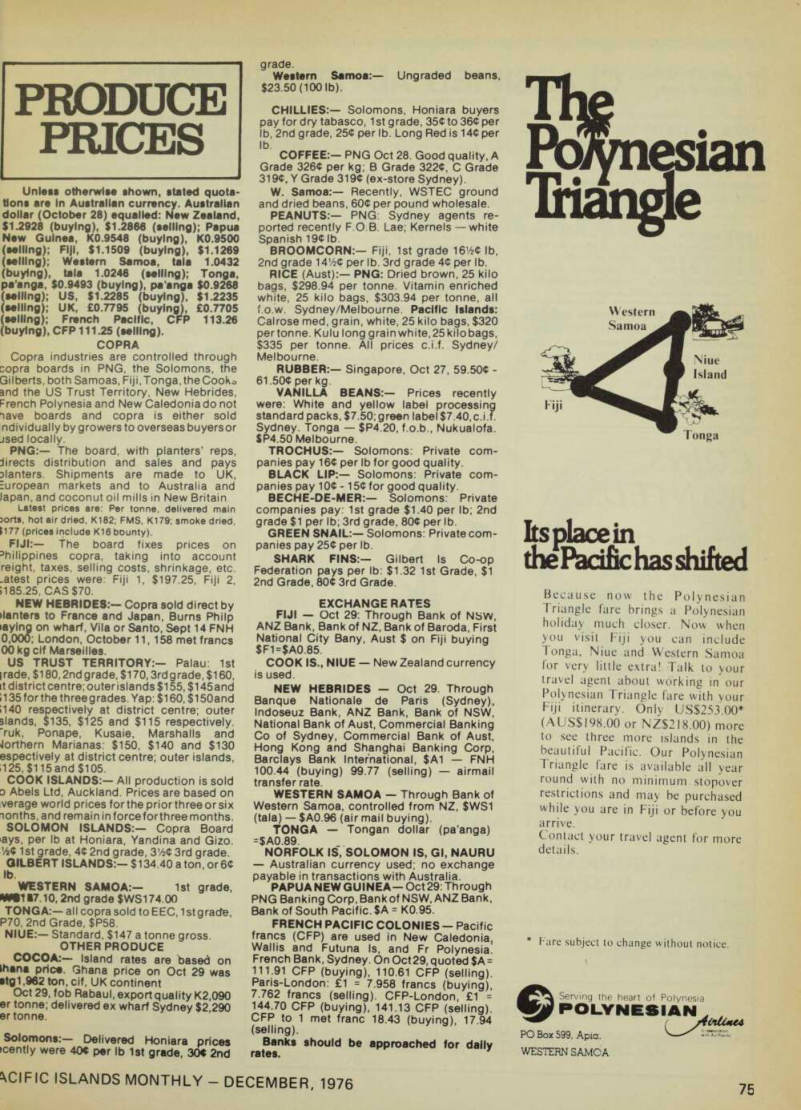
Produce
Unless otherwise shown, stated quota tions are In Australian currency. Australian dollar (October 28) equalled; New Zealand, $1.2928 (buying), $1.2866 (selling); Papua New Guinea, K 0.9548 (buying), K 0.9500 (selling); FIJI, $1.1509 (buying), $1.1269 (selling); Western Samoa, tala 1.0432 (buying), tala 1.0246 (selling); Tonga, pa’anga, $0.9493 (buying), pa’anga $0.9268 (selling); US, $1.2285 (buying), $1.2235 (selling); UK, £0.7795 (buying), £0.7705 (selling); French Pacific, CFP 113.26 (buying), CFP 111.25 (selling).
Copra
Copra industries are controlled through copra boards in PNG, the Solomons, the Gilberts, both Samoas, Fiji, Tonga, the Cooke and the US Trust Territory, New Hebrides, French Polynesia and New Caledonia do not lave boards and copra is either sold ndividually by growers to overseas buyersor jsed locally.
PNG:— The board, with planters’ reps, jirects distribution and sales and pays Dlanters. Shipments are made to UK, European markets and to Australia and lapan, and coconut oil mills in New Britain.
Latest prices are: Per tonne, delivered main >orts, hot air dried. K 182; FMS, K 179; smoke dried, |177 (prices include Kl 6 bounty).
FIJI:— the board fixes prices on Philippines copra, taking into account reight, taxes, selling costs, shrinkage, etc. .atest prices were. Fiji 1, $197.25, Fiji 2,
!185.25, Cas $7O.
NEW HEBRIDES:— Copra sold direct by ►lanters to France and Japan, Burns Philp »aylng on wharf, Vila or Santo, Sept 14 FNH 0,000; London, October 11,158 met francs OOkgclf Marseilles.
Us Trust Territory:- Palau; Ist
I rade, slBo,2nd grade, $170,3rd g rade, $l6O, it district centre; outer islands $155, sl4sand 1135 for the three grades. Yap; $l6O, slsoand 1140 respectively at district centre; outer stands, $135, $125 and $ll5 respectively, "ruk, Ponape, Kusaie, Marshalls and Jorthern Marianas: $l5O, $l4O and $l3O espectively at district centre; outer islands, 1125, sllsand $lO5.
COOK ISLANDS:— All production is sold o Abels Ltd, Auckland. Prices are based on verage world prices for the prior three or six lonths, and remain inforceforthreemonths.
SOLOMON ISLANDS:- Copra Board ays, per lb at Honiara, Yandina and Gizo. ■V&4 Ist grade, 44 2nd grade, 3M-4 3rd grade.
GILBERT ISLANDS:— $134.40 a ton, or 64 lb.
WESTERN SAMOA:— Ist grade, MP8117.10, 2nd grade $W5174.00 TONGA:— all copra sold to EEC, Istgrade, P7O, 2nd Grade, SPSB.
NIUE:— Standard, $147 a tonne gross.
Other Produce
COCOA:— Island rates are based on lhana prlca. Ghana price on Oct 29 was •tgl ,962 ton, cif, UK continent Oct 29, fob Rabaul, export quality K 2.090 er tonne; delivered ex wharf Sydney $2 290 er tonne.
Solomons:— Delivered Honiara prices icently were 404 per lb Ist grade. 304 2nd
grade.
Western Samoa:— Ungraded beans, $23.50 (100 lb).
CHILLIES:— Solomons, Honiara buyers pay for dry tabasco, Ist grade, 354 to 364 per lb, 2nd grade, 254 per lb. Long Red is 144 per lb.
COFFEE;— PNG Oct 28. Good quality, A Grade 3264 per kg; B Grade 3224, C Grade 3194, Y Grade 319 C (ex-store Sydney).
W. Samoa:— Recently, WSTEC ground and dried beans, 604 per pound wholesale.
PEANUTS:— PNG: Sydney agents re ported recently FOB. Lae; Kernels white Spanish 194 lb.
BROOMCORN;— Fiji, Ist grade 16Vfe4 lb, 2nd grade 14 1 /2<f per lb. 3rd grade 44 per lb.
RICE (Aust):— PNG: Dried brown, 25 kilo bags, $298.94 per tonne. Vitamin enriched white, 25 kilo bags, $303.94 per tonne, all f.o.w. Sydney/Melbourne. Pacific Islands; Calrose med, grain, white, 25 kilo bags, $320 pertonne. Kulu long grainwhite,2skilobags, $335 per tonne. All prices c.i.f. Sydney/ Melbourne.
RUBBER:— Singapore, Oct 27, 59.504 - 61.50<f per kg.
VANILLA BEANS:— Prices recently were: White and yellow label processing standard packs, $7.50; green labels7.4o.c.i.r Sydney. Tonga $P4.20, f.0.b,, Nukualofa. $P4.50 Melbourne.
TROCHUS:— Solomons; Private com panies pay 164 per lb for good quality.
BLACK LIP:— Solomons: Private com panies pay 104 -154 for good quality.
BECHE-DE-MER:— Solomons: Private companies pay: Ist grade $1.40 per lb; 2nd grade $1 per lb; 3rd grade, 804 per lb.
GREEN SNAIL:— Solomons: Private com panies pay 254 per lb.
SHARK FINS:— Gilbert Is Co-op Federation pays per lb: $1.32 Ist Grade, $1 2nd Grade, 804 3rd Grade.
Exchange Rates
FIJI Oct 29: Through Bank of NSW, ANZ Bank, Bank of NZ, Bank of Baroda, First National City Bany, Aust $ on Fiji buying
$Fl=$Ao.B5.
COOK IS., NIUE New Zealand currency is used.
NEW HEBRIDES - Oct 29. Through Banque Nationale de Paris (Sydney), Indoseuz Bank, ANZ Bank, Bank of NSW, National Bank of Aust, Commercial Banking Co of Sydney, Commercial Bank of Aust, Hong Kong and Shanghai Banking Corp, Barclays Bank International, SAI FNH 100.44 (buying) 99.77 (selling) airmail transfer rate.
WESTERN SAMOA - Through Bank of Western Samoa, controlled from NZ, SWSI (tala) $A0.96 (air mail buying).
TONGA Tongan dollar (pa’anga)
=$Ao.B9.
Norfolk Is', Solomon Is, Gl, Nauru
Australian currency used; no exchange payable in transactions with Australia.
PAPUA NEW GUINEA— Oct 29: Through PNG Banking Corp, Bankof NSW, ANZ Bank, Bank of South Pacific. $A = K 0.95.
French Pacific Colonies Pacific
francs (CFP) are used in New Caledonia, Wallis and Futuna Is, and Fr Polynesia.
French Bank, Sydney. On Oct 29, quoted $A = 111.91 CFP (buying), 110.61 CFP (selling).
Paris-London: £1 = 7.958 francs (buying), 7.762 francs (selling). CFP-London, £1 = 144.70 CFP (buying). 141.13 CFP (selling).
CFP to 1 met franc 18.43 (buying), 17 94 (selling).
Banks should be approached for daily rates.
Advertisements & other items, pp. 75-80 (4 items)
75
ISLANDS MONTHLY - DECEMBER, 1976
Polynesian
The
manae
Western Samoa .
Niue Island Tonga
Its place in
the Pacific has shifted
Because now the Polynesian Triangle fare brings a Polynesian holiday much closer. Now when you visit Fiji you can include Tonga, Niue and Western Samoa for very little extra! Talk to your travel agent about working in our Polynesian Triangle fare with your
Fiji itinerary. Only U55253.00*
(AUSSI9B.OO or NZ$2lB.OO) more to see three more islands in the beautiful Pacific. Our Polynesian Triangle fare is available all year round with no minimum stopover restrictions and may be purchased while you are in Fiji or before you arrive.
Contact your travel agent for more details. * Fare subject to change without notice.
Serving the heart of Polynesia
POLYNESIAN
PO Box 599, Apia.
WESTERN SAMOA
Minimum 4 lines. CLASSIFIED ADVERTISEMENTS
WANTED
Cruising Trimaran or Catamaran wanted 40' plus for live aboard and Barrier
Reef cruising.
Reply with photos please to:
PO Box 619, Cairns,
Nth. Queensland, Australia 4870.
If you have snens to sell —any quantity—contact Antaa Commodity Tradort Pty. Ltd., P O Box 1413, Lao, Papua Now Gulnaa, Phono 424159. We are buyers of Trochus, Greensnail, Blacklip MOP, Goldlip MOP, and Marine Specimens Best prices paid Rabaul agents; Gazelle Agencies Pty. Ltd., P.O. Box 262, Rabaul. PN G Phono; 921397 Manus Island Agents, R. L. A V. J. Knight, P.O Box 108, Lorengau, Manus Island. P.N.G. Phone 38
QUALIFIED ACCOUNTANT
Married, seeks position in Islands. All offers considered Write to: Box 42, Duffy, 2611, Australia
FOR SALE
PALATAR ISLAND.
Modern tropical residence E.N.B. province, 45 miles from Rabaul by sea.
Ideal retirement with gracious living, self contained.
Write: Island Sale Cl- New Britain Lodge, P.O. Box 296, Rabaul.
Phone: 92 2207.
PLANTATION WANTED
Share farmers for established copracocoa plantation, joint venture considered 40/40/20 project.
Write: The Planter P.O. Box 296, Rabaul.
Phone: 92 2207. 20 acres Mittagong for sale.
Offers to: Swallow P.O. Box 296, Rabaul.
Phone: 92 2207.
CONCRETE BLOCK MAKER Makes blocks, flags edgings, screen-blocks, garden stools—up to 8 at once and 96 an hour 5215 00 c.i.f main ports Send tor leaflets Forest Farm Research, Londonderry N S W.. 2753 Australia.
FOR SALE
COASTAL VESSELS-
Built 1946 Denmark, B.V. class, 41.65 m x 7.34 m x 2.70 m. 375 DWT Alpha diesel K 120,000 0.N.0.
Built 1950 Lloyds 100A1,642 DWT 52.4 m x 8.9 m x 3.35 m. 575 HP Meerlees Engine, 8 knts. Accom. for 30 persons.
K 140,000 0.N.0.
Built 1944, 66ft. wooden workboat, PNG survey, 50 DWT, 671 GM Engine, 7.5 knt Recently refitted, in excellent condition.
K 40,000 0.N.0
BARGES-
Built 1971, LOA 49'7", 25 DWT, bale approx. 40 tons. Twin Perkins, 7 knts.
Enclosed dry hatch with watertight door and ramp, K 30,000 0.N.0.
Built 1969, 90' x 26' x 7'. 127 DWT, 28C sq. ft. deck space. 4 Perkins Diesels.
KlBO,OOO 0.N.0.
Built 1969. 23.37 m x 6.09 m x 1.37 m. 60 DWT. 2 Caterpillar Diesels, 7.5 knts.
K7O, 000 0.N.0.
PEARLING LUGGER-
Refitted $A25,000.
YACHTS-
Luxury trawler type fibreglass/teak, 33'- 42'. From $A23,000 F. 0.8.
All types of vessels required for sale to waiting clients.
New Guinea Marine
Surveys & Services,
P.O. Box 783,
Lae, Papua New Guinea.
Phone: 42 4305.
Telex: NE 42515.
Cables: Marineserv.
MAPS & PRINTS OF THE OLD PACIFIC Catalogue of original antiquarian views and maps of Pacific Islands sent free.
C.HINCHCLIFFE—7 Royd Avenue, Heckmondwike, West Yorkshire, WFI6 9AL United Kingdom.
FLEETS 52ft. Tourist Cruiser, bit. Norman Wright 1967, in survey. Master's cabin & some dry cargo space aft. Gardner diesel, s. steel lined refrig, space. $75,000 00 FLEETS 221 Esplanade, Wynnum Central, Brisbane Cable: "FLEETS BRISBANE".
MARINE ENGINEER urgently requires position on ship. Excellent references, experience on Bulk, General and Fridge ships. Will consider any Pacific Island or Australia.
Replies in writing to: PO Box 23-579, Papatoetoe East, Auckland, New Zealand,
COINS
WANTED...
Paying twice face value for all pre-decimal Australian coins.
GOLD SOVEREIGNS
BUY—$27
SELL-$3O
Prices subject to fluctuation.
SOUTHERN CROSS COINS
2/131 Exhibition St.,
MELBOURNE 3000,
AUSTRALIA.
Phone: 63 1141.
r*X-
STERN
DRIVES
PETROL & DIESEL
MARINE ENGINES
X Manufactured by
SEA TIGER
MARINE
Pty. Ltd.
P.O. Box 157, Mordlalloc Victoria, Australia 3195
MASSEY UNIVERSITY
NEW ZEALAND
CERTIFICATE IN THE TEACHING OF
A SECOND LANGUAGE (ENGLISH)
Teachers of the English language or teachers who use English as the language of instruction for other subjects may now enrol for this special course ot study.
All tuition is by correspondence.
For details, write to: The Department of Modern Languages, Massey University,
PALMERSTON NORTH, NEW ZEALAND
Total service 0n ...
plumbing supplies Fast
WATSON & CRANE
are organised to fulfil your needs
wherever you are in the South Pacific r. m Sr You can get all you need from one supply source: water taps, valves, copper tube, tools and a host of other fittings and related plumbing equipment for domestic, industrial and multistorey buildings.
Watson & Crane Pty Ltd have over 20,000 plumbing items in stock at their central warehouse located at Waterloo, NSW, Australia.
Years of experience in handling and shipping right throughout the South Pacific add up to another big reason for you to deal with Watson & Crane Pty Ltd.
Representatives call regularly at New Guinea, Papua, the Solomons, New Hebrides and Frjl Islands to personally discuss your requirements and appropriate credit arrangements.
Write, cable or telephone today for complete plumbers" supplies service.
Watson & Crane Pty. Ltd 1037 Bourke Street, Waterloo,
NSW 2017.
Phone: Sydney 699-1333.
Telex: AA 25548.
Cables: "Watcrane" Sydney.
G
CRANE
GROUP
P.cWc Island distributors of Cr.rt. Enfield topper tufa, for w.t.r, s.nit.lion, engineering, rrrfriger.tion .nd .ir conditio™*.
0 Si a I * Fine Old Scotch Whi s^ IKeWhite Horse Cellar Est&b 174i|
You can take a ia ,
White Horse anywhere. yy
FINE OLD SCOTCH WHISKY
$ m m m Honda is a true life drama, performed on the world’s stage. By average folks, teenagers, men, and women everywhere. Your neighbors, maybe even you are playing a part. If so, you know Honda is more than great machines.
It’s people concerned with taking people where they want to go in life.
On two wheels, we’re the best selling motorcycle. The easy to operate hard workers who don’t demand much. Honda is always ready and gets you there safely. We move on four wheels. The precedent setting Honda Civic continues to receive international economy and performance awards. It’s the elegant compact car.
Sometimes, we have no wheels. Honda portable power operates machinery, generates electricity, pumps water and tills the soil.
Little wonder good things happen on Honda we work harder to assure they do. v. & m
HONDA MOTOR CO.. LTD. TOKYO, JAPAN
PAPUA NEW GUINEA: Steamships-Machinery P.O. Box 1, Port Moresby /TAHITI: Societe Tahitienne d’lmportation des Produits Honda B.P. 1665rfPeete f IJI Coral Island Motors P.O. Box 48. Suva/U.S. TRUST TERRITORY: United Micronesia Development Assn. P.O. Box 238 Saipan Mariana Islands 96950/COOK ISLANDS: Cook Islands Motor Center Ltd P.O. Box 74, Rarotonga/ AMERICAN SAMOA: Samoan Holiday and Travel °/. AMERICAN SAMOA: Haleck’s Service Center P.O. Box 1138, Pago Pago/GUAM: Mark's Motor Co., Inc. P.O, Box 11/1 m*" r^^. : « Motor Distributor s (Samoa) Ltd. P.O. Box 576, Apia/SOLOMON ISLANDS: British Solomons Trading Co.. Ltd. P.O. Box Tarawa /-.u . CALEDONIA: Establissements Ballande Boite Postale No. 04 Noumea Cedex/TONGA: EM. Jones Limited P.O. Box 34, Nukualofa/ n : G " be : t & I ICe lsla " ds Development Authority P.O. Box 488, Beito/NIUE ISLAND: S. Jessop & Sons Ltd. P.O. Box 71, Alofi South/NAURUnauru Cooperative Society, Republic of Nauru, Nauru Island Central Pacific/NEW HEBRIDES: Tropex International Ltd., P.O. Box 139 Port Vila
Vada Heni with his latest Datsun, photographed near Port Moresby, Papua New Between my home life and running my truck, taxi and forklift business, I don't have much time left to myself. There are eleven children in the family.
The eldest is 26, the youngest four years old—and somewhere in between we even have twins.
When I do manage to get some spare time I like to go hunting and fishing. The Port Moresby area is ideal for the person who enjoys the peace and quiet of the outdoor life.
Though you need a tough car to get around because most of the roads are hilly and unpaved outside the city.
That's why I drive a Datsun.
It’s my third Datsun, and the other two it’s a reliab!
Smart-looking, too. A lot friends agree with me. Ha them switched to Datsuns they saw my latest one.
A car to be proud of, I Datsun. In fact, sometime I think it's too good to drive!
Datsun Distributors: NEW HEBRIDES: Pentecost Pacific S.A. P.O. Box 119, Port Vila/NEW ZEALAND: Nissan Motor Distributors (N.Z.) 1975 Ltd. P.O. Box 61133, Otar a, Auckland /NORFOLK I: Sirius Motors P.O. Box 34, Norfolk 1./ PAPUA NEW GUINEA: Boroko Motors Ltd. P.O. Box 1259, Boroko, Port Moresby MARIANAS: J.C. Tenorio Enterprises P.O. Box 137, Saipan /SOLOMON IS: United Enterprises Ltd. P.O. Box 262, Honiara /TAHITI: Michel Pentecost et Cie/ TAHITIBULL B.P. 1809, Papeete /TONGA: Riechelman Bros. Ltd. P.O. Box 18, Nukualofa/' WESTERN SAMOA: Morris Hedstrom Ltd. P.O. Box 189, Apia
DATSU
emss Product of Nli
77
ACIFIC ISLANDS MONTHLY- DECEMBER, 1976
79
ISLANDS MONTHLY- DECEMBER, 1976