Travelling!

Pim
Pacific Islands';Monthly
U97.*
*s3 .*25 US fcfP 130
Travelling!
Our Cover
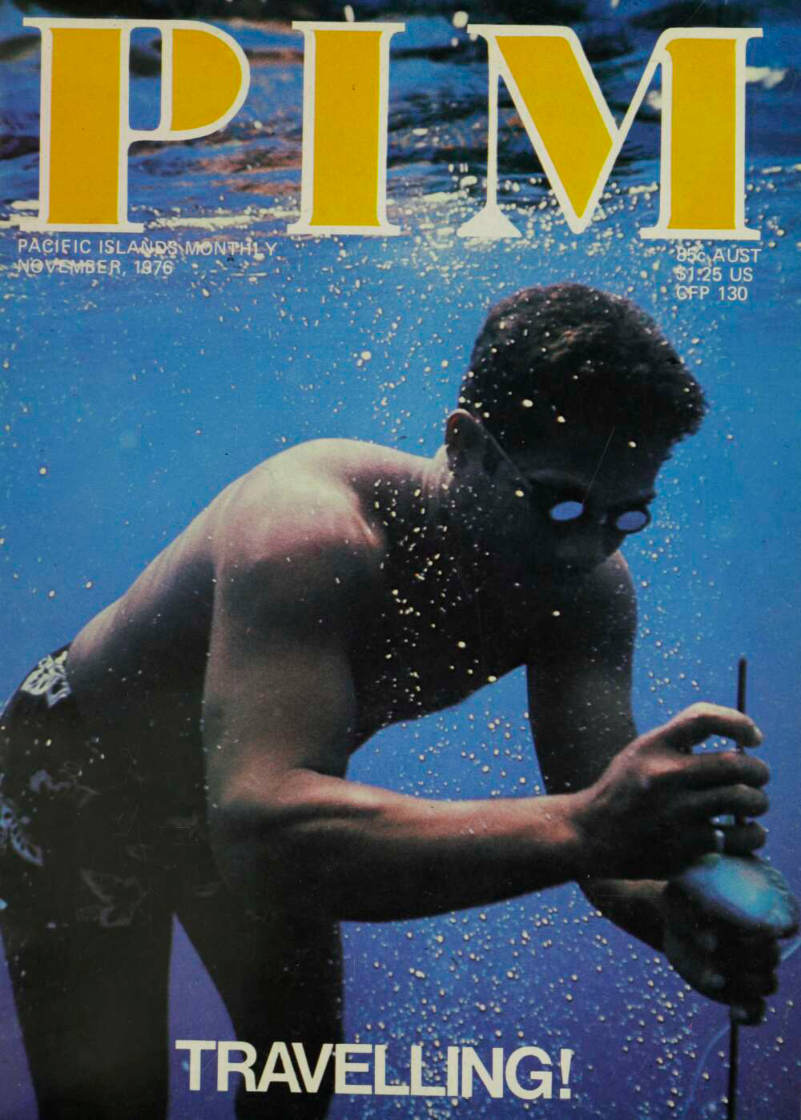
This spearfisherman with his catch, a tiny Parrot fish, in the crystal-clear waters of Nukuoro atoll, in the south east corner of the Ponape district of US Micro nesia, typifies daily life in much of the Pacific Islands. This issue of PIM con centrates on islands travel, but travellers won't find it easy to get to Nukuoro, where the people have a Polynesian background.
The photograph was taken by John H. Harding, an Australian underwater expert.
Advertisements & other items, pp. 2-4 (1 item)
\
Power
A
SUZUKI
SUZUKI
SUZUKI MOTOR CO., LTD.
Hamamatsu, Japan GUAM AGAT BOAT CENTER PONAPE LEO ETSCHEIT NAURU CAPELLE & PARTNER FIJI D. GOKAL & COMPANY LIMITED NIUE BURNS PHILP (SOUTH SEA) COMPANY LTD. PAPUA NEW GUINEA TUTT BRYANT PACIFIC LTD. NEW HEBRIDES HENRI LEROUX NEW CALEDONIA SUPERCAL
The new Sony CF-580 will keep anyone anywhere from being bored. 5.8 big watts of output power. Four big speakers in a powerful Matrix Stereo Sound System that spread high quality reproduction all around. Full stereo separation. And built-in twin mikes and automatic level control to make recording anything a cinch. You’re only half shipshape without one-even if you’re not a sailor.
SONY
Research Makes the Difference
Carry stereo anywhere
in the world.
STATESMAN
smoothest cigars on
e international scene
SRKji
% a* ;o uNOf o 1801 % V p B K
STATESMAN
CORONA
5
Corona
X554-10/75
Pacific Islands
Monthly
FOUNDED BY R W. ROBSON IN 1930
Published Monthly By
Pacific Publications (Aust,) Pty. Ltd.
76 Clarence Street, Sydney 2000
Post Address GP O BOX 3408, SYDNEY
N S W 2001
Telegraphic Address PACPUB, Sydney Telex 21242
Telephone: 29 6693
Publisher: Stuart Inder.
Manager: John Berry
Pacific Islands Monthly
Editor: John Carter Advertising Manager: Alan Ban.
Subscription Rates:
"Pacific Islands Monthly" is airfreighted to the ma jority of subscribers and agents in the Pacific Islands and the U S A.
Australia (including Lord Howe and Thursday Islands), New Zealand, Papua New Guinea. Fiji New Hebrides, Tonga, Cook Islands, Western Samoa, Gilberts and Tuvalu, Norfolk Island, Niue and Nauru $9 00 (local currency). Solomon Islands $lO 00 Aust , American Samoa Micronesia and Guam $l2 00 US Hawaii and U S Mainland $15.00 US . New Caledonia anc French Polynesia 1,500 C.F.P.; United Kingdom £6 50 Japan 4000 Yen; Elsewhere $ll 50 Aust
Representatives
Fiji: Advertising and Distribution Fiji Times & Herald Ltd , 20 Gordon Street, Suva, Telephone 312-1 11 Telex FJ 2124 Papua New Guinea: Advertising and Distribution PN G Post-Courier, P 0 Box 85, Port Moresby Inquiries: Post Newsagency, Telephone 24-2148 French Polynesia: Distribution Hachette Pacifique, 10 Ave Bruat, Papeete New Caledonia: Distribution Depot Centre de Presse Michel PENTECOST, 8.P.C2 NOUMEA New Zealand: Pacific Publications, CPO Box 2229, Auckland United Kingdom: The Herald and Weekly Times Limited, 8-10 Clifford s Inn. Fetter Lane, London EC4A I BU. Telephone 01-831 6041 Telex Lon don 21989 Japan: Advertising Universal Media Corpora tion, CPO Box 46. Tokyo Telephone: 666-3036 Victoria: Advertising Pacific Publications (Aust) Pty Ltd.. Herald and Weekly Times Building, 2nd Floor, 61 Flinders Lane, Melbourne, 3000 Telephone 652 1 565 Brisbane: D Wood, Anday Agency, Box 1918 GPO, Brisbane 4001 Telephone 44 3485 44 1546 Hawaii and U S, Mainland only: PIM, Hawaii, 2812, Kahawai St, Honolulu, Hawaii, 96822 Second class postage paid at Honolulu. Hawaii.
Printed in Australia
Copyright c 1976
Pacific Publications (Aust.) Pty. Ltd.
Printed by, Paramac, Mitchell Road, Alexandria.
Registered at the GPO Sydney for transmission by ost as a newspaper category B.
Recommended retail price only
Vol. 47, No. 11 Nov., 1976.
Up Front
with the Publisher
I attended not long ago a Pacific book trade seminar in Fiji, where one of the speakers was Shantilal Desai, founder and chief executive of Fiji’s Desai Book Depot. He was just one of a number of industry leaders who addressed the gathering that week, but there was none who made a greater impact on the audience. fit wasn’t only what he had to say about the book trade that created the interest, but the story which he unfold ed, modestly, about Shantilal Desai himself.
Shantilal has, from October, retired from active management of the company which he built from literally nothing into the biggest chain of book shops in the South Pacific.
What began as a few books in one corner of a tailor shop in Suva has developed into a chain of nine shops with further outlets to be opened soon. He remains as a director and consultant to the company, which on April 1 was acquired by the Fiji Native
Land Development Corporation.
Shantilal’s story is the story of a penniless Indian migrant to Fiji who made good through his own efforts.
Born in Bombay in 1918, Shantilal went to Fiji in September 1939, at the age of 21, with no English, and worked for an Indian merchant at Lautoka for S 6 a month for only six months. Then he was out of a job.
Before he had left Bombay he had taken a wife in an arranged marriage.
She was 14, and he left her behind in India until he could establish himself in Fiji, She waited nearly nine years. The war intervened and, in any case, for the first five years Shantilal was without work. They saw each other again for the first time in 1948 when she came out, by which time he had learned some English and got a clerical and book-keeping job in Suva.
Here was a man with no back ground of books - but with the drive to get on, and he had noticed during the war years that there were no book sellers to supply the big demand for books and magazines for the Allied fighting men stationed in Fiji, ’lt was out of this need, after the war, that I first decided to start a bookselling business,’ he recalls. ’I went to the bank and asked the man ager whether he could give me an over
draft to run my business. I was told that since I had no security they could not provide me with an overdraft.’ Nor would overseas publishers supply him with books. ’The business people of Suva used to laugh at me,’ he says, ’wondering how I was going to start a business without financial help of any sort, but I started to save money from my book keeping work and commenced to order books and magazines from London.
For the first four years it was total loss, and people told me that the booksell ing business was not going to be successful in Fiji.’
From there he began the slow climb to the successful business of today, which has been a leader in Islands edu cational bookselling and in the import ation of books.
Shantilal Desai and his bride of 14 are still married. Shantilal told the seminar that as far as his experience goes, an arranged marriage is a great success, and he has no complaints at all. One of the Desai offspring is Dr Satish Desai, prominent surgeon LRCP (London) MRCS (England), MB, BS (London). And Shantilal’s activ ities have never been all business, despite what one might expect. He has always been an active and effective participant in a long list of Fiji char ities and community organisations.
Desai Book Depot Ltd is now to be known as Desai Bookshops. The con tinuation of the name is not only a tribute to its founder the name of Desai will undoubtedly contribute to its continued success under its new
ownership.
Shantilal Desai
Advertisements & other items, p. 6 (1 item)
i mi
P ra * Fine Old Scotch WhisKy #* ll i TheWhUe Horsefellar Estftb 174-2 iiimi
In this issue
general Hokule'a voyage g Nervous Islanders in NZ ...12 Leprosy survey ig SP regionalism discussed 25 Somare's togetherness plea 25 Australia opens purse 53 Regional shipping gg Hawaiian Airlines 67
Fiji
Methodist Church leader 18
Official self-denial ”1 9
Parking meters 20 Dry dock patrol ... 20 Election fever builds up 29 cheque trouble 34 Broom boom 35 -au phosphate deposits 53
: Rench Polynesia
Hokule'a voyage 8 Political moves
Gilbert Islands
hipping headache 73
■Ord Howe Island
obs galore g 3
Lew Caledonia
pring frolics 13
Ew Hebrides
elegates differ at UN 14 sradise and hell 50
Papua New Guinea
Victim of official juggernaut 15 Stateless people Planters defended Police station siege 19 Plea for Manus Search for Wuvulu 20 Fishing captain gaoled 34 Ritual deaths Triba I tempers PNG Bank's K4m profit 57 Communist on Bougainville 59 Mission's planes grounded 67 Disastrous marine explosion 71 Airline aspirations 73 Death of "Snow" Rhoades 77
Solomon Islands
Independence may be delayed 13 Death of "Snow" Rhoades 77
Tonga
Financial crisis y High Commissioner from NZ 20 NZ rules for entry g- Barges from NZ 74
Us Trust Territory
Chase Manhattan leaves Saipan 23 Big pig money gg
Western Samoa
No ceremony for Malietoa is Belt tightening g^
Ti Pe ° Ple ' 18; N®ws— aNu«he„. 19; 47; Business and ss .Pa'c T t’ 37 - M Section, 38; Books, of is,ends People, 77; Sh i pping anP
What The Hokulea’S
Voyage Was All About
From BEN R. FINNEY in Honolulu
Three short years ago Charles T.
Holmes, Herbert K. Kane and I form ed the Polynesian Voyaging Society to undertake research into Polynesian voyaging by building a reconstruction of a large double-canoe and then sail ing it to Tahiti and return in the closest to traditional Polynesian style as we could manage in this modern age.
With the help of countless con tributors in Hawaii, throughout the Pacific and in more than a few coun tries elsewhere in the world, and many willing hands, we built Hokule’a, and between May 1 and July 26 of this year we sailed it to Tahiti and return just like we said we would do.
Because, however, some observers object to our use of modern materials (which had been fully announced in our literature and in PIM, May, 1974, p2l) and are offended by our use of an escort vessel for documentation and safety, and others were bothered by the human failings which led to the in advertent transmission to the canoe of our position south of Hawaii, and also led to a regrettable conflict among the crew on the first leg of the voyage, our accomplishment has been greeted with more than its fair share of criticism. (See “Hokule’a does it but ‘it wasn’t pure Polynesian’ say the critics” PIM, Aug, pp 8-10.) Rather than attempt to meet each point of criticism, I would like to clear the air by detailing the nature of the Hokule’a experiment for those readers who would like a glimpse of what the voyage was really about.
One, perhaps unwilling, progenitor of the project was the late Andrew Sharp who, in 1956, published An cient Voyagers in the Pacific in which he severely criticised uncritical accep tance of the idea that Polynesians could have intentionally explored and colonised their island realm.
Polynesia was settled accidentally, by a long series of fortuitous landfalls by canoes drifting before wind and current as well as canoes crammed with exiles seeking randomly for a new home, claimed Sharp and with
this pronouncement the battle was on.
In the controversy that followed, one thing became clear. Since the ear ly European explorers neglected to systematically describe the voyaging canoes they saw and their perfor mance, and since these craft have since disappeared from Polynesian waters, we really know very little about how well Polynesian canoes sailed a crucial point when claims are being made for and against Polynesian voyaging capabilities.
To gain needed information on canoe performance in 1966, a group of students and I built Nalehia, a 40foot long double-canoe modelled after a traditional Hawaiian craft, and tested her in Hawaiian waters. We found her to be a stable and seakindly vessel that sailed very well downwind and across the wind and that could make good up to about 75 degs into the wind, despite her round bottom and small Polynesian sprit sail (features which caused many a yachtsman to predict that we would not be able to sail to windward at all).
The demonstration of Nalehia’s limited, though definite windward ability, was important, as it is windward ability that allows sailors to go where they wish, which, in the con text of the controversy over Polyne sian voyaging, would tend to lend weight to arguments that the Polynesians may have exerted some control over their settlement destiny.
We then applied our findings to the legendary voyaging route between Tahiti and Hawaii, and hypothesised that such a voyage was well within the capabilities of a Polynesian double canoe. The leg from Tahiti up to Hawaii would have been the easiest as a canoe would sail with beam winds most of the way. The return to Tahiti would, however, have been more dif ficult because of the necessity of mak ing 400 or so miles of “easting” against wind and current, although our calculations showed that if a canoe could sail consistently 75 deg into the wind, it would just make Tahiti. The round-trip voyage of over 5,000 miles, we concluded, may well
have been the longest regularly-sailed sea road in Polynesia and may well have been the finest example of blue water sailing by Stone-age man.
Later, Hokule’a was conceived and built to test the relationship of theory to reality by actually making the hypothesised voyage. Hokule’a was carefully designed to represent par ticularly in hull shape, sail-plan and weight an ancient voyage canoe. We never hid our inability to secure or duplicate traditional materials. We said that, although the experiment will tell us nothing directly about the strength and durability of ancient materials, Hokule’a was planned as a performance-accurate replica of an ancient canoe.
The real test for Hokule’a was the windward voyage from Hawaii to Tahiti.
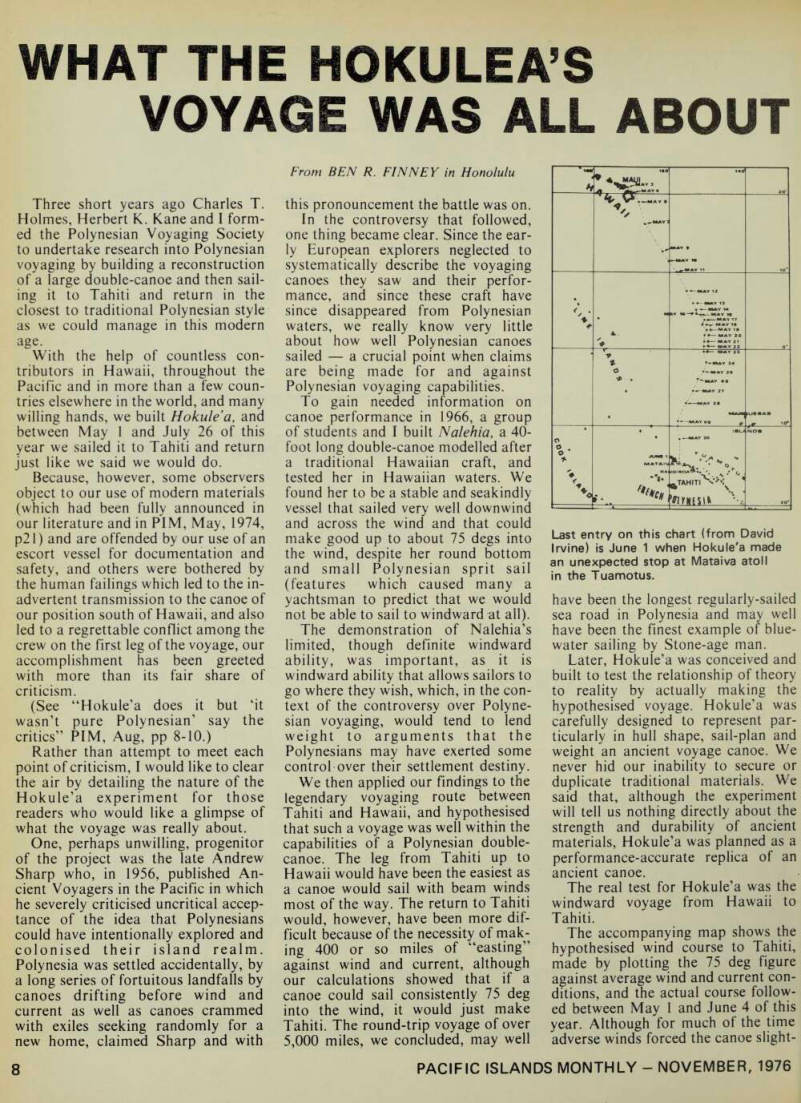
The accompanying map shows the hypothesised wind course to Tahiti, made by plotting the 75 deg figure against average wind and current con ditions, and the actual course follow ed between May 1 and June 4 of this year. Although for much of the time adverse winds forced the canoe slight
Last entry on this chart (from David Irvine) is June 1 when Hokule'a made an unexpected stop at Mataiva atoll in the Tuamotus.
ly to the west of the hypothesised route, the two tracks are remarkably parallel.
Despite NE tradewinds with a marked easterly component which tended to head us, we did make good “easting” from Hawaii until we entered the doldrums at about 6 deg north of the equator. We were then plagued by calms and light airs for a week before breaking out, but receiv ed an expected boost to the east provided by the equatorial counter current flowing strongly east in this covergence zone between the two tradewind belts.
South of the doldrums we en countered several days of light SSE wind that again pushed us too far west for comfort. Hokule’a is a heavy vessel (25,000 lb displacement fully loaded) with a relatively-small sail area (around 675 sq ft).
While this combination is fine for heavy tradewinds, Hokule’a slows to a crawl in light airs and loses much of her ability to point to windward. Thus these light headwinds forced her to oc casion onto a SW course which, if continued, would have taken her to the Cook Islands well west of Tahiti.
Fortunately, both wind speed and direction improved and we started heading right for Tahiti until the afternoon of May 31, when the wind shifted from SE to ENE allowing us to take a SE heading which brought us into the Tuamotus, as hypothesis ed. After ascertaining that we had reached Mataiva (which we learned by simply asking startled Mataivan “What is the name of your atoll?”), and after resting a day and a half, we had an easy sail to Tahiti.
The yacht Meotai followed us for
safety (a precaution heartily approved by the US Coast Guard, which had the right to stop our departure if they ascertained there was a safety problem) and for film documentation and the tracking required for the navigation experiment.
We carried no compass, sextant or other navigational devices as we wish ed to investigate the efficiency of the Polynesian non-instrument navigation system over this long route. Without the Meotai to track us we would have been in the position of knowing that we had reached our objective, but ig norant as to exactly where we had been and therefore in the dark as to whether or not we reached Tahiti because of, or in spite of, our navigational efforts.
Pius Piailug, a traditional Microne sian navigator from Satawal, in the Carolines, was our navigator and sail ing master, and was assisted by Rodo Williams, a Tahitian sea captain whose special job was to pilot us through the reefs of the Tuamotus, and New Zealander David Lewis whose job was to document the navigation process.
The navigation task was not as dif ficult as it might seem, as we had a large target to aim for: a hit anywhere along the screen of Tuamotu atolls that extend several hundreds of miles eastwards from Tahiti would enable us, once we found out which island we had reached, to island-hop our way to Tahiti.
Furthermore, we did not really have to precisely set a course by the stars, sun or swells, as we really had no option other than to sail as close to the wind as possible to make the Tuamotus east of Tahiti. In fact, for
most of the journey Hokule’a sailed herself at a more or less constant angle to the wind (which varied somewhat with wind intensity).
Under Piailug’s direction, steering sweeps and paddles were raised out of the water, the canoe was trimmed by redistributing weight and adjusting the sails so that she would automatically sail at the best possible angle to the wind. Thus the navigation problem was to calculate where the wind was taking us, and both Williams and Lewis provided some startling ac curate dead-reckoning positions along the way, although we were frankly in doubt as to what island we had hit un til our query was answered by: “It is Mataiva!”
That tape cassettes transferred from the Meotai, that were supposed to contain only personal messages, twice accidentally included tape recorded readings of newspaper ar ticles giving our position, certainly flawed our navigation experiment.
However, although critics may not believe us, we maintained that the im precise position descriptions (for ex ample, “Hokule’a is now 940 miles south of Hawaii . . .”) which were a day or two old by the time they reach ed us, could not have been very useful to Piailug (who apparently never heard them), an expert navigator who was carefully tracking our latitudinal position at the time by observing the angle of Polaris above the horizon (we were north of the equator at the time).
Let us not dwell too much on this problem for, however exotic naviga tion without instruments might seem, the real test on the voyage was of the canoe and its ability to sail to windward and thus reach Tahiti.
Two other subsidiary experiments were also undertaken, more for cultural revival and popular education than for scientific purposes.
We attempted to subsist on dried fish, dried bananas, hard taro poi and other traditional voyaging foods, but because of the spoilage of the taro poi and the lack of full dedication among the crew concerning the utility of the exercise, we supplemented our rations by drawing from the stores of the Meotai some modern Polynesian voyaging foods rice and corned beef primarily.
Our attempt to carry Polynesian animals and plants was, in contrast, a popular success. A pig, two chickens and a dog thrived on the fare and sur vived the ride well.
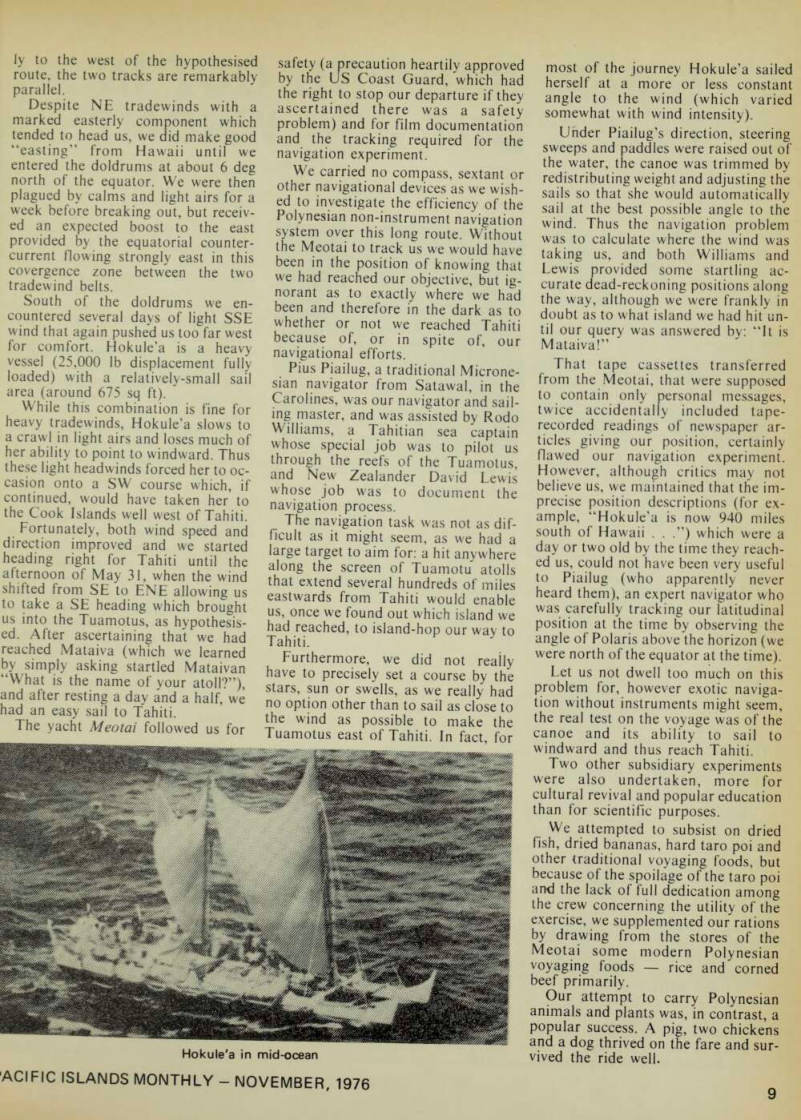
Hokule'a in mid-ocean
Advertisements & other items, p. 9 (1 item)
9
ACIFIC ISLANDS MONTHLY - NOVEMBER, 1976
Time’S Running Out In
Tahiti But For Whom?
By Al Prince in Papeete
Has Francis Sanford, leader of the United Front party for internal autonomy in French Polynesia, won the battle and lost the war? Or has Sanford won a battle whereby each subsequent time France says “no” to one of his demands French Polynesia and France move a step closer to a point of no return a head-on colli sion over independence?
Only time perhaps as much as a year will answer those questions.
Meanwhile, there are enough facts and reasonable speculations from which one can make a legitimate, calculated guess: Each time Sanford’s political party wins an election two are due within the next year without gaining any recognition, con cessions or compromises from France, Sanford will be moving French Polynesia one step closer to an
independence confrontation.
Ironically, at the moment, the last thing Sanford is after is independence.
And from all indications over the past two years, France does not want Polynesian independence either.
Among the facts, the most impor tant is Sanford’s September re election as French Polynesia’s Deputy to the French National Assembly in Paris. Resigning his post in June, Sanford forced the election, which he won with 55.37 per cent of the vote.
His closest rival was Gaston Flosse, whom France recognises, but Sanford and his party do not recognise, as President of the French Polynesia Territorial Assembly. Flosse received 34.19 per cent of the vote.
The most important aspect of the five-man race was that Sanford was elected to the three-year post of depu ty for the fourth consecutive time; but this time it was on the first ballot. His winning margin of 55.37 per cent was better than his 48.23 per cent showing in a three-man race on the first ballot in 1973 and better than his 53.3 per cent victory margin in the 1973 se cond ballot.
But Sanford’s victory this time was far short of the 70 per cent victory margin he had been hoping for on a
second ballot in order to show France that he and his internal autonomy party represent an overwhelming ma jority of French Polynesia’s elec torate.
Nevertheless, immediately follow ing his victory, Sanford and former Territorial Assembly President Frantz Vanizette, as leaders of the in ternal autonomy party, joined by Charles Taufa, president of the Federation of Labor Unions and the third-place finisher in the deputy elec tion (7.22 per cent of the vote), sent a telegram to the French Government in Paris demanding that Flosse’s one vote majority Territorial Assembly be dissolved immediately and new elec tions held.
A member of French President Valery Giscard d’Estaing’s Cabinet acknowledged receipt of the telegram a few days later with no comment.
However, two days after the elec tion, Mr Olivier Stirn, the French Secretary of State for Overseas Departments and Territories was quoted in the Paris newspaper Le Monde as saying, “The (election) results have no new significance.
Francis Sanford had announced that he would be re-elected with 70 per cent of the votes. He received ap preciably the same result as that of his election in 1968 (58.4 per cent) and on the second ballot in 1973 (53.5 per cent)”.
Secretary Stirn noted that the elec tion had been caused by Sanford’s resignation, which, Mr Stirn said, Sanford had intended to convert into a referendum in favour of internal autonomy.
In similar words to those of French Polynesia Governor Charles Schmitt on election night, Secretary Stirn said, “The support for independence, by its weak showing, demonstrates the profound desire of Polynesia to re main French”.
Secretary Stirn went further to in terpret the election results as a further indication of support for its proposed new law, which would clearly indicate the will of French Polynesia to remain French and which would allow a broad decentralisation, justified by the remoteness and characteristics of French Polynesia’s problems.
Gov Schmitt put it much more bluntly. He told reporters on election night (Sept 12) that despite Sanford’s victory, “nothing has changed”. And in a very real sense, the Governor was correct. Flosse is still President of the Territorial Assembly, deciding the af fairs of French Polynesia with only 16 out of 30 assembly members. France has shown no indication of even enter taining the idea of dissolving the assembly.
Sanford and Vanizette continue to occupy the Territorial Assembly building with their supporters, as they have done since June 10 (PIM, Aug, p 10) forcing Flosse and his “majority” to meet elsewhere. And Sanford is once again Deputy to the National Assembly.
But both Secretary Stirn and Gov Schmitt paid particular attention to the election showing by Charley Ching, leader of one of two newly formed independence parties.
Although Ching only received 676 votes (1.66 per cent), his showing was almost triple that of the last in dependence candidate to run in an election. In 1972, the independence party received 229 votes. (It is in teresting to note that the leader of the second independence party, Robert
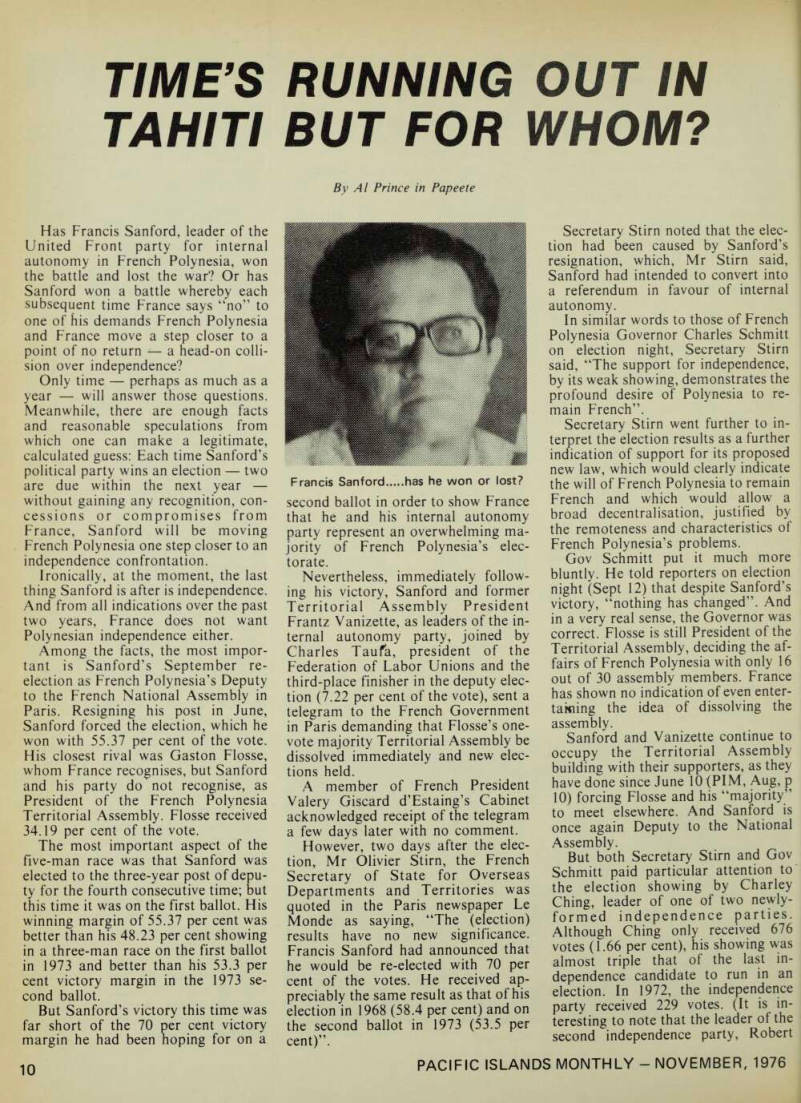
Francis Sanford...has he won or lost?
Cahn, supported Sanford in the latest election.) On election night, Gov Schmitt’s first interpretation of the results was that 97.61 per cent of the votes cast were, in effect, against independence.
However, some of Sanford’s sup porters feel that the tripling of the in dependence vote in four years is quite significant, if not dangerous to San ford’s present plans.
The independence party showing is even more significant when taking into consideration the number of new voters who will be joining the elec torate in the coming years. Studies have been made showing that by 1980, nearly half of the population of French Polynesia will be under 15.
The voting age is 18.
Gov Schmitt also noted on election night that the voter turnout was less than in either of the two rounds of the 1973 election. A total of 40,598 per sons, or 64.71 per cent, of the 62,732 registered voters voted. In 1973, the turnout for the first ballot was 70.3 per cent, and 72.2 per cent for the se cond ballot.
Looking ahead, there are two more elections scheduled within the next year municipal elections in March 1977, and, if the Territorial Assembly is not dissolved first, assembly elec tions in September, 1977. Sanford’s party will be out to win both.
Le Journal de Tahiti, a local French-language newspaper, wrote a story shortly after the latest election, speculating on how Sanford’s internal autonomy party would have done had the election been for Territorial Assembly members rather than for the deputy to the French National Assembly. Le Journal prefaced the story by saying there is certainly nothing scientific about comparing the two elections.
However, Le Journal said that, bas ed on Sanford s showing throughout French Polynesia, the internal autonomy party would have ended up with 18 seats for a three-vote majori ty. Flosse’s Gaullist, pro-French party would have finished with nine seats and Taufa’s party would have ended up with three seats.
In the deputy election, of the five general voting areas Leeward Islands, Windward Islands, Mar quesas, Tuamotu-Gambier and Australs Flosse outpolled Sanford only in the Marquesas. On the island of Tahiti, Flosse won only three of the 12 voting areas. This included a very narrow victory in his own city of
Pirae, where he is mayor. In Pirae, Flosse got 1,938 votes to Sanford’s 1,005.
Thus, Sanford has won the battle the election. But he has not im pressed France sufficiently enough to get the Territorial Assembly dissolv ed.
Sanford’s next area of attack could be the new statute that France and French Polynesia have been arguing about now for almost two years ever since Secretary Stirn’s last visit here. The new statute would change the relationship between France and
French Polynesia. The only thing that has not been agreed upon is how.
Theoretically, Secretary Stirn has been due to arrive here on more than one occasion since last summer with a new proposed status in other words, one different from the one he presented here in March, 1975.
But Sanford’s main target for the moment is the dissolution of the Territorial Assembly, saying he refuses to discuss any new statute un til that is done and new elections are held.
Time will tell, but time may also be running out.
Advertisements & other items, pp. 11-12 (2 items)
11
’ACIFIC ISLANDS MONTHLY - NOVEMBER, 1976
Hand Ye: £
THE BAILEY
HANDYMIX
Hand Operated, % cubic foot Mixer
Thirty turns of the handle gives you a
perfectly constituted mix
Mixes concrete, fertilizer, stock
feed ... in fact, anything.
• Easy to use
• Easy to clean
• Easy to store
• Easy to transport
HIGH IMPACT
NYLON HANDLE
EASY TILT
BOWL
HEAVY
SEAMLESS
■A STEEL
W TUBE
(42.5 dia]
NON CLOG
FLUTING
GRAPHITE-IMPREGNATED
NYLON BEARINGS
BUILT-IN
VANES
RUSTLESS EASY CLEAN
HIGH DENSITY
POLYETHYLENE BOWL
OUTLASTS STEEL
STRENGTHENED LIP
PATENTED
ANTI-CORROSION
FRAME
NON SLIP CAPS
NEW
ZEALAND
made
12 MONTH GUARANTEE
HAND YE: £
Sole Export Agent
M A^ ducts Mouldin 9 Company
Unit of AHI Operations Ltd. 1
Private Bag Hamilton. N.Z.
Part of'tour World
Look to Wunderflex
for a practical approach
to good design
We all look for good design in a building.
If it’s practical and economical as well, you’re in front.
Wunderflex building board is the answer. It fits good design with ease. Practical because it’s easy to work; won’t rot, shrink or rust. Paint it if you wish — but there’s no need. Versatile, too, use Wunderflex inside or out.
Economy comes with initial purchase and the long lasting qualities of Wunderflex.
Yes, Wunderflex has a lot going for it.
Askyour builder.
kViunderlich
Wunderflex
Made in Australia and marketed by: CSR-Wunderlich Building Materials Export Sales: 4 O’Connell Street, Sydney 2000 Postal address: Box 483, G.P.0., Sydney, N.S.W. 2001
AVAILABLE THROUGH LEADING ISLAND MERCHANTS.
926A8
letter day

Islanders’ red black letter day
From MAURICE DICK in Auckland Pacific Islanders in New Zealand as illegal immigrants are watching their mail boxes. A letter from the Labour Department is very welcome right now, but the longer it takes to arrive the less well received it will be.
This is because the government has started mailing out letters which grant permanent residency to those who came forward during an “amnesty” on illegal immigrants. But “amnesty” proved to be the wrong word, when police began executing arrest warrants on Islanders after they had signed up. The reason given was that the warrants were in existence prior to the amnesty. The furore caused Im migration Minister Frank Gill to reverse proceedings and waive the earlier warrants.
But now things have taken a turn for the worse again, with the dis covery that 50 per cent of Western Samoans so far considered have been refused permanent residency. Island leaders, who advised their people to come forward, expected a much higher rate of acceptance in New Zealand.
Western Samoa’s Prime Minister, Mr Tupuola Efi, is saddened by the decision.
“It will create hardship in Samoa and in other Pacific Islands,” he says.
“I do not think a 50 per cent rejection rate is anywhere near an act of friendship.”
One of the interesting aspects oi me so-called amnesty is that many Pacific Islanders have already been told to leave New Zealand, and many more have moved from their original ad dresses and are believed never to have received the Labour Department s letter telling them to go.
Another tricky aspect is that while the Islanders who came forward are getting the treatment, there’s no evidence that the government is doing anything to track down the 4000 British illegal immigrants which Im migration Minister Gill himself lamented had not volunteered their names.
Spring Frolics And
Graffiti In Noumea
From a Noumea correspondent
New Caledonia this year celebrated 123 years of French rule against a colourful background of red-painted wall slogans and tee-shirts depicting the island’s latest $1 million businessman’s collapse. These were curious reflections of the current hostility over French moves to tighten hold on the vulnerable nickel territory, gripped by severe economic recession with increasing unemploy ment and companies going into receivership.
September 24, the holiday celebrating New Caledonia’s attach ment to France in 1853, became the highlight of almost a month-long series of spring festivities on the island. From the Carnaval in Noumea’s streets to the 12-day Tour cycliste bicycle race around the island, the Caledonians had plenty to distract them from their political and economic problems.
The Carnaval, held for the first time last year, was this time held near the Noumea waterfront, by the old wharves, with a procession of decorated floats and beauty queens reflecting the territory’s varied ethnic origins from the provinces of France to French territories in the Caribbean, Africa and the Pacific.
The twenty-nine cyclists in this gear’s 10th Tour cycliste also brought ogether representatives of remote corners of France, with sportsmen rom metropolitan France and Tahiti, is well as from Australia and New Zealand.
But no amount of officially ponsored entertainment could hide he fact that the Noumea court is (lacing a growing number of local ompanies in receivership, while mployers continue to announce staff ismissals and the Territorial assembly, in vain, urges Governor iriau to protect jobs for the locals.
Then, suddenly, on September 16, □me Noumea walls were splashed nth red paint: “Vive LTndependance .anak” and “French go home’’.
Already, some 2000 persons are as unemployed, out of a )tal workforce around 35,000. lowever, the real number of jobless
can be assumed to be greater, since many do not reapply for work or are absorbed back into Melanesian tribal
life;
Caledonian business leaders openly express the view that France is deliberately stifling the territory’s economy in an effort to prove that the island could not have a viable economy without French aid.
France could therefore only be expected to relinquish this pressure when Pans is in complete control, with the autonomists and their moves for internal self-government totally suppressed. All the while, new arrivals are coming from France, and Caledonians losing their jobs can only protest in vain over jobs going to wives of gendarmes and other metropolitan public servants or to French military personnel retired in Ne ™ Caledonia , Meanwhile, back in Paris, the French Government has officially ad-
mitted the position of overseas territories such as New Caledonia, Under the new French Prime Minister, Raymond Barre, the overseas territories have been placed under Mr Michel Poniatowski, Minister for the Interior, to whom Mr Olivier Stirn acts as junior minister, This shows that New Caledonia is more closely integrated to the general French administrative system, Earlier, Mr Stirn had announced new laws would be passed in France to bind New Caledonia more completely to France so that any change would require a vote of the whole French people, rather than just the islanders After all the years of hearing “France is here to stay”, a Caledo nian oppostion newspaper (L’Unite Caledonienne) wondered, after all if “the Caledonians want to stay”. But of course after all this conditioning, they would miss the entertainment if they left.
The latest round of Anglo-French government talks on the New Hebrides problem were scheduled to be held in London on October 6-7, after being delayed a month by the French cabinet reshuffle. A new vote was also scheduled in October for the five Santo seats declared invalid after the November, 1975, elections for the first Representative Assembly.
Meanwhile, the United Nations members who received a delegation from the New Hebrides on August 19 must have been left wondering who
Solomons Wants To Mark
Time On Independence
Independence for the Solomon Islands is now almost certainly further away than the target of the middle of 1977, unofficially fixed when the former protectorate achieved self government. The Solomon Legislative Assembly, in September, decided to put off further discussion on the constitution report for the time being. The new Chief Minister, Mr Peter Kenilorea, said Britain would now be asked to delay independence.
The intention was that the September session of the Legislative Assembly should discuss the report and then send a broadly based delegation to London for further talks in November. These November talks are unlikely, unless there was an earlier special session of the assembly in October.
The next opportunity to debate the report will not be till January, when the assembly meets for the budget session.
When the assembly debated the report in September, Mr Ulufa’alu (East Honiara) asked for it to be referred back to area committees, local councils, interested bodies and the public for further discussion. Other members criticised the constitutional committee for not visiting all parts of the country to find out what the people thought. Many points in the report were not understood by constituents, or politicians for that matter, and some parts of the suggested constitution did not suit the Solomons, they argued.
There was agreement that the Solomons wanted independence, but not in 1977.
Independence had to be understood by all people, otherwise it would be nothing more than “town independence”, one member said.
The Solomons had been following the traditional course set by Britain towards in dependence. The first was the move from colonial or protectorate status to the “member” system under which local politicans were given portfolios and served a “ministerial appren ticeship”. The next move was to self-government, with Britain relinquishing all powers, ex cept for defence and foreign affairs, and when the “members” became ministers. The final step is full independence, unlikely now before 1978 at the earliest.
Advertisements & other items, p. 13 (1 item)
13
ACIFIC ISLANDS MONTHLY - NOVEMBER, 1976
Nh Delegates
Differ At Un
From a Vila correspondent had managed to cook up such a situa tion as now exists in the con dominium. Actually it was two delegations that addressed the UN Committee of 24 on Decolonisation in New York. Walter Lini and Georges Kalkoa represented the National Par ty (17 seats in the November 1975
elections for the NH Representative Assembly), with Vincent Boulekone and Jean-Marie Leye from the UCNH party (10 seats).
Walter Lini reasserted his call for local independence by 1977, without violence or the spilling of blood. He feared the delay in calling together the islands’ first representative assembly was a deliberate political manoeuvre to delay independence.
Lini was particularly critical of France whose action could lead to the New Hebrides being divided, with Santo remaining French, like Mayotte in the Comoros Islands off East Africa. He also condemned French colonialism in New Caledonia and Tahiti. If Great Britain and France were not prepared to grant in dependence to the New Hebrides for 1977, he called for a referendum to decide which of the two powers should stay in the islands and prepare for in dependence. He also urged an im mediate UN mission to visit the con dominium.
Vincent Boulekone, on the other hand, claimed no mission was re quired immediately. Whereas Lini had urged activation of the elected Representative Assembly, Boulekone called for dialogue between the different political parties.
Boulekone then made a lengthy at tack on the church influence over political affairs in the New Hebrides, striking particularly at the Presbyterians and the British in general. However, he also criticised France for her tendency to divide territories, as when only part of the Comoros Islands became indepen dent. But he rejected Lini’s call for a referendum and for independence by 1977.
British representative at the UN debate, Mr Richardson, insisted that the two governing powers were com mitted to maintaining the unity of the New Hebrides as one single territory, and to allowing self-determination, while the British were not opposed to independence.
As a curious aftermath to this now traditional Anglo-French political conflict, the French press quoted UCNH representative J-M Leye in early September after his return from New York: “The hereditary chiefs alone have the power to discuss in dependence .. . Otherwise, if in dependence were achieved merely at the demand of political parties there would be very serious disturbances in the New Hebrides”.
Advertisements & other items, p. 14 (1 item)
Qbe Insurance
PETER FISHER TRADING Pty. Ltd.
321 PITT STREET, SYDNEY, 2000, AUSTRALIA
Telephone 26-1109 CABLES: "FISHERION", SYDNEY
EXPORTERS TO THE PACIFIC ISLANDS
Q E
offers expert insurance service
throughout the Islands
QBE INSURANCE
LIMITED
(FORMERLY—QUEENSLAND INSURANCE COMPANY
Central Office: 82 Pitt Street, Sydney FlJl—Branch Office, Suva, Manager for Fiji: L.G.Liddell A.A.1.1.
LAUTOKA—Sub-Branch Office: Bums Philp Bldg.
HONIARA (8.5.1. P.) —Breckwoldt & Company (5.1.) Pty. Limited.
NEW CALEDONIA—T. A. Hagen, Ste. W. A. Johnston, S.A.R.L. —Noumea.
NEW HEBRlDES—District Manager: G. F. Donnelly, Vila; Santo: Burns Philp (New Hebrides) Ltd.
TAHlTl—Arthur Chung: Immeuble 8.1., Front de Mer, Papeete.
NIUE, NORFOLK ISLAND, SAMOA, TONGA and other South Sea Islands—Bums Philp (South Sea) Company Ltd.
QUEENSLAND INSURANCE (P.N.G.) LTD
PAPUA NEW GUINEA-Head Office, PORT MORESBY.
General Manager: J.M.Dawe. Assistant Manager: R.Jackson,A.A.l.l.
District Managers at: ARAWA: J.Longbut LAE: W.J.Leonard MADANG: l.R.Martin MOUNT HAGEN: D.F.Carroil RABAUL: A.M.Tanner
government juggernaut
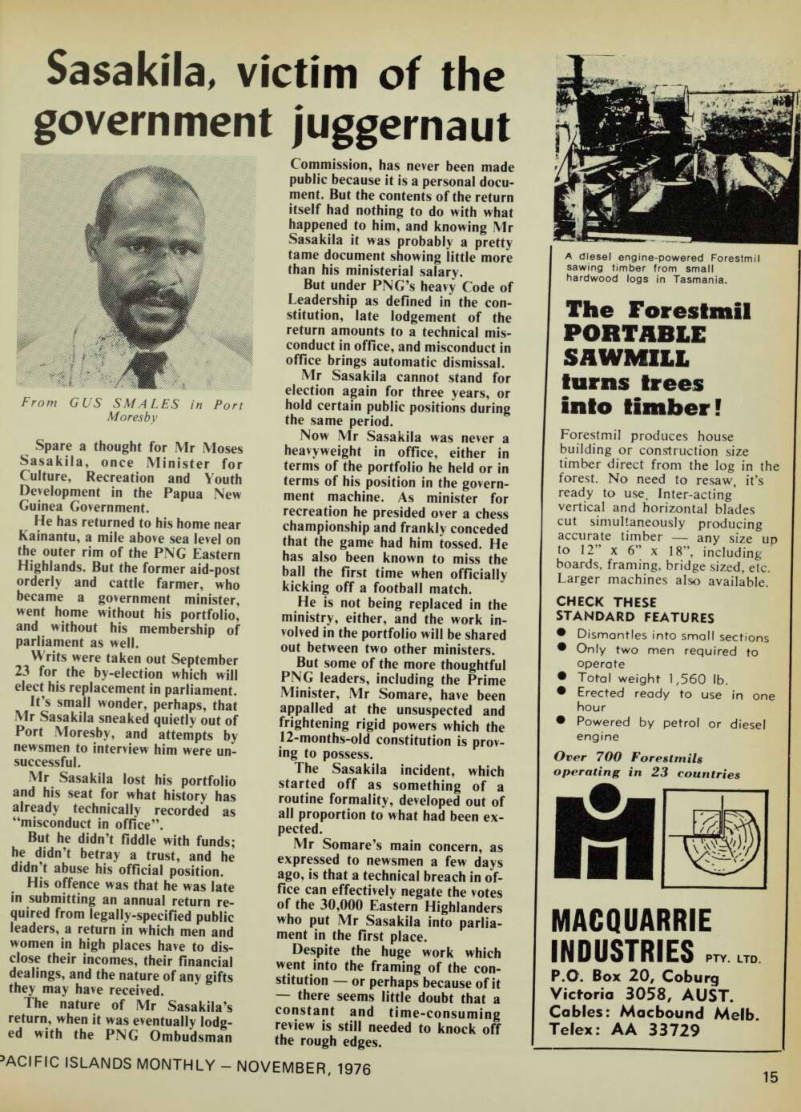
Sasakila, victim of the government juggernaut
Spare a thought for Mr Moses Sasakila, once Minister for Culture, Recreation and Youth Development in the Papua New Guinea Government.
He has returned to his home near Kainantu, a mile above sea level on the outer rim of the PNG Eastern Highlands. But the former aid-post orderly and cattle farmer, who became a government minister, went home without his portfolio, and without his membership of parliament as well.
Writs were taken out September 23 for the by-election which will elect his replacement in parliament.
It’s small wonder, perhaps, that Mr Sasakila sneaked quietly out of Port Moresby, and attempts by newsmen to interview him were un successful.
Mr Sasakila lost his portfolio and his seat for what history has already technically recorded as “misconduct in office”.
But he didn’t fiddle with funds; he didn’t betray a trust, and he didn’t abuse his official position.
His offence was that he was late in submitting an annual return re quired from legally-specified public leaders, a return in which men and women in high places have to dis close their incomes, their financial dealings, and the nature of any gifts they may have received.
The nature of Mr Sasakila’s return, when it was eventually lodg ed with the PNG Ombudsman
Commission, has never been made public because it is a personal docu ment. But the contents of the return itself had nothing to do with what happened to him, and knowing Mr Sasakila it was probably a pretty tame document showing little more than his ministerial salary.
But under PNG’s heavy Code of Leadership as defined in the con stitution, late lodgement of the return amounts to a technical mis conduct in office, and misconduct in office brings automatic dismissal.
Mr Sasakila cannot stand for election again for three years, or hold certain public positions during the same period.
Now Mr Sasakila was never a heavyweight in office, either in terms of the portfolio he held or in terms of his position in the govern ment machine. As minister for recreation he presided over a chess
championship and frankly conceded
that the game had him tossed. He has also been known to miss the ball the first time when officially kicking off a football match.
He is not being replaced in the ministry, either, and the work in volved in the portfolio will be shared out between two other ministers.
But some of the more thoughtful PNG leaders, including the Prime Minister, Mr Somare, have been appalled at the unsuspected and frightening rigid powers which the 12-months-old constitution is prov ing to possess.
The Sasakila incident, which started off as something of a routine formality, developed out of all proportion to what had been ex pected.
Mr Somare’s main concern, as expressed to newsmen a few days ago, is that a technical breach in of fice can effectively negate the votes of the 30,000 Eastern Highlanders who put Mr Sasakila into parlia ment in the first place.
Despite the huge work which went into the framing of the con stitution or perhaps because of it there seems little doubt that a constant and time-consuming review is still needed to knock off the rough edges.
From GUS SMALES in Port Moresby
Advertisements & other items, p. 15 (1 item)
Macquarrie
A diesel engine-powered Forestmil sawing timber from small hardwood logs in Tasmania.
The Forestmil
PORTABLE
SAWMILL
turns trees
into timber!
Forestmil produces house building or construction size timber direct from the log in the forest. No need to resaw, it’s ready to use. Inter-acting’ vertical and horizontal blades cut simultaneously producing accurate timber any size up to 12” x 6” x 18”, including boards, framing, bridge sized, etc.
Larger machines also available.
CHECK THESE
STANDARD FEATURES
• Dismantles into small sections • Only two men required to operate • Total weight 1,560 lb. • Erected ready to use in one hour • Powered by petrol or diesel engine Over 700 Forestmils operating in 23 countries
MACQUARRIE
INDUSTRIES pty. ltd P.O. Box 20, Coburg
Victoria 3058, AUST.
Cables: Macbound Melb Telex: AA 33729
Those Stateless People In Png
From a Port Moresby correspondent
There are some hundreds of Irianese, or, as they prefer to call themselves, West Papuans, in Papua New Guinea. Not all of them are refugees. A substantial number came to PNG from what was then Dutch New Guinea. before the Indonesian take-over of that territory. They came with the approval of, and under the sponsorship of, the Dutch Administration for the purpose of extending their education. While they were pursuing their studies here, In-
donesia took over their homeland, and, when their education was completed, they asked and were allowed by the PNG colonial ad ministration to stay on and take jobs here.
Others are political refugees who crossed the border, most of them between 1963, when In donesia took control of their coun try, and 1969, when the so-called “Act of Free Choice” confirmed Indonesia’s occupancy of it, and they were given permits to remain
in PNG. Since 1969 only a trickle of border crossers have made it and been successful in securing permits to remain.
Both these groups have proved themselves to be hard-working, in telligent and well-behaved people.
Some of them are highly-educated and fill positions of trust and responsibility here. Almost all of them have now forfeited Indone sian citizenship under Indonesian law, and if not granted PNG citizenship will become stateless persons, with all the worries and uncertainties which that involves.
Only those of their children who have been horn in PNG can claim citizenship as of right, but until recently they have been led to believe that their applications for naturalisation would be successful.
Out of the blue came a recent government announcement that they would not be allowed to become PNG citizens, and it appears to be a very firm decision.
It is difficult to believe that the reason for this apparent volte-face by the Somare government is other than a desire to appease Indonesia.
Understandably, the PNG Government is very sensitive about its relations with Indonesia.
It’s all very well for the “Pacific People’s Action Front’’, based in far-away Fiji, to condemn the PNG Government for its harsh decision. But Fiji doesn’t have to live cheek-by-jowl with an aggressive and expansionist nation of 120 million people. However, it remains to be seen whether this ex ercise in appeasement will be any more successful than similar exer cises have been in other places and at other times.
Less than a year ago, Prime Minister Somare, addressing the Assembly of the United Nations, declared that Papua New Guinea would not allow her friends to choose her enemies for her. Brave words indeed. * Sir Maori Kiki seemed to budge slightly on the issue when he said later that the Citizenship Ad visory Committee would consider the situation of the West Irian refugees.
Advertisements & other items, p. 16 (1 item)
Nelson & Robertson
nßEfty-
o'. o * •*0 z o in > rm v.
V; \V C> u
in our 8h
Selling
SERVICE
to the Pacific
NELSON & ROBERTSON
PTY. LIMITED
(Established 1895)
PLANTATION HOUSE, 197 CLARENCE STREET, SYDNEY
CABLES: "IVAN", SYDNEY, BRISBANE. TELEX: AA22381, SYDNEY.
FOR:
INDENTS
COMMODITIES
SHIPPING
TRAVEL
INSURANCE
REAL ESTATE
Branch Office: Nation & Robertson Pty. Ltd., 303 Adelaida St., Brisbane, Old.
New Guinea Representatives: Rabtrad Niugini Pty. Ltd., Rabaul Lae Madang Kieta.
Tonga devalues

Financial crisis Tonga devalues
Tonga, from midnight on September 19, devalued its currency by 6% against the Australian dollar.
The Ministry of Finance said the move was designed to make more money available to the government, to stimulate the economy and im prove the position of the country’s overseas reserves. The government found itself short of ready cash to meet everyday commitments.
Devaluation would increase foreign earnings from exports. The value of overseas aid would increase, and so would remittances from overseas.
Against all those benefits, however, the cost of living would increase because imports would be dearer. But dearer imports of items such as eggs and poultry meat should give an in centive to local farmers to become more competitive in the local market.
Devaluation should give a spur to in crease production for exports.
At the same time the government decided on a house-cleaning measure to cut out waste in government departments. Euphemistically, this measure was described as directing the Ministry of Finance to be the co ordinating and executing authority for supervising measures to alleviate financial difficulties facing the government.
All government departments have been told there will be a review of departmental revenue collections with the obiect of raising current charges.
The daily labour force is likely to be reduced, and no more daily paid labour will be recruited. Departments will be required to prove that staff recruitment is absolutely necessary. If they don’t meet those conditions, the Treasury may refuse to pay wages.
Overseas travel will be cut to a minimum, and will only be allowed where benefit will accrue to the government.
Internally, only essential inter island travel will be authorised. The frequency, number of officers on a trip and the duration of trips will be carefully controlled. Departments will be required to watch out for abuse and misuse of government vehicles ie private use of them during lunchtime, outside office hours and during weekends. In future, overtime will be limited to “absolutely essential” work.
Advertisements & other items, p. 17 (1 item)
4 Welders from
the BSSESah range
1 I ELECTRIC
for FABRICATING, CONSTRUCTION
MAINTENANCE AND REPAIR
-4 Lincoln Tractapac tractor driven welder/ generator: welding range 40-225 amp DC; auxiliary power 3 kVA 50 Hz 240 V continuous duty, for pumps, motors, power tools, lighting.
Available also as stationary unit for engine drive or for mounting on 4 x 4 for go-anywhere use.
Diesel Weldanpower 225 DC —economical reliable Diesel driven welder/generator. Transportable for on-site welding, 40 to 225 amp DC handling electrodes 2-5 mm ( 5 /64"- 3 /i6"). Auxiliary power, 3 kVA 240 V 50 Hz cont. duty—Other models, Lincwelder 225 petrol engine, details as above; Weldanpower 225 AC petrol engine 40-225 amp AC welding, auxiliary power 5 kVA 240 V or 115 V 60 Hz. Weldanpower 130 petrol engine 60-130 amp AC, auxiliary power 2.5 kVA 240 V 50 Hz.
LINK UP WITH
FOR THE RIGHT WELDER
FOR YOUR NEEDS
AGENTS
FIJI: Coral Island Motors, Suva • Lautoka • Sigatoka.
NEW GUINEA: Tutt Bryant Pacific Limited, Port Moresby • Madang • Lae • Goroka • Rabaul • Panguna.
NEW CALEDONIA: S.A.T.M.A., Noumea.
\ Lincoln AC225-S transformer welder, rugged, fan cooled design.
Welding capacity 40- 225 amp AC. Operates from 240 V 415 V or 460 V single phase 50 Hz supply. Handles electrodes 2 to 5 mm (%-*" to Vu”); with carbon arc torch (optional) handles heating, brazing, soldering. o Vr- Lincoln TM heavy duty transformer and transformer/ rectifier welders —range of six models for AC and AC/DC welding up to 750 amp, handling electrodes in the range 2.5 to 10 mm ( 3 /jj" to 3 /»") for all models. Input power 415 V 50 Hz single phase. Special voltages can be supplied.
THE LINCOLN ELECTRIC COMPANY (AUST.) PTY. LTD. 35 Bryant Street, Padstow (Sydney), N.S.W., Australia 2211. Tel. 77 0741.
People
The Papua New Guinea Governor- General, Sir John Guise, always a keen fisherman, is joining the ranks of the storytellers. He attended a football game in Port Moresby limping and without a shoe on one foot because of an injury. He told Rugby League officials he had been reeling in a Spanish mackerel “it must have been close to 90 pounds” and it had bitten him on the foot.
The Head of State of Western Samoa, Malietoa Tanumafili 11, was upset by the lack of pomp accorded him when he arrived in Lon don in September. According to his son, Captain Laupepa Malietoa, he complained that no member of the British Royal family was at Heathrow Airport to meet him. He contrasted this with the reception he received in Peking on his way to Europe. There he was met by Foreign Minister Chiao Kuan-hua.
The Foreign Office explained, however, that protocol had been respected. Tanumafili was in Britain on a private visit and was therefore
met by a lady-in-waiting of the Royal Household and a Foreign Ministry of ficial.
During his stay in Britain, he lunch ed with the Duke of Kent, He was also displeased with his reception in Paris, complaining that he was met by a junior official who murmured something about his being welcome to stay in France as a guest of the government when he ended a coming visit to West Germany.
Mr T. H. Layng, Queen’s Com missioner in Tuvalu, no longer has to wear two hats. Following recent resumption of duty after leave in the UK, he relinquished the post of Depu ty Governor of the Gilbert Islands. He has taken up permanent residence in Funafuti. While he held both posts he had to travel frequently between Funafuti and Tarawa.
The Rev Daniel Mustapha, 46, will become the first Fiji-Indian president of the Methodist Church in Fiji in January when he succeeds the Rev Setareki Tuilovoni for a three-year term. Mr Tuilovoni, after Mr Mustapha was elected by 200 delegates at the Methodist Church Conference, remarked, “It is a mark of true unity that the conference was able to elect the best person to the post, regardless of social distinc tions.” Mr Mustapha, who was born at Levuka, was ordained in 1959, and later went to Leonard College, Jubulpur, India, from where he graduated in 1965 with the degree of Bachelor of Divinity. He is married and has four children. He speaks the Fijian language fluently.
Miss Maris King, Australia’s Deputy High Commissioner to Western Samoa and Tonga, has com pleted three years in the Pacific and has returned to Australia. One of her last official “chores” was a visit to Western Samoa, which coincided with a goodwill visit to Apia, from September 29 to October 3, of the RAN submarine HMAS Ovens. She was quick to deny that the visit of the submarine had anything to do with re cent Russian and Chinese advances to Western Samoa, saying it had been planned well before the connection between Russia and Western Samoa and Tonga came to the surface.
Advertisements & other items, p. 18 (1 item)
Your
Made from longer lasting, harder wearing, non scuffing, washable, virtually indestructible plastic. Better than leather in every way because Kaydee' are unaffected by soils, oils,
PUT
BEST
FOOT
m m
KAYDEE
Roman Sandals
and you won’t
look back
MMi
H SHI
Marketed by salts and acids, fresh or salt water, fungus and bacteria.
Kaydee's are available at reasonable prices in adults and children's sizes.
Ideal for schoolwear, fishing, beachwear etc.
Plastic Products Moulding Company
PRIVATE BAG HAMILTON N.Z.i
News
The
In A
Nutshell
Planters Defended
The role of the white planter often under attack in Papua New Guinea’s new nationalism has been defended by a government minister, the Environment and Conservation Minister, Mr Stephen Tago. He said the maintenance and opera tion of large plantations had always been an important part of the rural economy.
Despite changing political and economic
conditions, plantations continued to be just as important in the sphere of national development as they ever were. The impor tant point was the manner in which the planters themselves fitted in to the new Papua New Guinea.
He believed the transition had been ac complished in a way which laid good foundations for the future. Mr Tago was opening the 51st annual conference of the Planters Association of New Guinea, held at its headquarters in Rabaul. • PNG legislation expected to become law very shortly will ban all but PNG citizens from owning land. Freehold land now held by non-citizens will be converted into leasehold land. The new law will also determine the term, rent and development :onditions of the leases.
Police Station Siege
Police reinforcements were brought 80 dlometres by air in a hurry in September o break up a siege at the Bulolo police sta i°n in Papua New Guinea. An angry :rowd surrounded the police station claim ng they intended to kill a man being held nside. Trouble erupted when a reversing 'chicle killed a man in the grounds of the )ig veneer factory operated at Bulolo by Commonwealth New Guinea Timbers, 'riends of the dead man attempted lynch aw justice against the driver, who was escued by police and taken under guard to he police station. But the crowd followed houting that they wanted revenge, and locked off the street outside the police tation. Riot police were flown in from Lae
and the crowd was dispersed. Six men were arrested five on charges of riot and one on a charge of having carried an offensive weapon.
Leprosy Survey
After making surveys of the incidence of leprosy in the New Hebrides and the Solomons, a World Health Organisation leprologist is to undertake similar work in Western Samoa.
The scientist, Dr Lopez Bravo, has said that the incidence of leprosy among South Pacific Island populations had never been determined, but it was now known to be surprisingly significant. It was difficult to determine exact numbers, as several islands had a very high incidence of the dis ease while others were totally free of it.
Leprosy is the foremost crippling dis ease in the world since a vaccine was developed to prevent poliomyelitis,” Dr Bravo said. There were estimated to be about 15 million lepers in the world, of whom a large number were untreated.
“With methods of treatment so greatly improved in recent times, the real need to day is to identify sufferers from the disease so that they may be given treatment and cured,” he said.
Dr Bravo’s work is being supported to the tune of $24,000 a year by the Lepers’
Trust Board, headquartered in Christchurch, New Zealand. Donations to the Leper Man Appeal” may be sent to the Board, Private Bag, Christchurch, NZ.
Self-Denial
Fiji’s top public servants recently, as a patriotic gesture, decided to forgo any pay rise this year. The Cabinet decided to follow suit, and urged parliamentarians to do the same. Prime Minister Ratu Sir Kamisese Mara said it was encouraging to see civil servants doing what they could to help overcome difficult times, when so many external factors, beyond Fiji’s con trol, contributed to the country’s financial difficulties. But the Public Service Association decided not to go along with the idea, saying that many civil servants, particularly on the junior and middle levels, had been waiting since the begin ning of the year for a pay review. Nor would the association tolerate any curtail ment of its members’ privileges and fringe benefits.
Come Back Anzus!
Despite strong government objections, the PNG National Parliament has called for negotiations with the ANZUS powers to have Manus Island re-established as a naval and air force base.
The original motion, moved by Mr Michael Pondros (Manus Open), express ed concern at Russian activities in the Pacific and Indian Oceans”.
The Opposition Leader, Sir Tei Abal successfully amended the motion to read
“some other countries” instead of having it name Russia.
Opposing the motion, the Minister for Defence, Foreign Affairs and Trade, Sir Maori Kiki, said it was still obvious the motion was talking about Russia, as the Soviet had interests in both the Indian and Pacific Oceans.
He described the motion as “dangerous
and provocative”.
“We must think about the well-being of our people,” he said. “Once you let the others in, the Russians will want to come in too.”
The Opposition Shadow Minister for Defence, Foreign Affairs and Trade, Mr Anton Parao (Enga), called on the govern ment to give up its non-aligned policy and decide who were its friends and enemies in the East-West confrontation.
The US had a large naval and air force base on Manus during the Second World War, but left the island in 1947. Australia had a naval base in the area but handed it over to PNG in November, 1974.
Nz Stretches Out
New Zealand has decided to upgrade its representation in Tonga to the status of high commissioner. The official represen tation had been confined to an immigra tion attache. When attention to other matters became necessary it was necessary
for the High Commissioner in Western Samoa to visit Tonga. New Zealand now has high commissioners in Fiji (who also covers Nauru), Papua New Guinea, Western Samoa and Tonga, a consulate general in New Caledonia, representatives in the Cook Islands and Niue and trade correspondents in Western Samoa and Tahiti.
Measly Meters
Parking meters are not the money spinners people generally believed them to be, according to the Fiji Commissioner of Police, Mr John Kelland. Apart from his knowledge about their operation in Suva, years of experience with them in the UK convinced him they were “totally un economic”. The wages of the people re quired to maintain them, to clear them and to administer them exceeded the takings from the meters. On top of that they were frequently jammed because people used “dud” coins in them. Then there was always somebody who learned how to open them, and that created problems for the police. Mr Kelland favours a traffic warden system, or a fixed penalty system.
Dry Dock Patrol
Fiji recently received a couple of launches from Australia as an aid gift, and handed them over to the police. One is bas
ed at Suva and the other at Lautoka. They are valuable adjuncts in preventive patrols and life-saving. But, unfortunately, they spend more time out of the water than in it, the Commissioner of Police, Mr John Kelland, said recently. There had been a plague of mechanical breakdowns-. Mr Kelland said that basically there was nothing wrong with the launches, and they had very good engines. But the police did not have people who knew how to maintain and service the launches.
Evasive Island
An air search was mounted in August for the 65-ft coastal ship Fatima Star after she failed to arrive at her destination of Wuvulu Island, 200 km off Wewak on the Papua New Guinea coast. But the ship’s captain had the best of excuses. He hadn’t turned up at Wuvulu because he couldn’t find it.
The ship was eventually sighted from the air on her way back to Wewak to prepare for a second try at finding the tiny, low lying coral island.
Aboard was a party of 37 US students and lecturers who planned to spend several weeks on the island carrying out oceanographic studies. The group, from Pepperdine University, Los Angeles, had paid SUS2OOO each to go on the study tour to PNG.
Advertisements & other items, pp. 19-20 (2 items)
19
ACIFIC ISLANDS MONTHLY - NOVEMBER, 1976
Buying office
BANKNOTES WANTED
FOR
IMMEDIATE CASH.
We are interested in purchasing obsolete Pacific Islands, New Zealand and Australian banknotes.
Also Straits Settlements- Malaya area, Hawaii, New Guinea (German and Dutch issues) Used and worn banknotes are often worth not much more than their face value. However brand new, mint uncirculated obsolete notes are frequently worth a substantial amount over face value;up to several hundred dollars each in a few cases.
Current notes are not required.
Because of the importance of condition in determining the value of banknotes it is essential we inspect the notes before we can make a firm offer.
Send a very detailed description of any notes you wish to sell and state any date printed on the note.A Xerox photocopy is particularly helpful.ldeally, send the notes themselves by registered mail.
We guarantee a prompt reply and a fair cash offer if interested in your notes.
As we are the largest and best known stamp and coin firm in the Southern Hemisphere you are assured of complete integrity and satisfaction.
SEVEN SEAS STAMPS
(of Dubbo)
Buying office
P.O. Box 47
Pymble 2073
N.S.W. Australia
SHIPBUILDERS TO THE PACIFIC..
3C a LANDING BARGE under construction at
CARPENTERS INDUSTRIAL SHIPYARD, Walu Bay, Suva
Fiji Islands, for Mr. Anton Lee of Port Moresby, Papua New Guinea.
CARGO CAPACITY; 14,000 c.ft. LENGTH: 114ft.0.A.
Powered by twin GARDNER diesel each_23ohp.
CARPENTERS INDUSTRIAL RO. BOX 296
SUVA,FIJI. PHONE 312-133.
PEease send me information on Shipbuilding in the South Pacific Name Company Addressr*
Editor’S Mailbag

The Suva 'Y'
The article “Teeth and Talons Bared at Suva ‘Y’ ” in September PIM (p 16) by Robert Keith-Reid, is notable both for its misreporting and misrepresentation of the facts.
However, most voluntary organisations, particularly those ser ving and run by women, are com paratively immune to this after cen turies of learning to live with it. There are two rather more serious concerns however: 1. The totally male chauvinist tone of the writing surprises, and I per sonally was amazed that even PIM, with its all-male staff, would go along with this. Writing in the classic tone (employed by all but a few notable reporters in the Pacific) which puts down women, is surely going out at last? 2. The concluding section of the ar ticle fails totally to point out that, in spite of mistakes by both board members and staff, the membership of the Suva YWCA, as befits a democratic membership movement, stepped in and voted their into action, which all of us connected with this international organisation consider a triumph.
Ruth E. Lechte,
(World YWCA South Pacific Area Secretary.) Nadi. ’
Fiji • With regard to the second of the ‘more serious concerns”, the offen ding article did report that the members met. passed a vote of no :onfidence in the directorate and dected a new board. Editor.
I have just returned from attending he third convention of the Fiji fWCA as official representative of he World YWCA. I was appalled to ead the article in the September issue )f PIM entitled “Teeth and talons >ared at Suva” and take exception to he chauvinist, sexist language used by Robert Keith-Reid.
Apart from incorrect facts stated, it 5 one of the worst put-downs of /omen I have read and to say I am
surprised to see it in a respected magazine such as PIM is to put it mildly. Would the author have been allowed to use such language if it had been about a business firm run by men? It is obvious that men can.be “bitchy” too. I request a public apology in the next issue of PIM.
Heather B. Crosby
(Member, World YWCA Executive Committee) North Adelaide
Our Nice
Exuberance
We are long subscribers to PIM.
However, somehow we think the com puters goofed this time because we received today three packages of Pacific Islands Monthly, which all were addressed to me, Mr H. S. Judd, 8505 Woodlawn Avenue SW, Tacoma, Washington 98499, USA,’ and in those three packages we receiv ed three of the August PlM’s and two of the July PlM’s.
Please make whatever necessary corrections you need to as we do not need all these copies. With your per mission, and really without it even, we are going to give the additional copies that we do not need, like one for July and two for August, to our local library. This might be very good advertising for PIM by the way, as someone reading these might ask that the library subscribe to PIM.
We thoroughly enjoy PIM and we will continue our subscription, but we just wanted to let you know that your exuberance is nice, but unnecessary.
Herman S. Judd
Tacoma, Washington State.
Where's George?
I am writing to anyone who may have any information concerning the descendants of a British subject, Matthew Hunkin, originally from Cornwall, England.
In 1838, Mr Hunkin married the daughter of High Chief Faiivae of
Leone, American Samoa. One of his sons, George (Siosi), was believed to have settled either in the Gilbert Islands or on Thursday Island, Torres Strait, Australia it was rumoured also that George may have changed his name from Hunkin to “Hankin”.
Will appreciate any contacts from anyone having knowledge of George, especially the descendants of the Hunkin family.
Eni F. Hunkin Jr.
1324 Longworth Office Building US House of Representatives Washington DC 20515 USA.
A Cod!
To your knowledge has PIM, or one of its contributors, or the EDITOR himself done any research into what Pacific Islands fishermen’s wives talk about when their husbands are away fishing?
It is one of the most interesting matters for research in the whole of the Pacific, and I believe, one which has been somewhat neglected by
anthropologists, ethnologists,
ethnographers, economists, prime ministers and editors.
It has been suggested that Pacific Islands Fishermen’s Wives Discuss Their Husbands’ Prowess As Fishermen. In your opinion, how true is this?
Tripolemus Gillowley
• Neither the editor nor any of his stuff has been with a fisherman’s wife while her husband has been away fishing. Editor.
Advertisements & other items, pp. 21-24 (2 items)
21
ACIFIC ISLANDS MONTHLY - NOVEMBER, 1976
Keeps you informed
BECOME A PART
OF PlM's PACIFIC
AND SUBSCRIBE NOW
Keeps you informed
FILL IN THE DETAILS
ON THE ATTACHED
ORDER FORMS
Total service 0n ...
plumbing supplies Fast
WATSON & CRANE
are organised to fulfil your needs
wherever you are in the South Pacific it. r*: « You can get all you need from one supply source: water taps, valves, copper tube, tools and a host of other fittings and related plumbing equipment for domestic, industrial and multistorey buildings.
Watson & Crane Pty Ltd have over 20,000 plumbing items in stock at their central warehouse located at Waterloo, NSW, Australia.
Years of experience in handling and shipping right throughout the South Pacific add up to another big reason for you to deal with Watson & Crane Pty Ltd.
Representatives call regularly at New Guinea, Papua, the Solomons, New Hebrides and Fiji Islands to personally discuss your requirements and appropriate credit arrangements.
Write, cable or telephone today for complete plumbers' supplies service.
Watson & Crane Pty. Ltd. 1037 Bourke Street, Waterloo,
NSW 2017.
Phone: Sydney 699-1333.
Telex: AA 25548.
Cables: "Watcrane" Sydney.
Pacific Island distributors of Crane Enfield copper tube for water, sanitation, engineering, refrigeration and air conditioning.
How to help
create a softer beauty
for your complexion
The early signs of age in your complexion can be softened and smoothed to a more youthful look by giving your skin a few moments pampering each day with a unique tropically moist oil blend.
One of the secrets of soft, smooth, supple skin lies in the potential of the skin’s failing oil and moisture to be supplemented by the
daily smoothing on of
a remarkable beautifying fluid.
AS A WOMAN passes her thirties, .it is normal for her complexion beauty to start fading and for her skin to adopt the signs of a prematurely older look. This is due to the tiring of the beautifying reservoirs which nestle in the mitotically active area of your skin and which supply the outer skin layer with its softening fluids.
Fortunately, these signs can b( softened and the resulting rough skii and accentuated surface line assuaged in order to help keep th< complexion looking younger as th< years pass by.
Pamper Your Skin to Softness
A few moments each day pampering the complexion with a light film of a scientifically developed tropically moist oil blend can help restore and maintain the vital balance of oil and moisture in your skin the remarkable fluid simulating the action of the skin’s natural fluids to bring benefits similar to those provided by its own oils and moisture.
The tropically moist Oil of Ulan, through its affinity with the natural fluids, penetrates rapidly into the stratum corneum or outer layer of your skin to help condition the keratinous area so that a softer, smoother, more supple and radiantly lovely complexion can result.
Smoothed over the entire face and neck before you venture outdoors and again at night before you retire, the Oil of Ulan leaves a fresh, natural, non-greasy feeling and such is its efficacy that Oil of Ulan moist oil blend has become for women in many parts of the world, a priceless element in preserving softer, smoother and more supple complexion beauty.
SOME OF THE FIRMS
WE REPRESENT ARE
Asia Rubber Works (Singapore Rubber Shoes) Frappier (French Brandy) Huvet (French Brandy) Indika (Belgium Dairy Produce) Durobor S.A. (Belgium Glassware) Miroiterie Gen. de Belgiqe S.A. (Louvre glass and mirrors) City Engineers (U.K. Bicycles) F.H.I. Japan (Subaru Cars) Kraggs (Wines, Spirits, Ciders) Sunshine Biscuits Sunrise (Confectionery) Flamenco (Instant Coffee & Tea) Quaker Products (Oats, Jets) Hancocks (Spaghetti, Cereals) Melbourne Canning (Jams) Amatil (Twisties, Twirlies) Edward Zorn (Margarine, Cooking Fats) Allens (Confectionery) Red Tulip (Fine Chocolates) Robert Timms (New Guinea Gold Instant Coffees and Teas) S.P.C. (Canned Fruit) S.P.C. (Abalone) Wing Lee (See You Sauce) Magnet (Mattresses) Essteel (Cookware) Warner-Drayton (Fans) Mitchell's (Abrasives) Tilbury & Lewis (Sports Trophies & Silverplate) Regent (Swiss watches) Lega Marcasite (Jewellery) Austramax (Pressure Lanterns) Lawn Chair; Tubco (Garden Furniture) Electronic Industries (Electrical Household Appliances) Jex (Steelwool) Arnbro (Folding Beds) James Miller (Blankets) Elmaco (Plastics —Electrical Fittings) B.X. (Plastics) Stegbar (Wooden Louvres) Franklite (Light Fittings) J.J. Cash Embroidered Labels) Disston (Saws)
S. E. TATHAM
& CO. PTY. LTD.
BEEHIVE BLDG.,
94 ELIZABETH ST.,
MELBOURNE, 3001, AUSTRALIA.
G.P.O. BOX B—CABLES "SET"
TELEPHONE 63 5094
TELEX: AA34293
BUYERS FOR THE
PACIFIC ISLANDS
!5a \ %
DIRECT ENQUIRIES WELCOMED
PAPUA NEW GUINEA: S. E. TATHAM (P.N.G.) PTY. LTD.,
LAE: MALAITA STREET (P.O. BOX 1562).
PORT MORESBY: CNR. GOROA AND MUNAHU STREETS, GORDON
(P.O. BOX 6733, BOROKO).
FIJI: S. E. TATHAM (FIJI) LTD.,
LAUTOKA: P.O. BOX 366.
SUVA: G.P.O. BOX 671.
YOUR GUARANTEE
SINCE 1924
1
FOR SERVICE
quits Saipan
Chase Manhattan quits Saipan
The Chase Manhattan Bank has closed its office on Saipan, according to Micronesian News Service, quoting the local press.
Francisco T. Uludong, the bank’s marketing representative in the Marianas and the rest of Micronesia, said he had been told by the bank’s Guam branch to shut up shop on Saipan because Chase is los ing money and wants to cut out all marginal operations.
The Chase’s closure still leaves Saipan and the Marianas with five ending institutions: Bank of \merica, Bank of Hawaii, California ~irst Bank, Citicorp and the \merican Savings and Loan Associa ion.
Advertisements & other items, p. 23 (1 item)
’Acific Islands Monthly - November, 1976
The Islands, The Spc And
A ‘Certain Kind Of Unity’
The notion of South Pacific regionalism was put under the microscope in a recent address to the Australian Institute of International Affairs in Canberra by Dr E. Macu Salato, Secretary-General of the South Pacific Commission.
Dr Salato, ex-Mayor of Suva and ex-diplomat, began his wide-ranging and frequently hard-hitting speech by suggesting that South Pacific regionalism should be basically ap proached as meaning “unity in diver sity”. “Indeed the region is diverse,” he said. “Yet at the same time it has a whole nexus of common traditions, common interests, common points of view yes, a certain kind of unity”.
In a survey of the history of regional institutions since the founda tion of the South Pacific Commission in 1949, Dr Salato paid tribute to the SPC’s role as “a major factor in the birth of South Pacific regionalism.”
“But”, he added, “the commission did have shortcomings they includ ed the minor role played by Islanders in the decision-making process, the lack of adequate funds to implement the commission’s work programme and, the most irksome aspect of all for Island countries, especially as they
evolved constitutionally and attained
independence or self-government, the fact that the Canberra Agreement [under which the commission was es tablished in 1949) made no provision for discussion of political matters.”
Dr Salato identified July, 1965, and the Sixth South Pacific Conference leld in Lae at that time, as the mo ment of emergence of an authentic South Pacific regional spirit.
He said the “outspoken expression )f regionalism” which occurred at the conference was led by Ratu (now Sir) Camisese Mara. But it also had “solid jacking” from other Island represen atives.
He described the formation of the >outh Pacific Forum, which held its irst meeting in August 1971, and of he South Pacific Bureau for economic Co-operation (SPEC), es ablished in Suva in November 1972, s “the most important and influen-
tial of the latest manifestations of South Pacific regionalism”.
“There can be no doubt that the main reason for the Forum’s founda tion was the impossibility of discuss ing political matters at the South Pacific Conference,” he said.
Returning to the concept of “unity in diversity”, Dr Salato said: “This is the all-pervading idea which is ex pressed consistently at regional meetings. Whether the matters being
discussed concern religion, education, politics, trade, health or sport, the common ground is always there.
There is unity in the face of the out side world. It may be expressed with all the wit, the grace, the flourish of traditional Polynesian oratory; it may be uttered with the finesse of modern diplomacy; in moments of extreme emotion, it may be voiced harshly, even rudely. In relation to outsiders, these small countries for even Papua New Guinea, the giant of the Pacific, is small on a world scale are as one. Sometimes cracks can appear in the unity, when, as for ex ample in discussions of a possible regional airline, national interests are not altogether in tune with a regional approach. But in the famous phrase coined by Ratu Sir Kamisese Mara and now widely used throughout the region, these differences are resolved ‘in the Pacific Way’, by formal and in formal negotiations.”
He went on; “One of the assets of the Pacific, as far as regionalism is
Dr. Salato
concerned, is its small size. While this may be a disadvantage in economic terms, it has the very real advantages of enabling representatives of different countries to meet and know each other well as people.
“Many of the Pacific leaders of today first met, for example, as students at the Fiji School of Medicine. The younger generation, the rising leaders, get to know each other at the University of the South Pacific. There are personal contacts not only between top national leaders, but also between those who represent the churches, the various specialised departments of national governments and administrations, the youth movements.
“I am proud to say that this personal contact is one area in which the South Pacific Commission has made a long-lasting and meaningful contribution to the Pacific sense of regional identity, not just through the South Pacific Conference, but also through its many specialised meetings and training courses, and its aid for study visits between territories and student travel within the region.”
Of the future, Dr Salato said; “I am no prophet, and I do not dare to make concrete predictions which
history might prove to be wildly off the mark. However, I think a general trend is discernible. South Pacific regionalism, in the sense of a united concern for the welfare of all the members of the Pacific family, is still very young. If we take its first appearance in the world as being the Sixth South Pacific Conference, South Pacific regionalism has just celebrated its 11th birthday. It has yet to develop, to reach maturity. And while the ‘top people’ of the Pacific Islands are very conscious of the things they have in common, the ‘man in the street’ is still too busy struggl ing with his problems social, medical, economic to be very much aware of his neighbours in the nextdoor island.
“It will be many years before those problems are adequately remedied, The time-worn picture of the happy Islander in his ‘paradise on earth’ was probably never accurate; certainly it is not so today. Like any man, the Pacific Islander needs food and shelter for his family, an outlet for his primary produce, a relevant education system for his children, an opportunity to lead a full, contented, useful life.
“This, as I see it, is the ultimate
goal towards which the regional and sub-regional organisations of today, and those which will come into being in the future, are striving. This is what regionalism is all about. As the dis tances between the Islands have shortened with the advent of air travel and satellite communications, so the extended family has expanded to in elude the whole region. There is a place for all, and no one must be left out.”
Sp Con Fer Ence
The 16th South Pacific Confer* ence, this time confined to a week for the first time since its inception, opened in Noumea on October 20 with an official reception staged by the French Administration in the new ORSTOM Auditorium. Mr. Dick Ukeiwe, President of the New Caledonia Territorial Assembly was conference chairman. A new name for the South Pacific Corn mission and proposed functional changes were on the agenda. A report of the conference will ap pear in the December PIM.
‘Let’s get together,' says Somare
The Papua New Guinea Prime Minister, Mr Somare, has called for the development of a Pacific consciousness.
Mr Somare was speaking at a welcoming function for the Deputy Prime Minister of Fiji, Ratu Sir Penaia Ganilau, and the Leader of the New Zealand Opposition, Mr Bill Rowling, guests at PNG’s Independence Day celebrations Mr Somare said nations had shared the Pacific for years, but without developing the sort of ties which linked them as regional partners. He believed that unless the countries now set out to foster a Pacific consciousness, there could be dangerous consequences.
One of the consequences would be the intrusion of other countries who would be prepared to get what they could from the Pacific, but without having the in terests of the Pacific at heart.
“I am concerned because I believe that unless this Pacific consciousness develops, we will see others from outside whose first interest cannot be our region enter the picture,” he said.
Mr Somare said that one of the heaviest responsibilities rested on the larger developed nations. When these nations made decisions in a Pacific context thev should not merely think of themselves and their alliances, but of the effect of the decisions on the smaller Pacific nations.
He believed this was one of the best ways in which the smaller nations would be encouraged to broaden their horizons. He also believed that, unless the Pacific nations supported each other on current and future issues, mutual hope would be ZIZ ?T n . g 'T Une to divisi *f ideo,0 B ies - A Pacific consciousness could provide a voice of commonsense to world affairs.
Advertisements & other items, pp. 25-28 (2 items)
25
ACIFIC ISLANDS MONTHLY - NOVEMBER, 1976
with....
TURNS GRASS INTO LAWN
ZrrTurX
UTILITY 160
THE “WORK HORSE” OF THE
VICTA RANGE
SUPER 24
THE BIG MOWER FOR
BIG AREAS
The big mower from Victa. It takes a full 61 cm wide bite into and cuts a smooth swath over large expanses of grass. It is the mower for municipal parks and gardens, sports grounds, road-side growth control as well as home owners with large areas of land. The lightweight construction of the mower makes it easy to manoeuvre and the giant rear wheels ride rough ground effortlessly. Two freeswinging blades cn the cutting disc absorb shock when hard objects are encountered.
A tough but lightweight mower without grasscatcher, a model designed to do a superb grasscutting job—on meadows full of weeds or on a fine lawn. It cuts clos, up to trees and fences and is the lightest Victa mower of all to use. Available with either a 125 c.c. Victa 2-stroke engine or with the Victa 160 c.c. 2-stroke engine— Folding handle and single-lever simultaneous height adjustment are other features that make this lowest priced VICTA a popular mower.
lip up & away
with...
There’s really
only one tool
SIDCHROME
There s a saying in the tool business.
If you’re going to throw a spanner in the works, make sure it’s a Sidchrome spanner.
And that goes for all Sidchrome tools.
Sidchrome tools are made from the highest quality alloy steel. Finished in a tough, everlasting nickel chrome, and made to last.
That’s why Sidchrome hand tools are un-
conditionally guaranteed.
m mmm P.N.G. AGENT:- R. & J. Henderson, P.O. Box 353, Lae.
The world over, more vehicles of all kinds roll on Goodyear tyres ... more planes land on Goodyear tyres ... more synthetic rubber is produced by Goodyear... and more different kinds of hose,
transmission belts, conveyor belts and other
industrial rubber goods bear the Goodyear trademark.
For leadership in rubber technology, look to Goodyear. The world s largest rubber company.
We solve industrial problems.
GOODYEAR DISTRIBUTORS IN S.E. ASIA AND PACIFIC BASIN
GOOD
Boroko Motors Ltd.
Port Moresby, PNG.
Societe General Automobile Noumea, New Caledonia Service Mobil Papeete, Tahiti Santo Engineers Santo, New Hebrides Microl Corporation Saipan, Mariana Is.
Pacific Motors Vila, New Hebrides Yap Cooperative Ass.
Yap, W. Caroline Is.
Morris Hedstrom Ltd.
Apia, Western Samoa Buncombe Bay Garage Norfolk Is.
Truk Trading Co.
Truk, E. Caroline Is.
P.A.M.I.
Morris Hedstrom Tonga Guam Tire & Supply Co.
Agana, Guam Cook Island Motors Cook Is.
Island Construction Co.
Majuro, Marshall Is.
Ngiratkel Etpison Co. Ltd.
Koror, Palau Yung Wei Tung Trading Co, Ltd.
Taipei, Taiwan Coral Island Motors Suva, Fiji Landis Brothers & Co. Ltd.
Hong Kong Solomon Motors Ltd.
Honiara, 8.5.1. P.
W.S.T.C.S.
Susupe Enterprises Saipan, Mariana Is.
Western Samoa Samoa Motors Inc.
American Samoa Kolonia, Ponape A 555
No Crystal-Gazing Needed For
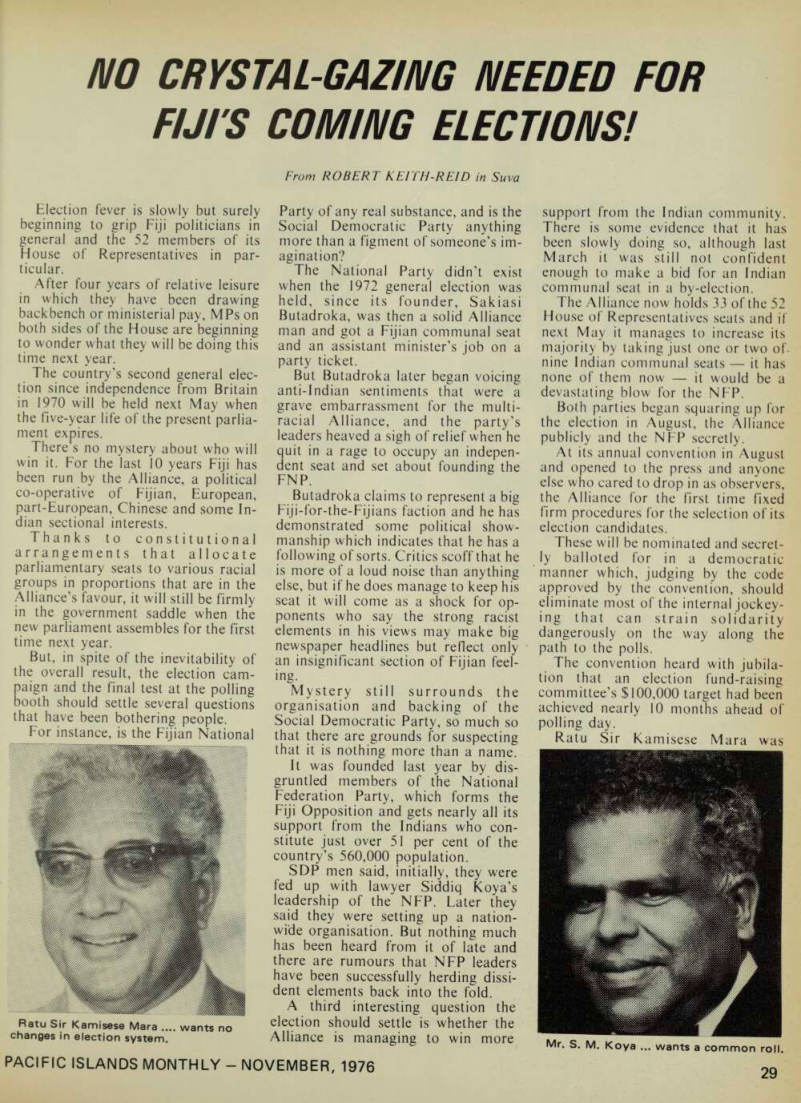

Fiji's Coming Elections!
From ROBERT KEITH-REID in Suva
Election fever is slowly but surely beginning to grip Fiji politicians in general and the 52 members of its House of Representatives in par ticular.
After four years of relative leisure in which they have been drawing backbench or ministerial pay, MPs on both sides of the House are beginning to wonder what they will be doing this time next year.
The country’s second general elec tion since independence from Britain in 1970 will be held next May when the five-year life of the present parlia
ment expires.
There s no mystery about who will win it. For the last 10 years Fiji has been run by the Alliance, a political co-operative of Fijian, European, part-European, Chinese and some In dian sectional interests.
Thanks to constitutional arrangements that allocate parliamentary seats to various racial groups in proportions that are in the Alliance’s favour, it will still be firmly in the government saddle when the new parliament assembles for the first time next year.
But, in spite of the inevitability of the overall result, the election cam paign and the final test at the polling booth should settle several questions that have been bothering people.
For instance, is the Fijian National
Party of any real substance, and is the Social Democratic Party anything more than a figment of someone’s im agination?
The National Party didn’t exist when the 1972 general election was held, since its founder, Sakiasi Butadroka, was then a solid Alliance man and got a Fijian communal seat and an assistant minister’s job on a party ticket.
But Butadroka later began voicing anti-Indian sentiments that were a grave embarrassment for the multi racial Alliance, and the party’s leaders heaved a sigh of relief when he quit in a rage to occupy an indepen dent seat and set about founding the
Fnp.
Butadroka claims to represent a big Fiji-for-the-Fijians faction and he has demonstrated some political show manship which indicates that he has a following of sorts. Critics scoff that he is more of a loud noise than anything else, but if he does manage to keep his seat it will come as a shock for op ponents who say the strong racist elements in his views may make big newspaper headlines but reflect only an insignificant section of Fijian feel ing.
Mystery still surrounds the organisation and backing of the Social Democratic Party, so much so that there are grounds for suspecting that it is nothing more than a name.
It was founded last year by dis gruntled members of the National Federation Party, which forms the Fiji Opposition and gets nearly all its support from the Indians who con stitute just over 51 per cent of the country’s 560,000 population.
SDP men said, initially, they were fed up with lawyer Siddiq Koya’s leadership of the NFP. Later they said they were setting up a nation wide organisation. But nothing much has been heard from it of late and there are rumours that NFP leaders have been successfully herding dissi dent elements back into the fold.
A third interesting question the election should settle is whether the Alliance is managing to win more
support from the Indian community.
There is some evidence that it has been slowly doing so, although last March it was still not confident enough to make a bid for an Indian communal seat in a by-election.
The Alliance now holds 33 of the 52 House of Representatives seats and if next May it manages to increase its majority by taking just one or two of nine Indian communal seats it has none of them now it would be a devastating blow for the NFP.
Both parties began squaring up for the election in August, the Alliance publicly and the NFP secretly.
At its annual convention in August and opened to the press and anyone else who cared to drop in as observers, the Alliance for the first time fixed firm procedures for the selection of its election candidates.
These will be nominated and secret ly balloted for in a democratic manner which, judging by the code approved by the convention, should eliminate most of the internal jockey ing that can strain solidarity dangerously on the way along the path to the polls.
The convention heard with jubila tion that an election fund-raising committee’s $lOO,OOO target had been achieved nearly 10 months ahead of polling day.
Ratu Sir Kamisese Mara was
Ratu Sir Kamisese Mara ... wants no changes in election system.
Mr. S. M. Koya ... wants a common roll.
returned unchallenged as the Alliance’s leader and proclaimed his party’s election platform. This, he said, was detailed in the $370 million 1976-1980 development plan publish ed last January.
The plan, he said, spelt continuing peace, progress and steady growth of prosperity for all if the Alliance got the five more years of power it needed to implement it.
In Parliament a few days later, Ratu Mara told a questioner that the Alliance completely rejected the idea of changes in Fiji’s communal election system as recommended by a Royal Commission of three British lawyers in a report also published last January.
His party did not think the report’s arguments justified “any change in the method of election which is suitable to our multi-racial society”.
The Alliance’s stand in resisting constitutional change is hardly sur prising since the present system of 22 guaranteed seats for Fijians, 22 guaranteed for Indians and eight for people of other races more or less guarantees perpetual power for it.
The Royal Commission urged a drastic reshaping of the electoral set up by the scrapping of 25 communal seats and their replacement by 25 “national” seats voted for on non communal lines a common roll.
In rejecting constitutional change, Ratu Sir Kamisese and his party would seem to have provided meat for the NFP to maul at during the elec tion campaign.
Mr Koya’s NFP has long bitterly opposed communal voting, knowing it has virtually no chance of attaining power while it is continued. But in moving to renew its battle with the Alliance over this issue, the NFP is, as yet, showing nothing like the con fidence the Alliance is displaying.
Rocked by internal splits and ap parently beset by money problems the NFP’s image is in complete contrast with the $lOO,OOO gilt-edged solidarity the Alliance boasts.
In recent months, Mr Koya has lost his place as NFP president to a woman, Mrs Irene Narayan, although he is still, officially, overall leader and Leader of the Opposition in parlia ment.
There was a “sustained attack” on Mr Koya to “discredit his authority and leadership and thus weaken the
party structure and cause confusion and loss of direction in the rank and file of the party,” it said.
Mr Koya and Mrs Narayan are rumoured to have patched up their differences, although some people wonder if the patch they have used will stand up to the wear and tear of a general election campaign.
One feature of previous Fiji elec tioneering will, the Alliance Party hopes, be totally absent from the cam paign now warming up. This is the type of speech that works up public anger, suspicion or alarm about any particular race or community.
In August, the House of Represen
tatives passed amendments to the Public Order Act making it illegal to do, say or publish anything that in cites race hatred.
A New Party
A 76-year-old former member of Fiji’s Legislative Council, Mr Brahma Das Lakshman, has announced the formation of a new political party, the Progressive Girmit Party.
He claimed that the party was “for the descendants of Indian indentured labourers”. It was hoped that it would stand candidates in the coming general election.
Advertisements & other items, pp. 30-33 (1 item)
a healthier place
that makes your home
How effectively you protect your family from the dangers of disease carrying insects, may well depend on the insect spray you choose.
Powerful Insect Killing Ingredients.
Concentrated Pea Beu is one of the most powerful household insect sprays in the world. Its principal insect killing ingredients have been selected to ensure rapid knock down and kill of all common disease carrying insects.
Rigid Testing. Through every stage of manufacture, Pea Beu is rigidly tested.
There are ingredient tests, spray droplet tests, pack tests, many forms of tests, some carried out three times over.
When you spray this remarkable aerosol insecticide, you can be sure that its ingredients have met with the most exacting standards enabling you to spray it safely with confidence in your home. m Family Health and Well Being. The common housefly carries up to half a billion germs and, when you realise that disease carrying insects enter even the best regulated households, you can understand why you can't be 100 careful about the effectiveness of your insect spray. Remember, even the tiniest droplet I i I il of concentrated Pea Beu kills flies, mosquitoes, all common disease carrying insects fast, so it is indeed a worthy guardian of your family's health and well being.
Concentrated Pea Beu. Even the tiniest droplet
kills flies, mosquitoes, gH common
disease carrying insects fast.
Such is the effectiveness of Pea Bnu’s insect killing ingred ient, that no common disease carrying insect can survive it. nor develop an immunity to it. When you spray Concentrated Pea Beu, it's nice to know that no common disease carrying insect can survive.
Pea Beu - The strong one, makes your home a healthier " '<”l,
E. G. BARKER & CO.
PTY. LTD.
Established 1825 150 Years of Service
AUSTRALIA'S OLDEST EXPORT HOUSE
GENERAL EXPORT MERCHANTS
Specialising in world-wide distribution of General Merchandise, Provisions and Produce
Buying Agents for;
THE CO-OPERATIVE WHOLESALE SOCIETY LTD.
Lae and all branches throughout PNC
Representatives
PORT MORESBY
RAYMOND WONG
P.O. Box 5020
BOROKO
Phone 25 5546
RABAUL
NEW GUINEA ISLANDS
PRODUCE CO. LTD.
P.O. Box 387
RABAUL
Phone: 921982
FIJI
PARAMOUNT AGENCIES
G.P.O. Box 459
SUVA
Phone 2 3127
34 HUNTER STREET, SYDNEY 2000
Cable Address: KERBAR SYDNEY Phone: 231 6200. Telex: 22221 Melbourne Office: 530 Little Collins Street.
Phone: 61 2877. Telex 31732
To Future Generations,
Security
7 * Tranquil Splendor.
Borobudu. Temple in Indonesi l built over 11 cen* es ago.
Social welfare is a subject of serious consideration in most modern societies.
Man in the twentieth century accepts his responsibility to bequeath to the next generation a society better than his own.
Daiwa Bank is not unique in accepting this responsibility, but Daiwa is unique in making acceptance of this role in society an integral part of their banking service.
Daiwa is the only Japanese city bank to combine banking and trust business. Daiwa is thus a fully integrated banking institution, comprising banking, international financing, trust, pension trust, and real estate business.
This integration is part of our effort to fulfil our social responsibility consistent with society's needs in a contemporary environment. a fully integrated banking service
DAIWA BANK
Head Office; Osaka, Japan London and Frankfurt Branches New York and Los Angeles Agencies Singapore, Sydney and Sao Paulo Representative Offices Joint Venture Banks: P.T. Bank Perdania, Jakarta, International Credit Alliance, Ltd., Hong Kong
EXPORTERS TO PACIFIC ISLANDS
Breekwoldt & Co P Ltd
276 Pin Street, Box 5027, G.P.O. Sydney 2001
CABLE ADDRESS: BREWO SYDNEY TELEX AA22890.
TELEPHONES: 61-7110 61-8674 26-6893
Pacific Island Branches :
P.O. BOX 1549, BOROKO, PORT MORESBY.
P.O. BOX 222, RABAUL P.O. BOX 185, MADANG.
P.O. BOX 72, KIETA. P.O. BOX 237, MT. HAGEN P.O. BOX 178, WEWAK. P.O. BOX 1188, LAE.
BRECKWOLDT & CO., P.O. BOX 47, APIA.
BRECKWOLDT & CO. (5.1.) LTD., P.O. BOX 140, HONIARA.
BRECKWOLDT S.A.R.L. B.P. 2369, NOUMEA.
Offices in Europe: Hamburg, London, Milan and West Africa as well as Singapore, Kuala Lumpur, Bangkok and Hong Kong.
Enquiries from Australian Manufacturers invited.
(fiilll
iJdlVi'f
T 7
iers’ hardware, French corned beef, dry batteries. ( Deer. gin, biscuits, sheetgl con ere :e gas stores. enamel\¥arf sweets, fhißitnre battery plates, refrigerated display counters, brake flui decorative f/lQm&id 8 made do sanitary ware, sanidHPMMHHMHmerciai trucks, to paper, canned soft d ( BS tel foam s hee ts, carp knapsack sprayers, Swedish Rardboflrd, kerosene stove: Danish canned meats, slippers, kitchen lightbulbs, Get s, bamboowai itteries, lamin wines, puncfMuA&e lawrurno wers, voaka,'win automotive spare parts, pressure stoves, tractors, carpe
UMBREAKHBLE!
and in sin sizes
Hall and clubroom furniture has to take a lot of punishment. Constant wear and tear can, in 1“ ——— ——— —. time, cause a great deal of damage to even the best of chairs. I Name Now. we've designed a chair that’s built to take almost any punishment. Every Polystak I Position chair has a seat and back of polypropylene a virtually indestructible plastic (it won’t I even delaminate, leaving rough edges to damage nylons or clothes). I 0r 9 an| sation Each chair frame is of 3 /a" and Vs" tubular steel, continuous over the back support, and I Address with heavy two metal reinforcing straps under the seat, and heavy duty non-markino I plastic feet. a i Polystak chairs are available in six comfortable sizes and in a choice of five vibrant colours. !
And they stack away in a surprisingly small amount of space. I ((Fil PRODUCTS LTD nhS k Chaif f r th , e all-rounders. Write us today for further information or no ' hasthScs obligation quotation (whole Pacific region C.I F.) I \ : J?ScS> r NFWTFAMiwn i^ M —
Tropicalities
The sad fate
of Captain
Ang Tai-peng
There was a rare blend of high drama and black comedy in the affair of the 60 ft Taiwanese fishing vessel Kim Heng-sing which had Papua New Guinea agog for a couple of days in mid-September.
It all began on September 14, when the PNG Defence Force patrol ship Madang discovered the Kim Heng sing fishing within PNG’s 12-mile limit. It arrested the ship and was preparing to escort it to Wewak when it received an emergency medical call from the Ninigo Island group. The patrol ship made off for the Ninigos at top speed, leaving four of its crewmen armed aboard the Taiwanese vessel.
The Kim Heng-sing was told to maintain position. But when the patrol ship returned it was nowhere to be seen.
Fearing that the Taiwanese might have made a dash for freedom, carry ing the PNG military boarding party as hostages, the Defence Force mounted a massive air and sea search for the vessel.
A second patrol boat joined the Madang. Two Defence Force Dakotas searched the area. A RAAF Orion flew overnight from Edinburgh, South Australia, to join in. Co operation was requested from the USAAF station on Guam. Relatives of the boarding party personnel had, meanwhile, been notified of their dis appearance by telegram from the Defence Department.
The drama ended suddenly on the morning of September 16, when the Kim Heng-sing was discovered near Aitape, 230 km southwest of the point of its arrest. All four members of the boarding party were safe and well, and in full control of everything ex cept where the ship was heading.
As it turned out there had been nothing sinister about the ship’s dis
appearance at all: it was due to a com bination of primitive navigation equipment, a low-powered engine and strong currents. In a word, the unfor tunate skipper Ang Tai-peng couldn’t help it. He was an “involuntary fugitive”.
All this didn’t help him, however, when he fronted up in Wewak court on September 23, despite his plea that he simply didn’t know he was fishing in PNG waters, and his supporting statement that his navigation equip ment consisted of “a sextant, a ready reckoner and a dictionary to read the English words on the chart”, he was convicted, given four months’ gaol in which to reflect upon his fate, and had his ship and fishing gear confiscated.
His 12-man crew was permitted to live on board the ship in Wewak har bour pending arrangements for repatriation.
A later report said that the Kim Heng-sing may be allowed to return home, but only after being stripped of its fishing gear, refrigerators, winches and other equipment. Captain Ang stays in gaol.
Cheque-mate for
Suva City Council
Suva saw a recent interesting ex change with the Mayor Cr Len Usher, on one side and Fiji Finance Minister Charles Stinson on the other. Spec tators included trading banks, which had imposed a surcharge on cheques, and that set off a train of events. Cr Usher claimed that Suva City Council would lose $lO,OOO a year if it did not get people who made payments by cheque to pay an extra 4c a cheque to meet the surcharge.
“Illegal”, thundered Mr Stinson, after he had been told by Cr Usher that the council would continue to accept cheques without the 4c sur charge, but that the extra 4c would still appear as an extra charge on the consumer’s account.
“Not so”, replied Cr Usher, challenging Mr Stinson to point out which section of the law made it il legal to ask for the 4c surcharge.
Mr Stinson who, naturally enough, has a fairly close knowledge of the council’s workings after about 15 years as a councillor, including seven years as mayor, commented that the council would have grave problems if it had to handle cash instead of the 250,000 cheques it received from con sumers.
He claimed the council enjoyed the security and convenience of the cheque system and, like anybody else, had to pay for those services. It paid not more than $3 a year in the past for such services, which was a ridiculous ly low figure for the benefit it derived from the system. (Mr Stinson, of course, would have been the mayor when it paid that “ridiculously low figure”.) Mr Stinson said that if the council refused to relax its conditions, he could only suggest that consumers pay their accounts to the council in cash.
One irate consumer, in fact did do that, according to Cr Usher. It was Mr Robert Earland, general manager of the Central Monetary Authority, which got into an argument with the council before Mr Stinson. The authority in a newspaper advertise ment asked people, requested for the surcharge when paying accounts, to advise the authority.
Cr Usher said Mr Earland had gone to the council to pay an electrici ty account, but had refused to pay the 4c surcharge. Mr Earland had gone away and later returned and paid the bill with small coins, while other peo ple waited in a queue.
Two die
by ritual
Police believe two men, who were clubbed to death on a PNG island, were victims of a ritual tribal execu tion. Investigations indicated that the men father and son were sentenced to death by an illegal court which revived old tribal customs.
The killings, apparently, carried
out on the spot by tribal executioners, who used carved fighting sticks as clubs while the court watched, oc curred in September on Buka, north of Bougainville.
The scene was Hahalis village, once the site of the strange Hahalis baby farm cult which attempted to breed a super race, and even tried to bribe the Pope.
Police were told that Sikula Monge, 50, and his son Mathias Meksi, 24, had paid “a tribal penalty”. A court, constituted under “the laws of our forefathers”, had found the men responsible for the dis appearance of an elderly woman, and had punished them by ritual death.
The Hahalis cult which flourished 15 years ago was one of the biggest problem situations ever encountered by the Australian administration.
Village people established a welfare society to improve their conditions, but it rapidly became a hotbed of cultism ruled by “King John” and “Queen Elizabeth” John Teosin and his wife.
The cultists handed a basket of money to the Catholic Church on Buka, and told the priests to pay it to the Pope so that he would permit free and multiple marriage.
The cultists refused to recognise legal authority, including tax payments, and hundreds of arrests were eventually made after a week long police siege of the area.
Big pig money
on Kusaie
Six hundred and nine Kusaiean pig-owners received a total of $U5263,076 in compensation in September for stock slaughtered when an epidemic of hog cholera struck Kusaie in June.
According to Trust Territory agricultural authorities, 4,693 pigs were slaughtered on the island in the effort to stamp out the epidemic. In addition, 301 wild pigs were trapped and killed as a precautionary measure, but no cholera was found in them. • According to PlM’s electronic calculator the Kusaiean pig farmers received an average of 5U552.7 in compensation per pig lost (with the wild ones thrown in), and payments to the 609 pig farmers averaged out at SUS 432 each.
Fiji farmers’
broom boom
Fiji will harvest a record broom corn crop of 180,0001 b this year, and one local manufacturer will export brooms to the value of $F 130,000 to New Zealand alone.
Reporting the broom boom, Fiji’s Ministry of Agriculture, Fisheries and Forests says that broomcorn (com mon millet) is an increasingly popular crop with local farmers.
Growing time is three months and the farmer averages a net income of SFI7O an acre. With intensive care of the crop some farmers this year pulled in as much as SF3OO an acre for their broomcorn.
Three hundred farmers in the Sigatoka area grew the crop this year.
Thirty farmers in Nadi and 100 in the Labasa-Bua area planted it for the first time.
Just like the
United Nations!
Kimbe in PNG’s New Britain, once called “the little United Nations of the Pacific”, has lost its unity.
A flare-up of tribal tempers has reached such a peak that the Prime Minister, Mr Somare, ordered two of his ministers to go there for a personal investigation.
Two men died in mid-September, one from spear wounds and the other from an axe attack. More than 300 men, women and children, fearing for their lives, left their homes and sheltered in two church buildings in Kimbe, which is the site of a palm oil project. The blocks there were made available to settlers from all parts of PNG instead of only to local villagers.
The settlers formed a new type of integrated inter-tribal community something new in rural PNG.
A United Nations inspection mis sion which visited the area five years ago wrote a glowing report of the ex periment, calling Kimbe “a little United Nations”.
But the new tensions have brought tribal barriers into prominence again, involving particularly the Chimbu people, who migrated from the PNG Highlands, and the Tolai people from Rabaul.
Police said the first murder victim was a Chimbu and the second a Tolai.
Advertisements & other items, pp. 35-36 (1 item)
Consultants
3007
Stay at
Aggie Grey's the
South Pacific's legendary hotel qL t mr!f d c ri9ht r, in 1 the - heart of Western bam° a . Enjoy Polynesian-style friendliness ana service, in cool surroundings, superb Q^nri^^! 0m ® nt and food. Magnificent white ilrn d n oHv che S only a short drive away. ful| C bar fa?iimes 0 ° mS ' swimmin 9 P°°' 8 "d Bookings through Union Steamship Company of Nz, Pan Am, Air New Zealand or direct to Aggie Grey's, Apia, Western Samoa. Cables: AGGIES, APIA.
PETER
CAMPBELL
AND
ASSOCIATES
HOTEL
CONSULTANTS
SYDNEY, AUSTRALIA
IN CONJUNCTION WITH
DAVID AUTY ASSOCIATES
LTD., EDMONTON, CANADA
offer a range of services with specialists in * Hotel Organisation. * The Campbell Hertner Hotel management system. * Hotel feasibilities. * Hotel design. * Construction management of new hotel projects. * Hotel renovations. * Hotel financing.
9th Floor,
Spectrum Building,
220 Pacific Highway,
Crows Nest, Sydney,
NSW 2065.
Tel.: (02) 922 7318.
Telex: KINGTRfI AA21271.
Save hundreds of dollars
on Australia’s most efficient
WALK IN, ALUMINIUM
COOLROOMS AND
FREEZE ROOMS
Hundreds already installed! The most economical supplementary coolrooms for bottles and food, providing the largest storage capacity of any comparable coolrooms of the same exterior dimensions. Five sizes—from 90-360 cu. ft. capacity; 16 models offering normal temp., two temp., deep freeze, or for pastry and ice storage applications. White vinyl interior, embossed rustproof aluminium exterior. • SUPPLIED IN EASY-TO-ERECT, DO-IT-YOURSELF KIT FORM.
Available from: AUSTRALIAN NEW CALEDONIA EXPORTS (SILVER & BARDA), 363 George St., Sydney, 2000 and Branches.
BRECKWOLDT & CO., 276 Pitt St., Sydney, 2000 and Branches.
PETER FISHER TRADING PTY. LTD., 321 Pitt St., Sydney, 2000.
HAGEMEYER (A'SIA), 59 Anzac Pde., Kensington, 2033 and Branches.
GEOFFREY HUGHES & CO., 167 Macquarie St., Sydney, 2000.
Manufactured by:
T 1 NELSON & ROBERTSON PTY. LTD., 197 Clarence St., Sydney, 2000.
RABAUL TRADING CO. PTY. LTD., P.O. Box 219, Rabaul and Branches.
E. RABOT (EXPORTS) PTY. LTD., 67 Castlereagh St., Sydney, 2000.
H. Y. KWAN (AUST.) PTY. LTD., Box 2713 G.P.O. Sydney, 2001.
C. SULLIVAN (EXPORT) PTY. LTD., 60 Margaret St., Sydney, 2000 and Branches.
W. S. TAIT & CO., PTY. LTD., 31 Macquarie Place, Sydney, 2000 and Branches.
FRIGID CABINETS PTY. LTD.,
14A Duffy Ave., Thornleigh, N.S.W. 2120 Aust. Ph. 848 8292.
THE DEPENDABLES!
VILUERS
2 & 4 STROKE
* ENGINES
For an infinite variety of applications including pumping, spraying, mowing, power saws, etc. you simply can’t go past the amazingly dependable Villiers aircooled petrol engine. We offer 7 basic models with hundreds of combinations, including reduction gearboxes.
WISCONSIN
HEAVY DUTY
ENGINES
They’re your logical choice if you need an air-cooled H.D. petrol engine upon which you can absolutely rely. Thrives on the toughest jobs with a minimum of maintenance. Available from 4.7 to 65.9 horsepower in single, twin and 4 cyl. types to suit a wide range of applications. * Both Villiers and Wisconsin engines are backed by a first class partsservice.
For Sales and Service contact:
HASTINGS PEERING LTD. iiy.tfftJJ.M
Parramatta Road, Cnr. John Street, ■»^iMn k L iffii/irimJiUil
LIDCOMBE, N.S.W. 2141, AUSTRALIA. It” JW
Tel: 648-0111.
Islands
From The
Press
From the Samoa Times: A keen reader suggested over the weekend that we should write a letter to Mr Muldoon by our Prime Minister when he goes to Wellington next week. In the letter, he said, we should ask Mr Muldoon to call off the dogs set on over-stayers and deport all islanders for harbouring them. As a gesture of goodwill we should tell him that he can make use of Bryan Williams (All Black), Ali Akafasi, Monty Betham (boxers) and Mene Mene until New Zealand is banned from all sporting contacts with the world, then send them home. In addition we should also invite Mr Muldoon to enjoy a coconut here sometime which he may try with some caviar from our Russian-funded fisheries.
From the Arawa Bulletin, Bougainville: A young man’s hopes of a midnight feast were thwarted by the Police on Tuesday night. The man, , from Goilala in the Central Province was caught just as he was leaving the Arawa Country Club premises with two bottles of wine and a bunch of carrots.
How President Hammer Deßoburt of Nauru passed the time when visiting Marakei in the Gilberts as reported by the Atoll Pioneer: H.E. (the president) said he wished to leave behind something with which the people of Nauru could be remembered, so he took off his gold wrist watch and gold cigarette lighter and presented them to the President of the Island Council.
From an editorial in the Samoa News (Pago Pago): Samoa is now beginning to see the fruits of progress and all that comes with it. The riff-raff, dope peddlers and the drug addicts. Now we have them in the classrooms as students and teachers, what’s being done about it and how alarmed have the parents become to know their children are being instructed, not about “drug abuse” but drug use? At this point, nothing has been done or said by anyone. It’s been well known throughout the community that the grass pushers are pushing and many of the island’s leading citizens are using it .
A festival can be a worrying time for the police, says Fiji Police Commissioner Mr John Kelland as reported in The Fiji Times: The growth of the Hibiscus Festival in future years and to what extent it should be allowed to disrupt the normal life of the city of Suva would have to be considered, the Commissioner of Police told his news conference in Suva on Monday. “I do not want to be a spoilsport anything which helps charities must be good,” Mr Kelland said. But some people used the festival as an excuse for unusual behaviour, he said. During the week of this year’s festival the number of break-ins in Suva increased because police had to take off preventive patrols to help in the festival.
Suva’s Mayor, Cr L. G. Usher, hit back at Police Commissioner Kelland’s comments on the festival,
The Fiji Times reporting:
Cr Usher said it would be a sorry day for the country if
the size and variety of the festival or any other celebration had to be curtailed because of police opinion that too many people were enjoying themselves.
“It’s a fact of life on Niue’’, says the Tohi Tala Niue out for the first time on July 9 after an eight-week break due to the lack of materials “to run the
dilapidated printing machine’’:
. . The editorial staff will do their utmost to keep the above conditions (government instructions on publication) but as most of us realise, getting information from the government is practically an impossibility at the best of time, and a deadline to them is an alien word.
Beauties, other than the dancing kind, come out of the Cooks, the Cook Islands News reveals in an auctioneer’s report from New Zealand: Every time I offer the Rarotongan stringless beans I get a thrill. They are beautiful . . .
From the Island Trader of Rabaul: There’s a new telephone trick around. What you do is to go to one of those blue telephones, ring another blue telephone through the operator (they have an ordinary number), have your mate waiting on the other end and ask if he will accept the charges. The operator doesn t know that it s a public phone, so the charge goes to the renter of the phone. Very clever.
A warning about ‘those Reds’ as reported by the Samoa Times: . . . The diocesan (Roman Catholic) senate of priests met in Apia on Monday to unanimously approve a resolution urging the government to “exercise the greatest caution in entering into aid agreements with the governments of these two countries (Russia and China) which share an essential Marxist aim of propagating world-wide godlessness”.
From the Arawa Bulletin: A special meeting of the executives of the Bougainville District Mining and General Workers Union yesterday resolved that May 12 of each year be recognised as Labour Day and a public holiday in Papua New Guinea to commemorate the workers’ struggle against Bougainville Copper on that day last year when more than 1,000 employees of Bougainville copper went on a strike rampage destructing company properties and caus ing the mine a loss of several million kina.
Magazine
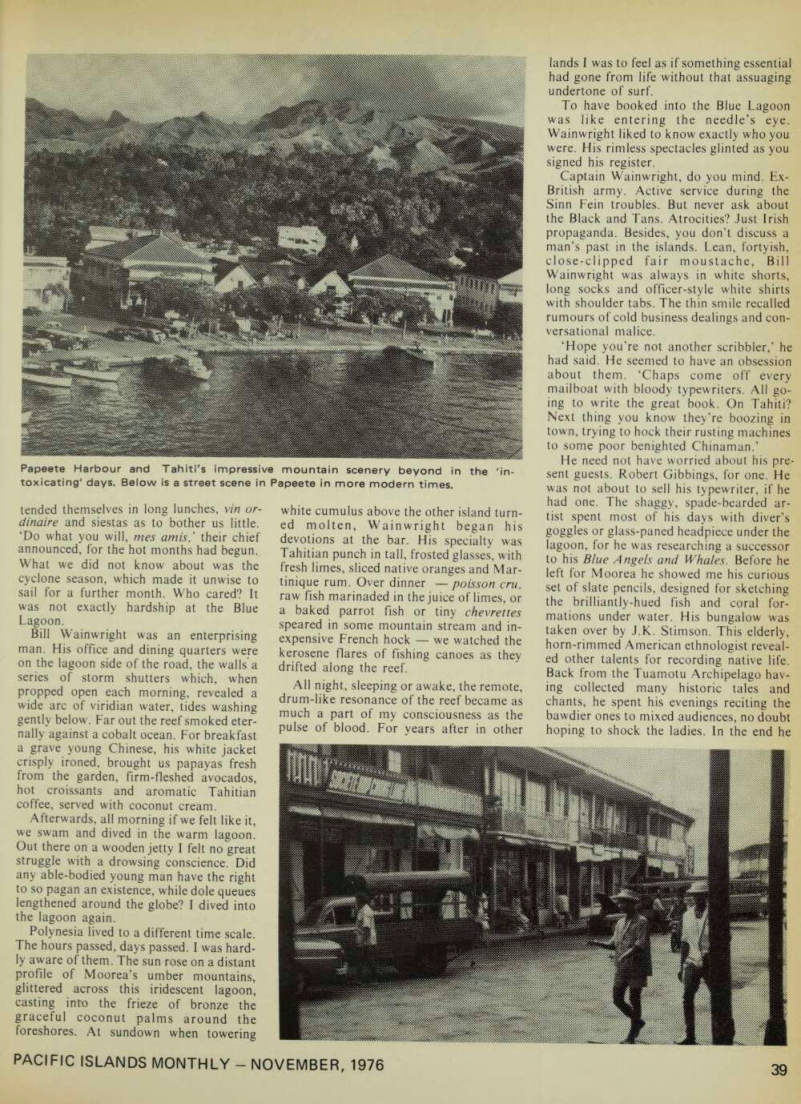
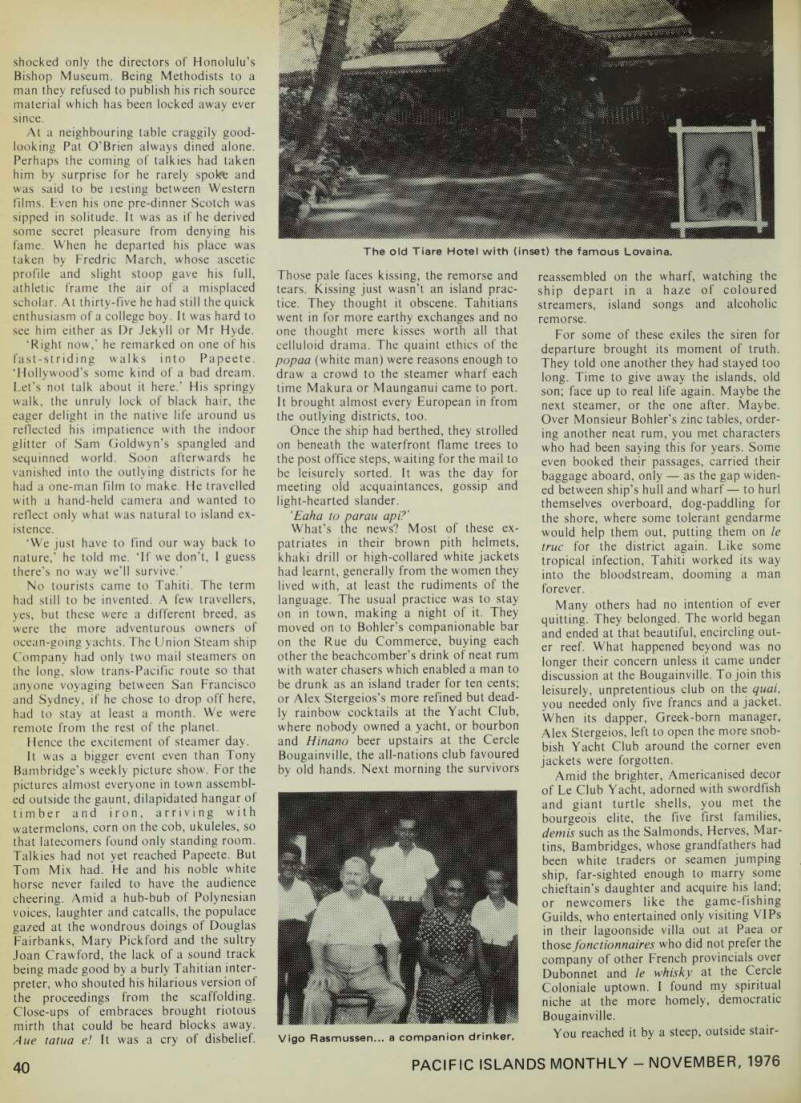
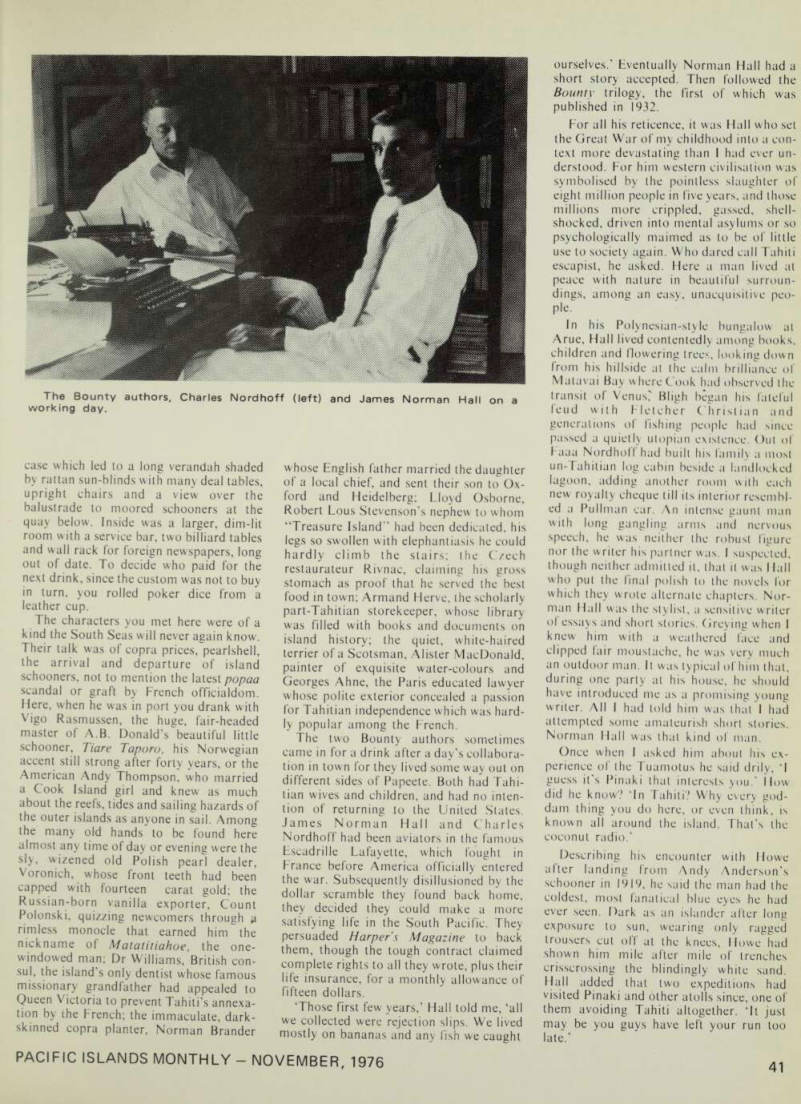
When Tahiti Was A Land Of
Perpetual Intoxication
To be just twenty-one, unshackled and in Tahiti was a perpetual intoxication.
Under the floodlight of a tropic sun you came alive in all the senses. Wherever you looked even down the shabbier side streets of Papeete were flowering shrubs and trees, frangipani exploding in pink, yellow or chaste white blossom, or the crimson brilliance of hibiscus or flame trees shed ding scarlet flowers on a patch of wasteland. From wharfside storage sheds came the warm, musky odour of copra or the sharper sweetish tang of vanilla. Was there ever such a flower as the fragrant, white tiare Tahiti? Its small, shiny-leaved bushes grew in every garden and nowhere else but in these islands.
Tahiti was a land of flowers. Its language was flowers. To wear one of those small, star-petalled cousins of the gardenia over the ear, or a couronne of fern leaves and frangipani, or a lei of freshly picked hibiscus was the com monplace expression of an inner joy long departed from western living, perhaps since ancient Greece. Here was the last tru ly pagan society on earth, based on the pleasure principle, not supernatural fears or a cult of death.
These latter-day Greeks wore scarlet and gold pareus about their loins. Their hair was wreathed in ferns. They swam in these aquamarine lagoons and pursued the classical sport of venery.
Papeete, old hands declared, was a dull little port town, provincial. I did not find it so. Along the waterfront, down the green tunnel of the Rue du Commerce with its foliage of flame trees arching overhead, around the crowded market square you strolled past flimsy, unpainted timber frame buildings whose tall verandah posts, faded sunblinds and fretwork of upper balconies gave it an air of theatre. A large cast of Tahitians was always on stage as if awaiting the overture to some tropical Carmen. They lounged and sat on stone benches in Gauguinesque attitudes, squatted by the stone quay to yarn with the crews of tuna boats and moored schooners, grouped around the doorless entrances of
This fascinating account of life in Tahiti in the days before its discovery by the tourist is taken from George Far well’s latest book Re joice in Freedom, an autobiography published by Thomas Nelson {Australia) Limited, of Jeffcott Street, West Melbourne, at the recommended price of $15.95. George Farwell died suddenly about four months ago. The photographs appearing with the article are from PI M’s own library and do not appear in the book.
Chinese stores, sang out ribald greetings to one another, gossiped and expostulated in that rapid, polysyllabic, slurred tongue that, whatever the French might decree, was still the spontaneous currency of island life. There were stout, heavy bosomed women in flowered mother hub bards, with enormous calves and upper
arms; seamy-faced, lean grandmothers
robed in black; jaunty youths whose black, crinkly hair was cut en brosse or who wore narrow-brimmed pandanus hats banded with cowrie shells and, as always, those full-hipped girls with the waist-long black hair, glancing as provocatively as only males did at desirable women in other lands. In the main street traffic was so scarce even in business hours that pedestrians walked the middle of the road, leaving the sidewalks under sun awnings to the shopkeepers. A few bicycles went slow ly by, the occasional Chinese cart drawn by a bony little horse, perhaps a dozen old fashioned cars all day. Each side, behind those tree boles and verandah posts, were small, open-fronted stores and Chinese
tailors, a poolroom where Tahitian youths idled and smoked, bicycle repair shops, Madame Quinn’s quiet ice cream parlour and a couple of cool, cavernous bars with batwing doors.
After dark the tempo quickened for this was the time to promenade. Dim lights slanted from shop doorways, while tiny oil lamps sputtered under the canvas tops of red, two-wheeled Chinese barrows whose glass fronts displayed watermelons in huge slices, fresh drinking nuts and sweets like manioca, made from arrowroot. Almost nightly Michael and I strolled in from the hotel to join the leisurely parade.
The Blue Lagoon, a kilometre out of town, was the only place to stay. Beside a lagoon in Arue, recently built, its half dozen thatched bungalows were each screened by thickets of bamboo, hibiscus, and slender tall papaya trees, which squabbling mynah birds plundered daily to the shrill fury of the Chinese houseboys. In town the old Tiare Hotel had fallen into decay since the death of Lovaina, the famous Tahitian-American whom Frederick O’Brien had described as having limbs the girth of breadfruit trees, and a bosom broad as Juno of Rome. Rupert Brooke had stayed there, Robert Keable, George Calderon and Maugham but the light-hearted vahines they wrote about had moved on, though on its lattice-screened verandah, schooner captains and their trader friends still took long lunches and consumed their carafes of French wine. As for the other more modest places on or around the waterfront, they were air-less little hot boxes suited only for those stay ing overnight from the districts or brief assignations of lovers.
Thus we awaited the rest of our party, due from Australia in fifteen days.
Curtler, being earnest and Central Euro pean, was the only one to confuse in dolence with sin so we allowed him the lux ury of keeping busy. He called at the governor’s palace, arranged the schooner charter with a Chinese trading firm, had our plans approved by the authorities.
These, in the manner of Frenchmen, so ex-
tended themselves in long lunches, vin or dinaire and siestas as to bother us little. ‘Do what you will, mes amis,' their chief announced, for the hot months had begun.
What we did not know about was the cyclone season, which made it unwise to sail for a further month. Who cared? It was not exactly hardship at the Blue Lagoon.
Bill Wainwright was an enterprising man. His office and dining quarters were on the lagoon side of the road, the walls'a series of storm shutters which, when propped open each morning, revealed a wide arc of viridian water, tides washing gently below. Far out the reef smoked eter nally against a cobalt ocean. For breakfast a grave young Chinese, his white jacket crisply ironed, brought us papayas fresh from the garden, firm-fleshed avocados, hot croissants and aromatic Tahitian coffee, served with coconut cream.
Afterwards, all morning if we felt like it, we swam and dived in the warm lagoon.
Out there on a wooden jetty I felt no great struggle with a drowsing conscience. Did any able-bodied young man have the right to so pagan an existence, while dole queues lengthened around the globe? I dived into the lagoon again.
Polynesia lived to a different time scale.
The hours passed, days passed. I was hard ly aware of them. The sun rose on a distant profile of Moorea’s umber mountains, glittered across this iridescent lagoon, casting into the frieze of bronze the graceful coconut palms around the foreshores. At sundown when towering
white cumulus above the other island turn ed molten, Wainwright began his devotions at the bar. His specialty was Tahitian punch in tall, frosted glasses, with fresh limes, sliced native oranges and Mar tinique rum. Over dinner poisson cru, raw fish marinaded in the juice of limes, or a baked parrot fish or tiny chevrettes speared in some mountain stream and in expensive French hock we watched the kerosene flares of fishing canoes as they drifted along the reef.
All night, sleeping or awake, the remote, drum-like resonance of the reef became as much a part of my consciousness as the pulse of blood. For years after in other
lands I was to feel as if something essential had gone from life without that assuaging undertone of surf.
To have booked into the Blue Lagoon was like entering the needle’s eye.
Wainwright liked to know exactly who you were. His rimless spectacles glinted as you signed his register.
Captain Wainwright, do you mind. Ex- British army. Active service during the Sinn Fein troubles. But never ask about the Black and Tans. Atrocities? Just Irish propaganda. Besides, you don’t discuss a man’s past in the islands. Lean, fortyish, close-clipped fair moustache, Bill Wainwright was always in white shorts, long socks and officer-style white shirts with shoulder tabs. The thin smile recalled rumours of cold business dealings and con versational malice. ‘Hope you’re not another scribbler,’ he had said. He seemed to have an obsession about them. ‘Chaps come off every mailboat with bloody typewriters. All go ing to write the great book. On Tahiti?
Next thing you know they’re boozing in town, trying to hock their rusting machines to some poor benighted Chinaman.’
He need not have worried about his pre sent guests. Robert Gibbings, for one. He was not about to sell his typewriter, if he had one. The shaggy, spade-bearded ar tist spent most of his days with diver’s goggles or glass-paned headpiece under the lagoon, for he was researching a successor to his Blue Angels and Whales. Before he left for Moorea he showed me his curious set of slate pencils, designed for sketching the brilliantly-hued fish and coral for mations under water. His bungalow was taken over by J.K. Stimson. This elderly, horn-rimmed American ethnologist reveal ed other talents for recording native life.
Back from the Tuamotu Archipelago hav ing collected many historic tales and chants, he spent his evenings reciting the bawdier ones to mixed audiences, no doubt hoping to shock the ladies. In the end he
Papeete Harbour and Tahiti's impressive mountain scenery beyond in the 'in toxicating' days. Below is a street scene in Papeete in more modern times.
shocked only the directors of Honolulu’s Bishop Museum. Being Methodists to a man they refused to publish his rich source material which has been locked away ever since.
At a neighbouring table craggily good looking Pat O’Brien always dined alone.
Perhaps the coming of talkies had taken him by surprise for he rarely spoke and was said to be resting between Western films. Even his one pre-dinner Scotch was sipped in solitude. It was as if he derived some secret pleasure from denying his fame. When he departed his place was taken by Fredric March, whose ascetic profile and slight stoop gave his full, athletic frame the air of a misplaced scholar. At thirty-five he had still the quick enthusiasm of a college boy. It was hard to see him either as Dr Jekyll or Mr Hyde. ‘Right now,’ he remarked on one of his fast-striding walks into Papeete. ‘Hollywood’s some kind of a bad dream.
Let’s not talk about it here.' His springy walk, the unruly lock of black hair, the eager delight in the native life around us reflected his impatience with the indoor glitter of Sam Goldwyn’s spangled and sequinned world. Soon afterwards he vanished into the outlying districts for he had a one-man film to make. He travelled with a hand-held camera and wanted to reflect only what was natural to island ex istence. ‘We just have to find our way back to nature,' he told me. ‘lf we don’t, I guess there’s no way we’ll survive.’
No tourists came to Tahiti. The term had still to be invented. A few travellers, yes, but these were a different breed, as were the more adventurous owners of ocean-going yachts. The Union Steam ship Company had only two mail steamers on the long, slow trans-Pacific route so that anyone voyaging between San Francisco and Sydney, if he chose to drop off here, had to stay at least a month. We were remote from the rest of the planet.
Hence the excitement of steamer day.
It was a bigger event even than Tony Bambridge’s weekly picture show. For the pictures almost everyone in town assembl ed outside the gaunt, dilapidated hangar of timber and iron, arriving with watermelons, corn on the cob, ukuleles, so that latecomers found only standing room.
Talkies had not yet reached Papeete. But Tom Mix had. He and his noble white horse never failed to have the audience cheering. Amid a hub-bub of Polynesian voices, laughter and catcalls, the populace gazed at the wondrous doings of Douglas Fairbanks, Mary Pickford and the sultry Joan Crawford, the lack of a sound track being made good by a burly Tahitian inter preter, who shouted his hilarious version of the proceedings from the scaffolding.
Close-ups of embraces brought riotous mirth that could be heard blocks away.
Aue tatua e! It was a cry of disbelief.
Those pale faces kissing, the remorse and tears. Kissing just wasn’t an island prac tice. They thought it obscene. Tahitians went in for more earthy exchanges and no one thought mere kisses worth all that celluloid drama. The quaint ethics of the popaa (white man) were reasons enough to draw a crowd to the steamer wharf each time Makura or Maunganui came to port.
It brought almost every European in from the outlying districts, too.
Once the ship had berthed, they strolled on beneath the waterfront flame trees to the post office steps, waiting for the mail to be leisurely sorted. It was the day for meeting old acquaintances, gossip and
light-hearted slander.
‘Eaha to parau api?’
What’s the news? Most of these ex patriates in their brown pith helmets, khaki drill or high-collared white jackets had learnt, generally from the women they lived with, at least the rudiments of the language. The usual practice was to stay on in town, making a night of it. They moved on to Bohler’s companionable bar on the Rue du Commerce, buying each other the beachcomber’s drink of neat rum with water chasers which enabled a man to be drunk as an island trader for ten cents; or Alex Stergeios’s more refined but dead ly rainbow cocktails at the Yacht Club, where nobody owned a yacht, or bourbon and Hinano beer upstairs at the Cercle Bougainville, the all-nations club favoured by old hands. Next morning the survivors
reassembled on the wharf, watching the ship depart in a haze of coloured streamers, island songs and alcoholic remorse.
For some of these exiles the siren for departure brought its moment of truth.
They told one another they had stayed too long. Time to give away the islands, old son; face up to real life again. Maybe the next steamer, or the one after. Maybe.
Over Monsieur Bohler’s zinc tables, order ing another neat rum, you met characters who had been saying this for years. Some even booked their passages, carried their baggage aboard, only as the gap widen ed between ship’s hull and wharf to hurl themselves overboard, dog-paddling for the shore, where some tolerant gendarme would help them out, putting them on le true for the district again. Like some tropical infection, Tahiti worked its way into the bloodstream, dooming a man forever.
Many others had no intention of ever quitting. They belonged. The world began and ended at that beautiful, encircling out er reef. What happened beyond was no longer their concern unless it came under discussion at the Bougainville. To join this leisurely, unpretentious club on the quai, you needed only five francs and a jacket.
When its dapper, Greek-born manager, Alex Stergeios, left to open the more snob bish Yacht Club around the corner even jackets were forgotten.
Amid the brighter, Americanised decor of Le Club Yacht, adorned with swordfish and giant turtle shells, you met the bourgeois elite, the five first families, demis such as the Salmonds, Herves, Mar tins, Bambridges, whose grandfathers had been white traders or seamen jumping ship, far-sighted enough to marry some chieftain’s daughter and acquire his land; or newcomers like the game-fishing Guilds, who entertained only visiting VIPs in their lagoonside villa out at Paea or those fonctionnaires who did not prefer the company of other French provincials over Dubonnet and le whisky at the Cercle Coloniale uptown. I found my spiritual niche at the more homely, democratic
Bougainville.
You reached it by a steep, outside stair-
Vigo Rasmussen... a companion drinker.
The old Tiare Hotel with (inset) the famous Lovaina.
case which led to a long verandah shaded by rattan sun-blinds with many deal tables, upright chairs and a view over the balustrade to moored schooners at the quay below. Inside was a larger, dim-lit room with a service bar, two billiard tables and wall rack for foreign newspapers, long out of date. To decide who paid for the next drink, since the custom was not to buy in turn, you rolled poker dice from a leather cup.
The characters you met here were of a kind the South Seas will never again know.
Their talk was of copra prices, pearlshell, the arrival and departure of island schooners, not to mention the latest popaa scandal or graft by French officialdom.
Here, when he was in port you drank with Vigo Rasmussen, the huge, fair-headed master of A.B. Donald’s beautiful little schooner, Tiare Taporo, his Norwegian accent still strong after forty years, or the American Andy Thompson, who married a Cook Island girl and knew as much about the reefs, tides and sailing hazards of the outer islands as anyone in sail. Among the many old hands to be found here almost any time of day or evening were the sly, wizened old Polish pearl dealer, Voronich, whose front teeth had been capped with fourteen carat gold; the Russian-born vanilla exporter, Count Polonski, quizzing newcomers through a rimless monocle that earned him the nickname of Matatitiahoe, the one windowed man; Dr Williams, British con sul, the island’s only dentist whose famous missionary grandfather had appealed to Queen Victoria to prevent Tahiti’s annexa tion by the French; the immaculate, dark skinned copra planter, Norman Brander
whose English father married the daughter of a local chief, and sent their son to Ox ford and Heidelberg; Lloyd Osborne, Robert Lous Stevenson’s nephew- to whom “Treasure Island" had been dedicated, his legs so swollen with elephantiasis he could hardly climb the stairs; the Czech restaurateur Rivnac, claiming his gross stomach as proof that he served the best food in town; Armand Herve, the scholarly
part-Tahitian storekeeper, whose library
was filled with books and documents on island history; the quiet, white-haired terrier of a Scotsman, Alister MacDonald, painter of exquisite water-colours and Georges Ahne, the Paris educated lawyer whose polite exterior concealed a passion for Tahitian independence which was hard ly popular among the French.
The two Bounty authors sometimes came in for a drink after a day’s collabora tion in town for they lived some way out on different sides of Papeete. Both had Tahi tian wives and children, and had no inten tion of returning to the United Stales.
James Norman Hall and Charles Nordhoff had been aviators in the famous Escadrille Lafayette, which fought in France before America officially entered the war. Subsequently disillusioned by the dollar scramble they found back home, they decided they could make a more satisfying life in the South Pacific. They persuaded Harper’s Magazine to back them, though the tough contract claimed complete rights to all they wrote, plus their life insurance, for a monthly allowance of fifteen dollars. ‘Those first few years,’ Hall told me, ‘all we collected were rejection slips. We lived mostly on bananas and any fish we caught
ourselves.' Eventually Norman Hall had a short story accepted. Then followed the Bounty trilogy, the first of which was published in 1932.
For all his reticence, it was Hall who set the Great War of my childhood into a con text more devastating than I had ever un derstood. For him western civilisation was symbolised by the pointless slaughter of eight million people in five years, and those millions more crippled, gassed, shell shocked, driven into mental asylums or so psychologically maimed as to be of little use to society again. Who dared call Tahiti escapist, he asked. Here a man lived at peace with nature in beautiful surroun dings, among an easy, unacquisitivc peo ple.
In his Polynesian-slyle bungalow at Arue, Hall lived contentedly among books, children and flowering trees, looking down from his hillside at the calm brilliance of Malavai Bay where Cook had observed the transit of Venus? Bligh began his fateful feud with Fletcher Christian and generations of fishing people had since passed a quietly utopian existence. Out of Fa a a Nordhoff had built his family a most un-Tahitian log cabin beside a landlocked lagoon, adding another room with each new royalty cheque till its interior resembl ed a Pullman car. An intense gaunt man with long gangling arms and nervous speech, he was neither the robust figure nor the writer his partner was. I suspected, though neither admitted it, that it was Hall who pul the final polish to the novels for which they wrote alternate chapters. Nor man Hall was the stylist, a sensitive writer of essays and short stories. Greying when I knew him with a weathered face and clipped fair moustache, he was very much an outdoor man. It was typical of him that, during one parly at his house, he should have introduced me as a promising young writer. All I had told him was that I had attempted some amateurish short stories.
Norman Hall was that kind of man.
Once when I asked him about his ex perience ol the Tuamolus he said drily, ‘I guess it's Pinaki that interests you.' How did he know? 'ln Tahiti? Why every god dam thing you do here, or even think, is known all around the island. Thai’s the coconut radio.’
Describing his encounter with Howe after landing from Andy Anderson’s schooner in 1919, he said the man had the coldest, most fanatical blue eyes he had ever seen. Dark as an islander after long exposure to sun, wearing only ragged trousers cut off at the knees, Howe had shown him mile after mile of trenches crisscrossing the blindingly white sand.
Flail added that two expeditions had visited Pinaki and other atolls since, one of them avoiding Tahiti altogether. ‘lt just may be you guys have left your run 100 late.’
The Bounty authors, Charles Nordhoff (left) and James Norman Hall on a working day.
Advertisements & other items, pp. 42-46 (1 item)
Invest in precious metals.
Of the eight precious metals, it takes four to make a Parker 75 pen. The silver, gold, platinum and ruthenium aren't there just for show. They make it work better. And they make it a gift to treasure. What you could call a lifetime investment.
Sterling silver gives the case heft and balance.
We use our own special alloy of 14ct gold for the nib, because few other metals resist ink corrosion as well, and still provide such responsiveness as you write.
For the tip that touches the paper, we developed an alloy of platinum and ruthenium that resists wear so well, we don't know how long a tip will last.
It's even more exceptional.
The nib can turn 360° to write at the angle most natural to you.
Quite an investment, the sterling silver Parker 75.
There's a nylon nib version and matching ball pen or pencil.
Also rolled gold or Vermeil, which is 14ct gold on silver.
The distinctive arrow clip identifies every Parker model.
tPARKER
World's most wanted pens
Another Achievement of Seiko Quartz Technology
The Ultra-Thin Seiko Quartz.
It Combines Slim Elegance with the Accuracy Only Quartz Can Offer, /
XII
PE2SD
9MHT2
A?
SEIKO
6 3 / m / * u Seiko was first to reduce the quartz principle to true wrist size and to market a quartz watch. That's why Seiko can create a quartz this thin and elegant. Seiko's expertise in every phase of watchmaking means Seiko can make any part of any watch, for impeccable quality control.
Seiko makes quartz watches with traditional analog faces and with the LC digital readout. No matter which Seiko Quartz you select, you get the watch that's changing the world's standard of accuracy. Seiko Quartz.
SEIKO
Someday all watches will be made this way.
§ t* * * 1 * ■ r.
I 4-r# a K * «* #■ MU# i W *|ilP t m % ■ .
The Toyota truck range.
Built to be unbeatable.
Bad weather conditions, no problem, Bad roads and driving surfaces, eaten up.
Difficult loads, no contest.
Built tough. Built to take it.
There's a Toyota truck built for you.
K v ■m- - TOYOTA Land Cruiser Pickup
TOYOTA Hi-Ace
1 TOYOTA Stout
TOYOTA Hi-Lux
TOYOTA Dyna
TOYOTA Toyo-Ace Jj I mi TOYOTA Truck For unbeatable after service:
TOYOTA
CO., LTD., P.O. 1057, Pago Pago WESTERN SAMOA BURNS PHII P VsnirruccAntn 3^ S “ Va ’ AMERICAN SAMOA: BURNS PHILP (SOUTH SE . P S°, B L 0 TD 64 ?0 T Br 174 9 '
CALEDONIA: SOC.ETE IMPORTATION
Musical survival pack.
You want good high fidelity sound reproduction. But, you don’t want to expend all your time and energy (not to mention your bankroll) on mixing and matching individual audio components. Well, Pioneer has done it again.
For those who want great stereo listening without getting lost in an electronic jungle, we are pleased to introduce our MS-6500 stereo system.
Everything you need to play anything you want. All in one beautifully designed package.
At the heart of the MS-6500 is an outstanding AM/FM stereo receiver.
In the amplifier, continuous power output is 18 watts per channel (RMS).
More than enough to fill your listening room with great sound. In the tuner, FM sensitivity is a powerful I.9juV and the S/N ratio is a hushed 73d8 (mono). Stable reception is virtually guaranteed by the presence of advanced PLL circuitry.
Playing your records is easy. The full size turntable features a sensitive tone arm with cartridge plus the added convenience of auto-cut and return.
Multi-source enjoyment is always available with the built-in cassette deck. All controls are user-oriented and the auto-stop mechanism offers protection for both tape and deck.
To make things complete, the MS-6500 includes a pair of balanced three-way, three-speaker systems.
Full rich bass from the big 20cm (8 inch) woofers is enhanced by the solid bass-reflex cabinets.
Pioneer s new MS-6500 stereo system. Just plug it in, turn it on and save your time for enjoying truly great sound.
fliO PIONEER
Pioneer Electronic Corporation
4-1, Meguro 1-chome, Meguro-ku, Tokyo 153, Japan Australia Pioneer Electronics Australia Pty.
Ltd., 178-184 Boundary Road, Braeside, Victoria 3195, Tel: 90-9011, Sydney 93-0246, Brisbane 52-8231.
Adelaide 433379, Perth 76-7776 Fiji Islands Brijlal & Company, G.P.O. Box No. 362, Suva, Fiji Islands Tel: 22258 New Zealand Fountain Marketing Ltd., Maidstone Street, Auckland, New Zealand Tel: 763-064 Norfolk Island Burns Philp (Norfolk Island) Ltd., Norfolk Island, South Pacific New Hebrides Burns Philp (New Hebrides) Ltd., Vila, New Hebrides Nauru Island Jacob Enterprises, P.O. Box No. 4 Republic of Nauru Tahiti Est. PERFECT, B.P. 594, Papeete, Tahiti Tel: 20 407 New Caledonia Menard Freres, B.P. 123, Noumea, New Caledonia Tel: 27.52.22 American Samoa Traspac Corporation, P.O. Box 1477 Pago Pago, American Samoa 96799 Tel: 633-5224 Rarotonga South Seas International Ltd., P.O. Box 49, Rarotonga Cook Islands Tel: 2327
A grassroots catalogue: greatest
thing since sliced bread
Ways of developing technology ap propriate to the needs, cultures and resources oflhe South Pacific was one of the six themes of the first young nations conference, held in Sydney during August 1976.
If we agree with Robert Waddell, one of the participants, that such a technology should (a) bring tools and energy sources where they are needed; (b) maximise employment; (c) en courage growth in the poorest areas; (d) be decentralised so that its products can readily be made, main tained and repaired by people on the spot, then it is clear that the imported technology, from Samoa in the east to New Guinea in the west, falls far short of his criteria.
An appropriate technology for the South Pacific is one that is less costly in terms of capital, less complicated and requires much less back-up or in frastructure in the form of public ser vants, highly educated technologists, costly spare parts, etc.
Take just one example; transport.
On most islands, the distances are not long enough to warrant the use of costly foreign-made trucks, with sophisticated engines, differentials, gears, etc, that require great expertise in maintenance and considerable monetary outlay on spare parts and fuel. Animal transport, eg Zebu-cross cattle and wooden carls, could carry produce in rural areas. The cattle could be bred and the carls manufac tured in the villages, greatly reducing expenditure of foreign exchange and lessening reliance on the vagaries of the world commodity markets and
foreign aid.
In other words, the new nation becomes more sell-sulficienl and depends less on political lies with in dustrialised, more powerful nations.
Not surprisingly, an increasing
number ol people in countries with low per capita incomes and/or little industrialisation have begun to look for an appropriate technology, and there is quite a volume ol information on this.
Regrettably, not much of this infor mation has so far found its way to the
Books
Pacific. It is therefore good news that, in the case of Papua New Guinea, the Melanesian Council of Churches has brought out Liklik Buk Bilong Kain Kain Samting, a catalogue that con tains information on such matters as primary energy crops, export crops, livestock, processing, building, cot tage industries, rural health and adult education.
The section on animating village development is particularly welcome, and the many articles and il lustrations, backed up by addresses of people and organisations from whom further information can be obtained, reflect a down-to-earth approach.
There are, for instance, 14 uses for old tyres and inner tubes listed, among them feed troughs for animals, erosion barriers on steep hills, sandals and the compilers invite readers to let them know about others.
The value of this catalogue will greatly depend upon the feedback from those for whom it has been com piled; teachers in rural schools, agricultural extension workers, business development officers and village leaders. Well-indexed an covering as wide a range of activities and ‘things’ as can be expected of a first edition, this catalogue must be kept up to date if it is to retain its value, let alone to be improved.
The compilers realise this and are hoping to bring out a revised and ex panded edition before long. I hope that they consider having it in loose leaf form, with a waterproof ring binder and every page with reinforced holes to fit the binder. This would make it cheaper to up-date the catalogue: it would merely need an annual issue of pages to amend or add to previous ones.
Whoever sent the review copy to PI M's editor enclosed a note saying that the Liklik Buk ‘is the greatest thing since sliced bread’. That is precisely what it is not: it is, instead, a compendium of information that, I hope, will lead to South Pacific alter
natives to sliced bread.
Harry
Jackman
(LIKLIK BUK BILONG KAIN KAIN SAMTING. Com piled by P. R. Hale and B. D. Williams. Published by the Melanesian Council of Churches, Lae, PNG, 1976. 52.00.)
Worthwhile Record Of Sepik Art
Muk Bilong Sepik is a collection of designs and paintings from the Sepik River collected by Helen Dennett. It is an excellently printed book, very pleasant to handle and printed hy Wirui Press, Wewak. It states that the text is by Paul Dennett. And that, I think, is my only criticism of the hook. Although it is a book to look at and a book to leach or a book for reading. I should like to see a little more text. We are used to art books giving some brief descriptions of the methods used, and I miss this from the present book, h is well to admire the designs and paintings, and all of them are highly admirable, but I'd like to know something of how they were done and the tools and the materials used in creating them.
Apart from that. / recommend the book as well-worth buying, and it would make a very good present for present-giving occasions. It is well produced and is a worthwhile record of the arts of the Sepik River. Perhaps in her next book. Mrs Dennett will think of me and tell how the works were produced and what went into making them.
Peter Livingston
(MAK BILONG SEPIK, a Selection of Designs and Paintings from the Sepik River, black and white and colour, 117 pages at K 5. or K 6 air to Australia and surface mail to elsewhere, from Wirui Press, Wewak).
a cultural resurrection?
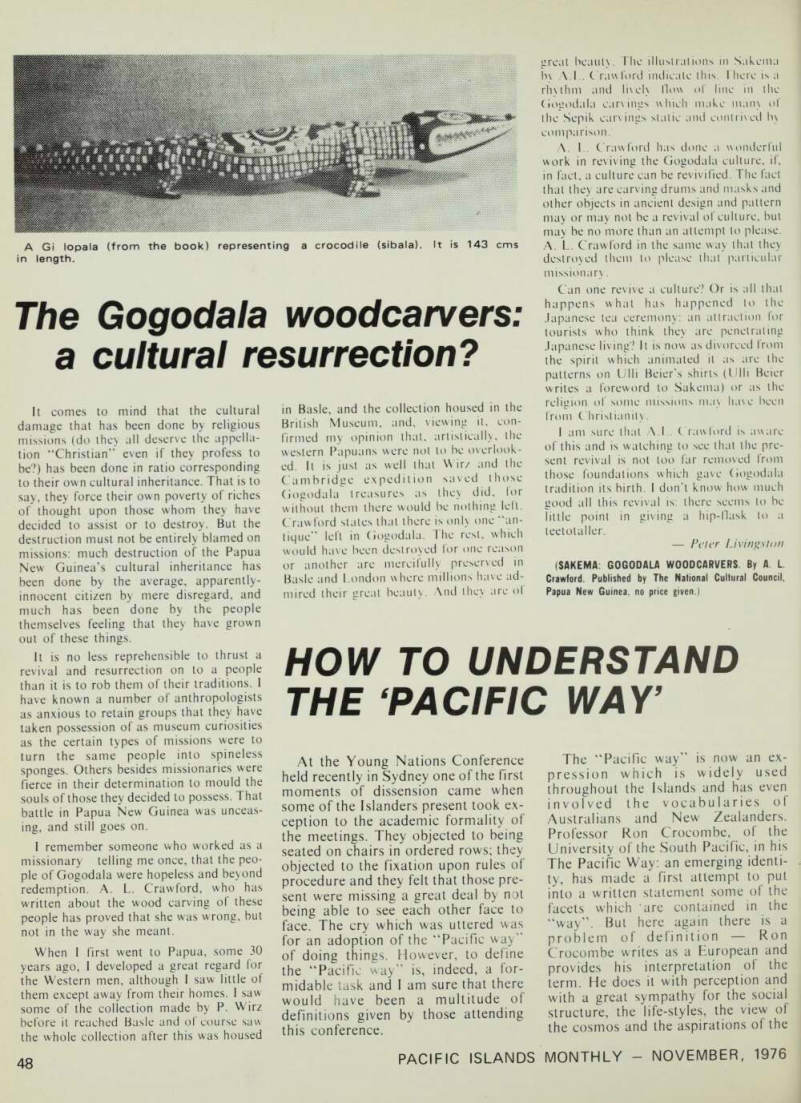
The Gogodala woodcarvers: a cultural resurrection?
It comes to mind that the cultural damage that has been done by religious missions (do they all deserve the appella tion “Christian” even if they profess to be?) has been done in ratio corresponding to their own cultural inheritance. That is to say, they force their own poverty of riches of thought upon those whom they have decided to assist or to destroy. But the destruction must not be entirely blamed on missions: much destruction of the Papua New Guinea’s cultural inheritance has been done by the average, apparently innocent citizen by mere disregard, and much has been done by the people themselves feeling that they have grown out of these things.
It is no less reprehensible to thrust a revival and resurrection on to a people than it is to rob them of their traditions. I have known a number of anthropologists as anxious to retain groups that they have taken possession of as museum curiosities as the certain types of missions were to turn the same people into spineless sponges. Others besides missionaries were fierce in their determination to mould the souls of those they decided to possess. That battle in Papua New Guinea was unceas ing, and still goes on.
I remember someone who worked as a missionary telling me once, that the peo ple of Gogodala were hopeless and beyond redemption. A. L. Crawford, who has written about the wood carving of these people has proved that she was wrong, but not in the way she meant.
When I first went to Papua, some 30 years ago, I developed a great regard for the Western men, although I saw little of them except away from their homes. I saw some of the collection made by P. Wirz before it reached Basle and of course saw the whole collection after this was housed
in Basle, and the collection housed in the British Museum, and, viewing it, con firmed my opinion that, artistically, the western Papuans were not to be overlook ed. It is just as well that Wirz and the Cambridge expedition saved those Gogodala treasures as they did. for without them there would be nothing left.
Crawford stales that there is only one “an tique" left in (iogodala. The rest, which would have been destroyed lor one reason or another are mercifully preserved in Basle and London where millions have ad mired their great beauty. And they are ol
great beauty. The illustrations in Sakema by A.I Crawford indicate thiv There is a rhythm and lively How of line in the Gogodala carvings which make main of the Sepik carvings static and contrived In
comparison.
A. 1 . Crawford has done a wonderful work in reviving the Gogodala culture, if, in fact, a culture can be revivified. The fact that they are carving drums and masks and other objects in ancient design and pattern may or may not be a revival of culture, but may be no more than an attempt to please.
A. L. Crawford in the same way that they destroyed them to please that particular missionary.
Can one revive a culture? Or is all that happens w'hat has happened to the Japanese tea ceremony: an attraction for tourists who think they are penetrating Japanese living? It is now as divorced Irom the spirit which animated it as are the patterns on Dili Beier's shirts (Dili Beier writes a foreword to Sakema) or as the religion of some missions may have been
from Christianity.
I am sure that AT.. C rawford is aware of this and is watching to see that the pre sent revival is not 100 far removed from those foundations which gave Gogodala tradition its birth. I don't know how much good all this revival is; there seems to be little point in giving a hip-flask to a teetotaller.
Peter Livingston
(Sakema: Gogodala Woodcarvers. By A. L.
Crawford. Published by The National Cultural Council, Papua New Guinea, no price given.)
A Gi lopala (from the book) representing a crocodile (sibala). It is 143 cms in length.
How To Understand
The ‘Pacific Way’
At the Young Nations Conference held recently in Sydney one of the first moments of dissension came when some of the Islanders present took exception to the academic formality of the meetings. They objected to being seated on chairs in ordered rows; they objected to the fixation upon rules of procedure and they fell that those present were missing a great deal by not being able to see each other face to face. The cry which was uttered was for an adoption of the “Pacific way" of doing things. However, to define the “Pacific way” is, indeed, a formidable task and 1 am sure that there would have been a multitude of definitions given by those attending this conference.
The “Pacific way" is now an ex pression which is widely used throughout the Islands and has even involved the vocabularies ol Australians and New Zealanders, Professor Ron Crocombe, of the University of the South Pacific, in his The Pacific Way: an emerging identi ty, has made a first attempt to put into a written statement some of the facets which are contained in the “way . But here again there is a problem of definition j Crocombe writes as a European and provides his interpretation of the term. He does it with perception and with a great sympathy for the social structure, the life-styles, the view of the cosmos and the aspirations ol the
many diverse groups who inhabit the Islands.
Credit must be given to the author for making a statement of this significance. I only hope that the appearance of the book will spur some Islander to begin, themselves, to ex press in written form what they feel is the essence of their “Pacific way”. It may well be that across the spectrum of the Islands community there may be large areas of commonalty, or there may be very marked areas of divergence.
This book does put into print some of the things which need to be said about the Pacific. It is the sort of book the visitor, the businessman and the outside politician should read in order to grasp some of the essential features which make the Pacific Islands people what they are. It would make for an easier understanding of the Islander’s attitude towards work and his notions of the importance of adhering to European concepts of time. Just as Ron Crocombe says, that it is characteristic of the “Pacific way” that “many people don’t do their homework properly, whether they be students, officials or cabinet ministers” so it is equally true that many of those going into the Pacific take with them their ignorance of the area they are encountering.
The author also is prepared to be critical of some of the things which are happening in the Pacific today, as is instanced by his criticism of the dis proportionate staffing of the Univer sity of the South Pacific in terms of the countries of origin of the staff. He brings to the fore the question of Fiji’s restricting the employment of staff from other countries by the use of short-term work permits. He also sounds a number of warnings concer ning the dangers of being carried away in the false euphoria which may all too easily become associated with the “Pacific way”, and also points out that “there is sometimes an awkward ambivalence”.
This little book was published in Suva by Lotu Pasifika Productions, who are to be commended for carry ing out a workmanlike task most ef ficiently and producing a well presented book, which is marketed at a price within the reach of all its potential readers.
W. G. Coppell
(THE PACIFIC WAY: AN EMERGING IDENTITY. By R. 6. Crocombe. Published by Lotu Pasifika Productions, Suva, 1976. Pacific Islands 5F1.20; Australia 5A1.20 New Zealand 5NZ1.50.)
‘Recipe’ for Island Dancing
From The Opera House 'Kitchen'
Beth Dean must be acknowledged as the
doyen of the European choreographers
who have concerned themselves with the dance forms of the Pacific Islands. Her in terests have ranged widely and she has developed a profound knowledge of the in finite variety of movements and themes, which characterise the dances of the Pacific. She has also played a most signifi cant role in assuring that recognition is be ing given to the dynamism, now being dis played by the national dance groups which have established themselves in a number of the Island nations. Audiences outside the Islands are now growing to appreciate the vigour, the grace and the spontaneity of Island dances and to realise that the hula is really only one dance form, which has suf fered from over-commercialisation.
Now Beth Dean has gone a step further and, under the auspices of the Sydney Opera House Trust, has produced a book.
Three Dances of Oceania, which is a scholarly treatise, concerned with dance forms from the Cook Islands, Fiji and Ocean Island.
It is a book, which basically meets the needs of a choreographer or a teacher of dancing, as it is a technical book of in structions, setting out the movements of the several dances. The technical value of these explanations would be best assessed by those who are going to put them into practice. However, Beth Dean, does provide a succinct introductory statement, which sets out a framework giving the anthropological background to the dances of the Pacific, and the notes which accom pany the dance instruction are full and in formative.
Just how the anthropologists will receive her analysis of the cultural significance of dance in the Pacific has to be seen; it is always on the cards, that by trying to make a short, omnibus statement the author sets up a target at which the experts are able to loose their darts.
As a book, Three Dances of Oceania is an oddity. There is a mystery element built into it. It is quite intriguing to realise that it is necessary to search with care to find out the identity of the publishers, and it does not bear the now universally-accepted form of copyright notation. The photography is of a reasonably high stan dard, the crudity of the maps mar the general presentation. And, to return to a theme I have taken up before .. . why can’t authors of books about the Pacific be consistent in their use of orthography. It seems pointless to have a section which states the usage in Fijian of the letters B,
C, D, G, Q, and to use the forms Buu, Dama, yaco, noda, and so on in the text, then to have a map which reverts to the spellings of Mbua, Ndama, Rambi . . .
To sum up this is a book which deserved to be published. It has a great deal of merit in the way in which it presents a vital aspect of the Pacific way of life, but it seems to have about it an air of a rather hasty preparation. But, there must be a thought for the Pacific bibliophile. I un derstand that only 1000 copies were printed of Three Dances of Oceania, and I have more than a mere suspicion that it is the kind of book which will become a collector's item in the not-too-dislanl future.
W. G. Coppell
(THREE DANCES OF OCEANIA. By Beth Dean. Publish ed by the Sydney Opera House Trust, 1976. Sydney. 52.50.)
Friendly Islands
Stories from the Friendly Islands
A Tongan woman. Tupou Pulu. from the Haapai Group, was respon sible for publishing schoolbooks for the children of her islands while she was in Point Barrow in Alaska. She was assisted in this project by Mary L. Pope who had lived for 10 years in Tonga. They have produced a bilingual book of charming folk tales.
Stories from the Friendly Islands —
Tonga.
The stories in English in the hook are arranged from the simplest to the most structurally complicated. This is because the stories have a place in teaching English as a second language to Tongan students. The Tongan stories are equivalent to the English stories hut they are not a direct translation.
This makes the hook sound rather formidable, hut it is most attractive and the English version, which is all 1 can read, most readable. The il lustrations are very attractive and are
interesting in themselves.
Peter
Livingston
(STORIES FROM THE FRIENDLY ISLANDS - TONGA.
By Tupou L. Pulu and Mary L. Pope. Published by Tofua Press, 10457-F Roselle St, San Diego, California USA 5U53.25.)
A New Hebridean Paradise -
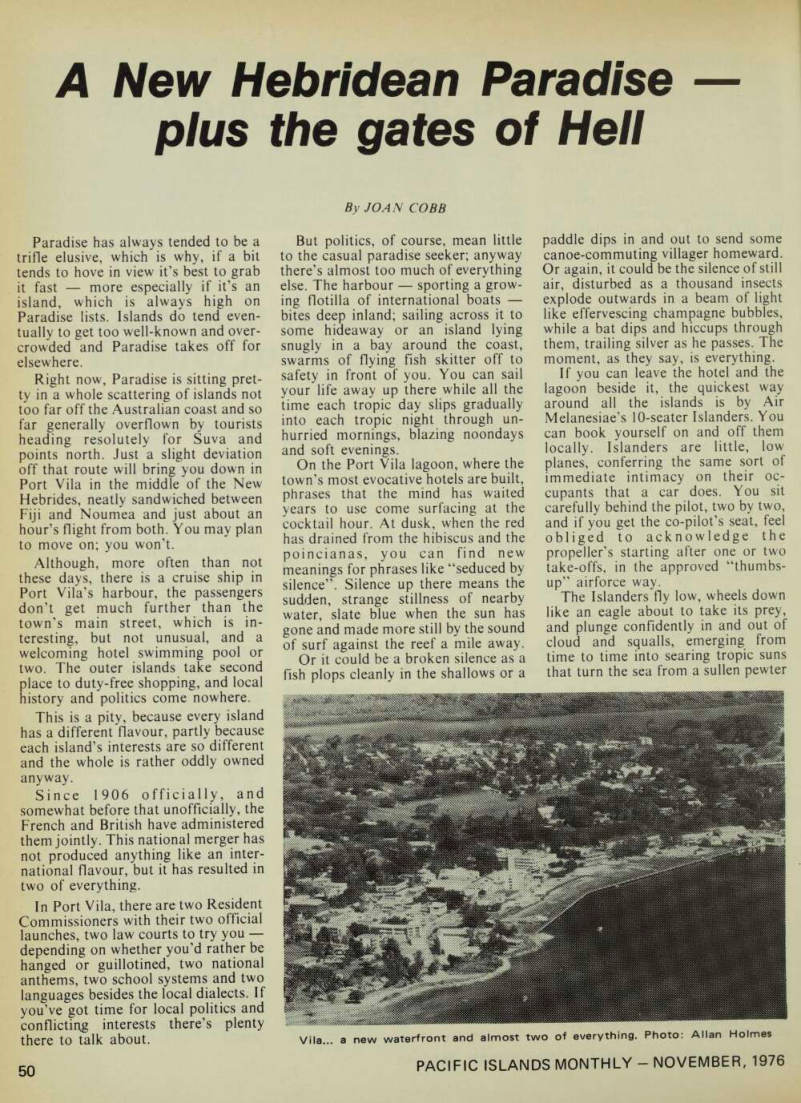
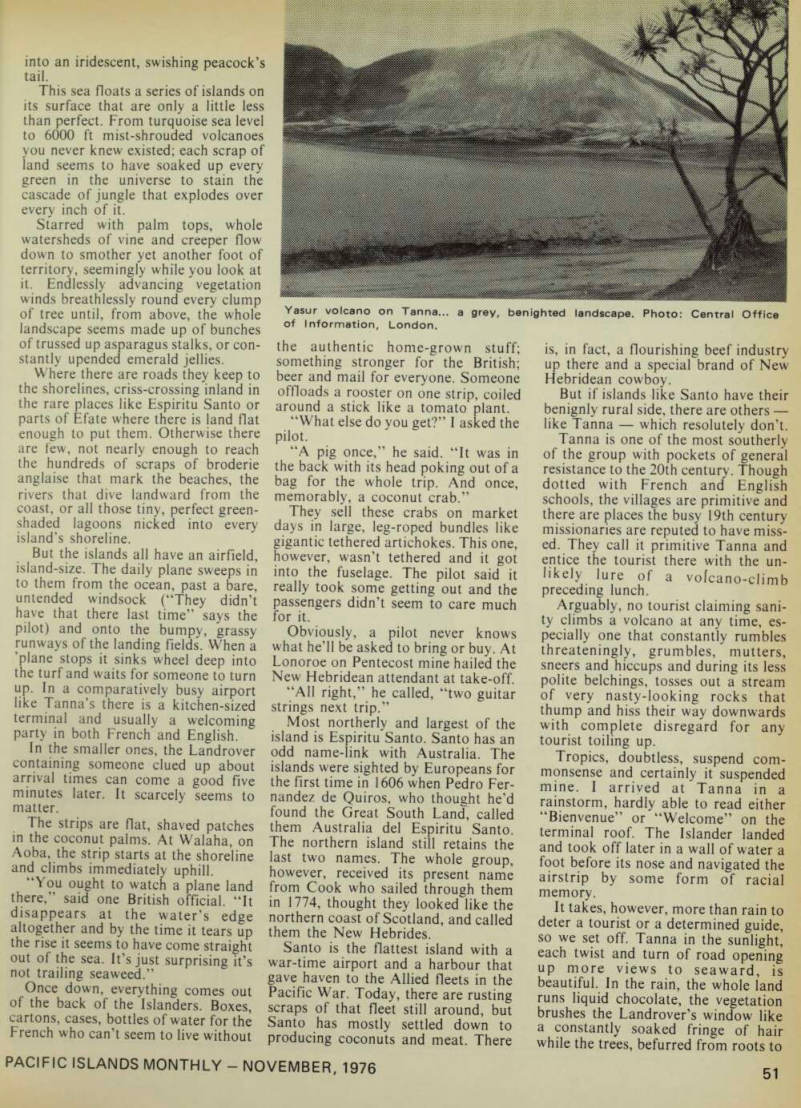
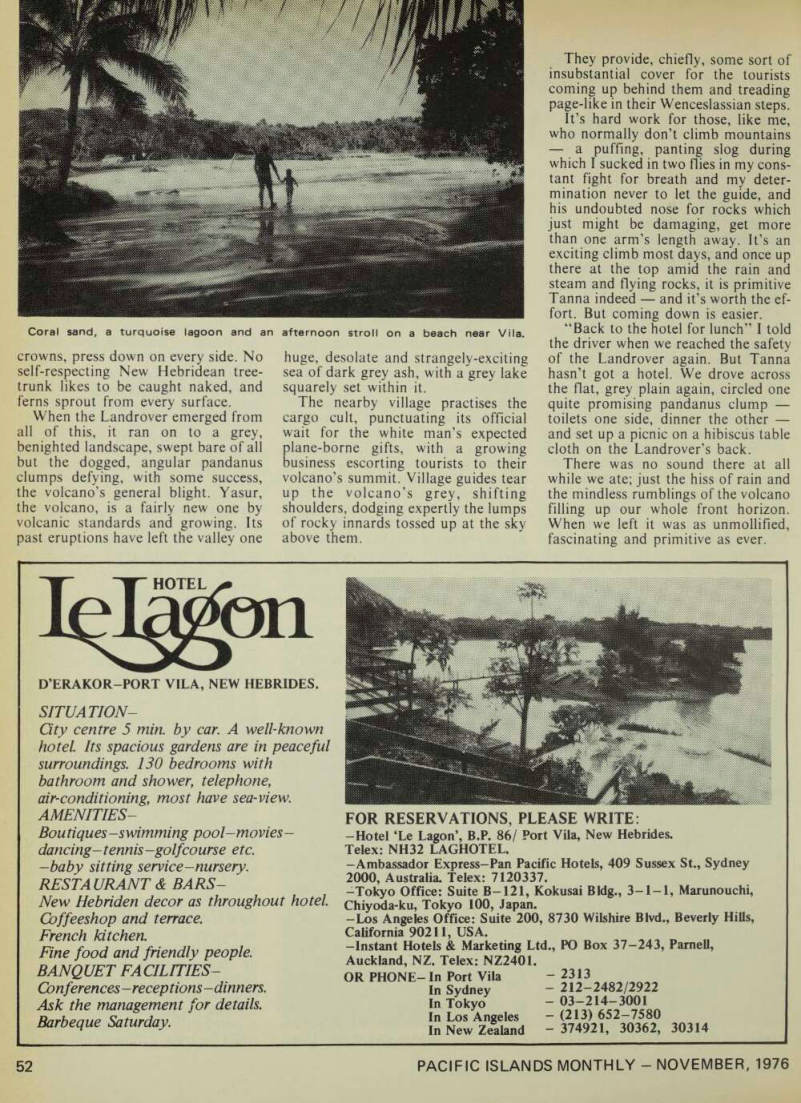
A New Hebridean Paradise plus the gates of Hell
By Joan Cobb
Paradise has always tended to be a trifle elusive, which is why, if a bit tends to hove in view it’s best to grab it fast more especially if it’s an island, which is always high on Paradise lists. Islands do tend even tually to get too well-known and over crowded and Paradise takes off for elsewhere.
Right now, Paradise is sitting pret ty in a whole scattering of islands not too far off the Australian coast and so far generally overflown by tourists heading resolutely for Suva and points north. Just a slight deviation off that route will bring you down in Port Vila in the middle of the New Hebrides, neatly sandwiched between Fiji and Noumea and just about an hour’s flight from both. You may plan to move on; you won’t.
Although, more often than not these days, there is a cruise ship in Port Vila’s harbour, the passengers don’t get much further than the town’s main street, which is in teresting, but not unusual, and a welcoming hotel swimming pool or two. The outer islands take second place to duty-free shopping, and local history and politics come nowhere.
This is a pity, because every island has a different flavour, partly because each island’s interests are so different and the whole is rather oddly owned anyway.
Since 1906 officially, and somewhat before that unofficially, the French and British have administered them jointly. This national merger has not produced anything like an inter national flavour, but it has resulted in two of everything.
In Port Vila, there are two Resident Commissioners with their two official launches, two law courts to try you depending on whether you’d rather be hanged or guillotined, two national anthems, two school systems and two languages besides the local dialects. If you’ve got time for local politics and conflicting interests there’s plenty there to talk about.
But politics, of course, mean little to the casual paradise seeker; anyway there’s almost too much of everything else. The harbour sporting a growing flotilla of international boats bites deep inland; sailing across it to some hideaway or an island lying snugly in a bay around the coast, swarms of flying fish skitter off to safety in front of you. You can sail your life away up there while all the time each tropic day slips gradually into each tropic night through unhurried mornings, blazing noondays and soft evenings.
On the Port Vila lagoon, where the town’s most evocative hotels are built, phrases that the mind has waited years to use come surfacing at the cocktail hour. At dusk, when the red has drained from the hibiscus and the poincianas, you can find new meanings for phrases like “seduced by silence”. Silence up there means the sudden, strange stillness of nearby water, slate blue when the sun has gone and made more still by the sound of surf against the reef a mile away.
Or it could be a broken silence as a fish plops cleanly in the shallows or a
paddle dips in and out to send some canoe-commuting villager homeward, Or again, it could be the silence of still air, disturbed as a thousand insects explode outwards in a beam of light like effervescing champagne bubbles, while a bat dips and hiccups through them, trailing silver as he passes. The moment, as they say, is everything, If you can leave the hotel and the lagoon beside it, the quickest way around all the islands is by Air Melanesiae’s 10-seater Islanders. You can book yourself on and off them locally. Islanders are little, low planes, conferring the same sort of immediate intimacy on their oc cupants that a car does. You sit carefully behind the pilot, two by two, and if you get the co-pilot’s seat, feel obliged to acknowledge the propeller’s starting after one or two take-offs, in the approved “thumbs up” airforce way.
The Islanders fly low, wheels down like an eagle about to take its prey, and plunge confidently in and out of cloud and squalls, emerging from time to time into searing tropic suns that turn the sea from a sullen pewter
Vila... a new waterfront and almost two of everything. Photo: Allan Holmes
into an iridescent, swishing peacock’s tail.
This sea floats a series of islands on its surface that are only a little less than perfect. From turquoise sea level to 6000 ft mist-shrouded volcanoes you never knew existed; each scrap of land seems to have soaked up every green in the universe to stain the cascade of jungle that explodes over every inch of it.
Starred with palm tops, whole watersheds of vine and creeper flow down to smother yet another foot of territory, seemingly while you look at it. Endlessly advancing vegetation winds breathlessly round every clump of tree until, from above, the whole landscape seems made up of bunches of trussed up asparagus stalks, or con stantly upended emerald jellies.
Where there are roads they keep to the shorelines, criss-crossing inland in the rare places like Espiritu Santo or parts of Efate where there is land flat enough to put them. Otherwise there are few, not nearly enough to reach the hundreds of scraps of broderie anglaise that mark the beaches, the rivers that dive landward from the coast, or all those tiny, perfect green shaded lagoons nicked into every island’s shoreline.
But the islands all have an airfield, island-size. The daily plane sweeps in to them from the ocean, past a bare, untended windsock (“They didn’t have that there last time” says the pilot) and onto the bumpy, grassy runways of the landing fields. When a ’plane stops it sinks wheel deep into the turf and waits for someone to turn up. In a comparatively busy airport like Tanna’s there is a kitchen-sized terminal and usually a welcoming party in both French and English.
In the smaller ones, the Landrover containing someone clued up about arrival times can come a good five minutes later. It scarcely seems to matter.
The strips are flat, shaved patches in the coconut palms. At Walaha, on Aoba, the strip starts at the shoreline and climbs immediately uphill.
“You ought to watch a plane land there,” said one British official. “It disappears at the water’s edge altogether and by the time it tears up the rise it seems to have come straight out of the sea. It’s just surprising it’s not trailing seaweed.”
Once down, everything comes out of the back of the Islanders. Boxes, cartons, cases, bottles of water for the French who can’t seem to live without
the authentic home-grown stuff; something stronger for the British; beer and mail for everyone. Someone offloads a rooster on one strip, coiled around a stick like a tomato plant.
“What else do you get?” I asked the pilot.
“A pig once,” he said. “It was in the back with its head poking out of a bag for the whole trip. And once, memorably, a coconut crab.”
They sell these crabs on market days in large, leg-roped bundles like gigantic tethered artichokes. This one, however, wasn’t tethered and it got into the fuselage. The pilot said it really took some getting out and the passengers didn’t seem to care much for it.
Obviously, a pilot never knows what he’ll be asked to bring or buy. At Lonoroe on Pentecost mine hailed the New Hebridean attendant at take-off.
“All right,” he called, “two guitar strings next trip.”
Most northerly and largest of the island is Espiritu Santo. Santo has an odd name-link with Australia. The islands were sighted by Europeans for the first time in 1606 when Pedro Fer nandez de Quiros, who thought he’d found the Great South called them Australia del Espiritu Santo.
The northern island still retains the last two names. The whole group, however, received its present name from Cook who sailed through them in 1774, thought they looked like the northern coast of Scotland, and called them the New Hebrides.
Santo is the flattest island with a war-time airport and a harbour that gave haven to the Allied fleets in the Pacific War. Today, there are rusting scraps of that fleet still around, but Santo has mostly settled down to producing coconuts and meat. There
is, in fact, a flourishing beef industry up there and a special brand of New Hebridean cowboy.
But if islands like Santo have their benignly rural side, there are others like Tanna which resolutely don’t.
Tanna is one of the most southerly of the group with pockets of general resistance to the 20th century. Though dotted with French and English schools, the villages are primitive and there are places the busy 19th century missionaries are reputed to have miss ed. They call it primitive Tanna and entice the tourist there with the un likely lure of a volcano-climb preceding lunch.
Arguably, no tourist claiming sani ty climbs a volcano at any time, es pecially one that constantly rumbles threateningly, grumbles, mutters, sneers and hiccups and during its less polite belchings, tosses out a stream of very nasty-looking rocks that thump and hiss their way downwards with complete disregard for any tourist toiling up.
Tropics, doubtless, suspend com monsense and certainly it suspended mine. I arrived at Tanna in a rainstorm, hardly able to read either “Bienvenue” or “Welcome” on the terminal roof. The Islander landed and took off later in a wall of water a foot before its nose and navigated the airstrip by some form of racial memory.
It takes, however, more than rain to deter a tourist or a determined guide, so we set off. Tanna in the sunlight, each twist and turn of road opening up more views to seaward, is beautiful. In the rain, the whole land runs liquid chocolate, the vegetation brushes the Landrover’s window like a constantly soaked fringe of hair while the trees, befurred from roots to
Yasur volcano on Tanna... a grey, benighted landscape. Photo: Central Office of Information, London.
crowns, press down on every side. No self-respecting New Hebridean treetrunk likes to be caught naked, and ferns sprout from every surface.
When the Landrover emerged from all of this, it ran on to a grey, benighted landscape, swept bare of all but the dogged, angular pandanus clumps defying, with some success, the volcano’s general blight. Yasur, the volcano, is a fairly new one by volcanic standards and growing. Its past eruptions have left the valley one
huge, desolate and strangely-exciting sea of dark grey ash, with a grey lake squarely set within it.
The nearby village practises the cargo cult, punctuating its official wait for the white man’s expected plane-borne gifts, with a growing business escorting tourists to their volcano’s summit. Village guides tear up the volcano’s grey, shifting shoulders, dodging expertly the lumps of rocky innards tossed up at the sky above them.
They provide, chiefly, some sort of insubstantial cover for the tourists coming up behind them and treading page-like in their Wenceslassian steps.
It’s hard work for those, like me, who normally don’t climb mountains a puffing, panting slog during which I sucked in two flies in my cons tant fight for breath and my deter mination never to let the guide, and his undoubted nose for rocks which just might be damaging, get more than one arm’s length away. It’s an exciting climb most days, and once up there at the top amid the rain and steam and flying rocks, it is primitive Tanna indeed and it’s worth the ef fort. But coming down is easier.
“Back to the hotel for lunch” I told the driver when we reached the safety of the Landrover again. But Tanna hasn’t got a hotel. We drove across the flat, grey plain again, circled one quite promising pandanus clump toilets one side, dinner the other and set up a picnic on a hibiscus table cloth on the Landrover’s back.
There was no sound there at all while we ate; just the hiss of rain and the mindless rumblings of the volcano filling up our whole front horizon.
When we left it was as unmodified, fascinating and primitive as ever.
Coral sand, a turquoise lagoon and an afternoon stroll on a beach near Vila.
Advertisements & other items, pp. 52-54 (1 item)
Jma^ri
HOTEL *
D’ERAKOR-PORT VILA, NEW HEBRIDES.
SITUATION -
City centre 5 min. by car. A well-known hotel. Its spacious gardens are in peaceful surroundings. 130 bedrooms with bathroom and shower, telephone, air-conditioning, most have sea-view.
AMENITIES-
Boutiques-swimming pool-moviesdancing-tennis-go If course etc. -baby sitting service-nursery.
RESTAURANT & BARS-
New Hebriden decor as throughout hotel.
Coffeeshop and terrace.
French kitchen.
Fine food and friendly people.
BANQUET FACILITIES-
Conferences -receptions -dinners.
Ask the management for details.
Barbeque Saturday.
FOR RESERVATIONS, PLEASE WRITE:
-Hotel ‘Le Lagon’, B.P. 86/ Port Vila, New Hebrides.
Telex: NH32 LAGHOTEL.
-Ambassador Express-Pan Pacific Hotels, 409 Sussex St., Sydney 2000, Australia. Telex: 7120337, -Tokyo Office: Suite B-121, Kokusai Bldg., 3-1-1, Marunouchi, Chiyoda-ku, Tokyo 100, Japan. —Los Angeles Office: Suite 200, 8730 Wilshire Blvd., Beverly Hills, California 90211, USA. -Instant Hotels & Marketing Ltd., PO Box 37-243, Parnell, Auckland, NZ. Telex: NZ2401.
OR PHONE- In Port Vila In Sydney In Tokyo In Los Angeles In New Zealand - 2313 - 212-2482/2922 - 03-214-3001 - (213) 652-7580 - 374921, 30362, 30314
Market day In Vila. Photo: Joan Cobb
Prouds
(NEW HEBRIDES) LTD.
JEWELLERS - BIJOUTIERS
LO LAM HOUSE, RUE HIGGINSON
P.O. BOX 193,
PORT VILA, NEW HEBRIDES,
PHONE 2393
DUTY FREE FOR:
Diamond Jewellery Swiss Watches Porce/aine Gold & Silver Jewellery Barometers, Binoculars, Sunglasses French Perfumes Mikimoto Pearls.
ifrdeßuiau
Island Resort
new
hebridc/
& THE NEW
ReeJwwld
Ten bungalows.
Relax on five acres of a tropical garden island.
PHONE; 2963
Mele Bay P.O. Box 875,
PORT VILA.
A Special Holiday Place For You...
Solalse
MOTEL
VILA-NEW HEBRIDES
16 rooms with shower, refrigerator, tea and coffee facilities.
Licensed restaurant.
Swimming pool.
Daily tariff (including breakfast) Single—Asll.oo Double—Asl6.oo PO Box 810 Telephone: 2150.
♦HOTEL ROSSI*
PORT VILA, NEW HEBRIDES.
♦ Famous French Cuisine. ♦ Famous French Wines. ♦ Famous Family Service.
All rooms air-conditioned on the harbour centre, Vila. II
BP 11 PORT VILA. <
Telex: NH22. Telephone; 2528.
HOTEL SANTO
The first international class hotel in Santo.
Commercial centre of town. 22 air conditioned rooms.
French cuisine.
Piped music, room service.
Bus transfer to and from airport.
Contact:
BP 178, SANTO-NEW HEBRIDES.
Telephone: 250. Cables: HO TELSA NTO.
£ S* ss ,v
Kodak pocket
camera
Small enough to slip into your pocket.
Light enough to carry anywhere. Quick enough to catch the moment as it happens.
So simple to use - just drop in the 110size film cartridge, aim, and shoot. Yet it takes big 9 x 11 cm (nominal) color pictures. Choose from the range of Kodak pocket Instamatic camera outfits. Each complete with wrist strap, Kodacolor 11 film, flash and instructions. There’s one price to suit your pocket. Camera measures: 12x5x3 cm. See your photo dealer now.
KODAK (Australasia) PTY. LTD. 72
Papua New Guinea Looks
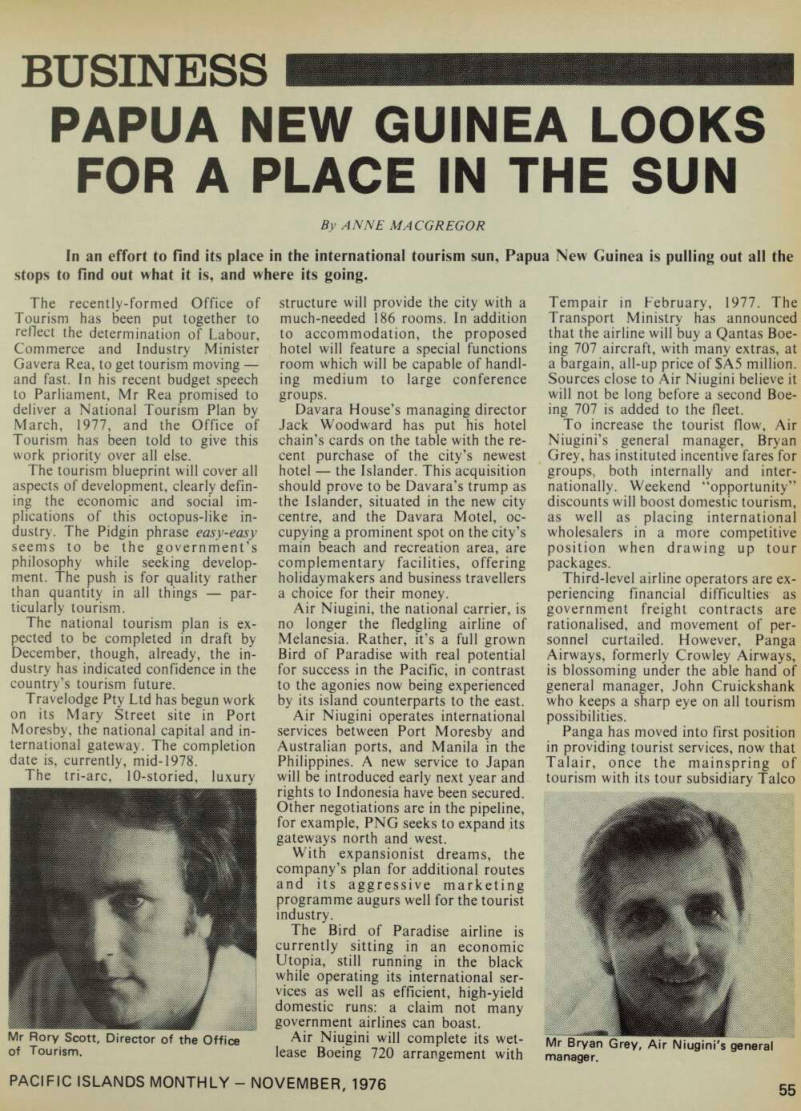

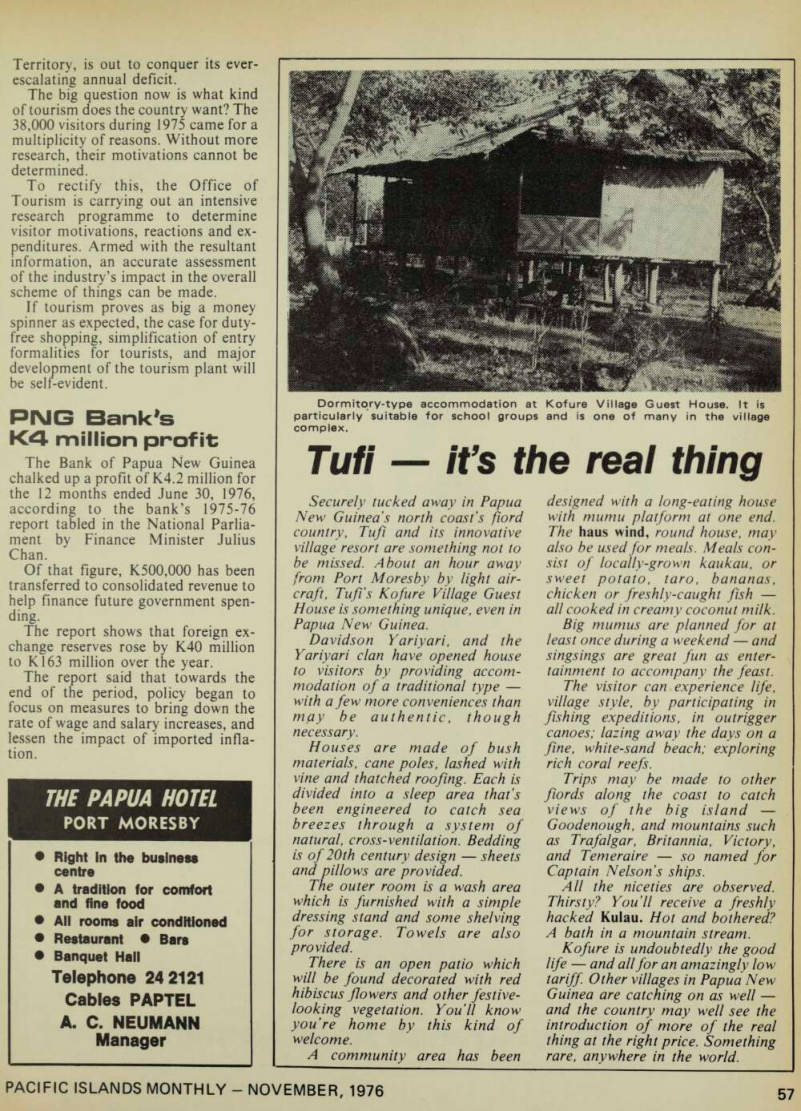
Business
For A Place In The Sun
By Anne Macgregor
In an effort to find its place in the international tourism sun, Papua New Guinea is pulling out all the stops to find out what it is, and where its going.
The recently-formed Office of Tourism has been put together to reflect the determination of Labour, Commerce and Industry Minister Gavera Rea, to get tourism moving and fast. In his recent budget speech to Parliament, Mr Rea promised to deliver a National Tourism Plan by March, 1977, and the Office of Tourism has been told to give this work priority over all else.
The tourism blueprint will cover all aspects of development, clearly defin ing the economic and social im plications of this octopus-like in dustry. The Pidgin phrase easy-easy seems to be the government’s philosophy while seeking develop ment. The push is for quality rather than quantity in all things par ticularly tourism.
The national tourism plan is ex pected to be completed in draft by December, though, already, the in dustry has indicated confidence in the country’s tourism future.
Travelodge Pty Ltd has begun work on its Mary Street site in Port Moresby, the national capital and in ternational gateway. The completion date is, currently, mid-1978.
The tri-arc, 10-storied, luxury
structure will provide the city with a much-needed 186 rooms. In addition to accommodation, the proposed hotel will feature a special functions room which will be capable of handl ing medium to large conference groups.
Davara House’s managing director Jack Woodward has put his hotel chain’s cards on the table with the re cent purchase of the city’s newest hotel the Islander. This acquisition should prove to be Davara’s trump as the Islander, situated in the new city centre, and the Davara Motel, oc cupying a prominent spot on the city’s main beach and recreation area, are complementary facilities, offering holidaymakers and business travellers a choice for their money.
Air Niugini, the national carrier, is no longer the fledgling airline of Melanesia. Rather, it’s a full grown Bird of Paradise with real potential for success in the Pacific, in contrast to the agonies now being experienced by its island counterparts to the east.
Air Niugini operates international services between Port Moresby and Australian ports, and Manila in the Philippines. A new service to Japan will be introduced early next year and rights to Indonesia have been secured.
Other negotiations are in the pipeline, for example, PNG seeks to expand its gateways north and west.
With expansionist dreams, the company’s plan for additional routes and its aggressive marketing programme augurs well for the tourist industry.
The Bird of Paradise airline is currently sitting in an economic Utopia, still running in the black while operating its international ser vices as well as efficient, high-yield domestic runs: a claim not many government airlines can boast.
Air Niugini will complete its wet lease Boeing 720 arrangement with
Tempair in February, 1977. The Transport Ministry has announced that the airline will buy a Qantas Boe ing 707 aircraft, with many extras, at a bargain, all-up price of SAS million.
Sources close to Air Niugini believe it will not be long before a second Boe ing 707 is added to the fleet.
To increase the tourist flow, Air Niugini’s general manager, Bryan Grey, has instituted incentive fares for groups, both internally and inter nationally. Weekend “opportunity” discounts will boost domestic tourism, as well as placing international wholesalers in a more competitive position when drawing up tour packages.
Third-level airline operators are ex periencing financial difficulties as government freight contracts are rationalised, and movement of per sonnel curtailed. However, Panga Airways, formerly Crowley Airways, is blossoming under the able hand of general manager, John Cruickshank who keeps a sharp eye on all tourism possibilities.
Panga has moved into first position in providing tourist services, now that Talair, once the mainspring of tourism with its tour subsidiary Talco
Mr Rory Scott, Director of the Office of Tourism.
Mr Bryan Grey, Air Niugini's general manager.
Territory, is out to conquer its ever escalating annual deficit.
The big question now is what kind of tourism does the country want? The 38,000 visitors during 1975 came for a multiplicity of reasons. Without more research, their motivations cannot be determined.
To rectify this, the Office of Tourism is carrying out an intensive research programme to determine visitor motivations, reactions and ex penditures. Armed with the resultant information, an accurate assessment of the industry’s impact in the overall scheme of things can be made.
If tourism proves as big a money spinner as expected, the case for duty free shopping, simplification of entry formalities for tourists, and major development of the tourism plant will be self-evident,
PNG Bank's
K 4 million profit:
The Bank of Papua New Guinea chalked up a profit of K 4.2 million for the 12 months ended June 30, 1976, according to the bank’s 1975-76 report tabled in the National Parlia ment by Finance Minister Julius Chan.
Of that figure, K 500,000 has been transferred to consolidated revenue to help finance future government spen ding.
The report shows that foreign ex change reserves rose by K4O million to K 163 million over the year.
The report said that towards the end of the period, policy began to focus on measures to bring down the rate of wage and salary increases, and lessen the impact of imported infla tion.
Advertisements & other items, pp. 56-57 (1 item)
cooling systems
Muller K-line
:^4O K-Line Water Cooling Tower K-Line Evaporative Condenser The K-line cooling tower is another quality Muller product which has been thoroughly laboratory tested and is fully guaranteed for high performance ratings. Features include - • 15- 1300 gpm per cell nominal • High velocity discharge - avoids recirculation • Quiet running centrifugal fans • Induced draught design eliminates leakage • Five nozzle sizes to give optimum pump selection and tower water distribution • Single and double flow versions • Simple installation and minimal support requirements. • High corrosion resistant solid construction.
The K-line evaporative condenser is of induced draught counterflow design. The unit is quiet in operation and moving parts are designed to ensure long life. The fans are available in stainless steel, or marine grade aluminium. The bearings are fitted outside the casing and the tubular shaft is specially treated to resist corrosion.
Fully guaranteed for high performance. For further particulars and specifications contact the New Zealand distributors.
COMMERCIAL
DIVISION
lona ire I ndustries Ltd, Phone 760-025, Box 4011, Auckland Phone 36-088, Box 976, Dunedin
THE PAPUA HOTEL
PORT MORESBY
• Right in the business centre • A tradition for comfort and fine food • All rooms air conditioned • Restaurant • Bars • Banquet Hall Telephone 24 2121
Cables PAPTEL
A. C. NEUMANN
Manager
Tufi -it’s the real thing
Securely tucked away in Papua New Guinea’s north coast’s fiord country, Tufi and its innovative village resort are something not to be missed. About an hour away from Port Moresby by light aircraft, Tufi’s Kofure Village Guest House is something unique, even in Papua New Guinea.
Davidson Yariyari, and the Yariyari clan have opened house to visitors by providing accommodation of a traditional type with a few more conveniences than may be authentic. though necessary.
Houses are made of bush materials, cane poles, lashed with vine and thatched roofing. Each is divided into a sleep area that’s been engineered to catch sea breezes through a system of natural, cross-ventilation. Bedding is of 20th century design sheets and pillows are provided.
The outer room is a wash area which is furnished with a simple dressing stand and some shelving for storage. Towels are also provided.
There is an open patio which will be found decorated with red hibiscus flowers and other festivelooking vegetation. You’ll know you’re home by this kind of welcome.
A community area has been
designed with a long-eating house with mumu platform at one end.
The haus wind, round house, may also be used for meals. Meals con sist of locally-grown kaukau, or sweet potato, taro, bananas, chicken or freshly-caught fish all cooked in creamy coconut milk.
Big mumus are planned for at least once during a weekend and singsings are great fun as enter tainment to accompany the feast, The visitor can experience life, village style, by participating in fishing expeditions, in outrigger canoes; lazing away the days on a fine, white-sand beach; exploring rich coral reefs, Trips may be made to other fiords along the coast to catch views of the big island Goodenough, and mountains such as Trafalgar, Britannia, Victory, and Temeraire so named for Captain Nelson’s ships.
All the niceties are observed, Thirsty? You’ll receive a freshly hacked Kulau. Hot and bothered?
A bath in a mountain stream, Kofure is undoubtedly the good life and all for an amazingly low tariff. Other villages in Papua New Guinea are catching on as well and the country may well see the introduction of more of the real thing at the right price. Something rare, anywhere in the world.
Dormitory-type accommodation at Kofure Village Guest House. It is particularly suitable for school groups and is one of many in the village complex.
Advertisements & other items, p. 58 (1 item)
The man from Australia
can come up with the goods
He’s the Australian Government Trade Commissioner. He has the knowledge and experience to advise you on buying from Australia.
And buying from Australia can be a very profitable business. The big range of world class Australian products will surprise you. Machinery, electrical goods, chemicals, sporting goods, scientific equipment, automotive and materials handling equipment—whatever products you want Australia will most likely be able to supply. Australian products are selling well in international markets, they can sell well in yours.
Ask the man who knows Australia
The Australian Trade Commissioner will be pleased to give you details of suppliers. You can contact him at: FIJI. 7th Floor, Dominion House, Thomson Street, Suva, (Post Office Box 1252). Telephone: 312844, P.N.G. Post Office Box 9129, Hohola, Port Moresby, Telephone: 25 9333. m- *4 $ c <
Ask the Australian Trade Commissioner
Clancy Lowers The Boom
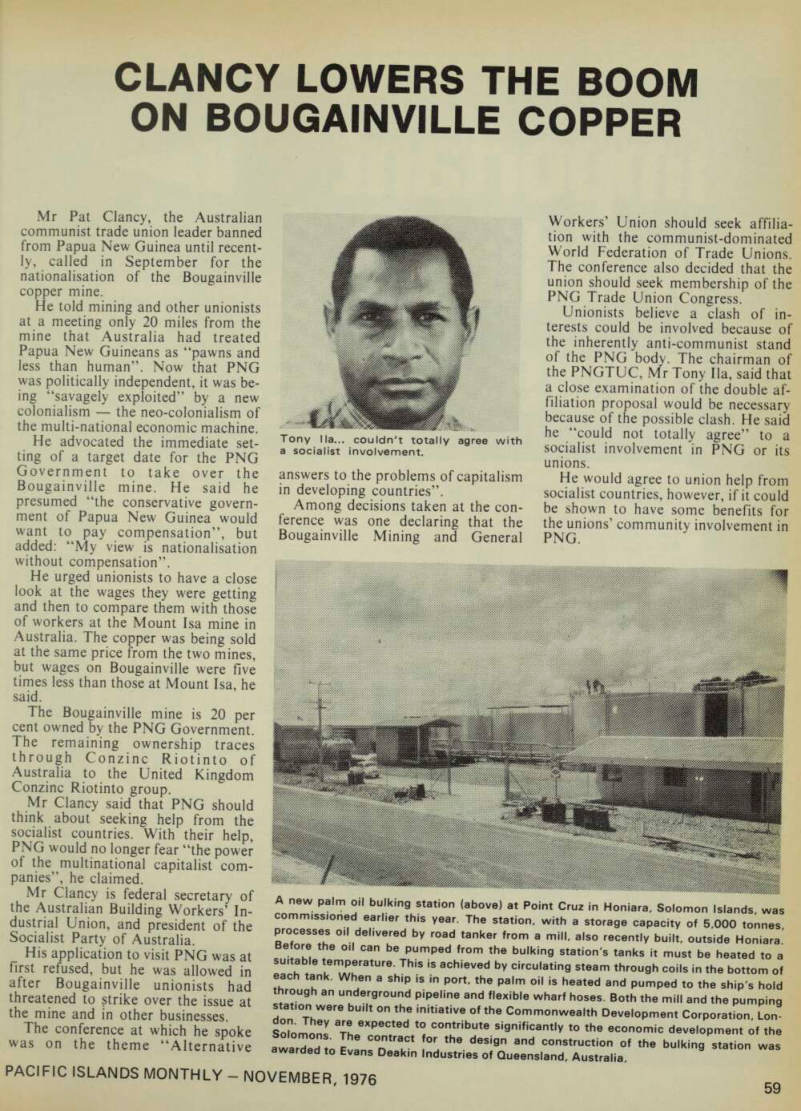
On Bougainville Copper
Mr Pat Clancy, the Australian communist trade union leader banned from Papua New Guinea until recent ly, called in September for the nationalisation of the Bougainville copper mine.
He told mining and other unionists at a meeting only 20 miles from the mine that Australia had treated Papua New Guineans as “pawns and less than human”. Now that PNG was politically independent, it was be ing “savagely exploited” by a new colonialism the neo-colonialism of the multi-national economic machine.
He advocated the immediate set ting of a target date for the PNG Government to take over the Bougainville mine. He said he presumed “the conservative govern ment of Papua New Guinea would want to pay compensation”, but added: “My view is nationalisation without compensation”.
He urged unionists to have a close look at the wages they were getting and then to compare them with those of workers at the Mount Isa mine in Australia. The copper was being sold at the same price from the two mines, but wages on Bougainville were five times less than those at Mount Isa, he said.
The Bougainville mine is 20 per cent owned by the PNG Government.
The remaining ownership traces through Conzinc Riotinto of Australia to the United Kingdom Conzinc Riotinto group.
Mr Clancy said that PNG should think about seeking help from the socialist countries. With their help, PNG would no longer fear “the power of the multinational capitalist com panies”, he claimed.
Mr Clancy is federal secretary of the Australian Building Workers’ In dustrial Union, and president of the Socialist Party of Australia.
His application to visit PNG was at first refused, but he was allowed in after Bougainville unionists had threatened to strike over the issue at the mine and in other businesses.
The conference at which he spoke was on the theme “Alternative
answers to the problems of capitalism in developing countries”.
Among decisions taken at the con ference was one declaring that the Bougainville Mining and General
Workers’ Union should seek affilia tion with the communist-dominated World Federation of Trade Unions.
The conference also decided that the union should seek membership of the PNG Trade Union Congress.
Unionists believe a clash of in terests could be involved because of the inherently anti-communist stand of the PNG body. The chairman of the PNGTUC, Mr Tony Ha, said that a close examination of the double af filiation proposal would be necessary because of the possible clash. He said he “could not totally agree” to a socialist involvement in PNG or its unions.
He would agree to union help from socialist countries, however, if it could be shown to have some benefits for the unions’ community involvement in
Png.
Tony lla... couldn't totally agree with a socialist involvement.
A new palm oil bulking station (above) at Point Cruz in Honiara, Solomon Islands was commissioned earlier this year. The station, with a storage capacity of 5,000 tonnes, processes oil delivered by road tanker from a mill, also recently built, outside Honiara.
Before the oil can be pumped from the bulking station's tanks it must be heated to a suitable temperature. This is achieved by circulating steam through coils in the bottom of each tank. When a ship is in port, the palm oil is heated and pumped to the ship's hold through an underground pipeline and flexible wharf hoses. Both the mill and the pumping station were built on the initiative of the Commonwealth Development Corporation, Lon don. They are expected to contribute significantly to the economic development of the Solomons. The contract for the design and construction of the bulking station was awarded to Evans Deakin Industries of Queensland, Australia.
Advertisements & other items, p. 60 (1 item)
welding
important
news.
m
W.I.A. Welding products have a
renowned reputation for advanced
technical design, quality of
manufacture and field performance.
A full internationally approved
range is available to suit all
purposes and industries.
WELDMATIC G.M.A. SEMI
AUTOMATIC EQUIPMENT
One of the most comprehensive ranges available Australian designed and manufactured Backed by efficient technical expertise ensuring up to date designs equal to anywhere in the welding world Range includes semi-automatic packaged units with capacities from 150 amps up to 600 amps (all 100% duty cycle). Plus full automatic welding head/power source combinations up to 1200 amps output, for use on either gas shielded, open arc or submerged arc welding uK »■
WELDMATIC
250 A high production semi-automatic G.M.A. welding package, ideal for automative production and manufacture of domestic/mdustnal appliances, heatmg/air conditioning equipment, metal cabinets and similar products Rated 250 amps 100% duty cycle, max. current 300 amps 60%.
AUTOMATIC
SUBMERGED ARC
FLUXES & WIRES
Austmalic OP senes includes highest quality, general purpose production fluxes, hardfacing and special application highly basic fluxes Packing 30 kg pails and 250 kg drums Low carbon and low alloy steel wires available
HEAVY DUTY 400 AMP
DIESEL ENGINE DRIVEN
SITE WELDER
> Maximum weldability with minimum fuel costs. > Reduced risk of fire and fuel theft > Auxiliary power ) Long life service. ) Positive all weather starting characteristics.
AUSTMIG C 026
Gas Shielded Welding Wire Copper coated mild steel solid wire for all general purpose semi-automatic welding, using CO2 or argon based mixture shielding gases. 0.8. 0.9, 1 2 and 1.6 mm sizes in 15 kg spools and 30 kq coils
ELECTRODES
Austarc internationally approved mild steel electrodes including cellulose, general purpose, low hydrogen, iron powder and Austalloy range offer superior welding characteristics in all types and gauges.
W.l A also offer a range of special purpose electrodes for hardfacing, bronze, stainless steel and cast iron applications.
I®
Illustrated below are examples
from the extensive range
available.
WELDARC A.C. ARC WELDERS
Comprehensive range of seven models, designed for dependability, ease of use. long efficient life. Fully guaranteed.
Models illustrated are 1) The Miniarc mC66, a popular small A.C. welder, rated up io 140 amps and handles 3.25,2.5 and 2.0 mm designed for extra heavy duty production welding with large size electrodes in locations such as shipyards, building construction sites, etc. Max. current output 500 amps at 100% duty cycle Optional extra is unique remote current control device, works wherever the operator is. any distance from the power source without special cabling.
MINIARC mC66
A revolutionary 140 amp welding all-rounder representing a major breakthrough in welding technology.
Everything you ever wanted in a 240 volt arc welder. n./
CONSTRUCTOR
500
m Mk
FLUXOFIL
Gas Shielded Welding Wire Solid drawn Seamless Fluxofll 11 Tubular Steel Flux Cored running rut Welding Wire ensures production increased productivity general pui higher deposition rates. butt weldin deeper penetration and Fluxofll 31 over 80% metal recovery slag produi Fluxofll 11 Ni Smooth running rutile type high production electrode for general purpose fillet and butt welding applications, Fluxofll 31 Highly basic slag produces toughest Completely moisture proof, weld metal offering high low hydrogen quality Exclusive copper coating gives high efficiency feeding, better electrical production techniques to high integrity welding applications.
Fluxofll 41 and 42 First contact, longer tip life. Sizes choice for welding low alloy available 1.6, 2.0 and high tensile steels, 2,4 mm. Wires available particularly those of the manufactured in Australia notch tough, high strength by W.I.A Q &Ttypes, such as Welten series and USSTI, etc.
For full details & information contact o "I MMM,M H
WELDING INDUSTRIES OF AUSTRALIA,PTY. LTD.
INTERNATIONAL DIVISION * /
Austarc Avenue, Thomastown. AUSTRALIA'S OWN WELDING ORGANIZATION
Telex; 32493, Cables; “Austarc" Melbourne
Tight Belts Will Remain
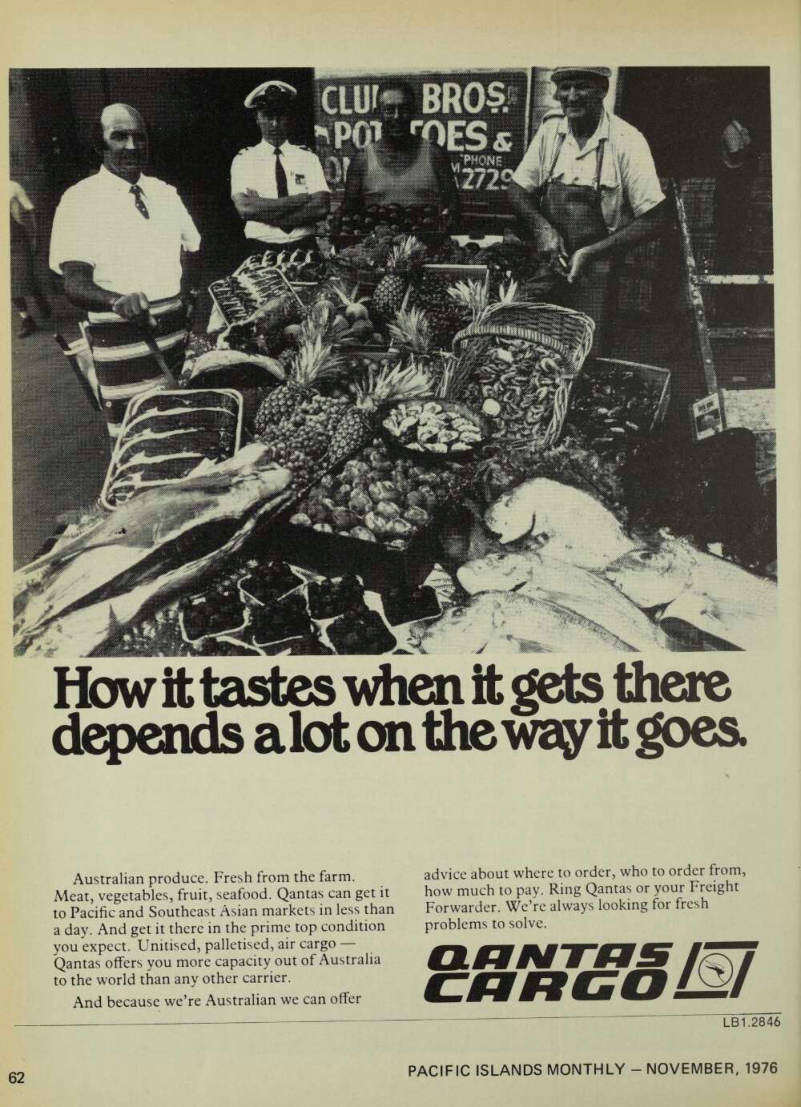
The Fashion In W. Samoa
From FELISF VA 'A in Apia
After reading the new Finance Minister’s statement on the 1976 supplementary estimates in parlia ment one cannot help thinking that the government is well aware of the country’s present financial situation and what the future is likely to be. The problems are delineated and the cures suggested. But then one also thinks that similar governments in the past presented a similar picture. And, retrospectively, it would appear that the country’s financial state has deteriorated and not ameliorated.
This is the crux of the whole question.
It is not that Vaovasamanaia Filipo’s statement is filled to the brim with utopian ideas or empty platitudes. Far from it. Vaovasa does manage to give a very clear, concise and informative picture of the coun try’s finances. Though his emphasis on rural development is not new (it has always been the cornerstone of Western Samoa's five-year develop ment plans) his stress on the inten sification of industrialisation seems to be a more distinct development in economic policy not that in dustrialisation had not been thought of by past governments. It is merely that he emphasises it more and gives it a more definite place.
As expected, Vaovasa painted a grim picture of the agricultural export situation. These exports remain far below their potential level. Taking only the last three years into account, 13.400 tons of copra, worth WSS4.6 million, were exported in 1974. Inter national prices then were good. The next year, more copra was exported, 19.400 tons, but its worth was only WSS2.6 million, due to a drop in prices. There has been no improve ment in copra exports during the first five months of this year. A total of 3300 tons (W 55367,000) was exported compared with 9400 tons (WSSI.IB million) for the same period in 1975.
As for cocoa, 1460 tons (WSSI.IB million) were exported in 1975, the minister said. This does not compare well with the 1820 tons (WSSI.B7 million) exported in 1974. During the
first five months of this year, only 118 tons of cocoa ($1 10,000) were exported, compared with 600 tons (W 55582,000) for the same period in 1975.
Just as bad as copra and cocoa is the banana situation. Only 19,000 cases of bananas worth W 5554,000 were exported in 1975 compared with 52,000 cases (WS$ 127,000) in 1974.
During the first five months of this year, only 7300 cases of bananas (W 5525,000) were exported.
Only 19,000 cases of taro (W 5594,000) were exported in 1975 compared with 90,700 cases (WS$3I8,000) in 1974. But there are encouraging signs, the minister said; in the first five months of this year, 19,400 cases (WS$I0I,000) were exported, compared with 4000 cases (WS$ 15,000) for the same period last year.
Timber exports are perhaps even more depressing. Timber exports in 1975 were worth WS$ 172,000 compared with WSSI.24 million in 1974.
Against the exports are the im ports, the cif value of which for 1975 was W 5522.52 million compared with W 5517.45 for 1974. For the first five months of this year the figure is W 559.45 million compared with WSS9.6I million for the same period last year. As can be seen, the trade balance is very lopsided indeed and a large part of the imbalance is due to government imports (perhaps at least 40 per cent of the imports) for capital development purposes. Thanks large ly to invisible earnings, the balance of payments deficit is not desperate. The country’s overseas reserves are also helping to stabilise the imbalance, Overseas reserves during 1975, in fact, rose by W 55666,000 to W 555.66 million.
The new government’s policy to
“increase . . . manufacturing in
dustrial facilities” is a realistic one.
Vaovasa was only stating the obvious when he said that these would enable Western Samoa to (1) process its agricultural products to a greater ex
tent, thus adding value to its exports (2) manufacture import substitute products and (3) process imported raw materials for re-export. “In creased industrial development thus provides a reasonably rapid means of earning and saving foreign exchange and of providing employment,’’ he said.
Industrialisation is a rapid means all right but by the look of things it appears unlikely that the industrial duty-free zone will be in operation three years from now. A lot of work still has to be done, according to a top government source. Applications Irom overseas companies are being screened in a rather overcautious manner. Those companies or organisations already approved are bickering over the question of loca tion in the zone.
Thus, industrialisation, even on a moderate scale, is still in the distant future as far as Western Samoa is concerned. And this means that the country will still continue to suffer in definitely from the adverse conse quences of an ailing agricultural in dustry. This also means that an im provement in the people’s standard of living is not in the immediate fiture.
In spite of government rhetoric about better times ahead, the fact remains the future is bleak for most Samoans especially with the added problem of a rapidly increasing pop ulation. Under these circumstances, government’s best bet is to continue to push with its development projects in industry, agriculture and, of course, infrastructure. In the private sector, it should adopt conservative policies all around and this means, socially, economically and politically for the life of a nation is an organic whole.
Any radical policies would bring about an imbalance which gives rise to revolutions. Can Tupuola do this?
He is capable of doing it if he can check his ambition for power. For ambition breeds excesses.
The government’s approach to the country's economic problems is quite sound. However, one wonders why the necessity for a large expenditure of money on the proposed Western Sa moan High Commission in Wellington and Consulate in Auckland. In such times of financial crisis, it seems a paradox that the government should see fit to engage in an expensive enterprise of questionable value. The money might be better spent on a sports stadium for Western Samoa’s youth.
New Nz Rules On Tongans
The Tongan Government was told in September that under a new scheme Tongans will be allowed to enter New Zealand to work for up to six months, ac cording to a spokesman for the Auckland Tongan community, Mr W. C.
Edwards.
The Tongan Government was setting up a migration committee from within the Auckland Tongan community and churches. The committee would keep a tight control on Tongans coming on temporary work permits and those who sponsored them.
Mr Edwards said the existing temporary work scheme (four months and renewable for a further two months) had “fizzled out ” because it had been left to employers to organise it. They had failed in this task through lack offacilities and lack of interest in the welfare aspects of the work.
Mr Edwards said the new committee would bring the Tongan Society, churches and respected permanent Tongan residents back into the picture as sponsors. It would try to prevent profiteering sponsorships and make sure tem porary workers went home when their permits expired.
“We want the whole thing to be on a genuine basis so that when a tem porary worker gets here he will not disappear into the woods as so often in the past,” Mr Edwards said.
In the same week as Mr Edwards made his statement, the NZ Minister of Immigration, Mr Gill, said that a total of 1,281 Pacific Island overstayers mostly single men have recently been told to go home. They were given from three to six months to do so.
Advertisements & other items, p. 62 (1 item)
How it tastes when it gets there
nt m A f' & How it tastes when it gets there depends alot on the way it goes.
Australian produce. Fresh from the farm.
Meat, vegetables, fruit, seafood. Qantas can get it to Pacific and Southeast Asian markets in less than a day. And get it there in the prime top condition you expect. Unitised, palletised, air cargo Qantas offers you more capacity out of Australia to the world than any other carrier.
And because we’re Australian we can offer advice about where to order, who to order from, how much to pay. Ring Qantas or your Freight Forwarder. We’re always looking for fresh problems to solve.
fXHNTas /T 7
can coil!
L 81.2846
Purse For The Islands
Australia Opens Its
Fiji, Western Samoa, and the Solomon Islands are among 13 nations due to receive more than $1,000,000 each from Australia in the next 12 months.
The $5,300,000 allocated to Fiji in 1976-77 is part of a programme for South-west Pacific nations for the year totalling $11,000,000 in direct or bilateral aid.
The Australian High Commission in Fiji said that $3,700,000 of the Fiji programme for next year was for projects proposed by the Fiji Govern ment, including the integrated rural development programme for housing, electrification, water supplies, and jet ties in rural areas. Extension of Suva’s water supply and sewerage and the development of beef cattle farms were proposed also as part of this “project aid”.
Australia had offered Fiji wheat worth $BOO,OOO to be milled into flour under the International Food Aid Convention.
An allocation of $500,000 was to be made for training Fiji people either in Fiji or abroad, and $150,000 was to be allocated to the Fiji Government for the staffing assistance scheme which is designed to meet the difference between Fiji salaries and the salaries needed to employ suitable Australian experts.
Australia was to lend Fiji $1,220,000 to help finance the Nadi- Suva highway, part of a $2,700,000 loan made for the highway on more generous terms than were available commercially.
This year $lOO,OOO was being allocated to the Australian fund for the preservation and development of South Pacific cultures, which was launched at the South Pacific Forum in 1974.
Australia would contribute an es timated $128,000 to the South Pacific Bureau for Economic Co-operation and $132,000 to the South Pacific Air Transport Council.
The release said that Australia’s commitment to assisting developing countries was reflected in its decision to increase its aid programme for 1976/77 by 15 per cent at a time when
growth in government spending at home was being curtailed.
The total $398,504,000 Australian aid programme was estimated to represent 0.49 per cent of the forecast gross national product for the year, which compares with the average for member countries of the development assistance committee of the Organisa tion for Economic Co-operation and Development of 0.36 per cent in 1975.
Jobs: Lord
Howe shows how
While places elsewhere in New South Wales have unemployment rates as high as 10%, tiny Lord Howe Island has jobs going begging.
The NSW Minister for Lands, Mr Crabtree, discovered the strange Lord Howe scene on a visit to the island in September.
He said: “They don’t know what unemployment is. The Island Board has jobs for six men that it can’t fill because of the full employment situa tion. Works programmes such as the foreshore protection planning scheme are being delayed.”
Mr Crabtree visited the island for talks on amendments to the Lord Howe Island Act, which will be in troduced in the NSW Parliament before Christmas.
The new legislation will preserve the island as a natural tourist resort with strict controls on future develop ment and careful preservation of flora and fauna.
A ‘Nauru’
in Lau Group
Phosphate deposits in Lau could be large enough to supply Fiji’s agriculture with most of its needs for the fertiliser for several years.
According to the country’s Mineral Resources Department three islands in the group have a total of about two million tons, with Tuvuca alone hav ing about 1,400,000 tons of clay con taining an average of 10% of phosphate.
Advertisements & other items, p. 64 (1 item)
Your Island
From today, this is
IN THE SKY
For 25 years, we have been flying the blue Pacific skies. Today, to celebrate our anniversary, and to look ahead to the next 25 years, we have become a new airline. From today, we are your island in the sky. An island reflected in a new colour scheme.
Rolls-Royce engined jets in colours which are a combination of the Pacific people’s fun and freedom. Colours which are sunrises and sunsets.
Flowers. And the blue Pacific itself.
This is the new Air Pacific. . . your island in the sky.
A new airline which offers you the new kind of island happiness and hospitality. With all traditional courtesy and dignity.
If you’re flying the Pacific, welcome aboard.
We know the South Pacific its our home. ikSymi c, N
CHAIRS
if p 4 Vf rl a V* A ssm hi
for regional shipping
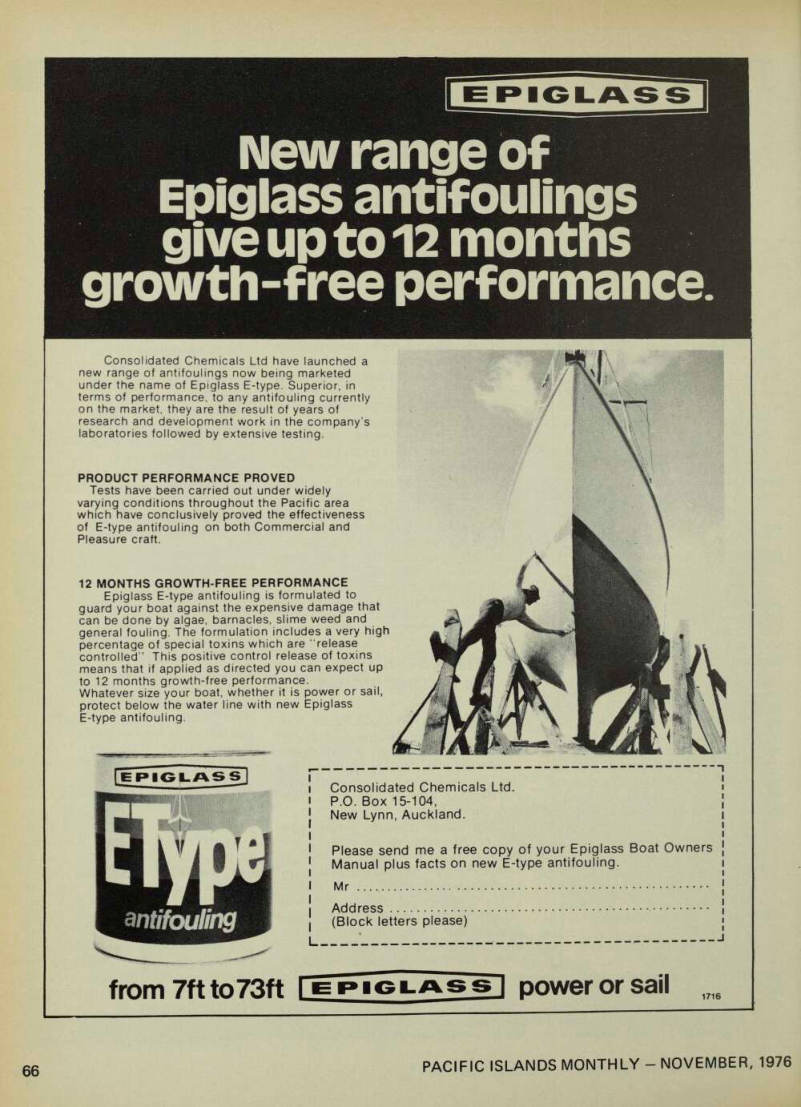
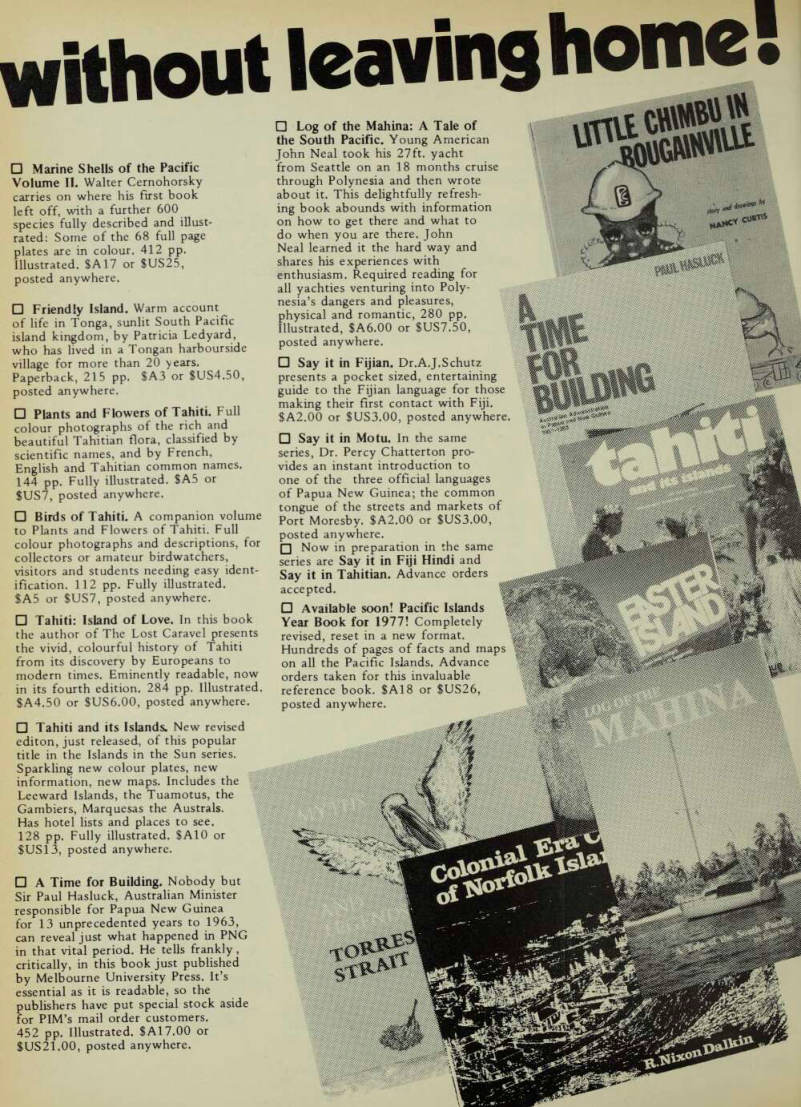
Pacific Transport
Nationalism, a perilous reef for regional shipping
From a special correspondent
The decision of the South Pacific Forum, at its July meeting at Nauru, to establish the Pacific Forum Line has, at long last, brought to near reality the much-talked-about regional shipping line a subject repeatedly discussed by Island leaders since the Pacific Islands Producers’
Association (PIPA) was formed in the late 19605.
In PIPA’s early years, Island leaders quickly felt that there was a need for a regional shipping line to reduce or perhaps end the Islands’ dependence on foreign shipping in terests and enable them to come to grips themselves with the problem of freight rates, routes, etc in which they had been helpless in the past.
A sub-committee was formed to look into the question and held several meetings, under PIPA’s auspices.
Those early meetings agreed that not only was there an urgent need for a regional shipping line but believed it would be a viable one.
The Tongan national line and, to a lesser extent, the Nauru line, were go ing to be the basis upon which the regional shipping line would be form ed. Tonga’s Pacific Navigation had the ships, the trained crews and, so it was popularly believed, the manage ment. But, in spite of the enthusiasm shown by the Island governments and the expenses spent on meetings, nothing really concrete ever came out of the PIPA sub-committee.
The concept of a regional line was not allowed to die, however, and the establishment of the Forum kept it alive. SPEC was entrusted with the task of looking into ways in which the regional line could be established on a sound economic basis. But as time went on it became more than ap parent that the line would not be a viable one. Thus, in the draft memorandum of agreement sub mitted to the Forum meeting at
Nauru, it says in its list of objectives that the line should “operate so far as possible on a viable basis”. This is a commendable though not entirely acceptable view.
But the deviation, from the original intention that the line will be es tablished only if its viability can be virtually guaranteed, to one of “operate so far as possible on a viable basis” requires some analysis.
Firstly, it appears that the SPEC authors of the memorandum are fear ful that the various problems faced by Air Pacific, the regional airline carrier, due to some member coun tries being obsessed with plans for their own national lines will also worry the proposed shipping line.
The hassles and wrangles over Air Pacific have been so bad that the ap
parent fears implied by SPEC in the memorandum of agreement cannot be ignored.
It is heartening to see that at least some people are convinced that there is little point in carrying on with the myth that Air Pacific is a successful product of regional co-operation. As a regional carrier, Air Pacific is a failure and this is what happens to communal ventures in which the par ticipating nations supposedly co operative give only token support to them while being more concerned with launching and nurturing their own national enterprises.
Countries which already own their shipping lines will naturally be reluc tant if the proposed line ever becomes a threat to their own national lines.
Another factor which appears to be worrying SPEC and some Forum members is the rather sad history of the Tongan national line, the Pacific Navigation Company Limited. Over recent months, it has become quite clear that it will only be a matter of time before the Tongan line will be liquidated. It is not clear whether the Nauru Line has been running profitably or not, but the answer to such a question is, in this connection, rather immaterial since Nauru can af ford heavy losses as it does in relation to its airline.
Apart from the threats from within, the proposed shipping line will have to face the problems of dealing with militant maritime unions of New Zealand and Australia which would be concerned about reduced employ ment opportunities for their members.
And let us be honest about it, the successive New Zealand and Australian governments have had more than their fair share of troubles with maritime unions.
The Prime Minister of Fiji, Ratu Sir Kamisese Mara, was on target in
this connection in an angry outburst at the Australian representative at the Forum meeting in Tonga last year when the latter appeared to disagree with Ratu Mara over his complaint about the difficulties that island ship ping companies were having, and still have with maritime unions in Australia and New Zealand.
The idea of a regional shipping line is a very fine one. Unfortunately, with the national feelings among Pacific Islands governments being so strong, the idea is a fine one in theory only.
I, personally, cannot see the proposed regional shipping line being given a fair go by all the member countries. Nationalism in the islands is too strong for the Islands’ own good.
The faint success that PI PA achiev ed during its existence lends support to my contention. The frank outburst of the flamboyant Prime Minister of Western Samoa, Tupuola Efi, at the last Forum meeting, is a fair indica tion of the tendency for regional groupings to discuss a lot of things and yet take very few decisions.
The angry outburst of the Prime Minister of Fiji in recent months about the lack of regional co operation in respect of Air Pacific cannot be pushed into the background in considering the pros and cons of es tablishing a regional shipping line.
To some, the sentiments expressed in this article may appear to be on the defeatist side. I believe, however, that the time has come for the Pacific with its limited resources to look at things more critically and more realistically before taking the final plunge.
Events may turn out to prove my sentiments wrong and if that happens, then and only then, can I say that there is regional co-operation among the Island nations of the Pacific.
Death Grounds
Mission Planes
The Mission Aviation Fellowship, which operates 11 aircraft in Papua New Guinea, was grounded in September by the Minister for Transport, Mr B. Jephcott.
His decision followed a series of mishaps over the preceding four months which killed eight people and destroyed or seriously damaged four MAF aircraft.
The Fellowship, an international organisation with its regional head quarters in Melbourne, provides air
support for missions in developing countries.
The ban will remain in force “until the checking and training organisa tion required under the civil aviation regulations is of an acceptable stan dard”. Only officially approved mer cy flights will be permitted for the duration of the ban.
A spokesman for the Fellowship said there would be a “flat out” attempt to meet the requirements of the PNG civil aviation authorities, and it was hoped that MAF would be back in the air in a week or so.
Thousands of people in remote PNG communities would be deprived of access to the outside world by the ban, he said.
Hawaiian Airlines
Want To Fly Pacific
There are glum faces around the Honolulu headquarters of Hawaiian Airlines Inc as the fact is digested that the airline has almost certainly missed out again in the latest of its many attempts to go international.
Although at time of writing no final decision has been handed down, the course of the argument in Washington before the US Civil Aeronautics Board on Hawaiian’s application to fly to San Francisco and Los Angeles and American Samoa and Fiji gave practically no ground for hope.
Hawaiian’s application showed considerable originality. It did not seek to serve Auckland and Sydney, apparently believing it would have dif ficulty securing landing rights in those places.
It also noted that service to American Samoa and Fiji at present is poor because through-flights to and from Australia stop at those islands in the middle of the night. Hawaiian argued that no-one has adequately tried to promote tourism from the US West Coast to American Samoa and Fiji.
Because Hawaiian is not a member of the International Air Transport Association and does not have to charge IATA-approved fares, it proposed low-cost vacation packages for American Samoa and Fiji, backed by a huge promotional campaign. Ad ditionally, by not seeking to go to Australia, Hawaiian reasoned that it would not be adding to Pan Am’s woes, for which it should receive the CAB’s thanks.
Continued on page 71
But the administrative law judge sitting on the case would have none of it. He claimed that Hawaiian’s traffic projections were “considerably over stated”, that there is no need for an additional carrier between the US mainland and Honolulu, and that there is no need for “competitive air service on a truncated South Pacific route between Honolulu and American Samoa and Fiji”.
This ruling apparently eliminated Hawaiian as an applicant in the case.
The judge’s recommendation was that the new route award to fly from the West Coast ot Australia and New Zealand, in competition with Pan Am, Qantas and Air New Zealand, should go to Continental Airlines.
Hawaiian had previously made un successful applications for inter national routes in 1935, 1946, 1959, 1966 and 1974.
Leaking Gas
Bottle Kills Four
A September explosion in a Papua New Guinea government ship which killed four people and injured 16 oc curred when the ship’s diesel engine ingested propane gas instead of air.
Marine investigators reported that the propane had come from a leaking gas bottle in the galley of the ship, the Rouna Falls. The gas is used for cook ing.
The circumstances are to be the subject of a formal marine safety in quiry, which may lead to a maritime inquiry under the PNG Merchant Shipping Act.
The ship was carrying members of a women’s netball team, who were returning home after a sports meeting, when the explosion occurred northwest of Madang. • Longest cruise in P & O’s April- December Island cruise programme for 1977 leaves Sydney on June 6 for 18 nights, calling at Brisbane, Honiara, Suva, Savusavu, Vavau, Nukualofa and Lautoka. The two new ports added to P & O’s itinerary in 1976, Santo and Apia, will again feature next year. There will be one call at Apia in the cruise leaving Sydney on May 22, and five calls at Santo in May, June, August, September and on January 2, 1978.
Other South Pacific ports featuring in P & O cruises include Vila, Noumea, Bay of Islands (NZ), Auckland and Pago Pago.
Inter-Island Talks
On Airline Rights
Fiji is to hold talks with Papua New Guinea, Western Samoa and Tonga on exchanges of airline traffic rights.
The talks will decide the frequency and the conditions under which Air Pacific can operate flights to these countries.
They would also fix similar con ditions for services to Fiji by Air Niugini and Polynesian Airlines, in which Western Samoa and Tonga are shareholders.
Until now Air Pacific has had relatively free access to Western Samoa and Tonga because the two countries are its shareholders.
But the Samoans and Tongans an nounced recently that they wanted to build up Polynesian Airlines and another major regional airline which in many instances would compete directly with Air Pacific.
Advertisements & other items, pp. 66-72 (1 item)
growth-free performance.
New range of
Epiglass antif oulings
give up to 12 months
growth-free performance.
Consolidated Chemicals Ltd have launched a new range of antifoulings now being marketed under the name of Epiglass E-type. Superior, in terms of performance, to any antifouling currently on the market, they are the result of years of research and development work in the company’s laboratories followed by extensive testing.
PRODUCT PERFORMANCE PROVED
Tests have been carried out under widely varying conditions throughout the Pacific area which have conclusively proved the effectiveness of E-type antifouling on both Commercial and Pleasure craft.
12 MONTHS GROWTH-FREE PERFORMANCE
Epiglass E-type antifouling is formulated to guard your boat against the expensive damage that can be done by algae, barnacles, slime weed and general fouling. The formulation includes a very high percentage of special toxins which are “release controlled” This positive control release of toxins means that if applied as directed you can expect up to 12 months growth-free performance.
Whatever size your boat, whether it is power or sail, protect below the water line with new Epiglass E-type antifouling. mi
[epiglass]
4) Consolidated Chemicals Ltd.
P.O. Box 15-104, New Lynn, Auckland.
Please send me a free copy of your Epiglass Boat Owners Manual plus facts on new E-type antifouling.
Mr Address
(Block letters please)
from 7ft to73ft [
power or sail
c >
E PIGLAS S I
PACIFIC AREA
DISTRIBUTORS
COOK ISLANDS
Cook Is. Trading Corp. Ltd
FIJI
Burns Philp (SS) Co. Ltd
NEW GUINEA
Bougainville Marine Pty Ltd, Kieta Burns Philp (NG) Ltd, Madang Elvee Trading Pty Ltd, Rabaul Faulkner & Tait (NG) Pty Ltd, Lae S. A. Heath & Co. Pty Ltd, Port Moresby
NEW HEBRIDES
Burns Philp (NH) Ltd
NOUMEA
Guy Limousin Pacific Yachting
NORFOLK ISLAND
Irvine Bid. Supply Centre
PAGO PAGO
Max Haleck Inc.
TAHITI
Marine Corail Tahiti Sport Tahiti Voile
TONGA
Riechelmann Bros.
WESTERN SAMOA
Burns Philp (SS) Co. Ltd E. A. Coxon Ltd Gold Star Transport Co. Ltd Morris Hedstrom Ltd
SOLOMON ISLANDS
George Yee Fai Ltd < /
without leaving home.
□ Marine Shells of the Pacific Volume 11. Walter Cernohorsky carries on where his first book left off, with a further 600 species fully described and illustrated; Some of the 68 full page plates are in colour. 412 pp.
Illustrated. SAI7 or SUS2S,
posted anywhere.
□ Friendly Island. Warm account of life in Tonga, sunlit South Pacific
island kingdom, by Patricia Ledyard,
who has lived in a Tongan harbourside village for more than 20 years.
Paperback, 215 pp. SA3 or SUS4.SO,
posted anywhere.
□ Plants and Flowers of Tahiti. Full colour photographs of the rich and beautiful Tahitian flora, classified by scientific names, and by French, English and Tahitian common names. 144 pp. Fully illustrated. SAS or
SUS 7, posted anywhere.
□ Birds of Tahiti. A companion volume to Plants and Flowers of Tahiti, Full colour photographs and descriptions, for collectors or amateur birdwatchers, visitors and students needing easy identification. 112 pp. Fully illustrated, SAS or SUS 7, posted anywhere. □ Tahiti: Island of Love. In this book the author of The Lost Caravel presents the vivid, colourful history of Tahiti from its discovery by Europeans to modern times. Eminently readable, now in its fourth edition. 284 pp. Illustrated. 5A4.50 or SUS6.OO, posted anywhere. □ Tahiti and its Islands. New revised editon, just released, of this popular title in the Islands in the Sun series.
Sparkling new colour plates, new information, new maps. Includes the Leeward Islands, the Tuamotus, the Gambiers, Marquesas the Australs.
Has hotel lists and places to see. 128 pp. Fully illustrated. SAIO or
SUSI 3, posted anywhere.
□ A Time for Building. Nobody but Sir Paul Hasluck, Australian Minister responsible for Papua New Guinea for 13 unprecedented years to 1963, can reveal just what happened in PNG in that vital period. He tells frankly, critically, in this book just published by Melbourne University Press. It’s essential as it is readable, so the publishers have put special stock aside for PlM’s mail order customers. 452 pp. Illustrated. 5A17.00 or
SUS2I.OO, posted anywhere.
□ Log of the Mahina: A Tale of the South Pacific. Young American John Neal took his 27ft. yacht from Seattle on an 18 months cruise through Polynesia and then wrote about it. This delightfully refreshing book abounds with information on how to get there and what to do when you are there. John Neal learned it the hard way and shares his experiences with
enthusiasm. Required reading for
all yachties venturing into Polynesia’s dangers and pleasures, physical and romantic, 280 pp.
Illustrated, 5A6.00 or SUS7.SO,
posted anywhere.
□ Say it in Fijian. Dr.AJ.Schutz presents a pocket sized, entertaining guide to the Fijian language for those making their first contact with Fiji. 5A2.00 or SUS3.OO, posted anywhere. □ Say it in Motu. In the same series, Dr. Percy Chatterton provides an instant introduction to one of the three official languages of Papua New Guinea; the common tongue of the streets and markets of Port Moresby, 5A2.00 or SUS3.OO,
posted anywhere.
□ Now in preparation in the same series are Say it in Fiji Hindi and Say it in Tahitian. Advance orders
accepted.
□ Available soon! Pacific Islands Year Book for 1977! Completely revised, reset in a new format.
Hundreds of pages of facts and maps on all the Pacific Islands. Advance orders taken for this invaluable reference book. SAIB or SUS 26,
posted anywhere.
£ t
travel the islands
FI New Caledonia Frpnrh New □ The Lost CaraveL Robert Langdon shatters traditionally-held views on the Polynesians in this controversial, historical whodunnit described by Prof. Ron Crocombe as a “masterpiece as fascinating as it is important”. Also invaluable as a record of early Pacific exploration. 368 pp. Profusely illustrated with maps and plates. SAIB or SUS 26, posted anywhere. □ The Story of the Solomons.
Simple, lucid outline of the history of the Solomon Islands, from a refreshingly frank and affectionate point of view, by Dr. C.E’Fox. 88 pp. SA3 or SUS 4, posted anywhere. □ Papua New Guinea Handbook 1976. Completely revised, reset, and containing full details of this newly independent nation history, geography, government, industry, tourist accommodation, etc. Clear maps include a large coloured, fold-out map of PNG. 5A7.50 or SUSIO, posted anywhere. □ Myths and Legends of Torres Strait. Margaret Lawrie collected these stories from the Western, Central and Eastern islands of Torres Strait, including Saibai and Boigu, and Queensland University Press bought them together in this magnificently produced large-format volume of 372 pages.
Splendidly illustrated with colour photographs, drawings, paintings and maps, and including a 45 rpm record of songs of Torres Strait. $A28.00 or 5U535.00 posted anywhere. □ Port Moresby, Yesterday and Today. In what is even more than n a history of Papua New Guinea’s capital, Canon lan Stuart takes us S on an entertaining, personalised tour of the city. Softcover, 368 pp. Maps r illustrations. 5A3.50 or SUS4.SO, posted anywhere. □ Holy Torture in Fiji. Firewalking *3 and other sacred, ancient rituals of Fiji’s Hindus described in text v and colour photographs. Large 5 format, 64 pp. Illustrated. 5A4.50 or SUS6.SO, posted anywhere. Q- □ New Hebrides. One of the superb Islands in the Sun colour series of brilliant full-colour plates, maps and text, this volume describes the unique British-French Condominium of the New Hebrides. A guide for travellers, or for collectors. 128 pp.
Fully illustrated, SAIO or SUSI 3, posted anywhere.
O o CN si CO Q > CO 00“ o CO X O QQ d CL d □ New Caledonia. French New Caledonia, superbly depicted in full colour photographs, with informative text and maps giving history, geography and daily life. An Islands in the Sun guide, with 128 pp. Fully illustrated.
SAIO or SUSI 3, posted anywhere. □ Bora Bora. One of the French Pacific’s fascinating, colourful high islands, reached from Tahiti, here presented in sparkling full colour pictures for visitors or mere armchair travellers. Another Islands in the Sun guide, with the same attention to to detail. 128 pp. Fully illustrated.
SAIO or SUSI 3 posted anywhere.
□ Fiji Fiji. The multi-racial dominion of friendly Fiji, crossroads of the Pacific, described in colour photographs, maps and text, uniform with the beautiful series listed above.
Many people buy the whole set.
More titles to be published. 128 pp.
Fully illustrated. SAIO or SUSI 3, posted anywhere. □ Little Chimbu in Bougainville.
For the young and young-in-heart, lovable Little Chimbu and his friends visit Panguna, and get into awful trouble in what could be the biggest hole in the world, the Bougainville copper mine. Nancy Curtis, who used to live there, tells the story in full colour drawings which are also accurate and instructive. Also in the colourful Nancy Curtis series for children are D Little Balus and □ Fiji Johnny.
About 48 pp. Illustrated. Each 5A3.50 or SUS4.SO posted anywhere. □ Percy Chatterton’s Papua: Day That I Have Loved. Charming evocative account of changing Papua as Rev.
Percy Chatterton knew it for 50 years. 144 pp. Illustrated. 5A6.50 or SUSB.SO posted anywhere. □ Colonial Era Cemetery of Norfolk Island. Former Administrator of the island, R.Nixon Dalkin,, describes life and death in what was Britain’s harshest Pacific penal colony. There are illuminating, often moving stories in these photographs, charts and inscriptions that describe the historic cemetery. Large format, 92 pp.
Illustrated. SAS or SUS7.SO, posted anywhere. □ Easter Island. At last, a new book on fascinating Easter Island history, daily life and the mysterious giant statues. All in full colour with maps and information for travellers, as one of the Islands in the Sun series. Half of this splendid book is devoted to descriptions and photographs of the statues that made the island famous.
SAIO or SUSI 3, posted anywhere.
\\LVe cut the
big, wide Pacific
down to size.
Again,
New York London Seattle Portland NYC/London San Francisco Los Angeles Mideasl/Europe Hon 9 Tokyo Lusaka Okinawa Honolulu Kong Taipe Saipan Manila Guam Bangkok Singapore Jakarta Bah Tahiti From the airline that first discovered the Pacific, Pan Am introduces another first. The fastest scheduled flights from Tokyo to New York and Los Angeles, non-stop. Aboard our new 747 SPs.
And from Australia, there’s now an all 747 service to the U.S.A. every day except Wednesday.
With new "no-change” 747 s from Melbourne to Honolulu on Fridays and Sundays via Sydney and Nadi. On Saturdays and Mondays via Sydney and Pago Pago. It’s all part of making the big wide Pacific not so big and wide. And beyond,
it’s the same fast, comfortable story.
You call it the world. We call it home.
Sydney: Elizabeth Street, at Martin Place, 2331111 and International Terminal Building, Mascot.
Melbourne: 233 Collins St., 6544788 Brisbane: 191 Elizabeth St., 221 7477 Canberra: 28-36 Ainslie Avenue, 489184.
Adelaide: Aston House, 13 Leigh St., 51 2821 Perth: 172 St. George’s Terrace, 21 2719. 065.P.125
PAIWA LINE
DIRECT REGULAR SERVICE
JAPAN-SOUTH PACIFIC
TARAWA-PAPEETE-PAGO PAGO-APIA
SUVA-LAUTOKA-NOUMEA-VILA
SANTO-HONIARA
JAPAN-TAIWAN-GUAM
JAPAN-KEELUNG-GUAM BY
EXCELLENT CAR/CONTAINER-CARRIER
JAPAN-WEST IRIAN-DILI
HONG KONG-TAIWAN-WEST IRIAN-DILI
GUAM: ATKINS, KROLL (GUAM) LTD.
TARAWA: G. & E. I. DEVELOPMENT AUTHORITY.
APIA: BURNS PHILP (SOUTH SEA) CO., LTD.
PAGO PAGO; KNEUBUHL MARITIME SERVICES CORP.
NUKUALOFA: PACIFIC NAVIGATION CO., LTD.
SUVA; BURNS PHILP (SOUTH SEA) CO., LTD.
LAUTOKA; BURNS PHILP (SOUTH SEA) CO., LTD.
NOUMEA: SOCIETE D'ACCONAGA ET
TRANSPORT D'OCEANIE (SATO)
SANTO; BURNS PHILP (NEW HEBRIDES) LTD.
VILA; BURNS PHILP (NEW HEBRIDES) LTD.
HONIARA: BRITISH SOLOMONS TRADING CO„ LTD.
PAPEETE: AGENCE MARITIME DE FARA UTE.
HONG KONG; IKE MARITIME CO., LTD.
SINGAPORE: THE BORNEO CO., (SINGAPORE) LTD.
DJAJAPURA: P. N. PELAJARAN NASIONAL INDONESIA
DILI: SANG TAI HOO
TAIWAN; FOR CARGO BETWEEN JAPAN/GUAM/TAIWAN
FORMOSA SHIPPING & ENTERPRISE CORP.
TAIWAN; FOR CARGO BETWEEN JAPAN/SOUTH PACIFIC/
WEST IRIAN/DILI
MARITIME TRANSPORTATION AGENCIES, LTD.
THE DAIWA NAVIGATION CO.. LTD.
AGENTS:
OSAKA; “DAILINE”
TOKYO: “FUNEDAILINE"
HEAD OFFICE
DAIICHI KYOGYO BLDG.,
45, 2-CHOME, AWAZAM IN AMI-DOR I
NISHI-KU, OSAKA, JAPAN
TELEPHONE: (06) 531-0471 ~9
TELEX: 525-6324 & 525-6325
TOKYO OFFICE
SHIN-DAIICHI BLDG.,
4-13, NIHONBASHI 3-CHOME, CHUO-KU
TOKYO, JAPAN
TELEPHONE. (03) 274-3251 ~8
TELEX. 222-3343. 23559
We're working the Pacific
with a Cat Marine Diesel.
"Loloho" - General purpose Harbour tug boat. Operated by Bougainville Copper Limited at Bougainville. Overall length 50 ft. (15.24 m). Powered by a Caterpillar D 343 Marine Engine. ”M.V. Kaunitoni” - An Inter-Island freighter. Operated by the Fiji Government. Overall length 134.3 ft. Displacement 628 tons. Speed 10 knots. Powered by a Caterpillar D 379.
Hastings Deering (Pacific) Ltd.and Carpenters Tractorsj:over the
Pacific islands waterfront with Cat.
Marine
Hastings Deering (Pacific) at Lae, Port Moresby and Bougainville and Carpenters Tractors at Suva are staffed by Caterpillar-trained technicians.
Working the Pacific waterfront day after day, year after year, you depend on reliable horsepower and first class dealer-support. You get it with a Cat Marine Diesel, Hastings Deering (Pacific) and Carpenters Tractors.
While there’s a Cat Marine Diesel in your craft you’re backed up with Cat Plus, the total support programme offered only by your Caterpillar dealer.
Your local Hastings Deering (Pacific) or Carpenters Tractors dealer backs your Cat Marine Diesel engine with parts and service programmes designed to prevent, as well as shorten profitrobbing downtime.
Caterpillar Dealers in South-West Pacific.
HASTINGS DEERING
Lae: Milford Haven Road, Ph: 42 2355 Port Moresby: Champion Parade, Konedobu Ph; 24 3138 or 24 2098.
Bougainville: Itakara.
Industrial Park, Arawa, Ph; 95 9077 154 Queens Road, Suva.
Ph: 24 051-4, Cables; Carptrac Suva.
Telex: Carptrac FJ2191 Suva.
HD6I4
Caterpillar. Cat and Q 3 are trademarks ol Caterpillar Tractor Co.
Niugini to Qantas, TAA
‘Three’s a crowd’ says Air Niugini to Qantas, TAA
Negotiations began in September between the governments of Papua New Guinea and Australia on ter mination of the Australian Government’s shareholding in the PNG national airline, Air Niugini.
Under the agreement establishing Air Niugini, the Australian Government’s international and domestic airlines, Qantas and Trans- Australia Airlines, each holds 12 per cent of the shares in Air Niugini. The country’s major commercial carrier, Ansett Airlines of Australia, holds 16 per cent. The remaining 60 per cent is held by the PNG Government.
The agreement, concluded under the former Labor government in Australia, makes clear provision for an eventual take-over of the Australian government interest, on the initiative of the PNG Govern ment. It is this provision that PNG is now seeking to put into effect.
Difficulties first began to appear in the arrangement after Air Niugini went international in 1975.
A spokesman for Air Niugini ad mitted at a press briefing that, in negotiations seeking traffic rights overseas, some foreign civil aviation authorities had gone so far as to suggest that Air Niugini was just a front for the Australian government airlines. PIM understands that US and Japanese officials have been among those raising such objections.
Speaking at a September press con ference in Port Moresby, PNG Prime Minister, Mr Michael Somare, denied reports of friction in the agreement, but conceded that a problem arose from the fact that Qantas, as a shareholder in Air Niugini and as an international carrier itself, knew the boardroom secrets of Air Niugini.
Although Qantas and Air Niugini had an effective working arrangement between themselves, the shared secrets became an inhibiting factor when Air Niugini wanted to conduct independent negotiations with other international carriers and their governments. ‘‘We sometimes hear things back from Australia practically before we know them ourselves,” he said, ad ding: “If a country like PNG and its
airline want to be independent, they have to be independent in fact as well as in name. What’s the use otherwise?”
Mr Somare brushed aside specula tion, some of which was aired in the PNG National Parliament, that Air Niugini would offer the Qantas and TAA shares to Ansett.
He said his government’s sole con cern was to build up its equity in its national airline, and that this would be done by proper negotiation under the terms of an existing agreement with the Australian Government.
But nothing said by Mr Somare ruled out the possibility, which is be ing discussed in airline circles, of Air Niugini entering or seeking to enter a business deal with Ansett involving fleet-usage and maintenance arrangements. The stumbling block to this could be the attitude of the Australian Government, in the light of its own airline policies.
While talks on the Australian government shareholding were getting
under way, Air Niugini confirmed that it was involved in con tinuing discussions with US civil avia tion authorities on the possibility of obtaining landing rights in Guam and Hawaii. It said the talks were still in a very tentative stage, and that market surveys would have to be completed before the airline firmed up its own at titude to the proposed route expan sions.
Air Niugini will begin flying into Sydney early in November under an agreement concluded with the Australian Government. At present its Australian operation terminates at Brisbane.
It is due to begin flying to Kagoshima, southern Japan, in January.
The airline plans to buy a Boeing 707 from Qantas in 1977. Seven Air Niugini pilots, most of them Australians, have been training with Qantas in Australia for conversion to Boeing 707 crew work.
Shipping changes gave
Gilbertese a headache
The Gilbertese were a worried peopie in September when they heard that the Columbus Line was dropping Tarawa [ r 9 m i* s Australia-New Zealand-United States service. The news came as a complete surprise since the company had only very shortly before denied that it had any such mtenUon.
The service started by the Germanbased Ime in 1965 and containerised m 1973, represented the Gilberts’ major freight link with the outside world.
Tarawa will be served in future by the Daiwa-Oceania consortium using the Palau, a vessel of about 6,000 tonnes capable of carrying 300-odd containers. Daiwa is a Japanese-based operation.
Within hours of news of the change being confirmed on Tarawa, a highlevel Gilbert Islands delegation was flying to Sydney for discussions with
Columbus and with Daiwa’s Australian agents, Tradex Transport Pty Ltd.
Qn the delegation were Mr Babera Kirata, Secretary for Commerce and industry in the Gilberts Government; Captain E.V. Ward, marine manager 0 f the Gilbert Islands Development Authority (GIDA); and Mr David Harrison, manager of the Co operative Federation Ltd, represen ting commercial interests in the Gilberts. grounds of their concern are f°ll° win g: • In 1975, the Columbus ships Caribic, Coramandel and Capricorn made 17 calls at Tarawa. Under the new proposals Palau will make only nine or 10 calls a year. This creates commercial problems such as the need to carry heavier stocks, and the
raising of additional finance to cover these. • Whereas Columbus used three ships on the service, Daiwa plans to use only one. If Palau suffered any serious mechanical breakdown or other mishap, this could have dis astrous effects for the islands. • The new service will make no calls at New Zealand, ending all direct sea contacts between the Gilberts and that country. This will raise freight costs substantially, since all freight between the two countries will now have to be trans-shipped. It is certain that Gilberts - NZ trade will suffer as a result. This trade had been growing, with the Gilberts receiving considerable quantities of NZ fresh meat and groceries. Corned beef and dairy products in particular had been coming to the Gilberts from NZ in in creasing quantities. • Tonga will get two 20-metre front-end loading barges from New Zealand under that country’s aid scheme to replace the Kao, which sank last year. The first barge was scheduled for delivery about the end of October, and the second in March, 1977.
Cruising

Yachts
Tonga played host to a number of visiting yachts recently, some of them calling at Nukualofa and Neiafu, and others at Neiafu only. The visitors included: • KRAKA, (Denmark), carrying Lars Aby Jensen (skipper), Jan Olov Astrom, and Juan Gaddiel Jaime arrived from Rarotonga, on the way to Suva. • BOOMERANG, (Belmont, Newcastle, NSW) with A. G. (Burgin (skipper), G. L. Ban brook, J. H. Henderson and K. W. Humphrey, arrived from Suva, and sailed a few days later for Lautoka. • SUPER SHRIMP, (England), carrying Shane J. Acton (skipper) and Iris Derungs, arrived from Niue and left for Suva. • ONZA, (US), with Lawrence Horrowitz (skipper), Tiu Renercomb and Vera Krivonos, arrived from Niue and left for Suva. • VERSATILE, (Jersey Island), with Geraw Garioud (skipper), Michele Garioud and Gilles Lecuyer, arrived from Rarotonga and left for Noumea. • MORNING LIGHT (US), with George
Greenough (skipper) and Chris Brock arrived from the Cook Islands and sailed for the New Hebrides. • TANGAROA TORU (Canada), with Ken (skipper) and Robyn Robertson arrived from Niue and sailed for Suva. • ODYSSEY (US), with Gary J. Moore (skipper) and Kirsten Moore arrived from Niue and sailed for Suva. • AUDACIOUS (US) with George (skipper) and Peter Stout arrived at Nukualofa from Whangarei and sailed for Neiafu. • EDYTHE (NZ) with John Atkinson (skipper) and Peter Brown, arrived from Pago Pago and sailed for Suva. • MORTIZ B (Germany) with Harald Vass arrived from Bora Bora and sailed for Wallis Island. • JOY (US), with Harold and Angela Smith arrived from Raiatea and sailed for Suva. • PRODIGAL (Hawaii) with William and Kathy Millisen, arrived from Apia and sailed for Pago Pago. • THE EST (Hawaii) with Bertrand Lang (skipper), Robert Hutchinson and Margaret Cusick, arrived from Samoa and sailed for Fiji. • THYME (NZ), with Douglas (skipper), Grant, Maurice and Roderick McAlpine, arriv ed from Asau and sailed for Fiji.
• MERCATOR (Canada) with Douglas Barron (skipper), Donald and Nancy Rout zahn and Maureen Abbott arrived from Niue and sailed for Suva. • MANATHINE (Canada) with Roderick (skipper), Michael and Margaret Knight arriv ed from Niue and sailed for Suva. • TYELE, 48 ft American trimaran, arriv ed at Rarotonga on September 15 from Tahiti, Bora Bora, and other French Polyne sian islands. On board were co-owners William and Barbara Breheny and their teenage sons, lan, Brian, David and Donald.
Their voyage started from San Diego, Calif., and took them to the Hawaiian Islands, most of the Marquesan Islands and French Polynesia. From Rarotonga their next ports of call will probably be Niue first, then Tonga, Fiji and Australia. • SPELLBOUND 11, 50 ft ketch, arrived at Rarotonga from Tahiti on September 16 with eight people on board, including the owner, Robin Irwin, Captain Bundy, and three children. They were bound for Fiji where Mr Irwin is the veterinary surgeon for the Fiji Government. He was returning to work after a mixed holiday-business cruise. • EDWARD RICHMOND, 60 ft ferro cement ketch with a square-rigged main mast, arrived at Rarotonga from Papeete on September 17 with Paul and Wendy Pollitt and lan, their 8-year-old son. The Pollitts built their yacht in California and, after visiting Mexico, spent 18 months cruising in the Marquesas and Society Islands. They hoped to visit some of the other Cook Islands, but their next port of call was uncer tain. • PENDRAGON, 42 ft concrete-hulled yacht, arrived in Suva in September after sailing round the world. On board were David Waters, 33, and his wife Liz, 27. They started their circumnavigation after taking part in the 1973 Auckland-Suva race. They sailed to Britain westwards from Fiji, and spent a year in England before setting out for Fiji via Panama. They planned to spend about a month in Sjva before sailing to their home in Whangarei, NZ.
• Alpha Centauri 11. 65Ft Swan
design ketch registered in Panama and own ed by three Italians from Milan, arrived in Tahiti on July 18 for a one-year visit en-route around the world. One of the owners, Giulic Belloni, skippered the boat from Italy across the Atlantic to Martinique in the Caribbean, then sailed to Panama, the Galapagos, Mar quesas and Tuamotus before reaching Tahiti.
On board in Tahiti were Geoff Bourne of San Francisco, Roberto Cuccolini of Genoa, Tom Britt of Connecticut and Julie Nelson of Wyoming. Alpha Centauri II was built in Finland in January, 1974, by Sparkman and Stephens and is made of fibreglass with a
teak deck. The skipper's plans will take them to the Indian Ocean by the winter of 1977. • BARLOVENTO, 65 ft staysail schooner from Santa Barbara, arrived in Tahiti on August 13 for her third visit. Built in 1932 by Cox and Stevens for Pierre DuPont of the chemical company family, Barlovento, now owned by Lament Cochran, Jr, left California on July 1 and sailed to the Mar quesas, Tuamotus and Tahiti, where she planned to remain for a week before cruising to the other Society Islands and eventually to Hilo, Hawaii. Sailing to Tahiti with the owner were: Rick Coe, Harry Nelson, Mike Cooke, Adriana and Leonid Kissel, Claire Hollenbeck and Genevra Gilcrest. The owner's wife and children joined Barlovento in the Marquesas for the sail to Tahiti, where they visited for a week.
• CAPELLA, 8-year-old 40 ft schooner from Coos Bay, Oregon, left California in March and sailed to the Marquesas and Tahiti, arriving in Papeete in early June for a visit of several months. Owner and skipper Jim Theroux planned to cruise the islands of French Polynesia and then sail to Panama and Florida. With him in Tahiti were Sean Wicks, Marty Perlman and Chris McConnell.
Capella is an Alden-design replica of a New England fishing schooner. • CYGNUS, 28 ft wooden sloop from Ventura, California, carrying owners Gil and Robin Maguire, both schoolteachers, sailed into Tahiti in August for an extended visit.
They left their native California in 1972 and spent one year along the Mexican and Cen tral American coast, sailed throughout the Caribbean and settled in Panama for three
years, where Gil worked as a polipeman. In March, 1976, they set sail for the Galapagos, Marquesas, Tuamotus and Tahiti. While anchored in the bay in Hiva Oa in the Mar quesas, they went into town and returned to find their boat had dragged its anchor and was crashing on the reef. The mayor brought 30 construction workers to the scene and they stood in the surf and pulled the boat off the reef. Very little damage was suffered. • GROCKLE, 38 ft fibreglass ketch from Southampton, England, visited Tahiti for two months before continuing circumnavigation.
Owned by Sir William Roberts and Nick Lowes, the 7-year-old Nicholson-designed boat left England in July, 1975 and has call ed at ports from Northern Spain through the Caribbean, Panama, Las Perlas, Galapagos and Marquesas, finally arriving in Tahiti in June. On board as they left Tahiti in early August were Nick and crew members An drew Charles and Sue Coates of England and Neva Griggs of California. Their next ports of call were to Suwarrow, Wallis, Fiji and New Zealand. • HUZURE, 31 ft wooden double ended cutter from Lowestoft, England, carry ing co-owners Justin Besley and Tim Beckett of London, left England in August, 1975 and sailed to Gibraltar and the Canaries, on to Barbados and Trinidad, where they enjoyed the carnival, then cruised all the Caribbean islands to Antigua. Crossing the Panama Canal, they sailed to the Marquesas and Tuamotus and arrived in Tahiti at the end of July. Their most memorable episode during their Pacific crossing was when they hit a whale 2,000 miles out of Panama, with no resulting damage to the boat. In Tahiti, Justin sold his share of the boat to Tim and planned to sail to Hawaii on JADA.
Advertisements & other items, pp. 74-76 (1 item)
nedlloyd
REGULAR SAILINGS BY FAST, MODERN CARGO VESSELS from EUROPE via PANAMA to:
PAPEETE, NOUMEA,
APIA, SUVA, LAUTOKA,
NEW ZEALAND.
from NEW ZEALAND via PANAMA to:
EUROPE
(MEDITERRANEAN Cr NORTH CONTINENT)
and from AUSTRALIA to:
CENTRAL AMERICA fir CARIBBEAN
heavy-lift facilities—refrigerated space—cargo deeptanks For further particulars apply to Agents: Ets. Donald Tahiti Agence Maritime Aerienne Caledonienne O. F. Nelson & Co. Ltd. Carpenters Shipping Papeete. S.A. A.M.A.C., Noumea. Apia. Suva, Lautoka.
Interocean Australia Services Pty. ltd. Joint Shipping Management ltd.
Sydney. P.O. Box 890, Wellington, N. 2.
1
NOTHING BUT
BOATING BOOKS
Books about: • Sailing • Navigation • Boatbuilding & Design • Cruising Tales • Fishing • Canoeing • Nautical History • etc., etc., etc.
OVER 500 TITLES IN STOCK!
Write, phone or cantor Free Book List Mail Orders & hard to get titles a speciality.
THE SPEQIHIST ÜBRfIRV
Sydney: Corfu House, 35 Hume Street, Crows Nest, 2065. 439-1133,
k ENQUIRIES TO
Western Fuelpump and Injector Services Pty. Ltd.
TOR- 797 X/ if'tnria R naH P v/Holmara - Ti ic MCim a.. i* -r . • 225-227 Victoria Road, Rydalmere, 2116 NSW, Australia Telephone: 638 6100
tIW 6VT6 DIESEL or
(VljlM.kjXl i 3 GAS TURBINE
m m Full range from 2kVA up to 3 MW in single units. Self contained with control gear and instrumentation . .
Choice of voltages. £k IS
CLAE ENGINE Sales and Service
31 Hoskins Ave, Bankstown.
NSW 2200. Phone 709 4777 Distributed by CLA16.8.1 Ocm Stones Auto Diesel Service
P.O. Box 151, Kieta, BOUGAINVILLE.
THE DENOISED DIESEL
Air cooled 1.5 to 80 h.p. at 3000 rpm.
Rugged, lightweight construction; the diesel specified by the majority of European equipment builders.
IB
CLAE ENGINE Sales and Service
31 Hoskins Ave, Bankstown.
NSW 2200. Phone 709 4777 Distributed by Stones Auto Diesel Service
P.O. Box 151, Kieta, BOUGAINVILLE.
CLA17.8.1 Ocm
STERN
DRIVES
PETROL & DIESEL
MARINE ENGINES
X Manufactured by
SEA TIGER
MARINE
Pty. Ltd.
P.O, Box 157, Mordlalloc Victoria, Australia 3195
‘Extraordinary hero’
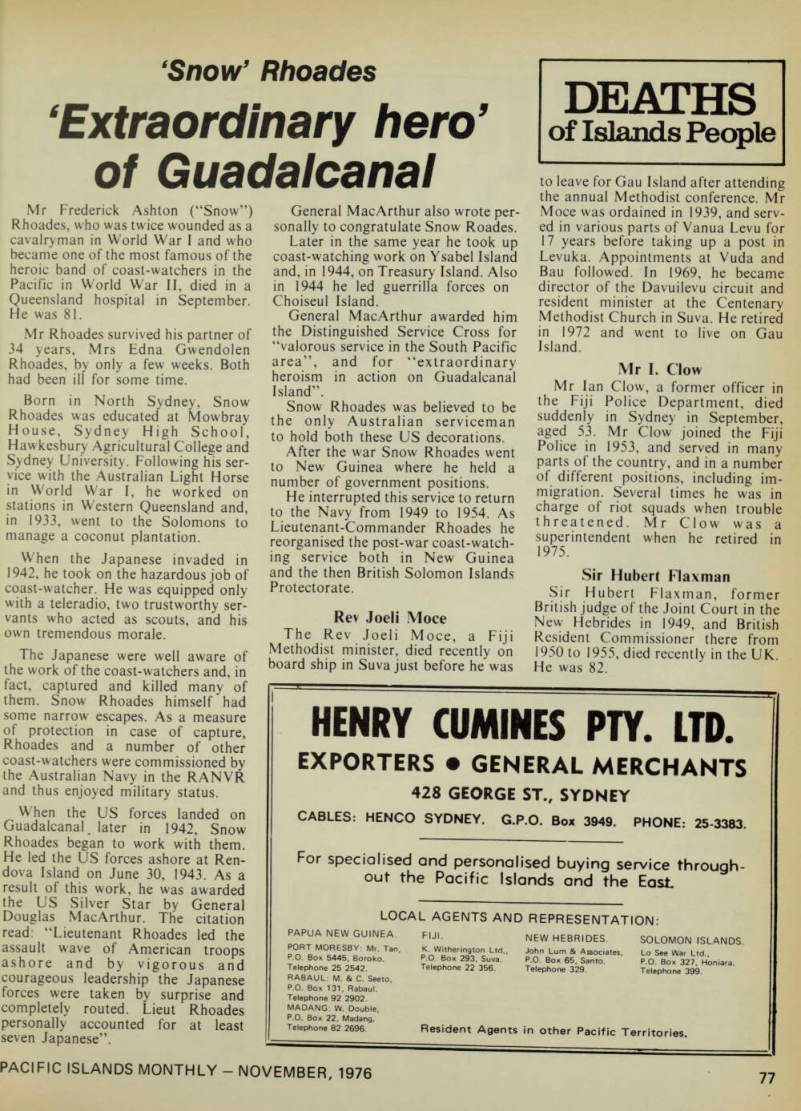
‘Snow’ Rhoades ‘Extraordinary hero’ of Guadalcanal
Mr Frederick Ashton (“Snow”) Rhoades, who was twice wounded as a cavalryman in World War I and who became one of the most famous of the heroic band of coast-watchers in the Pacific in World War 11, died in a Queensland hospital in September.
He was 81.
Mr Rhoades survived his partner of 34 years, Mrs Edna Gwendolen Rhoades, by only a few weeks. Both had been ill for some time.
Born in North Sydney, Snow Rhoades was educated at Mowbray House, Sydney High School, Hawkesbury Agricultural College and Sydney University. Following his ser vice with the Australian Light Horse in World War I, he worked on stations in Western Queensland and, in 1933, went to the Solomons to manage a coconut plantation.
When the Japanese invaded in 1942, he took on the hazardous job of coast-watcher. He was equipped only with a teleradio, two trustworthy ser vants who acted as scouts, and his own tremendous morale.
The Japanese were well aware of the work of the coast-watchers and, in fact, captured and killed many of them. Snow Rhoades himself had some narrow escapes. As a measure of protection in case of capture, Rhoades and a number of other coast-watchers were commissioned by the Australian Navy in the RANVR and thus enjoyed military status.
When the US forces landed on Guadalcanal. later in 1942, Snow Rhoades began to work with them.
He led the US forces ashore at Ren dova Island on June 30, 1943. As a result of this work, he was awarded the US Silver Star by General Douglas MacArthur. The citation read: “Lieutenant Rhoades led the assault wave of American troops ashore and by vigorous and courageous leadership the Japanese forces were taken by surprise and completely routed. Lieut Rhoades personally accounted for at least seven Japanese”.
General MacArthur also wrote per sonally to congratulate Snow Roades.
Later in the same year he took up coast-watching work on Ysabel Island and, in 1944, on Treasury Island. Also in 1944 he led guerrilla forces on Choiseul Island.
General MacArthur awarded him the Distinguished Service Cross for “valorous service in the South Pacific area”, and for “extraordinary heroism in action on Guadalcanal Island”.
Snow Rhoades was believed to be the only Australian serviceman to hold both these US decorations.
After the war Snow Rhoades went to New Guinea where he held a number of government positions.
He interrupted this service to return to the Navy from 1949 to 1954. As Lieutenant-Commander Rhoades he reorganised the post-war coast-watch ing service both in New Guinea and the then British Solomon Islands Protectorate.
Rev Joeli Moce The Rev Joeli Moce, a Fiji Methodist minister, died recently on board ship in Suva just before he was
Deaths
of Islands People
to leave for Gau Island after attending the annual Methodist conference. Mr Moce was ordained in 1939, and serv ed in various parts of Vanua Levu for 17 years before taking up a post in Levuka. Appointments at Vuda and Bau followed. In 1969, he became director of the Davuilevu circuit and resident minister at the Centenary Methodist Church in Suva, He retired in 1972 and went to live on Gau Island.
Mr I. Clow Mr lan Clow, a former officer in the Fiji Police Department, died suddenly in Sydney in September, aged 53. Mr Clow joined the Fiji Police in 1953, and served in many parts of the country, and in a number of different positions, including im migration. Several times he was in charge of riot squads when trouble threatened. Mr Clow was a superintendent when he retired in 1975.
Sir Hubert Flaxman Sir Hubert Flaxman, former British judge of the Joint Court in the New Hebrides in 1949, and British Resident Commissioner there from 1950 to 1955, died recently in the UK.
He was 82.
Advertisements & other items, pp. 77-78 (1 item)
Henry Cumines Pty. Ltd.
EXPORTERS • GENERAL MERCHANTS
428 GEORGE ST., SYDNEY
CABLES: HENCO SYDNEY. G.P.O. Box 3949. PHONE: 25-3383.
For specialised and personalised buying service throughout the Pacific Islands and the East
LOCAL AGENTS AND REPRESENTATION:
PAPUA NEW GUINEA.
PORT MORESBY: Mr. Tan,
P.O. Box 5445, Boroko.
Telephone 25 2542, RABAUL: M. 81 C. Seeto, P.O. Box 131, Rabaul.
Telephone 92 2902.
MADANG: W. Double, P.O. Box 22, Madang.
Telephone 82 2696.
Resident Agents in other Pacific Territories.
K. Witherington Ltd., P.O. Box 293, Suva.
Telephone 22 356.
FIJI.
NEW HEBRIDES.
John Lum & Associates, P.O. Box 65, Santo.
Telephone 329.
SOLOMON ISLANDS.
Lo See War Ltd., P.O. Box 327, Honiara.
Telephone 399.
» I »
REFRIGERATED
& GENERAL
CARGO IN
BARGES. BULK
LIQUIDS IN
VESSEL DEEP
TANKS.
m *
LASH
IFROM UNITED STATES WEST COAST & CANADA TO PAPEETE,
IPAGO PAGO, AUCKLAND, LAE & RABAUL.
I PAPUA NEW GUINEA TO VANCOUVER 8.C., TACOMA, PORT-
LAND, SAN FRANCISCO, LOS ANGELES.
■ SYDNEY, MELBOURNE, BURNIE, HOBART, BRISBANE TO LAE
& RABAUL.
MANAGING AGENTS: Wilh. Wilhelmsen Agency P/L., 13-15 Bridge Street, Sydney 2000—Phone 20517—60 Market Street, Melbourne, 3000—Phone 613031—344 Queen Street, Brisbane, 4000-Phone 2213316. MANAGING AGENTS N.Z.: Dalgety N.Z.
Ltd. , 119 Featherston Street, Welington—Phone 738347 41/45 Albert Street, Auckland—Phone 71859. ISLAND AGENTS; Robert Laurie (NG) P/L, P.O. Box 1032, Lae, PNG - Phone 423811. Burns Philp (NG) Ltd., P.O. Box 87, Rabaul, PNG. - Phone 922666. .
Shipping,
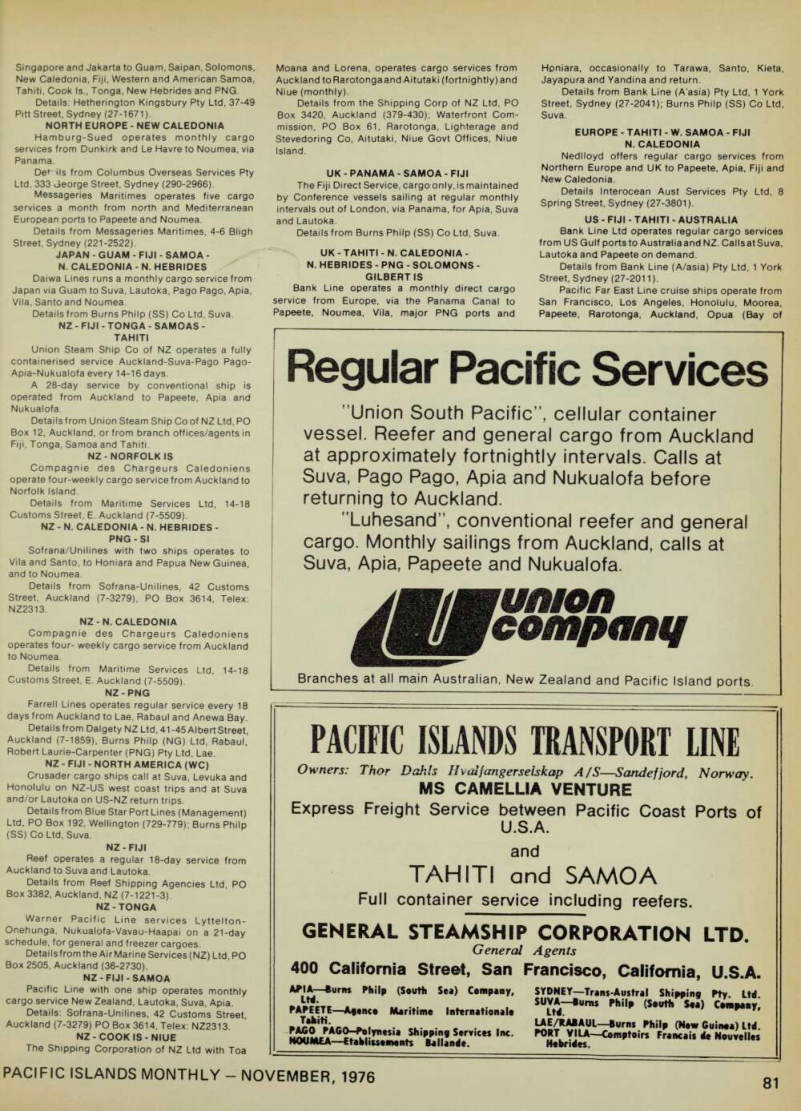
Airways
Shipping
SYDNEY - NZ - FIJI/TAHITI - UK Chandris Lines maintains a passenger service from Sydney via NZ, Suva or Papeete every second month.
Details from Chandris Lines, 135 King Street, Sydney (232-2455).
SYDNEY - LORD HOWE IS - AUCKLAND -
Norfolk Is - New Caledonia
Compagnie des Chargeurs Caledoniens operates four-weekly cargo service Sydney-Lord Howe Island-Norfolk Island-Auckland-Norfolk Island-Noumea.
Details Hetherington Kingsbury Pty Ltd, 37-49 Pitt Street, Sydney (27-1671).
Sydney - New Caledonia
Somacal operates 30-day service from Sydney to Noumea.
Details from Karlander (Aust) Pty Ltd, 19-31 Pitt Street, Sydney (27-6301).
Sydney-Nz-Fiji-Hawaii
Canada-Us
P & O liners call at Auckland, Suva, Honolulu and Vancouver on eastbound and westbound voyages between Sydney and the US.
Details from P & O Booking Centre, World Travel Headquarters Pty Ltd, 33 Bligh Street, Sydney (231-6655).
SYDNEY - NZ - FIJI - TONGA - N. HEBRIDES - NOUMEA - PNG - SOLOMONS - SAMOAS - TAHITI - HAWAII Sitmar Cruises operates a year-round cruise programme to include most of the above countries.
Details from Sitmar Cruises, 22-30 Bridge Street, Sydney (27-4521).
Royal Viking Line, with luxurycruiseships Royal Viking Sea, Star and Sky, cruises the Pacific from Sydney, Hobart and Cairns calling at most of above countries.
Details from Wilh, Wilhelmsen Agency Pty Ltd, 13-15 Bridge Street, Sydney (2-0517).
P & O liners call at Apia, Auckland, Bay of Islands, Borabora, Honiara, Honolulu, Lautoka, Noumea, Nukualofa, Pago Pago, Papeete, Port Moresby, Santo, Savusavu, Suva, Vavau and Vila on cruises from Australia.
Details from P & O Booking Centre World Travel Headquarters Pty Ltd, 33 Bligh Street, Sydney (231-6655).
Australia - New Caledonia -
New Hebrides
Compagnie des Chargeurs Caledoniens operates three-weekly cargo service from Sydney to Noumea, Port Vila, Santo.
Details; Hetherington Kingsbury Pty Ltd, 37-49 Pitt Street. Sydney (27-1671).
Sofrana-Unilines ships serve Noumea every three weeks from the main ports along the east Australian coast and Port Vila monthly from Melbourne and Sydney.
Details from Sofrana-Unilines, 37 Pitt Street, Sydney ' 9 7-2031). Trans-Austral Shipping Pty Ltd, 570 Bourke Street, Melbourne (67-9162), ACTA Pty Ltd, Brisbane (221-3166). Elder Smith Goldsbrough Mort Ltd, Port Adelaide (47-5688), Mcllwraith McEacharn Ltd, Newcastle (2-4781), HJonesandCo Pty Ltd, Burnie, Tasmania (31-1833), ACTA Pty Ltd, Fremantle (35-4866).
South Pacific United Lines maintains a four week cargo service from Sydney to Noumea, Vila and Santo.
Details from Omni Traders & Brokers Pty Ltd, 261 George Street, Sydney (24-2872/6).
Australia-Fiji
Karlander (Aust) Pty Ltd operates monthly cargo services from Sydney to Suva and Lautoka.
Details from Karlander (Aust) Pty Ltd, 19-31 Pitt Street, Sydney (27-6301); Dalgety Shipping, 461 Bourke Street, Melbourne (60-0731); Burns Philp (SS) Co Ltd, Suva and Lautoka.
Sofrana-Unilines (Fiji Express Line) operates to Suva every three weeks from the main ports on the east coast of Australia and monthly to Lautoka from Melbourne and Sydhey.
Details from Sofrana-Unilines, 37 Pitt Street, Sydney (27-2031), Trans-Austral Shipping Pty Ltd, 570 Bourke Street, Melbourne (67-9162), ACTA Pty Ltd, Brisbane (221-3116), Elder Smith Goldsbrough Mort Ltd, Port Adelaide (47-5688), Mcllwraith McEacharn Ltd Newcastle (2-4781), H. Jonesand Co Pty Ltd, Burnie, Tasmania (31-1833), ACTA Pty Ltd Fremantle (35-4866).
Australia - Fiji - W.Samoa
Nauru Pacific Line operates regular container ised, unitised and b/bulk service from Sydney to Lautoka, Suva and Apia.
Details: Nauru Pacific Line, 227 Collins Street, Melbourne (654-4977), Interocean Swire, 8 Spring Street, Sydney (2-0522).
Australia - Tonga - W.Samoa
Karlander operates a monthly cargo service from Melbourne and Sydney to Nukualofa and Apia, thence US west coast.
Details; Karlander (Aust) Pty Ltd, 19-31 Pitt Street, Sydney (27-6301).
AUSTRALIA - TAHITI - US WEST COAST South Pacific United Lines maintains a four weekly service from Sydney to Papeete, and US west coast.
Details from Omni Traders & Brokers Pty Ltd, 261 George Street. Sydney (241-2872/6).
Australia-Png
Containers Pacific Express (Burns Philp and AWP Line) operates four-weekly cargo service from Melbourne and Brisbane with Samos to Port Moresby and Lae and three-weekly cargo service from Sydney (direct) to Lae and Port Moresby with Nimos.
Details from Burns Philp & Co Ltd. 51 Pitt Street Sydney (241-3816).
Farrell Lines operates a service every 18 days from Tasmania, Melbourne, Sydney and Brisbane to Lae, Rabaul and Anewa Bay.
Details from Wilh Wilhelmsen Agency Pty Ltd, 13 Bridge Street, Sydney (2-0517), 60 Market Street, Melbourne (61-3031), Burns Philp (NG) Ltd, Rabaul, Robert Laurie-Carpenter (NG) Pty Ltd, Lae.
New Guinea Express Lines with two ships operates three-weekly Melbourne, Sydney, Brisbane, Port Moresby, Lae Rabaul.
Details from New Guinea Express Lines, PC Box R 73, Royal Exchange PC. Sydney (241-3991) MacArthur Shipping Agency Co, 82-92 Eagle Street, Brisbane (229-3777), Western Farmers Transport Pty Ltd, 459 Little Collins Street, Melbourne (67-8291), Breckwoldt’s Shipping Agencies in Port Moresby (24-2525). Lae (42-1536), Rabtrad Nuigini Pty Ltd, Rabaul (92-2911).
Karlander New Guinea Line’s cargo vessels call at Melbourne, Sydney, Port Moresby, Lae, Madang, Wewak, Manua, Kimbe.
Details from Karlander (Aust) Pty Ltd, 19-31 Pitt Street. Sydney (27-6301); Dalgety Shipping, 461 Bourke Street, Melbourne (60-0731).
Australia - Png - Solomons
New Guinea Australia Line’s vessels operate from Sydney and Brisbane to Port Moresby, Lae Rabaul, Kavieng, Wewak, Honiara, Kieta, Gizo, Madang and Samarai.
Details from Interocean Swire, 8 Spring Street Sydney (2-0522).
Australia - Png - Micronesia
Nauru Pacific Line operates regular container ised, unitised and b/bulk service from Sydney
(general cargo received in Melbourne for container movement to Sydney) to Lae, Rabaul, Koror, Guam, Saipan, Truk and Ponape.
Details: Nauru Pacific Line, 227 Collins Street, Melbourne (654-4977), Interocean Swire, 8 Spring Street, Sydney (2-0522).
AUSTRALIA - SOLOMONS - GILBERT IS -
Micronesia
Daiwa Line runs a container service every 35 days from Sydney to Honiara, Tarawa, Guam, Saipan and Palau.
Details: T radex T ransport Pty Ltd. 185 O'Riordan Street. Mascot, NSW (669-1099).
Australia - Nauru - Majuro -
Nauru-Australia
Nauru Pacific Line operates regular cargo/ passenger service from Sydney and Melbourne to Nauru, Majuro (Marshall Islands) Nauru, Sydney, Melbourne.
Details from Nauru Pacific Line, 227 Collins Street, Melbourne (654-4977), Interocean Swire, 8 Spring Street, Sydney (2-0522).
Us-Png
Farrell Lines operates regular services from all US west coast ports to Lae, Rabaul and Anewa Bay.
Details from Wilh, Wilhelmsen Agency Pty Ltd, 13 Bridge Street, Sydney (2-0517), Farrell Lines, 1 Market Plaza, San Francisco, L.A. (9-4105), Burns Philp (NG) Ltd, Rabaul and Kieta, Robert Laurie- Carpenter (PNG) Pty Ltd, Lae.
San Francisco - Honolulu -
Micronesia
Nauru Pacific Line operates regular conven tional/container service from San Francisco and Honolulu to Majuro, Nauru, Ponape, Truk and Saipan.
Details from Nauru Pacific Line, 227 Collins Street, Melbourne (654-4977), North American Maritime Agencies, 100 California Street, San Francisco, California 9411 (981-0343).
Png-Us-Canada
Farrell Lines operates regular services from Lae and Rabual to US west coast ports and Vancouver.
Details from Burns Philp (NG) Ltd, Rabaul, Robert Laurie-Carpenter (PNG) Pty Ltd, Lae, Farrell Lines, 1 Market Plaza, San Francisco, L.A. (9-4105), and Wilh, Wilhelmsen Agency Pty Ltd, 13 Bridge Street, Sydney (2-0517).
FAR EAST - FIJI - NEW ZEALAND New Zealand Unit Express (CNC, MNOL, RIL) operates a three-weekly cargo service from Hong Kong to Lautoka, Suva, NZports, Manila, Kaoshiung, Keelung, Hong Kong.
Details from Interocean Swire, 8 Spring Street, Sydney (2-0522).
Royal Interocean Lines operates monthly cargo service with three ships from Surabaya, Jakarta, Bangkok,Port Kelang and Singpore to Suva and NZ ports.
Details from Interocean Australia Services, 8 Spring Street, Sydney (27-3801), Burns Philp (SS) Co Ltd, Suva and Lautoka.
Ben Shipping Co (Pte) Ltd, sailing monthly from Singapore, Hong Kong, Keelung, Kaoshiung, Suva and main NZ ports.
Details from Seatrans (Fiji) Ltd, GPO Box 152, Suva, Fiji.
Japan-Nz-Png
China Navigation Co. withthreeshipsoperatesa monthly cargo service from Japan to New Zealand calling at Lae on return journey.
Details from Interocean Swire, 8 Spring Street, Sydney (2-0522).
FAR EAST - MID - S. PACIFIC China Navigation Co’s vessels operate a regular cargo service from Hong Kong, Taiwan and Singapore to Rabaul, Wewak, Madang, Lae. Port Moresby, Honiara, New Hebrides, Noumea, Papeete and Samoa.
Details from Interocean Swire, 8 Spring Street, Sydney (2-0522).
Kyowa Shipping Co Ltd operates monthly services from Hong Kong, Taiwan, S. Korea, Japan,
Singapore and Jakarta to Guam, Saipan, Solomons, New Caledonia, Fiji, Western and American Samoa, Tahiti, Cook Is., Tonga, New Hebrides and PNG.
Details: Hetherington Kingsbury Pty Ltd, 37-49 Pitt Street, Sydney (27-1671).
North Europe - New Caledonia
Hamburg-Sued operates monthly cargo services from Dunkirk and Le Havre to Noumea, via Panama.
De»' ils from Columbus Overseas Services Pty Ltd. 333 George Street, Sydney (290-2966).
Messageries Maritimes operates five cargo services a month from north and Mediterranean European ports to Papeete and Noumea.
Details from Messageries Maritimes, 4-6 Bligh Street, Sydney (221-2522).
JAPAN - GUAM - FIJI - SAMOA -
N. Caledonia - N. Hebrides
Daiwa Lines runs a monthly cargo service from Japan via Guam to Suva, Lautoka, Pago Pago, Apia, Vila, Santo and Noumea.
Details from Burns Philp (SS) Co Ltd, Suva.
NZ - FIJI - TONGA - SAMOAS -
Tahiti
Union Steam Ship Co of NZ operates a fully containerised service Auckland-Suva-Pago Pago- Apia-Nukualofa every 14-16 days.
A 28-day service by conventional ship is operated from Auckland to Papeete, Apia and Nukualofa.
Details from Union Steam Ship Co of NZ Ltd, PC Box 12, Auckland, or from branch offices/agents in Fiji, Tonga. Samoa and Tahiti.
Nz-Norfolk Is
Compagnie des Chargeurs Caledonians operate four-weekly cargo service from Auckland to Norfolk Island.
Details from Maritime Services Ltd, 14-18 Customs Street, E. Auckland (7-5509).
NZ - N. CALEDONIA - N. HEBRIDES -
Png-Si
Sofrana/Unilines with two ships operates to Vila and Santo, to Honiara and Papua New Guinea, and to Noumea.
Details from Sofrana-Unilines. 42 Customs Street, Auckland (7-3279), PC Box 3614, Telex: NZ2313.
Nz -N. Caledonia
Compagnie des Chargeurs Caledoniens operates four- weekly cargo service from Auckland to Noumea.
Details from Maritime Services Ltd, 14-18 Customs Street, E. Auckland (7-5509).
Nz-Png
Farrell Lines operates regular service every 18 days from Auckland to Lae, Rabaul and Anewa Bay.
Details from Dalgety NZ Ltd, 41-45 Albert Street, Auckland (7-1859), Burns Philp (NG) Ltd, Rabaul, Robert Laurie-Carpenter (PNG) Pty Ltd, Lae.
NZ - FIJI - NORTH AMERICA (WC) Crusader cargo ships call at Suva, Levuka and Honolulu on NZ-US west coast trips and at Suva and/or Lautoka on US-NZ return trips.
Detailsfrom Blue Star Port Lines (Management) Ltd, PC Box 192, Wellington (729-779); Burns Philp (SS) Co Ltd, Suva.
Nz - Fiji
Reef operates a regular 18-day service from Auckland to Suva and Lautoka.
Details from Reef Shipping Agencies Ltd, PC Box 3382, Auckland, NZ (7-1221-3).
Nz-Tonga
Warner Pacific Line services Lyttelton- Onehunga, Nukualofa-Vavau-Haapai on a 21-day schedule, for general and freezer cargoes.
Detailsfrom the Air Marine Services (NZ) Ltd, PO Box 2505, Auckland (36-2730).
Nz-Fiji-Samoa
Pacific Line with one ship operates monthly cargo service New Zealand, Lautoka, Suva, Apia.
Details: Sofrana-Unilines, 42 Customs Street, Auckland (7-3279) PO Box 3614, Telex: NZ2313.
Nz-Cook Is-Niue
The Shipping Corporation of NZ Ltd with Toa
Moana and Lorena, operates cargo services from Auckland to Rarotonga and Aitutaki (fortnightly) and Niue (monthly).
Details from the Shipping Corp of NZ Ltd, PC Box 3420, Auckland (379-430); Waterfront Com mission, PC Box 61, Rarotonga, Lighterage and Stevedoring Co, Aitutaki, Niue Govt Offices, Niue Island.
UK - PANAMA - SAMOA - FIJI The Fiji Direct Service, cargo only, is maintained by Conference vessels sailing at regular monthly intervals out of London, via Panama, for Apia, Suva and Lautoka.
Details from Burns Philp (SS) Co Ltd, Suva.
UK - TAHITI - N. CALEDONIA - N. HEBRIDES - PNG - SOLOMONS -
Gilbert Is
Bank Line operates a monthly direct cargo service from Europe, via the Panama Canal to Papeete, Noumea, Vila, major PNG ports and
Honiara, occasionally to Tarawa. Santo, Kieta, Jayapura and Yandina and return.
Details from Bank Line (A'asia) Pty Ltd, 1 York Street, Sydney (27-2041); Burns Philp (SS) Co Ltd, Suva.
EUROPE - TAHITI - W. SAMOA - FIJI
N. Caledonia
Nedlloyd offers regular cargo services from Northern Europe and UK to Papeete, Apia, Fiji and New Caledonia.
Details Interocean Aust Services Pty Ltd, 8 Spring Street, Sydney (27-3801).
US - FIJI - TAHITI - AUSTRALIA Bank Line Ltd operates regular cargo services from US Gulf ports to Austraiiaand NZ. Calls at Suva, Lautoka and Papeete on demand.
Details from Bank Line (A/asia) Pty Ltd, 1 York Street, Sydney (27-2011).
Pacific Far East Line cruise ships operate from San Francisco, Los Angeles, Honolulu, Moorea, Papeete, Rarotonga, Auckland, Opua (Bay of
Islands), Sydney and return via Suva, Niuafoou, Pago Pago and Honolulu to San Francisco.
Freight is carried on these passenger liners.
Passenger details from World Travel Headquarters Pty Ltd, 33 Bligh Street, Sydney (231- 6655); freight details from P & O Aust Ltd, 2 Castlereagh Street, Sydney (230-0177).
US - A. SAMOA - NZ - AUST - PNG Farrell Lines LASH ships operate regularly from US to Australia, via Pago Pago and Auckland, returning via PNG ports.
Details from Wilh, Wilhelmsen Agency Pty Ltd, 13 Bridge Street, Sydney (2-0517); 60 Market Street, Melbourne (61-0301); Farrell Lines, 1 Market Plaza, San Francisco, L A. (415-777-3300); Dalgety NZ Ltd, Auckland (7-1859); Kneubuhl Maritime Services.
Pago Pago (633-5121).
Us-Tahiti - Samoa
Pacific Islands Transport operates a five/six weekly cargo service from North American west coast ports to Papeete, Pago Pago, Apia.
Details from Trans-Austral Shipping Pty Ltd, 19 Pitt Street, Sydney (27-2441).
Polynesia Line operates container and general cargo service from US west coast ports to Papeete and Pago Pago.
Details from Polynesia Shipping Services Inc, PO Box 1478, Pago Pago (9-6799).
Airlines
From Australia
Qantas (7075. 7475, DC4) PNG. Norfolk Is, New Caledonia, Fiji, Hawaii, US, Canada.
PAA (7475) Fiji, American Samoa, Hawaii, US.
CP Air (DCS) Fiji, Hawaii, Canada.
UTA (DCSs and DCIOs) New Caledonia, Fijf, New Zealand, Tahiti, US.
Air Nauru (F2B) New Caledonia, Nauru, Tarawa, Majuro.
Air Nuigini (7075. F 27) PNG.
Air Pacific (BAC111) Fiji, via New Hebrides or New Caledonia to Fiji.
Advance Aviation (from Sydney), North Coast Airlines (from Coffs Harbour) and Oxley Airlines (from Port Macquarie) Lord Howe Is.
From New Zealand
Air-NZ (DCBs, DCIQs, F 27) - Fiji, American Samoa, Cook Is, Tahiti, Hawaii, US, New Caledonia, Norfolk Is.
PAA (7475) American Samoa, Tahiti, Hawaii, US.
UTA (DCS) Tahiti.
From Us
Qantas (707 s and 7475) Honolulu, Fiji, Australia.
PAA (7475) Honolulu, Tahiti, A. Samoa, Fiji, J\IZ, Australia.
Air-NZ (DCSs and DCIOs) Honolulu, Fiji, Auckland.
Pacific - Far East S. America
Air Nauru (F2B or 737) Nauru to Micronesia, the Philippines, Okinawa, Japan, Taiwan, Hong Kong.
Air France (7075) Japan to Tahiti, Peru.
Air Niugini (7075) to Manila.
Pacific Is —Aust
Qantas (7075) from Port Moresby to Sydney.
Air Pacific (BAC111) from Fiji, via New Hebrides or New Caledonia to Brisbane.
Air Nauru (F2B or 737) flies to Melbourne.
Air Nuigini (7075, F 27) to Cairns, Brisbane and Sydney.
Norfolk Island Airlines (Beechcraft) to Brisbane.
Pacific Is —Nz
Air Pacific (BAC111) Fiji-Tonga-NZ.
Inter-Territory
Lan-Chile (7075) Easter Is, Tahiti.
Air Pacific (BACIII and HS 7485) Fiji to Gilbert Is, Tuvalu, Western Samoa, Tonga, New Hebrides, Solomon Islands, New Caledonia. PNG.
Fiji Air Services Wallis and Futuna (charter).
PAA (7075) Hawaii to Am Samoa and Tahiti, US.
UTA (7075, Caravelles) from New Caledonia to Fiji, New Hebrides, Wallis Is, Tahiti.
Continental-Air Micronesia (7275) from Hawaii to Micronesia.
Air Nauru from Nauru to Tarawa, Marshall Is, Wallis Is, Fiji W. Samoa. New Hebrides, New Caledonia, Solomons, Phillipines.
Polynesian Airlines from ApiatoTonga, Niue Is, Fiji, Am. Samoa.
South Pacific Island Airway flies between America and Western Samoa and American Samoa and Tonga.
Air Tahiti from Tahiti to Cook Is.
Air Niugini to Irian Jaya, Solomon Is, Philippines.
Norfolk Island Airlines (Beechcraft) to Noumea.
Internal
Fiji Air Pacific (HS74Band Trislanders), Fiji Air Services (Beech Barons and Islanders).
French Polynesia Air Polynesia (Fokker Friendships), Air Tahiti.
US Trust Territory and Guam Continential-Air Micronesia (7275) and Air Pacific Internal Inc.
Gilbert Is Air Pacific.
PNG - Air Niugini. Douglas Airways, Panga Airways, Talair.
Bougainville Bougainville Air Services.
New Caledonia Air Caledonia (Twin Otters).
New Hebrides Air Melanesiae (Islanders).
Solomon Is Solair (Beech Barons and Islanders).
Tonga Tonga Internal Air Service (Islander).
Norfolk Island Airlines (Beechcraft) Norfolk Is-Lord Howe Is.
Western Samoa Air Samoa Ltd, and Samoa Aviation Ltd.
Airlines supply full details.
Advertisements & other items, pp. 79-82 (1 item)
Line
THE
BANK
GLOBAL SERVICE EOR SHIPPERS
50
MONTHLY SERVICES
United Kingdom and Continent to: Papeete, Noumea, New Hebrides, Papua New Guinea and Solomon Islands.
Papua New Guinea to: North America, United Kingdom and Continent.
Solomons, Fiji, Tonga, Samoa and Tarawa to: United Kingdom and Continent.
For particulars apply:
THE BANK LINE (AUSTRALASIA) PTY.
LTD.,
18TH FLOOR, 1 YORK STREET,
SYDNEY, N.S.W.
Monthly Services
Hong Kong, Taiwan, S. Korea, Japan
To: Guam, Saipan, British Solomon, New Caledonia, Fiji, W. Samoa, A. Samoa. Tahiti, Cook Is., Tonga, New Hebrides.
Taiwan,Hong Kong,Singapore,Jakarta
To; Australia, Papua New Guinea, Sabah & Sarawak.
South Korea, Japan
To: Guam, Saipan, Papua New Guinea, Other Pacific Islands.
Taiwan: Royal Steamship Corp , Ltd , Taipei S. Korea: Dong Sue Shipping Co, Ltd, Seoul Hong Kong: Dahzun Enterprises Ltd.
Singapore: Ocean Shipping & Enterprises Pte., Ltd.
Mariana Is.: Island Navigation Co., Ltd , Guam 8.5.1. P.: Solomon Taiyo Ltd., Honiara Tahiti: J.A. Cowan & Fils, Papeete Cooks: Union Citco Travel Ltd., Rarotonga Tonga: E M. Jones Ltd., Nukualofa New Hebrides; Agence Maritime Raymond Velicite, Port Vila A.Samoa: Island Pacific Agencies Inc., Pago Pago W. Samoa: Morris Hedstrom Ltd., Apia Fiji: Carpenter Shipping, Suva & Lautoka PNG: Carpenter Shipping Agencies, Port Moresby, Rabaul New Caledonia: Agence Maritime Du Rond Point Du Pacific, Noumea Indonesia: P.T. Porodisa Raya Shipping Lines, Jakarta Sabah: KOH Han Ming Shipping & Forwarding Agent, Kotakmabalu Sarawak: Pan Sarawak Agencies Sdn, Bhd .Sibu & Kuching Australia; Hethermgton Kingsbury Pty. Ltd , Sydney, N.S.W.
KYOWA SHIPPING CO., LTD.
HEAD OFFICE
Ojima Bldg., 22-8, 6-chome, Shinbashi Minato-ku, Tokyo, Japan Phone: 03(437)2885 (Rep.) Cables: “MARIQUEEN” Tokyo Telex: 242-4651 Kyowa J.
OSAKA OFFICE
Frontier Bldg., 3-13 Hirano-cho, Higashi-ku, Osaka, Japan.
Phone: 06(227)0422 (Rep.) Cables: “MARIQUEEN” Osaka.
Telex: 522-3896 Kyowa O.
Regular Pacific Services
"Union South Pacific", cellular container vessel. Reefer and general cargo from Auckland at approximately fortnightly intervals. Calls at Suva, Pago Pago, Apia and Nukualofa before returning to Auckland.
"Luhesand", conventional reefer and general cargo. Monthly sailings from Auckland, calls at Suva, Apia, Papeete and Nukualofa.
jmimumon
dmtmcomnanu
Branches at all main Australian, New Zealand and Pacific Island ports
PACIFIC ISLANDS TRANSPORT LINE
Owners: Thor Dahls Hvaijangerseiskap A/S — Sandefjord, Norway
MS CAMELLIA VENTURE
Express Freight Service between Pacific Coast Ports of
U.S.A.
and
TAHITI and SAMOA
Full container service including reefers.
GENERAL STEAMSHIP CORPORATION LTD.
General Agents 400 California Street, San Francisco, California, U.S.A.
APlA—Burns Philp (South Sea) Company, Ltd.
PAPEETE—Agence Maritime Internationale Tahiti.
PACO PAGO-Polyncsia Shipping Services Inc.
NOUMEA—Etablissements Ballande.
SYDNEY—Trans-Austral Shipping Pty. Ltd.
SU Ltd —,UmS Phil * (SoWth Company, UL T 4urnj (Now Guinea) Ltd. ro “ T . Y'LA— Compto.rs Francais de Nouvellcs Hebrides.
Express-Freight Service between U.S. Pacific Coast Ports & . ■ * . 'T*
PAPEETE • APIA • PAGO PAGO
Full Container Service including Refrigeration. •> ' ■ -S., •■■■ •
GENERAL AGENTS-
* fURNESS INTEROCE4N
CORPORATION
465 CALIFORNIA STREET. SAN FHANCISCO. CA 94104, Cable INTERCO' • TWX: 910-372 7350 • RCA; 278 207
• TEL. (415V398-2000
- - • hmmmrnmmm - PAPEETE - MORGAN; Vernex.Boite Postale 449, Papeete Phone: 309 Cables: MOREX * . , PAGO PAGO • POLYNESIA SHIPPING SERVICES, INC., Pago Pago Phone:633-5169 Cables: POLYSHIP APIA • UNION S.S. CO., of N.Z. Ltd., P.O. Box 50, Apia. Western Samoa Phone: 570 Cables: UNION * ■- .- ■ * Zr*** ■
lapua new guinea
printing co. ply. ltd.
Serving the Country from Altape to Alotau, Manus to Moresby
Leaders in Commercial Offset and Letterpress
Printing.
• Stationery • Office Supplies Office Equipment • Rubber Stamps • Self-Adhesive Labels • In Fact;— Everything For The Office.
P.O. Box 633, Port Moresby P.O. Box 759, Lae
P.O. Box 1239, Rabaul
Produce
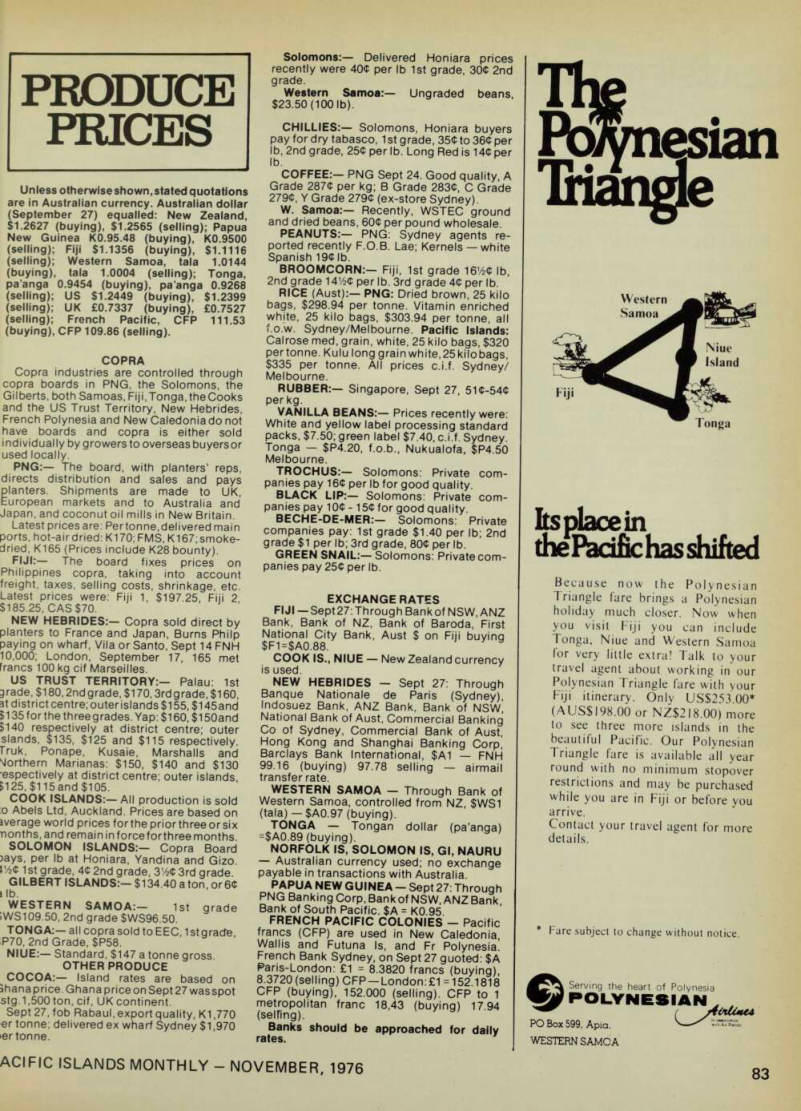
Prices
Unless otherwise shown, stated quotations are in Australian currency. Australian dollar (September 27) equalled: New Zealand, $1.2627 (buying), $1.2565 (selling); Papua New Guinea K 0.95.48 (buying), K 0.9500 (selling); Fiji $1.1356 (buying), $1.1116 (selling); Western Samoa, tala 1.0144 (buying), tala 1.0004 (selling); Tonga, paanga 0.9454 (buying), pa’anga 0.9268 (selling); US $1.2449 (buying), $1.2399 (selling); UK £0.7337 (buying), £0.7527 (selling); French Pacific, CFP 111.53 (buying), CFP 109.86 (selling).
Copra
Copra industries are controlled through copra boards in PNG, the Solomons, the Gilberts, both Samoas, Fiji, Tonga, the Cooks and the US Trust Territory, New Hebrides, French Polynesia and New Caledonia do not have boards and copra is either sold individually by growers to overseas buyersor used locally.
PNG:— The board, with planters’ reps, directs distribution and sales and pays planters. Shipments are made to UK, European markets and to Australia and Japan, and coconut oil mills in New Britain.
Latest prices are: Pertonne,delivered main ports, hot-airdried: K 170; FMS, Kl67;smoke dried, K 165 (Prices include K2B bounty).
FIJI:— The board fixes prices on Philippines copra, taking into account freight, taxes, selling costs, shrinkage, etc.
Latest prices were; Fiji 1, $197.25, Fiji 2
$185.25, Cas $7O.
NEW HEBRIDES:— Copra sold direct by planters to France and Japan, Burns Philp paying on wharf, Vila or Santo, Sept 14 FNH 10,000; London, September 17, 165 met francs 100 kg cif Marseilles.
Us Trust Territory:- Palau: Ist
grade, slBo,2nd grade, sl7o,3rdgrade,sl6o,
at district centre; outerislands $155, sl4sand &1 35 for the threegrades. Yap: $l6O, slsoand $l4O respectively at district centre; outer stands, $135, $125 and $ll5 respectively.
Truk, Ponape, Kusaie, Marshalls and Morthern Marianas: $l5O, $l4O and $l3O -espectively at district centre; outer islands $125, sllsandslos.
COOK ISLANDS: — All production is sold o Abels Ltd, Auckland. Prices are based on jverage world prices for the prior three or six nonths, and remain in force forthree months.
SOLOMON ISLANDS:- Copra Board >ays, per lb at Honiara, Yandina and Gizo IV 2 $ Ist grade, 4$ 2nd grade, 3 1 / 2 $ 3rd grade GILBERT ISLANDS:- $134.40 a ton, or 6$ t lb.
WESTERN SAMOA:- Ist grade iW5109.50, 2nd grade $W596.50.
TONGA:— aII copra sold toEEC, Istgrade, P7O, 2nd Grade, SPSB.
NIUE:— Standard, $147 a tonne gross.
Other Produce
COCOA:— Island rates are based on Shana price. Ghana price on Sept 27 was spot 5tg.1,500 ton. cif, UK continent.
Sept 27, fob Rabaul, export quality, K 1,770 er tonne; delivered ex wharf Sydney $1,970 er tonne.
Solomons; — Delivered Honiara prices recently were 40$ per lb Ist grade, 30$ 2nd grade.
Western Samoa;— Ungraded beans, $23.50 (100 lb).
CHILLIES: — Solomons, Honiara buyers pay for dry tabasco, Ist grade, 35$ to 36$ per lb, 2nd grade, 25$ per lb. Long Red is 14$ per lb.
COFFEE: — PNG Sept 24. Good quality, A Grade 287$ per kg; B Grade 2835, C Grade 2795, Y Grade 279$ (ex-store Sydney).
W. Samoa:— Recently, WSTEC ground and dried beans, 60$ per pound wholesale.
PEANUTS:— PNG: Sydney agents re ported recently F. 0.8. Lae; Kernels — white Spanish 19$ lb.
BROOMCORN:— Fiji, Ist grade 16V 2 $ lb, 2nd grade 14 1 / 2 $ per lb. 3rd grade 4$ per lb.
RICE (Aust):— PNG: Dried brown, 25 kilo bags, $298.94 per tonne. Vitamin enriched white, 25 kilo bags, $303.94 per tonne, all f.o.w. Sydney/Melbourne. Pacific Islands: Cal rose med, grain, white, 25 kilo bags, $320 pertonne. Kulu long grain white,2skilobags, $335 per tonne. All prices c.i.f. Sydney/ Melbourne.
RUBBER:— Singapore, Sept 27, 51 $-54$ per kg.
VANILLA BEANS: — Prices recently were: White and yellow label processing standard packs, $7.50; green label $7.40, c.i.f. Sydney Tonga $P4.20. f.0.b., Nukualofa. $P4.50 Melbourne.
TROCHUS: — Solomons: Private com panies pay 16$ per lb for good quality.
BLACK LIP:— Solomons. Private com panies pay 10$ -15$ for good quality.
BECHE-DE-MER: — Solomons; Private companies pay: Ist grade $1.40 per lb; 2nd grade $1 per lb; 3rd grade, 80$ per lb.
GREEN SNAIL: — Solomons: Private com panies pay 25$ per lb.
Exchange Rates
FIJI— Sept27:Throughßankof NSW, ANZ Bank, Bank of NZ, Bank of Baroda, First National City Bank, Aust $ on Fiji buying
$Fl=$Ao.Bb.
COOK IS., NIUE New Zealand currency is used.
NEW HEBRIDES - Sept 27: Through Banque Nationale de Paris (Sydney).
Indosuez Bank, ANZ Bank, Bank of NSW National Bank of Aust, Commercial Banking Co of Sydney, Commercial Bank of Aust, Hong Kong and Shanghai Banking Corp, Barclays Bank International, SAI FNH 99.16 (buying) 97.78 selling airmail transfer rate.
WESTERN SAMOA Through Bank of Western Samoa, controlled from NZ, SWSI (tala) $A0.97 (buying).
TONGA Tongan dollar (pa’anga) =$AO.B9 (buying).
Norfolk Is, Solomon Is, Gl, Nauru
Australian currency used; no exchange payable in transactions with Australia.
PAPUA NEW GUINEA - Sept 27: Through PNG Banking Corp, Bank of NSW, ANZ Bank Bank of South Pacific. $A = K 0.95
French Pacific Colonies Pacific
francs (CFP) are used in New Caledonia, Wallis and Futuna Is, and Fr Polynesia.
French Bank Sydney, on Sept 27 guoted: $A Paris-London: £1 = 8.3820 francs (buying) 8.3720 (selling) CFP —London:£l = 152.1818 CFP (buying), 152.000 (selling). CFP to 1 metropolitan franc 18,43 (buying) 17 94 (selfing).
Banks should be approached for daily rales.
Advertisements & other items, pp. 83-88 (3 items)
83
ACIFIC ISLANDS MONTHLY NOVEMBER, 1976
Triangle
Polynesian
Western Samoa Niue Island Fiji ■ Fonga
Its place in
the Pacific has shifted
Because now the Polynesian Triangle fare brings a Polynesian holiday much closer. Now when you visit Fiji you can include Tonga, Niue and Western Samoa for very little extra! Talk to your travel agent about working in our Polynesian Triangle fare with your
Fiji itinerary. Only U55253.00*
(AUSSI9B.OO or NZ$2lB.OO) more to see three more islands in the beautiful Pacific. Our Polynesian Triangle fare is available all year round with no minimum stopover restrictions and may be purchased while you are in Fiji or before you arrive.
Contact your travel agent for more details.
Fare subject to change without notice.
Serving the heart of Polynesi
POLYNESIAN
PO Box 599, Apia.
WESTERN SAMOA
INTERNATIONAL
DATELINE HOTEL
TONGA
Friendly Hotel" of the "Friendly Islands' Situated along the Nukualofa waterfront. Only five minutes walk from town. Single, double, family suites, airconditioning, and hot and cold water showers. Pool, bar, restaurant, duty-free shop, tour desk and boutique.
Book through your travel agent or write to International Dateline Hotel, P.O. Box 62, Nukualofa Tonga.
Cable Address: ''DATELINE''.
Represented Overseas by; Charles J. Henry and Associates Pty. Ltd.
Sydney and Melbourne. 297«
CLASSIFIED ADVERTISEMENTS
Per L ine $3.00 Aust
Minimum 4 lines.
CONCRETE BLOCK MAKER Makes blocks, flags edgings screen-blocks, garden stools—up to 8 at once and 96 an hour $215 00 c.i.f. main ports Send for leaflets Forest Farm Research, Londonderry NSW, 2753 Australia.
MAPS & PRINTS OF THE OLD PACIFIC Catalogue of original antiquarian views and maps of Pacific Islands sent free.
C.HINCHCLIFFE—7 Royd Avenue, Heckmondwike, West Yorkshire, WFI6 9AL United Kingdom.
FIBREGLASS BOAT MOULDS
22ft. & 24ft. high speed seagoing fishing boats. Complete set of moulds and patterns to produce a proven series of diesel or outboard powered centre console commercial or pleasure fishing boats.
Considerably less than cost. PHONE: (Aust.) 079 466141.
OR WRITE: P.O. Box 125, Airlie Beach, Queensland, 4800.
COINS
WANTED...
Paying twice face value for all pre-decimal Australian coins.
GOLD SOVEREIGNS
BUY—$27
SELL-$3O
Prices subject to fluctuation.
SOUTHERN CROSS COINS
2/131 Exhibition St.,
MELBOURNE 3000,
AUSTRALIA.
Phone: 63 1141.
Investment or work opportunity sought by personable Scot (40), long US resident, familiar with NZ. Have $15,000 and degrees in Lit. & Admin, published author exper. in dept, stores, libraries (director), rental properties, poster art, promotions, etc.—Gordon McShean, 16 Jolley Way, Scotts Valley, CA 95066 USA.
If you have sneiis to sell —any quantity—contact Anlsa Commodity Traders Pty. Ltd., P.O. Box 1413, Lae, Papua Naw Guinea, Phona 424159. We are buyers of Trochus, Greensnail, Blacklip MOP, Goldlip MOP, and Marine Specimens Best prices paid Rabaul agents; Gazelle Agencies Pty. Ltd., P.O. Box 262, Rabaul, P.N.G Phone; 921397 Manua (eland Agents, R. L. & V. J. Knight, P.O.
Box 106. Lorengau, Manus Island, P.N.G. Phone 38.
QUALIFIED ACCOUNTANT
Married, seeks position in Islands. All offers considered.
Write to: Box 42, Duffy, 2611, Australia
PLANTATION MANAGER, 48, 20 years
New Guinea, British Solomons, Copra, Cocoa, some Pepper.
Accustomed isolation. Any islands.
Family follows. Garners store, Evans Head, N.S.W. 2473, AUSTRALIA.
FOR SALE
COASTAL FREIGHTER OR LIGHTER
Ex YG US Navy 118’ x 28' x 7'. Draft 200 ton.
Light displacement. About 1500 Cu. Ft. 300 300 ton cargo with 3 ton boom and winches. 2 heads galley. Accommodation for 10.
Main engine Enterprise DMG-6, direct reversing 300 hp @ 300 RPM, 8 knots cruise, economical operation, GM-Delco 20 kw and 40 kw generators, electronics, spares. Good condition.
Presently undergoing routine drydocking at Rabaul, PNG.
Price U 55125,000.
Buyer subject US Govt, approval.
Contact- Carroll Hupp, 464 Warwick St.,
Akron, Ohio, USA.
Phone: 216 798 9465.
FLEETS 45 ft. Hollow Heel Carvel launch, profess bit. 1974, solid floors on every timber, new 120 h.p Caterpillar, new Radar, Auto Pilot, $55,000.00 FLEETS 221 Esplanade, Wynnum Central Brisbane. Cable: "FLEETS BRISBANE".
MASSEY UNIVERSITY
NEW ZEALAND
CERTIFICATE IN THE TEACHING OF
A SECOND LANGUAGE (ENGLISH)
Teachers of the English language or teachers who use English as the language of instruction for other subjects may now enrol for this special course of study.
All tuition is by correspondence.
For details, write to: The Department of Modern Languages, Massey University,
PALMERSTON NORTH, NEW ZEALAND
FIJI—FOR SALE:
12 acres with white sand beach, sheltered cove and vista park on beautiful small island three miles from mainland. Two outstanding houses, furnished, workshop, maid's quarters, caretaker's home.
Elegantly maintained. Adequate water. Power boat. Immediate occupancy. Ideal holiday paradise, retirement home or income property. Priced $F225,000.
Edward Morris, Room 3400, 555 California St., San Francisco, California, 94104,
USA.
ME 'Cere’san /
STom" '"flaws'"
e
TOUGH Bmm^
ss^sissT
Ip^F^kkr
• - l,2U( *«se/p o i vef^M«mifortatlte Searbox. Du^^'J^nchr c system. over slu ng susn eSponsive system r f p f ns '°n springs up fmnt entleaf
. S^SSr*’
I 111 fibers, g*
Si Ml as . COe SSibility
f f en 9ine /am I . S J J2U IXO , ISUZU TLD 238 BUS , b '9’ Powerful truck designed to A great way to carry up to 15 tackle the toughest jobs with ease! passengers reliably and comfortably.
Western Samoa O.F. Nelson & Co. Ltd.
Fiji Burns Philp (South Sea) Co. Ltd.
Papua New Guinea Dawapia Motors, Rabaul Wamp Nga Motors, Mt. Hagen Solomon Islands Solomon Islands Service Station New Caledonia
SAIP
General Motors. Serving you in the South Pacific.
AKA I
% W * a** !Pt
i cSlf*
* t
S2S2ZPX
lUIKI
There seems to be no end to the superlatives used to describe stereo sound quality. It’s usually
natural, crystal clear, rich or
vibrant with plenty in reserve.
The list of words is longer than the tape on a 7-inch reel. But these tired, old adjectives can’t convey the full impact of Akai sound. Perhaps there just aren’t any words equal to the task.
Australia Akai Australia Pty. Ltd. 17/18 Hordern Place Denison St.
Camperdown, Sydney, N.S.W. 2050 Tel; 516-3366
P.N.G.
S.O. Svensson (N.G.) Ltd.
P.O. Box 705, Port Moresby Tel; 2275 Fiji Islands Motibhai & Company Ltd.
P.O. Box 9175 Nadi International Airport Tel: 72-165 New Zealand Pye Ltd, Consumer Product Division 110 Mt. Eden Rd., Mt. Eden, Auckland Tel: 686-437 It’s a visual experience that begins the moment you close your eyes and are swept into the imaginative world of your mind.
Akai provides you a wide selection of fine stereo components
tape decks, turntables, amps,
tuners, receivers and speaker systems —to assure you will enjoy
every trip.
New Caledonia Menard Freres B.P. H 2, Noumea Tel: 275222 Tahiti Etablissements Comimpex P.O. Box 200, Papeete Tel; 20477 New Hebrides Island Burns Philip (New Hebrides) Co., Ltd.
Port Vila, New Hebrides Island Norfolk Island Burns Philip (Norfolk Island) Co., Ltd.
P.O. Box 21, Norfolk Island See the difference when you move up to Akai sound.
Audio & Video
AKAI
AKAI ELECTRIC CO., LTD.
Tokyo, )apan
Samoan Islands Burns Philip (South Sea) Co., Ltd.
P.O. Box 129, Pago Pago, American Samoa, Apia, Western Samoa Mariana Islands J.C. Tenorio Enterprises P.O. Box 137, Saipan Tel; 6444/8 British Solomon Security Electrical Co., Ltd.
P.O. Box 174, Honiara Tel: 881 Cook Islands JPS Enterprises Ltd.
P.O. Box 15, Rarotonga Tel; 2150, 2176
Performance
You Enjoy Living With.
Honda is a true life drama, performed on the world’s stage. By average folks, teenagers, men, and women everywhere. Your neighbors, maybe even you are playing a part. If so, you know Honda is more than great machines.
It’s people concerned with taking people where they want to go in life.
On two wheels, we’re the best selling motorcycle. The easy to operate hard workers who don’t demand much. Honda is always ready and gets you there safely. We move on four wheels. The precedent setting Honda Civic continues to receive international economy and performance awards. It’s the elegant compact car.
Sometimes, we have no wheels. Honda portable power operates machinery, generates electricity, pumps water and tills the soil.
Little wonder good things happen on Honda we work harder to assure they do. m k k
HONDA MOTOR CO., LTD. TOKYO, JAPAN
P^pe ete/F fjTIS L ANDS : o^aTlsland'l’wotor**! p!cT BoxAS Suva/U " 6 d ’ ,mp ° rtat l ion des Produits Honda B.P. 1665- Mariana Islands 96950/COOK ISLANDS: Cook Islands Motor p n R Q ,T^ Y D U ** d Development Assn. P.O. Box 238, Saipan, Center P.O. Box 968, Pago Pago AMERICAN SAMOA- Halork’* c r* ♦' SAMOA: Samoan Holiday and Travel DV. Agana/WESTERNsIMOA 8 : Motor^Di Po Z Marks Mot ° r C °- p O- Box 114, Honiara NEW CALEDONIA- Establissements HaibnH» d *° X ,a ( SOLOMON ISLANDS: British Solomons Trading Co., Ltd. P.O. Box TARAWA: Gilbert & Ellice •s.ands Jo " es Umited P 0 B °* 34 ' Nukualofa/ N * U, “ COOP * ra '‘ V * ■—* Ret>Ub,iC °< ’Cntr.l P.c’SS™
Mv Datsun-
%/ sometimes I think it’s too good to drive.
L ft ■ : Z9I AT Vada Heni with his latest Datsun, photographed near Port Moresby, Papua New Guine Between my home life and running my truck, taxi and forklift business, I don't have much time left to myself. There are eleven children in the family.
The eldest is 26, the youngest four years old—and somewhere in between we even have twins.
When I do manage to get some spare time I like to go hunting and fishing. The Port Moresby area is ideal for the person who enjoys the peace and quiet of the outdoor life.
Though you need a tough car to get around because most of the roads are hilly and unpaved outside the city.
That's why I drive a Datsun.
It's my third Datsun, and like the other two it's a reliable car Smart-looking, too. A lot of m friends agree with me. Half of them switched to Datsuns aftei they saw my latest one.
A car to be proud of, the Datsun. In fact, sometimes I think it's too good to drive!
Datsun Distributors: NEW HEBRIDES: Pentecost Pacific S.A. P.O. Box 119, Port Vila/NEW ZEALAND: Nissan Motor Distributors (N.Z.) 1975 Ltd. P.O. Box 61133, Otara, Auckland NORFOLK I: Sirius Motors P.O. Box 34, Norfolk 1./ PAPUA NEW GUINEA: Boroko Motors Ltd. P.O. Box 1259, Boroko, Port Moresby MARIANAS: J.C. Tenorio Enterprises P.O. Box 137, Saipan/SOLOMON IS: United Enterprises Ltd. P.O. Box 262, Honiara TAHITI: Michel Pentecost et Cie/ TAHITIBULL B.P. 1809, Papeete/TONGA: Riechelman Bros. Ltd. P.O. Box 18, Nukualofa/WESTERN SAMOA: Morris Hedstrom Ltd. P.O. Box 189, Apia
DATSUN
EB Product of NISSAI
87
I F 1C ISLANDS MONTHLY - NOVEMBER, 1976