Happy Birthday


Pim
■»F Ic Islands Monthly
ocr§«sirt976
85C Aust.
$1.25 US
Cfp 130
Happy Birthday
3 Apua New Guinea!
Our Cover
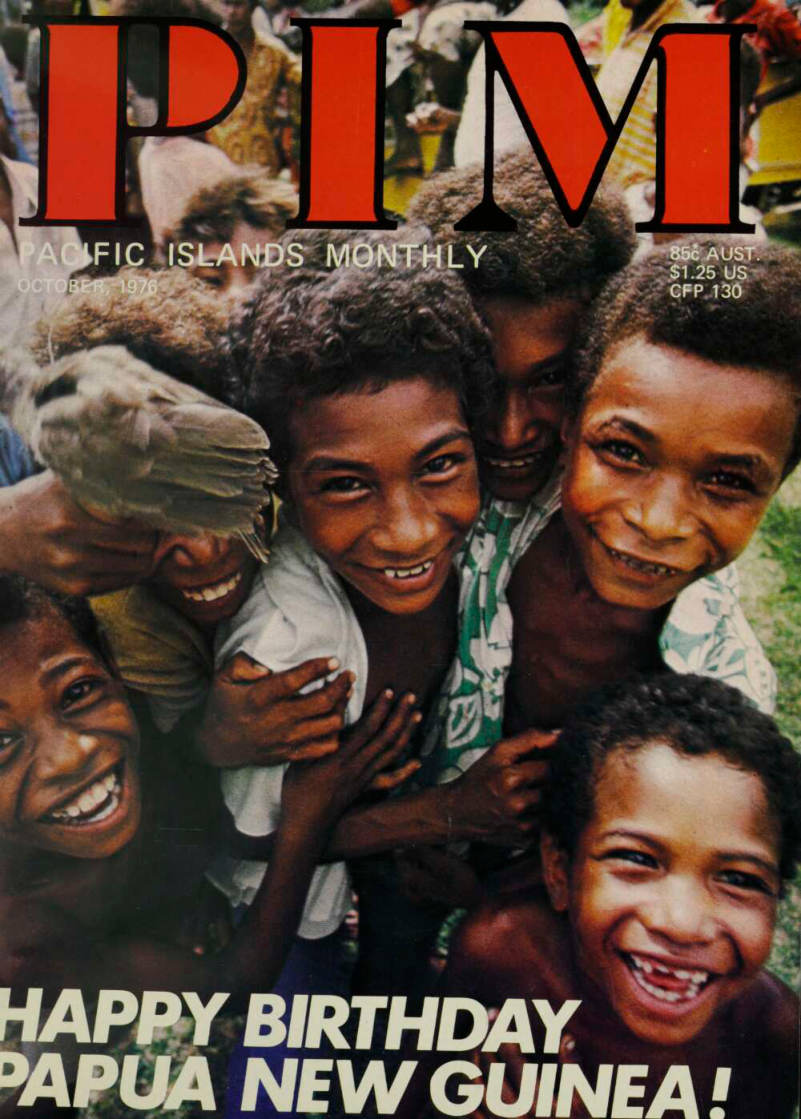
This wide-angled view of smiling Papua New Guinean youngsters is PlM’s birthday greetings card to Papua New Guinea, - as a nation - one year old on September 16.
Like our September issue, the cover picture comes from the camera of Roderick Hulsbergen, whose book Torres Straits: The Last Paradise, has just been published. September 16 is also the birthday of PlM‘s founder, R W. Robertson.
He is now 91.
Advertisements & other items, pp. 2-4 (1 item)
When you buy a Toyota
we promise you much more than
one of the world’s finest cars.
■fa We'll be the first to admit that at Toyota over fifty designated outlets to provide we make some of the world's finest cars.
You only have to look at them to see that.
And driving them just goes to confirm your first opinions.
But there's more to buying a car than buying a good one. You also have to be sure you can keep it that way.
Which is why Toyota have always insisted that their after-sales service be as good as the cars themselves.
In the Pacific Islands area alone we have
TOYOTA
The Toyota range includes: Toyota 1000, Toyota Corolla, Toyota Celica, Toyota Corona, Toyota Corona Mark 11, Toyota Crown PAPUA, NEW GUINEA: ELA MOTORS LIMITED, Scratchley Rd„ Badili, P.O. Box 75, Port Moresby. U.S. TRUST TERRITORY: MICROL CORPORATION, P.O. Box 267, Saipan. FIJI ISLANDS; AUTOMOTIVE SUPPLIES CO., LTD., G.P.O. Box 355, Suva. AMERICAN SAMOA: BURNS PHI LP (SOUTH SEA) CO., LTD., P.O. 1057, Pago Pago, WESTERN SAMOA: BURNS PHILP (SOUTH SEA) LTD., P.O. Box 188, Apia. GUAM: ATKINS; KROLL (GUAM) LTD., P.O. Box 6428, Tamuning. NEW HEBRIDES: NEW HEBRIDES MOTORS LTD., P.O. Box 18, Vila. SOLOMON ISLANDS: MENDANA ENTERPRISES (5.1.), LTD., P.O. Box 174, Honiara. TAHITI: NIPPON AUTOMOTO, B,P. 342, Papeete. COOK ISLANDS: COOK ISLANDS TRADING CORPORATION LTD., P.O. Box 92, Rarotonga.
NAURU ISLAND: NAURU COOPERATIVE SOCIETY. GILBERT & ELLICE ISLANDS COLONY: TARAWA MOTORS, Box 36, Bairiki Tarawa. NORFOLK ISLAND: MARIE'S NORFOLK TOURS, LTD.-, P.O. Box 276. TIMOR: SANGTAI HOO, Sang Tai Building, Dili. NEW CALEDONIA: SOCIETE IMPORTATION AUTOMOBILE DU PACIFIQUE, Rond-Point du Pacific (Station Total) B.P. 438, Noumea. everything you might need, from a simple service to a major overhaul. So get yourself a Toyota and get a lot more than a car.
And that's a promise.
TOYOTA
SERVICE
s * s^— i———
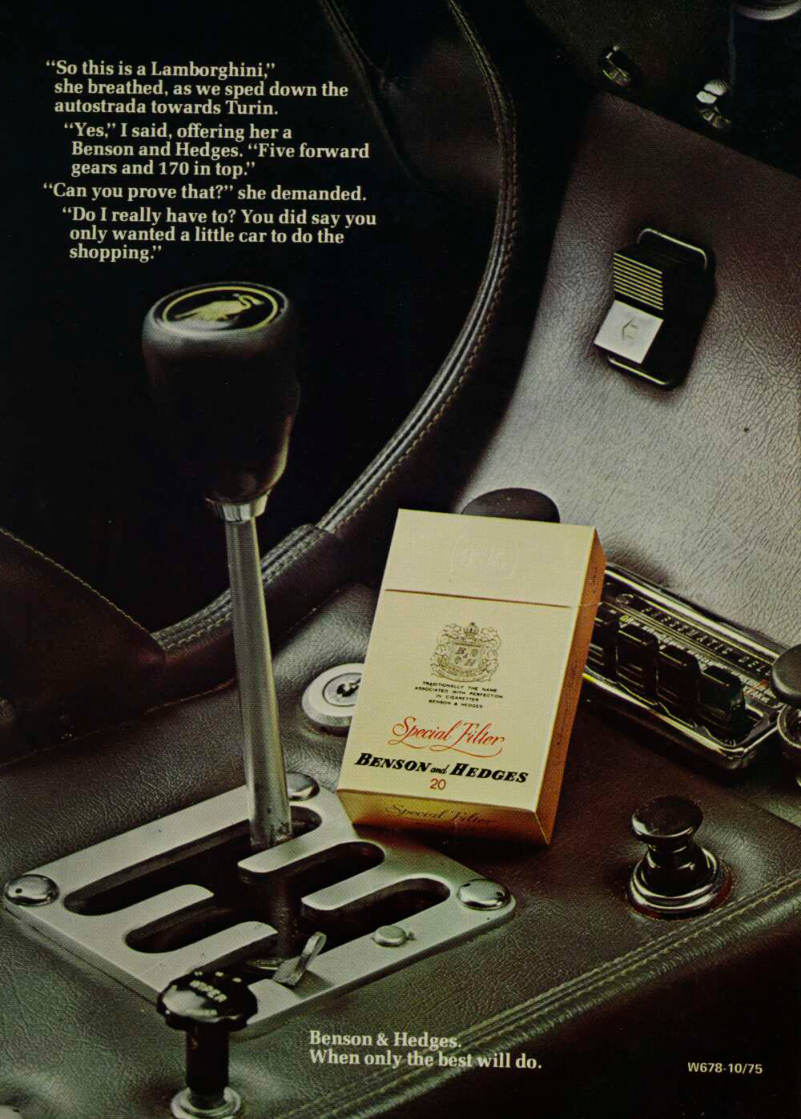
‘So this is a Lamborghini,” she breathed, as we sped down the autostrada towards Turin.
“Yes,” I said, offering her a Benson and Hedges. “Five forward gears and 170 in top.”
Can you prove that?” she demanded.
“Do I really have to? You did say you only wanted a little car to do the
shopping.’
✓ W A n. * /✓ V Benson & Hedges. * When only the best will do W 678 10/75
/ is
Evolution is a state
of art at Sansui.
Painstakingly slow. Thoroughly
researched. Uncompromisingly produced.
Therefore it should come as no surprise
that the SR-929 quartz-servo direct-drive
turntable didn’t happen overnight.
It evolved.
Quite simply into the quietest, most
precise direct-drive turntable ever achieved.
Listen.
Speed deviation: 0.002%.
Wow and flutter; 0.028%.
Signal-to-noise ratio; better than 66d8
(IEC-B).
Imagine listening to a 33 1/3 LP at
33 1/3 RPM.
SR-929
That’s
the SR-929.
Only one example of the outstanding range of
turntables offered by Sansui.
Electronic direct-drive. Traditional belt-
drive. Full automatic. Semi-automatic. Easy-to-
use manual. There’s a Sansui turntable just
right for you.
Take one home. And watch something
beautiful evolve.
SANSUI ELECTRIC CO., LTD.
14-1, 2-chome, Izumi, Suginami-ku, Tokyo 168, Japan
SasisuL
Papua New Guinea Oceania Indent Agency (P.N.G.) Pty. Ltd.
Box 5518, Boroko, Port Moresby Phone: PM 256406 Australia Rank Industries Australia Pty. Ltd.
Head Office: 12 Barcoo Street, East Roseville.
N.S.W. 2069 Phone: 406 5666 Melbourne: 68 Queensbridge Street, South Melbourne, Vic. 3205 Phone: 62 0031 Adelaide: Phone: 212 2555/Brisbane: Phone: 52 7333/Canberra: Phone; 95 2144 Australia Atkins Carlyle Ltd. 44 Belmont Avenue, Belmont, Western Australia, 6104 Phone; 65 0511 Fiji Prabhu Brothers Ltd.
P.O. Box 183, Nadi Phone: 70183/4 New Zealand David J. Reid (N.Z.) Ltd.
C.P.O. Box 2630, Auckland, 1 Phone: 492-189 New Caledonia Ets Michel MERCIER 53 rue de Sebastopol, Noumea Phone: 27. 59. 11 South Pacific Miltons Department Stores Limited P.O. Box 146, Norfolk Island 2899 Central Pacific Nauru Co-operative Society Republic of Nauru Western Samoa H.J. Keil and Company Ltd.
P.O. Box 7, Apia Phone; 198 New Hebrides South Pacific Audio & Photo Supplies 8.P..274, Vila Cook Islands United Island Traders Ltd.
P.O. Box 1 & 2, Rarotonga Tahiti Soci6te JAUNEZ & Cie B.P. 322, Papeete Phone: 2.04.24
Pacific Islands
Monthly
FOUNDED BY R. W. ROBSON IN 1930
Published Monthly By
Pacific Publications (Aust.) Pty. Ltd.,
76 Clarence Street, Sydney 2000
Post Address: G P 0 BOX 3408, SYDNEY
N S W. 2001
Telegraphic Address: PACPUB, Sydney.
Telex: 21242
Telephone: 29 6693.
Publisher: Stuart Inder Business Manager: John Berry
Pacific Islands Monthly
Editor: John Carter Advertising Manager; Alan Batt.
Subscription Rates
Pacific Islands Monthly" is airfreighted to the ma jority of subscribers and agents in the Pacific Islands and the USA.
Australia (including Lord Howe and Thursday Islands), New Zealand, Papua New Guinea, Fiji, New Hebrides, Tonga, Cook Islands, Western Samoa, Gilberts and Tuvalu, Norfolk Island, Niue and Nauru $9 00 (local currency); Solomon Islands $lO 00 Aust; American Samoa Micronesia and Guam: $12.00 US; Hawaii and U S. Mainland: $15.00 U S , New Caledonia and French Polynesia: 1,500 C.F.P.; United Kingdom: £6.50; Japan: 4000 Yen; Elsewhere: $ll 50 Aust
Representatives
Fiji; Advertising and Distribution Fiji Times & Herald Ltd , 20 Gordon Street, Suva Telephone:3l2-1 11. Telex: FJ 2124 Papua New Guinea: Advertising and Distribution PNG Post-Courier. P.O Box 85, Port Moresby Inquiries: Post Newsagency, Telephone 24-2148 French Polynesia: Distribution Hachette Pacifique, 10 Ave Bruat. Papeete.
New Caledonia: Distribution Depot Centre de Presse Michel PENTECOST, B.P C 2 NOUMEA New Zealand: Pacific Publications. C P.O Box 2229, Auckland.
United Kingdom. The Herald and Weekly Times Limited. 8-10 Clifford's Inn, Fetter Lane, London EC4A IBU Telephone: 01-831 6041 Telex Lon don 21989 Japan: Advertising Universal Media Corpora tion, CPO Box 46, Tokyo. Telephone: 666-3036 Victoria: Advertising Pacific Publications (Aust.) Pty Ltd., Herald and Weekly Times Building, 2nd Floor. 61 Flinders Lane, Melbourne. 3000 Telephone: 652 1565.
Brisbane: D Wood. Anday Agency. Box 1918 G.PO, Brisbane 4001. Telephone: 44 3485 44 1 546.
Hawaii and U.S. Mainland only: PIM, Hawaii, 2812, Kahawai St, Honolulu, Hawaii, 96822 Second class postage paid at Honolulu, Hawaii Printed in Australia Copyright c 1976
Pacific Publications (Aust.) Pty. Ltd.
Printed by, Paramac, Mitchell Road.
Alexandria.
Registered at the G.P O. Sydney for transmission by )ost as a newspaper category B.
Recommended retail price only.
Vol. 47 No. 10 Oct., 1976
Advertisements & other items, pp. 5-9 (3 items)
5
’ACIFIC ISLANDS MONTHLY, OCTOBER 1976
for a practical approach
Look to Wunderflex
to good design
We all look for good design in a building.
If it’s practical and economical as well, you’re in front.
Wunderflex building board is the answer. It fits good design with ease. Practical because it’s easy to work; won’t rot, shrink or rust. Paint it if you wish — but there’s no need. Versatile, too, use Wunderflex inside or out.
Economy comes with initial purchase and the long lasting qualities of Wunderflex.
Yes, Wunderflex has a lot going for it.
Ask your builder.
IViunderlich
Wunderflex
Made in Australia and marketed by; CSR-Wunderlich Building Materials Export Sales: 4 O'Connell Street, Sydney 2000 Postal address: Box 483, G.P.0., Sydney, N.S.W. 2001
AVAILABLE THROUGH LEADING ISLAND MERCHANTS.
Town 6c countr
iring at its best!
kVieambllla Chinchilla
s the country is the town
ie clear, crisp, exhilarating air on ieambilla is a product of its pure istralian bushland environment. ily a short distance from Chinchilla via a sasant country road, Wieambilla is a aceful place ideal for relaxed family ing.
arge acreage blocks
Dcks on Wieambilla are ‘country size’ and ige from 75 to 130 acres. Prices are ceptionally reasonable starting at $10,500 d peaking at $13,500. Good value for >ney! Attractive bank interest terms are ailable.
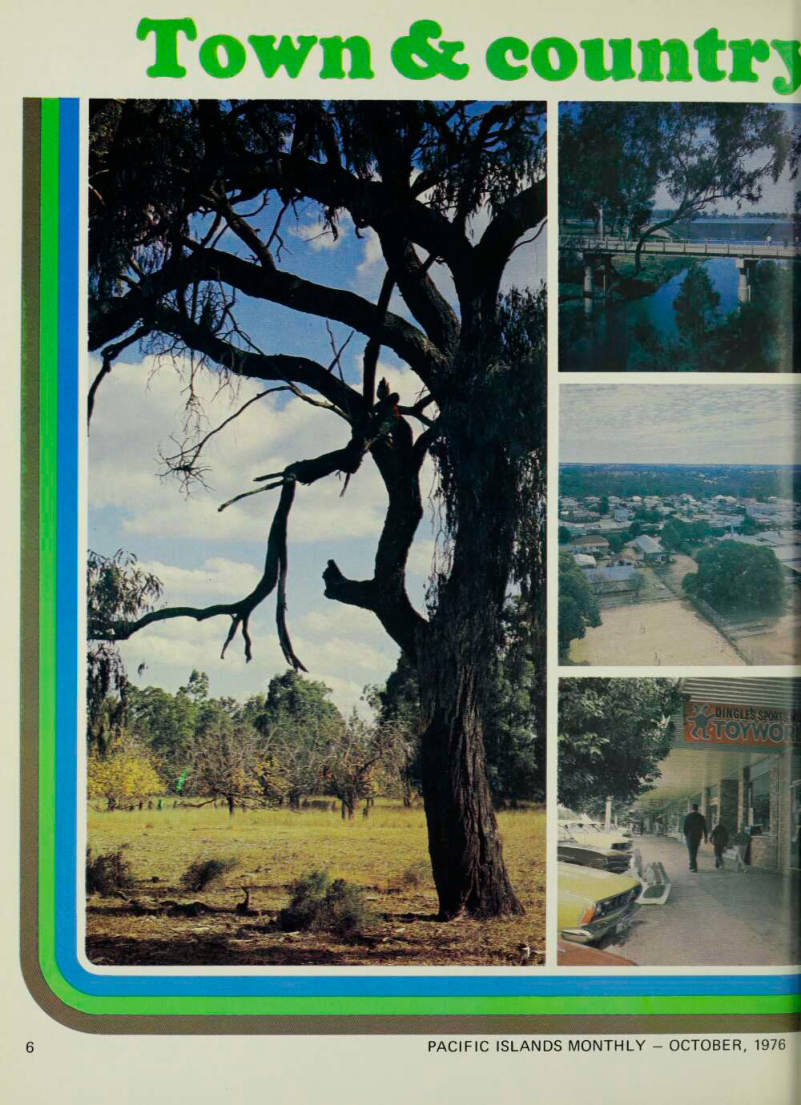
JURE CAPTIONS:
A typical Wieambilla scene, gh natural bush, studded i cypress and ironbark.
The Chinchilla Weir —a aground for local fishing and ting enthusiasts.
An elevated view of ichilla itself showing the antages of intelligent town ming.
The comfortable shopping commercial heart.
Chinchilla is a major rail head and cattle buying centre situated close to the heart of Queensland’s famous Darling Downs. The town is also an important saw milling point supplying various types of dressed timber to many outside areas. Chinchilla also has additional light industry including its own brickworks.
Progressive town
The growth rate of Chinchilla equals many and exceeds other towns throughout South East Queensland.
Chinchilla takes a great deal of pride in its Civic Centre which can house 800 people, its Golf Course, Swimming Centre and the wide range of clubs, service organisations and business houses.
Chinchilla is a vital, alive and progressive town
'or sate, sound
investment in a
fresh country
life-style...
RURAL Wieambilla is a Rural Research Pty. Ltd. Project. 149 Wickham Terrace, Brisbane, 4000. Tel. 221 1622 Please send me more details on Wieambilla.
RESEARCH
Name: Address: Postcode
vPFBES'
Care
V' asVi
’ BIOo«;
LEMON
•etergi ‘ajKiKccsßMse - eoer l
,f S OET6HOCKIS MS* ’
irui im *UzqW. concent rated
Kwitj
Ry f • r
SlcnttS
DISHWASHING UQI
m * a '7 t
MJTION'
[*scotbs
s/iri-afoii
teak oil
IR9BKS SCttTOSS m su»s , JOOml
household products
give you real value
for your money.
For twenty five years Scotts have been helping out in homes throughout Australia and the Pacific.
Washing dishes. Cleaning. Keeping germs and dirt at bay All with quality products at sensible prices.
Scotts household products. Big on value and big on quality for 25 years.
Bcolibs
25 th mm
SCOTTS’ DETERGENTS (A/ASIA) PTY. LTD.,
P.O. Box 22, BOTANY. 2019 N.S.W. AUSTRALIA
anywhere,
any time,
any gas.
ULLIi
m v. ifc For further information & addresses of your local distributor contact:
THE COMMONWEALTH
INDUSTRIAL GASES LIMITED
Gases Export Department, 138 Bourke Road, Alexandria, N.S.W.
Australia 2015.
Cables CIGAS’-Telex AA25475 SYDNEY
CS9B/76
7
\CI FI C ISLANDS MONTHLY - OCTOBER, 1976
Up Front
with the Publisher
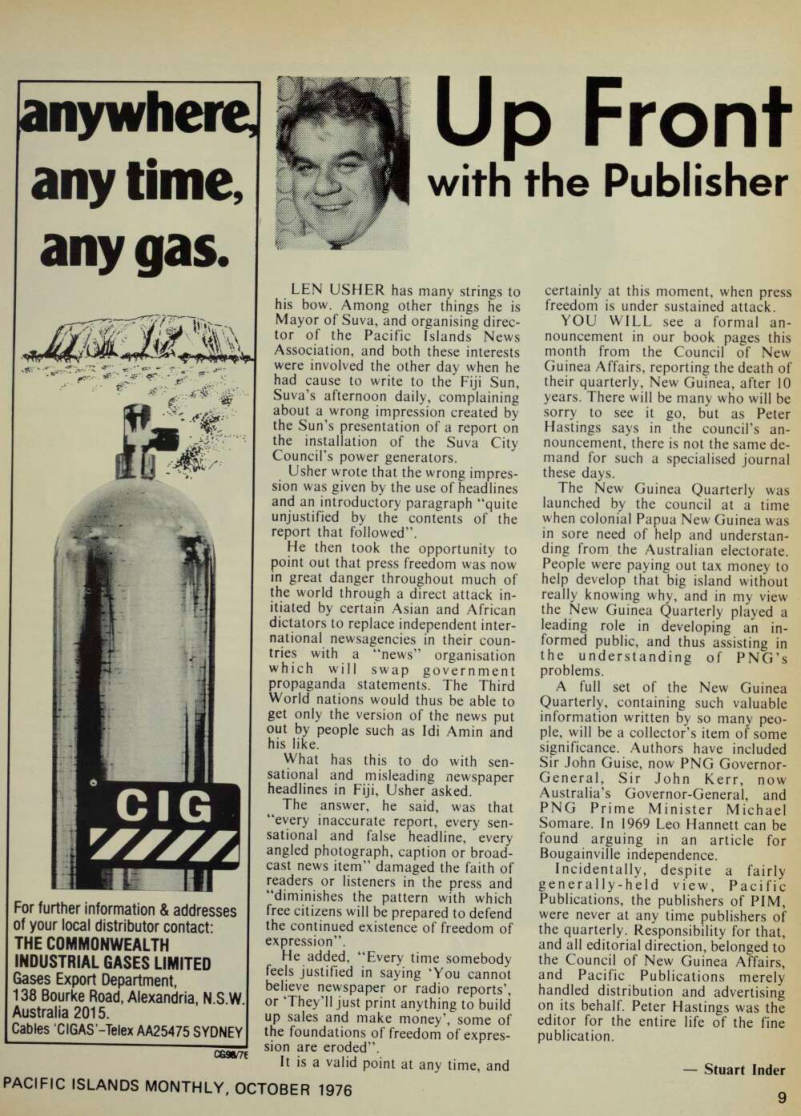
LEN USHER has many strings to his bow. Among other things he is Mayor of Suva, and organising direc tor of the Pacific Islands News Association, and both these interests were involved the other day when he had cause to write to the Fiji Sun, Suva’s afternoon daily, complaining about a wrong impression created by the Sun’s presentation of a report on the installation of the Suva City Council’s power generators.
Usher wrote that the wrong impres sion was given by the use of headlines and an introductory paragraph “quite unjustified by the contents of the report that followed”.
He then took the opportunity to point out that press freedom was now in great danger throughout much of the world through a direct attack in itiated by certain Asian and African dictators to replace independent inter national newsagencies in their coun tries with a “news” organisation which will swap government propaganda statements. The Third World nations would thus be able to get only the version of the news put out by people such as Idi Amin and his like.
What has this to do with sen sational and misleading newspaper headlines in Fiji, Usher asked.
The answer, he said, was that “every inaccurate report, every sen sational and false headline, every angled photograph, caption or broad cast news item” damaged the faith of readers or listeners in the press and “diminishes the pattern with which free citizens will be prepared to defend the continued existence of freedom of expression”.
He added, “Every time somebody feels justified in saying ‘You cannot believe newspaper or radio reports’, or They’ll just print anything to build up sales and make money’, some of the foundations of freedom of expres sion are eroded”.
It is a valid point at any time, and
certainly at this moment, when press freedom is under sustained attack.
YOU WILL see a formal an nouncement in our book pages this month from the Council of New Guinea Affairs, reporting the death of their quarterly, New Guinea, after 10 years. There will be many who will be sorry to see it go, but as Peter Hastings says in the council’s an nouncement, there is not the same de mand for such a specialised journal these days.
The New Guinea Quarterly was launched by the council at a time when colonial Papua New Guinea was in sore need of help and understan ding from the Australian electorate.
People were paying out tax money to help develop that big island without really knowing why, and in my view the New Guinea Quarterly played a leading role in developing an in formed public, and thus assisting in the understanding of PNG’s problems.
A full set of the New Guinea Quarterly, containing such valuable information written by so many peo ple, will be a collector’s item of some significance. Authors have included Sir John Guise, now PNG Governor- General, Sir John Kerr, now Australia’s Governor-General, and PNG Prime Minister Michael Somare. In 1969 Leo Hannett can be found arguing in an article for Bougainville independence.
Incidentally, despite a fairly generally-held view, Pacific Publications, the publishers of PIM, were never at any time publishers of the quarterly. Responsibility for that, and all editorial direction, belonged to the Council of New Guinea Affairs, and Pacific Publications merely handled distribution and advertising on its behalf. Peter Hastings was the editor for the entire life of the fine publication.
Stuart Inder
Advertisements & other items, pp. 10-11 (2 items)
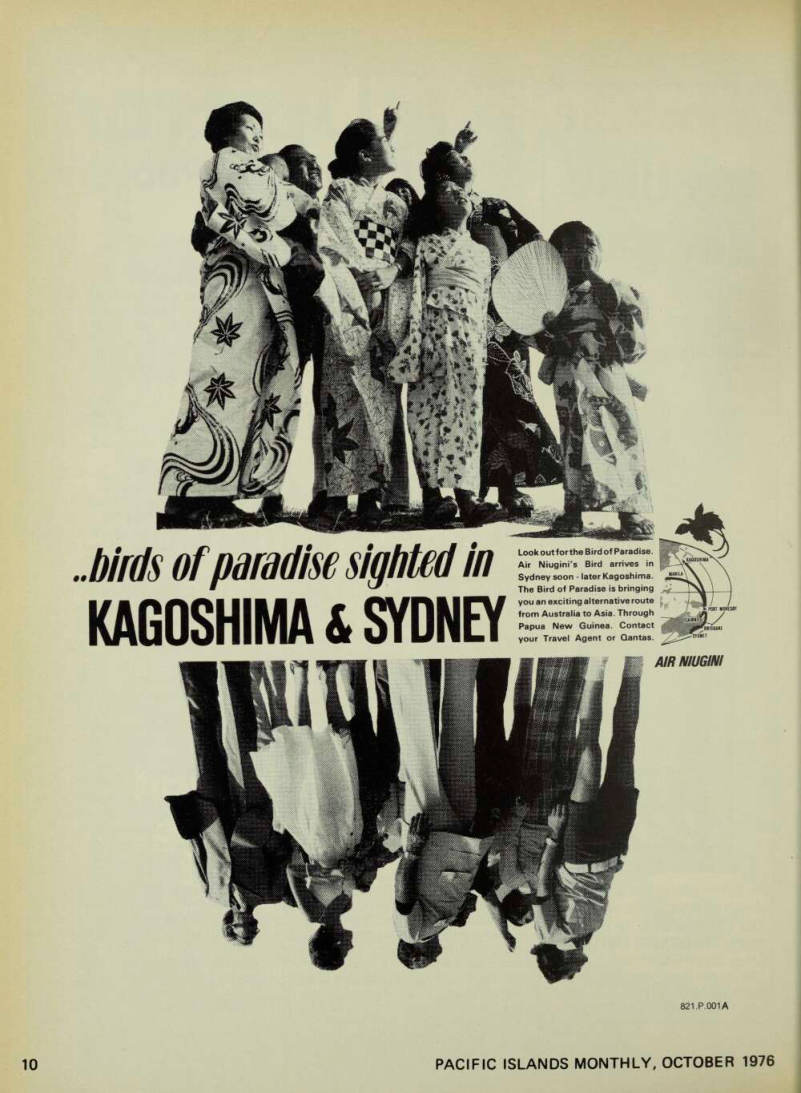
Kagoshima & Sydney
* 1. 4
birds of paradise sighted in
Look out forthe Bird of Paradise.
Air Niugini's Bird arrives in Sydney soon - later Kagoshima.
The Bird of Paradise is bringing you an exciting alternative route [ from Australia to Asia. Through Papua New Guinea. Contact your Travel Agent or Qantas. m
AIR NIUGINI
821.P.001 A
Pacific Island Monthly
Vol 47, No 10 October, 1976
In this issue
General
Young nations conference 17 No Medi for Islanders 27 Co-operation call 41
Cook Islands
Glitter at Rarotonga 27 Dr Davis ill 30 A cooked result 31
Fiji
Anti-wig Speaker 21 Press ban 25 Australia’s view of reds 45 Blow to tourism 73 Air Pacific plans 77 Hard workers on wharves 79
Gilbert Islands
Japanese aid sought 69
Nauru
Bouquet for stamps 33 New Bank 73
New Caledonia
New deal 15 French presence question 32
New Hebrides
Run around continues 16
Niue
Freight rates up 81
Papua New Guinea
Mr Somare’s independence message . 12 Changes with independence 13 Somare to visit China 13 Independence “I’s” dotted 14 Outside the law 24 Toping teachers 24 Women reformers 25 PNG-Solomons link 27 First Anglican archbishop 30 Unions slated 33 Search for national language 35 Discrimination alleged 37 Scouting’s 50th birthday 39 Ramu power scheme 67 Qantas 30 years ago 81
Pitcairn Island
Sappers at work 75
Solomon Islands
PNG-Solomons link 27 Journal dies 31 Newshipping service 77
Tokelau
Official name 25 Fishing zone fixed 73
Tonga
Dr Havea to USP 29 Company in trouble 71
Us Trust Territory
Future capital move 16 Bankrupt justice 25 New shipping service 77
Western Samoa
Air Pacific board 29 Bigger foot in NZ’s door 43 Air plan rejected 79
“anSs ™SS If • mL L ™*2T L he P L Ub !' sh ,T 9: Edi,or s Mailba 9. 2 * N e«s a Nutshell. 24; 77 nf«h : ¥, o f S '! ! 9: Business and Development, 67; Pacific Transport, Prodlfe Prfc«9s ’ ° PIe ' ® 9: ShippinS and Ai ™ a ' ,s 'n'omalion, 90;
Single, Free And Independent
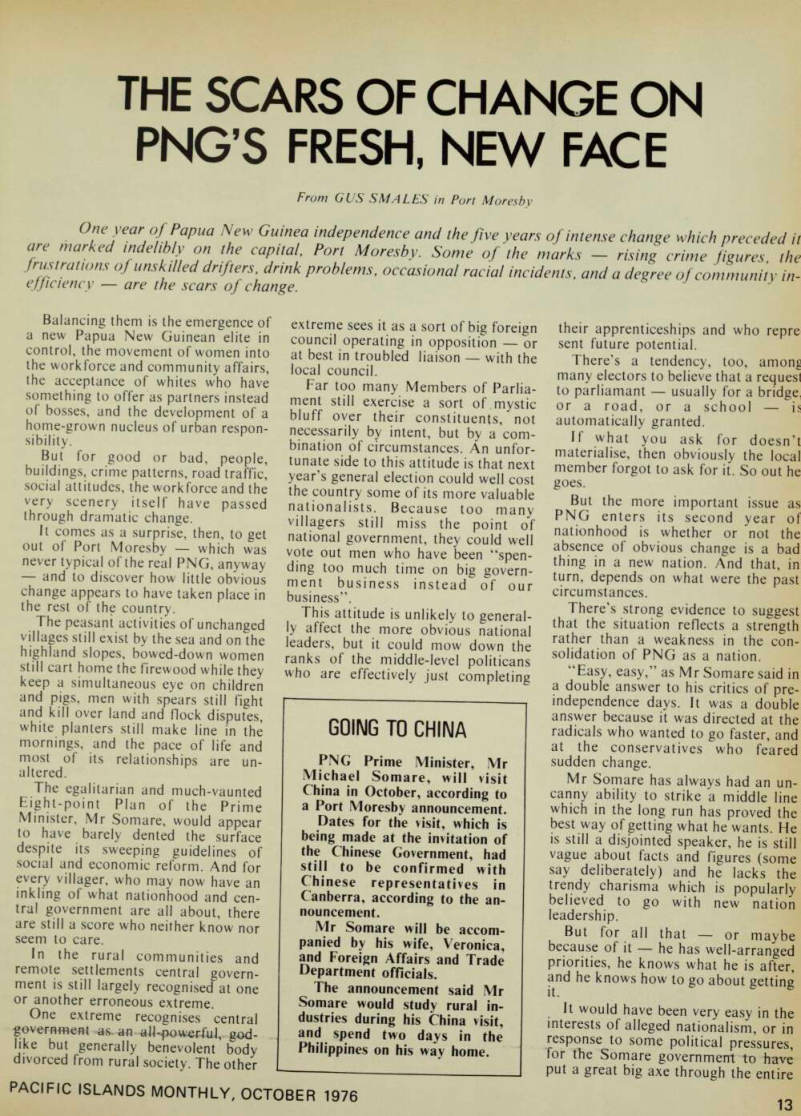
Papua New Guinea celebrated its first birthday as an independent nation on September 16. How has the country fared in that first 12 months and what will the future bring? Prime Minister Michael Somare, in this Independence Birthday message, believes the first year has been a good one, bearing in mind the many problems facing the new nation. With an air of restrained optimism, he believes the next 12 months will see “many hopes fulfilled and ambitions realised ” “if the national spirit remains as it has been for the past year”.
“One year after the Australian flag was lowered in our country for the last time and our national flag raised in its place it is a good time to reflect on the events of our first year of independence and look forward to the next.
“When I look back to this time last year it seems that we started our first year of independence with a mixture of problems and hopes.
Some of the problems we faced on September 16, 1975, seemed to challenge our future success as an independent nation. Outsiders must ■ , , . e have wondered how we would face .. .. e . . . the problem ot strong regional r pressure for real involvement of all r . . . , , . . people in government and decisionr & making.
“Others pointed to world economic problems and asked how PNG as a new independent nation would survive in a depressed economic situation outside our own direct control.
“This time last year, too, it seemed that a national strike could threaten our economy at a vital time. At this time, other countries watched and waited to see how we would handle our international negotiations and our commitment
to develop our resources, while at the same time, retaining our control over them.
“Personally, I did not doubt for a minute PNG’s ability to handle these problems but looking back on the final months of last year it did seem that some of these problems would test our every strength. Today September 16, 1976, not all these problems have been overcome and not all of our hopes have been realised. It does not matter how many problems we solve there will always be more, and with each .. r» N , n succeeding generation in PNG .« ... . c , . . there will be fresh hopes and new ... ambitions. ..
“But, at the same time, progress , . . . . £. . has been sure and steady. I he first provincial governments are now being established. We can be hopeful that the worst of the world economic recession is over and know that through this period our own currency, the Kina, held steady and only recently was revalued.
“I believe the near future will bring us positive commitments and plans in resource development. In these, and other areas, I believe we have won the respect of the world with our proven ability to peaceful-
|y resolve problems at home and deal fairly in our negotiations with others.
“Qur success, in part, has been due to the national spirit of the peo pje 0 f during our first year of independence. As Prime Minister, I believe that the nation is indebted to a those people who showed this spirit of responsibility in a sometimes frustrating and difficult year ... . ... „ e *. ear ’ ere Wl frustrations and more d.fficulties but I believe that if the national . . . ... r .. spirit remains as it has been for the v . ... ... . past year, then there will be many ’. , , ... .. hopes fulfilled and ambitions realis ,r, ... ed during the coming months, b * “Less than a hundred years ago our country was divided between many villages, each with their own small area of land. During the past on c hundred years we have seen several different administrations w h° ave on ma P s divided our land again to suit their own purposes, “Today we recognise and respect each other’s regional differences and needs. But without a doubt and above all else, we are a single free and independent nation.’’
Png’S Fresh, New Face
The Scars Of Change On
From GUS SMALES in Port Moresby One year of Popua New Guinea independence and the five years of intense change which preceded it are marked indelibly on the capital Port Moresby. Some of the marks - rising crime figures, the frustrations of unskilled drifters drink problems, occasional racial incidents, and a degree of community in ejjiciency are the scars of change.
Balancing them is the emergence of a new Papua New Guinean elite in control, the movement of women into the workforce and community affairs, the acceptance of whites who have something to offer as partners instead of bosses, and the development of a home-grown nucleus of urban respon sibility.
But for good or bad, people, buildings, crime patterns, road traffic, social attitudes, the workforce and the very scenery itself have passed through dramatic change.
It comes as a surprise, then, to get out of Port Moresby which was never typical of the real PNG, anyway and to discover how little obvious change appears to have taken place in the rest of the country.
The peasant activities of unchanged villages still exist by the sea and on the highland slopes, bowed-down women still cart home the firewood while they keep a simultaneous eye on children and pigs, men with spears still fight and kill over land and flock disputes, white planters still make line in the mornings, and the pace of life and most of its relationships are un altered.
The egalitarian and much-vaunted Eight-point Plan of the Prime Minister, Mr Somare, would appear to have barely dented the surface despite its sweeping guidelines of social and economic reform. And for every villager, who may now have an inkling of what nationhood and cen tral government are all about, there are still a score who neither know nor seem to care.
In the rural communities and remote settlements central govern ment is still largely recognised at one or another erroneous extreme.
One extreme recognises central government -as. an aJJ-powerful, god like but generally benevolent body divorced from rural society. The other
extreme sees it as a sort of big foreign council operating in opposition or at best in troubled liaison with the local council.
Far too many Members of Parlia ment still exercise a sort of mystic bluff over their constituents, not necessarily by intent, but by a com bination of circumstances. An unfor tunate side to this attitude is that next year’s general election could well cost the country some of its more valuable nationalists. Because too many villagers still miss the point of national government, they could well vote out men who have been “spen ding too much time on big govern ment business instead of our business”.
This attitude is unlikely to general ly affect the more obvious national leaders, but it could mow down the ranks of the middle-level politicans who are effectively just completing
their apprenticeships and who repre sent future potential.
There’s a tendency, too, among many electors to believe that a request to parliamant usually for a bridge, or a road, or a school is automatically granted.
If what you ask for doesn’t materialise, then obviously the local member forgot to ask for it. So out he goes.
But the more important issue as PNG enters its second year of nationhood is whether or not the absence of obvious change is a bad thing in a new nation. And that, in turn, depends on what were the past circumstances.
There’s strong evidence to suggest that the situation reflects a strength rather than a weakness in the con solidation of PNG as a nation.
“Easy, easy,” as Mr Somare said in a double answer to his critics of pre independence days. It was a double answer because it was directed at the radicals who wanted to go faster, and at the conservatives who feared sudden change.
Mr Somare has always had an un canny ability to strike a middle line which in the long run has proved the best way of getting what he wants. He is still a disjointed speaker, he is still vague about facts and figures (some say deliberately) and he lacks the trendy charisma which is popularly believed to go with new nation leadership.
But for all that or maybe because of it he has well-arranged priorities, he knows what he is after, and he knows how to go about getting It would have been very easy in the interests of alleged nationalism, or in response to some political pressures, for the Somare government to have put a great big axe through the entire
fabric of PNG in the past year or so.
Outside investors, whites and Asians who regarded PNG as their home, and puzzled or conservative Papua New Guineans themselves waited in some trepidation to see where or how the axe would fall.
Some tough guidelines emerged about foreign investment and involve ment and the new “foreigners” were told exactly where they stood, but no axe was ever wielded.
The results have been interesting in a number of directions.
There was an obvious increase in foreign confidence, even if the pickings seemed less attractive. But the real bonus for PNG came in the reaction of many of its own radicals, who suddenly realised that controlled investment meant something for them. There are still radical voices calling for instant economic revolu tion, even amounting to calls for un compensated acquisition, but the government is sitting solidly in con trol.
Mr Alex Gordon, a Scottish-born university lecturer in Port Moresby has publicly advocated, for instance, that all white planters should be
tipped off their properties.
Instead of the present govern ment policy paying compensation for any acquisitions, he believes the planters should compensate the government for nearly a century of “disrupting and exploiting the natural economic system”.
His remarks prompted an angry critic (another white, but not a planter) to suggest that doctors and health workers should pay compensa tion “for disrupting the natural en vironment by reducing malaria and child mortality”.
Of all the factors which have
emerged from the policies, the problems, the squabbles and (let’s face it) the inefficiencies of the first year of independence, one has emerg ed clearly as an indication of national strength. This is a basic integrity towards national financial manage ment, coupled with a recognition that no country, politically independent or otherwise, can exist today in isolation.
By adopting this attitude, and coupling it with responsible budget policies, PNG has traded speed for stability in making the wider changes which will surely come.
The forces, which will change the obvious face of society but even then not as quickly as many people believe are already at work and are contained in the Eight-point Plan and the voluminous National Constitution (one of the biggest in the world).
In the meantime, content with a type of national and domestic co existence policy, PNG continues to accept nearly half its budget revenue in untied Australian aid, putting the money into projects which will pay off when aid tapers away.
There have been fears, mainly from foreign investors, that the structure is still shaky because it stands or falls with the Somare government. This is true enough in a superficial sort of way, but it ignores the influence which any foundation government and parliament cannot help but impress on the immediate future of its coun try.
Mr Somare himself and his hard core supporters in government may indeed be difficult to replace im mediately as people, but there is nothing to suggest that the flavour of national politics contains a significant or even a potentially-significant force of counter-thought.
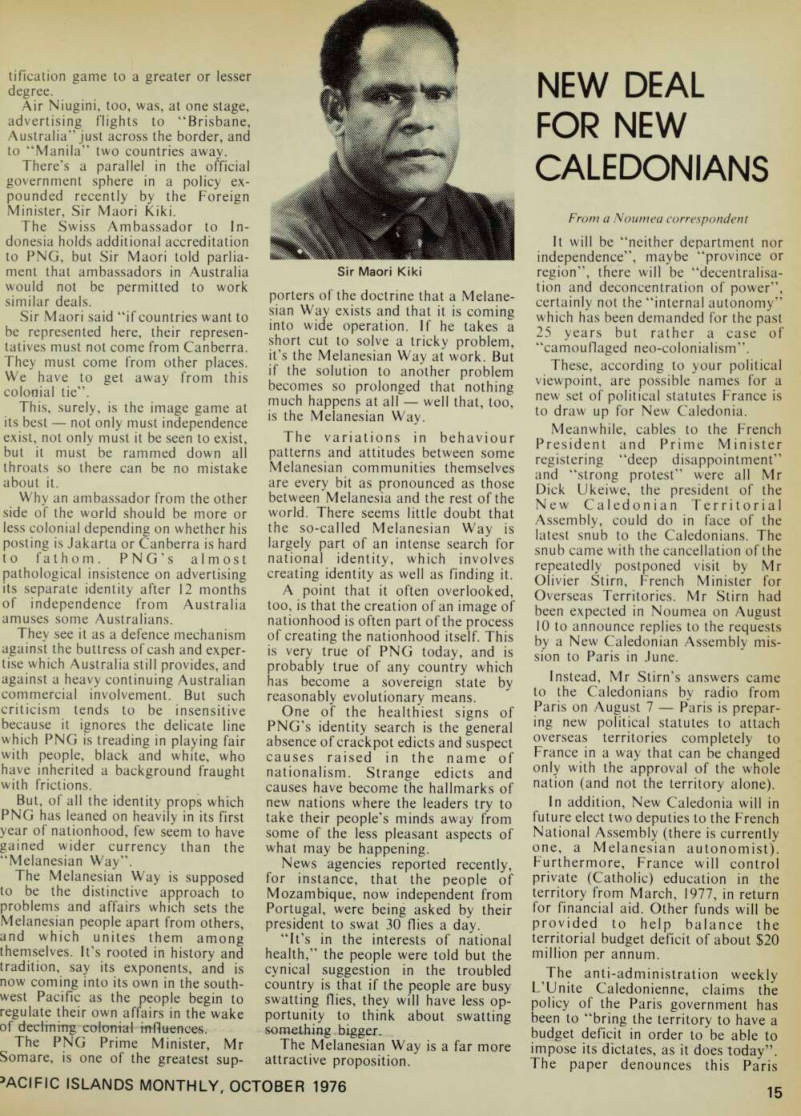
This is where it all started - Mr. Somare signs the papers legalising PNG's attainment of self-government on December 1, 1973. High Commissioner Mr. L.W. Johnson looks on.
Going To China
PNG Prime Minister, Mr Michael Somare, will visit China in October, according to a Port Moresby announcement.
Dates for the visit, which is being made at the invitation of the Chinese Government, had still to be confirmed with Chinese representatives in Canberra, according to the an nouncement.
Mr Somare will be accom panied by his wife, Veronica, and Foreign Affairs and Trade Department officials.
The announcement said Mr Somare would study rural in dustries during his China visit, and spend two days in the Philippines on his way home.
the'i’in
PNG dots the'i’in independence
From GUS SMA LES in Port Moresby Being yourself and making your own decisions are no doubt the things that matter when a country achieves independence after years of colonial status. But the activity which often gives the new nationalist his warmest glow is making sure that other people know all about his independence.
The urge to establish an identity and then project an image is one of the biggest side-issues involved in modern, new nation politics. It’s something which insists not only must you establish an identity, but the rest of the world must be made aware that such an identity exists.
The result is often an almost ar tificial adoption of ideas and attitudes and customs. Many of them, no doubt, existed incipiently, others are sought out and enthroned with painstaking care, and some are down right invented.
Relationships which a long established nation may often have stopped thinking about become major issues, and the whole new national community gets caught up in the game.
Papua New Guinea, in its first year of political independence, has been no exception.
And so it comes about that in Port Moresby today if you’re referring to overseas cities you might say simply London or Bangkok or Tokyo but that’s not enough for Sydney or Melbourne.
Trends dictate that you must refer to “Sydney, Australia’’ or “Melbourne, Australia’’ or even “Melbourne, the capital of the Australian State of Victoria” as one radio news bulletin pontificated.
It’s part of a process of demonstrating that Australia is very much a foreign and separate country, not linked to an independent PNG in any way, and therefore in need of special elaboration.
The Post-Courier newspaper in Port Moresby, the National Broad casting Commission, and the govern ment information services have all been guilty of the Australian iden
tification game to a greater or lesser degree.
Air Niugini, too, was, at one stage, advertising flights to “Brisbane, Australia” just across the border, and to “Manila” two countries away.
There’s a parallel in the official government sphere in a policy ex pounded recently by the Foreign Minister, Sir Maori Kiki.
The Swiss Ambassador to In donesia holds additional accreditation to PNG, but Sir Maori told parlia ment that ambassadors in Australia would not be permitted to work similar deals.
Sir Maori said “if countries want to be represented here, their represen tatives must not come from Canberra.
They must come from other places.
We have to get away from this colonial tie”.
This, surely, is the image game at its best not only must independence exist, not only must it be seen to exist, but it must be rammed down all throats so there can be no mistake about it.
Why an ambassador from the other side of the world should be more or less colonial depending on whether his posting is Jakarta or Canberra is hard to fathom. PNG’s almost pathological insistence on advertising its separate identity after 12 months of independence from Australia amuses some Australians.
They see it as a defence mechanism against the buttress of cash and exper tise which Australia still provides, and against a heavy continuing Australian commercial involvement. But such criticism tends to be insensitive because it ignores the delicate line which PNG is treading in playing fair with people, black and white, who have inherited a background fraught with frictions.
But, of all the identity props which PNG has leaned on heavily in its first year of nationhood, few seem to have gained wider currency than the “Melanesian Way”.
The Melanesian Way is supposed to be the distinctive approach to problems and affairs which sets the Melanesian people apart from others, and which unites them among themselves. It’s rooted in history and tradition, say its exponents, and is now coming into its own in the south west Pacific as the people begin to regulate their own affairs in the wake of declining colonial influences.
The PNG Prime Minister, Mr Somare, is one of the greatest sup-
porters of the doctrine that a Melane sian Way exists and that it is coming into wide operation. If he takes a short cut to solve a tricky problem, it’s the Melanesian Way at work. But if the solution to another problem becomes so prolonged that nothing much happens at all well that, too, is the Melanesian Way.
The variations in behaviour patterns and attitudes between some Melanesian communities themselves are every bit as pronounced as those between Melanesia and the rest of the world. There seems little doubt that the so-called Melanesian Way is largely part of an intense search for national identity, which involves creating identity as well as finding it.
A point that it often overlooked, too, is that the creation of an image of nationhood is often part of the process of creating the nationhood itself. This is very true of PNG today, and is probably true of any country which has become a sovereign state by reasonably evolutionary means.
One of the healthiest signs of PNG’s identity search is the general absence of crackpot edicts and suspect causes raised in the name of nationalism. Strange edicts and causes have become the hallmarks of new nations where the leaders try to take their people’s minds away from some of the less pleasant aspects of what may be happening.
News agencies reported recently, for instance, that the people of Mozambique, now independent from Portugal, were being asked by their president to swat 30 flies a day.
“It’s in the interests of national health,” the people were told but the cynical suggestion in the troubled country is that if the people are busy swatting flies, they will have less op portunity to think about swatting something bigger.
The Melanesian Way is a far more attractive proposition.
Sir Maori Kiki
Caledonians
New Deal
For New
From a Noumea correspondent It will be “neither department nor independence”, maybe “province or region”, there will be “decentralisa tion and deconcentration of power”, certainly not the “internal autonomy” which has been demanded for the past 25 years but rather a case of “camouflaged neo-colonialism”.
These, according to your political viewpoint, are possible names for a new set of political statutes France is to draw up for New Caledonia.
Meanwhile, cables to the French President and Prime Minister registering “deep disappointment” and “strong protest” were all Mr Dick Ukeiwe, the president of the New Caledonian Territorial Assembly, could do in face of the latest snub to the Caledonians. The snub came with the cancellation of the repeatedly postponed visit by Mr Olivier Stirn, French Minister for Overseas Territories. Mr Stirn had been expected in Noumea on August 10 to announce replies to the requests by a New Caledonian Assembly mis sion to Paris in June.
Instead, Mr Stirn’s answers came to the Caledonians by radio from Paris on August 7 Paris is prepar ing new political statutes to attach overseas territories completely to France in a way that can be changed only with the approval of the whole nation (and not the territory alone).
In addition, New Caledonia will in future elect two deputies to the French National Assembly (there is currently one, a Melanesian autonomist).
Furthermore, France will control private (Catholic) education in the territory from March, 1977, in return for financial aid. Other funds will be provided to help balance the territorial budget deficit of about $2O million per annum.
The anti-administration weekly L’Unite Caledonienne, claims the policy of the Paris government has been to “bring the territory to have a budget deficit in order to be able to impose its dictates, as it does today”.
The paper denounces this Paris
“blackmail” over the deficit and asks why doesn’t France pay back the im mense loans she had inadvisably led the territory to undertake in recent years.
On the other hand, Governor Eriau expressed his satisfaction at the success obtained by the assembly mis sion to Paris. However, Melanesian leader Mr Yann Celene Uregei and his Union Multiraciale party denounced the new moves as a “time bomb”, destroying the Kanaka people and normal evolution towards in dependence”. Like the autonomists in Tahiti, he called for new elections in the Territorial Assembly before any change in the statutes.
The official reason for cancelling Mr Stirn’s visit is that he had wanted to visit all French Pacific territories but that was no longer possible: since the June resignation of Francis San ford, French Polynesia’s deputy to the French National Assembly, that territory has launched into a three month electoral campaign, which it would be improper for the minister to interrupt.
Meanwhile, in the pro administration camp, which currently has a majority of one man in the Caledonian Territorial Assembly, the power ball-game between Noumea and Paris continues for the benefit of those who still can be bothered to watch. To revive the game, new jour nalists are flown in each year to operate local newspapers, radio and TV and give some attempt at fresh commentaries to a contest in which most Caledonians, after 25 years, are either too weary or too scared of “in jury” to get involved.
For lack of real action, especially in the continuing economic slump, those selected players still prepared to act out the drama for the benefit of the gallery have resorted to a game of words. Exactly what could Mr Stirn have in store for the island now that he has promised another attempt at drawing up new political statutes?
As Dick Ukeiwe solemnly an nounced; “In Paris, they are looking for the word and they have asked us to look too. The French language is rich enough for us to find the appropriate word”. It looks like another word game that could keep the Caledonians entertained for years. Meanwhile, “since Mother knows best”, France rules the waves, and New Caledonia will soon be more firmly attached to Paris.
New Hebrides run
around continues
From a Vila correspondent
When will the New Hebrideans grow weary of flying off to Paris, London and New York, trying to urge their country towards independence? Why can’t they resign their islands to the generous colonial administrators who want to look after them?
These are some of the questions the cynic must ask after leaders of the independence-seeking National Party sought help from the United Nations in New York and members of the South Pacific Forum as the condominium’s firstelected Representative Assembly still remained incomplete and ineffective in September.
The continuing problems surrounding the new assembly were highlighted by the July court decision to rule as void five of six seats from the November, 1975, elections in the electorates of rural and urban Santo. New elections for these seats were thus scheduled to be held by November, once a count of the island’s population could be held. Four of the candidates who lost their seats were National Party members Titus Path, Thomas Ruben, Mary Gilu and Philibert de Montgremier, besides MANH party member, Michel Thevenin.
Noumea’s anti-administration
weekly L’Unite Caledonienne was quick to blame the confused elec toral regulations for the New Hebrides situation. The paper saw the colonial strategy as being in tended to prevent the assembly from meeting as a complete body, and especially aimed at breaking the majority of the National Party.
The New Hebrides joint court actually ruled that some hundreds of votes were invalid due to the wording of a regulation to extend the date for registering voters. As soon as the court decision was known, the National Party sent a telegram to delegations at the South Pacific Forum meeting late July in Nauru, asking them to en dorse a declaration of "no con fidence” in the colonial ad ministration.
The National Party also urged Forum members’ support for its mission to the UN Committee for Decolonisation. One of the objec tives of the National Party is to call a referendum before the end of 1976. to have one of the two gover ning powers withdrawn from the New Hebrides, leaving only one to prepare the country for the desired independence. Members of the minority party UCNH also sent representatives to make its case at the UN.
Ponape, A Future Capital
The Congress of Micronesia in August voted in favour of Ponape in the Carolines as the site of the future capital of Micronesia.
Debate on the issue has been simmering ever since the Northern Marianas chose to become a US commonwealth, thus removing Saipan, largest and most populous island in the Marianas chain, as a contender.
During the debate in the House of Representatives, Truk representative Refonopei said that, despite his earlier support for siting the capital in the Faichuk area of! ruk, he would vote in support of Ponape because a majority of members favoured it.
However, Congressman Polycarp Basilius, on behalf of the Palau delegation, said that because the Palauans favoured a future political status relationship with the USA “which is distinct and separate from that of the other districts of Micronesia”, Palau representatives would not vote on the issue.
The three Palau members left the House before the vote was taken.
The four Marshalls representatives declined to take part in the vote on the same grounds as those from Palau. But as they remained in the House during the vote, they were counted, under House rules, as having voted affirmatively.
Problems Of Young Nations
An Academic Look At Some
By W. G. Coppell
The Young Nations Conference, with its theme of Research and Development Planning in the South Pacific, was held at the University of New South Wales over five days late in August, and in its wake it left a trail of questions, the solution of which are of vital concern for the peoples of the Pacific Islands.
It also posed a series of queries, which must now tax the thinking of non-Pacific Islanders, who feel that they have something to contribute to the advancement of the Pacific nations and their peoples.
Now, let’s make no bones about it, this was in all its essentials an academic conference, and with it came all those aspects of academic conferences are the discussions to be concerned with conceptual matters? Are the spin-off products of secondary importance? Are the in terests of academia to take a prime position?
This conference was organised by the School of Sociology at the univer sity, with the financial support of a whole bank of funding organisations, the Australian Board of Missions, the Australian Council of Churches Australian Catholic Relief, Com munity Aid Abroad, Foundation for the Peoples of the South Pacific, Freedom from Hunger-Action Development, and the Wenner-Gren Foundation for Anthropological Research.
It was a well-presented conference, the papers were published and presented with panache and a con siderable amount of money must have been -spent on bringing to Sydney and accommodating something like 30 people from the various Pacific coun tries.
And now, the point must be made what was the rationale behind call ng the conference? The preceding 3ublicity seems to have been directed at a restricted audience. It would appear odd that the organisers did not eel that it was appropriate to bring to he attention of those interested in ;Uch an important topic, that the con erence was to be held. No advance
notice of the conference appeared in such well-circulated serials as the South Pacific Bulletin, or PIM. It also seems clear that a number of peo ple working in the Pacific, both in digenous and expatriate, were either reluctant participants, or declined to attend. It was almost at the opening of proceedings that Esiteri Kamikamica, of Fiji, challenged the organisers to explain the reasoning behind the bringing together of the people present.
She asked why the Islands people had been brought to Sydney, when most of them had previously had the pleasure of visiting Australia, and she wanted to know why the structure of the proceedings seemed to deny to the participants an atmosphere in which a face-to-face dialogue might take place in the “Pacific way”.
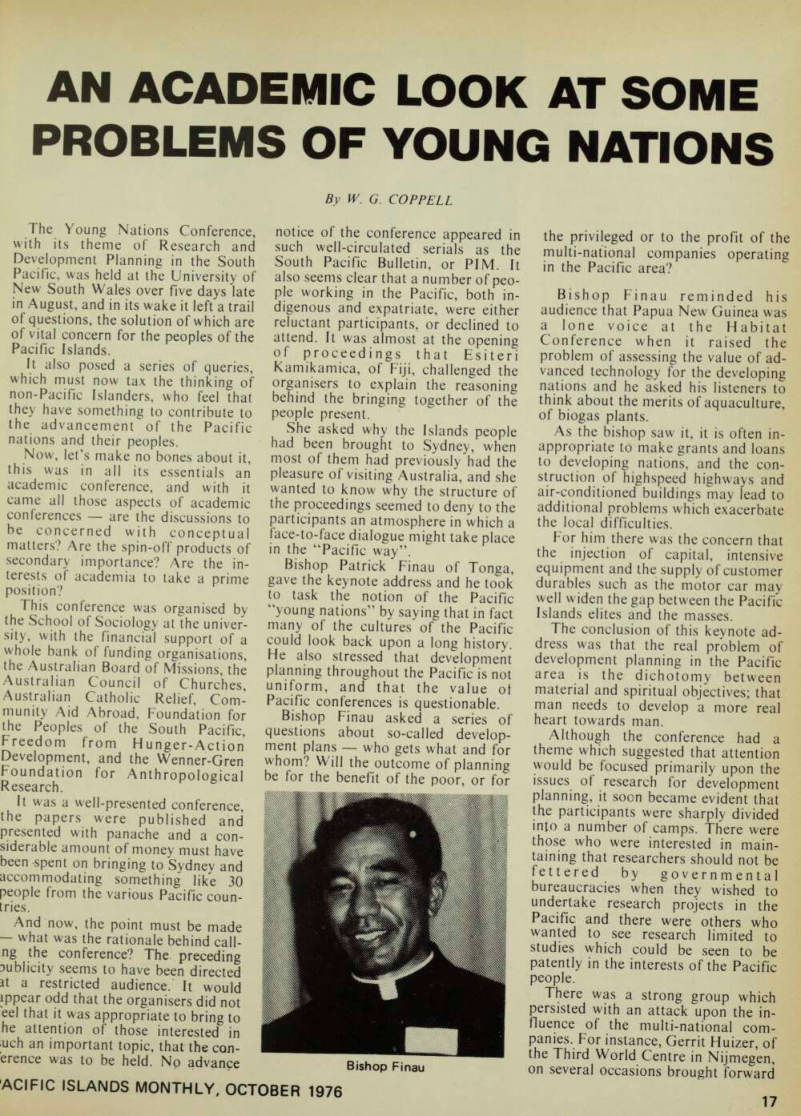
Bishop Patrick Finau of Tonga, gave the keynote address and he took to task the notion of the Pacific “young nations” by saying that in fact many of the cultures of the Pacific could look back upon a long history.
He also stressed that development planning throughout the Pacific is not uniform, and that the value ot Pacific conferences is questionable.
Bishop Finau asked a series of questions about so-called develop ment plans who gets what and for whom? Will the outcome of planning be for the benefit of the poor, or for
the privileged or to the profit of the multi-national companies operating in the Pacific area?
Bishop Finau reminded his audience that Papua New Guinea was a lone voice at the Habitat Conference when it raised the problem of assessing the value of ad vanced technology for the developing nations and he asked his listeners to think about the merits of aquaculture, of biogas plants.
As the bishop saw it, it is often in appropriate to make grants and loans to developing nations, and the con struction of highspeed highways and air-conditioned buildings may lead to additional problems which exacerbate the local difficulties.
For him there was the concern that the injection of capital, intensive equipment and the supply of customer durables such as the motor car may well widen the gap between the Pacific Islands elites and the masses.
The conclusion of this keynote ad dress was that the real problem of development planning in the Pacific area is the dichotomy between material and spiritual objectives; that man needs to develop a more real heart towards man.
Although the conference had a theme which suggested that attention would be focused primarily upon the issues of research for development planning, it soon became evident that the participants were sharply divided into a number of camps. There were those who were interested in main taining that researchers should not be fettered by governmental bureaucracies when they wished to undertake research projects in the Pacific and there were others who wanted to see research limited to studies which could be seen to be patently in the interests of the Pacific people.
There was a strong group which persisted with an attack upon the in fluence of the multi-national com panies. For instance, Gerrit Huizer, of the Third World Centre in Nijmegen, on several occasions brought forward
Bishop Finau
his perceptions of the influences ex erted by groups such as Unilever and Phillips and advocated an examina tion of the aspects of the scope of operations of multi-nationals in the Pacific.
Huizer also questioned the role of the breweries in Papua New Guinea, although several of the Papua New Guinea delegates were more in terested in the social effects of the growth of alcoholism, and some suggested that it might be useful to ex amine the replacement of the traditional pig-exchange system by a beer-exchange system.
It was more from the Islanders that a demand came to look into the value of much of the research which is carried out. Epeli Hau’ofa, of Tonga, said that, in his opinion, research for development was not only useless but in fact harmful. He considered there should be real research into exploita tion and corruption by the Pacific Islands’ elites and that the research should be carried out by Pacific Islanders, who would be able to make contacts with small, uncommitted groups outside the establishment.
He stated a position, which found support from many of the Islanders present, that, perhaps, the role of the local researcher would be to locate the centres of oppression and exploitation within the Island nations, with outside researchers being concerned with the identification of sources of exploita tion from outside influences. Stuart Kingan of the Cook Islands ad vocated the case for an extension of research into the physical sciences but there was a strong rebuttal of this by Cook Islander Marjorie Crocombe, who saw social issues as being of prime importance.
Stuart Kingan outlined a plan for the establishment of a television network throughout the Pacific.
While all the delegates praised the achievements in education of the use of radio transmissions through the Peacesat facilities, many were not prepared to support the early in troduction of mass television.
There was also an uneasiness about the role outside influences might be able to play through television programmes and a need for a very careful preparation of Islands people so that they would understand what the implications of the innovation were.
Lasarusa Vusoniwailala, of Fiji, pointed out that the introduction of
television would be an example of a concession to “comfort technology”, and he considered there was a real possibility of the introduction of television on a universal basis becom ing dysfunctional.
A most significant feature of the conference was the strong voice which came from the Pacific Islands women.
Boio Daro, of Papua New Guinea, was part of that voice when she main tained that television technology was beyond the resources of Papua New Guinea, because the mass of the peo ple lived outside town areas. She could see television as becoming a town-centres amenity. Boio also focused the attention of the par ticipants upon one of the basic dilem mas of the Pacific, that the more educated some Islanders become the less able they are to communicate with their own people.
One of the issues which eventually received a considerable airing was that of the feedback of research fin dings to the people most concerned.
Several delegates found fault with projects which had not reported back to the groups of people who had been the centres of research and a persis tent and vigorous plea was made for the establishment of information clearing-house facilities; a system of reporting back to people in straight forward terms, if necessary in the ver nacular languages.
Esiteri Kamikamica thought Island people should be able to establish research priorities in terms of needs of the people. In some instances, she said, governments may not in fact represent the real interests of the peo ple.
Esiteri felt that Pacific Islanders wanted to see worthwhile alternative solutions to problems made available.
She also considered that certain areas of research should be left for Pacific Islanders to deal with in “their own little way”, and she put a view,
supported by other Islanders, that perhaps there is often too much emphasis placed upon international, academic standards in the production of research documents. Again, as happened with other delegates, Esiteri returned to the question of com munication in the languages of the peoples under scrutiny. As she said “If I don’t know the language I am not good enough among my own people”.
In some ways this was a bewilder ing conference. Papers were presented at an almost breakneck speed. In some cases the authors read papers which had been previously dis tributed, some spoke to their papers, and there was even one instance where the speaker made virtually no reference to the matter within his paper.
One of the oddities about this con ference was that there seemed to be no real mechanism to bring to the notice of appropriate governmental or inter national organisations the findings and recommendations arrived at by the delegates.
The resolutions and recommen dations passed at the final plenary ses sion numbered 33 and although many of the items were sound and could be seen as having some effect upon decision-making processes, in other instances it was difficult to see what the practical outcome could be. Cer tainly, there is much to be worried about in relation to the situation of Islands communities in New Zealand, but it is not easy to see the practical outcome of a resolution, which was discussed “that Island migrants in New Zealand recognise their respon sibility to the metropolitan coun tries.” Or, how would a resolution “that the spread of Pacific elitism be halted and Pacific elites made more aware of the consequences of their policies and actions” be put into effect?
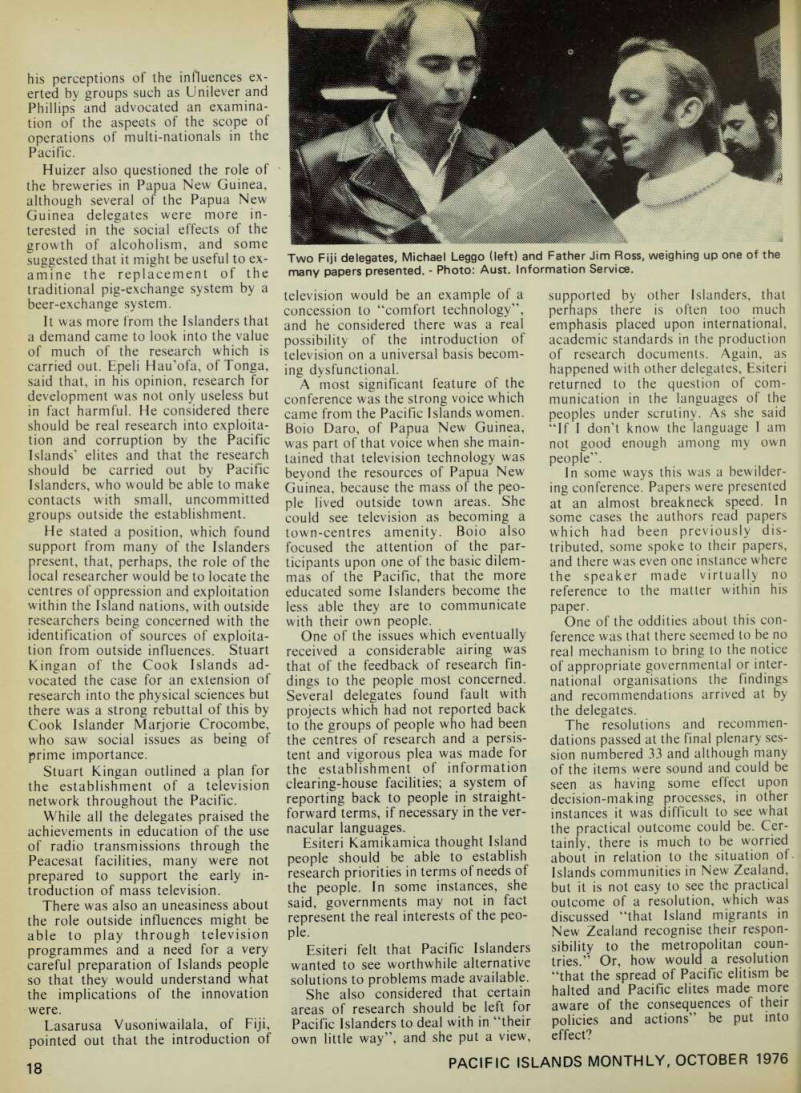
Two Fiji delegates, Michael Leggo (left) and Father Jim Ross, weighing up one of the many papers presented. Photo: Aust. Information Service.
Advertisements & other items, p. 17 (1 item)
17
ACIFIC ISLANDS MONTHLY, OCTOBER 1976
Public Order In Png: A Hot
Potato Comes Off The Boil
From a Port Moresby correspondent
Papua New Guinea’s new Public Order Bill has created something of a furore here. It has been bitterly at tacked by the parliamentary opposi tion and the trade unions.
The students of the University of Papua New Guinea staged a protest march from Koke Market to Parlia ment House, and were joined by students from the Sogeri National High School, who had started out on foot from their school 40 kilometres out of Port Moresby at one o’clock in the morning in order to reach the assembly point at Koke in time for the march. Other student protests have been staged at Goroka, Lae and Madang.
There are elements of irony in the situation. The original Public Order Act of 1970 was introduced by the colonial administration ostensibly to counter the supposed threat to public order posed by the Mataungan Association on the Gazelle Peninsula.
It was supported by the Highlands based United Party and opposed by the Pangu Party led by Michael Somare.
Now the Public Order Bill of 1976, which is basically a re-hash of the 1970 Act with a few modifications, las been brought down by Prime Minister Somare and is being op posed by the United Party.
The reason for these provisions laving to be re-enacted is that under he Constitution of the Independent state of Papua New Guinea any enactment which seeks to impose estrictions on the rights and reedoms guaranteed under the con titution must set out which rights and reedoms are to be restricted, and nust be passed by an absolute majori -1 of parliament, that is a majority of rie total membership of parliament, ot just a majority of those members resent when the vote is taken.
Consequently the bill starts with a reamble stating that its provisions or regulate freedom from ar itrary search and entry; freedom of onscience, thought and religion; eedom of expression; freedom of
assembly and association; and freedom of movement. A pretty for midable list, and it’s a bit difficult to imagine how the bill’s provisions could, in fact, restrict some of these freedoms. But, 1 suppose that the legal draftsmen have to be on the safe side and provide for all possible con tingencies.
Probably it is this preamble rather than the actual provisions of the bill which has caused such a violent and emotional reaction to it. The bill’s ac tual provisions do not differ material ly from those of the 1970 Act. In cidentally, it was a reaction from that act which led to the tabling in 1971 of a private member’s bill which became the Human Rights Act, the provisions of which were later incorporated, in a modified form, in the constitution.
In the first place, opponents of the bill claim that, in fact, its provisions, originally designed overseas to deal with phenomena such as anti-war demonstrations, have little if any relevance to our own Highlands problem and would not help in dealing with it. If the object is to deal with tribal fighting, they claim, what is needed is an act dealing specifically with tribal fighting.
The present bill, its opponents say, would be dubiously effective for its
declared purpose, but could be used by the government in power to harass and muzzle its political opponents, particularly at election times.
Bowing to the storm, the Prime Minister has postponed further con sideration of the bill to the next meeting of parliament, scheduled for November. This delay will give members more time to study it and prepare amendments, and also give the government time to take another look at it in the light of the criticisms which have been levelled at it.
Even with the delay, Mr Somare’s chances of getting the necessary 51 votes to pass the bill do not appear to be very bright. Parliament has almost run its course, and many members seem to be tired and indifferent.
Attendance in the chamber has reach ed an all-time low. There are frequent delays due to lack of a quorum; and party discipline is too weak for the whip< to be effective.
Whether the bill succeeds or is defeated, it can hardly fail to have an adverse effect on the coalition’s chances in next year’s general elec tions; and it is a matter for surprise that a politician as astute as Mr Somare should have taken the risks involved in sponsoring so unpopular a measure.
Ron Neville To Quit Parliament
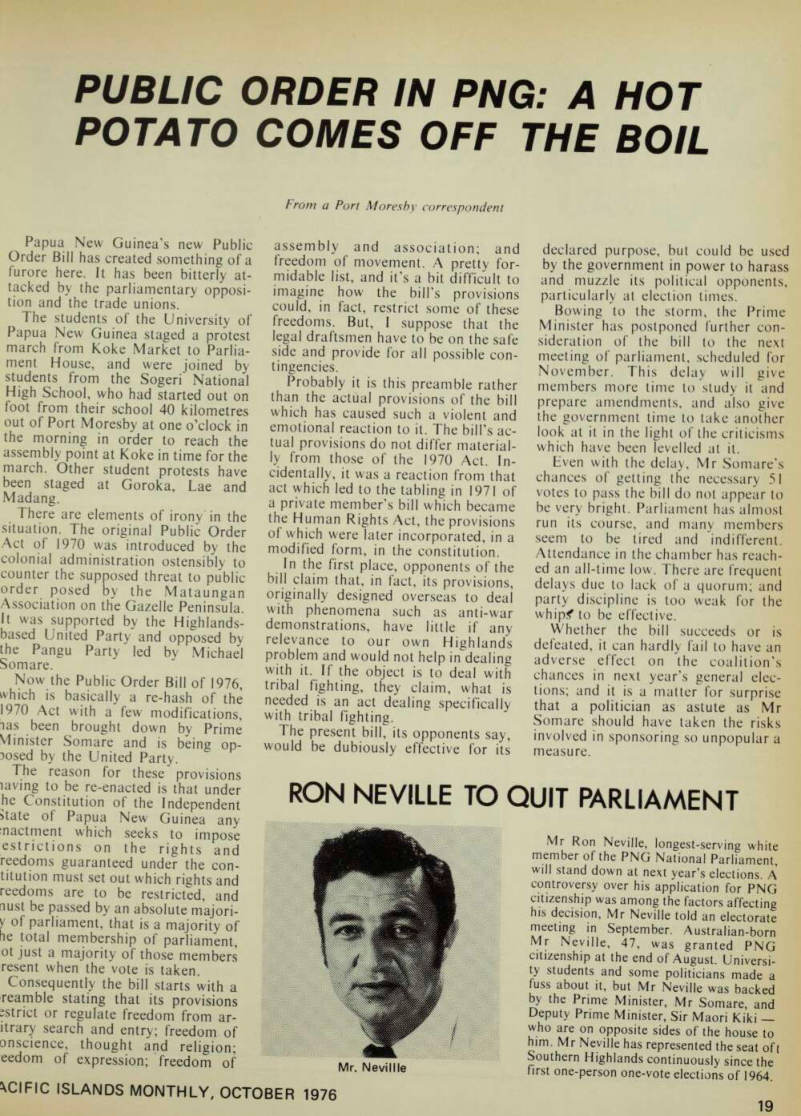
Mr Ron Neville, longest-serving white member of the PNG National Parliament, will stand down at next year’s elections. A controversy over his application for PNG citizenship was among the factors affecting his decision, Mr Neville told an electorate meeting in September. Australian-born Mr Neville, 47, was granted PNG citizenship at the end of August. Universi ty students and some politicians made a fuss about it, but Mr Neville was backed by the Prime Minister, Mr Somare, and Deputy Prime Minister, Sir Maori Kiki who are on opposite sides of the house to him. Mr Neville has represented the seat of( Southern Highlands continuously since the first one-person one-vote elections of 1964.
Mr. Nevillle
Advertisements & other items, p. 19 (1 item)
19
\CI FIC ISLANDS MONTHLY, OCTOBER 1976
Wigs’-Or Should Judges
Be Hair-Conditioned...
The Chief Justice is reported to have said that the wearing of such robes and headgear was of "long-standing custom" and as such would not be changed during his term of office; when a national Chief Justice is ap pointed it will be up to him to decide whether the custom will be continued or not. A good judgment, if I may say so, and I am sure that my friend Sir Sidney will not mind if I put him right on one point, for the wearing of legal wigs is by no means a long-standing custom in Papua New Guinea.
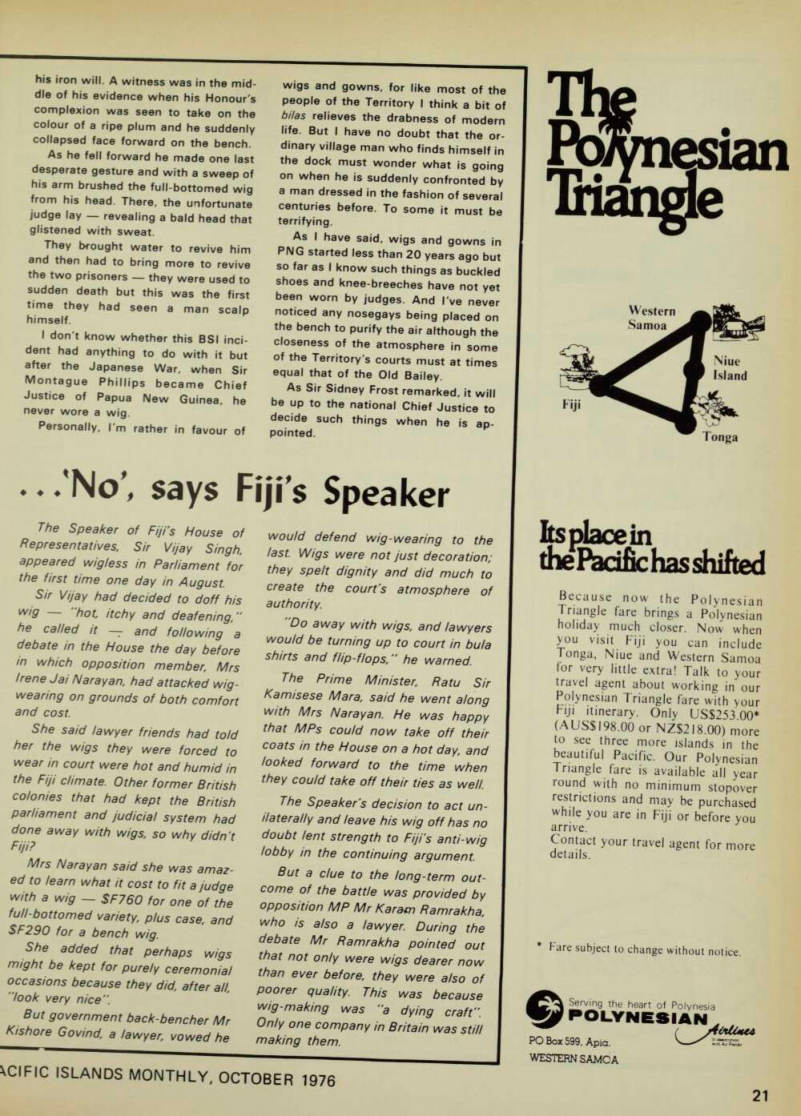
Wig-wearing was of course traditional among certain of the Highland men as part of their ordinary dress but the wearing of wigs in the courts of the Territory is a com paratively recent innovation and was first introduced by the late Sir Alan Mann when he assumed the Chief Justiceship in 1957.
Previous to that, judges of the Supreme Court in New Guinea wore robes while barristers appeared in or dinary civilian clothes and both judges and barristers were barehead ed.
When Sir Alan Mann introduced the wigs and scarlet robes of the judges, members of the Bar wore black gowns and wigs for the first time.
It set a sort of restricted fashion for, not to be outdone in formal millinery. Sir Horace Niall, Speaker in the first House of Assembly in 1964, wore a full-bottomed wig and gown in the Territory's parliament and the Clerk of the House also appeared in a wig and gown. Four years later, when Sir John Guise became Speaker of the House, he occasionally wore a wig and added to it some original touches of his own by embellishing his formal dress with Bird of Paradise plumes and other indigenous ornaments.
It is possible that the coming of air conditioning to the Territory had something to do with the institution of wig wearing for the climate of Papua New Guinea is warm enough without the added burden of a mass of curled horse hair perched on one's head.
However, the judges bravely endure
The Chief Justice of Papua New Guinea, as PIM reported in July, defended the wearing of wigs by the judiciary after the dis tinctive headgear had come un der attack from Papua New Guineans, one of whom, John Adoe, of Boroko, had described them as "a foreign concept", and "dirty", and should have been thrown out when PNG gained her independence. Now, Keith McCarthy, one of Papua New Guinea's more famous former district commissioners and one time chief of the Department of Native Affairs, adds his humorous comments.
the discomfort even when they are on circuit and with no air-conditioning or fans to give them relief.
In 1934, I was an ADO and sent to assist Judge Montague Phillips who was investigating a land case at Madang. In those pre-war days New Guinea's highest court was the Central Court. E. A Wanliss was the Chief Judge of the Central Court and "Mon tie” Phillips was one of the judges.
Phillips, a man with a delightful sense of humour, had once served in the
Solomon Islands and he told me the story of a judge who had recently been appointed to the Protectorate from England.
The new judge was a portly man with a ruddy complexion and a com pletely bald head. He possessed great natural dignity and was imbued with a sense of history; in keeping with it he was determined to maintain the traditional dress of the judges in England.
One of the first cases to be tried before him was two men charged with the killing of others during a tribal fight in some isolated part of the country.
The accused were from the deep bush primitive and wild and until their arrest had had very little contact with the white man and his law.
The court was set up in a wooden building with an iron roof and the day was hot and humid; there was not a breath of wind to lessen the heat.
The two prisoners in the dock were wide-eyed with fear and wonder as the judge took his place on the bench, for his stout form was clad in a heavy scarlet robe with patches of what appeared to be kapulfur on the wide sleeves and on his head was a tangle of grey curls that reached to his shoulders.
Never in their lives had the prisoners imagined such a figure could exist! The white men that they had encountered were strange enough with their pale skins and white clothing but this magnificent creature looked hardly human it looked as though a spirit from the nether world had come to judge them.
They were still open-mouthed in wonder when the trial began. In half an-hour the small court room was like an oven and the bewigged judge was showing signs of it. His naturally ruddy face had begun to assume a purple hue and perspiration was starting to drip from him. But the judge was a deter mined man and despite his extreme discomfort he carried on.
But, 20 minutes later, the stifling heat of the court proved too much for
The late Sir Alan Mann... he started the whole thing.
his iron will. A witness was in the mid dle of his evidence when his Honour's complexion was seen to take on the colour of a ripe plum and he suddenly collapsed face forward on the bench.
As he fell forward he made one last desperate gesture and with a sweep of his arm brushed the full-bottomed wig from his head. There, the unfortunate judge lay revealing a bald head that glistened with sweat.
They brought water to revive him and then had to bring more to revive the two prisoners they were used to sudden death but this was the first time they had seen a man scalp himself.
I don't know whether this BSI inci dent had anything to do with it but after the Japanese War, when Sir Montague Phillips became Chief Justice of Papua New Guinea, he never wore a wig.
Personally, I'm rather in favour of
wigs and gowns, for like most of the people of the Territory I think a bit of bi/as relieves the drabness of modern life. But I have no doubt that the or dinary village man who finds himself in the dock must wonder what is going on when he is suddenly confronted by a man dressed in the fashion of several centuries before. To some it must be
terrifying.
As I have said, wigs and gowns in PNG started less than 20 years ago but so far as I know such things as buckled shoes and knee-breeches have not yet been worn by judges. And I've never noticed any nosegays being placed on the bench to purify the air although the closeness of the atmosphere in some of the Territory's courts must at times equal that of the Old Bailey.
As Sir Sidney Frost remarked, it will be up to the national Chief Justice to decide such things when he is ap pointed.
•♦ • No, says Fiji’s Speaker
The Speaker of Fiji’s House of
Representatives, Sir Vijay Singh,
appeared wigless in Parliament for the first time one day in August.
Sir Vijay had decided to doff his wig "hot, itchy and deafening," he called it and following a debate in the House the day before in which opposition member, Mrs Irene Jai Narayan, had attacked wig wearing on grounds of both comfort and cost.
She said lawyer friends had told her the wigs they were forced to wear in court were hot and humid in the Fiji climate. Other former British colonies that had kept the British parliament and judicial system had done away with wigs, so why didn't Fiji?
Mrs Narayan said she was amaz ed to learn what it cost to fit a judge with a wig SF76O for one of the full-bottomed variety, plus case, and SF29O for a bench wig.
She added that perhaps wigs might be kept for purely ceremonial occasions because they did, after all, "look very nice".
But government back-bencher Mr Kishore Govind, a lawyer, vowed he
would defend wig-wearing to the last. Wigs were not just decoration; they spelt dignity and did much to create the court's atmosphere of authority.
Do away with wigs, and lawyers would be turning up to court in bu/a shirts and flip-flops," he warned.
The Prime Minister, Ratu Sir Kamisese Mara, said he went along with Mrs Narayan. He was happy that MPs could now take off their coats in the House on a hot day, and looked forward to the time when they could take off their ties as well.
The Speaker's decision to act un ilaterally and leave his wig off has no doubt lent strength to Fiji's anti-wig lobby in the continuing argument.
But a due to the long-term out come of the battle was provided by opposition MP Mr Karam Ramrakha, who is also a lawyer. During the debate Mr Ramrakha pointed out that not only were wigs dearer now than ever before, they were also of poorer quality. This was because wig-making was "a dying craft".
Only one company in Britain was still
making them.
Advertisements & other items, pp. 21-22 (2 items)
\Cific Islands Monthly, October 1976
Polynesian
The
mangle
Western Samoa Niue Island Fiji Tonga
Its dace in
the Pacific has shifted
Because now the Polynesian Triangle fare brings a Polynesian holiday much closer. Now when you visit Fiji you can include Tonga, Niue and Western Samoa for very little extra! Talk to your travel agent about working in our Polynesian Triangle fare with your Fiji itinerary. Only U55253.00* (A US$l9B.OO or NZ$2lB.OO) more to see three more islands in the beautiful Pacific. Our Polynesian Triangle fare is available all year round with no minimum stopover restrictions and may be purchased while you are in Fiji or before you arrive.
Contact your travel agent for more details.
Fare subject to change without notice. ©Serving the heart of Polynesia
POLYNESIAN^
( AinUmeA PO Box 599, Apia. X
WESTERN SAMOA
Round gourmet
“Skillet”
THE HANDIEST NEW APPLIANCE
SINCE FRYPANS
Bacon and eggs for two? Simple for the Sunbeam "Skillet". Yet "Skillet" is big enough to roast a size 8 chicken to perfection. And to wash simply remove the control and dunk the pan in the sink.
Another first and it comes only from Sunbeam.
8 Speed
Power
Blender
THE APPLIANCE YOU CAN USE
EVERY MEAL
With powerful. Solid-state motor. Which means the exact blending action you need to— Whip, grate, mix, chop or liquefy. Stainless steel cutters give fast food preparation while switching from speed to speed without turning off . . .
Editor’S Mailbag

Bottle-Feeding
1 was interested to read your report in the July issue, (p 13) titled Bottle feeding ban in PNG. The main hospital in the Highlands at Goroka has banned all bottle-feeding and is throwing out its own supply of feeding-bottles. This is the first step in a campaign to stop the dangerous trend towards bottle-feeding dangerous because of the problem of sterilising the bottles, apart from feeding a balanced formula and being able to afford it.
In Australia there is a trend back to breast-feeding, but our hospitals have not followed Goroka’s example and changed to cup and spoon feeding for babies who cannot drink human milk.
British researchers have produced conclusive evidence of the unethical marketing methods used by manufac turers in Africa, Asia and South America which they have published in a booklet called The Baby Killer.
There is also a film on the same sub ject produced in Kenya. The booklet and film highlight the dangers and costs of bottle-feeding where mothers are unaware of, or are unable to meet, the hygiene and mixing instructions written on the label.
There is still time to remove the idea that bottle-feeding represents progress, and stop the dangerous acceptance of bottled milk as a good substitute for breast milk which it isn’t.
This practice has already killed many children and family incomes and there is not much time left before the practice will be irreversible.
Anne J. Bunning
Parkside, S. Australia
Festival Of Arts
I was interested to read in the May issue (p. 19) your account of the se cond South Pacific Festival of Arts held at Rotorua in March this year.
There is just one point which I would like to take up with you, and that is the comment at the end of the article in which you say, “Its first aim was to provide a tourist attraction and that’s not the islanders’ idea.”
As chairman of the organising com
mittee, I would like to make it ab solutely clear that tourism was not the first aim of the festival so far as the organising committee was concerned, nor to my knowledge was it the idea of anybody else associated with the festival. Had it been so, the cost of the festival (which turned out to be con siderably less than the $650,000 originally budgeted) might well have been very greatly reduced.
I think I am too well-known in Pacific circles for people there to believe that I would be interested in the commercial exploitation of their cultures. Polynesian culture has been a life-long interest to me and I would be the last to become involved in its commercial exploitation. As a retired person I could be put to no pressures by the government or anyone else over a matter like this, nor in fact was any such pressure even hinted at. The whole aim of everybody concerned was to provide a venue for the festival and to ensure that the first festival at Suva was not also to be the last. I am sorry that PIM thought otherwise.
We greatly enjoyed our visitors and the effort put into the festival will have been totally worthwhile if they also enjoyed being with us.
Nz J. M. Mcewen
Heretaunga, NZ.
Development
What's An Atoll?
Misled as I apparently was by social scientists who were not so scien tifically correct in their geographic terms, perhaps I have caused hurt to “A Much-Pained Reader” of Canberra (PIM, Aug., p 25) over my June article on Rennell and Bellona.
But, then again, perhaps the hurt is self-inflicted.
“Much-Pained” may be correct in correcting me and Samuel Elbert and Torben Monberg who lived on the “atolls” for months in the 1950 s (it was their words I borrowed in those two brief descriptions of the “atolls”), yet . . .
Evidence of the shape of both Rennell and Bellona with their con cave centres, their entirely limestone base of which the outer rings, now cliffs, were undoubtedly reefs, shows
they are raised atolls. When does a reef stop being a reef and become an island?
Ontong Java, the largest atoll in the Pacific by the Oxford definition, is nevertheless occupied and has agriculture in parts. Part of Rennell’s one-time lagoon remains as a very large, land-locked lake. How does that fit?
So much, I hope, for the pedantry of “Much-Pained”. I’d rather someone had troubled to argue over the fate of the Rennellese and Bellonese, who may or may not suffer neo-colonialism by their own Solomon Islands Government. We shall have to wait and see if mining occurs, and how it is done.
Denis Fisk.
Lae, PNG.
Beekeeper's Offer
Through PIM editor’s recent radio broadcast, I learned of the need for technical assistance for primary in dustry on many of the Pacific Islands.
Over the years, I have heard reports of the favourable honey-producing potential on some of these islands.
Honey bees collect nectar from the blossoms of plants and elaborate this with honey. In the process, cross pollination, essential for reproduction in many plant species, is ac complished.
I am a commercial beekeeper and honey producer in Australia, and have been involved in the development, in troduction and implementation of a number of beekeeping techniques and equipment items. I would be prepared o offer my practical knowledge to in Island government agency or enterprise interested in developing the leekeeping potential locally.
I am interested in, and an admirer )f, Island culture, as well as an avid tudent of isolated, locally adapted trains of honey bees. Therefore, inancial remuneration is not of )rimary concern.
If any of your readers are in erested, they can contact me at the ddress below.
K. J. Ollev
297 Ipswich Road, )xley, Queensland 4075 Australia.
Biting The Hand . . .
In her rambling and grossly laccurate article (PIM, July, p 25),
Letters
“ -7,7 *• * aat li was the (now despised) M ‘ ssionar J es ,- , who fu "y educated her Sd Ktacher W “ h J ° bS “ S “““
“political jet-set” at the University of the South Pacific in Suva, where the main topic seems to be anti-white propaganda but at the same time en joying the white taxpayers’ money to do so . . .
We can only advise Miss Mera to turn back four pages in the same PIM and read Mr R. Cherry’s letter which sums it up quite clearly.
Miss Mera seems to fit the descrip tion of “The mouth biting the feeding hand” ... 5
Ex Patriate (White),
Luganville, Santo. • Name and address supplied.
Advertisements & other items, p. 23 (2 items)
23
\CI FIC ISALNDS MONTHLY, OCTOBER 1976
always rely on
when it comes to
automotive parts and
accessories you can
always rely on
m D.
nans
If you need a part in a hurry to suit your car, truck or light commercial, chances are Traders-Smith Sons can solve your problem. Fast!
Our comprehensive stocks cover most makes and models and our Export Department ensures your order receives the VI.P, treatment, No delays. No unnecessary down time for your vehicles or equipment.
INSTRUMENT REPAIRS, TOO!
Our team of instrument technicians is equipped to undertake repairs and adjustments to most types of instruments and gauges.
ORDERING IS EASY...AND EFFICIENT!
All major trading stores in the Islands can place orders, through their Sydney agents.
TRADERS-SMITH SONS PTY LTB
70 Commonwealth St., Sydney. Tel: 2114011 Telex: 26361
News

The
In A
Nutshell
Arms For Irian
Indonesian troops have sealed off an area of Irian Jaya (West Irian) to prevent shipments of communist arms reaching anti-Indonesian government rebels.
The area is described by the Indonesian press as “to the north of Schotjon, near the Papua New Guinea border’’. This is probably Sekotchiau, about 30 km west of Vanimo.
The press quoted the local commander, Colonel Ismail, as saying that the area had become the main operations centre for the rebels. He said that captured documents indicated that the rebels were expecting arms supplies there from a communist country, but the colonel did not name the country.
He said that though the rebellion had lost its military significance, “they con tinue to disturb us and therefore they must be crushed”.
The rebels, known as the Free Papua Movement, want to set up an independent State of Papua, separated from Indonesian rule.
According to the Indonesian press, 1,500 rebels have given themselves up since last year.
Pilots Rescue
Papua New Guinea’s civil aviation rule requiring all aircraft to carry very high frequency survival beacons prov ed its value again in August with the rescue of the pilot of a crashed
helicopter. The pilot, Canadian-born
Jan Blanche, crashed in high moun tain country in New Ireland. He was on a flight from the Panguna mirie
site, Bougainville, when his helicopter
developed engine-trouble. The machine, a Bell 47 owned by Airfast Helicopters Pty Ltd of Sydney, was on charter to Bougainville Copper.
Air safety investigator, Mr Don Ende, who led the rescue party, said later: “Without the beacon’s signals, we wouldn’t have had a ghost of a chance of finding Blanche. These VHF beacons have proved themselves invaluable time and time again’’.
Mr Blanche, who spent four nights exposed to the mountain cold, sur vived on standard emergency rations and rain water collected in parts of the wrechage. “The hotel accommoda tion wasn’t too good in the moun tains,” he johed on his arrival in Rabaul. “There were no bellboys and too many cold showers.” He suf fered only a slight nose fracture, cuts and bruises in the crash.
Mr Blanche must be starting to wonder whether or not he’s accident prone. This was his third brush with death in two years in PNG. The first was when he fell from the first floor of a motel, and the second in a motor cycle accident in which he was critically injured and tahen to Australia in a RAAF mercy flight for treatment.
Big Blow
Strong winds sweeping across Anir (Feni) Island, 70 hm off the New Ireland east coast, destroyed a church and several houses in mid-August; a radio report from the remote island said the winds were the strongest hnown in 30 years. Homeless families are being accommodated in a school building. On New Ireland itself part of northern Papua New Guinea winds have caused damage in at least two villages.
Coppers Copped It!
Three Western Samoa constables retreated with some loss of dignity when five women assailed them with a bucket and sticks. The police were searching for stolen goods at Mulinuu when the women attacked them. One constable suffered a head cut when a woman hit him with the bucket. During the scuffle, the police lost their search warrant. They returned to their station, reported the matter, and, with reinforcements resumed the search.
They were looking for eight big sacks of dried cocoa beans and automobile spare parts, said to be stolen from Burns Philp.
Grateful Constituents
Mr Tupui Ariki Henry, Cook Islands Minister of Internal Affairs and son of Premier Sir Albert Henry, has become the owner of a 14 ft outrigger canoe, the gift of his parliamentary constituents on the
island of Mauke, which he has represented for the last 10 years. The gift was in recognition of his services to the island and those services aren’t minor ones. Mauke has now got full electricity and water ser vices, a new harbour, an airstrip in the making and a development corporation which exports the products of vigorous beef cattle farming and citrus industries.
The canoe is custom-made of Pacific mahogany with coconut fibre lashings.
Outside The Law
Court-martial charges against an Australian naval lieutenant on loan to the Papua New Guinea Defence Force have been dismissed because the court can’t apply its service law to Australians. The prosecution alleged that the Australian, Lt. P. J. Smith, as commanding officer, was negligent when the Attack class patrol boat Samarai struck a reef and damaged a propeller. Samarai is a former RAN ship which was a gift to PNG from Australia.
Damage to the craft is estimated at
$Lo,Ooo.
The case, heard in August, represented the first occasion since PNG achieved in dependence when an Australian officer on loan has faced a court-martial. Although the agreement which protects Australian servicemen from PNG service law was widely known and freely accepted, the im plications of the court’s decision are likely to raise questions between the two coun tries.
Some Australian servicemen in PNG see the situation as a denial of their own rights. They claim that court-martial evidence rather than lack ol jurisdiction could clear them of possible negligence charges.
Lt. Smith is one of 400 officers and men from all three services who are on loan to the PNG Defence Force. They are serving under an interim arrangement which is in force while PNG consolidates its own defence structure. The arrangement is scheduled to continue for the next five years.
Plastered Pedagogues
Teachers in some remote areas of Papua New Guinea are arriving at their schools 100 drunk to teach, according to an Educa tion Superintendent. In a statement in August, the Provincial Education Superintendent at Lae, Mr Alan Isoiamo, appealed to teachers to recognise their responsibilities, saying that many teachers believed they could walk out of their classrooms at any time and get drunk.
Mr Osoiamo blamed lack of support from rural communities as one factor con tributing to a breakdown in school stan dards in remote areas. Fie believed too much had been given to the people without any self-help involvement by the people themselves.
Christian Cooks
Christianity got a boost at the 11th an niversary celebrations of self-government in the Cook Islands on August 4.
Speaking on the occasion, the Premier, Sir Albert Henry, said: “The white man in troduced Christianity to the Cook Islands, but now other white men are trying to in troduce anti-Christian ideas. Cook Islanders, however, are convinced that there is no better creed than Christianity, which has given them peace and prosperi ty.
“The Cook Islands are about the most peaceful and friendly spot in the world to day, and that is the way Cook Islanders want to keep them.”
Present at the celebrations in Avarua, Rarotonga, were the Governor-General of New Zealand, Sir Denis Blundell, Lady Blundell, and diplomatic envoys to New Zealand from Indonesia, the Arab Republic of Egypt, Malaysia and
Singapore.
Sir Denis Blundell pledged the con tinued assistance of the New Zealand Government to the Cooks until they achieve their final goal of complete in
dependence.
Tokelau - Only
The Tokelau Islands, a New Zealand dependency, will henceforth be known simply as “Tokelau”.
Proposing the change of name, the NZ Secretary of Foreign Affairs, Mr F. H.
Corner, said: “The Tokelau people customarily refer to their territory as ‘Tokelau’. It would be desirable for NZ terminology to be brought into line”.
Population of Tokelau was 1603 in September, 1975, compared with 1574 a year earlier.
Graves Pillaged
Cargo cultists on Bougainville are digg ing up graves and stacking coffins and bodies in a specially built “sanctuary”, ac cording to Papua New Guinea police sources.
They believe that their actions will liberate powerful forces to bring them material wealth. Police are concerned at reports that people who refuse to take part in the rites are being tortured. The reports come from Kopani village, about 30 miles north of Kieta in Central Bougainville.
The cult is said to have more than 400 followers. A later report said police had arrested and charged 21 men.
Fiji Press Ban
Fiji’s newspapers were forbidden by the Speaker of the Fiji House of Represen tatives, Sir Vijay Singh, to publish remarks made in the House in August by Fijian MP Sakiasi Butadroka, leader ol the Fijian Nationalist Party, which has the
slogan “Fiji for the Fijians”. Mr Butadroka had been expelled from the House for 48 hours for making a personal attack on Prime Minister Ratu Sir Kamisese Mara and the Speaker while at tacking a government bill to make it illegal to incite race hatred. The Speaker, who described Mr Buadroka’s comments as “very vicious allegations”, banned publication of them, using, for the first time, powers given by parliament to ban publication of language which had been ruled out of order by the Speaker. Later, the Prime Minister said he was amazed that such hatred and venom could be in the heart of a man.
Bankrupt Justice
Lack of funds is hamstringing the work of law-enforcement officers in the Northern Marianas. Acting Attorney- General Linsey Freeman said in August that marijuana prosecutions in the Marianas will have to cease unless money is made available.
“Neither the attorney’s office nor the police department has the money to secure the expert testimony required in marijuana possession cases,” he said in a memoran dum to the Resident Commissioner, Erwin D. Canham.
Freeman, who is in favour of decriminalising marijuana possession, also sent copies of his memo to Marianas senators. He said he is “confident” that the legislature will enact a law reflecting his views.
Also complaining of lack of funds was Marianas Public Defender James Grizzard who claimed a serious crime problem is be ing created among Saipan youth by the lack of any rehabilitation programme for youth offenders. They cannot be jailed in Saipan prison because the Trust Territory Code prohibits putting youth and adult offenders together.
“Offenders who know that nothing will happen to them even if they commit the same crime again are not prevented from committing more crimes,” Grizzard said.
Death In Owen Stanley
Four Australian men died in August when their twin-engined Piper Aztec air craft crashed in the Owen Stanley ranges about 90 km from Port Moresby. The four who died were the pilot, D. Looker, a Melbourne policeman, his father, R.D.
Looker, C.M. George, and G. Spurling, all of Victoria.
The pilot was attempting to negotiate
the “Gap”, the narrow pass which is a recognised air-route through the Owen Stanleys. Indications are that he became trapped in cloud, and lost sense of direc tion. The “Gap” is notorious for its cloud build-ups and for the rugged nature of the country beneath. The party had planned a brief visit to Lae, and then intended to fly inland to Goroka in the Highlands to stay with a family friend of the Lookers, Mr Keith Deevers, an airline official.
Women Reformers
Nilai Ra Waden Association of Rabaul will press the PNG Government to take stronger measures to stop the growth of prostitution in urban centres.
The decision was among matters dis cussed at the second national convention of women held at Vunadidir in August.
Among other matters on the convention’s agenda were the prohibition of the sale of comics and magazines emphasising sex and violence, the complete abolition of gambling, and the return of unemployed persons to their home provinces.
The Law Reform Commission hearing in Goroka has been urged to recommend increases in the penalties for adultery. Mr Julius Mamina, a local court magistrate from Henganofi, has told the commission that the existing penalty of a fine of K 6 and six months imprisonment are insufficient.
He also submitted to the commission that local courts be given more power to award compensation money on claims over repayment of the bride price.
Strikers Fined
Eight members of the Fiji Municipal
Workers’ Union are to appeal against their convictions and fines in the Lautoka Supreme Court for strike offences.
General secretary Mr Ujagar Singh was fined the maximum of $5OO for influencing workers employed in essential services to take part in an illegal strike at Ba last December. Seven members of the union were each fined $75 for stopping essential work and furthering an illegal strike.
Unionist Fined
A member of the Solomon Islands Legislative Assembly was fined $55 on three charges in the Gizo Magistrate’s Court in August.
Mr Batholomew Ulufa’alu, 37, who represents East Honiara, pleaded guilty to causing bodily harm to Mr Martin Glass,
Mr. Butadroka
planning officer of the Western Council (fined $25), drunken and disorderly behaviour ($5), and resisting arrest ($25).
Ulufa’alu is president of the Solomon Islands General Workers’ Union.
Png-Solomons Link
Papua New Guinea will represent Solomon Islands’ interests at the United Nations Law of the Sea Conference in New York, and the Solomon Islands will accept a PNG offer of help with overseas
representation after independence.
These are among main points to emerge from a one-day visit to Honiara made in late July by PNG Prime Minister, Mr Michael Somare. In talks with the Chief Minister of the Solomon Islands, Mr P.
Kenilorea, Mr Somare agreed that the border between the Solomon Islands and PNG be settled before independence, and that official border discussions should be held as soon as possible.
In another move concerning PNG diplomacy, the Minister for Foreign Af fairs and Trade, Sir Maori Kiki, an nounced in mid-August the establishment of diplomatic relations between PNG and Norway.
Glitter At Rarotonga
Rarotonga in the Cooks has never seen such a galaxy of diplomatic talent as appeared at the beginning of August at the annual dance festival and a craft show. The VIPs included the Governor-General of New Zealand, Sir Denis Blundell, and Lady Blundell, the Indonesian Am bassador, Mr L. Soetikno, the Egyptian Ambassador, Dr I. Sorour, the High Com missioner for Malaysia, Mr K. Thar maratnam, and the High Commissioner for Singapore, Mr Chan.
Saipan Tragedy
Yomico Okasawa, a 10-year-old Japanese girl, was found drowned off the micro-beach on Saipan in the Marianas early in August. She had been bathing with other Japanese students on a touring holi day from Japan. They were swimming un der the supervision of teachers who dis covered she was missing when a head count was taken.
Yachtees Skip Bail
A French couple skipped bail from Port Moresby in August while facing trial on charges related to the illegal purchase of Papuan artefacts.
The couple, John Gueroult of Noumea and Jocelyn Knezevic of Paris, slipped out of Port Moresby harbour under cover of night in their luxury yacht Thetis 11. The charges related to a December, 1975, visit by the couple in which, according to
prosecution allegations, they engaged in a
“planned buying spree” of artefacts in the Gulf of Papua area.
The prosecution alleged that they left
Port Moresby in their yacht last December bound for Vila, but doubled back to the Gulf of Papua to buy the artefacts. They were arrested on a return visit to Port
Moresby.
c . u if Witnesses from tribes in the gulf gave .. r . ... & . evidence ol having sold figurines with great . a u tribal significance. One witness said she , , . had so dan ancient figurine to get money e . . „ 6 B J for my income tax .
J The Public Prosecutor s office in Port Moresby said Interpol had been alerted on the yacht s disappearance but police said no search would be mounted.
Artefacts of the type alleged to have been bought by Gueroult and Knezevic are
known to fetch very high prices on con tinental art markets.
No Medi For Islands
Overseas visitors to Australia, and that includes hundreds who go there each year from the Pacific Islands for holidays, will not be covered for medical insurance after October I under the national health scheme, Medibank. Previously they had automatically enjoyed that cover.
However, new arrivals, intending to settle permanently in Australia will be eligible for Medibank benefits, in the same way as Australian residents that is by com pulsorily joining the government scheme, Medibank, or a private health insurance fund.
Advertisements & other items, pp. 26-28 (1 item)
We're working the Pacific
with a Cat Marine Diesel.
"Loloho" - General purpose Harbour tug boat. Operated by Bougainville Copper Limited at Bougainville. Overall length 50 ft. (15.24 m). Powered by a Caterpillar D 343 Marine Engine.
"M.V. Kaunitoni" - An Inter-Island freighter. Operated by the Fiji Government. Overall length 134.3 ft. Displacement 628 tons. Speed 10 knots. Powered by a Caterpillar D 379.
Hastings Deering (Pacific) Ltd.and Carpenters Tractors cover the Pacificlslands waterfront with Cat. Marine Service and Parts.
Hastings Deering (Pacific) at Lae, Port Moresby and Bougainville and Carpenters Tractors at Suva are staffed by Caterpillar-trained technicians.
Working the Pacific waterfront day after day, year after year, you depend on reliable horsepower and first class dealer-support. You get it with a Cat Marine Diesel, Hastings Deering (Pacific) and Carpenters' Tractors.
While there's a Cat Marine Diesel in your craft you're backed up with Cat Plus, the total support programme offered only by your Caterpillar dealer.
Your local Hastings Deering (Pacific) or Carpenters Tractors dealer backs your Cat Marine Diesel engine with parts and service programmes designed to prevent, as well as shorten profitrobbing downtime.
Caterpillar Dealers in South-West Pacific.
Lae: Milford Haven Road, 154 Queens Road, Suva.
Ph; 42 2355 Ph: 24 051-4, Port Moresby: Champion Cables; Carptrac Suva.
Parade, Konedobu Ph: 24 3138 Telex: Carptrac FJ2191 Suva, or 24 2098.
Bougainville: Itakara.
Industrial Park, Arawa, Ph: 95 9077 Caterpillar. Cat and [Q are trademarks ol Caterpillar Tractor Co.
HASTINGS DEERING
HD6I4
CARPENTERS
TRACTOR 6 EQUIPMENT
AUSTRALIA
A RECYCLING COMPANY
12 SEVILLE STREET, VILLAWOOD, N.S.W. 2163
CABLES: WITWOOL TELEX: AA24541
TEL.: SYDNEY 72-0631
Bulk Suppliers to the Islunds of
• ZORBIES BRAND NON-WOVEN WIPERS
• KOALA BRAND CLEANING CLOTHS
• INDUSTRIAL WIPING RAGS
• INDUSTRIAL WADDING AND FLOCK
• COTTON WASTE STOCKINETTE
• GRADED SECOND HAND CLOTHING
OF ALL DESCRIPTIONS
WITTERS” —The most prominent name in rags
WRITE FOR PRICE LIST
KOALA BRAND CLOTHS
V. o
MEW ZEALAND
EXPORTS ON SHOW
AUCKLAND
NOV 1-5 1976 r-«
‘COMPREHENSIVE DISPLAY OF NEW ZEALAND EXPORTS
130 EXHIBITORS . . . 6000 PRODUCTS.
You cannot afford to ignore the advantages of buying New Zealand products.
The exchange rate is low and prices are keen.
Quality and service are excellent.
New products, styles and ideas abound.
COME AS OUR GUEST, MEET YOUR HOST
COMPANIES; VISIT FACTORIES; ATTEND N.Z.
INTERNATIONAL NIGHT. STAY OVER FOR TOURS.
ASK FOR BROCHURES FROM YOUR NEAREST NEW ZEALAND CONSULATE GENERAL, OR YOUR LOCAL TAA OR AIR NEW ZEALAND OFFICE.
AIR NEW ZEALAND IS OFFICIAL INTERNATIONAL CARRIER TO
NEW ZEALAND ON SHOW.
& 4. * r
To Future Generations,
Security
m Tranquil Splendor.
Borobudur Temple in Indonesia built over 11 centuries ago.
Social welfare is a subject of serious consideration in most modern societies.
Man in the twentieth century accepts his responsibility to bequeath to the next generation a society better than his own.
Daiwa Bank is not unique in accepting this responsibility, but Daiwa is unique in making acceptance of this role in society an integral part of their banking service.
Daiwa is the only Japanese city bank to combine banking and trust business. Daiwa is thus a fully integrated banking institution, comprising banking, international financing, trust, pension trust, and real estate business.
This integration is part of our effort to fulfil our social responsibility consistent with society's needs in a contemporary environment. a fully integrated banking service
DAIWA BANK
Head Office: Osaka, Japan London and Frankfurt Branches New York and Los Angeles Agencies Singapore, Sydney and Sao Paulo Representative Offices Joint Venture Banks: P.T. Bank Perdania, Jakarta, International Credit Alliance, Ltd., Hong Kong
People
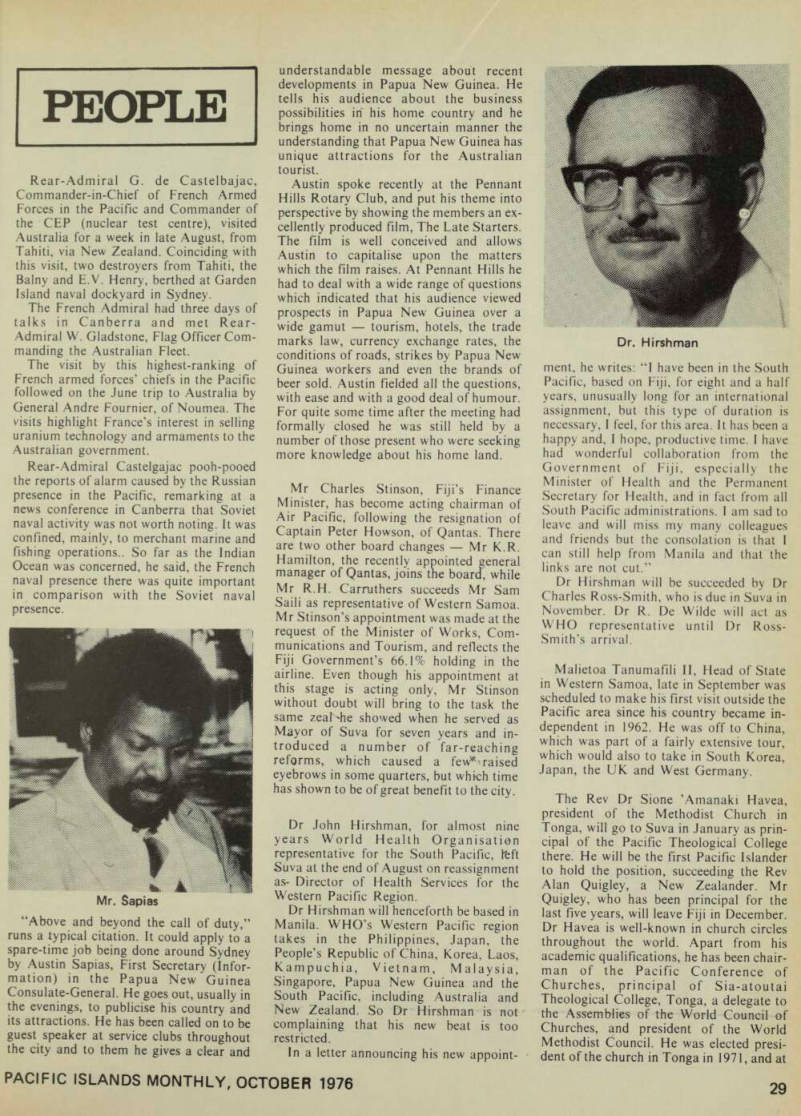
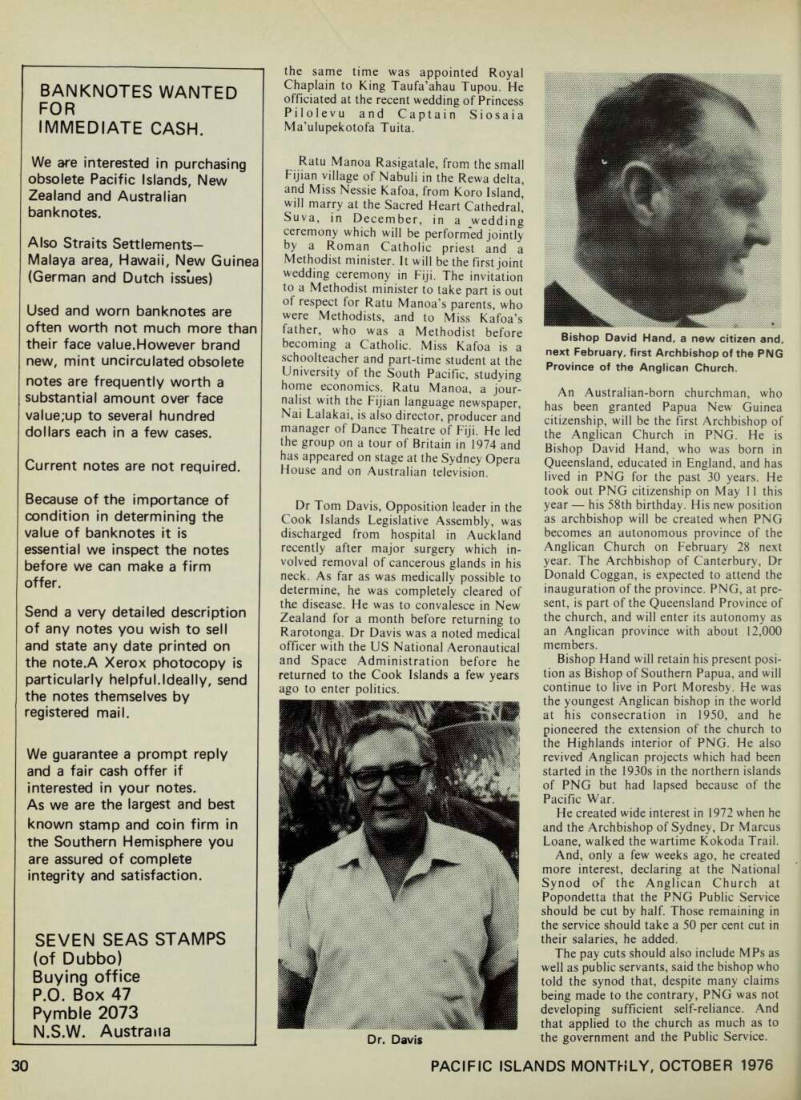
Rear-Admiral G. de Castelbajac, Commander-in-Chief of French Armed Forces in the Pacific and Commander of the CEP (nuclear test centre), visited Australia for a week in late August, from Tahiti, via New Zealand. Coinciding with this visit, two destroyers from Tahiti, the Balny and E.V. Henry, berthed at Garden Island naval dockyard in Sydney.
The French Admiral had three days of talks in Canberra and met Rear- Admiral W. Gladstone, Flag Officer Com manding the Australian Fleet.
The visit by this highest-ranking of French armed forces’ chiefs in the Pacific followed on the June trip to Australia by General Andre Fournier, of Noumea. The visits highlight France’s interest in selling uranium technology and armaments to the Australian government.
Rear-Admiral Castelgajac pooh-pooed the reports of alarm caused by the Russian presence in the Pacific, remarking at a news conference in Canberra that Soviet naval activity was not worth noting. It was confined, mainly, to merchant marine and fishing operations.. So far as the Indian Ocean was concerned, he said, the French naval presence there was quite important in comparison with the Soviet naval presence.
“Above and beyond the call of duty,” runs a typical citation. It could apply to a spare-time job being done around Sydney by Austin Sapias, First Secretary (Infor mation) in the Papua New Guinea Consulate-General. He goes out, usually in the evenings, to publicise his country and its attractions. He has been called on to be guest speaker at service clubs throughout the city and to them he gives a clear and
understandable message about recent developments in Papua New Guinea. He tells his audience about the business possibilities in his home country and he brings home in no uncertain manner the understanding that Papua New Guinea has unique attractions for the Australian tourist.
Austin spoke recently at the Pennant Hills Rotary Club, and put his theme into perspective by showing the members an ex cellently produced film, The Late Starters.
The film is well conceived and allows Austin to capitalise upon the matters which the film raises. At Pennant Hills he had to deal with a wide range of questions which indicated that his audience viewed prospects in Papua New Guinea over a wide gamut tourism, hotels, the trade marks law, currency exchange rates, the conditions of roads, strikes by Papua New Guinea workers and even the brands of beer sold. Austin fielded all the questions, with ease and with a good deal of humour.
For quite some time after the meeting had formally closed he was still held by a number of those present who were seeking more knowledge about his home land.
Mr Charles Stinson, Fiji’s Finance Minister, has become acting chairman of Air Pacific, following the resignation of Captain Peter Howson, of Qantas. There are two other board changes Mr K.R.
Hamilton, the recently appointed general manager of Qantas, joins the board, while Mr R.H. Carruthers succeeds Mr Sam Saili as representative of Western Samoa.
Mr Stinson’s appointment was made at the request of the Minister of Works, Com munications and Tourism, and reflects the Fiji Government’s 66.1% holding in the airline. Even though his appointment at this stage is acting only, Mr Stinson without doubt will bring to the task the same zeaNhe showed when he served as Mayor of Suva for seven years and in troduced a number of far-reaching reforms, which caused a eyebrows in some quarters, but which time has shown to be of great benefit to the city.
Dr John Hirshman, for almost nine years World Health Organisation representative for the South Pacific, teft Suva at the end of August on reassignment as- Director of Health Services for the Western Pacific Region.
Dr Hirshman will henceforth be based in Manila. WHO’s Western Pacific region takes in the Philippines, Japan, the People’s Republic of China, Korea, Laos, Kampuchia, Vietnam, Malaysia, Singapore, Papua New Guinea and the South Pacific, including Australia and New Zealand. So Dr Hirshman is not complaining that his new beat is too restricted.
In a letter announcing his new appoint-
merit, he writes: “I have been in the South Pacific, based on Fiji, for eight and a half years, unusually long for an international assignment, but this type of duration is necessary, I feel, for this area. It has been a happy and, I hope, productive time. I have had wonderful collaboration from the Government of Fiji, especially the Minister of Health and the Permanent Secretary for Health, and in fact from all South Pacific administrations. I am sad to leave and will miss my many colleagues and friends but the consolation is that I can still help from Manila and that the links are not cut.”
Dr Hirshman will be succeeded by Dr Charles Ross-Smith, who is due in Suva in November. Dr R. De Wilde will act as WHO representative until Dr Ross- Smith’s arrival.
Malietoa Tanumafili 11, Head of State in Western Samoa, late in September was scheduled to make his first visit outside the Pacific area since his country became in dependent in 1962. He was off to China, which was part of a fairly extensive tour, which would also to take in South Korea, Japan, the UK and West Germany.
The Rev Dr Sione ’Amanaki Havea, president of the Methodist Church in Tonga, will go to Suva in January as prin cipal of the Pacific Theological College there. He will be the first Pacific Islander to hold the position, succeeding the Rev Alan Quigley, a New Zealander. Mr Quigley, who has been principal for the last five years, will leave Fiji in December.
Dr Havea is well-known in church circles throughout the world. Apart from his academic qualifications, he has been chair man of the Pacific Conference of Churches, principal of Sia-atoutai
Theological College, Tonga, a delegate to
the Assemblies of the World Council of Churches, and president of the World Methodist Council. He was elected presi dent of the church in Tonga in 1971, and at
Mr. Sapias
Dr. Hirshman
the same time was appointed Royal Chaplain to King Taufa’ahau Tupou. He officiated at the recent wedding of Princess Pilolevu and Captain Siosaia
Ma’ulupekotofa Tuita.
Ratu Manoa Rasigatale, from the small Fijian village of Nabuli in the Rewa delta, and Miss Nessie Kafoa, from Koro Island,’ will marry at the Sacred Heart Cathedral, Suva, in December, in a wedding ceremony which will be performed jointly by a Roman Catholic priest and a Methodist minister. It will be the first joint wedding ceremony in Fiji. The invitation to a Methodist minister to take part is out of respect for Ratu Manoa’s parents, who were Methodists, and to Miss Kafoa’s father, who was a Methodist before becoming a Catholic. Miss Kafoa is a schoolteacher and part-time student at the University of the South Pacific, studying home economics. Ratu Manoa, a jour nalist with the Fijian language newspaper, Nai Lalakai, is also director, producer and manager of Dance Theatre of Fiji. He led the group on a tour of Britain in 1974 and has appeared on stage at the Sydney Opera House and on Australian television.
Dr Tom Davis, Opposition leader in the Cook Islands Legislative Assembly, was discharged from hospital in Auckland recently after major surgery which in volved removal of cancerous glands in his neck. As far as was medically possible to determine, he was completely cleared of the disease. He was to convalesce in New Zealand for a month before returning to Rarotonga. Dr Davis was a noted medical officer with the US National Aeronautical and Space Administration before he returned to the Cook Islands a few years ago to enter politics.
An Australian-born churchman, who has been granted Papua New Guinea citizenship, will be the first Archbishop of the Anglican Church in PNG. He is Bishop David Hand, who was born in Queensland, educated in England, and has lived in PNG for the past 30 years. He took out PNG citizenship on May 11 this year his 58th birthday. His new position as archbishop will be created when PNG becomes an autonomous province of the Anglican Church on February 28 next year. The Archbishop of Canterbury, Dr Donald Coggan, is expected to attend the inauguration of the province. PNG, at pre sent, is part of the Queensland Province of the church, and will enter its autonomy as an Anglican province with about 12,000 members.
Bishop Hand will retain his present posi tion as Bishop of Southern Papua, and will continue to live in Port Moresby. He was the youngest Anglican bishop in the world at his consecration in 1950, and he pioneered the extension of the church to the Highlands interior of PNG. He also revived Anglican projects which had been started in the 1930 s in the northern islands of PNG but had lapsed because of the Pacific War.
He created wide interest in 1972 when he and the Archbishop of Sydney, Dr Marcus Loane, walked the wartime Kokoda Trail.
And, only a few weeks ago, he created more interest, declaring at the National Synod of the Anglican Church at Popondetta that the PNG Public Service should be cut by half. Those remaining in the service should take a 50 per cent cut in their salaries, he added.
The pay cuts should also include MPs as well as public servants, said the bishop who told the synod that, despite many claims being made to the contrary, PNG was not developing sufficient self-reliance. And that applied to the church as much as to the government and the Public Service.
Or. Davis
Bishop David Hand, a new citizen and, next February, first Archbishop of the PNG Province of the Anglican Church.
Advertisements & other items, p. 30 (1 item)
Buying office
BANKNOTES WANTED
FOR
IMMEDIATE CASH.
We are interested in purchasing obsolete Pacific Islands, New Zealand and Australian banknotes.
Also Straits Settlements— Malaya area, Hawaii, New Guinea (German and Dutch issues) Used and worn banknotes are often worth not much more than their face value. However brand new, mint uncirculated obsolete notes are frequently worth a substantial amount over face value;up to several hundred dollars each in a few cases.
Current notes are not required.
Because of the importance of condition in determining the value of banknotes it is essential we inspect the notes before we can make a firm offer.
Send a very detailed description of any notes you wish to sell and state any date printed on the note.A Xerox photocopy is particularly helpful.ldeally, send the notes themselves by registered mail.
We guarantee a prompt reply and a fair cash offer if interested in your notes.
As we are the largest and best known stamp and coin firm in the Southern Hemisphere you are assured of complete integrity and satisfaction.
SEVEN SEAS STAMPS
(of Dubbo)
Buying office
P.O. Box 47
Pymble 2073
N.S.W. Australia
Tropicalities
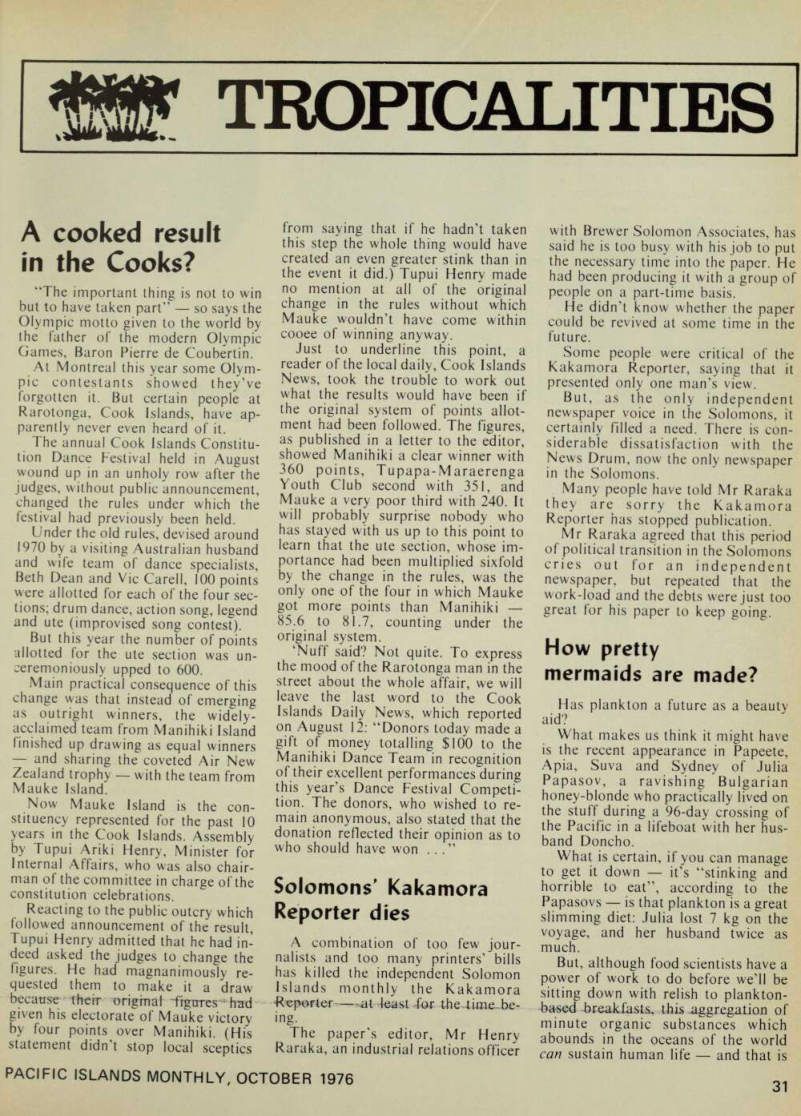
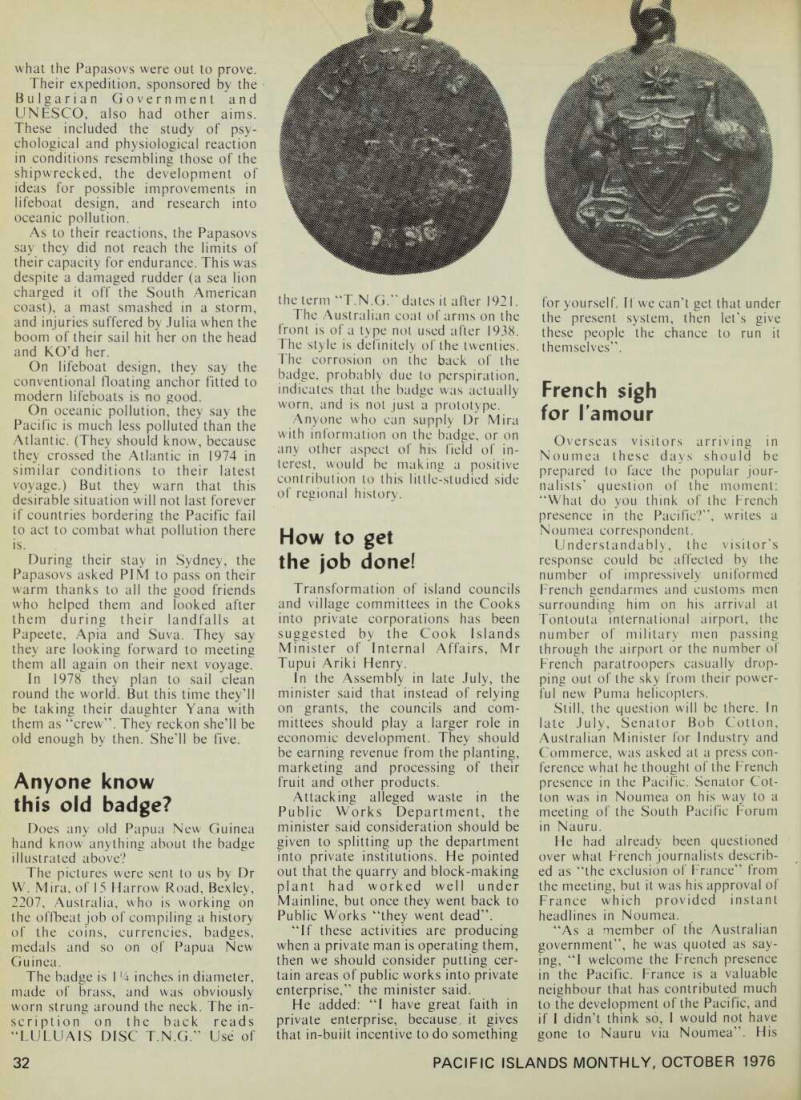
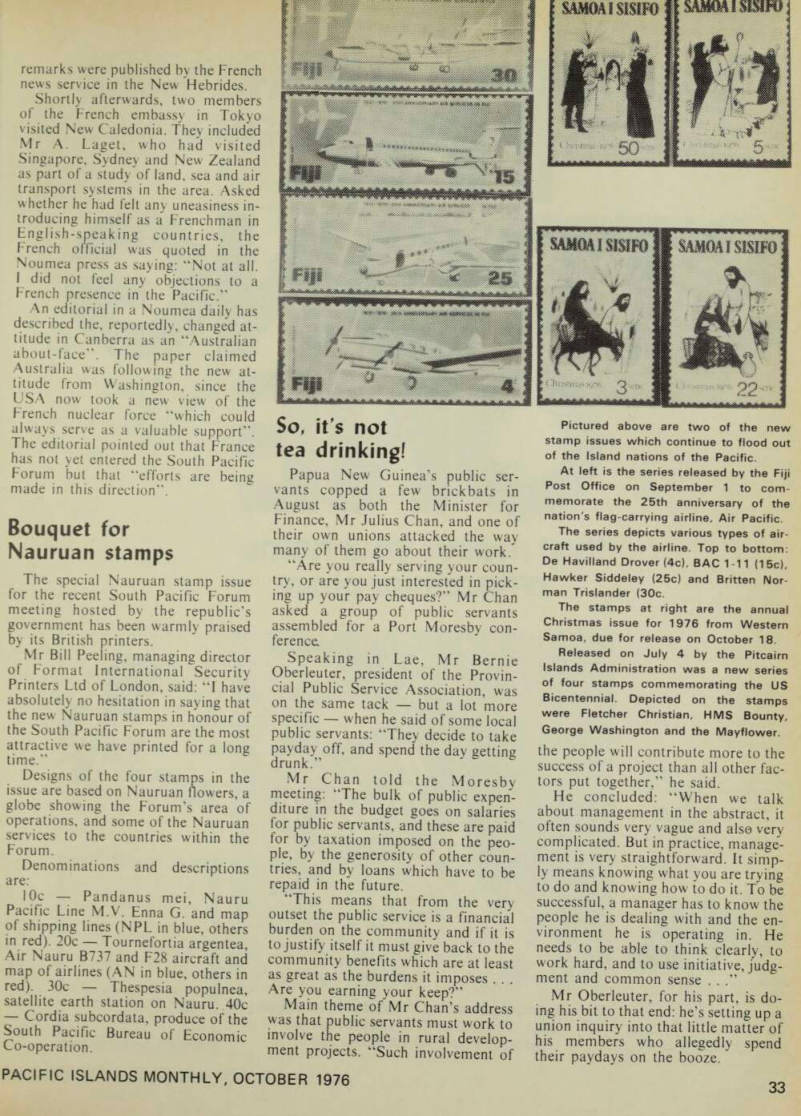
A cooked result
in the Cooks?
“The important thing is not to win but to have taken part” so says the Olympic motto given to the world by the father of the modern Olympic Games, Baron Pierre de Coubertin.
At Montreal this year some Olym pic contestants showed they’ve forgotten it. But certain people at Rarotonga, Cook Islands, have ap parently never even heard of it.
The annual Cook Islands Constitu tion Dance Festival held in August wound up in an unholy row after the judges, without public announcement, changed the rules under which the festival had previously been held.
Under the old rules, devised around 1970 by a visiting Australian husband and wife team of dance specialists, Beth Dean and Vic Carell, 100 points were allotted for each of the four sec tions; drum dance, action song, legend and ute (improvised song contest).
But this year the number of points allotted for the ute section was un ceremoniously upped to 600.
Main practical consequence of this change was that instead of emerging as outright winners, the widely acclaimed team from Manihiki Island finished up drawing as equal winners and sharing the coveted Air New Zealand trophy with the team from Mauke Island.
Now Mauke Island is the con stituency represented for the past 10 years in the Cook Islands. Assembly by Tupui Ariki Henry, Minister for Internal Affairs, who was also chair man of the committee in charge of the constitution celebrations.
Reacting to the public outcry which followed announcement of the result, Tupui Henry admitted that he had in deed asked the judges to change the figures. He had magnanimously re quested them to make it a draw because their original 'figures " had given his electorate of Mauke victory by four points over Manihiki. (His statement didn t stop local sceptics
from saying that if he hadn’t taken this step the whole thing would have created an even greater stink than in the event it did.) Tupui Henry made no mention at all of the original change in the rules without which Mauke wouldn’t have come within cooee of winning anyway.
Just to underline this point, a reader of the local daily. Cook Islands News, took the trouble to work out what the results would have been if the original system of points allot ment had been followed. The figures, as published in a letter to the editor, showed Manihiki a clear winner with 360 points, Tupapa-Maraerenga Youth Club second with 351, and Mauke a very poor third with 240. It will probably surprise nobody who has stayed with us up to this point to learn that the ute section, whose im portance had been multiplied sixfold by the change in the rules, was the only one of the four in which Mauke got more points than Manihiki 85.6 to 81.7, counting under the original system. ‘Nuff said? Not quite. To express the mood of the Rarotonga man in the street about the whole affair, we will leave the last word to the Cook Islands Daily News, which reported on August 12: “Donors today made a gift of money totalling $lOO to the Manihiki Dance Team in recognition of their excellent performances during this year’s Dance Festival Competi tion. The donors, who wished to re main anonymous, also stated that the donation reflected their opinion as to who should have won ...”
Solomons’ Kakamora
Reporter dies
A combination of too few jour nalists and too many printers’ bills has killed the independent Solomon Islands monthly the Kakamora least Tar the Time-be ing.
The paper’s editor, Mr Henry Raraka, an industrial relations officer
with Brewer Solomon Associates, has said he is too busy with his job to put the necessary time into the paper. He had been producing it with a group of people on a part-time basis.
He didn’t know whether the paper could be revived at some time in the future.
Some people were critical of the Kakamora Reporter, saying that it presented only one man’s view.
But, as the only independent newspaper voice in the Solomons, it certainly filled a need. There is con siderable dissatisfaction with the News Drum, now the only newspaper in the Solomons.
Many people have told Mr Raraka they are sorry the Kakamora Reporter has stopped publication.
Mr Raraka agreed that this period of political transition in the Solomons cries out for an independent newspaper, but repeated that the work-load and the debts were just too great for his paper to keep going.
How pretty
mermaids are made?
Has plankton a future as a beauty aid?
What makes us think it might have is the recent appearance in Papeete, Apia, Suva and Sydney of Julia Papasov, a ravishing Bulgarian honey-blonde who practically lived on the stuff during a 96-day crossing of the Pacific in a lifeboat with her hus band Doncho.
What is certain, if you can manage to get it down it’s “stinking and horrible to eat’’, according to the Papasovs is that plankton is a great slimming diet; Julia lost 7 kg on the voyage, and her husband twice as much.
But, although food scientists have a power of work to do before we’ll be sitting down with relish to plankton based -breakfasts, this aggregation of minute organic substances which abounds in the oceans of the world can sustain human life and that is
what the Papasovs were out to prove.
Their expedition, sponsored by the Bulgarian Government and UNESCO, also had other aims.
These included the study of psy chological and physiological reaction in conditions resembling those of the shipwrecked, the development of ideas for possible improvements in lifeboat design, and research into oceanic pollution.
As to their reactions, the Papasovs say they did not reach the limits of their capacity for endurance. This was despite a damaged rudder (a sea lion charged it off the South American coast), a mast smashed in a storm, and injuries suffered by Julia when the boom of their sail hit her on the head and KO’d her.
On lifeboat design, they say the conventional floating anchor fitted to modern lifeboats is no good.
On oceanic pollution, they say the Pacific is much less polluted than the Atlantic. (They should know, because they crossed the Atlantic in 1974 in similar conditions to their latest voyage.) But they warn that this desirable situation will not last forever if countries bordering the Pacific fail to act to combat what pollution there is.
During their stay in Sydney, the Papasovs asked PIM to pass on their warm thanks to all the good friends who helped them and looked after them during their landfalls at Papeete, Apia and Suva. They say they are looking forward to meeting them all again on their next voyage.
In 1978 they plan to sail clean round the world. But this time they’ll be taking their daughter Yana with them as “crew”. They reckon she’ll be old enough by then. She’ll be five.
Anyone know
this old badge?
Does any old Papua New Guinea hand know anything about the badge illustrated above?
The pictures were sent to us by Dr W. Mira, of 15 Harrow Road, Bexley, 2207, Australia, who is working on the offbeat job of compiling a history of the coins, currencies, badges, medals and so on of Papua New Guinea.
The badge is I 'A inches in diameter, made of brass, and was obviously worn strung around the neck. The in scription on the back reads
“Luluais Disc T.N.G.” Use Of
the term “T.N.G.” dates it after 1921.
The Australian coat of arms on the front is of a type not used after 1938.
The style is definitely of the twenties.
The corrosion on the back of the badge, probably due to perspiration, indicates that the badge was actually worn, and is not just a prototype.
Anyone who can supply Dr Mira with information on the badge, or on any other aspect of his field of in terest, would be making a positive contribution to this little-studied side of regional history.
How to get
the job done!
Transformation of island councils and village committees in the Cooks into private corporations has been suggested by the Cook Islands Minister of Internal Affairs, Mr Tupui Ariki Henry.
In the Assembly in late July, the minister said that instead of relying on grants, the councils and com mittees should play a larger role in economic development. They should be earning revenue from the planting, marketing and processing of their fruit and other products.
Attacking alleged waste in the Public Works Department, the minister said consideration should be given to splitting up the department into private institutions. He pointed out that the quarry and block-making plant had worked well under Mainline, but once they went back to Public Works “they went dead”.
“If these activities are producing when a private man is operating them, then we should consider putting cer tain areas of public works into private enterprise,” the minister said.
He added: “1 have great faith in private enterprise, because, it gives that in-buiit incentive to do something
for yourself. If we can’t gel that under the present system, then let’s give these people the chance to run it themselves”.
French sigh
for I’amour
Overseas visitors arriving in Noumea these days should be prepared to face the popular jour nalists' question of the moment: “What do you think of the French presence in the Pacific?”, writes a Noumea correspondent.
Understandably, the visitor’s response could be affected by the number of impressively uniformed French gendarmes and customs men surrounding him on his arrival at Tontouta international airport, the number of military men passing through the airport or the number of French paratroopers casually drop ping out of the sky from their power ful new Puma helicopters.
Still, the question will be there. In late July, Senator Bob Cotton, Australian Minister for Industry and Commerce, was asked at a press con ference what he thought of the French presence in the Pacific. Senator Cot ton was in Noumea on his way to a meeting of the South Pacific Forum in Nauru.
He had already been questioned over what French journalists describ ed as “the exclusion of France” from the meeting, but it was his approval of France which provided instant headlines in Noumea.
“As a member of the Australian government”, he was quoted as say ing, “I welcome the French presence in the Pacific. France is a valuable neighbour that has contributed much to the development of the Pacific, and if I didn’t think so, I would not have gone to Nauru via Noumea”. His
remarks were published by the French news service in the New Hebrides.
Shortly afterwards, two members of the French embassy in Tokyo visited New Caledonia. They included Mr A. Laget, who had visited Singapore, Sydney and New Zealand as part of a study of land, sea and air transport systems in the area. Asked whether he had felt any uneasiness in troducing himself as a Frenchman in English-speaking countries, the French official was quoted in the Noumea press as saying; “Not at all.
I did not feel any objections to a French presence in the Pacific.”
An editorial in a Noumea daily has described the, reportedly, changed at titude in Canberra as an “Australian about-face”. The paper claimed Australia was following the new at titude from Washington, since the USA now took a new view of the French nuclear force “which could always serve as a valuable support”.
The editorial pointed out that France has not yet entered the South Pacific Forum but that “efforts are being made in this direction”.
Bouquet for
Nauruan stamps
The special Nauruan stamp issue for the recent South Pacific Forum meeting hosted by the republic’s government has been warmly praised by its British printers.
Mr Bill Peeling, managing director of Format International Security Printers Ltd of London, said; “I have absolutely no hesitation in saying that the new Nauruan stamps in honour of the South Pacific Forum are the most attractive we have printed for a long time.”
Designs of the four stamps in the issue are based on Nauruan flowers, a globe showing the Forum’s area of operations, and some of the Nauruan services to the countries within the Forum.
Denominations and descriptions are; 10c Pandanus mei, Nauru Pacific Line M.V. Enna G. and map of shipping lines (NPL in blue, others in red). 20c Tournefortia argentea, Air Nauru 8737 and F2B aircraft and map of airlines (AN in blue, others in red). 30c Thespesia populnea, satellite earth station on Nauru. 40c Cordia subcordata, produce of the South Pacific Bureau of Economic Co-operation.
So, it’s not
tea drinking!
Papua New Guinea’s public ser vants copped a few brickbats in August as both the Minister for Finance, Mr Julius Chan, and one of their own unions attacked the way many of them go about their work.
“Are you really serving your coun try, or are you just interested in pick ing up your pay cheques?” Mr Chan asked a group of public servants assembled for a Port Moresby con ference.
Speaking in Lae, Mr Bernie Oberleuter, president of the Provin cial Public Service Association, was on the same tack but a lot more specific when he said of some local public servants; “They decide to take payday off, and spend the day getting drunk.”
Mr Chan told the Moresby meeting; “The bulk of public expen diture in the budget goes on salaries for public servants, and these are paid for by taxation imposed on the peo ple, by the generosity of other coun tries, and by loans which have to be repaid in the future.
“This means that from the very outset the public service is a financial burden on the community and if it is to justify itself it must give back to the community benefits which are at least as great as the burdens it imposes . . .
Are you earning your keep?”
Main theme of Mr Chan’s address was that public servants must work to involve the people in rural develop ment projects. “Such involvement of
the people will contribute more to the success of a project than all other fac tors put together,” he said.
He concluded: “When we talk about management in the abstract, it often sounds very vague and also very complicated. But in practice, manage ment is very straightforward. It simp ly means knowing what you are trying to do and knowing how to do it. To be successful, a manager has to know the people he is dealing with and the en vironment he is operating in. He needs to be able to think clearly, to work hard, and to use initiative, judg ment and common sense . .
Mr Oberleuter, for his part, is do ing his bit to that end: he’s setting up a union inquiry into that little matter of his members who allegedly spend their paydays on the booze.
Pictured above are two of the new stamp issues which continue to flood out of the Island nations of the Pacific.
At left is the series released by the Fiji Post Office on September 1 to com memorate the 25th anniversary of the nation's flag-carrying airline. Air Pacific.
The series depicts various types of air craft used by the airline. Top to bottom: De Havilland Drover (4c), BAG 1-11 (15c), Hawker Siddeley (25c) and Britten Nor man Trislander (30c.
The stamps at right are the annual Christmas issue for 1976 from Western Samoa, due for release on October 18.
Released on July 4 by the Pitcairn Islands Administration was a new series of four stamps commemorating the US Bicentennial. Depicted on the stamps were Fletcher Christian, HMS Bounty, George Washington and the Mayflower,
Advertisements & other items, p. 34 (1 item)
a healthier place
that makes your home
How effectively you protect your family from the dangers of disease carrying insects, may well depend on the insect spray you choose.
Powerful Insect Killing Ingredients.
Concentrated Pea Beu is one of the most powerful household insect sprays in the world. Its principal insect killing ingredients have been selected to ensure rapid knock down and kill of all common disease carrying insects.
Rigid Testing. Through every stage of manufacture. Pea Beu is rigidly tested.
There are ingredient tests, spray droplet tests, pack tests, many forms of tests, some carried out three times over.
When you spray this remarkable aerosol insecticide, you can be sure that its ingredients have met with the most exacting standards enabling you to spray it safely with confidence in your home. m m Family Health and Well Being. The common housefly carries up to half a billion germs and, when you realize that disease carrying insects enter even the best regulated households, you can understand why you can't be too careful about the effectiveness of your insect spray. Remember, even the tiniest droplet z / / * m of concentrated Pea Beu kills flies, mosquitoes, all common disease carrying Concentrated Pea Beu. Even the tiniest droplet
kills flies, mosquitoes, gj| common
disease carrying insects fast.
insects fast, so it is indeed a worthy guardian of your family's health and well being Such is the effectiveness of Pea Beu's insect killing ingredient, that no common disease carrying insect can survive it. not develop an immunity to it. When you spray Concentrated Pea Beu, it’s nice to know that no common disease carrying insect can survive.
Pea Beu - The strong one, makes your home a healthier place.
Search For A National
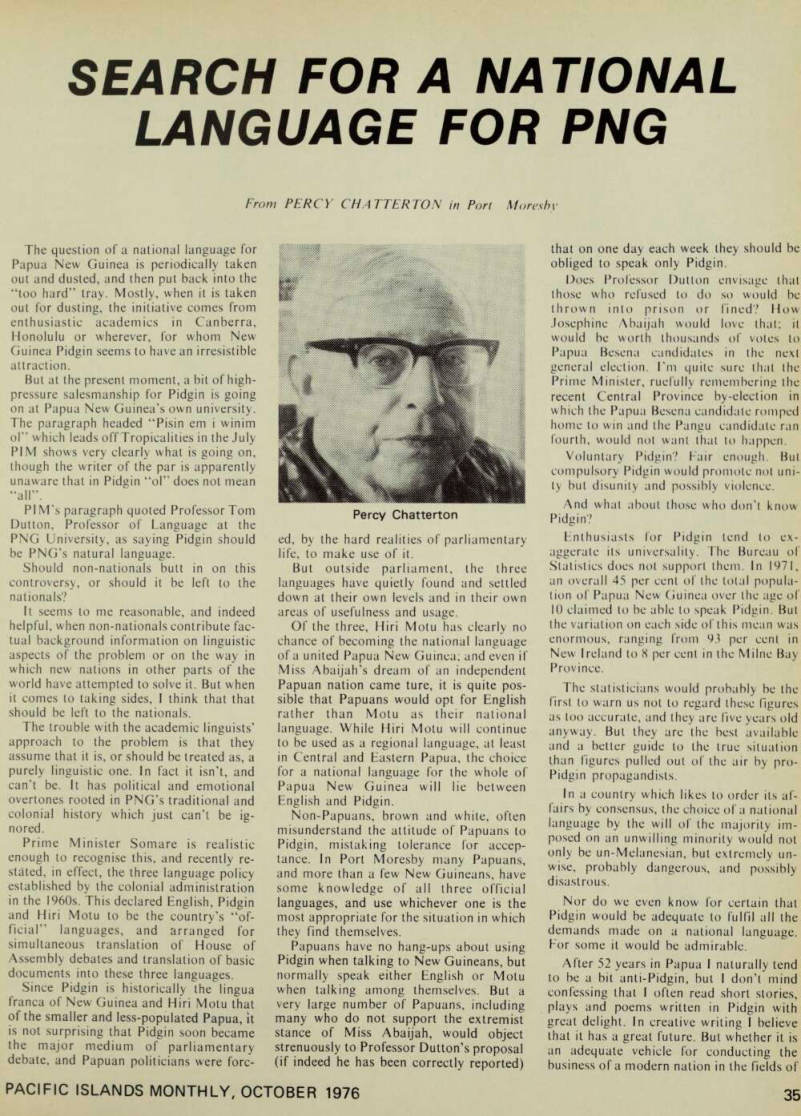
Language For Png
From PERCY CHATTERTON in Port Moreshx
The question of a national language for Papua New Guinea is periodically taken out and dusted, and then put back into the “too hard” tray. Mostly, when it is taken out for dusting, the initiative comes from enthusiastic academics in Canberra, Honolulu or wherever, for whom New Guinea Pidgin seems to have an irresistible attraction.
But at the present moment, a bit of high pressure salesmanship for Pidgin is going on at Papua New Guinea’s own university.
The paragraph headed “Pisin em i winim ol” which leads off Tropicalities in the July PIM shows very clearly what is going on, though the writer of the par is apparently unaware that in Pidgin “ol” does not mean “all”.
PI M’s paragraph quoted Professor Tom Dutton, Professor of Language at the PNG University, as saying Pidgin should be PNG’s natural language.
Should non-nationals butt in on this controversy, or should it be left to the nationals?
It seems to me reasonable, and indeed helpful, when non-nationals contribute fac tual background information on linguistic aspects of the problem or on the way in which new nations in other parts of the world have attempted to solve it. But when it comes to taking sides, I think that that should be left to the nationals.
The trouble with the academic linguists’ approach to the problem is that they assume that it is, or should be treated as, a purely linguistic one. In fact it isn’t, and can’t be. It has political and emotional overtones rooted in PNG’s traditional and colonial history which just can’t be ig nored.
Prime Minister Somare is realistic enough to recognise this, and recently re stated, in effect, the three language policy established by the colonial administration in the 19605. This declared English, Pidgin and Hiri Motu to be the country’s “of ficial” languages, and arranged for simultaneous translation of House of Assembly debates and translation of basic documents into these three languages.
Since Pidgin is historically the lingua franca of New Guinea and Hiri Motu that of the smaller and less-populated Papua, it is not surprising that Pidgin soon became the major medium of parliamentary debate, and Papuan politicians were fore-
ed, by the hard realities of parliamentary life, to make use of it.
But outside parliament, the three languages have quietly found and settled down at their own levels and in their own areas of usefulness and usage.
Of the three, Hiri Motu has clearly no chance of becoming the national language of a united Papua New Guinea; and even if Miss Abaijah’s dream of an independent Papuan nation came ture, it is quite pos sible that Papuans would opt for English rather than Motu as their national language. While Hiri Motu will continue to be used as a regional language, at least in Central and Eastern Papua, the choice for a national language for the whole of Papua New Guinea will lie between English and Pidgin.
Non-Papuans, brown and white, often misunderstand the attitude of Papuans to Pidgin, mistaking tolerance for accep tance. In Port Moresby many Papuans, and more than a few New Guineans, have some knowledge of all three official languages, and use whichever one is the most appropriate for the situation in which they find themselves.
Papuans have no hang-ups about using Pidgin when talking to New Guineans, but normally speak either English or Motu when talking among themselves. But a very large number of Papuans, including many who do not support the extremist stance of Miss Abaijah, would object strenuously to Professor Dutton’s proposal (if indeed he has been correctly reported)
that on one day each week they should be obliged to speak only Pidgin.
Does Professor Dutton envisage that those who refused to do so would be thrown into prison or fined? How Josephine Abaijah would love that; it would be worth thousands of voles to Papua Besena candidates in the next general election. I'm quite sure that the Prime Minister, ruefully remembering the recent Central Province by-election in which the Papua Besena candidate romped home to win and the Pangu candidate ran fourth, would not want that to happen.
Voluntary Pidgin? Fair enough. But compulsory Pidgin would promote not uni ty but disunity and possibly violence.
And what about those who don't know
Pidgin?
Enthusiasts for Pidgin lend to ex aggerate its universality. The Bureau of Statistics does not support them. In 1971, an overall 45 per cent of the total popula tion of Papua New Guinea over the age of 10 claimed to be able to speak Pidgin. But the variation on each side of this mean was enormous, ranging from 93 per cent in New Ireland to 8 per cent in the Milne Bay Province.
The statisticians would probably be the first to warn us not to regard these figures as 100 accurate, and they are five years old anyway. But they are the best available and a better guide to the true situation than figures pulled out of the air by pro- Pidgin propagandists.
In a country which likes to order its af fairs by consensus, the choice of a national language by the will of the majority im posed on an unwilling minority would not only be un-Melanesian, but extremely un wise, probably dangerous, and possibly disastrous.
Nor do we even know for certain that Pidgin would be adequate to fulfil all the demands made on a national language.
For some it would be admirable.
After 52 years in Papua I naturally tend to be a bit anti-Pidgin, but I don’t mind confessing that I often read short stories, plays and poems written in Pidgin with great delight. In creative writing I believe that it has a great future. But whether it is an adequate vehicle for conducting the business of a modern nation in the fields of
Percy Chatterton
government, administration and com merce is another matter.
Speaking out of my eight years ex perience in the House of Assembly I would say that Pidgin as it is at present is certain ly not adequate.
“Ah”, say the academic linguists, “but it could be made adequate by a controlled and guided infusion of neologism”. They, presumably, would do the guiding.
Well, they may be right. But if they are, let them get on with the job and give us a chance to evaluate and try out the new vocabulary they come up with. In the meantime we would be unwise to burn our boats before we are sure that our Tom Dutton life-jackets will keep us afloat.
When we turn to the question of the language of education, we find the situa tion even more bedevilled. In pre-war Papua there were no government schools and most mission schools operated in the local vernacular, with a modicum of English taught as a subject wherever possi ble. In pre-war New Guinea most schools operated in Pidgin, though I believe there were one or two government schools in the Ga/.elle Peninsula where English was taught.
In post-war Papua New Guinea, the Department of Education adopted an all- English system, which has now been in (orce for nearly 30 years. I have always regarded this system as unsound, but there can be no doubt that it has been what the customers (that is, the pupils and their parents) wanted and still want, even though the image of English as the open sesame to the while man’s affluence has become a bit tarnished.
To convince them that they have been wrong all the time would be pretty dif ficult, and they are unlikely to be won over by the argument (in hard fact a very dubious argument) that education in Pidgin would be cheaper.
Ideally, the initial school language should be the language of the home. In many rural areas this would be quite prac ticable, but it would no longer be so in ur ban situations.
In Port Moresby there are many homes where the home language is that of the village from which both parents come.
Where the parents come from different parts of Papua, the language of the home is likely to be Hiri Motu. Where they come from different parts of New Guinea, or where one parent is a New Gui nean and the other a Papuan, the language of the home will probably be Pidgin.
But it must not be overlooked that in a steadily-increasing number of homes, in which both parents have received a secon dary or tertiary education, the language of the home is English. This is almost in variably the case when the parents come from different language areas, but it is also true in some cases in which the parents
have a common vernacular. I know a number of Papuan parents who have a common vernacular but who speak to each other in English in the home, “for the sake of the children” as they put it.
The plan breaks down when granny comes to stay, but is resumed when she goes home. It seems unlikely that such parents would take kindly to sending their children to a school operating in Pidgin.
They could be right too. Even making the utmost allowance for the im provements which have been made in language teaching over the years, 1 believe that many teachers would regard it as educationally unsound to postpone the start in English until the educand knows whether he will need it or not.
On the other hand, Professor Dutton is undoubtedly right when he claims that those pupils who don't go beyond primary school have largely wasted their time in their laborious pursuit of English.
How to resolve this dilemma? Plato came up with one answer breed your elite! But this solution is unlikely to appeal to egalitarian Papua New Guinea.
One further point must be made.
Our former “Primary T” schools have now been renamed “Community schools”, and stress is being laid on the responsibility of the communities they serve to support them. Fair enough too. But if these schools are to receive community support, the community may not unreasonably demand a say in choosing the language in which the community children are to be educated.
I'm afraid that even in the case of the Kilakila Community School, of which Professor Dutton was once a highly respected and very able headmaster, it can not be assumed that the community it serves would be prepared unhesitatingly to accept his advice in making their choice, especially if his advice was to choose Pidgin.
Advertisements & other items, p. 36 (1 item)
Umpires
Here are 26 good reasons why Daikin makes
hundreds of different airconditioning systems,
lovers Her favorite Renoir will live forever in a Daikin controlled environment. ’ lorists Violets are bluer when cooler. issers Temperatures may rise but Daikin stays cool. \ assengers Ride with stowaway Daikins.
Umpires
Hot calls easier in calls are made stadiums with controlled atmospheres.
M ames you’re going crazy akers .Clean, cool airforfresher baking. , olfers I After the 18th hole, take a cool clubhouse break. umberjacks Cool tractor cabs cut the heat of the blazing uaffers Beer sips better and customers stay longer when cool. acationers Cool performances at night after a day in the sun.
C omputer Brains Controlled humidity lets sensitive components last longer. omeowners Cooling and warming bungalows to mansions.
M onkeys Maybe the zoo; definitely pet shops. estaurateurs Kitchens and dining areas cooled and warmed.
R orkers Even ties are comfortable if the weather isn’t.
And here’s more,
over the heat, cool it with Daikin. j
loctors
Cool thinking in clean air in clean rooms. ndustrialists No-sweat factories produce more products. m N ortherners I Come inside to guaranteed warmth.
kippers
Daikin is launched into all sizes of vessels.
ylophonists
Strike up the band for a cool night in town.
You. skimos Daikin heats as well as ,00013; anywhere! ewelers And a jewel of a way to keep cool. perators And switching installations hum when cool. eachers Daikin adds up to a better way to concentrate achtsmen Hot weather sailing is always a breeze.
You’re different and you want an airconditioning system that’s perfect for you.
That’s why Daikin makes so many different ways to keep most everyone comfortable.
But there’s one thing our systems have in common. Years of whisper-quiet, trouble-free service That we guarantee.
Tell us about the comfort style you need.
Whatever you do, you’ll do it better with Daikin.
©DAIKIN
AIRCONDITIONERS
Daikin Kogyo Co.. Ltd.
Head Office: Shin Hankyu Bldg 8 Umeda Kitaku Osaka Japan
‘Discrimination’ cry expats
About 350 angry Britons and New Zealanders working for the PNG Government want their own governments to intervene in a wages dispute. They’re angry, in the first in stance, because they get less pay than Australians in PNG and they weren’t told this when they signed up.
But now they’re angrier still because the PNG Government has refused to allow an increase granted to them by arbitration.
The public servants accused PNG of political expediency, of abdicating its industrial integrity and of repudiating established employer employee responsibilities.
“This leaves us free to take the issue to our own governments,” Mr John Edge, a spokesman for the group, said.
The controversy, which could affect the recruiting of specialised skills from overseas, is one of a series stem ming from PNG’s strange four-tier wages structure. Overseas public ser vants are recruited on the basis of at traction related to their homeland wage scales.
This gives Filipinos working in PNG a higher wage rate than PNG nationals, but the Britons and New Zealanders get more than the Filipinos, and the Australians get the most.
Filipinos working in PNG have already claimed “an outrage to our national dignity” and have asked President Marcos to intervene on a government-to-government basis.
More than 300 public servants have been brought from Britain and New Zealand over the past two years as teachers, lawyers, engineers, accoun tants and technicians.
An arbitration tribunal recently granted them increases of up to K 2400 on grounds of need, although the total wage scale was still lower than what Australians get.
But the Minister for Labour, Mr Gavera Rea, announced that the award would be disallowed by the government. He said an inquiry would be established to review the whole question of overseas recruiting.
On behalf of the bitter Britons and New Zealanders, Mr Edge said the government had demonstrated it would ignore any decision that did not suit it, even when the decision came from its own industrial structure. He believed PNG had effectively remov ed itself from the market of being able to attract the expertise it needed from overseas.
He claimed that some Britons and New Zealanders could no longer sur vive financially in PNG, and that their contracts should be ended with ter mination benefits.
Advertisements & other items, p. 38 (1 item)
White Horse anywhere
i} a m I * Old ne Scotch WhisKy
LED IN SCOTLA^
\bu can take a
White Horse anywhere
FINE OLD SCOTCH WHISKY
742
Another PNG birthday
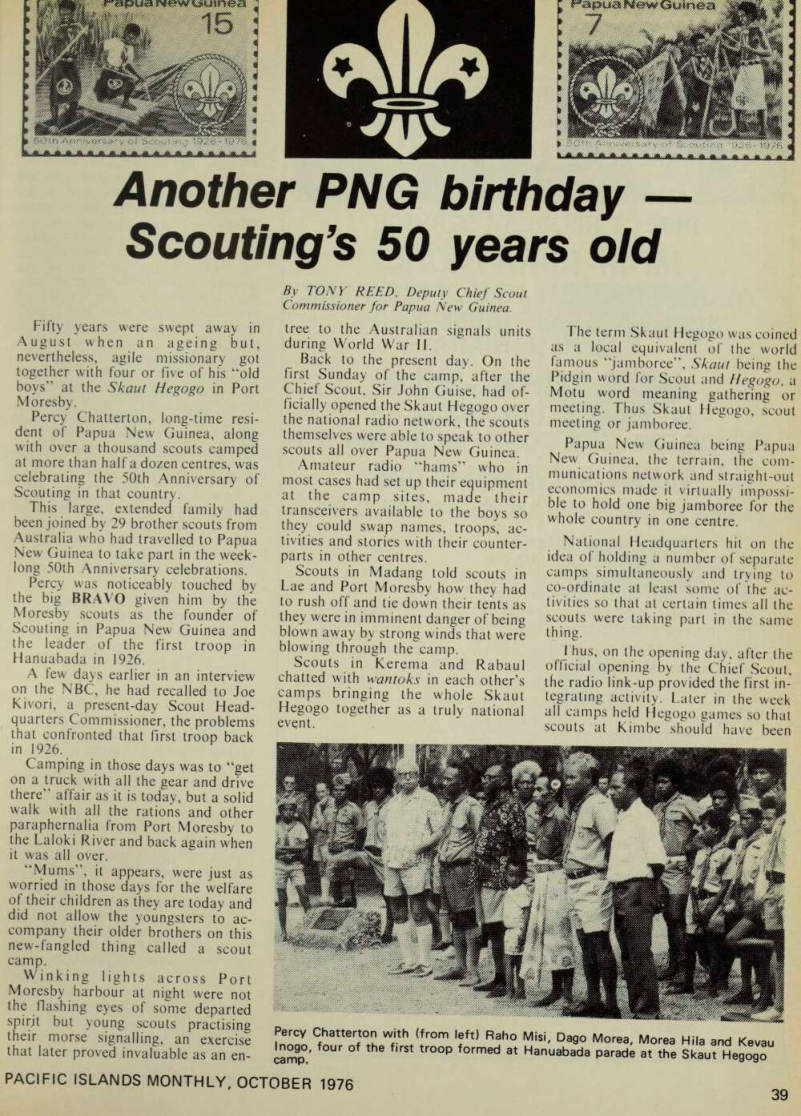
Scouting’s 50 years old
By TONY REED, Deputy Chief Scout Commissioner for Papua New Guinea.
Fifty years were swept away in August when an ageing but, nevertheless, agile missionary got together with four or five of his “old boys” at the Skaut Hegogo in Port Moresby.
Percy Chatterton, long-time resi dent of Papua New Guinea, along with over a thousand scouts camped at more than half a dozen centres, was celebrating the 50th Anniversary of Scouting in that country.
This large, extended family had been joined by 29 brother scouts from Australia who had travelled to Papua New Guinea to take part in the week long 50th Anniversary celebrations.
Percy was noticeably touched by the big BRAVO given him by the Moresby scouts as the founder of Scouting in Papua New Guinea and the leader of the first troop in Hanuabada in 1926.
A few days earlier in an interview on the NBC, he had recalled to Joe Kivori, a present-day Scout Head quarters Commissioner, the problems that confronted that first troop back in 1926.
Camping in those days was to “get on a truck with all the gear and drive there” affair as it is today, but a solid walk with all the rations and other paraphernalia from Port Moresby to the Laloki River and back again when it was all over.
“Mums”, it appears, were just as worried in those days for the welfare of their children as they are today and did not allow the youngsters to ac company their older brothers on this new-fangled thing called a scout camp.
Winking lights across Port Moresby harbour at night were not the flashing eyes of some departed spirit but young scouts practising their morse signalling, an exercise that later proved invaluable as an en
tree to the Australian signals units during World War 11.
Back to the present day. On the first Sunday of the camp, after the Chief Scout, Sir John Guise, had officially opened the Skaut Hegogo over the national radio network, the scouts themselves were able to speak to other scouts all over Papua New Guinea.
Amateur radio “hams” who in most cases had set up their equipment at the camp sites, made Teh transceivers available to the boys so they could swap names, troops, activities and stories with their counterparts in other centres.
Scouts in Madang told scouts in Lae and Port Moresby how they had to rush off and tie down their tents as they were in imminent danger of being blown away by strong winds that were blowing through the camp.
Scouts in Kerema and Rabaul chatted with wantoks in each other’s camps bringing the whole Skaut Hegogo together as a truly national event -
The term Skaut Hegogo was coined as a local equivalent of the world famous “jamboree”, Skaut being the Pidgin word for Scout and Hegogo. a Motu word meaning gathering or meeting. Thus Skaut Hegogo, scout meeting or jamboree, p , iniiy r u l>
New fl!!! .? be,r l? Papua
terrain the corn municdtlons network and straight-out
Wettow N^V’ 1 T°T
„L\° e Joint™ in Li b ? rCC ° T the ountry m one centre.
National Headquarters hit on the idea of holding a number of separate camps simultaneously and trying to co-ordinate at least some of the ac tivities so that at certain times all the scouts were taking part in the same thing.
Thus, on the opening day, after the official opening by the Chief Scout, the radio link-up provided the first in tegratmg activity. Later in the week all camps held Hegogo games so that scouts at Kimbe should have been
P ercy Chatterton with(fromleft) Raho Misi,Dage Morea Hila and Kevau Inogo, four fo the first troop formed at Hanuabada parade at the Skaut Hegogo camp
competing in the same events as those at Goroka or Rabaul.
A national campfire, an off-site day and an open-day when parents, friends and anybody who was in terested were invited to come along, were all part of the activities. They looked at the camps and watched special demonstrations, and it all helped to make the week a great success.
At many camps the culminating event was the burial of a time capsule.
In Port Moresby, apart from documents, papers and other present day artefacts, all the names of present-day scouts were also buried, hopefully, to be resurrected in the year 2000!
Apart from the Skaut Hegogo, a number of other activities are planned during the coming 12 months to emphasise this 50th year of Scouting.
A national church parade will be held later in the year and it’s a fair bet that, possibly, the largest congregation will be seen at the church in Hanuabada where it all started.
The Posts and Telecom munications Department have issued special 50th anniversary com memorative stamps in 7 and 15 toea denominations. These are bound to become collectors’ items amongst scout philatelists.
A special anniversary badge has been issued and all scouts in PNG will be allowed to wear it for this 50th year.
So much for the first 50 years.
What of the future?
Papua New Guinea is a young country. Young in as much as it recently attained independence. But more important it has a young pop ulation over 50% under 20 years of age.
Many people are looking to organisations like the Scout and Guide associations to provide a meaningful contribution to the train ing and direction of youth.
Not the least of these is the Gover nor-General, Sir John Guise, who has accepted the warrant of Chief Scout.
Already he has instigated action to set up youth-training projects and is publicly encouraging both govern ment and the private sector to put their money and their resources where their mouth is and stop talking about how someone else must do something for the youth of the country and get down and do it.
With this kind of support the next 50 years of Scouting is assured.
Advertisements & other items, p. 40 (1 item)
if \daiwa line
DIRECT REGULAR SERVICE
JAPAN-SOUTH PACIFIC
TARAWA-PAPEETE-PAGO PAGO-APIA
SUVA-LAUTOKA-NOUMEA-VILA
SANTO-HONIARA
JAPAN-TAIWAN-GUAM
JAPAN-KEELUNG-GUAM BY
EXCELLENT CAR/CONTAINER-CARRIER
JAPAN-WEST IRIAN-DILI
HONG KONG-TAIWAN-WEST IRIAN-DILI
GUAM: ATKINS, KROLL (GUAM) LTD.
TARAWA: G. & E. I. DEVELOPMENT AUTHORITY.
APIA: BURNS PHILP (SOUTH SEA) CO., LTD.
PAGO PAGO: KNEUBUHL MARITIME SERVICES CORP.
NUKUALOFA: PACIFIC NAVIGATION CO., LTD.
SUVA: BURNS PHILP (SOUTH SEA) CO., LTD.
LAUTOKA: BURNS PHILP (SOUTH SEA) CO., LTD.
NOUMEA: SOCIETE D'ACCONAGA ET
TRANSPORT D'OCEANIE (SATO)
SANTO: BURNS PHILP (NEW HEBRIDES) LTD.
VILA: BURNS PHILP (NEW HEBRIDES) LTD.
HONIARA: BRITISH SOLOMONS TRADING CO., LTD.
PAPEETE: AGENCE MARITIME DE FARA UTE.
HONG KONG: IKE MARITIME CO., LTD.
SINGAPORE: THE BORNEO CO., (SINGAPORE) LTD.
DJAJAPURA: P. N. PELAJARAN NASIONAL INDONESIA.
DILI: SANG TAI HOO
TAIWAN: FOR CARGO BETWEEN JAPAN/GUAM/TAIWAN
FORMOSA SHIPPING & ENTERPRISE CORP.
TAIWAN: FOR CARGO BETWEEN JAPAN/SOUTH PACIFIC/
WEST I RIAN/DILI
MARITIME TRANSPORTATION AGENCIES, LTD.
THE DAIWA MAX IG AXIOM CO., LTD.
AGENTS
OSAKA; “DAILINE”
TOKYO; “FUNEDAILINE"
HEAD OFFICE
DAIICHI KYOGYO BLDG.,
45, 2-CHOME, AWAZAMINAMI-DORI,
NISHI-KU, OSAKA, JAPAN
TELEPHONE: (06) 531-0471 ~9
TELEX: 525-6324 & 525-6325
TOKYO OFFICE
SHIN-DAIICHI BLDG.,
4-13, NIHONBASHI 3-CHOME, CHUO-KU,
TOKYO, JAPAN
TELEPHONE: (03) 274-3251 ~8
TELEX: 222-3343, 23559
Tie in with SE Asia,
Islands told
A call for closer co-operation between South Pacific Forum member countries and members of the Association of South East Asian Nations (ASEAN) was made by Senator John Knight in a recent ad dress to the North Queensland Branch of the Australian Institute of International Affairs.
Senator Knight, who before his election last December had a decade of service with the Australian Depart ment of Foreign Affairs including three years in Suva, stressed that in many areas the two groups of coun tries were seeking similar ends.
He said: “There is scope for closer co-operation between the two or ganisations. At an official level, the Forum, of which we are a member, might consult more closely with ASEAN as they develop their programmes; as they seek to do something about the prices of tropical agricultural products; as they seek markets for their products; as they try to develop more effective shipping arrangements and manageable freight rates; as they attempt perhaps to set up their own shipping lines; to com bine in establishing air services; to provide more effective regional com munications; to establish relevant in dustries; to provide better employ ment opportunities and public health services”.
Australia had “a great interest and inescapable involvement both in the South Pacific Forum and ASEAN areas,” said Senator Knight.
“All of us could benefit if the ef forts of these two regional organisations could be extended to consult together to see where common problems might be jointly dealt with or particular expertise and technology shared.
“It is an area where regional co operation could be effectively but in formally extended in what are two adjacent regional areas of great im portance to Australia.”
Discussing the Asian-Pacific regional context of Australia’s relationships, Senator Knight said the South Pacific Forum area represented “the first and most important element
most important because our in volvement is most direct and substan tial”.
He went on: “Australia’s involve ment in business, investment, bank ing, trade, communications and other matters is substantial. It is an area to which we must continue to give closer attention. There has, in the past, been a tendency to neglect the area for a number of reasons. It is not a major industrial or resource supplier. It has not been a centre of conflict. It does not possess large numbers of people.
But it is an area in which Australia has close friends with whom we share much in common, and in which we have certain obligations, because of our own substantial involvement.”
Senator Knight said that Australia’s participation in the South Pacific Forum, initiated in 1971, “is of importance to us and our neighbours in the area”.
“We have a lot to gain, more perhaps than other members of the region. I refer particularly to coun tries other than New Zealand and Papua New Guinea because, with those two, we do have special and long-standing relationships.
“But we must build closer and stronger ties with the governments of Fiji, Tonga, Nauru and the emerging nations the Gilbert Islands, Tuvalu, and the Solomon Islands.
These are all countries who are close to us and with whom we can readily build strong and lasting ties.
“It is worth noting that the govern ment has this month participated in the first of what are to be regular high-level official talks with the Government of Fiji. This is a further important step in acknowledging the significance to Australia of the Island nations of the South Pacific.
“It is also worth noting that while our attention has been so firmly focused on the Indian Ocean recently, there have been reports of the Soviet Union providing aid to Tonga and perhaps obtaining some facilities there or elsewhere in the region. This only serves to emphasise that we ought never take the South Pacific for granted.”
Advertisements & other items, pp. 41-42 (1 item)
Become A Part
OF PlM's PACIFIC
AND SUBSCRIBE NOW
FILL IN THE DETAILS
ON THE ATTACHED
ORDER FORMS
COLOR,SPEED,
SHARPNESS,
FINE GRAIN...
S ■
fSpeP
k KP 1 ?
Kodachrome 64 film
Kodachrome 64 (daylight) film is an excellent general purpose slide film that gives well-saturated colors, sharpness and fine grain, plus the flexibility of an ASA 64 rating. It holds fine detail in highlight and shadow areas and has good exposure latitude for pleasing results, even with moderate under or over-exposure. Kodachrome 64 film is available from photo dealers in sizes to fit 135,126 and 110-size cameras.
For ultra-fine grain sharpness, try Kodachrome 25 film. It’s rated at ASA 25 and is available only in 135-size rolls.
KODAK (Australasia) PTY. LTD.
K6l/5203
W. Samoa is putting a bigger
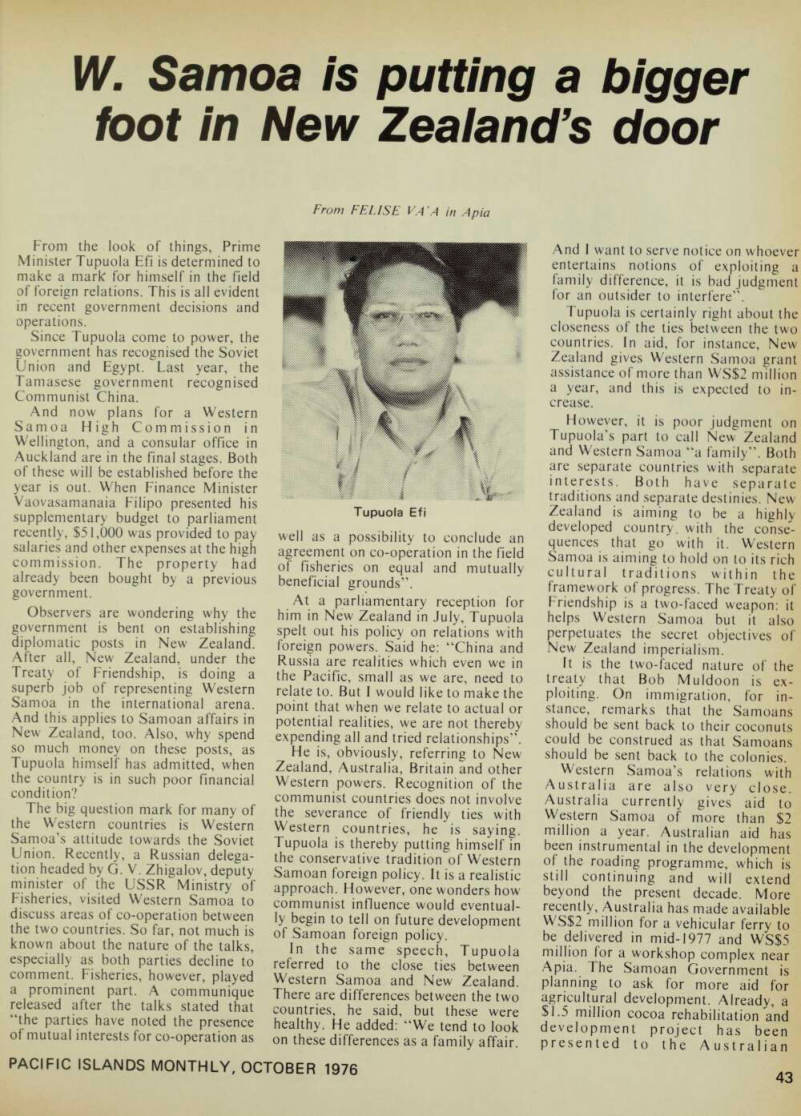
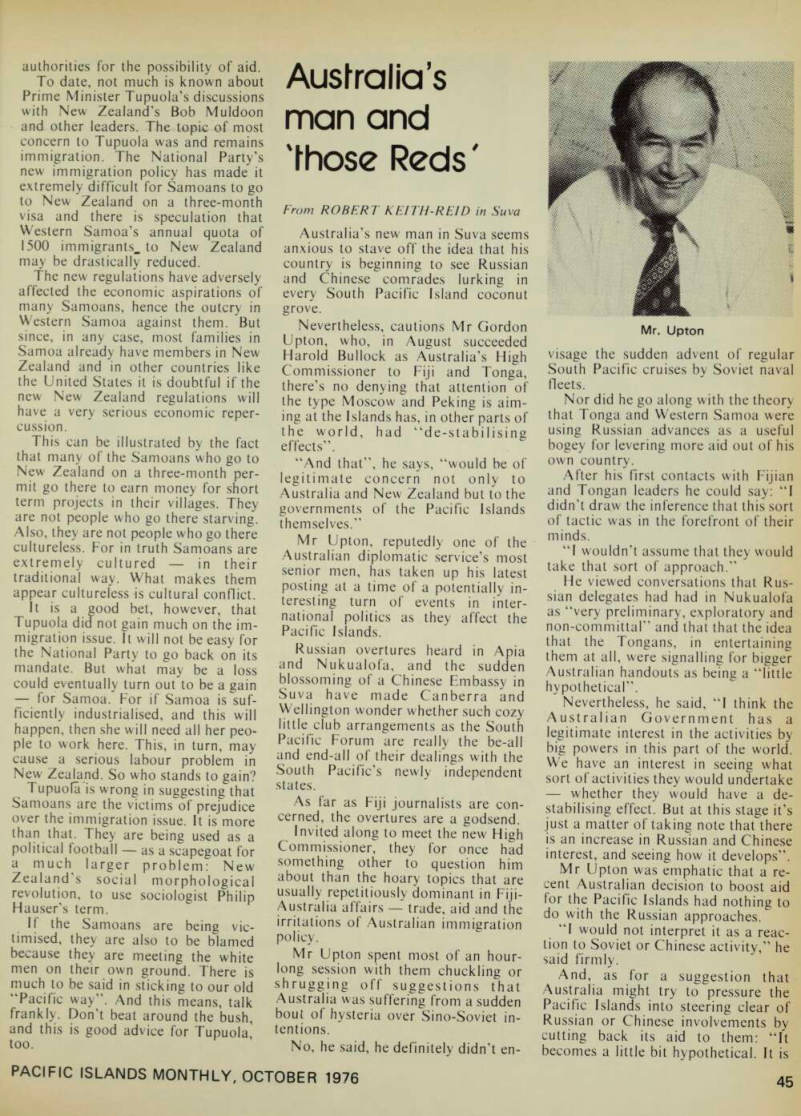
foot in New Zealand’s door
From FELISE VA’A in Apia
From the look of things, Prime Minister Tupuola Efi is determined to make a mark for himself in the field of foreign relations. This is all evident in recent government decisions and operations.
Since Tupuola come to power, the government has recognised the Soviet Union and Egypt. Last year, the Tamasese government recognised Communist China.
And now plans for a Western Samoa High Commission in Wellington, and a consular office in Auckland are in the final stages. Both of these will be established before the year is out. When Finance Minister Vaovasamanaia Filipo presented his supplementary budget to parliament recently, $51,000 was provided to pay salaries and other expenses at the high commission. The property had already been bought by a previous government.
Observers are wondering why the government is bent on establishing diplomatic posts in New Zealand.
After all, New Zealand, under the Treaty of Friendship, is doing a superb job of representing Western Samoa in the international arena.
And this applies to Samoan affairs in New Zealand, too. Also, why spend so much money on these posts, as Tupuola himself has admitted, when the country is in such poor financial condition?
The big question mark for many of the Western countries is Western Samoa’s attitude towards the Soviet Union. Recently, a Russian delega tion headed by G. V. Zhigalov, deputy minister of the USSR Ministry of Fisheries, visited Western Samoa to discuss areas of co-operation between the two countries. So far, not much is known about the nature of the talks, especially as both parties decline to comment. Fisheries, however, played a prominent part. A communique released after the talks stated that “the parties have noted the presence of mutual interests for co-operation as
well as a possibility to conclude an agreement on co-operation in the field of fisheries on equal and mutually beneficial grounds”.
At a parliamentary reception for him in New Zealand in July, Tupuola spelt out his policy on relations with foreign powers. Said he: “China and Russia are realities which even we in the Pacific, small as we are, need to relate to. But I would like to make the point that when we relate to actual or potential realities, we are not thereby expending all and tried relationships”.
He is, obviously, referring to New Zealand, Australia, Britain and other Western powers. Recognition of the communist countries does not involve the severance of friendly ties with Western countries, he is saying.
Tupuola is thereby putting himself in the conservative tradition of Western Samoan foreign policy. It is a realistic approach. However, one wonders how communist influence would eventual ly begin to tell on future development of Samoan foreign policy.
In the same speech, Tupuola referred to the close ties between Western Samoa and New Zealand.
There are differences between the two countries, he said, but these were healthy. He added; “We tend to look on these differences as a family affair.
And I want to serve notice on whoever entertains notions of exploiting a family difference, it is bad judgment for an outsider to interfere”.
Tupuola is certainly right about the closeness of the ties between the two countries. In aid, for instance, New Zealand gives Western Samoa grant assistance of more than WS$2 million a year, and this is expected to in crease.
However, it is poor judgment on Tupuola’s part to call New Zealand and Western Samoa “a family”. Both are separate countries with separate interests. Both have separate traditions and separate destinies. New Zealand is aiming to be a highly developed country, with the conse quences that go with it. Western Samoa is aiming to hold on to its rich cultural traditions within the framework of progress. The Treaty of Friendship is a two-faced weapon: it helps Western Samoa but it also perpetuates the secret objectives of New Zealand imperialism.
It is the two-faced nature of the treaty that Bob Muldoon is ex ploiting. On immigration, for in stance, remarks that the Samoans should be sent back to their coconuts could be construed as that Samoans should be sent back to the colonies.
Western Samoa’s relations with Australia are also very close.
Australia currently gives aid to Western Samoa of more than $2 million a year. Australian aid has been instrumental in the development of the reading programme, which is still continuing and will extend beyond the present decade. More recently, Australia has made available WS$2 million for a vehicular ferry to be delivered in mid-1977 and WS$5 million for a workshop complex near Apia. The Samoan Government is planning to ask for more aid for agricultural development. Already, a $1.5 million cocoa rehabilitation and development project has been presented to the Australian
Tupuola Efi
authorities for the possibility of aid.
To date, not much is known about Prime Minister Tupuola’s discussions with New Zealand’s Bob Muldoon and other leaders. The topic of most concern to Tupuola was and remains immigration. The National Party’s new immigration policy has made it extremely difficult for Samoans to go to New Zealand on a three-month visa and there is speculation that Western Samoa’s annual quota of 1500 immigrants, to New Zealand may be drastically reduced.
The new regulations have adversely affected the economic aspirations of many Samoans, hence the outcry in Western Samoa against them. But since, in any case, most families in Samoa already have members in New Zealand and in other countries like the United States it is doubtful if the new New Zealand regulations will have a very serious economic reper cussion.
This can be illustrated by the fact that many of the Samoans who go to New Zealand on a three-month per mit go there to earn money for short term projects in their villages. They are not people who go there starving.
Also, they are not people who go there cultureless. For in truth Samoans are extremely cultured in their traditional way. What makes them appear cultureless is cultural conflict.
It is a good bet, however, that Tupuola did not gain much on the im migration issue. It will not be easy for the National Party to go back on its mandate. But what may be a loss could eventually turn out to be a gain for Samoa. For if Samoa is suf ficiently industrialised, and this will happen, then she will need all her peo ple to work here. This, in turn, may cause a serious labour problem in New Zealand. So who stands to gain?
Tupuola is wrong in suggesting that Samoans are the victims of prejudice over the immigration issue. It is more than that. They are being used as a political football as a scapegoat for a much larger problem: New Zealand s social morphological revolution, to use sociologist Philip Hauser’s term.
If the Samoans are being vic timised, they are also to be blamed because they are meeting the white men on their own ground. There is much to be said in sticking to our old “Pacific way”. And this means, talk frankly. Don’t beat around the bush, and this is good advice for Tupuola, too.
Advertisements & other items, p. 44 (1 item)
Sincerest Congratulations
to the People of
Papua New Guinea
On the First Anniversary
of Their Independence
it C. Itoh is an extremely diversified business organization whose activity extends far beyond the trade. Besides import/export and third-country trade, we engage in such wideranging activities as the development of natural resources, construction of industrial plants, international investment, technical assistance, diversified joint ventures and many others.
We believe good opportunities are created by good partnerships.
Japan,a Pacific nation, shall be happy to forge new ties with a new Pacific nation. Close trade links shall bring mutual prosperity and better understanding which, we believe, will undoubtedly serve in the best interest of both nations that even goes beyond trade. total business company
C. ITOH & CO., (Aust.) LIMITED
Port Moresby Office: Bird Building, Cuthbertson St., Port Moresby.
P.O. Box 3576, Port Moresby. Phone: 3083 Telex: CITOH NE 22174 Headquarters in Oceania: Gold Fields House, 1 Alfred St., Sydney.
G.P.O. Box 4271, Sydney, N.S.W. 2001 Australia. Phone: 27-7611 Telex: 20205
C. ITOH & CO., LTD.
Founded in 1858 Capital: ¥34,912,876,800 (approx: A 587,212,000) Tokyo Head Office: C.P.O. Box 136, Tokyo, 100-90 Japan.
Osaka Head Office: C.P.O. Box 117, Osaka, 530-91 Japan.
'those Reds'

Australia’s man and 'those Reds'
From ROBERT KEITH-REID in Suva Australia’s new man in Suva seems anxious to stave off the idea that his country is beginning to see Russian and Chinese comrades lurking in every South Pacific Island coconut grove.
Nevertheless, cautions Mr Gordon Upton, who, in August succeeded Harold Bullock as Australia’s High Commissioner to Fiji and Tonga, there’s no denying that attention of the type Moscow and Peking is aim ing at the Islands has, in other parts of the world, had “de-stabilising effects”.
“And that”, he says, “would be of legitimate concern not only to Australia and New Zealand but to the governments of the Pacific Islands themselves.”
Mr Upton, reputedly one of the Australian diplomatic service’s most senior men, has taken up his latest posting at a time of a potentially in teresting turn of events in inter national politics as they affect the Pacific Islands.
Russian overtures heard in Apia and Nukualofa, and the sudden blossoming of a Chinese Embassy in Suva have made Canberra and Wellington wonder whether such cozy little club arrangements as the South Pacific Forum are really the be-all and end-all of their dealings with the South Pacific’s newly independent states.
As far as Fiji journalists are con cerned, the overtures are a godsend.
Invited along to meet the new High Commissioner, they for once had something other to question him about than the hoary topics that are usually repetitiously dominant in Fiji- Australia affairs trade, aid and the irritations of Australian immigration
policy.
Mr Upton spent most of an hour long session with them chuckling or shrugging off suggestions that Australia was suffering from a sudden bout of hysteria over Sino-Soviet in tentions.
No, he said, he definitely didn’t en-
visage the sudden advent of regular South Pacific cruises by Soviet naval fleets.
Nor did he go along with the theory that Tonga and Western Samoa were using Russian advances as a useful bogey for levering more aid out of his own country.
After his first contacts with Fijian and Tongan leaders he could say: “I didn't draw the inference that this sort of tactic was in the forefront of their minds.
“I wouldn’t assume that they would take that sort of approach.”
He viewed conversations that Rus sian delegates had had in Nukualofa as “very preliminary, exploratory and non-committal” and that that the idea that the Tongans, in entertaining them at all, were signalling for bigger Australian handouts as being a “little hypothetical”.
Nevertheless, he said, “I think the Australian Government has a legitimate interest in the activities by big powers in this part of the world.
We have an interest in seeing what sort of activities they would undertake whether they would have a de stabilising effect. But at this stage it’s just a matter of taking note that there is an increase in Russian and Chinese interest, and seeing how it develops”.
Mr Upton was emphatic that a re cent Australian decision to boost aid for the Pacific Islands had nothing to do with the Russian approaches.
“I would not interpret it as a reac tion to Soviet or Chinese activity,” he said firmly.
And, as for a suggestion that Australia might try to pressure the Pacific Islands into steering clear of Russian or Chinese involvements by cutting back its aid to them: “It becomes a little bit hypothetical. It is
Mr. Upton
a long way from anything like that happening. We, as of this moment, are expecting Australian aid to in crease, and nothing has happened, and we don’t really foresee anything happening, that would make us change this view.”
As far as Australia was concerned, there was nothing tangible in either Russian or Chinese moves to worry about.
And even if there were, he didn’t think they would make the South Pacific a place of more importance to Australia than it already was.
But the High Commissioner ad mitted that Australia’s mind was more bent towards the Pacific Islands than had been the case. The Islands were in an arc that was getting more priority now that such preoccupations as Vietnam had gone.
For their part, he imagined that the small countries regarded Australia “as a country which must play its part in solving development problems in this part of the world”.
During his term in Suva, Mr Upton expects to see defence co-operation activities with Fiji expanded.
This year, he pointed out, more than 20 Fiji military men had gone to Australia for training and a RAN lieutenant-commander had been posted to the fledgling naval squadron established in Fiji to patrol fishery zones.
Did he think Australia might like something from Fiji in the way of facilities to enable the Australian Navy and Air Force to extend the range of their patrols?
“It’s premature to speculate on those sort of things,” was his reply.
“Certainly there has been no dis cussions along these lines to my knowledge. I think at this stage it is a very speculative and hypothetical question. 1 really couldn’t comment.”
He was careful to point out that when it came to thinking about the Pacific Islands, Australia’s new Prime Minister, Malcolm Fraser, had, despite pressing domestic political worries, made a point of attending the South Pacific Forum meeting at Rotorua last March as his first overseas trip as PM.
Furthermore, regular meetings between top Australian and Fiji civil servants inaugurated this year to iron out some of the problems between the two countries was an arrangement Canberra had “with really no one else”.
Mr Upton’s record in his country’s
diplomatic services stretches back 31 years and bears out the story of his seniority in it.
He’s served in North America, Asia and Europe. More recent ap pointments were High Commissioner to Sri Lanka from 1966 to 1970, and deputy head of mission in London.
Before arriving in Suva he was number-two man in Washington.
It could be theorised that his arrival in Suva from Washington, London and Colombo is a bit of a comedown for him.
On the other hand perhaps Canberra, sensing that the pace of South Seas diplomacy might be hot ting up, might have decided that a
senior man in Suva is needed to help counter any possible sinister moves.
The city’s diplomatic circles are certainly becoming more entertaining.
For a start the Chinese appear to have brought in cold war tactics.
The American Embassy asked the Chinese to its big 200th independence wing-ding but they did not even acknowledge the invitation, let alone turn up at the reception.
Soon afterwards, the Embassy of the People’s Republic held its first reception in Suva's New Peking Restaurant and the Americans were not invited. US Charge D’Af faires Vance Hall was reportedly vex ed at the snub.
Advertisements & other items, pp. 46-47 (1 item)
G O Go Fye R
The world over, more vehicles of all kinds roll on Goodyear tyres ... more planes land on Goodyear tyres ... more synthetic rubber is produced by Goodyear... and more different kinds of hose,
transmission belts, conveyor belts and other
industrial rubber goods bear the Goodyear trademark.
For leadership in rubber technology, look to
Goodyear. The world’s largest rubber company.
GOODYEAR DISTRIBUTORS IN S.E. ASIA AND PACIFIC BASIN
G O GO fYE R
We solve industrial problems
Boroko Motors Ltd.
Port Moresby, PNG.
Societe General Automobile Noumea, New Caledonia Service Mobil Papeete, Tahiti Santo Engineers Santo, New Hebrides Microl Corporation Saipan, Mariana Is.
W.S.T.C.S.
Western Samoa Samoa Motors Inc.
American Samoa Pacific Motors Vila, New Hebrides Yap Cooperative Ass.
Yap, W. Caroline Is.
Morris Hedstrom Ltd.
Apia, Western Samoa Duncombe Bay Garage Norfolk Is.
Truk Trading Co.
Truk, E. Caroline Is.
P.A.M.I.
Morris Hedstrom Tonga Guam Tire & Supply Co.
Agana, Guam Cook Island Motors Cook Is.
Coral Island Motors Suva, Fiji Island Construction Co.
Majuro, Marshall Is.
Ngiratkel Etpison Co. Ltd.
Koror, Palau Yung Wei Tung Trading Co. Ltd.
Taipei, Taiwan Landis Brothers & Co. Ltd.
Hong Kong Solomon Motors Ltd.
Honiara, 8.5.1. P.
Susupe Enterprises Saipan, Mariana Is.
Kolonia, Ponape A 557
E. G. BARKER & CO.
PTY. LTD.
Established 1825 150 Years of Service
AUSTRALIA'S OLDEST EXPORT HOUSE
GENERAL EXPORT MERCHANTS
Specialising in world-wide distribution of General Merchandise, Provisions and Produce
Buying Agents for:
THE CO-OPERATIVE WHOLESALE SOCIETY LTD.
Lae and all branches throughout PNG
Representatives
PORT MORESBY
RABAUL
RAYMOND WONG NEW GUINEA ISLANDS
p o Box 5020 PRODUCE CO. LTD.
BOROKO p q Box 387 Phone 25 5546 RABAUL Phone: 921982
FIJI
PARAMOUNT AGENCIES
G.P.O. Box 459
SUVA
Phone 2 3127
34 HUNTER STREET, SYDNEY 2000
Cable Address: KERBAR SYDNEY Phone: 231 6200. Telex: 22221 Melbourne Office: 530 Little Collins Street.
Phone: 61 2877. Telex 31732
Islands
Prom The
Press
In praise of tinned fish a quote from Fiji Prime Minister Ratu Sir Kamisese Mara when opening a new tuna canning factory at Levuka and reported in The Fiji Times: . . . There is another small point linked with Fijian custom.
Perhaps it sounds rather trivial but none the less real. Presen tations of food are an integral part of our custom for many oc casions. Nearly always that food has to be divided into a number of shares. A carton of 48 tins of fish is infinitely easier for Tuirara to distribute in proportions that all can see to be fair . . .
One method for rehabilitating lawbreakers as reported in the PNG Post-Courier: A local government councillor wants prisoners to work in the streets “where people can see them”. “This will 'make them feel ashamed, and they won’t give us any more trouble,” Mr Gau Henao told a conference in Port Moresby.
And a comment on Mr Henao’s suggestion in the PNG Post-Courier the following day: . . . Shame is often transitory and evidence suggests that many who commit a crime against their fellow men are so un humiliated by the punishment they err again and again. Sadly they often acquire greater stature in the eyes of their colleagues From the Samoa Times: Close to 500 people were served by two doctors at the Apia Hospital yesterday, and many complained of the long wait they went through before finally making it to a doctor. Many claimed that they started waiting from about 10 o’clock until well into the afternoon . . . One of the doctors said the main cause of the inconvenience was the way the system operated. “There are at least 32 doctors at present, but the way they are allocated to the various wards is so poor that some are carrying a heavy load while others who are on duty in other wards sit and play draughts in the common room most of the time,” the doctor said.
Potted history of New Hebrides National Party leader by Father Walter Lini at the meeting of the Legislative Assembly as reported in the New Hebrides News: It is now 70 years since the ambiguous document called the Anglo-French mixed-fruit-salad (or Protocol) was declared and signed by our metropolitan godfathers. Seventy years of Joint Colonial influence that saw a very slow phase of social and economic and political progress . . . Really one cannot help feel ing that surely for a single country to be administered by two nations would achieve more in less years than some countries in the Pacific ... the end result of it is that the indigenous people are its victims. Perhaps this situation is best summed up by a colleague of mine when he spoke of this joint influence, and I quote, “You have brought us this far, you have made us work here, now get us out of this hell!”.
So now you know . . . NZ Prime Minister Mr Muldoon’s view of the Russians’ entry into the Pacific as reported by the Tonga Chronicle: “I suggest that you treat with a grain of salt headlines suggesting uneasiness between New Zealand and Australia and our Pacific neighbours”, he said (in a speech at the Auckland Lions Club).
“The South Pacific Forum proved each time its members met that ‘when the chips are down, old friends are the best friends’.”
Gilbert Islands Atoll Pioneer, reporting visit of
French frigate:
And so ... we have had the French, the Papua New Guineans, the New Zealanders, the Americans, etc . . . but not the British.
They are not sinking are they?
The pitfalls of translation as revealed by the PNG Post-Courier in an article on translating the New Testament into Pidgin: What’s the Pidgin word for “love”? The translations of the New Testament, the “standard” Pidgin work, opted for “givem bel” and hit a lot of problems. In some areas, it was discovered, it has the connotation of “make pregnant”. The consequences of that, some church people felt, could be disastrous! So a revised edition of the “Nupela Testament” is currently being printed, using “laikim tumas” as the main equivalent of “love”.
From the Samoa Times: A young girl was seen being taken by force aboard one of the local boats tied up behind Treasury and the matter was reported to the police. Constables arrived shortly after and a man jumped into the sea at their approach. The agents of the law took after him in a rubber dinghy. When they nearly caught up one of the policemen jumped in and upset the delicate balance of the tiny boat and gave the other two involuntary baths as well. When the sun went down in the western horizon the sea chase was still on with the seaman easily eluding the efforts of the wet, tired minions of the law.
From The Fiji Times: The question of lowering the voting age from 21 was one that needed the most minute examination, the Attorney-General, Sir John Falvey, told the Alliance on Saturday. He said the matter needed study by a statistician or an actuary, while the Alliance had to consider whether it might damage itself by extending voting rights to younger people. The party was not denying the political aspirations of the young. But lowering the voting age was “a very serious matter, a very difficult one and it could be a fatal one”.
A suggestion from Nauru’s President Hammer Deßoburt speaking in the Gilberts House of Assembly and reported in the Atoll Pioneer: . . . small nations like ours must unite if we are to be heard fairly . . . a joint representation of both Nauru and the Gilberts and, if possible, the Solomons, Tuvalu and the Marshalls as well would merit different considerations (in the United Nations)... to en sure that the common interests of the peoples of the Central Pacific were not sacrificed by default . . .
Advertisements & other items, pp. 49-53 (1 item)
Tough!
ONE-
TONNE
• The length, breadth, strength and suspension to deal with big 1-tonne loads! • Economical, powerful 4-cylinder SOHC oversquare engine. 68.9 kW (92.5 bhp)! • 12 months or 20,000 kilometre warranty! • Expert service and reliable spares supply right through the Pacific! • Great cabin comfort — bench seat, flow-through ventilation.
K it Papua New Guinea Tutt Bryant Pacific Ltd., Port Moresby Wamp Nga Motors, Mt. Hagen Dawapia Motors, Rabaul Solomon Islands Solomon Islands Service Station Republic of Nauru Nauru Co-Operative .Society Western Samoa O. F. Nelson and Co. Ltd.
Fiji Burns Philp (South Sea) Co. Ltd.
New Caledonia
SAIP
General Motors Serving you in the South Pacific.
rrj®
1 3* k a T , r J3 4 * 9 9 9
Musical survival pack.
You want good high fidelity sound reproduction. But, you don’t want to expend all your time and energy (not to mention your bankroll) on mixing and matching individual audio components. Well, Pioneer has done it again.
For those who want great stereo listening without getting lost in an electronic jungle, we are pleased to introduce our MS-6500 stereo system.
Everything you need to play anything you want. All in one beautifully designed package.
At the heart of the MS-6500 is an outstanding AM/FM stereo receiver.
In the amplifier, continuous power output is 18 watts per channel (RMS).
More than enough to fill your listening room with great sound. In the tuner, FM sensitivity is a powerful I.9juV and the S/N ratio is a hushed 73d8 (mono). Stable reception is virtually guaranteed by the presence of advanced PLL circuitry.
Playing your records is easy. The full size turntable features a sensitive tone arm with cartridge plus the added convenience of auto-cut and return.
Multi-source enjoyment is always available with the built-in cassette deck. All controls are user-oriented and the auto-stop mechanism offers protection for both tape and deck.
To make things complete, the MS-6500 includes a pair of balanced three-way, three-speaker systems.
Full rich bass from the big 20cm (8 inch) woofers is enhanced by the solid bass-reflex cabinets.
Pioneer’s new MS-6500 stereo system. Just plug it in, turn it on and save your time for enjoying truly great sound.
CiDpioneeit
Pioneer Electronic Corporation
4-1, Meguro 1-chome, Meguro-ku, Tokyo 153, Japan Australia Pioneer Electronics Australia Pty.
Ltd., 178-184 Boundary Road, Braeside, Victoria 3195, Tel: 90-9011, Sydney 93-0246, Brisbane 52-8231, Adelaide 433379, Perth 76-7776 Fiji Islands Brijlal & Company, G.P.O. Box No, 362, Suva, Fiji Islands Tel: 22258 New Zealand Fountain Marketing Ltd., Maidstone Street, Auckland, New Zealand Tel: 763-064 Norfolk Island Burns Philp (Norfolk Island) Ltd., Norfolk Island, South Pacific New Hebrides Burns Philp (New Hebrides) Ltd., Vila, New Hebrides Nauru Island Jacob Enterprises, P.O. Box No. 4 Republic of Nauru Tahiti Est. PERFECT, B.P. 594, Papeete, Tahiti Tel: 20 407 New Caledonia Menard Freres, B.P. 123, Noumea, New Caledonia Tel: 27.52,22 American Samoa Traspac Corporation, P.O. Box 1477, Pago Pago, American Samoa 96799 Tel: 633-5224 Rarotonga South Seas International Ltd., P.O. Box 49, Rarotonga Cook Islands Tel: 2327
A f* '' t m Mazda 929
Different yes. Frivolous no.
You can see the 929 is different.
Beautiful, clean-flowing lines from nose to tail. Everything on the car, appointments and mechanics, is there for a good practical reason. Building frivolous cars is not for us.
Never has been and never will be.
We build in something everyone appreciates . . . Quality. You’ll know what we mean when you look over the 929. Examine its finish. Settle down at the wheel. And take it out for a spin. Different yes. Frivolous no. 4 «
1976 TOYO KOGYO CO.. LTD.
FIJI ISLANDS Niranjans Autoport Ltd. G.P.O. Box 450. Suva TEL: 22691 NEW CALEDONIA Societe Riviere et Bernanos. 27, Rue de Sebastopol, Noumea PAPUA NEW GUINEA P.N.G. Associated Industries Ltd. P.O. Box 1394, Boroko TEL: 55788 NEW ZEALAND Mazda Motors of New Zealand Ltd Otahuhu, Auckland, P.O. Box 22-472 TEL: 69-099 NORFOLK Duncombe Bay Garage, P.O. Box 220, Norfolk Island TEL: 2097 8.5.1. P. Solomon Motors Ltd. P.O. Box 20, Honiara TEL: 313 TAHITI Comptoir Polynesian, B.P. 628, Papeete.
The trademark MAZDA in this advertisemet stands for AUTOMOBILES MAZDA as far as France and her territories are concerned.
» • It I rS .* I* K L I iW . M ••.1 I I 1 ail
mom
pIS feM»
sSSSS
>3* BHi w^V li m mm
wsmssm
■K m That's what the u.S. Environmental Protection Agency figures show. The Honda Civic placed first among the hundreds of 1976 cars tested. On the highway, in the city and in combined driving situations.
Top fuel economy is just the start. All-round operating costs are equally low. Thanks to a rugged, clean-burning OHC engine which delivers snappy acceleration. Elegance is second to none-both inside and out.
Famous Honda engineering also gives you: Enough roomy comfort to relax four adults.
A spacious trunk. Exceptional handling ease. A dual braking system featuring servo-assisted front disc brakes, independent strut suspensions.
All of this quality performance is yours in three exciting models—the 2-Door Sedan, 4-Door Sedan and Hatchback.
Own the 1976 economy champ—the Honda Civic.
HONDA MOTOR CO.. LTD. TOKYO. JAPAN
t t GUIN |A: Steamships-Machinery P.O. Box 1, Port Moresby/TAHITI: Societe Tahitien, Su^Ts FIJI ISLANDS: Coral Island Motors P.O. Box 4 fsiands'969so COOK c S United Micronesia Development Assn. P.O. Box 238, Saipan, Maria.
SAMOA Samoan HnIHHT° in ' Mot ° r Ce " ter Ltd Po ' Box 74 ’ Rar °t°"ga AMERICA SAMOA. Samoan Holiday and Travel Center P.O. Box 968, Pago Pago/AMERICAN SAMOA- H a P rk llZnl C M n J er ° B ° X 1138 ' Pag ° Pago GUAM: Mark ’ s Motor Co., Inc. P.O Box DV / ?fad° gCo Ud 03 ’ Ltd Mm W °o BOX 576 ' Apia SOLOMON ISLANDS: British Solomo.
' n.a S ° Lt s‘ Po ‘ 8 114 ’ Honiara/NEW CALEDONIA: Establissements Ballande Boite Posta Islands D^ m ? Cedex/ ™NG A: EM - J °nes Limited P.O. Box 34, Nuku’alofa/TARAWA: Gilbert & EIM.
Alofi South NaSriYn Auth ° rity p O. Box 488, Beito NIUE ISLAND: S. Jessop & Sons Ltd. P.O. Box 7 HEBRIDES " AURU: N f uru Cooperative Society, Republic of Nauru, Nauru Island Central Pacific/NE HEBRIDES: Tropex International Ltd., P.O. Box 139, Port Vila. acme, mt
Magazine
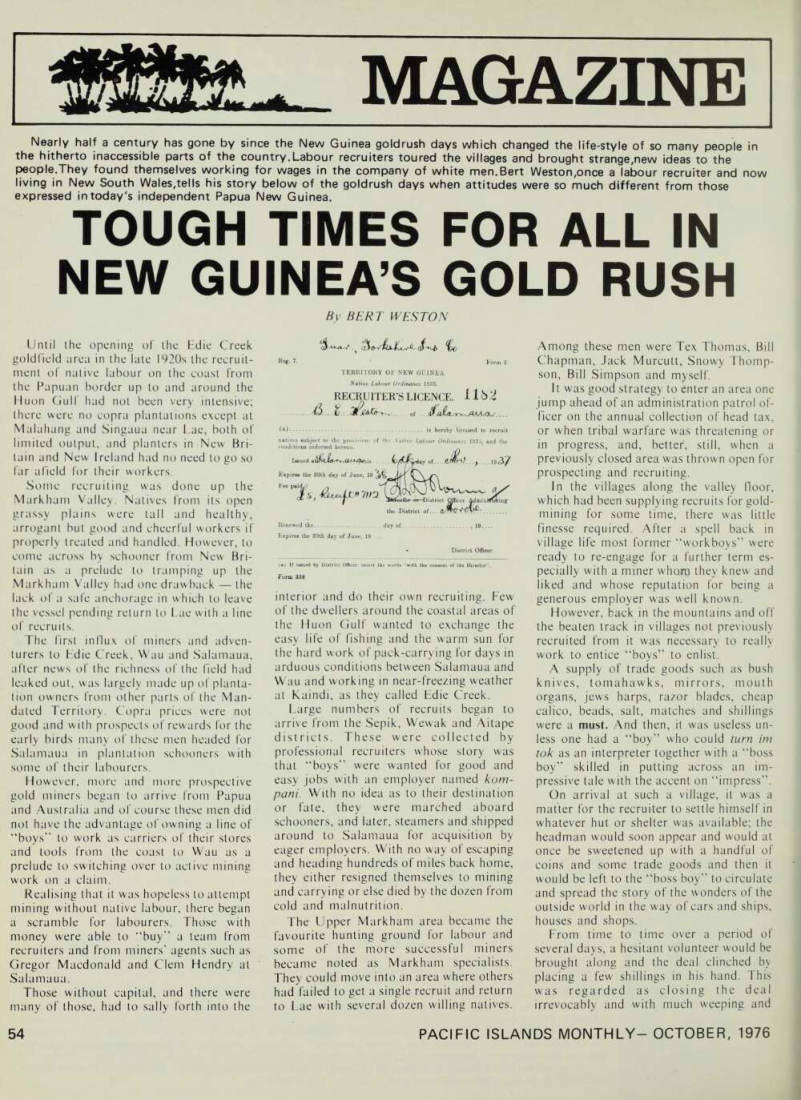
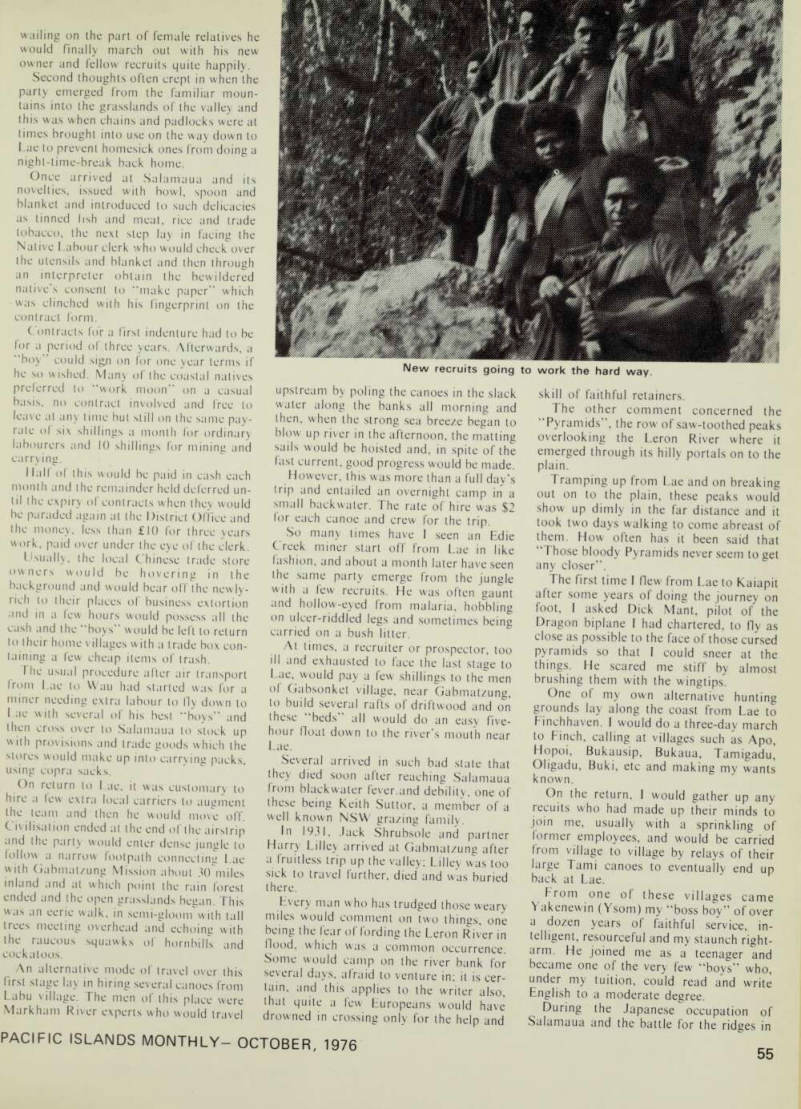
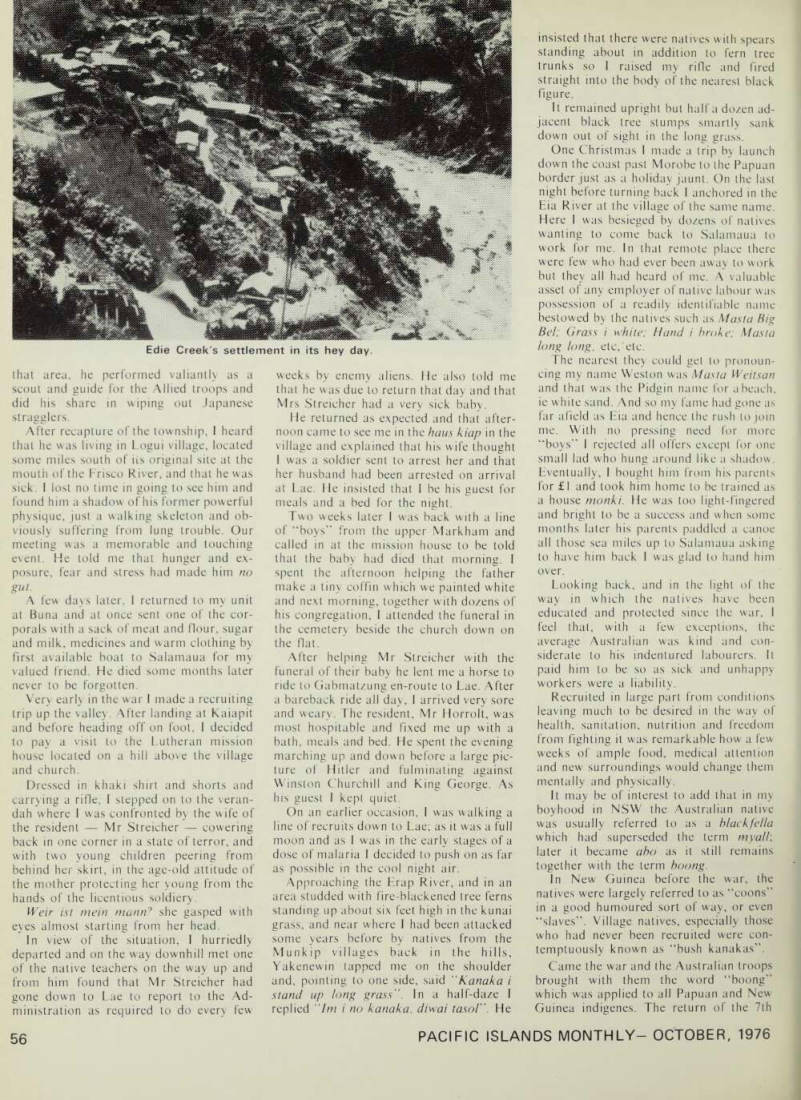
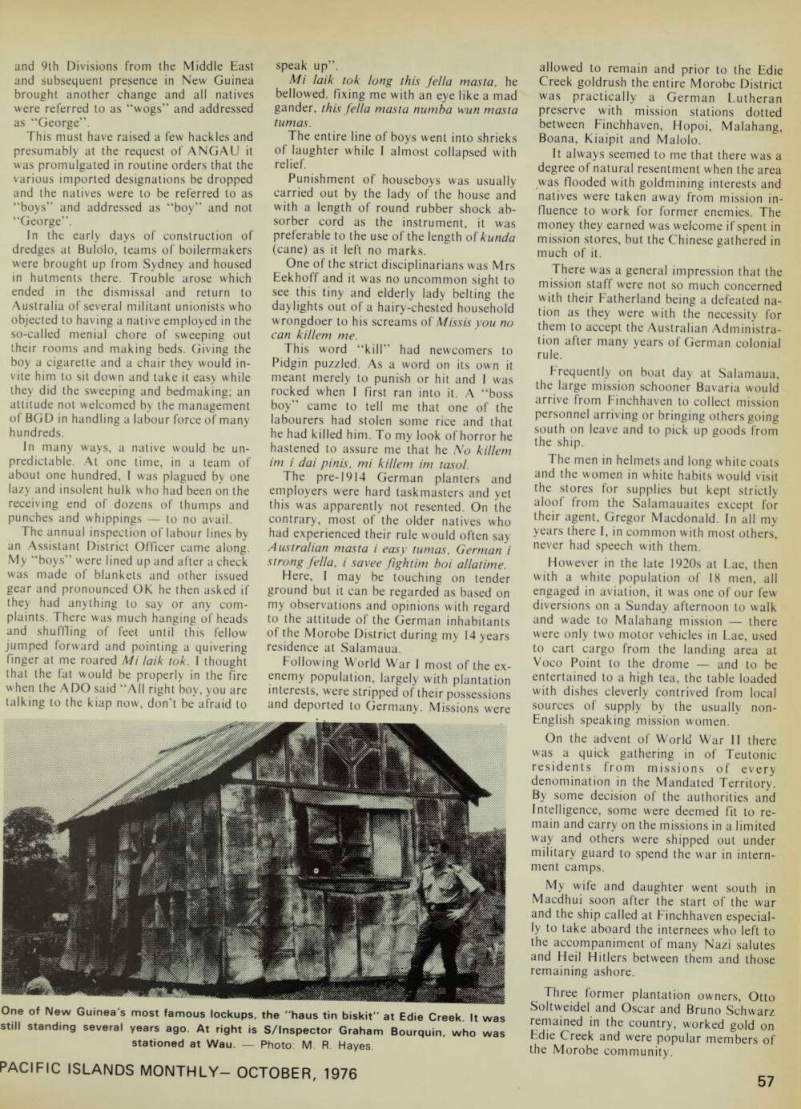
Tough Times For All In
New Guinea’S Gold Rush
Nearly half a century has gone by since the New Guinea goldrush days which changed the life-style of so many people in the hitherto inaccessible parts of the country.Labour recruiters toured the villages and brought strange,new ideas to the people. They found themselves working for wages in the company of white men. Bert Weston,once a labour recruiter and now living in New South Wales,tells his story below of the goldrush days when attitudes were so much different from those expressed in today's independent Papua New Guinea.
By Bert Weston
Until the opening of the Ldie Creek goldfield area in the late 1920 s the recruit ment of native labour on the coast from the Papuan border up to and around the Huon Gulf had not been very intensive; there were no copra plantations except at Malahang and Singaua near Lae, both of limited output, and planters in New Bri tain and New Ireland had no need to go so far afield for their workers.
Some recruiting was done up the Markham Valley. Natives from its open grassy plains were tall and healthy, arrogant but good and cheerful workers if properly treated and handled. However, to come across by schooner from New Bri tain as a prelude to tramping up the Markham Valley had one drawback the lack of a safe anchorage in which to leave the vessel pending return to Lae with a line of recruits.
The first influx of miners and adven turers to Ldie Creek, Wau and Salamaua, after news of the richness of the field had leaked out, was largely made up of planta tion owners from other parts of the Man dated Territory. Copra prices were not good and with prospects of rewards for the early birds many of these men headed for Salamaua in plantation schooners with some of their labourers.
However, more and more prospective gold miners began to arrive from Papua and Australia and of course these men did not have the advantage of owning a line of “boys” to work as carriers of their stores and tools from the coast to Wau as a prelude to switching over to active mining work on a claim.
Realising that it was hopeless to attempt mining without native labour, there began a scramble for labourers. Those with money were able to “buy” a team from recruiters and from miners’ agents such as Gregor Macdonald and Clem Hendry at Salamaua.
Those without capital, and there were many of those, had to sally forth into the
interior and do their own recruiting. Few of the dwellers around the coastal areas of the Huon Gulf wanted to exchange the easy life of fishing and the warm sun for the hard work of pack-carrying for days in arduous conditions between Salamaua and Wau and working in near-freezing weather at Kaindi, as they called Edie Creek.
Large numbers of recruits began to arrive from the Sepik, Wewak and Aitape districts. These were collected by professional recruiters whose story was that “boys” were wanted for good and easy jobs with an employer named kom pani. With no idea as to their destination or fate, they were marched aboard schooners, and later, steamers and shipped around to Salamaua for acquisition by eager employers. With no way of escaping and heading hundreds of miles back home,
they either resigned themselves to mining
and carrying or else died by the dozen from cold and malnutrition.
The Upper Markham area became the favourite hunting ground for labour and some of the more successful miners became noted as Markham specialists.
They could move into an area where others had failed to get a single recruit and return to Lae with several dozen willing natives.
Among these men were Tex Thomas, Bill Chapman, Jack Murcutt, Snowy Thomp son, Bill Simpson and myself.
It was good strategy to enter an area one jump ahead of an administration patrol of ficer on the annual collection of head tax, or when tribal warfare was threatening or in progress, and, better, still, when a previously closed area was thrown open for
prospecting and recruiting.
In the villages along the valley floor, which had been supplying recruits for gold mining for some time, there was little finesse required. After a spell back in village life most former “workboys” were ready to re-engage for a further term es pecially with a miner whoni they knew and liked and whose reputation for being a generous employer was well known.
However, back in the mountains and off the beaten track in villages not previously recruited from it was necessary to really work to entice “boys” to enlist.
A supply of trade goods such as bush knives, tomahawks, mirrors, mouth
organs, jews harps, razor blades, cheap
calico, beads, salt, matches and shillings were a must. And then, it was useless un less one had a “boy” who could turn im tok as an interpreter together with a “boss boy” skilled in putting across an im pressive tale with the accent on “impress”.
On arrival at such a village, it was a matter for the recruiter to settle himself in whatever hut or shelter was available; the headman would soon appear and would at once be sweetened up with a handful of coins and some trade goods and then it would be left to the “boss boy” to circulate and spread the story of the wonders of the outside world in the way of cars and ships, houses and shops.
From time to time over a period of several days, a hesitant volunteer would be brought along and the deal clinched by placing a few shillings in his hand. This was regarded as closing the deal irrevocably and with much weeping and
wailing on the pari of female relatives he would finally march out with his new owner and fellow recruits quite happily.
Second thoughts often crept in when the party emerged from the familiar moun tains into the grasslands of the valley and this was when chains and padlocks were at times brought into use on the way down to Lae to prevent homesick ones from doing a night-time-break back home.
Once arrived at Salamaua and its novelties, issued with bowl, spoon and blanket and introduced to such delicacies as tinned (ish and meat, rice and trade tobacco, the next step lay in facing the Native Labour clerk who would check over the utensils and blanket and then through an interpreter obtain the bewildered native s consent to “make paper” which was clinched with his fingerprint on the contract form.
Contracts lor a first indenture had to be lor a period ol three years. Afterwards, a “boy” could sigyi on for one year terms if he so wished. Many of the coastal natives preferred to “work moon” on a casual basis, no contract involved and free to leave at any lime but still on the same pay rate ol six shillings a month for ordinary labourers and 10 shillings for mining and
carrying.
Hall of this would be paid in cash each month and the remainder held deferred un til the expiry of contracts when they would be paraded again at the District Office and the money, less than £lO for three years work, paid over under the eye of the clerk.
Usually, the local Chinese trade store owners would be hovering in the background and would bear off the newly rich to their places of business extortion and in a few hours would possess all the cash and the “boys” would be left to return to their home villages with a trade box con taining a few cheap items of trash.
The usual procedure after air transport from Lae to Wau had started was for a miner needing extra labour to fly down to Lae with several ol his best “boys” and then cross over to Salamaua to slock up with provisions and trade goods which the stores would make up into carrying packs, using copra sacks.
On return to Lae, it was customary to hire a lew extra local carriers to augment the team and then he would move off.
Civilisation ended at the end of the airstrip and the party would enter dense jungle to follow a narrow footpath connecting Lae with Gabmal/ung Mission about 30 miles inland and at which point the rain forest ended and the open grasslands began. This was an eerie walk, in semi-gloom with tall trees meeting overhead and echoing with the raucous squawks of horn hi lls and cockatoos.
An alternative mode of travel over this first stage lay in hiring several canoes from Labu village. The men of this place were Markham River experts who would travel
upstream by poling the canoes in the slack water along the banks all morning and then, when the strong sea breeze began to blow up river in the afternoon, the matting sails would be hoisted and, in spite of the last current, good progress would be made.
However, this was more than a full day’s trip and entailed an overnight camp in a small backwater. The rate of hire was $2 for each canoe and crew for the trip.
So many limes have I seen an Edie Creek miner start off from Lae in like lashion, and about a month later have seen the same parly emerge from the jungle with a few recruits. He was often gaunt and hollow-eyed from malaria, hobbling on ulcer-riddled legs and sometimes being carried on a bush litter.
At times, a recruiter or prospector, too ill and exhausted to face the last stage to Lae, would pay a few shillings to the men of Gabsonket village, near Gabmatzung, to build several rafts of driftwood and on these “beds” all would do an easy five hour float down to the river's mouth near Lae.
Several arrived in such bad state that they died soon after reaching Salamaua Irom blackwaler fever.and debility, one of these being Keith Suitor, a member of a well known NSW grazing family.
In 1931, Jack Shrubsole and partner
Harry Lilley arrived at Gabmatzung after
a fruitless trip up the valley; Lilley was too sick to travel further, died and was buried there.
Every man who has trudged those weary miles would comment on two things, one being the fear of fording the Leron River in flood, which was a common occurrence.
Some would camp on the river bank for several days, afraid to venture in; it is cer tain, and this applies to the writer also, that quite a few Europeans would have drowned in crossing only for the help and
skill of faithful retainers.
The other comment concerned the “Pyramids”, the row of saw-toothed peaks overlooking the Leron River where it emerged through its hilly portals on to the plain.
Tramping up from Lae and on breaking out on to the plain, these peaks would show up dimly in the far distance and it took two days walking to come abreast of them. How often has it been said that “Those bloody Pyramids never seem to get any closer”.
The first time I flew from Lae to Kaiapit after some years of doing the journey on foot, I asked Dick Mant, pilot of the Dragon biplane I had chartered, to fly as close as possible to the face of those cursed pyramids so that 1 could sneer at the things. He scared me stiff by almost brushing them with the wingtips.
One of my own alternative hunting grounds lay along the coast from Lae to Finchhaven. I would do a three-day march to Finch, calling at villages such as Apo,
Hopoi, Bukausip, Bukaua, Tamigadu,
Oligadu, Buki, etc and making my wants known.
On the return, I would gather up any recuits who had made up their minds to join me, usually with a sprinkling of former employees, and would be carried from village to village by relays of their large Tami canoes to eventually end up back at Lae.
From one of these villages came Yakenewin (Ysom) my “boss boy” of over a dozen years of faithful service, in telligent, resourceful and my staunch right arm. He joined me as a teenager and became one of the very few “boys” who, under my tuition, could read and write English to a moderate degree.
During the Japanese occupation of Salamaua and the battle for the ridges in
Mew recruits going to work the hard way.
that area, he performed valiantly as a scout and guide for the Allied troops and did his share in wiping out Japanese
stragglers.
After recapture of the township, I heard that he was living in Logui village, located some miles south of its original site at the mouth of the Erisco River, and that he was sick. I lost no time in going to see him and found him a shadow of his former powerful physique, just a walking skeleton and ob viously suffering from lung trouble. Our meeting was a memorable and touching event. He told me that hunger and ex posure, fear and stress had made him no gut.
A few days later. I returned to my unit at Buna and at once sent one of the cor porals with a sack of meat and flour, sugar and milk, medicines and warm clothing by first available boat to Salamaua for my valued friend. He died some months later never to be forgotten.
Very early in the war I made a recruiting trip up the valley. After landing at Kaiapit and before heading off on foot, I decided to pay a visit to the Lutheran mission house located on a hill above the village and church.
Dressed in khaki shirt and shorts and carrying a rifle, I stepped on to the veran dah where I was confronted by the wife of the resident Mr Streicher cowering back in one corner in a state of terror, and with two young children peering from behind her skirt, in the age-old attitude of the mother protecting her young from the hands of the licentious soldiery.
Weir ist mein mann? she gasped with eyes almost starting from her head.
In view of the situation, I hurriedly departed and on the way downhill met one of the native teachers on the way up and from him found that Mr Streicher had gone down to Lae to report to the Ad ministration as required to do every few
weeks by enemy aliens. He also told me that he was due to return that day and that Mrs Streicher had a very sick baby.
He returned as expected and that after noon came to see me in the haus kiap in the village and explained that his wife thought I was a soldier sent to arrest her and that her husband had been arrested on arrival at Lae. He insisted that I be his guest for meals and a bed for the night.
Two weeks later I was back with a line of “boys” from the upper Markham and called in at the mission house to be told that the baby had died that morning. I spent the afternoon helping the father make a tiny coffin which we painted white and next morning, together with dozens of his congregation, I attended the funeral in the cemetery beside the church down on the flat.
After helping Mr Streicher with the funeral of their baby he lent me a horse to ride to Gabmatzung en-route to Lae. After a bareback ride all day, I arrived very sore and weary. The resident, Mr Horrolt, was most hospitable and fixed me up with a bath, meals and bed. He spent the evening marching up and down before a large pic ture of Hitler and fulminating against Winston Churchill and King George. As his guest I kept quiet.
On an earlier occasion, 1 was walking a line of recruits down to Lae; as it was a full moon and as I was in the early stages of a dose of malaria I decided to push on as far as possible in the cool night air.
Approaching the Erap River, and in an area studded with fire-blackened tree ferns standing up about six feet high in the kunai grass, and near where I had been attacked some years before by natives from the Munkip villages back in the hills, Yakenewin lapped me on the shoulder and, pointing to one side, said “Kanaka i stand up long grass". In a half-daze I replied “Im i no kanaka, diwai tasol’’. He
insisted that there were natives with spears standing about in addition to fern tree trunks so I raised my rifle and fired straight into the body of the nearest black
figure.
It remained upright but half a dozen ad jacent black tree stumps smartly sank down out of sight in the long grass.
One Christmas I made a trip by launch down the coast past Morobe to the Papuan border just as a holiday jaunt. On the last night before turning back I anchored in the Eia River at the village of the same name.
Here I was besieged by dozens of natives wanting to come back to Salamaua to work for me. In that remote place there were few who had ever been away to work but they all had heard of me. A valuable asset of any employer of native labour was possession of a readily identifiable name bestowed by the natives such as Masta Big Bel: Grass i white: Hand i broke: Masta
long long, etc, etc.
The nearest they could get to pronoun cing my name Weston was Masta Weitsan and that was the Pidgin name for a beach, ie white sand. And so my fame had gone as far afield as Eia and hence the rush to join me. With no pressing need for more “boys” I rejected all offers except for one small lad who hung around like a shadow.
Eventually, I bought him from his parents for £1 and took him home to be trained as a house monki. He was 100 light-fingered and bright to be a success and when some months later his parents paddled a canoe all those sea miles up to Salamaua asking to have him back 1 was glad to hand him over.
Looking back, and in the light of the way in which the natives have been educated and protected since the war, I feel that, with a few exceptions, the average Australian was kind and con siderate to his indentured labourers. It paid him to be so as sick and unhappy workers were a liability.
Recruited in large part from conditions leaving much to be desired in the way of health, sanitation, nutrition and freedom from fighting it was remarkable how a few weeks of ample food, medical attention and new surroundings would change them mentally and physically.
It may be of interest to add that in my boyhood in NSW the Australian native was usually referred to as a hlackfella which had superseded the term myall ; later it became aho as it still remains together with the term hoong.
In New Guinea before the war, the natives were largely referred to as “coons” in a good humoured sort of way, or even “slaves”. Village natives, especially those who had never been recruited were con temptuously known as “bush kanakas”.
Came the war and the Australian troops brought with them the word “boong” which was applied to all Papuan and New Guinea indigenes. The return of the 7th
Edie Creek's settlement in its hey day.
and 9th Divisions from the Middle East and subsequent presence in New Guinea brought another change and all natives were referred to as “wogs” and addressed as “George”.
This must have raised a few hackles and presumably at the request of ANGAU it was promulgated in routine orders that the various imported designations be dropped and the natives were to be referred to as “boys” and addressed as “boy” and not “George”.
In the early days of construction of dredges at Buldlo, teams of boilermakers were brought up from Sydney and housed in hutments there. Trouble arose which ended in the dismissal and return to Australia of several militant unionists who objected to having a native employed in the so-called menial chore of sweeping out their rooms and making beds. Giving the boy a cigarette and a chair they would in vite him to sit down and take it easy while they did the sweeping and bedmaking; an attitude not welcomed by the management of BCD in handling a labour force of many hundreds.
In many ways, a native would be un predictable. At one time, in a team of about one hundred, I was plagued by one lazy and insolent hulk who had been on the receiving end of dozens of thumps and punches and whippings to no avail.
The annual inspection of labour lines by an Assistant District Officer came along.
My “boys” were lined up and after a check was made of blankets and other issued gear and pronounced OK he then asked if they had anything to say or any com plaints. There was much hanging of heads and shuffling of feet until this fellow jumped forward and pointing a quivering finger at me roared Mi laik tok. I thought that the fat would be properly in the fire when the ADO said “All right boy, you are talking to the kiap now, don’t be afraid to
speak up”.
Mi laik tok long this fella masta, he bellowed, fixing me with an eye like a mad gander, this fella masta numba wun masta tumas.
The entire line of boys went into shrieks of laughter while I almost collapsed with relief.
Punishment of houseboys was usually carried out by the lady of the house and with a length of round rubber shock ab sorber cord as the instrument, it was preferable to the use of the length o fkunda (cane) as it left no marks.
One of the strict disciplinarians was Mrs Eekhoff and it was no uncommon sight to see this tiny and elderly lady belting the daylights out of a hairy-chested household wrongdoer to his screams of Missis you no can killem me.
This word “kill” had newcomers to Pidgin puzzled. As a word on its own it meant merely to punish or hit and 1 was rocked when I first ran into it. A “boss boy” came to tell me that one of the labourers had stolen some rice and that he had killed him. To my look of horror he hastened to assure me that he No killem im i dai pints, mi killem im tasol.
The pre-1914 German planters and employers were hard taskmasters and yet this was apparently not resented. On the contrary, most of the older natives who had experienced their rule would often say A ustralian masta i easy tumas, German i strong fella, i savee fightim boi allatime.
Here, I may be touching on tender ground but it can be regarded as based on my observations and opinions with regard to the attitude of the German inhabitants of the Morobe District during my 14 years residence at Salamaua.
Following World War I most of the ex enemy population, largely with plantation interests, were stripped of their possessions and deported to Germany. Missions were
allowed to remain and prior to the Edie Creek goldrush the entire Morobe District was practically a German Lutheran preserve with mission stations dotted between Finchhaven, Hopoi, Malahang, Boana, Kiaipit and Malolo.
It always seemed to me that there was a degree of natural resentment when the area was flooded with goldmining interests and natives were taken away from mission in fluence to work for former enemies. The money they earned was welcome if spent in mission stores, but the Chinese gathered in much of it.
There was a general impression that the mission staff were not so much concerned with their Fatherland being a defeated na tion as they were with the necessity for them to accept the Australian Administra tion after many years of German colonial rule.
Frequently on boat day at Salamaua, the large mission schooner Bavaria would arrive from Finchhaven to collect mission
personnel arriving or bringing others going
south on leave and to pick up goods from
the ship.
The men in helmets and long white coats and the women in white habits would visit the stores for supplies but kept strictly aloof from the Salamauaites except for their agent, Gregor Macdonald. In all my years there I, in common with most others, never had speech with them.
However in the late 1920 s at Lae, then with a white population of 18 men, all engaged in aviation, it was one of our few diversions on a Sunday afternoon to walk and wade to Malahang mission there were only two motor vehicles in Lae, used to cart cargo from the landing area at Voco Point to the drome and to be entertained to a high tea, the table loaded with dishes cleverly contrived from local sources of supply by the usually non- English speaking mission women.
On the advent of World War II there was a quick gathering in of Teutonic residents from missions of every denomination in the Mandated Territory.
By some decision of the authorities and Intelligence, some were deemed fit to re main and carry on the missions in a limited way and others were shipped out under military guard to spend the war in intern ment camps.
My wife and daughter went south in Macdhui soon after the start of the war and the ship called at Finchhaven especial ly to take aboard the internees who left to the accompaniment of many Nazi salutes and Heil Hitlers between them and those remaining ashore.
Three former plantation owners, Otto Soltweidel and Oscar and Bruno Schwarz remained in the country, worked gold on Edie Creek and were popular members of the Morobe community.
One of New Guinea s most famous lockups, the "haus tin biskit" at Edie Creek. It was still standing several years ago. At right is S/lnspector Graham Bourquin, who was stationed at Wau. Photo: M R Hayes.
Advertisements & other items, p. 58 (1 item)
Chloride The Most Complete
SOURCE OF PACKAGED POWER IN
THE SOUTHERN HEMISPHERE.
A generous statement? Maybe, but then Chloride is equipped and qualified as such . . always ready to offer advice, guidance and service on your battery requirements.
And it goes way beyond automotive batteries. No matter what the problem . . if it's a question of power. . battery power. . it's one for Chloride. It could be as small as a battery for a hearing aid the size of a coat button, or a power station battery weighing 40 tonnes.
Again, it could be a no break D.C. power system for a computer or emergency lighting for a hospital..
Nearly 50% of all batteries sold in Australia are made by Chloride.
No matter what the application . .
Transport, Industrial, Communication, Defence, Mining, Marine, Recreation . . .
Make Chloride power work for you.
Mo, Telecommunications Chloride Batteries Australia Limited 55 Bryant Street, Padstow, N.S.W. 2211, Australia. * Emergency Lighting Electric Vehicles \ itt Engine Starting Automotive srzi mi i hi j Telephone; 77 0177
How The Melanesians
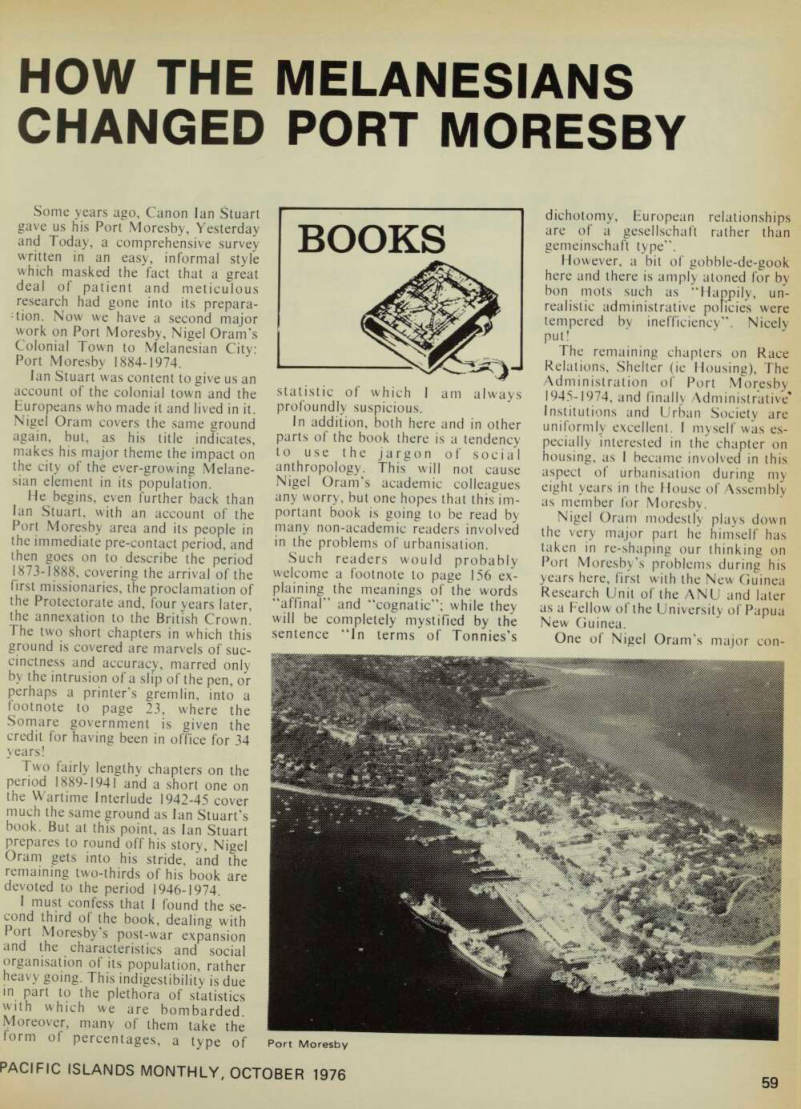
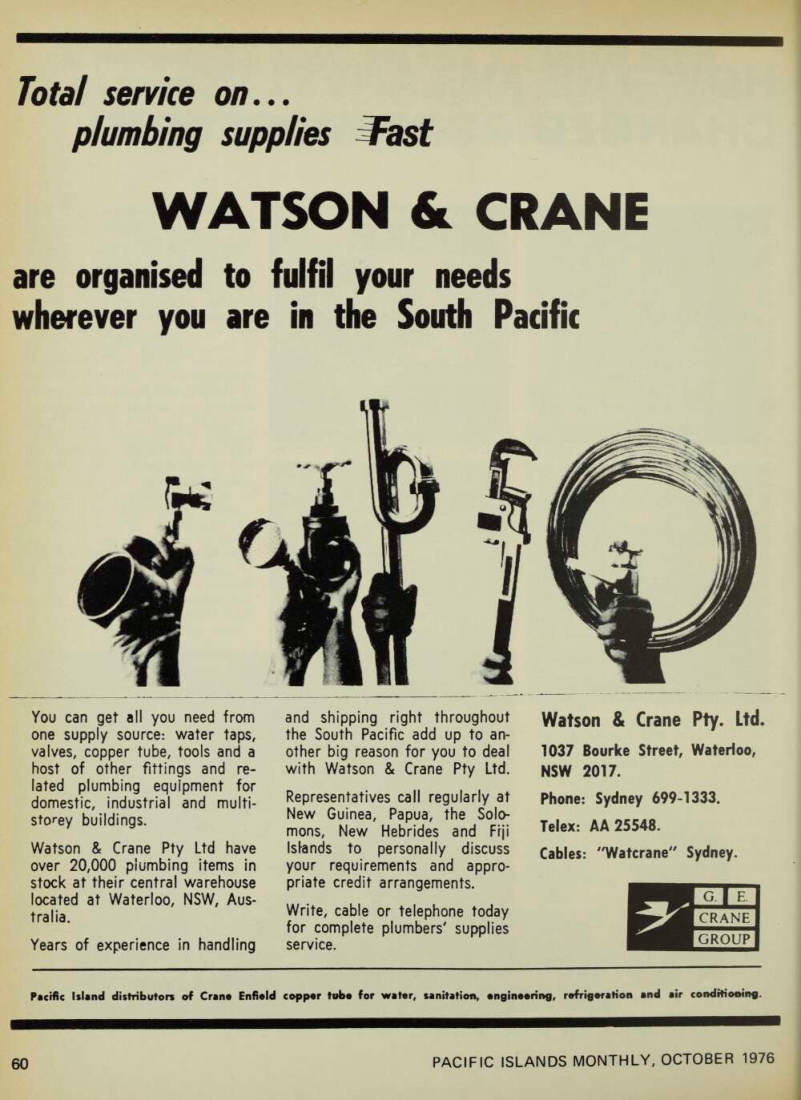
Changed Port Moresby
Some years ago, Canon lan Stuart gave us his Port Moresby, Yesterday and Today, a comprehensive survey written in an easy, informal style which masked the fact that a great deal of patient and meticulous research had gone into its prepara tion. Now we have a second major work on Port Moresby, Nigel Oram’s Colonial Town to Melanesian City: Port Moresby 1884-1974. lan Stuart was content to give us an account of the colonial town and the Europeans who made it and lived in it.
Nigel Oram covers the same ground again, but, as his title indicates, makes his major theme the impact on the city of the ever-growing Melane sian element in its population.
He begins, even further back than lan Stuart, with an account of the Port Moresby area and its people in the immediate pre-contact period, and then goes on to describe the period 1873-1888, covering the arrival of the first missionaries, the proclamation of the Protectorate and, four years later, the annexation to the British Crown.
The two short chapters in which this ground is covered are marvels of suc cinctness and accuracy, marred only by the intrusion of a slip of the pen, or perhaps a printer’s gremlin, into a footnote to page 23, where the Somare government is given the credit for having been in office for 34 years!
Two fairly lengthy chapters on the period 1889-1941 and a short one on the Wartime Interlude 1942-45 cover much the same ground as lan Stuart’s book. But at this point, as lan Stuart prepares to round off his story, Nigel Oram gets into his stride, and the remaining two-thirds of his book are devoted to the period 1946-1974.
I must confess that I found the se cond third of the book, dealing with Port Moresby’s post-war expansion and the characteristics and social organisation of its population, rather heavy going. This indigestibility is due in part to the plethora of statistics with which we are bombarded Moreover, many of them take the form of percentages, a type of
Books
statistic of which I am always profoundly suspicious.
In addition, both here and in other parts of the book there is a tendency to use the jargon of social anthropology. This will not cause Nigel Oram’s academic colleagues any worry, but one hopes that this im portant book is going to be read by many non-academic readers involved in the problems of urbanisation.
Such readers would probably welcome a footnote to page 156 ex plaining the meanings of the words “affinal” and “cognatic”; while they will be completely mystified by the sentence “In terms of Tonnies’s
dichotomy, European relationships are of a gesellschafl rather than gemeinschaft type”.
However, a bit of gobble-de-gook here and there is amply atoned for by bon mots such as “Happily, un realistic administrative policies were tempered by inefficiency”. Nicely put!
The remaining chapters on Race Relations, Shelter (ie Housing), The Administration of Port Moresby 1945-1974, and finally Administrative* Institutions and Urban Society are uniformly excellent. I myself was es pecially interested in the chapter on housing, as I became involved in this aspect of urbanisation during my eight years in the House of Assembly as member for Moresby.
Nigel Oram modestly plays down the very major part he himself has taken in re-shaping our thinking on Port Moresby’s problems during his years here, first with the New Guinea Research Unit of the ANU and later as a Fellow of the University of Papua New Guinea.
One of Nigel Oram’s major con-
Port Moresby
Port Moresby
cerns has been the de-centralisation of municipal government to the “ward” level. While some progress has been made in this direction, the process is far from complete, and in particular the idea of using the ward organisa tion as a unit in the maintenance of law and order has been shied away from. Perhaps one day we shall realise that Nigel Oram was right about this, as he has been about so many things.
This is a book which should be “read, marked and inwardly digested” by all who are involved in any aspect of urbanisation, whether in Port Moresby or the Pacific or anywhere else in the developing world.
Our thanks must go to Nigel Oram for writing it, and to the ANU Press for giving it to us in so attractive a format a pleasant change indeed from those “way out” dust jackets which this press has been inflicting on us during the last few years.
Percy Chatterton
(Colonial Town To Melanesian City: Port
MORESBY 1884-1974. By Nigel Oram. Published by Australian National University Press, Canberra, ACT $10.95.)
Advertisements & other items, p. 60 (1 item)
Watson & Crane
Total service 0n ...
plumbing supplies Fast
are organised to fulfil your needs
wherever you are in the South Pacific r*: « You can get all you need from one supply source: water taps, valves, copper tube, tools and a host of other fittings and related plumbing equipment for domestic, industrial and multistorey buildings.
Watson & Crane Pty Ltd have over 20,000 plumbing items in stock at their central warehouse located at Waterloo, NSW, Australia.
Years of experience in handling and shipping right throughout the South Pacific add up to another big reason for you to deal with Watson & Crane Pty Ltd.
Representatives call regularly at New Guinea, Papua, the Solomons, New Hebrides and Fiji Islands to personally discuss your requirements and appropriate credit arrangements.
Write, cable or telephone today for complete plumbers' supplies service.
Watson & Crane Pty. Ltd. 1037 Bourke Street, Waterloo,
NSW 2017.
Phone: Sydney 699-1333.
Telex: AA 25548.
Cables: "Watcrane" Sydney.
Pacific Island distributors of Crane Enfield copper tube for water, sanitation, engineering, refrigeration and air conditioning.
Those cruising folk from Hicksville
Maybe there is something significant in the fact that Cruising the World in High Style, by John and Naomi Loux, is published in Hicksville, NY.
John and Naomi are simple American folk who’d never been on a cruise before they embarked on a 9 3-days voyage on a Swedish luxury liner from New Y ork. He compiled his diary of their experiences, the only difference between it and a million other trip-diaries being the fact that they managed to have it published.
Nothing is too trivial to be mentioned (for their first luncheon on board they chose thin slices of tender beej sauted with onions, grape cocktail, cream of broccoli soup, iceberg salad and cheesecake); John was determined not to be trapped into any cocktail clique (very sensible); and Naomi was so affected by the wonder of it alt she sometimes burst into verse: Look at that blue sky; Look at that blue sea.
Is that you?
Is this really me?
This was off Cape Town.
John v odd littlehook (it has nothing about the at least serves as a warning of what you can expect if you embark on a cruise ship full of Pasadena widows and other assorted humans bent mostly on running up records on how many times they ve visited any given exotic spot.
As such, it s a wonder shipowners don't try to have it suppressed.
JT
TOW? naoTusir 6 " M " ,nd H,mi Lo “’ eMisM b> E,po! "“" Pres! m ”• om»
South Sea Journey: A
‘Painless’ Island Tour
If my heart sinks at the thought of reviewing yet another outsider’s book on the Pacific Islands, once read the least that can be said about George Woodcock’s South Sea Journey is that he obviously did his homework.
He also manages to make the reading painless, even for a reviewer who cut teeth on the Islands 30 years before he saw them.
Woodcock is a Canadian who, in the literary sense, has specialised on “journeys” into such places as Tibet, the Amazon, Andes, etc. The Pacific therefore must have been something of a pushover. He went there (with his wife) as part of a Canadian TV ex pedition which occupied some months in 1972, visiting Samoa, Tonga, the Gilberts, Fiji, New Caledonia, New Hebrides and the Solomons. This itinerary, while it had some notable omissions, covered the three varieties of Islanders Polynesian, Microne sian and Melanesian and it is people rather than places who interest this author.
As a latter-day visitor, perhaps as a
Canadian with no emotional involve ment in the past or present of the area, he tends to be more sym pathetically receptive in the territories now free of European administration.
Nor does he dwell on the ludicrous and one gets the distinct impression that he doesn’t see any of these islands as fun places, as they were, and at times, still are. He is, like all right minded outsiders, deadly serious about and disapproving of the governmental goulash in the New Hebrides one of the few aspects of life in the Pacific in these times that makes me feel that all is not lost, although it is heading that way. But then I’ve never considered the Islanders have done much for themselves by swopping dolce far niente in the sun for the boring business of universal suffrage.
In Samoa, the Woodcocks stayed at Aggie’s, ranged widely over Upolu, paid a hair-raising visit to Apolima and experienced less dolce than far niente on Savaii.
All arrangements had been made by an official for their reception on the big island; they set off in a “ramshackle” plane (with no seat belt) on schedule and landed at a deserted bush strip. The promised car did not eventuate, there was no place to go, the plane took off and they were left to fry in the heat. They took the first available flight back to Apia.
Someone had blundered.
Woodcock found the Tongans always impeccably friendly to strangers but believed that there was a relationship between their walled-in fales (in contradistinction to the open sided Samoan ditto) and their general attitude. They seemed, he thought, always to be on guard which was un derstandable “since such guardedness was what had saved them from being submerged by alien influences”.
Due to the usual Island difficulty of getting transport to any given point just when required, they never got off Tongatapu to the other Tongan Islands but made the most of what was available, including an audience with King Taufa’ahau. For this they went first to the palace office largely in order, Woodcock suspected, that the King’s secretary could assure himself that he was wearing a tie, the
principal requirement for a foreign visitor.
They were then issued into the King’s massive presence. “He welcomed us,” says Woodcock, “in the breathless drowned voice of the obese, shook our hands and motioned us to two armchairs whose legs had been trimmed so that when he sat on the sofa, which he filled as if it were an ordinary armchair, we were three inches below him. It was important that we should sit first so that at no moment were our heads higher than his. At first one was almost obsessed by the King's mere physical presence and there are some people who never gel beyond this stage.”
In the Gilberts, the Woodcocks saw more of the watery colony than most casual visitors, took off from Tarawa in one of the local small ships for visits to, or hanging off, Maiana, Abemama, Beru, Nukunau and Tabileua.
Journeys to New Caledonia, New Hebrides and the Solomons followed, passing back and forth through Nadi or Suva but having used 300-odd pages on the other islands, Fiji leaves Woodcock fairly mute. Perhaps this is not surprising. Fiji now has diminish ed curiosity value —no Big Nambas, recalcitrant Malaitamen, atoll dwellers or obese Polynesian monarchs. It has, therefore fewer angles for a free-wheeling writer to develop.
South Sea Journey is informative and never dull on any of its 340 pages.
An excellent introduction to the Pacific of the 19705, its only draw back the fad that not many who would enjoy it or find it useful will be able to afford to buy it and thereon hangs an anomaly.
Pacific Publications received two copies of this book, one direct from the publishers, Faber and Faber, in London, with a price-tag of £7.50; the other from the Oxford University Press in Australia who are the local distributors, with a “suggested price” of $21.50. Now we all know that the British quid had fallen on evil times so that £7.50 does not convert to 5A21.50 and hasn’t for a very long lime SAII would be nearer the mark. South Pacific book buyers, therefore will take a lot of convincing that it costs $9 per book to get it to Sydney, even in these days of run away freighting costs.
This sort of cost-plussing is tough on the author, as well as on the
reader.
Judy Tudor.
For the children
A new magazine published in Suva, at a first glance seems suitable for a child of seven or maybe eight. But, as the old saying goes, “Don’t judge a book (in this case, a magazine) by its cover”, and, after having eyed it in more detail, I found it most in teresting, not intellectually stimulating, but
interesting.
The publication in question is “The Pacific Islands Children’s Magazine”. In the first issue, it gives a factual account of Australian Aborigines, a description of weather station, a passage from the Bible, a short article on Lingula, a sea animal, a Fi jian legend, interesting advertisements and a host of other things, including safety first, and a page for amateur meteorologists.
There are also simple, but informative, il lustrations throughout the magazine. It’s also running a competition for a name for it.
The price, 20c, is more than reasonable for such a well-put-together journal.
John Baxter aged 12)
(The Pacific Islands Children’S Magazine,
published by Lotu Pasifika Productions, 20c).
The story of Sogeri High,
the school with charisma
A foreword by Sir Maori Kiki gives great authenticity to Pukari, voices of Papua New Guinea, which tells the story of the Sogeri Senior High School. For Sir Maori is one of a number of distinguished gentlemen who attended the school at Sogeri, many distinguished only by the fact that they became teachers and went to remote areas to carry education to their fellow countrymen and whose names are forgotten long ago except by the village children they taught.
Sogeri was founded as a school by General Morris, a fact which is not men tioned in Pukari, and was reluctantly con tinued after World War 11, during which it was founded, by the Director of Education, W. C. Groves, reluctantly because he en visaged it as a senior school for all Papua New Guinea, which it is and was, but felt that a more central location was desirable.
Groves met with opposition from the then Administrator, from Canberra and from his own staff. This opposition was because, already, even at that early stage of educational development in Papua New Guinea, a sentiment had grown up around the Sogeri School. Even then, there was something different about that school, something of personality, some sort of charisma which made Sogeri distinct from
any other institution anywhere in the coun try. But few remember that it had a war time history as well as a post-war history.
Many visits did I pay to Sogeri, and many week-ends from Moresby did I spend there, and took many visitors there.
For Sogeri I have a very deep affection, for the school and for the land about it. I can So it is with joy that I welcome this publication by Tofua Press which gives some idea of the important work being done at that high school, and the con tributions to Pukari by the students themselves, gives it a uniqueness worthy of the traditions of Sogeri.
Sogeri has had much fame in the past, and this publication might encourage a student at some time to write a thoroughly-researched work on the history of Sogeri Senior High School.
Pukari was written and illustrated by the students in the expressive arts courses of Sogeri Senior High School. One of their teachers, Barry Ison, completed the material and wrote an introduction.
Pukari came about as a result of a chance visit to Sogeri by Helen Raitt, a publisher, in the summer of 1973. When she saw the accomplishments of those students, she asked them to send her samples of their work and so Pukari resulted. The June issue of PIM contained some biographical details of Helen Raitt (p 57).
Sir Maori Kiki says in his foreword that the Pukari was chief in the Gulf District. It seems, he says, appropriate that this name should have been chosen for this book as the chiefs in the Gulf District were respon sible for teaching, upholding and en couraging traditions. The title page tells us that students of Sogeri High School relate, in Pukari, their traditions, interpret old designs, comment on their society, create new ideas, for that is the way of Pukari.
I don’t like the shape of the book, broader than it is long. This makes it hard to handle, but publishers seem sometimes to forget that a book has to be handled.
Also, I don’t like the glazed surface of the cover which makes it slippery. These features, in my opinion, detract from an admirable book, one which is really worthwhile and gives a broad view of development and tradition in Papua New Guinea, songs, music, stories, history and interesting illustrations. A proud record of a great school. Is there a man, who, having been a student there, is not, like Sir Maori, proud to say, “I went to Sogeri!” These will appreciate this book.
Peter Livingston
(PUKfIRI, published by Tofua Press, 10457-F Roselle St, San Diego 92121, California USA. Price 5U55.95).
Bougainville
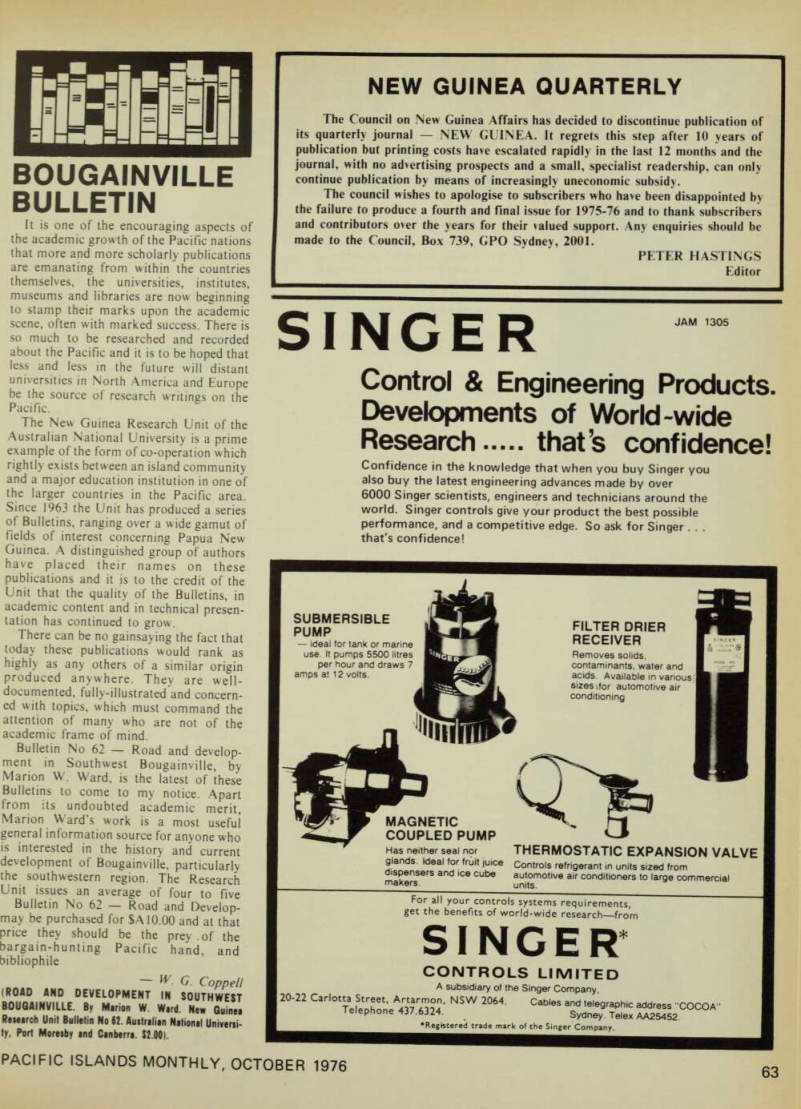
Bulletin
It is one of the encouraging aspects of the academic growth of the Pacific nations that more and more scholarly publications are emanating from within the countries themselves, the universities, institutes, museums and libraries are now beginning to stamp their marks upon the academic scene, often with marked success. There is so much to be researched and recorded about the Pacific and it is to be hoped that less and less in the future will distant universities in North America and Europe be the source of research writings on the Pacific.
The New Guinea Research Unit of the Australian National University is a prime example of the form of co-operation which rightly exists between an island community and a major education institution in one of the larger countries in the Pacific area.
Since 1963 the Unit has produced a series of Bulletins, ranging over a wide gamut of fields of interest concerning Papua New Guinea. A distinguished group of authors have placed their names on these publications and it is to the credit of the Unit that the quality of the Bulletins, in academic content and in technical presen tation has continued to grow.
There can be no gainsaying the fact that today these publications would rank as highly as any others of a similar origin produced anywhere. They are well documented, fully-illustrated and concern ed with topics, which must command the attention of many who are not of the academic frame of mind.
Bulletin No 62 Road and develop ment in Southwest Bougainville, by Marion W. Ward, is the latest of these Bulletins to come to my notice. Apart from :ts undoubted academic merit, Marion Ward’s work is a most useful general information source for anyone who is interested in the history and current
development of Bougainville, particularly
the southwestern region. The Research Unit issues an average of four to five Bulletin No 62 Road and Develop may be purchased for $A 10.00 and at that price they should be the prey of the bargain-hunting Pacific hand, and bibliophile
W. G. Coppell
(Road And Development In Southwest
BOUGAINVILLE. By Mirion W. Ward. New Guinea Research Unit Bulletin No 62. Australian National Universi ty, Port Moresby and Canberra. $2.00).
Advertisements & other items, pp. 63-66 (1 item)
Singer
NEW GUINEA QUARTERLY
The Council on New Guinea Affairs has decided to discontinue publication of its quarterly journal NEW GUINEA. It regrets this step after 10 years of publication but printing costs have escalated rapidly in the last 12 months and the journal, with no advertising prospects and a small, specialist readership, can only continue publication by means of increasingly uneconomic subsidy.
The council wishes to apologise to subscribers who have been disappointed by the failure to produce a fourth and final issue for 1975-76 and to thank subscribers and contributors over the years for their valued support. Any enquiries should be made to the Council, Box 739, GPO Sydney, 2001.
PETER HASTINGS
Editor
SINGER
Control & Engineering Products.
Developments of World-wide
Research that’s confidence!
Confidence in the knowledge that when you buy Singer you also buy the latest engineering advances made by over 6000 Singer scientists, engineers and technicians around the world. Singer controls give your product the best possible performance, and a competitive edge. So ask for Singer. . . that's confidence!
FILTER DRIER
sizes \for automotive air conditioning
SUBMERSIBLE
PUMP
ideal for tank or marine use. It pumps 5500 litres per hour and draws 7 amps at 12 volts.
MAGNETIC
COUPLED PUMP
Has neither seal nor glands. Ideal for fruit juice dispensers and ice cube makers.
THERMOSTATIC EXPANSION VALVE
Controls refrigerant in units sized from automotive air conditioners to large commercial For all your controls systems requirements, get the benefits of world-wide research—from
SINGER
CONTROLS LIMITED
A subsidiary of the Singer Company 20-22 NSW 2064. Cab*s «, telegraph* artereas -COCOA' eiepnone 4J/.6J24. Sydney. Telex AA25452. •Registered trade mark of the Singer Company.
FOR A PACIFIC READ...
Or the beginnings of a Pacific library
SHOP HERE!
y Iv
THE LOST
CARAVEL
Robert Langdon
□ The Lost Caravel Robert
Langdon shatters traditionally-held
views on the Polynesians in this controversial, historical whodunnit described by Prof. Ron Crocombe as a “masterpiece us fascinating as it is important”. Also invaluable as a record of early Pacific exploration. 368 pp. Profusely illustrated with maps and plates. SAIB or SUS 26, posted anywhere. □ The Stoiy of The Solomons.
Simple, lucid outline of the history of the Solomon Islands, from a refreshingly frank and affectionate point of view, by Dr. C.E. Fox. 88 pp. SA3 or SUS 4, posted anywhere. □ Papua New Guinea Handbook 1976. Completely revised, reset, and containing full details of this newly
independent nation history, geogra-
phy, government, industry, tourist
accommodation, etc. Clear maps including a large coloured, fold-out map of PNG. 5A7.50 or SUSIO.OO,
posted anywhere.
□ Myths and Legends of Torres Strait. Margaret Lawrie collected these stories from the Western, Central and Eastern islands of Torres Strait, including Saibai and Boigu, and Queensland University Press brought them together in
this magnificently produced
large-format volume of 372 pages. Splendidly illustrated with colour photographs,
drawings painings and maps,
and including a 45 rpm record of songs of Torres Strait. $A28.00 or 5U535.00,
posted anywhere.
□ Port Moresby, Yesterday and Today. In what is even more than a history of Papua New Guinea’s capital, Canon lan Stuart takes us on an entertaining, personalised tour of the city. Softcover, 368 pp. Maps illustrations. 5A3.50 or
SUS4.SO, posted anywhere.
D Holy Torture in Fiji, Firewalking and other sacred, ancient rituals of Fiji’s Hindus described in text and colour photographs.
Large format, 64 pp. Illustrated. 5A4.50 or SUS6.SO, posted anywhere.
□ New Hebrides. One of the superb Islands in the Sun colour series of brilliant full-colour plates, maps and text, this volume describes the unique British-French Condominium of the New Hebrides.
A guide for travellers, or for collectors. 128 pp. Fully illustrated. SAIO or SUSI 3, posted anywhere, □ New Caledonia. French New Caledonia, superbly depicted in full colour photographs, with informative text and maps giving history, geography and daily life.
An Islands in the Sun guide. 128 pp. Fully Illustrated. SAIO or
SUSI 3, posted anywhere.
□ Bora Bora. One of the French
Pacific’s fascinating, colourful high
islands, reached from Tahiti, here
presented in sparkling full-colour
pictures for visitors or mere armchair travellers. Another Islands in the Sun guide, with the same attention to detail, 128 pp.
Fully illustrated. SAIO or SUSI 3,
posted anywhere.
□ Fiji Fiji. The multi-racial dominion of friendly Fiji, crossroads of the Pacific, described in colour photographs, maps and text, uniform with the beautiful series listed above. Many people buy the whole set. More titles to be published. 128 pp. Fully illustrated. SAIO or SUSI 3 posted anywhere. □ Little Chimbu in Bougainville.
For the young and young-in-heart, lovable Little Chimbu and his friends visit Panguna, and get into awful trouble in what could be the biggest hole in the world, the Bougainville copper mine. Nancy Curtis, who used to live there, tells the story in full colour drawings which are also accurate and instructive. Also in the colourful Nancy Curtis series for children are □ Little Balus and □ Fiji Johnny.
About 48 pp. Illustrated. Each 5A3.50 or SUS4.SO posted
anywhere.
□ Percy Chatterton’s Papua: Day That I Have Loved. Charming evocative account of changing Papua as Rev. Percy Chatterton knew it for 50 years. 144 pp. Illustrated.
JA6.50 or SUSB.SO posted anywhere.
□ Tahiti and its Islands. New revised edition, just released, of this popular title in the Islands in the Sun series.
Sparkling new colour plates, new information, new maps. Includes the Leeward Islands, the Tuamotus, the Gambiers, Marquesas, the Australs.
Has hotel lists and places to see. 128 pp. Fully illustrated. SAIO or SUSI 3, posted anywhere. □ A Time For Building. Nobody but Sir Paul Hasluck,Australian Minister responsible for Papua New Guinea for 13 unprecedented years to 1963, can reveal just what happened in PNG in that vital period.
He tells it frankly, critically, in this book just published by Melbourne University Press. It’s as essential as it is readable, so the publishers have put a special stock aside for PlM’s mail order customers. 452 pp. Illustrated. 1A17.00 or SUS 21.00,1$ posted anywhere. □ Log of the MahinarA Tale of the South Pacific. Young American John Neal took his 27ft. yacht from Seattle on an 18 months cruise through Polynesia and then wrote about it. This delightfully refreshing book abounds with information on how to get there and what to do when you are there.
John Neal learned it the hard way and shares his experiences with enthusiasm Required reading for all yachties venturing into Polynesia’s dangers and pleasures, physical and romantic. 280 pp. Illustrated 5A6.00 or SUS7.SO, posted anywhere. □ Say It In Fijian. Dr. AJ.Shutz presents a pocket-sized, entertaining guide to the Fijian language for those making their first contact with Fiji. 5A2.00 or SUS3.OO, posted anywhere. □ Say It In Motu. In the same series, Dr. Percy Chatterton provides an instant introduction to one of the three official languages of Papua New Guinea; the common tongue of the streets and markets of Port Moresby. 5A2.00 or SUS3.OO, posted anywhere. Now in preparation in the same series are Say It In Fiji Hindi, and Say It In Tahitian. Advance orders accepted. □ Queen Emma. R.W. Robson presents drama, comedy, high adventure in this true story or “Queen Emma”, the Polynesian-American girl who met 19th century New Guinea on its own tough terms. 239 pp. illustrated. SA6 or SUSB, posted anywhere. n Available soon! Pacific Islands Year Book for 1977! Completely revised, reset in new format. Hundreds of pages of facts and maps on all the Pacific Islands. Advance orders taken for this invaluable reference book.
SAIB or SUS 26, posted anywhere.
MARINE SHELLS
OF THE PACIFIC
Volume II i . M I W ill
SAY
n IN ii*
FIJIAN
»« in in ii» in hi n» in in
Handbook
1976 Pacific Publications 1
□ Colonial Era Cemetery of Norfolk Island. Former Administrator of the island, R. Nixon Dalkin, describes life and death in what was Britain’s harshest Pacific penal colony. There are illuminating, often moving stories in these photographs, charts and inscriptions that describe the historic cemetery. Large format, 92 pp.
Illustrated. SAS or SUS7.SO, posted anywhere. □ Marine Shells of the Pacific.
Walter Cernohorsky describes in detail with clear photographs 440 Pacific shells, and tells how to find, arrange and photograph a collection. 248 pp. Illustrated. SAIO or SUSIS, posted anywhere. □ Easter Island. At last, a new book on fascinating Easter Island history, daily life and the mysterious giant statues.
All in full colour, with maps and information for travellers as on of the Islands in the Sun series. Half this splendid book is devoted to descriptions and photographs of the statues that made the island famous. SAIO or SUSI 3 posted anywhere. □ Friendly Island. Warm account of life in Tonga, sunlit South Pacific island kingdom, by Patricia Ledyard, who has lived in a Tongan harbourside village for more than 20 years. Paperback, 215 pp.
SA3 or SUS4.SO, posted anywhere. □ Plants and Flowers of Tahiti, Full colour photographs of the rich and beautiful Tahitian flora, classified by scientific names, and by French, English and Tahitian common names. 144 pp. Fully illustrated. SAS or SUS 7, posted anywhere. □ Birds of Tahiti. A companion volume to Plants and Flowers of Tahiti. Full colour photographs and descriptions, for collectors or for amateur birdwatchers, visitors and students needing easy identification. 112 pp. Fully illustrated.
SAS or SUS 7, posted anywhere. □ Tahiti: Island of Love. In this book, the author of The Lost Caravel presents the vivid, colourful history of Tahiti from its discovery by Europeans to modem times.
Eminently readable, now in its fourth edition. 284 pp. Illustrated. 5A4.50 or SUS6.OO posted anywhere.
Pim’s
mniL ORD€R
BOOKSHOP
On our first
birthday as an
independent
nation we look
forward to a
bright f uture**
one in which the people of Papua New Guinea will play an important role in promoting peace and prosperity for the Pacific region
GOVERNMENT OF
PAPUA NEW GUINEA
Under Lonely Valley'
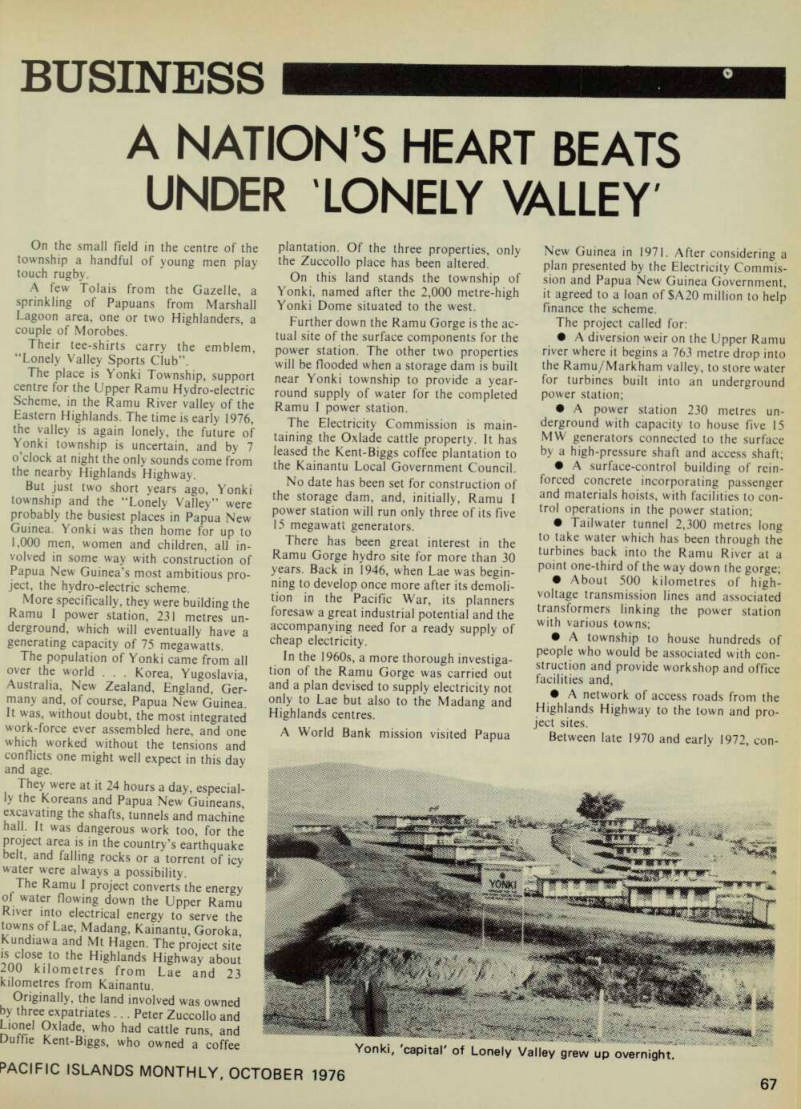
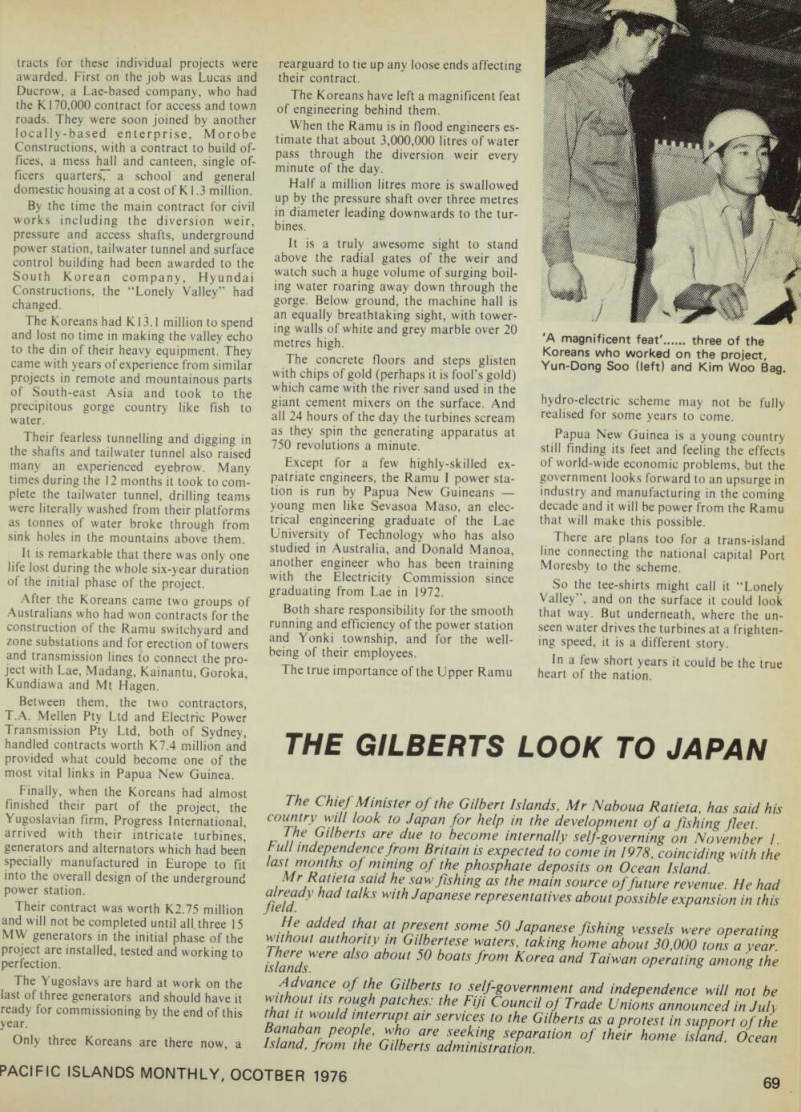
Business
A Nation’S Heart Beats
On the small field in the centre of the township a handful of young men play
touch rugby.
A few Tolais from the Gazelle, a sprinkling of Papuans from Marshall Lagoon area, one or two Highlanders, a couple of Morobes.
Their tee-shirts carry the emblem,
“Lonely Valley Sports Club”.
The place is Yonki Township, support centre for the Upper Ramu Hydro-electric Scheme, in the Ramu River valley of the Eastern Highlands. The time is early 1976, the valley is again lonely, the future of Yonki township is uncertain, and by 7 o clock at night the only sounds come from the nearby Highlands Highway.
But just two short years ago, Yonki township and the “Lonely Valley” were probably the busiest places in Papua New Guinea. Yonki was then home for up to 1,000 men, women and children, all in volved in some way with construction of Papua New Guinea’s most ambitious pro ject, the hydro-electric scheme.
More specifically, they were building the
Ramu I power station, 231 metres un derground, which will eventually have a generating capacity of 75 megawatts.
The population of Yonki came from all over the world . . . Korea, Yugoslavia Australia, New Zealand, England, Ger many and, of course, Papua New Guinea.
It was, without doubt, the most integrated work-force ever assembled here, and one which worked without the tensions and conflicts one might well expect in this day and age.
They were at it 24 hours a day, especial ly the Koreans and Papua New Guineans excavating the shafts, tunnels and machine hall. It was dangerous work too, for the project area is in the country’s earthquake belt, and falling rocks or a torrent of icy water were always a possibility.
The Ramu I project converts the energy of water flowing down the Upper Ramu River into electrical energy to serve the towns of Lae, Madang, Kainantu, Goroka Kundiawa and Mt Hagen. The project site is close to the Highlands Highway about 200 kilometres from Lae and 23 kilometres from Kainantu.
Originally, the land involved was owned by three expatriates .. . Peter Zuccollo and uonel Oxlade, who had cattle runs, and Duffie Kent-Biggs, who owned a coffee
plantation. Of the three properties, only the Zuccollo place has been altered.
On this land stands the township of Yonki, named after the 2,000 metre-high Yonki Dome situated to the west.
Further down the Ramu Gorge is the ac tual site of the surface components for the power station. The other two properties will be flooded when a storage dam is built near Yonki township to provide a year round supply of water for the completed Ramu I power station.
The Electricity Commission is main taining the Oxlade cattle property. It has leased the Kent-Biggs coffee plantation to the Kainantu Local Government Council.
No date has been set for construction of the storage dam, and, initially, Ramu I power station will run only three of its five 15 megawatt generators.
There has been great interest in the Ramu Gorge hydro site for more than 30 years. Back in 1946, when Lae was begin ning to develop once more after its demoli tion in the Pacific War, its planners foresaw a great industrial potential and the accompanying need for a ready supply of
cheap electricity.
In the 19605, a more thorough investiga tion of the Ramu Gorge was carried out and a plan devised to supply electricity not only to Lae but also to the Madang and
Highlands centres.
A World Bank mission visited Papua
New Guinea in 1971. After considering a plan presented by the Electricity Commis sion and Papua New Guinea Government, it agreed to a loan of SA2O million to help finance the scheme.
The project called for: • A diversion weir on the Upper Ramu river where it begins a 763 metre drop into the Ramu/Markham valley, to store water for turbines built into an underground power station; • A power station 230 metres un derground with capacity to house five 15 MW generators connected to the surface by a high-pressure shaft and access shaft; • A surface-control building of rein forced concrete incorporating passenger and materials hoists, with facilities to con trol operations in the power station; • Tailwater tunnel 2,300 metres long to take water which has been through the turbines back into the Ramu River at a point one-third of the way down the gorge; • About 500 kilometres of high voltage transmission lines and associated transformers linking the power station with various towns; • A township to house hundreds of people who would be associated with con struction and provide workshop and office facilities and, • A network of access roads from the Highlands Highway to the town and pro ject sites.
Between late 1970 and early 1972, con-
Yonki, capital' of Lonely Valley grew up overnight.
tracts for these individual projects were awarded. First on the job was Lucas and Ducrow, a Lae-based company, who had the K 170,000 contract for access and town roads. They were soon joined by another locally-based enterprise, Morobe Constructions, with a contract to build of fices, a mess hall and canteen, single of ficers quartersT a school and general domestic housing at a cost of K 1.3 million.
By the time the main contract for civil works including the diversion weir, pressure and access shafts, underground power station, tailwater tunnel and surface control building had been awarded to the South Korean company, Hyundai Constructions, the “Lonely Valley” had
changed.
The Koreans had K 13.1 million to spend and lost no time in making the valley echo to the din of their heavy equipment. They came with years of experience from similar projects in remote and mountainous parts of South-east Asia and took to the precipitous gorge country like fish to water.
Their fearless tunnelling and digging in the shafts and tailwater tunnel also raised many an experienced eyebrow. Many times during the 12 months it took to com plete the tailwater tunnel, drilling teams were literally washed from their platforms as tonnes of water broke through from sink holes in the mountains above them.
It is remarkable that there was only one life lost during the whole six-year duration of the initial phase of the project.
After the Koreans came two groups of Australians who had won contracts for the construction of the Ramu switchyard and zone substations and for erection of towers and transmission lines to connect the pro ject with Lae, Madang, Kainantu, Goroka, Kundiawa and Mt Hagen.
Between them, the two contractors, T.A. Mellen Pty Ltd and Electric Power Transmission Pty Ltd, both of Sydney, handled contracts worth K 7.4 million and provided what could become one of the most vital links in Papua New Guinea.
Finally, when the Koreans had almost finished their part of the project, the
Yugoslavian firm, Progress International,
arrived with their intricate turbines, generators and alternators which had been specially manufactured in Europe to fit into the overall design of the underground power station.
Their contract was worth K 2.75 million and will not be completed until all.three 15 MW generators in the initial phase of the project are installed, tested and working to perfection.
The Yugoslavs are hard at work on the last of three generators and should have it ready for commissioning by the end of this year.
Only three Koreans are there now, a
rearguard to tie up any loose ends affecting their contract.
The Koreans have left a magnificent feat of engineering behind them.
When the Ramu is in flood engineers es timate that about 3,000,000 litres of water pass through the diversion weir every minute of the day.
Half a million litres more is swallowed up by the pressure shaft over three metres in diameter leading downwards to the tur bines.
It is a truly awesome sight to stand above the radial gates of the weir and watch such a huge volume of surging boil ing water roaring away down through the gorge. Below ground, the machine hall is an equally breathtaking sight, with tower ing walls of white and grey marble over 20 metres high.
The concrete floors and steps glisten with chips of gold (perhaps it is fool’s gold) which came with the river sand used in the giant cement mixers on the surface. And all 24 hours of the day the turbines scream as they spin the generating apparatus at 750 revolutions a minute.
Except for a few highly-skilled ex patriate engineers, the Ramu I power sta tion is run by Papua New Guineans young men like Sevasoa Maso, an elec trical engineering graduate of the Lae University of Technology who has also studied in Australia, and Donald Manoa, another engineer who has been training with the Electricity Commission since graduating from Lae in 1972.
Both share responsibility for the smooth running and efficiency of the power station and Yonki township, and for the well
being of their employees.
The true importance of the Upper Ramu
hydro-electric scheme may not be fully realised for some years to come.
Papua New Guinea is a young country still finding its feet and feeling the effects of world-wide economic problems, but the government looks forward to an upsurge in
industry and manufacturing in the coming
decade and it will be power from the Ramu that will make this possible.
There are plans too for a trans-island line connecting the national capital Port Moresby to the scheme.
So the tee-shirts might call it “Lonely Valley”, and on the surface it could look that way. But underneath, where the un seen water drives the turbines at a frighten ing speed, it is a different story.
In a few short years it could be the true heart of the nation.
'A magnificent feat'... three of the Koreans who worked on the project, Yun-Dong Soo (left) and Kim Woo Bag.
Advertisements & other items, p. 68 (1 item)
Today’s most important commodity,
EMKA (AUSTRALIA) Pty. Ltd.
SELLS
SERVICE
Today’s most important commodity,
-difficult to obtain.
Do try us, we can prove it. 7 Coggins Place, Mascot, Sydney, 2020 Telex: 21416. Telephone: 669 6844 DO APPROACH US BY LETTER, CABLE OR TELEX FOR
QUOTATIONS
a. La
rtrodl
IATA
Shipping • Forwarding • Air Freight • Container operators • Insurance Founded in 1887 at Hamburg (Head Office) to service your transport needs.
NOMINATE HARTRODT AS YOUR FREIGHT FORWARDER
Contact A. Hartrodt (Australia) Pty. Ltd. for information on services available and advantages. Our own offices in all main trade centres of the world.
HAMBURG • BREMEN • ROTTERDAM • GENOA
• LONDON • LIVERPOOL
7 COGGINS PLACE, MASCOT. N.S.W. 2020.
Postal Address: P.O. Box 349, Mascot, N.S.W. 2020.
Telephone: 669 6844. Telex: 21416.
The Gilberts Look To Japan
The Chie f Minister of the Gilbert Islands, Mr Naboua Ratieta. has said his eoimtry will look to Japan for help in the development of a fishing fleet.
Vn e < f llber J s are due to become internally self-governing on November I hull independence from Britain is expected to come in 1978, coinciding with the QS ll* lo "™ 3 °f mimn S of the phosphate deposits on Ocean Island.
I Mr ju tie J a S n ld he , saw fishing a * the main source offuture revenue. He had field hQd WltH Japanese re P reser "otives about possible expansion in this He added that at present some 50 Japanese fishing vessels were operating without authority in Gilbertese waters, taking home about 30,000 tons a year. island™ 6 ™ GS ° a^out boats from Korea and Taiwan operating among the Advance of the Gilberts to self-government and independence will not be without its rough patches: the Fiji Council of Trade Unions announced in July that it would interrupt air services to the Gilberts as a protest in support of the Pe ° P i e ’ r h iu are S f eking of their home island, Ocean island, Jrom the Gilberts administration.
Advertisements & other items, p. 70 (1 item)
South Pacific
Bank of
Incorporated in Papua New Guinea Servicing the banking needs of an independent Papua New Guinea with a full range of domestic and overseas facilities.
Call at any one of our branches: Port Moresby, Boroko, Kieta, Lae, Mount Hagen, Rabaul.
Bank South Pacific
the
Personal Service Bank
300P2177
Tonga Tourist Group
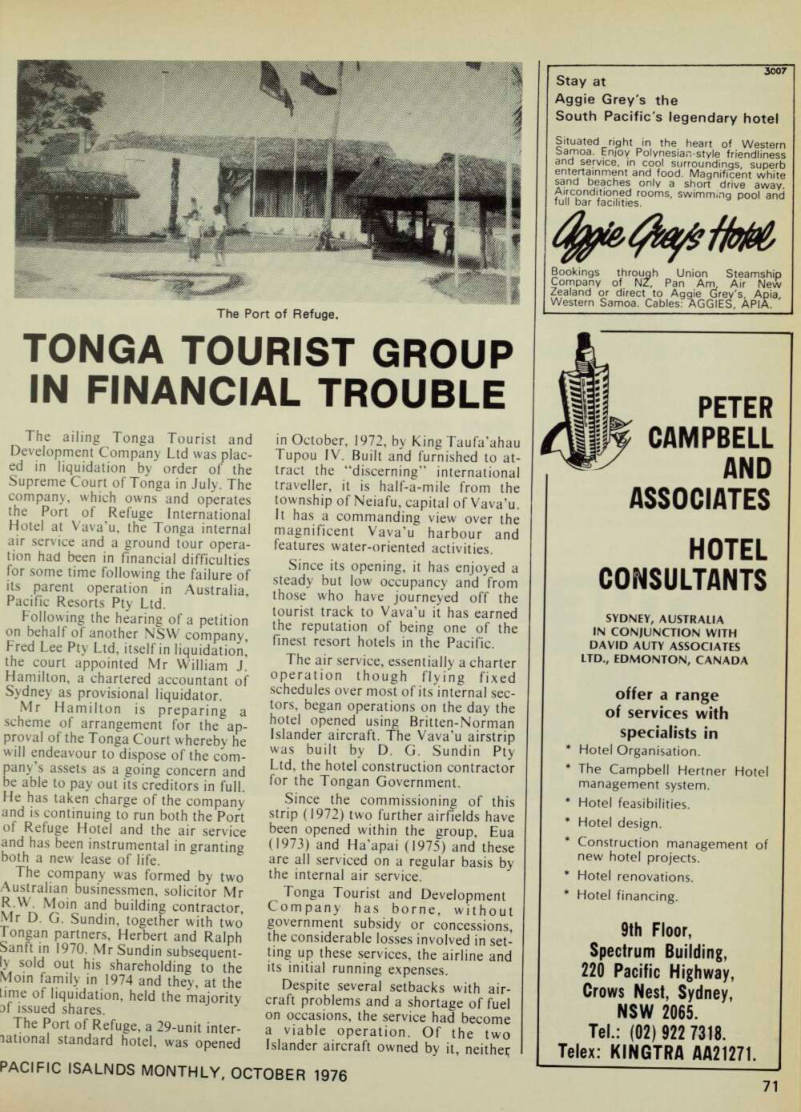
In Financial Trouble
The ailing Tonga Tourist and Development Company Ltd was plac ed in liquidation by order of the Supreme Court of Tonga in July. The company, which owns and operates the Port of Refuge International Hotel at Vava’u, the Tonga internal air service and a ground tour opera tion had been in financial difficulties for some time following the failure of its parent operation in Australia, Pacific Resorts Pty Ltd.
Following the hearing of a petition on behalf of another NSW company Fred Lee Pty Ltd, itself in liquidation,’ the court appointed Mr William J.
Hamilton, a chartered accountant of Sydney as provisional liquidator.
Mr Hamilton is preparing a scheme of arrangement for the ap proval of the Tonga Court whereby he will endeavour to dispose of the com pany’s assets as a going concern and be able to pay out its creditors in full.
He has taken charge of the company and is continuing to run both the Port of Refuge Hotel and the air service and has been instrumental in granting both a new lease of life.
The company was formed by two Australian businessmen, solicitor Mr R W. Moin and building contractor, Mr D. G. Sundin, together with two Tongan partners, Herbert and Ralph Sanft in 1970. Mr Sundin subsequent ly sold out his shareholding to the Mom family in 1974 and they, at the time of liquidation, held the majority t)f issued shares.
The Port of Refuge, a 29-unit inter lational standard hotel, was opened
in October, 1972, by King Taufa’ahau Tupou IV. Built and furnished to at tract the “discerning” international traveller, it is half-a-mile from the township of Neiafu, capital of Vava’u.
It has a commanding view over the magnificent Vava’u harbour and features water-oriented activities.
Since its opening, it has enjoyed a steady but low occupancy and from those who have journeyed off the tourist track to Vava’u it has earned the reputation of being one of the finest resort hotels in the Pacific.
The air service, essentially a charter operation though flying fixed schedules over most of its internal sec tors, began operations on the day the hotel opened using Britten-Norman Islander aircraft. The Vava’u airstrip was built by D. G. Sundin Pty Ltd, the hotel construction contractor for the Tongan Government.
Since the commissioning of this strip (1972) two further airfields have been opened within the group, Eua (1973) and Ha’apai (1975) and these are all serviced on a regular basis by the internal air service.
Tonga Tourist and Development Company has borne, without government subsidy or concessions, the considerable losses involved in set ting up these services, the airline and its initial running expenses.
Despite several setbacks with air craft problems and a shortage of fuel on occasions, the service had become a viable operation. Of the two Islander aircraft owned by it, neither
The Port of Refuge.
is flying at present and the service is being maintained by a leased Piper Aztec. One Islander developed fuel problems while on a test flight and was force-landed on a somewhat remote beach on Tongatapu where h remained for the several months it took to construct an access road to the site to enable it to be recovered overland.
This aircraft, though still in flying condition, is grounded at Fua’amotu airport awaiting inspection and recer tification.
The second Islander was totally destroyed in December, 1975, after being stolen and crashed by two Tongans who, under the influence of alcohol, forced access to it and, after managing to start the engines, attempted to fly it.
The provisional liquidator is con tinuing to run the air-service normally and has entered into negotiations with two major companies involved with airline operations. However, any arrangement made by him would be subject to the agreement of the Tonga Government, which has been procrastinating for years over the sub ject of airlines, services and air rights involving Tonga.
Tonga Tourist and Development
Company also had the rights to build a further hotel on the main island of Tongatapu. A site at Ha’atafu, a beach area some 13 miles from the capital, Nuku’alofa, had been leased and plans approved for a 160-room development.
Site work initiated in late 1974 was suspended before prime construction could commence. As there was a per formance covenant as a condition of the lease on this site it will now probably revert to the Tonga Tourist Authority, under whose control the lease was placed.
Whatever the outcome of the air service negotiations and entering the Port of Refuge for sale, it is hoped that the provisional liquidator can keep both these valuable assets to the kingdom and tourism operating for the benefit of all concerned.
Meat merger
to cut PNG imports
New Guinea Industries Pty Ltd, the big Morobe cattle producer, and the province’s biggest manufacturer of meat products, Sylvan Smallgoods (NG) Pty Ltd have merged.
Aim of the merger, according to
NGLs managing director, Mr William McLellan, is to replace im ported meat products on the Papua New Guinea market as soon as possi ble.
The new company has its eyes par ticularly on Bougainville, PNG’s ma jor smallgoods market, and on the huge potential market in the Highlands.
The merger gives the PNG Invest ment Corporation an equity in Sylvan for the first time through the equity it already holds in NGI.
PNG’s Development
Bank forges ahead
Steady progress in localisation was the dominant theme of an August press release on the past year’s ac tivities of the Papua New Guinea Development Bank.
Among points noted in the release by the managing director, Mr Alan Redman, and PNG’s Minister for Finance, Mr Julius Chan, are the following: • A higher proportion of the bank’s loan money went to Papua New Guineans than ever before K 7.2 million, compared with K 5.8
million the previous year. Two years ago, the amount lent by the bank to Papua New Guineans was only 40% of its total lending; this year it had been 66% of a greater total amount; • The average size of loans to Papua New Guineans rose from K2,- 677 the year before to K 4,115, in dicating a trend to the ownership by nationals of larger enterprises. These were mainly in rural commercial ac tivities, such as hotels, wholesale and retail trade, transport, boats and some manufacturing enterprises; • Localisation of staff rose from 79% to 83%, and, • Loans for agricultural develop ment totalled K 2 million, the highest for any year except 1971-72 when the total was boosted by loans for oil palm.
Summing up, Mr Chan said; “The Development Bank has now become self-sufficient, and will continue to assist the people without the necessity of further capital grants from the government in the immediate future.
This will increase the funds available to the government for other develop ment purposes.
“The Development Bank has now loaned K6O million for the develop ment of PNG. I congratulate its staff on this year’s performance.’’
Bad news for
Fiji tourism
Australian tourist traffic to Fiji -ould be hard hit by new cut-price air fares to the United States announced by Qantas.
From December, Australians will be able to buy a 16-day package holi day in America for $B9O. Current iconomy return fare is $1,370.
The Australian airline said it hoped he new fares would boost its present )assenger loadings to the States by as nuch as 55%.
It has also said it plans later in the 'ear to make similar cuts in fares to iouth-East Asia and Europe.
At talks in January, the Fiji Government rejected Qantas )roposals for a revision of package toliday fares as being against the in erests of Fiji’s tourism at that time.
Qantas officials visited Suva in July to eopen talks with the government on he subject. • A bright spot! Towards the end of lugust, Qantas flew 1162 people to Fiji, the lost the airline has ever flown to a single estination in one day.
Nauru has
its own bank
Nauru’s national bank, the Bank of Nauru, is expected to open its doors on October 1. This was announced in the Nauru Parliament in August by President Hammer Deßoburt. He said the new bank, whose establish ment follows lengthy discussions with senior representatives of the Bank of New South Wales and the Australian Government, will be a commercial rather than a reserve or central bank.
The President said agreement had been reached with the Australian representatives for the continued use of Australian currency in the republic after the bank begins operations.
PNG-Indonesian
trade link
Now that Papua New Guinea and In donesia had established firm diplomatic relations, it was logical to negotiate a bilateral trade agreement as soon as possi ble in the view of Mr R. B. Thureehl, presi dent of the Port Moresby Chamber of Commerce. Mr Thureehl, returning after a week in Jakarta, said he was surprised to
note the number of companies there producing goods, which PNG imported from Japan, Hong Kong, the UK and the Continent. He was also surprised to 11 nd that Indonesia imported coconut seedlings, coffee, cocoa and lea, which were the main products of PNG, from elsewhere.
Mr Thurechl said it was obvious the two countries could help each other. To make trade easier, however, Indonesia would need to ease import restrictions.
The PNG Ambassador to Indonesia, Mr R. V. Kumaina, said PNG might be in terested in importing Indonesian textiles as Indonesian products were relatively cheaper than those of other countries.
Ok Tedi may
rival Bougainville
The Ok Tedi in the remote Star Moun tains ol Papua New Guinea, may be belter than Bougainville Copper s mine at Panguna. The directors of the Government-owned Ok Tedi Development Co reported recently the Ok Tedi ore averages 0.75 per cent sulphide copper (0.85 per cent total copper), 0.012 per cent molybdenum and 0.653 grams of gold a tonne. In comparison, the Bougainville Copper mine contained about 840 million tonnes of ore averaging 0.46 per cent
Advertisements & other items, pp. 71-72 (2 items)
Pacific Isalnds Monthly, October 1976
Associates
Aggie Grey's the
South Pacific's legendary hotel Situated right in the heart of Western bamoa. Enjoy Polynesian-style friendliness and service, in cool surroundings, superb entertainment and food. Magnificent white sand beaches only a short drive away A.rcond.t.oned rooms, swimming pool and full bar facilities.
Bookings through Union Steamship Company of NZ, Pan Am, Air New Zealand or direct to Aggie Urey's, Apia Western Samoa. Cables: AGGIES, APIA.
PETER
CAMPBELL
AND
ASSOCIATES
HOTEL
CONSULTANTS
SYDNEY, AUSTRALIA
IN CONJUNCTION WITH
DAVID AUTY ASSOCIATES
LTD., EDMONTON, CANADA
offer a range of services with specialists in * Hotel Organisation. * The Campbell Hertner Hotel management system. * Hotel feasibilities. * Hotel design. * Construction management of new hotel projects. * Hotel renovations. * Hotel financing.
9th Floor,
Spectrum Building,
220 Pacific Highway,
Crows Nest, Sydney,
NSW 2065.
Tel.; (02) 922 7318.
Telex: KINGTRA AA21271.
THE DEPENDABLES!
. VILLIERS
2 & 4 STROKE
i ENGINES
WISCONSIN
HEAVY DUTY
ENGINES
% For an infinite variety of applications including pumping, spraying, mowing, power saws, etc. you simply can’t go past the amazingly dependable Villiers aircooled petrol engine. We offer 7 basic models with hundreds of combinations, including reduction gearboxes.
They’re your logical choice if you need an air-cooled H.D. petrol engine upon which you can absolutely rely. Thrives on the toughest jobs with a minimum of maintenance. Available from 4.7 to 65.9 horsepower in single, twin and 4 cyl. types to suit a wide range of applications.
Both Villiers and Wisconsin engines are backed by For Sales and Service contact:
HASTINGS PEERING LTD.
Parramatta Road, Cnr. John Street,
LIDCOMBE, N.S.W. 2141, AUSTRALIA.
Tel: 648-0111. a first class parts service. mm 001062
Islands Trader
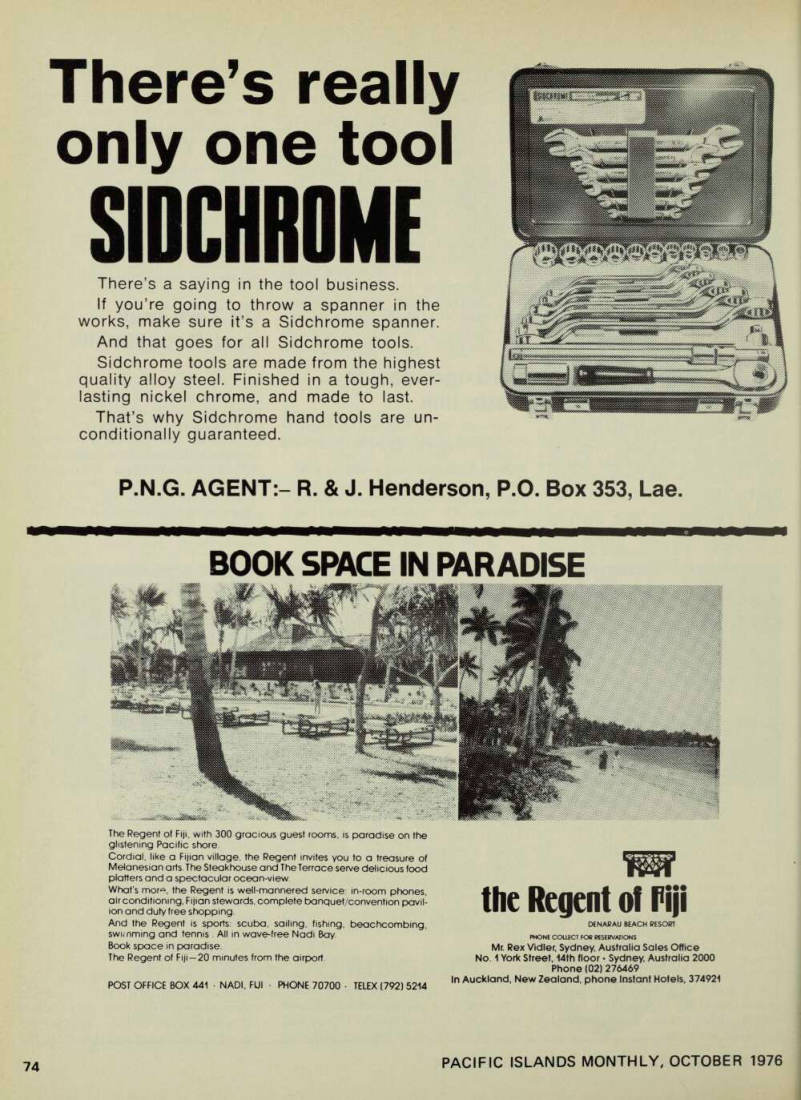
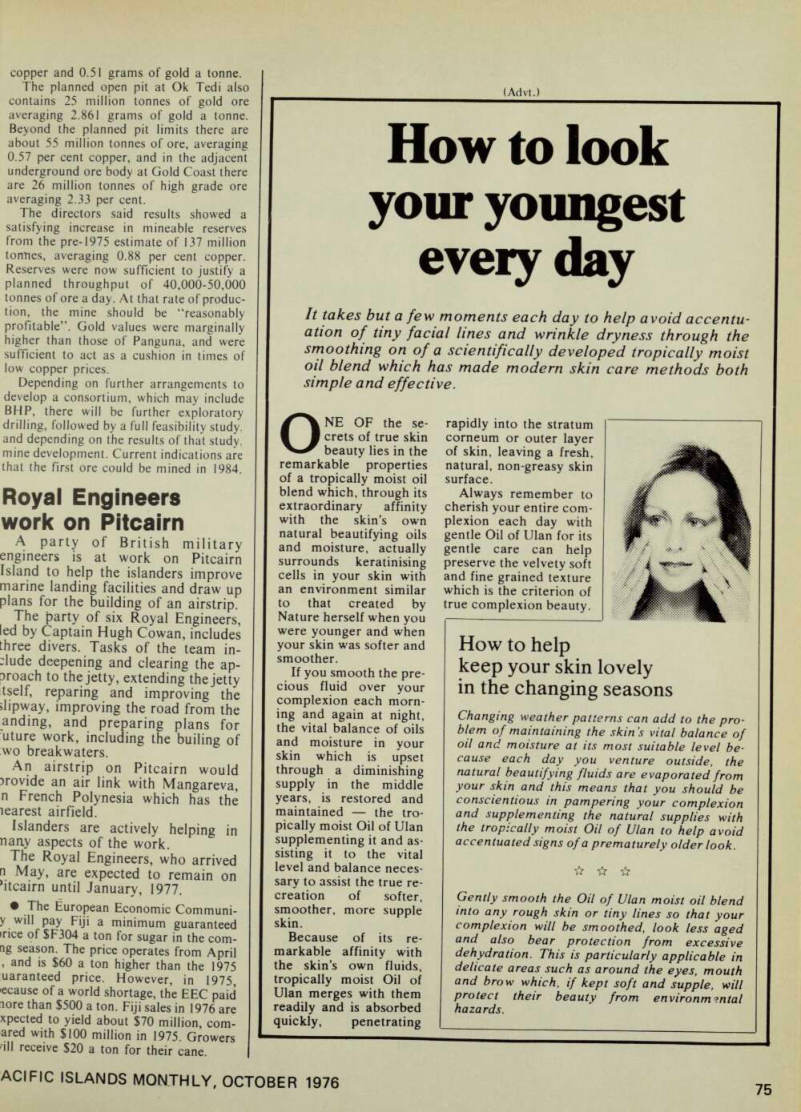
Fishes For Small Ones
To Sydney-based Islands trader, Peter Fischer, small fish are sweet. He sees no future in chasing trade where big business is established.
I am small, working small markets where big people don’t go”, he says. “That is how I worked my business up, by going to small markets, or to big markets where big people don’t go”. And that means everywhere even Ethiopia.
Mr Fischer, who has been an Islands trader for about 10 years, has concentrated his main activities in Micronesia, building up a business in many lines, but chiefy Australian foodstuffs. Now he finds Micronesia is becoming “ overrun” so he is seek ing his small markets elsewhere. Not that he intends to abandon Micronesia. He has too many friends there.
His markets in Micronesia have become more difficult because Australian goods, which were once comparatively cheap, are now dearer than United States goods. He has had to raise his prices to keep up with cost
increases in Australia, and this has allowed US goods to get in at lower prices.
Not that he is hitter he accepts this as a fact of business life. In his search for small markets he left Australia late in August for Van couver and Alaska. From Alaska he planned to fly to Bermuda and Nassau, then across to San Francisco and Honolulu. From Honolulu he in tended to return to Australia via Micronesia.
He likes travelling and will take up markets anywhere. In fact it was through travel that he became an Islands agent. He had gone from Australia to the Pacific area for a holiday, and was asked to buy something for a particular firm. One thing led to another, and now Peter Fisher Trading Co is well known in several parts of the Pacific, as well as M icronesia.
Mr Fischer, formerly a RAF non commissioned officer, came to Australia in 1954. He was an importer for several years before changing his business into that of an Islands trader.
copper and 0.51 grams of gold a tonne.
The planned open pit at Ok Tedi also contains 25 million tonnes of gold ore averaging 2.861 grams of gold a tonne.
Beyond the planned pit limits there are about 55 million tonnes of ore, averaging 0.57 per cent copper, and in the adjacent underground ore body at Gold Coast there are 26 million tonnes of high grade ore averaging 2.33 per cent.
The directors said results showed a satisfying increase in mineable reserves from the pre-1975 estimate of 137 million tonties, averaging 0.88 per cent copper.
Reserves were now sufficient to justify a planned throughput of 40,000-50,000 tonnes of ore a day. At that rate of produc tion, the mine should be “reasonably profitable”. Gold values were marginally higher than those of Panguna, and were sufficient to act as a cushion in times of low copper prices.
Depending on further arrangements to develop a consortium, which may include BHP, there will be further exploratory drilling, followed by a full feasibility study, and depending on the results of that study, mine development. Current indications are that the first ore could be mined in 1984.
Royal Engineers
work on Pitcairn
A party of British military engineers is at work on Pitcairn Island to help the islanders improve marine landing facilities and draw up plans for the building of an airstrip.
The party of six Royal Engineers,
led by Captain Hugh Cowan, includes
three divers. Tasks of the team in
clude deepening and clearing the ap
proach to the jetty, extending the jetty tself, reparing and improving the dipway, improving the road from the
anding, and preparing plans for
uture work, including the builing of wo breakwaters.
An airstrip on Pitcairn would provide an air link with Mangareva, n French Polynesia which has the learest airfield.
Islanders are actively helping in naay aspects of the work.
The Royal Engineers, who arrived n May, are expected to remain on
htcairn until January, 1977.
• The European Economic Communi y will pay Fiji a minimum guaranteed •rice of SF3O4 a ton for sugar in the com ng season. The price operates from April , and is $6O a ton higher than the 1975 uaranteed price. However, in 1975, ecause of a world shortage, the EEC paid lore than $5OO a ton. Fiji sales in 1976 are xpected to yield about $7O million, com ared with $lOO million in 1975. Growers 'ill receive $2O a ton for their cane
Advertisements & other items, pp. 73-76 (3 items)
73
’ACIFIC ISLANDS MONTHLY, OCTOBER 1976
Sidchrome
There’s really
only one tool
There’s a saying in the tool business.
If you’re going to throw a spanner in the works, make sure it’s a Sidchrome spanner.
And that goes for all Sidchrome tools.
Sidchrome tools are made from the highest quality alloy steel. Finished in a tough, everlasting nickel chrome, and made to last.
That’s why Sidchrome hand tools are unconditionally guaranteed. m P.N.G. AGENT:- R. & J. Henderson, P.O. Box 353, Lae.
BOOK SPACE IN PARADISE
The Regent of Fiji, with 300 gracious guest rooms, is paradise on the glistening Pacific shore Cordial, like a Fijian village, the Regent invites you to a treasure of Melanesian arts. The Steakhouse and The Terrace serve delicious food platters and a spectacular ocean-view What's more, the Regent is well-mannered service: in-room phones, air conditioning, Fijian stewards, complete banquet/convention pavilion and duty free shopping.
And the Regent is sports scuba, sailing, fishing, beachcombing, swimming and tennis . All in wave-tree Nadi Bay Book space in paradise.
The Regent of Fiji—2o minutes from the airport POST OFFICE BOX 441 NADI, FUI PHONE 70700 ■ TELEX (792) 5214
the Regent of Fiji
DENARAU BEACH RESORT
PHONE COUfCT FOR RESERVATIONS
Mr. Rex Vidler, Sydney, Australia Sales Office No. 1 York Street, 14th floor • Sydney. Australia 2000 Phone (02) 276469 In Auckland, New Zealand, phone Instant Hotels. 374921
(Advt.)
How to look
your youngest
every day
It takes but a few moments each day to help avoid accentuation of tiny facial lines and wrinkle dryness through the smoothing on of a scientifically developed tropically moist oil blend which has made modern skin care methods both
simple and effective.
ONE OF the secrets of true skin beauty lies in the
remarkable properties
of a tropically moist oil blend which, through its
extraordinary affinity
with the skin’s own natural beautifying oils and moisture, actually
surrounds keratinising
cells in your skin with an environment similar to that created by Nature herself when you were younger and when your skin was softer and smoother.
If you smooth the precious fluid over your complexion each morn-
ing and again at night,
the vital balance of oils and moisture in your skin which is upset
through a diminishing
supply in the middle years, is restored and maintained the tropically moist Oil of Ulan supplementing it and assisting it to the vital level and balance necessary to assist the true recreation of softer, smoother, more supple skin.
Because of its remarkable affinity with the skin’s own fluids, tropically moist Oil of Ulan merges with them readily and is absorbed
quickly, penetrating
rapidly into the stratum corneum or outer layer of skin, leaving a fresh, natural, non-greasy skin surface.
Always remember to cherish your entire complexion each day with gentle Oil of Ulan for its gentle care can help preserve the velvety soft and fine grained texture which is the criterion of
true complexion beauty.
How to help
keep your skin lovely
in the changing seasons
Changing weather patterns can add to the problem of maintaining the skin’s vital balance of oil and moisture at its most suitable level because each day you venture outside, the natural beautifying fluids are evaporated from your skin and this means that you should be conscientious in pampering your complexion and supplementing the natural supplies with the tropically moist Oil of Ulan to help avoid accentuated signs of a prematurely older look. ☆ ☆ ☆ Gently smooth the Oil of Ulan moist oil blend into any rough skin or tiny lines so that your complexion will be smoothed, look less aged and also bear protection from excessive dehydration. This is particularly applicable in delicate areas such as around the eyes, mouth and brow which, if kept soft and supple, will protect their beauty from environmental hazards.
m
More than 40 airlines have
found a way to help improve
their profit picture.DG9.
Twin-engine fuel economy. Self-contained stair and APU. Lower landing fees. High utilization capability.
High passenger capacity. 99% on-time departure rates.
Low crew costs.
For passengers the DC-9 means quicker tum-around times and more convenience.
For airlines, the DC-9 means a good business investment.
Now, there's a new DC-9. The Series 50.
It's designed for routes where traffic is on the upswing. 2Si Ji t* f J ■ i • 19
75
ACIFIC ISLANDS MONTHLY, OCTOBER 1976
Pacific Transport
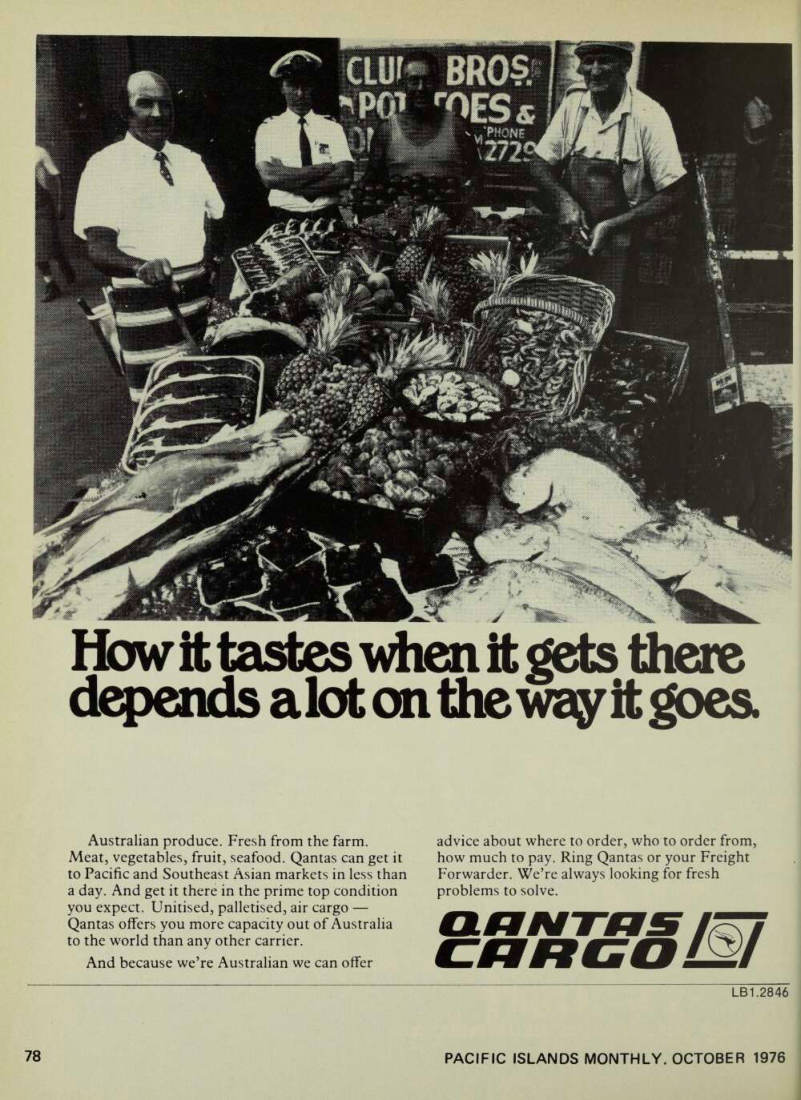
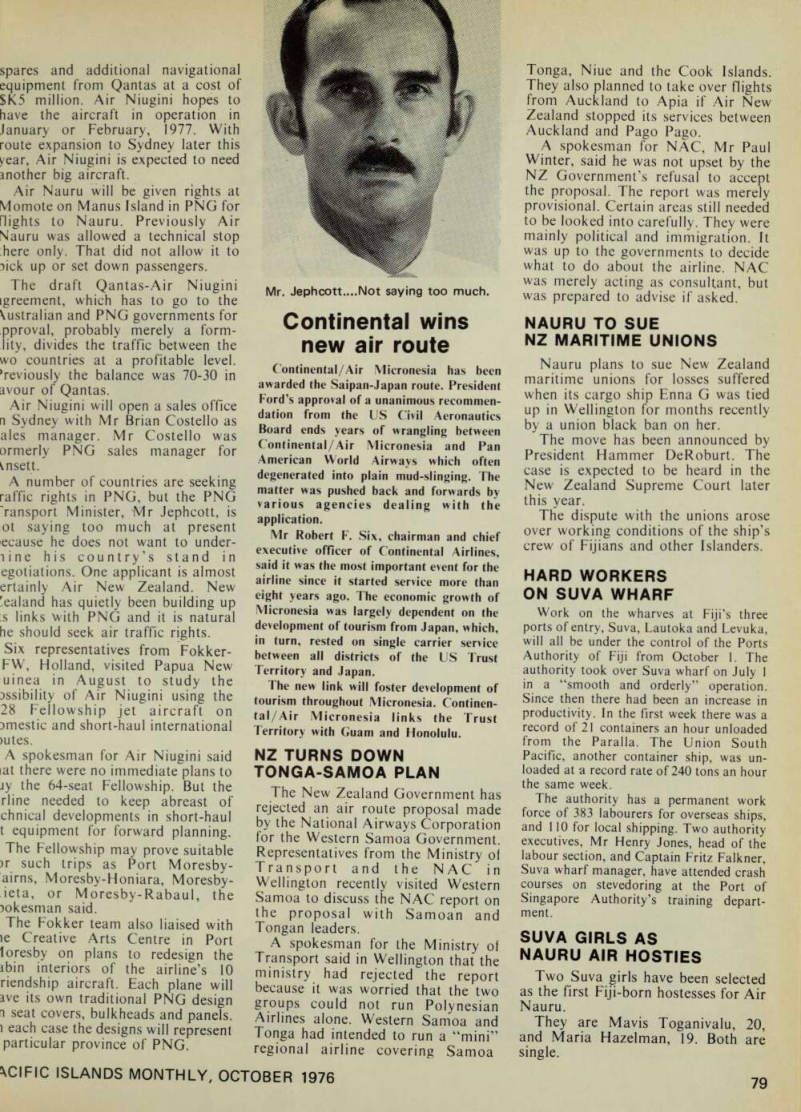
Air Pacific And Air Niugini
Plan Wider Wing Spreads
Some of the problems facing Air Pacific and its possible future role were outlined in the Fiji House of Representatives by Finance Minister Charles Stinson, a couple of days after he became acting chairman of the airline. Replying to questions about a government proposal to in vest a further $500,000 in Air Pacific, Mr Stinson said the future depended on a review of its structure which will be undertaken by independent con sultants.
Air Pacific might be forced into the position of getting long-range jets, such as the Boeing 707, and 'enegotiating the pattern of its routes o take in direct flights to Sydney and ~nd. But the airline’s big >roblem was the heavy interest >urden in repaying loans raised to buy lew aircraft.
Mr Stinson said Air Pacific lost 5923,000 between April, 1974, and March, 1976. It needed the $500,000 o get it out of serious cash problems, ’iji would invest another $500,000 in Vir Pacific in 1977. Three other air ines, with interests in Air Pacific, efused to increase their investments, 'hese were Qantas, British Airways nd Air New Zealand. Apart from Vestern Samoa, other Pacific Islands
jovernments were considering
/hether to increase their
hareholdings.
Air Pacific was not alone in losing loney. Qantas and Polynesian urlines suffered losses last year. Air Jauru had “extremely heavy” losses.
Mr Stinson said Fiji’s hopes of laking Air Pacific a regional airline ad not had a smooth passage. Other lareholders were being asked to low their loyalty. Mr Stinson said radically all general staff of Air acific were local, and good progress as being made in training local ilots.
Meanwhile, Air Niugini has been •anted rights to operate services to ydney. The first flight is expected in
November. It will probably be an ex tension of the Port Moresby-Brisbane service.
Under a new draft air services agreement between Papua New Guinea and Australia, Air Niugini has rights at Cairns, Brisbane and Port Moresby. In return, Qantas has traffic rights at Port Moresby and another port to be nominated later.
This could be Nadzab, near Lae.
Port Moresby at present has the only airport in PNG capable of handl ing Qantas jet aircraft. It can handle any aircraft, except the supersonic Concorde, but Nadzab, at present,
could not handle Qantas Boeing 707 s or 7475.
The emergence of the agreement has raised speculation that Qantas may be on the verge of an operations business deal with Air Niugini.
When Air Niugini went inter national late last year, Qantas was one of several operators which offered wet charter deals. But the contract went to the British charter specialists Tempair, based in UK and Hong Kong. Tempair is believed to have offered the best price.
Air Niugini, at the end of August, decided to buy a Boeing 707, with
New Shipping Link For Pacific
A new, fully containerised shipping service from Sydney to the Solomon Islands and the United States Trust Territories in August has opened new trading links between the South and North Pacific.
The Daiwa links introduced the % first containerised service to the* region following investigations by a trade mission from Micronesia to the Solomons and other major ports earlier this year.
Mr John Robinson, general manager of Oceania Lines, earlier said in Honiara that if there were east-west trading links in the Pacific, there should also be north-south trading routes.
The introduction of the containerised service direct from Sydney to Honiara, Koror, Guam, Saipan, Truk and Ponape gives much encouragement to businessmen in the Solomons who will, eventually, export raw materials to neighbouring territories.
The Solomons would certainly export timber, copra, and rice to the USTT. As a member of the trade mission put it: “The Solomons export to
the USTT is a guaranteed one”, USTT urgently requires rice, copra and timber. In the past few months Foxwood Timber Company has in creased its timber production to meet local demands with surplus for export.
Brewer Solomons Associates, a subsidiary of C. Brewer and Company of Honolulu is producing first-grade, vitamins-enriched rice. With the com pletion of the new rice mill scheduled for the end of August, the factory will be able to produce 70 tonnes of polish ed rice a day. The new mills will have a capacity of six tonnes of paddy rice an hour compared with the old mill which has a capacity of I3Al 3 A tonnes an hour.
Brewer Solomons Associates has made its first trial shipment of BSA rice to Palau, in the Carolines in the Palau, the first containerised vessel to call at Honiara.
One thousand tonnes of copra was also sent to Saipan in the same vessel, The Palau, of 6393 tons, has a capaci ty for 164 containers, of which 24 will be refrigerated 20ft containers.
Palau leaves direct from Sydney every 35 days.
spares and additional navigational equipment from Qantas at a cost of SKS million. Air Niugini hopes to have the aircraft in operation in January or February, 1977. With route expansion to Sydney later this year, Air Niugini is expected to need another big aircraft.
Air Nauru will be given rights at Momote on Manus Island in PNG for flights to Nauru. Previously Air Nauru was allowed a technical stop here only. That did not allow it to aick up or set down passengers.
The draft Qantas-Air Niugini igreement, which has to go to the Australian and PNG governments for pproval, probably merely a form lity, divides the traffic between the wo countries at a profitable level.
Teviously the balance was 70-30 in avour of Qantas.
Air Niugini will open a sales office n Sydney with Mr Brian Costello as ales manager. Mr Costello was ormerly PNG sales manager for vnsett.
A number of countries are seeking raffic rights in PNG, but the PNG 'ransport Minister, Mr Jephcott, is ot saying too much at present ecause he does not want to under aine his country’s stand in egotiations. One applicant is almost ertainly Air New Zealand. New Zealand has quietly been building up :s links with PNG and it is natural he should seek air traffic rights.
Six representatives from Fokker- FW, Holland, visited Papua New uinea in August to study the Dssibility of Air Niugini using the 28 Fellowship jet aircraft on Dmestic and short-haul international >utes.
A spokesman for Air Niugini said lat there were no immediate plans to jy the 64-seat Fellowship. But the rline needed to keep abreast of chnical developments in short-haul t equipment for forward planning.
The Fellowship may prove suitable >r such trips as Port Moresby airns, Moresby-Honiara, Moresby ieta, or Moresby-Rabaul, the said.
The Fokker team also liaised with le Creative Arts Centre in Port loresby on plans to redesign the ibin interiors of the airline’s 10 riendship aircraft. Each plane will ave its own traditional PNG design n seat covers, bulkheads and panels, i each case the designs will represenl particular province of PNG.
Advertisements & other items, pp. 77-78 (2 items)
77
ACIFIC ISLANDS MONTHLY, OCTOBER 1976
depends alot on the way it goes.
r* CLUr- BROS
' PQ* r OESs
nt A f. y How it tastes when it gets there depends alot on the way it goes.
Australian produce. Fresh from the farm.
Meat, vegetables, fruit, seafood. Qantas can get it to Pacific and Southeast Asian markets in less than a day. And get it there in the prime top condition you expect. Unitised, palletised, air cargo Qantas offers you more capacity out of Australia to the world than any other carrier.
And because we’re Australian we can offer advice about where to order, who to order from, how much to pay. Ring Qantas or your Freight Forwarder. We’re always looking for fresh problems to solve. !®/ L 81.2846
Continental wins
new air route
Continental/Air Micronesia has been awarded the Saipan-Japan route. President Ford’s approval of a unanimous recommen dation from the US Civil Aeronautics Board ends years of wrangling between Continental/Air Micronesia and Pan American World Airways which often degenerated into plain mud-slinging. The matter was pushed back and forwards by various agencies dealing with the application.
Mr Robert F. Six, chairman and chief executive officer of Continental Airlines, said it was the most important event for the airline since it started service more than eight years ago. The economic growth of Micronesia was largely dependent on the development of tourism from Japan, which, in turn, rested on single carrier service between all districts of the US Trust Territory and Japan.
The new link will foster development of tourism throughout Micronesia. Continen tal/Air Micronesia links the Trust Territory with Guam and Honolulu.
Nz Turns Down
Tonga-Samoa Plan
The New Zealand Government has rejected an air route proposal made by the National Airways Corporation for the Western Samoa Government.
Representatives from the Ministry of Transport and the NAC in Wellington recently visited Western Samoa to discuss the NAC report on the proposal with Samoan and Tongan leaders.
A spokesman for the Ministry of Transport said in Wellington that the ministry had rejected the report because it was worried that the two groups could not run Polynesian Airlines alone. Western Samoa and Tonga had intended to run a “mini” regional airline covering Samoa
Tonga, Niue and the Cook Islands.
They also planned to take over flights from Auckland to Apia if Air New Zealand stopped its services between Auckland and Pago Pago.
A spokesman for NAC, Mr Paul Winter, said he was not upset by the NZ Government’s refusal to accept the proposal. The report was merely provisional. Certain areas still needed to be looked into carefully. They were mainly political and immigration. It was up to the governments to decide what to do about the airline. NAC was merely acting as consultant, but was prepared to advise if asked.
Nauru To Sue
Nz Maritime Unions
Nauru plans to sue New Zealand maritime unions for losses suffered when its cargo ship Enna G was tied up in Wellington for months recently by a union black ban on her.
The move has been announced by President Hammer Deßoburt. The case is expected to be heard in the New Zealand Supreme Court later this year.
The dispute with the unions arose over working conditions of the ship’s crew of Fijians and other Islanders.
Hard Workers
On Suva Wharf
Work on the wharves at Fiji’s three ports of entry, Suva, Lautoka and Levuka, will all be under the control of the Ports Authority of Fiji from October 1. The authority took over Suva wharf on July 1 in a “smooth and orderly” operation.
Since then there had been an increase in productivity. In the first week there was a record of 21 containers an hour unloaded from the Paralla. The Union South Pacific, another container ship, was un loaded at a record rate of 240 tons an hour the same week.
The authority has a permanent work force of 383 labourers for overseas ships, and 110 for local shipping. Two authority executives, Mr Henry Jones, head of the labour section, and Captain Fritz Falkner, Suva wharf manager, have attended crash courses on stevedoring at the Port of Singapore Authority’s training depart ment.
Suva Girls As
Nauru Air Hosties
Two Suva girls have been selected as the first Fiji-born hostesses for Air Nauru.
They are Mavis Toganivalu, 20, and Maria Hazelman, 19. Both are single.
Mr. Jephcott...Not saying too much.
Advertisements & other items, pp. 79-80 (2 items)
79
AC I FI C ISLANDS MONTHLY, OCTOBER 1976
Your Island
From today, this is
IN THE SKY
For 25 years, we have been flying the blue Pacific skies. Today, to celebrate our anniversary, and to look ahead to the next 25 years, we have become a new airline. From today, we are your island in the sky. An island reflected in a new colour scheme.
Rolls-Royce engined jets in colours which are a combination of the Pacific people’s fun and freedom. Colours which are sunrises and sunsets.
Flowers. And the blue Pacific itself.
This is the new Air Pacific. . .your island in the sky.
A new airline which offers you the new kind of island happiness and hospitality. With all traditional courtesy and dignity.
If you’re flying the Pacific, welcome aboard.
We know the South Pacific its our home. m
SKSg
mm 0
Transport
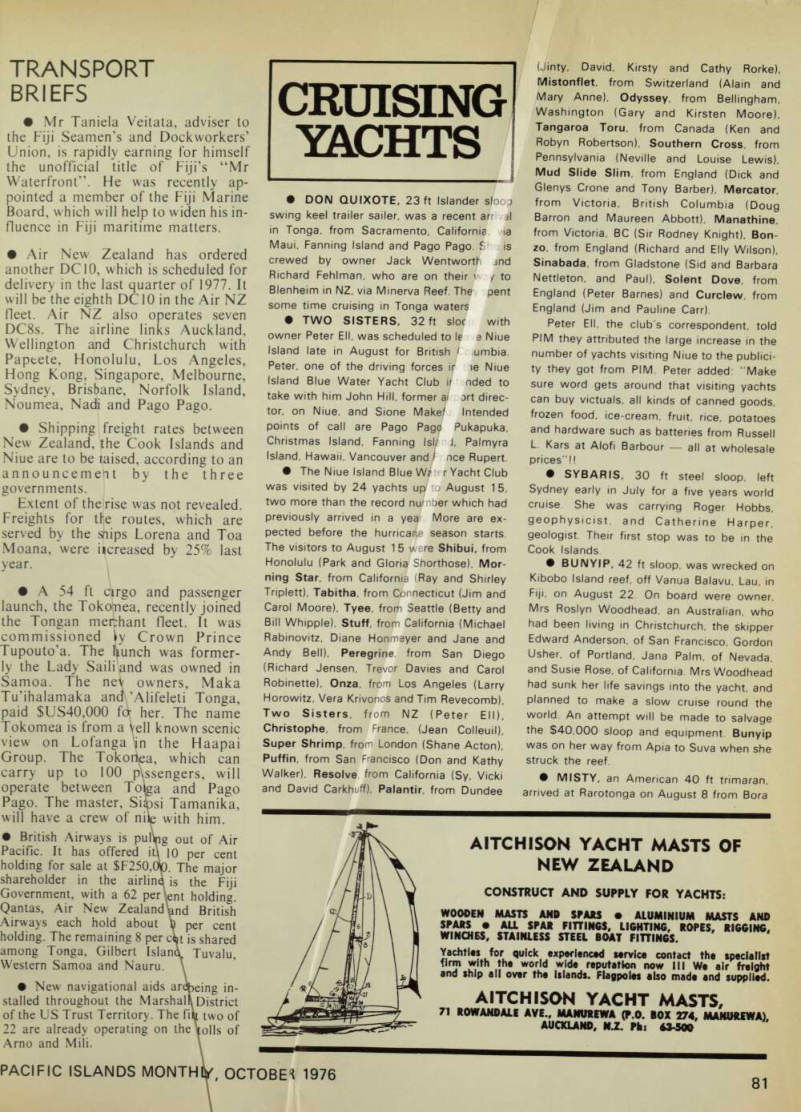
Briefs
• Mr Taniela Veitata, adviser to the Fiji Seamen’s and Dockworkers’
Union, is rapidly earning for himself the unofficial title of Fiji’s “Mr Waterfront”. He was recently ap pointed a member of the Fiji Marine Board, which will help to widen his in fluence in Fiji maritime matters. Air New Zealand has ordered another DC 10, which is scheduled for delivery in the last quarter of 1977. It will be the eighth DC 10 in the Air NZ fleet. Air NZ also operates seven DCBs. The airline links Auckland, Wellington and Christchurch with Papeete, Honolulu, Los Angeles, Hong Kong, Singapore, Melbourne, Sydney, Brisbane, Norfolk Island, Noumea, Nadi and Pago Pago. • Shipping freight rates between New Zealand, the Cook Islands and Niue are to be raised, according to an announcement by the three governments.
Extent of the rise was not revealed.
Freights for the routes, which are served by the snips Lorena and Toa Moana, were iicreased by 25% last year. • A 54 ft qirgo and passenger launch, the Tokojnea, recently joined the Tongan merchant fleet. It was commissioned Jy Crown Prince Tupouto’a. The launch was former ly the Lady Sailiand was owned in Samoa. The nev owners, Maka Tu’ihalamaka and ’Alifeleti Tonga, paid SUS4O,OOO fa her. The name Tokomea is from a Veil known scenic view on Lofanga jn the Haapai Group. The Tokoriea, which can carry up to 100 passengers, will operate between Tolga and Pago Pago. The master, Si£si Tamanika, will have a crew of niie with him. • British Airways is puling out of Air Pacific. It has offered it\ 10 per cent holding for sale at $F250,0p. The major shareholder in the airline is the Fiji Government, with a 62 per\ en t holding.
Qantas, Air New ZealandVmd British Airways each hold about u per cent holding. The remaining 8 per cV is shared among Tonga, Gilbert Island Tuvalu, Western Samoa and Nauru. \ • New navigational aids areheing in stalled throughout the Marshall District of the US Trust Territory. The fi» two of 22 are already operating on the tolls of Arno and Mili. \
Cruising
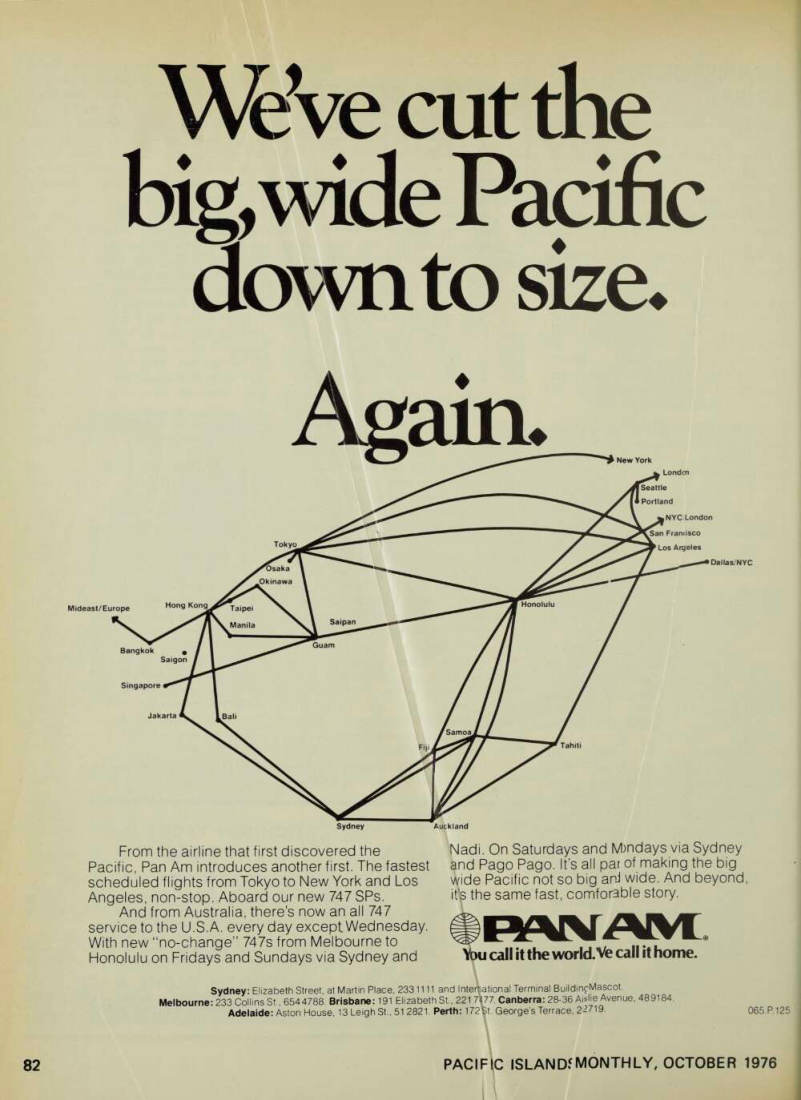
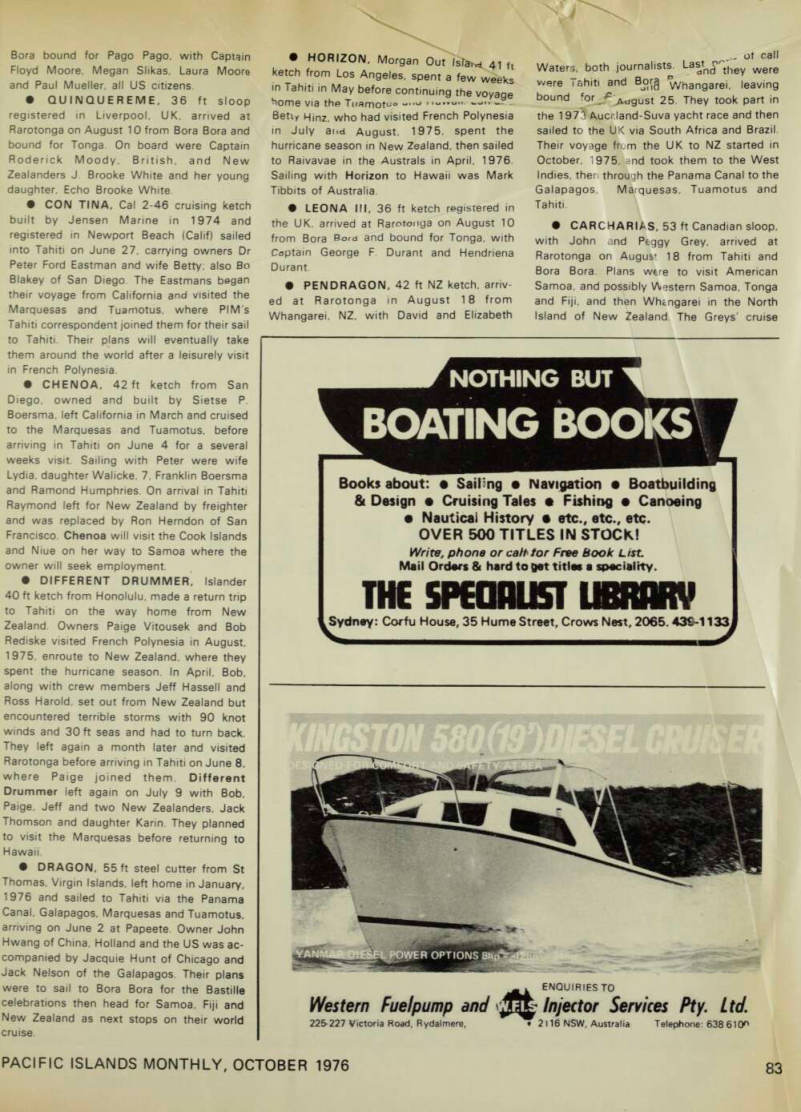
Yachts
• DON QUIXOTE, 23 ft Islander slooj swing keel trailer sailer, was a recent arr al in Tonga, from Sacramento, California ia Maui, Fanning Island and Pago Pago. S is crewed by owner Jack Wentworth jnd Richard Fehlman, who are on their v / to Blenheim in NZ, via Minerva Reef. The pent some time cruising in Tonga waters • TWO SISTERS, 32 ft sloe with owner Peter Ell, was scheduled to le e Niue Island late in August for British 1 umbia.
Peter, one of the driving forces ir ie Niue Island Blue Water Yacht Club ir nded to take with him John Hill, former ai art direc tor, on Niue, and Sione Make/ Intended points of call are Pago Pago Pukapuka, Christmas Island, Fanning Isl/ J, Palmyra Island, Hawaii, Vancouver and > nee Rupert. • The Niue Island Blue Wf r Yacht Club was visited by 24 yachts up o August 15, two more than the record number which had previously arrived in a yea More are ex pected before the hurricane season starts.
The visitors to August 1 5 were Shibui, from Honolulu (Park and Gloria Shorthose), Mor ning Star, from California (Ray and Shirley Triplett), Tabitha, from Connecticut (Jim and Carol Moore), Tyee, from Seattle (Betty and Bill Whipple), Stuff, from California (Michael Rabinovitz, Diane Honmeyer and Jane and Andy Bell), Peregrine, from San Diego (Richard Jensen, Trevor Davies and Carol Robinette), Onza, from Los Angeles (Larry Horowitz, Vera Krivonos and Tim Revecomb), Two Sisters, from NZ (Peter Ell), Christophe, from France, (Jean Colleuil), Super Shrimp, from London (Shane Acton), Puffin, from San Francisco (Don and Kathy Walker), Resolve from California (Sy, Vicki and David Carkhu/f), Palantir, from Dundee
(Jinty, David, Kirsty and Cathy Rorke), Mistonfiet, from Switzerland (Alain and Mary Anne), Odyssey, from Bellingham, Washington (Gary and Kirsten Moore), Tangaroa Toru, from Canada (Ken and Robyn Robertson), Southern Cross, from Pennsylvania (Neville and Louise Lewis), Mud Slide Slim, from England (Dick and Glenys Crone and Tony Barber), Mercator, from Victoria, British Columbia (Doug Barron and Maureen Abbott), Manathine, from Victoria, BC (Sir Rodney Knight), Bon zo, from England (Richard and Elly Wilson), Sinabada, from Gladstone (Sid and Barbara Nettleton, and Paul), Solent Dove, from England (Peter Barnes) and Curclew, from England (Jim and Pauline Carr).
Peter Ell, the club's correspondent, told PIM they attributed the large increase in the number of yachts visiting Niue to the publici ty they got from PIM Peter added: "Make sure word gets around that visiting yachts can buy victuals, all kinds of canned goods, frozen food, ice-cream, fruit, rice, potatoes and hardware such as batteries from Russell L, Kars at Alofi Barbour all at wholesale prices''!! • SYBARIS, 30 ft steel sloop, left Sydney early in July for a five years world cruise. She was carrying Roger Hobbs, geophysicist, and Catherine Harper, geologist. Their first stop was to be in the Cook Islands. • BUNYIP, 42 ft sloop, was wrecked on Kibobo Island reef, off Vanua Balavu, Lau, in Fiji, on August 22. On board were owner, Mrs Roslyn Woodhead, an Australian, who had been living in Christchurch, the skipper Edward Anderson, of San Francisco, Gordon Usher, of Portland, Jana Palm, of Nevada, and Susie Rose, of California. Mrs Woodhead had sunk her life savings into the yacht, and planned to make a slow cruise round the world An attempt will be made to salvage the $40,000 sloop and equipment. Bunyip was on her way from Apia to Suva when she struck the reef. • MISTY, an American 40 ft trimaran, arrived at Rarotonga on August 8 from Bora
Bora bound for Pago Pago, with Captain Floyd Moore, Megan Slikas, Laura Moore and Paul Mueller, all US citizens. • QUINQUEREME, 36 ft sloop registered in Liverpool, UK, arrived at Rarotonga on August 10 from Bora Bora and bound for Tonga. On board were Captain Roderick Moody, British, and New Zealanders J. Brooke White and her young daughter. Echo Brooke White. • CON TINA, Cal 2-46 cruising ketch built by Jensen Marine in 1974 and registered in Newport Beach (Calif) sailed into Tahiti on June 27, carrying owners Dr Peter Ford Eastman and wife Betty; also Bo Blakey of San Diego. The Eastmans began their voyage from California and visited the Marquesas and Tuamotus, where PlM's Tahiti correspondent joined them for their sail to Tahiti. Their plans will eventually take them around the world after a leisurely visit in French Polynesia. • CHENOA, 42 ft ketch from San Diego, owned and built by Sietse P.
Boersma, left California in March and cruised to the Marquesas and Tuamotus, before arriving in Tahiti on June 4 for a several weeks visit. Sailing with Peter were wife Lydia, daughter Walicke, 7, Franklin Boersma and Ramond Humphries. On arrival in Tahiti Raymond left for New Zealand by freighter and was replaced by Ron Herndon of San Francisco. Chenoa will visit the Cook Islands and Niue on her way to Samoa where the owner will seek employment.
• Different Drummer, Islander
40 ft ketch from Honolulu, made a return trip to Tahiti on the way home from New Zealand. Owners Paige Vitousek and Bob Rediske visited French Polynesia in August, 1975, enroute to New Zealand, where they spent the hurricane season. In April, Bob, along with crew members Jeff Hassell and Ross Harold, set out from New Zealand but encountered terrible storms with 90 knot winds and 30 ft seas and had to turn back.
They left again a month later and visited Rarotonga before arriving in Tahiti on June 8, where Paige joined them. Different Drummer left again on July 9 with Bob, Paige, Jeff and two New Zealanders, Jack Thomson and daughter Karin. They planned to visit the Marquesas before returning to Hawaii. • DRAGON, 55 ft steel cutter from St Thomas, Virgin Islands, left home in January, 1976 and sailed to Tahiti via the Panama Canal, Galapagos, Marquesas and Tuamotus, arriving on June 2 at Papeete. Owner John Hwang of China, Holland and the US was ac companied by Jacquie Hunt of Chicago and Jack Nelson of the Galapagos. Their plans were to sail to Bora Bora for the Bastille celebrations then head for Samoa, Fiji and New Zealand as next stops on their world cruise.
• HORIZON, Morgan Out Isla.-d 41 ft ketch from Los Angeles, spent a few weeks in Tahiti in May before continuing the voyage home via the Betiy Hinz, who had visited French Polynesia in July and August, 1975, spent the hurricane season in New Zealand, then sailed to Raivavae in the Australs in April, 1976 Sailing with Horizon to Hawaii was Mark Tibbits of Australia. • LEONA 111, 36 ft ketch registered in the UK, arrived at Rarotonga on August 10 from Bora Bora and bound for Tonga, with Captain George F. Durant and Hendriena Durant. • PENDRAGON, 42 ft NZ ketch, arriv ed at Rarotonga in August 18 from Whangarei, NZ, with David and Elizabeth
of call Waters, both journalists. La ® t n( s''' they were were Tahiti and Borg whangarei, leaving bound Au gust 25. They took part in the 1 AucHand-Suva yacht race and then sailed to the UK via South Africa and Brazil.
Their voyage from the UK to NZ started in October, 1975, and took them to the West Indies, then through the Panama Canal to the Galapagos, Marquesas, Tuamotus and Tahiti. • CARCHARIAS, 53 ft Canadian sloop, with John and Peggy Grey, arrived at Rarotonga on August 18 from Tahiti and Bora Bora. Plans were to visit American Samoa, and possibly Western Samoa, Tonga and Fiji, and then Whcngarei in the North Island of New Zealand. The Greys' cruise
started w, first leg of Trflflp from Poole (UK) and the Mediterranean and AcJfluJook them to across the Atlantic to the o.Jthes and into the Pacific via the Panama Canal.
While sailing to Vancouver, Via Hawaii, they were struck by a hurricane/but Carcharias had only minor damage. • WINDWAGGON 111, 68 ft cutter from Newport, Oregon, owned by retired lawyer Dick Tretheway and wife Sandy, arrived in Tahiti on April 12 where ihey planned to stay until October before heading for Tonga, Fiji and New Zealand. /Vith them is Hans Millenaar of Pasader/a (Calif). The 55 ton boat is steel-covered with concrete and is 16 ft from the keel/to the super structure.
There are 800 sq ft of living quarters in cluding three private staterooms, a saloon with an electric organ, a galley with full-sized washer and drye', propane cooker, 15cuft freezer and 8 cu ft refrigerator. There is a complete workshop aboard with an 11 ins metal lathe as part of Dick's proud possessions, an auxiliary generating plant, and an air compressor for scuba divers.
Windwaggon II was battered on the reef in Rarotonga in 1973 and the new one was built in 11 months. • SOUTHERNORE. 32 ft sloop from
Sydney, arrived at Rarotonga on August 23 from Papeete, bound for Suva, with Tony fountain), Francis Gugich and Linda Marere. • CARINA, 24 ft cutter from has been in Tahiti since March 18, with Canadians Connie and Eric Flewelling. They bought Carina in California and sailed to Hawaii in February, 1975, for a nine-month visit, then left for the Marquesas and Tuamotus. Their plans were to remain in Tahiti through the Bastille (July) celebrations, Hawaii, Western Samoa, Fiji. Sydney, Lord Howe Island and New Zealand, where she rested for the summer months. Leaving New Zealand on April 6 owners Lynn Wallen and Trevor Stickler, along with Anders Bolsen of Denmark, visited Raivavae before sailing to Tahiti. After a brief visit they left for Ahe in the Tuamotus, the Marquesas, Hawaii and home to Vancouver. • Kl' IHELE, Cal-40 owned and cap tained by G. T. "Van” Ingen of Hawaii, left Hawaii in late May and arrived in Tahiti on June 16. His plans were to visit French Polynesia then sail back home in early September. With Van in Tahiti were Jan Le Doux, George Kenning and Egon Rassow. • HELLY, 38 ft sloop, arrived at Rarotonga on August 17 with Australians Douglas and Josephine Winkler, both of
Sydney. During their six-month Pacific cruise they have called at Hawaii (where they bought HeJly) and in which they sailed to Tahiti, Moorea and Bora Bora. From Rarotonga they planned to sail to Tonga, Fiji, New Caledonia, then back home to Sydney. • NATURAL HY, 36 ft sloop from Van couver, left Canada in August, 1974, for then continue their three-year circumnaviga tion. Their next ports of call were to be Rarotonga, Tonga, Fiji, New Zealand and Australia. • COPY CAT, 43 ft catamaran registered in Vancouver, arrived at Rarotonga on July 28 with owner-captain Lyle Chase and Carol Chase. Their voyage started in September, 1975, and has taken them to the Marquesas and Tuamotus. Plans were to visit Samoa and Fiji before arriving in New Zealand in November. • FANTASIA, 32 ft American cutter, arrived at Rarotonga on August 3 with owner-captain Win Charlebois and Linda Hoppe! and their two cats. They came from Tahiti and Bora Bora after spending a year in French Polynesia and hoped to visit some of the other Cook Islands before calling at Niue and Tonga and spending the hurricane season in New Zealand. Next cruising season they plan to visit Fiji and Micronesia.
Advertisements & other items, pp. 81-84 (2 items)
81
PACIFIC ISLANDS MONTHIV OCTOBER 1976
New Zealand
AITCHISOK YACHT MASTS OF
CONSTRUCT AND SUPPLY FOR YACHTS:
WOODEN MASTS AND SPARS • ALUMINIUM MASTS AND SPARS • ALL SPAR FITTINGS, LIGHTING, ROPES, RIGGING.
WINCHES. STAINLESS STEEL BOAT FITTINGS.
Yachties for quick experienced service contact the specialist firm with the world wide reputation now 111 We air freight and ship all over the islands. Flagpoles also made and supplied.
AITCHISON YACHT MASTS,
71 ROW AND ALE A»E„ MANUREWA (R.O, MX 174, MANUUWA),
AUCKLAND, Hi Pk, 43-MO
\\fe’ve cut the
big, wide Pacific
down to size.
Again.
Mideast/Europe Hong Kon^^^T a ipei Manila York Lone n Seattle Portland NYC London San Francisco Tokyo Los Angeles Okinawa Honolulu Saipan Guam Bangkok Saigon Singapore Jakarta Bah Tahiti Sydney From the airline that first discovered the Pacific, Pan Am introduces another first. The fastest scheduled flights from Tokyo to New York and Los Angeles, non-stop. Aboard our new 747 SPs.
And from Australia, there’s now an all 747 service to the U.S.A. every day except Wednesday.
With new “no-change” 747 s from Melbourne to Honolulu on Fridays and Sundays via Sydney and Nadi. On Saturdays and Mondays via Sydney and Pago Pago. It’s all pat of making the big wide Pacific not so big ani wide. And beyond,
it's the same fast, comforable story.
i call it the world. Ve call it home.
Sydney: Elizabeth Street, at Martin Place, 2331111 and International Terminal BuildincMascot.
Melbourne: 233 Collins St., 6544788. Brisbane: 191 Elizabeth St., 221 7*77. Canberra: 28-36 Aislie Avenue, 489184.
Adelaide: Aston House, 13 Leigh St., 51 2821. Perth: 1728 L George’s Terrace, 2^719. 065
1
NOTHING BUT
BOATING BOOKS
Books about: • Sailing • Navigation • Boatbuilding & Design • Cruising Tales • Fishing • Canoeing • Nautical History • etc., etc., etc.
OVER 500 TITLES IN STOCK!
Write, phone or cab tor Free Book List Mail Orders & hard to get titles a speciality.
THE SPHHUST ÜBRfIRV
Sydney: Corfu House, 35 Hume Street, Crows Nest, 2065.43&-1133 % a
ENQUIRIES TO
m k t'tuuimco IU Western Fuel pump and Injector Services Pty. Ltd. 225-227 Victoria Road, Rydalmere, 2)16 NSW, Australia Telephone: 638 610°
UNBREAKABLE!
£ QP 1
and in
Hall and cluhroom furniture has to take a lot of punishment. Constant wear and tear can, in time, cause a great deal of damage to even the best of chairs.
Now, we've designed a chair that’s built to take almost any punishment. Every Polystak chair has a seat and back of polypropylene a virtually indestructible plastic (it won’t even delaminate, leaving rough edges to damage nylons or clothes).
Each chair frame is of and 7 /s” tubular steel, continuous over the back support, and with heavy two metal reinforcing straps under the seat, and heavy duty, non-marking plastic feet.
Polystak chairs are available in six comfortable sizes and in a choice of five vibrant colours.
And they stack away in a surprisingly small amount of space.
Polystak chairs the great all-rounders. Write us today for further information or no obligation quotation (whole Pacific region C.1.F.) Furnware Products Ltd exporters to the Pacific for over 15 years. Name Position I Organisation I Address RN
FURNWARE
PRODUCTS LTD
P O Box 1
HASTINGS
NEW ZEALAND
Seat Of Its Pants In Png
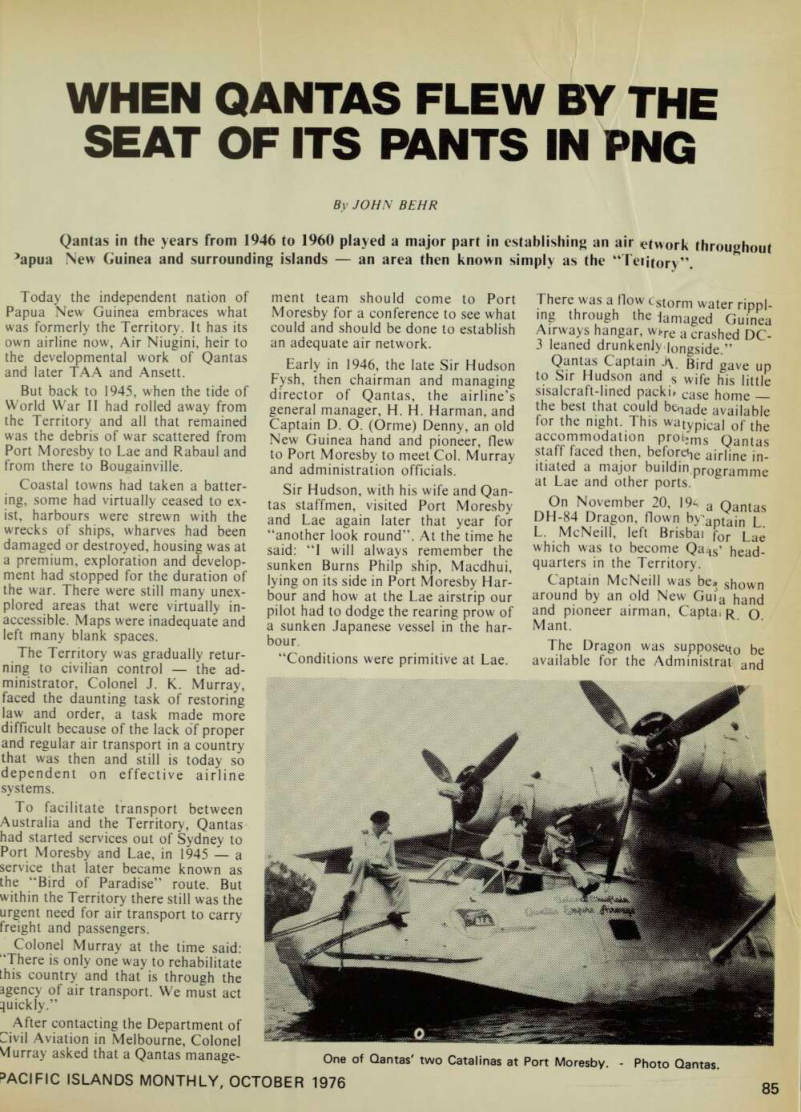
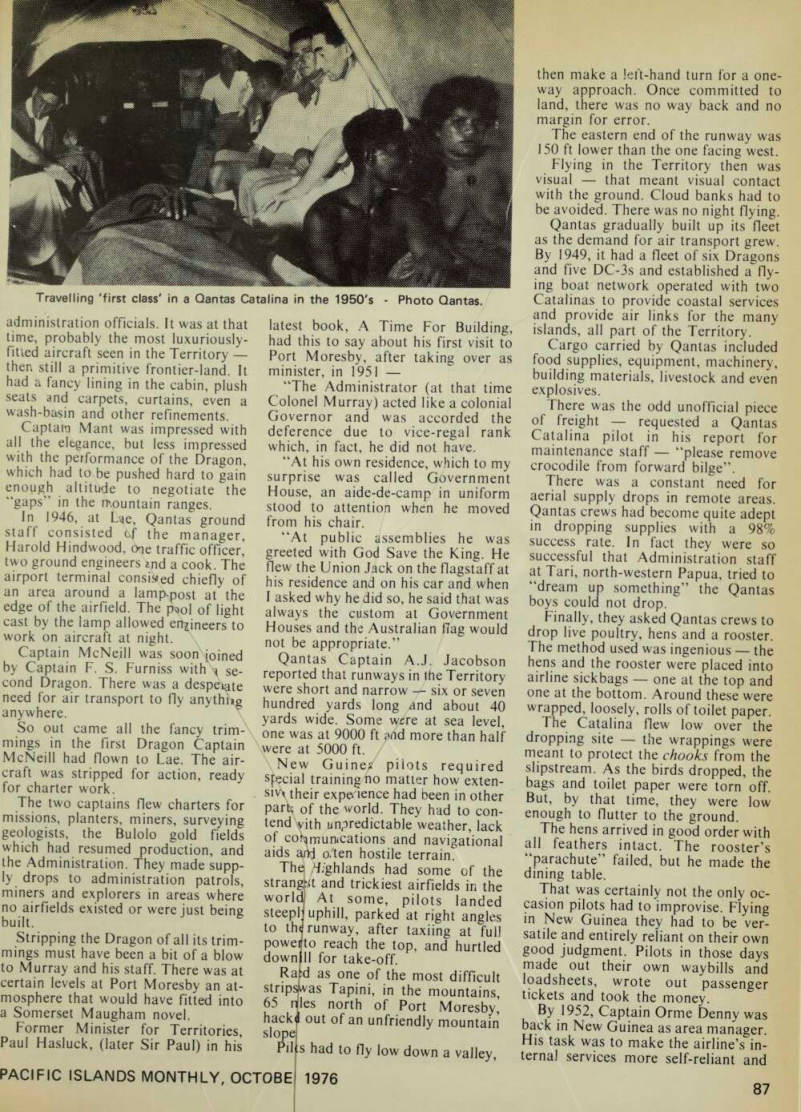
When Qantas Flew By The
By John Behr
Qantas in the years from 1946 to 1960 played a major part in establishing an air etwork throughout s apua New Guinea and surrounding islands an area then known simply as the “Teiitory".
Today the independent nation of Papua New Guinea embraces what was formerly the Territory. It has its own airline now, Air Niugini, heir to the developmental work of Qantas and later TAA and Ansett.
But back to 1945, when the tide of World War II had rolled away from the Territory and all that remained was the debris of war scattered from Port Moresby to Lae and Rabaul and from there to Bougainville.
Coastal towns had taken a batter ing, some had virtually ceased to ex ist, harbours were strewn with the wrecks of ships, wharves had been damaged or destroyed, housing was at a premium, exploration and develop ment had stopped for the duration of the war. There were still many unex plored areas that were virtually in accessible. Maps were inadequate and left many blank spaces.
The Territory was gradually retur ning to civilian control the ad ministrator, Colonel J. K. Murray, faced the daunting task of restoring law and order, a task made more difficult because of the lack of proper and regular air transport in a country that was then and still is today so dependent on effective airline systems.
To facilitate transport between Australia and the Territory, Qantas had started services out of Sydney to Port Moresby and Lae, in 1945 a service that later became known as the “Bird of Paradise” route. But within the Territory there still was the urgent need for air transport to carry freight and passengers.
Colonel Murray at the time said: There is only one way to rehabilitate this country and that is through the agency of air transport. We must act quickly.”
After contacting the Department of Aviation in Melbourne, Colonel Murray asked that a Qantas manage
ment team should come to Port Moresby for a conference to see what could and should be done to establish an adequate air network.
Early in 1946, the late Sir Hudson Fysh, then chairman and managing director of Qantas, the airline’s general manager, H. H. Harman, and Captain D. O. (Orme) Denny, an old New Guinea hand and pioneer, flew to Port Moresby to meet Col. Murray and administration officials.
Sir Hudson, with his wife and Qantas staffmen, visited Port Moresby and Lae again later that year for “another look round”. At the time he said; “I will always remember the sunken Burns Philp ship, Macdhui, lying on its side in Port Moresby Harhour and how at the Lae airstrip our pilot had to dodge the rearing prow of a sunken Japanese vessel in the harbour “Conditions were primitive at Lae.
There was a How C s torm water ripnl ing through the iamaged Guinea Airways hangar, wi* re a crashed DC 3 leaned drunkenly longside.”
Captain A. Bird gave up *9 , ir Hudson and s w if e hj s little sisalcraft-lmed packi, case home * he best V 1 ? 1 c 99 ld be nade available or tbe ni gj>t. This watypj ca j 0 f the accommodation prou ms Q an tas ? . * aceb then, airline in itiated a major buildin programme at ae otber P orts - On November 20, 19a a Q an tas DH-84 Dragon, flown by > a p ta j n l McNeill, left Brisbai f or L ae which was to become head quarters in the Territory, Captain McNeill was be* shown around by an old New Gui a hand and pioneer airman, Capta* r q.
Mant.
The Dragon was supposeq 0 be available for the Administral anc j
One of Qantas' two Catalinas at Port Moresby. Photo Qantas.
administration officials. It was at that time, probably the most luxuriously fitted aircraft seen in the Territory then still a primitive frontier-land. It had a fancy lining in the cabin, plush seats and carpets, curtains, even a wash-basin and other refinements.
Captain Mant was impressed with all the elegance, but less impressed with the performance of the Dragon, which had to be pushed hard to gain enough altitude to negotiate the “gaps” in the mountain ranges.
In 1946, at Lae, Qantas ground staff consisted ef the manager, Harold Hindwood, one traffic officer, two ground engineers and a cook. The airport terminal consisted chiefly of an area around a lamp-post at the edge of the airfield. The paol of light cast by the lamp allowed engineers to work on aircraft at night.
Captain McNeill was soon Joined by Captain F. S. Furniss with a se cond Dragon. There was a despeiate need for air transport to fly anythiig anywhere.
So out came all the fancy trim mings in the first Dragon Captain McNeill had flown to Lae. The air craft was stripped for action, ready for charter work.
The two captains flew charters for missions, planters, miners, surveying geologists, the Bulolo gold fields which had resumed production, and the Administration. They made supp ly drops to administration patrols, miners and explorers in areas where no airfields existed or were just being built.
Stripping the Dragon of all its trim mings must have been a bit of a blow to Murray and his staff. There was at certain levels at Port Moresby an at mosphere that would have fitted into a Somerset Maugham novel.
Former Minister for Territories, Paul Hasluck, (later Sir Paul) in his
latest book, A Time For Building, had this to say about his first visit to Port Moresby, after taking over as minister, in 1951 “The Administrator (at that time Colonel Murray) acted like a colonial Governor and was accorded the deference due to vice-regal rank which, in fact, he did not have.
“At his own residence, which to my surprise was called Government House, an aide-de-camp in uniform stood to attention when he moved from his chair.
“At public assemblies he was greeted with God Save the King. He flew the Union Jack on the flagstaff at his residence and on his car and when I asked why he did so, he said that was always the custom at Government Houses and the Australian Hag would not be appropriate.”
Q antas Captain A.J. Jacobson reported that runways in the Territory were short and narrow J- six or seven hundred yards long and about 40 yards wide. Some were at sea level 0116 W3S at 9000 ft more than half were at 5000 ft New G uine? pilots requ ired social training no matter how exten their expedience had been in other park of the world. They had to con tend vith unpredictable weather, lack of communications and navigational aids artf o/ten hostile terrain The Highlands had some' of the strang/t and trickiest airfields in the world) At some, pilots landed steepl uphill, parked at right angles
“43 £',o" X 3 h"„a
downlll for take-off. F Ratd as one of t}le most difficult stnpsfvas Tapini, in the mountains 65 nles north of Port MoreZ hacki I out of an unfriendly mountain slope y ~luunidm Pil ;s had to fly low down a valley
then make a left-hand turn for a one way approach. Once committed to land, there was no way back and no margin for error.
The eastern end of the runway was 150 ft lower than the one facing west.
Flying in the Territory then was visual that meant visual contact with the ground. Cloud banks had to be avoided. There was no night flying.
Qantas gradually built up its fleet as the demand for air transport grew.
By 1949, it had a fleet of six Dragons and five DC-3s and established a fly ing boat network operated with two Catalinas to provide coastal services and provide air links for the many islands, all part of the Territory.
Cargo carried by Qantas included food supplies, equipment, machinery, building materials, livestock and even explosives.
There was the odd unofficial piece of freight requested a Qantas Catalina pilot in his report for maintenance staff “please remove crocodile from forward bilge”.
There was a constant need for aerial supply drops in remote areas.
Qantas crews had become quite adept in dropping supplies with a 98% success rate. In fact they were so successful that Administration staff at Tari, north-western Papua, tried to “dream up something” the Qantas boys could not drop.
Finally, they asked Qantas crews to drop live poultry, hens and a rooster.
The method used was ingenious the hens and the rooster were placed into airline sickbags one at the top and one at the bottom. Around these were wrapped, loosely, rolls of toilet paper.
The Catalina flew low over the dropping site the wrappings were meant to protect the chooks from the slipstream. As the birds dropped, the bags and toilet paper were torn off.
But, by that time, they were low enough to flutter to the ground.
The hens arrived in good order with all feathers intact. The rooster’s “parachute” failed, but he made the dining table.
That was certainly not the only oc casion pilots had to improvise. Flying in New Guinea they had to be ver satile and entirely reliant on their own good judgment. Pilots in those days made out their own waybills and loadsheets, wrote out passenger tickets and took the money.
By 1952, Captain Orme Denny was back in New Guinea as area manager.
His task was to make the airline’s in ternal services more self-reliant and
Travelling 'first class' in a Qantas Catalina in the 1950's Photo Qantas.
self-contained. His chief pilot was the legendary Captain W. (Forgie) rorgan-Smith.
The airline had a staff of 174 Europeans and a fleet of 14 aircraft, flying to more than 103 ports Qantas in that year carried 35,029 passengers.
The Administration had opened up more areas in a country that was in parts still very primitive, where customs and life style of the indigenes had no, changed for centuries, where tribal wars were still commonplace.
There was still pockets where canmbalism was practised.
But development moved much more rapidly. Qantas was able to provide more scheduled services, apart from charter flights, extending throughout the Territory (with extensive penetration in the Highlands).
Services were extended to the British Solomons and to what was then Dutch New Guinea.
Qantas did not expect to make much out of New Guinea in the way of profits its job was largely developmental. At the same time, its directors were concerned about the company’s insecurity of tenure in the Territory.
Later events showed that their concern was justified.
As sj r Hudson Fysh put it, in the latter 19505, when Senator Paltridge was Minister for Civil Aviation and the late D. G. Anderson (later Sir Donald) Director-General for Civil Aviation, increasing pressure was exerted by Ansett to enter the Territory.
Sir Hudson said. "That company t Ansett) had great hopes of extending overseas from Port Moresby to Hong Kong as they had inherited ANA shareholdings in Cathay Pacific Airways, based ,n Hong Kong.
“New Guinea had been a magnificent training ground for our young pilots before they entered on our main international routes and we fought hard against losing the New Guinea services.
“It seemed, as in other instances, that the government was determined to do something for Ansett-ANA, a company full of vigour and bent on expansion.
“However, there was the government’s two-airline policy to be reckoned with. Ansett-ANA could not go to New Guinea unless TAA did the same thing.
“It all ended with us losing the bat-
tie and the government deciding to relieve us of our services to and within New Guinea.”
Qantas was obliged to sell its territorial network, aircraft, equip ment, buildings and all other assets to TAA for £700,000 (about $1,400,000).
Ansett joined TAA in the Territory later through the take-over of Man dated Airlines.
In July 1960, both TAA and Ansett took over from Qantas the Australia to New Guinea Bird of Paradise ser vice. And at 6.30 am on September 1, of that year, Nanandai, a Papuan in Qantas service for many years, lowered the Qantas flag at Lae air port.
A few minutes later, the TAA flag was raised in its place as the airline’s first territorial service from Lae to Madang, Wewak, Manus, Kavieng and Rabaul was ready to take off.
The ceremony at Lae underlined the end of the last chapter of a unique period in Qantas’ long history. Uni que, because in Australia, Qantas had left behind its pioneering days in the 19205, while in the Territory after the war it had to start all over again, creating a frontier airline.
Advertisements & other items, pp. 86-88 (2 items)
Some Or The Rirms
WE REPRESENT ARE:
Asia Rubbe/ Works (Singapore Rubber Sf/ S ) Frappier (Fr/h Brandy) Huvet (FreiV Brandy) Indika (Be^ m Dairy Produce) Durobor si (Belgium Glassware) Miroiterief"- de Belgiqe S.A. (Louvre^ ass and mirrors) City Eng/ ers (U.K. Bicycles) F.H.I. jJ™ (Subaru Cars) Kraggs ines ' Spirits, Ciders) Sunshir> B 'Scuits Sunrise/' on^ecf ' oner y) Flamer (Instant Coffee & Tea) Products (Oats, Jets) Hanc/ 5 (Spaghetti, Cereals) AAeib rne Canning (Jams) Am; (Twisties, Twirlies) Edw d Zorn (Margarine, Cooking is (Confectionery) Tulip (Fine Chocolates) jrt Timms (New Guinea Gold /nstant Coffees and Teas) .C. (Canned Fruit) S.P.C. (Abalone) Wing Lee (See You Sauce) Magnet (Mattresses) Essteel (Cookware) Warner-Drayton (Fans) Mitchell's (Abrasives) Tilbury & Lewis (Sports Trophies & Silverplate) Regent (Swiss watches) Lega Marcasite (Jewellery) Austramax (Pressure Lanterns) Lawn Chair; Tubco (Garden Furniture) Electronic Industries (Electrical Household Appliances) Jex (Steelwool) Arnbro (Folding Beds) James Miller (Blankets) Elmaco (Plastics —Electrical Fittings) B.X. (Plastics) Stegbar (Wooden Louvres) Franklite (Light Fittings) J.J. Cash Embroidered Labels) Disston (Saws)
DIRECT ENQUIRIES WELCOMED
PAPUA NEW GUINEA: S. E. TATHAM (P.N.G.) PTY. LTD.
LAE: MALAITA STREET (P.O. BOX 1562).
PORT MORESBY: CNR. GOROA AND MUNAHU STREETS, GORDON
(P.O. BOX 6733, BOROKO).
FIJI: S. E. TATHAM (FIJI) LTD.,
YOUR GUARANTEE
FOR SERVICE
LAUTOKA: P.O. BOX 366.
SUVA: G.P.O. BOX 671.
Save hundreds of dollars,
on Australia’s most efficient
WALK IN, ALUMINIUM
COOLROOMS AND
FREEZE ROOMS
Hundreds already installed! The most economical supplemental coolrooms fo bottles and food, providing the largest storage capacity of any comparable co*lrooms of the same exterior dimensions. Five sizes—from 90-360 Cv>. ft. capacty; 16 models offering normal temp., two temp., deep freeze, or for pastry and ice storage applications. White vinyl interior, embossed rustproof alumirfum exerior. • SUPPLIED IN EASY-TO-ERECT, DO-IT-YOURSELF KIT FORM.
Available from: AUSTRALIAN NEW CALEDONIA EXPORTS (SILVER & BARDA), 363 George St., Sydney, 2000 and Branches.
BRECKWOLDT & CO., 276 Pitt St., Sydney, 2000 and Branches.
PETER FISHER TRADING PTY. LTD., 321 Pitt St., Sydney, 2000.
HAGEMEYER (A'SIA), 59 Anzac Pde., Kensington, 2033 and Branches.
GEOFFREY HUGHES & CO., 167 Macquarie St., Sydney, 2000.
Manufactured by:
, T 1 NELSON & OBERTSON PTY. LTD., 197 Clarence St., Sydney, 2000.
RABAUL TROING CO. PTY. LTD., P.O. Box 219, Rabaul and Branches.
E. RABOT (XPORTS) PTY. LTD., 67 Castlereagh St., Sydney, 2000.
H. Y. KWAI (AUST.) PTY. LTD., Box 2713 G.P.O. Sydney, 2001.
C. SULLIVAI (EXPORT) PTY. LTD., 60 Margaret St., Sydney, 2000 and Branches.
W. S. TAIT ( CO., PTY. LTD., 31 Macquarie Place, Sydney 2000 and Branches.
FRIGID CAB I NETS PTY. LTD.,
HA Duffy te., Thornleigh, N.S.W. 2120 Aust. Ph. 848 8292.
88
PACING ISLANDS MONTHLY, OCTOBER 1976
Deaths
of Islands People
Mr A.S. Bathie Mr Albert Stuart (Ab) Bathie, who lied recently in Sydney, was promi lent in the political and civic affairs of Norfolk Island for many years. In 939, he married Amy Adams, nember of the prominent Norfolk sland family. They went to Norfolk or a holiday in 1945, and decided to emain there. Mr Bathie was a horse ireaker and farmer.
He became a member of the Nor olk Advisory Council in 1958, and /ith one break, served continuously ill the 1976 election. In 1960, he join d the administration as part-time quor-issuing officer.
Mr J.A. Sword Mr John Alexander (Jock) Sword, n old identity of Levuka, Fiji, died in mgust, aged 88. He was born in Gotland and went to Levuka in 1915 ‘om NSW. He was an engineer or a lariner throughout his career. He uilt his house at Levuka on the top of fission Hill and named it Stirling astle. The 199 steps leading to it ave become a major tourist attrac on in Levuka.
Mr R. Karankiri .Mr Rovai Karankiri, MM, who led recently on Bougainville, aged J, served with well-known coast atcher, Paul Mason, and his party aring World War 11. As a young lan he was a teacher with the eventh-day Adventist Mission, lourners from all parts of Bougain lle attended his funeral. They in uded members of the Bougainville SL. A bugler from Arawa police mnded Last Post.
Mr C.P. McCoy Mr Charles Philip (Philly) McCoy, orfolk Island carpenter, joiner and )at builder of some note, died late in ugust, aged 65. He was born on the land and schooled there, but spent »me of his youth at Vila. In World 'ar II he served with the 9th Divi on, 2nd AIF, in New Guinea and orneo. He built a number of fine )uses, and hand-crafted some ex tent furniture from Norfolk Island Tiber. He also built a number of
stout boats to withstand a battering in heavy seas. He married three times and had four sons and two daughters. .
Mr N. Menzies Mr N. Menzies, a retired Norfolk Island customs officer, died recently, aged 66. He was a descendant of Bounty mutineers, Christian and Nobbs. He was keen sportsman and a musicmn of some note. His first wife died in 956, and he remarried in 196 j ’
Mrs Ivy Wells Mrs Ivy Wells, a New Zealander
who, with her husband, spent winters on Norfolk Island for about 30 years, died recently on the island at her home in Taylor’s Road. Each year she and her husband arrived in May or June, and returned to New Zealand in August. She is survived by her hus band, a son and a daughter.
Mr D Hickey Mr Dona|d Hick a baker N , , r J ' Norfolk Island for many years, died recently. He and his wife, Elsie, went to the island in 1936 on their honey moon, and stayed. He and his wife raised their five children on the island.
Advertisements & other items, pp. 89-90 (2 items)
89
VCIFIC ISLANDS MONTHLY, OCTOBER 1976
Defender
HENRY CUMiNES PTY. LTD.
EXPORTERS • GENERAL MERCHANTS
428 GEORGE ST., SYDNEY
CABLES: HENCO SYDNEY. G.P.O. Box 3949. PHONE: 25-3383.
For specialised and personalised buying service throughout the Pacific Islands and the East
LOCAL AGENTS AND REPRESENTATION:
PAPUA NEW GUINEA.
PORT MORESBY: Mr. Tan,
P.O. Box 5445, Boroko.
Telephone 25 2542.
RABAUL: M. & C. Seeto, P.O. Box 131, Rabaul.
Telephone 92 2902, MADANG: W. Double, P.O. Box 22, Madang.
Telephone 82 2696.
FIJI.
K. Witherington Ltd., P.O. Box 293, Suva.
Telephone 22 356.
NEW HEBRIDES.
John Lum & Associates, P.O. Box 65, Santo.
Telephone 329.
SOLOMON ISLANDS.
Lo See War Ltd., P.O. Box 327, Honiara.
Telephone 399.
Resident Agents in other Pacific Territories.
DEFENDER
SLUG ft SNAIL KILLER
• Quick, dean and effective • Harmless to soil and garden worms • Defender gives full value defender ALL AUSTRALIAN
B I § B
REFRIGERATED
& GENERAL
CARGO IN
BARGES. BULK
LIQUIDS IN
VESSEL DEEP
TANKS.
LASH
(FROM UNITED STATES WEST COAST & CANADA TO PAPEETE,
IPAGO PAGO, AUCKLAND, LAE & RABAUL.
I PAPUA NEW GUINEA TO VANCOUVER 8.C., TACOMA, PORT-
II_AND, SAN FRANCISCO, LOS ANGELES.
I SYDNEY, MELBOURNE, BURNIE, HOBART, BRISBANE TO LAE
RABAUL.
MANAGING AGENTS: Wilh. Wilhelmsen Agency P/L., 13-15 Bridge Street, Sydney 2000-Phone 20517-60 Market Street, Melbourne, 3000-Phone 613031-344 Queer Street, Brisbane, 4000-Phone 2213316. MANAGING AGENTS N.Z.: Dalgety N.Z.
Ltd. , 119 Featherston Street, Wialington-Phone 738347- 41/45 Albert Street, Auckland—Phone 71859. ISLAND AGENTS: Robert Laurie (NG) P/L, P.O. Box 1032, Lae, PNG - Phone 423811. Burns Philp (NG) Ltd., P.O. Box 87, Rabaul, PNG. - Phone 922666. ..
Shipping,
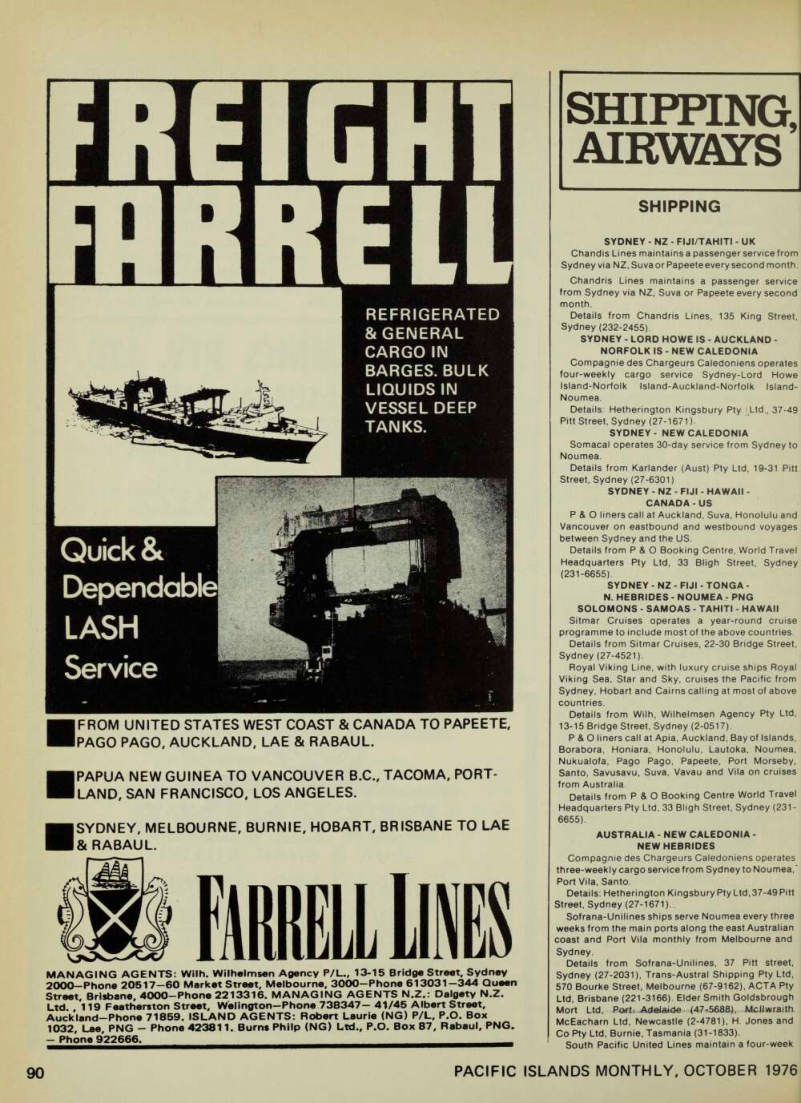
Airways
Shipping
SYDNEY - NZ - FIJI/TAHITI - UK Chandis Lines maintains a passenger service from Sydney via NZ.SuvaorPapeeteevery second month.
Chandris Lines maintains a passenger service from Sydney via NZ, Suva or Papeete every second month.
Details from Chandris Lines, 135 King Street, Sydney (232-2455).
SYDNEY - LORD HOWE IS - AUCKLAND -
Norfolk Is - New Caledonia
Compagnie des Chargeurs Caledonians operates four-weekly cargo service Sydney-Lord Howe Island-Norfolk Island-Auckland-Norfolk Island- Noumea.
Details: Hetherington Kingsbury Pty 4 Ltd„ 37-49 Pitt Street, Sydney (27-1671 )■
Sydney - New Caledonia
Somacal operates 30-day service from Sydney to Noumea.
Details from Karlander (Aust) Pty Ltd, 19-31 Pitt Street, Sydney (27-6301) SYDNEY - NZ - FIJI - HAWAII -
Canada-Us
P & O liners call at Auckland, Suva, Honolulu and Vancouver on eastbound and westbound voyages between Sydney and the US.
Details from P & O Booking Centre, World Travel Headquarters Pty Ltd, 33 Bligh Street, Sydney (231-6655).
SYDNEY - NZ - FIJI - TONGA -
N. Hebrides - Noumea - Png
SOLOMONS - SAMOAS - TAHITI - HAWAII Sitmar Cruises operates a year-round cruise programme to include most of the above countries.
Details from Sitmar Cruises, 22-30 Bridge Street.
Sydney (27-4521).
Royal Viking Line, with luxury cruise ships Royal Viking Sea, Star and Sky. cruises the Pacific from Sydney, Hobart and Cairns calling at most of above countries.
Details from Wilh, Wilhelmsen Agency Pty Ltd, 13-15 Bridge Street, Sydney (2-0517).
P & O liners call at Apia, Auckland, Bay of Islands, Borabora, Honiara, Honolulu, Lautoka, Noumea, Nukualofa, Pago Pago, Papeete, Port Morseby, Santo, Savusavu, Suva, Vavau and Vila on cruises from Australia.
Details from P & O Booking Centre World Travel Headquarters Pty Ltd. 33 Bligh Street, Sydney (231- 6655).
Australia - New Caledonia -
New Hebrides
Compagnie des Chargeurs Caledoniens operates three-weekly cargo service from Sydney to Noumea,' Port Vila, Santo.
Details: Hetherington Kingsbury Pty Ltd, 37-49 Pitt Street, Sydney (27-1671)., Sofrana-Unilines ships serve Noumea every three weeks from the main ports along the east Australian coast and Port Vila monthly from Melbourne and Sydney.
Details from Sofrana-Unilines, 37 Pitt street, Sydney (27-2031), Trans-Austral Shipping Pty Ltd, 570 Bourke Street, Melbourne (67-9162), ACTA Pty Ltd, Brisbane (221-3166). Elder Smith Goldsbrough Mort Ltd. Port. Adelaide (47,5688). MciJwraith McEacharn Ltd, Newcastle (2-4781), H. Jones and Co Pty Ltd, Burnie, Tasmania (31-1833).
South Pacific United Lines maintain a four-week
cargo service from Sydney to Noumea. Vila and Santo.
Details from Omni Traders & Brokers Pty Ltd, 261 George Street, Sydney (241-2872/6).
Australia-Fiji
Karlander (Aust) Pty Ltd operates monthly cargo services from Sydney to suva and Lautoka.
Details from Karlander (Aust) Pty Ltd, 19-31 Pitt Street, Sydney (27-6301); Dalgety Shipping, 461 Bourke Street, Melbourne (60-0731); Burns Philp (SS) Co Ltd, Suva and Lautoka.
Sofrana-Unilines (Fiji Express Line) operates to Suva every three weeks from the main ports on the aast coast of Australia and monthly to Lautoka from Melbourne and Sydney.
Details from Sofrana-Unilines. 37 Pitt Street, Sydney (27-2031), Trans-Austral Shipping Pty Ltd, >7O Bourke Street, Melbourne (67-9162), ACTA Pty _td, Brisbane (221-3116), Elder Smith Goldsbrough Mort Ltd, Port Adelaide (47-5688), Mcllwraith McEacharn Ltd Newcastle (2-4781), H. Jonesand Co *ty Ltd, Burnie, Tasmania (31-1833).
AUSTRALIA - TAHITI - US WEST COAST South Pacific United Lines maintain a four weekly service from Sydney to Papeete, and US West Coast.
Details from Omni Traders & Brokers Pty Ltd, !61 George Street. Sydney (241-2872/6).
Australia-Png
Containers Pacific Express (Burns Philp and AWP .ine) operates four-weekly cargo service from Melbourne and Brisbane with Samos to Port dorseby and Lae and three-weekly cargo service rom Sydney (direct) to Lae and Port Morseby with Jimos.
Details from Burns Philp & Co Ltd, 51 Pitt Street, Sydney (241-3816).
Farrell Lines operates a service every ISdaysfrom asmania, Melbourne, Sydney and Brisbane to Lae, abaul and Anewa Bay.
Details from Wilh. Wilhelmsen AgencyPty Ltd, 13 Iridge Street, Sydney (2-0517), 60 Market Street, lelbourne (61-3031), Burns Philp (NG) Ltd, Rabaul, lobert Laurie-Carpenter (NG) Pty Ltd, Lae.
New Guinea Express Lines with two ships operates iree-weekly Melbourne, Sydney, Brisbane, Port lorseby, Lae. Rabaul.
Details from New Guinea Express Lines, PO Box 73, Royal Exchange PO, Sydney (241-3991) lac Arthur Shipping Agency Co, 82-92 Eagle Street, Irisbane (229-3777), Western Farmers Transport ty Ltd, 459 Little Collins Street, Melbourne (67- 291), Breckwoldt’s Shipping Agencies in Port loresby (24-2525). Lae (42-1536), Rabtrad Niugini ty Ltd, Rabaul (92-2911).
Karlander New Guinea Line’s cargo vessels call at lelbourne, Sydney, Port Morseby, Lae, Madang, lewak, Manua, Kimbe.
Details from Karlander (Aust) Pty Ltd, 19-31 Pitt treet, Sydney (27-6301); Dalgety Shipping, 461 ourke Street. Melbourne (60-0731).
Australia - Png - Solomons
New Guinea Australia Line’s vessels operate from /dney and Brisbane to Port Morseby, Lae, Rabaul, avieng, Wewak, Honiara, Kieta, Gizo, Madang and amarai.
Details from Interocean Swire, 8 Spring Street, /dney (2-0522).
Australia - Nauru - Majuro -
Nauru-Australia
Nauru Pacific Line operates regular cargo/ issenger service from Sydney and Melbourne to auru. Majuro (Marshall Islands) Nauru, Sydney, elbourne.
Details from Nauru Pacific Line, 227 Collins Street, elbourne (654-4977), Interocean Swire, 8 Spring reet. Sydney (2-0522).
Us-Png
Farrell Lines operates regular services from all US ast coast ports to Lae, Rabaul and Anewa Bay.
Details from Wilh. Wilhelmsen Agency Pty Ltd, 13 idge Street, Sydney (2-0517). One Embarcadero antre, Suite 701, San Francisco, Burns Philp (NG) d. Rabaul and Kieta, Robert Laurie-Carpenter NG) Pty Ltd, Lae.
San Francisco - Honolulu -
Micronesia
Nauru Pacific Line operates regularconventional/ container service from San Francisco and Honolulu to Majuro, Nauru, Ponape, Truk and Saipan.
Details from Nauru Pacific Line, 227 Collins Street, Melbourne (654-4977), North American Maritime Agencies, 100 California Street. San Francisco, California 9411 (981-0343).
Png-Us-Canada
Farrell Lines operates regular services from Lae and Rabual to US west coast ports and Vancouver.
Details from Burns Philp (NG) Ltd, Rabaul, Robert Laurie-Carpenter (PNG) Pty Ltd, Lae, PFEL, One Embarcadero Centre, Suite 701, San Francisco and Wilh. Wilhelmsen Agency Pty Ltd, 13 Bridge Street.
Sydney (2-0517).
FAR EAST - FIJI - NEW ZEALAND New Zealand Unit Express (CNC, MNOL, RIL) operates a three-weekly cargo service from Hong Kong to Lautoka.Suva, NZ ports, Manila, Kaoshiung, Keelung, Hong Kong.
Details from Interocean Swire, 8 Spring Street, Sydney (2-0522).
Royal Interocean Lines operates monthly cargo service with three ships from Surabaya, Jakarta, Bangkok, Port Kelang and SingaporetoSuvaand NZ ports.
Details from Interocean Australia Services, 8 Spring Street, Sydney (27-3801). Burns Philp (SS) Co Ltd, Suva and Lautoka.
Ben Shipping Co (Pte) Ptd, sailing monthly from Singapore, Hong Kong, Keelung. Kaoshiung, Suva and main NZ ports.
Details from Seatrans (Fiji) Ltd, GPO Box 152, Suva, Fiji.
Japan-Nz-Png
China Navigation Co, with three ships, operates a monthly cargo service from Japan to New Zealand calling at Lae on return journey.
Details from Interocean Swire, 8 Spring Street, Sydney (2-0522).
Far East - Mid - S.Pacific
China Navigation Co's vessels operate a regular cargo service from Hong Kong, Taiwan and Singapore to Rabaul, Wewak, Madang, Lae, Port Moresby, Honiara, New Hebrides, Noumea, Papeete and Samoa.
Details from Interocean Swire, 8 Spring Street, Sydney (2-0522).
Kyowa Shpping Co Ltd operates monthly services from Hong Kong, Taiwan, S. Korea, Japan, Singapore and Jakarta to Guam, Saipan, Solomons, New Caledonia, Fiji, Western and American Samoa, Tahiti, Cook Is. Tonga, New Hebrides and PNG Details: Hetherington Kingsbury Pty Ltd, 37-49 Pitt Street. Sydney (27-1671).
North Europe - New Caledonia
Hamburg-Sued operates monthly cargo services from Dunkirk and Le Havre to Noumea, via Panama.
Details from Columbus Overseas Services Pty Ltd, 333 George Street, Sydney (290-2966).
Messageries Maritimes operates five cargo services a month from north and Mediterranean European ports to Papeete and Noumea.
Details from Messageries Maritimes, 4-6 Bligh Street, Sydney (221-2522).
JAPAN - GUAM - FIJI - SAMOA -
N Calednoa - N Hebrides
Daiwa Line runs a monthly cargo service from Japan via Guam to Suva, Lautoka. Pago Pago, Apia, Vila, Santo and Noumea.
Details from Burns Philp (SS) Co Ltd, Suva.
Tonga - Samoa - Australia
Pacific Navigation Co Ltd operates a monthly cargo service between Nukualofa, and Apia to Sydney.
Details from Karlander (Aust) Pty Ltd, 19-31 Pitt Street. Sydney (27-6301); Burns Philp (SS) Co Ltd, Suva.
NJ - FIJI - TONGA - SAMOAS -
Tahiti
Union Steam Ship Co of NZ operates a fully :ontainerised service Auckland-Suva-Pago Pago <Vpia-Nukualofa every 14-16 days.
A 28-day service by conventional ship is operated rom Auckland to Papeete, Apia and Nukualofa.
Details from Union Steam Ship Co of NZ Ltd, PO 3ox 12, Auckland, or from branch offices/agents in : iji, Tonga. Samoa and Tahiti.
Nz-Norfolk Is
Compagnie des Chargeurs Caledonians operate our-wee(dy cargo service from Auckland to Norfolk sland.
Detailsfrom Maritime Services Ltd, 14-18 Customs itreet E. Auckland (7-5509).
NZ - N CALEDONIA - N HEBRIDES •
Png-Si
Sofrana/Unilines with two ships operating to Vila nd Santo, to Honiara and Papua New Guinea, andto Joumea.
Details from Sofrana-Unilines, 42 Customs Street, .uckland (7-3279), P.O. Box 3614. Telex. NZ 2313.
Nz -N Caledonia
Compagnie des Chargeurs Caledoniens operates >ur-weekly cargo service from Auckland to loumea.
Detailsfrom Maritime Services Ltd, 14-18 Customs treet E. Auckland (7-5509).
Nz-Png
Farrell Linesoperates regularserviceevery 18 days om Auckland to Lae, Rabaul and Anewa Bay.
Details from Dalgety NZ Ltd. 14/45 Albert Street, uckland (7-1859), Burns Philp (NG) Ltd, Rabaul ot*rt Laurie-Carpenter (PNG) Pty Ltd, Lae.
NZ - FIJI - NORTH AMERICA (WC) Crusader cargo ships call at Suva, Levuka and onqlulu on NZ-US west coast trips and at Suva id/or Lautoka on US-NZ return trips.
Details from Blue Star Port Lines (Management) d, P.O Box 192, Wellington (73-9029); Burns Philp IS) Co Ltd, Suva.
Nz - Fiji
Reef operates a regular 18 day service from jckland to Suva and Lautoka.
Details from Reef Shipping Agengies Ltd, P.O. Box 182, Auckland, NZ (7-1221-3).
Nz-Tonga
Warner Pacific Line services Lyttleton-Onehunga, jkualofa-Vavau-Haapai on a 21 day schedule, for neral and freezer cargoes.
Details from the Air Marine Services (NZ) Ltd, PO )x 2505 Auckland (362-730).
Nz-Fij-Samoa
Pacific Line with one ship operates monthly cargo rvice. New Zealand, Lautoka, Suva, Apia, Details: Sofrana-Unilines, 42 Customs Street, ickland (7-3279) PO Box 3614, Telex: NZ 2313.
Nz-Cook Is-Niue
The Shipping Corporation of NZ Ltd with Toa Sana and Lorena, operates cargo services from ickland to Rarotonga and Aitutaki (fortnightly) and ue (monthly).
Details from The Shipping Corp of NZ Ltd, PO Box 20, Auckland (37-9430); Waterfront Commission, ) Box 61, Rarotonga; Lighterage and Stevedoring >, Aitukai, Niue Govt Offices, Niue Island.
UK - PANAMA - SAMOA - FIJI The Fiji Direct Service, cargo only, is maintained by inference vessels sailing at regular monthly ervals out of London, via Panama, for Apia, Suva d Lautoka.
Details from Burns Philp (SS) Co Ltd. Suva.
UK - TAHITI - N CALEDONIA - N HEBRIDES - PNG - SOLOMONS -
Gilbert Is
3ank Line operates a monthly direct cargo service m Europe, via the Panama Canal to Papeete, urnea, Vila, major PNG ports and Honiara! casionally to Tarawa, Santo, Kieta, Jayapura and ndina and return.
Details from Bank Line (A’asia) Pty Ltd, 1 York Street, Sydney (27-2041); Burns Philp (SS) Co Ltd, Suva.
EUROPE - TAHITI - W SAMOA - FIJI
N Caledonia
Nedlloyd offers regular cargo services from Northern Europe and UK to Papeete, Apia, Fiji and New Caledonia.
Details: Interocean Aust Services Pty Ltd, 8 Spring Street, Sydney (27-3801).
US - SYDNEY - GILBERT IS - HONOLULU Columbus Lines operates three-weekly container cargo sailing from US west coast to Australasia, returning via Tarawa, and Honolulu to Nth America.
Detailsfrom Columbus Overseas Services Pty Ltd, 333 George Street, Sydney (290-2966).
US - FIJI - TAHITI - AUSTRALIA Bank Line Ltd operate regular cargo services from US Gulf ports to Australia and NZ. Calls at Suva,' Lautoka and Papeete on demand.
Details from Bank Line (A/asia) Pty Ltd, 1 York St, Sydney (27-2011).
Pacific Far East Line cruise shipsoperatefrom San Francisco, Los Angeles. Honolulu, Moorea, Papeete, Rarotonga. Auckland, Opua (Bay of Islands), Sydney, and return via Suva. Niuafoou, Pago Pago and Honolulu to San Francisco.
Freight is carried on these passenger liners.
Passenger detailsfrom World Travel Headquarters Pty Ltd, 33 Bligh Street, Sydney (231-6655); freight details from P & O Aust Ltd, 2 Castlereagh St., Sydney (230-0177).
US - A.SAMOA - NZ - AUST - PNG Farell Lines LASH ships operate regularly from US to Australia, via Pago Pago and Auckland, returning via PNG ports.
Details from Wilh. Wilhelmsen Agency Pty Ltd, 13 Bridge Street, Sydney (2-0517); 60 Market Street, Melbourne (61-3031) PEEL, 1 Embarcadero Centre, Suite 701, San Francisco (576-4000); Dalgety NZ Ltd, Auckland (7-1859); Kneubuhl Maritime Services, Pago Pago (633-5121).
Us-Tahiti-Samoa
Pacific Islands Transport operates a five/six Weekly cargo service from North American west coast ports to Papeete, Pago Pago, Apia.
Details from Trans-Austral Shipping Pty Ltd. 19 Pitt Street, Sydney (27-2441).
Polnesia Line operates container and general cargo service from US west coast ports to Papeete and Pago Pago.
Details from Polynesia Shipping Services Inc, PO Box 1478, Pago Pago (9-6799).
Airlines
From Australia
Qantas (707s, 747s, DC4) — PNG, Norfolk Is. New Caledonia, Fiji, US, Canada.
PAA (747s) — Fiji, American Samoa, Hawaii, US.
CP Air (DCS) — Fiji, Hawaii. Canada.
UTA (DCBs and DCIOs) New Caledonia, Fiji, New Zealand, Tahiti, US.
Air Nauru (F2B) New Caledonia, Nauru,Tarawa, Majuro.
Air Nuigini (7075, F 27) PNG.
Air Pacific (BAC111) Fiji, via New Hebrides or New Caledonia to Fiji.
Advance Aviation (from Sydney), North Coast Airlines (from Coffs Harbour) and Oxley Airlines (from Port Macquarie) Lord Howe Is.
From New Zealand
Air-NZ (DCBs, DClOs, F 27) Fiji, American Samoa, Cook Is, Tahiti, Hawaii, US. New Caledonia, Norfolk Is.
PAA (7475) American Samoa, Tahiti, Hawaii, US.
UTA (DCS) - Tahiti.
From Us
Qantas (707 s and 7475) Honolulu, Fiji, Australia.
PAA (7475) Honolulu, Tahiti, A.Samoa, Fiji, NZ, Australia.
Air-NZ (DCBs and DCIOs) Honolulu, Fiji, Australia.
PACIFIC - FAR EAST - S. AMERICA Air Nauru (F2B or 737) Nauru to Micronesia, the Philippines, Okinawa, Japan, Taiwan, Hong Kong.
Air France (7075) Japan to Tahiti, Peru.
Air Niugini (7075) —to Manila.
Pacific Is - Aust
Air Pacific (BAC111) from Fiji, via New Hebrides or New Caledonia to Brisbane.
Air Nauru (F2B or 737) flies to Melbourne.
Air Nuigini (7075,(F27) to Cairns and Brisbane.
Norfolk Island Airlines (Beechcraft) to Brisbane.
Pacific Is - Nz
Air Pacific (BAC111) Fiji-Tonga-NZ.
Inter-Territory
Lan-Chile (7075) Easter Is, Tahiti.
Air Pacific (BACIII and HS74Bs) Fiji to Gilbert Is, Tuvalu, Western Samoa, Tonga, New Hebrides, Solomon Islands, New Caledonia, PNG.
Fiji Air Services Wallis and Futuna (charter).
PAA (7075) Hawaii to Am. Samoa and Tahiti, US.
UT A (7075, Caravelles) from New Caledonia to Fiji, New Hebrides, Wallis Is, Tahiti.
Continental-Air Micronesia (7275) from Hawaii to Micronesia.
Air Nauru from Mauru to Tarawa, Marshall Is, Wallis Is, Fiji, W. Samoa, New Hebrides, New Caledonia, Solomons, Philippines.
Polynesian Airlines from Apia to Tonga, Niue Is, Fiji, Am. Samoa.
South Pacific Island Airway flies between America and Western Samoa.
Air Tahiti from Tahiti to Cook Is.
Air Niugini to Irian Jaya, Solomon Is, Philippines.
Norfolk Island Airlines (Beechcraft) to Noumea.
Internal
Fiji Air Pacific (HS74Bs and Trislanders), Fiji Air Services (Beech Barons and Islanders).
French Polynesia Air Polynesia (Fokker Friendships), Air Tahiti.
US Trust Territory and Guam Continental-Air.
Micronesia (7275) and Air Pacific Internal Inc.
Gilbert Is Air Pacific.
PNG Air Niugini, Douglas Airways, Panga Airways, Talair. „ Bougainville Bougainville Air Services.
New Caledonia Air Caledonie (Twin Otters).
New Hebrides Air Melanesiae (Islanders).
Solomon Is Solair (Beech Barons and Islanders).
Tonga Tonga Internal Air Service (Islander).
Norfolk Island Airlines (Beechcraft) Norfolk Is- Lord Howe Is.
Western Samoa Air Samoa Ltd, and Samoa Aviation Ltd.
Airlines supply full details
Advertisements & other items, pp. 91-94 (3 items)
91
\CIFIC ISLANDS MONTHLY, OCTOBER 1976
Line
THE
GLOBAL SERVICE FOR SHIPPERS
V v
LINE
MONTHLY SERVICES
United Kingdom and Continent to: Papeete, Noumea, New Hebrides, Papua New Guinea and Solomon Islands.
Papua New Guinea to: North America, United Kingdom and Continent.
Solomons, Fiji, Tonga, Samoa and Tarawa to: United Kingdom and Continent.
For particulars apply:
THE BANK LINE (AUSTRALASIA) PTY.
LTD.,
18TH FLOOR, 1 YORK STREET,
SYDNEY, N.S.W.
KYOWA LINE
YOUR* TRADING PARTNER
Monthly Services
Hong Kong, Taiwan, S. Korea, Japan
To: Guam, Saipan, British Solomon, New Caledonia, Fiji, W. Samoa, A. Samoa. Tahiti, Cook Is., Tonga, New Hebrides.
Taiwan,Hong Kong,Singapore,Jakarta
To: Australia, Papua New Guinea, Sabah & Sarawak.
South Korea, Japan
To: Guam, Saipan, Papua New Guinea, Other Pacific Islands.
Taiwan: Royal Steamship Corp., Ltd., Taipei S. Korea: Dong Sue Shipping Co., Ltd., Seoul Hong Kong: Dahzun Enterprises Ltd Singapore: Ocean Shipping & Enterprises Pte., Ltd Mariana Is.: Island Navigation Co., Ltd.. Guam 8.5.1. P.; Solomon Taiyo Ltd., Honiara Tahiti: J.A. Cowan & Fils, Papeete Cooks: Union Citco Travel Ltd., Rarotonga Tonga: E.M. Jones Ltd , Nukualofa New Hebrides: Agence Maritime Raymond Velicite, Port Vile A.Samoa: Island Pacific Agencies Inc., Pago Pago W. Samoa; Morris Hedstrom Ltd., Apia Fiji: Carpenter Shipping, Suva & Lautoka PNG: Carpenter Shipping Agencies, Port Moresby, Rabaul New Caledonia: Agence Maritime Du Rond Point Du Pacific, Indonesia: P.T. Porodisa Raya Shipping Lines, Jakarta Sabah; KOH Han Ming Shipping & Forwarding Agent, Kotakinabalu Sarawak: Pan Sarawak Agencies Sdn. Bhd .Sibu & Kuching Australia: Hethenngton Kingsbury Pty, Ltd., Sydney, N S W.
KYOWA SHIPPING CO., LTD.
Ojima Bldg., 22-8, 6-chome, Shinbashi, Frontier Bldg., 3-13 Hirano-cho,
AGENTS
Noumea
HEAD OFFICE
OSAKA OFFICE
Minato-ku, Tokyo, Japan Phone: 03(437)2885 (Rep.) Cables: “MARIQUEEN” Tokyo Telex: 242-4651 Kyowa J.
Higashi-ku, Osaka, Japan.
Phone: 06(227)0422 (Rep.) Cables: “MARIQUEEN” Osaka.
Telex: 522-3896 Kyowa O-
Regular Pacific Services
"Union South Pacific”, cellular container vessel. Reefer and general cargo from Auckland at approximately fortnightly intervals. Calls at Suva, Pago Pago, Apia and Nukualofa before returning to Auckland.
"Luhesand”, conventional reefer and general cargo. Monthly sailings from Auckland, calls at Suva, Apia, Papeete and Nukualofa.
jmimwuon
JM/mcompanu
Branches at all main Australian, New Zealand and Pacific Island ports
PACIFIC ISLANDS TRANSPORT LINE
Owners: Thor Dahls Hvaljangerseiskap A /S—Sondefjord, Norway.
MS CAMELLIA VENTURE
Express Freight Service between Pacific Coast Ports of
U.S.A.
and
TAHITI and SAMOA
Full container service including reefers.
GENERAL STEAMSHIP CORPORATION LTD.
General Agents 400 California Street, San Francisco, California, U.S.A.
APlA—Burns Philp (South Sea) Company, Ltv* fA *l E l E —A»onco Maritime Internationale Tahiti.
'l AG 9“* > . l T"« si « Shipping Services Inc.
NOU***—Etablissements Ballande. !I r . 5? EY r Trans - Austral Shipping Pty. Ltd.
SU Ltd~* UnU PhH * {SOWth 5,,) Can, Hßy, •ABT A w£M ,L T* urns (*•" Guinea) Ltd. ro * T . YJL* —Comptoirs Francais de Nouvelles Hebrides.
ExpressTreight Service between U.S. Pacific Coast Ports &
PAPEETE - APIA - PAGO PAGO
Full Container Service including Refrigeration
GENERAL AGENT* .
* fURNESS INTEROCE4N
465 CALIFORNIA STREET. SANFRANCISCO CA 94104 , C»We tNTERCO • TWX 9KM7J-7350 • RCA 278 !
• TEL (415) 396 2000
AGENTS
■ PAPEETE - MORGAN; Vernex Boite Postale 449, Papeete Phone: 309 Cables; MOREX PAGO PAGO - POLYNESIA SHIPPING SERVICES, INC., Pago Pago Phone: 633-5169 Cables: POLYSHIP APIA • UNION S.S. CO., of N.Z. Ltd., P.O. Box 50, Apia, Western Samoa Phone; 570 Cables; UNION D
lapua new guinea
printing co. ply. lid.
Serving the Country from Aitape to Alotau, Manus to Moresby
Leaders in Commercial Offset and Letterpress
Printing.
• Stationery • Office Supplies • Office Equipment • Rubber Stamps • Self-Adhesive Labels • In Fact;— Everything For The Office.
P.O. Box 633, Port Moresby P.O. Box 759, Lae
P.O. Box 1239, Rabaul
PETER FISHER TRADING Pty. Lid.
321 Pin STREET, SYDNEY, 2000, AUSTRALIA
TeUphon*: 26-1109 CABLES: "FISHERION", SYDNEY
EXPORTERS TO THE PACIFIC ISLANDS
93
ISLANDS MONTHLY, OCTOBER 1976
Produce

Prices
Unless otherwise shown, stated quotations are in Australian currency. Australian dollar (August 26) equalled: New Zealand, $1.2478 (buying), $1.2434 (selling); Papua New Guinea, K 0.9548 (buying), K 0.9500 (selling); Fiji, $1.1254 (buying), $1.1014 (selling); Western Samoa, tala 1.0035 (buying), tala 0.9895 (selling); Tonga pa'anga 0.8826 (buying), pa'anga 0.8650 (selling); US $1.2480 (buying) $1.2430 (selling), UK £0.7070 (buying), £0.6990 (selling); French Pacific, CFP 113.35 (buying) 111.83 (selling).
Copra
Copra industries are controlled through copra oards in PNG, the Solomons, the Gilberts, both iamoas, Fiji, Tonga, the Cooks and the US Trust erritory, New Hebrides, French Polynesia and New laledoniadonothave boards and copra is either sold idividually by growers to overseas buyers or used >cally.
PNG:— The board, with planters’ reps, directs istribution and sales and pays planters. Shipments re made to UK, European markets and to Australian rid Japan, and coconut oil mills on New Britain.
Latest prices are; Per tonne, delivered main ports, ot-air dried. K 170; FMS, K 167; smoke-dried, K 165 ’rices include K2B bounty).
FIJI:— The board fixes priceson Philippinescopra, king into account freight, taxes, selling costs, irinkage, etc. The price is subsidised, latest prices ere; Fiji 1, $l9O, Fiji 2, $l7l, CAS $7O.
NEW HEBRIDES:— Copra sold direct by planters France and Japan. Burns Philp paying on wharf, la or Santo. Aug. 2 FNH 8,200, London, Aug 13139- 0 met francs 100 kg cif Marseilles.
US TRUST TERRITORY:- Palau; Ist grade, $155, nd grade, $145, 3rd grade, $135, at district centre; uter islands. $l3O, $l2O and $llO for the three rades. Yap: $135, $125 and $ll5 respectively at istrict centre; outer islands. $llO, $lOO and $9O ispectively. Truk, Ponape, Marshalls, Marianas: 130, $l2O and $llO respectively at district centres' lands, $lO5, $95 and $B5.
COOK ISLANDS;— All production is sold to Abels Id, Auckland. Prices are based on average world r ices for the prior three of six months, and remain in 'rce for three months.
SOLOMON ISLANDS: — Copra Board pays, per lb Honiara, Yandina and Gizo. 4'/ 2 4 Ist grade 40 2nd ade, 3Vfe4 3rd grade.
GILBERT ISLANDS:- $134.40 a ton, or 64 a lb.
WESTERN SAMOA;— Ist grade, $W5109.50 2nd ade, $W596.50.
TONGA:— All copra sold to EEC. Ist grade. SP7O id grade SPSB.
NIUE: Standard, $147 a tonne gross.
Other Produce
:OCOA; Island rates are based on Ghana price lana price on Aug 26 was spot £stg. 1,377 ton, cif, C Continent.
Aug 26, in store, Rabaul, export quality, Kl,3ooper nne, delivered ex wharf Sydney $1,790 per tonne.
Solomons. Delivered Honiara prices recently ire 40C per lb Ist grade, 30C 2nd grade.
Western Samoa. Ungraded beans, $23.50 (100 ~HILLIES: — Solomons, Honiara buyers pay for ' tabasco, Ist grade, 354 to 364 per lb. 2nd grade, t per lb. Long Red is 144 per lb. *O pp EE:— PNG Aug 26. Good quality, A Grade H per kg; B Grade 2724, C Grade 2694; Y Grade )4 (ex-store Sydney).
W.Samoa. Recently, WSTEC ground and dried beans. 604 per pound wholesale.
PEANUTS:— PNG; Sydney aents reported recently f.o.b. Lae; Kernels white Spanish 194 lb.
BROOMCORN:— Fiji, Ist grade 16M-4 lb, 2nd grade 14Vfe4 per lb. 3rd grade 44 per lb.
RICE (Aust);— PNG: Dried brown, 25 kilo bags, $298.94 per tonne. Vitamin enriched white, 25 kilo bags, $303.94 pertonne.allf.o.w.Sydney/Melbourne Pacific Islands: Calrose med. grain, white, 25 kilo bags, $320 per tonne. Kulu long grain white, 25 kilo bags, $355 per tonne. All prices c.i.f. Sydney/ Melbourne.
RUBBER:— Singapore, Aug 26, 494-514 per kg.
VANILLA BEANS:— Prices recently were: White and yellow label processing standard packs. $7.50; green label $7.40, c.i.f. Sydney. Tonga $P4.20, f.0.b., Nukualofa. $P4.50 Melbourne.
TROCHUS: — Solomons, Private companies pay 164 per lb for good quality.
BLACK LIP: — Solomons: Private companies pay 104-154 for good quality.
BECHE-DE-MER: — Solomons; Private com panies pay: Istgradesl.4operlb;2ndgradesl perlb; 3rd grade, 80C per lb.
GREEN SNAIL: — Solomons; Private companies pay 25C perlb.
Exchange Rates
FIJI Aug 27; Through Bank of NSW, ANZ Bank, Bank of NZ, Bank of Baroda. First National City Bank, Aust $ on F'ji buying SFI =$AO.9O.
COOKE IS., NIUE New Zealand currency is used.
NEW HEBRIDES. - Aug 27; Through Banque Nationale de Paris (Sydney), Indosuez Bank, ANZ Bank, Bank of NSW, National Bank of Aust, Commercial Banking Co of Sydney, Commercial Bank of Aust, Hong Kong and Shanghai Banking Corp, Barclays Bank International, SAI FNH 100.52 (buying) 99.18 selling —airmail transfer rate.
WESTERN SAMOA. Through Bank of Western Samoa, controlled from NZ, SWSI (tala) 5A0.97 (buying).
TONGA. Tongan dollar (pa’anga) = $A0.89 (buying).
NOFROLK IS, SOLOMON IS, Gl, NAURU. - Australian currency used; no exchange payable in transactions with Australia.
PAPUA NEW GUINEA - Aug 27: Through PNG Banking Corp, Bank of NSW, ANZ Bank. Bank of South Pacific. $A = K 0.95.
FRENCH PACIFIC COLONIES. Pacific francs (CFP) are used in New Caledonia, Wallisand Futuna Is. and Fr Polynesia. French Bank Sydney, on Aug 27 quoted: $A = 113.08 CFP (buying). 111.58 CFP (selling), Paris-London: £1 = B.7Bsofrancs (buying), 8.7750 (selling) CFP London: £1 = 159.4545 CFP (buying). 159.2727 (selling). CFP to 1 metropolitan franc 18.43 (buying) 17.94 (selling).
Banks should be approached for daily rates.
Advertisements & other items, pp. 95-104 (4 items)
95
CIF 1C ISLANDS MONTHLY, OCTOBER 1976
Qbe Insurance
Q E
offers expert insurance service
throughout the Islands
QBE INSURANCE
LIMITED
(FORMERLY—QUEENSLAND INSURANCE COMPANY
Central Office: 82 Pitt Street, Sydney JP? I ®®’ Suva ’ Manner for Fiji: L.G.Liddell A.A.1.1.
LAUTOKA—Sub-Branch Office: Bums Philp Bldg. (B.S.l.P.)—Breckwoldt & Company (5.1.) Pty. Limited.
NEW CALEDONIA—T. A. Hagen, Stc. W. A. Johnston, S.A.R.L. —Noumea. rw™ , M T an a ger: G. F. Donnelly, Vila; Santo; Burns Philp (New Hebrides) Ltd.
J^y T tr^ rthur Chung: Immeuble 8.1., Front de Mer, Papeete.
NIUE, NORFOLK ISLAND, SAMOA, TONGA and other South Sea Islands—Bums Philp (South Sea) Company Ltd.
QUEENSLAND INSURANCE (P N G.) LTD
PAPUA NEW GUINEA-Head Office, PORT MORESBY.
General Manager: J.M.Dawe. Assistant Manager: R.Jackson,A.A.l.l.
District Managers at: LAE: W.J.Leonard
MOUNT HAGEN: D.F.CarroU
ARAWA: J.Longbut MADANG: I.R.Martin RABAUL: A.M.Tanner
CLASSIFIED ADVERTISEMENTS
COINS
WANTED...
Paying twice face value for all pre-decimal Australian coins.
GOLD SOVEREIGNS
BUY—$27
SELL-$3O
Prices subject to fluctuation.
SOUTHERN CROSS COINS
2/131 Exhibition St.,
MELBOURNE 3000,
AUSTRALIA.
Phone: 63 1141.
THE PAPUA HOTEL
PORT MORESBY
• Right in the business centre • A tradition for comfort and fine food • All rooms air conditioned • Restaurant • Bars • Banquet Hall Telephone 24 2121 Cables PAPTEL
A. C. NEUMANN
Manager
Per L ine $3.00 Aus t.
Minimum 4 lines.
TUG AND LAUNCH
Tug 600 h.p. Lister Blackstone with Kort nozzle rudder, 19.81 m x 5.82 m x 3.80 m (65' x 19'-1" x 10'-3") wooden, built 1967 for harbour and pilot service and launch, 98 h.p. Fordson, 9.10 m x 2.75 m x 0.91 m (30' x 9' x 3'), wooden, built 1955 and used for harbour towing, for sale by tender, closing 15 November 1976. Launch available now, tug available about 1 April 1977.
Inspect at Napier. Description, tender and sale conditions from Chief Executive Officer, Hawke's Bay Harbour Board, Private Bag, Napier, New Zealand.
If you have snens to sell—any quantity—contact Anlaa Commodity Traders Pty. Ltd., P.O. Bo* 1413, Laa, Papua Naw Guinea, Phone 424159. We are buyers of Trochus, Greensnail, Blacklip MOP, Goldlip MOP, and Marine Specimens Best prices paid Rabeul agents; Gazelle Agencies Pty Ltd.
P.O. Box 262, Rabaul, PN G Phone; 921397 Menus Island Agents, R. L. & V. J. Knight. P.O.
Box 108, Lorengau, Manus Island, P.N.G Phone 38.
YOUNG, ENERGETIC MAN extensive general merchandising Australia, 5 years P.N.G. buying experience in the Orient specialising in textiles variety lines, staff training in sales warehouse controller 50,000 sq. ft., with staff of 30. Position seeking sales, or buyer in textiles, would like position in Pacific Is., no ties.
For further details: P.O. Box 307,
SMITHF IE LD 2164, SYDNEY,
N.S.W. AUSTRALIA.
FLEETS 27ft. carvel sloop, launched 1945, Dacron sails, 14 h.p diesel new 1972, 4 berths, refrigeration, 2 way radio, sounder $8750.00.
FLEETS 221 Esplanade Wynnum Central.
Brisbane Cable "FLEETS BRISBANE ".
PLANTATION MANAGER, 48, 20 years
New Guinea, British Solomons, Copra, Cocoa, some Pepper.
Accustomed isolation. Any islands.
Family follows. Garners store, Evans Head, N.S.W. 2473, AUSTRALIA.
WANTED TO BUY
By private collector writing "MEDALLIC History of Papua New Guinea Medals, badges, etc. of Papua New Guinea, particularly LULUAI, TUL TUL, HEAD
TAX. VILLAGE COUNCILLOR. POLICE, FIRE,
CONSTABULARY; Meritorious and Long Service Medals, etc.
Write Dr W. Mira, 15 Harrow Rd„ Bexley. NSW 2207, Australia.
CONCRETE BLOCK MAKER Makes blocks, flags edgings, screen-blocks, garden stools —up to 8 at once and 96 an hour $215.00 c.i.f. main ports Send for leaflets Forest Farm Research. Londonderry N S W., 2753 Australia.
INTERNATIONAL/
DATELINE HOTEL
TONGA
EL* "Friend* Hotel" of the "Friend* Mends"
Situated along the Nukualofa waterfront Only five minutes walk
from town. Single, double, family
suites, airconditioning, and hot and cold water showers. Pool, bar,
restaurant, duty-free shop, tour
desk and boutique.
Book through your travel agent or write to International Dateline Hotel, P.O. Box 62, Nukualofa Tonga.
Cable Address: "DATELINE".
Represented Overseas by: Charles
J. Henry and Associates Pty. Ltd.
Sydney and Melbourne.
STERN
DRIVES
PETROL & DIESEL
MARINE ENGINES
X Manufactured by
SEA TIGER
MARINE
Pty. Lid.
P.O, Box 157, Mordialloc Victoria, Australia 3195
MASSEY UNIVERSITY
NEW ZEALAND
CERTIFICATE IN THE TEACHING OF
A SECOND LANGUAGE (ENGLISH)
Teachers of the English language or teachers who use English as the language of instruction for other subjects may now enrol for this special course of study.
All tuition is by correspondence.
For details, write to: The Department of Modern Languages, Massey University,
PALMERSTON NORTH, NEW ZEALAND
Sony presents more power,
more tonal quality than you ever
dreamed was possible.
The SonyCF-480S cassette-corder/radio sounds as big and real as life itself.
Its powerful, specially-designed amplifier delivers 4 watts of power —enough to fill even the largest room with clear, distortion-free sound.
What’s more, it has a unique 2-way speaker system. One big 6 1/2-inch woofer for the lows and a separate 2-inch tweeter for the highs.
Result; Supertj re grams and cassette recordings, with audibly superior shortwave and medium wave sound, too.
In fact, the great-sounding CF-480S represents Sony cassette-corder technology at its finest; there is a DC servo-controlled tape drive motor, sensitive electret condenser microphone, tape selector for normal and CrCh cassettes, mic mixing controls, and much more. It’s a dream of versatility.
But you shouldn’t just take our word for it.
Visit the nearest Sony .dealer and audition the Sony CF-480S for yourself.
You’d never dream that a ca ssene-co rdeTTraTTfcr* could sound so good. mm- •• W
Teijin is continually working to provide you with the latest refinements.
Producing new fibers and fabrics for both industry and the home.
Creating exciting synthetics like Teijin Tetoron,* Nylon, Acetate, and Teviron.* Making elegant fashion materials for dresses, shirts, suits, even wigs.
Supplying industry with tire cords, fishing nets, belts, ropes, tents, synthetic leather, and sail cloth.
In the raw world Teijin produces, creates, makes, supplies, and works to bring you not only elegance but refinement. * Tetoron and Teviron are Teijin’s registered trademarks for its polyester fiber and fabrics, and for its polyvinyl chloride fiber, respectively.
A Leader Today... For A Better Tomorrow TEIJIN LIMITED Tokyo Head Office: 1-1,2-chome Uchisaiwaicho, Chiyoda-ku, Tokyo, Japan Phone: Tokyo 506-4111
Another Achievement of Seiko Quartz Technology
The Ultra-Thin Seiko Quartz.
It Combines Slim Elegance with the Accuracy Only Quartz Can Offer. / Ml / pßan «* VfT2
SEIKO
1 e = \ V l\ c s Seiko was first to reduce the quartz principle to true wrist size and to market a quartz watch. That's why Seiko can create a quartz this thin and elegant. Seiko's expertise in every phase of watchmaking means Seiko can make any part of any watch, for impeccable quality control Seiko makes quartz watches with traditional analog faces and with the LC digital readout. No matter which Seiko Quartz you select, you get the watch that's changing the world's standard of accuracy. Seiko Quartz.
SEIKO
Someday all watches will be made this way
Fast., .efficient. ..reliable...
SPEED-E-GAS
♦ t B * *
SPEED-E-GAS
Boral Gas Limited, a member of the major Australian Boral Group of Companies is associated with a network of bulk storage terminals distributing SPEED-E-GAS throughout the Pacific region.
Terminals at Port Moresby, Lae, Rabaul, Kieta, Wewak, Honiara, Santo, Suva, Lautoka, Nukualofa and Rarotonga now supply fast efficient SPEED-E-GAS for industrial, commercial and domestic requirements in these areas.
SPEED-E-GAS is completely dependable and highly efficient fuel, so vital to the development of modern living.
BORAL
Boral Gas Limited Head Office, 221 Miller Street North Sydney 2060 Phone 92-0951 * SPEED-E-GAS is known in Papua New Guinea as GUINEA GAS, in Tonga as TONGA SPEED-E-GAS and in Fiji as FIJI-GAS
Arnott’s!
The taste of Australia
lemon cream filling.
Lemon Crisp. A crisp sandwich with a tangy Delta Cream. Two chocolate flavoured biscuits with smooth vanilla cream.
Taste those delicious creamy fillings!
Crunch those crisp Arnott’s biscuits.
Every time you enjoy one of the great
selection of Arnott’s cream biscuits
you’re enjoying the taste of Australia’s
favourites.
Monte Carlo. Biscuits made with honey and coconut sandwiched with vanilla cream and jam.
Orange Slice.
" vanilla sandwic .A sandwich biscuit, with an orange flavoured cream. bhhh Creamy Chocolate. A subde blend of ginger and chocolate in a cream sandwich biscuit. ( ho<olai(> bisouitb Urnott's Creamy ChocolaU & , -•SsUr 9k /.
X x * X % " q, % V \t \ %&■
Biscuits
There is no Substitute for Quality
W 638
Mixmaster Mixer
3 times better than any
other mixer. Designed especially for family food preparation. 12-speed mixfinder dial indicates the correct speed for each mixing action. Complete with 2 heat-resistant bowls and juice extractor. Sunbeam’s exclusive 3-way beating action— extra large, contoured beaters, and automatic bowl movement — gives perfect aeration and more even mixing. It can handle everything from beating one egg to mixing a large fruit cake.
m "-* Si \ •J >5
v «as
' ix & -■ r ia *... rs# T", ■* r/ w O' *4 ’ ■•IT m tSA
LV^S
i i* bn a M / A i tf >
wiiSi i
% d a 1
I, in
er 100,000 units TCM’s lift trucks are active on the industrial - . scene throughout the whole world. At pres- Uo countries ent - more than 100.000 units are in operation in 103 countries. They have achieved remarkable success and an outstanding reputation because of their unrivalled reliability and work capacity. Their stability, maneuverability and loading/unloading performance are all optimal from the operator s standpoint. The wide selection of models meets the demands of the most exacting work situations in all corners of the world.
TCM
Westco Motors (NG) Pfy ltd,
Aircorps Rd or PO Box 365 Lae, PNG
My Datsun -
sometimes I think it’s too good to drive.
'.! a v 293 AT Vada Heni with his latest Datsun, photographed near Port Moresby/ Papua New Guinea.
Between my home life and running my truck, taxi and forklift business, I don’t have much time left to myself. There are eleven children in the family.
The eldest is 26, the youngest four years old—and somewhere in between we even have twins.
When I do manage to get some spare time I like to go hunting and fishing. The Port Moresby area is ideal for the person who enjoys the peace and quiet of the outdoor life.
Though you need a tough car to get around because most of the roads are hilly and unpaved outside the city.
That's why I drive a Datsun.
It's my third Datsun, and like the other two it's a reliable car.
Smart-looking, too. A lot of my friends agree with me. Half of them switched to Datsuns after they saw my latest one.
A car to be proud of, the Datsun. In fact, sometimes I think it’s too good to drive!
Datsun Distributors. NEW HEBRIDES: Pentecost Pacific S.A. P.O. Box 119, Port Vila/NEW ZEALAND: Nissan Motor Distributors (N.Z.) 1975 Ltd. P.O. Box 61133, Otara, Auckland/NORFOLK 1: Sirius Motors P.O. Box 34, Norfolk!./ PAPUA NEW GUINEA: Boroko Motors Ltd. P.O. Box 1259, Boroko, Port Moresby/MARIANAS: J.C. Tenorio Enterprises P.O. Box 137, Saipan/SOLOMON IS: United Enterprises Ltd. P.O. Box 262, Honiara/TAHITI: Michel Pentecost et Cie/ TAHITIBULL B.P. 1809, Papeete/TONGA: Riechelman Bros. Ltd. P.O. Box 18, Nukualofa/WESTERN SAMOA: Morris Hedstrom Ltd. P.O. Box 189, Apia
DATSUN
e™ Product of NISSAN
97
iCIFIC ISLANDS MONTHLY - OCTOBER, 1976
101
CIF 1C ISLANDS MONTHLY - OCTOBER, 1976