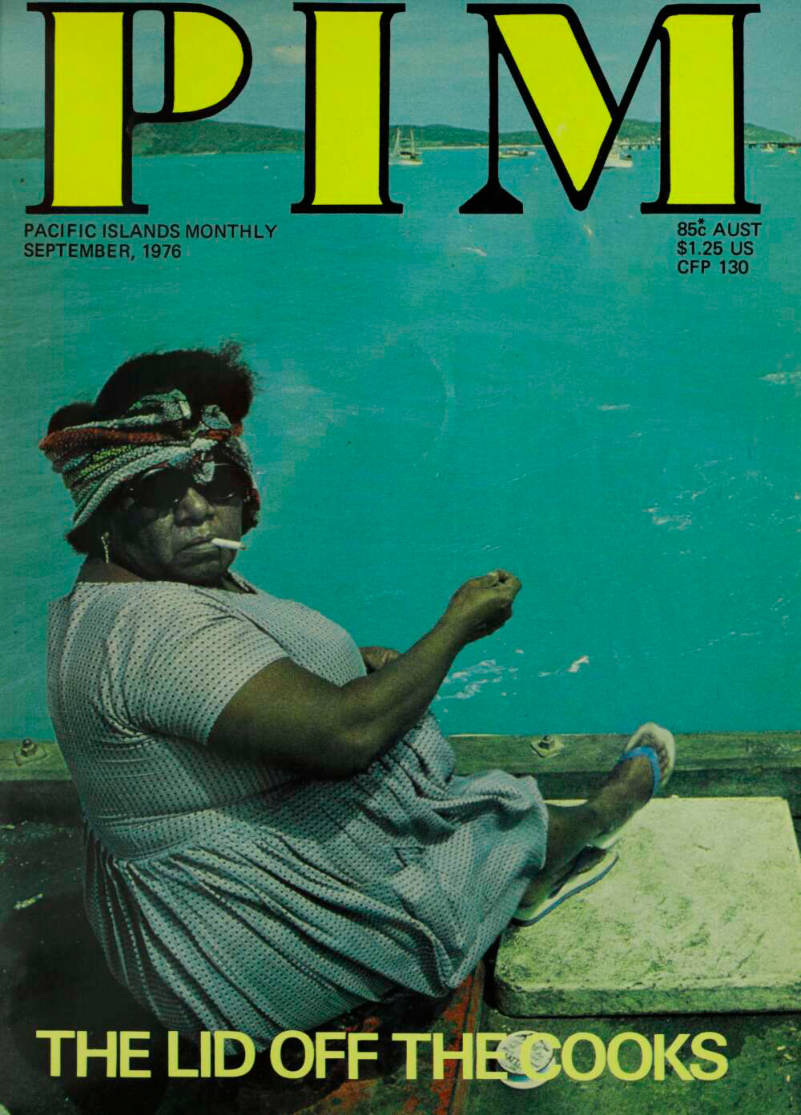
The Lid Off Th®Ooks

Advertisements & other items, pp. 2-4 (1 item)
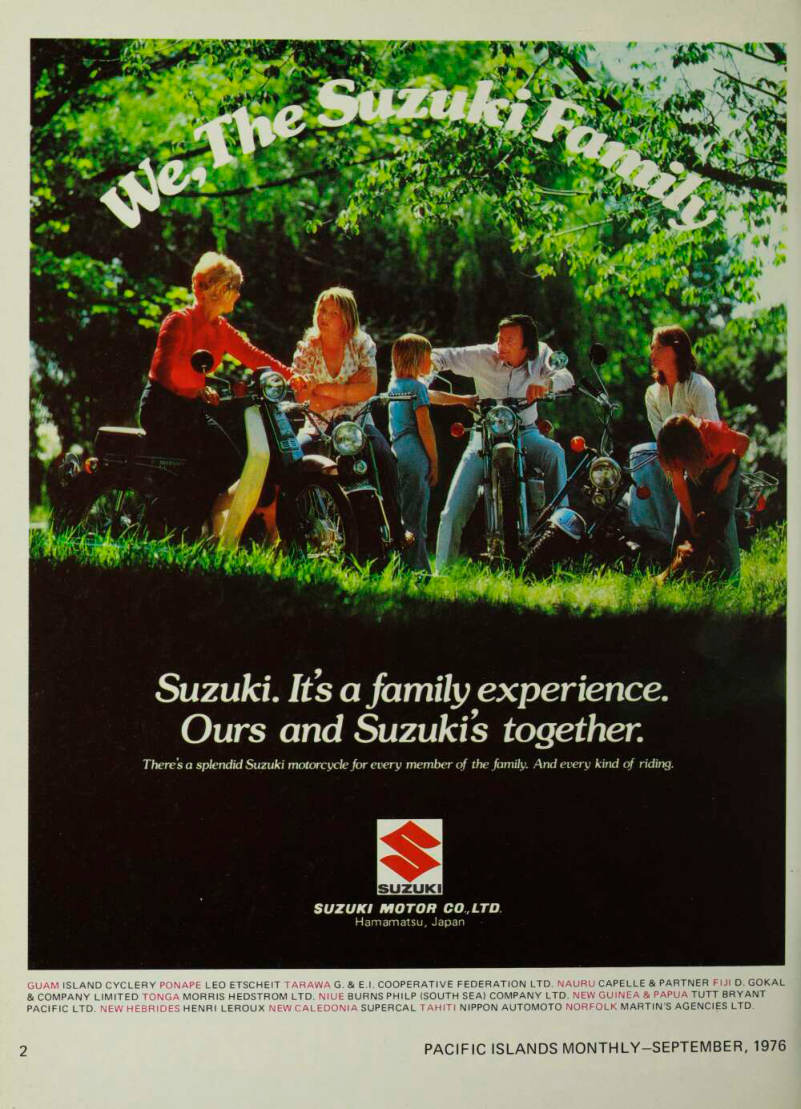
Suzuki. Its a family experience.
m » - ' «• 1?. 1 >m mt. *■ 4 .x> / ' 4: * It' **•*
Wfc.
* • ■ .** v h * ■ \ r?»i .s <f $ WLr!
Nj .i i v. ■■.
K N > v MX -Ti * 3 «• K ; ,vr at /
iiiii
'i * r *. tk-
Suzuki. Its a family experience.
Ours and Suzuki s together.
Theresa splendid Suzuki motorcycle for every member of the family. And every kind of riding.
SUZUKI MOTOR CO,LTD.
Hamamatsu, Japan GUAM ISLAND CVCLERY PONAPE LEO ETSCHEIT TARAWA G. & E.l. COOPERATIVE FEDERATION LTD. NAURU CAPELLE & PARTNER FIJI D. GOKAL & COMPANY LIMITED TONGA MORRIS HEDSTROM LTD. NIUE BURNS PHILP (SOUTH SEA) COMPANY LTD. NEW GUINEA & PAPUA TUTT BRYANT PACIFIC LTD. NEW HEBRIDES HENRI LEROUX NEW CALEDONIA SUPERCAL TAHITI NIPPON AUTOMOTO NORFOLK MARTIN'S AGENCIES LTD.
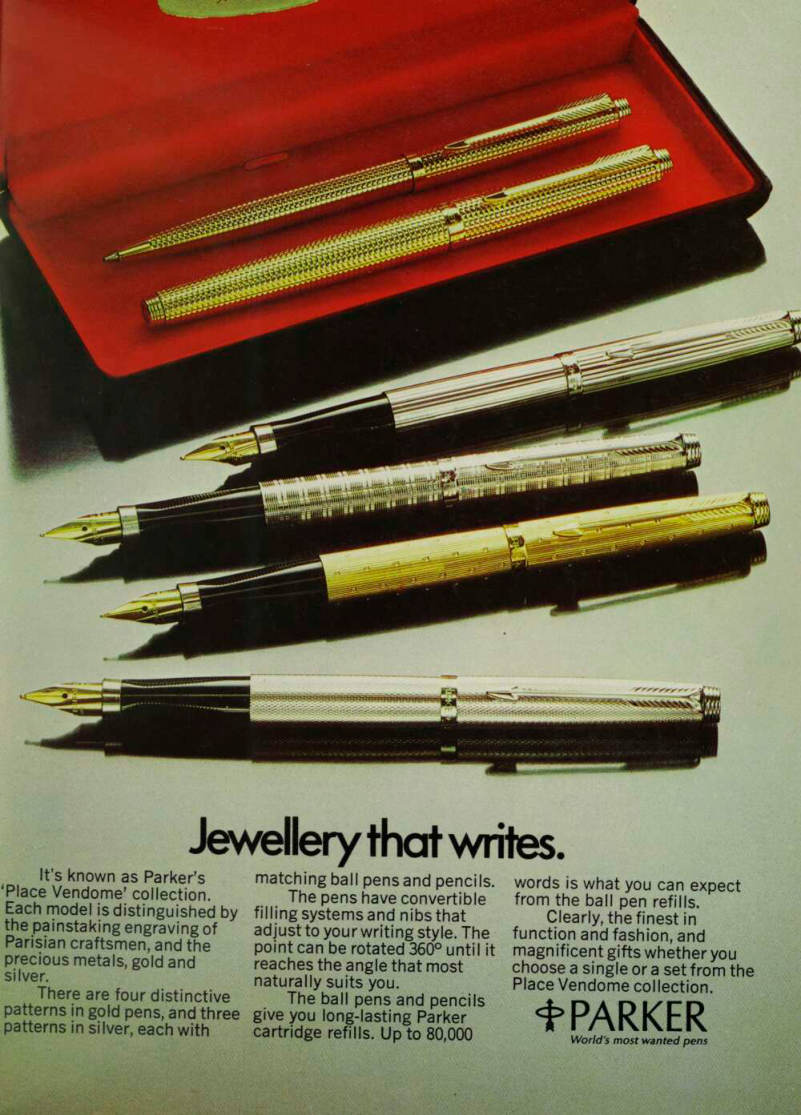
s? i DM > |kltl ■ •' HfnT \ ”» It’s known as Parker's 'Place Vendome' collection.
Each model is distinguished by the painstaking engraving of Parisian craftsmen, and the precious metals, gold and silver.
There are four distinctive patterns in gold pens, and three patterns in silver, each with
Jewellery that writes.
matching ball pens and pencils.
The pens have convertible filling systems and nibs that adjust to your writing style. The point can be rotated 360° until it reaches the angle that most naturally suits you.
The ball pens and pencils give you long-lasting Parker cartridge refills. Up to 80,000 words is what you can expect from the ball pen refills.
Clearly, the finest in function and fashion, and magnificent gifts whether you choose a single or a set from the Place Vendome collection.
t PARKER
World's most wanted pens
Musical survival pack.
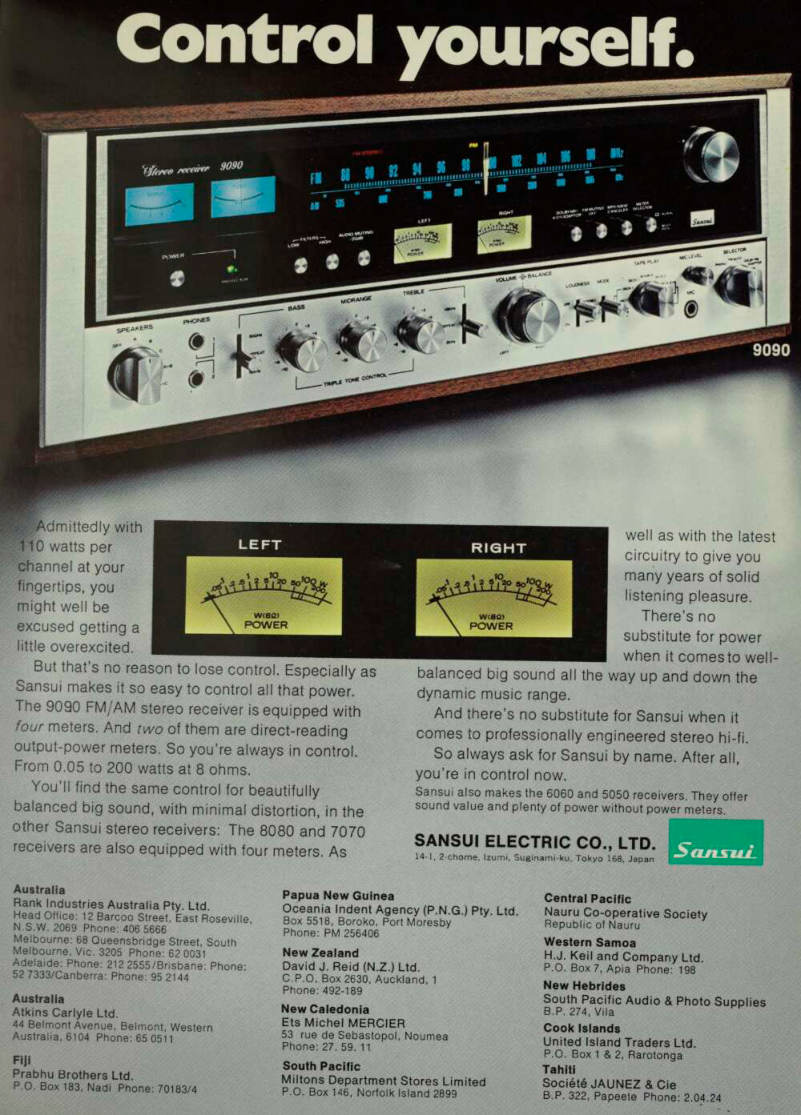
You want good high fidelity sound reproduction. But, you don’t want to expend all your time and energy (not to mention your bankroll) on mixing and matching individual audio components. Well, Pioneer has done it again.
For those who want great stereo listening without getting lost in an electronic jungle, we are pleased to introduce our MS-6500 stereo system.
Everything you need to play anything you want. All in one beautifully designed package.
At the heart of the MS-6500 is an outstanding AM/FM stereo receiver.
In the amplifier, continuous power output is 18 watts per channel (RMS).
More than enough to fill your listening room with great sound. In the tuner, FM sensitivity is a powerful 1.9/iV and the S/N ratio is a hushed 73d8 (mono). Stable reception is virtually guaranteed by the presence of advanced PLL circuitry.
Playing your records is easy. The full size turntable features a sensitive tone arm with cartridge plus the added convenience of auto-cut and return.
Multi-source enjoyment is always available with the built-in cassette deck. All controls are user-oriented and the auto-stop mechanism offers protection for both tape and deck.
To make things complete, the MS-6500 includes a pair of balanced three-way, three-speaker systems.
Full rich bass from the big 20cm (8 inch) woofers is enhanced by the solid bass-reflex cabinets.
Pioneer’s new MS-6500 stereo system. Just plug it in, turn it on and save your time for enjoying truly great sound.
CiD PIONEER
Pioneer Electronic Corporation
4-1, Moguro 1-chome, Meguro-ku, Tokyo 153, Japan Australia Pioneer Electronics Australia Pty.
Ltd., 178-184 Boundary Road, Braeside, Victoria 3195, Tel: 90-9011, Sydney 93-0246, Brisbane 52-8231, Adelaide 433379, Perth 76-7776 Fiji Islands Brijlal & Company, G.P.O. Box No. 362, Suva, Fiji Islands Tel: 22258 New Zealand Fountain Marketing Ltd., Maidstone Street, Auckland, New Zealand Tel: 763-064 Norfolk Island Burns Philp (Norfolk Island) Ltd., Norfolk Island, South Pacific New Hebrides Burns Philp (New Hebrides) Ltd., Vila, New Hebrides, Nauru Island Jacob Enterprises, P.O. Box No. 4 Republic of Nauru Tahiti Est. PERFECT, B.P. 594, Papeete, Tahiti Tel: 20 407 New Caledonia Menard Freres, B.P. 123, Noumea, New Caledonia Tel: 27.52.22 American Samoa Traspac Corporation, P.O, Box 1477, Pago Pago, American Samoa 96799 Tel: 633-5224 Rarotonga South Seas International Ltd., P.O. Box 49, Rarotonga Cook Islands Tel: 2327
Pacific Islands
Monthly
Founded By R.W. Robson In 1930
Published Monthly By
Pacific Publications (Aust.) Pty. Ltd ,
76 Clarence Street, Sydney 2000
Postal Address G.P.O BOX 3408, SYDNEY.
N S W 2001
Telegraphic Address PACPUB, Sydney Telex: 21242
Telephone: 296693
Publisher: Stuart Inder.
Business Manager: John Berry
Pacific Islands Monthly
Editor: John Carter Advertising Manager: Alan Batt.
Subscription Rates:
Pacific Islands Monthly" is airfreighted to the ma jority of subscribers and agents in the Pacific Islands and the U S A.
Australia (including Lord Howe and Thursday Islands), New Zealand, Papua New Guinea, Fiji, New Hebrides, Tonga. Cook Islands. Western Samoa, Gilberts and Tuvalu, Norfolk Island, Niue and Nauru $9 00 (local currency); Solomon Islands. $lO.OO Aust.; American Samoa Micronesia and Guam: $12.00 U S.; Hawaii and U S. Mainland: $15.00 U.S.; New Caledonia and French Polynesia 1,500 C.F.P ; United Kingdom: £6 50; Japan 4000 Yen; Elsewhere $11.50 Aust.
Representatives
Fiji: Advertising and Distribution Fiji Times & Herald Ltd , 20 Gordon Street, Suva, Telephone 312-111 Telex: FJ 2124 Papua New Guinea: Advertising and Distribution PNG Post-Courier, P.O. Box 85, Port Moresby.
Inquiries: Post Newsagency, Telephone 24-2148 French Polynesia: Distribution Hachette Pacifique, 10 Ave Bruat, Papeete.
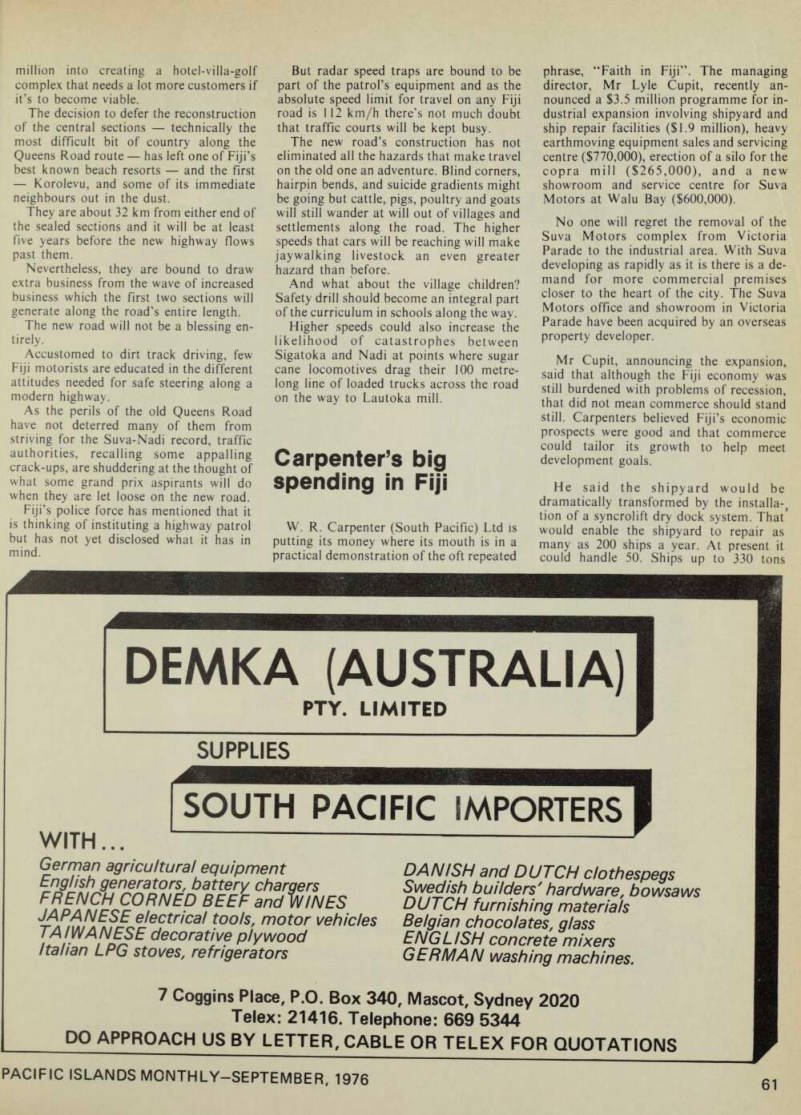
New Caledonia: Distribution Depot Centre de Presse Michel PENTECOST. 8.P.C2 NOUMEA New Zealand: Pacific Publications, CPO Box 2229, Auckland United Kingdom: The Herald and Weekly Times Limited, 8-10 Clifford's Inn, Fetter Lane, London EC4A IBU Telephone: 01-831 6041 Telex Lon don 21989 Japan: Advertising Universal Media Corpora tion. CPO Box 46, Tokyo Telephone 666-3036 Victoria: Advertising Pacific Publications (Aust.) Pty Ltd., Herald and Weekly Times Building, 2nd Floor, 61 Flinders Lane, Melbourne, 3000 telephone: 652-1565 Brisbane: D Wood, Anday Agency, Box 1918 3.P.0.. Brisbane 4001 Telephone: 44-3485 44- 1546.
Hawaii and U.S. Mainland only; N. Grogan. (Send :hange of address notices. Form 3579 and new >ubscriptions to P O Box 2193. Honolulu Hawaii
J.S.A. 96805.)
Second class postage paid at Honolulu. Hawaii.
Printed in Australia
Copyright c, 1976,
Pacific Publications (Aust.) Pty. Ltd.
Printed by Paramac, Mitchell Road, Alexandria. egistered at the G.P.O. Sydney for transmission by ost as a newspaper category B Recommended retail price only
Vol. 47 No. 9 Sept., 1976
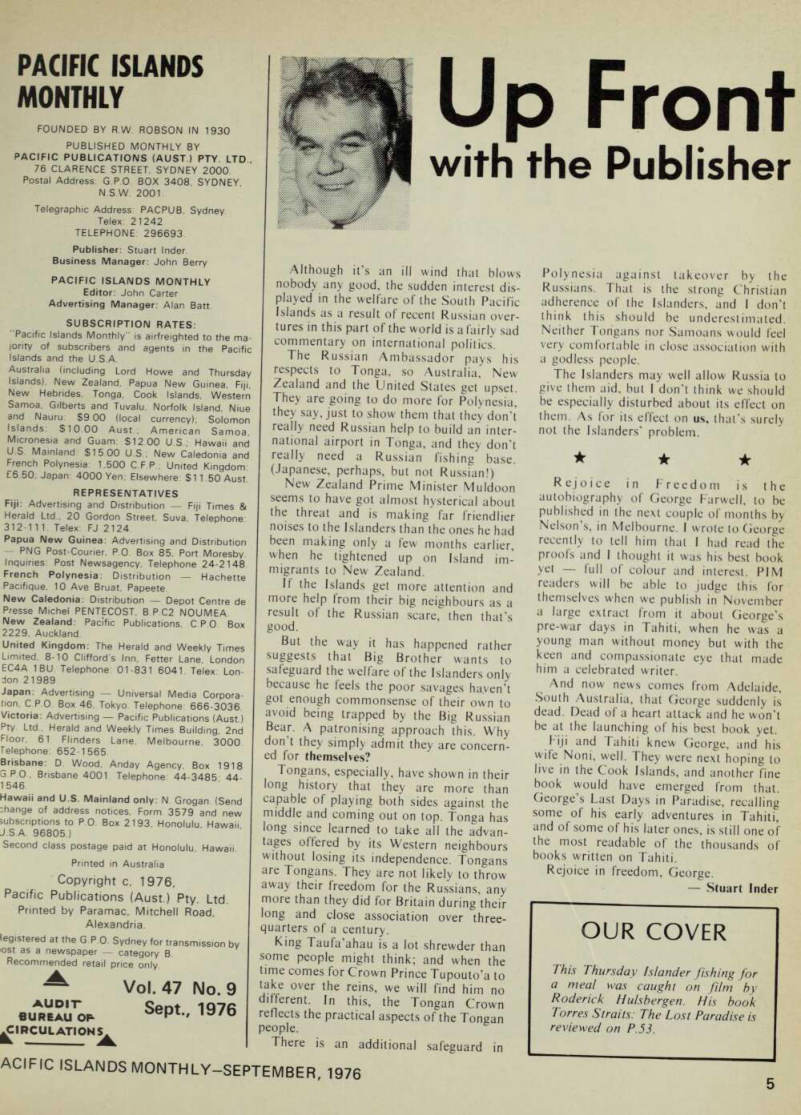
Up Front
with the Publisher
Although it’s an ill wind that blows nobody any good, the sudden interest dis played in the welfare of the South Pacific Islands as a result of recent Russian over tures in this part of the world is a fairly sad commentary on international politics.
The Russian Ambassador pays his respects to Tonga, so Australia, New Zealand and the United States get upset.
They are going to do more for Polynesia, they say, just to show them that they don’t really need Russian help to build an inter national airport in Tonga, and they don’t really need a Russian fishing base. (Japanese, perhaps, but not Russian!) New Zealand Prime Minister Muldoon seems to have got almost hysterical about the threat and is making far friendlier noises to the Islanders than the ones he had been making only a few months earlier, when he tightened up on Island im migrants to New Zealand.
If the Islands get more attention and more help from their big neighbours as a result of the Russian scare, then that’s good.
But the way it has happened rather suggests that Big Brother wants to safeguard the welfare of the Islanders only because he feels the poor savages haven’t got enough commonsense of their own to avoid being trapped by the Big Russian Bear. A patronising approach this. Why don t they simply admit they are concern ed for themselves?
Tongans, especially, have shown in their long history that they are more than capable of playing both sides against the middle and coming out on top. Tonga has long since learned to take all the advan tages offered by its Western neighbours without losing its independence. Tongans are Tongans. They are not likely to throw away their freedom for the Russians, any more than they did for Britain during their long and close association over three quarters of a century.
King Taufa’ahau is a lot shrewder than some people might think; and when the time comes for Crown Prince Tupouto’a to take over the reins, we will find him no different. In this, the Tongan Crown reflects the practical aspects of the Tongan people.
There is an additional safeguard in
Polynesia against takeover by the Russians. That is the strong Christian adherence of the Islanders, and I don’t think this should be underestimated.
Neither Tongans nor Samoans would feel very comfortable in close association with a godless people.
The Islanders may well allow Russia to give them aid, but I don’t think we should be especially disturbed about its effect on them. As for its effect on us, that’s surely not the Islanders’ problem. ★ ★ ★ Rejoice in Freedom is the autobiography of George Farwell, to be published in the next couple of months by Nelson’s, in Melbourne. I wrote to George recently to tell him that I had read the proofs and I thought it was his best book yet full of colour and interest. PIM readers will be able to judge this for themselves when we publish in November a large extract from it about George’s pre-war days in Tahiti, when he was a young man without money but with the keen and compassionate eye that made him a celebrated writer.
And now news comes from Adelaide, South Australia, that George suddenly is dead. Dead of a heart attack and he won’t be at the launching of his best book yet.
Fiji and Tahiti knew George, and his wife Noni, well. They were next hoping to live in the Cook Islands, and another fine book would have emerged from that.
George’s Last Days in Paradise, recalling
some of his early adventures in Tahiti, and of some of his later ones, is still one of the most readable of the thousands of books written on Tahiti.
Rejoice in freedom, George.
Stuart Inder
Advertisements & other items, pp. 5-6 (2 items)
Acific Islands Monthlv-September, 1976
Your Island
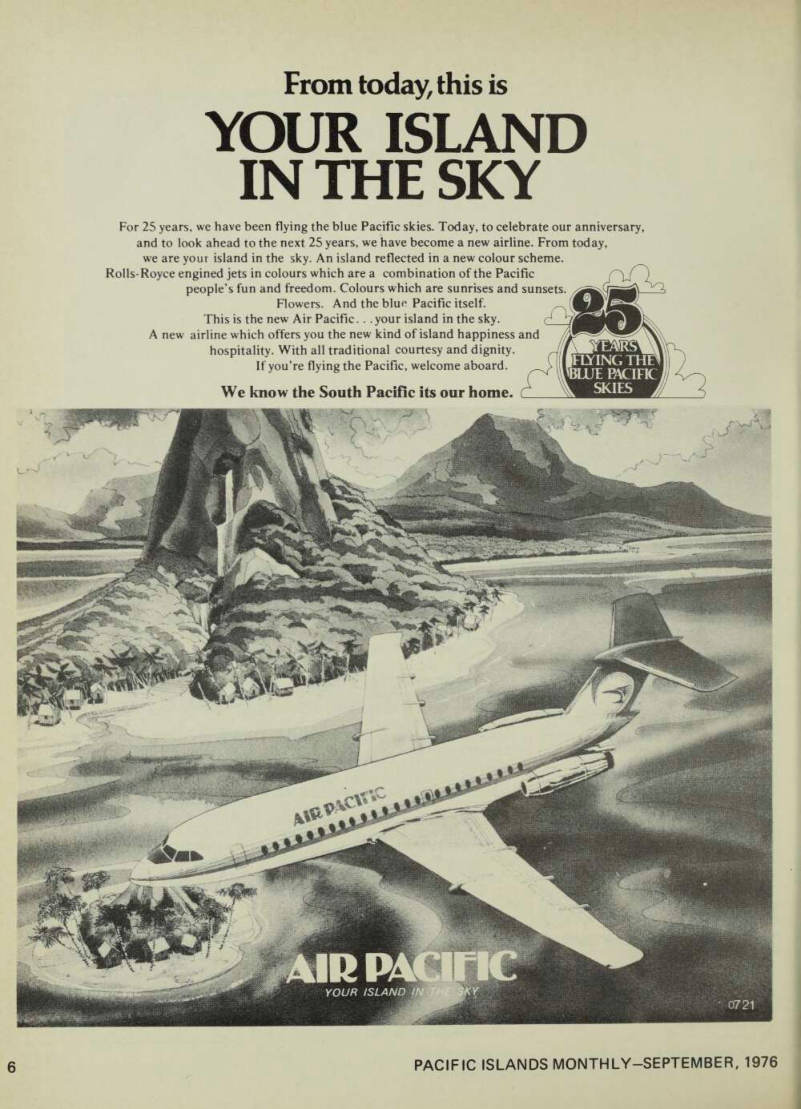
From today, this is
IN THE SKY
For 25 years, we have been flying the blue Pacific skies. Today, to celebrate our anniversary, and to look ahead to the next 25 years, we have become a new airline. From today, we are your island in the sky. An island reflected in a new colour scheme.
Rolls-Royce engined jets in colours which are a combination of the Pacific people’s fun and freedom. Colours which are sunrises and sunsets.
Flowers. And the blue Pacific itself.
This is the new Air Pacific. . .your island in the sky.
A new airline which offers you the new kind of island happiness and hospitality. With all traditional courtesy and dignity.
If you’re flying the Pacific, welcome aboard.
We know the South Pacific its our home. n i m *• w LL r
In this issue
General
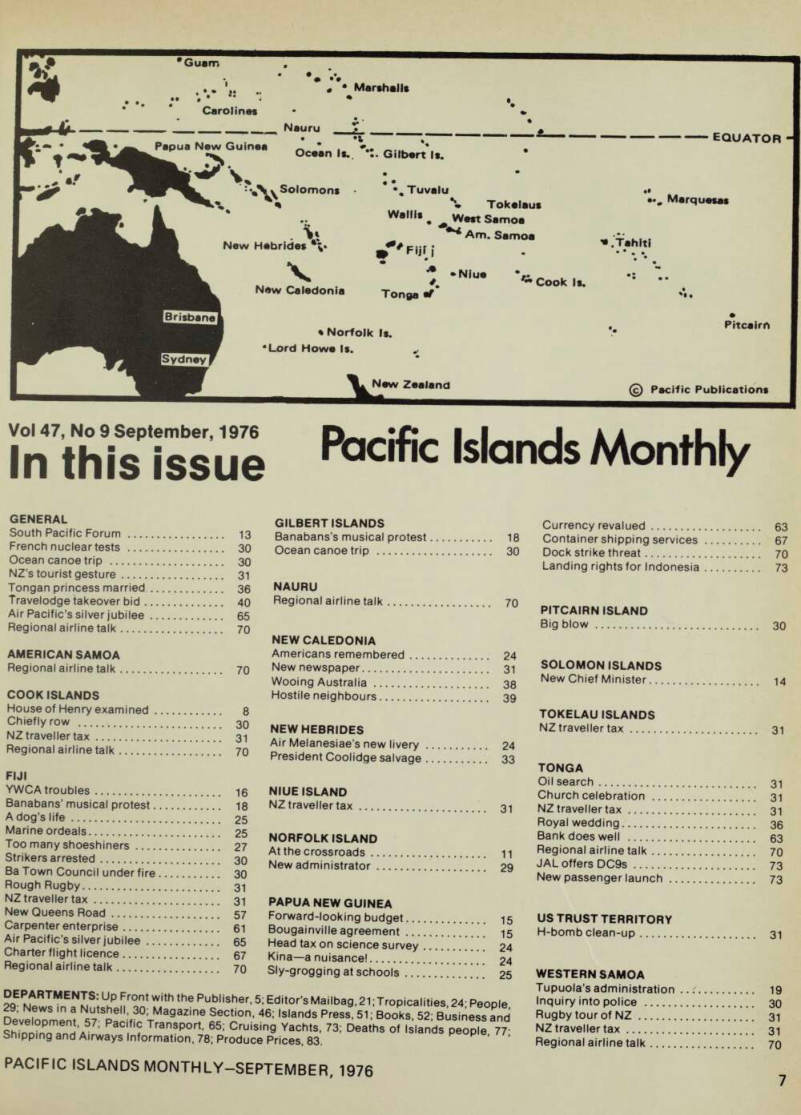
South Pacific Forum 13 French nuclear tests 30 Ocean canoe trip 30 NZ’s tourist gesture 31 Tongan princess married 36 Travelodge takeover bid 40 Air Pacific’s silver jubilee 65 Regional airline talk 70
American Samoa
Regional airline talk 70
Cook Islands
House of Henry examined 8 Chiefly row 30 NZ traveller tax 31 Regional airline talk 70
Fiji
YWCA troubles 16 Banabans’musical protest 18 A dog’s life 25 Marine ordeals 25 Too many shoeshiners 27 Strikers arrested 30 BaTown Council underfire 30 Rough Rugby 31 NZ traveller tax 31 New Queens Road 57 Carpenter enterprise 61 Air Pacific’s silver jubilee 65 Charter flight licence 67 Regional airline talk 70
Gilbert Islands
Banabans’s musical protest 18 Ocean canoe trip 30
Nauru
Regional airline talk 70
New Caledonia
Americans remembered 24 New newspaper 31 Wooing Australia 33 Hostile neighbours 39
New Hebrides
Air Melanesiae’s new livery 24 President Coolidge salvage 33
Niue Island
NZ traveller tax 31
Norfolk Island
At the crossroads 11 New administrator 29
Papua New Guinea
Forward-looking budget 15 Bougainville agreement 15 Head tax on science survey 24 Kina—a nuisance! 24 Sly-grogging at schools 25
Currency revalued 63 Container shipping services 67 Dock strike threat 70 Landing rights for Indonesia 73
Pitcairn Island
Big blow 30
Solomon Islands
New Chief Minister 14
Tokelau Islands
NZ traveller tax 31
Tonga
Oil search 31 Church celebration 31 NZ traveller tax 31 Royal wedding 35 Bank does well 63 Regional airline talk 70 JAL offers DC9s 73 New passenger launch 73
Us Trust Territory
H-bomb clean-up 31
Western Samoa
Tupuola’s administration .. 19 Inquiry into police 30 Rugby tour of NZ 31 NZ traveller tax 31 Regional airline talk 70
?q E R ™ EN T. S: Up Front With the Publisher - 5; Editor’s Mailbag. 21; Topicalities 24 People 29, News in a Nutshell. 30; Magazine Section. 46; Islands Press, 51; Books. 52- Business and ShiD^nnT^A 571 PaC 'i fl ? Transport - 65: Cruising Yachts. 73; Deaths of Islands people 77- Shipping and Airways Information, 78; Produce Prices, 83. p ’ ’
of the House of Henry
Cook Islands Politics
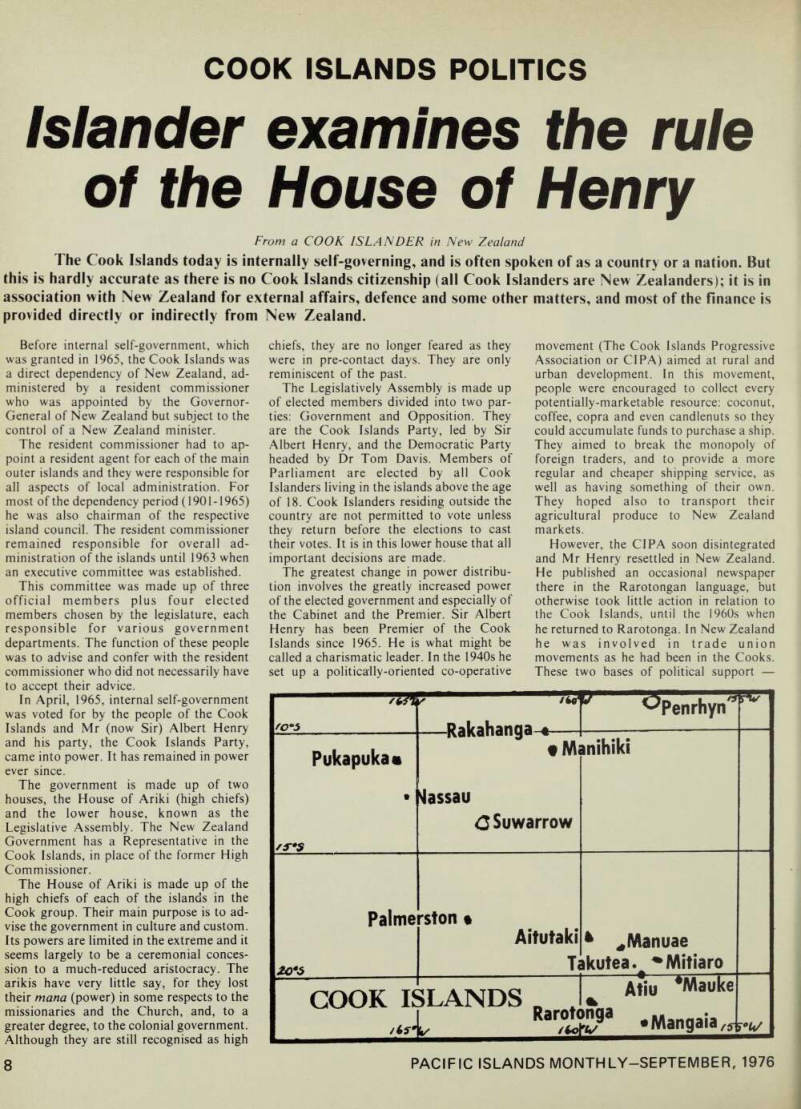
Islander examines the rule of the House of Henry
From a COOK ISLANDER in New Zealand
The Cook Islands today is internally self-governing, and is often spoken of as a country or a nation. But this is hardly accurate as there is no Cook Islands citizenship (all Cook Islanders are New Zealanders); it is in association with New Zealand for external affairs, defence and some other matters, and most of the finance is provided directly or indirectly from New Zealand.
Before internal self-government, which was granted in 1965, the Cook Islands was a direct dependency of New Zealand, ad ministered by a resident commissioner who was appointed by the Governor- General of New Zealand but subject to the control of a New Zealand minister.
The resident commissioner had to ap point a resident agent for each of the main outer islands and they were responsible for all aspects of local administration. For most of the dependency period (1901-1965) he was also chairman of the respective island council. The resident commissioner remained responsible for overall ad ministration of the islands until 1963 when an executive committee was established.
This committee was made up of three official members plus four elected members chosen by the legislature, each responsible for various government departments. The function of these people was to advise and confer with the resident commissioner who did not necessarily have to accept their advice.
In April, 1965, internal self-government was voted for by the people of the Cook Islands and Mr (now Sir) Albert Henry and his party, the Cook Islands Party, came into power. It has remained in power ever since.
The government is made up of two houses, the House of Ariki (high chiefs) and the lower house, known as the Legislative Assembly. The New Zealand Government has a Representative in the Cook Islands, in place of the former High Commissioner.
The House of Ariki is made up of the high chiefs of each of the islands in the Cook group. Their main purpose is to ad vise the government in culture and custom.
Its powers are limited in the extreme and it seems largely to be a ceremonial conces sion to a much-reduced aristocracy. The arikis have very little say, for they lost their mana (power) in some respects to the missionaries and the Church, and, to a greater degree, to the colonial government.
Although they are still recognised as high
chiefs, they are no longer feared as they were in pre-contact days. They are only reminiscent of the past.
The Legislatively Assembly is made up of elected members divided into two par ties: Government and Opposition. They are the Cook Islands Party, led by Sir Albert Henry, and the Democratic Party headed by Dr Tom Davis. Members of Parliament are elected by all Cook Islanders living in the islands above the age of 18. Cook Islanders residing outside the country are not permitted to vote unless they return before the elections to cast their votes. It is in this lower house that all important decisions are made.
The greatest change in power distribu tion involves the greatly increased power of the elected government and especially of the Cabinet and the Premier. Sir Albert Henry has been Premier of the Cook Islands since 1965. He is what might be called a charismatic leader. In the 1940 s he set up a politically-oriented co-operative
movement (The Cook Islands Progressive Association or Cl PA) aimed at rural and urban development. In this movement, people were encouraged to collect every potentially-marketable resource; coconut, coffee, copra and even candlenuts so they could accumulate funds to purchase a ship.
They aimed to break the monopoly of foreign traders, and to provide a more regular and cheaper shipping service, as well as having something of their own.
They hoped also to transport their agricultural produce to New Zealand markets.
However, the CIPA soon disintegrated and Mr Henry resettled in New Zealand.
He published an occasional newspaper there in the Rarotongan language, but otherwise took little action in relation to the Cook Islands, until the 1960 s when he returned to Rarotonga. In New Zealand he was involved in trade union movements as he had been in the Cooks.
These two bases of political support
trade unions for the urban workers and co operatives for the rural farmers, were key features of his political strength.
Today people in Rarotonga still, at times, refer to his old co-operative move ment when talking about Sir Albert Henry and often wonder what he did to their money. From the original members of his party in the first elections, some have moved to the opposition side and others have moved the other way, but the percen tage of his support is much reduced.
In the Cabinet today there are the Premier, two Deputy Premiers and five ministers all to govern a total popula tion of 20,000 a small suburb by most standards. The two Deputy Premiers are Mr Tiakana Numanga and Mr Apenera Short, who have been long-standing sup porters of the Premier. The five ministers are Mr Tupui Henry, Mr Geoffrey Henry, Mr William Estall, Dr Joseph Williams and Mr George Ellis.
There is a lot of resentment amongst Rarotongans and outer islanders because so much of the power is now concentrated in the hands of a group of people who came from one island, namely Aitutaki. The Henry family comes originally from Aitutaki, and there has always been some resentment against Aitutakians by Rarotongans. About 83% of the ministers (five out of six) are Aitutakians and over 90% of the portfolios (as some ministers hold several) are concentrated in their hands, yet Aitutaki people make up only about 10% of the population of the Cook Islands. Only one minister is from any of the other 15 islands he is from the atoll of Maniniki.
Besides, a disproportionately-high percentage of the top civil service and other jobs are today held by Aitutakians, and a great many of the holders of key posts are relatives of the Premier. A report in the Auckland Star stated that 18 members of the Premier’s extended family held senior official posts. The Cook Islands probably has the worst case of nepotism in the Pacific today, and one of the worst in the world, relative to its size.
The government has three Henrys as ministers; the Premier, Mr Tupui Henry (his son) and Mr Geoffrey Henry (his nephew). His sister is Speaker of the Parliament. His daughter is his private secretary and escorts him to overseas con ferences. His daughter’s husband is the manager of the government-owned freezer.
His other son was the Secretary to the Ministry of Supportive Services. Other members of his family have acquired various privileged jobs while the remainder have been given to strong supporters of his party disproportionately to people from his home island.
The Premier has vested unusually great powers upon himself, and is supported in this by his party members. Being the Minister of Immigration he is in a position
to deport any European or other non-Cook Islander he disapproves of, or who does something he does not like. For example, early in 1975, the reason for a particular person being forced to leave the islands was not disclosed, but it was believed to be related to his active support for the Op position party.
After the 1972 elections, several members of the Public Service were sacked from their jobs as a result of their being Opposition supporters. Whole islands are victimised: especially Atiu, Mangaia,
Penrhyn and Rakahanga, because they are
supporters of the Opposition party.
In December last year, a snap election was called by the Premier. Because absentee votes were not permitted, many Cook Islanders in New Zealand (there are over half as many Cook Islanders living in New Zealand as there are in the Cook Islands) tried to get to Rarotonga by air to vote. Air New Zealand could not take them, despite attempts to charter a plane, for the Premier obstructed this. He was well aware that many have migrated
because of political discrimination and would be voting against him. Finally a plane from Air Nauru was chartered much to the Premier’s annoyance. But it could only carry a fraction of those who wanted to go. Those who could flew to Rarotonga to cast their votes.
The Premier only received 20 more votes in total than the Leader of the Opposition.
The Opposition party’s campaign
meetings were continuously harassed by the radio and newspaper, both of which are government-owned. These were often made unavailable or available at the least desirable times, even though they are claimed to be non-political. The Premier stepped in to stop opposition attempts to get legitimate campaign pamphlets to the outer islands.
The result of the elections, although in favour of the ruling Cook Islands Party, showed a decline in his supporters and his
hopes of dominating the Opposition were
dashed for they won an extra seat, thus eliminating the two-thirds majority that the Premier previously had, which had been sufficient to allow him to make changes in the Constitution. The ruling Cook Islands Party got only 51% of the votes, and the Opposition got 49%.
What has Sir Albert Henry achieved in his 10 years in power? Since he has been in power, little seems to have gone right for the Cooks, but much has gone very well for him and his family.
The Cook Islands today are a financial embarrassment, heavily subsidised by New Zealand. Since 1965, the Cook Islands, economy has been running at a very great deficit. Audit reports show that there has been a progressive deterioration in finances and in financial management despite the $3 million or so a year New Zealand gives to keep the 20,000 people of the Cooks going. In 1973, the government spent $749,517 in excess, without the ap propriation of the local Legislative Assembly nearly 10 times more than is allowed in the Constitution.
Approval for this unauthorised spending was not available in most instances from
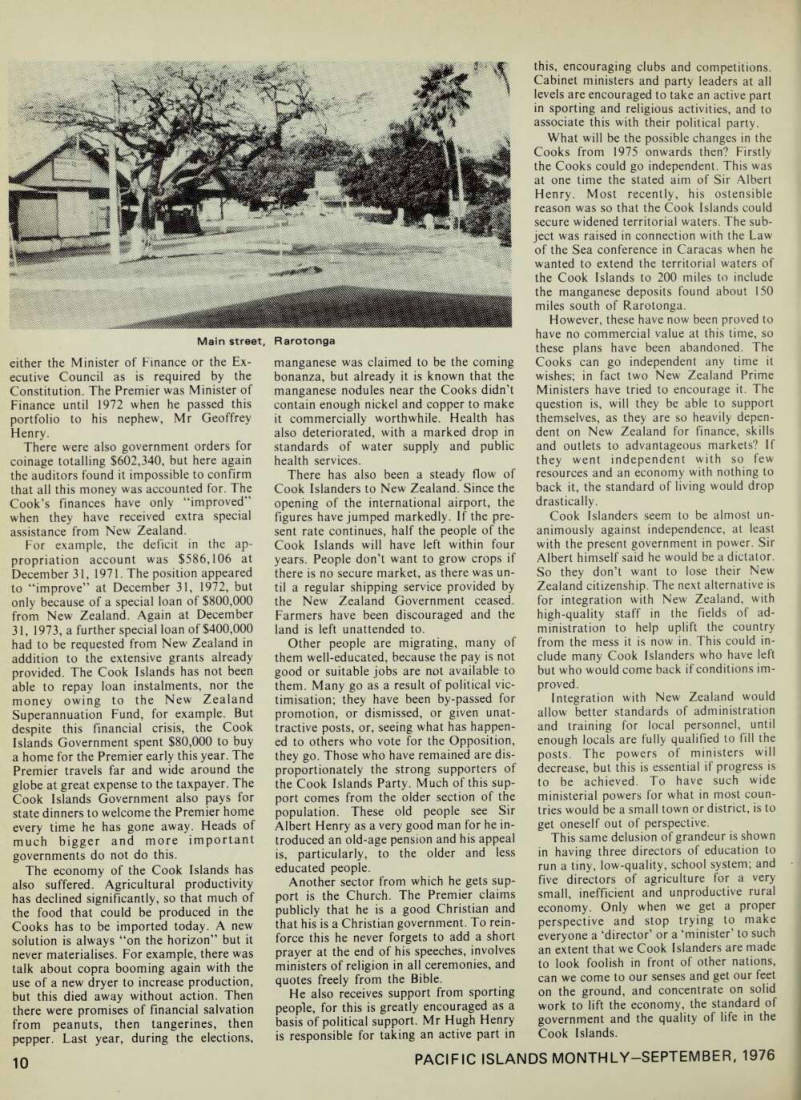
Sir Albert
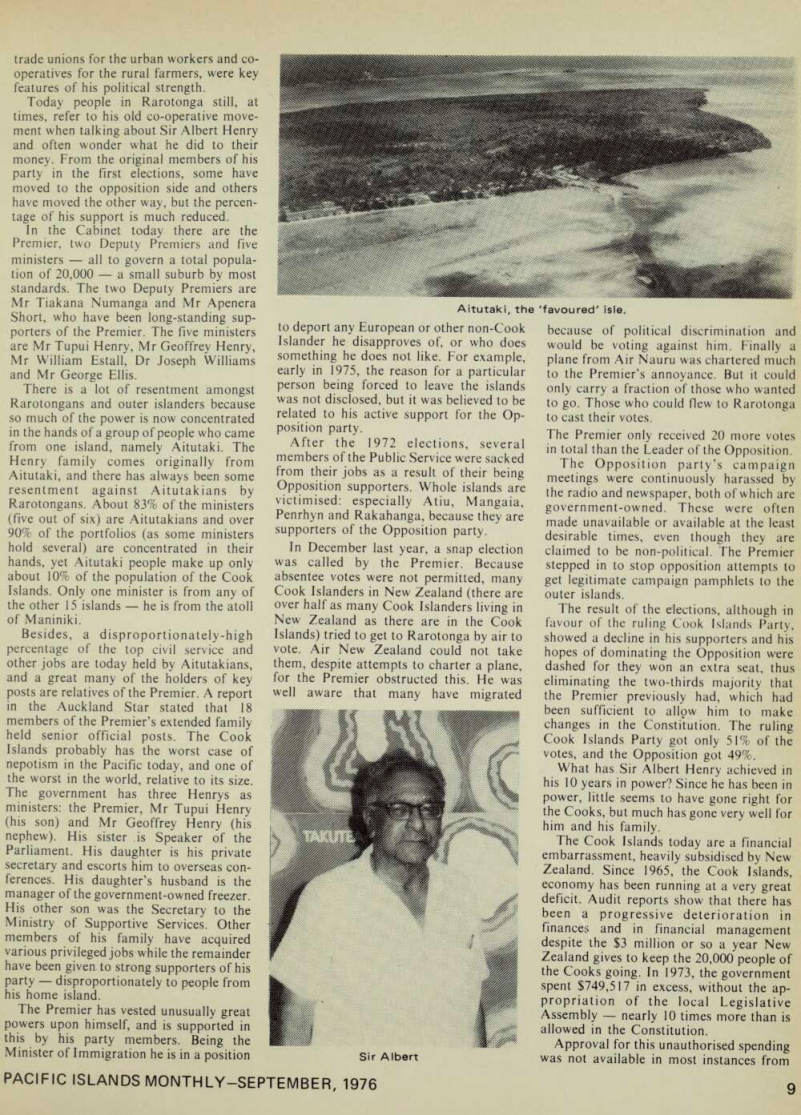
Aitutaki, the 'favoured' isle.
either the Minister of Finance or the Ex ecutive Council as is required by the Constitution. The Premier was Minister of Finance until 1972 when he passed this portfolio to his nephew, Mr Geoffrey Henry.
There were also government orders for coinage totalling $602,340, but here again the auditors found it impossible to confirm that all this money was accounted for. The Cook’s finances have only “improved” when they have received extra special assistance from New Zealand.
For example, the deficit in the ap propriation account was $586,106 at December 31, 1971. The position appeared to “improve” at December 31, 1972, but only because of a special loan of $BOO,OOO from New Zealand. Again at December 31, 1973, a further special loan of $400,000 had to be requested from New Zealand in addition to the extensive grants already provided. The Cook Islands has not been able to repay loan instalments, nor the money owing to the New Zealand Superannuation Fund, for example. But despite this financial crisis, the Cook Islands Government spent $BO,OOO to buy a home for the Premier early this year. The Premier travels far and wide around the globe at great expense to the taxpayer. The Cook Islands Government also pays for state dinners to welcome the Premier home every time he has gone away. Heads of much bigger and more important governments do not do this.
The economy of the Cook Islands has
also suffered. Agricultural productivity
has declined significantly, so that much of the food that could be produced in the Cooks has to be imported today. A new solution is always “on the horizon” but it never materialises. For example, there was talk about copra booming again with the use of a new dryer to increase production, but this died away without action. Then there were promises of financial salvation from peanuts, then tangerines, then pepper. Last year, during the elections.
manganese was claimed to be the coming bonanza, but already it is known that the manganese nodules near the Cooks didn’t contain enough nickel and copper to make it commercially worthwhile. Health has also deteriorated, with a marked drop in standards of water supply and public health services.
There has also been a steady flow of Cook Islanders to New Zealand. Since the opening of the international airport, the figures have jumped markedly. If the pre sent rate continues, half the people of the Cook Islands will have left within four years. People don’t want to grow crops if there is no secure market, as there was un til a regular shipping service provided by the New Zealand Government ceased.
Farmers have been discouraged and the land is left unattended to.
Other people are migrating, many of them well-educated, because the pay is not good or suitable jobs are not available to them. Many go as a result of political vic timisation; they have been by-passed for promotion, or dismissed, or given unat tractive posts, or, seeing what has happen ed to others who vote for the Opposition, they go. Those who have remained are dis proportionately the strong supporters of the Cook Islands Party. Much of this sup port comes from the older section of the population. These old people see Sir Albert Henry as a very good man for he in troduced an old-age pension and his appeal is, particularly, to the older and less
educated people.
Another sector from which he gets sup port is the Church. The Premier claims publicly that he is a good Christian and that his is a Christian government. To rein force this he never forgets to add a short prayer at the end of his speeches, involves ministers of religion in all ceremonies, and quotes freely from the Bible.
He also receives support from sporting people, for this is greatly encouraged as a basis of political support. Mr Hugh Henry is responsible for taking an active part in
this, encouraging clubs and competitions.
Cabinet ministers and party leaders at all levels are encouraged to take an active part in sporting and religious activities, and to associate this with their political party.
What will be the possible changes in the Cooks from 1975 onwards then? Firstly the Cooks could go independent. This was at one time the stated aim of Sir Albert Henry. Most recently, his ostensible reason was so that the Cook Islands could secure widened territorial waters. The sub ject was raised in connection with the Law of the Sea conference in Caracas when he wanted to extend the territorial waters of the Cook Islands to 200 miles to include the manganese deposits found about 150 miles south of Rarotonga.
However, these have now been proved to have no commercial value at this time, so these plans have been abandoned. The Cooks can go independent any time it wishes; in fact two New Zealand Prime Ministers have tried to encourage it. The question is, will they be able to support themselves, as they are so heavily depen dent on New Zealand for finance, skills and outlets to advantageous markets? If they went independent with so few resources and an economy with nothing to back it, the standard of living would drop drastically.
Cook Islanders seem to be almost un animously against independence, at least with the present government in power. Sir Albert himself said he would be a dictator.
So they don’t want to lose their New Zealand citizenship. The next alternative is for integration with New Zealand, with high-quality staff in the fields of ad ministration to help uplift the country from the mess it is now in. This could in clude many Cook Islanders who have left but who would come back if conditions im
proved.
Integration with New Zealand would allow better standards of administration and training for local personnel, until enough locals are fully qualified to fill the posts. The powers of ministers will decrease, but this is essential if progress is to be achieved. To have such wide ministerial powers for what in most coun tries would be a small town or district, is to get oneself out of perspective.
This same delusion of grandeur is shown in having three directors of education to run a tiny, low-quality, school system; and five directors of agriculture for a very small, inefficient and unproductive rural economy. Only when we get a proper perspective and stop trying to make everyone a ‘director’ or a ‘minister’ to such an extent that we Cook Islanders are made to look foolish in front of other nations, can we come to our senses and get our feet on the ground, and concentrate on solid work to lift the economy, the standard of government and the quality of life in the Cook Islands.
Main street, Rarotonga
Norfolk at the crossroads: which
way to go from here?
From FRANCIS ROLLEY in Kingston
After taking up his appointment on September 4, Norfolk Island’s new Ad ministrator, one-time Australian Navy Lieutenant-Commander and Secret Ser vice Agent Desmond Vincent O’Leary, faces a formidable challenge. Never, until a month ago, having set foot on the island, his main task during a two-year posting, if it runs full term, could be to implement the imminently expected recommendations of Sir John Nimmo’s Royal Commission into the island’s future status and constitutional relationship to Australia.
Canberra is not bound to adopt the com mission’s suggestions, either in whole or even part, but when Senator Reg Withers as Minister for Administrative Services the department with mainland authority over Norfolk at present says “the island is entering one of the most important periods in its history” most of the 1600 residents fear some changes are inevitable.
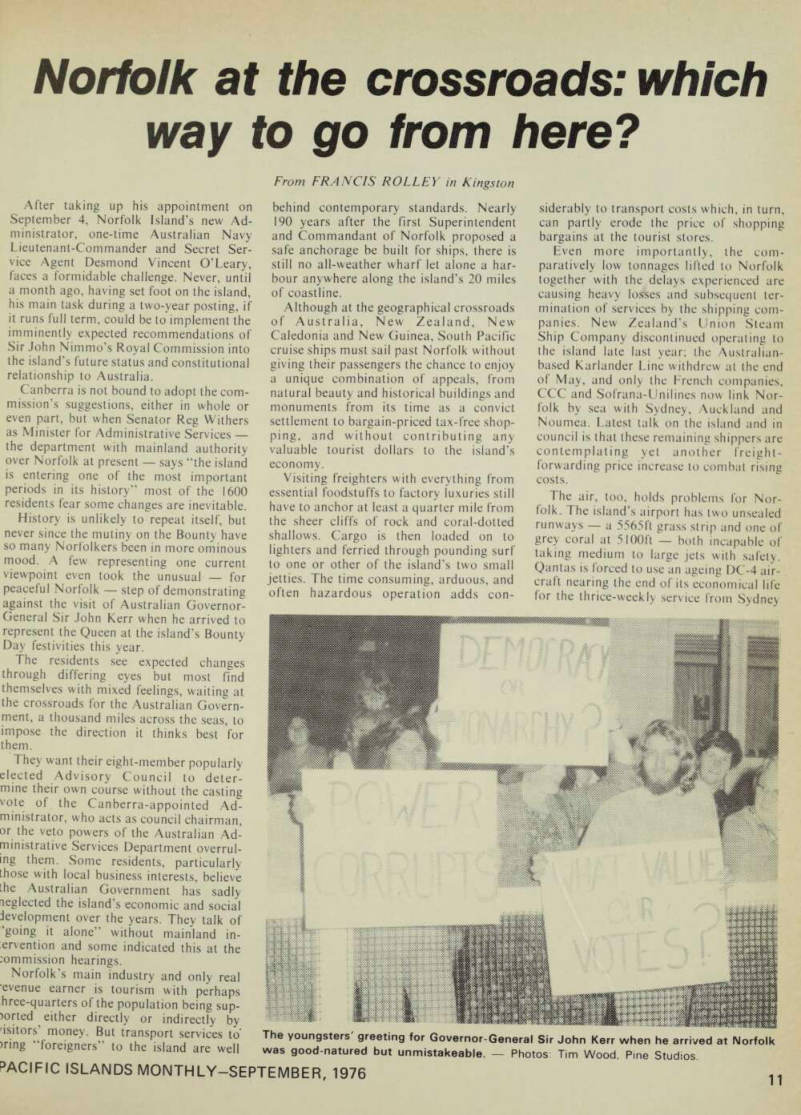
History is unlikely to repeat itself, but never since the mutiny on the Bounty have so many Norfolkers been in more ominous mood. A few representing one current viewpoint even took the unusual for peaceful Norfolk step of demonstrating against the visit of Australian Governor- General Sir John Kerr when he arrived to represent the Queen at the island’s Bounty Day festivities this year.
The residents see expected changes through differing eyes but most find themselves with mixed feelings, waiting at the crossroads for the Australian Govern ment, a thousand miles across the seas, to impose the direction it thinks best for them.
They want their eight-member popularly elected Advisory Council to deter mine their own course without the casting vote of the Canberra-appointed Ad ministrator, who acts as council chairman, or the veto powers of the Australian Ad
ministrative Services Department overrul
ing them. Some residents, particularly those with local business interests, believe the Australian Government has sadly neglected the island’s economic and social Jevelopment over the years. They talk of ‘going it alone” without mainland in dention and some indicated this at the
:ommission hearings.
Norfolk’s main industry and only real evenue earner is tourism with perhaps hree-quarters of the population being sup
)orted either directly or indirectly by
dsitors money. But transport services to >ring “foreigners” to the island are well
behind contemporary standards. Nearly 190 years after the first Superintendent and Commandant of Norfolk proposed a safe anchorage be built for ships, there is still no all-weather wharf let alone a har bour anywhere along the island’s 20 miles of coastline.
Although at the geographical crossroads of Australia, New Zealand, New Caledonia and New Guinea, South Pacific cruise ships must sail past Norfolk without giving their passengers the chance to enjoy a unique combination of appeals, from natural beauty and historical buildings and monuments from its time as a convict settlement to bargain-priced tax-free shop ping, and without contributing any valuable tourist dollars to the island’s economy.
Visiting freighters with everything from essential foodstuffs to factory luxuries still have to anchor at least a quarter mile from the sheer cliffs of rock and coral-dotted shallows. Cargo is then loaded on to lighters and ferried through pounding surf to one or other of the island’s two small jetties. The time consuming, arduous, and often hazardous operation adds con
siderably to transport costs which, in turn, can partly erode the price of shopping bargains at the tourist stores.
Even more importantly, the com paratively low tonnages lifted to Norfolk together with the delays experienced are causing heavy losses and subsequent ter mination of services by the shipping com panies. New Zealand’s Union Steam Ship Company discontinued operating to the island late last year; the Australian based Karlander Line withdrew at the end of May, and only the French companies, CCC and Sofrana-Unilines now link Nor folk by sea with Sydney, Auckland and Noumea. Latest talk on the island and in council is that these remaining shippers are contemplating yet another freight forwarding price increase to combat rising costs.
The air, too, holds problems for Nor folk. The island’s airport has two unsealed runways a 5565 ft grass strip and one of grey coral at 5100 ft both incapable of taking medium to large jets with safely.
Qantas is forced to use an ageing DC-4 air craft nearing the end of its economical life for the thrice-weekly service from Sydney
The youngsters greeting for Governor-General Sir John Kerr when he arrived at Norfolk was good-natured but unmistakeable. Photos; Tim Wood. Pine Studios.
while Air New Zealand charters a small NAG domestic airline Friendship for its link, four times a week, with Auckland.
Although also considered in the past, and the urgent need was outlined in sub missions to the commission, the Australian Government still has no firm starting plans to seal and extend the runways to bring them up to acceptable international airport standards.
Both airlines, meanwhile, admit they would rather not have the runs but are maintaining them as a service to the island.
However, they have adopted a “come what may” attitude and are pruning flights whenever the demand for them drops.
Qantas will commit itself to continuing the service only as far ahead as next March while from a weekly frequency of six at the beginning of this year, Air New Zealand discontinued one in April, and another in June, to bring its schedule down to the pre sent four return flights from Auckland each week.
The only other way of bringing in essen tial tourist money is by Norfolk Island Airlines’ 12-seat Beechcraft which operates four return flights a week to Brisbane, two of them via Lord Howe Island.
The local airline is trying to obtain per mission, so far without success, from the Australian Government to operate a regular service to New Caledonia follow ing approval of the idea by French Govern ment officials in Paris and Noumea. UTA French Airlines occasionally operates a weekend return charter flight by Friendship from Noumea and even Air Niugini already uses Norfolk as a technical refuelling stop for its Friendships going to and from New Zealand for routine maintenance work.
Its strategic position as an ideal location for stepped-up tourist development is thus underlined. But much needs to be done to capitalise on it and the estimated $lO million harbour and multi-million dollar
airport projects now seem more urgent needs than ever. In 1975, a record 19,500 people visited the island but local business owners are more than a little concerned that the winter off-season just passed has seen a greater downturn in tourist trade than normal. With continuing rampant in flation in the nations circling it, the latest Qantas fare rise, and the newly announced New Zealand budget lax on overseas travel, Norfolk’s present setback may be an ominous sign.
However, other residents like the in dications, are happy with their present paradise, want it to stay as is, and hope the vast tourist potential remains largely un tapped. Many of the island’s older genera tion let the commission know that Nor folk’s chief tourist attraction as a naturally conserved, tranquil place to gel away from city pressures will be shattered if giant cruise liners and jumbo jet aircraft begin to disgorge hundreds of visitors all trying to escape.
Paradoxically, their very presence will defeat their reason for coming. Over commercialism, high-rise accommodation blocks, gaudy tourist traps, and more
vehicles on the roads would certainly follow, say some residents with disgust. On an island only five miles long and three miles wide there are already 1600 people, 2200 vehicles, no less than five hire-car companies in a few hundred yards of shop ping centre, and the highest per capita car ownership rate in the world.
There’s no street lighting, speed limits of 30 mph on winding, hilly, not-so-open
roads,with 25 mph through the township.
And the law gives cattle the freedom to wander at will along with the right-of-way on all roads. Even more visiting mobile men and women would cause more
problems for eight local politicians, three
policemen, a couple of hundred produce breeders, and the 1600 population at large.
They hope Sir John Nimmo agrees.
Some others, most noticeable in the younger generation, point to the present tourist slump as an example of how Nor folk’s economy is sensitive to the fickle whims of international travellers. They believe a more diversified economic base for the island can be achieved only with outside assistance. Realistically, they also believe Canberra can’t be expected to give vastly increased aid without some con tinued say in the island’s affairs.
Threaded through all these differing viewpoints is the widespread idea that the Australian Government set up the Royal Commission in the first place with hopes of
eliminating ill-defined legal loopholes
which allow registered companies,
residents, and visitors to the island to es cape virtually tax-free. And although the various island groups concede they’re at a crossroads of possibilities, they all seem resigned to the commission's recommen ding the imposition of some form of in come tax. What else Sir John Nimmo’s leadership along a new path brings them remains to be seen but few, in even their wildest optimism, can see new Ad ministrator Desmond O’Leary having to
implement his own departure during his
two-year appointment.
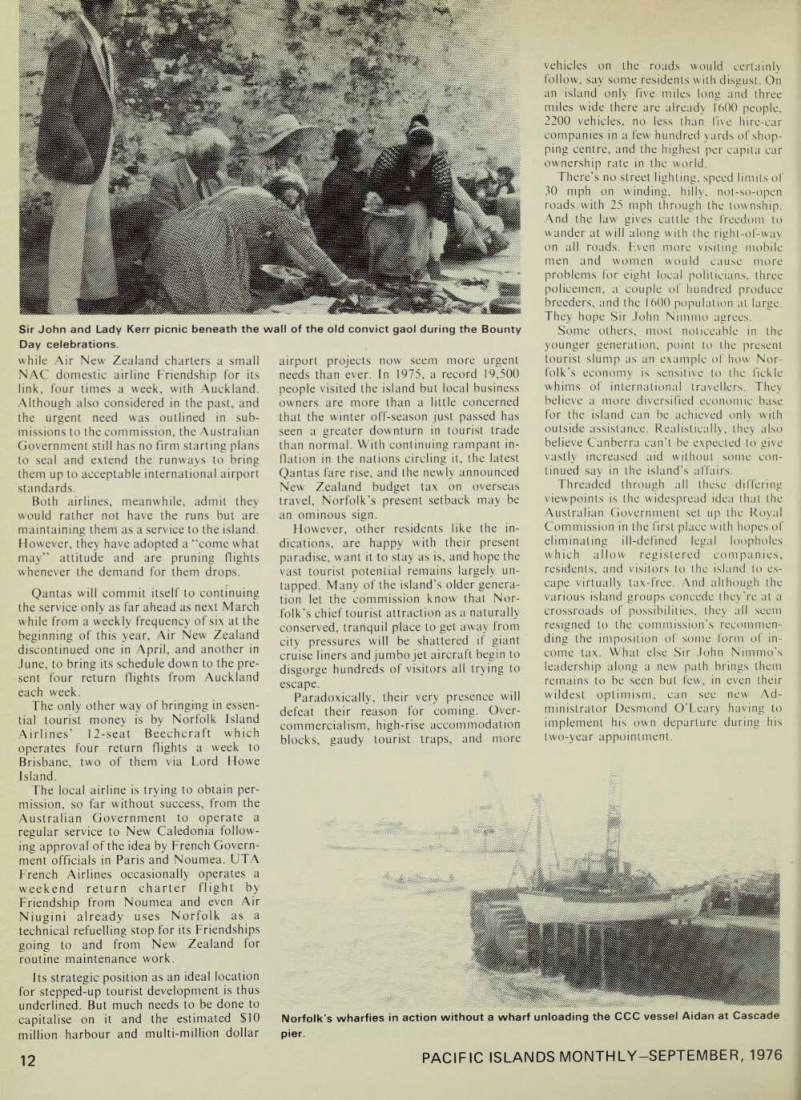
Sir John and Lady Kerr picnic beneath the wall of the old convict gaol during the Bounty Day celebrations.
Norfolk's wharfies in action without a wharf unloading the CCC vessel Aidan at Cascade pier.
Storm Over The Forum
A Thundercloud But No
From a special correspondent
The Seventh South Pacific Forum open ed for three days in Nauru on July 26 and was attended by leaders, or their represen tatives, from 12 Island countries. The tone of the meeting was set by Nauru’s Presi dent Hammer Deßoburt jetting in from Melbourne in an Air Nauru jet occupying the whole of the first class compartment, while Australia’s representative* Senator Robert Cotton, and his wife sat in the back in the economy compartment. New Zealand’s Prime Minister Robert Mul doon fared a little better as he flew in all the way from New Zealand in a Fokker Friendship normally used for New Zealand DCA calibration flights. Such are the ironies and contrasts of Island politics.
The Forum started its business by con sidering a PNG paper on environmental conservation which proposed a regional approach to the problem. As is often the case with such initiatives, the Forum’s South Pacific Bureau for Economic Co operation (SPEC) was asked to prepare specific recommendations for the next Forum.
On the related subject of Law of the Sea, the Forum decided to convene a meeting later in 1976 to discuss fisheries sur veillance and policing, conservation of marine resources and the establishment of 200-mile zones round Island groups. The Cook Islands Premier, Sir Albert Henry, regretted his country’s lack of control over the activities of foreign fishing vessels in Cook Islands waters, while other leaders thought perhaps of the potential economic benefit, in terms of underseas mineral wealth and fishing resources, which will obviously come to small Island countries from the 200 mile-limit.
The report of a task force established by SPEC to review the effectiveness of foreign aid in the South Pacific was well received by the Forum. The task force, which in cluded Island as well as Australian and New Zealand representatives, recommend ed, among other things, the eventual amalgamation of SPEC and SPC, perma nent migration to Australia and New Zealand from countries such as Tonga, the Gilberts, Tuvalu, Cooks and Niue, and the establishment of a new regional body to :o-ordinate aid in the region.
The report was generally critical of aid, and spoke of its tendency to worsen ex isting defects in countries, rather than remedying them, and the way it led to
more, rather than less, dependence on out side help. Recipient countries were also told to take ‘a long hard look at their inter nal social and political constraints to development’ and to set about remedying them if aid was not to worsen existing defects. More aid to the region should be
channelled through voluntary agencies
such as churches, while the whole ‘aid machine’ needed simplifying.
Regional shipping at last received the formal go-ahead when the Forum agreed to establish the Pacific Forum Line. One cynic was overheard to say that short of deferring the matter to the next Forum meeting for further study there was really no other alternative. The Line is intended to be an economic venture and will rely on operating chartered vessels on main routes. Those Island countries which have seen the Line as providing the missing links in the region’s services are obviously in for a shock.
Civil aviation, another area where there is scope for more regional co-operation, was discussed by the leaders and a report from the July meeting of the newly established South Pacific Regional Civil Aviation Council was endorsed. The report recommends investigation of regional re quirements for air services, rationalisation of routes and schedules, and identification of obstacles to the better co-ordination of regional air services.
Nauru had been hoping that the Forum would decide on some system for allocating routes to regional carriers which would replace the present bargaining between individual countries. Under the present arrangement Air Nauru is denied access to a number of lucrative routes presently served by Air Pacific. Fiji, which has no intention of seeing Air Pacific destroyed, and which is in a very strong bargaining position because of its central location, was obviously not willing to see anybody re-allocate its traffic rights.
A topic which, at first, seemed likely to be discussed and which finally was barely touched upon was the question of the Banaban people and their rights on Ocean Island and relations with the United Kingdom. At one time it seemed possible that the Banabans would address the Forum, but this was strongly resisted by the Chief Minister from the Solomons. Like a number of other subjects the Banaban issue was more the subject of debate outside the Forum than inside it.
One interesting feature of the Forum is the growing generation gap within it. On the one hand there are the elder statesmen of the islands, such as Sir Albert Henry, Prince Tuipelehake and Ralu Sir Kamisese Mara, while on the other there are newcomers such as Peter Kenilorea, the new Chief Minister ol the Solomons and Tupuola Efi, Western Samoa’s new Prime Minister. Tensions between the two groups seem inevitable as the younger leaders become increasingly intolerant of the old ways.
Looming over the Forum throughout its three-day meeting was the ‘thundercloud’ of Soviet and Chinese involvement in the South Pacific. Prime Minister Muldoon had left New Zealand saying that the Soviet and Chinese threat could dominate the Forum and leaders and observers alike wailed for the storm to break from the New Zealand leader.
Finally, it was Australia which made the running when Senator Robert Colton made a statement to the Forum about Soviet and Chinese involvement in the South Pacific.
Acknowledging that, while the two countries had quite legitimate interests in the region. Senator Colton said that Australia was nevertheless concerned about the increasing Soviet involvement in the South Pacific and where it might lead.
The Soviet Union was bound to seek to ex ploit any lealures of the situation to its own advantage and, therefore, it was im portant to study Soviet activities with great seriousness, and to be on guard against any developments which might not be in the interests of individual countries or of the region as a whole.
The development of large on-shore facilities by the USSR to serve its fishing fleets could open the way for unwelcome
longer-term developments.
Australia, Senator Cotton said, would continue its efforts to support and strengthen regional organisations such as SPC, SPEC and the South Pacific Forum and would improve and expand its aid to South Pacific countries to help them over come their economic problems. Whether the Australian statement heralds large in creases in Australian and New Zealand aid to the South Pacific remains to be seen.
Certainly to many at the Forum that must have seemed to be the logical result.
Advertisements & other items, p. 13 (1 item)
3 Acific Islands Monthly-September, 1976
Guard against fading

complexion beauty
The maintenance of a softer, lovelier complexion can be assured with the daily smoothing on of a remarkable tropically moist oil blend.
IT is with trepidation that many women enter their middle years simply because they suspect their complexion beauty will deteriorate and make them look older than they really are.
The natural oils and moisture which cherish your skin and help keep it in a soft, smooth supple state are supplied from within the skin itself by thousands of tiny glands which continuously create a moist environment in the outer layer of your skin. i As you grow older the tiny glands jbecome tired and the supplies of natural fluids gradually diminish and
therefore need special supplementing with a tropically moist oil blend.
These days, many women smooth on the scientifically developed tro pically moist oil blend to help re store and maintain the vital balance of moisture and oil in the skin and so assist the complexion in the main tenance of its fresh radiant beauty.
Fresh, natural
skin softness The tropically moist oil blend penetrates into the stratum corneum and acts on the skin in a similar way to Nature’s own oils and moisture, softening and smoothing dry skin and helping to overcome the onset of wrinkle dryness. The tropically moist oil of Ulan brings, even to a tired-looking and neglected com plexion, benefits similar to those provided by the skin’s own natural fluids helping to create a fresh, natural complexion radiance.
Solomons
A Brand New
Look In The
The Solomon Islands' new Chief Minister, Mr Peter Keniloreu, has named his new Council of Ministers. Only two have held posts in a former council Mr P. Ghemu, who retains his portfolios of Foreign Trade, Industry and Labour, which he held under Mr Solomon Mamaloni, and Mr Mariano Kelesi, an old hand, who lost his seal to Philip Solodia in 1973 after holding it for 12 years. He becomes Minister for Education and Cultural Affairs.
The remainder of Mr Kenilorea’s coun cil art all new to the job; Mr Benedict Kinik , Minister for Finance; Mr J.
Tepaika, Minister for Works and Public Utilities; Mr F. Billy Hilly, Minister of Home Al a rs; Mr D. Ho'ola, Minister for Health and Welfare, and Mr S. Kelly, Minister for Agriculture and Land.
Unless the r.ew siationalisl Parly form ed by the trace unions wields more in fluence than its five elected members are likely to exert, the Solomons may continue to eschew party politics on which the West minster parliamentary system is based. Mr Kenilorea isn’t a party man. In fact, this is his first introduction to politics.
His first speech after his election might have sounded naive, but it also suggested the abolition of a recognised Opposition.
He and his Council of Ministers did not alone constitute the government, he said.
All the members of the Legislative Assembly were the government.
And everyone knew he meant it. Mr Kenilorea’s honesty is recognised and applauded by everyone. A Malaila man, aged 42, he was educated in New Zealand, qualified as a teacher and has worked as an education officer and district com missioner. His entry into politics was at the behest of many people.
Papua New Guinea’s Prime Minister, Mr Michael Somare, lost no lime in sen ding his congratulations to the new Chief Minister, hoped they could develop a “close working relationship’’ and invited him to make an early visit to PNG.
Mr Somare and his ministers have been worried over the Solomons’ future.
Privately, they don’t think their neighbours are fully prepared lor in dependence and fear the creation next door of a power vacuum.
Australia’s Prime Minister, Mr Malcolm Fraser, also sent his good wishes and assured Mr Kenilorea of “Australia’s willingness to provide continuing assistance to your country’s progress and development.
a forward-looking budget
PNG crystal gazes and plans a forward-looking budget
From GUS SMALES in Port Moresby
Papua New Guinea’s first budget since independence dispels any fears that the new nation might be tempted to squander its five-year guaranteed aid programme from Australia. The budget was brought in the National Parliament in Port Moresby early in August by the Finance Minister, Mr Julius Chan.
It is essentially a budget of restraint, concentrating on some avenues of develop ment which will not reach their full value for several years when Australian aid is likely to be falling off. The Australian aid content in the budget is part of an agree ment in which Australia has undertaken to provide $930 million in budgetary support over the next five years.
This is in strong contrast with the system which existed while Australia was the administering authority in PNG when Australian aid was given only on a year to year basis, and PNG didn’t known what to expect each year until Australia brought down its own budget.
PNG political leaders claimed this gave them no opportunity to undertake long
range, integrated planning.
Mr Chan said the new budgetary system had allowed his country to “escape from a straitjacket” imposed by the rigid rules of the past.
The budget provides for revenue equivalent to $448 million and expenditure equivalent to $457 million. Australia’s contribution to the revenue, as an uncon ditional grant in aid, is $l9O million.
Mr Chan told parliament that for two years the aid relationship had been charged with a certain degree of tension and fric tion, but a long-term satisfactory arrange ment had now been reached. Australia’s agreement to make the money available without direction as to how it should be used was “enlightening and historic”.
The budget makes no structural changes to methods of raising internal revenue, and
does not change existing income tax.
However, it increases some hospital and dental fees, sea and air navigation charges
and liquor licensing fees.
Firearms, ammunition, playing cards,
greeting cards, perfumes and some textiles vill attract higher import duty. There will 56 an increase in the import duty on motor spirit of about 6%, and on aviation fuel of ust over 2%.
Statutory authorities, which operate as
commercial enterprises, such as the national airline and the Bank of PNG will be required to pay dividends to the govern ment.
The budget is expected to have little effect on the personal finances of Papua New Guineans or of Australians living in PNG. It will also have little effect on Australian companies operating in PNG, with one exception.
The exception takes in companies which operate as branches in PNG and have not been incorporated there. Because such branches do not pay dividends to a parent company, they have been avoiding divi dend withholding tax.
Under this budget these companies will be charged a company tax of 45% on their PNG earnings, instead of the standard 33 1/3% company tax applying to com panies incorporated in PNG.
The most significant internal change heralded by the budget is the provision of unconditional grants for planned provin cial governments. Under the scheme out lined by Mr Chan, certain areas of expen diture, particularly in roads and services, will be designated as provincial respon sibilities and full spending authority will rest with provincial governments.
The scheme marks a departure in traditional centralised spending, and is seen in no small measure as one of the results of the secession pressures on
Bougainville.
The new company tax for foreign businesses operating but not incorporated in PNG is designed to collect the equivalent of dividend-withholding tax.
Locally incorporated companies pay
withholding tax at present when they remit dividends to their parent companies, but business firms operating purely as branches have been avoiding such payments.
Although the Australian aid content is heavy, there is no suggestion that PNG is milking Australian sources to finance grandiose spending schemes. There’s a heavy accent on stabilisation-type funds and soundly based development projects and for the first time, 100, there's a plann ed effort in this year's budget to slop the octopus-like growth of the Public Service, once estimated at 10% annually and a
heavy drag on funds.
The Public Service growth figure will come down to 1.4% under the Chan budget, including the net loss of 190 highly paid Australians in specialised jobs.
Bougainville Agreement
In ‘True Melanesian Style’
Bougainville Island will stay with Papua New Guinea. .. !? la I nd ' s leaders announced on August 9 the end of secession pressures which had threatened to split the young nation of PNG. And in the National Parlia ment in Port Moresby the Prime Minister, Mr Somare, announced that he had signed a formal agreement of unity with Bougainville.
Under the agreement, the island's 100,000 people will gel defined revenues and will hold defined powers over many of their own affairs. But they will recognise the central authority of the PNG Government and their own status as a province of PNG.
The Bougainville signatories to the agreement were led by the Premier-elect of Bougainville Province, Dr Alexis Sarei, who flew to Port Moresby for the final stages of the unity negotiations.
Mr Somare revealed to parliament that by January this year he had considered the situation -beyond hope". But extreme patience, and a true spirit of com promise on both sides, had brought a settlement in what he called "true Melane sian style".
The joint communique which Mr Somare tabled in parliament also used the expression "true Melanesian spirit" in attaining a settlement of the secession cold war.
Advertisements & other items, p. 15 (1 item)
15
‘ACIFIC ISLANDS MONTHLY-SEPTEMBER, 1976
Teeth And Talons
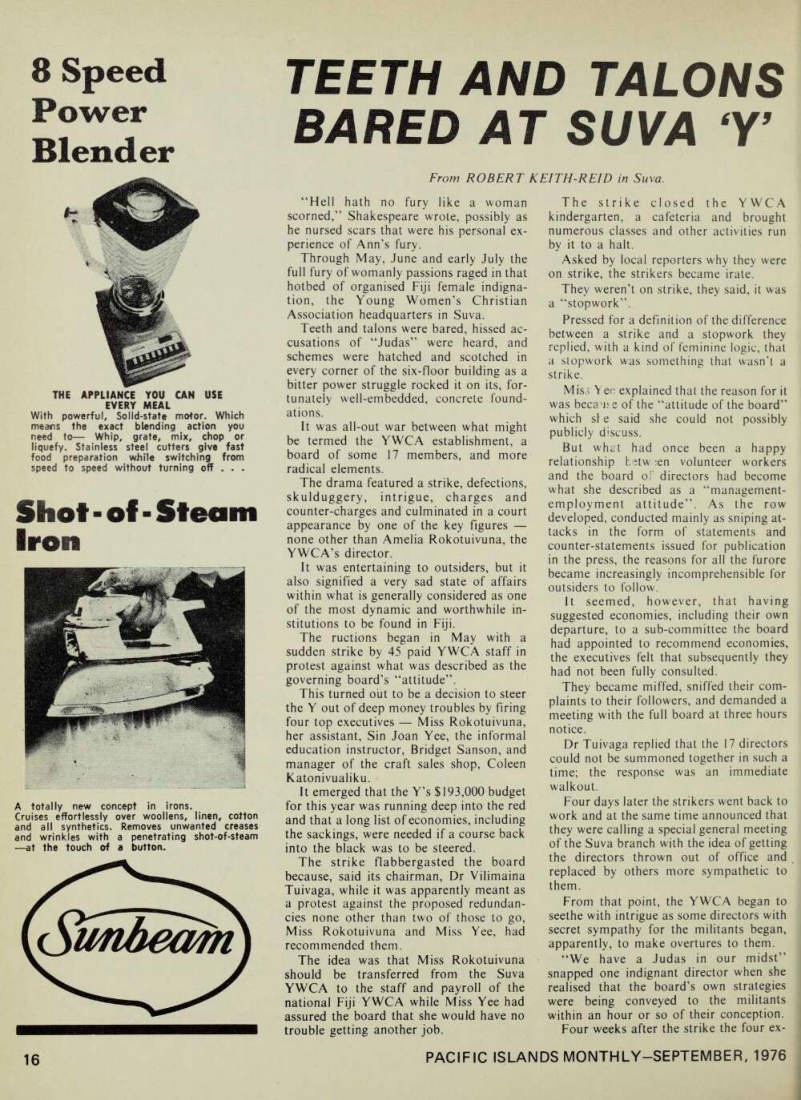

Bared At Suva 'Y’
From ROBERT KEITH-REID in Suva.
“Hell hath no fury like a woman scorned,” Shakespeare wrote, possibly as he nursed scars that were his personal experience of Ann’s fury.
Through May, June and early July the full fury of womanly passions raged in that hotbed of organised Fiji female indignation, the Young Women’s Christian Association headquarters in Suva.
Teeth and ta ons were bared hissed accusalions of Judas were heard, and schemes were hatched and scotched in every corner of the six-floor building as a bitter power struggle rocked it on its, fortunately well-embedded, concrete found- 3 i. nS ' ii . i , . , , It was all-out war between what might be termed the YWCA establishment, a board of some 17 members, and more , ’ raoicai elements The drama featured a strike, defections skulduggery, intrigue, charges and counter-charges and culminated m a court appearance by one of the key figures none other than Amelia Rokotuivuna, the vxjip., ’ s irec or.
It was entertaining to outsiders, but it also signified a very sad state of affairs within what is generally considered as one of the most dynamic and worthwhile institutions to be found in Fiji The ructions began ,n May with a sudden strike by 45 paid YWCA staff in protest against what was described as the governing board s attitude , This turned out to be a decision to steer the Y out of deep money troubles by firing four top executives Miss Rokotuivuna, r 7 her assistant, Sin Joan Yee, the informal education instructor, Bridget Sanson, and manager of the craft sales shop, Coleen Katonivualiku.
It emerged that the Y's $193,000 budget for this year was running deep into the red and that a long list of economies, including the sackings, were needed if a course back into the black was to be steered.
The strike flabbergasted the board because, said its chairman. Dr Vilimaina Tuivaga, while it was apparently meant as a protest against the proposed redundancies none other than two of those to go, Miss Rokotuivuna and Miss Yee, had recommended them.
The idea was that Miss Rokotuivuna should be transferred from the Suva YWCA to the staff and payroll of the national Fiji YWCA while Miss Yee had assured the board that she would have no trouble getting another job.
The strike closed the YWCA kindergarten, a cafeteria and brought numerous classes and other activities run by it to a halt.
Asked by local reporters why they were on strike, the strikers became irate.
They weren’t on strike, they said, it was a “slopwork”.
Pressed for a definition of the difference between a strike and a slopwork they replied, with a kind of feminine logic, that a slopwork was something that wasn’t a strike.
Miss Yee explained that the reason for it was because of the “attitude of the board” which sle said she could not possibly
publicly discuss.
But what had once been a happy relationship betw ;en volunteer workers and the board of directors had become what she described as a “management employment attitude”. As the row developed, conducted mainly as sniping at tacks in the form of statements and counter-statements issued for publication in the press, the reasons for all the furore became increasingly incomprehensible for outsiders to follow.
It seemed, however, that having suggested economies, including their own departure, to a sub-committee the board had appointed to recommend economies, the executives felt that subsequently they had not been fully consulted.
They became miffed, sniffed their com plaints to their followers, and demanded a meeting with the full board at three hours notice.
Dr Tuivaga replied that the 17 directors could not be summoned together in such a time; the response was an immediate walkout.
Four days later the strikers went back to work and at the same time announced that they were calling a special general meeting of the Suva branch with the idea of getting the directors thrown out of office and
replaced by others more sympathetic to
them.
From that point, the YWCA began to seethe with intrigue as some directors with secret sympathy for the militants began, apparently, to make overtures to them.
“We have a Judas in our midst” snapped one indignant director when she realised that the board’s own strategies were being conveyed to the militants within an hour or so of their conception.
Four weeks after the strike the four ex
ecutives recommended for redundancy got curt notices of dismissal.
Their aggrieved followers immediately went to the local newspapers with an “open letter” to the board in which they accused it of victimisation. The four had been sacked because of the part they had played in the slopwork protest, the letter complained, and accused the board of us ing “divisive tactics to intimidate and create distrust.”
“Not so” retorted the directors in a counter press statement and added that most of those who had gone on strike had been “persuaded” to do so by people who had not given them the full facts.
Putting a bit of boot-work in, the direc tors went on to say that YWCA organisa tion had become “top heavy” and inter posed by too many executives.
And, they added, no doubt recalling some of the forceful statements some ex staffers had made on such topics as abor tion, nuclear tests and the Miss versus Ms controversy, the YWCA had lost a lot of support due to “rudeness” and “excessive ly forceful views” wrongly represented as the organisation’s general opinion.
Further reaction to the sackings came in the form of resignations by some of the YWCA’s volunteer staff who lamented that they could not continue to work in such an atmosphere for which they felt the directors were mainly to blame.
The work of the Y managed to stagger on through May and June, if curtailed somewhat in certain quarters.
The special general meeting called by staff did not take place there seemed to be some sort of agreement that it should be deferred by mutual consent to July.
Then the board announced that it had “expelled” two of its members one of whom announced that she had resigned anyway as she did not think it had power to expel.
The long-awaited special general
meeting described in the the press as a “marathon” came in the second week of
July.
It signalled a defeat for the directors. A vote of no confidence in them was passed, a new board elected, and it was agreed that the YWCA constitution should be redrafted with the aim of ironing out deficiencies which had contributed to the creation of the whole unpleasant situation.
Speakers complained that board meetings had been “manipulated” and that :ertain people had “ganged up to get their Dwn desires fulfilled.”
Such remarks seemed to be a typical reflection of a somewhat bitchy affair. But it least the speakers also agreed that it was ;ime for the bitchiness to stop.
As the Fiji Times remarked in an ;ditorial afterwards: “Conflict and mimosity at the Suva YWCA have lopefully come to an end.”
Advertisements & other items, pp. 16-18 (3 items)
8 Speed
Power
Blender
THE APPLIANCE YOU CAN USE
EVERY MEAL
With powerful. Solid-state motor. Which means the exact blending action you need to— Whip, grate, mix, chop or liquefy. Stainless steel cutters give fast food preparation while switching from speed to speed without turning off . . .
Shot - of - Steam
Iron
A totally new concept in irons.
Cruises effortlessly over woollens, linen, cotton and all synthetics. Removes unwanted creases and wrinkles with a penetrating shot-of-steam —at the touch of a button.
17
WCIFIC ISLANDS MONTHLY-SEPTEMBER, 1976
to good design
Look to Wunderflex
for a practical approach
We all look for good design in a building.
If it’s practical and economical as well, you’re in front.
Wunderflex building board is the answer. It fits good design with ease. Practical because it’s easy to work; won’t rot, shrink or rust. Paint it if you wish — but there’s no need. Versatile, too, use Wunderflex inside or out.
Economy comes with initial purchase and the long lasting qualities of Wunderflex.
Yes, Wunderflex has a lot going for it.
Ask your builder.
LViunderlich
Wunderflex
Made in Australia and marketed by: CSR-Wunderlich Building Materials Export Sales: 4 O'Connell Street, Sydney 2000 Postal address: Box 483, G.P.0.. Sydney, N.S.W. 2001
AVAILABLE THROUGH LEADING ISLAND MERCHANTS.
926A8
4
Welders from
the
LINCOLN
I ELECTRIC
range
for FABRICATING, CONSTRUCTION
MAINTENANCE AND REPAIR
Lincoln Tractapac tractor driven welder/ generator; welding range 40-225 amp DC; auxiliary power 3 kVA 50 Hz 240 V continuous duty, for pumps, motors, power tools, lighting.
Available also as stationary unit for engine drive or for mounting on 4 x 4 for go-anywhere use.
Diesel Weldanpower 225 DC —economical reliable Diesel driven welder/generator. Transportable for on-site welding, 40 to 225 amp DC handling electrodes 2-5 mm ( 5 /64"- 3 /ii"). Auxiliary power, 3 kVA 240 V 50 Hz cont. duty—Other models, Lincwelder 225 petrol engine, details as above; Weldanpower 225 AC petrol engine 40-225 amp AC welding, auxiliary power 5 kVA 240 V or 115 V 60 Hz. Weldanpower 130 petrol engine 60-130 amp AC, auxiliary power 2.5 kVA 240 V 50 Hz. a Lincoln AC225-S transformer welder, rugged, fan cooled design.
Welding capacity 40- 225 amp AC. Operates from 240 V 415 V or 460 V single phase 50 Hz supply. Handles electrodes 2 to 5 mm (Vm" to 3 /i4"); with carbon arc torch (optional) handles heating, brazing, soldering.
LINK UP WITH 'Tfflgfrfel
FOR THE RIGHT WELDER
FOR YOUR NEEDS
AGENTS
FIJI: Coral Island Motors, Suva • Lautoka • Sigatoka.
NEW GUINEA: Tutt Bryant Pacific Limited, Port Moresby • Madang • Lae • Goroka • Rabaul • Panguna.
NEW CALEDONIA; S.A.T.M.A., Noumea.
Lincoln TM heavy duty transformer and transformer/rectifier welders —range of six models for AC and AC/DC welding up to 750 amp, handling electrodes in the range 2.5 to 10 mm ( 3 /32" to %") for all models. Input power 415 V 50 Hz single phase. Special voltages can be supplied.
THE LINCOLN ELECTRIC COMPANY (AUST.) PTY. LTD. 35 Bryant Street, Padstow (Sydney), N.S.W., Australia 2211. Tel. 77 0741.
protest

Banabans’ musical protest
The Gilbert Islands will get internal self government from Britain in November, as
a prelude to complete independence,
probably in 1978. This was agreed at a re cent constitutional conference in London, attended by leaders from the Gilbert Islands. Independence is, of course, subject to parliamentary approval, but these days that is little more than a formality.
The conference did not please the Banaban people from Ocean Island, now living in Fiji. They staged a demonstration in Suva against their exclusion from the talks. About 1,000 of them, led by a Banaban brass band and dancing girls and men in traditional dress, marched through Suva to the UK High Commission office to present a petition to the High Com missioner, Mr Stanley Arthur, to send to London.
Mr Rotan Tito, a Banaban leader, told a crowd of about 2,500, which included Fiji cabinet ministers, parliamentarians and civic dignitaries, that Banabans sought in dependence for Ocean Island because they did not wish to lose “our right of ownership or freedom of access to our ancestral home”. One of the speakers who supported Mr Tito was the Mayor of Suva, Cr Len Usher.
Mr Arthur issued a formal statement saying the London talks were entirely about internal self-government for the Gilberts, not independence. No decision taken in London would, in any way, pre judice the Banaban interests, including the UK Government’s special relationship with, and undertakings to, the Banabans.
The Fiji Prime Minister, Ratu Sir Kamisese Mara, a few weeks earlier, ac cused Britain and the Gilbert Islands of ig noring an agreement on the procedure for deciding the future of Ocean Island that was to look at the financial implications of the question before turning to the con stitutional aspects.
A few days after the London talks, a report issued from the Foreign Office said representatives of Britain, the Gilberts and the Banabans signed an agreement in Lon don for phosphate mining of another 100 acres of Ocean Island. British officials said that under the new agreement, which would reflect high prices for phosphate, 50% of the royalties would go to the Gilbert Islands, and the other 50% to the Banabans.
But back in Fiji, the Rabi Council of Leaders denied the Banabans had signed the agreement.
Samoan indigestion on the way
From FELISE VA’A in Apia Tupuola Efi’s election as the new Prime Minister of Western Samoa could not have come at a better time. For almost a year now, Western Samoa has been enjoying an abundance of foodstuffs, notably taro, taamu and bananas, for local consump tion. In fact, there is such a lot of taro some villages recently reported their taro is rotting. This state of affairs is in sharp contrast with that in 1973 when Mataafa came into power. Then, the cost of im ported foodstuffs was above the means of the average Samoan family and taro, taamu and bananas were extremely dear.
The Mataafa government resorted to strong enforcement of price control regulations which led to strained relations between the government and commerce.
But though the picture is brighter in that regard for the Tupuola administration, the fact remains that the country, as a whole, is no better off. There is scarcely any im provement to the export situation. Taros are rotting because of insufficient markets.
Recently, 700 tons of locally-stored cocoa went musty because of prolonged storage and, according to the South Seas Star, it is estimated that the government will spend $lOO a ton to repair the damage. In all, it will cost the government about $lOO,OOO to have the cocoa brought to a state fit to be exported. The expense is hardly worth the $300,000 the country expects to get for it.
Poor prices for copra is discouraging planters. The banana industry has been suffering for years. Thus, the export situa tion not only remains poor, it is also ex
tremely dangerous.
It is dangerous because it is forcing the government to raise duty on just about
anything (particularly on luxury goods
but what is a luxury good these days?) to discourage people from importing, and is forcing the government to strict credit con trol within the country.
For several years now, lending (except in very, very few cases) has been stopped at the Bank of Western Samoa and Pacific Savings. Of course, small loans up to $lOO have been permitted mainly for emergency purposes.
The point to all this, of course, is that for many years now, noticeably since the beginning of the last Mataafa administra tion, the government has found that its agricultural policies were not working.
Loan payments by the government, and
the importation of heavy equipment for
public projects, aggravated a situation already made almost unbearable by low exports in comparison with increased private and commercial imports.
Hence, the government had to order all credit institutions to either drastically cut down their lending or stop it altogether.
Presumably, this not only cuts down on in flation, but also enables the government to draw on the stored-up funds of those in stitutions to enable it to meet the balance of payments deficits and other overseas government obligations. The government is, thereby, bleeding the people white.
Essentials, such as house construction, have come almost to a stop. Loans to buy cars are practically impossible. So an in dividual can hope for very little progress
because he cannot finance his own under takings. It will take him '2O years or more to save for a house, for instance. The com mercial people are luckier since there is op portunity for them at the Development Bank but they also are subject to the imposition of outrageous interests. Under the circumstances, only Big Government is profiting from the present confusion; never mind about the average guy.
It is this situation Tupuola and his men are stepping into. It will beMnteresting to see how he will cope and how his party will fare in parliament.
Advertisements & other items, pp. 19-20 (1 item)
always rely on
when it comes to
automotive parts and
accessories you can
always rely on
dh m
If you need a part in a hurry to suit your car, truck or light commercial, chances are Traders-Smith Sons can solve your problem. Fast!
Our comprehensive stocks cover most makes and models and our Export Department ensures your order receives the VI.R treatment. No delays. No unnecessary down time for your vehicles or equipment.
INSTRUMENT REPAIRS, TOO!
Our team of instrument technicians is equipped to undertake repairs and adjustments to most types of instruments and gauges.
ORDERING IS EASY...AND EFFICIENT!
All major trading stores in the Islands can place orders, through their Sydney agents.
TRADERS-SMITH SONS PTY LTD
70 Commonwealth St., Sydney. Tel: 2114011 Telex: 26361
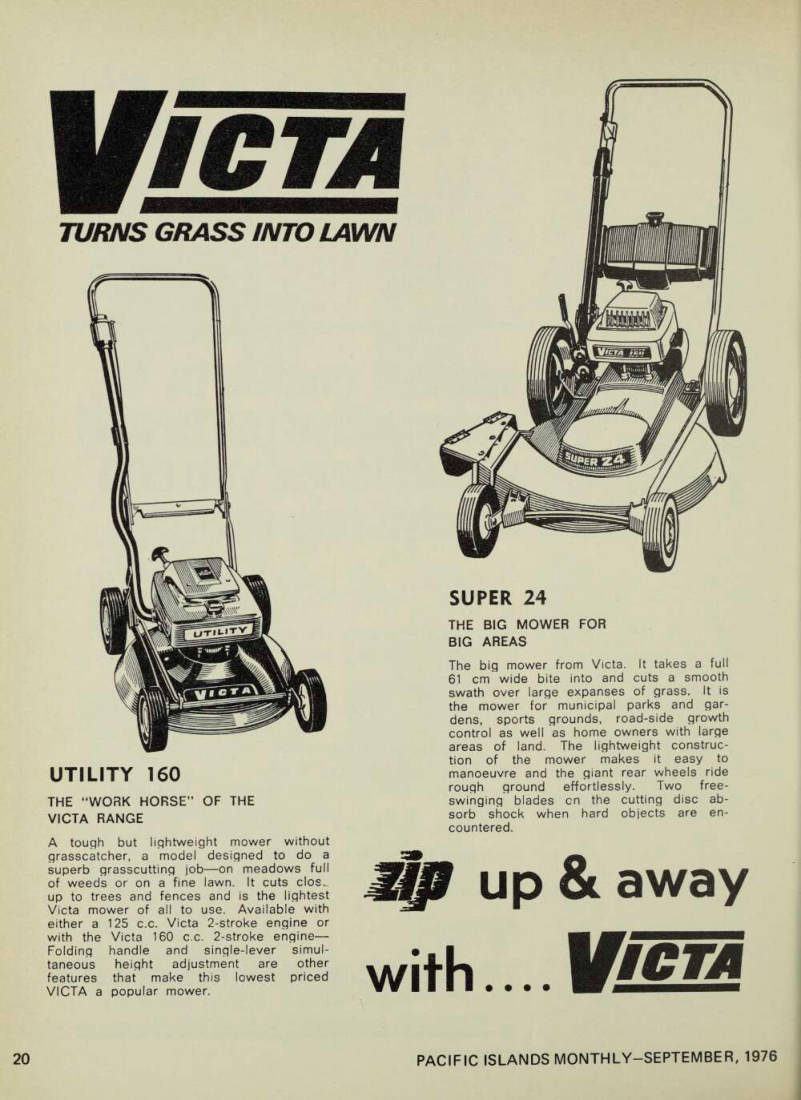
TURNS GRASS INTO LAWN
\ utilLIZ
UTILITY 160
THE "WORK HORSE" OF THE
VICTA RANGE
SUPER 24
THE BIG MOWER FOR
BIG AREAS
The big mower from Victa. It takes a full 61 cm wide bite into and cuts a smooth swath over large expanses of grass. It is the mower for municipal parks and gardens, sports grounds, road-side growth control as well as home owners with large areas of land. The lightweight construction of the mower makes it easy to manoeuvre and the giant rear wheels ride rough ground effortlessly. Two freeswinging blades cn the cutting disc absorb shock when hard objects are encountered.
A tough but lightweight mower without grasscatcher, a model designed to do a superb grasscutting job—on meadows full of weeds or on a fine lawn. It cuts clos.. up to trees and fences and is the lightest Victa mower of all to use. Available with either a 125 c.c. Victa 2-stroke engine or with the Victa 160 c.c. 2-stroke engine— Folding handle and single-lever simultaneous height adjustment are other features that make this lowest priced VICTA a popular mower.
lip up & away
with...
Editor’S Mailbag
Island Independence
Somehow, there seems to be a connec tion between R. Cherry’s letter (p 21) and Grace Mera’s article (p 25) in your July issue. Both address independence, the
quality of leadership and the relationship
between politics and economics.
If we are to believe Cherry, the Islands would be better off without independence, colonial administrators and leaders were never parasitic and Pacific Islanders prefer
begging to trading.
Fortunately, Ms Mera provides us with a case study of how faulty and antiquated Cherry’s argument is. Independence is measured, or should be measured, in terms of dignity, not material wealth.
Having leaders forced upon you does not guarantee they will be better, or less obstinate, or less entrenched in their posi tion than those you choose yourself.
Pacific Islanders never rejected trade as the main means to economic development, but began asking whose economy benefited most from it. When the internal economy is dominated by outside investment and non-indigenous businessmen, there is little chance for the Islander to compete in the economic sphere or have genuine control over the political sphere.
Cherry seems to be angered by an alleg ed lack of appreciation on the part of Islanders for his contribution to the aid bill. I say Ms Mera has far more justifica tion for being angered given the treatment her country has received from colonial powers and the beating its citizens received for expressing their political beliefs.
Neal Engledow
Honolulu, Hawaii.
I have absolutely no doubt that the basic white racism inherent in the letter of R Cherry (PIM, July p 21), will be clearly identified and treated with due scorn by Degressive people in the Pacific. Lest, by ny silence, I am accused of tolerating the Doint of view expressed in that letter, I feel i short comment may be appropriate. t Contrary to R. Cherry’s view that ‘racial discrimination throughout the vorld is now rapidly dissipating,” I would :ontend that racism, and white racism in articular, is among the leading causes of nost of the world’s innumerable injustices oday. No one can study the history of the ’acific during the last hundred years, or isit the Pacific today, without becoming
ware of the intense suffering, degrada
ion, poverty and dependence which is the
direct result of Euro-American colonisa tion in the Pacific.
In Papua New Guinea it was the isola tion of the colonial administration from the mass of the people which has left its imprint in the present detachment of many of the emergent black elite from their own
village societies.
In Fiji the tensions which exist between Fijians and Fiji-Indians are a direct in heritance of the segregation imposed upon these groups by a British policy of divide and rule.
In Western Samoa the foundations for a strong independent government were shattered by the violence used against the Mau movement. The military interests of the USA in the North Pacific have been used to disrupt Micronesian nationalism and to perpetuate a level of dependence which effectively discredits all options to colonial rule.
In the New Hebrides, the opposing in terests of white colonisers and black nationalists have been repeatedly emphasised in all reports from that coun try during the last 18 months. It is ironic that, having failed to stem the black nationalist tide through imposed, colonial institutions, the French and British ad ministrators should now be seeking other means to deny the New Hebrideans national self-determination.
R. Cherry suggested that “what the Islands need of course is trade not aid,” and implied that bridge-building between black and white people is the key to the Pacific’s future advancement. I disagree.
What the Pacific needs is genuine in dependence the right to choose future options on the basis of Pacific interests rather than those of Australia, New Zealand, the rest of Euro-America and other foreign intruders.
Politically, Pacific nations must be allowed to develop their own foreign relations and domestic institutions, rather than have the colonial models thrust upon them viz Australia’s determination to ensure that Papua New Guinea will not up set regional developments in South-East
Asia by opposing Indonesian imperialism
or by establishing contacts with the com munist governments of Indo-China, and of course the difficult constitutional framework bequeathed to PNG by Australia.
Economically, Pacific nations must be given the chance to develop producer oriented societies rather than become ser
vants of capitalist or other forms of foreign domination viz Fiji’s development of tourism which has served foreign interests so well and Fiji’s so poorly, and also foreign control of the mineral extraction and other industries, such as Bougainville’s copper, the development of which is more in the interests of advancing the wealth, status and power of the consumer oriented, industrialised societies of Euro- America than anything else.
Socially and culturally, Pacific nations must be encouraged to defend and develop their own independent identity based on their own rich and bountiful traditions rather than attempt an imitation of a civilisation which cannot appreciate their needs and interests viz the domination of Polynesian schooling by New Zealand educators and the importation of foreign values and life-styles into Pacific com munities which needed none of them.
R. Cherry was concerned that Pacific Islanders “have a peculiar manner for showing their appreciation and thanks.”
That may well be so, for Pacific Islanders are among the most generous and open hearted people in the world even to a fault, as far as protection of their interests are concerned. I suggest, however, that there is little if anything that people in the Pacific have to thank the foreign world for, other than the destruction and discrediting of the Pacific’s original independence es
tablished through hardship and suffering, toil and pleasure during the hundreds of years in the Pacific which preceded the in trusion of white colonisation.
Paul Grocott
Wayville, -South Australia.
Suspicious
In reply to Michael White’s letter (PIM, July, p 24), after Eti Saaga left Samoa College, where he had been head prefect, he chose to become a bulldozer driver.
Within 18 months he was the most qualified heavy-equipment driver in Western Samoa. During this time he wrote “Him Fella Saviour’.
I doubt if Saaga has ever heard of Lawrence Ferlinghetti, let alone read Ferlinghetti’s poems. Even if Saaga has read Ferlinghetti, his poem, except perhaps for the last three lines, is quite different from Ferlinghetti’s. And Saaga’s poem, in the context of our Pacific cultures, is the better poem.
Often poems (and poets) are inspired by other poems (and other poets). This applies to Ferlinghetti as well.
In the late ’sos and early ’6os, I too was a Ferlinghetti fan. Now, his work seems very dated.
Albert Wendt
(General editor, MANA Publications) University of the South Pacific, Suva
Fanning Island
I am an American research historian do ing a history book and a philatelic research paper on Fanning Island in the Line Islands of the Gilbert Islands Colony. I need the help of your readers to fill in historical gaps in the research, biographical sketches and pictures.
One picture that I am especially in terested in is that of David Cuthbert, the first radio station manager and postmaster of Fanning Island. 1 also have philatelic covers addressed to T. W. Hill, medical of ficer there in 1949, and H. Clark, who was there in 1946, and would appreciate
biographical data.
I need to contact old cable station employees for contemporary stories about the station, and need any information on old postmasters and cable station managers, and the names and approximate dates of the management of the various plantation managers. Would like to con tact Walter Gors if he is still alive and F. P. D. “Phil” Palmer.
Any assistance you can give on this pro ject would be greatly appreciated. Mail replies to Sherman Lee Pompey, Research Historian, Box 145, Springfield, Oregon 97477.
Sherman Lee Pompey
Oregon, USA
Advertisements & other items, pp. 21-23 (3 items)
21
’ACIFIC ISLANDS MONTHLV-SEPTEMBER, 1976
Keeps you informed
BECOME A PART
OF PlM's PACIFIC
AND SUBSCRIBE NOW
M Keeps you informed
FILL IN THE DETAILS
ON THE ATTACHED
ORDER FORMS
S. E. TATHAM
& CO. PTY. LTD.
SOME OF THE FIRMS
WE REPRESENT ARE:
BEEHIVE BLDG.,
94 ELIZABETH ST.,
MELBOURNE, 3001, AUSTRALIA.
G.P.O. BOX B—CABLES "SET"
TELEPHONE 63 5094
TELEX: AA34293
Asia Rubber Works (Singapore Rubber Shoes) Frappier (French Brandy) Huvet (French Brandy) Indika (Belgium Dairy Produce) Durobor S.A. (Belgium Glassware) Miroiterie Gen. de Belgiqe S.A. (Louvre glass and mirrors) City Engineers (U.K. Bicycles) F.H.I. Japan (Subaru Cars) Kraggs (Wines, Spirits, Ciders) Sunshine Biscuits Sunrise (Confectionery) Flamenco (Instant Coffee & Tea) Quaker Products (Oats, Jets) Hancocks (Spaghetti, Cereals) Melbourne Canning (Jams) Amatil (Twisties, Twirlies) Edward Zorn (Margarine, Cooking Fats) Allens (Confectionery) Red Tulip (Fine Chocolates) Robert Timms (New Guinea Gold Instant Coffees and Teas) S.P.C. (Canned Fruit) S.P.C. (Abalone) Wing Lee (See You Sauce) Magnet (Mattresses) Essteel (Cookware) Warner-Drayton (Fans) Mitohell's (Abrasives) Tilbury & Lewis (Sports Trophies & Silverplate) Regent (Swiss watches) Lega Marcasite (Jewellery) Austramax (Pressure Lanterns) Lawn Chair; Tubco (Garden Furniture) Electronic Industries (Electrical Household Appliances) Jex (Steelwool) Arnbro (Folding Beds) James Miller (Blankets) Elmaco (Plastics —Electrical Fittings) B.X. (Plastics) Stegbar (Wooden Louvres) Franklite (Light Fittings) J.J. Cash Embroidered Labels) Disston (Saws) st % 1 \ 1
BUYERS FOR THE
PACIFIC ISLANDS
DIRECT ENQUIRIES WELCOMED
PAPUA NEW GUINEA: S. E. TATHAM (P.N.G.) PTY. LTD.,
LAE: MALAITA STREET (P.O. BOX 1562).
PORT MORESBY; CNR. GOROA AND MUNAHU STREETS, GORDON
(P.O. BOX 6733, BOROKO).
FIJI: S. E. TATHAM (FIJI) LTD.,
LAUTOKA: P.O. BOX 366.
SUVA. G.P.O. BOX 671.
YOUR GUARANTEE
SINCE 1924
1 1 1
FOR SERVICE
Save hundreds of dollars
on Australia’s most efficient
WALK IN, ALUMINIUM
COOLROOMS AND
FREEZE ROOMS
Hundreds already installed! The most economical supplementary coolrooms for bottles and food, providing the largest storage capacity of any comparable coolrooms of the same exterior dimensions. Five sizes—from 90-360 cu. ft capacity- -16 models offering normal temp., two temp., deep freeze, or for pastry and ice storage applications. White vinyl interior, embossed rustproof aluminium exterior. • SUPPLIED IN EASY-TO-ERECT, DO-IT-YOURSELF KIT FORM.
Available from: AUSTRALIAN NEW CALEDONIA EXPORTS (SILVER & BARDA), 363 George St., Sydney, 2000 and Branches.
BRECKWOLDT & CO., 276 Pitt St., Sydney, 2000 and Branches.
PETER FISHER TRADING PTY. LTD., 321 Pitt St., Sydney, 2000.
HAGEMEYER (A'SIA), 59 Anzac Pde., Kensington, 2033 and Branches.
GEOFFREY HUGHES & CO., 167 Macquarie St., Sydney, 2000.
Manufactured by:
» T 1 NELSON & ROBERTSON PTY. LTD., 197 Clarence St Sydney 2000 RABAUL TRADING CO. PTY. LTD., P.O. Box 219 Rabaul and Branches E. RABOT (EXPORTS) PTY. LTD., 67 Castlereagh St Sydney 2(XX) H. Y, KWAN (AUST.) PTY. LTD., Box 2713 G.P.O. Sydney 2001 Branches VAN PTY - LTD -' 60 Margaret St., Sydney, 2000 and Branches* 11 &C ° ' PTY ‘ LTD '' 31 Macquarie Place ' Sydney, 2000 and
FRIGID CABINETS PTY. LTD.,
HA Duffy Ave., Thornleigh, N.S.W. 2120 Aust. Ph. 848 8292.
23
J ACIFIC ISLANDS MONTHLY-SEPTEMBER, 1976
Tropicalities
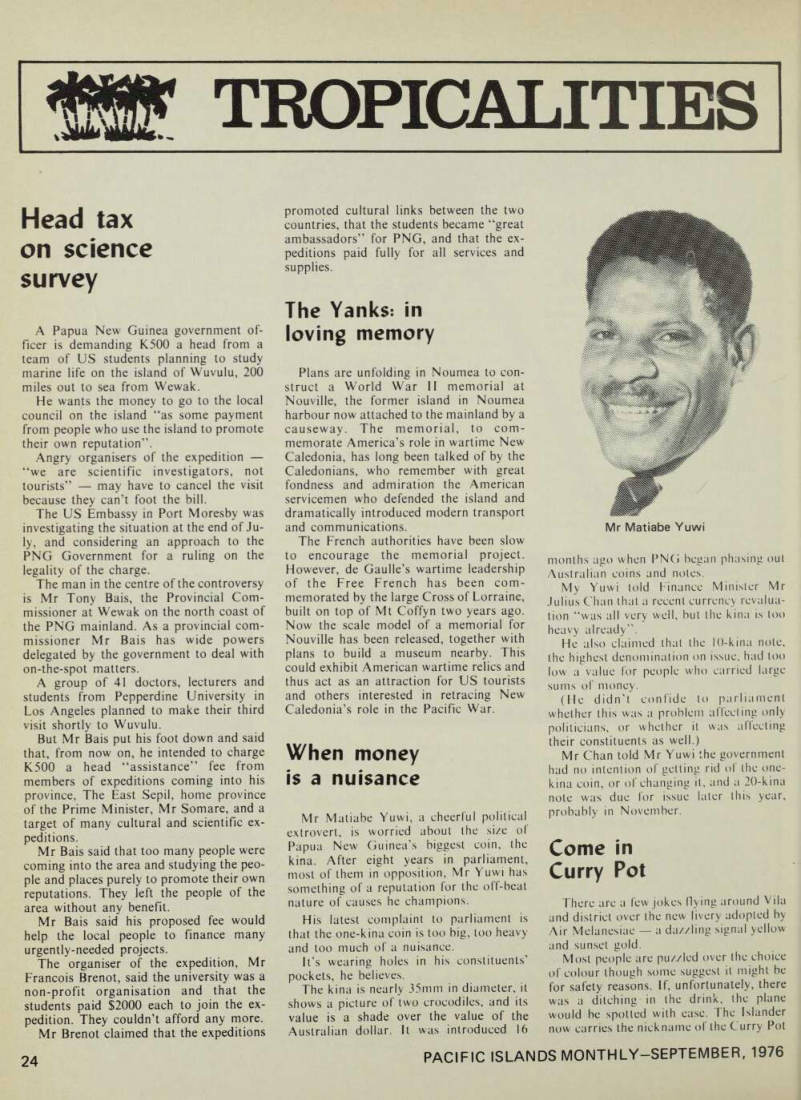
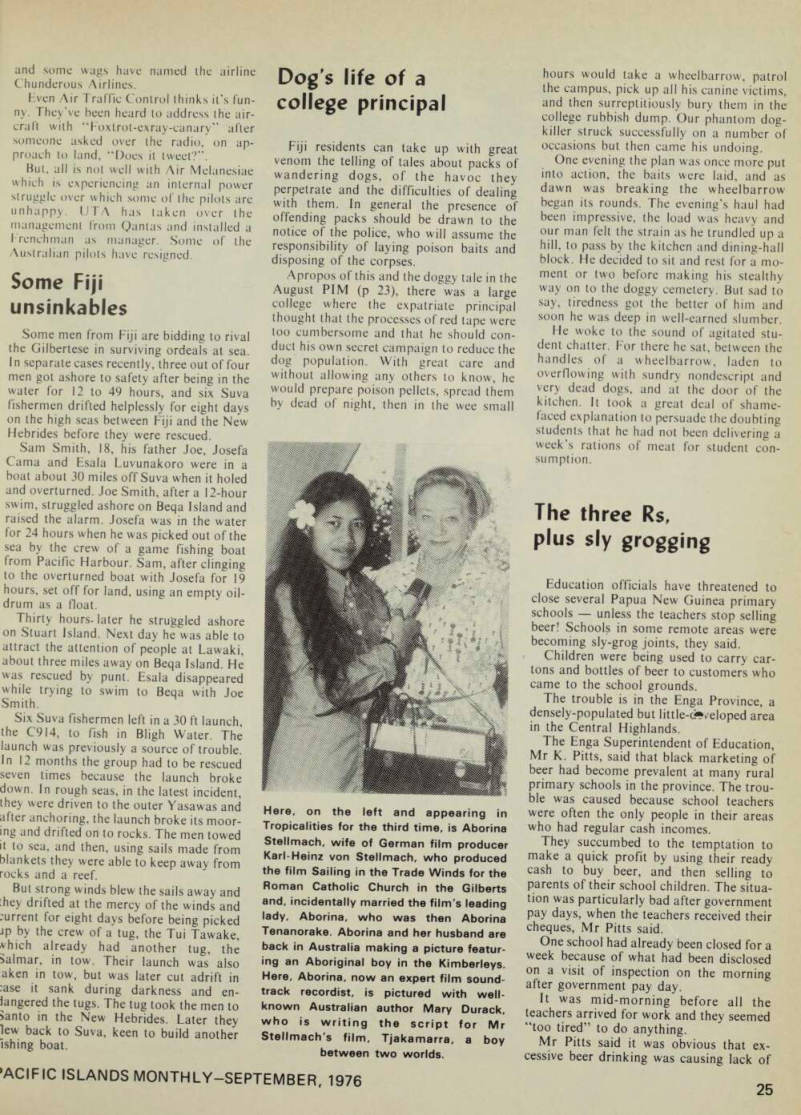

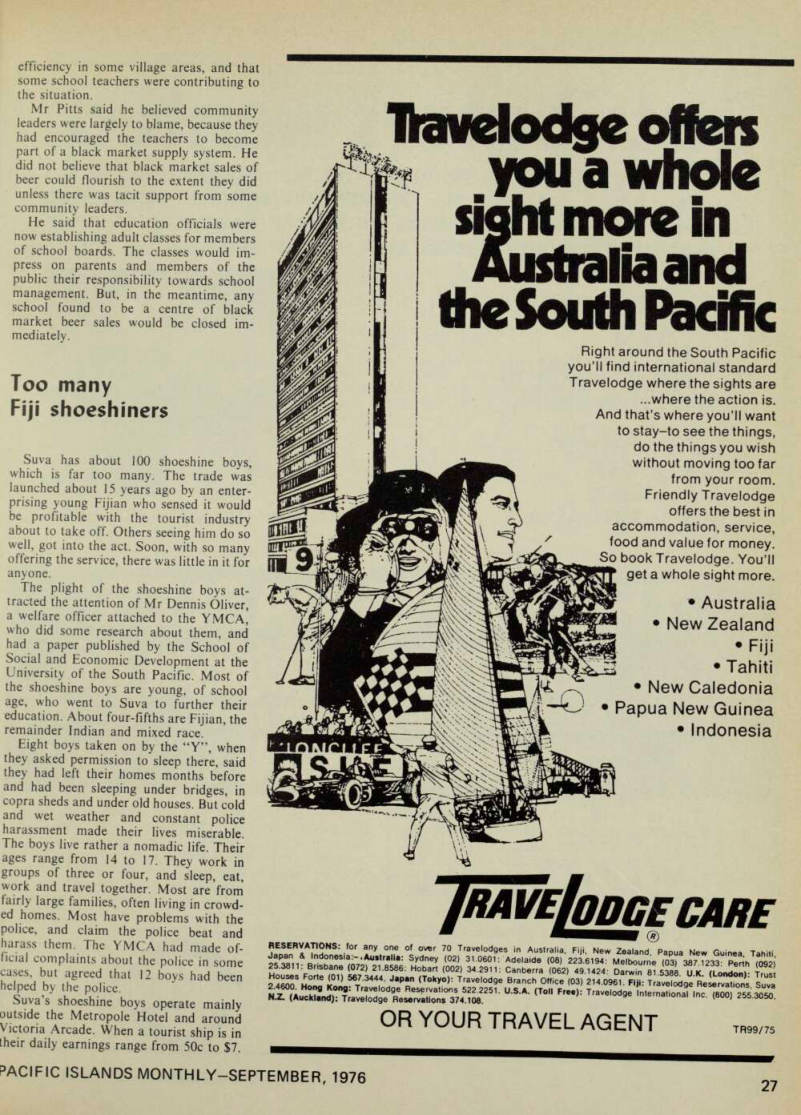
Head tax
on science
survey
A Papua New Guinea government of ficer is demanding K. 500 a head from a team of US students planning to study marine life on the island of Wuvulu, 200 miles out to sea from Wewak.
He wants the money to go to the local council on the island “as some payment from people who use the island to promote their own reputation”.
Angry organisers of the expedition “we are scientific investigators, not tourists” may have to cancel the visit because they can’t foot the bill.
The US Embassy in Port Moresby was investigating the situation at the end of Ju ly, and considering an approach to the PNG Government for a ruling on the
legality of the charge.
The man in the centre of the controversy is Mr Tony Bais, the Provincial Com missioner at Wewak on the north coast of the PNG mainland. As a provincial com missioner Mr Bais has wide powers delegated by the government to deal with
on-the-spot matters.
A group of 41 doctors, lecturers and students from Pepperdine University in Los Angeles planned to make their third visit shortly to Wuvulu.
But Mr Bais put his foot down and said that, from now on, he intended to charge K5OO a head “assistance” fee from members of expeditions coming into his province, The East Sepil, home province of the Prime Minister, Mr Somare, and a target of many cultural and scientific ex
peditions.
Mr Bais said that too many people were coming into the area and studying the peo ple and places purely to promote their own reputations. They left the people of the area without any benefit.
Mr Bais said his proposed fee would help the local people to finance many
urgently-needed projects.
The organiser of the expedition, Mr Francois Brenot, said the university was a non-profit organisation and that the students paid $2OOO each to join the ex pedition. They couldn’t afford any more.
Mr Brenot claimed that the expeditions
promoted cultural links between the two countries, that the students became “great ambassadors” for PNG, and that the ex peditions paid fully for all services and
supplies.
The Yanks: in
loving memory
Plans are unfolding in Noumea to con struct a World War II memorial at Nouville, the former island in Noumea harbour now attached to the mainland by a causeway. The memorial, to com memorate America’s role in wartime New Caledonia, has long been talked of by the Caledonians, who remember with great fondness and admiration the American servicemen who defended the island and dramatically introduced modern transport and communications.
The French authorities have been slow to encourage the memorial project.
However, de Gaulle’s wartime leadership of the Free French has been com memorated by the large Cross of Lorraine, built on top of Mt Coffyn two years ago.
Now the scale model of a memorial for Nouville has been released, together with plans to build a museum nearby. This could exhibit American wartime relics and thus act as an attraction for US tourists and others interested in retracing New Caledonia’s role in the Pacific War.
When money
is a nuisance
Mr Matiabe Yuwi, a cheerful political extrovert, is worried about the size ol Papua New Guinea’s biggest coin, the kina. After eight years in parliament, most of them in opposition, Mr Yuwi has something of a reputation for the olf-beat nature of causes he champions.
His latest complaint to parliament is that the one-kina coin is too big, too heavy and too much of a nuisance.
It’s wearing holes in his constituents’ pockets, he believes.
The kina is nearly 35mm in diameter, it shows a picture of two crocodiles, and its value is a shade over the value of the Australian dollar. It was introduced 16
months ago when PNG began phasing out Australian coins and notes.
My Yuwi told Finance Minister Mr Julius Chan that a recent currency revalua tion “was all very well, but the kina is too heavy already”.
He also claimed that the l()-kina note, the highest denomination on issue, had too low a value for people who carried large sums of money. (He didn’t confide to parliament whether this was a problem affecting only politicians, or whether it was affecting their constituents as well.) Mr Chan told Mr Yuwi the government had no intention of getting rid of the one kina coin, or of changing it, and a 20-kina note was due for issue later this year, probably in November.
Come in
Curry Pot
There are a few jokes Hying around Vila and district over the new livery adopted by Air Melanesiae a dazzling signal yellow and sunset gold.
Most people are puzzled over the choice of colour though some suggest it might be for safety reasons. If, unfortunately, there was a ditching in the drink, the plane would be spotted with ease. The Islander now carries the nickname of the Curry Pot
Mr Matiabe Yuwi
and some wags have named the airline Chunderous Airlines.
Even Air Traffic Control thinks it’s fun ny. They’ve been heard to address the air craft with “Foxlrot-exray-canary” after someone asked over the radio, on ap proach to land, “Does it tweet?”.
But, all is not well with Air Melanesiae which is experiencing an internal power struggle over which some of the pilots are unhappy. UTA has taken over the management from Qanlas and installed a frenchman as manager. Some of the Australian pilots have resigned.
Some Fiji
unsinkables
Some men from Fiji are bidding to rival the Gilbertese in surviving ordeals at sea.
In separate cases recently, three out of four men got ashore to safety after being in the water for 12 to 49 hours, and six Suva fishermen drifted helplessly for eight days on the high seas between Fiji and the New Hebrides before they were rescued.
Sam Smith, 18, his father Joe, Josefa Cama and Esala Luvunakoro were in a boat about 30 miles off Suva when it holed and overturned. Joe Smith, after a 12-hour swim, struggled ashore on Beqa Island and raised the alarm. Josefa was in the water for 24 hours when he was picked out of the sea by the crew of a game fishing boat from Pacific Harbour. Sam, after clinging to the overturned boat with Josefa for 19 hours, set off for land, using an empty oil drum as a float.
Thirty hours, later he struggled ashore on Stuart Island. Next day he was able to attract the attention of people at Lawaki, about three miles away on Beqa Island. He was rescued by punt. Esala disappeared while trying to swim to Beqa with Joe Smith.
Six Suva fishermen left in a 30 ft launch, the C 914, to fish in Bligh Water. The launch was previously a source of trouble.
In 12 months the group had to be rescued seven times because the launch broke down. In rough seas, in the latest incident, they were driven to the outer Yasawas and after anchoring, the launch broke its moor ing and drifted on to rocks. The men towed it to sea, and then, using sails made from blankets they were able to keep away from rocks and a reef.
But strong winds blew the sails away and hey drifted at the mercy of the winds and current for eight days before being picked jp by the crew of a tug, the Tui Tawake, vhich already had another tug, the Palmar, in tow. Their launch was also aken in tow, but was later cut adrift in :ase it sank during darkness and en langered the tugs. The tug took the men to santo in the New Hebrides. Later they lew back to Suva, keen to build another
"ishing boat.
Dog’s life of a
college principal
Fiji residents can take up with great venom the telling of tales about packs of
wandering dogs, of the havoc they
perpetrate and the difficulties of dealing with them. In general the presence of offending packs should be drawn to the notice of the police, who will assume the responsibility of laying poison baits and disposing of the corpses.
Apropos of this and the doggy tale in the August PIM (p 23), there was a large college where the expatriate principal thought that the processes of red tape were too cumbersome and that he should con duct his own secret campaign to reduce the dog population. With great care and without allowing any others to know, he would prepare poison pellets, spread them by dead of night, then in the wee small
hours would take a wheelbarrow, patrol the campus, pick up all his canine victims, and then surreptitiously bury them in the
college rubbish dump. Our phantom dog
killer struck successfully on a number of occasions but then came his undoing.
One evening the plan was once more put into action, the baits were laid, and as dawn was breaking the wheelbarrow began its rounds. The evening’s haul had been impressive, the load was heavy and our man felt the strain as he trundled up a hill, to pass by the kitchen and dining-hall block. He decided to sit and rest for a mo ment or two before making his stealthy way on to the doggy cemetery. But sad to say, tiredness got the better of him and soon he was deep in well-earned slumber.
He woke to the sound of agitated stu dent chatter. For there he sat, between the handles of a wheelbarrow, laden to
overflowing with sundry nondescript and
very dead dogs, and at the door of the kitchen. It took a great deal of shame faced explanation to persuade the doubting students that he had not been delivering a week’s rations of meat for student con sumption.
The three Rs,
plus sly grogging
Education officials have threatened to close several Papua New Guinea primary schools unless the teachers stop selling beer! Schools in some remote areas were
becoming sly-grog joints, they said.
Children were being used to carry car tons and bottles of beer to customers who came to the school grounds.
The trouble is in the Enga Province, a
densely-populated but little-developed area
in the Central Highlands.
The Enga Superintendent of Education, Mr K. Pitts, said that black marketing of beer had become prevalent at many rural primary schools in the province. The trou ble was caused because school teachers were often the only people in their areas who had regular cash incomes.
They succumbed to the temptation to make a quick profit by using their ready cash to buy beer, and then selling to parents of their school children. The situa tion was particularly bad after government pay days, when the teachers received their cheques, Mr Pitts said.
One school had already been closed for a week because of what had been disclosed on a visit of inspection on the morning after government pay day.
It was mid-morning before all the teachers arrived for work and they seemed “too tired’’ to do anything.
Mr Pitts said it was obvious that ex cessive beer drinking was causing lack of
Here, on the left and appearing in Tropicalities for the third time, is Aborina Stellmach, wife of German film producer Karl-Heinz von Stellmach, who produced the film Sailing in the Trade Winds for the Roman Catholic Church in the Gilberts and, incidentally married the film's leading lady, Aborina, who was then Aborina Tenanorake. Aborina and her husband are back in Australia making a picture featur ing an Aboriginal boy in the Kimberleys.
Here, Aborina, now an expert film sound track recordist, is pictured with well known Australian author Mary Durack, who is writing the script for Mr Stellmach's film, Tjakamarra, a boy between two worlds.
efficiency in some village areas, and that some school teachers were contributing to the situation.
Mr Pitts said he believed community leaders were largely to blame, because they had encouraged the teachers to become part of a black market supply system. He did not believe that black market sales of beer could flourish to the extent they did unless there was tacit support from some
community leaders.
He said that education officials were now establishing adult classes for members of school boards. The classes would im press on parents and members of the public their responsibility towards school management. But, in the meantime, any school found to be a centre of black market beer sales would be closed im
mediately.
Too many
Fiji shoeshiners
Suva has about 100 shoeshine boys, which is far too many. The trade was launched about 15 years ago by an enter prising young Fijian who sensed it would be profitable with the tourist industry about to take off. Others seeing him do so well, got into the act. Soon, with so many offering the service, there was little in it for anyone.
The plight of the shoeshine boys at tracted the attention of Mr Dennis Oliver, a welfare officer attached to the YMCA, who did some research about them, and had a paper published by the School of Social and Economic Development at the University of the South Pacific. Most of the shoeshine boys are young, of school age, who went to Suva to further their education. About four-fifths are Fijian, the remainder Indian and mixed race.
Eight boys taken on by the “Y”, when they asked permission to sleep there, said they had left their homes months before and had been sleeping under bridges, in copra sheds and under old houses. But cold and wet weather and constant police harassment made their lives miserable.
The boys live rather a nomadic life. Their ages range from 14 to 17. They work in groups of three or four, and sleep, eat, work and travel together. Most are from fairly large families, often living in crowd ed homes. Most have problems with the police, and claim the police beat and harass them. The YMCA had made of ficial complaints about the police in some cases, but agreed that 12 boys had been helped by the police.
Suva’s shoeshine boys operate mainly outside the Metropole Hotel and around Victoria Arcade. When a tourist ship is in their daily earnings range from 50c to $7
Advertisements & other items, pp. 25-28 (2 items)
•Acific Islands Monthly-September, 1976
that makes your home
a healthier place
How effectively you protect your family from the dangers of disease carrying insects, may well depend on the insect spray you choose.
Powerful Insect Killing Ingredients.
Concentrated Pea Beu is one of the most powerful household insect sprays in the world. Its principal insect killing ingredients have been selected to ensure rapid knock down and kill of all common disease carrying insects.
Rigid Testing. Through every stage of manufacture, Pea Beu is rigidly tested.
There are ingredient tests, spray droplet tests, pack tests, many forms of tests, some carried out three times over.
When you spray this remarkable aerosol insecticide, you can be sure that its ingredients have met with the most exacting standards enabling you to spray it safely with confidence in your home. * Family Health and Well Being. The common housefly carries up to half a billion germs and, when you realise that disease carrying insects enter even the best regulated households, you can understand why you can't be too careful about the effectiveness of your insect spray. Remember, even the tiniest droplet z / I ■ m m Concentrated Pea Beu. Even the tiniest droplet
kills flies, mosquitoes, all common
disease carrying insects fast.
of concentrated Pea Beu kills flies, mosquitoes, all common disease carrying % insects fast, so it is indeed a worthy guardian of your family's health and well being.
Such is the effectiveness of Pea Beu’s insect killing ingredient, that no common disease carrying insect can survive it. nor develop an immunity to it. When you spray Concentrated Pea Beu, it's nice to know that no common disease carrying insect can survive.
Pea Beu - The strong one, makes your home a healthier place.
Itavdodge offers
you a whole
sight more in
Australia and
the South focific
i % m i
ill 9
as Right around the South Pacific you’ll find international standard Travelodge where the sights are ...where the action is.
And that’s where you’ll want to stay-to see the things, do the things you wish without moving too far from your room.
Friendly Travelodge offers the best in accommodation, service, food and value for money.
So book Travelodge. You’ll get a whole sight more. • Australia • New Zealand
• Fiji
• Tahiti • New Caledonia Papua New Guinea • Indonesia
WAVE/odCE CARE
u E n S n n R * A II? NS: f ° r l ny .°?. e °l OVBr 70 Trave,od 9es in Australia, Fiji. New Zealand, Papua New Guinea Tah lnd °nosia:- .Australia; Sydney (02) 31.0601: Adelaide (08) 223.6194 Melbourne (03) 387 1233- rrv 25.3811 : Brisbane (072) 21.8586: Hobart (002) 34.2911: Canberra (062) 49.1424: DarZ 81 SMB SnSSJ In 2 460Q S Hono (T ° ky ° ): Travelodge Branch oMice (03) 214.0961. Fiji: Travelodge Su us -*- it ° m <“»>
OR YOUR TRAVEL AGENT
TR99/75
Distributors wanted.
Dictran International Corporation, U.S.A., manufacturers of the world’s finest range of Dictating/Telephone Answering Equipment, require distributors to market their product range throughout the South Pacific area interested parties please write direct to:—
THE AREA MANAGER,
DICTRAN
INTERNATIONAL
CORPORATION,
C/- L. B. CROSBY,
P.O. BOX 157,
PYMBLE, 2073
N.S.W. AUSTRALIA DORO'S MINI-CASSETTE PORTABLE.
THE DEPENDABLESI
g VILLIERS'
2 & 4 STROKE
6 ENGINES
WISCONSIN
HEAVY DUTY
ENGINES
i % For an infinite variety of applications including pumping, spraying, mowing, power saws, etc. you simply can’t go past the amazingly dependable Villiers aircooled petrol engine. We offer 7 basic models with hundreds of combinations, including reduction gearboxes.
They’re your logical choice if you need an air-cooled H.D. petrol engine upon which you can absolutely rely. Thrives on the toughest jobs with a minimum of maintenance. Available from 4.7 to 65.9 horsepower in single, twin and 4 cyl. types to suit a wide range of applications.
Both Villiers and Wisconsin engines are backed by a first class parts service.
For Sales and Service contact:
HASTINGS PEERING LTD.
Parramatta Road, Cnr. John Street,
LIDCOMBE, N.S.W. 2141, AUSTRALIA.
Tel: 648-0111. m 001062
People
Mr Desmond O’Leary, the new Ad ministrator of Norfolk Island, unlike his two immediate predecessors, is not a retired RAAF officer. But Mr O’Leary served with the Royal Australian Navy in World War 11, and his appointment revives a naval tradition for Norfolk Island as four previous Administrators were Royal Navy men, the last one, Cap tain C. S. Elliott, from 1907 to 1913. Mr O’Leary’s RAN service was in the Pacific area during World War 11. He was demobilised with the rank of lieutenant commander. From 1971 to 1972 he was a member of ASIO, Australia’s now-not-so “hush-hush spy” set-up (Australian
Security Intelligence Organisation). He
held a number of administrative roles with ASIO, and from 1971 to 1974 was First Assistant Director-General. He then became a leasing officer with the Depart ment of Administrative Services, Melbourne. Mr O’Leary, 62, is married.
He was educated at Xavier College, Melbourne.
Mr J.M.R. Mansfield has been ap pointed New Zealand High Commissioner to Papua New Guinea and is to take up his post in September. Mr Mansfield has had previous experience in the Pacific, having held a post with the NZ Foreign Affairs Department in Apia. He also served in Bangkok and New York. Mr Mansfield replaces Brigadier Brian Poenanga, who is
retiring.
Mr Peter J. Larke has been appointed area manager, South-West Pacific, for Qantas, and is based in Suva. It is a new post, and part of a new Qantas manage ment organisation. Previously Qantas in Fiji was responsible to a regional director, South Pacific, who was Sydney-based. The fact that Suva was chosen as the base for the new post is an indication that Qantas regards Fiji as a most significant country in a new management area. Mr Larke, who was in the planning and development branch in Sydney before this appointment, had previously served Qantas overseas in Switzerland, Germany, Hong Kong and Singapore. He joined Qantas in 1961.
Jois Waiman, a 21-years-old accounting clerk with Gas Supply New Guinea Pty Ltd, was the Papua New Guinea Appren tice of the Year for 1976. He was chosen from 12 final year apprentices. Soon after he was named as top apprentice, Jois went to Australia to have a close look at some of the installations operated by Gas Supply
Co of Australia in Brisbane, Sydney, Canberra and Melbourne. Gas Supply Co, like Gas Supply New Guinea Pty Ltd, is part of the giant Boral complex. Jois is from Kavieng, and now works at Port Moresby. He is at present studying at technical college on a four-year course which will lead to a certificate in com merce. Community service projects played a major role in his selection as Apprentice of the Year. One of these was the forma tion of the Erima Youth Club, which con ducts social and sports programmes for members. The Gas Supply Co of Aust. ships liquid petroleum gas to PNG, the Solomons, the New Hebrides, Fiji, Tonga and the Cook Islands.
Mr Joseph D. Gibson has succeeded Mr
Josua Rabukawaqa as Fiji High Com
missioner in London. He was previously Deputy High Commissioner in London, and Permanent Secretary at the Ministry of Education, Youth and Sport. Mr Rabukawaqa has returned to Fiji.
The Most Rev Leo Arkfeld, Roman Catholic Archbishop of Madang, has been awarded the honorary CBE. Honorary awards are made to citizens of nations out side the British Commonwealth.
Archbishop Arkfeld, who was born in the United States, went into the Papua New Guinea mission field in 1945. Most of his mission work was in the New Guinea area of PNG. Archbishop Arkfeld, after noting there was a need for aircraft in mission work, set up the missionary-operated Wirui Air Services. He learned to fly himself, 28 years ago, and has since logged more than 8000 hours. He is often referred to as the “flying bishop”.
Mr Andrew Deoki, former Fiji politician, barrister and solicitor and Director of Public Prosecutions, may prac tise in two States in Australia, as well as New Zealand and his home country. He was recently admitted as a barrister of the Supreme Court of Queensland. Earlier he had been admitted as a barrister and solicitor of the Supreme Court of Victoria.
And many years ago, after graduation, he was admitted as a barrister and solicitor of the Supreme Court of New Zealand. Mr Deoki, who had a brother in the Methodist Ministry in Fiji, ploughed a lonely furrow for three years in the old Fiji Legislative Council, being one of the few Indian politicians at that time outside the Federa tion Party.
Mr Garth ap Rees, 42, a Welshman, has been appointed regional representative in the South Pacific for the United Nations Development Programme. He has been with UNDP for 12 years, and has served in Botswana, Lesotho, Swaziland, Mauritania, and at UNDP headquarters.
In his new post he will be stationed in Suva, but will visit all Island nations in the area to supervise UNDP technical assistance activities.
Mr Stephen Pokawin and Mr Lphrem Makis, graduates from the University of Papua New Guinea, have been awarded Commonwealth scholarships to study for their MA degrees at Canadian universities.
Mr Pokawin, who is from Dungoumasih, near Lorengau, will read politics at McGill University, Montreal. Mr Makis, from Buin, Bougainville, will go to Carleton University, Ottawa, to read economics.
Advertisements & other items, p. 29 (1 item)
Henry Cumines Pty. Ltd.
EXPORTERS • GENERAL MERCHANTS
428 GEORGE ST., SYDNEY
CABLES: HENCO SYDNEY. G.P.O. Box 3949. PHONE: 25-3383.
For specialised and personalised buying service throughout the Pacific Islands and the East Local enquiries to our agents RABAUL; M. & C. Seeto, P.O. Box 131, Rabaul. Telephone 922902.
MADANG: W. Double, P.O. Box 22.
Madang. Telephone 822696.
FIJI: K, Witherington Ltd, P.O. 293, Suva Telephone 22-356.
NEW HEBRIDES: John Lum &
Associates, Box 65, P. 0., Santo Telephone 329, LAE: Osborne Agencies, P.O. Box 8, Lae Telephone 422918.
Resident Agents in other Pacific Territories.
News
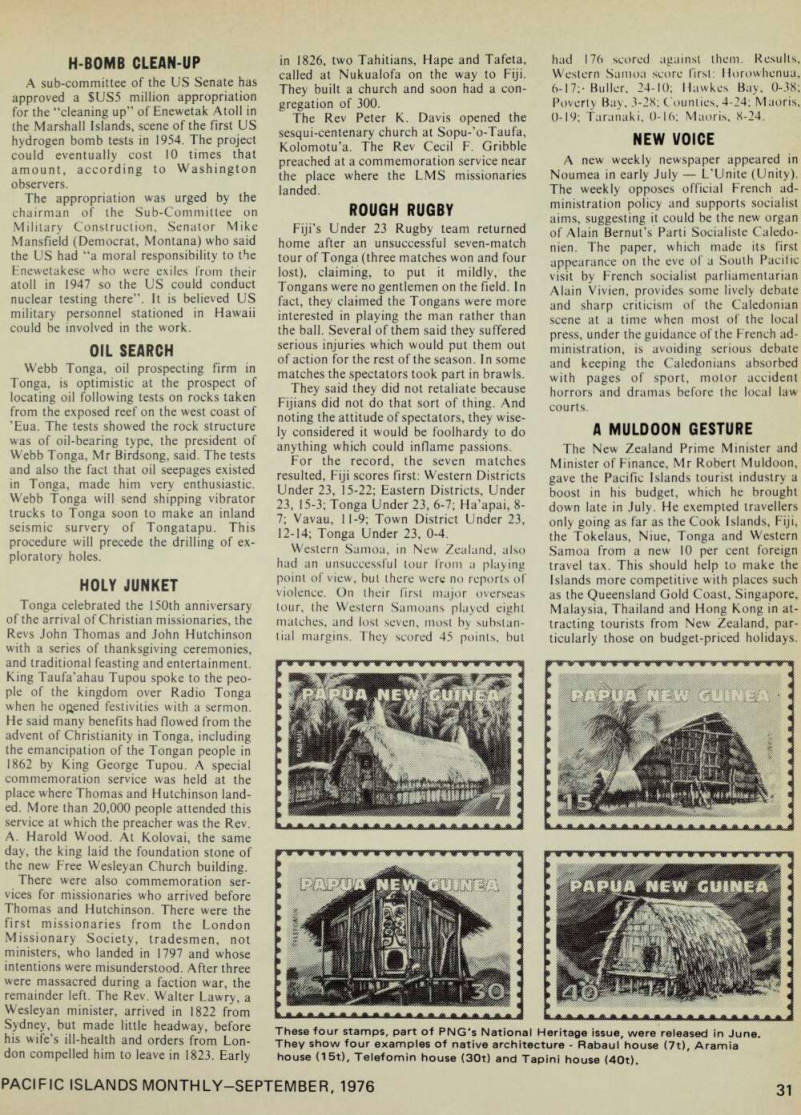
The
In A
Nutshell
Fiji Strikers Arrested
Three days after the start of a strike which closed the Fiji Sugar Corporation's mills at Lautoka, Rarawai, Penang and Labasa in late July at the height of the crushing season, police arrested all of ficials of the Sugar Milling Staff Officers’
Association, which called the strike. They were charged with causing an illegal strike, having failed to give notice of the strike, which was in protest against rejection of union claims for back-dated pay increases and a 10 per cent production bonus. The government claimed that a sympathy strike by the 3000-member strong Fiji Sugar and General Workers’ Union was also illegal. Fiji suffered from a rash of strikes in July. Seventy postal workers at Suva went on strike about an alleged lack of staff. They went back to work three days later after conciliation procedures were invoked.
The future of the Emperor gold mine at Vatukoula lay in the balance when the Fiji Mineworkers’ Union called a 24-hour stoppage in a dispute involving the transfer of 22 surface workers to underground min ing. Two days later, the Emperor chair man, Mr J. Reid, said the company might be forced to close the mine, which would involve dismissal of up to 1000 workers.
Between 500 and 600 would continue in employment in subsidiary companies. His board had given him a mandate to close the mine if he felt the situation warranted such action. Emperor was in the throes of a recession, partly caused by low gold prices and partly because it had to contend with irresponsible trade union actions. Ad ditional wage increases now would further jeopardise the company’s viability.
Bah Ba!
The Ba Town Council in Fiji recently tried to ban newspaper coverage of the an nual inter-district soccer tournament, and sought Supreme Court injunctions to en force the ban. The council also wanted to ban Radio Fiji. Mr Justice Kermode gave the council short shrift. He described the council’s action as a clear attempt to muz zle the news media from exercising their fundamental rights of free speech and ex pression.
The council claimed the newspapers and radio would make a substantial profit at the expense of the council, which would be a violation of an agreement between the council and the Fiji Football Association, and the council “would suffer incalculable loss or damage’’. The media had threaten ed to publish information about the tour nament without the council’s consent.
Mr Justice Kermode was mild in rejec ting the case against the newspaper. Others would consider the council’s application staggering, and that to prevent coverage of an event of national importance would be scandalous. Mr Justice Kermode ruled, however, the council could refuse to allow a broadcast from within the ground, and that the newspapers could not sell newspapers in the ground without the council’s permission. The council and Radio Fiji reached an agreement to allow direct broadcast commentaries on play.
Bang-Bang
France exploded two nuclear devices un derground at Mururoa Atoll on July 10 and 22. The French Defence Ministry said later the tests were carried out in “satisfac tory conditions”. Nothing was said about the strength of the devices. France has now made five underground tests at Mururoa, following a series of aerial detonations.
Pitcairn’S Big Blow
It’s been one blow after another on Pit cairn Island. A fire destroyed the islanders’ main electricity generator in June. Then, for 24 hours in July’s first week, a storm blasted the island with winds up to 80 mph.
Roofs of six houses were blown away or damaged. Tom Christian, the radio of ficer, told the Voice of Prophecy, the Seventh-day Adventist radio centre in California, in his weekly broadcast, that termites weakened the wooden supports of houses and damage could be severe in a storm. Banana trees were also blown over and many mangoes and oranges were blown from the trees. There were no in juries.
Police Probe
Mr Ulualofaiga Talamaivao Niko, once a policemen in Western Samoa and now that country’s Minister of Justice, Police, and Youth and Cultural Affairs, has ordered a full inquiry into the running of
the Department of Police and Prisons, but he was quick to deny a suggestion the in quiry was because of past differences he had with the Commissioner of Police, Mr Lavea Unasa Lio. But he did admit he had resigned from the police because he was dissatisfied with some aspects of the
department’s work.
He said the department’s work needed complete reappraisal in the light of new problems caused by changing cir cumstances. Higher standards would need to be imposed to protect the public against the sophisticated acts of educated criminals. The police had to be equipped to deal with more educated youths and adults, both local and from overseas.
Mr Ulualofaiga mentioned harmful drugs as one of the bad effects from in creased communications with the outside world. He said a full inquiry by an in dependent commission was the only fair way to start a complete reorganisation of the depa:tment. To make that fresh start, the government needed to know the strengths and weaknesses of the depart ment.
*Anoe Trip
A 74ft Gilbe;tese outrigger canoe, which left Tarawa on May 23, arrived at Lautoka in Fiji 47 days later on July 9 with a cew of 13. Mr Jim Siers, a New Zealand photographer, who planned the building of the canoe and the voyage, has accepted an offer to have the canoe housed in the museum in Wellington. He said the ven ture was to show such voyages could have been made by Micronesians before the arrival of Europeans in the Pacific. On the 1,500 mile voyage, the canoe called at Abemama and Tabiteuea in the Gilberts, and at Rotuma. It ran through a storm, which lasted 24 hours. The storm broke one of the two masts and the canoe sprang leaks in the hull. Mr Siers intends to re main in Fiji for some time seeking support for another canoe venture. This will in volve construction of a Fijian drua (double canoe) for a long ocean voyage.
Chiefly Row
A row is looming in the Cook Islands over the election and formal installation, with customary ceremonies, of Toua Paitai as the new Vakatini Ariki. Members of the Ui Rangalire, of Vakatini, are objecting to Toua Paitai holding the title. They claim that certain members of the tribe took on themselves the sole responsibility of elec ting the title holder, without proper con sideration for the custom and feelings of the Kopu Ariki and all the Ui Rangatire of Vakatini. The objectors say they intend to hold'a full investigation and decide on the rightful successor to the title. They said they did not recognise or accept the elec tion of Toua Paitai. The election had to have the majority backing of the Kopu Ariki and Aringa Mana of the tribe.
H-Bomb Clean-Up
A sub-committee of the US Senate has approved a SUSS million appropriation for the “cleaning up” of Enewetak Atoll in the Marshall Islands, scene of the first US hydrogen bomb tests in 1954. The project could eventually cost 10 times that amount, according to Washington observers.
The appropriation was urged by the
chairman of the Sub-Committee on Military Construction, Senator Mike Mansfield (Democrat, Montana) who said the US had “a moral responsibility to the Enewetakese who were exiles from their atoll in 1947 so the US could conduct nuclear testing there”. It is believed US military personnel stationed in Hawaii could be involved in the work.
Oil Search
Webb Tonga, oil prospecting firm in Tonga, is optimistic at the prospect of locating oil following tests on rocks taken from the exposed reef on the west coast of ’Eua. The tests showed the rock structure was of oil-bearing type, the president of Webb Tonga, Mr Birdsong, said. The tests and also the fact that oil seepages existed in Tonga, made him very enthusiastic.
Webb Tonga will send shipping vibrator trucks to Tonga soon to make an inland seismic survery of Tongatapu. This procedure will precede the drilling of ex ploratory holes.
Holy Junket
Tonga celebrated the 150th anniversary of the arrival of Christian missionaries, the Revs John Thomas and John Hutchinson with a series of thanksgiving ceremonies, and traditional feasting and entertainment.
King Taufa’ahau Tupou spoke to the peo ple of the kingdom over Radio Tonga when he opened festivities with a sermon.
He said many benefits had flowed from the advent of Christianity in Tonga, including the emancipation of the Tongan people in 1862 by King George Tupou. A special commemoration service was held at the place where Thomas and Hutchinson land ed. More than 20,000 people attended this service at which the preacher was the Rev.
A. Harold Wood. At Kolovai, the same day, the king laid the foundation stone of the new Free Wesleyan Church building.
There were also commemoration ser vices for missionaries who arrived before Thomas and Hutchinson. There were the first missionaries from the London Missionary Society, tradesmen, not ministers, who landed in 1797 and whose intentions were misunderstood. After three were massacred during a faction war, the remainder left. The Rev. Walter Lawry, a Wesleyan minister, arrived in 1822 from Sydney, but made little headway, before his wife’s ill-health and orders from Lon don compelled him to leave in 1823. Early
in 1826, two Tahitians, Hape and Tafeta, called at Nukualofa on the way to Fiji.
They built a church and soon had a con gregation of 300.
The Rev Peter K. Davis opened the
sesqui-centenary church at Sopu-’o-Taufa,
Kolomotu’a. The Rev Cecil F. Gribble preached at a commemoration service near the place where the LMS missionaries landed.
Rough Rugby
Fiji’s Under 23 Rugby team returned home after an unsuccessful seven-match tour of Tonga (three matches won and four lost), claiming, to put it mildly, the Tongans were no gentlemen on the field. In fact, they claimed the Tongans were more interested in playing the man rather than the ball. Several of them said they suffered serious injuries which would put them out of action for the rest of the season. In some matches the spectators took part in brawls.
They said they did not retaliate because Fijians did not do that sort of thing. And noting the attitude of spectators, they wise ly considered it would be foolhardy to do anything which could inflame passions.
For the record, the seven matches resulted, Fiji scores first: Western Districts Under 23, 15-22; Eastern Districts, Under 23, 15-3; Tonga Under 23, 6-7; Ha’apai, 8- 7; Vavau, 11-9; Town District Under 23, 12-14; Tonga Under 23, 0-4.
Western Samoa, in New Zealand, also had an unsuccessful tour from a playing point of view, but there were no reports of violence. On their first major overseas tour, the Western Samoans played eight matches, and lost seven, most by substan tial margins. They scored 45 points, but
had 176 scored against them. Results, Western Samoa score first: Horowhenua, 6-17;- Buller, 24-10; Hawkes Bay, 0-38; Poverty Bay, 3-28; Counties, 4-24; Maoris, 0-19; Taranaki, 0-16; Maoris, 8-24.
New Voice
A new weekly newspaper appeared in Noumea in early July L’Unite (Unity).
The weekly opposes official French ad ministration policy and supports socialist aims, suggesting it could be the new organ of Alain Bernut’s Parti Socialisle Caledo nien. The paper, which made its first appearance on the eve of a South Pacilic visit by French socialist parliamentarian Alain Vivien, provides some lively debate and sharp criticism of the Caledonian scene at a time when most of the local press, under the guidance of the French ad ministration, is avoiding serious debate and keeping the Caledonians absorbed with pages of sport, motor accident horrors and dramas before the local law courts.
A Muldoon Gesture
The New Zealand Prime Minister and Minister of Finance, Mr Robert Muldoon, gave the Pacific Islands tourist industry a boost in his budget, which he brought down late in July. He exempted travellers only going as far as the Cook Islands, Fiji, the Tokelaus, Niue, Tonga and Western Samoa from a new 10 per cent foreign travel tax. This should help to make the Islands more competitive with places such as the Queensland Gold Coast, Singapore, Malaysia, Thailand and Hong Kong in at tracting tourists from New Zealand, par ticularly those on budget-priced holidays.
These four stamps, part of PNG's National Heritage issue, were released in June.
They show four examples of native architecture - Rabaul house (7t), Aramia house (15t), Telefomin house (30t) and Tapini house (40t).
Advertisements & other items, p. 32 (1 item)
That’s Qantastic!
Good on yer, mates!
\ It’s been 25 years since your island in the sky found its wings.
And in that time, you have become well known in the Pacific for your efficiency and standard of service. \ \ Qantas is proud to be associated with Air Pacific.
Like the man says, “Good on yer Mates!”
25 years of Air Pacific.
That’s Qantastic!
\ / / / / / / 1/ LB 1.2947
’Quakes, sharks two of the
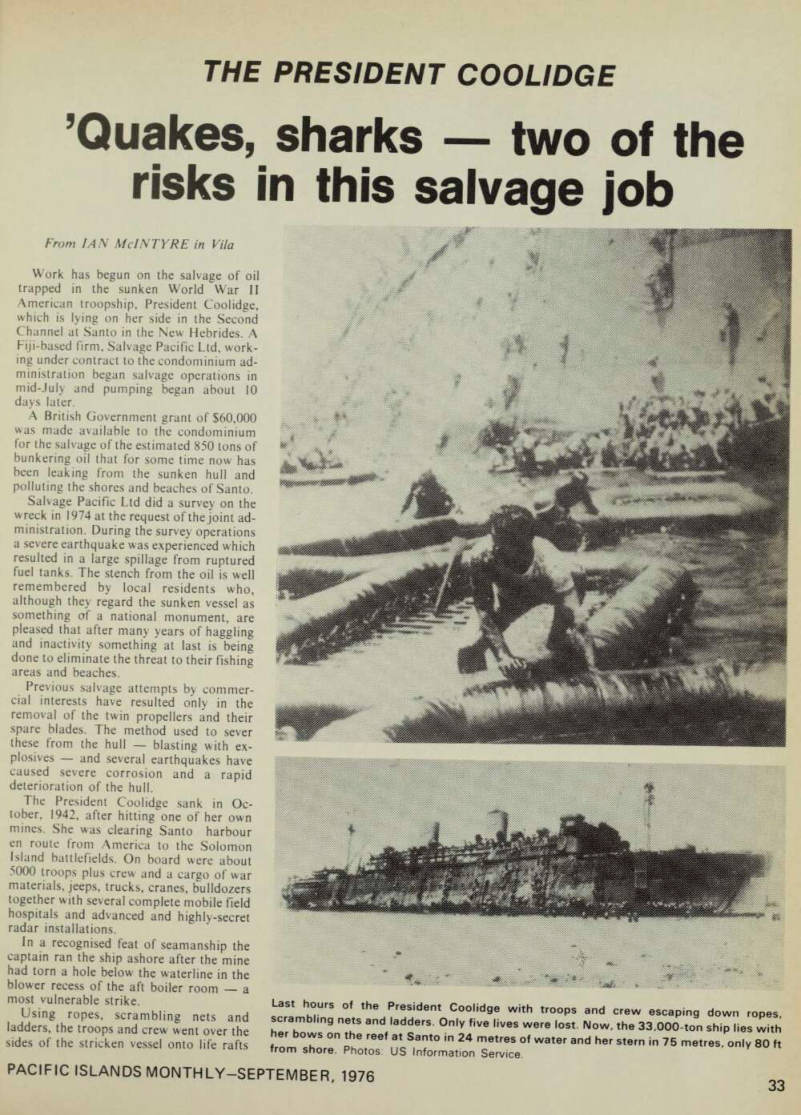
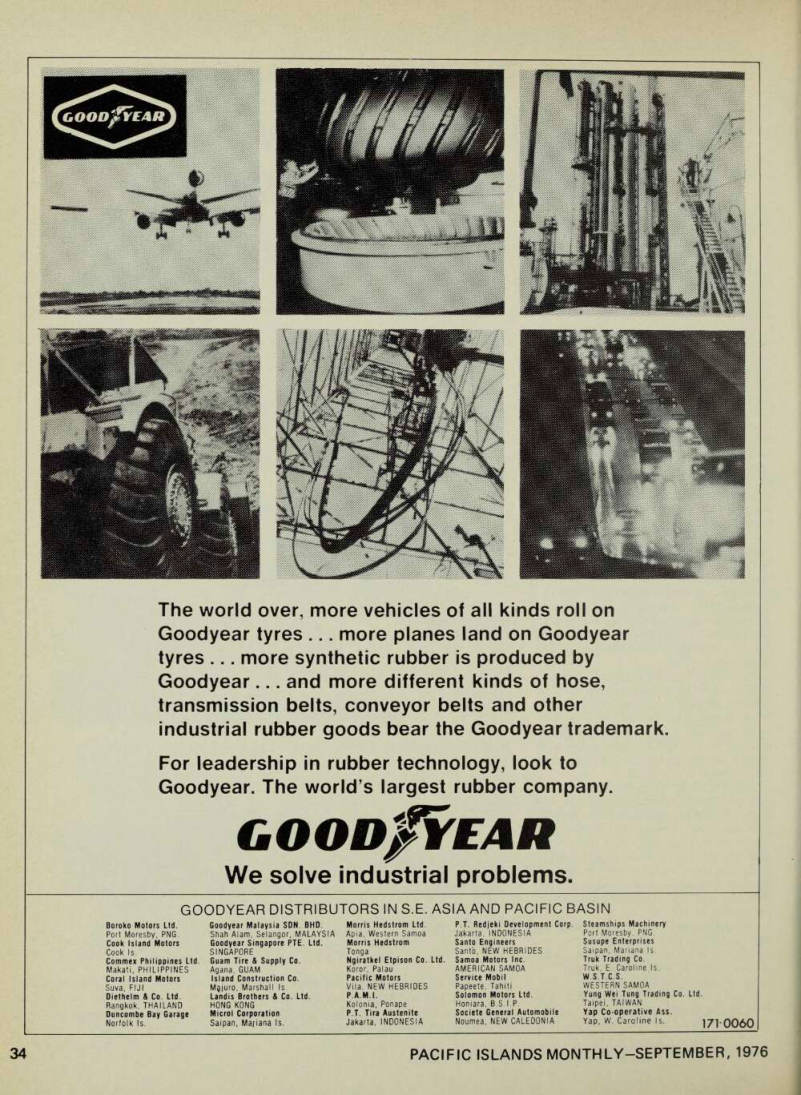
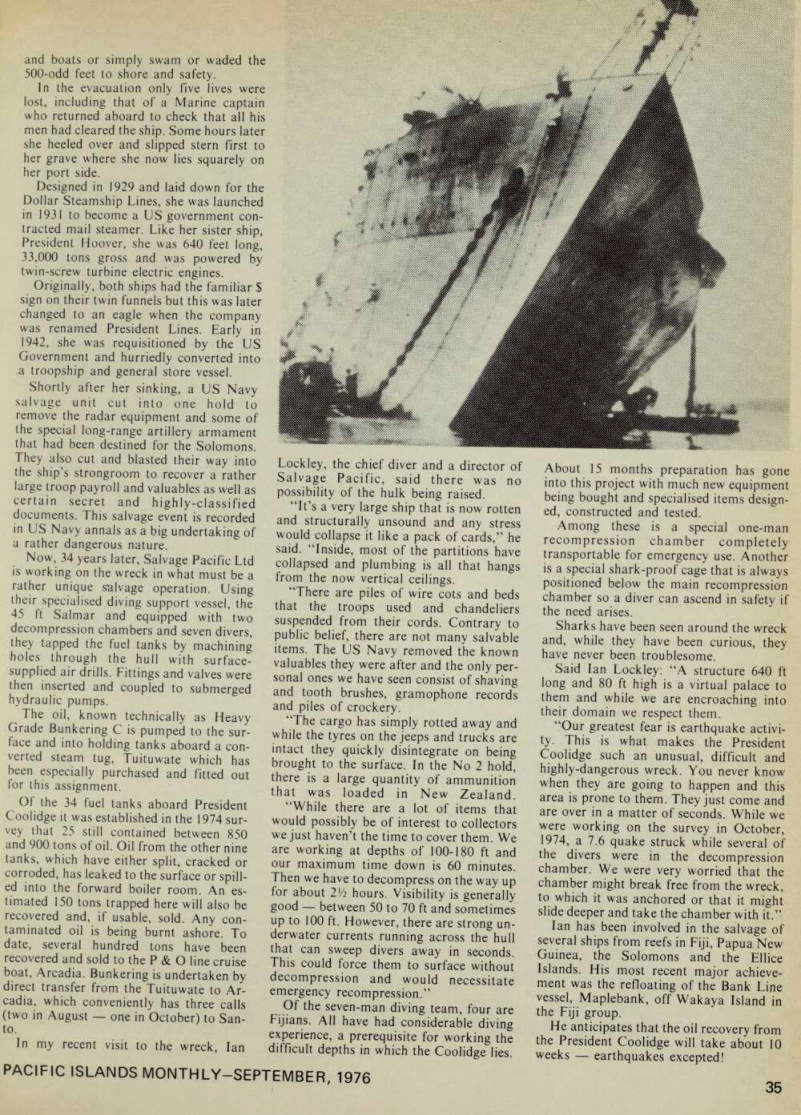
The President Coolidge
’Quakes, sharks two of the risks in this salvage job
From lAN McINTYRE in Vila Work has begun on the salvage of oil trapped in the sunken World War II American troopship, President Coolidge, which is lying on her side in the Second Channel at Santo in the New Hebrides. A Fiji-based firm. Salvage Pacific Ltd, work ing under contract to the condominium ad ministration began salvage operations in mid-July and pumping began about 10
days later.
A British Government grant of $60,000 was made available to the condominium for the salvage of the estimated 850 tons of bunkering oil that for some time now has been leaking from the sunken hull and polluting the shores and beaches of Santo.
Salvage Pacific Ltd did a survey on the wreck in 1974 at the request of the joint ad ministration. During the survey operations a severe earthquake was experienced which resulted in a large spillage from ruptured fuel tanks. The stench from the oil is well remembered by local residents who, although they regard the sunken vessel as something of a national monument, are pleased that after many years of haggling and inactivity something at last is being done to eliminate the threat to their fishing areas and beaches.
Previous salvage attempts by commer cial interests have resulted only in the removal of the twin propellers and their spare blades. The method used to sever these from the hull blasting with ex plosives and several earthquakes have caused severe corrosion and a rapid deterioration of the hull.
The President Coolidge sank in Oc tober, 1942, after hitting one of her own mines. She was clearing Santo harbour en route from America to the Solomon Island battlefields. On board were about 5000 troops plus crew and a cargo of war materials, jeeps, trucks, cranes, bulldozers together with several complete mobile field hospitals and advanced and highly-secret radar installations.
In a recognised feat of seamanship the captain ran the ship ashore after the mine had torn a hole below the waterline in the blower recess of the aft boiler room a most vulnerable strike.
Using ropes, scrambling nets and ladders, the troops and crew went over the sides of the stricken vessel onto life rafts
Last hours of the President Coolidge with troops and crew escaping down ropes, scrambling nets and ladders. Only five lives were lost. Now, the 33,000-ton ship lies with her ows on the reef at Santo in 24 metres of water and her stern in 75 metres, only 80 ft from shore. Photos: US Information Service.
and boats or simply swam or waded the 500-odd feet to shore and safety.
In the evacuation only five lives were lost, including that of a Marine captain who returned aboard to check that all his men had cleared the ship. Some hours later she heeled over and slipped stern first to her grave where she now lies squarely on her port side.
Designed in 1929 and laid down for the Dollar Steamship Lines, she was launched in 1931 to become a US government con tracted mail steamer. Like her sister ship, President Hoover, she was 640 feet long, 33,000 tons gross and was powered by twin-screw turbine electric engines.
Originally, both ships had the familiar $ sign on their twin funnels but this was later changed to an eagle when the company was renamed President Lines. Early in 1942, she was requisitioned by the US Government and hurriedly converted into a troopship and general store vessel.
Shortly after her sinking, a US Navy salvage unit cut into one hold to remove the radar equipment and some of the special long-range artillery armament that had been destined for the Solomons.
They also cut and blasted their way into the ship’s strongroom to recover a rather large troop payroll and valuables as well as certain secret and highly-classified documents. This salvage event is recorded in US Navy annals as a big undertaking of a rather dangerous nature.
Now, 34 years later, Salvage Pacific Ltd is working on the wreck in what must be a rather unique salvage operation. Using their specialised diving support vessel, the 45 ft Salmar and equipped with two decompression chambers and seven divers, they tapped the fuel tanks by machining holes through the hull with surface supplied air drills. Fittings and valves were then inserted and coupled to submerged
hydraulic pumps.
The oil, known technically as Heavy Grade Bunkering C is pumped to the sur face and into holding tanks aboard a con verted steam tug, Tuituwate which has been especially purchased and fitted out for this assignment.
Of the 34 fuel tanks aboard President Coolidge it was established in the 1974 sur vey that 25 still contained between 850 and 900 tons of oil. Oil from the other nine tanks, which have either split, cracked or corroded, has leaked to the surface or spill ed into the forward boiler room. An es timated 150 tons trapped here will also be recovered and, if usable, sold. Any con taminated oil is being burnt ashore. To date, several hundred tons have been recovered and sold to the P & O line cruise boat, Arcadia. Bunkering is undertaken by direct transfer from the Tuituwate to Ar cadia, which conveniently has three calls (two in August one in October) to San to.
In my recent visit to the wreck, lan
Lockley, the chief diver and a director of Salvage Pacific, said there was no possibility of the hulk being raised.
“It’s a very large ship that is now rotten and structurally unsound and any stress would collapse it like a pack of cards,” he said. “Inside, most of the partitions have collapsed and plumbing is all that hangs from the now vertical ceilings.
“There are piles of wire cots and beds that the troops used and chandeliers suspended from their cords. Contrary to public belief, there are not many salvable items. The US Navy removed the known valuables they were after and the only per sonal ones we have seen consist of shaving and tooth brushes, gramophone records and piles of crockery.
“The cargo has simply rotted away and while the tyres on the jeeps and trucks are
intact they quickly disintegrate on being
brought to the surface. In the No 2 hold, there is a large quantity of ammunition that was loaded in New Zealand.
“While there are a lot of items that would possibly be of interest to collectors we just haven’t the time to cover them. We are working at depths of 100-180 ft and our maximum time down is 60 minutes.
Then we have to decompress on the way up for about IVi hours. Visibility is generally good between 50 to 70 ft and sometimes up to 100 ft. However, there are strong un derwater currents running across the hull that can sweep divers away in seconds.
This could force them to surface without decompression and would necessitate emergency recompression.”
Of the seven-man diving team, four are Fijians. All have had considerable diving experience, a prerequisite for working the difficult depths in which the Coolidge lies.
About 15 months preparation has gone into this project with much new equipment
being bought and specialised items design
ed, constructed and tested.
Among these is a special one-man recompression chamber completely transportable for emergency use. Another is a special shark-proof cage that is always positioned below the main recompression chamber so a diver can ascend in safety if the need arises.
Sharks have been seen around the wreck and, while they have been curious, they have never been troublesome.
Said lan Lockley: “A structure 640 ft long and 80 ft high is a virtual palace to them and while we are encroaching into their domain we respect them.
“Our greatest fear is earthquake activi ty. This is what makes the President Coolidge such an unusual, difficult and highly-dangerous wreck. You never know when they are going to happen and this area is prone to them. They just come and are over in a matter of seconds. While we were working on the survey in October, 1974, a 7.6 quake struck while several of the divers were in the decompression chamber. We were very worried that the chamber might break free from the wreck, to which it was anchored or that it might slide deeper and take the chamber with it.” lan has been involved in the salvage of several ships from reefs in Fiji, Papua New Guinea, the Solomons and the Ellice Islands. His most recent major achieve ment was the refloating of the Bank Line vessel, Maplebank, off Wakaya Island in the Fiji group.
He anticipates that the oil recovery from the President Coolidge will take about 10 weeks earthquakes excepted!
Advertisements & other items, p. 34 (1 item)
Good-Year
The world over, more vehicles of all kinds roll on Goodyear tyres ... more planes land on Goodyear tyres ... more synthetic rubber is produced by Goodyear... and more different kinds of hose,
transmission belts, conveyor belts and other
industrial rubber goods bear the Goodyear trademark.
For leadership in rubber technology, look to
Goodyear. The world’s largest rubber company.
We solve industrial problems.
GOODYEAR DISTRIBUTORS IN S.E. ASIA AND PACIFIC BASIN
GOOD-YEAR
Boroko Motors Ltd.
Port Moresby, PNG.
Cook Island Motors Cook Is.
Goodyear Malaysia SDN. BHD. Morris Hedstrom Ltd.
Shah Alam, Selangor, MALAYSIA Apia. Western Samoa Goodyear Singapore PTE. Ltd. Morris Hedstrom P.T. Redjeki Development Corp. Steamships Machinery Commex Philippines Ltd. Guam Tire & Supply Co.
SINGAPORE
Morris Hedstrom Tonga Ngiratkel Etpison Co. Ltd.
Koror, Palau Pacific Motors
Vila. NEW HEBRIDES
P.A.M.I.
Kolonia, Ponape P.T. Tira Austenite Jakarta, INDONESIA Jakarta, INDONESIA Santo Engineers
Santo, NEW HEBRIDES
Samoa Motors Inc.
AMERICAN SAMOA
Service Mobil Papeete, Tahiti Solomon Motors Ltd.
Honiara, B S I P Societe General Automobile
Noumea, NEW CALEDONIA
Port Moresby, PNG.
Susupe Enterprises Saipan. Mariana Is.
Truk Trading Co.
Makati, PHILIPPINES
Coral Island Motors Suva, FIJI Agana, GUAM Island Construction Co.
Mgjuro, Marshall Is.
Landis Brothers & Co. Ltd.
HONG KONG
Microl Corporation Saipan, Ma/iana Is.
Truk. E, Caroline Is,
W S.T.C.S.
Norfolk Is.
Oiethelm & Co. Ltd.
Bangkok, THAILAND Buncombe Bay Garage
WESTERN SAMOA
Yung Wei Tung Trading Co. Ltd.
Taipei, TAIWAN Yap Co operative Ass.
Yap, W. Caroline Is. 1710060
A Right Royal
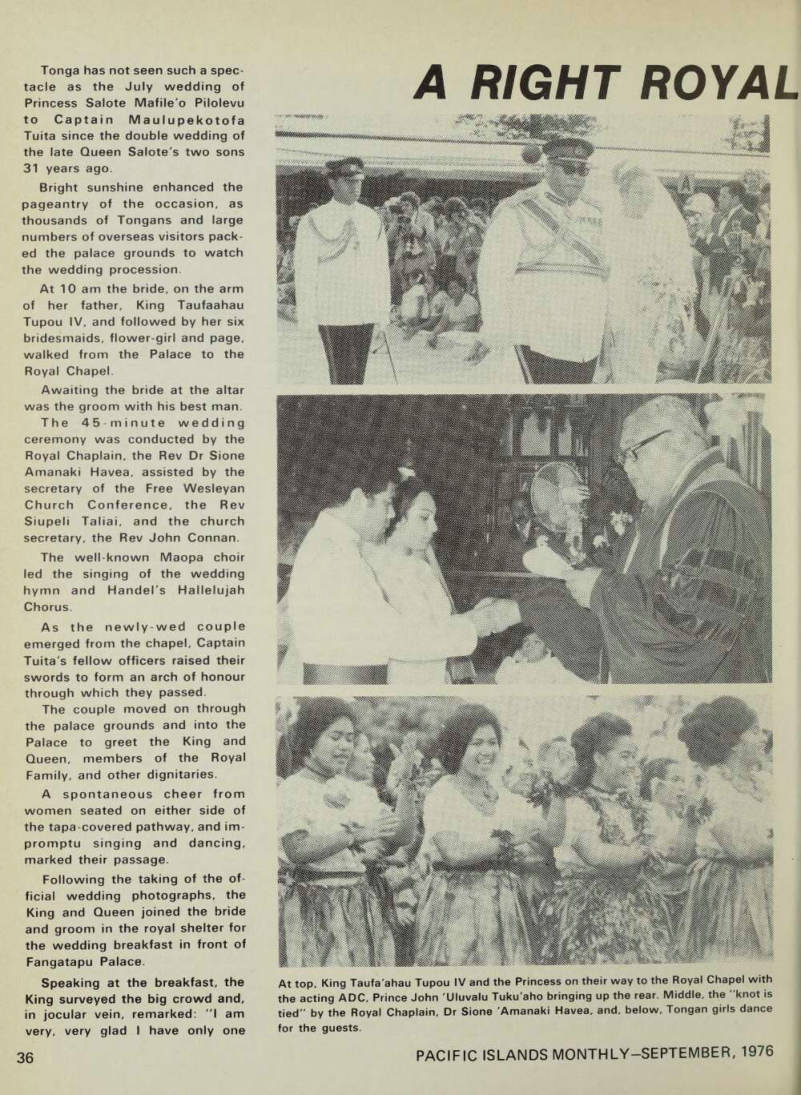
Tonga has not seen such a spec tacle as the July wedding of Princess Salote Mafile'o Pilolevu to Captain Mauiupekotofa Tuita since the double wedding of the late Queen Salote's two sons 31 years ago.
Bright sunshine enhanced the pageantry of the occasion, as thousands of Tongans and large numbers of overseas visitors pack ed the palace grounds to watch the wedding procession.
At 10 am the bride, on the arm of her father. King Taufaahau Tupou IV, and followed by her six bridesmaids, flower-girl and page, walked from the Palace to the Royal Chapel.
Awaiting the bride at the altar was the groom with his best man.
The 45-minute wedding ceremony was conducted by the Royal Chaplain, the Rev Dr Sione Amanaki Havea, assisted by the secretary of the Free Wesleyan Church Conference, the Rev Siupeli Taliai, and the church secretary, the Rev John Connan.
The well-known Maopa choir led the singing of the wedding hymn and Handel's Hallelujah Chorus.
As the newly-wed couple emerged from the chapel. Captain Tuita's fellow officers raised their swords to form an arch of honour through which they passed.
The couple moved on through the palace grounds and into the Palace to greet the King and Queen, members of the Royal Family, and other dignitaries.
A spontaneous cheer from women seated on either side of the tapa-covered pathway, and im promptu singing and dancing, marked their passage.
Following the taking of the of ficial wedding photographs, the King and Queen joined the bride and groom in the royal shelter for the wedding breakfast in front of Fangatapu Palace.
Speaking at the breakfast, the King surveyed the big crowd and, in jocular vein, remarked: "I am very, very glad I have only one
At top. King Taufa'ahau Tupou IV and the Princess on their way to the Royal Chapel with the acting ADC, Prince John 'Uluvalu Tuku'aho bringing up the rear. Middle, the "knot is tied" by the Royal Chaplain, Dr Sione Amanaki Havea, and, below, Tongan girls dance for the guests.
Advertisements & other items, pp. 37-41 (1 item)
dreamed was possible.
Sony presents more power,
more tonal quality than you ever
The Sony CF-480S cassette-corder/radio sounds as big and real as life itself.
Its powerful, specially-designed amplifier delivers 4 watts of power—enough to fill even the largest room with clear, distortion-free sound.
What’s more, it has a unique 2-way speaker system. One big 6 1/2-inch woofer for the lows and a separate 2-inch tweeter for the highs.
Result: r"TiMrf'ff>il rji ngniii and cassette recordings, with audibly superior shortwave and medium wave sound, too.
In fact, the great-sounding CF-480S represents Sony cassette-corder technology at its finest; there is a DC servo-controlled tape drive motor, sensitive electret condenser microphone, tape selector for normal and Cro2 cassettes, mic mixing controls, and much more. It’s a dream "of versatility.
But you shouldn’t just take our word for it.
Visit the nearest Sony_deaier and audition the Sony CF-480S for yourself.
You’d never dream that a raresemreo rumrrgq m could sound [ so good. a CP •ii*
How 'Terra Firma’ keeps aggregate
or sub-base in place.
The Problem: In constructions such as roads, car parks, temporary works etc. a stable sub-base must be established.
Failure to separate sub-base and sub-grade materials properly, can result in an expensive loss of aggregate. And a premature failure of the structure.
The Answer: Terra Firma' a membrane made from continuous synthetic fibres, by a unique melding process.
'Terra Firma' combines three functions Separation Filtration Reinforcement.
Used as a separator'Terra Firma' is extremely effective. It is convenient, easy to install at the sub-grade/sub-base interface, and requires very little ground preparation.
'Terra Firma' prevents punching and loss of sub-base material into the sub-grade.
'Terra Firma' contains the aggregate, allowing the sub-base to reach maximum compaction to its full depth.
Therefore less aggregate is required to achieve the designed bearing capacity.
'Terra Firma' keeps the subbase clean, free-draining and compacted by preventing • lubricating slurry from passing up into the aggregate, from the sub-grade.
With 'Terra Firma' a stable subbase is achieved quickly.
Less aggregate is needed for a better long-term performance.
'Terra Firma' can be especially useful over soft ground and in adverse weather conditions. n. j w
/jtf
• k JM & -M M
ill
> i j li * ■ i & ; The Applications: Terra Firma' can be used simply and economically in the construction of: • Access roads • Permanent roads • Asphalt reinforcement • Area stabilisation buildings car parks timber yards • Railways • Drainage land reclamation Playing fields racetracks • River and coastal protection erosion control levee banks Fibremakers
TERRtk.
FIRMk
stabilisation fabric 'Terra Firma' is one of the 'Terrain' group of products.
For separation, filtration, reinforcement. Each roll 63 kg, 4.5 metres wide and 100 metres long.
For further information and technical data contact: Fibremakers Limited, 1 Nicholson Street,
MELBOURNE, Vic. 3002.
Tel: (03) 662-2022 Telex: AA 32425, 'Terra Firma'and 'Terrain' are registered trade marks.
FM6247
Control yourself.
Nontui mJC** m
UOUM
TREBLE
MO«ANGe
PHONES
sp£AKERS
(• € n c«
CONTKC*-
RIGHT
J
lil
li£
W<BQl
WiSQ)
POWER
POWER
Admittedly with
110 watts per channel at your
fingertips, you
might well be excused getting a
little overexcited.
But that’s no reason to lose control. Especially as Sansui makes it so easy to control all that power.
The 9090 FM/AM stereo receiver is equipped with four meters. And two of them are direct-reading output-power meters. So you’re always in control.
From 0.05 to 200 watts at 8 ohms.
You’ll find the same control for beautifully balanced big sound, with minimal distortion, in the other Sansui stereo receivers: The 8080 and 7070 receivers are also equipped with four meters. As well as with the latest
circuitry to give you
many years of solid
listening pleasure.
There’s no substitute for power when it comes to wellbalanced big sound all the way up and down the dynamic music range.
And there’s no substitute for Sansui when it comes to professionally engineered stereo hi-fi.
So always ask for Sansui by name. After all, you’re in control now.
Sansui also makes the 6060 and 5050 receivers. They offer sound value and plenty of power without power meters.
SANSUI ELECTRIC CO., LTD.
14-1. 2-chome, Izumi, Suginami-ku, Tokyo 168, Japan
ScltlsuL
Australia Rank Industries Australia Pty. Ltd.
Head Office: 12 Barcoo Street, East Roseville, N.S.W. 2069 Phone: 406 5666 Melbourne: 68 Queensbridge Street, South Melbourne. Vic. 3205 Phone: 62 0031 Adelaide: Phone: 212 2555/Brisbane; Phone; 52 7333/Canberra: Phone; 95 2144 Australia Atkins Carlyle Ltd. 44 Belmont Avenue, Belmont, Western Australia, 6104 Phone: 65 0511 Fiji Prabhu Brothers Ltd.
P.O. Box 183, Nadi Phone: 70183/4 Papua New Guinea Oceania Indent Agency (P.N.G.) Pty. Ltd.
Box 5518, Boroko, Port Moresby Phone: PM 256406 New Zealand David J. Reid (N.Z.) Ltd.
C.P.O. Box 2630, Auckland, 1 Phone: 492-189 New Caledonia Ets Michel MERCIER 53 rue de Sebastopol, Noumea Phone: 27. 59. 11 South Pacific Miltons Department Stores Limited P.O. Box 146, Norfolk Island 2899 Central Pacific Nauru Co-operative Society Republic of Nauru Western Samoa H.J. Keil and Company Ltd.
P.O. Box 7, Apia Phone: 198 New Hebrides South Pacific Audio & Photo Supplies B.P. 274. Vila Cook Islands United Island Traders Ltd.
P.O. Box 1 & 2. Rarotonga Tahiti Societe JAUNEZ & Cie B.P. 322, Papeete Phone: 2.04.24
* m i A >- >■ *v# * s&■** / r ■; V i * r !>. f ■ '
The Toyota truck range.
Built to be unbeatable.
Bad weather conditions, no problem.
Bad roads and driving surfaces, eaten up.
Difficult loads, no contest.
Built tough. Built to take it.
There's a Toyota truck built for you.
TOYOTA Land Cruiser Pickup
TOYOTA Hi-Ace
TOYOTA Stout
TOYOTA Hi Lux
TOYOTA Dyna
>' 1 > T TOYOTA Toyo-Ace TOYOTA Truck For unbeatable after service:
TOYOTA
A p| CO "'i Tn 1°" US TRUST TERR,TORY: MICROL CORPORATK
P.a B™’eS; VSSS SSi'
Tropicalities
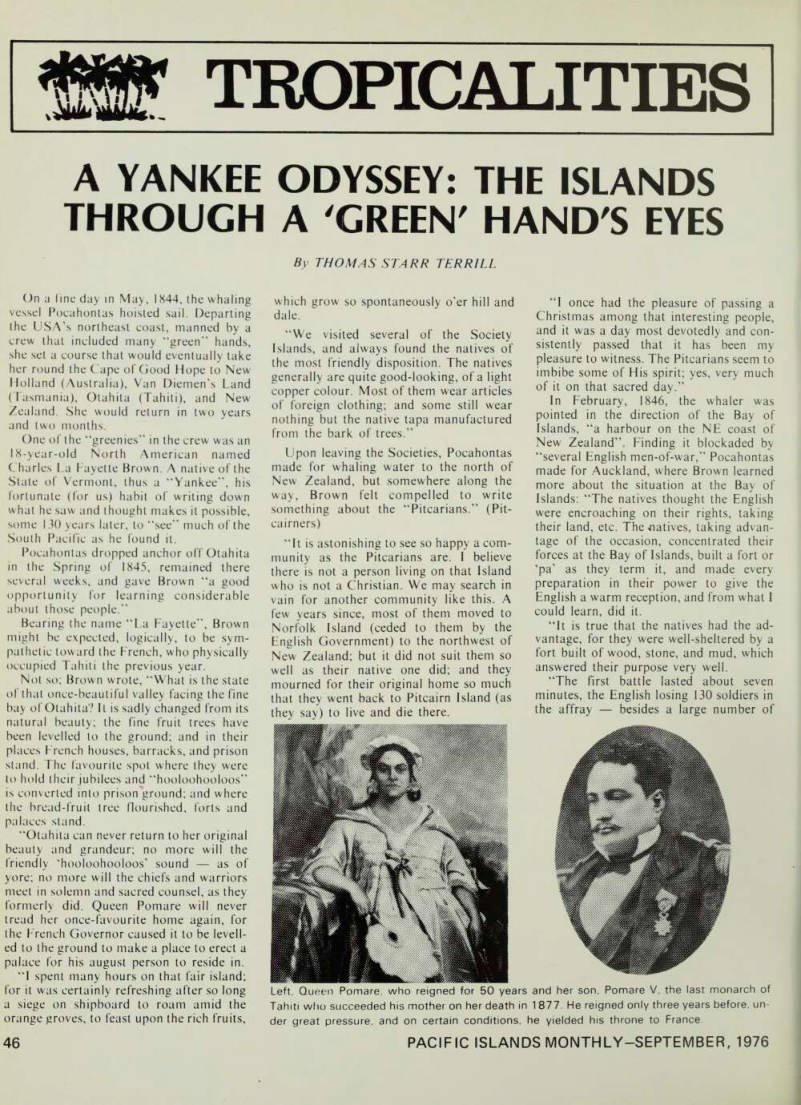
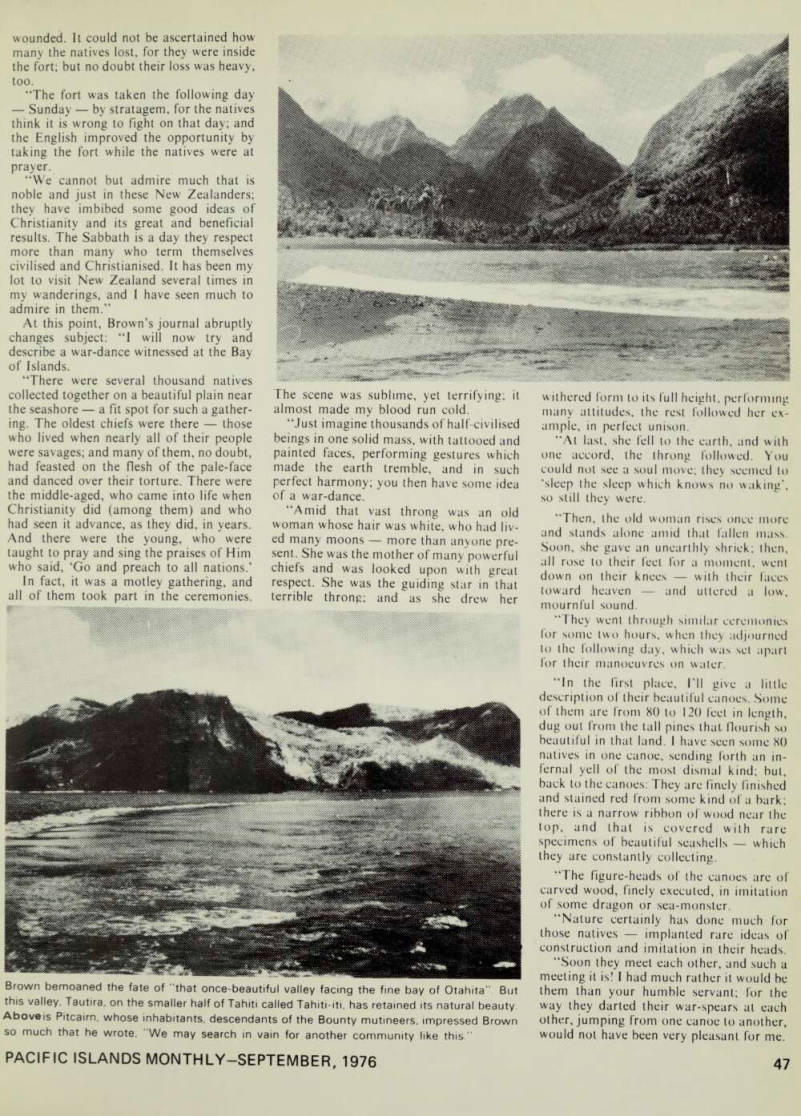

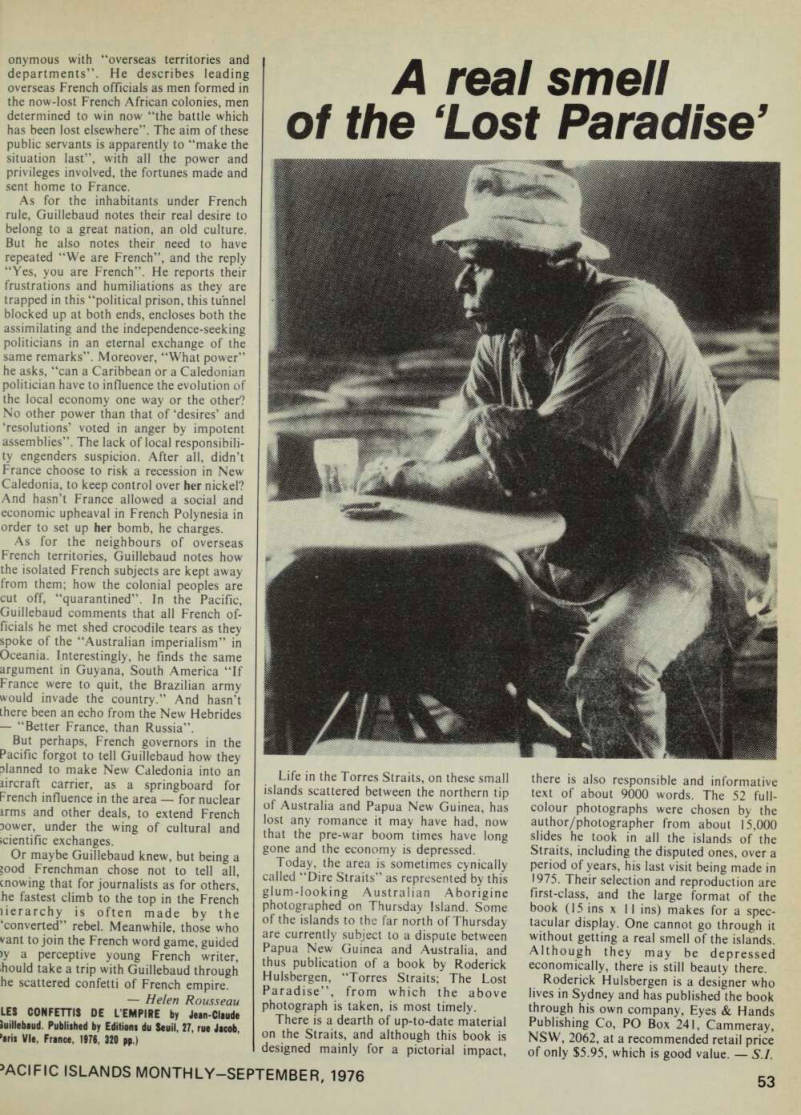
A Yankee Odyssey: The Islands
Through A 'Green' Hand's Eyes
By Thomas Starr Terrill
On a line day in May, 1844, the whaling vessel Pocahontas hoisted sail. Departing the USA’s northeast coast, manned by a crew that included many “green” hands, she set a course that would eventually take her round the Cape of Good Hope to New Holland (Australia), Van Diemen’s Land (Tasmania), Olahila (Tahiti), and New Zealand. She would return in two years and two months.
One of the “greenies” in the crew was an 18-year-old North American named Charles La Fayette Brown. A native of the Stale of Vermont, thus a “Yankee”, his fortunate (for us) habit of writing down what he saw and thought makes it possible, some 130 years later, to “see” much of the South Pacific as he found it.
Pocahontas dropped anchor off Otahita in the Spring of 1845, remained there several weeks, and gave Brown “a good
opportunity for learning considerable
about those people.”
Bearing the name “La Fayette”, Brown might be expected, logically, to be sym pathetic toward the French, who physically occupied Tahiti the previous year.
Not so; Brown wrote, “What is the state of that once-beauliful valley facing the fine bay of Otahita? It is sadly changed from its natural beauty; the fine fruit trees have been levelled to the ground; and in their places French houses, barracks, and prison stand. The favourite spot where they were to hold their jubilees and “hooloohooloos” is converted into prison‘ground; and where the bread-fruit tree flourished, forts and
palaces stand.
“Otahita can never return to her original beauty and grandeur; no more will the friendly ‘hooloohooloos’ sound as of yore; no more will the chiefs and warriors meet in solemn and sacred counsel, as they formerly did. Queen Pomare will never tread her once-favourite home again, for the French Governor caused it to be levell ed to the ground to make a place to erect a palace for his august person to reside in.
“I spent many hours on that fair island; for it was certainly refreshing after so long a siege on shipboard to roam amid the orange groves, to feast upon the rich fruits,
which grow so spontaneously o’er hill and dale.
“We visited several of the Society Islands, and always found the natives of the most friendly disposition. The natives generally are quite good-looking, of a light copper colour. Most of them wear articles of foreign clothing; and some still wear nothing but the native tapa manufactured from the bark of trees.”
Upon leaving the Societies, Pocahontas made for whaling water to the north of New Zealand, but somewhere along the way. Brown felt compelled to write something about the “Pitcarians.” (Pit cairners) “It is astonishing to see so happy a com munity as the Pitcarians are. I believe there is not a person living on that Island who is not a Christian. We may search in vain for another community like this. A few years since, most of them moved to Norfolk Island (ceded to them by the English Government) to the northwest of New Zealand; but it did not suit them so well as their native one did; and they mourned for their original home so much that they went back to Pitcairn Island (as they say) to live and die there.
"I once had the pleasure of passing a Christmas among that interesting people, and it was a day most devotedly and con sistently passed that it has been my pleasure to witness. The Pitcarians seem to imbibe some of His spirit; yes, very much of it on that sacred day.”
In February, 1846, the whaler was pointed in the direction of the Bay of Islands, “a harbour on the NE coast of New Zealand”. Finding it blockaded by “several English men-of-war,” Pocahontas made for Auckland, where Brown learned more about the situation at the Bay of Islands: “The natives thought the English were encroaching on their rights, taking their land, etc. The natives, taking advan tage of the occasion, concentrated their forces at the Bay of Islands, built a fort or ‘pa’ as they term it, and made every preparation in their power to give the English a warm reception, and from what I could learn, did it.
“It is true that the natives had the ad vantage, for they were well-sheltered by a fort built of wood, stone, and mud, which answered their purpose very well.
“The first battle lasted about seven minutes, the English losing 130 soldiers in the affray besides a large number of
Left. Queen Pomare. who reigned for 50 years and her son. Pomare V, the last monarch of Tahiti who succeeded his mother on her death in 1877. He reigned only three years before, un der great pressure, and on certain conditions, he yielded his throne to France.
wounded. It could not be ascertained how many the natives lost, for they were inside the fort; but no doubt their loss was heavy, too.
“The fort was taken the following day Sunday by stratagem, for the natives think it is wrong to fight on that day; and the English improved the opportunity by taking the fort while the natives were at prayer.
“We cannot but admire much that is noble and just in these New Zealanders; they have imbibed some good ideas of Christianity and its great and beneficial results. The Sabbath is a day they respect more than many who term themselves civilised and Christianised. It has been my lot to visit New Zealand several times in my wanderings, and I have seen much to admire in them.”
At this point, Brown’s journal abruptly changes subject: “I will now try and describe a war-dance witnessed at the Bay of Islands.
“There were several thousand natives collected together on a beautiful plain near the seashore a fit spot for such a gather ing. The oldest chiefs were there those who lived when nearly all of their people were savages; and many of them, no doubt, had feasted on the flesh of the pale-face and danced over their torture. There were the middle-aged, who came into life when Christianity did (among them) and who had seen it advance, as they did, in years.
And there were the young, who were taught to pray and sing the praises of Him who said, ‘Go and preach to all nations.’
In fact, it was a motley gathering, and all of them took part in the ceremonies.
The scene was sublime, yet terrifying; it almost made my blood run cold.
“Just imagine thousands of half-civilised beings in one solid mass, with tattooed and painted faces, performing gestures which made the earth tremble, and in such perfect harmony; you then have some idea of a war-dance.
“Amid that vast throng was an old woman whose hair was white, who had liv ed many moons more than anyone pre sent. She was the mother of many powerful chiefs and was looked upon with great respect. She was the guiding star in that terrible throng; and as she drew her
withered form to its full height, performing muny altitudes, the rest followed her ex
ample, in perfect unison.
“At last, she fell to the earth, and with one accord, the throng followed. You could not see a soul move; they seemed to ‘sleep the sleep which knows no waking', so still they were.
“Then, the old woman rises once more and stands alone amid that fallen mass.
Soon, she gave an unearthly shriek; then, all rose to their feel for a moment, went down on their knees with their faces toward heaven and uttered a low, mournful sound.
“They went through similar ceremonies for some two hours, when they adjourned to the following day, which was set apart for their manoeuvres on water.
“In the first place. I'll give a little description of their beautiful canoes. Some of them are from 80 to 120 feet in length, dug out from the tall pines that flourish so beautiful in that land. I have seen some 80 natives in one canoe, sending forth an in fernal yell of the most dismal kind; but, back to the canoes: They are finely finished and stained red from some kind of a bark; there is a narrow ribbon of wood near the lop, and that is covered with rare specimens of beautiful seashells which
they are constantly collecting.
“The figure-heads of the canoes are of carved wood, finely executed, in imitation of some dragon or sea-monster.
“Nature certainly has done much for those natives implanted rare ideas of construction and imitation in their heads.
“Soon they meet each other, and such a meeting it is! I had much rather it would be them than your humble servant; for the way they darted their war-spears at each other, jumping from one canoe to another, would not have been very pleasant for me.
Brown bemoaned the fate of that once-beautiful valley facing the fine bay of Otahita But this valley, Tautira, on the smaller half of Tahiti called Tahiti-iti, has retained its natural beauty Aboveis Pitcairn, whose inhabitants, descendants of the Bounty mutineers, impressed Brown so much that he wrote. "We may search in vain for another community like this "
onymous with “overseas territories and
departments”. He describes leading
overseas French officials as men formed in the now-lost French African colonies, men determined to win now “the battle which has been lost elsewhere”. The aim of these public servants is apparently to “make the situation last”, with all the power and privileges involved, the fortunes made and sent home to France.
As for the inhabitants under French rule, Guillebaud notes their real desire to belong to a great nation, an old culture.
But he also notes their need to have repeated “We are French”, and the reply “Yes, you are French”. He reports their frustrations and humiliations as they are trapped in this “political prison, this tunnel blocked up at both ends, encloses both the
assimilating and the independence-seeking
politicians in an eternal exchange of the same remarks”. Moreover, “What power” he asks, “can a Caribbean or a Caledonian politician have to influence the evolution of the local economy one way or the other?
No other power than that of ‘desires’ and ‘resolutions’ voted in anger by impotent assemblies”. The lack of local responsibili ty engenders suspicion. After all, didn’t France choose to risk a recession in New Caledonia, to keep control over her nickel?
And hasn’t France allowed a social and economic upheaval in French Polynesia in order to set up her bomb, he charges.
As for the neighbours of overseas French territories, Guillebaud notes how the isolated French subjects are kept away from them; how the colonial peoples are cut off, “quarantined”. In the Pacific, Guillebaud comments that all French of ficials he met shed crocodile tears as they spoke of the “Australian imperialism” in Oceania. Interestingly, he finds the same argument in Guyana, South America “If France were to quit, the Brazilian army would invade the country.” And hasn’t there been an echo from the New Hebrides “Better France, than Russia”.
But perhaps, French governors in the Pacific forgot to tell Guillebaud how they planned to make New Caledonia into an aircraft carrier, as a springboard for French influence in the area for nuclear arms and other deals, to extend French Dower, under the wing of cultural and
scientific exchanges.
Or maybe Guillebaud knew, but being a »ood Frenchman chose not to tell all, mowing that for journalists as for others, he fastest climb to the top in the French lierarchy is often made by the ‘converted” rebel. Meanwhile, those who vant to join the French word game, guided )y a perceptive young French writer, hould take a trip with Guillebaud through he scattered confetti of French empire.
Helen Rousseau
LEB CONFETTIS DE LEMPI RE by Jean-Claude iuillebaud. Published by Editions du Seuil, 27, rue Jacob, •aril Vie, France, 1976, 320 pp.)
Advertisements & other items, p. 44 (1 item)
Seiko
Ilii
\ i-H}* m *** 'S \ rM s
THE THIN SEIKO QUARTZ.
CHANGING THE WORLD'S
STANDARD OF ACCURACY.
Seiko gives you elegance with accuracy by incorporating all the vital quartz components into a smaller, ultra-thin case. But without sacrificing any of the accuracy and dependability you expect from a quartz timepiece.
Seiko's expertise in every phase of the watchmaking process makes it possible for Seiko to exercise a unique quality control system through every step from design to completion, and to make any part of any Seiko watch—so we're never limited to any particular size or shape. That's why Seiko can achieve these luxuriously thin dress models for men and women.
They're the most elegant quartz watches you can buy. And they put Seiko years ahead of any other quartz watch manufacturer. Seiko Quartz. sa
SEIKO
Someday all watches will be made this way.
of the ‘Lost Paradise’
A real smell of the ‘Lost Paradise’
Life in the Torres Straits, on these small islands scattered between the northern tip of Australia and Papua New Guinea, has lost any romance it may have had, now that the pre-war boom times have long gone and the economy is depressed.
Today, the area is sometimes cynically called “Dire Straits” as represented by this
glum-looking Australian Aborigine
photographed on Thursday Island. Some of the islands to the far north of Thursday are currently subject to a dispute between Papua New Guinea and Australia, and thus publication of a book by Roderick Hulsbergen, “Torres Straits; The Lost Paradise”, from which the above photograph is taken, is most timely.
There is a dearth of up-to-date material on the Straits, and although this book is designed mainly for a pictorial impact,
there is also responsible and informative text of about 9000 words. The 52 full colour photographs were chosen by the author/photographer from about 15,000 slides he took in all the islands of the Straits, including the disputed ones, over a period of years, his last visit being made in 1975. Their selection and reproduction are first-class, and the large format of the book (15 ins x II ins) makes for a spec tacular display. One cannot go through it without getting a real smell of the islands.
Although they may be depressed
economically, there is still beauty there.
Roderick Hulsbergen is a designer who lives in Sydney and has published the book through his own company, Eyes & Hands Publishing Co, PO Box 241, Cammeray, NSW, 2062, at a recommended retail price
of only $5.95, which is good value.
S.I.
Advertisements & other items, p. 46 (1 item)
Ask the bank which has
TO FIT ANY FORM
kindergarten, school, university
Comfort is an important factor in education. To give their best throughout the day, your students need furniture specifically designed to suit their own stage of development.
Furnware educational furniture meets the need with six sizes of matching desks and chairs. r* Name Position Every piece is practical and robust, to cope with the inevitable knocks and scrapes.
Desk construction is 16 gauge tubular steel and solid polished rimu. Chair frames are %" and 7 /s" tubular steel, with seats and backs of virtually indestructible polypropylene.
Should serious damage occur, replacement parts are readily available.
Cost, of course, is an important consideration. We proudly acknowledge that for over 15 years Furnware furniture has continued to be the economical first choice with education authorities throughout New Zealand and the South Pacific. Our furniture will meet your budget.
To keep your students comfortable and your costs down write us today for further mation or free no obligation quotation (whole Pacific region C.1.F.) School Address
HNWAfiB
FURNWARE
PRODUCTS LTD
P O. Box 1
HASTINGS
' NEW ZEALAND
Do you want to do business in New Zealand?
Ask the bank which has
40% of the banking business
in New Zealand
The BNZ can give you full information on buying or selling in New Zealand and overseas Ful information on investment movement of money, transfers of dividends etc., is also readily available.
There are offices everywhere, more than 400 in fact Whatever your financial or trade needs, the BNZ can help you.
Bank of New Zealand
Wellington -Head Office, International Division, Box 2392.
Sydney-GPO Box 507, Sydney, N.SW. 2001.
Melboume-GPO Box 528 E, Melbourne, Via 3001.
Tokyo-Mr E. L Banks, Bank of New Zealand Representative Office, Japan. Suite 240,'ShiniTokyo Bldg, 3-1,3-Chrome, Marunouchi, Chryorfa-ku.VTokyo 100.
Singapoce-Mr R. F. Warren, Bank of New Zealand Representative Office, South East Asia. Suite 230,23 rd Floor, Ocean Bldg, Colyer Quay, Singapore 1.
London-P0 Box 402, LondonEC4P.4.H.E.
Fiji, Suva-25 Victoria Parade. Also at Labasa, Lautoka, NadijSigatoka, Ba.
Associated Banks inlhe South Pacific Bank of Western Samoa Bank of Tonga. 7.6
Riddle-me-ree: what makes
variations in humans?
Mention race, in the sense of a class of persons with some common feature or in respect of an ethnic stock, and, more often than not, people will think of unjustifiable discrimination, slavery, or even genocide.
Nevertheless, even without attempting the daunting, perhaps impossible, task of defining what race is, one has to recognise that all human groups do not look alike.
There are, indeed, many startling differences between groups; sometimes, like in Papua New Guinea, even within one country.
How does one group of people come to be different from another? If groups are different with respect to one sort of physical character, eg blood types, are they likely to show similar differences in other physique? Can one predict the pattern or degree of physical differences among groups if the current pattern of inter marriage among them is known? And do linguistic or historical relationships among groups closely reflect the biological ones?
In Pattern-s of Human Variation, Professor Friedlaender tries to answer these questions in respect of one small but highly-diverse set of villages on Bougain ville Island.
In 1967, he surveyed 18 villages belong ing to the Nasioi, Eivo, Rotokas, Siwai, Uruava and Torau language groups 2311 people, with 49.4 per cent of them un der 1 5 years of age. (In that year the cor responding percentage in Australia was 29.1.) Thirty years earlier Douglas Oliver collected certain demographic, physical' and other data in the area, and Friedlaender and those who assisted him, herefore, had some useful material to start with.
The aim of this book is to help us un derstand the forces operating on genetic /ariation. The surveyed groups have, until recently, lived in isolation; there was ■datively little miscegenation, so that any genetic mutations are due to factors very Afferent from those obtaining in, say, Port Moresby or, to take it on a larger scale, \ustralia.
Using techniques of demography, blood
genetics, anthropometry (measurements of
icight, weight, arm length, nose, head,
;tc), dermatoglyphics (finger and hand
>rints) and dental variation, the author ried to establish the degree of relationship imong villages of a group of related
)eoples by reference to their language,
geographical position and patterns of novemenl, and then to ask whether the ;enetic differentiation among these illages reflects that history of elationship.
If it does not, then it must be assumed that natural selection, operating differently in different localities, has contributed significantly to the genetic variation. If it does, then one can assume that only migra tion and random population differentia tion have been involved.
Friedlaender found that even in this small area of Bougainville there is a rich human biological diversity. Some traits such as hand and finger prints differ little among the villages but vary enormously from one individual to the next. In con trast, many traits, such as skin colour, hair form, and eye colour, are monotonously uniform over the area. “If this is true for the village and small language area in Melanesia”, he concludes, “it is that much more certain for larger, more inclusive groupings of humans. People will probably persist in the naming of racial groups bas ed on simple physical and even social at tributes, but, at the very least, they should be made aware how grossly simplified any such taxonomic system has to be, and the diversity which a name such as ‘Melanesia’ masks”.
In the foreword, Professor Lewontin mentions that the great virtue of the study of human population is that it introduces history into evolution.
For pre-literate societies or societies which have only recently become literate, information obtained through studies like this one or work in certain other dis
ciplines, eg archaeological excavations
(with those involved rightly called pre
historians), recording of oral history
(genealogies, folk tales, myths, etc, passed on by word of mouth), is often of great
value when it comes to writing their history. And there are many good reasons, pride in citizenship being one of them, why new nations need a written history.
Another argument in favour of this kind of study is that evolutionary variation is one of the least understood of biological phenomena. Genetic variations reflect natural selection, especially in relation to environment, such as adaptation to sunlight, resistance to infectious diseases.
As other factors such as language, mode of dress, eating habits, are far more suscep tible to change than physical characteristics, eg blood group, the study of one of the few relatively isolated and minimally mobile groups remaining in the world is most pertinent. If you belong to the Judaeo-Christian tradition, the Tower of Babel is part of your world; and even if you do not, you will most likely agree that human ‘progress’ has been stimulated by
human diversity.
Patterns of Human Variation adds to the fund of human knowledge, even though we do not, at this stage, know exactly how to use the findings. Few readers of PIM will wish to spend $24.50 on what is a highly-specialised study, and most will find it difficult to grasp more than the threads running through this book’s preface, in troduction and synthesis. The main pur pose of this review is to show how work in a very specialised field can be of impor tance to something concerning everyone.
Harry Jackman
(PATTERNS OF HUMAN VARIATION. By J. S.
Friedlaender. Published by Harvard University Press; ob tainable in Australia from Australia S New Zealand Book Co, Sydney. 5A24.50).
Advertisements & other items, pp. 47-48 (2 items)
47
> ACIF 1C ISLANDS MONTHLY-SEPTEMBER, 1976
Boating Books
1
NOTHING BUT
Books about: • Sailing • Navigation • Boatbuilding & Design • Cruising Tales • Fishing • Canoeing • Nautical History • etc., etc., etc.
OVER 500 TITLES IN STOCKI
Write, phone or cantor Free Book List Mail Orders & hard to get title* a speciality.
Sydney: Corfu House, 35 Hume Street, Crows Nest, 2065.439-1133
yWye cut the
big, wide Pacific
down to size.
Again.
Tokyo New York London Seattle Portland NYC/London San Francisco Los Angeles Dallas/NYC
Mideast/Europe Hon 9 Kon 9,^^Taipei
Manila Okinawa Honolulu Saipan Guam Bangkok Saigon Singapore Bah Samoa Tahiti Sydney From the airline that first discovered the Pacific, Pan Am introduces another first. The fastest scheduled flights from Tokyo to New York and Los Angeles, non-stop. Aboard our new 747 SPs.
And from Australia, there’s now an all 747 service to the U.S.A. every day except Wednesday.
With new “no-change” 747 s from Melbourne to Honolulu on Fridays and Sundays via Sydney and Nadi. On Saturdays and Mondays via Sydney and Pago Pago. It’s all part of making the big wide Pacific not so big and wide. And beyond,
it’s the same fast, comfortable story.
You call it the world. We call it home.
Sydney: Elizabeth Street, at Martin Place, 2331111 and International Terminal Building, Mascot.
Melbourne: 233 Collins St., 6544788 Brisbane: 191 Elizabeth St., 221 7477 Canberra: 28-36 Ainslie Avenue, 489184.
Adelaide: Aston House, 13 Leigh St., 51 2821 Perth; 172 St. George’s Terrace, 21 2719
a blessing or a death trap?
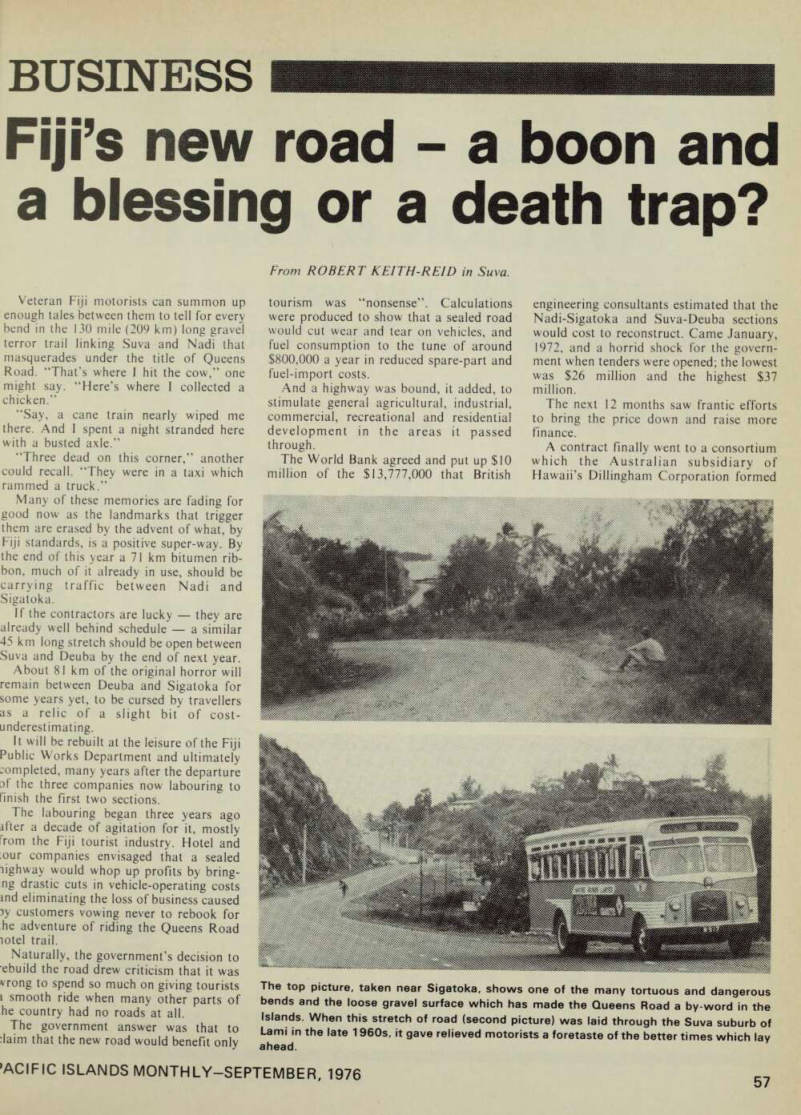


Business
Fiji’s new road - a boon and a blessing or a death trap?
From ROBERT KEITH-REID in Suva.
Veteran Fiji motorists can summon up enough tales between them to tell for every bend in the 130 mile (209 km) long gravel terror trail linking Suva and Nadi that masquerades under the title of Queens Road. “That’s where I hit the cow,” one might say. “Here’s where I collected a chicken.”
“Say, a cane train nearly wiped me there. And I spent a night stranded here with a busted axle.”
“Three dead on this corner,” another could recall. “They were in a taxi which rammed a truck.”
Many of these memories are fading for good now as the landmarks that trigger them are erased by the advent of what, by Fiji standards, is a positive super-way. By the end of this year a 71 km bitumen rib bon, much of it already in use, should be carrying traffic between Nadi and
Sigatoka.
If the contractors are lucky they are already well behind schedule a similar 45 km long stretch should be open between Suva and Deuba by the end of next year.
About 81 km of the original horror will remain between Deuba and Sigatoka for some years yet, to be cursed by travellers as a relic of a slight bit of cost
underestimating.
It will be rebuilt at the leisure of the Fiji Public Works Department and ultimately :ompleted, many years after the departure af the three companies now labouring to finish the first two sections.
The labouring began three years ago ifter a decade of agitation for it, mostly from the Fiji tourist industry. Hotel and our companies envisaged that a sealed lighway would whop up profits by bring ng drastic cuts in vehicle-operating costs ind eliminating the loss of business caused ay customers vowing never to rebook for he adventure of riding the Queens Road lotel trail.
Naturally, the government’s decision to ebuild the road drew criticism that it was vrong to spend so much on giving tourists i smooth ride when many other parts of he country had no roads at all.
The government answer was that to :laim that the new road would benefit only
tourism was “nonsense”. Calculations were produced to show that a sealed road would cut wear and tear on vehicles, and fuel consumption to the tune of around $BOO,OOO a year in reduced spare-part and
fuel-import costs.
And a highway was bound, it added, to stimulate general agricultural, industrial, commercial, recreational and residential development in the areas it passed
through.
The World Bank agreed and put up $lO million of the $13,777,000 that British
engineering consultants estimated that the Nadi-Sigatoka and Suva-Deuba sections would cost to reconstruct. Came January, 1972, and a horrid shock for the govern ment when tenders were opened; the lowest was $26 million and the highest $37 million.
The next 12 months saw frantic efforts to bring the price down and raise more finance.
A contract finally went to a consortium which the Australian subsidiary of Hawaii’s Dillingham Corporation formed
The top picture, taken near Sigatoka, shows one of the many tortuous and dangerous bends and the loose gravel surface which has made the Queens Road a by-word in the Islands. When this stretch of road (second picture) was laid through the Suva suburb of Lami in the late 1960s, it gave relieved motorists a foretaste of the better times which lay ahead.
with two New Zealand companies, Wilkins and Green Ltd.
These “very decently”, as a PWD direc tor of the day commented, agreed to do the job for a mere $2O million.
Latest cost estimates are $4O million thanks to a couple of years of wildfire in flation, and the government has resigned itself to seeing several millions swelling this figure before the contractors leave.
And what are Fiji taxpayers (and tourists) getting for their money?
After the exhilaration of zipping along a short stretch of the product near Suva, one must admit a very nice road.
It’s a 7.5 m-wide carriageway designed to carry vehicles cruising safely at 80.5 km/h. For the most part, it runs straight and true, keeping to the route of the old road along many parts but, in some, departing well inland away from it.
The Nadi-Sigatoka drive has had 26 km lopped off it and the distance between Suva and Deuba is being reduced by several more.
Suva-Deuba driving time will be cut from a hairy 60 minutes to an effortless 35 minutes and time for the Sigatoka-Nadi ride will also be halved.
As a government statement said, “driv ing conditions will be vastly improved”.
This is a definite understatment: com pared with life on the old rough-rider track, conditions will be pure Paradise.
Setting sinful luxury and ease con siderations apart, the rebuilt road should produce several significant economic benefits. Vehicle repair and fuel-burning savings are bound to be far greater than the original $BOO,OOO estimate when ac count is taken of the huge fuel cost and garage repair bill increases that have taken place since its calculation.
Transport of farm and other produce from country areas to markets like Suva and Lautoka will be greatly eased, and this in turn should boost production in the areas feeding them.
The costly job of rebuilding the fragile foundations of the old road after heavy rainfall will be eliminated. And above all, what’s known as the Coral Coast, the tourist playground zone running from Deuba to Sigatoka, will have decent road access to it for the first time.
The new road should bring a significant spurt of extra custom for hotels along the coast, not only from overseas tourists but from locals who, up to now, tend to think twice before submitting their cars to gravel track punishment for the sake of a few hours on a beach.
Suva’s 80,000 people will find the new highway as a special boon as it will be an outlet to Deuba, 48 km away, where the nearest decent beach available to them waits.
Yet the stimulus of the road is not likely
to lead to an immediate rash of new hotel construction.
Fiji is only just beginning to recover from a tourist industry slump and at most times of the year the Coral Coast has more than enough spare beds. Easier access to them will probably first produce dividends in the form of improved room occupancy figures. Established hotels and small weekend cottage retreats are likely to en joy a phase of expansion of their existing rooms and facilities before much in the way of new projects gets underway.
The first hotel to feel the benefit of the rebuilt road is the 312-room Fijian Resort at Yanuca, about 13 km from Sigatoka on the Nadi side.
The Australian-owned 72-room Reef Flotel, 10 km from Sigatoka on the Suva side, is ripe for expansion and its neighbouring Tubukula resort should pick up extra business as well.
Sigatoka itself, a flourishing little market town in its own right, has been struggling to establish itself as the centre for the best duty-free buying bargains in Fiji.
Extra traffic along the new road should make it blossom as such before long and its shopkeepers are already preparing for
the plucking.
The rebuilt section running out of Suva will be a godsend for the mighty Pacific Harbour resort at Deuba, where an inter national consortium has sunk over $3O
million into creating a hotel-villa-golf complex that needs a lot more customers if it’s to become viable.
The decision to defer the reconstruction of the central sections technically the most difficult bit of country along the Queens Road route has left one of Fiji’s best known beach resorts and the first Korolevu, and some of its immediate neighbours out in the dust.
They are about 32 km from either end of the sealed sections and it will be at least five years before the new highway flows past them.
Nevertheless, they are bound to draw extra business from the wave of increased business which the first two sections will generate along the road’s entire length.
The new road will not be a blessing en tirely.
Accustomed to dirt track driving, few Fiji motorists are educated in the different attitudes needed for safe steering along a modern highway.
As the perils of the old Queens Road have not deterred many of them from striving for the Suva-Nadi record, traffic
authorities, recalling some appalling
crack-ups, are shuddering at the thought of what some grand prix aspirants will do when they are let loose on the new road.
Fiji’s police force has mentioned that it is thinking of instituting a highway patrol but has not yet disclosed what it has in mind.
But radar speed traps are bound to be part of the patrol’s equipment and as the absolute speed limit for travel on any Fiji road is 112 km/h there’s not much doubt that traffic courts will be kept busy.
The new road’s construction has not eliminated all the hazards that make travel on the old one an adventure. Blind corners, hairpin bends, and suicide gradients might be going but cattle, pigs, poultry and goats will still wander at will out of villages and settlements along the road. The higher speeds that cars will be reaching will make jaywalking livestock an even greater hazard than before.
And what about the village children?
Safety drill should become an integral part of the curriculum in schools along the way.
Higher speeds could also increase the likelihood of catastrophes between Sigatoka and Nadi at points where sugar cane locomotives drag their 100 metre long line of loaded trucks across the road on the way to Lautoka mill.
Carpenter’s big
spending in Fiji
W. R. Carpenter (South Pacific) Ltd is putting its money where its mouth is in a practical demonstration of the oft repeated
phrase, “Faith in Fiji”. The managing director, Mr Lyle Cupit, recently an nounced a $3.5 million programme for in
dustrial expansion involving shipyard and
ship repair facilities ($1.9 million), heavy
earthmoving equipment sales and servicing
centre ($770,000), erection of a silo for the copra mill ($265,000), and a new showroom and service centre for Suva Motors at Walu Bay ($600,000).
No one will regret the removal of the Suva Motors complex from Victoria Parade to the industrial area. With Suva developing as rapidly as it is there is a de mand for more commercial premises closer to the heart of the city. The Suva Motors office and showroom in Victoria Parade have been acquired by an overseas property developer.
Mr Cupit, announcing the expansion,
said that although the Fiji economy was still burdened with problems of recession, that did not mean commerce should stand still. Carpenters believed Fiji’s economic prospects were good and that commerce could tailor its growth to help meet
development goals.
He said the shipyard would be
dramatically transformed by the installa- r
tion of a syncrolift dry dock system. That' would enable the shipyard to repair as many as 200 ships a year. At present it could handle 50. Ships up to 330 tons
would be lifted from the water by the syn crolift, and transported by rail trolley to the repair areas. The syncrolift would also be used to launch new ships.
The main repair customers will be Japanese, Korean and Taiwanese who operate fishing ships.
The industrial subdivision will be transferred from Walu Bay in Suva to a bigger sales and service centre at Raiwai.
The company expects an expansion of its heavy earth-moving equipment for such projects as the development of the Seaqaqa sugar project, the Nadrau hydro-electricity scheme and forestry plantations.
Tonga’s bank
is doing well
In its first full year of trading, in 1975, the Bank of Tonga earned a net profit of P 373,491. The net profit for the first six months of operation, to December 31, 1974, was P 98,639. The chairman, Mr E.
C. Tait, said the most pleasing feature about the excellent 1975 result was that it was obtained from banking business formerly conducted outside the kingdom.
The Bank of Tonga was now established and providing modern banking facilities for Tonga. The profits were retained in Tonga. In turn, that helped to build up the bank’s strength for the people’s benefit.
The bank now has general reserves of P 325,000 and is building up to a position of solid strength. • Fiji will build a medical training ship with part of a grant of $BOO,OOO from the United Nations Fund for Population Ac tivities. The ship will be used primarily for training medical workers, carrying
teaching and training equipment and
carrying medical staff.
Advertisements & other items, pp. 49-55 (3 items)
49
■ACIFIC ISLANDS MONTHLY-SEPTEMBER, 1976
Watson & Crane
Total service 0 ...
plumbing supplies Tast
are organised to fulfil your needs
wherever you are in the South Pacific u- « You can get all you need from one supply source: water taps, valves, copper tube, tools and a host of other fittings and related plumbing equipment for domestic, industrial and multistorey buildings.
Watson & Crane Pty Ltd have over 20,000 plumbing items in stock at their central warehouse located at Waterloo, NSW, Australia.
Years of experience in handling and shipping right throughout the South Pacific add up to another big reason for you to deal with Watson & Crane Pty Ltd.
Watson & Crane Pty. Ltd. 1037 Bourke Street, Waterloo,
NSW 2017.
Representatives call regularly at New Guinea, Papua, the Solomons, New Hebrides and Frji (stands to personally discuss your requirements and appropriate credit arrangements.
Write, cable or telephone today for complete plumbers' supplies service.
Phone: Sydney 699-1333.
Telex: AA 25548.
Cables: // Watcrane // Sydney.
G.
CRANE
GROUP
Pacific island distributors of Crane Enfield copper tube for water, sanitation, engineering, refrigeration and air conditioning.
EXPORTERS TO THE PACIFIC BLANDS
Breckwoldt & Co Ply Ltd
276 Pitt Street, Box 5027, G.P.O. Sydney 2001
CABLE ADDRESS: BREWO SYDNEY TELEX AA22890
TELEPHONES: 61-7110 61-8674 26-6893
Pacific Island Branches :
P.O. BOX 1549, BOROKO, PORT MORESBY.
P.O. BOX 222, RABAUL P.O. BOX 185, MADANG.
P.O. BOX 72, KIETA. P.O. BOX 237, MT. HAGEN P.O. BOX 178, WEWAK. P.O. BOX 1188, LAE.
BRECKWOLDT & CO., P.O. BOX 47, APIA.
BRECKWOLDT & CO. (5.1.) LTD., P.O. BOX 140, HONIARA.
BRECKWOLDT S.A.R.L. B.P. 2369, NOUMEA.
Offices in Europe: Hamburg. London, Milan and West Africa as well as Singapore. Kuala Lumpur.
Bangkok and Hong Kong.
Enquiries from Australian Manufacturers invited.
A
lM4Vi«y
We can't change
what you pump.
But we can change how
reliably you pump it.
We make mining pumps that have run for days on a snorer full of slurry. Bore-hole pumps that haven’t been lifted in 15 years. Sewerage pumps that are unaffected by wet-strength fibres, pantyhose, nappies or solids up to 6" diameter. And farm-water pumps that deliver town-water pressure or better, 5 miles from the creek. As well as pumps for boiling cheese, grease, acids, cooked fruit and biscuit dough. Or anything else that can be pumped, and a few things other pumps can’t pump.
All of them have one thing in common. In a few years you’ll begin to wonder if your Mono Pump will ever stop pumping. And our pumps are backed by 24 hours a day service from local engineers, factory trained in Australia. We can’t change what you pump, but we can pump it more reliably. 2. nuu •' »»»♦»« 5 6. . T series-mining & foods (Flanges or Tapped Ports) 2. Borehole series 3. Monta Pump-sewerage 4. Mutrator-sewerage 5. ‘o9’ series-farming 6. CP series-light industrial
MON
(AUSTRALIA) PTY. LTD.
Head Office and Works: “Mono House". 338-348 Lower Dandenong Rd, Mordialloc, Vic. 3195. Phone 90-5211.
Agents in all major South East Asian and Pacific areas. r I Please send details of your pumps for (describe purpose): I I 1 1 jlf a Borehole pump, indicate: Approx, depth of bore ...ft.; estimated water level ft.;j I estimated yield J. gph. NAME - J
1 ADDRESS -J
344-P-043
DEMKA (AUSTRALIA)
PTY. LIMITED
SUPPLIES
SOUTH PACIFIC IMPORTERS
WITH...
German agricultural equipment English generators, battery chargers
FRENCH CORNED BEEF and WINES
JAPANESE electrical tools, motor vehicles TAIWANESE decorative plywood Italian LPG stoves, refrigerators DANISH and DUTCH c/othespegs Swedish builders' hardware, bowsaws DUTCH furnishing materials Belgian chocolates, glass ENGLISH concrete mixers GERMAN washing machines. 7 Coggins Place, P.O. Box 340, Mascot, Sydney 2020 Telex: 21416. Telephone: 669 5344 DO APPROACH US BY LETTER, CABLE OR TELEX FOR QUOTATIONS
Wild Heerbrugg
has a lot
of good levels.
W/tm m I ,
■ H - I .
M 111 111 |j I I
- V.-.: 1 ■ I \ I 1
For you the best.
We've many levels. Seven basic models, and even more if you count the versions with and without circle.
There's definitely one to meet your needs.
It may be an automatic (NAKO, NAKI, NA2) or a traditional spirit level (NKOI, N 10, N 2, N 3). Most are available with a circle for turning and setting out angles. And for special jobs, there's a wide range of accessories.
Take a closer look at this range of quality levels from Switzerland. Ask for brochure G 1 906 e and select the model that suits you best. HEERBRUGG [V
WILD (AUSTRALIA) PTY. LTD.
45 ERRING ROAD, NORTH RYDE, N.S.W. 2113. 888 7122 11 BUCHANAN STREET, WEST END, BRISBANE, OLD. 4101. 44 3455 83 - 85 PALMERSTON CRES., STH. MELBOURNE, VIC. 3205. 69 2263 BRIAN BELL & CO. PTY. LTD., BOROKO, T.P.N.G.
ENQUIRIES TO
Western Fuelpump and Injector Services Pty. Ltd. 225-227 Victoria Road, Rydalmere, - OilC llUl a . . enquiries to
Injector S
* 2116 NSW, Australia Telephone: 638 610°
51
ACIFIC ISLANDS MONTHLY-SEPTEMBER, 1976
PNG sees better days
ahead and revalues its kina
Papua New Guinea late in July up valued its currency by 5%, which puts the Australian dollar at 5% lower than the PNG kina.
The revaluation is the first move away from parity with the Australian dollar since PNG cut loose from the Australian monetary system just over six months ago.
The Finance Minister, Mr Julius Chan, who announced the revaluation, said the timing reflected an improving trend in world commodity prices, a stronger balance of payments position, and the prospects of rather more buoyant govern ment revenue. These factors taken together meant it now seemed sensible to make a “small currency adjustment,” Mr Chan said.
Mr Chan conceded that primary ex ports, which form a major part of the in come of rural villagers, would suffer slight ly in kina earned. But the government, ob viously, sees the better world prices on offer recently as offsetting this loss. The gains, which the government sees political ly and economically, will obviously be in the purchasing power of the wage-earning
community.
Consumer markets in PNG still rely heavily on imported foodstuffs, fabrics and materials, and most of the country’s in flationary pressures have in fact come from the rising prices of imported basic commodities.
Mr Chan said the government had been keeping down inflationary pressures by restricting its own expenditure. It had ask ed for sacrifices from the community, and
the response had generally been good. It now seemed appropriate to relax the pressure a little, and the government had decided on the 5% upwards revaluation.
He said that although export producers would suffer some loss on market values, he believed their gain as purchasing con sumers would be significant. In any event, the government proposed a compensation scheme for some producers whose contrac tual positions would involve them in losses because of the revaluation.
The revaluation is part of the basic hard currency strategy which PNG announced it would use when it introduced its own currency 15 months ago. Continuation of the policy was announced last December when PNG cut loose from automatic pari ty with the Australian dollar.
Although there are conflicting opinions from a number of sources about the rate of inflation, there seems little doubt that PNG has been fortunate in its first six months of currency independence.
The situation has not required any par ticular financial wizardry on PNG’s part because of the wide range of external fac tors which have been involved. Nonethe less, the overall picture is seen as reflecting a basic responsibility to financial control which should maintain confidence from outside in PNG commerce and investment.
There’s a sneaking tendency to view the revaluation as a heady piece of new nation advertising. This is not to suggest that the revaluation is ill-founded or motivated purely by politics.
Thanks to increases in the world market prices of some tropical products, there’s every reason to believe that the Kina an old tribal word for shells used as currency is now worth the extra five per cent value the government has given it. But the gains and losses involved in the revaluation seem to cancel out so closely, and the political reactions are so difficult to forecast, that the change seems hardly worth the trouble.
The obvious conclusion is that PNG no doubt with justification is keen to assure the world that its currency is sound and that its management is good. “Only 10 months of political independence, and look where our currency is already,” is the theme of the message.
The opportunity to upvalue within a mere seven months was too good to miss for a new nation seeking to es tablish its reputation. In addition, the fact of being able to call the tune would appear to have ranked high in the government’s decision.
Advertisements & other items, p. 56 (1 item)
congratulates
ir
Rolls-Royce
Air Pacific on their
Silver Jubilee.
Rolls-Royce DART and SPEY engines will provide the power to fly AIR PACIFIC aircraft two million miles this year.
Rolls-Royce (1971) Limited Norfolk House,St. James’s Square, London SWIY 4JR, England.
ROIIS
1
ROYCE
Weren’T All Smooth Flying
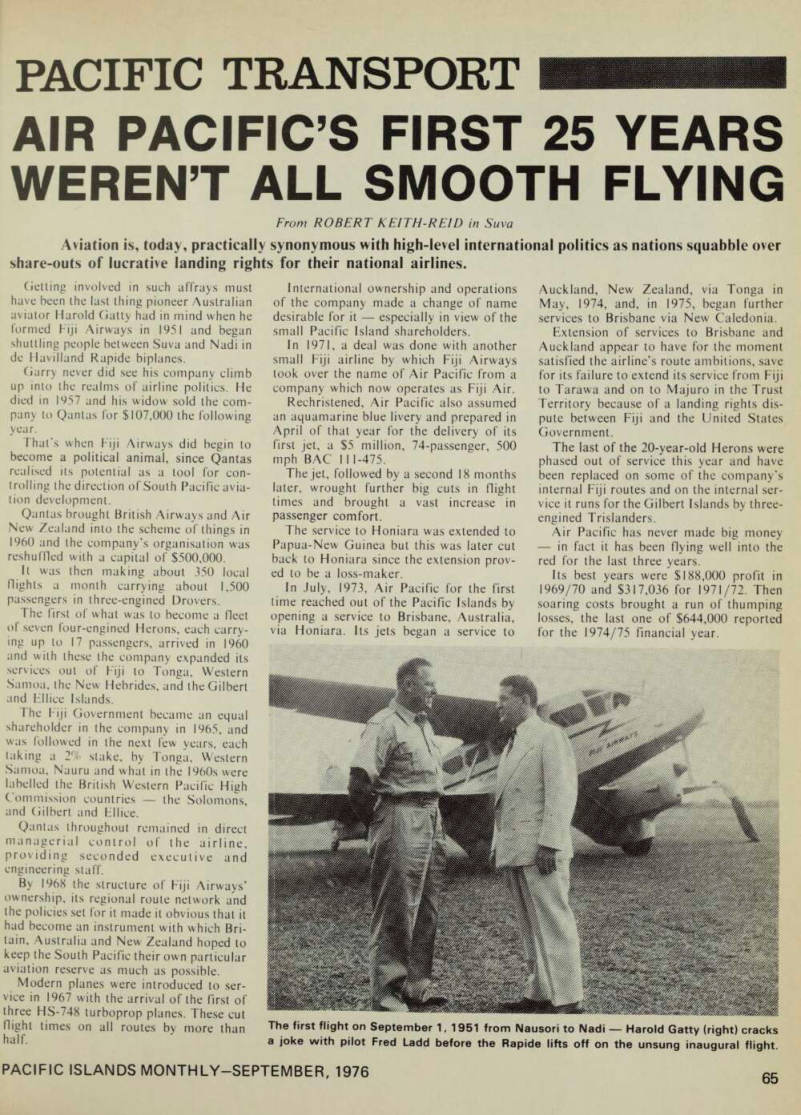
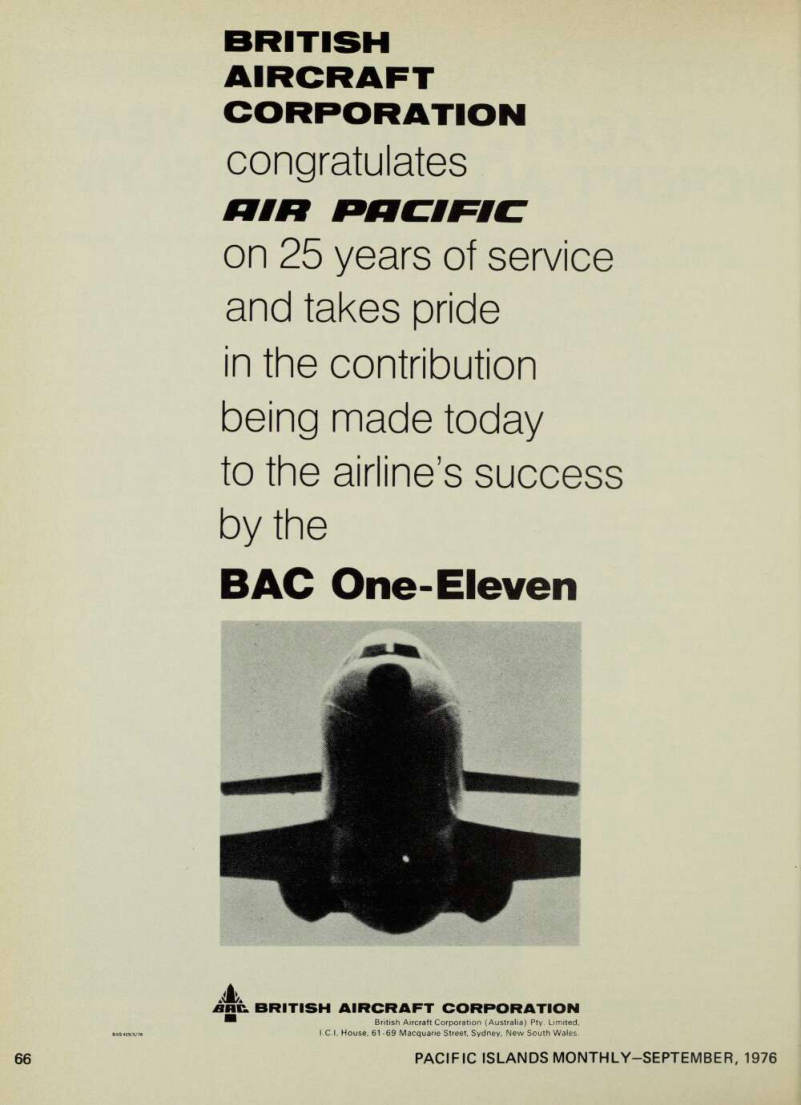
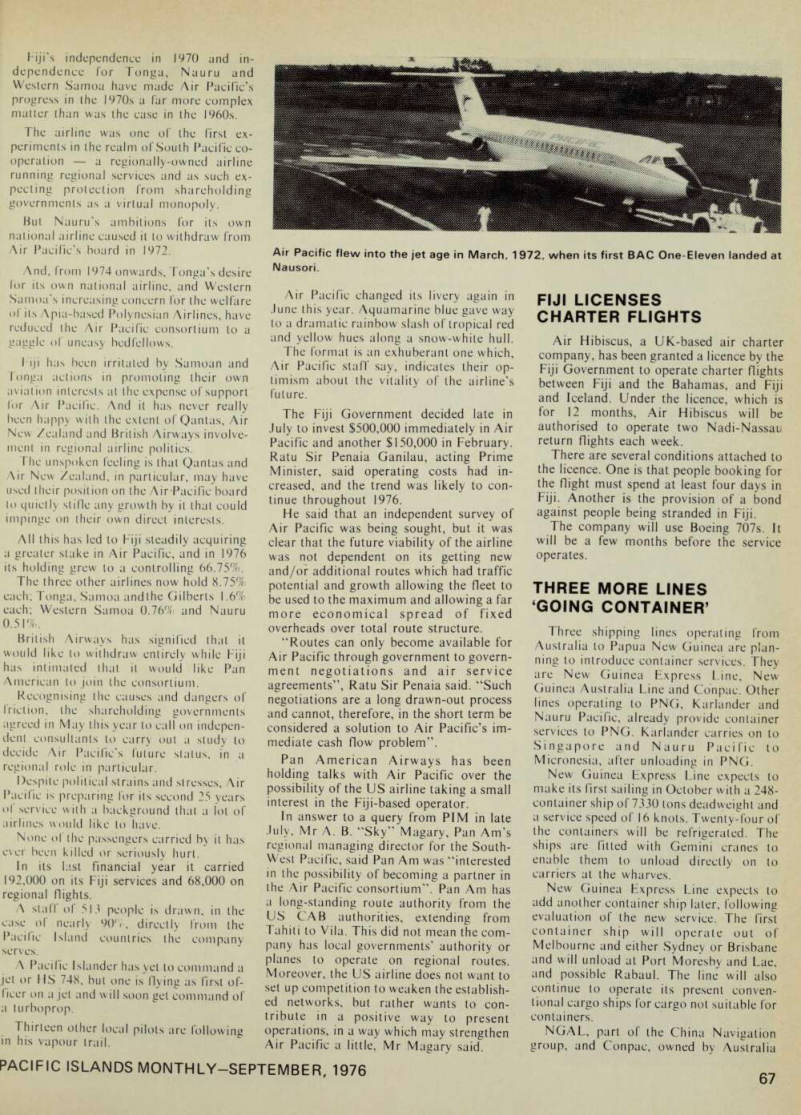
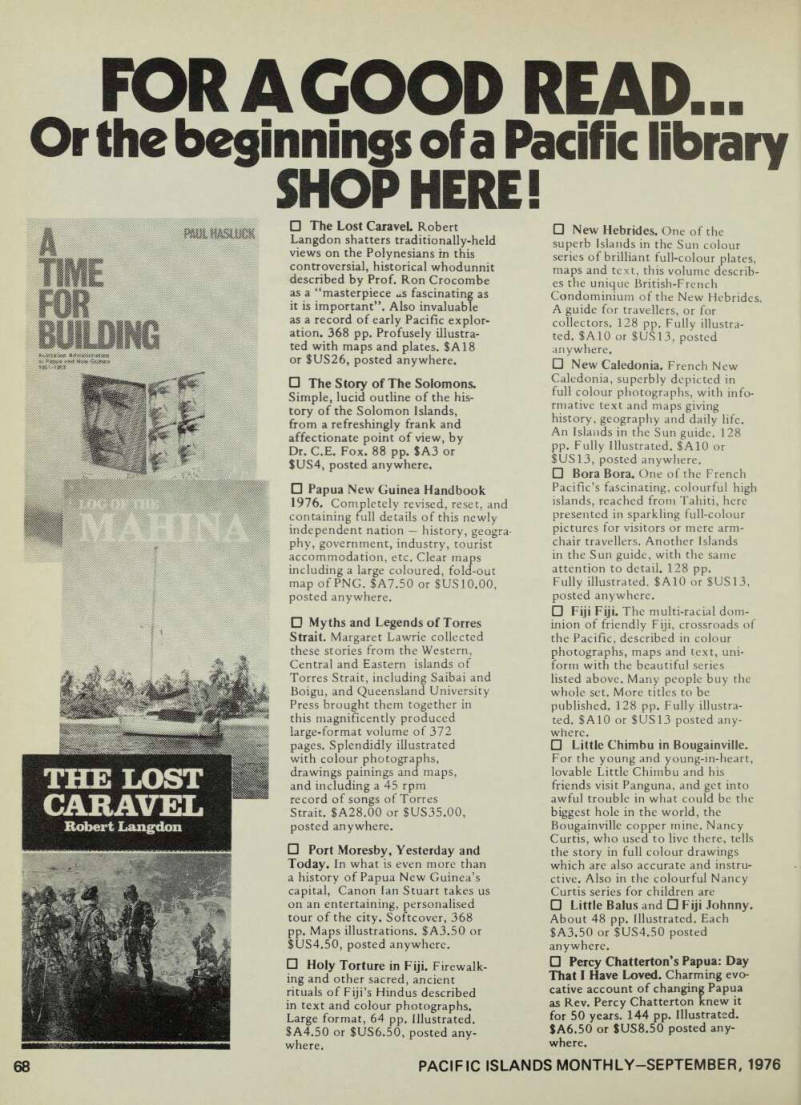
Pacific Transport
Air Pacific’S First 25 Years
From ROBERT KEITH-REID in Suva Aviation is, today, practically synonymous with high-level international politics as nations squabble over share-outs of lucrative landing rights for their national airlines.
Getting involved in such affrays must have been the last thing pioneer Australian aviator Harold Galty had in mind when he formed Fiji Airways in 1951 and began shuttling people between Suva and Nadi in dc Havilland Rapide biplanes.
Garry never did see his company climb up into the realms of airline politics. He died in 1957 and his widow sold the com pany to Qanlas for $107,000 the following year.
Thai's when Fiji Airways did begin to become a political animal, since Qantas realised its potential as a tool for con trolling the direction of South Pacific avia
tion development.
Qantas brought British Airways and Air New Zealand into the scheme of things in 1960 and the company's organisation was reshuffled with a capital of $500,000.
It was then making about 350 local flights a month carrying about 1,500 passengers in three-engined Drovers.
The first of what was to become a fleet of seven four-engined Herons, each carry ing up to 17 passengers, arrived in 1960 and with these the company expanded its services out of Fiji to Tonga, Western Samoa, the New Hebrides, and the Gilbert and Ellice Islands.
The Fiji Government became an equal shareholder in the company in 1965, and was followed in the next few years, each taking a 2% slake, by Tonga, Western Samoa, Nauru and what in the 1960 s were labelled the British Western Pacific High Commission countries the Solomons, and (filbert and Ellice.
Qanlas throughout remained in direct managerial control of the airline, providing seconded executive and
engineering staff.
By 1968 the structure of Fiji Airways’ ownership, its regional route network and the policies set for it made it obvious that it had become an instrument with which Bri tain, Australia and New Zealand hoped to keep the South Pacific their own particular aviation reserve as much as possible.
Modern planes were introduced to ser vice in 1967 with the arrival of the first of three HS-748 turboprop planes. These cut flight times on all routes by more than half.
International ownership and operations of the company made a change of name desirable for it especially in view of the small Pacific Island shareholders.
In 1971, a deal was done with another small Fiji airline by which Fiji Airways look over the name of Air Pacific from a company which now operates as Fiji Air.
Rechristened, Air Pacific also assumed an aquamarine blue livery and prepared in April of that year for the delivery of its first jet, a $5 million, 74-passenger, 500 mph BAG 111-475.
The jet, followed by a second 18 months later, wrought further big cuts in flight times and brought a vast increase in passenger comfort.
The service to Honiara was extended to Papua-New Guinea but this was later cut back to Honiara since the extension prov ed to be a loss-maker.
In July, 1973, Air Pacific for the first time reached out of the Pacific Islands by opening a service to Brisbane, Australia, via Honiara. Its jets began a service to
Auckland, New Zealand, via Tonga in May, 1974, and, in 1975, began further services to Brisbane via New Caledonia.
Extension of services to Brisbane and Auckland appear to have for the moment satisfied the airline’s route ambitions, save for its failure to extend its service from Fiji to Tarawa and on to Majuro in the Trust Territory because of a landing rights dis pute between Fiji and the United States Government.
The last of the 20-year-old Herons were phased out of service this year and have been replaced on some of the company's internal Fiji routes and on the internal ser vice it runs for the Gilbert Islands by three engined Trislanders.
Air Pacific has never made big money in fact it has been flying well into the red for the last three years.
Its best years were $lBB,OOO profit in 1969/70 and $317,036 for 1971/72. Then soaring costs brought a run of thumping losses, the last one of $644,000 reported for the 1974/75 financial year.
The first flight on September 1. 1951 from Nausori to Nadi - Harold Gatty (right) cracks a joke with pilot Fred Ladd before the Rapide lifts off on the unsung inaugural flight.
Fiji’s independence in 1970 and in dependence for Tonga, Nauru and Western Samoa have made Air Pacific’s progress in the 1970 s a far more complex matter than was the case in the 19605.
The airline was one of the first ex periments in the realm of South Pacific co operation a regionally-owned airline running regional services and as such ex
pecting protection from shareholding
governments as a virtual monopoly.
But Nauru’s ambitions for its own national airline caused it to withdraw from Air Pacific’s board in 1972.
And, Irom 1974 onwards, Tonga's desire for its own national airline, and Western Samoa's increasing concern for the welfare ol its Apia-based Polynesian Airlines, have reduced the Air Pacific consortium to a gaggle of uneasy bedfellows.
Fiji has been irritated by Samoan and Tonga actions in promoting their own aviation interests at the expense of support for Air Pacific. And it has never really been happy with the extent of Qanlas, Air New Zealand and British Airways involve ment in regional airline politics.
The unspoken feeling is that Qanlas and Air New Zealand, in particular, may have used their position on the Air-Pacific board to quietly stifle any growth by it that could impinge on their own direct interests.
All this has led to Fiji steadily acquiring a greater slake in Air Pacific, and in 1976 its holding grew to a controlling 66.75%.
The three other airlines now hold 8.75% each: Tonga, Samoa andlhe Gilberts 1.6% each; Western Samoa 0.76% and Nauru 0.51%.
British Airways has signified that it would like to withdraw entirely while Fiji has intimated that it would like Pan American to join the consortium.
Recognising the causes and dangers of friction, the shareholding governments agreed in May this year to call on indepen dent consultants to carry out a study to decide Air Pacific's future status, in a regional role in particular.
Despite political strains and stresses. Air Pacific is preparing for its second 25 years ol service with a background that a lot of airlines would like to have.
None ol the passengers carried by it has ever been killed or seriously hurl.
In its last financial year it carried 192,000 on its Fiji services and 68,000 on
regional flights.
A stall ol 513 people is drawn, in the case ol nearly 90%, directly from the Pacific Island countries the company serves.
A Pacific Islander has yet to command a jet or HS 748, but one is Hying as first of ficer on a jet and will soon get command of
a turboprop.
Thirteen other local pilots are following in his vapour trail.
Air Pacific changed its livery again in June this year. Aquamarine blue gave way to a dramatic rainbow slash of tropical red and yellow hues along a snow-white hull.
The format is an exhuberant one which, Air Pacific staff say, indicates their op timism about the vitality of the airline’s future.
The Fiji Government decided late in July to invest $500,000 immediately in Air Pacific and another $150,000 in February.
Ratu Sir Penaia Ganilau, acting Prime Minister, said operating costs had in creased, and the trend was likely to con tinue throughout 1976.
He said that an independent survey of Air Pacific was being sought, but it was clear that the future viability of the airline was not dependent on its getting new and/or additional routes which had traffic potential and growth allowing the fleet to be used to the maximum and allowing a far more economical spread of fixed overheads over total route structure.
“Routes can only become available for Air Pacific through government to govern ment negotiations and air service agreements”, Ratu Sir Penaia said. “Such negotiations are a long drawn-out process and cannot, therefore, in the short term be considered a solution to Air Pacific’s im mediate cash flow problem”.
Pan American Airways has been holding talks with Air Pacific over the possibility of the US airline taking a small interest in the Fiji-based operator.
In answer to a query from PIM in late July, Mr A. B. “Sky” Magary, Pan Am’s regional managing director for the South- West Pacific, said Pan Am was “interested in the possibility of becoming a partner in the Air Pacific consortium”. Pan Am has a long-standing route authority from the US CAB authorities, extending from Tahiti to Vila. This did not mean the com pany has local governments' authority or planes to operate on regional routes.
Moreover, the US airline does not want to set up competition to weaken the establish ed networks, but rather wants to con tribute in a positive way to present operations, in a way which may strengthen Air Pacific a little, Mr Magary said.
Fiji Licenses
Charter Flights
Air Hibiscus, a UK-based air charter company, has been granted a licence by the Fiji Government to operate charter flights between Fiji and the Bahamas, and Fiji and Iceland. Under the licence, which is for 12 months, Air Hibiscus will be authorised to operate two Nadi-Nassau return flights each week.
There are several conditions attached to the licence. One is that people booking for the flight must spend at least four days in Fiji. Another is the provision of a bond against people being stranded in Fiji.
The company will use Boeing 7075. It will be a few months before the service operates.
Three More Lines
‘Going Container’
Three shipping lines operating from Australia to Papua New Guinea are plan ning to introduce container services. They are New Guinea Express Line, New Guinea Australia Line and Conpac. Other lines operating to PNG, Karlander and Nauru Pacific, already provide container services to PNG. Karlander carries on to Singapore and Nauru Pacific to Micronesia, after unloading in PNG.
New Guinea Express Line expects to make its first sailing in October with a 248container ship of 7330 tons deadweight and a service speed ol 16 knots. Twenty-four of the containers will be refrigerated. The ships are fitted with Gemini cranes to enable them to unload directly on to carriers at the wharves.
New Guinea Express Line expects to add another container ship later, following evaluation of the new service. The first container ship will operate out of Melbourne and either Sydney or Brisbane and will unload at Port Moresby and Lae, and possible Rabaul. The line will also continue to operate its present conven tional cargo ships for cargo not suitable for containers.
NGAL, part of the China Navigation group, and Conpac, owned by Australia
Air Pacific flew into the jet age in March, 1972, when its first BAC One-Eleven landed at Nausori.
West Pacific Line and Burns Philp, will charter two container ships, which are now being built in Japan by Miko Shipyard Co Ltd, Tokyo, for a Swire company. They will operate the ships, which will cost about $5 million each, as a joint venture.
The first ship is expected to go into service about July, 1977, and the second about two months later.
Each ship will carry 320 containers (20 ft x 8 ft x 8 ft). There will be 40 refrigerated containers on each voyage.
The overall investment in the two ships will be about $2O million. The $5 million cost of each ship does not include transverse gantry cranes, containers and other equip ment required for container ships. It will be necessary to have 960 containers for each ship 320 being loaded in Australia while the ships are in transit and carrying 320, and 320 at Port Moresby and Lae be ing unloaded and awaiting return to Australia.
The NGAL-Conpac ships will operate from Sydney and Brisbane. Conpac is almost certain to withdraw the Nimos, and NGAL could withdraw one of the three ships at present on the service. However, conventional cargo ships will still be re quired to operate from Melbourne, and to serve PNG ports, other than Port Moresby, and Lae and also the Solomons.
It is possible another container ship will be ordered to replace a conventional cargo
ship operating out of Melbourne.
However, that move is unlikely before there is a complete assessment of the con tainer services.
The container ships are being introduced in an effort to contain costs, and stop them rising as sharply as they have in the last two or three years.
Unloading the container ships at Port Moresby may present some technical problems because of lack of space for big vehicles to manoeuvre easily. Lae and Rabaul are well-equipped to handle con tainer ships.
Dock Strike
Threatened In Png
The Central District Waterside Workers’ Union in Papua New Guinea threatened to stop work early in August unless Steamships Trading Co recon sidered a decision to suspend three members of the union. The union secretary, Mr R. McAlister, said the com pany had one to two weeks to reconsider its decision. He claimed Steamships Trading had refused to carry out a decision of a Department of Labour officer, who recommended the three men be reinstated.
The award, handed down recently, provid ed that a suspension be investigated by an officer of the department, and that on his recommendation a worker be reinstated or dismissed.
More Talk About
A Regional Airline
The South Pacific Air Transport Coun cil, meeting recently in Suva, agreed that South Pacific air routes should be rationalised, but will Nauru, Western Samoa and Tonga go along with the idea?
Papua New Guinea’s Transport Minister, Mr Bruce Jephcott, simply summed up the case for rationalisation the South Pacific region did not have enough people or cargo for intensive competition.
The council discussed the possibility ol setting up a single regional airline for the South Pacific and the possibility of stan dardising aircraft and facilities. But against that ideal this sort of thing is going on: • South Pacific Airways, of American Samoa, is seeking rights for a direct link between Vavau and Pago Pago; • Polynesian Airlines, encouraged by Tonga, is pushing for a service to New Zealand, via Tonga, which would compete on the Tonga-Auckland “leg” with Air Pacific; • Air Nauru, with a fleet of four jet aircraft is operating an extensive network in the Pacific, but competition with Air Pacific is minimal; • The Cook Islands, after initial qualms, wants to get into the South Pacific
network through Polynesian Airlines ser vices from Western Samoa and Niue to Rarotonga.
But Polynesian Airlines has run into a snag over rights in New Zealand. High level talks between civil aviation officials from New Zealand and Western Samoa were held recently to discuss technical issues rising from a NZ National Airways Corporation report on a proposal to ex pand Polynesian Airlines.
Figures showed that in the last six years, traffic between Pago Pago and Auckland comprised mainly people from Western Samoa, carried by Air New Zealand or
Paa.
South Pacific Island Airways of American Samoa is after a two-flights-a week service from Pago Pago to Vavau and then to Nukualofa, using a Cessna air craft, equipped to carry seven passengers.
Mr George Wray, president of SPIA, recently went to Tonga to discuss the proposed service with King Taufa’ahau
Tupou.
Mr Jephcott’s comments were highly relevant, for Air Niugini, while having a few troubles itself, does not compete with other airlines in the Islands, although in time it may seek to extend its services.
Air Niugini will soon have to decide whether to continue its “wet lease” charter of a Boeing 7208 from Tempair for its in ternational services. The lease is due to ex pire in February, 1977, but PNG has to give the airline six months notice of renewal or termination. Air Niugini has had informal talks with Qantas about buy ing a Boeing 707. Qantas is phasing out its 707 s in favour of the larger jumbo 7475.
Air Niugini also, recently, dispensed with the services of its Sydney-based advertising agent, Hansen Rubensohn- McCann Erickson Pty Ltd. It was a K 250,000 annual account. A spokesman for Air Niugini said the airline was not satisfied with the agency which previously held the account. Air Niugini will expand its public relations staff to take advertising
responsibility.
Jal Offers
Planes To Tonga
King Taufa’ahau Tupou, of Tonga, is again flirting with Japan Airlines. He said late in July that Mr Manichi Matsumoto, a prominent Japanese businessman, told him it would be beneficial to Japan Airlines and to Tonga to have two DC9s readily available to cater for the demands of Japanese tourists wishing to get from Fiji to Tonga.
Japan Airlines intended to resume a jumbo jet service for tourists into Fiji in September. Many of those tourists were expected to visit Tonga. The king said Mr Matsumoto told him the airline company
would provide four pilots, as well as a team of mechanics and stewardesses to serve the operations in Tonga. The airline would train Tongan hostesses to take over from the Japanese.
The king also said Mr Matsumoto had made a special trip to Tonga to tell him of Japan Air Lines’ offer. The airline was prepared to provide prefabricated buildings to accommodate the Japanese pilots, mechanics and stewardesses. It was interested in building a new hotel either in Pelehake or on Fua’amotu beach to cater for the demand for accommodation.
Fiji's Prime Minister, Ratu Sir Kamisese Mara, commenting on the suggestion, said he was “puzzled” that Japan Air Lines thought two DC9s, each with 100-seat capacity, could operate economically between Fiji and Tonga. He said Fiji would have to examine the ques tion of landing rights at Nadi and Suva if the proposal went ahead. Fiji had a “gentlemen’s agreement” with Tonga about landing rights. A regular tourist shuttle between Fiji and Tonga would take business away from the struggling Air Pacific.
Advertisements & other items, pp. 58-64 (2 items)
British
AIRCRAFT
CORPORATION
congratulates aia pacific on 25 years of service and takes pride in the contribution being made today to the airline’s success by the BAC One-Eleven ■ A.
■HUE. BRITISH AIRCRAFT CORPORATION
* British Aircraft Corporation (Australia) Pty. Limited, bas429/S/76 1.C.1. House, 61 -69 Macquarie Street, Sydney, New South Wales.
FOR A GOOD READ...
Or the beginnings of a Pacific library
SHOP HERE!
I V □ The Lost CaraveL Robert
Langdon shatters traditionally-held
views on the Polynesians in this controversial, historical whodunnit described by Prof. Ron Crocombe as a “masterpiece us fascinating as it is important”. Also invaluable as a record of early Pacific exploration. 368 pp. Profusely illustrated with maps and plates. SAIB or SUS 26, posted anywhere. □ The Story of The Solomons.
Simple, lucid outline of the history of the Solomon Islands, from a refreshingly frank and affectionate point of view, by Dr. C.E. Fox. 88 pp. SA3 or SUS 4, posted anywhere. □ Papua New Guinea Handbook 1976. Completely revised, reset, and containing full details of this newly
independent nation history, geogra-
phy, government, industry, tourist
accommodation, etc. Clear maps including a large coloured, fold-out map of PNG. 5A7.50 or SUSIO.OO,
posted anywhere.
□ Myths and Legends of Torres Strait. Margaret Lawrie collected these stories from the Western, Central and Eastern islands of Torres Strait, including Saibai and Boigu, and Queensland University Press brought them together in
this magnificently produced
large-format volume of 372 pages. Splendidly illustrated with colour photographs, drawings painings and maps, and including a 45 rpm record of songs of Torres Strait. 5A28.00 or 5U535.00,
posted anywhere.
□ Port Moresby, Yesterday and Today. In what is even more than a history of Papua New Guinea’s capital, Canon lan Stuart takes us
on an entertaining, personalised
tour of the city. Softcover, 368 pp. Maps illustrations. 5A3.50 or
SUS4.SO, posted anywhere.
□ Holy Torture in Fiji. Firewalking and other sacred, ancient rituals of Fiji’s Hindus described in text and colour photographs.
Large format, 64 pp. Illustrated. 5A4.50 or SUS6.SO, posted anywhere. □ New Hebrides. One of the superb Islands in the Sun colour series of brilliant full-colour plates, maps and text, this volume describes the unique British-French Condominium of the New Hebrides.
A guide for travellers, or for collectors. 128 pp. Fully illustrated. SAIO or SUSI 3, posted anywhere. □ New Caledonia. French New Caledonia, superbly depicted in full colour photographs, with informative text and maps giving history, geography and daily life.
An Islands in the Sun guide. 128 pp. Fully Illustrated. SAIO or SUSI 3, posted anywhere. □ Bora Bora, One of the French
Pacific’s fascinating, colourful high
islands, reached from Tahiti, here presented in sparkling full-colour pictures for visitors or mere armchair travellers. Another Islands in the Sun guide, with the same attention to detail. 128 pp.
Fully illustrated. SAIO or SUSI 3,
posted anywhere.
□ Fiji Fiji. The multi-racial dominion of friendly Fiji, crossroads of the Pacific, described in colour photographs, maps and text, uniform with the beautiful series listed above. Many people buy the whole set. More titles to be published. 128 pp. Fully illustrated. SAIO or SUSI 3 posted anywhere. □ Little Chimbu in Bougainville.
For the young and young-in-heart, lovable Little Chimbu and his friends visit Panguna, and get into awful trouble in what could be the biggest hole in the world, the Bougainville copper mine. Nancy Curtis, who used to live there, tells the story in full colour drawings which are also accurate and instructive. Also in the colourful Nancy Curtis series for children are □ Little Balus and □ Fiji Johnny.
About 48 pp. Illustrated. Each 5A3.50 or SUS4.SO posted
anywhere.
□ Percy Chatterton’s Papua: Day That I Have Loved. Charming evocative account of changing Papua as Rev. Percy Chatterton knew it for 50 years. 144 pp. Illustrated. 5A6.50 or SUSB.SO posted anywhere.
□ Colonial Era Cemetery of Norfolk Island. Former Administrator of the island, R. Nixon Dalkin, describes life and death in what was Britain’s harshest Pacific penal colony. There are illuminating, often moving stories in these photographs, charts and inscriptions that describe the historic cemetery. Large format, 92 pp.
Illustrated. SAS or SUS7.SO, posted anywhere. □ Marine Shells of the Pacific.
Walter Cernohorsky describes in detail with clear photographs 440 Pacific shells, and tells how to find, arrange and photograph a collection. 248 pp. Illustrated. SAIO or SUSIS, posted anywhere. □ Marine Shells of the Pacific Volume 11. Walter Cernohorsky carries on where his first book leaves off, with a further 600 species fully described and illustrated: Some of the 68 full-page plates are in colour. 412 pp. Illustrated. SAI7 or SUS2S, posted anywhere. □ Friendly Island. Warm account of life in Tonga, sunlit South Pacific island kingdom, by Patricia Ledyard, who has lived in a Tongan harbourside village for more than 20 years. Paperback, 215 pp. lA3 or SUS4.SO, posted anywhere. □ Plants and Flowers of Tahiti.
Full colour photographs of the rich and beautiful Tahitian flora, classified by scientific names, and by French, English and Tahitian common names, 144 pp. Fully Ilustrated. SAS or SUS 7, posted mywhere, 3 Birds of Tahiti, A companion volume to Plants and Flowers of
fahiti. Full colour photographs
nd descriptions, for collectors or
or amateur birdwatchers, visitors
nd students needing easy identfication. 112 pp. Fully illustrated.
A 5 or SUS 7, posted anywhere. 3 Tahiti: Island of Love. In this book, he author of The Lost Caravel resents the vivid, colourful history f Tahiti from its discovery by Europeans to modem times. -minently readable, now in its Durth edition. 284 pp. Illustrated.
A 4.50 or SUS6.OO posted ny where.
3 im’s
TIRIL ORD€R
BOOKSHOP
□ A Time For Building. Nobody but Sir Paul Hasluck,Australian Minister responsible for Papua New Guinea for 13 unprecedented years to 1963, can reveal just what happened m PNG in that vital period.
He tells it frankly, critically, in this book just published by Melbourne University Press. It’s as essential as it is readable, so the publishers have put a special stock aside for PlM’s mail order customers. 452 pp. Illustrated. 5A17.00 or SUS 21,00, posted anywhere. □ Log of the Mahina:A Tale of the South Pacific. Young American John Neal took his 27ft. yacht from Seattle on an 18 months cruise through Polynesia and then wrote about it. This
delightfully refreshing book abounds
with information on how to get there and what to do when you are there.
John Neal learned it the hard way and shares his experiences with enthusiasm Required reading for all yachties venturing into Polynesia’s dangers and pleasures physical and romantic. 280 pp. Illustrated 5A6.00 or SUS7.SO, postea anywhere. □ Say It In Fijian. Dr. A.J.Shutz presents a pocket-sized, entertaining guide to the Fijian language for those making their first contact with Fiji. 5A2.00 or SUS3.OO, posted anywhere. □ Say It In Motu, In the same series, Dr. Percy Chatterton provides an instant introduction to one of the three official languages of Papua New Guinea; the common tongue of the streets and markets of Port Moresby. 5A2.00 or SUS3.OO, posted anywhere. □ Rambler’s Guide to Norfolk Island. Merval Hoare tells you what to see, and why, on this historic island first colonised by Britain in 1788, and now the home of the descendants of the “Bounty” mutineers. Includes detailed sectional and fold-out maps. 80pp.
Illustrated. SA3 or SUS 4, posted anywhere. □ Queen Emma. R.W. Robson presents drama, comedy, high adventure in this true story of “Queer Emma”, the Polynesian-American girl who met 19th century New Guinea on its own tough terms. 239 pp. illustrated. SA6 or SUSB, posted anywhere. □ Folkloric in Australia, Dance expert Beth Dean and photographer Stan Goik present the beauty and vitality of national folk dances brought to Australia from Europe and elsewhere in this superb book of colour photographs and brilliant text. Large format, 88 pp.
Illustrated. 5A3.50 or SUSS posted anywhere.
WiMSSL
MARINE SHELLS
OF THE PACIFIC
Volume II HI in
SAY
IT IN horsky HI
FIJIAN
HI 111 ill 111 Ml ll* ill 111 ill in 511
11 I■l 1 I 111 11 1 1 I I I I 1U J i-i-i LL Under Construction Ljr m * g ♦ • Address: m son steel'personnel bunch for eiter-isbnd service powered by twin 3160 caterpllar diesei engines. 1 1 11 111 I 1 1 I c
BUILT TO
EARN A LIVING
MARINE - STRUCTURAL *- FOUNDRY
REFRIGERATION - ELECTRICAL - AIRCONDITIONING
METALOCK CASTINGS REPAIR
JOINERY - GLAZING - FURNITURE
UPHOLSTERY - CANVASWORK
SHEETMETAL WORK - ELECTROPLATING
CARPENTERS INDUSTRIAL
GPO Box 296. SUVA. FIJI
m Please send me further information, on Carpenters Slupoulding I maintenance ana repars.
IN OUSTRIAL.
More than 40 airlines have
found a way to help improve
their profit picture.DG9.
Twin-engine fuel economy. Self-contained stair and APU. Lower landing fees. High utilization capability.
High passenger capacity, 99% on-time departure rates.
Low crew costs.
For passengers the DC-9 means quicker tum-around times and more convenience.
For airlines, the DC-9 means a good business investment. ew DC-9. The Series 50.
It's designed for routes where traffic is on the upswing.
4
Bitzer, the chilling best seller
Bonaire Industries are proud to offer famous Bitzer Refrigerating Compressors.
Constructed according to the ‘Counter Flow Principle’, Bitzer have the benefit of more than 30 years experience in the Compressor field. They can be seen operating in cooling, freezing and air-conditioning plants in vastly differing conditions and climates throughout 80 countries of the world.
Bitzer have an extensive and versatile range of Compressors, offering belt and direct drive, compatibility with Refrigerants Rl2, R22and R 502 and skilfully engineered parts for optimum efficiency under extreme conditions.
These and many more examples of technical excellence may be studied with all the relevant dats and specifications in a pamphlet from the distributor.
Bonaire Industries Ltd, Phone 760-023, Box 4011, Auckland.
Phone 36-088, Box 976, Dunedin.
COMMERCIAL
DIVISION
61
ACIFIC ISLANDS MONTHLY-SEPTEMBER, 1976
Transport Briefs
• The China Navigation Co is running a monthly cargo service from New Zealand to Lae with ships returning to Japan. The ships, Poyang, Baynunah and Shansi, sail from Japan to New Zealand.
After unloading in NZ, they pick up cargo for Lae. At Lae, after unloading NZ cargo, they pick up cargo for Japan and NZ. • A 40ft passenger launch, the Ngaluta’ane, has been added to Tonga’s merchant fleet. She will run between Nukualofa and Eua, carrying up to 50 passengers a trip. The launch was built in Brisbane and given to Tonga under the Australian aid programme. • Sofrana-Unilines will have another ship on its Pacific cargo routes in October or November. It recently bought the Bourgogne, 2,500 tonnes, in Norway. The ship has been renamed Capitaine Ker madec, after another cargo ship which sail ed under the Sofrana-Unilines flag a few years ago. The line expects soon to allocate routes for the Capitaine Kermadec. • The Papua New Guinea Government has given Indonesia landing rights at Port Moresby. This will allow Garuda, the national airline of Indonesia, to operate a Biak-Port Moresby return service. In return, Indonesia has agreed that in a year Air Niugini will be given the right to operate between Port Moresby and Jakar ta, Air Niugini now operates between Port Moresby and Jayapura in Irian Jaya.
Cruising

Yachts
• MAJANDO, 40 ft trimaran registered at Wellington, NZ, arrived at Rarotonga from Wellington on July 15 on a three to four months Pacific cruise and bound for Papeete.
On board were owner-skipper Douglas Barry- Martin who designed and built the yacht (with help from friends), Rick McKenzie, Mark Fenton, Maurice Saunderson and John Leniston. An unusual feature of the tri's design are the canted outrigger hulls which give increased stability and a more efficient weather helm. • WANDERER IV, 46 ft ketch registered at Southampton, UK, arrived at Rarotonga from Papeete and Bora Bora on July 14 with owner-captain Eric Hiscock and his wife, Susan. Mr Hiscock, a well known author of books on sailing, was in Rarotonga in June, 1960, in his previous yacht, WANDERER 111. The Hiscocks left in Wanderer IV for Fiji and New Zealand on July 20. • SEATRAIN, 31 ft ketch registered in Los Angeles, arrived at Rarotonga on July 19 from Papeete, bound for Tonga or ith James and Linda Godber. They had caneu at Honolulu, Bora Bora, Raiatea and Huahine. • SOLENT DOVE, 20ft Bins sloop from Cowes, Isle of Wight, arrived at Rarotonga on July 19 with Peter Barnes and Valerie Bouladon. Their last port of call was Bora Bora and they were bound for Niue Island. • QUINQUEREME, 42 ft Buchanan design wood ketch built in 1963 in the United Kingdom, left England in August, 1975, with New Zealanders Rod Moody, Pat McLean, Julia Brooke-White, and 5-year-old Echo Brooke-White. After visiting the Mar quesas and Tuamotus, they arrived in Tahiti mid-June with plans to stay in French Polynesia until the end of July, then continue their trip home to New Zealand. • REGENTAG, 60ft wooden gaff rigged ketch built in 1910 in Sicily as a salt and sand cargo ship, left Venice in August, 1975, for New Zealand. She arrived in Tahiti on June 24 for a three-month visit with Jacqueline and Hoest Wachter making the delivery for owner Freidensreich Hundertwasser, a famous Austrian artist who is going to New Zealand to live. The 40 ton boat was purchased 10 years ago by Hundertwasser and completely remodelled.
The colours of Regentac, which means rainy day in German, reflect the art of the owner there are brown and white stripped sails, a
red topsail flies on the mainmast and a blue sail on the mizzen, while the boat is painted various colors. • SUZY Q, 1938 Alden ketch from Portland, Oregon, left Coos Bay, Oregon in December, 1975, with owner Omar Hansen singlehanding. A mountain-climber who has opened new trails in Alaska and the northwest US Omar sailed to the Marquesas and Tuamotus before arriving in Tahiti in June. His plans were to cruise French Polynesia then go to New Zealand and Australia. • TROUBADOR, a 41 ft Imperial ketch from San Francisco, spent a short time in Tahiti in transit from New Zealand to Hawaii on a voyage that has taken her crew from California to the Marquesas, Tuamotus, Tahiti, Rarotonga, Fiji, Tonga and Samoa, then on to New Zealand where they stayed several months. The Shoaf family of Jug, Lou, sons Doug and John arrived in Tahiti for their second visit in May. From there Lou and John flew home for the wedding of daughter Diane. Jug, Doug and two crew members Clay Forbes and Charlie Peet were returning Troubador to Hawaii via the Tuamotus.
• Trimaran Pistachio. 55 Ft, Was
at Lautoka recently in the course of a round the-world cruise, carrying owner Robert Law, his wife Marge and dog Salty. Mr Law is an aircraft pilot from California. Before arriving in Fiji the trimaran cruised in American Samoa and Wallis Island waters. She is made of fibreglass and latex foam. • FIREBIRD, 85 ft clipper, was in Fiji in July carrying a crew of four, including skipper Bob Bucknell. The clipper was built in Wisconsin for Mr Sam Rehnborg, and cost more than SUSI million. She has a 320 hp diesel engine, a 320 kw generator, radio and radar. • LUTE SONG 11, 38 ft cutty hunk, arrived at Port Moresby in July from Vila, en route to Bali, carrying David and Ann Harris.
The yacht sailed from England for Spain, and cruised through various islands in the Atlan tic before arrival in the Pacific. • WILLIWAW, 31 ft American hydrofoil trimaran, arrived at Rarotonga from Auckland on June 23 with David Keiper, master, and Chris Cinders, and left for Bora Bora, Tahiti and Honolulu on June 29. • CONTENT, 47 ft American ketch, arrived at Rarotonga on June 22 from Pago Pago. On board were owner-captain Tom Geary, four of his family and D. Mead and G.P. Lewis all men. They left for Bora Bora on June 30. • ODYSSEY, 27 ft American sloop, anchored at Rarotonga on June 17 from Bora Bora with owner-captain Gary Moore and Kirsten Moore and sailed for Niue on July 1, • SOUTHERN CROSS, 41 ft American ketch, is at Rarotonga, arriving from Bora Bora with owner-skipper Charles N. Lewis
and six crew, including his wife and two children. • DRUMMER, 41 ft American ketch, arrived at Rarotonga from Christmas Island on June 19 with owner-skipper Bernard Florcke, his wife and two children. Ten days later they sailed for Papeete. • MUD SLIDE SLIM, 34 ft 5 ins British trimaran bound for Niue, arrived at Rarotonga from Papeete on June 30 with master, Richard Crowe, Mrs Glenis Crowe and Peter Barber. • SEA FEVER, 40 ft ketch registered at Honolulu, arrived at Rarotonga on July 7 from Pago Pago with owner-captain Ron Cox and his wife, Linda. Next port of call is Papeete, then back home to Hawaii after completing their Pacific cruise. • MERCATOR, 43 ft Canadian ketch registered at Victoria, called at Rarotonga on July 10 from Papeete and Bora Bora with Captain Douglas Barron and Maicreen Ab bott. They were bound for Niue. • ATEA, 34ft Bins Canadian ketch, arrived at Rarotonga from Tahiti on July 11, bound for Samoa. On board were Arthur Gooding (captain), Pat Gooding and Richard Minogue. • MANATHINE, 41 ft Canadian ketch, also arrived at Rarotonga on July 10 from Tahiti, bound for Fiji and possibly Tonga, with skipper Roderick Knight, Isobel and Michael Knight, and Margaret Craig. • HOLOKIKI, 37 ft sloop registered in Honolulu, arrived at Rarotonga on July 12 from Hilo, Hawaii, with James and Kamuela Ray. Next ports of call were to be Suwarrow and Pago Pago. • CARCHARIAS, 53 ft auxiliary sloop built in England in 1969 and owned by John and Peggy Grey of Vancouver, arrived in Tahiti on June 24 for a short visit before con tinuing a trip around the world. Thus far, they have visited numerous countries around the Black Sea and Sea of Marmara, cruised the Mediterranean for two years, crossed the Atlantic to Barbados in 1973 and sailed to Hawaii through the Panama Canal in 1974.
Enroute to Hawaii they went through Hurricane Francesca. After a brief visit back to Vancouver they returned to Hawaii and picked up two friends, Harris and Molly Turner, and sailed to the Marquesas and Tuamotus. Andre Parashidis of Greece was also on board when the Carcharias sailed into Tahiti. • PEGASUS, 43 ft double-ended ketch, arrived at Port Moresby in July from Australia and moored at the Papua Yacht Club. On board were owner, Jerry Fitch, his wife Helen, and sons Gerald, Robert, Lloyd and Eric. The ketch was built at Detroit in 1973 by the owner, to a William Atkin design. Indonesia was the next country on the Pegasus's itinerary • VOORDEWIND, 32 ft yacht, after
two years in the South Pacific, was a recent arrival at Port Moresby from New Zealand.
Owner Laurent Velleman is sailing single handed round the world. He built the yacht, which was Atkin designed, in Belgium in 1970. His next calls were to be in Indonesia. • BESS, 34 ft gaff ketch, built in Nor way in 1930, was a recent arrival in Port Moresby, carrying Dieter and Heidrun Wassermann. The Bess, which arrived from Vila, is on a round-the-world cruise, which started in South Africa in 1973. After Port Moresby, Bess will sail to the US Trust Territory. • ERIC THE RED, 30 ft junk rigged yacht, sailed single-handed by Donald Ridler, arrived at Port Moresby. He built the yacht, which was designed by John T. Rowland, at Bradford, England, in 1970 out of old floor boards and scrap lumber at a cost of less than £3OO. She has sailed across the Atlantic twice. • CYPRIAIMA, 43 ft auxiliary Bermu dan cutter, arrived at Port Moresby recently from Noumea, carrying owner Rich Brendlinger. The yacht, designed by Robert Clark, was built in Holland in 1965. After Port Moresby, the Cypriana was scheduled to sail through Torres Strait to the Seychelles, South Afric and the Caribbean. • AMATUANA, 38 ft ketch-rigged yacht, arrived recently at Port Moresby from Cairns, carrying Tom Allwood (owner) Merril Reeves and Margo McDiamod. The owner built the Amatuana in Vancouver in 1970. He had a word of praise for the amenities at the Papua Yacht Club and for the friendliness of the club management and members.
Advertisements & other items, pp. 65-68 (3 items)
65
> ACIFI C ISLANDS MONTHLY-SEPTEMBER, 1976
Epiglass antifoulings
New range of
give up to 12 months
growth-free performance
Consolidated Chemicals Ltd have launched new range of antifoulings now being marketed under the name of Epiglass E-type. Superior, in terms of performance, to any antifouling currently on the market, they are the result of years of research and development work in the company’s laboratories followed by extensive testing.
PRODUCT PERFORMANCE PROVED
Tests have been carried out under widely varying conditions throughout the Pacific area which have conclusively proved the effectiveness of E-type antifouling on both Commercial and Pleasure craft.
12 MONTHS GROWTH-FREE PERFORMANCE
Epiglass E-type antifouling is formulated to guard your boat against the expensive damage that can be done by algae, barnacles, slime weed and general fouling. The formulation includes a very high percentage of special toxins which are “release controlled’’ This positive control release of toxins means that if applied as directed you can expect up to 12 months growth-free performance.
Whatever size your boat, whether it is power or sail, protect below the water line with new Epiglass E-type antifouling.
[EPIGLASS]
r HP
t\ #lj!jl
> Consolidated Chemicals Ltd.
P.O. Box 15-104, New Lynn, Auckland.
Please send me a free copy of your Epiglass Boat Owners Manual plus facts on new E-type antifouling.
Mr Address
(Block letters please)
I -J
from 7ft to73ft [
] power or sail
>ACIFIC AREA
)ISTRIBUTORS
:00K ISLANDS
ls. Trading Corp. Ltd
IJI
Burns Philp (SS) Co. Ltd
JEW GUINEA
Bougainville Marine Pty Ltd, Ueta Burns Philp (NG) Ltd, dadang ilvee Trading Pty Ltd, labaul : aulkner & Tait (NG) Pty Ltd, .ae >. A. Heath & Co. Pty Ltd, ) ort Moresby
lEW HEBRIDES
Burns Philp (NH) Ltd
lOUMEA
Buy Limousin ‘acific Yachting
lORFOLK ISLAND
rvine Bid. Supply Centre
‘AGO PAGO
flax Haleck Inc.
AHITI
Marine Corail ahiti Sport ahiti Voile
ONGA
liechelmann Bros.
WESTERN SAMOA
Burns Philp (SS) Co. Ltd :. A. Coxon Ltd Bold Star Transport Co. Ltd lorris Hedstrom Ltd
BOLOMON ISLANDS
Beorge Yee Fai Ltd
PAIWA LINE
DIRECT REGULAR SERVICE
JAPAN-SOUTH PACIFIC
TARAWA-PAPEETE-PAGO PAGO-APIA
SUVA-LAUTOKA-NOUMEA-VILA
SANTO-HONIARA
JAPAN-TAIWAN-GUAM
JAPAN-KEELUNG-GUAM BY
EXCELLENT CAR/CONTAINER-CARRIER
JAPAN-WEST IRIAN-DILI
HONG KONG-TAIWAN-WEST IRIAN-DILI
GUAM: ATKINS, KROLL (GUAM) LTD.
TARAWA: G. & E. I. DEVELOPMENT AUTHORITY.
APIA; BURNS PHILP (SOUTH SEA) CO., LTD.
PAGO PAGO: KNEUBUHL MARITIME SERVICES CORP.
NUKUALOFA: PACIFIC NAVIGATION CO., LTD.
SUVA: BURNS PHILP (SOUTH SEA) CO., LTD.
LAUTOKA: BURNS PHILP (SOUTH SEA) CO., LTD.
NOUMEA: SOCIETE D'ACCONAGA ET
TRANSPORT D'OCEANIE (SATO)
SANTO: BURNS PHILP (NEW HEBRIDES) LTD.
VILA: BURNS PHILP (NEW HEBRIDES) LTD.
HONIARA: BRITISH SOLOMONS TRADING CO., LTD.
PAPEETE: AGENCE MARITIME DE FARA UTE.
HONG KONG: IKE MARITIME CO., LTD.
SINGAPORE: THE BORNEO CO., (SINGAPORE) LTD.
DJAJAPURA: P. N. PELAJARAN NASIONAL INDONESIA.
DILI: SANG TAI HOO
TAIWAN: FOR CARGO BETWEEN JAPAN/GUAM/TAIWAN
FORMOSA SHIPPING & ENTERPRISE CORP.
TAIWAN: FOR CARGO BETWEEN JAPAN/SOUTH PACIFIC/
WEST IRIAN/DILI
MARITIME TRANSPORTATION AGENCIES, LTD.
THE DAIWA NAVIGATION CO-LTD.
AGENTS
OSAKA: “DAILINE"
TOKYO; “FUNEDAILINE"
HEAD OFFICE
DAIICHI KYOGYO BLDG.,
45, 2-CHOME, AWAZAMINAMI-DOR I,
NISHI-KU, OSAKA, JAPAN
TELEPHONE: (06) 531-0471 ~9
TELEX: 525-6324 & 525-6325
TOKYO OFFICE
SHIN-DAIICHI BLDG.,
4-13, NIHONBASHI 3-CHOME, CHUO-KU,
TOKYO, JAPAN
TELEPHONE: (03) 274-3251 ~8
TELEX: 222-3343,23559
67
ACIFIC ISLANDS MONTHLY-SEPTEMBER, 1976
Imposition On
Yachts
The Solomon Islands are now imposing on all visiting yachts a charge for 'Light Dues' of $lOO plus 5c per registered ton.
Such an imposition on non-commercial vessels is unheard of in most countries of the world. Every yachtsman should write in protest to the Chief Minister, as I have done, and yacht clubs everywhere should likewise protest in the strongest possible terms.
Once this imposition becomes widely known, it will surely prove counter productive. Yachts will avoid the.
Solomons entirely, and the Solomons will lose the often quite considerable sums that cruising yachtsmen spend.
A charge of a few dollars would doubtless have been acceptable to most but this is the fee charged to visiting passenger liners!
Tom Hepworth,
Pigeon Island, Reef Islands, Solomon Islands.
Deaths
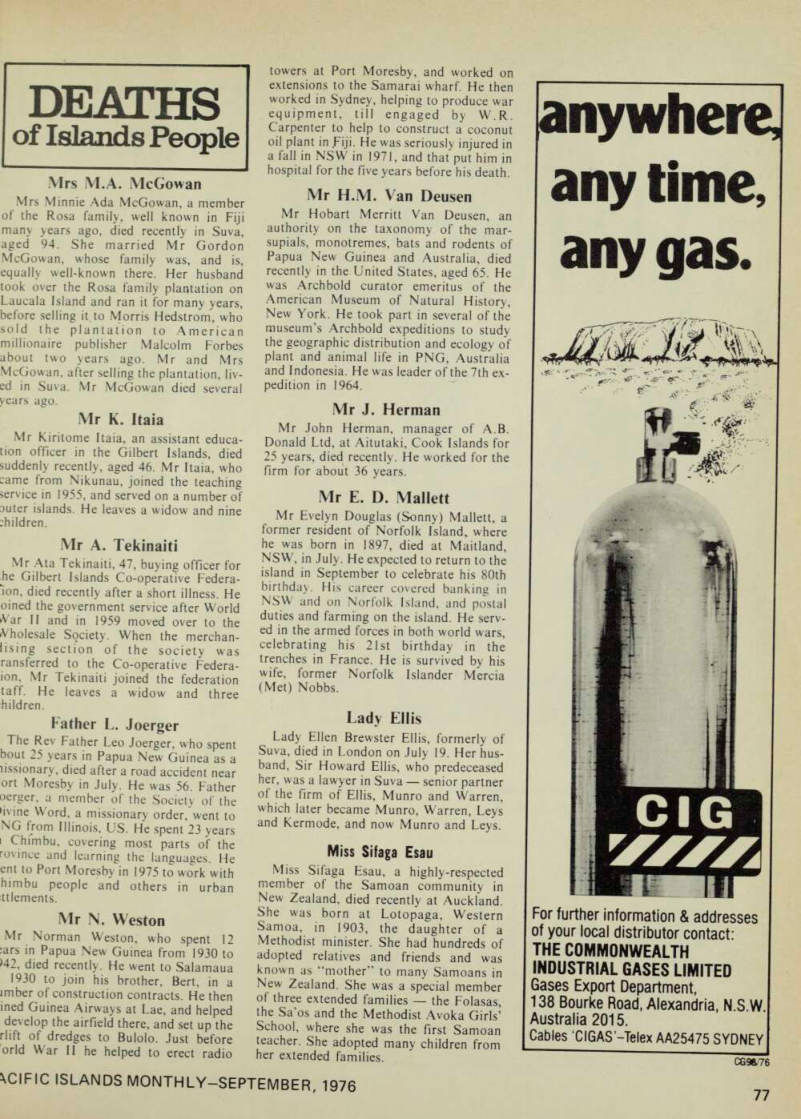
of Islands People
Mrs M.A. McGowan Mrs Minnie Ada McGowan, a member of the Rosa family, well known in Fiji many years ago, died recently in Suva, aged 94. She married Mr Gordon McGowan, whose family was, and is, equally well-known there. Her husband took over the Rosa family plantation on Laucala Island and ran it for many years, before selling it to Morris Hedstrom, who sold the plantation to American millionaire publisher Malcolm Forbes about two years ago. Mr and Mrs McGowan, after selling the plantation, liv ed in Suva. Mr McGowan died several years ago.
Mr K. Itaia Mr Kiritome Itaia, an assistant educa tion officer in the Gilbert Islands, died suddenly recently, aged 46. Mr Itaia, who eame from Nikunau, joined the teaching service in 1955, and served on a number of auter islands. He leaves a widow and nine children.
Mr A. Tekinaiti Mr Ata Tekinaiti, 47, buying officer for lie Gilbert Islands Co-operative Federa 'ion, died recently after a short illness. He oined the government service after World Var II and in 1959 moved over to the Wholesale Society. When the merchan iising section of the society was ransferred to the Co-operative Federa ion, Mr Tekinaiti joined the federation taff. He leaves a widow and three hildren.
Father L. Joerger The Rev Father Leo Joerger, who spent bout 25 years in Papua New Guinea as a lissionary, died after a road accident near ort Moresby in July. He was 56. Father oerger, a member of the Society of the >ivine Word, a missionary order, went to NG from Illinois, US. He spent 23 years i Chimbu, covering most parts of the
rovince and learning the languages. He
ent to Port Moresby in 1975 to work with himbu people and others in urban ttlements.
Mr N. Weston Mr Norman Weston, who spent 12 :ars in Papua New Guinea from 1930 to >42, died recently. He went to Salamaua 1930 to join his brother, Bert, in a imber of construction contracts. He then ined Guinea Airways at Lae, and helped develop the airfield there, and set up the rlift of dredges to Bulolo. Just before orld War II he helped to erect radio
towers at Port Moresby, and worked on extensions to the Samarai wharf. He then worked in Sydney, helping to produce war equipment, till engaged by W.R.
Carpenter to help to construct a coconut oil plant in Fiji. He was seriously injured in a fall in NSW in 1971, and that put him in hospital for the five years before his death.
Mr H.M. Van Deusen Mr Hobart Merritt Van Deusen, an authority on the taxonomy of the mar supials, monotremes, bats and rodents of Papua New Guinea and Australia, died recently in the United States, aged 65. He was Archbold curator emeritus of the American Museum of Natural History, New York. He took part in several of the museum’s Archbold expeditions to study the geographic distribution and ecology of plant and animal life in PNG, Australia and Indonesia. He was leader of the 7th ex pedition in 1964.
Mr J. Herman Mr John Herman, manager of A.B.
Donald Ltd, at Aitutaki, Cook Islands for 25 years, died recently. He worked for the firm for about 36 years.
Mr E. D. Mallett Mr Evelyn Douglas (Sonny) Mallett, a former resident of Norfolk Island, where he was born in 1897, died at Maitland, NSW, in July. He expected to return to the island in September to celebrate his 80th birthday. His career covered banking in NSW and on Norfolk Island, and postal duties and farming on the island. He serv ed in the armed forces in both world wars, celebrating his 21st birthday in the trenches in France. He is survived by his wife, former Norfolk Islander Mercia (Met) Nobbs.
Lady Ellis
Lady Ellen Brewster Ellis, formerly of Suva, died in London on July 19. Her hus band, Sir Howard Ellis, who predeceased her, was a lawyer in Suva senior partner of the firm of Ellis, Munro and Warren, which later became Munro, Warren, Leys and Kermode, and now Munro and Leys.
Miss Sifaga Esau Miss Sifaga Esau, a highly-respected member of the Samoan community in New Zealand, died recently at Auckland.
She was born at Lotopaga, Western Samoa, in 1903, the daughter of a Methodist minister. She had hundreds of adopted relatives and friends and was known as “mother” to many Samoans in New Zealand. She was a special member of three extended families the Folasas, the Sa’os and the Methodist Avoka Girls’
School, where she was the first Samoan teacher. She adopted many children from her extended families.
Advertisements & other items, pp. 69-70 (2 items)
69
\CIFIC ISLANDS MONTHLY-SEPTEMBER, 1976
anywhere,
any time
any gas.
SB* -or further information & addresses of your local distributor contact:
HE COMMONWEALTH
NDUSTRIAL GASES LIMITED
Gases Export Department, 138 Bourke Road, Alexandria, N.S.W.
Australia 2015.
Cables ‘CIGAS’-Telex AA25475 SYDNEY CG 98/76
I I
REFRIGERATED
& GENERAL
CARGO IN
BARGES. BULK
LIQUIDS IN
VESSEL DEEP
TANKS.
-ct* ■ I
LASH
a IFROM UNITED STATES WEST COAST & CANADA TO PAPEETE,
IPAGO PAGO, AUCKLAND, LAE & RABAUL.
■ PAPUA NEW GUINEA TO VANCOUVER 8.C., TACOMA, PORT-
LAND, SAN FRANCISCO. LOS ANGELES.
■ SYDNEY, MELBOURNE, BURNIE, HOBART, BRISBANE TO LAE
& RABAUL.
MANAGING AGENTS: Wilh. Wilhelmsen Agency P/L., 13-15 Bridge Street, Sydney 2000-Phone 20517-60 Market Street, Melbourne, 3000-Phone 613031—344 Queen Street, Brisbane, 4000-Phone 2213316. MANAGING AGENTS N.Z.; Dalgety N.Z.
Ltd 119 Featherston Street, Wialington—Phone 738347 41/45 Albert Street, Auckland—Phone 71859. ISLAND AGENTS; Robert Laurie (NG) P/L, P.O. Box 1032, Lae, PNG - Phone 423811. Burns Philp (NG) Ltd., P.O. Box 87, Rabaul, PNG. - Phone 922666. -
Shipping,
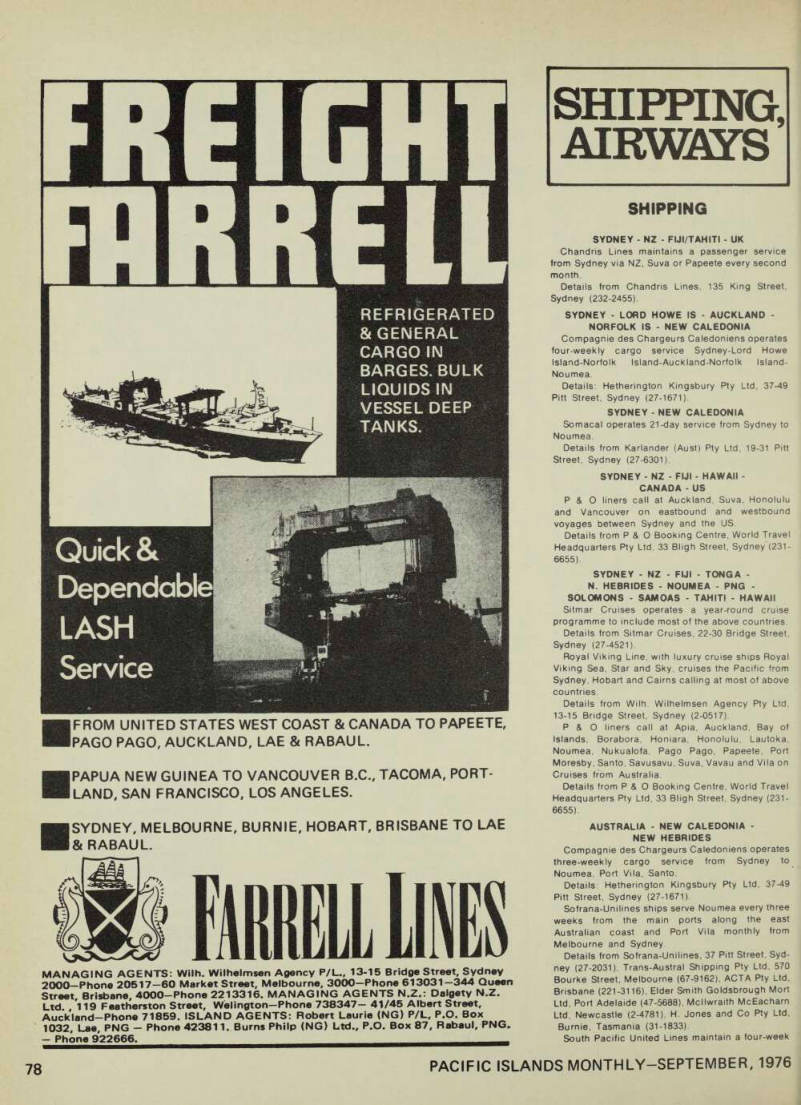
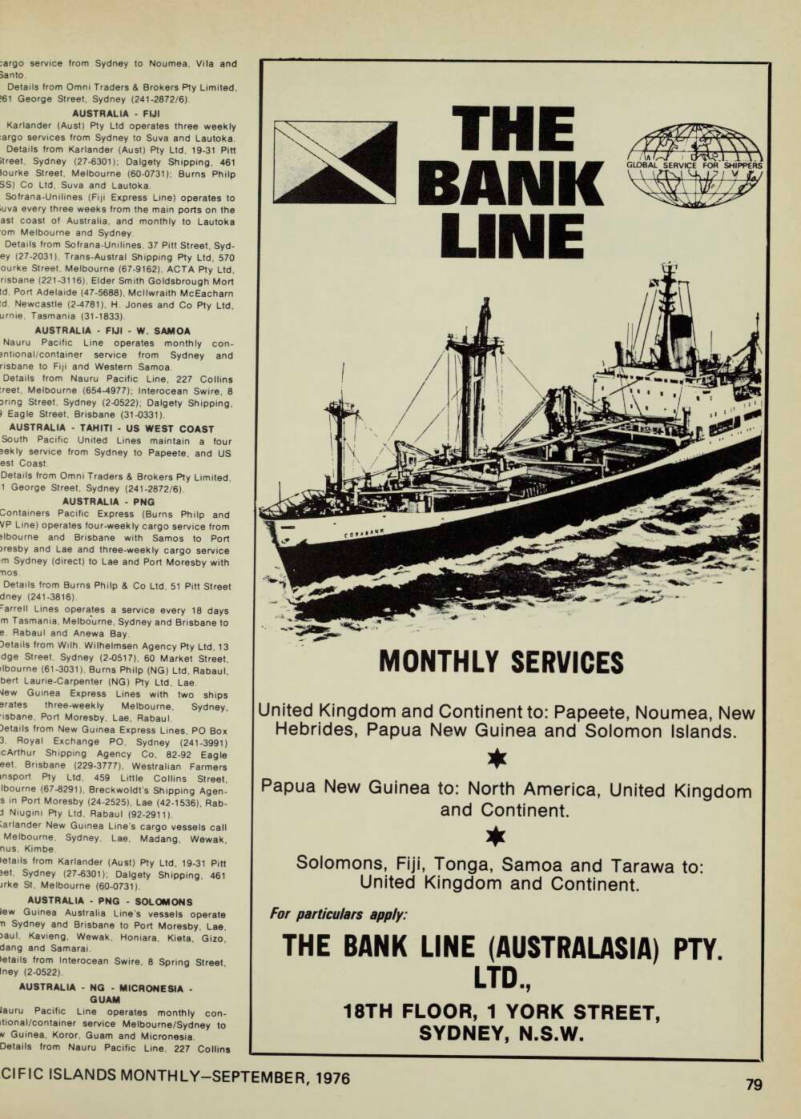
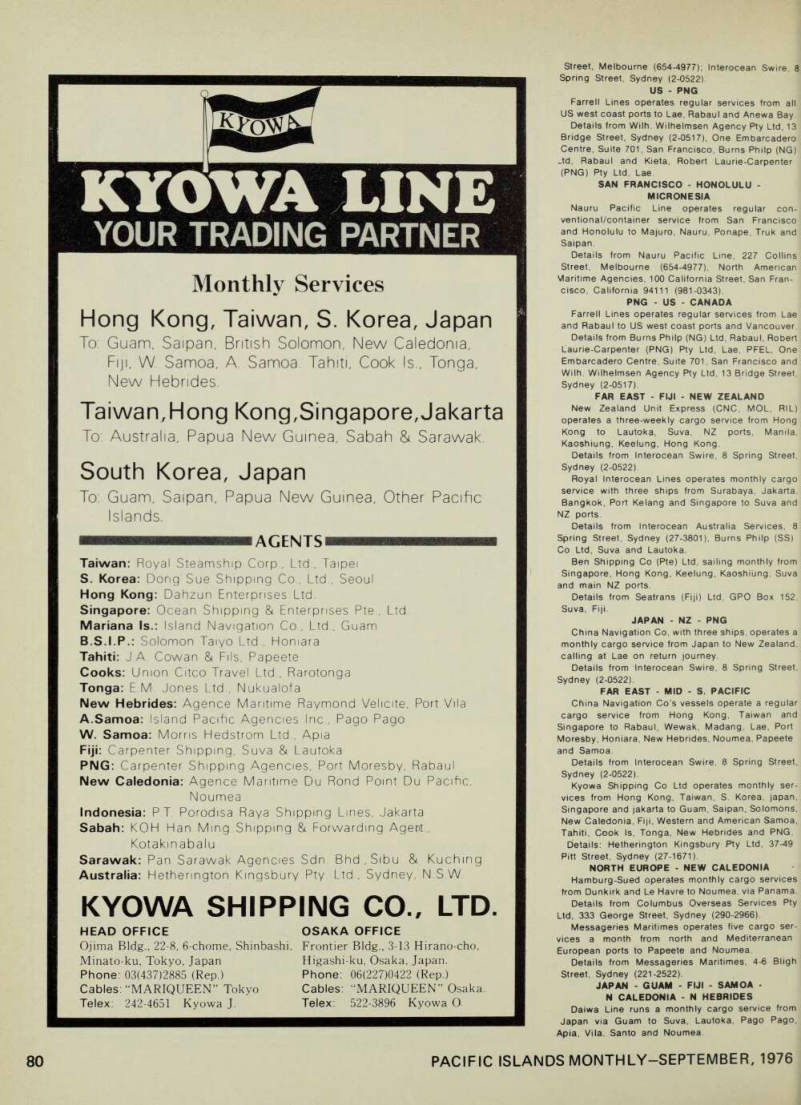
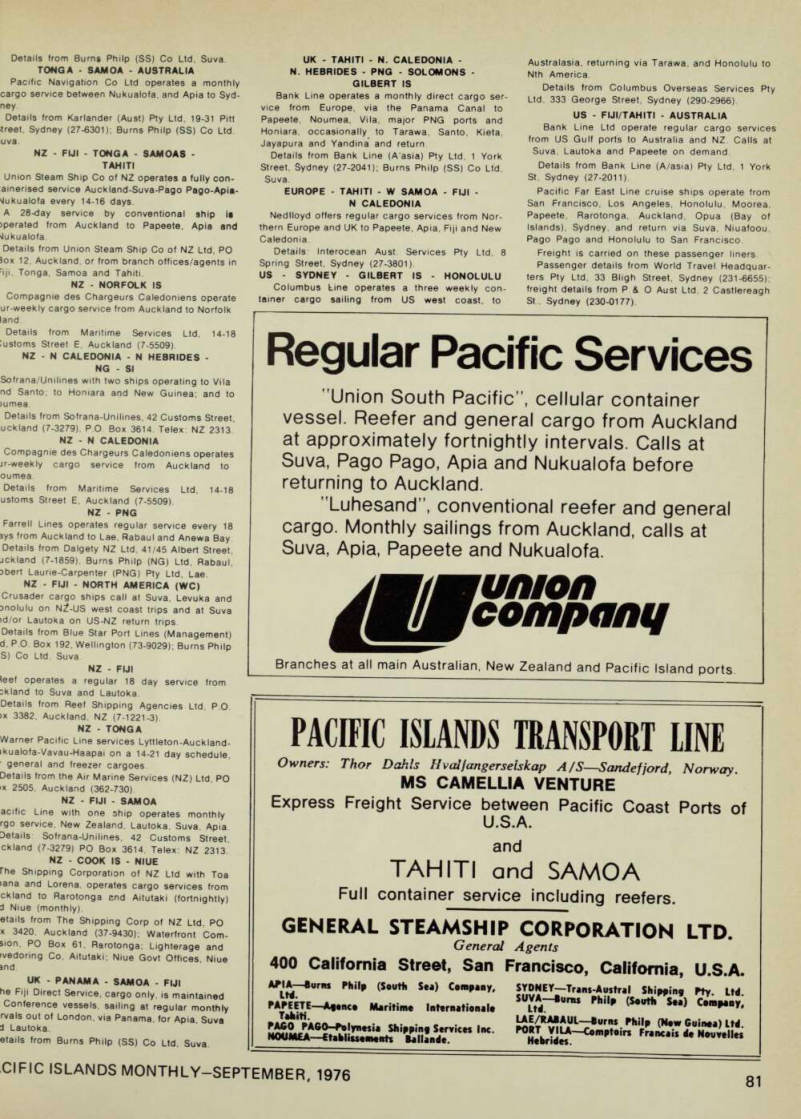
Airways
Shipping
SYDNEY - NZ - FIJI/TAHITI - UK Chandris Lines maintains a passenger service from Sydney via NZ, Suva or Papeete every second month.
Details from Chandris Lines, 135 King Street, Sydney (232-2455).
SYDNEY - LORD HOWE IS - AUCKLAND -
Norfolk Is - New Caledonia
Compagnie des Chargeurs Caledonians operates four-weekly cargo service Sydney-Lord Howe Island-Norfolk Island-Auckland-Norfolk Island- Noumea.
Details; Hetherington Kingsbury Pty Ltd, 37-49 Pitt Street, Sydney (27-1671).
Sydney - New Caledonia
Somacal operates 21-day service from Sydney to Noumea.
Details from Karlander (Aust) Pty Ltd, 19-31 Pitt Street, Sydney (27-6301).
SYDNEY - NZ - FIJI - HAWAII -
Canada - Us
P & O liners call at Auckland, Suva, Honolulu and Vancouver on eastbound and westbound voyages between Sydney and the US.
Details from P & O Booking Centre, World Travel Headquarters Pty Ltd, 33 Bligh Street, Sydney (231- 6655) SYDNEY - NZ - FIJI - TONGA - N. HEBRIDES - NOUMEA - PNG - SOLOMONS - SAMOAS - TAHITI - HAWAII Sitmar Cruises operates a year-round cruise programme to include most of the above countries.
Details from Sitmar Cruises, 22-30 Bridge Street, Sydney (27-4521).
Royal Viking Line, with luxury cruise ships Royal Viking Sea, Star and Sky, cruises the Pacific from Sydney, Hobart and Cairns calling at most of above countries.
Details from Wilh. Wilhelmsen Agency Pty Ltd. 13-15 Bridge Street, Sydney (2-0517).
P & O liners call at Apia, Auckland. Bay of Islands, Borabora, Honiara, Honolulu, Lautoka, Noumea, Nukualofa, Pago Pago, Papeete, Port Moresby, Santo, Savusavu, Suva, Vavau and Vila on Cruises from Australia.
Details from P & 0 Booking Centre, World Travel Headquarters Pty Ltd, 33 Bligh Street, Sydney (231- 6655).
Australia - New Caledonia -
New Hebrides
Compagnie des Chargeurs Caledoniens operates three-weekly cargo service from Sydney to Noumea, Port Vila, Santo.
Details: Hetherington Kingsbury Pty Ltd, 37-49 Pitt Street, Sydney (27-1671).
Sofrana-Unilines ships serve Noumea every three weeks from the main ports along the east Australian coast and Port Vila monthly from Melbourne and Sydney.
Details from Sofrana-Unilines, 37 Pitt Street, Syd ney (27-2031), Trans-Austral Shipping Pty Ltd, 570 Bourke Street, Melbourne (67-9162), ACTA Pty Ltd, Brisbane (221-3116), Elder Smith Goldsbrough Mort Ltd, Port Adelaide (47-5688), Mcllwraith McEacharn Ltd, Newcastle (2-4781), H. Jones and Cos Pty Ltd, Burnie, Tasmania (31-1833).
South Pacific United Lines maintain a four-week
:argo service from Sydney to Noumea, Vila and >anto Details from Omni Traders & Brokers Pty Limited, ►6l George Street, Sydney (241-2872/6).
Australia - Fiji
Karlander (Aust) Pty Ltd operates three weekly argo services from Sydney to Suva and Lautoka Details from Karlander (Aust) Pty Ltd, 19-31 Pitt Hreet, Sydney (27-6301); Dalgety Shipping, 461 lourke Street, Melbourne (60-0731); Burns Philp SS) Cos Ltd, Suva and Lautoka.
Sofrana-Unilines (Fiji Express Line) operates to luva every three weeks from the main ports on the ast coast of Australia, and monthly to Lautoka om Melbourne and Sydney.
Details from Sofrana-Unilines, 37 Pitt Street, Syd ey (27-2031). Trans-Austral Shipping Pty Ltd, 570 ourke Street. Melbourne (67-9162), ACTA Pty Ltd, risbane (221-3116), Elder Smith Goldsbrough Mort Id. Port Adelaide (47-5688), Mcllwraith McEacharn :d, Newcastle (2-4781), H, Jones and Cos Pty Ltd, urnie, Tasmania (31-1833).
Australia - Fiji - W. Samoa
Nauru Pacific Line operates monthly con jntional/container service from Sydney and risbane to Fiji and Western Samoa.
Details from Nauru Pacific Line, 227 Collins :reet, Melbourne (654-4977); Interocean Swire, 8 sring Street, Sydney (2-0522); Dalgety Shipping, » Eagle Street, Brisbane (31-0331).
AUSTRALIA - TAHITI - US WEST COAST South Pacific United Lines maintain a four jekly service from Sydney to Papeete, and US est Coast Details from Omni Traders & Brokers Pty Limited, 1 George Street, Sydney (241-2872/6)
Australia - Png
Containers Pacific Express (Burns Philp and VP Line) operates four-weekly cargo service from Hbourne and Brisbane with Samos to Port iresby and Lae and three-weekly cargo service m Sydney (direct) to Lae and Port Moresby with ■nos.
Details from Burns Philp & Cos Ltd, 51 Pitt Street dney (241-3816). -arrell Lines operates a service every 18 days m Tasmania, Melbourne, Sydney and Brisbane to e. Rabaul and Anewa Bay.
Details from Wilh. Wilhelmsen Agency Pty Ltd, 13 dge Street Sydney (2-0517), 60 Market Street, ilbourne (61-3031), Burns Philp (NG) Ltd, Rabaul, bert Laurie-Carpenter (NG) Pty Ltd, Lae 'Jew Guinea Express Lines with two ships srates three-weekly Melbourne, Sydney, isbane, Port Moresby, Lae, Rabaul.
Details from New Guinea Express Lines, PO Box 3. Royal Exchange PO, Sydney (241-3991) cArthur Shipping Agency Cos, 82-92 Eagle eet. Brisbane (229-3777), Westralian Farmers insport Pty Ltd, 459 Little Collins Street, Ibourne (67-8291), Breckwoldt's Shipping Agen s in Port Moresby (24-2525), Lae (42-1536), Rab- J Niugini Pty Ltd, Rabaul (92-2911).
New Guinea Line's cargo vessels call Melbourne Sydney. Lae, Madang, Wewak, nus, Kimbe, •etails from Karlander (Aust) Pty Ltd, 19-31 Pitt Jet, Sydney (27-6301); Dalgety Shipping, 461 jrke St, Melbourne (60-0731).
Australia - Png - Solomons
lew Guinea Australia Line’s vessels operate n Sydney and Brisbane to Port Moresby, Lae, jaul, Kavieng, Wewak, Honiara, Kieta, Gizo, dang and Samarai. •etails from Interocean Swire, 8 Spring Street Iney (2-0522).
Australia - Ng - Micronesia -
Guam
lauru Pacific Line operates monthly con itional/container service Melbourne/Sydney to v Guinea, Koror, Guam and Micronesia Details from Nauru Pacific Line, 227 Collins
Street, Melbourne (654-4977); Interocean Swire, 8 Spring Street, Sydney (2-0522).
Us - Png
Farrell Lines operates regular services from all US west coast ports to Lae, Rabaul and Anewa Bay.
Details from With. Wilhelmsen Agency Pty Ltd, 13 Bridge Street, Sydney (2-0517), One Embarcadero Centre, Suite 701, San Francisco, Burns Philp (NG) _td, Rabaul and Kieta, Robert Laurie-Carpenter (PNG) Pty Ltd, Lae.
San Francisco - Honolulu -
Micronesia
Nauru Pacific Line operates regular con ventional/container service from San Francisco and Honolulu to Majuro, Nauru, Ponape, Truk and Saipan.
Details from Nauru Pacific Line, 227 Collins Street, Melbourne (654-4977), North American Maritime Agencies, 100 California Street, San Fran cisco, California 94111 (981-0343).
Png - Us - Canada
Farrell Lines operates regular services from Lae and Rabaul to US west coast ports and Vancouver.
Details from Burns Philp (NG) Ltd, Rabaul, Robert Laurie-Carpenter (PNG) Pty Ltd, Lae, PFEL, One Embarcadero Centre, Suite 701, San Francisco and Wilh. Wilhelmsen Agency Pty Ltd, 13 Bridge Street, Sydney (2-0517).
FAR EAST - FIJI - NEW ZEALAND New Zealand Unit Express (CNC, MOL, RIL) operates a three-weekly cargo service from Hong Kong to Lautoka, Suva, NZ ports, Manila, Kaoshiung, Keelung, Hong Kong Details from Interocean Swire, 8 Spring Street, Sydney (2-0522).
Royal Interocean Lines operates monthly cargo service with three ships from Surabaya, Jakarta, Bangkok, Port Kelang and Singapore to Suva and NZ ports.
Details from Interocean Australia Services, 8 Spring Street, Sydney (27-3801), Burns Philp (SS) Cos Ltd, Suva and Lautoka.
Ben Shipping Cos (Pte) Ltd, sailing monthly from Singapore, Hong Kong, Keelung, Kaoshiung, Suva and main NZ ports.
Details from Seatrans (Fiji) Ltd, GPO Box 152, Suva, Fiji.
Japan - Nz - Png
China Navigation Cos, with three ships, operates a monthly cargo service from Japan to New Zealand, calling at Lae on return journey.
Details from Interocean Swire, 8 Spring Street, Sydney (2-0522).
FAR EAST - MID - S. PACIFIC China Navigation Cos s vessels operate a regular cargo service from Hong Kong, Taiwan and Singapore to Rabaul, Wewak, Madang, Lae, Port Moresby, Honiara, New Hebrides, Noumea, Papeete and Samoa.
Details from Interocean Swire, 8 Spring Street, Sydney (2-0522).
Kyowa Shipping Cos Ltd operates monthly ser vices from Hong Kong, Taiwan, S. Korea, japan, Singapore and Jakarta to Guam, Saipan, Solomons, New Caledonia, Fiji, Western and American Samoa, Tahiti, Cook Is, Tonga, New Hebrides and PNG.
Details: Hetherington Kingsbury Pty Ltd, 37-49 Pitt Street, Sydney (27-1671).
North Europe - New Caledonia
Hamburg-Sued operates monthly cargo services from Dunkirk and Le Havre to Noumea, via Panama.
Details from Columbus Overseas Services Pty Ltd, 333 George Street, Sydney (290-2966) Messageries Maritimes operates five cargo ser vices a month from north and Mediterranean European ports to Papeete and Noumea.
Details from Messageries Maritimes, 4-6 Bligh Street, Sydney (221-2522).
JAPAN - GUAM - FIJI - SAMOA -
N Caledonia - N Hebrides
Daiwa Line runs a monthly cargo service from Japan via Guam to Suva, Lautoka, Pago Pago, Apia, Vila, Santo and Noumea.
Details from Burns Philp (SS) Cos Ltd, Suva.
Tonga - Samoa - Australia
Pacific Navigation Cos Ltd operates a monthly cargo service between Nukualofa, and Apia to Syd ney Details from Karlander (Aust) Pty Ltd, 19-31 Pitt treet, Sydney (27-6301); Burns Philp (SS) Cos Ltd. uva NZ - FIJI - TONGA - SAMOAS -
Tahiti
Union Steam Ship Cos of NZ operates a fully con ainerised service Auckland-Suva-Pago Pago-Apia 'Jukualofa every 14-16 days.
A 28-day service by conventional ship Is jperated from Auckland to Papeete, Apia and Nukualofa Details from Union Steam Ship Cos of NZ Ltd, PC lox 12, Auckland, or from branch offices/agents in : iji, Tonga, Samoa and Tahiti.
Nz - Norfolk Is
Compagnie des Chargeurs Caledoniens operate ur-weekly cargo service from Auckland to Norfolk land Details from Maritime Services Ltd, 14-18 lustoms Street E, Auckland (7-5509).
NZ - N CALEDONIA - N HEBRIDES -
Ng - Si
Sofrana/Unilines with two ships operating to Vila nd Santo; to Honiara and New Guinea; and to )umea.
Details from Sofrana-Unilines, 42 Customs Street, uckland (7-3279), P C Box 3614. Telex: NZ 2313.
Nz - N Caledonia
Compagnie des Chargeurs Caledoniens operates jr-weekly cargo service from Auckland to oumea Details from Maritime Services Ltd, 14-18 ustoms Street E, Auckland (7-5509).
Nz - Png
Farrell Lines operates regular service every 18 ays from Auckland to Lae, Rabaul and Anewa Bay Details from Dalgety NZ Ltd, 41/45 Albert Street, jckland (7-1859), Burns Philp (NG) Ltd, Rabaul, Jbert Laurie-Carpenter (PNG) Pty Ltd, Lae.
NZ - FIJI - NORTH AMERICA (WC) Crusader cargo ships call at Suva, Levuka and jnolulu on N2-US west coast trips and at Suva id/or Lautoka on US-NZ return trips.
Details from Blue Star Port Lines (Management) and, P.O Box 192, Wellington (73-9029); Burns Philp S) Cos Ltd, Suva
Nz - Fiji
leef operates a regular 18 day service from :kland to Suva and Lautoka.
Details from Reef Shipping Agencies Ltd, P.O. )x 3382, Auckland, NZ (7-1221-3)
Nz - Tonga
Warner Pacific Line services Lyttleton-Auckland ikualofa-Vavau-Haapai on a 14-21 day schedule, ■ general and freezer cargoes Details from the Air Marine Services (NZ) Ltd, PO ix 2505, Auckland (362-730).
Nz - Fiji - Samoa
acific Line with one ship operates monthly rg° service, New Zealand, Lautoka, Suva, Apia Details Sofrana-Unilines, 42 Customs Street ckland (7-3279) PC Box 3614, Telex: NZ 2313.
Nz - Cook Is - Niue
Fhe Shipping Corporation of NZ Ltd with Toa lana and Lorena, operates cargo services from ckland to Rarotonga and Aitutaki (fortnightly)
and Niue (monthly),
etails from The Shipping Corp of NZ Ltd, PO x 3420, Auckland (37-9430); Waterfront Com sion, PO Box 61, Rarotonga; Lighterage and wedoring Cos. Aitutaki; Niue Govt Offices, Niue »nd UK - PANAMA - SAMOA - FIJI he Fiji Direct Service, cargo only, is maintained Conference vessels, sailing at regular monthly rvals out of London, via Panama, for Apia. Suva and Lautoka. etails from Burns Philp (SS) Cos Ltd, Suva
UK - TAHITI - N. CALEDONIA - N. HEBRIDES - PNG - SOLOMONS -
Gilbert Is
Bank Line operates a monthly direct cargo ser vice from Europe, via the Panama Canal to Papeete, Noumea, Vila, major PNG ports and Honiara, occasionally to Tarawa, Santo, Kieta, Jayapura and Yandina and return.
Details from Bank Line (A’asia) Pty Ltd, 1 York Street, Sydney (27-2041); Burns Philp (SS) Cos Ltd, Suva EUROPE - TAHITI - W SAMOA - FIJI -
N Caledonia
Nedlloyd offers regular cargo services from Nor thern Europe and UK to Papeete, Apia, Fiji and New Caledonia Details: Interocean Aust. Services Pty Ltd. 8 Spring Street, Sydney (27-3801).
US - SYDNEY - GILBERT IS - HONOLULU Columbus Line operates a three weekly con tainer cargo sailing from US west coast, to
Australasia, returning via Tarawa, and Honolulu to Nth America.
Details from Columbus Overseas Services Pty Ltd, 333 George Street, Sydney (290-2966)
Us - Fiji/Tahiti - Australia
Bank Line Ltd operate regular cargo services from US Gulf ports to Australia and NZ. Calls at Suva, Lautoka and Papeete on demand.
Details from Bank Line (A/asia) Pty Ltd, 1 York St, Sydney (27-2011) Pacific Far East Line cruise ships operate from San Francisco, Los Angeles, Honolulu, Moorea, Papeete, Rarotonga, Auckland, Opua (Bay of Islands), Sydney, and return via Suva, Niuafoou, Pago Pago and Honolulu to San Francisco.
Freight is carried on these passenger liners.
Passenger details from World Travel Headquar ters Pty Ltd. 33 Bligh Street, Sydney (231-6655); freight details from P & O Aust Ltd. 2 Castlereagh St.. Sydney (230-0177).
US - A. SAMOA - NZ - AUST - PNG Farrell Lines LASH ships operate regularly from US to Australia, via Pago Pago and Auckland, returning via PNG ports.
Details from Wilh. Wilhelmsen Agency Pty Ltd, 13 Bridge Street, Sydney (2-0517); 60 Market Street, Melbourne (61-3031); PFEL, 1 Embarcadero Centre, Suite 701, San Francisco (576-4000); Dalgety NZ Ltd, Auckland (7-1859); Kneubuhl Maritime Ser vices. Pago Pago (633-5121).
Us - Tahiti - Samoa
Pacific Islands Transport operates a five/six weekly cargo service from North American west coast ports to Papeete, Pago Pago, Apia Details from Trans-Austral Shipping Pty Ltd, 19 Pitt Street, Sydney (27-2441).
Polynesia Line operates container and general cargo service from US west coast ports to Papeete and Pago Pago Details from Polynesia Shipping Services Inc, PO Box 1478, Pago Pago (9-6799).
Airways
From Australia
Qantas (707s, 747s, DC4) — PNG, Norfolk Is, New Caledonia, Fiji, US, Canada.
PAA (747s) — Fiji, American Samoa, Hawaii, US CP Air (DC8) — Fiji, Hawaii, Canada.
UTA (DC8s and DCIOs) — New Caledonia, Fiji, New Zealand, Tahiti, US.
Air Nauru (F28) — New Caledonia, Nauru, Tarawa, Majuro.
Air Niugini (720s) — PNG Air Pacific (BAC111) — Fiji, via New Hebrides or New Caledonia to Fiji.
Advance Aviation (from Sydney), North Coast Airlines (from Coffs Harbour) and Oxley Airlines (from Port Macquarie) — Lord Howe Is
From New Zealand
Air-NZ (DC8s, DCIOs, F27) — Fiji, American
Samoa, Cook Is.. Tahiti, Hawaii, US, New Caledonia, Norfolk Is.
PAA (7475) American Samoa, Tahiti, Hawaii, US.
UTA (DCS) Tahiti.
From Us
Qantas (707 sand 7475) Honolulu, Fiji, Australia.
PAA (7475) Honolulu, Tahiti, A. Samoa, Fiji, NZ, Australia.
Air-NZ (DCSs and DClOs) Honolulu, Fiji, Auckland.
From Canada
CP Air (DCSs) Honolulu, Fiji, Australia Qantas (DCSs and DCIOs) Honolulu, Fiji, Australia.
PACIFIC - FAR EAST - S. AMERICA Air Nauru (F2B or 737) Nauru to Micronesia, The Philippines, Okinawa, Japan, Taiwan, Hong Kong Air France (7075) Japan to Tahiti, Peru.
Air Niugini (7075) to Manila.
Pacific Is - Aust
Air Pacific (BAC111) From Fiji, via New Hebrides or New Caledonia, to Brisbane.
Air Nauru (F2B or 737) flies to Melbourne Air Niugini (727 sand Fokker Friendships) to Cairns and Brisbane.
Norfolk Island Airlines (Beechcraft) to Brisbane.
Pacific Is - Nz
Air Pacific (B AC 111) Fiji-Tonga-NZ.
Inter-Territory
Lan-Chile (7075) Easter Is, Tahiti Air Pacific (BACIII and HS74Bs) Fiji to Gilbert Is, Tuvalu, Western Samoa, Tonga, New Hebrides, Solomon Islands, New Caledonia, PNG.
Fiji Air Services Wallis and Futuna (charter).
Qantas (7075) PNG to Singapore.
PAA (7075) Hawaii to Am. Samoa and Tahiti, US.
UTA (7075, Caravelles) from New Caledonia to Fiji, New Hebrides, Wallis Is, Tahiti.
Continental-Air Micronesia (7275) from Hawaii to Micronesia.
Air Nauru from Nauru to Tarawa, Marshall Is, Wallis Is, Fiji, W. Samoa, New Hebrides, New Caledonia, Solomons, Philippines.
Polynesian Airlines from Apia to Tonga, Niue Is, Fiji, Am. Samoa.
South Pacific Island Airway flies between American and Western Samoa.
Air Tahiti from Tahiti to Cook Is.
Air Niugini to Irian Jaya, Solomon Is, Philippines.
Norfolk Island Airlines (Beechcraft) to Noumea.
Internal
Fiji Air Pacific (HS74Bs and Trislanders), Fiji Air Services (Beech Barons and Islanders).
French Polynesia Air Polynesia (Fokker Friendships), Air Tahiti.
US Trust Territory and Guam Continental-Air Micronesia (7275) and Air Pacific International Inc.
Gilbert Is Air Pacific.
PNG Air Niugini, Aerial Tours, Talair, Melanesian Airlines, Crowley Airways.
Bougainville Bougainville Air Services.
New Caledonia Air Caledonia (Twin Otters).
New Hebrides Air Melanesiae (Islanders).
Solomon Is Solair (Beech Barons and Islan ders).
Tonga Tonga Internal Air Service (Islanders).
Cook Is Cook Island Airways (Islander).
Norfolk Island Airlines (Beechcraft) Norfolk Is- Lord Howe Is.
Western Samoa Air Samoa Ltd, and Samoa Aviation Ltd. • The Pacific Navigation Cos, Tonga, has added Auckland and Port Vila to the itinerary of the Tauloto. The Tauloto now sails direct from Nukualofa to Sydney and returns via Auckland, Port Vila and Apia.
Calls at Suva and Lautoka were omitted from the run a few months ago.
Advertisements & other items, pp. 71-74 (3 items)
71
CIFIC ISLANDS MONTHLY-SEPTEMBER, 1976
Lime
THE
Wl I . . .
GLOBAL SERVICE FOR SHIPPERS
■ V
LIME
a?
MONTHLY SERVICES
United Kingdom and Continent to: Papeete, Noumea, New Hebrides, Papua New Guinea and Solomon Islands.
Papua New Guinea to: North America, United Kingdom and Continent.
Solomons, Fiji, Tonga, Samoa and Tarawa to: United Kingdom and Continent.
For particulars apply:
THE BANK LINE (AUSTRALASIA) PTY.
LTD.,
18TH FLOOR, 1 YORK STREET,
SYDNEY, N.S.W.
KYOWA LINE
YOUR TRADING PARTNER
Monthly Services
Hong Kong, Taiwan, S. Korea, Japan
To: Guam, Saipan, British Solomon, New Caledonia, Fiji, W. Samoa, A. Samoa. Tahiti, Cook Is., Tonga, New Hebrides.
Taiwan,Hong Kong,Singapore,Jakarta
To: Australia, Papua New Guinea, Sabah & Sarawak.
South Korea, Japan
To: Guam, Saipan, Papua New Guinea, Other Pacific Islands.
Taiwan: Royal Steamship Corp., Ltd., Taipei S. Korea: Dong Sue Shipping Co., Ltd., Seoul Hong Kong: Dahzun Enterprises Ltd Singapore: Ocean Shipping & Enterprises Pte., Ltd Mariana Is.: Island Navigation Co.. Ltd., Guam 8.5.1. P.; Solomon Taiyo Ltd , Honiara Tahiti; J.A. Cowan & Fils, Papeete Cooks; Union Citco Travel Ltd., Rarotonga Tonga: E M. Jones Ltd , Nukualofa New Hebrides: Agence Maritime Raymond Velicite, Port Vila A.Samoa: Island Pacific Agencies Inc., Pago Pago W. Samoa: Morris Hedstrom Ltd., Apia Fiji: Carpenter Shipping, Suva & Lautoka PNG: Carpenter Shipping Agencies, Port Moresby, Rabaul New Caledonia; Agence Maritime Du Rond Point Du Pacific, Indonesia: P.T. Porodisa Raya Shipping Lines, Jakarta Sabah: KOH Han Ming Shipping & Forwarding Agent, Kotakmabalu Sarawak: Pan Sarawak Agencies Sdn. Bhd .Sibu & Kuching Australia: Hethenngton Kingsbury Pty. Ltd., Sydney, N.S.W.
KYOWA SHIPPING CO., LTD.
Ojima Bldg., 22-8, 6-chome, Shinbashi, Frontier Bldg., 3-13 Hirano-cho,
AGENTS
■ Noumea
HEAD OFFICE
OSAKA OFFICE
Minato-ku, Tokyo, Japan Phone: 03(437)2885 (Rep.) Cables: “MARIQUEEN” Tokyo Telex; 242-4651 Kyowa J.
Higashi-ku, Osaka, Japan.
Phone: 06(227)0422 (Rep.) Cables: “MARIQUEEN” Osaka.
Telex: 522-3896 Kyowa 0.
Regular Pacific Services
"Union South Pacific”, cellular container vessel. Reefer and general cargo from Auckland at approximately fortnightly intervals. Calls at Suva, Pago Pago, Apia and Nukualofa before returning to Auckland.
' Luhesand”, conventional reefer and general cargo. Monthly sailings from Auckland, calls at Suva, Apia, Papeete and Nukualofa.
jmimvmon
gmmcompanu
Branches at all main Australian, New Zealand and Pacific Island ports.
PACIFIC ISLANDS TRANSPORT LINE
Owners: Thor Dahls Hvaljangerseiskap A/S—Sonde fjord, Norway
MS CAMELLIA VENTURE
Express Freight Service between Pacific Coast Ports of
U.S.A.
and
TAHITI and SAMOA
Full container service including reefers.
GENERAL STEAMSHIP CORPORATION LTD.
General Agents 400 California Street, San Francisco, California, U.S.A.
APlA—Burn* Philp (South Sea) Company IN. —Afonco Maritime Internationale Tahiti.
Services Inc.
NOUMEA—Etablissomonts Ballande. fl r . 5!!!r Trans ;^. stra ' Sh 'pp in » p*y- Ltd.
SU Ltd~ iUrm Phl * S ° Wti * Company, anDT^\ UL 7 <Uri “. (Now Guinea) Ltd.
U A YJLA—^ Comptoirs Franca is de Nouvelles Hebrides.
nedlloyd
REGULAR SAILINGS BY FAST, MODERN CARGO VESSELS from EUROPE vio PANAMA to:
PAPEETE, NOUMEA,
APIA, SUVA, LAUTOKA,
NEW ZEALAND.
from NEW ZEALAND via PANAMA to:
EUROPE
(MEDITERRANEAN €r NORTH CONTINENT)
and from AUSTRALIA to:
CENTRAL AMERICA & CARIBBEAN
heavy-lift facilities—refrigerated space—cargo deeptanks For further particulars apply to Agents: ii Ets. Donald Tahiti Agence Maritime Aerienne Caledonienne O. F. Nelson & Co. ltd. Carpenters Shipping Papeete. S.A. A.M.A.C., Noumea. Apia. Suva, Lautoka.
Interocean Australia Services Pty. Ltd. Joint Shipping Management Ltd.
Sydney. P.O. Box 890, Wellington, N.Z.
73
CIF 1C ISLANDS MONTHLY-SEPTEMBER, 1976
Prices
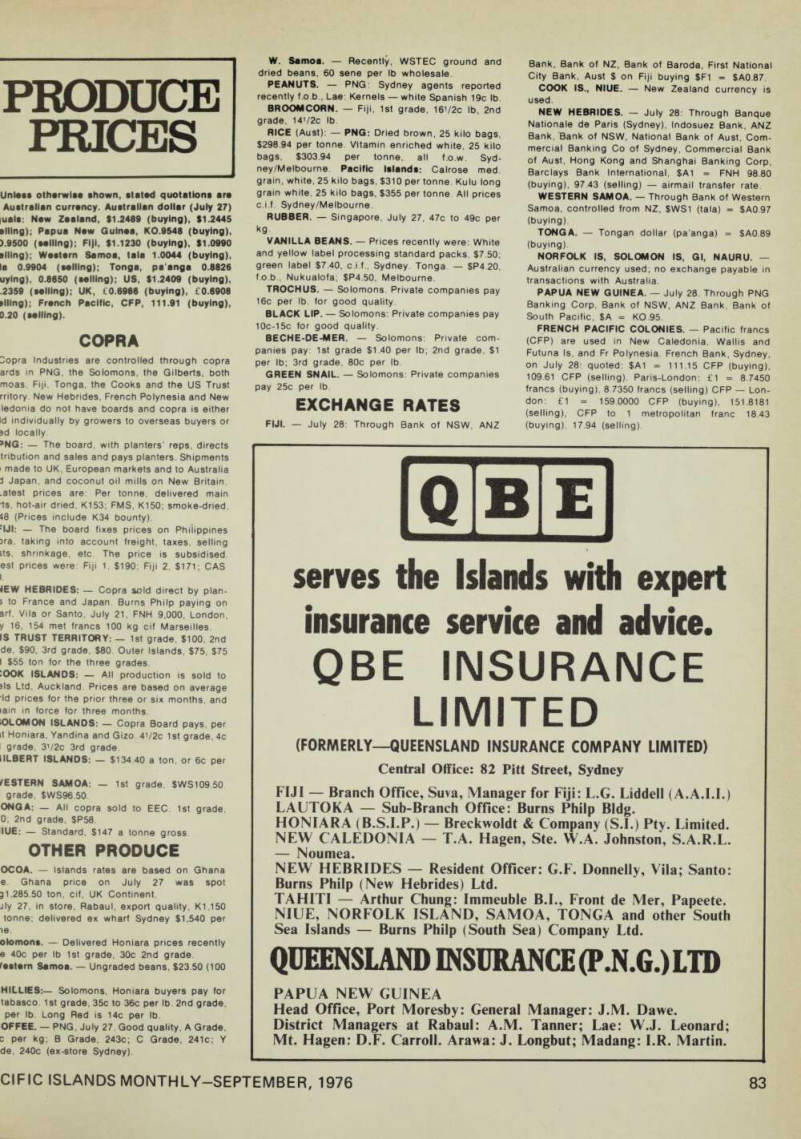
Produce
Unless otherwise shown, stated quotations are Australian currency. Australian dollar (July 27) uals; New Zealand, SI .2489 (buying), $1.2445 slllng); Papua New Guinea, K 0.9548 (buying), ).9500 (selling); Fiji, $1.1230 (buying), $1.0990 slllng); Western Samoa, tala 1.0044 (buying), la 0.9904 (selling); Tonga, paanga 0.8826 uying), 0.8650 (selling); US, $1.2409 (buying), .2359 (selling); UK, €0.6986 (buying), £0.6908 ailing); French Pacific, CFP, 111.91 (buying), 0.20 (selling).
Copra
Dopra Industries are controlled through copra ards in PNG, the Solomons, the Gilberts, both moas, Fiji, Tonga, the Cooks and the US Trust rritory New Hebrides, French Polynesia and New ledonia do not have boards and copra is either Id individually by growers to overseas buyers or sd locally. *NG; The board, with planters' reps, directs tribution and sales and pays planters. Shipments i made to UK, European markets and to Australia 1 Japan, and coconut oil mills on New Britain .atest prices are: Per tonne, delivered main Is, hot-air dried, K 153; FMS, K 150; smoke-dried, 18 (Prices include K 34 bounty). : UI: The board fixes prices on Philippines ira, taking into account freight, taxes, selling its, shrinkage, etc. The price is subsidised est prices were: Fiji 1, $190; Fiji 2, $171; CAS lEW HEBRIDES; Copra sold direct by plan -5 to France and Japan Burns Philp paying on arf. Vila or Santo, July 21, FNH 9,000, London, y 16, 154 met francs 100 kg cif Marseilles.
IS TRUST TERRITORY; Ist grade, $lOO, 2nd de, $9O, 3rd grade, $BO. Outer Islands, $75, $75 I $55 ton for the three grades. lOOK ISLANDS; All production is sold to }ls Ltd, Auckland. Prices are based on average Id prices for the prior three or six months, and lain in force for three months. iOLOMON ISLANDS: Copra Board pays, per it Honiara, Yandina and Gizo. 4V2c Ist grade, 4c grade, 3V2c 3rd grade. iILBERT ISLANDS; $134.40 a ton, or 6c per WESTERN SAMOA: Ist grade, $W5109.50 grade, $W596.50.
ONGA: All copra sold to EEC. Ist grade. 0; 2nd grade, SPSB lUE; Standard, $147 a tonne gross
Other Produce
OCOA. Islands rates are based on Ghana e Ghana price on July 27 was spot 31,285.50 ton, cif, UK Continent, jly 27, in store, Rabaul, export quality, K 1.150 tonne; delivered ex wharf Sydney $1,540 per le, olomons. Delivered Honiara prices recently e 40c per lb Ist grade, 30c 2nd grade, faatarn Samoa. Ungraded beans, $23.50 (100 HILLIES: — Solomons, Honiara buyers pay for tabasco Ist grade, 35c to 36c per lb. 2nd grade, per lb. Long Red is 14c per lb.
OFFEE. PNG, July 27, Good quality, A Grade, c per kg; B Grade, 243 c; C Grade, 241 c; Y de, 240 c (ex-store Sydney).
W. Samoa. Recently, WSTEC ground and dried beans, 60 sene per lb wholesale PEANUTS. PNG: Sydney agents reported recently f.o.b , Lae: Kernels white Spanish 19c lb BROOMCORN. Fiji, Ist grade, 16V2c lb, 2nd grade, 14V2c lb RICE (Aust): PNG: Dried brown, 25 kilo bags, $298.94 per tonne. Vitamin enriched white, 25 kilo bags, $303.94 per tonne, all f.o.w Syd ney/Melbourne. Pacific lalandt: Calrose med grain, white, 25 kilo bags, $3lO per tonne. Kulu long grain white, 25 kilo bags, $355 per tonne. All prices c.i.f. Sydney/Melbourne.
RUBBER. Singapore, July 27, 47c to 49c per kg- VANILLA BEANS. Prices recently were: White and yellow label processing standard packs, $7.50; green label $7.40, c.i.f., Sydney. Tonga. $P4.20, f.0.b., Nukualofa; $P4.50, Melbourne.
TROCHUS. Solomons. Private companies pay 16c per lb. for good quality.
BLACK LIP. Solomons. Private companies pay 10c-15c for good quality.
BECHE-DE-MER. Solomons: Private com panies pay: Ist grade $1.40 per lb; 2nd grade, $1 per lb; 3rd grade, 80c per lb.
GREEN SNAIL. Solomons: Private companies pay 25c per lb.
Exchange Rates
FIJI. July 28; Through Bank of NSW, ANZ
Bank, Bank of NZ, Bank of Barode, First National City Bank, Aust $ on Fiji buying SFI = $A0.87.
COOK IS., NIUE. New Zealand currency is used.
NEW HEBRIDES. July 28: Through Banque Nationale de Paris (Sydney), Indosuez Bank, ANZ Bank, Bank of NSW, National Bank of Aust, Com mercial Banking Co of Sydney, Commercial Bank of Aust, Hong Kong and Shanghai Banking Corp, Barclays Bank International, SAI = FNH 98.80 (buying), 97.43 (selling) airmail transfer rate.
WESTERN SAMOA. Through Bank of Western Samoa, controlled from NZ, SWSI (tala) = $A0.97 (buying).
TONGA. Tongan dollar (pa’anga) = $A0.89 (buying).
Norfolk Is, Solomon Is, Gl, Nauru.
Australian currency used; no exchange payable in transactions with Australia.
PAPUA NEW GUINEA. July 28. Through PNG Banking Corp, Bank of NSW, ANZ Bank, Bank of South Pacific, $A = K 0.95.
FRENCH PACIFIC COLONIES. Pacific francs (CFP) are used in New Caledonia, Wallis and Futuna Is, and Fr Polynesia. French Bank, Sydney, on July 28: quoted: SAI = 111.15 CFP (buying), 109.61 CFP (selling). Paris-London: £1 = 8.7450 francs (buying), 8.7350 francs (selling) CFP Lon don: £1 = 159.0000 CFP (buying), 151.8181 (selling), CFP to 1 metropolitan franc 18.43 (buying), 17.94 (selling).
Advertisements & other items, pp. 75-80 (3 items)
75
CIFIC ISLANDS MONTHLY-SEPTEMBER, 1976
Qbe Insurance
Q E
serves the Islands with expert
insurance service and advice.
QBE INSURANCE
LIMITED
(FORMERLY—QUEENSLAND INSURANCE COMPANY LIMITED)
Central Office: 82 Pitt Street, Sydney FIJI Branch Office, Suva, Manager for Fiji: L.G. Liddell (A.A.1.1.) LAUTOKA Sub-Branch Office: Burns Philp Bldg.
HONIARA (8.5.1. P.) Breckwoldt & Company (5.1.) Pty. Limited.
NEW CALEDONIA T.A. Hagen, Ste. W.A. Johnston, S.A.R.L.
Noumea.
NEW HEBRIDES Resident Officer: G.F. Donnelly, Vila; Santo: Burns Philp (New Hebrides) Ltd.
TAHITI Arthur Chung: Immeuble B.L, Front de Mer, Papeete.
NIUE, NORFOLK ISLAND, SAMOA, TONGA and other South Sea Islands Burns Philp (South Sea) Company Ltd.
QUEENSLAND INSURANCE (P.N.G.) LTD
PAPUA NEW GUINEA
Head Office, Port Moresby: General Manager: J.M. Dawe.
District Managers at Rabaul: A.M. Tanner; Lae: W.J. Leonard; Mt. Hagen: D.F. Carroll. Arawa: J. Longbut; Madang: I.R. Martin.
PASTRYCOOK/BAKERY/CONFECTIONERY
FOOD AND PACKAGING MACHINERY
New from world leading overseas manufacturers.
Used, as-is or reconditioned from Australian and overseas suppliers. Depositors, wire-cut extruders, mixers, doughbrakes, bun dividers, peanut roaster, blancher, jacketted stainless steel pans, etc.
EFCA ENGINEERING PTY. LTD.,
Food Machinery Specialists
50 Whiteman St., Sth Melb., Vic. 3205.
P.O Box 192 Phone: 699 8766, Australia. Telex: 31791 If you have sneiis to sell—any quantity—contact Anlsa Commodity Traders Pty. Ltd., P.O. Box 1413, Lae, Papua New Guinea, Phone 424159. We are buyers of Trochus, Greensnail, Blacklip MOP, Goldlip MOP, and Marine Specimens Best prices paid Rabcul agents; Gazelle Agencies Pty. Ltd P.O. Box 262, Rabaul, PNG. Phone; 921397.
Manus Island Agents, R. L. & V. J. Knight, P.O.
Box 108, Lorengau, Manus Island, P.N.G. Phone
QUALIFIED ACCOUNTANT
Married, seeks position in Islands. All offers considered.
Write to: Box 42, Duffy, 2611, Australia
CLASSIFIED
CONCRETE BLOCK MAKER Makes blocks, flags, edgings, screen-blocks, garden stools—up to 8 at once and 96 an hour. $215.00 c.i.f. main ports Send for leaflets Forest Farm Research. Londonderry N S W., 2753 Australia.
FOR SALE
TRIMARAN 35 foot Fiver Lodestar. Just completed world circumnavigation, fully equipped for ocean cruising.
SUS2O,OOO.
Frank Melhop, 57 Avonleigh Rd., Green Bay, Auckland, New Zealand.
FLEETS 52ft. Tourist Cruiser, bit. Norman Wright 1967, in survey. Master's cabin & some dry cargo space aft, Gardner diesel, s. steel lined refrig, space, $75,000.00. FLEETS 221 Esplanade, Wynnum Central, Brisbane. Cable: "FLEETS BRISBANE".
Experienced crew person needs yacht to sail upon.
Age 26, good cook, good company Contact: S. Hoban, 48 Moor St., Fitzroy, Vic. 3065, Australia.
Park View Motel—Brisbane
Quiet location—opp Botanic Gardens Single, double, family suites, all with refrig., air conditioning, phone. TV. radio, tea making facilities, from $l2. Pool and restaurant Phone 31-2695—Tele* 40270.
Write for coloured brochure — Park View Motel. 128 Alice St. BRISBANE Old., 4000
Young, energetic man. extensive general
merchandising Australia. 5 years P.N.G.
Buying experience in the Orient specialising in textiles variety lines. Staff training in sales warehouse controller 50,000 sq. ft., with staff of 30. Position seeking sales, or buyer in textiles, would like position in Pacific Is. No ties. For further details P.O. BOX 307 SMITHFIELD
2164, SYDNEY N.S.W., AUSTRALIA.
FOR SALE
COASTAL VESSELS:
1 Built 1965 Japan, LOA 27m DWT 100. PNG Survey $BB,OOO 2 Built 1949 Lloyds 100A1 S/S 6/76 LOA 51m
DWT 652 $120,000
3 Built 1960 Lloyds 100A1 LOA 52m 642 DWT $120,000 4 Built 1952 Lloyds 100A1 LOA 53m 600 DWT $120,000
BARGES
1. Built 1969 LOA 28m PNG Survey DWT 127 $175,000 Terms available 2 Built 1971 PNG Survey LOA 15m DWT 25. $40,000
YACHTS
Luxury Trawler Type. Fibreglass/Teak. 33 -42', From $24,000 F O B New Guinea Marine Surveys & Services, PO Box 783, Lae, PNG. Cables; Marineserv.
GENERATORS-FOR SALE.
POWERLITE GENERATOR, 190 KVA, Type TP6OOB, 240-415 volts, 1500 rpm, powered by Rolls Royce C Range 6 cylinder diesel engine. Model A 135-1, unit skid mounted, year manufacture, 1971.
Australian $lO,OOO.
POWERLITE GENERATOR, 125 KVA, Type TPSIOA, 240-415 volts, 1500 rpm, powered by Rolls Royce 6 cylinder diesel engine.
Model All B-3, unit skid mounted, year manufacture, 1970.
Australian $7,000.
Mike Electric Distribution and Control Switchboard for above units.
Australian $1,500.
UNITS LOCATED AT TONGA ON VAVA’U ISLAND, AND ARE
OFFERED FOR DELIVERY WHERE IS.
FOR FURTHER INFORMATION CONTACT: MR. GARY TIMMS Phone SYDNEY 669 2622.
GEOFF K. GRAY PTY. LTD. Industrial Auctioneers & Brokers
34 Morley Ave., ROSEBERY. N.S.W. AUSTRALIA.
STERN
DRIVES
PETROL & DIESEL
MARINE ENGINES
X Manufactured by
SEA TIGER
MARINE
Pty. Ltd.
P.O, Box 157, Mordialloc Victoria, Australia 3195
EARN EXTRA MONEY
Livewire person (man or woman) of integrity and with some selling personality required as Nauru ticket-selling agent for Mater Prize Home Art Unions.
Popularity of this Art Union ensures wide demand for tickets.
Excellent commission basis. Apply, with references to Director, Mater Art Union, Box 708. G.P.0., Brisbane Queensland, 4000.
PETER FISHER TRADING Pty. Ltd.
321 Pin STREET, SYDNEY, 2000, AUSTRALIA
Telephone: 26-1109 CABLES: "FISHERION", SYDNEY
EXPORTERS TO THE PACIFIC ISLANDS
A ‘So this is a Lamborghini,” she breathed, as we sped down the autostrada towards Turin. ‘‘Yes,” I said, offering her a Benson and Hedges. “Five forward gears and 170 in top.” ‘Can you prove that?” she demanded. ‘‘Do I really have to? You did say you only wanted a little car to do the shopping.’ \v -A yv Krks V V Tf / > : a ■ ■ . * v Benson & Hedges.
When only the best will do.
W 678 10/75
Arnott’s! The taste of Australia
Sao. A light crisp cracker biscuit... delicious with butter and cheese, ham, or anything savoury or sweet.
Jatz. A cracker biscuit with a tangy flavour. Enjoy them just as they are—or with any savoury spread.
Saltine. Light, tangy and crispteam perfecdy with salads, cheese or soups. .. Shapes. Great for parties or just nibbling. In delicious Barbecue and Savoury flavours.
Top them. Dip them. Dress them up.
Or eat them plain. However you choose to enjoy your Amott’s cracker and savoury biscuits you’ll know right a\ 'ay that you are getting the special taste of Australia’s favourite biscuits.
<33EIE>
’W m
I;. jl
CRACKER BISCUITS 'W
m .
V" v ©J* 1 V I *5 J % 9 Jr mm / C °tTf
6 o^net
savoury
Qrnott'sßiscuits
There is no Substitute for Quality W 637
Performance
You Enjoy Living With.
Honda is a true life drama, performed on the world’s stage. By average folks, teenagers, men, and women everywhere. Your neighbors, maybe even you are playing a part. If so, you know Honda is more than great machines.
It’s people concerned with taking people where they want to go in life.
On two wheels, we’re the best selling motorcycle. The easy to operate hard workers who don’t demand much. Honda is always ready and gets you there safely. We move on four wheels. The precedent setting Honda Civic continues to receive international economy and performance awards. It’s the elegant compact car.
Sometimes, we have no wheels. Honda portable power operates machinery, generates electricity, pumps water and tills the soil.
Little wonder good things happen on Honda —we work harder to assure they do. u IP m - 1
HONDA MOTOR CO., LTD. TOKYO, JAPAN
Solomons Trading Co., Ltd P O Box m Honiara k.™ 08 ’ Ltd ‘ P D ° B ° X 5?6 ’ Apia SOLOMON ISLANDS: British TONGA: E M. Jones Limited, P. 6 Box 34 GHbert & iTT n Ba lande Boite Postale No. C 4 Noumea Cedex / ISLAND: S. Jessop & Sons Ltd PO Box 71 Alofi Gilbert & Ellice slands Development Authority P.O. Box 488, Beito/NIUE P & sons Ltd. p.O. Box 71. Alofi South/NAURU: Nauru Cooperative Society, Republic of Nauru, Nauru Island Central Pacific
I Z 9
A AT
Vada Heni with his latest Datsun, photographed near Port Moresby, Papua New Guinea.
Between my home life and running my truck, taxi and forklift business, I don't have much time left to myself. There are eleven children in the family.
The eldest is 26, the youngest four years old—and somewhere in between we even have twins.
When I do manage to get some spare time I like to go hunting and fishing. The Port Moresby area is ideal for the person who enjoys the peace and quiet of the outdoor life.
Though you need a tough car to get around because most of the roads are hilly and unpaved outside the city.
That's why I drive a Datsun.
It's my third Datsun, and like the other two it's a reliable car.
Smart-looking, too. A lot of my friends agree with me. Half of them switched to Datsuns after they saw my latest one.
A car to be proud of, the Datsun. In fact, sometimes I think it's too good to drive!
Datsun Distributors: A. SAMOA: B.F. Kneubuhl, Inc. P.O. Box 39, Pago Pago/ AUSTRALIA: Nissan Motor Co., (Australia) Pty. Ltd. 210-218 Victoria St. Carlton Melbourne, Victoria 3053/COOK IS: Cook Is. Motor Centre P.O.
Box 74, Rarotonga/FIJI: Suva Motors Ltd. P.O. Box 34, Suva/GILBERT IS: Gilbert & Ellice Islands Development Authority P.O. Box 71, Bairiki, Tarawa/ GUAM: Datsun Motor Sales P.O. Box 726, Agana/NAURU; Jacob Enterprises Ltd. P.O. Box 4, Nauru/NEW CALEDONIA: Agence Alma S.A. B.P. A 3, Noumea
DATSUN
mb Product of NISSAN
79
CIF 1C ISLANDS MONTHLY-SEPTEMBER, 1976