Pacifics Unseen Links


Pim
Pacific Islands Monthly
August, 1976
85C Aust
$1.25 US
Cfp 130
Pacifics Unseen Links
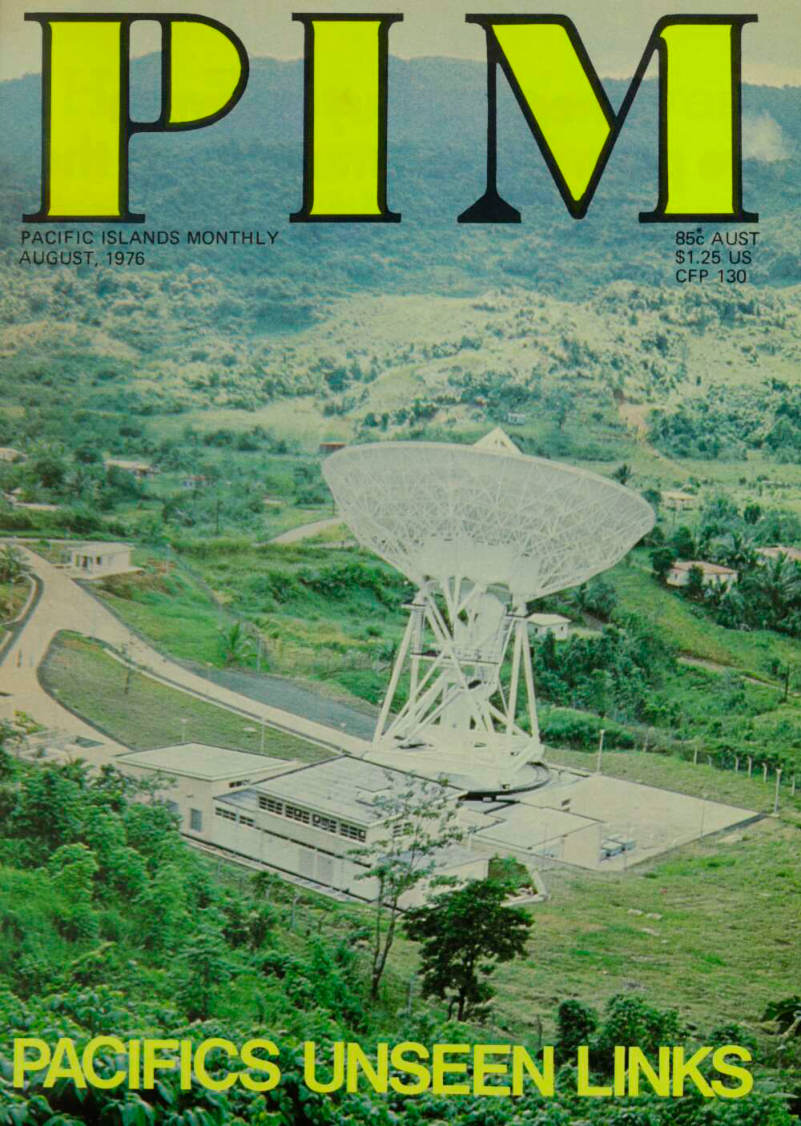
Our Cover
This satellite com munications station, built at Wailoku, six miles from Suva at a cost of $6 million, beams into the Intelsat IV satellite. It provides direct telephone, telex, high-speed data and facsimile circuits with Australia and New Zealand. The picture is by Fiji Times photographer Ann Livingston.
Advertisements & other items, pp. 2-4 (2 items)
When you buy a Toyota
we promise you much more than
one of the world’s finest cars.
m We'll be the first to admit that at Toyota we make some of the world's finest cars.
You only have to look at them to see that.
And driving them just goes to confirm your first opinions.
But there's more to buying a car than buying a good one. You also have to be sure you can keep it that way.
Which is why Toyota have always insisted that their after-sales service be as good as the cars themselves.
In the Pacific Islands area alone we have over fifty designated outlets to provide everything you might need, from a simple service to a major overhaul. So get yourself a Toyota and get a lot more than a car.
And that's a promise.
TOYOTA
SERVICE
TOYOTA
The Toyota range includes: Toyota 1000, Toyota Corolla, Toyota Celica, Toyota Corona, Toyota Corona Mark 11, Toyota Crown PAPUA, NEW GUINEA: ELA MOTORS LIMITED, Scratchley Rd., Badili, P.O. Box 75, Port Moresby. U.S. TRUST TERRITORY: MICROL CORPORATION, P.O. Box 267, Saipan. FIJI ISLANDS: AUTOMOTIVE SUPPLIES CO., LTD, G.P.O. Box 355, Suva. AMERICAN SAMOA: BURNS PHILP (SOUTH SEA) CO., LTD., P.O. 1057, Pago Pago. WESTERN SAMOA: BURNS PHI LP (SOUTH SEA) LTD., P.O. Box 188, Apia. GUAM: ATKINS, KROLL (GUAM) LTD., P.O. Box 6428, Tamuning. NEW HEBRIDES: NEW HEBRIDES MOTORS LTD., P.O. Box 18, Vila. SOLOMON ISLANDS: MENDANA ENTERPRISES (5.1.), LTD., P.O. Box 174, Honiara. TAHITI: NIPPON AUTOMOTO, B.P. 342, Papeete. COOK ISLANDS: COOK ISLANDS TRADING CORPORATION LTD., P.O. Box 92, Rarotonga.
NAURU ISLAND: NAURU COOPERATIVE SOCIETY. GILBERT & ELLICE ISLANDS COLONY: TARAWA MOTORS, Box 36, Bairiki Tarawa. NORFOLK ISLAND: MARIE'S NORFOLK TOURS, LTD;, P.O. Box 276. TIMOR: SANGTAI HOO.SangTai Building, Dili. NEW CALEDONIA: SOCIETE IMPORTATION AUTOMOBILE DU PACIFIQUE, Rond-Pointdu Pacific (Station Total) B.P. 438, Noumea.
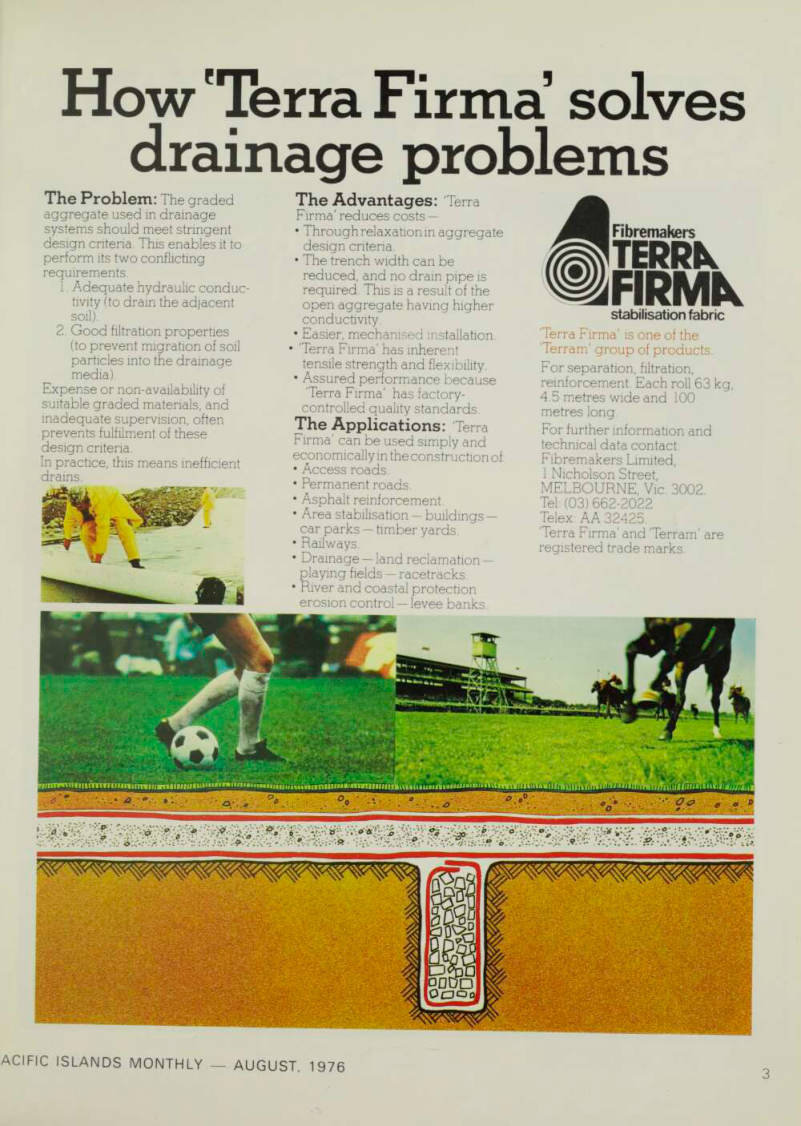
How 'Terra Firma solves
drainage problems
The Problem: The graded aggregate used in drainage systems should meet stringent design criteria. This enables it to perform its two conflicting requirements. 1 ■ Adequate hydraulic conductivity (to drain the adjacent soil). 2. Good filtration properties (to prevent migration of soil particles into the drainage media).
Expense or non-availability of suitable graded materials, and inadequate supervision, often prevents fulfilment of these design criteria.
In practice, this means inefficient drains. 5* The Advantages: Terra Firma' reduces costs • Through relaxation in aggregate design criteria. • The trench width can be reduced, and no drain pipe is required. This is a result of the open aggregate having higher conductivity. • Easier, mechanised installation. • 'Terra Firma' has inherent tensile strength and flexibility. • Assured performance because 'Terra Firma' has factorycontrolled quality standards.
The Applications: Terra Firma' can be used simply and economically in the construction of: • Access roads. • Permanent roads. • Asphalt reinforcement. • Area stabilisation buildings car parks timber yards. • Railways. • Drainage land reclamation playing fields racetracks. • River and coastal protection erosion control levee banks.
J Fibremakers
IffTERRk
HFIRMk
stabilisation fabric Terra Firma' is one of the Terrain' group of products.
For separation, filtration, reinforcement. Each roll 63 kg, 4.5 metres wide and 100 metres long.
For further information and technical data contact: Fibremakers Limited, 1 Nicholson Street,
MELBOURNE, Vic. 3002.
Tel: (03) 662-2022 Telex: AA 32425.
Terra Firma' and Terrain' are registered trade marks. ■T feT9* iifJfffMito \\\ i« n .V• • - * .. 9 ° - m Q o
□ODD
QOOq
STATESMAN
smoothest cigars on
e international scene
W oH ND f<i 1801 %Mw m%m¥ ♦ ■
fflS
*va|
■■, hi mm
-a *■ - ■jgsM BH;
STATESMAN
CORONA
5
Corona
■ 9 ' * V -
’•Of. - fiL
X554-10/75
3
ACIFIC ISLANDS MONTHLY AUGUST, 1976
Pacific Islands
Monthly
FOUNDED BY R W ROBSON IN 1930
Published Monthly By
Pacific Publications (Aust.) Pty. Ltd.,
76 Clarence Street, Sydney 2000
Postal Address GPO BOX 3408. SYDNEY,
N S W 2001
Telegraphic Address PACPUB, Sydney Telex 21242
Telephone 296693
Publisher: Stuart Inder Business Manager: John Berry
Pacific Islands Monthly
Editor: John Carter Advertising Manager: Alan Batt.
Subscription Rates:
Pacific Islands Monthly" is airfreighted to the ma jority of subscribers and agents in the Pacific Islands and the U S A Australia (including Lord Howe and Thursday Islands), New Zealand. Papua New Guinea, Fiji, New Hebrides, Tonga, Cook Islands, Western Samoa. Gilberts and Tuvalu, Norfolk Island, Niue and Nauru: $9 00 (local currency); Solomon Islands: $lO.OO Aust ; American Samoa, Micronesia and Guam: $l2 00 U S.; Hawaii and U S Mainland: $l5 00 U.S.; New Caledonia and French Polynesia 1,500 C.F P ; United Kingdom E 6 50; Japan: 4000 Yen; Elsewhere: $ll 50 Aust.
Representatives
Fiji: Advertising and Distribution Fiji Times & Herald Ltd , 20 Gordon Street. Suva, Telephone 312-1 11 Telex: FJ 2124 Papua New Guinea: Advertising and Distribution PNG Post-Courier, P 0 Box 85, Port Moresby Inquiries: Post Newsagency, Telephone 24-2148 French Polynesia: Distribution Hachette Pacifique, 10 Ave Bruat, Papeete New Caledonia: Distribution Depot Centre de Presse Michel PENTECOST, 8.P.C2 NOUMEA New Zealand: Pacific Publications, C.PO. Box 2229, Auckland.
United Kingdom: The Herald and Weekly Times Limited, 8-10 Clifford's Inn, Fetter Lane, London EC4A IBU Telephone: 01-831 6041 Telex: Lon don 21989 Japan: Advertising Universal Media Corpora tion, C P 0 Box 46, Tokyo Telephone: 666-3036 Victoria: Advertising Pacific Publications (Aust) Pty Ltd., Herald and Weekly Times Building, 2nd Floor. 61 Flinders Lane, Melbourne, 3000 Telephone 652-1565 Brisbane: D Wood. Anday Agency, Box 1918 G.PO, Brisbane 4001 Telephone 44-3485; 44- 1546 Hawaii and U S. Mainland only: N Grogan. (Send change of address notices. Form 3579 and new subscriptions to P 0. Box 2193, Honolulu, Hawaii,
U S A. 96805 )
Second class postage paid at Honolulu, Hawaii Printed in Australia
Copyright c, 1976,
Pacific Publications (Aust.) Pty. Ltd.
Printed by Paramac, Mitchell Road, Alexandria Registered at the G.P.O. Sydney for transmission by aost as a newspaper category B Recommended retail price only.
Vol. 47, No. 8 August, 1976
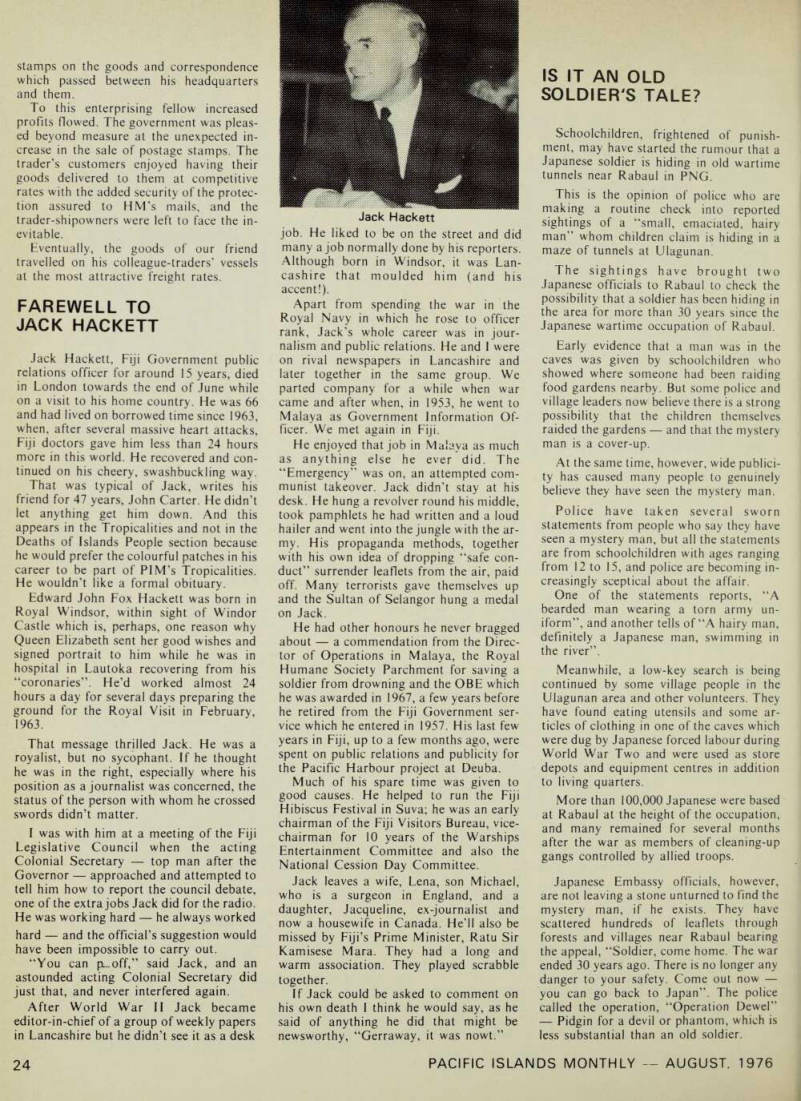
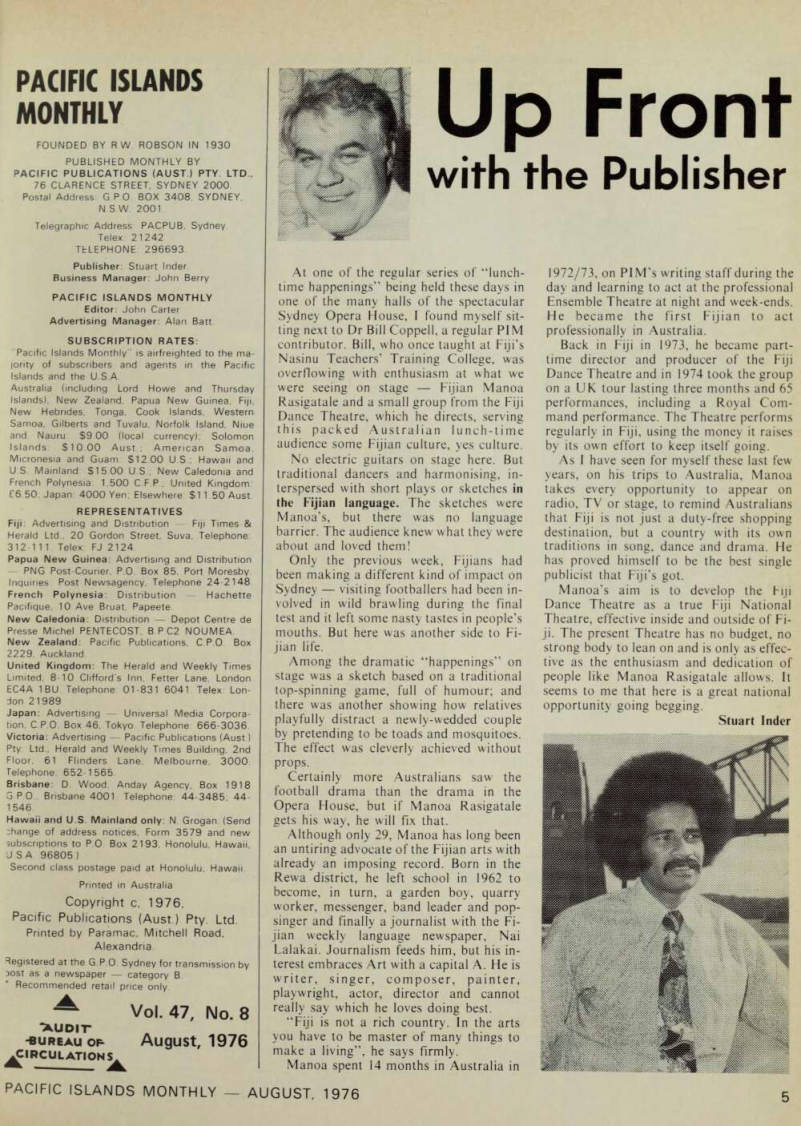
Up Front
with the Publisher
At one of the regular series of “lunch time happenings” being held these days in one of the many halls of the spectacular Sydney Opera House, I found myself sit ting next to Dr Bill Coppell, a regular PIM contributor. Bill, who once taught at Fiji’s Nasinu Teachers’ Training College, was overflowing with enthusiasm at what we were seeing on stage Fijian Manoa Rasigatale and a small group from the Fiji Dance Theatre, which he directs, serving this packed Australian lunch-time audience some Fijian culture, yes culture.
No electric guitars on stage here. But traditional dancers and harmonising, in terspersed with short plays or sketches in the Fijian language. The sketches were Manoa’s, but there was no language barrier. The audience knew what they were about and loved them!
Only the previous week, Fijians had been making a different kind of impact on Sydney visiting footballers had been in volved in wild brawling during the final test and it left some nasty tastes in people’s mouths. But here was another side to Fi jian life.
Among the dramatic “happenings” on stage was a sketch based on a traditional top-spinning game, full of humour; and there was another showing how relatives playfully distract a newly-wedded couple by pretending to be toads and mosquitoes.
The effect was cleverly achieved without props.
Certainly more Australians saw the football drama than the drama in the Opera House, but if Manoa Rasigatale gets his way, he will fix that.
Although only 29, Manoa has long been an untiring advocate of the Fijian arts with already an imposing record. Born in the Rewa district, he left school in 1962 to become, in turn, a garden boy, quarry worker, messenger, band leader and pop singer and finally a journalist with the Fi jian weekly language newspaper, Nai Falakai. Journalism feeds him, but his in terest embraces Art with a capital A. He is
writer, singer, composer, painter,
playwright, actor, director and cannot really say which he loves doing best.
“Fiji is not a rich country. In the arts you have to be master of many things to make a living”, he says firmly.
Manoa spent 14 months in Australia in
1972/73, on PlM’s writing staff during the day and learning to act at the professional Ensemble Theatre at night and week-ends.
He became the first Fijian to act professionally in Australia.
Back in Fiji in 1973, he became part time director and producer of the Fiji Dance Theatre and in 1974 took the group on a UK tour lasting three months and 65 performances, including a Royal Com mand performance. The Theatre performs regularly in Fiji, using the money it raises by its own effort to keep itself going.
As I have seen for myself these last few years, on his trips to Australia, Manoa takes every opportunity to appear on radio, TV or stage, to remind Australians that Fiji is not just a duty-free shopping destination, but a country with its own traditions in song, dance and drama. He has proved himself to be the best single publicist that Fiji’s got.
Manoa’s aim is to develop the Fiji Dance Theatre as a true Fiji National Theatre, effective inside and outside of Fi ji. The present Theatre has no budget, no strong body to lean on and is only as effec tive as the enthusiasm and dedication of people like Manoa Rasigatale allows. It seems to me that here is a great national
opportunity going begging.
Stuart Inder
Advertisements & other items, p. 6 (1 item)
Goodfyeah
The world over, more vehicles of all kinds roll on Goodyear tyres ... more planes land on Goodyear tyres ... more synthetic rubber is produced by Goodyear... and more different kinds of hose,
transmission belts, conveyor belts and other
industrial rubber goods bear the Goodyear trademark.
For leadership in rubber technology, look to
Goodyear. The world’s largest rubber company.
We solve industrial problems.
GOODYEAR DISTRIBUTORS IN S.E. ASIA AND PACIFIC BASIN
GOODfYEAH
Boroko Motors Ltd.
Port Moresby, PNG.
Cook Island Motors Cook Is.
Goodyear Malaysia SDN. BHD. Morris Hedstrom Ltd.
Shah Alam, Selangor, MALAYSIA Apia, Western Samoa Morris Hedstrom Ltd. P.T. Redjeki P.T. Redjeki Development Corp. Steamships Machinery Port Moresby. PNG.
Susupe Enterprises Saipan. Manana Is.
Truk Trading Co.
Goodyear Singapore PTE. Ltd.
SINGAPORE
PTE. Ltd. Morris Hedstrom Apia, Western Samoa Jakarta, INDONESIA Morris Hedstrom Santo Engineers Tonga Santo, NEW HEBRIDES Tonga Ngiratkel Etpison Co. Ltd. Samoa Motors Inc.
Koror, Palau AMERICAN SAMQA Commex Philippines Ltd. Guam Tire & Supply Co.
AMERICAN SAMQA
Service Mobil Papeete. Tahiti Solomon Motors Ltd.
Honiara, 8.5.1. P Societe General Automobile
Noumea. NEW CALEDONIA
Truk, E. Caroline Is.
Makati, PHILIPPINES
Coral Island Motors Suva, FIJI Agana, GUAM Island Construction Co.
Mgjuro, Marshall Is, Landis Brothers & Co. Ltd.
HONG KONG
Micro! Corporation Saipan, Ma/iana Is.
Pacific Motors
Vila, NEW HEBRIDES
P.A.M.I.
Kolonia, Ponape P.T. Tira Austenite Jakarta, INDONESIA
W.S.T.C.S.
WESTERN SAMOA
Yung Wei Tung Trading Co. Ltd.
Taipei, TAIWAN Yap Co-operative Ass.
Yap, W. Caroline Is. 1710060 Diethelm & Co. Ltd.
Bangkok, THAILAND Duncombe Bay Garage Norfolk Is.
In the issue
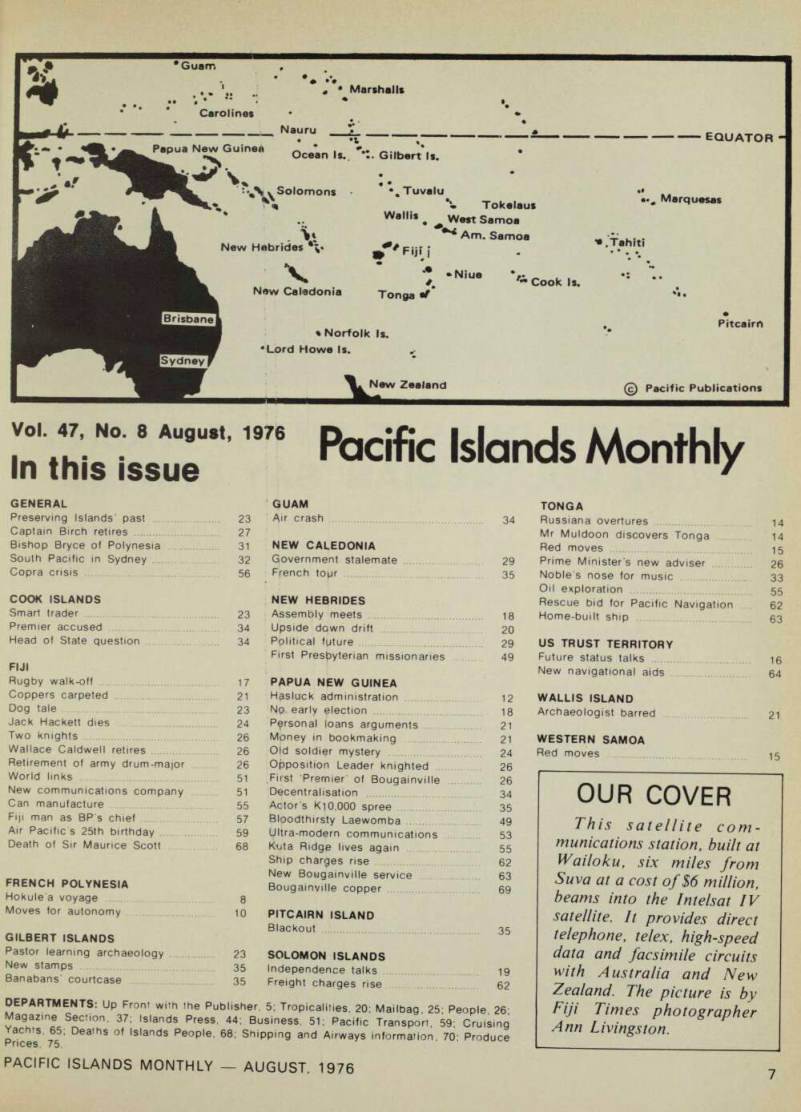
General
Preserving Islands' past 23 Captain Birch retires 27 Bishop Bryce of Polynesia 31 South Pacific in Sydney 32 Copra crisis 56
Cook Islands
Smart trader 23 Premier accused 34 Head of State question 34
Fiji
Rugby walk-off 17 Coppers carpeted 21 Dog tale 23 Jack Hackett dies 24 Two knights 26 Wallace Caldwell retires 26 Retirement of army drum-major 26 World links 51 New communications company 51 Can manufacture 55 Fiji man as BP's chief 57 Air Pacific s 25th birthday 59 Death of Sir Maurice Scott 68
French Polynesia
Hokule a voyage 8 Moves for autonomy 10
Gilbert Islands
Pastor learning archaeology 23
New stamps 35 Banabans' courtcase 35
Guam
Air crash 34
New Caledonia
Government stalemate 29 French tour 35
New Hebrides
Assembly meets is Upside down drift 20 Political future 29 First Preslpyterian missionaries 49
Papua New Guinea
Hasluck administration 12 Np, early election is Personal loans arguments 21 Money in bookmaking 21 Old soldier mystery 24 Opposition Leader knighted 26 First Premier' of Bougainville 26 Decentralisation 34 Actor s Kio.ooo spree 35 Bloodthirsty Laewomba 49 Ultra-modern communications 53 Kuta Ridge lives again 55 Ship charges rise 62 New Bougainville service 63 Bougainville copper 69
Pitcairn Island
Blackout 35
Solomon Islands
Independence talks 19 Freight charges rise 62
Tonga
Russians overtures 14 Mr Muldoon discovers Tonga 14 Red moves 15 Prime Minister's new adviser 26 Noble s nose for music 33 Oil exploration 55 Rescue bid for Pacific Navigation 62 Home-built ship 53
Us Trust Territory
Future status talks 15 New navigational aids 64
Wallis Island
Archaeologist barred 21
Western Samoa
Red moves 15
DEPARTMENTS: Up Front with the Publisher, 5; Tropicalities, 20; Mailbag, 25; People 26' Magazine Section, 37; Islands Press, 44; Business. 51; Pacific Transport, 59; Cruising Yachts, 65; Deaths of Islands People, 68; Shipping and Airways information 70- Produce Prices, 75.
Pure Polynesian’ Say Critics
Hokule’A Does It But ‘It Wasn’T
From AL PRINCE in Papeete
The Polynesian, twin-hulled sailing canoe, Hokule’a, set sail from Papeete for Hawaii on July I, its sponsors trying desperately to hold its accomplishments intact in the wake of mounting criticism of its 34'/’-day voyage from Hawaii to Tahiti in May.
While the so-called purity of the voyage will be debated far into the future, one of the most amazing and impressive ac complishments of the Hokule’a’s trip has been the Tahitians’ enthusiastic awareness of their ancient Polynesian culture. An es timated crowd of between 10,000 and 15,- 000 formed a solid mass of humanity along the shore of Papeete Harbour to greet Hokule’a on June 4. It was the biggest welcome ever held in Tahiti, causing one French language newspaper to headline the greeting the next day, “Tahiti’s welcome also an achievement”.
But the enthusiasm did not stop there as Tahitians feted everyone connected with the voyage for almost a month later, right up to the Hokule’a’s departure for Hawaii.
There were feasts, receptions and visits by the canoe and its return crew to two of Tahiti’s districts and to the island of Raiatea. It was almost as if the people here had rediscovered their natural cultural link with Hawaii as Polynesians first, Tahitians and Hawaiians second. One could not enter a bar or nightclub without overhear ing or being drawn into at least one conver sation about the Hokule’a. The streets were filled daily with people wearing Hokule’a T-shirts.
To the Tahitians, the Hokule’a voyage from Hawaii to Tahiti was a complete success. To them, it proved that their ancestors from Raiatea actually did sail back and forth the 3000 nautical miles along the longest of the ancient Polynesian sea lanes, using only the sun, moon, stars, winds and ocean currents and swells to
navigate by.
And the sponsors of the voyage, the
Polynesian Voyaging Society, a non-profit
organisation in Honolulu, is satisfied with the results also.
“The navigation was 100 per cent successful,” said Herb Kane of Honolulu,
the organisation’s vice president.
But, as in any long-distance ocean voyage, the Hokule’a’s trip was not without problems and critics, who view the entire voyage as a hoax, claiming that the trip was encumbered by 20th century technology, such as the construction of the hulls with fibreglass, the use of an escort yacht and some communications between the trailing yacht and the canoe.
To all these critics, Kane said that some people would not be satisfied with the puri ty of the Hokule’a voyage unless the bodies of the ancient Polynesian sailors were ex humed, brought back to life and placed on the canoe for the voyage.
Instead of the ancient Polynesians, however, there were 17 crew members on the 60 ft Hokule’a, with cramped living area of about 320 sq ft, no bigger than a small living room or a small apartment.
The majority of the crew was Polynesian
from Hawaii. But there were two
photographers aboard, one shooting
movies for the National Geographic Socie ty, the other shooting stillphotos for the society’s magazine.
The crew also included Dr David Lewis, of Canberra, as assistant navigator, but whose primary role was to observe how the crew reacted to eating typical, non-20th century Polynesian foods during the voyage. The experiment lasted only during the first two weeks of the trip, and had to be abandoned for medical reasons because the crew was not getting enough sugar in its blood, Kane said.
Yet Kane called the experiment successful, saying that Dr Lewis will prove this in a report he is preparing. But just the very limited use of the food and the accom panying publicity, Kane said, has spawned a tremendous revival in Hawaii of the preparation of ancient Polynesian foods.
“People are drying bananas for the first time. And they’re saving money and get ting sweets that are cheaper than candy.”
Another crew member was Dr Ben Finney, an anthropologist and one of the main organisers of the voyage.
The Hokule’a’s voyage from Hawaii to Tahiti was very difficult, from a sailing point of view, Kane said. “This canoe’s been pounded for 3000 miles into the wind, and the crew’s been pounded also.” That pounding, the 10 days instead of the ex pected five spent in the doldrums and the varying social and economic backgrounds of the 17 crew members, contributed in a
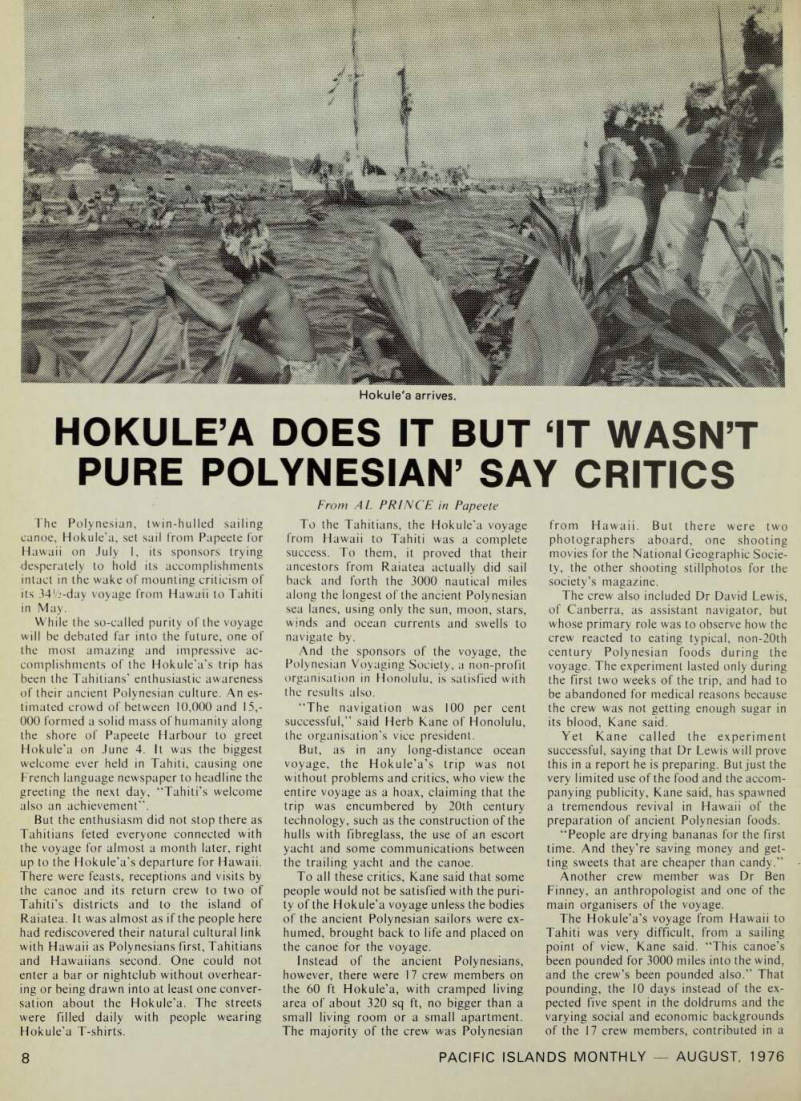
Hokule'sa arrives
large measure to the tensions and per sonality clashes that occurred, Kane in dicated.
“There were a lot of tigers with diverse backgrounds. We did expect that there might be some problems because of the diverse backgrounds of the people on board. There were different points of view about the objective of the trip. It became a problem primarily toward the end of the voyage.”
As one of the crew members making the trip back to Hawaii said before leaving Tahiti, “There was too much power on that canoe”. By contrast, he said, the return crew was smaller in number , 12, younger, had no scientists or photographers on board and had more In dians and fewer chiefs.
But the return crew did not include Mau Piailug, the Yapese navigator from Satawal atoll, who was lauded by every crew member for sailing the Hokule’a from the island of Maui in Hawaii to Tahiti without using any modern naviga tion. As Bruce Benson, science writer for the Honolulu Advertiser wrote, Piailug navigated the Hokule’a as ancient Polynesians did, “with crewmen who, despite pledging to leave their differences on shore and follow Piailug’s lead at sea, were unable in some measure to work together”.
Piailug left Tahiti on the first plane out, leaving behind a tape-recorded message for his companions, calling it “a bad crew” with the exception of three men, one of whom is a full-blooded Hawaiian and another is Rodo Williams, a part- Polynesian from Tahiti who piloted the Hokule’a through the Tuamotus and Society Islands once she reached French
Polynesia.
With the loss of Piailug as navigator, the Hokule’a was forced to make the return trip to Hawaii using two navigation systems one modern, one ancient because no one was as qualified as the Micronesian to use the ancient system of sun, stars, moon, winds and seas.
The return voyage, Kane said, “Should be easier. We’re east of Hawaii and the wind blows from the east. There’ll be less easting to do to arrive at the same latitude of Hawaii.
He described the navigation and sailing aspects of the return trip in one sentence: Sail hard to the wind, close-hauled or up wind, however, you want to call it, until the stars Hokule’a (Star of Gladness), or Arc turus, Sheratan or Pleiadies (Makalii, or Little Eyes in Hawaiian) pass directly overhead in their nightly arch east to west, then head downwind and you’ll hit the Hawaiin chain”.
The 64-foot yacht Meotai, the target of much of the critics’ “anti-purity” argu ments, was accompanying the -Hokule’a once again as an escort. The modern yacht s radar and radio direction finder
broke down early in the voyage to Tahiti, forcing the Meotai to abandon its original plan of staying out of sight of the Hokule’a.
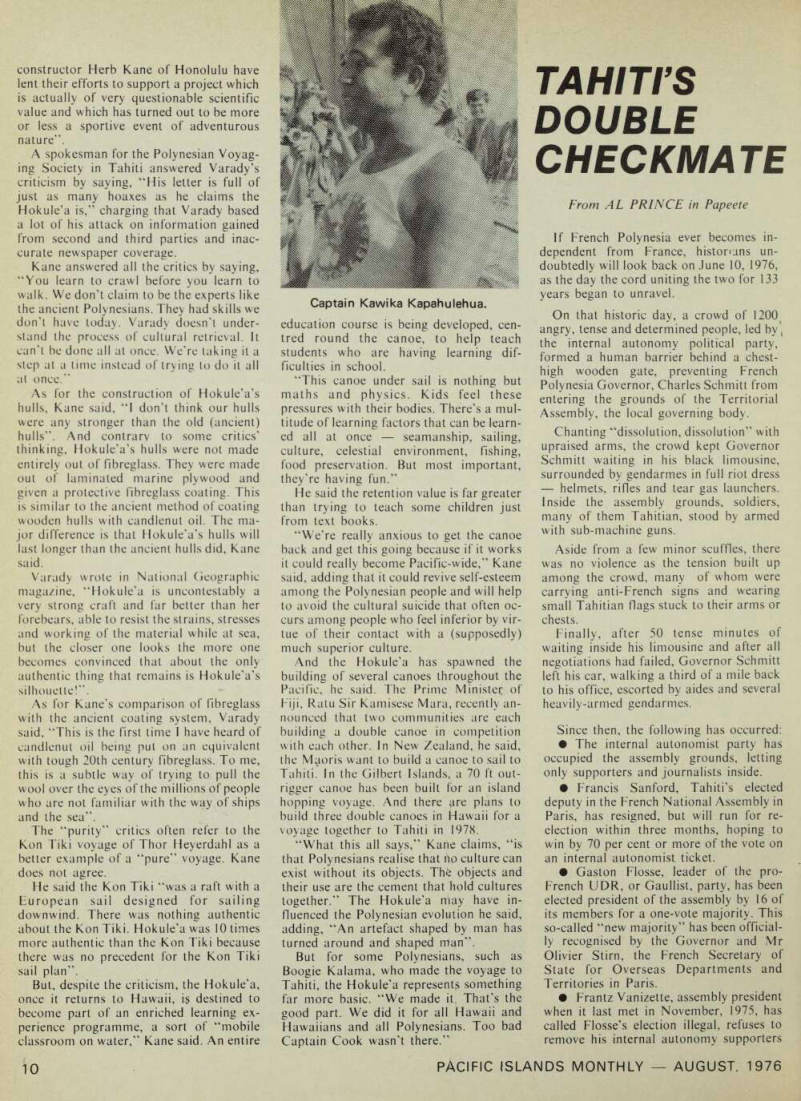
The purists claim that the ancient Polynesians never had the equivalent of an escort yacht like Meotai, although Kane counters by saying that most of the ancient voyages were made in groups of two or three canoes. But the critics’ biggest target was the communications system set up between the Navy-Marine MARS radio network for the Pacific in Honolulu, the skipper of the Meotai and the skipper of the Hokule’a, Kawika Kapahulehua, one of the two full-blooded Hawaiians to make the voyage and the only original crew member to make the return trip. This system transferred, through three censor checks, well-wishes from the crew’s families on tape cassettes as the canoe sail ed to Tahiti. “This was a morale thing for the guys and just as important a morale thing for the families,” Kane said. “The crew was more confident of hitting Tahiti than their families.”
When the Hokule’a arrived in Tahiti, one of the crewmen said information on one of the cassettes had told the crew its position accidentally, making them realise they were too far west and might end up in the Cook Islands instead of Tahiti.
Kane said a position was never given to the crew under any circumstances. But he said one tape apparently was not erased completely, leaving a shadow of a message telling the crew they were too far west, but not telling them exactly where they were.
Alter their return to Hawaii by air, relief captain David Lyman, a parl-Hawaiian, and Dr Finney confirmed that Hokule’a inadvertently received information at sea indicating its position. But both denied that any ol the information was ever heard by Piailug, Williams or Dr Lewis.
As for the crewmen who did hear the in formation about being too far west, Kane said, “They already knew that themselves and they disregarded it” (the information).
In summarising the main accomplish ment of the Hokule’a’s voyage to Tahiti, Kane said it proved that “the Polynesian hull design and sail plan are capable of making enough easting to hit Tahiti from Hawaii without using (navigation) in struments”.
How important is that? “To the anthropologist,” Kane said, “this is god dam exciting news”. It is also important “to the Hawaiian or Tahitian student of history who wants to confirm that his legends are based on probability”.
Kane said there would be a lot to learn on the return voyage, “depending on how much we crank into it. The main objective is to get the canoe back to Hawaii in as comfortable and dry a trip as possible”.
But, regardless of Hokule’a’s objectives, the critics continue to attack the so-called “purity” of the voyage.
Shortly after the canoe went into dry dock in Tahiti for minor repairs, Ralph Varady, a German writer who has written several books about Polynesia during his many years of living in Tahiti, telephoned The Tahiti Bulletin, the English language newspaper.
“I was more than shocked. It’s a hoax.
You should see the fibreglass. You should see the nails. You should see the nylon. I’m shocked. It s a sham. Herb Kane is trying to pull the wool over people’s eyes. There’s tons of resin on board.”
In a letter to the National Geographic magazine, Varady wrote, “It distresses me to state outright and without prejudice- HOKULE’A IS A HOAX! It further sur prises me that respectable scholars such as
Dr (Kenneth) Emory (of the Bishop
Museum in Honolulu), Dr Ben Finney and
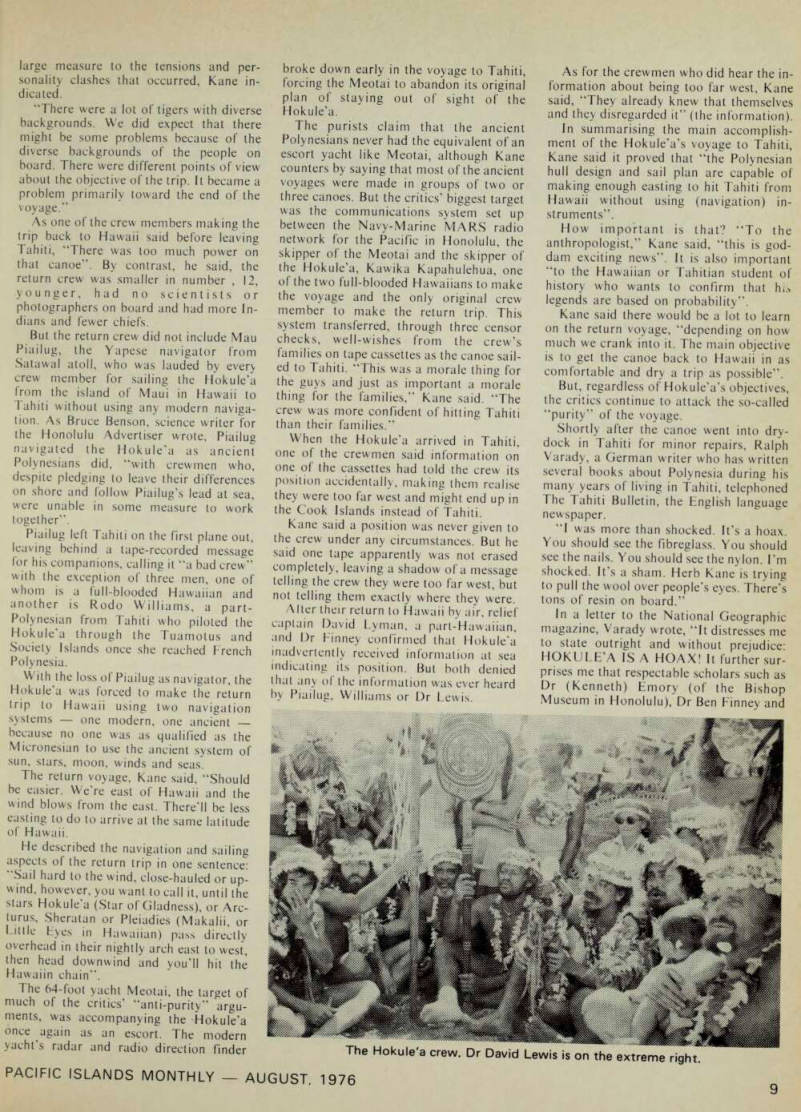
The Hokule'a crew. Dr David Lewis is on the extreme right.
constructor Herb Kane of Honolulu have lent their efforts to support a project which is actually of very questionable scientific value and which has turned out to be more or less a sportive event of adventurous nature”.
A spokesman for the Polynesian Voyag ing Society in Tahiti answered Varady’s criticism by saying, “His letter is full of just as many hoaxes as he claims the Hokule’a is,” charging that Varady based a lot of his attack on information gained from second and third parties and inac curate newspaper coverage.
Kane answered all the critics by saying, “You learn to crawl before you learn to walk. We don’t claim to be the experts like the ancient Polynesians. They had skills we don’t have today. Varady doesn’t under stand the process of cultural retrieval. It can’t be done all at once. We’re taking it a step at a lime instead of trying to do it all at once.”
As for the construction of Hokule’a’s hulls, Kane said, “1 don’t think our hulls were any stronger than the old (ancient) hulls”. And contrary to some critics’ thinking, Hokule’a’s hulls were not made entirely out of fibreglass. They were made out of laminated marine plywood and given a protective fibreglass coating. This is similar to the ancient method of coating wooden hulls with candlenut oil. The ma jor difference is that Hokule’a’s hulls will last longer than the ancient hulls did, Kane said.
Varady wrote in National Geographic magazine, “Hokule’a is unconteslably a very strong craft and far better than her forebears, able to resist the strains, stresses and working of the material while at sea, but the closer one looks the more one becomes convinced that about the only authentic thing that remains is Hokule’a’s silhouette!”.
As for Kane's comparison of fibreglass with the ancient coating system, Varady said, “This is the first time I have heard of candlenut oil being pul on an equivalent with tough 20th century fibreglass. To me, this is a subtle way of trying to pull the wool over the eyes of the millions of people who are not familiar with the way of ships and the sea”.
The “purity” critics often refer to the Kon Tiki voyage of Thor Heyerdahl as a better example of a “pure” voyage. Kane does not agree.
He said the Kon Tiki “was a raft with a European sail designed for sailing downwind. There was nothing authentic about the Kon Tiki. Hokule’a was 10 times more authentic than the Kon Tiki because there was no precedent for the Kon Tiki sail plan”.
But, despite the criticism, the Hokule’a, once it returns to Hawaii, is destined to become part of an enriched learning ex perience programme, a sort of “mobile classroom on water,” Kane said. An entire
education course is being developed, cen tred round the canoe, to help teach students who are having learning dif ficulties in school.
“This canoe under sail is nothing but maths and physics. Kids feel these pressures with their bodies. There’s a mul titude of learning factors that can be learn ed all at once seamanship, sailing, culture, celestial environment, fishing, food preservation. But most important, they’re having fun.”
He said the retention value is far greater than trying to teach some children just from text books.
“We’re really anxious to get the canoe back and get this going because if it works it could really become Pacific-wide,” Kane said, adding that it could revive self-esteem among the Polynesian people and will help to avoid the cultural suicide that often oc curs among people who feel inferior by vir tue of their contact with a (supposedly) much superior culture.
And the Hokule’a has spawned the building of several canoes throughout the Pacific, he said. The Prime Minister of Fiji, Rulu Sir Kamisese Mara, recently an nounced that two communities are each building a double canoe in competition with each other. In New Zealand, he said, the Maoris want to build a canoe to sail to Tahiti. In the Gilbert Islands, a 70 ft out rigger canoe has been built for an island hopping voyage. And there are plans to build three double canoes in Hawaii for a voyage together to Tahiti in 1978.
“What this all says,” Kane claims, “is that Polynesians realise that ho culture can exist without its objects. Thfe objects and their use are the cement that hold cultures together.” The Hokule'a may have in fluenced the Polynesian evolution he said, adding, “An artefact shaped by man has turned around and shaped man”.
But for some Polynesians, such as Boogie Kalama, who made the voyage to Tahiti, the Hokule’a represents something far more basic. “We made it That's the good part. We did it for all Hawaii and Hawaiians and all Polynesians. Too bad Captain Cook wasn’t there.”
Captain Kawika Kapahulehua.
Double
Tahiti’S
Checkmate
From AL PRINCE in Papeete If French Polynesia ever becomes in dependent from France, historians un doubtedly will look back on June 10, 1976, as the day the cord uniting the two for 133 years began to unravel.
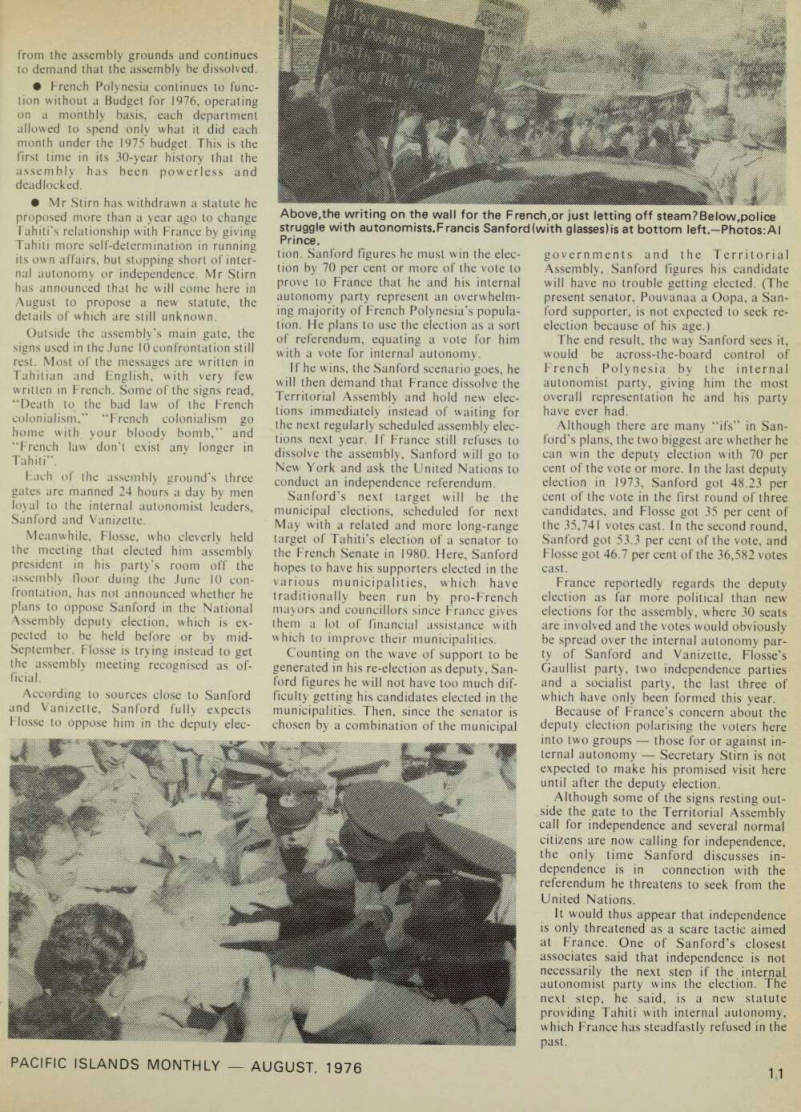
On that historic day, a crowd of 1 200 ( angry, tense and determined people, led by, the internal autonomy political party, formed a human barrier behind a chest high wooden gate, preventing French Polynesia Governor, Charles Schmitt from entering the grounds of the Territorial Assembly, the local governing body.
Chanting “dissolution, dissolution” with upraised arms, the crowd kept Governor Schmitt waiting in his black limousine, surrounded by gendarmes in full riot dress helmets, rifles and tear gas launchers.
Inside the assembly grounds, soldiers, many of them Tahitian, stood by armed with sub-machine guns.
Aside from a few minor scuffles, there was no violence as the tension built up among the crowd, many of whom were carrying anti-French signs and wearing small Tahitian flags stuck to their arms or chests.
Finally, after 50 tense minutes of waiting inside his limousine and after all negotiations had failed, Governor Schmitt left his car, walking a third of a mile back to his office, escorted by aides and several
heavily-armed gendarmes.
Since then, the following has occurred: • The internal autonomist party has occupied the assembly grounds, letting only supporters and journalists inside. • Francis Sanford, Tahiti’s elected deputy in the French National Assembly in Paris, has resigned, but will run for re election within three months, hoping to win by 70 per cent or more of the vote on an internal autonomist ticket. • Gaston Flosse, leader of the pro- French UDR, or Gaullist, party, has been elected president of the assembly by 16 of its members for a one-vote majority. This so-called “new majority” has been official ly recognised by the Governor and Mr Olivier Stirn, the French Secretary of State for Overseas Departments and Territories in Paris. • Frantz Vanizette, assembly president when it last met in November, 1975, has called Flosse’s election illegal, refuses to remove his internal autonomy supporters
from the assembly grounds and continues to demand that the assembly be dissolved. • French Polynesia continues to func tion without a Budget for 1976, operating on a monthly basis, each department allowed to spend only what it did each month under the 1975 budget. This is the first time in its 30-year history that the assembly has been powerless and deadlocked. • Mr Stirn has withdrawn a statute he proposed more than a year ago to change Tahiti’s relationship with France by giving Tahiti more self-determination in running its own affairs, but stopping short of inter nal autonomy or independence. Mr Stirn has announced that he will come here in August to propose a new statute, the details of which are still unknown.
Outside the assembly’s main gate, the signs used in the June 10 confrontation still rest. Most of the messages are written in Tahitian and English, with very few written in French. Some of the signs read, “Death to the bad law of the French colonialism," “French colonialism go home with your bloody bomb,’’ and “French law don’t exist any longer in Tahiti”.
Each of the assembly ground's three gates are manned 24 hours a day by men loyal to the internal autonomist leaders, Sanford and Vanizette.
Meanwhile, Flosse, who cleverly held the meeting that elected him assembly president in his party’s room off the assembly floor duing the June 10 con frontation, has not announced whether he plans to oppose Sanford in the National Assembly deputy election, which is ex pected to be held before or by mid- September. Flosse is trying instead to get the assembly meeting recognised as of ficial.
According to sources close to Sanford and Vanizette, Sanford fully expects Flosse to oppose him in the deputy elec-
lion. Sanford figures he must win the elec tion by 70 per cent or more of the vote to prove to France that he and his internal autonomy party represent an overwhelm ing majority of French Polynesia’s popula tion. He plans to use the election as a sort of referendum, equating a vote for him with a vote for internal autonomy.
If he wins, the Sanford scenario goes, he will then demand that France dissolve the Territorial Assembly and hold new elec tions immediately instead of waiting for the next regularly scheduled assembly elec tions next year. If France still refuses to dissolve the assembly, Sanford will go to New York and ask the United Nations to conduct an independence referendum.
Sanford’s next target will be the municipal elections, scheduled for next May with a related and more long-range target of Tahiti’s election of a senator to the French Senate in 1980. Here, Sanford hopes to have his supporters elected in the various municipalities, which have traditionally been run by pro-French mayors and councillors since France gives them a lot of financial assistance with which to improve their municipalities.
Counting on the wave of support to be generated in his re-election as deputy, San ford figures he will not have too much dif ficulty getting his candidates elected in the municipalities. Then, since the senator is chosen by a combination of the municipal
governments and the Territorial Assembly, Sanford figures his candidate will have no trouble getting elected. (The present senator, Pouvanaa a Oopa, a San ford supporter, is not expected to seek re election because of his age.) The end result, the way Sanford sees it, would be across-the-board control of French Polynesia by the internal autonomist party, giving him the most overall representation he and his party have ever had.
Although there are many “ifs” in San ford’s plans, the two biggest are whether he can win the deputy election with 70 per cent of the vote or more. In the last deputy election in 1973, Sanford got 48.23 per cent of the vote in the first round of three candidates, and Flosse got 35 per cent of the 35,741 votes cast. In the second round, Sanford got 53.3 per cent of the vote, and Flosse got 46.7 per cent of the 36,582 votes cast.
France reportedly regards the deputy election as far more political than new elections for the assembly, where 30 seats are involved and the votes would obviously be spread over the internal autonomy par ty of Sanford and Vanizette, Flosse’s GauHist party, two independence parties and a socialist party, the last three of which have only been formed this year.
Because of France’s concern about the deputy election polarising the voters here into two groups those for or against in ternal autonomy Secretary Stirn is not expected to make his promised visit here until after the deputy election.
Although some of the signs resting out side the gate to the Territorial Assembly call for independence and several normal citizens are now calling for independence, the only time Sanford discusses in dependence is in connection with the referendum he threatens to seek from the United Nations.
It would thus appear that independence is only threatened as a scare tactic aimed at France. One of Sanford’s closest associates said that independence is not necessarily the next step if the internal autonomist party wins the election. The next step, he said, is a new statute providing Tahiti with internal autonomy, which France has steadfastly refused in the past.
Above,the writing on the wall for the French,or just letting off steam?Below,police struggle with autonomists.Francis Sanfordlwith glasses)is at bottom left.—Photos:Al Prince,
the corpse of white supremacy
The man who built New Guinea on the corpse of white supremacy
By Stuart Inder
When, in 1951, Mr Paul Hasluck took over the responsibility for the direction of Papua New Guinea as Australia's Minister for Territories, he asked the then- Administrator of that big territory.
Colonel J. K. Murray, to tell him what he thought his most urgent problems were.
Murray, he recalls, “at once started to tell me of a dispute between himself and the naval officer-in-charge about the number of guns he was entitled to receive in salute from a visiting French warship.”
Hasluck fell that Murray had “developed an obsession for his own rank and status”, but worse, Murray believed that the government of the territory should be run by himself and his staff, who were “to be left free to do good as they saw it.”
Long before Hasluck relinquished his post as minister 13 years later, he had got rid of Murray as Administrator, and he had firmly established the principle of ministerial responsibility for PNG, but he never did succeed in streamlining the post of Administrator itself.
To the end, he continued to regard it as badly conceived, its functions beyond the compass of any one man. What he fell was needed were at least two men, one to act as a sort of Port Moresby deputy to the Australian Governor-General, a figure head who opened parliament and annual shows; the other man to get on with the real business of administering the country without distraction.
As it happened, Hasluck did a pretty
good job of administering the country
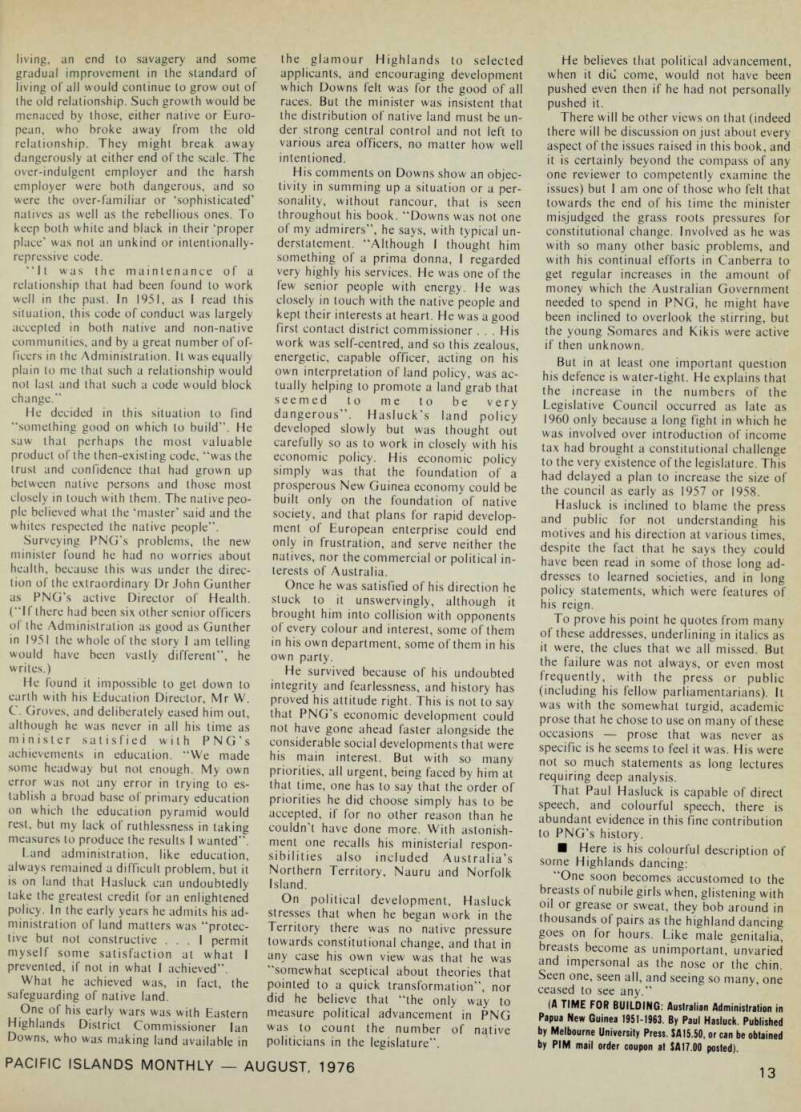
himself, and his 452-page autobiography, A Time for Building: Australian Ad ministration in Papua New' Guinea 1951- 63, becomes not merely a basic account of those important years in PNG's history but a fine record of the work of one man.
History will remember Hasluck for what he did in Papua New Guinea, not for his later term as Minister for Foreign Af fairs and then as Australian Governor- General, and this book will help ensure it.
It's a highly-compelenl, quite invaluable history objective, sensitive, honest. It will dispel some myths about the man, and some myths about how the development of PNG was a achieved.
Hasluck, of course, would disagree that he ever administered the country or that he even established remote control from Canberra. “My whole endeavour,” he says, “was to make other people do the job but to do it the proper way, and my im patience was with bad method, disregard of the rules or lack of diligence.”
The minister saw his role as that of the circus rider, circling the ring with two galloping horses, one the PNG Ad ministration, the other the Canberra Department of Territories, one foot on the back of each, directing their pace and direction.
He managed it successfully because he knew his horses, he came to know the ring intimately and learned to judge the temper of the crowd. But pacing these horses was, of necessity, a lonely and exacting respon sibility, and he himself never felt it was en tirely successful.
“My failure as minister was that perfor mance did not match intention, and I did not gel the Administration of the territory to do all that I wanted it to do,” he says.
In this big book he repeatedly surveys his work in various areas and berates himself for not having worked harder for results in one area or another; frequently he feels he was not ruthless enough.
Repeatedly he was exasperated by inef ficiency in Canberra or Port Moresby, es pecially at long public service delays in get ting a task done.
His own integrity, which shows through clearly, will bring many to his defence, for one can hardly avoid being impressed, not by the failures that he berates himself for, but for his achievements. They were clear ly the result of Hasluck's determination, stamina and intelligence although “intellect” might be the belter word.
If he were a different kind of man, a dominating, outgoing personality who noisily kicked bums, and took short cuts
and even risks where the occasion seemed to demand it, perhaps he might have won some of the achievements he pines after.
But then, that kind of man would not have the qualities of a Hasluck, qualities of con centration and attention to detail, a deter mination to first lay down a firm base on which to build, and not be attracted to the more colourful, more politically rewarding, aspects of his position. It is a measure of Hasluck’s success that not at any time during his long service as Territories Minister was PNG ever a party-political issue. All sides of
Canberra’s political life supported
Hasluck’s work.
He was a planner who never took one step unless he saw where it might lead, and one can’t escape the realisation that it was lucky for PNG that Australia was then un dergoing a long period of stable govern
ment by the Liberal-Country Party coali
tion, which enabled one minister to hold the reins for 13 years.
He spent his first five years, he says, “lacking experience”, and thus he worked to check tendencies that were wrong rather than attempting to introduce anything that was new. Meanwhile he “groped towards some broad statement of principle and policy” to guide his activities.
In 1951 he found that PNG was quite colonial, with some racist tendencies as a result. Senior Administration officers par ticularly lived very much “in club”, visiting, eating, drinking and gossiping in the same circles and looking for esteem from the members of the circle “a colonial Main Street”, as he puts it. It was an apt description of Port Moresby or Rabaul in those years, and in fact of Apia, or Suva, or Noumea.
Of the planners and businessmen, he writes that they were “not the unpleasant people that sections of politicians and the press made them out to be.”
“There was much about them that was kindly, unselfish, and in Territory terms, patriotic,” he says. “They were attached to the Territory as to their home and they had good intentions towards its people. But even the kindliest had a limited view. They saw the good of the Territory as the good that would be given to it by themselves . . .
Both in peace and in war, or so I un derstood the attitude of the majority, the
indigenous and the expatriate people had
worked together satisfactorily, in. as much as it was in a way that was understood and was acceptable to both.
“Security, good order, a better way of
Sir Paul Hasluck
living, an end to savagery and some gradual improvement in the standard of living of all would continue to grow out of the old relationship. Such growth would be menaced by those, either native or Euro pean, who broke away from the old relationship. They might break away dangerously at either end of the scale. The over-indulgent employer and the harsh employer were both dangerous, and so were the over-familiar or ‘sophisticated’ natives as well as the rebellious ones. To keep both while and black in their ‘proper place’ was not an unkind or intenlionally repressive code.
“It was the maintenance of a relationship that had been found to work well in the past. In 1951, as I read this situation, this code of conduct was largely accepted in both native and non-native communities, and by a great number of of ficers in the Administration. It was equally plain to me that such a relationship would not last and that such a code would block
change.”
He decided in this situation to find “something good on which to build”. He saw that perhaps the most valuable product of the then-existing code, “was the trust and confidence that had grown up between native persons and those most closely in touch with them. The native peo ple believed what the ‘master’ said and the whiles respected the native people”.
Surveying PNG’s problems, the new minister found he had no worries about health, because this was under the direc tion of the extraordinary Dr John Gunther as PNG’s active Director of Health. (“If there had been six other senior officers of the Administration as good as Gunther in 1951 the whole of the story I am telling would have been vastly different”, he writes.) He found it impossible to get down to earth with his Education Director, Mr W.
C. Groves, and deliberately eased him out, although he was never in all his time as minister satisfied with PNG’s achievements in education. “We made some headway but not enough. My own error was not any error in trying to es tablish a broad base of primary education on which the education pyramid would rest, but my lack of ruthlessness in taking measures to produce the results I wanted”.
Land administration, like education, always remained a difficult problem, but it is on land that Hasluck can undoubtedly lake the greatest credit for an enlightened policy. In the early years he admits his ad ministration of land matters was “protec tive but not constructive ... I permit myself some satisfaction at what I prevented, if not in what I achieved".
What he achieved was, in fact, the safeguarding of native land.
One of his early wars was with Eastern Highlands District Commissioner lan Downs, who was making land available in
the glamour Highlands to selected applicants, and encouraging development which Downs felt was for the good of all races. But the minister was insistent that the distribution of native land must be un der strong central control and not left to various area officers, no matter how well intentioned.
His comments on Downs show an objec tivity in summing up a situation or a per sonality, without rancour, that is seen throughout his book. “Downs was not one of my admirers’’, he says, with typical un derstatement. “Although I thought him something of a prima donna, I regarded very highly his services. He was one of the few senior people with energy. He was closely in touch with the native people and kept their interests at heart. He was a good first contact district commissioner . . . His work was self-centred, and so this zealous, energetic, capable officer, acting on his own interpretation of land policy, was ac tually helping to promote a land grab that seemed to me to be very
dangerous’’. Hasluck’s land policy
developed slowly but was thought out
carefully so as to work in closely with his economic policy. His economic policy simply was that the foundation of a prosperous New Guinea economy could be built only on the foundation of native society, and that plans for rapid develop ment of European enterprise could end only in frustration, and serve neither the natives, nor the commercial or political in terests of Australia.
Once he was satisfied of his direction he stuck to it unswervingly, although it brought him into collision with opponents of every colour and interest, some of them in his own department, some of them in his own party.
He survived because of his undoubted integrity and fearlessness, and history has proved his attitude right. This is not to say that PNG’s economic development could not have gone ahead faster alongside the considerable social developments that were his main interest. But with so many priorities, all urgent, being faced by him at that time, one has to say that the order of priorities he did choose simply has to be accepted, if for no other reason than he couldn’t have done more. With astonish ment one recalls his ministerial respon sibilities also included Australia’s Northern Territory, Nauru and Norfolk Island.
On political development, Hasluck stresses that when he began work in the Territory there was no native pressure towards constitutional change, and that in any case his own view was that he was “somewhat sceptical about theories that pointed to a quick transformation”, nor did he believe that “the only way to measure political advancement in PNG was to count the number of native politicians in the legislature”.
He believes that political advancement, when it did come, would not have been pushed even then if he had not personally pushed it.
There will be other views on that (indeed there will be discussion on just about every aspect of the issues raised in this book, and it is certainly beyond the compass of any one reviewer to competently examine the issues) but I am one of those who felt that towards the end of his time the minister misjudged the grass roots pressures for constitutional change. Involved as he was with so many other basic problems, and with his continual efforts in Canberra to get regular increases in the amount of money which the Australian Government needed to spend in PNG, he might have been inclined to overlook the stirring, but the young Somares and Kikis were active if then unknown.
But in at least one important question his defence is water-tight. He explains that the increase in the numbers of the Legislative Council occurred as late as 1960 only because a long fight in which he was involved over introduction of income tax had brought a constitutional challenge to the very existence of the legislature. This had delayed a plan to increase the size of the council as early as 1957 or 1958.
Hasluck is inclined to blame the press and public for not understanding his motives and his direction at various times, despite the fact that he says they could have been read in some of those long ad dresses to learned societies, and in long policy statements, which were features of his reign.
To prove his point he quotes from many of these addresses, underlining in italics as it were, the clues that we all missed. But the failure was not always, or even most frequently, with the press or public (including his fellow parliamentarians). It was with the somewhat turgid, academic prose that he chose to use on many of these occasions prose that was never as specific is he seems to feel it was. His were not so much statements as long lectures
requiring deep analysis.
That Paul Hasluck is capable of direct speech, and colourful speech, there is abundant evidence in this fine contribution to PNG’s history. ■ Here is his colourful description of some Highlands dancing; “One soon becomes accustomed to the breasts of nubile girls when, glistening with oil or grease or sweat, they bob around in thousands of pairs as the highland dancing goes on for hours. Like male genitalia, breasts become as unimportant, unvaried and impersonal as the nose or the chin.
Seen one, seen all, and seeing so many, one ceased to see any.’’ (fl TIME FOR BUILDING; Australian Administration in Papua New Guinea 1951-1963. By Paul Hasluck. Published by Melbourne University Press. 5A15.50, or can be obtained by PIM mail order coupon at JA17.00 posted).
Roubles for Tonga from Russia
Russia with love
Cheers! Our Russian
FRIENDS ARE COMING —Such is the reaction from some of the Tongans when the news of the Russians setting up a base in the tiny kingdom of the South Pacific broke out It is quite ironical that while NZ Prime Minister Mr Muldoon was, several weeks ago, getting matey with the Chinese in Peking in condemning the activities of the Soviet fleet in the Indian Ocean, and while Mr Fraser was underlining his foreign policy of siding with China vis-a-vis Russia, the Russians were busily working behind the scenes to strengthen friendship ties with Tonga with the ultimate aim of setting up a base in Tonga.
From a Nukualofa correspondent
Since the visit of Ambassador Mr Oleg Selyaninov to Tonga to pay his respects to King Taufa’ahau Tupou and to officially establish diplomatic relations between his country and Tonga, numerous discussions have been held between the two countries on how the Soviet Union could assist Tonga.
Two or three areas in particular have been identified as priorities for Russian assistance: upgrading of Tonga’s inter national airport, extension of the wharf and the establishment of a naval base in Vavau. It is also understood that quite a
number of other areas of assistance have also been discussed.
What exactly the Russians have asked for in return, nothing definite can be said at this stage, except that they want a foothold in the South Pacific. So far, no official denial or confirmation, let alone elaboration, has been issued by Tonga.
The news of the Tonga/Russia moves certainly came as a bombshell to the western powers especially the United States, Britain, New Zealand and Australia. And the reaction from those governments was, as Tonga had expected, one of a “rude awakening”.
The western world has for far too long taken Tonga for granted. In fact, some of the western powers have always regarded Tonga (and other Pacific Islands for that matter) as just another territory of “a few thousand acres with a few thousand coconut trees which nobody wants”, as Mr Muldoon put it.
To be fair, Britain has been good to Tonga over the years even if she has, over recent years, tended to care less and less for the kingdom’s future.
Tonga’s overtures to the Russians have been very carefully scrutinised by the western powers since the bombshell was dropped a few weeks ago, and it is un derstood that the western governments are busily working behind the scenes to find ways of increasing their aid to Tonga in an effort to minimise, if not to prevent altogether, any further Russian encroach ment into a country that has always been regarded, perhaps rather naively, by the western powers as pro-western and anti communist.
While the western powers are doing their thing behind the scenes in trying to outbid the Russians, they have been and are most careful not to upset Tonga.
The press statement made by Crown Prince Tupouto’a in Sydney a few weeks ago, brought home to the western powers a clear message and warning Although we have many friends, we would not like those friends to interfere in our choice of or search for other friends.
And rightly so! After all, this is a freedom which every independent nation, large or small, communist or otherwise, treasures rather preciously.
Tonga is aware of the various im plications and possible consequences of comradeship with the Russians, and has been considering every angle of such im
plications. How far she will go in this courtship only time will tell. Perhaps the only definite thing that can be said at this stage is that Tonga has made it quite clear to the western powers that she is not just a group of atolls which nobody wants but that she is a force to be recognised.
Mention of Komuniusi (communists) is something which the average Tongan has always associated with “enemies of the free world”, a legacy perhaps of decades of western brainwashing. It is precisely for this very fact that one finds it hard to believe that there are quite a lot of people in Tonga who appear not to mind too much the possibility of the Russians set ting themselves up in Tonga.
Reactions from the ordinary man on the street are certainly ambivalent. Some are receiving the news with joy anticipating greater assistance to Tonga’s economic development plans, while others are far from happy at the possible deep involve ment with the communists.
There are also those who think it impor tant not to turn Tonga into an “arena” for the rival powers, but at the same time feel that it will be a mistake not to welcome the Russians if the country is going to gain Fishing is important to Tonga, as to other Pacific countries, but has not, unfor tunately, been developed very much. This
could then be an area where Russian ex pertise could immediately play an impor tant part in the economic development of the kingdom.
While some of the western countries such as the United States, New Zealand, Australia, to name to few, are frantically trying to find out what is exactly going on between Tonga and the Soviet Union, things appear to continue as normal in the kingdom. As one overseas-educated Tongan recently remarked, it is our turn to watch the palangis dancing to our music!
Unlike what most people expected, King Taufa’ahau Tupou, in his speech from the throne to open the 76th session of the Legislative Assembly, made no direct reference to Tonga’s relationship with the Soviet Union. Instead, in majestic fashion, he only said that there was now a greater awareness of Tonga’s increased friendship and co-operation with various countries.
His son’s previously publicised message was appropriately redelivered with
emphasis: “Tonga’s objective is to be
friendly with other countries, and not to create animosity towards them”, the king said.
An overseas diplomat remarked rather dejectedly after the opening of parliament that he was sorry he could not enlighten his government as to the rumour of the
Russians setting up a base in Tonga. A Tongan bystander said with tongue in cheek, of course, “It’s guessing time”.
The recent fuss created in New Zealand when the government made a rapid about face on an earlier decision to send a senior diplomat to Tonga to investigate the situa tion is just incredible. Only a few weeks ago, Tonga was referred to by the New Zealand Prime Minister as a tiny island of no interest to anybody.
If the Russians do set up a base in Tonga, then it would be the “irony of ironies” that the ruler of the world’s smallest kingdom should be responsible for such a “rude awakening” of the western world.
The late Queen Salote stole the show at Queen Elizabeth’s coronation in 1953 when she refused to be sheltered, and elegantly, and smilingly rode through the pouring rain as a mark of respect for the most important person of the occasion, Queen Elizabeth. This particular deed made headlines in every British and other newspapers at the time.
Now, two decades later, the late Queen’s son, HM King Taufa’ahau Tupou IV steals the show by showing the western world that in spite of the kingdom’s small size, it is a force to be reckoned with in today’s power game in the South Pacific.
ra"f”f best-received
And Was His Face Red!
New Zealand’s Prime Minister, Mr Bob Muldoon, has just dis covered Tonga. For some weeks he has been storming about Russian ships in the Indian Ocean. Now he’s finally expressed concern at Russian interest in Tonga.
Tongan government officials have freely admitted they are hop ing Russia will help them build an international airport, and that they are negotiating for an on-shore or mother ship fishing base to serve the Russian feet.
New Zealanders watching their Prime Minster make much of the Indian Ocean threat to “ships bringing vital oil” to their shores got a huge laugh when it was revealed that a Security Intelligence Service investigator had questioned a Tongan govern ment officer, simply because a Soviet Embassy official had called at his home.
Mr Liufau Saulala said he had told the SIS man “what he wanted to know”.
That was, simply, that the Rus
sian had called to deliver a flag, and music for the Russian national anthem. They were sent to Tonga for use as a normal diplomatic courtesy when the Soviet am bassador, Mr Oleg Selyaninov, visited Tonga to present his credentials, With that mystery cleared up, t^ie S° v * ets to °k initiative, Their ambassador invited Prime Minister Muldoon home for tea, two s P ent seven hours dis cussing what both agree were wide
ra"f”f best-received
on foreign involvement lhg Padfic camg fmm /ormer Prime of State. Sir Keith He said New Zealand mml ow „ did nol affect thg economies of its Padfic “ Without a reasonable degree of prosperity, the Pacific region will not continue to enjoy peaceful and co-operative development,” Sir Keith said.
Red sails in a Polynesian sunset
From FELISE VA’A in Apia
A much-publicised report that the Soviet Government is negotiating with the Kingdom of Tonga for the establishment of a Soviet fishing base in Tonga has received a mixed reaction here. Some people are vehemently against it. Others see in the establishment of such a base as a benefit to the kingdom. A few have even gone so far as to say that they would welcome the Communists in Western Samoa.
The report, however, has caused a lot of stir in Western capitals. According to a Samoa Times report, Prime Minister Tupuola Efi has received an offer to visit the United States, presumably for a discussion on “the communist menace”. The New Zealand Government is also reportedly interested in a visit by Tupuola.
But the Western nations are not the only ones interested in a “holy alliance” with Western Samoa. Communist China is also particularly interested. Mr Chang Ying, counsellor and charge d’affaires of the People’s Republic of China in Fiji, has warned against Soviet intrusion in the South Pacific. While visiting Western Samoa for the 14th independence anniversary celebrations in June, Mr Ying told the Samoa Times in an inter view that the Russians are bullies and want to control the world.
The Russians do not come here to help but to control”, he said.
The Western nations, apparently, don’t want a Soviet presence in the South Pacific which is supposed to be a strictly western sphere of interest. The ANZUS pact is the embodiment of this interest. Neither do the Communist Chinese want the Soviets here. This is, of course, already largely explained by the differences over boundaries and ideologies between the USSR and Communist China.
But where does Western Samoa stand? Tupuola has not made his position clear. A socialist of a sort, Tupuola can be ex pected to be more sympathetic towards the Communists, than, for example, former Prime Minister Tamasese.
Also, he would not like to antagonise King Taufa’ahau over the Russian question in view of his proposed deal concerning air line expansion in Tonga. Thus, it is not expected that Tupuola can do much to neutralise the Russian “danger”. The best that the Western countries can do is to try to convince Tupuola that the Communist Chinese should not be granted similar favours in Western Samoa. But would this be asking for too much?
Certainly it is reported that King Taufa’ahau has confirmed the report but he has made it clear that negotiations over the fishing base are only preliminary ones. No definite decisions have been made. In return for the base, the Russians are prepared to build an international airport for Tonga and assist in the development of industries in Tonga.
According to the Samoa Times, the Russians told the king that if the deal goes through, “Tonga would benefit from the development of fishing and canning locally as well as from trade, scientific research and sport.” The negotiations are still con tinuing between Tonga and the Russian Embassy in New Zealand.
It is not merely that the Western nations are afraid that the communists may be able to find a foothold at their back door.
They may also be concerned that the South Pacific nations may find in the communists better partners for their economic
development efforts.
“When stomachs are empty, people will do anything,” is an old saying. Hopefully, this will not be the case.
Hurdle Jumping In Micronesia
One of the last big hurdles remaining before the United States Trust Territories of Micronesia reach agreement with America over their future status was removed early in June. After two days of trouble-free talks on Saipan, the Compact of Free Association, which, if ratified by the Micronesian people in a referendum, will give them internal self-government, was initialled by both sides on June 2.
The US Congress could block its passage, but that is unlikely, and the people’s referendum is expected to favour
its adoption although dissident elements among the leaders of both the Carolines and the Marshalls may make full agree ment difficult in the closing stages.
One important obstacle yet to be sur mounted is that of Micronesian claims to its marine resources and differences which exist between them and the Americans over the Law of the Sea. But that will be tackled by the new 11-member Commis sion on Future Status and Transition which has been set up under the chair
manship of former Senator Andon Amaraich, of Truk.
The initialling of the compact came after five years and eight rounds of talks and was hailed as a personal triumph for Palau Senator Lazarus Salii, chairman of the Micronesia Joint Committee on Future Status, which ceased to exist at the close of the ceremony.
Mr Salii’s contribution had been a great one, said Mr Franklin Haydn Williams, President Ford’s personal ambassador, who led the US team. The Micronesian people and the United States owed Mr Salii a great debt.
“Lazarus”, Mr Williams continued, “you have been a great captain and a skill ed navigator. You have brought your ship safely through many a stormy negotiating sea and now, thanks in large measure to your efforts, the crossing is nearly over and the destined shore is in sight.”
The tasks of the new commission in clude renegotiation, if necessary, of the ex isting draft compact, the making of recommendations relating to the organisa tion and structure of the new government and the constitution and transition of government from the United States, as the trustee, to the new Government of Micronesia and the choice of a new capital.
The compact, which can be terminated unilaterally by either side after 15 years, provides that; • The Micronesians will have the sovereign right to choosy their own future political status; • Will govern themselves under their own laws and have full responsibility for their internal affairs; • Own and control all their lands and, • Will vest in the United States respon sibility and authority over foreign affairs and defence.
All Micronesians will be regarded as United States nationals, allowing them freedom of travel, residence and employ ment in the United States.
Approval of the compact must be by the votes of at least 55 per cent of the people including a majority in at least four of the six states of Micronesia.
The Marianas have already made a separate pact with the United States which gives them commonwealth status within the United States.
Just days after the Saipan ceremony, Ambassador Williams turned down a re quest by the Marshall Islands Political Status Commission for separate talks with the United States, saying that in the negotiations between America and the joint commission, the Marshalls would be free to exercise their inherent right to self determination.
Fiji’s walk-off in the third rugby test against Australia in June at the Sydney Cricket Ground was the most sickening in cident I have seen after watching football in New Zealand, Australia and Fiji for more than 40 years. It will take years to repair the damage to rugby relations between the two countries. I thoroughly agree with the president of the Australian Rugby Union, Mr R. E. McLaughlin, who said: “There’s no way a tour (of Fiji) will be on as far as I am concerned”. The day before the walk-off the chairman of the Fiji Rugby Union executive, Mr Barry Sweetman, had extended an invitation to Australia to make an eight or nine-match tour of Fiji next year.
Mr McLaughlin was speaking about what had been a spiteful match, rather than the particular incident the ordering off of Fijian Josateki Sovau. He specifical ly avoided blaming either side for three massive brawls, which were a disgrace to the code. I attribute blame to the referee, Warwick Cooney. He should have taken very firm action early in the game when a few niggling incidents suggested there was worse to follow.
Twice after all-in brawls he penalised the Fijians. In all fairness, he should have ordered scrums. When so many players on both sides are involved in brawling, to suggest one player or one side is worse than the other defies the wisdom of Solomon. I have seen this type of open brawling in another test where Cooney was in control, between Australia and France at the SCG in 1972. And that was a match where very firm control was needed.
The Fijians must have been close to breaking point because of the decisions against them after the brawls, when Josateki Sovau was ordered off for alleged indiscriminate kicking. He did not want to go; when he went two or three players went a little way with him. Sovau went to the players’ enclosure where the non-playing members of the party, including injured captain Ilaitia Tuisese, were seated. He spoke to them, and went back on to the field. Significantly, neither Tuisese nor the team manager, Dr Mesake Biumaiwai, nor
A rugby test to turn the stomach
By Norman Baxter
assistant manager-coach Mike Light, moved to stop him.
Naturally, Cooney sent Sovau off again.
This time the team followed. A high Australian Rugby Union official called out loudly to the team management to get the players back to the field. He was rein forced by Mr Sweetman, FRU treasurer, George Pickering, and Pat Raddock, Fiji’s “Mr Rugby” for many years. Dr Biumaiwai, Mike Light and Tuisese acted quickly and told players to carry on the game.
The players obeyed and for the remainder of the match treated the small crowd to typical Fijian rugby. It was fast and open, with some one-handed passes 30 or 40 metres across the field to change the direction of an attack. 1 liked it, and so did the crowd, but memories of an unfortunate incident will remain. I agree with Mr McLaughlin that there should be no more matches between the two countries, unless it is one match only while Australia is in Fiji at the start or end of a tour. Let the guilty players on both sides reach rugby retiring age before another tour is con
templated.
And Josateki joins a small company of players sent off in a rugby test Cyril Brownlie (NZ), against England 1924-25; Colin Meads (NZ), against Scotland 1967; Mike Burton (England), against Australia 1975, and Latakefu (Tonga), against Fiji 1959.
Advertisements & other items, p. 16 (1 item)
Bulk Suppliers to the Islands of
AUSTRALIA
A RECYCLING COMPANY
12 SEVILLE STREET, VILLAWOOD, N.S.W. 2163
CABLES: WITWOOL TELEX: AA24541
TEL.: SYDNEY 72-0631
Bulk Suppliers to the Islands of
• ZORBIES BRAND NON-WOVEN WIPERS
• KOALA BRAND CLEANING CLOTHS
• INDUSTRIAL WIPING RAGS
• INDUSTRIAL WADDING AND FLOCK
• COTTON WASTE STOCKINETTE
• GRADED SECOND HAND CLOTHING
OF ALL DESCRIPTIONS
WITTERS”—The most prominent name in rags
WRITE FOR PRICE LIST
KOALA BRAND CLOTHS
Png Plans For Torres Solution
Papua New Guinea has admitted for the first time the possibility that it may fail to reach agreement with Australia over the location of the Torres Strait border.
“It is certainly possible that the present negotiations will not be successful,”
Foreign Minister, Sir Maori Kiki told the National Parliament in a formal statement in the middle of June.
In the event of failure, the government would take “whatever steps are necessary to protect our national interests,” he said.
This is taken to indicate that failure of the talks would lead to two developments.
PNG would probably declare a border of
its own thus creating a formal inter national dispute (there is no such dispute at present). PNG (and presumably also Australia) would then take the dispute to the International Court of Justice for a decision.
Sir Maori disclosed for the first time that one of the major grounds on which the talks are based is an agreed contention that no legal border at present exists. He said PNG had not possessed the autonomy un til recently to fix or to negotiate a border.
At the same time, Australia had not dis puted a contention that one country acting alone could not fix a mutual border.
Dismal Tour

The Fiji Rugby Union had a dismal tour of Australia in May-June, playing 13 matches, winning five only and losing eight, including the three tests. They scored 250 points, while 201 were scored against them. Results, Fiji score first Sydney, 4-12; Tasmania, 48-8; Western Australia, 47-3; South Australia, 7-10; Victoria, 27-4; NSW Country, 11-13; NSW, 6-37; Australian Capital Territory, 28-12; Australia, 6-22; Queensland, 16-28; Australia, 9-21; Queensland Country, 24- 4; Australia, 17-27.
There will be no early election in Papua New Guinea. In Port Moresby towards June’s end the National Parliament defeated a move by Prime Minister Mr Somare, for a November election. Now he will have to wait until the scheduled elec tions in the middle of next year.
Outside the parliament after the vote, Mr Somare said he had no more tricks up his sleeve to force an early election. But he added that he took the vote as an expres sion of confidence in his government.
“How else can you construe it?” he asked.
Mr Somare said he had been prepared to go to the people ahead of schedule. He had moved accordingly in parliament, but the opposition had led a move refusing the re
quired approval.
Advertisements & other items, pp. 17-18 (1 item)
Associates
PETER
CAMPBELL
AND
ASSOCIATES
HOTEL
CONSULTANTS
SYDNEY, AUSTRALIA
IN CONJUNCTION WITH
DAVID AUTY ASSOCIATES
LTD., EDMONTON, CANADA
offer a range of services with specialists in * Hotel Organisation. * The Campbell Hertner Hotel management system. * Hotel feasibilities. * Hotel design. * Construction management of new hotel projects. * Hotel renovations. * Hotel financing. 9th Floor,
Spectrum Building,
220 Pacific Highway,
Crows Nest, Sydney,
NSW 2065.
Tel.: (02) 922 7318.
Telex; KINGTRA AA21271.
when it comes to
automotive parts and
accessories you can
always rely on
Tm
uliuu
Ml If you need a part in a hurry to suit your car, truck or light commercial, chances areTraders-Smith Sons can solve your problem. Fast!
Our comprehensive stocks cover most makes and models and our Export Department ensures your order receives the VI.R treatment. No delays. No unnecessary down time for your vehicles or equipment.
INSTRUMENT REPAIRS, TOO!
Our team of instrument technicians is equipped to undertake repairs and adjustments to most types of instruments and gauges.
ORDERING IS EASY...AND EFFICIENT!
All major trading stores in the Islands can place orders, through their Sydney agents.
TRADERS-SMITH SONS PTY LTD
70 Commonwealth St., Sydney. Tel: 2114011 Telex: 26361
No Jumping Png Election Gun
. The a y es for Mr Somare’s election mo t'oll were 45 and the noes were 40.
Although this was a numerical victory, it was constitutionally insufficient to force an election ahead of schedule, Mr Somare be ing seven votes short of the 52 half the total membership which were needed to make the motion effective.
Ironically, the defeat of the motion came only two hours after the Supreme Court handed down a decision removing a possible mechanical hurdle to an early election. There had been fears that even if parliament passed Mr Somare’s motion,
the constitutional need for an electoral boundaries review would have prevented an early election.
However, the full bench of five Supreme Court judges ruled, from an examination of the constitution, that such a review would not have been essential.
Parliamentary refusal to go to the polls early marked the end of one of the noisiest and most confused debates to occupy the members. At one stage, Mr Somare was uncertain of the support of his own party, so unpopular was his move, but when the issue came to the vote the government sup port was there. The debate was spread in
termittently over 12 days with frequent
delays over points of order, procedural in terpretations and confused attitudes.
Mr Somare’s official reasons for wan ting an early election were the climate of the voters and the fact that parliament is already on an extended term of office.
Unofficially, he is believed to consider his chances of re-election, after leading PNG to independence, would have been better this year than next.
Assembly meets
New Hebrides Assembly meets
Seven months after the first general elections in the New Hebrides, which gave the National Party a majority, the
Representative Assembly opened its first
meeting on June 29 and managed to agree on one bitter bone of contention, that the number of chiefs represented in the assembly should remain at four.
The assembly postponed a decision on the formation of a Custom Council or a Council of Chiefs in which would repose traditional authority. Then, members got bogged down in a debate on the exact definition of a chief and the method of election of chiefs.
The National Party had opposed debate on the subject, arguing that the assembly was not competent to discuss or decide on traditions which differed in every island of the group.
The resident commissioners in an open ing statement described the meeting as a “milestone in the history of the New Hebrides”, and called for an “orderly and democratic evolution of the New Hebrides in accordance with the basic principles of self-determination.”
The reply, from the National Party through Mr Donald Kalpokas, was an un resolved motion of no confidence in the two administrations. Mr Kalpokas said the two administrations had demonstrated their incompetence in working to promote peace, unity, justice and prosperity.
Solomons
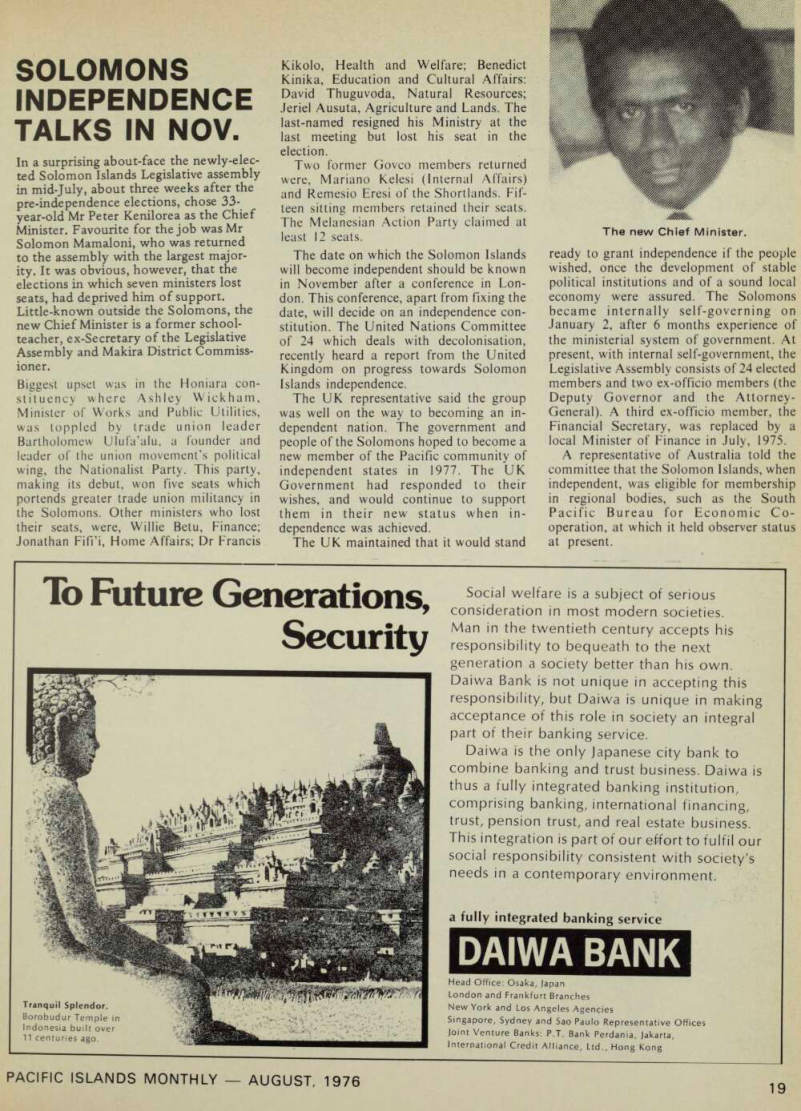
Independence
Talks In Nov.
In a surprising about-face the newly-elec ted Solomon Islands Legislative assembly in mid-July, about three weeks after the pre-independence elections, chose 33year-old Mr Peter Kenilorea as the Chief Minister. Favourite for the job was Mr Solomon Mamaloni, who was returned to the assembly with the largest major ity. It was obvious, however, that the elections in which seven ministers lost seats, had deprived him of support.
Little-known outside the Solomons, the new Chief Minister is a former school teacher, ex-Secretary of the Legislative Assembly and Makira District Commiss ioner.
Biggest upset was in the Honiara con stituency where Ashley Wickham, Minister of Works and Public Utilities, was toppled by trade union leader Bartholomew Ulufa’alu, a founder and leader of the union movement's political wing, the Nationalist Party. This party, making its debut, won five seats which portends greater trade union militancy in the Solomons. Other ministers who lost their seats, were, Willie Betu, Finance; Jonathan Fifi’i, Home Affairs; Dr Francis
Kikolo, Health and Welfare; Benedict Kinika, Education and Cultural Affairs: David Thuguvoda, Natural Resources; Jeriel Ausuta, Agriculture and Lands. The last-named resigned his Ministry at the last meeting but lost his seat in the election.
Two former Govco members returned were, Mariano Kelesi (Internal Affairs) and Remesio Eresi of the Shortlands. Fif teen sitting members retained their seats.
The Melanesian Action Party claimed at least 12 seats.
The date on which the Solomon Islands will become independent should be known in November after a conference in Lon don. This conference, apart from fixing the date, will decide on an independence con stitution. The United Nations Committee of 24 which deals with decolonisation, recently heard a report from the United Kingdom on progress towards Solomon Islands independence.
The UK representative said the group was well on the way to becoming an in dependent nation. The government and people of the Solomons hoped to become a new member of the Pacific community of independent states in 1977. The UK Government had responded to their wishes, and would continue to support them in their new status when in dependence was achieved.
The UK maintained that it would stand
ready to grant independence if the people wished, once the development of stable political institutions and of a sound local economy were assured. The Solomons became internally self-governing on January 2, after 6 months experience of the ministerial system of government. At present, with internal self-government, the Legislative Assembly consists of 24 elected members and two ex-officio members (the Deputy Governor and the Attorney- General). A third ex-officio member, the Financial Secretary, was replaced by a local Minister of Finance in July, 1975.
A representative of Australia told the committee that the Solomon Islands, when
independent, was eligible for membership
in regional bodies, such as the South Pacific Bureau for Economic Co operation, at which it held observer status at present.
The new Chief Minister,
Advertisements & other items, p. 19 (1 item)
Security
To Future Generations,
n Tranquil Splendor.
Borobudur Temple in Indonesia built over 11 centuries ago.
Social welfare is a subject of serious consideration in most modern societies.
Man in the twentieth century accepts his responsibility to bequeath to the next generation a society better than his own.
Daiwa Bank is not unique in accepting this responsibility, but Daiwa is unique in making acceptance of this role in society an integral part of their banking service.
Daiwa is the only Japanese city bank to combine banking and trust business. Daiwa is thus a fully integrated banking institution, comprising banking, international financing, trust, pension trust, and real estate business.
This integration is part of our effort to fulfil our social responsibility consistent with society's needs in a contemporary environment. a fully integrated banking service
DAIWA BANK
Head Office: Osaka, Japan London and Frankfurt Branches New York and Los Angeles Agencies Singapore, Sydney and Sao Paulo Representative Offices Joint Venture Banks; P.T. Bank Perdania, Jakarta, International Credit Alliance, Ltd., Hong Kong
Tbopicalities
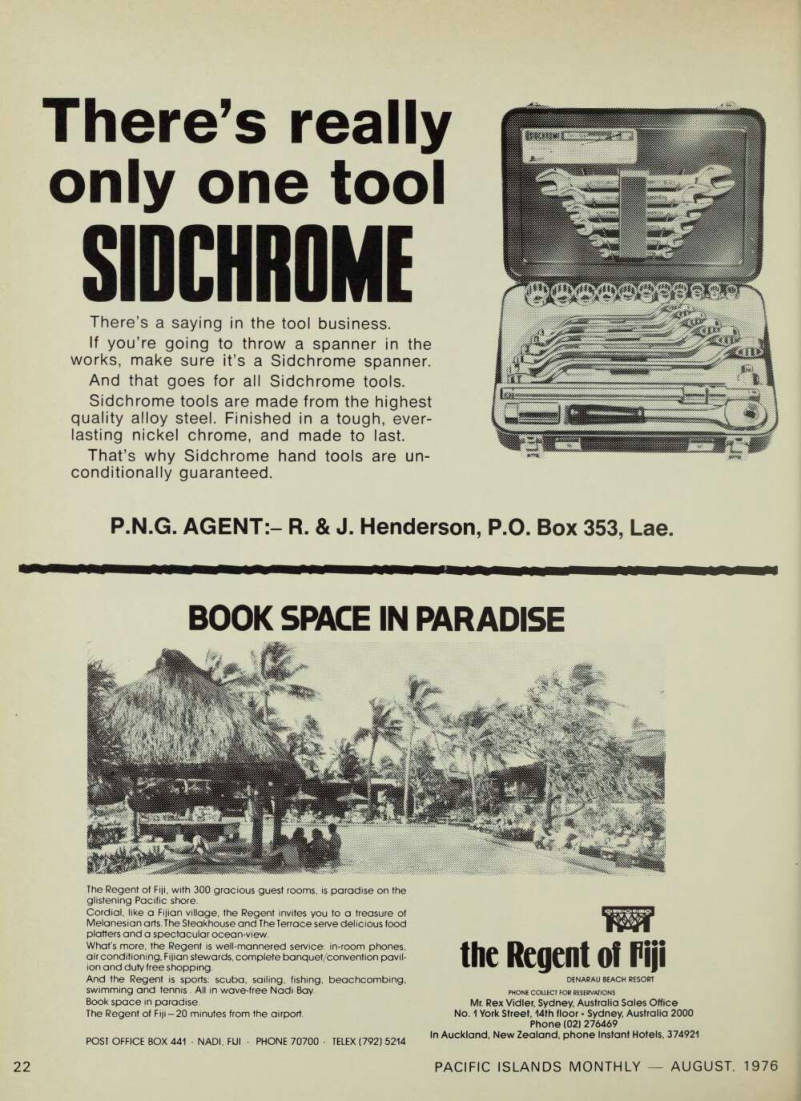
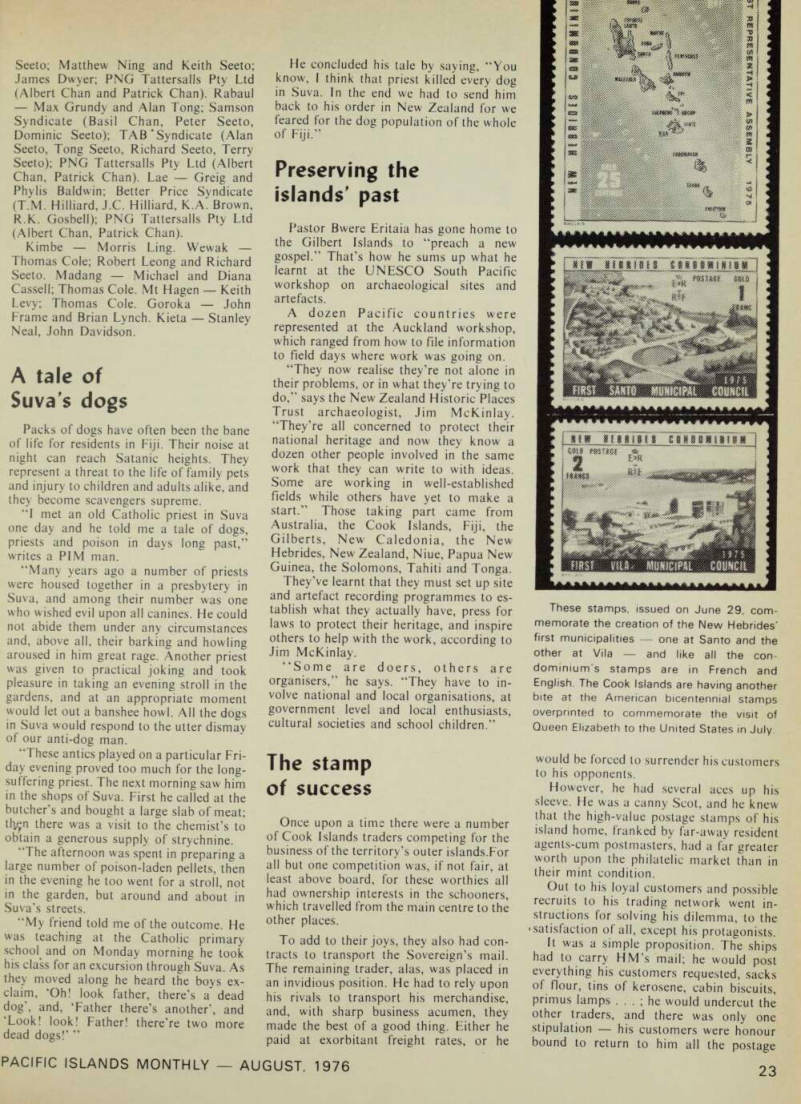
Upside down
Kon Tiki drift
A 32ft launch, floating upside down with only her bows above the waves, has con tributed further evidence in support of the theory that Polynesia was peopled from South America.
The Kon Tiki expedition and others, sometimes at the risk of lives and at some cost, have managed to prove that the currents could have aided migration from South America into Polynesia. This launch has done it alone and unaware because there was no one in it, according to its finder, well-known New Hebrides shipowner. Captain E.W. Lamberty, who has written to PIM about his find.
He was five miles south of Motalava in the Banks Group towards the end of May when he found the motor launch floating
upside down.
Later, it was established that the launch had come from Pucallpa in Peru.
“It must have accomplished a near record drift across the Pacific, as contrary to all the drifting rafts, Kon Tiki etc, the launch was submerged; only her bow stuck about two feet above the water, so she was
not pushed by the prevailing winds, only the current,” Captain Lamberty wrote.
“The. hull is in perfect condition, of heavy aluminium construction and her plastic petrol containers were still full of
good petrol”.
In his first letter to PIM, in which he
asked us to help in solving what might have been another Joyita mystery (the 70-ton ship which was found waterlogged and abandoned north of Fiji in November, 1955 and her passengers and crew lost without trace), Captain Lamberty wrote: “The vessel is of heavy aluminium con struction, the solid hull in perfect condi tion, but her superstructure of lighter aluminium with plastic windows, damag ed. In her cabin are five seats and small table, all of aluminium. Her engine room
aft contained an 8-cylinder Chrysler petrol
engine of the inboard-outboard type. Her huge petrol tanks were full of seawater but two 6-gallon plastic containers were full of
petrol.
“Further, on board, were crockery and cooking utensils, toolbox with tools and a 20-gallon drum of engine oil.
“We had to tow the vessel upside down to Port Patteson, as we could not lift her at sea, but after lifting out her engine and emptying tanks we secured her on board, still full of fish which had made the vessel their home and refused to leave; we collected several bucketsful.
“The vessel must have been a long time at sea as she was covered with heavy bar nacles. The inscription on her starboard bow, barely visible in black paint, reads as follows; ASTILLERO ASPISA and un derneath (her port???): PUCALLPA.”
When you’re
a big man . . .
Arguments over personal loans are fast becoming the biggest source of civil court actions in the Papua New Guinea
Highlands.
The loans are usually in money, but sometimes involve pigs or traditional tokens of exchange.
The Mount Hagen Council clerk, Mr Koim Kip, who is becoming concerned at the situation, said that disputes over loans were now running a close second in number to bride price disputes.
Mr Kip said the increasing volume of civil debt actions involved small personal loans often between friends and relatives.
Much of the trouble stemmed from the fact that the “big men” in village society were lending money to any one who asked.
The big men didn’t like to refuse because it would reflect on their status.
French keep
Wallis off-limits’
The French authorities’ suspicion of out siders who come to study islanders in their Pacific territories was highlighted by the recent refusal to allow a US researcher to pursue his studies in the territory of Wallis and Futuna.
The amateurs of New Caledonia’s Historical Society, who are always keen to meet with visiting specialists on the region, were hardly surprised when a young archaeologist from the Bishop Museum in Honolulu was denied permission to con tinue his search for lapita pottery as signs of Polynesian migration through Wallis and Futuna.
According to sources close to the French Administration in Noumea, Dr Patrick Kirch, working in collaboration with the French research institutes CNRS and ORSTOM, was refused study facilities by Mr Harbelot-Repaire, administrative chief of Wallis.
It was under an earlier administrator Mr J. de Agostini, expelled from Wallis by the islanders, that Patrick Kirch under took his earlier diggings, discovering several archaeological sites in both Wallis and Futuna. This time, the research mis sion was equipped with a $30,000 study grant, which will apparently now benefit Tongan research, instead.
In the meantime, this is not the first time French authorities have refused permission for research. Australian university lec turers have faced the same denial of access to islanders and upon the intervention of French friends have been allowed to move among Melanesian tribes, but only under
the “courtesy” of a French gendarme es cort.
French journalist J-C Guillebaud, from Le Monde in Paris, has reported the same problem. Pointing out that the Bishop Museum, as well as Australian, New Zealand and Fiji universities are keenly in terested in Oceanic civilisation, Guillebaud notes that in Papeete, Noumea or Vila, young scientists such as those at the French ORSTOM “when they are tolerated, are held suspect by the ad ministration”. Interest in French, rather than islander culture is of course seen with a totally different official eye.
Cheers! Have
another kava
Kava instead of beer is the aim of Tongan church leaders in Auckland in an effort to keep their fellow-countrymen out of trouble. Pacific Islanders, Tongans among them, have not had a favourable press in Auckland for many months, with most criticism flowing from incidents caused by over-indulgence in intoxicating
liquor.
Several Tongan churchmen in Auckland recently imported three bags of kava for a new-style party, without beer, at the Pon sonby Community Centre. Ponsonby is an inner suburb, where Islanders congregate.
The pastors hope that the soporific effect of kava which is a mild narcotic and not alcoholic, will be more beneficial than beer. They plan to hold kava parties once a month.
Mr Nelson Tupou, one of the church leaders, and a kava drinker, discussing the merits of kava and beer, said, “You feel excitable in a manner (with kava), but the urge to act foolishly and fight is not there”.
Tough deal
for the bookies?
The Papua New Guinea Government has, at last, woken up to the fact that there is money to be made out of bookmaking.
But it is not going to do this through its own bagmen that would be too much like nationalisation. It is going to license bookies, and then charge them a hefty fee, plus a rather solid betting tax. The annual fee will be K 1,000 and the betting tax will be 20t a bet. Each bookmaker will be required to make a security deposit of K 10,000, half in cash and half in bank guarantees. Presumably any interest on the cash deposit will go to the government.
The Finance Minister, Mr Julius Chan, said the purpose of licensing bookmakers was not to encourage betting, but to bring bookmaking under proper control and make it contribute to the national revenue.
Those licensed are: Port Moresby Check Loon and Joyce
Seeto; Matthew Ning and Keith Seeto; James Dwyer; PNG Tattersalls Pty Ltd (Albert Chan and Patrick Chan). Rabaul Max Grundy and Alan Tong; Samson Syndicate (Basil Chan, Peter Seeto, Dominic Seeto); TAB‘Syndicate (Alan Seeto, Tong Seeto, Richard Seeto, Terry Seeto); PNG Tattersalls Pty Ltd (Albert Chan, Patrick Chan). Lae Greig and Phylis Baldwin; Better Price Syndicate (T.M. Hilliard, J.C. Hilliard, K.A. Brown, R.K. Gosbell); PNG Tattersalls Pty Ltd (Albert Chan, Patrick Chan).
Kimbe Morris Ling. Wewak Thomas Cole; Robert Leong and Richard Seeto. Madang Michael and Diana Cassell; Thomas Cole. Mt Hagen Keith Levy; Thomas Cole. Goroka John Frame and Brian Lynch. Kieta Stanley Neal, John Davidson.
A tale of
Suva’s dogs
Packs of dogs have often been the bane of life for residents in Fiji. Their noise at night can reach Satanic heights. They represent a threat to the life of family pets and injury to children and adults alike, and they become scavengers supreme.
“I met an old Catholic priest in Suva one day and he told me a tale of dogs, priests and poison in days long past,” writes a PIM man.
“Many years ago a number of priests were housed together in a presbytery in Suva, and among their number was one who wished evil upon all canines. He could not abide them under any circumstances and, above all, their barking and howling aroused in him great rage. Another priest was given to practical joking and took pleasure in taking an evening stroll in the gardens, and at an appropriate moment would let out a banshee howl. All the dogs in Suva would respond to the utter dismay of our anti-dog man.
“These antics played on a particular Fri day evening proved too much for the long suffering priest. The next morning saw him in the shops of Suva. First he called at the butcher’s and bought a large slab of meat; there was a visit to the chemist’s to obtain a generous supply of strychnine.
“The afternoon was spent in preparing a large number of poison-laden pellets, then in the evening he too went for a stroll, not in the garden, but around and about in Suva’s streets.
“My friend told me of the outcome. He was teaching at the Catholic primary school and on Monday morning he took his class for an excursion through Suva. As they moved along he heard the boys ex claim, ‘Oh! look father, there’s a dead dog’, and, ‘Father there’s another’, and ‘Look! look! Father! there’re two more dead dogs!’ ”
He concluded his tale by saying, “You know, I think that priest killed every dog in Suva. In the end we had to send him back to his order in New Zealand for we feared for the dog population of the whole of Fiji.”
Preserving the
islands’ past
Pastor Bwere Eritaia has gone home to the Gilbert Islands to “preach a new gospel.” That’s how he sums up what he learnt at the UNESCO South Pacific workshop on archaeological sites and artefacts.
A dozen Pacific countries were represented at the Auckland workshop, which ranged from how to file information to field days where work was going on.
“They now realise they’re not alone in their problems, or in what they’re trying to do,” says the New Zealand Historic Places
Trust archaeologist, Jim McKinlay.
“They’re all concerned to protect their national heritage and now they know a dozen other people involved in the same work that they can write to with ideas.
Some are working in well-established fields while others have yet to make a start.” Those taking part came from Australia, the Cook Islands, Fiji, the Gilberts, New Caledonia, the New Hebrides, New Zealand, Niue, Papua New Guinea, the Solomons, Tahiti and Tonga.
They’ve learnt that they must set up site and artefact recording programmes to es tablish what they actually have, press for laws to protect their heritage, and inspire others to help with the work, according to
Jim McKinlay.
“Some are doers, others are organisers,” he says. “They have to in volve national and local organisations, at government level and local enthusiasts, cultural societies and school children.”
The stamp
of success
Once upon a time there were a number of Cook Islands traders competing for the business of the territory’s outer islands. For all but one competition was, if not fair, at least above board, for these worthies all had ownership interests in the schooners, which travelled from the main centre to the
other places.
To add to their joys, they also had con tracts to transport the Sovereign’s mail.
The remaining trader, alas, was placed in an invidious position. He had to rely upon his rivals to transport his merchandise, and, with sharp business acumen, they made the best of a good thing. Either he paid at exorbitant freight rates, or he
would be forced to surrender his customers to his opponents.
However, he had several aces up his sleeve. He was a canny Scot, and he knew that the high-value postage stamps of his island home, franked by far-away resident agents-cum postmasters, had a far greater worth upon the philatelic market than in their mint condition.
Out to his loyal customers and possible recruits to his trading network went in structions for solving his dilemma, to the ■ satisfaction of all, except his protagonists.
It was a simple proposition. The ships had to carry HM’s mail; he would post everything his customers requested, sacks of flour, tins of kerosene, cabin biscuits, primus lamps . . . ; he would undercut the other traders, and there was only one stipulation his customers were honour bound to return to him all the postage
These stamps, issued on June 29, com memorate the creation of the New Hebrides' first municipalities one at Santo and the other at Vila and like all the con dominium's stamps are in French and English. The Cook Islands are having another bite at the American bicentennial stamps overprinted to commemorate the visit of Queen Elizabeth to the United States in July.
stamps on the goods and correspondence which passed between his headquarters and them.
To this enterprising fellow increased profits flowed. The government was pleas ed beyond measure at the unexpected in crease in the sale of postage stamps. The trader’s customers enjoyed having their goods delivered to them at competitive rates with the added security of the protec tion assured to HM’s mails, and the trader-shipowners were left to face the in evitable.
Eventually, the goods of our friend travelled on his colleague-traders’ vessels at the most attractive freight rates.
Farewell To
Jack Hackett
Jack Hackett, Fiji Government public relations officer for around 15 years, died in London towards the end of June while on a visit to his home country. He was 66 and had lived on borrowed time since 1963, when, after several massive heart attacks, Fiji doctors gave him less than 24 hours more in this world. He recovered and con tinued on his cheery, swashbuckling way.
That was typical of Jack, writes his friend for 47 years, John Carter. He didn’t let anything get him down. And this appears in the Tropicalities and not in the Deaths of Islands People section because he would prefer the colourful patches in his career to be part of PI M’s Tropicalities.
He wouldn’t like a formal obituary.
Edward John Fox Hackett was born in Royal Windsor, within sight of Windor Castle which is, perhaps, one reason why Queen Elizabeth sent her good wishes and signed portrait to him while he was in hospital in Lautoka recovering from his “coronaries”. He’d worked almost 24 hours a day for several days preparing the ground for the Royal Visit in February, 1963.
That message thrilled Jack. He was a royalist, but no sycophant. If he thought he was in the right, especially where his position as a journalist was concerned, the status of the person with whom he crossed swords didn’t matter.
I was with him at a meeting of the Fiji Legislative Council when the acting Colonial Secretary top man after the Governor approached and attempted to tell him how to report the council debate, one of the extra jobs Jack did for the radio.
He was working hard he always worked hard and the official’s suggestion would have been impossible to carry out.
“You can pi..off,” said Jack, and an astounded acting Colonial Secretary did just that, and never interfered again.
After World War II Jack became editor-in-chief of a group of weekly papers in Lancashire but he didn’t see it as a desk
job. He liked to be on the street and did many a job normally done by his reporters.
Although born in Windsor, it was Lan cashire that moulded him (and his accent!).
Apart from spending the war in the Royal Navy in which he rose to officer rank. Jack’s whole career was in jour nalism and public relations. He and I were on rival newspapers in Lancashire and later together in the same group. We parted company for a while when war came and after when, in 1953, he went to Malaya as Government Information Of ficer. We met again in Fiji.
He enjoyed that job in Malaya as much as anything else he ever did. The “Emergency” was on, an attempted com munist takeover. Jack didn’t stay at his desk. He hung a revolver round his middle, took pamphlets he had written and a loud hailer and went into the jungle with the ar my. His propaganda methods, together with his own idea of dropping “safe con duct” surrender leaflets from the air, paid off. Many terrorists gave themselves up and the Sultan of Selangor hung a medal on Jack.
He had other honours he never bragged about a commendation from the Direc tor of Operations in Malaya, the Royal Humane Society Parchment for saving a soldier from drowning and the OBE which he was awarded in 1967, a few years before he retired from the Fiji Government ser vice which he entered in 1957. His last few years in Fiji, up to a few months ago, were spent on public relations and publicity for the Pacific Harbour project at Deuba.
Much of his spare time was given to good causes. He helped to run the Fiji Hibiscus Festival in Suva; he was an early chairman of the Fiji Visitors Bureau, vice chairman for 10 years of the Warships Entertainment Committee and also the National Cession Day Committee.
Jack leaves a wife, Lena, son Michael, who is a surgeon in England, and a daughter, Jacqueline, ex-journalist and now a housewife in Canada. He’ll also be missed by Fiji’s Prime Minister, Ratu Sir Kamisese Mara. They had a long and warm association. They played scrabble together.
If Jack could be asked to comment on his own death I think he would say, as he said of anything he did that might be newsworthy, “Gerraway, it was nowt.”
Is It An Old
Soldier's Tale?
Schoolchildren, frightened of punish ment, may have started the rumour that a Japanese soldier is hiding in old wartime tunnels near Rabaul in PNG.
This is the opinion of police who are making a routine check into reported sightings of a “small, emaciated, hairy man” whom children claim is hiding in a maze of tunnels at Ulagunan.
The sightings have brought two Japanese officials to Rabaul to check the possibility that a soldier has been hiding in the area for more than 30 years since the Japanese wartime occupation of Rabaul.
Early evidence that a man was in the caves was given by schoolchildren who showed where someone had been raiding food gardens nearby. But some police and village leaders now believe there is a strong possibility that the children themselves raided the gardens and that the mystery man is a cover-up.
At the same time, however, wide publici ty has caused many people to genuinely believe they have seen the mystery man.
Police have taken several sworn statements from people who say they have seen a mystery man, but all the statements are from schoolchildren with ages ranging from 12 to 15, and police are becoming in creasingly sceptical about the affair.
One of the statements reports, “A bearded man wearing a torn army un iform”, and another tells of “A hairy man, definitely a Japanese man, swimming in the river”.
Meanwhile, a low-key search is being continued by some village people in the Ulagunan area and other volunteers. They have found eating utensils and some ar ticles of clothing in one of the caves which were dug by Japanese forced labour during World War Two and were used as store depots and equipment centres in addition to living quarters.
More than 100,000 Japanese were based at Rabaul at the height of the occupation, and many remained for several months after the war as members of cleaning-up gangs controlled by allied troops.
Japanese Embassy officials, however, are not leaving a stone unturned to find the mystery man, if he exists. They have scattered hundreds of leaflets through forests and villages near Rabaul bearing the appeal, “Soldier, come home. The war ended 30 years ago. There is no longer any danger to your safety. Come out now you can go back to Japan”. The police called the operation, “Operation Dewel”
Pidgin for a devil or phantom, which is less substantial than an old soldier.
Jack Hackett
Advertisements & other items, pp. 21-22 (1 item)
Become A Part
OF PlM's PACIFIC
AND SUBSCRIBE NOW
0) E ◄ £ c o to CL Q) 0)
FILL IN THE DETAILS
ON THE ATTACHED
ORDER FORMS
There’s really
only one tool
SIDCHROME
There’s a saying in the tool business.
If you’re going to throw a spanner in the works, make sure it’s a Sidchrome spanner.
And that goes for all Sidchrome tools.
Sidchrome tools are made from the highest quality alloy steel. Finished in a tough, everlasting nickel chrome, and made to last.
That’s why Sidchrome hand tools are unconditionally guaranteed. & fJL P.N.G. AGENT:- R. & J. Henderson, P.O. Box 353, Lae.
BOOK SPACE IN PARADISE
' %: > The Regent of Fiji, with 300 gracious guest rooms, is paradise on the glistening Pacific shore.
Cordial, like a Fijian village, the Regent invites you to a treasure of Melanesian arts. The Steakhouse and The Terrace serve delicious food platters and a spectacular ocean-view.
What’s more, the Regent is well-mannered service: in-room phones, air conditioning, Fijian stewards, complete banquet/convention pavilion and duty free shopping.
And the Regent is sports: scuba, sailing, fishing, beachcombing, swimming and tennis . All in wave-free Nadi Bay.
Book space in paradise.
The Regent of Fiji—2o minutes from the airport.
POST OFFICE BOX 441 NADI, FUI • PHONE 70700 • TELEX (792) 5214 Hw
the Regent of Fiji
DENARAU BEACH RESORT
PHONE COLLECT FOR RESERVATIONS
Mr. Rex Vidler, Sydney, Australia Sales Office No. 1 York Street, 14th floor • Sydney, Australia 2000 Phone (02) 276469 In Auckland, New Zealand, phone Instant Hotels, 374921
Editor’S Mailbag
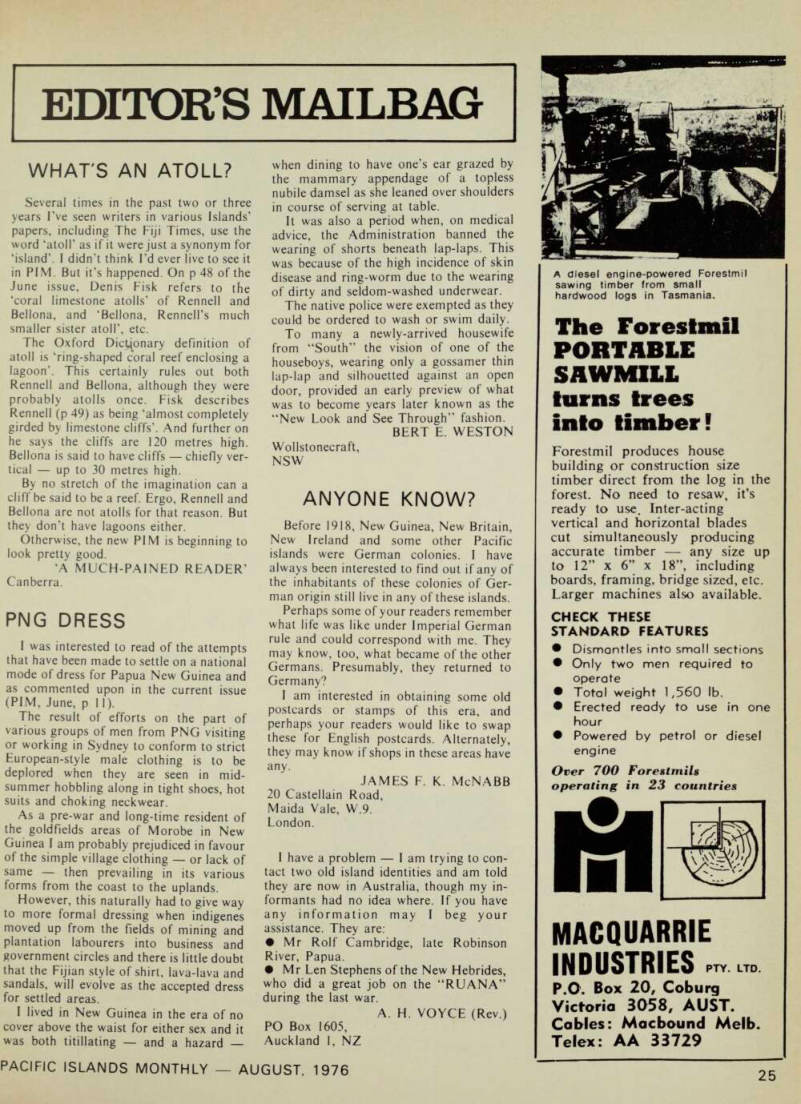
What's An Atoll?
Several times in the past two or three years I’ve seen writers in various Islands’ papers, including The Fiji Times, use the word ‘atoll’ as if it were just a synonym for ‘island’. I didn’t think I’d ever live to see it in PIM. But it’s happened. On p 48 of the June issue, Denrs Fisk refers to the ‘coral limestone atolls’ of Rennell and Bellona, and ‘Bellona, Rennell’s much smaller sister atoll’, etc.
The Oxford Dictionary definition of atoll is ‘ring-shaped coral reef enclosing a lagoon’. This certainly rules out both Rennell and Bellona, although they were probably atolls once. Fisk describes Rennell (p 49) as being ‘almost completely girded by limestone cliffs’. And further on he says the cliffs are 120 metres high.
Bellona is said to have cliffs chiefly ver tical up to 30 metres high.
By no stretch of the imagination can a cliff be said to be a reef. Ergo, Rennell and Bellona are not atolls for that reason. But they don’t have lagoons either.
Otherwise, the new PIM is beginning to look pretty good.
‘A Much-Pained Reader'
Canberra.
Png Dress
1 was interested to read of the attempts that have been made to settle on a national mode of dress for Papua New Guinea and as commented upon in the current issue (PIM, June, p 11).
The result of efforts on the part of various groups of men from PNG visiting or working in Sydney to conform to strict European-style male clothing is to be deplored when they are seen in mid summer hobbling along in tight shoes, hot suits and choking neckwear.
As a pre-war and long-time resident of the goldfields areas of Morobe in New Guinea I am probably prejudiced in favour of the simple village clothing or lack of same then prevailing in its various forms from the coast to the uplands.
However, this naturally had to give way to more formal dressing when indigenes moved up from the fields of mining and plantation labourers into business and government circles and there is little doubt that the Fijian style of shirt, lava-lava and sandals, will evolve as the accepted dress for settled areas.
I lived in New Guinea in the era of no cover above the waist for either sex and it was both titillating and a hazard
when dining to have one’s ear grazed by the mammary appendage of a topless nubile damsel as she leaned over shoulders in course of serving at table.
It was also a period when, on medical advice, the Administration banned the wearing of shorts beneath lap-laps. This was because of the high incidence of skin disease and ring-worm due to the wearing of dirty and seldom-washed underwear.
The native police were exempted as they could be ordered to wash or swim daily.
To many a newly-arrived housewife from “South” the vision of one of the houseboys, wearing only a gossamer thin lap-lap and silhouetted against an open door, provided an early preview of what was to become years later known as the “New Look and See Through” fashion.
Bert E. Weston
Wollstonecraft,
Nsw
Anyone Know?
Before 1918, New Guinea, New Britain, New Ireland and some other Pacific islands were German colonies. 1 have always been interested to find out if any of the inhabitants of these colonies of Ger man origin still live in any of these islands.
Perhaps some of your readers remember what life was like under Imperial German rule and could correspond with me. They may know, too, what became of the other Germans. Presumably, they returned to
Germany?
I am interested in obtaining some old postcards or stamps of this era, and perhaps your readers would like to swap these for English postcards. Alternately, they may know if shops in these areas have any.
James F. K. Mcnabb
20 Castellain Road, Maida Vale, W. 9.
London. 1 have a problem 1 am trying to con tact two old island identities and am told they are now in Australia, though my in formants had no idea where. If you have any information may I beg your assistance. They are: • Mr Rolf Cambridge, late Robinson River, Papua. • Mr Len Stephens of the New Hebrides, who did a great job on the “RUANA” during the last war.
A. H. Voyce (Rev.)
PO Box 1605, Auckland I, NZ
Advertisements & other items, p. 25 (1 item)
Macquarrie
A diesel engine-powered Forestmil sawing timber from small hardwood logs in Tasmania.
The Forestmil
PORTABLE
SAWMILL
turns trees
into timber!
Forestmil produces house building or construction size timber direct from the log in the forest. No need to resaw, it’s ready to use. Inter-acting vertical and horizontal blades cut simultaneously producing accurate timber any size up to 12” x 6” x 18”, including boards, framing, bridge sized, etc.
Larger machines also available. • Dismontles into small sections • Only two men required to operate • Total weight 1,560 lb. • Erected ready to use in one hour • Powered by petrol or diesel engine Over 700 Forestmils operating in 23 countries
MACQUARRIE
INDUSTRIES pty. ltd.
P.O. Box 20, Coburg
Victoria 3058, AUST.
Cables: Macbound Melb.
Telex: AA 33729
CHECK THESE
STANDARD FEATURES
IH
People
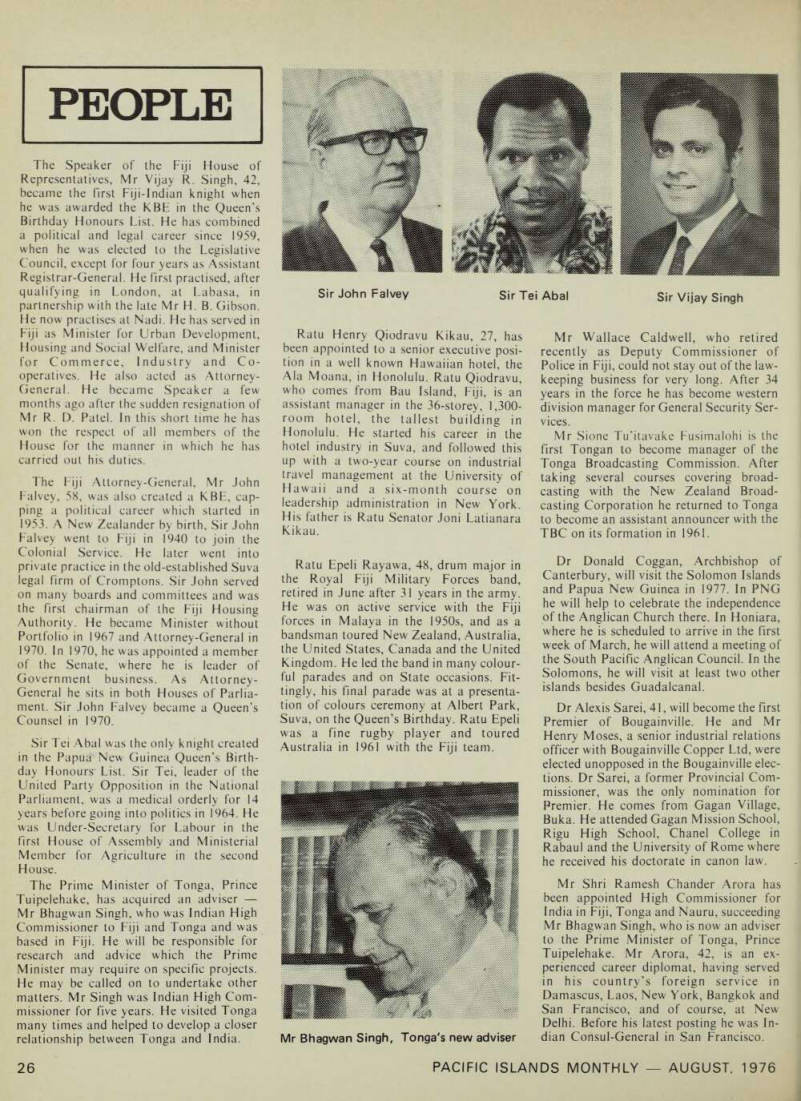
The Speaker of the Fiji House of Representatives, Mr Vijay R. Singh, 42, became the first Fiji-Indian knight when he was awarded the KBE in the Queen’s Birthday Honours List. He has combined a political and legal career since 1959, when he was elected to the Legislative Council, except for four years as Assistant Registrar-General. He first practised, after qualifying in London, at Labasa, in partnership with the late Mr H. B. Gibson.
He now practises at Nadi. He has served in Fiji as Minister for Urban Development, Housing and Social Welfare, and Minister for Commerce, Industry and Co operatives. He also acted as Attorney- General. He became Speaker a few months ago after the sudden resignation of Mr R. D. Patel. In this short time he has won the respect of all members of the House for the manner in which he has carried out his duties.
The Fiji Attorney-General, Mr John Falvey, 58, was also created a KBE, cap ping a political career which started in 1953. A New Zealander by birth. Sir John Falvey went to Fiji in 1940 to join the Colonial Service. He later went into private practice in the old-established Suva legal firm of Cromptons. Sir John served on many boards and committees and was the first chairman of the Fiji Housing Authority. He became Minister without Portfolio in 1967 and Attorney-General in 1970. In 1970, he was appointed a member of the Senate, where he is leader of Government business. As Attorney- General he sits in both Houses of Parlia ment. Sir John Falvey became a Queen’s Counsel in 1970.
Sir Tei Abal was the only knight created in the Papua New Guinea Queen's Birth day Honours List. Sir Tei, leader of the United Party Opposition in the National Parliament, was a medical orderly for 14 years before going into politics in 1964. He was Under-Secretary for Labour in the first House of Assembly and Ministerial Member for Agriculture in the second House.
The Prime Minister of Tonga, Prince Tuipelehake, has acquired an adviser Mr Bhagwan Singh, who was Indian High Commissioner to Fiji and Tonga and was based in Fiji. He will be responsible for research and advice which the Prime Minister may require on specific projects.
He may be called on to undertake other matters. Mr Singh was Indian High Com missioner for five years. He visited Tonga many times and helped to develop a closer relationship between Tonga and India.
Ratu Henry Qiodravu Kikau, 27, has been appointed to a senior executive posi tion in a well known Hawaiian hotel, the Ala Moana, in Honolulu. Ratu Qiodravu, who comes from Bau Island, Fiji, is an assistant manager in the 36-storey, 1,300room hotel, the tallest building in Honolulu. He started his career in the hotel industry in Suva, and followed this up with a two-year course on industrial travel management at the University of Hawaii and a six-month course on leadership administration in New York.
His father is Ratu Senator Joni Latianara Kikau.
Ratu Epeli Rayawa, 48, drum major in the Royal Fiji Military Forces band, retired in June after 31 years in the army.
He was on active service with the Fiji forces in Malaya in the 19505, and as a bandsman toured New Zealand, Australia, the United States, Canada and the United Kingdom. He led the band in many colour ful parades and on State occasions. Fit tingly, his final parade was at a presenta tion of colours ceremony at Albert Park, Suva, on the Queen’s Birthday. Ratu Epeli was a fine rugby player and toured Australia in 1961 with the Fiji team.
Mr Wallace Caldwell, who retired recently as Deputy Commissioner of Police in Fiji, could not stay out of the law keeping business for very long. After 34 years in the force he has become western division manager for General Security Ser vices.
Mr Sione Tu’itavake Fusimalohi is the first Tongan to become manager of the Tonga Broadcasting Commission. After taking several courses covering broad casting with the New Zealand Broad casting Corporation he returned to Tonga to become an assistant announcer with the TBC on its formation in 1961.
Dr Donald Coggan, Archbishop of Canterbury, will visit the Solomon Islands and Papua New Guinea in 1977. In PNG he will help to celebrate the independence of the Anglican Church there. In Honiara, where he is scheduled to arrive in the first week of March, he will attend a meeting of the South Pacific Anglican Council. In the Solomons, he will visit at least two other islands besides Guadalcanal.
Dr Alexis Sarei, 41, will become the first Premier of Bougainville. He and Mr Henry Moses, a senior industrial relations officer with Bougainville Copper Ltd, were elected unopposed in the Bougainville elec tions. Dr Sarei, a former Provincial Com missioner, was the only nomination for Premier. He comes from Gagan Village, Buka. He attended Gagan Mission School, Rigu High School, Chanel College in Rabaul and the University of Rome where he received his doctorate in canon law.
Mr Shri Ramesh Chander Arora has been appointed High Commissioner for India in Fiji, Tonga and Nauru, succeeding Mr Bhagwan Singh, who is now an adviser to the Prime Minister of Tonga, Prince Tuipelehake. Mr Arora, 42, is an ex perienced career diplomat, having served in his country’s foreign service in Damascus, Laos, New York, Bangkok and San Francisco, and of course, at New Delhi. Before his latest posting he was In dian Consul-General in San Francisco.
Sir John Falvey
Mr Bhagwan Singh, Tonga's new adviser
Sir Vijay Singh
Sir Tei Abal
Folds
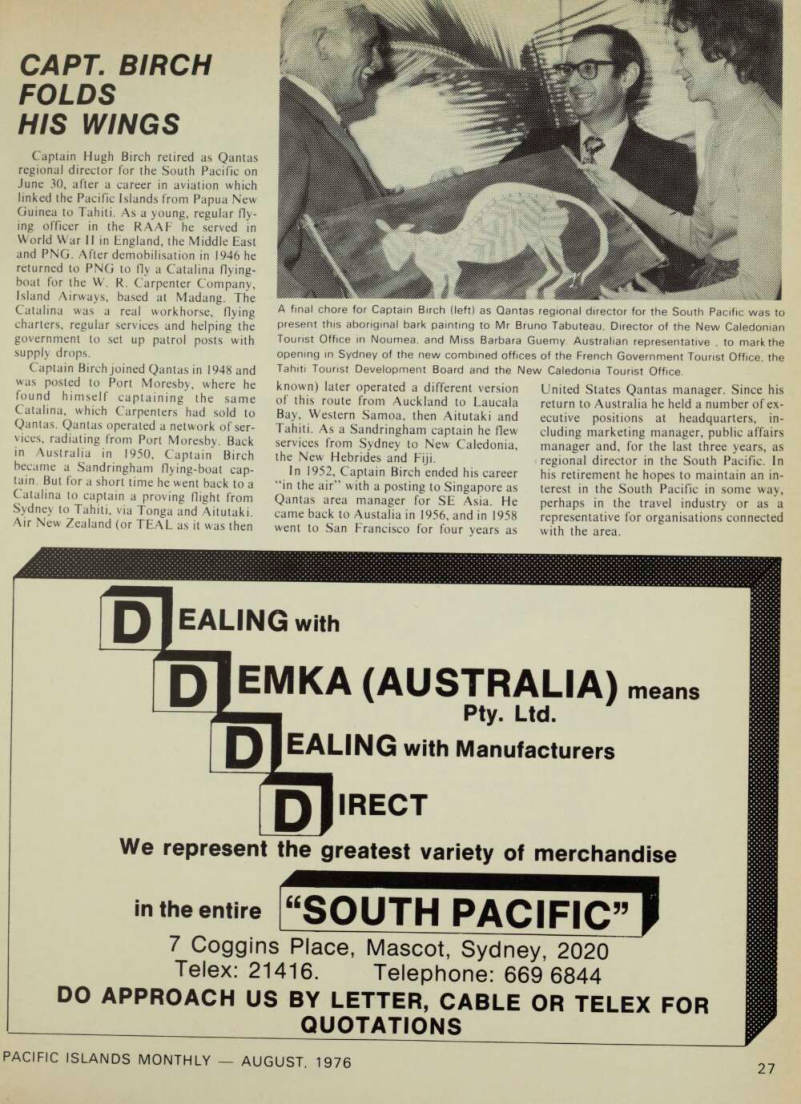
Cart. Birch
His Wings
Captain Hugh Birch retired as Qantas regional director for the South Pacific on June 30, after a career in aviation which linked the Pacific Islands from Papua New Guinea to Tahiti. As a young, regular fly ing officer in the RAAF he served in World War II in England, the Middle East and PNG. After demobilisation in 1946 he returned to PNG to fly a Catalina flying boat for the W. R. Carpenter Company, Island Airways, based at Madang. The Catalina was a real workhorse, flying charters, regular services and helping the government to set up patrol posts with
supply drops.
Captain Birch joined Qantas in 1948 and was posted to Port Moresby, where he found himself captaining the same Catalina, which Carpenters had sold to Qantas. Qantas operated a network of ser vices, radiating from Port Moresby. Back in Australia in 1950, Captain Birch became a Sandringham flying-boat cap tain. But for a short time he went back to a Catalina to captain a proving flight from Sydney to Tahiti, via Tonga and Aitutaki.
Air New Zealand (or TEAL as it was then
known) later operated a different version this route from Auckland to Laucala Bay, Western Samoa, then Aitutaki and Tahiti. As a Sandringham captain he flew services from Sydney to New Caledonia, tbe ew N ebr 'des and Fiji.
In 1952, Captain Birch ended his career “in the air” with a posting to Singapore as Qantas area manager for SE Asia. He came back to Austalia in 1956, and in 1958 went to San Francisco for four years as
United States Qantas manager. Since his return to Australia he held a number of ex ecutive positions at headquarters, in eluding marketing manager, public affairs manager and, for the last three years, as regional director in the South Pacific. In his retirement he hopes to maintain an in terest in the South Pacific in some way, perhaps in the travel industry or as a representative for organisations connected with the area.
A final chore for Captain Birch (left) as Qantas regional director for the South Pacific was to present this aboriginal bark painting to Mr Bruno Tabuteau, Director of the New Caledonian Tourist Office in Noumea, and Miss Barbara Guemy Australian representative , to mark the opening in Sydney of the new combined offices of the French Government Tourist Office, the Tahiti Tourist Development Board and the New Caledonia Tourist Office.
Advertisements & other items, pp. 27-28 (1 item)
□ leMKA (AUSTRALIA) means
0 I EALING with
1 Jhh Pty. Ltd.
DJealing with Manufacturers
I n|I R ECT
We represent the greatest variety of merchandise in the entire 7 Coggins Telex: 21416. Telephone: 669 6844 DO APPROACH US BY LETTER, CABLE OR TELEX FOR
QUOTATIONS
“SOUTH PACIFIC”
Place, Mascot, Sydney, 2020
COLOR,SPEED,
SHARPNESS,
FINE GRAIN...
Kodachrome 64 film
Kodachrome 64 (daylight) film is an excellent general purpose slide film that gives well-saturated colors, sharpness and fine grain, plus the flexibility of an ASA 64 rating. It holds fine detail in highlight and shadow areas and has good exposure latitude for pleasing results, even with moderate under or over-exposure. Kodachrome 64 film is available from photo dealers in sizes to fit 135,126 and 110-size cameras.
For ultra-fine grain sharpness, try Kodachrome 25 film. It’s rated at ASA 25 and is available only in 135-size rolls.
KODAK (Australasia) PTY. LTD.
K6l/5203
Anglo-French shuffle over New Hebrideans’ future
New Hebrideans’ future
From a Vila correspondent
Both British and French officials have, at last, made public statements referring to an “independent” New Hebrides. The statements have been made more than six months after the condominium’s first general elections, in which victory went to the National Party seeking independence for 1977.
The first Representative Assembly still had not met on June 4 when Mr H. S. H.
Stanley, Under-Secretary at the British Foreign Office, held a press conference in Noumea, before flying off to the New Hebrides.
New Caledonia’s Governor J-G Eriau, High Commissioner for France in the Pacific, was unwilling to expand upon the subject when he arrived back in Noumea from Paris on June 8. Earlier, in the New Hebrides, French Resident Commissioner Mr Robert Gauger had told islanders the country would be “neither French, nor British” as the two powers led it “to in dependence”.
Needless to say, the British official’s remarks caused wide surprise in Noumea.
Mr Stanley was quoted by the local press as saying that Britain was firmly resolved to respect New Hebridean demands for in dependence and hoped that France felt the same way, as the two nations should exer cise their joint responsibility right to the end, acting together to bring about in dependence. Mr Stanley considered that the proposed date, 1977, seemed too soon.
However, he insisted that all the New Hebrides should be independent and that Britain would not accept a situation like Mayotte in the former French-held African Comoro Islands, with Santo, for example, separating and remaining French.
The Noumea press carried Mr Stanley’s declarations on June 5, the very same day as the French press in the New Hebrides quoted the French Resident Commissioner on the same subject, although his remarks were made 12 days earlier. Mr Gauger was visiting the tiny island of Paama, which lies between Ambrym and Epi Islands. So it was to a very small, isolated audience that he happened to make the remarks “the territory will be neither French nor British. The two countries will lead it together to independence to enable it to face the problems of life”.
Twelve days later the news was cir culated by the official French news service, which meant that for the Caledonians the
shock came from the mouth of the visiting British official.
Governor Eriau reached Noumea four days later from Paris and seemed evasive over a newspaper reporter’s claim that visiting British officials had announced their visit was intended to “work out, in agreement with the French Government, the means of bringing the New Hebrides to
independence”.
Governor Eriau was quoted as saying, “These two civil servants are not authorised to make decisions one way or the other.
A joint Franco-British communique will be read out at the appropriate time during one of the meetings of the New Hebrides
Representative Assembly”.
The governor also pointed out that a judges’ decision was expected in late June over appeals lodged against the invalidation of results in four seats at last November’s elections. The invalidation was announced only in May.
Governor Eriau then flew to Vila to meet Mr Stanley. Then, following talks between Walter Lini’s National Party and
Remy Delaveuve’s UCNH (Union of Communities in the N.H.), the National Party stated it was prepared to co-operate in bringing together the Representative Assembly, even though the issue of chief tain members had not been settled. British officials were apparently working hard to solve the stalemate so that the assembly could meet by the end of June (before the next meeting of the UN committee on decolonisation) and receive a joint administration statement on the political future of the New Hebrides.
Meantime, however evasive the French may be about their real intentions in the New Hebrides, they seem to have no doubt about Australian objectives. A recent of ficial French report on Australian aid to the New Hebrides was sub-titled in English “Rule, Australia”. The report on an Australian-aid mission to the islands in late May, led by Dr J. Baker, went to some length to point out the “political” nature of such aid, allegedly intended to strengthen Australia’s near neighbours against possible Russian infiltration.
Caledonian stalemate
From a Noumea correspondent
French Government officials and New Caledonian politicians have continued their yoyo flights back and forth to Paris as the economic and political situation in Noumea remains clouded by uncertainty and indecision. The autonomists boycotted the Assembly in early June and thereby refused to vote approval of a scheme to stabilise tax payments by the territory’s nickel smelting company, SEN.
The island’s future budgetary problems, of course, still remain unsolved and as a further gesture in the ever-continuing power game between Paris and Noumea another mission from the Territorial Assembly flew off on June 15 for talks with the French Government. The spotlight in negotiations remains fixed on private, largely Roman Catholic, educa tion. This is the area France has suggested
financing, thereby controlling, as one way
of solving New Caledonia’s repeated an nual Budget deficits. To many Caledonians this seems but a further step towards integrating the island as a dependency of France, making it in effect a department of France.
A week before the Caledonians’ depar ture, Governor J-G Eriau returned from his latest talks in Paris. Mr Eriau pointed out that discussion of the territory’s amended political statutes had been delayed at the French National Assembly and would not occur until the northern autumn. (The modifications are in fact only window-dressing and bring no real in crease in local power.) Meanwhile, in what appears another equally fruitless gesture, New Caledonia’s deputy to the French National Assembly, Roch Pidjot, has called for internal autonomy before 1978. In an article published in the reputable French newspaper Le Monde, Deputy Pidjot draws a gloomy picture of the present situation on the island: “Small businesses are closing their doors, the number of un employed is growing, public finance is bankrupt”. On the nickel scene, “after seven years, there is still no new factory”.
The deputy repeats his demand for autonomy, “otherwise the Caledonians will turn towards independence, in
despair”.
Advertisements & other items, pp. 29-30 (2 items)
29
ACIFIC ISLANDS MONTHLY AUGUST, 1976
S. E. Tatham
SOME OF THE FIRMS
WE REPRESENT ARE:
Asia Rubber Works (Singapore Rubber Shoes) Frappier (French Brandy) Huvet (French Brandy) Indika (Belgium Dairy Produce) Durobor S.A. (Belgium Glassware) Miroiterie Gen. de Belgiqe S.A. (Louvre glass and mirrors) City Engineers (U.K. Bicycles) F.H.I. Japan (Subaru Cars) Kraggs (Wines, Spirits, Ciders) Sunshine Biscuits Sunrise (Confectionery) Flamenco (Instant Coffee & Tea) Quaker Products (Oats, Jets) Hancocks (Spaghetti, Cereals) Melbourne Canning (Jams) Amatil (Twisties, Twirlies) Edward Zorn (Margarine, Cooking Fats) Allens (Confectionery) Red Tulip (Fine Chocolates) Robert Timms (New Guinea Gold Instant Coffees and Teas) S.P.C. (Canned Fruit) % S.P.C. (Abalone) Wing Lee (See You Sauce) Magnet (Mattresses) Essteel (Cookware) Warner-Drayton (Fans) Mitchell's (Abrasives) Tilbury & Lewis (Sports Trophies & Silverplate) Regent (Swiss watches) Lega Marcasite (Jewellery) Austramax (Pressure Lanterns) Lawn Chair; Tubco (Garden Furniture) Electronic Industries (Electrical Household Appliances) Jex (Steelwool) Arnbro (Folding Beds) James Miller (Blankets) Elmaco (Plastics —Electrical Fittings) B.X. (Plastics) Stegbar (Wooden Louvres) Franklite (Light Fittings) JJ. Cash Embroidered Labels) Disston (Saws)
S. E. TATHAM
& CO. PTY. LTD.
BEEHIVE BLDG.,
94 ELIZABETH ST.,
MELBOURNE, 3001, AUSTRALIA.
G.P.O. BOX B—CABLES "SET"
TELEPHONE 63 5094
TELEX: AA34293
BUYERS FOR THE
PACIFIC ISLANDS
DIRECT ENQUIRIES WELCOMED
PAPUA NEW GUINEA: S. E. TATHAM (P.N.G.) PTY. LTD.,
LAE: MALAITA STREET (P.O. BOX 1562).
PORT MORESBY: CNR. GOROA AND MUNAHU STREETS, GORDON
(P.O. BOX 6733, BOROKO).
FIJI: S. E. TATHAM (FIJI) LTD.,
LAUTOKA: P.O. BOX 366.
SUVA: G.P.O. BOX 671.
YOUR GUARANTEE
1 % 1
FOR SERVICE
SINCE 1924
T. 2.
Liquid Diocese
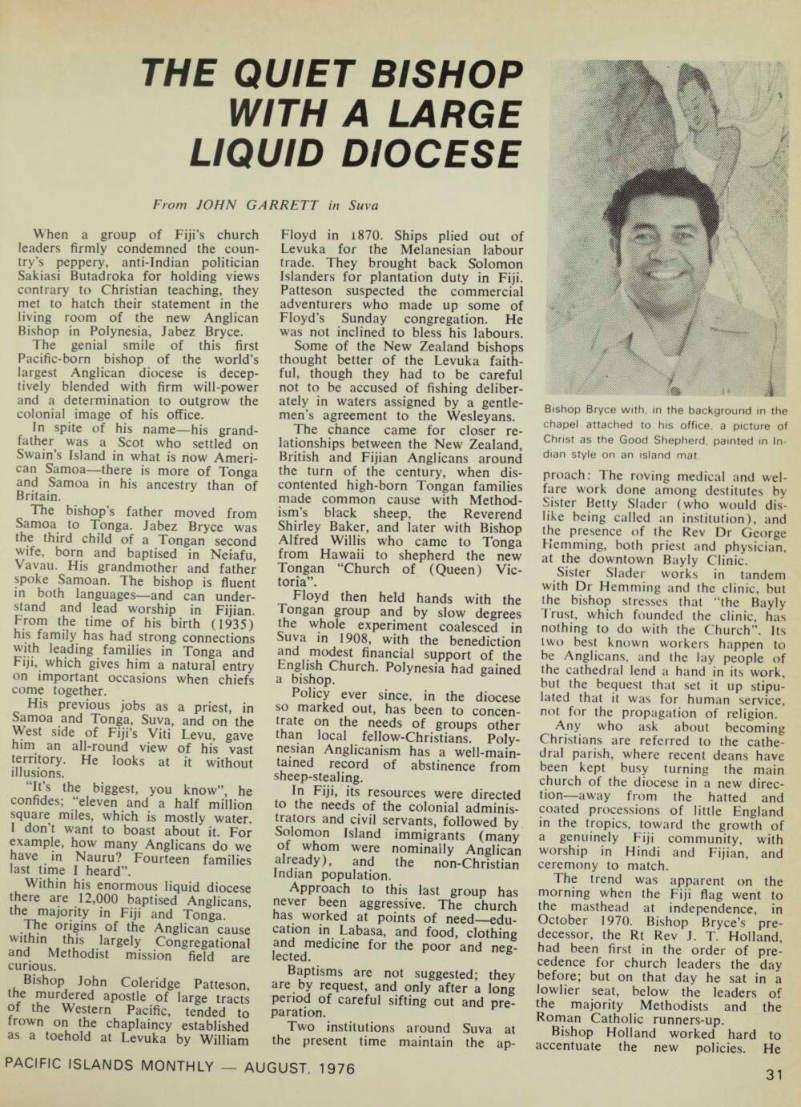
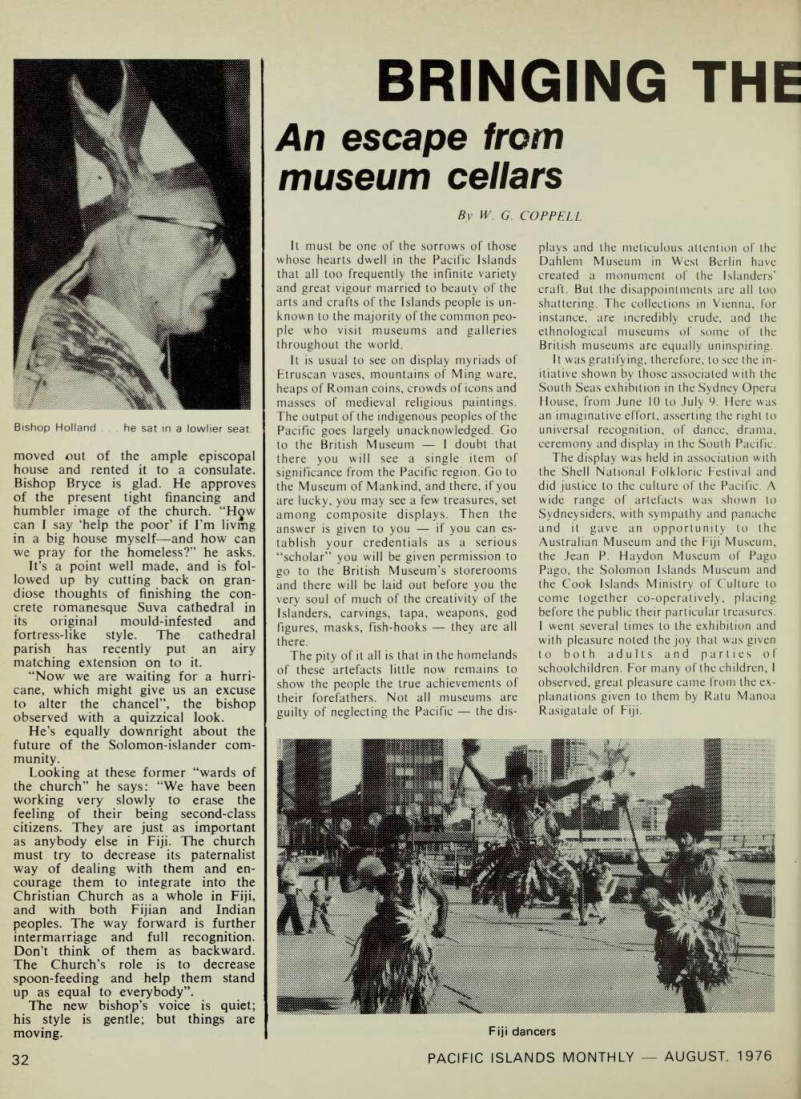
The Quiet Bishop
With A Large
From JOHN GARRETT in Suva
When a group of Fiji’s church leaders firmly condemned the coun try’s peppery, anti-Indian politician Sakiasi Butadroka for holding views contrary to Christian teaching, they met to hatch their statement in the living room of the new Anglican Bishop in Polynesia, Jabez Bryce.
The genial smile of this first Pacific-bom bishop of the world’s largest Anglican diocese is decep tively blended with firm will-power and a determination to outgrow the colonial image of his office.
In spite of his name—his grand father was a Scot who settled on Swain’s Island in what is now Ameri can Samoa—-there is more of Tonga and Samoa in his ancestry than of Britain.
The bishop’s father moved from Samoa to Tonga. Jabez Bryce was the third child of a Tongan second wife, born and baptised in Neiafu, Vavau. His grandmother and father spoke Samoan. The bishop is fluent in both languages—and can under stand and lead worship in Fijian.
From the time of his birth (1935) his family has had strong connections with leading families in Tonga and Fiji, which gives him a natural entry on important occasions when chiefs come together.
His previous jobs as a priest, in Samoa and Tonga, Suva, and on the West side of Fiji’s Viti Levu, gave him an all-round view of his vast territory. He looks at it without illusions.
“It’s the biggest, you know”, he confides; “eleven and a half million square miles, which is mostly water.
I don’t want to boast about it. For example, how many Anglicans do we have in Nauru? Fourteen families last time I heard”.
Within his enormous liquid diocese there are 12,000 baptised Anglicans, the majority in Fiji and Tonga.
The origins of the Anglican cause within this largely Congregational and Methodist mission field are curious.
Bishop John Coleridge Patteson, the murdered apostle of large tracts of the Western Pacific, tended to frown on the chaplaincy established as a toehold at Levuka by William
Floyd in 1870. Ships plied out of Levuka for the Melanesian labour trade. They brought back Solomon Islanders for plantation duty in Fiji, Patteson suspected the commercial adventurers who made up some of Floyd’s Sunday congregation. He was not inclined to bless his labours.
Some of the New Zealand bishops thought better of the Levuka faith ful, though they had to be careful not to be accused of fishing deliber ately in waters assigned by a gentle men’s agreement to the Wesleyans.
The chance came for closer re lationships between the New Zealand, British and Fijian Anglicans around the turn of the century, when dis contented high-born Tongan families made common cause with Method ism’s black sheep, the Reverend Shirley Baker, and later with Bishop Alfred Willis who came to Tonga from Hawaii to shepherd the new Tongan “Church of (Queen) Vic toria”.
Floyd then held hands with the Tongan group and by slow degrees the whole experiment coalesced in Suva in 1908, with the benediction and modest financial support of the English Church. Polynesia had gained a bishop.
Polic y ever since, in the diocese so marked out, has been to concen trate on the needs of groups other than local fellow-Christians. Poly nesian Anglicanism has a well-main tamed record of abstinence from
sheep-stealing.
In Fiji, its resources were directed to the needs of the colonial adminis trators and civil servants, followed bv Solomon Island immigrants (many of whom were nominally Anglican and ,he "on-Chris.ian Indian population.
Appr ° ach ,0 th >s last group has never been aggressive. The church has worked at points of need-edu cation in Labasa, and food, clothing and medicine for the poor and neg lected. g Baptisms are not suggested; they are by request, and only after a long period of careful sifting out and pre paration. p Two institutions around Suva at the present time maintain the ap-
proach: The roving medical and wel fare work done among destitutes by Sister Betty Slader (who would dis like being called an institution), and the presence of the Rev Dr George Hemming, both priest and physician, at the downtown Bayly Clinic.
Sister Slader works in tandem with Dr Hemming and the clinic, but the bishop stresses that “the Bayly Trust, which founded the clinic, has nothing to do with the Church”. Its two best known workers happen to be Anglicans, and the lay people of the cathedral lend a hand in its work, but the bequest that set it up stipu lated that it was for human service, not for the propagation of religion.
Any who ask about becoming Christians are referred to the cathe dral parish, where recent deans have been kept busy turning the main church of the diocese in a new direc tion—away from the hatted and coated processions of little England in the tropics, toward the growth of a genuinely Fiji community, with worship in Hindi and Fijian, and ceremony to match.
The trend was apparent on the morning when the Fiji flag went to the masthead at independence, in October 1970. Bishop Bryce’s pre decessor, the Rt Rev J. T. Holland, had been first in the order of pre cedence for church leaders the day before; but on that day he sat in a lowlier seat, below the leaders of the majority Methodists and the Roman Catholic runners-up.
Bishop Holland worked hard to accentuate the new policies. He
Bishop Bryce with, in the background in the chapel attached to his office, a picture of Christ as the Good Shepherd, painted in In dian style on an island mat.
moved out of the ample episcopal house and rented it to a consulate.
Bishop Bryce is glad. He approves of the present tight financing and humbler image of the church. “How can I say ‘help the poor’ if I’m livmg in a big house myself—and how can we pray for the homeless?” he asks.
It’s a point well made, and is fol lowed up by cutting back on gran diose thoughts of finishing the con crete romanesque Suva cathedral in its original mould-infested and fortress-like style. The cathedral parish has recently put an airy matching extension on to it.
“Now we are waiting for a hurri cane, which might give us an excuse to alter the chancel”, the bishop observed with a quizzical look.
He’s equally downright about the future of the Solomon-islander com munity.
Looking at these former “wards of the church” he says: “We have been working very slowly to erase the feeling of their being second-class citizens. They are just as important as anybody else in Fiji. The church must try to decrease its paternalist way of dealing with them and en courage them to integrate into the Christian Church as a whole in Fiji, and with both Fijian and Indian peoples. The way forward is further intermarriage and full recognition.
Don’t think of them as backward.
The Church’s role is to decrease spoon-feeding and help them stand up as equal to everybody”.
The new bishop’s voice is quiet; his style is gentle; but things are moving.
Bishop Holland he sat in a lowlier seat
Bringing The
An escape from museum cellars
By W. G. Coppell
It must be one of the sorrows of those whose hearts dwell in the Pacific Islands that all too frequently the infinite variety and great vigour married to beauty of the arts and crafts of the Islands people is un known to the majority of the common peo ple who visit museums and galleries throughout the world.
It is usual to see on display myriads of Etruscan vases, mountains of Ming ware, heaps of Roman coins, crowds of icons and masses of medieval religious paintings.
The output of the indigenous peoples of the Pacific goes largely unacknowledged. Go to the British Museum I doubt that there you will see a single item of significance from the Pacific region. Go to the Museum of Mankind, and there, if you are lucky, you may see a few treasures, set among composite displays. Then the answer is given to you if you can es tablish your credentials as a serious “scholar” you will be given permission to go to the British Museum’s storerooms and there will be laid out before you the very soul of much of the creativity of the Islanders, carvings, tapa, weapons, god figures, masks, fish-hooks they are all there.
The pity of it all is that in the homelands of these artefacts little now remains to show the people the true achievements of their forefathers. Not all museums are guilty of neglecting the Pacific the dis
plays and the meticulous attention of the Dahlem Museum in West Berlin have created a monument of the Islanders' craft. But the disappointments are all too shattering. The collections in Vienna, for instance, are incredibly crude, and the ethnological museums of some of the British museums are equally uninspiring.
It was gratifying, therefore, to see the in itiative shown by those associated with the South Seas exhibition in the Sydney Opera House, from June 10 to July 9. Here was an imaginative effort, asserting the right to universal recognition, of dance, drama, ceremony and display in the South Pacific.
The display was held in association with the Shell National Folkloric Festival and did justice to the culture of the Pacific. A wide range of artefacts was shown to
Sydneysiders, with sympathy and panache
and it gave an opportunity to the Australian Museum and the Fiji Museum, the Jean P. Haydon Museum of Pago Pago, the Solomon Islands Museum and the Cook Islands Ministry of Culture to
come together co-operatively, placing
before the public their particular treasures.
I went several times to the exhibition and with pleasure noted the joy that was given to both adults and parties of schoolchildren. For many of the children, I observed, great pleasure came from the ex planations given to them by Ralu Manoa Rasigatale of Fiji.
Fiji dancers
Slands To Australia
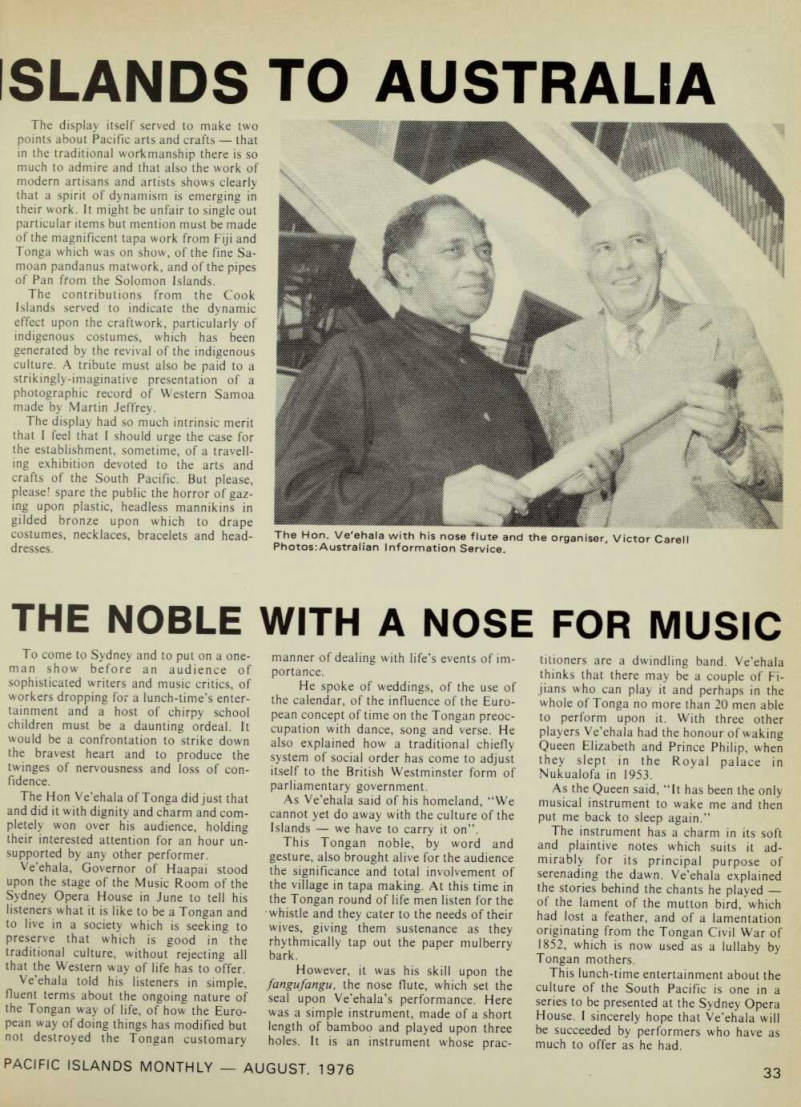
The display itself served to make two points about Pacific arts and crafts that in the traditional workmanship there is so much to admire and that also the work of modern artisans and artists shows clearly that a spirit of dynamism is emerging in their work. It might be unfair to single out particular items but mention must be made of the magnificent tapa work from Fiji and Tonga which was on show, of the fine Sa moan pandanus matwork, and of the pipes of Pan from the Solomon Islands.
The contributions from the Cook Islands served to indicate the dynamic effect upon the craftwork, particularly of indigenous costumes, which has been generated by the revival of the indigenous culture. A tribute must also be paid to a strikingly-imaginative presentation of a photographic record of Western Samoa made by Martin Jeffrey.
The display had so much intrinsic merit that I feel that I should urge the case for the establishment, sometime, of a travell ing exhibition devoted to the arts and crafts of the South Pacific. But please, please! spare the public the horror of gaz ing upon plastic, headless mannikins in gilded bronze upon which to drape costumes, necklaces, bracelets and head dresses.
The Hon. Ve'ehala with his nose flute and the organiser. Victor Carell Photos:Australian Information Service.
The Noble With A Nose For Music
To come to Sydney and to put on a one man show before an audience of sophisticated writers and music critics, of workers dropping for a lunch-time’s enter tainment and a host of chirpy school children must be a daunting ordeal. It would be a confrontation to strike down the bravest heart and to produce the twinges of nervousness and loss of con fidence.
The Hon Ve’ehala of Tonga did just that and did it with dignity and charm and com pletely won over his audience, holding their interested attention for an hour un supported by any other performer.
Ve’ehala, Governor of Haapai stood upon the stage of the Music Room of the Sydney Opera House in June to tell his listeners what it is like to be a Tongan and to live in a society which is seeking to preserve that which is good in the traditional culture, without rejecting all that the Western way of life has to offer.
Ve’ehala told his listeners in simple, fluent terms about the ongoing nature of the Tongan way of life, of how the Euro pean way of doing things has modified but not destroyed the Tongan customary
manner of dealing with life’s events of importance.
He spoke of weddings, of the use of the calendar, of the influence of the European concept of time on the Tongan preoccupation with dance, song and verse. He also explained how a traditional chiefly system of social order has come to adjust itself to the British Westminster form of
Parliamentary government.
As Ve’ehala said of his homeland, “We cannot yet do away with the culture of the Islands - we have to carry it on”.
This Tongan noble, by word and gesture, also brought alive for the audience the significance and total involvement of the village in tapa making. At this time in tbe Tongan round of life men listen for the whistle and they cater to the needs of their w u lve u s ’ them sustenance as they rhythmically tap out the paper mulberry bark. , However it was his skill upon the fangufangu. the nose flute, which set the seal upon Ve ’ ehala ’ s performance. Here was a simple instrument, made of a short ' en Bth8 th ? f bambo ° and pla y ed upon three holes. It is an instrument whose prac-
titioners are a dwindling band. Ve’ehala thinks that there may be a couple of Fi jians who can play it and perhaps in the whole of Tonga no more than 20 men able to perform upon it. With three other players Ve’ehala had the honour of waking Queen Elizabeth and Prince Philip, when they slept in the Royal palace in Nukualofa in 1953.
As the Queen said, “It has been the only musical instrument to wake me and then put me back to sleep again.”
The instrument has a charm in its soft and plaintive notes which suits it ad mirably for its principal purpose of serenading the dawn. Ve’ehala explained the stories behind the chants he played of the lament of the mutton bird, which had lost a feather, and of a lamentation originating from the Tongan Civil War of 1852, which is now used as a lullaby by Tongan mothers.
This lunch-time entertainment about the culture of the South Pacific is one in a series to be presented at the Sydney Opera House. I sincerely hope that Ve’ehala will be succeeded by performers who have as much to offer as he had.
Nutshell
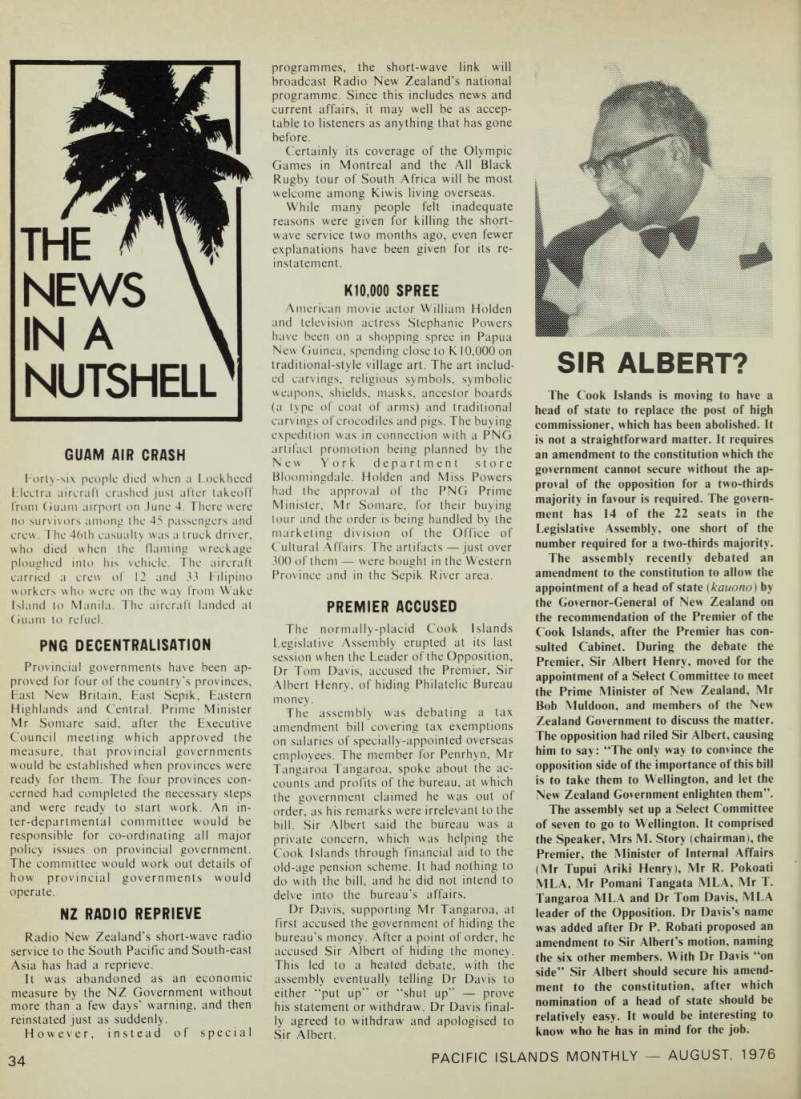
The
News
In A
Nutshell
Guam Air Crash
Eorly-six people died when a Lockheed Plectra aircraft crashed just after takeoff from Guam airport on June 4. There were no survivors among the 45 passengers and crew. The 46th casually was a truck driver, who died when the flaming wreckage ploughed into his vehicle. The aircraft carried a crew of 12 and 33 Filipino workers who were on the way from Wake Island to Manila. The aircraft landed at Guam to refuel.
Png Decentralisation
Provincial governments have been ap proved for four of the country's provinces, Fast New Britain, East Sepik, Eastern Highlands and Central. Prime Minister Mr Somare said, after the Executive Council meeting which approved the measure, that provincial governments would be established when provinces were ready for them. The four provinces con cerned had completed the necessary steps and were ready to start work. An in ter-departmental committee would be responsible for co-ordinating all major policy issues on provincial government.
The committee would work out details of how provincial governments would operate.
Nz Radio Reprieve
Radio New Zealand’s short-wave radio service to the South Pacific and South-east Asia has had a reprieve.
It was abandoned as an economic measure by the NZ Government without more than a few days’ warning, and then reinstated just as suddenly.
However, instead of special
programmes, the short-wave link will broadcast Radio New Zealand’s national programme. Since this includes news and current affairs, it may well be as accep table to listeners as anything that has gone before.
Certainly its coverage of the Olympic Games in Montreal and the All Black Rugby tour of South Africa will be most welcome among Kiwis living overseas.
While many people felt inadequate reasons were given for killing the short wave service two months ago, even fewer explanations have been given for its re instatement.
Klo,Ooo Spree
American movie actor William Holden and television actress Stephanie Powers have been on a shopping spree in Papua New Guinea, spending close to K 10,000 on traditional-style village art. The art includ
ed carvings, religious symbols, symbolic
weapons, shields, masks, ancestor boards (a type of coat of arms) and traditional carvings of crocodiles and pigs. The buying expedition was in connection with a PNG
artifact promotion being planned by the
New York department store Bloomingdale. Holden and Miss Powers had the approval of the PNG Prime Minister, Mr Somare, for their buying lour and the order is being handled by the marketing division of the Office of Cultural Affairs. The artifacts —just over 300 of them were bought in the Western Province and in the Sepik River area.
Premier Accused
The normally-placid Cook Islands
Legislative Assembly erupted at its last
session when the Leader of the Opposition, Dr Tom Davis, accused the Premier, Sir Albert Henry, of hiding Philatelic Bureau money.
The assembly was debating a tax amendment bill covering tax exemptions on salaries of specially-appointed overseas employees. The member for Penrhyn, Mr Tangaroa Tangaroa, spoke about the ac counts and profits of the bureau, at which the government claimed he was out of order, as his remarks were irrelevant to the bill. Sir Albert said the bureau was a private concern, which was helping the Cook Islands through financial aid to the old-age pension scheme. It had nothing to do with the bill, and he did not intend to delve into the bureau’s affairs.
Dr Davis, supporting Mr Tangaroa, at first accused the government of hiding the bureau’s money. After a point of order, he accused Sir Albert of hiding the money.
This led to a heated debate, with the
assembly eventually telling Dr Davis to
either "put up” or “shut up” prove his statement or withdraw. Dr Davis final ly agreed to withdraw and apologised to Sir Albert.
Sir Albert?
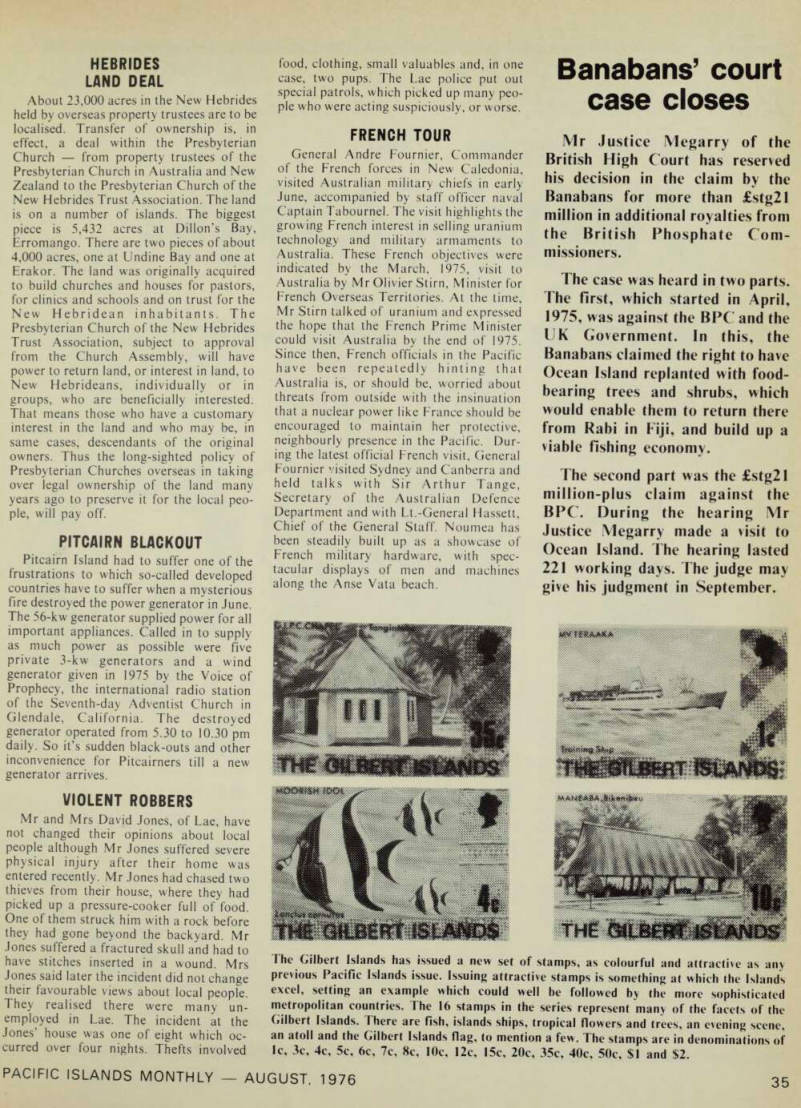
The Cook Islands is moving to have a head of state to replace the post of high commissioner, which has been abolished. It is not a straightforward matter. It requires an amendment to the constitution which the government cannot secure without the ap proval of the opposition for a two-thirds majority in favour is required. The govern ment has 14 of the 22 seats in the Legislative Assembly, one short of the number required for a two-thirds majority.
The assembly recently debated an amendment to the constitution to allow the appointment of a head of state ( kauono ) by the Governor-General of New Zealand on the recommendation of the Premier of the Cook Islands, after the Premier has con sulted Cabinet. During the debate the Premier, Sir Albert Henry, moved for the appointment of a Select Committee to meet the Prime Minister of New Zealand, Mr Bob Muldoon, and members of the New Zealand Government to discuss the matter.
The opposition had riled Sir Albert, causing him to say: “The only way to convince the opposition side of the importance of this bill is to take them to Wellington, and let the New Zealand Government enlighten them”.
The assembly set up a Select Committee of seven to go to Wellington. It comprised the Speaker, Mrs M. Story (chairman), the Premier, the Minister of Internal Affairs (Mr Tupui Ariki Henry), Mr R. Pokoati MLA, Mr Pomani Tangata MLA, Mr T.
Tangaroa MLA and Dr Tom Davis, MLA leader of the Opposition. Dr Davis’s name was added after Dr P. Robati proposed an amendment to Sir Albert’s motion, naming the six other members. With Dr Davis “on side” Sir Albert should secure his amend ment to the constitution, after which nomination of a head of state should be relatively easy. It would be interesting to know who he has in mind for the job.
Hebrides
Land Deal
About 23,000 acres in the New Hebrides held by overseas property trustees are to be localised. Transfer of ownership is, in effect, a deal within the Presbyterian Church from property trustees of the Presbyterian Church in Australia and New Zealand to the Presbyterian Church of the New Hebrides Trust Association. The land is on a number of islands. The biggest piece is 5,432 acres at Dillon’s Bay, Erromango. There are two pieces of about 4,000 acres, one at Undine Bay and one at Erakor. The land was originally acquired to build churches and houses for pastors, for clinics and schools and on trust for the New Hebridean inhabitants. The Presbyterian Church of the New Hebrides Trust Association, subject to approval from the Church Assembly, will have power to return land, or interest in land, to New Hebrideans, individually or in groups, who are beneficially interested.
That means those who have a customary interest in the land and who may be, in same cases, descendants of the original owners. Thus the long-sighted policy of Presbyterian Churches overseas in taking over legal ownership of the land many years ago to preserve it for the local peo ple, will pay off.
Pitcairn Blackout
Pitcairn Island had to suffer one of the frustrations to which so-called developed countries have to suffer when a mysterious fire destroyed the power generator in June.
The 56-kw generator supplied power for all important appliances. Called in to supply as much power as possible were five private 3-kw generators and a wind generator given in 1975 by the Voice of Prophecy, the international radio station of the Seventh-day Adventist Church in Glendale, California. The destroyed generator operated from 5.30 to 10.30 pm daily. So it’s sudden black-outs and other inconvenience for Pitcairners till a new generator arrives.
Violent Robbers
Mr and Mrs David Jones, of Lae, have not changed their opinions about local people although Mr Jones suffered severe physical injury after their home was entered recently. Mr Jones had chased two thieves from their house, where they had picked up a pressure-cooker full of food.
One of them struck him with a rock before they had gone beyond the backyard. Mr Jones suffered a fractured skull and had to have stitches inserted in a wound. Mrs Jones said later the incident did not change their favourable views about local people.
They realised there were many un employed in Lae. The incident at the Jones’ house was one of eight which oc curred over four nights. Thefts involved
food, clothing, small valuables and, in one case, two pups. The Lae police put out special patrols, which picked up many peo ple who were acting suspiciously, or worse.
French Tour
General Andre Fournier, Commander of the French forces in New Caledonia, visited Australian military chiefs in early June, accompanied by staff officer naval Captain Tabournel. The visit highlights the growing French interest in selling uranium technology and military armaments to Australia. These French objectives were indicated by the March, 1975, visit to Australia by Mr Olivier Stirn, Minister for French Overseas Territories. At the time, Mr Stirn talked of uranium and expressed the hope that the French Prime Minister could visit Australia by the end of 1975.
Since then, French officials in the Pacific have been repeatedly hinting that Australia is, or should be, worried about threats from outside with the insinuation that a nuclear power like France should be encouraged to maintain her protective, neighbourly presence in the Pacific. Dur ing the latest official French visit. General Fournier visited Sydney and Canberra and held talks with Sir Arthur Tange, Secretary of the Australian Defence Department and with Lt.-General Flassett, Chief of the General Staff. Noumea has been steadily built up as a showcase of French military hardware, with spec tacular displays of men and machines along the Anse Vata beach.
The Gilbert Islands has issued a new set of stamps, as colourful and attractive as any previous Pacific Islands issue. Issuing attractive stamps is something at which the Islands excel, setting an example which could well be followed by the more sophisticated metropolitan countries. The 16 stamps in the series represent many of the facets of the Gilbert Islands. There are fish, islands ships, tropical flowers and trees, an evening scene, an atoll and the Gilbert Islands flag, to mention a few. The stamps are in denominations of 1c, 3c, 4c, sc, 6c, 7c, Bc, 10c, 12c, 15c, 20c, 35c, 40c, 50c, $1 and $2.
Banabans’ court
case closes
Mr Justice Megarry of the British High Court has reserved his decision in the claim by the Banabans for more than £stg2l million in additional royalties from the British Phosphate Com missioners.
The case was heard in two parts.
The first, which started in April, 1975, was against the BPC and the UK Government. In this, the Banabans claimed the right to have Ocean Island replanted with food bearing trees and shrubs, which would enable them to return there from Rabi in Fiji, and build up a viable fishing economy.
The second part was the £stg2l million-plus claim against the BPC. During the hearing Mr Justice Megarry made a visit to Ocean Island. The hearing lasted 221 working days. The judge may give his judgment in September.
Advertisements & other items, p. 36 (1 item)
Watson & Crane
Total service 0n ...
plumbing supplies Tast
are organised to fulfil your needs
wherever you are in the South Pacific ‘tr « You can get all you need from one supply source: water taps, valves, copper tube, tools and a host of other fittings and related plumbing equipment for domestic, industrial and multistorey buildings.
Watson & Crane Pty Ltd have over 20,000 plumbing items in stock at their central warehouse located at Waterloo, NSW, Australia.
Years of experience in handling and shipping right throughout the South Pacific add up to another big reason for you to deal with Watson & Crane Pty Ltd.
Representatives call regularly at New Guinea, Papua, the Solomons, New Hebrides and Frji Islands to personally discuss your requirements and appropriate credit arrangements.
Write, cable or telephone today for complete plumbers' supplies service.
Watson & Crane Pty. Ltd. 1037 Bourke Street, Waterloo,
NSW 2017.
Phone: Sydney 699-1333.
Telex: AA 25548.
Cables: // Watcrane // Sydney.
Pacific Island distributors of Crane Enfield copper tube for water, sanitation, engineering, refrigeration and air conditioning.
Magazine
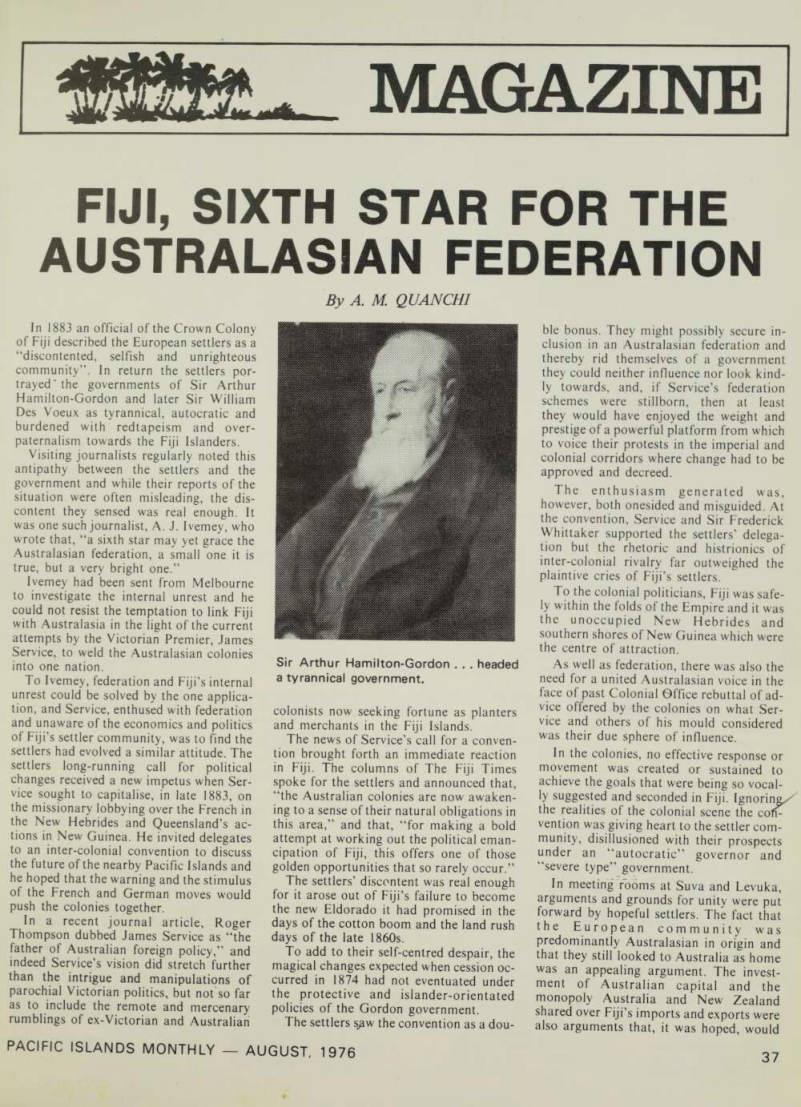
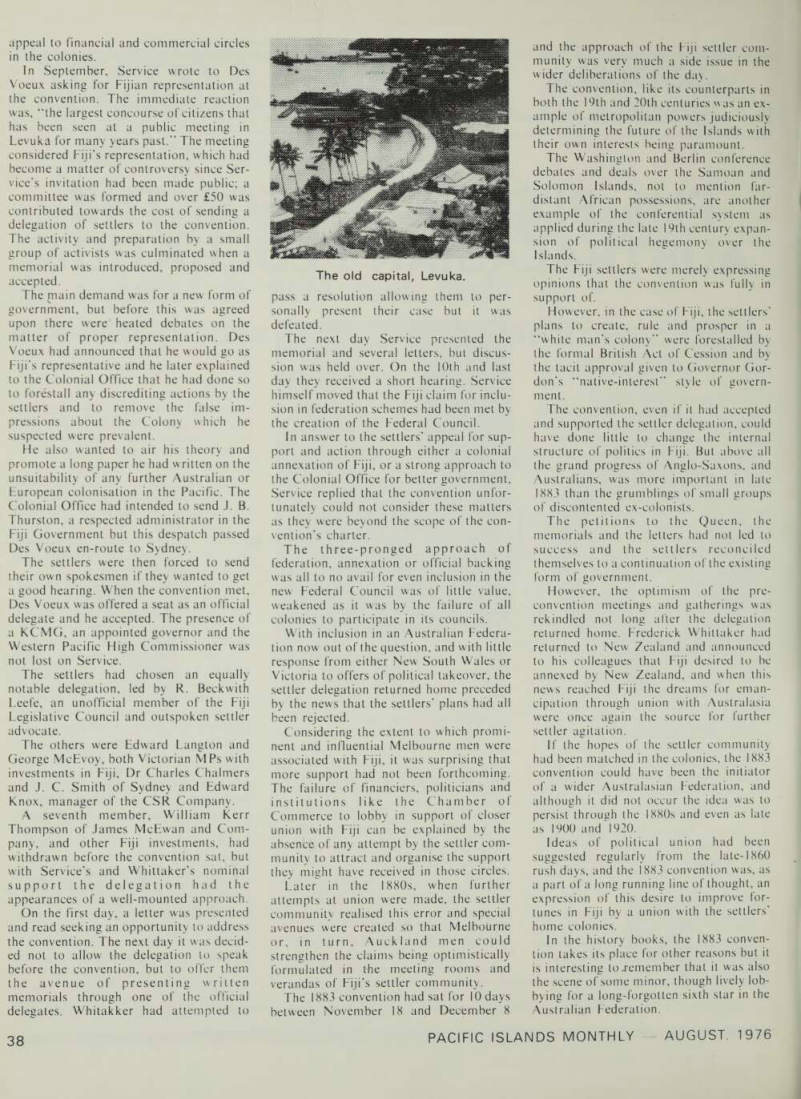
Fiji, Sixth Star For The
Australasian Federation
By A. M. Quanchi
In 1883 an official of the Crown Colony of Fiji described the European settlers as a “discontented, selfish and unrighteous community”. In return the settlers por trayed’the governments of Sir Arthur Hamilton-Gordon and later Sir William Des Voeux as tyrannical, autocratic and burdened with redtapeism and over paternalism towards the Fiji Islanders.
Visiting journalists regularly noted this antipathy between the settlers and the government and while their reports of the situation were often misleading, the dis content they sensed was real enough. It was one such journalist, A. J. Ivemey, who wrote that, “a sixth star may yet grace the Australasian federation, a small one it is true, but a very bright one.”
Ivemey had been sent from Melbourne to investigate the internal unrest and he could not resist the temptation to link Fiji with Australasia in the light of the current attempts by the Victorian Premier, James Service, to weld the Australasian colonies into one nation.
To Ivemey, federation and Fiji’s internal unrest could be solved by the one applica tion, and Service, enthused with federation and unaware of the economics and politics of Fiji’s settler community, was to find the settlers had evolved a similar attitude. The settlers long-running call for political changes received a new impetus when Ser vice sought to capitalise, in late 1883, on the missionary lobbying over the French in the New Hebrides and Queensland’s ac tions in New Guinea. He invited delegates to an inter-colonial convention to discuss the future of the nearby Pacific Islands and he hoped that the warning and the stimulus of the French and German moves would push the colonies together.
In a recent journal article, Roger Thompson dubbed James Service as “the father of Australian foreign policy,” and indeed Service’s vision did stretch further than the intrigue and manipulations of parochial Victorian politics, but not so far as to include the remote and mercenary rumblings of ex-Victorian and Australian
colonists now seeking fortune as planters and merchants in the Fiji Islands.
The news of Service’s call for a conven tion brought forth an immediate reaction in Fiji. The columns of The Fiji Times spoke for the settlers and announced that, “the Australian colonies are now awaken ing to a sense of their natural obligations in this area,” and that, “for making a bold attempt at working out the political eman cipation of Fiji, this offers one of those golden opportunities that so rarely occur.”
The settlers’ discontent was real enough for it arose out of Fiji’s failure to become the new Eldorado it had promised in the days of the cotton boom and the land rush days of the late 1860 s.
To add to their self-centred despair, the magical changes expected when cession oc curred in 1874 had not eventuated under the protective and islander-orientated policies of the Gordon government.
The settlers the convention as a dou
ble bonus. They might possibly secure in clusion in an Australasian federation and thereby rid themselves of a government they could neither influence nor look kind ly towards, and, if Service’s federation schemes were stillborn, then at least they would have enjoyed the weight and prestige of a powerful platform from which to voice their protests in the imperial and colonial corridors where change had to be approved and decreed.
The enthusiasm generated was, however, both onesided and misguided. At the convention, Service and Sir Frederick Whittaker supported the settlers' delega tion but the rhetoric and histrionics of inter-colonial rivalry far outweighed the plaintive cries of Fiji’s settlers.
To the colonial politicians, Fiji was safe ly within the folds of the Empire and it was the unoccupied New Hebrides and southern shores of New Guinea which were the centre of attraction.
As well as federation, there was also the need for a united Australasian voice in the face of past Colonial Office rebuttal of ad vice offered by the colonies on what Ser vice and others of his mould considered was their due sphere of influence.
In the colonies, no effective response or movement was created or sustained to achieve the goals that were being so vocal ly suggested and seconded in Fiji. Ignoring/ the realities of the colonial scene the con vention was giving heart to the settler com munity, disillusioned with their prospects under an “autocratic” governor and “severe type” government.
In meeting' rooms at Suva and Levuka, arguments and grounds for unity were put forward by hopeful settlers. The fact that
the European community was
predominantly Australasian in origin and that they still looked to Australia as home was an appealing argument. The invest ment of Australian capital and the monopoly Australia and New Zealand shared over Fiji’s imports and exports were also arguments that, it was hoped, would
Sir Arthur Hamilton-Gordon . . . headed a tyrannical government.
appeal to financial and commercial circles in the colonies.
In September, Service wrote to Des Voeux asking for Fijian representation at the convention. The immediate reaction was, “the largest concourse of citizens that has been seen at a public meeting in Levuka for many years past.” The meeting considered Fiji's representation, which had become a matter of controversy since Ser vice's invitation had been made public; a committee was formed and over £5O was contributed towards the cost of sending a delegation of settlers to the convention.
The activity and preparation by a small group of activists was culminated when a memorial was introduced, proposed and accepted.
The main demand was for a new form of government, but before this was agreed upon there were heated debates on the matter of proper representation. Des Voeux had announced that he would go as Fiji's representative and he later explained to the Colonial Office that he had done so to forestall any discrediting actions by the settlers and to remove the false im pressions about the Colony which he suspected were prevalent.
He also wanted to air his theory and promote a long paper he had written on the unsuitability of any further Australian or European colonisation in the Pacific. The Colonial Office had intended to send J. B.
Thurston, a respected administrator in the Fiji Government but this despatch passed Des Voeux en-route to Sydney.
The settlers were then forced to send their own spokesmen if they wanted to get a good hearing. When the convention met, Des Voeux was offered a seal as an official delegate and he accepted. The presence of a KCMG, an appointed governor and the Western Pacific High Commissioner was not lost on Service.
The settlers had chosen an equally notable delegation, led by R. Beckwith Leefe, an unofficial member of the Fiji Legislative Council and outspoken settler advocate.
The others were Edward Langton and George McEvoy, both Victorian MPs with investments in Fiji, Dr Charles Chalmers and J. C. Smith of Sydney and Edward Knox, manager of the CSR Company.
A seventh member, William Kerr Thompson of James McEwan and Com pany, and other Fiji investments, had withdrawn before the convention sal, but with Service’s and Whittaker's nominal support the delegation had the appearances of a well-mounted approach.
On the first day, a letter was presented and read seeking an opportunity to address the convention. The next day it was decid ed not to allow the delegation to speak before the convention, but to offer them the avenue of presenting written memorials through one of the official delegates. Whitakker had attempted to
pass a resolution allowing them to per sonally present their case but it was defeated.
The next day Service presented the memorial and several letters, but discus sion was held over. On the 10th and last day they received a short hearing. Service himself moved that the Fiji claim for inclu sion in federation schemes had been met by the creation of the Federal Council.
In answer to the settlers' appeal for sup port and action through either a colonial annexation of Fiji, or a strong approach to the Colonial Office for belter government.
Service replied that the convention unfor tunately could not consider these matters as they were beyond the scope of the con vention’s charter.
The three-pronged approach of
federation, annexation or official backing was all to no avail for even inclusion in the new Federal Council was of little value, weakened as it was by the failure of all colonies to participate in its councils.
With inclusion in an Australian Federa tion now out of the question, and with little response from either New South Wales or Victoria to offers of political takeover, the settler delegation returned home preceded by the news that the settlers' plans had all been rejected.
Considering the extent to which promi nent and influential Melbourne men were associated with Fiji, it was surprising that more support had not been forthcoming.
The failure of financiers, politicians and institutions like the Chamber of Commerce to lobby in support of closer union with Fiji can be explained by the absence of an> attempt by the settler com munity to attract and organise the support they might have received in those circles.
Later in the 1880 s, when further attempts at union were made, the settler community realised this error and special avenues were created so that Melbourne or, in turn, Auckland men could strengthen the claims being optimistically formulated in the meeting rooms and verandas of Fiji’s settler community.
The 1883 convention had sal for 10 days between November 18 and December 8
and the approach of the Fiji settler com munity was very much a side issue in the wider deliberations of the day.
The convention, like its counterparts in both the 19th and 20th centuries was an ex ample of metropolitan powers judiciously determining the future of the Islands with their own interests being paramount.
The Washington and Berlin conference debates and deals over the Samoan and Solomon Islands, not to mention far distant African possessions, are another example of the conferential system as applied during the late 19th century expan sion of political hegemony over the Islands.
The Fiji settlers were merely expressing
opinions that the convention was fully in support of.
However, in the case of Fiji, the settlers' plans to create, rule and prosper in a “while man's colony" were forestalled by the formal British Act of Cession and by the tacit approval given to Governor Gor don's “native-interest" style of govern ment.
The convention, even if it had accepted and supported the settler delegation, could have done little to change the internal structure of politics in Fiji. But above all the grand progress of Anglo-Saxons, and Australians, was more important in late 1883 than the grumblings of small groups of discontented ex-colonists.
The petitions to the Queen, the memorials and the letters had not led to success and the settlers reconciled themselves to a continuation oflhe existing form of government.
However, the optimism of the pre convention meetings and gatherings was rekindled not long after the delegation returned home. Frederick Whittaker had returned to New Zealand and announced to his colleagues that Fiji desired to be annexed by New Zealand, and when this news reached Fiji the dreams for eman cipation through union with Australasia were once again the source for further settler agitation.
If the hopes of the settler community had been matched in the colonies, the 1883 convention could have been the initiator of a wider Australasian Federation, and although it did not occur the idea was to persist through the 1880 s and even as late as 1900 and 1920.
Ideas of political union had been suggested regularly from the late-1860 rush days, and the 1883 convention was, as a part of a long running line of thought, an expression of this desire to improve for tunes in Fiji by a union with the settlers' home colonies.
In the history books, the 1883 conven tion takes its place for other reasons but it is interesting to .remember that it was also the scene of some minor, though lively lob bying for a long-forgotten sixth star in the Australian Federation.
The old capital, Levuka.
Advertisements & other items, pp. 39-42 (1 item)
Cd Pioneer
X wMm wv * --£ ** "_
tt>*d<y-2000
Top performance takes the guesswork
out of going hi-fi.
No imitations here. Every one of the RONDO 2000 Stereo Sound Mates was component created and Pioneer blended into a total system stereo package. And at a price much lower than you think.
First, an advanced design AM/FM stereo receiver produces a powerful 13 watts per channel virtually distortion-free.
Accurate tonal management is achieved with separate bass and treble controls and AM/FM reception is clean and clear On the input side of the RONDO 2000 is a professional type manual turntable.
The super-smooth belt-drive mechanism provides loving care for your records.
Auto-cut at the touch of a button plus the convenience of auto-return.
On the output side, beautifully balanced two-way, two-speaker systems. Every earthy note from the big 20 cm. woofers is enriched by the solid bass-reflex design cabinets.
And for your private listening pleasure, RONDO 2000 Sound-Mates include lightweight high-polymer headphones.
RONDO 2000 Stereo Sound Mates.
From stylus to speaker...the direct approach to top performance.
Cd PIONEER
Pioneer Electronic Corporatior
4-1, Meguro 1-chome, Meguro-ku, Tokyo 153, Japa Australia Pioneer Electronics Australia Pty. Ltd., 178-184 Boundary Road, Braeside. Victoria 3195.
Phone: 90-9011, Sydney 93-0246, Brisbane 52-8231, Adelaide 433379, Perth 76-7776 Fiji Islands Brijlal & Company, G.PO. Box No. 362, Suva, Fiji Islands Tel: 22258 New Zealand Fountain Marketing Ltd., Maidstone Street, Auckland, New Zealand Tel: 763-064 Norfolk Island Burns Philp (Norfolk Island) Ltd., Norfolk Island, South Pacific New Hebrides Burns Philp (New Hebrides) Ltd., Vila. New Hebrides Nauru Island Jacob Enterprises, RO. Box No. 4 Republic of Nauru Tahiti
Est. PERFECT, B P 594,
Papeete, Tahiti Tel: 20 407 New Caledonia Menard Freres, B P 123, Noumea, New Caledonia Tel: 27.52.22 American Samoa Traspac Corporation, PO. Box 1477, Pago Pago, American Samoa 96799 Tel: 633-5224 Rarotonga South Seas International Ltd PO. Box 49, Rarotonga Cook Islands Tel: 2327
Honda Civic Declared
_,Ar. f Jlffiß ‘
7* r BP». >a m ■ . m mm • •- -■■ m mi -
is Ji
etiKBR ’■ v * m n mm m >; & 4 - ■ That's what the U.S. Environmental Protection Agency figures show. The Honda Civic . placed first among the hundreds of 1976 cars tested. On the highway, in the city and in combined driving situations.
Top fuel economy is Just the start. All-round operating costs are equally low. Thanks to a rugged, clean-burning OHC engine which delivers snappy acceleration. Elegance is second to none—both inside and out.
Famous Honda engineering also gives you: Enough roomy comfort to relax four adults.
A spacious trunk. Exceptional handling ease. A dual braking system featuring servo-assisted front disc brakes, independent strut suspensions.
All of this quality performance is yours in three exciting models—the 2-Door Sedan, 4-Door Sedan and Hatchback.
Own the 1976 economy champ-the Honda Civic.
I
HONDA
HONDA MOTOR CO.. LTD. TOKYO, JAPAN
PAPUA NEW GUINEA: Steamships-Machinery P.O. Box 1, Port Moresby/TAHITI: Soci6t<§ Tahitienne d Importation des Produits Honda B.P. 1665-Papeete/FIJI ISLANDS: Coral Island Motors P.O. Box 48 Suva/U.S. TRUST TERRITORY: United Micronesia Development Assn. P.O. Box 238, Saipan, Mairiana 's'ands 96950/COOK ISLANDS: Cook Islands Motor Centre Ltd. P.O. Box 74, Rarotonga/AMERICAN SAMOA: Samoan Holiday and Travel Center P.O. Box 968, Pago Pago/AMERICAN SAMOA: Haleck’s Service Center P.O. Box 1138, Pago Pago/GUAM: Mark’s Motor Co., Inc. P.O. Box DV. Agana/WESTERN SAMOA: Motor Distributors (Samoa) Ltd. P.O. Box 576, Apia/SOLOMON ISLANDS: British Solomons I Ltd - P 0 - Box 114 ’ H o n 'ara/NEW CALEDONIA: Establissements Ballande Boite Postale No. C 4 Noumea Cedex/TONGA: E.M. Jones Limited P.O. Box 34, Nuku’alofa/TARAWA: Gilberts. Ellice Islands Deve'opment Authority P.O. Box 488, Beito/NIUE ISLAND: S. Jessop 8. Sons Ltd. P O Box 71, Alofi South/NAURU: Nauru Cooperative Society Republic of Nauru, Nauru Island Central Pacific
How it tastes when it gets there depends akrt on the way it goes.
Australian produce. Fresh from the farm.
Meat, vegetables, fruit, seafood. Qantas can get it to Pacific and Southeast Asian markets in less than a day. And get it there in the prime top condition you expect. Unitised, palletised, air cargo Qantas offers you more capacity out of Australia to the world than any other carrier.
And because we’re Australian we can offer advice about where to order, who to order from, how much to pay. Ring Qantas or your Freight Forwarder. We’re always looking for fresh problems to solve.
txaNTas /~7
carte a!—!
L 81.2846
Alone And Afloat In
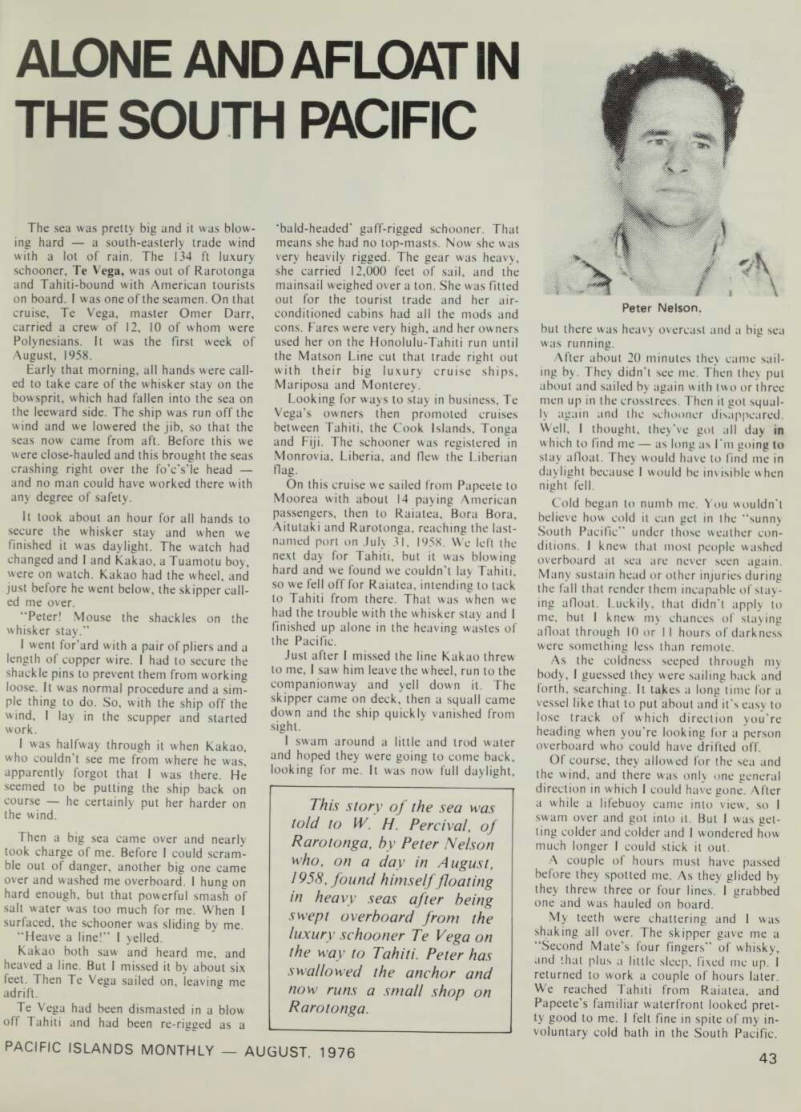
The South Pacific
The sea was pretty big and it was blow ing hard a south-easterly trade wind with a lot of rain. The 134 ft luxury schooner, Te Vega, was out of Rarotonga and Tahiti-bound with American tourists on board. 1 was one of the seamen. On that cruise, Te Vega, master Omer Darr, carried a crew of 12, 10 of whom were Polynesians. It was the first week of August, 1958.
Early that morning, all hands were call ed to take care of the whisker stay on the bowsprit, which had fallen into the sea on the leeward side. The ship was run off the wind and we lowered the jib, so that the seas now came from aft. Before this we were close-hauled and this brought the seas crashing right over the fo’c’s'le head and no man could have worked there with
any degree of safety.
it took about an hour for all hands to secure the whisker stay and when we finished it was daylight. The watch had changed and I and Kakao, a Tuamotu boy, were on watch. Kakao had the wheel, and just before he went below, the skipper call ed me over.
“Peter! Mouse the shackles on the whisker stay.”
I went for’ard with a pair of pliers and a length of copper wire. I had to secure the shackle pins to prevent them from working loose. It was normal procedure and a sim ple thing to do. So, with the ship off the wind, I lay in the scupper and started work.
I was halfway through it when Kakao, who couldn't see me from where he was, apparently forgot that 1 was there. He seemed to be putting the ship back on course he certainly put her harder on the wind.
Then a big sea came over and nearly took charge of me. Before I could scram ble out of danger, another big one came over and washed me overboard. I hung on hard enough, but that powerful smash of salt water was too much for me. When I surfaced, the schooner was sliding by me.
“Heave a line!” I yelled.
Kakao both saw and heard me, and heaved a line. But 1 missed it by about six feet. Then Te Vega sailed on, leaving me adrift.
Te Vega had been dismasted in a blow off Tahiti and had been re-rigged as a
'bald-headed' gaff-rigged schooner. That means she had no top-masts. Now she was very heavily rigged. The gear was heavy, she carried 12,000 feet of sail, and the mainsail weighed over a ton. She was fitted out for the tourist trade and her air conditioned cabins had all the mods and cons. Fares were very high, and her owners used her on the Honolulu-Tahili run until the Matson Line cut that trade right out with their big luxury cruise ships, Mariposa and Monterey.
Looking for ways to stay in business, Te Vega’s owners then promoted cruises between Tahiti, the Cook Islands, Tonga and Fiji. The schooner was registered in Monrovia, Liberia, and Hew the Liberian
flag.
On this cruise we sailed from Papeete to Moorea with about 14 paying American passengers, then to Raiatea, Bora Bora, Ailutaki and Rarotonga, reaching the last named port on July 31, 1958. We left the next day for Tahiti, but it was blowing hard and we found we couldn't lay Tahiti, so we fell off for Raiatea, intending to tack to Tahiti from there. That was when we had the trouble with the whisker stay and 1 finished up alone in the heaving wastes of the Pacific.
Just after I missed the line Kakao threw to me, I saw him leave the wheel, run to the companionway and yell down it. The skipper came on deck, then a squall came down and the ship quickly vanished from sight.
I swam around a little and trod water and hoped they were going to come back, looking for me. It was now full daylight.
This story of the sea was told to W. H. Percival, of Rarotonga, by Peter Nelson who, on a day in August, 1958, found himself floating in heavy seas after being swept overboard from the luxury schooner Te Vega on the way to Tahiti. Peter has swallowed the anchor and now runs a small shop on Rarotonga.
bul there was heavy overcast and a hig sea
was running.
After about 20 minutes they came sail ing by. They didn't see me. Then they pul about and sailed by again with two or three men up in the crosslrees. Then it got squal ly again and the schooner disappeared.
Well, I thought, they've got all day in which to find me as long as I'm going to stay afloat. They would have to find me in daylight because I would be invisible when night fell.
Cold began to numb me. You wouldn't believe how cold it can gel in the “sunny South Pacific" under those weather con ditions. I knew that most people washed overboard at sea are never seen again.
Many sustain head or other injuries during the fall that render them incapable of slay ing afloat. Luckily, that didn't apply to me, bul I knew my chances of staying afloat through 10 or I I hours of darkness were something less than remote.
As the coldness seeped through my body, I guessed they were sailing back and forth, searching. It takes a long time for a vessel like that to put about and it's easy to lose track of which direction you’re heading when you're looking for a person overboard who could have drifted off.
Of course, they allowed for (he sea and the wind, and there was only one general direction in which I could have gone. After a while a lifebuoy came into view, so I swam over and got into it. But I was get ting colder and colder and I wondered how much longer 1 could stick it out.
A couple of hours must have passed before they spotted me. As they glided by they threw three or four lines. I grabbed one and was hauled on board.
My teeth were chattering and I was shaking all over. The skipper gave me a “Second Male’s four fingers” of whisky, and that plus a little sleep, fixed me up. I returned to work a couple of hours later.
We reached Tahiti from Raiatea, and Papeete’s familiar waterfront looked pret ty good to me. I felt fine in spite of my in voluntary cold bath in the South Pacific.
Peter Nelson.
Islands
From The
Press
From the Tuvalu News Sheet: He (Mr M. G. Powell, acting Financial Secretary) described the seriously-mutilated notes as those with more than slight tears, part of the note missing or two half-notes bearing different numbers. Mr Powell has also made it clear that notes with corners bent and crumpled or with missing small corner would not constitute a serious mutilation.
From a speech underlying some drawbacks to custom by Fijian clergyman, the Rev Manasa Lasaro, and reported in The Fiji Times: . . . Any social study of Fijian society would show that a large portion of the family income was spent on social customs resources which could effectively be used in improving the standard of family life, Rev Lasaro said. A newly married couple had to begin life from scratch because the marriage system of exchange gifts during the ceremonies robbed them of a better starting point. The same happened in the event of death, when the closest relatives suffered severely financially, let alone suffering the loss of a loved one . . .
Mr Naboua Ratieta, Chief Minister of the Gilbert Islands, speaking at the opening of a new Bank of NSW office, as reported by the Atoll Pioneer: ... I am sure he (Mr Wright, chief manager of the bank in Fiji) does not fall within the usual definition of a bank manager. That is somebody who will only lend you an umbrella if it is not
raining.
From the Arawa Bulletin: People are still expressing concern at the traffic hazard of drunken men roaming across the road on the way home from the Tavern. It will be the innocent motorist who gets the chop by the pay-back system. If they can’t stop serving them before they get to that stage, then they should pay for bright street lighting.
From the Tohi Tala Niue: The time is ripe for government to appoint a “Commission of Inquiry” into our prison system . . . Can Niue afford to maintain a prison. Can Niue afford to have members of its work force put out of circulation for a few months .. . Being sentenced to prison is like a well earned holiday say some prisoners. “I can play golf, sing in the sun and get a square meal every day of the week.
If I was fined then I would think twice”, says one young man sentenced to 3 months imprisonment.
From a report in the Samoa Times of a visit to Apia of 38 high school students from American Samoa on a “cultural observance tour”: . . . One Apia woman said she had never come across such ill mannered, rude and confused young people before . . . One girl was late turning in Monday night and was later found in one of the nightclubs with a married man, reports said, and she was beaten up by the teachers and ‘deported’ back the next day . . .
From a reply by Peni Vea, economist with the Tonga Government Central Planning Unit, to a question from the Tonga Chronicle, “Soviet Union interests in Tonga is it right for Tonga?”
I feel that any offer from the Soviet Union or any of the Communist countries to build an airport for us .should only be accepted if none of our non-Communist Allies like New
Zealand, Australia, the United Kingdom and even the United States are willing to assist Tonga on this when it wants to have it.
From the PNG Post-Courier: Some Dumun villagers in Chimbu Province will inform on people who ambush and steal from trucks —r if they are paid by the government . . . Two Dumun villagers said: “We know the people who steal from the trucks. They are our wantoks. But why should we tell the police? We will only do this if we are
paid.”
The Microneslan Independent reports under the heading ‘The bad news’: This is a short story, being put in the paper at the last minute because what happened just happened a few minutes ago: another young Marshallese man has attempted suicide. He was discovered hanging in a wash house several buildings from where this paper is printed in Majuro. Fortunately he was cut down before suffocating himself and was rushed to hospital in an unconscious state. This incident bears an uncomfortable and undeniable relationship to a rash of such hangings and self shootings by young men there have been five or six since January.
From a statement in The Fiji Times from Taniela Veitata, Industrial Officer of the Fiji Waterside Workers’ and Seamen’s Union, on the dispute between the union and the Fiji Ports Authority: The majority of Fijians must not be classed as still within the throes of backwardness, ignorance and shortsightedness. We are fully conscious and are aware of our identity and have by now acquired the senses and ability of smelling a rat a mile away. So, the rat might now or later find itself the meat in the sandwich, entangled in its own shady dealings, the culmination of bad showmanship . . .
“All councillors in harmonious agreement” ran the headline in the Norfolk Island News reporting an increase in pay for council members: . . . Why the rise should be treated like a hot potato is hard to understand: who else takes so much responsibility and earbashing for around $1 an hour?
From the Cook Islands News: They (the New Zealand people) end up buying very expensive Ecuador bananas rather than cheap Island bananas which, they say, look second-hand because of all their bruises, stains or scars.
Advertisements & other items, p. 45 (1 item)
Mixmaster Mixer
m m
3 times better than any
other mixer. Designed especially for family food preparation. 12-speed mixfinder dial indicates the correct speed for each mixing action. Complete with 2 heat-resistant bowls and juice extractor. Sunbeam's exclusive 3-way beating action — extra large, contoured beaters, and automatic bowl movementgives perfect aeration and more even mixing. It can handle everything from beating one egg to mixing a large fruit cake.
Hebrides Presbyterianism
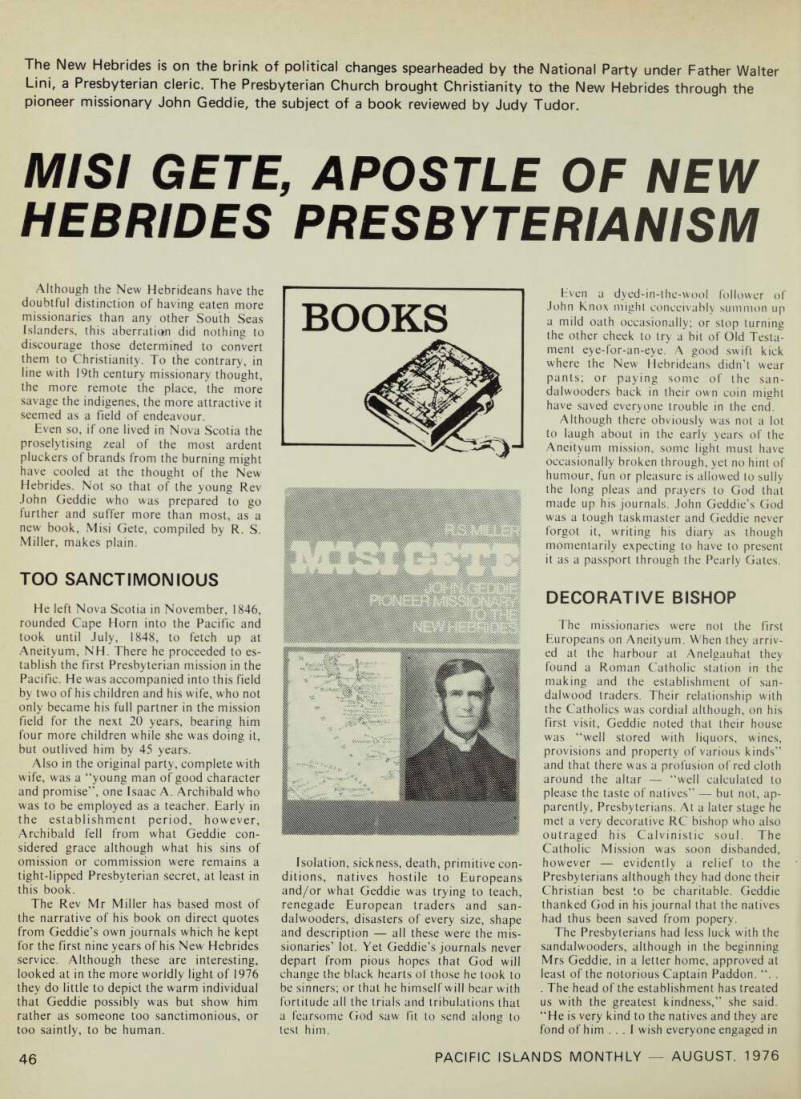
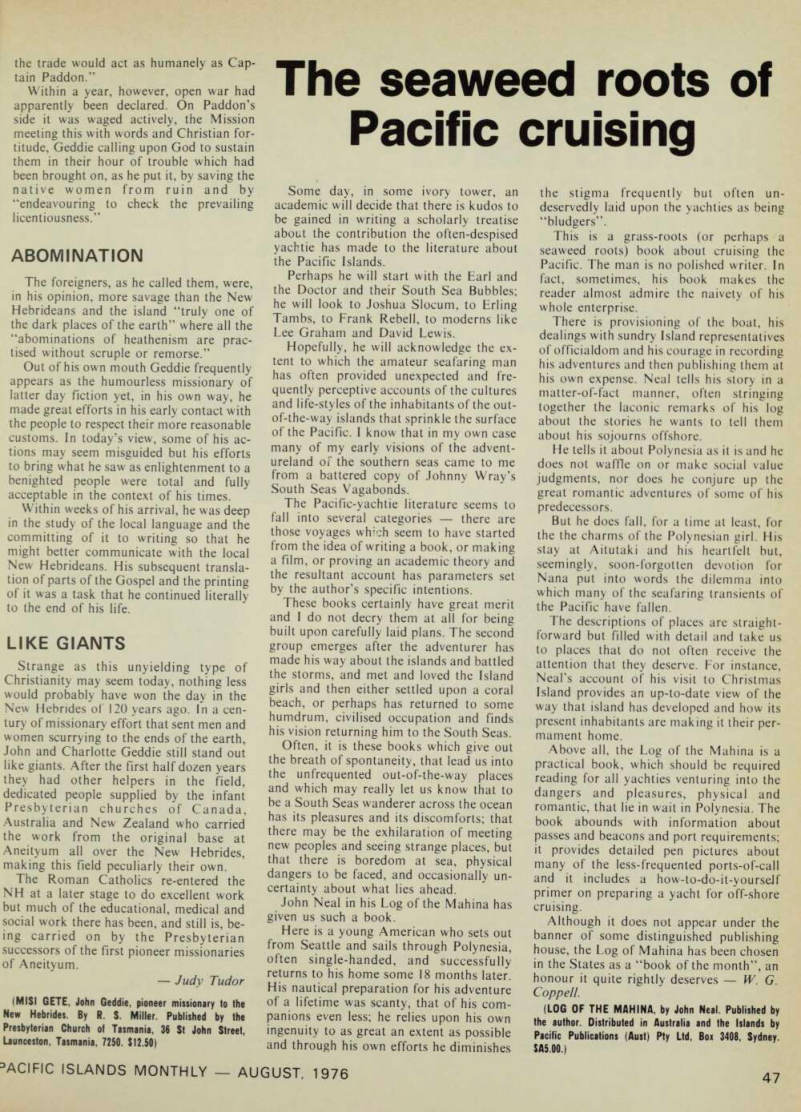
Misi Gete, Apostle Of New
The New Hebrides is on the brink of political changes spearheaded by the National Party under Father Walter Lini, a Presbyterian cleric. The Presbyterian Church brought Christianity to the New Hebrides through the pioneer missionary John Geddie, the subject of a book reviewed by Judy Tudor.
Although the New Hebrideans have the doubtful distinction of having eaten more missionaries than any other South Seas Islanders, this aberration did nothing to discourage those determined to convert them to Christianity. To the contrary, in line with 19th century missionary thought, the more remote the place, the more savage the indigenes, the more attractive it seemed as a field of endeavour.
Even so, if one lived in Nova Scotia the proselytising zeal of the most ardent pluckers of brands from the burning might have cooled at the thought of the New Hebrides. Not so that of the young Rev John Geddie who was prepared to go further and suffer more than most, as a new book, Misi Gete, compiled by R. S.
Miller, makes plain.
Too Sanctimonious
He left Nova Scotia in November, 1846, rounded Cape Horn into the Pacific and took until July, 1848, to fetch up at Aneityum, NH. There he proceeded to es tablish the first Presbyterian mission in the Pacific. He was accompanied into this field by two of his children and his wife, who not only became his full partner in the mission field for the next 20 years, bearing him four more children while she was doing it, but outlived him by 45 years.
Also in the original party, complete with wife, was a “young man of good character and promise”, one Isaac A. Archibald who was to be employed as a teacher. Early in the establishment period, however, Archibald fell from what Geddie con sidered grace although what his sins of omission or commission were remains a tight-lipped Presbyterian secret, at least in this book.
The Rev Mr Miller has based most of the narrative of his book on direct quotes from Geddie’s own journals which he kept for the first nine years of his New Hebrides service. Although these are interesting, looked at in the more worldly light of 1976 they do little to depict the warm individual that Geddie possibly was but show him rather as someone too sanctimonious, or too saintly, to be human.
Books
Even a dyed-in-the-wool follower of John Knox might conceivably summon up a mild oath occasionally; or stop turning the other cheek to try a bit of Old Testa ment eye-for-an-eye. A good swift kick where the New Hebrideans didn’t wear pants; or paying some of the san dalwooders back in their own coin might have saved everyone trouble in the end.
Although there obviously was not a lot to laugh about in the early years of the Aneityum mission, some light must have occasionally broken through, yet no hint of humour, fun or pleasure is allowed to sully the long pleas and prayers to God that made up his journals. John Geddie’s God was a tough taskmaster and Geddie never forgot it, writing his diary as though momentarily expecting to have to present it as a passport through the Pearly Gates.
Decorative Bishop
The missionaries were not the first
Europeans on Aneityum. When they arriv
ed at the harbour at Anelgauhat they found a Roman Catholic station in the making and the establishment of san dalwood traders. Their relationship with the Catholics was cordial although, on his first visit, Geddie noted that their house was “well stored with liquors, wines, provisions and property of various kinds” and that there was a profusion of red cloth around the altar “well calculated to please the taste of natives” but not, ap parently, Presbyterians. At a later stage he met a very decorative RC bishop who also outraged his Calvinistic soul. The Catholic Mission was soon disbanded, however evidently a relief to the Presbyterians although they had done their Christian best to be charitable. Geddie thanked God in his journal that the natives had thus been saved from popery.
The Presbyterians had less luck with the sandalwooders, although in the beginning Mrs Geddie, in a letter home, approved at least of the notorious Captain Paddon. “. . . The head of the establishment has treated us with the greatest kindness,” she said.
“He is very kind to the natives and they are fond of him ... I wish everyone engaged in
Isolation, sickness, death, primitive con ditions, natives hostile to Europeans and/or what Geddie was trying to teach, renegade European traders and san dalwooders, disasters of every size, shape and description — all these were the mis sionaries’ lot. Yet Geddie’s journals never depart from pious hopes that God will change the black hearts of those he look to be sinners; or that he himself will bear with fortitude all the trials and tribulations that a fearsome God saw fit to send along to test him.
the trade would act as humanely as Cap tain Paddon.”
Within a year, however, open war had apparently been declared. On Paddon’s side it was waged actively, the Mission meeting this with words and Christian for titude, Geddie calling upon God to sustain them in their hour of trouble which had been brought on, as he put it, by saving the native women from ruin and by “endeavouring to check the prevailing licentiousness.”
Abomination
The foreigners, as he called them, were, in his opinion, more savage than the New Hebrideans and the island “truly one of the dark places of the earth” where all the “abominations of heathenism are prac tised without scruple or remorse.”
Out of his own mouth Geddie frequently appears as the humourless missionary of latter day fiction yet, in his own way, he made great efforts in his early contact with the people to respect their more reasonable customs. In today’s view, some of his ac tions may seem misguided but his efforts to bring what he saw as enlightenment to a benighted people were total and fully acceptable in the context of his times.
Within weeks of his arrival, he was deep in the study of the local language and the committing of it to writing so that he might better communicate with the local New Hebrideans. His subsequent transla tion of parts of the Gospel and the printing of it was a task that he continued literally to the end of his life.
Like Giants
Strange as this unyielding type of
Christianity may seem today, nothing less
would probably have won the day in the New Hebrides of 120 years ago. In a cen tury of missionary effort that sent men and women scurrying to the ends of the earth, John and Charlotte Geddie still stand out like giants. After the first half dozen years they had other helpers in the field, dedicated people supplied by the infant Presbyterian churches of Canada, Australia and New Zealand who carried the work from the original base at Aneityum all over the New Hebrides, making this field peculiarly their own.
The Roman Catholics re-entered the NH at a later stage to do excellent work but much of the educational, medical and social work there has been, and still is, be ing carried on by the Presbyterian successors of the first pioneer missionaries of Aneityum.
Judy Tudor
(MISI GETE, John Geddie, pioneer missionary to the New Hebrides. By R. S. Miller. Published by the Presbyterian Church of Tasmania, 36 St John Street, Launceston, Tasmania, 7250. $12.50)
Pacific cruising
The seaweed roots of Pacific cruising
Some day, in some ivory tower, an academic will decide that there is kudos to be gained in writing a scholarly treatise about the contribution the often-despised yachtie has made to the literature about the Pacific Islands.
Perhaps he will start with the Earl and the Doctor and their South Sea Bubbles; he will look to Joshua Slocum, to Erling Tambs, to Frank Rebell, to moderns like Lee Graham and David Lewis.
Hopefully, he will acknowledge the ex tent to which the amateur seafaring man has often provided unexpected and fre quently perceptive accounts of the cultures and life-styles of the inhabitants of the out of-the-way islands that sprinkle the surface of the Pacific. I know that in my own case many of my early visions of the advent ureland of the southern seas came to me from a battered copy of Johnny Wray’s South Seas Vagabonds.
The Pacific-yachtie literature seems to fall into several categories there are those voyages which seem to have started from the idea of writing a book, or making a film, or proving an academic theory and the resultant account has parameters set by the author’s specific intentions.
These books certainly have great merit and I do not decry them at all for being built upon carefully laid plans. The second group emerges after the adventurer has made his way about the islands and battled the storms, and met and loved the Island girls and then either settled upon a coral beach, or perhaps has returned to some humdrum, civilised occupation and finds his vision returning him to the South Seas.
Often, it is these books which give out the breath of spontaneity, that lead us into
the unfrequented out-of-the-way places
and which may really let us know that to be a South Seas wanderer across the ocean has its pleasures and its discomforts; that there may be the exhilaration of meeting new peoples and seeing strange places, but that there is boredom at sea, physical dangers to be faced, and occasionally un certainty about what lies ahead.
John Neal in his Log of the Mahina has given us such a book.
Here is a young American who sets out from Seattle and sails through Polynesia,
often single-handed, and successfully
returns to his home some 18 months later.
His nautical preparation for his adventure of a lifetime was scanty, that of his com panions even less; he relies upon his own ingenuity to as great an extent as possible and through his own efforts he diminishes
the stigma frequently but often un deservedly laid upon the yachties as being “bludgers”.
This is a grass-roots (or perhaps a seaweed roots) book about cruising the Pacific. The man is no polished writer. In fact, sometimes, his book makes the reader almost admire the naively of his whole enterprise.
There is provisioning of the boat, his dealings with sundry Island representatives of officialdom and his courage in recording his adventures and then publishing them at his own expense. Neal tells his story in a matter-of-fact manner, often stringing together the laconic remarks of his log about the stories he wants to tell them about his sojourns offshore.
He tells it about Polynesia as it is and he does not waffle on or make social value judgments, nor does he conjure up the great romantic adventures of some of his
predecessors.
But he does fall, for a time at least, for the the charms of the Polynesian girl. His stay at Aitutaki and his heartfelt but, seemingly, soon-forgotten devotion for Nana put into words the dilemma into which many of the seafaring transients of the Pacific have fallen.
The descriptions of places are straight forward but filled with detail and lake us to places that do not often receive the attention that they deserve. For instance, Neal’s account of his visit to Christmas Island provides an up-to-date view of the way that island has developed and how its present inhabitants are making it their per manent home.
Above all, the Log of the Mahina is a practical book, which should be required reading for all yachties venturing into the dangers and pleasures, physical and romantic, that lie in wait in Polynesia. The book abounds with information about passes and beacons and port requirements; it provides detailed pen pictures about many of the less-frequented ports-of-call and it includes a how-to-do-it-yourseJf primer on preparing a yacht for off-shore cruising.
Although it does not appear under the banner of some distinguished publishing house, the Log of Mahina has been chosen in the States as a “book of the month”, an
honour it quite rightly deserves
W. G.
Coppell. (LOG OF THE MAHINA, by John Neal. Published by the author. Distributed in Australia and the Islands by Pacific Publications (Aust) Pty Ltd, Box 3408, Sydney.
Sas.00.)
Advertisements & other items, p. 48 (1 item)
Let Lane
lend a hand
These are some of the products which are keeping our customers prosperous. From this range, you can obtain a really effective herbicide such as which controls persistent grasses and sedges in coconuts and bananas, or a short, residual, quick-acting insecticide like DIBROM which controls fruit and vegetable insects and mosquitoes, sandflies and midges.
Also, our research facilities and advisory services In the field are among the best available, so drop us a line and let us help you.
Lane Ltd., Export Division,
P.O. Box 59, Bankstown, N.S.W. 2200 Lane (Fiji) Ltd., P.O. Box 89, Suva, Fiji f e nsecticide f Fungici e Weedkiller Feed upplement e * Animal Health *9 umigants e Home
Garde^
\\ \ d * Don’t forget—Amalgamated Chemicals is now Lane
Save hundreds of dollars
on Australia’s most efficient
WALK IN, ALUMINIUM
COOLROOMS AND
FREEZE ROOMS
Hundreds already installed! The most economical supplementary coolrooms for bottles and food, providing the largest storage capacity of any comparable coolrooms of the same exterior dimensions. Five sizes—from 90-360 cu. ft. capacity; 16 models offering normal temp., two temp., deep freeze, or for pastry and ice storage applications. White vinyl interior, embossed rustproof aluminium exterior. • SUPPLIED IN EASY-TO-ERECT, DO-IT-YOURSELF KIT FORM.
Available from: AUSTRALIAN NEW CALEDONIA EXPORTS (SILVER & BARDA), 363 George St., Sydney, 2000 and Branches.
BRECKWOLDT & CO., 276 Pitt St., Sydney, 2000 and Branches.
PETER FISHER TRADING PTY. LTD., 321 Pitt St., Sydney, 2000.
HAGEMEYER (A'SIA), 59 Anzac Pde., Kensington, 2033 and Branches.
GEOFFREY HUGHES & CO., 167 Macquarie St., Sydney, 2000.
Manufactured by:
NELSON & ROBERTSON PTY. LTD., 197 Clarence St., Sydney, 2000.
RABAUL TRADING CO. PTY. LTD., P.O. Box 219, Rabaul and Branches.
E. RABOT (EXPORTS) PTY. LTD., 67 Castlereagh St., Sydney, 2000.
H. Y. KWAN (AUST.) PTY. LTD., Box 2713 G.P.O. Sydney, 2001.
C. SULLIVAN (EXPORT) PTY. LTD., 60 Margaret St., Sydney, 2000 and Branches.
W. S. TAIT & CO., PTY. LTD., 31 Macquarie Place, Sydney, 2000 and Branches.
T 1
FRIGID CABINETS PTY. LTD.,
14A Duffy Ave., Thornleigh, N.S.W. 2120 Aust. Ph. 848 8292.
Bloodthirsty Laewomba:
Guilty Or Maligned?
Archaeologists and oral historians are fast replacing social anthropologists as the most common species of academic researcher in the Pacific. There is a good reason for this: the new nations like to clothe their politico-legal legitimacy in the mantle of history, but, pre-literate societies until the middle of the 19th century or later, Tonga, Samoa, Fiji, etc, do not have enough documents or other reliable written material for a written history.
The work of archaeologists, inquiring into the past through the evidence of im plements, former village sites, etc, and of oral historians, recording genealogies, myths, tales, etc, passed from generation to generation by word of mouth, is therefore of great importance, and so is any historically relevant research by linguists and other scientists.
In the case of Papua New Guinea, much skill and labour are necessary to find documents and books written before 1900.
However, as Dr Sack, an expert on Ger man land laws and practice in New Guinea, shows in The Bloodthirsty Laewomba?, there is more material than many people have believed. He does so by inquiring into the validity of verbal ac counts by islanders and written ones by Europeans about the Laewomba whose present-day descendants live in villages along the lower Markham River.
The Laewomba of the 19th and early 20th centuries have been regarded as bloodthirsty, ruthless killers who preyed upon groups, eg on the Lahe and Bukaua in the coastal region. In his detailed study, Historical Problems of Northeast New Guinea (1961), C. A. Schmitz sees the tribal fighting of those times as a clash between two sub-branches of a people who settled into the interior and pushing the in habitants further inland.
But, in Transformation Scene (1951), H. I. Hogbin, a renowned anthropologist, suggests that the fighting was between those intruders and other people coming after them from the coast. B. A. Hooley, a linguist, writing about the origins of languages spoken in the area, says that it is a waste of time to go through the existing literature in the hope of finding a substan tial amount of information on the history of the various groups.
The first well documented account of contact between Europeans and Laewom ba is a report by district commissioner
Stuckhardt who, with a party of two other Europeans, 10 New Guinean policemen and 44 labourers from a coastal village, was attacked by 50 to 60 “mountain people” on June 22, 1905. At least six Laewomba were killed and six members of Stuckhardt’s party were wounded. Two years later, the Lutheran missionary Lehner wrote that the Laewomba had kill ed seven Lahe and captured a woman, and that they were “bloodthirsty and
rapacious”.
Another missionary, Mailander, reported that the Labu had their villages in the middle of the Herzog Lakes because they feared the Laewomba. However, by 1909, the editor of a mission magazine reported that the Laewomba were not bloodthirsty but merely taking revenge for wrongs done to them by the Lahe. In 1911, Schmutterer, another missionary, reported that the Laewomba had killed five Yalu, while a report in 1914 told about Waing people attacking and killing six Laewomba to avenge a raid during which the Laewomba had slain eight of their people.
These and other reports by missionaries, officials and travellers make it clear that tribal warfare was endemic but, as Dr Sack shows by quoting from contem porary written material, eg Deutsches Kolonialblatt (a newspaper issued by the German Colonial Society) and Amtsblatt fur das Schutzgebiet Deutsch Neuguinea (official gazette), not used by other
resources, it is questionable that the Laewomba sinned more than they were sinned against.
As far as word of mouth accounts go, the Bukaua, Lahe, Labu, Buang and other groups in the area today give the Laewom ba a bad name, and, unless the Laewomba have changed their opinion about their neighbours, what Luluai Wis told me in 1943 still holds good: they regard everyone else in the area as “rubbish men”, lacking in manly attributes.
However, oral history, as Hogbin points out and any oral historian worth his salt knows, becomes “bent” when its purveyors have some objective, eg a claim to land or hunting rights in a dispute with neighbours. And even though written ac counts by foreigners are frequently biased and, therefore, unreliable, they are often of greater value than verbal accounts. Above all, they make cross-checking possible.
Dr Sack does not pretend that written sources are infallible, let alone adequate, but he does show that, with much more ex pertise and diligence than most researchers have so far shown, it is possible to obtain additional information of considerable value. He has done a great service to the Papua New Guineans who will, before long, tackle the monumental task of
writing their nation’s history.
Harry
Jackman.
(The Bloodthirsty Laewomba? By Peter G.
Sack. Published by ANU Press and Morobe District Historical Society, LAE, 1976. $4.95.)
Advertisements & other items, pp. 49-50 (1 item)
The Journal of Pacific History
A bi-annual scholarly journal concerned with the history and development of the Pacific Island peoples, containing articles based on recent research, sections on Current Developments, Notes and Documents, and Publications including book reviews and an annual bibliography.
Volume XI first issue on
THE LABOUR TRADE
Subscription SAIO.OO or equivalent (SUSI4.BO) for two issues post free Back issues SAIO.OO (SUSI4.BO) a volume. Correspondence etc. to the Editors, The Journal of Pacific History, Australian National University, Box 4, P. 0., Canberra, A.C.T. 2600, Australia.
CHLORIDE THE MOST COMPLETE
SOURCE OF PACKAGED POWER IN
THE SOUTHERN HEMISPHERE.
A generous statement? Maybe, but then Chloride is equipped and qualified as such . . always ready to offer advice, guidance and service on your battery requirements.
And it goes way beyond automotive batteries. No matter what the problem . . if it's a question of power. . battery power. . it's one for Chloride. It could be as small as a battery for a hearing aid the size of a coat button, or a power station battery weighing 40 tonnes.
Again, it could be a no break D.C. power system for a computer or emergency lighting for a hospital.
Nearly 50% of all batteries sold in Australia are made by Chloride.
No matter what the application . .
Transport, Industrial, Communication, Defence, Mining, Marine, Recreation . . .
Make Chloride power work for you. * Emergency Lighting Electric Vehicles 1 t Engine Starting Automotive ?!
Telecommunications Chloride Batteries Australia Limited 55 Bryant Street, PatJstow, N.S.W. 2211, Australia Telephone: 77 0177.
Sill Bill • •
Fiji reaches for the stars
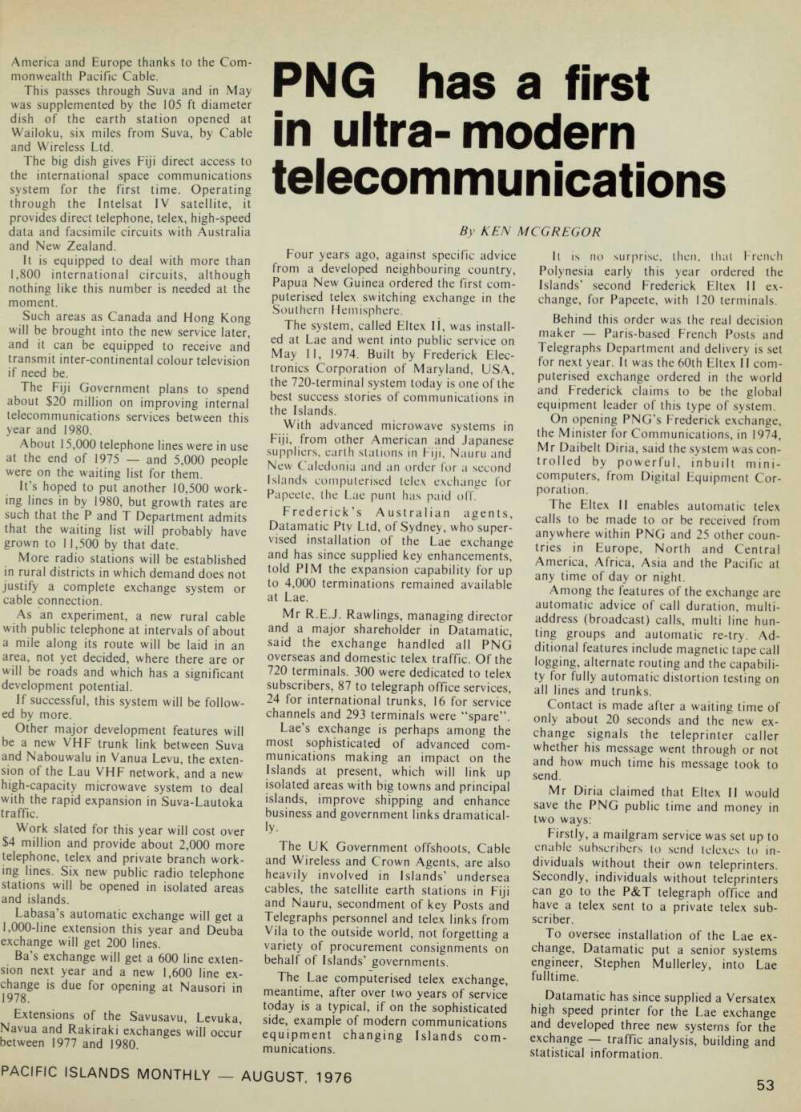
Business
Fiji reaches for the stars and plans more world links
From ROBERT KEITH-REID in Suva
A $6 million space communications earth station, opened at Suva in May by Britain’s Cable and Wireless group might seem to some to be a culmination of years of effort in developing Fiji’s telecom munications system.
Actually, it heralded only the beginning of a government drive to expand the coverage and improve the quality of a communications service that people in many other countries of Fiji’s level of
development already might envy.
Of late, Fiji businessmen have grumbled that the telephone service has deteriorated.
Perhaps it has to some degree. But, nevertheless, from Suva it’s possible to reach most populated parts of Fiji, and the world, with speed and clarity through telephone, radio-telephone, telex and cable services. At present, according to the Posts and Telecommunications Depart ment, there are very few areas of Fiji that are not within 15 miles of a public telephone.
By the end of the next decade it is in tended to have improved coverage to a level at which no one should be more than two or three miles from a phone.
Sole responsibility for telecom munications services within Fiji is vested in the Posts and Telecommunications Department of the Ministry for Com munications, Works and Tourism. Unlike other government departments this, since 1974, has operated on a commercial ac
counting basis.
This means it ploughs all its telephone service and other revenues back into development instead of paying them to the government and receiving recurrent and capital finance allocations from the annual national budget.
While the department is responsible for Fiji’s South Pacific island regional, as well as internal, communication links, Cable and Wireless Ltd has a government licence to run international services through its own world-wide cable and space station network.
Centred in Suva, Fiji’s internal telecom munications services reach out to towns and villages in the main islands of Viti
Levu and Vanua Levu and to about 60 other of the 350 islands in the Fiji Group via telephone, radio telephone and telex.
Suva’s telephone connections with such western Viti Levu centres as Lautoka, Nadi and Sigatoka are through modern microwave links.
Calls between Suva and Labasa and Savusavu in Vanua Levu are carried by a VHF link, and work is progressing on new microwave systems to improve com munications between Viti Levu and Vanua Levu and also with the third largest island of Taveuni and with small islands of Lau, in the east of the group.
By the end of 1975, most towns in Viti Levu had automatic exchanges or were slated to get them within a few years.
Country areas still rely on manual ex changes with subscribers sharing lines.
The interiors of the two big islands, 4,000 square mile Viti Levu and 2,100 square mile Vanua Levu, are the areas most poorly off for telephone services.
A few isolated agricultural or medical stations, or camps maintained by mineral prospecting companies, have a radio telephone service; otherwise people in the mountainous interior must walk for miles if they want to get to a ’phone.
Outlying islands are far better serviced, although, until recently, communication with them was prone to frequent disrup
tions through the deterioration of the cast off World War Two gear with which their r/t stations were equipped. This is being gradually replaced with single side-band high frequency radio or very high frequen cy radio, according to the needs of each location.
Outer island r/t stations work to set daily schedules but can usually be raised for the handling of urgent messages out side ordinary hours by a request broadcast in the daily programmes of the Fiji Broad
casting Commission.
For a small fee, the FBC will, in any case carry, at peak listening hours, service and other messages, such as death notifications, intended for people in isolated areas who can’t ordinarily be reached by no/mal public telecommunica tion services.
Telegrams can be lodged at about 60 agencies throughout the country and an in creasing number of local inter-island ships are being fitted with ship-to-shore equip ment.
Suva’s telex exchange has capacity for 160 subscribers’ lines and by the end of 1970 more than 100 of them were in use mainly by hotels, airlines, travel agencies and large trading companies for messages local and worldwide.
Fiji’s telephone communications with its immediate neighbours are still primitive.
Talking to countries like Tonga, Western Samoa, the New Hebrides and the Solomons is very much a shouting match
transmitted by radio-telephone equipment
which is subject to severe fading and dis tortion.
Moves are afoot, through such agencies as the South Pacific Commission and South Pacific Bureau for Economic Co operation, for a regional scheme to im prove Pacific Islands telecommunications.
But nothing has been firmed and it looks as if it could be years before talk produces any real improvement in available services.
The quality of Fiji’s telecommunications links with the world beyond the South Pacific region are something else. Crystal clear contact, 24 hours a day, is possible with Australia, New Zealand, North
America and Europe thanks to the Com monwealth Pacific Cable.
This passes through Suva and in May was supplemented by the 105 ft diameter dish of the earth station opened at Wailoku, six miles from Suva, by Cable and Wireless Ltd.
The big dish gives Fiji direct access to the international space communications system for the first time. Operating through the Intelsat IV satellite, it provides direct telephone, telex, high-speed data and facsimile circuits with Australia and New Zealand.
It is equipped to deal with more than 1,800 international circuits, although nothing like this number is needed at the moment.
Such areas as Canada and Hong Kong will be brought into the new service later, and it can be equipped to receive and transmit inter-continental colour television if need be.
The Fiji Government plans to spend about $2O million on improving internal telecommunications services between this year and 1980.
About 15,000 telephone lines were in use at the end of 1975 and 5,000 people were on the waiting list for them.
It’s hoped to put another 10,500 work ing lines in by 1980, but growth rates are such that the P and T Department admits that the waiting list will probably have grown to 11,500 by that date.
More radio stations will be established in rural districts in which demand does not justify a complete exchange system or cable connection.
As an experiment, a new rural cable with public telephone at intervals of about a mile along its route will be laid in an area, not yet decided, where there are or will be roads and which has a significant
development potential.
If successful, this system will be follow ed by more.
Other major development features will be a new VHP trunk link between Suva and Nabouwalu in Vanua Levu, the exten sion of the Lau VHP network, and a new high-capacity microwave system to deal with the rapid expansion in Suva-Lautoka traffic.
Work slated for this year will cost over $4 million and provide about 2,000 more telephone, telex and private branch work ing lines. Six new public radio telephone stations will be opened in isolated areas and islands.
Labasa’s automatic exchange will get a 1,000-line extension this year and Deuba exchange will get 200 lines.
Ba’s exchange will get a 600 line exten sion next year and a new 1,600 line ex change is due for opening at Nausori in 1978.
Extensions of the Savusavu, Levuka, Navua and Rakiraki exchanges will occur between 1977 and 1980.
New Company
The Fiji Government is going into the ex ternal telecommunications business through acquisition of a holding in Cable and Wireless Ltd. A new company will be form ed to take over the Fiji branch operations of Cable and Wireless. Fiji will have a 51 per cent interest in this company, starting with an initial 10 per cent, and climbing to 51 per cent. Cable and Wireless has been in Fiji for more than 70 years. It kept Fiji abreast of developments in communications. In 1962, Fiji became part of Conpac, the Cable and Wireless telephone link between the United Kingdom and Australia, via Canada, Fiji, and New Zealand.
Advertisements & other items, p. 52 (1 item)
Datamatic Pty. Ltd.
As Regional Distributors for Frederick Electronics Corporation, we are proud of our association with the construction and installation of the computer controlled Telex Exchange in Lae, Papua New Guinea.
Our high technology activities also include design of special purpose data handling systems and the marketing and support of computer and communications equipments by the following companies: Calcomp Versatec Kennedy Datum Imlac Peripheral Dynamics Trend Telectron Moore Reed Numonics Drum, Flatbed and Film Plotters Line Printers and Printer Plotters Magnetic Tape Transports Universal Cassette Transports and Disc Drives Interactive Graphics Terminals Card Readers Telegraph and Data Test Sets Telecommunications Systems Acoustically Coupled Modems Digitisers and Planimeters
90 ALEXANDER STREET,
CROWS NEST,
N.S.W., AUSTRALIA
TELEPHONE: 43-3333
TELEX: SYDNEY 27508
telecommunications
PNG has a first in ultra-modern telecommunications
By Ken Mcgregor
Four years ago, against specific advice from a developed neighbouring country, Papua New Guinea ordered the first com puterised telex switching exchange in the Southern Hemisphere.
The system, called Eltex li, was install ed at Lae and went into public service on May 11, 1974. Built by Frederick Elec tronics Corporation of Maryland, USA, the 720-terminal system today is one of the best success stories of communications in the Islands.
With advanced microwave systems in Fiji, from other American and Japanese suppliers, earth stations in Fiji, Nauru and New Caledonia and an order for a second Islands computerised telex exchange for Papeete, the Lae punt has paid off.
Frederick’s Australian agents, Datamatic Pty Ltd, of Sydney, who super vised installation of the Lae exchange and has since supplied key enhancements, told PIM the expansion capability for up to 4,000 terminations remained available at Lae.
Mr R.E.J. Rawlings, managing director and a major shareholder in Datamatic, said the exchange handled all PNG overseas and domestic telex traffic. Of the 720 terminals. 300 were dedicated to telex subscribers, 87 to telegraph office services, 24 for international trunks, 16 for service channels and 293 terminals were “spare”.
Lae’s exchange is perhaps among the most sophisticated of advanced com munications making an impact on the Islands at present, which will link up isolated areas with big towns and principal islands, improve shipping and enhance business and government links dramatical ly.
The UK Government offshoots, Cable and Wireless and Crown Agents, are also heavily involved in Islands’ undersea cables, the satellite earth stations in Fiji and Nauru, secondment of key Posts and Telegraphs personnel and telex links from Vila to the outside world, not forgetting a variety of procurement consignments on behalf of Islands’ governments.
The Lae computerised telex exchange, meantime, after over two years of service today is a typical, if on the sophisticated side, example of modern communications
equipment changing Islands com
munications.
11 is no surprise, then, that French Polynesia early this year ordered the Islands’ second Frederick Eltex II ex change, for Papeete, with 120 terminals.
Behind this order was the real decision maker Paris-based French Posts and Telegraphs Department and delivery is set for next year. It was the 60th Eltex 11 com puterised exchange ordered in the world and Frederick claims to be the global equipment leader of this type of system.
On opening PNG’s Frederick exchange, the Minister for Communications, in 1974, Mr Daibelt Diria, said the system was con trolled by powerful, inbuilt mini computers, from Digital Equipment Cor poration.
The Eltex II enables automatic telex calls to be made to or be received from anywhere within PNG and 25 other coun tries in Europe, North and Central America, Africa, Asia and the Pacific at any time of day or night.
Among the features of the exchange are automatic advice of call duration, multi address (broadcast) calls, multi line hun ting groups and automatic re-try. Ad ditional features include magnetic tape call logging, alternate routing and the capabili ty for fully automatic distortion testing on all lines and trunks.
Contact is made after a waiting time of only about 20 seconds and the new ex change signals the teleprinter caller whether his message went through or not and how much time his message took to send.
Mr Diria claimed that Eltex II would save the PNG public time and money in two ways: Firstly, a mailgram service was set up to enable subscribers to send telexes to in dividuals without their own teleprinters.
Secondly, individuals without teleprinters
can go to the P&T telegraph office and have a telex sent to a private telex sub scriber.
To oversee installation of the Lae ex change, Datamatic put a senior systems engineer, Stephen Mullerley, into Lae fulltime.
Datamatic has since supplied a Versatex high speed printer for the Lae exchange and developed three new systems for the exchange traffic analysis, building and statistical information.
Advertisements & other items, p. 54 (1 item)
Ask the bank which has
TO FIT ANY FORM
kindergarten, school, university
Comfort is an important factor in education. To give their best throughout the day, your students need furniture specifically designed to suit their own stage of development.
Furnware educational furniture meets the need with six sizes of matching desks and chairs. r I Name Position Every piece is practical and robust, to cope with the inevitable knocks and scrapes.
Desk construction is 16 gauge tubular steel and solid polished rimu. Chair frames are 3 /a" and 7 /b” tubular steel, with seats and backs of virtually indestructible polypropylene.
Should serious damage occur, replacement parts are readily available.
Cost, of course, is an important consideration. We proudly acknowledge that for over 15 years Furnware furniture has continued to be the economical first choice with education authorities throughout New Zealand and the South Pacific. Our furniture will meet your budget.
To keep your students comfortable and your costs down write us today for further information or free no obligation quotation (whole Pacific region C.1.F.) School Address
tfLEEm:
ism
FURNWARE
PRODUCTS LTD
P O Box 1
HASTINGS
NEW ZEALAND
Do you want to do business in New Zealand?
Ask the bank which has
40% of the banking business
in New Zealand
The BNZ can give you full information on buying or selling in New Zealand and overseas. Ril information on investment movement of money, transfers of dividends etc., is also readily availabte.
There are offices everywhere, more than 400 in fact Whatever your financial or trade needs, the BNZ can help you.
Bank of New Zealand
Wellington -Head Office, International Dwaon, Box 2392.
Sydney-GRO Box 507, Sydney, N.SW. 2001.
Melboume-GPO Box 528 E, Melbourne, Vc. 3001.
Tokyo-Mr E. L. Banks, Bank of New Zealand Representative Office, Japan. Suite 240,'ShiniTokyo Bldg, 3-1,3-Chrome, Marunouchi, Chiyoda-ku,Vrokyo 100.
Singapore-Mr R. F. Warren, Bank of New Zealand Representative Office, South East Asia. Suite 230,23 rd Floor, Ocean Bldg, Colyer Quay, Singapore 1.
London-PO Box 402. LondonEC4P.4.H.E.
Fiji, Suva-25 Victoria Parade. Also at labasa, Lautoka, NadijSigatoka, Ba.
Associated Banks inttw South Pacific.
Bank of Western Samoa. Bank of Tonga. 7.6
Kuta Ridge lives again
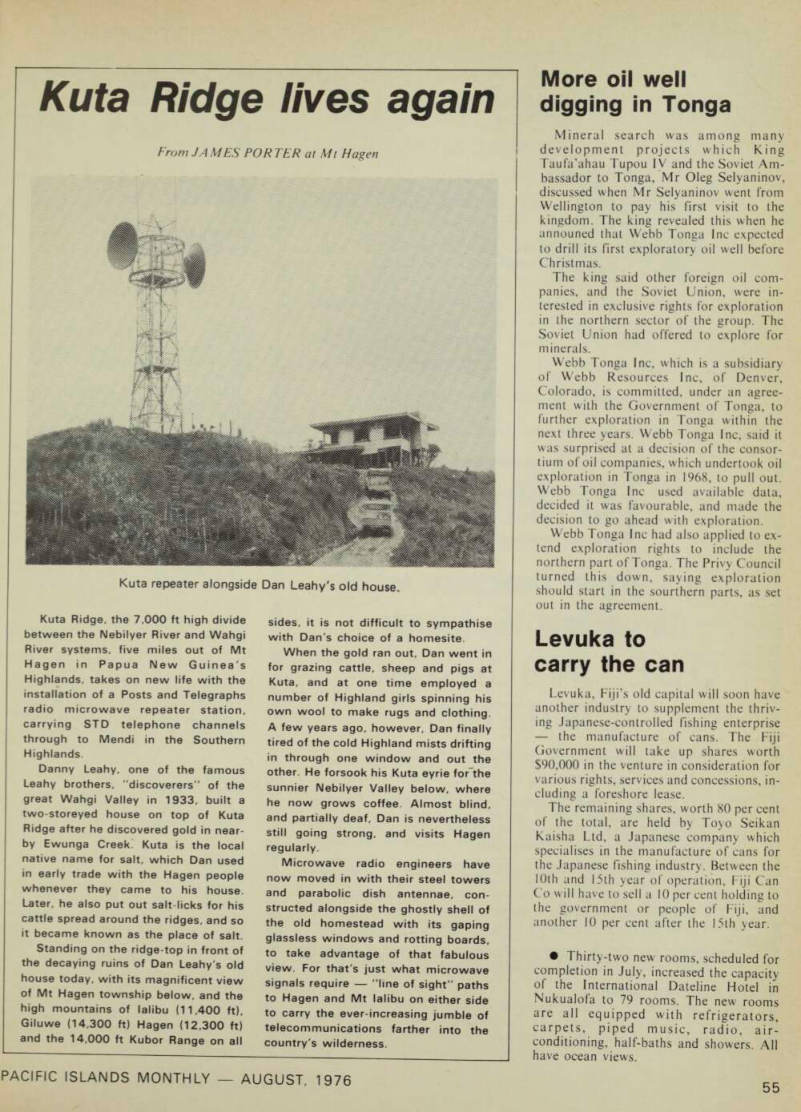
From JAMES PORTER at Mt Hagen
Kuta Ridge, the 7,000 ft high divide between the Nebilyer River and Wahgi River systems, five miles out of Mt Hagen in Papua New Guinea's Highlands, takes on new life with the installation of a Posts and Telegraphs radio microwave repeater station, carrying STD telephone channels through to Mendi in the Southern Highlands.
Danny Leahy, one of the famous Leahy brothers, "discoverers" of the great Wahgi Valley in 1933, built a two-storeyed house on top of Kuta Ridge after he discovered gold in near by Ewunga Creek. Kuta is the local native name for salt, which Dan used in early trade with the Hagen people whenever they came to his house.
Later, he also put out salt-licks for his cattle spread around the ridges, and so it became known as the place of salt.
Standing on the ridge-top in front of the decaying ruins of Dan Leahy's old house today, with its magnificent view of Mt Hagen township below, and the high mountains of lalibu (11,400 ft), Giluwe (14,300 ft) Hagen (12,300 ft) and the 14,000 ft Kubor Range on all
sides, it is not difficult to sympathise with Dan's choice of a homesite.
When the gold ran out, Dan went in for grazing cattle, sheep and pigs at Kuta, and at one time employed a number of Highland girls spinning his own wool to make rugs and clothing.
A few years ago, however, Dan finally tired of the cold Highland mists drifting in through one window and out the other. He forsook his Kuta eyrie foFthe sunnier Nebilyer Valley below, where he now grows coffee. Almost blind, and partially deaf, Dan is nevertheless still going strong, and visits Hagen regularly.
Microwave radio engineers have now moved in with their steel towers and parabolic dish antennae, con structed alongside the ghostly shell of the old homestead with its gaping glassless windows and rotting boards, to take advantage of that fabulous view. For that's just what microwave signals require "line of sight" paths to Hagen and Mt lalibu on either side to carry the ever-increasing Jumble of telecommunications farther into the country's wilderness.
Kuta repeater alongside Dan Leahy's old house.
digging in Tonga
More oil well digging in Tonga
Mineral search was among many development projects which King Taufa’ahau Tupou I V and the Soviet Am bassador to Tonga, Mr Oleg Selyaninov, discussed when Mr Selyaninov went from Wellington to pay his first visit to the kingdom. The king revealed this when he announed that Webb Tonga Inc expected to drill its first exploratory oil well before Christmas.
The king said other foreign oil com panies, and the Soviet Union, were in terested in exclusive rights for exploration in the northern sector of the group. The Soviet Union had offered to explore for minerals.
Webb Tonga Inc, which is a subsidiary of Webb Resources Inc, of Denver, Colorado, is committed, under an agree ment with the Government of Tonga, to further exploration in Tonga within the next three years. Webb Tonga Inc, said it was surprised at a decision of the consor tium of oil companies, which undertook oil exploration in Tonga in 1968, to pull out.
Webb Tonga Inc used available data, decided it was favourable, and made the decision to go ahead with exploration.
Webb Tonga Inc had also applied to ex tend exploration rights to include the northern part of Tonga. The Privy Council turned this down, saying exploration should start in the sourthern parts, as set out in the agreement.
Levuka to carry
carry the can
Levuka, Fiji’s old capital will soon have another industry to supplement the thriv ing Japanese-controlled fishing enterprise — the manufacture of cans. The Fiji Government will take up shares worth $90,000 in the venture in consideration for various rights, services and concessions, in cluding a foreshore lease.
The remaining shares, worth 80 per cent of the total, are held by Toyo Seikan Kaisha Ltd, a Japanese company which specialises in the manufacture of cans for the Japanese fishing industry. Between the 10th and 15th year of operation, Fiji Can Co will have to sell a 10 per cent holding to the government or people of Fiji, and another 10 per cent after the 15th year. • Thirty-two new rooms, scheduled for completion in July, increased the capacity of the International Dateline Hotel in Nukualofa to 79 rooms. The new rooms are all equipped with refrigerators, carpets, piped music, radio, air conditioning, half-baths and showers. All have ocean views.
Crisis
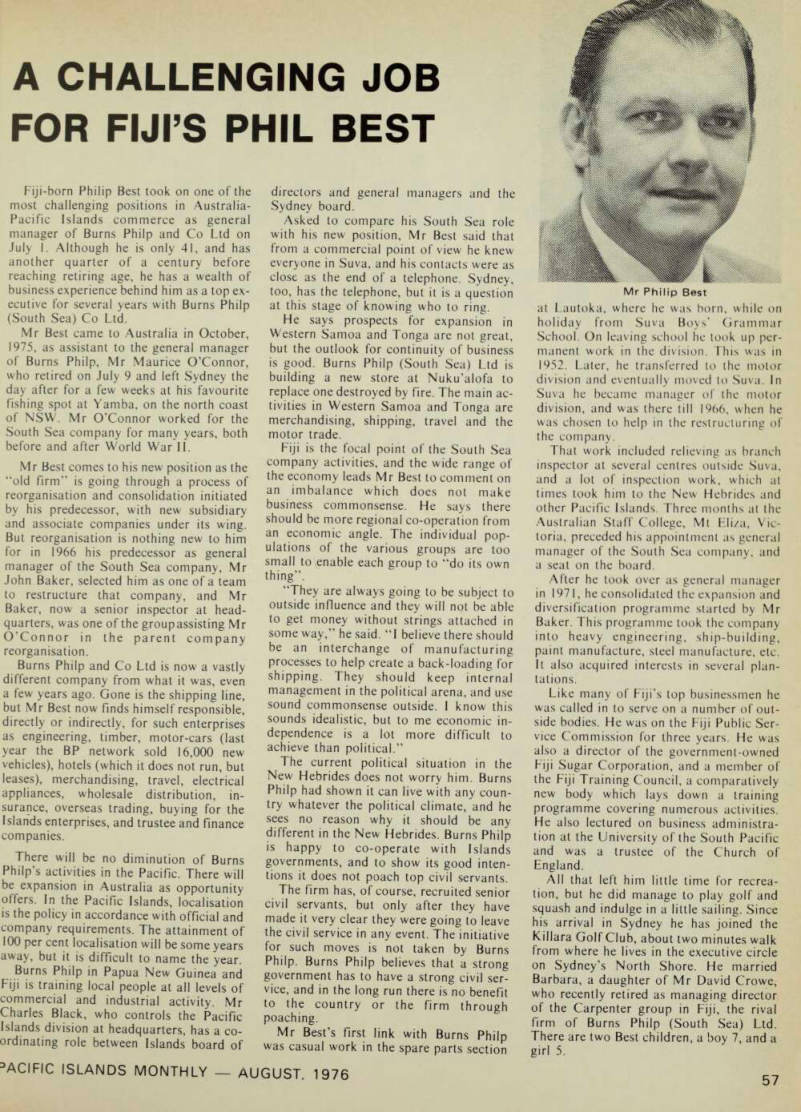
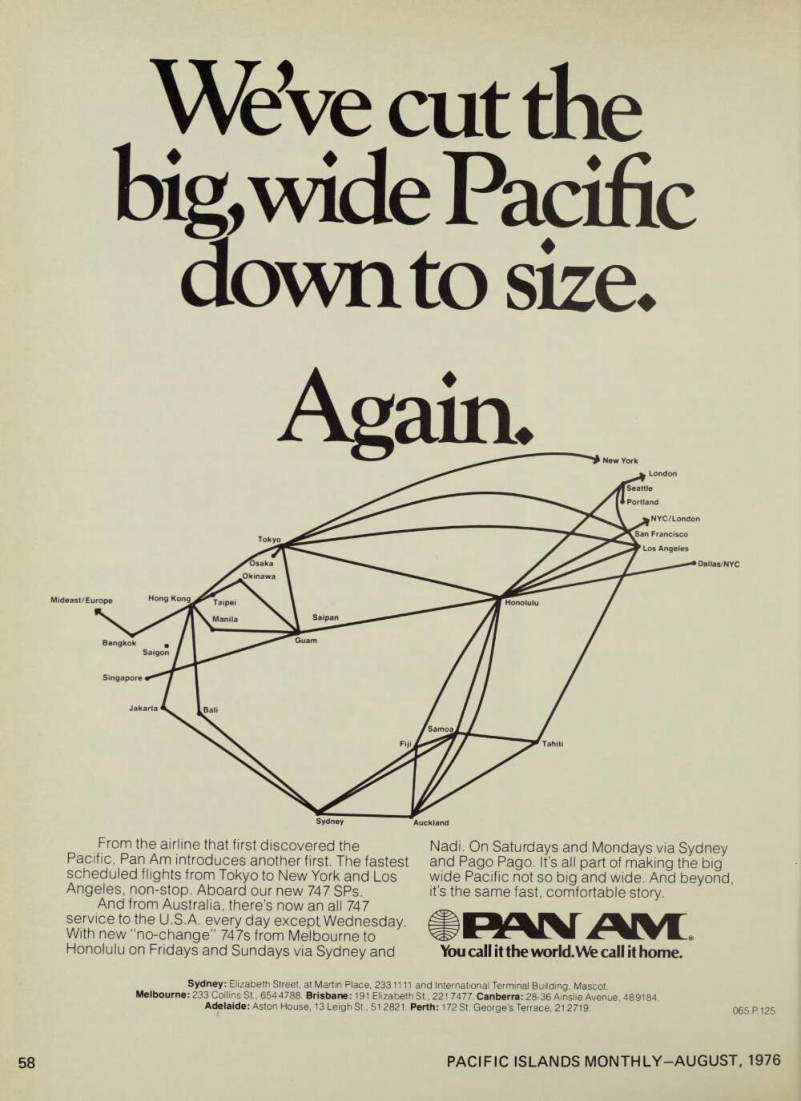
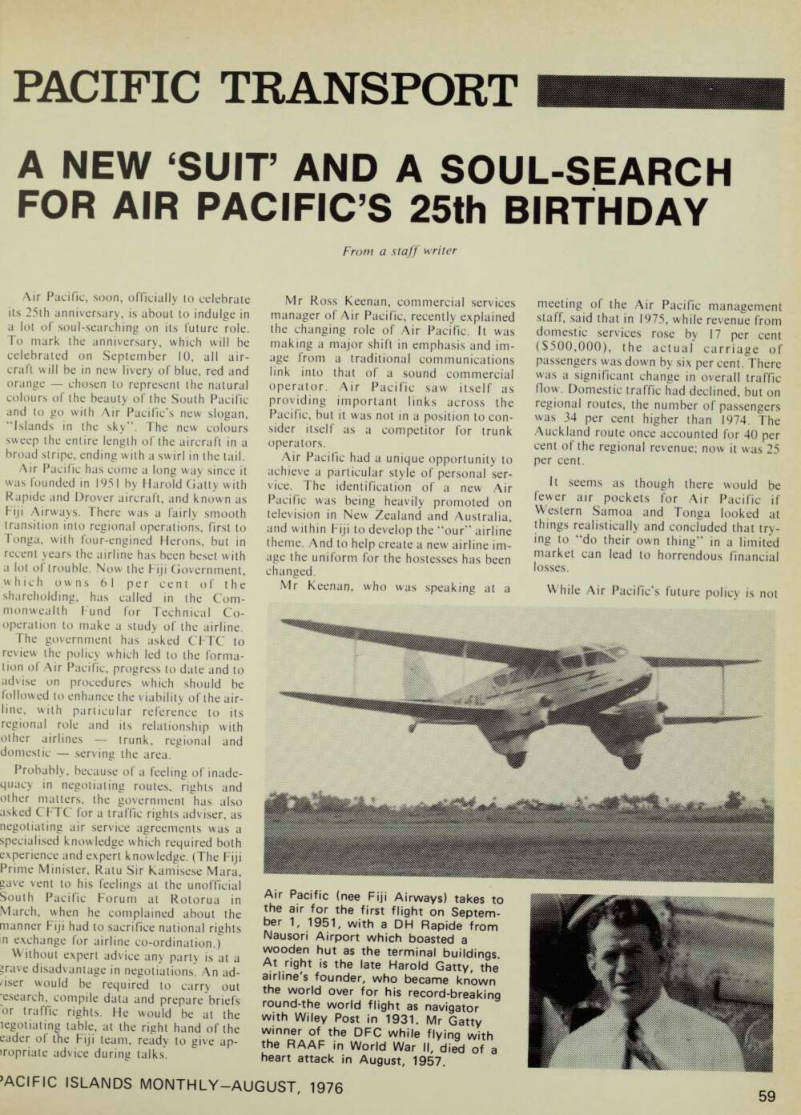
for Islands’ copra
The South Pacific copra industry is in a sorry state. A Sydney authority said that in Papua New Guinea there was the makings of an industry collapse unless there was a significant improvement in world prices. He described the outlook as “lousy”.
The Philippines has an exportable sur plus of copra which is helping to depress prices, and a glut of soya bean oil, which will soon become a drug on the market, will make matters even more difficult for the Islands with copra-based economies.
For some time now PNG growers have had their prices propped up with their own money from the Copra Stabilisation Fund. This fund could be exhausted by the end of this year. If that happens, growers will be lucky to get KlOO a tonne, and at that price plantations are likely to close.
The PNG price bottomed at KlB9 a tonne some time ago. It has climbed to K 277, but growers need K. 300 before they even think about meeting production costs.
The current low prices are discouraging growers to such an extent that the Copra Marketing Board is concerned about being able to fill orders. The Minster for Primary Industry, Mr Sali, said a shortage meant the board could not take advantage of some open market sales to Singapore.
He warned cash producers it was not in their, or the country’s, interest to wait for an improved price for copra. He urged them to carry on with copra production as coconuts became available.
In the Solomons there has been some improvement in shipments in quantity, but not in price. Western Samoa is produc ing very little copra at present.
In Fiji, copra is declining as an impor tant factor in the economy. The govern ment has subsidised the price for some time to guarantee $l9O a tonne for first grade and $l7l a tonne for second grade.
But it has been unable to give any firm in dication how long it will continue the sub sidy, nor has it said whether growers will be required to repay the subsidy if, and when, the market improves.
In 1964, Fiji reached its peak in the area under production 89,000 hectares. But now about half of the existing palms are
Continued on page 69
From page 56
past peak bearing. Production is also declining. In 1956 it was a record 48,817 tonnes. In 1975 production was down by more than 50 per cent to 23,875 tonnes.
The lower prices and lower production directly affect the Fijian villagers in some of the more remote areas. Small Fijian owned plantations produce about 60 per cent of the country’s copra. The coconut is a basic and essential crop for the Fijians in those areas. The lives of more than 100,000 Fijians are closely tied to it.
Most of Fiji’s copra is crushed locally and in 1975 about 16,000 tonnes of coconut oil was exported, earning about $lO million. Coconut meal pellets are produced from the by-products at the mill.
Under Development Plan 7 the govern ment will urge copra growers to diversify into cocoa, yaqona, root crops and other vegetables. Cattle will be encouraged on bigger plantations. The government will also encourage the processing of whole nuts into charcoal, fibre, desiccated coconut, coconut cream, coconut oil and particle board to change the copra in dustry into a coconut industry.
Advertisements & other items, p. 56 (1 item)
Qbe Insurance
HENRY CUMINES PTY. LTD.
EXPORTERS • GENERAL MERCHANTS
428 GEORGE ST., SYDNEY
CABLES: HENCO SYDNEY. G.P.O. Box 3949. PHONE: 25-3383.
For specialised and personalised buying service throughout the Pacific Islands and the East Local enquiries to our agents RABAUL: M & C Seeto, P.O. Box 131, Rabaul. Telephone 922902.
MADANG: W. Double, P.O. Box 22, Madang. Telephone 822696 FIJI: K, Witherington Ltd, P.O. 293, Suva Telephone 22-356.
NEW HEBRIDES: John Lum &
Associates, Box 65, P. 0., Santo Telephone 329.
LAE: Osborne Agencies, P.O. Box 8, Lae Telephone 422918.
Resident Agents In other Pacific Territories.
Q E
offers expert insurance service
throughout the Islands
QBE INSURANCE
LIMITED
(FORMERLY—QUEENSLAND INSURANCE COMPANY
Central Office: 82 Pitt Street, Sydney FlJl—Branch Office, Suva, Manager for Fiji: L. Gliddell (A.A.1.1 ).
LAUTOKA—Sub-Branch Office: Burns Philp Bldg.
HONIARA (8.5.1. P.) —Breckwoldt & Company (5.1.) Pty. Limited.
NEW CALEDONIA—T. A. Hagen, Ste. W. A. Johnston, S.A.R.L. —Noumea.
NEW HEBRlDES—District Manager: G. F. Donnelly, Vila; Santo: Burns Philp (New Hebrides) Ltd.
TAHlTl—Arthur Chung: Immeuble 8.1., Front de Mer, Papeete.
NIUE, NORFOLK ISLAND, SAMOA, TONGA and other South Sea Islands—Burns Philp (South Sea) Company Ltd.
QUEENSLAND INSURANCE (P N G.) LTD
PAPUA NEW GUINEA
Head Office, Port Moresby: General Manager: J. M. Dawe.
District Managers at Rabaul: C. D. Dickings; Lae: W. J. Leonard; Mt. Hagen: D. F. Carroll. Arawa: A, M. Tanner; Madang: I. R.
Martin.
H 360
A Challenging Job
For Fiji’S Phil Best
Fiji-born Philip Best took on one of the most challenging positions in Australia- Pacific Islands commerce as general manager of Burns Philp and Co Ltd on July 1. Although he is only 41, and has another quarter of a century before reaching retiring age, he has a wealth of business experience behind him as a top ex ecutive for several years with Burns Philp (South Sea) Co Ltd.
Mr Best came to Australia in October, 1975, as assistant to the general manager of Burns Philp, Mr Maurice O’Connor, who retired on July 9 and left Sydney the day after for a few weeks at his favourite fishing spot at Yamba, on the north coast of NSW. Mr O’Connor worked for the South Sea company for many years, both before and after World War 11.
Mr Best comes to his new position as the “old firm” is going through a process of reorganisation and consolidation initiated by his predecessor, with new subsidiary and associate companies under its wing.
But reorganisation is nothing new to him for in 1966 his predecessor as general manager of the South Sea company, Mr John Baker, selected him as one of a team to restructure that company, and Mr Baker, now a senior inspector at head quarters, was one of the group assisting Mr O’Connor in the parent company reorganisation.
Burns Philp and Co Ltd is now a vastly different company from what it was, even a few years ago. Gone is the shipping line, but Mr Best now finds himself responsible, directly or indirectly, for such enterprises as engineering, timber, motor-cars (last year the BP network sold 16,000 new vehicles), hotels (which it does not run, but leases), merchandising, travel, electrical appliances, wholesale distribution, in surance, overseas trading, buying for the Islands enterprises, and trustee and finance companies.
There will be no diminution of Burns Philp’s activities in the Pacific. There will be expansion in Australia as opportunity offers. In the Pacific Islands, localisation is the policy in accordance with official and company requirements. The attainment of 100 per cent localisation will be some years away, but it is difficult to name the year.
Burns Philp in Papua New Guinea and Fiji is training local people at all levels of commercial and industrial activity. Mr Charles Black, who controls the Pacific Islands division at headquarters, has a co ordinating role between Islands board of
directors and general managers and the Sydney board.
Asked to compare his South Sea role with his new position, Mr Best said that from a commercial point of view he knew everyone in Suva, and his contacts were as close as the end of a telephone. Sydney, too, has the telephone, but it is a question at this stage of knowing who to ring.
He says prospects for expansion in Western Samoa and Tonga are not great, but the outlook for continuity of business is good. Burns Philp (South Sea) Ltd is building a new store at Nukualofa to replace one destroyed by fire. The main ac tivities in Western Samoa and Tonga are merchandising, shipping, travel and the motor trade.
Fiji is the focal point of the South Sea company activities, and the wide range of the economy leads Mr Best to comment on an imbalance which does not make business commonsense. He says there should be more regional co-operation from an economic angle. The individual pop ulations of the various groups are too small to enable each group to “do its own
thing”.
“They are always going to be subject to outside influence and they will not be able to get money without strings attached in some way,” he said. “I believe there should be an interchange of manufacturing processes to help create a back-loading for shipping. They should keep internal management in the political arena, and use sound commonsense outside. I know this sounds idealistic, but to me economic in dependence is a lot more difficult to achieve than political.”
The current political situation in the New Hebrides does not worry him. Burns Philp had shown it can live with any coun try whatever the political climate, and he sees no reason why it should be any different in the New Hebrides. Burns Philp is happy to co-operate with Islands governments, and to show its good inten tions it does not poach top civil servants.
The firm has, of course, recruited senior civil servants, but only after they have made it very clear they were going to leave the civil service in any event. The initiative for such moves is not taken by Burns Philp. Burns Philp believes that a strong government has to have a strong civil ser vice, and in the long run there is no benefit to the country or the firm through poaching.
Mr Best’s first link with Burns Philp was casual work in the spare parts section
at Lautoka, where he was born, while on holiday from Suva Boys’ Grammar School. On leaving school he took up per manent work in the division. This was in 1952. Later, he transferred to the motor division and eventually moved to Suva. In Suva he became manager of the motor division, and was there till 1966, when he was chosen to help in the restructuring of the company.
That work included relieving as branch inspector at several centres outside Suva, and a lot of inspection work, which at times took him to the New Hebrides and other Pacific Islands. Three months at the Australian Staff College, Mt Eliza, Vic toria, preceded his appointment as general manager of the South Sea company, and a seat on the board.
After he took over as general manager in 1971, he consolidated the expansion and diversification programme started by Mr Baker. This programme took the company
into heavy engineering, ship-building,
paint manufacture, steel manufacture, etc.
It also acquired interests in several plan tations.
Like many of Fiji’s top businessmen he was called in to serve on a number of out side bodies. He was on the Fiji Public Ser vice Commission for three years. He was also a director of the government-owned Fiji Sugar Corporation, and a member of the Fiji Training Council, a comparatively new body which lays down a training programme covering numerous activities.
He also lectured on business administra tion at the University of the South Pacific and was a trustee of the Church of England.
All that left him little lime for recrea tion, but he did manage to play golf and squash and indulge in a little sailing. Since his arrival in Sydney he has joined the Killara Golf Club, about two minutes walk from where he lives in the executive circle on Sydney’s North Shore. He married Barbara, a daughter of Mr David Crowe, who recently retired as managing director of the Carpenter group in Fiji, the rival firm of Burns Philp (South Sea) Ltd.
There are two Best children, a boy 7, and a girl 5.
Mr Philip Best
Advertisements & other items, pp. 57-58 (2 items)
57
'ACIFIC ISLANDS MONTHLY AUGUST, 1976
Again.
\\LVe cut the
big, wide Pacific
down to size.
Again.
New York London Seattle Portland NYC/London San Francisco Los Angeles Dallas/NYC Mldeasl/Europe Hong Taipei Manila Tokyo r Osaka Okinawa Honolulu Saipan Guam Bangkok Saigon Singapore Bah Samoa Tahiti Sydney From the airline that first discovered the Pacific, Pan Am introduces another first. The fastest scheduled flights from Tokyo to New York and Los Angeles, non-stop. Aboard our new 747 SPs.
And from Australia, there’s now an all 747 service to the U.S.A. every day except Wednesday.
With new “no-change” 747 s from Melbourne to Honolulu on Fridays and Sundays via Sydney and Nadi. On Saturdays and Mondays via Sydney and Pago Pago. It’s all part of making the big wide Pacific not so big and wide. And beyond,
it’s the same fast, comfortable story.
You call it the world. We call it home.
Sydney: Elizabeth Street, at Martin Place, 2331111 and International Terminal Building, Mascot.
Melbourne: 233 Collins St., 6544788. Brisbane: 191 Elizabeth St., 221 7477 Canberra: 28-36 Ainslie Avenue, 489184.
Adelaide: Aston House, 13 Leigh St., 51 2821. Perth: 172 St. George’s Terrace, 21 2719 065. P. 125
Pacific Transport
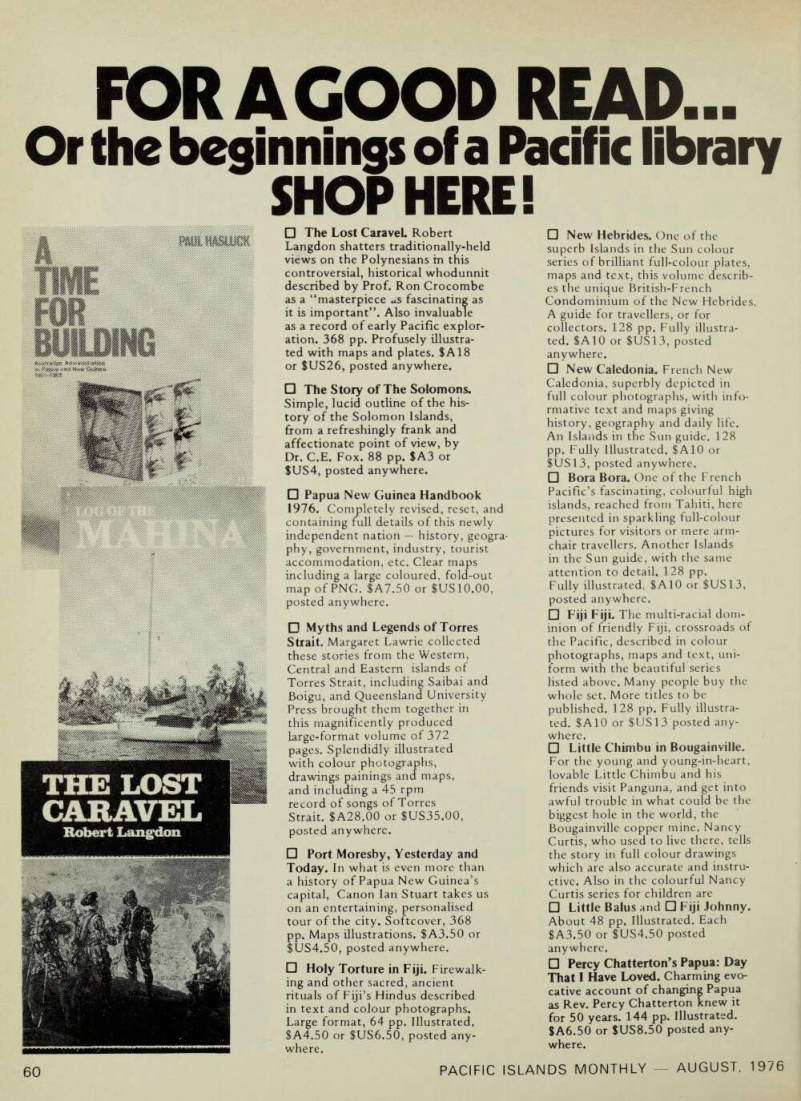
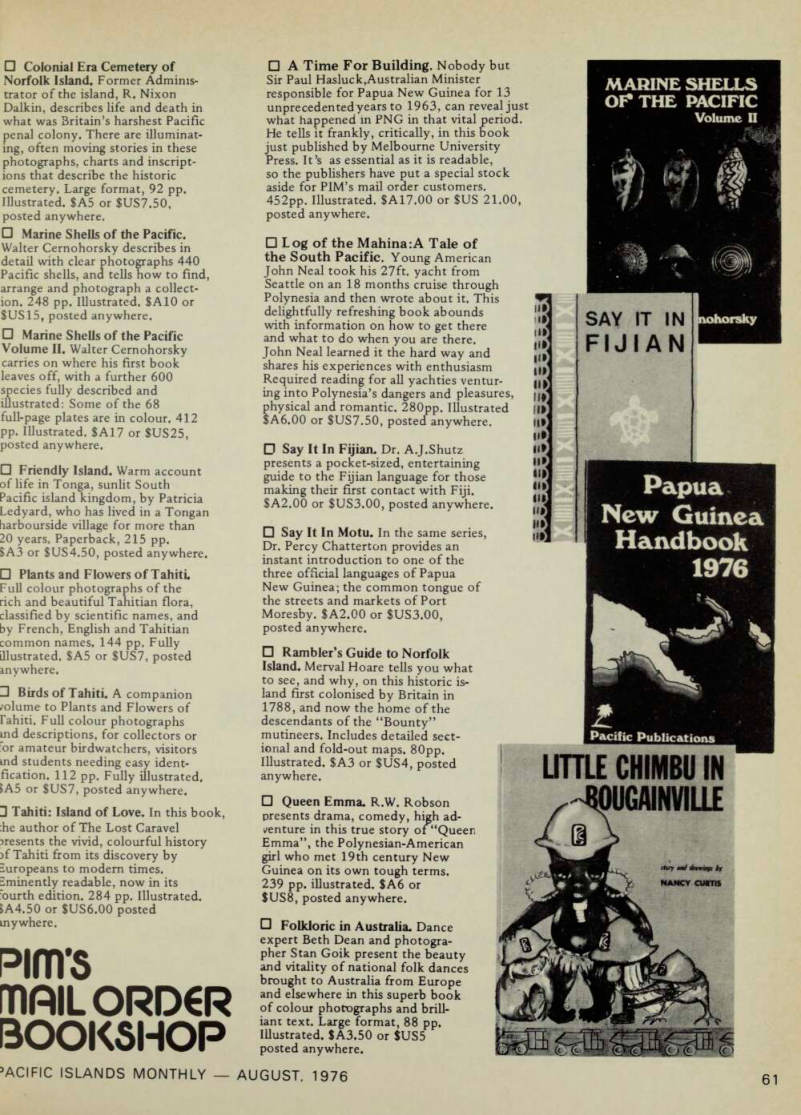
A New ‘Suit’ And A Soul-Search
For Air Pacific’S 25Th Birthday
From a staff writer
Air Pacific, soon, officially to celebrate its 25th anniversary, is about to indulge in a lot of soul-searching on its future role.
To mark the anniversary, which will be celebrated on September 10, all air craft will be in new livery of blue, red and orange chosen to represent the natural colours of the beauty of the South Pacific and to go with Air Pacific’s new slogan, “Islands in the sky”. The new colours sweep the entire length of the aircraft in a broad stripe, ending with a swirl in the tail.
Air Pacific has come a long way since it was founded in 1951 by Harold Gatty with Rapide and Drover aircraft, and known as Fiji Airways. There was a fairly smooth transition into regional operations, first to Tonga, with four-engined Herons, but in recent years the airline has been beset with a lot of trouble. Now the Fiji Government, which owns 61 per cent of the shareholding, has called in the Com monwealth Fund for Technical Co operation to make a study of the airline.
The government has asked CFTC to review the policy which led to the forma tion of Air Pacific, progress to date and to advise on procedures which should be followed to enhance the viability of the air line, with particular reference to its regional role and its relationship with other airlines trunk, regional and domestic serving the area.
Probably, because of a feeling of inade quacy in negotiating routes, rights and other matters, the government has also asked CFTC for a traffic rights adviser, as negotiating air service agreements was a specialised knowledge which required both experience and expert knowledge. (The Fiji Prime Minister, Ratu Sir Kamisese Mara, gave vent to his feelings at the unofficial South Pacific Forum at Rotorua in March, when he complained about the manner Fiji had to sacrifice national rights
in exchange for airline co-ordination.)
Without expert advice any party is at a irave disadvantage in negotiations. An ad viser would be required to carry out ;esearch, compile data and prepare briefs or traffic rights. He would be at the legotiating table, at the right hand of the eader of the Fiji team, ready to give ap •ropriate advice during tallcs.
Mr Ross Keenan, commercial services manager of Air Pacific, recently explained the changing role of Air Pacific. It was making a major shift in emphasis and im age from a traditional communications link into that of a sound commercial operator. Air Pacific saw itself as providing important links across the Pacific, but it was not in a position to con sider itself as a competitor for trunk operators.
Air Pacific had a unique opportunity to achieve a particular style of personal ser vice. The identification of a new Air Pacific was being heavily promoted on television in New Zealand and Australia, and within Fiji to develop the “our” airline theme. And to help create a new airline im age the uniform for the hostesses has been
changed.
Mr Keenan, who was speaking at a
meeting of the Air Pacific management staff, said that in 1975, while revenue from domestic services rose by 17 per cent ($500,000), the actual carriage of passengers was down by six per cent. There was a significant change in overall traffic flow. Domestic traffic had declined, but on regional routes, the number of passengers was 34 per cent higher than 1974. The Auckland route once accounted for 40 per cent of the regional revenue; now it was 25 per cent.
It seems as though there would be fewer air pockets for Air Pacific if Western Samoa and Tonga looked at things realistically and concluded that try ing to “do their own thing” in a limited market can lead to horrendous financial losses.
While Air Pacific’s future policy is not
Air Pacific (nee Fiji Airways) takes to the air for the first flight on Septem ber 1, 1951, with a DH Rapide from Nauson Airport which boasted a wooden hut as the terminal buildings At right is the late Harold Gatty, the airline's founder, who became known the world over for his record-breaking round-the world flight as navigator with Wiley Post in 1931. Mr Gatty winner of the DFC while flying with the RAAF in World War II, died of a heart attack in August, 1957.
yet clear, Air Nauru continues to expand.
Recently President Hammer deßoburt signed an agreement with Sir Reginald Ansett to buy a Boeing 727-100 C from Ansett Transport Industries. That will in crease the Air Nauru’s fleet to four, made up of a Boeing 737, a Boeing 727 and two F2B Fokker Friendship jets.
Air Nauru expects to use its latest ac quisition on the Melbourne-Nauru route and the Nauru-Japan route. It will operate two services a week from Melbourne to Nauru, via Noumea. Air Nauru now has an extensive network, covering most island groups in the central and southern Pacific, as well as flying to Australia, the
Philippines, Hong Kong, Taiwan and
Japan.
It was a festive occasion on Nauru when the Boeing 727 arrived on its delivery flight. The Boeing, which has been named Chief Auweieda, was blessed by the Rev I.
Amram and the Rev Father B. Lahn.
King Taufa’ahau Tupou, of Tonga, in his Speech from the Throne, to open Parliament in June, said joint participation with New Zealand in Polynesian Airlines had been negotiated. A conference had been planned, with Tonga, NZ and Western Samoa taking part, to reorganise Polynesian Airlines. At the same time, Tonga would hold on to its share in Air Pacific.
Meanwhile, Tonga is negotiating for an
Australian-made 15-seater aircraft to meet the country’s internal aviation needs, King Taufa’ahau Tupou said. At present, only one aircraft was serving the kingdom’s needs. He expected the aircraft to arrive soon. It would be capable, apart from in ternal requirements, of flying from Vavau to Pago Pago.
Rescue Bid For
Pacific Navigation
The board of the Pacific Navigation Co Ltd, of Tonga, has been replaced for three months by A.W. Ellem and Associates, a Sydney-based firm of management con sultants. The firm will be directly responsi ble to the Prime Minister, Prince Tuipelehake for the reconstruction of Pacific Navigation.
Pacific Navigation has been in financial difficulty for some time. Some of the ships have operated profitably; others have run at continual loss. PIM, in April (p 68) reported that it was heavily in debt and try ing to borrow P 200,000 to pay creditors.
Pacific Navigation is government owned. One of the Ellem duties will be to introduce another substantial shareholder.
With reorganisation. Pacific Navigation expects to be refinanced, along with exten sive development and expansion.
Four Lines
Raise Rates
Four shipping lines servicing Papua New Guinea and the Solomon Islands from Australia hiked their freight rates by 8 per cent in June. There was an earlier rise of 8 per cent on April 1. The new rates in corporate adjustments to the Waterside Workers’ Federation award and levies since November, 1975. The bunker sur charge has been reviewed and has been reduced to 4.72 per cent.
The shipping lines involved are Karlander, Conpac, New Guinea Express Line and New Guinea Australia Line.
Farrell Lines, which also operates an Australia-PNG service, is negotiating separately with the Australian Shippers’
Council for an increase.
Captain Williams
Buys The Aoniu
The Pacific Navigation Co Ltd has sold the Aoniu, 500 tons, to Captain Hugh Williams, of Australia, for P 70,000. Cap tain Williams has renamed the passenger/cargo ship Taoniu. The Tonga Copra Board took delivery of the Aoniu in 1958. The cost was then put at £stgB7,ooo, but delivery costs from Holland and other
charges probably put the price close to £stg 100,000.
Captain Williams, his brother, and Mr Tom Hare have formed a company, South Seas Shipping Co, to operate the Taoniu and plan a monthly cargo service between Suva and Nukualofa and a passenger ser vice, if there is support. There is also a possiblity of operating charter services between Apia and the Tokelaus and reviv ing the Suva-Rotuma service which the Aoniu covered a number of years ago.
Bougainville Ships
On New Service
Atolls Shipping Pty Ltd, of Bougain ville, has taken over the operation of its two ships, the Bougainville Chief and the Maluan Solok from a firm of agents.
Atolls Shipping is a subsidiary of Bougain ville Development Corporation Ltd. The Bougainville Chief will make regular trips from Kieta to Buka, via all ports, and a monthly trip to Rabaul. The Maluan Solok will provide a monthly service to the Mortlock and Tasman Islands, and a se cond service to the Fead and Cataract groups, and will offer supplementary trips along the Bougainville coast.
Tonga’S Biggest
‘Home-Grown’ Ship
The owner of the biggest ship ever built in Tonga has ambitious plans to operate services to Hawaii, as well as Fiji, the Samoas and internally. The owner is ’Uliti Uata, a MP from Haapai. He expected to commission her on June 26, after she was towed about 20 metres overland from the building site to the water.
Mr Uata commissioned Paula Hemaloto, of Vavau, to build the craft without plans, but with a replica as a model. The ship is about 26 metres long with a beam of about six metres and measures about two and a quarter metres from deck to keel. She is about 122 tonnes.
Dakua timber from Fiji was used for the planking. The keel was made of tangato from Eua. The cargo-hold runs from the engine-room at the stern to the bow. On deck there are five cabins with bunk beds.
There are toilet facilities, showers and a
galley.
There is a rear double deck for deck passengers. On the top deck will be a special cabin with beds, shower, toilet, cooling fans and dining facilities for the
Royal family.
Mr Uata said the ship could carry 70- 100 tonnes of cargo, and more than 200 passengers, but the final decision on those capacities rested with the Harbour Master.
The cost was about PI 10,000.
Mr Uata said he expected the boat to make two trips a year to Hawaii. He hopes to make an arrangement with Pacific
Navigation Co Ltd to share routes with the Olovaha, and expects the crew to total 14 captain, two other officers, two engineers, a cook and eight others.
He decided to build the boat to help cur tail rising freight charges which were seriously affecting his wholesale and retail shops. Also, he felt that as a People’s Representative in Parliament, the craft could be used to help the people of the out er islands.
Talair Flies
Into The Red
Talair, the biggest third-level airline in Papua New Guinea, faces a loss of K.350,- 000 in the current financial year.
The managing director, Mr Deni's Buchanan, said he had been forced to ground 11 aircraft, including a Twin Otter, retrench 15 pilots and close the engineer ing division at Port Moresby. Three other pilots had resigned for other reasons, in cluding dislike of transfers needed in reorganisation of the company. There was a 40 per cent overall cut in company staffing.
Mr Buchanan said Talair was not get ting much assistance from the government.
Talair, with other major operators, was be ing hampered by the recent introduction of new operators, who were making inroads into the operations of the recognised operators.
Florida’S Second
Reef Stranding
The Florida, a 700-ton freighter, owned by Silk and Boyd, of the Cook Islands, and registered in Fiji, ran aground on a reef off Townsville, Queensland, on June 9, and started to break up soon after. The crew of 12 was rescued by a tug and a Royal Australian Navy patrol boat. The Florida was on the way from the New Hebrides to Townsville, carrying a cargo of pozzuolana (volcanic material).
The Florida was under the command of Captain Robert Rae. The second officer is a Levuka, Fiji man, Mr Jack Riley, who was on watch when the ship grounded. He said later than about 4 am there was a “big bang’’ as the ship went on to the reef. Fif teen minutes later, water was seeping into the engine-room. At daybreak he saw the rudder was stuck fast and the aft of the Florida was badly damaged.
Throughout the day the officers and crew manned the pumps in an effort to empty the flooded rooms, but in vain.
It was the second time in nine months the Florida had run aground. In September, 1975, she drifted off Suva when the gearbox failed and ran aground on a reef near Laucala Bay. After repairs and during trials she hit the Pacific Princess, a cruise ship at Kings Wharf.
Her bow was extensively damaged.
She is expected to be a total loss.
Peace Again On
Fiji’S Waterfronts
Fiji’s threatened dock strike, scheduled to start on July 1, turned out to be a non event, after a settlement was reached between the Waterside Workers’ and Seamen’s Union and the Ports Authority of Fiji. There was a lot of pre-settlement huffing and puffing, chiefly by the union’s industrial adviser, Mr Taniela Veitata, some dissension within the union with of ficials at Lautoka and Labasa saying they would not strike, and a trip to New Zealand and Australia by Mr Veitata to enlist support from maritime unions in those countries.
The union took full-page newspaper advertisements to set out its case. The government and the Ports Authority had little to say. The acting Prime Minister, Ratu Sir Penaia Ganilau, early on said that if the strike occurred the government would take over the operation of the wharves. He did not go into details, but the obvious inference was that the troops would be called in. Ratu Sir Penaia says little, but can act decisively. And he com mands tremendous respect throughout the country. This would have been at the back of Mr Veitata’s mind at all stages leading up to the settlement.
The dockers, however, won a 15 per cent pay increase to $l.OB an hour, plus 12c an hour, fringe benefits and bonuses, for per manent men. The rate for casuals went up by 15c to $ 1.15 an hour, plus 11c an hour bonus. Relief workers at Princes Wharf, Suva, will now get about 90c an hour, with another 20c an hour in fringe benefits.
The Ports Authority will re-examine and re-draft a seven-point package offered earlier.
Advertisements & other items, pp. 59-64 (3 items)
59
’ACIFIC ISLANDS MONTFILY-AUGUST, 1976
For A Good Read...
Or the beginnings of a Pacific library
SHOP HERE!
ey'ss&VP ox<! He* <s<dw<> * □ The Lost CaraveL Robert
Langdon shatters traditionally-held
views on the Polynesians in this controversial, historical whodunnit described by Prof. Ron Crocombe as a “masterpiece as fascinating as it is important”. Also invaluable as a record of early Pacific exploration. 368 pp. Profusely illustrated with maps and plates. SAIB or SUS 26, posted anywhere. □ The Story of The Solomons.
Simple, lucid outline of the history of the Solomon Islands, from a refreshingly frank and affectionate point of view, by Dr. C.E. Fox. 88 pp. SA3 or
SUS 4, posted anywhere.
□ Papua New Guinea Handbook 1976. Completely revised, reset, and containing full details of this newly
independent nation history, geogra-
phy, government, industry, tourist accommodation, etc. Clear maps including a large coloured, fold-out map of PNG. 5A7.50 or SUSIO.OO,
posted anywhere.
□ Myths and Legends of Torres Strait. Margaret Lawrie collected these stories from the Western, Central and Eastern islands of Torres Strait, including Saibai and Boigu, and Queensland University Press brought them together in
this magnificently produced
large-format volume of 372 pages. Splendidly illustrated with colour photographs, drawings painings and maps, and including a 45 rpm record of songs of Torres Strait. $A28.00 or 5U535.00,
posted anywhere.
□ Port Moresby, Yesterday and Today. In what is even more than a history of Papua New Guinea’s capital, Canon lan Stuart takes us on an entertaining, personalised tour of the city. Softcover, 368 pp. Maps illustrations. 5A3.50 or
SUS4.SO, posted anywhere.
□ Holy Torture in Fiji. Firewalking and other sacred, ancient rituals of Fiji’s Hindus described in text and colour photographs.
Large format, 64 pp. Illustrated. 5A4.50 or SUS6.SO, posted anywhere. □ New Hebrides. One of the superb Islands in the Sun colour series of brilliant full-colour plates, maps and text, this volume describes the unique British-French Condominium of the New Hebrides.
A guide for travellers, or for collectors. 128 pp. Fully illustrated. SAIO or SUSI 3, posted
anywhere.
□ New Caledonia. French New Caledonia, superbly depicted in full colour photographs, with informative text and maps giving history, geography and daily life.
An Islands in the Sun guide. 128 pp. Fully Illustrated. SAIO or
SUSI 3, posted anywhere.
□ Bora Bora, One of the French Pacific’s fascinating, colourful high islands, reached from Tahiti, here
presented in sparkling full-colour
pictures for visitors or mere armchair travellers. Another Islands in the Sun guide, with the same attention to detail. 128 pp.
Fully illustrated. SAIO or SUSI 3,
posted anywhere.
□ Fiji Fiji. The multi-racial dominion of friendly Fiji, crossroads of the Pacific, described in colour photographs, maps and text, uniform with the beautiful series listed above. Many people buy the whole set. More titles to be published, 128 pp. Fully illustrated. SAIO or SUSI 3 posted anywhere. □ Little Chimbu in Bougainville.
For the young and young-in-heart, lovable Little Chimbu and his friends visit Panguna, and get into awful trouble in what could be the biggest hole in the world, the Bougainville copper mine. Nancy Curtis, who used to live there, tells the story in full colour drawings which are also accurate and instructive. Also in the colourful Nancy Curtis series for children are □ Little Balus and □ Fiji Johnny.
About 48 pp. Illustrated. Each 5A3.50 or SUS4.SO posted anywhere. □ Percy Chatterton’s Papua: Day That I Have Loved. Charming evocative account of changing Papua as Rev. Percy Chatterton knew it for 50 years. 144 pp. Illustrated. 5A6.50 or SUSB.SO posted anywhere.
□ Colonial Era Cemetery of Norfolk Island. Former Administrator of the island, R. Nixon Dalkin, describes life and death in what was Britain’s harshest Pacific penal colony. There are illuminating, often moving stories in these photographs, charts and inscriptions that describe the historic cemetery. Large format, 92 pp.
Illustrated. SAS or SUS7.SO, posted anywhere. □ Marine Shells of the Pacific.
Walter Cernohorsky describes in detail with clear photographs 440 Pacific shells, and tells how to find, arrange and photograph a collection. 248 pp. Illustrated. SAIO or SUSIS, posted anywhere. □ Marine Shells of the Pacific Volume 11. Walter Cernohorsky carries on where his first book leaves off, with a further 600 species fully described and illustrated: Some of the 68 full-page plates are in colour. 412 pp. Illustrated. SAI7 or SUS2S, posted anywhere. □ Friendly Island. Warm account of life in Tonga, sunlit South Pacific island kingdom, by Patricia Ledyard, who has lived in a Tongan barbourside village for more than 20 years. Paperback, 215 pp. 5A3 or SUS4.SO, posted anywhere. □ Plants and Flowers of Tahiti, Full colour photographs of the rich and beautiful Tahitian flora, classified by scientific names, and by French, English and Tahitian common names. 144 pp, Fully illustrated. SAS or SUS 7, posted anywhere.
Birds of Tahiti, A companion volume to Plants and Flowers of Fahiti. Full colour photographs md descriptions, for collectors or r or amateur birdwatchers, visitors md students needing easy identfication. 112 pp. Fully illustrated, IAS or SUS 7, posted anywhere. 3 Tahiti: Island of Love. In this book, :he author of The Lost Caravel aresents the vivid, colourful history af Tahiti from its discovery by Europeans to modem times.
Eminently readable, now in its ourth edition. 284 pp. Illustrated. 1A4.50 or SUS6.OO posted my where.
PlfTl’S
ftlfllL ORD€R
BOOKSHOP
□ A Time For Building. Nobody but Sir Paul Hasluck,Australian Minister responsible for Papua New Guinea for 13 unprecedented years to 1963, can reveal just what happened m PNG in that vital period.
He tells it frankly, critically, in this book just published by Melbourne University Press. It’s as essential as it is readable, so the publishers have put a special stock aside for PlM’s mail order customers. 452 pp. Illustrated. 5A17.00 or SUS 21.00, posted anywhere. □ Log of the Mahina:A Tale of the South Pacific. Young American John Neal took his 27ft. yacht from Seattle on an 18 months cruise through Polynesia and then wrote about it. This delightfully refreshing book abounds with information on how to get there and what to do when you are there.
John Neal learned it the hard way and shares his experiences with enthusiasm Required reading for all yachties venturing into Polynesia’s dangers and pleasures, physical and romantic. 280 pp. Illustrated 5A6.00 or SUS7.SO, posted anywhere. □ Say It In Fijian. Dr. AJ.Shutz presents a pocket-sized, entertaining guide to the Fijian language for those making their first contact with Fiji. 5A2.00 or SUS3.OO, posted anywhere. □ Say It In Motu. In the same series, Dr. Percy Chatterton provides an instant introduction to one of the three official languages of Papua New Guinea; the common tongue of the streets and markets of Port Moresby. 5A2.00 or SUS3.OO, posted anywhere. □ Rambler’s Guide to Norfolk Island. Merval Hoare tells you what to see, and why, on this historic island first colonised by Britain in 1788, and now the home of the descendants of the “Bounty” mutineers. Includes detailed sectional and fold-out maps. 80pp.
Illustrated. SA3 or SUS 4, posted anywhere. □ Queen Emma. R.W. Robson presents drama, comedy, high adventure in this true story of “Queer Emma”, the Polynesian-American girl who met 19th century New Guinea on its own tough terms. 239 pp. illustrated. SA6 or SUSB, posted anywhere. □ Folkloric in Australia. Dance expert Beth Dean and photographer Stan Goik present the beauty and vitality of national folk dances brought to Australia from Europe and elsewhere in this superb book of colour photographs and brilliant text. Large format, 88 pp.
Illustrated. 5A3.50 or SUSS posted anywhere.
MARINE SHELLS
OF* THE PACIFIC
Volume II
fi & i $
7 / i >
SAY
IT IN horsky «l ill
FIJIAN
Hi HI 111 111 111 111 ll* HI 111 HI ill .
Papua
New Guinea
Handbook
1976 Pacific Publications
UTILE CHIMBU IN
■flO" a.liart
rodt
IATA
Shipping • Forwarding • Air Freight • Container operators • Insurance Founded in 1887 at Hamburg (Head Office) to service your transport needs.
NOMINATE HARTRODT AS YOUR FREIGHT FORWARDER
Contact A. Hartrodt (Australia) Pty. Ltd. for information on services available and advantages. Our own offices in all main trade centres of the world.
HAMBURG • BREMEN • ROTTERDAM • GENOA
• LONDON • LIVERPOOL
184 Sussex Street, Sydney, N.S.W., Australia 2000 Telephone: 29-3054 Telex: 21416
DAIWA LINE
DIRECT REGULAR SERVICE
JAPAN-SOUTH PACIFIC
TARAWA-PAPEETE-PAGO PAGO-APIA
SUVA-LAUTOKA-NOUMEA-VILA
SANTO-HONIARA
JAPAN - TAIWAN - GUAM
JAPAN-KEELUNG-GUAM BY
EXCELLENT CAR/CONTAINER-CARRIER
JAPAN-WEST IRIAN-DILI
HONG KONG-TAIWAN-WEST IRIAN-DILI
AGENTS:
GUAM: ATKINS, KROLL (GUAM) LTD.
TARAWA: G. & E. I. DEVELOPMENT AUTHORITY.
APIA: BURNS PHILP (SOUTH SEA) CO.. LTD,
PAGO PAGO: KNEUBUHL MARITIME SERVICES CORP.
NUKUALOFA; PACIFIC NAVIGATION CO., LTD.
SUVA: BURNS PHILP (SOUTH SEA) CO., LTD.
LAUTOKA: BURNS PHILP (SOUTH SEA) CO„ LTD.
NOUMEA: AGENCE MARITIME ET AERIENNE
CALEDONIENNE.
SANTO: BURNS PHILP (NEW HEBRIDES) LTD.
VILA: BURNS PHILP (NEW HEBRIDES) LTD.
HONIARA; BRITISH SOLOMONS TRADING CO„ LTD.
PAPEETE: AGENCE MARITIME DE FARA UTE.
HONG KONG: IKE MARITIME CO., LTD.
SINGAPORE: THE BORNEO CO., (SINGAPORE) LTD.
DJAJAPURA: P. N. PELAJARAN NASIONAL INDONESIA
DILI: SANG TAI HOO
TAIWAN: FOR CARGO BETWEEN JAPAN/GUAM/TAIWAN
FORMOSA SHIPPING & ENTERPRISE CORP.
TAIWAN: FOR CARGO BETWEEN JAPAN/SOUTH PACIFIC/
WEST IRIAN/DILI
MARITIME TRANSPORTATION AGENCIES, LTD.
THE DAIWA N/ftTIGATIOM CO., LTD,
OSAKA: “DAILINE"
HEAD OFFICE
OAIICHI KYOGYO BLDG.,
45, 2-CHOME, AWAZ AM IN AMI-DOR I,
NISHI-KU, OSAKA. JAPAN
TELEPHONE: (06) 531-0471 ~9
TELEX; 525-6324 & 525-6325
TOKYO; “FUNEDAILINE”
TOKYO OFFICE
SHIN-DAIICHI BLDG.,
4-13, NIHONBASHI 3-CHOME, CHUO-KU,
TOKYO, JAPAN
TELEPHONE; (03) 274-3251 ~8
Polynesian
Triangle
Western Samoa Niue Island riji I onga
Its place in
the Pacific has shifted
Because now the Polynesian Triangle fare brings a Polynesian holiday much closer. Now when you visit Fiji you can include Tonga, Niue and Western Samoa for very little extra! Talk to your travel agent about working in our Polynesian Triangle fare with your Fiji itinerary. Only U55253.00* (A US$l9B.OO or NZ$2lB.OO) more to see three more islands in the beautiful Pacific. Our Polynesian Triangle fare is available all year round with no minimum stopover restrictions and may be purchased while you are in Fiji or before you arrive.
Contact your travel agent for more details. * Fare subject to change without notice.
Serving the heart of Polynesia
POLYNESIAN . .
/ AMOut JSSS Pacihc PO Box 599, Apia
WESTERN SAMOA
STERN
DRIVES
PETROL & DIESEL
MARINE ENGINES
X Manufactured by
SEA TIGER
MARINE
Pty. Ltd.
P.O, Box 157, Mordialloc Victoria, Australia 3195
61
ACIFIC ISLANDS MONTHLY AUGUST, 1976
Cruising
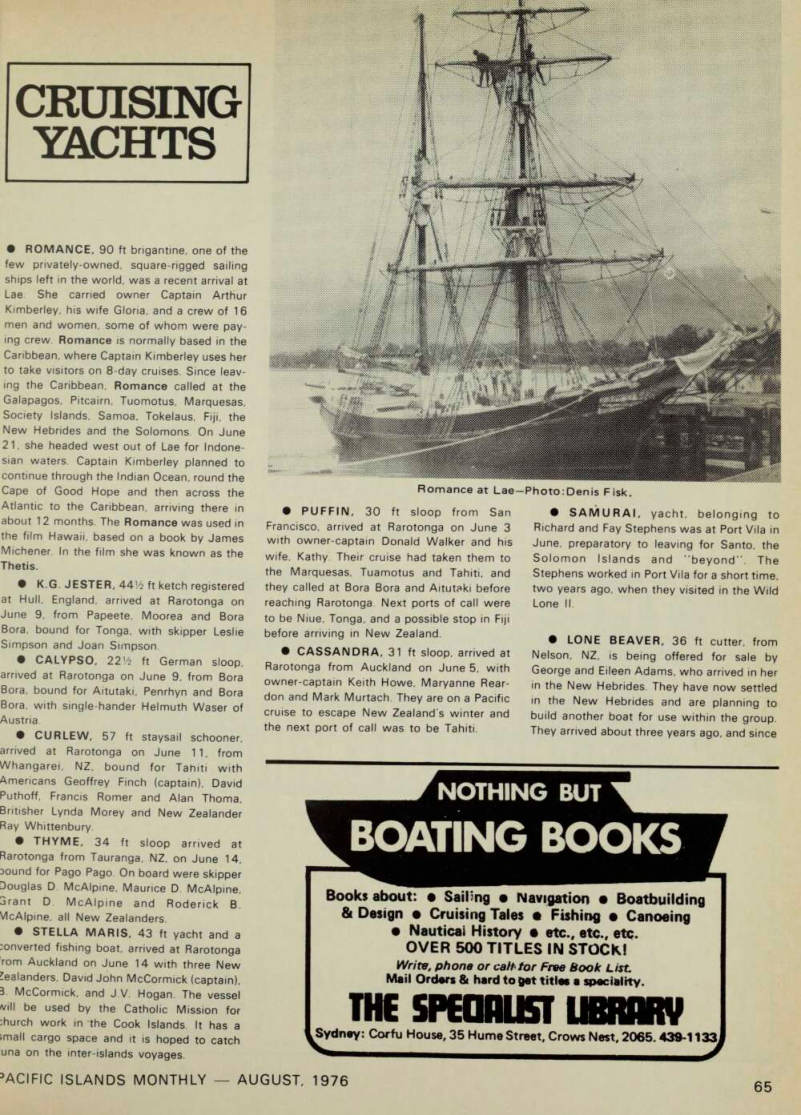
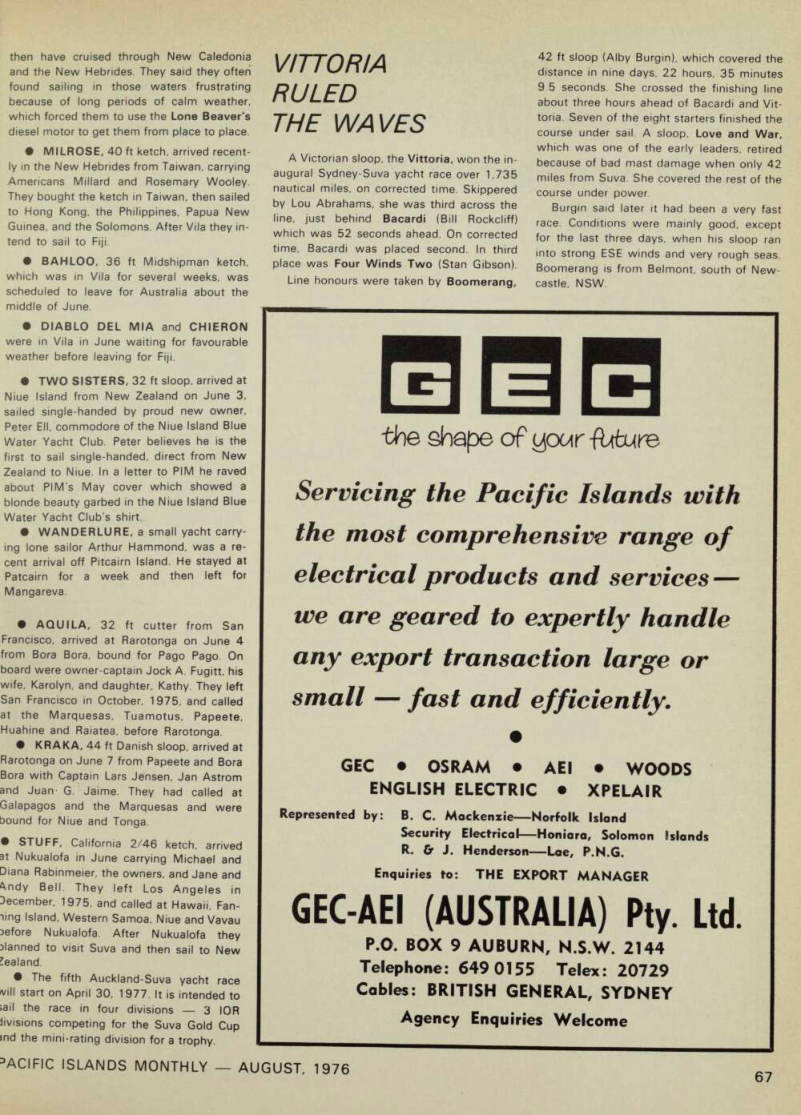
Yachts
• ROMANCE, 90 ft brigantine, one of the few privately-owned, square-rigged sailing ships left in the world, was a recent arrival at Lae. She carried owner Captain Arthur Kimberley, his wife Gloria, and a crew of 16 men and women, some of whom were pay ing crew. Romance is normally based in the Caribbean, where Captain Kimberley uses her to take visitors on 8-day cruises. Since leav ing the Caribbean, Romance called at the Galapagos, Pitcairn, Tuomotus, Marquesas, Society Islands, Samoa. Tokelaus, Fiji, the New Hebrides and the Solomons. On June 21. she headed west out of Lae for Indone sian waters. Captain Kimberley planned to continue through the Indian Ocean, round the Cape of Good Hope and then across the Atlantic to the Caribbean, arriving there in about 12 months. The Romance was used in the film Hawaii, based on a book by James Michener. In the film she was known as the Thetis. • K.G. JESTER, 44V2 ft ketch registered at Hull, England, arrived at Rarotonga on June 9, from Papeete, Moorea and Bora Bora, bound for Tonga, with skipper Leslie Simpson and Joan Simpson. • CALYPSO, 22V$ ft German sloop, arrived at Rarotonga on June 9, from Bora Bora, bound for Aitutaki, Penrhyn and Bora Bora, with single-hander Helmuth Waser of Austria. • CURLEW, 57 ft staysail schooner, arrived at Rarotonga on June 11, from Whangarei. NZ, bound for Tahiti with Americans Geoffrey Finch (captain), David Puthoff, Francis Romer and Alan Thoma, Britisher Lynda Morey and New Zealander Ray Whittenbury. • THYME, 34 ft sloop arrived at Rarotonga from Tauranga, NZ, on June 14, aound for Pago Pago. On board were skipper Douglas D McAlpine, Maurice D. McAlpine, 3rant D McAlpine and Roderick B.
VlcAlpine, all New Zealanders. ® STELLA MARIS, 43 ft yacht and a inverted fishing boat, arrived at Rarotonga rom Auckland on June 14 with three New Zealanders, David John McCormick (captain), 3 McCormick, and J.V. Hogan. The vessel will be used by the Catholic Mission for :hurch work in the Cook Islands. It has a •mall cargo space and it is hoped to catch una on the inter-islands voyages.
• PUFFIN, 30 ft sloop from San Francisco, arrived at Rarotonga on June 3 with owner-captain Donald Walker and his wife, Kathy. Their cruise had taken them to the Marquesas. Tuamotus and Tahiti, and they called at Bora Bora and Aitutaki before reaching Rarotonga. Next ports of call were to be Niue, Tonga, and a possible stop in Fiji before arriving in New Zealand. • CASSANDRA, 31 ft sloop, arrived at Rarotonga from Auckland on June 5, with owner-captain Keith Howe, Maryanne Rear don and Mark Murtach. They are on a Pacific cruise to escape New Zealand's winter and the next port of call was to be Tahiti.
• SAMURAI, yacht, belonging to Richard and Fay Stephens was at Port Vila in June, preparatory to leaving for Santo, the Solomon Islands and "beyond ". The Stephens worked in Port Vila for a short time, two years ago, when they visited in the Wild Lone 11. • LOME BEAVER, 36 ft cutter, from Nelson, NZ, is being offered for sale by George and Eileen Adams, who arrived in her in the New Hebrides. They have now settled in the New Hebrides and are planning to build another boat for use within the group.
They arrived about three years ago, and since
Romance at Lae—Photo:Denis Fisk.
then have cruised through New Caledonia and the New Hebrides, They said they often found sailing in those waters frustrating because of long periods of calm weather, which forced them to use the Lone Beaver's diesel motor to get them from place to place. • MILROSE, 40 ft ketch, arrived recent ly in the New Hebrides from Taiwan, carrying Americans Millard and Rosemary Wooley.
They bought the ketch in Taiwan, then sailed to Hong Kong, the Philippines, Papua New Guinea, and the Solomons. After Vila they in tend to sail to Fiji. • BAHLOO, 36 ft Midshipman ketch, which was in Vila for several weeks, was scheduled to leave for Australia about the middle of June.
• Diablo Del Mia And Chieron
were in Vila in June waiting for favourable weather before leaving for Fiji. • TWO SISTERS, 32 ft sloop, arrived at Niue Island from New Zealand on June 3, sailed single-handed by proud new owner, Peter Ell, commodore of the Niue Island Blue Water Yacht Club. Peter believes he is the first to sail single-handed, direct from New Zealand to Niue. In a letter to PIM he raved about PlM's May cover which showed a blonde beauty garbed in the Niue Island Blue Water Yacht Club's shirt. • WANDERLURE, a small yacht carry ing lone sailor Arthur Hammond, was a re cent arrival off Pitcairn Island. He stayed at Patcairn for a week and then left for Mangareva. • AQUILA, 32 ft cutter from San Francisco, arrived at Rarotonga on June 4 from Bora Bora, bound for Pago Pago. On board were owner-captain Jock A. Fugitt, his wife, Karolyn, and daughter, Kathy. They left San Francisco in October, 1975, and called at the Marquesas, Tuamotus, Papeete, Huahine and Raiatea, before Rarotonga. • KRAKA, 44 ft Danish sloop, arrived at Rarotonga on June 7 from Papeete and Bora Bora with Captain Lars Jensen, Jan Astrom and Juan G. Jaime. They had called at Galapagos and the Marquesas and were bound for Niue and Tonga. • STUFF, California 2/46 ketch, arrived at Nukualofa in June carrying Michael and Diana Rabinmeier, the owners, and Jane and 4ndy Bell. They left Los Angeles in December, 1975, and called at Hawaii, Fan ning Island, Western Samoa, Niue and Vavau aefore Nukualofa. After Nukualofa they alanned to visit Suva and then sail to New Zealand. • The fifth Auckland-Suva yacht race vill start on April 30, 1977. It is intended to sail the race in four divisions 3 IOR iivisions competing for the Suva Gold Cup md the mini-rating division for a trophy.
Advertisements & other items, pp. 65-66 (2 items)
65
’ACIFIC ISLANDS MONTHLY AUGUST. 1976
Boating Books
NOTHING BUT
\ r Books about: • Sailing • Navigation • Boatbuilding & Design • Cruising Tales • Fishing • Canoeing • Nautical History • etc., etc., etc.
OVER 500 TITLES IN STOCK!
Write, phone or cantor Free Book List Mail Orders & hard to got titles a speciality.
THE SPEdfIUST ÜBRfIRV
Sydney: Corfu House, 35 Hume Street, Crows Nest. 2065.439-1133, J
E. G. BARKER & CO. PTY. LTD.
Established 1825 150 Years of Service
AUSTRALIA'S OLDEST EXPORT HOUSE
GENERAL EXPORT MERCHANTS
Specialising in world-wide distribution of General Merchandise, Provisions and Produce
Buying Agents for:
THE CO-OPERATIVE WHOLESALE SOCIETY LTD.
Lae and all branches throughout PNG
PORT MORESBY
RAYMOND WONG
P.O. Box 5020
BOROKO
Phone 25 5546
Representatives RABAUL
FIJI
PARAMOUNT AGENCIES
G.P.O. Box 459
SUVA
Phone 2 3127
NEW GUINEA ISLANDS
PRODUCE CO. LTD.
P.O. Box 387
RABAUL
Phone: 92 1982
34 HUNTER STREET, SYDNEY 2000
Cable Address: KERBAR SYDNEY Phone: 231 6200. Telex: 22221 Melbourne Office: 530 Little Collins Street.
Phone: 61 2877. Telex 31732
THE DEPENDABLES!
VILLIERS
& 4 STROKE
ENGINES
WISCONSIN
HEAVY DUTY
ENGINES
% For an infinite variety of applications including pumping, spraying, mowing, power saws, etc. you simply can’t go past the amazingly dependable Villiers aircooled petrol engine. We offer 7 basic models with hundreds of combinations, including reduction gearboxes.
They’re your logical choice if you need an air-cooled H.D. petrol engine upon which you can absolutely rely. Thrives on the toughest jobs with a minimum of maintenance. Available from 4.7 to 65.9 horsepower in single, twin and 4 cyl. types to suit a wide range of applications.
Both Villiers and Wisconsin engines are backed by For Sales and Service contact:
HASTINGS PEERING LTD.
Parramatta Road, Cnr. John Street,
LIDCOMBE, N.S.W. 2141, AUSTRALIA.
Tel: 648-0111. a first class parts service. mi 001062
Vittoria
Ruled
The Waves
A Victorian sloop, the Vittoria. won the in augural Sydney-Suva yacht race over 1,735 nautical miles, on corrected time. Skippered by Lou Abrahams, she was third across the line, just behind Bacardi (Bill Rockcliff) which was 52 seconds ahead. On corrected time, Bacardi was placed second. In third place was Four Winds Two (Stan Gibson).
Line honours were taken by Boomerang,
42 ft sloop (Alby Burgin), which covered the distance in nine days, 22 hours, 35 minutes 9.5 seconds. She crossed the finishing line about three hours ahead of Bacardi and Vit toria. Seven of the eight starters finished the course under sail. A sloop. Love and War, which was one of the early leaders, retired because of bad mast damage when only 42 miles from Suva. She covered the rest of the course under power.
Burgin said later it had been a very fast race. Conditions were mainly good, except for the last three days, when his sloop ran into strong ESE winds and very rough seas.
Boomerang is from Belmont, south of New castle, NSW.
Advertisements & other items, p. 67 (2 items)
67
3 ACIFIC ISLANDS MONTHLY AUGUST, 1976
Gec-Aei (Australia) Pty. Ltd.
the shape of yoor -future
Servicing the Pacific Islands with the most comprehensive range of electrical products and services we are geared to expertly handle any export transaction large or
small fast and efficiently.
GEC • OS RAM • AEI • WOODS
ENGLISH ELECTRIC • XPELAIR
Represented by: B. C. Mackenzie—Norfolk Island Security Electrical—Honiara, Solomon Islands R. & J. Henderson—Lae, P.N.G.
Enquiries to: THE EXPORT MANAGER
GEC-AEI (AUSTRALIA) Pty. Ltd.
P.O. BOX 9 AUBURN, N.S.W. 2144
Telephone: 649 0155 Telex: 20729
Cables: BRITISH GENERAL, SYDNEY
Agency Enquiries Welcome
A varied life ‘lived
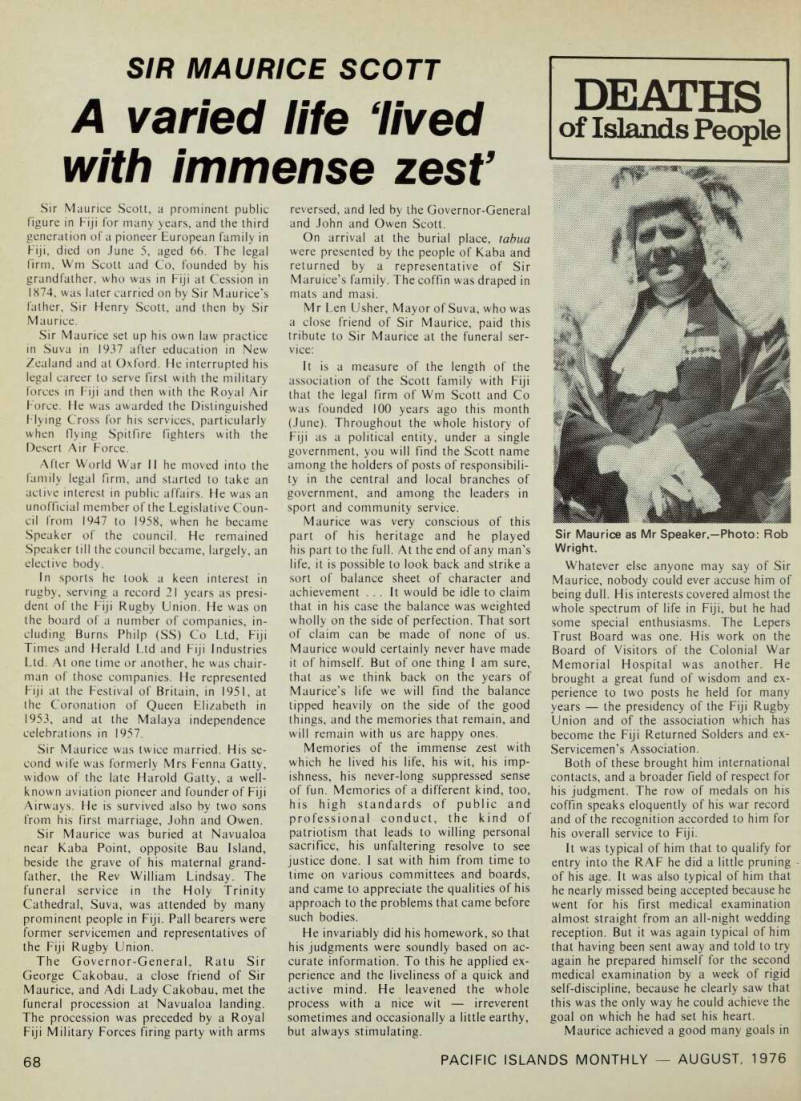
Sir Maurice Scott
A varied life ‘lived with immense zest’
Sir Maurice Scott, a prominent public figure in Fiji for many years, and the third generation of a pioneer European family in Fiji, died on June 5, aged 66. The legal firm, Wm Scott and Co, founded by his grandfather, who was in Fiji at Cession in 1874, was later carried on by Sir Maurice’s father. Sir Henry Scott, and then by Sir Maurice.
Sir Maurice set up his own law practice in Suva in 1937 after education in New Zealand and at Oxford. He interrupted his legal career to serve first with the military forces in Fiji and then with the Royal Air Force. He was awarded the Distinguished Flying Cross for his services, particularly when flying Spitfire fighters with the Desert Air Force.
After World War II he moved into the family legal firm, and started to take an active interest in public affairs. He was an unofficial member of the Legislative Coun cil from 1947 to 1958, when he became Speaker of the council. He remained Speaker till the council became, largely, an
elective body.
In sports he took a keen interest in rugby, serving a record 21 years as presi dent of the Fiji Rugby Union. He was on the board of a number of companies, in cluding Burns Philp (SS) Co Ltd, Fiji Times and Herald Ltd and Fiji Industries Ltd. At one time or another, he was chair man of those companies. He represented Fiji at the Festival of Britain, in 1951, at the Coronation of Queen Elizabeth in 1953, and at the Malaya independence celebrations in 1957.
Sir Maurice was twice married. His se cond wife was formerly Mrs Fenna Gatty, widow of the late Harold Gatty, a well known aviation pioneer and founder of Fiji Airways. He is survived also by two sons from his first marriage, John and Owen.
Sir Maurice was buried at Navualoa near Kaba Point, opposite Bau Island, beside the grave of his maternal grand father, the Rev William Lindsay. The funeral service in the Holy Trinity Cathedral, Suva, was attended by many prominent people in Fiji. Pall bearers were former servicemen and representatives of the Fiji Rugby Union.
The Governor-General, Ratu Sir George Cakobau, a close friend of Sir Maurice, and Adi Lady Cakobau, met the funeral procession at Navualoa landing.
The procession was preceded by a Royal Fiji Military Forces firing party with arms
reversed, and led by the Governor-General and John and Owen Scott.
On arrival at the burial place, tabua were presented by the people of Kaba and returned by a representative of Sir Maruice’s family. The coffin was draped in mats and masi.
Mr Len Usher, Mayor of Suva, who was a close friend of Sir Maurice, paid this tribute to Sir Maurice at the funeral ser vice: It is a measure of the length of the association of the Scott family with Fiji that the legal firm of Wm Scott and Co was founded 100 years ago this month (June). Throughout the whole history of Fiji as a political entity, under a single government, you will find the Scott name among the holders of posts of responsibili ty in the central and local branches of government, and among the leaders in sport and community service.
Maurice was very conscious of this part of his heritage and he played his part to the full. At the end of any man’s life, it is possible to look back and strike a sort of balance sheet of character and achievement ... It would be idle to claim that in his case the balance was weighted wholly on the side of perfection. That sort of claim can be made of none of us.
Maurice would certainly never have made it of himself. But of one thing I am sure, that as we think back on the years of Maurice’s life we will find the balance tipped heavily on the side of the good things, and the memories that remain, and will remain with us are happy ones.
Memories of the immense zest with which he lived his life, his wit, his imp ishness, his never-long suppressed sense of fun. Memories of a different kind, too, his high standards of public and professional conduct, the kind of patriotism that leads to willing personal sacrifice, his unfaltering resolve to see justice done. I sat with him from time to time on various committees and boards, and came to appreciate the qualities of his approach to the problems that came before such bodies.
He invariably did his homework, so that his judgments were soundly based on ac curate information. To this he applied ex perience and the liveliness of a quick and active mind. He leavened the whole process with a nice wit irreverent sometimes and occasionally a little earthy, but always stimulating.
Deaths
of Islands People
Whatever else anyone may say of Sir Maurice, nobody could ever accuse him of being dull. His interests covered almost the whole spectrum of life in Fiji, but he had some special enthusiasms. The Lepers Trust Board was one. His work on the Board of Visitors of the Colonial War Memorial Hospital was another. He brought a great fund of wisdom and ex perience to two posts he held for many years the presidency of the Fiji Rugby Union and of the association which has become the Fiji Returned Solders and ex- Servicemen’s Association.
Both of these brought him international contacts, and a broader field of respect for his judgment. The row of medals on his coffin speaks eloquently of his war record and of the recognition accorded to him for his overall service to Fiji.
It was typical of him that to qualify for entry into the RAF he did a little pruning of his age. It was also typical of him that he nearly missed being accepted because he went for his first medical examination almost straight from an all-night wedding reception. But it was again typical of him that having been sent away and told to try again he prepared himself for the second medical examination by a week of rigid self-discipline, because he clearly saw that this was the only way he could achieve the goal on which he had set his heart.
Maurice achieved a good many goals in
Sir Maurice as Mr Speaker.—Photo: Rob Wright.
his life and he leaves behind him a record of achievement in a variety of fields of which any man could well be proud.
Memories of this record are among the things that help to soften the loss which brings our sympathy to Lady Scott and to John and Owen.
It is good to know that in almost the last days of his life he was able to welcome the news of the birth in Auckland of a grand son, so that the continuity of the name is assured for another generation. It is John’s hope that it means also, in the fullness of time, a continuity of the contribution which Maurice gave to this nation, which he so loved and which he served so well.
Dr G. Loison Well known all over the Islands, Dr Guy Loison, Health Programme Director for the South Pacific Commission, died in Paris in late June at the age of 62.
Born in France, Dr Loison, who studied medicine in France and the United States, entered the French colonial service in 1939, serving in French Polynesia, New Caledonia, Vietnam, Morocco and the French Congo. He joined the SPC as a research officer in 1952, left after four years and returned to its service as Health Programme Director in 1962, a position he occupied at the time of his death. He was the author of several works on health problems in the Islands.
Mrs M. Stock Mrs Myffie Stock, who was a schoolteacher at Lae in the 19605, died recently at Lae. She and her husband, Noel, who worked for TAA, and daughter Bronwen went to Lae in 1960 from Brisbane and returned there in 1966. A few years ago Noel was seconded to Air Niugini, and he and his wife had lived in PNG ever since.
Pastor G. Dan Pastor Gershom Dan, well known in Presbyterian Church circles in the New Hebrides, died recently, aged 40. He serv ed as a pastor on Ambrym and Malekula.
In 1964 he became the first New Hebri dean teacher at Tangoa Bible College.
Mr H. T. Nicholson Mr Henry Thomas Nicholson, who was t)orn on Norfolk Island, died recently in Auckland, aged 60. He served with the MF in World War 11. He leaves a widow and two sons.
Mr V. Storck Mr Vincent Storck, a member of the third generation of an old Fiji family which had its origins in Germany, died in June, aged 62. He worked for the Emperor Gold Mining Co Ltd and W.R. Carpenter before going into the tourist industry. He ;et up the Southern Cross Hotel, Suva, and in 1956 established Storck Cruises.
Bougainville’S Copper
Bolsters Png’S Credit
From GUS SMALES in Port Moresby
The World Bank has given Papua New Guinea a high international credit rating provided the copper island of Bougain ville doesn’t secede.
If Bougainville breaks away, as it has threatened several times, the whole picture could change because of PNG’s heavy dependence on the mining revenue. This, in turn, could lead to the running down of the entire PNG economy as it is at present constituted.
A statement on the World Bank’s finan cial survey of PNG was tabled in the National Parliament in Port Moresby in June by Finance Minister Mr Chan.
He made two main points arising from the results of the survey. They were that: • PNG has been given a clean bill of health in its creditworthiness, and no longer will have to rely on Australian guarantees when raising overseas loans. • The bank has endorsed the government’s policies in hard currency strategy, financial control, financial management, and in political and financial responsibility.
The bank’s full report had not been received, when Mr Chan spoke, but its in terim judgment was contained in a formal letter to the government.
Tabling his statement in parliament, Mr Chan made no reference to any specific comments on Bougainville by the World
Bank. But outside the House he confirmed that the interim report contained reference to PNG’s heavy reliance on the Bougain ville mining revenue to maintain the pre sent status of the economy.
He would not elaborate, but said he hoped to receive the detailed final report soon, and would make it available to parliament.
Mr Chan’s lengthy statement to
parliament concentrated on optimistic
aspects of the economy, particularly the ability to end all current reliance on Australian guarantees when raising overseas loans.
In practice, Australia has been a ready partner to any guarantee arrange ment but the mere fact of needing a
guarantee was becoming increasingly
irksome to the newly-independenl PNG.
This led to an invitation to the World Bank to send a mission to PNG for an inter national and on-the-spot assessment of financial and credit capabilities.
Mr Chan told said the World Bank's en dorsement of his country’s financial management meant more than the mere ability to borrow from the bank itself. The result meant that all international agencies and institutions would recognise PNG as a responsible financial entity. This would be reflected in PNG’s financial relationships with the world.
Prison Workers
Papua New Guinea now seems certain to go ahead with a plan to use prisoners as labourers on public works projects.
Australia used outside prison labour in PNG until 10 years ago, but stopped the practice after receiving a sharp rap over the knuckles from the United Nations. A visiting UN delegation which saw prisoners working on a road had criticised Australia for “eroding human dignity”.
The Minister for Corrective Institutions, Mr Pita Lus, confirmed in the National Parliament that he was going ahead with his proposals to use prison labour “productively”. Mr Lus said he saw no objections to employing prisoners on public works projects and maintenance, and had recommended this to Cabinet.
This did not mean that prisoners could be used for private work. A report of the Law Reform Commission, published in Port Moresby in June, also accepts in principle the use of prison labour for public works.
The chairman of the commission, Mr Ber nard Narokobi, said that proper procedures would need to be established.
Advertisements & other items, p. 69 (1 item)
69
ACIFIC ISLANDS MONTHLY AUGUST, 1976
Shipping,
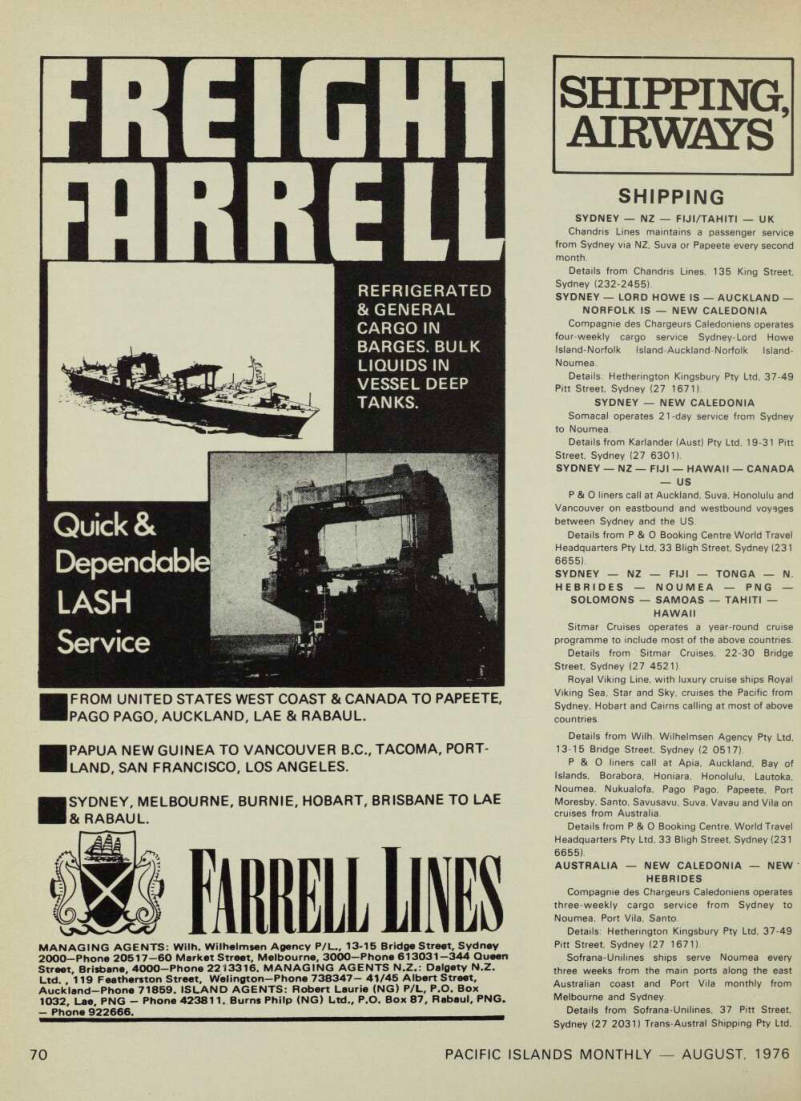
Airways
Shipping
Sydney Nz Fiji/Tahiti Uk
Chandris Lines maintains a passenger service from Sydney via NZ, Suva or Papeete every second month.
Details from Chandris Lines, 135 King Street, Sydney (232-2455).
Sydney Lord Howe Is Auckland
Norfolk Is New Caledonia
Compagnie des Chargeurs Caledonians operates four-weekly cargo service Sydney-Lord Howe Island-Norfolk Island-Auckland-Norfolk Island- Noumea.
Details: Hetherington Kingsbury Pty Ltd. 37-49 Pitt Street, Sydney (27 1671).
Sydney New Caledonia
Somacal operates 21-day service from Sydney to Noumea.
Details from Karlander (Aust) Pty Ltd. 19-31 Pitt Street, Sydney (27 6301).
Sydney Nz Fiji Hawaii Canada
US P & 0 liners call at Auckland, Suva, Honolulu and Vancouver on eastbound and westbound voyages between Sydney and the US Details from P & 0 Booking Centre World Travel Headquarters Pty Ltd, 33 Bligh Street, Sydney (231 6655).
Sydney Nz Fiji Tonga N.
Hebrides Noumea Png
Solomons Samoas Tahiti
Hawaii
Sitmar Cruises operates a year-round cruise programme to include most of the above countries.
Details from Sitmar Cruises, 22-30 Bridge Street, Sydney (27 4521).
Royal Viking Line, with luxury cruise ships Royal Viking Sea, Star and Sky, cruises the Pacific from Sydney, Hobart and Cairns calling at most of above countries.
Details from Wilh. Wilhelmsen Agency Pty Ltd, 13-15 Bridge Street, Sydney (2 0517).
P & 0 liners call at Apia, Auckland, Bay of Islands, Borabora, Honiara, Honolulu, Lautoka, Noumea, Nukualofa, Pago Pago, Papeete, Port Moresby, Santo, Savusavu, Suva, Vavau and Vila on cruises from Australia.
Details from P & 0 Booking Centre, World Travel Headquarters Pty Ltd, 33 Bligh Street, Sydney (231 6655).
Australia New Caledonia New
Hebrides
Compagnie des Chargeurs Caledoniens operates three-weekly cargo service from Sydney to Noumea, Port Vila, Santo.
Details: Hetherington Kingsbury Pty Ltd, 37-49 Pitt Street, Sydney (27 1671).
Sofrana-Unilines ships serve Noumea every three weeks from the main ports along the east Australian coast and Port Vila monthly from Melbourne and Sydney.
Details from Sofrana-Unilines, 37 Pitt Street, Sydney (27 2031) Trans-Austral Shipping Pty Ltd,
570 Bourke Street, Melbourne (67 9162), ACTA Pty Ltd Brisbane (221 3116). Elder Smith Goldsbrough Mort Ltd, Port Adelaide (47 5688).
Mcllwraith McEacharn Ltd, Newcastle (2 4781), H Jones and Co Pty Ltd, Burnie, Tasmania (31 1833).
South Pacific United Lines maintain a four-week cargo service from Sydney to Noumea, Vila and Santo.
Details from Omni Trades & Brokers Pty Ltd, 261 George Street, Sydney (241 2872/6).
Australia Fiji
Karlander (Aust) Pty Ltd operates three weekly cargo services from Sydney to Suva and Lautoka.
Details from Karlander (Aust.) Pty Ltd, 19-31 Pitt Street, Sydney (27 6301): Dalgety Shipping, 461 Bourke Street, Melbourne (60 0731): Burns Philp (SS) Co Ltd, Suva and Lautoka.
Sofrana-Unilines (Fiji Express Line) operates to Suva every three weeks from the main ports on the sast coast of Australia, and monthly to Lautoka 'rom Melbourne and Sydney.
Details from Sofrana-Unilines. 37 Pitt Street, Sydney (27 2031). Trans-Austral Shipping Pty -td, 570 Bourke Street, Melbourne (67 9162), <\CTA Pty Ltd, Brisbane (221 3116), Elder Smith Soldsbrough Mort Ltd, Port Adelaide (47 5688), Mcllwraith McEacharn Ltd, Newcastle (2 4781), H.
Jones and Co Pty Ltd, Burnie, Tasmania (31 1833).
Australia Fiji W Samoa
Nauru Pacific Line operates monthly conven ional/container service from Sydney and Brisbane o Fiji and Western Samoa.
Details from Nauru Pacific Line, 227 Collins street Melbourne (654 4977): Interocean Swire. 8 spring Street. Sydney (2 0522); Dalgety Shipping, r 9 Eagle Street, Brisbane (31 0331).
Australia Tahiti Us West Coast
South Pacific United Lines maintain a four week / service from Sydney to Papeete, and US West 'oast.
Details from Omni Trades & Brokers Pty Limited, 61 George Street. Sydney (241 2872/6).
Australia Png
Containers Pacific Express (Burns Philp and kWP Line) operates four-weekly cargo service from /lelbourne and Brisbane with Samos to Port Moresby and Lae and three-weekly cargo service om Sydney (direct) to Lae and Port Moresby with limos.
Details from Burns Philp & Co Ltd, 51 Pitt Street Sydney (241 3816).
Farrell Lines operates a service every 18 days om Tasmania, Melbourne, Sydney and Brisbane to ae, Rabaul and Anewa Bay Details from Wilh. Wilhelmsen Agency Pty Ltd, 3 Bridge Street, Sydney (2 0517), 60 Market treet, Melbourne (61 3031), Burns Philp (NG) Ltd. labaul, Robert Laurie-Carpenter (NG) Pty Ltd, Lae.
New Guinea Express Lines with two ships perates three-weekly Melbourne. Sydney, risbane. Port Moresby, Lae, Rabaul.
Details from New Guinea Express Lines, PO Box 73, Royal Exchange PO. Sydney (241 3991) lac Arthur Shipping Agency Co, 82-92 Eagle treet, Brisbane (229 3777), Westralian Farmers ransport Pty Ltd, 459 Little Collins Street, lelbourne (67 8291). Breckwoldt’s Shipping gencies in Port Moresby (24 2525), Lae (42 536), Rabtrad Niugini Pty Ltd, Rab|ul (92 2911).
Karlander New Guinea Line's cargo vessels call t Melbourne, Sydney, Lae, Madang, Wewak lanus, Kimbe.
Details from Karlander (Aust.) Pty Ltd, 19-31 itt Street, Sydney (27 6301): Dalgety Shipping,
461 Bourke St. Melbourne (60 0731).
Australia Png Solomons
New Guinea Australia Line’s vessels operate from Sydney and Brisbane to Port Moresby, Lae.
Rabaul, Kavieng, Wewak, Honiara, Kieta, Gizo, Madang and Samarai.
Details from Interocean Swire, 8 Spring Street, Sydney (2 0522)
Australia Ng Micronesia Guam
Nauru Pacific Line operates monthly conven tional/container service Melbourne/Sydney to New Guinea, Koror, Guam and Micronesia.
Details from Nauru Pacific Line. 227 Collins Street, Melbourne (654 4977); Interocean Swire, 8 Spring Street, Sydney (2 0522).
Us Png
Farrell Lines operates regular services from all US west coast ports to Lae, Rabaul and Anewa Bay Details from Wih, Wilhelmsen Agency Pty Ltd, 13 Bridge Street, Sydney (2 0517). One Embar cadero Centre, Suite 701, San Francisco, Burns Philp (NG) Ltd, Rabaul and Kieta, Robert Laurie- Carpenter (PNG) Pty Ltd. Lae
San Francisco Honolulu
Micronesia
Nauru Pacific Line operates regular conven tional/container service from San Francisco and Honolulu to Majuro, Nauru, Ponape, Truk and Saipan.
Details from Nauru Pacific Line, 227 Collins Street, Melbourne (654 4977). North American Maritime Agencies, 100 California Street, San Francisco, California 94111 (981 0343).
Png Us Canada
Farrell Lines operates regular services from Lae and Rabaul to US west coast ports and Vancouver.
Details from Burns Philp (NG) Ltd, Rabaul, Robert Laurie-Carpenter (PNG) Pty Ltd, Lae, PFEL, One Embarcadero Centre, Suite 701, San Francisco and Wilh. Wilhelmsen Agency Pty Ltd, 13 Bridge Street. Sydney (2 0517).
Far East Fiji New Zealand
New Zealand Unit Express (CNC, MOL. RIL) operates a three-weekly cargo service from Hong Kong to Lautoka, Suva, NZ ports, Manila, Kaoshiung, Keelung, Hong Kong Details from Interocean Swire, 8 Spring Street, Sydney (2 0522).
Royal Interocean Lines operates monthly cargo service with three ships from Surabaya, Jakarta Bangkok, Port Kelang and Singapore to Suva and NZ ports.
Details from Interocean Australia Services. 261 George Street. Sydney (2 0573). Burns Philp (SS) Co Ltd, Suva and Lautoka.
Ben Shipping Co (Pte) Ltd, sailing monthly from Singapore, Hong Kong, Keelung, Kaoshiung, Suva and main NZ ports.
Details from Seatrans (Fiji) Ltd, GPO Box 152, .
Suva, Fiji.
Far East—Png —Si —New Hebrides
Noumea Tahiti Samoa
China Navigation Co's vessels operate a regular cargo service from Hong Kong, Taiwan and Singapore to Rabaul, Wewak, Madang, Lae, Port Moresby, Honiara, New Hebrides, Noumea, Papeete and Samoa.
Details from Interocean Swire, 8 Spring Street, Sydney (2 0522).
North Europe New Caledonia
Hamburg-Sued operates monthly cargo services from Dunkirk and Le Havre to Noumea, via Panama.
Details from Columbus Overseas Services Pty Ltd, 333 George Street, Sydney (290 2966).
Messageries Maritimes operates five cargo ser vices a month from north and Mediterranean Euro pean ports to Papeete and Noumea Details from Messageries Maritimes, 4-6 Bligh Street. Sydney (221-2522).
Japan Guam Fiji Samoa N.
Caledonia N. Hebrides
Daiwa Line runs a monthly cargo service from Japan via Guam to Suva, Lautoka, Pago Pago, Apia, Vila, Santo and Noumea.
Details from Burns Philp (SS) Co Ltd, Suva.
Tonga Samoa Fiji Norfolk Is.
Australia
Pacific Navigation Co Ltd operates a monthly cargo service between Nukualofa, Apia, Suva, Lautoka and Norfolk Is. to Sydney.
Details from Karlander (Aust.) Pty Ltd, 19-31 Pitt Street, Sydney, (27 6301): Burns Philp (SS) Co Ltd. Suva
Nz Fiji Tonga Samoas Tahiti
Union Steam Ship Co of NZ operates a fully con tainerised service Auckland-Suva-Pago Pago-Apia- Nukualofa every 14-16 days A 28-day service by conventional ship is operated from Auckland to Papeete, Apia and Nukualofa.
Details from Union Steam Ship Co of NZ Ltd, PO Box 12 Auckland or from branch offices/agents in Fiji, Tonga, Samoa and Tahiti.
Nz Norfolk Is.
Compagnie des Chargeurs Caledoniens operate four-weekly cargo service from Auckland to Norfolk Island.
Details from Maritime Services Ltd, 14-18 Customs Street E, Auckland (7 5509).
Nz N Caledonia N. Hebrides Ng
SI Sofrana-Unilines with two ships operating to Vila and Santo: to Honiara and New Guinea; and to Noumea.
Details from Sofrana-Unilines, 42 Customs Street, Auckland (7 3279). PO Box 3614 Telex: NZ 2313
Nz N. Caledonia
Compagnie des Chargeurs Caledoniens operates four-weekly cargo service from Auckland to Noumea.
Details from Maritime Services Ltd. 14-18 Customs Street E Auckland (7 5509).
Nz Png
Farrell Lines operates regular service every 18 fays from Auckland to Lae, Rabaul and Anewa Bay Details from Dalgety NZ Ltd. 41/45 Albert Street, Auckland (7 1859), Burns Philp (NG) Ltd, Sabaul, Robert Laurie-Carpenter (PNG) Pty Ltd, Lae
Nz Fui North America (Wc)
Crusader cargo ships call at Suva. Levuka and Honolulu on NZ-US west coast trips and at Suva and/or Lautoka on US-NZ return trips.
Details from Blue Star Port Lines (Management) -td, PO Box 192. Wellington (73 9029): Burns J hilp (SS) Co Ltd, Suva
Nz Fiji
Reef operates a regular 18 day service from Vuckland to Suva and Lautoka Details from Reef Shipping Agencies Ltd, PO Jox 3382, Auckland. NZ (7 1221-3)
Nz Tonga
Warner Pacific Line services Lyttelton-Auckland-
Nukualofa-Vavau-Haapai on a 14-21-day schedule for general and freezer cargoes.
Details from Air Marine Services (NZ) Ltd, PO Box 2505, Auckland (362-730)
(Mz Fiji Samoa
Pacific Line with one ship operates monthly cargo service. New Zealand, Lautoka, Suva, Apia Details: Sofrana- Unilines, 42 Customs Street, Auckland (7 3279) PO Box 3614, Telex: NZ 2313.
Nz Cook Is Niue
The Shipping Corporation of NZ Ltd with Toa Moana and Lorena, operates cargo services from Auckland to Rarotonga and Aitutaki (fortnightly) and Niue (monthly) Details from The Shipping Corp of NZ Ltd, PO Box 3420, Auckland (37 9430): Waterfront Com mission, PO Box 61, Rarotonga: Lighterage and Stevedoring Co. Aitutaki; Niue Govt Offices, Niue
Island.
Uk Panama Samoa Fiji
The Fiji Direct Service, cargo only, is maintained by Conference vessels, sailing at regular monthly in tervals out of London, via Panama, for Apia. Suva and Lautoka Details from Burns Philp (SS) Co Ltd. Suva
Uk Tahiti N, Caledonia N
Hebrides Png Solomons
Gilbert Is.
Bank Line operates a monthly direct cargo ser vice from Europe, via the Panama Canal to Papeete.
Noumea, Vila, major PNG ports and Honiara, oc casionally to Tarawa. Santo, Kieta, Jayapura and Yandina and return.
Details from Bank Line (A sia) Pty Ltd, 1 York Street, Sydney (27 2041); Burns Philp (SS) Co Ltd, Suva.
Europe Tahiti W. Samoa Fiji
N. Caledonia
Nedlloyd offers regular cargo services from Northern Europe and UK to Papeete. Apia, Fiji and New Caledonia Details Interocean Aust Services Pty Ltd, 261 George Street. Sydney (2 0573).
Us Sydney Gilbert Is. Honolulu
Columbus Line operates three-weekly container cargo service, sailing from US west coast to Australasia, returning via Tarawa and Honolulu to Nth. America.
Details from Columbus Overseas Services Pty Ltd, 333 George Street. Sydney (290 2966).
Us Fiji/Tahiti Australia
Bank Line Ltd operate regular cargo services from US Gulf ports to Australia and NZ. Calls at Suva. Lautoka and Papeete on demand.
Details from Bank Line (A'sia) Pty Ltd, 1 York St.
Sydney (27 2011).
Pacific Far East Line cruise ships operate from San Francisco, Los Angeles. Honolulu, Moorea- Papeete, Rarotonga, Auckland, Opua (Bay of Islands), Sydney, and return via Suva. Niuafoou Pago Pago and Honolulu to San Francisco.
Freight is carried on these passenger liners.
Passenger details from World Travel Head quarters Pty Ltd, 33 Bligh Street, Sydney (231 6655), freight details from P & 0 Aust Ltd, 2 Castlereagh St. Sydney (2300177).
Us A. Samoa Nz Aust. Png
Farrell Lines LASH ships operate regularly from US to Australia, via Pago Pago and Auckland, retur ning via PNG ports.
Details from Wilh, Wilhelmsen Agency Pty Ltd, 13 Bridge Street. Sydney (2 0517); 60 Market Street. Melbourne (61 3031): PFEL, 1 Embar
cadero Centre, Suite 701, San Francisco (576 4000); Dalgety NZ Ltd, Auckland (7 1859): Kneubuhl Maritime Services. Pago Pago (633 5121).
Us Tahiti Samoa
Pacific Islands Transport operates a five/six weekly cargo service from North American west coast ports to Papeete, Pago Pago, Apia Details from Trans-Austral Shipping Pty Ltd, 19 Pitt Street, Sydney (27 2441).
Polynesia Line operates container and general cargo service from US west coast ports to Papeete and Pago Pago.
Details from Polynesia Shipping Services Inc, PO Box 1478. Pago Pago (9 6799)
Airways
From Australia
Qantas (7075, 7475, DC4) PNG. Norfolk Is.
New Caledonia, Fiji, US, Canada.
PAA (7475) Fiji, American Samoa, Hawaii, US.
CP Air (DCS) Fiji, Hawaii, Canada.
UTA (DCBs and DCIOs) New Caledonia, Fiji, New Zealand, Tahiti, US.
Air Nauru (F2B) New Caledonia, Nauru, Tarawa, Majuro.
Air Niugini (7205) PNG.
Advance Aviation (from Sydney). North Coast Airlines (from Coffs Harbour) and Oxley Airlines (from Port Macquarie) Lord Howe Is.
From New Zealand
Air-NZ (DCBs, DCIOs, F 27) Fiji, American Samoa, Cook Is, Tahiti, Hawaii, US, New Caledonia, Norfolk Is.
PAA (7475) American Samoa, Tahiti, Hawaii,
US.
UTA (DCS) Tahiti.
From Us
Qantas (707 s and 7475) Honolulu, Fiji, Australia.
PAA (7475) Honolulu, Tahiti, A Samoa, Fiji, NZ. Australia.
Air-NZ (DCSs and DCIOs) Honolulu, Fiji, Auckland.
From Canada
CP Air (DCSs) Honolulu, Fiji, Australia Qantas (DCSs and DCIOs) Honolulu, Fiji, Australia.
Pacific Far East S. America
Air Nauru (F2B or 737) Nauru to Micronesia.
The Philippines, Okinawa, Japan, Taiwan, Hong Kong.
Air France (7075) Japan to Tahiti, Peru Air Niugini (7075) to Manila
Pacific Is. Aust.
Air Pacific (BAC111) From Fiji, via New Hebrides or New Caledonia to Brisbane.
Air Nauru (F2B or 737) flies to Melbourne.
Air Niugini (727 s and Fokker Friendships) to Cairns and Brisbane Norfolk Airlines (Beechcraft) to Brisbane.
Pacific Is. Nz
Air Pacific (BAC111) Fiji-Tonga-NZ
Inter-Territory
Lan-Chile (7075) Easter Is , Tahiti.
Air Pacific (BACIII and HS74Bs) Fiji to Gilbert Is , Tuvalu, Western Samoa, Tonga, New Hebrides. Solomon Islands, New Caledonia, PNG.
Fiji Air Services Wallis and Futuna (charter).
Qantas (7075) PNG to Singapore.
PAA (7075) Hawaii to Am. Samoa and Tahiti, US.
UTA (7075. Caravelles) from New Caledonia to Fiji, New Hebrides, Wallis Is, Tahiti.
Continental-Air Micronesia (7275) from Hawaii to Micronesia.
Air Nauru from Nauru to Tarawa, Marshall Is., Wallis Is., Fiji, W. Samoa, New Hebrides. New Caledonia, Solomons, Philippines Polynesian Airlines from Apia to Tonga, Niue Is., Fiji, Am. Samoa.
South Pacific Island Airway flies between American and Western Samoa Air Tahiti from Tahiti to Cook Is..
Air Niugini to Irian Jaya, Solomon Is , Philip pines.
Norfolk Island Airlines (Beechcraft) to Noumea.
Internal
Fiji Air Pacific (HS74Bs and Trislanders), Fiji Air Services (Beech Barons and Islanders).
French Polynesia Air Polynesia (Fokker Friendships) Air Tahiti.
US Trust Territory and Guam Continental-Air Micronesia 7275) and Air Pacific International Inc.
Gilbert Is., Air Pacific.
PNG Air Niugini, Aerial Tours, Talair, Melane sian Airlines, Crowley Airways.
Bougainville Bougainville Air Services.
New Caledonia Air Caledonie (Twin Otters).
New Hebrides Air Melanesiae (Islanders).
Solomon Is., Sofair (Beech Barons and Islanders).
Tonga Tonga Internal Air Service (Islanders).
Cook Is. Cook Island Airways (Islander).
Norfolk Island Airlines (Beechcraft) Norfolk Is.. Lord Howe Is.
Western Samoa Air Samoa Ltd, and Samoa Aviation Ltd.
Advertisements & other items, pp. 70-74 (3 items)
Dependable
B I B
REFRIGERATED
& GENERAL
CARGO IN
BARGES. BULK
LIQUIDS IN
VESSEL DEEP
TANKS.
Quick &
Dependable
LASH
Service
(FROM UNITED STATES WEST COAST & CANADA TO PAPEETE,
IPAGO PAGO, AUCKLAND, LAE & RABAUL.
I PAPUA NEW GUINEA TO VANCOUVER 8.C., TACOMA, PORT-
LAND, SAN FRANCISCO, LOS ANGELES.
I SYDNEY, MELBOURNE, BURNIE, HOBART, BRISBANE TO LAE
l& RABAUL.
MANAGING AGENTS: Wilh. Wilhelmsen Agency P/L., 13-15 Bridge Street, Sydney 2000-Phone 20517-60 Market Street, Melbourne, 3000-Phone 613031—344 Queen Street, Brisbane, 4000-Phone 2213316. MANAGING AGENTS N.Z.: Dalgety N.Z.
Ltd. ,119 Featherston Street, Welington-Phone 738347- 41/45 Albert Street, Auckland—Phone 71859. ISLAND AGENTS: Robert Laurie (NG) P/L, P.O, Box 1032, Lae, PNG - Phone 423811. Burns Philp (NG) Ltd., P.O. Box 87, Rabaul, PNG. - Phone 922666.
71
'ACIFIC ISLANDS MONTHLY AUGUST, 1976
Monthly Services
THE
GLOBAL SERVICE FOR SHIPPERS
UNE
Ssi
MONTHLY SERVICES
United Kingdom and Continent to: Papeete, Noumea, New Hebrides, Papua New Guinea and Solomon Islands. * Papua New Guinea to: North America, United Kingdom and Continent. * Solomons, Fiji, Tonga, Samoa and Tarawa to: United Kingdom and Continent.
For particulars apply:
THE BANK LINE (AUSTRALASIA) PTY.
LTD.,
18TH FLOOR, 1 YORK STREET,
SYDNEY, N.S.W.
KYOWA LINE
YOUR TRADING PARTNER
Monthly Services
Hong Kong, Taiwan, S. Korea, Japan
To: Guam, Saipan, British Solomon, New Caledonia, Fiji, W. Samoa, A. Samoa. Tahiti, Cook Is., Tonga, New Hebrides.
Taiwan,Hong Kong,Singapore,Jakarta
To: Australia, Papua New Guinea, Sabah & Sarawak.
South Korea, Japan
To; Guam, Saipan, Papua New Guinea, Other Pacific Islands.
Taiwan: Royal Steamship Corp., Ltd., Taipei S. Korea: Dong Sue Shipping Co., Ltd., Seoul Hong Kong: Dahzun Enterprises Ltd Singapore: Ocean Shipping & Enterprises Pte., Ltd Mariana Is.: Island Navigation Co., Ltd., Guam 8.5.1. P.: Solomon Taiyo Ltd., Honiara Tahiti: J.A. Cowan & Fils, Papeete Cooks: Union Citco Travel Ltd., Rarotonga Tonga: E M. Jones Ltd , Nukualofa New Hebrides: Agence Maritime Raymond Velicite, Port Vila A.Samoa: Island Pacific Agencies Inc., Pago Pago W. Samoa: Morris Hedstrom Ltd., Apia Fiji : Carpenter Shipping, Suva & Lautoka PNG: Carpenter Shipping Agencies, Port Moresby, Rabaul New Caledonia: Agence Maritime Du Rond Point Du Pacific, Indonesia: P.T. Porodisa Raya Shipping Lines, Jakarta Sabah: KOH Han Ming Shipping & Forwarding Agent , Kotakmabalu Sarawak: Pan Sarawak Agencies Sdn. Bhd , Sibu & Kuching Australia: Hethermgton Kingsbury Pty. Ltd., Sydney, N.S.W.
KYOWA SHIPPING CO., LTD.
Ojima Bldg., 22-8, 6-chome, Shinbashi, Frontier Bldg., 3-13 Hirano-cho,
AGENTS
Noumea
HEAD OFFICE
OSAKA OFFICE
ivnnaLO-Ku, lOKyo, japan Phone: 03(437)2885 (Rep.) Cables: “MARIQUEEN” Tokyo Telex: 242-4651 Kyowa J.
Minato-ku, Tokyo, Japan Higashi-ku, Osaka, Japan.
Phone: 06(227)0422 (Rep.) Cables: “MARIQUEEN” Osaka.
Telex: 522-3896 Kyowa O
Regular Pacific Services
Union South Pacific”, cellular container vessel. Reefer and general cargo from Auckland at approximately fortnightly intervals. Calls at Suva, Pago Pago, Apia and Nukualofa before returning to Auckland.
"Luhesand”, conventional reefer and general cargo. Monthly sailings from Auckland, calls at Suva, Apia, Papeete and Nukualofa.
jmimumon
gm/Mcompma
Branches at all main Australian, New Zealand and Pacific Island ports
PACIFIC ISLANDS TRANSPORT LINE
Owners: Thor Dahls Hvaijangerseiskap A/S—Sonde fjord, Norway.
MS CAMELLIA VENTURE
Express Freight Service between Pacific Coast Ports of
U.S.A.
and
TAHITI and SAMOA
Full container service including reefers.
GENERAL STEAMSHIP CORPORATION LTD.
General Agents 400 California Street, San Francisco, California, U.S.A. *««■!»$ Phi lp (South Sea) Company, Ltl.
PA ,TI ET , E —*§•"«• Maritime Internationale Tahiti.
Kf.ir , l AG 2r?I .! yne4 '* Services Inc.
NOUMEA—Etahlissomonts Ballande. 2) r .5^ EY^■ T^ • n, * Au^tT * , Shipping Pty, Ltd.
SU Ltd~ iUnW PhH * (SOU,h Sta) Company, (Now Guinea) ltd.
V Y. —Comptoirs Francais de Nouvelles
PETER FISHER TRADING Pty. Ltd.
321 Pin STREET, SYDNEY, 2000, AUSTRALIA
Telephone: 26-1109 CABLES: "FISHERION", SYDNEY
EXPORTERS TO THE PACIFIC ISLANDS
D
lapua new guln
printing co. pty. ltd.
Serving the Country from Aitape to Alotau, Manus to Moresby Leaders in Commercial Offset and Letterpress Printing. • Stationery • Office Supplies • Office Equipment • Rubber Stamps • Self-Adhesive Labels • In Fact:— Everything For The Office.
P.O. Box 633, Port Moresby P.O. Box 759, Lae P.O. Box 1239, Rabaul
Produce
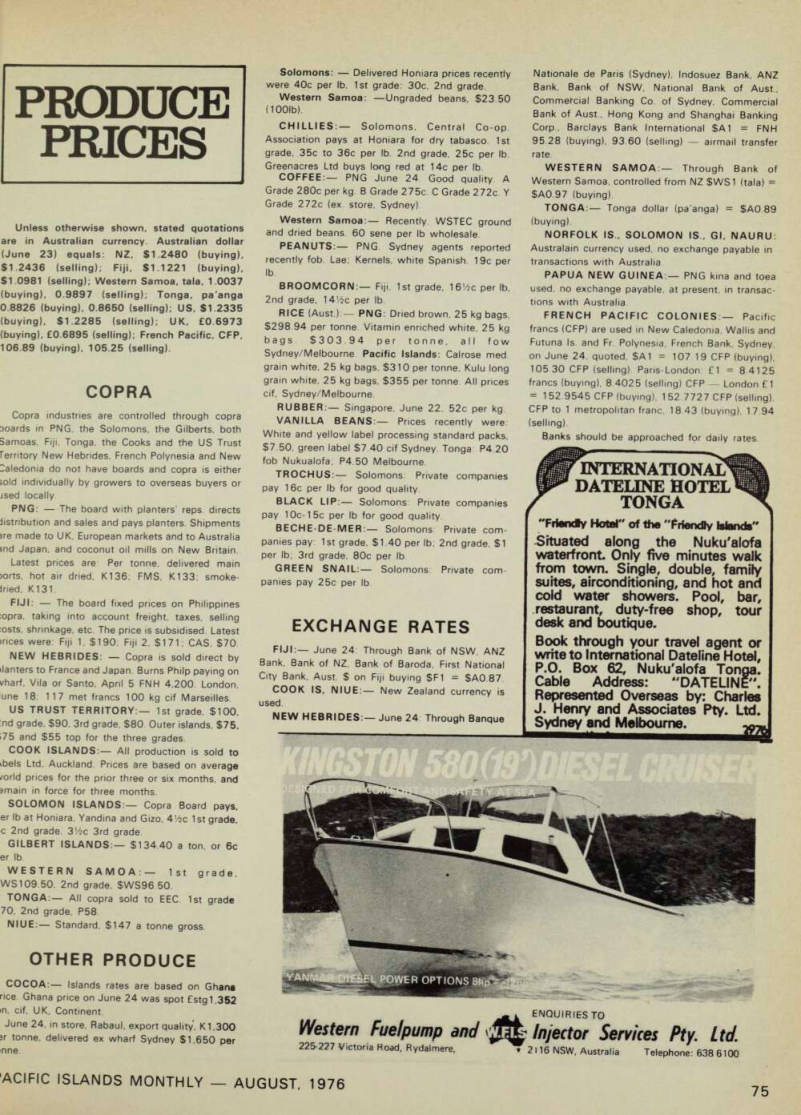
Prices
Unless otherwise shown, stated quotations are in Australian currency. Australian dollar (June 23) equals; NZ, $1.2480 (buying), $1.2436 (selling); Fiji, $1.1221 (buying), $1.0981 (selling); Western Samoa, tala, 1.0037 (buying), 0.9897 (selling); Tonga, pa'anga 0.8826 (buying). 0.8650 (selling); US, $1.2335 (buying), $1.2285 (selling); UK, £0.6973 (buying), £0.6895 (selling); French Pacific, CFP, 106.89 (buying), 105.25 (selling).
Copra
Copra industries are controlled through copra aoards in PNG, the Solomons, the Gilberts, both Samoas, Fiji, Tonga, the Cooks and the US Trust Ferritory New Hebrides, French Polynesia and New Caledonia do not have boards and copra is either >old individually by growers to overseas buyers or jsed locally.
PNG: —The board with planters' reps, directs Jistribution and sales and pays planters. Shipments ire made to UK, European markets and to Australia md Japan, and coconut oil mills on New Britain.
Latest prices are: Per tonne, delivered main >orts. hot air dried, K 136; FMS, K 133; smoke- Iried, Kl3l.
FIJI: The board fixed prices on Philippines opra, taking into account freight, taxes, selling osts, shrinkage, etc. The price is subsidised. Latest rices were: Fiji 1, $190; Fiji 2, $171; CAS. $7O NEW HEBRIDES; Copra is sold direct by ilanters to France and Japan, Burns Philp paying on vharf, Vila or Santo. April 5 FNH 4,200. London, une 18 117 met francs 100 kg cif Marseilles.
Us Trust Territory:— Ist Grade. $Loo,
nd grade, $9O. 3rd grade, $BO Outer islands. $75, 175 and $55 top for the three grades.
COOK ISLANDS: — All production is sold to ibels Ltd. Auckland. Prices are based on average /orld prices for the prior three or six months, and jmain in force for three months.
SOLOMON ISLANDS; — Copra Board pays, er lb at Honiara, Yandina and Gizo, 4 Vic Ist grade, c 2nd grade. 3Vic 3rd grade GILBERT ISLANDS:— $13440 a ton. or 6c er lb.
WESTERN SAMOA Ist grade.
WSIO9 50. 2nd grade. $W596.50.
TONGA: — All copra sold to EEC. Ist grade 70. 2nd grade. P5B.
NIUE: — Standard, $147 a tonne gross.
Other Produce
COCOA: — Islands rates are based on Ghana rice. Ghana price on June 24 was spot £stg 1,352 m. cif, UK, Continent.
June 24, in store. Rabaul, export quality. K 1,300 }r tonne, delivered ex wharf Sydney $1,650 per nne
Solomons; Delivered Honiara prices recently were 40c per lb, Ist grade: 30c, 2nd grade Western Samoa: —Ungraded beans, $23.50 (1001 b).
CHILLIES:— Solomons, Central Co-op.
Association pays at Honiara for dry tabasco Ist grade, 35c to 36c per lb. 2nd grade, 25c per lb.
Greenacres Ltd buys long red at 14c per lb.
COFFEE;— PNG June 24. Good quality. A Grade 280 c per kg B Grade 275 c C Grade 272 c. Y
Grade 272 c (ex. store, Sydney)
Western Samoa:— Recently WSTEC ground and dried beans. 60 sene per lb wholesale.
PEANUTS:— PNG Sydney agents reported recently fob. Lae; Kernels, white Spanish. 19c per lb.
BROOMCORN:— Fiji, Ist grade, 16Vic per lb, 2nd grade, 14'/ic per lb RICE (Aust): — PNG: Dried brown, 25 kg bags, $298 94 per tonne. Vitamin enriched white, 25 kg bags. $303.94 per tonne, all fow Sydney/Melbourne Pacific Islands: Calrose med grain white, 25 kg bags. $3lO per tonne. Kulu long grain white, 25 kg bags, $355 per tonne. All prices cif, Sydney/Melbourne RUBBER:— Singapore. June 22, 52c per kg.
VANILLA BEANS:— Prices recently were: White and yellow label processing standard packs. $7.50, green label $7 40 cif Sydney Tonga P 4 20 fob Nukualofa; P 4.50 Melbourne TROCHUS:— Solomons: Private companies pay 16c per lb for good quality BLACK LIP:— Solomons: Private companies pay 10c-15c per lb for good quality.
BECHE-DE-MER:— Solomons Private com panies pay: Ist grade. $1 40 per lb; 2nd grade, $1 per lb; 3rd grade. 80c per lb GREEN SNAIL:— Solomons: Private com panies pay 25c per lb
Exchange Rates
FIJI:— June 24 Through Bank of NSW, ANZ Bank, Bank of NZ, Bank of Baroda. First National City Bank, Aust. $ on Fiji buying SFI = SAO 87.
COOK IS, NIUE:— New Zealand currency is used.
NEW HEBRIDES:—June 24: Through Banque
Nationale de Paris (Sydney), Indosuez Bank, ANZ Bank. Bank of NSW, National Bank of Aust, Commercial Banking Co of Sydney, Commercial Bank of Aust., Hong Kong and Shanghai Banking Corp., Barclays Bank International SAI = FNH 95 28 (buying), 93.60 (selling) airmail transfer rate WESTERN SAMOA; — Through Bank of Western Samoa, controlled from NZ SWSI (tala) = SAO 97 (buying) TONGA: — Tonga dollar (pa'anga) = SAO 89
(buying).
Norfolk Is., Solomon Is., Gl, Nauru:
Australain currency used, no exchange payable in transactions with Australia PAPUA NEW GUINEA:— PNG kina and toea used, no exchange payable, at present, in transac tions with Australia
French Pacific Colonies Pacific
francs (CFP) are used in New Caledonia, Wallis and Futuna Is. and Fr Polynesia, French Bank, Sydney, on June 24. quoted, SAI = 107 19 CFP (buying), 105 30 CFP (selling) Paris-London £1 = 8 4125 francs (buying). 8 4025 (selling) CFP London £1 = 152 9545 CFP (buying), 1 52 7727 CFP (selling) CFP to 1 metropolitan franc, 18 43 (buying), 1 7 94 (selling).
Banks should be approached for daily rates.
Advertisements & other items, pp. 75-80 (3 items)
75
ACIFIC ISLANDS MONTHLY AUGUST, 1976
nfimmNATlOS/SWk
W* DATELINE HOTELIII
S TONGA
"Frisndy Hotel" of the "Friendly Islands"
Situated along the Nukualofa waterfront Only five minutes walk from town. Single, double, family suites, airconditioning, and hot and cold water showers. Pool, bar, restaurant, duty-free shop, tour desk and boutique.
Book through your travel agent or write to International Dateline Hotel, P.O. Box 62, Nukualofa Tonga.
Cable Address: "DATELINE"
Represented Overseas by: Charles J. Henry and Associates Pty. Ltd.
Sydney and Melbourne. —.
ENQUIRIES TO
Western Fuelpump and ij Injector Services Pty. Ltd.
X/I»'tAria D/ta/l P - * rj < o . 2116 NSW, Australia Telephone: 638 6100 225-227 Victoria Road, Rydalmere,
FOR SALE
Sawmilling Machinery for sale Brand new (unused) sft. Bin frame saw complete with 100 HP Motor 65ft. constant feed table All necessary feed chains, gearboxes & equipment Price $55,000,000.
For further details contact: Sawmilling, GPO Box 2422, Sydney, Australia.
WANTED
Stamps wanted to exchange Used stamps of Pacific Islands for Australian Please write Mrs G Wood. 92 Raglan St .
Mosman 2088. NSW, Australia
W THE PAPUA HOTEL
PORT MORESBY
• Right in the business centre • A tradition for comfort and fine food • All rooms air conditioned • Restaurant • Bars • Banquet Hall
Telephone 24 2121
Cables PAPTEL
A. C. NEUMANN
Manager
GENERATING SETS
by BRAYBON
Capacities available are: Petrol 2 kva-7i kva • Diesel 2 kva-200 kva Write for brochure and prices:
BRAYBON BROS. PTY. LTD.,
2 ROTHWELL AVE., CONCORD WEST,
N.S.W., 2138. Phone: 73-3248.
CLASSIFIED ADVERTISEMENTS
Per Line $3.00 Aust.
Minimum 4 lines.
See Pages 60,61 for
the PIM Bookshop advertisements,
listing our latest publication.
Available by Mail.
If you have snens to sell—any quantity—contact Anita Commodity Traders Pty. Ltd., P.O. Bo* 1413, Lae. Papua New Guinea. Phone 424159. We are buyers of Trochus, Greensnail, Blacklip MOP, Goldlip MOP, and Marine Specimens. Best prices paid Rabaul agents: Gazelle Agencies Pty. Ltd..
P O Bo* 262, Rabaul. PN G Phone: 921397 Manus Island Agents. R. L. & V. J. Knight, P.O.
Box 108, Lorengau, Manus Island, P.N.G. Phone 38
MAKE FRIENDS WORLDWIDE!
Have penfriends from nearly 200 different countries! Write immediately; Five Continents Club, Waitakere, New Zealand.
WANTED Sailboat Looking for a cruising sailboat 40’ 45’
L.0.A., prefer steel. Contact J.W. Cafky/P.O.
Box EK/AGANA, GUAM 96910 USA.
Park View Motel—Brisbane
Quiet location—opp Botanic Gardens Single, double, family suites, all with refrig . air conditioning, phone, TV, radio, tea making facilities, from $l2. Pool and restaurant Phone 31-2695—Tele* 40270.
Write for coloured brochure— Park View Motel, 128 Alice St. BRISBANE Old . 4000.
FOR SALE
Two Lister 6 Cylinder Marine Engines, Type 6HW, 6M, 16, 72 BMP at 2000 R.PM (Cont) Serial Numbers 1 18 & 119, complete with 24V Electrics.
With Borg Warner Velvet Drive Model ASS 73C Gearboxes Two 12' 0" x 2 W Dia Bronze Prop Shafts, with Couplings, etc Two 3-blade propellers 32" xl9 5 One additional unused spare Quantity new Spares Value $5,255.37.
Above units removed from vessel Price $3OOO for two Units and spares complete Maintained to full survey requirement.
General Manager, Lever's Pacific Timbers Limited, Ringi Cove, Kolombangara I, Solomon Islands
WANTED TO BUY
By private collector writing "MEDALLIC History of Papua New Guinea”. Medals, badges, etc. of Papua New Guinea, particularly LULUAI. TUL TUL, HEAD
TAX, VILLAGE COUNCILLOR, POLICE, FIRE,
CONSTABULARY; Meritorious and Long Service Medals, etc.
Write Dr. W. Mira, 15 Harrow Rd., Bexley, NSW 2207, Australia.
For all your Real Estate & Flatting needs contact Strickland Agency.
For complete Management of Flats, Houses & Businesses Contact Strickland Agency.
Write Strickland Agency, P.O. Box 1581 Boroko P.N.G. or Phone Port Moresby 254291.
CONCRETE BLOCK MAKER Makes blocks, flags, edgings, screen-blocks, garden stools—up to 8 at once and 96 an hour $215 00 c.i.f main ports Send for leaflets Forest Farm Research. Londonderry NSW, 2753 Australia FLEETS 30ft. steel, diesel workboat, bit. 1974, some refrig, space, $25,000.00. 52ft. trawler, bit. 1968, in survey, $45,000.00, also tugs, luxury tourist cruisers etc.
Fleets 221 Esplanade Wynnum Central, Brisbane. Cable: “FLEETS BRISBANE”.
PORT MORESBY
ROSS ENG RABAUL
P.O. BOX 10
K 650.00 F. 0.8. Rabaul Tel. 92-2009
CABLES
ROSSENG
Lister LTI
air-cooled diesel engine.
5.5 HP Cent rating:
CITIZEN BUSINESS MACHINES
• CASH REGISTERS • ADDING MACHINES
• TYPEWRITERS • ELECTRONIC CALCULATORS
Write for brochures and prices Maison Barrau, 8.P.A4 Cedex, Noumea Iprotec, B.P. 366 Port Vila or direct to
GOODSON CALCULATORS PTY. LTD.
23/25 ABERCROMBIE STREET, CHIPPENDALE, SYDNEY 2008
Agency enquiries invited
*• Salada V * •« - ■ * ' f- . m .
Cheds. Savoury crackers, deliciously topped with cheese.
BSOOCHOff
CHEDS
'A* Salada. So versatile. They go with everything. Enjoy them man-size, snack-size or bite-size.
Salada, the three-in-one cracker.
if BROCKHOff
Shields
THE VERSATILE CRACKER
225QNET
. ’ . v s - Clix. The crackers that taste like they’re already buttered. Scrumptious. r - Krispy Wheat Wafer. The satisfying, wafer-thin cracker with the hearty taste of wheat.
Brockhoff crackers seem to be
always just right. Crisp and fresh
and always tasty...as though
they just came from the oven.
And there’s a Brockhoff cracker to suit every taste.
All baked oven crisp by Brockhoff.
BROCKHOFF
Arnott-Brockhoff-Guest Pty. Ltd., Burwood, Victoria, Australia. 3125. Telex 33075. 163(
Sony presents more power,
more tonal quality than you ever
dreamed was possible.
The Sony CF-480S cassette-corder/radio sounds as big and real as life itself.
Its powerful, specially-designed amplifier delivers 4 watts of power —enough to fill even the largest room with clear, distortion-free sound.
What’s more, it has a unique 2-way speaker system. One big 6 1/2-inch woofer for the lows and a separate 2-inch tweeter for the highs.
Result; Supfr£ rrp~mdi|r|TtlTWiSP"f)(| i innnr
and cassette recordings, with audibly superior shortwave and medium wave sound, too.
In fact, the great-sounding CF-480S represents Sony cassette-corder technology at its finest: there is a DC servo-controlled tape drive motor, sensitive electret condenser microphone, tape selector for normal and Cro2 cassettes, mic mixing controls, and much more. It’s a dream of versatility.
But you shouldn’t just take our word for it.
Visit the nearest Sanyjdealer and audition the Sony CF-480S for yourself.
You’d never dream that a could sound so good. 4 4 Il« o* :ii
any gas, anywhere, any time
t! ' < \ \ t < ry ‘
mum
ikm
■ i i 1
THE COMMONWEALTH INDUSTRIAL GASES LIMITED,
GASES EXPORT DEPARTMENT, 138 BOURKE ROAD, ALEXANDRIA, N.S.W.,
AUSTRALIA 2015. CABLES “CIGAS”—TELEX AA25475 SYDNEY.
■C/G NEW GUINEA PTY. LIMITED, Lae: Mangola Street, LAE (P.O. Box 93). Phone 2641 Port Moresby. Racecourse Road, Hohola (P.O. Box 1636 Boroko) Phone 53870
■ THAI INDUSTRIAL GASES LIMITED, Bangkok:
22/26 Poochaosmingprai Road, Prapradaeng, Smutprakarn Phone 940708. Telex AMCO TH 2541. ■ C/G FIJI LIMITED, Suva: Vetaia Street, Lami (P.O. Box 687).
Phone 361011. Lautoka: Vitogo Parade (P.O. Box 601). Phone 61105
‘ASSOCIATED COMPANIES
■ P.T. INDUSTRIAL GASES, INDONESIA, DJAKARTA:
P.O. Box 124/JNG, Pulo Gadung. ■ HONG KONG OXYGEN AND ACETYLENE CO. LTD.
Hong Kong:4l GMa Tau Wei Road, Kowloon. ■ SOXAL P.O. Box 241, Singapore, Telex 21150. * ■ new ZEALAND INDUSTRIAL GASES LIMITED, Wellington: P.O. Box 30337, Lower Hutt, Wellington, N.Z.
■ MALAYAN OXYGEN SDN BERHAD,
Box 633 P.O. Kuala Lumpur. Malaysia.
=■ m§i
L~titmaM#thAcaAM
zcMumical wttit ad TmuJt dumjJl?
' ■ • ; : .:•■ ■ : r r: r
Vdt&UAArlt&phJMcl to
Miss Diane Frogia, teacher i *«w* 4t**»
Uk clwac tubenmt
tA umaaa uCtta Qcl^oai
Mrs. Ilona Wimer, housewife. tm : m i mm . ■ V ■ ■lil
Your Datsun. Your special island.
Once it has found you, it'll never let you go.
Where else can you find such
economical, worry-free
motoring? Little wonder Datsuns are enjoyed in Tahiti —and in 130 other nations! In a series of on-thespot global interviews, Nissan Motor representatives met many owners and asked them for a frank assessment of their Datsuns. Answers were surprisingly similar, despite the very different circumstances in which the Datsuns were used.
The Datsun, they told us. is economical, reliable, durable, comfortable.
Fun to own.
Again and again.
DATSUN
Product of NISSAN DATSUN distributor network covers the following areas: Fiji•T.P.N.G.* W. Samoa-New Caledonia-New Hebrides•B.S.lP. ‘Timor-Norfolk Is.*- A. Samoa •Tahiti • Cook Is. • Nauru •Tonga • Saipan -Guam - Australia *New Zealand
77
S ACIFIC ISLANDS MONTHLY AUGUST, 1976