Pim

Pacific Islands Monthly
July, 1976
85C Aust
$1.25 US
Cfp 130
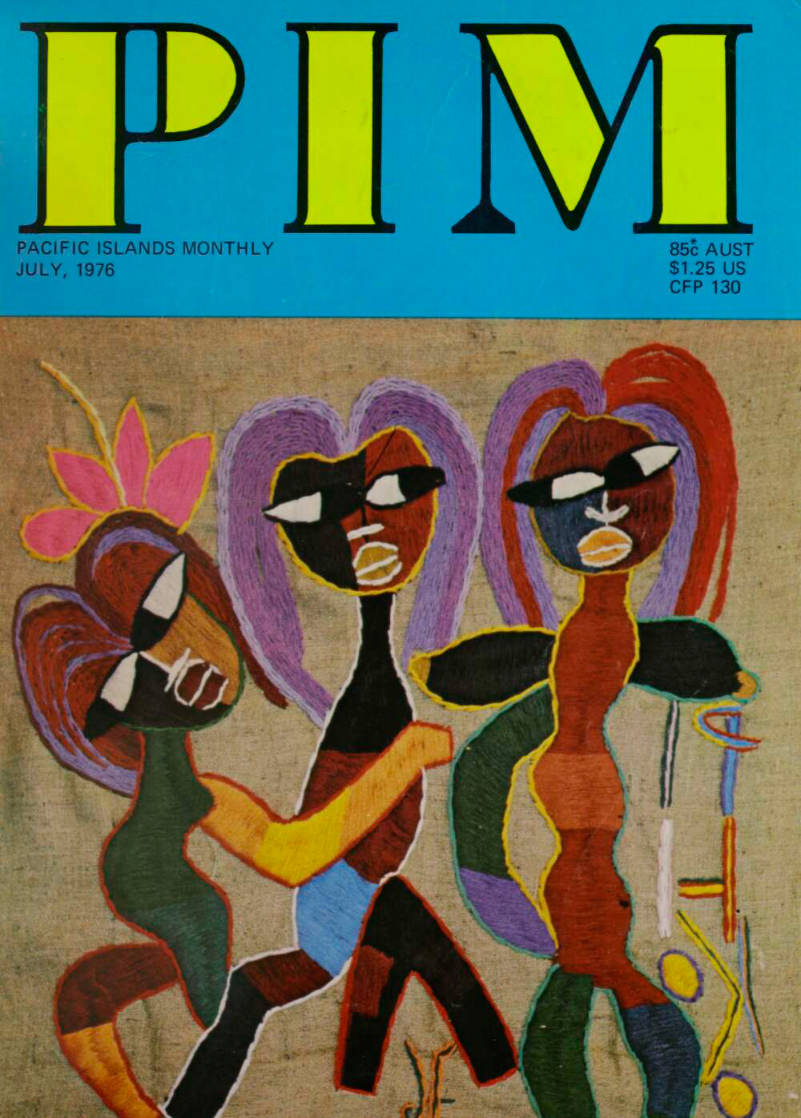
Our Cover
This striking “pain ting” w Wallisian ar tist Alio Pilioko and was exhibited at the Kabuki Gallery in Paddington, Sydney, in a display of his works and those of his mentor, Nicolai Michoutouchkine. Pil ioko used thick strands of wool to create his tapestries. A critique of the exhibition is on page 45.
Advertisements & other items, pp. 2-4 (1 item)
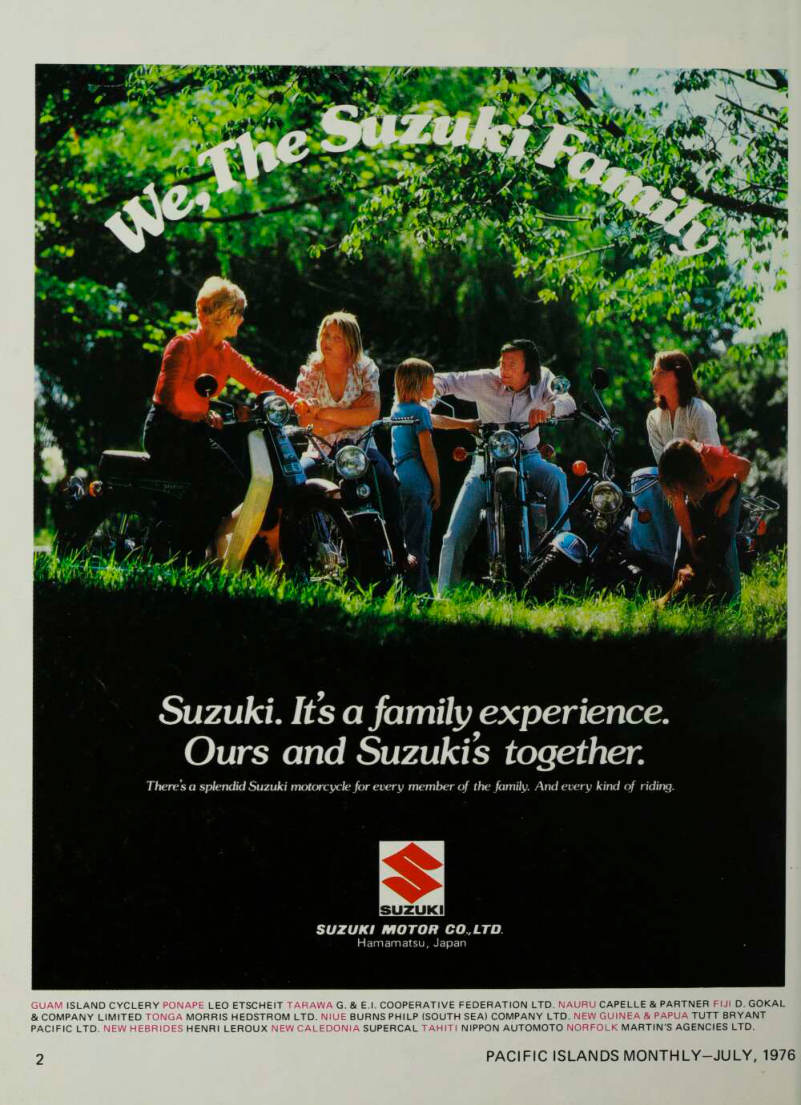
Suzuki. Its a family experience.
Ours and Suzuki s together.
There’s a splendid Suzuki motorcycle for every member of the family. And every kind of riding.
SUZUKI
SUZUKI MOTOR CO,LTD.
Hamamatsu, Japan GUAM ISLAND CYCLERY PONAPE LEO ETSCHEIT TARAWA G. & E.l. COOPERATIVE FEDERATION LTD. NAURU CAPELLE & PARTNER FIJI D, GOKAL & COMPANY LIMITED TONGA MORRIS HEDSTROM LTD. NIUE BURNS PHILP (SOUTH SEA) COMPANY LTD. NEW GUINEA & PAPUA TUTT BRYANT PACIFIC LTD. NEW HEBRIDES HENRI LEROUX NEW CALEDONIA SUPERCAL TAHITI NIPPON AUTOMOTO NORFOLK MARTIN'S AGENCIES LTD.
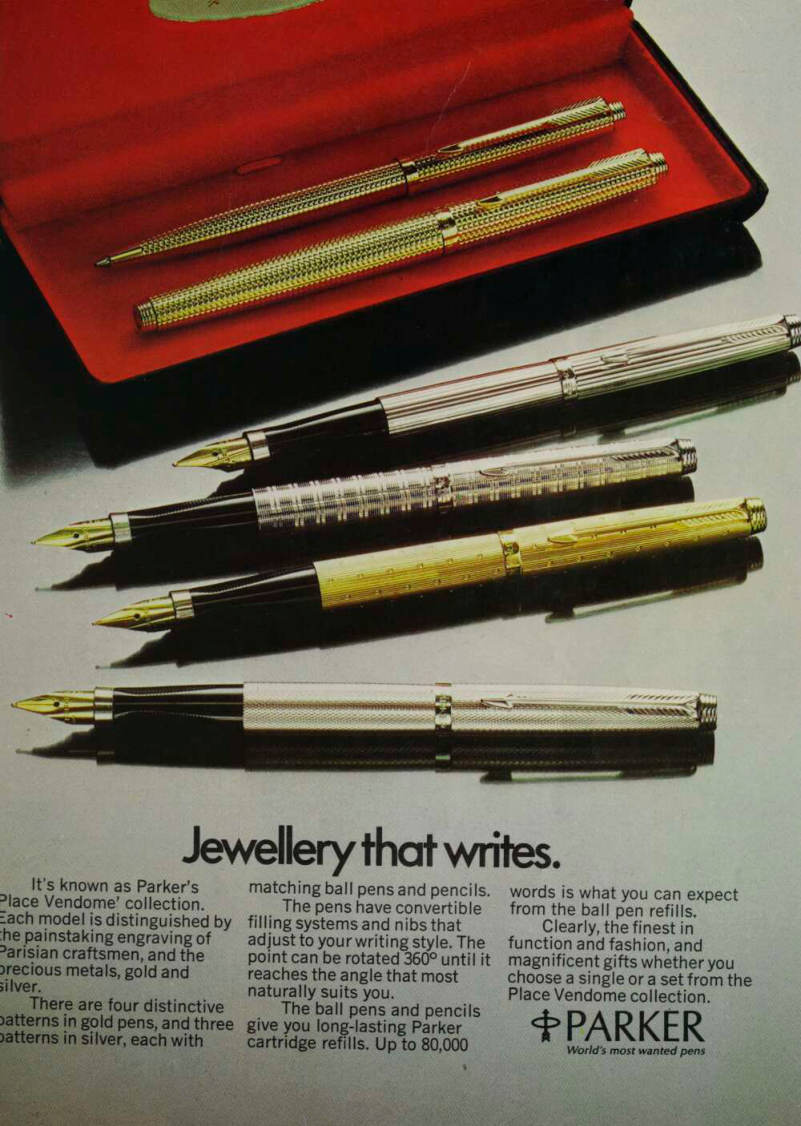
Jewellery that writes.
It’s known as Parker’s Vendome' collection.
Each model is distinguished by
:he painstaking engraving of
Frisian craftsmen, and the precious metals, gold and silver.
There are four distinctive patterns in gold pens, and three patterns in silver, each with matching ball pens and pencils.
The pens have convertible filling systems and nibs that adjust to your writing style. The point can be rotated 360° until it reaches the angle that most naturally suits you.
The ball pens and pencils give you long-lasting Parker cartridge refills. Up to 80,000 words is what you can expect from the ball pen refills.
Clearly, the finest in function and fashion, and magnificent gifts whether you choose a single or a set from the Place Vendome collection.
*PARKER
World's most wanted pens
Arnott’s!
The taste of Australia
Milk Arrowroot A wholesome biscuit enjoyed by all the family.
Milk Coffee . A
plain crisp biscuit to
enjoy with coffee or tea.
Amott’s plain sweet biscuits are not too sweet, not too fancy. They’re just right for those times when you really want a biscuit to go with a cup of tea or coffee, or a glass of icy cold milk.
Discover the taste of Amott’s for
yourself.
with fine sugar.
Nice . A sweet
biscuit sprinkled
«m %
BIBCUITB
2259N6.T
o MilkJjoffee
Shredded WheatmeaL Crunchy, with the nutty flavour of baked wheatmeal.
BISCUITS
m * r ii! • I * « *• * ■ * * ♦ » rrf £ <3 Ornotts
nice
axscuvrs Ornotts
mpi
BISCUITS
2250 NET
Qrnotts/“ Biscuits
There is no Substitute for Quality
W 639
Pacific Islands
Monthly
Founded By R.W Robson In 1930
Published Monthly By
Pacific Publications (Aust.) Pty. Ltd.,
76 Clarence Street, Sydney 2000.
Postal Address G.P.O BOX C4OB. SYDNEY,
N S W. 2001
Telegraphic Address PACPUB, Sydney Telex: 21242
Telephone 296693
Publisher: Stuart Inder.
Business Manager: John Berry
Pacific Islands Monthly
Editor: John Carter Advertising Manager: Alan Batt.
Subscription Rates:
"Pacific Islands Monthly" is airfreighted to the ma jority of subscribers and agents in the Pacific Islands and the U S A Australia (including Lord Howe and Thursday Islands), New Zealand, Papua New Guinea, Fiji, New Hebrides, Tonga, Cook Islands. Western Samoa, Gilberts and Tuvalu, Norfolk Island, Niue and Nauru: $9 00 (local currency); Solomon Islands: $lO.OO Aust ; American Samoa, Micronesia and Guam $12.00 US : Hawaii and U S Mainland: $l5 00 U.S.; New Caledonia and French Polynesia 1,500 C.F.P.; United Kingdom: £6 50; Japan: 4000 Yen, Elsewhere: $ll 50 Aust
Representatives
Fiji: Advertising and Distribution Fiji Times & Herald Ltd., 20 Gordon Street, Suva. Telephone 312-111 Telex: FJ 2124 Papua New Guinea: Advertising and Distribution PNG Post-Courier, P.O Box 85, Port Moresby Inquiries: Post Newsagency, Telephone 24-2148 French Polynesia: Distribution Hachette Pacifique, 10 Ave Bruat, Papeete New Caledonia: Distribution Depot Centre de Presse Michel PENTECOST, 8.P.C2 NOUMEA.
New Zealand: Pacific Publications, CPO Box 2229, Auckland United Kingdom: The Herald and Weekly Times Limited, 8-10 Clifford s Inn, Fetter Lane, London EC4A 1 BU. Telephone: 01-831 6041 Telex: Lon don 21989 Japan: Advertising Universal Media Corpora tion, C P O Box 46, Tokyo Telephone 666-3036 Victoria: Advertising Pacific Publications (Aust.) Pty. Ltd., Herald and Weekly Times Building, 2nd Floor, 61 Flinders Lane, Melbourne. 3000 Telephone: 652-1565 Brisbane: D Wood, Anday Agency. Box 1918 G.P.0.. Brisbane 4001 Telephone 44-3485 44- 1546 Hawaii and U S. Mainland only: N Grogan. (Send change of address notices. Form 3579 and new subscriptions to P.O. Box 2193, Honolulu, Hawaii
U S A 96805 )
Second class postage paid at Honolulu, Hawaii Printed in Australia
Copyright c, 1976,
Pacific Publications (Aust.) Pty. Ltd.
Printed by Paramac, Mitchell Road, Alexandria.
Registered at the G.P.O. Sydney for transmission by tost as a newspaper category B Recommended retail price only
Vol. 47, No. 7 July, 1976
Up Front
with the Publisher
Two quotes from a PIM piece last December: “The Queensland Government takes a hard line over the future of the islands in the Torres Strait, a political hot potato which is bound to feature on the parliamentary menus of both Australia and PNG in the next few months . . . The new nation of Papua New Guinea and Australia have vowed to foster a lasting friendship, but how long will it last?”
Not very long if the ratbag Premier of the Australian State of Queensland keeps stirring the stew.
In June, PNG Foreign Affairs Minister Sir Maori Kiki and Australian Foreign Af fairs Minister Andrew Peacock came up with a compromise agreement on the vex ed border question. The new border between PNG and Australia is to run south of the islands of Boigu, Dauan and Saibai, which are Australian islands within a stone’s throw of the PNG mainland. Just how far south is yet to be fixed, but at least it won’t be skirting PNG’s beaches, as it does now. But the three islands will remain Australian, their people Australian citizens.
It’s an unusual compromise, in theory not neat, but in practice, in that area with its long history of friendly “togetherness”, practical. It’s a typical Islands’ approach to a problem, with grey areas recognised and accepted. Living together means com promise, consensus; few problems have a
simple right or wrong.
Andrew' Peacock, who has great regard for Papua New Guineans, deserves credit, with the Australian Cabinet, for an enlightened approach in handling the first major dispute between PNG and Australia.
Not so Queensland Premier Bjelke- Petersen. He’s loudly, insultingly opposed to any concession on his State boundaries.
Says he, “A nation smaller than Queensland has been able to put it all over Canberra, even though it has no legal or moral right to claim any part of the Torres Strait except for its greed to lay hands on oil supposed to occur in this part of Queensland and Australia.”
Stripped to essentials, what the Queensland State Premier is saying is, “It’s power politics! We’re bigger, so we win!”
Thank God his view is not supported by the Australian Government. But that kind of attitude is too commonly held in Australia nevertheless.
The Island nations of the South Pacific are their own men now. They may be small but they're entitled to equal consideration.
What’s more, nobody should make the mistake of believing that the “Pacific way” of consensus and respect for others means they’ll display no steely resolve should all other avenues for getting a fair go fail.
When close friends fall out, the struggle can be bitter.
Stuart Inder
Andrew Peacock
Advertisements & other items, pp. 5-6 (2 items)
5
’ACIFIC ISLANDS MONTHLY-JULY, 1976
important ingredient
i m a y v: o 9 ■ * on E I 1 ' I m 000 -1 ■ Trr f ■ n r *; ;■
Jmßns.w.
*«&«» AUSTRALIA
mm w f'v"
K 4.
Ff| a
the most
BREAD FLOURS: •
CAKE FLOURS: •
BISCUIT FLOURS: •
SPECIALITY FLOURS: •
important ingredient
MAINTOP—high protein bread flour ANCHOR—bakers flour • 50/50 MEAL—brown bread MEDlUM—cake and pastry • SPONGE—sponge cakes SPECIAL CAKE—madeira and cup cakes STRONG—cracker biscuits • MEDlUM—Shortbreads SOFT—sweet biscuits RYE flour • RYE meal • KIBBLED RYE SHARPS—roti and chapati flour • 100% STONE GROUND
WHOLEMEAL
GILLESPIE BROS. PTY. LTD.
HEAD OFFICE; BRISBANE OFFICE;
52 UNION ST., PYRMONT, SYDNEY, N.S.W. CABLE ADDRESS: ALBION, BRISBANE, QUEENSLAND. (G.P.O, BOX 2518, SYDNEY, 2001.) "GILLESPIE", (P.O. BOX 8, ALBION, BRISBANE, 4010.) PHONE: 660-4933. SYDNEY AND BRISBANE. PHONE: 6-1121.
In this issue
General
SP Games in Fiji in 1979 Busy Rugby teams East-West Centre Festival for posterity SPC changes forecast Pacific art in Sydney Regional ships face storm Polynesian canoe's voyage
Cook Islands
Rugby team in NZ Business waltz New business flurry
Fiji
Host to 1979 SP Games Soldier in trouble Rugby tour of Australia Prime Minister warns about western culture Altair refloated Waterfront strike looms Maritime brain drain
French Polynesia
News blackout
Gilbert Islands
Drifting fishermen rescued House of Assembly meets
Nauru
Cargo rates up
New Caledonia
12 Budget juggling 11 13 Lobster industry 53 30
33 New Hebrides
33 Election results annulled n 45 Political hammer blows 25 59 Battling to fill hotel beds 51
67 Norfolk Island
Buffett resigns 13
13 Papua New Guinea
53 Villagers' problems 10 53 Chimbu control 12 Living low 12 Sliding death 12 12 Students' morals 12 13 Filipinos' lament 12 13 Watersiders’ award 13 Pidgin as national language 14 54 Burial customs 14 61 “Orgies'' in the Highlands 14 61 Cargo cultists gaoled 17 63 Torres Strait talks 18 Adultery law 20 Hiri Motu 48 9 Commercial cardamon 57 Air Nuigini buys more planes 61 Death of David Fenbury 68
]G Solomon Islands
Civil servants' rents 17
Tonga
63 Church still in 19th century 8
NZ gift creates industry 53 Salary gap bridged 53
Us Trust Territory
Typhoon terror 12 Coleman's adventures 15 Talks on future 20 Micronesia: Trust betrayed (review) 47 Passion in Palau 49 Round to Continental Air 63
Wallis Island
Pilioko’s works hand in Sydney 45
DEPARTMENTS: Up Front with the Publisher 5; Tropicalities, 14; People, 17; Editor’s mailbag, 21; Islands Press, 31; Magazine Section, 39; Books, 47; Business & Development, 51; Pacific Transport, 59; Cruising yachts, 65; Deaths of Islands People, 68; Shipping and Airways information, 70; Produce Prices, 75.
Tonga’S Church, Outdated Or
On The Way To A Renewal?
By a special correspondent in Nukualofa
To consider the Church in Tonga is to look with fascination at an undoubted major institution.
It is also still a 19th century Church, riddled unfortunately with practices which raise questions of depressing magnitude.
Questions I will try to answer here are: What does the Church do for the people and vice versa, and what sort of future does the Church face in Tonga?
There is not space to consider now how the Church became what it is and what ef fect it has had on Tongan social life, nor to what extent the Church cares for the mass of have-nots, to what extent it exerts its authority against increasingly strong in terruptions of the Sabbath, and, further, how deeply it participates in politics?
Suffice it is to say that its deep in volvement in Tongan life must be taken for granted.
The Christian religion has made a deep and permanent impact upon the Tongan people. Most have followed the teachings of the Wesleyan missionaries in their various forms. Wesleyans do not however hold the field entirely unchallenged.
There are Catholics, Seventh-day Ad ventists, Anglicans, Mormans, and others.
The impact has been so profound that even in this day of declining interest in religion it is still true that all Tongans, at least those still residing in Tonga, belong to one religion or another.
Church activities and ceremonies oc cupy an important part of the everyday life of Tongans. Each Sabbath there are at least two services and both are well at tended, even though they often last for an hour or two. There is a Sunday School for the youngsters where they are taught more to memorise than understand the various
dogmas.
In addition there are services on at least three week-days. From time to time during the year additional week night ser vices take place in connection with the public organisation of the Church meetings of various committees making drives for church funds.
The Church provides educational ser vices to a degree unparalleled in the South Pacific. Over three-quarters of the secon dary school population are in church schools financed entirely by the Church.
Years of pleading with the government have so far yielded no positive results in terms of the State sharing the financial burden. Consequently, some of the chur
ches have begun phasing out their primary school systems to hand over the task to the government.
The Church also plays an important role in providing social centres and social gatherings for many of the youth who would otherwise be only passing the time doing nothing. While this movement is still in its infancy there are heartening aspects of the movement which indicate further and promising development.
In some areas, especially in recent years there has also been an awareness of the need for provision of adult education.
But the provision of all these services is very costly.
Each Sabbath the main morning service is generally followed by a sumptuous and very costly feast in honour of the visiting preacher. Practically every family is bur dened with having to provide such a feast
which normally costs approximately $lOO in kind and cash at least once a year.
Most families can ill-afford such ex penditure. As one man put it, “Honestly, I cannot really afford to provide this luxury, but it will be embarrassing if I and my family do not provide one as all the others are doing it.”
Apparently there have been attempts made by the younger and more enlightened ministers to do away with this practice but the opposition has been strong from the old and more conservative elements. In addition there is an annual misinale or (donation) in which the average family contributes roughly a quarter of its annual cash in come of approximately $3OO.
Not having a system of indirect taxation at its disposal the Church must ask the Tongans for contributions for its various purposes such as educational activities.
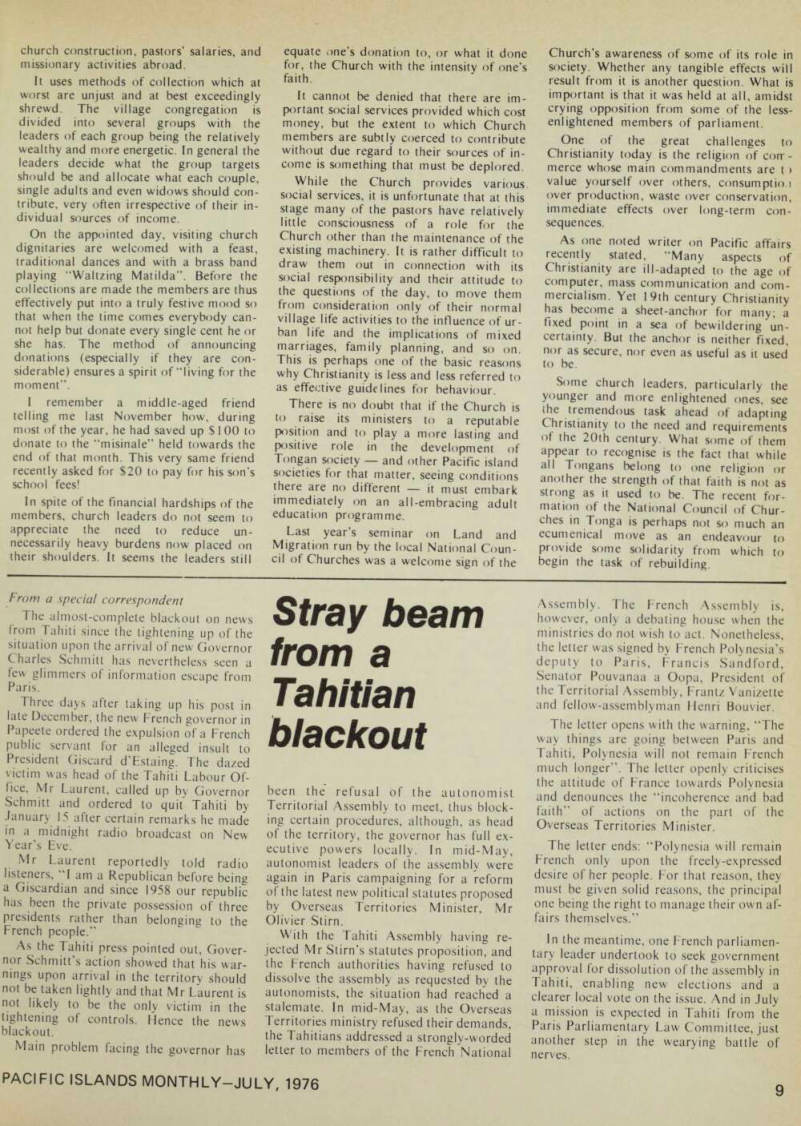
The Royal Chapel in Nukualofa...a symbol of the kingdom's Christianity.
church construction, pastors’ salaries, and missionary activities abroad.
It uses methods of collection which at worst are unjust and at best exceedingly shrewd. The village congregation is divided into several groups with the leaders of each group being the relatively wealthy and more energetic. In general the leaders decide what the group targets should be and allocate what each couple, single adults and even widows should con tribute, very often irrespective of their in dividual sources of income.
On the appointed day, visiting church dignitaries are welcomed with a feast, traditional dances and with a brass band playing “Waltzing Matilda”. Before the collections are made the members are thus effectively put into a truly festive mood so that when the time comes everybody can not help but donate every single cent he or she has. The method of announcing donations (especially if they are con siderable) ensures a spirit of “living for the moment”.
I remember a middle-aged friend telling me last November how, during most of the year, he had saved up $ 1 00 to donate to the “misinale” held towards the end of that month. This very same friend recently asked for $2O to pay for his son’s school fees!
In spite of the financial hardships of the members, church leaders do not seem to appreciate the need to reduce un necessarily heavy burdens now placed on their shoulders. It seems the leaders still
equate one’s donation to, or what it done for, the Church with the intensity of one’s faith.
It cannot be denied that there are im portant social services provided which cost money, but the extent to which Church members are subtly coerced to contribute without due regard to their sources of in come is something that must be deplored.
While the Church provides various social services, it is unfortunate that at this stage many of the pastors have relatively little consciousness of a role for the Church other than the maintenance of the existing machinery. It is rather difficult to draw them out in connection with its social responsibility and their attitude to the questions of the day, to move them from consideration only of their normal village life activities to the influence of ur ban life and the implications of mixed marriages, family planning, and so on.
This is perhaps one of the basic reasons why Christianity is less and less referred to as effective guidelines for behaviour.
There is no doubt that if the Church is to raise its ministers to a reputable position and to play a more lasting and positive role in the development of Tongan society and other Pacific island societies for that matter, seeing conditions there are no different it must embark immediately on an all-embracing adult education programme.
Last year’s seminar on Land and Migration run by the local National Coun cil of Churches was a welcome sign of the
Church’s awareness of some of its role in society. Whether any tangible effects will result from it is another question. What is important is that it was held at all, amidst crying opposition from some of the less enlightened members of parliament.
One of the great challenges to Christianity today is the religion of corr merce whose main commandments are t) value yourself over others, consumption over production, waste over conservation, immediate effects over long-term con sequences.
As one noted writer on Pacific affairs recently stated, “Many aspects of Christianity are ill-adapted to the age of computer, mass communication and com mercialism. Yet 19th century Christianity has become a sheet-anchor for many; a fixed point in a sea of bewildering un certainty. But the anchor is neither fixed, nor as secure, nor even as useful as it used to be.
Some church leaders, particularly the younger and more enlightened ones, see the tremendous task ahead of adapting Christianity to the need and requirements of the 20th century. What some of them appear to recognise is the fact that while all Tongans belong to one religion or another the strength of that faith is not as strong as it used to be. The recent for mation of the National Council of Chur ches in Tonga is perhaps not so much an ecumenical move as an endeavour to provide some solidarity from which to begin the task of rebuilding.
Stray beam
from a Tahitian blackout
From a special correspondent The almost-complete blackout on news from Tahiti since the tightening up of the situation upon the arrival of new Governor Charles Schmitt has nevertheless seen a few glimmers of information escape from Paris.
Three days after taking up his post in late December, the new French governor in Papeete ordered the expulsion of a French public servant for an alleged insult to President Giscard d’Estaing. The dazed victim was head of the Tahiti Labour Of fice, Mr Laurent, called up by Governor Schmitt and ordered to quit Tahiti by January 15 after certain remarks he made m a midnight radio broadcast on New Year’s Eve.
Mr Laurent reportedly told radio listeners, lam a Republican before being a Giscardian and since 1958 our republic has been the private possession of three presidents rather than belonging to the French people.”
As the Tahiti press pointed out, Gover nor Schmitt’s action showed that his war nings upon arrival in the territory should not be taken lightly and that Mr Laurent is not likely to be the only victim in the tightening of controls. Hence the news blackout.
Main problem facing the governor has
been the refusal of the autonomist Territorial Assembly to meet, thus block ing certain procedures, although, as head of the territory, the governor has full ex ecutive powers locally. In mid-May, autonomist leaders of the assembly were again in Paris campaigning for a reform of the latest new political statutes proposed by Overseas Territories Minister, Mr Olivier St irn.
With the Tahiti Assembly having re jected Mr Stirn’s statutes proposition, and the French authorities having refused to dissolve the assembly as requested by the autonomists, the situation had reached a stalemate. In mid-May, as the Overseas Territories ministry refused their demands, the Tahitians addressed a strongly-worded letter to members of the French National
Assembly. The French Assembly is, however, only a debating house when the ministries do not wish to act. Nonetheless, the letter was signed by French Polynesia’s deputy to Paris, Francis Sandford, Senator Pouvanaa a Oopa, President of the Territorial Assembly, Frantz Vanizette and fellow-assemblyman Henri Bouvier.
The letter opens with the warning, “The way things are going between Paris and Tahiti, Polynesia will not remain French much longer”. The letter openly criticises the attitude of France towards Polynesia and denounces the “incoherence and bad faith” of actions on the part of the Overseas Territories Minister.
The letter ends: “Polynesia will remain French only upon the freely-expressed desire of her people. For that reason, they must be given solid reasons, the principal one being the right to manage their own af fairs themselves.”
In the meantime, one French parliamen tary leader undertook to seek government approval for dissolution of the assembly in Tahiti, enabling new elections and a clearer local vote on the issue. And in July a mission is expected in Tahiti from the Paris Parliamentary Law Committee, just another step in the wearying battle of nerves.
by bureaucracy
PNG borrowers bamboozled by bureaucracy
From Lee Mckenzie
in Port Moresby
Papua New Guinea villagers have long suffered a confused frustration in dealings with government, in common with their counterparts elsewhere.
But now, several national leaders in sympathy with their predicament, are calling for radical changes.
This communication gap shows up markedly in the difficulties en countered by those seeking aid. The Development Bank and other agen cies are designed to assist legitimate community groups to establish enter prises of benefit to rural areas. Many have received help but not enough, ac cording to Dr Reuben Taureka. in his new capacity as Minister for Broadcasting and Information, he has spoken out on behalf of the unin formed. They get little help from some national public servants who emulated the worst attitudes of their colonial “masters”. Most village peo ple were afraid of them or did not even know who to approach for a loan or how to go about it, Dr Taureka said.
Mr Gavera Rea, Minister for Commerce, Labour and Industry, condemned the District Village Econ omic Development Fund as a “bureaucratic monster” which obstructed applicants in a tangle of red tape. He said that “what was meant to be a simple, speedy aid scheme, is now useless and should be scrapped to be replaced by a more direct method of aid.”
The PNG public service in its pre sent inherited format is huge, un wieldy and complex. By its nature, any dealings with it involve the filling in of forms, couched in difficult “of ficialese”.
Its adherence to sophisticated ac counting and administrative procedures inhibits the direct ap proach. Thus, the ordinary citizen must undergo scrutiny and be subject to a paper hassle whenever in contact with any aspect of government, be it the law, a local council or district of fice.
Critics call for radical reform of an
overlarge, intrinsically foreign and en trenched bureaucracy.
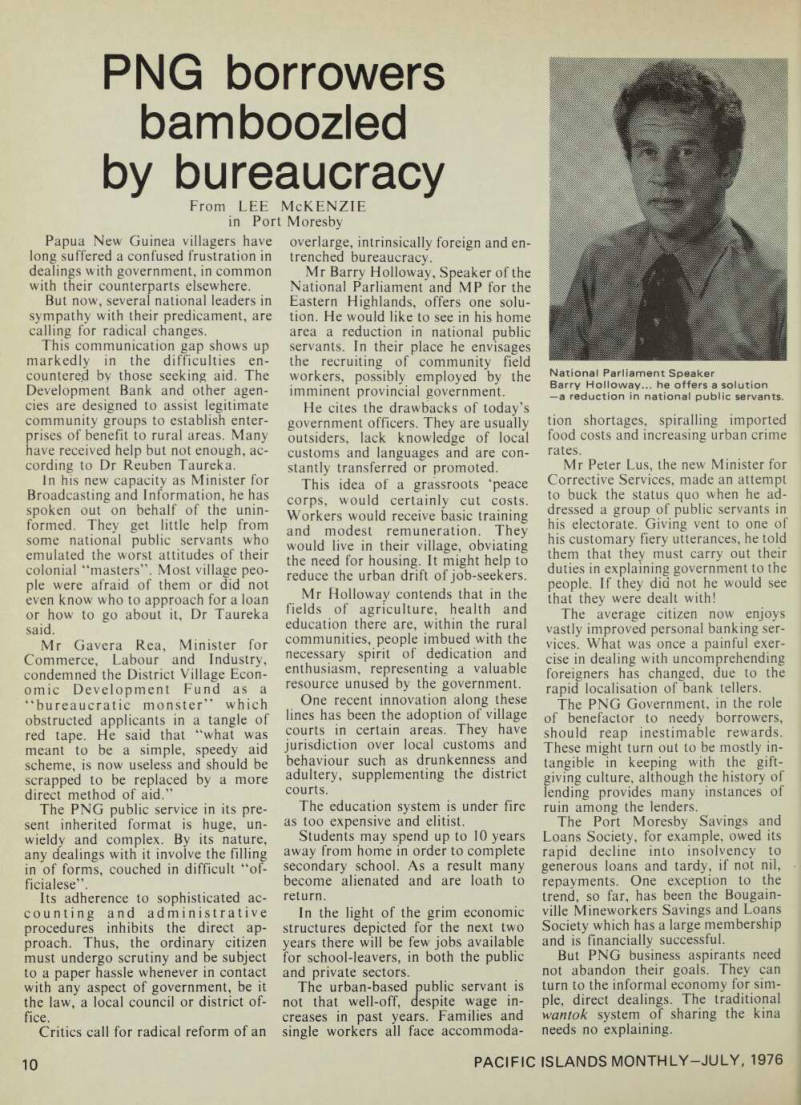
Mr Barry Holloway, Speaker of the National Parliament and MP for the Eastern Highlands, offers one solu tion. He would like to see in his home area a reduction in national public servants. In their place he envisages the recruiting of community field workers, possibly employed by the imminent provincial government.
He cites the drawbacks of today’s government officers. They are usually outsiders, lack knowledge of local customs and languages and are con stantly transferred or promoted.
This idea of a grassroots ‘peace corps, would certainly cut costs.
Workers would receive basic training and modest remuneration. They would live in their village, obviating the need for housing. It might help to reduce the urban drift of job-seekers.
Mr Holloway contends that in the fields of agriculture, health and education there are, within the rural communities, people imbued with the necessary spirit of dedication and enthusiasm, representing a valuable resource unused by the government.
One recent innovation along these lines has been the adoption of village courts in certain areas. They have jurisdiction over local customs and behaviour such as drunkenness and adultery, supplementing the district courts.
The education system is under fire as too expensive and elitist.
Students may spend up to 10 years away from home in order to complete secondary school. As a result many become alienated and are loath to return.
In the light of the grim economic structures depicted for the next two years there will be few jobs available for school-leavers, in both the public and private sectors.
The urban-based public servant is not that well-off, despite wage in creases in past years. Families and single workers all face accommoda-
tion shortages, spiralling imported food costs and increasing urban crime rates.
Mr Peter Lus, the new Minister for Corrective Services, made an attempt to buck the status quo when he ad dressed a group of public servants in his electorate. Giving vent to one of his customary fiery utterances, he told them that they must carry out their duties in explaining government to the people. If they did not he would see that they were dealt with!
The average citizen now enjoys vastly improved personal banking ser vices. What was once a painful exer cise in dealing with uncomprehending foreigners has changed, due to the rapid localisation of bank tellers.
The PNG Government, in the role of benefactor to needy borrowers, should reap inestimable rewards.
These might turn out to be mostly in tangible in keeping with the gift giving culture, although the history of lending provides many instances of ruin among the lenders.
The Port Moresby Savings and Loans Society, for example, owed its rapid decline into insolvency to generous loans and tardy, if not nil, repayments. One exception to the trend, so far, has been the Bougain ville Mineworkers Savings and Loans Society which has a large membership and is financially successful.
But PNG business aspirants need not abandon their goals. They can turn to the informal economy for sim ple, direct dealings. The traditional wantok system of sharing the kina needs no explaining.
National Parliament Speaker Barry Holloway... he offers a solution —a reduction in national public servants.
Caledonian
Budget
Juggling
The New Caledonian 1976 Budget was finally voted by the Territorial Assembly in mid-May after the French administra tion backed down by cutting public service expenditure. Aid to non-government schools was also cut after the assembly refused a French Government proposal to take over control of all secondary educa tion in the territory.
Until May, the administration had been functioning on monthly estimates with many government accounts remaining un paid while the assembly refused the Paris education proposals to overcome a deficit of about SAIO million. Noumea’s Roman Catholic schools put up a tough resistance to French government control, protesting that “Catholic schools were not for sale”.
Mgr Klein, Bishop of Noumea, issued a strong word of encouragement to Catholic teachers fighting the scheme.
The budget was formally approved by 18 out of 35 members of the assembly, several days after the May 11 opening of the assembly’s second session for the year.
Contrary to general procedure, the governor did not attend the opening of the session to deliver his customary “address from the throne” and detail the state of the economy. In what could be seen as a further down-grading of the Territorial Assembly, Governor Eriau, instead, gave an exclusive interview to a local daily newspaper. This was published the day after the budget vote and the day of Eriau’s departure to Paris for Government talks.
The governor warned that the same problem of a budget deficit would have to be faced in 1977. He pointed out that the assembly would have to accept greater control (with funds) from Paris or else change local tax laws, thereby hinting at the likelihood of the introduction of per sonal income tax which the Caledonians have been strenuously resisting in view of the notorious frauds this involves in France.
The governor pointed out the inade quacy of territorial budget revenue. Under the expensive bureaucracy Paris has set up in the territory, local revenue is swallowed up almost completely in running the public service. This means an almost equal amount (about SABO million) is required in loans and grants from France for invest ment and military projects. Of course this indebtedness to France, which controls the island’s nickel industry, has been a major protest issue with the Caledonian autonomists.
Meanwhile, earlier in May, the territory’s sole smelting company, SEN, received a large group of visitors from
France and other European countries, who were treated to lavish hospitality and taken on tours of inspection of the SEN smelters in Noumea and the extensive installations at the west coast mining town of Nepoui.
The visitors especially included SEN clients, manufacturers of steel alloys.
Those interviewed at the end of their visit, indicated how greatly they had been impressed by the SEN installation and what confidence this inspired in their dealings with the company. In view of the
fact that a similar publicity exercise was conducted in the territory in 1971 by Baron Guy de Rothschild and other SEN heads, the motive of the latest visit puzzled the Caledonians. It would seem to have been intended to show the value of retaining New Caledonia for France, and to make sure tf, e influential industrialists in France had seen the territory themselves so that t h ey could actively champion this cause in t h e face of pressure for Caledonian in
dependence.
Hebrideans' gallery
Playing to New Hebrideans' gallery
From a Vila correspondent The court of disputed returns in the New Hebrides handed down its decision on May 10 in Vila to annul the election of four candidates elected to the con dominium's first Representative Assembly last November. Three of the four can didates had lodged an appeal by late May. They were all members of the National Party majority Mrs Mary Gilu (Urban Santo), and Thomas Ruben and Titua Path, who together with the fourth candidate, Michel Thevenin (Manh- Nagriamel Party) were from the Rural Santo Electorate. The Santo Rural results had been contested by Jimmy Stevens in particular.
Appeals would go to the Joint Court in Vila, which would necessitate Mr Justice Davis from the Solomons sitting with French Judge Cazendres. The elec tion decision came almost six months after the voting in November and was hand ed down on the eve of the departure from Noumea of French High Commissioner in the Pacific, Mr J. G. Eriau, who left for talks in Paris.
Meanwhile, the show to “amuse the gallery” put on a new act in Vila on April 29 when Remy Delaveuve’s UCNH party called for 10 New Hebridean chieftains to be elected to the Representative Assembly, instead of the four originally intended under the murky “soup” of an electoral system cooked up by the authorities. Disputes over the designation of the chiefs has “conveniently” provided the stumbling block to calling together the condominium’s first Assembly, where the independence-seeking National Party would hold the ma jority.
When the British and French authorities called for an informal meeting of assembly members on April 29 to discuss the stalemate, only 14 of the 38 elected came to talk. They were 10 members of the UCNH (Union des Communautes des Nouvelles Hebrides), one member of Manh-Nagriamel and three of the nine members representing not political parties but “economic interests”. Also atten ding the gathering were eight men representing Hebridean chiefs and invited by
Ucnh.
The CNH initiative of porposing 10 chiefs in the assembly seems to be turn ing the limelight from Jimmy Stevens in Santo onto Remy Delaveuve in Vila, both men stars in the French realm. Remy Delaveuve was in Noumea some months ago reportedly studying the workings of the Noumea municipal council as a model for Vila’s first municipal council, where he is mayor. Since then he has been to Paris and was quoted in the Noumea press as suggesting that the New Hebrides may not have an assembly until new elections can follow an official register of the population, currently being prepared which gives the authorities more time to orchestrate the next act.
Nutshell
The
News
In A
Nutshell
Typhoon Terror
Typhoon Pamela, gusting at times to 190 kilometres an hour, devastated Truk district on May 18, practically flattened Guam soon after and then headed for the Philippines, parts of which had just been badly damaged by Typhoon Olga. Ten people were killed, including three who died on Moen Island when a two-storey house was buried in a landslide. Many houses were damaged, roads were badly damaged by sea water whipped up by the typhoon, crops were destroyed and boats washed away. The cost of the damage ran into millions of dollars.
Pamela was responsible for three more deaths on Guam, and she left thousands homeless. President Ford declared Guam a disaster area, and pledged federal assistance for temporary housing, disaster unemployment payments, debris removal and repairs. About 80 per cent of the buildings on Guam were wrecked, and 1,000 military families were left homeless.
It was reported that eight ships sank in Guam Harbour.
Chimbu Control
PNG Prime Minister Michael Somare, plans to declare regular tribal fighting grounds as emergency zones declared areas where effective on-the-spot police rule can be applied. Emergency zone regulations give the police, and other authorities, wide powers to stop distur bances. The police can make mass arrests without immediate formalities, restrict or order movement and use firearms.
Mr Somare announced his plans at meetings in May with leaders of the Chim bu area in the central ranges of PNG. He flew from Port Moresby to Kundiawa, the
administrative headquarters for Chimbu, one of the most densely-populated areas of PNG, and the one most plagued by tribal fighting. Mr Somare said he would put his plan to the National Parliament through the National Executive Council.
He proposed that the emergency zone powers should be applied to areas which were recognised as tribal fighting grounds and where the major fighting was, but he opposed a call by some Chimbu leaders for greater general police powers, including a blanket approval to carry arms.
Games For Fiji
Fiji will host the 6th South Pacific Games in 1979. The year chosen throws out the normal three-yearly cycle.
However, the Seventh Games in 1981 will restore the cycle, but the cycle had already been broken — the fourth Games were held in 1971 instead of 1972, and there was a four-year gap between the fourth and the fifth Games.
Several Fiji sporting bodies have agreed to billet their counterparts for the 1979 Games. This will help to cut down costs, which are now almost astronomical in con
ducting major sports gatherings.
The secretary of the Fiji Amateur Sports Association, Mr Brian Wightman, has written to all affiliated associations, asking for help in organising the Games.
Living Low
Treasurers, finance ministers and their equivalents must have been envious of Papua New Guinea’s performance in the three months to March 31 when the con sumer price index rose by a mere 1.29 per r ent. That would have made PNG’s infla tion rate one of the lowest in the world.
The PNG Finance Minister, Mr Julius Chan, offered congratulations to the business community for co-operation. He said the low rate of inflation followed the identification of problem areas by the government and effective administration by the price control. That, however, would not have been possible without the co operation of businessmen and workers.
Sliding Death
Seven women and three children were killed in a landslide which fell on Banakyoke Village, in the Menyamya area of central eastern Papua New Guinea late in May. Eighty people were left homeless after hundreds of tons of clay, mud and stone slid down a mountain from a height of nearly 330 metres on to the village. Con tinuous heavy rain caused three major landslides in the area in a fortnight. Air craft from the Papua New Guinea Defence Force dropped food, tents and other supplies to the stricken village. The police and government officers warned villagers to keep a regular watch on surrounding mountain slopes in case continued rain brought further slides.
Students’ Morals
The Roman Catholic Bishops of Papua New Guinea have asked universities and colleges to stop providing contraceptives for students. “Pandering to human weakness” is how the bishops describe the present situation in a statement issued from a bishops’ conference in Rabaul.
They say that an increasing trend towards issuing contraceptives has been described as “protecting students from the effects of behaviour”. They believe, however, that any protection is being achieved at the ex pense of moral and community values, which in the long term will be damaging to PNG. “By pandering to human weakness in this way, the power for good which a college holds is considerably reduced” the bishops say in their statement.
Filipinos’ Lament
Filipinos brought into Papua New Guinea on government employment con tracts have asked the Philippines Presi dent, Mr Marcos, to help in raising their pay. They have sent a formal letter to the president from the Filipino Association of PNG calling on him to direct officers of his government to open negotiations with Papua New Guinea over the pay rates.
They claim that they were not told when they were recruited that they would be get ting lower wages in PNG than any other employees recruited from overseas. They said they are on the bottom of a wages hierarchy in which Australians are on top, followed by New Zealanders and British in that order. “We don’t ask for parity with these, but want a little increase in our salaries and conditions,” the Filipinos say, and add that one reason they require higher wages and better conditions is for the “honour and dignity of the Philip pines”.
Gang Warfare
Police reinforcements were sent to the Buin area of Bougainville late in May following reports of lawlessness, which in volved terrorism and gang violence. A number of senior public servants left Buin township and others said they would leave because of terrorism. Teachers at Buin High School were ready to board the first aircraft out of Buin on May 31 after a series of incidents involving members of a village gang, teachers and students.
According to one report from the area there was acomplete breakdown of law and order. A gang of youngsters believed to be operating under political motivations, call ing itself the Kumamaru Rascal Gang, was going round the town and villages, molesting older people, abusing public ser vants and destroying homes and property.
The deputy headmaster of Buin High School, Mr Joel Evi, said he was held by six young men and threatened at knife point because the school would not allow
the men to attend a social function held by the school.
The most terrifying night was on May 29 when a truck load of men drove round the school, firing shots into the air and shouting Mipela i buruk pinis (“We have succeeded”) and “Go home, red faces”.
The Provincial Commissioner, Mr Benson Gegeyo, asked the Minister for Correc tional Services and Liquor Licensing, Mr Pita Lus, to consider banning the sale of liquor in the area for two months until law and order was restored.
Won One, Lost One
The Central District Waterside Workers Union in Papua New Guinea won one and lost one in their 1976 award, which was handed down recently. They gained in leave provisions but lost the afternoon tea break. They are now entitled to six months long-service leave after 15 years con tinuous service with the one employer, and after three years with one employer they are entitled to proportionate long-service leave. On top of two days paid leave on the death of a close relative, they may now take 12 days unpaid compassionate leave.
The 10-minute tea-break still applies, but only for a four-hour shift under the new award. As the afternoon shift is three hours they are no longer entitled to a tea break. A small gain was an extra five minutes washing time before meals, but only after working particularly dirty or noxious cargo.
Fijian Stray
A Fijian soldier, recruited 14 years ago for the British Army, has been caught up in Northern Ireland’s troubles with rather serious consequences. The soldier, Sergeant Ilisoni Vanioni Ligari, 34, from Wailevu, Savusavu, a member of the crack Special Air Services Regiment, was a
member of a patrol which strayed over the border into Eire. They were arrested by Eire troops and police and taken to Dublin. In Dublin they were charged with having possession of firearms and am munition with intent to endanger life and with not having firearms certificates. They were all released on £5,000 cash bail, put up by the British Embassy, pending their trial. The arms included nine Sterling sub machine guns, eight Browning automatic
pistols, three pump-action shotguns and 744 rounds of 9 mm ammunition.
Busy Rugby Teams
The 1976 rugby season was one of the busiest ever for Pacific Islands teams on the international scene. Fiji, on June 26, was scheduled to complete a 13-match tour of Australia; the Cook Islands made their first-ever overseas tour to New Zealand in May at the end of June Western Samoa was to send a team to NZ for an eight-match tour, while at home, a Fiji XV was to play a touring Irish team, which was on its way home after a seven-match tour of NZ.
The Fiji team had mixed success in the first half of the tour, with three wins and three losses. One of the losses was to South Australia, where rugby is a minor code. It was SA’s first win against an overseas team. But a better performance against NSW Country, even though beaten 13-11 put the team in good heart for the remain ing matches, which included three tests.
The Cook Islanders, playing mainly against Maori teams, had an indifferent lour. They lost one match 13-76, then made a remarkable turnround to hold a very strong team and lose narrowly 6-12.
The tour, however, will have many benefits in the future. Already prominent New Zealand rugby men have said they want to take touring teams to the Cooks next season.
Mr Buffett's Had A Gutful
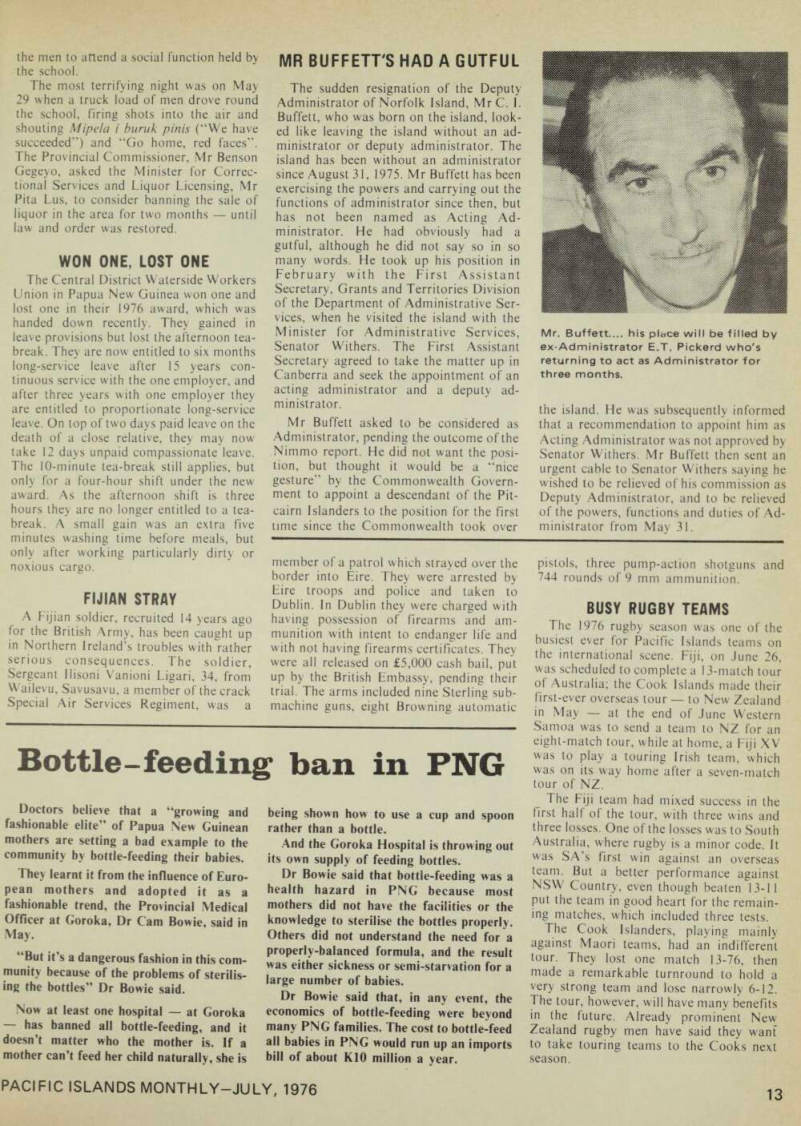
The sudden resignation of the Deputy Administrator of Norfolk Island, MrC. I.
Buffett, who was born on the island, look ed like leaving the island without an ad ministrator or deputy administrator. The island has been without an administrator since August 31, 1975. Mr Buffett has been exercising the powers and carrying out the functions of administrator since then, but has not been named as Acting Ad ministrator. He had obviously had a gutful, although he did not say so in so many words. He took up his position in February with the First Assistant Secretary, Grants and Territories Division of the Department of Administrative Ser vices, when he visited the island with the Minister for Administrative Services, Senator Withers. The First Assistant Secretary agreed to take the matter up in Canberra and seek the appointment of an acting administrator and a deputy ad ministrator.
Mr Buffett asked to be considered as Administrator, pending the outcome of the Nimmo report. He did not want the posi tion, but thought it would be a “nice gesture” by the Commonwealth Govern ment to appoint a descendant of the Pit cairn Islanders to the position for the first ume since the Commonwealth took over
the island. He was subsequently informed that a recommendation to appoint him as Acting Administrator was not approved by Senator Withers. Mr Buffett then sent an urgent cable to Senator Withers saying he wished to be relieved of his commission as Deputy Administrator, and to be relieved of the powers, functions and duties of Ad ministrator from May 31.
Mr. Buffett... his place will be filled by ex-Administrator E.T. Pickerd who's returning to act as Administrator for three months.
Bottle-feeding ban in PNG
Doctors believe that a “growing and fashionable elite” of Papua New Guinean mothers are setting a bad example to the community by bottle-feeding their babies.
They learnt it from the influence of Euro pean mothers and adopted it as a fashionable trend, the Provincial Medical Officer at Goroka, Dr Cam Bowie, said in May.
“But it’s a dangerous fashion in this com munity because of the problems of sterilis ing the bottles” Dr Bowie said.
Now at least one hospital at Goroka has banned all bottle-feeding, and it doesn’t matter who the mother is. If a mother can’t feed her child naturally, she is
being shown how to use a cup and spoon rather than a bottle.
And the Goroka Hospital is throwing out its own supply of feeding bottles.
Dr Bowie said that bottle-feeding was a health hazard in PNG because most mothers did not have the facilities or the knowledge to sterilise the bottles properly.
Others did not understand the need for a properly-balanced formula, and the result was either sickness or semi-starvation for a large number of babies.
Dr Bowie said that, in any event, the economics of bottle-feeding were beyond many PNG families. The cost to bottle-feed all babies in PNG would run up an imports bill of about KlO million a year.
Tropicalities

Pisin em i
winim ol
Pidgin should be the national language in Papua New Guinea, the new Professor of Language at the PNG University, Professor Tom Dutton, believes.
Professor Dutton called the English language an expensive luxury which the country couldn't afford, and claimed that too much school-time was being wasted teaching English to Papua New Guinean children. He was giving his inaugural lec ture after taking up the Chair of Language at the University in Port Moresby.
Pidgin, sometimes called neo- Melanesian, Melanesian Pidgin or Pidgin English, is already one of the most widely used languages in PNG, and is one of three standard languages in the National Parlia ment.
The language uses Melanesian syntax forms, and draws its vocabulary from a wide range of tribal and imported languages, including English.
Professor Dutton advocated a 10-year period to phase out English and bring in the new national language, accompanied by research to establish the language in a formal and acceptable manner.
He said the research should be under taken by a national language committee. It would ensure that necessary changes and ideas needed for the national language were incorporated, not haphazardly, but with proper respect for traditional gram mar, word-building, structure and vocabulary.
And Professor Dutton suggested a “National Language Day” during the changeover years a day every week when every one would have to use only the national language.
Professor Dutton said that under his plan Pidgin would be used in all general conversation, at all levels of formal educa tion (including university), and for all ad ministrative and communication purposes.
English could be learned later only by those who had particular need for it in cer tain types of higher education or other fields.
At present, however, English, and the need to learn it, was a distraction from the main goal of a general education.
Professor Dutton estimated that at pre sent up to half of the school-day was spent in teaching “something about English”.
“Why should everybody be forced to learn English just for the sake of the few
who might need it?” Professor Dutton ask ed.
He believed that an immediate start could be made in the preparation of school textbooks in Pidgin, and said that this was already being done as an individual programme in some primary schools. By teaching in Pidgin, reliance on expensive teachers brought from outside PNG would also be reduced, Professor Dutton said.
He criticised the government for lack of a definite policy on national language, and said that PNG needed a national language more than it needed a national emblem or a national anthem.
Later, Miss Josephine Abaijah, leader of Papua Besena, describing Pidgin as a “mutilated foreign language”, said Motu should be the national language.
She was supported by the Minister for Primary Industry, Mr Sali, who said Pidgin was not spoken by the great grandfathers of the PNG people.
Pisin em i winim ol Pidgin has beaten all others.
High cost
of dying
Charging cemetery burial fees in Papua New Guinea is a “foreign concept” and could force Papua New Guineans to revert to tribal death customs to avoid such costs.
This is the view of Mr Buaki Singeri, MP for Kabwum in Morobe Province, who has criticised Lae City Council, trustees for the area cemetery, for in creasing cemetery fees.
“It’s using a foreign idea to make money,” said Mr Singeri.
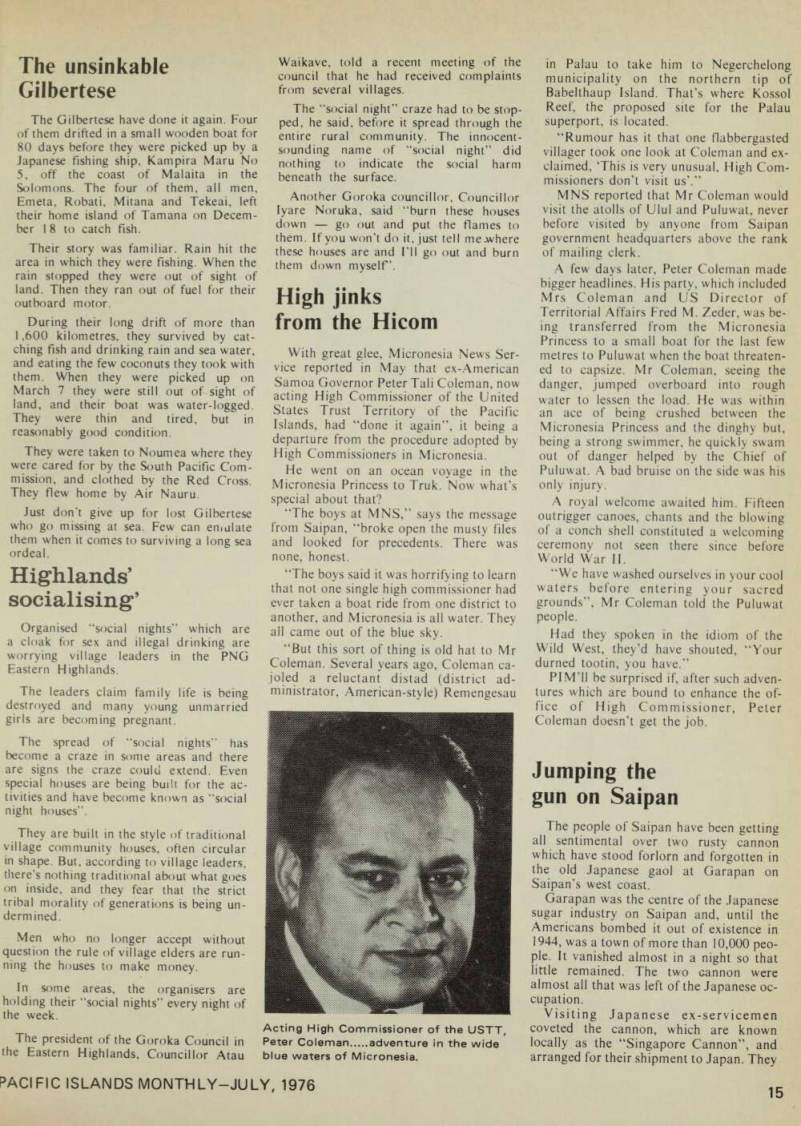
He warned the council that if the prac tice of charging burial fees continued, the people would be forced to revert to tribal death customs to avoid funeral costs. This could mean hanging bodies from trees, putting them on exposed platforms or bur ning them over open fires.
The council, which had increased the fees to KlO for Papua New Guinean nationals and K5O for non-nationals, argued that the increased fees didn’t cover a quarter of the expenses involved.
The imposition of cemetery burial fees could bring a return to tribal burial customs, PNG politican Buaki Singeri warns, customs like this—the body of a Biami (Western District) man lies on a bier outside the house until only the bleached bones are left.
The unsinkable
Gilbertese
The Gilbertese have done it again. Four of them drifted in a small wooden boat for 80 days before they were picked up by a Japanese fishing ship, Kampira Maru No 5, off the coast of Malaita in the Solomons. The four of them, all men, Emeta, Robati, Mitana and Tekeai, left their home island of Tamana on Decem ber 1 8 to catch fish.
Their story was familiar. Rain hit the area in which they were fishing. When the rain stopped they were out of sight of land. Then they ran out of fuel for their outboard motor.
During their long drift of more than 1,600 kilometres, they survived by cat ching fish and drinking rain and sea water, and eating the few coconuts they took with them. When they were picked up on March 7 they were still out of sight of land, and their boat was water-logged.
They were thin and tired, but in reasonably good condition.
They were taken to Noumea where they were cared for by the South Pacific Com mission, and clothed by the Red Cross.
They flew home by Air Nauru.
Just don’t give up for lost Gilbertese who go missing at sea. Few can emulate them when it comes to surviving a long sea ordeal.
Highlands’
socialising’
Organised “social nights” which are a cloak for sex and illegal drinking are worrying village leaders in the PNG Eastern Highlands.
The leaders claim family life is being destroyed and many young unmarried girls are becoming pregnant.
The spread of “social nights” has become a craze in some areas and there are signs the craze could extend. Even special houses are being built for the ac tivities and have become known as “social night houses”.
They are built in the style of traditional village community houses, often circular in shape. But, according to village leaders, there’s nothing traditional about what goes on inside, and they fear that the strict tribal morality of generations is being un dermined.
Men who no longer accept without question the rule of village elders are run ning the houses to make money.
In some areas, the organisers are holding their “social nights” every night of the week.
The president of the Goroka Council in the Eastern Highlands, Councillor Atau
Waikave, told a recent meeting of the council that he had received complaints from several villages.
The “social night” craze had to be stop ped, he said, before it spread through the entire rural community. The innocent sounding name of “social night” did nothing to indicate the social harm beneath the surface.
Another Goroka councillor, Councillor lyare Noruka, said “burn these houses down go out and put the flames to them. If you won’t do it, just tell me .where these houses are and I’ll go out and burn them down myself’.
High jinks
from the Hicom
With great glee, Micronesia News Ser vice reported in May that ex-American Samoa Governor Peter Tali Coleman, now acting High Commissioner of the United States Trust Territory of the Pacific Islands, had “done it again”, it being a
departure from the procedure adopted by
High Commissioners in Micronesia.
He went on an ocean voyage in the Micronesia Princess to Truk. Now what’s special about that?
“The boys at MNS,” says the message from Saipan, “broke open the musty files and looked for precedents. There was none, honest.
“The boys said it was horrifying to learn that not one single high commissioner had ever taken a boat ride from one district to another, and Micronesia is all water. They all came out of the blue sky.
“But this sort of thing is old hat to Mr Coleman. Several years ago, Coleman ca joled a reluctant distad (district ad ministrator, American-style) Remengesau
in Palau to take him to Negerchelong municipality on the northern tip of Babelthaup Island. That’s where Kossol Reef, the proposed site for the Palau superport, is located.
“Rumour has it that one flabbergasted villager took one look at Coleman and ex claimed, This is very unusual, High Com missioners don’t visit us’.”
MNS reported that Mr Coleman would visit the atolls of Ulul and Puluwat, never before visited by anyone from Saipan government headquarters above the rank of mailing clerk.
A few days later, Peter Coleman made bigger headlines. His party, which included Mrs Coleman and US Director of Territorial Affairs Fred M. Zeder, was be ing transferred from the Micronesia Princess to a small boat for the last few metres to Puluwat when the boat threaten ed to capsize. Mr Coleman, seeing the danger, jumped overboard into rough water to lessen the load. He was within an ace of being crushed between the Micronesia Princess and the dinghy but, being a strong swimmer, he quickly swam out of danger helped by the Chief of Puluwat. A bad bruise on the side was his
only injury.
A royal welcome awaited him. Fifteen outrigger canoes, chants and the blowing of a conch shell constituted a welcoming ceremony not seen there since before World War 11.
“We have washed ourselves in your cool waters before entering your sacred grounds”, Mr Coleman told the Puluwat
people.
Had they spoken in the idiom of the Wild West, they’d have shouted, “Your durned tootin, you have.”
PlM’ll be surprised if, after such adven tures which are bound to enhance the of fice of High Commissioner, Peter Coleman doesn’t get the job.
Jumping the
gun on Saipan
The people of Saipan have been getting all sentimental over two rusty cannon which have stood forlorn and forgotten in the old Japanese gaol at Garapan on Saipan’s west coast.
Garapan was the centre of the Japanese sugar industry on Saipan and, until the Americans bombed it out of existence in 1944, was a town of more than 10,000 peo ple. It vanished almost in a night so that little remained. The two cannon were almost all that was left of the Japanese oc cupation.
Visiting Japanese ex-servicemen
coveted the cannon, which are known locally as the “Singapore Cannon”, and arranged for their shipment to Japan. They
Acting High Commissioner of the USTT, Peter Coleman... adventure in the wide blue waters of Micronesia.
were hoisted aboard a Japanese-bound ship, which was almost ready to sail from
Saipan’s quaintly-named Charley Dock
when someone realised that they loved the old guns after all. The police were called and they off-loaded the cannon.
The Deputy District Administrator, Dan E. Akimoto, issued a temporary order preventing anyone from jumping the gun.
He was almost lyrical in his restraining order, saying, according to Guam’s Pacific Daily News, that the cannon “have great intrinsic value due to their rarity and their place in history of the Mariana Islands”.
Now the Marianas’ District Attorney is looking for a law, since one doesn’t exist, to ban the export of war relics and artifacts from the Marianas.
How’s this
for re-cycling
A chewing gum industry with a local touch has been suggested for Papua New Guinea when you’ve chewed out the sweetness you trade-in what’s left.
The suggestion comes from a group of researchers and potential beekeepers in volved in a new attempt to get beekeeping established in the PNG Highlands. They
have suggested selling honey-soaked
beeswax as a local chewing gum. Honey is almost unknown among the Highlands people.
Because the beeswax base is in com paratively short supply, the suggestion is that the chewed-out material could even ually be sold back to the industry.
“Chew it all day if you like, but then put it into a bottle and sell it back to us,” they suggest.
The Department of Primary Industry is behind the beekeeping promotion, but commented that it had “no formal recommendations” on the chewing gum idea.
Fiji's civil service
almost localised
Fiji’s localisation of the public service is almost complete, but the goal of complete localisation is practically unattainable, ac cording to a Fiji Public Service Commis sion report. By the middle of 1975 there were only 15 permanent and pensionable expatriate civil' servants in the 17,735strong public service. The PSC concedes that Fiji still needs, and is likely to need for many years, the services of recruits from overseas, especially in some professional and technical categories.
At the middle of 1975, there were 513 non-Fiji citizens in the public service. Two hundred were from Britain (132 on con tract), 155 from the US, 95 from NZ, 50 from India, 30 from Australia, six from Canada and 17 of “other nationalities”. Of the total of 513 non-Fiji citizens, 135 were volunteers and 69 were from aid organisations.
Advertisements & other items, p. 16 (2 items)
16
PACIFIC ISLANDS MONTH LY-JULY, 1976
Welders from
4
the
LIIMCaLIM
ELECTRIC
range
for FABRICATING, CONSTRUCTION
MAINTENANCE AND REPAIR
Lincoln Tractapac tractor driven welder/ generator: welding range 40-225 amp DC; auxiliary power 3 kVA 50 Hz 240 V continuous duty, for pumps, motors, power tools, lighting.
Available also as stationary unit for engine drive or for mounting on 4 x 4 for go-anywhere use.
Diesel Weldanpower 225 DC —economical reliable Diesel driven welder/generator. Transportable for on-site welding, 40 to 225 amp DC handling electrodes 2-5 mm (%4"- 3 /i4"). Auxiliary power, 3 kVA 240 V 50 Hz cont. duty—Other models, Lincwelder 225 petrol engine, details as above; Weldanpower 225 AC petrol engine 40-225 amp AC welding, auxiliary power 5 kVA 240 V or 115 V 60 Hz. Weldanpower 130 petrol engine 60-130 amp AC, auxiliary power 2.5 kVA 240 V 50 Hz.
LINK UP WITH
LINCOLN
I electric!
FOR THE RIGHT WELDER
FOR YOUR NEEDS
AGENTS
FIJI: Coral Island Motors, Suva • Lautoka * Sigatoka.
NEW GUINEA; Tutt Bryant Pacific Limited, Port Moresby • Madang • Lae • Goroka • Rabaul • Panguna.
NEW CALEDONIA: S.A.T.M.A., Noumea.
Lincoln AC225-S transformer welder, rugged, fan cooled design.
Welding capacity 40- 225 amp AC. Operates from 240 V 415 V or 460 V single phase 50 Hz supply. Handles electrodes 2 to 5 mm (%4" to Vi/>")-, with carbon arc torch (optional) handles heating, brazing, soldering.
M * 1 i m Lincoln TM heavy duty transformer and transformer/rectifier welders —range of six models for AC and AC/DC welding up to 750 amp, handling electrodes in the range 2.5 to 10 mm (Vn" to 3 /s") for ail models. Input power 415 V 50 Hz single phase. Special voltages can be supplied.
THE LINCOLN ELECTRIC COMPANY (AUST.) PTY. LTD. 35 Bryant Street, Padstow (Sydney), N.S.W., Australia 2211. Tel. 77 0741. 7/7S
Solomons
Rent Perk
Off
In The
Solomons
The Solomon Islands government ap pears ready to cut into the privileges of the early crop of local public servants and politicians through their housing rents.
The Minister of Works and Public Utilities, Ashley Wickham, who has always expressed concern for the housing problems of his constituents in the capital, Honiara, has moved quickly to begin evening up the conditions of public ser vants and others since he became a minister earlier this year.
If there is one serious problem of living in Honiara it is the difficulty in finding housing, and for Solomon Islanders especially finding transport from the housing they can get often with relatives or “wantoks” which causes many friendships to break under the trials of ur ban living.
Most government housing was built originally for expatriates the British, Australians and New Zealanders and Fijians who together largely dominated the public service until recent years. Rents were taken as part of the conditions of ser vice. A few years ago, this housing was opened up to local public servants on the qualifications of length of service, salary and dependents, in a points system. As well, politicians who had to live in Honiara in other words, ministers got preference. Within a year or two the best houses not already tied to long serving expatriate public servants were going to politicians and the still young but fast-rising Solomon Islanders who were heading and getting near the top of their departments or ministries.
At the same time, a lot more Solomon Islanders were coming to live in Honiara.
Housing costs, because of imported materials or companies tied to some degree to overseas costing, were rising despite all efforts by the Housing
Authority to design extraordinarily cheap
basic houses.
Mr Wickham has now declared that at present about 70 per cent of government
employees including “non-established”
employees, mainly labourers do not have houses, and most of them are living in Honiara. As a result house rentals are too high.
His first step to even out the situation is to introduce what he calls “near economic” rents for government houses.
This he says will make public servants pay
a much higher and more realistic rent, dependent on the size and quality of the house they occupy.
Until now, it has been a case of first in first served for the better houses, with rents not differing sufficiently to make it worth worrying about for public servants in the higher salary ranges who want the best available. Those in the middling salary ranges have been allowed to com pete for them as well.
Mr Wickham says the higher rents will compensate other public servants unable to be housed by government.
The longer term aid is to hand over most of the government houses to the
Housing Authority a technically in
dependent body to pass out of govern ment’s weary hands the control of these homes, and the problems of who gets them, with all that entails in dealing with people who use whatever influence they have to get a house they want.
Mr Wickham hopes that if the Housing Authority has enough money and is “strengthened”, more people will be able to have houses.
The plan to hand over housing to the Authority is not a new one, but Mr Wickham seems to be the first minister willing to deal with the problem. He is being advised by a special group of people who may help him to persevere.
Meanwhile, everyone’s waiting for the outcome of an inquiry into the Case of the Commemorative Coins, which caused the resignation last year of Chief Minister Solomon Mamaloni.
The Governor, Mr Donald Luddington, has ordered an inquiry into all the cir cumstances relating to the advertising, striking and sale of the coins which were struck by the Letcher Mint, of California to commemorate the change to self government. He has appointed Mr Richard Hampson, senior magistrate and judicial commissioner in the New Hebrides, as commissioner to conduct the
inquiry.
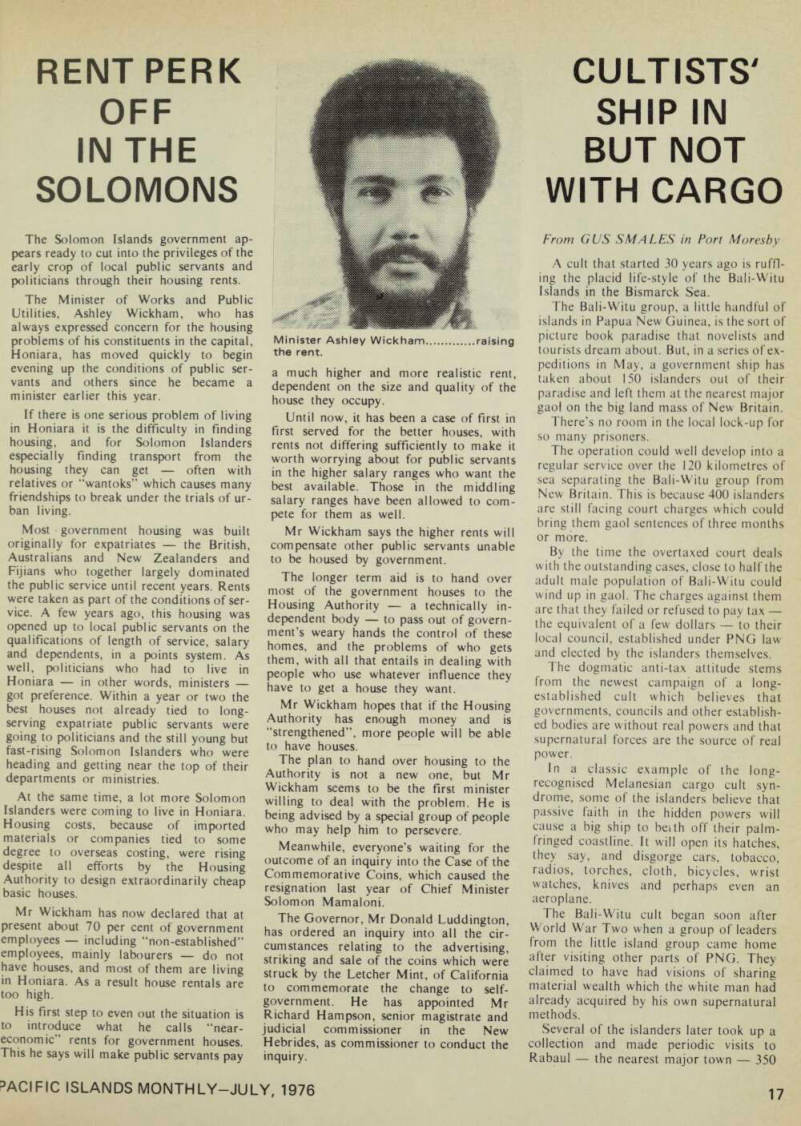
Minister Ashley Wickham... raising the rent.
Cultists'
Ship In
But Not
With Cargo
From GUS SMALES in Port Moresby A cult that started 30 years ago is ruffl ing the placid life-style of the Bali-Witu Islands in the Bismarck Sea.
The Bali-Witu group, a little handful of islands in Papua New Guinea, is the sort of picture book paradise that novelists and tourists dream about. But, in a series of ex peditions in May, a government ship has taken about 150 islanders out of their paradise and left them at the nearest major gaol on the big land mass of New Britain.
There’s no room in the local lock-up for so many prisoners.
The operation could well develop into a regular service over the 120 kilometres of sea separating the Bali-Witu group from New Britain. This is because 400 islanders are still facing court charges which could bring them gaol sentences of three months or more.
By the time the overtaxed court deals with the outstanding cases, close to half the adult male population of Bali-Witu could wind up in gaol. The charges against them are that they failed or refused to pay tax the equivalent of a few dollars to their local council, established under PNG law and elected by the islanders themselves.
The dogmatic anti-tax attitude stems from the newest campaign of a long established cult which believes that governments, councils and other establish ed bodies are without real powers and that supernatural forces are the source of real power.
In a classic example of the long recognised Melanesian cargo cult syn drome, some of the islanders believe that passive faith in the hidden powers will cause a big ship to beith off their palm fringed coastline. It will open its hatches, they say, and disgorge cars, tobacco, radios, torches, cloth, bicycles, wrist watches, knives and perhaps even an aeroplane.
The Bali-Witu cult began soon after World War Two when a group of leaders from the little island group came home after visiting other parts of PNG. They claimed to have had visions of sharing material wealth which the white man had already acquired by his own supernatural methods.
Several of the islanders later took up a collection and made periodic visits to Rabaul the nearest major town 350
kilometres away by sea, and brought back goods from the well-stocked shops in Rabaul, showing the goods as examples of what could be expected if the cult was followed correctly.
By western standards the operation had all the elements of trickery by false pretences, but anthropologists and many government officers recognise a groping sincerity. They say the developments were typical of a society which was unable to accept the existence of advanced technology, and thus attributed manufac tured goods to supernatural causes.
In the past 10 years, the Bali-Witu cult has manifested itself in sporadic incidents which supposedly were to prepare for the arrival of “cargo” a shipload of manufactured goods.
The incidents have included the destruc tion of an area of food crops (“we won’t need them any more”), the killing of pigs, the boycott of an election, and refusal to allow children to attend school.
Slightly less than half the population appears to be involved in the cult, and their current campaign is refusing to pay tax.
Unlike many other PNG cults, which have included active anti-government acts and even violence, the Bali-Witu cult goes placidly on its way as if secure in an inner belief that a reward is just round the cor ner.
Despite the rash of recent summonses and convictions, there has been no collapse of law and order and only a handful of police are stationed there. There’s little heat in the situation, and even the gaol sentences have been accepted
phlegmatically.
To the ingrained cultist, a few months in gaol is merely marking time while the big ship comes closer.
Torres tussle
The border between Australia and Papua New Guinea has still to be fix ed, but it will be south of the islands of Boigu, Dauan and Saibai, which will become Australian enclaves. Agree ment to change the border was reached on June 5, by the Foreign Affairs Ministers of Australia and PNG, Mr Andrew Peacock and Sir Maori Kiki.
The three islands are close to the coast of PNG, and the border is between them and PNG mainland. The islands will have a three-mile territorial limit.
Details of the agreement, covering the seabed and the actual border have still to be worked out. The agreement came under fire from the Premier of
Queensland, Mr Joh Bjelke-Petersen,
and the chairman of the Torres Strait
Islanders Advisory Council, Mr
Getano Lui.
Getting
The Bird
Gilberts
Style
The Gilbert Islands Attorney-General found himself out on a limb during the May session of the House of Assembly because proceedings were conducted almost entirely in Gilbertese. It was not a Gilbertian situation, but it drew a large number of Gilbertese to the public gallery to listen to the debates. Members took ad vantage of the absence of the Governor and Financial Secretary, on leave, to use their native language. The only ex-officio English-speaking member left was the Attorney-General.
Mr G.L. Pimm, 50, the new Attorney- General in the Gilbert Islands, helped Zambia to draw up the constitution it adopted when it received its independence from Britain. He practised as a barrister at the London bar for six years before becom ing a resident magistrate and then senior state advocate in Zambia. When he left Zambia to return to the UK he stopped off for six months in Kenya to practise privately. Four years ago he went to Ber muda where he was parliamentary counsel to the law reform committee. Since then he has been in private practice in the UK.
It was an interesting session enlivened by several bright passages, particularly when the Co-operative Federation Loans Bill, involving $1 million was debated. The bill was passed, but not without spirited opposition from some members.
Mr Abete Merang said that while it was necessary for the government to guarantee funds needed by the federation, he thought $1 million was too high. The federation was suffering from a sickness the main sickness was the high salaries paid to senior staff. The manager’s salary was higher than that of the governor. The federation came into existence three years ago and should be able to stand on its own feet.
Mr Teatao Teannaki said the govern ment should probe the federation’s high expenditure. It had received a bank loan of $532,000 and an overdraft of $277,000.
Co-operative societies owed the federation $996,000. The societies were over-stocked and should be controlled.
Mr Otiuea Tanentoa, Minister for Commerce and Industry, said the federa tion, since it came into existence more than three years ago, suffered from world-wide inflation, and had a liquidity problem.
The loan would be advanced, bit by bit,
as the need arose and would enable the federation to meet the high rise in the cost of imports.
Chief Minister Naboua Ratieta asked the House to look on the federation as be ing owned by everyone. If the bill was re jected the federation would probably go bankrupt. Then another body would have to be created to import, export and supply co-operative societies with what they need ed.
The House carried a motion to appoint a select committee to review and revise localisation plans for the Civil Service and the Gilbert Islands Development Authori ty. During the debate, Mr Tito Teburoro complained about priorities. He had notic ed where localisation was slow it should have been fast, and where it should have been fast it was slow. Education was a case where the pace should have been slow, but it was fast.
“Education is our foundation and only those with proper qualifications should localise the expatriate-held posts,” he said.
Mr Ratieta reported progress in negotiations towards self-government.
When that status was achieved there would be a Minister of Finance in place of the Financial Secretary who was at present an ex-officio member; the post of Deputy Governor would be abolished and the Governor would no longer preside over the Council of Ministers. There would be a national election about 12 months after self-government was achieved, and before full independence.
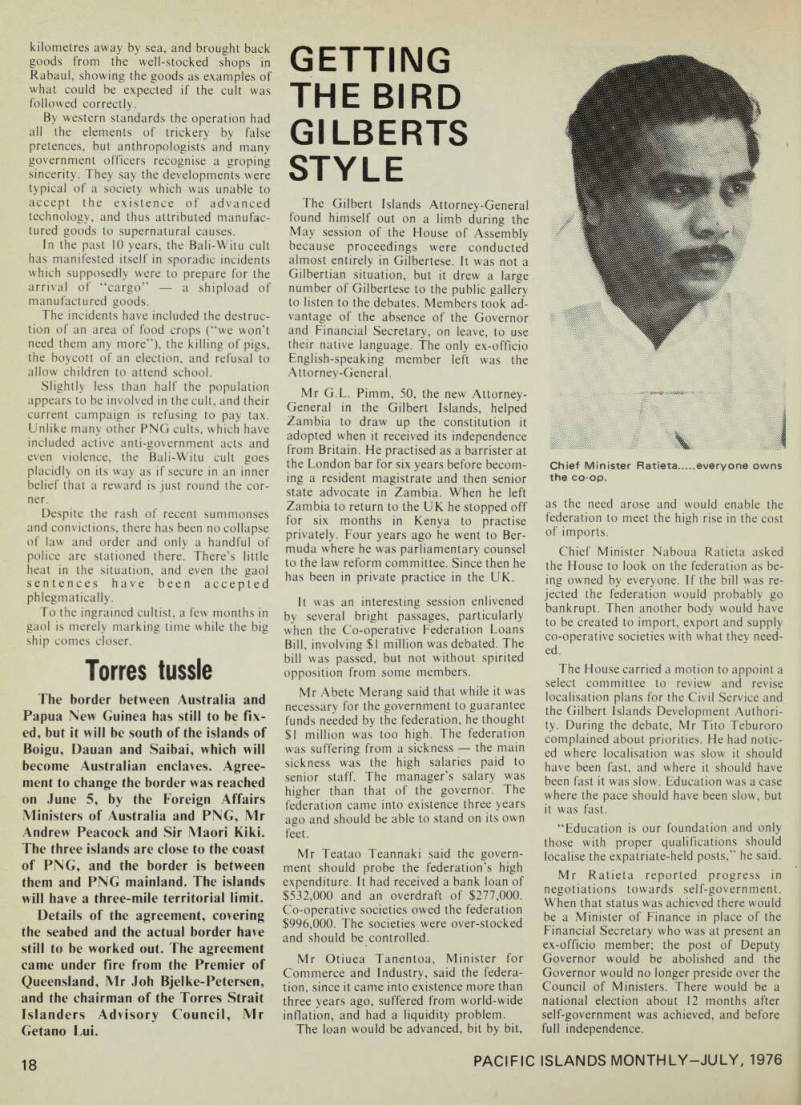
Chief Minister Ratieta... everyone owns the co-op.
People
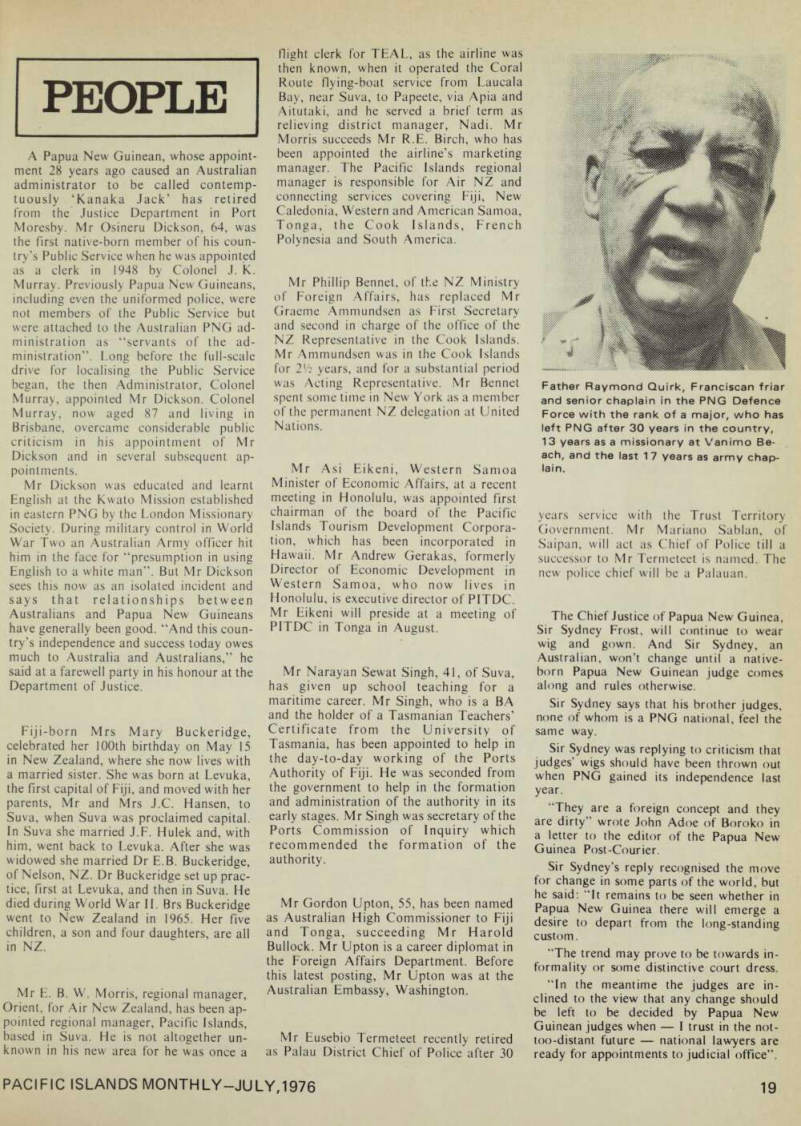
A Papua New Guinean, whose appoint ment 28 years ago caused an Australian administrator to be called contemp tuously ‘Kanaka Jack’ has retired from the Justice Department in Port Moresby. Mr Osineru Dickson, 64, was the first native-born member of his coun try’s Public Service when he was appointed as a clerk in 1948 by Colonel J. K.
Murray. Previously Papua New Guineans, including even the uniformed police, were not members of the Public Service but were attached to the Australian PNG ad ministration as “servants of the ad ministration”. Long before the full-scale drive for localising the Public Service began, the then Administrator, Colonel Murray, appointed Mr Dickson. Colonel Murray, now aged 87 and living in Brisbane, overcame considerable public criticism in his appointment of Mr Dickson and in several subsequent ap pointments.
Mr Dickson was educated and learnt English at the Kwato Mission established in eastern PNG by the London Missionary Society. During military control in World War Two an Australian Army officer hit him in the face for “presumption in using English to a white man”. But Mr Dickson sees this now as an isolated incident and says that relationships between Australians and Papua New Guineans have generally been good. “And this coun try’s independence and success today owes much to Australia and Australians,” he said at a farewell party in his honour at the Department of Justice.
Fiji-born Mrs Mary Buckeridge, celebrated her 100th birthday on May 15 in New Zealand, where she now lives with a married sister. She was born at Levuka, the first capital of Fiji, and moved with her parents, Mr and Mrs J.C. Hansen, to Suva, when Suva was proclaimed capital.
In Suva she married J.F. Hulek and, with him, went back to Levuka. After she was widowed she married Dr E.B. Buckeridge, of Nelson, NZ. Dr Buckeridge set up prac tice, first at Levuka, and then in Suva. He died during World War 11. Brs Buckeridge went to New Zealand in 1965. Her five children, a son and four daughters, are all in NZ.
Mr E. B. W. Morris, regional manager, Orient, for Air New Zealand, has been ap pointed regional manager, Pacific Islands, based in Suva. He is not altogether un known in his new area for he was once a
flight clerk for TEAL, as the airline was then known, when it operated the Coral Route flying-boat service from Laucala Bay, near Suva, to Papeete, via Apia and Aitutaki, and he served a brief term as relieving district manager, Nadi. Mr Morris succeeds Mr R.E. Birch, who has been appointed the airline’s marketing manager. The Pacific Islands regional manager is responsible for Air NZ and connecting services covering Fiji, New Caledonia, Western and American Samoa, Tonga, the Cook Islands, French Polynesia and South America.
Mr Phillip Bennet, of the NZ Ministry of Foreign Affairs, has replaced Mr Graeme Ammundsen as First Secretary and second in charge of the office of the NZ Representative in the Cook Islands.
Mr Ammundsen was in the Cook Islands for m years, and for a substantial period was Acting Representative. Mr Bennet spent some time in New York as a member of the permanent NZ delegation at United Nations.
Mr Asi Eikeni, Western Samoa Minister of Economic Affairs, at a recent meeting in Honolulu, was appointed first chairman of the board of the Pacific
Islands Tourism Development Corpora
tion, which has been incorporated in Hawaii. Mr Andrew Gerakas, formerly Director of Economic Development in Western Samoa, who now lives in Honolulu, is executive director of PITDC.
Mr Eikeni will preside at a meeting of PITDC in Tonga in August.
Mr Narayan Sewat Singh, 41, of Suva, has given up school teaching for a maritime career. Mr Singh, who is a BA and the holder of a Tasmanian Teachers’
Certificate from the University of Tasmania, has been appointed to help in the day-to-day working of the Ports Authority of Fiji. He was seconded from the government to help in the formation and administration of the authority in its early stages. Mr Singh was secretary of the Ports Commission of Inquiry which recommended the formation of the authority.
Mr Gordon Upton, 55, has been named as Australian High Commissioner to Fiji and Tonga, succeeding Mr Harold Bullock. Mr Upton is a career diplomat in the Foreign Affairs Department. Before this latest posting, Mr Upton was at the
Australian Embassy, Washington.
Mr Eusebio Termeteet recently retired as Palau District Chief of Police after 30
years service with the Trust Territory Government. Mr Mariano Sablan, of Saipan, will act as Chief of Police till a successor to Mr Termeteet is named. The new police chief will be a Palauan.
The Chief Justice of Papua New Guinea, Sir Sydney Frost, will continue to wear wig and gown. And Sir Sydney, an Australian, won’t change until a native born Papua New Guinean judge comes along and rules otherwise.
Sir Sydney says that his brother judges, none of whom is a PNG national, feel the same way.
Sir Sydney was replying to criticism that judges’ wigs should have been thrown out when PNG gained its independence last year.
“They are a foreign concept and they are dirty” wrote John Adoe of Boroko in a letter to the editor of the Papua New Guinea Post-Courier.
Sir Sydney’s reply recognised the move for change in some parts of the world, but he said; “It remains to be seen whether in Papua New Guinea there will emerge a desire to depart from the long-standing custom.
“The trend may prove to be towards in formality or some distinctive court dress.
“In the meantime the judges are in clined to the view that any change should be left to be decided by Papua New Guinean judges when I trust in the not too-distant future national lawyers are ready for appointments to judicial office”.
Father Raymond Quirk, Franciscan friar and senior chaplain in the PNG Defence Force with the rank of a major, who has left PNG after 30 years in the country, 13 years as a missionary at Vanimo Be ach, and the last 17 years as army chap lain.
From Russia With Love

King Taufa’ahau Tupou, of Tonga, has confirmed that Russia had offered to build an international airport and other facilities in Tonga.
Preliminary discussions with the Soviet Ambassador to Tonga, Mr Oleg Selyaninov, who is stationed in Wellington (NZ), will be followed by a visit by a counsellor in the Soviet Embassy, Wellington. The king said he expected final negotiations would be beneficial to both sides.
The initial Tonga-Soviet talks caused consternation in several parts of the western world. The New Zealand Prime Minister, Mr Muldoon, was outspoken in caustic comment.
Before Mr Selyaninov’s visit to Tonga, Crown Prince Tupouto'a took part in discussions with the Russians in London while he was acting High Commissioner. In Sydney, on the way home, he said it was a very delicate matter.
“All I would like to say is that the general feeling in our ministry is that Tonga has many friends, and all we ask of them is that they don’t choose our enemies for us,” he said.
He said Tonga was not looking for handouts and did not intend to yield up any of its independence. But more technical assistance was need ed. It was essential that the airport near Nukualofa be upgraded to inter national standard.
Micronesia
Talks
Talks between the United States and Micronesia on the future status of the trust territory were resumed on Saipan on May 31. The last meeting was in November when the 90-day constitutional convention ended with the production of an agreed preamble to a constitution. Since then the Micronesians, less the Marianas which has become a commonwealth of the United States, have formed a new Joint Com mittee on Future Status and this com mittee, headed by Palau Senator Lazarus Salii and Marshalls delegate Ekpap Silk, met President Ford’s personal represen tative, Ambassador Franklyn Haydn Williams, who had arrived the previous day on Saipan. The talks are aimed at completing the draft compact of free association.
If the Congress of Micronesia approves the completed draft at its special July meeting, it will then be put to the vote of the electorate in the Marshalls and Carolines in November. There are no declared plans for the fate of the draft if the congress rejects it.
Advertisements & other items, pp. 20-21 (1 item)
Ask the bank which has
Do you want to do business in New Zealand?
40% of the banking business
in New Zealand
The BNZ can give you full information on buying or selling in New Zealand and overseas. Ful information on investment movement of money, transfers of dividends etc., is also readily available.
There are offices everywhere, more than 400 in fact Whatever your financial or trade needs, the BNZ can help you.
@ Bank of New Zealand
Wellington -Head Office, International Dwision, Box 2392.
Sydney-GPO Box 507, Sydney, N.S.W. 2001.
Melboume-GPO Box 528 E, Melbourne, Vc. 3001.
Tokyo-Mr E. L Banks, Bank of New Zealand Representative Office, Japan. Suite 240,1'ShinTokyo Bldg, 3-1,3-Chrome, Marunouchi, lOO.
Sintjapore-Mr R. F. Warren, Bank of New Zealand Representative Office, South East Asia. Suite 230,23 rd Floor, Ocean Bldg, CoiyerQuay, Singapore 1.
London-PO Box 402. LondonEC4P.4.H.E.
Fiji, Suva-25 Victoria Parade. Also at Labasa, Lautoka, NadijSigatoka, Ba.
Associated Banks inlhc South Pacific.
Bank of Western Samoa Bank of Tonga.
BECOME A PART
OF PIM's PACIFIC
AND SUBSCRIBE NOW
“O Q) E ◄ £ c D o X (/> Ql 0) 0)
FILL IN THE DETAILS
ON THE ATTACHED
ORDER FORMS
Editor’S Mailbag

Island Independence
An anti-European flavour emerges in correspondence to PIM in recent times and the ordinary Australian or New Zealand reader must find himself reflecting are these the people who continually ask, frequently demand, our financial, technological, administrative and commercial assistance? Because, if so, they have a peculiar manner of showing their appreciation and thanks. It would appear that they are trying to close the door on their own fingers.
Probably the most significant development in the Pacific Island communities in the last decade' is not independence,' which is in itself a most inaccurate term in its current application, but the emergence of a parasite Pacific Islander class who masquerade as leaders and administrators. Most newly
“independent” communities survive today
not because of their leaders, but in spite of them. Most Islanders are materially far worse off today than they were before “independence” and if we listen to the Islanders themselves, this is evidenced very clearly. The political leaders of the more advanced nations (European) in the Pacific area must accept a large measure of the blame for not only permitting but in promoting situations whereby atoll- Napoleons and village opportunists have been able to use the administrative process and systems of European nations to establish themselves in positions of influence and power over their fellow Pacific Islanders.
Today’s spectacle of developments in the South Pacific augurs ill for the future of the people in this area. “Independence”, that prime misnomer, has in almost every Island group yielded nothing more than
heavy and increasing financial
indebtedness with little prospect for repayment and a limited number of administrative posts for the local “fat cats”.
Dire poverty, ignorance, abysmal living conditions, drunkenness and crime are increasing and uncontrolled. Racial discrimination is being fostered and demonstrated by native administrations and so-called leaders, in their attitude towards Europeans and European interests (racial discrimination throughout the world is now rapidly dissipating, but in the South Pacific it is being rekindled with a twist a ludicrous exercise, if ever there
was one, of the “tail wagging the dog”).
Immaturity, inexperience and inadequacy are clearly demonstrated in the arrogance and pomposity of recently-elevated native politicians and public servants, encouraged by European Church movements who, recognising that their position of influence has deteriorated dramatically among their own countrymen, are making a “death throes” bid for survival among the simple folk of the South Pacific.
These attitudes obviously will do nothing to build the bridges, cultural and economic between peoples, black and white, of the Pacific region which are vital to the real advancement of living conditions and standards of the Pacific Island communities.
The currents and ripples of anti- European discrimination are starting to come to the attention of some ordinary, tax-paying Australians, who must ask themselves and their representatives in parliament why they are expected to contribute toward the almost-one billion dollars being passed out each year as overseas aid much of it to our Pacific neighbours.
What the Islands need of course is trade not aid. Economically, they have a lot of “catching up” to do and they won’t do it by building barriers about themselves.
Tourism, investment and general interest in the Islands have fallen off noticeably in the past two years and, it appears, will continue to decline.
I doubt whether the current Pacific Island (native) administrators will recognise or act upon these factors and facts, but then, why should they? Most of them are sitting pretty in comfortable jobs with all mod-cons (European mod-cons perish the thought!) believing that they will be able to go on scrounging foreign “handouts” to maintain their position for a long time to come, while the stoic and
uncomplaining multitudes of simple
Pacific Island people stagnate in the worsening “no man’s land” between primitive darkness and the unrelenting advancement of modern society.
R. Cherry
Brisbane, Qld
more letters on page 23
Food Imports
Why is it that Pacific Island nations are buying large and increasing quantities of meat, fish, dairy products, fruit and vegetables from New Zealand (or from anywhere else for that matter) as reported in the New Zealand Feature (PIM, Feb, p 31).
Trade based on the complementarity of resources is usually beneficial to all concerned, but when fertile countries, surrounded by seas that are rich in fish and other seafoods, are importing large quantities of food to supplement their own production (or lack of it), something would appear to be very wrong.
At least a partial explanation may be that Pacific Island governments, regardless of their countries’ economic capabilities, are committed to allowing their residents to shop freely on world markets for whatever they want, and that also, because they must regularly face elections, these governments invariably choose shorter rather than longer term economic strategies. The result is that in order to pay for the desired imports the economic resources of Pacific Island nations are channelled into foreign exchange earning activities and the production for domestic consumption of such items as food is neglected. Once this
happens there is then no choice but to import food, and so the vicious circle goes on.
The current emphasis on foreign exchange earning activities is not a new phenomenon in the Pacific Islands, but a continuation of the former (or in some cases still existent) policy of basing the economy of colonies on the export of raw materials sugar, copra, timber, coffee, copper, nickel, gold, etc to the industrialised world. Any nation which promotes a narrow range of export orientated or foreign exchange earning activities, while not being able to feed its own people, becomes particularly vulnerable to outside forces and perpetuates its position as an economic colony. If this state of affairs is judged to be undesirable it is clear that the emphasis must be shifted to boosting domestic production for internal consumption in vital areas such as food production, and at the same time reducing unnecessary imports.
The writer of the New Zealand Feature
simplistically (or New Zealand-centredly)
advocated greater imports by the Pacific Islands from New Zealand, suggesting that beneficiaries of New Zealand aid “could reciprocate by buying New Zealand’s undeniably high-class exports”.
It is one thing to suggest this when talking
of types of goods that the Pacific Islands could not produce themselves, but it is quite another thing when talking of food products that the Pacific Islands could produce themselves. In that same February issue PIM reported Fiji’s renew ed resolve to promote self-sufficiency in agriculture and Tonga's efforts to develop her fisheries for her home market.
Perhaps it is time more thought was given to New Zealand's expanding food exports to the Pacific Islands.
C.H. Livesey
Boroko, PNG
The White
Man's Burden
Human variety in historical cycle never ceases to make me wonder. It strikes atiain as Maxime Tevi (PIM, April, p 25) and S.
Tebula and F. Kali (PIM, May, pp 23, 25) come out with their own quaint versions of “the white man’s burden” in the New
Hebrides today.
What did other people in the colonial history say? The Reverend T. Smaill, presumably a Presbyterian, could not see any kind of order in the lives of Fpi people until “the advent of a more enlightened religious faith” in 1899.
In 1909, a planters' newspaper in Vila
(Le Neo-Hebrides) said that the first duty of the French administration was to “facilitate the recruitment of natives for the absence of natives and their culture and the development of that culture, is the door through which will enter French prosperity in the New Hebrides”.
In 1914, the then French Resident Commissioner, Repiquet, said that he had come to the colony with “the high mission to serve the superior interests of France and her nationals.” This, he said, was always the source of inspiration in his work.
Sometime early this century, one of my great-grandfathers, Jek Suparana, a returned slave from the Queensland sugar fields, saw a recruiting vessel in a harbour at Tongoa collecting more slaves. One of his friends asked him to come to the beach and board the vessel. His well-known reply was “Mi blah ful wan taem, mi no blahful tu taem.”
I am not going to challenge the arguments of Tevi, Tebula or Kati. 1 would rather attain my results through action within the next several years. However, it is disturbing to note that these three persons sound like expatriate-whites using New Hebridean pseudonyms in your columns. Is this not a painful psychological revelation of the lost colonialist mind groping justification in a fast-crumbling dream world?
Kalkot Matas-Kelekele
University of PNG, Assist. Gen. Sec.
New Hebrides National Party.
Suspicious
The poem by Eti Sa’aga, reprinted in Up Front with the Publisher in PI M’s April, issue (p 5) looks far too suspiciously like a work by one of my own favourites, Lawrence Ferlinghetti; in A Coney Island of the Mind, no 5, Mr Ferlinghetti wrote: .. . And everybody after that is always making models of this Tree with Him hung up and always crooning His name and calling him to come down and sit in on their combo as if he is the king cat who’s got to blow or they can’t quite make it Only he don’t come down from His Tree Him just hang there on His Tree looking real Petered out and real cool and also according to a roundup of late world news from the usual unreliable sources real dead
Michael A. White
Saipan, USTT
Advertisements & other items, pp. 21-24 (2 items)
21
ACIFIC ISLANDS MONTHLY-JULY, 1976
by Good/ear.
Some down-to-earth
reasons for using
Unisteel radial pi y tires
by Good/ear.
Unisteel—the earthmover tire with radial steel body plies plus steel belts— carries heavier loads at faster speeds than conventional tires. Radial ply construction—with belts of steel cord under the tread plus a super-strong ply of steel cord in the body—dissipates heat quickly for cooler running, resists punctures by deflecting most debris and rocks, and provides excellent traction with a long lasting tread. Large vehicle j4B JOP or small, Goodyear earthmover tires will perform better, WJ mMM Mwk longer, and more economically than conventional tires.
GOODYEAR DISTRIBUTORS IN S.E. ASIA AND PACIFIC BASIN Boroko Motors Ltd.
Port Moresby, PNG.
Cook Island Motors Cook Is.
Commex Philippines Ltd.
Makati, PHILIPPINES
Coral Island Motors Suva, FIJI Diethelm & Co. Ltd.
Bangkok, THAILAND Buncombe Bay Garage Norfolk Is.
Goodyear Malaysia SDN. BHD.
Shah Alam, Selangor, MALAYSIA Goodyear Singapore PTE. Ltd.
SINGAPORE
Guam Tire & Supply Co.
Agana, GUAM Island Construction Co.
Majuro, Marshall Is.
Landis Brothers & Co. Ltd.
HONG KONG
Microl Corporation Saioan. Mariana Is.
Morris Hedstrom Ltd.
Apia, Western Samoa Morris Hedstrom Tonga Ngiratkel Etpison Co. Ltd.
Koror, Palau Pacific Motors
Vila, NEW HEBRIDES
PAM.I.
Kolonia, Ponape P.T. lira Austenite Jakarta, INDONESIA P.T. Redjeki Development Corp.
Jakarta, INDONESIA Santo Engineers
Santo, NEW HEBRIDES
Samoa Motors Inc.
AMERICAN SAMOA
Service Mobil Papeete, Tahiti Solomon Motors Ltd.
Honiara, 8.5.1. P.
Societe General Automobile
Noumea, NEW CALEDONIA
Steamships Machinery Port Moresby. PNG.
Susupe Enterprises Saipan, Mariana Is.
Truk Trading Co.
Truk, E. Caroline Is.
WESTERNSAMOA
Yung Wei Tung Trading Co. Ltd.
Taipei. TAIWAN Yap Co-operative Ass.
Yap, W. Caroline Is. 171 0059
A XT
EXPORTERS TO THE ISLANDS
Breckwoldt & Co I’lj Ltd
276 Pitt Street, Box 5027, G.P.O. Sydney 2001
CABLE ADDRESS; BREWO SYDNEY TELEX AA22890
TELEPHONES; 61-7110 61-8674 26-6893
Pacific Island Branches:
P.O. BOX 1549, BOROKO, PORT MORESBY.
P.O. BOX 222, RABAUL P.O. BOX 185, MADANG.
P.O. BOX 72, KIETA. P.O. BOX 237, MT. HAGEN P.O. BOX 178, WEWAK. P.O. BOX 1188, LAE.
BRECKWOLDT & CO., P.O. BOX 47, APIA.
BRECKWOLDT & CO. (5.1.) LTD., P.O. BOX 140, HONIARA.
BRECKWOLDT S.A.R.L. B.P. 2369, NOUMEA.
Offices in Europe: Hamburg. London, Milan and West Africa as well as Singapore. Kuala Lumpur.
Bangkok and Hong Kong.
Enquiries from Australian Manufacturers invited .
Itavdodge offers
you a whole
sight more in
Austral
the South Padfik
i i i
Bid
3 % Right around the South Pacific you’ll find international standard Travelodge where the sights are ...where the action is.
And that’s where you’ll want to stay-to see the things, do the things you wish without moving too far from your room.
Friendly Travelodge offers the best in accommodation, service, food and value for money.
So book Travelodge. You’ll get a whole sight more. • Australia • New Zealand •Fiji
; *l3lllll
• New Caledonia Papua New Guinea • Indonesia
'RAVEIODCE CARE
RESERVATIONS; for any one of over 70 Travelodges in Australia, Fiji, New Zealand, Papua New Guinea, Tahiti, Japan & Indonesia:- .Australia: Sydney (02) 31.0601: Adelaide (08) 223.6194: Melbourne (03) 387.1233: Perth (092) 25.3811: Brisbane (072) 21.8586; Hobart (002) 34.2911: Canberra (062) 49.1424; Darwin 81.5388. U.K. (London): Trust Houses Forte (01) 567.3444. Japan (Tokyo): Travelodge Branch Office (03) 214.0961. Fiji: Travelodge Reservations, Suva 2.4600. Hong Kong; Travelodge Reservations 522.2251. U.S.A. (Toll Free): Travelodge International Inc. (800) 255.3050.
N.Z. (Auckland): Travelodge Reservations 374.108.
OR YOUR TRAVEL AGENT
TR99/75
Hammer Blows From An
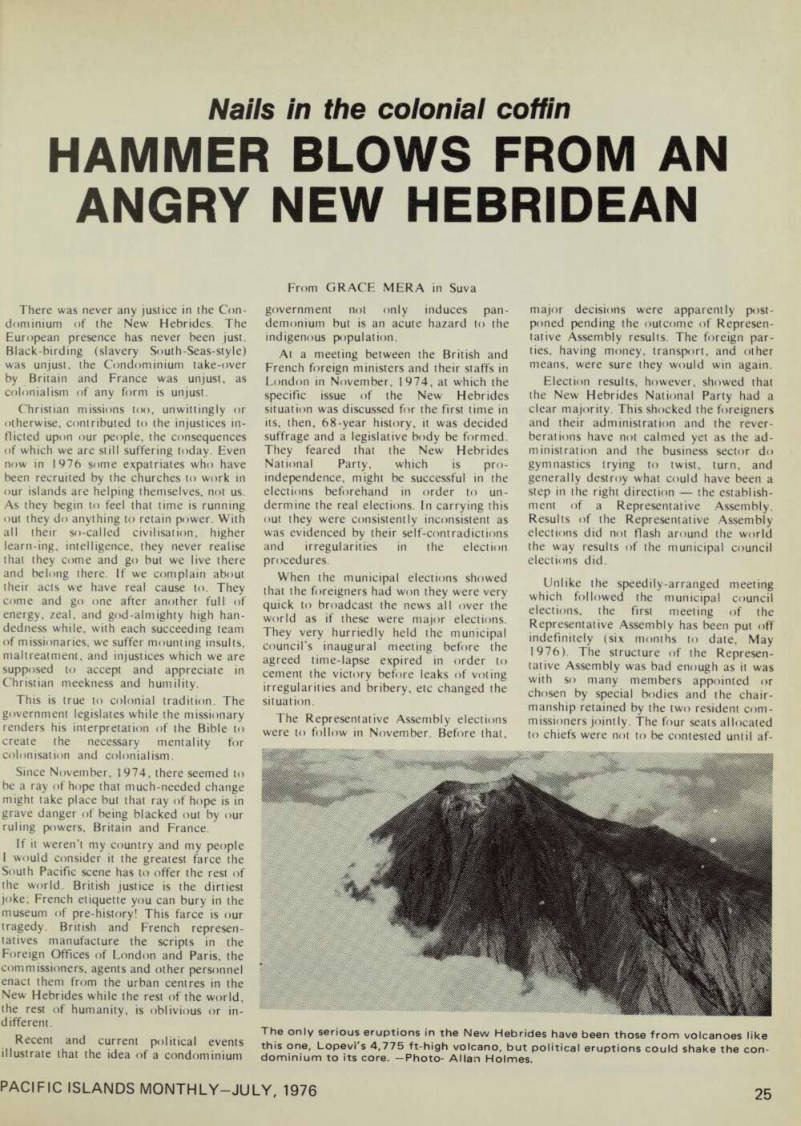
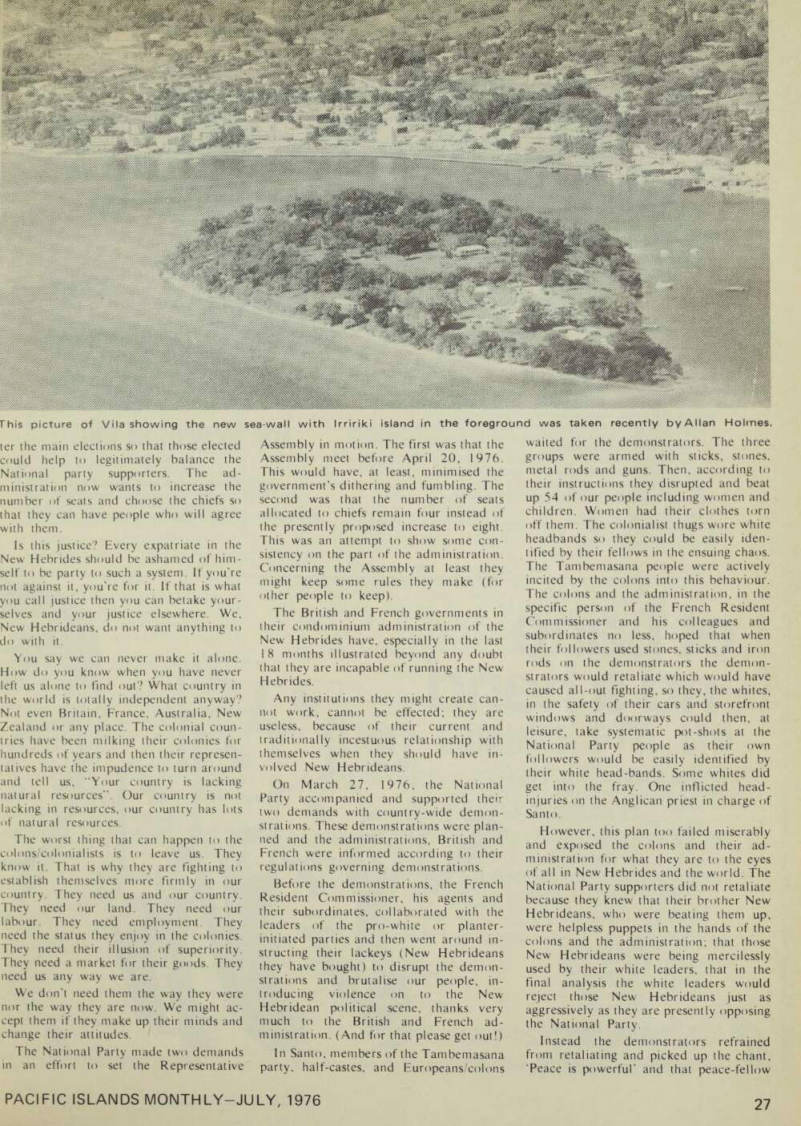
Nails in the colonial coffin
Angry New Hebridean
From GRACE MERA in Suva
There was never any justice in the Con dominium of the New Hebrides. The European presence has never been just.
Black-birding (slavery South-Seas-style) was unjust, the Condominium take-over by Britain and France was unjust, as colonialism of any form is unjust.
Christian missions too, unwittingly or otherwise, contributed to the injustices in flicted upon our people, the consequences of which we are still suffering today. Even now in 1976 some expatriates who have been recruited by the churches to work in our islands are helping themselves, not us.
As they begin to feel that time is running out they do anything to retain power. With all their so-called civilisation, higher learn-ing, intelligence, they never realise that they come and go but we live there and belong there. If we complain about their acts we have real cause to. They come and go one after another full of energy, zeal, and god-almighty high han dedness while, with each succeeding team of missionaries, we suffer mounting insults, maltreatment, and injustices which we are supposed to accept and appreciate in Christian meekness and humility.
This is true to colonial tradition. The government legislates while the missionary renders his interpretation of the Bible to create the necessary mentality for colonisation and colonialism.
Since November, 1974, there seemed to be a ray of hope that much-needed change might take place but that ray of hope is in grave danger of being blacked out by our ruling powers, Britain and France.
If it weren’t my country and my people I would consider it the greatest farce the South Pacific scene has to offer the rest of the world. British justice is the dirtiest joke; French etiquette you can bury in the museum of pre-history! This farce is our tragedy. British and French represen tatives manufacture the scripts in the Foreign Offices of London and Paris, the commissioners, agents and other personnel enact them from the urban centres in the New Hebrides while the rest of the world, the rest of humanity, is oblivious or in different.
Recent and current political events illustrate that the idea of a condominium
government not only induces pan demonium but is an acute hazard to the
indigenous population.
At a meeting between the British and French foreign ministers and their staffs in London in November, 1974, at which the specific issue of the New Hebrides situation was discussed for the first time in its, then, 68-year history, it was decided suffrage and a legislative body be formed.
They feared that the New Hebrides National Party, which is pro independence, might be successful in the elections beforehand in order to un dermine the real elections. In carrying this out they were consistently inconsistent as was evidenced by their self-contradictions and irregularities in the election procedures.
When the municipal elections showed that the foreigners had won they were very quick to broadcast the news all over the world as if these were major elections.
They very hurriedly held the municipal council’s inaugural meeting before the agreed time-lapse expired in order to cement the victory before leaks of voting irregularities and bribery, etc changed the situation.
The Representative Assembly elections were to follow in November. Before that.
major decisions were apparently post poned pending the outcome of Represen tative Assembly results. The foreign par ties, having money, transport, and other means, were sure they would win again.
Election results, however, showed that the New Hebrides National Party had a clear majority. This shocked the foreigners and their administration and the rever berations have not calmed yet as the ad ministration and the business sector do gymnastics trying to twist, turn, and generally destroy what could have been a step in the right direction the establish ment of a Representative Assembly.
Results of the Representative Assembly elections did not flash around the world the way results of the municipal council elections did.
Unlike the speedily-arranged meeting which followed the municipal council elections, the first meeting of the Representative Assembly has been put off indefinitely (six months to date, May 1976). The structure of the Represen tative Assembly was bad enough as it was with so many members appointed or chosen by special bodies and the chair manship retained by the two resident com missioners jointly. The four seats allocated to chiefs were not to be contested until af-
The only serious eruptions in the New Hebrides have been those from volcanoes like this one, Lopevi's 4,775 ft-high volcano, but political eruptions could shake the con dominium to its core. —Photo- Allan Holmes.
ter the main elections so that those elected could help to legitimately balance the National party supporters. The ad ministration now wants to increase the number of seats and choose the chiefs so that they can have people who will agree with them.
Is this justice? Every expatriate in the New Hebrides should be ashamed of him self to be party to such a system. If you're not against it, you’re for it. If that is what you call justice then you can betake your selves and your justice elsewhere. We, New Hebrideans, do not want anything to do with it.
You say we can never make it alone.
How do you know when you have never left us alone to find out? What country in
the world is totally independent anyway?
Not even Britain, France, Australia, New Zealand or any place. The colonial coun tries have been milking their colonies for hundreds of years and then their represen tatives have the impudence to turn around and tell us, “Your country is lacking natural resources”. Our country is not lacking in resources, our country has lots of natural resources.
The worst thing that can happen to the colons/colonialists is to leave us. They know it. That is why they are fighting to establish themselves more firmly in our country. They need us and our country.
They need our land. They need our
labour. They need employment. They
need the status they enjoy in the colonies.
They need their illusion of superiority.
They need a market for their goods. They need us any way we are.
We don’t need them the way they were nor the way they are now. We might ac cept them if they make up their minds and change their attitudes.
The National Party made two demands in an effort to set the Representative
Assembly in motion. The first was that the Assembly meet before April 20, 1976.
This would have, at least, minimised the government’s dithering and fumbling. The second was that the number of seats allocated to chiefs remain four instead of the presently proposed increase to eight This was an attempt to show some con sistency on the part of the administration.
Concerning the Assembly at least they
might keep some rules they make (for other people to keep).
The British and French governments in their condominium administration of the New Hebrides have, especially in the last 18 months illustrated beyond any doubt that they are incapable of running the New Hebrides.
Any institutions they might create can not work, cannot be effected; they are useless, because of their current and traditionally incestuous relationship with themselves when they should have in volved New Hebrideans.
On March 27, 1976, the National Party accompanied and supported their two demands with country-wide demon strations. These demonstrations were plan ned and the administrations, British and French were informed according to their regulations governing demonstrations.
Before the demonstrations, the French Resident Commissioner, his agents and their subordinates, collaborated with the leaders of the pro-white or planter initiated parties and then went around in structing their lackeys (New Hebrideans they have bought) to disrupt the demon strations and brutalise our people, in troducing violence on to the New Hebridean political scene, thanks very much to the British and French ad ministration. (And for that please get out!) In Santo, members of the Tambemasana party, half-castes, and Europeans/colons
waited for the demonstrators. The three groups were armed with sticks, stones, metal rods and guns. Then, according to their instructions they disrupted and beat up 54 of our people including women and children. Women had their clothes torn off them. The colonialist thugs wore white headbands so they could be easily iden tified by their fellows in the ensuing chaos.
The Tambemasana people were actively incited by the colons into this behaviour.
The colons and the administration, in the specific person of the French Resident Commissioner and his colleagues and subordinates no less, hoped that when their followers used stones, sticks and iron rods on the demonstrators the demon strators would retaliate which would have caused all-out fighting, so they, the whites, in the safety of their cars and storefront windows and doorways could then, at leisure, take systematic pot-shots at the National Party people as their own followers would be easily identified by their white head-bands. Some whites did get into the fray. One inflicted head injuries on the Anglican priest in charge of Santo.
However, this plan too failed miserably and exposed the colons and their ad ministration for what they are to the eyes of all in New Hebrides and the world. The National Party supporters did not retaliate because they knew that their brother New Hebrideans, who were beating them up, were helpless puppets in the hands of the colons and the administration; that those New Hebrideans were being mercilessly used by their white leaders, that in the final analysis the white leaders would reject those New Hebrideans Just as aggressively as they are presently opposing the National Party.
Instead the demonstrators refrained from retaliating and picked up the chant, ‘Peace is powerful' and that peace-fellow
This picture of Vila showing the new sea-wall with Irririki island in the foreground was taken recently by Allan Holmes.
New Hebrideans is powerful.
The French administration conveniently advised their police force not to patrol the stieets on this occasion to better facilitate their planned disorder. They brought the mobile guard over from New Caledonia and left them sucking their thumbs in Vila when they knew the trouble would be in Santo.
The French and their supporters wanted an excuse to massacre our people but once more they underestimated our intelligence and determination.
Peace is powerful. That is our line. We want peace. The condominium presence in the New Hebrides does not equate with peace. Colonialism is a violence. The in volvement of saboteurs in the New Hebrides, incitement to riot, bribery, the use of force by the administration are violent acts. The administration stands for violence. We do not want violence, we want peace. The only way for the present condominium government to go is OUT!
The demonstration of peace that the National Party supporters displayed in Santo during the disruption of their or derly and purposeful demonstration was indicative of the National Party’s and the New Hebridean peoples’ political maturity, strength of will, determination, discipline, unity, in their desire to end colonialism in the New Hebrides.
The struggle is on. There is no turning back!
It is now more than six months since the Representative Assembly was elected. The inaugural meeting has not been held and a possible date has not even been discussed.
The British and French in New Hebrides, their nationals, and all perpetrators of colonialism know that if the Represen tative Assembly does meet with a National Party majority, and exercises its power to legislate, each piece of legislation enacted will be another nail in the colonial coffin (and they certainly fear death physically and figuratively). We realise the odds against us. We are determined to strive for peace and justice in the New Hebrides.
The British and French resident com missioners have pressured their metropolitan governments to reject the National Party’s two demands. The two resident commissioners have informed the people that London and Paris insist that there must be eight custom chiefs in the
Representative Assembly. Presumably
London and Paris, with the help of their Administration, will choose the custom chiefs. What the hell, may I ask, do the British and French in London and Paris know about the customs of 110 different cultures in the New Hebrides and who can legitimately be considered a custom chief when even the whites who are in New Hebrides don’t even know?
The Europeans who have at all bothered to learn the rudimentaries of one
language or other of the 110 languages extant can be counted on the fingers of one hand. Many expatriates simply exist in New Hebrides as part of the exploitative structure. They don’t know what’s going on; they don’t even attempt to find out, and for that reason they are a menace to the country.
The British and French colonial administrations are in league with these elements, allowing themselves to be heavily influenced by them, which explains why some of the administrations’ decisions are ridiculously stupid. The metropolitan colonial offices aside, the resident commissioners are forever playing political games at the expense of the country's welfare. Time is running out. The present administration must go.
The National Party deplored the violence and the inactivity of the British and French police to maintain order. They accused the British of passively following the French and the French of actively inciting people to riot and sowing the seeds of discontent and disorder, creating trouble for the country. The two resident commissioners thought that as usual they would talk themselves out of the accusations and laugh off the incident. The French Resident Commissioner denied the accusation and said that, furthermore, it was impossible as the National Party had no proof. Members of the National Party executive proceeded to inform him, in detail, his exact movements and activities prior to the March 27 demonstration. The March 27 violence was a direct result of these government activities. That is why the French police did not patrol the streets. The British police were there but took no action because they did not want
to offend the French (while 54 innocent, unarmed people were beaten up). No ac tion has since been taken following this outbreak of violence, According to one government officer, when individuals commit crimes the police can take action but when political parties are involved then the police cannot take any action because it is a political act.
Which means that, according to the British and French administrations in the New Hebrides, if members of one party or par ties decide to annihilate the members of another party or parties then it is perfectly all right because the blanket label of Political Activity gives it immunity to
police action.
We urge the British and French ad ministration to stop playing games in our country, risking our people’s lives, and the general welfare of our country. If they must play their games go and play them in London and Paris with their own people in their own environment and leave us in peace to run our own affairs. We know better what’s good for us.
British and French initiative in and sup port of violence and their inactivity or failure to restore order has produced (to this date) a deplorable state where in dividuals could take the law into their ()W n hands. If violence does break out again the British and French con dominium administration will be totally
responsible,
The British and French have the might „f western technology on their side. We, the indigenous populace of the New Hebrides, have determination, a will, a spirit. Our struggle is on. We are not tur ning back!
Advertisements & other items, pp. 26-29 (1 item)
S. E. Tatham
SOME OF THE FIRMS
WE REPRESENT ARE:
Asia Rubber Works (Singapore Rubber Shoes) Frappier (French Brandy) Huvet (French Brandy) Indika (Belgium Dairy Produce) Durobor S.A. (Belgium Glassware) Miroiterie Gen. de Belgiqe S.A. (Louvre glass and mirrors) City Engineers (U.K. Bicycles) F.H.I. Japan (Subaru Cars) Kraggs (Wines, Spirits, Ciders) Sunshine Biscuits Sunrise (Confectionery) Flamenco (Instant Coffee & Tea) Quaker Products (Oats, Jets) Hancocks (Spaghetti, Cereals) Melbourne Canning (Jams) Amatil (Twisties, Twirlies) Edward Zorn (Margarine, Cooking Fats) Allens (Confectionery) Red Tulip (Fine Chocolates) Robert Timms (New Guinea Gold Instant Coffees and Teas) S.P.C. (Canned Fruit) % ii 1 i %
S. E. TATHAM
& CO. PTY. LTD.
BEEHIVE BLDG.,
94 ELIZABETH ST.,
MELBOURNE, 3001, AUSTRALIA.
G.P.O. BOX B—CABLES "SET'
TELEPHONE 63 5094
TELEX: AA34293
S.P.C. (Abalone) Wing Lee (See You Sauce) Magnet (Mattresses) Essteel (Cookware) Warner-Drayton (Fans) Mitahell's (Abrasives) Tilbury & Lewis (Sports Trophies & Silverplate) Regent (Swiss watches) Lega Marcasite (Jewellery) Austramax (Pressure Lanterns) Lawn Chair; Tubco (Garden Furniture) Electronic Industries (Electrical Household Appliances) Jex (Steelwool) Arnbro (Folding Beds) James Miller (Blankets) Elmaco (Plastics —Electrical Fittings) B.X. (Plastics) Stegbar (Wooden Louvres) Franklite (Light Fittings) JJ. Cash Embroidered Labels) Disston (Saws)
BUYERS FOR THE
PACIFIC ISLANDS
DIRECT ENQUIRIES WELCOMED
PAPUA NEW GUINEA: S. E. TATHAM (P.N.G.) PTY. LTD
LAE: MALAITA STREET (P.O. BOX 1562).
PORT MORESBY: CNR. GOROA AND MUNAHU STREETS, GORDON
(P.O. BOX 6733, BOROKO).
FIJI: S. E. TATHAM (FIJI) LTD.,
LAUTOKA: P.O. BOX 366.
SUVA: G.P.O. BOX 671.
YOUR GUARANTEE
SINCE 1924
1
FOR SERVICE
BOOK SPACE IN PARADISE
The Regent of Fiji, with 300 gracious guest rooms, is paradise on the glistening Pacific shore Cordial, like a Fijian village, the Regent invites you to a treasure of Melanesian arts The Steakhouse and The Terrace serve delicious food platters and a spectacular ocean-view Whafs mom, the Regent is well-mannered service: in-room phones air conditioning, Fijian stewards, complete banquet/convention pavilion and duty tree shopping And the Regent is sports: scuba, sailing, fishing, beachcombing swimming and tennis All in wave-free Nadi Bay Book space in paradise The Regent of Fiji—2o minutes from the airport POST OFFICE BOX 441 NADI, FUI PHONE 70700 • TELEX (792) 5214 'mr
the Regent of Fiji
OENARAU BEACH RESORT
PHONE COLLECT FOR RESERVATIONS
Mr. Rex Vidler, Sydney, Australia Sales Office No. 1 York Street, 14th floor • Sydney, Australia 2000 Phone (02) 276469 In Auckland, New Zealand, phone Instant Hotels, 374921
Let Lane
lend a hand
These are some of the products which are keeping our customers prosperous. From this range, you can obtain a really effective herbicide such as M.S.M.A., which controls persistent grasses and sedges in coconuts and bananas, or a short, residual, quick-acting insecticide like DIBROM which controls fruit and vegetable insects and mosquitoes, sandflies and midges.
Also, our research facilities and advisory services In the field are among the best available, so drop us a line and let us help you.
Lane Ltd., Export Division, P.O. Box 59, Bankstown, N.S.W. 2200 Lane (Fiji) Ltd., P.O. Box 89, Suva, Fiji f f Insecticide e Fungici f Weedkiller , Feed upplement f e iu Animal Health umigants e Home Gard \S \ \ * Don't target—Amalgamated Chemicals is now Lane
HENRY CUMINES PTY. LTD.
EXPORTERS • GENERAL MERCHANTS
428 GEORGE ST., SYDNEY
CABLES: HENCO SYDNEY. G.P.O. Box 3949. PHONE: 25-3383.
For specialised and personalised buying service throughout the Pacific Islands and the East Local enquiries to our agents RABAUL: M & C. Seeto, P.O. Box 131, Rabaul. Telephone 922902.
MADANG: W. Double, P.O. Box 22, Madang. Telephone 822696.
Resident Agents in other Pacific Territories.
FIJI: K. Witherington Ltd, P.O. 293, Suva.
Telephone 22-356.
NEW HEBRIDES: John Lum &
Associates, Box 65, P. 0., Santo.
Telephone 329.
LAE: Osborne Agencies, P.O. Box 8, Lae Telephone 422918.
Islands Want More Of The
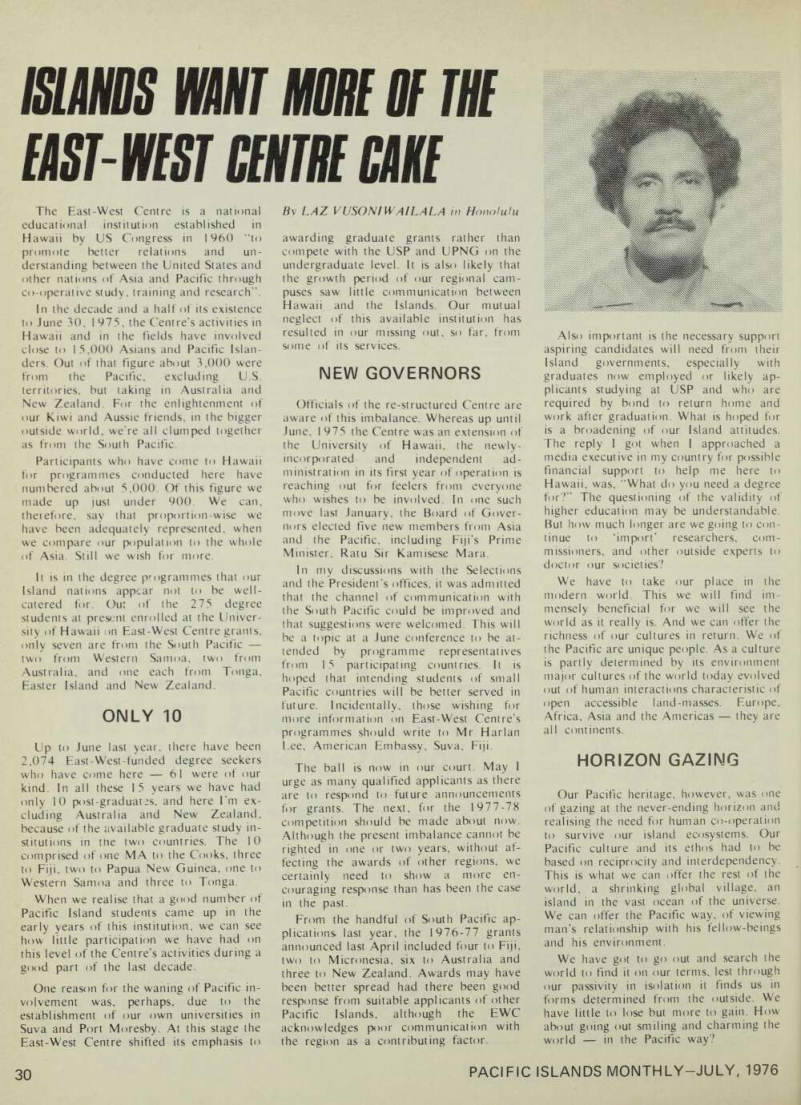
East-West Centre Cake
The East-West Centre is a national educational institution established in Hawaii by US Congress in 1960 "to promote better relations and un derstanding between the United States and other nations of Asia and Pacific through
co-operative study, training and research”.
In the decade and a half of its existence to June 30. I 975, the Centre’s activities in Hawaii and in the fields have involved close to 15,000 Asians and Pacific Islan ders. Out of that figure about 3,000 were from the Pacific, excluding U.S. territories, but taking in Australia and New Zealand. For the enlightenment of our Kiwi and Aussie friends, in the bigger outside world, we’re all clumped together as from the South Pacific.
Participants who have come to Hawaii for programmes conducted here have numbered about 5,000. Of this figure we made up just under 900. We can, theiefore, say that proportion-wise we have been adequately represented, when we compare our population to the whole of Asia. Still we wish for more.
It is in the degree programmes that our Island nations appear not to be well catered for. Out of the 275 degree students at present enrolled at the Univer sity of Hawaii on East-West Centre grants, only seven are from the South Pacific two from Western Samoa, two from Australia, and one each from Tonga, Easter Island and New Zealand.
Only 10
Up to June last year, there have been 2,074 East-West-funded degree seekers who have come here 61 were of our kind. In all these 15 years we have had only 10 post-graduates, and here I’m ex cluding Australia and New Zealand, because of the available graduate study in stitutions in the two countries. The 10 comprised of one MA to the Cooks, three to Fiji, two to Papua New Guinea, one to Western Samoa and three to Tonga.
When we realise that a good number of Pacific Island students came up in the early years of this institution, we can see how little participation we have had on this level of the Centre’s activities during a good part of the last decade.
One reason for the waning of Pacific in volvement was, perhaps, due to the establishment of our own universities in Suva and Port Moresby. At this stage the East-West Centre shifted its emphasis to
By LAZ VUSONIWAILALA in Honolulu
awarding graduate grants rather than compete with the USP and UPNG on the undergraduate level. It is also likely that the growth period of our regional cam puses saw little communication between Hawaii and the Islands. Our mutual neglect of this available institution has resulted in our missing out, so far, from some of its services.
New Governors
Officials of the re-structured Centre are aware of this imbalance. Whereas up until June, 1 975 the Centre was an extension of the University of Hawaii, the newly incorporated and independent ad ministration in its first year of operation is reaching out for feelers from everyone who wishes to be involved. In one such move last January, the Board of Gover nors elected five new members from Asia and the Pacific, including Fiji's Prime Minister, Ratu Sir Kamisese Mara.
In my discussions with the Selections and the President’s offices, it was admitted that the channel of communication with the South Pacific could be improved and that suggestions were welcomed. This will be a topic at a June conference to be at tended by programme representatives from 15 participating countries. It is hoped that intending students of small Pacific countries will be better served in future. Incidentally, those wishing for more information on East-West Centre’s programmes should write to Mr Harlan Lee, American Embassy, Suva, Fiji.
The ball is now in our court. May I urge as many qualified applicants as there are to respond to future announcements for grants. The next, for the 1977-78 competition should be made about now.
Although the present imbalance cannot be righted in one or two years, without af fecting the awards of other regions, we certainly need to show a more en couraging response than has been the case in the past.
From the handful of South Pacific ap plications last year, the 1976-77 grants announced last April included four to Fiji, two to Micronesia, six to Australia and three to New Zealand. Awards may have been better spread had there been good response from suitable applicants of other Pacific Islands, although the EWC acknowledges poor communication with the region as a contributing factor.
Also important is the necessary support aspiring candidates will need from their Island governments, especially with
graduates now employed or likely ap
plicants studying at USP and who are required by bond to return home and work after graduation. What is hoped for is a broadening of our Island attitudes.
The reply I got when I approached a media executive in my country for possible financial support to help me here to Hawaii, was, "What do you need a degree for?” The questioning of the validity of higher education may be understandable.
But how much longer are we going to con tinue to ‘import’ researchers, com missioners, and other outside experts to doctor our societies?
We have to take our place in the modern world. This we will find im mensely beneficial for we will see the world as it really is. And we can offer the richness of our cultures in return. We of the Pacific are unique people. As a culture is partly determined by its environment major cultures of the world today evolved out of human interactions characteristic of open accessible land-masses. Europe, Africa, Asia and the Americas they are all continents.
Horizon Gazing
Our Pacific heritage, however, was one of gazing at the never-ending horizon and realising the need for human co-operation to survive our island ecosystems. Our Pacific culture and its ethos had to be based on reciprocity and interdependency.
This is what we can offer the rest of the world, a shrinking global village, an island in the vast ocean of the universe.
We can offer the Pacific way. of viewing man’s relationship with his fellow-beings and his environment.
We have got to go out and search the world to find it on our terms, lest through our passivity in isolation it finds us in forms determined from the outside. We have little to lose but more to gain. How about going out smiling and charming the world in the Pacific way?
From the Samoa Times: A young man was acquitted of rape at the Supreme Court Tuesday afternoon by a panel of four assessors ... He told the court that he had sexual intercourse with the woman as payment for her ride on his bicycle.
Editorial comment in The Fiji Times on recent diplomatic overtures overseas by New Zealand Prime Minister, Mr Bob Muldoon: . . . Mr Muldoon is paddling against wind and tide if he believes that the independent Pacific nations (apart from New Zealand and possibly Australia) will welcome his call for closer ties between France and its colonies and other countries of the region. There is everywhere in the Pacific sympathy and support for those people in New Caledonia and French Polynesia who are seeking independence, but very little indeed for the colonial power which for so long has littered the region with its filthy nuclear garbage . . . Nor will islands people be enchanted despite Mr Muldoon’s assurance that New Zealand has a special Pacific responsibility, with his glib comment about a newly independent Pacific country; “Eight islands together 7000 people and lots of coconuts that nobody wants”.
From Tohi Tala Niue: Hakapu the last village on the southern circuit celebrated the power switch on in a style usually reserved for such occasions as opening of a new village church or pastor’s house. According to people who attended the festivities every man and his dog celebrated.
From the Solomons News Drum: John Lapaite’e of Aulutau was on a fishing trip off Wahi’i when he hooked a big fish. In a hard struggle the fish sank Mr Lapaite’e’s canoe and it took him more than six hours to swim ashore. Our correspondent Jeffrey Noris, says the man arrived safely at Liwe village late in the evening but he did not catch the fish.
From a Micronesian Independent report of a speech by Mr Fred M. Zeder, US Director of Territories,
on Saipan:
Saipan, Zeder, said, should be more like White Sulphur Springs, a well-known resort area for the very rich in the United Slates.
With recreation facilities, a medical centre, and gathering place for small conventions, companies like IBM, Xerox, US Steel would “book years in advance” to come to Saipan; “A good image for the island to attract people with money,” Zeder exclaimed, “not honeymoon couples from Japan with a roll of nickles”.
From a Micronesian Independent report of the celebrations marking the Northern Marianas US commonwealth status: . . . The festivities were filled with plenty of pomp and circumstance a spiffy Navy band, marching Marines, boring speeches, the Island Chorus singing “God bless America” and even a 852 bomber zooming over the crowd . . . But something seemed to be missing ... No great outbursts of joy or enthusiasm swept through the crowd over their new status many business employees had to be back at work by 2, and left shortly after eating ... As the band closed down its last set around 10, someone yelled out from a passing car, “Hey Brown, how’s it feel to be second-class Americano?”
Carting coals to Newcastle, or, in this case, to Nauru as reported in the republic’s Bulletin: Mr Peter Tapsell, Conservative MP for Louth (UK), made a short visit to Nauru where he was the guest of Mr Simon Gilletl.
Mr Tapsell, who is a stockbroker . . . presented the President with two turtles and these are now installed in Turtle Pool at Slate House.
Lesieli S. Vete underlines the importance of keeping Tonga’s Sunday observance law in a letter to the
Tonga Chronicle:
If the Maker of Modern Tonga was here today, I am sure he would remind us that; “It is written, the Sabbath Day in my country will be called a day of prayer, but you are making it a day of unloading cargo for your ship."
From the Samoa Times: Married senior police officers have been accused of having illicit affairs with unattached female members of the police. The -charges will be heard by a "police court" itself but informed sources said that a “Judge" to preside was difficult to find as the Commissioner of Police, Unasa Lio, and other senior officers have declined to preside over the hearings.
From Tohi Tala Niue: How do you order a “rock crushing plant” worth in the vicinity of $70,000 without bothering to find out if it is powered by electricity or diesel?
The answer is simple, don’t bother, because she’ll be right mate.
Apparently the Public Works Department, the biggest government department on Niue, had placed an order for new “rock crushing plant” without firstly finding out, or bothering to properly investigate the new plant before placing the order. This blunder, not the first, will cost an extra $4,500 to install a sub station, transformers and high tension reticulation cables to the quarry, because the crusher is powered by 150 hp electric motors and not diesel as assumed.
From The Samoa Times, reporting nearly 60 per cent of Parliament’s members were not returned in elections: High titles, which once ensured holders easy entry into Parliament, failed to produce the expected results. Even Prime Minster Tupua Tamasese Lealofi, holder of one of the four Tama-a-Aiga titles, had to fight for his seat. The first time a holder of such a title has had to compete for a seat. Maulolo Motuloa, holder of one of the most important orator titles in the whole country, went down to Taliaoa Maoama, the possessor of a less important title.
Advertisements & other items, pp. 31-32 (1 item)
m
FROM THE
ISLANDS
PRESS
E. G. BARKER & CO. PTY. LTD Established 1825 150 Years of Service
AUSTRALIA S OLDEST EXPORT HOUSE
GENERAL EXPORT MERCHANTS
Specialising in world-wide distribution of General Provisions and Produce
EXPORTING TO ALL PORTS IN
PACIFIC ISLANDS
Buying Agents for: —THE CO-OPERATIVE WHOLESALE SOCIETY LTD.
LAE AND ALL BRANCHES
PORT MORESBY
RAYMOND WONG
P.O. Box 5020
BOROKO
Phone 25 5546 Representatives
RABAUL
CON S ASSAD IS
P.O. Box 611
RABAUL
Phone 92 2934
FIJI
PARAMOUNT AGENCIES
G.P.O. Box 459
SUVA
Phone 2 3127
34 HUNTER STREET, SYDNEY 2000
Cable Address: KERBAR SYDNEY. Phone: 231-6200. Telex: 22221 Melbourne Office: 530 Little Collins Street. Phone: 61-2877. Telex: 31732.
Save hundreds of dollars
on Australia’s most efficient
WALK IN, ALUMINIUM
COOLROOMS AND
FREEZE ROOMS
Hundreds already installed! The most economical supplementary coolrooms for bottles and food, providing the largest storage capacity of any comparable coolrooms of the same exterior dimensions. Five sizes—from 90-360 cu. ft. capacity; 16 models offering normal temp., two temp., deep freeze, or for pastry and ice storage applications. White vinyl interior, embossed rustproof aluminium exterior. • SUPPLIED IN EASY-TO-ERECT, DO-IT-YOURSELF KIT FORM.
Available from: AUSTRALIAN NEW CALEDONIA EXPORTS (SILVER & BARDA), 363 George St., Sydney, 2000 and Branches.
BRECKWOLDT & CO., 276 Pitt St., Sydney, 2000 and Branches.
PETER FISHER TRADING PTY. LTD., 321 Pitt St., Sydney, 2000.
HAGEMEYER (A'SIA), 59 Anzac Pde., Kensington, 2033 and Branches.
GEOFFREY HUGHES & CO., 167 Macquarie St., Sydney, 2000.
Manufactured by:
T 1 NELSON & ROBERTSON PTY. LTD., 197 Clarence St., Sydney, 2000.
RABAUL TRADING CO. PTY. LTD., P.O. Box 219, Rabaul and Branches.
E. RABOT (EXPORTS) PTY. LTD., 67 Castlereagh St., Sydney, 2000.
H. Y. KWAN (AUST.) PTY. LTD., Box 2713 G.P.O. Sydney, 2001.
C. SULLIVAN (EXPORT) PTY. LTD., 60 Margaret St., Sydney, 2000 and Branches.
W. S. TAIT & CO., PTY. LTD., 31 Macquarie Place, Sydney, 2000 and Branches.
FRIGID CABINETS PTY. LTD.,
14A Duffy Ave., Thornleigh, N.S.W. 2120 Aust. Ph. 848 8292.
Canned festival
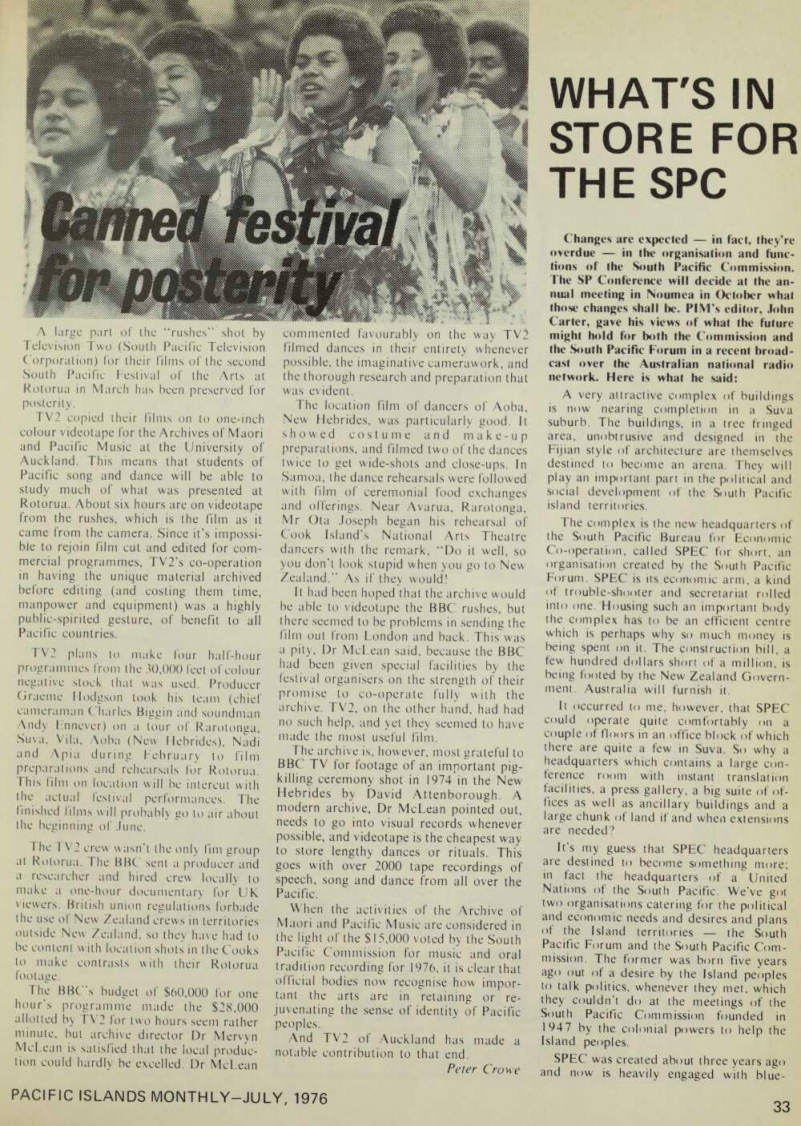
for posterity
A large part of the “rushes” shot by Television Two (South Pacific Television Corporation) for their films of the second South Pacific Festival of the Arts at Rotorua in March has been preserved for posterity.
TV2 copied their films on to one-inch colour videotape for the Archives of Maori and Pacific Music at the University of Auckland. This means that students of Pacific song and dance will be able to study much of what was presented at Rotorua. About six hours are on videotape from the rushes, which is the film as it came from the camera. Since it’s impossi ble to rejoin film cut and edited for com mercial programmes, TV2’s co-operation in having the unique material archived before editing (and costing them time, manpower and equipment) was a highly public-spirited gesture, of benefit to all Pacific countries.
IV2 plans to make four half-hour programmes from the 30,000 feel of colour negative slock that was used. Producer Graeme Hodgson look his team (chief cameraman Charles Biggin and soundman Andy Lnnever) on a lour of Rarotonga, Suva, Vila, Aoba (New Hebrides), Nadi and Apia during February to film preparations and rehearsals for Rotorua.
This film on location will be intercut with the actual festival performances. The finished films w ill probably go to air about the beginning of June.
The TV2 crew wasn't the only fim group at Rotorua. The BBC sent a producer and a researcher and hired crew locally to make a one-hour documentary for UK viewers. British union regulations forbade the use ol New Zealand crews in territories outside New Zealand, so they have had to be content with location shots in the Cooks to make contrasts with their Rotorua
footage.
The BBC's budget of $60,000 for one hour's programme made the $28,000 allotted by TV2 lor two hours seem rather minute, but archive director Dr Mervyn McLean is satisfied that the local produc tion could hardly be excelled. Dr McLean
commenled favourably on the way TV2 filmed dances in their entirety whenever possible, the imaginative camerawork, and the thorough research and preparation that was evident.
The location film of dancers of Aoba, New Hebrides, was particularly good. It showed costume and make-up preparations, and filmed two of the dances twice to gel wide-shots and close-ups. In Samoa, the dance rehearsals were followed with film of ceremonial food exchanges and offerings. Near Avarua, Rarotonga, Mr Ola Joseph began his rehearsal of Cook Island’s National Arts Theatre dancers with the remark, “Do it well, so you don't look stupid when you go to New Zealand.” As if they would!
It had been hoped that the archive would be able to videotape the BBC rushes, but there seemed to be problems in sending the film out from London and back. This was a pity. Dr McLean said, because the BBC had been given special facilities by the festival organisers on the strength of their promise to co-operate fully with the archive. TV2, on the other hand, had had no such help, and yet they seemed to have made the most useful film.
The archive is, however, most grateful to BBC TV for footage of an important pig killing ceremony shot in 1974 in the New Hebrides by David Attenborough. A modern archive. Dr McLean pointed out, needs to go into visual records whenever possible, and videotape is the cheapest way to store lengthy dances or rituals. This goes with over 2000 tape recordings of speech, song and dance from all over the Pacific.
When the activities of the Archive of Maori and Pacific Music are considered in the light of the $ 15,000 voted by the South Pacific Commission for music and oral tradition recording for 1976, it is clear that official bodies now recognise how impor tant the arts are in retaining or re juvenating the sense of identity of Pacific peoples.
And TV2 of Auckland has made a notable contribution to that end.
Peter Crowe
What's In
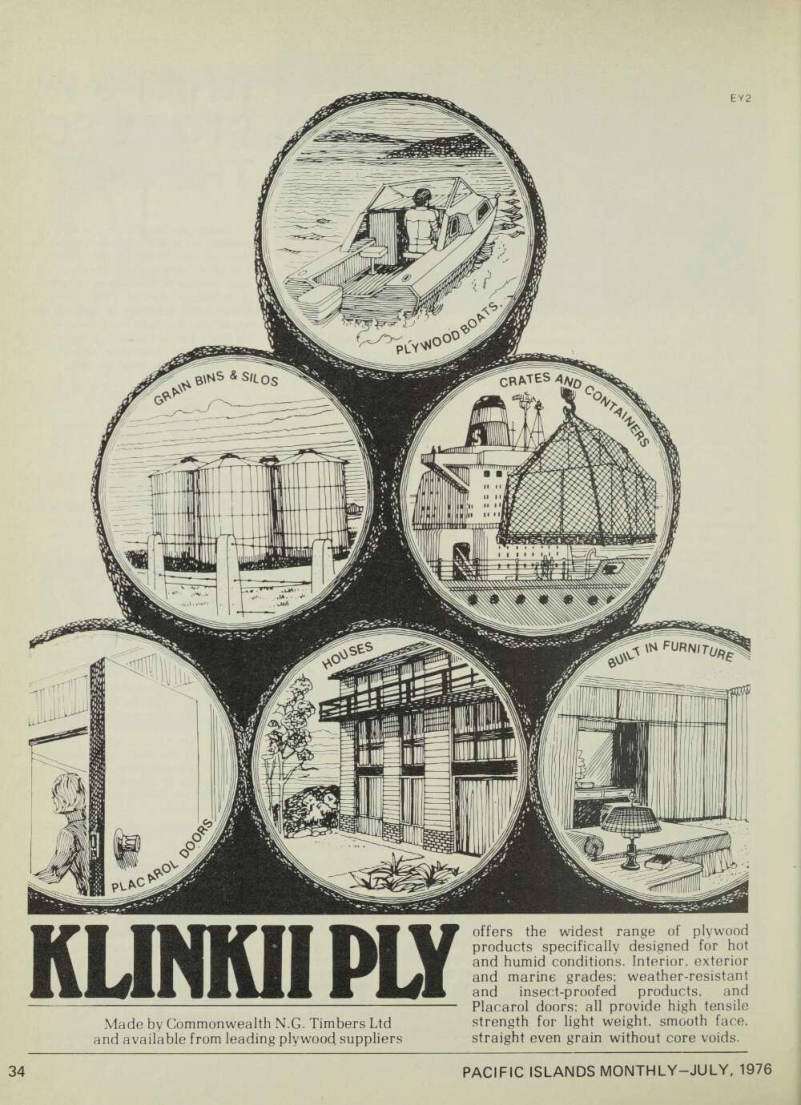
Store For
The Spc
Changes are expected in fact, they’re overdue in the organisation and func tions of the South Pacific Commission.
The SP Conference will decide at the an nual meeting in Noumea in October what those changes shall be. PlM’s editor, John Carter, gave his views of what the future might hold for both the Commission and the South Pacific Forum in a recent broad cast over the Australian national radio network. Here is what he said: A very attractive complex of buildings is now nearing completion in a Suva suburb. The buildings, in a tree fringed area, unobtrusive and designed in the Fijian style of architecture are themselves destined to become an arena. They will play an important part in the political and social development of the South Pacific island territories.
The complex is the new headquarters of the South Pacific Bureau for Economic Co-operation, called SPEC for short, an organisation created by the South Pacific Forum. SPEC is its economic arm, a kind of trouble-shooter and secretariat rolled into one. Housing such an important body the complex has to be an efficient centre which is perhaps why so much money is being spent on it. The construction bill, a few hundred dollars short of a million, is being footed by the New Zealand Govern ment. Australia will furnish it.
It occurred to me, however, that SPEC could operate quite comfortably on a couple of floors in an office block of which there are quite a few in Suva. So why a headquarters which contains a large con ference room with instant translation facilities, a press gallery, a big suite of of fices as well as ancillary buildings and a large chunk of land it and when extensions are needed?
It’s my guess that SPEC headquarters are destined to become something more; in fact the headquarters of a United Nations of the South Pacific. We’ve got two organisations catering for the political and economic needs and desires and plans of the Island territories the South Pacific Forum and the South Pacific Com mission. The former was born five years ago out of a desire by the Island peoples to talk politics, whenever they met, which they couldn't do at the meetings of the South Pacific Commission founded in 1947 by the colonial powers to help the Island peoples.
SPEC was created about three years ago and now is heavily engaged with blue
prints for a regional shipping line and a regional airline. It’s obvious that there is going to be duplication of effort by the SPC and the Forum. South Pacific Com mission delegates will meet on that chunk of phosphate called the Republic of Nauru to review the future role of the Com mission. A report has been prepared by two experts who have been touring the Islands seeking the views of the various governments on the SPC’s future. Many believe it’s outdated and ineffectual. It has always operated on a shoestring with Australia contributing the largest sum but the money, never more than S2 l /2 million in any one year, has been swallowed up by administration expenses and the fees of ex perts who have prepared pilot projects like fishfarming, and agricultural schemes which somehow have very rarely got off Jhe ground.
To be fair, however, 1 must stress that it has done some good work in health and education But as times and countries change, the SPC must change. Wha will it be? A conduit and clearing house for funds flowing to the Islands and an economic advisory body? But SPEC, given the facilities, could do the same job. The review committee’s report will be con sidered at the 16th South Pacific Con ference which will be held in Noumea in October. But before that meeting there will be the annual meeting of the Forum in Nauru.
So there’s a fine political broth brewing.
It could boil over. Students of Island af fairs have seen in the last 10 years great changes in the Islands. Seven Island territories have become independent or self-governing and in the next two or three years all the former commonwealth colonies with the exception of Pitcairn Island, population 70, will be self governing.
Which leaves the New Hebrides, the Condominium, sometimes called the Pan demonium, governed by France and Britain and there are also France’s over seas territories of New Caledonia, French Polynesia. Wallis and Futuna. There’s political ferment in them all.
Change is likely in the New Hebrides with Britain longing to get out but France holding on because the withdrawal there would increase pressures for political change in her other territories. So we have this position. All the ex-Commonwealth colonies which include Papua New Guinea will be independent and the majority of these see the South Pacific Forum as their main organisation in the future.
On the other side are the French-held territories and the Condominium. Mem bership of the Forum is only open to in
dependent or self-governing countries
which rules out the French territories and.
for the moment, the New Hebrides.
All the Islands are eager for a closer co operation with each other and this can be achieved through the Forum and SPEC.
For several years there has been a feeling in those Islands that the South Pacific Commission headquarters should be transferred from Noumea in New Caledonia to a more central position. Not for nothing has Fiji been called the hub of the South Pacific. It’s no secret that some are planning for a shift to Suva but France which has always been a strong member of the South Pacific Commission will oppose this that is if, in a few years time, France is in a position to oppose. Nuclear tests haven’t endeared her to the Islands and pressure is growing for independence or self-government in the French territories. Something has got to give
which is why the political broth might boil over Whatever happens, I’m sure there will be moves to dovetail the Forum and the Commission and that’s why 1 think such an elaborate complex of buildings is being readied in Suva.
If France transforms her overseas territories into departments of France and moves for independence in those territories fail, those territories could become isolated but there is a strong feeling of togetherness in all the Islands. If the Commission headquarters were moved from Noumea, France’s position could be weakened and the Forum countries would be encouraged to work harder for political
change for their French-speaking
Polynesian and Melanesian brethren.
Advertisements & other items, pp. 34-42 (2 items)
Klinkii Put
ms
6 & S//.OS
CBATES Aty o
Sts V- 0 p\> C
KLINKII PUT
Made by Commonwealth N.G. Timbers Ltd and available from leading plywood suppliers offers the widest range of plywood products specifically designed for hot and humid conditions. Interior, exterior and marine grades; weather-resistant and insect-proofed products, and Placarol doors; all provide high tensile strength for light weight, smooth face, straight even grain without core voids.
qBEP^
O % o 0^ >l/
In our 81st year
Selling
"SERVICE"
to the Pacific islands
NELSON & ROBERTSON
PTY. LIMITED
(Established 1895)
PLANTATION HOUSE, 197 CLARENCE STREET, SYDNEY
CABLES: “IVAN", SYDNEY, BRISBANE. TELEX: AA22381, SYDNEY.
FOR:
INDENTS
COMMODITIES
SHIPPING
TRAVEL
INSURANCE
REAL ESTATE
Branch Office: Nelson & Robertson Pty. ltd., 303 Adelaide St., Brisbane, Old.
New Guinea Representatives: Rabtrad Niugini Pty. ltd., Rabaul Lae Madang Kieta.
a*** 50 r
Mixmaster Mixer
3 times better than any
other mixer. Designed especially for family food preparation. 12-speed mixfinder dial indicates the correct speed for each mixing action. Complete with 2 heat-resistant bowls and juice extractor. Sunbeam’s exclusive 3-way beating action — extra large, contoured beaters, and automatic bowl movement — gives perfect aeration and more even mixing. It can handle everything from beating one egg to mixing a large fruit cake.
How Sansui’s front-loaders
became stereo’s
front-runners.
SC-2000 SC-20 Sansui.
mwf! f" l "
*** if #* * © Sansui a SC-3000 SC-30
When our Sansui engineers designed our
four classic front-loading stereo cassette tape
decks, they positioned the front-access tape
compartments right-side-up. Naturally, this
made it easier to handle tapes and read their
labels. More convenience and more stability.
The critics liked what they saw. And heard. “The styling is fresh and functional and the operation eminently sane,” said the first technical review of the Sansui SC-3000. “It is,
in a word, an attractive product.”
Compared to some of the other frontloading decks, ours don’t cost very much.
Perhaps that’s how our front-
loaders have become stereo’s
front-runners.
SANSUI ELECTRIC CO., LTD.
14-1,2-chome, Izumi, Suginami-ku, Tokyo 168, Japan
Sasisnl.
Australia Rank Industries Australia Pty. Ltd.
Head Office: 12 Barcoo Street, East Roseville, N.S.W. 2069 Phone: 406 5666 Melbourne: 68 Queensbridge Street, South Melbourne, Vic. 3205 Phone: 62 0031 Adelaide: Phone: 332 4288/Brisbane; Phone: 52 7333/Canberra: Phone: 95 2144 Australia Atkins Carlyle Ltd. 44 Belmont Avenue, Belmont. Western Australia. 6104 Phone: 65 0511 Fiji Prabhu Brothers Ltd.
P-O. Box 183, Nadi Phone: 70183/4 Papua New Guinea Oceania Indent Agency (P.N.G.) Pty. Ltd.
Box 5518, Boroko, Port Moresby Phone: PM 256406 New Zealand David J. Reid (N.Z.) Ltd.
C.P.O. Box 2630, Auckland, 1 Phone: 492-189 Nlle-Caledonie Ets Michel MERCIER 53, rue de Sebastopol, Noumea Phone: 27. 59.11 South Pacific Miltons Department Stores Limited P.O. Box 146, Norfolk Island 2899 Central Pacific Nauru Co-operative Society Republic of Nauru Western Samoa H.J. Keil and Company Ltd.
P.O. Box 7, Apia Phone: 198 New Hebrides South Pacific Audio & Photo Supplie B.P. 274, Vila Cook Islands United Island Traders Ltd.
P.O. Box 1 & 2, Rarotonga Tahiti Societe JAUNEZ & Cie B.P. 322, Papeete Phone: 2.04.24
1 SM Whatever you want in a pickup, the 81600 delivers it.
With performance. With economy. With style.
Consider the things we build into it so you can get more out of it. The 1600 cc overhead cam engine, for instance, is a lot like the one you find in some sports cars.
Yet ours just sips gas. And the important things like the heavy duty suspension system and the safe, sure braking system make operating the 81600 a joy.
Want a sporty pickup for the fun of it?
Or just for its carry-all capabilities?
Test drive the Mazda 81600 pickup.
The truck-load of fun and economy. 1975 Toyo Kogyo Co., Ltd mm FIJI ISLANDS Niranjans Autoport Ltd G P© Box 450. Suva TEL: 22691 NEW CALEDONIASoci§t6 Riviere et Bernanos, 27. Rue de Sebastopol, Noumea PAPUA NEW GUINEA png Associated Industries Ltd. PO Box 1394. BorokoTEL: 55788 NEW ZEAL AND Mazda Motors of New Zealand Ltd Otahuhu, Auckland. PO Box 22-472 TEL: 69-099 NORFOLK Duncombe Bay Garage, PO Box 220, Norfolk Island TEL: 2097 B.S IP. Solomon Motors Ltd P.O Box 20. Honiara TEL: 313 TAHlTlComptoir Polynesian, B P 628. Papeete The trademark MAZDA in this ad-irtisement stands for AUTOMOBILES MAZDA as far as France and her territories are concerned.
So this is a Lamborghini,” she breathed, as we sped down the autostrada towards Turin.
“Yes,” I said, offering her a Benson and Hedges. “Five forward gears and 170 in top ‘Can you prove that?” she demanded.
“Do I really have to? You did say you only wanted a little car to do the
shopping.’
5) /it* ■■ <*- N V- -> V V - Benson & Hedges.
When only the best will do.
W678-10/75
2a.
' i V F y - * * ■ •* *. *
SjKr *F*
The Toyota truck range.
Built to be unbeatable.
Bad weather conditions, no problem.
Bad roads and driving surfaces, eaten up.
Difficult loads, no contest.
Built tough. Built to take it.
There's a Toyota truck built for you. lie TOYOTA Land Cruiser Pickup
TOYOTA Hi-Ace
TOYOTA Stout
TOYOTA Hi-Lux
TOYOTA Dyna
If—7 TOYOTA Toyo-Ace TOYOTA Truck
TOYOTA
For unbeatable after service: *2 u| NEA: ELA MOTORS LIMITED, Scratchley Rd,, Badili, P.O. Box 75, Port Moresby. U.S. TRUST TERRITORY - MICROL CORPORATION CO • LTD P O Tnßv' P UI p SLA^ t A c =I. O c M^ VE SUPPUES C °- LTD - GP 0 - B °* 355 ' Suva - ER SAMOArBURN^PHi D *' ’' ' ‘ ago Pago. WESTERN SAMOA. BURNS PHILP (SOUTH SEA) LTD,. P.O. Box 188, Apia. GUAM: ATKINS KROLL (GUAM) LTD IS I h EW HE T B r T E ?~“ HEBR,DES MOTORS LTO P °- Bo* 18, Vila. SOLOMON ISLANDS: MENDANA ENTERPRISES
■ 1 58111 m m m m m . m ■ x ’■ x. in ■ 1 mi - -r X sk. 6 •
-fit ? -
‘&>*<i<>-2000 H
Top performance takes the guesswork
out of going hi-fi.
No imitations here. Every one of the =IONDO 2000 Stereo Sound Mates was component created and Pioneer blended nto a total system stereo package. And it a price much lower than you think.
First, an advanced design AM/FM >tereo receiver produces a powerful 13 vatts per channel virtually distortion-free. \ccurate tonal management is achieved vith separate bass and treble controls md AM/FM reception is clean and clear.
On the input side of the RONDO 2000 is a professional type manual turntable.
The super-smooth belt-drive mechanism provides loving care for your records.
Auto-cut at the touch of a button plus the convenience of auto-return.
On the output side, beautifully balanced two-way, two-speaker systems. Every earthy note from the big 20 cm. woofers is enriched by the solid bass-reflex design cabinets.
And for your private listening pleasure, RONDO 2000 Sound-Mates include lightweight high-polymer headphones.
RONDO 2000 Stereo Sound Mates.
From stylus to speaker...the direct approach to top performance.
(IDpioimeeit
Pioneer Electronic Corporation
4-1, Meguro 1-chome, Meguro-ku, Tokyo 153, Japan Australia ’ioneer Electronics Australia >ty. Ltd., 178-184 Boundary load, Braeside, Victoria 3195, ’hone: 90-9011, Sydney 13-0246, Brisbane 52-8231, Adelaide 433379, Perth 76-7776 ; iji Islands Jrijlal & Company, G.P.O. Box Jo. 362, Suva, Fiji Islands el: 22258 New Zealand Fountain Marketing Ltd., Maidstone Street, Auckland, New Zealand Tel: 763-064 Norfolk Island Burns Philp (Norfolk Island) Ltd., Norfolk Island, South Pacific New Hebrides Burns Philp (New Hebrides) Ltd., Vila, New Hebrides Nauru Island Jacob Enterprises, RO. Box No. 4 Republic of Nauru Tahiti
Est. PERFECT. B.P 594,
Papeete, Tahiti Tel: 20 407 New Caledonia Menard Freres, B.P 123, Noumea, New Caledonia Tel: 27.52.22 American Samoa Traspac Corporation, PO. Box 1477, Pago Pago, American Samoa 96799 Tel: 633-5224 Rarotonga South Seas International Ltd.
RO. Box 49, Rarotonga Cook Islands Tel: 2327
35
PACIFIC ISLANDS MONTH LY-JULY, 1976
Magazine
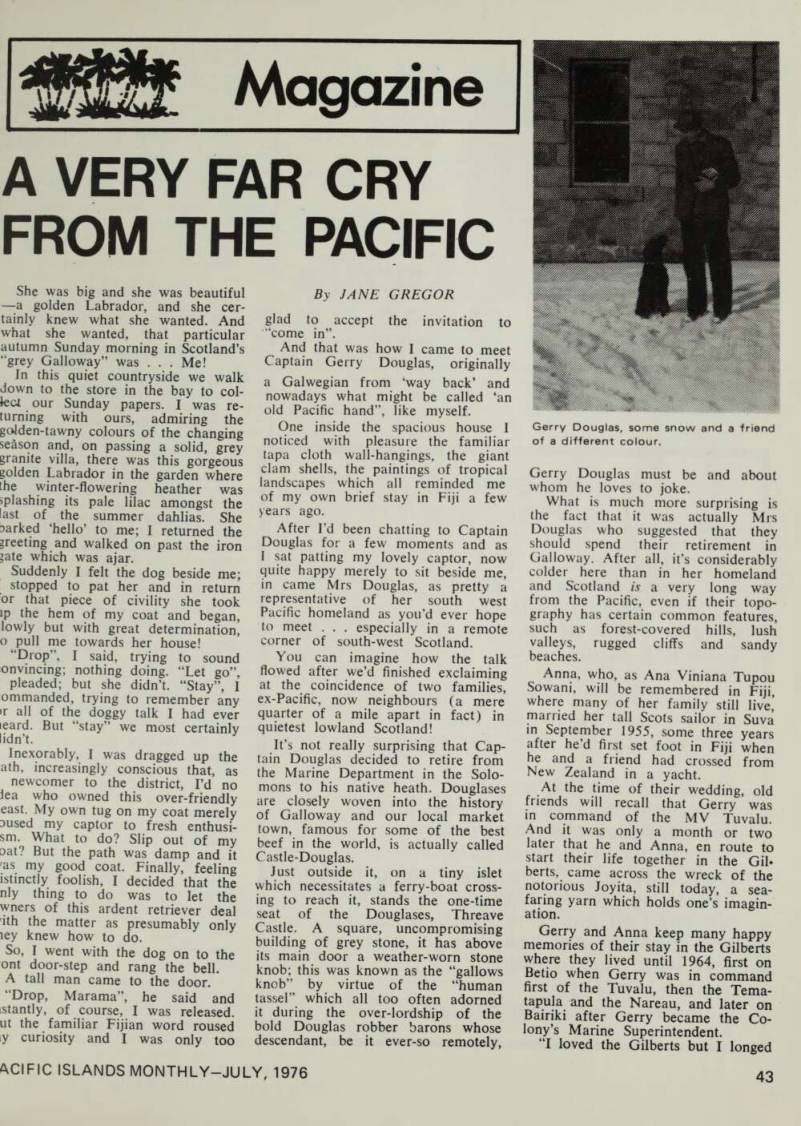
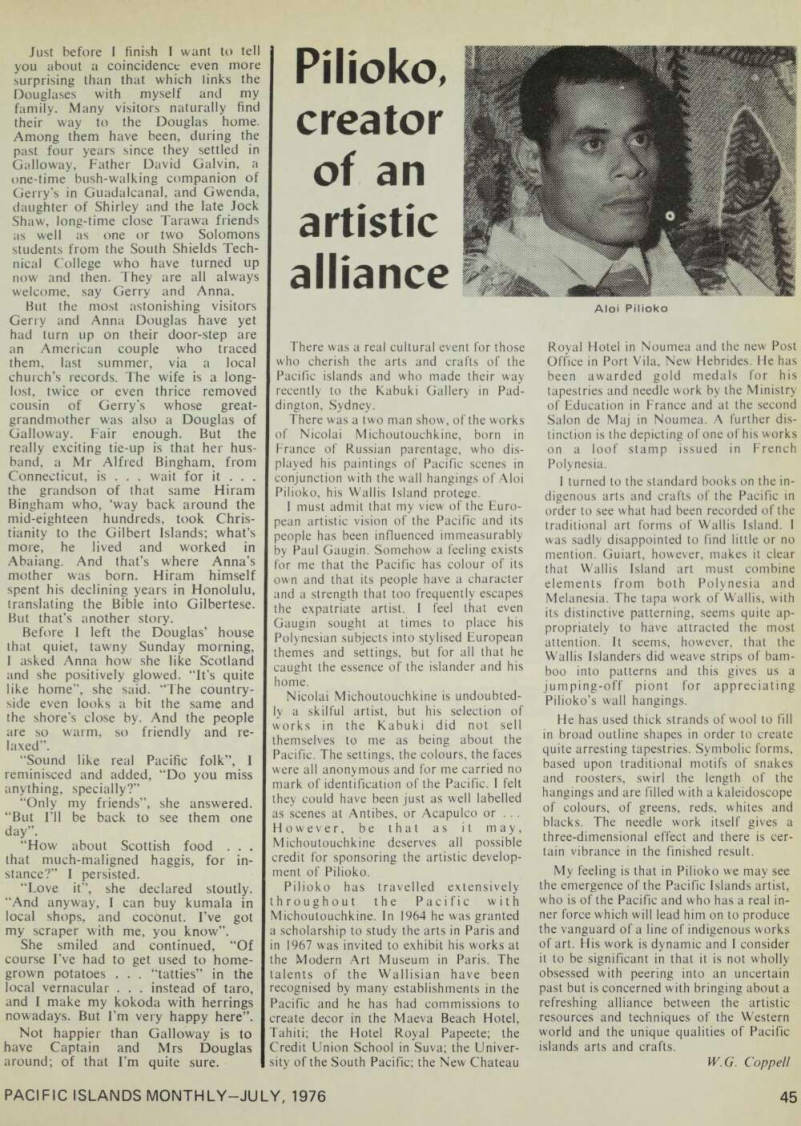
A Very Far Cry
From The Pacific
She was big and she was beautiful —a golden Labrador, and she cer tainly knew what she wanted. And what she wanted, that particular autumn Sunday morning in Scotland’s “grey Galloway” was ... Me!
In this quiet countryside we walk down to the store in the bay to col lect our Sunday papers. I was re turning with ours, admiring the golden-tawny colours of the changing season and, on passing a solid, grey granite villa, there was this gorgeous golden Labrador in the garden where the winter-flowering heather was splashing its pale lilac amongst the last of the summer dahlias. She marked ‘hello’ to me; I returned the greeting and walked on past the iron gate which was ajar.
Suddenly I felt the dog beside me; stopped to pat her and in return or that piece of civility she took ip the hem of my coat and began, lowly but with great determination, o pull me towards her house!
“Drop”, I said, trying to sound onvincing; nothing doing. “Let go”, pleaded; but she didn’t. “Stay”, I ommanded, trying to remember any >r all of the doggy talk I had ever icard. But “stay” we most certainly lidn’t.
Inexorably, I was dragged up the ath, increasingly conscious that, as newcomer to the district, I’d no lea who owned this over-friendly east. My own tug on my coat merely 3used my captor to fresh enthusi sm. What to do? Slip out of my oat? But the path was damp and it 'as my good coat. Finally, feeling istmctly foolish, I decided that the nly thing to do was to let the wners of this ardent retriever deal ith the matter as presumably only ley knew how to do.
So, I went with the dog on to the ont door-step and rang the bell.
A tall man came to the door.
“Drop, Marama”, he said and istantly, of course, I was released, ut the familiar Fijian word roused y curiosity and I was only too
By Jane Gregor
glad to accept the invitation to “come in”.
And that was how I came to meet Captain Gerry Douglas, originally a Galwegian from ‘way back’ and nowadays what might be called ‘an old Pacific hand”, like myself.
One inside the spacious house I noticed with pleasure the familiar tapa cloth wall-hangings, the giant clam shells, the paintings of tropical landscapes which all reminded me of my own brief stay in Fiji a few years ago.
After I’d been chatting to Captain Douglas for a few moments and as I sat patting my lovely captor, now quite happy merely to sit beside me, in came Mrs Douglas, as pretty a representative of her south west Pacific homeland as you’d ever hope to meet . . . especially in a remote corner of south-west Scotland.
You can imagine how the talk flowed after we’d finished exclaiming at the coincidence of two families, ex-Pacific, now neighbours (a mere quarter of a mile apart in fact) in quietest lowland Scotland!
It’s not really surprising that Cap tain Douglas decided to retire from the Marine Department in the Solo mons to his native heath. Douglases are closely woven into the history of Galloway and our local market town, famous for some of the best beef in the world, is actually called
Castle-Douglas.
Just outside it, on a tiny islet which necessitates a ferry-boat cross ing to reach it, stands the one-time seat of the Douglases, Threave Castle. A square, uncompromising building of grey stone, it has above its main door a weather-worn stone knob; this was known as the “gallows knob” by virtue of the “human tassel” which all too often adorned it during the over-lordship of the bold Douglas robber barons whose descendant, be it ever-so remotely,
Gerry Douglas must be and about whom he loves to joke.
What is much more surprising is the fact that it was actually Mrs Douglas who suggested that they should spend their retirement in Galloway. After all, it’s considerably colder here than in her homeland and Scotland is a very long way from the Pacific, even if their topo graphy has certain common features, such as forest-covered hills, lush valleys, rugged cliffs and sandy beaches.
Anna, who, as Ana Viniana Tupou Sowani, will be remembered in Fiji, where many of her family still live,’ married her tall Scots sailor in Suva in September 1955, some three years after he d first set foot in Fiji when he and a friend had crossed from New Zealand in a yacht.
At the time of their wedding, old friends will recall that Gerry was in command of the MV Tuvalu.
And it was only a month or two later that he and Anna, en route to start their life together in the Gil* berts, came across the wreck of the notorious Joyita, still today, a sea faring yarn which holds one’s imagin ation.
Gerry and Anna keep many happy memories of their stay in the Gilberts where they lived until 1964, first on Betio when Gerry was in command first of the Tuvalu, then the Tema tapula and the Nareau, and later on Bairiki after Gerry became the Co lony’s Marine Superintendent.
“I loved the Gilberts but I longed
Gerry Douglas, some snow and a friend of a different colour.
for some hills”, says Gerry.
There were plenty of hills in the Solomons and, after transferring there in 1964, Gerry’s free time was largely bush-walking, climbing and . . . less strenuously . . . orchid collecting. Keen gardeners in Tarawa (“Digging holes in the coral sand kept me fit even if nothing would grow”, grins Gerry) and in Honiara, Anna and Gerry now delight in their homegrown fruit and vegetables and, from personal enjoyment, I can tell you they grow the best lettuce in the district.
And so, I can hear all their Islands friends asking, what are Anna and Gerry Douglas actually doing nowadays in rural Galloway?
It might be easier . . . and cer tainly would be quicker ... to tell you what they’re not doing!
Naturally enough, Gerry’s main interest lies in his 50 ft, twin-screw charter motor yacht, appropriately called The Maid of Galloway. He
takes her far and wide around the wild Galloway coast, up north to Scotland’s islanded west, across to the Isle of Man and as far afield as you like to mention within a limit of some 200 miles.
“The Maid” sleeps eight passen gers and two crew and she’s in great demand each summer by visitors to Galloway, whether they’re keen sea anglers or more passive rubber necks.
For, like the Pacific Islands, we here in southern Scotland are cur rently being ‘discovered’ by the tourist-trade. Geographically and historically Galloway’s always been a bit of a loner, a wild land, cut off until very recently from main stream Britain. But now the cara vanners, the cyclists, the hill-walkers, shooters, fishers, golfers and wild-life lovers are finding Galloway one of the last unspoilt parts of the United Kingdom and they are coming in thick and fast.
And what more natural than that
Anna and Gerry should be right there, where the action is, after their somewhat similar experiences in the Islands Gerry’s very full sea-going days still allow him time to be active on the local tourist committee and Anna is building up a happy business with the popular ‘bed and breakfast’ trade.
But that’s by no means all. In their ‘spare’ time they’re into local poli tics, amateur dramatics, painting and pottery, charity work, church work . . . and they’re both keen and cap able gardeners who are turning a neglected wilderness into a little paradise. Anna who, incredibly enough, says she suffered at times from the excessive heat of her native land, is ecstatic about the changes of season in this cool climate.
She specially loves the long sum mer twilights and autumn’s golden colours; she never . . . (‘hardly ever’, Gerry interposes) complains of the cold although it can be quite nippy here around January/February in spite of that Gulf Stream which is reputed to give us a very favoured climate ... for these latitudes, that’s to say! What else do the Doug lases manage to get into? Oh yes, during the winter months, Gerry teaches coastal navigation at evening classes in our nearest large town which is Dumfries and known as “the Queen of the South” . . . and he finds time to do a stint in the local Observer Corps.
I suppose you might expect no less from a man who was given the OBE soon after he retired. It was on March 21, 1972, to be precise, that Captain Douglas attended HM Queen Elizabeth, the Queen Mother’s in vestiture ceremony at Buckingham Palace . . . and if he hadn’t beavered about producing safety legislation for the Western Pacific High Com mission, some of which was also adopted by other Pacific territories, no doubt that particular honour wouldn’t have come his way. Anna accompanied him to the Palace to gether with their lovely daughter, Louise.
Louise, incidentally, is continuing the medical tradition of the family.
Her maternal grandfather, NMP Sowani, MBE, would have been proud of his granddaughter, now a student nurse at Canterbury, Kent, from where she’ll qualify later this year.
Louise’s mother hopes that one day her daughter will return to Tubou and there meet the district nurse whom her grandfather taught the then modern techniques of his
Just before I finish I want to tell you about a coincidence even more surprising than that which links the Douglases with myself and my family. Many visitors naturally find their way to the Douglas home.
Among them have been, during the past four years since they settled in Galloway, Father David Galvin, a one-time bush-walking companion of Gerry’s in Guadalcanal, and Gwenda, daughter of Shirley and the late Jock Shaw, long-time close Tarawa friends as well as one or two Solomons students from the South Shields Tech nical College who have turned up now and then. They are all always welcome, say Gerry and Anna.
But the most astonishing visitors Gerry and Anna Douglas have yet had turn up on their door-step are an American couple who traced them, last summer, via a local church’s records. The wife is a long lost, twice or even thrice removed cousin of Gerry’s whose great grandmother was also a Douglas of Galloway. Fair enough. But the really exciting tie-up is that her hus band, a Mr Alfred Bingham, from Connecticut, is . . . wait for it . . . the grandson of that same Hiram Bingham who, ‘way back around the mid-eighteen hundreds, took Chris tianity to the Gilbert Islands; what’s more, he lived and worked in Abaiang. And that’s where Anna’s mother was born. Hiram himself spent his declining years in Honolulu, translating the Bible into Gilbertese.
But that’s another story.
Before I left the Douglas’ house that quiet, tawny Sunday morning, I asked Anna how she like Scotland and she positively glowed. “It’s quite like home’’, she said. “The country side even looks a bit the same and the shore’s close by. And the people are so warm, so friendly and re laxed”.
“Sound like real Pacific folk”, I reminisced and added, “Do you miss anything, specially?”
“Only my friends”, she answered.
“But I’ll be back to see them one day”.
“How about Scottish food . . . that much-maligned haggis, for in stance?” I persisted.
“Love it”, she declared stoutly.
“And anyway, I can buy kumala in local shops, and coconut. I’ve got my scraper with me, you know”.
She smiled and continued, “Of course I’ve had to get used to home grown potatoes . . . “tatties” in the local vernacular . . . instead of taro, and I make my kokoda with herrings nowadays. But I'm very happy here”.
Not happier than Galloway is to have Captain and Mrs Douglas around; of that I’m quite sure.
Advertisements & other items, pp. 43-44 (2 items)
43
ISLANDS MONTHLY-JULY, 1976
Homecoming
By Pimi Finau The plane lands, Out walks the new breed Suit, tie, and long hair, Pregnant with pomp, Drowning in air.
Don’t choke, mate!
Come down, it's not too late.
Many have landed just like you.
Will you fool us just like them?
We laughed together once, Let’s learn to laugh like that again.
You teach us the new refrain And rid us of our old pain.
We’ll take you to the new fishing ground And show you all else we have found.
We shall sit and sing the new song, And together our hair will grow long.
Stay with us, our heir!
Let the plane go With only your pomp and air.
Pilioko,
creator of an artistic alliance
There was a real cultural event for those who cherish the arts and crafts of the Pacific islands and who made their way recently to the Kabuki Gallery in Pad dington, Sydney.
There was a two man show, of the works of Nicolai Michoutouchkine, born in France of Russian parentage, who dis played his paintings of Pacific scenes in conjunction with the wall hangings of Aloi Pilioko, his Wallis Island protege.
I must admit that my view of the Euro pean artistic vision of the Pacific and its people has been influenced immeasurably by Paul Gaugin. Somehow a feeling exists for me that the Pacific has colour of its own and that its people have a character and a strength that too frequently escapes the expatriate artist. I feel that even Gaugin sought at times to place his Polynesian subjects into stylised European themes and settings, but for all that he caught the essence of the islander and his home.
Nicolai Michoutouchkine is undoubted ly a skilful artist, but his selection of works in the Kabuki did not sell themselves to me as being about the Pacific. The settings, the colours, the faces were all anonymous and for me carried no mark of identification of the Pacific. I felt they could have been just as well labelled as scenes at Antibes, or Acapulco or . . .
However, be that as it may, Michoutouchkine deserves all possible credit for sponsoring the artistic develop ment of Pilioko.
Pilioko has travelled extensively throughout the Pacific with Michoutouchkine. In 1964 he was granted a scholarship to study the arts in Paris and in 1967 was invited to exhibit his works at the Modern Art Museum in Paris. The talents of the Wallisian have been recognised by many establishments in the Pacific and he has had commissions to create decor in the Maeva Beach Hotel, Tahiti; the Hotel Royal Papeete; the Credit Union School in Suva; the Univer sity of the South Pacific; the New Chateau
Royal Hotel in Noumea and the new Post Office in Port Vila, New Hebrides. He has been awarded gold medals for his tapestries and needle work by the Ministry of Education in France and at the second Salon de Maj in Noumea. A further dis tinction is the depicting of one of his works on a loof stamp issued in French Polynesia. 1 turned to the standard books on the in digenous arts and crafts of the Pacific in order to see what had been recorded of the traditional art forms of Wallis Island. I was sadly disappointed to find little or no mention. Guiart, however, makes it clear that Wallis Island art must combine elements from both Polynesia and Melanesia. The tapa work of Wallis, with its distinctive patterning, seems quite ap propriately to have attracted the most attention. It seems, however, that the Wallis Islanders did weave strips of bam boo into patterns and this gives us a
jumping-off piont for appreciating
Pilioko’s wall hangings.
He has used thick strands of wool to fill in broad outline shapes in order to create quite arresting tapestries. Symbolic forms, based upon traditional motifs of snakes and roosters, swirl the length of the hangings and are filled with a kaleidoscope of colours, of greens, reds, whites and blacks. The needle work itself gives a three-dimensional effect and there is cer tain vibrance in the finished result.
My feeling is that in Pilioko we may see the emergence of the Pacific Islands artist, who is of the Pacific and who has a real in ner force which will lead him on to produce the vanguard of a line of indigenous works of art. His work is dynamic and I consider it to be significant in that it is not wholly obsessed with peering into an uncertain past but is concerned with bringing about a refreshing alliance between the artistic resources and techniques of the Western world and the unique qualities of Pacific islands arts and crafts.
W.G. Coppell
Aloi Pilioko
Advertisements & other items, p. 46 (1 item)
cancolzl
i ¥ m .4 R r y How it tastes when it gets there depends a lot on the way it goes.
Australian produce. Fresh from the farm.
Meat, vegetables, fruit, seafood. Qantas can get it to Pacific and Southeast Asian markets in less than a day. And get it there in the prime top condition you expect. Unitised, palletised, air cargo Qantas offers you more capacity out of Australia to the world than any other carrier.
And because we’re Australian we can offer advice about where to order, who to order from, how much to pay. Ring Qantas or your Freight Forwarder. We’re always looking for fresh problems to solve.
aaisrras /—j
cancolzl
L 81.2846
or Uncle Sam's joker
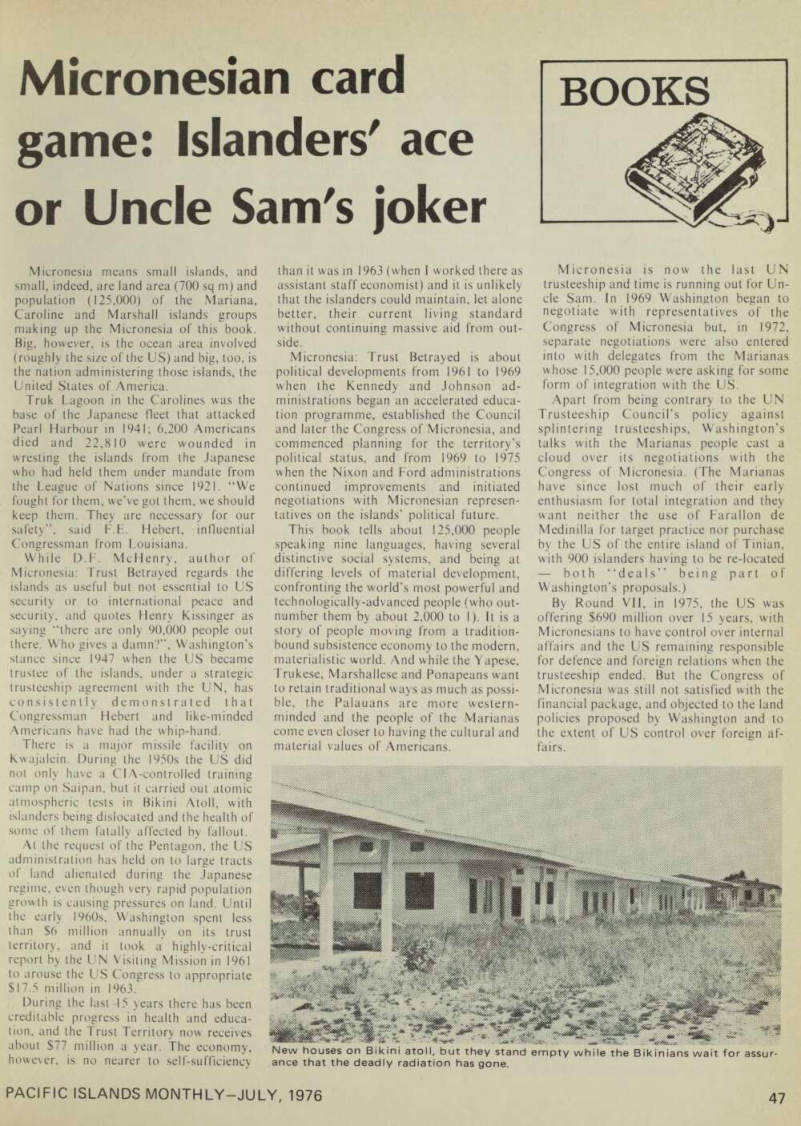
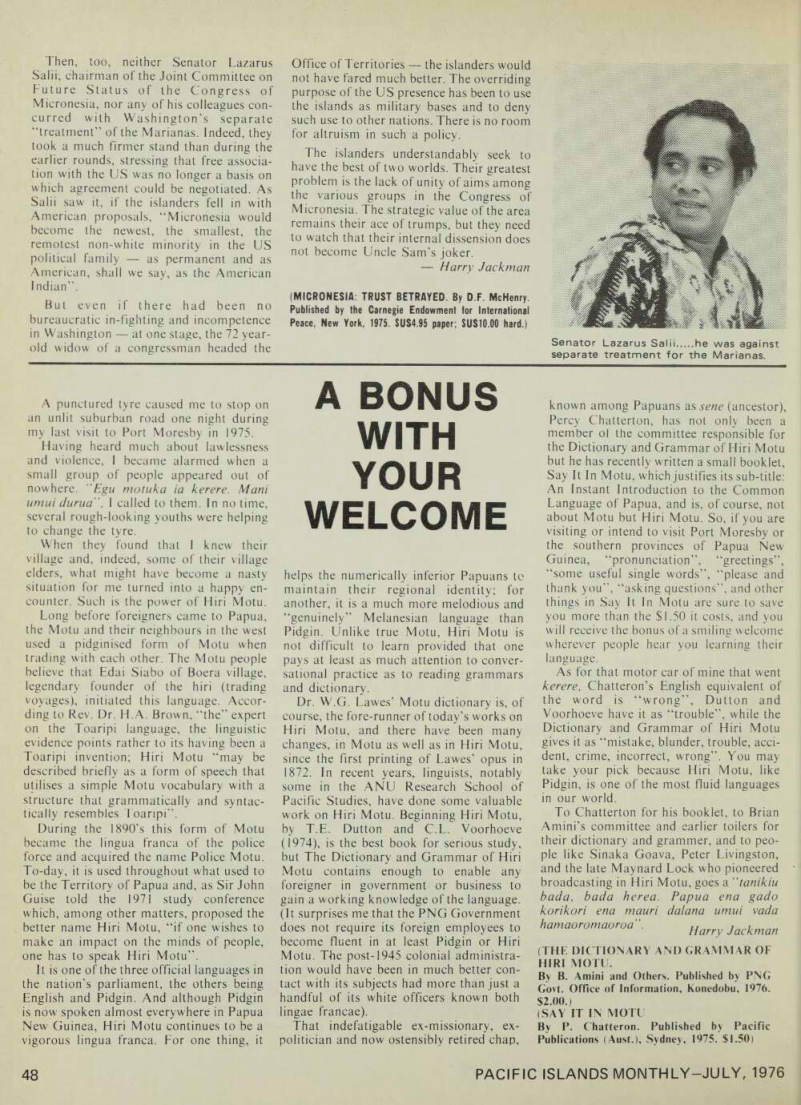
Micronesian card game: Islanders' ace or Uncle Sam's joker
Micronesia means small islands, and small, indeed, are land area (700 sq m) and population (125,000) of the Mariana, Caroline and Marshall islands groups making up the Micronesia of this book.
Big, however, is the ocean area involved (roughly the size of the US) and big, too, is the nation administering those islands, the United States of America.
Truk Lagoon in the Carolines was the base of the Japanese fleet that attacked Pearl Harbour in 1941; 6,200 Americans died and 22,810 were wounded in wresting the islands from the Japanese who had held them under mandate from the League of Nations since 1921. “We fought for them, we’ve got them, we should keep them. They are necessary for our safely”, said F.E. Hebert, influential Congressman from Louisiana.
While D.F. McHenry, author of Micronesia: Trust Betrayed regards the islands as useful but not essential to US security or to international peace and security, and quotes Henry Kissinger as saying “there are only 90,000 people out there. Who gives a damn?”, Washington’s stance since 1947 when the US became trustee of the islands, under a strategic trusteeship agreement with the UN, has consistently demonstrated that Congressman Hebert and like-minded Americans have had the whip-hand.
There is a major missile facility on Kwajalein. During the 1950 s the US did not only have a CIA-controlled training camp on Saipan, but it carried out atomic atmospheric tests in Bikini Atoll, with islanders being dislocated and the health of some of them fatally affected by fallout.
At the request of the Pentagon, the US administration has held on to large tracts of land alienated during the Japanese regime, even though very rapid population growth is causing pressures on land. Until the early 19605, Washington spent less than $6 million annually on its trust territory, and it took a highly-critical report by the UN Visiting Mission in 1961 to arouse the US Congress to appropriate $17.5 million in 1963.
During the last 4 5 years there has been creditable progress in health and educa tion, and the Trust Territory now receives about $77 million a year. The economy, however, is no nearer to self-sufficiency
than it was in 1963 (when I worked there as assistant staff economist) and it is unlikely that the islanders could maintain, let alone better, their current living standard without continuing massive aid from outside.
Micronesia: Trust Betrayed is about political developments from 1961 to 1969 when the Kennedy and Johnson administrations began an accelerated education programme, established the Council and later the Congress of Micronesia, and commenced planning for the territory’s political status, and from 1969 to 1975 when the Nixon and Ford administrations continued improvements and initiated negotiations with Micronesian representatives on the islands’ political future.
This book tells about 125,000 people speaking nine languages, having several distinctive social systems, and being at differing levels of material development, confronting the world’s most powerful and technologically-advanced people (who outnumber them by about 2,000 to 1). It is a story of people moving from a traditionbound subsistence economy to the modern, materialistic world. And while the Yapese, Trukese, Marshallese and Ponapeans want to retain traditional ways as much as possible, the Palauans are more westernminded and the people of the Marianas come even closer to having the cultural and material values of Americans.
Micronesia is now the last UN trusteeship and time is running out for Un cle Sam. In 1969 Washington began to negotiate with representatives of the Congress of Micronesia but, in 1972, separate negotiations were also entered into with delegates from the Marianas whose 15,000 people were asking for some form of integration with the US.
Apart from being contrary to the UN Trusteeship Council’s policy against splintering trusteeships, Washington’s talks with the Marianas people cast a cloud over its negotiations with the Congress of Micronesia. (The Marianas have since lost much of their early enthusiasm for total integration and they want neither the use of Farallon de Medinilla for target practice nor purchase by the US of the entire island of Tinian, with 900 islanders having to be re-located both “deals” being part of Washington’s proposals.) By Round VII, in 1975, the US was offering $690 million over 15 years, with Micronesians to have control over internal affairs and the US remaining responsible for defence and foreign relations when the trusteeship ended. But the Congress of Micronesia was still not satisfied with the financial package, and objected to the land policies proposed by Washington and to the extent of US control over foreign af fairs.
New houses on Bikini atoll, but they stand empty while the Bikinians wait for assur ance that the deadly radiation has gone.
Then, too, neither Senator Lazarus Salii, chairman of the Joint Committee on Future Status of the Congress of Micronesia, nor any of his colleagues con curred with Washington’s separate “treatment” of the Marianas. Indeed, they took a much firmer stand than during the earlier rounds, stressing that free associa tion with the US was no longer a basis on which agreement could be negotiated. As Salii saw it, if the islanders fell in with American proposals, “Micronesia would become the newest, the smallest, the remotest non-white minority in the US political family as permanent and as American, shall we say, as the American Indian”.
But even if there had been no bureaucratic in-fighting and incompetence in Washington at one stage, the 72 year old widow of a congressman headed the
Office of Territories the islanders would not have fared much better. The overriding purpose of the US presence has been to use the islands as military bases and to deny such use to other nations. There is no room for altruism in such a policy.
The islanders understandably seek to have the best of two worlds. Their greatest problem is the lack of unity of aims among the various groups in the Congress of Micronesia. The strategic value of the area remains their ace of trumps, but they need to watch that their internal dissension does not become Uncle Sam’s joker.
Harry Jackman
(Micronesia: Trust Betrayed. By D.F. Mchenry.
Published by the Carnegie Endowment for International Peace, New York, 1975. SUS4.9S paper; SUSIO.OO hard.)
Senator Lazarus Salii... he was against separate treatment for the Marianas.
Your
A Bonus
With
Welcome
A punctured tyre caused me to stop on an unlit suburban road one night during my last visit to Port Moresby in 1975.
Having heard much about lawlessness and violence, I became alarmed when a small group of people appeared out of nowhere. “ Egu motuka ia kerere. Mani umui durua". I called to them. In no time, several rough-looking youths were helping to change the tyre.
When they found that I knew their village and, indeed, some of their village elders, what might have become a nasty situation for me turned into a happy encounter. Such is the power of Hiri Motu.
Long before foreigners came to Papua, the Motu and their neighbours in the west used a pidginised form of Motu when trading with each other. The Motu people believe that Edai Siabo of Boera village, legendary founder of the hiri (trading voyages), initiated this language. According to Rev. Dr. H.A. Brown, “the” expert on the Toaripi language, the linguistic evidence points rather to its having been a Toaripi invention; Hiri Motu “may be described briefly as a form of speech that utilises a simple Motu vocabulary with a structure that grammatically and syntactically resembles Toaripi”.
During the 1890’s this form of Motu became the lingua franca of the police force and acquired the name Police Motu.
To-day, it is used throughout what used to be the Territory of Papua and, as Sir John Guise told the 1971 study conference which, among other matters, proposed the better name Hiri Motu, “if one wishes to make an impact on the minds of people, one has to speak Hiri Motu”.
It is one of the three official languages in the nation’s parliament, the others being English and Pidgin. And although Pidgin is now spoken almost everywhere in Papua New Guinea, Hiri Motu continues to be a vigorous lingua franca. For one thing, it
helps the numerically inferior Papuans to maintain their regional identity; for another, it is a much more melodious and “genuinely” Melanesian language than Pidgin. Unlike true Motu, Hiri Motu is not difficult to learn provided that one pays at least as much attention to conver sational practice as to reading grammars and dictionary.
Dr. W.G. Lawes’ Motu dictionary is, of course, the fore-runner of today’s works on Hiri Motu, and there have been many changes, in Motu as well as in Hiri Motu, since the first printing of Lawes’ opus in 1872. In recent years, linguists, notably some in the ANU Research School of Pacific Studies, have done some valuable work on Hiri Motu. Beginning Hiri Motu, by T.E. Dutton and C.L. Voorhoeve (1974), is the best book for serious study, but The Dictionary and Grammar of Hiri Motu contains enough to enable any foreigner in government or business to gain a working knowledge of the language. (It surprises me that the PNG Government does not require its foreign employees to become fluent in at least Pidgin or Hiri Motu. The post-1945 colonial administra tion would have been in much better con tact with its subjects had more than just a handful of its white officers known both lingae francae).
That indefatigable ex-missionary, ex politician and now ostensibly retired chap.
known among Papuans as sene (ancestor), Percy Chatterton, has not only been a member of the committee responsible for the Dictionary and Grammar of Hiri Motu but he has recently written a small booklet, Say It In Motu, which justifies its sub-title; An Instant Introduction to the Common Language of Papua, and is, of course, not about Motu but Hiri Motu. So, if you are visiting or intend to visit Port Moresby or the southern provinces of Papua New Guinea, “pronunciation”, “greetings”, “some useful single words”, “please and thank you”, “asking questions”, and other things in Say It In Motu are sure to save you more than the $1.50 it costs, and you will receive the bonus of a smiling welcome wherever people hear you learning their language.
As for that motor car of mine that went kerere, Chatteron’s English equivalent of the word is “wrong”, Dutton and Voorhoeve have it as “trouble”, while the Dictionary and Grammar of Hiri Motu gives it as “mistake, blunder, trouble, acci dent, crime, incorrect, wrong”. You may take your pick because Hiri Motu, like Pidgin, is one of the most fluid languages in our world.
To Chatterton for his booklet, to Brian Amini’s committee and earlier toilers for their dictionary and grammer, and to peo ple like Sinaka Goava, Peter Livingston, and the late Maynard Lock who pioneered broadcasting in Hiri Motu, goes a "tanikiu bada, bada herea. Papua ena gado korikori ena mauri dalana umui vada
hamaoromaoroa ’
Harry Jackman
(The Dictionary And Grammar Of
Hiri Motu.
By B. Amini and Others. Published by PNG Govt. Office of Information, Konedobu, 1976. $2.00.)
(Say It In Motu
By P. Chatteron. Published by Pacific Publications (Aust.), Sydney, 1975. $1.50)
Purple passion in Palau
In these trying times so often filled with superfluous seriousness, we seem literally inundated with scholarly works claiming to deliver the “truth” about the Pacific Islands, and it is thus an exceptional and extremely pleasant surprise to discover a bright new book about the Pacific which wants primarily to entertain us with a tale of suspense and intrigue.
Former LIFE magazine staffer P.F.
Kluge, in his first work of fiction entitled The Day That I Die, skilfully draws the reader into a tangle of murder and conspiracy which begins in the Western Caroline Islands of Micronesia with the mysterious death of a failed hero of World War 11. A burnt-out ex-marine named Red Elwell returns to the island of Peleliu after an absence of many years to re-live in fantasy the battle which made him a national hero. For Elwell, fantasy turns quickly into a horrible reality in a brief encounter on Orange Beach where he is slashed to death amongst the rusted relics of his life’s only triumph.
What follows is a tightly-plotted and well-executed series of twists and turns, ineluding a gripping account of a second battie of Peleliu orchestrated and conducted by an obsessed Marine colonel who is willing to sacrifice everyone and everything to prove his theory that there really are murderous Japanese stragglers at the end of the tunnels beneath the infamous Bloody Nose Ridge.
The author, who has worked with both
the Trust Territory Government and the Congress of Micronesia, demonstrates a properly sceptical attitude toward officials and heroes of all types, whether they be of the officially-proclaimed military variety, or self-proclaimed island heroes of the peo pie. His characterisations of the American civilian and military personnel sent to govern the Micronesians are clearly and crisply drawn with large measures of humour and irony, and his portrayal of the island pseudo-leader, Kintaro, is devastating, and unfortunately right on target.
The trip through the excitibg maze of The Day That I Die is guided by the book’s central character, Marshall Booker, an enterprising, but not overly-energetic jour nalist. Through Booker’s investigation of the murder the reader is treated to a series of historically-accurate and thoughtfully developed political and social insights about the Americanisation of Micronesia which enhance and support the story and successfully transcend the limits of the suspense genre. The tough-minded tension of the storyline holds well throughout, but fails to hide the affection that the author clearly holds for the islands and their peo pie.'Even his lighthearted and somewhat sexist presentation of the two island ladies in the story reveals a deeply held respect for them, and an understan ding of the predicament they face in main taining themselves on islands suddenly grown too small.
In the final unravelling of the mystery, Booker and the beautiful Ponapean half cast Inez are trapped on one of Palau’s magnificent rock islands in a scene of violence and beauty that rivals for excite ment the scenes in many classic island tales.
The genuine feeling of island life, the tone and colour, the very ethos of the islands still comes to us as it has traditionally, through the story, the yarn, the tale well told. In this category. The Day That I Die stands as a new and most welcome entry. yVoe/ Grogan (THE DAY THAT I DIE By P F Kluge, published by the Bobbs-Merrill Company, New York, 1976.
US$7 95).
Maritime
Bits
And Pieces
Just when I think that 1 must have read every article in the Mariner’s Catalog through about five times, a new edition arrives on mv desk.
Editors George Putz and Peter H. Spectre have once again collected an imposing array of maritime bits and pieces, enough to keep any sailor or shiplover well enthused until the next edition arrives.
The Mariner’s Catalog is far from just entertainment however. It is a where-to-get-it book and an ideas book and a worry book, for spouses who expect to see a 30 ft folding schooner or a Mississippi houseboat sprouting from the front lawn at any moment.
The very popular section intro duced in the last volume; “Quick and Dirty Boats’’ has been continued and . . . would you believe a boat (?) built from a bundle of brush and a square of old canvas!
Another section is devoted to the growing enthusiasm for classic small boats such as skiffs, dorys etc and
the intriguing sprit-sail rig.
Of course no boat can be built without tools, and like the other two editions, this year has its full com plement, I could go on for hours—suffice to say that Volume 3 of the Marin er’s Catalog is superb, a bedtime book for sailors par excellence— John Collins.
(The Mariner’S Catalog, Volume 3.
Edited by George Putz and Peter H. Spectre.
International Marine Publishing Co, Camden, Maine, USA. $U55.95).
Advertisements & other items, pp. 49-50 (1 item)
wilscn boos, (pointers) ply. United
at.
P.O. Box 56. Chippendale, N.S.W. 2008 Australia Telegrams: "WMbroprint" Sydney Currently supplying to the Pacific Islands: Computer Stationery Accounting Machine Forms for Sweda, NCR & Burroughs Purtch Cards Burroughs Magnetic Stripe Ledger Cards Package stationery systems for Burroughs L Series Machines - Payroll - General Accounting Ledger Cards Security Document Printing - Airline Tickets - Accommodation & Travel Vouchers - Cheques Computer Data Storage -Magnetic Tape, Disk Pack, Punch Card, Visible Record, Revolving 8- Rotating Card Storage and Retrieval Systems.
Machine Accounting Trays & Indexes.
Computer Print-out Binders.
May we discuss your requirements with you on our next visit
We can't change
what you pump.
But we can change how
reliably you pump it.
We make mining pumps that have run for days on a snorer full of slurry. Bore-hole pumps that haven’t been lifted in 15 years. Sewerage pumps that are unaffected by wet-strength fibres, pantyhose, nappies or solids up to 6" diameter. And farm-water pumps that deliver town-water pressure or better, 5 miles from the creek. As well as pumps for boiling cheese, grease, acids, cooked fruit and biscuit dough. Or anything else that can be pumped, and a few things other pumps can’t pump.
All of them have one thing in common. In a few years you’ll begin to wonder if your Mono Pump will ever stop pumping. And our pumps are backed by 24 hours a day service from local engineers, factory trained in Australia. We can’t change what you pump, but we can pump it more reliably. 4. 2.
M : <1 »»»♦** w 5 1. hi 1. T series-mining & foods (Flanges or Tapped Ports) 2. Borehole series 3. Monta Pump-sewerage 4. Mutrator-sewerage 5. ‘o9’ series-farming 6. CP series-light industrial
MONO [POIMPfe (AUSTRALIA) PTY LTD.
Head Office and Works: “Mono House’’. 338-348 Lower Dandenong Rd, Mordialloc, Vic. 3195. Phone 90-5211.
Agents in all major South East Asian and Pacific areas.
I Please send details of your pumps for (describe purpose): I I I if a Borehole pump, indicate: Approx, depth of bore ft.; estimated water level ft.; ■ estimated yield. gph. NAME -
ADDRESS jl - -
I J 344-P-043
New Hebrides Is Battling
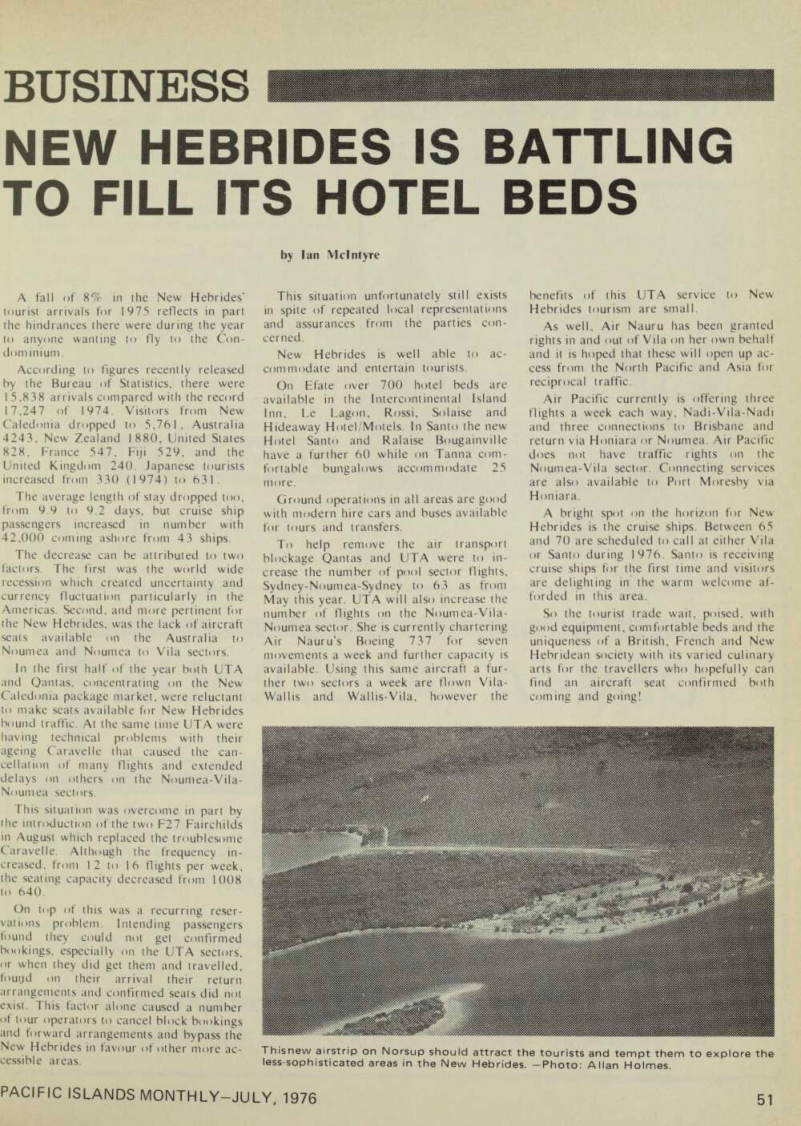

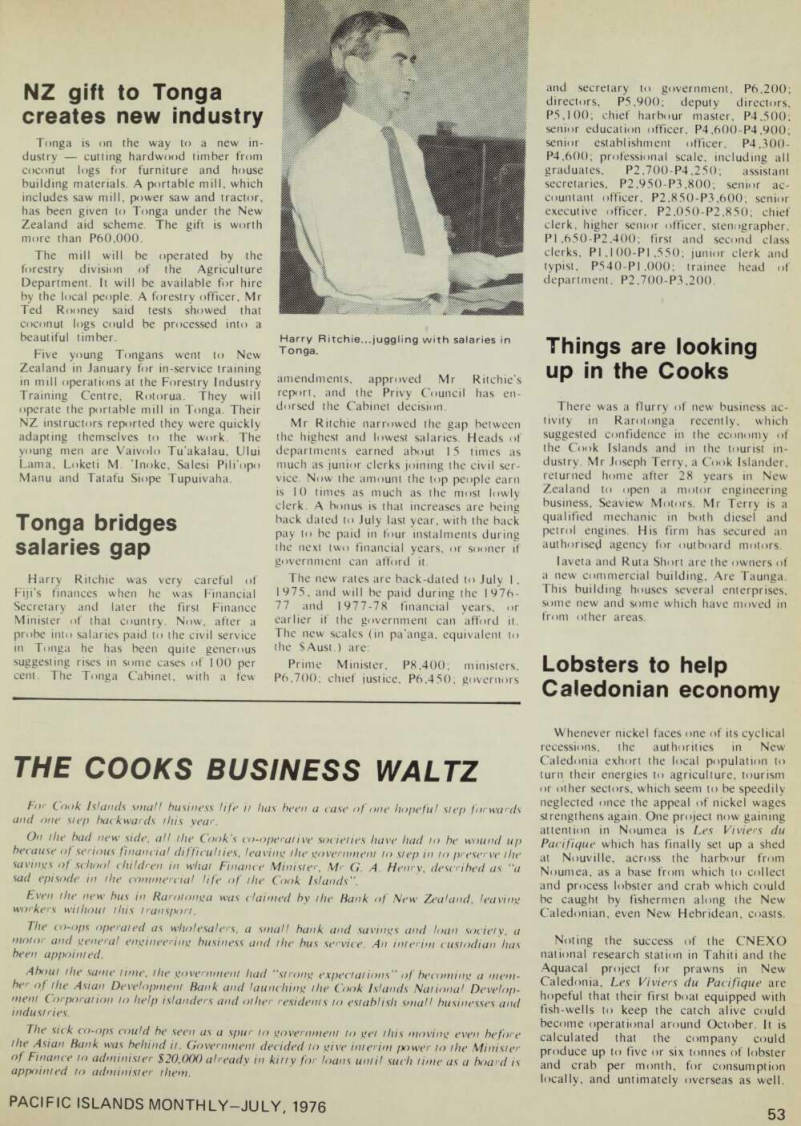
Business
To Fill Its Hotel Beds
by Ian McIntyre
A fall of 8% in the New Hebrides’ tourist arrivals for 1975 reflects in part the hindrances there were during the year to anyone wanting to fly to the Con dominium .
According to figures recently released
by the Bureau of Statistics, there were 1 5,838 arrivals compared with the record 17,247 of 1974. Visitors from New Caledonia dropped to 5,761, Australia 4243, New Zealand 1880, United States 828, France 547. Fiji 529, and the United Kingdom 240. Japanese tourists increased from 330 (1974) to 631.
The average length of stay dropped too, from 9.9 to 9.2 days, but cruise ship passengers increased in number with 42,000 coming ashore from 43 ships.
The decrease can be attributed to two factors. The first was the world wide recession which created uncertainty and currency fluctuation particularly in the Americas. Second, and more pertinent for the New Hebrides, was the lack of aircraft seats available on the Australia to Noumea and Noumea to Vila sectors.
In the first half of the year both UTA and Oantas, concentrating on the New Caledonia package market, were reluctant to make seats available for New Hebrides bound traffic. At the same time UTA were having technical problems with their ageing Caravelle that caused the can cellation of many flights and extended delays on others on the Noumea-Vila- Noumea sectors.
This situation was overcome in part by the introduction of the two F 27 Fairchilds in August which replaced the troublesome Caravelle. Although the frequency in creased, from 12 to 16 flights per week, the seating capacity decreased from 1008 to 640.
On top of this was a recurring reser vations problem. Intending passengers found they could not get confirmed bookings, especially on the UTA sectors, or when they did get them and travelled, fouijd on their arrival their return arrangements and confirmed seats did not exist. This factor alone caused a number of tour operators to cancel block bookings and forward arrangements and bypass the New Hebrides in favour of other more ac cessible areas.
This situation unfortunately still exists
in spite of repeated local representations
and assurances from the parties con cerned.
New Hebrides is well able to ac commodate and entertain tourists.
On Efate over 700 hotel beds are available in the Intercontinental Island Inn, Le Lagon, Rossi, Solaise and Hideaway Hotel'Motels. In Santo the new Hotel Santo and Ralaise Bougainville have a further 60 while on Tanna com fortable bungalows accommodate 25 more.
Ground operations in all areas are good with modern hire cars and buses available for tours and transfers.
To help remove the air transport blockage Oantas and UTA were to in crease the number of pool sector flights, Sydney-Noumea-Sydney to 63 as from May this year. UTA will also increase the number of flights on the Noumea-Vila- Noumea sector. She is currently chartering Air Nauru's Boeing 737 for seven movements a week and further capacity is available. Using this same aircraft a fur ther two sectors a week are flown Vila- Wallis and Wallis-Vila, however the
benefits of this UTA service to New Hebrides tourism are small.
As well. Air Nauru has been granted rights in and out of Vila on her own behalf and it is hoped that these will open up ac cess from the North Pacific and Asia for
reciprocal traffic.
Air Pacific currently is offering three flights a week each way, Nadi-Vila-Nadi and three connections to Brisbane and return via Honiara or Noumea. Air Pacific does not have traffic rights on the Noumea-Vila sector. Connecting services are also available to Port Moresby via Honiara.
A bright spot on the horizon for New Hebrides is the cruise ships. Between 65 and 70 are scheduled to call at either Vila or Santo during 1976. Santo is receiving cruise ships for the first lime and visitors are delighting in the warm welcome af forded in this area.
So the tourist trade wait, poised, with good equipment, comfortable beds and the uniqueness of a British, French and New Hebridean society with its varied culinary arts for the travellers who hopefully can find an aircraft seat confirmed both coming and going!
This new airstrip on Norsup should attract the tourists and tempt them to explore the less-sophisticated areas in the New Hebrides. -Photo: Allan Holmes.
NZ gift to Tonga
creates new industry
Tonga is on the way to a new in dustry cutting hardwood timber from coconut logs for furniture and house building materials. A portable mill, which includes saw mill, power saw and tractor, has been given to Tonga under the New Zealand aid scheme. The gift is worth more than P 60.000.
The mill will be operated by the forestry division of the Agriculture Department. It will be available for hire by the local people. A forestry officer, Mr Ted Rooney said tests showed that coconut logs could be processed into a beautiful timber.
Five young Tongans went to New Zealand in January for in-service training in mill operations at the Forestry Industry Training Centre, Rotorua. They will operate the portable mill in Tonga. Their NZ instructors reported they were quickly adapting themselves to the work. The young men are Vaivolo Tu’akalau, Ului Lama, Loketi M. Inoke, Salesi Pili’opo Manu and Tatafu Siope Tupuivaha.
Tonga bridges
salaries gap
Harry Ritchie was very careful of Fiji’s finances when he was Financial Secretary and later the first Finance Minister of that country. Now, after a probe into salaries paid to the civil service in Tonga he has been quite generous suggesting rises in some cases of 100 per cent. The Tonga Cabinet, with a few
amendments, approved Mr Ritchie's report, and the Privy Council has en dorsed the Cabinet decision.
Mr Ritchie narrowed the gap between the highest and lowest salaries. Heads of departments earned about 15 times as much as junior clerks joining the civil ser vice. Now the amount the top people earn is 10 times as much as the most lowly clerk. A bonus is that increases are being back dated to July last year, with the back pay to be paid in four instalments during the next two financial years, or sooner if government can afford it.
The new rates are back-dated to July 1. 1975, and will be paid during the 1976- 77 and 1977-78 financial years, or earlier if the government can afford it.
The new scales (in pa'anga, equivalent to the sAust.) are: Prime Minister, P 8.400; ministers, P 6,700; chief justice, P 6,450; governors
and secretary to government, P 6,200; directors, P 5,900; deputy directors.
P 5.100; chief harbour master, P 4.500; senior education officer, P4.600-P4,900; senior establishment officer, P 4.300- P 4.600; professional scale, including all graduates, P2.700-P4.250; assistant secretaries, P2.950-P3.800; senior ac countant officer, P2.850-P3.600; senior executive officer, P2.050-P2.850; chief clerk, higher senior officer, stenographer.
PI .650-P2.400; first and second class clerks, PI ,100-P1,550; junior clerk and typist, P540-P1 ,000; trainee head of
department, P2,700-P3,200.
Things are looking
up in the Cooks
There was a flurry of new business ac tivity in Rarotonga recently, which suggested confidence in the economy of the Cook Islands and in the tourist in dustry. Mr Joseph Terry, a Cook Islander, returned home after 28 years in New Zealand to open a motor engineering business, Seaview Motors. Mr Terry is a qualified mechanic in both diesel and petrol engines. His firm has secured an agency for outboard motors. laveta and Ruta Short are the owners of a new commercial building. Are Taunga.
This building houses several enterprises, some new and some which have moved in from other areas.
Lobsters to help
Caledonian economy
Whenever nickel faces one of its cyclical recessions, the authorities in New Caledonia exhort the local population to turn their energies to agriculture, tourism or other sectors, which seem to be speedily neglected once the appeal of nickel wages strengthens again. One project now gaining attention in Noumea is Les Viviers du Pacifique which has finally set up a shed at Nouville, across the harbour from Noumea, as a base from which to collect and process lobster and crab which could be caught by fishermen along the New Caledonian, even New Hebridean, coasts.
Noting the success of the CNEXO national research station in Tahiti and the Aquacal project for prawns in New Caledonia, Les Viviers du Pacifique are hopeful that their first boat equipped with fish-wells to keep the catch alive could become operational around October. It is calculated that the company could produce up to five or six tonnes of lobster and crab per month, for consumption locally, and untimately overseas as well.
Harry Ritchie...juggling with salaries in Tonga.
Advertisements & other items, p. 52 (1 item)
Demka (Australia)
To Future Generations,
Security
KV if * f T 1 Social welfare is a subject of serious consideration in most modern societies.
Man in the twentieth century accepts his responsibility to bequeath to the next generation a society better than his own.
Daiwa Bank is not unique in accepting this responsibility, but Daiwa is unique in making acceptance of this role in society an integral part of their banking service.
Daiwa is the only Japanese city bank to combine banking and trust business. Daiwa is thus a fully integrated banking institution, comprising banking, international financing, trust, pension trust, and real estate business.
This integration is part of our effort to fulfil our social responsibility consistent with society's needs in a contemporary environment. a fully integrated banking service
DAIWA BANK
Head Office; Osaka, Japan London and Frankfurt Branches New York and Los Angeles Agencies Singapore, Sydney and Sao Paulo Representative Offices Joint Venture Banks: P.T. Bank Perdania, Jakarta, International Credit Alliance, Ltd., Hong Kong
DEMKA (AUSTRALIA)
PTY. LIMITED
WE ARE AN EXCEPTION
TO THE RULE
SOUTH PACIFIC
for every manufacturer we represent, because "DEMKA" does not do any business for its own account.
YOU WOULD BE A CUSTOMER OF THE MANUFACTURER YOU BUY
FROM—THROUGH OUR INTERMEDIARY!
DO ASK FOR QUOTATIONS WITHOUT ANY OBLIGATION TO BUY 184 SUSSEX ST. (3rd floor) SYDNEY, NSW, AUSTRALIA 2000
The Cooks Business Waltz
hnr Cook Islands small business life it has been a case of one hopeful step forwards and one step backwards this year.
On the bad new side, all the Cook’s co-operative societies have had to be wound Uf) because of serious financial difficulties, leaving the government to step in to preserve the savings of school children in what Finance Minister, Mr G. A. Henry , described as “a sad episode in the commercial life of the Cook Islands".
Even the new bus in Rarotonga was claimed by the Bank of New Zealand, leaving workers without this transport.
The co-ops operated as wholesalers, a small bank and savings and loan society, a motor and general engineering business and the bus service. An interim custodian has been appointed.
About the same lime, the government had “strong expectations” of becoming a mem ber of the Asian Development Bank and launching the Cook Islands National Develop ment Corporal ion to help islanders and other residents to establish small businesses and industries.
The sick co-ops could be seen as a spur to government to get this moving even before the Asian Bank was behind it. Government decided to give interim fxtwer to the Minister of Finance to administer $20,000 already in kitty for loans until such time as a board is appointed to administer them.
Close To Nature, The Old Fijian
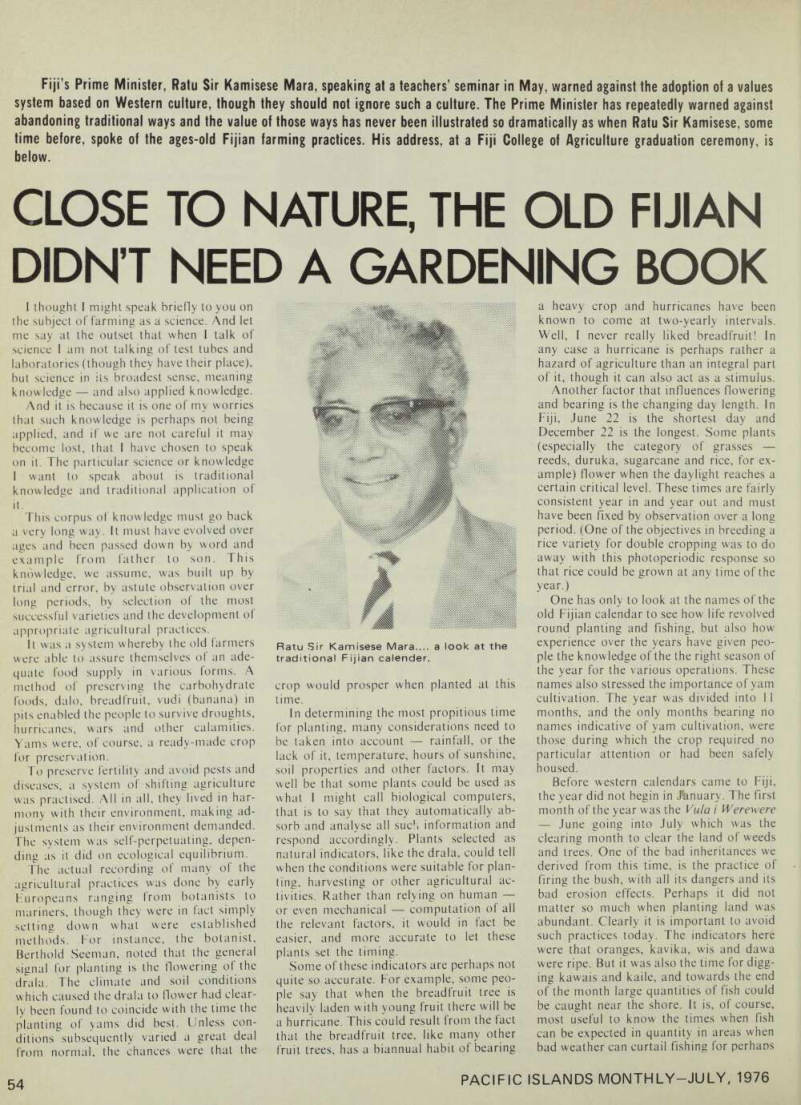
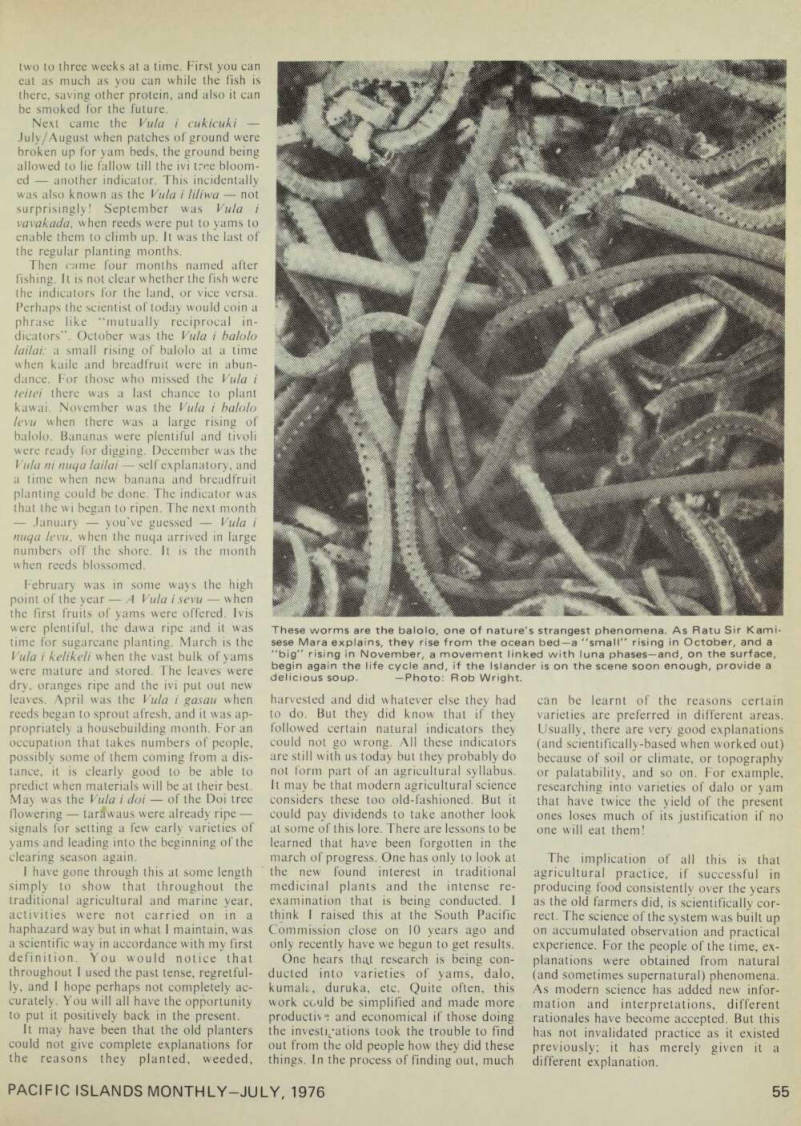
Didn’T Need A Gardening Book
Fiji’s Prime Minister, Ratu Sir Kamisese Mara, speaking at a teachers’ seminar in May, warned against the adoption of a values system based on Western culture, though they should not ignore such a culture. The Prime Minister has repeatedly warned against abandoning traditional ways and the value of those ways has never been illustrated so dramatically as when Ratu Sir Kamisese, some time before, spoke of the ages-old Fijian farming practices. His address, at a Fiji College of Agriculture graduation ceremony, is below.
I thought I might speak briefly to you on the subject of farming as a science. And let me say at the outset that when I talk of science I am not talking of lest tubes and laboratories (though they have their place), but science in its broadest sense, meaning knowledge and also applied knowledge.
And it is because it is one of my worries that such knowledge is perhaps not being applied, and if we are not careful it may become lost, that I have chosen to speak on it. The particular science or knowledge I want to speak about is traditional knowledge and traditional application of it.
This corpus of knowledge must go back a very long way. It must have evolved over ages and been passed down by word and example from father to son. This knowledge, we assume, was built up by trial and error, by astute observation over long periods, by selection of the most successful varieties and the development of
appropriate agricultural practices.
It was a system whereby the old farmers were able to assure themselves of an ade quate food supply in various forms. A method of preserving the carbohydrate foods, dalo, breadfruit, vudi (banana) in pits enabled the people to survive droughts, hurricanes, wars and other calamities.
Yams were, of course, a ready-made crop
for preservation.
To preserve fertility and avoid pests and diseases, a system of shifting agriculture was practised. All in all, they lived in har mony with their environment, making ad justments as their environment demanded.
The system was self-perpetuating, depen ding as it did on ecological equilibrium.
The actual recording of many of the agricultural practices was done by early Europeans ranging from botanists to mariners, though they were in fact simply setting down what were established methods. For instance, the botanist, Berthold Seeman, noted that the general signal for planting is the flowering of the drala. The climate and soil conditions which caused the drala to flower had clear ly been found to coincide with the time the planting of yams did best. Unless con ditions subsequently varied a great deal from normal, the chances were that the
a heavy crop and hurricanes have been known to come at two-yearly intervals.
Well, 1 never really liked breadfruit! In any case a hurricane is perhaps rather a hazard of agriculture than an integral part of it, though it can also act as a stimulus.
Another factor that influences flowering and bearing is the changing day length. In Fiji, June 22 is the shortest day and December 22 is the longest. Some plants (especially the category of grasses reeds, duruka, sugarcane and rice, for ex ample) flower when the daylight reaches a certain critical level. These times are fairly consistent year in and year out and must have been fixed by observation over a long period. (One of the objectives in breeding a rice variety for double cropping was to do away with this photoperiodic response so that rice could be grown at any time of the year.) One has only to look at the names of the old Fijian calendar to see how life revolved round planting and fishing, but also how experience over the years have given peo ple the knowledge of the the right season of the year for the various operations. These names also stressed the importance of yam cultivation. The year was divided into 11 months, and the only months bearing no names indicative of yam cultivation, were those during which the crop required no particular attention or had been safely housed.
Before western calendars came to Fiji, the year did not begin in January. The first month of the year was the Vula i Werewere June going into July which was the clearing month to clear the land of weeds and trees. One of the bad inheritances we derived from this time, is the practice of firing the bush, with all its dangers and its bad erosion effects. Perhaps it did not matter so much when planting land was abundant. Clearly it is important to avoid such practices today. The indicators here were that oranges, kavika, wis and dawa were ripe. But it was also the time for digg ing kawais and kaile, and towards the end of the month large quantities of fish could be caught near the shore. It is, of course, most useful to know the times when fish can be expected in quantity in areas when bad weather can curtail fishing for perhaps
crop would prosper when planted at this time.
In determining the most propitious time for planting, many considerations need to be taken into account rainfall, or the lack of .it, temperature, hours of sunshine, soil properties and other factors. It may well be that some plants could be used as
what I might call biological computers,
that is to say that they automatically ab sorb and analyse all sue!, information and respond accordingly. Plants selected as natural indicators, like the drala, could tell when the conditions were suitable for plan ting, harvesting or other agricultural ac tivities. Rather than relying on human or even mechanical computation of all the relevant factors, it would in fact be easier, and more accurate to let these
plants set the timing.
Some of these indicators are perhaps not quite so accurate. For example, some peo ple say that when the breadfruit tree is heavily laden with young fruit there will be a hurricane. This could result from the fact that the breadfruit tree, like many other fruit trees, has a biannual habit of bearing
Ratu Sir Kamisese Mara... a look at the traditional Fijian calender.
two to three weeks at a time. First you can eat as much as you can while the fish is there, saving other protein, and also it can be smoked for the future.
Next came the Vula i cukicuki July/August when patches of ground were broken up for yam beds, the ground being allowed to lie fallow till the ivi tree bloom ed another indicator. This incidentally was also known as the Vula i liliwa not surprisingly! September was Vula i vavakada, when reeds were put to yams to enable them to climb up. It was the last of
the regular planting months.
Then came four months named after fishing. It is not clear whether the fish were the indicators for the land, or vice versa.
Perhaps the scientist of today would coin a phrase like “mutually reciprocal in dicators". October was the Vula i balolo lailai: a small rising of balolo at a time when kaile and breadfruit were in abun dance. For those who missed the Vula i teitei there was a last chance to plant kawai. November was the Vula i balolo leva when there was a large rising of balolo. Bananas were plentiful and tivoli were ready for digging. December was the Vula ni nuqa lailai self explanatory, and a time when new banana and breadfruit planting could be done. The indicator was that the wi began to ripen. The next month
January - you've guessed Vula i
nuqa leva, when the nuqa arrived in large numbers off the shore. It is the month when reeds blossomed.
February was in some ways the high point of the year A Vula i sevu when the first fruits of yams were offered. Ivis were plentiful, the dawa ripe and it was time for sugarcane planting. March is the Vula i kelikeli when the vast bulk of yams were mature and stored. The leaves were dry, oranges ripe and the ivi put out new leaves. April was the Vula i gasau when reeds began to sprout afresh, and it was ap propriately a housebuilding month. For an occupation that lakes numbers of people, possibly some of them coming from a dis tance, it is clearly good to be able to predict when materials will be at their best.
May was the Vula i doi of the Doi tree
flowering were already ripe
signals for setting a few early varieties of yams and leading into the beginning of the
clearing season again.
I have gone through this at some length simply to show that throughout the traditional agricultural and marine year, activities were not carried on in a haphazard way but in what I maintain, was a scientific way in accordance with my first definition. You would notice that throughout I used the past tense, regretful ly, and I hope perhaps not completely ac curately. You will all have the opportunity to put it positively back in the present.
It may have been that the old planters
could not give complete explanations for
the reasons they planted, weeded,
harvested and did whatever else they had to do. But they did know that if they followed certain natural indicators they could not go wrong. All these indicators are still with us today but they probably do not form part of an agricultural syllabus.
It may be that modern agricultural science considers these too old-fashioned. But it could pay dividends to take another look at some of this lore. There are lessons to be learned that have been forgotten in the march of progress. One has only to look at the new found interest in traditional medicinal plants and the intense re examination that is being conducted. I think I raised this at the South Pacific Commission close on 10 years ago and only recently have we begun to get results.
One hears that research is being con ducted into varieties of yams, dalo, kumalfc, duruka, etc. Quite often, this work could be simplified and made more productive and economical if those doing the investigations took the trouble to find out from the old people how they did these things. In the process of finding out, much
can be learnt of the reasons certain varieties are preferred in different areas.
Usually, there are very good explanations (and scientifically-based when worked out) because of soil or climate, or topography or palatability, and so on. For example, researching into varieties of dalo or yam that have twice the yield of the present ones loses much of its justification if no one will eat them!
The implication of all this is that agricultural practice, if successful in producing food consistently over the years as the old farmers did, is scientifically cor rect. The science of the system was built up on accumulated observation and practical experience. For the people of the time, ex planations were obtained from natural (and sometimes supernatural) phenomena.
As modern science has added new infor mation and interpretations, different rationales have become accepted. But this has not invalidated practice as it existed previously; it has merely given it a different explanation.
These worms are the balolo, one of nature's strangest phenomena. As Ratu Sir Kami sese Mara explains, they rise from the ocean bed—a "small" rising in October, and a "big" rising in November, a movement linked with luna phases—and, on the surface, begin again the life cycle and, if the Islander is on the scene soon enough, provide a delicious soup. —Photo: Rob Wright.
Advertisements & other items, p. 56 (1 item)
under the sun.'
We cool any thine
From the smallest home to the largest factory - there’s a Daikin unit to help keep you cool.
And wherever your particular hot spot is - there’s a Daikin man within calling distance to help keep you happy. Because Daikin specializes in air conditioning equipment, you can always feel comfortable knowing you have a fine unit that should give you years of whisper-quiet, trouble-free service. But, we can’t cool your place under the sun until we know where it is, now can we? So call soon.
Comfort will be on its way.
©DAIKIN
AIR CONDITIONERS
Daikin Kogyo Co., Ltd.
Head Office: Shin Hankyu Bldg 8 Umeda Kitaku Osaka Japan Mechanical Service Ltd.
P.O. Box 412, Suva, Fiji Islands
Cable: MECHSERV SUVA
Societe Japon Import S.A.R.L.
B. P. 590, Papeete, Tahiti
Cable: TAKAMARU PAPEETE
Daikin PNG Limited CNR. Sir Hubert Murray Highway & Taurama Road Port Moresby, Papua New Guinea Cable; TAXICO Clark Daikin Pty., Ltd. 15 Harley, Crescent, Condell Park, N.S.W. 2200 Tel. 708-1088 P.O. Box 378, Bankstown, N.S.W. 2200
Png Puts Spice Into Its Exports
By Maclaren Hiari
Papua New Guinea’s first commercial cardamon plantation, established in the virgin jungle area on the Managalase plateau of the Northern Province five years ago, has come into full production this year. Cardamon is a spice originally grown only in East India.
Its availability in Papua New Guinea has depended largely on the whims of im porters and on demand it is not one of the more common spices. But a pioneering venture in the Northern Province is already out to change all this.
The members of the Breay family, who are behind the scheme, began their careers in cardamon in India and have already proved the commercial potential for the product in Papua New Guinea. This pioneering venture, the Boikik Plantation, established at Afore in 1971, is managed by Cardamon Traders, a partnership of members of the Breay family.
Guy and Jan Breay manage the planta tion while Guy’s father, Geoff Breay, lives in Lae with his wife Bunty and frequently commutes to Karimui in the Chimbu Province where the partnership has a 10acre trial plot of cardamon.
Geoff Breay handles the marketing and technical details of the operation. He is an authority on cardamon, having spent 35 successful years in South India producing it, and has already proved the commercial possibilities for it in Papua New Guinea.
“It did not take me long to discover from the air that there were many areas in which cardamon might be grown and so to initiate the investigations I set up a nursery at Mount Hagen from seeds I obtained from India”, Mr Breay said.
Plants were transferred by air from Mt Hagen to Karimui and the first crops were planted in the Karimui area in September and October, 1970.
The cardamon comes from many species of wild gingers which spread around Papua New Guinea but this particular cardamon is the Ellecteria Cardamon.
Mr Breay said the first sales from crops obtained at Karimui were mainly Mysor variety and 6301 b of cardamon was sold to a Fiji firm in October, 1973. Before the first sale samples were sent to buyers in various parts of the world, who all spoke highly of the size of the pods and the quali ty of the seeds inside the pods.
A lot of back-breaking work has gone into establishing the plantation both for Guy and his Papua New Guinean employees. Dense jungle was cleared for the house and his employees' village, Boikik village. One of the essentials for the venture was a road to Afore, the main
patrol post in the Managalase. About 10 kilometres was hacked out of the bush.
The road is passable by tractor and Land rover at the moment but in the wet season only a trail bike is able to get through.
Cardamon Traders are marketing their cardamon overseas by flying it to Oro Bay or Port Moresby from Boikik and then by ship to overseas ports.
India is a large consumer of cardamon.
There, it is used in curries and it is also chewed with betel nut. In India and Middle East it is widely known as an aphrodisiac.
It is used in cooking in many other coun tries as a general aromatic flavouring agent, particularly in Scandinavia, Japan and Fiji.
Mr Breay said that the introduction of
cardamon to this country should be a great interest especially as it was extremely suitable as a peasant farming crop.
“I am convinced that the soil, climate and elevation and forest are very suitable to the growing of cardamons in this coun try, and I am prepared to put my ex perience in this field to native growers and to advise and assist them in the establish ment of the cultivation of cardamon”, he said.
Mr Breay said that since Cardamon Traders started exporting in October, 1973, they had now exported, up to January this year, 12,000 kilograms to Fi
ji, Japan, United Kingdom, Singapore,
Australia and New Zealand, but Fiji is the main market catering mainly for the In dian population there.
Advertisements & other items, pp. 57-58 (1 item)
Qbe Insurance
Q E
offers expert insurance service
throughout the Islands
QBE INSURANCE
LIMITED
(FORMERLY—QUEENSLAND INSURANCE COMPANY
Central Office: 82 Pitt Street, Sydney FlJl—Branch Office, Suva, Manager for Fiji: L. Gliddell (A.A.1.1 ).
LAUTOKA—Sub-Branch Office: Bums Philp Bldg.
HONIARA (8.5.1. P.) —Breckwoldt & Company (5.1.) Pty. Limited.
NEW CALEDONIA—T. A. Hagen, Ste. W, A. Johnston, S.A.R.L. —Noumea. d EW Su E , BR JS ES^Tr D L St - i J ct , Mana B er: G F Donnelly, Vila; Santo: Burns Philp (New Hebrides) Ltd.
TAHlTl—Arthur Chung: Immeuble 8.1., Front de Mer Papeete.
NIUE, NORFOLK ISLAND, SAMOA, TONGA and other South Sea Islands—Bums Philp (South Sea) Company Ltd.
QUEENSLAND INSURANCE (P.N.G.) LTD
PAPUA NEW GUINEA
Head Office, Port Moresby: General Manager: J. M. Dawe.
District Managers at Rabaul: C. D. Dickings; Lae: W. J. Leonard; Mt. Hagen; D. F. Carroll. Arawa: A. M. Tanner; Madang: I. R Martin.
H 360
There’s really
only one tool
SIDCHROME
There s a saying in the tool business.
If you’re going to throw a spanner in the works, make sure it’s a Sidchrome spanner.
And that goes for all Sidchrome tools.
Sidchrome tools are made from the highest quality alloy steel. Finished in a tough, everlasting nickel chrome, and made to last.
That’s why Sidchrome hand tools are unconditionally guaranteed. m m P.N.G. AGENT:- R. & J. Henderson, P.O. Box 353, Lae.
m ii ■ Under Construction . ♦ 'I • • 50ft steelpersoimel bunch for mter-isbnd service powered by twii 3160 caterpllar diesei ensues.
BUILT TO
EARN A LIVING
MARINE - STRUCTURAL *- FOUNDRY
REFRIGERATION - ELECTRICAL - AIRCONDITIONING
METALOCK CASTINGS REPAIR
JOINERY - GLAZING - FURNITURE
UPHOLSTERY - CANVASWORK
SHEETMETAL WORK - ELECTROPLATING
CARPENTERS INDUSTRIAL
GPO Box 296. SUVA. FIJI
a Please send me turner information on Carpenters Slupnuldng I maintenance ann repars.
Address:
r RRPEnrEBS
IfWMOIiSTRIiILHV
Islands’ shipping line
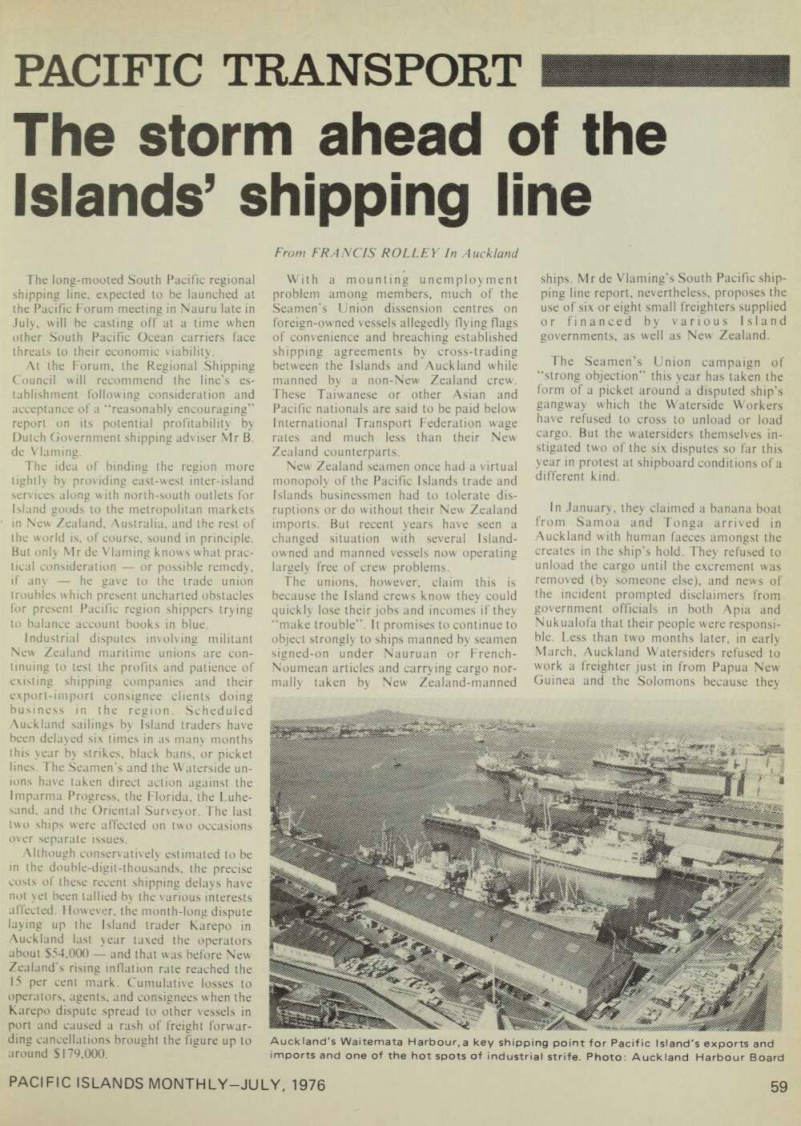
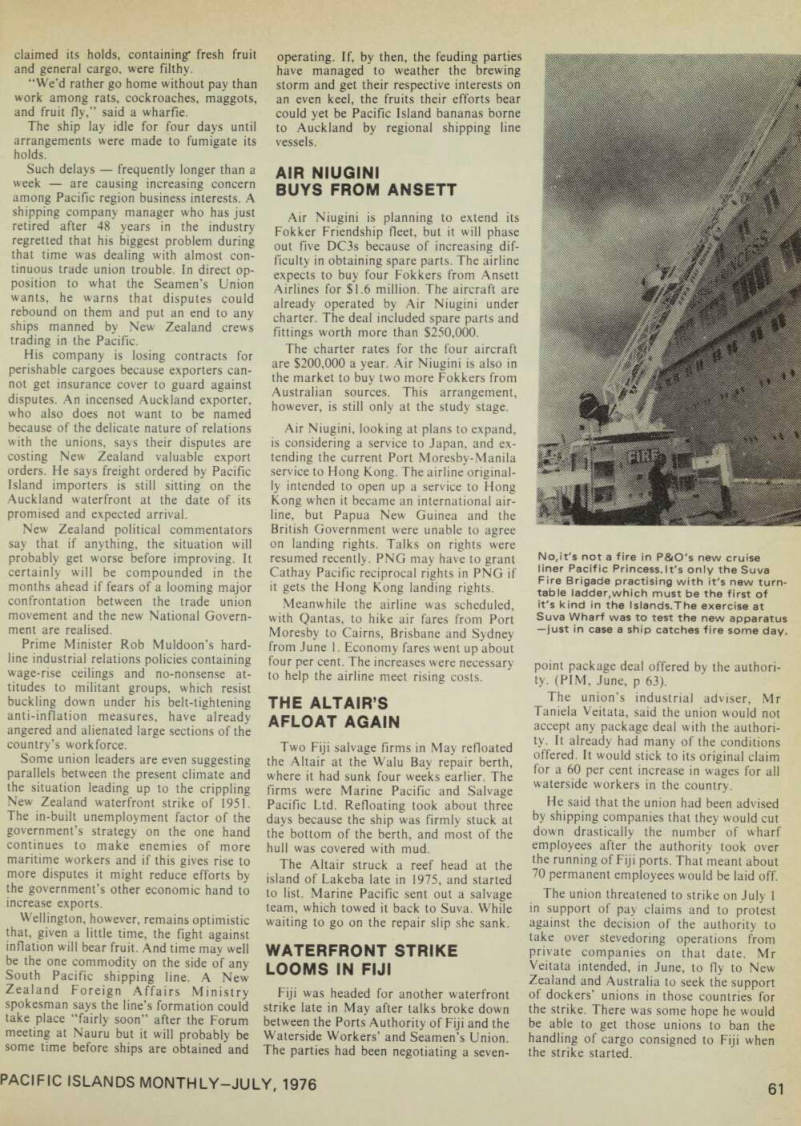

Pacific Transport
The storm ahead of the Islands’ shipping line
From FRANCIS ROLLEY In Auckland
The long-mooted South Pacific regional shipping line, expected to be launched at the Pacific Forum meeting in Nauru late in July, will be casting off at a time when other South Pacific Ocean carriers face threats to their economic viability.
At the Forum, the Regional Shipping Council will recommend the line’s es tablishment following consideration and acceptance of a “reasonably encouraging’’ report on its potential profitability by Dutch Government shipping adviser Mr B. de Vlaming.
The idea of binding the region more lightly by providing east-west inter-island services along with north-south outlets for Island goods to the metropolitan markets in New Zealand, Australia, and the rest of the world is, of course, sound in principle.
But only Mr de Vlaming knows what prac tical consideration or possible remedy, if any he gave to the trade union troubles which present uncharted obstacles for present Pacific region shippers trying to balance account books in blue.
Industrial disputes involving militant New' Zealand maritime unions are con tinuing to test the profits and patience of existing shipping companies and their export-import consignee clients doing bu si ness in the region. Scheduled Auckland sailings by Island traders have been delayed six times in as many months this year by strikes, black bans, or picket lines. The Seamen's and the Waterside un ions have taken direct action against the Imparma Progress, the Florida, the Luhe sand, and the Oriental Surveyor. The last two ships were affected on two occasions over separate issues.
Although conservatively estimated to be in the double-digil-lhousands, the precise costs ol these recent shipping delays have not yet been tallied by the various interests affected. However, the month-long dispute laying up the Island trader Karepo in Auckland last year taxed the operators about $54,000 and that was before New Zealand's rising inflation rate reached the 15 per cent mark. Cumulative losses to operators, agents, and consignees when the Karepo dispute spread to other vessels in port and caused a rash of freight forwar ding cancellations brought the figure up to around $179,000.
With a mounting unemployment
problem among members, much of the Seamen’s Union dissension centres on
foreign-owned vessels allegedly flying flags
of convenience and breaching established
shipping agreements by cross-trading
between the Islands and Auckland while manned by a non-New Zealand crew.
These Taiwanese or other Asian and Pacific nationals are said to be paid below International Transport Federation wage rates and much less than their New Zealand counterparts.
New Zealand seamen once had a virtual monopoly of the Pacific Islands trade and Islands businessmen had to tolerate dis ruptions or do without their New Zealand imports. But recent years have seen a changed situation with several Islandowned and manned vessels now operating largely free of crew problems.
The unions, however, claim this is because the Island crews know they could quickly lose their jobs and incomes if they “make trouble”. It promises to continue to object strongly to ships manned by seamen signed-on under Nauruan or French- Noumean articles and carrying cargo normally taken by New Zealand-manned
ships. Mr de Vlaming's South Pacific ship ping line report, nevertheless, proposes the use of six or eight small freighters supplied or financed by various Island governments, as well as New Zealand, le Seamen Union campaign of strong objection this year has taken the f° rrn °f a picket around a disputed ships gangway which the Waterside Workers aave refused to cross to unload or load cargo. But the watersiders themselves in stigated two of the six disputes so far this year in protest at shipboard conditions of a different kind.
In January, they claimed a banana boat from Samoa and Tonga arrived in Auckland with human faeces amongst the creates in the ship’s hold. They refused to unload the cargo until the excrement was removed (by someone else), and news of the incident prompted disclaimers from government officials in both Apia and Nukualofa that their people were responsi hie. Less than two months later, in early March, Auckland Watersiders refused to work a freighter just in from Papua New Guinea and the Solomons because they
Auckland's Waitemata Harbour,a key shipping point for Pacific Island's exports and imports and one of the hot spots of industrial strife. Photo: Auckland Harbour Board
claimed its holds, containing* fresh fruit and general cargo, were filthy.
“We’d rather go home without pay than work among rats, cockroaches, maggots, and fruit fly,” said a wharfie.
The ship lay idle for four days until arrangements were made to fumigate its holds.
Such delays frequently longer than a week are causing increasing concern among Pacific region business interests. A shipping company manager who has just retired after 48 years in the industry regretted that his biggest problem during that time was dealing with almost con tinuous trade union trouble. In direct op position to what the Seamen’s Union wants, he warns that disputes could rebound on them and put an end to any ships manned by New Zealand crews trading in the Pacific.
His company is losing contracts for perishable cargoes because exporters can not get insurance cover to guard against disputes. An incensed Auckland exporter, who also does not want to be named because of the delicate nature of relations with the unions, says their disputes are costing New Zealand valuable export orders. He says freight ordered by Pacific Island importers is still sitting on the Auckland waterfront at the date of its promised and expected arrival.
New Zealand political commentators say that if anything, the situation will probably get worse before improving. It certainly will be compounded in the months ahead if fears of a looming major confrontation between the trade union movement and the new National Govern ment are realised.
Prime Minister Rob Muldoon’s hard line industrial relations policies containing wage-rise ceilings and no-nonsense at titudes to militant groups, which resist buckling down under his belt-tightening anti-inflation measures, have already angered and alienated large sections of the
country’s workforce.
Some union leaders are even suggesting parallels between the present climate and the situation leading up to the crippling New Zealand waterfront strike of 1951.
The in-built unemployment factor of the government’s strategy on the one hand continues to make enemies of more maritime workers and if this gives rise to more disputes it might reduce efforts by the government’s other economic hand to increase exports.
Wellington, however, remains optimistic that, given a little time, the fight against inflation will bear fruit. And time may well be the one commodity on the side of any South Pacific shipping line. A New
Zealand Foreign Affairs Ministry
spokesman says the line’s formation could take place “fairly soon” after the Forum meeting at Nauru but it will probably be some time before ships are obtained and
operating. If, by then, the feuding parties have managed to weather the brewing storm and get their respective interests on an even keel, the fruits their efforts bear could yet be Pacific Island bananas borne to Auckland by regional shipping line vessels.
Air Niugini
Buys From Ansett
Air Niugini is planning to extend its Fokker Friendship fleet, but it will phase out five DC3s because of increasing dif ficulty in obtaining spare parts. The airline expects to buy four Fokkers from Ansett Airlines for $1.6 million. The aircraft are already operated by Air Niugini under charter. The deal included spare parts and fittings worth more than $250,000.
The charter rates for the four aircraft are $200,000 a year. Air Niugini is also in the market to buy two more Fokkers from Australian sources. This arrangement, however, is still only at the study stage.
Air Niugini, looking at plans to expand, is considering a service to Japan, and ex tending the current Port Moresby-Manila service to Hong Kong. The airline original ly intended to open up a service to Hong Kong when it became an international air line, but Papua New Guinea and the British Government were unable to agree on landing rights. Talks on rights were resumed recently. PNG may have to grant Cathay Pacific reciprocal rights in PNG if it gets the Hong Kong landing rights.
Meanwhile the airline was scheduled, with Qantas, to hike air fares from Port Moresby to Cairns, Brisbane and Sydney from June I. Economy fares went up about four per cent. The increases were necessary to help the airline meet rising costs.
The Altair’S
Afloat Again
Two Fiji salvage firms in May refloated the Altair at the Walu Bay repair berth, where it had sunk four weeks earlier. The firms were Marine Pacific and Salvage Pacific Ltd. Refloating took about three days because the ship was firmly stuck at the bottom of the berth, and most of the hull was covered with mud.
The Altair struck a reef head at the island of Lakeba late in 1975, and started to list. Marine Pacific sent out a salvage team, which towed it back to Suva. While waiting to go on the repair slip she sank.
Waterfront Strike
Looms In Fiji
Fiji was headed for another waterfront strike late in May after talks broke down between the Ports Authority of Fiji and the Waterside Workers’ and Seamen’s Union.
The parties had been negotiating a seven-
point package deal offered by the authori ty. (PIM, June, p 63).
The union’s industrial adviser, Mr Taniela Veitata, said the union would not accept any package deal with the authori ty. It already had many of the conditions offered. It would stick to its original claim for a 60 per cent increase in wages for all waterside workers in the country.
He said that the union had been advised by shipping companies that they would cut down drastically the number of wharf employees after the authority took over the running of Fiji ports. That meant about 70 permanent employees would be laid off.
The union threatened to strike on July 1 in support of pay claims and to protest against the decision of the authority to take over stevedoring operations from private companies on that date. Mr Veitata intended, in June, to fly to New Zealand and Australia to seek the support of dockers’ unions in those countries for the strike. There was some hope he would be able to get those unions to ban the handling of cargo consigned to Fiji when the strike started.
No,it's not a fire in P&O's new cruise liner Pacific Princess. It's only the Suva Fire Brigade practising with it's new turn table ladder,which must be the first of it's kind in the Islands. The exercise at Suva Wharf was to test the new apparatus —just in case a ship catches fire some day.
Nauru Hikes
Cargo Rates
Nauru Pacific Line hiked cargo freight rates from Australia to Fiji, Western Samoa and Papua New Guinea by WV2 per cent on June 1. It was the first rise on the PNG run since June, 1975, and on the Western Samoa service since July, 1974.
Nauru Pacific Line acts independently in fixing its rates.
The new general cargo rates, with those applying before June 1 in brackets, are; To Fiji $72.85 ($60.95) a tonne; $64.94 ($54.35) a cubic metre.
To Western Samoa $66.30 ($55.45) a tonne; $59.10 ($49.45) a cubic metre.
To PNG (Lae and Rabatil) $67.55 ($52.35) a tonne; $60.45 ($46.95) a cubic metre.
The surcharge is unchanged at $2.80 a tonne.
The rates on the runs to Nauru, Guam and Micronesia are unchanged.
Brain Drain From
Maritime School
The Fiji School of Maritime Studies is suffering from a brain drain. The school, which is part of the Derrick Technical Institute, is not yet finished, but, when it is,
it is expected that about $1.2 million will have been spent.
The school is having difficulty in recruiting suitable staff because of the low salary structure. The principal of Derrick Technical Institute, Dr Ankim Swami, said the salary structure for professional people was so low that a lot of good people were being lost to commercial companies, which offered good salaries.
It was difficult to ask lecturers to stay when there were other places where they could work and get better pay. Recently the school lost a professional lecturer, Captain Vollmer, who received advance training in maritime studies in Fiji and overseas. He had been offered a better salary with another company.
“It really hurts to see local professional lecturers like Captain Vollmer leaving for a job with commercial companies, es pecially when great efforts have been made to mould them into what they are now”, Dr Swami said.
The school will soon have a new prin cipal from England to replace the founder, Captain Richard Beaddon. • New jetties are being built at Nabouwalu and Taveuni in Fiji under the country’s rural development scheme. The jetties, which will cost about $lOO,OOO, will make for easier loading of produce. Much of the loading at present is by lighter.
Advertisements & other items, pp. 60-63 (2 items)
Pim’S (Tl Ail Ord€R Bookshop
IT S On€ STOP SHOPPIHQ HI
the titles you want. Mail us the page with your remittance. We’ll despatch your books immediately. □ Percy Chatterton’s Papua: Day □ Holy Torture in Fiji. Firewalk- That I Have Loved. Charming evo- ing and other sacred, ancient cative account of changing Papua rituals of Fiji’s Hindus described as Rev. Percy Chatterton knew it for 50 years. 144 pp. Illustrated. 5A6.50 or SUSB.SO posted anywhere.
D The Story of The Solomons.
Simple, lucid outline of the history of the Solomon Islands, from a refreshingly frank and affectionate point of view, by Dr. C.E. Fox. 88 pp. SA3 or SUS 4, posted anywhere. □ The Lost Caravel. Robert Langdon shatters traditionally-held views on the Polynesians in this controversial, historical whodunnit described by Prof. Ron Crocombe as a “masterpiece c.s fascinating as it is important”. Also invaluable as a record of early Pacific exploration. 368 pp. Profusely illustrated with maps and plates. SAIB or SUS 26, posted anywhere. □ Papua New Guinea Handbook 1976. Completely revised, reset, and containing full details of this newly independent nation history, geography, government, industry, tourist accommodation, etc. Clear maps including a large coloured, fold-out map of PNG. 5A7.50 or SUSIO.OO, posted anywhere. □ Myths and Legends of Torres Strait. Margaret Lawrie collected these stories from the Western, Central and Eastern islands of Torres Strait, including Saibai and Boigu, and Queensland University Press brought them together in this magnificently produced large-format volume of 372 pages. Splendidly illustrated with colour photographs, drawings painings and maps, and including a 45 rpm record of songs of Torres Strait. 5A28.00 or 5U535.00, posted anywhere. □ Port Moresby, Yesterday and Today. In what is even more than a history of Papua New Guinea’s capital, Canon lan Stuart takes us on an entertaining, personalised tour of the city. Softcover, 368 pp. Maps illustrations. 5A3.50 or SUS4.SO, posted anywhere. in text and colour photographs.
Large format, 64 pp. Illustrated. 5A4.50 or SUS6.SO, posted anywhere. □ New Hebrides. One of the superb Islands in the Sun colour series of brilliant full-colour plates, maps and text, this volume describes the unique British-French Condominium of the New Hebrides.
A guide for travellers, or for collectors. 128 pp. Fully illustrated. SAIO or SUSI 3, posted anywhere. □ New Caledonia. French New Caledonia, superbly depicted in full colour photographs, with informative text and maps giving history, geography and daily life.
An Islands in the Sun guide. 128 pp. Fully Illustrated. SAIO or SUSI 3, posted anywhere. □ Bora Bora, One of the French Pacific’s fascinating, colourful higl islands, reached from Tahiti, here presented in sparkling full-colour pictures for visitors or mere armchair travellers. Another Islands in the Sun guide, with the same attention to detail. 128 pp.
Fully illustrated. SAIO or SUSI 3, posted anywhere. □ Fiji Fiji. The multi-racial dominion of friendly Fiji, crossroads of the Pacific, described in colour photographs, maps and text, uniform with the beautiful series listed above. Many people buy the whole set. More titles to be published. 128 pp. Fully illustrated. SAIO or SUSI 3 posted anywhere. □ Little Chimbu in Bougainville, For the young and young-in-heart, lovable Little Chimbu and his friends visit Panguna, and get into awful trouble in what could be the biggest hole in the world, the Bougainville copper mine. Nancy Curtis, who used to live there, tells the story in full colour drawings which are also accurate and instructive. Also in the colourful Nancy Curtis series for children are □ Little Balus and □ Fiji Johnny.
About 48 pp. Illustrated. Each 5A3.50 or SUS4.SO posted anywhere. □ South Pacific Art & Dance.
Beth Dean and the late Bruce Palmer, two skilled guides, lead us in an excellent and colourful ocean voyage of discovery. 104 pp.
Illustrated. 5A3.50 or SUS4.SO, posted anywhere. d Colonial Era Cemetery of Norfolk Island. Former Administrator of the island, R. Nixon Dalkin, describes life and death in what was Britain’s harshest Pacific penal colony. There are illuminating, often moving stories in these photographs, charts and inscriptions that describe the historic cemetery. Large format, 92 pp.
Illustrated. SAS or SUS7.SO, posted anywhere. □ Marine Shells of the Pacific.
Walter Cernohorsky describes in detail with clear photographs 440 Pacific shells, and tells how to find, arrange and photograph a collection. 248 pp. Illustrated. SAIO or SUSIS, posted anywhere. □ Marine Shells of the Pacific Volume 11. Walter Cernohorsky carries on where his first book leaves off, with a further 600 species fully described and illustrated: Some of the 68 full-page plates are in colour. 412 pp. Illustrated. SAI7 or SUS2S, posted anywhere.
D Friendly Island. Warm account of life in Tonga, sunlit South Pacific island kingdom, by Patricia Ledyard, who has lived in a Tongan harbourside village for more than 20 years c Paperback, 215 pp.
SA3 or SUS4.SO, posted anywhere. □ Plants and Flowers of Tahiti.
Full colour photographs of the rich and beautiful Tahitian flora, classified by scientific names, and by French, English and Tahitian common names, 144 pp. Fully illustrated. SAS or SUS 7, posted anywhere, □ Birds of Tahiti. A companion volume to Plants and Flowers of Tahiti. Full colour photographs and descriptions, for collectors or for amateur birdwatchers, visitors and students needing easy identification. 112 pp. Fully illustrated.
SAS or SUS 7, posted anywhere.
PlM’s mail order bookshop prices include surface postage and charges anywhere in the world. There’s nothing extra to pay.
Sydney visitors may buy any title at slightly less cost across the counter at our office at 76 Clarence Street, Sydney.
Please mail to Mail Order Bookshop, Pacific Publications, Box 3408 GPO, Sydney, 200 li I have ticked the books I want and have enclosed $ (cash with order) NAME (Block Letters)
ADDRESS
New range of
Epiglass antif oulings
give up to 12 months
growth-free performance.
Consolidated Chemicals Ltd have launched a new range of antifoulings now being marketed under the name of Epiglass E-type. Superior, in terms of performance, to any antifouling currently on the market, they are the result of years of research and development work in the company’s laboratories followed by extensive testing.
PRODUCT PERFORMANCE PROVED
Tests have been carried out under widely varying conditions throughout the Pacific area which have conclusively proved the effectiveness of E-type antifouling on both Commercial and Pleasure craft.
12 MONTHS GROWTH-FREE PERFORMANCE
Epiglass E-type antifouling is formulated to guard your boat against the expensive damage that can be done by algae, barnacles, slime weed and general fouling. The formulation includes a very high percentage of special toxins which are ‘‘release controlled’’ This positive control release of toxins means that if applied as directed you can expect up to 12 months growth-free performance.
Whatever size your boat, whether it is power or sail, protect below the water line with new Epiglass E-type antifouling.
IP
epiglass]
V 1 i ■ 1 : • f lift ■ 1 1 Consolidated Chemicals Ltd. 1 P.O. Box 15-104,
j New Lynn, Auckland.
• Please send me a free copy of your Epiglass Boat Owners Manual plus facts on new E-type antifouling.
I Mr [
Address
I (Block letters please)
I J from 7ft to73ft I epiglass j power or sail
PACIFIC AREA
DISTRIBUTORS
COOK ISLANDS
Cook Is. Trading Corp. Ltd
FIJI
Burns Philp (SS) Co. Ltd
NEW GUINEA
Bougainville Marine Pty Ltd, Kieta Burns Philp (NG) Ltd, Madang Elvee Trading Pty Ltd, Rabaul Faulkner & Tait (NG) Pty Ltd, Lae S. A. Heath & Co. Pty Ltd, Port Moresby
NEW HEBRIDES
Burns Philp (NH) Ltd
NOUMEA
Guy Limousin Pacific Yachting
NORFOLK ISLAND
Irvine Bid. Supply Centre
PAGO PAGO
Max Haleck Inc.
TAHITI
Marine Corail Tahiti Sport Tahiti Voile
TONGA
Riechelmann Bros.
WESTERN SAMOA
Burns Philp (SS) Co. Ltd E. A. Coxon Ltd Gold Star Transport Co. Ltd Morris Hedstrom Ltd
SOLOMON ISLANDS
George Yee Fai Ltd
61
’ACIFIC ISLANDS MONTHLY-JULY, 1976
A round for Continental
Continental Airlines won the latest round in its battle with Pan American World Airways for the Saipan-Japan route when the US Civil Aeronautics Board made another recommendation in its favour in a 3-0 vote, with two members
abstaining.
But whether Continental, or PAA, will get the route, is another matter. As alloca tion of the route Involves flights to a foreign nation, the final decision rests with President Ford who, at the time of the CAB vote, was locked in a battle with former film star, Ronald Reagan, for the Republican Party’s presidential nomina tion, and had little time for anything else.
The last time President Ford received a recommendation from the CAB in favour of Continental, he told the CAB to have another look at it. He wanted more infor mation about the viability of the service, and directed the Transportation Depart ment to prepare a report for the CAB.
The board said it again recommended Continental because there was little incen tive to encourage Japanese tourists to travel to US territories. That was par ticularly true because JAL was already fly
ing from Japan to Guam, and Saipan traf fic would, in part, be diverted from JAL’s existing Guam service.
“Indeed, a decision not to authorise a US flag service will, in all likelihood, effec tively deprive the Marianas and the rest of the Trust Territory of any direct service to Japan”, the CAB reported.
President Ford had asked the CAB to consider the Japanese Government’s possi ble concern over the designation of a new carrier (Continental) for the route, and whether the service would make money.
PAA is a major trans-Pacific airline, and competes with JAL on Japan-Guam flights. Continental does not serve Japan.
The CAB in its latest recommendation, rejected a claim by PAA that giving the service to Continental would divert $3.7 million in much-needed income from PAA. The CAB estimated the diversion at $1.5 million and said it would not seriously weaken PAA.
It is understood that Continental’s already extensive interests in the area was a major factor in the CAB decision. Con tinental claimed to have invested more than $32 million in its Micronesia air ser vices and related hotel operations.
Advertisements & other items, p. 64 (1 item)
Again.
WLVe cut the
tag, wide Pacific
down to size.
Again.
New York London Seattle Portland NYC/London San Francisco Los Angeles Dallas/NYC Mideast/Europe Hong K °n^^^Taipei Manila Tokyo Honolulu Saipan Bangkok Saigon Bah Samoa Tahiti Singapore Sydney From the airline that first discovered the Pacific, Pan Am introduces another first. The fastest scheduled flights from Tokyo to New York and Los Angeles, non-stop. Aboard our new 747 SPs.
And from Australia, there’s now an all 747 service to the U.S.A. every day except Wednesday.
With new “no-change” 747 s from Melbourne to Honolulu on Fridays and Sundays via Sydney and Nadi. On Saturdays and Mondays via Sydney and Pago Pago. It’s all part of making the big wide Pacific not so big and wide. And beyond,
it’s the same fast, comfortable story.
You call it the world. We call it home.
Sydney: Elizabeth Street, at Martin Place, 2331111 and International Terminal Building, Mascot.
Melbourne: 233 Collins St., 6544788. Brisbane: 191 Elizabeth St., 221 7477 Canberra: 28-36 Ainslie Avenue, 489184.
Adelaide: Aston House, 13 Leigh St., 51 2821. Perth: 172 St. George’s Terrace, 21 2719. 065. P. 125
Yachts
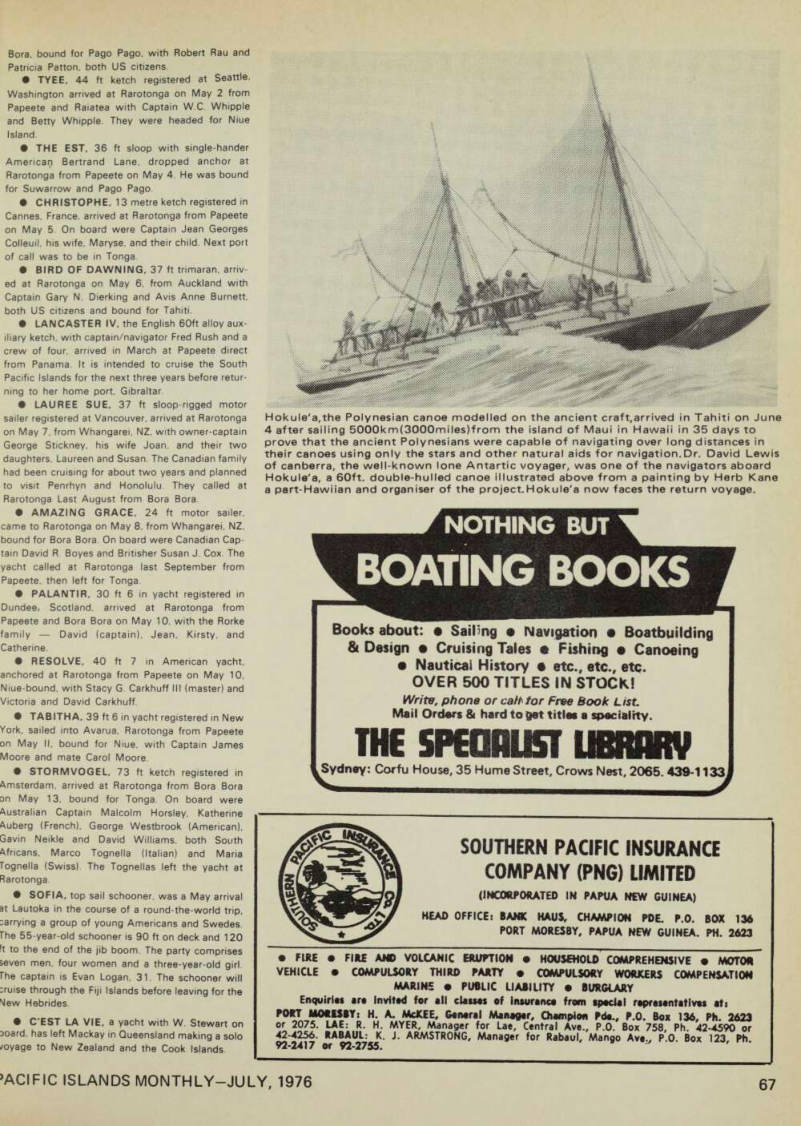
Cruising
• ALTAIR, Alberg 30ft sloop from Port Arthur, Texas, sailed into Tahiti on May 19 for a month's visit en route around the world. Owner Terrell Adkisson, Jr, a school teacher from Beaumont, Tex as, and Leo Singleton 111 of La Place, La, left Texas on Nov 5, visiting the dry Tortugas and Bahamas before sailing to Panama and the Marquesas. The two men entertain friends in their ports of call by playing the guitar and flute. Their next stops will in clude American Samoa and Fiji. • CORYPHAENA, 37ft double-ended Carol ketch from San Diego, planned to leave Tahiti in June for Rarotonga and westward. John and Mary Mathias bought their boat in France in 1967 and left the following year for the Caribbean and Florida.
In August, 1974 they sailed through the Panama Canal down the coast of South America to Ecuador, then on to the Galapagos for a month before arriv ing in the Marquesas where John got hepatitis. • ERYX 11, 2-masted 80ft square-sail schooner designed and built in England, has been cruising the islands of French Polynesia since she arrived in Tahiti late in 1975. Owner Michel Feuga, formerly a charter boat captain in the Mediterranean on BLUE TROUT, bought Eryx II two years ago to sail around the world. With Michel is his brother Pierre,
girlfriend Colette, Reynald Berthe, also of France, and Lea Adamson and Kathy Cleveland of San Francisco, • NEW HORIZONS, a most unusual 60ft ferro-cement ketch from Vancouver, built and sailed by the "Fearsome Foursome" bachelors Ben Fraleigh, Mike Campbell, Don Beadle and Fred Bulechowsky, left Tahiti for Hawaii in late April, following a visit of several months in French Polynesia With them in Tahiti were Gwen Corn field, Darleen Woodward and Audrey Byers, all of Vancouver. New Horizons was built in five years while the foursome continued their jobs, and was finally launched in April, 1974 She carries 580 gallons of diesel and 380 gallons of water. Power is supplied by a 7.5 kw Onan generator plant. There is a Panasonic microwave oven, deep-freeze and a clothes dryer aboard. • LA MIOCHE, Mariner 31ft ketch from Balboa, Canal Zone, arrived in Tahiti mid-May for a visit through^*>ie Bastille celebrations in July.
Owners Bill and Karen Woods left the Panama Canal on January 29 and sailed to Tahiti by way of the Cocos Islands, the Galapagos and Marquesas, where Bill became ill. They lost their forestay 600 miles from the Marquesas and jury-rigged her. They planned to visit the Samoas. Gilberts and Marshall Islands before returning home • MANDORLA, 38ft Morgan-designed Columbia sloop from Portland, reported in the May issue, left Tahiti on March 14 for Hawaii by way of Bora Bora.
Owner Geoffrey Wilson flew home because of hepatitis he'd contracted. Kaarin, with a new cap tain, Ron Zalesky of California, and Jeanne Longfelder of Seattle, were 10 days out at sea
when Kaarin became dangerously ill with hepatitis Many ham operators came to their aid and dramatic air-sea rescue by the French Navy follow ed When Kaarin was dismissed from the hospita they all flew home. Mandorla was left in Tahiti. • MARY ANN 11, 36ft Cheoy Lee Clippe ketch from Los Angeles, left Tahiti on March 19 fo Moorea and Hilo. Owner lan Holland, who had beei in French Polynesia for several months, was single handing his boat when the back stay broke. He jury rigged her and sailed the 700 miles back to Tahit for repairs. He left again around April 10. • TAKAROA, 30ft Tahiti ketch from Brittany has been put up for sale in Tahiti by owner Jean- Michel Garrec. He sailed Takaroa to Tahiti from France, arriving in October, 1975. with Laurie Leavitt of Colorado aboard. • VARDA, famous 70ft brigantine built and owned by author William A Robinson of Massachusetts and Tahiti, left Tahiti on May 19 for New Zealand, where she will be refitted and equipped. Launched in 1942, Robinson sailed Varua to Tahiti in 1945 and Tahiti became home for them both. Robinson, who has written several books about his voyages on his sailboats, turned Varua over to a group of scientists working for Marine Environmental Research Inc. from Kittery Point, Maine. She will participate in their research projects by acting as a floating laboratory as they sail around the world. Sailing Varua to New Zealand are Russ Nilson, 24, the ship's captain, and Jennifer Brown, Ron Harelstad, Hugh Scott and John Brady. • PEREGRINE, 37ft American catamaran registered in San Diego, arrived at Rarotonga on
May 14 from Papeete, bound for Niue. On board were Richard Jensen (captain), Trevor Davies and C. Robinette, • NOMAD, 38ft cutter, arrived at Rarotonga on May 21 with owner-captain Edwin Arnold, his wife, Mary, and their four children, Chris, Phil, Geoff and Sonia. Their circumnavigation started from New York and to-date has taken them to the Mar quesas and Tahiti. Next port of call was to be Samoa. • TARA NUI 11, 29ft cutter registered at Whangarei, NZ, arrived at Rarotonga on May 21 with Brian R. Wintle and Jill Goodwin. Next ports of call are Aitutaki and the Tokelau Islands. • DIFFERENT DRUMMER, 39ft 9ins ketch, arrived at Rarotonga on May 24 from Auckland bound for Honolulu via Tahiti with Captain Robert Rediske (US), Rosa Harold (NZ), Gloria Guest (Australia) and Jeff Hassell (US). The yacht is registered in Honolulu. • RUNNING WIND, 39ft ketch registered in Auckland, arrived at Rarotonga on May 25 from Papeete and Bora Bora bound for Auckland. On board were Captain Douglas W. Jonstone, Rosemany Johnstone and Judith Wrightson, all New Zealanders. • SUPER SHRIMP, 18 ft sloop registered in London, left Rarotonga on May 8 for Niue, Tonga, Fiji, New Hebrides and Australia with owner captain Shane Acton and his Swiss companion. Iris Derungs, who joined the yacht in Panama. They had spent the hurricane season in Rarotonga. Mr Acton had sailed from the UK to the Canary Islands, Bar bados, Panama, Ecuador, the Galapagos Islands and Tahiti, and he believes that Super Shrimp will be the smallest sailing vessel ever to have sailed from London to Australia. • PALAWAN, 68 ft ketch registered at North Haven, Maine, USA, arrived at Rarotonga on May 8 from Bora Bora, bound for Fiji then back to the States. The vessel's owner is Thomas J. Watson Jnr and the captain is Paul Wolther. • ONZA, 56 ft 7 in. motor sailer registered in Honolulu arrived at Rarotonga on April 26 from Papeete and bound for Niue. On board were Lawence Horowitz (captain), Vera Krivonos, Timothy Roger Revercomb and Frantisek Spillar. • BLUE WATER, 81 ft 7 in. motor launch registered at Portland, Oregon, anchored at Rarotonga from Tahiti and Bora Bora on May 2 with Captain Sidney Lee Browning, Steven Ellacott, Oscar B. Polk and Janet Ann Lawrenson. When bound for Rarotonga Blue Water called at Mitiaro and borrowed two high-voltage batteries, needed to build up the vessel’s electrical system. The yacht is well-equipped with radar gear and radio com munications and has three carpeted lounges, ac commodation for 10 cabin passengers, a captain's suite, a deck lounge, a small cargo space and an automatic pilot. The next port of call was uncertain. • CIRCE, 27 ft cutter registered at San Fran cisco arrived at Rarotonga on May 2 from Bora
Bora, bound for Pago Pago, with Robert Rau and Patricia Patton, both US citizens. • TYEE, 44 ft ketch registered at Seattle, Washington arrived at Rarotonga on May 2 from Papeete and Raiatea with Captain W.C. Whipple and Betty Whipple. They were headed for Niue Island. • THE EST, 36 ft sloop with single-hander American Bertrand Lane, dropped anchor at Rarotonga from Papeete on May 4. He was bound for Suwarrow and Pago Pago. • CHRISTOPHE, 13 metre ketch registered in Cannes, France, arrived at Rarotonga from Papeete on May 5. On board were Captain Jean Georges Colleuil, his wife. Maryse, and their child. Next port of call was to be in Tonga. • BIRD OF DAWNING, 37 ft trimaran, arriv ed at Rarotonga on May 6, from Auckland with Captain Gary N. Dierking and Avis Anne Burnett, both US citizens and bound for Tahiti. • LANCASTER IV, the English 60ft alloy aux iliary ketch, with captain/navigator Fred Rush and a crew of four, arrived in March at Papeete direct from Panama. It is intended to cruise the South Pacific Islands for the next three years before retur ning to her home port, Gibraltar. • LAUREE SUE, 37 ft sloop-rigged motor sailer registered at Vancouver, arrived at Rarotonga on May 7, from Whangarei, NZ, with owner-captain George Stickney, his wife Joan, and their two daughters, Laureen and Susan. The Canadian family had been cruising for about two years and planned to visit Penrhyn and Honolulu. They called at Rarotonga Last August from Bora Bora. • AMAZING GRACE, 24 ft motor sailer, came to Rarotonga on May 8, from Whangarei, NZ, bound for Bora Bora. On board were Canadian Cap tain David R. Boyes and Britisher Susan J. Cox. The yacht called at Rarotonga last September from Papeete, then left for Tonga. • PALANTIR, 30 ft 6 in yacht registered in Dundee, Scotland, arrived at Rarotonga from Papeete and Bora Bora on May 10, with the Rorke family David (captain), Jean, Kirsty, and Catherine. • RESOLVE, 40 ft 7 in American yacht, anchored at Rarotonga from Papeete on May 10, Niue-bound, with Stacy G. Carkhuff 111 (master) and Victoria and David Carkhuff. • TABITHA, 39 ft 6in yacht registered in New York, sailed into Avarua, Rarotonga from Papeete on May 11, bound for Niue, with Captain James Moore and mate Carol Moore. • STORMVOGEL, 73 ft ketch registered in Amsterdam, arrived at Rarotonga from Bora Bora on May 13, bound for Tonga. On board were Australian Captain Malcolm Horsley, Katherine Auberg (French), George Westbrook (American), Gavin Neikle and David Williams, both South Africans, Marco Tognella (Italian) and Maria fognella (Swiss). The Tognellas left the yacht at Rarotonga. • SOFIA, top sail schooner, was a May arrival at Lautoka in the course of a round-the-world trip, oarrying a group of young Americans and Swedes, Fhe 55-year-old schooner is 90 ft on deck and 120 ft to the end of the jib boom. The party comprises seven men, four women and a three-year-old girl.
Fhe captain is Evan Logan, 31. The schooner will :ruise through the Fiji Islands before leaving for the Mew Hebrides. • C'EST LA VIE, a yacht with W. Stewart on aoard, has left Mackay in Queensland making a solo /oyage to New Zealand and the Cook Islands.
Hokule'a, the Polynesian canoe modelled on the ancient craft, arrived in Tahiti on June 4 after sailing 5000km (3000miles) from the island of Maui in Hawaii in 35 days to prove that the ancient Polynesians were capable of navigating over long distances in their canoes using only the stars and other natural aids for navigation. Dr. David Lewis of Canberra, the well-known lone Antartic voyager, was one of the navigators aboard Hokule'a, a 60ft. double-hulled canoe illustrated above from a painting by Herb Kane a part-Hawiian and organiser of the project. Hokule'a now faces the return voyage.
Advertisements & other items, pp. 65-67 (2 items)
nedlloyd
REGULAR SAILINGS BY FAST, MODERN CARGO VESSELS from EUROPE vio PANAMA to:
PAPEETE, NOUMEA,
APIA, SUVA, LAUTOKA,
NEW ZEALAND.
from NEW ZEALAND vio PANAMA to:
EUROPE
(MEDITERRANEAN b NORTH CONTINENT)
and from AUSTRALIA to:
CENTRAL AMERICA b CARIBBEAN
heavy-lift facilities—refrigerated space—cargo deeptanks
For further particulars apply to Agents: Ets. Donald Tahiti Papeete. / / Agence Maritime Aerienne Caledonienne S.A. A.M.A.C., Noumea.
Interocean Australia Services Pty. Ltd.
Sydney.
O. F. Nelson & Co. Ltd.
Apia.
Carpenters Shipping Suva, Lautoka.
Joint Shipping Management Ltd.
P.O. Box 890, Wellington, N.Z.
FREIGHT
ffIRREU
REFRIGERATED
& GENERAL
CARGO IN
BARGES. BULK
LIQUIDS IN
VESSEL DEEP
TANKS.
w
Quick &
Dependab
LASH
Service
FROM UNITED STATES WEST COAST & CANADA TO PAPEETE,
PAGO PAGO, AUCKLAND, LAE & RABAUL.
PAPUA NEW GUINEA TO VANCOUVER 8.C., TACOMA, PORT-
LAND, SAN FRANCISCO, LOS ANGELES.
SYDNEY, MELBOURNE, BURNIE, HOBART, BRISBANE TO LAE
& RABAUL.
n MANAGING AGENTS: Wilh. Wilholmsen Agency P/L., 13-15 Bridge Street, Sydney 2000-Phone 20517-60 Market Street, Melbourne, 3000-Phone 613031-344 Queen Street, Brisbane, 4000-Phone 2213316. MANAGING AGENTS N.Z,: Dalgety N.Z.
Ltd. ,119 Featherston Street, Welington-Phone 738347- 41/45 Albert Street, Auckland—Phone 71859, ISLAND AGENTS: Robert Laurie (NG) P/L, P.O. Box 1032, Lae, PNG - Phone 423811. Burns Philp (NG) Ltd., P.O, Box 87, Rabaul, PNG. - Phone 922666.
TRAIL BLAZERS OF
NEW ZEALAND
Historical tales from a unique land.
Fully illustrated, gold-embossed binding. Limited number First Editions available. $10.95 (NZ) postpaid from DUFS, Bx. 3847, Wellington, NZ.
1
NOTHING BUT
BOATING BOOKS
Books about: • Sail ng • Navigation • Boatbuilding & Design • Cruising Tales • Fishing • Canoeing • Nautical History • etc., etc., etc.
OVER 500 TITLES IN STOCK!
Write, phone or caft tor Free Book List Mail Orders & hard to get titles a speciality.
Sydney: Corfu House, 35 Hume Street, Crows Nest, 2065. 439-1133
9a & &
SOUTHERN PACIFIC INSURANCE
COMPANY (PNG) LIMITED
(INCORPORATED IN PAPUA NEW GUINEA)
HEAD OFFICES BANK HAUS, CHAMPION PDE. P.O. BOX 136 PORT MORESBY, PAPUA NEW GUINEA. PH. 2623 • FIRE • FIRE AND VOLCANIC ERUPTION • HOUSEHOLD COMPREHENSIVE • MOTOR VEHICLE • COMPULSORY THIRD PARTY • COMPULSORY WORKERS COMPENSATION
MARINE • PUBLIC LIABILITY • BURGLARY
Enquiries arc Invited for all classes of insurance from apodal representatives att PORT MORESBY: H. A. McKEE, General Manager, Champion Pde., P.O. Box 136, Ph. or 2075. LAE: R. H. MYER, Manager for Lae, Central Ave., P.O. Box 758, Ph. 42-4590 or 42-4256. RABAUL: K. J. ARMSTRONG, Manager for Rabaul, Mango A ve v P.O. Box 123, Ph. 92-2417 or 92-2755.
67
ACIFIC ISLANDS MONTHLY-JULY, 1976
feared change
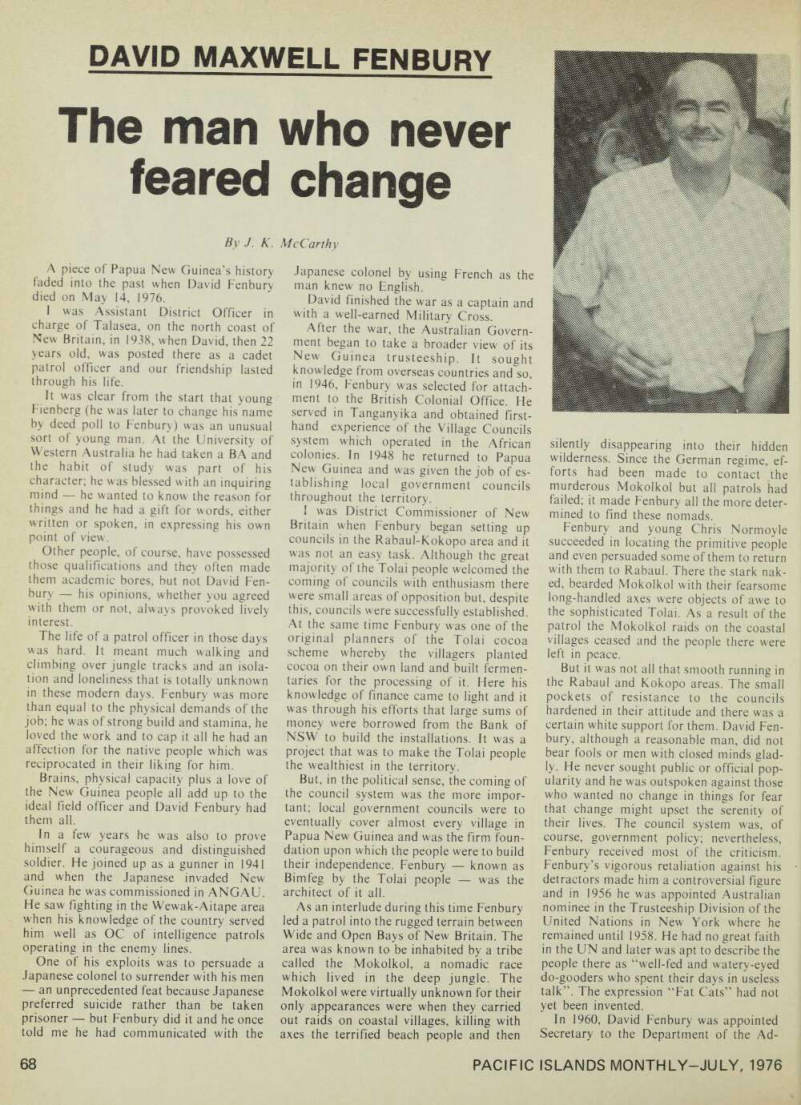
David Maxwell Fenbury
The man who never feared change
By J. K. McCarthy
A piece of Papua New Guinea’s history faded into the past when David Fenbury died on May 14, 1976.
I was Assistant District Officer in charge of Talasea, on the north coast of New Britain, in 1938, when David, then 22 years old, was posted there as a cadet patrol officer and our friendship lasted through his life.
It was clear from the start that young Fienberg (he was later to change his name by deed poll to Fenbury) was an unusual sort of young man. At the University of Western Australia he had taken a BA and the habit of study was part of his character; he was blessed with an inquiring mind he wanted to know the reason for things and he had a gift for words, either written or spoken, in expressing his own point of view.
Other people, of course, have possessed those qualifications and they often made them academic bores, but not David Fen bury his opinions, whether you agreed with them or not, always provoked lively interest.
The life of a patrol officer in those days was hard. It meant much walking and climbing over jungle tracks and an isola tion and loneliness that is totally unknown in these modern days. Fenbury was more than equal to the physical demands of the job; he was of strong build and stamina, he loved the work and to cap it all he had an affection for the native people which was reciprocated in their liking for him.
Brains, physical capacity plus a love of the New Guinea people all add up to the ideal field officer and David Fenbury had them all.
In a few years he was also to prove himself a courageous and distinguished soldier. He joined up as a gunner in 1941 and when the Japanese invaded New Guinea he was commissioned in ANGAU.
He saw fighting in the Wewak-Aitape area when his knowledge of the country served him well as OC of intelligence patrols operating in the enemy lines.
One of his exploits was to persuade a Japanese colonel to surrender with his men an unprecedented feat because Japanese preferred suicide rather than be taken prisoner but Fenbury did it and he once told me he had communicated with the
Japanese colonel by using French as the man knew no English.
David finished the war as a captain and with a well-earned Military Cross.
After the war, the Australian Govern ment began to take a broader view of its New Guinea trusteeship. It sought knowledge from overseas countries and so, in 1946, Fenbury was selected for attach ment to the British Colonial Office. He served in Tanganyika and obtained first hand experience of the Village Councils system which operated in the African colonies. In 1948 he returned to Papua New Guinea and was given the job of es tablishing local government councils
throughout the territory.
I was District Commissioner of New Britain when Fenbury began setting up councils in the Rabaul-Kokopo area and it was not an easy task. Although the great majority of the Tolai people welcomed the coming of councils with enthusiasm there were small areas of opposition but, despite this, councils were successfully established.
At the same time Fenbury was one of the original planners of the Tolai cocoa scheme whereby the villagers planted cocoa on their own land and built fermen taries for the processing of it. Here his knowledge of finance came to light and it was through his efforts that large sums of money were borrowed from the Bank of NSW to build the installations. It was a project that was to make the Tolai people the wealthiest in the territory.
But, in the political sense, the coming of the council system was the more impor tant; local government councils were to eventually cover almost every village in Papua New Guinea and was the firm foun dation upon which the people were to build their independence. Fenbury known as Bimfeg by the Tolai people was the architect of it all.
As an interlude during this time Fenbury led a patrol into the rugged terrain between Wide and Open Bays of New Britain. The area was known to be inhabited by a tribe called the Mokolkol, a nomadic race which lived in the deep jungle. The Mokolkol were virtually unknown for their only appearances were when they carried out raids on coastal villages, killing with axes the terrified beach people and then
silently disappearing into their hidden wilderness. Since the German regime, ef forts had been made to contact the murderous Mokolkol but all patrols had failed; it made Fenbury all the more deter mined to find these nomads.
Fenbury and young Chris Normoyle succeeded in locating the primitive people and even persuaded some of them to return with them to Rabaul. There the stark nak ed, bearded Mokolkol with their fearsome long-handled axes were objects of awe to the sophisticated Tolai. As a result of the patrol the Mokolkol raids on the coastal villages ceased and the people there were left in peace.
But it was not all that smooth running in the Rabaul and Kokopo areas. The small pockets of resistance to the councils hardened in their attitude and there was a certain white support for them. David Fen bury, although a reasonable man, did not bear fools or men with closed minds glad ly. He never sought public or official pop ularity and he was outspoken against those who wanted no change in things for fear that change might upset the serenity of their lives. The council system was, of course, government policy; nevertheless, Fenbury received most of the criticism.
Fenbury’s vigorous retaliation against his detractors made him a controversial figure and in 1956 he was appointed Australian nominee in the Trusteeship Division of the United Nations in New York where he remained until 1958. He had no great faith in the UN and later was apt to describe the people there as “well-fed and watery-eyed do-gooders who spent their days in useless talk”. The expression “Fat Cats” had not yet been invented.
In 1960, David Fenbury was appointed Secretary to the Department of the Ad
mimstrator an appointment which acted like a dose of salts on that rather costive organisation. If Fenbury had no time for fools he had even less for the lazy and inef ficient and he was not slow to point out their deficiencies on what he called “bits of paper” notes written with a vitriolic pen and phrased in equally cutting terms.
Some of the department heads resented it but it did not deter Fenbury.
In 1967, Sir Donald Cleland retired as Administrator of Papua New Guinea and David Hay, a former Australian Am bassador, took his place. Two years later, Fenbury was transferred from the Depart ment of the Administrator and given the secretaryship of the newly-founded Department of Social Development and Home Affairs, a ragbag organisation covering all the minor bits and pieces of the administration and having little real effect on the things that mattered.
I had retired from the service in 1967 and of course don’t know the reason for Fenbury’s sudden removal as the head of the Department of the Administrator. My guess is that David Hay, as a trained diplomat, was a bit shocked at Fenbury’s lack of diplomacy and wanted a more tact ful man.
Fair enough, but in any case Fenbury was disappointed at the decision and the way it had been taken for he had no inkling of his transfer until he returned from leave in Australia.
David Fenbury retired from the service in 1973 a few years before he was due to do so and until his death lived in Western Australia. He married Joan, his first wife, in 1948 and he was a grief stricken man when she died in 1964. There were two children of the marriage, Alan, now a barrister in Perth and Margaret, a graduate of ANU, who was recently teaching aboriginal children in Arnhem Land and in the Northern Territory. In 1966, David married Helen, the ceremony taking place at our house in
Port Moresby.
In my opinion David Fenbury was one of the best administrators Papua New Guinea ever had. He had an excellent brain and the physical stamina to give him an energy that many other men lacked. But through some quirk of fate he was never to attain the fullness to which his talents en titled him. He was not, of course, the ideal public servant, being far too energetic and outspoken to be cast in that role.
And so, perhaps, one will have to wait until history gives him his due.
Deaths
of Islands People
Mr A. Meyer Mr August (Gus) Meyer, 61, son-in-law of the late O. F. Nelson, of Western Samoa, died recently in Auckland, where he had lived since 1952. In 1940, because he was a German national, he was interned at Somes Island, NZ. However, in 1942, he was able to return to Western Samoa, where he joined O. F. Nelson and Co Ltd as manager of the Apia branch store. In NZ, he was a departmental manager, and later a director of Cooks. He leaves a widow and two daughters.
Mrs. L. A. Bamola Mrs Leela Ambikanand Bamola, a pioneer woman teacher in Fiji, died recent ly, aged 55. After higher education in India she taught in Fiji primary schools for 35 years. She was active in Indian women’s organisations. She is survived by her hus band, Mr A. Bamola, a retired education officer, a daughter and a son.
Mr W. G. Mitchell Mr William George Mitchell, who spent almost 50 years in Papua New Guinea and Norfolk Island, died on May 26 at Nowra, NSW, aged 97. He was born at Creswich, Victoria, and went to Port Moresby in 1920 to work for a mining company. He was a Burns Philp manager from 1927 to 1942 in PNG and at Norfolk Island from 1947 to 1957. Between 1942 and 1947 he was on Commonwealth war work. Mr Mitchell was married twice in 1906 and 1932. He had two sons and three
daughters.
Iroij Albert Loeak Iroij Albert Loeak, a high chief of Ailinglaplap Atoll, Marshall Islands, died recently in hospital in Honolulu, aged 62.
He was a member of the House of Iroij when the Marshall Islands Congress had an upper and lower house in 1949. When the charter of the district legislature was amended to make it one body, he was elected to that house.
Maka Maui Kea Maka Maui Kea who died in Auckland in May was a descendant of three ariki of Atiu in the Cook Islands. His wife, Pare, was captain of a Cook Islands netball team, which was in Auckland at the time.
He worked for the Treasury Department in The Cooks and is survived by his wife and three children.
Mr J.F. Semple Mr J.F. Semple, former Chief Police Officer and Commissioner of Police in the Gilbert and Ellice Islands from 1968 to 1973, died recently in the UK, aged 50. He was in the Solomon Islands as a police of ficer from 1952 to 1958, then in Tanganyika (now Tanzania), where he served till 1965. He was in the Aden State Police before his appointment to the
Geic.
Mrs Salaevalu Fiame Only sister of the late Fiame Mata’afa, first Prime Minister of Western Samoa, 59-year-old Salaevalu Fiame died in Apia Hospital in May, almost a year since her brother’s death.
An outstanding sportswoman in her younger days, Sala, as she was widely knoftm, led many women’s activities and, at the time of her death, was vice-president of the National Council of Women. She leaves an only daughter, Faamusami
Ulberg.
The funeral service was at the Congregational Christian Church at Lepea before burial in the family cemetery at Lepea.
Mr Henri Jacquier A special issue of the Bulletin de la Societe des Etudes Oceaniennes, of Tahiti, was published recently in honour of the late Mr Henri Jacquier, one of French Polynesia’s best known post-war citizens.
Mr Jacquier died at the age of 68. He had been president of the Societe des Etudes Oceaniennes for 25 years. The society is the oldest learned institution in the South Pacific.
A pharmacist by profession, Mr Jac quier first went to Tahiti with the French Navy in 1931. He was pharmacist at the Papeete Hospital from 1933 to 1937 after which he went into private business near the Papeete waterfront.
He played a prominent role in the development of tourism in Tahiti after World War 11, and was elected president
of the Syndicate d’lnitiative, amourist
body, in 1954.
Many scholars who visited Tahiti in the postwar years found Mr Jacquier a helpful friend. Among these was Thor Heyerdahl who invited Mr Jacquier to accompany him on his expedition to Rapa in 1956. Mr Jacquier was also a keen deep-sea fisher man.
Besides contributing many articles to the Bulletin de la Societe des Etudes Oceaniennes, Mr Jacquier was the author of a novel, Piraterie dans le Pacifique. The novel, which was published in 1973, is bas ed on a true story of the turn of the cen tury. Jules Verne also based a novel on it.
An English translation of the Jacquier novel is to be published in New York this year.
Advertisements & other items, p. 69 (1 item)
American Readers
Please advise us if the zip code on your PIM delivery envelope is incorrect. It’s very important.
Shipping,
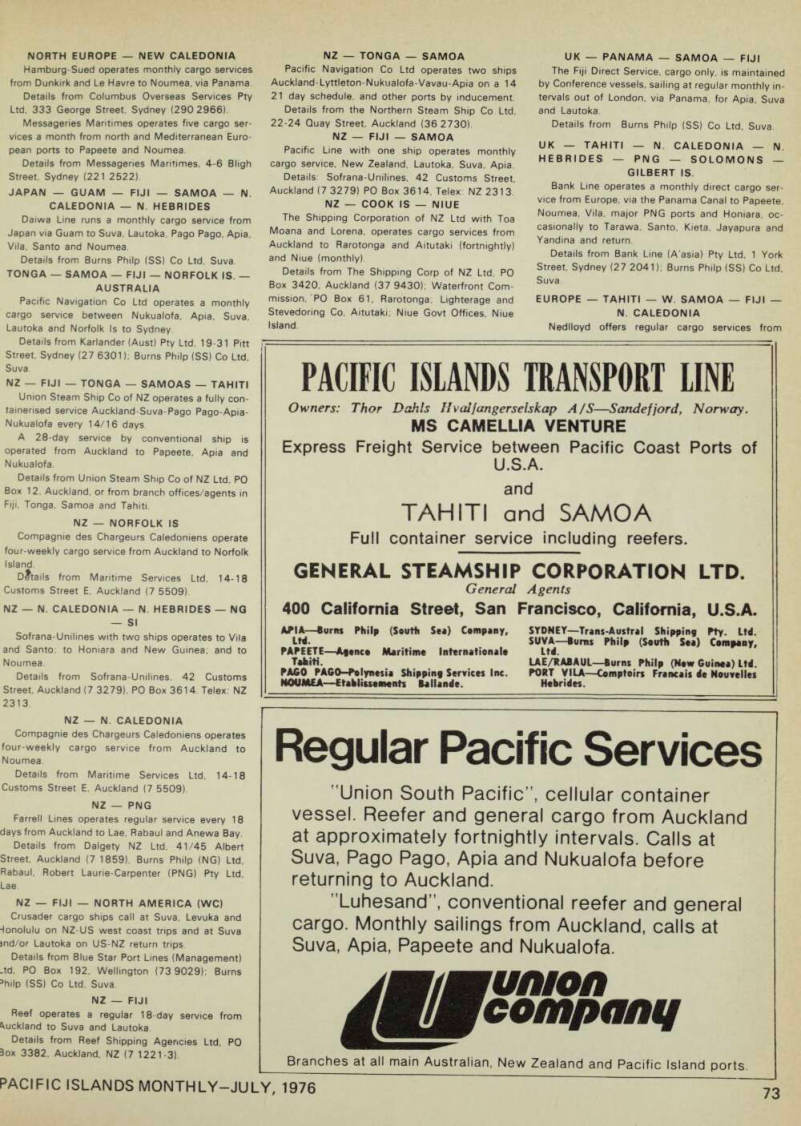
Airways
Shipping
Sydney Nz Fiji/Tahiti Uk
Chandris Lines maintain a twice-monthly passenger service from Sydney via NZ, Suva or Papeete.
Details from Chandris Lines, 135 King Street, Sydney (28 2451).
Sydney Lord Howe Is Auckland
Norfolk Is New Caledonia
Compagnie des Chargeurs Caledonians operates four-weekly cargo service Sydney-Lord Howe Island-Norfolk Island-Auckland-Norfolk Island- Noumea.
Details: Hetherington Kingsbury Pty Ltd, 37-49 Pitt Street, Sydney (27 1671).
Sydney New Caledonia
Somacal operates 21-day service from Sydney to Noumea.
Details from Karlander (Aust) Pty Ltd, 19-31 Pitt Street, Sydney (27 6301).
Sydney Nz Fiji Hawaii Canada
US P & 0 liners call at Auckland, Suva, Honolulu and Vancouver on eastbound and westbound voyages between Sydney and the US.
Details from P & 0 Booking Centre, World Travel Headquarters Pty Ltd, 33 Bligh Street, Sydney (231 6655)
Sydney Nz Fiji Tonga N.
Hebrides Noumea Png
Solomons Samoas Tahiti
Hawaii
Sitmar Cruises operates a year-round cruise programme to include most of the above countries.
Details from Sitmar Cruises, 22-30 Bridge Street, Sydney (27 4521).
Royal Viking Line, with luxury cruise ships Royal Viking Sea, Star and Sky, cruises the Pacific from Sydney, Hobart and Cairns calling at most of above countries.
Details from With. Wilhelmsen Agency Pty Ltd, 13-15 Bridge Street, Sydney (20517).
P & 0 liners call at Apia, Auckland, Bay of Islands, Borabora, Honiara, Honolulu, Lautoka, Noumea, Nukualofa, Pago Pago, Papeete, Port Moresby, Santo, Savusavu, Suva, Vavau and Vila on cruises from Australia.
Details from P & 0 Booking Centre, World Travel Headquarters Pty Ltd, 33 Bligh Street, Sydney (231 6655).
Australia New Caledonia New
Hebrides
Compagnie des Chargeurs Caledoniens operates three-weekly cargo service from Sydney to Noumea, Port Vila, Santo.
Details: Hetherington Kingsbury Pty Ltd, 37-49 Pitt Street, Sydney (27 1671).
Sofrana-Unilines ships serve Noumea every three weeks from the main ports along the east Australian coast and Port Vila monthly from Melbourne and Sydney.
Details from Sofrana-Unilines, 37 Pitt Street.
Sydney (27 2031), Trans-Austral Shipping Pty Ltd, 570 Bourke Street, Melbourne (67 9162), ACTA Pty Ltd, Brisbane (2213116), Elder Smith Goldsbrough Mort Ltd, Port Adelaide (47 5688), Mcllwraith McEacharn Ltd, Newcastle (2 4781), H Jones and Co. Pty Ltd, Burnie, Tasmania (31 1833).
South Pacific United Lines maintain a four-week cargo service from Sydney to Noumea, Vila and Santo.
Details from Omni Traders & Brokers Pty Limited, 261 George Street, Sydney (241 2872/6).
Australia Fiji
Karlander (Aust.) Pty Ltd operates three-weekly cargo services from Sydney to Suva and Lautoka.
Details from Karlander (Aust.) Pty Ltd, 19-31 Pitt Street, Sydney (27 6301); Dalgety Shipping, 461 Bourke Street, Melbourne (60 0731); Burns Philp (SS) Co Ltd, Suva and Lautoka.
Sofrana-Unilines (Fiji Express Line) operates to Suva every three weeks from the main ports on the east coast of Australia, and monthly to Lautoka from Melbourne and Sydney.
Details from Sofrana-Unilines, 37 Pitt Street, Sydney (27 2031), Trans-Austral Shipping Pty Ltd, 570 Bourke Street. Melbourne (67 9162). ACTA Pty Ltd, Brisbane (2213116), Elder Smith Goldsbrough Mort Ltd, Port Adelaide (47 5688).
Mcllwraith McEacharn Ltd, Newcastle (2 4781), H.
Jones and Co Pty Ltd, Burnie. Tasmania (31 1833).
Australia Fiji W. Samoa
Nauru Pacific Line operates monthly conven tional/container service from Sydney and Brisbane to Fiji and Western Samoa.
Details from Nauru Pacific Line, 227 Collins Street, Melbourne (654 4977); Interocean Swire, 8 Spring Street, Sydney (2 0522): Dalgety Shipping, 79 Eagle Street, Brisbane (31 0331).
Australia Tahiti Us West Coast
South Pacific United Lines maintain a four week ly service from Sydney to Papeete, and US West Coast.
Details from Omni Trades & Brokers Pty Limited, 261 George Street, Sydney (241 2872/6).
Australia Png
Containers Pacific Express (Burns Philp and AWP Line) operates four-weekly cargo service from Melbourne and Brisbane with Samoa to Port Moresby and Lae and three-weekly cargo service from Sydney (direct) to Lae and Port Moresby with Nimos.
Details from Burns Philp & Co Ltd. 51 Pitt Street.
Sydney (241 3816) Farrell Lines operates a service every 18 days from Tasmania, Melbourne, Sydney and Brisbane to Lae, Rabaul and Anewa Bay Details from Wilh. Wilhelmsen Agency Pty Ltd, 13 Bridge Street, Sydney (2 0517), 60 Market Street, Melbourne (61 3031). Burns Philp (NG) Ltd.
Rabaul, Robert Laurie-Carpenter (NG) Pty Ltd, Lae.
New Guinea Express Line with two ships operates three-weekly Melbourne, Sydney, Brisbane, Port Moresby, Lae, Rabaul Details from New Guinea Express Line, PO Box R 73, Royal Exchange PO, Sydney (241 3991) MacArthur Shipping Agency Co, 82-92 Eagle Street, Brisbane (229 3777), Westralian Farmers Transport Pty Ltd, 459 Little Collins Street, Melbourne (67 8291), Breckwoldt's Shipping Agencies in Port Moresby (24 2525), Lae 42 1536), Rabtrad Niugini Pty Ltd, Rabaul 92 2911).
Karlander New Guinea Line's cargo vessels call at Melbourne, Sydney, Lae, Madang, Wewak, Manus, Kimbe.
Details from Karlander (Aust.) Pty. Ltd, 19-31 Pitt Street, Sydney (27 6301); Dalgety Shipping, 461 Bourke St, Melbourne (60 0731).
Australia Png Solomons
New Guinea Australia Line's vessels operate from Sydney and Brisbane to Port Moresby, Lae, Rabaul, Kavieng, Wewak, Honiara, Kieta, Gizo, Madang and Samarai.
Details from Interocean Swire, 8 Spring Street, Sydney (2 0522).
Australia Ng Micronesia Guam
Nauru Pacific Line operates monthly conven tional/container service Melbourne/Sydney to New Guinea, Koror, Guam and Micronesia.
Details from Nauru Pacific Line, 227 Collins Street, Melbourne (654 4977): Interocean Swire, 8 Spring Street, Sydney (2 0522).
Us Png
Farrell Lines operates regular services from all US west coast ports to Lae, Rabaul and Anewa Bay.
Details from With. Wilhelmsen Agency Pty Ltd, 13 Bridge Street, Sydney (2 0517), One Embar cadero Centre. Suite 701, San Francisco, Burns Philp (NG) Ltd, Rabaul and Kieta, Robert Laurie- Carpenter (PNG) Pty Ltd, Lae.
San Francisco Honolulu
Micronesia
Nauru Pacific Line operates regular conven tional/container service from San Francisco and Honolulu to Majuro, Nauru, Ponape, Truk and Saipan.
Details from Nauru Pacific Line, 227 Collins Street. Melbourne (654 4977). North American Maritime Agencies, 100 California Street, San Francisco, California 94111 (981 0343).
Png Us Canada
Farrell Lines operates regular services from Lae and Rabaul to US west coast ports and Vancouver.
Details from Burns Philp (NG) Ltd, Rabaul, Robert Laurie-Carpenter (PNG) Pty Ltd, Lae, PFEL, One Embarcadero Centre, Suite 701, San Francisco and Wilh. Wilhelmsen Agency Pty Ltd, 13 Bridge Street, Sydney (2 0517),
Far East Fiji New Zealand
New Zealand Unit Express (CNC, MOL, RIL) operates a three-weekly cargo service from Hong Kong to Lautoka, Suva, NZ ports, Manila, Kaoshiung, Keelung, Hong Kong.
Details from Interocean Swire, 8 Spring Street, Sydney (2 0522).
Royal Interocean Lines operates monthly cargo service with three ships from Surabaya, Jakarta, Bangkok, Port Kelang and Singapore to Suva and NZ ports.
Details from Interocean Australia Services, 261 George Street, Sydney (2 0573), Burns Philp (SS) Co Ltd, Suva and Lautoka.
Ben Shipping Co (Pte) Ltd, sailing monthly from Singapore, Hong Kong, Keelung, Kaoshiung, Suva and main NZ ports.
Details from Seatrans (Fiji) Ltd, GPO Box 152, Suva, Fiji.
Far East —Png —Si —Newhebrides
Noumea Tahiti Samoa
China Navigation Co's vessels operate a regular cargo service from Hong Kong, Taiwan and Singapore to Rabaul, Wewak, Madang, Lae, Port Moresby, Honiara, New Hebrides, Noumea, Papeete and Samoa.
Details from Interocean Swire, 8 Spring Street, Sydney (2 0522).
North Europe New Caledonia
Hamburg-Sued operates monthly cargo services from Dunkirk and Le Havre to Noumea, via Panama.
Details from Columbus Overseas Services Pty Ltd, 333 George Street, Sydney (290 2966) Messageries Maritimes operates five cargo ser vices a month from north and Mediterranean Euro pean ports to Papeete and Noumea.
Details from Messageries Maritimes, 4-6 Bligh Street, Sydney (221 2522).
Japan Guam Fiji Samoa N.
Caledonia N. Hebrides
Daiwa Line runs a monthly cargo service from Japan via Guam to Suva, Lautoka, Pago Pago, Apia, Vila, Santo and Noumea.
Details from Burns Philp (SS) Co Ltd, Suva.
Tonga Samoa Fiji Norfolk Is.
Australia
Pacific Navigation Co Ltd operates a monthly cargo service between Nukualofa, Apia. Suva, Lautoka and Norfolk Is to Sydney.
Details from Karlander (Aust) Pty Ltd, 19-31 Pitt Street. Sydney (27 6301): Burns Philp (SS) Co Ltd, Suva
Nz Fiji Tonga Samoas Tahiti
Union Steam Ship Co of NZ operates a fully con tainerised service Auckland-Suva-Pago Pago-Apia- Nukualofa every 14/16 days.
A 28-day service by conventional ship is operated from Auckland to Papeete, Apia and Nukualofa.
Details from Union Steam Ship Co of NZ Ltd, PO Box 12, Auckland, or from branch offices/agents in Fiji. Tonga, Samoa and Tahiti.
Nz Norfolk Is
Compagnie des Chargeurs Caledoniens operate four-weekly cargo service from Auckland to Norfolk Island.
Details from Maritime Services Ltd, 14-18 Customs Street E. Auckland (7 5509).
Nz N. Caledonia N. Hebrides Nq
SI Sofrana-Unilines with two ships operates to Vila and Santo: to Honiara and New Guinea; and to Noumea.
Details from Sofrana-Unilines, 42 Customs Street, Auckland (7 3279), PO Box 3614 Telex: NZ 2313.
Nz N. Caledonia
Compagnie des Chargeurs Caledoniens operates four-weekly cargo service from Auckland to Noumea.
Details from Maritime Services Ltd, 14-18 Customs Street E, Auckland (7 5509).
Nz Png
Farrell Lines operates regular service every 18 days from Auckland to Lae, Rabaul and Anewa Bay Details from Dalgety NZ Ltd, 41/45 Albert Street, Auckland (7 1859), Burns Philp (NG) Ltd.
Rabaul, Robert Laurie-Carpenter (PNG) Pty Ltd, Lae.
Nz Fiji North America (Wc)
Crusader cargo ships call at Suva, Levuka and Honolulu on NZ-US west coast trips and at Suva md/or Lautoka on US-NZ return trips.
Details from Blue Star Port Lines (Management) .td. PO Box 192, Wellington (73 9029): Burns s hilp (SS) Co Ltd, Suva.
Nz Fiji
Reef operates a regular 18-day service from Auckland to Suva and Lautoka.
Details from Reef Shipping Agencies Ltd, PO Box 3382, Auckland, NZ (7 1221-3).
Nz Tonga Samoa
Pacific Navigation Co Ltd operates two ships Auckland-Lyttleton-Nukualofa-Vavau-Apia on a 14 21 day schedule, and other ports by inducement.
Details from the Northern Steam Ship Co Ltd, 22-24 Quay Street. Auckland (36 2730).
Nz Fiji Samoa
Pacific Line with one ship operates monthly cargo service. New Zealand, Lautoka, Suva, Apia.
Details: Sofrana-Unilines, 42 Customs Street, Auckland (7 3279) PO Box 3614, Telex NZ 2313.
Nz Cook Is Niue
The Shipping Corporation of NZ Ltd with Toa Moana and Lorena, operates cargo services from Auckland to Rarotonga and Aitutaki (fortnightly) and Niue (monthly).
Details from The Shipping Corp of NZ Ltd, PO Box 3420, Auckland (37 9430); Waterfront Com mission, PO Box 61, Rarotonga: Lighterage and Stevedoring Co, Aitutaki: Niue Govt Offices. Niue Island.
Uk Panama Samoa Fiji
The Fiji Direct Service, cargo only, is maintained by Conference vessels, sailing at regular monthly in tervals out of London, via Panama, for Apia, Suva and Lautoka, Details from Burns Philp (SS) Co Ltd, Suva.
Uk Tahiti N Caledonia N.
Hebrides Png Solomons
Gilbert Is.
Bank Line operates a monthly direct cargo ser vice from Europe, via the Panama Canal to Papeete.
Noumea. Vila, major PNG ports and Honiara, oc casionally to Tarawa, Santo, Kieta, Jayapura and Yandina and return.
Details from Bank Line (A'asia) Pty Ltd, 1 York Street. Sydney (27 2041): Burns Philp (SS) Co Ltd.
Suva.
Europe Tahiti W Samoa Fiji
N. Caledonia
Nedlloyd offers regular cargo services from
Nothern Europe and UK to Papeete, Apia, Fiji and New Caledonia.
Details: Interocean Aust. Services Pty Ltd, 261 George Street, Sydney (2 0573).
Us Sydney Gilbert Is. Honolulu
Columbus Line operates a three weekly con tainer cargo sailing from West Coast, US to Australasia, returning via Tarawa, and Honolulu to Nth. America.
Details from Columbus Overseas Services Pty Ltd. 333 George Street, Sydney (290 2966).
Us Fiji/Tahiti Australia
Bank Line Ltd operate regular cargo services from US Gulf ports to Australia and NZ. Calls at Suva. Lautoka and Papeete on demand.
Details from Bank Line (A/asia) Pty Ltd, 1 York St. Sydney (27 2041).
Pacific Far East Line cruise ships operate from San Francisco, Los Angeles, Honolulu, Moorea, Papeete, Rarotonga, Auckland, Opua (Bay of Islands), Sydney, and return via Suva, Niuafoou, Pago Pago and Honolulu to San Francisco.
Freight is carried on these passenger liners.
Passenger details from World Travel Head
quarters Pty Ltd, 33 Bligh Street. Sydney (231 6655), freight details from P & 0 Aust Ltd, 2 Castlereagh St, Sydney (230 0177).
Us A. Samoa Nz Aust. Png
Farrell Lines LASH ships operate regularly from US to Australia, via Pago Pago and Auckland, retur ning via PNG ports.
Details from Wilh. Wilhelmsen Agency Pty Ltd, 13 Bridge Street, Sydney (2 0517); 60 Market Street, Melbourne (61 3031): PFEL, 1 Embar cadero Centre, Suite 701, San Francisco (576 4000): Dalgety NZ Ltd, Auckland (7 1859): Kneubuhl Maritime Services, Pago Pago (633 5121).
Us Tahiti Samoa
Pacific Islands Transport operates a five/six weekly cargo service from North American west coast points to Papeete, Pago Pago, Apia.
Details from Trans-Austral Shipping Pty Ltd, 19 Pitt Street, Sydney (27 2441).
Polynesia Line operates container and general cargo service from US west coast ports to Papeete and Pago Pago.
Details from Polynesia Shipping Services Inc. PO Box 1478, Pago Page (9 6799).
Airways
From Australia
Qantas (7075, 7475, DC4) PNG, Norfolk Is, New Caledonia, Fiji, Tahiti, US, Canada.
PAA (7475) Fiji, American Samoa, Hawaii, US.
CP Air (DCS) Fiji, Hawaii, Canada.
UTA (DCSs and DCIOs) New Caledonia, Fiji, New Zealand, Tahiti, US.
Air Nauru (F2B) New Caledonia, Nauru, Tarawa, Majuro.
Air Niugini (7205) PNG.
Advance Aviation (from Sydney), North Coast Airlines (from Coffs Harbour) and Oxley Airlines (from Port Macquarie) Lord Howe Is.
From New Zealand
Air-NZ (DCSs, DCIOs, F 27) Fiji, American Samoa, Cook Is., Tahiti. Hawaii, US, New Caledonia, Norfolk Is.
PAA (7475) American Samoa, Tahiti. Hawaii US.
UTA (DCS) Tahiti.
From Us
Qantas (707 s and 7475) Honolulu, Fiji.
Australia.
PAA (7475) Honolulu, Tahiti, A. Samoa, Fiji, NZ, Australia.
Air-NZ (DCSs and DCIOs) Honolulu, Fiji, Auckland.
From Canada
CP Air (DCSs) Honolulu, Fiji, Australia.
Qantas (DCSs and DCIOs) Honolulu, Fiji, Australia.
Pacific Far East S. America
Air Nauru (F2B or 737) Nauru to Micronesia, The Philippines, Okinawa, Japan, Taiwan. Hong Kong.
Air France (7075) Japan to Tahiti, Peru.
Air Niugini (7075) to Manila.
Pacific Is. Aust.
Air Pacific (BAC111) From Fiji, via New Hebrides or New Caledonia to Brisbane.
Air Nauru (F2B or 737) flies to Melbourne.
Air Niugini (727 s and Fokker Friendships) to Cairns and Brisbane.
Norfolk Island Airlines (Beechcraft) to Brisbane.
Pacific Is. Nz
Air Pacific (BAC111) Fiji-Tonga-NZ.
Inter-Territory
Lan-Chile (7075) Easter Is., Tahiti.
Air Pacific (BACIII and HS74Bs) Fiji to Gilbert Is., Tuvalu, Western Samoa, Tonga, New Hebrides, Sololon Islands, New Caledonia, PNG.
Fiji Air Services Wallis and Futuna (charter).
Qantas (7075) PNG to Singapore.
PAA (7075) Hawaii to Am. Samoa and Tahiti, US.
UTA (7075, Caravelles) from New Caledonia to Fiji, New Hebrides, Wallis Is., Tahiti.
Continental-Air Micronesia (7275) from Hawaii to Micronesia.
Air Nauru from Nauru to Tarawa, Marshall Is., Wallis Is., Fiji, W. Samoa, New Hebrides, New Caledonia, Solomons, Philippines.
Polynesian Airlines from Apia to Tonga, Niue Is., Fiji. Am. Samoa.
South Pacific Island Airways flies between American and Western Samoa.
Air Tahiti from Tahiti to Cook Is.
Air Niugini to Irian Jaya, Solomon Is., Philip pines.
Norfork Island Airlines (Beechcraft) to Noumea.
Internal
Fiji Air Pacific (HS74Bs and Trislanders), Fiji Air Services (Beech Barons and Islanders).
French Polynesia Air Polynesia (Fokker Friendships). Air Tahiti.
US Trust Territory and Guam Continental-Air Micronesia (7275) and Air Pacific International Inc.
Gilbert Is. Air Pacific.
PNG Air Niugini, Aerial Tours, Talair, Melane sian Airlines, Crowley Airways.
Bougainville Bougainville Air Services.
New Caledonia Air Caledonie (Twin Otters) New Hebrides Air Melanesiae (Islanders).
Solomon Is. Solair (Beech Barons and Islanders).
Tonga Tonga Internal Air Service (Islanders).
Cook Is Cook Island Airways (Islander).
Norfolk Island Airlines (Beechcraft) Norfolk Is.-Lord Howe Is.
Western Samoa Air Samoa Ltd, and Samoa Aviation Ltd.
Advertisements & other items, pp. 70-74 (2 items)
Daiwa Line
DIRECT REGULAR SERVICE
JAPAN-SOUTH PACIFIC
TARAWA-PAPEETE-PAGO PAGO-APIA
SUVA-LAUTOKA-NOUMEA-VILA
SANTO-HONIARA
JAPAN - TAIWAN - GUAM
JAPAN-KEELUNG-GUAM BY
EXCELLENT CAR/CONTAINER-CARRIER
JAPAN-WEST IRIAN-DILI
HONG KONG-TAIWAN-WEST IRIAN-DILI
GUAM: ATKINS, KROLL (GUAM) LTD.
TARAWA: G. & E. I. DEVELOPMENT AUTHORITY.
APIA: BURNS PHILP (SOUTH SEA) CO., LTD.
PAGO PAGO: KNEUBUHL MARITIME SERVICES CORP,
NUKUALOFA: PACIFIC NAVIGATION CO., LTD.
SUVA: BURNS PHILP (SOUTH SEA) CO., LTD.
LAUTOKA: BURNS PHILP (SOUTH SEA) CO., LTD.
NOUMEA: AGENCE MARITIME ET AERIENNE
CALEDONIENNE.
SANTO: BURNS PHILP (NEW HEBRIDES) LTD.
VILA: BURNS PHILP (NEW HEBRIDES) LTD.
HONIARA: BRITISH SOLOMONS TRADING CO., LTD.
PAPEETE: AGENCE MARITIME DE FARA UTE.
HONG KONG: IKE MARITIME CO., LTD.
SINGAPORE: THE BORNEO CO., (SINGAPORE) LTD.
DJAJAPURA: P. N. PELAJARAN NASIONAL INDONESIA,
DILI: SANG TAI HOO
TAIWAN: FOR CARGO BETWEEN JAPAN/GUAM/TAIWAN
FORMOSA SHIPPING & ENTERPRISE CORP.
TAIWAN: FOR CARGO BETWEEN JAPAN/SOUTH PACIFIC/
WEST IRIAN/DILI
MARITIME TRANSPORTATION AGENCIES, LTD.
THE DAIWA NAVIGATION CO..LTD.
UMIIcm M uvj T U DLL/VJ,, DUUVJ., 45, 2-CHOME, AWAZAMINAMI-DORI, 4-13, NIHONBASHI 3-CHOME, CHUO-KU,
AGENTS:
HEAD OFFICE
OAIICHI KYOGYO BLDG,,
OSAKA: “DAILINE’
TOKYO: “FUNEDAILINE 1
TOKYO OFFICE
SHIN-DAIICHI BLDG.,
NISHI-KU, OSAKA, JAPAN
TELEPHONE: (06) 531-0471 ~9
TELEX: 525-6324 & 525-6325
TOKYO, JAPAN
TELEPHONE; (03) 274-3251 ~8
Kyowa Line
YOUR TRADING PARTNER
Monthly Services
Hong Kong, Taiwan, S. Korea, Japan
To: Guam, Saipan, British Solomon, New Caledonia, Fiji, W. Samoa, A. Samoa. Tahiti, Cook Is., Tonga, New Fiebndes.
Taiwan,Hong Kong,Singapore,Jakarta
To: Australia, Papua New Guinea, Sabah & Sarawak.
South Korea, Japan
To; Guam, Saipan, Papua New Guinea, Other Pacific Islands.
AGENTS
Taiwan: Royal Steamship Corp , Ltd., Taipei S. Korea: Dong Sue Shipping Co , Ltd , Seoul Hong Kong: Dahzun Enterprises Ltd.
Singapore: Ocean Shipping & Enterprises Pte . Ltd Mariana Is.: Island Navigation Co , Ltd.. Guam 8.5.1. P.: Solomon Taiyo Ltd , Honiara Tahiti; J.A Cowan & Fils, Papeete Cooks: Union Citco Travel Ltd., Rarotonga Tonga: EM. Jones Ltd., Nukualofa New Hebrides: Agence Maritime Raymond Velicite. Port Vila A.Samoa; Island Pacific Agencies Inc . Pago Pago W. Samoa: Morris Hedstrom Ltd., Apia Fiji: Carpenter Shipping, Suva & Lautoka PNG; Carpenter Shipping Agencies, Port Moresby, Rabaul New Caledonia: Agence Maritime Du Rond Point Du Pacific, Noumea Indonesia: P.T. Porodisa Raya Shipping Lines. Jakarta Sabah: KOH Han Ming Shipping & Forwarding Agent, Kotakmabalu Sarawak: Pan Sarawak Agencies Sdn. Bhd ,Sibu & Kuching Australia; Hetherington Kingsbury Pty. Ltd.. Sydney, NSW
KYOWA SHIPPING CO., LTD
HEAD OFFICE
Ojima Bldg., 22-8, 6-chome, Shinbashi Minato-ku, Tokyo, Japan Phone: 03(437)2885 (Rep.) Cables: “MARIQUEEN” Tokyo Telex: 242-4651 Kyowa J.
OSAKA OFFICE
Frontier Bldg., 3-13 Hirano-cho, Higashi-ku, Osaka, Japan.
Phone: 06(227)0422 (Rep.) Cables; “MARIQUEEN” Osaka.
Telex: 522-3896 Kyowa O
THE
BANK
LINE
GLOBAL SERVICE FOR SHIPPERS
■rri
MONTHLY SERVICES
United Kingdom and Continent to: Papeete, Noumea, New Hebrides, Papua New Guinea and Solomon Islands. ★ Papua New Guinea to: North America, United Kingdom and Continent. * Solomons, Fiji, Tonga, Samoa and Tarawa to: United Kingdom and Continent.
For particulars apply:
THE BANK LINE (AUSTRALASIA) PTY.
LTD.,
18TH FLOOR, 1 YORK STREET,
SYDNEY, N.S.W.
PACIFIC ISLANDS TRANSPORT LINE
Owners: Thor Dahls llvaljangerseiskap A/S — Sandefjord, Norway.
MS CAMELLIA VENTURE
Express Freight Service between Pacific Coast Ports of
U.S.A.
and
TAHITI and SAMOA
Full container service Including reefers.
GENERAL STEAMSHIP CORPORATION LTD.
General Agents 400 California Street, San Francisco, California, U.S.A.
APlA—Burns Philp (South Sea) Company, Ltd.
PAPEETE—Agenee Maritime Internationale Tahiti.
PAGO PAGO-Polynesia Shipping Services Inc.
NOUMEA—Etablissements Ballande.
SYDNEY—Trans-Austral Shipping Pty. Ltd.
SUVA—Burns Philp (South Sea) Company, LAE/RABAUL—Burns Philp (Now Guinea) Ltd.
PORT VlLA—Comptoirs Francais de Nouvelles Hebrides.
Regular Pacific Services
"Union South Pacific", cellular container vessel. Reefer and general cargo from Auckland at approximately fortnightly intervals. Calls at Suva, Pago Pago, Apia and Nukualofa before returning to Auckland.
"Luhesand”, conventional reefer and general cargo. Monthly sailings from Auckland, calls at Suva, Apia, Papeete and Nukualofa.
jmimumon
gmlmcompanu
Branches at all main Australian, New Zealand and Pacific Island ports.
THE PAPUA HOTEL
PORT MORESBY
• Right In the business centre • A tradition for comfort and fine food • All rooms air conditioned • Restaurant • Bars • Banquet Hall Telephone 24 2121
Cables PAPTEL
A. C. NEUMANN
Manager
ExpressTreight Service between U S. Pacific Coast Ports &
PAPEETE - APIA - PAGO PAGO
Fuji Container Service including Refrigeration
GENERAL AGENTS-.
FURNESS INTEROCE4N
465 CALIFORNIA STREET. SAN FRANCISCOfiA 94104,
C»ble: INTERCO' • TWX: 910-372 7350 • RCA: 278 207
• TEL (415) 398-2000
AGENTS < v
PAPEETE - MORGAN; Vernex Boite Postale 449, Papeete Phone; 309 Cables: MpREX PAGO PAGO - POLYNESIA SHIPPING SERVICES, INC., Pago Pago Phone: 633-5169 Cables: POLYSHIP APIA - UNION S.S. CO., Of N.Z. Ltd., P.O. Box 50, Apia, Western Samoa Phone; 570 Cables: UNION '
Prices
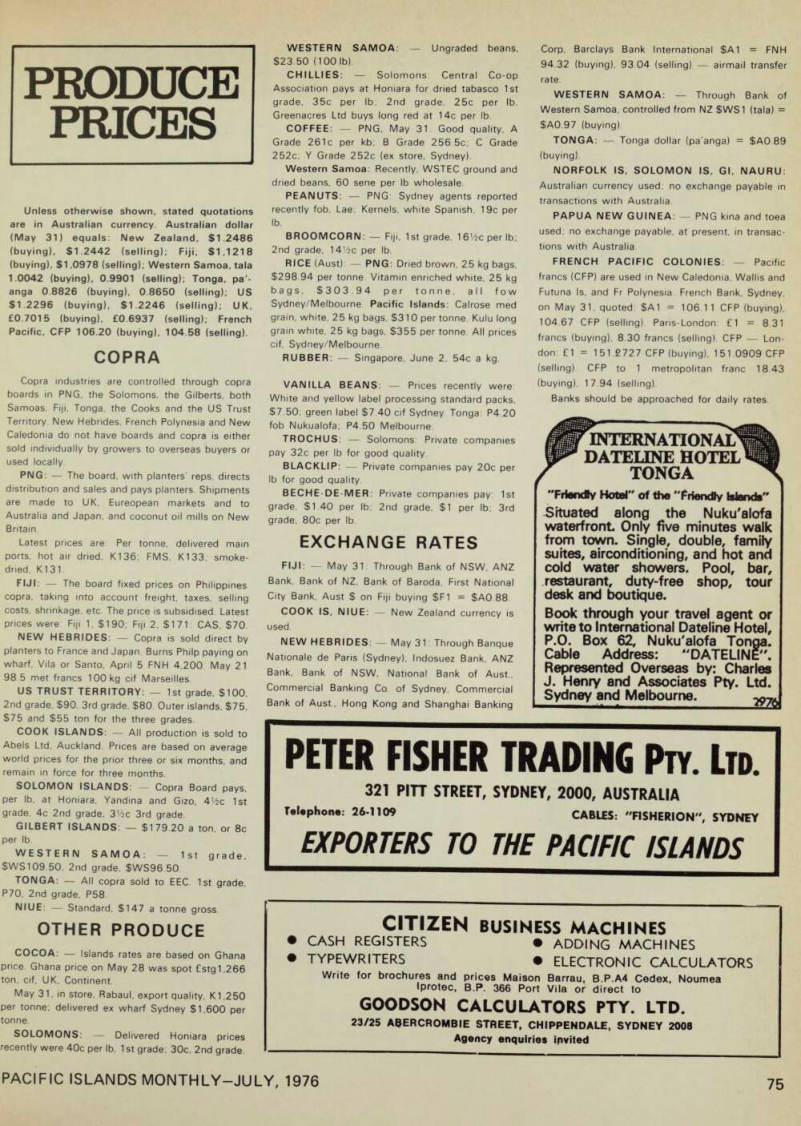
Produce
Unless otherwise shown, stated quotations are in Australian currency. Australian dollar (May 31) equals: New Zealand, $1.2486 (buying), $1.2442 (selling); Fiji, $1,1218 (buying), $1,0978 (selling); Western Samoa, tala 1.0042 (buying), 0.9901 (selling); Tonga, pa'anga 0.8826 (buying), 0.8650 (selling); US $1.2296 (buying), $1.2246 (selling); UK, £0.7015 (buying), £0.6937 (selling); French Pacific, CFP 106.20 (buying), 104.58 (selling).
Copra
Copra industries are controlled through copra boards in PNG, the Solomons, the Gilberts, both Samoas, Fiji, Tonga, the Cooks and the US Trust Territory. New Hebrides, French Polynesia and New Caledonia do not have boards and copra is either sold individually by growers to overseas buyers or used locally.
PNG: The board, with planters’ reps, directs distribution and sales and pays planters. Shipments are made to UK, Eureopean markets and to Australia and Japan, and coconut oil mills on New Britain.
Latest prices are: Per tonne, delivered main ports, hot air dried, K 136; FMS, K 133: smoke dried, Kl3l.
FIJI: The board fixed prices on Philippines copra, taking into account freight, taxes, selling costs, shrinkage, etc. The price is subsidised. Latest prices were: Fiji 1. $190: Fiji 2, $171: CAS, $7O.
NEW HEBRIDES: Copra is sold direct by planters to France and Japan. Burns Philp paying on wharf, Vila or Santo, April 5 FNH 4,200. May 21 98.5 met francs 100 kg cif Marseilles.
Us Trust Territory: Ist Grade. $Loo,
2nd grade, $9O, 3rd grade, $BO. Outer islands. $75, $75 and $55 ton for the three grades.
COOK ISLANDS: All production is sold to Abels Ltd, Auckland. Prices are based on average world prices for the prior three or six months, and remain in force for three months.
SOLOMON ISLANDS: Copra Board pays, per lb, at Honiara, Yandina and Gizo, 4'/>c Ist grade, 4c 2nd grade, 3Vic 3rd grade.
GILBERT ISLANDS: $179 20 a ton, or 8c per lb.
WESTERN SAMOA: Ist grade.
SWSIO9 50, 2nd grade, SWS96 50 TONGA: All copra sold to EEC. Ist grade, P7O, 2nd grade, P5B.
NIUE; Standard, $147 a tonne gross.
Other Produce
COCOA: Islands rates are based on Ghana price. Ghana price on May 28 was spot £stg 1.266 ton. cif, UK, Continent.
May 31, in store, Rabaul, export quality, K 1.250 per tonne; delivered ex wharf Sydney $1,600 per tonne.
SOLOMONS; Delivered Honiara prices recently were 40c per lb, 1 st grade: 30c, 2nd grade.
WESTERN SAMOA: Ungraded beans, $23 50 (100 lb).
CHILLIES: Solomons: Central Co-op Association pays at Honiara for dried tabasco Ist grade, 35c per lb; 2nd grade, 25c per lb.
Greenacres Ltd buys long red at 14c per lb COFFEE: PNG, May 31. Good quality, A Grade 261 c per kb; B Grade 256.5 c: C Grade 252 c; Y Grade 252 c (ex store, Sydney).
Western Samoa: Recently, WSTEC ground and dried beans, 60 sene per lb wholesale.
PEANUTS: PNG: Sydney agents reported recently fob, Lae; Kernels, white Spanish, 19c per lb.
BROOMCORN: Fiji, Ist grade, per lb; 2nd grade, 14'/2C per lb.
RICE (Aust): PNG: Dried brown, 25 kg bags, $298.94 per tonne. Vitamin enriched white, 25 kg bags, $303.94 per tonne, all fow Sydney/Melbourne Pacific Islands: Calrose med grain, white, 25 kg bags, $3lO per tonne Kulu long grain white, 25 kg bags, $355 per tonne. All prices cif, Sydney/Melbourne.
RUBBER: Singapore, June 2,54 c a kg.
VANILLA BEANS: Prices recently were White and yellow label processing standard packs, $7.50; green label $7 40 cif Sydney Tonga: P 4.20 fob Nukualofa: P 4.50 Melbourne TROCHUS: Solomons: Private companies pay 32c per lb for good quality BLACKLIP: Private companies pay 20c per lb for good quality.
BECHE-DE-MER: Private companies pay: Ist grade, $1 40 per lb; 2nd grade, $1 per lb: 3rd grade, 80c per lb
Exchange Rates
FIJI: May 31: Through Bank of NSW. ANZ Bank, Bank of NZ, Bank of Baroda, First National City Bank, Aust $ on Fiji buying SFI = SAO 88 COOK IS, NIUE: New Zealand currency is used.
NEW HEBRIDES: May 31: Through Banque Nationale de Paris (Sydney), Indosuez Bank, ANZ Bank, Bank of NSW, National Bank of Aust., Commercial Banking Co. of Sydney, Commercial Bank of Aust., Hong Kong and Shanghai Banking
Corp, Barclays Bank International SAI = FNH 94.32 (buying), 93.04 (selling) airmail transfer rate.
WESTERN SAMOA: Through Bank of Western Samoa, controlled from NZ SWSI (tala) = SAO 97 (buying) TONGA: Tonga dollar (pa'anga) = SAO 89 (buying).
Norfolk Is, Solomon Is, Gl, Nauru:
Australian currency used, no exchange payable in transactions with Australia.
PAPUA NEW GUINEA: - PNG kina and toea used; no exchange payable, at present, in transac tions with Australia.
French Pacific Colonies: Pacific
francs (CFP) are used in New Caledonia, Wallis and Futuna Is, and Fr Polynesia French Bank, Sydney, on May 31, quoted: SAI = 106.11 CFP (buying), 104 67 CFP (selling). Paris-London: £1 = 8.31 francs (buying), 8 30 francs (selling). CFP Lon don: £1 = 151.2727 CFP (buying), 151.0909 CFP (selling), CFP to 1 metropolitan franc 18 43 (buying), 17.94 (selling).
Banks should be approached for daily rates.
Advertisements & other items, pp. 75-80 (2 items)
Peter Fisher Trading Pty. Ltd.
INTERNATIONA!;
DATELINE HOTEL
TONGA
EL <3 'Friencfly Hotel'' of the "friendly Islands' Situated along the Nukualofa waterfront Only five minutes walk from town. Single, double, family suites, airconditioning, and hot and cold water showers. Pool, bar, restaurant, duty-free shop, tour desk and boutique.
Book through your travel agent or write to International Dateline Hotel, P.O. Box 62, Nukualofa Tonga.
Cable Address: "DATELINE".
Represented Overseas by: Charles J. Henry and Associates Pty. Ltd.
Sydney and Melbourne.
PETER FISHER TRADING Pty. Ltd.
321 Pin STREET, SYDNEY, 2000, AUSTRALIA
Telephone: 26-1109 CABLES: "FISHERION", SYDNEY
EXPORTERS TO THE PACIFIC ISLANDS
CITIZEN BUSINESS MACHINES
• CASH REGISTERS • ADDING MACHINES
• TYPEWRITERS • ELECTRONIC CALCULATORS
Write for brochures and prices Maison Barrau, 8.P.A4 Cedex, Noumea Iprotec, B.P. 366 Port Vila or direct to
GOODSON CALCULATORS PTY. LTD.
23/25 ABERCROMBIE STREET, CHIPPENDALE, SYDNEY 2008
Agency enquiries invited
CLASSIFIED ADVERTISEMENTS
anywhere,
any time,
any gas.
M WV>
*C U For further information & addresses of your local distributor contact:
THE COMMONWEALTH
INDUSTRIAL GASES LIMITED
Gases Export Department, 138 Bourke Road, Alexandria, N.S.W., Australia 2015.
Cables ‘CIGAS’-Telex 20241 Sydney. 017.0308
Per Line $3.00 Aus t.
Minimum 4 lines.
MAKE FRIENDS WORLDWIDE!
Have penfriends from nearly 200 different countries! Write immediately: Five Continents Club, Waitakere, New Zealand.
WANTED Sailboat Looking for a cruising sailboat 40’ 45’
L.0.A., prefer steel. Contact J.W. Cafky/P.O.
Box EK/AGANA. GUAM 96910 USA.
CONCRETE BLOCK MAKER Makes blocks, flags, edgings, screen-blocks, garden stools —up to 8 at once and 96 an hour $215 00 c.i.f main ports Send for leaflets Forest Farm Research, Londonderry N S W., 2753 Australia If you have snens to sell—any quantity—contact Anisa Commodity Traders Pty. Ltd., P.O. Box 1413, Lae, Papua New Guinea, Phone 424159. We are buyers of Trochus, Greensnail, Blacklip MOP, Goldlip MOP, and Marine Specimens. Best prices paid Rabaul agents: Gazelle Agencies Pty. Ltd., P.O. Box 262, Rabaul. P.N.G Phone: 921397.
Manus Island Agents, R. L. & V. J. Knight, P.O.
Box 108, Lorengau, Manus Island, P.N.G. Phone 38.
Investment opportunity, Cairns, Australia. 7 acres residential land incl. brick residence, sewer avail., 2 street frontages. Suitable subdivision into 29 blocks. Walk to large shopping Complex.
Details Carver & Co., Solicitors, PO Box 33, Sutherland 2232. NSW, Australia.
Park View Motel—Brisbane
Quiet location —opp Botanic Gardens Single, double, family suites, all with refrig., air conditioning, phone, TV, radio, tea making facilities, from $l2. Pool and restaurant.
Phone 31-2695—Telex 40270.
Write for coloured brochure— Park View Motel, 128 Alice St, BRISBANE Old., 4000.
Australian male travelling Pacific Islands and Papua New Guinea interested in life style and culture of Islands People seeking accommodation with local families. Also transport between islands as crew Contact: Chris Rigley, c/o Post Office, Rabaul, till mid-July thence Post Office, Honiara, mid- August.
PORT MORESBY
For all your Real Estate & Flatting needs contact Strickland Agency.
For complete Management of Flats, Houses & Businesses Contact Strickland Agency.
Write Strickland Agency, P.O. Box 1581 Boroko P.N.G. or Phone Port Moresby 254291. - FLEETS diesel yachts, 28ft. $9,500.00, 31ft fibreglass $31,000.00, 34ft. steel $27,000.00 42ft, steel $32,000.00. 52ft steel hul $26,000.00.
Fleets 221 Esplanade Wynnum Central Brisbane. Cable: “FLEETS BRISBANE”
FOR SALE
MARINE DIESELS, 2,600 HP
Twin Pair with or less matching alternators. Ex power plant, fully operational. Steam units to 5,000 kw.
Slipway winch.
Flying Fox, 214 in. diam. Cable: 114 ton wharf cranes: 22 in, pump: Anchors 100 & 200 yrs. old Mining and related plant.
Enquiries to: The Manager, Machinery Park, Cabarita.'Vic. Australia. 3505.
GENERATING SETS
by BRAYBON
Capacities available are: Petrol 2 kva-7i kva • Diesel 2 kva-200 kva Write for brochure and prices:
BRAYBON BROS. PTY. LTD.,
2 ROTHWELL AVE., CONCORD WEST,
N.S.W., 2138. Phone: 73-3246.
STERN
DRIVES
PETROL & DIESEL
MARINE ENGINES
X Manufactured by
SEA TIGER
MARINE
Pty. Ltd.
P.O, Box 157, Mordialloc Victoria, Australia 3195
Fast efficient reliable
SPEED-E-GAS ir
♦ i . * SPEED-E-GAS is known in Papua New Guinea as GUINEA GAS, in Tonga as TONGA SPEED-E-GAS and in Fiji as FIJI-GAS The Gas Supply Company Limited, a member of the major Australian Boral Group of Companies is associated with a network of bulk storage terminals distributing SPEED-E-GAS throughout the Pacific region.
Terminals at Port Moresby, Lae, Rabaul, Kieta,Wewak, Honiara, Santo, Suva, Lautoka, Nuku’alofa and Rarotonga now supply fast efficient SPEED-E-GAS for industrial, commercial and domestic requirements in these areas.
SPEED-E-GAS is completely dependable and highly efficient fuel, so vital to the development of modern living.
A
SPEEDEGAS
u The Gas Supply Company Limited Head Office, 221 Miller Street North Sydney 2060 Phone 92-0951 A member of the
BQRAL
Group
HOLT BL2I
Sony presents more power,
more tonal quality than you ever
dreamed was possible.
The Sony CF-480S cassette-corder/radio sounds as big and real as life itself.
Its powerful, specially-designed amplifier delivers 4 watts of power—enough to fill even the largest room with clear, distortion-free sound.
What’s more, it has a unique 2-way speaker system. One big 6 1 /2-inch woofer for the lows and _a separate 2-inch tweeter for the highs.
Result: Supsr|jregrams
and cassette recordings, with audibly superior shortwave and medium wave sound, too.
In fact, the great-sounding CF-480S represents Sony cassette-corder technology at its finest: there is a DC servo-controlled tape drive motor, sensitive electret condenser microphone, tape selector for normal and Cro2 cassettes, mic mixing controls, and much more. It’s a dream of versatility.
But you shouldn’t just take our word for it.
Visit the nearest Sonyjdealer and audition the Sony CF-480S for yourself.
You’d never dream that a could sound so good. * S 3 |l»»M ill!! at
-■ Honda is a true life drama, performed on the world’s stage. By average folks, teenagers, men, and women everywhere. Your neighbors, maybe even you are playing a part. If so, you know Honda is more than great machines.
It’s people concerned with taking people where they want to go in life.
On two wheels, we’re the best selling motorcycle. The easy to operate hard workers who don’t demand much. Honda is always ready and gets you there safely. We move on four wheels. The precedent setting Honda Civic continues to receive international economy and performance awards. It’s the elegant compact car.
Sometimes, we have no wheels. Honda portable power operates machinery, generates electricity, pumps water and tills the soil.
Little wonder good things happen on Honda —we work harder to assure they do. sS* :? :S
HONDA MOTOR CO., LTD. TOKYO, JAPAN
PAPUA NEW GUINEA: Steamships-Machinery P.O. Box 1, Port Moresby/TAHITI: Societe Tahitienne d’lmportation des Produits Honda B.P. 1665-Papeete/FIJI ISLANDS: Coral Island Motors P.O. Box 48, Suva/U.S. TRUST TERRITORY: United Micronesia Development Assn P.O. Box 238, Saipan, Mairiana Islands 96950/COOK ISLANDS: Cook Islands Motor Centre Ltd. P.O. Box 74, Rarotonga/AMERICAN SAMOA: Samoan Holiday and Travel Center P.O. Box 968, Pago Pago/AMERICAN SAMOA: Haleck’s Service Center P.O. Box 1138, Pago Pago/ GUAM: Mark’s Motor Co., Inc. P.O. Box DV. Agana/WESTERN SAMOA: Motor Distributors (Samoa) Ltd. P.O. Box 576, Apia/SOLOMON ISLANDS: British Solomons Trading Co., Ltd: P.O. Box 114, Honiara / NEW CALEDONIA: Establissements Ballande Boite Postale No. C 4 Noumea Cedex / TONGA: E.M. Jones Limited, P.O. Box 34, Nuku’alofa/TARAWA: Gilbert & Ellice Islands Development Authority P.O. Box 488, Beito/NIUE ISLAND: S. Jessop & Sons Ltd. P.O. Box 71, Alofi South/NAURU: Nauru Cooperative Society, Republic of Nauru. Nauru Island Central Pacific
a& M&i Mr. Chau Jin Man, motor mechanic.
'Ddt&UAA.-it&phDVtd to
bt A(>mlkjL^fita^
Miss Diane Frogia, teacher.
V/ f '*"■4 I 4 ■
UJt clmttfrbiamt
[& umaas u/itkjL Sapm Mrs. Ilona Wimer. housewife. ■9 : ‘ iiw, m ■
Your Datsun. Your special island.
Once it has found you, it'll never let you go.
Where else can you find such economical, worry-free motoring? Little wonder Datsuns are enjoyed in Tahiti—and in 130 other nations! In a series of on-thespot global interviews, Nissan Motor representatives met many owners and asked them for a frank assessment of their Datsuns. Answers were surprisingly similar, despite the very different circumstances in which the Datsuns were used.
The Datsun, they told us. is economical, reliable, durable, comfortable.
Fun to own.
Again and again.
DATSUN
™j Product of NISSAN DATSUN distributor network covers the following areas: Fiji *T.P.N.G.* W. Samoa« New Caledonia*New Hebrides *8.5.1.P. *Timor Is.*- A. Samoa • Cook Is. • Nauru *Tonga • Saipan *Guam • Australia »New Zealand
77
CIFIC ISLANDS MONTHLY-JULY, 1976