Japan Ihjhe South Seas



Pim
Jffi&Fic Islaw^Amonthly
85c A«
$1.25 UTl
Cfp_K3Cl .
Japan Ihjhe South Seas
Our Cover
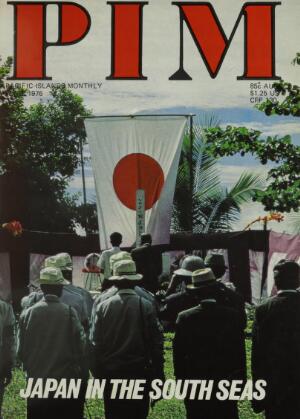
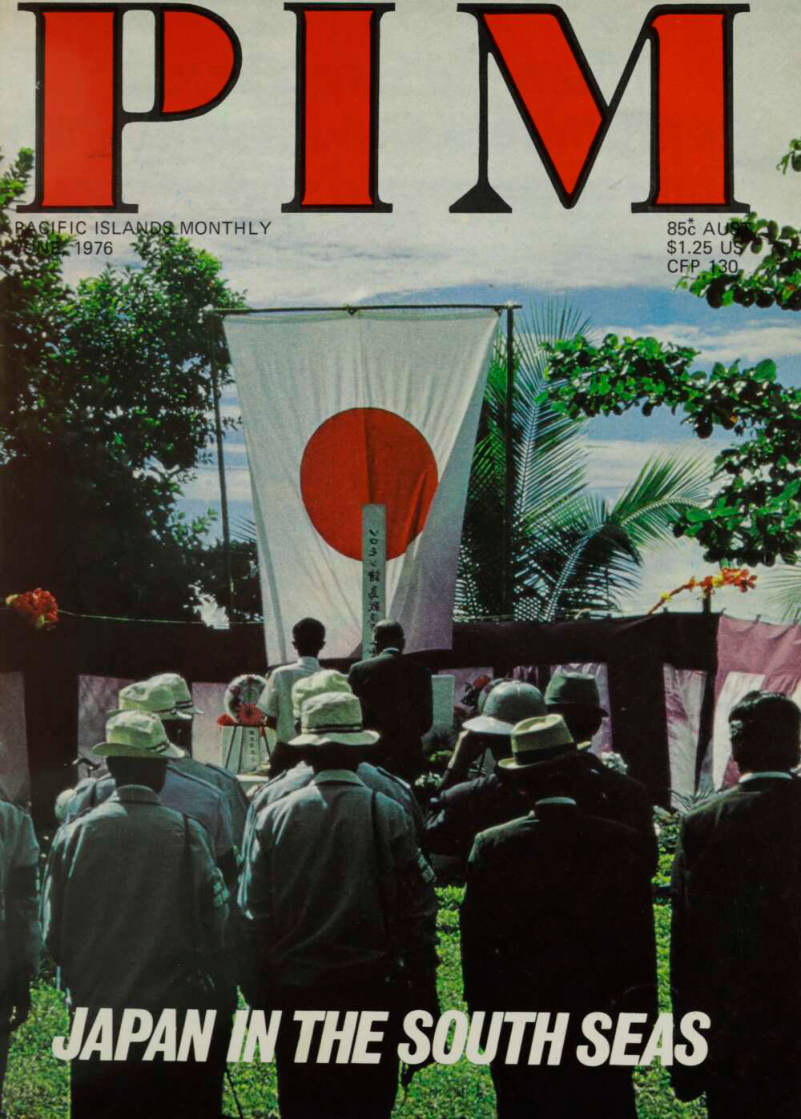
With feelings of enmity vanishing and war memories fading, the governments and people of the Islands have, with great goodwill, assisted Japanese missions to recover and return home the remains of their war dead. All over the Islands temporary shrines were erected to honour the dead and Islanders joined the Japanese in the ceremonies. Here is one such ceremony, at Tambea Village, West Guadalcanal, where Japanese veterans stand dressed in suits in 90 deg F. heat in the middle of the day as a eulogy is read by one of them. The picture is by Denis Fisk.
Advertisements & other items, pp. 2-4 (1 item)
we promise you much more than
When you buy a Toyota
one of the world’s finest cars.
We'll be the first to admit that at Toyota we make some of the world's finest cars.
You only have to look at them to see that.
And driving them just goes to confirm your first opinions.
But there's more to buying a car than buying a good one. You also have to be sure you can keep it that way.
Which is why Toyota have always insisted that their after-sales service be as good as the cars themselves.
In the Pacific Islands area alone we have over fifty designated outlets to provide everything you might need, from a simple service to a major overhaul. So get yourself a Toyota and get a lot more than a car.
And that's a promise.
TOYOTA
SERVICE
TOYOTA
The Toyota range includes: Toyota 1000, Toyota Corolla, Toyota Celica, Toyota Corona, Toyota Corona Mark 11, Toyota Crown PAPUA, NEW GUINEA: ELA MOTORS LIMITED, Scratchley Rd., Badili, P.O. Box 75, Port Moresby- U.S. TRUST TERRITORY: MICROL CORPORATION, P.O. Box 267, Saipan. FIJI ISLANDS: AUTOMOTIVE SUPPLIES CO., LTD,, G.P.O. Box 355, Suva. AMERICAN SAMOA: BURNS PHILP (SOUTH SEA) CO., LTD., P.O. 1057, Pago Pago. WESTERN SAMOA: BURNS PHI LP (SOUTH SEA) LTD P.O. Box 188 Apia GUAM: ATKINS, KROLL (GUAM) LTD., P.O. Box 6428, Tamuning. NEW HEBRIDES; NEW HEBRIDES MOTORS LTD., P.O. Box 18, Vila. SOLOMON ISLANDS: MENDANA ENTERPRISES (5.1.), LTD.. P.O. Box 174, Honiara. TAHITI; NIPPON AUTOMOTO, B.P. 342, Papeete. COOK ISLANDS: COOK ISLANDS TRADING CORPORATION LTD.,P.a Box 92, Rarotonga.
NAURU ISLAND: NAURU COOPERATIVE SOCIETY. GILBERT & ELLICE ISLANDS COLONY: TARAWA MOTORS, Box 36, Bairiki Tarawa. NORFOLK ISLAND: MARIE'S NORFOLK TOURS, LTD;, PO Box 276 TIMOR: SANG TAI HOO, Sang Tai Building, Dili. NEW CALEDONIA: SOCIETE IMPORTATION AUTOMOBILE DU PACIFIQUE, Rond-Pointdu Pacific (Station Total) B.P. 438, Noumea.
Invest in precious metals.
Of the eight precious metals, it takes four to make a Parker 75 pen. The silver, gold, platinum and ruthenium aren't there just for show. They make it work better. And they make it a gift to treasure. What you could call a lifetime investment.
Sterling silver gives the case heft and balance.
We use our own special alloy of 14ct gold for the nib, because few other metals resist ink corrosion as well, and still provide such responsiveness as you write.
For the tip that touches the paper, we developed an alloy of platinum and ruthenium that resists wear so well, we don't know how long a tip will last.
It's even more exceptional.
The nib can turn 360° to write at the angle most natural to you.
Quite an investment, the sterling silver Parker 75.
There's a nylon nib version and matching ball pen or pencil.
Also rolled gold or Vermeil, which is 14ct gold on silver.
The distinctive arrow clip identifies every Parker model.
tPARKER
World's most wanted pens
any gas, anywhere, any time.
M U 9 i * \ \
om\ f
vVfHi
* P> /» ' ■ .< |»P s V t /: M dyer’s Hock, Central Australia
THE COMMONWEALTH INDUSTRIAL GASES LIMITED,
GASES EXPORT DEPARTMENT, 138 BOURKE ROAD, ALEXANDRIA, N.S.W.,
AUSTRALIA 2015. CABLES “CIGAS”—TELEX AA25475 SYDNEY.
■ C/G NEW GUINEA PTY. LIMITED, Lae: Mangola Street, LAE (P.O. Box 93). Phone 2641 Port Moresby. Racecourse Road, Hohola (P.O. Box 1636, Boroko). Phone 53 870.
■ THAI INDUSTRIAL GASES LIMITED, Bangkok:
22/26 Poochaosmingprai Road, Prapradaeng, Smutprakarn.
Phone 940708. Telex AMCO TH 2541. ■ C/G FIJI LIMITED, Suva: Vetaia Street, Lami (P.O. Box 687).
Phone 361011. Lautoka: Vitogo Parade (P.O. Box 601). Phone 61105.
■ P.T. INDUSTRIAL GASES, INDONESIA, DJAKARTA:
P.O. Box 124/JNG, Pulo Gadung. ■ HONG KONG OXYGEN AND ACETYLENE CO. LTD., Hong Kong: 41 G Ma Tau Wei Road, Kowloon. ■ SINGAPORE OXYGEN AIR LIQUIDE PTE. LTD., P.O. Box 241, Singapore. Telex 21150.
■ NEW ZEALAND INDUSTRIAL GASES LIMITED,
Wellington: P.O. Box 30337, Lower Hutt, Wellington, N.Z.
CG*
Pacific Islands
Monthly
FOUNDED BY R. W. ROBSON IN 1930
Published Monthly By
Pacific Publications (Aust.) Pty. Ltd.,
76 Clarence Street, Sydney 2000.
Postal Address: G.P.O. BOX 3408, SYDNEY,
N.S.W. 2001.
Telegraphic Address: PACPUB, Sydney.
Telex: 21242.
Telephone: 296693.
Publisher; Stuart Inder.
Business Manager: John Berry.
Pacific Islands Monthly
Editor; John Carter.
Advertising Manager: Alan Batt.
Subscription Rates:
'Pacific Islands Monthly" is airfreighted to the majority of subscribers and agents in the Pacific Islands and the U.S.A.
Australia (including Lord Howe and Thursday Islands), New Zealand, Papua New Guinea, Fiji, Mew Hebrides, Tonga, Cook Islands, Western Samoa, Gilberts and Tuvalu, Norfolk Island, Niue and Nauru: $9.00 (local currency); Solomon Islands: $lO.OO Aust.; American Samoa, Micronesia and Guam: $12.00 U.S.; Hawaii and U.S. Mainland: $15.00 U.S.; New Caledonia and French Polynesia: 1,500 C.F.P.; United Kingdom; £6.50; Japan: 4,000 Yen; Elsewhere: $11.50 Aust.
Representatives
Fiji: Advertising and Distribution—Fiji Times & Herald Ltd., 20 Gordon Street, Suva. Telephone: 312-111. Telex: FJ 2124.
Papua New Guinea: Advertising and Distribution —PNG Post-Courier, P.O. Box 85, Port Moresby.
Enquiries: Post Newsagency, Telephone 24-2148. trench Polynesia: Distribution —Hachette Paci fique, 10 Ave Bruat, Papeete.
New Zealand: Pacific Publications, C.P.O.
Box 2229, Auckland.
United Kingdom; The Herald and Weekly Times Limited, 8-10 Clifford's Inn, Fetter Lane, London EC4A IBU. Telephone: 01-8316041. Telex: London 21989.
Japan: Advertising—Universal Media Corpora tion, C.P.O. Box 46, Tokyo. Telephone: 666-3036.
Victoria: Advertising Pacific Publications (Aust.) Pty. Ltd., Herald and Weekly Times Building, 2nd Fkior, 61 Flinders Lane, Mel bourne, 3000. Telephone; 652-1565.
Brisbane: D. Wood, Anday Agency, Box 1918 G.P.0., Brisbane 4001. Telephone: 44-3485; 44-1546.
Hawaii and U.S. Mainland only: N. Grogan. (Send change of address notices. Form 3579 and new subscriptions to P.O. Box 2193, Honolulu, Hawaii, U.S.A. 96805.) Second class postage paid at Honolulu, Hawaii.
Printed in Australia
Copyright ©, 1976,
Pacific Publications (Aust.) Pty. Ltd.
Printed by Paramac, Mitchell Road, Alexandria.
Registered at the G.P.O. Sydney for trans mission by post as a newspaper—category B. * Recommended retail price only.
Vol. 47, No. 6 June, 1976
Up Front
with the Publisher
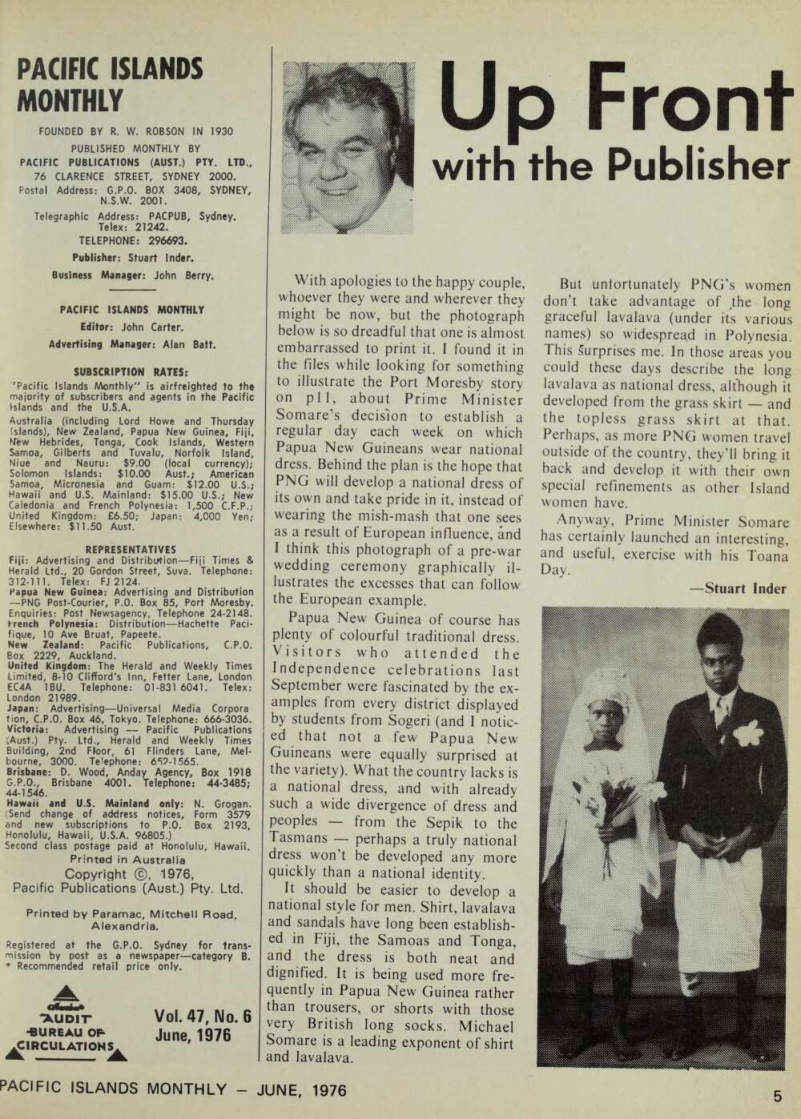
With apologies to the happy couple, whoever they were and wherever they might be now, but the photograph below is so dreadful that one is almost embarrassed to print it. I found it in the files while looking for something to illustrate the Port Moresby story on pll, about Prime Minister Somare’s decision to establish a regular day each week on which Papua New Guineans wear national dress. Behind the plan is the hope that PNG will develop a national dress of its own and take pride in it, instead of wearing the mish-mash that one sees as a result of European influence, and I think this photograph of a pre-war wedding ceremony graphically il lustrates the excesses that can follow the European example.
Papua New Guinea of course has plenty of colourful traditional dress.
Visitors who attended the Independence celebrations last September were fascinated by the ex amples from every district displayed by students from Sogeri (and I notic ed that not a few Papua New Guineans were equally surprised at the variety). What the country lacks is a national dress, and with already such a wide divergence of dress and peoples from the Sepik to the Tasmans perhaps a truly national dress won’t be developed any more quickly than a national identity.
It should be easier to develop a national style for men. Shirt, lavalava and sandals have long been establish ed in Fiji, the Samoas and Tonga, and the dress is both neat and dignified. It is being used more fre quently in Papua New Guinea rather than trousers, or shorts with those very British long socks. Michael Somare is a leading exponent of shirt and lavalava.
But unfortunately PNG’s women don’t take advantage of Jhe long graceful lavalava (under its various names) so widespread in Polynesia.
This Surprises me. In those areas you could these days describe the long lavalava as national dress, although it developed from the grass skirt and the topless grass skirt at that.
Perhaps, as more PNG women travel outside of the country, they’ll bring it back and develop it with their own special refinements as other Island women have.
Anyway, Prime Minister Somare has certainly launched an interesting, and useful, exercise with his Toana Day.
Stuart Inder
Advertisements & other items, p. 6 (1 item)
Eadio Au'ieaua
GLENYS
DIGKSON
COUNTDOWN
your top sounds tune to Radio Australia o90(mioo G.M.T. Monday oFriday
EADIO AU'IEAUA
write to Countdown, Radio Australia, Melbourne.3ooo, for record requests, programme guides.fan cards & posters
In this issue
General
Clue to Polynesia’s past 8 Hawaii-Tahiti canoe voyage 9 Question over next SP Games 14 NZ cuts Pacific radio 18 Japan feature 33
Cook Islands
Premier’s heart attack 19
Fiji
Corruption alleged 9 Laucala’s millionaire 13 New RC archbishop 19 Paddy Doyle heads FVB 19 Did mumbo-jumbo cause death? 25 Air Pacific problems 61 Capitalistic dockers 63
French Polynesia
Expedition to Reao 8 Hawaii-Tahiti canoe voyage 9
Nauru
US Ambassador 19
New Caledonia
Dengue deaths 18 First 747 75
New Hebrides
Ghost assembly 10 Aviation uplift 61
Niue Island
Lime exports 16
Norfolk Island
Court ruling on status 15
Papua New Guinea
National dress 11 Torres Strait border 14 Coffee tax 15 Adultery probe 16 Fatter wages for seamen 64
Pitcairn Island
1975 fish catch 18
Solomon Islands
Rebuilding an island 16 Union problem 17 Flag fuss 17
Tonga
Soviet link 14 Aviation link with W. Samoa 61
Us Trust Territory
Marianas revenue poser 14 Ghetto in Kwajalein 27 Supertanker port 59
Western Samoa
House rules for ministers 10 Election nullified 11 Dying newspapers 12
DEPARTMENTS: Up front with the Publisher, 5; News in a nutshell, 14; Editor's mailbag, 21; Islands Press, 31; Magazine Section, 48; Books, 54; Business and Development, 59; Pacific Transport, 61; Cruising Yachts, 66; Shipping and Airways Information, 68; Deaths of Islands people, 73; Produce Prices, 75.
Clues To
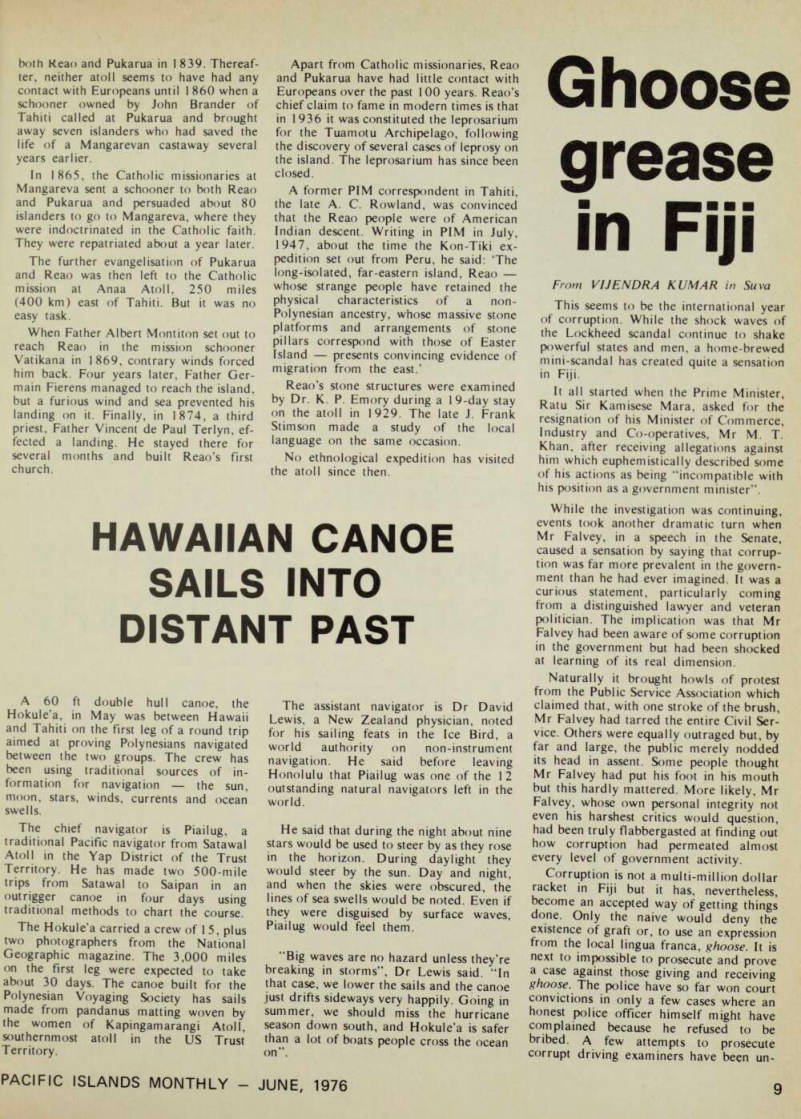
Atoll May Reveal
Polynesia’S Past
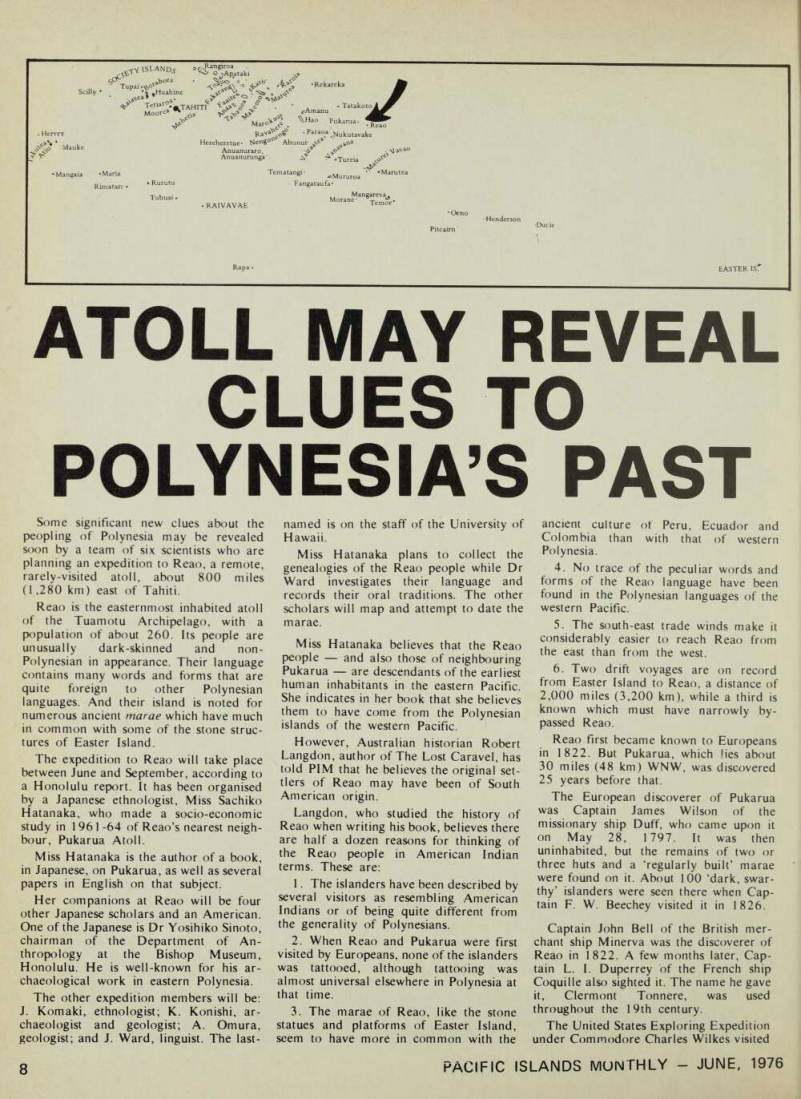
Some significant new clues about the peopling of Polynesia may be revealed soon by a team of six scientists who are planning an expedition to Reao, a remote, ato i’ T a rP. ut miles (1,200 km) east of Tahiti.
Reao is the easternmost inhabited atoll of the Tuamotu Archipelago, with a population of about 260, Its people are unusually dark-skinned and non- Polynesian in appearance. Their language contains many words and forms that are quite foreign to other Polynesian languages. And their island is noted for numerous ancient marae which have much in common with some of the stone structures of Easter Island.
The expedition to Reao will take place between June and September, according to a Honolulu report. It has been organised by a Japanese ethnologist, Miss Sachiko Hatanaka, who made a socio-economic study in 1961-64 of Reao’s nearest neighbour, Pukarua Atoll.
Miss Hatanaka is the author of a book, in Japanese, on Pukarua, as well as several papers in English on that subject.
Her companions a, Reao will be four other Japanese scholars and an American.
One of the Japanese is Dr Yosihiko Sinoto, chairman of the Department of Anthropology at the Bishop Museum, Honolulu. He is well-known for his archaeological work in eastern Polynesia.
The other expedition members will be: J. Komaki, ethnologist; K. Konishi, archaeologist and geologist; A. Omura, geologist; and J. Ward, linguist. The last-
named is on the staff of the University of Hawaii.
Miss Hatanaka plans to collect the genealogies of the Reao people while Dr Ward investigates their language and records their oral traditions. The other scholars will map and attempt to date the marae.
Hatanaka believes that the Reao , s Malar| aKa believes that the Reao and also those of neighbouring Pukarua are descendants of the earliest human inhabitants in the eastern Pacific. md,cates m her book that she believes f hem to ha ve come from the Polynesian elands of the western Pacific.
However, Australian historian Robert La "g do "; a l Uthor of The Lost Caravel ’ has told PIM that he believes the original settlers of Reao ma V have been of South American origin.
Langdon, who studied the history of Reao when writing his book, believes there are half a dozen reasons for thinking of the Reao people in American Indian terms - These are: 1. The islanders have been described by f-ral visitors as resembling American Indians or of being quite different from
the generality of Polynesians.
2. When Reao and Pukarua were first visited by Europeans, none of the islanders was tattooed, although tattooing was almost universal elsewhere in Polynesia at tbat time. 3. The marae of Reao, like the stone statues and platforms of Easter Island, seem to have more in common with the
ancient culture of Peru, Ecuador and Colombia than with that of western
Polynesia.
4. No trace of the peculiar words and forms of the Reao language have been found in the Polynesian languages of the western Pacific. 5, The south-east trade winds make it considerably easier to reach Reao from
th . f .
6 - I wo dr ' ' voyages are on record Ea « er ‘ S ‘ a^ n t ? R f ao ’ a . d,Bta u n “ of miles (3,200 km), while a third is know " which must have narrowly by passe eao.
Reao pirst became known to Europeans
? n a? J?** aboU j
miles (48 km) WNW, was discovered y ears betore that - The European discoverer of Pukarua was Captain James Wilson of the missionary ship Duff, who came upon it on . May 28, 1797. It was then uninhabited, but the remains of two or three huts and a regularly bu.lt marae ? ° n ll ‘ About 100 dark, swar f w m Captain John Bell of the British mer chant ship Minerva was the discoverer of Reao in 1 822. A few months later, Cap tain L. I. Duperrey of the French ship Coquille also sighted it. The name he gave it, Clermont Tonnere, was used throughout the 19th century, The United States Exploring Expedition under Commodore Charles Wilkes visited
both Keao and Pukarua in 1839. Thereaf ter, neither atoll seems to have had any contact with Europeans until 1 860 when a schooner owned by John Brander of Tahiti called at Pukarua and brought away seven islanders who had saved the life of a Mangarevan castaway several years earlier.
In 1865, the Catholic missionaries at Mangareva sent a schooner to both Reao and Pukarua and persuaded about 80 islanders to go to Mangareva, where they were indoctrinated in the Catholic faith.
They were repatriated about a year later.
The further evangelisation of Pukarua and Reao was then left to the Catholic mission at Anaa Atoll, 250 miles (400 km) east of Tahiti. But it was no easy task.
When Father Albert Montiton set out to reach Reao in the mission schooner Vatikana in 1869, contrary winds forced him back. Four years later, Father Ger main Fierens managed to reach the island, but a furious wind and sea prevented his landing on it. Finally, in 1874, a third priest, Father Vincent de Paul Terlyn, ef fected a landing. He stayed there for several months and built Reao’s first church.
Apart from Catholic missionaries, Reao and Pukarua have had little contact with Europeans over the past 100 years. Reao’s chief claim to fame in modern times is that in 1936 it was constituted the leprosarium for the Tuamotu Archipelago, following the discovery of several cases of leprosy on the island. The leprosarium has since been closed.
A former PIM correspondent in Tahiti, the late A. C. Rowland, was convinced that the Reao people were of American Indian descent. Writing in PIM in July, 1947, about the time the Kon-Tiki ex pedition set out from Peru, he said: The long-isolated, far-eastern island, Reao whose strange people have retained the physical characteristics of a non- Polynesian ancestry, whose massive stone platforms and arrangements of stone pillars correspond with those of Easter Island presents convincing evidence of migration from the east.’
Reao’s stone structures were examined by Dr. K. P. Emory during a 19-day stay on the atoll in 1929. The late J. Frank Stimson made a study of the local language on the same occasion.
No ethnological expedition has visited the atoll since then.
Sails Into
Hawaiian Canoe
Distant Past
A 60 ft double hull canoe, the Hokule’a, in May was between Hawaii and Tahiti on the first leg of a round trip aimed at proving Polynesians navigated between the two groups. The crew has been using traditional sources of in formation for navigation the sun, moon, stars, winds, currents and ocean swells.
The chief navigator is Piailug, a traditional Pacific navigator from Satawal Atoll in the Yap District of the Trust Territory. He has made two 500-mile trips from Satawal to Saipan in an outrigger canoe in four days using traditional methods to chart the course.
The Hokule’a carried a crew of 1 5, plus two photographers from the National Geographic magazine. The 3,000 miles on the first leg were expected to take about 30 days. The canoe built for the
Polynesian Voyaging Society has sails
made from pandanus matting woven by the women of Kapingamarangi Atoll, southernmost atoll in the US Trust
Territory.
The assistant navigator is Dr David Lewis, a New Zealand physician, noted for his sailing feats in the Ice Bird, a world authority on non-instrument navigation. He said before leaving Honolulu that Piailug was one of the 12 outstanding natural navigators left in the world.
He said that during the night about nine stars would be used to steer by as they rose in the horizon. During daylight they would steer by the sun. Day and night, and when the skies were obscured, the lines of sea swells would be noted. Even if they were disguised by surface waves, Piailug would feel them.
“Big waves are no hazard unless they’re breaking in storms”, Dr Lewis said. “In that case, we lower the sails and the canoe just drifts sideways very happily. Going in summer, we should miss the hurricane season down south, and Hokule’a is safer than a lot of boats people cross the ocean on”.
Ghoose
grease in Fiji
From VIJENDRA KUMAR in Suva This seems to be the international year of corruption. While the shock waves of the Lockheed scandal continue to shake powerful states and men, a home-brewed mini-scandal has created quite a sensation in Fiji.
It all started when the Prime Minister, Ratu Sir Kamisese Mara, asked for the resignation of his Minister of Commerce, Industry and Co-operatives, Mr M. T.
Khan, after receiving allegations against him which euphemistically described some of his actions as being “incompatible with his position as a government minister”.
While the investigation was continuing, events took another dramatic turn when Mr Falvey, in a speech in the Senate, caused a sensation by saying that corrup tion was far more prevalent in the govern ment than he had ever imagined. It was a curious statement, particularly coming from a distinguished lawyer and veteran politician. The implication was that Mr Falvey had been aware of some corruption in the government but had been shocked at learning of its real dimension.
Naturally it brought howls of protest from the Public Service Association which claimed that, with one stroke of the brush, Mr Falvey had tarred the entire Civil Ser vice. Others were equally outraged but, by far and large, the public merely nodded its head in assent. Some people thought Mr Falvey had put his foot in his mouth but this hardly mattered. More likely, Mr Falvey, whose own personal integrity not even his harshest critics would question, had been truly flabbergasted at finding out how corruption had permeated almost every level of government activity.
Corruption is not a multi-million dollar racket in Fiji but it has, nevertheless, become an accepted way of getting things done. Only the naive would deny the existence of graft or, to use an expression from the local lingua franca, ghoose. It is next to impossible to prosecute and prove a case against those giving and receiving ghoose. The police have so far won court convictions in only a few cases where an honest police officer himself might have complained because he refused to be bribed. A few attempts to prosecute corrupt driving examiners have been un
successful. Few people want to testify in such cases.
The extent of corruption and black money changing hands may vary from a mere bottle of Scotch given to a govern ment clerk who might expedite an ap plication for a fishing licence to a “gift” of several hundred dollars to a middle man who might secure a land lease for a far mer.
The Native Land Trust Board recently suspended one of its officers because of irregularities in issuing leases (read “bribery”). I have met many people who have greased the palms of officials of government departments and statutory bodies. They spoke freely about how they got their problems solved by forking out cash and passing it to their benefactors un der the table. But none would dream of going to the police.
“Why should I? I have got a new taxi plate for $lOO when there was little hope of getting one without giving ghoose to the right people,” a Nadi man recently told me. His story was not without a certain bizarre humour.
Taxis are restricted in Fiji and so there is a black market in taxi plates. A beaten up car with a taxi plate can fetch up to $6,000 or more. The man in this case said he merely went to an official in the right government office and blandly told him that he would give him $lOO if he would get a taxi plate. The official demurred but finally accepted the offer. He asked for the money but the wily corrupter said he would not play it that way. He wanted the official to hand him the licence with one hand and simultaneously, he would put $lOO in his other hand. And so the deal was made.
Another acquaintance went to a Native Lands Trust Board officer to try to get a lease for a small patch of land at Lautoka.
It should have been a simple matter because there were no attendant com plications. But the officer put on a pretence of studying the application form and then turned to the man saying something to the effect that there were dif ficulties. My acquaintance, mistaking his remark for concern for his difficulties, concurred and started telling him about the hardship he and his family had been facing.
During the course of the conversation, he learnt that the officer was speaking about his financial difficulties and said $2O would solve both their problems. The applicant was asked to go out of the office, put $2O in an envelope and bring it back so that his lease could be issued. The money changed hands surreptitiously and the little matter of the lease was fixed up.
Dealing through the backdoor does not seem to have any limit. To get a job, to avoid getting prosecuted for a traffic of fence, to get special favours of any kind from officials who are in positions of power and influence all are worth trying through ghoose.
The Ghost Assembly
From a Vila correspondent The political stalemate in the New Hebrides continued into May as controversy still engulfed the election of four chieftains to join the 38 other members of the con dominium’s first Representative Assembly.
Although territory-wide elections were held last November, the Assembly still had not met in early May and it was even suggested that there might be no meeting until an of ficial register of the population could be established and new elections held by universal suffrage.
In statements published in April, the victorious group in the November elections the National Party claimed that it was their demand for independence by 1977 that was delaying a calling together of the Assembly. The National Party criticised French policy in its overseas territories, in the Pacific especially, and accused the British Government of passively tolerating French policy in the New Hebrides.
The French authorities have suggested the selection of eight, instead of the originally proposed four, chieftains in the new Assembly. There have been moves to have Nagriamel leader Jimmy Stevens included as a chief, but this is opposed on the grounds of his mixed ancestry. When a meeting was called by the British and French authorities for elected representatives to meet informally, without the chiefs, to discuss the chiefs’ situation on April 29, the National Party announced it would not take part.
Under a special “soup” recipe that the French are most skilled at concocting, the 42 seats of the Representative Assembly are allocated to 29 members from all electorates, three French and three British from chamber of commerce members, three more from “economic interests” to represent co-operatives, and finally four chieftains.
When the predictable confusion ensued with Assembly membership still unresolved, the Noumea press in late April quoted UCNH party leader Remy Delaveuve recently returned from Paris as suggesting that at the worst the New Hebrides might wait for the current registering of the population to be completed, for new elections by universal suf frage.
Samoa Ministers
House Rules For
From Felise Va’a in Apia
It is now about three months since Tupuola Efi was elected the new Prime Minister of Western Samoa. He now en joys an unrivalled position of having no ef fective leader to oppose him in parliament. At the moment, there is only speculation that there will be opposition, to be formed by the remnants of Tamasese’s old party under such leaders as Sam Saili and Tofilau Efi, intelligent leaders themselves, but not as charismatic
as Tupuola.
Former Prime Minister Tupua Tamasese has been cleverly manoeuvred into a respectable but ineffective position as a member of the Council of Deputies, members of which are also de facto deputy Heads of State. At the moment, because of the vacancies in the Mataafa and Tuimalealiifano titles, he is the only mem ber.
It is not clear what made Tamasese resign his seat almost immediately after he lost the bid for the prime minister’s position to Tupuola. According to one version, Tupuola talked Tamasese into it.
Another said he was advised by Lufilufi,
an important political district, not to remain in parliament while Tupuola is prime minister as this would sap his traditional prestige. There is every in dication, however, that Tamasese aban doned his parliamentary seat sadly yet gamely.
Tupuola’s selection of his cabinet mem bers was done apparently after con sultation with other MPs but the final decision was still his. Three of Tamasese’s former ministers, Vaovasamanaia Filipo, Tofaeono Tile and Lilomaiava Niko, were retained.
They presumably voted against their former boss for one reason or another.
The progressive and conservative elements in Tupuola’s cabinet are fairly evenly balanced with the progressives perhaps in
the majority.
Fuimaono Mimio, Minister of Agriculture, Lilomaiava Niko, Minister of Education, Mano Togamau, Minister of Lands and Survey and Tofaeono Tile, Minister of Communications and Tran sport, may be classified as the con servatives, while Asi Eikeni, Minister of
Economic Affairs, Vaovasamanaia Filipo, Minister of Finance, Ulualofaiga Talamaivao, Minister of Justice, Letiu Tamatoa, Minister of Works, and Prime Minister Tupuola may be classified as the progressives. This is only a rough
dichotomy, however.
At this stage, it is difficult to judge how well or how badly the new cabinet and their prime minister are doing as they are still settling into their jobs. The prime minister apparently has already laid down the house rules for his cabinet: be punctual at work, work hard, be honest in carrying out responsibilities, treat everybody the same, and so on. In short, the aim of the new policies is the production of a morally-superior type of cabinet minister (this is not to insinuate that there were no such ministers before) and to teach the new ministers to see their position as public servants, to be treated the same as
everybody else.
Hypothetical example: if the prime minister himself should arrive in a queue, he should not necessarily be given first place. He should take his turn along with the others.
The really first big event involving the new government was the reception for King Taufaahau of Tonga who came here in April ostensibly to meet the new prime minister and his cabinet but principally to interest the Western Samoan Government in increasing Tonga’s shares in Polynesian Airlines and in expanding Polynesian’s services to Rarotonga and New Zealand.
According to press reports, Tonga’s shares have been increased and plans are being prepared to extend Polynesian’s service to the Cooks and New Zealand.
Tupuola still goes about in his ordinary clothes, a lavalava and a shirt, even when he entertains royal visitors, ambassadors and other dignitaries. Like the people in the hamburger advertisement, he might say, “That’s my way.” None can argue about that. It is to be hoped, however, that his way will succeed in getting results in a country which is overpopulated, un derdeveloped, lacking in exports (because of bad agricultural policies?), suffering from both inflation and recession, having a high rate of unemployment and under employment, and not yet truly in the 20th century.
One Lousy Vote!
liga Suafole, one of the two women elected to the Western Samoa Parliament in February, did not hold her seat long.
She had a majority of one. Mulitalo Siafausa petitioned against her election on the ground that unqualified people voted for her. The Supreme Court declared one vote invalid and she lost her majority.
The Speaker, Leota Leiluaua Ituau, directed that a by-election be held to fill the vacant seat because the tie was the result of a petition and not the result of the actual voting.
Grass skirts - so it
must be Friday
From GUS SMALES in Port Moresby
Flowers in the hair, a few office girls in grass skirts, and an epidemic of brightly-coloured shirts for men These were the main eye-catchers on the last Friday in April for Papua New Guinea’s first Toana Day, a campaign to wear national dress to work €V€ 'ru the Prime Minister, Mr So mare, thought up the idea as part of a current trend to establish a national
bT‘!LZriZff.ZthZ
, problem is that no one is really too sure about what constitutes a true national dress in PNG.
One of the government’s top information men, Mr Luke Sela usually neat and natty in western-style clothes conceded the problem in a radio broadcast about Toana Day. He Md‘o d r‘n h mn ,v' “• he ti competition 10 create a design for national dress.
The results were far from conelusive, and drew more controversy than general acceptance. The winning
d ::rcZidTeT f :i“tsrsz
borrowed or over-contrived or both Although a few brave office girls turned out on Toana Day in grass skirts, their numbers were a pale comparison with the hundreds of Papuan women who until about 10 years ago
always wore grass skirts in the streets and markets of Port Moresby Toana of fice girls wore blouses on top, too, which was definitely not the rule with the grass skirts of an earlier generation.
The first observance of Toana it’s a Motuan word meaning “op pear once” was almost completely confined to government offices Guineans. Many men wore tailored laptops with M , pocke , md at t he side F n , , out most of the men who dressed this way, including Mr Somare him self have already adopted the style for everyday wear anyway. It was stan dard dress at work on Toana for Mr Somare’s ministers.
T PNG 4 « *■*// women, wore at ,‘T P ‘ fl° wers « '*«> hair. And an Australian, who turned up for work in the central government offices in Port Moresby, carried a basket of woven coconut leaves.
T FridaybrUfcase ’’ he
Mr Somare s supporters conceded that the country’s first Toana Day had been fairly low-key, with women responding better than men. But they believe that every Friday will see the idea grow, and that a standard type of national dress will evolve.
The lady and the Highlander—traditional dress can turn all eyes any day of the week.
Freedom
TO
Perish
From Felise Va’A In Apia
The saga of dying newspapers con tinues in the Samoas with the demise of two weeklies in Western Samoa, and a weekly and a monthly in American Samoa during the first four months of 1976.
Beginning with the American Samoan newspapers, Transpac, publisher of the popular Samoan Sun, ordered a halt to publication early March. About the same time. Sherry O’Sullivan, the ebullient editor/pub lisher of the controversial but en tertaining Underground Monthly an nounced that her magazine would cease publication with the April issue.
In Western Samoa, financial dif ficulties forced the closure of the popular Apia Weekly and the Samoana Herald. The Apia Weekly had been going for about a year, the Samoana Herald for a little over two years. The life of the Samoana Herald was shortened considerably by the fact that it lost a libel suit brought against it by the management of the Hideaway Hotel. The court ordered the newspaper to pay a fine of about $l,OOO for printed remarks in a letter to the editor relating to the quality of meat served at the hotel.
Whether the court will succeed in collecting the money is another issue as
the editor has said “the newspaper does not have that money.”
The Samoa Sun, one of the fastest growing newspapers in the Samoas, died after only a year and several months existence at the peak of its career. This fact has surprised many people especially as the halt to publication was sudden and unan nounced.
On surface, the Sun contained a lot of advertisements, averaging eight pages weekly, at a cost of US$lOO a page. Its circulation was fast ap proaching the 3,000 mark, close enough to that of the Samoa News to make it uncomfortable for the News, but deeper down, the newspaper was beset by personnel and financial problems. The newspaper revenue was inadequate to offset the rising costs of production. These costs were largely the result of high salaries (by local standards, at least) paid to employees.
But it was the resignation or the prof fered resignation of two key personnel which finally forced the decision to close.
As for the Underground Monthly, many factors led to the decision to close it. The courageous Miss O’Sullivan had for many months been complaining of inadequate revenues necessary to support her publication, and she had been considering the possibility of migrating to an uninhabited island, to live there by herself. She was also thinking of writing a book about her experiences in American Samoa. But all that was to end sooner than expected.
She was in the habit of combing the local bars in search of hard-core news and gossip. At the Bamboo Room, her regular haunt, she had met a regular drinking companion, a palagi. Late at night, as the unsuspecting editor was leaving the bar, she was viciously at tacked by a crowd of Samoan women.
In her words, published in her last issue: “My hair was all hacked off and passed down a surrealistic ‘bucket brigade’ of Samoans, an earring was torn out and an attempt to either blind me or disfigure my face was narrowly aborted. I was able to count five Samoans and was aware of many, many more milling about... ap parently enjoying the situation. When I cried for help. . .they laughed at me.”
After her fear and fiery temper had worn off, Miss O’Sullivan finally lear ned another fact about Samoan life. To make a pass at a married man or to be seen socialising with a married man in “questionable circumstances” could result in an unsuspected attack on the “offender” and frequently mutilation
of the body (usually an ear cut off).
Men are more tolerant but more brutal once they have discovered “the
true relationship.”
For the sensitive editor, the attack by the Samoans she had grown to love after two years was definitely the last straw.
She was constantly hustled by government representatives who resen ted her outspoken criticism of politicians and public servants. For many months, they had been trying to deport her to her homeland in Canada. However, she managed to fight off all sorts of government on slaughts, but the attack on her meant that she had lost the one thing that had given her strength in all her tribulations: her faith in the Samoan people. She felt it was indeed time to pack up her things and leave. She has already left but her name is legendary, for the struggle she fought. The struggle to make the government more honest, more humane, more
progressive.
The fact that the government dilly dallied in the prosecution of her case did not help her. She was told that she should not press charges against her assailants as it might jeopardise her life. Then, after she reported this in a television interview, the government relented but she was told that if she came back to attend the trial, she would have to bear the expenses her self. End of the case for Miss O’Sullivan.
Now in American Samoa, there is only the Samoa News, which has sud denly taken a pro-government stance.
In Western Samoa, the Samoa Times still rules supreme but is seriously being challenged by the South Seas Star, and the Tapuitea, printed and owned by the Lamepa Press.
Despite the setbacks to journalism in the Samoas, there is comfort in the Samoan proverb; “A hero falls, but another takes his place.”
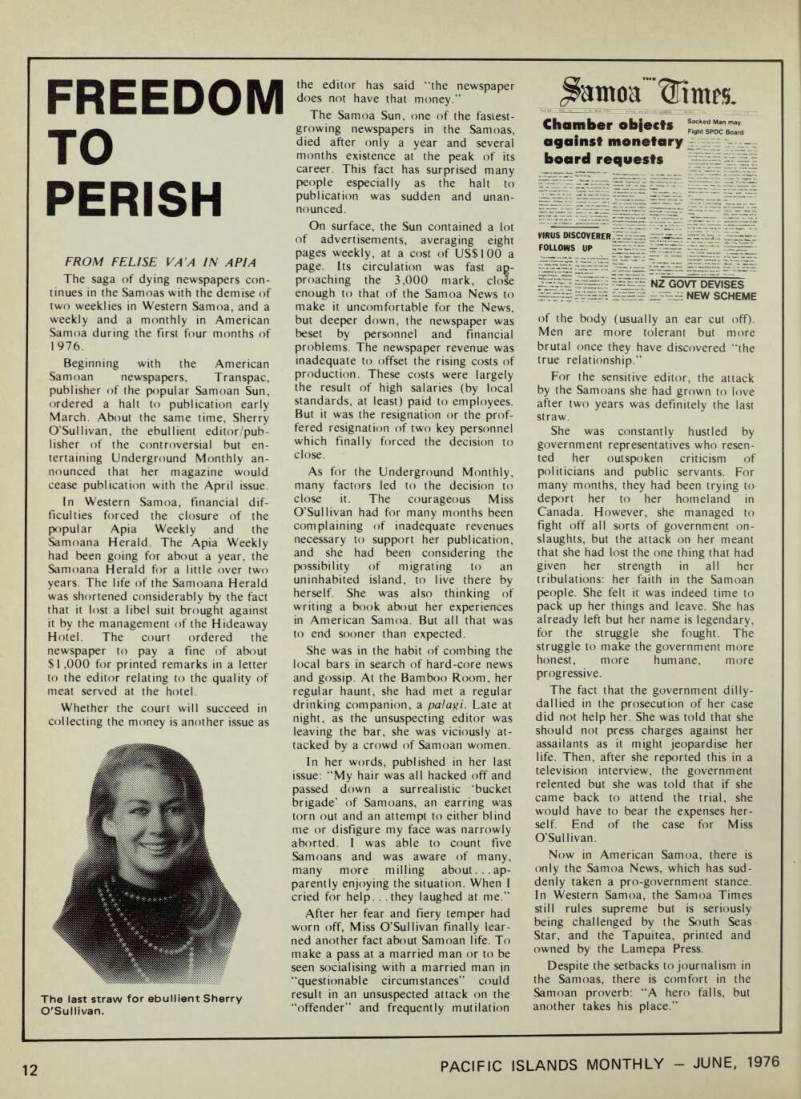
The last straw for ebullient Sherry O'Sullivan.
Dollar
Million
Island
By John Carter
It had to be something really important to take Fiji’s Prime Minister, Ratu Sir Kamisese Mara, and several of his ministers on a flight over 150 miles of ocean from Suva to the 4‘/2 square-mile island of Laucala in April. A series of ceremonies, opening a $20,000 copra dryer, a 3,000 ft airstrip, a new school-cum community centre and eight modern homes for Fijian workers and families was one of the most significant happenings in Fiji for a decade.
Host to the ministers was island-owner, multi-millionaire Malcolm S. Forbes, who bought Laucala in 1972; adding it to his other pieces of real estate which include a 262 square-mile ranch in Colorado, a couple of castles in France, mansions in the States and London and a fishing camp in Tahiti. He also has several art collec tions worth several million dollars, Forbes Magazine on which his fortune was found ed by his Scots journalist father, and sun
dry other money-making projects.
But, for the present, Laucala is his pride and joy and it may become Fiji’s pride and joy for Mr Forbes plans to put it on the world map as the source of a new cosmetic base super-refined coconut oil squeezed from the island’s annual output of 450 tons of copra. He promised, in a talk to
reporters he “imported” from Australia, New Zealand and the United States, that his marketing organisation will sell the cosmetic at a high price, and other copra producers in Fiji will be able to climb on
the bandwaggon.
His promises can be expected to materialise because 56-year-old hard bitten Malcolm Forbes is in the habit of getting things done. His magazine, Forbes, was wallowing in a trough of depression after World War 11. It’s now one of America’s leading business magazines last calculated turnover US$l4 million.
The only hot air he deals in is the hot air which goes into his hobby, hot-air balloon ing, and he holds the record for sailing across the States in such a balloon. He also rides motorbikes for fun but sells them at a profit, collects Faberge, fine paintings and odds and ends like ancient film posters and presidential autographs.
He’s not shy or retiring and does things in the way Hollywood imagines all millionaire tycoons do with a lot of publicity, but I suspect he’s really publicis ing his magazine rather than himself.
There was a flamboyant touch about the island ceremonies. As the Fijian ceremony welcoming Ratu Sir Kamisese Mara and his ministers unfolded on a patch of green
facing the sea, Mr Forbes’ private jet plane, a DC-9, which he calls Capitalist Tool, made two token sweeps across the island, and his 117 ft yacht Laucala sailed majestically into the bay.
But, if anyone thought that a display of what the almighty American dollar can do was the only thing they came to see, they must have changed their minds when they toured the areas bearing the Forbes touch.
The airstrip, dug out of the plantation soil and surfaced with powdered rock (or so it seemed) was impressive, as was the copra dryer. So were the new houses for the plantation workers like palaces compared with the traditional bures; eight to start with but more going up until all 200 Fijians on the island will be comfor tably housed.
Having spent several years in colonial Fiji, I got the feeling that maybe this Forbes’ idea of gilding his baby smacked a little of the old paternalism and that his island would get the bird from the Fijians in the saddle but, not a bit of it.
The Prime Minister made it plain to me that he was all for it; that nothing but good could come from it. Finance Minister Mr Charles Stinson took the same view. Here was a definite upgrading of one of Fiji’s traditional industries, coconuts, which, with modern American know-how and dollars might enter one of the world’s most exotic spheres the beauty’s boudoir in stead of the margarine factory!
Mr Forbes was frank about it all. He wasn’t a philanthropist, a do-gooder. He denied that what he was doing was because he’d fallen in love with Laucala and its Fi jians. When he bought Laucala it cost a million dollars, some say he had the idea of selling it piecemeal at top prices as homesites for rich Americans. Then he realised its potential as a plantation and decided to develop that side of it. Which is where the cosmetic coconut comes in.
I’m sure Mr Forbes won’t mind a polite rasberry! The money he’ll make from his coconuts wouldn’t keep his jet plane in the air, but there’ll be a very happy communi ty of Fijians on Laucala and he might decide that Fiji’s just the place to work off some of his excess energy and dollars to the greater good of the country.
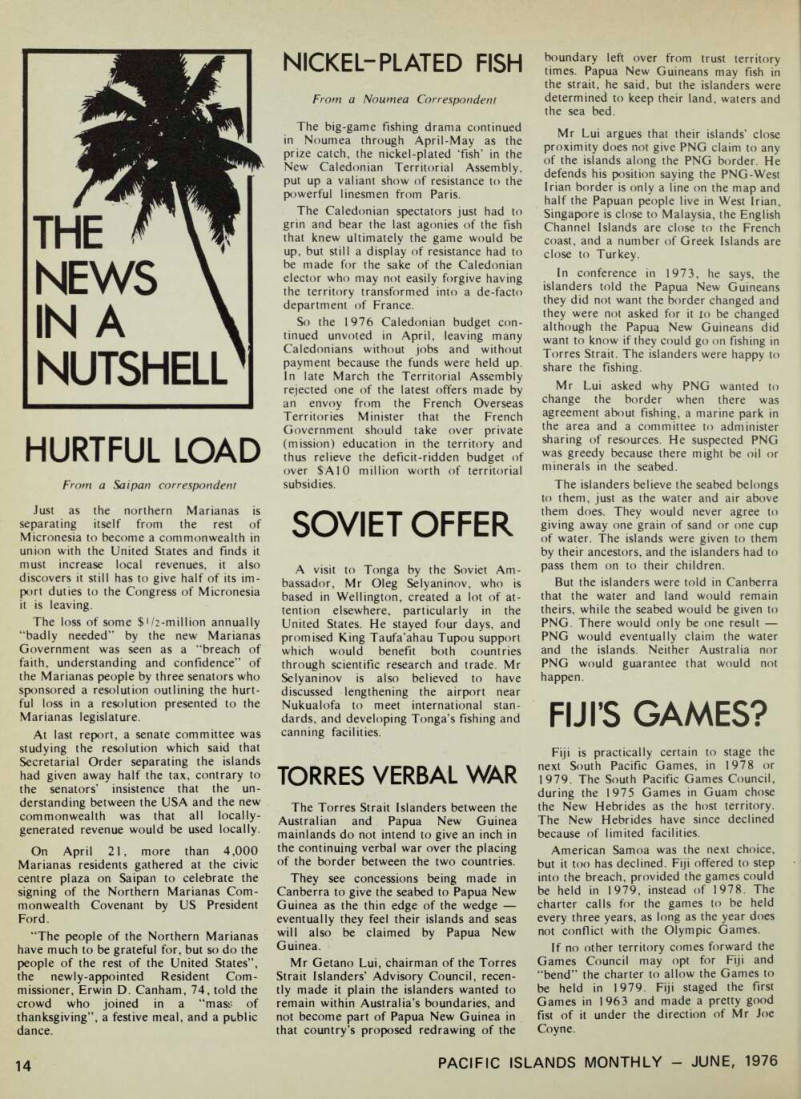
Garlanded and smilling (who wouldn't with an island of one’s own), Malcolm Forbes on the right, cracks a joke with Fiji's Prime Minister, Ratu Sir Kamisese Mara Wright Photographies.
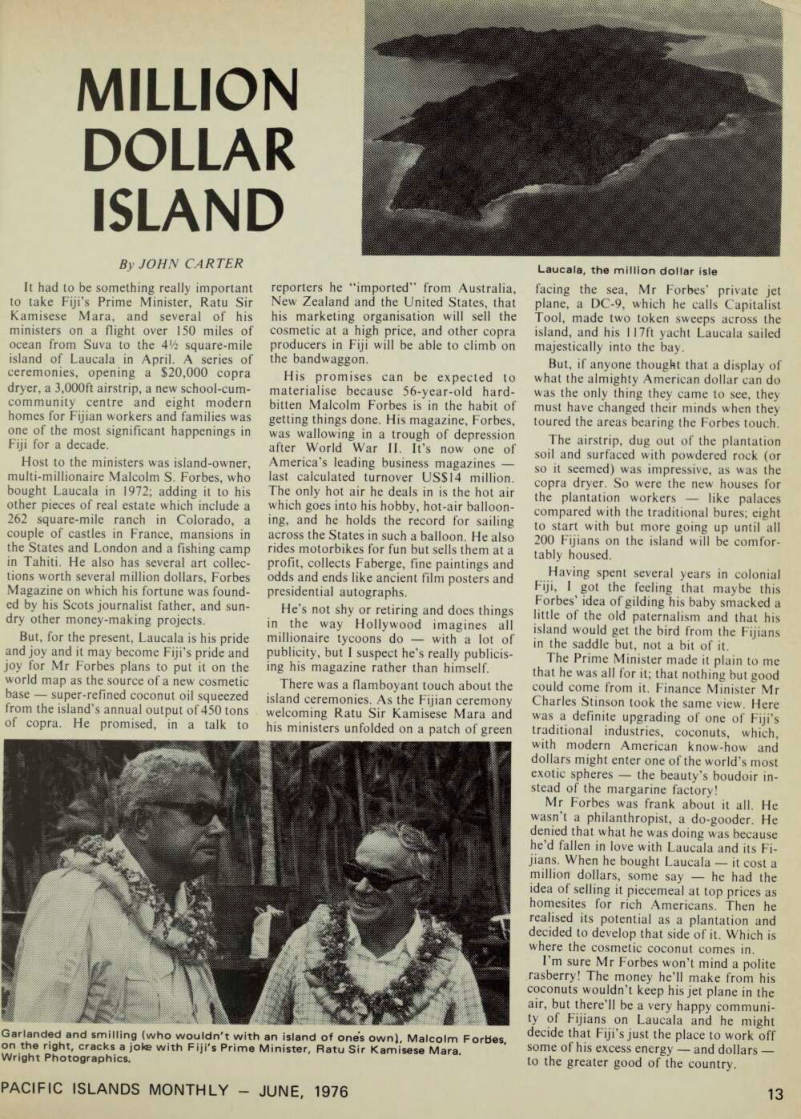
Laucala, the million dollar isle
News
The
In A
Nutshell
Hurtful Load
From a Saipan correspondent Just as the northern Marianas is separating itself from the rest of Micronesia to become a commonwealth in union with the United States and finds it must increase local revenues, it also discovers it still has to give half of its im port duties to the Congress of Micronesia it is leaving.
The loss of some s</2-million annually “badly needed” by the new Marianas Government was seen as a “breach of faith, understanding and confidence” of the Marianas people by three senators who sponsored a resolution outlining the hurt ful loss in a resolution presented to the Marianas legislature.
At last report, a senate committee was studying the resolution which said that Secretarial Order separating the islands had given away half the tax, contrary to the senators’ insistence that the un derstanding between the USA and the new commonwealth was that all locally generated revenue would be used locally.
On April 21, more than 4,000 Marianas residents gathered at the civic centre plaza on Saipan to celebrate the signing of the Northern Marianas Com monwealth Covenant by US President Ford.
“The people of the Northern Marianas have much to be grateful for, but so do the people of the rest of the United States”, the newly-appointed Resident Com missioner, Erwin D. Canham, 74, told the crowd who joined in a “mass of thanksgiving”, a festive meal, and a public dance.
Nickel-Plated Fish
From a Noumea Correspondent The big-game fishing drama continued in Noumea through April-May as the prize catch, the nickel-plated ‘fish’ in the New Caledonian Territorial Assembly, put up a valiant show of resistance to the powerful linesmen from Paris.
The Caledonian spectators just had to grin and bear the last agonies of the fish that knew ultimately the game would be up, but still a display of resistance had to be made for the sake of the Caledonian elector who may not easily forgive having the territory transformed into a de-facto department of France.
So the 1976 Caledonian budget con tinued unvoted in April, leaving many Caledonians without jobs and without payment because the funds were held up.
In late March the Territorial Assembly rejected one of the latest offers made by an envoy from the French Overseas Territories Minister that the French Government should take over private (mission) education in the territory and thus relieve the deficit-ridden budget of over SAIO million worth of territorial subsidies.
Soviet Offer
A visit to Tonga by the Soviet Am bassador, Mr Oleg Selyaninov, who is based in Wellington, created a lot of at tention elsewhere, particularly in the United States. He stayed four days, and promised King Taufa’ahau Tupou support which would benefit both countries through scientific research and trade. Mr Selyaninov is also believed to have discussed lengthening the airport near Nukualofa to meet international stan dards, and developing Tonga’s fishing and canning facilities.
Torres Verbal War
The Torres Strait Islanders between the Australian and Papua New Guinea mainlands do not intend to give an inch in the continuing verbal war over the placing of the border between the two countries.
They see concessions being made in Canberra to give the seabed to Papua New Guinea as the thin edge of the wedge eventually they feel their islands and seas will also be claimed by Papua New Guinea.
Mr Getano Lui, chairman of the Torres Strait Islanders’ Advisory Council, recen tly made it plain the islanders wanted to remain within Australia’s boundaries, and not become part of Papua New Guinea in that country’s proposed redrawing of the
boundary left over from trust territory times. Papua New Guineans may fish in the strait, he said, but the islanders were determined to keep their land, waters and the sea bed.
Mr Lui argues that their islands’ close proximity does not give PNG claim to any of the islands along the PNG border. He defends his position saying the PNG-West Irian border is only a line on the map and half the Papuan people live in West Irian, Singapore is close to Malaysia, the English Channel Islands are close to the French coast, and a number of Greek Islands are close to Turkey.
In conference in 1973, he says, the islanders told the Papua New Guineans they did not want the border changed and they were not asked for it to be changed although the Papua New Guineans did want to know if they could go on fishing in Torres Strait. The islanders were happy to share the fishing.
Mr Lui asked why PNG wanted to change the border when there was agreement about fishing, a marine park in the area and a committee to administer sharing of resources. He suspected PNG was greedy because there might be oil or minerals in the seabed.
The islanders believe the seabed belongs to them, just as the water and air above them does. They would never agree to giving away one grain of sand or one cup of water. The islands were given to them by their ancestors, and the islanders had to pass them on to their children.
But the islanders were told in Canberra that the water and land would remain theirs, while the seabed would be given to PNG. There would only be one result PNG would eventually claim the water and the islands. Neither Australia nor PNG would guarantee that would not
happen.
Fiji’S Games?
Fiji is practically certain to stage the next South Pacific Games, in 1978 or 1979. The South Pacific Games Council, during the 1975 Games in Guam chose the New Hebrides as the host territory.
The New Hebrides have since declined because of limited facilities.
American Samoa was the next choice, but it too has declined. Fiji offered to step into the breach, provided the games could be held in 1979, instead of 1978. The charter calls for the games to be held every three years, as long as the year does not conflict with the Olympic Games.
If no other territory comes forward the Games Council may opt for Fiji and “bend” the charter to allow the Games to be held in 1979. Fiji staged the first Games in 1963 and made a pretty good fist of it under the direction of Mr Joe Coyne.
Ground For Tax
A tax on boom earnings from coffee growing is just around the corner, Papua New Guinea Finance Minister Julius Chan said in April. He was replying to criticism from the Speaker of the National Parliament, Mr Barry Holloway who claimed that growers were frittering away their boom earnings on imported luxuries and were undermining attempts to make PNG self-reliant.
Mr Holloway criticised the government for not adopting a tax scheme which would put the extra earnings to good use in the national interest. The government’s reply from Mr Chan said the Local Government Act was being amended to give special tax powers to some local authorities.
In coffee-growing areas this would allow local authorities to raise taxes in times of excess earnings. When coffee prices fell, central taxation at normal rates would take precedence.
Workless Woes
Massive unemployment is just around the corner for Papua New Guinea’s towns and cities; up to 44 per cent of the male urban workforce some 86,000 men could be out of work by 1981, the PNG Central Planning Office fears.
The office blames excessively rapid growth of PNG’s population and the drift of workers from rural areas to towns. It discounts the widespread opinion in PNG that rapid industrialisation in urban areas will solve the problem.
The report appeals to the government to put the greatest possible emphasis on rural development and agriculture in an attempt to change trends which include worsening housing problems, urban poverty and crime.
Oh Norfolk!
The High Court of Australia has ruled that Norfolk Island is part of Australia.
The court was dismissing an appeal against a lower court’s decision that a Norfolk company must put in a tax return.
The court ruled that Australia’s income tax laws covering Norfolk were valid, and at the same time went further by saying there were “powerful reasons” for regard ing Norfolk Island as part of Australia.
In an earlier case, Mr Justice Eggleston had dealt with the history of the island and historical documents, and had con cluded that Norfolk Island was a territory placed by the Crown under the authority of the Commonwealth of Australia by the constitution. Now, Mr Justice Mason who prepared the tax case judgment has agreed that the history and historical documents supported Mr Justice Eggleston’s con clusions.
Norfolk Island initially was part of the
penal settlement established in New South Wales, later it was administered by the Governor of Van Diemen’s Land (Tasmania) as part of that colony. In 1856 it was constituted a separate set tlement administered by the Governor of NSW, who was appointed Governor of Norfolk Island.
On January 15,1 897, on the eve of the establishment of the Commonwealth by Order-in-Council it was recited that it was “expedient that other provision should be made for the government of Norfolk Island, and that, in prospect of the future annexation of that island to the colony of NSW, or to any federal body of which that colony may hereafter form part, in the meantime the affairs of the island should be administered by the Governor of
Nsw”.
Mr Justice Mason said the Order-in- Council empowered the Governor of NSW to make laws for the peace, order and good government of the island.
“The continued administration of Nor folk Island as part of or by the governors of the Australian colonies, culminating in the Order-in-Council made in 1897 vesting the administration in the Governor of New South Wales, makes it abundantly clear that Norfolk Island forms part of the Commonwealth of Australia”, Mr Justice Mason said.
The Chief Justice, Sir Garfield Barwick, said he agreed with Mr Justice Mason’s conclusions and the reasons for reaching them.
“In my opinion, Norfolk Island is part of the Commonwealth”, Sir Garfield said.
“The legislative power given by Section 5 1 (2) of the constitution is exercisable with respect to the income of residents of the island”.
At Last!
A regional shipping line could now be established by the South Pacific Forum which only had to make a definite decision, President Hammer deßoburt of Nauru said after the recent meeting of the Regional Shipping Council in New Zealand. The president is chairman of the council. The forum, at Nauru, late in July, will consider a recommendation from the council to set up the line.
Air Baby
The recently released Australian air craft, the Nomad, has a Papua New Guinean baby named after it. Nomad Weta, whose parents come from the cen tral mountains settlement of Telefomin, will be given a big Christening ceremony after being born in a Nomad while being flown to coastal Wewak to hospital. The Nomad has been operating in PNG for only a few weeks for Independent Air Transports, one of the country’s first air ventures to be owned solely by Papua New Guineans.
Dengue Deaths
Two cases of suspected death from dengue fever were reported in April from Noumea where an epidemic broke out in February. By late April it was estimated that already 15 per cent of the population had been affected by the disease, which was still not as severe as the 40 per cent afflicted during the 1972 epidemic.
Strenuous efforts were being taken to com bat the mosquito vector of the disease. The two deaths suspected as being caused by dengue fever concerned two persons already in a state of coma when admitted
to hospital.
A grass roots commission
The South Pacific Commission must be helped to survive and prosper There are many things wrong with it, but none so bad that the SPC should be disbanded or absorbed in the South Pacific Forum or the South Pacific Bureau for Economic Co-operation That’s the message that emerged from the deliberations of a review committee which met in Nauru in May. Delegates from member countries and the participating metropolitan governments took part in the review under the chairmanship of President Hammer Deßoburt. The Committee was formed under the instructions of the last South Pacific Conference, and its recommendations will go to the Sixteenth Conference to be held in Noumea in October.
Everyone but Tonga was represented, and the French adopted a new open-handed policy under France’s new representative on the SPC, Mr M. Revol, who replaces Com missioner Henri Nettre who has now retired from the post after being the doyen of com missioners, efficiently representing France almost since the inception of the SPC Mr Revol said France would go along with what anybody wanted. What one or two ot the territories in fact wanted was union with SPEC or the Forum, but they didn’t press it when it became obvious that most territories felt that the real value of the SPC was in lending a practical helping hand in every way to the smaller islands; and that it would simply, be directed to concentrate on grass roots matters, using local experts and not highly-paid, imported non-experts parading as experts.
In short, the SPC as an organisation got a resounding vote of confidence by the review committee on condition that it cuts its cloth to suit its customers. And this is what it will now undoubtedly proceed to do.
Tropicalities
Rebuilding
your island
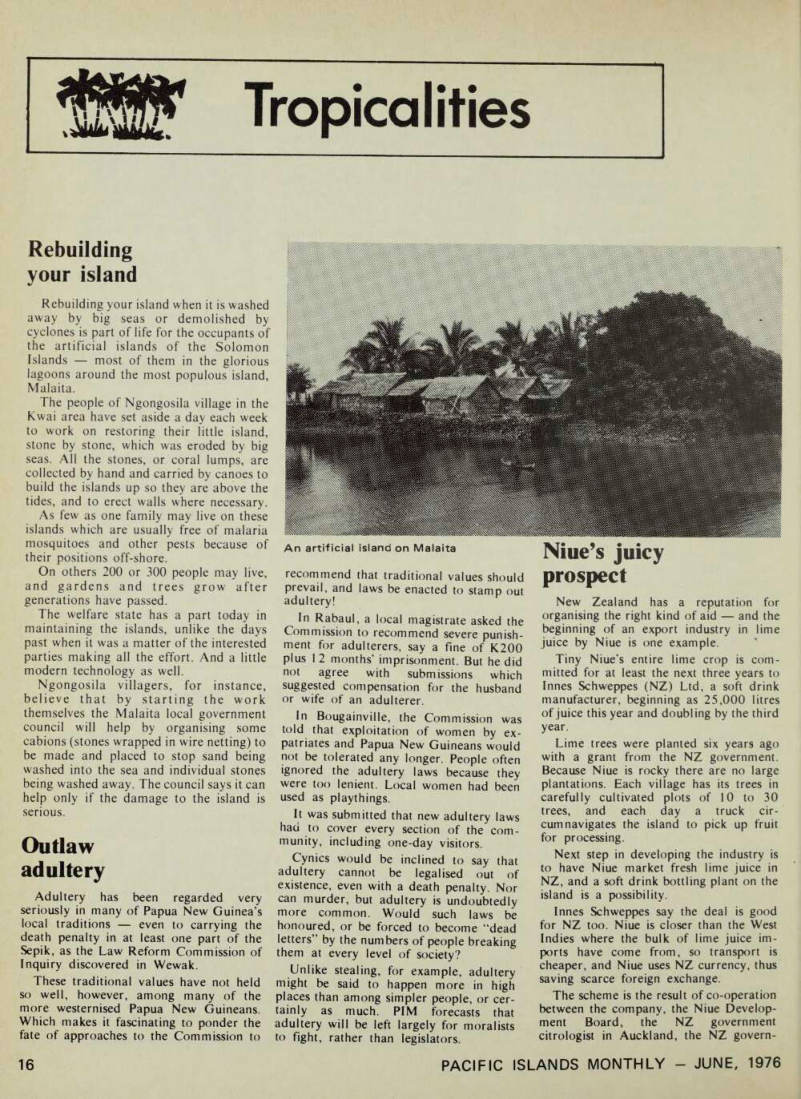
Rebuilding your island when it is washed away by big seas or demolished by cyclones is part of life for the occupants of the artificial islands of the Solomon Islands most of them in the glorious lagoons around the most populous island, Malaita.
The people of Ngongosila village in the Kwai area have set aside a day each week to work on restoring their little island, stone by stone, which was eroded by big seas. All the stones, or coral lumps, are collected by hand and carried by canoes to build the islands up so they are above the tides, and to erect walls where necessary.
As few as one family may live on these islands which are usually free of malaria mosquitoes and other pests because of their positions off-shore.
On others 200 or 300 people may live, and gardens and trees grow after generations have passed.
The welfare state has a part today in maintaining the islands, unlike the days past when it was a matter of the interested parties making all the effort. And a little modern technology as well.
Ngongosila villagers, for instance, believe that by starting the work themselves the Malaita local government council will help by organising some cabions (stones wrapped in wire netting) to be made and placed to stop sand being washed into the sea and individual stones being washed away. The council says it can help only if the damage to the island is serious.
Outlaw
adultery
Adultery has been regarded very seriously in many of Papua New Guinea’s local traditions even to carrying the death penalty in at least one part of the Sepik, as the Law Reform Commission of Inquiry discovered in Wewak.
These traditional values have not held so well, however, among many of the more westernised Papua New Guineans.
Which makes it fascinating to ponder the fate of approaches to the Commission to
recommend that traditional values should prevail, and laws be enacted to stamp out
adultery!
In Rabaul, a local magistrate asked the Commission to recommend severe punishment for adulterers, say a fine of K2OO plus 12 months’imprisonment. But he did not agree with submissions which suggested compensation for the husband or wife of an adulterer.
In Bougainville, the Commission was told that exploitation of women by expatriates and Papua New Guineans would not be tolerated any longer. People often ignored the adultery laws because they were too lenient. Local women had been used as playthings.
It was submitted that new adultery laws had to cover every section of the com-
munity, including one-day visitors
Cynics would be inclined to say that adultery cannot be legalised out of existence, even with a death penalty. Nor can murder, but adultery is undoubtedly more common. Would such laws be honoured, or be forced to become “dead letters” by the numbers of people breaking them at every level of society 7 Unlike stealing, for example, adultery might be said to happen more in high places than among simpler people, or certainly as much. PIM forecasts that adultery will be left largely for moralists to fight, rather than legislators.
Niue’s juicy
prospect
New Zealand has a reputation for organising the right kind of aid and the beginning of an export industry in lime juice by Niue is one example.
Tiny Niue’s entire lime crop is com mitted for at least the next three years to Innes Schweppes (NZ) Ltd, a soft drink manufacturer, beginning as 25,000 litres of juice this year and doubling by the third year.
Lime trees were planted six years ago with a grant from the NZ government.
Because Niue is rocky there are no large plantations. Each village has its trees in carefully cultivated plots of 10 to 30 trees, and each day a truck cir cumnavigates the island to pick up fruit
for processing.
Next step in developing the industry is to have Niue market fresh lime juice in NZ, and a soft drink bottling plant on the island is a possibility.
Innes Schweppes say the deal is good for NZ too. Niue is closer than the West Indies where the bulk of lime juice im ports have come from, so transport is cheaper, and Niue uses NZ currency, thus saving scarce foreign exchange.
The scheme is the result of co-operation between the company, the Niue Develop ment Board, the NZ government citrologist in Auckland, the NZ govern
An artificial island on Malaita
ment citrologist in Auckland and the Department of Scientific and Industrial Research.
Imagination and foresight can help even a rocky little self-governing island of 4500 people support itself.
Union fingers
in ballot box
Trade union leaders involved in the Solomon Islands’ first serious strikes early this year are making their expected at tempt to establish themselves as a power in national politics. With the critical, pre independence general elections coming on June 22, union leaders have formed a party to try to enter the enlarged Legislative Assembly.
All over the main centres, words have flown into the ears of every low-paid worker, for it is they who are seen as the support for the leaders of the newly established Solomon Islands General Workers’ Union, and for others such as those heading the government labouring force.
A letter from the Ministry of Foreign Trade, Industry and Labour to the Solomon Islands Chamber of Commerce said at the time of the prolonged strikes: “It is very obvious to the Ministry that the union has not been operating properly and was mixing union matters with political matters.
“This would mean one of two things either its leaders are ‘power hungry’ or are ‘inexperienced’. The general public felt the former is the case, while we in the Ministry took the latter”, the letter said.
Probably the Ministry was being hopeful, for unionists have formed a new political party, the Nationalist Party, although parties up to now have been shown not to work in the Solomons.
Working for
the Wuvuluans
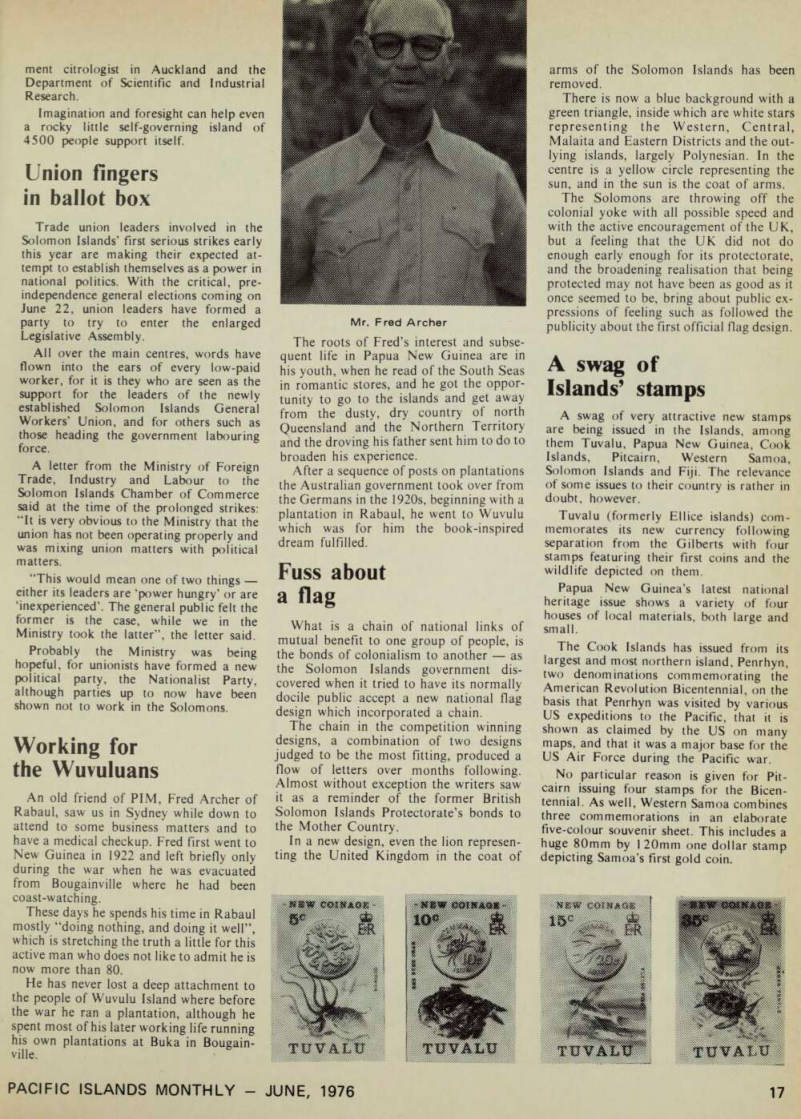
An old friend of PIM, Fred Archer of Rabaul, saw us in Sydney while down to attend to some business matters and to have a medical checkup. Fred first went to New Guinea in 1922 and left briefly only during the war when he was evacuated from Bougainville where he had been
coast-watching.
These days he spends his time in Rabaul mostly “doing nothing, and doing it well”, which is stretching the truth a little for this active man who does not like to admit he is now more than 80.
He has never lost a deep attachment to the people of Wuvulu Island where before the war he ran a plantation, although he spent most of his later working life running his own plantations at Buka in Bougain ville.
The roots of Fred’s interest and subse quent life in Papua New Guinea are in his youth, when he read of the South Seas in romantic stores, and he got the oppor tunity to go to the islands and get away from the dusty, dry country of north Queensland and the Northern Territory and the droving his father sent him to do to broaden his experience.
After a sequence of posts on plantations the Australian government took over from the Germans in the 19205, beginning with a plantation in Rabaul, he went to Wuvulu which was for him the book-inspired dream fulfilled.
Fuss about
a flag
What is a chain of national links of mutual benefit to one group of people, is the bonds of colonialism to another as the Solomon Islands government dis covered when it tried to have its normally docile public accept a new national flag design which incorporated a chain.
The chain in the competition winning designs, a combination of two designs judged to be the most fitting, produced a flow of letters over months following.
Almost without exception the writers saw it as a reminder of the former British Solomon Islands Protectorate’s bonds to the Mother Country.
In a new design, even the lion represen ting the United Kingdom in the coat of
arms of the Solomon Islands has been removed.
There is now a blue background with a green triangle, inside which are white stars representing the Western, Central, Malaita and Eastern Districts and the out lying islands, largely Polynesian. In the centre is a yellow circle representing the sun, and in the sun is the coat of arms.
The Solomons are throwing off the colonial yoke with all possible speed and with the active encouragement of the UK, but a feeling that the UK did not do enough early enough for its protectorate, and the broadening realisation that being protected may not have been as good as it once seemed to be, bring about public ex pressions of feeling such as followed the publicity about the first official flag design.
A swag of
Islands’ stamps
A swag of very attractive new stamps are being issued in the Islands, among them Tuvalu, Papua New Guinea, Cook Islands, Pitcairn, Western Samoa, Solomon Islands and Fiji. The relevance of some issues to their country is rather in doubt, however.
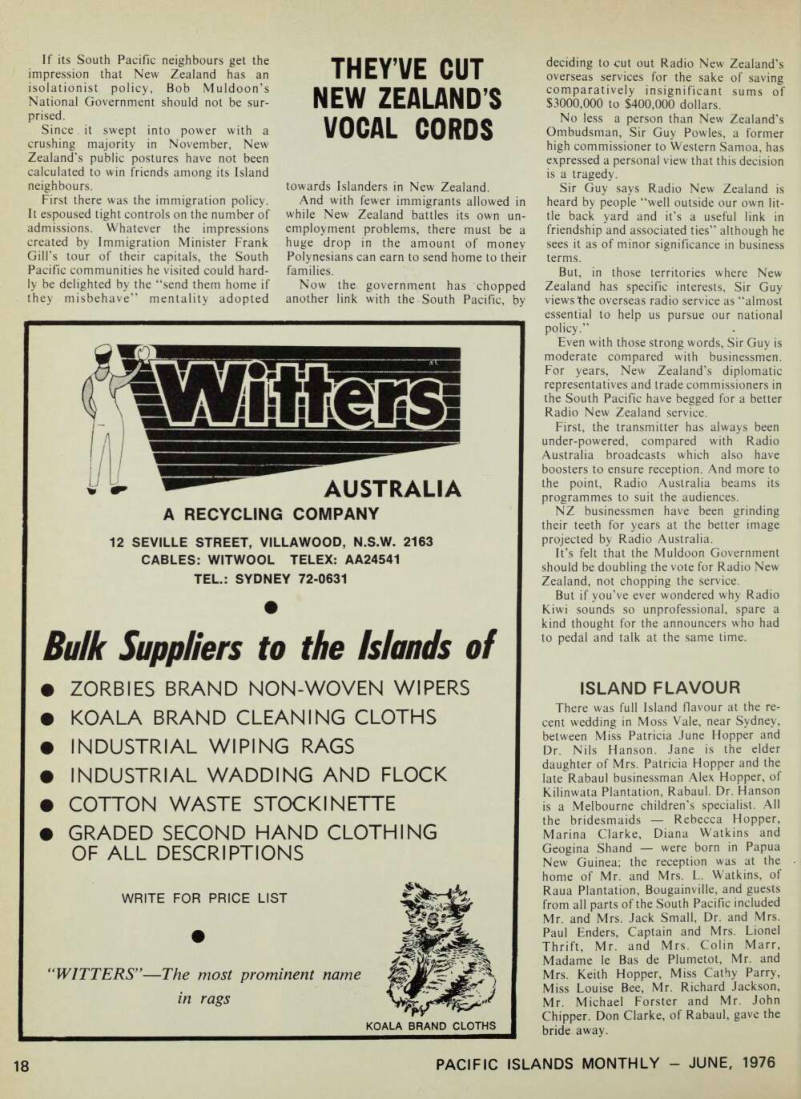
Tuvalu (formerly Ellice islands) com memorates its new currency following separation from the Gilberts with four stamps featuring their first coins and the wildlife depicted on them.
Papua New Guinea’s latest national heritage issue shows a variety of four houses of local materials, both large and small.
The Cook Islands has issued from its largest and most northern island, Penrhyn, two denominations commemorating the American Revolution Bicentennial, on the basis that Penrhyn was visited by various US expeditions to the Pacific, that it is shown as claimed by the US on many maps, and that it was a major base for the US Air Force during the Pacific war.
No particular reason is given for Pit cairn issuing four stamps for the Bicen tennial. As well, Western Samoa combines three commemorations in an elaborate five-colour souvenir sheet. This includes a huge 80mm by 120 mm one dollar stamp depicting Samoa’s first gold coin.
Mr. Fred Archer
If its South Pacific neighbours get the impression that New Zealand has an isolationist policy, Bob Muldoon’s National Government should not be sur prised.
Since it swept into power with a crushing majority in November, New Zealand’s public postures have not been calculated to win friends among its Island
neighbours.
First there was the immigration policy.
It espoused tight controls on the number of admissions. Whatever the impressions created by Immigration Minister Frank Gill’s tour of their capitals, the South Pacific communities he visited could hard ly be delighted by the “send them home if they misbehave” mentality adopted
They’Ve Cut
New Zealand’S
Vocal Cords
towards Islanders in New Zealand.
And with fewer immigrants allowed in while New Zealand battles its own un employment problems, there must be a huge drop in the amount of money Polynesians can earn to send home to their families.
Now the government has chopped another link with the South Pacific, by
deciding to cut out Radio New Zealand’s overseas services for the sake of saving comparatively insignificant sums of $3000,000 to $400,000 dollars.
No less a person than New Zealand’s Ombudsman, Sir Guy Powles, a former high commissioner to Western Samoa, has expressed a personal view that this decision is a tragedy.
Sir Guy says Radio New Zealand is heard by people “well outside our own lit tle back yard and it’s a useful link in friendship and associated ties” although he sees it as of minor significance in business terms.
But, in those territories where New Zealand has specific interests, Sir Guy views the overseas radio service as “almost essential to help us pursue our national policy.”
Even with those strong words, Sir Guy is moderate compared with businessmen.
For years, New Zealand’s diplomatic representatives and trade commissioners in the South Pacific have begged for a better Radio New Zealand service.
First, the transmitter has always been
under-powered, compared with Radio
Australia broadcasts which also have boosters to ensure reception. And more to the point, Radio Australia beams its programmes to suit the audiences.
NZ businessmen have been grinding their teeth for years at the better image
projected by Radio Australia.
It’s felt that the Muldoon Government should be doubling the vote for Radio New Zealand, not chopping the service.
But if you’ve ever wondered why Radio Kiwi sounds so unprofessional, spare a kind thought for the announcers who had to pedal and talk at the same time.
Island Flavour
There was full Island flavour at the re cent wedding in Moss Vale, near Sydney, between Miss Patricia June Hopper and Dr. Nils Hanson. Jane is the elder daughter of Mrs. Patricia Hopper and the late Rabaul businessman Alex Hopper, of Kilinwata Plantation, Rabaul. Dr. Hanson is a Melbourne children’s specialist. All the bridesmaids Rebecca Hopper, Marina Clarke, Diana Watkins and Geogina Shand were born in Papua New Guinea; the reception was at the home of Mr. and Mrs. L. Watkins, of Raua Plantation, Bougainville, and guests from all parts of the South Pacific included Mr. and Mrs. Jack Small, Dr. and Mrs.
Paul Enders, Captain and Mrs. Lionel Thrift, Mr. and Mrs. Colin Marr, Madame le Bas de Plumetot, Mr. and Mrs. Keith Hopper, Miss Cathy Parry, Miss Louise Bee, Mr. Richard Jackson, Mr. Michael Forster and Mr. John Chipper. Don Clarke, of Rabaul, gave the bride away.
Advertisements & other items, p. 18 (1 item)
Bulk Suppliers to the Islands of
AUSTRALIA
A RECYCLING COMPANY
12 SEVILLE STREET, VILLAWOOD, N.S.W. 2163
CABLES: WITWOOL TELEX; AA24541
TEL: SYDNEY 72-0631
Bulk Suppliers to the Islands of
• ZORBIES BRAND NON-WOVEN WIPERS
• KOALA BRAND CLEANING CLOTHS
• INDUSTRIAL WIPING RAGS
• INDUSTRIAL WADDING AND FLOCK
• COTTON WASTE STOCKINETTE
• GRADED SECOND HAND CLOTHING
OF ALL DESCRIPTIONS
WITTERS” —The most prominent name in rags
WRITE FOR PRICE LIST
KOALA BRAND CLOTHS
People
“Ah, horses for courses”, thought Nauru’s President Hammer Deßoburt when he received the credentials of the United States new Ambassador to the republic, Mr James W. Hargrove, on April 20. The president learned that Mr Hargrove, before becoming a diplomat, was Assistant Postmaster-General of the United States, so, the next day, the president had the ambassador ceremoniously opening Nauru’s new Post Office at the Civic Centre.
The Most Rev Petero Mataca has been named as Roman Catholic Archbishop of Suva, to succeed Archbishop George Pearce. Archbishop-elect Mataca, who was ordained in 1959, was consecrated auxiliary bishop in December, 1974 and is the first Fijian to become a bishop. He had previously held important positions in the Catholic mission in Fiji. American born Archbishop Pearce, who succeeded Archbishop Victor Foley in the late 19605, has suffered ill-health for long periods in recent years. He was con secrated bishop and named Vicar Apostolic of Western Samoa in 1956. He became Bishop of Apia when Western Samoa was raised to the status of a diocese.
Two well-known diplomats in the South Pacific will soon take up new ap pointments. Mr Harold Bullock, Australian High Commissioner to Fiji, Tonga and Western Samoa since February, 1973, is to return to Australia to take up a post in Canberra. Mr Ramesh Chandar Arora has been named to suc ceed Mr Bhagwan Singh, Indian High Commissioner in Fiji and Tonga since 1971. Mr Arora has served in a number of overseas embassies for the Government of India. Mr Bhagwan Singh was one of the most popular Indian High Com missioners in the South Pacific, striving at all times to identify himself with local in terests as well as representing the interests of his government.
Samoan-born Peter Tali Coleman has effectively taken over as High Com missioner for the US Trust Territory, although the outgoing incumbent, Edward E. Johnston, does not finish until July 1.
Mr Johnston resigned to join the Pacific Area Travel Association as executive vice president. Mr Coleman, who has been deputy High Commissioner, first came to the Trust Territory in 1961 as ad ministrator of the Marshall District. Born at Pago Pago in American Samoa in 1919, he was educated in Honolulu (St
Louis College) and Washington
(Georgetown University) before being ap pointed to the Office of Territories in 1951 and a year later as Public Defender in American Samoa. He became Attorney- General and then Governor there before being transferred to the Trust Territory.
The Fiji Visitors Bureau has opted for hard business experience in appointing Irishman Paddy Doyle as bureau general manager. Mr Doyle, a younger brother of a former Fiji Attorney-General, has been in Fiji since 1958. He was a Taylor Woodrow engineer on the Nadi airport reconstruction. On completion of that project Mr Doyle joined up with American businessman and airline pilots to develop several hotel projects, in cluding the Sky Lodge, the Mocambo (which was built by Mr Barry Philp) and the Fijian Hotel. He left this consortium, which became Fiji Resorts Ltd to become a consultant for the company developing the Soqulu project in Taveuni.
After a major heart attack his third Sir Albert Henry, premier of the Cook Islands, said he had never felt better upon his return home from New Zealand and the South Pacific Festival of Arts in Rotorua. Despite the attack during the festival in March, Sir Albert showed no signs of any ailment when he stepped from a plane in Raratonga towards the end of April, and appeared full of his usual vigour and good humour. He told a welcoming crowd he had no intention of retiring from politics between now and the next elections in 1978.
Mr Laki Niu, a young Tongan, has returned home from New Zealand to be his country’s Assistant Crown Solicitor.
He first became a legal assistant in the Crown Solicitor’s Office after receiving his LL.B. degree at Auckland University, but went back to NZ in 1974 to finish his professional units and to be admitted as a barrister and solicitor of the Supreme Court of NZ.
Fiji-born Philip Best, 41, will become general manager of Burns Philp and Co Ltd in July, succeeding Mr Maurice (Dan) O’Connor, who will then retire. Mr Best came to Australia in 1975 from Suva, where he was general manager of Burns Philp (SS) Ltd. Mr O’Connor was also on the staff for the South Sea company for some years. Mr O’Connor, along with two other BP men in the South Pacific, Mr R.
M. Stobo and Mr B. C. Goodsell, retires from the parent company board in July.
Among them they have chalked up 122 years service with the “old firm’’. They will be replaced by Mr Best, Mr P. J.
Ferris, 43 and Mr R. T. Heiler, 40. Mr Best joined the South Sea company 25 years ago.
Advertisements & other items, pp. 19-21 (1 item)
“Skillet”
Round gourmet
r
THE HANDIEST NEW APPLIANCE
SINCE FRYPANS
Bacon and eggs for two? Simple for the Sunbeam "Skillet". Yet "Skillet" is big enough to roast a size 8 chicken to perfection. And to wash simply remove the control and dunk the pan in the sink.
Another first and it comes only from Sunbeam.
8 Speed
Power
Blender
THE APPLIANCE YOU CAN USE
EVERY MEAL
With powerful. Solid-state motor. Which means the exact blending action you need to— Whip, grate, mix, chop or liquefy. Stainless steel cutters give fast food preparation while switching from speed to speed without turning off . . .
s» I
Mixmaster Mixer
3 times better than any
other mixer. Designed especially for family food preparation. 12-speed mixfinder dial indicates the correct speed for each mixing action. Complete with 2 heat-resistant bowls and juice extractor. Sunbeam’s exclusive 3-way beating action — extra large, contoured beaters, and automatic bowl movement — gives perfect aeration and more even mixing. It can handle everything from beating one egg to mixing a large fruit cake.
BECOME A PART
OF PlM's PACIFIC
AND SUBSCRIBE NOW
* E ◄ o D O X CO a 0) 0)
FILL IN THE DETAILS
ON THE ATTACHED
ORDER FORMS
The Editor's Mailbag
In Defence Of Fiji
In PlM’s April issue (p. 25) Mr Clive Sadleir rejects the constructive and, to my mind, gentle criticism of current tourist facilities in Fiji made by ‘A Sydney Travel Agent’ (PIM, Feb. p. 29).
Mr Sadleir’s letter was headed Tn Defence of Fiji’, but I suggest that it is precisely this negative form of support which is not only inhibiting but reversing the advancement of Fiji as a modern Pacific nation.
Almost all the points made by the Sydney Travel Agent (Mr X) are valid and I would imagine that the reason he wishes to remain anonymous is to avoid the wrath of anti-critics in his future dealings with Fiji and he is wise to do so. Mr Sadleir no doubt has an equally good reason for public flag waving. Mr X stated that the tourist cannot fully enjoy the local at mosphere, stuck away in a 20-storey stereo model modern hotel. Mr Sadleir complete ly misses the point by protesting that there are no 20-storey hotels in Fiji.
Mr X remarks that the taxi trade for tourists in Fiji is a ‘rip-off. Mr S Disputes this. Apparently Mr S is unaware that taxi meters are often not activated, that the un suspecting tourist is often taken for a detour of several miles to reach his destina tion less than one mile away.
The possibility of being robbed in Fiji in broad daylight is scoffed at by Mr S and I cannot imagine why.
Perhaps, like many of the working whites in Fiji he dwells in an ivory tower and is removed from the sordid facts as they really are. Records clearly show that tourists have been assaulted, robbed, raped and, less frequently, murdered at various hours of the day and night to a far greater extent (in proportion) than tourists let us say, in New Zealand, or the Gold Coast of Queensland.
In March last year a message by the police was sent out through Radio Fiji warning people in Suva to keep off the streets after sundown and we assume that they did not take this action lightly.
For Mr S to comment that similar situations exist in parts of Australia does not diminish, excuse or nullify in any way the charge made by Mr X which is factual, as is the charge that drink today in Fiji is a serious and increasing problem.
It is a fact that today’s visitor to Fiji is not infrequently intimidated and ‘hard
shouldered’ by local drunks. If Mr S. does not believe this, I suggest that he visits the hotels and places of entertainment where the tourist is expected to find night recrea tion to see for himself.
Mr X suggests positive means of preven ting the continuing run-down of the tourist industry in Fiji. Mr S opines incredibly, that the run down is probably ‘a good thing’, because this will cull out the inef ficient. I wonder whether Mr S realises the damage that has already been done to Fi ji’s investment image by inept administra tion, by open discrimination against overseas ‘so-called ex-patriate’ business operators and by broken departmental promises. If he is not aware of the dis astrous effect that these have had on business development in Fiji, I suggest that he goes along to the Government Bureau of Statistics at Nasese in Suva and gets some figures and facts first-hand from the
people there.
Mr S comments that the famous Fijian smile is tending to disappear due to realisa tion that Australians and New Zealanders can and often do earn more than three times as much as the average Fijian. The relevance of this comment to the question of poor tourist facilities excapes me. Is Mr S suggesting that the tourist shall apologize for advanced productivity at home and for his economic good fortune?
Mr S states that there will be an upturn within a few months in tourist traffic in Fiji, but he does not give his reasons for such blithe optimism and he concludes his letter by saying that Fiji is changing and that its beauty remains untouched.
Such time-worn platitudes surely do nothing to advance Fiji’s lot, in fact, I suggest that it is largely this ‘head in sand’ attitude that is responsible for the current technological, industrial and commercial near-vacuum in Fiji, also for the impres sion given to visiting Europeans by the ad ministration that they are ‘persona non grata.’
I suggest that as an Australian Travel Agent, Mr X is in a position to be far more aware of what tourism should stand for and of its problems than Mr S. I suggest Mr X acted with good intentions by pointing out existing flaws and that Mr S might serve the interests of Fiji better by viewing the problem objectively (and after
research) and possibly, by having the moral stamina to point out to the govern ment that the image of Fiji from a tourist, investment and economy standpoint is
deteriorating and deteriorating rapidly.
All the evidence and signs are available and obvious. Sweeping them under the carpet can only increase their dimensions.
A few constructive, albeit unpopular suggestions which I would make, were I permitted, would be as follows: • Put an end to the Indian ‘All Strata’ control of ministries, set up fast-moving avenues of court appeal against corruption and bias and procrastination as may come to light and punish with extreme severity public servants who may be found to be responsible. Bring in a few impartial, qualified experts to advise the ministers, experts who have no business connection or relatives involved in business in Fiji. • Examine closely the adequacy, com mercial experience and qualifications of those administering and working for the Fiji Visitors Bureau. • Rationalise the application of localisa tion policy, which at present is unrealistic, over-restrictive and works overwhelmingly to the advantage of the Indian and Euro
pean Fijian nationals only, by excluding
any real and dynamic competition. In its present form, localisation benefits to the Fijian have been and are likely to be negligible if at all. • Examine the effectiveness and tangible achievements of the Fiji Development Bank during the past few years. • Change current policy to permit Fijian hotel management personnel and staff members to obtain professional overseas training, even if this is only for a limited duration to develop a nucleus of qualified personnel in a position to pass on their ex pertise to Fijian hotel staff personnel who may follow. • Encourage constructive criticism from all sources and consider its possible merit and justification without prejudice.
I have written this letter objectively with no ‘axe to grind’ in the sincere hope that you can find space to publish it, and so generate further thought and comment concerning this topic, which is of such vital importance to the interest of Fiji.
Wynnum West, Qld.
Bill Dennis
The Sydney travel agent, author of an article about tourism in the Pacific (PIM, Feb., p. 29) apparently feels that the ma jority Australians who visit the Pacific Islands as tourists wish to see an island of their dreams “of blue skies, white beaches and waving coconut palms”. He then suggests that the Island people make an ef fort to maintain the tourists’ romantic view by somehow conspiring to live in a picture postcard. That this is impossible should be obvious.
Letters
But even if it were possible it would be both wrong and detrimental to both the tourist and the host country.
The reasons why people travel as tourists are mainly twofold; for rest and relaxation and to learn about the place they visit. The first can be done easily enough, for example by checking into a large city hotel and relaxing. The main reason for travelling to a different country, for example an Australian tourist visiting a Pacific Island, should then be mainly educational. To wish to learn a lie, as your author suggests, seems to me to be detrimental to the tourist. And for a travel agent, who has some influence on where and why people travel as tourists, to suggest this is doubly wrong.
Tourists are a necessary evil, especially for developing countries. The only reason they are permitted to exist is as a source of
foreign dollars.
If a tourist has his dreams shattered by a visit to the reality of the Pacific Islands it’s hardly the Islands’ fault. That they are places of real people living real lives not just “blue skies and white beaches’’ should surprise no one with any sense. For the Pacific countries to change just for the benefit of the tourists would both con tribute to a lie and, more importantly, be a waste of already heavily-taxed resources.
The fact that most tourists are only marginally interested in learning anything about the country they visit makes it even less desirable to cater to their whims. Most tourists that I saw during my years in Suva were interested in only two things, the quality of their hotel and where they could purchase the cheapest radio or camera. Of the country and its inhabitants they couldn’t care less. Combining this and the fact that their sole benefit is their money, which they so often flaunt, is it any wonder that many people in developing countries, the Pacific included, treat tourists as easy sources of money?
Toronto, Canada
David Pike
A Doormat
Santo, the largest island and biggest (80%) producing centre in the New Hebrides has over the years been con sidered the most turbulent and aggressive.
With just reason.
Apart from import tax, native and ex patriate producers also pay export tax, the bulk of which is invariably swallowed up by the capital, Vila, and very little left over for Santo’s development.
More recently, since the advent of inter
nal politics, Santo natives have shown force while objecting to demonstrations and marches held by parties which com prise OUTER-island natives and their leaders.
It it any wonder that a certain local political party demanded immediate in dependence for Santo alone?
How would the Tannese, Malekulans and Vila natives feel if Santoites demonstrated and marched through their towns or villages?
So let us be fair and ponder over in justices, even rudeness, of outer-islanders and both governments who appear to use Santo as a convenient door-mat without as much as a “beg your pardon”.
Santo
W.Tevi
Guadalcanal Visit
As Tour Organiser for the Marine ’75 “Sentimental Journey” II to the South Pacific may I take this opportunity to ex press our thanks and appreciation for the excellent PIM article (February issue) en titled “U.S. Marines at Guadalcanal Again” by Michael McCoy (PIM, February, p. 37). It was indeed quite an “emotional” experience for all of us who were returning again for the first time since 1942!
May we request permission to quote ex cerpts from Michael McCoy’s article for inclusion in upcoming issues of Ist Marine Division’s publication “The Old Breed News”, and our own quarterly ‘newsletter”? We feel certain members of both associations will appreciate hearing and learning more about Guadalcanal “now”.
Brunswick, Maine
Al Bonney
Women's Lib
I was very interested in the article about the meeting held by women in Fiji (PIM Feb 1976 p. 67). Having just moved to New Zealand from the US I find that the issue of women’s rights is still in a somewhat infantile form “down under” a wife is always an adjunct to her husband, a woman must use either Mrs or Miss before her name. The article in PIM did seem to point up the fact that no matter how much national identity, ethnic pride, or whatever an Oceanic nation may have, the leaders, mainly men (eg Sir Albert Henry), see women as distinctly second class citizens. I hope to see more articles of the so-called “Women’s Lib” theme in PIM, especially those relating to South Pacific women breaking the chains that bind them!
Charlene Gregory
Auckland, New Zealand.
Advertisements & other items, pp. 22-24 (1 item)
Let Lane
lend a hand
These are some of the products which are keeping our customers prosperous. From this range, you can obtain a realty effective herbicide such as M.S.M.A , which controls persistent grasses and sedges in coconuts and bananas, or a short, residual, quick-acting insecticide like DIBROM, which controls fruit and vegetable insects and mosquitoes, sandflies and midges.
Also, our research facilities and advisory services In the field are among the best available, so drop us a line and let us help you.
Lane Ltd., Export Division, P.O. Box 59, Bankstown, N.S.W. 2200 Lane (Fiji) Ltd., P.O. Box 89, Suva, Fiji /I
■[lnsecticide
f Fungici t Weedkiller f , ‘ Feed Supplement * if : umigants . if/ Animal Health N Home Garde^ \ \ \ rjf Don’t target—Amalgamated Chemicals is now Lane 9859
E. G. BARKER & CO. PTY. LTD.
Established 1825 150 Years of Service
AUSTRALIA S OLDEST EXPORT HOUSE
GENERAL EXPORT MERCHANTS
Specialising in world-wide distribution of General Merchandise, Provisions and Produce
EXPORTING TO ALL PORTS IN
PACIFIC ISLANDS
Buying Agents for:— THE CO-OPERATIVE WHOLESALE SOCIETY LTD.
LAE AND ALL BRANCHES
i
PORT MORESBY
RAYMOND WONG
P.O. Box 5020
BOROKO
Phone 25 5546 Representatives
RABAUL
CON SASSADIS
P.O. Box 611
RABAUL
Phone 92 2934
FIJI
PARAMOUNT AGENCIES
G.P.O. Box 459
SUVA
Phone 2 3127
34 HUNTER STREET, SYDNEY 2000
Cable Address: KERBAR SYDNEY. Phone: 231-6200. Telex: 22221 Melbourne Office: 530 Little Collins Street. Phone: 61-2877. Telex: 31732.
BOWMANS OVERSEAS SALES
BUILDING MATERIALS EXPORT SPECIALISTS
With branches in PORT MORESBY, LAE, KIETA (Bowmans (PNG) Pty. Ltd.) and HONIARA (Bowmans 5.1.), we are familiar with Pacific Islands requirements. Exporting building
materials generally including
TIMBER
MOULDINGS
FLOORING
PLYWOOD
PARQUETRY
PARTICLEBOARD
HARDBOARD
DOORS
PLUMBING SUPPLIES
BUILDERS’ HARDWARE
CONVEYORS
WIRE PRODUCTS
WINDOW GLASS AND LOUVRES
TILES
STEEL PRODUCTS
POLYTHENE FILM
Contact R. Chambers or W. Franken for prompt, personal attention P.O. Box N 345, Grosvenor Street, Sydney, N.S.W., Australia 2000
Cables: LEBOWMAN SYDNEY Telex: LEBOW AA26353
Save hundreds of dollars
on Australia’s most efficient
WALK IN, ALUMINIUM
COOLROOMS AND
FREEZE ROOMS
Hundreds already installed! The most economical supplementary coolrooms for bottles and food, providing the largest storage capacity of any comparable coolrooms of the same exterior dimensions. Five sizes —from 90-360 cu. ft. capacity; 16 models offering normal temp., two temp., deep freeze, or for pastry and ice storage applications. White vinyl interior, embossed rustproof aluminium exterior. • SUPPLIED IN EASY-TO-ERECT, DO-IT-YOURSELF KIT FORM.
Available from:
AUSTRALIAN NEW CALEDONIA
EXPORTS (SILVER & BARDA), 363
George St”' Sydney, 2000 and Branches.
BRECKWOLDT & CO., 276 Pitt St., Sydney, 2000 and Branches.
PETER FISHER TRADING PTY. LTD., 321 Pitt St., Sydney, 2000.
HAGEMEYER (A'SIA), 59 Anzac Pde., Kensington, 2033 and Branches.
GEOFFREY HUGHES & CO., 167 Macquarie St., Sydney, 2000.
Manufactured by:
NELSON & ROBERTSON PTY. LTD., 197 Clarence St., Sydney, 2000.
RABAUL TRADING CO. PTY. LTD., P.O. Box 219, Rabaul and Branches E RABOT (EXPORTS) PTY. LTD., 67 Castlereagh St., Sydney, 2000.
H. Y. KWAN (AUST.) PTY. LTD., Box 2713 G.P.O. Sydney, 2001.
C. SULLIVAN (EXPORT) PTY. LTD., 60 Margaret St., Sydney, 2000 am Branches. , . , W. S. TAIT & CO., PTY. LTD., 31 Macquarie Place, Sydney, 2000 am Branches.
T 1
FRIGID CABINETS PTY. LTD.,
HA Huffy Ave., Thornleigh, N.S.W. 2120 Ausl. Ph. 848 8292.
Fiji mumbo-jumbo?
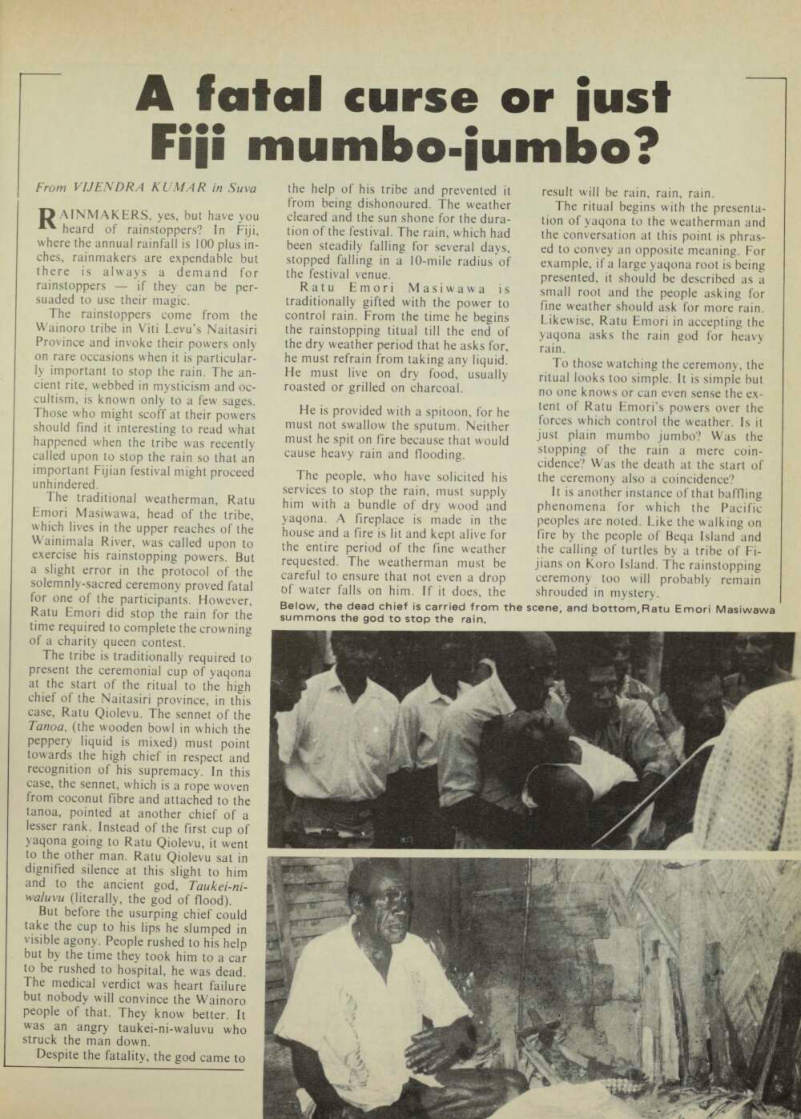
A fatal curse or just Fiji mumbo-jumbo?
From VIJENDRA KUMAR in Suva D AINMAKERS, yes, but have you heard of rainstoppers? In Fiji, where the annual rainfall is 100 plus in ches, rainmakers are expendable but there is always a demand for rainstoppers if they can be per suaded to use their magic.
The rainstoppers come from the Wainoro tribe in Viti Levu’s Naitasiri Province and invoke their powers only on rare occasions when it is particular ly important to stop the rain. The an cient rite, webbed in mysticism and oc cultism, is known only to a few sages.
Those who might scoff at their powers should find it interesting to read what happened when the tribe was recently called upon to stop the rain so that an important Fijian festival might proceed unhindered.
The traditional weatherman, Ratu Emori Masiwawa, head of the tribe, which lives in the upper reaches of the Wainimala River, was called upon to exercise his rainstopping powers. But a slight error in the protocol of the solemnly-sacred ceremony proved fatal for one of the participants. However, Ratu Emori did stop the rain for the time required to complete the crowning of a charity queen contest.
The tribe is traditionally required to present the ceremonial cup of yaqona at the start of the ritual to the high chief of the Naitasiri province, in this case, Ratu Qiolevu. The sennet of the Tanoa, (the wooden bowl in which the peppery liquid is mixed) must point towards the high chief in respect and recognition of his supremacy. In this case, the sennet, which is a rope woven from coconut fibre and attached to the tanoa, pointed at another chief of a lesser rank. Instead of the first cup of yaqona going to Ratu Qiolevu, it went to the other man. Ratu Qiolevu sat in dignified silence at this slight to him and to the ancient god, Taukei-ni waluvu (literally, the god of flood).
But before the usurping chief could take the cup to his lips he slumped in visible agony. People rushed to his help but by the time they took him to a car to be rushed to hospital, he was dead.
The medical verdict was heart failure but nobody will convince the Wainoro people of that. They know better. It was an angry taukei-ni-waluvu who struck the man down.
Despite the fatality, the god came to
the help of his tribe and prevented it from being dishonoured. The weather cleared and the sun shone for the dura tion of the festival. The rain, which had been steadily falling for several days, stopped falling in a 10-mile radius of the festival venue.
Ratu Emori Masiwawa is traditionally gifted with the power to control rain. From the time he begins the rainstopping titual till the end of the dry weather period that he asks for, he must refrain from taking any liquid.
He must live on dry food, usually roasted or grilled on charcoal.
He is provided with a spitoon, for he must not swallow the sputum. Neither must he spit on fire because that would cause heavy rain and flooding.
The people, who have solicited his services to stop the rain, must supply him with a bundle of dry wood and yaqona. A fireplace is made in the house and a fire is lit and kept alive for the entire period of the fine weather requested. The weatherman must be careful to ensure that not even a drop of water falls on him. If it does, the
result will be rain, rain, rain.
The ritual begins with the presenta tion of yaqona to the weatherman and the conversation at this point is phras ed to convey an opposite meaning. For example, if a large yaqona root is being presented, it should be described as a small root and the people asking for fine weather should ask for more rain.
Likewise, Ratu Emori in accepting the yaqona asks the rain god for heavy rain.
To those watching the ceremony, the ritual looks too simple. It is simple but no one knows or can even sense the ex tent of Ratu Emori's powers over the forces which control the weather. Is it just plain mumbo jumbo? Was the stopping of the rain a mere coin cidence? Was the death at the start of the ceremony also a coincidence?
It is another instance of that baffling phenomena for which the Pacific peoples are noted. Like the walking on fire by the people of Beqa Island and the calling of turtles by a tribe of Fi jians on Koro Island. The rainstopping ceremony too will probably remain shrouded in mystery.
Below, the dead chief is carried from the scene, and bottom,Ratu Emori Masiwawa summons the god to stop the rain.
Advertisements & other items, p. 26 (1 item)
S. E. Tatham
2 l
SOME OF THE FIRMS
WE REPRESENT ARE:
Asia Rubber Works (Singapore Rubber Shoes) Frappier (French Brandy) Huvet (French Brandy) Indika (Belgium Dairy Produce) Durobor S.A. (Belgium Glassware) Miroiterie Gen. de Belgiqe S.A. (Louvre glass and mirrors) City Engineers (U.K, Bicycles) F.H.I. Japan (Subaru Cars) Kraggs (Wines, Spirits, Ciders) Sunshine Biscuits Sunrise (Confectionery) Flamenco (Instant Coffee & Tea) Quaker Products (Oats, Jets) Hancocks (Spaghetti, Cereals) Melbourne Canning (Jams) Amatil (Twisties, Twirlies) Edward Zorn (Margarine, Cooking Fats) Allens (Confectionery) Red Tulip (Fine Chocolates) Robert Timms (New Guinea Gold Instant Coffees and Teas) S.P.C. (Canned Fruit) S.P.C. (Abalone) Wing Lee (See You Sauce) Magnet (Mattresses) Essteel (Cookware) Warner-Drayton (Fans) Mitahell's (Abrasives) Tilbury & Lewis (Sports Trophies & Silverplate) Regent (Swiss watches) Lega Marcasite (Jewellery) Austramax (Pressure Lanterns) Lawn Chair; Tubco (Garden Furniture) Electronic Industries (Electrical Household Appliances) Jex (Steelwool) Arnbro (Folding Beds) James Miller (Blankets) Elmaco (Plastics —Electrical Fittings) B.X. (Plastics) Stegbar (Wooden Louvres) Franklite (Light Fittings) JJ. Cash Embroidered Labels) Disston (Saws)
S. E. TATHAM
S CO. PTY. LTD.
BEEHIVE BLDG.,
94 ELIZABETH ST.,
MELBOURNE, 3001, AUSTRALIA.
G.P.O. BOX B—CABLES "SET"
TELEPHONE 63 5094
TELEX: AA34293
BUYERS FOR THE
PACIFIC ISLANDS
5* 1 %
DIRECT ENQUIRIES WELCOMED
PAPUA NEW GUINEA; S. E. TATHAM (P.N.G.) PTY. LTD.
LAE: MALAITA STREET (P.O. BOX 1562).
PORT MORESBY: CNR. GOROA AND MUNAHU STREETS, GORDON
(P.O. BOX 6733, BOROKO).
FIJI: S. E. TATHAM (FIJI) LTD.,
LAUTOKA; P.O. BOX 366.
SUVA; G.P.O. BOX 671.
YOUR GUARANTEE
SINCE 1924
1
FOR SERVICE
The US army’s ghetto-islet
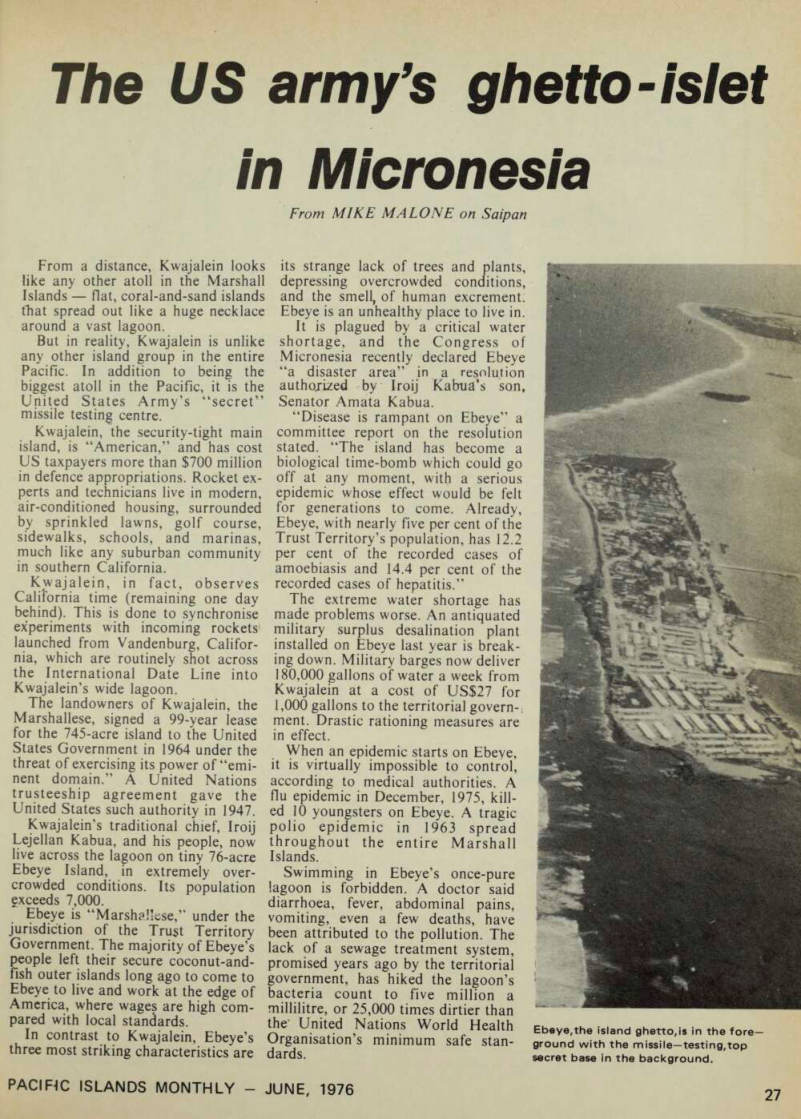

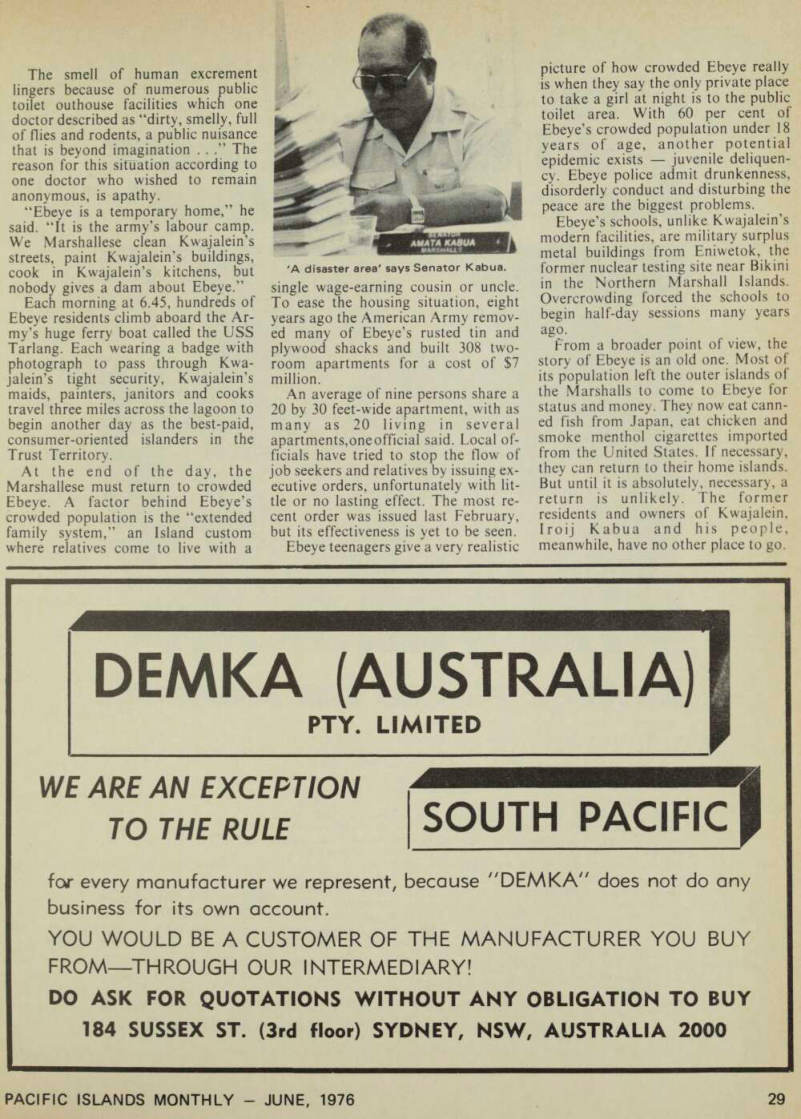
in Micronesia
From MIKE MALONE on Saipan
From a distance, Kwajalein looks like any other atoll in the Marshall Islands flat, coral-and-sand islands that spread out like a huge necklace around a vast lagoon.
But in reality, Kwajalein is unlike any other island group in the entire Pacific. In addition to being the biggest atoll in the Pacific, it is the United States Army’s “secret” missile testing centre.
Kwajalein, the security-tight main island, is “American,” and has cost US taxpayers more than $7OO million in defence appropriations. Rocket ex perts and technicians live in modern, air-conditioned housing, surrounded by sprinkled lawns, golf course, sidewalks, schools, and marinas, much like any suburban community in southern California.
Kwajalein, in fact, observes California time (remaining one day behind). This is done to synchronise experiments with incoming rockets launched from Vandenburg, Califor nia, which are routinely shot across the International Date Line into Kwajalein’s wide lagoon.
The landowners of Kwajalein, the Marshallese, signed a 99-year lease for the 745-acre island to the United States Government in 1964 under the threat of exercising its power of “emi nent domain.” A United Nations trusteeship agreement gave the United States such authority in 1947.
Kwajalein’s traditional chief, Iroij Lejellan Kabua, and his people, now live across the lagoon on tiny 76-acre Ebeye Island, in extremely over crowded conditions. Its population exceeds 7,000.
Ebeye is “Marshallese,” under the jurisdiction of the Trust Territory Government. The majority of Ebeye’s people left their secure coconut-and fish outer islands long ago to come to Ebeye to live and work at the edge of America, where wages are high com pared with local standards.
In contrast to Kwajalein, Ebeye’s three most striking characteristics are
its strange lack of trees and plants, depressing overcrowded conditions, and the smell, of human excrement.
Ebeye is an unhealthy place to live in.
It is plagued by a critical water shortage, and the Congress of Micronesia recently declared Ebeye “a disaster area” in a resolution authorized by Iroij Kabua’s son.
Senator Amata Kabua.
“Disease is rampant on Ebeye” a committee report on the resolution stated. “The island has become a biological time-bomb which could go off at any moment, with a serious epidemic whose effect would be felt for generations to come. Already, Ebeye, with nearly five per cent of the Trust Territory’s population, has 12.2 per cent of the recorded cases of amoebiasis and 14.4 per cent of the recorded cases of hepatitis.”
The extreme water shortage has made problems worse. An antiquated military surplus desalination plant installed on Ebeye last year is break ing down. Military barges now deliver 180.000 gallons of water a week from Kwajalein at a cost of US$27 for 1.000 gallons to the territorial govern ment. Drastic rationing measures are in effect.
When an epidemic starts on Ebeye, it is virtually impossible to control, according to medical authorities. A flu epidemic in December, 1975, kill ed 10 youngsters on Ebeye. A tragic polio epidemic in 1963 spread throughout the entire Marshall Islands.
Swimming in Ebeye’s once-pure lagoon is forbidden. A doctor said diarrhoea, fever, abdominal pains, vomiting, even a few deaths, have been attributed to the pollution. The lack of a sewage treatment system, promised years ago by the territorial government, has hiked the lagoon’s bacteria count to five million a millilitre, or 25,000 times dirtier than the' United Nations World Health Organisation’s minimum safe stan dards.
Ebeye,the island ghetto, is in the fore ground with the missile—testing,top secret base in the background.
The smell of human excrement lingers because of numerous public toilet outhouse facilities which one doctor described as “dirty, smelly, full of flies and rodents, a public nuisance that is beyond imagination . . .” The reason for this situation according to one doctor who wished to remain anonymous, is apathy.
“Ebeye is a temporary home,” he said. “It is the army’s labour camp.
We Marshallese clean Kwajalein’s streets, paint Kwajalein’s buildings, cook in Kwajalein’s kitchens, but nobody gives a dam about Ebeye.”
Each morning at 6.45, hundreds of Ebeye residents climb aboard the Ar my’s huge ferry boat called the USS Tarlang. Each wearing a badge with photograph to pass through Kwa jalein’s tight security, Kwajalein’s maids, painters, janitors and cooks travel three miles across the lagoon to begin another day as the best-paid, consumer-oriented islanders in the Trust Territory.
At the end of the day, the Marshallese must return to crowded Ebeye. A factor behind Ebeye’s crowded population is the “extended family system,” an Island custom where relatives come to live with a
single wage-earning cousin or uncle.
To ease the housing situation, eight years ago the American Army remov ed many of Ebeye’s rusted tin and plywood shacks and built 308 two room apartments for a cost of $7 million.
An average of nine persons share a 20 by 30 feet-wide apartment, with as many as 20 living in several apartments,one official said. Local of ficials have tried to stop the flow of job seekers and relatives by issuing ex ecutive orders, unfortunately with lit tle or no lasting effect. The most re cent order was issued last February, but its effectiveness is yet to be seen.
Ebeye teenagers give a very realistic
picture of how crowded Ebeye really is when they say the only private place to take a girl at night is to the public toilet area. With 60 per cent of Ebeye’s crowded population under 18 years of age, another potential epidemic exists juvenile deliquen cy. Ebeye police admit drunkenness, disorderly conduct and disturbing the peace are the biggest problems.
Ebeye’s schools, unlike Kwajalein’s modern facilities, are military surplus metal buildings from Eniwetok, the former nuclear testing site near Bikini in the Northern Marshall Islands.
Overcrowding forced the schools to begin half-day sessions many years ago.
From a broader point of view, the story of Ebeye is an old one. Most of its population left the outer islands of the Marshalls to come to Ebeye for status and money. They now eat cann ed fish from Japan, eat chicken and smoke menthol cigarettes imported from the United States. If necessary, they can return to their home islands.
But until it is absolutely, necessary, a return is unlikely. The former residents and owners of Kwajalein, Iroij Kabua and his people, meanwhile, have no other place to go.
'A disaster area' says Senator Kabua.
Advertisements & other items, pp. 28-32 (2 items)
Good-Year
The world over, more vehicles of all kinds roll on Goodyear tyres ... more planes land on Goodyear tyres ... more synthetic rubber is produced by Goodyear... and more different kinds of hose,
transmission belts, conveyor belts and other
industrial rubber goods bear the Goodyear trademark.
For leadership in rubber technology, look to
Goodyear. The world’s largest rubber company.
We solve industrial problems.
GOODYEAR DISTRIBUTORS IN S.E. ASIA AND PACIFIC BASIN
GOOD-YEAR
Guam Tire & Supply Co.
Agana, Guam Boroko Motors Ltd.
Port Moresby, PNG.
Societe General Automobile Noumea, New Caledonia Service Mobil Papeete, Tahiti Santo Engineers Santo, New Hebrides Micro! Corporation Saipan, Mariana Is.
Pacific Motors Vila, New Hebrides Yap Cooperative Ass.
Yap, W. Caroline Is.
Morris Hedstrom Ltd.
Apia, Western Samoa Duncombe Bay Garage Norfolk Is.
Truk Trading Co.
Truk, E. Caroline Is.
P.A.M.I.
Kolonia, Ponape Morris Hedstrom Tonga Cook Island Motors Cook Is.
Coral Island Motors Suva, Fiji Island Construction Co.
Majuro, Marshall Is.
Ngiratkel Etpison Co. Ltd.
Koror, Palau Yung Wei Tung Trading Co. Ltd.
Taipei, Taiwan Landis Brothers & Co. Ltd.
Hong Kong Solomon Motors Ltd.
Honiara, 8.5.1. P.
W.S.T.C.S.
Susupe Enterprises Saipan, Mariana Is.
Western Samoa Samoa Motors Inc.
American Samoa A 555
New
Wild Instruments
for construction!
7 a 9 6: 'I \ m r i
. El k
Better value for money.
Accurate measurements mean better construction, quick measurements lower costs. With the new Wild instruments you get both!
The TO5 Small Theodolite is specially designed for builders, contractors and site surveyors. It's the instrument you need for measuring and laying out angles. The circles are always bright and easy-to-read thanks to the new electronic illumination system. For levelling, take the NKOS Tilting Level: accurate and tough, it handles site and line levelling. The TO5 and NKOS have several common features: 19x erect-image telescope which focuses down to 80 cm, three-footscrew base, mirror viewing for tubular Jevel, bright red instrument colour and yellow tripod - highly visible for safety, and unbreakable Makrolon containers. The GSL Sectional Staff is what you need for site work; 1 m light-metal sections slot together to give any length.
The NKOI, NlO and NAKO levels, various tripods and staffs round off the Wild range of construction instruments. Ask for brochure G 1 149 e.
HE ERBRUGG
WILD (AUSTRALIA) PTY. LTD.
lEEjik
45 ERRING ROAD, NORTH RYDE, N.S.W. 2113. 888 7122 11 BUCHANAN STREET, WEST END, BRISBANE, OLD. 4101. 44 3455 83 - 85 PALMERSTON CRES., STH. MELBOURNE, VIC. 3205. 69 2263 BRIAN BELL & CO. PTY. LTD., BOROKO, T.P.N.G.
No matter which way you look at it. . . you’ll find . . .
KLEVKII
is the finest allpurpose ply for building in hot and humid conditions.
Made by Commonwealth N.G, Timbers Ltd and available from leading plywood suppliers.
N 4
Demka (Australia)
PTY. LIMITED
WE ARE AN EXCEPTION
TO THE RULE
SOUTH PACIFIC
for every manufacturer we represent, because "DEMKA" does not do any business for its own account.
YOU WOULD BE A CUSTOMER OF THE MANUFACTURER YOU BUY
FROM—THROUGH OUR INTERMEDIARY!
DO ASK FOR QUOTATIONS WITHOUT ANY OBLIGATION TO BUY 184 SUSSEX ST. (3rd floor) SYDNEY, NSW, AUSTRALIA 2000
Press
From The
Islands
A quiet time in Port Moresby as presented by the PNG Post-Courier: The Metropolitan Police Superintendent, Mr Lawrence Sausau, said yesterday the ban on liquor sales had helped to make the Easter weekend in Port Moresby a quiet one. Police reported 71 street arrests, eight break and enters and 10 motor vehicle accidents.
The importance of physical fitness in rugby players as expounded by King Taufa’ahau Tupous IV, of Tonga, and reported by the Tonga Chronicle: His Majesty likened players, who are not fit physically, to a raw egg dropped into a frying pan, and the fact that such an egg splashes in all directions. An unfit player, said His Majesty, when he goes on to the field will perform exactly the same as a raw egg. This statement from His Majesty drew a lot of understanding grins from the well-filled grandstand on
Saturday.
A new slant on sexual behaviour as reported by the Arawa Bulletin in an article on a Law Reform
Commission inquiry into PNG’s adultery laws:
. . . Under the present adultery law, it is a crime in PNG for married people to commit adultery with anyone except their husbands or wives. The adultery law, however, has applied only to Papua New Guineans and not expatriates . . . Also under the present law, there is no guaranteee that the defendants can receive some form of compensation if the wife, husband, son-in law or daughter-in-law commits adultery.
From a farewell message by Mr Justice D.R. Davies of the New Hebrides High Court leaving the condominium to be Chief Justice of the Solomons, as reported by the New Hebrides News: “■ • • The multiplicity of legal systems and of courts in a little place like this is confusing to everyone and only serves to bring the law into disrespect,” he said.
Norfolk Island’s cosmopolitan population as recorded on the electoral roll and reported by the Norfolk Islander: . . . The roll shows 997 persons. Of these, 329 are of Pitcairn lineage ... the same exhibit shows that persons other than those of Pitcairn lineage, or those born on Norfolk Island have the following origin: Argentina, Australia, Burma, Canada, Ceylon, China, Curipipe, England, Fiji, France, Germany, Gilbert & Ellice Islands, Holland, Hungary, India, Ireland, Italy, Japan, Lithuania, Malta, New Hebrides, New Zealand, Norway, Scotland, South Africa, Sweden, Switzerland, USA and Wales.
From an editorial in the Samoa Times: The last issue of the Underground Monthly is now on sale in Apia. Some time today the monthly’s publisher and total staff, Miss Sherry A. Sullivan, will leave American Samoa probably for good. Her departure marks the end of a courageous fight against official deceit and general hypocrisy. In her last editorial titled “A few rarely published observations about American Samoa”, she, among other things, had this to say . . . “I was frightened half to death and later attacked. My hair was all hacked off and passed down a surrealistic ‘bucket brigade’ of Samoans, an earring was torn out and an attempt to blind me or disfigure my face was narrowly aborted.” She complained to the Police Commissioner who suggested “that I drop the prosecution because I would be ‘killed’ by the remaining
family members(aiga) if I succeeded in getting what looked like a definite conviction” . . .
From The Fiji Times: The Nadi Duty-Free Dealers’ Association will urge the Consumer Council and the Fiji Visitors Bureau to stop publicising such statements which warn tourists from buying in Fiji ... Its newly-elected secretary, Mr Himat Lodhia told The Fiji Times that his members were disappointed with the Consumer Council for publicising statements such as “look before you leap” for visitors. Such statements, he said, implied that Fiji’s duty-free dealers were cheaters and robbers and were there only to “suck money”. In fact, duty-free dealers were no such people, but were in existence to cater for the needs of the
duty-free goods buyers.
From the Tohi Tala Niue: Shame on those who go around slashing the polythene village water pipes with their bushknives. Someone suggested to us this week that to overcome the problem (which seems to be getting greater each week) the pipes should be made of galvanized iron and all local traders be restricted to selling plastic bushknives.
From a Cook Islands News report of Premier Sir Albert Henry’s stay in a New Zealand hospital after his heart attack at Rotorua: . . . Grinning widely he related yesterday how $4 was lost that afternoon with a punt on a horse called Royal Albert. There is nothing in a name when it comes to racehorses, he murmurs, and to the tune of La Marseille, sings a ditty to himself about going down the drain. “I picked a horse called Henry’s Dream last week and it came home on its first start and paid $25,” he says, “but I didn’t back it.”
From a reprint in the Tonga Chronicle of a Radio Times (BBC) interview with Crown Prince Tupouto’a in London: . . . The prospect of being king does not displease him, but neither does it fill him with a royal flush or pride. I asked him if, in solitary moments, he dreamed of his kingship. He said sometimes he thought about it in bed but added, ‘Nothing puts me to sleep quicker than the thought of being king.’
The policeman’s lot is not a happy one, especially in some parts of Papua New Guinea, the PNG Post-
Courier reports:
One tribesman was killed and 10 houses destroyed in recent tribal fighting at Du village in the Sinasina area of the Chimbu Province. A police spokesman said that because of bad weather and road conditions, police were unable to attend. No arrests have been made.
South Seas
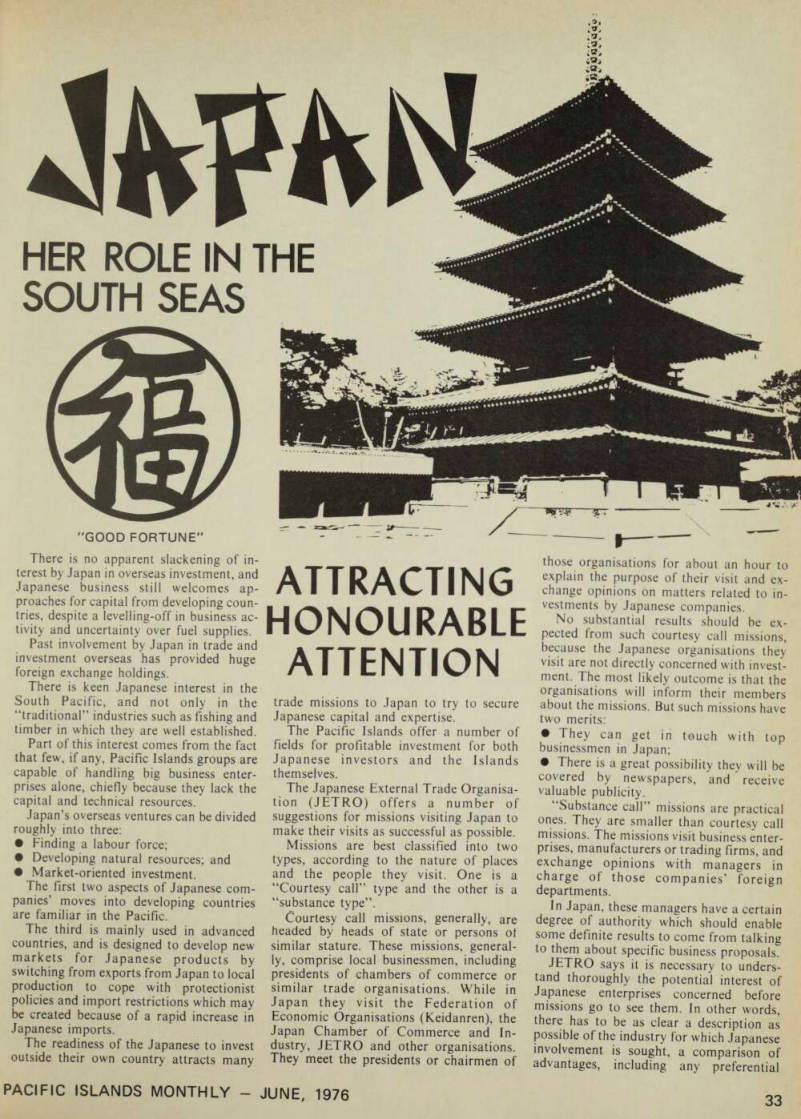
Her Role In The
Attracting
Honourable
Attention
"Good Fortune"
There is no apparent slackening of in terest by Japan in overseas investment, and Japanese business still welcomes ap proaches for capital from developing coun tries, despite a levelling-off in business ac tivity and uncertainty over fuel supplies.
Past involvement by Japan in trade and investment overseas has provided huge
foreign exchange holdings.
There is keen Japanese interest in the South Pacific, and not only in the “traditional” industries such as fishing and timber in which they are well established.
Part of this interest comes from the fact that few, if any, Pacific Islands groups are capable of handling big business enter prises alone, chiefly because they lack the capital and technical resources.
Japan’s overseas ventures can be divided roughly into three; • Finding a labour force; • Developing natural resources; and • Market-oriented investment.
The first two aspects of Japanese com panies’ moves into developing countries are familiar in the Pacific.
The third is mainly used in advanced countries, and is designed to develop new markets for Japanese products by switching from exports from Japan to local production to cope with protectionist policies and import restrictions which may be created because of a rapid increase in
Japanese imports.
The readiness of the Japanese to invest outside their own country attracts many
trade missions to Japan to try to secure
Japanese capital and expertise.
The Pacific Islands offer a number of fields for profitable investment for both Japanese investors and the Islands themselves.
The Japanese External Trade Organisa tion (JETRO) offers a number of suggestions for missions visiting Japan to make their visits as successful as possible.
Missions are best classified into two types, according to the nature of places and the people they visit. One is a “Courtesy call” type and the other is a “substance type”.
Courtesy call missions, generally, are headed by heads of state or persons of similar stature. These missions, general ly, comprise local businessmen, including presidents of chambers of commerce or similar trade organisations. While in Japan they visit the Federation of
Economic Organisations (Keidanren), the
Japan Chamber of Commerce and In dustry, JETRO and other organisations.
They meet the presidents or chairmen of
those organisations for about an hour to explain the purpose of their visit and ex change opinions on matters related to in vestments by Japanese companies.
No substantial results should be ex pected from such courtesy call missions, because the Japanese organisations they visit are not directly concerned with invest ment. The most likely outcome is that the organisations will inform their members about the missions. But such missions have two merits: • They can get in touch with top businessmen in Japan; • There is a great possibility they will be covered by newspapers, and receive valuable publicity.
“Substance call” missions are practical ones. They are smaller than courtesy call missions. The missions visit business enter prises, manufacturers or trading firms, and exchange opinions with managers in charge of those companies’ foreign departments.
In Japan, these managers have a certain degree of authority which should enable some definite results to come from talking to them about specific business proposals.
JETRO says it is necessary to unders tand thoroughly the potential interest of Japanese enterprises concerned before missions go to see them. In other words, there has to be as clear a description as possible of the industry for which Japanese involvement is sought, a comparison of advantages, including any preferential
treatment, of the country concerned with other countries should be outlined, and the missions should be well acquainted with the operations and interests of companies they will be approaching.
Missions should find appropriate in termediaries to receive them in Japan and help them. In ordinary cases, three types of intermediaries handle the preparations to receive missions: • Foreign embassies may make all the necessary arrangements. In some cases the arrangements are made by offices (banks and official representatives) of the coun tries which send the missions: • Some Japanese intermediaries make all
necessary preparations:
• Foreign embassies in Japan and Japanese intermediaries jointly make the
preparations.
Of the three, the combination of foreign embassies and Japanese intermediaries probably ensures the smoothest reception.
Among Japanese organisations which usually handle preparations jointly with foreign embassies are Keidanren, the Japan Chamber of Commerce and In dustry, Japan Productivity Centre, and
Jetro.
These organisations can give advice about the itinerary of missions, make ap pointments, provide data and references, and offer much other assistance. If mis sions want a substantial reception and a smooth development of their programme in Japan, they should have preparatory work done by reliable public relations agents or consultants. The missions should explain thoroughly to these people what they hope to achieve.
They help in such matters of local knowledge as appointments, which should be limited to three a day in Tokyo, chiefly because of the traffic congestion. Japanese are particular about punctuality in keeping
appointments.
If missions are big they should be divid ed into groups. Courtesy call groups should be limited to five or six. If they ex ceed 10 they are not effective because they lack intimacy. It is better for the mission leaders to make courtesy calls with the rest of the members, visiting as many potential investors as possible to exchange views at managerial level. It is necessary of course to make a study in advance of the firm to be visited.
Printed materials should be prepared in Japanese. This habit has been developed
by many overseas businessmen visiting Japan, and is an excellent move which smooths the missions’ paths. The Japanese generally can read English, but it is wise to assume that material written in English would rarely be read. The metric system should be used for weights and measures and name cards should be printed in both Japanese and English.
Information should be supplied, in writing, about the country concerned, covering its economic state (in brief), climate, and geography and maps should be supplied. There should be information about manufacturing industries, agriculture, availability of various materials, transport, labour, services such as electricity, water, and gas, taxes, finance (banking institutions), corporate registration, licensing, market indicators, education and as much information as possible about local requirements for set ting up anew business.
Missions should employ competent in terpreters. Big cities like Tokyo and Osaka have companies which specialise in
providing interpreters.
Some foreign missions say they do not mind what businesses are established in their countries. The Japanese regard such an attitude as highly irresponsible. To at tract foreign investment the countries should give responsible explanations after carefully investigating what type of businesses have bright prospects, as well as the type they specially want to develop.
Simultaneous establishment or develop ment of competitive industries would only lead to disorderly marketing in Japanese eyes.
Some missions may give receptions in Japan, perhaps showing slides or motion pictures beforehand. These audio-visual aids can be very effective, but they should be limited to no more than 15 minutes.
Slides or motion pictures with too many similar scenes kill their effect. If at all possible, any narrations should be given in Japanese. If the pictures concern a
successful Japanese enterprise operating
abroad, the staff of the enterprise should be asked to address the audience.
A mission’s work does not end when it leaves Japan. In fact, it is only beginning.
The follow-up is important. Missions should not fail to send letters of thanks, they should continue to send data by direct mail, keep in touch with potential customers (perhaps through Christmas cards) and provide data to Japanese em bassies and other prominent Japanese organisations so that they may answer in quiries from Japanese manufacturers and traders.
It is advisable, if possible, to set up a proxy contact in Japan to handle follow-up work for the mission. It is wise to keep in touch with overseas branches of Japanese trading firms. And keep up public relations work aggressively.
Those
unique
traders
Japanese trading companies are a uni que institution without parallel in other nations. While international corporations based in the US and Europe share some of the features of Japanese general trading companies, none of them comes close to having the breadth of product line and ser vices offered by Japanese trading com panies, or the variety of subsidiary ac tivities.
Trading companies justify their ex istence in a number of ways: • Ability to get the best deal for their clients in transport, warehousing and other areas related to physical distribution and marketing of exports and imports; • Ability to pool business risk through handling a wide portfolio of products and thus provide financing for items exchanged in international trade; • Ability to provide financing and organisational knowhow for setting up
major projects;
• Development of overseas resources, in cluding iron ore and timber, as Japan has become increasingly more dependent on external sources of raw materials.
Less than one per cent of trading com panies, in terms of sales, handle about three-fifths of all imports, and close to 50 per cent of exports. So these companies control a very large proportion of both im ports and exports. The degree of concen tration of goods-flow through the largest firms is very high.
Trading firms of interest to exporters to Japan fall generally into three groups: (1) General trading companies; (2) specialised trading companies; (3) maker or retailer “captive” trading companies.
As the size of turnover increases, trading companies tend to become much more specialised in their product lines. Specialis
ed trading companies are engaged primari
ly in handling export and import transac tions, and in arranging for distribution for a limited number of products. While their activities do not extend to resource development, and the other functions of general trading companies, they often have access to distribution, sales and service networks for many specialised products.
Maker “captive” trading companies
engage in import and export marketing for
particular companies. They are primarily
of interest to overseas firms interested in exporting to the parent manufacturing company.
Tonga’S Royal’ Sumo Wrestlers
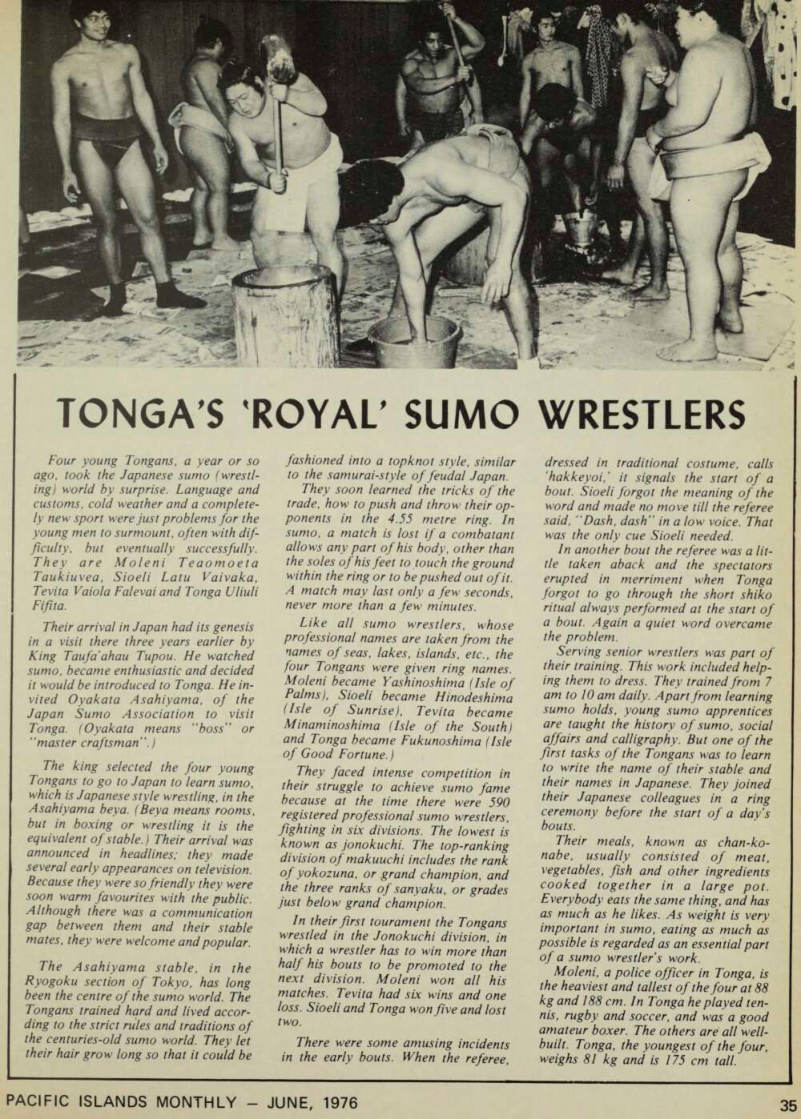
Four young Tongans, a year or so ago, took the Japanese sumo (wrestl ing) world by surprise. Language and customs, cold weather and a complete ly new sport were just problems for the young men to surmount, often with dif ficulty, but eventually successfully.
They are Moleni Teaomoeta Taukiuvea, Sioeli Latu Vaivaka, Tevita Vaiola Falevai and Tonga Uliuli Fifita.
Their arrival in Japan had its genesis in a visit there three years earlier by King Taufa’ahau Tupou. He watched sumo, became enthusiastic and decided it would be introduced to Tonga. He in vited Oyakata Asahiyama, of the Japan Sumo Association to visit Tonga. (Oyakata means "boss” or "master craftsman”.) The king selected the four young Tongans to go to Japan to learn sumo, which is Japanese style wrestling, in the Asahiyama beya. (Beya means rooms, but in boxing or wrestling it is the equivalent of stable.) Their arrival was announced in headlines: they made several early appearances on television.
Because they were so friendly they were soon warm favourites with the public.
Although there was a communication gap between them and their stable mates, they were welcome and popular.
The Asahiyama stable, in the Ryogoku section of Tokyo, has long been the centre of the sumo world. The Tongans trained hard and lived accor ding to the strict rules and traditions of the centuries-old sumo world. They let their hair grow long so that it could be
fashioned into a topknot style, similar to the samurai-style of feudal Japan.
They soon learned the tricks of the trade, how to push and throw their op ponents in the 4.55 metre ring. In sumo, a match is lost if a combatant allows any part of his body, other than the soles of his feet to touch the ground within the ring or to be pushed out of it.
A match may last only a few seconds, never more than a few minutes.
Like all sumo wrestlers, whose professional names are taken from the names of seas, lakes, islands, etc., the four Tongans were given ring names.
Moleni became Yashinoshima (Isle of Palms), Sioeli became Hinodeshima (Isle of Sunrise), Tevita became Minaminoshima (Isle of the South) and Tonga became Fukunoshima (Isle of Good Fortune.) They faced intense competition in their struggle to achieve sumo fame because at the time there were 590 registered professional sumo wrestlers, fighting in six divisions. The lowest is known as jonokuchi. The top-ranking division of makuuchi includes the rank of yokozuna. or grand champion, and the three ranks of sanyaku, or grades just below grand champion.
In their first tourament the Tongans wrestled in the Jonokuchi division, in which a wrestler has to win more than half his bouts to be promoted to the next division. Moleni won all his matches. Tevita had six wins and one loss. Sioeli and Tonga won five and lost two.
There were some amusing incidents in the early bouts. When the referee,
dressed in traditional costume, calls ‘hakkeyoi,’ it signals the start of a bout. Sioeli forgot the meaning of the word and made no move till the referee said. 'Dash, dash” in a low voice. That was the only cue Sioeli needed.
In another bout the referee was a lit tle taken aback and the spectators erupted in merriment when Tonga forgot to go through the short shiko ritual always performed at the start of a bout. Again a quiet word overcame
the problem.
Serving senior wrestlers was part of their training. This work included help ing them to dress. They trained from 7 am to 10 am daily. Apart from learning sumo holds, young sumo apprentices are taught the history of sumo, social affairs and calligraphy. But one of the first tasks of the Tongans was to learn to write the name of their stable and their names in Japanese. They joined their Japanese colleagues in a ring ceremony before the start of a day’s bouts.
Their meals, known as chan-ko nabe, usually consisted of meat, vegetables, fish and other ingredients cooked together in a large pot.
Everybody eats the same thing, and has as much as he likes. As weight is very important in sumo, eating as much as possible is regarded as an essential part of a sumo wrestler’s work.
Moleni, a police officer in Tonga, is the heaviest and tallest of the four at 88 kg and 188 cm. In Tonga he played ten nis, rugby and soccer, and was a good amateur boxer. The others are all well built. Tonga, the youngest of the four, weighs 81 kg and is 175 cm tall.
How Fish
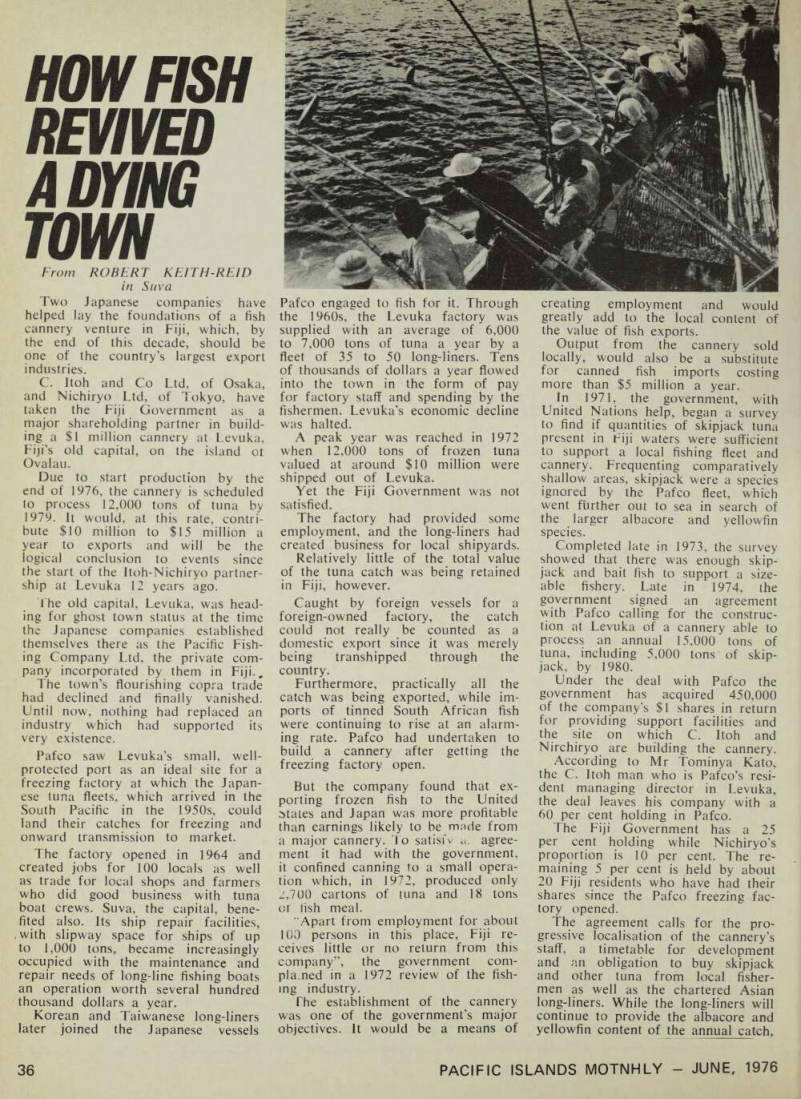



Revived
A Dying
Town
From Robert Keith-Reid
in Suva Two Japanese companies have helped lay the foundations of a fish cannery venture in Fiji, which, by the end of this decade, should be one of the country’s largest export industries.
C. Itoh and Co Ltd, of Osaka, and Nichiryo Ltd, of Tokyo, have taken the Fiji Government as a major shareholding partner in build ing a $1 million cannery at Levuka, Fiji’s old capital, on the island ot Ovalau.
Due to start production by the end of 1976, the cannery is scheduled to process 12,000 tons of tuna by 1979. It would, at this rate, contri bute $lO million to $l5 million a year to exports and will be the logical conclusion to events since the start of the Itoh-Nichiryo partner ship at Levuka 12 years ago.
The old capital, Levuka, was head ing for ghost town status at the time the Japanese companies established themselves there as the Pacific Fish ing Company Ltd, the private com pany incorporated by them in Fiji., The town’s flourishing copra trade had declined and finally vanished.
Until now, nothing had replaced an industry which had supported its very existence.
Pafco saw Levuka’s small, well protected port as an ideal site for a freezing factory at which the Japan ese tuna fleets, which arrived in the South Pacific in the 19505, could land their catches for freezing and onward transmission to market.
The factory opened in 1964 and created jobs for 100 locals as well as trade for local shops and farmers who did good business with tuna boat crews. Suva, the capital, bene fited also. Its ship repair facilities, with slipway space for ships of up to 1,000 tons, became increasingly occupied with the maintenance and repair needs of long-line fishing boats an operation worth several hundred thousand dollars a year.
Korean and Taiwanese long-liners later joined the Japanese vessels
Pafco engaged to fish for it. Through the 19605, the Levuka factory was supplied with an average of 6,000 to 7,000 tons of tuna a year by a fleet of 35 to 50 long-liners. Tens of thousands of dollars a year flowed into the town in the form of pay for factory staff and spending by the fishermen. Levuka’s economic decline was halted.
A peak year was reached in 1972 when 12,000 tons of frozen tuna valued at around $lO million were shipped out of Levuka.
Yet the Fiji Government was not satisfied.
The factory had provided some employment, and the long-liners had created business for local shipyards.
Relatively little of the total value of the tuna catch was being retained in Fiji, however.
Caught by foreign vessels for a
foreign-owned factory, the catch
could not really be counted as a domestic export since it was merely
being transhipped through the
country.
Furthermore, practically all the catch was being exported, while im ports of tinned South African fish were continuing to rise at an alarm ing rate. Pafco had undertaken to build a cannery after getting the freezing factory open.
But the company found that ex porting frozen fish to the United states and Japan was more profitable than earnings likely to be made from a major cannery. To satisfy a. agree ment it had with the government, it confined canning to a small opera tion which, in 1972, produced only 2,700 cartons of tuna and 18 tons or fish meal.
"Apart from employment for about 100 persons in this place, Fiji re ceives little or no return from this company”, the government com pla.ned in a 1972 review of the fish ing industry.
The establishment of the cannery was one of the government’s major objectives. It would be a means of
creating employment and would greatly add to the local content of the value of fish exports.
Output from the cannery sold locally, would also be a substitute for canned fish imports costing more than $5 million a year.
In 1971, the government, with United Nations help, began a survey to find if quantities of skipjack tuna present in Fiji waters were sufficient to support a local fishing fleet and cannery. Frequenting comparatively shallow areas, skipjack were a species ignored by the Pafco fleet, which went further out to sea in search of the larger albacore and yellowfin species.
Completed late in 1973, the survey showed that there was enough skip jack and bait fish to support a size able fishery. Late in 1974, the government signed an agreement with Pafco calling for the construc tion at Levuka of a cannery able to process an annual 15,000 tons of tuna, including 5,000 tons of skip jack, by 1980.
Under the deal with Pafco the government has acquired 450,000 of the company’s $1 shares in return for providing support facilities and the site on which C. Itoh and Nirchiryo are building the cannery.
According to Mr Tominya Kato, the C. Itoh man who is Pafco’s resi dent managing director in Levuka, the deal leaves his company with a 60 per cent holding in Pafco.
The Fiji Government has a 25 per cent holding while Nichiryo’s proportion is 10 per cent. The re maining 5 per cent is held by about 20 Fiji residents who have had their shares since the Pafco freezing fac tory opened.
The agreement calls for the pro gressive localisation of the cannery’s staff, a timetable for development and an obligation to buy skipjack and other tuna from local fisher men as well as the chartered Asian long-liners. While the long-liners will continue to provide the albacore and yellowfin content of the annual catch,
Continued from page 36. skipjack would be caught by a fleet of nine ships the Fiji Government will build during 1976-1980.
These will be operated by the Ika Corporation, a government owned company formed to manage the fish ing fleet and to charter other ships as needed.
A Japanese skipjack catcher the corporation chartered for an initial nine months, arrived in January to train local seamen in fishing tech niques and to catch fish for the can nery. It landed its first catch, 40 tons, at Levuka after a two-week trip.
Exports of frozen tuna will pro gressively fall as more is sent for canning. By 1980 the cannery should be processing 12,000 tons of fish a year, yielding 650,000 cases of prime-quality brine pack and up to 5,000,000 half-pound cans of tuna flakes.
Local sales of canned fish are expected to replace 35 per cent to 40 per cent of unt is imported for local consumption. As a sideline, the cannery will produce about 700 tons of meal a year suitable for poultry and pig feed.
Mr Kato, 48, formerly assistant manager in C. Itoh’s marine depart ment, expects the canned skipjack o find a market in Britain. Albacore and yellowfin will continue to go to the long-established United States and Japanese markets.
He is confident about the joint enterprise’s future, which, he says, is being launched at a time when the size of annual catches and prices are beginning to recover. Catches have slumped since the record 12,000 tons taken in 1972 and in recent years have averaged 7,000-8,000 tons.
Last year's was down to 5,000 tons.
The reasons for the drop are not known, except that tuna just were not around in their former quantities.
But albacore and yellowfin stocks seem to be recovering now, and to gether with 1,000 tons of skipjack due to be supplied by the Fiji Government fleet, landings this year are expected to reach 8,000 tons.
When in full operation the can nery will add real earnings worth at least $lO million a year to export income.
Pafco’s annual payroll—now cost ing $250,000 a year for the 100 locals employed by it—will swell proportionately as the cannery force builds up to a projected level of 400.
And while the size of the chart ered long-line fleet is expected to remain constant at about 35 to 45 vessels, the new local skipjack fleet the cannery will support is expected to create a further 200 to 300 new jobs.
Advertisements & other items, pp. 36-43 (2 items)
36
PACIFIC ISLANDS MOTNHLV - JUNE, 1976
Expand your stereo enjoyment
NPUT
€ € € DOOfl
STOP
STD
Pt-AY
c
PEW
REC
pOWEF*
<r. cr-w* 1 tape (jflPKJAjeen
CT-F 2121
cntsEEsa
polbvsvstem
Expand your stereo enjoyment
via access to the front.
Stereo tape cassettes open up a listen to. A long-life permalloy-solid /hole new world of music listening head and built-in Dolby-B* noise mjoyment. Whether you’re starting reduction system join to increase r ° m scratch or as an addition to the S/N ratio to a hushed 62 sdß our present stereo system, (chrome tape over SKHz). And Sneer’s new CT-F 2121 is perfect independent BIAS and EQ selection s the basic stereo cassette deck, enables you to obtain maximum basically outstanding in tonal frequency response and lowest uality and basically designed for distortion from virtually any type lechanical precision. of tape.
With the tape compartment in the Pioneer’s CT-F 2121 helps you ont, loading a cassette is as easy stretch your stereo budget. Produce s slipping your hand in your your own music library A built-in ocket. While front access design MPX (multiplex) filter ensures the lakes it easy to use, advanced recording of FM stereo broadcasts ioneer features make it great to with wide dynamic range. And to Dolby is a trademark of Dolby Laboratories, Inc. protect your valuable tapes, the
fully automatic Stop Mechanism
functions in all modes disengaging the tape transport mechanism and returning all levers to neutral.
Pioneer’s new CT-F 2121 stereo cassette deck. The added enjoyment of cassette tape versatility via access to the front.
CtD PIONEER
Pioneer Electronic Corporation
4-1, Meguro 1-chome, Meguro-ku, Tokyo 153, Japan >ioneer products are available Australia Pioneer Electronics Australia Pty. Ltd., 178-184 Boundary Road, Braeside, Victoria 3195, Phone: 90-9011, Sydney 93-0246, Brisbane 52-8213, Adelaide 433379 Perth 76-7776 Fiji Islands Brijlal & Company, G.P.O. Box No. 362, Suva, Fiji Islands Tel: 22258 Lae Hagemeyer (Australasia) 8.V., PO. Box No. 90, Lae, Papua • New Guinea Tel: 42-32 00 Rabaul Hagemeyer (Australasia) 8.V., PO. Box No. 63, Rabaul, Papua* New Guinea Tel: 26 33 Port Moresby Hagemeyer (Australasia) 8.V., PO. Box No. 1428. Boroko, Port Moresby, Papua • New Guinea Tel: 5 61 44 Madang Hagemeyer (Australasia) 8.V., P.O. Box No. 673. Madang,
T.P.N.G. Tel; 24 45
New Zealand Fountain Marketing Ltd., Maidstone Street Auckland, New Zealand Tel: 763-064 Norfolk Island Burns Philp (Norfolk Island) Ltd.. Norfolk Island, South Pacific New Hebrides Burns Philp (New Hebrides) Ltd., Vila, New Hebrides Nauru Island Jacob Enterprises, P.O. Box No. 4 Nauru Island Tahiti
Ets. PERFECT, B.P. 594,
Papeete, Tahiti Tel: 20 407 New Caledonia Menard Freres, B.P. 123, Noumea, New Caledonia Tel: 52-22 American Samoa Transpac Corporation, P.O. Box 1477. Pago Pago, American Samoa 96799 Tel: 633-5224 Rarotonga South Seas International Ltd., P.O. Box 49, Rarotonga Cook Islands Tel: 2327
How Sansui’s front-loaders
became stereo’s
front-runners.
SC-2000 SanxuL o * 0 ® SC-3000 ■ I •* ! ► ! >»
'ariTTiri:
t o m SC-3003
When our Sansui engineers designed our
four classic front-loading stereo cassette tape
decks, they positioned the front-access tape
compartments right-side-up. Naturally, this
made it easier to handle tapes and read their
labels. More convenience and more stability.
The critics liked what they saw. And heard. “The styling is fresh and functional and the operation eminently sane,” said the first technical review of the Sansui SC-3000. “It is,
in a word, an attractive product.”
Compared to some of the other frontloading decks, ours don’t cost very much.
Perhaps that’s how our front-
loaders have become stereo’s
front-runners.
ScLftSTLL.
SANSUI ELECTRIC CO., LTD.
14-1,2-chome, Izumi, Suginami-ku, Tokyo 168, Japan Australia Rank Industries Australia Pty. Ltd.
Head Office: 12 Barcoo Street, East Roseville, N.S.W. 2069 Phone; 406 5666 Melbourne: 68 Queensbridge Street, South Melbourne, Vic. 3205 Phone; 62 0031 Adelaide: Phone: 332 4288/Brisbane: Phone; 52 7333/Canberra: Phone: 95 2144 Australia Atkins Carlyle Ltd. 44 Belmont Avenue, Belmont, Western Australia, 6104 Phone: 65 0511 Fiji Prabhu Brothers Ltd.
P.O. Box 183, Nadi Phone: 70183/4 Papua New Guinea Oceania Indent Agency (P.N.G.) Pty. Ltd.
Box 5518, Boroko, Port Moresby Phone: PM 256406 New Zealand David J. Reid (N.Z.) Ltd.
C.P.O. Box 2630, Auckland, 1 Phone: 492-189 Nlle-Caledonie Ets Michel MERCIER 53, rue de Sebastopol, Noumea Phone: 27. 59. 11 South Pacific Miltons Department Stores Limited P.O. Box 146, Norfolk Island 2899 Central Pacific Nauru Co-operative Society Republic of Nauru Western Samoa H.J. Keil and Company Ltd.
P.O. Box 7, Apia Phone: 198 New Hebrides South Pacific Audio & Photo Supplies B.P. 274, Vila Cook Islands United Island Traders Ltd.
P.O. Box 1 & 2, Rarotonga Tahiti Societe JAUNEZ & Cie B.P. 322, Papeete Phone: 2.04.24
\ a L\ ea r ° \ m*** m-*'*-*;* a *
SEIKO
y Ou*»”
Ml / % 2 .
IV
THE THIN SEIKO QUARTZ.
CHANGING THE WORLD'S
STANDARD OF ACCURACY.
Seiko gives you elegance with accuracy by incorporating all the vital quartz components into a smaller, ultra-thin case. But without sacrificing any of the accuracy and dependability you expect from a quartz timepiece.
Seiko's expertise in every phase of the watchmaking process makes it possible for Seiko to exercise a unique quality control system through every step from design to completion, and to make any part of any Seiko watch—so we're never limited to any particular size or shape. That's why Seiko can achieve these luxuriously thin dress models for men and women.
They're the most elegant quartz watches you can buy. And they put Seiko years ahead of any other quartz watch manufacturer. Seiko Quartz.
Someday all watches will be made this way.
Honda Civic Declared
■W - », 'k f M iAH .fi ’M *
SiSSSi
>-r * «r.
S«gr &a S^* That's what the U.S. Environmental Protection Agency figures show. The Honda Civic placed first among the hundreds of 1976 cars tested. On the highway, in the city and in combined driving situations.
Top fuel economy is just the start. All-round operating costs are equally low. Thanks to a rugged, clean-burning OHC engine which delivers snappy acceleration. Elegance is second to none—both inside and out.
Famous Honda engineering also gives you: Enough roomy comfort to relax four adults.
A spacious trunk. Exceptional handling ease. A dual braking system featuring servo-assisted front disc brakes, independent strut suspensions.
All of this quality performance is yours in three exciting models-the 2-Door Sedan, 4-Door Sedan and Hatchback.
Own the 1976 economy champ-the Honda Civic.
HONDA
HONDA MOTOR CO.. LTD. TOKYO, JAPAN
PAPUA NEW GUINEA: Steamships-Machinery P.O. Box 1, Port Moresby/TAHITI: Soci6t6 Tahitienm d Produits Honda B.P. 1665-Papeete/FIJI ISLANDS: Coral Island Motors P.O. Box 48 ManHc l i mted M| cronesia Development Assn. P.O. Box 238, Saipan, Mairiam lfaMnA 9 c 950/COO ij K '^ LANDS: Cook Islands Motor Centre Ltd. P.O. Box 74, Rarotonga/AMERICAf SAMOA: Samoan Holiday and Travel Center P.O. Box 968, Pago Pago/AMERICAN SAMOA: Haleck’: qamoa C |S n ! er o°' 1138, Pag ° Pa S°/ GUAM : Mark’s Motor Co.. Inc. P.O. Box DV. Agana/WESTERr SAMOA: Motor Distributors (Samoa) Ltd. P.O. Box 576, Apia/SOLOMON ISLANDS: British Solomons l r n a r?* C ° ’ Ltd - P 0 - Honiara/NEW CALEDONIA: Establissements Ballande Boite Postal, No. C 4 Noumea Cedex/TONGA: E.M. Jones Limited P.O. Box 34. Nuku’alofa/TARAWA: Gilbert'S* Ellic, Islands Development Authority P.O. Box 488, Beito/NIUE ISLAND: S. Jessop & Sons Ltd. P.O. Bo: 71, Alofi South/NAURU: Nauru Cooperative Society Republic of Nauru, Nauru Island Central Pacific
Sony presents more power,
more tonal quality than you ever
dreamed was possible.
The Sony CF-480S cassette-corder/radio sounds as big and real as life itself.
Its powerful, specially-designed amplifier delivers 4 watts of power —enough to fill even the largest room with clear, distortion-free sound.
What’s more, it has a unique 2-way speaker system. One big 6 1/2-inch woofer for the lows and a separate 2-inch tweeter for the highs.
Result: Superb reorodiiclicrtiwal FM programs and cassette recordings, with audibly superior shortwave and medium wave sound, too.
In fact, the great-sounding CF-480S represents Sony cassette-corder technology at its finest: there is a DC servo-controlled tape drive motor, sensitive electret condenser microphone, tape selector for normal and Cro2 cassettes, mic mixing controls, and much more. It’s a dream of versatility.
But you shouldn’t just take our word for it.
Visit the nearest Sony 4aaler and audition the Sony CF-480S for yourself.
You’d never dream that a cassette-coTcrm7fi2rTb' w ~* could sound so good. v *•••
YAMAHA
A Yamaha in your life can make
for a lot of living
IvßiJfl
♦ w Yamaha’s superior technology, gained over the years, proves its worth when you see how these bikes go right on running smoothly. For men, boys, girls...bikes suited to shopping, working, sport... Yamaha even has smooth, easy operating models for the anti-bike people. Care to try the one we designed for you? x S 4-stroke Street/650,500 : 2-stroke Twin Street/400,250,200.125 2-stroke Single Street/125,100 y B 2-stroke Single Street/100,50 v 2-stroke Moped 90,75,50 DT 2-stroke Trail/400. 250, 175, 125,100 TY Trials/250,175,125 YZ 2-stroke Motocross 400,250,175,125
Mmi/GTBO.GTSO,GTMX,YZBO,TYBO
AG Agricultural use/175,100 Chappy/LBBO XT 4-stroke Single Enduro Type/500 TT 4-stroke Single Motocross Type/500 v ,
XSSOO
■ rjMJM 55AE Yamaha’s outboard motors, designed to give efficient, dependable operation, have been gaining steady popularity over the past years in a wide variety of applications.
Due to their inherent ease of operation, Yamaha outboard motors are used throughout the world for commercial fishing, for water patrol uses, for water safety education and for leisure.
55AE 48A 25A/AE 20A
ENDURO 15A/AK 15A 12A
8A SBS 5B 3.5A/AC 2A
YAMAHA
since 1887 YAMAHA MOTOR CO, LTD
2500 SHINGAI IWATA SHI SHIZUOKA KEN JAPAN
YAMAHA
A New Phenomenon
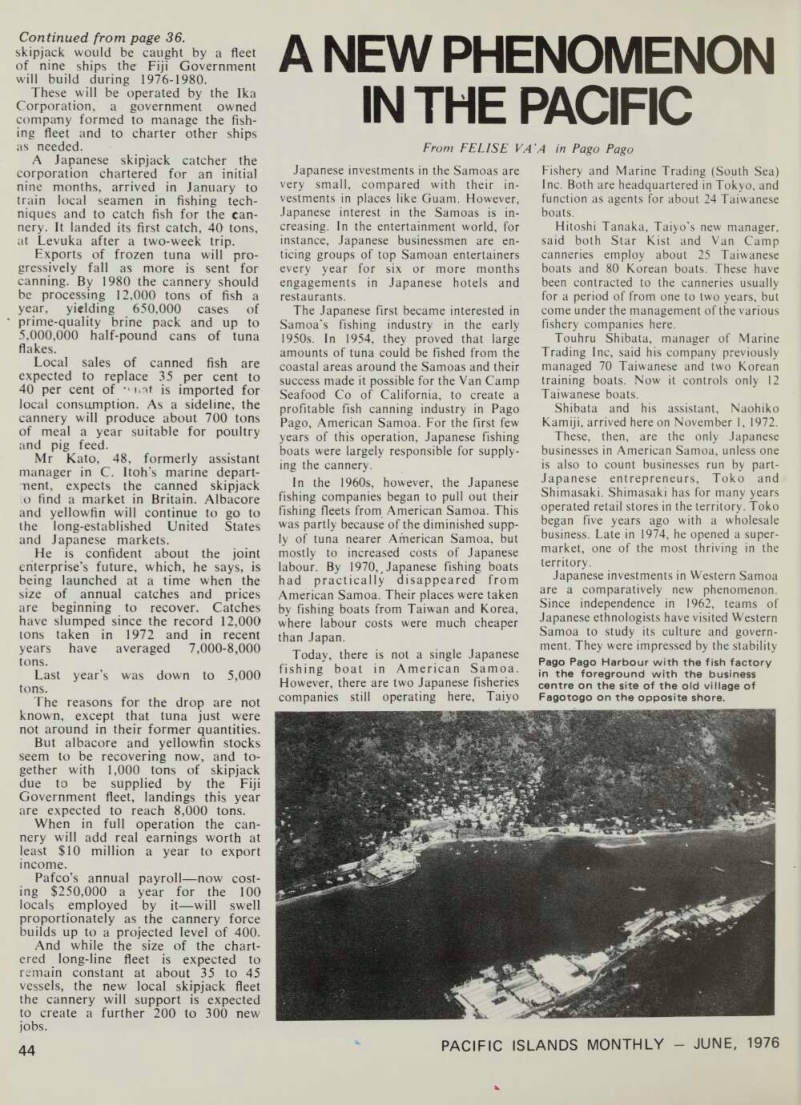
In The Pacific
From FELISE VA'A in Pago Pago
Japanese investments in the Samoas are very small, compared with their in vestments in places like Guam. However, Japanese interest in the Samoas is in creasing. In the entertainment world, for instance, Japanese businessmen are en ticing groups of top Samoan entertainers every year for six or more months engagements in Japanese hotels and restaurants.
The Japanese first became interested in Samoa's fishing industry in the early 19505. In 1954, they proved that large amounts of tuna could be fished from the coastal areas around the Samoas and their success made it possible for the Van Camp Seafood Co of California, to create a profitable fish canning industry in Pago Pago, American Samoa. For the first few years of this operation, Japanese fishing boats were largely responsible for supply ing the cannery.
In the 19605, however, the Japanese fishing companies began to pull out their fishing fleets from American Samoa. This was partly because of the diminished supp ly of tuna nearer American Samoa, but mostly to increased costs of Japanese labour. By 1970,, Japanese fishing boats
had practically disappeared from
American Samoa. Their places were taken by fishing boats from Taiwan and Korea, where labour costs were much cheaper than Japan.
Today, there is not a single Japanese fishing boat in American Samoa.
However, there are two Japanese fisheries companies still operating here, Taiyo
Fishery and Marine Trading (South Sea) Inc. Both are headquartered in Tokyo, and function as agents for about 24 Taiwanese boats.
Hitoshi Tanaka, Taiyo’s new manager, said both Star Kist and Van Camp canneries employ about 25 Taiwanese boats and 80 Korean boats. These have been contracted to the canneries usually for a period of from one to two years, but come under the management of the various fishery companies here.
Touhru Shibata, manager of Marine Trading Inc, said his company previously managed 70 Taiwanese and two Korean training boats. Now it controls only 12 Taiwanese boats.
Shibata and his assistant, Naohiko Kamiji, arrived here on November I, 1972.
These, then, are the only Japanese businesses in American Samoa, unless one is also to count businesses run by part- Japanese entrepreneurs, Toko and Shimasaki. Shimasaki has for many years operated retail stores in the territory. Toko began five years ago with a wholesale business. Late in 1974, he opened a super market, one of the most thriving in the territory.
Japanese investments in Western Samoa are a comparatively new phenomenon.
Since independence in 1962, teams of Japanese ethnologists have visited Western Samoa to study its culture and govern ment. They were impressed by the stability
Pago Pago Harbour with the fish factory in the foreground with the business centre on the site of the old village of Fagotogo on the opposite shore.
of Western Samoan society and by the country’s potential for investment and became good ambassadors for Western Samoa back in Japan.
They helped sell Western Samoa to the Japanese Government and businessmen.
By 1968, the Japanese were beginning to gain a foothold in Western Samoa. In that year, they established New Samoa In dustries, engaged chiefly in logging, mill ing, seasoning and sale of timbers primari ly for the local market.
According to Hans Kruse, Director of the Department of Economic Develop ment, the authorised capital of the com pany is $200,000 of which Japanese in terests hold 58 per cent. In 1974, the com
pany expanded operations in the produc
tion of timber, manufacturing of first-class furniture for export and production of taro and banana cases for Western Samoan ex ports.
Last year the company employed 75 workers and produced 1,000 cu ft of logs a day. Fifty per cent of the logs are used to produce sawn timber for the local market, and fifty per cent for furniture and case
production.
“Both the initial establishment and the expansion into production of banana and taro shooks were encouraged by the government through tax and duty incen tives,” Kruse said.
Key positions in New Samoa Industries Ltd are held by Japanese but there is a move to gradually replace them with
qualified Samoans.
Kruse reports that there are four other Japanese tradesmen working in the fields of construction and production of footwear and the Western Samoa Government is on the point of approving a proposal from Nippon View Hotel Co Ltd for the con struction of a hotel at Cape Lefatu, several miles from Faleolo airport. This will be a joint venture involving a local enterprise.
The proposal had earlier been postponed because of the world-wide recession and consequent slump in tourism, Kruse said.
The new SUS 4 million hotel will have 150 rooms with beach side facilities such as piers for sightseeing, glass-bottom boats for rides through the coral lagoons, fishing boats, beaches and a yacht harbour.
Nippon View owns and operates the Narita First City Hotel, Nasu View Hotel and Irako View Hotel in Japan. It is also engaged in real estate, operating sightsee ing facilities, plays, shows and motion pic tures.
Lower prices, superior qualities and a swift, sure supply of spare parts these are the factors which have enabled Japanese car manufacturers to win their
dominating position.
The first Japanese cars did not make a good impression when they arrived in the early 19605. They looked old-fashioned, even ugly, compared with European makes. Many had serious defects.
How Japanese cars ran
the rest off Fiji’s roads
From ROBERT KEITH-REID in Suva Fifteen years ago the appearance of a Japanese car on Fiji’s roads promoted curiosity. Today, the hold Japanese car manufacturers have on the country \s relatively small ($lO million a year) car market is almost com plete. This year the Datsun and Toyota factories alone mil supply 60 per cent - 70 per cent of all new cars sold in Fiji.
These became clear when the cars were subjected to the rough punishment any vehicle inevitably gets on the abrasive gravel surface that constitutes most of the Fiji road system.
As Japan’s share of the world car market grew, the quality of its vehicles im proved markedly. The initial bad impres sion they made in Fiji was forgotten. Suva Motors Ltd, the coun try’s biggest car dealer, dropped its British Motor Corporation agency to concentrate on selling Datsun, when it realised just how competitive Japanese cars had become.
Sales manager John Reader com mented: “The Japanese car, any of them, not just Datsun, is mechanically superior to other makes sold in Fiji. They simply stand up better to conditions here than counterpart British models which, price wise, can’t compete.”
Looking at the way Japanese cars won their place in the Fiji transport system, it is difficult to avoid comparison with British vehicles.
Fiji was a British colony until 1970, and it was not until Australian car factories were opened that sales of British vehicles were ever challenged.
Cars from continental European coun tries are rare and American cars were, and still are, even more rare.
Australia’s Holden was the top seller in the 1960 s through to 1974, though sales of Japanese cars crept up steadily in this period.
Then the Fiji Government made the first of two decisions that all but cleared the market of serious rivals for Japanese vehicles.
First, it scrapped the Commonwealth preferential system under which British and Australian cars were landed in Fiji at half the duty applied to Japanese and other cars not made in British Commonwealth countries.
As Japanese cars are shipped from fac tories only half as far from Fiji as British factories, they were already competitive in price when the equalisation of tariffs dramatically improved their sales position.
British cars, now costing $3OO-5600, and in some cases up to $2OOO more than equivalent Japanese models, can no longer compete in price.
The other decision favouring Japanese cars was the imposition in 1975 of a ban on imports of cars of over 2000 cc engine capacity with the idea of cutting petrol
consumption.
It was the end of the road in Fiji for big Australian vehicles like the Holden, Ford Falcon and Chrysler Valiant. Until then they together commanded more than one third of the car market.
Deprived of the ability to buy large Australian cars and unwilling to pay hun dreds of dollars extra for European cars, hundreds of motorists have since switched to Japanese models.
Figures for sales of private cars or taxis tell the story best.
Sales of British cars dropped from 342 in 1969 to under 200 in 1974. Sales of Australian cars dropped from 501 in 1969 to 141 in 1974.
Sales of Japanese cars have risen from 536 in 1969, and have not fallen below 1000 since 1972, with 1124 being sold in 1974.
Last year’s figures for the eight months to the end of August show 15 Australian cars sold against 869 Japanese cars.
For a time, Britain retained her position as chief supplier of lorries, tractors, buses and other types but Japan is now dominating this area also.
In 1969, Britain supplied 236 heavy vehicles, Australia 135 and Japan 141. The 1974 figures were, Britain 149, Australia 60 and Japan 823.
Britain once supplied virtually all the motor cycles sold in Fiji. Not now. In 1974 258 of the 260 sold were Japanese.
Datsun and Toyota seem likely to retain their places in Fiji as sales leaders. Mazda, with sales of 100-150 cars a year, is third, but Honda’s new Civic saloon could take this place from it soon.
Names like Subaru, Isuzu, Daihatsu, Hino and Nissan are still comparatively unknown in Fiji.
The Solomons Has A New Image
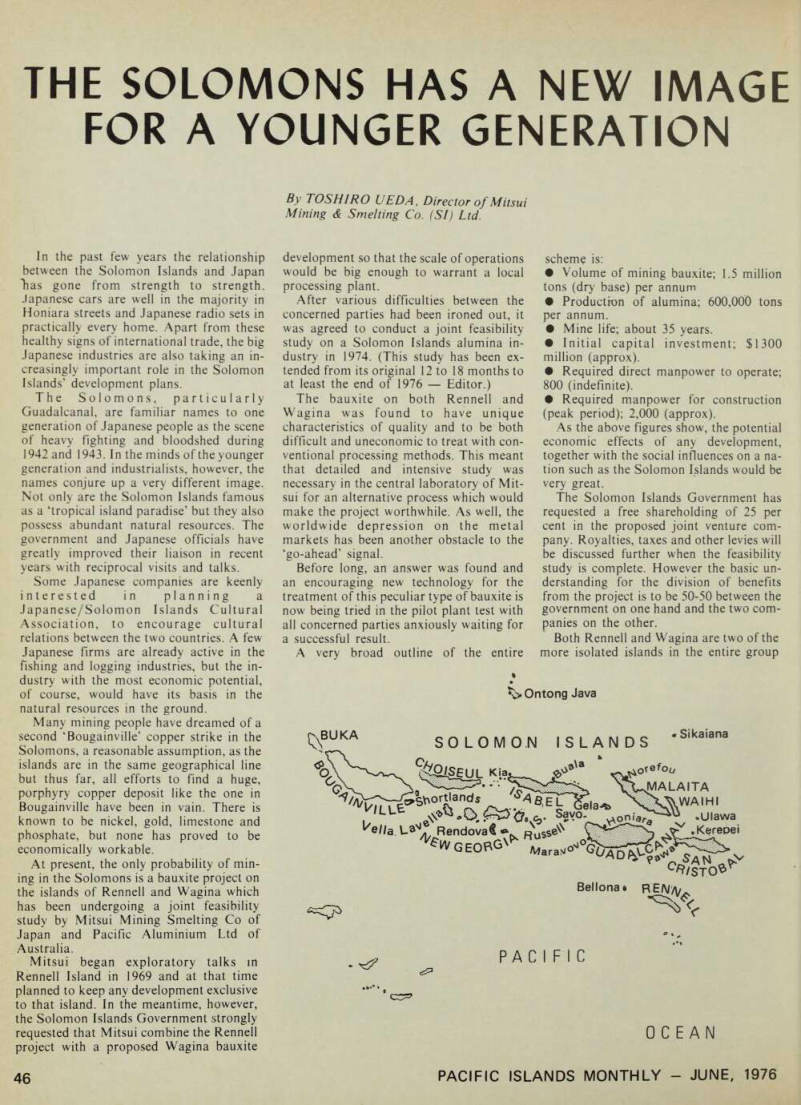
For A Younger Generation
By TOSHIRO UEDA, Director of Mitsui Mining & Smelting Co. (SI) Ltd.
In the past few years the relationship between the Solomon Islands and Japan lias gone from strength to strength.
Japanese cars are well in the majority in Honiara streets and Japanese radio sets in practically every home. Apart from these healthy signs of international trade, the big Japanese industries are also taking an in creasingly important role in the Solomon
Islands’ development plans.
The Solomons, particularly Guadalcanal, are familiar names to one generation of Japanese people as the scene of heavy fighting and bloodshed during 1942 and 1943. In the minds of the younger generation and industrialists, however, the names conjure up a very different image.
Not only are the Solomon Islands famous as a ‘tropical island paradise’ but they also possess abundant natural resources. The government and Japanese officials have greatly improved their liaison in recent years with reciprocal visits and talks.
Some Japanese companies are keenly interested in planning a Japanese/Solomon Islands Cultural Association, to encourage cultural relations between the two countries. A few Japanese firms are already active in the fishing and logging industries, but the in dustry with the most economic potential, of course, would have its basis in the natural resources in the ground.
Many mining people have dreamed of a second ‘Bougainville’ copper strike in the Solomons, a reasonable assumption, as the islands are in the same geographical line but thus far, all efforts to find a huge, porphyry copper deposit like the one in Bougainville have been in vain. There is known to be nickel, gold, limestone and phosphate, but none has proved to be
economically workable.
At present, the only probability of min ing in the Solomons is a bauxite project on the islands of Rennell and Wagina which has been undergoing a joint feasibility study by Mitsui Mining Smelting Co of Japan and Pacific Aluminium Ltd of Australia.
Mitsui began exploratory talks in Rennell Island in 1969 and at that time planned to keep any development exclusive to that island. In the meantime, however, the Solomon Islands Government strongly requested that Mitsui combine the Rennell project with a proposed Wagina bauxite
development so that the scale of operations would be big enough to warrant a local
processing plant.
After various difficulties between the concerned parties had been ironed out, it was agreed to conduct a joint feasibility study on a Solomon Islands alumina industry in 1974. (This study has been extended from its original 12 to 18 months to at least the end of 1976 Editor.) The bauxite on both Rennell and Wagina was found to have unique characteristics of quality and to be both difficult and uneconomic to treat with conventional processing methods. This meant that detailed and intensive study was necessary in the central laboratory of Mitsui for an alternative process which would make the project worthwhile. As well, the worldwide depression on the metal markets has been another obstacle to the
‘go-ahead’ signal.
Before long, an answer was found and an encouraging new technology for the treatment of this peculiar type of bauxite is now being tried in the pilot plant test with all concerned parties anxiously waiting for a successful result.
A very broad outline of the entire
scheme is: • Volume of mining bauxite; 1.5 million tons (dry base) per annum • Production of alumina; 600,000 tons per annum, • Mine life; about 35 years, • Initial capital investment; $l3OO million (approx). • Required direct manpower to operate;
800 (indefinite).
• Required manpower for construction (peak period); 2,000 (approx), As the above figures show, the potential economic effects of any development, together with the social influences on a na tion such as the Solomon Islands would be very great.
The Solomon Islands Government has requested a free shareholding of 25 per cent in the proposed joint venture corn pany. Royalties, taxes and other levies will be discussed further when the feasibility study is complete. However the basic un derstanding for the division of benefits from the project is to be 50-50 between the government on one hand and the two com panics on the other, Both Rennell and Wagina are two of the more isolated islands in the entire group
and the new joint venture company will need to invest tremendous capital for in frastructure such as a port, roads, public utilities etc especially on Rennell where it is proposed to establish the processing plant. An entire new town of over 5,000 people will have to be established with all the necessary industry, commerce, civil service and public facilities necessary for its administration.
Particular care will be taken by all con cerned in the scheme in preserving the natural environment as far as humanly and economically possible. Both companies and the government are determined there will be no repetition of Nauru or Ocean Island.
The situation is, in fact, quite different from those islands in that the whole area for the mining and processing of the baux ite is less than 10 per cent of the whole of Rennell Island.
The Solomon Islands Government plans to establish a national park in a substan tially large area of East Rennell for the preservation of certain birds which are found nowhere else. Rennell also attracts and interests many scholars of archaeology and ethnology as a very early Polynesian settlement.
Many important discoveries have been found during their surveys and as recently as September 1975, pigs’ teeth and other artifacts were unearthed which are being
Mitsubishi Looks For Coal
Mitsubishi Development Pty Ltd, an Australian subsidiary of the giant corporation, Mitsubishi, of Japan, is interested in coal and other mineral exploration in the Gulf Province of Papua New Guinea. The exploration area covers 4,600 square miles at the headwaters of the Vailala River, near Ihu, next to a CRA prospect.
Both sites are in the area of the Purari coal beds, first discovered early this century.
Brown coal found there has been low-grade. Mitsubishi may spend up to K 100,000 in ex ploration. Emphasis in the first stage is on coal, shales and clay. There will also be ex ploration for a variety of minerals.
Mitsubishi has had considerable experience in coal. In Australia, it is involved with Utah.
studied by the Kaio University team in Japan. Professor T. Monburg, the well known ethnologist, has studied in Rennell for many years and any developments there will be in full co-operation with these scholastic investigations into the ecology, archaeology and anthropology of Rennell.
Rennellese people are enthusiastic about the proposed developments and have cooperated with the survey work already done by Mitsui. They can expect permanent employment and a comfortable income from land compensation.
The people have been consulted on every aspect since the project was first considered, as without their cooperation the entire scheme would be impossible.
Mitsui’s survey work thus far has
already created a certain amount of im patience for the scheme to start, Mr Trevor Clark, the Deputy Governor, who recently visited Rennell, advised the people that a plan of this magnitude re
quires a patient waiting period. The
government and both companies must carefully consider the long term future of the island as well as the immediate benefits that may ensue and have every intention of doing so.
There are many problems and dif ficulties yet to be solved before the scheme can be realised but none is impossible and it is firmly believed that as they are solved one by one, an entirely new economic in dustry for the Solomon Islands will be the result.
Advertisements & other items, p. 47 (1 item)
Security
To Future Generations,
Social welfare is a subject of serious consideration in most modern societies. Man in the twentieth century accepts his responsibility to bequeath to the next generation a society better than his own.
Daiwa Bank is not unique in accepting this responsibility, but Daiwa is unique in making acceptance of this role in society an integral part of their banking service.
Daiwa is the only Japanese city bank to combine banking and trust business. Daiwa is thus a fully integrated banking institution, comprising banking, international financing, trust, pension trust, and real estate business. This integration is part of our effort to fulfil our social responsibility consistent with society's needs in a contemporary environment. a fully integrated banking service
DAIWA BANK
Head Office: Osaka, Japan London and Frankfurt Branches New York and Los Angeles Agencies Singapore, Sydney and Sao Paulo Representative Offices Joint Venture Banks: P.T. Bank Perdania, Jakarta, International Credit Allianrp ltd Hnno Krmo
Magazine
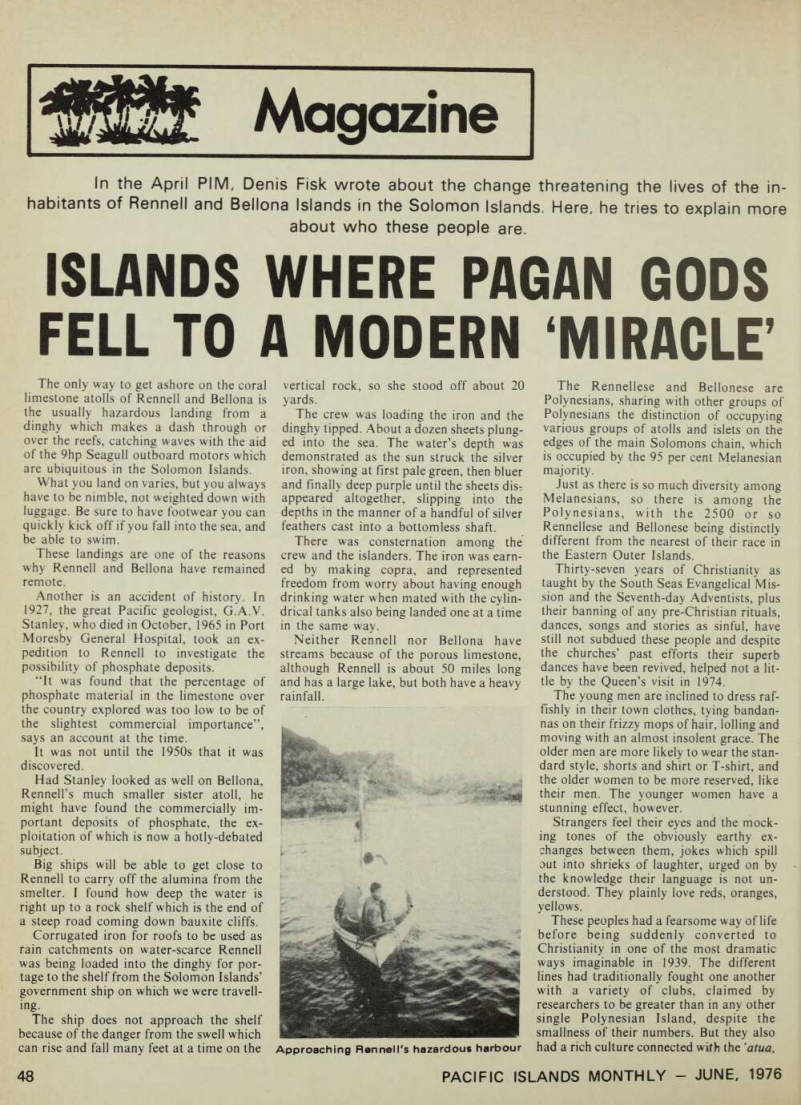
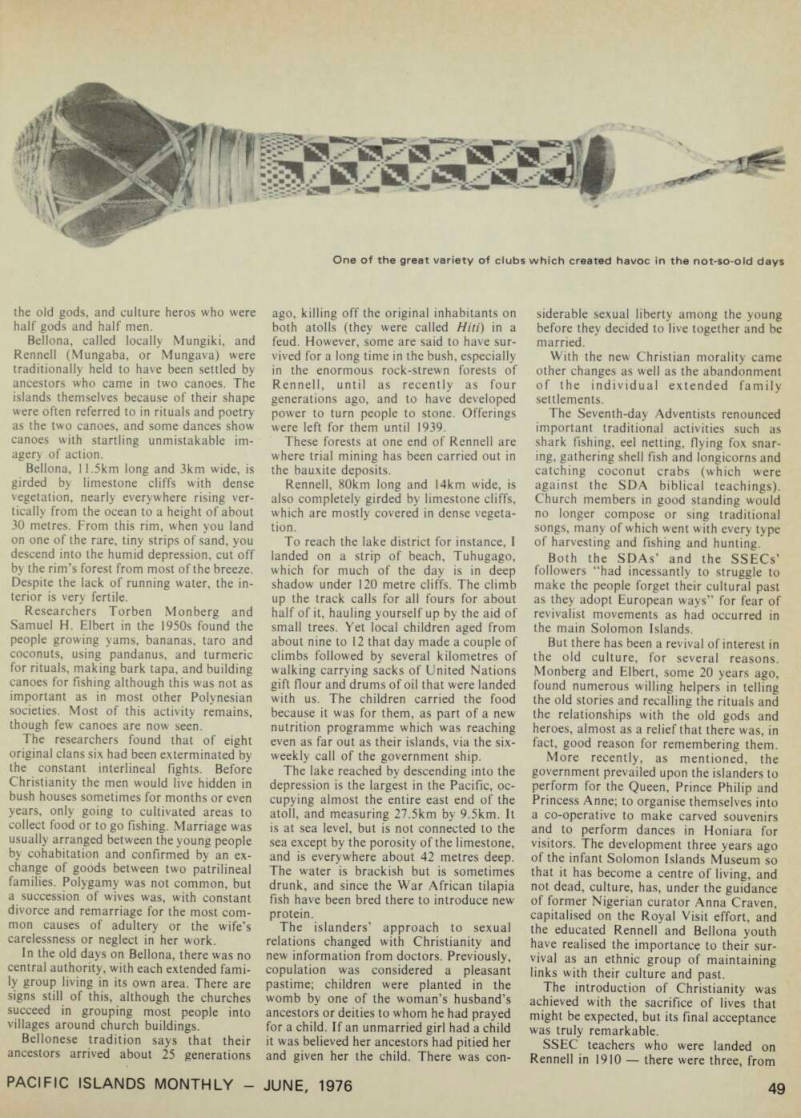

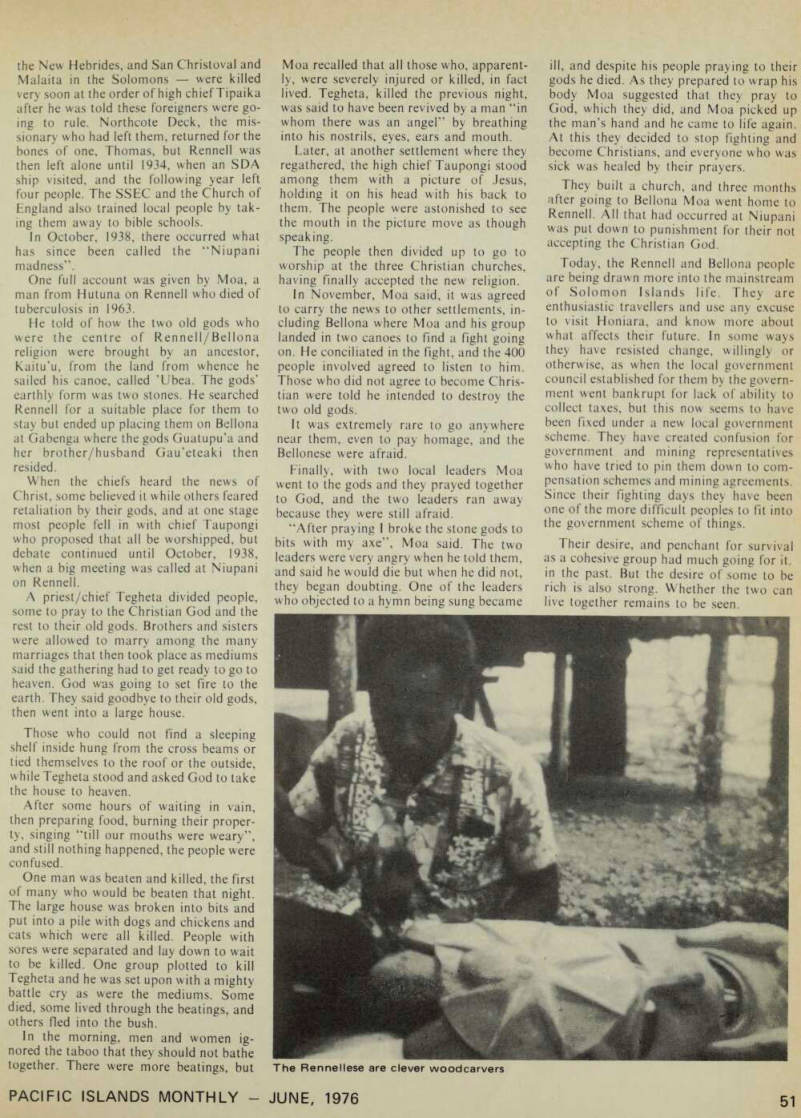
Islands Where Pagan Gods
Fell To A Modern ‘Miracle’
In the April PIM, Denis Fisk wrote about the change threatening the lives of the in habitants of Rennell and Bellona Islands in the Solomon Islands. Here, he tries to explain more about who these people are.
The only way to get ashore on the coral limestone atolls of Rennell and Bellona is the usually hazardous landing from a dinghy which makes a dash through or over the reefs, catching waves with the aid of the 9hp Seagull outboard motors which are übiquitous in the Solomon Islands.
What you land on varies, but you always have to be nimble, not weighted down with luggage. Be sure to have footwear you can quickly kick off if you fall into the sea, and be able to swim.
These landings are one of the reasons why Rennell and Bellona have remained remote.
Another is an accident of history. In 1927, the great Pacific geologist, G.A.V.
Stanley, who died in October, 1965 in Port Moresby General Hospital, took an ex pedition to Rennell to investigate the
possibility of phosphate deposits.
“It was found that the percentage of phosphate material in the limestone over the country explored was too low to be of the slightest commercial importance”, says an account at the time.
It was not until the 1950 s that it was discovered.
Had Stanley looked as well on Bellona, Rennell’s much smaller sister atoll, he might have found the commercially im portant deposits of phosphate, the ex ploitation of which is now a hotly-debated subject.
Big ships will be able to get close to Rennell to carry off the alumina from the smelter. I found how deep the water is right up to a rock shelf which is the end of a steep road coming down bauxite cliffs.
Corrugated iron for roofs to be used as rain catchments on water-scarce Rennell was being loaded into the dinghy for por tage to the shelf from the Solomon Islands’ government ship on which we were travell ing.
The ship does not approach the shelf because of the danger from the swell which can rise and fall many feet at a time on the
vertical rock, so she stood off about 20 yards.
The crew was loading the iron and the dinghy tipped. About a dozen sheets plung ed into the sea. The water’s depth was demonstrated as the sun struck the silver iron, showing at first pale green, then bluer and finally deep purple until the sheets dis appeared altogether, slipping into the depths in the manner of a handful of silver feathers cast into a bottomless shaft.
There was consternation among the crew and the islanders. The iron was earn ed by making copra, and represented freedom from worry about having enough drinking water when mated with the cylin drical tanks also being landed one at a time in the same way.
Neither Rennell nor Bellona have streams because of the porous limestone, although Rennell is about 50 miles long and has a large lake, but both have a heavy rainfall.
The Rennellese and Bellonese are Polynesians, sharing with other groups of Polynesians the distinction of occupying various groups of atolls and islets on the edges of the main Solomons chain, which is occupied by the 95 per cent Melanesian
majority.
Just as there is so much diversity among Melanesians, so there is among the Polynesians, with the 2500 or so Rennellese and Bellonese being distinctly different from the nearest of their race in the Eastern Outer Islands.
Thirty-seven years of Christianity as taught by the South Seas Evangelical Mis sion and the Seventh-day Adventists, plus their banning of any pre-Christian rituals, dances, songs and stories as sinful, have still not subdued these people and despite the churches’ past efforts their superb dances have been revived, helped not a lit tle by the Queen’s visit in 1974.
The young men are inclined to dress raf fishly in their town clothes, tying bandan nas on their frizzy mops of hair, lolling and moving with an almost insolent grace. The older men are more likely to wear the stan dard style, shorts and shirt or T-shirt, and the older women to be more reserved, like their men. The younger women have a stunning effect, however.
Strangers feel their eyes and the mock ing tones of the obviously earthy ex changes between them, jokes which spill out into shrieks of laughter, urged on by the knowledge their language is not un derstood. They plainly love reds, oranges, yellows.
These peoples had a fearsome way of life before being suddenly converted to Christianity in one of the most dramatic ways imaginable in 1939. The different lines had traditionally fought one another with a variety of clubs, claimed by researchers to be greater than in any other single Polynesian Island, despite the smallness of their numbers. But they also had a rich culture connected with the ‘atua.
Approaching Rennell's hazardous harbour
the old gods, and culture heros who were half gods and half men.
Bellona, called locally Mungiki, and Rennell (Mungaba, or Mungava) were traditionally held to have been settled by ancestors who came in two canoes. The islands themselves because of their shape were often referred to in rituals and poetry as the two canoes, and some dances show canoes with startling unmistakable im agery of action.
Bellona, 11.5 km long and 3km wide, is girded by limestone cliffs with dense vegetation, nearly everywhere rising ver tically from the ocean to a height of about 30 metres. From this rim, when you land on one of the rare, tiny strips of sand, you descend into the humid depression, cut off by the rim’s forest from most of the breeze.
Despite the lack of running water, the in terior is very fertile.
Researchers Torben Monberg and Samuel H. Elbert in the 1950 s found the people growing yams, bananas, taro and coconuts, using pandanus, and turmeric for rituals, making bark tapa, and building canoes for fishing although this was not as important as in most other Polynesian societies. Most of this activity remains, though few canoes are now seen.
The researchers found that of eight original clans six had been exterminated by the constant interlineal fights. Before Christianity the men would live hidden in bush houses sometimes for months or even years, only going to cultivated areas to collect food or to go fishing. Marriage was usually arranged between the young people by cohabitation and confirmed by an ex change of goods between two patrilineal families. Polygamy was not common, but a succession of wives was, with constant divorce and remarriage for the most com mon causes of adultery or the wife’s carelessness or neglect in her work.
In the old days on Bellona, there was no central authority, with each extended fami ly group living in its own area. There are signs still of this, although the churches succeed in grouping most people into
villages around church buildings.
Bellonese tradition says that their ancestors arrived about 25 generations
ago, killing off the original inhabitants on both atolls (they were called Hiti) in a feud. However, some are said to have sur vived for a long time in the bush, especially in the enormous rock-strewn forests of Rennell, until as recently as four generations ago, and to have developed power to turn people to stone. Offerings were left for them until 1939.
These forests at one end of Rennell are where trial mining has been carried out in the bauxite deposits.
Rennell, 80km long and 14km wide, is also completely girded by limestone cliffs, which are mostly covered in dense vegeta tion.
To reach the lake district for instance, I landed on a strip of beach, Tuhugago, which for much of the day is in deep shadow under 120 metre cliffs. The climb up the track calls for all fours for about half of it, hauling yourself up by the aid of small trees. Yet local children aged from about nine to 12 that day made a couple of climbs followed by several kilometres of walking carrying sacks of United Nations gift flour and drums of oil that were landed with us. The children carried the food because it was for them, as part of a new nutrition programme which was reaching even as far out as their islands, via the six weekly call of the government ship.
The lake reached by descending into the depression is the largest in the Pacific, oc cupying almost the entire east end of the atoll, and measuring 27.5 km by 9.5 km. It is at sea level, but is not connected to the sea except by the porosity of the limestone, and is everywhere about 42 metres deep.
The water is brackish but is sometimes drunk, and since the War African tilapia fish have been bred there to introduce new protein.
The islanders’ approach to sexual relations changed with Christianity and new information from doctors. Previously, copulation was considered a pleasant pastime; children were planted in the womb by one of the woman’s husband’s ancestors or deities to whom he had prayed for a child. If an unmarried girl had a child it was believed her ancestors had pitied her and given her the child. There was con
siderable sexual liberty among the young before they decided to live together and be married.
With the new Christian morality came other changes as well as the abandonment of the individual extended family settlements.
The Seventh-day Adventists renounced important traditional activities such as shark fishing, eel netting, flying fox snar ing, gathering shell fish and longicorns and catching coconut crabs (which were against the SDA biblical teachings).
Church members in good standing would no longer compose or sing traditional songs, many of which went with every type
of harvesting and fishing and hunting.
Both the SDAs’ and the SSECs’ followers “had incessantly to struggle to make the people forget their cultural past as they adopt European ways” for fear of revivalist movements as had occurred in the main Solomon Islands.
But there has been a revival of interest in the old culture, for several reasons.
Monberg and Elbert, some 20 years ago,
found numerous willing helpers in telling
the old stories and recalling the rituals and the relationships with the old gods and heroes, almost as a relief that there was, in fact, good reason for remembering them.
More recently, as mentioned, the government prevailed upon the islanders to perform for the Queen, Prince Philip and Princess Anne; to organise themselves into a co-operative to make carved souvenirs and to perform dances in Honiara for visitors. The development three years ago of the infant Solomon Islands Museum so that it has become a centre of living, and not dead, culture, has, under the guidance of former Nigerian curator Anna Craven, capitalised on the Royal Visit effort, and the educated Rennell and Bellona youth have realised the importance to their sur vival as an ethnic group of maintaining links with their culture and past.
The introduction of Christianity was achieved with the sacrifice of lives that might be expected, but its final acceptance was truly remarkable.
SSEC teachers who were landed on Rennell in 1910 there were three, from
One of the great variety of clubs which created havoc in the not-so-old days
the New Hebrides, and San Christoval and Malaita in the Solomons were killed very soon at the order of high chief Tipaika after he was told these foreigners were go ing to rule. Northcote Deck, the mis sionary who had left them, returned for the bones of one, Thomas, but Rennell was then left alone until 1934, when an SDA ship visited, and the following year left four people. The SSEC and the Church of England also trained local people by tak ing them away to bible schools.
In October, 1938, there occurred what has since been called the “Niupani madness”.
One full account was given by Moa, a man from Hutuna on Rennell who died of tuberculosis in 1963.
He told of how the two old gods who were the centre of Rennell/Bellona religion were brought by an ancestor, Kaitu’u, from the land from whence he sailed his canoe, called ’Ubea. The gods’ earthly form was two stones. He searched Rennell for a suitable place for them to stay but ended up placing them on Bellona at Gabenga where the gods Guatupu'a and her brother/husband Gau’eteaki then resided.
When the chiefs heard the news of Christ, some believed it while others feared retaliation by their gods, and at one stage most people fell in with chief Taupongi who proposed that all be worshipped, but debate continued until October, 1938, when a big meeting was called at Niupani on Rennell.
A priest/chief Tegheta divided people, some to pray to the Christian God and the rest to their old gods. Brothers and sisters were allowed to marry among the many marriages that then took place as mediums said the gathering had to get ready to go to heaven. God was going to set fire to the earth. They said goodbye to their old gods, then went into a large house.
Those who could not find a sleeping shelf inside hung from the cross beams or tied themselves to the roof or the outside, while Tegheta stood and asked God to take the house to heaven.
After some hours of waiting in vain, then preparing food, burning their proper ty, singing “till our mouths were weary”, and still nothing happened, the people were confused.
One man was beaten and killed, the first of many who would be beaten that night.
The large house was broken into bits and put into a pile with dogs and chickens and cats which were all killed. People with sores were separated and lay down to wait to be killed. One group plotted to kill Tegheta and he was set upon with a mighty battle cry as were the mediums. Some died, some lived through the beatings, and others fled into the bush.
In the morning, men and women ig nored the taboo that they should not bathe together. There were more beatings, but
Moa recalled that all those who, apparently, were severely injured or killed, in fact lived. Tegheta, killed the previous night, was said to have been revived by a man “in whom there was an angel” by breathing into his nostrils, eyes, ears and mouth.
Later, at another settlement where they regathered, the high chief Taupongi stood among them with a picture of Jesus, ... i • i j * ■ i i ■ i holding it on his head with his back to , 4 . , . them. The people were astonished to see .. ■ X . , the mouth m the picture move as though ,■ K 5 speaKmg.
The people then divided up to go to worship at the three Christian churches, having finally accepted the new religion.
In November, Moa said, it was agreed to carry the news to other settlements, ineluding Bellona where Moa and his group landed in two canoes to find a fight going on. He conciliated in the fight, and the 400 people involved agreed to listen to him.
Those who did not agree to become Christian were told he intended to destroy the two old gods.
It was extremely rare to go anywhere near them, even to pay homage, and the Bellonese were afraid.
Finally, with two local leaders Moa went to the gods and they prayed together to God, and the two leaders ran away because they were still afraid.
“After praying I broke the stone gods to bits with my axe”, Moa said. The two leaders were very angry when he told them, and said he would die but when he did not, they began doubting. One of the leaders who objected to a hymn being sung became
ill, and despite his people praying to their gods he died. As they prepared to wrap his body Moa suggested that they pray to God, which they did, and Moa picked up the man’s hand and he came to life again.
At this they decided to stop fighting and become Christians, and everyone who was sick was healed by their prayers. a .u . • ney built a church, and three months a r fpr or . in „ t R _n rtr , o . , alter going to Bellona Moa went home to D« n aii th.,, u a . . C Rennell. All that had occurred at Niupani mif j_ w;ri tn . . r ... F w as put down to punishment for their not accepting the Christian God.
Today, the Rennell and Bellona people are bein g drawn more into the mainstream °f Solomon Islands life. They are enthusiastic travellers and use any excuse t 0 v *sß Honiara, and know more about what affects their future. In some ways tbe y bave resisted change, willingly or otherwise, as when the local government council established for them by the govern ment went bankrupt for lack of ability to collect taxes, but this now seems to have been f' xed under a new local government scheme. They have created confusion for government and mining representatives wbo bave tr ' e d to pin them down to com pensation schemes and mining agreements, Since their fighting days they have been one more difficult peoples to fit into B overnment scheme of things, Their desire, and penchant for survival as a cohesive group had much going for it. in the past. But the desire of some to be rich is also strong. Whether the two can live together remains to be seen.
The Rennellese are clever woodcarvers
Advertisements & other items, pp. 50-52 (1 item)
Color,Speed,
SHARPNESS,
FINE GRAIN...
rsr*36p
k \V
kp l ?
KodacKrome 64 film
Kodachrome 64 (daylight) film is an excellent general purpose slide film that gives well-saturated colors, sharpness and fine grain, plus the flexibility of an ASA 64 rating. It holds fine detail in highlight and shadow areas and has good exposure latitude for pleasing results, even with moderate under or over-exposure. Kodachrome 64 film is available from photo dealers in sizes to fit 135,126 and 110-size cameras.
For ultra-fine grain sharpness, try Kodachrome 25 film. It’s rated at ASA 25 and is available only in 135-size rolls.
KODAK (Australasia) PTY. LTD.
K6l/5203
CHLORIDE THE MOST COMPLETE
SOURCE OF PACKAGED POWER IN
THE SOUTHERN HEMISPHERE.
A generous statement? Maybe, but then Chloride is equipped and qualified as such . . always ready to offer advice, guidance and service on your battery requirements.
And it goes way beyond automotive batteries. No matter what the problem . . if it's a question of power. . battery power. . it's one for Chloride. It could be as small as a battery for a hearing aid the size of a coat button, or a power station battery weighing 40 tonnes.
Again, it could be a no break D.C. power system for a computer or emergency lighting for a hospital.
Nearly 50% of all batteries sold in Australia are made by Chloride.
No matter what the application . .
Transport, Industrial, Communication, Defence, Mining, Marine, Recreation . . .
Make Chloride power work for you. p Emergency Lighting Electric Vehicles f Engine Starting Automotive
feCi
Telecommunications Chloride Batteries Australia Limited 55 Bryant Street, Padstow, N.S.W. 2211, Australia. Telephone; 77 0177. 8111 B til
Suffering crawling crabs!
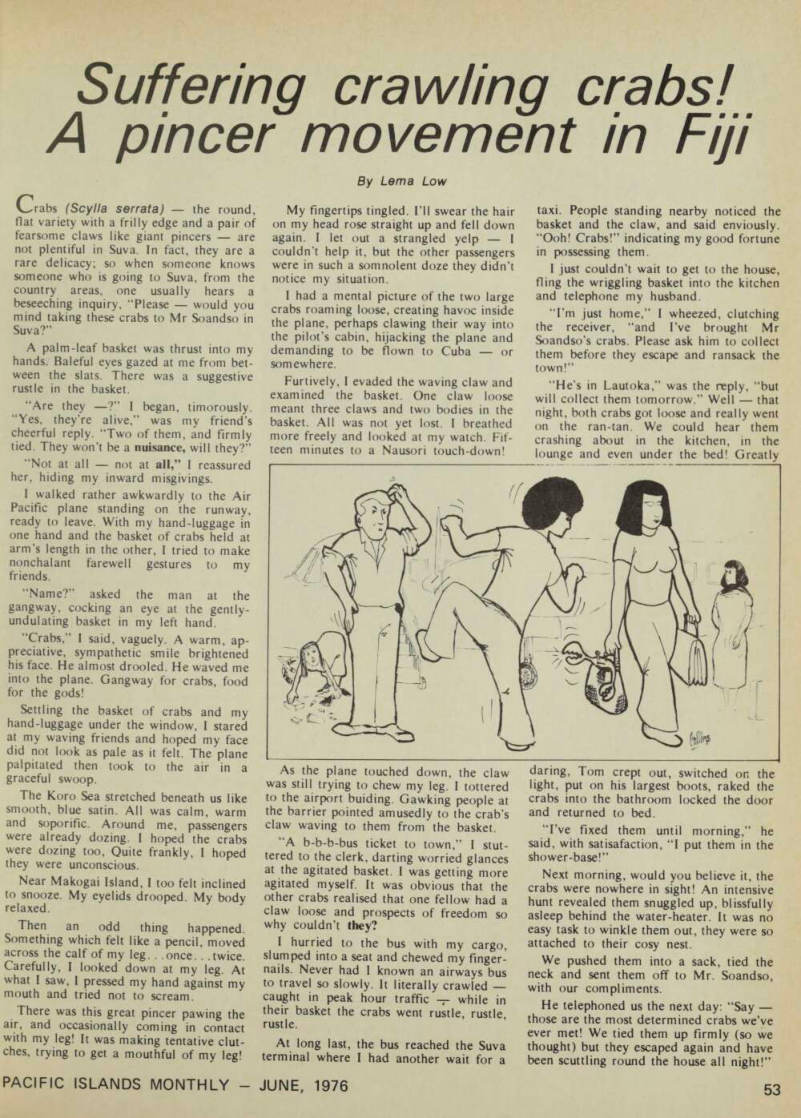
A pincer movement in Fiji
By Lema Low
Crabs (Scylla serrata) the round, flat variety with a frilly edge and a pair of fearsome claws like giant pincers are not plentiful in Suva. In fact, they are a rare delicacy; so when someone knows someone who is going to Suva, from the country areas, one usually hears a beseeching inquiry, “Please would you mind taking these crabs to Mr Soandso in Suva?”
A palm-leaf basket was thrust into my hands. Baleful eyes gazed at me from bet ween the slats. There was a suggestive rustle in the basket.
“Are they —?” I began, timorously.
“Yes, they’re alive,” was my friend’s cheerful reply. “Two of them, and firmly tied. They won’t be a nuisance, will they?”
“Not at all not at all,” I reassured her, hiding my inward misgivings.
I walked rather awkwardly to the Air Pacific plane standing on the runway, ready to leave. With my hand-luggage in one hand and the basket of crabs held at arm’s length in the other, I tried to make nonchalant farewell gestures to my friends.
“Name?” asked the man at the gangway, cocking an eye at the gently undulating basket in my left hand.
“Crabs,” I said, vaguely. A warm, ap preciative, sympathetic smile brightened his face. He almost drooled. He waved me into the plane. Gangway for crabs, food for the gods!
Settling the basket of crabs and my hand-luggage under the window, I stared at my waving friends and hoped my face did not look as pale as it felt. The plane palpitated then took to the air in a graceful swoop.
The Koro Sea stretched beneath us like smooth, blue satin. All was calm, warm and soporific. Around me, passengers were already dozing. I hoped the crabs were dozing too, Quite frankly, I hoped they were unconscious.
Near Makogai Island, I too felt inclined to snooze. My eyelids drooped. My body relaxed.
Then an odd thing happened.
Something which felt like a pencil, moved across the calf of my leg. . .once. . .twice.
Carefully, I looked down at my leg. At what I saw, I pressed my hand against my mouth and tried not to scream.
There was this great pincer pawing the air, and occasionally coming in contact with my leg! It was making tentative clut ches, trying to get a mouthful of my leg!
My fingertips tingled. I’ll swear the hair on my head rose straight up and fell down again. I let out a strangled yelp I couldn’t help it, but the other passengers were in such a somnolent doze they didn’t notice my situation.
I had a mental picture of the two large crabs roaming loose, creating havoc inside the plane, perhaps clawing their way into the pilot’s cabin, hijacking the plane and demanding to be flown to Cuba or somewhere.
Furtively, I evaded the waving claw and examined the basket. One claw loose meant three claws and two bodies in the basket. All was not yet lost. I breathed more freely and looked at my watch. Fif teen minutes to a Nausori touch-down!
As the plane touched down, the claw was still trying to chew my leg. I tottered to the airport buiding. Gawking people at the barrier pointed amusedly to the crab’s claw waving to them from the basket.
“A b-b-b-bus ticket to town,” I stuttered to the clerk, darting worried glances at the agitated basket. I was getting more agitated myself. It was obvious that the other crabs realised that one fellow had a claw loose and prospects of freedom so
why couldn t they?
I hurried to the bus with my cargo, slumped into a seat and chewed my fingernails. Never had I known an airways bus to travel so slowly. It literally crawled caught in peak hour traffic while in their basket the crabs went ruitle, rustle rust j e ’ ’
At long last, the bus reached the Suva terminal where I had another wait for a
taxi. People standing nearby noticed the basket and the claw, and said enviously.
“Ooh! Crabs!” indicating my good fortune in possessing them.
I just couldn’t wait to get to the house, fling the wriggling basket into the kitchen and telephone my husband.
“I’m just home,” I wheezed, clutching the receiver, “and I’ve brought Mr Soandso’s crabs. Please ask him to collect them before they escape and ransack the town!”
“He’s in Lautoka,” was the reply, “but will collect them tomorrow.” Well that night, both crabs got loose and really went on the ran-tan. We could hear them crashing about in the kitchen, in the lounge and even under the bed! Greatly
daring, Tom crept out, switched on the light, put on his largest boots, raked the crabs into the bathroom locked the door and returned to bed.
“I’ve fixed them until morning,” he said, with satisafaction, “I put them in the shower-base!”
Next morning, would you believe it, the crabs were nowhere in sight! An intensive hunt revealed them snuggled up, blissfully asleep behind the water-heater. It was no eaS y task to w inkle them out, they were so attached to their cosy nest, We pushed them into a sack, tied the neck and sent them off to Mr. Soandso, with our compliments, ~. . . th He lele f h honed , u * the «xt day: ‘‘Say those are the most determined crabs we ve ever met! We tied them up firmly (so we thought) but they escaped again and have been scuttling round the house all night!”
romance through
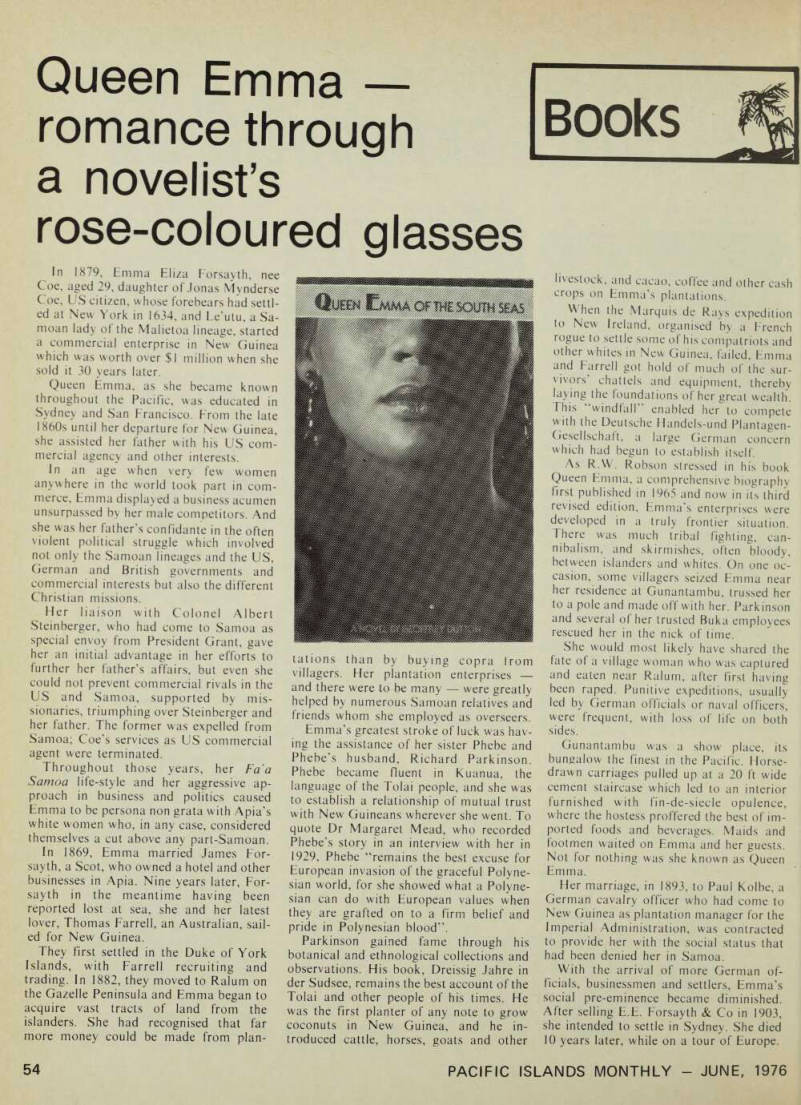
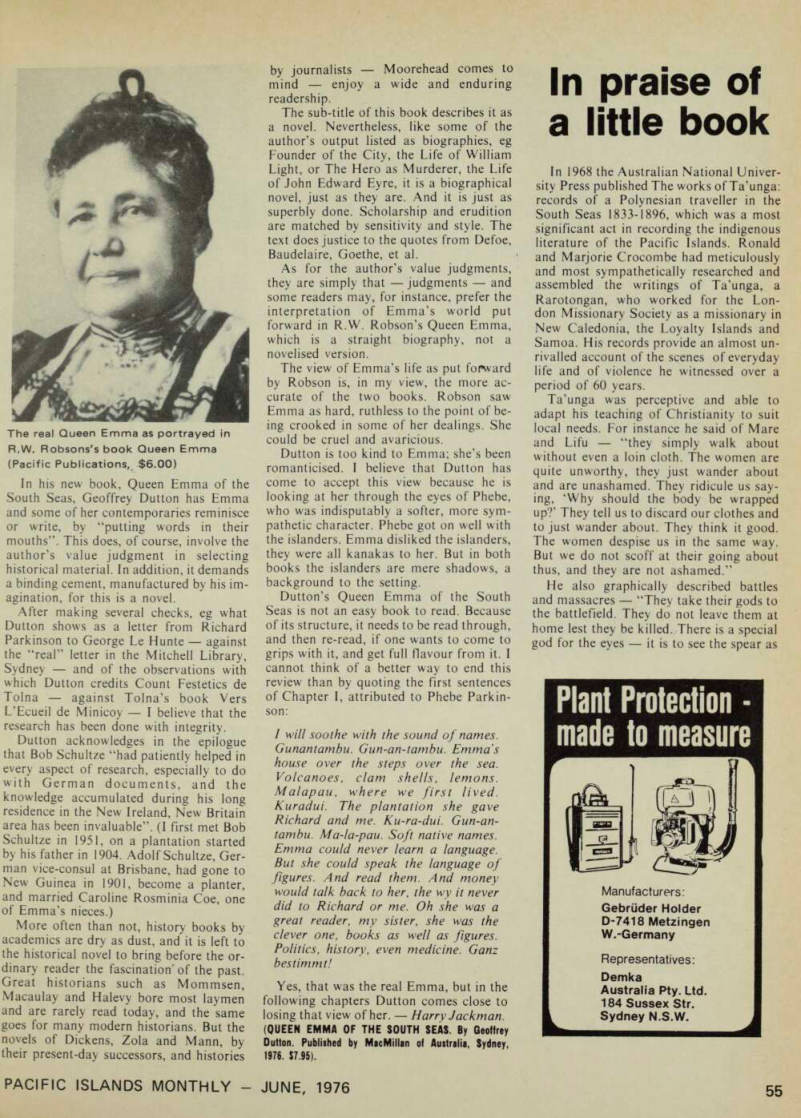
Queen Emmaromance through a novelist’s rose-coloured glasses
Books
In 1879, Emma Eliza Forsayth, nee Coe, aged 29, daughter of Jonas Mynderse Coe, US citizen, whose forebears had settl ed at New York in 1634, and Le’utu, a Sa moan lady of the Malietoa lineage, started a commercial enterprise in New Guinea which was worth over $1 million when she sold it 30 years later.
Queen Emma, as she became known throughout the Pacific, was educated in Sydney and San Francisco. From the late 1860 s until her departure for New Guinea, she assisted her father with his US com mercial agency and other interests.
In an age when very few women anywhere in the world took part in com merce, Emma displayed a business acumen unsurpassed by her male competitors. And she was her father’s confidante in the often violent political struggle which involved not only the Samoan lineages and the US, German and British governments and commercial interests but also the different Christian missions.
Her liaison with Colonel Albert Steinberger, who had come to Samoa as special envoy from President Grant, gave her an initial advantage in her efforts to further her father’s affairs, but even she could not prevent commercial rivals in the US and Samoa, supported by mis sionaries, triumphing over Steinberger and her father. The former was expelled from Samoa; Coe’s services as US commercial agent were terminated.
Throughout those years, her Fa’a Samoa life-style and her aggressive ap proach in business and politics caused Emma to be persona non grata with Apia’s white women who, in any case, considered themselves a cut above any part-Samoan.
In 1869, Emma married James For sayth, a Scot, who owned a hotel and other businesses in Apia. Nine years later, For sayth in the meantime having been reported lost at sea, she and her latest lover, Thomas Farrell, an Australian, sail ed for New Guinea.
They first settled in the Duke of York Islands, with Farrell recruiting and trading. In 1882, they moved to Ralum on the Gazelle Peninsula and Emma began to acquire vast tracts of land from the islanders. She had recognised that far more money could be made from plan-
tations than by buying copra from villagers. Her plantation enterprises and there were to be many were greatly helped by numerous Samoan relatives and friends whom she employed as overseers.
Emma’s greatest stroke of luck was hav ing the assistance of her sister Phebe and Phebe’s husband, Richard Parkinson.
Phebe became fluent in Kuanua, the language of the Tolai people, and she was to establish a relationship of mutual trust with New Guineans wherever she went. To quote Dr Margaret Mead, who recorded Phebe’s story in an interview with her in 1929, Phebe “remains the best excuse for European invasion of the graceful Polyne sian world, for she showed what a Polyne sian can do with European values when they are grafted on to a firm belief and pride in Polynesian blood’’.
Parkinson gained fame through his botanical and ethnological collections and observations. His book, Dreissig Jahre in der Sudsee, remains the best account of the Tolai and other people of his times. He was the first planter of any note to grow coconuts in New Guinea, and he in troduced cattle, horses, goals and other
livestock, and cacao, coffee and other cash crops on Emma’s plantations.
When the Marquis de Rays expedition to New Ireland, organised by a French rogue to settle some of his compatriots and other whites in New Guinea, failed, Emma and Farrell got hold of much of the sur vivors chattels and equipment, thereby laying the foundations of her great wealth.
This windfall enabled her to compete with the Deutsche Handels-und Plantagen- Gesellschaft, a large German concern which had begun to establish itself.
As R.W. Robson stressed in his book Queen Emma, a comprehensive biography first published in 1965 and now in its third revised edition, Emma’s enterprises were developed in a truly frontier situation.
There was much tribal fighting, can nibalism, and skirmishes, often bloody, between islanders and whites. On one oc casion, some villagers seized Emma near her residence at Gunantambu, trussed her to a pole and made off with her. Parkinson and several of her trusted Buka employees rescued her in the nick of time.
She would most likely have shared the fate of a village woman who was captured and eaten near Ralum, after first having been raped. Punitive expeditions, usually led by German officials or naval officers, were frequent, with loss of life on both sides.
Gunantambu was a show place, its bungalow the finest in the Pacific. Horse drawn carriages pulled up at a 20 ft wide cement staircase which led to an interior furnished with fin-de-siecle opulence, where the hostess proffered the best of im ported foods and beverages. Maids and footmen waited on Emma and her guests.
Not for nothing was she known as Queen Emma.
Her marriage, in 1893, to Paul Kolbe, a German cavalry officer who had come to New Guinea as plantation manager for the Imperial Administration, was contracted to provide her with the social status that had been denied her in Samoa.
With the arrival of more German of ficials, businessmen and settlers, Emma’s social pre-eminence became diminished.
After selling E.E. Forsayth & Co in 1903, she intended to settle in Sydney. She died 10 years later, while on a tour of Europe.
In his new book, Queen Emma of the South Seas, Geoffrey Dutton has Emma and some of her contemporaries reminisce or write, by “putting words in their mouths”. This does, of course, involve the author’s value judgment in selecting historical material. In addition, it demands a binding cement, manufactured by his im agination, for this is a novel.
After making several checks, eg what Dutton shows as a letter from Richard Parkinson to George Le Hunte against the “real” letter in the Mitchell Library, Sydney and of the observations with which Dutton credits Count Festetics de Tolna against Tolna’s book Vers L’Ecueil de Minicoy I believe that the research has been done with integrity.
Dutton acknowledges in the epilogue that Bob Schultze “had patiently helped in every aspect of research, especially to do with German documents, and the
knowledge accumulated during his long
residence in the New Ireland, New Britain area has been invaluable”. (I first met Bob Schultze in 1951, on a plantation started by his father in 1904. Adolf Schultze, Ger man vice-consul at Brisbane, had gone to New Guinea in 1901, become a planter, and married Caroline Rosminia Coe, one of Emma’s nieces.) More often than not, history books by academics are dry as dust, and it is left to the historical novel to bring before the or dinary reader the fascination" of the past.
Great historians such as Mommsen, Macaulay and Halevy bore most laymen and are rarely read today, and the same goes for many modern historians. But the novels of Dickens, Zola and Mann, by their present-day successors, and histories
by journalists Moorehead comes to mind enjoy a wide and enduring readership.
The sub-title of this book describes it as a novel. Nevertheless, like some of the author’s output listed as biographies, eg Founder of the City, the Life of William Light, or The Hero as Murderer, the Life of John Edward Eyre, it is a biographical novel, just as they are. And it is just as superbly done. Scholarship and erudition are matched by sensitivity and style. The text does justice to the quotes from Defoe, Baudelaire, Goethe, et al.
As for the author’s value judgments,
they are simply that judgments and
some readers may, for instance, prefer the interpretation of Emma’s world put forward in R.W. Robson’s Queen Emma, which is a straight biography, not a novelised version.
The view of Emma’s life as put fopward by Robson is, in my view, the more ac curate of the two books. Robson saw Emma as hard, ruthless to the point of be ing crooked in some of her dealings. She could be cruel and avaricious.
Dutton is too kind to Emma; she’s been romanticised. I believe that Dutton has come to accept this view because he is looking at her through the eyes of Phebe, who was indisputably a softer, more sym pathetic character. Phebe got on well with the islanders. Emma disliked the islanders, they were all kanakas to her. But in both books the islanders are mere shadows, a background to the setting.
Dutton’s Queen Emma of the South Seas is not an easy book to read. Because of its structure, it needs to be read through, and then re-read, if one wants to come to grips with it, and get full flavour from it. I cannot think of a better way to end this review than by quoting the first sentences of Chapter I, attributed to Phebe Parkin son: / wz// soothe with the sound of names.
Gunantambu. Gun-an-tambu. Emma’s house over the steps over the sea.
Volcanoes, clam shells, lemons.
Malapau, where we first lived.
Kuradui. The plantation she gave Richard and me. Ku-ra-dui. Gun-an tambu. Ma-la-pau. Soft native names.
Emma could never learn a language.
But she could speak the language of figures. And read them. And money would talk back to her. the wy it never did to Richard or me. Oh she was a great reader, my sister, she was the clever one, books as well as figures.
Politics, history, even medicine. Ganz bestimmt!
Yes, that was the real Emma, but in the following chapters Dutton comes close to losing that view of her. Harry Jackman. (QUEEN EMMA OF THE SOUTH SEAS. By Geoffrey Dutton. Published by MacMillan of Australia, Sydney, 1976. $7.95).
The real Queen Emma as portrayed in R.W. Robsons's book Queen Emma (Pacific Publications, $6.00)
In praise of
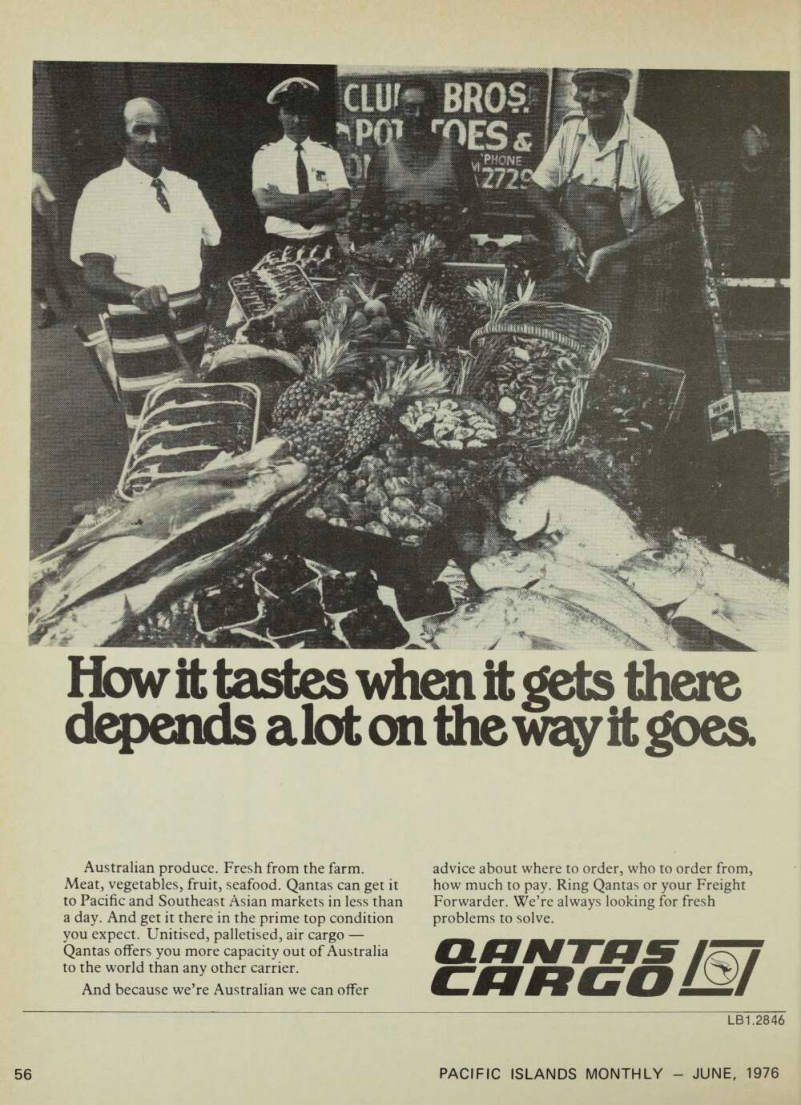
a little book
In 1968 the Australian National Univer sity Press published The works of Ta’unga: records of a Polynesian traveller in the South Seas 1833-1896, which was a most significant act in recording the indigenous literature of the Pacific Islands. Ronald and Marjorie Crocombe had meticulously and most sympathetically researched and assembled the writings of Ta’unga, a Rarotongan, who worked for the Lon don Missionary Society as a missionary in New Caledonia, the Loyalty Islands and Samoa. His records provide an almost un rivalled account of the scenes of everyday life and of violence he witnessed over a period of 60 years.
Ta’unga was perceptive and able to adapt his teaching of Christianity to suit local needs. For instance he said of Mare and Lifu “they simply walk about without even a loin cloth. The women are quite unworthy, they just wander about and are unashamed. They ridicule us say ing, ‘Why should the body be wrapped up?’ They tell us to discard our clothes and to just wander about. They think it good.
The women despise us in the same way.
But we do not scoff at their going about thus, and they are not ashamed.”
He also graphically described battles and massacres “They take their gods to the battlefield. They do not leave them at home lest they be killed. There is a special god for the eyes it is to see the spear as
it flies toward one. There is a separate god for the ears it is to detect the hum of the spear and the whiz of the sling-stone.”
All praise to the Australian National University Press and to theCrocombes for paying tribute to Ta’unga but to tell the tale in an academic publication does not necessarily imply that its message will reach those for whom it has the deepest significance, the peoples of the Pacific Islands - Marjorie Crocombe had found an answer to this problem, a solution which needs to be further developed. She has brought out an abridged version of the first book entitled “If I live; the life of Ta’unga,” in a form, and at a cost, which p S r ide d i strib i! tion throughout the Pacific, and perhaps, hopefully in other parts. ? r i a ‘t 0 p ru° D finn/Thl 1C n d hr y h L ° tU h PaSirika fh rod tT e P . pubb shmg bouse w,thlothe Pmpra l^n^ d nf a th° n t^ nd f^ o p im f niCa^°n f PaCIf,C Conference of St^eslmh PU pirfrlp 0 \n a - *J n l ertaken fiir the South Pacific Social Sciences uZZ°l,l rrf f°p 8a T at ;T T p ; J°faOU l th 1? k ° \4 aC,^ C Is ands nters and researchers. Mrs Crocombe has made a judicious selection of the contents of the parent work and has retained a framework which gives clarity to the record ol Ta unga s work.
It behoves those interested in Pacific Islands literature to give all possible en couragement to such grass-roots publica tion as “If I Live”. In particular, such publications have a real place to fill in Pacific Islands education. All too fre quently in the Islands schools the children are confronted with the rather doubtful deeds of stereotyped European hero figures.
The children and all Pacific Islands peoples should be able to acknowledge the feats of their own men and women, Perhaps Marjorie Crocombe may be em boldened to go on to tell the stories of other Cook Islands heroic figures, of Papeiha, of Eliakana, and of Ruatolca.
I have only one criticism to make of this , itt e book Let a „ of us who write about the Pacific be consistent in the form we give t 0 P ,ace Surely we have all come to acce P t the spelling of Pago Pago as being just that. It must be confusing for the reader to f,nd 00 P a B e 26 jt is Pan 8° Pango and on page 27 Pago Pago, and Olosega receives the same treatment. I do not want to be carping however Let’s give
Praise where ft * Kdhl£fet n££
books in the mould of “If I Live” will
follow its course.
W.G. Coppell
» IF i LIVE: THE LIFE OF TA’UNGA ”By Marjorie juainekore Crocombe. Published by Lotu Pasifika Productions, Suva. 5A0.70.
Advertisements & other items, pp. 55-56 (1 item)
Plant Protection -
made to measure
m Manufacturers: Gebriider Holder D-7418 Metzingen W.-Germany Representatives: Demka Australia Pty. Ltd. 184 Sussex Str.
Sydney N.S.W.
How it tastes when it gets there depends alot on the way it goes.
Australian produce. Fresh from the farm.
Meat, vegetables, fruit, seafood. Qantas can get it to Pacific and Southeast Asian markets in less than a day. And get it there in the prime top condition you expect. Unitised, palletised, air cargo Qantas offers you more capacity out of Australia to the world than any other carrier.
And because we’re Australian we can offer advice about where to order, who to order from, how much to pay. Ring Qantas or your Freight Forwarder. We’re always looking for fresh problems to solve.
aa/vTtrs i~i
cart col®/
L 81.2846
To Tonga
with love, from Helen
From Patricia Matheson In
Vavau
The Kingdom of Tonga and the Pacific world generally sustained a great loss when on 26 March, 1976, Helen Raitt, author and founder of the Tofua Press, died in her native California.
Helen first v,sited Tonga in *953 when her oceanographer husband, Dr Russell Ra,U ’ waS 00 an ex P edition sponsored by California’s Scnpps Institute. As wives were banned from the expedition ship, Helen was flying from port to port meeting “Russ” whenevershe could. When the ex 8 pedition reached Fiji, it planned to spend a month or so there, so Helen, still prohibited from travelling on the ship, took passage on a copra vessel for Vavau in Tonga.
Enraptured by the beauty of the country
Books
and the friendliness of the people, she call ed Russ and the heads of the expedition to come down and see it for themselves. They did and so much did they agree with her feelings about the islands of Tonga that, out of gratitude, they allowed her to ac company them on the trip back to Califor nia. From that experience grew her first book, Exploring the Deep Pacific, a fascinating volume that presents a layman’s view of the busy lives of oceanographers at work.
When the University of California at San Diego, of which Scripps is an integral part, was given a vast collection of Pacific
explorations, Helen’s thoughts turned
again to Tonga. Making frequent trips to the country, she recognised the lack there of easily-accessible material on the history and heritage of the islands and began Xeroxing out of the priceless volumes in the university library, all the sections rele vant to Tonga. Copies of these she dis tributed freely to Tongan schools and in dividuals.
As her own knowledge of the islands grew, she decided to found the Tofua Press to publish books which would make them better known both to their own people and to the outside world. Relating to young people as well as to those of her own age group, Helen made many friends among the Peace Corps and other volunteers.
Characteristically the first book put out by the Tofua Press was Gentle People, a survey and history of Vavau people written by ex-PCV Donna Gerstle. From time to time Helen employed at the press other former Peace Corps Volunteers as well as a number of Tongans and her home in La Jolla was well known as a centre for Tongans in Southern California.
Her wide knowledge of Tonga and the generosity with which she shared it, her willingness to listen to other people’s problems and to help them solve them and the gaiety with which she met life will long be remembered.
Christopher Gist, Helen’s grandson, who accompanied her on her last trip to Tonga in 1973 and took the pictures for Tofua Press’ Tongan Pictorial, has ex pressed the wish of her entire family and of her many friends that the press will con tinue to turn out books to help all the Islands. • Tofua Press’ latest book, Pukari, Voices of Papua New Guinea, is a collec tion of writings, songs and design by the students of Sogeri High School in PNG.
The book is the sequel to Helen Raitt’s visit to the school in 1973.
Advertisements & other items, pp. 57-58 (1 item)
the Regent o! Fiji
BOOK SPACE IN PARADISE
I m •H . - yJt ' i f n •jTZ. m "iMT Hl■ J»r- .
Psi£L
>‘ w *o' f ia" : *mtrmi, * 1 p^ A *>U^ «iarc lift —•■ ip| : + \
TFi'W^
«■ y» (^)gs& s,:s| il! •» The Regent of Fiji, with 300 gracious guest rooms, is paradise on the glistening Pacific shore.
Cordial, like a Fijian village, the Regent invites you to a treasure of Melanesian arts. The Steakhouse and The Terrace serve delicious food platters and a spectacular ocean-view.
What’s more, the Regent is well-mannered service: in-room phones (?^shopping a,CIS complefe banquet/convention pavii:
beachcombing.
Book space in paradise.
The Regent of Fiji—2o minutes from the airport.
POST OFFICE BOX 441 • NADI, FUI • PHONE 70700 • TELEX (792) 5214
the Regent o! Fiji
DENARAU BEACH RESORT
PHONE COUECT FOR RESERVATIONS
Mr. Rex Vidler, Sydney, Australia Sales Office No. 1 York Street, 14th floor • Sydney, Australia 2000 Phone (02)276469 In Auckland, New Zealand, phone Instant Hotels, 37492
FREIGHT
FARRELL
REFRIGERATED
& GENERAL
CARGO IN
BARGES. BULK
LIQUIDS IN
VESSEL DEEP
TANKS.
mi u
Quick &
Dependable
LASH
Service
FROM UNITED STATES WEST COAST & CANADA TO PAPEETE,
PAGO PAGO, AUCKLAND, LAE & RABAUL.
PAPUA NEW GUINEA TO VANCOUVER 8.C., TACOMA, PORT-
LAND, SAN FRANCISCO, LOS ANGELES.
SYDNEY, MELBOURNE, BURNIE, HOBART, BRISBANE TO LAE
& RABAUL.
MANAGING AGENTS: Wilh, Wilhelmsen Agency P/L., 13-15 Bridge Street, Sydney 2000-Phone 20517-60 Market Street, Melbourne, 3000-Phone 613031-344 Queen Street, Brisbane, 4000-Phone 2213316. MANAGING AGENTS N.Z.: Dalgety N. 2.
Ltd. , 119 Featherston Street, Welington-Phone 738347- 41/45 Albert Street, Auckland—Phone 71859. ISLAND AGENTS: Robert Laurie (NG) P/L, P.O. Box 1032, Lae, PNG - Phone 423811. Burns Philp (NG) Ltd,, P.O, Box 87, Rabaul, PNG. - Phone 922666.
Business
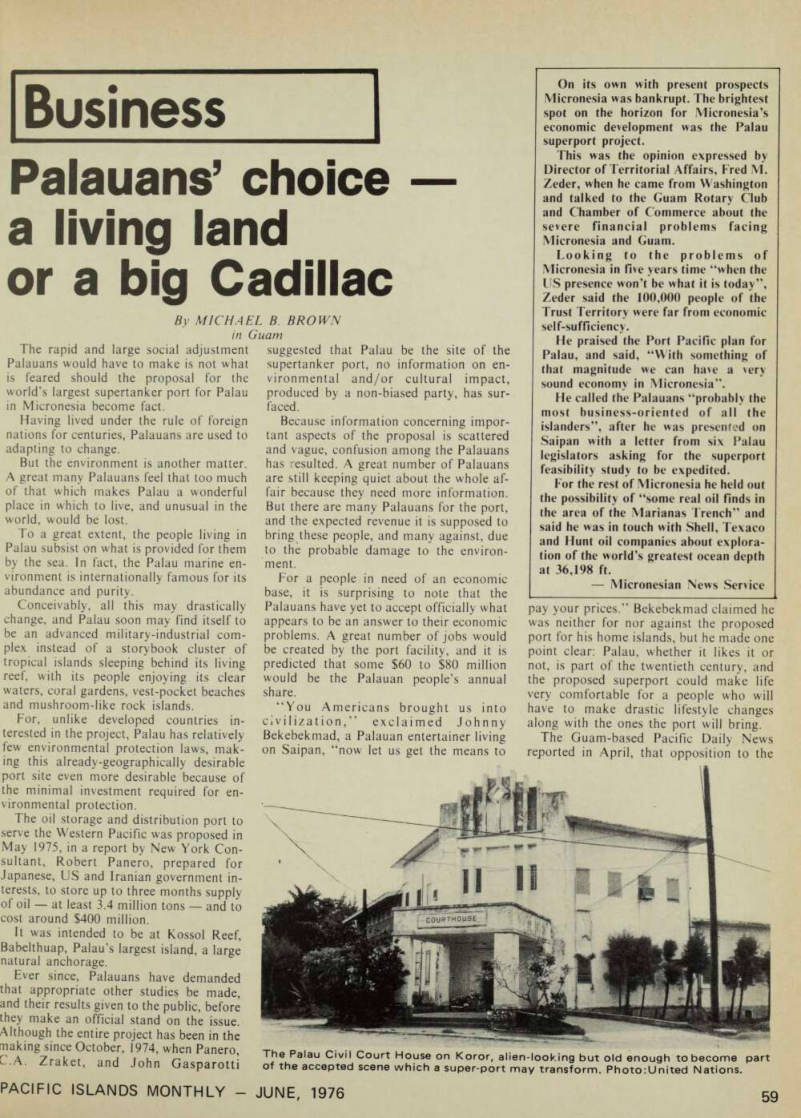
Palauans’ choicea living land or a big Cadillac
By Michael B. Brown
in Guam
The rapid and large social adjustment Palauans would have to make is not what is feared should the proposal for the world’s largest supertanker port for Palau in Micronesia become fact.
Having lived under the rule of foreign nations for centuries, Palauans are used to adapting to change.
But the environment is another matter.
A great many Palauans feel that too much of that which makes Palau a wonderful place in which to live, and unusual in the world, would be lost.
To a great extent, the people living in Palau subsist on what is provided for them by the sea. In fact, the Palau marine en vironment is internationally famous for its abundance and purity.
Conceivably, all this may drastically change, and Palau soon may find itself to be an advanced military-industrial com plex instead of a storybook cluster of tropical islands sleeping behind its living reef, with its people enjoying its clear waters, coral gardens, vest-pocket beaches and mushroom-like rock islands.
For, unlike developed countries in terested in the project, Palau has relatively few environmental protection laws, mak ing this already-geographically desirable port site even more desirable because of the minimal investment required for en vironmental protection.
The oil storage and distribution port to serve the Western Pacific was proposed in May 1975, in a report by New York Con sultant, Robert Panero, prepared for Japanese, US and Iranian government in terests, to store up to three months supply of oil at least 3.4 million tons and to cost around $4OO million.
It was intended to be at Kossol Reef,
Babelthuap, Palau’s largest island, a large
natural anchorage.
Ever since, Palauans have demanded that appropriate other studies be made, and their results given to the public, before they make an official stand on the issue.
Although the entire project has been in the making since October, 1974, when Panero, C.A. Zraket, and John Gasparotti
suggested that Palau be the site of the supertanker port, no information on en vironmental and/or cultural impact, produced by a non-biased party, has sur faced.
Because information concerning impor tant aspects of the proposal is scattered and vague, confusion among the Palauans has resulted. A great number of Palauans are still keeping quiet about the whole af fair because they need more information.
But there are many Palauans for the port, and the expected revenue it is supposed to bring these people, and many against, due to the probable damage to the environ ment.
For a people in need of an economic base, it is surprising to note that the Palauans have yet to accept officially what appears to be an answer to their economic problems. A great number of jobs would be created by the port facility, and it is predicted that some $6O to $BO million would be the Palauan people’s annual share.
“You Americans brought us into Civilization,’’ exclaimed Johnny Bekebekmad, a Palauan entertainer living on Saipan, “now let us get the means to
On its own with present prospects Micronesia was bankrupt. The brightest spot on the horizon for Micronesia’s economic development was the Palau
superport project.
This was the opinion expressed by Director of Territorial Affairs, Fred M.
Zeder, when he came from Washington and talked to the Guam Rotary Club and Chamber of Commerce about the
severe financial problems facing
Micronesia and Guam.
Looking to the problems of Micronesia in five years time “when the US presence won’t be what it is today”, Zeder said the 100,000 people of the Trust Territory were far from economic
self-sufficiency.
He praised the Port Pacific plan for Palau, and said, “With something of that magnitude we can have a very sound economy in Micronesia”.
He called the Palauans “probably the most business-oriented of all the islanders”, after he was presented on Saipan with a letter from six Palau legislators asking for the superport feasibility study to be expedited.
For the rest of Micronesia he held out the possibility of “some real oil finds in the area of the Marianas Trench” and said he was in touch with Shell, Texaco and Hunt oil companies about explora tion of the world’s greatest ocean depth at 36,198 ft.
Micronesian News Service
pay your prices.” Bekebekmad claimed he was neither for nor against the proposed port for his home islands, but he made one point clear: Palau, whether it likes it or not, is part of the twentieth century, and the proposed superport could make life very comfortable for a people who will have to make drastic lifestyle changes along with the ones the port will bring.
The Guam-based Pacific Daily News reported in April, that opposition to the
The Palau Civil Court House on Koror, alien-looking but old enough to become part of the accepted scene which a super-port may transform. Photo:United Nations.
port is growing in Palau. The young High Chief Ibedul of Palau, recently discharged with honour from the United States Army, claimed he “. . . can see the damage it (the proposed superport) is going to do to the water, marine life and the traditional way of life.”
The High Chief is the chairman of the Save Palau Organisation, a group formed primarily to stop the port’s construction, and he has asked that all the traditional chiefs of Palau “stand with him” in order that Palau may be saved from the port.
Iran, the country believed to be the na tion that will sell oil to consuming nations that will, in turn, ship the oil through Palau, has made no official stand on the issue. A Palauan delegation, though, has just returned from Iran where it held dis cussions, and a high government official working in Palau reported that “Iran and the United States are deadlocked” on the security end of Port Pacific at Palau.
This government source, who wishes to remain anonymous, reported, “Iran isn’t about to let her oil be stored in an un protected port facility in Palau”.
Among other demands, the Iranian Government wants the US Navy to provide round-the-clock patrols of Port Pacific at Palau.
The United States position on the super port is confusing. In fact, the US position is downright mysterious. For instance, while in Japan, Edward Johnston the High Commissioner for the Trust Territory of the Pacific Islands (Palau is one of the five districts in this trusteeship) told some Japanese officials that the final decision on the superport “must be made solely by the Palauans.” Yet he refused to let some visiting marine biologists from the Univer sity of Guam inspect the proposed port’s site. No reason was given for the refusal.
Reportedly, some American Intelligence
people appeared in Palau shortly after the proposal was made, for the purpose of recruiting “spies” for informational pur poses. As yet no official US stand on the proposal has been made, and it appears as though the United States wants more in formation, like many Palauans.
In general, most people don’t want supertankers or oil ports near where they live. Writing for The Far Eastern Economic Review recently, Roger Gale tells of how the fishermen and ecologists of Japan, a country that is dependent on im ported oil for 80 per cent of its energy needs, “. . . have virtually guaranteed that no large central terminal storage tank farms will ever be built in either mainland Japan or in Okinawa.”
While it is true the Japanese people have prevented the construction of ports similar to the one proposed for Palau, it is also true that they had the means to do so. Not so with Palau, as pointed out.
In a recent article published in the environment-oriented Audubon, Noel
Mostert writes, “There is scarcely a week that some tanker accident does not occur; sometimes there are several. Many of the worst pass completely unnoticed by the public.”
And the National Academy of Sciences, in Washington, DC, reported recently that, “. . . the quantity of oil entering the oceans from transportation-related sources has been increasing every year; given future in creases in production and transport, it is possible that transportation-related inputs will continue to increase despite the current interest and activity in control measures.” Thus, more oil will probably spill into the oceans than we can remove.
The present tankers used measure up to 250,000 tons (DWT). They transport oil from producing nations to consuming ones in ships with sometimes defective hulls 1-2 in thick. The tankers referred to by Panero in his port proposal for Palau measure out at a giant 1 MILLION (DWT), or four times larger than the tankers being used
today.
Noel Mostert warns that “. . .it is probable we are now entering the age of really giant spills.” It would seem, therefore, based on reports about super tankers and their frequent spills, that the chances of a major spill occurring in Palau
are overwhelming.
The proponents of ‘Port Pacific at Palau,’ whether they like it or not, are go ing to have to produce some valid en vironmental and cultural impact studies before they can proceed with their plans.
This much they owe the people of Palau.
But even after all information is available, don’t be surprised if the Palauans still op pose the port for their islands.
As Uchel Sechewas, a Palauan studying at the University of Guam, said, “I want to leave some land and some reef, something alive, to my children. I sure don’t want to leave behind just a one-acre lot and a Cadillac.”
Fiji hotels Big loss
The Naviti Resort Hotel, at Votualailai, on the south coast of Fiji’s Viti Levu, contributed $448,832 of a loss of $602,471 for Naviti Investments Ltd in 1974-1975. The luxury hotel is operated by Votualailai Ltd, a subsidiary of Naviti Investments. It opened its doors just as the Fiji tourist boom was tapering off and is now something of a white elephant.
The holding company, Naviti In vestments, incurred a loss of $49,079.
Other losses were, Makita Holdings Ltd, $83,450; Motels of Fiji Ltd, $5,856; Solomon Islands Investments Ltd, $1 5,254.
The directors said the year was the most difficult the company had faced since its formation about eight years ago. Liquidity problems had not been altogether solved.
Advertisements & other items, p. 60 (1 item)
Now Available!
5 D ? 2 FILL IN DETAILS ON THE ORDER FORM ATTACHED D
Pacific Transport
Samoans And Tongans
Ruffle Fiji's Feathers
Fiji is prepared to go it alone and run its own international airline if it cannot run Air Pacific successfully as a co operative venture with other airlines and Pacific countries, Fiji Prime Minister, Ratu Sir Kamisese Mara, warned late in
April.
His warning came soon after reports that Western Samoa and Tonga were get ting together to run a “mini” regional airline covering both Samoa, Tonga, Niue Island and the Cook Islands.
Tonga and Western Samoa also have their eyes on an Auckland-Apia service should Air New Zealand relinquish its Auckland-Pago Pago service. Nor do their aspirations end there. King Taufa'ahau Tupou, of Tonga, and Mr Tupuola Efi, Western Samoa’s new Prime Minister, meeting in Apia soon after Mr Efi’s elec tion, agreed to approach the NZ Govern ment for landing rights in Rarotonga and New Zealand, not only from Apia, but also from Nieu Island and Nukualofa.
They had before them an air route study prepared by the NZ National Airways Corporation for the Western Samoa Government. The report dealt with re equipping Polynesian Airlines with jet air craft BACllls or Boeing 737 s and expanding operations. (Polynesian Airlines, using HS74Bs, covers Apia, Fiji, Tonga, Niue Island and Pago Pago).
Tonga and Western Samoa are shareholders, admittedly small, in Air Pacific. Along with other shareholders, they are likely to be called on to provide Air Pacific with new money as Air Pacific’s working capital will be exhausted
by July.
Ratu Sir Kamisese said Fiji would want a new civil aviation agreement with New Zealand if reports that the NZ National Airways Corporation was tied up with the expansion of Polynesian Airlines were true. Fiji would not be pushed around.
The Tonga-Western Samoa decision about New Zealand air services would “very adversely” affect Air Pacific’s ser vice to NZ. Air Pacific and Polynesian Airlines might fail if they competed for an Auckland route, leaving Air New Zealand in control in the area.
Ratu Sir Kamisese said there was a ten
dency to regard Air Pacific as Fiji’s national airline; in fact, it was a regional carrier and Fiji could ask why it should grant national traffic rights in return for Air Pacific’s landing rights in other territories.
If Fiji found its relationship with the big international airlines unsatisfactory, it had to be prepared to run its own international service. That had never been her ambition, but she was prepared to do it if it was the
only way.
The Premier of the Cook Islands, Sir Albert Henry, was upset at the Tonga- Western Samoa moves. He accused those countries of back door dealings to boost Polynesian Airlines as a rival to Air Pacific. He complained he had not been told about the Apia meeting. It was a mat ter of considerable annoyance to him to learn through the media of proposals of Pacific colleagues which directly affected his government.
Mr Efi, in an effort to sooth ruffled feelings, said he had been meaning to write to Sir Albert and Ratu Sir Kamisese, and would have written earlier if there was any official indication that they were interested in the affairs of Polynesian Airlines.
Meanwhile, Air Pacific has decided to appoint independent consultants to review the airline’s future. The survey will cover
ownership, routes and landing rights.
The airline’s board, after the last quar terly meeting, said it was worried about a severe drop in passenger traffic in February and March. The main routes af fected were Fiji-Honiara and Fiji- Brisbane, via Honiara. Fiji-Honiara traffic was down 30 per cent compared with February-March, 1975. Other routes were marginally ahead of forecast figures. Traf fic on the Fiji-Tonga-New Zealand was 50 per cent of that in February-March, 1 975.
Aviation uplift for Condominium
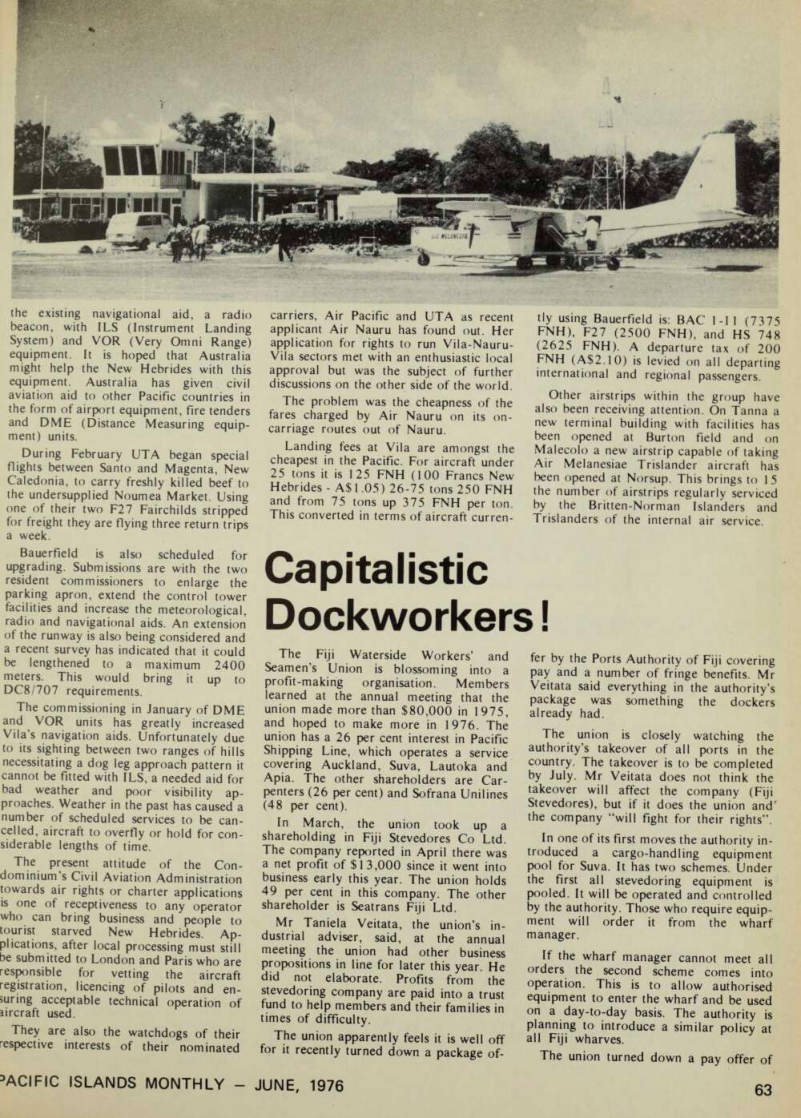
by Ian Mclntyre
The New Hebrides is set for an aviation uplift, and 1976 could well become •Aviation Year’ for the New Hebrides Condommmm. There has been an increase carrifrs r Tnd A V ir P a ‘ W ? eS,ab lt iSh n d a?rivat A J r ' l he arnval on the scene of a new earner, Atr This coupled with the long awaited approval to upgrade the airfield at Pekoa, Santo, the commissioning of new navigational aids and the current consideration being given to expanding Vila’s Bauerfield airport make for an exciting aviation year. And not to be overshadowed by the regional operators’ activity, the internal airline, Air Melanesiae, has increased its services, extended its routes and adopted a new colour scheme.
With the demise of the Polynesie and the reluctance of cruise ships to accept terminating passengers to and from the New
Hebrides, aviation has become a necessary rather than luxury transport. i„ keeping with this the Civil Aviation Administration is endeavouring to upgrade its facili,ies and 10 a >" a « ad ‘ ditional carriers w ho could offer a wider area of access to locals and visitors alike.
After many months of frustrating inac approval has finally been given by tbe j°‘ nt colonial powers France and Britain for the upgrading of the airfield or Luganville, Santo. All that is now awa ited to set the contractors in motion is the financial approval which both London and Paris have indicated is ‘on the way’, < )nce received, work will commence on covering the existing wartime-built strip with a 20cm layer of coral and sealing with bitum en to a length of 1900 metres.
This will enable all weather use by aircraft * n * be F 27, HS74B, DC4 and possibly class.
Plans are also underway to supplement
the existing navigational aid, a radio beacon, with ILS (Instrument Landing System) and VOR (Very Omni Range) equipment. It is hoped that Australia might help the New Hebrides with this equipment. Australia has given civil aviation aid to other Pacific countries in the form of airport equipment, fire tenders and DME (Distance Measuring equip ment) units.
During February UTA began special
flights between Santo and Magenta, New Caledonia, to carry freshly killed beef to the undersupplied Noumea Market. Using one of their two F 27 Fairchilds stripped for freight they are flying three return trips a week.
Bauerfield is also scheduled for upgrading. Submissions are with the two resident commissioners to enlarge the parking apron, extend the control tower facilities and increase the meteorological, radio and navigational aids. An extension of the runway is also being considered and a recent survey has indicated that it could be lengthened to a maximum 2400 meters. This would bring it up to
DCB/707 requirements.
The commissioning in January of DME and VOR units has greatly increased Vila’s navigation aids. Unfortunately due to its sighting between two ranges of hills necessitating a dog leg approach pattern it cannot be fitted with ILS, a needed aid for bad weather and poor visibility ap proaches. Weather in the past has caused a number of scheduled services to be can celled, aircraft to overfly or hold for con siderable lengths of time.
The present attitude of the Con dominium’s Civil Aviation Administration towards air rights or charter applications is one of receptiveness to any operator who can bring business and people to tourist starved New Hebrides. Ap plications, after local processing must still be submitted to London and Paris who are responsible for vetting the aircraft
registration, licencing of pilots and en
suring acceptable technical operation of aircraft used.
They are also the watchdogs of their respective interests of their nominated
carriers, Air Pacific and UTA as recent applicant Air Nauru has found out. Her application for rights to run Vila-Nauru- Vila sectors met with an enthusiastic local approval but was the subject of further discussions on the other side of the world.
The problem was the cheapness of the fares charged by Air Nauru on its on carriage routes out of Nauru.
Landing fees at Vila are amongst the cheapest in the Pacific. For aircraft under 25 tons it is 125 FNH (100 Francs New Hebrides - A 51.05) 26-75 tons 250 FNH and from 75 tons up 375 FNH per ton.
This converted in terms of aircraft curren
tly using Bauerfield is: BAC 1-1 1 (7375 FNH), F 27 (2500 FNH), and HS 748 (2625 FNH). A departure tax of 200 FNH (A 52.10) is levied on all departing international and regional passengers.
Other airstrips within the group have also been receiving attention. On Tanna a new terminal building with facilities has been opened at Burton field and on Malecolo a new airstrip capable of taking Air Melanesiae Trislander aircraft has been opened at Norsup. This brings to 1 5 the number of airstrips regularly serviced by the Britten-Norman Islanders and Trislanders of the internal air service.
Advertisements & other items, p. 62 (1 item)
a. nartrodt
I AT A
Shipping • Forwarding • Air Freight • Container operators • Insurance Founded in 1887 at Hamburg (Head Office) to service your transport needs.
NOMINATE HARTRODT AS YOUR FREIGHT FORWARDER
Contact A. Hartrodt (Australia) Pty, Ltd. for information on services available and advantages. Our own offices in all main trade centres of the world.
HAMBURG • BREMEN • ROTTERDAM • GENOA
• LONDON • LIVERPOOL
184 Sussex Street, Sydney, N.S.W., Australia 2000 Telephone: 29-3054 Telex: 21416
5A395.00 FULL PRICE
F. 0.8. SYDNEY
"fV I m ***»«?
Length 5 5%, height 23%Depth 4Mi
Incorporating two 10x8 transparencies
for display.
DESCRIPTION
The World Time Map unit incorporates a three-colour map of the world, divided longitudinally into time zones.
These zones are identified by numbers as they relate to plus or minus hours on Greenwich Mean Time. Silk screened on plexi-glass locating over 200 cities through out the world. The case is finished in textra coat.
WORLD TIME
MAP UNIT
MODEL
BM BY POPULAR DEMAND - WE HAVE PRODUCED A
NEW MODEL FOR AIRPORTS, HOTELS, CLUBS,
RECEPTION AREAS, BOARD ROOMS, AND
THE EXECUTIVE OFFICES AT A PRICE
WHICH YOU CAN AFFORD.
Cheques or further information to:
WORLD TIME MAP SALES,
93 YORK STREET, SYDNEY. 2000
PHONE: 29 2038, 29 2039.
Enclosed ($A395 per unit) Bill me for shipping cost.
Name Address
(Postcode) Phone
ATTENTION :-AGENTS: We are
seeking agents in every Island Group
Capitalistic
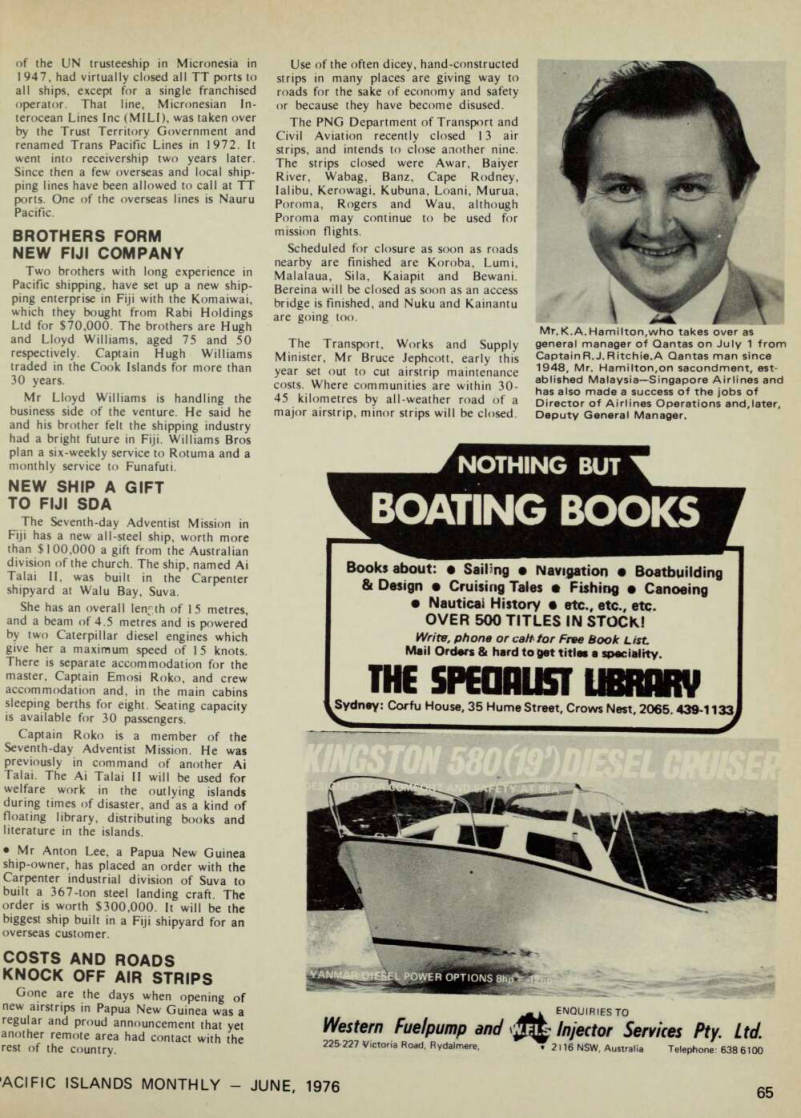
Dockworkers!
The Fiji Waterside Workers’ and Seamen’s Union is blossoming into a profit-making organisation. Members learned at the annual meeting that the union made more than $BO,OOO in 1975, and hoped to make more in 1976. The union has a 26 per cent interest in Pacific Shipping Line, which operates a service covering Auckland, Suva, Lautoka and Apia. The other shareholders are Car penters (26 per cent) and Sofrana Unilines (48 per cent).
In March, the union took up a shareholding in Fiji Stevedores Co Ltd.
The company reported in April there was a net profit of $1 3,000 since it went into business early this year. The union holds 49 per cent in this company. The other shareholder is Seatrans Fiji Ltd.
Mr Taniela Veitata, the union’s in dustrial adviser, said, at the annual meeting the union had other business propositions in line for later this year. He did not elaborate. Profits from the stevedoring company are paid into a trust fund to help members and their families in times of difficulty.
The union apparently feels it is well off for it recently turned down a package of
fer by the Ports Authority of Fiji covering pay and a number of fringe benefits. Mr Veitata said everything in the authority’s package was something the dockers
already had.
The union is closely watching the authority’s takeover of all ports in the country. The takeover is to be completed by July. Mr Veitata does not think the takeover will affect the company (Fiji Stevedores), but if it does the union and' the company “will fight for their rights”.
In one of its first moves the authority in
troduced a cargo-handling equipment
pool for Suva. It has two schemes. Under the first all stevedoring equipment is pooled. It will be operated and controlled by the authority. Those who require equip ment will order it from the wharf manager.
If the wharf manager cannot meet all orders the second scheme comes into operation. This is to allow authorised equipment to enter the wharf and be used on a day-to-day basis. The authority is planning to introduce a similar policy at all Fiji wharves.
The union turned down a pay offer of
$1.12 an hour, which is 3c less than they sought, but 6c more than the authority first offered. Also rejected were an offer of up to 15 per cent of the net stevedoring profits, which could be as much as $67,000 a year; a 5 per cent Christmas bonus for authority staff and dockers out of stevedoring profits for good work and a reduction of cargo damage claims; a fur ther bonus up to 21/2 per cent of the stevedoring profits for a reduction in cargo damage claims; a productivity bonus of up to 5 per cent to be paid out of stevedoring profits; an incentive bonus for working ships fast; a levy on containerised cargo to be negotiated by the authority; and 2'/2 per cent of stevedoring profits to be set aside to provide welfare amenities for dockers and their families.
The authority also plans a com prehensive training scheme in packing and unpacking containers, general wharf work, and driving fork lifts and other vehicles. It claimed its scheme would keep more workers in the port labour force.
Fatter Wages
Packet For Png Seamen
Papua New Guinea seamen serving in overseas ships recently received substantial pay rises, with overtime and several fringe benefits. Under a new award by the Ar bitration Tribunal bosuns received an ex tra K 75 a month. Deckhands, cooks, stewards, messmen, engine-room hands and similar ratings received a rise of K5O a month for the first year of service, K6O in the second year and K5O in the third year.
The weekly hours remained unchanged at 42 a week, to be worked at eight hours a day, Monday to Friday, with two hours on Saturdays before 10 am. Excess time each day will be paid at time and a half.
Double time will be paid for all time over two hours on Saturdays, and on Sun
days and public holidays. Compassionate
leave annually is 14 days. Minimum washing times of five minutes will be allowed before the mid-day meal break.
and before finishing the day’s work.
Mr John Herbert, a member of the tribunal, who the award, said that as the seamen were citizens of PNG, there was no reason why they should not receive cost-of-living adjustments related to the PNG Consumer Price Index. Those adjustments applied to the rest of the work force.
The Seamen’s Union of Australia, which represented the PNG seamen at the hearing, sought a 40-hour week, higher wages, two 30-minute rest periods (one at mid-morning and one at mid-afternoon) and a 10-minute washing time before meals.
Mr Herbert said the tribunal could not ignore the fact that the seamen had not had pay increases since the last award, which expired in January, 1975, was negotiated. The new rates took into ac count changes in wages because of in flation, and other factors. The levels set were well in excess of the present stan dards set by the International Labour
Organisation.
The executive director of the PNG Em ployers’ Federation, Mr. M. Wells, said he was pleased with the tribunal’s decision.
Open Seas’
In Micronesia
Mr Fred Zeder, recently-appointed Director of the Office of Territorial Af fairs, Interior Department, Washington, has ordered an “open seas” policy for the Trust Territory. One of his first acts was to direct the Trust Territory Office of Tran sportation to allow any shipping company, Micronesian or non-Micronesian, to carry cargo to TT ports.
It was a unilateral decision from the Congess of Micronesia’s point of view.
There was just no consultation with it. In the past, Congress was given assurances by Interior Department officials that no changes in shipping policy in Micronesia would be made without consultation.
A subsequent conference on shipping recommended to the retiring High Com missioner, Mr Edward E. Johnston, that no changes be made in the existing system which was scheduled to expire on May 3 1.
The conference was attended by represen tatives of the Department of Tran sportation and Communications, Depart ment of Resources, office of the Attorney- General and members of the Congress of Micronesia joint committee on resources
and development.
Micronesia is at present served by seven
shipping lines Palau Shipping, Saipan
Shipping Co, Tiger Lines (all Micronesian-owned), Daiwa Lines of Japan, Nauru Pacific Lines, and two US carriers, Matson Navigation and Sause Bros. Another Micronesian company, Oceana Lines, has been given permission to enter certain Micronesian ports, but is not yet operating.
The Interior Department, since the start
of the UN trusteeship in Micronesia in 1 947, had virtually closed all TT ports to all ships, except for a single franchised operator. That line, Micronesian In terocean Lines Inc (MI LI), was taken over by the Trust Territory Government and renamed Trans Pacific Lines in 1972. It went into receivership two years later.
Since then a few overseas and local ship ping lines have been allowed to call at TT ports. One of the overseas lines is Nauru Pacific.
Brothers Form
New Fiji Company
Two brothers with long experience in Pacific shipping, have set up a new ship ping enterprise in Fiji with the Komaiwai, which they bought from Rabi Holdings Ltd for $70,000. The brothers are Hugh and Lloyd Williams, aged 75 and 50
respectively. Captain Hugh Williams
traded in the Cook Islands for more than 30 years.
Mr Lloyd Williams is handling the business side of the venture. He said he and his brother felt the shipping industry had a bright future in Fiji. Williams Bros plan a six-weekly service to Rotuma and a monthly service to Funafuti.
New Ship A Gift
To Fiji Sda
The Seventh-day Adventist Mission in Fiji has a new all-steel ship, worth more than $lOO,OOO a gift from the Australian division of the church. The ship, named Ai Talai 11, was built in the Carpenter shipyard at Walu Bay, Suva.
She has an overall length of 15 metres, and a beam of 4.5 metres and is powered by two Caterpillar diesel engines which give her a maximum speed of 15 knots.
There is separate accommodation for the master. Captain Emosi Roko, and crew accommodation and, in the main cabins
sleeping berths for eight. Seating capacity
is available for 30 passengers.
Captain Roko is a member of the Seventh-day Adventist Mission. He was previously in command of another Ai Talai. The Ai Talai II will be used for welfare work in the outlying islands during times of disaster, and as a kind of
floating library, distributing books and
literature in the islands. • Mr Anton Lee, a Papua New Guinea ship-owner, has placed an order with the Carpenter industrial division of Suva to built a 367-ton steel landing craft. The order is worth $300,000. It will be the biggest ship built in a Fiji shipyard for an overseas customer.
Costs And Roads
Knock Off Air Strips
Gone are the days when opening of new airstrips in Papua New Guinea was a regular and proud announcement that yet another remote area had contact with the rest of the country.
Use of the often dicey, hand-constructed strips in many places are giving way to roads for the sake of economy and safety or because they have become disused.
The PNG Department of Transport and Civil Aviation recently closed 13 air strips, and intends to close another nine.
The strips closed were Awar, Baiyer River, Wabag, Banz, Cape Rodney, lalibu, Kerowagi, Kubuna, Loani, Murua, Poroma, Rogers and Wau, although Poroma may continue to be used for mission flights.
Scheduled for closure as soon as roads nearby are finished are Koroba, Lumi, Malalaua, Sila, Kaiapit and Bewani.
Bereina will be closed as soon as an access bridge is finished, and Nuku and Kainantu are going too.
The Transport, Works and Supply Minister, Mr Bruce Jephcott, early this year set out to cut airstrip maintenance costs. Where communities are within 30- 45 kilometres by all-weather road of a major airstrip, minor strips will be closed.
Mr. K. A. Hamilton,who takes over as general manager of Qantas on July 1 from CaptainR.J.Ritchie.A Qantas man since 1948, Mr. Hamilton,on sacondment, est ablished Malaysia—Singapore Airlines and has also made a success of the jobs of Director of Airlines Operations and,later, Deputy General Manager.
Advertisements & other items, pp. 64-65 (2 items)
Qbe Insurance
Throughout the Islands
Q E
are foremost in General Insurance
QBE INSURANCE
LIMITED
(FORMERLY—QUEENSLAND INSURANCE COMPANY LIMITED)
Central Office: 82 Pitt Street, Sydney FlJl—Branch Office, Suva, Manager for Fiji: F. N. Davies (A.A.1.1.).
LAUTOKA—Sub-Branch Office: Burns Philp Bldg.
HONIARA (8.5.1. P.) —Breckwoldt & Company (5.1.) Pty. Limited.
NEW CALEDONIA—T. A. Hagen, Ste. W. A. Johnston, S.A.R.L. —Noumea.
NEW HEBRlDES—Resident Officer: G. F. Donnelly, Vila; Santo: Burns Philp (New Hebrides) Ltd.
TAHlTl—Arthur Chung: Immeuble 8.1., Front de Mer, Papeete.
NIUE, NORFOLK ISLAND, SAMOA, TONGA and other South Sea Islands—Bums Philp (South Sea) Company Ltd.
QUEENSLAND INSURANCE (P.N.G.) LTD
PAPUA NEW GUINEA
Head Office, Port Moresby: General Manager: D. J. Granter.
District Managers at Rabaul: C. D. Dickings; Lae: W. J. Leonard; Mt. Hagen: D. F. Carroll. Atawa: A. M. Tanner; Madang: I. R.
Martin.
H 361
1
NOTHING BUT
BOATING BOOKS
Books about: • Sailing • Navigation • Boatbuilding & Design • Cruising Tales • Fishing • Canoeing • Nautical History • etc., etc., etc.
OVER 500 TITLES IN STOCK!
Write, phone or caittor Free Book List Mail Orders & hard to get titles a speciality.
Sydney: Corfu House, 35 Hume Street, Crows Nest, 2065.439-1133 A
ENQUIRIES TO
Western Fuel pump and Injector Services Pty. Ltd, • 2116 NSW, Australia Telephone: 638 6100 225-227 Victoria Road, Rydalmere,
65
ACIFIC ISLANDS MONTHLY - JUNE, 1976
Cruising
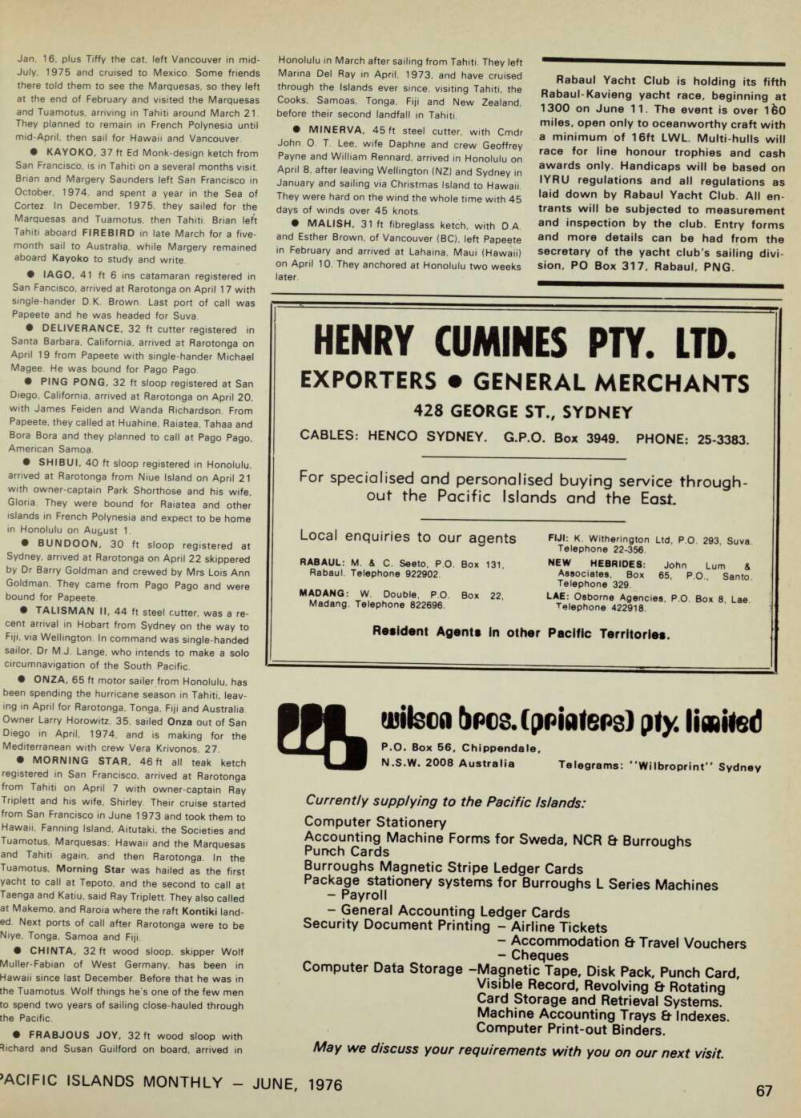
Yachts
• NOMAD, 33 ft steel sloop from Myack, New York, left there last September with owners Ed and Mary Arnold and their children. Chris 17, Phil 16, Geof 15, and Sonia 14, arriving in Tahiti in March for a month's stay. On the way, they called in at the Bahamas, Jamaica, Panama, the Marquesas and the Tuamotus, and expect to see many more places before reaching home in August, 1977 As Ed and Mary are teachers, there's no trouble over running a floating school for the children They'll be in the Cooks in May. • ODYSSEY, Vega 27 ft sloop from Bellingham, Washington, carrying Gary and Kirsten Moore, left San Diego in November for the Mar quesas, where they stayed three months before continuing on to the Tuamotus and Tahiti. They arrived in Papeete on March 20 for a three month visit before continuing to New Zealand. • PALAWAN, 68 ft aluminium ketch registered in North Haven, Maine and owned by Thomas J Watson, Jr, arrived in Tahiti on March 23 She left North Haven in October, 1975 and cruised to Florida and the Caribbean, then to Panama, the Cocos Islands, Galapagos, Easter Island, Pitcairn and Marquesas, before sailing into Papeete On board upon arrival were Mr Watson.
Lord Riverdale of Sheffield, England, Mrs Helen W Buckner of New York City, the owner's daughter, Helen Watson, captain Paul Wolter of Germany and Maine, David Flanagan of Maine, Carter Christensen of Connecticut, Ann Madden of Boston and Elinor Lazarus of Ohio. Palawan, which was built by the Abeking and Rasmussen shipyard in Germany in 1972, planned to cruise the Societies until the end of April, then sail for Tonga and Fiji. • SALTDIGGER, 36 ft ferro cement sloop built by owners Dale and Rod Bloedel of Alberta left Vancouver in September, 1975, cruised down the west coast of the US to San Diego, then sailed to the Marquesas and into Tahiti on March 4 With them were Barbara Myers of Toronto and Elizabeth Goad of Australia. The brothers planned to tour the Societies before sailing to Hawaii and Vancouver, The girls planned to find another boat and go to Australia. • SERENITY, 37ft Carrol ketch from Portsmouth, New Hampshire, sailed into Tahiti on April 1 for a one-month visit before continuing circumnavigation. Owners Ric Martin and Russ Nilson, with Jennifer Brown, left Maine in August 1975, cruised down the east coast of the US to Florida and Panama. They left Panama on
December 24 for a six weeks' stay in the Galapagos before continuing to the Marquesas and Tuamotus.
Serenity is a research boat and the crew is collec ting fish for the Smithsonian Institute, tagging por poises for the US Fisheries Service and will be studying the sea cows between Fiji and South Africa for the Fisheries Dept. Their next ports of call will be in the Cooks, Samoas, Fiji, Tongas and New Caledonia. • STORMVOGEL, 73 ft Marconi ketch from Amsterdam, arrived in Tahiti on March 29 on her fifth trip around the world. This leg of her circum navigation began in Malta in September, 1975, and has brought her to Spain, Gibraltar, the Canaries, the West Indies, Cocos, Galapagos and Marquesas.
Owned by Werner Mattmann of Switzerland and captained by Malcolm Horsley of Australia, she carries an international crew consisting of Catherine Aubery (Martinique), Reynald Berthe (France).
George Westbrook (USA), David Williams (South Africa), Gavin Meikle (South Africa) and Jonathan Loughborough (England). The 15-year-old Storm vogel, a famous racing yacht, carries 4,500 sq ft of spinnaker and other sails totalling 8,500 sq ft and has sailed more miles than any other yacht, accor ding to Captain Horsley. The owner, Mr Mattmann, planned to join the yacht either in Tahiti or Fiji. Their plans were to cruise the islands of French Polynesia for a month before sailing to Rarotonga, Tonga, Fiji, the Solomons and New Hebrides. • TAURANGI, 35ft Piver trimaran built by owner Frank Melhop in Auckland, called at Tahiti on March 30 for a month's visit before sailing to Fiji.
With Frank were his wife, Barbara, of Rhodesia, and their parrot Lorea, of Brazil. Frank left his native New Zealand 10 years ago aboard Taurangi and has since sailed the Fijis, Solomons, Papua New Guinea, New Hebrides, New Caledonia, to Southeast Asia, across the Indian Ocean to Africa, then to South America on up to the Caribbean and Florida. They spent two years in Florida, then sailed back to the Caribbean IV4 years ago. From Panama they visited the Galapagos, spent two months in the Marquesas, then sailed for the Tuamotus and Tahiti. • THALES, a 36 ft Petersen Coaster schooner owned by Lawrence and Ann Stewart of Sausalito, California, arrived in Tahiti on March 15 and plann ed to cruise the Societies until June 1, when they will leave for Hawaii They left Marina Del Rey on December 8 for a 23-day sail to Nukuhiva, Mar quesas En route they hit a whale but there was no major damage to the yacht. Lawrence and Ann are both college teachers. While in French Polynesia, Ann planned to research women artists living in the islands. • TORRID, Mariner 40ft ketch owned by Bruce Butterfield of San Francisco, arrived in Tahiti on January 14 to keep a very important date. Bruce married his Tahitian sweetheart, Monique, in a ceremony in Tahiti during April. Bruce and Monique met in San Francisco in 1969, decided to get married in 1971, and took five more years to make
it a reality. They sailed off to Huahine. Raiatea and Bora Bora for their honeymoon. In a few months time they plan to sail to Hawaii. • ALPAMAYO 11, 40ft fibreglass Michael Dufour ketch from La Rochelle, France, sailed into Tahiti in March for a three-month visit before con tinuing circumnavigation. Jean and Madeleine Puiseux left France in July. 1975, and have visited the Canaries, the Natilles. Panama, Marquesas and the Tuamotus. Their next ports of call will include the Tongas, Fiji, New Hebrides and Australia • COPY CAT, 43 ft catamaran from Van couver, arrived in Tahiti on March 6 with owners Lyle and Carol Chase aboard. Lyle, who is a boat builder, built the copy of CSK in four years. They left Vancouver in September. 1975, and sailed down the west coast of the US to San Diego, then visited the Marquesas and Tuamotus. Their plans will eventually carry them to New Zealand • CYBELE, 50 ft Alden ketch from San Diego, left San Diego in November for Mexico, carrying the Flanagan family of Steve and Tommie, their son, Steve. Jr. 16, and 9 year-old daughter, Sylvia. They left Manzanillo. Mexico the end of February for the Marquesas and Tuamotus and arrived in Tahiti at the end of March. Their plans were to cruise the Societies for two months and then head for Hawaii and home. They reported their crossing was a storybook passage. • GITANO 11, a CT-41 ft fibreglass ketch from Vancouver, rendezvoused with CYBELE from Man zanillo. Mexico to Tahiti. Clare and Norma Allen and their son Greg, 14, two daughters, Laurie, 15, and
Jan, 16, plus Tiffy the cat, left Vancouver in mid- July, 1975 and cruised to Mexico. Some friends there told them to see the Marquesas, so they left at the end of February and visited the Marquesas and Tuamotus, arriving in Tahiti around March 21 They planned to remain in French Polynesia until mid-April, then sail for Hawaii and Vancouver. • KAYOKO, 37 ft Ed Monk-design ketch from San Francisco, is in Tahiti on a several months visit.
Brian and Margery Saunders left San Francisco in October, 1974, and spent a year in the Sea of Cortez In December, 1975, they sailed for the Marquesas and Tuamotus, then Tahiti. Brian left Tahiti aboard FIREBIRD in late March for a five month sail to Australia, while Margery remained aboard Kayoko to study and write. • lAGO, 41 ft 6 ins catamaran registered in San Fancisco, arrived at Rarotonga on April 17 with single-hander D.K, Brown. Last port of call was Papeete and he was headed for Suva. • DELIVERANCE, 32 ft cutter registered in Santa Barbara, California, arrived at Rarotonga on April 19 from Papeete with single-hander Michael Magee. He was bound for Pago Pago. • PING PONG, 32 ft sloop registered at San Diego, California, arrived at Rarotonga on April 20, with James Feiden and Wanda Richardson. From Papeete, they called at Huahine, Raiatea, Tahaa and Bora Bora and they planned to call at Pago Pago, American Samoa. • SHI BUI, 40 ft sloop registered in Honolulu, arrived at Rarotonga from Niue Island on April 21 with owner-captain Park Shorthose and his wife, Gloria. They were bound for Raiatea and other islands in French Polynesia and expect to be home in Honolulu on August 1. • BUNDOON, 30 ft sloop registered at Sydney, arrived at Rarotonga on April 22 skippered by Dr Barry Goldman and crewed by Mrs Lois Ann Goldman. They came from Pago Pago and were bound for Papeete. • TALISMAN 11, 44 ft steel cutter, was a re cent arrival in Hobart from Sydney on the way to Fiji, via Wellington. In command was single-handed sailor. Dr M.J, Lange, who intends to make a solo circumnavigation of the South Pacific. • ONZA, 65 ft motor sailer from Honolulu, has been spending the hurricane season in Tahiti, leav ing in April for Rarotonga, Tonga, Fiji and Australia.
Owner Larry Horowitz, 35, sailed Onza out of San Diego in April, 1974, and is making for the Mediterranean with crew Vera Krivonos, 27. • MORNING STAR, 46ft all teak ketch registered in San Francisco, arrived at Rarotonga from Tahiti on April 7 with owner-captain Ray Triplett and his wife, Shirley. Their cruise started from San Francisco in June 1973 and took them to Hawaii, Fanning Island. Aitutaki, the Societies and Tuamotus, Marquesas; Hawaii and the Marquesas and Tahiti again, and then Rarotonga. In the Tuamotus, Morning Star was hailed as the first yacht to call at Tepoto, and the second to call at Taenga and Katiu, said Ray Triplett. They also called at Makemo, and Raroia where the raft Kontiki land ed. Next ports of call after Rarotonga were to be Niye, Tonga, Samoa and Fiji. • CHINTA, 32 ft wood sloop, skipper Wolf Muller-Fabian of West Germany, has been in Hawaii since last December Before that he was in the Tuamotus. Wolf things he's one of the few men to spend two years of sailing close-hauled through the Pacific. • FRABJOUS JOY, 32 ft wood sloop with Richard and Susan Guilford on board, arrived in
Honolulu in March after sailing from Tahiti. They left Marina Del Ray in April, 1973, and have cruised through the Islands ever since, visiting Tahiti, the Cooks, Samoas, Tonga, Fiji and New Zealand, before their second landfall in Tahiti. • MINERVA, 45 ft steel cutter, with Cmdr John 0. T. Lee, wife Daphne and crew Geoffrey Payne and William Rennard, arrived in Honolulu on April 8, after leaving Wellington (NZ) and Sydney in January and sailing via Christmas Island to Hawaii They were hard on the wind the whole time with 45 days of winds over 45 knots. • MALISH, 31 ft fibreglass ketch, with DA. and Esther Brown, of Vancouver (BC), left Papeete in February and arrived at Lahaina, Maui (Hawaii) on April 10, They anchored at Honolulu two weeks later.
Rabaul Yacht Club is holding its fifth Rabaul-Kavieng yacht race, beginning at 1300 on June 11. The event is over ifeo miles, open only to oceanworthy craft with a minimum of 16ft LWL. Multi-hulls will race for line honour trophies and cash awards only. Handicaps will be based on IYRU regulations and all regulations as laid down by Rabaul Yacht Club. All en trants will be subjected to measurement and inspection by the club. Entry forms and more details can be had from the secretary of the yacht club's sailing divi sion, PO Box 317, Rabaul, PNG.
Advertisements & other items, pp. 66-68 (2 items)
Citizen Business Machines
JET SEA-TRUCK FOR
SALE
ROTORK MKIV Sea-Truck. GRP
hull 23’ 9” x 9’ 8” draft unladen 7 ins. laden 10 in 18 ins. 6 ft wide forward ramp. Internal buoyancy.
Safari roof with tinted windows and ventillator grills. Fitted with 18 seats and drivers seat.
ENGINE. Ford Mermaid 595 ET-INT turbo charged diesel 162 BMP continuous rating. Tropical lube-oil cooler. Coupled to Hamilton 1312 jet unit. Fuel 100 galls. Morse controls. Tachometer, pressure, water temp, ammeter and mechanical boost pressure gauges.
EXTRAS. Bilge pump, search light, windscreen wiper, electric navigation lights, electric horn.
Spare jet unit and engine spares for two years operation.
WEIGHT. 7973 lbs.
Excellent condition almost new.
Offers in region of $lO,OOO considered.
Contact present owners. Gilbert Islands Development Authority P.O.
Box 495, Tarawa, Gilbert Islands:
Cables “SHIPMAN TARAWA”.
CITIZEN BUSINESS MACHINES
• CASH REGISTERS • ADDING MACHINES
• TYPEWRITERS • ELECTRONIC CALCULATORS
Write for brochures and prices Maison Barrau, 8.P.A4 Cedex, Noumea Iprotec, B.P. 366 Port Vila or direct to
GOODSON CALCULATORS PTY. LTD.
23/25 ABERCROMBIE STREET, CHIPPENDALE, SYDNEY 2008
Agency enquiries invited
HENRY CUMINES PTY. LTD.
EXPORTERS • GENERAL MERCHANTS
428 GEORGE ST., SYDNEY
CABLES: HENCO SYDNEY. G.P.O. Box 3949. PHONE: 25-3383.
For specialised and personalised buying service throughout the Pacific Islands and the East Local enquiries to our agents RABAUL; M. & C. Seeto, P.O. Box 131, Rabaul. Telephone 922902.
MADANG: W. Double, P.O. Box 22, Madang. Telephone 822696.
FIJI: K. Witherington Ltd, P.O. 293 Suva Telephone 22-356.
NEW HEBRIDES: John Lum &
Associates, Box 65, P.O, Santo Telephone 329.
LAE: Osborne Agencies, P.O. Box 8 Lae Telephone 422918.
Resident Agents in other Pacific Territories.
at.
Wilson boos, (pointers) ply. lionited
P.O. Box 56, Chippendale, N.S.W. 2008 Australia Telegrams: "Wilbroprint" Sydney Currently supplying to the Pacific Islands: Computer Stationery Accounting Machine Forms for Sweda, NCR & Burroughs Punch Cards Burroughs Magnetic Stripe Ledger Cards Package stationery systems for Burroughs L Series Machines - Payroll - General Accounting Ledger Cards Security Document Printing - Airline Tickets - Accommodation & Travel Vouchers - Cheques Computer Data Storage -Magnetic Tape, Disk Pack, Punch Card, Visible Record, Revolving & Rotating Card Storage and Retrieval Systems.
Machine Accounting Trays & Indexes.
Computer Print-out Binders.
May we discuss your requirements with you on our next visit.
DAIWA LINE
DIRECT REGULAR SERVICE
JAPAN-SOUTH PACIFIC
TARAWA-PAPEETE-PAGO PAGO-APIA
SUVA-LAUTOKA-NOUMEA-VILA
SANTO-HONIARA
JAPAN-TAIWAN-GUAM
JAPAN-KEELUNG-GUAM BY
EXCELLENT CAR/CONTAINER-CARRIER
JAPAN-WEST IRIAN-DILI
HONG KONG-TAIWAN-WEST IRIAN-DILI
GUAM: ATKINS, KROLL (GUAM) LTD.
TARAWA: G. & E. I. DEVELOPMENT AUTHORITY.
APIA: BURNS PHILP (SOUTH SEA) CO., LTD.
PAGO PAGO: KNEUBUHL MARITIME SERVICES CORP.
NUKUALOFA: PACIFIC NAVIGATION CO., LTD.
SUVA: BURNS PHILP (SOUTH SEA) CO., LTD.
LAUTOKA: BURNS PHILP (SOUTH SEA) CO., LTD.
NOUMEA: SOCIETE D'ACCONAGA ET
TRANSPORT D'OCEANIE (SATO)
SANTO: BURNS PHILP (NEW HEBRIDES) LTD.
VILA: BURNS PHILP (NEW HEBRIDES) LTD.
HONIARA: BRITISH SOLOMONS TRADING CO., LTD.
PAPEETE: AGENCE MARITIME DE FARA UTE.
HONG KONG: IKE MARITIME CO., LTD.
SINGAPORE: THE BORNEO CO., (SINGAPORE) LTD.
DJAJAPURA: P. N. PELAJARAN NASIONAL INDONESIA.
DILI: SANG TAI HOO
TAIWAN: FOR CARGO BETWEEN JAPAN/GUAM/TAIWAN
FORMOSA SHIPPING & ENTERPRISE CORP.
TAIWAN: FOR CARGO BETWEEN JAPAN/SOUTH PACIFIC/
WEST IRIAN/DILI
MARITIME TRANSPORTATION AGENCIES, LTD.
THE DAIWA NAVIGATION CO.* LTD.
AGENTS;
OSAKA; “DAILINE"
TOKYO; “FUNEDAILINE”
TOKYO OFFICE
SHIN-DAIICHI BLDG.,
4-13, NIHONBASHI 3-CHOME, CHUO-KU
TOKYO, JAPAN
TELEPHONE: (03) 274-3251 ~8
HEAD OFFICE
DAIICHI KYOGYO BLDG.,
45, 2-CHOME, AWAZAMINAMI-DOR
NISHI-KU, OSAKA, JAPAN
TELEPHONE: (06 ) 531-0471 ~9
TELEX: 525-6324 & 525-6325
67
ACIFIC ISLANDS MONTHLY - JUNE, 1976
Shipping,
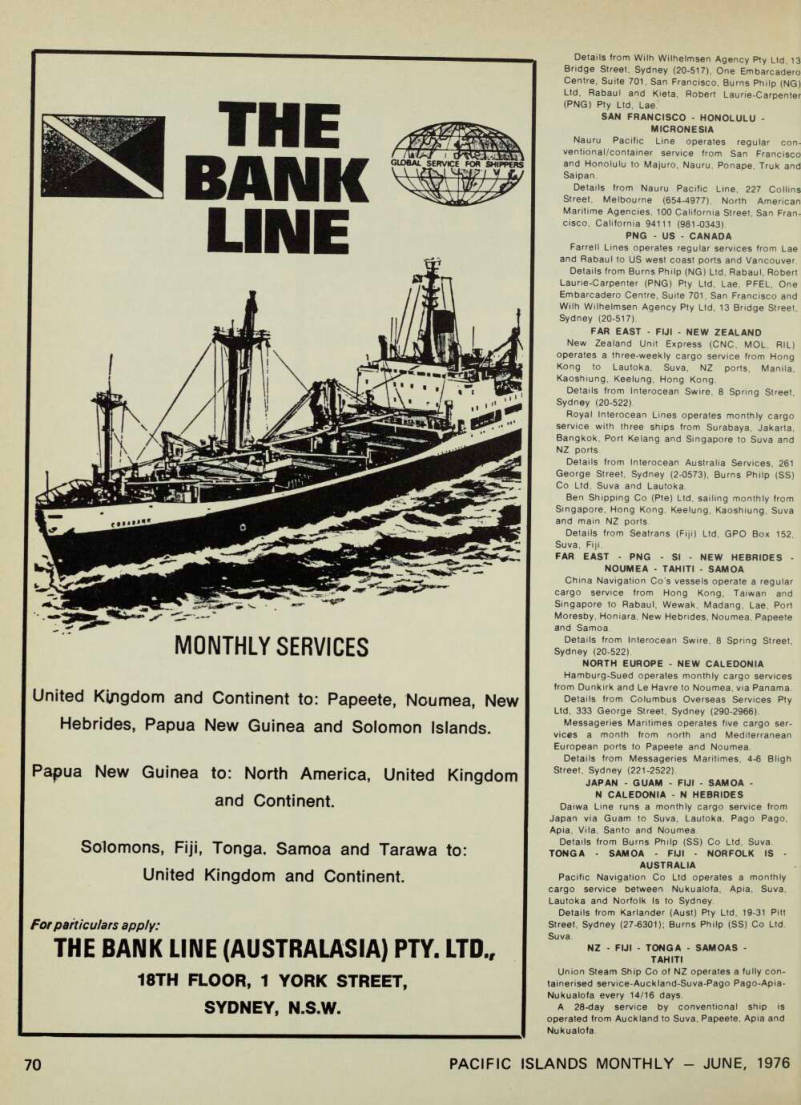
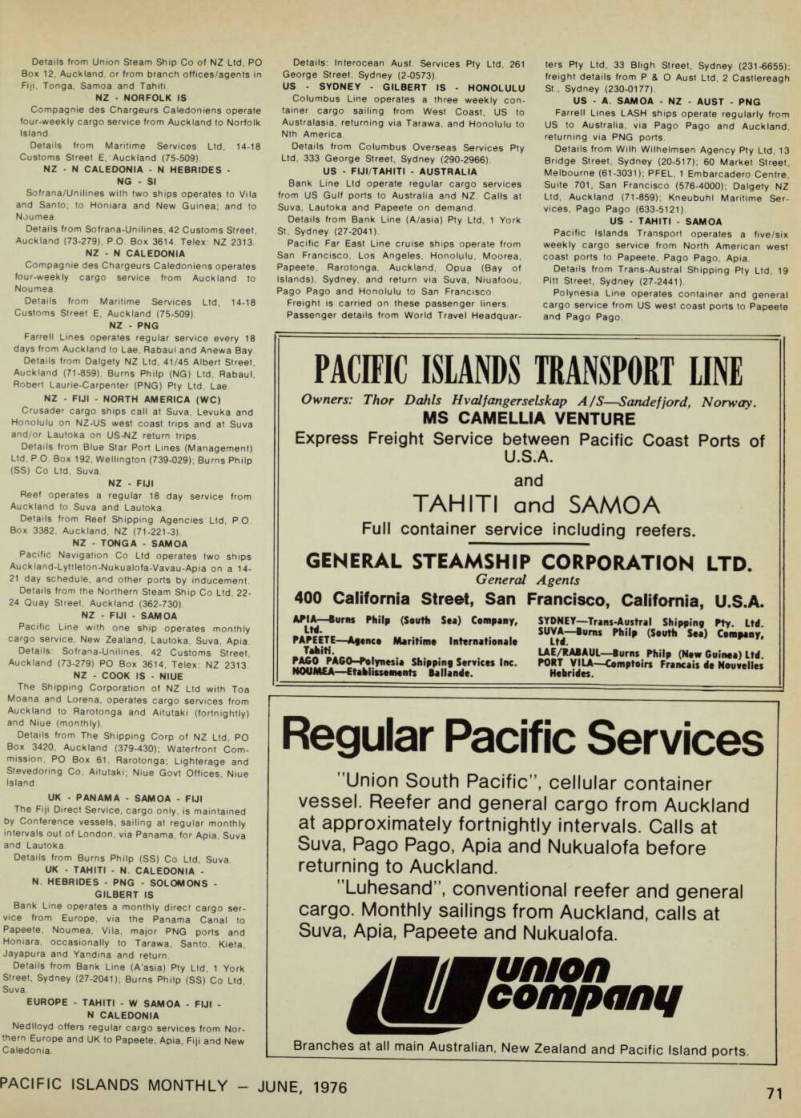
Airways
Shipping
SYDNEY - NZ - FIJI/TAHITI - UK Chandris Lines maintains a twice-monthly passenger service from Sydney via NZ, Suva or Papeete.
Details from Chandris Lines, 135 King Street, Sydney (28-2451).
SYDNEY - LORD HOWE IS - AUCKLAND -
Norfolk Is - New Caledonia
Compagnie des Chargeurs Caledoniens operates four-weekly cargo service Sydney-Lord Howe Island-Norfolk Island-Auckland-Norfolk Island- Noumea.
Details: Hetherington Kingsbury Pty Ltd, 37-49 Pitt Street, Sydney (27-1671),
Sydney - New Caledonia
Somacal operates 21-day service from Sydney to Noumea Details from Karlander (Aust) Pty Ltd, 19-31 Pitt Street, Sydney (27-6301).
SYDNEY - NZ - FIJI - HAWAII -
Canada - Us
P & O liners call at Auckland, Suva, Honolulu and Vancouver on eastbound and westbound voyages between Sydney and the US.
Details from P & O Booking Centre, World Travel Headquarters Pty Ltd, 33 Bligh Street, Sydney (231- 6655).
SYDNEY - NZ - FIJI - TONGA - N. HEBRIDES - NOUMEA - PNG - SOLOMONS - SAMOAS - TAHITI - HAWAII Sitmar Cruises operates a year-round cruise programme to include most of the above countries.
Details from Sitmar Cruises, 22-30 Bridge Street, Sydney (27-4521).
Royal Viking Line, with luxury cruise ships Royal Viking Sea, Star and Sky, cruises the Pacific from Sydney, Hobart and Cairns calling at most of above countries.
Details from Wilh. Wilhelmsen Agency Pty Ltd, 13-15 Bridge Street, Sydney (2-0517).
P & O liners call at Apia, Auckland, Bay of Islands, Borabora, Honiara, Honolulu, Lautoka, Noumea, Nukualofa, Pago Pago, Papeete, Port Moresby, Santo, Savusavu, Suva, Vavau and Vila on Cruises from Australia.
Details from P & O Booking Centre, World Travel Headquarters Pty Ltd, 33 Bligh Street, Sydney (231- 6655),
Australia - New Caledonia -
New Hebrides
Compagnie des Chargeurs Caledoniens operates three-weekly cargo service from Sydney to Noumea, Port Vila, Santo.
Details: Hetherington Kingsbury Pty Ltd, 37-49 Pitt Street, Sydney (27-1671).
Sofrana-Unilines ships serve Noumea every three weeks from the main ports along the east Australian coast and Port Vila monthly from Melbourne and Sydney.
Details from Sofrana-Unilines, 37 Pitt Street, Syd ney (27-2031), Trans-Austral Shipping Pty Ltd, 570 Bourke Street, Melbourne (67-9162), ACTA Pty Ltd, Brisbane (221-3116), Elder Smith Goldsbrough Mort Ltd, Port Adelaide (47-5688), Mcllwraith McEacharn Ltd, Newcastle (2-4781), H. Jones and Co Pty Ltd, Burnie, Tasmania (31-1833).
South Pacific United Lines maintain a four-week cargo service from Sydney to Noumea, Vila and Santo.
Details from Omni Traders & Brokers Pty Limited, 261 George Street, Sydney (241-2872/6).
Australia - Fiji
Karlander (Aust) Pty Ltd operates three weekly cargo services from Sydney to Suva and Lautoka.
Details from Karlander (Aust) Pty Ltd, 19-31 Pitt Street, Sydney (27-6301); Dalgety Shipping, 461 Bourke Street, Melbourne (60-0731); Burns Philp (SS) Cos Ltd, Suva and Lautoka.
Sofrana-Unilines (Fiji Express Line) operates to Suva every three weeks from the main ports on the east coast of Australia, and monthly to Lautoka from Melbourne and Sydney.
Details from Sofrana-Unilines, 37 Pitt Street, Syd ney (27-2031), Trans-Austral Shipping Pty Ltd, 570 Bourke Street, Melbourne (67-9162), ACTA Pty Ltd, Brisbane (221-3116), Elder Smith Goldsbrough Mort Ltd, Port Adelaide (47-5688), Mcllwraith McEacharn Ltd, Newcastle (2-4781), H, Jones and Cos Pty Ltd, Burnie, Tasmania (31-1833).
Australia - Fiji - W. Samoa
Nauru Pacific Line operates monthly con ventional/container service from Sydney and Brisbane to Fiji and Western Samoa Details from Nauru Pacific Line, 227 Collins Street, Melbourne (654-4977); Interocean Swire, 8 Spring Street, Sydney (20-522); Dalgety Shipping, 79 Eagle Street, Brisbane (31-0331).
AUSTRALIA - TAHITI - US WEST COAST South Pacific United Lines maintain a four weekly service from Sydney to Papeete, and US West Coast.
Details from Omni Traders & Brokers Pty Limited, 261 George Street, Sydney (241-2872/6)
Australia - Png
Containers Pacific Express (Burns Philp and AWP Line) operates four-weekly cargo service from Melbourne and Brisbane with Samos to Port Moresby and Lae and three-weekly cargo service from Sydney (direct) to Lae and Port Moresby with Nimos.
Details from Burns Philp & Cos Ltd, 51 Pitt Street, Sydney (241-3816) Farrell Lines operates a service every 18 days from Tasmania, Melbourne, Sydney and Brisbane to Lae, Rabaul and Anewa Bay Details from Wilh. Wilhelmsen Agency Pty Ltd, 13 Bridge Street, Sydney (20-517), 60 Market Street, Melbourne (61-3031), Burns Philp (NG) Ltd, Rabaul, Robert Laurie-Carpenter (NG) Pty Ltd, Lae New Guinea Express Lines with two ships operates three-weekly Melbourne, Sydney, Brisbane, Port Moresby, Lae, Rabaul Details from New Guinea Express Lines, PO Box R 73, Royal Exchange PO, Sydney (241-3991) MacArthur Shipping Agency Cos, 82-92 Eagle Street, Brisbane (229-3777), Westralian Farmers Transport Pty Ltd, 459 Little Collins Street, Melbourne (67-8291), Breckwoldt’s Shipping Agen cies in Port Moresby (24-2525), Lae (42-1536), Rab trad Niugini Pty Ltd, Rabaul (92-2911).
Karlander New Guinea Line’s cargo vessels call at Melbourne, Sydney, Lae, Madang, Wewak, Manus, Kimbe.
Details from Karlander (Aust) Pty Ltd, 19-31 Pitt Street, Sydney (27-6301); Dalgety Shipping, 461 Bourke St, Melbourne (60-0731).
Australia - Png - Solomons
New Guinea Australia Line’s vessels operate from Sydney and Brisbane to Port Moresby, Lae, Rabaul, Kavieng, Wewak, Honiara, Kieta, Gizo, Madang and Samarai.
Details from Interocean Swire, 8 Spring Street, Sydney (20-522).
Australia - Ng - Micronesia -
Guam
Nauru Pacific Line operates monthly con ventional/container service Melbourne/Sydney to New Guinea, Koror, Guam and Micronesia.
Details from Nauru Pacific Line, 227 Collins Street, Melbourne (654-4977); Interocean Swire, 8 Spring Street, Sydney (20-522).
Us - Png
Farrell Lines operates regular services from all US west coast ports to Lae, Rabaul and Anewa Bay.
Details from Wilh Wilhelmsen Agency Pty Ltd, 13 Bridge Street, Sydney (20-517), One Embarcadero Centre, Suite 701, San Francisco, Burns Philp (NG) Ltd, Rabaul and Kieta, Robert Laurie-Carpenter (PNG) Pty Ltd, Lae.
San Francisco - Honolulu -
Micronesia
Nauru Pacific Line operates regular con ventional/container service from San Francisco and Honolulu to Majuro, Nauru, Ponape, Truk and Saipan.
Details from Nauru Pacific Line, 227 Collins Street, Melbourne (654-4977), North American Maritime Agencies, 100 California Street, San Fran cisco, California 94111 (981-0343).
Png - Us - Canada
Farrell Lines operates regular services from Lae and Rabaul to US west coast ports and Vancouver.
Details from Burns Philp (NG) Ltd, Rabaul, Robert Laurie-Carpenter (PNG) Pty Ltd, Lae, PFEL, One Embarcadero Centre, Suite 701, San Francisco and Wilh Wilhelmsen Agency Pty Ltd, 13 Bridge Street, Sydney (20-517).
FAR EAST - FIJI - NEW ZEALAND New Zealand Unit Express (CNC, MOL, RIL) operates a three-weekly cargo service from Hong Kong to Lautoka, Suva, NZ ports, Manila, Kaoshiung, Keelung, Hong Kong.
Details from Interocean Swire, 8 Spring Street, Sydney (20-522).
Royal Interocean Lines operates monthly cargo service with three ships from Surabaya, Jakarta, Bangkok, Port Kelang and Singapore to Suva and NZ ports.
Details from Interocean Australia Services, 261 George Street, Sydney (2-0573), Burns Philp (SS) Cos Ltd, Suva and Lautoka.
Ben Shipping Cos (Pte) Ltd, sailing monthly from Singapore, Hong Kong, Keelung, Kaoshiung, Suva and main NZ ports.
Details from Seatrans (Fiji) Ltd, GPO Box 152, Suva, Fiji.
FAR EAST - PNG - SI - NEW HEBRIDES -
Noumea - Tahiti - Samoa
China Navigation Co’s vessels operate a regular cargo service from Hong Kong, Taiwan and Singapore to Rabaul, Wewak, Madang, Lae, Port Moresby, Honiara, New Hebrides, Noumea, Papeete and Samoa.
Details from Interocean Swire, 8 Spring Street, Sydney (20-522).
North Europe - New Caledonia
Hamburg-Sued operates monthly cargo services from Dunkirk and Le Havre to Noumea, via Panama.
Details from Columbus Overseas Services Pty Ltd, 333 George Street, Sydney (290-2966).
Messageries Maritimes operates five cargo ser vices a month from north and Mediterranean European ports to Papeete and Noumea.
Details from Messageries Maritimes, 4-6 Bligh Street, Sydney (221-2522).
JAPAN - GUAM - FIJI - SAMOA -
N Caledonia - N Hebrides
Daiwa Line runs a monthly cargo service from Japan via Guam to Suva, Lautoka, Pago Pago, Apia, Vila, Santo and Noumea.
Details from Burns Philp (SS) Cos Ltd, Suva.
TONGA - SAMOA - FIJI - NORFOLK IS -
Australia
Pacific Navigation Cos Ltd operates a monthly cargo service between Nukualofa, Apia, Suva, Lautoka and Norfolk Is to Sydney.
Details from Karlander (Aust) Pty Ltd, 19-31 Pitt Street, Sydney (27-6301); Burns Philp (SS) Cos Ltd.
Suva NZ - FIJI - TONGA - SAMOAS -
Tahiti
Union Steam Ship Cos of NZ operates a fully con tainerised service-Auckland-Suva-Pago Pago-Apia- Nukualofa every 14/16 days.
A 28-day service by conventional ship is operated from Auckland to Suva, Papeete, Apia and Nukualofa.
Details from Union Steam Ship Cos of NZ Ltd, PO Box 12, Auckland, or from branch offices/agents in Fiji, Tonga, Samoa and Tahiti.
Nz - Norfolk Is
Compagnie des Chargeurs Caledoniens operate four-weekly cargo service from Auckland to Norfolk Island.
Details from Maritime Services Ltd, 14-18 Customs Street E, Auckland (75-509).
NZ - N CALEDONIA - N HEBRIDES -
Ng - Si
Sofrana/Unilines with two ships operates to Vila and Santo; to Honiara and New Guinea; and to Noumea.
Details from Sofrana-Unilines, 42 Customs Street, Auckland (73-279), P.O, Box 3614. Telex: NZ 2313.
Nz - N Caledonia
Compagnie des Chargeurs Caledoniens operates four-weekly cargo service from Auckland to Noumea.
Details from Maritime Services Ltd, 14-18 Customs Street E, Auckland (75-509).
Nz - Png
Farrell Lines operates regular service every 18 days from Auckland to Lae, Rabaul and Anewa Bay.
Details from Dalgety NZ Ltd, 41/45 Albert Street, Auckland (71-859), Burns Philp (NG) Ltd, Rabaul, Robert Laurie-Carpenter (PNG) Pty Ltd, Lae.
NZ - FIJI - NORTH AMERICA (WC) Crusader cargo ships call at Suva, Levuka and Honolulu on NZ-US west coast trips and at Suva and/or Lautoka on US-NZ return trips.
Details from Blue Star Port Lines (Management) Ltd, P.O. Box 192, Wellington (739-029); Burns Philp (SS) Cos Ltd, Suva.
Nz - Fiji
Reef operates a regular 18 day service from Auckland to Suva and Lautoka.
Details from Reef Shipping Agencies Ltd, P.O.
Box 3382, Auckland, NZ (71-221-3).
Nz - Tonga - Samoa
Pacific Navigation Cos Ltd operates two ships Auckland-Lyttleton-Nukualofa-Vavau-Apia on a 14- 21 day schedule, and other ports by inducement.
Details from the Northern Steam Ship Cos Ltd, 22- 24 Quay Street, Auckland (362-730).
Nz - Fiji - Samoa
Pacific Line with one ship operates monthly cargo service, New Zealand, Lautoka, Suva, Apia.
Details: Sofrana-Unilines, 42 Customs Street, Auckland (73-279) PO Box 3614, Telex: NZ 2313.
Nz - Cook Is - Niue
The Shipping Corporation of NZ Ltd with Toa Moana and Lorena, operates cargo services from Auckland to Rarotonga and Aitutaki (fortnightly) and Niue (monthly).
Details from The Shipping Corp of NZ Ltd, PO Box 3420, Auckland (379-430); Waterfront Com mission, PO Box 61, Rarotonga; Lighterage and Stevedoring Cos, Aitutaki; Niue Govt Offices, Niue Island.
UK - PANAMA - SAMOA - FIJI The Fiji Direct Service, cargo only, is maintained by Conference vessels, sailing at regular monthly intervals out of London, via Panama, for Apia, Suva and Lautoka.
Details from Burns Philp (SS) Cos Ltd, Suva.
UK - TAHITI - N. CALEDONIA - N. HEBRIDES - PNG - SOLOMONS -
Gilbert Is
Bank Line operates a monthly direct cargo ser vice from Europe, via the Panama Canal to Papeete, Noumea, Vila, major PNG ports and Honiara, occasionally to Tarawa, Santo, Kieta, Jayapura and Yandina and return.
Details from Bank Line (A'asia) Pty Ltd, 1 York Street, Sydney (27-2041); Burns Philp (SS) Cos Ltd, Suva.
EUROPE - TAHITI - W SAMOA - FIJI -
N Caledonia
Nedlloyd offers regular cargo services from Nor thern Europe and UK to Papeete, Apia, Fiji and New Caledonia.
Details: Interocean Aust. Services Pty Ltd, 261 George Street, Sydney (2-0573).
US - SYDNEY - GILBERT IS - HONOLULU Columbus Line operates a three weekly con tainer cargo sailing from West Coast, US to Australasia, returning via Tarawa, and Honolulu to Nth America.
Details from Columbus Overseas Services Pty Ltd, 333 George Street, Sydney (290-2966).
Us - Fiji/Tahiti - Australia
Bank Line Ltd operate regular cargo services from US Gulf ports to Australia and NZ. Calls at Suva, Lautoka and Papeete on demand.
Details from Bank Line (A/asia) Pty Ltd, 1 York St, Sydney (27-2041).
Pacific Far East Line cruise ships operate from San Francisco, Los Angeles, Honolulu, Moorea, Papeete, Rarotonga, Auckland, Opua (Bay of Islands), Sydney, and return via Suva, Niuafoou, Pago Pago and Honolulu to San Francisco.
Freight is carried on these passenger liners.
Passenger details from World Travel Headquar
ters Pty Ltd, 33 Bligh Street, Sydney (231-6655); freight details from P & O Aust Ltd, 2 Castlereagh St., Sydney (230-0177).
US - A. SAMOA - NZ - AUST - PNG Farrell Lines LASH ships operate regularly from US to Australia, via Pago Pago and Auckland, returning via PNG ports.
Details from Wilh Wilhelmsen Agency Pty Ltd, 13 Bridge Street, Sydney (20-517); 60 Market Street, Melbourne (61-3031); PFEL, 1 Embarcadero Centre, Suite 701, San Francisco (576-4000); Dalgety NZ Ltd, Auckland (71-859); Kneubuhl Maritime Ser vices, Pago Pago (633-5121)
Us - Tahiti - Samoa
Pacific Islands Transport operates a five/six weekly cargo service from North American west coast ports to Papeete, Pago Pago, Apia Details from Trans-Austral Shipping Pty Ltd, 19 Pitt Street, Sydney (27-2441).
Polynesia Line operates container and general cargo service from US west coast ports to Papeete and Pago Pago
Details from Polynesia Shipping Services Inc, PO Box 1478, Pago Pago (96799).
Airways
From Australia
Qantas (707s, 747s, DC4) — PNG, Norfolk Is, New
Caledonia, Fiji, Tahiti, US, Canada.
PAA (7475) Fiji, American Samoa, Hawaii, US.
CP Air (DCS) Fiji, Hawaii, Canada.
UTA (DCSs and DCIOs) New Caledonia, Fiji, New Zealand, Tahiti, US.
Air Nautu (F2B) New Caledonia, Nauru, Tarawa, Majuro
Air Niugini (7205) PNG.
Advance Aviation (from Sydney), North Coast Airlines (from Coffs Harbour) and Oxley Airlines (from Port Macquarie) Lord Howe Is.
From New Zealand
Air-NZ (DCBs, DClOs, F 27) Fiji, American Samoa, Cook Is., Tahiti, Hawaii. US, New Caledonia, Norfolk Is.
PAA (7475) American Samoa, Tahiti, Hawaii, US.
UTA (DCS) Tahiti.
From Us
Qantas (707 sand 7475) Honolulu, Fiji.
Australia.
PAA (7475) Honolulu, Tahiti, A. Samoa, Fiji, NZ, Australia.
Air-NZ (DCSs and DCIOs) Honolulu, Fiji, Auckland.
From Canada
CP Air (DCSs) Honolulu, Fiji, Australia.
Qantas (DCSs and DCIOs) Honolulu, Fiji, Australia.
PACIFIC - FAR EAST - S. AMERICA Air Nauru (F2B or 737) Nauru to Micronesia, The Philippines, Okinawa, Japan, Taiwan, Hong Kong.
Air France (7075) Japan to Tahiti, Peru.
Air Niugini (7075) to Manila.
Pacific Is - Aust
Air Pacific (BAC111) From Fiji, via New Hebrides or New Caledonia, to Brisbane.
Air Nauru (F2B or 737) flies to Melbourne Air Niugini (727 sand Fokker Friendships) to Cairns and Brisbane.
Norfolk Island Airlines (Beechcraft) to Brisbane.
Pacific Is - Nz
Air Pacific (BAC111) Fiji-Tonga-NZ.
Inter-Territory
Lan-Chile (7075) Easter Is, Tahiti.
Air Pacific (BACIII and HS74Bs) Fiji to Gilbert Is, Tuvalu, Western Samoa, Tonga, New Hebrides, Solomon Islands, New Caledonia, PNG.
Fiji Air Services Wallis and Futuna (charter).
Qantas (7075) PNG to Singapore PAA (7075) Hawaii to Am. Samoa and Tahiti, US.
UTA (7075, Caravelles) from New Caledonia to Fiji, New Hebrides, Wallis Is, Tahiti.
Continental-Air Micronesia (7275) from Hawaii to Micronesia.
Air Nauru from Nauru to Tarawa, Marshall Is, Wallis Is, Fiji, W. Samoa, New Hebrides, New Caledonia, Solomons, Philippines.
Polynesian Airlines from Apia to Tonga, Niue Is, Fiji, Am. Samoa.
South Pacific Island Airways flies between American and Western Samoa.
Air Tahiti from Tahiti to Cook Is.
Air Niugini to Irian Jaya, Solomon Is, Philippines.
Norfolk Island Airlines (Beechcraft) to Noumea.
Internal
Fiji Air Pacific (HS74Bs and Trislanders), Fiji Air Services (Beech Barons and Islanders).
French Polynesia Air Polynesia (Fokker Friendships), Air Tahiti.
US Trust Territory and Guam Continental-Air Micronesia (7275) and Air Pacific International Inc.
Gilbert Is Air Pacific PNG Air Niugini, Aerial Tours, Talair, Melanesian Airlines, Crowley Airways.
Bougainville Bougainville Air Services.
New Caledonia Air Caledinie (Twin Otters), New Hebrides Air Melanesiae (Islanders).
Solomon Is Solair (Beech Barons and Islan ders).
Tonga Tonga Internal Air Service (Islanders).
Cook Is Cook Island Airways (Islander).
Norfolk Island Airlines (Beechcraft) Norfolk Is- Lord Howe Is.
Western Samoa Air Samoa Ltd, and Samoa Aviation Ltd.
Advertisements & other items, pp. 69-72 (2 items)
Kyowa Line
YOUR TRADING PARTNER
Monthly Services
Hong Kong, Taiwan, S. Korea, Japan
To: Guam, Saipan, British Solomon, New Caledonia, Fiji, W. Samoa, A. Samoa. Tahiti, Cook Is., Tonga, New Hebrides.
Taiwan,Hong Kong,Singapore,Jakarta
To: Australia, Papua New Guinea, Sabah & Sarawak.
South Korea, Japan
To: Guam, Saipan, Papua New Guinea, Other Pacific Islands.
Taiwan: Royal Steamship Corp., Ltd., Taipei S. Korea: Dong Sue Shipping Co., Ltd., Seoul Hong Kong: Dahzun Enterprises Ltd.
Singapore: Ocean Shipping & Enterprises Pte., Ltd.
Mariana Is.: Island Navigation Co., Ltd., Guam 8.5.1. P.: Solomon Taiyo Ltd., Honiara Tahiti: J.A, Cowan & Fils, Papeete Cooks: Union Citco Travel Ltd., Rarotonga Tonga: EM. Jones Ltd., Nukualofa New Hebrides: Agence Maritime Raymond Velicite, Port Vila A.Samoa; Island Pacific Agencies Inc., Pago Pago W. Samoa: Morris Hedstrom Ltd., Apia Fiji: Carpenter Shipping, Suva & Lautoka PNG: Carpenter Shipping Agencies, Port Moresby, Rabaul New Caledonia: Agence Maritime Du Rond Point Du Pacific, Indonesia: P.T. Porodisa Raya Shipping Lines, Jakarta Sabah: KOH Han Ming Shipping & Forwarding Agent., Kotakmabalu Sarawak: Pan Sarawak Agencies Sdn. Bhd.,Sibu & Kuching Australia: Hethermgton Kingsbury Pty, Ltd., Sydney, N.S.W.
KYOWA SHIPPING CO., LTD.
Ojima Bldg., 22-8, 6-chome, Shinbashi, Frontier Bldg., 3-13 Hirano-cho,
AGENTS
Noumea
HEAD OFFICE
OSAKA OFFICE
Minato-ku, Tokyo, Japan Phone: 03(437)2885 (Rep.) Cables: “MARIQUEEN” Tokyo Telex: 242-4651 Kyowa J.
Higashi-ku, Osaka, Japan.
Phone: 06(227)0422 (Rep.) Cables: “MARIQUEEN” Osaka.
Telex: 522-3896 Kyowa 0
THE
m.
BANK W®™
UNE
es** \
MONTHLY SERVICES
United Kingdom and Continent to: Papeete, Noumea, New Hebrides, Papua New Guinea and Solomon Islands.
Papua New Guinea to: North America, United Kingdom and Continent.
Solomons, Fiji, Tonga, Samoa and Tarawa to: United Kingdom and Continent.
For particulars apply:
THE BANK LINE (AUSTRALASIA) PTY. LTD.,
18TH FLOOR, 1 YORK STREET,
SYDNEY, N.S.W.
PACIFIC ISLANDS TRANSPORT LINE
Owners: Thor Dahls Hvalfangerselskap A/S — Sandefjord, Norway.
MS CAMELLIA VENTURE
Express Freight Service between Pacific Coast Ports of
U.S.A.
and
TAHITI and SAMOA
Full container service including reefers.
GENERAL STEAMSHIP CORPORATION LTD.
General Agents 400 California Street, San Francisco, California, U.S.A.
AP . , £r" Burns Philp (South Sea) c ® m P*"y» SYDNEY—Trans-Austral Shipping Pty. Ltd.
Ltd. fMU4 “ ** LM “ - % micctc a u ... — Bumj Philp (South Soa) Company, PAPEETE—Agence Maritime Internationale Ltd.
Tahiti.
PAGO PAGO-Polynesia Shipping Services Inc.
NOUMEA—Etablissements Ballande.
LAE/RABAUL—Burns Philp (New Guinea) Ltd.
WW VlLA—Comptoirs Francais de Nouvelles Hebrides.
Regular Pacific Services
"Union South Pacific”, cellular container vessel. Reefer and general cargo from Auckland at approximately fortnightly intervals. Calls at Suva, Pago Pago, Apia and Nukualofa before returning to Auckland.
"Luhesand”, conventional reefer and general cargo. Monthly sailings from Auckland, calls at Suva, Apia, Papeete and Nukualofa.
jm/mumon
gm/Mcompmu
Branches at all main Australian, New Zealand and Pacific Island ports.
Gec-Aei (Australia) Pty. Ltd.
PETER FISHER TRADING Pty. Ltd.
321 Pin STREET, SYDNEY, 2000, AUSTRALIA
Telephone: 26-1109 CABLES: "FISHERION", SYDNEY
EXPORTERS TO THE PACIFIC ISLANDS
the shape of your -fltture
Servicing the Pacific Islands with
the most comprehensive range of
electrical products and services
we are geared to expertly handle
any export transaction large or
small fast and efficiently.
GEC • OS RAM • AEI • WOODS
ENGLISH ELECTRIC • XPELAIR
Represented by: B. C. Mackenzie—Norfolk island Security Electrical—Honiara, Solomon Islands R. & J. Henderson—Lae, P.N.G.
Enquiries to: THE EXPORT MANAGER
GEC-AEI (AUSTRALIA) Pty. Ltd.
P.O. BOX 9 AUBURN, N.S.W. 2144
Telephone: 649 0155 Telex: 20729
Cables: BRITISH GENERAL, SYDNEY
Agency Enquiries Welcome
Islands People
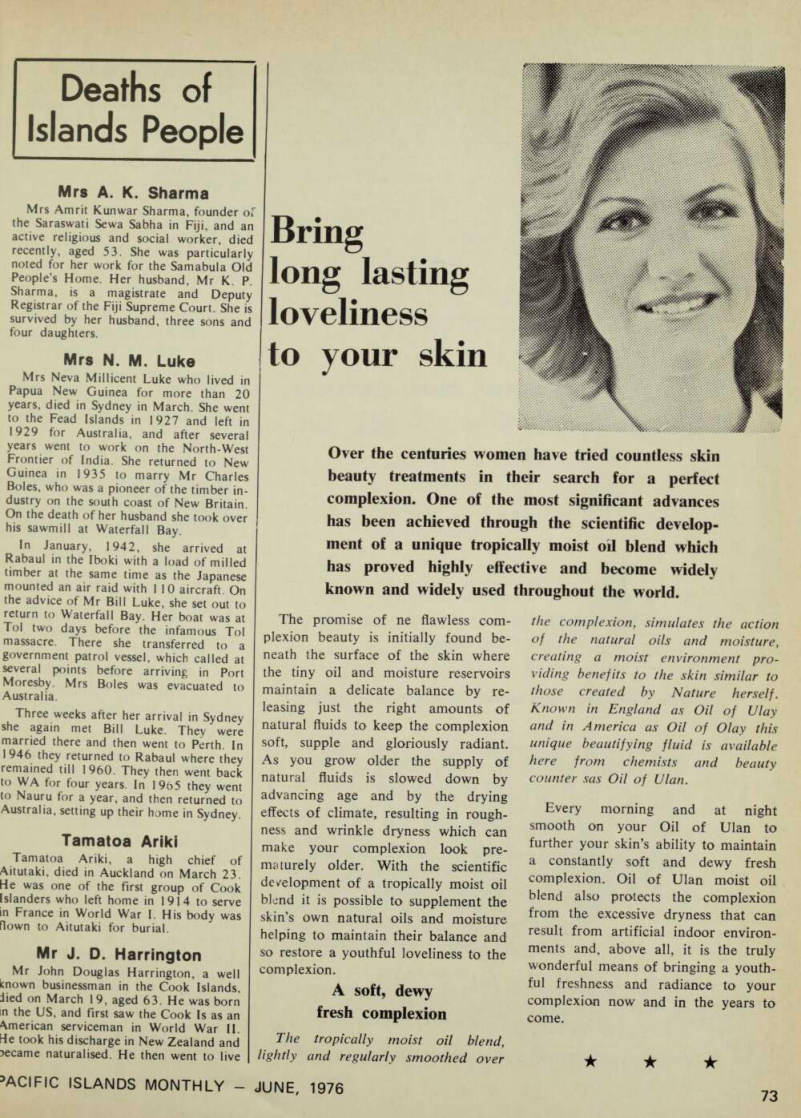
Deaths of Islands People
Mrs A. K. Sharma
Mrs Amrit Kunwar Sharma, founder of the Saraswati Sewa Sabha in Fiji, and an active religious and social worker, died recently, aged 53. She was particularly noted for her work for the Samabula Old People’s Home. Her husband, Mr K. P.
Sharma, is a magistrate and Deputy Registrar of the Fiji Supreme Court She is survived by her husband, three sons and
four daughters.
Mrs N. M. Luke
Mrs Neva Millicent Luke who lived in Papua New Guinea for more than 20 years, died in Sydney in March. She went to the Fead Islands in 1927 and left in 1929 for Australia, and after several years went to work on the North-West Frontier of India. She returned to New Guinea in 1935 to marry Mr Charles Boles, who was a pioneer of the timber in dustry on the south coast of New Britain.
On the death of her husband she took over his sawmill at Waterfall Bay.
In January, 1942, she arrived at Rabaul in the Iboki with a load of milled timber at the same time as the Japanese mounted an air raid with 1 10 aircraft. On the advice of Mr Bill Luke, she set out to return to Waterfall Bay. Her boat was at Tol two days before the infamous Tol massacre. There she transferred to a government patrol vessel, which called at several points before arriving in Port Moresby. Mrs Boles was evacuated to Australia.
Three weeks after her arrival in Sydney she again met Bill Luke. They were married there and then went to Perth. In 1946 they returned to Rabaul where they remained till 1960. They then went back to WA for four years. In 1965 they went to Nauru for a year, and then returned to Australia, setting up their home in Sydney.
Tamatoa Ariki
Tamatoa Ariki, a high chief of Aitutaki, died in Auckland on March 23.
He was one of the first group of Cook Islanders who left home in 1914 to serve in France in World War I. His body was flown to Aitutaki for burial.
Mr J. D. Harrington
Mr John Douglas Harrington, a well known businessman in the Cook Islands, died on March 19, aged 63. He was born in the US, and first saw the Cook Is as an American serviceman in World War 11.
He took his discharge in New Zealand and became naturalised. He then went to live
in Aitutaki when he married, and set up in business. He went back to NZ for five years, and returned to Aitutaki. In 1957 he sold his Aitutaki interests and built a store in Rarotonga. His wife died in 1955.
He later remarried, and is survived by his second wife and five children from both marriages.
Mr E. B. Chapman Mr E. B. Chapman, British Phosphate Commission manager at Ocean Islands, has died suddenly. He joined the BPC in 1938 and worked at both Nauru and Ocean Islands. He was a prisoner of the Japanese during World War 11.
Mr P. F. D. Palmer Mr Phillip F. D. Palmer, who died on April 22 at Cairns, was a member of the Burns Philp and Co Ltd staff for 47 years.
He was at Fanning Island for many years.
He is survived by his wife.
Rev Father J. Wall
The Rev Father James Wall, SM, known to Solomon Islanders as "Patere Wall” and “Jimmy Wall” died recently in Wellington, aged 69. He was a priest for 45 years. He was one of the first Marist missionaries to arrive in the Solomons, where he was stationed from 1933 to 1969. Father Wall served as an appointed
member of the old Legislative Council and was awarded the QBE for his work on that council. He had a wide knowledge of island names, figures and genealogies.
Mr C. G. O. T. Parr Mr Cecil Guy Orsbourne Trulove Parr, who died in Fiji recently, opened the first tourist resort at Savusavu. Mr Parr went to Fiji from England in 1926 to work for the CSR Co Ltd. He was later a teacher and also worked in the Fiji Department of Agriculture. In 1946 he acquired Muanicula, a copra plantation near Savusavu. He started his tourist resort there in 1957. Mr Parr is survived by Mrs Parr and a son.
long lasting
Bring long lasting loveliness to your skin
Over the centuries women have fried countless skin beauty treatments in their search for a perfect complexion. One of the most significant advances has been achieved through the scientific develop ment of a unique tropically moist oil blend which has proved highly effective and become widely known and widely used throughout the world.
The promise of ne flawless com plexion beauty is initially found be neath the surface of the skin where the tiny oil and moisture reservoirs maintain a delicate balance by re leasing just the right amounts of natural fluids to keep the complexion soft, supple and gloriously radiant.
As you grow older the supply of natural fluids is slowed down by advancing age and by the drying effects of climate, resulting in rough ness and wrinkle dryness which can make your complexion look pre maturely older. With the scientific development of a tropically moist oil blend it is possible to supplement the skin’s own natural oils and moisture helping to maintain their balance and so restore a youthful loveliness to the complexion.
A soft, dewy
fresh complexion
The tropically moist oil blend, lightly and regularly smoothed over
the complexion, simulates the action of the natural oils and moisture, creating a moist environment pro viding benefits to the skin similar to those created by Nature herself.
Known in England as Oil of Ulay and in America as Oil of Olay this unique beautifying fluid is available here from chemists and beauty counter sas Oil of Ulan.
Every morning and at night smooth on your Oil of Ulan to further your skin’s ability to maintain a constantly soft and dewy fresh complexion. Oil of Ulan moist oil blend also protects the complexion from the excessive dryness that can result from artificial indoor environ ments and, above all, it is the truly wonderful means of bringing a youth ful freshness and radiance to your complexion now and in the years to come.
Advertisements & other items, pp. 73-74 (2 items)
73
’ACIFIC ISLANDS MONTHLY - JUNE, 1976
The Right Oiesel far any job!
TRAIL BLAZERS OF
NEW ZEALAND
Historical tales from a unique land.
Fully illustrated, gold-embossed binding. Limited number First Editions available. $10.95 (NZ) postpaid from DUFS, Bx. 3847, Wellington, NZ.
THE PAPUA HOTEL
PORT MORESBY
• Right in the business centre • A tradition for comfort and fine food • All rooms air conditioned • Restaurant • Bars • Banquet Hall Telephone 24 2121 Cables PAPTEL
A. C. NEUMANN
Manager
INTERNATIONAL
DATELINE HOTEL
TONGA
"Friendly Hotel" of the "Friendly Mends"
Situated along the Nukualofa waterfront Only five minutes walk from town. Single, double, family suites, airconditioning, and hot and cold water showers. Pool, bar, restaurant, duty-free shop, tour desk and boutique.
Book through your travel agent or write to International Dateline Hotel, P.O. Box 62, Nukualofa Tonga.
Cable Address: "DATELINE".
Represented Overseas by: Charles J. Henry and Associates Pty. Ltd.
Sydney and Melbourne.
apua new gulm
printing co. pfy. ltd.
Serving the Country from Aitape to Alotau, Manus to Moresby Leaders in Commercial Offset and Letterpress Printing. • Stationery • Office Supplies • Office Equipment • Rubber Stamps • Self-Adhesive Labels • In Fact:— Everything For The Office.
P.O. Box 633, Port Moresby P.O. Box 759, Lae P.O. Box 1239, Rabaul
The Right Oiesel far any job!
G.E.C. have more than 100 models to choose from. World famous names like Boudouin, Dorman, Kelvin, Paxman and Ruston. Coupled with the know-how of G.E.C.
Diesels. From 6 to 4,550H.P. there's a model to suit your needs for Generating, Marine & Pumping.
GEC Diesels Australia Ltd.
1 WINTERTON RD„ CLAYTON, VICTORIA. AUTRALIA. PHONE: 544 8344 TELEX: 30994. SOLOMONS AGENT: HONIARA MARINA & SHIPYARD.
Produce Prices
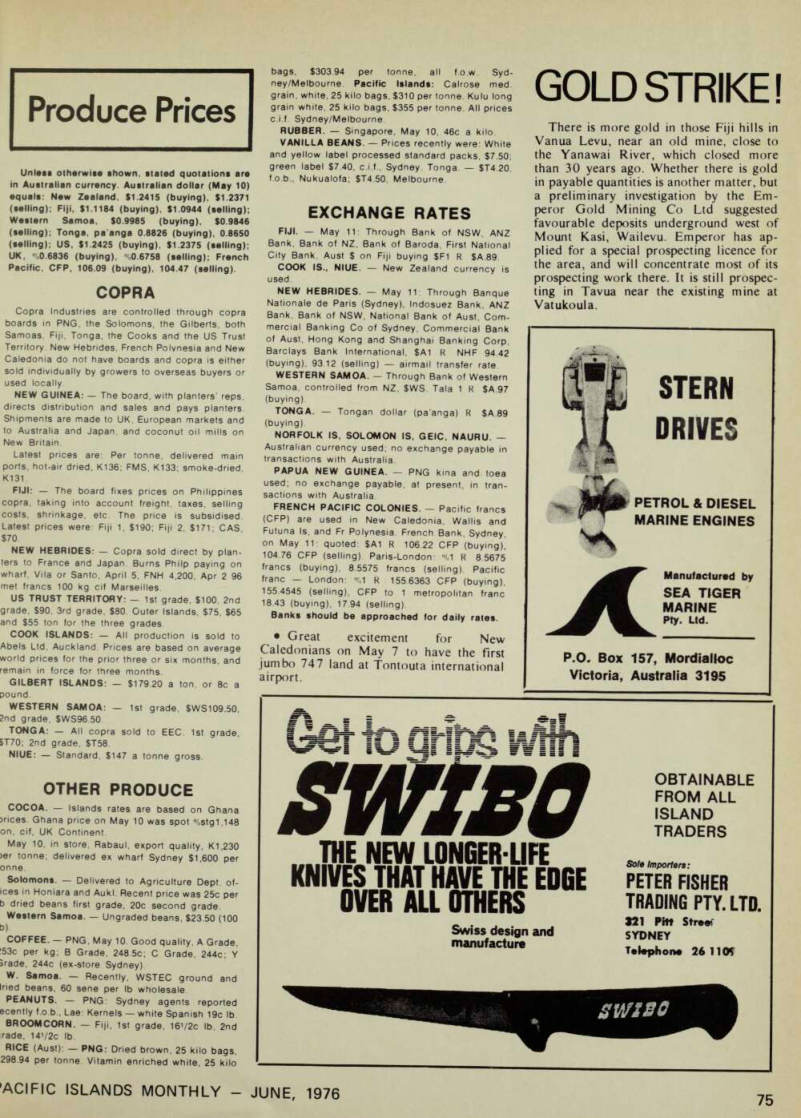
Unless otherwise shown, stated quotations are in Australian currency. Australian dollar (May 10) equals: New Zealand. $1.2415 (buying), $1.2371 (selling); Fiji, $1.1184 (buying), $1.0944 (selling); Western Samoa, $0.9985 (buying), $0.9846 (selling); Tonga, pa anga 0.8826 (buying), 0.8650 (selling); US, $1.2425 (buying), $1.2375 (selling); UK, ",0.6836 (buying), %0.6758 (selling); French Pacific. CFP, 106.09 (buying), 104.47 (selling).
Copra
Copra Industries are controlled through copra boards in PNG, the Solomons, the Gilberts, both Samoas, Fiji, Tonga, the Cooks and the US Trust Territory. New Hebrides, French Polynesia and New Caledonia do not have boards and copra is either sold individually by growers to overseas buyers or used locally.
NEW GUINEA; The board, with planters’ reps, directs distribution and sales and pays planters.
Shipments are made to UK, European markets and to Australia and Japan, and coconut oil mills on New Britain.
Latest prices are: Per tonne, delivered main ports, hot-air dried, K 136; FMS, K 133; smoke-dried, Kl3l.
FIJI; The board fixes prices on Philippines copra, taking into account freight, taxes, selling costs, shrinkage, etc. The price is subsidised.
Latest prices were: Fiji 1, $190; Fiji 2, $171; CAS, S7O.
NEW HEBRIDES; Copra sold direct by plan ters to France and Japan. Burns Philp paying on wharf, Vila or Santo, April 5, FNH 4,200, Apr 2 96 met francs 100 kg cif Marseilles.
US TRUST TERRITORY: lst grade. SIOO, 2nd grade, S9O, 3rd grade, S3O. Outer Islands, $75, $65 and $55 ton for the three grades.
COOK ISLANDS: All production is sold to Abels Ltd, Auckland. Prices are based on average world prices for the prior three or six months, and remain in force for three months.
GILBERT ISLANDS; 5179.20 a ton, or 8c a pound.
WESTERN SAMOA: lst grade, $W5109.50, 2nd grade, $W596.50.
TONGA: All copra sold to EEC. Ist grade, 5T70; 2nd grade, STSB.
NIUE: Standard, $147 a tonne gross.
Other Produce
COCOA. lslands rates are based on Ghana >rices. Ghana price on May 10 was spot %stgl,l4B on, cif. UK Continent.
May 10, in store, Rabaul, export quality, K 1.230 >er tonne; delivered ex wharf Sydney $1,600 per onne.
Solomons. Delivered to Agriculture Dept of ices in Honiara and Aukl. Recent price was 25c per b dried beans first grade, 20c second grade.
Western Samoa. Ungraded beans, $23.50 (100 b).
COFFEE. PNG, May 10. Good quality, A Grade, 153 c per kg; B Grade, 248.5 c; C Grade, 244 c; Y
Jrade, 244 c (ex-store Sydney)
W. Samoa. Recently, WSTEC ground and Iried beans, 60 sene per lb wholesale.
PEANUTS. PNG: Sydney agents reported ecently f o b., Lae: Kernels white Spanish 19c lb.
BROOMCORN. Fiji, Ist grade, 16V2c lb, 2nd rade, 14V2c lb.
RICE (Aust): PNG: Dried brown, 25 kilo bags. 298.94 per tonne. Vitamin enriched white, 25 kilo
bags, $303.94 per tonne, all f.o.w. Syd ney/Melbourne. Pacific Islands: Calrose med grain, white, 25 kilo bags, $310 per tonne. Kulu long grain white, 25 kilo bags, $355 per tonne. All prices c.i.f. Sydney/Melbourne RUBBER. — Singapore, May 10, 46c a kilo VANILLA BEANS. — Prices recently were: White and yellow label processed standard packs, $7.50; green label $7.40, c.i.f., Sydney. Tonga. — $14.20, f o b., Nukualofa; $T4.50, Melbourne.
Exchange Rates
FIJI. — May 11: Through Bank of NSW, ANZ Bank, Bank of NZ, Bank of Baroda, First National City Bank, Aust $ on Fiji buying $F1 R $A.89 COOK IS., NIUE. — New Zealand currency is used.
NEW HEBRIDES. — May 11: Through Banque Nationale de Paris (Sydney), Indosuez Bank, ANZ Bank, Bank of NSW, National Bank of Aust, Com mercial Banking Co of Sydney, Commercial Bank of Aust, Hong Kong and Shanghai Banking Corp, Barclays Bank International, $A1 R NHF 94 42 (buying), 93.12 (selling) — airmail transfer rate WESTERN SAMOA. — Through Bank of Western Samoa, controlled from NZ, $WS Tala 1 R $A 97 (buying).
TONGA. — Tongan dollar (pa’anga) R $A.89 (buying) NORFOLK IS, SOLOMON IS, GEIC, NAURU. — Australian currency used; no exchange payable in transactions with Australia.
PAPUA NEW GUINEA. - PNG kina and toea used; no exchange payable, at present, in tran sactions with Australia.
FRENCH PACIFIC COLONIES. — Pacific francs (CFP) are used in New Caledonia, Wallis and Futuna Is, and Fr Polynesia. French Bank, Sydney, on May 11: quoted: $A1 R 106.22 CFP (buying), 104 76 CFP (selling) Paris-London: %1 R 8 5675 francs (buying), 8.5575 francs (selling) Pacific franc — London: %1 R 155.6363 CFP (buying), 155.4545 (selling), CFP to 1 metropolitan franc 18,43 (buying), 17.94 (selling).
Banks should be approached for daily rates. • Great excitement for New Caledonians on May 7 to have the first jumbo 747 land at Tontouta international
airport.
Gold Strike!
There is more gold in those Fiji hills in Vanua Levu, near an old mine, close to the Yanawai River, which closed more than 30 years ago. Whether there is gold in payable quantities is another matter, but a preliminary investigation by the Em peror Gold Mining Co Ltd suggested favourable deposits underground west of Mount Kasi, Wailevu. Emperor has ap plied for a special prospecting licence for the area, and will concentrate most of its prospecting work there. It is still prospec ting in Tavua near the existing mine at Vatukoula.
Advertisements & other items, pp. 75-80 (2 items)
75
ACIFIC ISLANDS MONTHLY - JUNE, 1976
Swibo
STERN
DRIVES
PETROL & DIESEL
MARINE ENGINES
X Manufactured by
SEA TIGER
MARINE
Pty. Ltd.
P.O. Box 157, Mordialloc Victoria, Australia 3195
= " E = = = = ===_ - === ==l 1 wi sw mi imo mu §
SWIBO
THE NEW LONGEH'UFE
KNIVES THAT HAVE THE EDGE
OVER AIL OTHERS
Swiss design and manufacture
OBTAINABLE
FROM ALL
ISLAND
TRADERS
Sole Importers:
PETER FISHER
TRADING PTY.LTD.
*ll Pitt Strew
SYDNEY
Telephone 26 110 f
CLASSIFIED
ADVERTISMENTS
Per Line $3.00 Aust. Minimum 4 lines WANTED: A few acres of farmland on extremely isolated island with healthy climate.
D. Wharton, 1916 Pelham Ave., Los Anoele<? ual. 90025 U.S.A. y ’
PORT MORESBY
For all your Real Estate & Flatting needs contact Strickland Agency.
For complete Management of Flats, Houses & Businesses Contact Strickland Agency.
Write Strickland Agency, P.O. Box 1581 Boroko P.N.G. or Phone Port Moresby 254291. - FLEETS diesel yachts, 28ft. $9,500.00, 31ft. fibreglass $31,000.00, 34ft. steel $27,000.00, 42ft, steel $32,000.00. 52ft steel hull. $26,000.00.
Fleets 221 Esplanade Wynnum Central, Brisbane. Cable: “FLEETS BRISBANE”.
CRUISING CATAMARAN Ketch rigged, diesel aux., accommodation for 7 in 3 cabins.
Large saloon, 6 sails, depth sounder, sumlog. $18,500.
SPIT BRIDGE MARINA
The Spit, Mosman 960.2233 (Sydney) Australia
GENERATING SETS
by BRAYBON
Capacities available are: Petrol 2 kva-7i kva • Diesel 2 kva-200 kva Write for brochure and prices:
BRAYBON BROS. PTY. LTD.,
2 ROTHWELL AVE., CONCORD WEST,
N.S.W., 2138. Phone: 73-3246.
POSITION VACANT
Applications are invited for appointment as a research fellow to undertake research imo factors affecting the work of rural women, particularly in relation to cash crop production.
Research should be designed to be completed within 24 months. Under terms laid down by the sponsoring agency, salaries will be related to rates payable in the researcher’s country of residence.
Applications should include a full curriculum vitae, and the names of three referees, details of dependents, and should indicate when the applicant would be available to take up appointment.
Further information may be obtained from the Director (Dr. R.J. May), lASER, Box 5854, Boroko, Papua New Guinea or from Ms. Barbara Lepani, Central Planning Office, Wards Strip, Papua New Guinea. Applications, which close on 30 June 1976, should be addressed to lASER.
POSITION VACANT
The Papua New Guinea Institute of Applied Social and Economic Research was established in January 1976 to promote research into Papua New Guinea society and economy and undertake research into social, political and economic problems in order to enable practical solutions to be formulated.
It is now seeking applications for appointment as Research Fellow/Senior Research Fellow in the following areas of interest: • population (including effectiveness of
family planning);
• rural development (including land policy: constraints on economic development: rural out-migration; role of women); • Organizational bases for local development (including local and provincial government: development associations): • assessment of government services; • macro economic policy.
FOR SALE: One 65' Freezer vessel 5 years old steel construction. Fuel capacity 4500 galls Carrying capacity 40 to 45000 lbs. in cartons of meat. Draft 6'9" 240/415 electrics 80 kva. Alternator 200 HP Main propulsion engine Regd. British ship. For further particulars write to: P. Pallanza, PO Box 1497, Townsville. Queensland 4810, Australia.
MAKE FRIENDS WORLDWIDE!
Have penfriends from nearly 200 different countries! Write immediately: Five Continents Club, Waitakere, New Zealand.
WANTED - Sailboat Looking for a cruising sailboat 40’ 45’
L.0.A., prefer steel. Contact J.W. Cafky/P.O.
Box EK/AGANA, GUAM 96910 USA.
CONCRETE BLOCK MAKER Makes blocks, flags, edgings, screen-blocks, garden stools—up to 8 at once and 96 an hour $215.00 c.i.f. main ports. Send for leaflets Forest Farm Research. Londonderry N.S.W., 2753 Australia FOR SALE: Freehold Land, 4V2 acres, Satala, Pago Pago, American Samoa. Contact L. A. Groves, 654 Anzac Pde., Wanganui, New Zealand.
If you have snens to sell—any quantity—contact Anisa Commodity Traders Pty. Ltd., P.O. Box 1413, Lae, Papua New Guinea, Phone 424159. We are buyers of Trochus, Greensnail, Blacklip MOP, Goldlip MOP, and Marine Specimens. Best prices paid Rabaul agents: Gazelle Agencies Pty. Ltd., P.O. Box 262, Rabaul. P.N.G. Phone; 921397.
Manus Island Agents. R. L. & V. J. Knight, P.O.
Box 108, Lorengau, Manus Island, P.N.G. Phone 38.
Park View Motel—Brisbane
Quiet location—opp. Botanic Gardens.
Single, double, family suites, all with refrig., air conditioning, phone, TV, radio, tea making facilities, from $l2. Pool and restaurant.
Phone 31-2695—Telex 40270.
Write for coloured brochure— Park View Motel, 128 Alice St, BRISBANE Old., 4000.
SOUTHERN PACIFIC INSURANCE
COMPANY (PNG) LIMITED
(INCORPORATED IN PAPUA MEW GUINEA)
HEAD OFFICE: BANK HA US, CHAMPION PDE. P.O.
PORT MORESBY, PAPUA NEW GUINEA.
BOX 136
PH. 2623 • FIRE • FIRE AND VOLCANIC ERUPTION • HOUSEHOLD COMPREHENSIVE • MOTOR VEHICLE • COMPULSORY THIRD PARTY • COMPULSORY WORKERS COMPENSATION
MARINE • PUBLIC LIABILITY • BURGLARY
Enquiries art invited for ell classes of insurance from special representatives at: PORT MORESBY: H. A. McKEE, General Manager, Champion Pde., P.O. Box 136, PH. 2623 or 2075. LAE: R. H. MYER, Manager for Lae, Central Ave., P.O. Box 758, Ph. 42-4590 or 42-4256. RABAUL: K. J. ARMSTRONG, Manager for Rabaul, Mango P.O. Box 123, Ph. 92-2417 or 92-2755.
“So this is a Lamborghini,” she breathed, as we sped down the autostrada towards Turin.
“Yes,” I said, offering her a Benson and Hedges. “Five forward gears and 170 in top”
“Can you prove that?” she demanded.
“Do I really have to? You did say you only wanted a little car to do the
shopping.”
AV -'•A V/N / ■ t* S- V N O' ✓ m > Benson & Hedges.
When only the best will do.
W678-10/75
Arnott’s!
The taste of Australia
%*i Lemon Crisp. A crisp sandwich with a tangy lemon cream filling.
Delta Cream.
Two chocolateflavoured biscuits with smooth vanilla cream.
Monte Carlo. Biscuits made with honey and coconut sandwiched with vanilla cream and jam.
Orange Slice. A vanilla sandwich biscuit, with an orange flavoured cream.
Creamy Chocolate. A subtie blend of ginger and chocolate in a cream sandwich biscuit.
Taste those delicious creamy fillings!
Crunch those crisp Arnott’s biscuits.
Every time you enjoy one of the great
selection of Arnott’s cream biscuits
you’re enjoying the taste of Australia’s
favourites.
'H an* f> nW' '.- ‘•no s
BISCUITS
’ ■ umotts Creamy QiocoUitc <5 X V ' £ Of. %. % %>« x y<^
Ornotts famous Biscuits
There is no Substitute for Quality
W 638
In the raw world
Teijin not only offers elegance
but refinement.
Teijin is continually working to provide you with the latest refinements.
Producing new fibers and fabrics for both industry and the home.
Creating exciting synthetics like Teijin Tetoron,* Nylon, Acetate, and Teviron.* Making elegant fashion materials for dresses, shirts, suits, even wigs.
Supplying industry with tire cords, fishing nets, belts, ropes, tents, synthetic leather, and sail cloth.
In the raw world Teijin produces, creates, makes, supplies, and works to bring you not only elegance but refinement. ♦ Tetoron and Teviron are Teijin’s registered trademarks for its polyester fiber and fabrics, and for its polyvinyl chloride fiber, respectively.
A Leader Today... For A Better Tomorrow
TEIJIN LIMITED
Tokyo Head Office: 1-1, 2-chome Uchisaiwaicho, Chiyoda-ku, Tokyo, Japan Phone: Tokyo 506-4111
httiMoM/fttmca/iciA
MOWmllDil ivtfti AO TmJull pUMJokt?
VdtAUAi-LIA ptmid to
Miss Diane Frogia, teacher. :-;vtm m ■r'9% hlm-4. m
UUt dtOAc ithecauAz op
Cts umaaa iAJith &i&tA(pic/UL Qa^aAi
Mrs. Ilona Wimer, housewife.
M
I -■W I
WB
Your Datsun. Your special island.
Once it has found you, it'll never let you go.
Where else can you find such
economical, worry-free
motoring? Little wonder Datsuns are enjoyed in Tahiti—and in 130 other nations! In a series of on-thespot global interviews, Nissan Motor representatives met many owners and asked them for a frank assessment of their Datsuns. Answers were surprisingly similar, despite the very different circumstances in which the Datsuns were used.
The Datsun, they told us. is economical, reliable, durable, comfortable.
Fun to own.
Again and again.
DATSUN
m Product of NISSAN DATSUN distributor network covers the following areas: Fiji •T.P.N.G.• W. Samoa -New Caledonia -New Hebrides -8.5.1. P. •Timor -Norfolk Is. •• A. Samoa -Tahiti - Cook Is. - Nauru -Tonga - Saipan -Guam - Australia -New Zealand