Boating




Pim
Pacific Islands Monthly
May, 1976
85C Aust
$1.25 US
Cfpi3O
Our
Boating
Issue
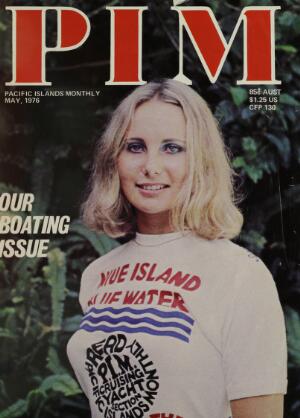
Our Cover
Pretty Sharon Wilson, 19-year-old entrant in the NSW Miss Wine Quest, is an enthusiast for all types of boating. She was happy to model the rare Niue Island Blue Water Yacht Club T-shirt sent to us in appreciation of the story we ran about the club’s efforts to raise funds for the installation of mooring facilities for cruising yachts. And we were happy to have her.
Advertisements & other items, pp. 2-4 (1 item)
tPtfrMf..:
m H * , * •f 4 v U :r *' V ♦' V TL* \ / - * . <* it:;-" w< r- -4t S .■* v> ■■' T / *•• . •/-*
. ft *< v r ’Ct • . r . > X ‘ ; ' ' <W T A • f NJ * :< 0; -T: * tr JiP- ■ rg m rn *// i‘ / ' / h ~f *1 Jr >
*>w fis
-'. >1 1 :••
Suzuki. Its a family experience.
Ours and Suzuki s together.
Theresa splendid Suzuki motorcycle for every member of the family. And every kind of riding. $
SUZUKI
SUZUKI MOTOR CO, LTD
Hamamatsu, Japan GUAM ISLAND CVCLERY PONAPE LEO ETSCHEIT TARAWA G. & E.l. COOPERATIVE FEDERATION LTD. NAURU CAPELLE & PARTNER FIJI D. GOKAL & COMPANY LIMITED TONGA MORRIS HEDSTROM LTD. NIUE BURNS PHILP (SOUTH SEA) COMPANY LTD. NEW GUINEA & PAPUA TUTT BRYANT PACIFIC LTD. NEW HEBRIDES HENRI LEROUX NEW CALEDONIA SUPERCAL TAHITI NIPPON AUTOMOTO NORFOLK MARTIN'S AGENCIES LTD.
Invest‘m precious metals.
Of the eight precious metals, it takes four to make a Parker 75 pen. The silver, gold, platinum and ruthenium aren't there just for show. They make it work better. And they make it a gift to treasure. What you could call a lifetime investment.
Sterling silver gives the case heft and balance.
We use our own special alloy of 14ct gold for the nib, because few other metals resist ink corrosion as well, and still provide such responsiveness as you write.
For the tip that touches the paper, we developed an alloy of platinum and ruthenium that resists wear so well, we don't know how long a tip will last.
It's even more exceptional.
The nib can turn 360° to write at the angle most natural to you.
Quite an investment, the sterling silver Parker 75.
There’s a nylon nib version and matching ball pen or pencil.
Also rolled gold or Vermeil, which is 14ct gold on silver.
The distinctive arrow clip identifies every Parker model.
+PARKER
World's most wanted pens
wput lbtt-S-rckt €
EJECT
STOP
PLAY
£
REW
REC
II & powep
CT-E2**
□eck tape
STEBED
HJPtONE EB
CT-F 2121
(23E315535 3
SYSTEM
Expand your stereo enjoyment
via access to the front.
Stereo tape cassettes open up a hole new world of music listening njoyment. Whether you’re starting om scratch or as an addition to our present stereo system, ioneer’s new CT-F 2121 is perfect 5 the basic stereo cassette deck, asically outstanding in tonal uality and basically designed for lechanical precision.
With the tape compartment in the ont, loading a cassette is as easy 5 slipping your hand in your DCket. While front access design takes it easy to use, advanced ioneer features make it great to listen to. A long-life permalloy-solid head and built-in Dolby-B* noise reduction system join to increase the S/N ratio to a hushed 62.5d8 (chrome tape over SKHz). And independent BIAS and EQ selection enables you to obtain maximum frequency response and lowest distortion from virtually any type of tape.
Pioneer’s CT-F 2121 helps you stretch your stereo budget. Produce your own music library. A built-in MPX (multiplex) filter ensures the recording of FM stereo broadcasts with wide dynamic range. And to protect your valuable tapes, the fully automatic Stop Mechanism functions in all modes disengaging the tape transport mechanism and returning all levers to neutral.
Pioneer’s new CT-F 2121 stereo cassette deck. The added enjoyment of cassette tape versatility via access to the front.
C>!) PIONEER
Pioneer Electronic Corporation 4-1, Meguro 1-chome, Meguro-ku, Tokyo 153, Japan lolby is a trademark of Dolby Laboratories, Inc. ioneer products are available through: Australia Pioneer Electronics Australia Pty. Ltd., 178-184 Boundary Road, Braeside, Victoria 3195, Phone: 90-9011, Sydney 93-0246, Brisbane 52-8213, Adelaide 433379, Perth 76-7776 Fiji Islands Brijlal & Company, G.P.O. Box No. 362, Suva, Fiji Islands Tel; 22258 Lae Hagemeyer (Australasia) 8.V., PO. Box No. 90, Lae, Papua • New Guinea Tel: 42-32 00 Rabaul Hagemeyer (Australasia) 8.V., P.O. Box No. 63. Rabaul, Papua*New GuineaTel:2633 Port Moresby Hagemeyer (Australasia) 8.V., P.O. Box No. 1428, Boroko, Port Moresby, Papua •New Guinea Tel: 5 61 44 Madang Hagemeyer (Australasia) 8.V., P.O. Box No. 673, Madang,
T.P.N.G. Tel; 24 45
New Zealand Fountain Marketing Ltd., Maidstone Street Auckland, New Zealand Tel: 763-064 Norfolk Island Burns Philp (Norfolk Island) Ltd., Norfolk Island, South Pacific New Hebrides Burns Philp (New Hebrides) Ltd., Vila, New Hebrides Nauru Island Jacob Enterprises, P.O. Box No. 4 Nauru Island Tahiti
Ets. PERFECT, B.P. 594,
Papeete, Tahiti Tel: 20 407 New Caledonia Menard Freres, B.P. 123, Noumea, New Caledonia Tel: 52-22 American Samoa Transpac Corporation, P.O. Box 1477, Pago Pago.
American Samoa 96799 Tel: 633-5224 Rarotonga South Seas International Ltd P.O. Box 49, Rarotonga Cook Islands Tel: 2327
Pacific Islands
Monthly
FOUNDED BY R. W. ROBSON IN 1930
Published Monthly By
Pacific Publications (Aust.) Pty. Ltd.,
76 Clarence Street, Sydney 2000.
Postal Address: G.P.O. BOX 3408, SYDNEY,
N.S.W. 2001.
Telegraphic Address: PACPUB, Sydney.
Telex: 21242.
Telephone: 296693.
Publisher: Stuart Inder.
Business Manager: John Berry.
Pacific Islands Monthly
Editor: John Carter.
Advertising Manager: Alan Batt.
Subscription Rates:
"Pacific Islands Monthly" is airfreighted to the majority of subscribers and agents in the Pacific Islands and the U.S.A.
Australia (including Lord Howe and Thursday Islands), New Zealand, Papua New Guinea, Fiji, New Hebrides, Tonga, Cook Islands, Western Samoa, Gilberts and Tuvalu, Norfolk Island, Niue and Nauru: $9.00 (local currency); Solomon Islands: $lO.OO Aust.; American Samoa, Micronesia and Guam: $12.00 U.S.; Hawaii and U.S. Mainland: $15.00 U.S.; New Caledonia and French Polynesia: 1,500 C.F.P.; United Kingdom: £6.50; Japan: 4,000 Yen; Elsewhere; $11.50 Aust.
Representatives
Fiji: Advertising and Distribution —Fiji Times & Herald Ltd., 20 Gordon Street, Suva. Telephone: 25-601. Telex: FJ 2124.
Papua New Guinea: Advertising and Distribution —PNG Post-Courier, P.O. Box 85, Port Moresby.
Telephone: 25-9899. Enquiries: Post News agency, Telephone 24-2148.
French Polynesia: Distribution —Hachette Paci fique, 10 Ave Bruat, Papeete.
New Zealand: Pacific Publications, C.P.O.
Box 2229, Auckland.
United Kingdom: The Herald and Weekly Times Limited, 8-10 Clifford's Inn, Fetter Lane, London EC4A IBU. Telephone: 01-831 6041. Telex: London 21989.
Japan: Advertising—Universal Media Corpora tion, C.P.O. Box 46, Tokyo. Telephone: 666-3036.
Victoria: Advertising Pacific Publications (Aust.) Pty. Ltd., Herald and Weekly Times Building, 2nd Floor, 61 Flinders Lane, Mel bourne, 3000. Telephone; 652-1565.
Brisbane: D. Wood, Anday Agency, Box 1918 G.P.0., Brisbane 4001. Telephone: 44-3485; 44-1546.
Hawaii and U.S. Mainland only: N. Grogan. ;Send change of address notices. Form 3579 snd new subscriptions to P.O. Box 2193, Honolulu, Hawaii, U.S.A. 96805.) Second class postage paid at Honolulu, Hawaii.
Copyright ©, 1976,
Pacific Publications (Aust.) Pty. Ltd. tinted by The Harbour Press, Chalmers Street, Sydney.
Registered at the G.P.O. Sydney for trans nission by post as a newspaper—category B. * Recommended retail price only.
Vol. 47, No. 5 May, 1976
Advertisements & other items, pp. 5-6 (2 items)
5
ACIFIC ISLANDS MONTHLY-MAY, 1976
Up Front
n
with the Publisher
This issue of PIM looks different, both on the outside and on the inside.
There will be more changes to come, but none of them will alter the essential flavour of PIM. You'll get more news and features about South Pacific happenings, not less. The popular In a Nutshell feature is back in a different form and will in subsequent issues be extended so that you can get even more hard news in capsule form. We plan also to use more pictures. But the biggest change, for us, is the cover.
After 46 years of bearing the cover title Pacific Islands Monthly we are now PIM. It had suddenly occurred to us that this was eminently sensible because we have always been known as PIM or "the PIM" or P.I.M. (with all the letters pronounced). I remember when I took a tourist s tour of Western Samoa, travelling on a tourist ship and in a tourist bus with a party of Australians and New Zealanders who had never before visited the islands. They asked me about Pacific Islands Monthly, and I told them most people in the islands knew about the magazine, so they decided to test me out. One of them said to our bus tour hostess, a pleasant Samoan, "Have you ever heard of the Pacific Islands Monthly?"
She looked blank and shook her head, with much merriment in the bus at my apparent discomfiture. So I said to her, "But you read PIM. I saw you with a copy." ’
Oh, I read the P.1.M.!" she said. "Everybody reads the P.1.M.!"
God bless her, I hope she keeps reading it.
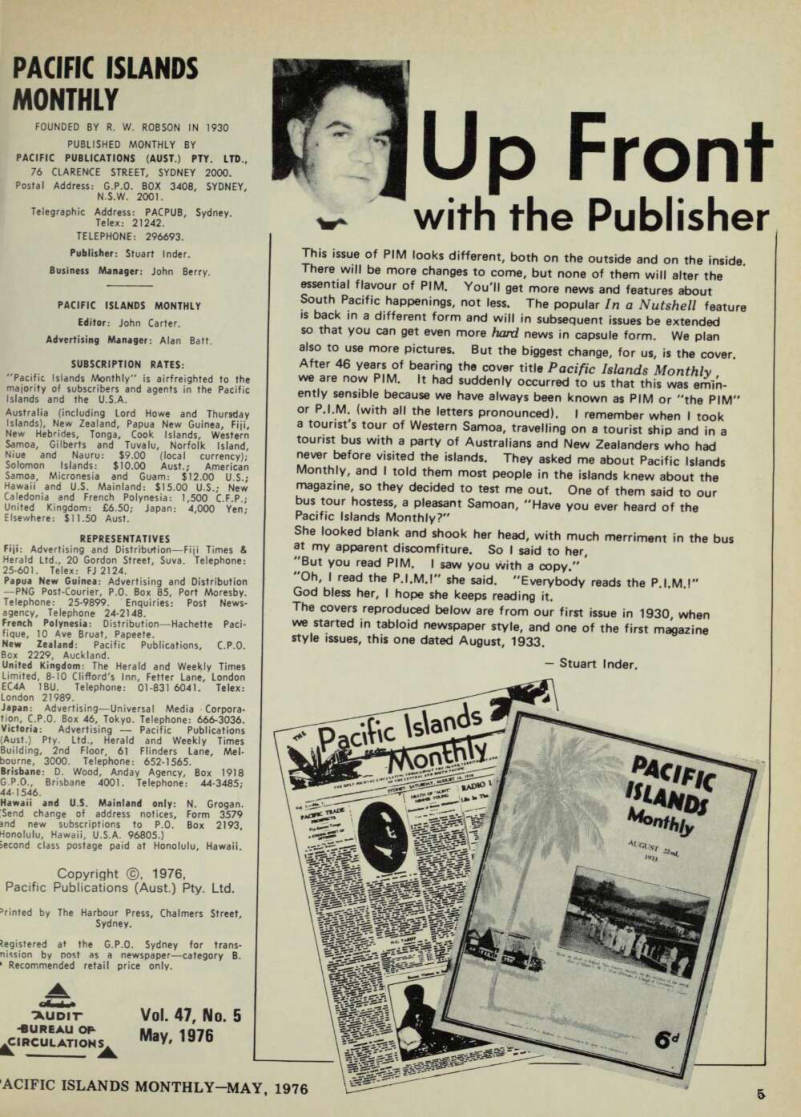
The covers reproduced below are from our first issue in 1930 when we started in tabloid newspaper style, and one of the first magazine style issues, this one dated August, 1933.
Stuart Inder.
[\c \sW)2
P cv Y oh 1C t I I . 6 ft i (y j=^==r rSs ■sat is 1 6
Better Business
starts with
Australian Products
* Australian products have proven themselves the world over and can benefit you and your customers. The range of Australian products is wide and varied . . . from Agricultural Equipment, Pharmaceuticals, Telecommunications Equipment, Chemicals, Food and Wines to Building Materials, Motor Vehicles, Electrical and Hardware Goods, Automotive Accessories, Engineering and Mining Equipment, Fashions and Fabrics. Delivery times are sensible and prices are competitive, so when you think of development and expansion remember Australian products can assist you.
Quality and value that's only hours away.
The Australian Trade Commissioner can give you details of suppliers. You can contact him at: FIJI -7th Floor, Dominion House, Thomson St., Suva. (P.O. Box 1252). Phone: 312844.
P.N.G. P.O. Box 9129, Hohola, Port Moresby.
Phone: 25 9333.
Australian Department of Overseas Trade.
In This Issue
General
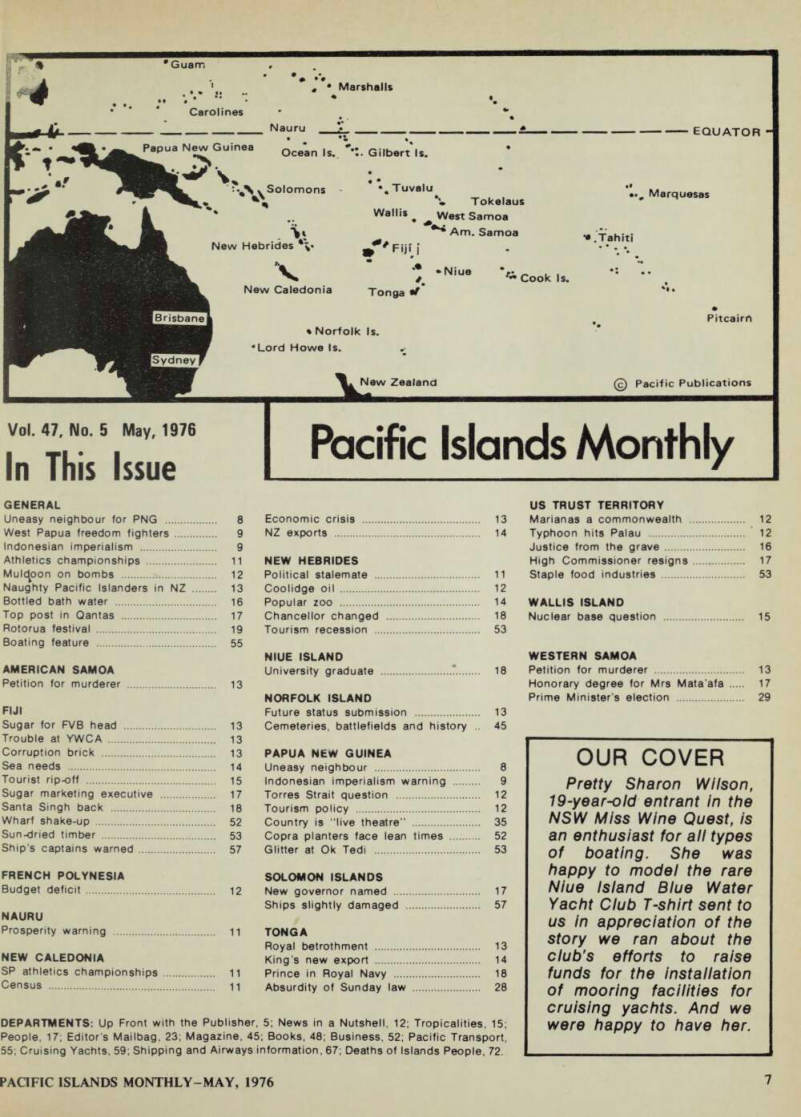
Uneasy neighbour for PNG 8 West Papua freedom fighters 9 Indonesian imperialism 9 Athletics championships 11 Mulcjpon on bombs 12 Naughty Pacific Islanders in NZ 13 Bottled bath water 16 Top post in Qantas 17 Rotorua festival 19 Boating feature 55
American Samoa
Petition for murderer 13
Fiji
Sugar for FVB head 13 Trouble at YWCA 13 Corruption brick 13 Sea needs 14 Tourist rip-off 15 Sugar marketing executive 17 Santa Singh back 18 Wharf shake-up 52 Sun-dried timber 53 Ship’s captains warned 57
French Polynesia
Budget deficit 12
Nauru
Prosperity warning 11
New Caledonia
SP athletics championships 11 Census 11
Economic crisis 13 NZ exports 14
New Hebrides
Political stalemate 11 Coolidge oil 12 Popular zoo 14 Chancellor changed 18 Tourism recession 53
Niue Island
University graduate ' 18
Norfolk Island
Future status submission 13 Cemeteries, battlefields and history .. 45
Papua New Guinea
Uneasy neighbour 8 Indonesian imperialism warning 9 Torres Strait question 12 Tourism policy 12 Country is “live theatre" 35 Copra planters face lean times 52 Glitter at Ok Tedi 53
Solomon Islands
New governor named 17 Ships slightly damaged 57
Tonga
Royal betrothment 13 King’s new export 14 Prince in Royal Navy 18 Absurdity of Sunday law 28
Us Trust Territory
Marianas a commonwealth 12 Typhoon hits Palau 12 Justice from the grave 16 High Commissioner resigns 17 Staple food industries 53
Wallis Island
Nuclear base question 15
Western Samoa
Petition for murderer 13 Honorary degree for Mrs Mata’afa 17 Prime Minister's election 29
DEPARTMENTS: Up Front with the Publisher, 5; News in a Nutshell, 12; Tropicalities, 15; People, 17; Editor’s Mailbag, 23; Magazine, 45; Books, 48; Business, 52; Pacific Transport, 55; Cruising Yachts, 59; Shipping and Airways information, 67; Deaths of Islands People, 72.
Irian Jaya, An Uneasy Neighbour
For A Worried Papua New Guinea
Newly-independent Papua New Guinea has an uneasy neighbour on her left - Irian Jaya or West New Guinea, or, before the Act of Free Choice, which made the territory part of Indonesia, Dutch New Guinea. Irian Jaya is uneasy because of the emergence of a revolutionary force styling itself the Provisional Government of the Republic of West Papua /New Guinea. There have been stories of rebel bands operating along the border with Papua New Guinea and that makes Papua New Guinea uneasy, so uneasy that Foreign Minister Sir Maori Kiki has, with Indonesia's knowledge, had secret meetings with rebel leaders in an effort to mediate. Below, and on succeeding pages, PIM presents two sides, Indonesian efforts to develop Irian Jaya, written by Indonesian R.S.Roosman of the Department of Political Studies at the University of Papua New Guinea, and the rebels' side as told to PIM by the rebel leaders who have established their headquarters at Dakar, capita! of the West A frican republic of Senegal.
By R. S. Roosman
“The government does not pro mise a paradise on earth in her 5year national reconstruction plan.
However, special attention will be given to West Irian”, were President Suharto’s words when he addressed the Jakarta House of Representatives on August 16, 1%9, on the eve of Indonesia’s 24th anniversary of In dependence.
“It is a challenge for us to raise the standard of living of our back ward brothers to a level comparable to that of their brothers in the other regions of Indonesia. This effort needs heavily to be subsidised”.
On Sepicmber 16, 1969, the presi dent flew to Jayapura to address the West Irian House of Representatives, urged “full participation of West Irian’s population in the deve lopment programme”, and stressed that West Irian’s administrative appa ratus would be directed towards reconstruction. He visited several in land areas, and instituted the Task Force with the sole aim of develop ing West Irian’s rural sector.
On his Jayapura visit he also in augurated West Irian as an auto nomous province. The Indonesian concept of regional autonomy, how ever, should be interpreted rather as deconcentration of power from the central government. It is obvious that Indonesia’s policy toward Irian Jaya is one of increasingly strength ening its ties with Jakarta rather than lessening them. The Jakarta appointed governor of Irian Jaya, the highest official in the province, func tions also as chairman of the Task Force Programme with the military
commander as its co-chairman.
With a land surface of 413,000 square kilometres inhabited by only 994,754 people, most of whom still live in the neolithic age, a rural de velopment in the modern sense would be impossible without bring ing in technical assistance from out side its territory. Only with the re cent discoveries of new oil reserves and mineral ores (nickel and copper) in Irian Jaya, one can expect that the financial subsidies from the cen tral government would be relieved by reyenues and other incomes from the oil and mineral resources.
The Task Force programme repre sents only one of the several govern mental programmes now being car ried out in Irian Jaya. The Task Force subsidy amounts were Rp 500 million in 1969-70, Rp 750 million in 1971-72 (600 rupiah to approxi mately SAI). The 1972-73-74 figures are not directly available.
On November 9, 1969 an appeal was made to the public to take part in the “Humanitarian Project” fund raising drive, as part of the Task Force programme. About 5,000
wealthy businessmen (mostly Jakarta
residents), the top echelons of the public service and military, commun ity and religious leaders, diplomats and the press were invited to the Bogor Presidential Palace. Blown up photographs of rural life in West Irian were on display inside the palace.
Symbolically, West Irian repre sentatives were invited and shown around. Referring to some pictures
on exhibit where fierce-looking Dani tribesmen of the Jayawijaya highlands around Wamena were seen wearing the koteka (penis-gourds), the Pre sident dramatised his appeal by say ing: “It is almost unbelievable that our brothers in West Irian are scr minimally dressed”. He urged the public to aid 200,000 children in rural West Irian with clothing and schooling. By February 27, 1971, the “Humanitarian Project” had netted a total of Rp191,704,221.69 and an additional $U538,180.28.
Suharto’s idea inspired Irian Jaya’s governor Acub Zainal—in 1971 military commander of the locally-stationed Cendera-wash (Bird of Paradise) Division—to initiate the “Operation Koteka” by distributing essential clothing to the inland population and upgrading the primi tive villages to more contemporary conditions. As from April 1, 1975, Acub Zainal was replaced by Sutran who was promoted to governor on the merits of his successful rural de velopment programme in Eastern Java where he was district adminis trator or bupati.
During its operation, 356,310 short pants for men and 89,077 sarongs for women were distributed in the rural districts of Merauke, Jayawijaya, Paniai and Manokwari.
This effort is generally considered as unsuccessful since the Highland people, in particular, have shown themselves to be rather unresponsive to the idea. Also, the governor’s in struction was sometimes not tactfully carried out due to ambition and ignorance of local customs.
In other sectors, the Koteka
Operation proved to be more suc cessful: 262 local students graduated from the illiteracy eradication course and 33 from the village development training, 469 new villages and an other 4,493 additional houses for resettlement were built together with 86 kilometres of road and 95 bridges, 188,737 square metres of experi mental food gardens and 552 fish ponds were established.
Different from the other provinces in Indonesia where, because of the rapid population increase, the em phasis of village development is laid on food production, in Irian Jaya first preference is given to the re habilitation and improvement of the infrastructure of overland, air and sea communications.
Second preference is given to rais ing the quality of the local work force by teaching them new skills, and agriculture comes only third.
Due to stiff competition among the poor farmers, and even more so among the farm labourers in over populated Java wanting to migrate to other areas of Indonesia, the government sets strict requirements to its transmigration scheme; eg the candidate migrant must be a farmer by profession, not older than 45 years, with not more than four child ren. Preference is given to married couples.
In Irian Jaya, each migrant couple is allocated two hectares which they have to divide into one hectare for rice cultivation—whenever irrigation is possible—half a hectare for a food garden, planted with mainly tubers and vegetables, and the remaining half hectare for erecting a village house with locally available materials such as gabargaba (sago stems), wood, and bamboo, with corrugated iron roofs from tl\e Department of Trans-migration. The migrant settlers are also encouraged to breed chickens, sheep and goats.
Tribal land in Irian Jaya, which is given for development, consists primarily of virgin jungle which has to be cleared by slash-and-burn, a phase in land cultivation which in Java, had, for centuries, belonged to the past. It is interesting to notice how the Javanese migrants, being unfamiliar with this method, imitate the local Irianese and plant the cleared jungle with local food plants such as taro and yams, and only after the first harvest with the more familiar corn, manioc, peanuts, and string-beans. The seeds are provided by the Department of Agriculture, in Jose co-operation with the Depart ment of Trans-migration, which is responsible for the entire trans migration scheme.
The deal that a tribal community usually makes with the local ad ministration to allow part of its tri bal land to be developed by migrants is based on certain promises; eg that the government builds roads, a school, a polyclinic, and a church in the village, within a certain time limit. Not fulfilling these promises could easily lead to protests, causing troubles in the area, as has hap pened with the local trans-migration office and the migrant settlers’ colony becoming objects for angry demonstrations.
In the agricultural sector, the Task Force instigates an “accelerated acculturation process” by trans migrating Javanese farmers to Irian Jaya in “mixed settlements” with with local villagers.
This occurred, tor instance, in Warmare in the Manokwari district with 30 farmer families from Southern Jogjakarta (Central Java) and 150 families of the Arfak tribe.
The author saw another example in Dosai, 60 kilometres from Jayapura where Javanese farmers live together with local villagers, and it seems that the latter were on good terms with the newcomers.
For socio-psychological reasons, the newly-arrived migrants tend to be cliquish, while their children easily assimilate with the local child ren attending the same schools.
Beware!
Papua New Guineans had to realise that Indonesia posed a threat. They had to beware of Indonesian “imperialism”. These warnings were made by Mr Bernard Narakobi, chairman of the PNG Law Reform Com mission. However, he made his statement as a private citizen.
Mr Narakobi said pro- Indonesian forces caught during the fighting on Timor had let ters from generals telling them to watch closely seccessionist movements in PNG. The letters told' the forces that they could be “called upon”.
Indonesia had justified its in vasion of Timor by saying that instability on the island would not be good for the region. If that logic followed to its con clusion then instability in PNG would justify Indonesian inter ventibn. Most of the people of East Timor werg Melanesian and belonged to the Pacific. If they could not be safe, how could Papua New Guinea be safe?
Fighters’
Freedom Fighters’ long arm
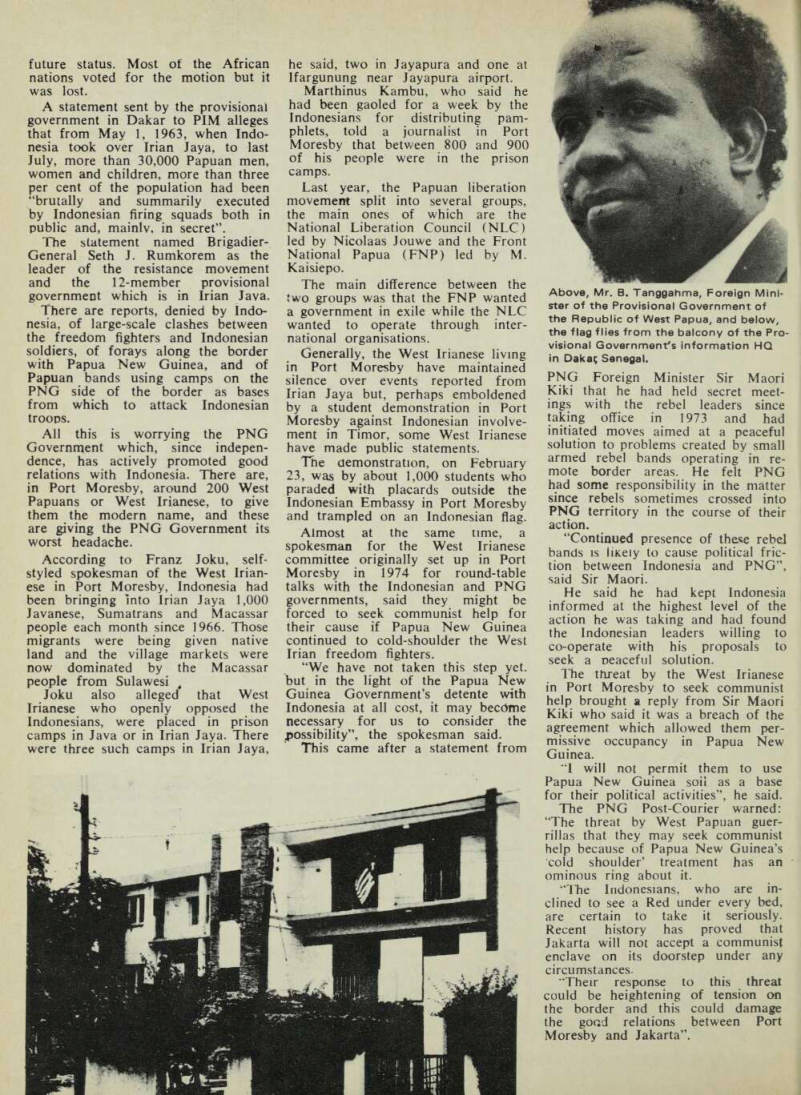
From a special correspondent From the upstairs balcony of a house in Dakar, capital of the West African state of Senegal, flutters a flag—a white star on a broad, red vertical stripe with blue and white horizontal stripes. It is the symbol of the revolutionary Provisional Government of the Republic of West Papua, focus point for several hun dred “freedom fighters” in Irian Jay a who refuse to accept Indonesian rule.
The house is the headquarters of the West Papuans’ “information and co-ordination” department. There are other centres, one in Doetinchem in Holland and another, but with an indefinite address, in Port Moresby.
But why a centre in West Atncav The West Papuans believe that greater help will come for their cause from the African nations and, especially from Senegal, the Presi dent of which, Mr Leopold Senghor, has promised active support for the dissemination of the West Papuans’ propaganda against Indonesia.
The Dakai centre was opened on July 1 last year in premises placed at the provisional government’s dis posal by President Senghor who, a year before, had talks with a West Papuan delegation headed by Mr B. Tanggahma, the provisionals’
Foreign Minister, at the Ocam con ference in Bangui.
But the West Papuans’ connec tion with Black Africa goes much further back than that. In 1962, a delegation from the then New Guinea Council under Mr H. Wom siwor, who is now a vice-president in the provisional government, visited several African countries seeking support for their resistance to Indonesian plans to annex their country, then known as Dutch New Guinea.
Seven years later, the success of the Indonesian plan with the “Act of Free Choice” led Ghana to table a motion in the United Nations General Assembly calling on the UN to give the West Papuans another opportunity, in 1975, to express .themselves about their country’s
future status. Most of the African nations voted for the motion but it was lost.
A statement sent by the provisional government in Dakar to PIM alleges that from May 1, 1963, when Indo nesia took over Irian Jaya, to last July, more than 30,000 Papuan men, women and children, more than three per cent of the population had been “brutally and summarily executed by Indonesian firing squads both in public and, mainly, in secret”.
The statement named Brigadier- General Seth J. Rumkorem as the leader of the resistance movement and the 12-member provisional government which is in Irian Java.
There are reports, denied by Indo nesia, of large-scale clashes between the freedom fighters and Indonesian soldiers, of forays along the border with Papua New Guinea, and of Papuan bands using camps on the PNG side of the border as bases from which to attack Indonesian troops.
All this is worrying the PNG Government which, since indepen dence, has actively promoted good relations with Indonesia. There are, in Port Moresby, around 200 West Papuans or West Irianese, to give them the modern name, and these are giving the PNG Government its worst headache.
According to Franz Joku, self styled spokesman of the West Irian ese in Port Moresby, Indonesia had been bringing into Irian Jaya 1,000 Javanese, Sumatrans and Macassar people each month since 1966. Those migrants were being given native land and the village markets were now dominated by the Macassar people from Sulawesi , Joku also alleged that West Irianese who openly opposed the Indonesians, were placed in prison camps in Java or in Irian Jaya. There were three such camps in Irian Jaya,
he said, two in Jayapura and one at Ifargunung near Jayapura airport.
Marthinus Kambu, who said he had been gaoled for a week by the Indonesians for distributing pam phlets, told a journalist in Port Moresby that between 800 and 900 of his people were in the prison camps.
Last year, the Papuan liberation movement split into several groups, the main ones of which are the National Liberation Council (NLC) led by Nicolaas Jouwe and the Front National Papua (FNP) led by M.
Kaisiepo.
The main difference between the two groups was that the FNP wanted a government in exile while the NLC wanted to operate through inter national organisations.
Generally, the West Irianese living in Port Moresby have maintained silence over events reported from Irian Jaya but, perhaps emboldened by a student demonstration in Port Moresby against Indonesian involve ment in Timor, some West Irianese have made public statements.
The demonstration, on February 23, was by about 1,000 students who paraded with placards outside the Indonesian Embassy in Port Moresby and trampled on an Indonesian flag.
Almost at the same time, a spokesman for the West Irianese committee originally set up in Port Moresby in 1974 for round-table talks with the Indonesian and PNG governments, said they might be forced to seek communist help for their cause if Papua New Guinea continued to cold-shoulder the West Irian freedom fighters.
“We have not taken this step yet. but in the light of the Papua New Guinea Government’s detente with Indonesia at all cost, it may become necessary for us to consider the possibility”, the spokesman said.
This came after a statement from
PNG Foreign Minister Sir Maori Kiki that he had held secret meet ings with the rebel leaders since taking office in 1973 and had initiated moves aimed at a peaceful solution to problems created by small armed rebel bands operating in re mote border areas. He felt PNG had some responsibility in the matter since rebels sometimes crossed into PNG territory in the course of their action.
“Continued presence of these rebel bands is likely to cause political fric tion between Indonesia and PNG”, said Sir Maori.
He said he had kept Indonesia informed at the highest level of the action he was taking and had found the Indonesian leaders willing to co-operate with his proposals to seek a neaceful solution.
The threat by the West Irianese in Port Moresby to seek communist help brought a reply from Sir Maori Kiki who said it was a breach of the agreement which allowed them per missive occupancy in Papua New Guinea.
"I will not permit them to use Papua New Guinea soil as a base for their political activities”, he said.
The PNG Post-Courier warned: “The threat by West Papuan guer rillas that they may seek communist help because of Papua New Guinea’s cold shoulder’ treatment has an ominous ring about it.
“The Indonesians, who are in clined to see a Red under every bed, are certain to take it seriously.
Recent history has proved that Jakarta will not accept a communist enclave on its doorstep under any circumstances.
“Their response to this threat could be heightening of tension on the border and this could damage the goad relations between Port Moresby and Jakarta”,
Above, Mr. B. Tanggahma, Foreign Mini ster of the Provisional Government of the Republic of West Papua, and below, the flag flies from the balcony of the Pro visional Government's information HQ in Dakar Senegal.
N. Hebrides
Splinters
Flying In
New Hebrideans in April could see that their country is now split into at least six conflicting ineffective groups since the French-style electoral system was in troduced last November. The country’s first Representative Assembly, elected five months previously, still had not met in early April.
In the meantime the electoral system has effectively divided the population into disintegrating, rather than unifying groups
four political parties of differing
proportions holding 29 seats, nine seats reserved for “economic interests” and four more still being debated, to be held by certain chiefs.
As a solution to the stalemate, the French High Commissioner in the Pacific, Governor Eriau, of New Caledonia, suggested that two customary chiefs in stead of one should be elected from each 3f the four administrative districts. This suggestion has been refused by the Rev Walter Lini, leader of the National Party,
vhich won an overwhelming majority in
he November election.
Attending a church meeting in London n March, Walter Lini repeated his call for
ndependence by 1977.
Also in March, the UCNH Party sent hree members, Remy Delaveuve, Gerard -aymang and Guy Prevot, to see officials n Paris. Jimmy Stevens, leader of the
Jagriamel Party, had already called for
Britain’s withdrawal by April 1, 1976, if he was not prepared to match French in estment in the territory.
A fourth and smaller party, Tab ('emasana, claims the territory does not ave the elite to press for independence, or their part the “economic interests” roup has urged a rapid calling-together f the assembly to avoid possible distur
ances leading to anarchy.
There was a street clash in Santo late in larch between National Party supporters nd those of Tabwemasana. About a ozen people finished up in hospital and thers went home nursing bruises.
Santo was tense on April 1 when mmy Stevens and his Nagriamel mem ;rs arrived to give the British the final immand to get out. On second thoughts, Dwever, he extended the date to a day in ugust.
The prolonged teasing of the New ebrideans over whether or not they will
:t long-promised airport improvements
ems hopefully to be coming to an end.
The whole exercise seems to depend on ,w long the French authorities feel the ebrideans need to be kept waiting to im
press them with their need to keep tied up with France and New Caledonia t or their future progress. The demonstrations by Jimmy Stevens in Santo after Christmas have obligingly helped the cause with the message: “British out; in with the French and their investments”.
A new wind seems to be sweeping through French interests in the Pacific, blowing along with UTA airlines all the way from Paris where the message is loud and clear: “Co-operate with Anglo-Saxon neighbours in the Pacific”.
So latest reports from France indicate that more than SAS million worth of French funds are now available for sealing Santo’s Pekoa airstrip, which could be completed by the end of 1976. The im provements are being urged by the tourist industry and beef producers anxious to facilitate meat *exports overseas.
Another result of the new French at titude in the Pacific has been the in creasing effort by UTA to co-operate with Air Nauru and Qantas in bringing more tourists into New Caledonia and the New Hebrides.
Whereas the French in recent years had depicted Australia as an imperialist power trying to take over French interests in New Caledonia and the New Hebrides, now that Paris is confident of controlling the self-government movement in New Caledonia at least, the Australian “enemy” image can be abandoned.
Anxious to make friends and prevent a repeat of any such as anti- French nuclear boycotts, and keen to sell arms and technology in the Pacific, France is adopting an “open arms” policy towards Australia and neighbouring Anglo-Saxons.
A census of the population in New Caledonia was scheduled in April - May, in all communes (municipalities) by the mayors, under the control of the French national institute of statistics (INSEE).
Prosperous
Nauruans warned
The prosperity of the Nauruan people had increased markedly because in four or five years of unprecedented inflation, while the prices of commodities and manufactured goods had increased rapidly, they had not increased as fast as the price for phosphate.
President Hammer Deßoburt ham mered this point home in an Independence Day speech to the nation, when he warned that prosperity would not continue without
interruption.
The increased returns, apart from the gain to individuals, had allowed the government and the Nauru Local Govern ment Council to expand their activities.
But in spite of the apparently effortless increase in prosperity, there were danger signals. In recent months the international demand for phosphate had declined sub stantially and the price had stabilised. The international economic recession, the worst for 40 years, was presenting serious problems throughout the world.
The Australian Government’s decision to restore a phosphate bounty, abandoned by the Labor Government about two years ago, could have a beneficial effect on the demand for Nauru phosphate, and although President Deßoburt’s warning still stands, Nauru’s prosperity is likely to continue. • Mrs Sarafina Underwood, 30, of Nausori, Fiji, made history in February when She was elected sec retary of the Rewa Rugby Union.
She beat two men in a ballot.
South Seas athletes will meet
The first South Pacific athletic championships are to be held in Noumea during the week August 26 to September 1, 1976.
The championships are a sequel to the August South Pacific Games in Guam, when athletes and trainers emphasised the need for more frequent meetings between Island sportsmen, Already the Noumea organisers are insisting that the participants and spectators will be well looked after
and that timetables, once established, will be dili gently complied with, to overcome many of the dis appointments at Guam.
At the same time, the organisers have already published a list of minimum performance criteria which must be met by athletes wishing to compete in any of the events—running, jumping, pole vault, weight lifting, discus, javelin, shot put and pentathlon.
Advertisements & other items, p. 11 (1 item)
11
ACIFIC ISLANDS MONTHLY-MAY, 1976
News
The
In A
Nutshell
Marianas
Commonwealth
The Northern Marianas, one of the three island groups in the United States Trust Territory of the Pacific Islands, of ficially became a commonwealth within the United States on March 24 when US President Ford signed the deed of covenant at the White House.
Seven days later, the Marianas Govern ment was created by an order issued from the office of the US Department of the In terior. When the last signature was made to the documents, Marianas Senator Ed ward Pangelinan, former chairman of the Marianas Political Status Commission, who has worked hard for incorporation of the Marianas in the United States, described the Marianas’ separation from the rest of Micronesia as “wonderful”, and added that their job now was to make their territory “a showplace for democracy”. Later, there was a denial that the tylarianas was seeking union with Guam.
There may be more fragmentation of Micronesia. The Marshalls, who have declared themselves dissatisfied with the draft Constitution for the Federated States of Micronesia, have asked for separate negotiation with the United States over their future. They complain that the draft constitution discriminates against them in that their “special needs” are not recognised,
Typhoon At Palau
Typhoon Marie, blowing a regular 75 mph with 90 mph gusts, hit Koror in Palau early in April, causing almost total crop damage.
Damage is estimated at around US$l million and casualties included the Royal Palauan Hotel, which lost its roof, and the
Van Camp Fishing Company’s harbour at Malakal.
There was no news of Marie’s depredations in the outer islands as Marie
had effectively destroyed communications.
Food stocks at Koror were expected to last two weeks after which emergency sup plies would be needed.
More Bomb Protests
Spurred on by the South Pacific Forum’s decision at Rotorua to continue opposition to nuclear tests in the area, New Zealand’s Prime Minister Bob Muldoon was expected to make a protest on the Forum’s behalf to the French President over the latest bomb exploded by France at the beginning of April, but, if the Prime Minister’s own comment before leaving for France around the middle of April is any criterion, the protest will be less than half-hearted.
Mr Muldoon said it did not seem to make much sense to over-emphasise New Zealand’s opposition to French testing at a time when New Zealand is trying to per suade the French Government to continue to move towards a reasonable attitude over access of NZ products to the European Common Market.
Australia’s opposition to nuclear weapons testing has not softened; it is as strong as ever Foreign Affairs Minister Andrew Peacock said in the House of Representatives. The government was aware France was refraining from at mospheric tests in the Pacific, and hoped it would continue to do so. When his party was previously in government it had protested against such testing, both through the South Pacific Forum and the United Nations.
Polynesia's Budget
In French Polynesia, as in New Caledonia, the budget prepared by the French Administration continues to face a deficit over the volume of expected revenue. Under French law the territorial budget must balance each year.
Speaking in Papeete recently, Governor Charles Schmitt said the 1977 deficit would be about SAIO million. He said that the 1975 deficit had been overcome by a loan of about $A2.5 million, while the 1976 budgeted deficit was about $7 million. The governor thus foreshadowed the need for higher local taxes.
The governor also referred to the holding up of meetings of the Territorial Assembly by the autonomist members un til the June session. The governor pointed out that the Assembly could meet if two thirds of the members requested it. He sought a speedy summoning of the Assem bly for a special session to overcome the serious handicap of seven months delay in dealing with the budget.
Torres Strait Question
The Australian Government has decided its attitude to its Torres Strait border with Papua New Guinea, but is playing its cards close to its chest. The Prime Minister, Mr Malcolm Fraser, in reply to a question in Parliament from for mer Prime Minister and now Leader of the Opposition, Mr Gough Whitlam, said the Minister for Foreign Affairs, Mr An drew Peacock, would discuss the question with the Queensland Premier, Mr Johan nes Bjelke-Petersen. They should consider one view by some international jurists that any connection between the Torres Strait islands and Queensland isn’t exactly legal.
Coolidge, Yet Again
The oil leaks from the sunken former US navy vessel President Coolidge have been plugged by marine divers working on the wreck off Santo, in the New Hebrides.
The oil, which was causing a serious problem of pollution, was found to be
seeping from deteriorating plugs inserted
in the vessel’s hold after a survey had been made of its fuel reserves. This study was made over 1 5 months ago by a Fiji com pany Pacific Salvage, investigating the possibilities of salvaging 800 tonnes of oil
trapped in the ship.
This oil has been inside the wreck for 34 years, since October, 1942, when the great troop transport ship sank: The 27 000 tonne vessel measures 193 metres long and 40 metres wide.
After the salvage investigations, holes made in the ship’s hold were plugged
again, awaiting the expected pumping
operations. However, as time passed the stoppers have corroded, provoking the oil leaks. The authorities engaged a diving specialist, Mr Martin, to study the situation which revealed an estimated 1 200 litres of oil escaping each day. New bronze stoppers were set in place to replace the iron ones, with a sealing of concrete added for good measure.
Png Tourism: Official
Papua New Guinea is preparing a blue print to give it a large slice of tourism’s riches but not at the expense of this or
future generations. Only “respectable”
visitors will be welcome and custom, en vironment and the people will be “screened” f -om any harmful effects of tourism.
The Ministry of Labour, Commerce and Industry has been detailed to prepare a national plan, in close consultation with other ministries, department and govern ment agencies. Foremost in the plan will be a need for attention to be paid to the type of tourist the country wishes to at tract.
The plan will be required to comply with the eight aims, set out some years
ago, to develop the country. It will con form to the guidelines laid down in Sep tember, 1975, for a framework for in dustrial development, by increasing em ployment opportunities and laying special emphasis on the dignity of service in line with the traditional Melanesian concept of “caring for the stranger who comes in peace and goodwill”.
The government will encourage domestic and foreign investment in the in dustry and, if necessary, may provide ad ditional incentives. The role of the govern ment is seen as that of providing essential revenue-producing infrastructure. Priority for development is likely to be for projects where roads, airfields, telecom munications, power and water, sewerage and ancillary services are readily available, or can be supplied at low cost.
While every effort will be made to en courage visitors, including an easing of en try formalities, care will be taken to see that tourism does not spoil the country.
The national plan will be designed to protect and preserve the quality of social and cultural life, and the customs and traditions of the people. It will also be aimed at conserving the indigenous en vironment.
Plenty of PNG’s Pacific neighbours have first-hand experience of the effects of tourism on their countries and no doubt, if asked, would be prepared to pass on the benefit of what they have learned.
John May Is Sugar
John May, general manager of the Fiji Visitors Bureau for a few weeks, was in a spot recently when the board met to con firm his position, after he had been acting GM for some time. John was on the short list for a top executive post in the new Fiji Sugar Marketing Co, but for obvious reasons could not tell the FVB board and suggest confirmation be deferred a few weeks. The sugar job was offered to him about 10 days later; he accepted and now the FVB is looking for a new GM.
Trouble At The 'Y'
The staff of the Suva YWCA caused a stir late in March when they stopped work in protest “about a board’s attitude”. They complained a five-member committee of board members, appointed to recommend economy measures, acted too quickly, and without consulting the staff. The board was astounded, but their amazement was nothing compared with the attitude of the staff, who claimed they were not on strike, but just refusing (o do the work they were paid to do!
Norfolk's Future
Norfolk island should have greater self governing power while remaining an Australian territory, Mr Cedric Hampson, QC, submitted to the Royal Commission on the future of the island. Mr Hampson was counsel assisting the Royal Com
missioner, Mr Justice Nimmo. He sub mitted, in an address at the conclusion of evidence* that the island should have its own elected member in the Australian Parliament.
Mr Hampson submitted the Norfolk Island Council should have all govern mental .powers which applied to any geographical part of Australia. The powers should be transferred over a five year period. The MP would be allowed to speak on any measure, but would only be allowed to vote on a bill intended to apply to the island.
Corruption?
Mr John Falvey, Fiji’s Auorney- General, dropped a brick when he told the Senate there was more corruption in government circles than he had imagined.
He refused to name names, and did not point to any particular area of corruption.
Civil servants reacted angrily, and claimed Mr Falvey should say to whom he was referring. Mr Falvey opposed a motion in the Senate that an anti corruption commission be appointed. It would be difficult to get concrete evidence of corruption, unless an informant, who was possibly a party to corruption, was given protection, he said. PIM staffers, over the years, have heard of some startling cases, but would find it im possible to prove them.
Pardon Wanted
Chiefs from American Samoa recently sent a petition to the Western Samoa Head of State, Malietoa Tanumafili, seeking a pardon for Alainuuese Liu, who was con victed for the murder of American Samoa Senator Lualemana Faoliu. (PIM, March, page 14). Alainuuese was sentenced to death, which was mandatory. Senator Lualemana was visiting Satuiatua, Savaii.
He was shot in bed at night following an incident during a kava ceremony.
Tait-Eved View
A former Auckland police chief, Mr Gideon Tail, advocates the birch, a short prison sentence and then deportation for Pacific Islanders who commit rape. He said recently that city streets were unsafe because of the many Pacific Islanders and Maoris who had too much to drink.
Women were being molested and raped, bus drivers attacked and drunks were being “rolled”. Up to 100 arrests were made each night. Yet the police were at tacked by “do-gooders” who said the police operation was racially-biased.
Economic Crisis
As the New Caledonian economic crisis continued to April with the budget still not voted and no Paris approval of new nickel projects, various Caledonian protest voices could still be heard.
Among some of the protest voices in late March, albeit weak protests, were union members, a socialist in the
Territorial Assembly and a reportedly growing number of prostitutes.
Members of the Workers Federation of New Caledonia made use of the March visit of General Marcel Bigeard, Under secretary to the French Minister of Defence, to demand that all military of ficers demobilised in New Caledonia should surrender their second jobs in the territory in view of the local unem ployment situation threatening New Caledonians and the fact that these retired officers already enjoyed comfortable pen sions.
The union also demanded that French military officers should be demobilised in metropolitan France, not New Caledonia (again, to relieve the job shortage in Noumea).
In the Territorial Assembly the stalemate continued over voting a budget presented by the French Administration with a SAIO million deficit as the Ad ministration continues to increase public service expenditure at a time when the main source of revenue nickel is in no condition to match this increase. With the budget thus blocked for three months while the strings attached to further Over
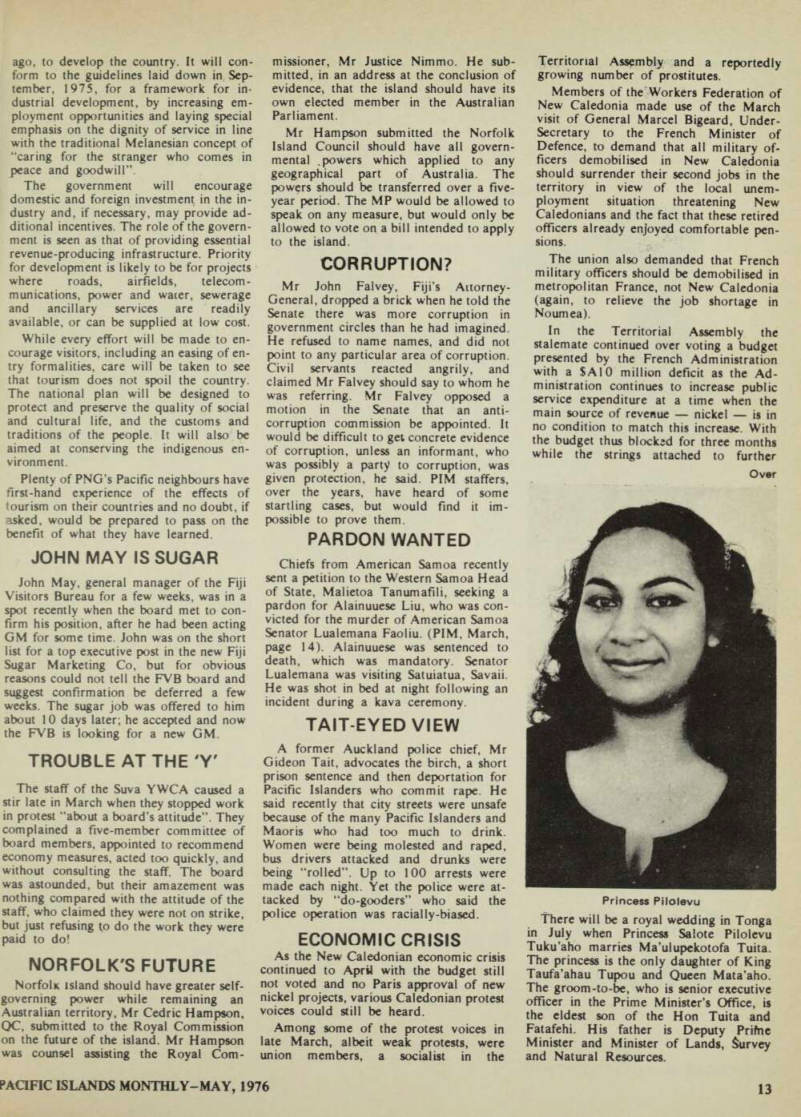
There will be a royal wedding in Tonga in July when Princess Salote Filolevu Tuku’aho marries Ma’ulupekotofa Tuita.
The princess is the only daughter of King Taufa’ahau Tupou and Queen Mata’aho.
The groom-to-be, who is senior executive officer in the Prime Minister’s Office, is the eldest son of the Hon Tuita and Fatafehi. His father is Deputy Prifnc Minister and Minister of Lands, Survey and Natural Resources.
Princess Pilolevu
“hand-outs” from Paris caused a belated alarm among certain Assembly members, one politician pointed out the plight of territorial pensioners and orphans. Some of these disadvantaged persons had not received their pensions, minimal as they are, since last October, under the Treasury crisis.
A further protest over the territory being marched to the brink of bankruptcy, ironic as it may be, comes from the French Army in Noumea where an increasing number of men are reported suffering from venereal disease. A local newspaper survey has claimed that a surprising num ber of women are turning to prostitution to feed their children during la crise economique.
New Zoo
The recently opened Lama Mountain zoo and botanical garden in Efate, has proved a popular attraction for visitors to the New Hebrides and to local people.
The garden and zoo, on top of Clem’s Hill, was opened just before Christmas.
The owner, Mr George Ah Tong, started to lay out the garden about two years ago because of his interest in gardening. The zoo, so far, comprises aviaries and fish pools. The aviaries house local pigeons and three species of birds from. New Zealand. In the fish ponds are fresh water
crayfish, tilapia and a Singapore species
known as koicarp. Mr Ah Tong plans to bring in more birds, animals and water lilies.
Nz Builds Exports
The New Zealand government in March appointed a marketing officer to its Con sulate-General in Noumea, as a move to promote Kiwi exports to the territory. The new trade representative is Mr Albert Caradant, a New Caledonian who has worked eight years in New Zealand for export sales of the General Foods com pany. Consul-General for New Zealand in Noumea, Mr Raymond Wright, recently pointed out that his country is now geared to compete for public tenders in New Caledonia, as in the recent case con cerning the construction of silos at Bourail.
In 1973 and 1974, New Zealand was in eighth position as a supplier of imports into New Caledonia, well behind France and Australia in the first two places. In the latest year ended June 1975, New Zealand’s exports to New Caledonia were worth about SNZ4 million.
Fiji's Sea Needs
Fiji is prepared to claim all the sea wealth within 200 miles of her coasts and what’s more she now has a couple of gun boats to support her claim.
Not that Fiji is going to engage in gun boat diplomacy, but she will declare an economic boundary 200 miles out if the United Nations does not get international
agreement on sea limits within a reasonable time.
The UN Law of the Sea conference is not making much progress in attempts to fix new boundaries. In Fiji’s case a unilateral declaration would not be well received in Japan, Taiwan or Korea, which fish large areas of the Pacific Ocean.
The Fiji Prime Minister, Ratu Sir Kamisese Mara, said Fiji’s claim would mean a fishing boundary extending 12 miles from a line drawn round the group, and an economic boundary lying 200 miles out. He remarked that the United States was the latest convert to the concept he espoused, and said it was “quite a significant convert”.
The US. which represents the US Trust Territory at the law of the sea conference, was prepared to put forward the territory’s case for the 200-mile limit, although it took a different view. Now the US, along with other countries has set the 200-mile economic limit, saying this gives owner ship of oil deposits, seabed minerals and other resources within the limit.
Fiji, the Philippines and Indonesia have asked the conference to accept their claim to jurisdiction over all the sea area inside their island groups. Fiji will have a problem or two to iron out if she goes ahead with the 200-mile claim. Some of the Lau islands are less than 200 miles from Tonga, and Tonga would have to be consulted before any new boundary was fixed.
The King's
New Export
The Tonga Commodities Board tur ned down a proposal by an American company offering to buy shredded coconut from the kingdom but King Taufa’ahau Tupou IV thought otherwise and a pilot project is underway.
The king returned to Tonga in March, fired as usual after an overseas trip, with an enthusiasm for new projects. He said on his return Tonga could earn more overseas from the sale of raw shredded coconut flesh than from copra.
A tonne of shredded coconut was worth 10 times more than copra. It was in great demand in the United States. On his way home he spent two days in Los Angeles, where he spoke to an American company about the possibility of exporting shredded coconut to the US.
The king said he had agreed with the company to launch a pilot project, marketing the shredded coconut, when he learned the Tonga Commodities Board had turned down a proposal from the company.
“I will do it myself since the board is not interested,” the king said.
He has ordered 24 shredding machines from India. The shredded coconut from the pilot project will be shipped to California, in plastic bags, under
refrigeration.
Advertisements & other items, p. 14 (1 item)
8 Speed
Power
Blender
THE APPLIANCE YOU CAN USE
EVERY MEAL
With powerful. Solid-state motor. Which meatis the exact blending action you need to — Whip, grate, mix, chop or liquefy. Stainless steel cutters give fast food preparation white switching from speed to speed without turning off . . .
Shot - of - Steam
Iron
1 A totally new concept in irons.
Cruises effortlessly over woollens, linen, cotton and all synthetics. Removes unwanted creases and wrinkles with a penetrating shot-of-steam —at the touch of a button.
Tropicalities
Nuclear base
for Wallis
The islands of Wallis and Futuna, an almost forgotten outpost of the French Pacific, have come into prominence with suggestions that French nuclear testing in the Pacific could be eventually relocated in Wallis and that the island’s airport could be upgraded to replace Fiji as a stopover for UTA French Airlines across the Pacific.
These possibilities were aired in March in a Noumea newspaper close to the French Administration.
The islands have remained isolated from foreign contact. Several years ago they became “out of bounds” to South Pacific Commission staff when un favourable reports on local health and hygiene followed an SPC survey of Wallis.
In late 1974 they again erupted into publicity when the islanders’ protests for ced the expulsion of the resident French Administrator, Mr. J. de Agostini.
Recent problems have concerned tran sport and these appear to have been solved since the C.C.C. Caledonian shipping company has contracted to provide a 45day service out of Noumea while UTA has introduced an Air Nauru 737 to make weekly flights to Hihifo airport, on Wallis.
As an indicator that greater things may be ahead for this small territory of only 210 square kilometres, last year its
hereditary Polynesian “kings” were en
tertained in Paris by French President
Giscard d’Estaing.
Essential services in the territory are maintained by subsidies from France, with
locally-derived revenue coming mainly
from import tax. The budget voted by the elected Territorial Assembly has doubled over the past five years to about SAI million in 1975. At the same time ad ditonal French government expenditure has been between SAI and $2 million an nually, more than half of this to support the French public servants working for the islands, and a large amount paid outside the territory, for example in New Caledonia, for services such as transport.
Among recent developments have been a modern hospital in the capital, Mata Utu, of which the first section was com pleted in July, 1975. Work has now star ted to provide water and electricity for the whole population of Wallis. So far, only those in the administrative centre are sup plied with electricity. Plans are to have
electricity and water taken to all villagers by 1978. The water is to be pumped up from the considerable reserves located un derground. It is hoped that these water supplies could help promote local
agriculture and stock raising.
The islands’ exports are negligible in volume just 30 tonnes of trocas in 1974, for example. However the locally produced tapa cloth is very much sought after by those who can find it in such places as Noumea.
On the political side, in view of their own lack of material resources and their almost total dependence on French aid, and work opportunities, the Wallis Islan ders could always be counted upon to vote anti-autonomist in New Caledonia. Recen tly, a spokesman for the Territorial Assembly in Wallis said in Noumea that the islanders would be prepared to con sider becoming a department of France, being officially more integrated than as an
overseas territory.
It will be interesting now to watch whether the whispers among the French authorities in Noumea are likely to even tuate as to Wallis being developed as a
French Pacific air link or an eventual site for the re-location of the nuclear test cen tre currently operated in French
Polynesia.
Meanwhile, the latest from French Polynesia is that the French have carried out another nuclear test underground.
A tourist
rip-off in Fiji?
Did the Fiji tourist industry engage in a huge rip-off in 1974? That was the implication in a question posed by the Fiji Governor-General, Ratu Sir George Cakobau, when he opened the annual Fiji Tourism Convention at the new luxury hotel, Regent of Fiji, in Nadi Bay. He put some interesting figures to the convention.
In 1974, tourist traffic dropped by 2.8 per cent, but earnings from tourists rose by 22 per cent to a record $60.5 million.
Had charges been pushed up too much, with a consequent effect on 1975? Ratu Sir George asked. Did some people become too acquistive? Duty-free dealers took 47 per cent of total earnings, and the
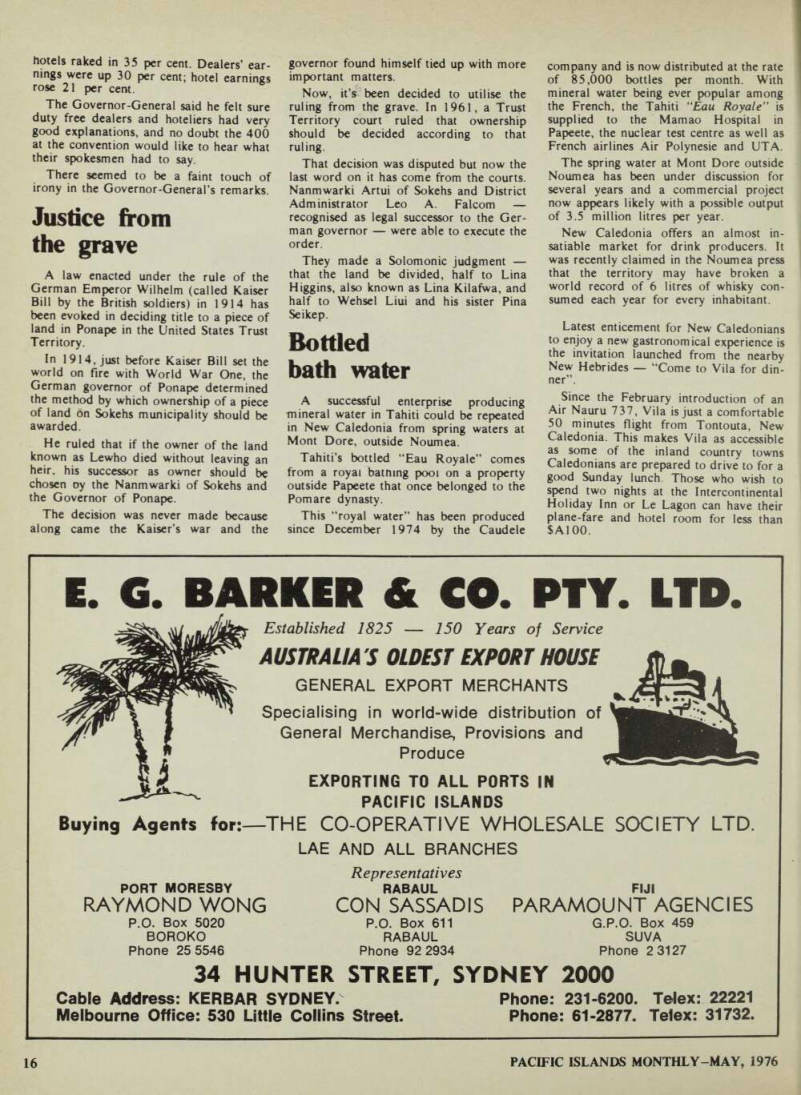
This is the Catholic Cathedral on Wallis, typical of the churches the French mission aries built all over the South Pacific-built to last.
hotels raked in 35 per cent. Dealers’ ear nings were up 30 per cent; hotel earnings rose 21 per cent.
The Governor-General said he felt sure duty free dealers and hoteliers had very good explanations, and no doubt the 400 at the convention would like to hear what their spokesmen had to say.
There seemed to be a faint touch of irony in the Governor-General’s remarks.
Justice from
the grave
A law enacted under the rule of the German Emperor Wilhelm (called Kaiser Bill by the British soldiers) in 1914 has been evoked in deciding title to a piece of land in Ponape in the United States Trust
Territory.
In 1914, just before Kaiser Bill set the world on fire with World War One, the German governor of Ponape determined the method by which ownership of a piece of land on Sokehs municipality should be awarded.
He ruled that if the owner of the land known as Lewho died without leaving an heir, his successor as owner should be chosen oy the Nanmwarki of Sokehs and the Governor of Ponape.
The decision was never made because along came the Kaiser’s war and the
governor found himself tied up with more
important matters.
Now, it’s been decided to utilise the ruling from the grave. In 1961, a Trust Territory court ruled that ownership should be decided according to that ruling.
That decision was disputed but now the last word on it has come from the courts.
Nanmwarki Artui of Sokehs and District Administrator Leo A. Falcom recognised as legal successor to the Ger man governor were able to execute the order.
They made a Solomonic judgment that the land be divided, half to Lina Higgins, also known as Lina Kilafwa, and half to Wehsel Liui and his sister Pina
Seikep.
Bottled
bath water
A successful enterprise producing
mineral water in Tahiti could be repeated in New Caledonia from spring waters at Mont Dore, outside Noumea.
Tahiti’s bottled “Eau Royale” comes from a royal batnmg pool on a property outside Papeete that once belonged to the
Pomare dynasty.
This “royal water” has been produced since December 1974 by the Caudele
company and is now distributed at the rate of 85,000 bottles per month. With mineral water being ever popular among the French, the Tahiti "Eau Royale” is supplied to the Mamao Hospital in Papeete, the nuclear test centre as well as French airlines Air Polynesie and UTA.
The spring water at Mont Dore outside Noumea has been under discussion for several years and a commercial project now appears likely with a possible output of 3.5 million litres per year.
New Caledonia offers an almost in satiable market for drink producers. It was recently claimed in the Noumea press that the territory may have broken a world record of 6 litres of whisky con sumed each year for every inhabitant.
Latest enticement for New Caledonians to enjoy a new gastronomical experience is the invitation launched from the nearby New Hebrides “Come to Vila for din ner”.
Since the February introduction of an Air Nauru 737, Vila is just a comfortable 50 minutes flight from Tontouta, New Caledonia. This makes Vila as accessible as some of the inland country towns Caledonians are prepared to drive to for a good Sunday lunch Those who wish to spend two nights at the Intercontinental Holiday Inn or Le Lagon can have their plane-fare and hotel room for less than
Saioo.
Advertisements & other items, p. 16 (1 item)
E. G. Barker & Co. Pty. Ltd.
Established 1825 150 Years of Service
AUSTRALIA'S OLDEST EXPORT HOUSE
GENERAL EXPORT MERCHANTS
Specialising in world-wide distribution of General Provisions and Produce
EXPORTING TO ALL PORTS IN
PACIFIC ISLANDS
Buying Agents for:— THE CO-OPERATIVE WHOLESALE SOCIETY LTD.
LAE AND ALL BRANCHES
i •W> *
PORT MORESBY
RAYMOND WONG
P.O. Box 5020
BOROKO
Phone 25 5546 Representatives
RABAUL
CON SASSADIS
P.O. Box 611
RABAUL
Phone 92 2934
FIJI
PARAMOUNT AGENCIES
G.P.O. Box 459
SUVA
Phone 2 3127
34 HUNTER STREET, SYDNEY 2000
Cable Address: KERBAR SYDNEY. Phone: 231-6200. Telex: 22221 Melbourne Office: 530 Little Collins Street. Phone: 61-2877. Telex: 31732.
People
Mr Edward E. Johnston, appointed High Commissioner in Micronesia in 1969 by President Nixon, has resigned to take up a SUSSO,OOO a year post as executive vice-president of the Pacific Area Travel Association. He served longer as High Commissioner than any previous holder of the post. Mr Johnston was an in surance executive and chairman of the Hawaii Republican Party before going to the top post in Micronesia. In 1975, he and his administration were criticised in two US Government reports. But ac cording to Mr Johnston, charges in the reports of “waste, inefficiency, mismanagement and corruption”, were “totally unsubstantiated and unproved allegations”. There’s one thing though a few Micronesian top brass are changing their jobs as a result of the reports.
Mr C. H. Allan will return to the Pacific Islands later this year as Governor of the Solomons. At present Governor of the Seychelles, he was an administrative officer in the Solomons from 1945 to 1959. Then, he went on to the New Hebrides as British Resident Com missioner. The term of the retiring Gover nor of the Solomons, Mr D. M. Lud dington, expires in October. He went there in 1973 as High Commissioner and became Governor in 1974 when the Legislative Assembly replaced the Gover ning Council and the Solomons took the
first steps towards independence.
Mrs Fetaui Mata’afa, widow of Fiame Vlata’afa, former Prime Minister of Western Samoa, has been awarded an lonorary doctorate of laws at Victoria Jniversity, Wellington.
Captain R. J. (Bert) Ritchie retires on [ uly las general manager of Qantas and vill be succeeded by Mr K. Hamilton.
Veil known in the Pacific in areas served >y Qantas, he started his flying career >efore World War II with Mandated Airlines of New Guinea. He is a twin •rother of Mr Chris Ritchie like two «as in a pod also well known in ’acific aviation circles, having done two tints as general manager of Fiji Airways nd Air Pacific and as a director of Air 4elanesiae.
Mr Eric Jones, 51, an economist, has een appointed chief executive of Fiji ugar Marketing Co. This company, ewly formed, will take over the larketing of Fiji sugar from CSR Ltd. Mr anes, who was chief economist in the Ministry for Agriculture, Fisheries and orests, has been actively engaged in a
number of negotiations connected with the sugar industry. These included the Fiji Government purchase of South Pacific Sugar Mills from CSR Ltd and the long term agreements with New Zealand.
Mr Ikipa Togatula, the first Niue Islan der to graduate from a university in New Zealand, has been appointed to a position in the Parliamentary Counsel’s office in Wellington. He was educated at Niue High School, Wanganui Boys’ College and Canterbury College, where he graduated in law. He will work in Wellington till about the end of 1976, when he will return to Niue as the Government Legal Officer.
Prince ‘Alaivahamama’o, second son of King Taufa’ahau Tupou, of Tonga, is ser ving as a midshipman in the Royal Navy frigate, Mermaid. The frigate, part of the Royal Navy’s cod war flotilla off Iceland water, was once derided as a “Floating Gin Palace” for former President Kwame Nkrumah, of Ghana. The prince, apart from his duties as midshipman, is also un dertaking navigational in-service training.
The Rev Santakumar Singh, just Santa to many who knew him as a photographer, salesman and executive of Stinsons Ltd, in Suva, has rejoined the firm, now Stinson- Pearce, as chaplain and personnel manager. Fr Singh was ordained as a Church of England priest after study in New Zealand.
He must be the first clergyman in the South Pacific to have a shop as his parish.
Mr Jacques Fabre, after 1 5 years in the New Hebrides, returned to France in March. He was Chancellor at the French Residency. He has been succeeded as Chancellor by Mr F. Doyen.
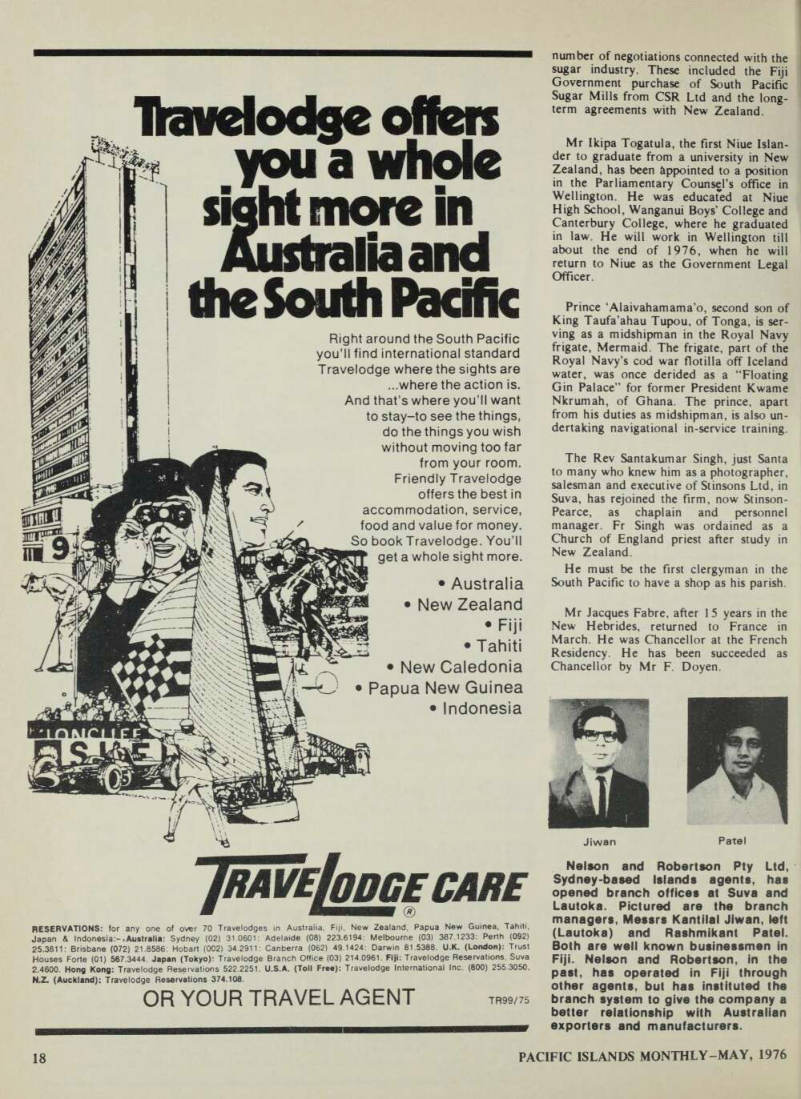
Nelson and Robertson Pty Ltd, Sydney-based Islands agents, has opened branch offices at Suva and Lautoka. Pictured are the branch managers, Messrs Kantilal Jiwan, left (Lautoka) and Rashmikant Patel.
Both are well known businessmen in Fiji. Nelson and Robertson, in the past, has operated in Fiji through other agents, but has instituted the branch system to give the company a better relationship with Australian exporters and manufacturers.
Patel
Jiwan
Advertisements & other items, pp. 17-18 (1 item)
Freight
FHRRELL
Vi
REFRIGERATED
& GENERAL
CARGO IN
BARGES. BULK
LIQUIDS IN
VESSEL DEEP
TANKS.
Quick &
Dependabl
LASH
Service
Xr IFROM UNITED STATES WEST COAST & CANADA TO PAPEETE
IPAGO PAGO, AUCKLAND, LAE & RABAUL.
I PAPUA NEW GUINEA TO VANCOUVER 8.C., TACOMA, PORT-
LAND, SAN FRANCISCO, LOS ANGELES.
(SYDNEY, MELBOURNE, BURNIE, HOBART, BRISBANE TO LAE
l& RABAUL.
IJI
I^« AG,NG AGENTS: Wi,h - Wilhelmsen Agency P/L., 13-15 Bridge Street Svdnev 2000-Phone 20517-60 Market Street, Melbourne, 3000-Phone 613031-344Queer 400 °- phone 2213316. MANAGING AGENTS N.Z.: Dalgety N 2 Ltd. 119 Featherston Street, Welington-Phone 738347- 41/45 Albert Street ’ * wvao l ® nd_Phone 71859. ISLAND AGENTS; Robert Laurie (NG) P/L P.O Box 1032, Lae. PNG - Phone 423811. Burns Philp (NG) Ltd., P.O. Box 87, Rabaul, PNG. rnone y2200D.
Itavdodge offers
you a whole
sight more in
Australia and
the South Pacific
i i % nf 9 «5 >99 Right around the South Pacific you’ll find international standard Travelodge where the sights are ...where the action is.
And that’s where you’ll want to stay-to see the things, do the things you wish without moving too far from your room.
Friendly Travelodge offers the best in accommodation, service, food and value for money.
So book Travelodge. You’ll get a whole sight more. • Australia • New Zealand
•Fiji
•Tahiti • New Caledonia Papua New Guinea • Indonesia
'RAVE/ODCE CARE
RESERVATIONS: for any one of over 70 Travelodges in Australia, Fiji, New Zealand, Papua New Guinea, Tahiti, Japan & Indonesia:-.Australia: Sydney (02) 31.0601: Adelaide (08) 223.6194: Melbourne (03) 387.1233: Perth (092) 25.3811: Brisbane (072) 21.8586: Hobart (002) 34.2911; Canberra (062) 49.1424: Darwin 81.5388. U.K. (London): Trust Houses Forte (01) 567.3444. Japan (Tokyo): Travelodge Branch Office (03) 214,0961. Fiji: Travelodge Reservations, Suva 2.4600. Hong Kong: Travelodge Reservations 522.2251. U.S.A. (Toll Free): Travelodge International Inc. (800) 255.3050.
N.Z. (Auckland); Travelodge Reservations 374.108.
OR YOUR TRAVEL AGENT
TR99/75
Rotorua!
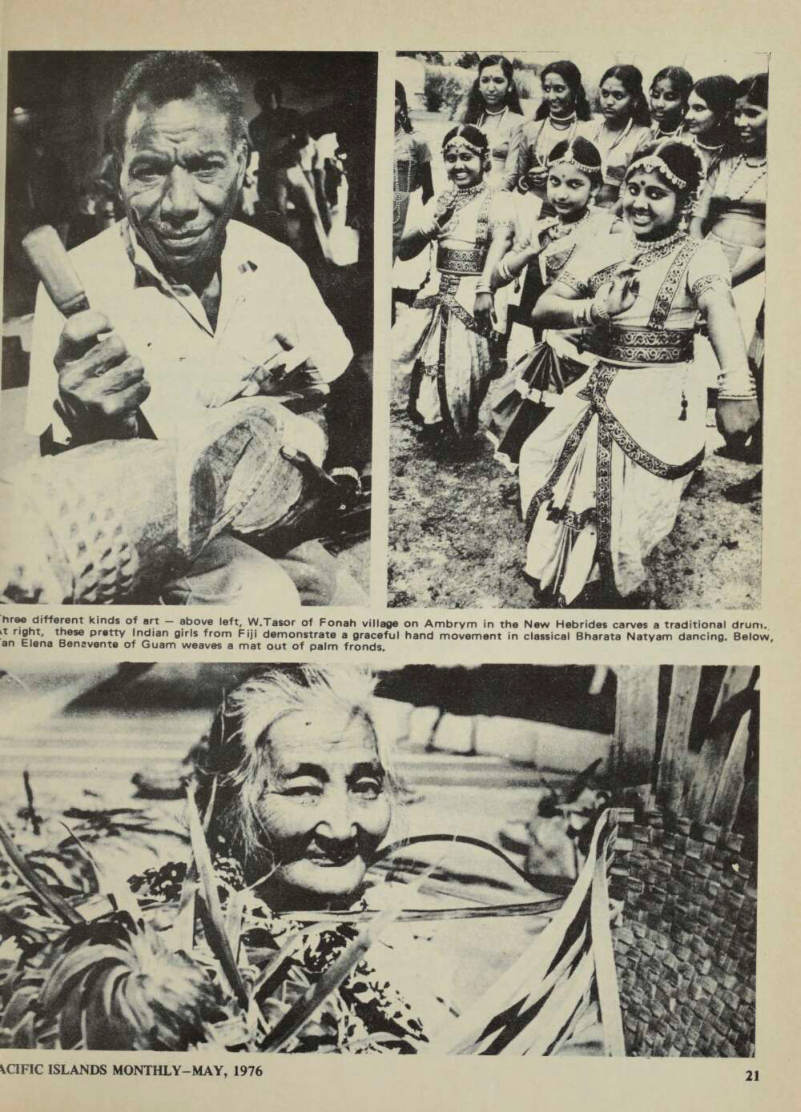
The Islanders’ image in New Zealand a little tarnished of late got a terrific polishing at Rotorua, the North Island’s thermal resort, when 1,200 Islanders from 22 territories rolled back the centuries with an eight-day display of traditional dances, arts and crafts early in March.
It was the Second South Pacific Festival of the Arts and it could be the last, that’s if somebody doesn’t do some streamlining and cut costs. The first festival, in May, 1972, cost the host country, Fiji, around $200,000. The Rotorua festival cost New Zealand $650,000, a total bill of a million dollars if you count the visiting groups’ own expenses.
Not that it wasn’t worth the money. It was; every cent, with the possible exception of that which disappeared in ad ministration costs and payment to house managers and tradesmen —*which is why the festival should be confined to the Islands where so much is done for nothing.
It was a glorious festival for the Islanders, who were cosseted, wined (non-alcoholic) and dined by their Maori hosts at the traditional maraes, and a glorious festival for those fortunate to gain admission. For others, it wasn’t so good. Many who had bought season tickets, and should have had seats reserved, couldn’t get in to the performances. There were 30,000 visitors in the city. With the exception of the stadium, none of the venues was big enough for the crowds which queued outside the doors, some for a couple of hours. Season tickets bought at the outset mean money in the kitty from the first. They should have been catered for, especially when most had come miles to enjoy genuine Island culture.
Reporters, wanting to write about the various performances for several million people, had to queue for entry. At such func tions, where the behind-the-scenes story is important and takes time to get, pressmen haven’t time to queue. So many missed out and the organisers missed out on much publicity and future goodwill!
Now with regard to the cost which will frighten off future host countries. The first festival cost Fiji $200,000, a third of the cost to New Zealand. The Suva festival was for 15 days and 4,000 performers took part. There were 1 200 performers at Rotorua for eight days.
Maybe the generous subsistence allowance of $l2 a head per day paid to the Maori hosts was too much. But good on the Maoris if they made a profit.
Dr Macu Salato, Secretary-General of the South Pacific Commission, the festival’s parent, said in the middle of the week that no one had volunteered to host the next festival. It cost too much, he said.
Later, Papua New Guinea volunteered to stage the third festival four years from now if Australia will help and Australia had already offered help to whoever would take on the job.
Victor Carell, executive director of the first festival, told me: “Even at today’s in flated prices, I don’t think there is any need for the cost to be much more than the Suva festival if it’s held in an Island
country”.
It’s likely the SP Festival Committee,
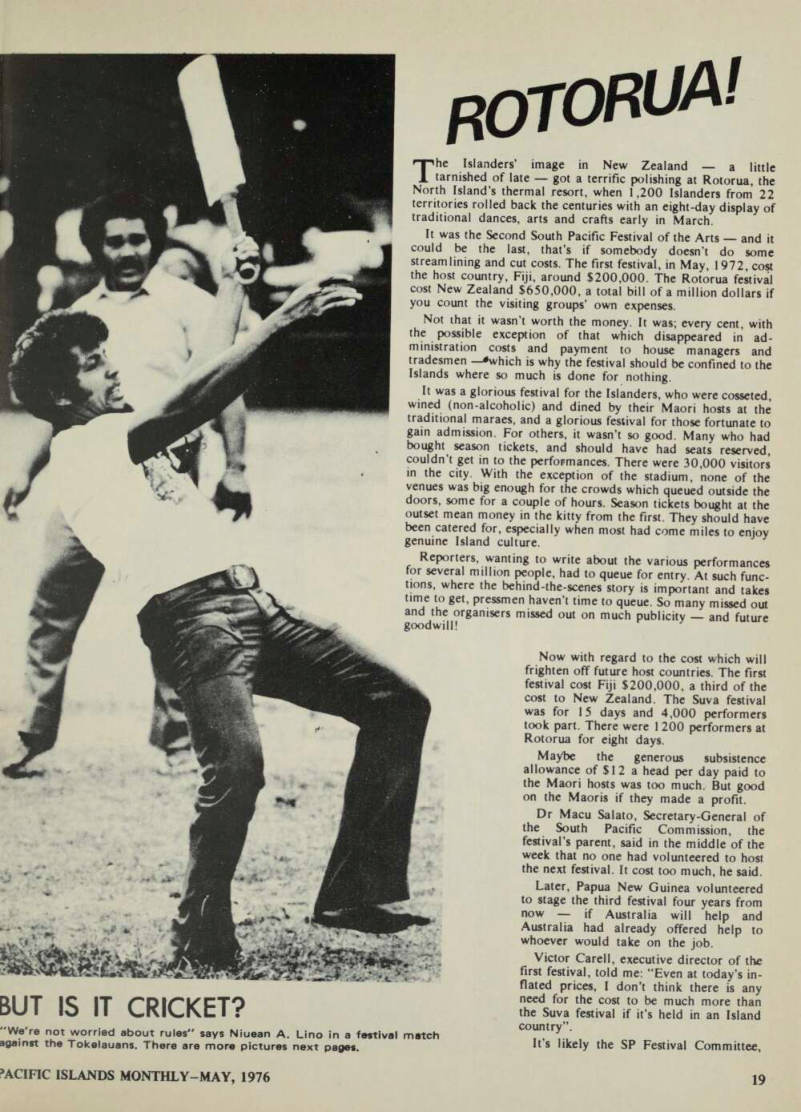
But Is It Cricket?
"We're not worried about rules" says Niuean A. Lino in a festival match against the Tokelauans. There are more pictures next pages.
which will meet around November’s end, will propose the formation of an Arts Council. That’s all to the good, provided it’s an Islander’s Council which should keep the festival- in the Islands.
Rotorua was kind to the performers, but it’s first aim was to provide a tourist at traction and that’s not the Islanders’
idea. They want to restore their cultures and traditions.
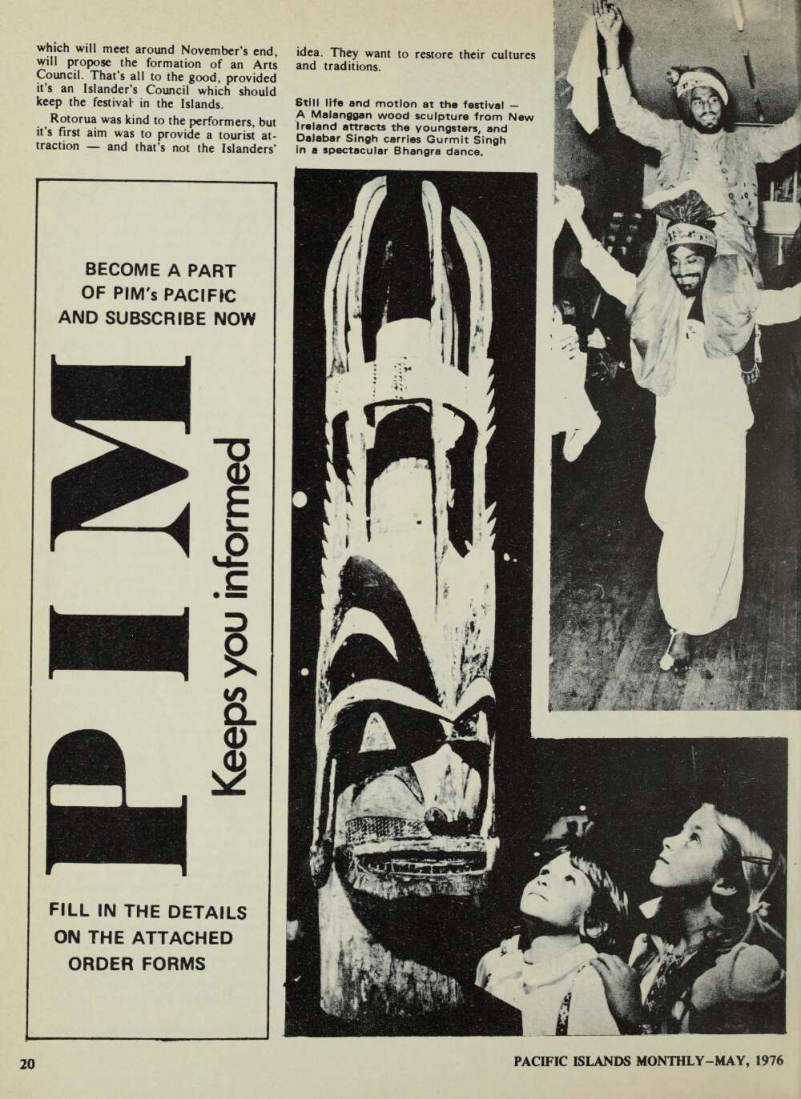
Still life and motion at the festival A Maianggan wood sculpture from New Ireland attracts the youngsters, and Dalabar Singh carries Gurmit Singh in a spectacular Bhangra dance.
hrec different kinds of art — above left, W.Tasor of Fonah village on Ambrym in the New Hebrides carves a traditional drum. . right, these pretty Indian girls from Fiji demonstrate a graceful hand movement in classical Bharata Natyam dancing. Below an Elena Bensvente of Guam weaves a mat out of palm fronds.
Advertisements & other items, pp. 20-22 (2 items)
Keeps you informed
BECOME A PART
OF PlM's PACIFIC
AND SUBSCRIBE NOW
M Keeps you informed
FILL IN THE DETAILS
ON THE ATTACHED
ORDER FORMS
lb Future Generations,
Security
jioy .
■'as> r:a
•* 't*?gsss&mv :/*l itl lV Social welfare is a subject of serious consideration in most modern societies. Man in the twentieth century accepts his responsibility to bequeath to the next generation a society better than his own.
Daiwa Bank is not unique in accepting this responsibility, but Daiwa is unique in making acceptance of this role in society an integral part of their banking service.
Daiwa is the only Japanese city bank to combine banking and trust business. Daiwa is thus a fully integrated banking institution, comprising banking, international financing, trust, pension trust, and real estate business. This integration is part of our effort to fulfil our social responsibility consistent with society's needs in a Contemporary environment. a fully integrated banking service
DAIWA BANK
Custodian of the past Head Office; Osaka, japan London and Frankfurt Branches New York and Los Angeles Agencies Singapore, Sydney and Sao Paulo Representative Offices Joint Venture Banks: P.T. Bank Perdania, Jakarta, International Credit Alliance, Ltd., Hong Kong
nedlloyd
REGULAR SAILINGS BY FAST, MODERN CARGO VESSELS from EUROPE via PANAMA to: from NEW ZEALAND via PANAMA to;
EUROPE
PAPEETE, NOUMEA, (MEDITERRANEAN & NORTH CONTINENT)
APIA, SUVA, LAUTOKA, an( j f rom AUSTRALIA to:
NEW ZEALAND. CENTRAL AMERICA & CARIBBEAN
facilities—refrigerated space—cargo deeptanks
For further particulars apply to Agents: Ets. Donald Tahiti Papeete.
Agence Maritime Aerienne Caledonienne O. F. Nelson & Co. Ltd.
S.A. A.M.A.C., Noumea. Apia.
Carpenters Shipping Suva, Lautoka.
Interocean Australia Services Pty. Ltd.
Sydney.
Joint Shipping Management Ltd. p.O. Box 890, Wellington, N.Z.
21
ISLANDS MONTHLY-MAY, 1976
The Editor's Mailbag
Soul-Saving V Politics
While soul-saving should be kept apart from politics, it is understandable that Island primitives turn to those close to their hearth and home for help and
guidance.
This gives religious leaders a flattering awe-like power which places them (in the eys of primitives) in a higher position than governments or even Christ.
Unfortunately, it is not with the trust-in the-Lord that political problems may be solved.
Religious leaders cannot be expected to :ope with world intrigues as their Christian teaching of “turning the other :heek” puts them at a disadvantage when faced with worldly “eye for eye and for 1
;ooth the entire jaw”.
If New Hebrides churchmen aspire to he reins of political leadership, then, for the sake of the New Hebrides, they should ?e sent overseas for a few years to special idministrative schools to learn the art.
S. Tebula
ianto, '-lew Hebrides
... In New Hebrides
I agree completely with what my fellow Ider Mr Bob Hindle says in his letter to ou (PIM, March, p. 21).
Christians must take part in the political fe of their country. It heartened me also ) see many pastors, elders and laymen oing so. In fact, I believe our whole western civilisation is a result of Christian eople doing this very thing. The whole English political system is based around Christian principles, and many politicians ave been devout Christians. When 'hristian men and women are in politics nd they hold fast to Christian principles, lowing it by their politics, they should be known quantity. If a politician is a nown quantity you should expect certain lings from that person.
The point I am trying to make is that at resent in this country when certain chur hes are mentioned, people immediately lign that person with a certain political arty. This is the unfortunate part, even lough it may not be true.
If people in the New Hebrides kept their olitical alignments out of church wor iip, in time, people would stop aligning ;rtain churches with certain political par es and regardless of their political align
ment, they would feel free to come back inside the church. 1 say come back because, I feel in Vila particularly, a lot of people use this point as an excuse to say that they have been frightened of church
worship.
Let’s not give them an opportunity to have this excuse; then they are only deceiving themselves and it is then their responsibility to decide whether they really want to join in worship or not. I must say though, that I am sure, if they really made an attempt to join church life, the Session of PMC would make them most welcome, as would any other denomination in the New Hebrides.
To my mind it is the atmosphere of the church which is really very important. It should be that the church is open to all regardless of their political alignment.
This does not stop people taking part in the New Assembly. It should encourage them to do so. They should realise that just as they can come into Assembly re gardless of their political affiliation they should be able to come into church just the same.
Surely Christian people should not think that power in the church means power in politics too. I think this is very wrong and it is no small possibility that some expatriates have led New Hebrideans to think like this.
Christian leaders, looking for power in politics through their church affiliation, are making other people think they can do the same. They are often very disap pointed when they find it does not work out for them. A Christian does not go to church to worship in the hope that it will give that person more political power.
You go to church to worship a God of love, not a God of politics. A God of love is interested in the political welfare of his
people, but not wholly their political
welfare. He is interested in a person’s whole being, not just one part of it. A per son’s whole being is more than just his
political being.
I think Bob will realise the point I am trying to make. I am only too happy to continue this discussion through the pages of PIM or privately. I feel that the pages of PIM might let some New Hebrideans know just what goes through an ex patriate’s mind as he tries to live alongside the New Hebridean. I am sure we would both welcome any New Hebridean ideas on this subject. I personally would be in terested to hear some thoughts from
Letters
somebody as I have little opportunity to meet those who would no doubt have plenty to say on this subject. Any correspondence, through PIM or to me personally, would be most welcome.
David Burt
Santo, New Hebrides.
Frosty Fanmail
I read in the January, 1975, issue of PIM, (p. 13) about the letter you received from Alfred Berglund, Lappland, Sweden.
It is a pleasure informing you that there are more Swedes reading your excellent magazine. From time to time I borrow five or six copies of PIM from a Swedish friend living abroad who subscribes to it.
I am living 30 km from Stockholm, working as a standardisation officer at the Swedish Standards Institute in Stockholm.
I see in the Memento of the international standardisation organization (ISO) that no South Pacific country, except New Zealand and Australia, is a member of
Iso.
A most interesting standardisation sub ject is standardisation of test methods for water and air. Water and air pollution is
generally a very interesting and important
subject in today’s world, and it has oc curred to me that very little is written in PIM about risks of pollution of water and air in the South Pacific area as a result of industrial development, tourism and, not to forget, the exploration of the bottom of the sea.
I am well aware of the absolute need of the development and creation of different parts of the economy in order to make possible a survival of the South Pacific Islands, but still there is not much meaning in short-term solutions producing
an unacceptable physical environment.
A few years ago I corresponded with a Swede who sailed in a little boat from Sweden to New Zealand. He worked some months as a teacher in Rarotonga, Cook Islands. In 1966 I almost asked for em ployment at Tarawa radio station (I am ilso a radio operator), but family reasons stopped me that time. It thus seems
possible for Europeans to get employment
n the South Pacific, although I guess there s a trend toward “Island employments for slanders”. Am I right? Anyhow, it would >e interesting to get some information on he need of standardisation, environment )rotection and telecommunication ad ninistration in the South Pacific area.
Best wishes from a still frosty Sweden.
Hans Goransson
:/- SIS, Box 3295, MO3 66 Stockholm
Anti-French!
One is saddened by repeated, often un founded, anti-French jottings in your magazine.
Re “Church politics” (PIM, March, p. 35) it was written that the French had not prepared Kanaks for independence: no doctors, lawyers, etc.
The writer’s 60-year-old French friends can remember when they sat side by side in schools with native children in New Caledonia. Nothing prevented Kanak students from outshining the French had they been keen enough. Both colours were given equal, free education.
The French are among the most democratic of all nations and have never entertained the colour-bar. It would be untruthful to deny this.
Last para of the above article, regarding New Hebrides: “all government affairs were decided by the French and the New Hebrideans were just ignored”. Once again an unfair ‘attack’ on the French.
Please remind all your readers that this is a Condominium all matters concerning these islands must be decided by both governments as decreed by the Protocol.
On page 34 of the March issue, “New Hebrideans lack of citizenship privileges” is not quite clear. Local natives have their natural freedom, do what they like when they like and only work when they are prepared to do so. They can obtain per mits for overseas travels just as Europeans, without Passports, are issued with similar permits.
As for “low wages”, New Hebrideans have always received Ear higher wages than any others in the Pacific except New Caledonia because of the nickel. The main local industry is copra which, at present, is produced at a loss but harvested as much as possible to maintain clean properties.
When the market rises, natives cut their own copra but only enough to purchase immediate requirements without extra ef fort to help save for a rainy day.
With regard to “unfair distribution of lands”, these islands are under-populated and there are thousands of miles of fertile bushlands waiting to be cleared and developed. It appears that no-one is in terested; too much work involved.
Obviously, some ringleaders would prefer to reclaim properties cleared and planted by Europeans (assisted by im ported labour in the past), quite forgetting that a certain amount of good management is required.
Some Church leaders who have sud
denly become budding politicians could
do a lot more Christian good for their people by helping to develop the vast amount of virgin lands rather than preach discontent away from pulpits. Surely this country could blossom forth in peace and
harmony by industrious actions rather than fault-finding words.
E. Kati
Luganville, Santo
Excuse Blushes!
Bless you, and your whole staff, for
publishing, editing and filling RIM with
all the news about the Pacific!
Because shipping between Australia and Holland seems to be rare (?), I received the issues of September, October, Novem ber and December simultaneously. They arrived in a period of real cold, snowy,
frosty, somewhat dreary, wintry weather,
and they brought with them a whiff of the blue Pacific, and all the beautiful islands, and the people that live there.
It is disappointing, and rather amazing, how little the European press publishes about what happens in the Pacific. So,
without PIM, I would never nave known what happened in Nauru at the meeting of the SPC; nor would I have known the problems around that Commission (of which I am convinced it will recover); nor would I have known that my good friend, Dr Macu Salato, had been appointed as Secretary-General (and what an excellent choice that seems to be!) Surely for an “ailing body” like the SPC, a doctor can be expected to give the right treatment, and to administer the “life-saving” in
jections!
Having lived in the New Hebrides till last May, I was, of course very much in terested in the outcome of first the Municipal elections, and afterwards the elections for the Representative Assembly; needless to say that I read the articles by Messrs Joffick, Curtis anc), iCalkoa with
great interest, and I am looking forward to the coming issues, to learn how things have further developed in the con dominium.
It was a joy to read your so-complete coverage of the celebrations of in dependence in Papua New Guinea; and of the “century-celebrations” in Tonga. In both countries I have spent many happy hours, and it is good to read about them.
And so I could go on and on, because there practically are no items in PIM which do not interest me.
Please keep up the good work! And when, hopefully, I can return to the South Pacific, I know that I shall be fully “in the picture” about what has happened, and is happening, there, thanks to your priceless
monthly.
Looking out (while typing this) over snow-covered fields, under a gloomy sky, is it surprising that I am terribly nostalgic about the Pacific?
And yet I am grateful for PIM for having increased that nostalgia. . .thank you all for all the good work!
H. M. C. Poortman
(former WHO-consultant) Ermelo Holland
Norway Calls
I am 29 years old, stamp collector, living in Norway, Scandinavia. I am very interested in the Pacific area to learn about all the Islands and the people living there.
Tne Norwegian people know very little about the Pacific, (except Mr Thor Heyer dal (KON-TIKI). If you mention names like Nauru, Niue, Norfolk I, Tokelau Islands etc to a Norwegian, I think that ?9.9% of the people don’t know where in he world these places are situated.
Anyone from The Pacific who wants a aen-friend in Norway? I shall be most jrateful if you will publish my desire, Sir.
Rolf Vindal
/ardenlra 29a,
9-3200 Sandefjord,
Norway.
Sanitation
The environmental problems con fonting all the Islands are accelerating at i rapid pace, and the time has come to eriously consider the proper direction to ake for the ultimate benefit of all.
At one time, the advent of the flush oilet was the ultimate in progress. Today he enormous use of fresh water to carry iway human wastes, plus soaring costs of ewer and waste treatment plants are mrealistic burdens to contend with.
The ecological effect is devastating vherever a septic tank, with cesspool or
leaching field, is used and the ground water contaminated. In installations where a sewerage disposal plant is used for primary treatment only, the ocean is con taminated. If secondary treatment facilities are added, the sludge removal becomes a problem.
The principal costs, as well as operating and maintenance costs, for a centrally located treatment plant are becoming prohibitive. . .more so in the Islands than mainland areas.
Luckily, some alternatives to the flush toilet do exist, alternatives which could allow for decentralisation of waste disposal and would keep body wastes out of the water supply. Among the disposal methods now in limited use in various parts of the world are two methods suitable for Island use: the composting and the biological systems. Both of these systems do away with the need for sewers and centralised treatment plants.
The clivus multrum organic waste treat ment system is a system completely self contained for the treatment of organic household wastes. It places toilet and kit chen wastes into an environment where
they decompose slowly by composting,
producing a humus which.can be returned directly to the soil. Multrum uses no water, no energy and no chemicals of any kind. It is not connected to sewers as it has no liquid effluent. It has no moving parts, so requires virtually no maintenance.
Capacity ranges from 2-3 people for the small unit and 10-12 for the large unit.
Clivus multrum means literally “inclining compost room”.
The biological system replaces the usual septic tank with cesspool or leaching field.
A barrier is placed between the surroun ding soil and the biological tank. The lower area around the tank is filled with gravel and the upper area with sand. All of this material is within the sealed-in area. Consequently, this is a closed system and allows no effluent to pass into the ground waters. This system, being based upon evaporation of the liquids drained from the tank, has to have, in areas of high precipitation, a canopy. The use of a canopy reduces the size of the evapotran spiration bed by a large degree, due to the exclusion of precipitation and an increase in surface temperature generated from solar radiation through the canopy, thus increasing the rate of evaporation.
Traditional disposal methods are clearly a problem which must be reduced or eliminated. Present systems will create greater pollution as the expanding population makes increasing demands on a finite water supply and on ecologically limited processes for final disposal. The subject is not a pleasant one, but the sooner it is given serious thought, the bet ter off we will all be.
Leif V. Gustafson
(Deputy Director of Public Works) American Samoa
Advertisements & other items, pp. 23-27 (4 items)
23
ACIFIC ISLANDS MONTHLY-MAY, 1976
anywhere,
any time,
any gas.
For further information & addresses of your local distributor contact:
THE COMMONWEALTH
INDUSTRIAL GASES LIMITED
Gases Export Department, 138 Bourke Road, Alexandria, N.S.W., Australia 2015.
Cables ‘CIGAS’-Telex 20241 Sydney. 017.0308
Let Lane
lend a hand
These are some of the products which are keeping our customers prosperous. From this range, you can obtain a really effective herbicide such as M.S.M.A., which controls persistent grasses and sedges in coconuts and bananas, or a short, residual, quick-acting insecticide like DIBROM, which controls fruit and vegetable insects and mosquitoes, sandflies and midges.
Also, our research facilities and advisory services in the field are among the best available, so drop us a line and let us help you.
Lane Ltd., Export Division, P.O. Box 59, Bankstown, N.S.W. 2200 Lane (Fiji) Ltd., P.O. Box 89, Suva, Fiji f Insecticide it Weedkiller Fungici t v Feed upplement t e Animal Health N umigants e Home Garde^ \\ \ 4 * Don't forget—Amalgamated Chemicals is now Lane A
mir
EXPORTERS TO THE PACIFIC ISLANDS
Breckwoldt & Co Pty Ltd
276 Pitt Street, Box 5027, G.P.O. Sydney 2001
CABLE ADDRESS: BREWO SYDNEY TELEX AA22890.
TELEPHONES; 61-7110 61-8674 26-6893
Pacific Island Branches:
P.O. BOX 1549, BOROKO, PORT MORESBY.
P.O. BOX 222, RABAUL. P.O. BOX 185, MADANG.
P.O. BOX 72, KIETA. P.O. BOX 237, MT. HAGEN P.O. BOX 178, WEWAK. P.O. BOX 1188, LAE.
BRECKWOLDT & CO., P.O. BOX 47, APIA.
BRECKWOLDT & CO. (5.1.) LTD., P.O. BOX 140, HONIARA.
BRECKWOLDT S.A.R.L. B.P. 2369, NOUMEA.
Offices in Europe: Hamburg, London, Milan and West Africa as well as Singapore, Kuala Lumpur, Bangkok and Hong Kong.
Enquiries from Australian Manufacturers invited.
We can't change
what you pump.
But we can change how
reliably you pump it.
We make mining pumps that have run for days on a snorer full of slurry. Bore-hole pumps that haven’t been lifted in 15 years. Sewerage pumps that are unaffected by wet-strength fibres, pantyhose, nappies or solids up to 6" diameter. And farm-water pumps that deliver town-water pressure or better, 5 miles from the creek. As well as pumps for boiling cheese, grease, acids, cooked fruit and biscuit dough. Or anything else that can be pumped, and a few things other pumps can’t pump.
All of them have one thing in common. In a few years you’ll begin to wonder if your Mono Pump will ever stop pumping. And our pumps are backed by 24 hours a day service from local engineers, factory trained in Australia. We can’t change what you pump, but we can pump it more reliably. 2. » w >»»»•« 0 ■B 5 ‘ 1.
I 1. T series-mining & foods (Flanges or Tapped Ports) 2. Borehole series 3. Monta Pump-sewerage 4. Mutrator-sewerage 5. ‘o9’ series-farming 6. CP series-light industrial
(AUSTRALIA) PTY. LTD.
Head Office and Works: “Mono House’’. 338-348 Lower Dandenong Rd, Mordialloc, Vic. 3195. Phone 90-5211.
Agents in all major South East Asian and Pacific areas. r 1 I Please send details of your pumps for (describe purpose); I I I I I Jif a Borehole pump, indicate: Approx, depth of bore ft.; estimated water level ft. ;j I estimated yield. gph. NAME I I f
ADDRESS -v I
L 344-P-043
THE PAPUA HOTEL
PORT MORESBY
• Right in the business centre • A tradition for comfort and fine food • All rooms air conditioned • Restaurant • Bars • Banquet Hall Telephone 24 2121 Cables PAPTEL
A. C. NEUMANN
Manager
INTERNATIONAL?
DATELINE HOTEL
TONGA
'Friendy Hold" of the "Friendly blends' Situated along the Nukualofa waterfront Only five minutes walk from town. Single, double, family suites, airconditioning, and hot and cold water showers. Pool, bar, restaurant, duty-free shop, tour desk and boutique.
Book through your travel agent or write to International Dateline Hotel, P.O. Box 62, Nukualofa Tonga.
Cable Address: ‘'DATELINE".
Represented Overseas by: Charles J. Henry and Associates Pty. Ltd.
Sydney and Melbourne.
GENERATING SETS
by BRAYBON
Capacities available are: Petrol 2 kva-7* kva • Diesel 2 kva-200 kva Write for brochure and prices:
BRAYBON BROS. PTY. LTD.,
2 ROTHWELL AVE., CONCORD WEST,
N.S.W., 2138. Phone: 73-3246.
25
ACIFIC ISLANDS MONTHLY-MAY, 1976
27
ACIFIC ISLANDS MONTHLY-MAY, 1976
On Asunday-Except...
In Tonga It’S Never, Never
Things have changed so much since 1875, even in a small and rather homogeneous society such as Tonga. Whereas the missionaries exerted a very powerful impact on the thinking of the higher echelons of society in 1875, today they are told to confine their thinking to spiritual matters. Moreover, whereas in 1875 there were no tourists to attend to, no power station to keep a watch on, no police force as such to maintain law and or der, these are part and parcel of Tongan society today.
Even more ridiculous is the fact that the Sunday Law is im possible to enforce and is, therefore, invalid. This impossibility of application was clearly demonstrated five years ago when Justice Roberts dismissed a charge for baking bread on the Sab bath Day brought against master baker Frank Cowley by the police.
Mr Cowley did not deny that he was baking bread on Sun days. Rather, he argued that, as his family had been baking bread on Sundays for 80 years, he could not see why the police should suddenly declare such a customary practice unlawful.
In his summing up, Justice Roberts argued that the ap plication of the Sunday Law would result in, among other things, there being no electric light or power, no normal care of hospital patients, no hotel services and the Police Force itself
being hamstrung.
Was it mentioned that the police officers, in detecting the of fence, were also working on the Sabbath?
As such he judged the provisions of the Sunday Law to be un workable as they are impossible of enforcement, and are therefore invalid.
“Therefore,” Justice Roberts continued, “until the Legislature amends and clarifies the law relating to work and trade in Tonga on the Sabbath Day so as to make such law possible to enforce, the Gouts must, in my opinion, apply the law established by custom”.
The law established by custom, Justice Roberts elaborated, is a “law of right not written, which being established by long use and the consent of our ancestors, has been and daily is put in practice”.
He could not, therefore, but find for the defendant.
Charges against other bakers were thus subsequently dropped by the police, and the bakers have ever since been happily baking (and stealthily selling when they could) while the rest of Tonga attend to their religious services.
The absurdity and, in my opinion, extreme hypocrisy of the Sunday Law is also clearly seen when it is quite lawful for a hotel employee to attend to a tourist as Tonga needs his foreign exchange, but unlawful for a stevedore unless permission has been granted (which is not always the case) to load perishable exports on Sundays, especially in bright daylight!
In the Friendly Islands “the Sabbath Day shall be sacred. . .forever and ever and it shall not be lawful to do work or play games or trade on the Sabbath”. So declares the Tongan Constitution.
But, it is not unlawful for a policeman, a hotel employee, a chauffeur, or a radio announcer to work on the Sabbath, and of course be paid for it! Further, one can buy a beer at the hotel, but one cannot hire a taxi to take one’s sick child to the hospital
From a Nukualofa correspondent
unless it is an emergency case and that approval from the ap propriate authority naslseen given. And while such approval is being sought, the child’s life could be in real danger.
Such is the anomalous absurdity of Tonga’s Sunday Law One cannot fathom why this piece of legal anachronism has not been seriously examined, not only in the light of its inherent con tradictions but also in the light of present-day conditions.
The answer may lie in what someone recently said: “The con tradictions of the Sunday Law are but one example of the con tradictions and hypocrisy that are increasingly becoming part of the Tongan society”. Or is it only one of the stages through which a traditional society must wade in its attempt to adapt to the demands of the twentieth century?
While the Sunday Law might have been well-suited to the conditions of 1875, when it, and other Clauses of the Con stitution, was enacted, and to the super-puritanic and outdated attitudes and tastes of the missionaries who had extraordinary influence on the then law-makers, it is certainly, or at least some aspects of it are. not suited to today’s conditions.
There have been occasions when perishable exports had been left behind or left exposed to the sun all day Sunday because of the Sunday Law. God, I’m sure, would be more disappointed with such a waste, which Tonga can ill-afford, than working on Sundays. To go further, one can say that God must feel cheated and insulted by such utter hypocrisy.
With 1975 being the Centenary of the Tongan Constitution, one would have thought that that was the appropriate time in which to review the Sunday Law, and other laws, in the light of
present-day conditions.
It is most unfortunate, however, that the Parliamentary Session of 1975, not unlike those of previous years, evidenced very little clear and positive thinking. Rather than examining whether some of the clauses of the Constitution, passed a hun dred years ago, needed some amendments, the parliamen tarians wasted a lot of time (and of course a lot of the taxpayers’ money) discussing trivialities such as whether long-hair is to be declared unlawful, the form of dress that they should wear on certain functions, whether divorcees should be fined etc. I often wonder why those Parliamentarians should be paid any emoluments at all!
There was, inordinately, too much attention given to the celebrations of the Centenary of the Constitution, but very little positive thinking given to the Constitution itself and its relevance to the conditions of today and tomorrow.
But what does the ordinary Tongan think of the Sunday Law?
Judging by the number of people who break it in one way or another, and by the fact that very few Tongans on work schemes in New Zealand ever refuse to earn “double time” on Sundays when asked, I believe that the Law should at the first available opportunity be amended.
I am not suggesting that the Sunday Law be changed in toto.
Rather, that only certain aspects of it be amended to suit present-day conditions. For example, that grocery stores be allowed to trade, that taxis and buses be permitted to run, that loading of exports be allowed, and so forth.
But until such a time arrives, it is still going to be never never on a Sunday. . .Except!
dispels a myth
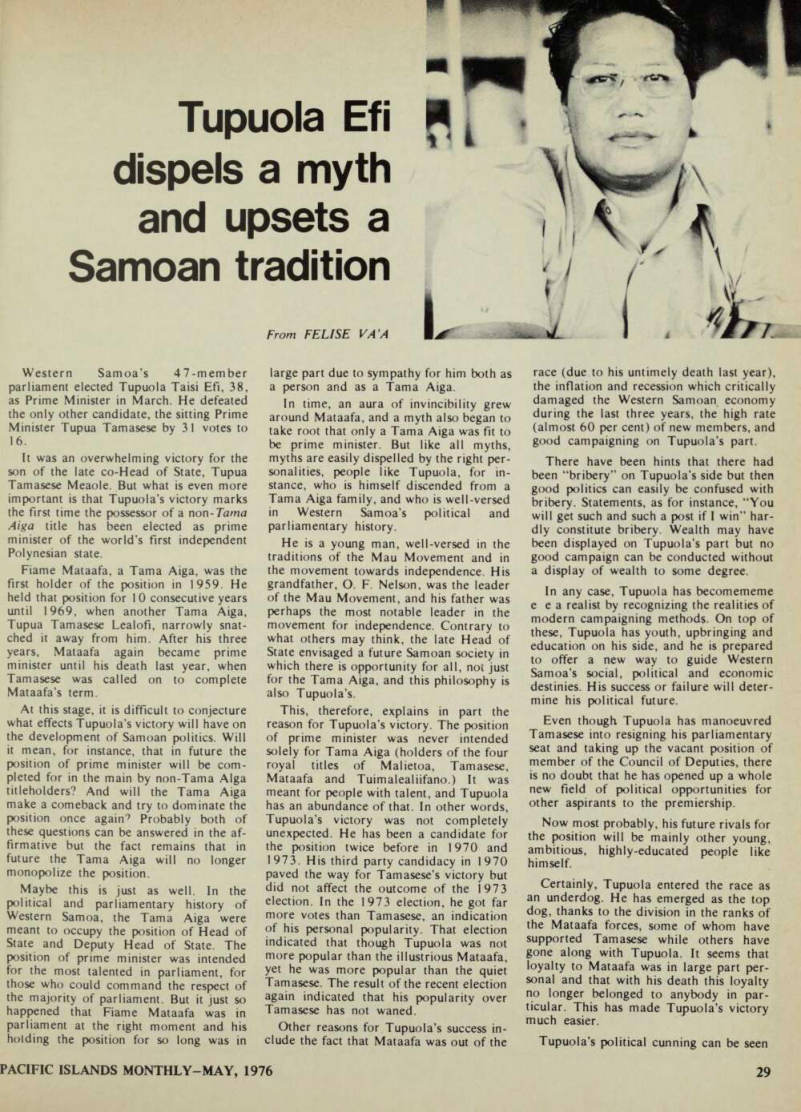
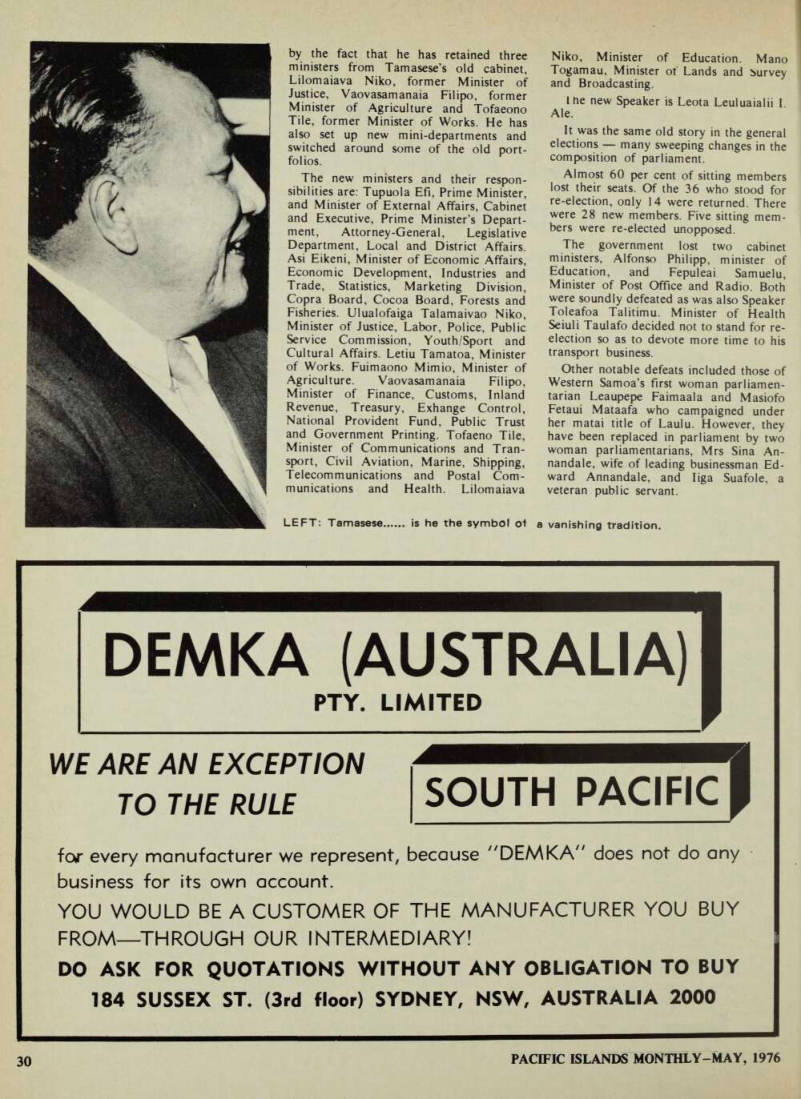
Tupuola Efi dispels a myth and upsets a Samoan tradition
From Felise Va 'A
Western Samoa’s 47-member parliament elected Tupuola Taisi Efi, 38, as Prime Minister in March. He defeated the only other candidate, the sitting Prime Minister Tupua Tamasese by 31 votes to 16.
It was an overwhelming victory for the son of the late co-Head of State, Tupua Tamasese Meaole. But what is even more
important is that Tupuola’s victory marks
the first time the possessor of a non -Tama Aiga title has been elected as prime minister of the world’s first independent
Polynesian state.
Fiame Mataafa, a Tama Aiga, was the first holder of the position in 1959. He held that position for 10 consecutive years until 1969, when another Tama Aiga, Tupua Tamasese Lealofi, narrowly snat ched it away from him. After his three years, Mataafa again became prime minister until his death last year, when Tamasese was called on to complete Mataafa’s term.
At this stage, it is difficult to conjecture what effects Tupuola’s victory will have on the development of Samoan politics. Will it mean, for instance, that in future the position of prime minister will be com pleted for in the main by non-Tama Alga titleholders? And will the Tama Aiga make a comeback and try to dominate the position once again 9 Probably both of these questions can be answered in the af firmative but the fact remains that in future the Tama Aiga will no longer monopolize the position.
Maybe this is just as well. In the political and parliamentary history of Western Samoa, the Tama Aiga were meant to occupy the position of Head of State and Deputy Head of State. The position of prime minister was intended for the most talented in parliament, for those who could command the respect of the majority of parliament. But it just so happened that Fiame Mataafa was in parliament at the right moment and his holding the position for so long was in
large part due to sympathy for him both as a person and as a Tama Aiga.
In time, an aura of invincibility grew around Mataafa, and a myth also began to take root that only a Tama Aiga was fit to be prime minister. But like all myths, myths are easily dispelled by the right per sonalities, people like Tupuola, for in stance, who is himself discended from a Tama Aiga family, and who is well-versed in Western Samoa’s political and
parliamentary history.
He is a young man, well-versed in the traditions of the Mau Movement and in the movement towards independence. His grandfather, O. F. Nelson, was the leader of the Mau Movement, and his father was perhaps the most notable leader in the movement for independence. Contrary to what others may think, the late Head of State envisaged a future Samoan society in which there is opportunity for all, not just for the Tama Aiga, and this philosophy is
also Tupuola’s.
This, therefore, explains in part the reason for Tupuola’s victory. The position of prime minister was never intended solely for Tama Aiga (holders of the four royal titles of Malietoa, Tamasese, Mataafa and Tuimalealiifano.) It was meant for people with talent, and Tupuola has an abundance of that. In other words,
Tupuola’s victory was not completely
unexpected. He has been a candidate for the position twice before in 1970 and 1973. His third party candidacy in 1970 paved the way for Tamasese’s victory but did not affect the outcome of the 1973 election. In the 1973 election, he got far more votes than Tamasese, an indication of his personal popularity. That election indicated that though Tupuola was not more popular than the illustrious Mataafa, yet he was more popular than the quiet Tamasese. The result of the recent election again indicated that his popularity over Tamasese has not waned.
Other reasons for Tupuola’s success in clude the fact that Mataafa was out of the
race (due to his untimely death last year), the inflation and recession which critically damaged the Western Samoan economy during the last three years, the high rate (almost 60 per cent) of new members, and good campaigning on Tupuola’s part.
There have been hints that there had been “bribery” on Tupuola’s side but then good politics can easily be confused with bribery. Statements, as for instance, “You will get such and such a post if I win” har dly constitute bribery. Wealth may have been displayed on Tupuola’s part but no good campaign can be conducted without a display of wealth to some degree.
In any case, Tupuola has becomememe e e a realist by recognizing the realities of modern campaigning methods. On top of these, Tupuola has youth, upbringing and education on his side, and he is prepared to offer a new way to guide Western Samoa’s social, political and economic destinies. His success or failure will deter mine his political future.
Even though Tupuola has manoeuvred Tamasese into resigning his parliamentary seat and taking up the vacant position of member of the Council of Deputies, there is no doubt that he has opened up a whole new field of political opportunities for other aspirants to the premiership.
Now most probably, his future rivals for the position will be mainly other young, ambitious, highly-educated people like himself.
Certainly, Tupuola entered the race as an underdog. He has emerged as the top dog, thanks to the division in the ranks of the Mataafa forces, some of whom have supported Tamasese while others have gone along with Tupuola. It seems that loyalty to Mataafa was in large part per sonal and that with his death this loyalty no longer belonged to anybody in par ticular. This has made Tupuola’s victory much easier.
Tupuola’s political cunning can be seen
by the fact that he has retained three ministers from Tamasese’s old cabinet, Lilomaiava Niko, former Minister of Justice, Vaovasamanaia Filipo, former Minister of Agriculture and Tofaeono Tile, former Minister of Works. He has also set up new mini-departments and switched around some of the old port folios.
The new ministers and their respon sibilities are: Tupuola Efi, Prime Minister, and Minister of External Affairs, Cabinet and Executive, Prime Minister’s Depart ment, Attorney-General, Legislative Department, Local and District Affairs.
Asi Eikeni, Minister of Economic Affairs, Economic Development, Industries and Trade, Statistics, Marketing Division, Copra Board, Cocoa Board, Forests and Fisheries. Ulualofaiga Talamaivao Niko, Minister of Justice, Labor, Police, Public Service Commission, Youth/Sport and Cultural Affairs. Letiu Tamatoa, Minister of Works. Fuimaono Mimio, Minister of Agriculture. Vaovasamanaia Filipo, Minister of Finance, Customs, Inland Revenue, Treasury, Exhange Control, National Provident Fund, Public Trust and Government Printing. Tofaeno Tile, Minister of Communications and Tran sport, Civil Aviation, Marine, Shipping, Telecommunications and Postal Com munications and Health. Lilomaiava
Niko, Minister of Education. Mano Togamau, Minister of Lands and Survey
and Broadcasting.
Ihe new Speaker is Leota Leuluaialii I Ale.
It was the same old story in the general elections many sweeping changes in the composition of parliament.
Almost 60 per cent of sitting members lost their seats. Of the 36 who stood for re-election, only 14 were returned. There were 28 new members. Five sitting mem bers were re-elected unopposed.
The government lost two cabinet ministers, Alfonso Philipp, minister of Education, and Fepuleai Samuelu, Minister of Post Office and Radio. Both were soundly defeated as was also Speaker Toleafoa Talitimu. Minister of Health Seiuli Taulafo decided not to stand for re election so as to devote more time to his transport business.
Other notable defeats included those of Western Samoa’s first woman parliamen tarian Leaupepe Faimaala and Masiofo Fetaui Mataafa who campaigned under her matai title of Laulu. However, they have been replaced in parliament by two woman parliamentarians, Mrs Sina An nandale, wife of leading businessman Ed ward Annandale, and liga Suafole, a veteran public servant.
LEFT: Tamasese is he the symbol of a vanishing tradition.
Advertisements & other items, p. 30 (1 item)
Demka (Australia)
PTY. LIMITED
WE ARE AN EXCEPTION
TO THE RULE
SOUTH PACIFIC
for every manufacturer we represent, because "DEMKA" does not do any business for its own account.
YOU WOULD BE A CUSTOMER OF THE MANUFACTURER YOU BUY
FROM—THROUGH OUR INTERMEDIARY!
DO ASK FOR QUOTATIONS WITHOUT ANY OBLIGATION TO BUY 184 SUSSEX ST. (3rd floor) SYDNEY, NSW, AUSTRALIA 2000
The love of booze-not money
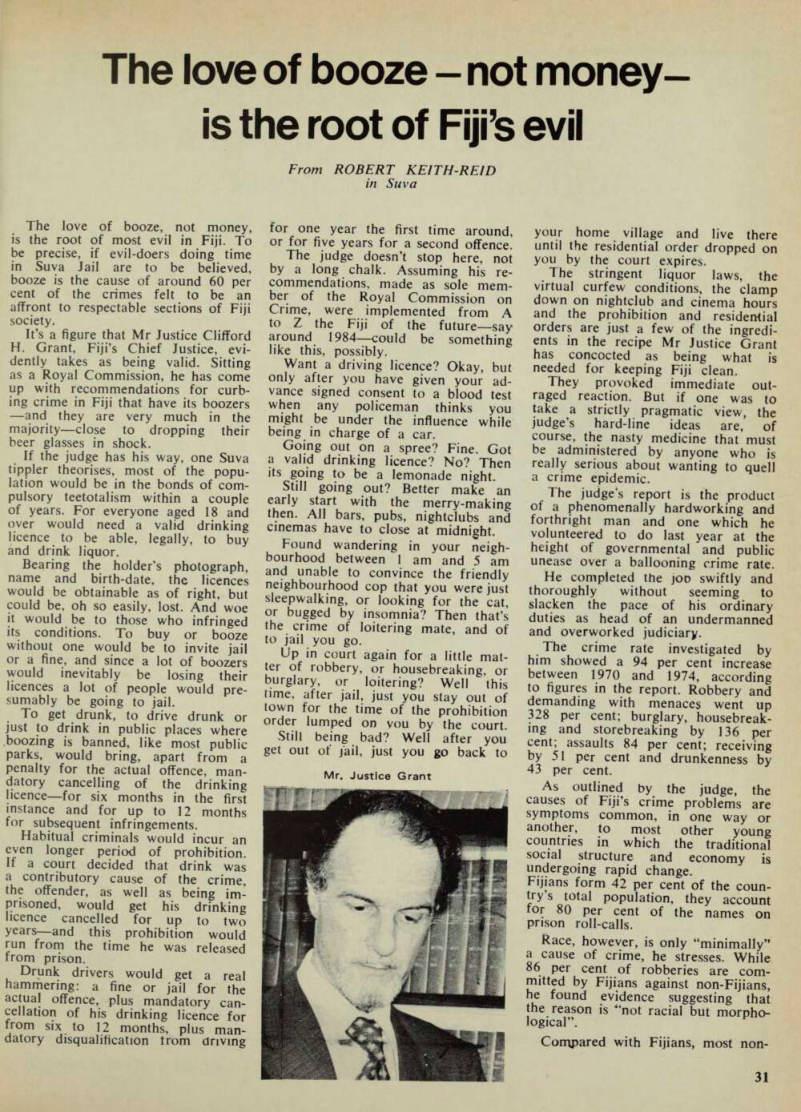


is the root of Fiji’s evil
From Robert Keith-Reid
in Suva
The love of booze, not money, is the root of most evil in Fiji. To be precise, if evil-doers doing time in Suva Jail are to be believed, booze is the cause of around 60 per cent of the crimes felt to be an affront to respectable sections of Fiji society.
It’s a figure that Mr Justice Clifford H. Grant, Fiji’s Chief Justice, evi dently takes as being valid. Sitting as a Royal Commission, he has come up with recommendations for curb ing crime in Fiji that have its boozers —and they are very much in the majority—close to dropping their beer glasses in shock.
If the judge has his way, one Suva tippler theorises, most of the popu lation would be in the bonds of com pulsory teetotalism within a couple of years. For everyone aged 18 and over would need a valid drinking licence to be able, legally, to buy and drink liquor.
Bearing the holder’s photograph, name and birth-date, the licences would be obtainable as of right, but could be, oh so easily, lost. And woe it would be to those who infringed its conditions. To buy or booze without one would be to invite jail or a fine, and since a lot of boozers would inevitably be losing their licences a lot of people would pre sumably be going to jail.
To get drunk, to drive drunk or just to drink in public places where boozing is banned, like most public parks, would bring, apart from a penalty for the actual offence, man datory cancelling of the drinking licence—for six months in the first instance and for up to 12 months for subsequent infringements.
Habitual criminals would incur an even longer period of prohibition.
If a court decided that drink was a contributory cause of the crime, the offender, as well as being im prisoned, would get his drinking licence cancelled for up to two years—and this prohibition would run from the time he was released from prison.
Drunk drivers would get a real hammering: a fine or jail for the actual offence, plus mandatory can cellation of his drinking licence for from six to 12 months, plus man datory disqualification trom driving
for one year the first time around, or for five years for a second offence.
The judge doesn’t stop here, not by a long chalk. Assuming his re commendations, made as sole mem ber of the Royal Commission on Crime, were implemented from A to Z the Fiji of the future—say around 1984—could be something like this, possibly.
Want a driving licence? Okay, but only after you have given your ad vance signed consent to a blood test when any policeman thinks you might be under the influence while being in charge of a car.
Going out on a spree? Fine. Got a valid drinking licence? No? Then its going to be a lemonade night.
Still going out? Better make an early start with the merry-making then. All bars, pubs, nightclubs and cinemas have to close at midnight.
Found wandering in your neigh bourhood between 1 am and 5 am and unable to convince the friendly neighbourhood cop that you were just sleepwalking, or looking for the cat, or bugged by insomnia? Then that’s the crime of loitering mate, and of to jail you go.
Up in court again for a little mat ter of robbery, or housebreaking, or burglary, or loitering? Well this time, after jail, just you stay out of town for the time of the prohibition order lumped on vou by the court.
Still being bad? Well after you get out of jail, just you go back to
your home village and live there until the residential order dropped on you by the court expires.
The stringent liquor laws, the virtual curfew conditions, the clamp down on nightclub and cinema hours and the prohibition and residential orders are just a few of the ingredi ents in the recipe Mr Justice Grant has concocted as being what is needed for keeping Fiji clean.
They provoked immediate out raged reaction. But if one was to take a strictly pragmatic view, the judge’s hard-line ideas are, of course, the nasty medicine that must be administered by anyone who is really serious about wanting to quell a crime epidemic.
The judge’s report is the product of a phenomenally hardworking and forthright man and one which he volunteered to do last year at the height of governmental and public unease over a ballooning crime rate.
He completed the joo swiftly and thoroughly without seeming to slacken the pace of his ordinary duties as head of an undermanned and overworked judiciary.
The crime rate investigated by him showed a 94 per cent increase between 1970 and 1974, according to figures in the report. Robbery and demanding with menaces went up 328 per cent; burglary, housebreak ing and storebreaking by 136 per cent; assaults 84 per cent; receiving by 51 per cent and drunkenness by 43 per cent.
As outlined by the judge, the causes of Fiji’s crime problems are symptoms common, in one way or another, to most other young countries in which the traditional social structure and economy is undergoing rapid change.
Fijians form 42 per cent of the coun try s total population, they account for 80 per cent of the names on prison roll-calls.
Race, however, is only “minimally” a cause of crime, he stresses. While 86 per cent of robberies are com mitted by Fijians against non-Fijians, he found evidence suggesting that the reason is “not racial but morpho logical”.
Compared with Fijians, most non-
Mr. Justice Grant
Fijians are smaller, seem an easy target for this reason, and usually have more money or items worth stealing, the judge says.
Noting the 1970-1974 crime figures he says that, in the same period, beer consumption almost doubled.
“I am satisfied there is a direct relationship, despite the increase in population and tourists”, he says.
“My conclusion is supported by the fact that 60 per cent of the prison population blame liquor for the commission of their offences; and the courts throughout Fiji are constantly being informed by offenders that liquor was the cause of their criminal conduct”.
Making his diagnosis, Mr Justice Grant observes that crime is also mainly an urban problem—and that Fiji is fast becoming urbanised.
Old communal and family systems are breaking down and cramped “high density” living in towns stimu lates aggressive behaviour.
Contrary to popular beliefs un employment is not a major contribut ory factor, the judge says; only 19 per cent of convicts had no means of employment.
“What is far more likely to give rise to crime are awakening aspira tions, sometimes referred to as the ‘revolution of rising expectations’ if they are not realised”, he says.
Fijians especially, he says, are bewildered by the loss of traditional customs and ethics when they move into town and can’t cope with them selves or their children. The abolition of the bulk of Fijian Affairs regu lations (a legal code) formerly applied to Fijians only) has caused an “alarming” decline in village discipline.
The judge sees tourism as a mixed blessing, bringing employment and income, but also alien values which are contributory to crime.
Much of the slide downwards, he feels, is due to faults with the Royal Fiji Police Force: undermanned, ill equipped and, because of low pay, not getting men of the right calibre.
Meaningful economic development cannot continue without law and order being preserved, he warns.
“This has not been fully appre ciated by the government, resulting in a failure to provide an adequate police force”.
This failure was another major :ause of crime, since stiff deterrent sentences dealt out by courts would not be much of a deterrent to people who knew that there was not much chance of being caught by the police.
The Fiji public itself helps criminals in a big way, the judge says. Firstly, it fails to take simple
precautions like fitting iron grilles over windows.
Secondly, the judge laments, the public’s threshold of honesty is not as high as it should be”—people tend to buy what is offered without asking where it has come from.
“Positive steps must be taken by the public to protect their own per sons and property” the judge insists.
“They should avoid walking alone in unlit areas at night. They should report to the police anything sus picious that comes to their attention instead of adopting the attitude that it is no concern of theirs”.
Dealing with preventative mea sures, the judge complains that Fiji’s education system places too little
emphasis on such lessons as honesty and decency. Instead, 125,000 child ren are being crammed for examin ations that have little relevance to local needs.
The judge takes a hefty swipe at cinema proprietors for screening far too many films containing “gratuitous violence or glorifying crime”. He demands much tougher film censor ship—a complete ban on sexv vio lence and crime-orientated films— and says censors who don’t keep such films out of cinemas should be promptly sacked He would like one censor to be a police officer.
Suva’s brewery gets a broadside also. Fiji beer contains too much alcohol, the judge thinks. The
brewers “must be persuaded that it is not an economic proposition to continue their contribution to crime”.
His solution here, is to slap high excise duty on strong beers, low duty on weak brews.
The report airs a long list of other remedies: more prison accommoda tion to ease overcrowding and permit the segregation of first offenders from old lags; more support for youth clubs; more sports fields and facili ties so that sport can be promoted as an outlet for aggressive feelings; the gradual demolition of choc-a bloc tenement buildings; school lessons in honesty; and the creation of a Ministry of Justice.
Crime prevention depends largely on there being an adequate and com prehensive policy for a nation’s youth, the judge says.
“It is an essential part of planning for national development and would be the responsibility of a Minister of Justice who would concentrate on an evaluation of programmes, costs and benefits likely to accrue from the adoption of various crime control and crime prevention mea sures five years in advance”, the judge says.
Looking specifically at Fijian law lessness the judge suggests the ap pointment of village peace officers to restore discipline in the villages, with powers to arrest and detain without warrant and to report any offences to the nearest district police station.
Other duties would be to supervise offenders on probation, report juvenile delinquents to the welfare department, supervise work by ex tramural prisoners, serve summonses, help trace witnesses and generally liaise with the police and welfare authorities.
Mr Justice Grant also took the opportunity to comment on three matters not directly related to the problem of everyday crime.
“It is about time”, the judge says, “that the Fiji Parliament either com pletely abolishes the death penalty once and for all, or otherwise legis lates to specify the categories of murder for which it should be applied”
“Supreme Court judges should not be left, as they are now, to decide when the death penalty should be invoked”.
Dealing with the effectiveness ot corporal punishment, the judge says it is still too early to say what re sults have been achieved since punishment with a rattan cane was reintroduced for crimes of violence several years ago.
But caning does appear to be a deterrent. Since, however, the num ber of strokes is limited to 12, courts
have tended to order no more than six, “to keep something in reserve”, “This verges on the inadequate”, the Chief Justice says, and suggests the maximum should be raised to 24.
Recommending tougher measures against acts likely to incite racial hatred, the judge counsels the adop-. non or pena ties which could be USC H ‘° onp« ,hn| P ™rf hnnlH h h f CO f S should . b « empowered to close, for any period of up to one year, a newspaper found guilty of publishing material likely to inflame racial feeling, prejudice, public peace or advise disobedience of lawful orders given by military, police or prison authorities.
Furthermore the iudae cave courts shouM on be able to ban newspaper publishers, proprietors and editors from writing for or helping with the publication of any newspaper.
These recommendations brought an immediate howl of protest from the 18-month-old Fiji Sun, one of Fiji’s two dailies, which the judge accused of publishing “deadly” and “blatantly racist” letters in its open columns.
The 106-year-old Fiji Times also expressed some understandable reservations on this point, although in a rather more muted fashion.
Other aspects of the judge’s report did not go down well in other quarters either.
Prime Minister Ratu Sir Kamisese Mara stressed that its contents war ranted very long and careful study before any action was taken.
He did not like the idea of drink permits since, he said, people would just go back to brewing their own grog on the sly. Fiji had tried a liquor permit system before and it had not worked, he said, recalling British colonial days when non- Europeans were required to hold drinking permits.
The Prime Minister also came out strongly against the proposals for town prohibition and residential orders. These had been used during World War Two days and had caused more trouble in the villages, he said.
But the PM was all for the village peace officer concept as one he had been advocating himself from way back.
The Prime Minister pointed out that the government, of its own initiative, had already taken steps to improve the quality of the police force. Since the judge had been com missioned to prepare his crime re port, police pay had been increased, more men recruited and overseas expertise had been sought and
obtained.
Ratu Mara pointed, with satisfac tion, to a 28 per cent drop in crime figures in the Suva area in January this year compared with January, 1975, and said it looked as if action to boost police morale and efficiency was earning quick dividends.
Although the Prime Minister did not say it aloud, as he spoke to local journalists about the Chief Justice’s report, he seemed to hint that the lowered Suva crime rate was a more than adequate reason for regarding it as not needing urgent consider ation and complementary action.
Any government which tried to implement the more controversial of the report’s recommendations, such as that for liquor permits, would certainly be courting a lot of unpopularity.
And with a general election com ing up next year, Ratu Sir Kamisese Mara’s Alliance Party will certainly be wary of doing anything like that. • Mr Charles Wardrop, of Fiji, has been appointed chairman of Burns Philp (SS) Co Ltd. He suc ceeds Mr R. G. Kermode, who is now Mr Justice Kermode of the Fiji Supreme Court. Mr Wardrop joined BPs about 40 years ago as a motor workshop supervisor.
Advertisements & other items, pp. 32-34 (2 items)
Concentrated Pea-Ben
is lethal to flies, mosquitoes
and all insect pests ...
Yet so pure it's safe to spray anywhere With tropical weather providing ideal conditions for prolifically-breeding flies and mosquitoes, serious outbreaks of disease can be spread by swarms of these insect invaders. Once more, householders are urged to combat this threat to public health by killing every disease-carrying insect seen. A.N.I. Research Chemists are constantly at work world-wide to ensure that Pea-Beu aerosol insecticide is effective in eliminating flies and mosquitoes from households. Pea-Beu is specifically formulated to contain pyrethrins, one of the most powerful insecticidal ingredients known deadly to mosquitoes, and all insect pests and yet harmless to man and his pets.
The Deadliest Traffickers of Disease Four centuries ago flies were suspected of spreading tropical ulcers. Modern pathologists have proved they spread a whole list of infections, ranging from mild but unpleasant stomach upsets to infective hepatitis, bacillary, dysentery, typhoid and persistent ameobiasis. Worse still, flies transmit crippling scourges such as cholera, smallpox, poliomyelitis, opthalmia and trachoma, A highly efficient method of fly extermination is to use powerful Pea-Beu aerosol insecticide. A few short bursts of Pea-Beu in a room will kill all flies on the wing.
The permeating action of Pea-Beu also spreads into hidden corners of the room, thus eliminating any hidden insects.
The mosquitoes’ record is just as grim.
Besides wrecking your night’s rest with their irritating whine and inflicting painful toxic bites, mosquitoes pass on many serious diseases including malaria, hepatitis, dengue and yellow fever, disfiguring elephantiasis and encephalitis.
Total Killing Power with Total Safety Controlling these dangerous diseasespreaders demands rapid destruction wherever they appear. Long-term research was needed to formulate the insect spray that combines high killing potential with complete safety for users, as powerful Pea-Beu aerosol does. Pea-Beu is particularly effective as the wide action spray ensures total coverage of anv room. Pea Beu’s efficient spray seeks out and destroys insects before they have a chance to bring irritation and illness to your family.
Pea-Beu the safe, powerful insecticide
to the Pacific Islands
In our 81st year
Selling
"SERVICE"
NELSON & ROBERTSON
PTY. LIMITED
(Established 1895)
PLANTATION HOUSE, 197 CLARENCE STREET, SYDNEY
CABLES: "IVAN", SYDNEY, BRISBANE TELEX: AA22381, SYDNEY.
FOR:
INDENTS
COMMODITIES
SHIPPING
TRAVEL
INSURANCE
REAL ESTATE
Branch Office; Nelson & Robertson Pty. Ltd., 303 Adelaide St., Brisbane, Old.
New Guinea Representatives; Rabtrad Niugini Pty. Ltd., Rabaul Lae Madang Xieta.
BOWMANS OVERSEAS SALES
BUILDING MATERIALS EXPORT SPECIALISTS
With branches in PORT MORESBY, LAE, KIETA (Bowmans (PNG) Pty. Ltd.) and HONIARA (Bowmans 5.1.), we are familiar with Pacific Islands requirements. Exporting building
materials generally including
TIMBER
MOULDINGS
FLOORING
PLYWOOD
PARQUETRY
PARTICLEBOARD
HARDBOARD
DOORS
PLUMBING SUPPLIES
BUILDERS’ HARDWARE
CONVEYORS
WIRE PRODUCTS
WINDOW GLASS AND LOUVRES
TILES
STEEL PRODUCTS
POLYTHENE FILM
Contact R. Chambers or W. Franken for prompt, personal attention P.O. Box N 345, Grosvenor Street, Sydney, N.S.W., Australia 2000
Cables: LEBOWMAN SYDNEY Telex: LEBOW AA26353
Save hundreds of dollars
on Australia’s most efficient
WALK IN, ALUMINIUM
COOLROOMS AND
FREEZE ROOMS
Hundreds already installed! The most economical supplementary coolrooms for bottles and food, providing the largest storage capacity of any comparable coolrooms of the same exterior dimensions. Five sizes—from 90-360 cu. ft. capacity; 16 models offering normal temp., two temp., deep freeze, or for pastry and ice storage applications. White vinyl interior, embossed rustproof aluminium exterior. • SUPPLIED IN EASY-TO-ERECT, DO-IT-YOURSELF KIT FORM.
Available from: AUSTRALIAN NEW CALEDONIA EXPORTS (SILVER & BARDA), 363 George St., Sydney, 2000 and Branches.
BRECKWOLDT & CO., 276 Pitt St., Sydney, 2000 and Branches.
PETER FISHER TRADING PTY. LTD., 321 Pitt St., Sydney, 2000.
HAGEMEYER (A'SIA), 59 Anzac Pde., Kensington, 2033 and Branches.
GEOFFREY HUGHES & CO., 167 Macquarie St., Sydney, 2000.
Manufactured by:
Tt NELSON & ROBERTSON PTY. LTD., 197 Clarence St., Sydney, 2000.
RABAUL TRADING CO. PTY. LTD., P.O. Box 219, Rabaul and Branches.
E. RABOT (EXPORTS) PTY. LTD., 67 Castlereagh St., Sydney, 2000.
H. Y. KWAN (AUST.) PTY. LTD., Box 2713 G.P.O. Sydney, 2001.
C. SULLIVAN (EXPORT) PTY. LTD., 60 Margaret St., Sydney, 2000 and Branches.
W. S. TAIT & CO., PTY. LTD., 31 Macquarie Place, Sydney, 2000 and Branches.
FRIGID CABINETS PTY. LTD.,
14A Duffy Ave., Thornleigh, N.S.W. 2120 Aust. Ph. 848 8292.
33
ACIFIC ISLANDS MONTHLY-MAY, 1976
says Ingrid
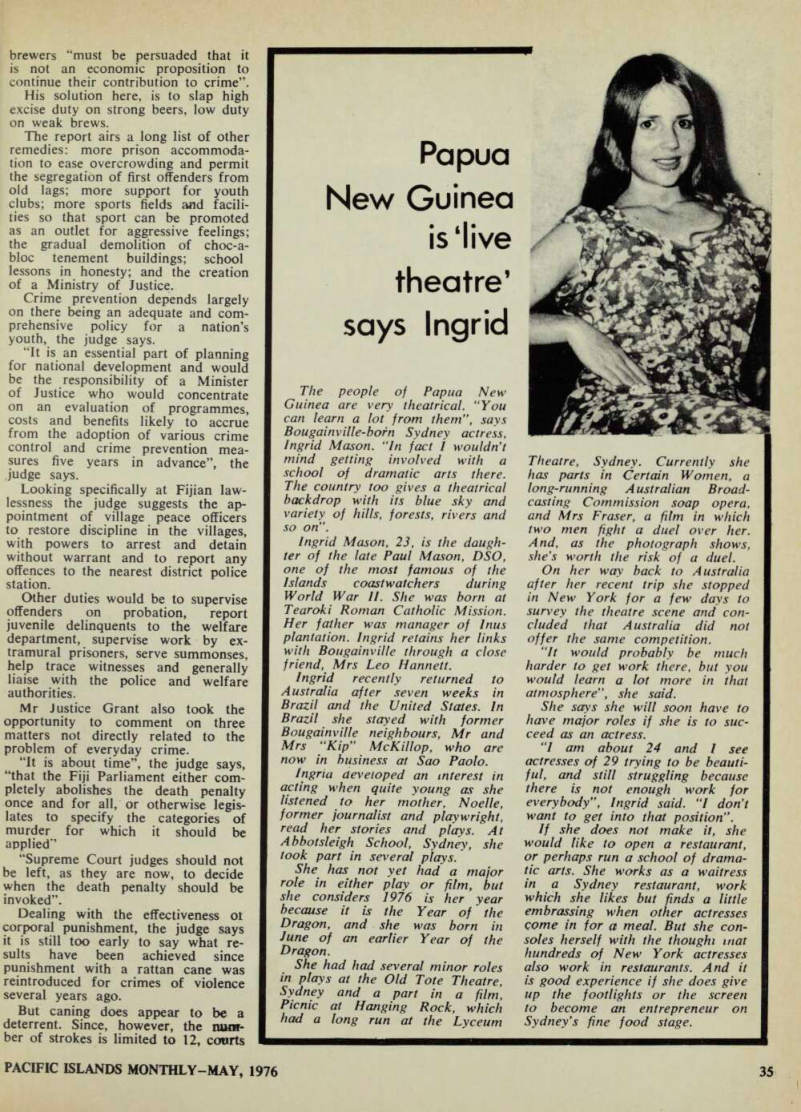
Papua New Guinea is‘live theatre’ says Ingrid
The people of Papua New Guinea are very theatrical. “You can learn a lot from them”, says Bougainville-born Sydney actress, Ingrid Mason. “In fact I wouldn’t mind getting involved with a school of dramatic arts there.
The country too gives a theatrical backdrop with its blue sky and variety of hills, forests, rivers and so on”.
Ingrid Mason, 23, is the daugh ter of the late Paul Mason, DSO, one of the most famous of the Islands coastwatchers during World War 11. She was born at Tearoki Roman Catholic Mission.
Her father was manager of Inus plantation. Ingrid retains her links with Bougainville through a close friend, Mrs Leo Hannett.
Ingrid recently returned to Australia after seven weeks in Brazil and the United States. In Brazil she stayed with former Bougainville neighbours, Mr and Mrs “Kip” McKillop, who are now in business at Sao Paolo.
Ingria developed an interest in acting when quite young as she listened to her mother, Noelle, former journalist and playwright, read her stories and plays. At Abbotsleigh School, Sydney, she took part in several plays.
She has not yet had a major role in either play or film, but she considers 1976 is her year because it is the Year of the Dragon, and she was born in June of an earlier Year of the Dragon.
She had had several minor roles in plays at the Old Tote Theatre, Sydney and a part in a film, Picnic at Hanging Rock, which had a long run at the Lyceum
Theatre, Sydney. Currently she has parts in Certain Women, a long-running Australian Broad casting Commission soap opera, and Mrs Fraser, a film in which two men fight a duel over her.
And, as the photograph shows, she’s worth the risk of a duel.
On her way back to Australia after her recent trip she stopped in New York for a few days to survey the theatre scene and con cluded that Australia did not offer the same competition.
“It would probably be much harder to get work there, but you would learn a lot more in that atmosphere”, she said.
She says she will soon have to have major roles if she is to suc ceed as an actress. ‘7 am about 24 and I see actresses of 29 trying to be beauti ful, and still struggling because there is not enough work for everybody”, Ingrid said. “I don’t want to get into that position”.
If she does not make it, she would like to open a restaurant, or perhaps run a school of drama tic arts. She works as a waitress in a Sydney restaurant, work which she likes but finds a little embrassing when other actresses come in for a meal. But she con soles herself with the thought mat hundreds of New York actresses also work in restaurants. And it is good experience if she does give up the footlights or the screen to become an entrepreneur on Sydney’s fine food stage.
Advertisements & other items, pp. 36-38 (1 item)
the Regent of Fiji
BOOK SPACE IN PARADISE
ll r t r:r ’■■'*'•• fJ iy.-, u .
•jtff&'ii
r «
pktm* .
i* aaai'l
KW: £j.Sg
ii«i^
** n«>
.»•■* ,v~£liS
The Regent of Fiji, with 300 gracious guest rooms, is paradise on the glistening Pacific shore.
Cordial, like a Fijian village, the Regent invites you to a treasure of Melanesian arts. The Sfeakhouse and The Terrace serve delicious food platters and a spectacular ocean-view.
What’s more, the Regent is well-mannered service: in-room phones, air conditioning, Fijian stewards, complete banquet/convention pavilion and duty free shopping.
And the Regent is sports: scuba, sailing, fishing, beachcombing, swimming and tennis . All in wave-free Nadi Bay.
Book space in paradise.
The Regent of Fiji—2o minutes from the airport.
POST OFFICE BOX 441 • NADI, FUI • PHONE 70700 ■ TELEX (792) 5214
Th^nf
the Regent of Fiji
DENARAU BEACH RESORT
PHONE COUfCT FOR RESERVATIONS
Mr. Rex Vrdler, Sydney, Australia Sales Office No. 1 York Street, 14th floor • Sydney, Australia 2000 Phone (02) 276469 In Auckland, New Zealand, phone Instant Hotels, 374921
STATESMAN
■ smoothest cigars on
i the international scene
SKE(fy
N
ISOI
SIS
STATESMAN
CORONA
5
Corona
X554-10/75
Arnott’s!
The taste of Australia
Milk A rrowroot A wholesome biscuit enjoyed by all the family.
Milk Coffee . A plain crisp biscuit to enjoy with coffee or tea.
Amort’s plain sweet biscuits are not too sweet, not too fancy. They’re just right for those times when you really want a biscuit to go with a cup of tea or coffee, or a glass of icy cold milk.
Discover the taste of Amott’s for
yourself.
with fine sugar.
Nice. A sweet biscuit sprinkled
226 s NET
Shredded WheatmeaL Crunchy, with the nutty flavour of baked wheatmeal.
G MilkJjoffee ;
BISCUITS * * ft,
-- * I & m m • i m •IS! £
<SHH3S^
nice
siscurrs Ornotts
nice
BISCUITS
Qrnott's™ Biscuits
There is no Substitute for Quality
W 639
Islands
From The
Press
“Must it be a concrete jungle” asks an editorial in The Fiji Times: Suva is fast becoming a city of skyscrapers. Gone are the days when the height of buildings was limited by the height of a coconut tree. Airy and elegant colonial architecture is a thing of the past and adapted traditional Fijian designs are practical only on spacious out-of-town sites. For space and economic reasons, buildings in urban areas must now go up instead of out. The results are often less than aesthetically pleasing. It appears that, however hard architects try, looming towers of glass and concrete remain towers of glass and concrete and not elegant, soaring monuments to design. . .
From the Arawa Bulletin: Father John Momis isn’t the most enthusiastic person about boarding aircraft. . . He was ushered, rather unwillingly into Somare’s private plane for the trip to Rabaul as a goodwill gesture on the part of the Prime Minister. When the plane landed safely in Port Moresby, he wondered why the plane had stopped so far away from the terminus. Wonder how he felt as they towed the plane across the tarmac it just couldn’t get there under its own steam as they’d come in on one engine!
From the Samoa Times: The Western Samoa Association of the Blind was given two second-hand cars this week, the biggest donation to the association so far, officials said. The children named the pick-up ‘Uncle Sam’ because it was from the Peace Corps and the aid was from the States, and the sedan ‘Aunty Nancy’ because they said the name goes well with Uncle Sam.
The uncertainties of Island living, as illustrated in the Norfolk Islander: Rawson Hall Talkies. Saturday, March 13th. No pictures to film. At the Mission Road Theatrette, Saturday, March 13th at 8.00 p.m. And Hope to Die. Subject to arrival. Sunday, March 14th. Pictures subject to film arriving Saturday. Monday, March 15th. Please ring 2069 for title of film from Saturday P.M.
The Micronesian Independent relays a cloak
and dagger story from Guam’s Pacific Daily
News:
Ruth Gilliam, now a Guam Bureau of Planning employee, told the newspaper the Navy’s desire to know “everything” that happens in Palau brought a job offer from Navy Intelligence to “spy” on Palau where the US has requested land to be used for military purposes. She was offered $5OO a month, trips to Japan for clandestine training, a secret radio transmitter receiver, tape recorder and monthly trips to Guam, said the newspaper.
From the Papua New Guinea Post-Courier:
A Bill outlawing direct sales to the public from breweries has been passed in Parliament. The Liquor Licensing Minister, Mr Lus, said that beer could only be obtained from bars, taverns and licensed storekeepers.
He said the Bill was aimed at cutting down on
black marketing.
From the Tonga Chronicle: A few areas of Tonga which have been tested for microfilariasis in the blood, revealed that about 70 per cent of the population tested is infected with filariasis. The youngest person to have filariasis was 20 months old. The highest count was 6000 worms in one drop of blood. The decision for mass treatment in Tonga comes from many sources, Studies by the Ministry of Health, assisted by the WHO and Dr Hitchcock in Niuatoputapu have shown the project is necessary.
Pressure from other Pacific countries where treatment is already instituted has also added to Tonga’s decision to rid all her people of filariasis. The project will affect every person living in Tonga.
Editorial in the Tohi Tala Niue, on Christmas and New Year in Niue (pop 3962): A lot of tradition associated with the festive season has been lost, take for instance this week, Prayer Week, was a week of feasting, playing of cricket and tripping round the Island on the back of a truck, walking or on push bikes, and some enterprising locals even paddling round the island in canoes. Why we have lost most traditions is because we are becoming westernised, and lazy, people now have more spending power and easier access to most things considered myths in the past. And just for the record, the Treasury Bond Store sold $26,055.64 worth of liquor over the festive season. . . but what really marred the season was the 21 accident cases, one so serious the RNZAF made a mercy flight to take them to New Zealand for specialised treatment. Most of these accidents were caused by drunken driving.
From the Arawa Bulletin:
Assistant manager of the Arawa Supermarket, Mr Dave Ross, said that at one stage they were buying empty beer cartons from S.P. Brewery for 15t each and selling them to customers for lOt. This proved so costly they abandoned the idea.
The Samoa Times reported, after being
unable to buy stamps at Apia Post Office for
three days:
People were turned off at the stamp booths with the story that there were no more stamps because the girl responsible for stamps was sick. What if the girl did not return, the reporter asked. “Then we would look for somebody else. It’s the people upstairs who handle that”, a girl at a booth replied. When the Director was notified of what was happening he ordered stamps to be on sale at once. . . “We have thousands of stamps, but the people downstairs are just too lazy to get on their feet and get the system going when the booths run hot”, he said.
Advertisements & other items, pp. 40-44 (1 item)
Vioaqi
m m
J
r ax*
* * I'.: HI 4 i * % « '•-!. ■ 9* ft *ft r 0 %
1 d % The Toyota truck range.
Built to be unbeatable.
Bad weather conditions, no problem.
Bad roads and driving surfaces, eaten up.
Difficult loads, no contest.
Built tough. Built to take it.
There's a Toyota truck built for you. \ TOYOTA Land Cruiser Pickup
TOYOTA Hi-Ace
TOYOTA Stout
TOYOTA Hi-Lux
TOYOTA Dyna
TOYOTA Toyo-Ace IB!
TOYOTA Truck
TOYOTA
For unbeatable after service: D^ Pl i A ' 9, UINEA: ELA MOTORS LIMITED, Scratchley Rd., Badili, P.O. Box 75, Port Moresby. U.S. TRUST TERRITORY: MICROL CORPORATION .0. Box 267, Saipan. FIJI ISLANDS: AUTOMOTIVE SUPPLIES CO., LTD., G.P.O. Box 355, Suva. AMERICAN SAMOA: BURNS PHILP (SOUTH SEA) o 105I 057 ’ Pa9 ° Pa9 °- WESTERN SAMOA: BURNS PHILP (SOUTH SEA) LTD., P.O. Box 188, Apia. GUAM: ATKINS, KROLL (GUAM) LTD on amunin9 ' NEW HEBRIDES; NEW HEBRIDES MOTORS LTD., P.O. Box 18, Vila. SOLOMON ISLANDS: MENDANA ENTERPRISES IPP" P ‘°' B ° X 174 ' Honiara - TA HITI: NIPPON AUTOMOTO, B.P. 342, Papeete. COOK ISLANDS: COOK ISLANDS TRADING CORPORATION LTD P.O. Box 92, Rarotonga. NAURU ISLAND: NAURU COOPERATIVE SOCIETY. GILBERT & ELLICE ISLANDS COLONY: TARAWA MOTORS B AM".' k 'cl a / aWa NORFOLK 'SLAND: MARIE'S NORFOLK TOURS, LTD., P.O. Box 276. TIMOR: SANG TAI HOO, Sang Tai Building, Dili. NEW CALEDONIA; SOCIETE IMPORTATION AUTOMOBILE DU PACIFIQUE, Rond Point du Pacific (Station Total) B.P. 438, Noumea.
The world over, more vehicles of all kinds roll on Goodyear tyres ... more planes land on Goodyear tyres ... more synthetic rubber is produced by Goodyear... and more different kinds of hose,
transmission belts, conveyor belts and other
industrial rubber goods bear the Goodyear trademark.
For leadership in rubber technology, look to Goodyear. The world s largest rubber company.
GOOD-YEAR
We solve industrial problems.
GOODYEAR DISTRIBUTORS IN S.E. ASIA AND PACIFIC BASIN Boroko Motors Ltd.
Port Moresby, PNG.
Guam Tire & Supply Co.
Agana, Guam Coral Island Motors Suva, Fiji Landis Brothers & Co. Ltd.
Hong Kong Solomon Motors Ltd.
Honiara, 8.5.1. P.
Susupe Enterprises Saipan, Mariana Is.
Societe General Automobile Noumea, New Caledonia Service Mobil Papeete, Tahiti Santo Engineers Santo, New Hebrides Micro! Corporation Saipan, Mariana Is.
W.S.T.C.S.
Western Samoa Samoa Motors Inc.
American Samoa Pacific Motors Vila, New Hebrides Yap Cooperative Ass.
Yap, W. Caroline Is.
Morris Hedstrom Ltd.
Apia, Western Samoa Buncombe Bay Garage Norfolk Is.
Truk Trading Co.
Truk, E. Caroline Is.
P.A.M.I.
Kolonia, Ponape Morris Hedstrom Tonga Cook Island Motors Cook Is.
Island Construction Co.
Majuro, Marshall Is.
Ngiratkel Etpison Co. Ltd.
Koror, Palau Yung Wei Tung Trading Co. Ltd.
Taipei, Taiwan A 557
THE SEIKO QUARTZ COLLECTION.
CHANGING THE WORLD'S
STANDARD OF ACCURACY.
The Seiko Quartz Collection encompasses a wide and exciting range of quartz watches for men and women. Quartz guaranteed accurate to within one second per month.
Ultra-thin quartz. Day/Date quartz. Digital quartz watches with liquid crystal display for continuous readout. Even a digital quartz chronograph. It's what you'd expect of Seiko.
Seiko sold the world's first quartz wrist watch. And Seiko's expertise in every phase of the watchmaking process makes it possible for Seiko to make any part of any Seiko watch, and to exercise a unique quality control system through every step from design to completion. Whichever Seiko Quartz model you select, you get more than just a technologically advanced timepiece. You* get the watch that's changing the world's standard of accuracy. Seiko Quartz.
SEIKO
Someday all watches will be made this way
ĎSFSDFD
Magazine
In his book Colonial Era Cemetery of Norfolk Island, published by Pacific Publications Pty Ltd in 1974, an ex-Administrator of Norfolk Island, Air Commodore R.N. Dalkin, DFC, demonstrated that a cemetery can be a rewarding starting-point for the amateur historian who is prepared to do some research into a particular aspect of history. His book has stimulated interest in the famous, infamous and lesser-known colonial figures who lie buried in the old cemetery at Kingston, Nor folk Island.
Air Commodore Dalkin was Administrator of the island for four years from 1968 to 1972. He holds a BA degree in history and politics from the Australian National University, Canberra, and has furthered his interest in history and cemeteries in a recent tour of historical sites and battlefields in Greece, including Crete and the islands, western Turkey, Egypt and Lebanon. In doing so he has covered some fascinating ground, some having links with Norfolk Island in which he retains a deep interest, as this article indicates.
Forever Norfolk
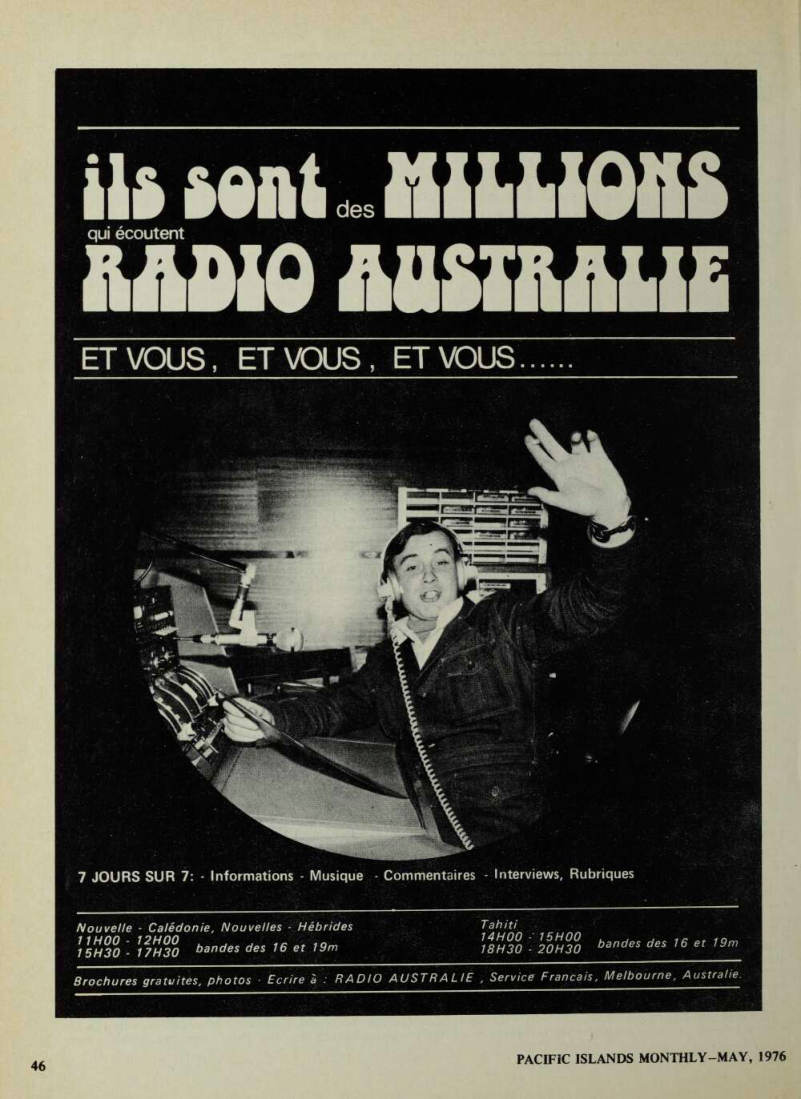
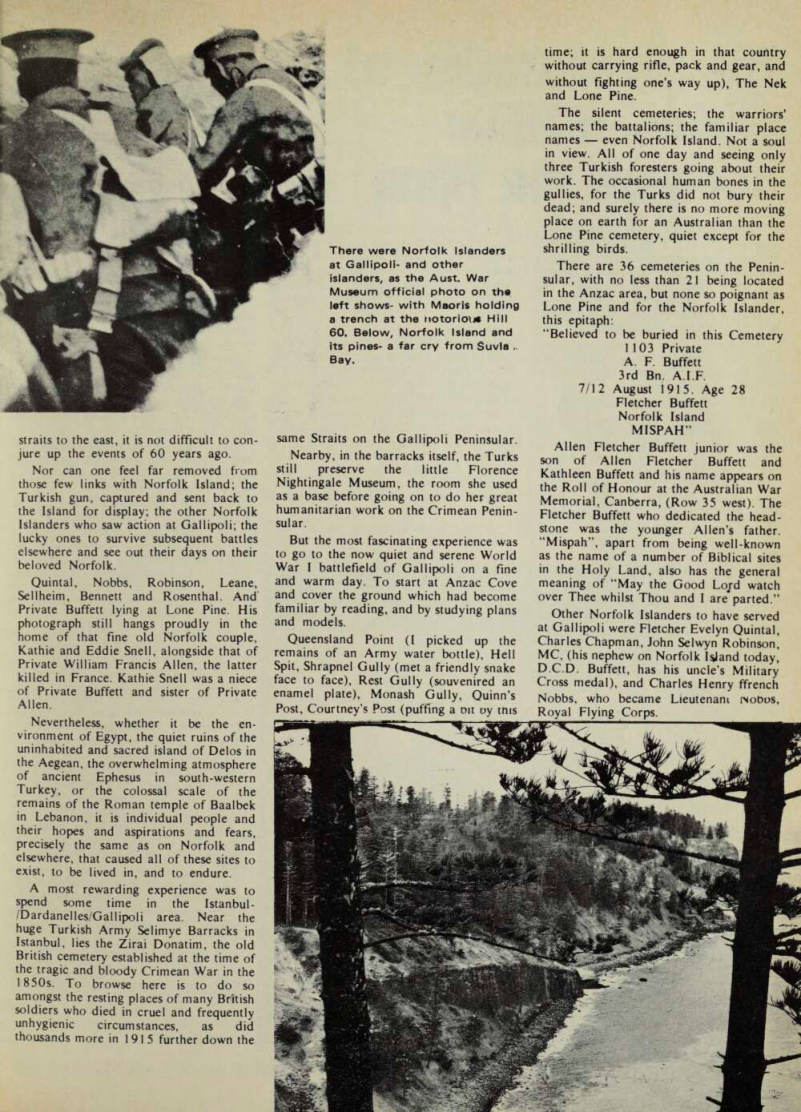
A Corner Of A
Foreign Field Which Is
a ™£ te 'i‘ r . histor '® 1 ’ and archaeologist is unlikely to find any connections with Norfolk Island in the nreserved inmh/nfn Q “ eensthe N. ile galley of Egypt, where to browse through the incredibly well preserved tombs of Queen Hapshetsut, King Tuthankamen, Ramses VI and Amenophis 11, and to examine ocietiTs of ove 000 P eS ° f is to bring home the fact that The spiritually-onented problems** perhaps make Australia's periodic “constitutional crises, much less little Norfolk s worries, pale indeed into insignificance.
A number of military officers who were S°. au™f Admin,strators of Norfolk island had connections with the fighting and adventures on Gallipoli. Of the eight
Sffit
buf 'two e ( MV W Mu?p7y a Ud 1 Mr 9 Jusuce C E eight, Herbert and Sellheim, died on Norfolk Island and are buried there Of the six soldiers, four had a connection with
Gallipoli.
Colonel Edwin Thomas Leane, CBE, VD, served as Administrator from July 1 924 to October 1 926. He does not seem to have actually served at Gallipoli but was in the large supporting base in Cairo on the staff of the then Colonel Sellheim.
E.T. Leane is not to be confused with Brigadier R.L. Leane, CB, CMG, DSO, MC, (of Leane’s Trench fame) who landed early in the Gallipoli campaign and surfighting generals. ° f AUStral ' a * The adm inistrati °n of E.T. Leane on rfolk, however, ended with his removal
from office after the Royal Commission of 1926 headed by Francis Whysall had recommended “That in the interests of the Commonwealth and Norfolk Island, the present Administrator be recalled without
delay.”
Leane was succeeded by his previous boss in Cairo, Major General Victor Conradsdorf Morisset Sellheim, CB, CMG, who died in office within a year of his arrival at Norfolk.
In Cairo, Sellheim had had the difficult and often thankless task of providing sup port to the troops on Gallipoli and he was bitterly disappointed at not being given a fighting command there. Sellheim’s mother was one of the six daughters of the colonial-era Commandant of the penal settlement on Norfolk, Lieutenant Colonel James T. Morisset, who was probably the first officer in charge to occupy the present Government House in the early 1830 s.
Colonel Alfred Joshua Bennett, CMG, DSO, VD, who served as Administrator from 1 May 1929 to 30 June 1932, par ticipated in much of the savage fighting at
Gallipoli, but it was that redoubtable soldier, architect and musician, Major General Sir Charles Rosenthal, KCB, CMG, DSO, VD, probably Norfolk Island’s greatest Administrator (4 Decem ber 1937 to 31 December 1945) whose name shone brightest at Gallipoli. He had an important feature, Rosenthal’s Ridge, named after him.
Rosenthal was the artillery commander and an original Anzac who landed with his 3rd Australian Artillery Brigade on 25 April 1915. He was twice wounded at
Gallipoli, being evacuated once to Egypt
and once to England. Rosenthal later commanded the 2nd Australian Division in France with great distinction up to the end of World War I. On the Western Front in June 1918 he was wounded for the fifth time. Many of the older residents of Norfolk Island today speak with af fection and deep respect of Rosenthal and his dedication to Island affairs.
Relaxing on the heights of the Gallipoli Peninsular in May of 1975, with the hazy island of Imbros to the west and parts of the Asian continent visible across the
straits to the east, it is not difficult to con jure up the events of 60 years ago.
Nor can one feel far removed from those few links with Norfolk Island; the Turkish gun, captured and sent back to the Island for display; the other Norfolk Islanders who saw action at Gallipoli; the lucky ones to survive subsequent battles elsewhere and see out their days on their beloved Norfolk.
Quintal, Nobbs, Robinson, Leane, Sellheim, Bennett and Rosenthal. And Private Buffett lying at Lone Pine. His
photograph still hangs proudly in the
home of that fine old Norfolk couple, Kathie and Eddie Snell, alongside that of Private William Francis Allen, the latter killed in France. Kathie Snell was a niece of Private Buffett and sister of Private Allen.
Nevertheless, whether it be the en vironment of Egypt, the quiet ruins of the uninhabited and sacred island of Delos in the Aegean, the overwhelming atmosphere of ancient Ephesus in south-western Turkey, or the colossal scale of the remains of the Roman temple of Baalbek in Lebanon, it is individual people and their hopes and aspirations and fears, precisely the same as on Norfolk and elsewhere, that caused all of these sites to exist, to be lived in, and to endure.
A most rewarding experience was to spend some time in the Istanbul /Dardanelles/Gallipoli area. Near the huge Turkish Army Selimye Barracks in Istanbul, lies the Zirai Donatim, the old British cemetery established at the time of the tragic and bloody Crimean War in the 1850 s. To browse here is to do so amongst the resting places of many British soldiers who died in cruel and frequently unhygienic circumstances, as did thousands more in 1915 further down the
same Straits on the Gallipoli Peninsular.
KT . • u u . . .. . „ , Nearby, m the barracks itself, the Turks still preserve the little Florence Nightingale Museum, the room she used as a base before going on to do her great humanitarian work on the Crimean Pemnsu ar> But the most fascinating experience was to go to the now quiet and serene World War I battlefield of Gallipoli on a fine and warm day. To start at Anzac Cove and cover the ground which had become familiar by reading, and by studying plans n mo e s.
Queensland Point (I picked up the remains of an Army water bottle), Hell Spit, Shrapnel Gully (met a friendly snake face to face), Rest Gully (souvenired an enamel plate), Monash Gully, Quinn s Post, Courtney’s Post (puffing a on oy inis
time; it is hard enough in that country without carrying rifle, pack and gear, and without fighting one’s way up), The Nek and Lone Pine.
The silent cemeteries; the warriors’ names; the battalions; the familiar place names even Norfolk Island. Not a soul in view. All of one day and seeing only three Turkish foresters going about their work. The occasional human bones in the gullies, for the Turks did not bury their dead; and surely there is no more moving place on earth for an Australian than the Lone Pine cemetery, quiet except for the
shrilling birds.
There are 36 cemeteries on the Penin sular, with no less than 21 being located in the Anzac area, but none so poignant as Lone Pine and for the Norfolk Islander,
this epitaph;
“Believed to be buried in this Cemetery 1103 Private A. F. Buffett 3rd Bn. A.I.F. 7/12 August 1915. Age 28 Fletcher Buffett Norfolk Island
Mispah”
Allen Fletcher Buffett junior was the son of Allen Fletcher Buffett and Kathleen Buffett and his name appears on the Roll of Honour at the Australian War Memorial, Canberra, (Row 35 west). The Fletcher Buffett who dedicated the head stone was the younger Allen’s father.
“Mispah”, apart from being well-known as the name of a number of Biblical sites in the Holy Land, also has the general meaning of “May the Good Lo/d watch over Thee whilst Thou and I are parted.”
Other Norfolk Islanders to have served at Gallipoli were Fletcher Evelyn Quintal, Charles Chapman, John Selwyn Robinson, MC, (his nephew on Norfolk Island today, D.C.D. Buffett, has his uncle’s Military Cross medal), and Charles Henry ffrench Nobbs, who became Lieutenani rsobos,
Royal Flying Corps.
There were Norfolk Islanders at Gallipoli- and other islanders, as the Aust. War Museum official photo on the left shows- with Maoris holding a trench at the notorio[?] Hill 60. Below, Norfolk Island and its pines- a far cry from Suvla Bay.
Advertisements & other items, p. 46 (1 item)
Aamo Ahmraue
u» Mat«auuon&
qui ecoutent
ETVCXJS, ETVOUS, ETVOUS
i I nn 7 JOURS SUR 7; - Informations - Musique - Commentaires - Interviews, Rubriques Nouvelle - Caledonie, Nouvelles - Hebrides 11H00 - 12H00 , , , - 1Q 15H30 - 17H30 Landes des 16 et 19m Tahiti 18H30 - 20H30 bandes des 16 et 19m Brochures gratvites, photos - Ecrire a : RADIO A USTR A LIE , Service Francais, Melbourne, Australia.
power-a Fijian
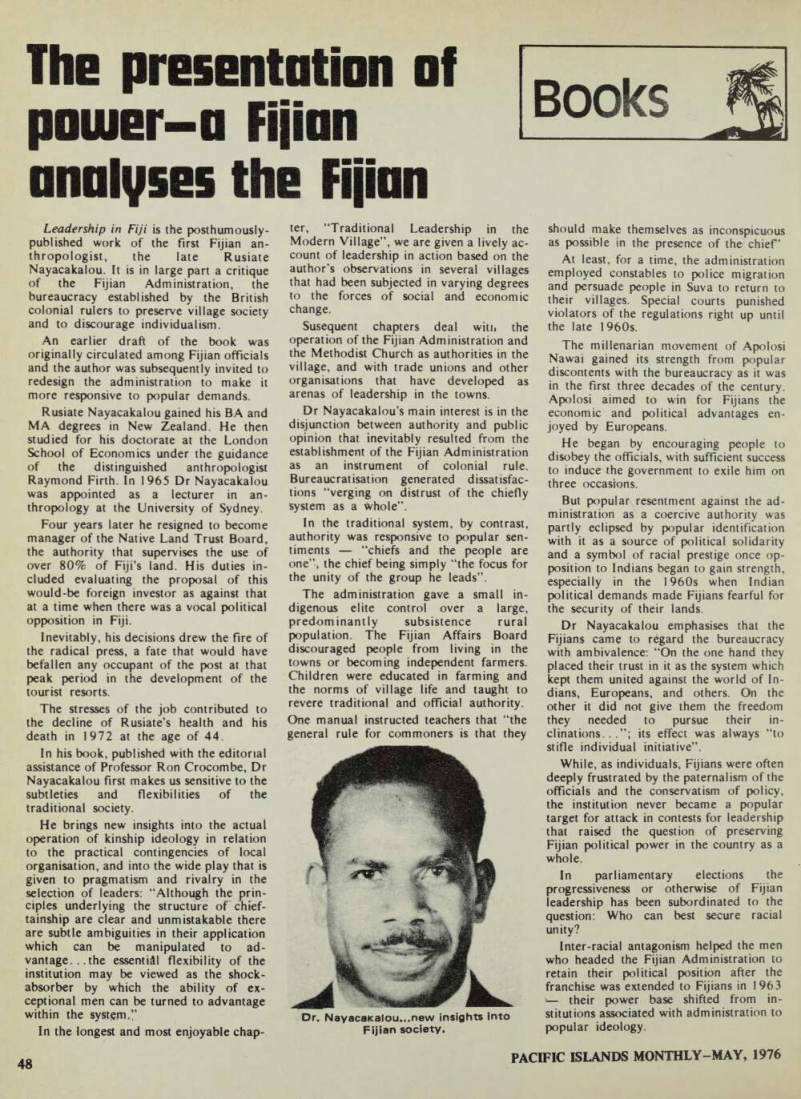
The presentation nf power-a Fijian analyses the Fijian
Books
Leadership in Fiji is the posthumously published work of the first Fijian an thropologist, the late Rusiate Nayacakalou. It is in large part a critique of the Fijian Administration, the bureaucracy established by the British colonial rulers to preserve village society and to discourage individualism.
An earlier draft of the book was originally circulated among Fijian officials and the author was subsequently invited to redesign the administration to make it more responsive to popular demands.
Rusiate Nayacakalou gained his BA and MA degrees in New Zealand. He then studied for his doctorate at the London School of Economics under the guidance of the distinguished anthropologist Raymond Firth. In 1965 Dr Nayacakalou was appointed as a lecturer in an
thropology at the University of Sydney.
Four years later he resigned to become manager of the Native Land Trust Board, the authority that supervises the use of over 80% of Fiji’s land. His duties in cluded evaluating the proposal of this would-be foreign investor as against that at a time when there was a vocal political
opposition in Fiji.
Inevitably, his decisions drew the fire of the radical press, a fate that would have befallen any occupant of the post at that peak period in the development of the tourist resorts.
The stresses of the job contributed to the decline of Rusiate’s health and his death in 1972 at the age of 44.
In his book, published with the editorial assistance of Professor Ron Crocombe, Dr Nayacakalou first makes us sensitive to the subtleties and flexibilities of the
traditional society.
He brings new insights into the actual
operation of kinship ideology in relation
to the practical contingencies of local organisation, and into the wide play that is given to pragmatism and rivalry in the selection of leaders: “Although the prin ciples underlying the structure of chief tainship are clear and unmistakable there are subtle ambiguities in their application which can be manipulated to ad vantage. . .the essential flexibility of the institution may be viewed as the shock absorber by which the ability of ex ceptional men can be turned to advantage within the system.”
In the longest and most enjoyable chap
ter, “Traditional Leadership in the Modern Village”, we are given a lively ac count of leadership in action based on the author’s observations in several villages that had been subjected in varying degrees to the forces of social and economic change.
Susequent chapters deal with the operation of the Fijian Administration and the Methodist Church as authorities in the village, and with trade unions and other organisations that have developed as arenas of leadership in the towns.
Dr Nayacakalou’s main interest is in the disjunction between authority and public opinion that inevitably resulted from the establishment of the Fijian Administration as an instrument of colonial rule.
Bureaucratisation generated dissatisfac tions “verging on distrust of the chiefly system as a <vhole”.
In the traditional system, by contrast,
authority was responsive to popular sen
timents “chiefs and the people are one”, the chief being simply “the focus for the unity of the group he leads”.
The administration gave a small in digenous elite control over a large, predominantly subsistence rural population. The Fijian Affairs Board discouraged people from living in the towns or becoming independent farmers.
Children were educated in farming and the norms of village life and taught to revere traditional and official authority.
One manual instructed teachers that “the general rule for commoners is that they
should make themselves as inconspicuous as possible in the presence of the chief’
At least, for a time, the administration employed constables to police migration and persuade people in Suva to return to their villages. Special courts punished violators of the regulations right up until the late 19605.
The millenarian movement of Apolosi Nawai gained its strength from popular discontents with the bureaucracy as it was in the first three decades of the century.
Apolosi aimed to win for Fijians the economic and political advantages en
joyed by Europeans.
He began by encouraging people to disobey the officials, with sufficient success to induce the government to exile him on three occasions.
But popular resentment against the ad ministration as a coercive authority was
partly eclipsed by popular identification
with it as a source of political solidarity and a symbol of racial prestige once op position to Indians began to gain strength, especially in the 1960 s when Indian political demands made Fijians fearful for the security of their lands.
Dr Nayacakalou emphasises that the Fijians came to regard the bureaucracy with ambivalence: “On the one hand they placed their trust in it as the system which kept them united against the world of In dians, Europeans, and others. On the other it did not give them the freedom they needed to pursue their in clinations..its effect was always “to stifle individual initiative”.
While, as individuals, Fijians were often deeply frustrated by the paternalism of the officials and the conservatism of policy, the institution never became a popular target for attack in contests for leadership that raised the question of preserving Fijian political power in the country as a whole.
In parliamentary elections the progressiveness or otherwise of Fijian leadership has been subordinated to the question; Who can best secure racial
unity?
Inter-racial antagonism helped the men who headed the Fijian Administration to retain their political position after the franchise was extended to Fijians in 1963 their power base shifted from in stitutions associated with administration to
popular ideology.
Dr. NayacaKalou...new insights into Fijian society.
This brings me to my criticism of the book. It makes little attempt to relate the operation of Fijian Administration to the interests and conflicts of particular sec tions of society, especially in inter-racial relations.
The institution created a social and political elite whose members acquired a vested interest in its preservation. As heads of the administration, chiefs and com moners alike were reluctant to promote social and economic change partly from fear that it would undermine their position by weakening official power and diver sifying the interests of the people.
Dr Nayacakalou dismisses with a derisive exclamation mark the suggestion by some of his informants that con servative ideals were preached by the chiefs to keep themselves in a privileged position. But there is more than a grain of truth in this notion and to acknowledge that would be to introduce a rather dif ferent perspective to the study.
Europeans, both officials and businessmen, wished to support a strong conservative Fijian leadership that would restrain social changes that might strengthen opposition to industrial management and demands for political reforms, and give Fijians reasons to oc casionally unite with Indians as some did in the big strikes of 1959-60, events that are largely ignored in the book.
Europeans also sought allies among the Fijian leaders to strengthen their position against Indian leaders who were calling for the reduction of European political
privileges.
Hence, we find Europeans generally en dorsing the institutions in which con servative Fijian leaders built their positions, and Fijians being brought up to revere as sacred the alliance of their leaders with the Europeans.
The conservatism of Fijian Ad ministration was validated by an ideology that stressed the moral integrity and loyalty of the Fijians and attributed these virtues to the traditional society as this was said to be preserved through the colonial institutions.
One of the first things I noted when doing research in Fiji in the late 19605, initially under Dr Nayacakalou’s super
vision, was how Europeans were generally
inclined to contrast these reputed virtues with alleged demerits of the Indians: In
dians were often depicted as calculating,
materialistic, and exploiting.
In truth, the Europeans were defen sively exaggerating the very qualities that made the Indians their rivals in com merce, professions, and politics, and
lauding the Fijians for being gracefully
-ontented with their humble positions in he economy as subsistence villagers or iocile wage-workers disinclined to question the status quo.
One of the ironic twists in Fijian history is that the very impediments the Fijian Administration placed in the way of economic development helped to create anxieties that then made the institution popular as a framework and symbol of racial unity, and encouraging Fijians to be more concerned with maintaining political power than with reducing the economic
inequalities.
Aside from guaranteeing control of land and increasing career opportunities in the civil service, the preservation of power has had an intrinsic value for Fijians, enhan cing their sense of honour in the wider society rather than providing a lever for gaining real economic advantages. Indeed it has provided a safe setting for the con tinuation of foreign hegemony in major in dustries.
My point is that an examination of the Fijian Administration ought to give some attention to the influence of political in terests, some of which I have indicated, and also to political consequences that bear on the situations of interest groups
today.
But perhaps to effect liberal changes in Fijian government Dr Nayacakalou found it necessary to take the diplomatic path of
locating his peoples’ “problems” simply in
the form of their institutions rather than in the interests, conflicts, and alliances of particular groups and strata.
There is a story in Fiji, perhaps
apocryphal, that Apolosi Nawai blessed the family of Rusiate Nayacakalou and assured his father of his son’s future fame.
Rusiate’s boyhood village, Draubuta, was indeed one of the main centres of Apolosi’s commercial ventures, and his father was one of Apolosi’s most devoted hosts there. Unlike his legendary patron, Rusiate was able to stimulate change from within the system itself, realising the popular hope that an educated commoner would one day persuade the chiefly establishment to relax its grip on the people.
Yet, though Fijians now elect their leaders at both local and national levels, they have come little closer to achieving effective power in their economy than in the days when Apolosi organised his Viti Kabani (Fiji Company). Robert Norton
(Leadership In Fiji By Rusiate
Nayacakalou. Published by Oxford University Press, Melbourne. Cloth $l4. paper $6.50.)
Advertisements & other items, pp. 49-50 (1 item)
Pukari
MAPS AND PRINTS
OF THE OLD PACIFIC
Original antiquarian Pacific views and maps for sale. Enquiries invited stating areas of interest.
C. HINCHCLIFFE, 7 Royd Avenue, Heckmondwike, West Yorkshire, WFI6 9AL, United Kingdom.
NEW from TOFUA PRESS:
PUKARI
VOICES OF PAPUA NEW GUINEA
by Sogeri Senior High School students of Papua New Guinea, edited by Barry Ison.
Creative expression in art, poetry, story, and song. Lavishly illustrated. 112 pages, 28x21.5 cm. $5.95 U.S. inquire about our other titles Please add $.60 postage and handling for all pacific areas. Trade discounts available.
TOFUA PRESS. 10457-F ROSELLE ST.
SAN DIEGO, CALIF. 92121. U.S.A.
No one comes out of this phase
of Micronesia’s history
looking good . . .
iS not the Congress
r> not the Executive
iS not the United Nations
is not even the Micronesians.
The story of America’s effort to reconcile
Micronesian self-determination with U.S.
strategic interests.
ICRONESIA:
TRUST BETRAYED
IVlention Kwajalein, Saipan, Peleliu, Tinian and awaken the memories of millions who followed the advance of American forces after Pearl Harbor.
What has happened to those remote, exotic islands—the islands of Micronesia—since the U.S. captured them from Japan?
Micronesia presented us with a dilemma: how to reconcile U.S. views in favor of selfgovernment with the belief that U.S. control of Micronesia was required to maintain international peace and security.
In 1947 the U.S. postponed a solution. Micronesia was placed under a U.N. Trusteeship which allowed the U.S. continued military control of the islands.
But the U.N. agreement specified that self-determination be promoted in Micronesia as in all other eleven Trusts.
Now, in 1976, colonialism, even in the form of trusteeship, is an outmoded concept. Micronesia is the only Trust Territory left. All the others—Togoland, Somaliland, Tanganyika, New Guinea, etc. —have achieved independence or joined other independent states. Trust Betrayed traces U.S. attempts to negotiate a new status for Micronesia while maintaining “control” for military purposes. Out of this effort have grown plans for a new Marianas Commonwealth.
- sxtm&o
The Carnegie Endowment for International Peace t 45 Fast 46th Street. New York Citv 10017 345 East 46th Street, New York City 10017 Please send me copies of TRUST BETRAYED Name Address Paperback: $4.95; Hardcover:* 10.00. Add 55c for handling on all invoiced orders. □ Bill me
Expires
□ Check enclosed □ Bankamericard rIM GS
(39 Carnegie
Endowment For International Peace
The Carnegie Endowment for
International Peace
345 East 46th Street New York, New York 10017
Explorers
and museums
This small book, 100 Years of Australian Scientific Explorations, profusely illustrated and well presented, commemorates the centenary of Sir William Macleay’s scientific expedition to New Guinea.
It consists of 14 brief essays, by six authors, on some of the people who have made notable contributions to the scien tific exploration of Australia.
The two essays by Dr Peter Stanbury, the editor, are of special interest to Pacific Islanders.
One of the two essays deals with Baron Mikloucho-Maclay, who made several visits to New Guinea between 1871 and 1883, (C.L. Sentinella’s excellent English translation of Maclay’s New Guinea diaries was reviewed by Judy Tudor in PIM, December, 1975.) Stanbury’s other essay is about Sir William Macleay (no relation of the Russian scientist), squatter, Member of Parliament and scientist, who bought the Chevert, a 300-tonner ship, in 1 875 and, accompanied by several scientists, took her on a voyage along the Papuan coast which yielded a rich harvest of an thropological, zoological and other scien
tific specimens.
Dr Stanbury is curator of the Macleay Museum, Sydney, which has a fine ethnological collection, the basis of which comes from the Chevert expedition and from Mikloucho-Maclay’s studies in Melanesia and Micronesia.
The Macleay Museum is mainly con cerned with zoology, insects, 19th century technology and anthropology. It is situated within the University of Sydney and open to public viewing between 8.30 am and 4.30 pm, Monday to Friday.
Sydney has two other museums and an art gallery which contain much of con siderable interest to Pacific Islanders. The Museum of Applied Arts and Sciences (659 Harris Street, Ultimo) opens 10am to 5 pm, Monday to Saturday; 2 pm to 5 pm, Sunday, except Good Friday and Christmas Day, displays models of ships which sailed the South Pacific, and it holds the diaries of Lawrence Hargrave, the aviation pioneer who made several visits to New Guinea.
The Art Gallery of New South Wales (Domain, open 10am to 5 pm, Monday to Saturday; 1 2 noon to 5 pm, Sunday) has a fine collection of Australian aboriginal and Melanesian art, and a number of paintings in its excellent assembly, eg Race
to the Market, Tahiti, painted by Nicholas Chevalier in 1880, are of particular in terest.
Over 600,000 people a year visit the Australian Museum, College Street, which is open from 10am to 5 pm, Tuesday to Saturday; 12 noon to 5 pm, Sunday and Monday.
It contains an excellent educational and general interest display of the evolution of our planet, an equally meritorious show of the fauna of Australia and Papua New Guinea, and other displays of much in terest. Even so, the Pacific collections will probably rank first with visitors from the Islands.
The foundation of these collections was laid between 1885 and 1900 with the acquisition of more than 4,000 items from six collectors in New Guinea and other parts of Melanesia. Among them are items from the Solomons and Bismarck Ar
chipelago purchased from Thomas
Farrell, Richard Parkinson and Mrs Kolbe (Queen Emma).
There are also about 200 malaggan carvings from New Ireland and many dance paddles from Buka. Among the 183 items collected during Cook’s voyages, which the museum bought in 1 890, there are a woven breast-plate worn for protection in battle and made from sinnet, feathers, shark’s teeth, pearl shell and dog hair, which was acquired by Cook in the Society Islands on his first voyage, and a woven helmet from Hawaii, said to have been presented to Cook by King
Halaviopuie (Kalaniopu) in 1779 shortly
before Cook’s death.
Nearly every major region of the mainland of Papua New Guinea is represented in the Australian Museum’s collections, eg more than 1,000 items
from Collingwood and Goodenough Bays on the north-east coast of Papua, presen ted by the Rev Percy Money, an Anglican missionary, between 1904 and 1914, and the H. D. Eve collection, made along the Middle Sepik and received in 1938, which contains a large number of decorated bamboo smoking pipes.
There is, too, the largest donation to the museum; the entire contents of the late Melbourne Ward’s private museum at Katoomba. This collection numbers more than 5,000 specimens from every part of the Pacific and it is particularly strong on Melanesia, including Papua New Guinea.
The museum’s policy of presenting as fully as possible each Island group of Melanesia and other regions of the Pacific, to let visitors see some of the secular and religious past and present of the peoples, is an excellent one.
As Dr Jim Specht, Curator of An thropology, puts it, “there are many museums throughout the world which may have better collections from specific areas, but few, if any, which can offer the geographical scope and depth of the Australian Museum.'”
This museum does not only help Australian and other Western visitors to gain a better appreciation of the peoples of the Pacific; it also enables visiting Pacific Islanders to see items which reflect the skill, artistry and, indeed, the way of life of their ancestors items which are often no longer found in the islands.
Harry Jackman
(100 Years Of Australian Scien
Tific Explorations.
By P. Stanbury. Published by Holt, Rinehart and Winston, Sydney, 1975 $4.95.)
Father And Son
By Ruperake Petala
He comes home now his mind filled with the wisdom of the Papalagi.
Your son has done well at school, and you are proud and show him off to friends for their congratulations, for you had wanted it all this way.
Suddenly he speaks and you don’t want to hear him.
He dresses and you don’t want to see him.
He tries to explain himself but you say he’s just a trying-to-be-smart-little-cheek who’s had too much education.
I wonder where in the darkness you lost each other, father and son?
Business
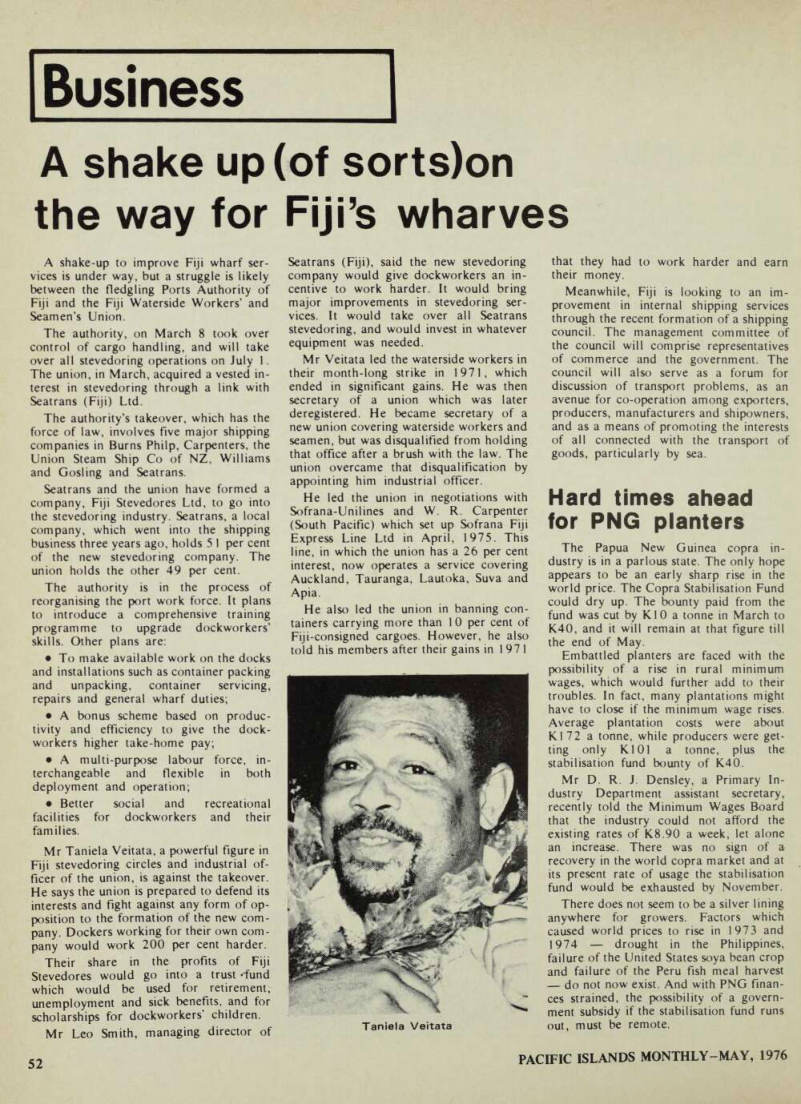
A shake up (of sorts)on the way for Fiji’s wharves
A shake-up to improve Fiji wharf ser vices is under way, but a struggle is likely between the fledgling Ports Authority of Fiji and the Fiji Waterside Workers’ and Seamen’s Union.
The authority, on March 8 took over control of cargo handling, and will take over all stevedoring operations on July 1.
The union, in March, acquired a vested in terest in stevedoring through a link with Seatrans (Fiji) Ltd.
The authority’s takeover, which has the force of law, involves five major shipping companies in Burns Philp, Carpenters, the Union Steam Ship Co of NZ, Williams and Gosling and Seatrans.
Seatrans and the union have formed a company, Fiji Stevedores Ltd, to go into the stevedoring industry. Seatrans, a local company, which went into the shipping business three years ago, holds 5 1 per cent of the new stevedoring company. The union holds the other 49 per cent.
The authority is in the process of reorganising the port work force. It plans to introduce a comprehensive training programme to upgrade dockworkers’ skills. Other plans are: • To make available work on the docks and installations such as container packing and unpacking, container servicing, repairs and general wharf duties; • A bonus scheme based on produc tivity and efficiency to give the dock workers higher take-home pay; • A multi-purpose labour force, in terchangeable and flexible in both
deployment and operation;
• Better social and recreational facilities for dockworkers and their families.
Mr Taniela Veitata, a powerful figure in Fiji stevedoring circles and industrial of ficer of the union, is against the takeover.
He says the union is prepared to defend its interests and fight against any form of op position to the formation of the new com pany. Dockers working for their own com pany would work 200 per cent harder.
Their share in the profits of Fiji Stevedores would go into a trust «fund which would be used for retirement, unemployment and sick benefits, and for scholarships for dockworkers’ children.
Mr Leo Smith, managing director of
Seatrans (Fiji), said the new stevedoring company would give dockworkers an in centive to work harder. It would bring major improvements in stevedoring ser vices. It would take over all Seatrans stevedoring, and would invest in whatever equipment was needed.
Mr Veitata led the waterside workers in their month-long strike in 1971, which ended in significant gains. He was then secretary of a union which was later deregistered. He became secretary of a new union covering waterside workers and seamen, but was disqualified from holding that office after a brush with the law. The union overcame that disqualification by appointing him industrial officer.
He led the union in negotiations with Sofrana-Unilines and W. R. Carpenter (South Pacific) which set up Sofrana Fiji Express Line Ltd in April, 1975. This line, in which the union has a 26 per cent interest, now operates a service covering Auckland, Tauranga, Lautoka, Suva and
Apia.
He also led the union in banning con tainers carrying more than 10 per cent of Fiji-consigned cargoes. However, he also told his members after their gains in 1971
that they had to work harder and earn their money.
Meanwhile, Fiji is looking to an im provement in internal shipping services through the recent formation of a shipping council. The management committee of the council will comprise representatives of commerce and the government. The council will also serve as a forum for discussion of transport problems, as an avenue for co-operation among exporters, producers, manufacturers and shipowners, and as a means of promoting the interests of all connected with the transport of
goods, particularly by sea.
Hard times ahead
for PNG planters
The Papua New Guinea copra in dustry is in a parlous state. The only hope appears to be an early sharp rise in the world price. The Copra Stabilisation Fund could dry up. The bounty paid from the fund was cut by KlO a tonne in March to K4O, and it will remain at that figure till the end of May.
Embattled planters are faced with the possibility of a rise in rural minimum wages, which would further add to their troubles. In fact, many plantations might have to close if the minimum wage rises.
Average plantation costs were about K 172 a tonne, while producers were get ting only KlOl a tonne, plus the stabilisation fund bounty of K4O.
Mr D. R. J. Densley, a Primary In dustry Department assistant secretary, recently told the Minimum Wages Board that the industry could not afford the existing rates of K 8.90 a week, let alone an increase. There was no sign of a recovery in the world copra market and at its present rate of usage the stabilisation fund would be exhausted by November.
There does not seem to be a silver lining anywhere for growers. Factors which caused world prices to rise in 1973 and 1974 drought in the Philippines, failure of the United States soya bean crop and failure of the Peru fish meal harvest do not now exist. And with PNG finan ces strained, the possibility of a govern ment subsidy if the stabilisation fund runs out, must be remote.
Taniela Veitata
Fiji plan for
sun-dried timber
The Fiji Forestry Department is ex
perimenting with a solar kiln to dry tim ber. The kiln at the department’s timber utilisation division at Nasinu, is capable of handling 2,000 super ft of timber. It is claimed that the drying time, compared with air drying, is reduced by half.
Glass has been used for the roof and walls of the kiln. Crushed rock is laid on the floor to store heat. The highest tem perature recorded in the kiln is 46 deg C.
Such kilns could be used by small timber producers and furniture makers who dry their own timber.
The only power needed in the kiln is that used to drive an air circulating fan.
Ok Tedi copper’s
golden glitter
A firm decision about the Ok Tedi copper project is required by June 30 un der an agreement between the Papua New Guinea Government and Broken Hill Co
Pty Ltd.
Under the agreement BHP is required to form a consortium to decide whether the project is economically feasible. The estimated cost of the mine, in 1975 currency, is between K 350 million and K4OO million.
The PNG Prime Minister, Mr Michael Somare, speaking in parliament on the bill to authorise the agreement, said that if BHP’s early work established there were 250 million tonnes of ore containing .85 per cent copper, the mine would support 40,000 tons a day mining operation for 20 years.
Using the experience gained in the
development of the Bougainville Copper
Ltd mine, the PNG Government has negotiated an agreement “far superior” to the Bougainville agreement. The PNG Government will receive a 20 per cent
equity, unless a bigger share is agreed.
Anything above a “fair and reasonable” return for BHP will go to the PNG people in taxes. There will also be normal cor n?s r t a yea a r nd of o^ilon'’ 8 tam from ,he BHP is reported to be looking for partners in the US, Japan and Germany. There are no plans yet for a refinery, but the BHP survey will include evaluation of a smelter.
Speaking at a Commonwealth foreign investment seminar, Mr Somare said the drilling programme at Ok Tedi was proceeding ahead of schedule.
A programme was also continuing to define the mineral potential of the liltalmm area m West Sepik Province and there were plans to carry out a helicopterborne magnetomeler and electro-magnet survey of other areas. 8 , thP rCS ! IB T! fr ° m the first 1,300 metres of the 3,000 metre drilling programme at Ok Tedi. Of six holes drilled at the end of February, four had significant intersections of copper ore and a fifth had gold values P r- ,• . ,-_ ar ,er surve y s m tbe area suggested 137 million tonnes averaging 0.88 per cent copper. The latest drilling programme is designed to discover ad-
ditional reserves which would allow a higher rate of mining and give the mine a longer life. u give me mine a
Tourist recession
hits N. Hebrides
There was an 8 per cent drop in the number of tourists visiting the New Hebrides in 1975, compared with 1974. °i ° ther areaS ’ and in ''f l6 th forecast s made two or three years f more . v,s,tors fr,T7iapan jmber of arrivals m 1975 was 15,838, made up of New Caledonia, 5,761; Australia, 4,243; New Zealand 1,880; US, 828; Japan, 631; France,’ 547; Fiji, 529; UK, 240
t.r • • r
"TOl^romnared’ 5 OTa " xh* “P b * ? o .' • co "P ared with 1974 The New Caledonia figure for 1 975 was down b y 1 •' 88 - The average length of stay was 9.2 days, compared with 9.9 days in 1974 Th< . riollP<lc * IQ7/1 ... rn ™ f 1974 did not include cruise ship passengers who visited Vila or Santo for one day. The number of one-day visits has risen in recent years, and the money these visitors spend goes close to offsetting losses caused through a fall-off in the number of long-staying visitors.
Trade Briefs
• Imports of tea by Papua New Guinea after September 1 will be in containers of not less than 10 kg. A ban on tea imports in small packets and containers has a double-pronged aim providing packing work for local people and encouraging the local tea industry. • Burns Philp and Co Ltd earned a con solidated profit of $6,031,000 in the six months to December 31. In the period group sales were $171,644,000. The dividend is steady at 7.5 c a share. • Nauru Pacific Line has placed the passenger/cargo ship, Enna G, on its ser vice from the United States west coast to Micronesia. The Enna G replaces the Elizabeth Bornhoffen.
Self-sufficient Micronesia
Overseas experts believe Micronesia could become self-sufficient in several staple foods. They say there is ample scope to develop the meat and rice industries.
Dr Ernest Rigor, a Food and Agriculture Organisation livestock specialist stationed at Bangkok, said
recently that simple improved breeding of
pigs and chickens could lead to the with drawal of present stock and increase production. In 1975, Micronesia’s meat imports, excluding frozen meat, fish, chicken, eggs and milk, was SUSI 2 million.
Plants should be developed to improve animal feedstuffs. The FAO was con sidering plans to develop stock feed plants m Palau and Ponape using local rice, corn, fish meal and other local products including copra cake. Cattle, goat and pig raising could be greatly expanded, using the family system instead of large ranches.
Mr Chandra Arulpragasam, a United Nations Development Programme agricultural economist, considers agriculture will be most important in Micronesia in future as foreign aid decreases in line with possible changes in the political status of the islands.
Most of the problems of agriculture, not necessarily technical or in agriculture it self, required political or policy decisions.
These included the impact of food imports and high wage levels. The high cost of
labour which made farming unprofitable, came from the competing wage levels of the government payroll.
Thus local production could not be competitive with imports, and local people were not encouraged to go into farming.
There was also an insidious influence creeping into Micronesia through the education system the orientation of education towards white-collar em ployment and tastes for things not
produced locally.
The extended family system was also an impediment to agriculture. If one member of a family earned a salary in a govern ment position he generally shared his in come with his relations. That removed the need for many members of the family to find work, or work on the farms for a cash income.
Mr Arulpragasam said there was a lack of information about what could be produced, distances, transport and stock feed. Agriculture at present represented SUS 3.2 million in exports, with copra alone accounting for SUS 3 million. He suggested, to reach self-sufficiency in food, there might have to be strong measures against imports to stimulate items like meat and rice, even though such moves would be very unpopular because of an acquired taste for them. Also, artificially high wages might have to be lowered so that a farmer could match incomes with an office worker.
Advertisements & other items, p. 54 (1 item)
thru
*g * < m JL si •* * » I tk * T f 2hp. 5 hp. 15 hp 8 hp. 15HD g hp. J (Heavy duty)
WTSSE »T2SE
H hp. JB hp. 4 vl and manual hp. 55 2 hp
thru
Q Let us show you why Mariner is what an outboard should be. High energy ignition systems for sure starts. 5-port, loop-charged powerheads for spirited performance. Built-In saltwater corrosion protection. Full gear shifts. Long and short shafts. Full year warranty on parts and labor . . . and more. Come see them.
Come see how much outboard your money can buy SOUTH PACIFIC DISTRIBUTORS AS AT APRIL 12, 1976 ■ BURNS PHILP (SOUTH SEA) CO. PTY. LTD., G.P.O. Box 355, Suva, Fiji Islands. ■ GUY LIMOUSIN, 70 Route du Port-Despointes, Noumea, New Caledonia. ■ MONARCH DISTRIBUTORS LTD., 48 Great South Road, Auckland, New Zealand ■ BURNS PHILP (SOUTH SEA) CO. PTY. LTD., G.P.O. Box 188, Apia, West Samoa.
MARINER INTERNATIONAL CO., 90 Yore Street, Silverwater, N.S.W. 2141 Ph. (02) 648-5599
Pacific Transport
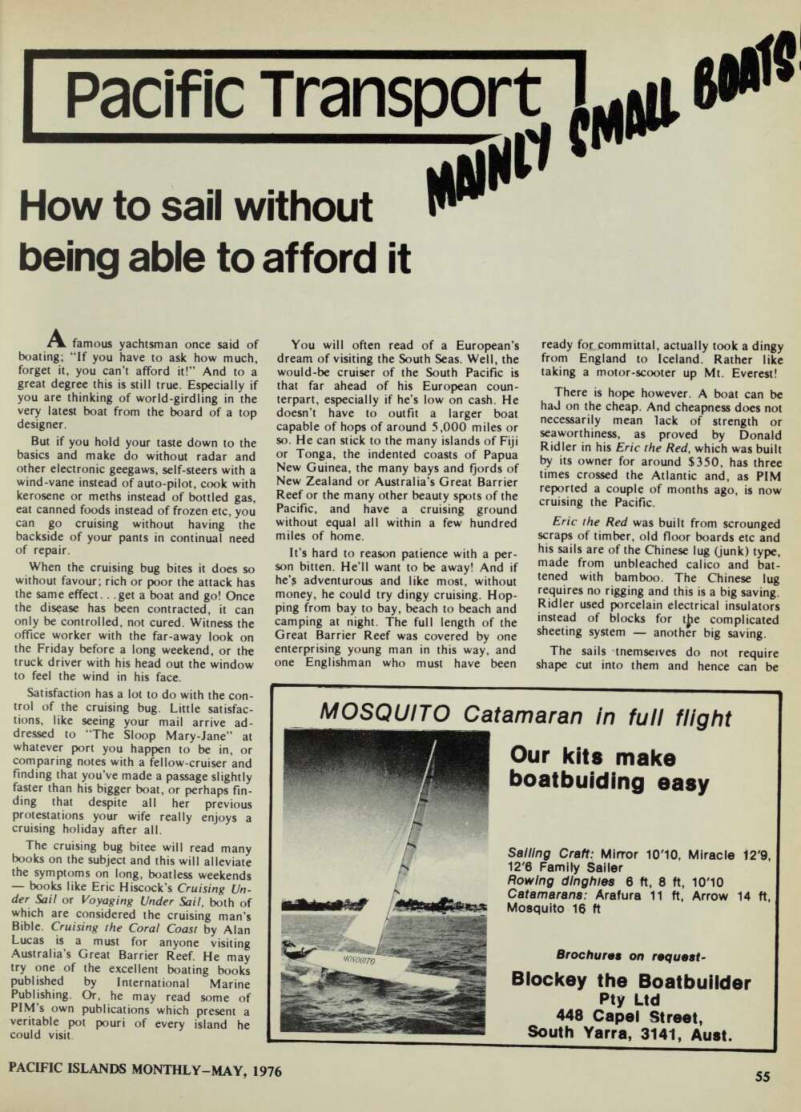

How to sail without being able to afford it
.A. famous yachtsman once said of boating; “If you have to ask how much, forget it, you can’t afford it!” And to a great degree this is still true. Especially if you are thinking of world-girdling in the very latest boat from the board of a top designer.
But if you hold your taste down to the basics and make do without radar and other electronic geegaws, self-steers with a wind-vane instead of auto-pilot, cook with kerosene or meths instead of bottled gas, eat canned foods instead of frozen etc, you can go cruising without having the backside of your pants in continual need of repair.
When the cruising bug bites it does so without favour; rich or poor the attack has the same effect. . .get a boat and go! Once the disease has been contracted, it can only be controlled, not cured. Witness the office worker with the far-away look on the Friday before a long weekend, or the truck driver with his head out the window to feel the wind in his face.
Satisfaction has a lot to do with the con trol of the cruising bug. Little satisfac tions, like seeing your mail arrive ad dressed to “The Sloop Mary-Jane” at whatever port you happen to be in, or comparing notes with a fellow-cruiser and finding that you’ve made a passage slightly faster than his bigger boat, or perhaps fin ding that despite all her previous protestations your wife really enjoys a cruising holiday after all.
The cruising bug bitee will read many books on the subject and this will alleviate the symptoms on long, boatless weekends books like Eric Hiscock’s Cruising Un der Sail or Voyaging Under Sail, both of which are considered the cruising man’s Bible. Cruising the Coral Coast by Alan Lucas is a must for anyone visiting Australia’s Great Barrier Reef. He may try one of the excellent boating books published by International Marine Publishing. Or, he may read some of PlM’s own publications which present a veritable pot pouri of every island he could visit
You will often read of a European’s dream of visiting the South Seas. Well, the would-be cruiser of the South Pacific is that far ahead of his European counterpart, especially if he’s low in cash. He doesn’t have to outfit a larger boat capable of hops of around s,ooo*miles or so. He can stick to the many islands of Fiji or Tonga, the indented coasts of Papua New Guinea, the many bays and fjords of New Zealand or Australia’s Great Barrier Reef or the many other beauty spots of the Pacific, and have a cruising ground without equal all within a few hundred miles of home.
It’s hard to reason patience with a person bitten. He’ll want to be away! And if he’? adventurous and like most, without money, he could try dingy cruising. Hopping from bay to bay, beach to beach and camping at night. The full length of the Great Barrier Reef was covered by one enterprising young man in this way, and one Englishman who must have been
ready foe,committal, actually took a dingy
from England to Iceland. Rather like taking a motor-scooter up Mt. Everest!
T L a „ • . , . , h J h n e „ re ,' S TaT V™ * ad °" chea P A"d cheapness does not ™" “ k J“ trength ° r R .. . .- U . , .ty Donald
hj '/. " ft Ullt
.. . r ?^ d as Allantic and, as PIM 3 ‘ e „ d , a h , c " upk r of monlhs a B°- ls now CrUlS,n « the Pac,f,c Eric the Red was built from scrounged scraps of timber, old floor boards etc and his sails are of the Chinese lug (junk) type, made from unbleached calico and bat tened w >th bamboo. The Chinese lug requires no rigging and this is a big saving, Ridler used porcelain electrical insulators ‘" stead of blocks for tjie complicated sheeting system another big saving, The sails tnemseives do not require shape cut into them and hence can be
made at home with a reasonable sewing machine and a few pricked fingers. This system also allows the sails to be shor tened in a matter of seconds, a big safety factor.
Eric the Red is modeled on a Cape Anne Dory, ope of the easiest and cheapest craft to build and yet one of the most seaworthy for any money anywhere.
The dory has a flat bottom and flat flairing sides, its greatest feature being that the more it is immersed, (loaded) the more buoyant it becomes. Grand Banks fishermen sit in open versions of this boat fishing with handlines in some of the roughest waters in the world. The design evolved so that they could be stacked one inside the other aboard the mother ship.
Plans for these craft can be had for as little as SUSIO in both power and sail (or both) from Capt Jim Orrell, Texas Dorys, P.O. Box 720, Galveston, Texas, USA, 77550.
One cruising type neglected over the years, and of special interest to the man who doesn’t care for sail with all their
reliance on wind and tide, is the low
powered displacement motor launch.
Using the modejn lightweight diesel, they can make passages that are economical, boast utter reliability and can often arrive faster than sailing vessels twice as large.
The much-maligned multi-hull makes an excellent cruising craft well-suited to amateur construction. The old days of floating blocks of flats are gone, and in their place are fast, stable craft that are not so prone to capsize as their predecessors. The old “give a dog a bad name” syndrome is slowly fading and skippers are facing up to the fact that their craft are capsizable and require a little more attention. The biggest asset of the multi is its ability to stay afloat even when holed or badly damaged and its shallow draught makes it ideal for cruising coral waters.
The best-known designers for trimarans are American Jim Brown or Australian Lock Crowther while perhaps the best catamarans for the amateur are by James Wharram, whose so called Polynesian cats have no superstructure between the hulls, only slatted deck so that large waves have nothing to grip. The hulls themselves are flexibly connected to allow the craft to ride the swells rather than fight them.
Wharram designs sizes from 16 to 55ft and plans are available from him at the Longhouse, Milford Docks, Milford Haven, Pembs., South Wales, UK.
Perhaps your cruising must be done from a base ashore; then maybe one of the burgeoning class of trailer-sailers is for you. They can be towed behind your car to your favourite cruising ground, and are available in sizes from 16ft up. New Zealander Richard Hartley started the boom with his famous TSI6 for which plans can be had at reasonable cost. Other trailer-sailers tend to be production models in fibreglass.
If you feel a larger boat could be the answer and you can stand a wait, you could try ferro-cement. Many beautiful yachts have been built in this medium.
While certainly a cheap way to a boat it is time consuming and great care must be taken to avoid expensive mistakes.
You may want fibreglass and yet still wish to build your own. If so, perhaps Bruce Roberts of Gumdale in Queensland can help. He’ll not only supply superb designs for cruising boats but also supply material, and if necessary a place to build
your dream-ship.
A little cash stashed away, and a yen for a ready-made little ship, could be that the H2B featured in this issue is for you.
But it all comes down to the same old disease. . .you’re bitten and want to go places in your own boat... places the tourists read about but never get to. . .to be skipper of your own ship.
Advertisements & other items, pp. 55-58 (1 item)
boatbuiding easy
MOSQL//70 Catamaran in full flight
Our kits make
Sailing Craft: Mirror 10'10. Miracle 12'9, 12'6 Family Sailer Rowing dinghies 6 ft, 8 ft, 10'10 Catamarans: Arafura 11 ft, Arrow 14 ft, Mosquito 16 ft Brochures on request - Blockey the Boatbuilder Pty Ltd 448 Capel Street, South Yarra, 3141, Aust.
New range of *
Epiglass antif oulings
give up to 12 months
growth-free performance.
Consolidated Chemicals Ltd have launched a new range of antifoulings now being marketed under the name of Epiglass E-type. Superior, in terms of performance, to any antifouling currently on the market, they are the result of years of research and development work in the company’s laboratories followed by extensive testing.
PRODUCT PERFORMANCE PROVED
Tests have been carried out under widely varying conditions throughout the Pacific area which have conclusively proved the effectiveness of E-type antifouling on both Commercial and Pleasure craft.
12 MONTHS GROWTH-FREE PERFORMANCE
Epiglass E-type antifouling is formulated to guard your boat against the expensive damage that can be done by algae, barnacles, slime weed and general fouling. The formulation includes a very high percentage of special toxins which are “release controlled'’ This positive control release of toxins means that if applied as directed you can expect up to 12 months growth-free performance.
Whatever size your boat, whether it is power or sail, protect below the water line with new Epiglass E-type antifouling.
EPIC LASSJ
Consolidated Chemicals Ltd.
P.O. Box 15-104.
New Lynn, Auckland.
Please send me a free copy of your Epiglass Boat Owners Manual plus facts on new E-type antifouling.
Mr •••■ Address
(Block letters please)
I J
from 7ft to 73ft [
] power or sail
PACIFIC AREA
DISTRIBUTORS
COOK ISLANDS
Cook Is. Trading Corp. Ltd
FIJI
Burns Philp (SS) Co. Ltd
NEW GUINEA
Bougainville Marine Pty Ltd, Kieta Burns Philp (NG) Ltd, Madang Elvee Trading Pty Ltd, Rabaul Faulkner & Tait (NG) Pty Ltd, l_ ae S. A. Heath & Co. Pty Ltd, Port Moresby
NEW HEBRIDES
Burns Philp (NH) Ltd
NOUMEA
Guy Limousin Pacific Yachting
NORFOLK ISLAND
Irvine Bid. Supply Centre
PAGO PAGO
Max Haleck Inc.
TAHITI
Marine Corail Tahiti Sport Tahiti Voile
TONGA
Riechelmann Bros.
WESTERN SAMOA
Burns Philp (SS) Co. Ltd E. A. Coxon Ltd Gold Star Transport Co. Ltd Morris Hedstrom Ltd
SOLOMON ISLANDS
George Yee Fai Ltd
SC-23 ALPHA
She cruises, daysails, races. She can be as economical to purchase or as lavishly appointed and equipped as you choose to make her.
SC-23's give you a choice of under bodies, fin keel or swing keel.
SEPARATE HEAD GALLEY DINETTE
ADULT SIZED SINGLE AND DOUBLE BERTHS
and with the magic of 'TOP TOP" you will have full headroom in the main saloon.
WhiteCeyCtafct Ratine
524 7422
169 TAREN POINT ROAD, TAREN POINT
N.S.W., 2229
me H 28
CRUISING
KETCH
adapted from the original design of L.
Francis Herreshoff and built in fibreglass by Walker Boat Co. Pty. Ltd. Geelong. Vic The ideal island cruiser. She is sea kindly, easily sailed short handed, heavily constructed and an excellent performer.
Four comfortable berths, 6' 2" headroom in saloon and shower/toilet compartment, tremendous storage space, large ice box, gimballed stove, insulated deck.
Specifications:
LOA 29' 0" LWL 23' 6"
Beam 9' 2" Draught 4' 2"
Displ 11,000 lbs. Ballast 5,000 lbs.
Engine 20 HP BUKH Diesel i Full colour brochure from
Saiemaster
PTY
LTD
Suite 15/67 Queens Road Melbourne 3004 Australia Phone: 51 4406
Fiji Marine Board
Warns Captains
The Fiji Marine Board has issued a stern warning to ships’ masters about the need to handle their vessels competently.
It also voiced its concern over the safety of passengers. The board had just suspended, for 1 2 months, the certificate of Captain Inosa Nabola, who was master of the pleasure cruiser, Sayandra when she grounded on March 9.
The board, after a preliminary inquiry into the grounding, found that Captain Nabola had shown “unseamanlike
behaviour” in taking the Sayandra through
dangerous passages. However, the board did not open a formal inquiry.
At another inquiry into the grounding of the Tui Taveuni on March 5, the board also decided against a formal inquiry. It “deplored the fact that the master took undue risk in not anchoring properly.”
Proper anchors and cables had to be on board ships registered with the board.
In the case of the Tui Taveuni, if proper ground tackle had been used, the accident might well have been avoided. Masters were warned to watch that point in future. • Two Solomon Islands ships, the Com pass Rose II and the Regina M, were slightly damaged in an accident at Point Cruz wharf in March. The Compass Rose II was at her moorings when the Regina M, on the way to the main wharf, hit her in the stern. Damage to the Compass Rose II was estimated at $1,000. It did not prevent the ship sailing on schedule for West District and Malaita. Damage to the Regina M was superficial. The wharf was
slightly damaged.
Cruising
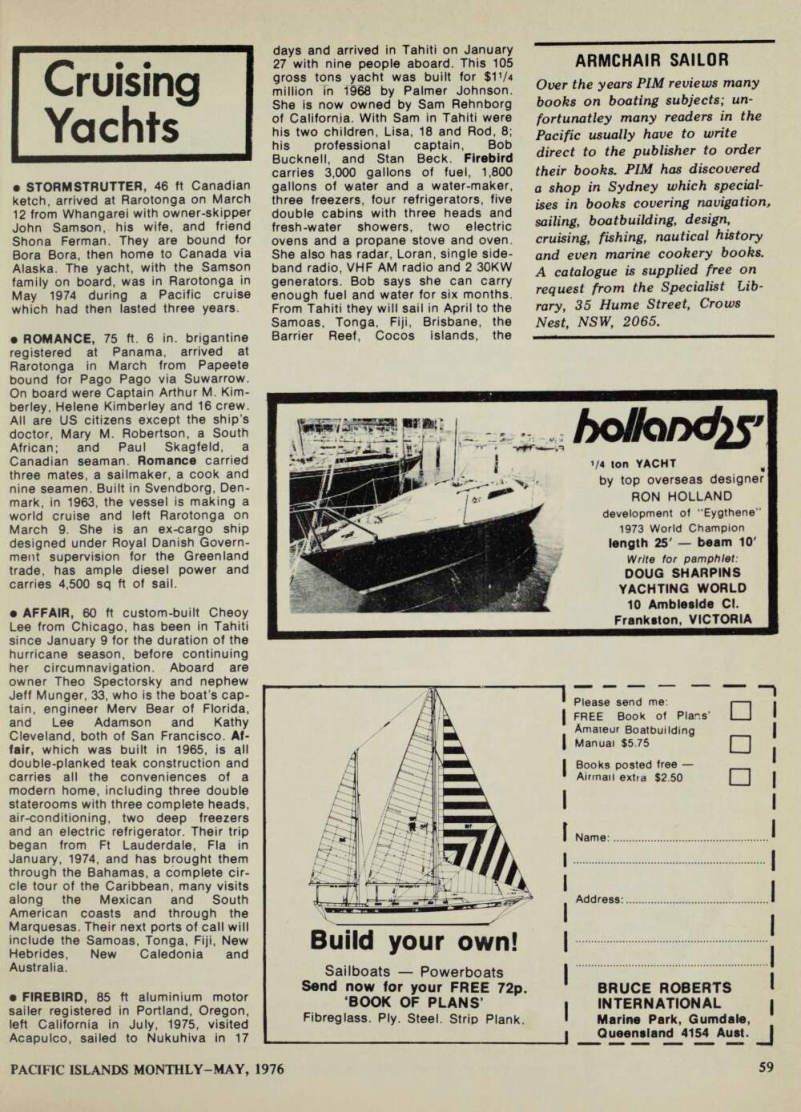
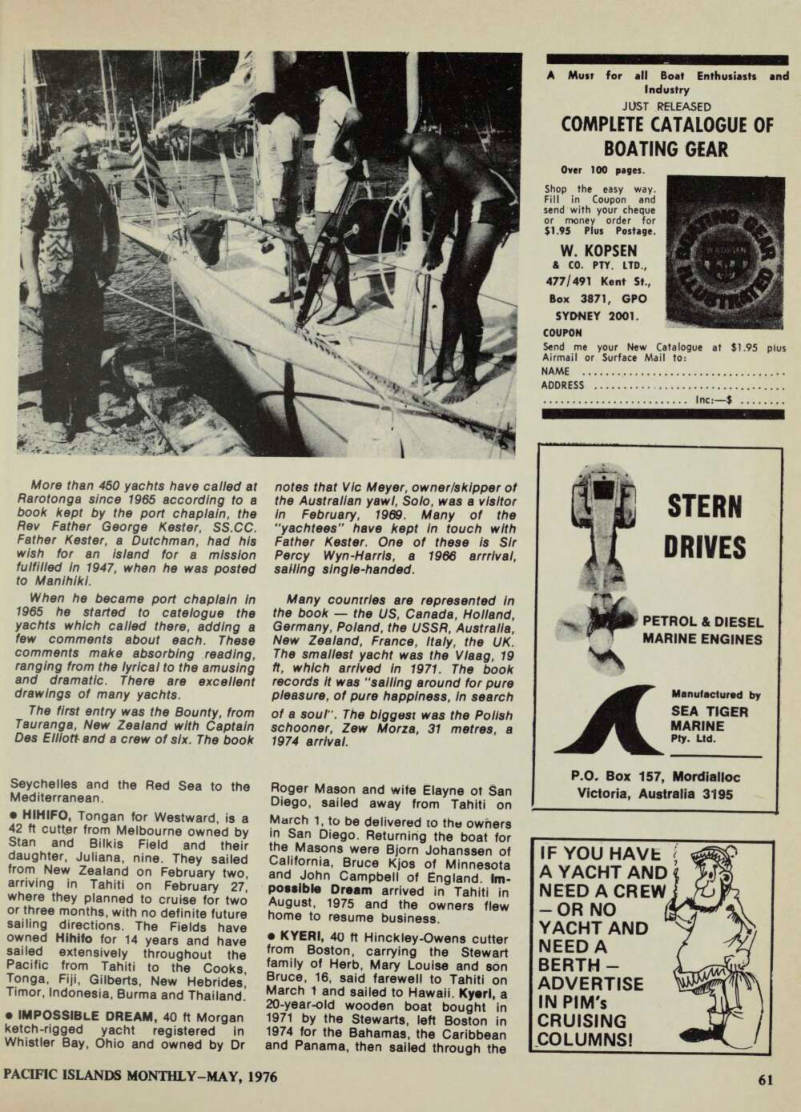
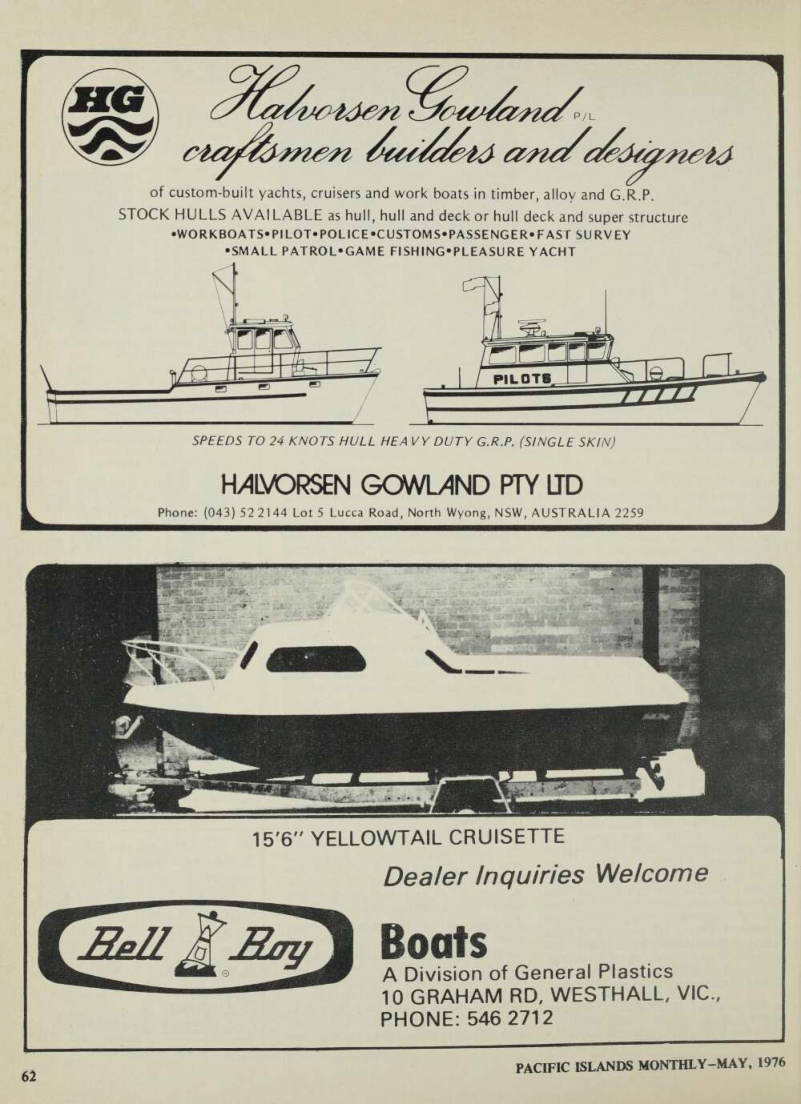
Yachts
• STORMSTRUTTER, 46 ft Canadian ketch, arrived at Rarotonga on March 12 from Whangarei with owner-skipper John Samson, his wife, and friend Shona Ferman. They are bound for Bora Bora, then home to Canada via Alaska. The yacht, with the Samson family on board, was in Rarotonga in May 1974 during a Pacific cruise which had then lasted three years. • ROMANCE, 75 ft. 6 in. brigantine registered at Panama, arrived at Rarotonga in March from Papeete bound for Pago Pago via Suwarrow.
On board were Captain Arthur M. Kim berley, Helene Kimberley and 16 crew.
All are US citizens except the ship’s doctor, Mary M. Robertson, a South African; and Paul Skagfeld, a Canadian seaman. Romance carried three mates, a sailmaker, a cook and nine seamen. Built in Svendborg, Den mark, in 1963, the vessel is making a world cruise and left Rarotonga on March 9. She is an ex-cargo ship designed under Royal Danish Govern ment supervision for the Greenland trade, has ample diesel power and carries 4,500 sq ft of sail. • AFFAIR, 60 ft custom-built Cheoy Lee from Chicago, has been in Tahiti since January 9 for the duration of the hurricane season, before continuing her circumnavigation. Aboard are owner Theo Spectorsky and nephew Jeff Munger, 33, who is the boat’s cap tain, engineer Merv Bear of Florida, and Lee Adamson and Kathy Cleveland, both of San Francisco. Af fair, which was built in 1965, is all double-planked teak construction and carries all the conveniences of a modern home, including three double staterooms with three complete heads, air-conditioning, two deep freezers and an electric refrigerator. Their trip began from Ft Lauderdale, Fla in January, 1974, and has brought them through the Bahamas, a complete cir cle tour of the Caribbean, many visits along the Mexican and South American coasts and through the Marquesas. Their next ports of call will include the Samoas, Tonga, Fiji, New Hebrides, New Caledonia and Australia. • FIREBIRD, 85 ft aluminium motor sailer registered in Portland, Oregon, left California in July, 1975, visited Acapulco, sailed to Nukuhiva in 17
days and arrived in Tahiti on January 27 with nine people aboard. This 105 gross tons yacht was built for $1 1 /4 million in 1968 by Palmer Johnson.
She is now owned by Sam Rehnborg of California. With Sam in Tahiti were his two children, Lisa, 18 and Rod, 8; his professional captain, Bob Bucknell, and Stan Beck. Firebird carries 3,000 gallons of fuel, 1,800 gallons of water and a water-maker, three freezers, four refrigerators, five double cabins with three heads and fresh-water showers, two electric ovens and a propane stove and oven.
She also has radar, Loran, single side band radio, VHF AM radio and 2 30KW generators. Bob says she can carry enough fuel and water for six months.
From Tahiti they will sail in April to the Samoas, Tonga, Fiji, Brisbane, the Barrier Reef. Cocos islands, the
Seychelles and the Red Sea to the Mediterranean. • HIHIFO, Tongan for Westward, is a 42 ft cutter from Melbourne owned by Stan and Bilkis Field and their daughter, Juliana, nine. They sailed from New Zealand on February two, arriving in Tahiti on February 27, where they planned to cruise for two or three months, with no definite future sailing directions. The Fields have owned Hihifo for 14 years and have sailed extensively throughout the Pacific from Tahiti to the Cooks, Tonga, Fiji, Gilberts, New Hebrides, Timor, Indonesia, Burma and Thailand. • IMPOSSIBLE DREAM, 40 ft Morgan ketch-rigged yacht registered in Whistler Bay, Ohio and owned by Dr
Roger Mason and wife Elayne of San Diego, sailed away from Tahiti on March 1, to be delivered 10 the owners in San Diego. Returning the boat for the Masons were Bjorn Johanssen of California, Bruce Kjos of Minnesota and John Campbell of England. Im possible Dream arrived in Tahiti in August, 1975 and the owners flew home to resume business. e KYERI, 40 ft Hinckley-Owens cutter from Boston, carrying the Stewart family of Herb, Mary Louise and son Bruce, 16, said farewell to Tahiti on March 1 and sailed to Hawaii. Kyeri, a 20-year-old wooden boat bought in 1971 by the Stewarts, left Boston in 1974 for the Bahamas, the Caribbean and Panama, then sailed through the
More than 450 yachts have called at Rarotonga since 1965 according to a book kept by the port chaplain, the Rev Father George Kester, SS.CC.
Father Kester, a Dutchman, had his wish for an island for a mission fulfilled in 1947, when he was posted to Manihiki.
When he became port chaplain in 1965 he started to catelogue the yachts which called there, adding a few comments about each. These
comments make absorbing reading,
ranging from the lyrical to the amusing and dramatic. There are excellent drawings of many yachts.
The first entry was the Bounty, from Tauranga, New Zealand with Captain Des Elliott and a crew of six. The book
notes that Vic Meyer, owner/skipper of the Australian yawl, Solo, was a visitor In February, 1969. Many of the ", yachtees " have kept In touch with Father Kester. One of these is Sir Percy Wyn-Harris, a 1966 arrrlval,
sailing single-handed.
Many countries are represented In the book the US, Canada, Holland, Germany, Poland, the USSR, Australia, New Zealand, France, Italy, the UK.
The smallest yacht was the Vlaag, 19 ft, which arrived In 1971. The book records It was “sailing around for pure pleasure, of pure happiness, in search of a soul". The biggest was the Polish schooner, Zew Morza, 31 metres, a 1974 arrival.
Panama Canal to the Las Perlas Islands, the Galapagos, Marquesas and Tuamotus, arriving in Tahiti the last week in November. While in French Polynesia they cruised to many of the outer islands. Bruce, noted along the Papeete waterfront for his lovely scrimshaw pennants of boats, presented a pendant of the BOUNTY to the widow of James Norman Hall, one of the authors of this famous story, just before he sailed away. • MANDORLA, 38 ft Morgan-designed Columbia sloop from Portland, arrived in Tahiti on February 15, with owner Geoffrey Wilson, 32 and Kaarin, of Seattle. Their cruise began in Novem ber from San Diego and carried them to the Marquesas and Moorea. Geof frey was in the hospital with hepatitis the first week in March and it was un decided as to whether he would fly home or recuperate first and then sail to Hawaii. • MATTHEW, 30 ft Tahiti ketch registered in Pago Pago, sailed into Tahiti in December with owners David and Pidge Irvine and son James, 11.
Also sailing with the Irvines is the ship’s cat, Minnie, who has been with them the eight years they’ve owned Matthew. They left the US in 1970 and cruised to Mexico, Hawaii, the Cooks and Samoas, settling in Pago Pago for 4V2 years, while David worked as executive producer of KUZK-TV there.
James is attending school in Tahiti.
Their plans will carry them west again in a few months to Penryhn Atoll and maybe New Zealand or New Guinea • PISTACHIO, 55 ft long, 29 ft wide, specially-designed trimaran registered in Tortola, British West Indies, was built for Bob and Marge Law in British Columbia, which they left in Sep tember for a round-the-world cruise.
They arrived in Tahiti in December and planned to wait out the hurricane season, then resume their trip in April, calling at Rarotonga, Fiji, Tonga and Niue. Pistachio will be used for day charters when Bob and Marge return to the Caribbean. • SEA TRAIN, 31 ft Mariner ketch from Los Angeles, arrived in Tahiti on February 18, carying owners Jim and Linda Godber of Redondo Beach.
They left California in June, 1975, and sailed to Hawaii before visiting the Societies. Jim and Linda plan to cruise the South Pacific over the next two years, calling at Rarotonga, Tonga and Fiji. Linda is the boat’s navigator and Jim is the cook. • SPIRIT, 42 ft double-ended wooden ketch from Portsmouth, New Hamp shire, is spending the hurricane season in French Polynesia before continuing her trip west. Owners Ray and Ellen Jackson, with Peggy Fleder
john, Fred Baker, Kathy Pumphrey and Warren Plumbo, all from the Sausalito area, sailed from San Francisco on September 18, arriving in Nukuhive 24 days and two hours later, after skirting two hurricanes. Other problems were encountered when their anchor rode chafed through and again when they were caught 1/2 a mile off Tahiti in a 60 mph squall with all their sails up and no fuel for the engine, they waited all night and half the next day before fuel could be brought to them, allowing them to come into the harbour in Tahiti on December 3. • THE EST, 36 ft Columbia sloop from
Honolulu left Hawaii on Dec 6 for the Marquesas and Tuamotus and sailed into Tahiti at the end of January.
Owner Bert Lang and crew Pavel Kubac were on board. Pavel flew back to Honolulu and Bert plans to sail west to New Zealand after the hurricane season. • LAUCALA, 60 ft waterline ketch, arrived at Rarotonga on March 26 with Captain Hilton, his wife, Judy, and five other crew. The yacht, registered in Panama, was on a delivery voyage from Fort Lauderdale, Florida, to Fiji for the owner. Laucala left for Fiji on March 27.
Armchair Sailor
Over the years PIM reviews many books on boating subjects; un fortunatley many readers in the Pacific usually have to write direct to the publisher to order their books. PIM has discovered a shop in Sydney which special ises in books covering navigation, sailing, boatbuilding, design, cruising, fishing, nautical history and even marine cookery books.
A catalogue is supplied free on request from the Specialist Lib rary, 35 Hume Street, Crows Nest, NSW, 2065.
Advertisements & other items, pp. 59-64 (1 item)
hoKondiS’
pw , —C* ■;
i/4 ton YACHT g by top overseas designer
RON HOLLAND
development of "Eygthene” 1973 World Champion length 25' beam 10' Write for pamphlet:
DOUG SHARPINS
YACHTING WORLD
10 Ambleside Cl.
Frankston, VICTORIA
Build your own!
Sailboats Powerboats Send now for your FREE 72p.
BOOK OF PLANS’
Fibreglass. Ply. Steel. Strip Plank.
Please send me; FREE Book of Plans’
Amateur Boatbuilding I Manual $5.76 I Books posted free 1 Airmail extra $2.50
I Name;
□ □ □ Address;
1 BRUCE ROBERTS
I INTERNATIONAL
I Marine Park, Gumdale, j Queensland 4154 Aust. J
IT'S OH€ STOP SHOPPmO PT
Pim’S mPIL ORD€R BOOKSHOP
QIJ Tick the titles you want. Mail the coupon with your remittance. We’ll despatch your books immediately. □ The Story of The Solomons.
Simple, lucid outline of the history of the Solomon Islands, from a refreshingly frank and affectionate point of view, by Dr. C.E. Fox. 88 pp. JA3 or SUS 4, posted anywhere, □ The Lost Caravel. Robert Langdon shatters traditionally-held views on the Polynesians in this controversial, historical whodunnit described by Prof. Ron Crocombe as a “masterpiece uS fascinating as it is important”. Also invaluable as a record of early Pacific exploration, 368 pp. Profusely illustrated with maps and plates. JAIB or lUS26, posted anywhere. □ Queen Emma. R.W. Robson presents drama, comedy, high adventure in this true story of “Queer Emma”, the Polynesian-American girl who met 19th century New Guinea on its own tough terms. 239 pp. illustrated. SA6 or JUSB, posted anywhere. □ Folkloric in Australia. Dance expert Beth Dean and photographer Stan Goik present the beauty and vitality of national folk dances brought to Australia from Europe and elsewhere in this superb book of colour photographs and brilliant text. Large format, 88 pp.
Illustrated. JA3.50 or JUSS posted anywhere. □ Holy Torture in Fiji, Firewalking and other sacred, ancient rituals of Fiji’s Hindus described in text and colour photographs.
Large format, 64 pp. Illustrated. 5A4.50 or JUS6.SO, posted anywhere. □ Port Moresby, Yesterday and Today. In what is even more than a history of Papua New Guinea’s capital, Canon lan Stuart takes us on an entertaining, personalised tour of the city. Softcover, 368 pp. Maps illustrations. JA3.50 or 5U54.50, posted anywhere.
D Many a Green Isle, Judy Tudor’s best-selling classic of Pacific Islands life for armchair travellers. Diverting, packed with incident, embellished with dry humour. 256 pp.
Illustrated. JA6 or SUSS posted anywhere. □ New Hebrides. One of the superb Islands in the Sun colour series of brilliant full-colour plates, maps and text, this volume describes the unique British-French Condominium of the New Hebrides.
A guide for travellers, or for collectors. 128 pp. Fully illustrated. SAIO or SUSI 3, posted anywhere, □ New Caledonia. French New Caledonia, superbly depicted in full colour photographs, with informative text and maps giving history, geography and daily life.
An Islands in the Sun guide. 128 pp. Fully Illustrated. SAIO or JUSI3, posted anywhere. □ Bora Bora. One of the French Pacific’s fascinating, colourful higl islands, reached from Tahiti, here presented in sparkling full-colour pictures for visitors or mere armchair travellers. Another Islands in the Sun guide, with the same attention to detail. 128 pp.
Fully illustrated. SAIO or SUSI 3, posted anywhere. □ Fiji Fiji, The multi-racial dominion of friendly Fiji, crossroads of the Pacific, described in colour photographs, maps and text, uniform with the beautiful series listed above. Many people buy the whole set. More titles to be published, 128 pp. Fully illustrated. SAIO or JUS 13 posted anywhere, □ Little Chimbu in Bougainville.
For the young and young-in-heart, lovable Little Chimbu and his friends visit Panguna, and get into awful trouble in what could be the biggest hole in the world, the Bougainville copper mine. Nancy Curtis, who used to live there, tells the story in full colour drawings which are also accurate and instructive. Also in the colourful Nancy Curtis series for children are □ Little Bahis and □ Fiji Johnny.
About 48 pp. Illustrated. Each JA3.50 or JUS4.SO posted anywhere. □ Percy Chatterton’s Papua: Day That I Have Loved. Charming evocative account of changing Papua as Rev. Percy Chattertou knew it for 50 years. 144 pp. Illustrated.
JA6.50 or JUSB.SO posted anywhere. □ Colonial Era Cemetery of Norfolk Island. Former Administrator of the island, R. Nixon Dalkin, describes life and death in what was Britain’s harshest Pacific penal colony. There are illuminating, often moving stories in these photographs, charts and inscriptions that describe the historic cemetery. Large format, 92 pp.
Illustrated. JAS or JUS7.SO, posted anywhere.
D Marine Shells of the Pacific.
Walter Cernohorsky describes in detail with clear photographs 440 Pacific shells, and tells now to find, arrange and photograph a collection. 248 pp. Illustrated. SAIO or
sUSls,,posted anywhere.
□ Marine Shells of the Pacific Volume 11. Walter Cernohorsky carries on where his first book leaves off, with a further 600 species fully described and illustrated: Some of the 68 full-page plates are in colour. 412 pp. Illustrated. JAI7 or JUS2S, posted anywhere, □ Friendly Island. Warm account of life in Tonga, sunlit South Pacific island kingdom, by Patricia Ledyard, who has lived in a Tongan harbourside village for more than 20 years. Paperback, 215 pp.
SA3 or JUS4.SO, posted anywhere. □ Plants and Flowers of Tahiti.
Full colour photographs of the rich and beautiful Tahitian flora, classified by scientific names, and by French, English and Tahitian common names. 144 pp. Fully illustrated. JAS or SUS 7, posted anywhere, □ Birds of Tahiti A companion volume to Plants and Flowers of Tahiti, Full colour photographs and descriptions, for collectors or for amateur birdwatchers, visitors and students needing easy identification. 112 pp. Fully illustrated.
JAS or JUS7, posted anywhere.
PlM’s mail order bookshop prices include surface postage and charges anywhere in the world. There’s nothing extra to pay.
Sydney visitors may buy any title at slightly less cost across the counter at our office at 76 Clarence Street, Sydney.
Please mail to Mail Order Bookshop, Pacific Publications, r I have ticked the books I want and have enclosed $ NAME (Block Letters)
ADDRESS
Box 3408 GPO, Sydney. 2001 (cash with order)
A Must for all Boat Enthusiasts and
Industry
JUST RELEASED
COMPLETE CATALOGUE OF
BOATING GEAR
Over 100 pages.
Shop the easy way.
Fill in Coupon and send with your cheque or money order for $1.95 Plus Postage.
W. KOPSEN
& CO. PTY. LTD.,
477/491 Kent St., Box 3871, GPO
SYDNEY 2001.
COUPON
Send me your New Catalogue at $1.95 plus Airmail or Surface Mail to;
NAME .
ADDRESS
Inc:—s
STERN
DRIVES
PETROL & DIESEL
MARINE ENGINES
X Manufactured by
SEA TIGER
MARINE
Pty. Ltd.
P.O. Box 157, Mordialloc Victoria, Australia 3195
IF YOU HAVE
A YACHT AND
NEED A CREW
-OR NO
YACHT AND
NEED A
BERTH-
ADVERTISE
IN PlM's
CRUISING
COLUMNS!
P/L /n&n of custom-built yachts, cruisers and work boats in timber, alloy and G.R.P.
STOCK HULLS AVAILABLE as hull, hull and deck or hull deck and super structure •WORK BOATS* PI LOT* POL ICE •CUSTOMS* PASSENGER* FAST SURVEY
•SMALL PATROL-GAME FISHING* PLEA SURE YACHT
rnn
s
PILOTS
B E
zzz
SPEEDS TO 24 KNOTS HULL HE A VY DUTY G.R.P. (SINGLE SKIN)
HAVORSEN GOWL4ND PTY LTD
Phone: (043) 52 2144 Lot 5 Lucca Road, North Wyong, NSW, AUSTRALIA 2259
. 1 -•
15'6" YELLOWTAIL CRUISETTE
Dealer Inquiries Welcome a
Boats
A Division of General Plastics
10 GRAHAM RD, WESTHALL, VIC.,
PHONE: 546 2712
HAVE FUN
Exploring the underwater world with the Amazingly Simple Aqua Bell hard hat professional diving helmet.
Just clip the compressor leads onto any 12 volt car or boat battery and you can spend hours of safe, effortless, economical diving to 30 ft depths.
View coral reefs • Study marine life • inspect and repair boat hulls • clear fouled propellers • pier inspections and maintenance, etc.
For work or recreation; for every application, Aqua Bell is ideal. Aqua Bell helmet, electric air compressor, 35 ft air hose, security rope & full instructions.
Order yours today or write for free brochure to:
LEISURETRON
25 Bardwell Rd. Mosman. N.S.W. 2088.
asl79
*lncludes insurance & freight.
- TKi th.
JfJM
*aqic
The magic MAKO 20
ultimate sports machine!
Sole Distributors;
MINN KOTA MARINE PTY. LTD.
791 Princes Highway, Tempo, 2044, N.S.W. Australia Phone 559 2000 e Island Distributors Required
Leaders in the Field of All-Welded Aluminium Craft We produce custom built Aluminium Commercial and Pleasure Craft e CUSTOMS e POLICE e SURVEY e PILOT LAUNCHES e e RESCUE e FISHING e WORK BOATS e BARGES e Enquiries for quotations are invited from the Pacific Islands.
STRIKER BOATS (AUSTRALIA) PTY. LTD.
19 BYRON STREET, BULIMBA, 4171 OLD. Ph. 339 6866
Under Construction ■ Name: • i Address; 50ft steel personnel bunch for dbsei BBj*es. nter-tsb twei 3160 caterpllar
BUILT TO
EARN A LIVING
MARINE - STRUCTURAL - FOUNDRY
REFRIGERATION - ELECTRICAL - AIRCONDITIONING
METALOCK CASTINGS REPAIR
JOINERY - GLAZING - FURNITURE
UPHOLSTERY - CANVASWORK
SHEETMETAL WORK - ELECTROPLATING
IRPENTERS INniISTRm
CARPENTERS INDUSTRIAL
GPO Box 296. SUVA. FIJI
Please send me further information on Carpenters Slupouiding maintenance ana repars. imoustfual.
How to tender her with care
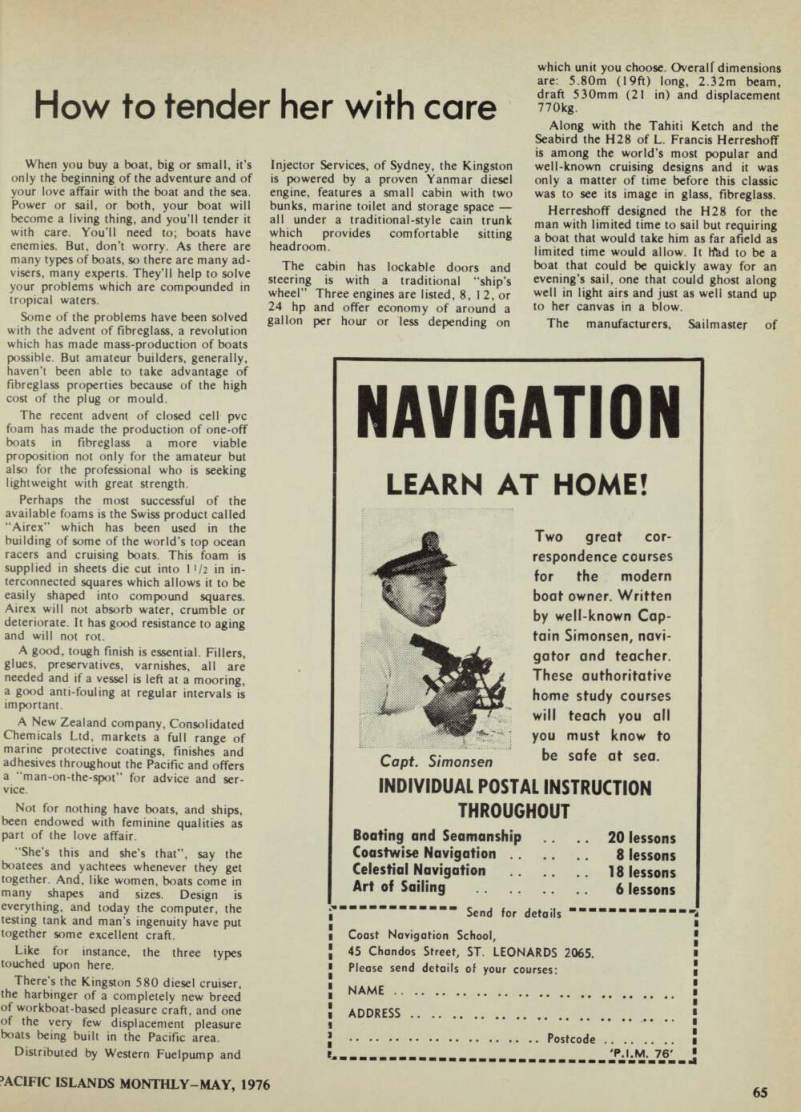
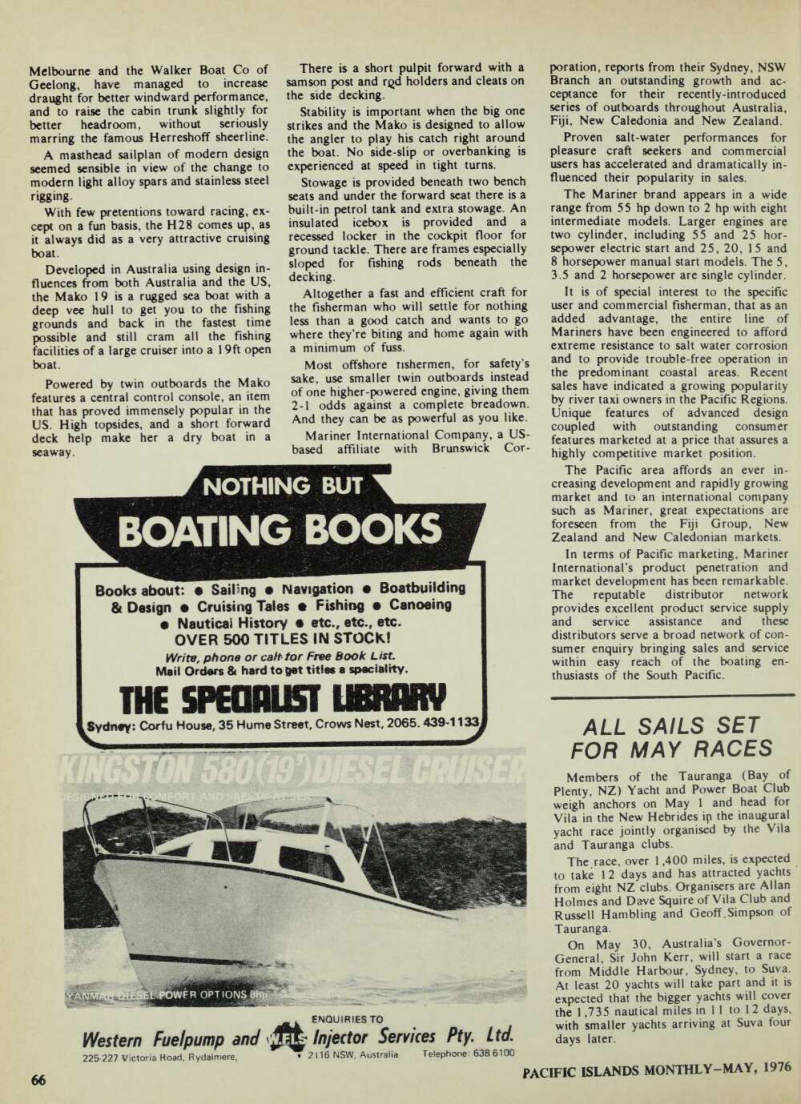
When you buy a boat, big or small, it’s only the beginning of the adventure and of your love affair with the boat and the sea.
Power or sail, or both, your boat will become a living thing, and you’ll tender it with care. You’ll need to; boats have enemies. But, don’t worry. As there are many types of boats, so there are many ad visers, many experts. They’ll help to solve your problems which are compounded in
tropical waters.
Some of the problems have been solved with the advent of fibreglass, a revolution which has made mass-production of boats possible. But amateur builders, generally, haven’t been able to take advantage of fibreglass properties because of the high cost of the plug or mould.
The recent advent of closed cell pvc foam has made the production of one-off boats in fibreglass a more viable proposition not only for the amateur but also for the professional who is seeking lightweight with great strength.
Perhaps the most successful of the available foams is the Swiss product called “Airex” which has been used in the building of some of the world’s top ocean racers and cruising boats. This foam is supplied in sheets die cut into 1 >/2 in in terconnected squares which allows it to be easily shaped into compound squares.
Airex will not absorb water, crumble or deteriorate. It has good resistance to aging and will not rot.
A good, tough finish is essential. Fillers, glues, preservatives, varnishes, all are needed and if a vessel is left at a mooring, a good anti-fouling at regular intervals is
important.
A New Zealand company, Consolidated Chemicals Ltd, markets a full range of marine protective coatings, finishes and adhesives throughout the Pacific and offers a “man-on-the-spot” for advice and ser vice.
Not for nothing have boats, and ships, been endowed with feminine qualities as part of the love affair.
“She’s this and she’s that”, say the boatees and yachtees whenever they get together. And, like women, boats come in many shapes and sizes. Design is everything, and today the computer, the testing tank and man’s ingenuity have put together some excellent craft.
Like for instance, the three types touched upon here.
There’s the Kingston 580 diesel cruiser, the harbinger of a completely new breed of workboat-based pleasure craft, and one of the very few displacement pleasure boats being built in the Pacific area.
Distributed by Western Fuelpump and
Injector Services, of Sydney, the Kingston is powered by a proven Yanmar diesel engine, features a small cabin with two bunks, marine toilet and storage space all under a traditional-style cain trunk which provides comfortable sitting headroom.
The cabin has lockable doors and steering is with a traditional “ship’s wheel” Three engines are listed, 8, 1 2, or 24 hp and offer economy of around a gallon per hour or less depending on
which unit you choose. Overalf dimensions are: 5.80 m (19ft) long, 2.32 m beam, draft 530 mm (21 in) and displacement 770 kg.
Along with the Tahiti Ketch and the Seabird the H2B of L. Francis Herreshoflf is among the world’s most popular and well-known cruising designs and it was only a matter of time before this classic was to see its image in glass, fibreglass.
Herreshoff designed the H2B for the man with limited time to sail but requiring a boat that would take him as far afield as limited time would allow. It tfhd to be a boat that could be quickly away for an evening’s sail, one that could ghost along well in light airs and Just as well stand up to her canvas in a blow.
The manufacturers, Sailmaster of
Melbourne and the Walker Boat Co of Geelong, have managed to increase draught for better windward performance, and to raise the cabin trunk slightly for better headroom, without seriously marring the famous Herreshoff sheerline.
A masthead sailplan of modern design seemed sensible in view of the change to modern light alloy spars and stainless steel rigging.
With few pretentions toward racing, ex cept on a fun basis, the H2B comes up, as it always did as a very attractive cruising boat.
Developed in Australia using design in fluences from both Australia and the US, the Mako 19 is a rugged sea boat with a deep vee hull to get you to the fishing grounds and back in the fastest time possible and still cram all the fishing facilities of a large cruiser into a 19ft open boat.
Powered by twin outboards the Mako features a central control console, an item that has proved immensely popular in the US. High topsides, and a short forward deck help make her a dry boat in a seaway.
There is a short pulpit forward with a samson post and rsd holders and cleats on the side decking.
Stability is important when the big one strikes and the Mako is designed to allow the angler to play his catch right around the boat. No side-slip or overbanking is experienced at speed in tight turns, Stowage is provided beneath two bench seats and under the forward seat there is a built-in petrol tank and extra stowage. An insulated icebox is provided and a recessed locker in the cockpit floor for ground tackle. There are frames especially sloped for fishing rods beneath the decking.
Altogether a fast and efficient craft for the fisherman who will settle for nothing less than a good catch and wants to go where they’re biting and home again with a minimum of fuss, Most offshore nshermen, for safety’s ““ k smaller <*“> outboards instead of one h.gher-powered engine giymg them odds a B a '"« a complete breadown.
And they can be as powerful as you like, Mariner International Company, a US based affiliate with Brunswick Cor
poration, reports from their Sydney, NSW Branch an outstanding growth and ac ceptance for their recently-introduced series of outboards throughout Australia, Fiji, New Caledonia and New Zealand.
Proven salt-water performances for pleasure craft seekers and commercial users has accelerated and dramatically in fluenced their popularity in sales.
The Mariner brand appears in a wide range from 55 hp down to 2 hp with eight intermediate models. Larger engines are two cylinder, including 55 and 25 hor sepower electric start and 25, 20, 15 and 8 horsepower manual start models. The 5, 3.5 and 2 horsepower are single cylinder.
It is of special interest to the specific user and commercial fisherman, that as an added advantage, the entire line of Mariners have been engineered to afford extreme resistance to salt water corrosion and to provide trouble-free operation in the predominant coastal areas. Recent sales have indicated a growing popularity by river taxi owners in the Pacific Regions.
Unique features of advanced design
coupled with outstanding consumer
features marketed at a price that assures a
highly competitive market position.
The Pacific area affords an ever in
creasing development and rapidly growing
market and to an international company such as Mariner, great expectations are foreseen from the Fiji Group, New Zealand and New Caledonian markets.
In terms of Pacific marketing, Mariner
International’s product penetration and
market development has been remarkable.
The reputable distributor network
provides excellent product service supply
and service assistance and these distributors serve a broad network of con sumer enquiry bringing sales and service within easy reach of the boating en thusiasts of the South Pacific.
Advertisements & other items, pp. 65-66 (2 items)
65
'ACIFIC ISLANDS MONTHLY-MAY, 1976
Navigation
LEARN AT HOME!
Two great correspondence courses for the modern boat owner. Written by well-known Captain Simonsen, navigator and teacher.
These authoritative home study courses will teach you all you must know to be safe at sea.
INDIVIDUAL POSTAL INSTRUCTION
THROUGHOUT
Boating and Seamanship 20 lessons Coastwise Navigation 8 lessons Celestial Navigation 18 lessons Art of Sailing 6 lessons Send for details ■“■■■--- Coast Navigation School, 45 Chandos Street, ST. LEONARDS 2065.
Please send details of your courses:
NAME
ADDRESS
Postcode Capt. Simonsen
NOTHING BUT
BOATING BOOKS
Books about: • Sailing • Navigation • Boatbuilding & Design • Cruising Tales • Fishing • Canoeing • Nautical History • etc., etc., etc.
OVER 500 TITLES IN STOCK!
Write, phone or cait tor Free Book List Mail Orders & hard to get titles a speciality.
Sydney: Corfu House, 35 Hume Street, Crows Nest, 2065. 439-1 133 ■ L m mtr- -225-227 Victoria Road, Rydatmere,
k ENQUIRIES TO
Western Fuelpump and Injector Services Pty. Ltd.
NSW, Australia Telephone: 638 6100
All Sails Set
For May Races
Members of the Tauranga (Bay of Plenty, NZ) Yacht and Power Boat Club weigh anchors on May 1 and head for Vila in the New Hebrides ip the inaugural yacht race jointly organised by the Vila and Tauranga clubs.
The race, over 1,400 miles, is expected to take 1 2 days and has attracted yachts from eight NZ clubs. Organisers are Allan Holmes and Dave Squire of Vila Club and Russell Hambling and Geoff. Simpson of Tauranga.
On May 30, Australia’s Governor- General, Sir John Kerr, will start a race from Middle Harbour, Sydney, to Suva.
At least 20 yachts will take part and it is expected that the bigger yachts will cover the 1,735 nautical miles in 1 1 to 1 2 days, with smaller yachts arriving at Suva four
days later.
Shipping,
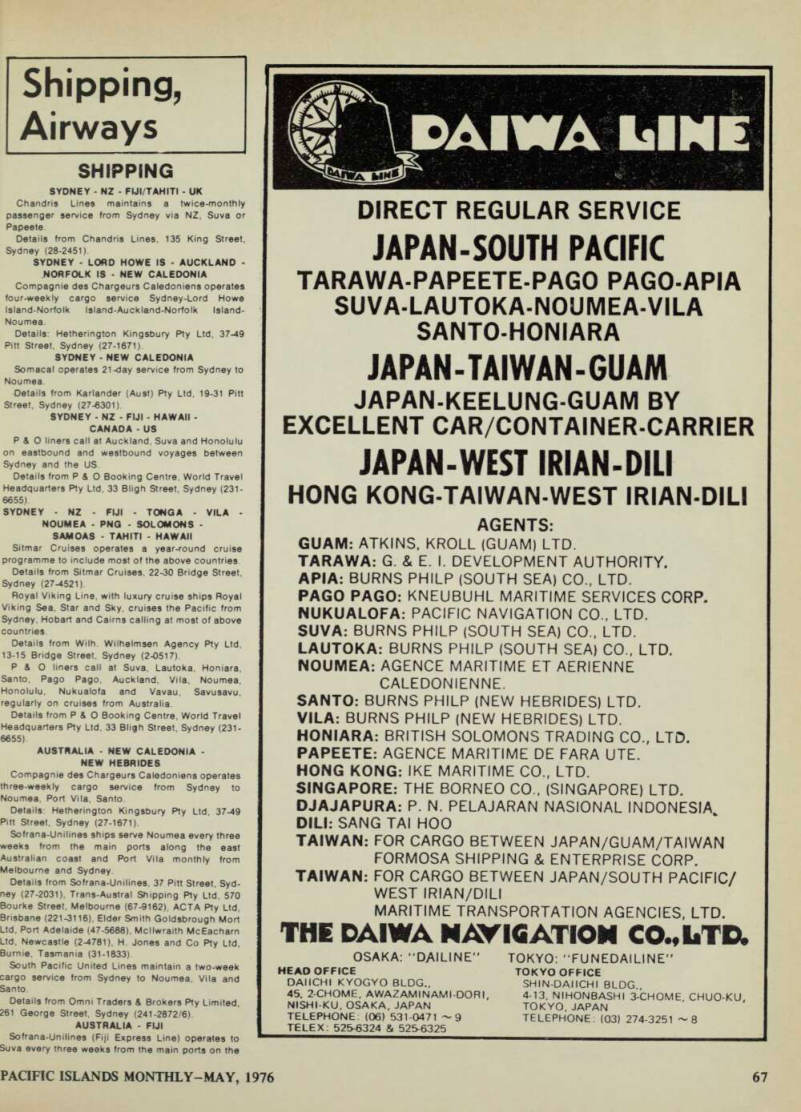
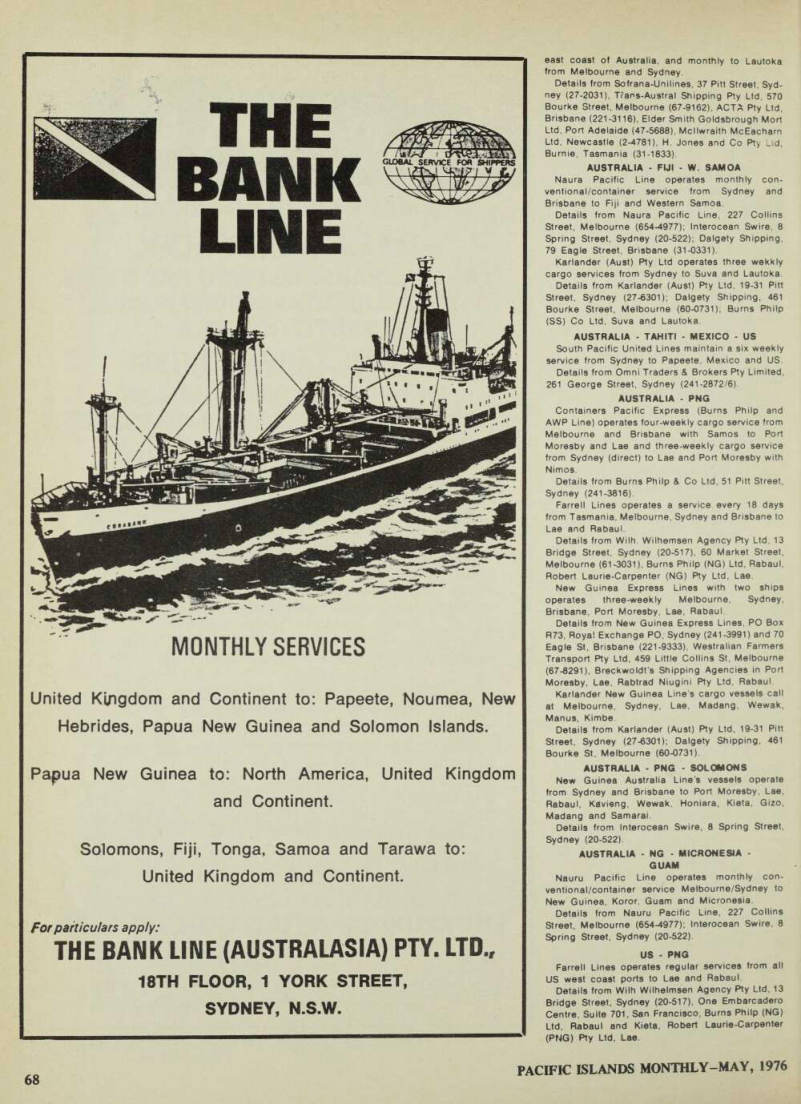

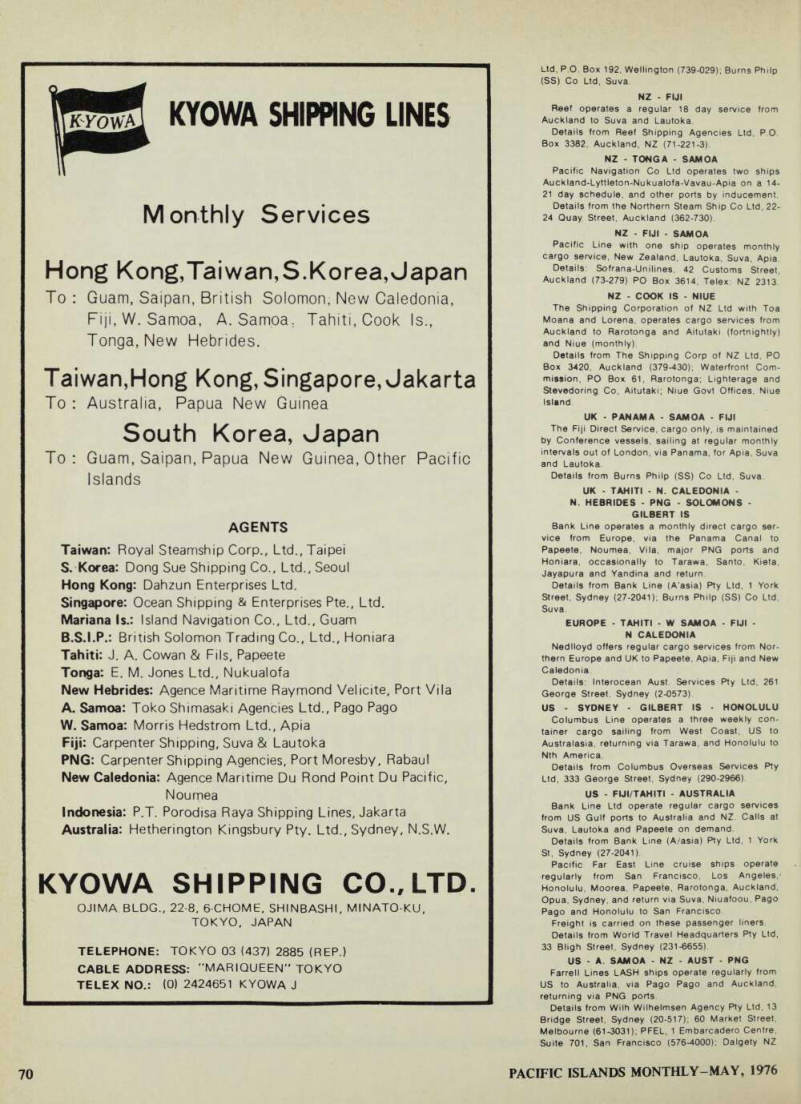
Airways
Shipping
SYDNEY - NZ - FUI/TAHITI - UK Chandris Lines maintains a twice-monthly passenger service from Sydney via NZ, Suva or Papeete Details from Chandris Lines, 135 King Street, Sydney (28-2451).
SYDNEY - LORD HOWE IS - AUCKLAND -
Norfolk Is - New Caledonia
Compagnie des Chargeurs Caledoniens operates four-weekly cargo service Sydney-Lord Howe Island-Norfolk Island-Auckland-Norfolk Island- Noumea.
Details: Hetherington Kingsbury Pty Ltd, 37-49 Pitt Street. Sydney (27-1671).
Sydney - New Caledonia
Somacal operates 21-day service from Sydney to Noumea.
Details from Karlander (Aust) Pty Ltd, 19-31 Pitt Street. Sydney (27-6301).
SYDNEY - NZ - FIJI - HAWAII -
Canada - Us
P & 0 liners call at Auckland, Suva and Honolulu on eastbound and westbound voyages between Sydney and the US.
Details from P & O Booking Centre, World Travel Headquarters Pty Ltd, 33 Bligh Street, Sydney (231- 6655).
SYDNEY - NZ - FIJI - TONGA - VILA -
Noumea - Png - Solomons -
Samoas - Tahiti • Hawaii
Sitmar Cruises operates a year-round cruise programme to include most of the above countries Details from Sitmar Cruises, 22-30 Bridge Street, Sydney (27-4521).
Royal Viking Line, with luxury cruise ships Royal Viking Sea, Star and Sky. cruises the Pacific from Sydney. Hobart and Cairns calling at most of above countries.
Details from With. Wilhelmsen Agency Pty Ltd. 13-15 Bridge Street, Sydney (2-0517).
P & 0 liners call at Suva, Lautoka, Honiara, Santo, Pago Pago, Auckland, Vila, Noumea.
Honolulu, Nukualofa and Vavau, Savusavu, regularly on cruises from Australia.
Details from P 4 0 Booking Centre, World Travel Headquarters Pty Ltd, 33 Bligh Street, Sydney (231- 6655)
Australia - New Caledonia -
New Hebrides
Compagnie des Chargeurs Caledoniens operates three-weekly cargo service from Sydney to Noumea, Port Vila, Santo.
Details; Hetherington Kingsbury Pty Ltd, 37-49 Pitt Street, Sydney (27-1671).
Sofrana-Unilines ships serve Noumea every three weeks from the main ports along the east Australian coast and Port Vila monthly from Melbourne and Sydney.
Details from Sofrana-Unilines, 37 Pitt Street. Syd ney (27-2031), Trans-Austral Shipping Pty Ltd, 570 Bourke Street, Melbourne (67-9162), ACTA Pty Ltd, Brisbane (221-3116), Elder Smith Goldsbrough Mort Ltd, Port Adelaide (47-5608), Mcllwraith McEacharn Ltd, Newcastle (2-4781), H. Jones and Co Pty Ltd.
Burnie, Tasmania (31-1833) South Pacific United Lines maintain a two-week cargo service from Sydney to Noumea, Vila and Santo.
Details from Omni Traders 4 Brokers Pty Limited, 261 George Street, Sydney (241-2872/6).
Australia - Fiji
Sofrana-Unilines (Fiji Express Line) operates to Suva every three weeks from the main ports on the
east coast of Australia, and monthly to Lautoka from Melbourne and Sydney.
Details from Sofrana-Unilines, 37 Pitt Street, Syd ney (27-2031), Trans-Austral Shipping Pty Ltd, 570 Bourke Street, Melbourne (67-9162), ACTA Pty Ltd, Brisbane (221-3116), Elder Smith Goldsbrough Mort Ltd, Port Adelaide (47-5688), Mcllwraith McEacharn Ltd, Newcastle (2-4781), H. Jones and Co Pty Lid, Burnie, Tasmania (31-1833).
Australia - Fiji - W. Samoa
Naura Pacific Line operates monthly con ventional/container service from Sydney and Brisbane to Fiji and Western Samoa.
Details from Naura Pacific Line, 227 Collins Street, Melbourne (654-4977); Interocean Swire, 8 Spring Street, Sydney (20-522); Dalgety Shipping, 79 Eagle Street, Brisbane (31-0331).
Karlander (Aust) Pty Ltd operates three wekkly cargo services from Sydney to Suva and Lautoka.
Details from Karlander (Aust) Pty Ltd, 19-31 Pitt Street, Sydney (27-6301); Dalgety Shipping, 461 Bourke Street, Melbourne (60-0731); Burns Philp (SS) Co Ltd, Suva and Lautoka.
AUSTRALIA - TAHITI - MEXICO - US South Pacific United Lines maintain a six weekly service from Sydney to Papeete, Mexico and US.
Details from Omni Traders & Brokers Pty Limited, 261 George Street, Sydney (241-2872/6).
Australia • Png
Containers Pacific Express (Burns Philp and AWP Line) operates four-weekly cargo service from Melbourne and Brisbane with Samos to Port Moresby and Lae and three-weekly cargo service from Sydney (direct) to Lae and Port Moresby with Nimos.
Details from Burns Philp & Co Ltd, 51 Pitt Street, Sydney (241-3816).
Farrell Lines operates a service every 18 days from Tasmania, Melbourne, Sydney and Brisbane to Lae and Rabaul.
Details from Wilh. Wilhemsen Agency Pty Ltd, 13 Bridge Street, Sydney (20-517), 60 Market Street, Melbourne (61-3031), Burns Philp (NG) Ltd, Rabaul, Robert Laurie-Carpenter (NG) Pty Ltd, Lae.
New Guinea Express Lines with two ships operates three-weekly Melbourne, Sydney, Brisbane, Port Moresby, Lae, Rabaul.
Details from New Guinea Express Lines, PO Box R 73, Royal Exchange PO, Sydney (241-3991) and 70 Eagle St, Brisbane (221-9333), Westralian Farmers Transport Pty Ltd, 459 Little Collins St, Melbourne (67-8291), Breckwoldt’s Shipping Agencies in Port Moresby, Lae, Rabtrad Niugini Pty Ltd, Rabaul.
Karlander New Guinea Line’s cargo vessels call at Melbourne, Sydney, Lae, Madang, Wewak, Manus, Kimbe.
Details from Karlander (Aust) Pty Ltd, 19-31 Pitt Street, Sydney (27-6301); Dalgety Shipping, 461 Bourke St, Melbourne (60-0731).
Australia - Png - Solomons
New Guinea Australia Line’s vessels operate from Sydney and Brisbane to Port Moresby, Lae, Rabaul, Kavieng, Wewak. Honiara, Kieta, Gizo, Madang and Samarai Details from Interocean Swire, 8 Spring Street, Sydney (20-522).
Australia - Ng - Micronesia -
Guam
Nauru Pacific Line operates monthly con ventional/container service Melbourne/Sydney to New Guinea, Koror, Guam and Micronesia.
Details from Nauru Pacific Line, 227 Collins Street, Melbourne (654-4977); Interocean Swire, 8 Spring Street, Sydney (20-522).
Us - Png
Farrell Lines operates regular services from all US west coast ports to Lae and Rabaul.
Details from Wilh Wilhelmsen Agency Pty Ltd, 13 Bridge Street, Sydney (20-517), One Embarcadero Centre, Suite 701, San Francisco, Burns Philp (NG) Ltd, Rabaul and Kieta, Robert Laurie-Carpenter (PNG) Pty Ltd, Lae.
San Francisco - Honolulu -
Micronesia
Nauru Pacific Line operates regular con ventional/container service from San Francisco and Honolulu to Majuro, Nauru, Ponape, Truk and Saipan.
Details from Nauru Pacific Line, 227 Collins Street, Melbourne (654-4977), North American Maritime Agencies, 100 California Street, San Fran cisco, California 94111 (981-0343).
Png Us - Canada
Farrell Lines operates regular services from Lae and Rabaul to US west coast ports and Vancouver.
Details from Burns Philp (NG) Ltd, Rabaul, Robert Laurie-Carpenter (PNG) Pty Ltd, Lae, PFEL, One Embarcadero Centre, Suite 701, San Francisco and Wilh Wilhelmsen Agency Pty Ltd, 13 Bridge Street, Sydney (20-517), FAR EAST - FIJI • NEW ZEALAND New Zealand Unit Express (CNC, MOL, RIL) operates a three-weekly cargo service from Hong Kong to Lautoka, Suva, NZ ports, Manila, Kaoshiung, Keelung, Hong Kong.
Details from Interocean Swire, 8 Spring Street, Sydney (20-522).
Royal Interocean Lines operates monthly cargo service with three ships from Surabaya, Jakarta, Bangkok, Port Kelang and Singapore to Suva and NZ ports.
Details from Interocean Australia Services, 261 George Street, Sydney (2-0573), Burns Philp (SS) Co Ltd, Suva and Lautoka.
Ben Shipping Co (Re) Ltd, sailing monthly from Singapore, Hong Kong. Keelung, Kaoshiung, Suva and main NZ ports.
Details from Seatrans (Fiji) Ltd, X3PO Box 152, Suva, Fiji.
FAR EAST - PNG - SI - NEW HEBRIDES -
Noumea - Tahiti - Samoa
China Navigation Co's vessels operate a regular cargo service from Hong Kong, Taiwan and Singapore to Rabaul, Wewak, Madang, Lae, Port Moresby, Honiara, New Hebrides, Noumea, Papeete and Samoa.
Details from Interocean Swire. 8 Spring Street, Sydney (20-522).
North Europe - New Caledonia
Hamburg-Sued operates monthly cargo services from Dunkirk and Le Havre to Noumea, via Panama.
Details from Columbus Overseas Services Pty Ltd, 333 George Street, Sydney (290-2966).
Messageries Maritimes operates five cargo ser vices a month from north and Mediterranean European ports to Papeete and Noumea.
Details from Messageries Maritimes. 4-6 Bligh Street, Sydney (221-2522), JAPAN - GUAM - FIJI - SAMOA -
N Caledonia - N Hebrides
Daiwa Line runs a monthly cargo service from Japan via Guam to Suva, Lautoka, Pago Pago, Apia, Vila, Santo and Noumea.
Details from Burns Philp (SS) Co Ltd, Suva.
TONGA - SAMOA - FIJI - NORFOLK IS -
Australia
Pacific Navigation Co Ltd operates a monthly cargo service between Nukualofa, Apia, Suva, Lautoka and Norfolk Is to Sydney.
Details from Karlander (Aust) Pty Ltd, 19-31 Pitt Street, Sydney (27-6301); Burns Philp (SS) Co Ltd.
Suva.
NZ - FIJI - TONGA - SAMOAS -
Tahiti
Union Steam Ship Co of NZ operates a fully con tainerised service-Auckland-Suva-Pago Pago-Apia-
Nukualofa every 14/16 days A 28-day service by conventional ship is operated from Auckland to Suva, Papeete, Apia and Nukualofa.
Details from Union Steam Ship Co of NZ Ltd. PO Box 12, Auckland, or from branch otflces/agents In Fiji, Tonga, Samoa and Tahiti.
Nz - Nunrots Is
Compagnie des Chargeurs Caledonians operate four-weekly cargo service from Auckland to Norfolk Island.
Details from Maritime Services Ltd, 14-18 Customs Street E. Auckland (75-509).
NZ - N CALEDONIA - N HEBRIDES - NO - 81 Sofrana/Unilines with two ships operates to Vila and Santo; to Honiara and New Guinea; and to Noumea.
Details from Sofrana-Unillnes. 42 Customs Street, Auckland (73-279), P.O. Box 3614 Telex: NZ 2313.
Nz - N Caledonia
Compagnie des Chargeurs Caledonians operates four-weekly cargo service from Auckland to Noumea.
Details from Maritime Services Ltd, 14-18 Customs Street E, Auckland (75-509).
Nz - Png
Farrell Lines operates regular service every 18 days from Auckland to Lae and Rabaul.
Details from Dalgety NZ Ltd, 41/45 Albert Street, Auckland (71-859), Burns Philp (NG) Ltd, Rabaul, Robert Laurie-Carpenter (PNG) Pty Ltd, Lae NZ - FIJI - NORTH AMERICA (WC) Crusader oergo ships call at Suva. Levuka and Honolulu on NZ-US west coast trips and at Suva and/or Lautoka on US-NZ return trips.
Qetails from Blue Star Port Lines (Management)
Ltd, P.O. Box 192, Wellington (739-029); Burns Philp (SS) Co Ltd, Suva.
Nz - Fiji
Reef operates a regular 18 day service from Auckland to Suva and Lautoka.
Details from Reef Shipping Agencies Ltd, P.O.
Box 3382, Auckland, NZ (71-221-3),
Nz - Tonga - Samoa
Pacific Navigation Co Ltd operates two ships Auckland-Lyttleton-Nukualofa-Vavau-Apia on a 14- 21 day schedule, and other ports by inducement.
Details from the Northern Steam Ship Co Ltd, 22- 24 Quay Street, Auckland (362-730).
Nz - Fiji - Samoa
Pacific Line with one ship operates monthly cargo service, New Zealand, Lautoka, Suva, Apia Details: Sofrana-Unilines, 42 Customs Street, Auckland (73-279) PO Box 3614, Telex: NZ 2313.
Nz - Cook Is - Niue
The Shipping Corporation of NZ Ltd with Toa Moana and Lorena, operates cargo services from Auckland to Rarotonga and Aitutaki (fortnightly) and Niue (monthly).
Details from The Shipping Corp of NZ Ltd, PO Box 3420, Auckland (379-430); Waterfront Com mission, PO Box 61, Rarotonga; Lighterage and Stevedoring Co, Aitutaki; Niue Govt Offices, Niue Island UK - PANAMA - SAMOA - FIJI The Fiji Direct Service, cargo only, is maintained by Conference vessels, sailing at regular monthly intervals out of London, via Panama, for Apia, Suva and Lautoka.
Details from Burns Philp (SS) Co Ltd, Suva UK - TAHITI - N. CALEDONIA - N. HEBRIDES - PNG - SOLOMONS -
Gilbert Is
Bank Line operates a monthly direct cargo ser vice from Europe, via the Panama Canal to Papeete, Noumea, Vila, major PNG ports and Honiara, occasionally to Tarawa, Santo, Kieta, Jayapura and Yandina and return.
Details from Bank Line (A'asia) Pty Ltd, 1 York Street, Sydney (27-2041); Burns Philp (SS) Co Ltd, Suva.
EUROPE - TAHITI - W SAMOA - FIJI -
N Caledonia
Nedlloyd offers regular cargo services from Nor thern Europe and UK to Papeete, Apia, Fiji and New Caledonia Details: Interocean Aust. Services Pty Ltd, 261 George Street, Sydney (2-0573).
US - SYDNEY - GILBERT IS - HONOLULU Columbus Line operates a three weekly con tainer cargo sailing from West Coast, US to Australasia, returning via Tarawa, and Honolulu to Nth America.
Details from Columbus Overseas Services Pty Ltd, 333 George Street, Sydney (290-2966).
Us - Fiji/Tahiti - Australia
Bank Line Ltd operate regular cargo services from US Gulf ports to Australia and NZ. Calls at Suva, Lautoka and Papeete on demand Details from Bank Line (A/asia) Pty Ltd, 1 York St, Sydney (27-2041).
Pacific Far East Line cruise ships operate regularly from San Francisco, Los Angeles,- Honolulu, Moorea, Papeete, Rarotonga, Auckland, Opua, Sydney, and return via Suva, Niuafoou, Pago Pago and Honolulu to San Francisco.
Freight is carried on these passenger liners Details from World Travel Headquarters Pty Ltd, 33 Bligh Street, Sydney (231-6655) US - A. SAMOA - NZ - AUST - PNG Farrell Lines LASH ships operate regularly from US to Australia, via Pago Pago and Auckland, returning via PNG ports.
Details from Wilh Wilhelmsen Agency Pty Ltd, 13 Bridge Street, Sydney (20-517); 60 Market Street, Melbourne (61-3031); PFEL, 1 Embarcadero Centre, Suite 701, San Francisco (576-4000); Dalgety NZ
Ltd, Auckland (71-859); Knecbuhl Mari time Services, Pago Pago (633-5121),
Us-Tahiti-Samoa
Pacific Islands Transport operates a five/ six weekly cargo service from North American west coast ports to Papeete, Pago Pago, Apia.
Details from Trans-Austral Shipping Pty Ltd 19 Pitt Street, Sydney. (27-2441).
Polynesia Line operates container and general cargo service from US west coast ports to Papeete and Pago Pago.
Details from Polynesia Shipping Services Inc. PO Box 1478, Pago Pago (96799)
Advertisements & other items, pp. 67-70 (1 item)
Daiwa Line
DIRECT REGULAR SERVICE
JAPAN-SOUTH PACIFIC
TARAWA-PAPEETE-PAGO PAGO-APIA
SUVA-LAUTOKA-NOUMEA-VILA
SANTO-HONIARA
JAPAN-TAIWAN-GUAM
JAPAN-KEELUNG-GUAM BY
EXCELLENT CAR/CONTAINER-CARRIER
JAPAN-WEST IRIAN-DILI
HONG KONG-TAIWAN-WEST IRIAN-DILI
AGENTS:
GUAM: ATKINS, KROLL (GUAM) LTD.
TARAWA: G. & E. I. DEVELOPMENT AUTHORITY.
APIA: BURNS PHILP (SOUTH SEA) CO., LTD.
PAGO PAGO: KNEUBUHL MARITIME SERVICES CORP.
NUKUALOFA: PACIFIC NAVIGATION CO., LTD.
SUVA; BURNS PHILP (SOUTH SEA) CO., LTD.
LAUTOKA: BURNS PHILP (SOUTH SEA) CO., LTD.
NOUMEA: AGENCE MARITIME ET AERIENNE
CALEDONIENNE.
SANTO: BURNS PHILP (NEW HEBRIDES) LTD.
VILA: BURNS PHILP (NEW HEBRIDES) LTD.
HONIARA: BRITISH SOLOMONS TRADING CO., LTD.
PAPEETE: AGENCE MARITIME DE FARA UTE.
HONG KONG: IKE MARITIME CO., LTD,
SINGAPORE; THE BORNEO CO., (SINGAPORE) LTD.
OJAJAPURA: P. N. PELAJARAN NASIONAL INDONESIA
DILI; SANG TAI HOO
TAIWAN: FOR CARGO BETWEEN JAPAN/GUAM/TAIWAN
FORMOSA SHIPPING & ENTERPRISE CORP.
TAIWAN: FOR CARGO BETWEEN JAPAN/SOUTH PACIFIC/
WEST IRIAN/DILI
MARITIME TRANSPORTATION AGENCIES, LTD.
THE DAIWA NAVIGATION CO., LTD.
OSAKA: “DAILINE” TOKYO; “FUNEDAILINE"
HEAD OFFICE TOKYO OFFICE
DAIICHI KYOGYO BLDG., SHIN-DAIICHI BLDG.,
45, 2-CHOME, AWAZ AM IN AMI-DOR I, 4-13, NIHONBASHI 5-CHOME CHUO-KU
NISHI-KU, OSAKA, JAPAN TOKYO, JAPAN
TELEPHONE: (06) 531-0471 ~9 TELEPHONE: (03) 274-3251 ~8
TELEX; 525-6324 & 525-6325
THE
/ iWis-f i tyWQ
GLOBAL SERVICE FOR
LINE
i * & \
MONTHLY SERVICES
United Kingdom and Continent to: Papeete, Noumea, New Hebrides, Papua New Guinea and Solomon Islands.
Papua New Guinea to: North America, United Kingdom and Continent.
Solomons, Fiji, Tonga, Samoa and Tarawa to: United Kingdom and Continent.
For particulars apply:
THE BANK LINE (AUSTRALASIA) PTY. LTD.,
18TH FLOOR, 1 YORK STREET,
SYDNEY, N.S.W.
Do you want to do business in New Zealand?
Ask the bank which has
40% of the banking business
in New Zealand
The BNZ can give you full information on buying or selling in New Zealand and overseas. Ful information on investment movement of money, transfers of dividends etc., is also readily availaWa There are offices everywhere, more than 400 in fact Whatever your financial or trade needs, the BNZ can help you.
Bank of New Zealand
Wellington -Head Office, International Drwsion, Box 2392.
Sydney-GPO Box 507, Sydney, N.S.W. 2001.
Melboume-GPO Box 528 E, Melbourne, Vic. 3001.
Tokyo-Mr E. L. Banks, Bank of New Zealand Representative Office, Japan. Suite 240,:Shin,Tokyo Bldg, 3-1,3-Chrome, Marunouchi, Chiyoda-ku.VTokyo 100.
Singapore -M rR. F. Warren, Bank of New Zealand Representative Office. South East Asia. Suite 230,23 rd Floor, Ocean Bldg, Cofyer Quay, Singapore 1 London-PO Box 402, LondonEC4P.4.H.E.
Fiji, Suva-25 Victona Parade Also at Labasa, Lautoka, Nadi,|Sigatoka, Ba.
Associated Banks inlhe South Pacific.
Bank of Western Samoa. Bank of Tonga. 7.6
KYOWA SHIPPING LINES
Monthly Services
Hong Kong,Taiwan,S.Korea, Japan
To: Guam, Saipan, British Solomon, New Caledonia, Fiji, W. Samoa, A. Samoa, Tahiti, Cook Is., Tonga, New Hebrides.
Taiwan,Hong Kong, Singapore, Jakarta
To : Australia, Papua New Guinea
South Korea, Japan
To: Guam, Saipan, Papua New Guinea, Other Pacific Islands
AGENTS
Taiwan: Royal Steamship Corp., Ltd., Taipei S. Korea: Dong Sue Shipping Co., Ltd., Seoul Hong Kong: Dahzun Enterprises Ltd.
Singapore: Ocean Shipping & Enterprises Pte., Ltd.
Mariana Is.: Island Navigation Co., Ltd., Guam 8.5.1. P.: British Solomon Trading Co., Ltd., Honiara Tahiti: J. A. Cowan & Fils, Papeete Tonga: E, M. Jones Ltd., Nukualofa New Hebrides: Agence Maritime Raymond Velicite, Port Vila A. Samoa: Toko Shimasaki Agencies Ltd., Pago Pago W. Samoa: Morris Hedstrom Ltd., Apia Fiji: Carpenter Shipping, Suva & Lautoka PNG: Carpenter Shipping Agencies, Port Moresby, Rabaul New Caledonia: Agence Maritime Du Rond Point Du Pacific, Noumea Indonesia: P.T. Porodisa Raya Shipping Lines, Jakarta Australia: Hetherington Kingsbury Pty. Ltd., Sydney, N.S.W.
KYOWA SHIPPING CO., LTD.
OJIMA BLDG., 22-8, 6-CHOME, SHINBASHI, MINATO-KU,
TOKYO. JAPAN
TELEPHONE: TOKYO 03 (437) 2885 (REP.)
CABLE ADDRESS: "MARIQUEEN” TOKYO
TELEX NO.: (0) 2424651 KYOWA J
Airways
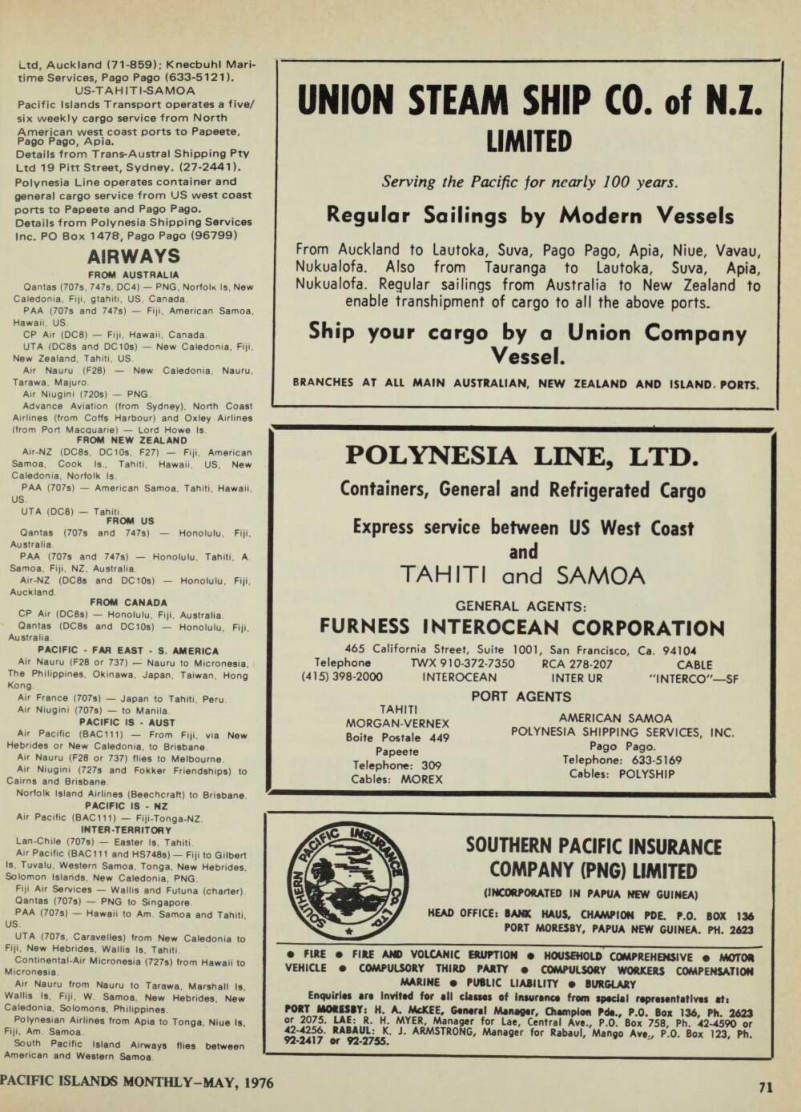
From Australia
Qantas (7075, 7475, DC4) PNG, Norfolx Is, New Caledonia, Fiji, gtahiti, US, Canada PAA (707 s and 7475) Fiji, American Samoa, Hawaii, US.
CP Air (DCB) Fiji, Hawaii, Canada.
UTA (DCBs and DClOs) New Caledonia, Fiji, New Zealand, Tahiti, US.
Air Nauru (F2B) New Caledonia, Nauru, Tarawa. Majuro.
Air Niugini (7205) PNG Advance Aviation (from Sydney), North Coast Airlines (from Coffs Harbour) and Oxley Airlines (from Port Macquarie) Lord Howe Is.
From New Zealand
Air-NZ (DCBs, DCIOs, F 27) Fiji. American Samoa, Cook Is., Tahiti, Hawaii, US, New Caledonia, Norfolk Is PAA (7075) American Samoa, Tahiti, Hawaii, US.
UTA (DCS) Tahiti.
From Us
Qantas (707 s and 7475) Honolulu, Fiji.
Australia.
PAA (707 s and 7475) Honolulu, Tahiti, A Samoa, Fiji, NZ, Australia.
Air-NZ (DCBs and DClOs) Honolulu, Fiji, Auckland.
From Canada
CP Air (DCBs) Honolulu, Fiji, Australia.
Qantas (DCBs and DCIOs) Honolulu. Fiji, Australia.
PACIFIC - FAR EAST - S. AMERICA Air Nauru (F2B or 737) — 1 Nauru to Micronesia, The Philippines, Okinawa, Japan, Taiwan, Hong Kong.
Air France (7075) Japan to Tahiti, Peru Air Niugini (7075) to Manila.
Pacific Is • Aust
Air Pacific (BAC111) From Fiji, via New Hebrides or New Caledonia, to Brisbane.
Air Nauru (F2B or 737) flies to Melbourne.
Air Niugini (727 s and Fokker Friendships) to Cairns and Brisbane Norfolk Island Airlines (Beechcraft) to Brisbane
Pacific Is - Nz
Air Pacific (BAC111) Fiji-Tonga-NZ.
Inter-Territory
Lan-Chile (7075) Easter Is. Tahiti Air Pacific (BACIII and HS74Bs) Fiji to Gilbert Is, Tuvalu, Western Samoa, Tonga, New Hebrides.
Solomon Islands, New Caledonia, PNG Fiji Air Services Wallis and Futuna (charter).
Qantas (7075) PNG to Singapore.
PAA (7075) Hawaii to Am. Samoa and Tahiti US.
UTA (7075, Caravelles) from New Caledonia to Fiji, New Hebrides, Wallis Is, Tahiti, Continental-Air Micronesia (7275) from Hawaii to Micronesia.
Air Nauru from Nauru to Tarawa, Marshall Is, Wallis Is, Fiji, W. Samoa, New Hebrides, New Caledonia, Solomons. Philippines.
Polynesian Airlines from Apia to Tonga, Niue Is, Fiji, Am, Samoa.
South Pacific Island Airways flies between American and Western Samoa
Air Tahiti from Tahiti to Cook Is.
Air Niugini to Irian/Jaya, Solomon Is, Philippines.
Norfolk Island Airlines (Beechcraft) to Noumea.
Internal
Fiji Air Pacific (HS74Bs and Trislanders), Fiji Air Services (Beech Barons and Islanders).
French Polynesia Air Polynesia (Fokker Friendships), Air Tahiti.
US Trust Territory and Guam Continental-Air Micronesia (7275) and Air Pacific International Inc.
Gilbert Is Air Pacific.
PNG Air Niugini, Aerial Tours, Talair, Melanesian Airlines, Crowley Airways.
Bougainville Bougainville Air Services.
New Caledonia Air Caledinie (Twin Otters) New Hebrides Air Melanesiae (Islanders).
Solomon Is Solair (Beech Barons and Islan ders).
Tonga Tonga Internal Air Service (Islanders).
Cook Is Cook Island Airways (Islander) Norfolk Island Airlines (Beechcraft) Norfolk Is- Lord Howe Is.
Western Samoa Air Samoa Ltd, and Samoa Aviation Ltd.
Advertisements & other items, pp. 71-72 (2 items)
71
‘ACIFIC ISLANDS MONTHLY-MAY, 1976
Union Steam Ship Co. Of N.Z.
LIMITED
Serving the Pacific for nearly 100 years.
Regular Sailings by Modern Vessels
From Auckland to Lautoka, Suva, Pago Pago, Apia, Niue, Vavau, Nukualofa. Also from Tauranga to Lautoka, Suva, Apia, Nukualofa. Regular sailings from Australia to New Zealand to enable transhipment of cargo to all the above ports.
Ship your cargo by a Union Company
Vessel.
BRANCHES AT ALL MAIN AUSTRALIAN, NEW ZEALAND AND ISLAND, PORTS.
POLYNESIA LINE, LTD.
Containers, General and Refrigerated Cargo
Express service between US West Coast
and
TAHITI and SAMOA
GENERAL AGENTS;
FURNESS INTEROCEAN CORPORATION
465 California Street, Suite 1001, San Francisco, Ca. 94104 Telephone TWX 910-372-7350 RCA 278-207 CABLE
(415)398-2000 INTEROCEAN INTER UR "INTERCO"—SF
TAHITI
MORGAN-VERNEX
Boite Postale 449 Papeete Telephone: 309 Cables: MOREX
PORT AGENTS
AMERICAN SAMOA
POLYNESIA SHIPPING SERVICES, INC.
Pago Pago.
Telephone: 633-5169 Cables: POLYSHIP
£9 $ v<¥
SOUTHERN PACIFIC INSURANCE
COMPANY (PNG) LIMITED
(INCORPORATED IN PAPUA NEW GUINEA)
HEAD OFFICE: BANK HAUS, CHAMPION PDE. P.O. BOX 136 PORT MORESBY, PAPUA NEW GUINEA. PH. 2623 • FIRE • FIRE AND VOLCANIC ERUPTION • HOUSEHOLD COMPREHENSIVE • MOTOR VEHICLE • COMPULSORY THIRD PARTY • COMPULSORY WORKERS COMPENSATION
MARINE • PUBLIC LIABILITY • BURGLARY
Enquiries are Invited for all classes of insurence from special representatives att PORT MORESBY: H. A. McKEE, General Manager, Champion Pde., P.O. Box 136, Ph. 2623 or 2075. LAE: R. H. MYER, Manager for Lae, Central Ave., P.O. Box 758, Ph. 42-4590 or *2A256- J - ARMSTRONG, Manager for Rabaul, Mango P.O. Box 123, Ph. 92-2417 or 92-2755.
NOTICE
KIKKOMAN
TRADE MARKS
Notice is hereby given that Kikkoman Shoyu Co. Ltd., a corporation duly organised and existing under the laws of Japan, of 339, Noda, Noda City, Chiba, Japan, is the sole proprietor in Papua New Guinea and Nauru and elsewhere of the following Trade Marks:
1. KIKKOMAN
2 Used in respect of the following: Coffee, tea, cocoa, sugar, rice, tapioca, sago, coffee substitutes: flour, and preparations made from cereals; bread, biscuits, cakes, pastry and confectionery, ices; honey, treacle: yeast, bakingpowder: salt, mustard: pepper, vinegar, sauces, spices; ice • The Proprietor claims all rights in respect of the above Trade Marks and will take all necessary legal steps against any person or company infringing those rights.
F. B. RICE
& CO.
Patent Attorneys Sydney, Australia
Islands People
Deaths of Islands People
Mr H. W. Evans The death occurred at his home at Turramurra, Sydney, on February 18 of Mr Hallen William Evans, well-known former resident of Papua New Guinea.
He was born in Sydney in 1913 but went with his parents, the late Mr and Mrs H. Beilby Evans, to Rabaul in 1921 when the new civil administration of the Mandated Territory of New Guinea was being set up and the powerful Australian
Expropriation Board was taking over former German plantations.
Young Hal and his brothers and sisters became founding pupils at the Rabaul primary school when it was probably the only European school in the territory and when white children were a rare commodity in New Guinea.
Later, after school in Sydney, he returned to his family to assist his father who had taken up plantation land in Buka. The Depression was then in full swing and in 1933 Hallen branched out for himself as overseer on Rugen Plantation where early attempts were being made to plant coffee.
He joined the public service in 1934. After the Pacific War he was District Labour Officer, Madang and, later, senior co-operatives officer for New Ireland.
He left Papua New Guinea for a new career as export manager for an Islands merchant firm in 1956.
He has been an active member of the ex-PNG public service asso ciation, a keen yachtsman and an exemplary family man. His know ledge of the early period of Austra lian administration in New Guinea was extensive, as was his command of Pidgin English. In his young days in Papua New Guinea he sometimes acted as court interpreter and, after his return to Sydney, PIM on numerous occasions had reason to thank his sharp memory of early PNG events and his expertise as a translator of passages of inexplicable Pidgin that came our way.
He is survived by his wife Linda, hs married daughters Patty and Lynne and his son Hallen Jr.
Mrs L. Sutherland Mrs Laura Sutherland, who was ictive in the social life of Rabaul or some years after World War II lied recently in Mackay, Queens and, aged 77. She went to Rabaul n 1947, where she worked in the elegraph office. Mrs Sutherland was in early member of the New Britain Yemen's Club.
Dr M. A. Radcliffe-Taylor Dr Marion Aroha Radcliffe-Taylor /ho had a medical practice at Rabaul for bout 20 years, died in Sydney in March, ged 82. Dr Radcliffe-Taylor was also eenly interested in art. and founded the tabaul Art Society.
She was born in New Zealand and raduated in medicine at Otago Univer ty. She practised privately in Perth for ’me years, and later took a degree in irgery (FRCS) at Edinburgh University.
Advertisements & other items, pp. 72-80 (2 items)
Peter Fisher Trading Pty. Ltd.
PACIFIC ISLANDS TRANSPORT LINE
Owners: Thor Dahls Hvalfangerselskap A/S — Sandefjord, Norway.
MS CAMELLIA VENTURE
Express Freight Service between Pacific Coast Ports of
U.S.A.
and
TAHITI and SAMOA
Full container service including reefers.
GENERAL STEAMSHIP CORPORATION LTD.
General Agents 400 California Street, San Francisco, California, U.S.A.
APlA—Borns Philp (South Sea) Company, SYDNEY—Trans-Austral Shipping Pty. Ltd.
Ltd. SUVA—Bums Philp (Sooth Sea) Company, PAPEETE—Agence Maritime Internationale Ltd.
Tahiti. LAE/RABAUL—Borns Philp (New Guinea) Ltd.
PAGO PAGO—Pojynesia Shipping Services Inc. PORT^VjLA —Comptoirs Francais de Nouveltes
PETER FISHER TRADING Pty. Ltd.
321 Pin STREET, SYDNEY, 2000, AUSTRALIA
Telephone: 26-1109 CABLES: "FISHERION", SYDNEY
EXPORTERS TO THE PACIFIC ISLANDS
CITIZEN BUSINESS MACHINES
• CASH REGISTERS • ADDING MACHINES
• TYPEWRITERS • ELECTRONIC CALCULATORS
Write for brochures and prices Maison Barrau, 8.P.A4 Cedex, Noumea Iprotec, B.P. 366 Port Vila or direct to
GOODSON CALCULATORS PTY. LTD.
23/25 ABERCROMBIE STREET, CHIPPENDALE, SYDNEY 2008
Agency enquiries invited
HENRY CUMINES PTY. LTD.
EXPORTERS • GENERAL MERCHANTS
428 GEORGE ST., SYDNEY
CABLES: HENCO SYDNEY. G.P.O. Box 3949. PHONE: 25-3383.
For specialised and personalised buying service throughout the Pacific Islands and the East Local enquiries to our agents RABAUL: M & C. Seeto, P.O. Box 131, Rabaul. Telephone 922902.
MADANG: W. Double, P.O. Box 22, Madang, Telephone 822696 FIJI: K. Witherington Ltd, P.O. 293, Suva.
Telephone 22-356.
NEW HEBRIDES; John Lum A
Associates, Box 65. P. 0., Santo.
Telephone 329.
LAE: Osborne Agencies, P.O. Box 8, Lae Telephone 422918.
Resident Agents in other Pacific Territories.
Q E
offers expert insurance service
throughout the Islands
QBE INSURANCE
LIMITED
(FORMERLY—QUEENSLAND INSURANCE COMPANY
Central Office: 82 Pitt Street, Sydney rmi?A Ch <P K i( L e ’ for Fiji: L. Gliddell (A. AM). 7rVvV T Tr^ A Sub ‘ Branch Office: Bums Philp Bldg.
sa* ias
KSS ™Nel% D eb S rid«) M Ud Ber ° R D ° nne ">' V " a; Santo: I^ TI 7; Arthur Chung: Immeuble 8.1., Front de Mer Papeete
SM3K
QUEENSLAND INSURANCE (P.N.G.) LTD
PAPUA NEW GUINEA
Head Office, Port Moresby: General Manager: J. M. Dawe.
District Managers at Rabaul: C. D. Dickings; Lae: W. J. Leonard- Mart^ 86111 D ’ F ' CarrolL Arawa: A. M. Tanner; Madang: I. R.
H 360
Total service 0n ...
plumbing supplies fast
WATSON & CRANE
are organised to fulfil your needs
wherever you are in the South Pacific You can get all you need from one supply source: water taps, valves, copper tube, tools and a host of other fittings and related plumbing equipment for domestic, industrial and multistorey buildings.
Watson & Crane Pty Ltd have over 20,000 plumbing items in stock at their central warehouse located at Waterloo, NSW, Australia.
Years of experience in handling and shipping right throughout the South Pacific add up to another big reason for you to deal with Watson & Crane Pty Ltd.
Representatives call regularly at New Guinea, Papua, the Solomons, New Hebrides and Fiji (stands to personally discuss your requirements and appropriate credit arrangements.
Write, cable or telephone today for complete plumbers' supplies service.
Watson & Crane Pty. Ltd, 1037 Bourke Street, Waterloo,
NSW 2017.
Phone: Sydney 699-1333. telex: AA 25548.
Cables: "Watcrane" Sydney.
CRANE
GROUP
Pacific Island distributors of Crane Enfield copper tube for water, sanitation, engineering, refrigeration and air conditioning
FIBREGLASS STILE
LADDERS OUTLAST
TIMBER LADDERS
MANY TIMES OVER!
STILE ladders are available in many sizes to suit your needs From home use to major construction work, especially electrical installations and maintenance. • Far more rigid • Resilient to weathering • Leakage to earth vastly superior than Oregon ladders
* Extensions to 36 feet
* Steps to 14 feet.
* Single ladders to 20 feet.
Pure fibreglass STILE ladders and steps have been tested and approved by the
DEPT. OF OCCUPATIONAL SAFETY (QLD.)
• • O For full details of how STILE fibreglass ladders can assist in your project, contact
W. H. BAILEY LADDERS
PTY. LTD.
P.O. Box 205, Revesby, N.S.W., Australia 2212
Telephone 771-6055
Line Advertisements
Per line. $3.00 Aust. Minimum rate. 4 lines.
FOR SALE Artifacts ana Handicrafts from Papua New Guinea and New Zealand WANTED: Artifacts and Handicrafts from all Pacific Islands must be genuine Write Papua New Guinea Arts & Crafts.
Box 509. Surfers Paradise 4217 Old.. Aust.
FISHINu vessel 54ft, Gardner 130 hp 8 ton blast freezer accessories NZ Marine Dept. Survey Certificate price $NZ35,000 negotiable enquiries T.
C. Clarke, PO Box 144, Rarotonga, Cook Islands.
CONCRETE BLOCK MAKER. Makes blocks, flags, edgings, screen-blocks, garden stools—up to 8 at once and 96 an hour. $215.00 c.i.f. main ports. Send for leaflets Forest Farm Research, Londonderry.
N S W., 2753 Australia.
FLEETS 30ft. steel, diesel workboat, bit. 1974, some refrig, space, $25,000.00 52ft. trawler, bit. 1968, in survey, $45,000 00, also tugs, luxury tourist cruisers etc Fleets 221 Esplanade Wynnum Central.
Brisbane. Cable FLEETS BRISBANE Buying entire used envelopes from Pacific Islands especially U S Trust Territories J. Krupnik, 3091 North East 441 h St., Fort Lauderdale, Florida 33308
USA
Try your luck, buy Australian lotteries. For details, contact V. Leventhal. Box 1933 g Sydney 2001, Australia more P. 0., FOR SALE: Freehold Land, 4V2 acres, Satala, Pago Pago, American Samoa. Contact L. A. Groves, 65A Anzac Pda , Wanganui. New Zealand. ii you have snens to sell—any quantity—contact Anisa Commodity Traders Ply. Ltd., P.O. Box 1413, Lae. Papua New Guinea, Phone 424159. We are buyers of Trochus, Greensnail, Blacklip MOP, Goldlip MOP, and Marine Specimens Best prices paid Rabaul agents; Gazelle Agencies Pty. Ltd., P.O. Box 262, Rabaul, P.N.G. Phone; 921397.
Manus Island Agents, R, L. & V. J. Knight, P.O Box 108, Lorengau. Manus Island, P.N.G. Phone
Park View Motel—Brisbane
Quiet location—opp. Botanic Gardens.
Single, double, family suites, all with refrig., air conditioning, phone, TV, radio, tea making facilities, from $l2. Pool and restaurant.
Phone 31-2695—Telex 40270.
Write for coloured brochure— Park View Motel, 128 Alice St. BRISBANE Old., 4000.
Holder Cultitrac
Four-wheel drive
Tractors
Representatives;
Demka Australia Pty. Ltd. 184 Sussex Str. Sydney N.S.W.
A diesel engine-powered Forestmil sawing timber from small hardwood logs in Tasmania,
The Forestmil
PORTABLE
SAWMILL
turns trees
into timber!
Forestmil produces house building or construction size timber direct from the log in the forest. No need to resaw, it’s ready to use. Inter-acting vertical and horizontal blades cut simultaneously producing accurate timber any size up to 12” x 6” x 18”, including boards, framing, bridge sized, etc.
Larger machines also available.
CHECK THESE
STANDARD FEATURES
• Dismantles into small sections • Only two men required to operate • Total weight 1,560 lb. • Erected ready to use in one hour • Powered by petrol or diesel engine Over 700 Forestmils operating in 23 countries
MACQUARRIE
INDUSTRIES pty. ltd
P.O. Box 20, Coburg
Victoria 3058, AUST.
Cables: Macbound Melb.
Telex: AA 33729
NOTICE
TRADE MARK
Notice is hereby given that Aiwa Co., Ltd., a corporation duly organised and existing under the laws of Japan of 2- 3, 5-chome, Sotokanda, Chiyoda-ku, Tokyo, Japan, is the sole proprietor in Papua New Guinea and Nauru and elsewhere oj the following Trade Mark:
AIWA
Used in respect of the following: Radio and television equipments: sound amplifying apparatus and instruments and parts thereof: microphones, loud-speakers, tuners, record players, turntables, pickups, tape recorders, video recorders, phonograph records, tapes and other sound and/or image recording and/or reproducing apparatus, articles and implements: cassette tape recorders, combined radio receivers and cassette tape recorders, phonomotors; parts and accessories of foregoing goods.
The Proprietor claims all rights in respect of the above Trade Mark and will take all necessary legal steps against any person or company infringing those rights.
F. B. RICE
& CO.
Patent Attorneys Sydney, Australia
TURNS GRASS INTO LAWN
UTILITY
UTILITY 160
THE “WORK HORSE’
VICTA RANGE
OF THE
A tough but lightweight mower without grasscatcher, a model designed to do a superb grasscutting job—on meadows full of weeds or on a fine lawn. It cuts up to trees and fences and is the lightest Victa mower of all to use. Available with either a 125 c.c. Victa 2-stroke engine or with the Victa 160 c.c. 2-stroke engine— Folding handle and single-lever simultaneous height adjustment are other features that make this lowest priced VICTA a popular mower.
SUPER 24
THE BIG MOWER FOR
BIG AREAS
The big mower from Victa. It takes a full 61 cm wide bite into and cuts a smooth swath over large expanses of grass. It is the mower for municipal parks and gardens, sports grounds, road-side growth control as well as home owners with large areas of land. The lightweight construction of the mower makes it easy to manoeuvre and the giant rear wheels ride rough ground effortlessly. Two freeswinging blades on the cutting disc absorb shock when hard objects are encountered.
JIJ3 up & away
with... tfvn
n S. E. TATHAM & CO. PTY. LTD
BEEHIVE BLDG., 94 ELIZABETH STREET
G.P.O. BOX 8 CABLES "SET"
MELBOURNE, 3001, AUSTRALIA
TELEX: AA34293 TELEPHONE 63-5094
Buyers hr the Pacific Islands
AND IN
Popup New Guineo:
S. E. TATHAM (P.N.G.) PTY. LTD.
LAE: MALAITA ST. (P.O. BOX 1562)
PORT MORESBY: Cnr. GOROA & MUNAHU Sts., GORDON
(P.O. BOX 6733, B0R0K0).
Fiji: S. E. TATHAM (FIJI) LTD.,
LAUTOKA P.O. BOX 366,
SUVA G.P.O. BOX 671,
\ 1 1
YOUR GUARANTEE
1
FOR SERVICE
TELEGRAMS: ALL OFFICES “SET”
SINCE 1924
- ; aai \
Perfeimcince
You Enjoy Living With.
Honda is a true life drama, performed on the world’s stage. By average folks, teenagers, men, and women everywhere. Your neighbors, maybe even you are playing a part. If so, you know Honda is more than great machines.
It’s people concerned with taking people where they want to go in life.
On two wheels, we’re the best selling motorcycle. The easy to operate hard workers who don’t demand much. Honda is always ready and gets you there safely. We move on four wheels. The precedent setting Honda Civic continues to receive international economy and performance awards. It’s the elegant compact car.
Sometimes, we have no wheels. Honda portable power operates machinery, generates electricity, pumps water and tills the soil.
Little wonder good things happen on Honda —we work harder to assure they do. r
HONDA MOTOR CO., LTD. TOKYO. JAPAN
PAPUA NEW GUINEA: Steamships-Machinery P.O. Box 1. Port Moresby /TAHITI: Societe Tahitienne d’lmportation des Produits Honda B.P. i^ 5 ; Papeete .T IJI 'SLANDS: Coral Island Motors P.O. Box 48. Suva/U.S. TRUST TERRITORY: United Micronesia Development Assn P.O. Box 238 Saipan Mainana Islands 96950/COOK ISLANDS: Cook Islands Motor Centre Ltd. P.O. Box 74, Rarotonga AMERICAN SAMOA: Samoan Holiday and Travel Center P.O. Box 968, Pago Pago/AMERICAN SAMOA: Haleck’s Service Center P.O. Box 1138, Pago Pago/ GUAM; Mark’s Motor Co., Inc. P.O. Box DV. Agana/WESTERN SAMOA: Motor Distributors (Samoa) Ltd. P.O. Box 576, Apia/SOLOMON ISLANDS: British J r l 8 . Lt J d: D P i ) n ßox 114 Honiara / NEW CALEDONIA: Establissements Ballande Boite Postale No. C 4 Noumea Cedex / jL, J ° n es Limited, P.O. Box 34, Nuku’alofa/TARAWA: Gilbert & Ellice Islands Development Authority P.O. Box 488, Beito/NIUE ISLAND: S. Jessop & Sons Ltd. P.O. Box 71, Alofi South/NAURU: Nauru Cooperative Society, Republic of Nauru, Nauru Island Central Pacific
mwmiail cutfti ad Mlccll piwxk?
Mr. Chau Jin Man, motor mechanic
Vats tut-itiphJOvtd to
ht AOiMjSlu^fita^^
Miss Diane Frogia, teacher.
'mm -'YWk mfM UUt dma CtrhtaiuAc [t& umaaa uCtkz Qcl^OAl Mrs. Ilona Wimer, housewife
Your Datsun. Your special island.
Once it has found you, it'll never let you go.
Where else can you find such economical, worry-free motoring? Little wonder Datsuns are enjoyed in Tahiti—and in 130 other nations! In a series of on-thespot global interviews, Nissan Motor representatives met many owners and asked them for a frank assessment of their Datsuns. Answers were surprisingly similar, despite the very different circumstances in which the Datsuns were used.
The Datsun, they told us. is economical, reliable, durable, comfortable.
Fun to own.
Again and again.
DATSUN
rqgm Product of NISSAN DATSUN distributor network covers the following areas: Fiji •T.P.N.G. • W. Samoa -New Caledonia -New Hebrides •8.5.1 P. -Timor -Norfolk Is.
A. Samoa-Tahiti-Cook Is.-Nauru -Tonga-Saipan-Guam-Australia-New Zealand
73
ACIFIC ISLANDS MONTHLY-MAY, 1976