Pacific Islands Monthly

■■■ Jmr 1 Mr" jl JI H
Wjstralia 85
r.A lH r=Tr:.K«] tfimsp L»T:.)
Our Cover
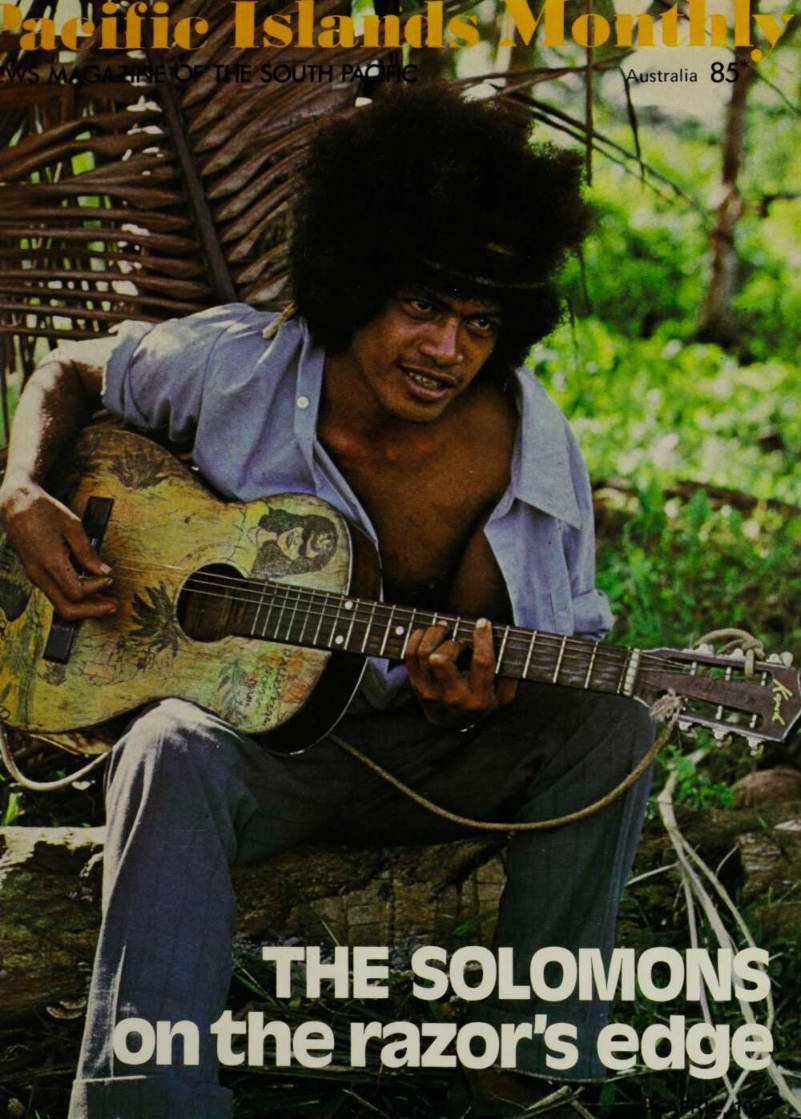
This young Rennell
man photographed by
Denis Fisk today lives a quiet, rural life raising coconuts and gardening on his remote island in the Solomons. Will he soon he a miner? Will he and his fellow Ren nellese and neighbour ing Bello nese be com pensated and then dispersed to other islands for the sake of riches from bauxite and
phosphate exploitation?
Along with these two islands ’ peoples , much of the Solomons 9 future life-style and degree of dependence on the rest of the world hangs on whether these mines are opened. See story on page 11.
Advertisements & other items, pp. 2-4 (1 item)
When you buy a Toyota
we promise you much more than
one of the world’s finest cars.
We'll be the first to admit that at Toyota we make some of the world's finest cars.
You only have to look at them to see that.
And driving them just goes to confirm your first opinions.
But there's more to buying a car than buying a good one. You also have to be sure you can keep it that way.
Which is why Toyota have always insisted that their after-sales service be as good as the cars themselves.
In the Pacific Islands area alone we have over fifty designated outlets to provide everything you might need, from a simple service to a major overhaul. So get yourself a Toyota and get a lot more than a car.
And that's a promise.
TOYOTA
SERVICE
W
TOYOTA
The Toyota range includes: Toyota 1000, Toyota Corolla, Toyota Celica, Toyota Corona, Toyota Corona Mark 11, Toyota Crown PAPUA, NEW GUINEA: ELA MOTORS LIMITED, Scratchley Rd., Badili, P.O. Box 75, Port Moresby. U.S. TRUST TERRITORY. MICROL CORPORATION, P.O. Box 267, Saipan. FIJI ISLANDS; AUTOMOTIVE SUPPLIES CO., LTD., G.P.O. Box 355, Suva. AMERICAN SAMOA: BURNS PHI LP (SOUTH SEA) CO., LTD., P.O. 1057, Pago Pago. WESTERN SAMOA; BURNS PHILP (SOUTH SEA) LTD., P.O. Box 188, Apia. GUAM: ATKINS, KROLL (GUAM) LTD., P.O. Box 6428, Tamuning. NEW HEBRIDES: NEW HEBRIDES MOTORS LTD., P.O. Box 18, Vila. SOLOMON ISLANDS: MENDANA ENTERPRISES (5.1.1, LTD., P.O. Box 174, Honiara. TAHITI: NIPPON AUTOMOTO, B.P. 342, Papeete. COOK ISLANDS: COOK ISLANDS TRADING CORPORATION LTD., P.O. Box 92, Rarotonga.
NAURU ISLAND NAURU COOPERATIVE SOCIETY. GILBERT & ELLICE ISLANDS COLONY: TARAWA MOTORS, Box 36, Bairiki Tarawa. NORFOLK ISLAND: MARIE'S NORFOLK TOURS, LTD;, lIMOR. ;;a- : TAI HOO, SangTai Building, Dili. NEW CALEDONIA: SOCIETE IMPORTATION AUTOMOBILE DU PACIFIQUE, Rond-Point du Pacific (Station Total) B.P. 438, Noumea.
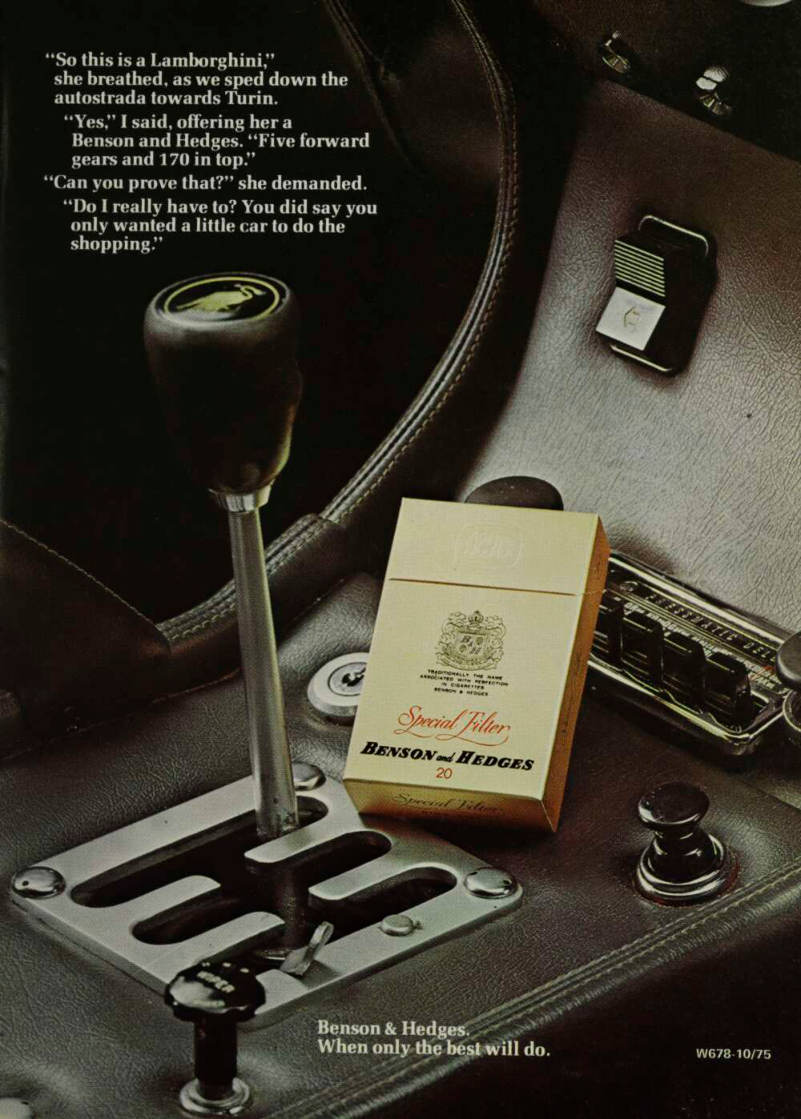
\\ ‘So this is a Lamborghini,” she breathed, as we sped down the autostrada towards Turin.
“Yes,” I said, offering her a Benson and Hedges, “Five forward gears and 170 in top.” ‘Can you prove that?” she demanded.
“Do I really have to? You did say you only wanted a little car to do the
shopping.”
,v.
V-. *N v % 5 b 1 ■& ■ . ■* s *V N s lima V ;\ Benson & Hedges.
When only the best will do.
W 678 10/75 ■p s*
Sony presents more power,
more tonal quality than you ever
dreamed was possible.
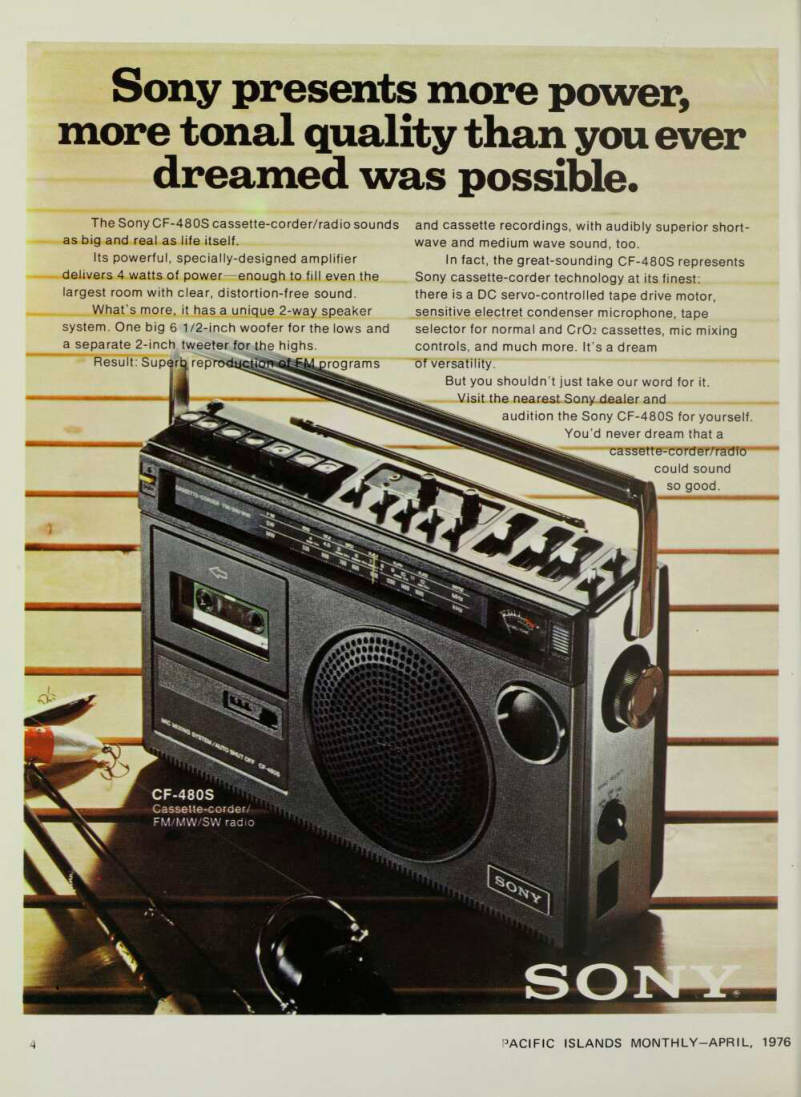
The Sony CF-480S cassette-corder/radio sounds as big and real as life itself.
Its powerful, specially-designed amplifier delivers 4 watts of power —enough to fill even the largest room with clear, distortion-free sound.
What’s more, it has a unique 2-way speaker system. One big 6 1/2-inch woofer for the lows and a separate 2-inch tweeter for the highs.
Result: reprod^tiCQ^^^Programs and cassette recordings, with audibly superior shortwave and medium wave sound, too.
In fact, the great-sounding CF-480S represents Sony cassette-corder technology at its finest: there is a DC servo-controlled tape drive motor, sensitive electret condenser microphone, tape selector for normal and Cro2 cassettes, mic mixing controls, and much more. It’s a dream of versatility.
But you shouldn’t just take our word for it.
Visit the nearest Sonyjlealer and audition the Sony CF-480S for yourself.
You’d never dream that a casswrwaw UHwaary— could sound so good. a llHl O. - ;f:i»
Pacific Islands
Monthly
FOUNDED BY R. W. ROBSON IN 1930
Published Monthly By
Pacific Publications (Aust.) Pty. Ltd.,
76 Clarence Street, Sydney 2000.
Postal Address: G.P.O. BOX 3408, SYDNEY,
N.S.W. 2001.
Telegraphic Address: PACPUB, Sydney.
Telex: 21242.
Telephone: 296693.
Publisher: Stuart Inder.
Business Manager: John Berry.
Pacific Islands Monthly
Editor: John Carter.
Advertising Manager: Alan Batt.
Subscription Rates:
"Pacific Islands Monthly" is airfreighted to the majority of subscribers and agents in the Pacific Islands and the U.S.A.
Australia (including Lord Howe and Thursday Islands), New Zealand, Papua New Guinea, Fiji, New Hebrides, Tonga, Cook Islands, Western Samoa, Gilberts and Tuvalu, Norfolk Island, Niue and Nauru; $9.00 (local currency); Solomon Islands; $lO.OO Aust.; American Samoa, Micronesia and Guam: $12.00 U.S.; Hawaii and U.S. Mainland: $15.00 U.S.; New Caledonia and French Polynesia; 1,500 C.F.P.; United Kingdom: £6.50; Japan: 4,000 Yen; Elsewhere: $11.50 Aust.
Representatives
Fiji: Advertising and Distribution—Fiji Times & Herald Ltd., 20 Gordon Street, Suva. Telephone: 312-111. Telex: FJ 2124.
Papua New Guinea; Advertising and Distribution —PNG Post-Courier, P.O. Box 85, Port Moresby.
Enquiries: Post Newsagency, Telephone 24-2148.
French Polynesia: Distribution —Hachette Paci fique, 10 Ave Bruat, Papeete.
New Zealand: Pacific Publications, C.P.O.
Box 2229, Auckland.
United Kingdom: The Herald and Weekly Times Limited, 8-10 Clifford's Inn, Fetter Lane, London EC4A IBU. Telephone: 01-8316041. Telex: London 21989.
Japan: Advertising—Universal Media Corpora tion, C.P.O. Box 46, Tokyo. Telephone: 666-3036.
Victoria: Advertising Pacific Publications (Aust.) Pty. Ltd., Herald and Weekly Times Building, 2nd Floor, 61 Flinders Lane, Mel bourne, 3000. Telephone: 652-1565.
Brisbane: D. Wood, Anday Agency, Box 1918 G.P.0., Brisbane 4001. Telephone; 44-3485; 44-1546.
Hawaii and U.S. Mainland only: N. Grogan.
Send change of address notices. Form 3579 and new subscriptions to P.O. Box 2193, Honolulu, Hawaii, U.S.A. 96805.) Second class postage paid at Honolulu, Hawaii.
Copyright ©, 1976,
Pacific Publications (Aust.) Pty. Ltd.
Printed by The Harbour Press, Chalmers Street, Sydney.
Registered at the G.P.O. Sydney for trans mission by post as a newspaper—category B. * Recommended retail price only.
Vol. 47, No. 4 April, 1976
Up Front
with the Publisher
FOR a number of years after World War 11, PlM’s pages in cluded a regular smattering of Island flavoured poetry and fiction, almost all of it submitted by expatriate Islands residents with a literary bent.
But as the postwar Island develop ment boom grew apace, and PlM’s space was under pressure, this kind of material was squeezed out until eventually we decided to give it no room at all. There were other, more literary-orientated magazines avail able to expatriate writers of fiction and poetry.
Then in 1972, Marjorie Crocombe of Suva, a Cook Islander herself, drew my attention to the fact that during the years we had dropped expatriate fiction, a widely-dispersed body of indigenous writers were de veloping who would be encouraged by having their material published regularly in a special PIM section and being able to compare their works with each other.
Thus were born the MANA pages of PIM.
MANA appeared in March, 1973: the organ of the newly-organised South Pacific Creative Arts Society, which had, and has, an editorial committee drawn from writers in many Pacific Islands. Marjorie, MANA’s editor, said then that she hoped the monthly publication of the material in PIM would influence Islanders to write, and furthermore, “to have courage to submit what they write for publication”.
PIM also agreed to assist with the publication each year, in a MANA annual, of all the material printed in the monthly MANA sections, to gether with some additional new material. When the third MANA annual comes out soon, something like 250 pages of drawings, poetry, short stories and folk tales will have been published in the last three years. To Marjorie has fallen the onerous task of getting all this material together, but her reward, she says, has been in seeing the de velopment of confidence by young Pacific writers over this period.
There will be no more MANA pages in PIM. Three years have been
enough to prove Marjorie’s view that only encouragement was needed for Island writers to develop their own momentum. They don’t need to be reserved a special section in PIM. They can compete on equal terms, and in future PIM will in clude a regular leavening of Island short story writers and poets in its pages. I invite them to submit their material direct to the editor.
Meanwhile, MANA will continue to see the light of day in the form of the MANA Review, to be pub lished in Suva twice a year by the South Pacific Creative Arts Society, and also to contain, among other good things, critical essays on South Pacific fiction, poetry and language.
The society, c/- P.O Box 5038, Suva, will have it available for a subscrip tion rate of 5F4.00 for one year.
And now, since this is our Easter issue of PIM, I’m going to take the opportunity to reprint one of my favourite poems from MANA, by Western Samoan writer Eti Sa’aga and first published in 1973. It’s called Him Fella Saviour.
Him Fella Saviour up in the tree wanting to come down.
Another fella spear-carrier fun ma™g standing on the ground.
All the time Him Fella Saviour make sad noise, While his momma cry begging mercy with sad voice Then earth-shaker come, stopping all the fun.
Making all the noisy people Talk little but run.
But Him Fella Saviour just hang there on his tree, looking red, And according to some untrue reports, real dead.
Advertisements & other items, pp. 5-6 (1 item)
Recommended Pim
BOOKSTALL PRICES
Australia ... g^ c NZ & Pacific Islands, local currency 85c French territories CFP 130 American territories SUS 1.25
CHLORIDE THE MOST COMPLETE
SOURCE OF PACKAGED POWER IN
THE SOUTHERN HEMISPHERE.
A generous statement? Maybe, but then Chloride is equipped and qualified as such . . always ready to offer advice, guidance and service on your battery requirements.
And it goes way beyond automotive batteries. No matter what the problem . . if it's a question of power. . battery power. . it's one for Chloride. It could be as small as a battery for a hearing aid the size of a coat button, or a power station battery weighing 40 tonnes.
Again, it could be a no break D.C, power system for a computer or emergency lighting for a hospital.
Nearly 50% of all batteries sold in Australia are made by Chloride.
No matter what the application . .
Transport, Industrial, Communication, Defence, Mining, Marine, Recreation . . .
Make Chloride power work for you. p Emergency Lighting Electric Vehicles f Engine Starting Automotive L w Telecommunications Chloride Batteries Australia Limited 55 Bryant Street, Padstow, N.S.W. 2211, Australia, Telephone: 77 0177, "I I ill
In This Issue
General
Forum meets at Rotorua Office equipment feature
Cook Islands
Forum meets at Rotorua Burial rites Time of no account Homecraft education
Easter Island
Tourist flock in
Fiji
Forum meets at Rotorua Drugs seized
Teaching homecrafts
.and problem
Electronic age ...
Janabans want new ship
Gilbert Is
: orum meets at Rotorua
Vogramme for independence
Lir service to Christmas Island?
4Auru
drum meets at Rotorua
Urline's expansion
Iew Caledonia
iickel industry on show
tarriages by the mayor
kir Nauru's new service
New Hebrides
8 Anglo-French referendum 17 58 Air Nauru's new service 68
Niue Island
Forum meets at Rotorua 8 22
29 Papua New Guinea
Forum meets at Rotorua 8 Bougainville talks upset 9 37 World Bank review 13 Drum treasure ... 22 New magazine 23 g New soap factory at Lae 67 2i Morobe boat maintenance 70 29
33 Pitcairn Island
55 Where did Christian die? 45 70
Solomon Islands
Forum meets at Rotorua 8 j At the crossroads 11
70 Tonga
Forum meets at Rotorua ... 8 8 Shipping line's financial troubles ... 68 68
Tuvalu
Forum meets at Rotorua 8 17
22 Us Trust Territory
68 Anti-necktie law 23
Western Samoa
Forum meets at Rotorua ... 3
DEPARTMENTS: Up front with the Publisher, 5; Tropicalities, 21; Editor's mailbag 25- Vagazme section, 36; Yesterday, 47; Islands Press, 49; Books, 51; Business' and development, 55; Produce Prices, 67; Pacific Transport, 68; Cruhiig Yaqhts, 71 hipping and Airways Information, 72. '
Advertisements & other items, p. 7 (1 item)
7
•ACIFIC ISLANDS MONTHLY—APRIL, 1976
Pacific Islands Monthly
Islands Learn To Live With The
Bomb And Keep The Forum Intact
By JOHN CARTER who was at Rotorua
The seventh meeting of the South Pacific Forum, held over two days at Rotorua in March and co-inciding with the second South Pacific Festival of the Arts, was an exercise in the Island art of avoiding the reefs of controversy. Taking no longer than 4i hours it was conducted in a spirit of sweet reason and light— to the disappointment of Australian and New Zealand metropolitan news papermen.
They had created headlines about a coming split over the Islands’ cam paign for a nuclear-free South Paci fic. They based their hopes—and they were hopes because the Forum hasn’t produced a world-shattering story yet—on an apparent change by the newly-elected Australian and New Zealand governments of the previous Socialist governments’ policy of sup port for a nuclear-free zone. Both NZ’s Prime Minister Robert Muldoon and Malcolm Fraser, his Australian counterpart, who were meeting Island leaders for the first time as prime ministers, had said only weeks before that a nuclear-free zone was impractical.
'‘That means a row at the Forum”, reckoned the metropolitan newsbut they also reckoned with out the Islanders’ Pacific Way, reach ing a consensus and avoiding a row.
I told them there would be no row, no split. I reasoned that the Islands would be satisfied with continuing support fpr a campaign against nuclear testing like the French tests at Mururoa and for a denial of nuclear bases in the South Pacific to any power.
Australia and New Zealand had had second thoughts about the word ing of the resolution which New Zealand, Fiji and others had man aged to steer through the United Nations’ General Assembly. It was too loosely worded and its scope could refer to the passage of nuclear powered ships carrying nuclear wea pons though the Islands—United States nuclear submarines, for in stance.
That would be against the ANZUS
Pact and was bound to upset Ame rica, which has been having second, or third, thoughts about its foreign policy of bearing the burden of overseas defence. Upsetting the Americans could perhaps mean a return to the old isolationism. In which case the lesser of the two evils would be a watering down of the resolution for a nuclear-free zone.
When the nine Forum member countries got down to business for a 90-minute session on the first day, the nuclear-free zone loomed large on the small agenda and consider ation of it was adjourned until the following day.
The press concluded that was be cause there was a risk of a row. I think it was because Mr Fraser wasn’t due at the meeting until the
following day. Foreign Minister
Andrew Peacock was there, but the earlier comment on the impracticality of a nuclear-free zone had been made by Mr Fraser, so, obviously, he would like to handle it. Anyway, the Forum is regarded as a summit meeting of prime, or chief ministers.
It took them half the following morning to settle the matter. But there was no row. There was a reso
lution with intriguing wording—a
face-saver for somebody? An attempt to avoid the ambiguity of the UN resolution? A compromise? Mr Muldoon, in off-the-cuff comments afterwards—he wasn't the Forum’s chosen spokesman—called it a clari fication. And it was. It certainly won’t upset the ANZUS Pact.
It was plain then that the imprac ticality was in assuming that the UN resolution was meant to ban the free passage of ships on the high seas.
The former Australian and NZ governments had probably not given that aspect a thought. The Islands would sooner have nuclear weapon carrying ships at the other side of the world but they weren’t going to insist on .it at the expense of the loss of American defence.
Mr Muldoon, probably playing politics, talked about the “duplicity”
of the old NZ government and said the new resolution tidied up a lack of understanding that had been com pounded by the previous government.
Well, that lack of understanding was repaired and the Islands have the assurance of their more powerful partners that they’ll continue to back them in opposing nuclear tests in the South Pacific.
Fiji’s Prime Minister, Ratu Sir Kamisese Mara, had the job of ex plaining, as official spokesman, the resolution to the press. They gave him a hot time, mainly because they believed there had been a row be hind closed doors and there were headlines to justify. Ratu Mara, however, wouldn’t concede that at all. There was no row, he insisted.
The resolution showed the true posi tion. There had been no alteration.
He didn’t say there had been clari fication but that’s what he meant.
He made it plain that he wouldn’t object to nuclear-powered ships sail ing into Suva. In fact, he said he wished he had the services of such vessels to save Fiji’s dearly-bought oil. As for ships carrying nuclear weapons, he also made it plain that he wouldn’t welcome them, but if they were ships belonging to the Western powers (he didn’t use that term but that’s what he meant) and they insisted in tying up at Suva, he would tell them that he would also have to allow Russian ships to do the same.
Here is the resolution: “The members of the Forum agreed that in carrying forward their con sultations under the resolution adopted by the General Assembly of the United Nations on December 11,- 1975, endorsing the idea of a nuclear weapons-free zone in the South Paci fic, their objectives would be to ad vance the cause of general disarma ment and to seek the cessation of nuclear weapons testing in the South Pacific. In taking such action they would respect the principle of the freedom of navigation of the high seas. They agreed that in developing the concept embodied in the General
Assembly Resolution along these lines there would be no incompati bility with existing security arrange ments”.
The previous day, Australia’s Mr Peacock expertly fielded questions from the press about the nuclear-free zone and gave an assurance that Australia would continue to be totally opposed to any atmospheric testing. That was what has really bugged the Islands.
Any other business didn’t matter a cracker. As Ratu Sir Kamisese told me: “It was a good idea to have an informal meeting. It keeps the mill grinding. We had a check list of The resolutions or decisions made in Tonga and one or two of them needed interim decisions which we made”.
Regional shipping was on the agenda and the Forum considered a report of SPEC’s work on this pro ject which was said to be in its final stages of completion. It expressed satisfaction and decided on further consideration at the Forum meeting which, the leaders later agreed, would be at Nauru for three days beginning on July 26.
Whatever anyone might think about the Forum meeting and the idea some have that the Islands lost out so far as the nuclear-free zone was concerned, Fiji’s Prime Minister was more than satisfied that it had been held. He was able to kill two birds with one stone, the other bird, and maybe a more important one, being Fiji’s future relations with Australia and New Zealand.
Ratu Mara had private talks with Mr Fraser and Mr Muldoon. Both satisfied him that they would con tinue in the same vein as their pre vious governments.
Mr Fraser went further. He agreed that machinery should be set up for meetings between Fiji and Australia to discuss problems arising in poli tical and industrial relations. Using that machinery, Fiji might be able to get more satisfaction over such intricate matters as immigration which didn’t get on to the Forum agenda.
Ratu Mara also tackled Mr Mul doon over the loss to Fiji’s sugar industry of NZ dollars caused by New Zealand's devaluation last year, and airline landing rights. He failed to get an assurance from Mr Mul doon that New Zealand will make up the difference in the price Fiji would have got for the sugar she has sold under a two-year agreement to New Zealand if the latter had not devalued its currency. But he’s still hoping.
With regard to airline rights, Fiji is at a disadvantage in having Austra lian and New Zealand partners in
Air Pacific, having to exchange her national rights for airline co ordination. Ratu Mara said Fiji had tied up her civil air rights for the sake of a regional airline associated with Air New Zealand and Qantas.
Fiji wants to be free to negotiate with airlines like Singapore Air Lines, Japan Airlines and others. And Ratu Mara is hoping he’ll get some change out of New Zealand—and some liquified gas if and when that coun try produces any. He told me he has put Fiji’s name down as a customer.
At present, Fiji has to buy from Australia and, because of difficulties with the Australian Seamen's Union, she has to import it in Australian ships.
Attending the Forum were Presi dent Hammer Deßoburt (Nauru), Ratu Sir Kamisese Mara (Prime Minister, Fiji), Mr Malcolm Fraser (Prime Minister. Australia) and Mr Andrew Peacock (Foreign Affairs Minister, Australia), Mr R. D. Mul doon (Prime Minister, New Zea land), Mr Michael Somare (Prime Minister, Papua New Guinea), Prince Tu’ipelehake (Prime Minister, Tonga). Sir Albert Henry (Premier, Cook Islands), Mr Robert Rex (Premier, Niue). Mr Aumua loane (Finance Minister, Western Samoa) and, as observers, Mr Naboua Ratieta (Chief Minister, Gilberts) Mr Toalipi Lauti (Chief Minister, Tuvalu) and Mr Benedict Kinika (Education Minister, Solomon Islands). Mr Mahe Tupouniua, Director of SPEC, which acts as the Forum secretariat, was also present.
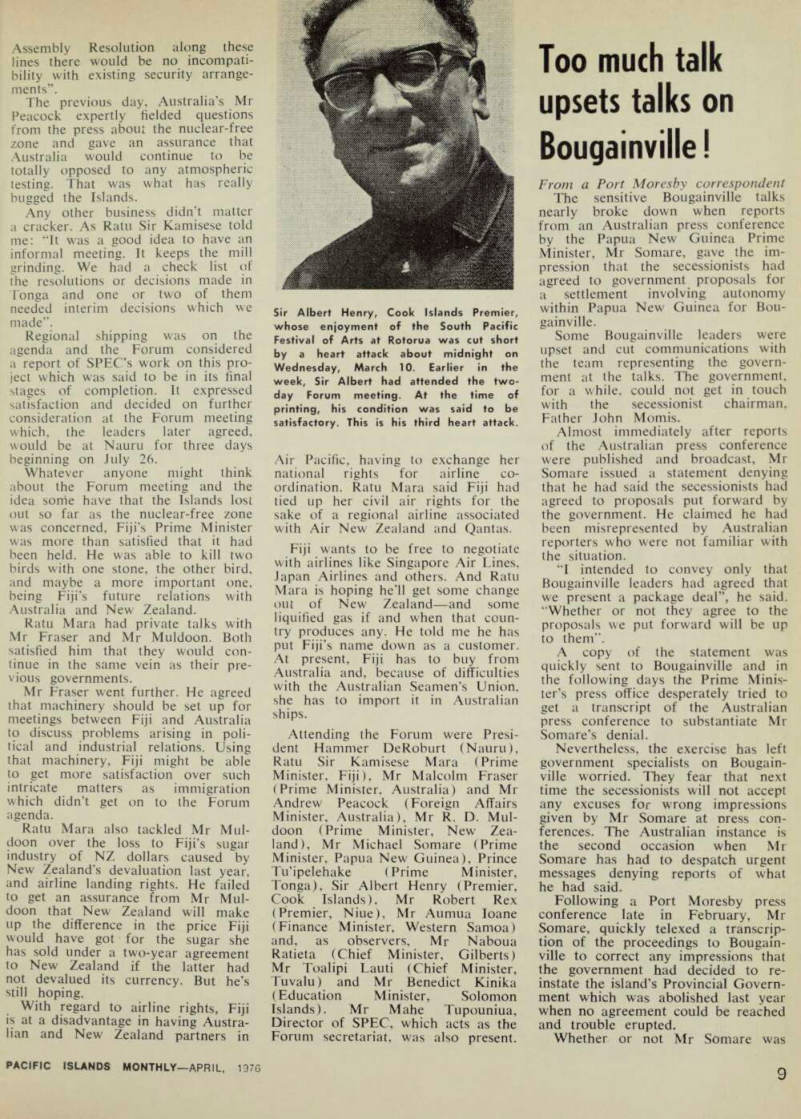
Sir Albert Henry, Cook Islands Premier, whose enjoyment of the South Pacific Festival of Arts at Rotorua was cut short by a heart attack about midnight on Wednesday, March 10. Earlier in the week, Sir Albert had attended the two day Forum meeting. At the time of printing, his condition was said to be satisfactory. This is his third heart attack.
Bougainville!
Too much talk upsets talks on Bougainville!
From a Port Moresby correspondent The sensitive Bougainville talks nearly broke down when reports from an Australian press conference by the Papua New Guinea Prime Minister, Mr Somare, gave the im pression that the secessionists had agreed to government proposals for a settlement involving autonomy within Papua New Guinea for Bou gainville.
Some Bougainville leaders were upset and cut communications with the team representing the govern ment at the talks. The government, for a while, could not get in touch with the secessionist chairman, Father John Momis.
Almost immediately after reports of the Australian press conference were published and broadcast, Mr Somare issued a statement denying that he had said the secessionists had agreed to proposals put forward by the government. He claimed he had been misrepresented by Australian reporters who were not familiar with the situation.
“I intended to convey only that Bougainville leaders had agreed that we present a package deal”, he said.
“Whether or not they agree to the proposals we put forward will be up to them”.
A copy of the statement was quickly sent to Bougainville and in the following days the Prime Minis ter’s press office desperately tried to get a transcript of the Australian press conference to substantiate Mr Somare’s denial.
Nevertheless, the exercise has left government specialists on Bougain ville worried. They fear that next time the secessionists will not accept any excuses for wrong impressions given by Mr Somare at oress con ferences. The Australian instance is the second occasion when Mr Somare has had to despatch urgent messages denying reports of what he had said.
Following a Port Moresby press conference late in February, Mr Somare, quickly telexed a transcrip tion of the proceedings to Bougain ville to correct any impressions that the government had decided to re instate the island’s Provincial Govern ment which was abolished last year when no agreement could be reached and trouble erupted.
Whether or not Mr Somare was
misrepresented at the two press con ferences is debatable. Deliberate or not, Mr Somare is always vague at his press conferences never giving precise answers. Even seasoned poli tical roundsmen find his vagueness trying at times. To avoid further misrepresentation, his advisers have decided that he should either refrain from answering or play it low-key when asked for comment on Bougain ville.
They are also considering joint statements with the secessionists on all Bougainville matters. When that will be effected, remains to be seen.
The second round of talks that forged ahead with major break throughs late in February presents analysts with intriguing politics at its best. With malicious aforethought, the Tolais lobbied to have the talks held in Rabaul. Before the talks be gan, the Tolais invited Mr Somare to a rally where they successfully put their case for provincial govern ment, and called on the government to include in the constitution the provincial government recommend ations of the Ledderman-Watt report which recommends more provincial autonomy. Outspoken parjiament arian, Mr John Kaputin, was promi nent in the Tolai lobbying. Behind the scene moves by him, Tolai Pro vincial Affairs Minister, Mr Tammur, Tolai East New Britain Commis sioner, Mr Rabbie Namaliu, and the Prime Minister’s Tolai press sec retary, Mr Bill Kuamin, enhanced the conducive atmosphere that led to the major breakthrough in the long Bougainville dispute.
Naturally, having the talks in Rabaul gave their people the oppor tunity to put their case for provincial government to Mr Somare. Beyond that, however, the scenario becomes puzzling. Why the other three acted is understandable. While they are nationalists, who share the same principles with Fr Momis and Mr Kaputin, they work for Mr Somare.
Mr Kaputin, on the other hand, is an arch-enemy of Mr Somare. His only respect for the government is with his compatriot, Mr Tammur.
Thus it is hard to work out why he figured in the talks. Did he do it because of his friendship with Fr Momis and Mr Tammur or did he do it out of self-interest?
Advertisements & other items, p. 10 (1 item)
Qbe Insurance
HENRY CUMINES PR LTD.
EXPORTERS • GENERAL MERCHANTS
428 GEORGE ST., SYDNEY
CABLES: HENCO SYDNEY. G.P.O. Box 3949. PHONE: 25-3383.
For specialised and personalised buying service throughout the Pacific Islands and the East.
Local enquiries to our agents; PORT MORESBY; Agencies Pacific Pty Ltd, Box 50 44, P. 0., Boroko, Port Moresby. Telephone 55261.
MADANG: W. Double, P.O. Box 22, Madang. Telephone 2696.
FIJI: K. Witherington Ltd, P.O. 293, Suva. Telephone 22-356.
HEW HEBRIDES: John Lum & Associates, Box 65, P. 0., Santo. Telephone 329.
LAE: Osborne Agencies, P.O. Box 8, Lae.
Resident Agents in other Pacific Territories.
Q E
serves the Islands with expert
insurance service and advice.
QBE INSURANCE
LIMITED
(FORMERLY—QUEENSLAND INSURANCE COMPANY LIMITED)
Central Office: 82 Pitt Street, Sydney FlJl—Branch Office, Suva, Manager for Fiji: F. N. Davies (A.A.1.1.).
LAUTOKA—Sub-Branch Office: Burns Philp Bldg.
HONIARA (8.5.1. P.) —Breckwoldt & Company (5.1.) Pty. Limited.
NEW CALEDONIA—T. A. Hagen, Ste. W. A. Johnston, S.A.R.L. —Noumea.
NEW HEBRlDES—Resident Officer: G. F. Donnelly, Vila; Santo: Burns Philp (New Hebrides) Ltd.
TAHlTl—Arthur Chung: Immeuble 8.1., Front de Mer, Papeete.
NIUE, NORFOLK ISLAND, SAMOA, TONGA and other South Sea Islands—Bums Philp (South Sea) Company Ltd.
QUEENSLAND INSURANCE(P.N.G.)LTD
PAPUA NEW GUINEA
Head Office, Port Moresby: General Manager; D. J. Granter.
District Managers at Rabaul: C. D, Dickings; Lae: W. J. Leonard; Mt. Hagen: D. F. Carroll. Arawa: A. M. Tanner; Madang: I. R.
Martin.
H 359
What about the next South Pacific Festival of the Arts? PIM will take a forward look in a report , with pictures , in the Mayissue of the eight-day festival at Rotorua (JSZ).
With Riches In The Ground
The Solomons At The Cross Roads
The Solomon Islands are going through the most convulsed period in their history , facing, after more than 70 years of somnolent colonialism, the harsh realities of emerging into the world around them .
Swift withdrawal is underway by the UK from its former protectorate; foreigners are discovering some of the prizes of these quite large, fertile and mineral-rich islands and their seas; improved health—prob ably the most significant change brought by colonialism—has resulted in a galloping birthrate; the politics of a legislature only a jew years dominated by local people is confused and still lacking in firm purpose.
By Denis Fisk
Many would say today the Solo mon Islands are a fortunate country because the British administrators hardly developed the Solomon Islanders’ own economy in the 79 years it has been a protectorate.
For most of this century there was hardly an argument raised against the “development” of such countries’ resources—these days more properly, and neutrally, called exploitation.
But how many of the developing countries today could, if there was reason, chop off all overseas trade and aid and return to self-sufficiency?
That’s an extreme way of putting it, but the Solomons, in this year of self-government and only a year or so away from independence, still could.
No doubt in the next decade or two many of its people will wish it was doing just that. And they could be sorry they and foreign partners are increasingly exploiting their natural and human resources, and irretrievably becoming part of “the mixed-up community of nations” with all the hoped-for benefits and the problems that brings, as Chief Minister Solomon Mamaloni pointed out in January.
He was making the point that deep involvement with the outside world was essential to finding jobs for the large numbers of young people who will double the popu lation well before the year 2000.
At the same time he commented: “Actually, I think the world is full of hungry sharks swimming around looking for nice little developing countries to swallow up”.
It’s the dangers I’d like to discuss, since they are less-often debated publicly. • How much of the Solomons’ self-sufficiency in food and way of life will be left in 1966: • When the population will be about 400,000 instead of the 200,000 of today; • When the much-promoted and Australian-subsidised export cattle industry will have taken over most of the coastal land which has always
been available for rotating root crops and other crops; • When at least two and pro bably more big mining projects could be operating, distorting for ever the economy and the expecta tions by Solomon Islanders of con sumer goods; • When rice, grown commercially by (at present) an American com pany, will have taken over as the staple food of all town dwellers and as the desired food of villagers, in place of the independently-produced garden vegetables which today give order and meaning to village life; • When it is a way of life to pander to foreign visitors because they bring money and make jobs; • When more Solomon Islanders aged between 15 and 50 will be working for a wage rather than sup porting themselves because they will be too proud to garden or even to raise commercial crops.
Does all that sound too harsh, too far-fetched, when the present govern ment is planning how the new coun try will find interesting and useful ways of life for thousands of young people every year, new jobs, train ing and rural development and land reforms to give some of the growing army of landless their chance, and how it can join the world of the sharks.
It remains to be seen whether the increasing hunger of the sharks and their weakening bargaining position will eventually favour little develop ing countries like the Solomons with their tasty but limited resources of land, sea-life and minerals.
Will the Solomons develop enough of its own wisdom and get enough help to be able to feed the man eaters enough to keep them happy but not so much that the feeding ground is destroyed and the occu pants left dependent?
Already, the Chief Minister has had a chastening experience with the
Letcher Mint of the USA, where he appears to have acted without sufficient forethought, perhaps dis tracted by the problems of putting together a workable and able com bination of ministers to govern.
Already, the Solomons are ex periencing imported political and social problems, partly inspired by self-interest among their own peoples.
Self-government in January came in the midst of the country’s first general strike. It was partially effec tive in advancing claims for the General Workers’ Union and the Government Non-established Workers Union (mostly labourers) which joined in striking for a week, in some cases for longer. It brought about the first confrontation by riot police who, fortunately, readily dis persed a mob of a few dozen young men with tear gas, but a number of stores were damaged by stones during the retreat.
One of the more radical thinkers
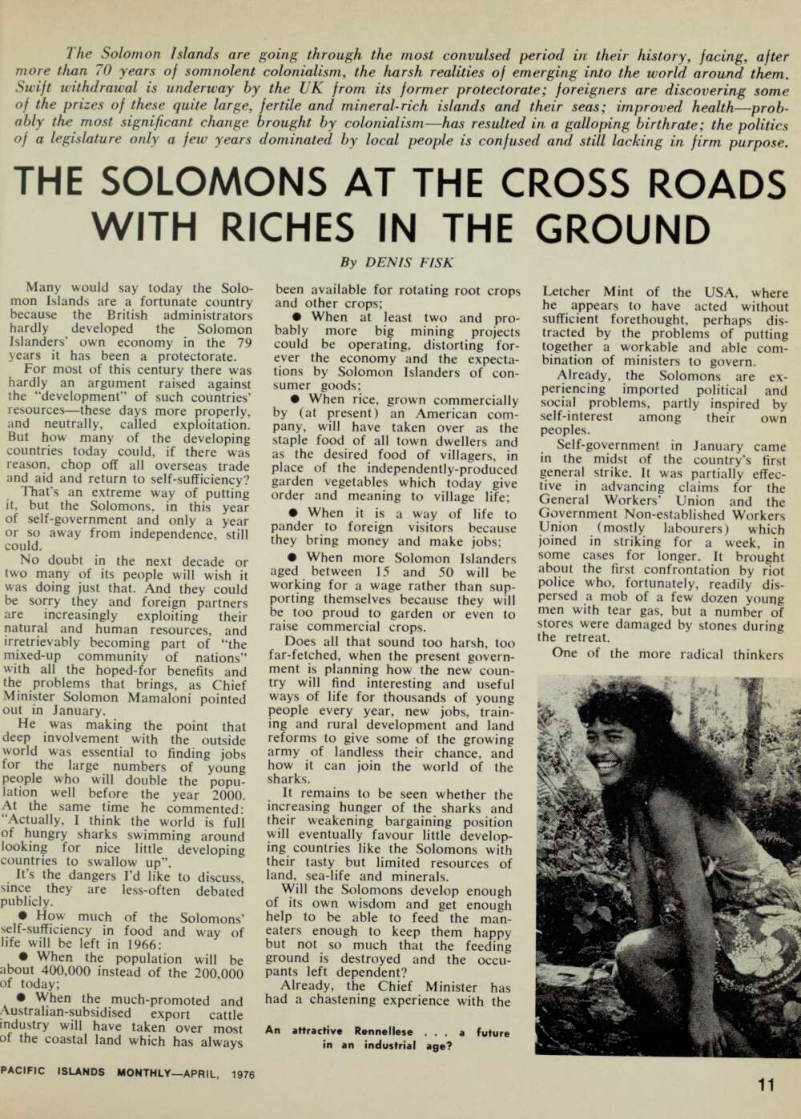
An attractive Rennellese ... a future in an industrial age?
in both union and government affairs (now the new Minister for Works and Public Utilities), the Member for Honiara, Ashley Wickham, called the clash with the riot police and the damage afterwards a shameful display of irresponsibility.
The current General Workers’
Union president, Bartholomew Ulufa’alu, has brought tactics with him from the much more sophisti cated union scene of Papua New Guinea, including opting to serve jail sentences in place of paying fines for his participation in civil dis turbances.
Both he and the union’s secretary, Paul Belande, appear to be using their positions to build a power base in national politics.
Mining is a virtual certainty in the Solomon Islands, sooner or later.
The government does not like talk ing about it publicly, and almost all the information made public has come in response to questions from the opposition in the Legislative Assembly.
A written request I made last year to have confirmed and expanded some published information about the likely mining of bauxite on Ren nell and Wagina (also called Vaghena) Islands was refused.
The Rennell/Wagina proposal has reached the stage of an exchange of letters of intent between the Mitsui Mining and Smelting Co of Japan, which has the Rennell deposit, Conzinc Riotinto of Australia, which has the Wagina deposit, and the government, dependent upon a feasi bility study carried out last year and supposedly finished about now.
The government has been doing its utmost to reach agreement with the companies to create the jobs and income it wants. It has already said it would like to see not only mining involving maximum participation by local people but an alumina plant— the first stage of bauxite processing for aluminium—to be built on Ren nell. Despite the good deal the government seeks—so per cent of the total proceeds through taxation, dividends and royalties—it has not been anxious to promote a public debate about mining, apparently because of what it could mean to life in the Solomons.
The thoughtful Finance Minister, Willie Betu’s modest estimate that at least S2OO million would be needed in capital investment, and thousands of expatriate workers to establish mining and the alumina plant, are indications enough.
The S4OO million copper mine on Bougainville has changed the life style, the topography, even the rain fall, it is said, on a large island of
90.000 people. It is by far the domi nant economic influence in Papua New Guinea with 2i million people.
It has greatly influenced the poli ticisation of Bougainville into pro and anti-secession camps, and threatens the existence of the Somare government. It also brought to a head the first international political problem for the still loosely-united Solomon Islands.
What can be foreseen as the result of a similar investment in a simi larly new nation of less than one tenth the population?
What will happen to the people of Rennell on which, Mitsui in Tokyo confirmed for me, there are about 2,600 acres of land to be mined for 30 million tonnes of ore. with an alumina plant to produce 600.000 tonnes a year, rising perhaps to 1.3 million tonnes? Roughly half of this alumina would result from the mining also of the Wagina de posit of about 28 million tonnes, by CRA which would ship it to Rennell.
Rennell has about 1,000 people, Polynesians, who with about another 500 Bellona Islanders on a much tinier atoll 15 km away, make a distinct remote community, different from the bulk of Solomon Islanders, For years the government has been trying to persuade the Rennel lese to agree to compensation per head for land and for each coconut tree and other useful tree which would be lost to mining, and to agree to being resettled at the other end of the Solomons some 600 km away. Government would prefer the island deserted for Mitsui, who have carried out extensive trial mining at one end.
Agreements have been made, and then upset, causing concern to government and Mitsui. The last I heard, the Rennellese were busy with unusual industry, both planting coconut trees in any available space
and making babies, to increase com pensation should it come.
It would be ironical if Rennell’s coconut industry disappeared, since it was this remote atoll which pro duced by its own natural selection the prolific coconut variety which has been exported as seed coconut to so many tropical countries.
The situation is ripe for another cause celebre like phosphate-rich Ocean Island which has involved the UK, Fiji and the Gilberts ad ministrations in international litiga tion many years after its original inhabitants were transplanted to a Fiji island.
Even if the Rennellese agree to being resettled, for how long will they be happy away from their home land? Their gods were wiped out just before World War II by the dramatic arrival of Christianity, but the pull of the land is more subtle than that, especially for a people with their own miniature environment.
Will they return? The government has talked of filling in the holes with imported soil when the 40-odd years of mining is up. What will be the state of the Rennellese after that long? The Western Solomons, where they could be resettled, doesn’t want them as a unit, but fragmented.
If they stayed, it would be no time before the invading mining technology and a huge camp of foreign men, not to mention a pol luting alumina plant, would wreck remaining traditions, social order and environment.
Government has an unenviable decision to make, and it is more on the shoulders of Solomon Islanders than the decision to mine Bougain ville ever was for Papua New Guineans or Bougainvilleans.
Neighbouring Bellona too is threatened with violent change, but by a more subtle and, for the time being, more uncertain expectation of mining for phosphate.
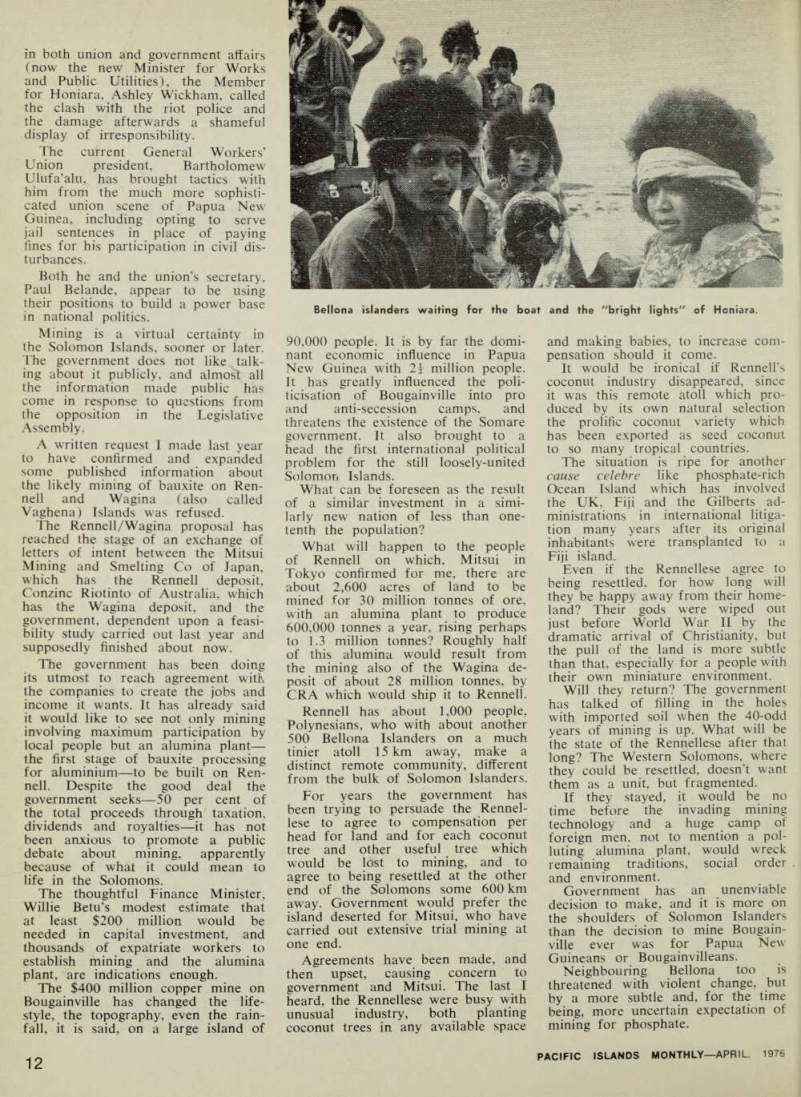
Bellona islanders waiting for the boat and the "bright lights" of Honiara.
I am told there is estimated to be some 10 million tonnes of phosphate bearing material spread over about 115 hectares of this atoll which measures only 11.5 km by 3 km at its widest.
The Bellonese were told the interested miner was the British Phosphate Commission, through a hired Englishman who has spent many years in the Pacific. Last year he offered the Bellonese participation in a venture tentatively called the South Pacific Development Com pany, The man is Fred Dixon, a small, balding character well known in Bougainville where he worked for Bougainville Copper in community relations. In the Solomons he was equally well known for the stormy period he spent as manager of the Honiara Hotel for local businessman, Jimmy Chan, before walking out and onto a visiting cruise ship, and again when he returned until about the end of 1974 for the time he spent living with the closely-knit Gilbertese com munity whom he helped establish and promote outside Honiara as an entertainment unit for local and overseas visitors. (The Gilbertese came to the Solomons during a famine in the Line Islands in the 19505).
Their emphasis on retaining cus toms is a good indicator to the feel ings that might be within the Poly nesian Rennellese and Bellonese who have no ties other than political with the rest of the Solomons.
Mr Dixon’s proposals, first made during a visit on May 6 last year, followed visits he made in 1974 when he was talking to the Rennel lese and Bellonese about “settling” there. No Europeans live on the atolls.
He depicted for them a multi million dollar industry which would result in “all means of comfort and luxury and an undreamed Utopia”, as one Bellona man put it, if the island was given up to mining.
The proposal has divided the island into two hostile camps, turn ing father against son, brother against brother, in-laws against each other, and so on. In general the division is between the older gener ations who are sold on the idea, and a minority group of younger people who are mostly educated and believe they see the implications better. They see their people being divorced from their culture and lands, and the end of them as an ethnic group.
Opponents formed an organisation to fight against mining, fittingly nam ing themselves the Mau Tiki Tiki Movement after a culture hero.
The government has heard many representations from both sides.
Opponents were frightened by the early agreement of supporters who told the Permanent Secretary for Trade, Industry and Labour, Dr Dick Thompson, they were happy to see mining go ahead even before nego tiations for compensation, equity, resettlement and other matters had been settled. The future of the phos phate appears suspended for the time being with government uncommitted either way.
It is not long since the Solomon Islands Government was committed to development based on widespread rural industry, multiple trading posts which could, in time, provide some urban amenities, and to restricting as much as possible the growth of the capital, Honiara.
Committal instead to an economy based for the next 50-odd years on mining would be the end of this answer to the electorate’s demands in the early 19705. Like people else where, Solomon Islanders are sensi tive to what earns them the most mqney the easiest way. When copra prices are low they turn to logging or fishing or spices or cattle or what ever is going.
Mining would pull thousands of farmers and self-sufficient villagers into actual mine work and the other industries that would grow with the import and export boom accom panying it, in addition to mopping up the growing numbers of school leavers who often want to hang around Honiara.
At this stage, there is hardly one generation which can really be said to know only urban living and work ing. Honiara has grown from nothing since the war, and half its population still gardens for much of their living.
'Hie educated elite, with hopes of living in the European way, is very small, a few thousand.
But it is they who will be making the decisions for the rest on what their future lives will be like: the elected politicians, some of whom have grown to depend too much on their privileges; the rather new public servants living in spacious brick and timber houses provided originally by British aid to house European public servants, and who, in some cases, have risen too quickly to desks at which they mainly spend time find ing someone else to do their work; the small cohort of remaining British, Australian and New Zealand public servants on contract now with few exceptions, who try to find ways of making the Solomons pay its way; the earnest high school and university graduates infiltrating the community and impatient to lead; and the busi ness community acting like business men anywhere.
But most of all, making the de
cisions will probably rest with the somewhat unpredictable, supreme political tactician. Chief Minister Solomon Mamaloni—if he survives the general election in the middle of this year and can put together yet another ministry from the survivors of the present 24 member parlia ment, together with some new mem bers one expects to be elected mostly from the ranks of the present public service.
For the remaining few months of this parliament he has a team which, for the first time, makes just about the most practical use of the executive talent available in the Legislative Assembly.
There are arguments that someone like David Kausimae with his long experience should not have been dropped. But Mr Kausimae is vehemently opposed by some of the new office-holders.
The rout of the standing members in 1973 may be repeated, leaving the Solomons again with a largely in experienced parliament at an even more critical time.
Among the new ministers are several I would expect to have good chances of retaining their seats be cause they have consolidated then positions since their election: David Thuguvoda (Agriculture and Lands), a tireless worker at building influence in his electorate through a political instinct; Benedict Kinika (Education and Cultural Affairs) who avoided ferociously opposing Mr Mamaloni of his own island Makira in earlier days to maintain support of electors who could not understand his opposition to Mamaloni; Pulepada Ghemu (Foreign Trade, Industry and Labour), who came in through a by-election with a potent support base at home; probably Ashley Wickham, who faces the difficult electorate of Honiara (likely to be divided since it is twice the size of of most others), but who has been the most persistent questioner and debater in the legislature on local and national issues; and Jona than Fifi’i because of traditional respect for his role in the Marching Rule movement of 25 years ago and his more prominent role now.
Whoever is governing will have a classic decision to make as to whether having fairly rich resources to exploit is more of a problem than the resources are worth.
In some colonies and developing countries almost any change like this would be an improvement. But the Solomon Islanders are not hungry, not lacking in shelter, not very un healthy, and many more are being educated. The only question is whether “development” will really benefit these particular islands?
Advertisements & other items, pp. 13-14 (1 item)
Port of
THE PAPUA HOTEL
PORT MORESBY
• Right in the business centre • A tradition for comfort and fine food • All rooms air conditioned • Restaurant • Bars • Banquet Hall Telephone 24 2121
Cables PAPTEL
A. C. NEUMANN
Manager
INTERNATIONA
DATELINE HOT
TONGA
"Friendly Hotel" of the "Friendly Islands"
Situated along the Nukualofa waterfront. Only five minutes walk from town. Single, double, family suites, airconditioning, and hot and cold water showers. Pool, bar, restaurant, duty-free shop, tour desk and boutique.
Book through your travel agent or write to International Dateline Hotel, P.O. Box 62, Nuku'alofa Tonga.
Cable Address: "DATELINE".
Represented Overseas by: Charles J. Henry and Associates Pty. Ltd.
Sydney and Melbourne.
Primitive luxury
(im »i.m si v|t*l ** Nestled away in the untouched Kingdom of Tonga is new, luxurious "Port of Refuge" International resort. More is a unique opportunity for your clients to experience the tranquil and relaxed Tongan atmosphere while they enjoy the picturesque surroundings of the new "Port of Refuge". And only a short flight from Fiji.
Reasonable tariffs from $17.50 with Special concession* for (.hlldrtn. commission 10 per cent.
Port of
s
INTERNATIONAL RESORT
Uava’u Tonga
Cables: "Refuge" Tonga or "Tengatours"
Sydney. Phone; Sydney 85-1603 or 852162
The Hamadastar Numbering Device can be installed on all 700 Series Presses 700 CD, 770 CD and 700DX. Maximum sheet size 14| x 1 in w mm * ' & m - Sole distributors in the South Pacific for Hamadastar Small Offset Presses and Nuarc Platemaking Equipment— Gollin Graphics Ltd., P.O. Box 3109, Auckland, New Zealand.
a.Lrt
rodt
I AT A
Shipping • Forwarding • Air Freight • Container operators • Insurance Founded in 1887 at Hamburg (Head Office) to service your transport needs.
NOMINATE HARTRODT AS YOUR FREIGHT FORWARDER
Contact A. Hartroclt (Australia) Pty. Ltd. for information on services available and advantages. Our own offices in all main trade centres of the world.
HAMBURG • BREMEN • ROTTERDAM e GENEVA
9 LONDON • LIVERPOOL
184 Sussex Street, Sydney, N.S.W., Australia 2000 Telephone: 29-3054 Telex: 21416
An Independent Gilberts In 1978 ?
An unofficial timetable suggests that the Gilbert Islands will be inde pendent in 1978. The House of Assembly in May is expected to fix a date, before the end of 1976, for internal self-government. When the date is known, the Chief Minister, Mr Naboua Ratieta, will lead a delegation from the House to London to take part in a constitutional conference.
This conference will deal with the timetable leading up to internal self government, and eventual independence. Independence is expected 12 to 18 months after internal self-government.
The government considers, with constitutional advance in the offing, it should look closely at the security needs of the group, as well as the backlog of development works, such as road construction. It considers a suitably structured defence force could take care of both security and some develop ment. K preliminary study suggested a defence force of about 170 men.
Advertisements & other items, pp. 15-16 (1 item)
Bulk Suppliers to the Islands of
AUSTRALIA
A RECYCLING COMPANY
12 SEVILLE STREET, VILLAWOOD, N.S.W. 2163
CABLES: WITWOOL TELEX: AA24541
TEL.: SYDNEY 72-0631
Bulk Suppliers to the Islands of
• ZORBIES BRAND NON-WOVEN WIPERS
• KOALA BRAND CLEANING CLOTHS
• INDUSTRIAL WIPING RAGS
• INDUSTRIAL WADDING AND FLOCK
• COTTON WASTE STOCKINETTE
• GRADED SECOND HAND CLOTHING
OF ALL DESCRIPTIONS
WITTERS” —The most prominent name in rags
WRITE FOR PRICE LIST
KOALA BRAND CLOTHS
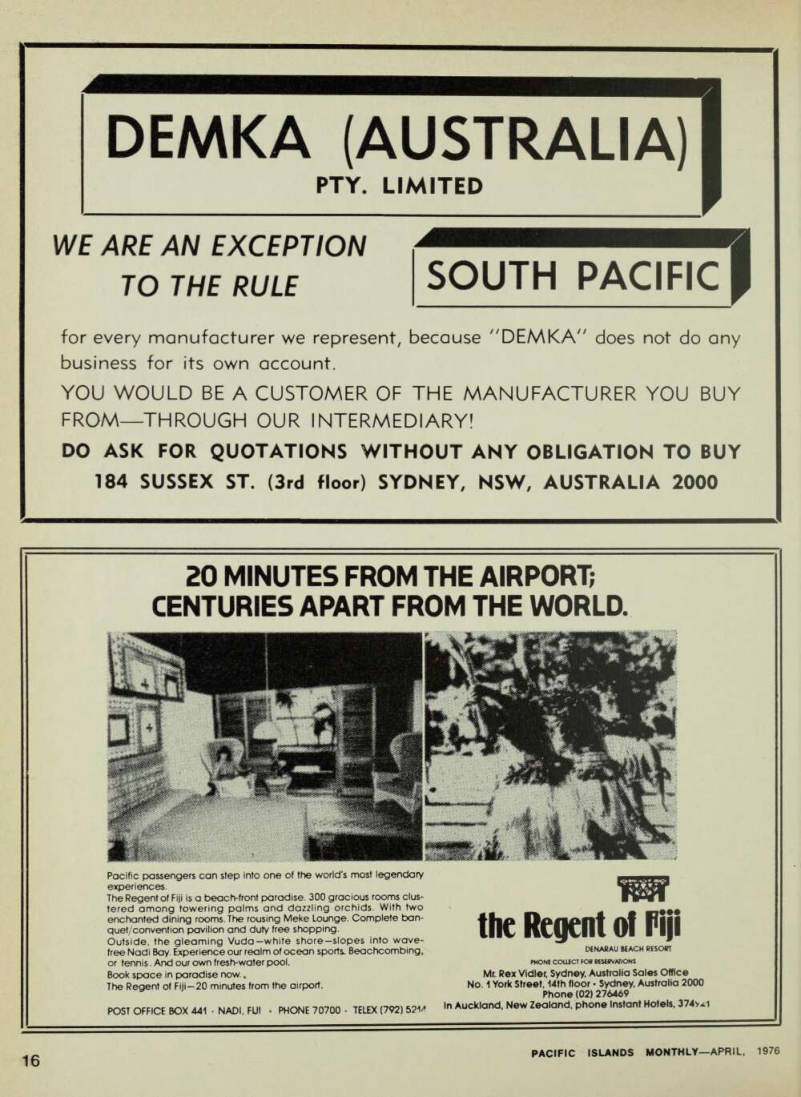
DEMKA (AUSTRALIA)
PTY. LIMITED
WE ARE AN EXCEPTION
TO THE RULE
SOUTH PACIFIC
for every manufacturer we represent, because "DEMKA" does not do any business for its own account.
YOU WOULD BE A CUSTOMER OF THE MANUFACTURER YOU BUY
FROM—THROUGH OUR INTERMEDIARY!
DO ASK FOR QUOTATIONS WITHOUT ANY OBLIGATION TO BUY 184 SUSSEX ST. (3rd floor) SYDNEY, NSW, AUSTRALIA 2000
20 MINUTES FROM THE AIRPORT;
CENTURIES APART FROM THE WORLD.
□ Pacific passengers can step into one of the world’s most legendary experiences.
The Regent of Fiji is a beach-front paradise. 300 gracious rooms clustered among towering palms and dazzling orchids. With two enchanted dining rooms. The rousing Meke Lounge. Complete banquet/convention pavilion and duty free shopping.
Outside, the gleaming Vuda—white shore—slopes into wavefree Nadi Bay. Experience our realm of ocean sports. Beachcombing, or tennis. And our own fresh-water pool.
Book space in paradise now..
The Regent of Fiji—2o minutes from the airport.
POST OFFICE BOX 441 • NADI, FUI • PHONE 70700 • TELEX (792) 521/
the Regent of Fiji
DENARAU REACH RESORT
PHONE corner FOR reservations Mr. Rex Vidler, Sydney, Australia Sales Office No. 1 York Street, 14th floor • Sydney, Australia 2000 Phone (02) 276469 In Auckland. New Zealand, phone Instant Hotels. 374>*l
Nickel-plated
French cinema
From a Noumea correspondent The New Caledonian public, which never knows what new spectacle Paris is going to surprise it with next, now has a new super-show lined up for the nickel industry in May.
The mining company Societe Le Nickel (SLN) plans to fly some 200 visitors to the territory over May 3-7, including representatives of French, US and Japanese steel smelting groups and members of the press.
This mammoth sales promotion is planned at a time when the SLN is widely publicising its intention to gear up production capacity to 90,000 tonnes of nickel annually.
Caledonians would readily recall May 1971, when the Baron Guy de Rothschild himself flew in from Paris and hired a local cinema theatre to announce SLN expansion plans. As the then president-elect of SLN, Rothschild was accompanied by the top echelon of his company and the international press. His pro mises at that time included the famous assertion, “Poum will go ahead”.
Yet Poum, in the north of New Caledonia, is still only a project under debate in Paris. Rothschild also claimed that SLN nickel pro duction in Noumea would reach 80.000 tonnes in 1973: it reached 70.000 tonnes in 1975.
But the Caledonians, accustomed to shows performed to amuse the gallery will no doubt sit through the forthcoming May spectacle as through many others. And some of them, who have lost their right to export Caledonian nickel, admit grimly they have paid dearly for their front row seats. The plebs watch the show acted out by the chosen French “elite”, and they love it.
There was a fore-runner to the SLN drama and that involved three Caledonian politicians who in Feb ruary made another of those rushed trips to Paris to “sound the bell of alarm” they have been sounding, in vain, for quite some years now.
For the latest visit, it was made clear French Overseas Territories Minister Olivier Stirn would speak only to three particular members, and they happened to be all pro- French government. They went flit ting around in the Paris winter try ing to get some SAIO million to balance the swollen Caledonian terri torial budget.
The Condominium's Waterloo!
A referendum for islanders to decide which of the two nations, Britain or France, should remain in the New Hebrides to help prepare for indepen dence, has been urged by the Rev Walter Lini, president of the National Party.
Walter Lini made this proposal after the late-January congress of the National Party which won an overwhelming majority in the territory’s elec tions last November for the first Representative Assembly in the New Hebrides.
When the new Assembly still had not met in February, Mr. Lini pointed out that the National Party did not think the two governing powers could accomplish the preparation for independence together.
As proof, he pointed to the inefficiency of 60 years joint effort and the continuing problem over the election of a Chief to represent Central District No. 2. He said that in this electorate the British delegate was satisfied with the results of the first election cu\d the French was not. “If we keep the two governments, it will always be the same ”, he declared.
Advertisements & other items, pp. 17-18 (1 item)
The Right Oiesel for any job!
G.E.C. have more than 100 models to choose from. World famous names like Boudouin, Dorman, Kelvin, Paxman and Ruston. Coupled with the know-how of G.E.C.
Diesels. From 6 to 4,950H.P. there's a model to suit your needs for Generating, Marine & Pumping.
GEC Diesels Australia Ltd
1 WINTERTON RD„ CLAYTON, VICTORIA, AUTRALIA. PHONE: 544 8344 TELEX: 30994. SOLOMONS AGENT; HONIARA MARINA & SHIPYARD.
D apua new guinea
printing co. pfy. ltd.
Serving the Country from Aitape to Alotau, Manus to Moresby Leaders in Commercial Offset and Letterpress Printing. Stationery • Office Supplies • Office Equipment • Rubber Stamps • Self-Adhesive Labels In Fact; Everything For The Office.
P.O. Box 633, Port Moresby P.O. Box 759, Lae P-O. Box 1239, Rabaul
RACE RELATIONS AND COLONIAL
RULE IN PAPUA NEW GUINEA
by Edward P. Wolfers
1975 publication 176 pages A 56.95 Presenting the first outline history of the principal laws and administrative institutions through which British, German and Australian rulers of Papua New Guinea exercised their rule. Explicitly racial laws strictly governed Papua New Guineans’ behaviour, from work to sexual relationships. Hence by the mid-1950s Papua New Guinean society was almost completely cut in two with the Chinese and mixed race inhabitants occupying an ambiguous position between the two main castes.
An appreciation of past discrimination is essential for an understanding of the island’s current racial and political situation, and its course as an independant state.
Published and Distributed by the
AUSTRALIA & NEW ZEALAND
BOOK CO. PTY. LTD.
23 Cross Street, Brookvale, N.S.W., Australia 2100
PNG'S 'credit-worthiness '
World Bank's re-think on PNG'S 'credit-worthiness '
PIM last October gave an exclusive report on the surprise decision by World Bank president Robert McNamara that an independent Papua New Guinea would be con sidered “uncreditworthy” unless the Australian Government guaranteed her loans.
The decision caused ill-feeling in the PNG Government; nor was it supported by many senior officers of the World Bank. Bank officials felt that if PNG was independent then it could hardly be expected to take kindly to the suggestion that it should still be tied to somebody else’s apron strings. In any case, they felt, PNG was “creditworthy” on its own
account; it had greater potential than many countries getting independent loans from the World Bank.
So in an attempt to counter the ill-feeling in PNG, a three week economic survey mission from the bank visited PNG in January- February. Its purpose was to review the earlier decision and if possible to reverse it. It was in fact something of a face-saving mission for Mr McNamara.
The mission’s leader, Mr George Baldwin, will be recommending favourably on PNG’s situation, and will advise Mr McNamara to reverse the earlier situation. Mr McNamara is expected to act promptly, but it still could be some months before the machinery starts working and the way is open for substantial amounts of aid to be made available to PNG from World Bank sources.
Meanwhile, in a decision which not only came as a pleasant shock to PNG Prime Minister Michael Somare, but which also caused sur prise in official circles in Canberra and Port Moresby, Australian Prime Minister Malcolm Fraser announced on March 4 that Australia would give PNG at least $930 million in Australian aid over the next five years.
Officials of both governments had been expected to meet in Canberra in mid-March to hold discussions on long term aid arrangements.
At that meeting levels of aid for future years were expected to have been decided. Fears were held in Port Moresby however that hard liners in the Australian Treasury would use the poor state of the Australian economy to justify an un reasonably low level of aid to PNG.
This fear perhaps lay behind PNG Opposition Leader Tei Abal’s call in February that Mr Somare, Sir Maori Kiki and Mr Julius Chan should go to Canberra to discuss future levels of aid with Mr Fraser.
It is understood that Mr Somare wrote to Mr Fraser in late January expressing serious concern at the state of Australian-PNG relations and specifically seeking a meeting to discuss the question of future aid. It was not however expected by PNG officials that the meeting which finally took place in Canberra on March 4 would be so productive.
Mr Fraser told Mr Somare at that meeting that, in determining the allo cation of aid funds, Australia would continue to give the highest priority to providing aid to PNG on a sub stantial scale to assist it towards its objective of self-reliance.
Mr Fraser undertook that Australia would provide a minimum of $lBO million in social and economic aid to PNG for each of the five years beginning on July 1, 1976. It would also provide further annual supple ments in the light of prevailing cir cumstances.
He said the supplement in 1976-77 would be $lO million and $2O mil
lion in 1977-78, giving aid total for 1976-77 and 1977-78 of $l9O million and $2OO million respectively.
In addition to the above levels of aid, Mr Fraser undertook to make additional payments to cover among other things the Wabo hydro-electric feasibility study, payments relating to war pensions and cemeteries, and expenditures to cover completion of the current airport construction works at Port Moresby and Nadzab.
Australia is also obliged by legis lation to make payments under the Employment Security Scheme which provides termination benefits to for mer expatriate employees of the Government of Papua New Guinea and which are estimated to cost $37 million in 1976-77 and $2l million in 1977-78. Other Australian assist ance which lies outside the basic aid figure is the Australia-Papua New Guinea Training and Education Scheme, estimated to cost $1.2 mil lion in 1976-77.
Australian assistance to Papua New Guinea in 1976-77, for what are termed economic and social pur poses, will therefore exceed $195 million, an increase of $33 million on the 1975-76 level of $162 million.
Australia’s previous Labour Government had agreed to give PNG $5OO million in aid over three years.
The agreement still has a year to run, though with aid of $195 million for 1976-77 it has been more than achieved.
Mr Somare warmly welcomed the “new and generous long-term aid commitment by the Australian Government” which he said the PNG Government found fully acceptable, as well it might. He also stressed that PNG would in no way be relaxing its serious attempts to live within its means in the years ahead. He has repeated this last point on a number of occasions since his meeting with Mr Fraser, and it is doubtless one on which Australia will be looking for some tangible progress in the next few years.
The Prime Ministers also discussed an earlier Australian Government offer whereby the Australian Reserve Bank would provide a $3O million standby to the Bank of PNG to assist PNG to support its new currency.
The $3O million offer is understood to have been rejected as being low by Mr Somare in his January letter to Fraser. Mr Fraser has now offered to increase the standby arrangement to $6O million, but it is not yet known whether this figure will prove acceptable to Papua New Guinea.
The two leaders also discussed telephone services between Australia and PNG, the Torres Strait question, the situation on Bougainville and other foreign policy issues.
Advertisements & other items, pp. 19-21 (1 item)
complexion beauty
Guard against fading
The maintenance of a softer, lovelier complexion can be assured with the daily smoothing on of a remarkable tropically moist oil blend.
TT is with trepidation that many T women enter their middle years simply because they suspect their complexion beauty will deteriorate and make them look older than they really are.
The natural oils and moisture which cherish your skin and help keep it in a soft, smooth supple state are supplied from within the skin itself by thousands of tiny glands which continuously create a moist environment in the outer layer of your skin.
As you grow older the tiny glands become tired and the supplies of natural fluids gradually diminish and therefore need special supplementing with a tropically moist oil blend.
These days, many women smooth on the scientifically developed tropically moist oil blend to help restore and maintain the vital balance of moisture and oil in the skin and so assist the complexion in the maintenance of its fresh radiant beauty.
Fresh, natural
skin softness The tropically moist oil blend penetrates into the stratum corneum and acts on the skin in a similar way to Nature’s own oils and moisture, softening and smoothing dry skin and helping to overcome the onset of wrinkle dryness. The tropically moist oil of Ulan brings, even to a tired-looking and neglected complexion, benefits similar to those provided by the skin’s own natural fluids helping to create a fresh, natural complexion radiance.
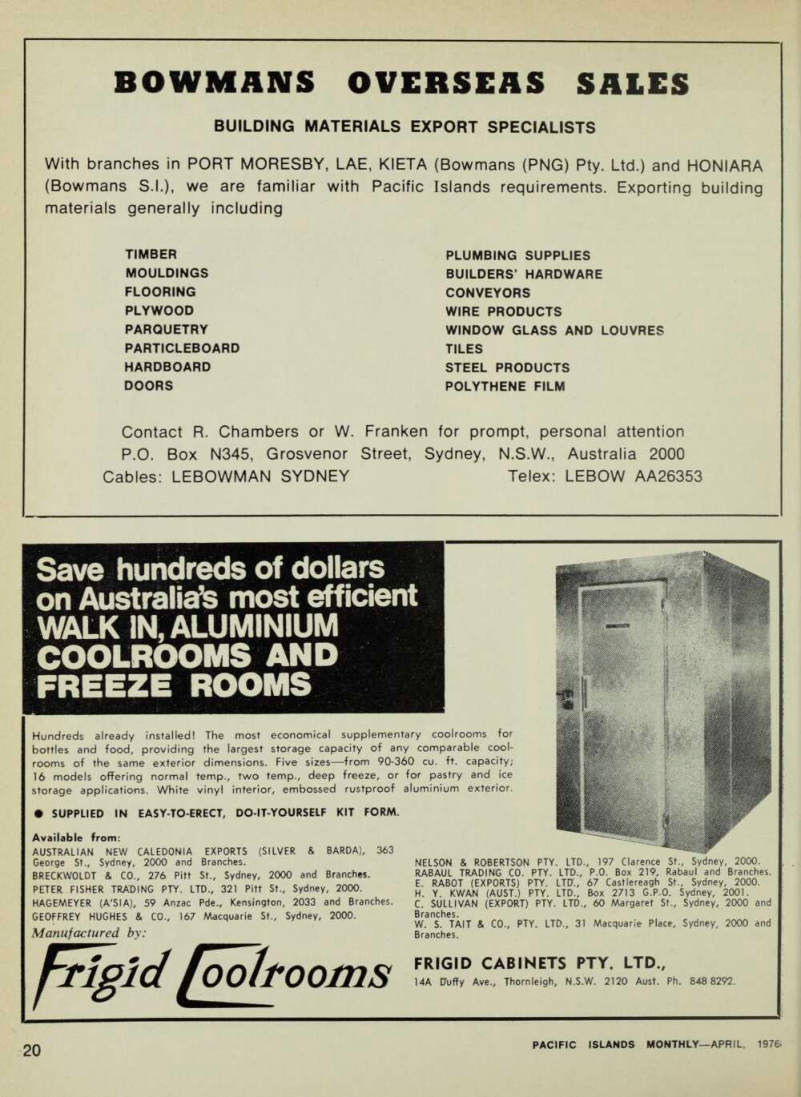
BOWMANS OVERSEAS SALES
BUILDING MATERIALS EXPORT SPECIALISTS
With branches in PORT MORESBY, LAE, KIETA (Bowmans (PNG) Pty. Ltd.) and HONIARA (Bowmans S.I.), we are familiar with Pacific Islands requirements. Exporting building
materials generally including
TIMBER
MOULDINGS
FLOORING
PLYWOOD
PARQUETRY
PARTICLEBOARD
HARDBOARD
DOORS
PLUMBING SUPPLIES
BUILDERS’ HARDWARE
CONVEYORS
WIRE PRODUCTS
WINDOW GLASS AND LOUVRES
TILES
STEEL PRODUCTS
POLYTHENE FILM
Contact R. Chambers or W. Franken for prompt, personal attention P.O. Box N345, Grosvenor Street, Sydney, N.S.W., Australia 2000
Cables: LEBOWMAN SYDNEY Telex: LEBOW AA26353
Save hundreds of dollars
on Australians most efficient
WALK IN, ALUMINIUM
COOLROOMS AND
FREEZE ROOMS
Hundreds already installed! The most economical supplementary coolrooms for bottles and food, providing the largest storage capacity of any comparable coolrooms of the same exterior dimensions. Five sizes—from 90-360 cu. ft. capacity; 16 models offering normal temp., two temp., deep freeze, or for pastry and ice storage applications. White vinyl interior, embossed rustproof aluminium exterior. • SUPPLIED IN EASY-TO-ERECT, DO-IT-YOURSELF KIT FORM.
Available from: AUSTRALIAN NEW CALEDONIA EXPORTS (SILVER & BARDA), 363 George St., Sydney, 2000 and Branches.
BRECKWOLDT & CO., 276 Pitt St., Sydney, 2000 and Branches.
PETER FISHER TRADING PTY. LTD., 321 Pitt St., Sydney, 2000.
HAGEMEYER (A'SIA), 59 Anzac Pde., Kensington, 2033 and Branches.
GEOFFREY HUGHES & CO., 167 Macquarie St., Sydney, 2000.
Manufactured by:
f m T 1 NELSON & ROBERTSON PTY. LTD., 197 Clarence St., Sydney, 2000.
RABAUL TRADING CO. PTY. LTD., P.O. Box 219, Rabaul and Branches.
E. RABOT (EXPORTS) PTY. LTD., 67 Castlereagh St., Sydney, 2000.
H. Y. KWAN (AUST.) PTY. LTD., Box 2713 G.P.O. Sydney, 2001.
C. SULLIVAN (EXPORT) PTY. LTD., 60 Margaret St., Sydney, 2000 and Branches.
W. S. TAIT & CO., PTY. LTD., 31 Macquarie Place, Sydney, 2000 and Branches.
FRIGID CABINETS PTY. LTD.,
14A Duffy Ave., Thornleigh, N.S.W. 2120 Aust. Ph. 848 8292.
Become a part of PlM’s Pacific and subscribe now Wl 'd
Vlmm
v a •pi W a§ £ w rt £3 O y> & a a o 'ta cu fl Pm P o co Ph V V PiH in the details on the attached order forms
Tropicalities
Fiji on the dope trail
Fiji may be a staging post for illicit drugs on the way to lucrative markets in Australia and New Zea land from the Far East. Drug run ners probably reason that customs officers in Australia and New Zea land will not apply such rigorous tests to cargoes from Fiji as they would to imports from known drug areas.
However, alert customs officers in Fiji, in a number of recent in cidents, intercepted drugs at Nadi Airport and at Lautoka. According to the Fiji Police Commissioner, Mr John Kelland, who believes Fiji is a dropping-off point for large quan tities of illicit drugs, some drugs seized were consigned to Australia.
Smugglers used surfboards and children’s water buggies to conceal drugs. These were consigned from Bangkok. A sniffing Labrador dog at Auckland, led searchers to a quantity of marihuana in water bug gies. Fiji customs officers, hearing of this, searched some water buggies at Lautoka and found marihuana.
They also found marihuana in simi lar buggies at Nadi Airport.
Five surfboards, consigned to Nadi Airport from Bangkok, lay at the airport for more than six months.
When nobody claimed them, it was decided that they should be auc tioned. But one suspicious customs man, knowing there was little or no use for surfboards in the placid vyaters round Fiji, decided it was time for a closer look.
He and other officers ripped the boards apart and were not altogether surprised to find 39 bags. It was be lieved there were hard drugs such as morphine or heroin in three of them, and marihuana in the re mainder. The drugs could have been worth more than $lOO,OOO on the international market.
Fiji does not have an internal drug problem worth speaking about— except, perhaps, the opium smokers —but as an archipelago she offers many advantages to drug runners to drop off and pick up drugs. Dealers m drugs, the objects of close official
attention, are always searching for new ways to keep a jump or two ahead of the authorities.
And the suspicion remains, in spite of the good work of the Fiji customs men in intercepting the re cent consignments, that a lot of drugs still get through.
Burial, Cook
Island’s style
Visit any of the Cook Islands and you will see graves in all manner of places ... in church yards, in a few designated cemeteries, in the front and back yards of homes and, in at least one instance, in the middle of the back verandah.
On some of the coral atolls, for example, Manihiki and Rakahanga, the graves are monolithic and raised above the surface of coral debris.
On Rakahanga there are grave houses which often shelter sewing machines, or lanterns, or some other article of possible future use to the dearly-departed.
There are legendary graves such as that of Rosa Cruickshank, the mystery European woman buried on distant Penrhyn Island. On Mangaia there used to be a ship’s plate that marked the last resting place of a sailor who did not survive the wreck of the Saragossa. He was denied a Christian burial as, at the time of his death, he was under the influence of alcohol.
In a tropical environment time is the essential factor in the disposal of the dead. And death is not a matter to be put into the hands of a professional undertaker. It is the duty of the senior male members of the family to arrange and direct the funeral; grave-digging is a shared activity and after the ceremony is oyer, by custom, the mourners press gifts of cash upon the chief mourner.
When some time later, the grave has settled, a further ceremony is held to build up a proper grave set ting and to erect the headstone. The chief mourner then provides a wake for all the mourners from the cash he received at the burial.
There are no restrictions upon where burials take place and quite usually the deceased is laid to rest near the family home. Often the pre sence of a grave will restrict the siting of a building. When the old Side School at Rarotonga was extended in the early 1960 s the buildings were carefully laid out so as not to dis turb an old grave.
There is an evening of sheer beauty associated with the Catholic Cemetery on Rarotonga. On All Souls’ Night the burial ground is decorated with a multitude of chains made of thousands of frangipani flowers and many candles light the graves. A priest conducts the memo rial service by moon and starlight to the accompaniment of the surge of the sea upon the reef and all about are people of all faiths come together amid the fragrance of the frangipani and illuminated by waver ing candlelight.
Taking the ‘thump’
out of a drum
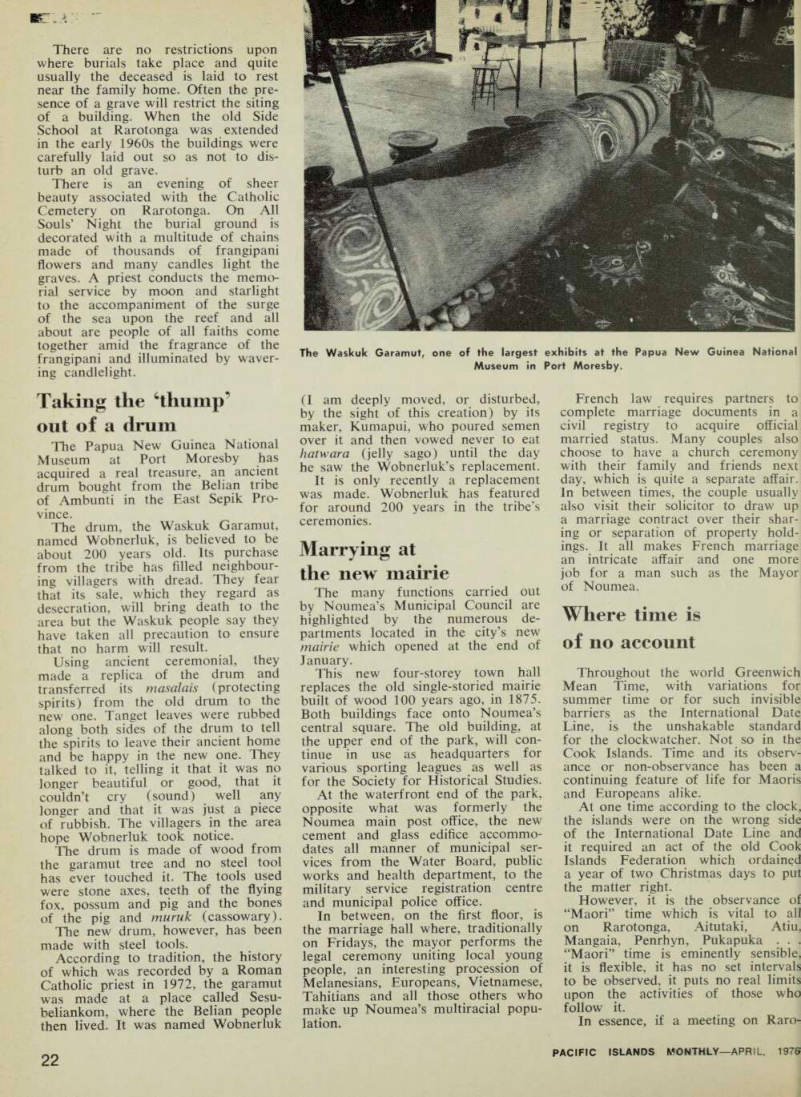
The Papua New Guinea National Museum at Port Moresby has acquired a real treasure, an ancient drum bought from the Belian tribe of Ambunti in the East Sepik Pro vince.
The drum, the Waskuk Garamut, named Wobnerluk, is believed to be about 200 years old. Its purchase from the tribe has filled neighbour ing villagers with dread. They fear that its sale, which they regard as desecration, will bring death to the area but the Waskuk people say they have taken all precaution to ensure that no harm will result.
Using ancient ceremonial, they made a replica of the drum and transferred its masalais (protecting spirits) from the old drum to the new one. Tanget leaves were rubbed along both sides of the drum to tell the spirits to leave their ancient home and be happy in the new one. They talked to it, telling it that it was no longer beautiful or good, that it couldn’t cry (sound) well any longer and that it was just a piece of rubbish. The villagers in the area hope Wobnerluk took notice.
The drum is made of wood from the garamut tree and no steel tool has ever touched it. The tools used were stone axes, teeth of the flying fox, possum and pig and the bones of the pig and muruk (cassowary).
The new drum, however, has been made with steel tools.
According to tradition, the history of which was recorded by a Roman Catholic priest in 1972, the garamut was made at a place called Sesu beliankom, where the Belian people then lived. It was named Wobnerluk
(I am deeply moved, or disturbed, by the sight of this creation) by its maker, Kumapui, who poured semen over it and then vowed never to eat hatwara (jelly sago) until the day he saw the Wobnerluk’s replacement.
It is only recently a replacement was made. Wobnerluk has featured for around 200 years in the tribe’s ceremonies.
Marryinsr at
J ®
the lieW mairie
The many functions carried out by Noumea’s Municipal Council are highlighted by the numerous departments located in the city’s new mairie which opened at the end of January.
This new four-storey town hall replaces the old single-storied mairie built of wood 100 years ago, in 1875.
Both buildings face onto Noumea’s central square. The old building, at the upper end of the park, will continue in use as headquarters for various sporting leagues as well as for the Society for Historical Studies.
At the waterfront end of the park, opposite what was formerly the Noumea main post office, the new cement and glass edifice accommodates all manner of municipal services from the Water Board, public works and health department, to the military service registration centre and municipal police office.
In between, on the first floor, is the marriage hall where, traditionally on Fridays, the mayor performs the legal ceremony uniting local young people, an interesting procession of Melanesians, Europeans, Vietnamese, Tahitians and all those others who make up Noumea’s multiracial population.
French law requires partners to complete marriage documents in a civil registry to acquire official married status. Many couples also choose to have a church ceremony with their family and friends next day, which is quite a separate affair, In between times, the couple usually also visit their solicitor to draw up a marriage contract over their shar ing or separation of property hold ings. H makes French marriage an intricate affair and one more job for a man such as the Mayor °I Noumea, wri .• • W liere time IS «
Oi 110 Accouiit
Throughout the world Greenwich Mean Time, with variations for summer time or for such invisible barriers as the International Date Line, is the unshakable standard for the clockwatcher. Not so in the Cook Islands. Time and its observ ance or non-observance has been a continuing feature of life for Maoris and Europeans alike, At one time according to the clock, the islands were on the wrong side of the International Date Line and it required an act of the old Cook Islands Federation which ordained a year of two Christmas days to put the matter right, However, it is the observance of “Maori” time which is vital to all on Rarotonga, Aitutaki, Atiu, Mangaia, Penrhyn, Pukapuka . . .
“Maori” time is eminently sensible, it is flexible, it has no set intervals to be observed, it puts no real limits upon the activities of those who follow it.
In essence, if a meeting on Ran>
The Waskuk Garamut, one of the largest exhibits at the Papua New Guinea National Museum in Port Moresby.
tonga, for instance, is announced as being for eight o’clock in the evening “European” time, then the parti cipants know that they will be under an obligation to attend on or about the specified time.
Eight o’clock in the evening “Maori” time means that the first to appear may be there at say four o’clock, that by eight o’clock there may be a handful in attendance, and that perhaps, and only perhaps, the meeting may finally commence at 10 o’clock, or 11 o’clock, or mid night, or ... But there will have been no hectic assembly and prob ably most of the issues will have been thoroughly but informally examined and the meeting can pro ceed along clearly-defined lines, without too many tedious diversions.
Ships also used to sail either by “European” or “Maori” time. On one occasion Dick Brown’s old motor vessel Apanui was to sail for the Northern Group. Friday’s Cook Islands News announced the de parture as for Monday; Monday told the story that she would sail on Tuesday; Tuesday said she would not leave before Thursday; Friday told all parties that Apanui definitely would not sail before Tuesday of the following week.
At noon on the Sunday Dick Brown rang his passengers ... he enquired: “Are you still coming on the Apanui? because if you are, the ship sails in an hour’s time” . . . and she did.
Hiri, a new
voice from PNG
The Papua New Guinea Govern ment has gone into the magazine publishing business with a very workmanlike publication, Hiri, a monthly intended for overseas con sumption.
According to Dr Reuben Taureka, Minister for Information and Broad wing, whose department, the Office 3f Information, produces Hiri “to establish a communications link vith people interested in our :ountry”.
As such, its name is appropriate. 3iri was an already well-established rading expedition when the first English missionaries arrived in Port Moresby in 1874. It was a major ink of a trading network along the 3 apuan coast to the eastern point )f the mainland, Dr Taureka says. >ne function of the expedition was he exchange of earthenware pottery or packages of sago and other foods.
But along with the bartering went he exchange of customs and ideas ind the renewal of friendships.
PNG hopes its new Hiri will per
form the same function in the modern world. And it isn’t partisan.
The first issue contains a report of Opposition Leader Tei Abal calling for a general election because the government “has failed to manage the country in the best interests of the people”.
Hiri’s main circulation areas are in Australia, New Zealand, Japan, Indonesia, Fiji and the United States.
Meanwhile, the PNG Government is cutting expenses. One victim of the axe is Papua New Guinea House in Sydney which will lose its trade and information departments. The Consul-General, Mr Vincent Iri, will remain with a small staff to handle entry permits and other travel docu ments.
The fate of the PNG Government news service which goes by telex every day to all the principal news papers and news services in Austra lia was unknown at the time of writing, but it is likely to be re tained.
Designed to feed the media with news from PNG “untreated” and without any special “angles”, it costs only a few dollars a day.
Necktie party
in Micronesia
Micronesian Congress jester, Sen ator John Mangfel, has come up with another historic bill—one to outlaw neckties, a “most insidious evil perpetrated upon the people of Micronesia”, and a “nefarious inven tion”, he said, when tabling his bill.
Congress solemnly accepted the bill for reading and referred it to the Committee on Education and Social Matters.
One of the evils, the bill said, was to compel its wearers to “suffer the constrictions of the throat and the chafing of the skin thereof, to say nothing of the effects of closing the system of ventilation permitted by the open collar”.
Anyone committing the unlawful act of wearing a tie, the bill con tinues, “shall be an idiot, and upon conviction thereof shall suffer his neck to be permanently surrounded by a large piece of Yapese stone money”.
Unique artifacts found in Bougainville are reproduced in four new Papua New Guinea stamps. The stamps revive old traditions—the Rorovana carvings (7t), Upe hats (20t), kapkaps (25t) and canoe paddles (30t)-which played a vital part in the social and economic life of the Bougainville people. The Rorovana carvings and the Upe hats were used in solemn ceremonies, the former in puberty and burial ceremonies, and the Upe hats in boys' initiation ceremonies. The hats hid their hair which was not cut until the cermony. First day for the stamps was March 17.
Advertisements & other items, pp. 21-24 (3 items)
21
ICIFIC ISLANDS MONTHLY—APRIL, 1976
23
ACIFIC ISLANDS MONTHLY—APRIL, 1976
an Alfa Romeo
What Makes it
Front wheel drive and McPherson suspension make it handle like an Alfa.
The four cylinder, horizontally opposed motor and four speed gearbox make it perform like one, too.
And disc brakes all round guarantee it stops the way an Alfa Romeo should.
The only un-Alfa thing about the Alfasud is its price.
What Makes it
a family Car
It’s big on the inside, so there’s room inside for the whole family.
But it's quite compact on the outside.
So it doesn’t need much room to park.
The space inside the boot is about the same as the space in the average family refrigerator.
The front seats adjust up and down as well as backwards and forwards. And the steeringcolumn also adjusts up and down.
So you can adjust your Alfasud to suit you and your family. Which is better than adjusting your family to suit the car.
alfa
romeo
AN INVESTMENT IN SAFETY
For information contact Alfa Romeo Pty. Ltd.
Cnr. Beauchamp & Botany Rds., Botany, N.S.W., Australia.
Trade enquiries welcome.
The Editor's Mailbag
The Devil We
Know
Over the years until now it has >een noted that PIM makes a point if attacking the French; somewhat imilar to Australian papers attack ag the Dutch in Indonesia long ears ago. Each country has its good nd bad points. There is no perfec ion.
Many people in the islands come rom a long line of mixed blood: mglo-Saxon, European, Asian and acific. This makes them tolerant of ag-wavers who stress the ancient istory importance of “identity” as lough it is some kind of stigma ist to be an ordinary human being.
Do-gooders will say that we are orn equal—what rot! Some are orn leaders, others were made to irve whether they sweep floors, ork in a factory, behind a counter, ;nd the sick, keep books for a com any, preach sermons or even be )me newspaper reporters.
In between the above-mentioned rganisers and workers are the para tical, unproductive ones: self :ekers who love to hear their own Dice and influence the unwary, usting mob; and those who sit be ind a desk writing a heap of non nse, based on hearsay, which eates mischief and disharmony.
Whatever the fate of the New ebrides under the leadership of irious present self-seekers, either ission-influenced or otherwise, an iportant point should be con dered: while all the silly bickerings ke place whether to remain Stone ;e addicts with “customs”, or go ►rward to keep abreast of the ever langing world, the Soviets are not r behind. They are gradually in trating in Africa wherever Western s moved out.
It is quite certain that Nagriamel, ational Party, MANH etc, all ined together, will not be able to event Soviet overlords from mov g in the New Hebrides after the emocratic overlords leave.
Better the Devil we know . . ,
Maxim Tevi
into, ew Hebrides.
Letters
Waterhouse
Papers
I am making an extensive study }f social and economic change in he Siwai area of south Bougain /ille.
In approximately 1932-1934, a uissionary teacher Mr J. H. L. ‘Harry” Waterhouse, was living here before transferring to Rabaul vhere he died. During his stay he :ollected plant specimens, took holographs and gave at least one ecture in Australia on Siwai cus oms.
I have not been able to trace this ecture (or any other papers of his) hrough possible contacts in either labaul or Bougainville.
I would very much welcome any lues that could lead me to those iapers and the new Bougainvillean tiuseum might also benefit in other /ays.
John Connell (Dr)
)ept of Economics, Research School of Economics, INU, Canberra. ientified with the Australian Army
Army Request
Perhaps the word most readily Canungra.
In its many forms—Land HQ raining Centre (Jungle Warfare), Australian Training Centre (Jungle /arfare), Jungle Training Centre nd now, Land Warfare Centre—it as trained countless thousands of )ldiers and left its stamp unmistak aly upon the Army; its doctrines, ictical concepts and men.
Its past is a vital part of our mili iry heritage and, in an effort to itablish a Unit Museum, we are aw seeking information, photo aphs and mementoes associated ith this institution.
Any items of historical interest ould be gratefully received and, if eir return is desired, copying and ife despatch of same will be under ken.
Should any reader possess any such aterial could you please contact aptain M. B. Meadows of the Land r arfare Centre, Kokoda Barracks, anungra, Qld 4275. (Phone STD extension 236).
M. B. Meadows
(Captain for Commandant) anungra, Qld.
In defence of Fiji
No wonder we hear in Fiji of tourists who are disgruntled about the poor advice given to them by Australian travel agents.
The Sydney travel agent who preferred to remain nameless, but who tendered his advice to Fiji in the February issue of PIM (p 29) made a number of state ments which are far from ac curate.
Apart from suggesting that there are hotels here which are 20-storeys high (and his clients would tell him that is nonsense), he also is ignorant of the fact that taxi meters have been compulsory for several months. Perhaps Fiji has had its share of sharp taxi operators, but then people coming from Australia, myself included, would be well accustomed to, and perhaps even expect, that parti cular type of taxi operator.
To speak of the risk of being robbed in broad daylight is a gross exaggeration. Having lived in Fiji for the last three years, my wife and I have wandered night and day through towns and coun try areas of Fiji, with far less fear than would be the case walking in many parts of Sydney.
In this context, it is worthy of comment that the crime rate in the more urbanised part of Fiji actually dropped by 28.1 per cent in January this year, compared to January, 1975.
While admitting that there is a degree of excessive drinking in Fiji, I am completely unable to confirm the travel agent’s sugges tion that Fiji is abound with “dangerous drunks”. Coming from Australia, with its own particular drink problem, this suggestion is not only exagger ated, it is highly ironical.
If the writer is aware that Fiji is spending $3O million on its “main road”, he does not men tion it. This amount is the equi valent of $4OO for every person in employment in Fiji, with the vast majority of them earning less than $1 per hour. In this small country with few natural resources, luxuries such as tar sealed highways do not come
easily or rapidly or simply to meet the desire for comfort of the 3,000 or 4,000 tourists who happen to be in Fiji at any one time, important though they may be.
With the down-turn in tourist traffic of some 15 per cent, coin ciding with the opening of a num ber of new hotels which were planned during the very recent growth rates of 20 per cent per annum, the industry certainly is facing a testing period, which, in the long run may turn out to have been a good thing. Only the better managers and the bet ter hotels will survive, only the better staff will be retained, mar keting will improve, some hotels have already cut their room rates, despite rising costs, and for those who care to look, there is avail able in the main urban areas a better range of good and cheap meals than ever before. One hotel in Suva is currently providing in attractive surroundings a four course meal, followed by a free movie, for $2.50. Good business luncheons are available for $2.
It will be some months before any resumption of growth can be expected, but few people in Fiji in any event would favour a return to regular 20 per cent per annum growth rates such as were previously experienced. If the smiles are tending to dis appear from the Fijian faces, it is due, at least in part, to the fact that the tourists have made them aware that they have to work for probably 120 hours per week if they are to achieve the same buy ing power as their more fortunate neighbours in Australia and New Zealand can earn in a normal 40 hours.
In common with the rest of the world, Fiji is changing, but its beauty remains untouched, as the many people who come back year after year still testify.
Clive Sadleir
Managing Director, Fiji Development Bank.
Suva, Fiji.
Advertisements & other items, pp. 25-28 (4 items)
25
hCIFIC ISLANDS MONTHLY—APRIL, 1976
Some Of The Firms
WE REPRESENT ARE:
Asia Rubber Works (Singapore Rubber Shoes) Frappier (French Brandy) Huvet (French Brandy) Indika (Belgium Dairy Produce) Durobor S.A. (Belgium Glassware) Miroiterie Gen. de Belgiqe S.A. (Louvre glass and mirrors) City Engineers (U.K. Bicycles) F.H.I. Japan (Subaru Cars) Kraggs (Wines, Spirits, Ciders) Sunshine Biscuits Sunrise (Confectionery) Flamenco (Instant Coffee & Tea) Quaker Products (Oats, Jets) Hancocks (Spaghetti, Cereals) Melbourne Canning (Jams) Amatil (Twisties, Twirlies) Edward Zorn (Margarine, Cooking Fats) Allens (Confectionery) Red Tulip (Fine Chocolates) Robert Timms (New Guinea Gold Instant Coffees and Teas) S.P.C. (Canned Fruit) S.P.C. (Abalone) Wing Lee (See You Sauce) Magnet (Mattresses) Essteel (Cookware) Warner-Drayton (Fans) Mitchell's (Abrasives) Tilbury & Lewis (Sports Trophies & Silverplate) Regent (Swiss watches) Lega Marcasite (Jewellery) Austramax (Pressure Lanterns) Lawn Chair; Tubco (Garden Furniture) Electronic Industries (Electrical Household Appliances) Jex (Steelwool) Arnbro (Folding Beds) James Miller (Blankets) Elmaco (Plastics —Electrical Fittings) B.X. (Plastics) Stegbar (Wooden Louvres) Franklite (Light Fittings) J.J. Cash Embroidered Labels) Disston (Saws)
YOUR GUARANTEE
FOR SERVICE
DIRECT ENQUIRIES WELCOMED
PAPUA NEW GUINEA; S. E. TATHAM (P.N.6.) PTY. LTD.,
LAE: MALAITA STREET (P.O. BOX 1562).
PORT MORESBY: CNR. GOROA AND MUNAHU STREETS, GORDON
(P.O. BOX 6733, BOROKO).
FIJI: S. E. TATHAM (FIJI) LTD.,
LAUTOKA: P.O. BOX 366.
SUVA: G.P.O. BOX 671.
SINCE 1924
27
ICIFIC ISLANDS MONTHLY—APRIL, 1976
Itavdodge offers
A*
you a whole
sight more in
Australia and
the South Pacific
m % ■ 1 ns 9 m a 3 L Right around the South Pacific you’ll find international standard Travelodge where the sights are ...where the action is.
And that’s where you’ll want to stay-to see the things, do the things you wish without moving too far from your room.
Friendly Travelodge offers the best in accommodation, service, food and value for money.
So book Travelodge. You’ll get a whole sight more. • Australia • New Zealand • Fiji • Tahiti • New Caledonia Papua New Guinea • Indonesia
'RAVE/OOCE care
RESERVATIONS: for any one of over 70 Travelodges in Australia, Fiji, New Zealand, Papua New Guinea. Tahiti ! neS ®i _,AUS,ralia: Sydney (02) 31 0601: Adelaide (08) 223.6194: Melbourne (03) 387.1233: Perth (092) 25.3811. Brisbane (072) 21.8586: Hobart (002) 34.2911: Canberra (062) 49.1424: Darwin 81,5388. U.K. (London); Trust S u orte i° 1) 56 J- 3444 Japan ( Tok y°) : Travelodge Branch Office (03) 214.0961. Fiji: Travelodge Reservations, Suva 2.46°a Hong Kong: Travelodge Reservations 522.2251. U.S.A. (Toll Free): Travelodge International Inc. (800) 255.3050.
N.Z. (Auckland): Travelodge Reservations 374.108.
OR YOUR TRAVEL AGENT
TR99/75
Remember the good times
with silk'fmish
Kodak color prints
M Borderless round-cornered pictures with a silk surface that actually hides fingerprints. Pass them around.
Show your friends.
You’ll forget. Pictures won’t.
Silk-finish Kodak color printsfrom all sizes of Kodacolor film.
Silk-finish Kodak color prints are standard from all photo dealers where you see this sign.
KODAK (Australasia) PTY. LTD.
See your photo dealer now.
ASK FOR
COLOR
PROCESSING
Kodak
K 6175074
Oil Drum Ovens And Practical
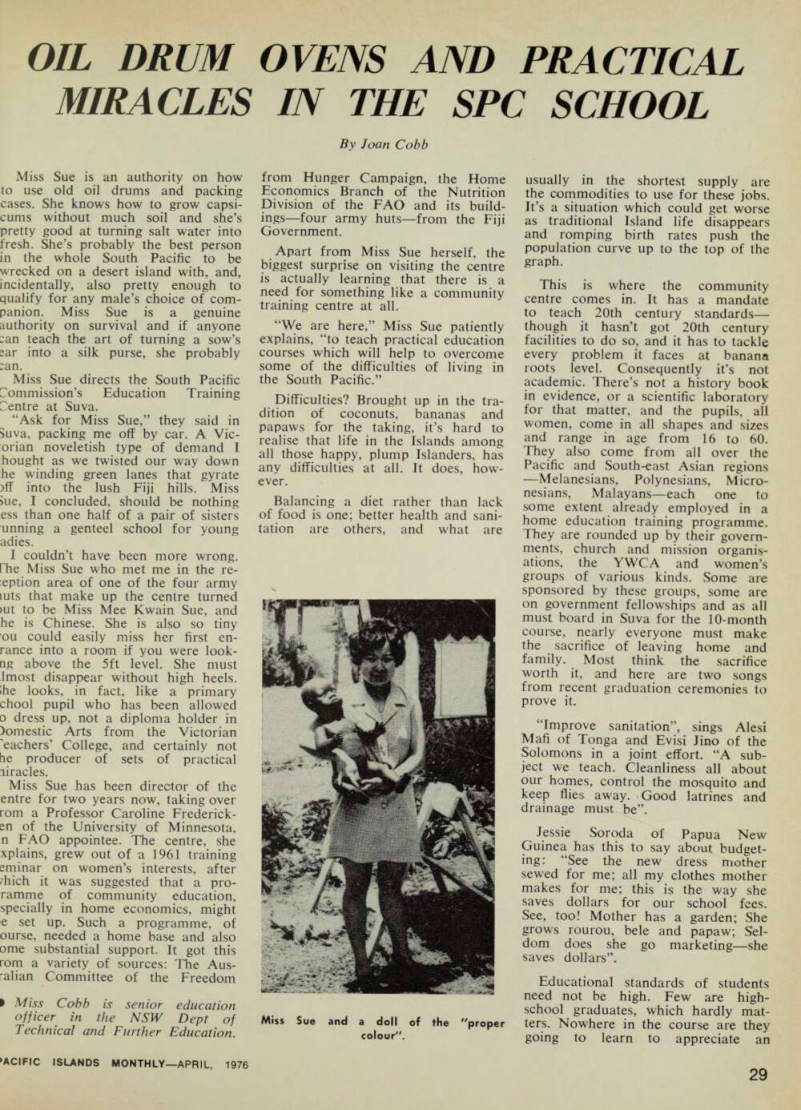

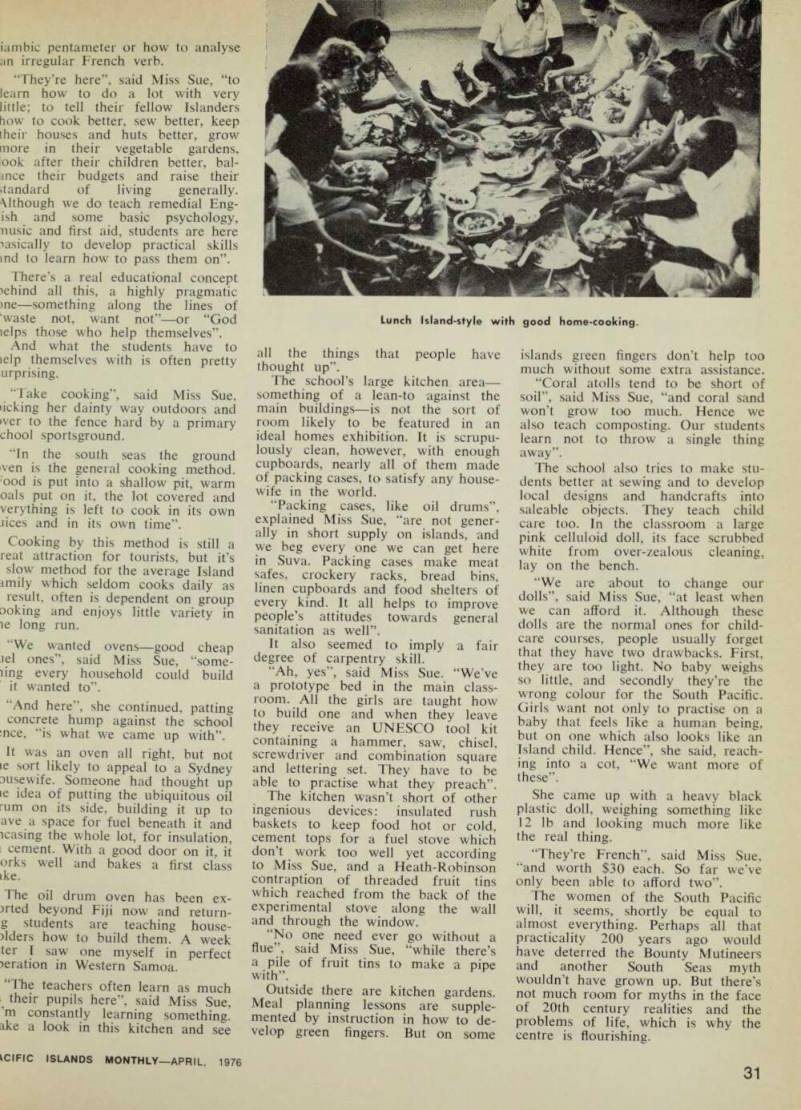
Miracles In The Spc School
By Joan Cobb
Miss Sue is an authority on how to use old oil drums and packing cases. She knows how to grow capsi cums without much soil and she’s pretty good at turning salt water into fresh. She’s probably the best person in the whole South Pacific to be wrecked on a desert island with, and, incidentally, also pretty enough to qualify for any male’s choice of com panion. Miss Sue is a genuine authority on survival and if anyone :an teach the art of turning a sow’s sar into a silk purse, she probably :an.
Miss Sue directs the South Pacific Commission’s Education Training Centre at Suva.
“Ask for Miss Sue,” they said in Suva, packing me off by car. A Vic orian noveletish type of demand I bought as we twisted our way down he winding green lanes that gyrate iff into the lush Fiji hills. Miss >ue, I concluded, should be nothing ess than one half of a pair of sisters unning a genteel school for young adies.
I couldn’t have been more wrong, fhe Miss Sue who met me in the re eption area of one of the four army mts that make up the centre turned »ut to be Miss Mee Kwain Sue, and he is Chinese. She is also so tiny ou could easily miss her first en rance into a room if you were look ng above the sft level. She must Imost disappear without high heels.
Ihe looks, in fact, like a primary chool pupil who has been allowed 0 dress up, not a diploma holder in )omestic Arts from the Victorian 'eachers’ College, and certainly not tie producer of sets of practical liracles.
Miss Sue has been director of the entre for two years now, taking over rom a Professor Caroline Frederick en of the University of Minnesota, n FAO appointee. The centre, she xplains, grew out of a 1961 training eminar on women’s interests, after diich it was suggested that a pro ramme of community education, specially in home economics, might e set up. Such a programme, of ourse, needed a home base and also ome substantial support. It got this rom a variety of sources: The Aus -alian Committee of the Freedom 1 Miss Cobb is senior education officer in the NSW Dept of Technical and Further Education.
from Hunger Campaign, the Home Economics Branch of the Nutrition Division of the FAO and its build ings—four army huts—from the Fiji Government.
Apart from Miss Sue herself, the biggest surprise on visiting the centre is actually learning that there is a need for something like a community training centre at all.
“We are here,” Miss Sue patiently explains, “to teach practical education courses which will help to overcome some of the difficulties of living in the South Pacific.”
Difficulties? Brought up in the tra dition of coconuts, bananas and papaws for the taking, it’s hard to realise that life in the Islands among all those happy, plump Islanders, has any difficulties at all. It does, how ever.
Balancing a diet rather than lack of food is one; better health and sani tation are others, and what are
usually in the shortest supply are the commodities to use for these jobs.
It’s a situation which could get worse as traditional Island life disappears and romping birth rates push the population curve up to the top of the graph.
This is where the community centre comes in. It has a mandate to teach 20th century standards— though it hasn’t got 20th century facilities to do so, and it has to tackle every problem it faces at banana roots level. Consequently it’s not academic. There’s not a history book in evidence, or a scientific laboratory for that matter, and the pupils, all women, come in all shapes and sizes and range in age from 16 to 60.
They also come from all over the Pacific and South-east Asian regions —Melanesians, Polynesians, Micro nesians, Malayans—each one to some extent already employed in a home education training programme.
They are rounded up by their govern ments, church and mission organis ations, the YWCA and women’s groups of various kinds. Some are sponsored by these groups, some are on government fellowships and as all must board in Suva for the 10-month course, nearly everyone must make the sacrifice of leaving home and family. Most think the sacrifice worth it, and here are two songs from recent graduation ceremonies to prove it.
“Improve sanitation”, sings Alesi Mafi of Tonga and Evisi lino of the Solomons in a joint effort. “A sub ject we teach. Cleanliness all about our homes, control the mosquito and keep flies away. Good latrines and drainage must be”.
Jessie Soroda of Papua New Guinea has this to say about budget ing: “See the new dress mother sewed for me; all my clothes mother makes for me; this is the way she saves dollars for our school fees.
See, too! Mother has a garden; She grows rourou, bele and papaw; Sel dom does she go marketing—she saves dollars”.
Educational standards of students need not be high. Few are high school graduates, which hardly mat ters. Nowhere in the course are they going to learn to appreciate an
Miss Sue and a doll of the "proper colour".
iambic pentameter or how to analyse an irregular French verb.
“They’re here”, said Miss Sue, “to learn how to do a lot with very little; to tell their fellow Islanders how to cook better, sew better, keep their houses and huts better, grow more in their vegetable gardens, ook after their children better, bal ance their budgets and raise their standard of living generally.
Mthough we do teach remedial Eng ish and some basic psychology, nusic and first aid, students are here lasically to develop practical skills md to learn how to pass them on”.
There’s a real educational concept )ehind all this, a highly pragmatic me —something along the lines of ‘waste not, want not”—or “God iclps those who help themselves”.
And what the students have to iclp themselves with is often pretty urprising.
“Take cooking”, said Miss Sue, licking her dainty way outdoors and ►ver to the fence hard by a primary chool sportsground.
“In the south seas the ground ven is the general cooking method, ood is put into a shallow pit, warm oals put on it, the lot covered and verything is left to cook in its own jices and in its own time”.
Cooking by this method is still a reat attraction for tourists, but it’s slow method for the average Island amily which seldom cooks daily as result, often is dependent on group □oking and enjoys little variety in ie long run.
“We wanted ovens—good cheap Jel ones”, said Miss Sue, “some ling every household could build it wanted to”.
“And here”, she continued, patting concrete hump against the school mce, “is what we came up with”.
It was an oven all right, but not ic sort likely to appeal to a Sydney ausewife. Someone had thought up ie idea of putting the übiquitous oil rum on its side, building it up to ave a space for fuel beneath it and leasing the whole lot, for insulation, i cement. With a good door on it, it orks well and bakes a first class ike.
The oil drum oven has been ex ited beyond Fiji now and return g students are teaching house )lders how to build them. A week ter I saw one myself in perfect icration in Western Samoa.
The teachers often learn as much their pupils here”, said Miss Sue, ’m constantly learning something, ake a look in this kitchen and see
all the things that people have thought up”.
The school’s large kitchen area— something of a lean-to against the main buildings—is not the sort of room likely to be featured in an ideal homes exhibition. It is scrupu lously clean, however, with enough cupboards, nearly all of them made of packing cases, to satisfy any house wife in the world.
“Packing cases, like oil drums”, explained Miss Sue, “are not gener ally in short supply on islands, and we beg every one we can get here in Suva. Packing cases make meat safes, crockery racks, bread bins, linen cupboards and food shelters of every kind. It all helps to improve people’s attitudes towards general sanitation as well”.
It also seemed to imply a fair degree of carpentry skill.
“Ah, yes”, said Miss Sue. “We've a prototype bed in the main class room. All the girls are taught how to build one and when they leave they receive an UNESCO tool kit containing a hammer, saw, chisel, screwdriver and combination square and lettering set. They have to be able to practise what they preach”.
The kitchen wasn’t short of other ingenious devices: insulated rush baskets to keep food hot or cold, cement tops for a fuel stove which don’t work too well yet according to Miss Sue, and a Heath-Robinson contraption of threaded fruit tins which reached from the back of the experimental stove along the wall and through the window.
“No one need ever go without a flue”, said Miss Sue, “while there’s a pile of fruit tins to make a pipe with”.
Outside there are kitchen gardens.
Meal planning lessons are supple mented by instruction in how to de velop green fingers. But on some
islands green fingers don’t help too much without some extra assistance.
“Coral atolls tend to be short of soil”, said Miss Sue, “and coral sand won’t grow too much. Hence we also teach composting. Our students learn not to throw a single thing away”.
The school also tries to make stu dents better at sewing and to develop local designs and handcrafts into saleable objects. They teach child care too. In the classroom a large pink celluloid doll, its face scrubbed white from over-zealous cleaning, lay on the bench.
“We are about to change our dolls”, said Miss Sue, “at least when we can afford it. Although these dolls are the normal ones for child care courses, people usually forget that they have two drawbacks. First, they are too light. No baby weighs so little, and secondly they’re the wrong colour for the South Pacific.
Girls want not only to practise on a baby that feels like a human being, but on one which also looks like an Island child. Hence”, she said, reach ing into a cot, “We want more of these”.
She came up with a heavy black plastic doll, weighing something like 12 lb and looking much more like the real thing.
“They’re French”, said Miss Sue, “and worth $3O each. So far we’ve only been able to afford two”.
The women of the South Pacific will, it seems, shortly be equal to almost everything. Perhaps all that practicality 200 years ago would have deterred the Bounty Mutineers and another South Seas myth wouldn’t have grown up. But there’s not much room for myths in the face of 20th century realities and the problems of life, which is why the centre is flourishing.
Lunch Island-style with good home-cooking.
Advertisements & other items, pp. 29-32 (3 items)
Acific Islands Monthly—April, 1976
No matter which
way you look at it. . . you’ll find . . .
KLEVKII
is the finest allpurpose ply for building in hot and humid conditions.
Made by Commonwealth N.G.
Timbers Ltd and available from leading plywood suppliers.
Total service 0n ...
plumbing supplies Fast
WATSON & CRANE
are organised to fulfil your needs
wherever you are in the South Pacific S m You can get all you need from one supply source: water taps, valves, copper tube, tools and a host of other fittings and related plumbing equipment for domestic, industrial and multistorey buildings.
Watson & Crane Pty Ltd have over 20,000 plumbing items in stock at their central warehouse located at Waterloo, NSW, Australia.
Years of experience in handling and shipping right throughout the South Pacific add up to another big reason for you to deal with Watson & Crane Pty Ltd.
Representatives call regularly at New Guinea, Papua, the Solomons, New Hebrides and Fiji Islands to personally discuss your requirements and appropriate credit arrangements.
Write, cable or telephone today for complete plumbers' supplies service.
Watson & Crane Pty. Ltd. 1037 Bourke Street, Waterloo,
NSW 2017.
Phone: Sydney 699-1333.
Telex: AA 25548.
Cables: "Watcrane" Sydney.
Pacific Island distributors of Crane Enfield copper tube for water, sanitation, engineering, refrigeration and air conditioning.
31
ICIFIC ISLANDS MONTHLY— APRIL, 1976
for Fiji's politicians
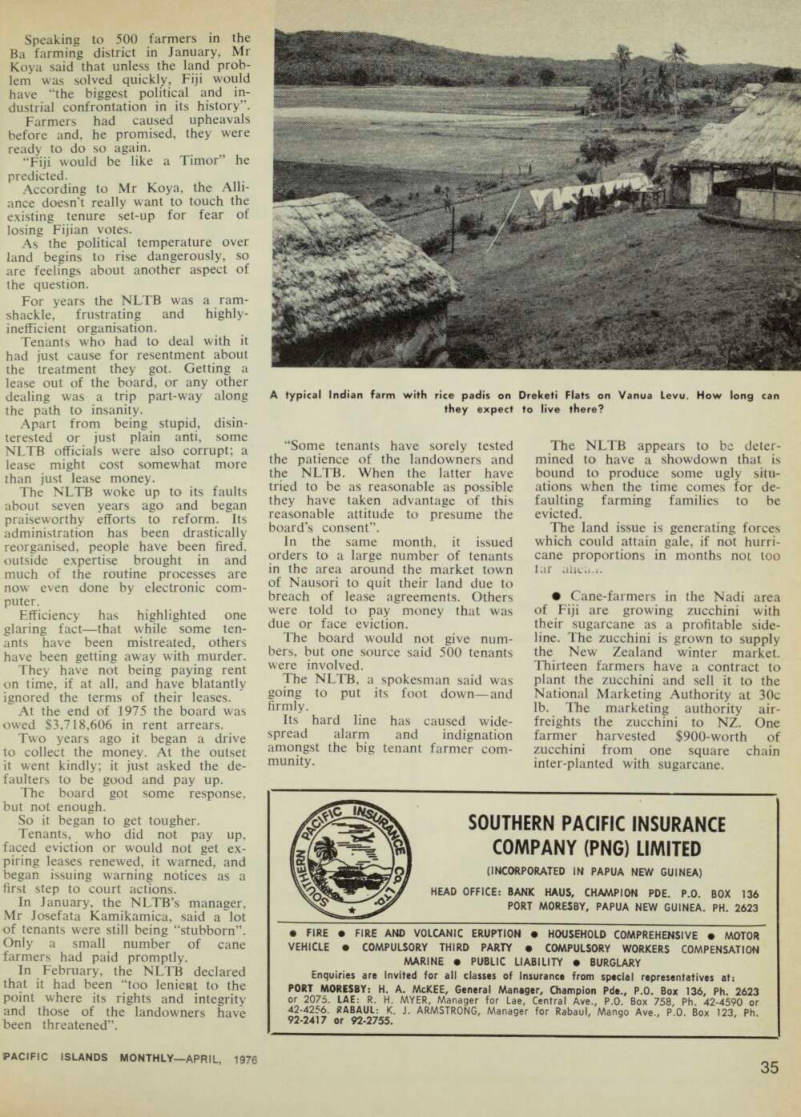
Land hunger, a hot potato for Fiji's politicians
From ROBERT KEITH-REID in Suva
Ehe Leader of the Opposition in i proclaims: “My cup of dis isionment on the land question is I!” The Prime Minister looks be sed and asked the Opposition ider to define what the land ques i is, >ver on the Island of Taveuni. :ans, who for years have let Indian tner Ashrak Khan till a bit of ir fertile land, suddenly tell him get off; he must; he hasn’t got a ;e, and he has to leave $25,000th of maturing crops behind. 4ear Suva an Indian family wakes find that their tin shack house been ringed in by a barbed wire :e; the Fijians from who they e the land they occupy are hint they want more rent, iji’s biggest landlord, the Native id Trust Board, suddenly realises owed arrears of rent by most of 27,000 or so tenants —just a m,' of $3,700,000. d Nausori Mohammed Hussein defiantly; the NLTB has pointed to him that he is improperly g the Fijian land leased to him agricultural use and using it for istrial purposes instead, and that lias illegally built a house on the 1 only four years before the lease res. [ can vacate the land in a matter minutes”, he says, “if I get 000 compensation”.
Ir lan Thomson, independent irman of the Sugar Industry, irman of the Coconut Board, of the most widely-respected trusted persons in Fiji, says its ise talking about increasing sugar •ut, or any other agricultural out until the Indian tenant small lers, who do most of the growing, n that their tenure is safe, he House of Representatives has 1 nothing to improve the land re situation, he laments—“ln l the House positively caused un linties to develop in the minds many cane growers because of imotional debate on the issue”.
Whatever emotions are aroused the land problem, land is the est, most vexatious question that
there is in Fiji, and it looks as if it is, at last coming to a head.
Eighty-two per cent of Fiji land is communally owned by 250,000 native Fijians. They can’t sell it, but they can lease it.
What little freehold there is— eight per cent of the total land area —is completely insufficient to satisfy the land-hunger of most non-Fijians, and they are mostly the descendants of indentured labourers brought from India to work sugar plantations.
Most Fiji Indians are farmers.
Those who have not been able to buy land must lease it.
They do so through the NLTB, the statutory organisation in which all Fijian land is vested.
More than 20,000 Indian tenant farmers have the board as their land lord. The relationship between the two parties has never been an easy one.
The relationship between all Fiji agricultural tenants and landlords is ruled by the Agricultural Landlord and Tenant Ordinance, a 1966 bit of legislation supposed to give a ten ant more security on the grounds that insecurity is a prime factor retarding agricultural developments.
But the ordinance, usually referred to as Alto, had a bit of a backlash effect and actually causes more dis content.
Before Alto, tenants usually man aged to get leases of about 30 years.
Alto said leases had to be for a minimum of 10 years, with the prob ability of an automatic 10-year ex tension, if the landlord could not show that he needed the land for his own use, plus a second 10-year extension under the same circum stances.
The NLTB promptly took the minimum as a maximum and tenants soon came to complain: “What’s the use of doing much with the land if we might have to leave it after 10 years?”
The Fijians had gripes also. They said that at the end of the first 10 years they found it hard to prove that they had a case for getting the leased land back.
It was reported in February that 477 Fijian canefarmers in Na droga Province, one of the choice cane areas in the country, failed to plant any cane in 1975. The loss of that production would cost Fiji several hundred thousand! dollars. IVadroga farmers usually harvest about 200,000 tons of cane annually. In 1975, the har vest was down to about 150,000 tons, and the Fijians, more so than their Indian counterparts, were to blame.
A committee to review Alto was appointed in 1969.
But, what with changes in mem bers, changes in government, and, not least of all, the sheer complexity of the issues involved, the report of its findings wasn’t published until late last year.
Even then it wasn’t a unanimous one. Basically, however, it said the minimum lease should be for 33 years and that a statutory board should be established to set fair farm rents.
A Fijian member of the commit tee was all for the retention of the 10-year minimum while some Indian members said the Crown at least should grant leases of 99 years dura tion, if not in perpetuity.
Towards the end of last year.
Prime Minister Ratu Sir Kamisese Mara said the Alliance Government accepted most of the report.
This year, legislation would be brought in to set the minimum lease period at 30 years while farm rents would be limited to a maximum of six per cent of the unimproved capi tal value of the property concerned.
Referring to the years it had taken to decide on reforms to Alto, the Prime Minister commented: “It has been a lengthy process, but too im portant to be rushed”.
Unfortunately, the decision has far from appeased the National Federation Party leader, Mr Siddiq Koya.
In a series of speeches to farmers, from whom his party draws a good deal of its support, he has adopted an increasingly belligerent stance.
He has repeatedly accused the Alljance of breaking a promise to maintain constant close consultation with the NFP on land tenure issues on which, he says, Fiji’s whole future hangs.
Other NFP personalities have fre quently alleged that Alliance poli ticians use the land issue as a tool to try to win supporters away from the NFP.
What they do, the NFP men say, is go round offering to arrange long leases for farmers in return for their political support.
Speaking to 500 farmers in the Ba farming district in January, Mr Koya said that unless the land prob lem was solved quickly, Fiji would have “the biggest political and in dustrial confrontation in its history”.
Farmers had caused upheavals before and, he promised, they were ready to do so again.
“Fiji would be like a Timor” he predicted.
According to Mr Koya, the Alli ance doesn’t really want to touch the existing tenure set-up for fear of losing Fijian votes.
As the political temperature over land begins to rise dangerously, so are feelings about another aspect of the question.
For years the NLTB was a ram shackle, frustrating and highly inefficient organisation.
Tenants who had to deal with it had just cause for resentment about the treatment they got. Getting a lease out of the board, or any other dealing was a trip part-way along the path to insanity.
Apart from being stupid, disin terested or just plain anti, some NLTB officials were also corrupt; a lease might cost somewhat more than just lease money.
The NLTB woke up to its faults about seven years ago and began praiseworthy efforts to reform. Its administration has been drastically reorganised, people have been fired, outside expertise brought in and much of the routine processes are now even done by electronic com puter.
Efficiency has highlighted one glaring fact—that while some ten ants have been mistreated, others have been getting away with murder.
They have not being paying rent on time, if at all, and have blatantly ignored the terms of their leases.
At the end of 1975 the board was owed $3,718,606 in rent arrears.
Two years ago it began a drive to collect the money. At the outset it went kindly; it just asked the de faulters to be good and pay up.
The board got some response, but not enough.
So it began to get tougher.
Tenants, who did not pay up, faced eviction or would not get ex piring leases renewed, it warned, and began issuing warning notices as a first step to court actions.
In January, the NLTB’s manager, Mr Josefata Kamikamica, said a lot of tenants were still being “stubborn”.
Only a small number of cane farmers had paid promptly.
In February, the NLTB declared that it had been “too lenient to the point where its rights and integrity and those of the landowners have Been threatened”.
“Some tenants have sorely tested the patience of the landowners and the NLTB, When the latter have tried to be as reasonable as possible they have taken advantage of this reasonable attitude to presume the board’s consent”.
In the same month, it issued orders to a large number of tenants in the area around the market town of Nausori to quit their land due to breach of lease agreements. Others were told to pay money that was due or face eviction.
The board would not give num bers, but one source said 500 tenants were involved.
The NLTB, a spokesman said was going to put its foot down—and firmly.
Its hard line has caused wide spread alarm and indignation amongst the big tenant farmer com munity.
The NLTB appears to be deter mined to have a showdown that is bound to produce some ugly situ ations when the time comes for de faulting farming families to be evicted.
The land issue is generating forces which could attain gale, if not hurri cane proportions in months not 100 tar ahca.i. • Cane-farmers in the Nadi area of Fiji are growing zucchini with their sugarcane as a profitable side line. The zucchini is grown to supply the New Zealand winter market.
Thirteen farmers have a contract to plant the zucchini and sell it to the National Marketing Authority at 30c lb. The marketing authority air freights the zucchini to NZ. One farmer harvested $9OO-worth of zucchini from one square chain inter-planted with sugarcane.
A typical Indian farm with rice padis on Dreketi Flats on Vanua Levu. How long can they expect to live there?
Advertisements & other items, pp. 33-36 (2 items)
33
FIC ISLANDS MONTHLY—APRIL, 1976
We cool anything
under the sun.
From the smallest home to the largest factory - there’s a Daikin unit to help keep you cool.
And wherever your particular hot spot is there’s a Daikin man within calling distance to help keep you happy. Because Daikin specializes in air conditioning equipment, you can always feel comfortable knowing you have a fine unit that should give you years of whisper-quiet, trouble-free service. But, we can’t cool your place under the sun until we know where it is, now can we? So call soon.
Comfort will be on its way.
®.DAIKIN
Daikin Kogyo Co., Ltd.
Head Office: Shin Hankyu Bldg 8 Umeda Kitaku Osaka Japan Mechanical Service Ltd.
P.O. Box 412, Suva, Fiji Islands
Cable: MECHSERV SUVA
Societe Japon Import S.A.R.L.
B. P. 590, Papeete, Tahiti
Cable: TAKAMARU PAPEETE
Daikin PNG Limited CNR. Sir Hubert Murray Highway & Taurama Road Port Moresby, Papua New Guinea Cable: TAXICO Clark Daikin Pty., Ltd. 15 Harley, Crescent, Condell Park, N.S.W. 2200 Tel. 708-1088 P.O. Box 378, Bankstown, N.S.W. 2200
SOUTHERN PACIFIC INSURANCE
COMPANY (PNG) LIMITED
(INCORPORATED IN PAPUA NEW GUINEA)
HEAD OFFICE: BANK HAUS, CHAMPION PDE. P.O. BOX 136 PORT MORESBY, PAPUA NEW GUINEA. PH. 2623 • FIRE • FIRE AND VOLCANIC ERUPTION • HOUSEHOLD COMPREHENSIVE • MOTOR VEHICLE o COMPULSORY THIRD PARTY • COMPULSORY WORKERS COMPENSATION
MARINE • PUBLIC LIABILITY • BURGLARY
Enquiries are Invited for all classes of insurance from special representatives at: PORT MORESBY: H. A. McKEE, General Manager, Champion Pde., P.O. Box 136, Ph. 2623 or 2075. LAE: R. H. MYER, Manager for Lae, Central Ave., P.O. Box 758, Ph. 42-4590 or 42-4256. RABAUL: K. J. ARMSTRONG, Manager for Rabaul, Mango Ave., P.O. Box 123, Ph. o'
Let Lane
lend a hand
These are some of the products which are keeping our customers prosperous. From this range, you can obtain a really effective herbicide such as M.S.M.A., which controls persistent grasses and sedges in coconuts and bananas, or a short, residual, quick-acting insecticide like DIBROM which controls fruit and vegetable insects and mosquitoes, sandflies and midges.
Also, our research facilities and advisory services In the field are among the best available, so drop us a line and let us help you.
Lane Ltd., Export Division, P.O. Box 59, Bankstown, N.S.W. 2200 Lane (Fiji) Ltd., P.O. Box 89, Suva, Fiji f f Insecticide f Fungici f weedkiller , t Feed Supplement f t Animal Health >1 Fumigants f Home Garde^ v\ 4\ a ■Jf Don’t forget—Amalgamated Chemicals is now Lane 9859
To Future Generations,
Security
»» Custodian of the past Social welfare is a subject of serious consideration in most modern societies. Man in the twentieth century accepts his responsibility to bequeath to the next generation a society better than his own.
Daiwa Bank is not unique in accepting this responsibility, but Daiwa is unique in making acceptance of this role in society an integral part of their banking service.
Daiwa is the only Japanese city bank to combine banking and trust business. Daiwa is thus a fully integrated banking institution, comprising banking, international financing, trust, pension trust, and real estate business. This integration is part of our effort to fulfil our social responsibility consistent with society's needs in a contemporary environment. a fully integrated banking service
DAIWA BANK
Head Office: Osaka, japan London and Frankfurt Branches New York and Los Angeles Agencies Singapore, Sydney and Sao Paulo Representative Offices Joint Venture Banks; P.T. Bank Perdania, Jakarta, international Credit Alliance, Ltd., Hong Kong
Magazine Section
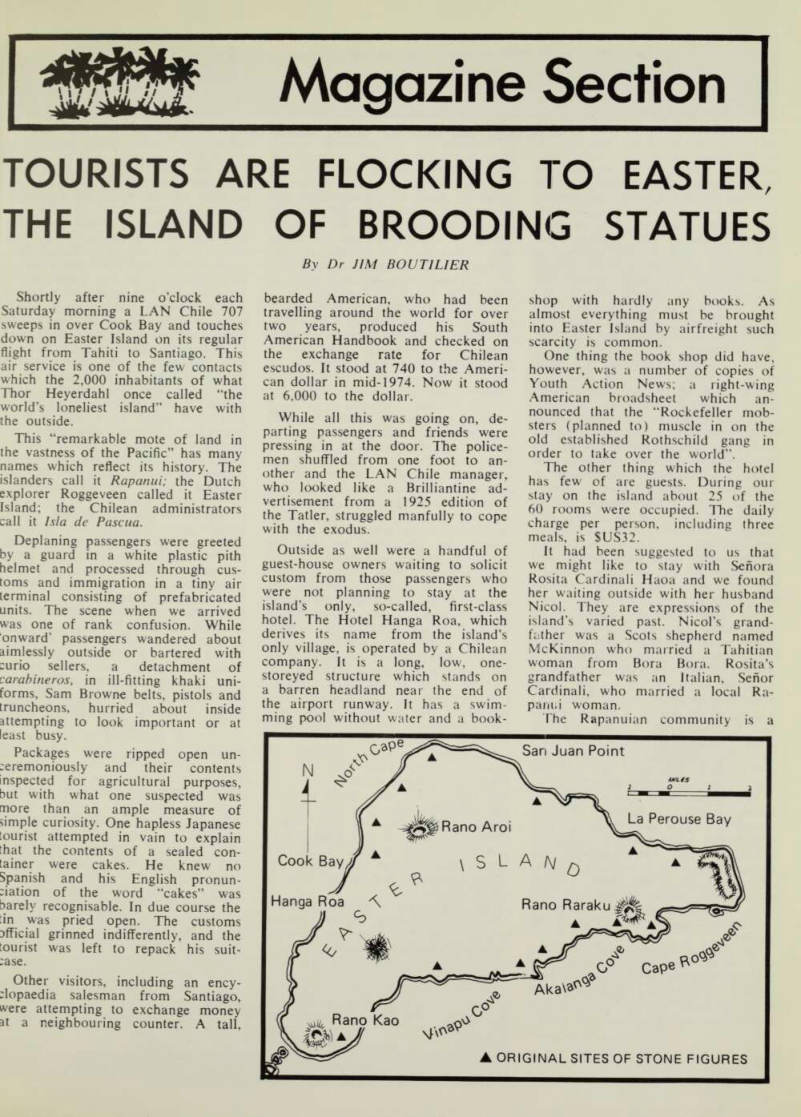
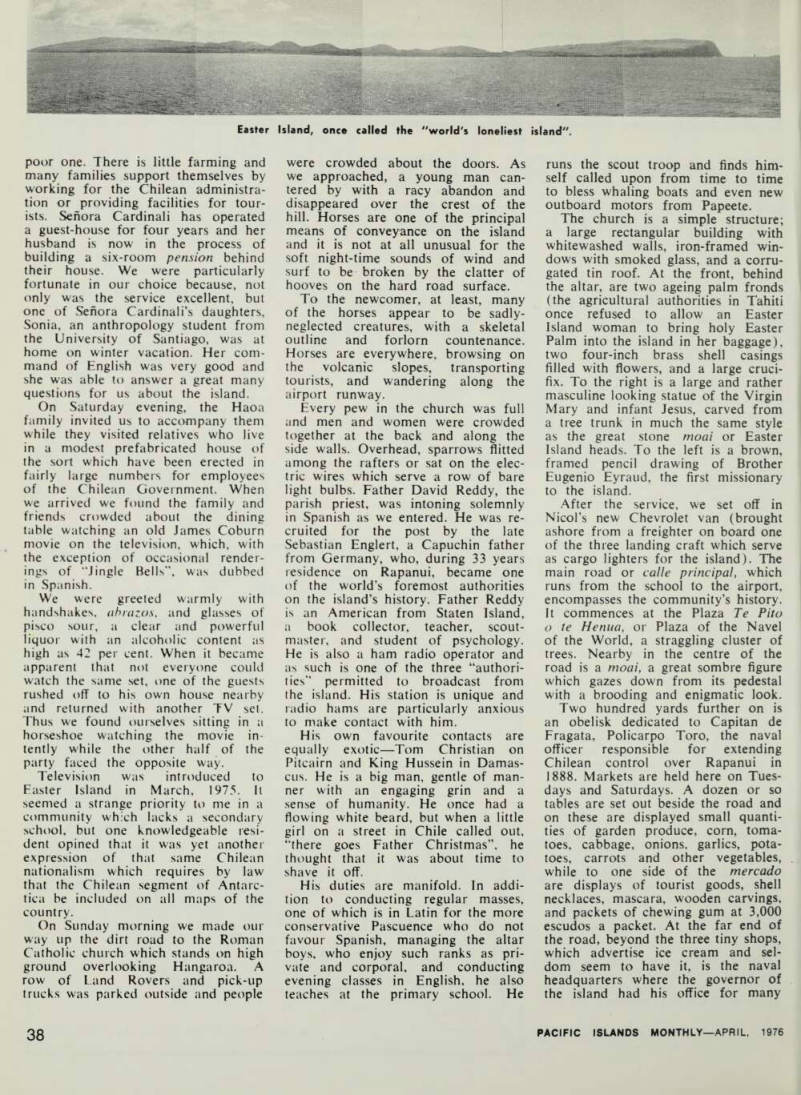
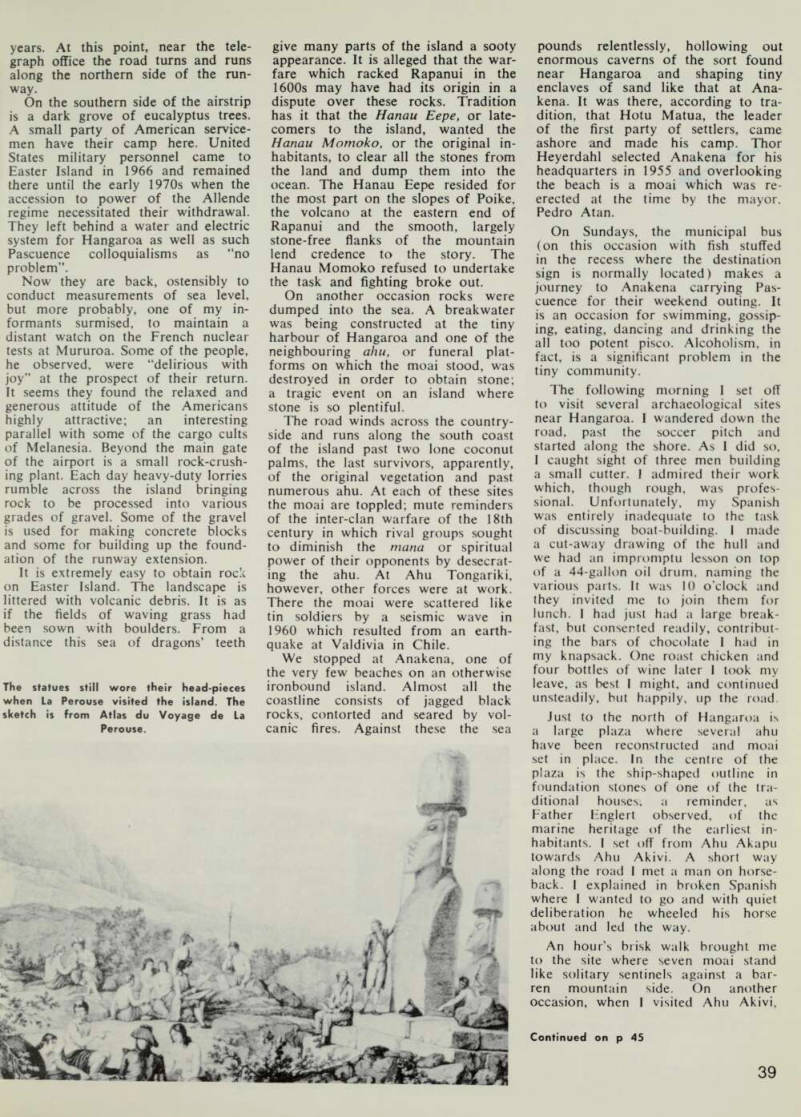

Tourists Are Flocking To Easter,
The Island Of Brooding Statues
By Dr Jim Boutilier
Shortly after nine o’clock each Saturday morning a LAN Chile 707 sweeps in over Cook Bay and touches down on Easter Island on its regular flight from Tahiti to Santiago. This air service is one of the few contacts which the 2,000 inhabitants of what Thor Heyerdahl once called “the world’s loneliest island” have with the outside.
This “remarkable mote of land in the vastness of the Pacific” has many names which reflect its history. The islanders call it Rapanui; the Dutch explorer Roggeveen called it Easter Island; the Chilean administrators call it Isla de Pascua.
Deplaning passengers were greeted by a guard in a white plastic pith helmet and processed through cus toms and immigration in a tiny air terminal consisting of prefabricated □nits. The scene when we arrived was one of rank confusion. While onward’ passengers wandered about aimlessly outside or bartered with curio sellers, a detachment of camhineros, in ill-fitting khaki uni forms, Sam Browne belts, pistols and truncheons, hurried about inside attempting to look important or at least busy.
Packages were ripped open un ceremoniously and their contents inspected for agricultural purposes, but with what one suspected was more than an ample measure of simple curiosity. One hapless Japanese tourist attempted in vain to explain that the contents of a sealed con tainer were cakes. He knew no Spanish and his English pronun ciation of the word “cakes” was barely recognisable. In due course the tin was pried open. The customs Dfficial grinned indifferently, and the tourist was left to repack his suit case.
Other visitors, including an ency clopaedia salesman from Santiago, were attempting to exchange money at a neighbouring counter. A tall,
bearded American, who had been travelling around the world for over two years, produced his South American Handbook and checked on the exchange rate for Chilean escudos. It stood at 740 to the Ameri can dollar in mid-1974. Now it stood at 6,000 to the dollar.
While all this was going on, de parting passengers and friends were pressing in at the door. The police men shuffled from one foot to an other and the LAN Chile manager, who looked like a Brilliantine ad vertisement from a 1925 edition of the Tatler, struggled manfully to cope with the exodus.
Outside as well were a handful of guest-house owners waiting to solicit custom from those passengers who were not planning to stay at the island’s only, so-called, first-class hotel. The Hotel Hanga Roa, which derives its name from the island’s only village, is operated by a Chilean company. It is a long, low, one storeyed structure which stands on a barren headland near the end of the airport runway. It has a swim ming pool without water and a book
shop with hardly any books. As almost everything must be brought into Easter Island by airfreight such scarcity is common.
One thing the book shop did have, however, was a number of copies of Youth Action News; a right-wing American broadsheet which an nounced that the “Rockefeller mob sters (planned to) muscle in on the old established Rothschild gang in order to take over the world”.
The other thing which the hotel has few of are guests. During our stay on the island about 25 of the 60 rooms were occupied. The daily charge per person, including three meals, is SUS 32.
It had been suggested to us that we might like to stay with Sehora Rosita Cardinali Haoa and we found her waiting outside with her husband Nicol. They are expressions of the island’s varied past. Nicol’s grand father was a Scots shepherd named McKinnon who married a Tahitian woman from Bora Bora. Rosita’s grandfather was an Italian, Senor Cardinali, who married a local Ra
pariui woman.
The Rapanuian community is a
poor one. There is little farming and many families support themselves by working for the Chilean administra tion or providing facilities for tour ists. Senora Cardinali has operated a guest-house for four years and her husband is now in the process of building a six-room pension behind their house. We were particularly fortunate in our choice because, not only was the service excellent, but one of Senora Cardinali’s daughters, Sonia, an anthropology student from the University of Santiago, was at home on winter vacation. Her com mand of English was very good and she was able to answer a great many questions for us about the island.
On Saturday evening, the Haoa family invited us to accompany them while they visited relatives who live in a modest prefabricated house of the sort which have been erected in fairly large numbers for employees of the Chilean Government. When we arrived we found the family and friends crowded about the dining table watching an old James Coburn movie on the television, which, with the exception of occasional render ings of “Jingle Bells”, was dubbed in Spanish.
We were greeted warmly with handshakes, ahrazos, and glasses of pisco sour, a clear and powerful liquor with an alcoholic content as high as 42 per cent. When it became apparent that not everyone could watch the same set, one of the guests rushed off to his own house nearby and returned with another TV set.
Thus we found ourselves sitting in a horseshoe watching the movie in tently while the other half of the party faced the opposite way.
Television was introduced to Easter Island in March, 1975. It seemed a strange priority to me in a community which lacks a secondary school, but one knowledgeable resi dent opined that it was yet another expression of that same Chilean nationalism which requires by law that the Chilean segment of Antarc tica be included on all maps of the country.
On Sunday morning we made our way up the dirt road to the Roman Catholic church which stands on high
ground overlooking Hangaroa. A
row of Land Rovers and pick-up trucks was parked outside and people
were crowded about the doors. As we approached, a young man can tered by with a racy abandon and disappeared over the crest of the hill. Horses are one of the principal means of conveyance on the island and it is not at all unusual for the soft night-time sounds of wind and surf to be broken by the clatter of hooves on the hard road surface.
To the newcomer, at least, many of the horses appear to be sadly neglected creatures, with a skeletal outline and forlorn countenance.
Horses are everywhere, browsing on the volcanic slopes, transporting tourists, and wandering along the airport runway.
Every pew in the church was full and men and women were crowded together at the back and along the side walls. Overhead, sparrows flitted among the rafters or sat on the elec tric wires which serve a row of bare light bulbs. Father David Reddy, the parish priest, was intoning solemnly in Spanish as we entered. He was re cruited for the post by the late Sebastian Englert, a Capuchin father from Germany, who, during 33 years residence on Rapanui, became one of the world’s foremost authorities on the island’s history. Father Reddy is an American from Staten Island, a book collector, teacher, scout master, and student of psychology.
He is also a ham radio operator and as such is one of the three “authori ties” permitted to broadcast from the island. His station is unique and radio hams are particularly anxious to make contact with him.
His own favourite contacts are equally exotic—Tom Christian on Pitcairn and King Hussein in Damas cus. He is a big man, gentle of man ner with an engaging grin and a sense of humanity. He once had a flowing white beard, but when a little girl on a street in Chile called out, “there goes Father Christmas”, he thought that it was about time to shave it off.
His duties are manifold. In addi tion to conducting regular masses, one of which is in Latin for the more conservative Pascuence who do not favour Spanish, managing the altar boys, who enjoy such ranks as pri vate and corporal, and conducting evening classes in English, he also teaches at the primary school. He
runs the scout troop and finds him self called upon from time to time to bless whaling boats and even new outboard motors from Papeete.
The church is a simple structure; a large rectangular building with whitewashed walls, iron-framed win dows with smoked glass, and a corru gated tin roof. At the front, behind the altar, are two ageing palm fronds (the agricultural authorities in Tahiti once refused to allow an Easter Island woman to bring holy Easter Palm into the island in her baggage), two four-inch brass shell casings filled with flowers, and a large cruci fix. To the right is a large and rather masculine looking statue of the Virgin Mary and infant Jesus, carved from a tree trunk in much the same style as the great stone moai or Easter Island heads. To the left is a brown, framed pencil drawing of Brother Eugenio Eyraud, the first missionary to the island.
After the service, we set off in Nicol’s new Chevrolet van (brought ashore from a freighter on board one of the three landing craft which serve as cargo lighters for the island). The main road or calle principal, which runs from the school to the airport, encompasses the community’s history.
It commences at the Plaza Te Pito o te Henua, or Plaza of the Navel of the World, a straggling cluster of trees. Nearby in the centre of the road is a moai, a great sombre figure which gazes down from its pedestal with a brooding and enigmatic look.
Two hundred yards further on is an obelisk dedicated to Capitan de Fragata, Policarpo Toro, the naval officer responsible for extending Chilean control over Rapanui in 1888. Markets are held here on Tues days and Saturdays. A dozen or so tables are set out beside the road and on these are displayed small quanti ties of garden produce, corn, toma toes, cabbage, onions, garlics, pota toes, carrots and other vegetables, while to one side of the mercado are displays of tourist goods, shell necklaces, mascara, wooden carvings, and packets of chewing gum at 3,000 escudos a packet. At the far end of the road, beyond the three tiny shops, which advertise ice cream and sel dom seem to have it, is the naval headquarters where the governor of the island had his office for many
Easter Island, once called the "world's loneliest island".
years. At this point, near the tele graph office the road turns and runs along the northern side of the run way.
On the southern side of the airstrip is a dark grove of eucalyptus trees.
A small party of American service men have their camp here. United States military personnel came to Easter Island in 1966 and remained there until the early 1970 s when the accession to power of the Allende regime necessitated their withdrawal.
They left behind a water and electric system for Hangaroa as well as such Pascuence colloquialisms as “no problem”.
Now they are back, ostensibly to conduct measurements of sea level, but more probably, one of my in formants surmised, to maintain a distant watch on the French nuclear tests at Mururoa. Some of the people, he observed, were “delirious with joy” at the prospect of their return.
It seems they found the relaxed and generous attitude of the Americans highly attractive; an interesting parallel with some of the cargo cults of Melanesia. Beyond the main gate of the airport is a small rock-crush ing plant. Each day heavy-duty lorries rumble across the island bringing rock to be processed into various grades of gravel. Some of the gravel is used for making concrete blocks and some for building up the found ation of the runway extension.
It is extremely easy to obtain rock on Easter Island. The landscape is littered with volcanic debris. It is as if the fields of waving grass had been sown with boulders. From a distance this sea of dragons’ teeth
give many parts of the island a sooty appearance. It is alleged that the war fare which racked Rapanui in the 1600 s may have had its origin in a dispute over these rocks. Tradition has it that the Hanau Eepe, or late comers to the island, wanted the Hanau Momoko, or the original in habitants, to clear all the stones from the land and dump them into the ocean. The Hanau Eepe resided for the most part on the slopes of Poike, the volcano at the eastern end of Rapanui and the smooth, largely stone-free flanks of the mountain lend credence to the story. The Hanau Momoko refused to undertake the task and fighting broke out.
On another occasion rocks were dumped into the sea. A breakwater was being constructed at the tiny harbour of Hangaroa and one of the neighbouring ahu, or funeral plat forms on which the moai stood, was destroyed in order to obtain stone; a tragic event on an island where stone is so plentiful.
The road winds across the country side and runs along the south coast of the island past two lone coconut palms, the last survivors, apparently, of the original vegetation and past numerous ahu. At each of these sites the moai are toppled; mute reminders of the inter-clan warfare of the 18th century in which rival groups sought to diminish the mana or spiritual power of their opponents by desecrat ing the ahu. At Ahu Tongariki, however, other forces were at work.
There the moai were scattered like tin soldiers by a seismic wave in 1960 which resulted from an earth quake at Valdivia in Chile.
We stopped at Anakena, one of the very few beaches on an otherwise ironbound island. Almost all the coastline consists of jagged black rocks, contorted and seared by vol canic fires. Against these the sea
pounds relentlessly, hollowing out enormous caverns of the sort found near Hangaroa and shaping tiny enclaves of sand like that at Ana kena. It was there, according to tra dition, that Hotu Matua, the leader of the first party of settlers, came ashore and made his camp. Thor Heyerdahl selected Anakena for his headquarters in 1955 and overlooking the beach is a moai which was re erected at the time by the mayor, Pedro Atan.
On Sundays, the municipal bus (on this occasion with fish stuffed in the recess where the destination sign is normally located) makes a journey to Anakena carrying Pas cuence for their weekend outing. It is an occasion for swimming, gossip ing, eating, dancing and drinking the all too potent pisco. Alcoholism, in fact, is a significant problem in the tiny community.
The following morning I set off to visit several archaeological sites near Hangaroa. I wandered down the road, past the soccer pitch and started along the shore. As I did so, I caught sight of three men building a small cutter. I admired their work which, though rough, was profes sional. Unfortunately, my Spanish was entirely inadequate to the task of discussing boat-building. 1 made a cut-away drawing of the hull and we had an impromptu lesson on top of a 44-gallon oil drum, naming the various parts. It was 10 o’clock and they invited me to join them for lunch. I had just had a large break fast, but consented readily, contribut ing the bars of chocolate I had in my knapsack. One roast chicken and four bottles of wine later I took my leave, as best I might, and continued unsteadily, but happily, up the road.
Just to the north of Hangaroa is a large plaza where several ahu have been reconstructed and moai set in place. In the centre of the plaza is the ship-shaped outline in foundation stones of one of the tra ditional houses, a reminder, as Father Englert observed, of the marine heritage of the earliest in habitants. I set off from Ahu Akapu towards Ahu Akivi. A short way along the road I met a man on horse back. I explained in broken Spanish where I wanted to go and with quiet deliberation he wheeled his horse about and led the way.
An hour’s brisk walk brought me to the site where seven moai stand like solitary sentinels against a bar ren mountain side. On another occasion, when I visited Ahu Akivi,
Continued on p 45
The statues still wore their head-pieces when La Perouse visited the island. The sketch is from Atlas du Voyage de La Perouse.
ree trucks appeared over the crest a hill. Almost before they had me to a halt a party of French urists tumbled out of them and 'armed over the ahu like a com iny of marines storming ashore, ley had flown from Santiago on e Thursday flight which arrives at 50 and were scheduled to leave at .20 on Saturday morning; a 4,600 ile journey in order to spend one y on Easter Island.
The island is experiencing an un pected boom in tourism even ?ugh July and August are the “off ison”. Whereas a year ago 707 s ide the journey with 30 or 40 ssengers, now they are sold out. fact on a recent flight the airline d confirmed bookings for 10 seats >re than there were places on the craft and a number of wait-listed ssengers, ourselves included, were ced to stay on the island for an icr week.
Phis was not a hardship. We
passed our time visiting the wind swept summit of Rano Kau and the moai “factory” at Rano Raraku. This volcano is the most famous of the Easter Island sites. Dozens of moai stand in the shadow of the weathered outer face of the massif; some are upright and alert while others are tilted crazily or sprawled on the grassy slopes. They are silent and eyeless. Above them, hewn in the rock are partly completed figures, abandoned centuries ago.
We clambered up to the highest point of the crater lip and sat for the longest time gazing out across the countryside. We were absolutely alone. The only sounds were those of the wind, the crickets and the hawks wheeling below. The solitude reminded us of the words written by Mrs Routledge, the leader of a British expedition to Easter Island in 1914. “Everywhere”, she wrote, “is the wind of heaven; around and above all are boundless sea and sky, infinite space and a great silence”.
Advertisements & other items, pp. 40-44 (1 item)
Clix
The anytime, anywhere crackers.
Salada Clix
Site ...
is# s
, WmM
% Pi P#;
PmH
■s ~" Stf " -#!- Cheds. Savoury crackers, deliciously topped with cheese.
CHEDS
crackers ,
wMw
Salada. So versatile. They go with everything. Enjoy them man-size, snack-size or bite-size.
Salada, the three-in-one cracker.
BROCKHOFF
• • Cheds Krispy Wheat
THE VERSATILE CRACKER
225 g NET
M
BROCKHOFF
CLIX
Clix. The crackers that taste like they're already buttered Scrumptious.
KRISPY-
WHEAT
Krispy Wheat Wafer. The satisfying, wafer-thin cracker with the hearty taste of wheat.
Brockhoff crackers seem to be
always just right. Crisp and fresh
and always tasty...as though
they just came from the oven.
And there’s a Brockhoff cracker to suit every taste.
All baked oven crisp by Brockhoff.
Arnott-Brockhoff-Guest Pty. Ltd., Burwood, Victoria, Australia. 3125. Telex 33075.
rjPUT * SS. ooT?. o <**
PHONES L —~C—*^
@@@ stop/EJECT dooh play ff f
BEW
POWER
CLOSE
4i : " ft I
fmxsszn_
cr-rs**
CASSETTE
STEREO
Expand your stereo enjoyment
via access to the front.
Stereo tape cassettes open up a listen to. A long-life permalloy-solid /hole new world of music listening head and built-in Dolby-B* noise njoyment. Whether you’re starting reduction system join to increase '°m scratch or as an addition to the S/N ratio to a hushed 62 sdß our present stereo system, (chrome tape over SKHz). And Noneer’s new CT-F 2121 is perfect independent BIAS and EQ selection s the basic stereo cassette deck, enables you to obtain maximum asically outstanding in tonal frequency response and lowest uality and basically designed for distortion from virtually any type lechanical precision. of tape.
With the tape compartment in the Pioneer’s CT-F 2121 helps you ont, loading a cassette is as easy stretch your stereo budget. Produce s sl.ppmg your hand in your your own music library. A built-in ocket WhNe front access design MPX (multiplex) filter ensures the lakes it easy to use, advanced recording of FM stereo broadcasts ioneer features make it great to with wide dynamic range And to Oolby is a trademark of Dolby Laboratories, Inc. ’ioneer products are available through: protect your valuable tapes, the
fully automatic Stop Mechanism
functions in all modes disengaging the tape transport mechanism and returning all levers to neutral.
Pioneer’s new CT-F 2121 stereo cassette deck. The added enjoyment of cassette tape versatility via access to the front.
ft!) PIONEER
Pioneer Electronic Corporation
4-1, Meguro 1-chome, Moguro-ku, Tokyo 153, Japan Australia Pioneer Electronics Australia Pty. Ltd., 178-184 Boundary Road, Braeside, Victoria 3195, Phone: 90-9011, Sydney 93-0246, Brisbane 52-8213, Adelaide 433379 Perth 76-7776 Fiji Islands Brijlal & Company, G.PO. Box No. 362, Suva, Fiji Islands Tel: 22258 Lae Hagemeyer (Australasia) B V PO. Box No. 90, Lae, Papua •New Guinea Tel; 42-32 00 Rabaul Hagemeyer (Australasia) B.V, PO. Box No. 63, Rabaul.
Papua* New Guinea Tel; 26 33 Port Moresby Hagemeyer (Australasia) B.V.
PO. Box No. 1428, Boroko.
Port Moresby, Papua •New Guinea Tel: 5 61 44 Madang Hagemeyer (Australasia) B.V, PO. Box No. 673, Madang,
T.P.N.G. Tel: 24 45
New Zealand Fountain Marketing Ltd , Maidstone Street Auckland.
New Zealand Tel: 763-064 Norfolk Island Burns Philp (Norfolk Island) Ltd., Norfolk Island, South Pacific New Hebrides Burns Philp (New Hebrides) Ltd., Vila, New Hebrides Nauru Island Jacob Enterprises, PO. Box No. 4 Nauru Island Tahiti
Ets. PERFECT, B.P. 594.
Papeete, Tahiti Tel: 20 407 New Caledonia Menard Freres, B.P. 123.
Noumea, New Caledonia Tel; 52-22 American Samoa Transpac Corporation.
PO. Box 1477, Pago Pago, American Samoa 96799 Tel: 633-5224 Rarotonga South Seas International Ltd., PO. Box 49, Rarotonga Cook Islands Tel: 2327
iU MBL.IULUOBS
qui ecoutent
KAMO AHHftAUE
ETVOUS, ETVOUS, ETVDUS
> : „ *v 7 JOURS SUR 7: - Informations - Musique - Commentaires - Interviews, Rubriques Nouvelle - Caledonia , Nouvelles - Hebrides 11H00 - 12H00 15H30 - 17H30 bandes des 16 et 19m Tahiti 14H00 ■ 15H00 18H30 - 20H30 bandes des 16 et 19m Brochures gratuites, photos - Ecrire a : RADIO AUSTRAL IE , Service Francais, Melbourne, Australia.
/ JT / H=v ■ ■ • « •-- - Vw . ■a td 7^ \ «V*
SV B
W -
SEIKO
QUARTZ LC
utter
UGH 7
K a AM ID 08 L 0 © L
THE SEIKO QUARTZ COLLECTION.
CHANGING THE WORLD'S
STANDARD OF ACCURACY.
The Seiko Quartz Collection encompasses a wide and exciting scope of quartz watches for men and women. Quartz guaranteed accurate to within one second per month. Ultra-thin quartz. Day/date Quartz. Digital quartz watches with liquid crystal for continuous readout to the second, and no buttons to push. Even a digital quartz chronograph. It's what you'd expect of Seiko.
Seiko sold the world's first quartz wristwatch. And Seiko even makes every part of every watch (except for the battery) to insure impeccable quality control and a superb product. Whatever Seiko Quartz model you select, you get more than just a technologically advanced timepiece. You get the watch that's changing the world's standard of accuracy. Seiko Quartz.
SEIKO
Someday all watches will be made this way.
Power
Padi
' ' t-t aiPeqS&m L . I If you’ve ever watched a big Pacific roller about to break, you’ll agree that two things are undeniable.
The majesty of it all.
And the power of it all.
Nothing could be more true than in concert-hall stereo reproduction.
It takes power.
Lots of power. To reproduce stereo sound majestically.
And that’s just what you get from Sansui stereo integrated amplifiers and stereo FM/AM tuners.
The Sansui AU-11000 stereo amp delivers a whopping 110 watts, min. RMS per channel.
While the Sansui AU-9900 has an output that’s no less awe-inspiring: 80 watts, min. RMS per channel.
And both offer no more than 0.08% total harmonic distortion.
Ideally matched is the Sansui FM/AM stereo tuner TU-99,00.
Its plus-minus dual power supply can be depended upon to bring in all the majesty of sound broadcasts. And, as is to be expected in a tuner of this calibre, the distortion is very low: 0.06%
(mono) and 0.08% (stereo) in FM
performance.
So, if the best sound in the Pacific is what you’re after, better tune in to the power of the Pacific.
Scut^uL
Sansui. Dynamic audio answers.
SANSUI ELECTRIC CO., LTD.
14-1, 2-chome, Izumi, Suginami-ku, Tokyo 168, Japan Australia Rank Industries Australia Pty. Ltd. 68 Queensbridge Street, South Melbourne, Victoria 3205 Phone: 61 3281 Australia Atkins Carlyle Ltd. 44 Belmont Avenue, Belmont, Western Australia, 6104 Phone: 65 0511 Fiji Prabhu Brothers Ltd.
P.O. Box 183, Nadi Phone: 70183/4 Papua New Guinea Oceania Indent Agency (P.N.G.) Pty. Ltd.
Box 5518, Boroko, Port Moresby Phone: PM 256406 New Zealand David J. Reid (N.Z.) Ltd.
C.P.O. Box 2630, Auckland, 1 Phone: 492-189 Nlle-Caledonie Ets Michel MERCIER 53, rue de Sebastopol, Noumea Phone: 759.11 South Pacific Miltons Department Stores Limited P.O. Box 146, Norfolk Island 2899 Western Samoa H.J. Keil and Company, Ltd.
P.O. Box 7, Apia Phone: 198 New Hebrides South Pacific Audio & Photo Supplies B.P. 274. Vila Cook Islands United Island Traders Ltd.
P.O. Box 1 & 2, Rarotonga Tahiti Societe JAUNEZ & Cie B.P. 322, Papeete Phone: 2.04.24
Pitcairn’s who-dunnit:
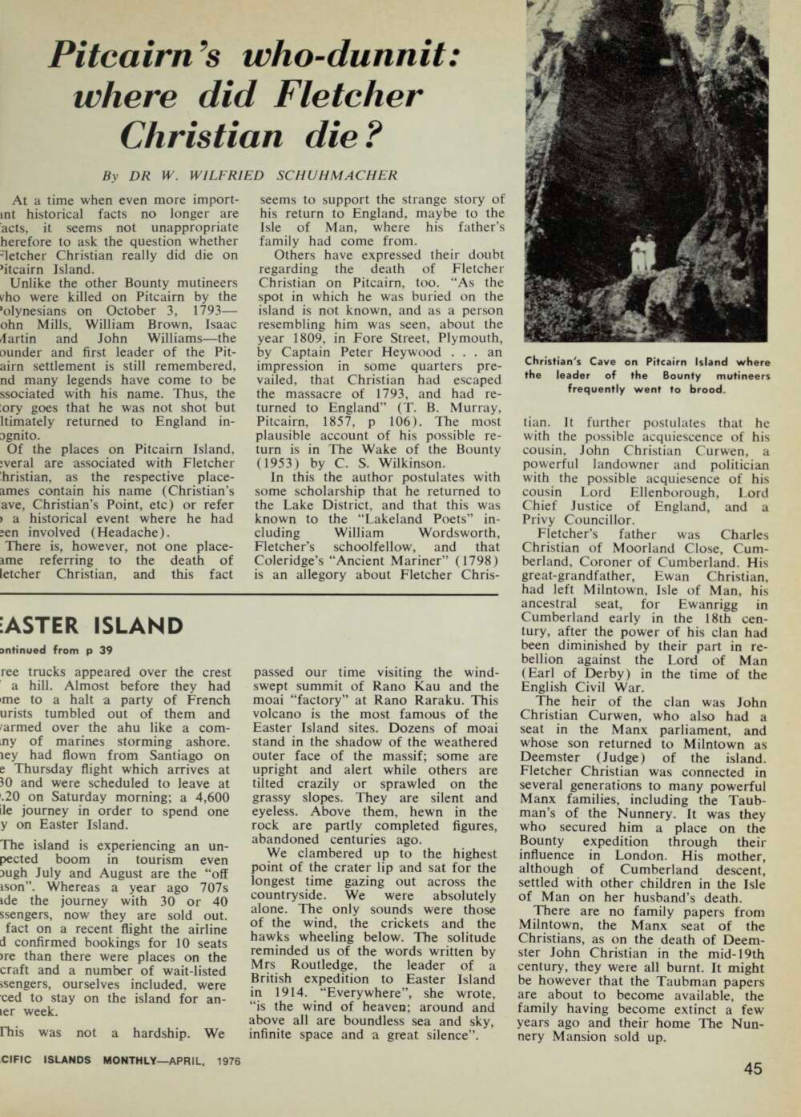
where did Fletcher Christian die?
By Dr W. Wilfried Schuhmacher
At a time when even more import mt historical facts no longer are acts, it seems not unappropriate herefore to ask the question whether Tetcher Christian really did die on *itcairn Island.
Unlike the other Bounty mutineers yho were killed on Pitcairn by the ‘olynesians on October 3, 1793 ohn Mills, William Brown, Isaac Tartin and John Williams—the □under and first leader of the Pit airn settlement is still remembered, nd many legends have come to be ssociated with his name. Thus, the ;ory goes that he was not shot but Itimately returned to England in- Dgnito.
Of the places on Pitcairn Island, ;veral are associated with Fletcher Christian, as the respective place ames contain his name (Christian’s ave, Christian’s Point, etc) or refer > a historical event where he had ;en involved (Headache).
There is, however, not one place ame referring to the death of letcher Christian, and this fact
seems to support the strange story of his return to England, maybe to the Isle of Man, where his father’s family had come from.
Others have expressed their doubt regarding the death of Fletcher Christian on Pitcairn, too. “As the spot in which he was buried on the island is not known, and as a person resembling him was seen, about the year 1809, in Fore Street, Plymouth, by Captain Peter Heywood ... an impression in some quarters pre vailed, that Christian had escaped the massacre of 1793, and had re turned to England” (T. B. Murray, Pitcairn, 1857, p 106). The most plausible account of his possible re turn is in The Wake of the Bounty (1953) by C. S. Wilkinson.
In this the author postulates with some scholarship that he returned to the Lake District, and that this was known to the “Lakeland Poets” in cluding William Wordsworth, Fletcher’s schoolfellow, and that Coleridge’s “Ancient Mariner” (1798) is an allegory about Fletcher Chris-
tian. It further postulates that he with the possible acquiescence of his cousin, John Christian Curwen, a powerful landowner and politician with the possible acquiesence of his cousin Lord Ellenborough, Lord Chief Justice of England, and a Privy Councillor.
Fletcher’s father was Charles Christian of Moorland Close, Cum berland, Coroner of Cumberland. His great-grandfather, Ewan Christian, had left Milntown, Isle of Man, his ancestral seat, for Ewanrigg in Cumberland early in the 18th cen tury, after the power of his clan had been diminished by their part in re bellion against the Lord of Man (Earl of Derby) in the time of the English Civil War.
The heir of the clan was John Christian Curwen, who also had a seat in the Manx parliament, and whose son returned to Milntown as Deemster (Judge) of the island.
Fletcher Christian was connected in several generations to many powerful Manx families, including the Taub man’s of the Nunnery. It was they who secured him a place on the Bounty expedition through their influence in London. His mother, although of Cumberland descent, settled with other children in the Isle of Man on her husband’s death.
There are no family papers from Milntown, the Manx seat of the Christians, as on the death of Deem ster John Christian in the mid-19th century, they were all burnt. It might be however that the Taubman papers are about to become available, the family having become extinct a few years ago and their home Tlie Nun nery Mansion sold up.
Christian's Cave on Pitcairn Island where the leader of the Bounty mutineers frequently went to brood.
Advertisements & other items, pp. 45-46 (2 items)
Aster Island
45
CIFIC ISLANDS MONTHLY—APRIL. 1976
»ntinued from p 39
by Goodyear.
Some down-to-earth
reasons for using
Unisteel radial pi tires
by Goodyear.
Unisteel—the earthmover tire with radial steel body plies plus steel belts— carries heavier loads at faster speeds than conventional tires. Radial ply construction—with belts of steel cord under the tread plus a super-strong ply of steel cord in the body—dissipates heat quickly for cooler running, resists punctures by deflecting most debris and rocks, and provides excellent traction with a long lasting tread. Large vehicle f* JTS Mk SQB or small, Goodyear earthmover tires will perform better, mW M longer, and more economically than conventional tires. ' m f Boroko Motors Ltd, Port Moresby, PNG.
Solomon Motors Ltd.
Honiara, 8.5.1. P.
Santo Engineers
Santo, NEW HEBRIDES
Pacific Motors
Vila, NEW HEBRIDES
Truk Trading Co.
Truk, E. Caroline Is.
Island Construction Co.
Majuro, Marshall Is.
Guam Tire & Supply Co.
Agana, GUAM Susepe Enterprise Saipan, Mariana Is.
Microl Gorp.
Saipan, Mariana Is.
Yap Cooperative Ass.
Yap, W. Caroline Is.
PAM.I.
Koionia, Ponape Ngiratkel Etpison Co. Ltd.
Koror, Palau Coral Island Motors Suva, FIJI Societe Generale Automobile
Noumea, NEW CALEDONIA
W.S.T.C.S.
WESTERN SAMOA
Morris Hedstrom Ltd .
Apia, Western Samoa Morris Hedstrom Tonga Yung Wei Tung Trading Co., Ltd.
Taipei, TAIWAN Landis Brothers & Co.
HONG KONG
Service Mobil Papeete, Tahiti Samoa Motors Inc.
AMERICAN SAMOA
Duncombe Bay Garage Norfolk Is.
Cook Island Motors Cook Is. 8612
Yesterday
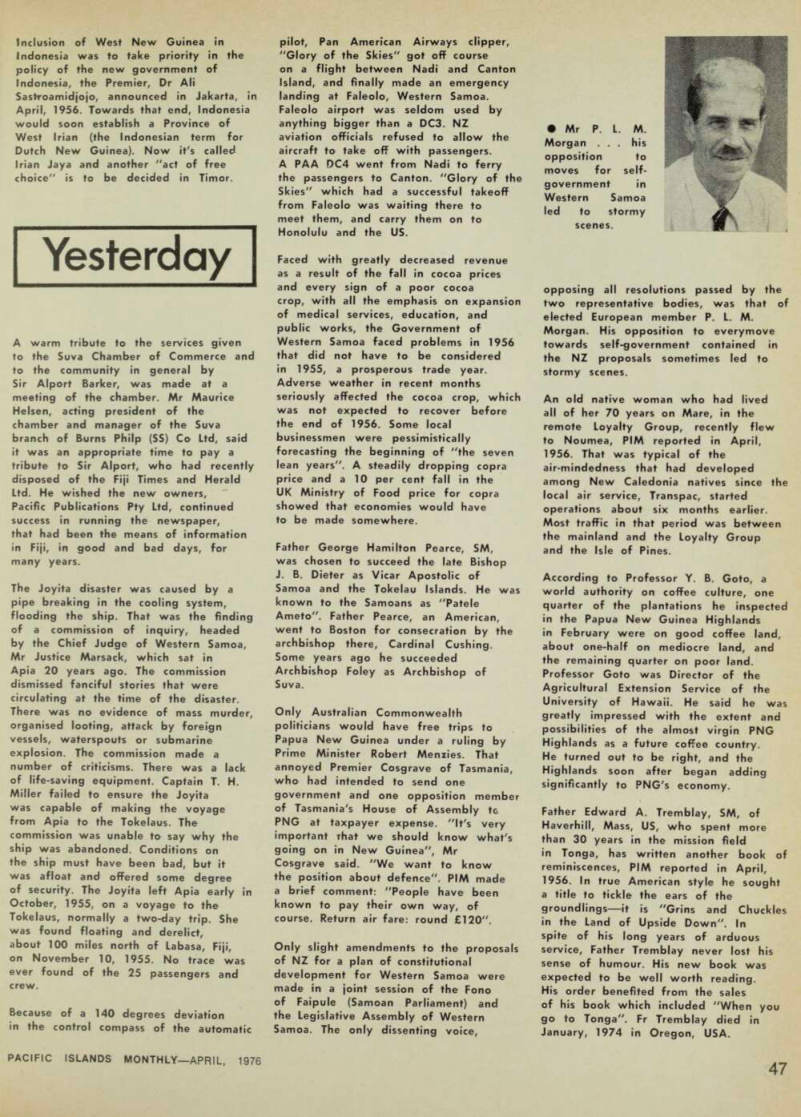
Inclusion of West New Guinea in Indonesia was to take priority in the policy of the new government of Indonesia, the Premier, Dr Ali Sastroamidjojo, announced in Jakarta, in April, 1956. Towards that end, Indonesia would soon establish a Province of West Irian (the Indonesian term for Dutch New Guinea). Now it's called Irian Jaya and another "act of free choice" is to be decided in Timor.
A warm tribute to the services given to the Suva Chamber of Commerce and to the community in general by Sir Alport Barker, was made at a meeting of the chamber. Mr Maurice Helsen, acting president of the chamber and manager of the Suva branch of Burns Philp (SS) Co Ltd, said it was an appropriate time to pay a tribute to Sir Alport, who had recently disposed of the Fiji Times and Herald Ltd. He wished the new owners, Pacific Publications Pty Ltd, continued success in running the newspaper, that had been the means of information in Fiji, in good and bad days, for many years.
The Joyita disaster was caused by a pipe breaking in the cooling system, flooding the ship. That was the finding of a commission of inquiry, headed by the Chief Judge of Western Samoa, Mr Justice Marsack, which sat in Apia 20 years ago. The commission dismissed fanciful stories that were circulating at the time of the disaster.
There was no evidence of mass murder, organised looting, attack by foreign vessels, waterspouts or submarine explosion. The commission made a number of criticisms. There was a lack of life-saving equipment. Captain T. H.
Miller failed to ensure the Joyita was capable of making the voyage from Apia to the Tokelaus. The commission was unable to say why the ship was abandoned. Conditions on the ship must have been bad, but It was afloat and offered some degree of security. The Joyita left Apia early in October, 1955, on a voyage to the Tokelaus, normally a two-day trip. She was found floating and derelict, about 100 miles north of Labasa, Fiji, on November 10, 1955. No trace was ever found of the 25 passengers and crew.
Because of a 140 degrees deviation in the control compass of the automatic
pilot, Pan American Airways clipper, "Glory of the Skies" got off course on a flight between Nadi and Canton Island, and finally made an emergency landing at Faleolo, Western Samoa.
Faleolo airport was seldom used by anything bigger than a DC3. NZ aviation officials refused to allow the aircraft to take off with passengers.
A PAA DC4 went from Nadi to ferry the passengers to Canton. "Glory of the Skies" which had a successful takeoff from Faleolo was waiting there to meet them, and carry them on to Honolulu and the US.
Faced with greatly decreased revenue as a result of the fall in cocoa prices and every sign of a poor cocoa crop, with all the emphasis on expansion of medical services, education, and public works, the Government of Western Samoa faced problems in 1956 that did not have to be considered in 1955, a prosperous trade year.
Adverse weather in recent months seriously affected the cocoa crop, which was not expected to recover before the end of 1956. Some local businessmen were pessimistically forecasting the beginning of "the seven lean years". A steadily dropping copra price and a 10 per cent fall in the UK Ministry of Food price for copra showed that economies would have to be made somewhere.
Father George Hamilton Pearce, SM, was chosen to succeed the late Bishop J. B. Dieter as Vicar Apostolic of Samoa and the Tokelau Islands. He was known to the Samoans as "Patele Ameto". Father Pearce, an American, went to Boston for consecration by the archbishop there, Cardinal Cushing.
Some years ago he succeeded
Archbishop Foley as Archbishop of
Suva.
Only Australian Commonwealth politicians would have free trips to Papua New Guinea under a ruling by Prime Minister Robert Menzies. That annoyed Premier Cosgrave of Tasmania, who had intended to send one government and one opposition member of Tasmania's House of Assembly to PNG at taxpayer expense. "It's very important that we should know what's going on in New Guinea", Mr Cosgrave said. "We want to know the position about defence". PIM made a brief comment; "People have been known to pay their own way, of course. Return air fare: round £120".
Only slight amendments to the proposals of NZ for a plan of constitutional development for Western Samoa were made in a joint session of the Fono of Faipule (Samoan Parliament) and the Legislative Assembly of Western Samoa. The only dissenting voice,
opposing all resolutions passed by the two representative bodies, was that of elected European member P. L M.
Morgan. His opposition to everymove towards self-government contained in the NZ proposals sometimes led to stormy scenes.
An old native woman who had lived all of her 70 years on Mare, in the remote Loyalty Group, recently flew to Noumea, PIM reported in April, 1956. That was typical of the air-mindedness that had developed among New Caledonia natives since the local air service, Transpac, started operations about six months earlier.
Most traffic in that period was between the mainland and the Loyalty Group and the Isle of Pines.
According to Professor Y. B. Goto, a world authority on coffee culture, one quarter of the plantations he inspected in the Papua New Guinea Highlands in February were on good coffee land, about one-half on mediocre land, and the remaining quarter on poor land.
Professor Goto was Director of the Agricultural Extension Service of the University of Hawaii. He said he was greatly impressed with the extent and possibilities of the almost virgin PNG Highlands as a future coffee country.
He turned out to be right, and the Highlands soon after began adding significantly to PNG's economy.
Father Edward A. Tremblay, SM, of Haverhill, Mass, US, who spent more than 30 years in the mission field in Tonga, has written another book of reminiscences, PIM reported in April, 1956. In true American style he sought a title to tickle the ears of the groundlings—it is "Grins and Chuckles in the Land of Upside Down". In spite of his long years of arduous service, Father Tremblay never lost his sense of humour. His new book was expected to be well worth reading.
His order benefited from the sales of his book which included "When you go to Tonga" Fr Tremblay died in January, 1974 in Oregon, USA.
• Mr P. L. M.
Morgan ... his opposition to moves for self government in Western Samoa led to stormy scenes.
Advertisements & other items, pp. 48-50 (3 items)
Mixmaster Mixer
' KS m i
3 times better than any
mixer. Designed especially for family food preparation. 12-speed mixfinder dial indicates the correct speed for each mixing action. Complete with 2 heat-resistant bowls and juice extractor. Sunbeam's exclusive 3-way beating action — extra large, contoured beaters, and automatic bowl movement — gives perfect aeration and more even mixing. It can handle everything from beating one egg to mixing a large fruit cake.
From the
Islands Press
According to the Tonga Chronicle, “a member of the German royal family, His Serene Highness, Prince von Thurn Und Taxis” on a visit to Tonga, gave this advice: “Considering the size and population of this nation, I believe that feudalism is the right political system for Tonga”, he said. “It is good to maintain the one-party system in Tonga because family ties are still strongly upheld by her people. It is like a big family under the control of the parents”.
A “public accolade” awarded the Royal Fiji Police by The Fiji Times in an editorial on “Police success in preventing crime”. . . . Figures released by the police show a 28.1 per cent drop in the crime rate for the Southern Division, an area where crimes against property were normally high because of social problems created by rapid urbanisation. This is a significant victory in stemming the tide of crime which reached a dangerous level when the city streets had become virtually unsafe to walk at night.
From the New Hebrides radio news: A custom ceremony at Bongabonga village was a part of the preparation of Willie Jack Moses, who will eventually become chief of Bongabonga. In Willie Jack's absence Pastor Fred Tapagongi, who is also of chiefly line, killed four pigs for him as customary on such an occasion.
People from four villages came and pigs were killed and given to them with kava, bundles of sugar cane and other foods. Altogether, 10 pigs were killed and about 50 to 60 people were present.
One of 10 points made by Natui-Tanno, a political party in the New Hebrides, against Nagriamel declaration of independence for Santo, as reported in the New Hebrides News: Santo used to be a happy place, but not now with people taking money from bushmen, and land too, and people making trouble at the time of the elections. Those white men who are making trouble in Santo should leave Santo and the New Hebrides.
From a letter by Moegagogo Tamasese in the Samoa Times: It is about time the people of Samoa took a strong stand to protest and condemn the barbaric actions of the news media, the Government and the people of New Zealand for inhumanely projecting and creating such a senseless, irresponsible and evil attack on our people by publishing unfounded and false
information about Samoan bananas being contaminated with human excrement.
From a circular issued by the Fiji Ministry of Education and reported by The Fiji Times warning teachers over the use of
corporal punishment:
. . . "Excessive use of punishment is a sign of general incompetency on the part of the teacher", the circular says.
"If pupils are inattentive, noisy, frequently late or absent from the school, the teacher should realise that the fault is probably his".
From the Cook Islands News reporting a speech by Premier Sir Albert Henry on the creation of a market for small produce growers: “I have been very concerned with the people who have to sit on the side of the road for long hours hoping that someone will come and buy their goods. This market will stop these people having to sit and hope”, said Sir Albert.
“Bowlers defy Cabinet” headlined the Samoa Times and reported that before a team of five bowlers left to play in the World Bowling Championships in South Africa “despite Cabinet’s disapproval of the
trip”:
. . . the team captain, Letaa Sulufaiga Devoe, told the Samoa Times that it was not their wish to be disrespectful to Cabinet, but they firmly believed that sports and politics must remain separate. The team, he said, was going as a team from the Western Samoa Bowling Association, and if the South African officials decided to raise the Samoan flag and play the Samoan National Anthem, they were not going to stop them.
From a speech by Micronesian Senator John Mangefel, of Yap, on plans to begin a US Department of Agriculture-sponsored school feeding programme in Micronesia as
reported by the Micronesian Independent:
Mangefel said the children of Micronesia should not be fed by someone else. “If we want to be dependent on the United Stales for everything, including food, then we should forget about this business of future status, self-government and unity”, he said.
He said if Micronesia is not weaned from handouts, then instead of the future Federated States of Micronesia (FSM) Micronesia will have a future USDA. He added USD A would not mean US Department of Agriculture, but rather “the United States of Dependent Adolescents'’.
A controversy about kissing as an
educational activity as reported by The
Fiji Times:
A Swiss Evangelical Mission school in Papua New Guinea's eastern highlands has been ordered to reinstate four students —three boys and a girl—who were expelled for kissing in the school grounds. The eastern highlands provincial commissioner for education, Mr Clemens Runawery, said he did not think kissing in the school grounds was a satisfactory reason for stopping the children from attending school.
Stile Fibreglass
LADDERS OUTLAST
TIMBER LADDERS
MANY TIMES OVER!
STILE ladders are available in many sizes to suit your needs From home use to major construction work, especially electrical installations and maintenance. * Extensions to 36 feet. * Steps to 14 feet * Single ladders to 20 feet.
Pure fibreglass STILE ladders and steps have been tested aiul approved by the
DEPT. OF OCCUPATIONAL SAFETY (QLD.)
For full details of how STILE fibreglass ladders can assist in your project, contact
W. H. BAILEY LADDERS
PTY. LTD.
P.O. Box 205, Reresby, N.S.W., Australia 2212 Telephone 771-6055
Books, Reviews, Writers
From Benghazi To The Sepik
- The War Of One Australian
World War II gave many Pacific Islanders their first experience of modern war, its massive use of men and material and its miseries. The war is the subject of official histories of the nations which waged it, and of many books about the army units, naval ships, air squadrons, etc, which took part. But, as Francis Bacon observed, money is not the sinews of war. People wage war against other people, and it is the personal accounts of those who ex perienced it first-hand that often provide the best insight.
Geoff Fearnside had already writ ten two books, Sojourn In Tobruk (1944) and Bayonets Abroad (1953) about the 2/13th Infantry Battalion, Australian Imperial Force, in which he served. Now, more than 20 years later, he tells his own story.
The 2/13th, ‘Devil’s Own’, was one of the units opposing the Italian and German forces in North Africa.
The author took part in the success ful initial drive against the Italians and he was one of the many ‘entries’ in the ‘Benghazi Handicap’, the flight of Allied troops before the German Afrika Korps in 1941, The 2/13th was among units which dug in at Tobruk and defied the Afrika Korps’ attempts to dislodge them. Fearnside was wounded, eva cuated, and, following a spell in hos pital and leave, took part in the fighting in Syria against the Vichy French.
During one leave, he visited Gordon’s Calvary in Jerusalem: “We had come, not as pilgrims but as off-duty soldiers whose hands were bloody and whose minds were conditioned to hate and kill. We profaned the Garden Tomb, its peace and tranquillity, as surely as did the machine guns of the British police men down at the Wailing Wall”.
By July, 1942, the 2/13th was on its way to the Western Desert where it took part in the bloody fight ing with the Afrika Korps.
Fearnside writes about one of the many attacks: “It would be spring in Australia and the wattle would
be out . . . Could men die of mad ness and fear on a battlefield? A thousand deaths of madness and fear? ‘The valiant never taste of death but once . . .’ Where is the valour of cowering in the dust, swamped by a fury of frightening sound? Oh God, for a golden beach and the sound of surf”.
The 2/13th sustained 285 casual ties, about one-third of its strength, in that campaign. Several of the author’s mates were among those.
The 9th Division 2nd AIF, of which the 2/13th was part, went home soon after. After three months at an officer cadet training unit and other training. Lieut Fearnside was sent to the 2/3rd Infantry Battalion which, with other units of the 6th
Tom Harrisson
Dies In Crash
Tom Harrisson, the anthropologist and writer, whose book Savage Civilisation gave a valuable account of life in the Malekula (New Heb rides) bush in the 19305, has been killed in a bus accident in Bangkok.
He was 64. His wife, Belgian sculp tress Baronne Christine Forani, whom he married in 1971, also died in the accident.
Harrisson, educated at Harrow and Cambridge, arrived in the New Hebrides in 1933 and spent more than a year among the mountain people of Malekula who were still cannibal. He also worked in the New Hebrides as a civil servant to help finance his expedition and was in volved in the production of a film on island life.
War service in Sarawak and Dutch Borneo organising guerilla activities against the Japanese gained him a
Dso.
Dr Harrisson paid another visit to the New Hebrides in the late 19605.
Division, was fighting against Japan ese troops in the Sepik District.
He had a lucky escape when a camp of the 2/3rd was washed away by the rain-flooded Danmap River one dark night; several men were drowned. There was no large scale fighting like the battles in the Middle East, but the jungle warfare in New Guinea, too, claimed lives.
And malaria, scrub typhus and going ‘troppo’ (mental breakdown) were an even greater enemy than the Japanese who, in 1944, no longer received supplies from home, and who suffered even more.
In that campaign, 442 officers and men of the 6th Division were killed or died of wounds, 1,141 were wounded and 16,203 admitted to hospital because of sickness. Fearn side, no longer fit for front-line service, was sent home before the war ended.
Pacific Islanders, not least the Papua New Guineans, are beginning to write about their own or their people’s war-time experiences. It is important that they do so, because warfare, of some kind or other, has been a part of human existence since times immemorial. It must, therefore, be included in the histories of nations.
Half To Remember, the unpreten tious, sensitively-written account of one Australian’s war, does a lot more than is done by official histories and the like to put to Papua New Guineans and other Pacific islanders what the many graves in the war cemeteries at Bomana, Lae and Bita paka mean to Australians. And one does not have to be a political scientist or defence expert to see the message of those graves reflected in Australia’s policy and dealings concerning Papua New Guinea.
Many Jackman
(HALF TO REMEMBER By G. H. Fearnside, Haldane Publishing Co, 65 Campbell St, Surry Hills, NSW, Australia. $7.95).
Advertisements & other items, p. 52 (1 item)
Surveyors!!
W k
—Don’t waste time and effort measuring with a survey chain any more! For much quicker and more accurate results, the proven electronic distance measuring instrument, THE BEETLE, takes the grind and uncertainties out of surveying. Measurements up to 1,000 metres in fifteen seconds. THE BEETLE, at a basic price of $2,995 makes chaihing uneconomical. THE BEETLE is lightweight (5.5 lb.) and fits any theodolite so you can read angles and distances simultaneously You can learn, or teach someone to use, THE BEETLE in ten minutes. Set the cogs into motion in your organisation —obtain further details and the name of your nearest BEETLE agent.
CONTACT:—
PRECISION INSTRUMENT CO
Surveying Equipment
88-90 WALKER STREET,
NORTH SYDNEY, N.S.W., AUST
Phone (02) 92 7035, 92 4280
E. G. BARKER & CO. PTY. LTD.
Established 1825 150 Years of Service
AUSTRALIA 5 OLDEST EXPORT HOUSE
GENERAL EXPORT MERCHANTS
Specialising in world-wide distribution of General Merchandise, Provisions and Produce
EXPORTING TO ALL PORTS IN
PACIFIC ISLANDS
Buying Agents for:— THE CO-OPERATIVE WHOLESALE SOCIETY LTD.
LAE AND ALL BRANCHES
v •
PORT MORESBY
RAYMOND WONG
P.O. Box 5020
BOROKO
Phone 25 5546 Representatives
RABAUL
CON SASSADIS
P.O. Box 611
RABAUL
Phone 92 2934
FIJI
PARAMOUNT AGENCIES
G.P.O. Box 459
SUVA
Phone 2 3127
34 HUNTER STREET, SYDNEY 2000
Cable Address: KERBAR SYDNEY. Phone: 231-6200. Telex: 22221 Melbourne Office: 530 Little Collins Street. Phone: 61-2877. Telex: 31732.
Profound Experience For A Reader
The diary kept by a teenage girl forms the basis of an account of life on Tahiti in the early years of the second World War. Amusing anecdotes of delightful and some times frustrating Polynesian friends, lyrical descriptions of the tropical beauty of French Polynesia and in timate glimpses of a young Ameri can girl’s innermost thoughts in such a setting are all to be found in the pages of Sound of the Stars.
Nothing unusual in this, perhaps?
But bear in mind that the writer of this book has been deaf from birth.
Deafness is an isolating and res trictive handicap, which spells seclusion from normal social inter course because a deaf person does not speak and acquire language nor mally. The hearing person builds up a vast vocabulary during the forma tive years, without giving conscious thought to the matter, but, to a deaf person, every word learnt is a new and hard-won achievement.
To read this book is a profound experience to anyone aware of and sympathetic to the problems of the deaf.
Frances Parsons and her twin sister were discovered to be deaf at the age of five and not until the age of
10 did they learn to speak intelli gibly. They attended the State School for the Deaf in California, but after five years of boarding school life, their mother determined to re-unite the family, rather dramatically, by moving lock, stock and barrel right across the Pacific to French Poly nesia. They settled on Tahiti in the outlying district of Vairao, which was tenuously linked to the bright lights of Papeete by a quite hilarious and unpredictable means of trans port, known as the “midnight truck”.
The vagaries and marital disputes of the Parsons’ Chinese neighbour and his Tahitian wife are described with great verve and racy detail and such local characters as Papa Poria and Mother Angel spring to lusty life for the reader. Through her literary-minded parents this young deaf girl also had the good fortune to meet such well-known characters as Charles Nordhoff, James Hall and Zane Grey.
Outer island travel on small schooners provided Frances and her twin with many adventures. Two adolescent girls are soon aware of life’s finer and more intimate points and these are recounted with re freshing and unsparing candour.
The reader will discover some rather quaint English in this book.
This is due to Frances’ handicap as the deaf inevitably miss out on some structural language. But, far from detracting from the narrative, these small lapses add a charm and origin
ality.
Today, Frances Parsons, holder of a Master of Arts degree and hav ing passed her first half century, is a faculty member of Gallaudet College in Washington, DC—the only tertiary institution for the deaf in the world. She lectures in Art History and her idea of a good holi day is to bustle off to some far-flung corner of the world to help some project concerned with educating the deaf.
She is a remarkable woman who can make herself at home anywhere, undaunted by any language barrier.
Those four adventure-filled years in Tahiti served to whet her appetite for travel and for understanding the world. Her very readable Sound of the Stars is surely worthy of a place on the book shelves of all who enjoy reading about the Pacific. —Merle H. Coppell (SOUND OF THE STARS by Frances M.
Parsons. Published by Vantage Press Inc, 516 West 34th St, New York, NY 10001.
U 555.95).
Making maths a fun thing
The education authorities of Western Samoa, in common with hose of other Pacific Islands coun ties, are engaged upon an extensive ;xamination of the curricula offered o their pupils.
Quite obviously there is concern hat, in many instances, the present syllabuses of instruction concentrate ipon academic subject matter which las little or no relevance for the arge number of students who will emain on the land or who will make ip the greater part of the workforce.
The past emphasis upon academic itudies had a principal objective of iroducing the educated elite which yould receive tertiary education and orm the higher echelons of the pub ic service. This objective tended to gnore the interests of those who vere screened out of the academic rducational process.
In Western Samoa, lan Lowe of he UNDP Curriculum Development Unit, working with the Western >amoan secondary schools mathe natics curriculum committee has ?een engaged upon the task of de signing a mathematics programme
relevant to those pupils who will not enter Samoa College.
The Schools Publications Division of the Western Samoa Department of Education has now published pupils’ textbooks together with teachers’ manuals to cover the Form 111 to Form V area. Mr Lowe spent some time in village schools and had extensive consultations with Samoan teachers before assembling the syllabus. The results are com mendable as the programme is tailor-made to Western Samoan con ditions.
Learning mathematics should be a “fun thing” as there is a great variety of material to study and a market absence of tedious and repetitious tasks. The students, as an example, are introduced to the pro ject of starting a village store by surveying the potential customers, transport facilities and the costs of stocking a store. They are also shown how to draw the floor plans for a faleola (counter-in-front store) or a small “super-market” store.
Book-keeping is taught on a pre mise of life in the village, with some notes of caution. The pupils are
warned for instance that “there may be some trusted friends and maybe your own family to whom you can give credit”.
Fa’a Samoa is emphasised wher ever possible. In the teaching of the concept of symmetry, there is an examination of the symmetry used in the traditional Samoan tattoo motifs, and the practical applications of studying symmetry are used in designing patterns for the laying of floor tiles.
The programme also extends be yond the school buildings and play ground as the children carry out practical land surveys. They are also shown how to play interesting mathe matical games at home with their families, using everyday objects such as playing cards, matches and bottle tops.
It is to be hoped the Western Samoan Department of Education will press on with similar revisions of the curriculum and that its example with the mathematics pro gramme will become typical of similar programmes throughout the Pacific Islands countries.
Advertisements & other items, p. 54 (1 item)
If you run a business,
you must read this ad
No matter what size business you run, the amazing new Olivetti A 5 desktop business systems computer will
increase efficiency and profitability, economically.
r» The Olivetti A 5 is a business systems computer that has been designed to handle all accounting, invoicing, payroll and stock control functions within your business.
It has been designed to handle those functions extremely quickly.
The Olivetti A 5 takes up less desk space than two electric typewriters and because it is built on a modular principle, you simply m add-on different accessories as you need them to deal with your future management requirements.
It is an extremely simple system to use, as you deal with it in human language.
And being a computer, it carries with it all the intrinsic promise of increased efficiency and profitability.
However, one thing the Olivetti A 5 doesn’t carry is a huge price tag.
That sort of performance at its price must kill any doubts you may have had about utilising a computer to gain better solutions to your business problems.
The Olivetti A 5 has so many functions, we couldn’t fit them all in this ad. So if you would like to find out more about this revolutionary new management tool, please write or phone for a demonstration.
Olivetti
apua new guinea printing co. pty. ltd.
Sole agents for Olivetti products in Papua New Guinea PORT MORESBY- Box 633. Phone Head Office 242981, Office Equipment Division 256230.
LAE: Box 759. Phone 422892. RABAUL Box 1239. Phone 922990. 0L0224
Business and Development
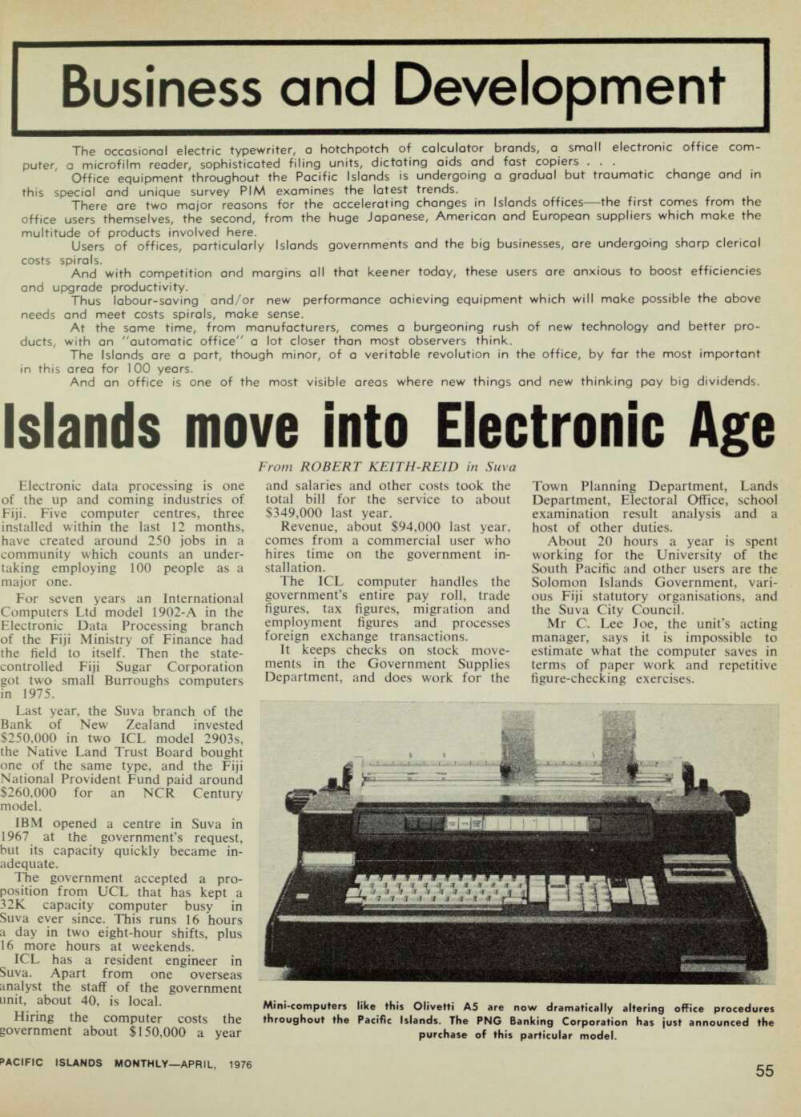
The occasional electric typewriter, a hotchpotch of calculator brands, a small electronic office com puter, a microfilm reader, sophisticated filing units, dictating aids and fast copiers . . .
Office equipment throughout the Pacific Islands is undergoing a gradual but traumatic change and in this special and unique survey PIM examines the latest trends.
There are two major reasons for the accelerating changes in Islands offices —the first comes from the office users themselves, the second, from the huge Japanese, American and European suppliers which make the multitude of products involved here.
Users of offices, particularly Islands governments and the big businesses, are undergoing sharp clerical costs spirals.
And with competition and margins all that keener today, these users are anxious to boost efficiencies and upgrade productivity.
Thus labour-saving and/or new performance achieving equipment which will make possible the above needs and meet costs spirals, make sense.
At the same time, from manufacturers, comes a burgeoning rush of new technology and better pro ducts, with an "automatic office" a lot closer than most observers think.
The Islands are a part, though minor, of a veritable revolution in the office, by far the most important in this area for 100 years.
And an office is one of the most visible areas where new things and new thinking pay big dividends.
Islands move into Electronic Age
From ROBERT KEITH-REID in Suva
Electronic data processing is one of the up and coming industries of Fiji. Five computer centres, three installed within the last 12 months, have created around 250 jobs in a community which counts an under taking employing 100 people as a major one.
For seven years an International Computers Ltd model 1902-A in the Electronic Data Processing branch of the Fiji Ministry of Finance had the field to itself. Then the state controlled Fiji Sugar Corporation got two small Burroughs computers in 1975.
Last year, the Suva branch of the Bank of New Zealand invested $250,000 in two ICL model 29035, the Native Land Trust Board bought one of the same type, and the Fiji National Provident Fund paid around $260,000 for an NCR Century model.
IBM opened a centre in Suva in 1967 at the government’s request, but its capacity quickly became in adequate.
The government accepted a pro position from UCL that has kept a 32K capacity computer busy in Suva ever since. This runs 16 hours a day in two eight-hour shifts, plus 16 more hours at weekends.
ICL has a resident engineer in Suva. Apart from one overseas analyst the staff of the government unit, about 40, is local.
Hiring the computer costs the government about $150,000 a year
and salaries and other costs took the total bill for the service to about $349,000 last year.
Revenue, about $94,000 last year, comes from a commercial user who hires time on the government in stallation.
The ICL computer handles the government’s entire pay roll, trade figures, tax figures, migration and employment figures and processes foreign exchange transactions.
It keeps checks on stock move ments in the Government Supplies Department, and does work for the
Town Planning Department, Lands Department, Electoral Office, school examination result analysis and a host of other duties.
About 20 hours a year is spent working for the University of the South Pacific and other users are the Solomon Islands Government, vari ous Fiji statutory organisations, and the Suva City Council.
Mr C. Lee Joe, the unit’s acting manager, says it is impossible to estimate what the computer saves in terms of paper work and repetitive figure-checking exercises.
Mini-computers like this Olivetti A5 are now dramatically altering office procedures throughout the Pacific Islands. The PNG Banking Corporation has just announced the purchase of this particular model.
“It’s not so much cost saved as time saved”, he says. “With access to instant information, government officials have more time for creative work”.
About one-third of the business handled by the government com puter is for International Data (South Pacific) Ltd, a New Zealand owned company which started busi ness in Suva in 1970.
Beginning with a staff of three and eight clients, manager Cam Goodir recalls, it now employs 25 people and has custom for 50 differ ent services.
The company devises a pro gramme to suit a client’s needs, punches out the information and sends the cards along to the govern ment centre for processing. Most of its work deals with company ac counts and pay rolls, but the range runs from quality control matters to updating company share registers.
At one time International Data was employing 60 key punch oper ators in two shifts handling business for clients in Australia. But this business collapsed when the Austra lian economy began tottering and hasn’t recovered yet.
Another New Zealand-backed operator, Pacific Computer System (Fiji) Ltd, recently entered the field but apparently intends to have its
data processing carried out in New Zealand.
The new ICL and NCR computers, which arrived in Suva last year, went to buyers with a big volume of work and some special problems to handle.
The Bank of New Zealand has been trading in Fiji for more than a century; as the first bank in the country it’s also the first to have its accounting system computerised.
The Native Land Trust Board, as Fiji’s biggest landlord, has already found its ICL computer an invalu able aid in sorting out thousands of complex land transaction matters, but it is still having some work done for it by the government unit.
With 100,000 accounts to look after, the Fiji National Provident Fund bought its computer to over come the sheer physical problems posed by sorting through strip ledger cards.
Although the three new computer operators have plenty of capacity to spare, they do not envisage taking on any outside work.
During 1974-75, Fiji firms and organisations invested about $940,000 in computers and related equipment.
Sales of “mini computers”, highly sophisticated electronic accounting machines in the $20,000 to $30,000 class, are going well.
Partnership
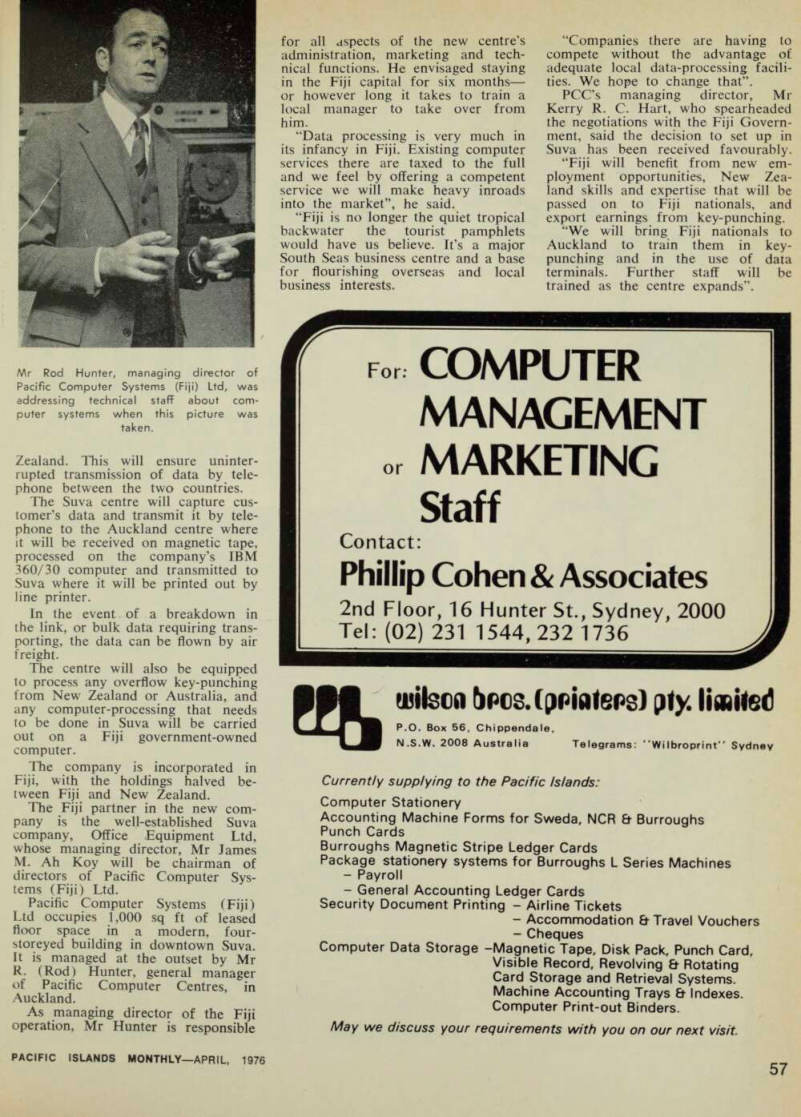
Data Processing by Fiji—N.Z.
An Auckland-based computer data processing company. Pacific Com puter Centres Limited, has received Fiji Government approval to set up a key-punching and computer pro cessing centre in Suva.
The new centre started last year.
The centre will use Singer (US) equipment, and Pacific Computer Centres has also secured the Singer agency for computer hardware for Fiji.
The Fiji venture marks the start of PCC’s export efforts; previously it was restricted to within New Zealand.
The new centre is called Pacific Computer Systems (Fiji) Ltd.
By utilising the company’s staff and data processing equipment in Auckland, the Suva centre will con vert company data into computer readable format.
Government approval, at both ends, has been received by Pacific Computer Centres to establish a Datel link between Fiji and New
Zealand. This will ensure uninter rupted transmission of data by tele phone between the two countries.
The Suva centre will capture cus tomer’s data and transmit it by tele phone to the Auckland centre where it will be received on magnetic tape, processed on the company’s IBM 360/30 computer and transmitted to Suva where it will be printed out by line printer.
In the event of a breakdown in the link, or bulk data requiring trans porting, the data can be flown by air freight.
The centre will also be equipped to process any overflow key-punching from New Zealand or Australia, and any computer-processing that needs to be done in Suva will be carried out on a Fiji government-owned computer.
The company is incorporated in Fiji, with the holdings halved be tween Fiji and New Zealand, The Fiji partner in the new com pany is the well-established Suva company, Office Equipment Ltd, whose managing director, Mr James M. Ah Koy will be chairman of directors of Pacific Computer Sys tems (Fiji) Ltd.
Pacific Computer Systems (Fiji) Ltd occupies 1,000 sq ft of leased floor space in a modern, four storeyed building in downtown Suva.
It is managed at the outset by Mr R. (Rod) Hunter, general manager of Pacific Computer Centres, in Auckland.
As managing director of the Fiji operation, Mr Hunter is responsible
for all aspects of the new centre’s administration, marketing and tech nical functions. He envisaged staying in the Fiji capital for six months — or however long it takes to train a local manager to take over from him.
“Data processing is very much in its infancy in Fiji. Existing computer services there are taxed to the full and we feel by offering a competent service we will make heavy inroads into the market”, he said.
“Fiji is no longer the quiet tropical backwater the tourist pamphlets would have us believe. It’s a major South Seas business centre and a base for flourishing overseas and local business interests.
“Companies there are having to compete without the advantage of adequate local data-processing facili ties. We hope to change that”.
PCC’s managing director, Mr Kerry R. C. Hart, who spearheaded the negotiations with the Fiji Govern ment, said the decision to set up in Suva has been received favourably.
“Fiji will benefit from new em ployment opportunities. New Zea land skills and expertise that will be passed on to Fiji nationals, and export earnings from key-punching.
“We will bring Fiji nationals to Auckland to train them in key punching and in the use of data terminals. Further staff will be trained as the centre expands”.
Mr Rod Hunter, managing director of Pacific Computer Systems (Fiji) Ltd, was addressing technical staff about com puter systems when this picture was taken.
Advertisements & other items, pp. 56-58 (1 item)
Burroughs computers are available in a wide range of sizes and styles.
3 3 Burroughs computers are available in a wide range of sizes and styles.
Computers no larger than an office desk, as big as an office floor, and a whole range in between. Plus a wide variety of terminals, data entry equipment, electronic calculators and computer supplies. An extensive range of innovative products backed by support and service throughout Australia. Burroughs Corporation; helping business since 1886. Burroughs Ltd., Head Office-8 Berry St.. North Sydney. 2060.
Branches in all States and A.C.T. Wherever there's business there's Burroughs BU 5073/75
For COMPUTER
MANAGEMENT
or MARKETING
Staff Contact: Phillip Cohen & Associates 2nd Floor, 16 Hunter St., Sydney, 2000 Tel: (02) 231 1544,232 1736
wilson boos, (pointers) ply. li«i)ec3
P.O. Box 56, Chippendale, N.S.W. 2008 Australia Telegrams: "Wilbroprint" Sydney Currently supplying to the Pacific Islands: Computer Stationery Accounting Machine Forms for Sweda, NCR & Burroughs Punch Cards Burroughs Magnetic Stripe Ledger Cards Package stationery systems for Burroughs L Series Machines - Payroll - General Accounting Ledger Cards Security Document Printing - Airline Tickets - Accommodation & Travel Vouchers - Cheques Computer Data Storage -Magnetic Tape, Disk Pack, Punch Card, Visible Record, Revolving & Rotating Card Storage and Retrieval Systems.
Machine Accounting Trays & Indexes.
Computer Print-out Binders.
May we discuss your requirements with you on our next visit.
man
Lilli Halil;
3#/.
in OFFICE EQUIPMENT, OFFICE
FURNITURE, STATIONERY,
ART & DRAFTING SUPPLIES
Distributors of: OLIVETTI typewriters, adding machines, calculators.
RONEO VICKERS duplication machines ANKER cash registers 1.8. M. typewriters SIMPLEX time equipment MINOLTAFAX electrostatic copying machines BROWNBUILT office furniture NAMCO chairs BANDA spirit duplicators Technical Service provided for all products marketed by our Office Equipment Division.
Multi-nationals vie
for sales in PNG
This office and com puter feature was com piled by Ken McGregor , a former PIM staff man and now a specialist writer with the Aus tralian Financial Review.
A handful of multinational corpo rations from the US, Britain and Italy dominate the data processing and office supply market of Papua New Guinea.
With this industry sector worth about 20 million kina a year and with growths of various sub-sectors ranging up to 100 per cent a year, it is an exciting time.
The imminent arrivals are ex pected in word processors, online banking terminals, sophisticated office computers and data communi cations between large towns, such as Port Moresby, Keita, Rabaul and Lae. Plus a computer output to microfilm (COM) bureau.
PNG’s very advanced Posts and Telegraphs Exchange at Lae will play no small role in the expected new communications facilities and indeed this American-built exchange is crucial to most plans.
It is no secret PNG’s major banks
are currently evaluating their first online banking terminals systems.
The three major user areas for all equipment remain government, commerce and finance (including banking) in that order, with govern ment said to comprise 37 per cent of all purchases.
Electric typewriters are certainly not uncommon; electronic account ing machines are numerous, the latest copiers are übiquitous and modern microfilm gear, such as manual duplicators and readers, are all there.
In the larger computer area, British supplier, International Com puters Ltd (ICL), has eclipsed the entire market with its low end main frame, the 2903 model, plus two much bigger systems with the central government.
Other important suppliers which come to mind include NCR, which has a data services base and over
1,000 machines of smaller type in stalled with a multitude of users, and PNG Printing Company of Port Moresby, which has a variety of agencies including fast-growing Olivetti.
Then there’s 3M, which set up a branch in Moresby just over a year ago, headed by Geoff Ballance, Sperry Remington, Addressograph Multigraph, Brownbuilt, Kalamazoo Business Systems and Burroughs.
PNG Printing may well be the most important locally-controlled concern here, with astute local busi nessman, Ray Thurecht, in charge.
Ray is reported to have just acquired a small light plane for his operations, which should prove a key sales aid.
Advertisements & other items, pp. 59-60 (1 item)
mastic binding
Do-it-yourself
for booklets!
The best “one-two” in the paper handling business! The GBC Combo is an inexpensive, easy-to-operate little machine which plastic binds any type or size of presentation, sales and financial reports, catalogues, tenders, training notes, manuals, etc. Business literature of any kind looks better, turns easier, lies flatter. . . and it will more than compete in cost with any other binding system.
Two simple actions.
One, punch. Two, bind.
That's all it takes!
GENERAL BINDING
CORPORATION
(AUST.) PTY. LTD.
W.S.W.: 24-26 Lyndhurst St. Glebe, N S W. 2037. 660-3311 VIC.: 136 Johnston St, Fitzroy, Vic. 3065. 419-2322 QU).: 435 Montague St. West End. Old. 4101. 44-1517 CANBERRA: 95 0431 NEWCASTLE: 52-3577. WOLLONGONG: 29-3511. SJt; 51-4773 W.A.: 46-6100. TASMANIA: 23-2688. GEELONG: 9 1271, TOWNSVILLE: 79-4844. P.H.G.; 5-5855. n
NAME
ADDRESS
TO: GENERAL BINDING
CORPORATION (AUST.) PTY. LTD.
P.O. Box 234, Glebe, N.S.W. 2037 Please forward further details of the GBC Combo.
.CODE
J
G8C1375/R76
Olivetti in
Papua
New Guinea
Manual and electric typewriters Adding-listing machines Electronic printing calculators Accounting systems Office microcomputers Automatic typing systems
Olivetti
PAPUA NEW GUINEA PRINTING COMPANY PTY. LTD
P.O. BOX 633 PORT MORESBY
LAE - P.O. Box 759.
RABAUL - P.O Box 1239.
The Png Scene
PNG Printing has placed big em phasis on service and support for all its office agencies and there is a highly-trained team of between 10 and 15 people dedicated to this aim in Port Moresby.
Mr Jack Mol, Olivetti Australia’s divisional manager, agents and dealers, who works closely with Mr Thurecht, reports in Sydney that while Olivetti has been selling for over 15 years in PNG, it is only in the most recent three to four years that sales have really grown with PNG Printing.
This 18-year Olivetti career executive explains that all Olivetti’s office range, including typewriters, adding machines, calculators, account ing machines and now computerised systems, such as the A 4, A 5 and A 6, are sold in PNG.
“We’re budgeting for a 100 per cent increase in PNG sales this year”, Mr Mol says. “We are tremen dously impressed by the potential in PNG tor office equipment and we feel our real dividends are still in the future”.
ICL is similarly optimistic about its prospects for sales of computers in the KBO,OOO plus bracket, and it can claim users here including Steamies, Bougainville Copper (K300,000-worth), Talair and the University of Technology at Lae.
And that’s not forgetting what is probably one of the largest Islands computer installations—the two mil lion kina dual processor ICL system at the PNG Government public ser vice board which acts as a data services bureau for many government departments.
American supplier NCR, is ICL’s major computer rival in PNG. It boasts an impressive list of users, such as BPs, Carpenters, and several government departments.
Total NCR equipment population for PNG exceeds 1,000 machines, incorporating cash registers, electro mechanical and pure electronic accounting systems, electronic bank ing systems and microfiche viewers.
Two Australian computer software consulting companies which have got involved with important con tracts in PNG are Datec and PA Management, both of Sydney.
Datec is headed by a most energetic computer professional, Harry Douglas. Mr Douglas is fami liar with PNG on a personal basis and about six years ago his company won a contract to process education statistics with computers for the Education Department.
A little over a year ago Datec was involved with introducing informa tion-processing systems for the PNG National Investment and Develop ment Authority.
Two major computer suppliers who have tendered but so far haven't been successful in PNG, are IBM and Honeywell. Both tried, unsuc cessfully, for the Bougainville Copper contract, which was let in December, 1974, to ICL.
PNG is hardly an important com puter market by world criteria—it is worth significantly less than five per cent of the market in Australia for computers. And Australia com prises under one per cent of the annual world sales for computers.
But, from a modest base, the growth in PNG outstrips most other countries, including Australia, and the office area, prodded by changing technology and the need to cut costs, is changing fast indeed.
Advertisements & other items, pp. 61-62 (1 item)
arms and legs.
Twinlock saves your
Twinlock discovered the easy way of moving your computer printouts and special reference sheets around the office on wheels in the Twinlock Universal Filing Trolley. It saves your arms from carrying files and your legs from tracking back and forth to filing cabinets. This versatile unit stands at desk height and is fitted with twin track castors for fingertip mobility. It allows 69 cm of filing space and is adjustable up to 50 cm wide. The Twinlock Universal Filing Trolley is ideal for computer printout and by using Twinlock Crystalfiles, doubles as a suspension filing trolley.
All Twinlock products are available from office equipment dealers.
Twinlock Australia Ltd.
P.O. Box 221, Cheltenham.
Victoria. 3192. Australia.
Telex: 32738. Telephone: 550-4000.
TAL4973
• ■ H A Ten four drawer filing cabinets lake up this much office .
Wmw. iM T. S A The Brownbuilt 'Compactus' Type A office file occupies less than half the space.
One Brownbuilt Compactus
mobile office file can hold the contents of
10 four drawer filing cabinets
For most companies, floor space devoted to storage is unprofitable. The Brownbuilt ‘Compactus’ mobile filing system provides the same storage capacity of 10 four drawer filing cabinets in one attractive unit.
Just roll the individual cabinets apart. Everything that was once scattered in bulky cabinets or cupboards is consolidated. The office space you’ve saved can be put to better use.
Adjustable steel shelving accommodates most types of office filing, including lateral, or box, and general storage with lockable security.
The unit may be relocated wherever required. The base can be extended to accommodate additional cabinets. Available in a range of attractive colours to blend with contemporary office surroundings.
Free Catalogue
For further information contact the Brownbuilt office in your state, or send the coupon for a free full colour catalogue.
Lysaght Brownbuilt Industries (Fiji) Limited, 169/171 Lakeba St..
Samabula, Suva. Phone 382388, 381835 Brownbuilt (Papua New Guinea) Pty. Limited, Gabaka St., Gordon, Port Moresby. Phone 53119 Please send me a free copy of your full colour Brownbuilt ‘Compactus* Office File catalogue.
Name— Address- . Postcode
LIMITED
can take waste
out of space. 88443
From Adding Machines To Computers
Burroughs Australia interest in the Islands began in the early 1950 s when sales of adding machines and cash registers were made in Fiji. The marketing and servicing of this equipment was carried out by field engineers who reported directly to Burroughs Australia head office in Sydney.
However, due to the growth of sales and the intro duction of more technically-advanced equipment, the Fiji operations began in January 1972, to report to one of the Burroughs marketing/servicing branches in Sydney.
In 1972, Mr Don Hardman, now branch manager, Rockhampton, was appointed salesfservice manager in Fiji and with the support and guidance of Mr R. Gooch in the Sydney South West branch, sold the first Burroughs “office computer ” (Series L visible record computer) in Fiji. Each year since 1972 has seen increas ing sales of L Series computers to today where about 40 such machines have now been installed or are on order.
Emphasis has been placed on the availability of proven software which minimises the effort by the cus tomer to get the machine to produce the results he wants.
Also, these machines incorporate a higher degree of electronic circuitry, improving their reliability.
These Series L machines have been sold to a diversi fied range of users, both commercial, government and local government authorities.
Also, a Series L has been donated to the University of the South Pacific in Fiji and this will train students in the writing of computer programmes.
Besides Series L machines, adding machines and electronic calculators, Burroughs has also been success ful with the marketing of larger, “mainframe", com puters.
Two mainframes, B 700 models, have been installed by the Fiji Sugar Corporation. The corporation has also installed equipment to prepare data for subsequent processing on the B 700 s.
Fiji operations are today directed by Mr Peter Hales, manager, South Pacific Islands, and he is supported by another Australian Mr J. Gorman, who has combined sales and field engineering responsibilities.
Sales and field engineering personnel have been re cruited from among Fiji residents.
These Fiji citizens receive training at the Burroughs Pacific Area Training Centre, Sydney, followed by practical experience with one of the Sydney branches.
As regards activities outside Fiji, three Series L machines, will be installed in the Gilbert Islands with personnel from there being trained in programming and field engineering so that they will be able to support these machines.
However, if and when necessary, additional support will be forthcoming from Fiji.
Other Pacific areas where Burroughs has done busi ness include Nauru and Western Samoa (handled by Burroughs New Zealand).
Office equipment
Keen market in Islands for Office equipment
Three international companies eenly interested in Island markets 3r office equipment are Addresso raph Multigraph, Kalamazoo Busi ess Systems and Twinlock Australia.
Each of the three are known [ready for their products, particu irly in the larger centres such as iji. New Caledonia and Papua New ruinea.
Addressograph Multigraph, for ne, considers the rate of growth in ffice equipment buying in the lands as greater than anywhere se in the world.
Mr Tony Arnouts, general man ner for AM in the Far East and acific areas, mentions phototype :tters in PNG, automatic Multilith aplicators in Nauru and the latest iazo products in Fiji.
He says the major reasons for this owth are constant rises in labour
costs and the need for automation necessary to combat high costs, Addressograph Multigraph is ex panding its operations in the Asia- Pacific area. Pacific countries ser viced either with a subsidary office or dealerships include: New Zealand, Papua New Guinea and New Cale donia.
Papua New Guinea is pushing ahead with many new AM systems installations in both government and the private sector.
Kalamazoo (Aust) Ltd is Austra lian owned and based in the Sydney suburb of Lane Cove. Its area of in fluence extends beyond Australia, encompassing the numerous islands of the South Pacific Region, Kala mazoo claims.
The company specialises in stan dard systems for the basic account ing records such as cash receipts, cash payments, accounts receivable, accounts payable, payroll, stock con trol, job costing, plant, staff, etc.
In addition, systems are also available for purchases control, share registry records, wall charting, strip indexing, cheque protection, etc.
The tremendous growth that has taken place in the South Pacific Islands in the post-war years has
created an important market for Kalamazoo products.
Kalamazoo representatives make regular trips to the area, servicing and instructing staff in the operation of the systems sold on the previous trip.
It is only possible for the Kala mazoo representatives to visit the major areas so that transactions with businesses in isolated locations are handled by correspondence in the same way as transactions with busi nesses in the remote areas of out back Australia where distance makes personal contact unecon omical.
In these cases, instruction book lets, written in simple terms, accom pany the principal accounting systems, so that by following the routines and procedures enumerated, the recipient can understand and operate the systems efficiently des pite the lack of personal service.
The Kalamazoo organisation is most optimistic concerning the growth potential of the area.
Twinlock Australia Limited has introduced a low-cost archival stor age system which saves time and space in dead-file storage.
The system consists of a wire reinforced plastic clip and a strong.
cardboard case—all called the D clip system. The system retails at less than 70 cents.
D-clip has been designed to aid all types of file storage and is already widely used throughout Europe, the United Kingdom, Scandinavia, South Africa and Japan.
A new loose-leaf flexible system to assist bookkeeping and analysis
has also become available with Twin lock Variform.
It is a lightweight working account book in loose-leaf concept introduced by Twinlock Australia Limited. All rulings are international metric depth in A 4 size.
The system avoids the waste of unused pages and the excessive stor age of fast-bound books.
Advertisements & other items, p. 63 (1 item)
63
ACIFIC ISLANDS MONTHLY—APRIL, 1976
space-and costs
Microfilm saves space-and costs
Interest in microfilm and de mand for the associated equip ment that goes with this tech nology, is now accelerating as Islands government and big busi ness hasten to cut costs and reduce their paper usage and space demands—and space costs money!
Office users, particularly in Fiji atul Papua New Guinea, report greater interest and the desire at least to “hear out” microfilm propositions, but they criticise the lack of local processing facili ties.
Big companies, such as Burns Philp (South Sea), say they already use microfilm, roll or fche for some applications, and admit that they will use it more, but they explain all processing must be carried out in Sydney, not at their headquarters in Suva.
Suppliers claim that individual Islands markets for microfilm do
not yet warrant the investment of local processing plants, but they hint that “a first one” may not be “far away”.
The three “giants” of micro film in the world — 3M, Kodak and Bell and Howell—are all in the Islands, with varying strengths, plus several of the smaller micro film suppliers.
One of the Americans, 3M, set up a Port Moresby branch in February last year and appointed Mr Geoff Ballance as PNG man ager.
Mr Jim Hutchinson, 3M Aus tralia’s director of market ser vices, who is responsible for 3M Islands operations, claims current Islands microfilm usage is rising steeply.
In PNG, Mr Hutchinson told PIM, that manual duplicators have sold strongly. He predicts that the market is moving to wards automatic duplicators.
There’s an increasing range of flat-bed and flow cameras, and a full range of readers finding customers. The PNG Government, he says, is now starting to replace its paper files with microfilm.
In Fiji, 3M uses a direct repre sentative, Sirtag Ali, and it re ports a “fair spread” of micro film throughout the dominion with some interesting commercial application.
No one supplier, Mr Hutchin son says, has a dominant share of the microfilm market in Fiji, and he adds that 3M is now con sidering setting up a Fiji process
ing plant.
While he can see no computer output to microfHm(COM) oper ation as a service bureau in Fiji imminent, he predicts the first PNG COM operation “soon”.
COM is an advanced machine which automatically converts computer data—which would nor mally be produced on big print out paper—directly into micro film.
New Caledonia is reported as a smaller market so far for micro film, although the reverse is true for larger computers in these two territories.
Mr John Nixon, NCR’s top man in Noumea, reports little interest in microfilm in the New Hebrides, Solomons and New Caledonia.
problems in business
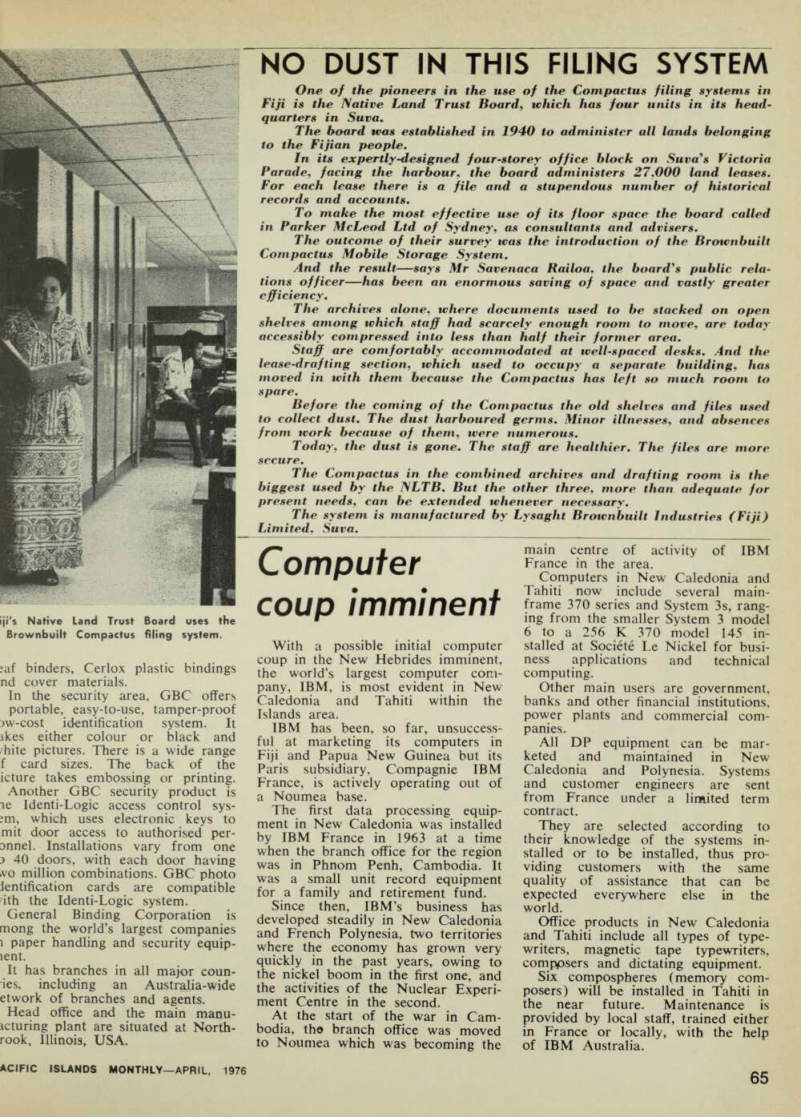
How to overcome paper problems in business
The collation and preservation of business papers is a constant prob lem in today’s office. The daily flood of mail, swelled by copies of internal output, has to be sorted, disseminated and filed away for reference. General Binding Corporation has built a world-wide business on the fact that business now needs help with paper handling, collating, punching and binding equipment for books, sales reports, catalogues, computer print out sheets and price lists, with pro tective coverings for irreplaceable documents, and with security mea sures to protect trade secrets.
GBC makes 11 different models of electric collators for gathering and sorting loose pages into books or sets, manual and electric punches and binders, including the Combo, which punches 20 holes in paper margins and then binds the sheets together with a tough plastic comb, and eight different types of web-fed laminators for sealing paper in transparent film.
Other GBC products include the Shredmaster range of paper shred ders, custom-made plastic binders and covers, a variety of metal loose-
iaf binders, Cerlox plastic bindings nd cover materials.
In the security area, GBC offers portable, easy-to-use, tamper-proof 3w-cost identification system. It ikes either colour or black and /hite pictures. There is a wide range f card sizes. The back of the icture takes embossing or printing.
Another GBC security product is le Identi-Logic access control sys :m, which uses electronic keys to mit door access to authorised per- Dnnel. Installations vary from one > 40 doors, with each door having vo million combinations. GBC photo lentification cards are compatible Tth the Identi-Logic system.
General Binding Corporation is mong the world’s largest companies i paper handling and security equip icnt.
It has branches in all major coun ies, including an Australia-wide etwork of branches and agents.
Head office and the main manu icturing plant are situated at North rook, Illinois, USA.
Fiji's Native Land Trust Board uses the Brownbuilt Compactus filing system.
Advertisements & other items, p. 64 (1 item)
Computer Personnel!!!
BATTLES Gr ASSOCIATES are Personnel Consultants to the Australian Computer Industry.
Allow our Directors, Miss Val Swanson or Mr Kevin Howard to be your
PERSONNEL CONSULTANT
Recruitment services: E.D.P. Managers Analysts Programmers
BATTLES &
ASSOCIATES
Marketing Personnel E.D.P. Technicians Suite 3204, Tower Building, Australia Square,
SYDNEY 2000.
Phone (02) 24T 1221
No Dust In This Filing System
One of the pioneers in the use of the Compactus filing systems in Fiji is the Native Land Trust Board. which has four units in its head quarters in Suva.
The board teas established in 1940 to administer all lands belonging to the Fijian people.
In its ex pertly-designed four-storey office block on Suva’s Victoria Parade. facing the harbour. the board administers 27.000 land leases.
For each lease there is a file and a stupendous number of historical records and accounts.
To make the most effective use of its floor space the board called in Parker McLeod Ltd of Sydney , as consultants and advisers.
The outcome of their survey was the introduction of the Brownhuilt Compactus Mobile Storage System.
And the result—says Mr Savenaca Bailoa. the board’s public rela tions officer —has been an enormous saving of space and vastly greater efficiency.
The archives alone, where documents used to be stacked on open shelves among which staff had scarcely enough room to move. are today accessibly compressed into less than half their former area.
Staff are comfortably accommodated at well-spaced desks. And the lease-drafting section. which used to occupy a separate building, has moved in with them because the Compactus has left so much room to spare.
Before the coming of the Compactus the old shelves and files used to collect dust. The dust harboured germs. Minor illnesses, and absences from work because of them, were numerous.
Today , the dust is gone. The staff are healthier. The files are more secure.
The Compactus in the combined archives and drafting room is the biggest used by the NLTB. But the other three. more than adequate for present needs, can be extended whenever necessary.
The system is manufactured by Lysaght Brownbuilt Industries (Fiji) Limited. Suva.
Computer
coup imminent
With a possible initial computer coup in the New Hebrides imminent, the world’s largest computer com pany, IBM, is most evident in New Caledonia and Tahiti within the Islands area.
IBM has been, so far, unsuccess ful at marketing its computers in Fiji and Papua New Guinea but its Paris subsidiary, Compagnie IBM France, is actively operating out of a Noumea base.
The first data processing equip ment in New Caledonia was installed by IBM France in 1963 at a time when the branch office for the region was in Phnom Penh, Cambodia. It was a small unit record equipment for a family and retirement fund.
Since then, IBM’s business has developed steadily in New Caledonia and French Polynesia, two territories where the economy has grown very quickly in the past years, owing to the nickel boom in the first one, and the activities of the Nuclear Experi ment Centre in the second.
At the start of the war in Cam bodia, the branch office was moved to Noumea which was becoming the
main centre of activity of IBM France in the area.
Computers in New Caledonia and Tahiti now include several main frame 370 series and System 3s, rang ing from the smaller System 3 model 6 to a 256 K 370 model 145 in stalled at Societe Le Nickel for busi ness applications and technical computing.
Other main users are government, banks and other financial institutions, power plants and commercial com panies.
All DP equipment can be mar keted and maintained in New Caledonia and Polynesia. Systems and customer engineers are sent from France under a limited term contract.
They are selected according to their knowledge of the systems in stalled or to be installed, thus pro viding customers with the same quality of assistance that can be expected everywhere else in the world.
Office products in New Caledonia and Tahiti include all types of type writers, magnetic tape typewriters, comppsers and dictating equipment.
Six compospheres (memory com posers) will be installed in Tahiti in the near future. Maintenance is provided by local staff, trained either in France or locally, with the help of IBM Australia.
Advertisements & other items, pp. 65-66 (2 items)
65
ACIFIC ISLANDS MONTHLY—APRIL, 1976
Equipment
Australian Industrial
made welLworks well...sells well
Dependability, performance, quality of production and value for money, that’s how Australian industrial equipment has gained increasing sales in the world’s toughest markets.
The range is wide. From press brakes, guillotines, lathes, box-banding and wire-tying machinery to machine drills, electric motors, welding equipment, wood working machinery and safety equipment.
With Australian-made products, importers get prompt deliveries and the customer gets dependability. Look to Australia for your industrial equipment.
Quality and value that’s only hours away The Australian Trade Commissioner will be pleased to give you details of suppliers.
You can contact him at; 7th Floor, Dominion House, Thomson Street, Suva, FIJI. (Post Office Box 1252).
Telephone: 312844, or: Post Office Box 9129, Hohola, Port Moresby, P.N.G. Telephone: 25 9333.
Australian Department of Overseas Trade
Produce Prices
Unless otherwise shown, stated quotations are in Australian currency. Australian dollar [March 10) equals: New Zealand, 51.2175 [buying), $1.2131 (selling); Fiji, $1.1040 (buy ng), $l.OBOO (selling); Western Samoa, tala J. 9790 (buying), 0.9654 (selling); Tonga, ja'anga 0.8826 (buying), 0.8650 (selling); US, 51.2511 (buying), $1.2461 (selling); UK, 50.6463 (buying), £0.6409 (selling); French ’acific, CFP, 103.71 (buying), 102.12 (selling).
Copra
Copra Industries are controlled through copra cards in PNG, the Solomons, the Gilberts, oth Samoas, Fiji, Tonga, the Cooks and the S Trust Territory. New Hebrides, French olynesia and New Caledonia do not have oards and copra is either sold individually y growers to overseas buyers or used locally.
NEW GUINEA: The board, with planters' ! PS, directs distribution and sales and pays enters. Shipments are made to UK, European arkets and to Australia and Japan, and coco- Jt oil mills on New Britain.
Latest prices are: Per tonne, delivered ain ports, hot-air dried, K 131; FMS, Kl2B - K 126.
FIJI:—The board fixes prices on Philippines ipra, taking into account freight, taxes, selling •sts, shrinkage, etc. The price is subsidised Uest prices were: Fiji 1, $190: Fiji 2 $l7l - $7O.
NEW HEBRIDES: Copra sold direct by lanters to France and Japan. Burns Phi Id lying on wharf, Vila or Santo, Feb 25, 3,500 HF, Mar 5 89.25 met francs 100 kg cif arsei lies.
US TRUST TERRITORY:— Ist grade, $9O, 2nd ade, $BO, 3rd grade, $7O. Outer Islands, >5, $55 and $45 ton for the three grades, serviced by government ships and $55, 15 and $35 if serviced by private ships.
COOK ISLANDS. —AII production is sold to Abels Ltd, Auckland. Prices are based on average world prices for the prior three or six months, and remain in force for three months.
GILBERT ISLANDS.—SI79.2O a ton, or 8c a pound.
WESTERN SAMOA.— Ist grade, $W5109.50, 2nd grade $W596.50.
TONGA.— AII copra sold to EEC. Ist grade, grade, ST7O; 2nd grade, STSB.
Other Produce
COCOA. —lslands rates are based on Ghana prices. Ghana price on Mar 11 was spot £stg79o ton, cif, UK Continent.
Mar 11, in store, Rabaul, export quality, K 950 per tonne; delivered ex wharf Sydney $1,190 per tonne.
Solomons. —Delivered to Agriculture Dept, offices in Honiara and Auki. Recent price was 25c per lb dried beans first grade, 20c second grade.
Western Samoa. —Ungraded beans, $23.50 (100 lb).
COFFEE. —PNG, Mar 11. Good quality, A Grade 1874 c per kg ; B Grade, 183 c; C Grade, 178 c, Y Grade, 178 c (ex-store Sydney).
W. Samoa. —Recently, WSTEC ground and dried beans, 60 sene per lb wholesale.
PEANUTS. PNG: Sydney agents reported recently f.0.b., Lae: Kernels—white Spanish 19c lb BROOMCORN. —Fiji, Ist grade, 164 c lb, 2nd grade, 144 c lb.
RICE (Aust): — PNG: Dried brown, 25 kilo bags, $298.94 per tonne. Vitamin enriched white, 25 kilo bags, $303.94 per tonne, all f.o.w. Sydney/Melbourne. Pacific Islands: Calrose med. grain, white, 25 kilo bags, $3lO per tonne. Kulu long grain white, 25 kilo bags, $355 per tonne. All prices c.&f. Sydney/ Melbourne.
RUBBER. —Singapore, Mar 9,42.25 c a kilo.
VANILLA BEANS. Prices recently were: White *nd yellow label processed standard packs, $7.50; green label $7.40, c.i.f., Sydney.
Tonga.—sl4.2o, f.0.b., Nukualofa; $T4.50, Mel bourne. • Villagers from Nailauwaki on the small island of Waya, in the
Yasawas, Fiji, have developed a new
industry—rearing goats for sale at Lautoka. The scheme was started
with 35 goats, pooled by villagers
who bred them individually.
Exchange Rates
FIJI. —Mar 11; Through Bank of NSW, ANZ lank. Bank of NZ, Bank of Baroda, First lational City Bank, Aust $ on Fiji buying
Fi = Sa.B9.
COOK IS W NIUE. —New Zealand currency Is sed.
NEW HEBRIDES.— Mar 11; Through Banque ationale de Paris (Sydney), Indosuez Bank, NZ Bank, Bank of NSW, National Bank of ust. Commercial Banking Co of Sydney, Com icrcial Bank of Aust, Hong Kong and Shang ai Banking Corp, Barclays Bank International, A 1 = NHF 91.46 (buying), 90.21 (selling)— irmail transfer rate.
WESTERN SAMOA.—Through Bank of Western amoa, controlled from NZ, SWS. Tala I = A. 97 (buying).
TONGA. —Tongan dollar (pa'anga) = SA.B9 »uying).
Norfolk Is, Solomon Is, Geic, Nauru.—
ustralian currency used; no exchange payable i transactions with Australia.
PAPUA NEW GUINEA. —PNG kina and toea >ed; no exchange payable, at present, in ansactions with Australia.
FRENCH PACIFIC COLONIES.—Pacific francs .FP) are used in New Caledonia, Wallis and jfuna Is, and Fr Polynesia. French Bank, rdney, on Mai 10 quoted: SAI = 102.89 : P (buying), 101.49 CFP (selling). Paris mdon: £1 = 8.6825 francs (buying), 8.6725 ancs selling. Pacific franc—London: £1 = 58.8181 CFP (buying), 158 3636 (selling), CFP ) 1 metropolitan franc 18.43 (buying), 17.94 el ling).
Banks should be approached for daily rates.
A new soap
factory for Lae
'> new K 1 million soap factory at Lae, when in full production, will employ at least 50 men, and will work two shifts daily. The enter prise, operated by Melanesian Soaps Will make half a dozen different foducts, including toilet, liquid, laundry and powdered soap. Mela nesian Soaps is the only soap manu facturer in Papua New Guinea.
The company hopes its prices W JII Up rheaner than fnr Wll ‘ *? e cnea P er than those tor im ported soaps.
Advertisements & other items, p. 67 (2 items)
67
*CIFIC ISLANDS MONTHLY—APRIL, 1976
Swibo
V~I, STERN
DRIVES
PETROL & DIESEL
MARINE ENGINES
Manufactured by
SEA TIGER
MARINE
Pty. Ltd.
P.O. Box 157, Mordialloc Victoria, Australia 3195
SWIBO
THE NEW LONGERUFE
KNIVES THAT HAVE THE EDGE
OVER All OTHERS
Swiss design and manufacture
OBTAINABLE
FROM ALL
ISLAND
TRADERS
Sole Importers:
PETER FISHER
TRADING PTY.LTD.
321 Pitt Street
SYDNEY
Telephone 26 1109
swiso
Pacific Transport
Tongan Shipping Wallowing
In A Heavy Sea Of Debt
From a Suva correspondent
Proposals for the establishment of a regional shipping line are still being developed here in Suva by the South Pacific Bureau for Economic Co-operation (SPEC) in spite of the critical state of Tonga’s Pacific Navi gation Company. It is not long since Pacific Navigation was being hailed, as the South Pacific’s shipping success story. Any questioning of the neces sity for a regional line was countered with claims about the success of Pacific Navigation.
However, the financial state of Toi\ga’s line is now so serious that it is reportedly attempting to borrow $200,000 to pay creditors who might, otherwise, take legal action against it. Principal creditors are understood to be Burns Philp in Fiji and Kar lander in Australia.
In late 1975 Pacific Navigation’s assets were understood to have been valued at a mere $140,000, while its liabilities were nearly $750,000.
Losses over the past three years are said to have totalled more than $1.3 million.
A principal recipient of the blame for this state of affairs was alleged to be Pacific Navigation’s ex-general manager Captain Chris Hill-Willis.
Captain Hill-Willis, the ebullient, colourful and, by turns, charming or somewhat ill-mannered general man ager of Pacific Navigation, left Tonga rather unexpectedly in the middle of 1975.
While not doubting the sincerity of his concern for Tonga's advance ment in the maritime field, many people in Tonga felt that his en thusiasm for shipping did not suf ficiently compensate for the com pany’s weaknesses in other areas of management.
For example, had the company’s annual accounts been more up to date, the extent of the company’s losses might have been realised earlier.
Captain Hill-Willis first went to work in Tonga from Brisbane as master of the Tonga Copra Board’s MV Aoniu. He later became Harbour
Master at Nukualofa, before moving as manager to Pacific Navigation’s predecessor, the Tonga Shipping Agency. There he replaced Mr Peter Corbett who, after a period as a United Nations shipping expert, is now manager of Burns Philp’s shipping division in Suva.
Since Captain Hill-Willis’ departure, Pacific Navigation has been managed by Mr Sione Faletau, brother of Tonga’s High Commissioner in London. Mr Faletau was originally ship’s engineer before going ashore to run the company’s engineering workshop.
Unfortunately, it seems unlikely that he can bring to the job the skills needed to solve Pacific Navigation’s current problems.
The recent loss through sinking in the Haapai Group of Pacific Navi gation’s landing craft the Kao, and the company’s reported inability to afford a replacement, seem a far cry from mid-1975 when the talk was of buying a 65,000 tonne bulk carrier with a loan from the Government of Bahrain, In that connection King Taufa ahau Jupou IV, together with acting F, nance Minister Sione Tapa, Sec <° Government Taniela Tufui and Pacific Navigation s general manager Chris Hill-Willis, made a fruitless visit to Bahrain.
Critics in Tonga are now asking whether the government would not have been better spending its time on problems a little nearer home, When the question of Pacific Navi-
A FOURTH JET TO SERVE AIR NAURU'S
New Pacific And Asian Routes?
Air Nauru is expanding rapidly its services in the central and southern Pacific regions and to parts of Asia. A number of new services, planned up to 12 months ago, were launched recently. These make acquisition of another aircraft almost inevitable. Air Nauru’s present jet fleet consists of a Boeing 737 and two F2Bs.
Two big moves recently were con clusion of an agreement with UTA to serve Wallis Island, Noumea and Vila, and fly a new route to Hong Kong, via Manila. Rights were granted recently at Manila and also at Ponape and Guam.
The agreement with UTA is, in effect, a charter. It is for two years, with an option for renewal. The flights are programmed to connect with international services to Nou mea. There is one Wallis Island return flight from Vila sandwiched between three or four ferry services connecting Noumea and Vila. The New Hebrides can expect a big in flux of tourists with these new' ser vices from Noumea.
Granting of rights at Manila was celebrated with a special flight from Nauru, carrying a number of VIPs.
On the next flight through Manila, with earlier stops at Palau and Manus Island, Air Nauru inaugurated its second weekly Nauru-Hong Kong Service.
The stops at Manus Island and Palau on the Hong Kong, via Manila, service are for refuelling.
Air Nauru’s other Hong Kong flight is via Guam and Taipei.
In the Pacific Islands, Air Nauru now calls, outside Nauru, at Tarawa, Majuro, Wallis Island, Western Samoa, Fiji, Solomon Islands, New Hebrides, New Caledonia, Palau, Manus Island, Guam, Ponape and the Philippines. In Asia it calls at Okinawa, Taipei, Hong Kong and Kagoshima in Japan. There is also the service to Australia, via Noumea.
This service terminates at Melbourne.
Occasionally, if there is a full air craft, it will land at Brisbane to refuel, but no passengers are landed there or picked up.
gation’s losses was discussed in Tonga’s Legislative Assembly in July, 1975, the Haapai People’s Representative ’Uliti Uata summed up the general feeling when he said that the losses would be bearable if the company provided a useful ser vice to the country, but this was not the case.
According to Dr Tapa, acting Minister of Finance, all losses are the responsibility of the two principal shareholders, Government and the Commodities Board.
Meanwhile, in Fiji, SPEC, is con tinuing with its planning of the pro posed regional line and is relying heavily on the skills of Mr De Vlaming, a UN shipping expert of Dutch nationality. A constitution and financial structure for the pro posed line are to be considered at a Regional Shipping Advisory Board and Council meeting in April when it is understood a working capital of $0.5 million will be proposed.
New Zealand is understood to be considering advancing this sum as a low interest long-term loan. It is per haps interesting to note that Mr Mahe Tupouniua, SPEC’s director since 1972 and a supporter of the proposed regional shipping line was, when he was Minister of Finance in Tonga, a strong supporter of the establishment of the Pacific Navi gation Company.
If Tonga’s experience is any in dication, then the members of the proposed line would be well-advised to place the sharing of operating losses fairly high on their agenda at the forthcoming meeting.
Air Niugini Sheds
Dc3 Services
Papua New Guinea’s Minister for Transport Bruce Jephcott did not take long to implement a promise to change the pattern of air services in Papua New Guinea. Soon after he took over his portfolio early this year he said services would be rationalised and costs would be cut.
Early in March he announced that third level airlines would take over some of Air Niugini’s domestic ser vices, particularly the scheduled, but unprofitable, DC3 routes. In return, the third level operators would get Feeder services connecting Air Niu ?ini Fokker Friendship services at the most convenient airports.
DC3s were taken off services from Port Moresby to Kokoda, Bulolo, Talasea, Garaina and Vivigani.
Talair and Douglas Airways (for merly Aerial Tours) took over and, hrough a re-arrangement of sche dules, maintained services to these ;entres.
Mr Brian Grey, general manager
of Air Niugini, considered the rationalisation would improve air ser vices to the public and reduce Air Niugini’s costs.
Third level operators, at the same time, sought an increase in fares for scheduled services. Talair asked for a 15 per cent hike. Douglas Airways wanted a “substantial” rise. Mr Dennis Buchanan, managing director of Talair, said the third level airlines were operating at a very economical level—in fact, below an economical level.
Gilberts Arrange Air
Service To Christmas
Mercer Airlines, of California, USA, will operate an air service be tween Tarawa and Christmas Island, 1,750 miles to the east. The Gilbert Islands’ Chief Minister, Mr Naboua Ratieta, has signed an agreement with the airline providing for the training of Gilbertese as air hostesses and for help in civil aviation train ing. There was no indication initially of when the service would start, how often it would operate, or of the type of aircraft which would be used.
Air Pacific runs other internal ser vices in the Gilberts.
Keeping Morobe
Boats Up To Scratch
Boat owners had to watch for mechanical and other problems asso ciated with keeping their boats up to required standards, the Morobe Harbour Master, Captain Foulkes, told a recent meeting of the Morobe Coastal Shipping Association. They had to have adequate emergency equipment, and needed to know how to keep a boat in good condititon Mr Nigel Porteous, president of the Papua New Guinea Shipping Association, said that all commercial boats over 10 metres long had to undergo an annual survey to ensure they were in good condition. The harbour master and the engineering surveyor carried out the surveys. At present boats of less than 10 metres were not required to undergo annual survey.
The association intends to provide facilities at Voco Point, Morobe, for coastal boat operators. These include cargo sheds, toilets and better wharf facilities. • Rabi Holdings Ltd, of Fiji, a Banaban organisation, is in the mar ket for a ship to replace its “trouble some” Komaiwai, 400 tons, which it sold to Williams Shipping, of Australia, for $70,000.
Mr Tekote Rotan, managing direc tor of Rabi Holdings, said he was looking for a ship with better passen ger accommodation than that in the Komaiwai and with a good opera tional engine.
Advertisements & other items, pp. 69-70 (1 item)
Depenable
» I i i
Quick &
LASH
Service
REFRIGERATED
& GENERAL
CARGO IN
BARGES. BULK
LIQUIDS IN
VESSEL DEEP
TANKS.
'FROM UNITED STATES WEST COAST & CANADA TO PAPEETE,
IPAGO PAGO, AUCKLAND, LAE & RABAUL.
PAPUA NEW GUINEA TO VANCOUVER 8.C., TACOMA, PORT-
LAND, SAN FRANCISCO, LOS ANGELES.
■ SYDNEY, MELBOURNE, BURNIE, HOBART, BRISBANE TO LAE
& RABAUL.
c; a MANAGING AGENTS: Wilh, Wilhelmsen Agency P/L., 13-15 Bridge Street, Sydney 2000-Phone 20517-60 Market Street, Melbourne, 3000-Phone 613031-344 Queen Street, Brisbane, 4000-Phone 2213316. MANAGING AGENTS N. 2.: Dalgety N.Z.
Ltd. , 119 Featherston Street, Welington—Phone 738347 41/45 Albert Street Auckland—Phone 71859. ISLAND AGENTS: Robert Laurie (NG) P/L, P.O. Box 1032, Lae, PNG Phone 423811. Burns Philp (NG) Ltd., P.O, Box 87 Rabaul PNG - Phone 922666. '
THE
BANK
LINE
GLOBAL SERVICE FOR SHIPPERS
MONTHLY SERVICES
United Kingdom and Continent to: Papeete, Noumea, New Hebrides, Papua New Guinea and Solomon Islands.
Papua New Guinea to: North America, United Kingdom and Continent.
Solomons, Fiji, Tonga, Samoa and Tarawa to: United Kingdom and Continent.
For particulars apply:
THE BANK LINE (AUSTRALASIA) PTY. LTD
18TH FLOOR, 1 YORK STREET,
SYDNEY, N.S.W.
Cruising
Yachts
• MINERVA, 45 ft steel-hulled cutter, arrived at Rarotonga on February 11 Prom Sydney, via NZ. On board were Dwner-captain, Commander John Lee of the Royal Canadian Navy, his wife.
Daphne, and Jeoffrey Payne and Billy ?ennard, both from Sydney. They ex perienced gales all the way —the Cook strait passage was "hairy", but the elf-steering vane acted very well, said Mrs Lee. The yacht was built in Australia.
Phe Lees did the interior work them elves. They hoped to call at Christmas sland and Hawaii on their voyage home o Victoria, 8.C., where Minerva i s egistered. • APHRODITE, 50 Cheoy Lee ketch, egistered in the Virgin Islands, has been t Vila since J nhe end of 1975 waiting or the end of the hurricane season. On card are owner Joan Eccleshare and aughter Kim, and Bob Meeburg (skip er). They arrived from Fiji, where they pent about a year cruising through the lands. • MANU OTE MITI, 47 ft ferro ?ment cutter, registered in Vancouver, xpects to resume cruising soon with ie hurricane season at an end. It has een at Vila for some months, after a par in New Zealand. Owner Heinz ienciala and wife Muriel, after a New ebrides cruise, will visit islands in the plomons. • GALADRIEL, 40 ft ferro cement oop, has been at Vila since the end of >75, after arriving from New Zealand, ji and New Caledonia. On board are vners Colin and Patricia Hall. • SNOOPY, 30 ft catamaran from ull, UK, arrived at Rarotonga from jpeete on February 20 with owner ptain Charles Dennis and Susan Dennis, teir next port of call was to be Auck nd. • KIALOA, 79 ft racing ketch, was a bruary arrival in Suva, on the way Seattle via Western Samoa and Hono lu. She had taken part in the 1975 dney-Hobart race in which she took ihrs 45 min off the previous best time r the distance between the two cities, rlier she had won the Admirals Cup Britain and in the trans-Atlantic race as first to finish, but was placed cond on corrected time. She then sailed rough the Mediterranean and the Suez nal for Australia. On board at Suva ire the skipper, Bruce Kendall and a ■ w of eight including (his wife, Patty, e owner is Mr Jim Kilroy, of Los igeles.
• FOREIGN AFFAIR, 40 ft Valiant 40 cutter-rigged yacht, arrived at Rarotonga on February 21 from Bora Bora with owner-captain William Black, his wife, Mary, and their son. Will. The yacht was built in Seattle, Washington, and the Blacks' cruise took them to San Francisco, the Marquesas and the Society Group. They plan to visit New Zealand. • WILD WAVE, yacht, carrying Jacques and Robin Sapir, and their children Ronni 4 and Michel 2, is at Vila They left Australia in April, 1975 for Ntew Zealand, carrying two crew. They visited Norfolk Island and New Caledonia on the way, • SEA FOAM, 36 ft Sea Witch angleman ketch with a 13J ft beam, left home
in Newport Beach in March 1973, carry ing the Payson family of Herb, Nancy and son Craig, now 13. They sailed down the Mexican coast to Central America and over to the Galapagos for one month, before resuming |heir trip to the Mar quesas, Tuamotus and Tahiti. After spend ing 11 months in French Polynesia in 1974 they left for Tonga, Fiji and New Zealand ' where they worked and stayed f ? r or ? e x Th e n , in j 1975 ™ ey left , Wew Zealand and c ™ised to the Australs, visiting Tubuai and Raivavae, , returned to Tahiti in December. They P lan , t 0 , stay ,n French Po 'V"esia until Apnl and 53,1 to Hawaii and California.
Sailing with them from New Zealand were Ed and Laurie McKeon of Los Angeles.
Advertisements & other items, p. 71 (2 items)
71
CIFIC ISLANDS MONTHLY—APRIL, 1976
Gec-Aei (Australia) Pty. Ltd.
SSH
the shape of yooir {Utmre-
Servicing the Pacific Islands with
the most comprehensive range of
electrical products and services —
we are geared to expertly handle
any export transaction large or
small — fast and efficiently. • GEC • OSRAM • AEI • WOODS
ENGLISH ELECTRIC • XPELAIR
Represented by: B. C. Mockenzie—Norfolk Island Security Electrical—Honiara, Solomon Islands R. & J. Henderson—Lae, P.N.G.
Enquiries to: THE EXPORT MANAGER
GEC-AEI (AUSTRALIA) Pty. Ltd.
P.0. BOX 9 AUBURN, N.S.W. 2144
Telephone; 649 0155 Telex: 20729
Cables: BRITISH GENERAL, SYDNEY
Agency Enquiries Welcome
Shipping & Airways Information
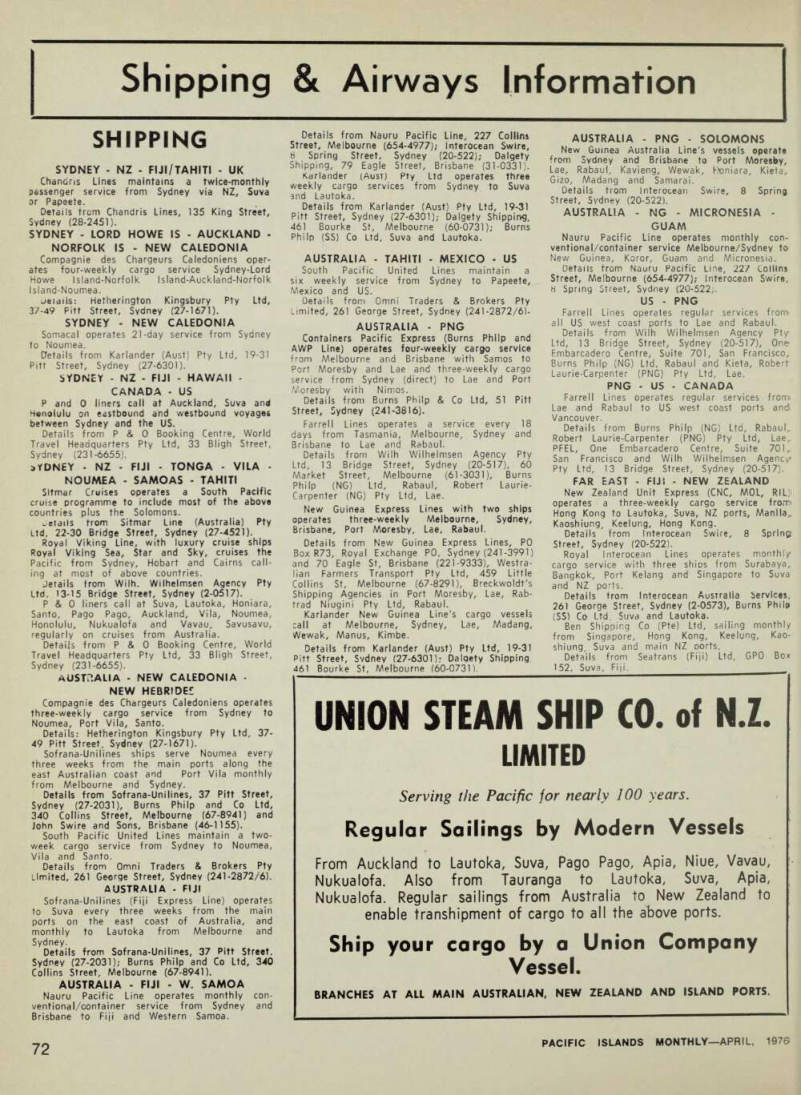
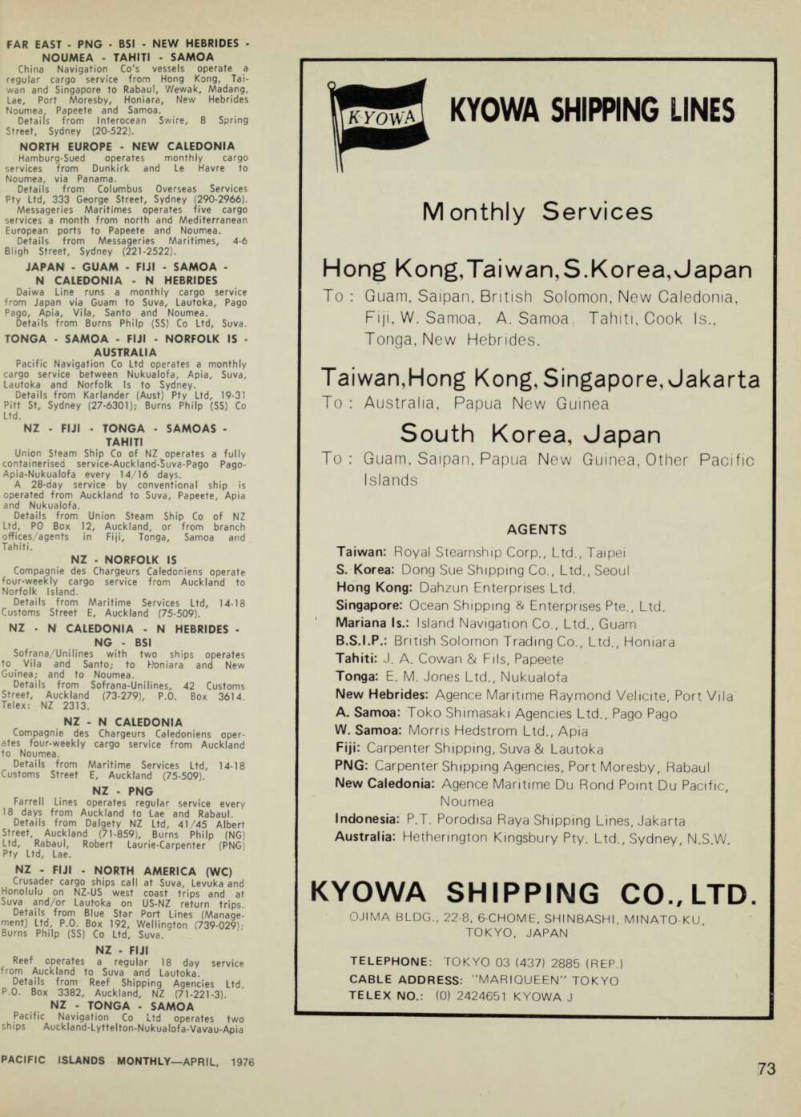
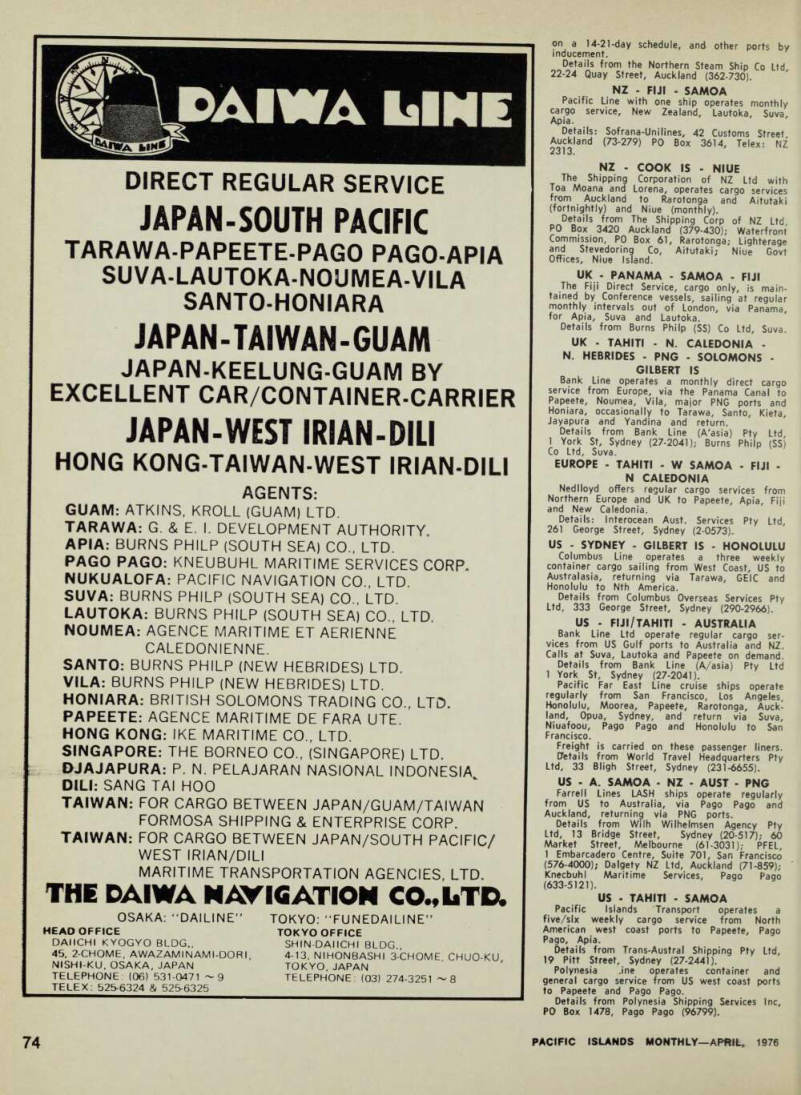
Shipping
SYDNEY - NZ - FIJI/TAHITI - UK Chandns Lines maintains a twice-monthly passenger service from Sydney via NZ, Suva or Papeete.
Details from Chandris Lines, 135 King Street, Sydney (28-2451).
SYDNEY - LORD HOWE IS - AUCKLAND -
Norfolk Is - New Caledonia
Compagnie des Chargeurs Caledoniens oper ates four-weekly cargo service Sydney-Lord Howe Island-Norfolk Island-Auckland-Norfolk Island-Noumea. jeiails: Hetherington Kingsbury Pty Ltd, 37-49 Pitt Street, Sydney (27-1671).
Sydney - New Caledonia
Somacal operates 21-day service from Sydney to Noumea.
Details from Karlander (Aust) Pty Ltd, 19-31 Pitt Street, Sydney (27-6301).
SYDNEY - NZ - FIJI - HAWAII -
Canada - Us
P and 0 liners call at Auckland, Suva and Henoiulu on eastbound and westbound voyages between Sydney and the US.
Details from P & 0 Booking Centre, World Travel Headquarters Pty Ltd, 33 Bligh Street, Sydney (231-6655).
SYDNEY - NZ - FIJI - TONGA - VILA -
Noumea - Samoas - Tahiti
Sltmar Cruises operates a South Pacific cruise programme to include most of the above countries plus the Solomons. retails from Sitmar Line (Australia) Pty Ltd, 22-30 Bridge Street, Sydney (27-4521).
Royal Viking Line, with luxury cruise ships Royal Viking Sea, Star and Sky, cruises the Pacific from Sydney, Hobart and Cairns call ing at most of above countries.
Details from Wilh. Wilhelmsen Agency Pty Ltd. 13-15 Bridge Street, Sydney (2-0517).
P & 0 liners call at Suva, Lautoka, Honiara, Santo, Pago Pago, Auckland, Vila, Noumea, Honolulu, Nukualofa and Vavau, Savusavu, regularly on cruises from Australia.
Details from P & 0 Booking Centre, World Travel Headquarters Pty Ltd, 33 Bligh Street, Sydney (231-6655).
Australia - New Caledonia •
New Hebrides
Compagnie des Chargeurs Caledoniens operates three-weekly cargo service from Sydney to Noumea, Port Vila, Santo.
Details: Hetherington Kingsbury Pty Ltd, 37- 49 Pitt Street, Sydney (27-1671).
Sofrana-Unilines ships serve Noumea every three weeks from the main ports along the east Australian coast and Port Vila monthly from Melbourne and Sydney.
Details from Sofrana-Unilines, 37 Pitt Street, Sydney (27-2031), Burns Philp and Co Ltd, 340 Collins Street, Melbourne (67-8941) and John Swire and Sons, Brisbane (46-1155).
South Pacific United Lines maintain a two week cargo service from Sydney to Noumea, Vila and Santo.
Details from Omni Traders & Brokers Pty Limited, 261 George Street, Sydney (241-2872/6).
Australia - Fiji
Sofrana-Unilines (Fiji Express Line) operates to Suva every three weeks from the main ports on the east coast of Australia, and monthly to Lautoka from Melbourne and Sydney.
Details from Sofrana-Unilines, 37 Pitt Street, Sydney (27-2031); Burns Philp and Co Ltd, 340 Collins Street, Melbourne (67-8941).
Australia - Fiji - W. Samoa
Nauru Pacific Line operates monthly con ventional/oontainer service from Sydney and Brisbane to Fiji and Western Samoa.
Details from Nauru Pacific Line, 227 Collins Street, Melbourne (654-4977); Interocean Swire, 8 Spring Street, Sydney (20-522); Dalgety Shipping, 79 Eagle Street, Brisbane (31-0331).
Karlander (Aust) Pty Ltd operates three weekly cargo services from Sydney to Suva and Lautoka.
Details from Karlander (Aust) Pty Ltd, 19-31 Pitt Street, Sydney (27-6301); Dalgety Shipping, 461 Bourke St, Melbourne (60-0731); Burns Philp (SS) Co Ltd, Suva and Lautoka.
AUSTRALIA - TAHITI - MEXICO ■ US South Pacific United Lines maintain a six weekly service from Sydney to Papeete, Mexico and US.
Details from Omni Traders & Brokers Pty Limited, 261 George Street, Sydney (241-2872/6).
Australia ■ Png
Containers Pacific Express (Burns Philp and AWP Line) operates four-weekly cargo service from Melbourne and Brisbane with Samos to Port Moresby and Lae and three-weekly cargo service from Sydney (direct) to Lae and Port Moresby with Nimos.
Details from Burns Philp & Co Ltd, 51 Pitt Street, Sydney (241-3816).
Farrell Lines operates a service every 18 days from Tasmania, Melbourne, Sydney and Brisbane to Lae and Rabaul.
Details from Wilh Wilhelmsen Agency Pty Ltd, 13 Bridge Street, Sydney (20-517), 60 Market Street, Melbourne (61-3031), Burns Philp (NG) Ltd, Rabaul, Robert Laurie- Carpenter (NG) Pty Ltd, Lae.
New Guinea Express Lines with two ships operates three-weekly Melbourne, Sydney, Brisbane, Port Moresby, Lae, Rabaul.
Details from New Guinea Express Lines, PO Box R 73, Royal Exchange PO, Sydney (241-3991) and 70 Eagle St, Brisbane (221-9333), Westra lian Farmers Transport Pty Ltd, 459 Little Collins St, Melbourne (67-8291), Breckwoldt's Shipping Agencies in Port Moresby, Lae, Rab trad Niugini Pty Ltd, Rabaul.
Karlander New Guinea Line's cargo vessels call at Melbourne, Sydney, Lae, Madang, Wewak, Manus, Kimbe.
Details from Karlander (Aust) Pty Ltd, 19-31 Pitt Street, Sydney (27-6301); Dalgety Shipping 461 Bourke St, Melbourne (60-0731).
Australia - Png - Solomons
New Guinea Australia Line's vessels operate from Sydney and Brisbane to Port Moresby, Lae, Rabaul, Kavieng, Wewak, Ftoniara, Kieta, Gizo, Madang and Samarai.
Details from Interocean Swire, 8 Spring Street, Sydney (20-522).
Australia - Ng - Micronesia -
Guam
Nauru Pacific Line operates monthly con ventional/container service Melbourne/Sydney to New Guinea, Koror, Guam and Micronesia.
Details from Nauru Pacific Line, 227 Collins Street, Melbourne (654-4977); Interocean Swire, 8 Spring Street, Sydney (20-522;.
Us - Png
Farrell Lines operates regular services from all US west coast ports to Lae and Rabaul.
Details from Wilh Wilhelmsen Agency Pty Ltd, 13 Bridge Street, Sydney (20-517), One- Embarcadero Centre, Suite 701, San Francisco,.
Burns Philp (NG) Ltd, Rabaul and Kieta, Robert Laurie-Carpenter (PNG) Pty Ltd, Lae.
Png - Us - Canada
Farrell Lines operates regular services from Lae and Rabaul to US west coast ports and Vancouver.
Details from Burns Philp (NG) Ltd, Rabaul,.
Robert Laurie-Carpenter (PNG) Pty Ltd, PFEL, One Embarcadero Centre, Suite 701 r San Francisco and Wilh Wilhelmsen Agency Pty Ltd, 13 Bridge Street, Sydney (20-517).
FAR EAST - FIJI - NEW ZEALAND New Zealand Unit Express (CNC, MOL, RIL) operates a three-weekly cargo service from Hong Kong to Lautoka, Suva, NZ ports, Manila,, Kaoshiung, Keelung, Hong Kong.
Details from Interocean Swire, 8 Spring Street, Sydney (20-522).
Royal Interocean Lines operates monthly cargo service with three ships from Surabaya, Bangkok, Port Kelang and Singapore to Suva and NZ ports.
Details from Interocean Australia Services, 261 George Street, Sydney (2-0573), Burns Phils (SS) Co Ltd. Suva and Lautoka.
Ben Shipping Co (Pte) Ltd, sailing monthly from Singapore, Hong Kong, Keelung, Kao shiung, Suva and main NZ ports.
Details from Seatrans (Fiji) Ltd, GPO Box 152, Suva, Fiji.
FAR EAST - PNG - BSI - NEW HEBRIDES -
Noumea - Tahiti - Samoa
China Navigation Co's vessels operate a regular cargo service from Hong Kong, Tai wan and Singapore to Rabaul, Wewak, Madang, Lae, Port Moresby, Honiara, New Hebrides Noumea. Papeete and Samoa.
Details from Interocean Swire, 8 Spring Street, Sydney (20-522).
North Europe - New Caledonia
Hamburg-Sued operates monthly cargo services from Dunkirk and Le Havre to Noumea, via Panama.
Details from Columbus Overseas Services Pty Ltd, 333 George Street, Sydney (290-2966).
Messageries Maritimes operates five cargo services a month from north and Mediterranean European ports to Papeete and Noumea.
Details from Messageries Maritimes, 4-6 Bligh Street, Sydney (221-2522).
JAPAN - GUAM - FIJI • SAMOA -
N Caledonia - N Hebrides
Daiwa Line runs a monthly cargo service from Japan via Guam to Suva, Lautoka, Pago Pago, Apia, Vila, Santo and Noumea.
Details from Burns Philp (SS) Co Ltd, Suva.
TONGA - SAMOA - FIJI - NORFOLK IS •
Australia
Pacific Navigation Co Ltd operates a monthly cargo service between Nukualofa, Apia, Suva, Lautoka and Norfolk Is to Sydney.
Details from Karlander (Aust) Pty Ltd, 19-31 Pitt St, Sydney (27-6301); Burns Philp (SS) Co Ltd.
NZ - FIJI - TONGA ■ SAMOAS -
Tahiti
Union Steam Ship Co of NZ operates a fully containerised service-Auckland-Suva-Pago Pago- Apia-Nukualofa every 14/16 days.
A 28-day service by conventional ship is operated from Auckland to Suva, Papeete, Apia and Nukualofa.
Details from Union Steam Ship Co of NZ Ltd, PO Box 12, Auckland, or from branch offices/agents in Fiji, Tonga, Samoa and Tahiti.
Nz - Norfolk Is
Compagnie des Chargeurs Caledonians operate four-weekly cargo service from Auckland to Norfolk Island.
Details from Maritime Services Ltd, 14-18 Customs Street E, Auckland (75-509).
NZ - N CALEDONIA - N HEBRIDES -
Ng - Bsi
Sofrana/Unilines with two ships operates to Vila and Santo; to Honiara and New Guinea; and to Noumea.
Details from Sofrana-Unilines, 42 Customs Street, Auckland (73-279), P.O. Box 3614.
Telex: NZ 2313.
Nz - N Caledonia
Compagnie des Chargeurs Caledoniens oper ates four-weekly cargo service from Auckland to Noumea.
Details from Maritime Services Ltd, 14-18 Customs Street E, Auckland (75-509).
Nz - Png
Farrell Lines operates regular service every 18 days from Auckland to Lae and Rabaul.
Details from Dalgety NZ Ltd, 41/45 Albert Street, Auckland (71-859), Burns Philp (NG) Ltd, Rabaul, Robert Laurie-Carpenter (PNG Pty Ltd, Lae.
NZ - FIJI - NORTH AMERICA (WC) Crusader cargo ships call at Suva, Levuka and Honolulu on NZ-US west coast trips and at Suva and/or Lautoka on US-NZ return trips.
Details from Blue Star Port Lines (Manage ment) Ltd, P.O. Box 192, Wellington (739-029)- Burns Philp (SS) Co Ltd, Suva.
Nz - Fiji
Reef operates a regular 18 day service from Auckland to Suva and Lautoka.
Details from Reef Shipping Agencies Ltd P.O. Box 3382, Auckland, NZ (71-221-3).
Nz - Tonga - Samoa
Pacific Navigation Co Ltd operates two
ships Auckland-Lyttelton-Nukualofa-Vavau-Apia
on a 14-21-day schedule, and other ports by inducement.
Details from the Northern Steam Ship Co Ltd 22-24 Quay Street, Auckland (362-730).
Nz - Fiji - Samoa
Pacific Line with one ship operates monthly cargo service. New Zealand, Lautoka, Suva Apia.
Details: Sofrana-Unilines, 42 Customs Street, Auckland (73-279) PO Box 3614, Telex: NZ
Nz - Cook Is - Niue
The Shipping Corporation of NZ Ltd with Toa Moana and Lorena, operates cargo services from Auckland to Rarotonga and Aitutaki (fortnightly) and Niue (monthly).
Details from The Shipping Corp of NZ Ltd PO Box 3420 Auckland (379-430); Waterfront Commission, PO Box 61, Rarotonga; Lighterage and Stevedoring Co, Aitutaki; Niue Govt Offices, Niue Island.
UK - PANAMA - SAMOA - FIJI The Fiji Direct Service, cargo only, is main tained by Conference vessels, sailing at regular monthly intervals out of London, via Panama, for Apia, Suva and Lautoka.
Details from Burns Philp (SS) Co Ltd, Suva.
UK - TAHITI - N. CALEDONIA - N. HEBRIDES • PNG - SOLOMONS -
Gilbert Is
Bank Line operates a monthly direct cargo service from Europe, via the Panama Canal to Papeete, Noumea, Vila, major PNG ports and Honiara, occasionally to Tarawa, Santo, Kieta, Jayapura and Yandina and return.
Details from Bank Line (A'asia) Pty Ltd, 1 York St, Sydney (27-2041); Burns Philp (SS) Co Ltd, Suva.
EUROPE - TAHITI - W SAMOA - FIJI -
N Caledonia
Nedlloyd offers regular cargo services from Northern Europe and UK to Papeete, Apia, Fiji and New Caledonia.
Details: Interocean Aust. Services Pty Ltd, 261 George Street, Sydney (2-0573).
US - SYDNEY - GILBERT IS - HONOLULU Columbus Line operates a three weekly container cargo sailing from West Coast, US to Australasia, returning via Tarawa, GEIC and Honolulu to Nth America.
Details from Columbus Overseas Services Pty Ltd, 333 George Street, Sydney (290-2966).
Us - Fiji/Tahiti - Australia
Bank Line Ltd operate regular cargo ser vices from US Gulf ports to Australia and NZ.
Calls at Suva, Lautoka and Papeete on demand.
Details from Bank Line (A/asia) Pty Ltd 1 York St, Sydney (27-2041).
Pacific Far East Line cruise ships operate regularly from San Francisco, Los Angeles, Honolulu, Moorea, Papeete, Rarotonga, Auck land, Opua, Sydney, and return via Suva, Niuafoou, Pago Pago and Honolulu to San Francisco.
Freight is carried on these passenger liners.
Retails from World Travel Headquarters Pty Ltd, 33 Bligh Street, Sydney (231-6655).
US • A. SAMOA - NZ - AUST - PNG Farrell Lines LASH ships operate regularly from US to Australia, via Pago Pago and Auckland, returning via PNG ports.
Details from Wilh Wilhelmsen Agency Pty Ltd, 13 Bridge Street, Sydney (20-517); 60 Market Street, Melbourne (61-3031); PFEL, 1 Embarcadero Centre, Suite 701, San Francisco (576-4000); Dalgety NZ Ltd, Auckland (71-859); Knecbuhl Maritime Services, Pago Paqo (633-5121).
Us - Tahiti - Samoa
Pacific Islands Transport operates a five/six weekly cargo service from North American west coast ports to Papeete, Pago Pago, Apia.
Details from Trans-Austral Shipping Pty Ltd, 19 Pitt Street, Sydney (27-2441).
Polynesia ,ine operates container and general cargo service from US west coast ports to Papeete and Pago Pago.
Details from Polynesia Shipping Services Inc, PO Box 1478, Pago Pago (96799).
Advertisements & other items, pp. 72-75 (1 item)
Union Steam Ship Co. Of N.Z.
LIMITED
Serving the Pacific for nearly 100 years.
Regular Sailings by Modern Vessels
From Auckland to Lautoka, Suva, Pago Pago, Apia, Niue, Vavau, Nukualofa. Also from Tauranga to Lautoka, Suva, Apia, Nukualofa. Regular sailings from Australia to New Zealand to enable transhipment of cargo to all the above ports.
Ship your cargo by a Union Company Vessel.
BRANCHES AT ALL MAIN AUSTRALIAN, NEW ZEALAND AND ISLAND PORTS.
KYOWA SHIPPING LINES
Monthly Services
Hong Kong,Taiwan,S.Korea, Japan
To: Guam, Saipan, British Solomon. New Caledonia, Fiji, W. Samoa, A. Samoa. Tahiti, Cook Is., Tonga, New Hebrides.
Taiwan,Hong Kong, Singapore, Jakarta
To : Australia, Papua New Guinea
South Korea, Japan
To: Guam, Saipan, Papua New Guinea, Other Pacific Islands
AGENTS
Taiwan: Royal Steamship Corp., Ltd., Taipei S. Korea: Dong Sue Shipping Co., Ltd., Seoul Hong Kong: Dahzun Enterprises Ltd.
Singapore: Ocean Shipping & Enterprises Pte., Ltd.
Mariana Is.: Island Navigation Co., Ltd., Guam 8.5.1. P.: British Solomon Trading Co., Ltd., Honiara Tahiti: J. A. Cowan & Fils, Papeete Tonga: E. M. Jones Ltd., Nukualofa New Hebrides: Agence Maritime Raymond Velicite, Port Vila A. Samoa: Toko Shimasaki Agencies Ltd., Pago Pago W. Samoa: Morris Hedstrom Ltd., Apia Fiji: Carpenter Shipping, Suva & Lautoka PNG: Carpenter Shipping Agencies, Port Moresby, Rabaul New Caledonia: Agence Maritime Du Rond Point Du Pacific, Noumea Indonesia: P.T. Porodisa Raya Shipping Lines, Jakarta Australia: Hetherington Kingsbury Pty. Ltd., Sydney, N.S.W.
KYOWA SHIPPING CO., LTD.
OJIMA BLDG., 22-8, 6-CHOME, SHINBASHI, MINATO-KU,
TOKYO. JAPAN
TELEPHONE: TOKYO 03 (437) 2885 (REP.)
CABLE ADDRESS: "MARIQUEEN" TOKYO
TELEX NO.: (0) 2424651 KYOWA J
DIRECT REGULAR SERVICE
JAPAN-SOUTH PACIFIC
TARAWA-PAPEETE-PAGO PAGO-APIA
SUVA-LAUTOKA-NOUMEA-VILA
SANTO-HONIARA
JAPAN-TAIWAN-GUAM
JAPAN-KEELUNG-GUAM BY
EXCELLENT CAR/CONTAINER-CARRIER
JAPAN-WEST IRIAN-DILI
HONG KONG-TAIWAN-WEST IRIAN-DILI
AGENTS:
GUAM: ATKINS, KROLL (GUAM) LTD.
TARAWA: G. & E. I. DEVELOPMENT AUTHORITY, APIA: BURNS PHILP (SOUTH SEA) CO.. LTD.
PAGO PAGO: KNEUBUHL MARITIME SERVICES CORP,
NUKUALOFA: PACIFIC NAVIGATION CO., LTD
SUVA: BURNS PHILP (SOUTH SEA) CO.. LTD.
LAUTOKA: BURNS PHILP (SOUTH SEA) CO., LTD.
NOUMEA: AGENCE MARITIME ET AERIENNE
CALEDONIENNE.
SANTO: BURNS PHILP (NEW HEBRIDES) LTD.
VILA: BURNS PHILP (NEW HEBRIDES) LTD.
HONIARA: BRITISH SOLOMONS TRADING CO., LTD.
PAPEETE: AGENCE MARITIME DE FARA UTE.
HONG KONG: IKE MARITIME CO., LTD.
SINGAPORE: THE BORNEO CO.. (SINGAPORE) LTD.
DJAJAPURA: P. N. PELAJARAN NASIONAL INDONESIA
DILI: SANG TAI HOO
TAIWAN: FOR CARGO BETWEEN JAPAN/GUAM/TAIWAN
FORMOSA SHIPPING & ENTERPRISE CORP.
TAIWAN: FOR CARGO BETWEEN JAPAN/SOUTH PACIFIC/
WEST IRIAN/DILI
MARITIME TRANSPORTATION AGENCIES, LTD.
THE DAIWA NAVIGATION CO.. LTD.
OSAKA: “DAILINE”
HEAD OFFICE
OAIICHI KYOGYO BLDG.,
45, 2-CHOME, AWAZAMINAMI-DORI,
NISHI-KU, OSAKA. JAPAN
TELEPHONE: (06) 531-0471 ~9
TELEX; 525-6324 & 525-6325
TOKYO; “FUNEDAILINE"
TOKYO OFFICE
SHIN-DAIICHI BLDG.,
4-13, NIHONBASHI 3-CHOME, CHUO-KU
TOKYO, JAPAN
TELEPHONE; (03) 274-3251 ~8
NOTICE
BACARDI
TRADE MARKS
The following
trade marks: 1 2
BACARDI
lil
are the
property of:
BACARDI &
COMPANY LIMITED
Millar Road New Providence Commonwealth of the Bahama Islands The above trademarks are famous throughout the world as indicating high quality beverages, particularly rum and rum products, identified with Bacardi & Company Limited, and any unauthorised use of these trademarks and any attempts to imitate them will be restrained by appropriate action.
McCUBBERY TRAIN
LOVE & THOMAS,
Solicitors Port Moresby Agents for Davies & Collinson, Trade Mark Agents for the Proprietors.
Airways
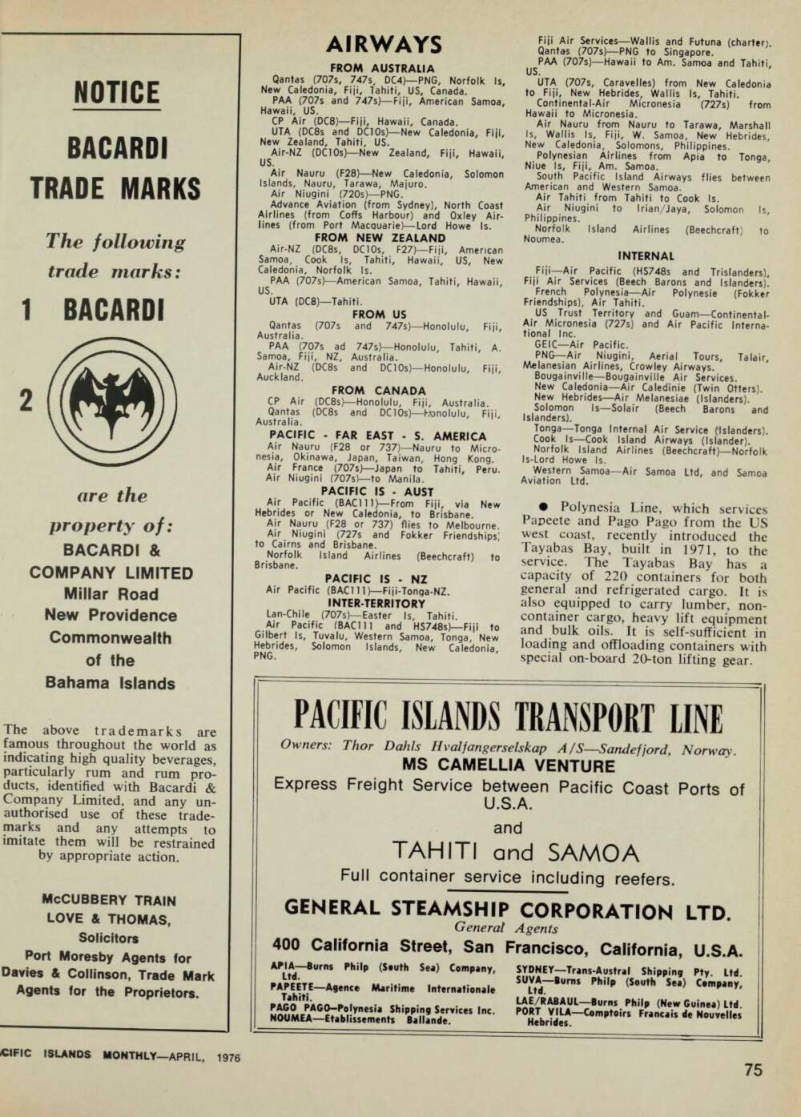
From Australia
Qantas (7075, 7475. DC4)—PNG, Norfolk Is, New Caledonia, Fiji, Tahiti, US, Canada.
PAA (707 s and 747 s) —Fiji, American Samoa, Hawaii, US.
CP Air (DCS) —Fiji, Hawaii, Canada.
UTA (DCBs and DClOs) —New Caledonia, Fiji, New Zealand, Tahiti, US. (DC 1 Os) —New Zealand, Fiji, Hawaii, Air Nauru (F2B) —New Caledonia, Solomon Islands, Nauru, Tarawa, Majuro.
Air Niugini (720s)—PNG.
Advance Aviation (from Sydney), North Coast Airlines (from CofPs Harbour) and Oxley Air lines (from Port Macquarie)—Lord Howe Is.
From New Zealand
Air-NZ (DCBs, DClOs, F27)—Fiji, American Samoa, Cook Is, Tahiti, Hawaii, US, New Caledonia, Norfolk Is.
PAA (707 s) —American Samoa, Tahiti, Hawaii, US.
UTA (DCS)—Tahiti.
From Us
Qantas (707 s and 747 s) —Honolulu, Fiji, Australia.
PAA (707 s ad 747 s) —Honolulu, Tahiti, A.
Samoa, Fiji, NZ, Australia.
Air-NZ (DCBs and DClOs) —Honolulu, Fiji, Auckland.
From Canada
CP Air (DCBs) —Honolulu, Fiji, Australia.
Qantas (DCBs and DClOs) —Honolulu, Fiji, Australia.
PACIFIC - FAR EAST - S. AMERICA Air Nauru (F2B or 737) —Nauru to Micro nesia, Okinawa, Japan, Taiwan, Hong Kong Air France (707s)—Japan to Tahiti, Peru.
Air Niugini (707 s) —to Manila.
Pacific Is ■ Aust
Air Pacific (BAC111) From Fiji, via New Hebrides or New Caledonia, to Brisbane.
Air Nauru (F2B or 737) flies to Melbourne.
Air Niugini (727 s and Fokker Friendships) to Cairns and Brisbane.
Norfolk Island Airlines (Beechcraft) to Brisbane.
Pacific Is - Nz
Air Pacific (BAClll)—Fiji-Tonga-NZ.
Inter-Territory
Lan-Chile (707s)—Easter Is, Tahiti.
Air Pacific (BACIII and HS74Bs)—Fiji to Gilbert Is, Tuvalu, Western Samoa, Tonga, New Hebrides, Solomon Islands, New Caledonia
Png.
Fiji Air Services—Wallis and Futuna (charter).
Qantes (707 s) —PNG to Singapore.
PAA (707 s) —Hawaii to Am. Samoa and Tahiti.
US.
UTA (7075, Caravelles) from New Caledonia to Fiji, New Hebrides, Wallis Is, Tahiti.
Continental-Air Micronesia (7275) from Hawaii to Micronesia.
Air Nauru from Nauru to Tarawa, Marshall Is, Wallis Is, Fiji, W. Samoa, New Hebrides, New Caledonia, Solomons, Philippines.
Polynesian Airlines from Apia to Tonga, Niue Is, Fiji, Am. Samoa.
South Pacific Island Airways flies between American and Western Samoa.
Air Tahiti from Tahiti to Cook Is.
Air Niugini to Irian/Jaya, Solomon Is, Philippines.
Norfolk Island Airlines (Beechcraft) to Noumea.
Internal
Fiji—Air Pacific (HS74Bs and Trislanders), Fiji Air Services (Beech Barons and Islanders), French Polynesia—Air Polynesie (Fokker Friendships), Air Tahiti.
US Trust Territory and Guam—Continental- Air Micronesia (7275) and Air Pacific Interna tional Inc.
GEIC —Air Pacific.
PNG—Air Niugini, Aerial Tours, Talair, Melanesian Airlines, Crowley Airways.
Bougainville—Bougainville Air Services.
New Caledonia—Air Caledinie (Twin Otters).
New Hebrides—Air Melanesiae (Islanders).
Solomon Is —Solair (Beech Barons and Islanders).
Tonga—Tonga Internal Air Service ('lslanders).
Cook Is—Cook Island Airways (Islander).
Norfolk Island Airlines (Beechcraft)—Norfolk Is-Lord Howe Is.
Western Samoa—Air Samoa Ltd, and Samoa Aviation Ltd. • Polynesia Line, which services Papeete and Pago Pago from the US west coast, recently introduced the Tayabas Bay, built in 1971, to the service. The Tayabas Bay has a capacity of 220 containers for both general and refrigerated cargo. It is also equipped to carry lumber, non container cargo, heavy lift equipment and bulk oils. It is self-sufficient in loading and offloading containers with special on-board 20-ton lifting gear.
Advertisements & other items, pp. 75-80 (4 items)
75
CIFIC ISLANDS MONTHLY—APRIL. 1976
Pacific Islands Transport Line
Owners: Thor Dahls Hvalfangerselskap A/S—Sonde fjord, Norway
MS CAMELLIA VENTURE
Express Freight Service between Pacific Coast Ports of
U.S.A.
and
TAHITI and SAMOA
Full container service including reefers.
GENERAL STEAMSHIP CORPORATION LTD.
General Agents 400 California Street, San Francisco, California, U.S.A.
APlA—Burns Philp (South Sea) Company, Ltd.
PAPEETE—Agence Maritime Internationale Tahiti. £££?-/. AG 9“* >,vnesia Shipping Services Inc.
NOUMEA—Etablissements Ballande SYDNEY—Trans-Austral Shipping Pty. Ltd.
SUVA Bums Philp (South Sea) Company, K!^ UL 7 B - r - s Philp (N« w Guinea) Ltd.
P .. L Y IU —C«mptoirs Francais de Nouvelles Hebrides.
TRAIL BLAZERS OF
NEW ZEALAND
Historical tales from a unique land.
Fully illustrated, gold-embossed binding. Limited number First Editions available. $10.95 (NZ) postpaid from DUFS, Bx. 3847, Wellington, NZ.
Line Advertisements
Per line, 52.50 Aust.
Minimum rate, 4 lines.
FOR SALE
FOR SALE: Artifacts and Handicrafts from Papua New Guinea and New Zealand.
WANTED: Artifacts and Handicrafts from all Pacific Islands must be genuine. Write Papua New Guinea Arts 8C Crafts, Box 509, Surfers Paradise 4217 Qld., Aust.
CONCRETE BLOCK MAKER. Makes
blocks, flags, edgings, screen-blocks, garden stools—up to 8 at once and 96 an hour. #215.00 c.i.f. main ports. Send for leaflets. Forest Farm Research, Londonderry, N.S.W., 2753 Australia.
FLEETS 5 2 ft. general purpose boat, bit. 1967, in survey, Gardner main, some refrig, and dry cargo, 13 berths, Auto Pilot, 2 rafts, #75,000.00. Fleets 221 Esplanade Wynnum Central, Brisbane. Cable
"FLEETS BRISBANE".
PARK VIEW MOTEL—BRISBANE
Quiet location—opp. Botanic Gardens.
Single, double, family suites, all with refrig., air conditioning, phone, TV, radio, tea making facilities, from $l2. Pool and restaurant.
Phone 31-2695—Telex 40270.
Write for coloured brochure — Park View Motel, 128 Alice St, BRISBANE Qld., 4000.
UNIVERSITY GRADUATE (28) in
English, Political Sc., Economics and deeply interested in the life of Pacific Islands seeks temporary or permanent job of any suitable nature on any island. Some experience in community service, office work and teaching.
Reply V. Kumar, P.O. Box 2437, Suva, Fiji.
YACHTING HOLIDAY. Female looking for position with sailing crew in the Pacific area June to September 1976 or 1977.
Ilva Stroili, Sparkassestr, 18 Bolzano 39100 Italy.
If you have shells to sell—any quantity —contact Anisa Commodity Traders Pty.
Ltd., P.O. Box 1413, Lae, Papua New Guinea, Phone 424159. We are buyers of ’rochus, Greensnail, Blacklip MOP, Goldlip MOP, and Marine Specimens. Best prices paid. Rabaul agents: Gazelle Agencies Pty. Ltd., P.O. Box 262, Rabaul, P.N.G. Phone: 921397. Manns Island Agents, R. L. & V. J. Knight, P.O. Box 108, Lorengau, Manus Island, P.N.G.
Phone; 38.
BILLIARD AND POOL TABLES. Juke
boxes and amusement machines, sales and accessory supplies, prompt attention to all enquiries: Cavill Slot Machines, 14 Burke St., Woolloongabba, Brisbane, Australia.
WILL OPEN SOON!
In the centre of the European Common Market, A Trade, Social and Cultural Office for all PACIFIC
ISLANDS.
We are looking for contracts now.
Government contracts welcomed.
For more details, write to L. PHILIPS, Arawa, P.O. Box 794, Bougainville Island or call PNG 951134.
Plant Protection -
made to measure
I Manufacturers: Gebriider Holder D-7418 Metzingen W.-Germany Representatives: Demka Australia Pty. Ltd. 184 Sussex Str.
Sydney N.S.W.
MAPS AND PRINTS
OF THE OLD PACIFIC
Original antiquarian Pacific views and maps for sale. Enquiries invited stating areas of interest.
C. HINCHCLIFFE, 7 Royd Avenue, Heckmondwike, West Yorkshire, WFI6 SAL, United Kingdom
GENERATING SETS
by BRAYBON
Capacities available are: Petrol 2 kva-7i kva Diesel 2 kva-200 kva Write for brochure and prices:
BRAYBON BROS. PTY. LTD.,
2 ROTHWELL AVE., CONCORD WEST,
N.S.W., 2138. Phone: 73-3246.
CITIZEN BUSINESS MACHINES
• CASH REGISTERS • ADDING MACHINES
• TYPEWRITERS • ELECTRONIC CALCULATORS
Write for brochures and prices Maison Barrau, 8.R.A4 Cedex, Noumea Iprotec, B.P. 366 Port Vila or direct to
GOODSON CALCULATORS PTY. LTD.
23/25 ABERCROMBIE STREET. CHIPPENDALE, SYDNEY 2008
Agency enquiries invited
PETER FISHER TRADING Pty. Ltd.
321 PITT STREET, SYDNEY, 2000, AUSTRALIA
Telephone: 26-1109 CABLES: "FISHERION", SYDNEY
EXPORTERS TO THE PACIFIC ISLANDS
<■ Pi Whatever you want in a pickup, the 81600 delivers it.
With performance. With economy. With style.
Consider the things we build into it so you can get more out of it. The 1600 cc overhead cam engine, for instance, is a lot like the one you find in some sports cars.
Yet ours just sips gas. And the important things like the heavy duty suspension system and the safe, sure braking system make operating the 81600 a joy.
Want a sporty pickup for the fun of it?
Or just for its carry-all capabilities?
Test drive the Mazda 81600 pickup.
The truck-load of fun and economy. 1975 Toyo Kogyo Co., Ltd. m Bmhhh. ’APUA NEW GUIN EaP NT3 Tstoc 'aTed I ncTustn esUd d PO To x 4 slzls ’N E R ”'\ e ' e e ' Berna ™*' 27, Rue de Sebastopol Noumea K DUnC ° mbe B3y Gar39e P ° - 22 * Nor, °' K —™ ™ 7 p3olomo^n Z Motors *Box S TEU^Ta^TAH^TCo^ptoir^Polyne^Sn^B^BJ^ l ?^^^ The trademark MAZDA in this ad brtisement stands for AUTOMOBILES MAZDA as far as France and her territories are concerned
IT’S Oo€ STOP SHOPPme AT
v<
Pim’S mfilL ORD€R BOOKSHOP
Tick the titles you want. Mail us the page with your remittance. We’ll despatch your books immediately. □ Percy Chatterton’s Papua: Day That I Have Loved. Charming evocative account of changing Papua as Rev. Percy Chatterton knew it for 50 years. 144 pp. Illustrated. 5A6.50 or SUSB.SO posted anywhere. □ The Story of The Solomons.
Simple, lucid outline of the history of the Solomon Islands, from a refreshingly frank and affectionate point of view, by Dr. C.E. Fox. 88 pp. SA3 or SUS 4, posted anywhere. □ The Lost Caravel Robert
Langdon shatters traditionally-held
views on the Polynesians in this controversial, historical whodunnit described by Prof. Ron Crocombe as a “masterpiece us fascinating as it is important”. Also invaluable as a record of early Pacific exploration. 368 pp. Profusely illustrated with maps and plates. SAIB or SUS 26, posted anywhere. □ Queen Emma. R.W. Robson presents drama, comedy, high adventure in this true story of “Queen Emma”, the Polynesian-American girl who met 19th century New Guinea on its own tough terms. 239 pp. illustrated. SA6 or
SUSB, posted anywhere.
□ Folkloric in Australia. Dance expert Beth Dean and photographer Stan Goik present the beauty and vitality of national folk dances brought to Australia from Europe and elsewhere in this superb book of colour photographs and brilliant text. Large format, 88 pp.
Illustrated. 5A3.50 or SUSS
posted anywhere.
□ Holy Torture in Fiji. Firewalking and other sacred, ancient rituals of Fiji’s Hindus described in text and colour photographs.
Large format, 64 pp. Illustrated. 5A4.50 or SUS6.SO, posted anywhere. □ Port Moresby, Yesterday and Today. In what is even more than a history of Papua New Guinea’s capital, Canon lan Stuart takes us
on an entertaining, personalised
tour of the city, Softcover, 368 pp. Maps illustrations. 5A3.50 or
SUS4.SO, posted anywhere.
□ Many a Green Isle. Judy Tudor’s best-selling classic of Pacific Islands life for armchair travellers. Diverting, packed with incident, embellished with dry humour. 256 pp.
Illustrated. SA6 or SUSB posted anywhere. □ New Hebrides. One of the superb Islands in the Sun colour series of brilliant full-colour plates, maps and text, this volume describes tne unique British-French Condominium of the New Hebrides.
A guide for travellers, or for collectors. 128 pp. Fully illustrated. SAIO or SUSI 3, posted
anywhere.
□ New Caledonia. French New
Caledonia, superbly depicted in
full colour photographs, with informative text and maps giving history, geography and daily life.
An Islands in the Sun guide. 128 pp. Fully Illustrated. SAIO or
SUSI 3, posted anywhere.
□ Bora Bora. One of the French
Pacific’s fascinating, colourful higl
islands, reached from Tahiti, here
presented in sparkling full-colour
pictures for visitors or mere armchair travellers. Another Islands in the Sun guide, with the same attention to detail. 128 pp.
Fully illustrated. SAIO or SUSI 3,
posted anywhere.
□ Fiji Fiji. The multi-racial dominion of friendly Fiji, crossroads of the Pacific, described in colour photographs, maps and text, uniform with the beautiful series listed above. Many people buy the whole set. More titles to be published. 128 pp. Fully illustrated. SAIO or SUSI 3 posted anywhere. □ Little Chimbu in Bougainville.
For the young and young-in-heart, lovable Little Chimbu and his friends visit Panguna, and get into awful trouble in what could be the biggest hole in the world, the Bougainville copper mine. Nancy Curtis, who used to live there, tells the story in full colour drawings which are also accurate and instructive. Also in the colourful Nancy Curtis series for children are □ Little Balus and □ Fiji Johnny.
About 48 pp. Illustrated. Each 5A3.50 or SUS4.SO posted
anywhere.
□ South Pacific Art & Dance.
Beth Dean and the late Bruce Palmer, two skilled guides, lead us in an excellent and colourful ocean voyage of discovery. 104 pp.
Illustrated. 5A3.50 or SUS4.SO,
posted anywhere.
□ Colonial Era Cemetery of Norfolk Island. Former Administrator of the island, R. Nixon Dalkin, describes life and death in what was Britain’s harshest Pacific penal colony. There are illuminating, often moving stories in these
photographs, charts and inscript-
ions that describe the historic cemetery. Large format, 92 pp.
Illustrated. SAS or SUS7.SO, posted anywhere. □ Marine Shells of the Pacific.
Walter Cernohorsky describes in detail with clear photographs 440 Pacific shells, and tells how to find, arrange and photograph a collection. 248 pp. Illustrated. SAIO or
SUSIS, posted anywhere.
□ Marine Shells of the Pacific Volume 11, Walter Cernohorsky carries on where his first book leaves off, with a further 600
species fully described and
illustrated: Some of the 68 full-page plates are in colour. 412 pp. Illustrated. SAI7 or SUS2S, posted anywhere. □ Friendly Island. Warm account of life in Tonga, sunlit South Pacific island kingdom, by Patricia Ledyard, who has lived in a Tongan harbourside village for more than 20 years. Paperback, 215 pp. lA3 or SUS4.SO, posted anywhere. □ Plants and Flowers of Tahiti Full colour photographs of the rich and beautiful Tahitian flora, classified by scientific names, and by French, English and Tahitian common names. 144 pp. Fully illustrated. SAS or SUS 7, posted
anywhere.
□ Birds of Tahiti A companion volume to Plants and Flowers of Tahiti. Full colour photographs and descriptions, for collectors or for amateur birdwatchers, visitors and students needing easy identification. 112 pp. Fully illustrated.
SAS or SUS 7, posted anywhere.
PlM’s mail order bookshop prices include surface postage and charges anywhere in the world. There’s nothing extra to pay.
Sydney visitors may buy any title at slightly less cost across the counter at our office at 76 Clarence Street, Sydney.
Please mail to ( 1 have ticked the books 1 want and have enclosed $ (cash with order) u .. n . n . . ) NAME (Block Letters) Mail Order Bookshop, < Pacific Publications, I ADDRESS Box 3408 GPO, Sydney, 2001/
Performance
You Enjoy Living With
Honda is a true life drama, performed on the world’s stage. By average folks, teenagers, men, and women everywhere. Your neighbors, maybe even you are playing a part. If so, you know Honda is more than great machines.
It’s people concerned with taking people where they want to go in life.
On two wheels, we’re the best selling motorcycle. The easy to operate hard workers who don’t demand much. Honda on four wheels. The precedent setting Honda Civic continues to receive international economy and performance awards. It’s the elegant compact car.
Sometimes, we have no wheels. Honda portable power operates machinery, generates electricity, pumps water and tills the soil.
Little wonder good things happen on Honda —we work harder to assure they do. is always ready and gets you there safely. We move m
HONDA MOTOR CO. LTD. TOKYO. JAPAN
MSL A 'fvT'iui P £',? o* P ° rt Moresby/TA HITI: Societe Tahitienne d’lmportation des Produits Honda B.P. 1665 P apeet e/F ,J| ISLANDS: Coral Island Motors P.O. Box 48. Suva/U.S. TRUST TERRITORY: United Micronesia Development Assn P O Box ELANDS. Cook Islands Motor Centre Ltd. P.O. Box 74. Rarotonga AMERICAN SAMOA: Samoan Holiday and Travel Center P.O. Box 968, Pago Pago AMERICAN SAMOA: Haleck’s Service Center P.O. Box 1138 Pago Pago GUAM Marks Solomons Tradin o c°* nfn A p^*' a Q WE ?7f RN SAMOA: Motor Di»tributors (Samoa) Ltd. P.O Box 576. Apia SOLOMOnWaNDS British .Tradmg Co.. Ltd: P.O. Box 114. Honiara NEW CALEDONIA: Establissements Ballande Boite Postale No. C 4 Noumea Cedex ISLAND- D « o o 34^ U L U, f lof a/T A R AWA: Gi,bert * Ellice Islands Development Authority P.O. Box 488. Beito NIUE ISLAND. S. Jessop & Sons Ltd. P.O. Box 71. Alof. South/NAURU: Nauru Cooperative Society. Republic of Nauru. Sauru Island Central PaciVic
h Th/u, motiwi cqa. oa mwxmjjcaJi
I a IQ
Mr. Chau
JAy_ VcLtAUM-CtiphlMd tb
IB Miss Diane Frogia, teacher. ■a '«~l
ik .ggajjg, i
■ mmT'S
7,i» i ' i 7. .fl '■ ' n^3fL
UJt dmt W’bejumt a^
d& umA iAjCthz Social Mrs. Ilona Wimer, housewife.
I «iip aw B ■ liisaii liiiii
Your Datsun. Your special island.
Once it has found you, it'll never let you go.
Where else can you find such
economical, worry-free
motoring? Little wonder Datsuns are enjoyed in Tahiti —and in 130 other nations! In a series of on-thespot global interviews, Nissan Motor representatives met many owners and asked them for a frank assessment of their Datsuns. Answers were surprisingly similar, despite the very different circumstances in which the Datsuns were used.
The Datsun, they told us. is economical, reliable, durable, comfortable.
Fun to own.
Again and again.
DATSUN
rgm Product of NISSAN DATSUN distributor network covers the following areas; Fiji-T.P.N.G.-W. Samoa-New Caledonia-New Hebrides*B.S.lP.-Timor-Norfolk Is.* A. Samoa -Tahiti • Cook Is. • Nauru -Tonga - Saipan -Guam - Australia -New Zealand
Ific Islands Monthly—April, 1976
79
I F 1C ISLANDS MONTHLY—APRIL, 1976