Bali Ha 'i they call you ...or
pp. 42-44 · Read in the full issue
should it be Rarotonga ?
By NED A VARY on Rarotonga
Most of us who roam the South Pacific always have a quiet, secret question in the back of our minds: will we ever discover that perfect island, the island of our dreams?
As an international airline captain and Pacific traveller since I was a teenager, I thought I had seen it all.
And finally concluded that the perfect island my personal Bali Ha’i did not exist.
But that was before Rarotonga.
Recently, in Tahiti, I read James Michener's South Sea classic Return to Paradise again. A phrase on page 80 which I had missed on earlier readings stopped my eyes and rac ed my pulse. Michener claimed that Rarotonga was the one island he would choose of all the others to return to. That fired me up.
So 1 caught the once-a-week Wednesday flight from Papeete, on Air New Zealand, for Rarotonga.
Just one hour and 20 minutes later, we touched down on Rarotonga’s coral white jet strip where a crowd of colourful, flower-bedecked Polynesians warmly greeted me. I called out the Rarotongan greeting: Kia Orana! and the whole group sang out their welcoming Kia Orana!
Once inside the Polynesian-style terminal I got a truly royal welcome from the ravishing ground hostess she’s the daughter of the Rarotongan Queen! More about her later.
Then the hotel courtesy car took me past Black Rock a place that figures famously in Rarotonga’s long, colourful history. The island’s first European visitors two centuries ago were Fletcher Christian and his Bounty mutineers! They anchored here in their search for a safe hideout.
Then decided to sail on to a more
isolated place which they certainly found at lonely Pitcairn Island.
Later, at Black Rock, a young Tahitian missionary Papeiha Raiatea swam ashore from his London Missionary Society vessel to test the friendliness of the Maori natives of Rarotonga. Papeiha got a warm reception, swam back to his ship unharmed, gave the good word to his European superiors. And Rarotonga got its first European settlers. Another missionary first in the South Seas.
Soon we reached my thatch-roofed, South Sea-style hotel, where the manager and his native staff gave me another friendly welcome, then presented me with the loveliest flower leis I have ever seen. As we chatted, I realised an extra bonus everyone here speaks English!
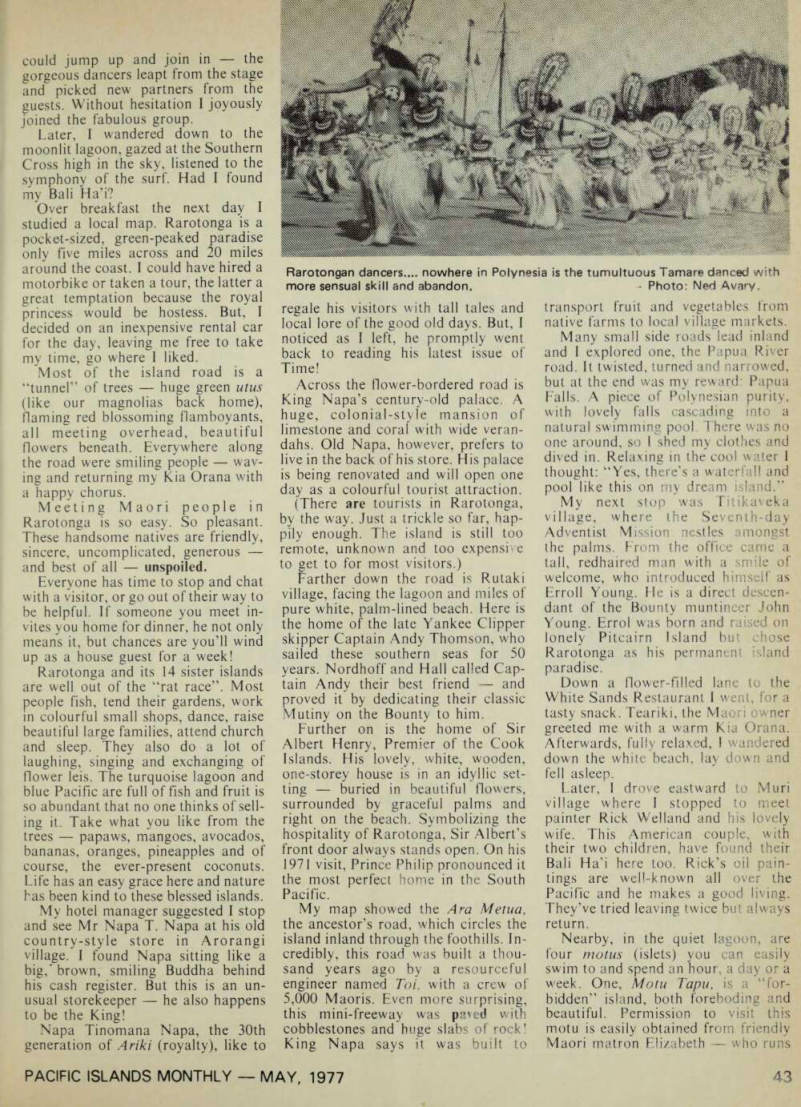
That night at the hotel there was an umukai (native feast). After that sumptuous spread, a troupe of torrid, twisting, whirling dancers performed the wildest of spectacles, the ura pa’u or drum dance. The Tahitians have their tamure, but the Cook Islands’ teams cannot be topped. An earlier visitor much earlier had watch ed this exciting show and remarked: “... the girls must have been chosen especially for the performance, since few in the crowd equalled them in beauty.” That visitor was Captain James Cook in 1777! As one of the great navigators of his time, Cook had a sharp eye for heavenly bodies, Nowhere in Polynesia is this tumultuous dance done with such sen sual skill and abandon. Just when I was getting that “carried-away” feel ing when any spectator wishes he
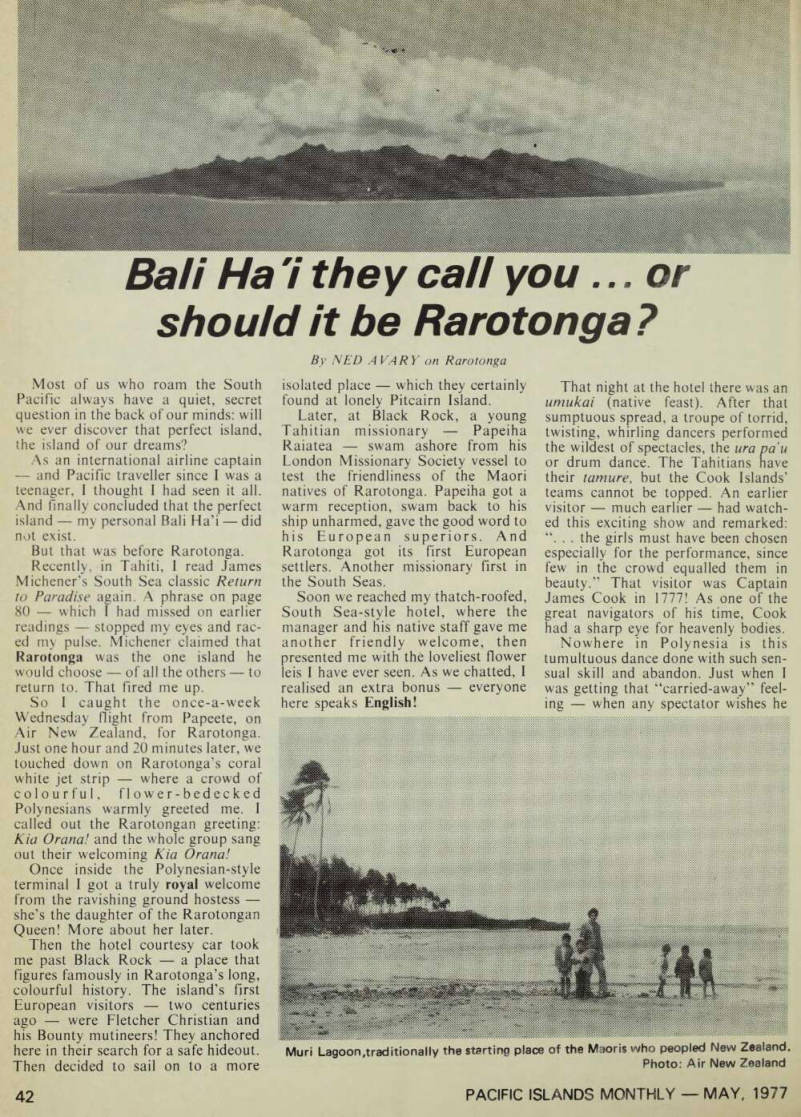
Muri Lagoon,traditionally the starting place of the Maoris who peopled New Zealand.
Photo: Air New Zealand
could jump up and join in the gorgeous dancers leapt from the stage and picked new partners from the guests. Without hesitation I joyously joined the fabulous group.
Later, I wandered down to the moonlit lagoon, gazed at the Southern Cross high in the sky, listened to the symphony of the surf. Had I found my Bali Ha’i?
Over breakfast the next day I studied a local map. Rarotonga is a pocket-sized, green-peaked paradise only five miles across and 20 miles around the coast. I could have hired a motorbike or taken a tour, the latter a great temptation because the royal princess would be hostess. But, I decided on an inexpensive rental car for the day, leaving me free to take my time, go where I liked.
Most of the island road is a “tunnel” of trees huge green utus (like our magnolias back home), flaming red blossoming flamboyants, all meeting overhead, beautiful flowers beneath. Everywhere along the road were smiling people wav ing and returning my Kia Orana with a happy chorus.
Meeting Maori people in Rarotonga is so easy. So pleasant.
These handsome natives are friendly, sincere, uncomplicated, generous and best of all unspoiled.
Everyone has time to stop and chat with a visitor, or go out of their way to be helpful. If someone you meet in vites you home for dinner, he not only means it, but chances are you’ll wind up as a house guest for a week!
Rarotonga and its 14 sister islands are well out of the “rat race”. Most people fish, tend their gardens, work in colourful small shops, dance, raise beautiful large families, attend church and sleep. They also do a lot of laughing, singing and exchanging of flower leis. The turquoise lagoon and blue Pacific are full of fish and fruit is so abundant that no one thinks of sell ing it. Take what you like from the trees papaws, mangoes, avocados, bananas, oranges, pineapples and of course, the ever-present coconuts.
Life has an easy grace here and nature has been kind to these blessed islands.
My hotel manager suggested I stop and see Mr Napa T. Napa at his old country-style store in Arorangi village. I found Napa sitting like a big,'brown, smiling Buddha behind his cash register. But this is an un usual storekeeper he also happens to be the King!
Napa Tinomana Napa, the 30th generation of Ariki (royalty), like to
regale his visitors with tall tales and local lore of the good old days. But, I noticed as I left, he promptly went back to reading his latest issue of Time!
Across the flower-bordered road is King Napa’s century-old palace. A huge, colonial-style mansion of limestone and coral with wide veran dahs. Old Napa, however, prefers to live in the back of his store. His palace is being renovated and will open one day as a colourful tourist attraction. (There are tourists in Rarotonga, by the way. Just a trickle so far, hap pily enough. The island is still too remote, unknown and too expensive to get to for most visitors.) Farther down the road is Rutaki village, facing the lagoon and miles of pure white, palm-lined beach. Here is the home of the late Yankee Clipper skipper Captain Andy Thomson, who sailed these southern seas for 50 years. Nordhoff and Hall called Cap tain Andy their best friend and proved it by dedicating their classic Mutiny on the Bounty to him.
Further on is the home of Sir Albert Henry, Premier of the Cook Islands. His lovely, white, wooden, one-storey house is in an idyllic set ting buried in beautiful flowers, surrounded by graceful palms and right on the beach. Symbolizing the hospitality of Rarotonga, Sir Albert’s front door always stands open. On his 1971 visit, Prince Philip pronounced it the most perfect home in the South Pacific.
My map showed the Ara Metua, the ancestor’s road, which circles the island inland through the foothills. In credibly, this road was built a thou sand years ago by a resourceful engineer named Toi, with a crew of 5,000 Maoris. Even more surprising, this mini-freeway was paved with cobblestones and huge slabs of rock!
King Napa says it was built to
transport fruit and vegetables from native farms to local village markets.
Many small side roads lead inland and I explored one, the Papua River road. It twisted, turned and narrowed, but at the end was my reward; Papua Falls. A piece of Polynesian purity, with lovely falls cascading into a natural swimming pool. There was no one around, so I shed my clothes and dived in. Relaxing in the cool water I thought: “Yes, there’s a waterfall and pool like this on my dream island.”
My next stop was Titikaveka village, where the Seventh-day Adventist Mission nestles amongst the palms. From the office came a tall, redhaired man with a smile of welcome, who introduced himself as Erroll Young. He is a direct descen dant of the Bounty muntineer John Young. Errol was born and raised on lonely Pitcairn Island but chose Rarotonga as his permanent island paradise.
Down a flower-filled lane to the White Sands Restaurant I went, for a tasty snack. Teariki, the Maori owner greeted me with a warm Kia Orana.
Afterwards, fully relaxed, I wandered down the white beach, lay down and fell asleep.
Later, 1 drove eastward to Muri village where I stopped to meet painter Rick Welland and his lovely wife. This American couple, with their two children, have found their Bali Ha’i here too. Rick’s oil pain tings are well-known all over the Pacific and he makes a good living.
They’ve tried leaving twice but always return.
Nearby, in the quiet lagoon, are four motus (islets) you can easily swim to and spend an hour, a day or a week. One, Motu Tapu, is a “for bidden” island, both foreboding and beautiful. Permission to visit this motu is easily obtained from friendly Maori matron Elizabeth who runs
Rarotongan dancers... nowhere in Polynesia is the tumultuous Tamare danced with more sensual skill and abandon. - Photo: Ned Avary.
a tiny hillside shop just opposite Motu Tapu. She will also tell you about the legendary monster lurking in a lagoon cavern. Elizabeth says Buzz Sawyer an American yachtsman visiting Rarotonga in 1958 left hurriedly after an underwater battle with something he encountered in that un derwater cave. Who knows?
On the reef, just opposite the main village, Avarua, rests the remains of the world-famous brigantine Yankee.
She was visiting Rarotonga in 1964 when a storm blew up and her anchors dragged. Engines failed to start and she was thrown onto the reefs foam ing jaws. Yachtsmen around the world wept real salt tears when they heard of her tragic fate.
No Rarotonga tour is complete without getting to know Bill Marsters. To meet him, all you do is visit the beautiful Cook Islands Chris tian Church in Avarua. Bill, a round, robust, Maori, has 12 children of his own, but is also spiritual father of thousands of his church members in the Cook Islands. He was going to visit his sister, Tere, and invited me to join him. Later, Tere and Bill told me one of the Pacific’s most romantic and improbable stories.
Their grandfather, William
Marsters, was a Scottish adventurer who made his fortune in the Califor nia Gold Rush. “Will Bill” then sailed for the South Pacific, where he selected and collected three beautiful wives from Tongareva in the northern Cooks. He promptly settled on remote Palmerston Atoll and with the kind co-operation of his three brides, he produced the Pacific’s best known “Marster” race. There are now over six thousand Marsters descendants!
At the end of the tour, I was enchanted with this incredibly beautiful, friendly and peaceful island. I know now why James Michener chose Rarotonga as the one island he longed to return to and stay.
Rarotonga is not crowded, com mercialised or expensive. Beauti fully furnished, lagoon-side bungalows rent for $l5 a week, choice filet mignon is $1 a pound, fruit and fish are free and Avarua has the best duty-free bargains in the whole Pacific. Medical and dental care? Excellent and free! This is not a tourist place yet. So I didn’t feel like a tourist. I honestly felt that these people really liked me as they do most papa as (foreigners). I had looked at all this sympathetically and
now I listened. The loudest noise was the surf pounding the reef, with a quiet lagoon undisturbed by outboard motors. Natives still paddle their graceful outrigger canoes as they have for centuries.
Finally, someone may ask what about the legendary charm and fabled beauty of the South Sea Island girls? I will only say that I’ve found it all to be true.
How many places are there left like this in the world, 1 wondered? I was soon to find out what this pocket paradise has done for me.
My last day passed too quickly.
The plane was leaving very early, so 1 retired right after dinner. Half awake, my mind kept asking: “Is this Polyne sian paradise really your Bali Ha’i?”
Finally I slept. 1 awakened to a light tapping on my bungalow door. Moana, the lovely Maori maid, whispered: “Captain Ned, it’s nearly time for your flight.”
Without hesitation I replied: “Moana, please cancel my booking, I'm staying longer.”
“Oh! That is good!” Moana warm ly responded. “How much longer?”
“Forever,” I sang out. And meant it. I’d found my Bali Ha’i at last.