mail by outrigger canoe
pp. 39-41 · Read in the full issue
The first Trans-Pacific mail by outrigger canoe
By Sherman Lee Pompey
The American Revolution Bicen tennial voyage of the outrigger canoe Hokule’a from Hawaii to Tahiti recalls to mind a voyage made nearly 40 years ago by the canoe Lealea-Lani with the first Trans-Pacific mail carried by out rigger canoe.
Back in 1938, it was the dream of a seafarer named Captain A. U.
Woodbury 11, who had started his sailing career early in life, and before making the trip had spent 25 years at sea. He had sailed two boats for Sir Wilfred Grenfell carrying supplies from Boston to Newfound land, and had done quite a bit of rough sailing over the Atlantic.
The rest of the crew consisted of A 1 Eastman, a former quartermaster on the inter-island ship Hawaii, and Don Hall, a lifeguard and surfer from California who had been 1935 Coast Champion in the Skimmerette Class.
Before the trip started, they en countered many delays, and the greatest of these was finances. This delayed the Lealea-Lani’s launching until December 1 1, 1938, when several Honolulu businessmen agreed to underwrite the journey.
On the date of sailing they encoun tered a powerful headwind that forced the frail craft back into Kewalo Basin.
They reached Kaupo Gap, Maui, on January 8, 1939, after stops at Kaunakakai on Molokai and Kaanapali on Maui. Old-timers shook their heads and said that they would never make it. The next day the three men were picked up by the Matson freighter Maunanalani in the heavy surging seas between Maui and Hawaii. The Federal Bureau of Steamboat Inspection voiced its “high opinion” about these “stunt trips”, but they could do nothing about it as it did not fall within their jurisdiction.
The Lealea-Lani reached Hilo on January 15, 1939, and spent until April 18 on test runs up and down the coast of Hawaii. These were the hardest three months of the venture
with many tests and trial landings.
In one minor mishap, Woodbury suffered a broken hand, severe abra sions on his head, and had a bad elbow from these tests.
Financial difficulties were solved by Woodbury giving lectures to school children and selling philatelic covers at $1 each. Fifteen years later, I bought 50 of these covers from a Honolulu dealer at 10c each. One financial prospect was turned down when Woodbury refused a $5O bribe to take a woman along.
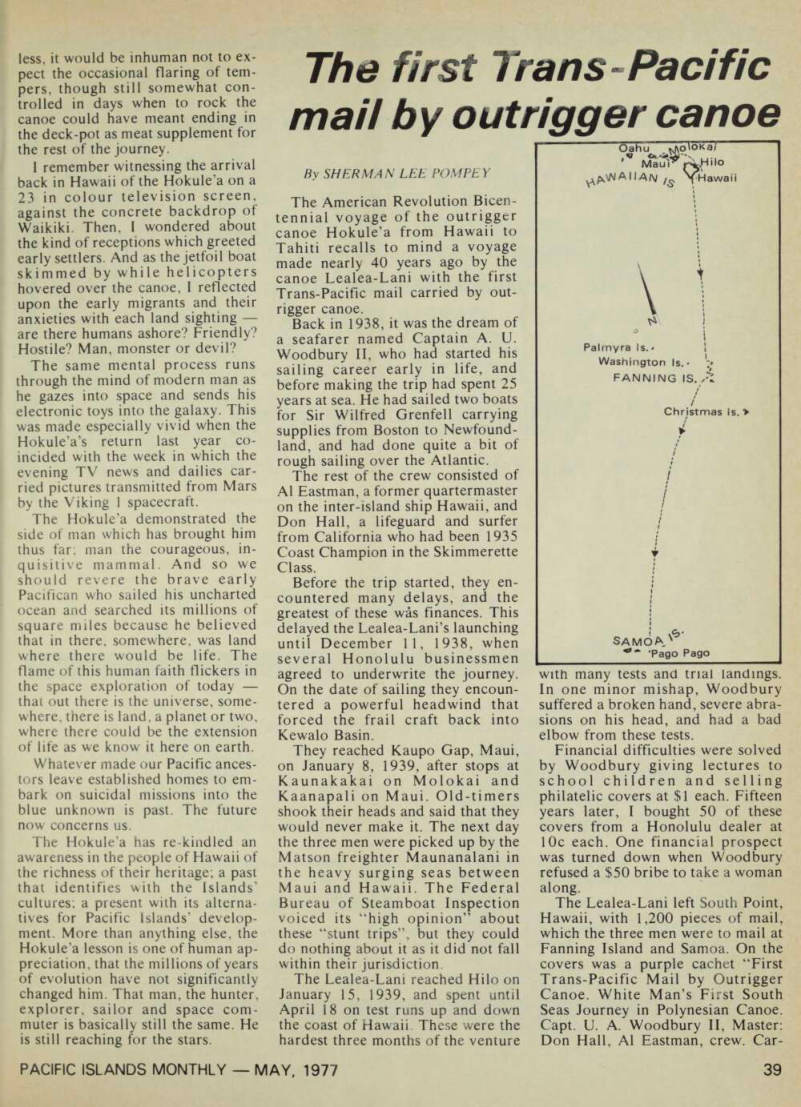
The Lealea-Lani left South Point, Hawaii, with 1,200 pieces of mail, which the three men were to mail at Fanning Island and Samoa. On the covers was a purple cachet “First Trans-Pacific Mail by Outrigger Canoe. White Man’s First South Seas Journey in Polynesian Canoe.
Capt. U. A. Woodbury 11, Master: Don Hall, A 1 Eastman, crew. Car
ried by Canoe Lealea-Lani Hawaiian Islands To Pago Pago.”
These covers were all postmarked at Honolulu on December 31, 1938 at midnight. They were sealed in one and five gallon cans for the voyage. The stamps were generally the 2c United States of the Army- Navy series, the 2c 1938 Presiden tial series and the 3c Hawaii issue.
The Lealea-Lani got off to a secret start in the early morning hours and was later spotted by an Army pilot who was flying south from Hawaii in the afternoon. Don Hall said they had expected to reach Fanning in the 10 days, but about the time they were to have reached Fanning overcast skies prevented a sight for position, a condition that remained for four days. Meanwhile the chronometer stopped. They searched for Fanning for five days until food and water were ex hausted, and then decided to head for Samoa. Samoa was ap proximately another 20 days away.
After five days they caught 10 gallons of water in the sails and on the seventh day they caught a 21b barracuda. The 10th day they caught a bonita. They tried to spear sharks to eat, but these were too large for their spears.
Thirty-four days out they spotted land dead ahead. It was an uninhabited cove in Samoan waters, where they found some coconuts.
Everyone was exhausted. The next day, Don Hall walked to a village, Aoloau, about two miles away, and the natives came and towed the canoe to the village. They arrived in the village the next day, and the third day reached Pago Pago by na tive rowboat and trail. In Pago Pago they were acclaimed by High Chief Fuimanono as “Greatest skipper to day of sailing craft”. This was a title given only by Samoans when well deserved in consideration of actual accomplishment.
The philatelic covers were a mess.
Many of them had rust spots on them, and Woodbury had to glue the stamps back on many of them, being careful that the stamps coincided with the postmarks.
“A thankless job,” he said, “but I feel that the people who gave me the dollar are entitled to it.” These covers were postmarked Pago Pago, Samoa 29 May, 1939, and back stamped upon arrival in Honolulu.