Hokule'a, the canoe, taught
pp. 37-39 · Read in the full issue
modern man an old lesson
From LASARUSA VUSONIWAILALA in Honolulu
As I watched the National Geographic film of the Hokule’a the other night on public television, I was reminded of my scepticism, this time last year, at its chances of mak ing it to Tahiti. As a Pacific Islander my head is bowed in shame at my lack of faith in our traditional capabilities, although the success of the trip has raised my Pacific pride to new heights.
That I doubted the likelihood of the canoe’s chance was not so much a denial of our renowned seaman ship of the past and present, as an acknowledgment of how much I had been charmed by the spirit of Kon tiki and the adventurous Thor Heyerdahl. Now that the most re cent seafaring expedition has subs tantiated the Tahiti-Hawaii origin, I am happier with what previously was an untested theory.
Our derision over the ingenuity of early man is the product of our mechanical minds of today. In en vironments that abound with scien tific gadgets we are inclined to see every facet of development and achievement as the output of monstrous computers, of some mag nificent machines. We have almost forgotten that they are but waves of the human brain. Modernisation through science and modern tech nology has led man to self-doubt and the depreciation of human culture. His industrial and electronic jungle has made him un concerned over nature and his earlier empathy with the ecology.
Hokule’a has proved to be more than support for a migration theory.
It has elicited deeper emotions than the cultural awareness of the peo ples of Oceania. Hokule’a has shown the rest of the world a part of its past. It may also have contained an inkling of the future.
Hokule’a has been an outstanding success. Its critics have been rather unrealistic, by focusing on the petty which pales in the dazzle of the en-
The film of the voyage of the Hokule’a from Hawaii to Tahiti and return began, in mid-January, a season on cinema and television screens in Honolulu.
Lasarusa Vusoniwailala, a Fijian studying at the East- West Communication In stitute in Hawaii, analyses his reaction as an Islander to the Hokule’a ex periment.
deavour’s achievements.-There have been those who criticised the modern amenities which were essentials for the trip and ignore the spirit in which it was made. It was a scientific expedition, unlike the suicide voyages of the past, many taken when the consequences of remaining on hostile land were as dire, if not worse, than the probability.
The attempt at authenticity was admirable. The cry against non-indigenous material and people making the trip was akin to our forefathers having sailed with com-
passes while subsisting on vitamin and protein tablets. There is a time and place for everything. Besides, who can define and find the “true”
Polynesian?
An interesting contrast was in me media publicity of the squabbles that rippled aboard the canoe dur ing its southbound journey. Every island of the Pacific has legends on the arrivals of their respective an cestors and almost all include dis agreements among kin or intra tribal fighting at some point after disembarkation.
In the case of the Fijians, the popular legend has it that our ances tors landed at Vuda, Veiseisei, which is close to present-day Nadi International Airport. The two names themselves tell the story of arrival Vuda means “our origin”, and Veiseisei means “divisive con flict”. Quarrels among the brothers of the first landing family ended in a “split” at Veiseisei, dividing them into factions who headed in separate directions to occupy and populate other parts of the Fiji Group.
Long and tortuous sea voyages demanded the best of endurance in the disciplined seaman. Neverthe-
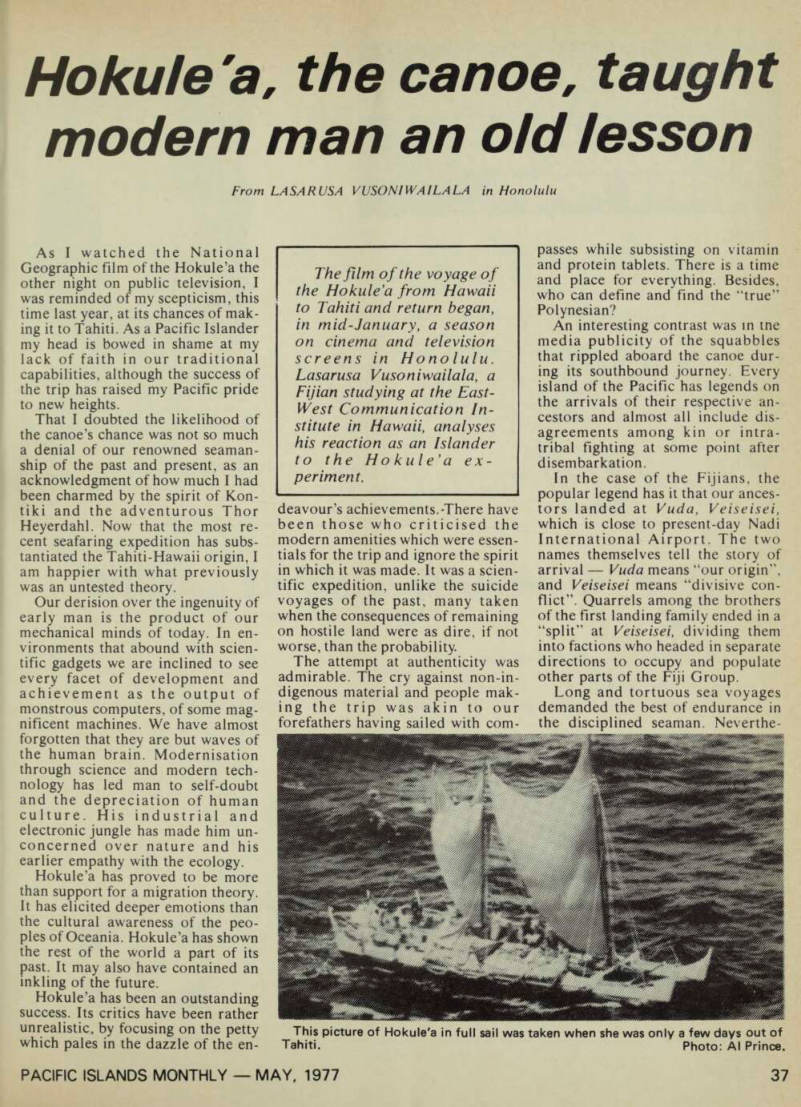
This picture of Hokule'a in full sail was taken when she was only a few days out of Tahiti. Photo: Al Prince.
less, it would be inhuman not to ex pect the occasional flaring of tem pers, though still somewhat con trolled in days when to rock the canoe could have meant ending in the deck-pot as meat supplement for the rest of the journey.
I remember witnessing the arrival back in Hawaii of the Hokule’a on a 23 in colour television screen, against the concrete backdrop of Waikiki. Then, I wondered about the kind of receptions which greeted early settlers. And as the jetfoil boat skimmed by while helicopters hovered over the canoe, I reflected upon the early migrants and their anxieties with each land sighting are there humans ashore? Friendly?
Hostile? Man, monster or devil?
The same mental process runs through the mind of modern man as he gazes into space and sends his electronic toys into the galaxy. This was made especially vivid when the Hokule’a’s return last year co incided with the week in which the evening TV news and dailies car ried pictures transmitted from Mars by the Viking 1 spacecraft.
The Hokule’a demonstrated the side of man which has brought him thus far; man the courageous, in quisitive mammal. And so we should revere the brave early Pacifican who sailed his uncharted ocean and searched its millions of square miles because he believed that in there, somewhere, was land where there would be life. The flame of this human faith flickers in the space exploration of today thai out there is the universe, some where, there is land, a planet or two, where there could be the extension of life as we know it here on earth.
Whatever made our Pacific ances tors leave established homes to em bark on suicidal missions into the blue unknown is past. The future now concerns us.
The Hokule’a has re-kindled an awareness in the people of Hawaii of the richness of their heritage; a past that identifies with the Islands’ cultures; a present with its alterna tives for Pacific Islands’ develop ment. More than anything else, the Hokule’a lesson is one of human ap preciation, that the millions of years of evolution have not significantly changed him. That man, the hunter, explorer, sailor and space com muter is basically still the same. He is still reaching for the stars.