American Samoans on the road
p. 13 · Read in the full issue
to true Americanisation
From FELISE VA A in Apia
Recent political developments in American Samoa definitely point to some drastic changes in the future which will have repercussions on the political geography of the South Pacific.
The most significant development was the territory’s fourth plebiscite on whether the people of American Samoa should elect their own gover nor and lieutenant-governor. Thrice before, over several years, the people have rejected the measure. But in the fourth plebiscite on August 31, 1976, the people voted overwhelmingly almost three to one in favour of the proposal.
The bureaucratic machineries in both Washington and American Samoa are now being geared to prepare the groundwork leading to the local election of a governor and lieutenant-governor by November, 1977, and even earlier, if possible.
There is no doubt now the Interior Department, which is reponsible for the administration of all US territories, will go along with the wishes of the Samoan people about electing their own top executives, and has formed an Elected Governor Commission to look into all the aspects involved.
On the commission are C. Brewster Chapman, associate solicitor for the Department of Interior, chairman; ac ting Governor Frank Barnett; former governor Earl Ruth; Representative Eaasuka Lutu; Senator Fofo Sunia; High Chief Leiato; Don Moysey, financial officer for Territorial Af fairs; Senate President Salanoa Aumoeualogo; House Speaker Te’o fuavai; Delegate-At-Large A.P.
Lutali; Attorney-General Lyle Rich mond and Paopaoailua Meko, assis tant director of Samoan Affairs.
Its functions have caused con troversy and brought strong criticism from Representative Joe luli, the in fluential chairman of American Samoa’s House Budget and Ap propriations Committee.
According to Pago reports, luli said that while in Washington on government business in September, the deputy director for Territorial Af
fairs, requested the formation by the local legislature of a “transition com mission”. However, when the bill for this purpose was finally introduced the commission was no longer a “transition” one, but an “elected governor” one. The alteration in the commission’s name is a controversial matter, maintains luli, and threatens to usurp the powers of the local legislature.
A bill now before the US Congress provides that the legislature “establish rules and procedures for the nomination, qualifications, term of office and removal of the gover nor,” luli says. It now seems that the new commission, in session since November, has taken over those func tions being earmarked for the local legislature, luli argues. He says he was removed from membership of the commission because of his critical views.
The elected governor will still come under the authority of the Interior Secretary, who will still be responsible to Congress for the administration of American Samoa.
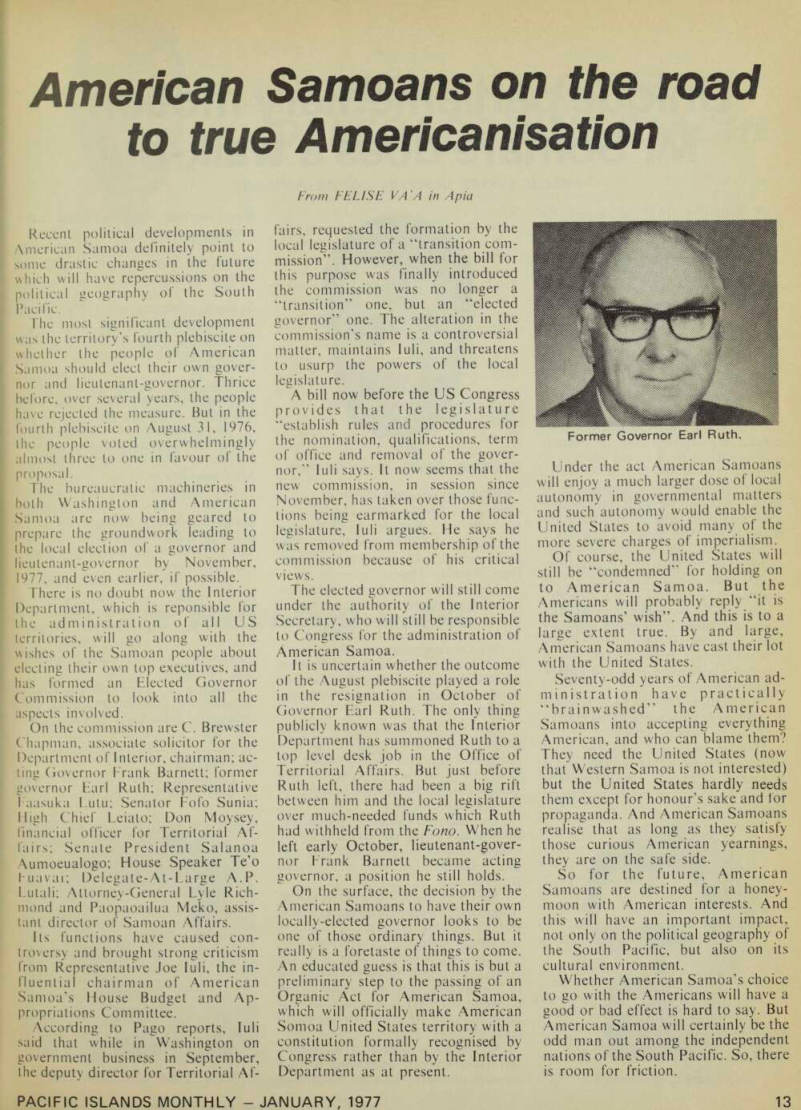
It is uncertain whether the outcome of the August plebiscite played a role in the resignation in October of Governor Earl Ruth. The only thing publicly known was that the Interior Department has summoned Ruth to a top level desk job in the Office of Territorial Affairs. But just before Ruth left, there had been a big rift between him and the local legislature over much-needed funds which Ruth had withheld from the Fono. When he left early October, lieutenant-gover nor Frank Barnett became acting governor, a position he still holds.
On the surface, the decision by the American Samoans to have their own locally-elected governor looks to be one of those ordinary things. But it really is a foretaste of things to come.
An educated guess is that this is but a preliminary step to the passing of an Organic Act for American Samoa, which will officially make American Somoa United States territory with a constitution formally recognised by Congress rather than by the Interior Department as at present.
Under the act American Samoans will enjoy a much larger dose of local autonomy in governmental matters and such autonomy would enable the United States to avoid many of the more severe charges of imperialism.
Of course, the United States will still be “condemned” for holding on to American Samoa. But the Americans will probably reply “it is the Samoans’ wish”. And this is to a large extent true. By and large, American Samoans have cast their lot with the United States.
Seventy-odd years of American ad ministration have practically “brainwashed” the American Samoans into accepting everything American, and who can blame them?
They need the United States (now that Western Samoa is not interested) but the United States hardly needs them except for honour’s sake and for propaganda. And American Samoans realise that as long as they satisfy those curious American yearnings, they are on the safe side.
So for the future, American Samoans are destined for a honey moon with American interests. And this will have an important impact, not only on the political geography of the South Pacific, but also on its cultural environment.
Whether American Samoa’s choice to go with the Americans will have a good or bad effect is hard to say. But American Samoa will certainly be the odd man out among the independent nations of the South Pacific. So, there is room for friction.
Former Governor Earl Ruth.