Unique parliamentary motion?
pp. 14-15 · Read in the full issue
Mr Somare does a walk-out
From A Port Moresby Correspondent
A walk-out from parliament by Prime Minister Michael Somare, an apology to him and to parliament staff by Speaker Barry Holloway, a motion to bring the 1977 Papua New Guinea elections forward by several months, and a government decision to withdraw a controversial Public Order Bill these were features of an
increasingly ragged parliamentary
scene in Port Moresby in late November-early December.
Mr Somare staged his angry walk out after Mr Holloway, criticised parliamentary staff following a pro cedural mix-up in which he himself had appeared to lose the thread of events.
Mr Holloway later apologised to Mr Somare and the staff, but by that time the Prime Minister had been out of the House for about 15 minutes.
Mr Somare was clearly the victim of frayed nerves following frustrations which had been distrupting the government’s control of the House.
Earlier in the same day he had twice attempted to suspend standing orders to move that next year’s general election be held earlier than planned. Parliament refused to allow
the suspension.
Mr Somare will now need 52 votes if parliament is to agree to his plan to hurry up the election date.
This is just over half the total number of votes in parliament, and is a good 10 votes more than the government can normally rely upon with confidence.
There thus seems little chance of success for Mr Somare’s sudden plan to call for elections in February instead of later in the year. The projected date at present is anywhere from April to June.
Mr Somare’s move was partly an act of bravado after being challenged in parliament by a former member of his ministry, Mr lambakey Okuk.
Mr Okuk challenged Mr Somare to call an early poll during a debate on Mr Okuk’s motion of no-confidence in the recent appointment of two ministers.
One of the ministers, Mr Waitea Magnolias, had been an Opposition front-bencher, but since crossing the floor to join the government has denied that he was ever a member of the Opposition party.
The other, Mr Moses Sasakila, lost his seat in Parliament earlier last year over a constitutional issue but was later reinstated following an appeal to the courts.
Mr Okuk accused the government of making the appointments as a last minute election gimmick, and called the two ministers “power-hungry”.
The Opposition Leader, Sir Tei Abal, criticised political horsetrading in Parliament. He also warned of the dangers if PNG allowed itself to develop in the direction of a one-party state.
Mr Somare was also no doubt influenced by an increasing feeling among all parties that an election is
long overdue, and that the more quickly it is approached the better.
But when it comes to the crunch, few members are likely to be prepared to do much about it.
The 52 votes required by Mr Somare represent what the House defines as an absolute majority more than half the total membership, and not simply a majority of those present.
The absolute majority is needed because Mr Somare’s motion involves rescinding an earlier decision.
Announcement of the withdrawal of the Public Order Bill was made to parliament by the Justice Minister, Mr Ebia Olewale. the Bill, which had aroused
unprecedented public opposition, was
designed to give special powers to police and other authorities in places and at times where a civil emergency
was proclaimed.
Under declared emergencies, police would have had power to restrict or prevent movement and association, to search without warrant, to control speech and publication and to make “holding type” arrests.
Despite a series of safeguards designed to prevent improper dec laration of a state of civil emergency, the Bill was widely criticised as repressive and as an interference with civil liberties.
Demonstrations and other forms of opposition reached such a point
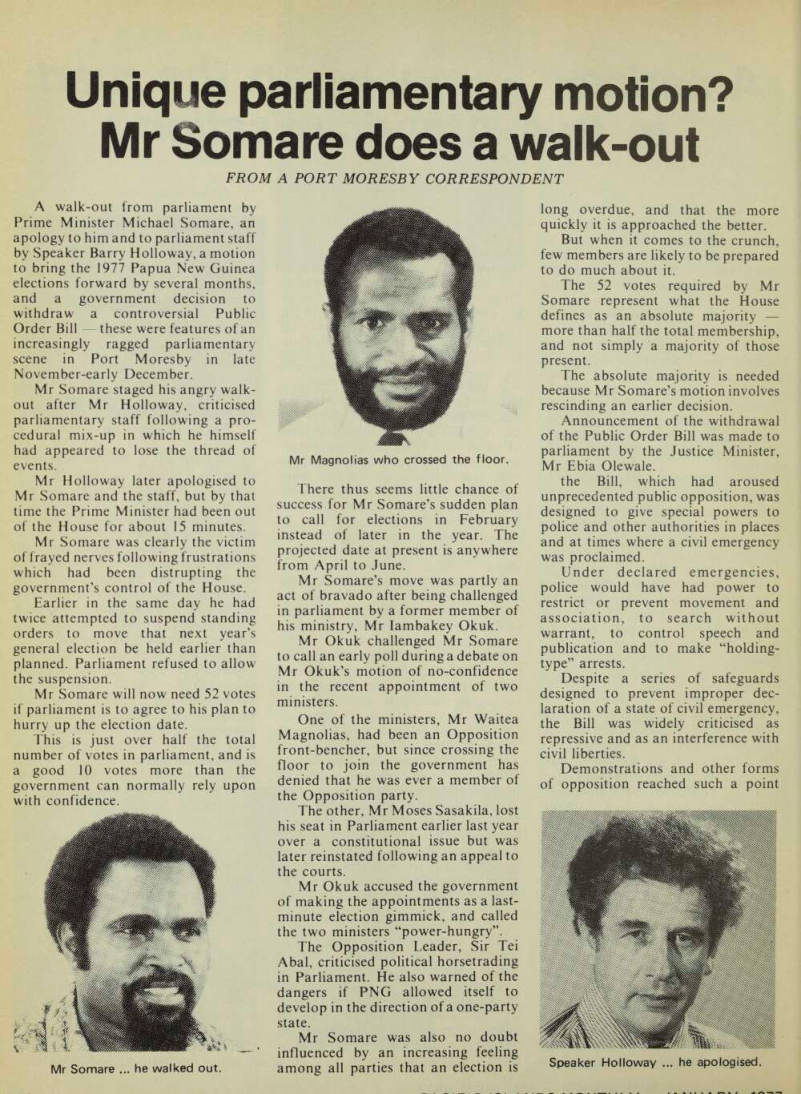
Mr Somare ... he walked out.
Mr Magnolias who crossed the floor.
Speaker Holloway ... he apologised.
that the government appointed a special committee to canvass public opinion.
Mr Olewale told parliament that the committee had recommended that the Bill be withdrawn because of public attitudes and alternative suggestions.
He said the government accepted the committee’s recommendations, and accordingly was withdrawing the bill.
Some of the committee’s proposals originated with the PNG Law Reform Commission, and others with the Faculty of Law at the PNG University.
Altogether, it was a bumpy period for the fledgling parliamentary democracy of PNG.
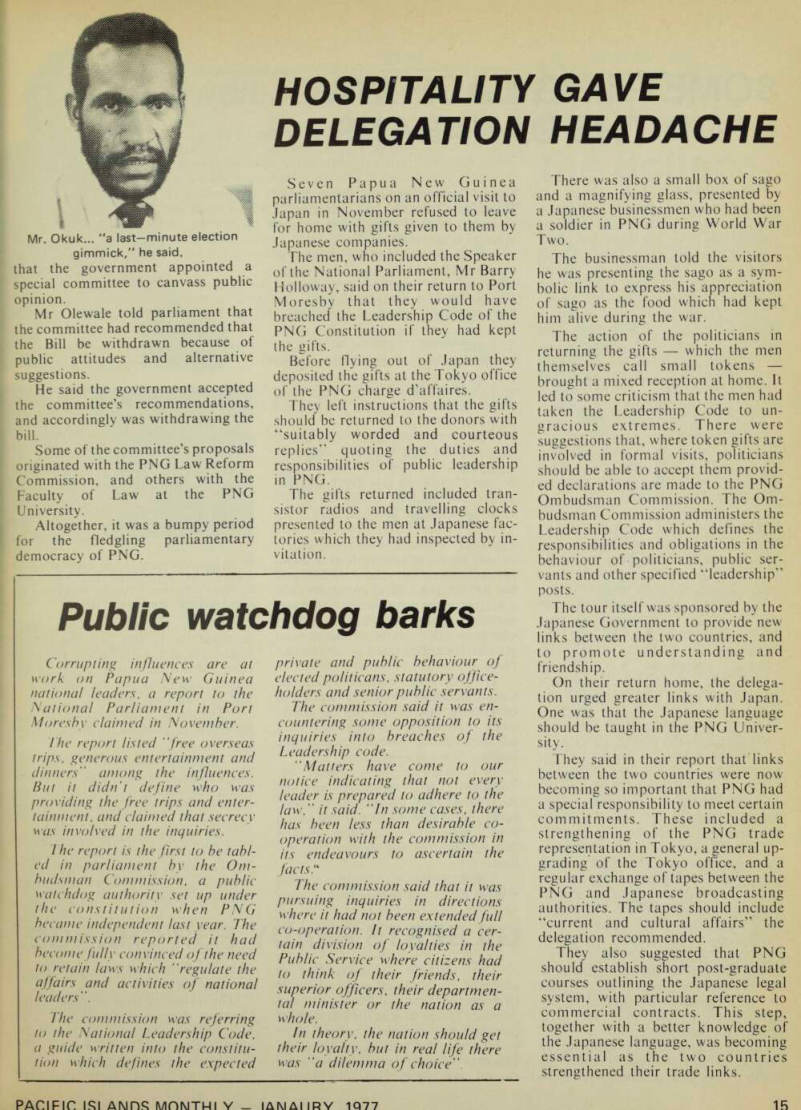
Mr. Okuk... "a last-minute election gimmick," he said.