The waiting is over but
pp. 11-12 · Read in the full issue
indecision lingers on
From FRANCIS ROLLEY in Kingston
Norfolk Island enters the new year
with anticipation and apprehension
following the release of Sir John Nimmo’s Royal Commission report detailing a future constitutional, social, and economic blueprint for the community’s 1600 residents.
Everyone Pitcairn descendants who claim Norfolk as their homeland with valid moral, if no longer legal, justification; long-standing immigrants, many of them retired; more recent arrivals who have invested in local businesses and taken up residence; itinerant workers passing through; and even visiting tourists will be affected in some way if the Nimmo recommendations are adopted by the Australian Government.
Public meetings with attendances in the hundreds, informal discussions
among community leaders, private
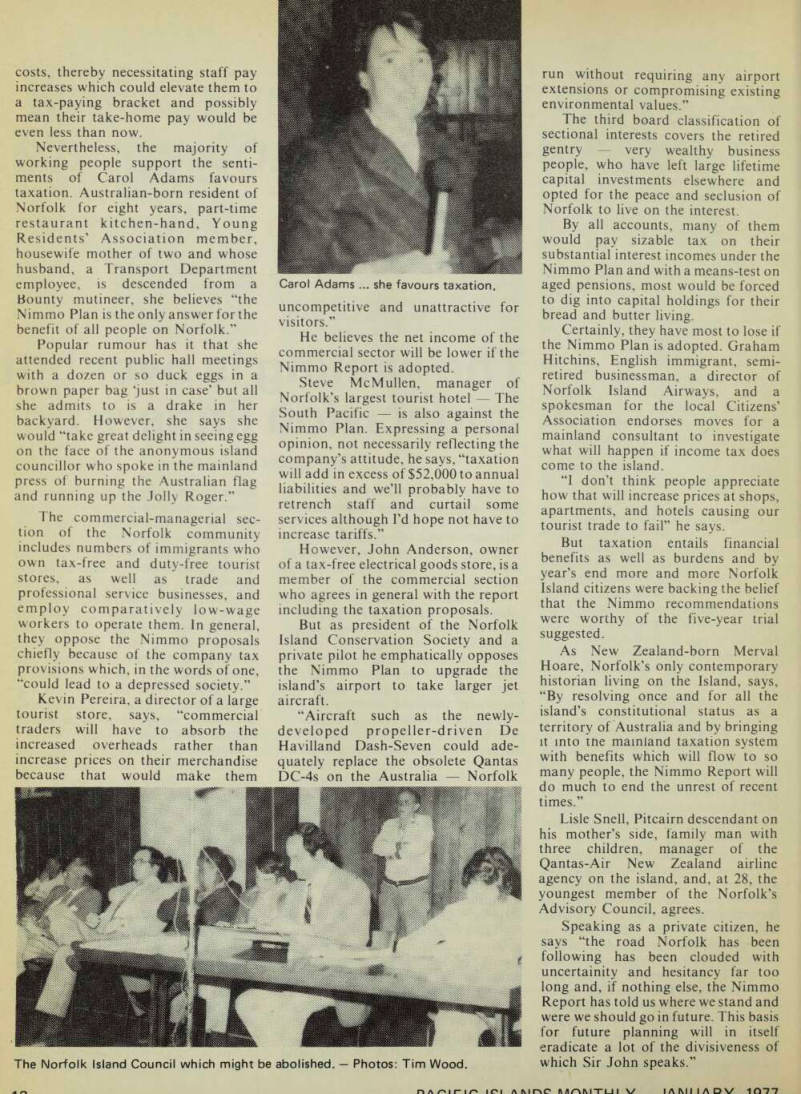
conferences of wealthy big-business interests, and in-camera as well as open special and regular monthly sessions of the eight-member Norfolk Advisory Council which faces abolition under the Nimmo Plan have been held to consider the matter.
The various vested interests
provoked myriad opinion ranging
from favourable to foreboding which suggested Sir John Nimmo correctly read the climate when he referred to a community deeply divided by factions. His remarks spurred a flurry of comment in the Australian mainland media and a storm of indignant reaction on the island but in spite of
protestations many, although not all, residents with unwitting irony still disagree that they are deeply disagreed over the recommendations, The divisions, not surprisingly, fall broadly along economic lines and the contentious issue is taxation at Australian mainland rates. There are the low-wage workers who include the majority of Pitcairn descendant islanders along with a few long standing immigrant residents and many Australians, New Zealanders, and other nationals who, during shorter stays, engage in the mundane and menial occupations of the tourist support industries.
Because the average islander and itinerant earn less than the minimum taxable mainland wage it would seen they’ll be least scarred by the Nimmo Plan while sharing the economic and social welfare benefits from Canberra it proposes.
Islanders welcome any move to force very wealthy outsiders who they see as exploiting their homeland and erasing their heritage into paying a part of Norfolk’s present maintenance and future development costs in return for the privilege of residence.
But at the same time, some itinerants and islanders are chary of wage-price inflationary spirals which plague Australia. They fear their employers, if required to pay company tax, will increase retail prices, thus raising general living
costs, thereby necessitating staff pay increases which could elevate them to a tax-paying bracket and possibly mean their take-home pay would be even less than now.
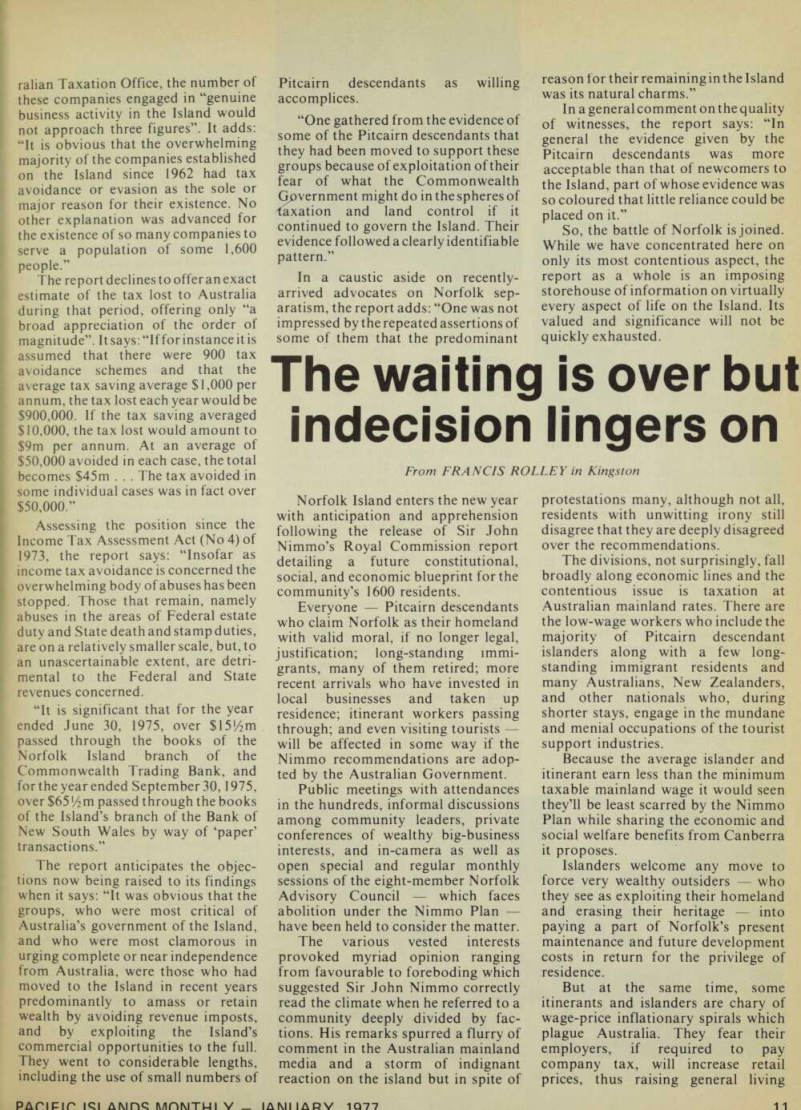
Nevertheless, the majority of working people support the senti ments of Carol Adams favours taxation. Australian-born resident of Norfolk for eight years, part-time restaurant kitchen-hand. Young Residents’ Association member, housewife mother of two and whose husband, a Transport Department employee, is descended from a Bounty mutineer, she believes “the Nimmo Plan is the only answer for the benefit of all people on Norfolk.”
Popular rumour has it that she attended recent public hall meetings with a dozen or so duck eggs in a brown paper bag ‘just in case’ but all she admits to is a drake in her backyard. However, she says she would “take great delight in seeing egg on the face of the anonymous island councillor who spoke in the mainland press of burning the Australian flag and running up the Jolly Roger.”
The commercial-managerial sec tion of the Norfolk community includes numbers of immigrants who own tax-free and duty-free tourist stores, as well as trade and professional service businesses, and employ comparatively low-wage workers to operate them. In general, they oppose the Nimmo proposals chiefly because of the company tax provisions which, in the words of one, “could lead to a depressed society.”
Kevin Pereira, a director of a large tourist store, says, “commercial traders will have to absorb the increased overheads rather than increase prices on their merchandise because that would make them
uncompetitive and unattractive for visitors.”
He believes the net income of the commercial sector will be lower if the Nimmo Report is adopted.
Steve McMullen, manager of Norfolk’s largest tourist hotel The South Pacific is also against the Nimmo Plan. Expressing a personal opinion, not necessarily reflecting the company’s attitude, he says, “taxation will add in excess of $52,000 to annual liabilities and we’ll probably have to retrench staff and curtail some services although I’d hope not have to increase tariffs.”
However, John Anderson, owner of a tax-free electrical goods store, is a member of the commercial section who agrees in general with the report including the taxation proposals.
But as president of the Norfolk Island Conservation Society and a
private pilot he emphatically opposes
the Nimmo Plan to upgrade the island’s airport to take larger jet aircraft.
“Aircraft such as the newly developed propeller-driven De Havilland Dash-Seven could ade quately replace the obsolete Qantas DC-4s on the Australia Norfolk
run without requiring any airport
extensions or compromising existing
environmental values.”
The third board classification of sectional interests covers the retired gentry very wealthy business people, who have left large lifetime capital investments elsewhere and opted for the peace and seclusion of Norfolk to live on the interest.
By all accounts, many of them would pay sizable tax on their substantial interest incomes under the Nimmo Plan and with a means-test on aged pensions, most would be forced to dig into capital holdings for their bread and butter living.
Certainly, they have most to lose if the Nimmo Plan is adopted. Graham Hitchins, English immigrant, semi retired businessman, a director of Norfolk Island Airways, and a spokesman for the local Citizens’
Association endorses moves for a mainland consultant to investigate what will happen if income tax does come to the island.
“I don’t think people appreciate how that will increase prices at shops, apartments, and hotels causing our tourist trade to fail” he says.
But taxation entails financial benefits as well as burdens and by year’s end more and more Norfolk Island citizens were backing the belief that the Nimmo recommendations were worthy of the five-year trial suggested.
As New Zealand-born Merval Hoare, Norfolk’s only contemporary historian living on the Island, says, “By resolving once and for all the island’s constitutional status as a territory of Australia and by bringing it into tne mainland taxation system with benefits which will flow to so many people, the Nimmo Report will do much to end the unrest of recent times.”
Lisle Snell, Pitcairn descendant on his mother’s side, family man with three children, manager of the Qantas-Air New Zealand airline agency on the island, and, at 28, the youngest member of the Norfolk’s Advisory Council, agrees.
Speaking as a private citizen, he says “the road Norfolk has been following has been clouded with uncertainly and hesitancy far too long and, if nothing else, the Nimmo Report has told us where we stand and were we should go in future. This basis for future planning will in itself eradicate a lot of the divisiveness of which Sir John speaks.”
The Norfolk Island Council which might be abolished.-Photos: Tim Wood.
Carol Adams ... she favours taxation.