Nimmo Seizes The Nettle And
pp. 10-11 · Read in the full issue
Stings Norfolk’S Newcomers
“It is hard to do justice to the spirit of order and decency that animates the whole community, whose number amounts to 170, strictly brought up in the Protestant faith according to the Established Church of England, by Mr Nobbs, their pastor and surgeon, who has, for 24 years, zealously and successfully, by precept and example, raised them to a state of the highest moral conduct and feeling ...” (Admiral Moresby on the Pitcairners in 1852, four years before their transfer to Norfolk Island.) “It really appears to me wonderful that a small community like this should have succeeded in so completely gulling the whole world into a belief that they are an isle of saints. I believe there is more immorality of all kinds here, according to population, than in any other civilised part of the world.. ” (Sydney magistrate Henry Wilkinson, reporting on Norfolk Island to Governor Loftus of New South Wales, 1885.) “A feature of this modern society is the number of factions which exist.
Pitcairn descendants, traders, operators of tax avoidance schemes, retired people and new farmers all constitute divergent groups. A superficial friendliness and con viviality masks a deal of resentment and dislike among some of the groups.
“Many Pitcairn descendants bitterly resent what they regard as the misuse of their Island by many newcomers whose predominant reason for being in the Island is to amass or retain wealth by avoiding revenue imposts and in some cases to help others to do likewise . . .
“It would be extremely difficult for this small faction-riddled and confined community to evolve for the Island policies that are likely to receive general acceptance in respect of major matters.” (Judge Nimmo in his “Report of the Royal Commission into Matters Relating to Norfolk Island”, 1976).
Such are three outsiders’ views of the same community at different points in its development over a century and a quarter.
The contrasting opinions of the
admiral and the magistrate reflect sharp changes in prevailing attitudes to the community of Pitcairners at different times in the 19th century.
But the opinion of the Nimmo Commission is topical in the extreme.
Its conclusion that, in present circumstances, it is impossible to obtain a genuine popular consensus on “Major matters” on Norfolk led directly to the main, and most controversial, point made in its 420page report which was tabled in the Australian Parliament in November; that the Australian Commonwealth itself should, “by a conscious and quite deliberate adoption of measures, bring the Island wholly within the Australian taxation system”.
In return, the commission says, all social security, pensions, medical, hospital and other health benefits dispensed by the Commonwealth Government would be extended to the residents of the Island. The burden of education would be taken over by the Commonwealth Government, which would be obliged to ensure that educational facilities were of the same standard as in the rest of the Australian territories.
As well as recommending the abolition of the present Norfolk Island Council and its replacement by a nine member, elected Norfolk Island Territory Assembly, the commission suggests that, in order to give them representation in the Commonwealth Parliament, Norfolk Island residents
should be included in the electorate of Canberra in the Australian Capital Territory.
This seizing of the Norfolk nettle by the commission has predictably brought protests from various circles on the Island, especially those most directly interested in preserving what remains of its tax-haven status.
A public meeting on the Island on November 23, which discussed the Nimmo report, heard various calls for “secession” from such circles. How ever, the meeting ended with a decision for one more try to persuade Canberra to let the Island carry on its old way.
But all signs are that this is just not on. Answering a question in Common wealth Parliament on November 17, the Australian Treasurer, Mr Lynch said that his government was “determined ... to make sure that neither Norfolk Island nor the other islands in its vicinity in that part of the Pacific Ocean can be used as tax avoidance havens”.
A substantial part of the Nimmo report is naturally devoted to the Island’s status as a tax haven, a status derived from the Acts Interpretation Act (1901-1973) which ruled that Norfolk Island is not part of “Australia” for taxation purposes.
The report records that in the 37 years from beginning of 1926, when the Island’s Companies Ordinance was first promulgated, to the end of 1962, seven companies were registered on the Island. By that time and not before Norfolk Island had developed what the report calls the “prerequisites of a tax haven”. These included, notably, efficient banking services, and satis factory communication facilities (transport, telephone, telex and mail).
In the next 10 years, to the end of 1972 no fewer than 1,920 companies were registered on the Island. (Put statistically, this means that from 1926 to 1962, a company was registered on Norfolk Island every 1,929.9 days.
From 1962 to 1972, the rate of registration was one every 1.9 days, a factor of increase in the rate of company registrations of 1,015.7!) The report says that, from information available to the Aust
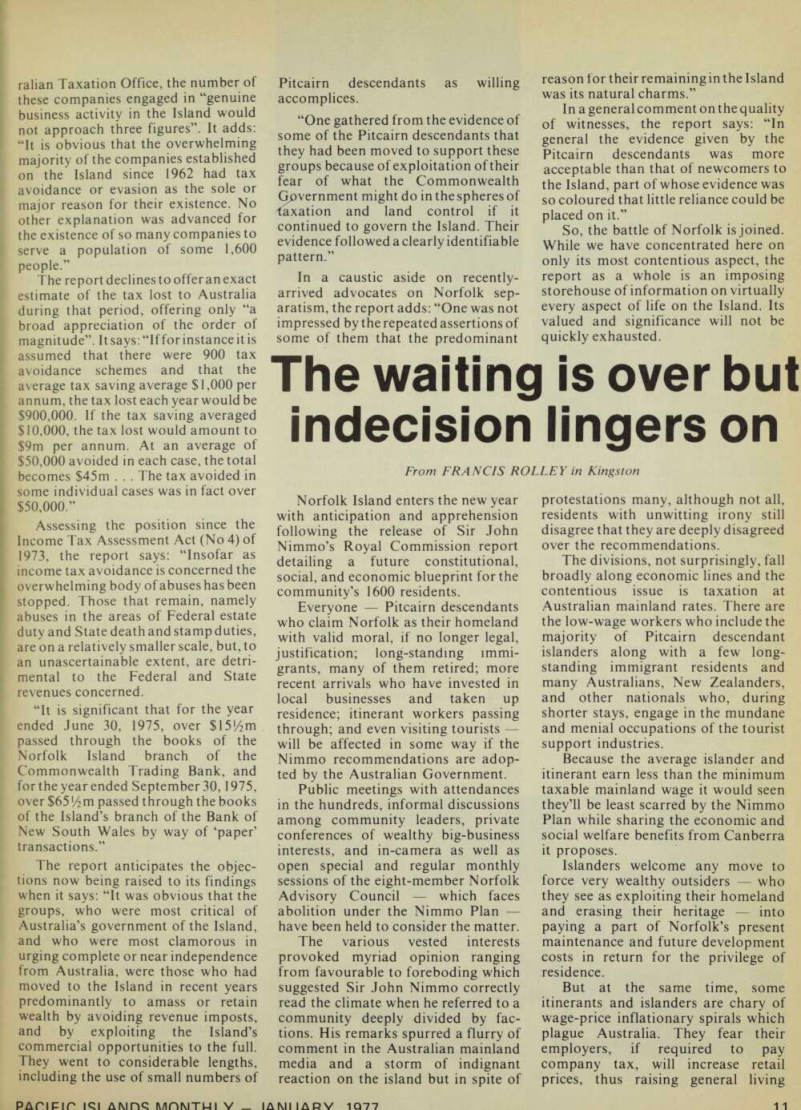
Sir John Nimmo ... this small faction ridden community.
ralian Taxation Office, the number of these companies engaged in “genuine business activity in the Island would not approach three figures”. It adds: “It is obvious that the overwhelming majority of the companies established on the Island since 1962 had tax avoidance or evasion as the sole or major reason for their existence. No other explanation was advanced for the existence of so many companies to serve a population of some 1,600
people.”
The report declines to offer an exact estimate of the tax lost to Australia during that period, offering only “a broad appreciation of the order of magnitude”. It says; “If for instance it is assumed that there were 900 tax avoidance schemes and that the average tax saving average $l,OOO per annum, the tax lost each year would be $900,000. If the tax saving averaged $lO,OOO, the tax lost would amount to s9m per annum. At an average of $50,000 avoided in each case, the total becomes s4sm . . . The tax avoided in some individual cases was in fact over $50,000.”
Assessing the position since the Income Tax Assessment Act (No 4) of 1973, the report says; “Insofar as income tax avoidance is concerned the overwhelming body of abuses has been stopped. Those that remain, namely abuses in the areas of Federal estate duty and State death and stamp duties, are on a relatively smaller scale, but, to an unascertainable extent, are detri mental to the Federal and State revenues concerned.
“It is significant that for the year ended June 30, 1975, over sls'/2m passed through the books of the Norfolk Island branch of the Commonwealth Trading Bank, and for the year ended September 30,1975, over s6s'/4m passed through the books of the Island’s branch of the Bank of New South Wales by way of ‘paper’ transactions.”
The report anticipates the objec tions now being raised to its findings when it says: “It was obvious that the groups, who were most critical of Australia’s government of the Island, and who were most clamorous in urging complete or near independence from Australia, were those who had moved to the Island in recent years predominantly to amass or retain wealth by avoiding revenue imposts, and by exploiting the Island’s commercial opportunities to the full.
They went to considerable lengths, including the use of small numbers of
Pitcairn descendants as willing
accomplices.
“One gathered from the evidence of some of the Pitcairn descendants that they had been moved to support these groups because of exploitation of their fear of what the Commonwealth Gpvernment might do in the spheres of taxation and land control if it continued to govern the Island. Their evidence followed a clearly identifiable pattern.”
In a caustic aside on recentlyarrived advocates on Norfolk separatism, the report adds: “One was not impressed by the repeated assertions of some of them that the predominant
reason t or their remaining in the Island was its natural charms.
In a general comment on the quality of witnesses, the report says: “In general the evidence given by the Pitcairn descendants was more acceptable than that of newcomers to the Island, part of whose evidence was so coloured that little reliance could be placed on it.”
So t he battle of Norfolk is joined, wh i le we have concentrated here on only j ts mo st contentious aspect, the report as a whole is an imposing storehouse of information on virtually every aspect of life on the Island. Its valued and significance will not be
quickly exhausted.