in Papua New Guinea
pp. 8-9 · Read in the full issue
The women are stepping out in Papua New Guinea
From MACLAREN HIARI in Port Moresby
Traditionally women in the South Pacific have played a subservient role to their men. But today in Papua New Guinea, the largest country in the region, women are coming out with the same vigour and panache as the new nation itself.
The traditional role of women in PNG varies from tribal group to tribal group, from area to area, and also over time. While they carry a major share of the economic burden, they also exert power and influence. It is difficult to make generalisations because of the need to assess the in terplay of customs and of social and economic forces.
But even where, to Western eyes, customs seem to be oppressive to women, there are often balancing fac tors which have given women either security or authority or both.
Although 90% of PNG women still lead a rural existence, they are gradually becoming aware of the new horizons which education, in all its various guises, is opening up.
From 1958 onwards concerted ef fort was made by the Australian ad ministration to step up the advance ment of women by expanding formal educational opportunities for girls, by introducing new forms of vocational training in nursing, teaching, secretarial duties; and so on, and by a new programme of informal educa tion for adult women.
Today, women are leaders in foster ing adult education both in the towns and in the villages, realising that this is a means of bringing both profit and pleasure to themselves and their families.
PNG community development of ficers are working throughout the country, fostering women’s groups, involving families in communal ac tivities and generally giving help, in particular lo women, whenever it is needed.
Today, there are more than 1,000 women’s clubs throughout the coun try, catering for up to 80,000 women.
In some areas, the clubs have joined together in provincial associations, to raise living standards through instruc tion in hygiene, nutrition, cookery, sewing, home nursing and childcare.
They also provide leisure-time ac
tivities, through new and old crafts, sports and social activities. They help women improve their way of life, and offer them a formal channel for ex pression of their opinions. Through these clubs, women now have a voice with which to influence the country’s development.
Several thousand selected women have been given leaders’ courses, and both churches and voluntary agencies such as the Young Women’s Christian Association, and the Girl Guides, have involved many thousands in a drive to bring women into the most favourable possible position.
Selected PNG women also attend the Community Education Centre at Suva in Fiji under the auspices of the South Pacific Commission, in con junction with the United Nations Food and Agriculture Organisation.
Training centres have been set up at many points throughout the country where courses of many kinds are given. Some are attended by married couples. Local government councils have been encouraged to employ social workers trained by the govern ment, and nearly 50 young women are currently so employed.
The first woman medical graduate took up her duties in 1966, and a growing percentage of girls and women is to be found in educational
inslilulions from pre-school lo univer sity level.
There is one woman in the national parliament, and several others in local government councils. Electoral reports indicate that women are acutely aware of the value of the vote, and register a high proportion of votes cast.
Women are taking part more ac tively in the cash sector of the economy and through new forms of economic endeavour such as small bakeries, craft shops, clothing workshops, cattle-farming and co operative cash cropping, are rapidly learning new roles.
If one views the time-scale in perspective, the women of Papua New Guinea have made tremendous gains in the postwar years.
There are still areas of marked con servatism and still problems to be overcome, such as the traditional ear ly marriage, which clashes sharply with the role of the emerging professional woman, or her counter part in business.
There is, for example, the question of “bride price”. Does this institution degrade the woman who appears to be the object of sale and purchase?
Where the practice itself has become merely a commercial transaction, this must be so. But, traditionally, bride price was only part of a series of marriage gifts between the relatives of bride and groom, which tended to give stability to the marriage.
Lacking the tissue of “status” con cepts which cloud social relationships in typical Western societies, the PNG woman in many respects enjoys a dignity of position which could well be envied by her sisters in more “ad vanced” societies.
Women have always played a full part in traditional Papua New Gui nean society, and they still do. Their role as the family workers has not changed. What has changed is the man’s traditional role as hunter, protector and weapon maker.
Now there is no more fighting, it may sometimes appear to the outsider that women have a harder life than men. Women carry burdens, make gardens, produce food, care for children. Men sit around talking,
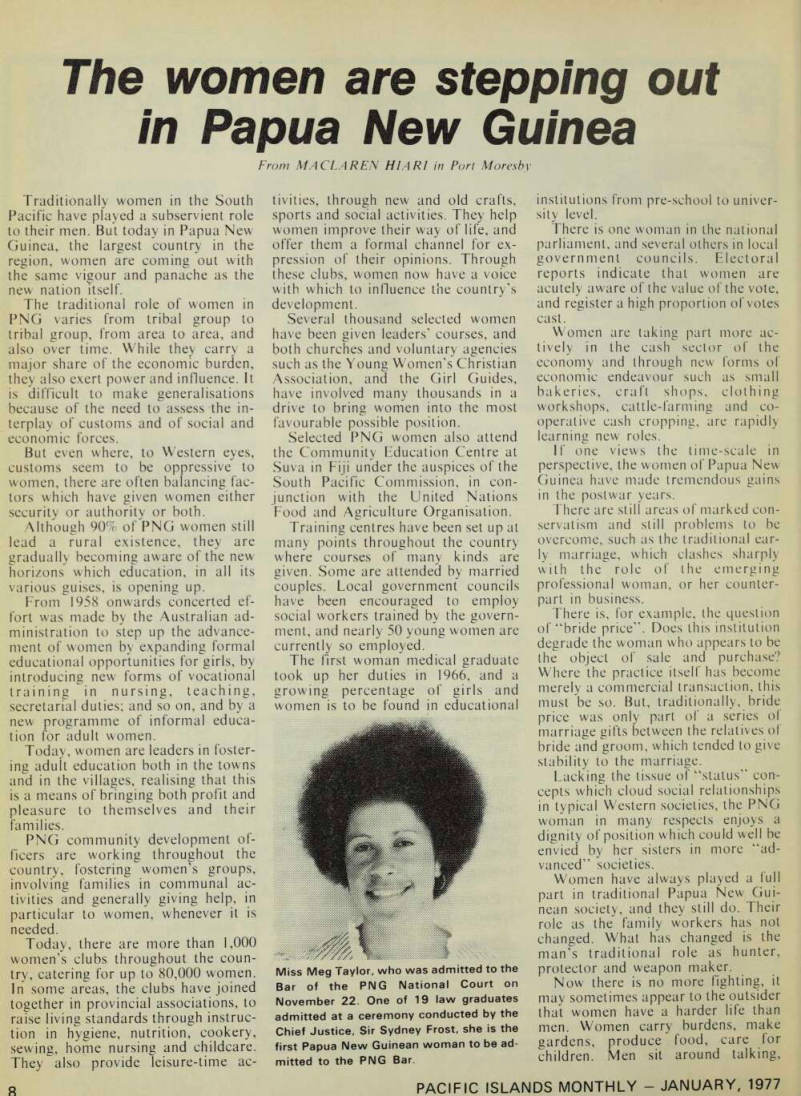
Miss Meg Taylor, who was admitted to the Bar of the PNG National Court on November 22. One of 19 law graduates admitted at a ceremony conducted by the Chief Justice, Sir Sydney Frost, she is the first Papua New Guinean woman to be ad mitted to the PNG Bar.
share in cash-cropping or leave the village to look for work.
It is an interim stage. Men’s “emancipation” into education and sophisticated skills goes fast women’s lags.
They, generally, may own and in herit property. They vote and pay tax es. They sit on local government councils. Miss Josephine Abaijah, the fiery Papuan who remains the coun try’s only woman MP, will certainly be joined by others.
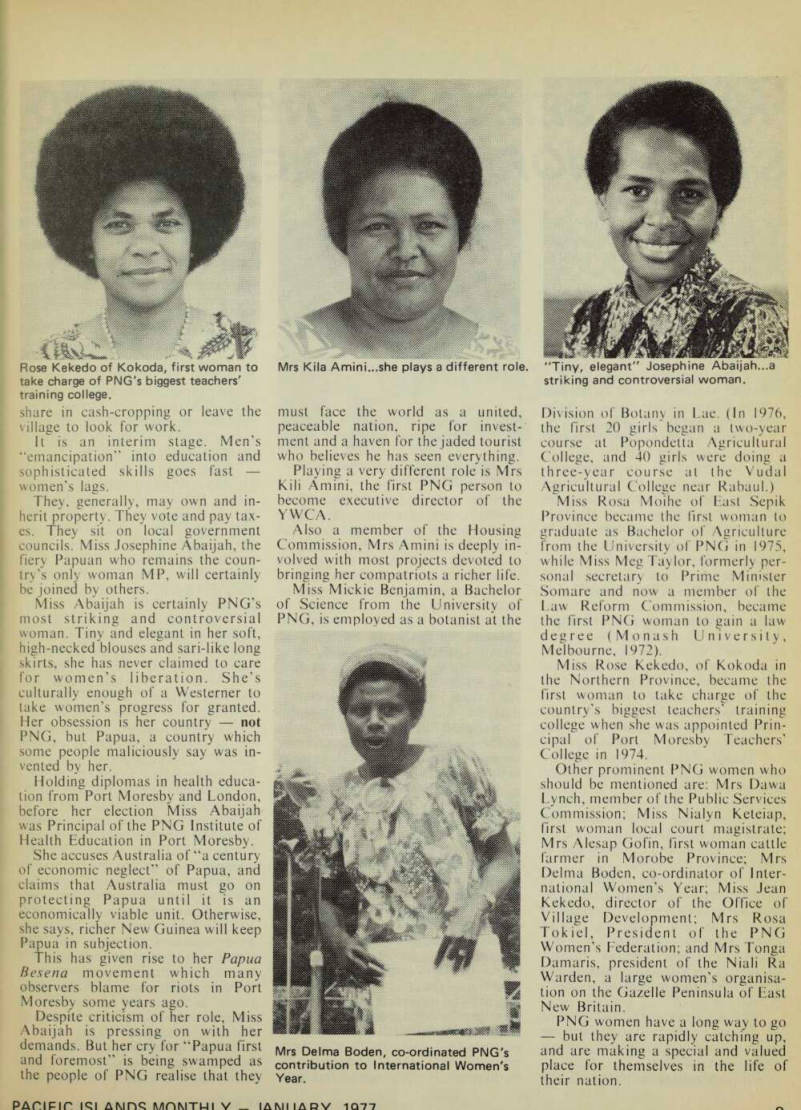
Miss Abaijah is certainly PNG’s most striking and controversial woman. Tiny and elegant in her soft, high-necked blouses and sari-like long skirts, she has never claimed to care for women’s liberation. She’s culturally enough of a Westerner to take women’s progress for granted.
Her obsession is her country not PNG, but Papua, a country which some people maliciously say was in vented by her.
Holding diplomas in health educa tion from Port Moresby and London, before her election Miss Abaijah was Principal of the PNG Institute of Health Education in Port Moresby.
She accuses Australia of “a century of economic neglect” of Papua, and claims that Australia must go on protecting Papua until it is an economically viable unit. Otherwise, she says, richer New Guinea will keep Papua in subjection.
This has given rise to her Papua Besena movement which many observers blame for riots in Port Moresby some years ago.
Despite criticism of her role, Miss Abaijah is pressing on with her demands. But her cry for “Papua first and foremost” is being swamped as the people of PNG realise that they
must face the world as a united, peaceable nation, ripe for invest ment and a haven for the jaded tourist who believes he has seen everything.
Playing a very different role is Mrs Kili Amini, the first PNG person to become executive director of the
Ywca.
Also a member of the Housing Commission, Mrs Amini is deeply in volved with most projects devoted to bringing her compatriots a richer life.
Miss Mickie Benjamin, a Bachelor of Science from the University of PNG, is employed as a botanist at the
Division of Botany in Lae. (In 1976, the first 20 girls began a two-year course at Popondella Agricultural College, and 40 girls were doing a three-year course at the Vudal Agricultural College near Rabaul.) Miss Rosa Moihe of East Sepik Province became the first woman to graduate as Bachelor of Agriculture from the University of PNG in 1975, while Miss Meg Taylor, formerly per sonal secretary to Prime Minister Somare and now a member of the Law Reform Commission, became the first PNG woman to gain a law degree (Monash University, Melbourne, 1972).
Miss Rose Kekedo, of Kokoda in the Northern Province, became the first woman to lake charge of the country’s biggest teachers’ training college when she was appointed Prin cipal of Port Moresby Teachers’
College in 1974.
Other prominent PNG women who should be mentioned are; Mrs Dawa Lynch, member of the Public Services Commission; Miss Nialyn Keteiap, first woman local court magistrate; Mrs Alesap Gofin, first woman cattle farmer in Morobe Province; Mrs Delma Boden, co-ordinator of Inter national Women’s Year; Miss Jean Kekedo, director of the Office of Village Development; Mrs Rosa Tokiel, President of the PNG Women’s Federation; and Mrs Tonga Damaris, president of the Niali Ra Warden, a large women’s organisa tion on the Gazelle Peninsula of East New Britain.
PNG women have a long way to go but they are rapidly catching up, and are making a special and valued place for themselves in the life of their nation.
Rose Kekedo of Kokoda, first woman to take charge of PNG's biggest teachers' training college.
Mrs Kila Amini...she plays a different role.
Mrs Delma Boden, co-ordinated PNG's contribution to International Women's Year.
"Tiny, elegant" Josephine Abaijah...a striking and controversial woman.